Cambridge A Level Chemistry 9701 — 2010 May/June Paper 1 · Variant 1
9701/11/M/J/10 · 40 questions · 40 marks · ≈45 min
The question paper and its mark scheme, free to read here and free to download. This is Cambridge’s own paper, exactly as it was sat.
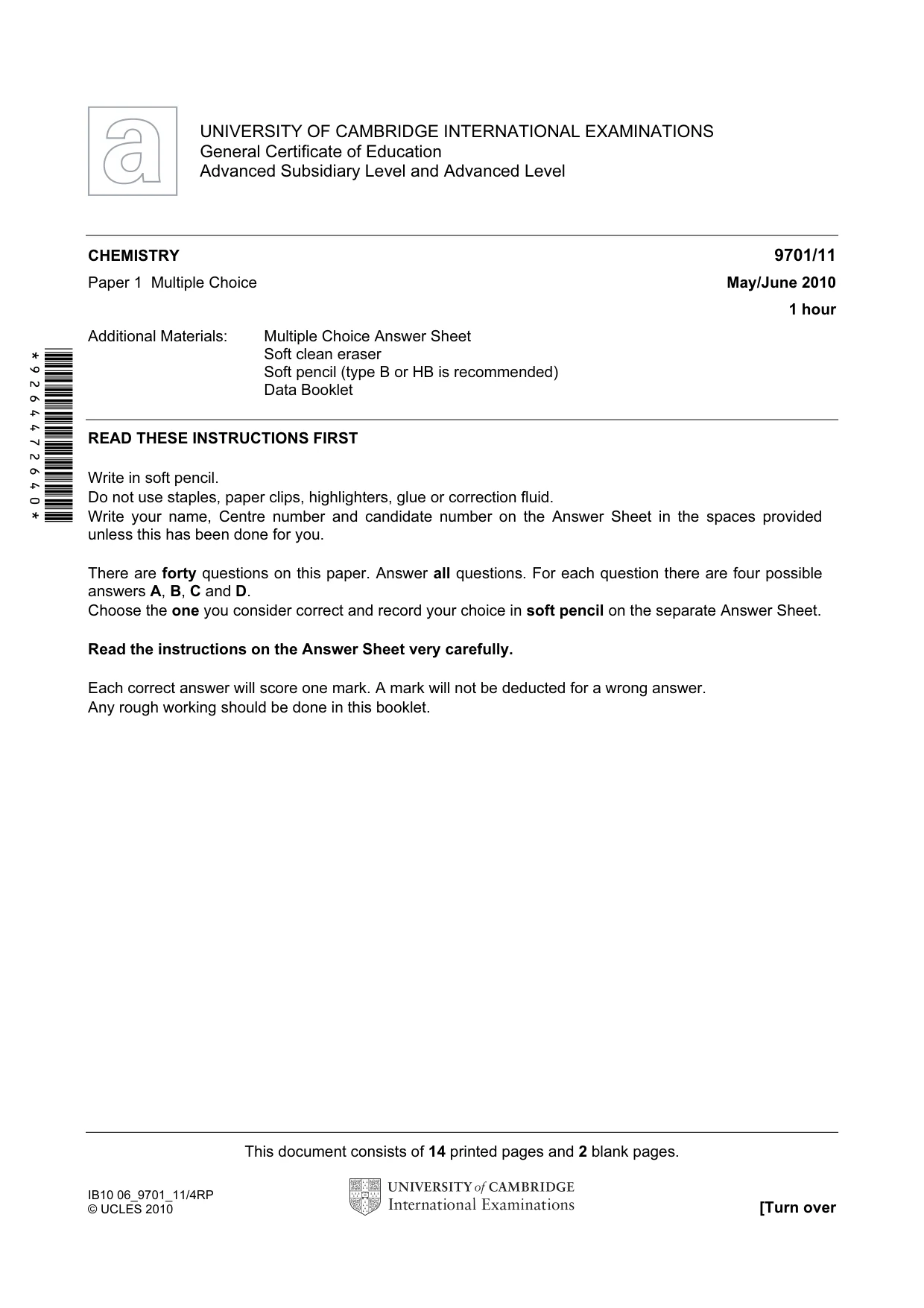
Question paper16 pages


Mark scheme2 pages
Answers below. Sit the paper first if you are practising.
Questions as text
Q1 · Use of the Data Booklet is relevant to this question
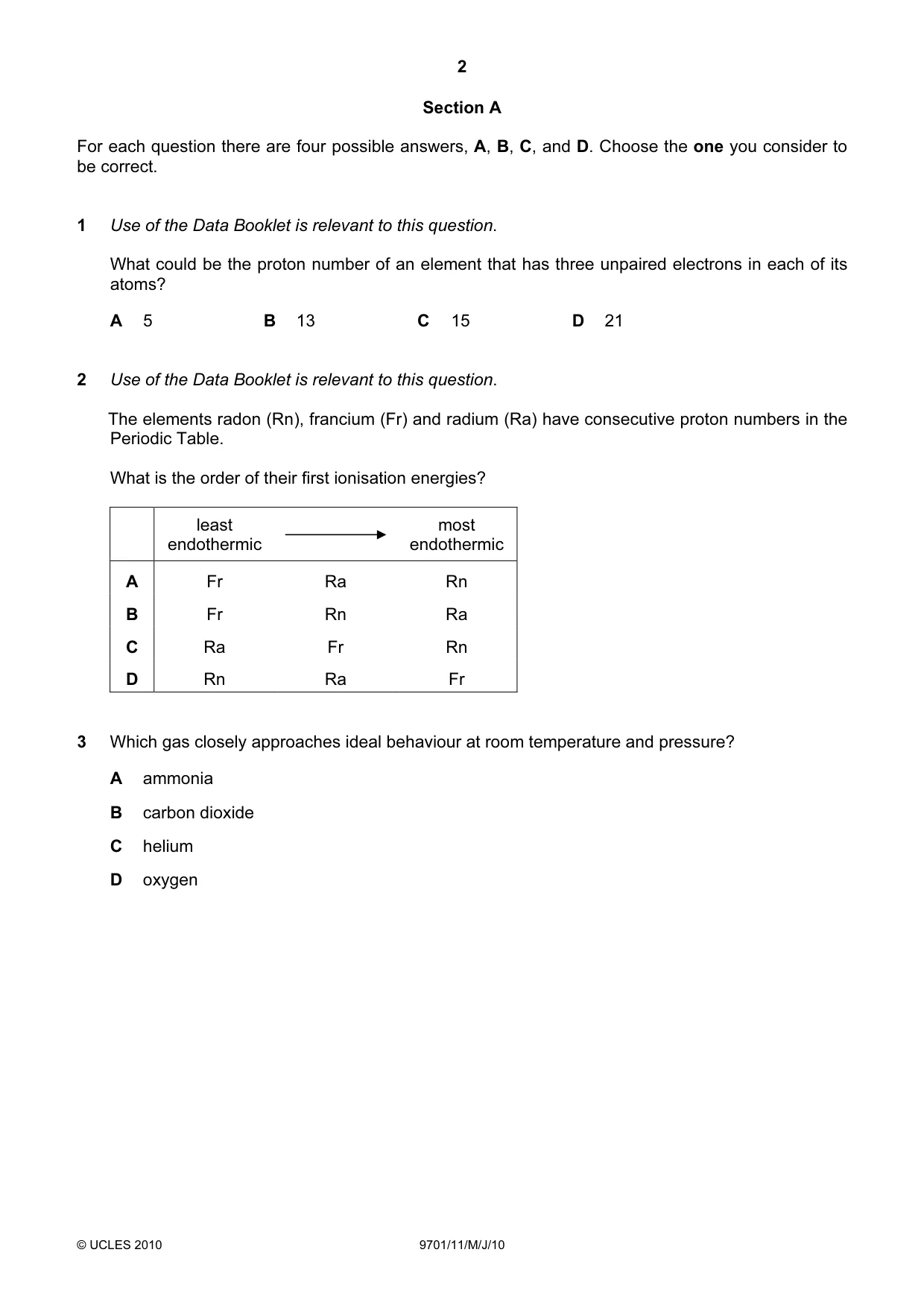
1 Use of the Data Booklet is relevant to this question. What could be the proton number of an element that has three unpaired electrons in each of its atoms? A 5 B 13 C 15 D 21
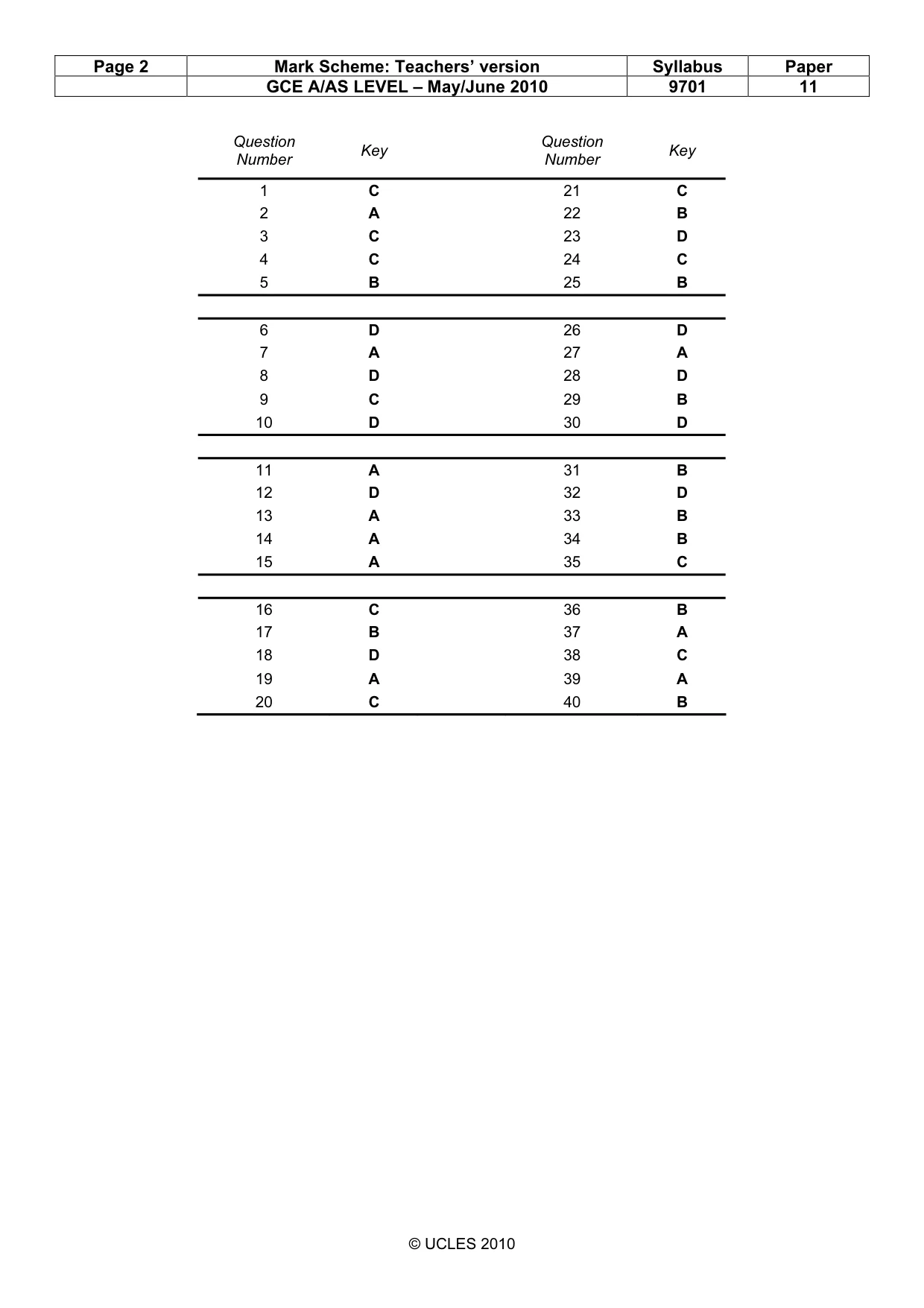
Mark scheme: C
More questions on Electrons, energy levels and atomic orbitals
Q2 · Use of the Data Booklet is relevant to this question
2 Use of the Data Booklet is relevant to this question. The elements radon (Rn), francium (Fr) and radium (Ra) have consecutive proton numbers in the Periodic Table. What is the order of their first ionisation energies? least most endothermic endothermic A Fr Ra Rn B Fr Rn Ra C Ra Fr Rn D Rn Ra Fr
Mark scheme: A
Q3 · Which gas closely approaches ideal behaviour at room temperature and pressure?
3 Which gas closely approaches ideal behaviour at room temperature and pressure? A ammonia B carbon dioxide C helium D oxygen
Mark scheme: C
More questions on The gaseous state: ideal and real gases and pV = nRT
Q4 · Some bond energy values are listed below
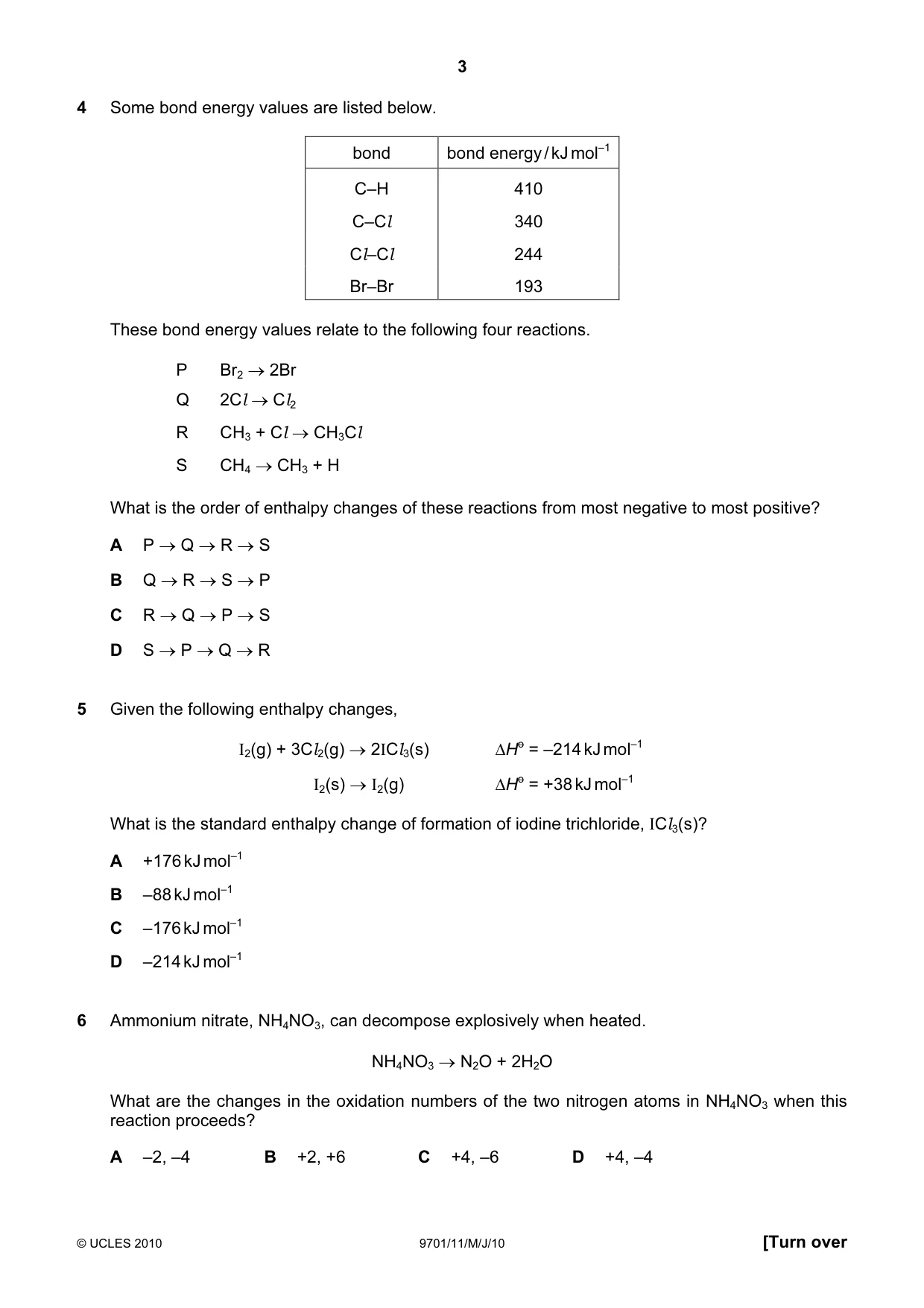
4 Some bond energy values are listed below. bond bond energy / kJ mol–1 C–H 410 C–Cl 340 Cl–Cl 244 Br–Br 193 These bond energy values relate to the following four reactions. P Br2 → 2Br Q 2Cl → Cl2 R CH3 + Cl → CH3Cl S CH4 → CH3 + H What is the order of enthalpy changes of these reactions from most negative to most positive? A P → Q → R → S B Q → R → S → P C R → Q → P → S D S → P → Q → R
Mark scheme: C
Q5 · Given the following enthalpy changes, I2(g) + 3Cl2(g) → 2ICl3(s) ∆Ho = –214 kJ mol–1…
5 Given the following enthalpy changes, I2(g) + 3Cl2(g) → 2ICl3(s) ∆Ho = –214 kJ mol–1 I2(s) → I2(g) ∆Ho = +38 kJ mol–1 What is the standard enthalpy change of formation of iodine trichloride, ICl3(s)? A +176 kJ mol–1 B –88 kJ mol–1 C –176 kJ mol–1 D –214 kJ mol–1
Mark scheme: B
Q6 · Ammonium nitrate, NH4NO3, can decompose explosively when heated
6 Ammonium nitrate, NH4NO3, can decompose explosively when heated. NH4NO3 → N2O + 2H2O What are the changes in the oxidation numbers of the two nitrogen atoms in NH4NO3 when this reaction proceeds? A –2, –4 B +2, +6 C +4, –6 D +4, –4
Mark scheme: D
Q7 · The Haber process for the manufacture of ammonia is represented by the following equation
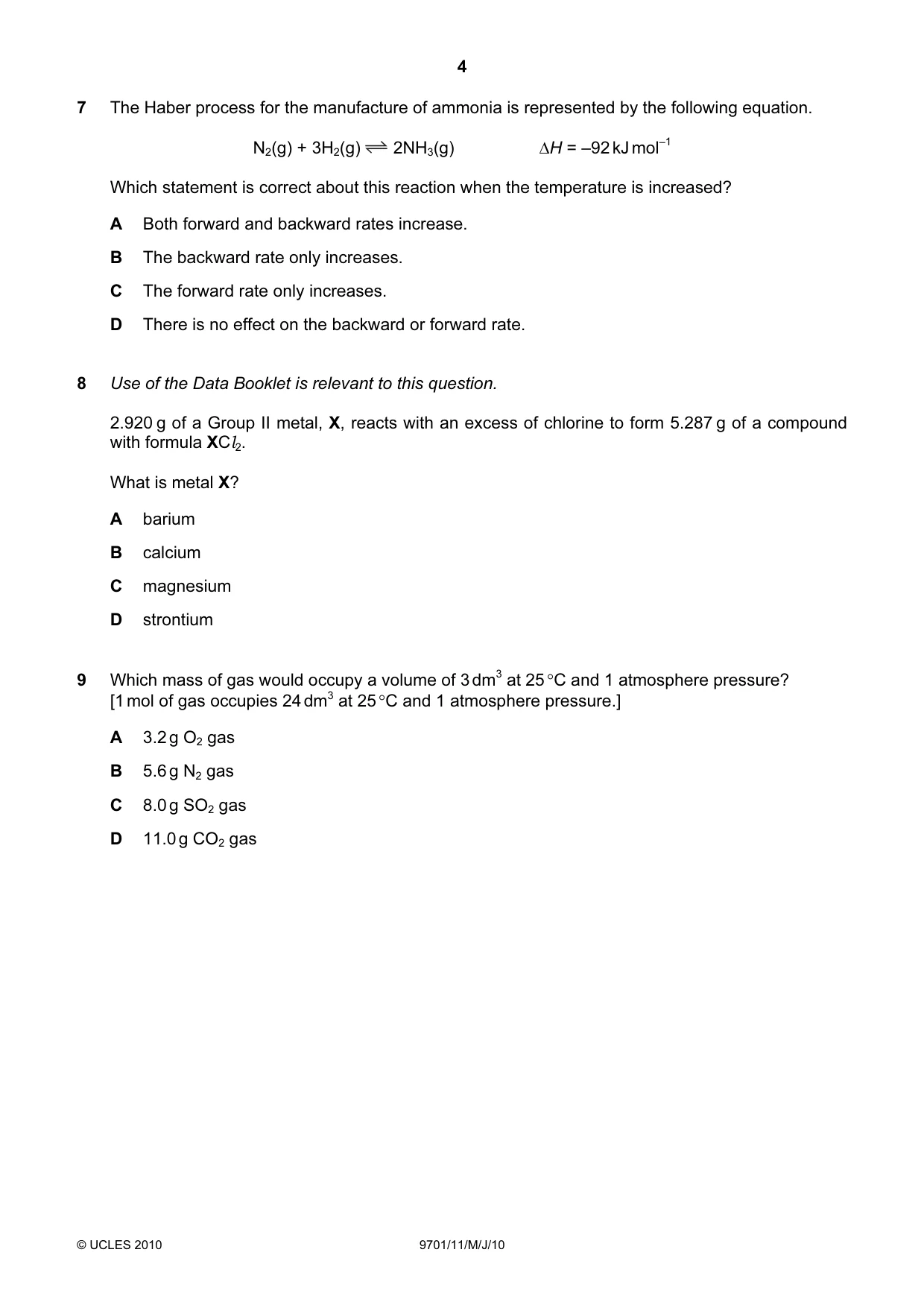
7 The Haber process for the manufacture of ammonia is represented by the following equation. N2(g) + 3H2(g) 2NH3(g) ∆H = –92 kJ mol–1 Which statement is correct about this reaction when the temperature is increased? A Both forward and backward rates increase. B The backward rate only increases. C The forward rate only increases. D There is no effect on the backward or forward rate.
Mark scheme: A
Q8 · Use of the Data Booklet is relevant to this question
8 Use of the Data Booklet is relevant to this question. 2.920 g of a Group II metal, X, reacts with an excess of chlorine to form 5.287 g of a compound with formula XCl2. What is metal X? A barium B calcium C magnesium D strontium
Mark scheme: D
Q9 · Which mass of gas would occupy a volume of 3 dm3 at 25 °C and 1 atmosphere pressure?
9 Which mass of gas would occupy a volume of 3 dm3 at 25 °C and 1 atmosphere pressure? [1 mol of gas occupies 24 dm3 at 25 °C and 1 atmosphere pressure.] A 3.2 g O2 gas B 5.6 g N2 gas C 8.0 g SO2 gas D 11.0 g CO2 gas
Mark scheme: C
More questions on The gaseous state: ideal and real gases and pV = nRT
Q10 · The table gives the concentrations and pH values of the aqueous solutions of two…
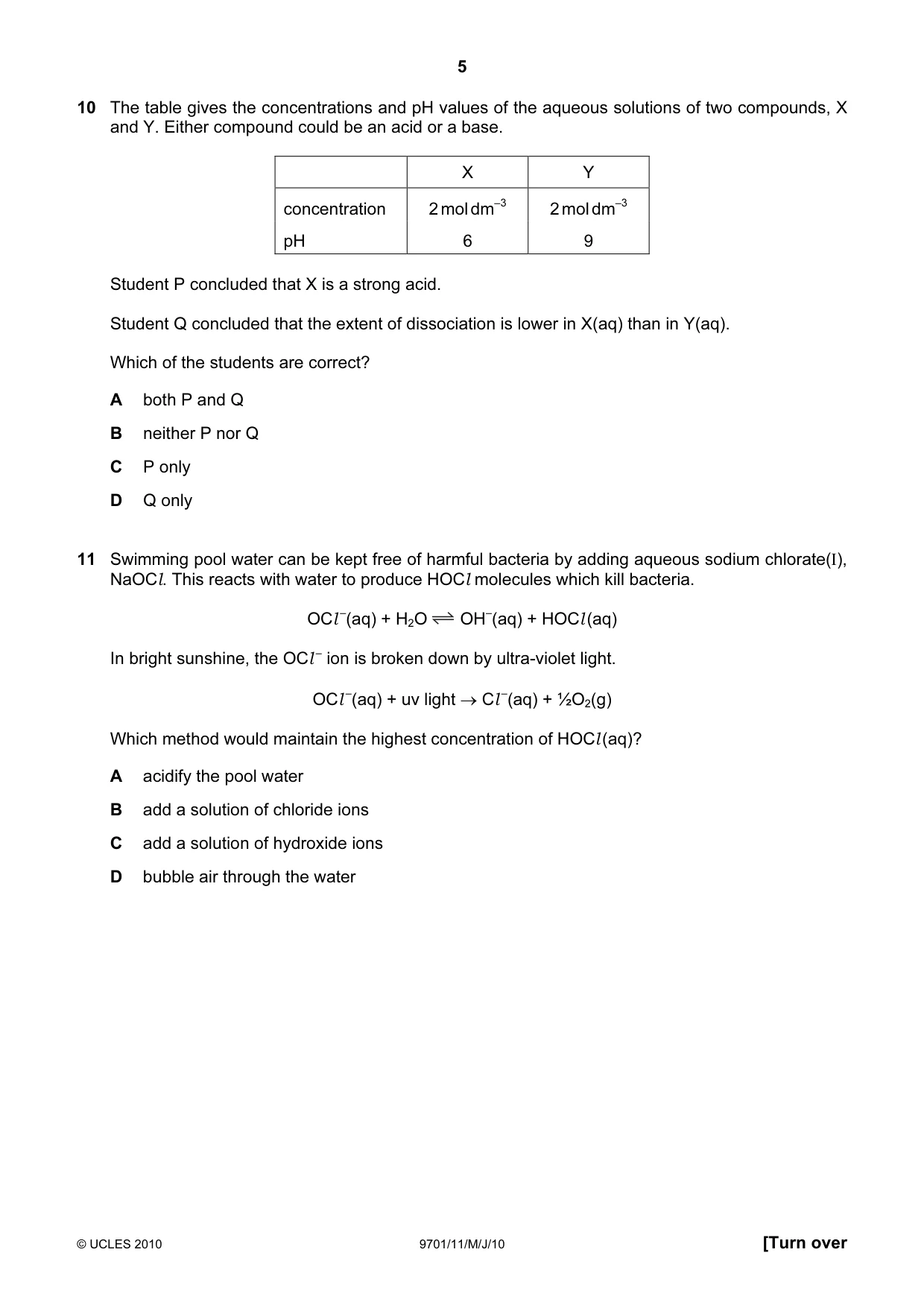
10 The table gives the concentrations and pH values of the aqueous solutions of two compounds, X and Y. Either compound could be an acid or a base. X Y concentration 2 mol dm–3 2 mol dm–3 pH 6 9 Student P concluded that X is a strong acid. Student Q concluded that the extent of dissociation is lower in X(aq) than in Y(aq). Which of the students are correct? A both P and Q B neither P nor Q C P only D Q only
Mark scheme: D
Q11 · Swimming pool water can be kept free of harmful bacteria by adding aqueous sodium…
11 Swimming pool water can be kept free of harmful bacteria by adding aqueous sodium chlorate(I), NaOCl. This reacts with water to produce HOCl molecules which kill bacteria. OCl –(aq) + H2O OH–(aq) + HOCl (aq) In bright sunshine, the OCl – ion is broken down by ultra-violet light. OCl –(aq) + uv light → Cl –(aq) + ½O2(g) Which method would maintain the highest concentration of HOCl (aq)? A acidify the pool water B add a solution of chloride ions C add a solution of hydroxide ions D bubble air through the water
Mark scheme: A
More questions on Chemical equilibria: reversible reactions, dynamic equilibrium
Q12 · Na2S2O3 reacts with dilute HCl to give a pale yellow precipitate
12 Na2S2O3 reacts with dilute HCl to give a pale yellow precipitate. If 1 cm3 of 0.1 mol dm–3 HCl is added to 10 cm3 of 0.02 mol dm–3 Na2S2O3 the precipitate forms slowly. If the experiment is repeated with 1 cm3 of 0.1 mol dm–3 HCl and 10 cm3 of 0.05 mol dm–3 Na2S2O3 the precipitate forms more quickly. Why is this? A The activation energy of the reaction is lower when 0.05 mol dm–3 Na2S2O3 is used. B The reaction proceeds by a different pathway when 0.05 mol dm–3 Na2S2O3 is used. C The collisions between reactant particles are more violent when 0.05 mol dm–3 Na2S2O3 is used. D The reactant particles collide more frequently when 0.05 mol dm–3 Na2S2O3 is used.
Mark scheme: D
Q13 · How does concentrated sulfuric acid behave when it reacts with sodium chloride?
13 How does concentrated sulfuric acid behave when it reacts with sodium chloride? A as an acid only B as an acid and oxidising agent C as an oxidising agent only D as a reducing agent only
Mark scheme: A
More questions on The chemical properties of the halogen elements and the hydrogen halides
Q14 · X is a salt of one of the halogens chlorine, bromine, iodine, or astatine (proton number…
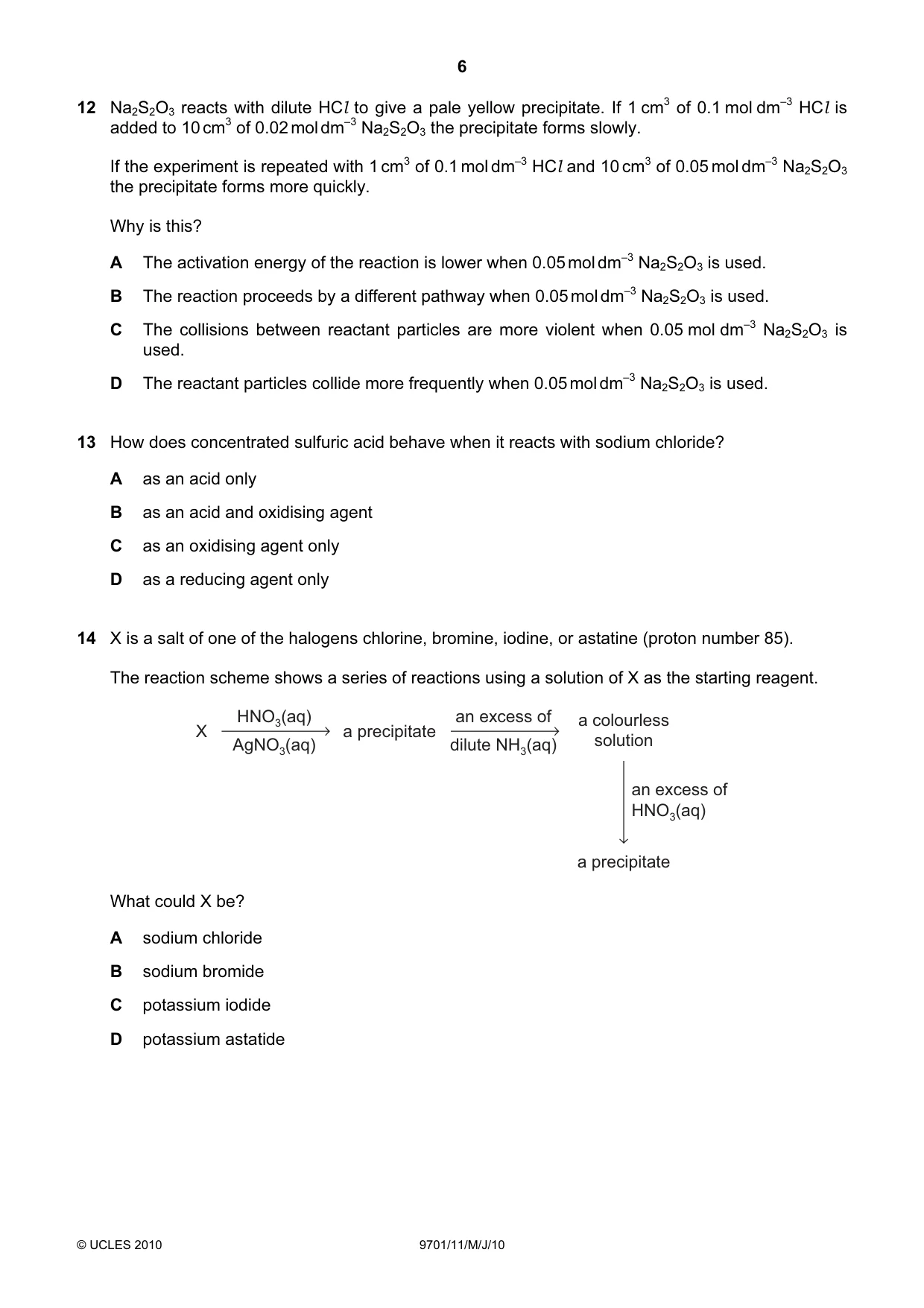
14 X is a salt of one of the halogens chlorine, bromine, iodine, or astatine (proton number 85). The reaction scheme shows a series of reactions using a solution of X as the starting reagent. HNO3(aq) an excess of a colourless X a precipitate AgNO3(aq) dilute NH3(aq) solution an excess of HNO3(aq) a precipitate What could X be? A sodium chloride B sodium bromide C potassium iodide D potassium astatide
Mark scheme: A
Q15 · The percentage of ammonia obtainable, if equilibrium were established during the Haber…
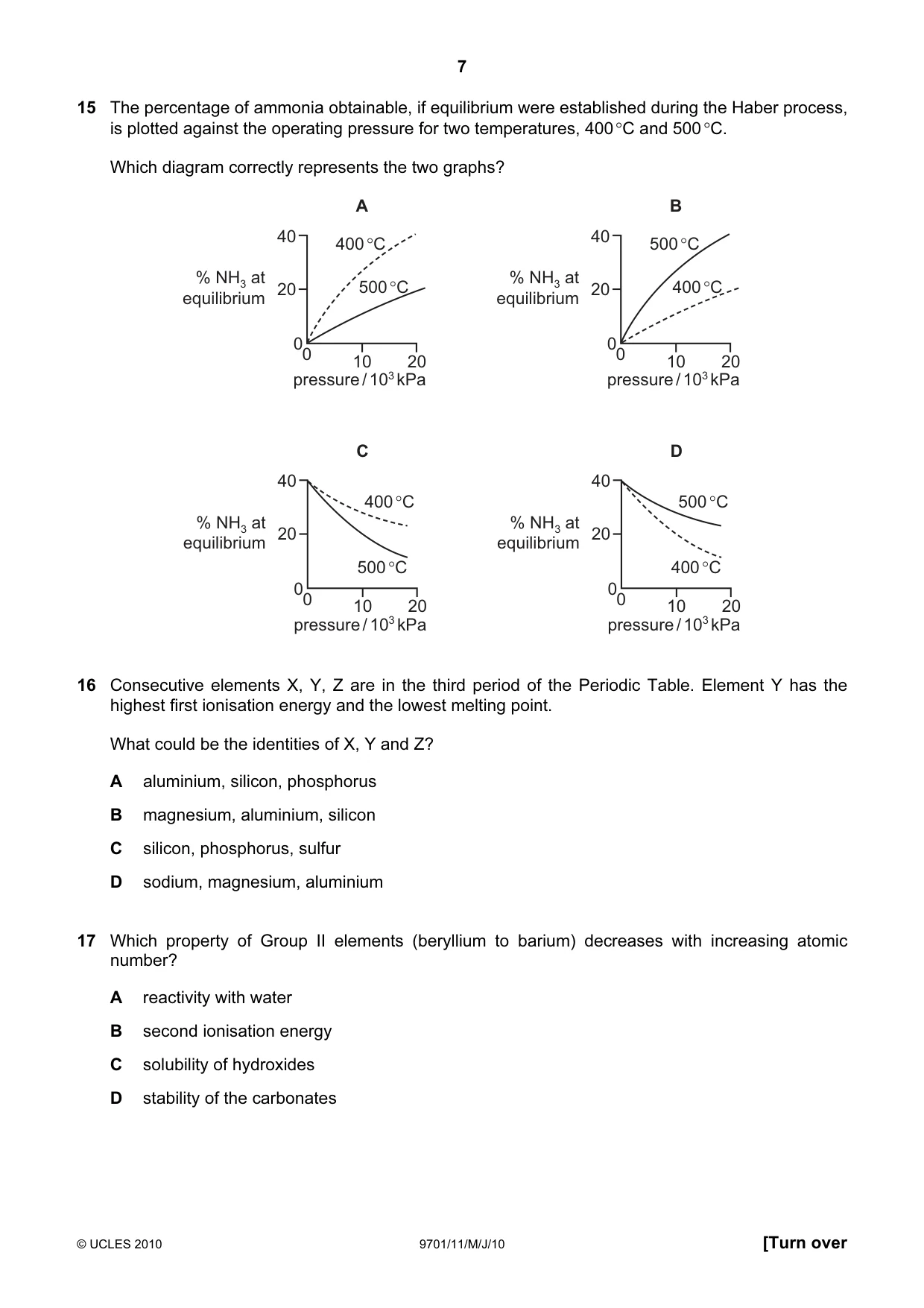
15 The percentage of ammonia obtainable, if equilibrium were established during the Haber process, is plotted against the operating pressure for two temperatures, 400 °C and 500 °C. Which diagram correctly represents the two graphs? A B 40 400 °C 40 500 °C % NH3 at % NH3 at 20 500 °C 20 400 °C equilibrium equilibrium 0 0 0 0 10 20 10 20 pressure / 103 kPa pressure / 103 kPa C D 40 40 400 °C 500 °C % NH3 at % NH3 at 20 20 equilibrium equilibrium 500 °C 400 °C 0 0 0 0 10 20 10 20 pressure / 103 kPa pressure / 103 kPa
Mark scheme: A
More questions on Chemical equilibria: reversible reactions, dynamic equilibrium
Q16 · Consecutive elements X, Y, Z are in the third period of the Periodic Table
16 Consecutive elements X, Y, Z are in the third period of the Periodic Table. Element Y has the highest first ionisation energy and the lowest melting point. What could be the identities of X, Y and Z? A aluminium, silicon, phosphorus B magnesium, aluminium, silicon C silicon, phosphorus, sulfur D sodium, magnesium, aluminium
Mark scheme: C
More questions on Periodicity of physical properties of the elements in Period 3
Q17 · Which property of Group II elements (beryllium to barium) decreases with increasing…
17 Which property of Group II elements (beryllium to barium) decreases with increasing atomic number? A reactivity with water B second ionisation energy C solubility of hydroxides D stability of the carbonates
Mark scheme: B
Q18 · Which element of the third period requires the least number of moles of oxygen for the…
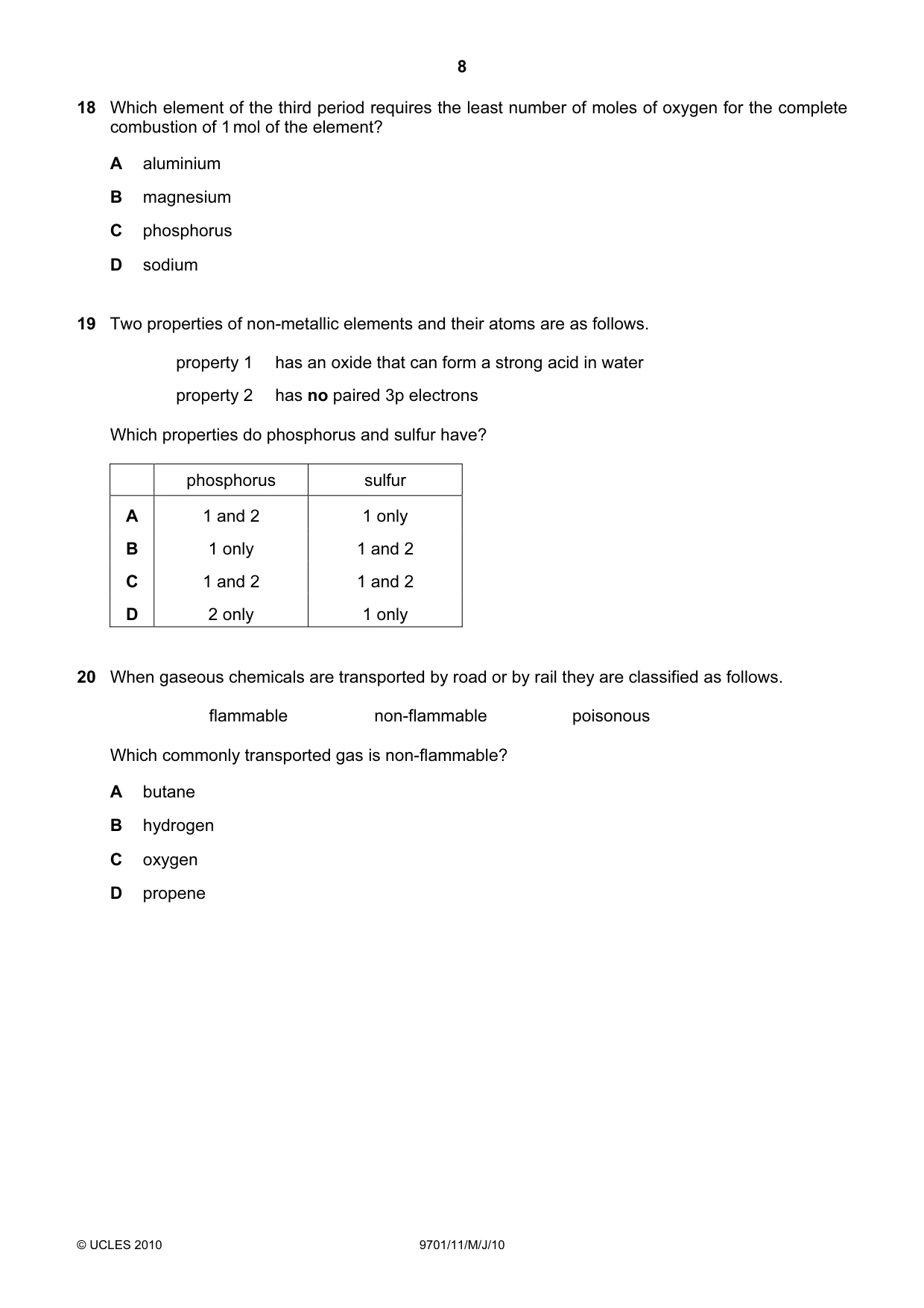
18 Which element of the third period requires the least number of moles of oxygen for the complete combustion of 1 mol of the element? A aluminium B magnesium C phosphorus D sodium
Mark scheme: D
More questions on Periodicity of chemical properties of the elements in Period 3
Q19 · Two properties of non-metallic elements and their atoms are as follows
19 Two properties of non-metallic elements and their atoms are as follows. property 1 has an oxide that can form a strong acid in water property 2 has no paired 3p electrons Which properties do phosphorus and sulfur have? phosphorus sulfur A 1 and 2 1 only B 1 only 1 and 2 C 1 and 2 1 and 2 D 2 only 1 only
Mark scheme: A
More questions on Periodicity of chemical properties of the elements in Period 3
Q20 · When gaseous chemicals are transported by road or by rail they are classified as follows
20 When gaseous chemicals are transported by road or by rail they are classified as follows. flammable non-flammable poisonous Which commonly transported gas is non-flammable? A butane B hydrogen C oxygen D propene
Mark scheme: C
Q21 · When heated with chlorine, the hydrocarbon 2,2-dimethylbutane undergoes free radical…
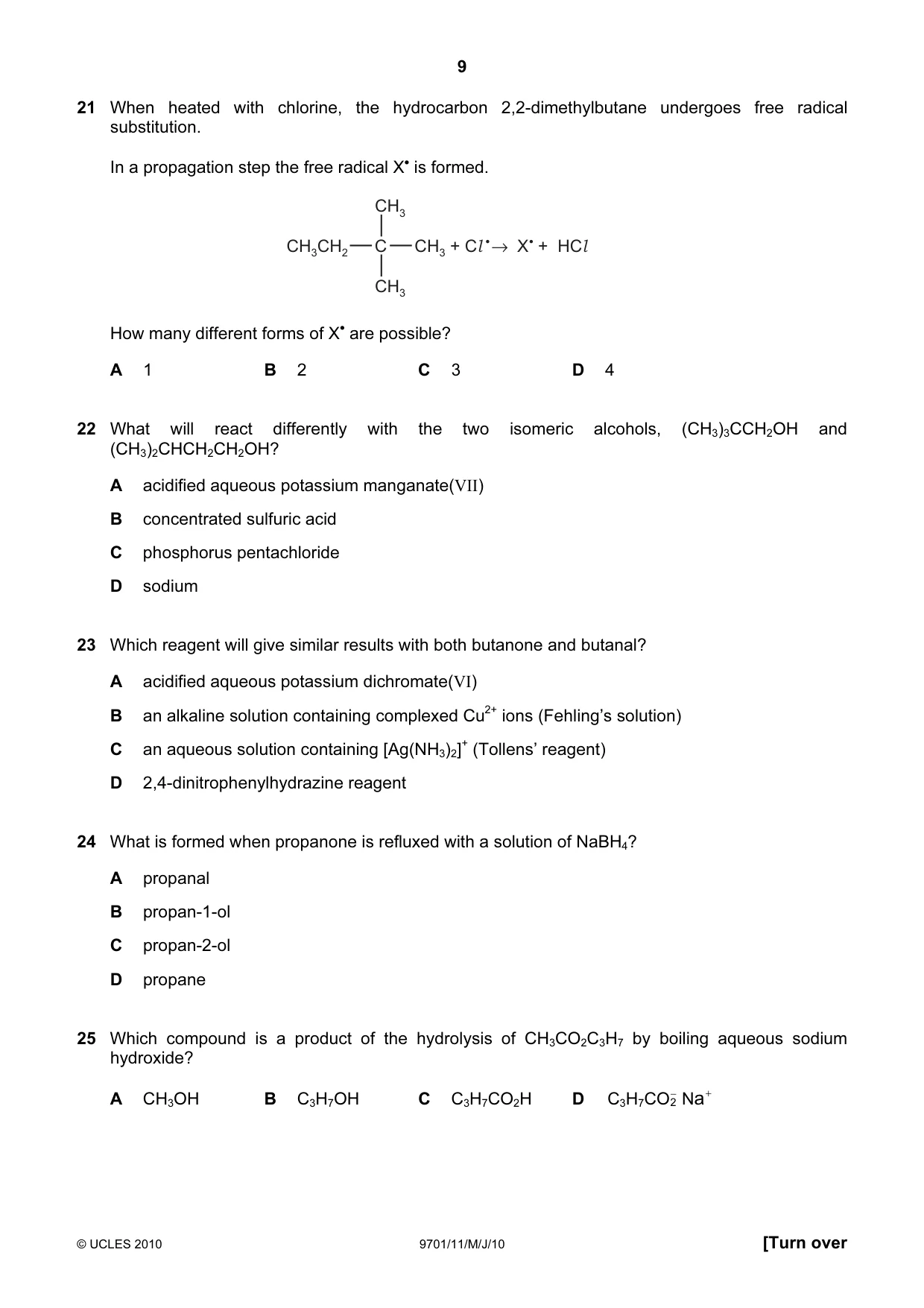
21 When heated with chlorine, the hydrocarbon 2,2-dimethylbutane undergoes free radical substitution. In a propagation step the free radical X• is formed. CH3 CH3CH2 C CH3 + Cl → X + HCl ● ● CH3 How many different forms of X• are possible? A 1 B 2 C 3 D 4
Mark scheme: C
Q22 · What will react differently with the two isomeric alcohols, (CH3)3CCH2OH and…
22 What will react differently with the two isomeric alcohols, (CH3)3CCH2OH and (CH3)2CHCH2CH2OH? A acidified aqueous potassium manganate(VII) B concentrated sulfuric acid C phosphorus pentachloride D sodium
Mark scheme: B
Q23 · Which reagent will give similar results with both butanone and butanal?
23 Which reagent will give similar results with both butanone and butanal? A acidified aqueous potassium dichromate(VI) B an alkaline solution containing complexed Cu2+ ions (Fehling’s solution) C an aqueous solution containing [Ag(NH3)2]+ (Tollens’ reagent) D 2,4-dinitrophenylhydrazine reagent
Mark scheme: D
Q24 · What is formed when propanone is refluxed with a solution of NaBH4?
24 What is formed when propanone is refluxed with a solution of NaBH4? A propanal B propan-1-ol C propan-2-ol D propane
Mark scheme: C
Q25 · Which compound is a product of the hydrolysis of CH3CO2C3H7 by boiling aqueous sodium…
25 Which compound is a product of the hydrolysis of CH3CO2C3H7 by boiling aqueous sodium hydroxide? A CH3OH B C3H7OH C C3H7CO2H D C H CO − N a + 3 7 2
Mark scheme: B
Q26 · In many countries plastic waste is collected separately and sorted
26 In many countries plastic waste is collected separately and sorted. Some of this is incinerated to provide heat for power stations. Why is pvc, polyvinylchloride, removed from any waste that is to be incinerated? A It destroys the ozone layer. B It does not burn easily. C It is easily biodegradable. D Its combustion products are harmful.
Mark scheme: D
Q27 · Polymerisation of 1,1-dichloroethene produces a dense, high melting point substance that…
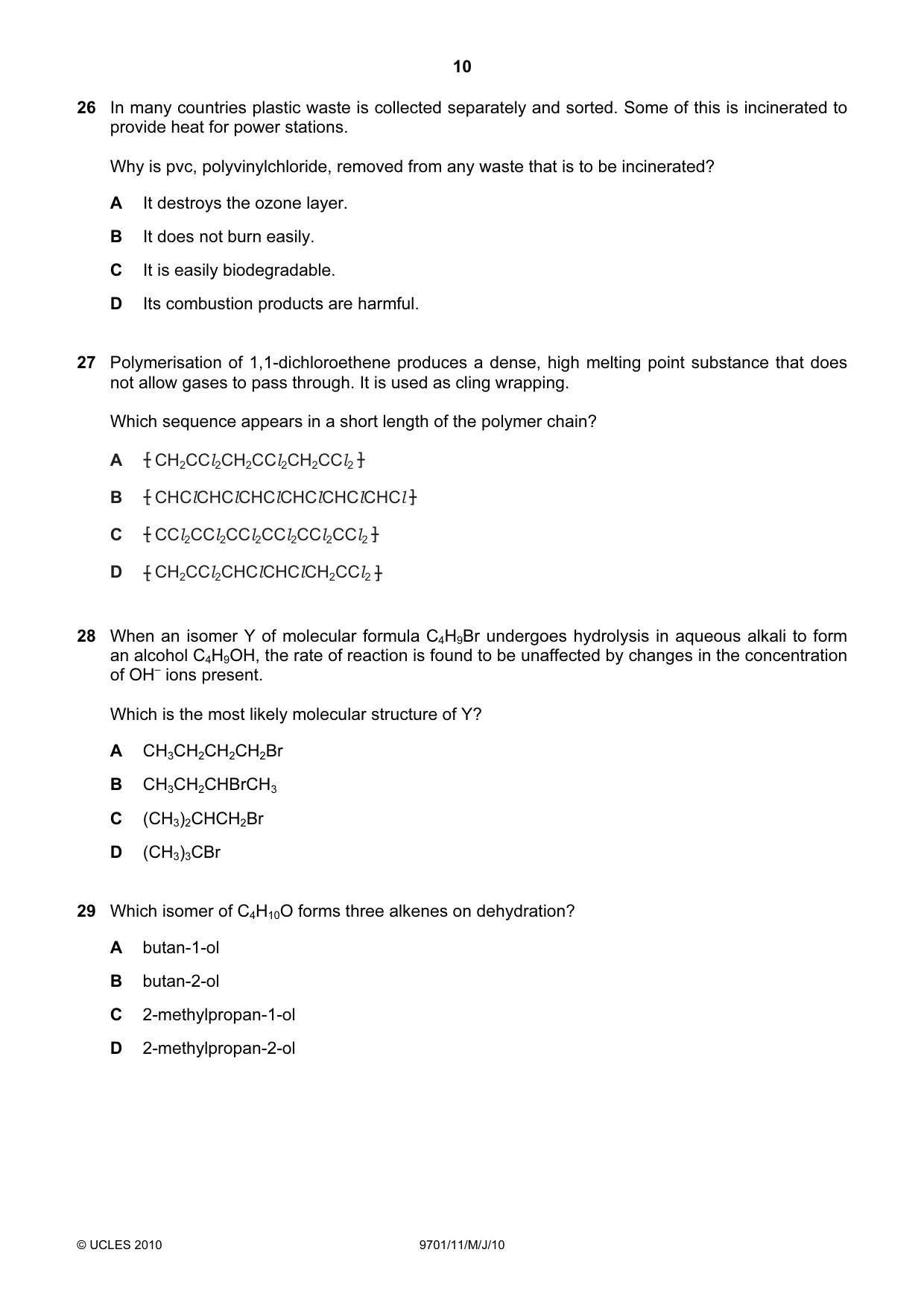
27 Polymerisation of 1,1-dichloroethene produces a dense, high melting point substance that does not allow gases to pass through. It is used as cling wrapping. Which sequence appears in a short length of the polymer chain? A [ CH2CCl2CH2CCl2CH2CCl2 ] B [ CHClCHClCHClCHClCHClCHCl ] C [ CCl2CCl2CCl2CCl2CCl2CCl2 ] D [ CH2CCl2CHClCHClCH2CCl2 ]
Mark scheme: A
Q28 · When an isomer Y of molecular formula C4H9Br undergoes hydrolysis in aqueous alkali to…
28 When an isomer Y of molecular formula C4H9Br undergoes hydrolysis in aqueous alkali to form an alcohol C4H9OH, the rate of reaction is found to be unaffected by changes in the concentration of OH– ions present. Which is the most likely molecular structure of Y? A CH3CH2CH2CH2Br B CH3CH2CHBrCH3 C (CH3)2CHCH2Br D (CH3)3CBr
Mark scheme: D
Q29 · Which isomer of C4H10O forms three alkenes on dehydration?
29 Which isomer of C4H10O forms three alkenes on dehydration? A butan-1-ol B butan-2-ol C 2-methylpropan-1-ol D 2-methylpropan-2-ol
Mark scheme: B
Q30 · Which compound exhibits both cis-trans and optical isomerism?
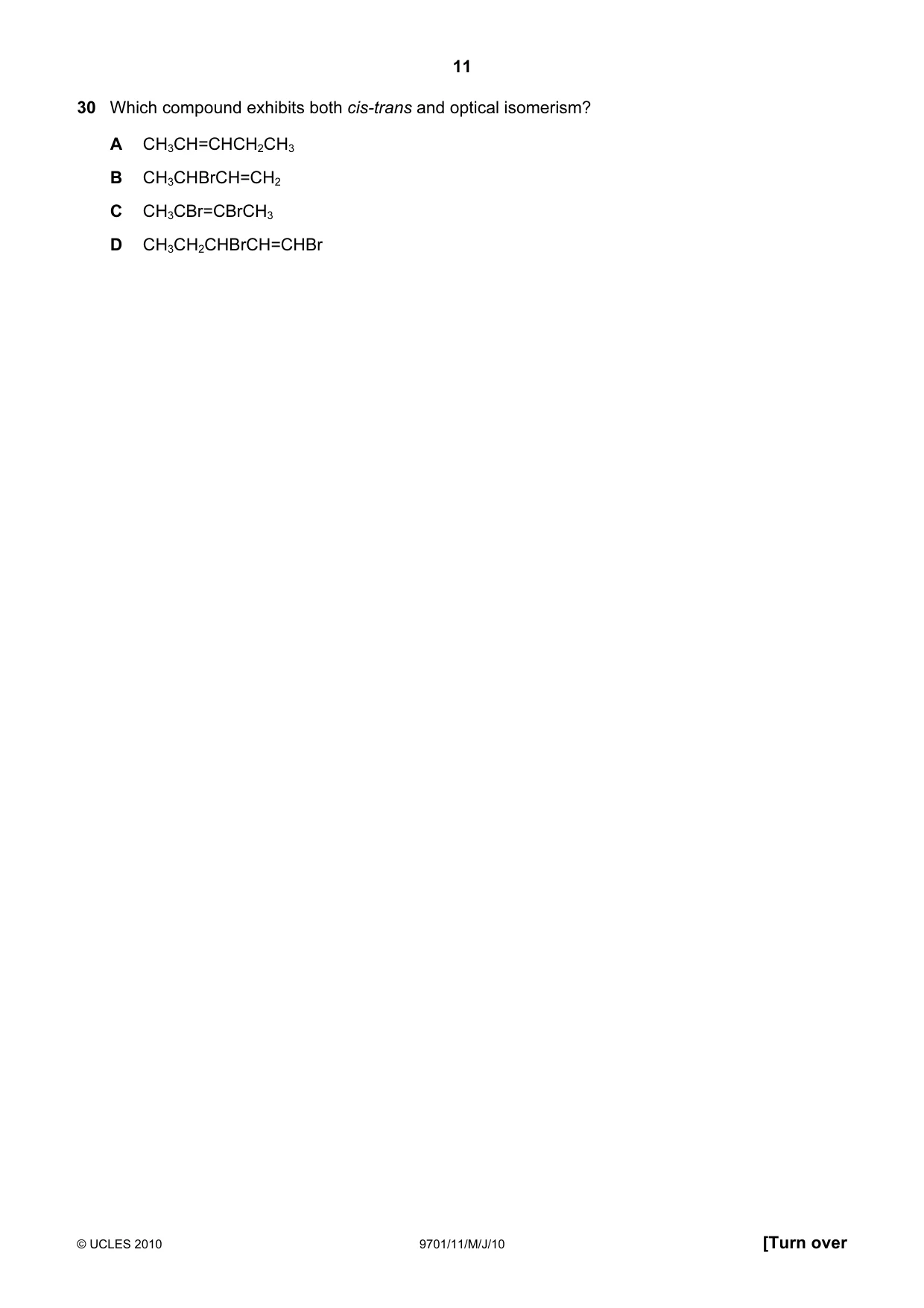
30 Which compound exhibits both cis-trans and optical isomerism? A CH3CH=CHCH2CH3 B CH3CHBrCH=CH2 C CH3CBr=CBrCH3 D CH3CH2CHBrCH=CHBr
Mark scheme: D
Q31 · Which diagrams represent part of a giant molecular structure?
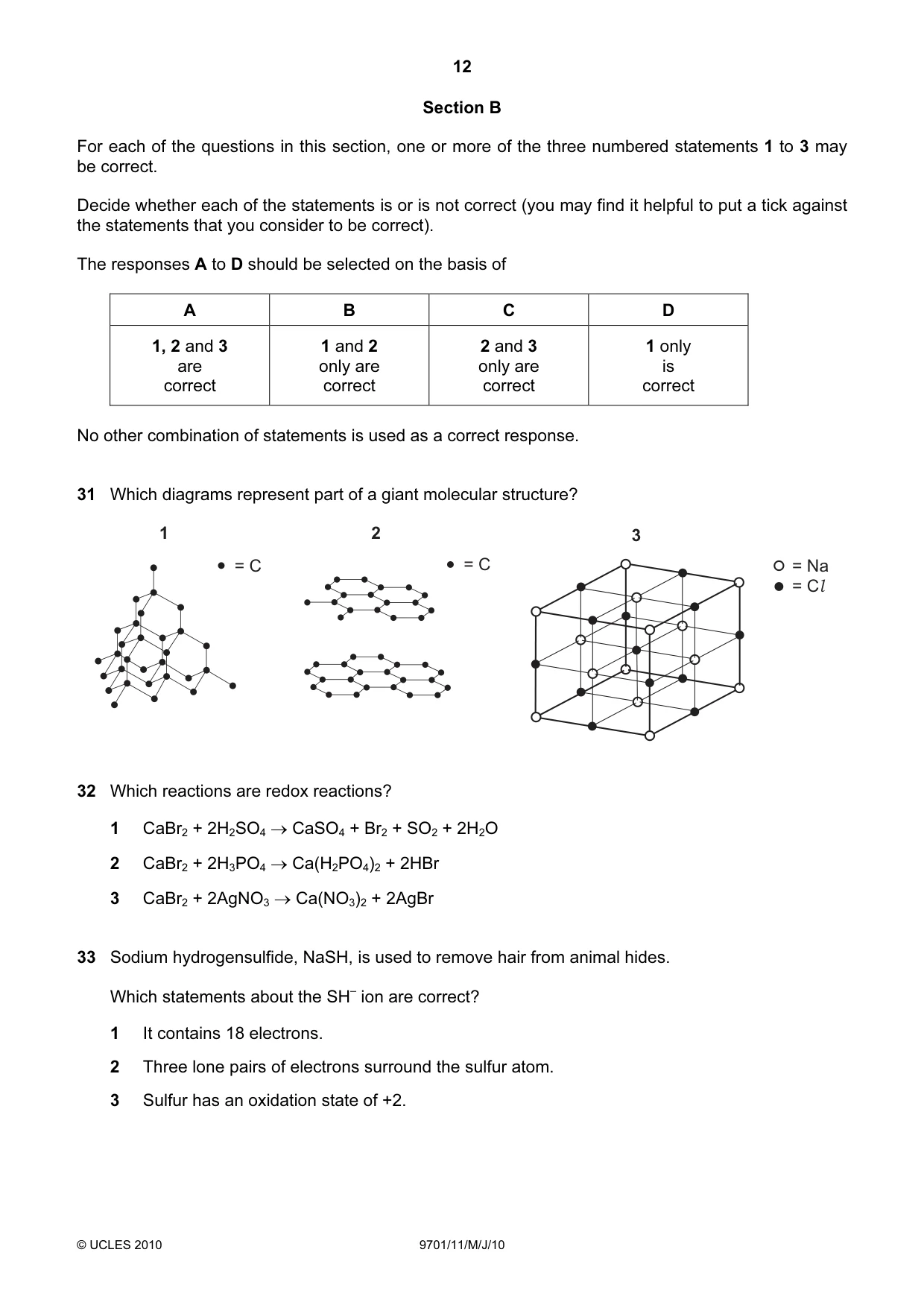
31 Which diagrams represent part of a giant molecular structure? 1 2 3 = C = C = Na = Cl
Mark scheme: B
Q32 · Which reactions are redox reactions?
32 Which reactions are redox reactions? 1 CaBr2 + 2H2SO4 → CaSO4 + Br2 + SO2 + 2H2O 2 CaBr2 + 2H3PO4 → Ca(H2PO4)2 + 2HBr 3 CaBr2 + 2AgNO3 → Ca(NO3)2 + 2AgBr
Mark scheme: D
Q33 · Sodium hydrogensulfide, NaSH, is used to remove hair from animal hides
33 Sodium hydrogensulfide, NaSH, is used to remove hair from animal hides. Which statements about the SH– ion are correct? 1 It contains 18 electrons. 2 Three lone pairs of electrons surround the sulfur atom. 3 Sulfur has an oxidation state of +2.
Mark scheme: B
Q34 · When organic refuse decomposes in water carboxylic acids are formed
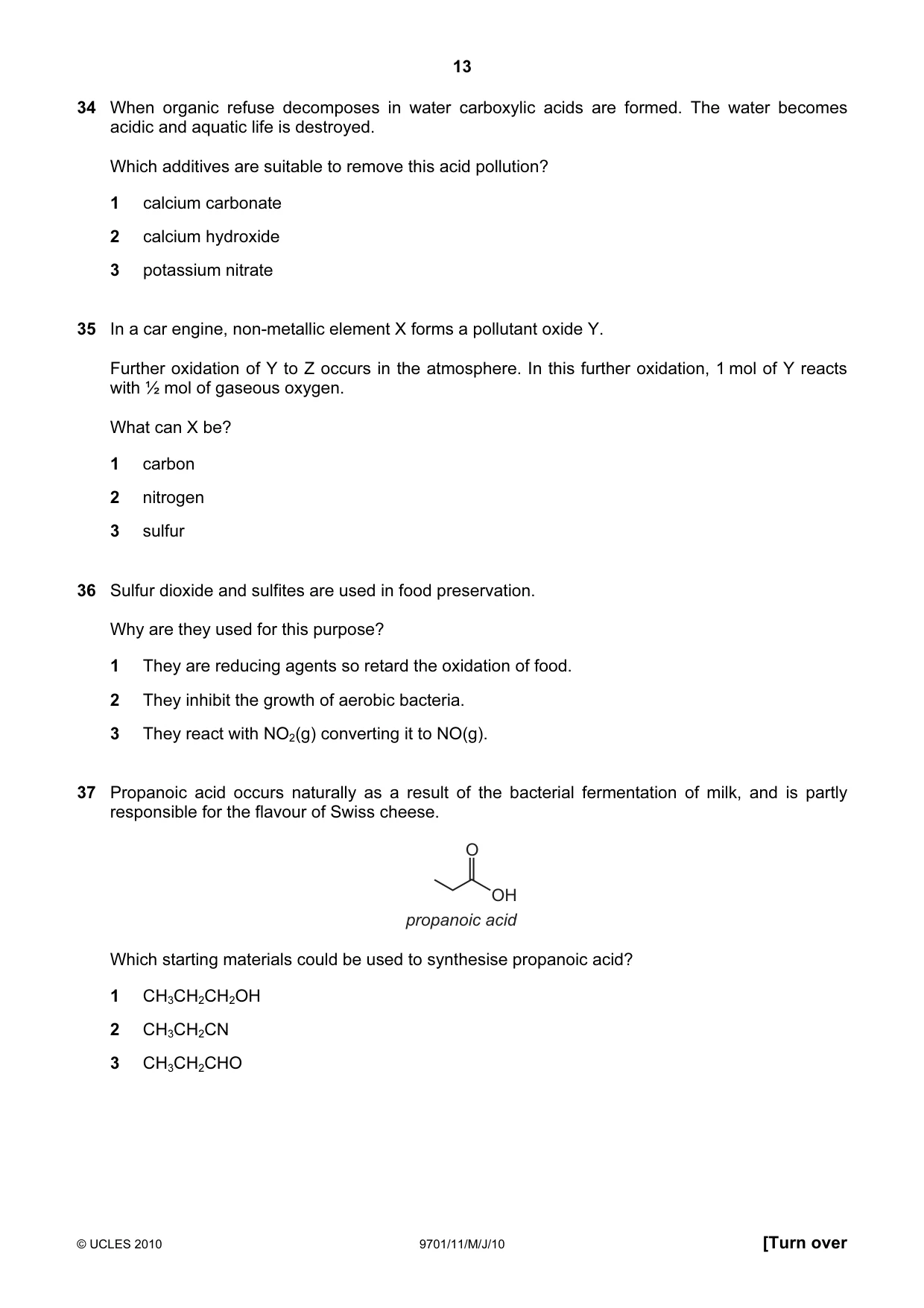
34 When organic refuse decomposes in water carboxylic acids are formed. The water becomes acidic and aquatic life is destroyed. Which additives are suitable to remove this acid pollution? 1 calcium carbonate 2 calcium hydroxide 3 potassium nitrate
Mark scheme: B
Q35 · In a car engine, non-metallic element X forms a pollutant oxide Y
35 In a car engine, non-metallic element X forms a pollutant oxide Y. Further oxidation of Y to Z occurs in the atmosphere. In this further oxidation, 1 mol of Y reacts with ½ mol of gaseous oxygen. What can X be? 1 carbon 2 nitrogen 3 sulfur
Mark scheme: C
Q36 · Sulfur dioxide and sulfites are used in food preservation
36 Sulfur dioxide and sulfites are used in food preservation. Why are they used for this purpose? 1 They are reducing agents so retard the oxidation of food. 2 They inhibit the growth of aerobic bacteria. 3 They react with NO2(g) converting it to NO(g).
Mark scheme: B
Q37 · Propanoic acid occurs naturally as a result of the bacterial fermentation of milk, and is…
37 Propanoic acid occurs naturally as a result of the bacterial fermentation of milk, and is partly responsible for the flavour of Swiss cheese. O OH propanoic acid Which starting materials could be used to synthesise propanoic acid? 1 CH3CH2CH2OH 2 CH3CH2CN 3 CH3CH2CHO
Mark scheme: A
Q38 · Which structural formulae represent 2,2-dimethylpentane?
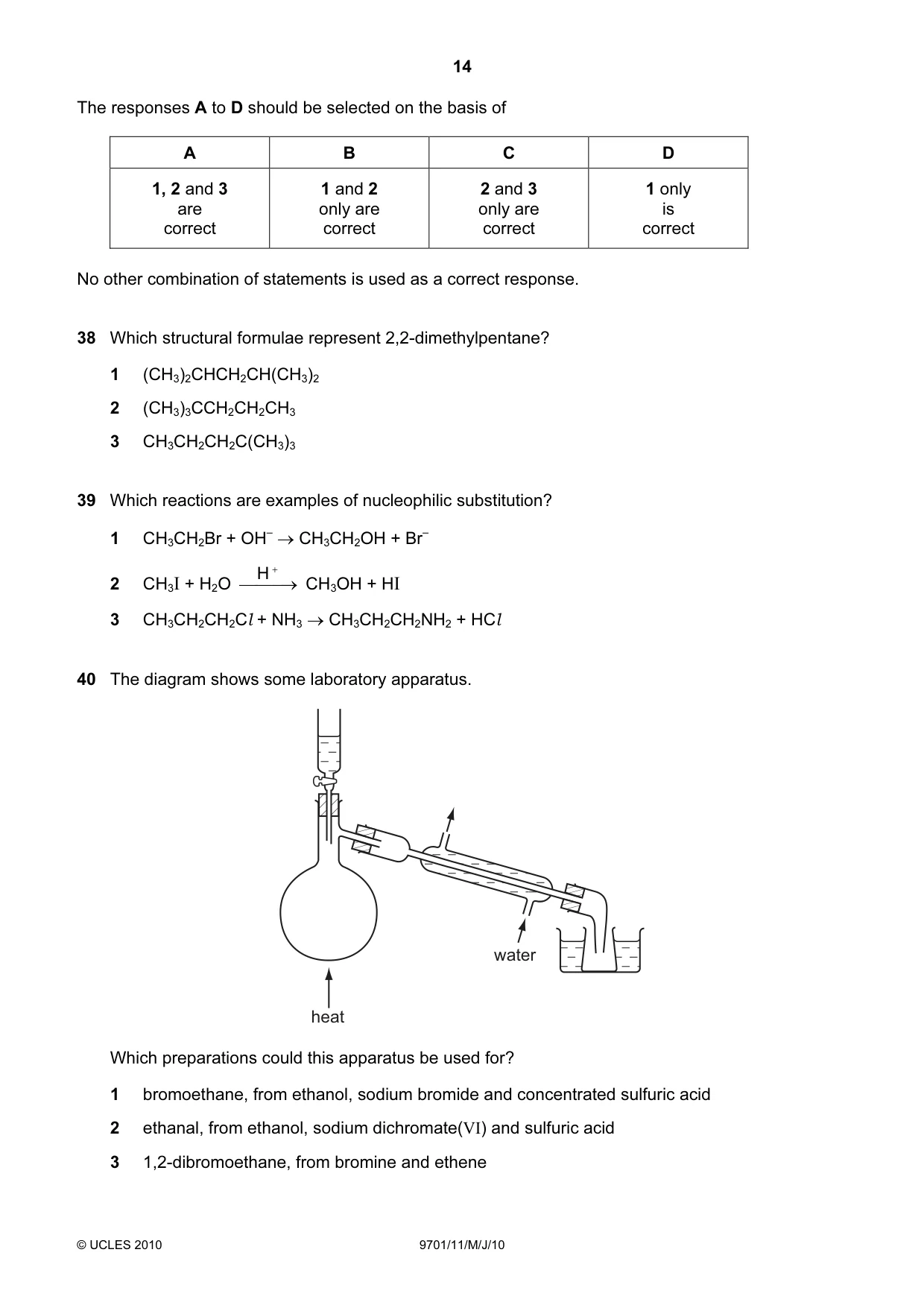
38 Which structural formulae represent 2,2-dimethylpentane? 1 (CH3)2CHCH2CH(CH3)2 2 (CH3)3CCH2CH2CH3 3 CH3CH2CH2C(CH3)3
Mark scheme: C
More questions on Formulas, functional groups and the naming of organic compounds
Q39 · Which reactions are examples of nucleophilic substitution?
39 Which reactions are examples of nucleophilic substitution? 1 CH3CH2Br + OH– → CH3CH2OH + Br– H + 2 CH3I + H2O → CH3OH + HI 3 CH3CH2CH2Cl + NH3 → CH3CH2CH2NH2 + HCl
Mark scheme: A
Q40 · The diagram shows some laboratory apparatus
40 The diagram shows some laboratory apparatus. water heat Which preparations could this apparatus be used for? 1 bromoethane, from ethanol, sodium bromide and concentrated sulfuric acid 2 ethanal, from ethanol, sodium dichromate(VI) and sulfuric acid 3 1,2-dibromoethane, from bromine and ethene
Mark scheme: B
What was in this paper
The subtopics covered by these 40 questions, and how many questions each got. Open one in a new tab to see every Cambridge question on it.
3Acids and bases2Alcohols2Aldehydes and ketones2Alkanes2Chemical equilibria: reversible reactions, dynamic equilibrium2Nitrogen and sulfur2Periodicity of chemical properties of the elements in Period 32Rate of reaction2Redox processes: electron transfer and changes in oxidation number (oxidation state)2Similarities and trends in the properties of the Group 2 metals, magnesium to barium, and their compounds2The gaseous state: ideal and real gases and pV = nRT2Addition polymerisation1Bonding and structure1Carboxylic acids1Dot-and-cross diagrams1Electrons, energy levels and atomic orbitals1Enthalpy change, ΔH1Esters1Formulas, functional groups and the naming of organic compounds1Hess’s law1Ionisation energy1Isomerism: optical1Organic synthesis1Periodicity of physical properties of the elements in Period 31Some reactions of the halide ions1The chemical properties of the halogen elements and the hydrogen halides1What you needed in this session
Cambridge’s own grade thresholds for 2010 May/June, Paper 1 · Variant 1. A higher threshold means an easier paper — the bar moves with how the cohort did.