Cambridge A Level Chemistry 9701 — 2016 May/June Paper 1 · Variant 2
9701/12/M/J/16 · 40 questions · 40 marks · ≈45 min
The question paper and its mark scheme, free to read here and free to download. This is Cambridge’s own paper, exactly as it was sat.
Question paper16 pages
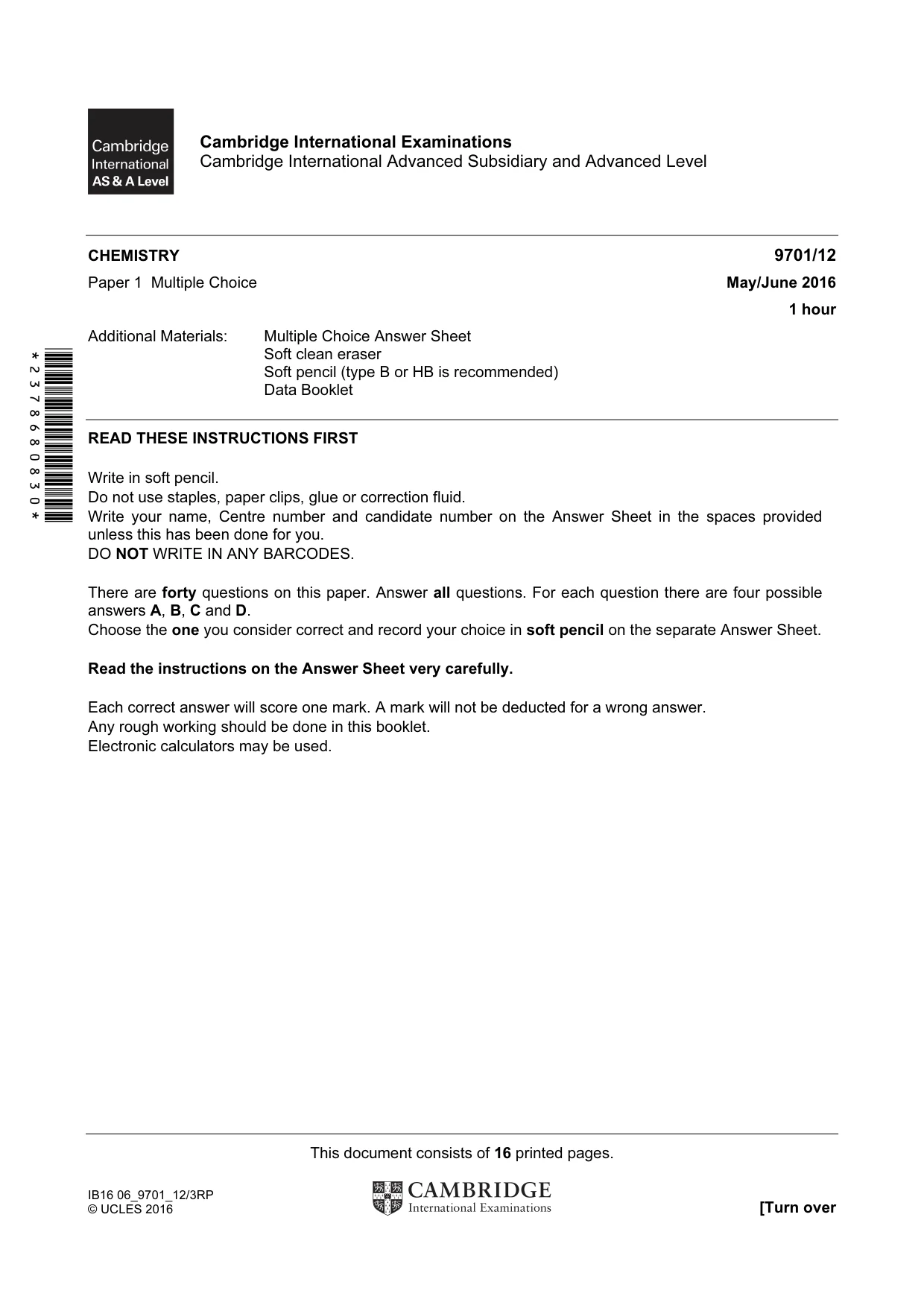
Mark scheme2 pages
Answers below. Sit the paper first if you are practising.
Questions as text
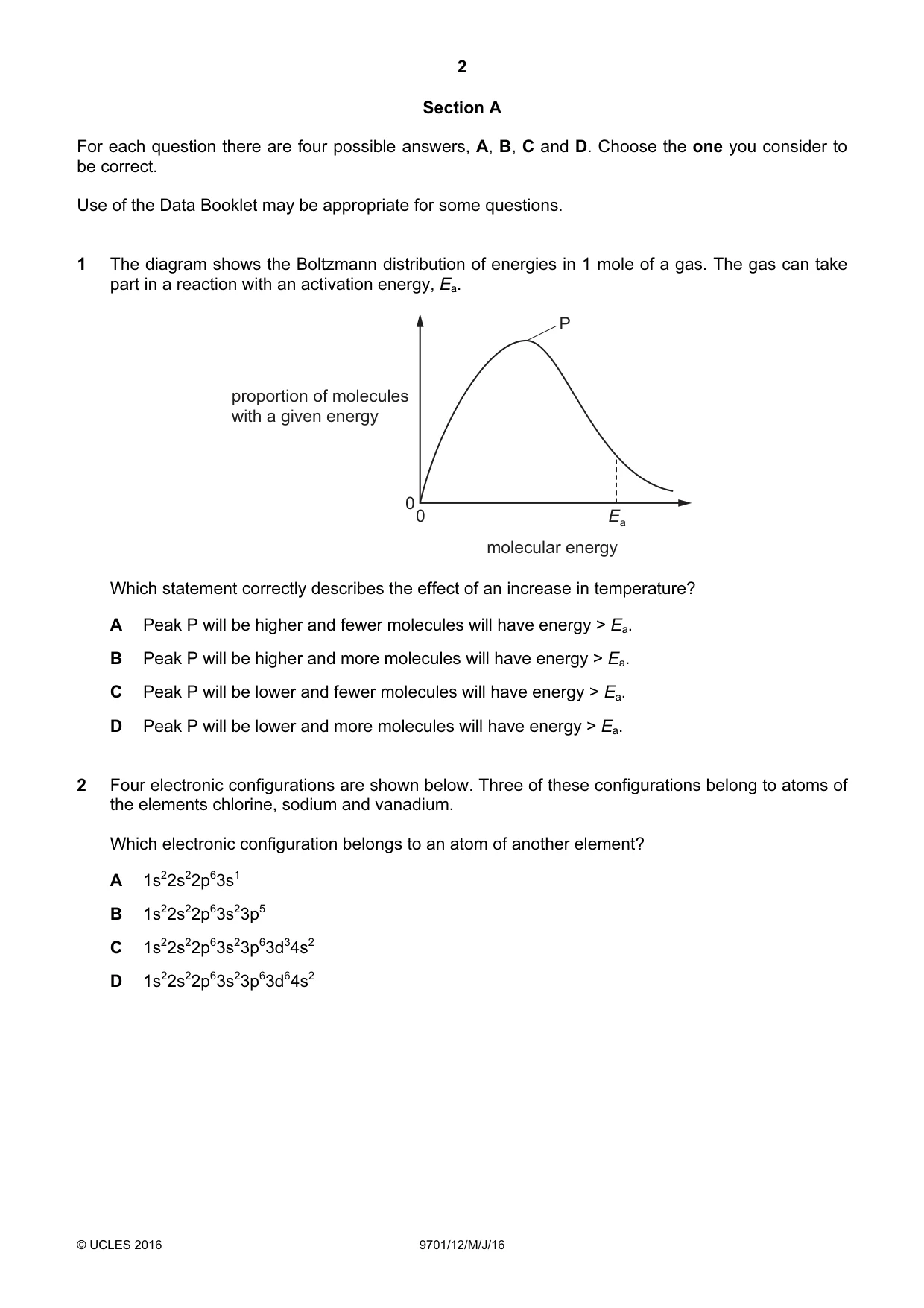
Q1 · The diagram shows the Boltzmann distribution of energies in 1 mole of a gas
1 The diagram shows the Boltzmann distribution of energies in 1 mole of a gas. The gas can take part in a reaction with an activation energy, Ea. P proportion of molecules with a given energy 0 0 Ea molecular energy Which statement correctly describes the effect of an increase in temperature? A Peak P will be higher and fewer molecules will have energy > Ea. B Peak P will be higher and more molecules will have energy > Ea. C Peak P will be lower and fewer molecules will have energy > Ea. D Peak P will be lower and more molecules will have energy > Ea.
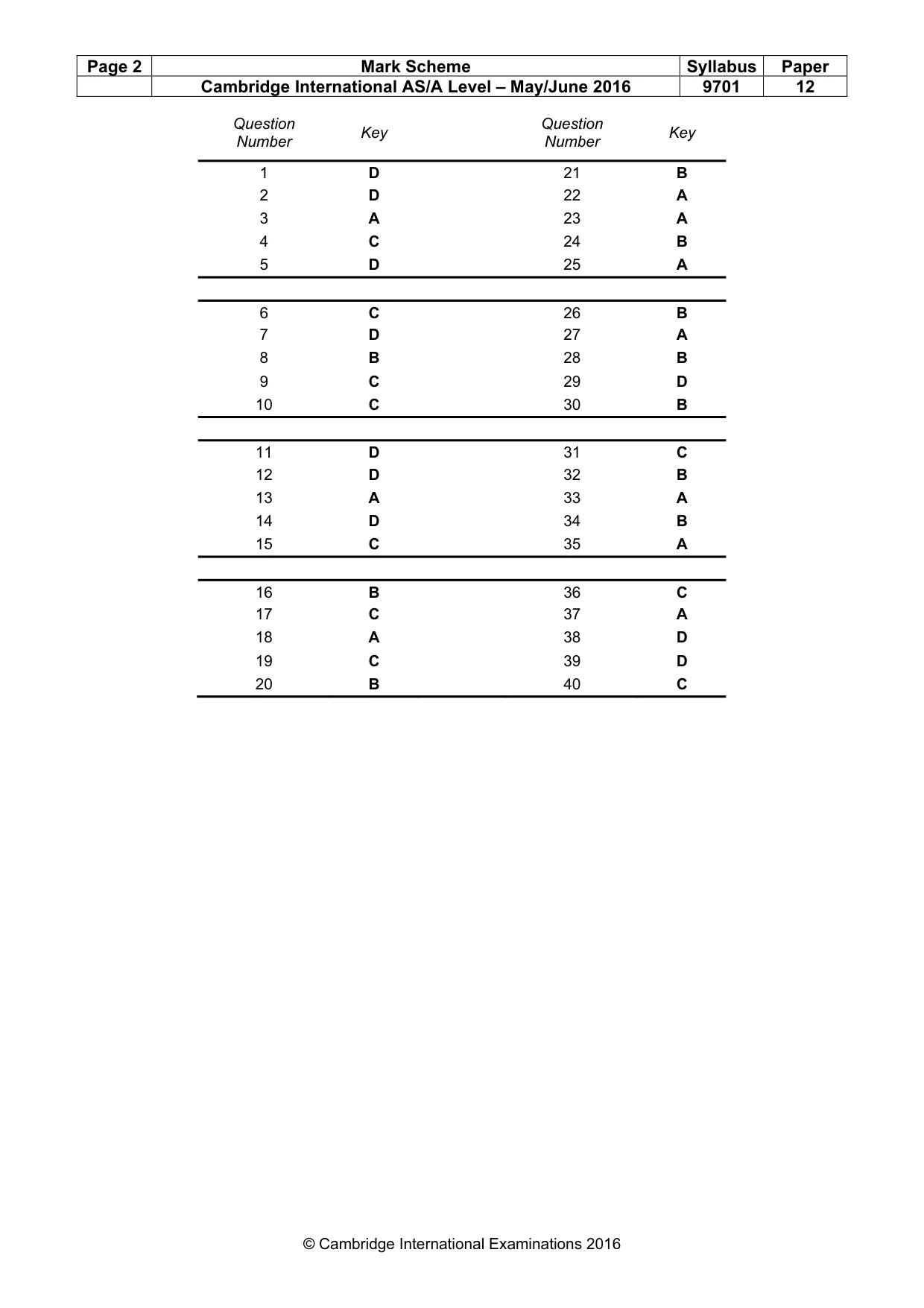
Mark scheme: D
More questions on Effect of temperature on reaction rates and the concept of activation energy
Q2 · Four electronic configurations are shown below
2 Four electronic configurations are shown below. Three of these configurations belong to atoms of the elements chlorine, sodium and vanadium. Which electronic configuration belongs to an atom of another element? A 1s22s22p63s1 B 1s22s22p63s23p5 C 1s22s22p63s23p63d34s2 D 1s22s22p63s23p63d64s2
Mark scheme: D
More questions on Electrons, energy levels and atomic orbitals
Q3 · Elements X and Y are in the same group of the Periodic Table
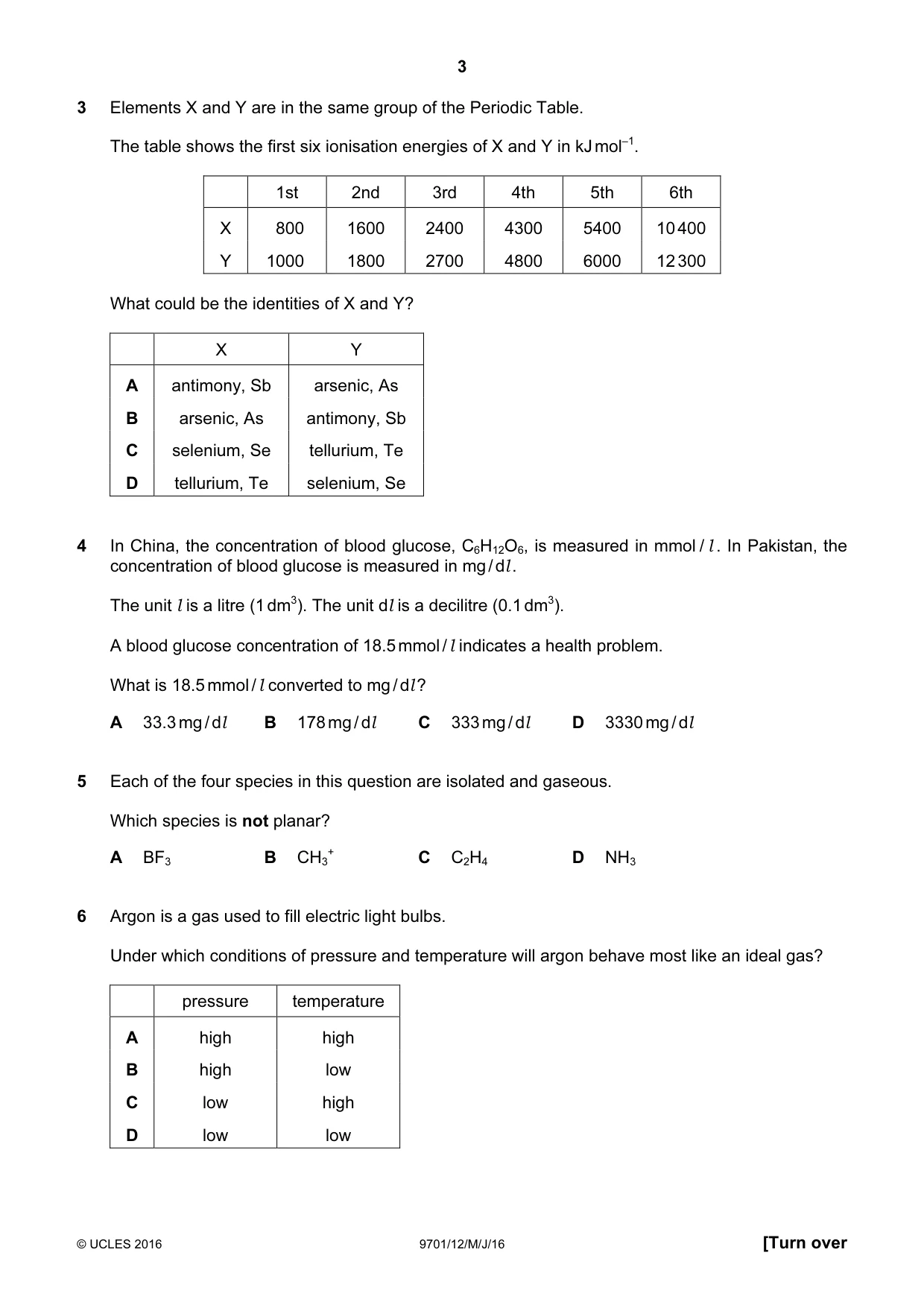
3 Elements X and Y are in the same group of the Periodic Table. The table shows the first six ionisation energies of X and Y in kJ mol–1. 1st 2nd 3rd 4th 5th 6th X 800 1600 2400 4300 5400 10 400 Y 1000 1800 2700 4800 6000 12 300 What could be the identities of X and Y? X Y A antimony, Sb arsenic, As B arsenic, As antimony, Sb C selenium, Se tellurium, Te D tellurium, Te selenium, Se
Mark scheme: A
Q4 · In China, the concentration of blood glucose, C6H12O6, is measured in mmol / l
4 In China, the concentration of blood glucose, C6H12O6, is measured in mmol / l . In Pakistan, the concentration of blood glucose is measured in mg / dl . The unit l is a litre (1 dm3). The unit dl is a decilitre (0.1 dm3). A blood glucose concentration of 18.5 mmol / l indicates a health problem. What is 18.5 mmol / l converted to mg / dl ? A 33.3 mg / dl B 178 mg / dl C 333 mg / dl D 3330 mg / dl
Mark scheme: C
Q5 · Each of the four species in this question are isolated and gaseous
5 Each of the four species in this question are isolated and gaseous. Which species is not planar? A BF3 B CH3 + C C2H4 D NH3
Mark scheme: D
Q6 · Argon is a gas used to fill electric light bulbs
6 Argon is a gas used to fill electric light bulbs. Under which conditions of pressure and temperature will argon behave most like an ideal gas? pressure temperature A high high B high low C low high D low low
Mark scheme: C
More questions on The gaseous state: ideal and real gases and pV = nRT
Q7 · 0.10 g of the volatile liquid X formed 0.025 dm3 of vapour at 100 °C and atmospheric…
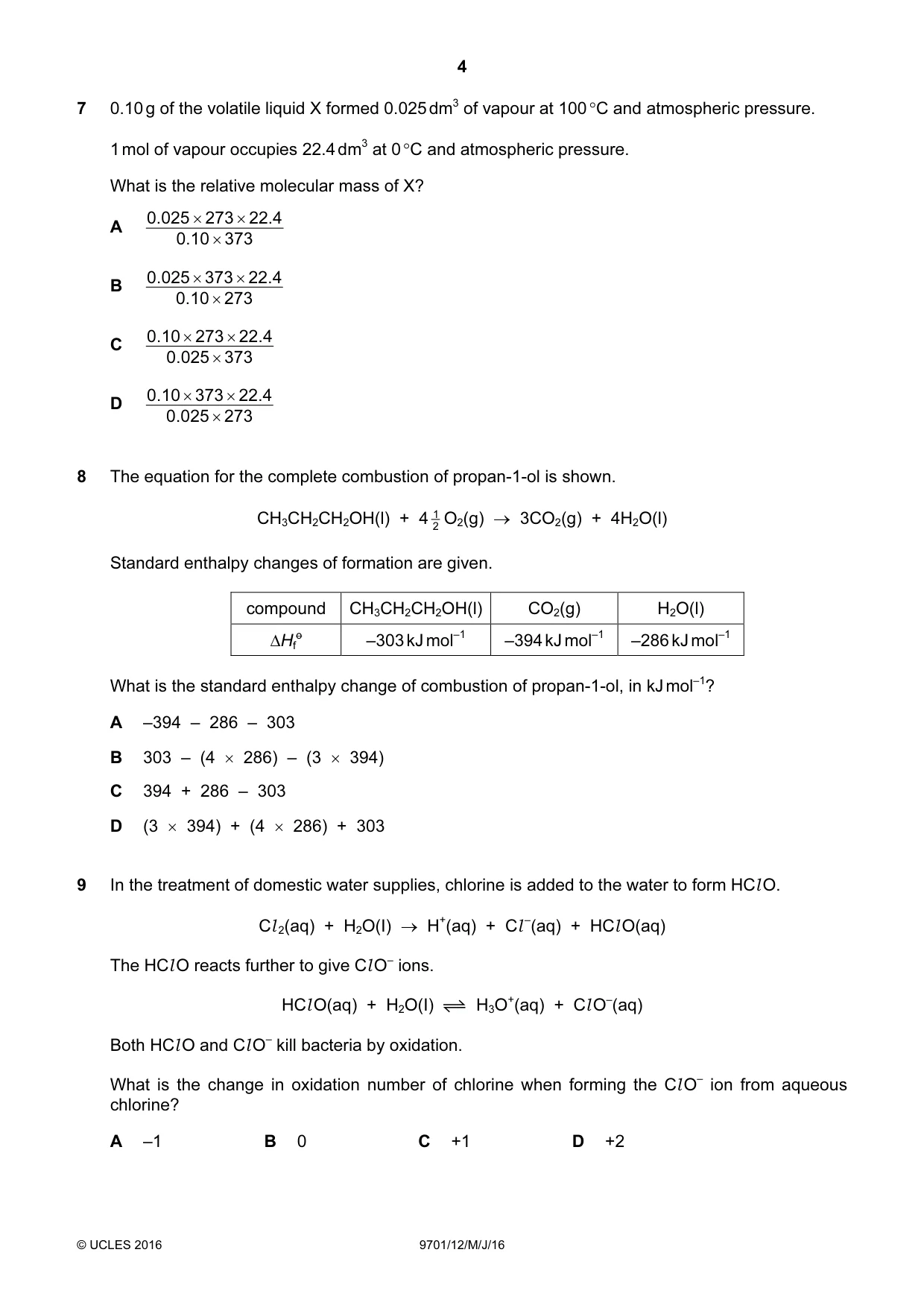
7 0.10 g of the volatile liquid X formed 0.025 dm3 of vapour at 100 °C and atmospheric pressure. 1 mol of vapour occupies 22.4 dm3 at 0 °C and atmospheric pressure. What is the relative molecular mass of X? 0.025 × 273 × 22.4 A 0.10 × 373 0 . 025 × 373 × 22 . 4 B 0 . 10 × 273 0 . 10 × 273 × 22 . 4 C 0 . 025 × 373 0 . 10 × 373 × 22 . 4 D 0 . 025 × 273
Mark scheme: D
More questions on The gaseous state: ideal and real gases and pV = nRT
Q8 · The equation for the complete combustion of propan-1-ol is shown
8 The equation for the complete combustion of propan-1-ol is shown. CH3CH2CH2OH(l) + 4 2 1 O2(g) → 3CO2(g) + 4H2O(l) Standard enthalpy changes of formation are given. compound CH3CH2CH2OH(l) CO2(g) H2O(l) ∆Hf o –303 kJ mol–1 –394 kJ mol–1 –286 kJ mol–1 What is the standard enthalpy change of combustion of propan-1-ol, in kJ mol–1? A –394 – 286 – 303 B 303 – (4 × 286) – (3 × 394) C 394 + 286 – 303 D (3 × 394) + (4 × 286) + 303
Mark scheme: B
Q9 · In the treatment of domestic water supplies, chlorine is added to the water to form HCl O
9 In the treatment of domestic water supplies, chlorine is added to the water to form HCl O. Cl 2(aq) + H2O(I) → H+(aq) + Cl –(aq) + HCl O(aq) The HCl O reacts further to give Cl O– ions. HCl O(aq) + H2O(I) H3O+(aq) + Cl O–(aq) Both HCl O and Cl O– kill bacteria by oxidation. What is the change in oxidation number of chlorine when forming the Cl O– ion from aqueous chlorine? A –1 B 0 C +1 D +2
Mark scheme: C
Q10 · When solid ammonium chloride dissociates at a certain temperature in a 0.500 dm3…
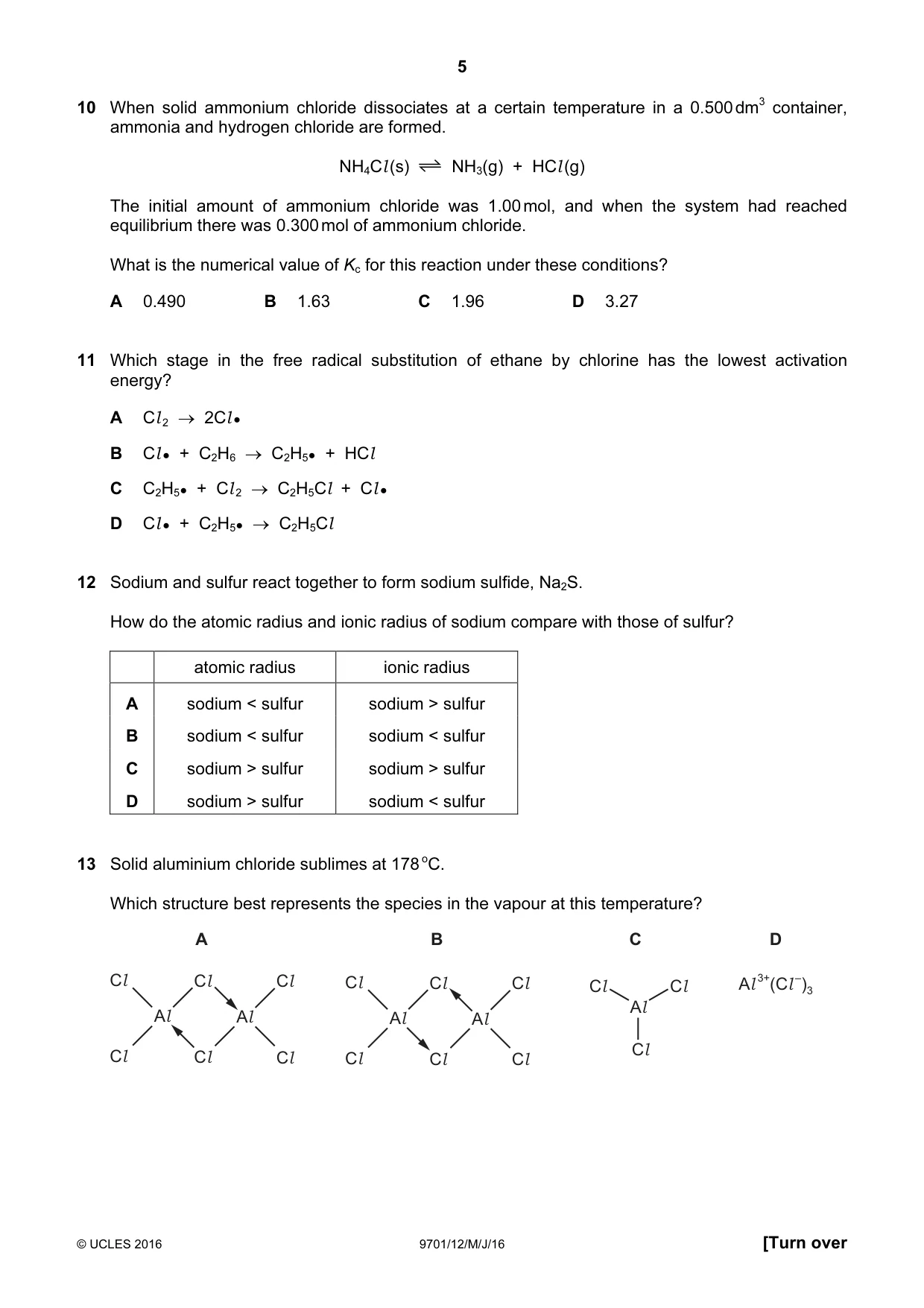
10 When solid ammonium chloride dissociates at a certain temperature in a 0.500 dm3 container, ammonia and hydrogen chloride are formed. NH4Cl (s) NH3(g) + HCl (g) The initial amount of ammonium chloride was 1.00 mol, and when the system had reached equilibrium there was 0.300 mol of ammonium chloride. What is the numerical value of Kc for this reaction under these conditions? A 0.490 B 1.63 C 1.96 D 3.27
Mark scheme: C
More questions on Chemical equilibria: reversible reactions, dynamic equilibrium
Q11 · Which stage in the free radical substitution of ethane by chlorine has the lowest…
11 Which stage in the free radical substitution of ethane by chlorine has the lowest activation energy? A Cl 2 → 2Cl ● B Cl ● + C2H6 → C2H5● + HCl C C2H5● + Cl 2 → C2H5Cl + Cl ● D Cl ● + C2H5● → C2H5Cl
Mark scheme: D
Q12 · Sodium and sulfur react together to form sodium sulfide, Na2S
12 Sodium and sulfur react together to form sodium sulfide, Na2S. How do the atomic radius and ionic radius of sodium compare with those of sulfur? atomic radius ionic radius A sodium < sulfur sodium > sulfur B sodium < sulfur sodium < sulfur C sodium > sulfur sodium > sulfur D sodium > sulfur sodium < sulfur
Mark scheme: D
Q13 · Solid aluminium chloride sublimes at 178 oC
13 Solid aluminium chloride sublimes at 178 oC. Which structure best represents the species in the vapour at this temperature? A B C D Cl Cl Cl Cl Cl Cl Cl Cl Al 3+(Cl –)3 Al Al Al Al Al Cl Cl Cl Cl Cl Cl Cl
Mark scheme: A
More questions on Covalent bonding and coordinate (dative covalent) bonding
Q14 · A 0.005 mol sample of anhydrous calcium carbonate was completely thermally decomposed to…
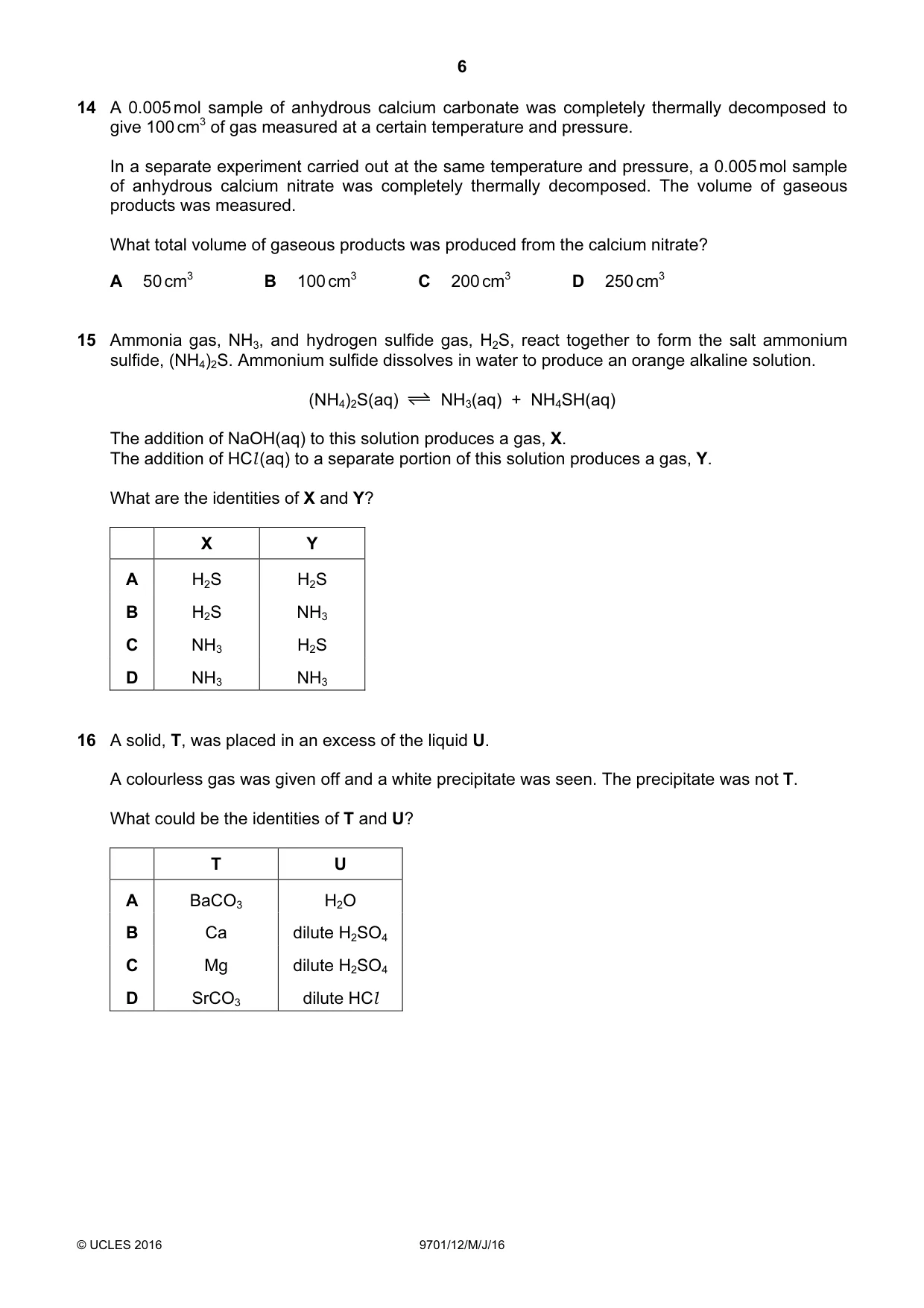
14 A 0.005 mol sample of anhydrous calcium carbonate was completely thermally decomposed to give 100 cm3 of gas measured at a certain temperature and pressure. In a separate experiment carried out at the same temperature and pressure, a 0.005 mol sample of anhydrous calcium nitrate was completely thermally decomposed. The volume of gaseous products was measured. What total volume of gaseous products was produced from the calcium nitrate? A 50 cm3 B 100 cm3 C 200 cm3 D 250 cm3
Mark scheme: D
More questions on Reacting masses and volumes (of solutions and gases)
Q15 · Ammonia gas, NH3, and hydrogen sulfide gas, H2S, react together to form the salt ammonium…
15 Ammonia gas, NH3, and hydrogen sulfide gas, H2S, react together to form the salt ammonium sulfide, (NH4)2S. Ammonium sulfide dissolves in water to produce an orange alkaline solution. (NH4)2S(aq) NH3(aq) + NH4SH(aq) The addition of NaOH(aq) to this solution produces a gas, X. The addition of HCl (aq) to a separate portion of this solution produces a gas, Y. What are the identities of X and Y? X Y A H2S H2S B H2S NH3 C NH3 H2S D NH3 NH3
Mark scheme: C
Q16 · A solid, T, was placed in an excess of the liquid U
16 A solid, T, was placed in an excess of the liquid U. A colourless gas was given off and a white precipitate was seen. The precipitate was not T. What could be the identities of T and U? T U A BaCO3 H2O B Ca dilute H2SO4 C Mg dilute H2SO4 D SrCO3 dilute HCl
Mark scheme: B
Q17 · Nitrogen(II) oxide, NO, nitrogen(IV) oxide, NO2, carbon monoxide, CO, and unburnt…
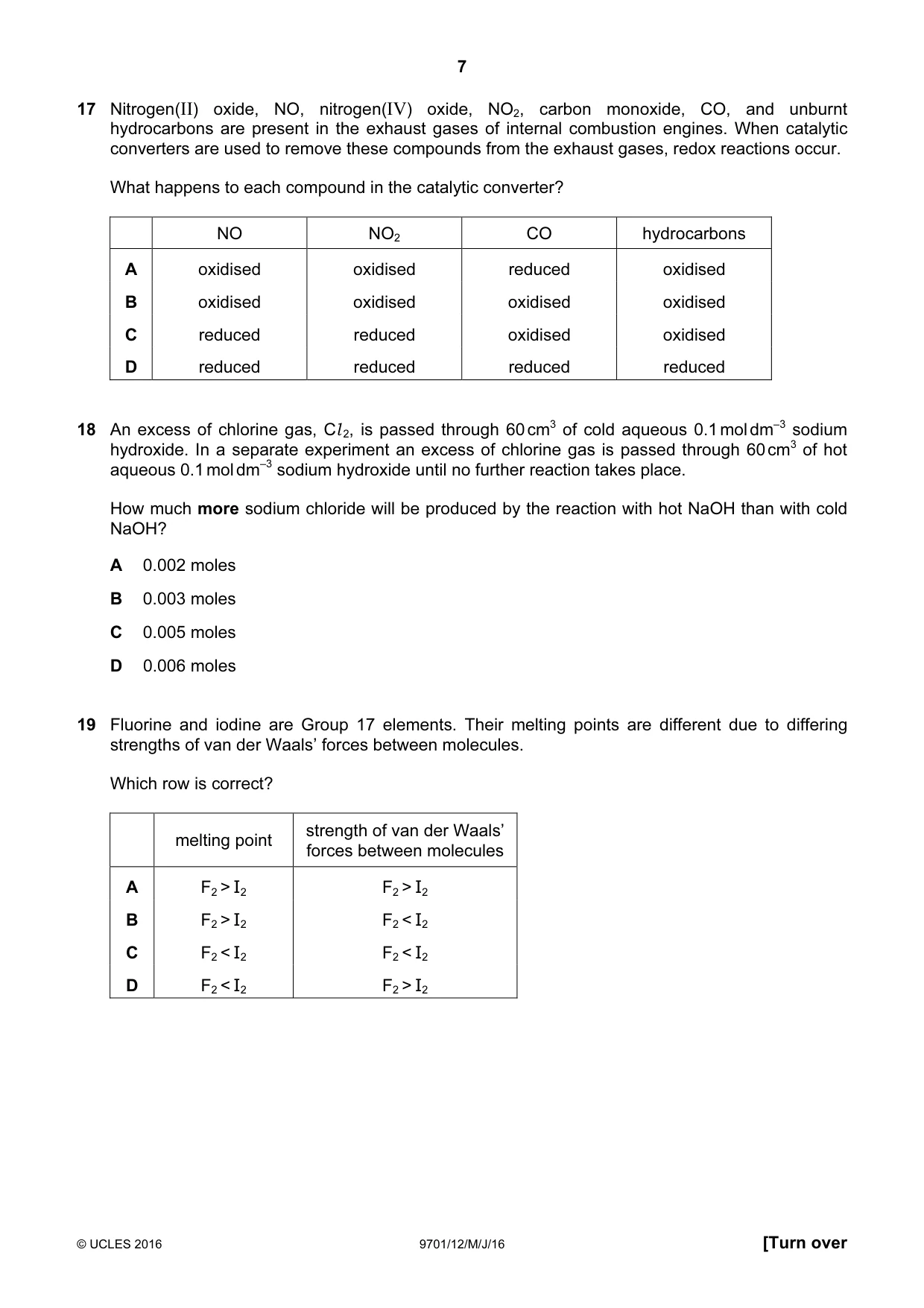
17 Nitrogen(II) oxide, NO, nitrogen(IV) oxide, NO2, carbon monoxide, CO, and unburnt hydrocarbons are present in the exhaust gases of internal combustion engines. When catalytic converters are used to remove these compounds from the exhaust gases, redox reactions occur. What happens to each compound in the catalytic converter? NO NO2 CO hydrocarbons A oxidised oxidised reduced oxidised B oxidised oxidised oxidised oxidised C reduced reduced oxidised oxidised D reduced reduced reduced reduced
Mark scheme: C
Q18 · An excess of chlorine gas, Cl 2, is passed through 60 cm3 of cold aqueous 0.1 mol dm–3…
18 An excess of chlorine gas, Cl 2, is passed through 60 cm3 of cold aqueous 0.1 mol dm–3 sodium hydroxide. In a separate experiment an excess of chlorine gas is passed through 60 cm3 of hot aqueous 0.1 mol dm–3 sodium hydroxide until no further reaction takes place. How much more sodium chloride will be produced by the reaction with hot NaOH than with cold NaOH? A 0.002 moles B 0.003 moles C 0.005 moles D 0.006 moles
Mark scheme: A
Q19 · Fluorine and iodine are Group 17 elements
19 Fluorine and iodine are Group 17 elements. Their melting points are different due to differing strengths of van der Waals’ forces between molecules. Which row is correct? strength of van der Waals’ melting point forces between molecules A F2 > I2 F2 > I2 B F2 > I2 F2 < I2 C F2 < I2 F2 < I2 D F2 < I2 F2 > I2
Mark scheme: C
More questions on Physical properties of the Group 17 elements
Q20 · Chlorofluorocarbons damage the ozone layer by undergoing reactions with a free radical…
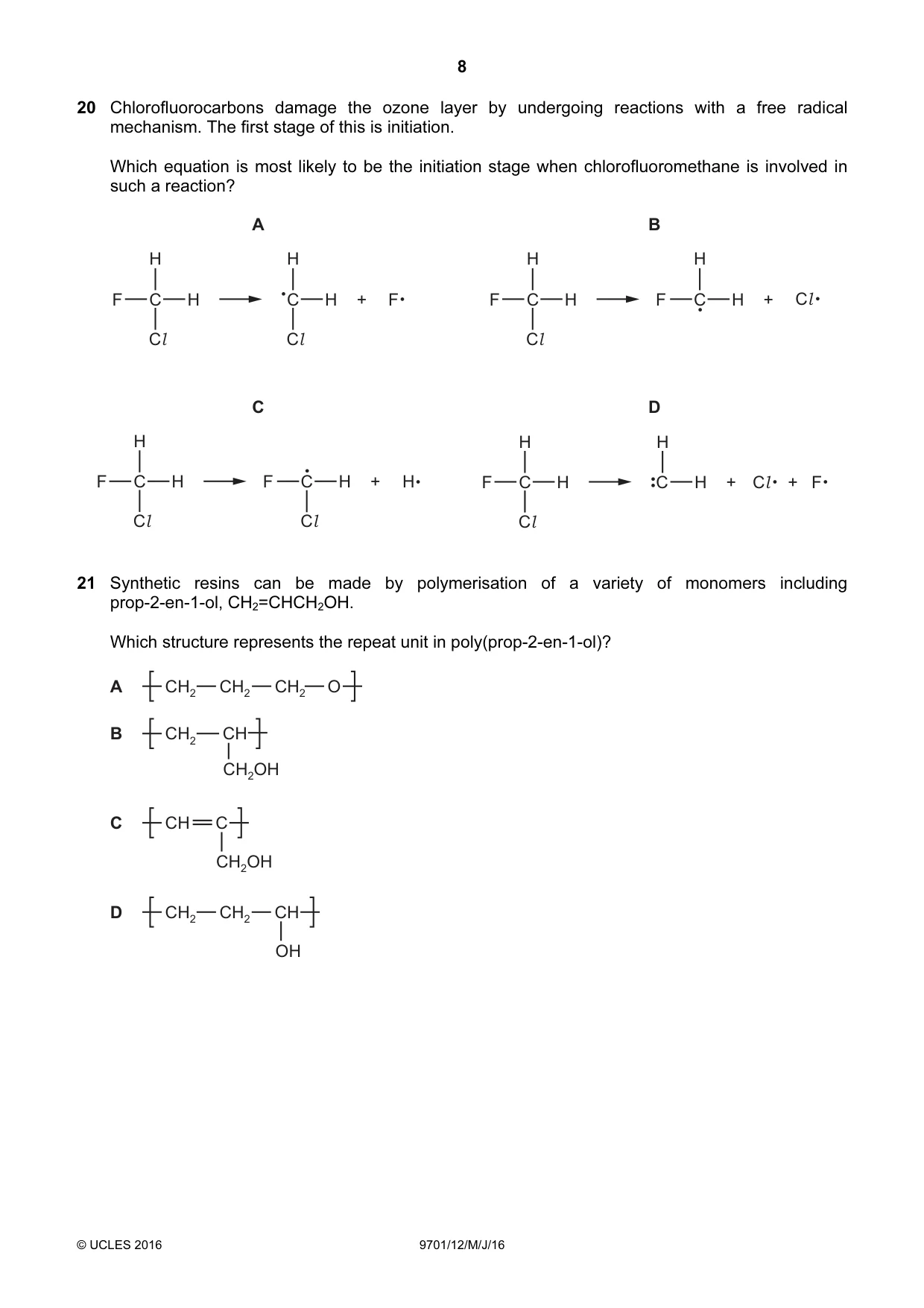
20 Chlorofluorocarbons damage the ozone layer by undergoing reactions with a free radical mechanism. The first stage of this is initiation. Which equation is most likely to be the initiation stage when chlorofluoromethane is involved in such a reaction? A B H H H H F C H C H + F F C H F C H + Cl Cl Cl Cl C D H H H F C H F C H + H F C H C H + Cl + F Cl Cl Cl
Mark scheme: B
Q21 · Synthetic resins can be made by polymerisation of a variety of monomers including…
21 Synthetic resins can be made by polymerisation of a variety of monomers including prop-2-en-1-ol, CH2=CHCH2OH. Which structure represents the repeat unit in poly(prop-2-en-1-ol)? A CH2 CH2 CH2 O B CH2 CH CH2OH C CH C CH2OH D CH2 CH2 CH OH
Mark scheme: B
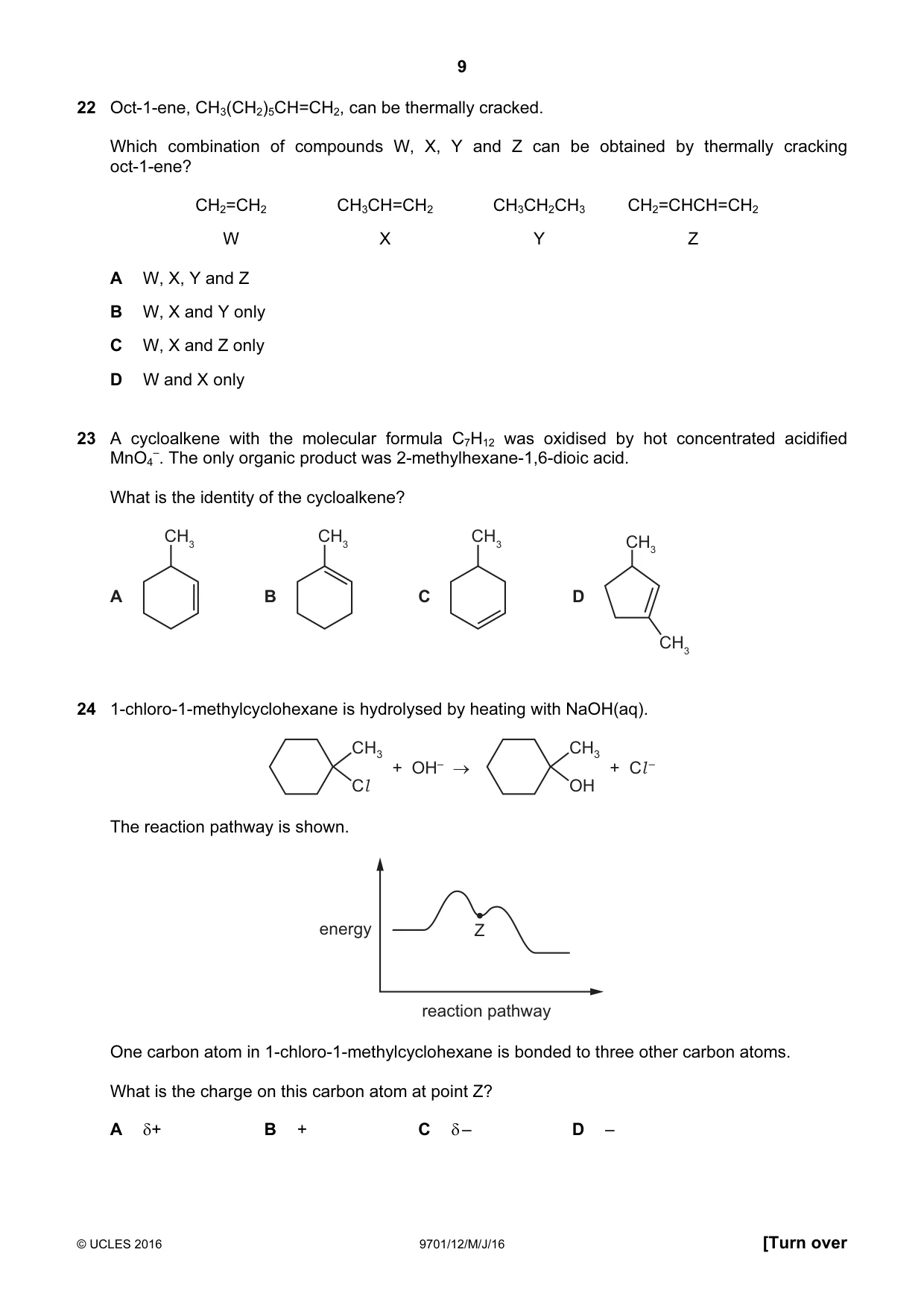
Q22 · Oct-1-ene, CH3(CH2)5CH=CH2, can be thermally cracked
22 Oct-1-ene, CH3(CH2)5CH=CH2, can be thermally cracked. Which combination of compounds W, X, Y and Z can be obtained by thermally cracking oct-1-ene? CH2=CH2 CH3CH=CH2 CH3CH2CH3 CH2=CHCH=CH2 W X Y Z A W, X, Y and Z B W, X and Y only C W, X and Z only D W and X only
Mark scheme: A
Q23 · A cycloalkene with the molecular formula C7H12 was oxidised by hot concentrated acidified…
23 A cycloalkene with the molecular formula C7H12 was oxidised by hot concentrated acidified MnO4 –. The only organic product was 2-methylhexane-1,6-dioic acid. What is the identity of the cycloalkene? CH3 CH3 CH3 CH3 A B C D CH3
Mark scheme: A
Q24 · 1-chloro-1-methylcyclohexane is hydrolysed by heating with NaOH(aq)
24 1-chloro-1-methylcyclohexane is hydrolysed by heating with NaOH(aq). CH3 CH3 + OH– → + Cl – Cl OH The reaction pathway is shown. energy Z reaction pathway One carbon atom in 1-chloro-1-methylcyclohexane is bonded to three other carbon atoms. What is the charge on this carbon atom at point Z? A δ+ B + C δ – D –
Mark scheme: B
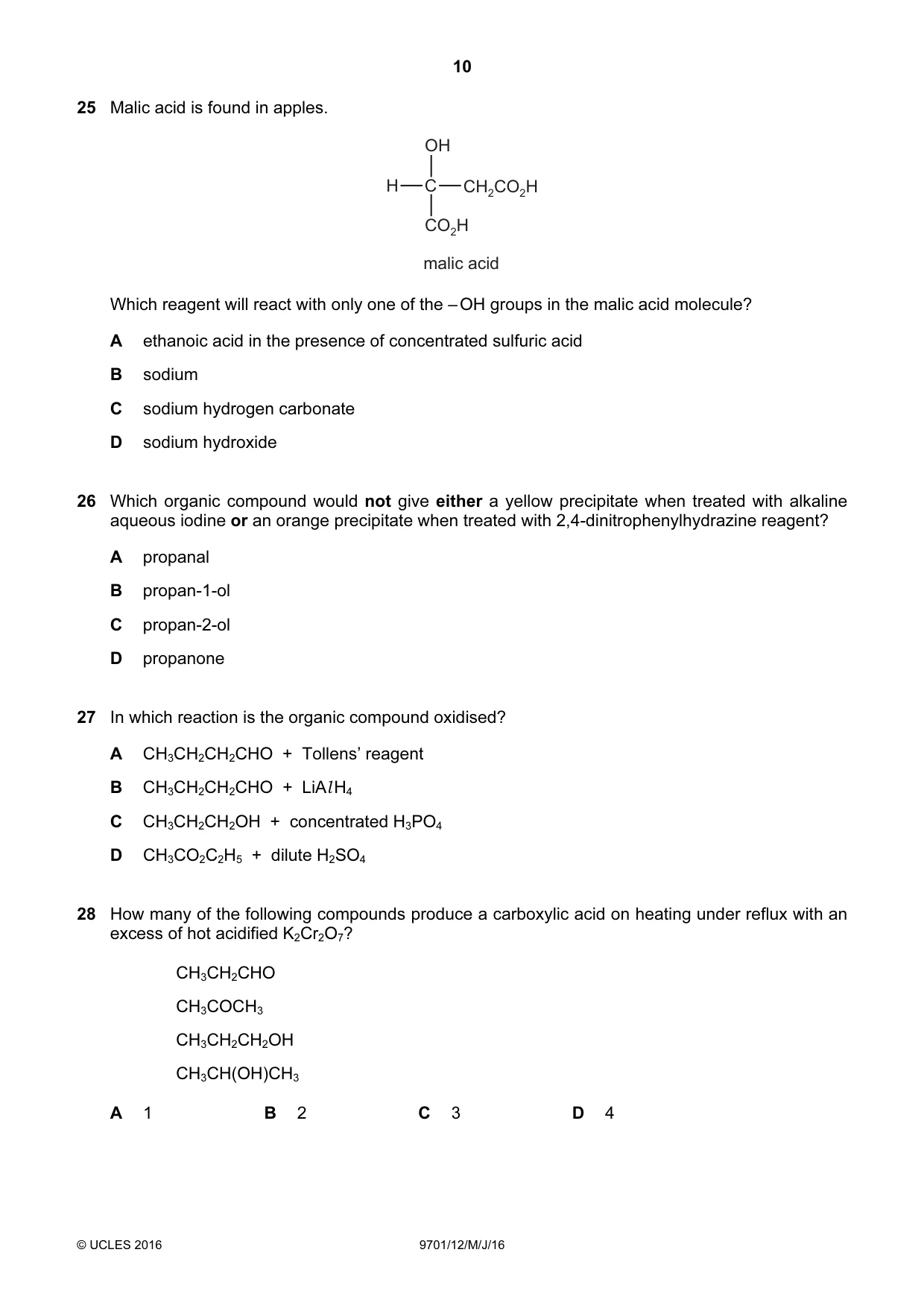
Q25 · Malic acid is found in apples
25 Malic acid is found in apples. OH H C CH2CO2H CO2H malic acid Which reagent will react with only one of the – OH groups in the malic acid molecule? A ethanoic acid in the presence of concentrated sulfuric acid B sodium C sodium hydrogen carbonate D sodium hydroxide
Mark scheme: A
Q26 · Which organic compound would not give either a yellow precipitate when treated with…
26 Which organic compound would not give either a yellow precipitate when treated with alkaline aqueous iodine or an orange precipitate when treated with 2,4-dinitrophenylhydrazine reagent? A propanal B propan-1-ol C propan-2-ol D propanone
Mark scheme: B
Q27 · In which reaction is the organic compound oxidised?
27 In which reaction is the organic compound oxidised? A CH3CH2CH2CHO + Tollens’ reagent B CH3CH2CH2CHO + LiAl H4 C CH3CH2CH2OH + concentrated H3PO4 D CH3CO2C2H5 + dilute H2SO4
Mark scheme: A
Q28 · How many of the following compounds produce a carboxylic acid on heating under reflux…
28 How many of the following compounds produce a carboxylic acid on heating under reflux with an excess of hot acidified K2Cr2O7? CH3CH2CHO CH3COCH3 CH3CH2CH2OH CH3CH(OH)CH3 A 1 B 2 C 3 D 4
Mark scheme: B
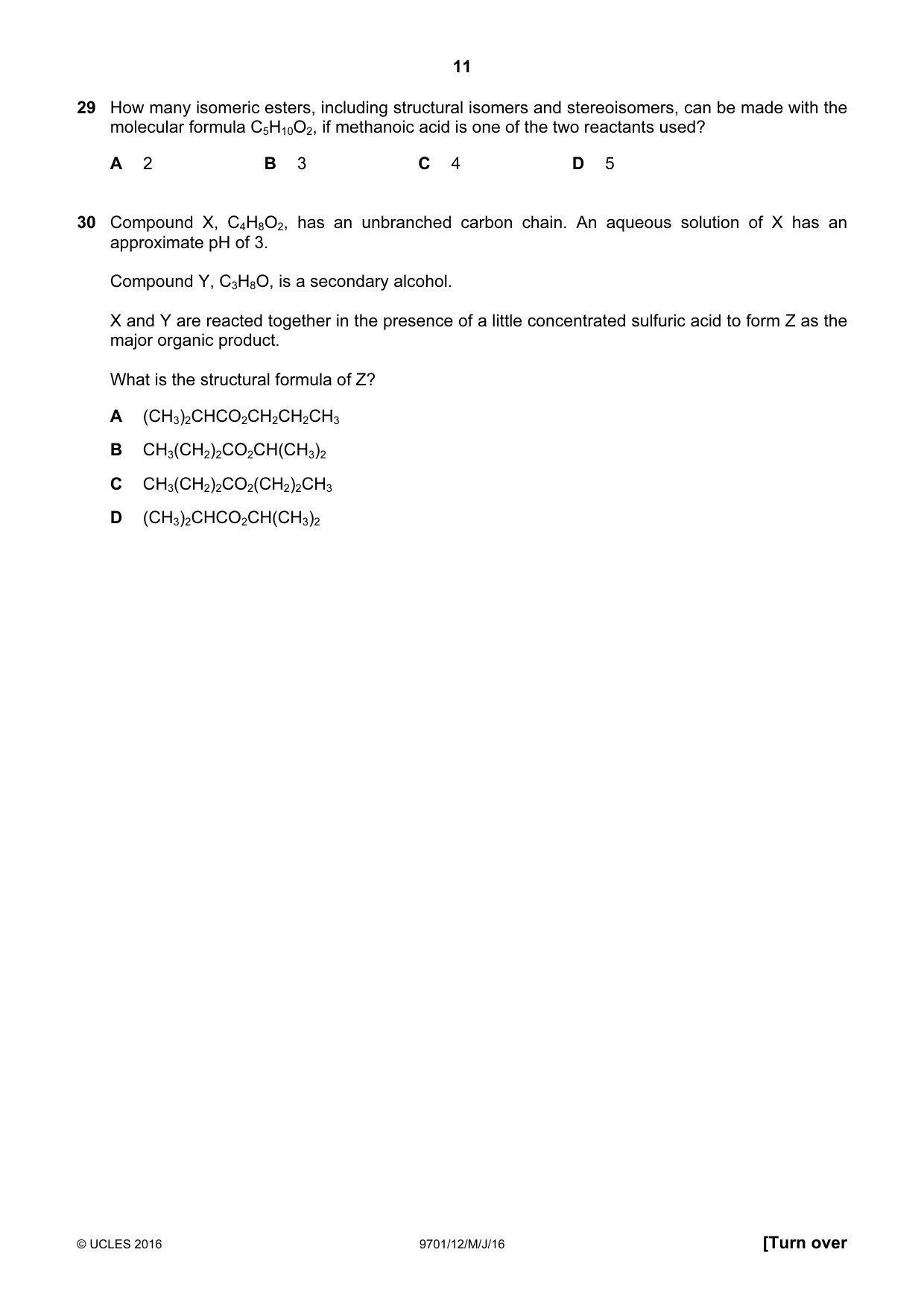
Q29 · How many isomeric esters, including structural isomers and stereoisomers, can be made…
29 How many isomeric esters, including structural isomers and stereoisomers, can be made with the molecular formula C5H10O2, if methanoic acid is one of the two reactants used? A 2 B 3 C 4 D 5
Mark scheme: D
More questions on Isomerism: structural isomerism and stereoisomerism
Q30 · Compound X, C4H8O2, has an unbranched carbon chain
30 Compound X, C4H8O2, has an unbranched carbon chain. An aqueous solution of X has an approximate pH of 3. Compound Y, C3H8O, is a secondary alcohol. X and Y are reacted together in the presence of a little concentrated sulfuric acid to form Z as the major organic product. What is the structural formula of Z? A (CH3)2CHCO2CH2CH2CH3 B CH3(CH2)2CO2CH(CH3)2 C CH3(CH2)2CO2(CH2)2CH3 D (CH3)2CHCO2CH(CH3)2
Mark scheme: B
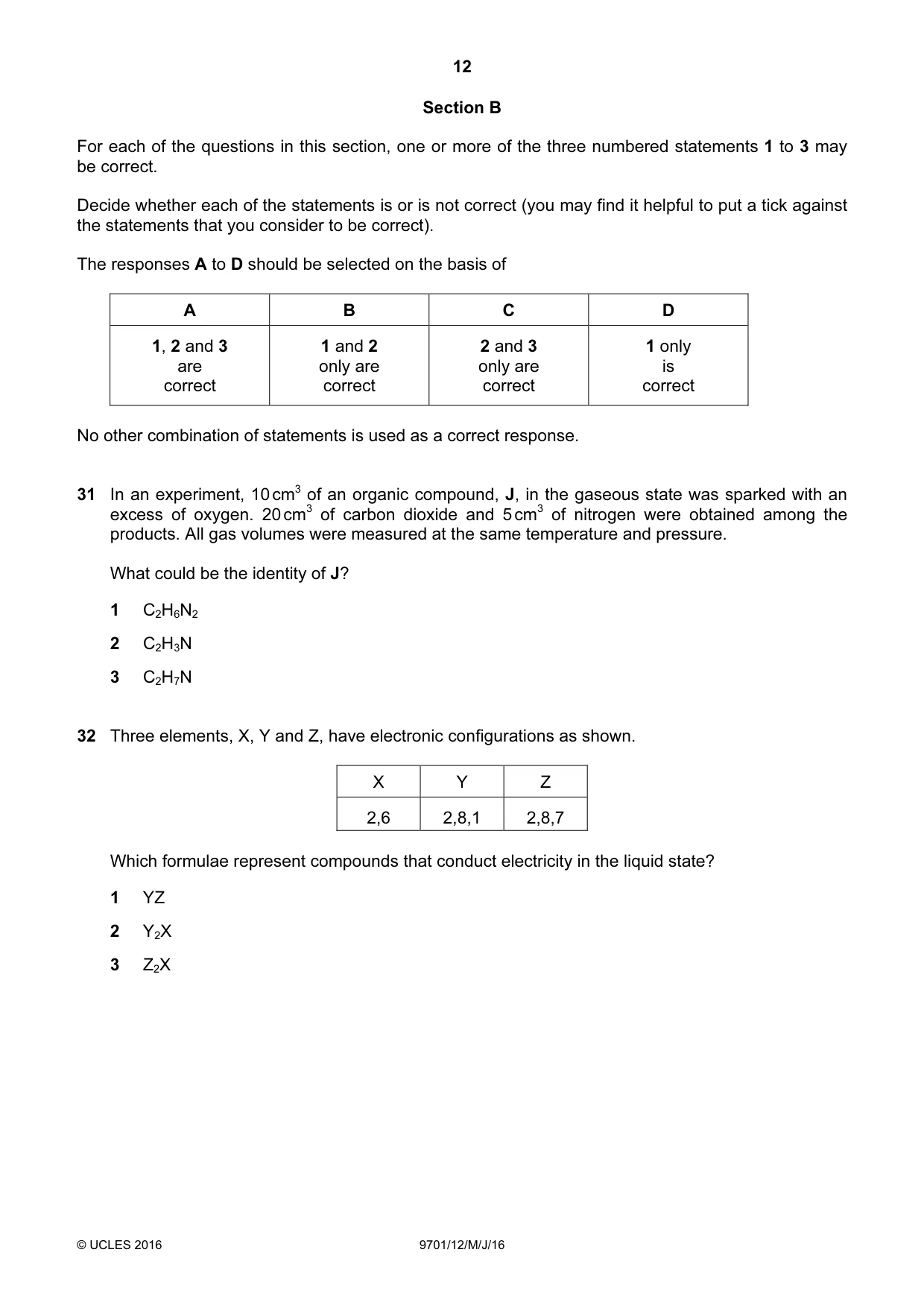
Q31 · In an experiment, 10 cm3 of an organic compound, J, in the gaseous state was sparked with…
31 In an experiment, 10 cm3 of an organic compound, J, in the gaseous state was sparked with an excess of oxygen. 20 cm3 of carbon dioxide and 5 cm3 of nitrogen were obtained among the products. All gas volumes were measured at the same temperature and pressure. What could be the identity of J? 1 C2H6N2 2 C2H3N 3 C2H7N
Mark scheme: C
Q32 · Three elements, X, Y and Z, have electronic configurations as shown
32 Three elements, X, Y and Z, have electronic configurations as shown. X Y Z 2,6 2,8,1 2,8,7 Which formulae represent compounds that conduct electricity in the liquid state? 1 YZ 2 Y2X 3 Z2X
Mark scheme: B
Q33 · In this question, all gases can be assumed to behave ideally
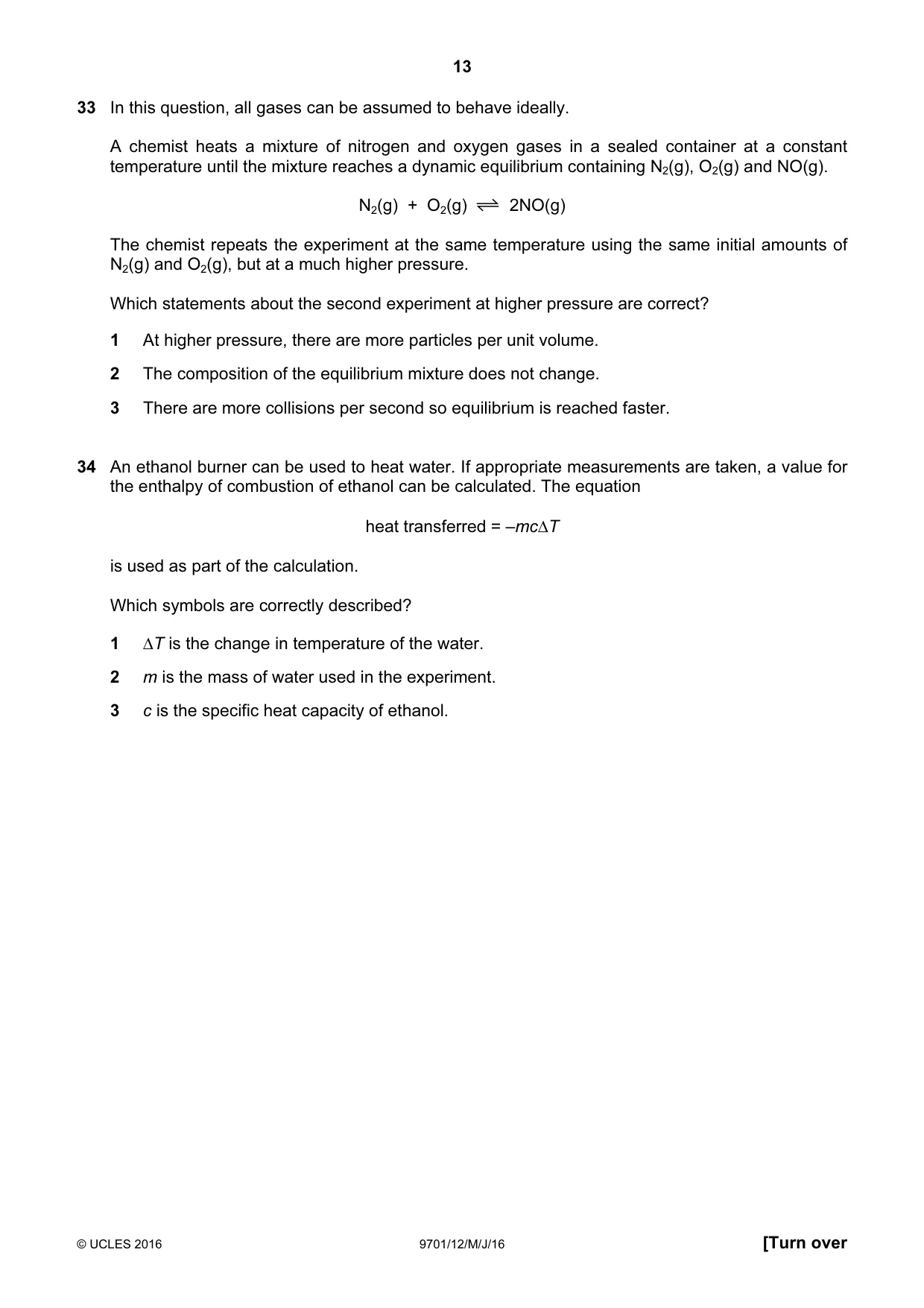
33 In this question, all gases can be assumed to behave ideally. A chemist heats a mixture of nitrogen and oxygen gases in a sealed container at a constant temperature until the mixture reaches a dynamic equilibrium containing N2(g), O2(g) and NO(g). N2(g) + O2(g) 2NO(g) The chemist repeats the experiment at the same temperature using the same initial amounts of N2(g) and O2(g), but at a much higher pressure. Which statements about the second experiment at higher pressure are correct? 1 At higher pressure, there are more particles per unit volume. 2 The composition of the equilibrium mixture does not change. 3 There are more collisions per second so equilibrium is reached faster.
Mark scheme: A
More questions on Chemical equilibria: reversible reactions, dynamic equilibrium
Q34 · An ethanol burner can be used to heat water
34 An ethanol burner can be used to heat water. If appropriate measurements are taken, a value for the enthalpy of combustion of ethanol can be calculated. The equation heat transferred = –mc∆T is used as part of the calculation. Which symbols are correctly described? 1 ∆T is the change in temperature of the water. 2 m is the mass of water used in the experiment. 3 c is the specific heat capacity of ethanol.
Mark scheme: B
Q35 · The first ionisation energies of twenty successive elements in the Periodic Table are…
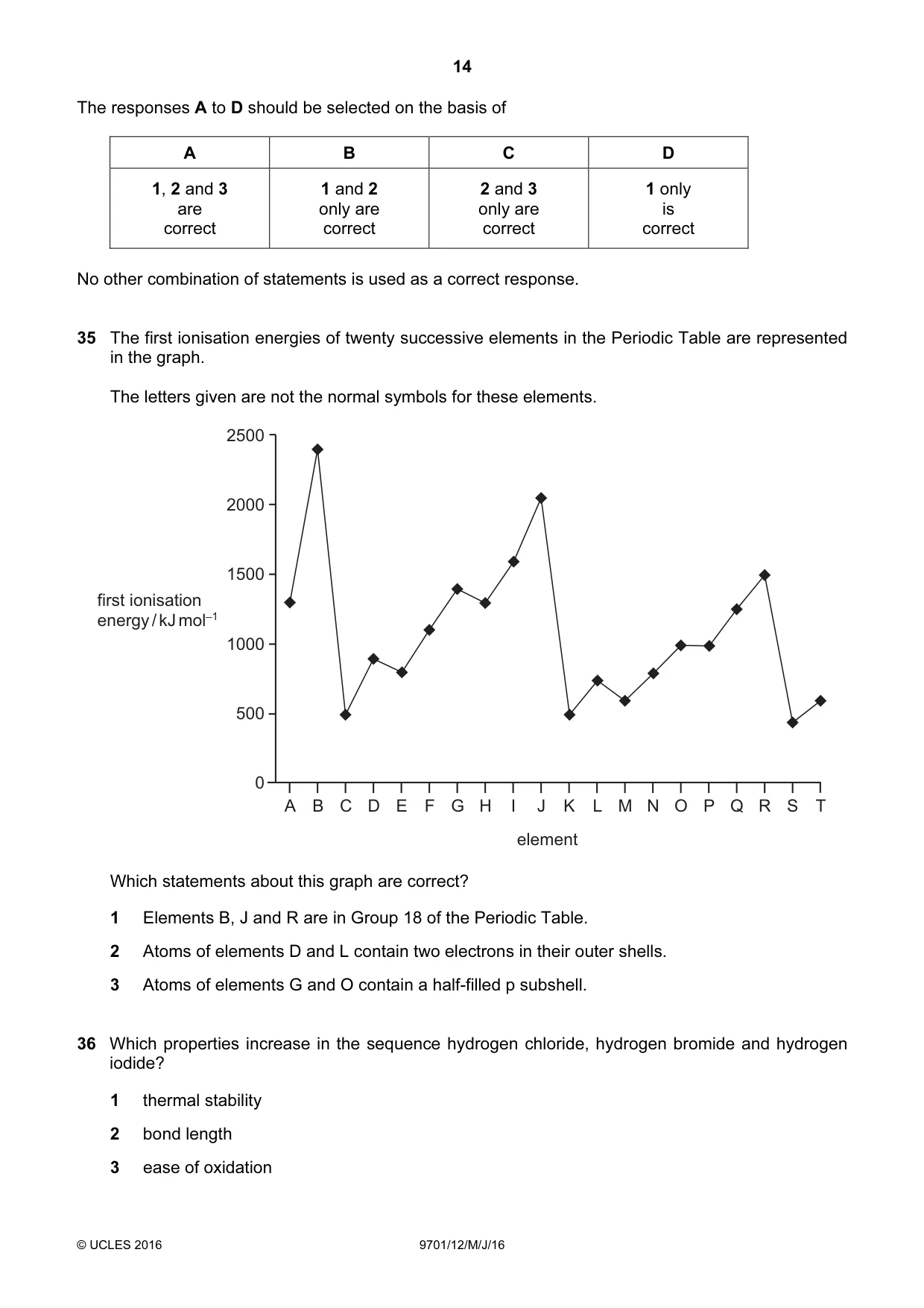
35 The first ionisation energies of twenty successive elements in the Periodic Table are represented in the graph. The letters given are not the normal symbols for these elements. 2500 2000 1500 first ionisation energy / kJ mol _1 1000 500 0 A B C D E F G H I J K L M N O P Q R S T element Which statements about this graph are correct? 1 Elements B, J and R are in Group 18 of the Periodic Table. 2 Atoms of elements D and L contain two electrons in their outer shells. 3 Atoms of elements G and O contain a half-filled p subshell.
Mark scheme: A
Q36 · Which properties increase in the sequence hydrogen chloride, hydrogen bromide and…
36 Which properties increase in the sequence hydrogen chloride, hydrogen bromide and hydrogen iodide? 1 thermal stability 2 bond length 3 ease of oxidation
Mark scheme: C
More questions on The chemical properties of the halogen elements and the hydrogen halides
Q37 · The diagram shows a compound used as a flame retardant
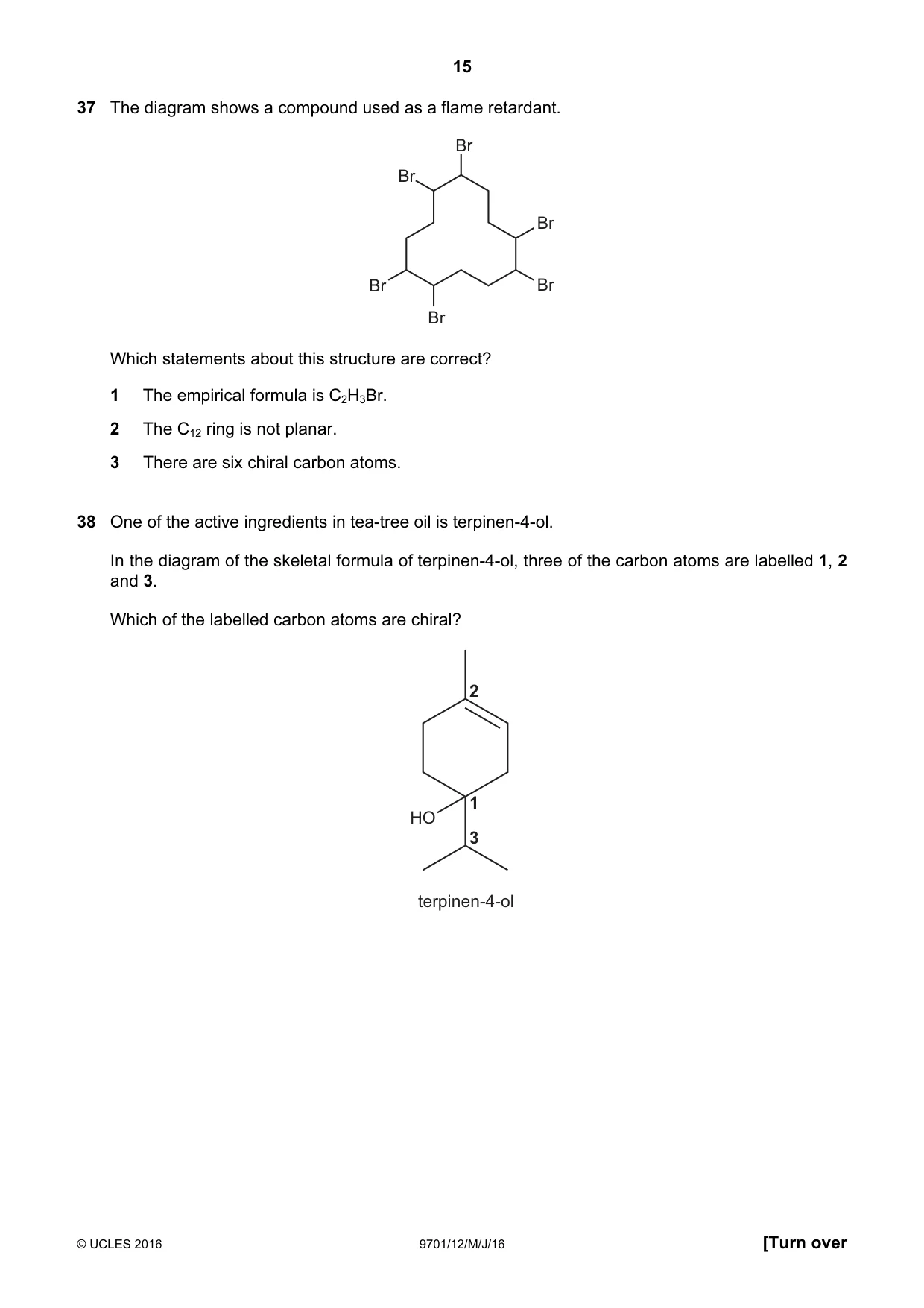
37 The diagram shows a compound used as a flame retardant. Br Br Br Br Br Br Which statements about this structure are correct? 1 The empirical formula is C2H3Br. 2 The C12 ring is not planar. 3 There are six chiral carbon atoms.
Mark scheme: A
Q38 · One of the active ingredients in tea-tree oil is terpinen-4-ol
38 One of the active ingredients in tea-tree oil is terpinen-4-ol. In the diagram of the skeletal formula of terpinen-4-ol, three of the carbon atoms are labelled 1, 2 and 3. Which of the labelled carbon atoms are chiral? 2 1 HO 3 terpinen-4-ol
Mark scheme: D
Q39 · Propanal reacts with hydrogen cyanide to form 2-hydroxybutanenitrile
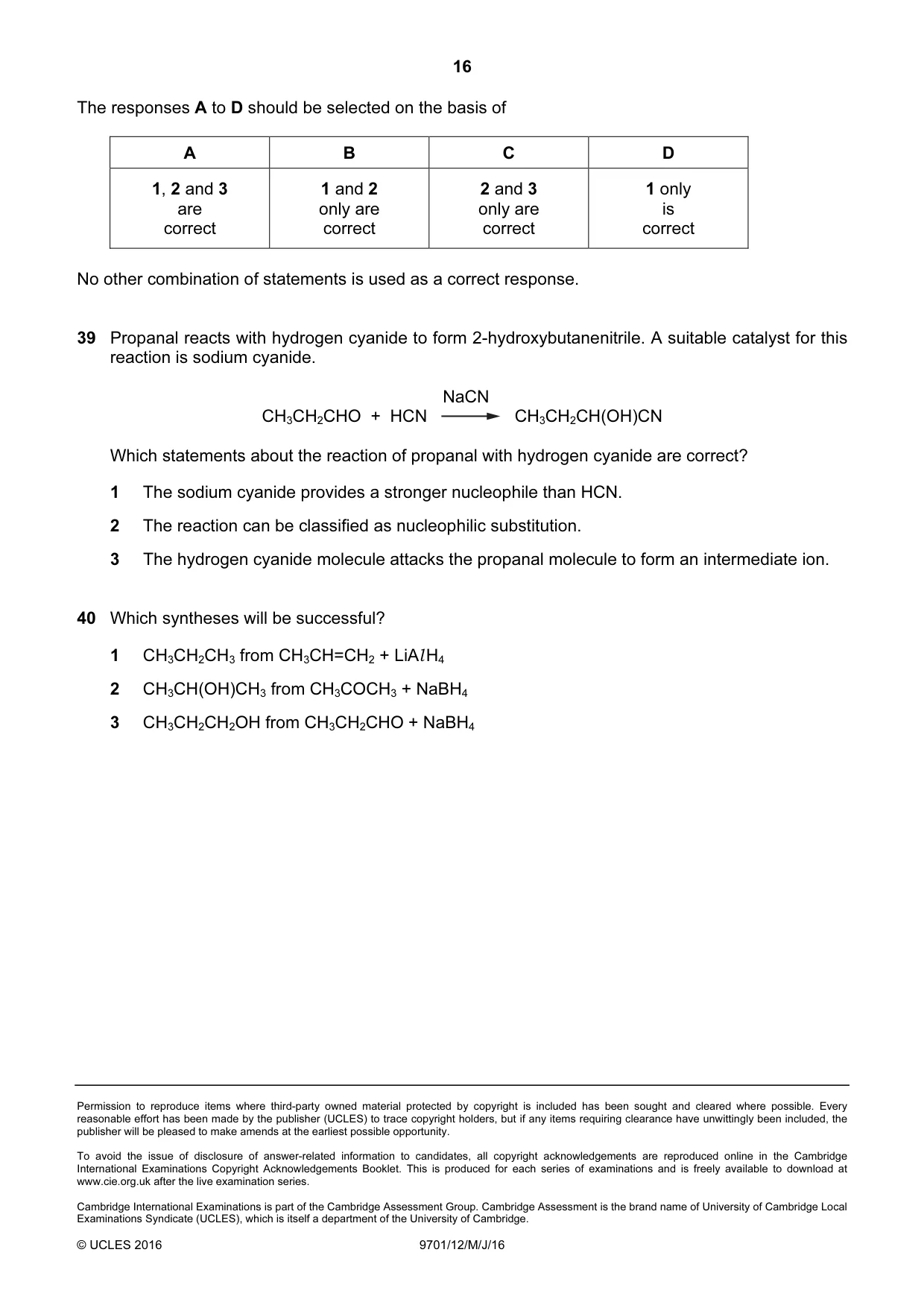
39 Propanal reacts with hydrogen cyanide to form 2-hydroxybutanenitrile. A suitable catalyst for this reaction is sodium cyanide. NaCN CH3CH2CHO + HCN CH3CH2CH(OH)CN Which statements about the reaction of propanal with hydrogen cyanide are correct? 1 The sodium cyanide provides a stronger nucleophile than HCN. 2 The reaction can be classified as nucleophilic substitution. 3 The hydrogen cyanide molecule attacks the propanal molecule to form an intermediate ion.
Mark scheme: D
Q40 · Which syntheses will be successful?
40 Which syntheses will be successful? 1 CH3CH2CH3 from CH3CH=CH2 + LiAl H4 2 CH3CH(OH)CH3 from CH3COCH3 + NaBH4 3 CH3CH2CH2OH from CH3CH2CHO + NaBH4
Mark scheme: C
What was in this paper
The subtopics covered by these 40 questions, and how many questions each got. Open one in a new tab to see every Cambridge question on it.
2Alkanes2Alkenes2Chemical equilibria: reversible reactions, dynamic equilibrium2Ionisation energy2Isomerism: optical2Redox processes: electron transfer and changes in oxidation number (oxidation state)2The gaseous state: ideal and real gases and pV = nRT2Acids and bases1Addition polymerisation1Carboxylic acids1Carboxylic acids1Covalent bonding and coordinate (dative covalent) bonding1Effect of temperature on reaction rates and the concept of activation energy1Electrons, energy levels and atomic orbitals1Enthalpy change, ΔH1Esters1Formulas1Halogenoalkanes1Hess’s law1Ionic bonding1Isomerism: structural isomerism and stereoisomerism1Nitriles and hydroxynitriles1Organic synthesis1Particles in the atom and atomic radius1Physical properties of the Group 17 elements1Reacting masses and volumes (of solutions and gases)1Shapes of molecules1Similarities and trends in the properties of the Group 2 metals, magnesium to barium, and their compounds1The chemical properties of the halogen elements and the hydrogen halides1The mole and the Avogadro constant1The reactions of chlorine1What you needed in this session
Cambridge’s own grade thresholds for 2016 May/June, Paper 1 · Variant 2. A higher threshold means an easier paper — the bar moves with how the cohort did.