Cambridge A Level Chemistry 9701 — 2012 May/June Paper 1 · Variant 1
9701/11/M/J/12 · 40 questions · 40 marks · ≈45 min
The question paper and its mark scheme, free to read here and free to download. This is Cambridge’s own paper, exactly as it was sat.
Question paper16 pages
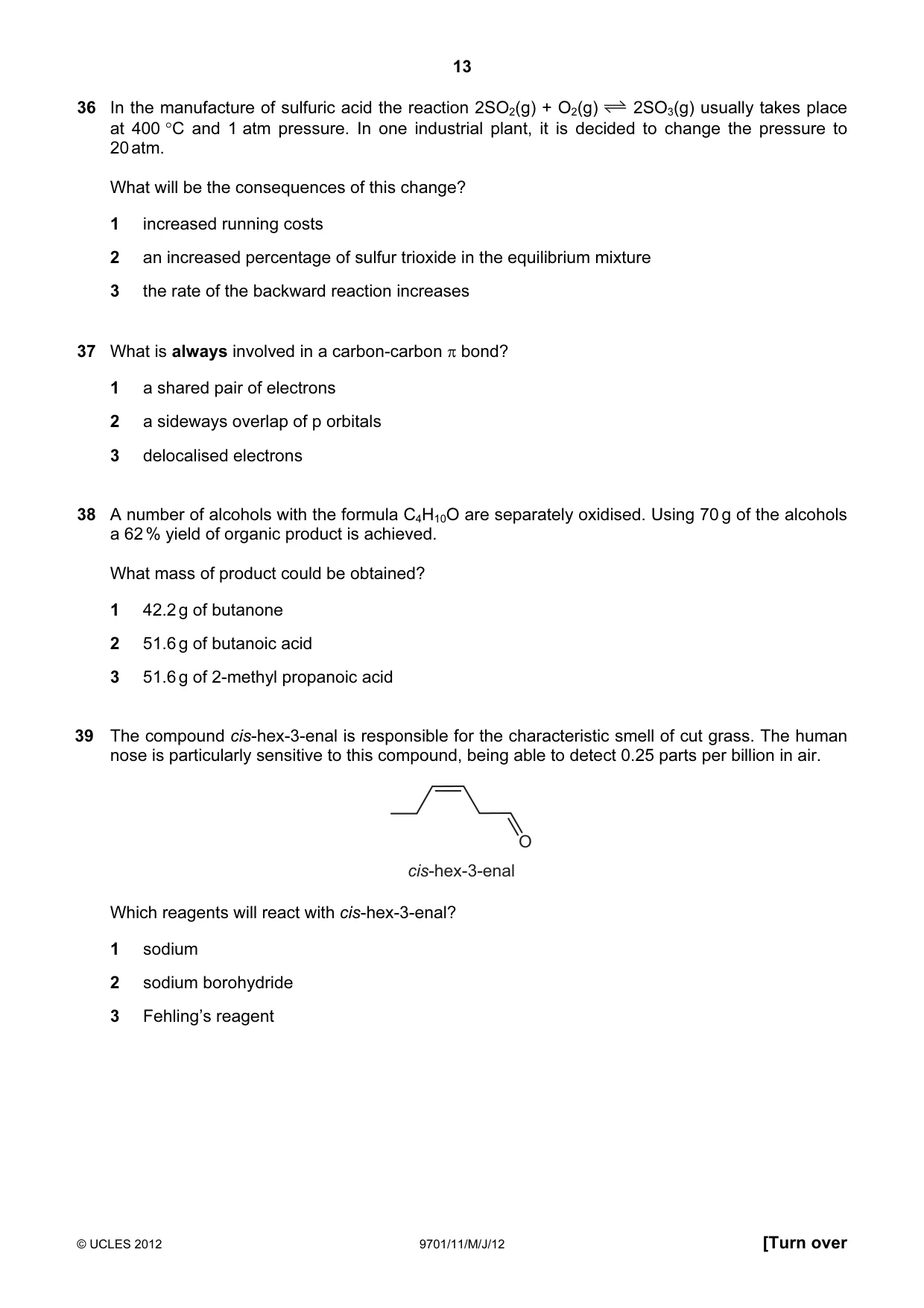
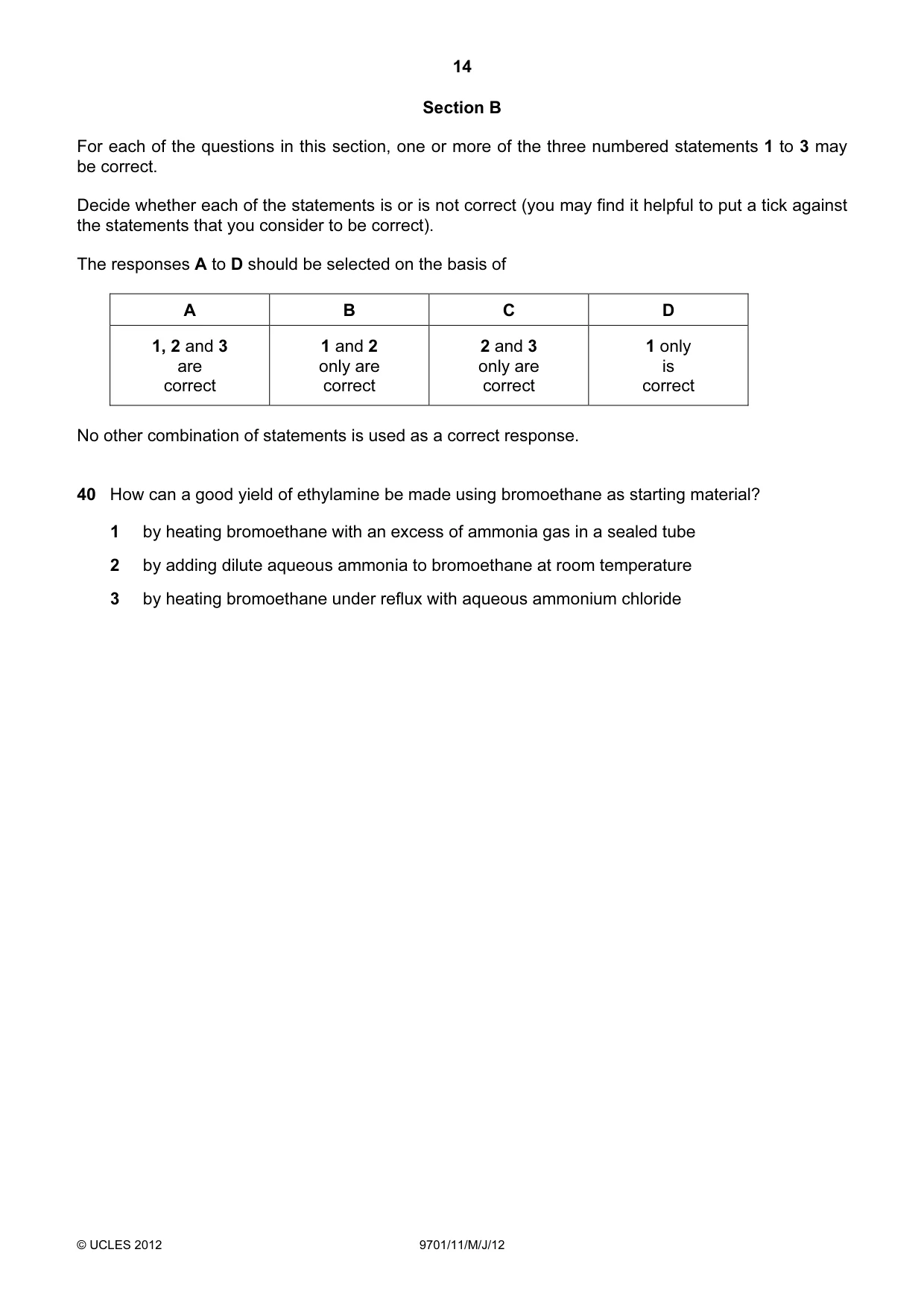


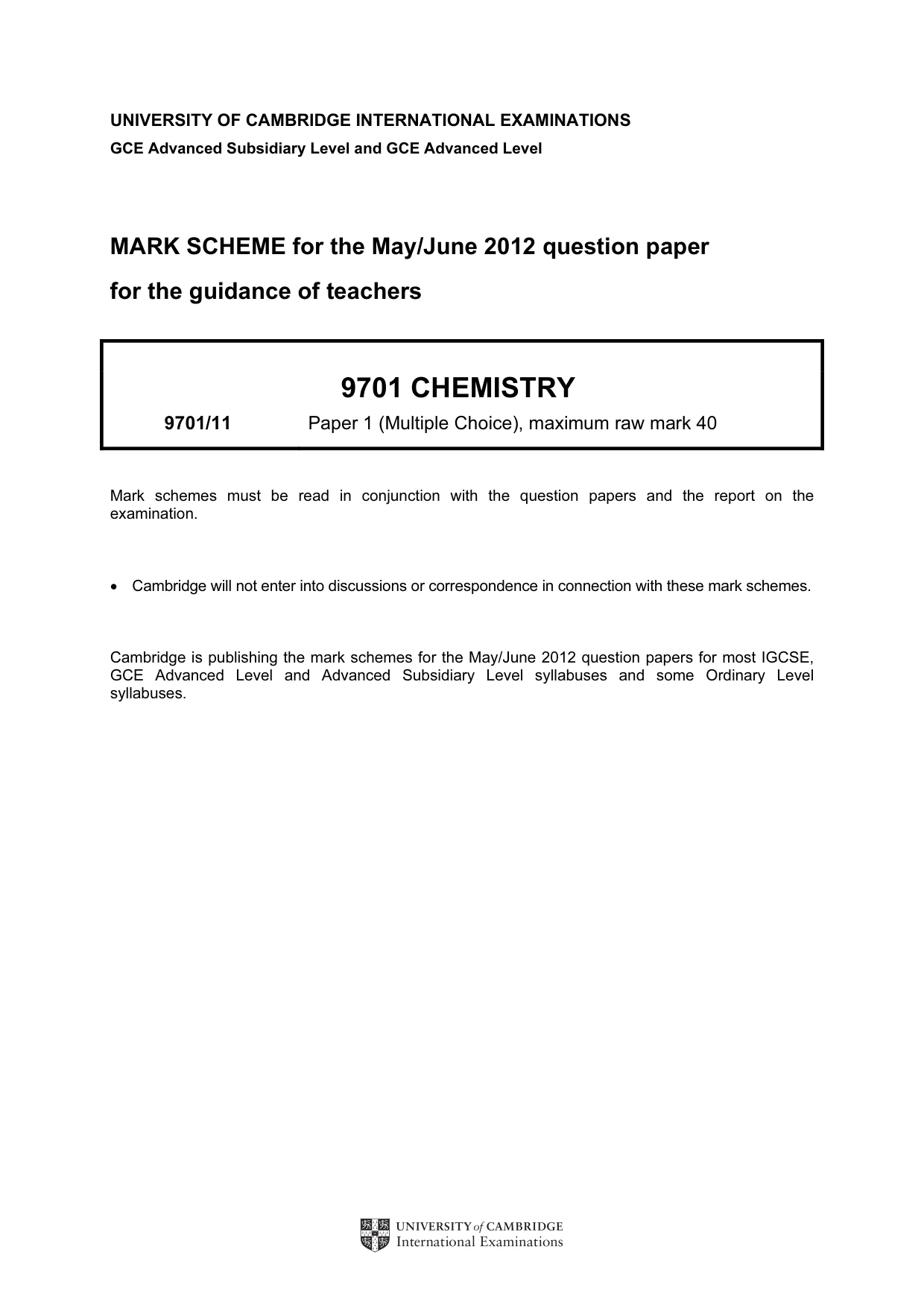
Mark scheme2 pages
Answers below. Sit the paper first if you are practising.
Questions as text
Q1 · In which species does the underlined atom have an incomplete outer shell?
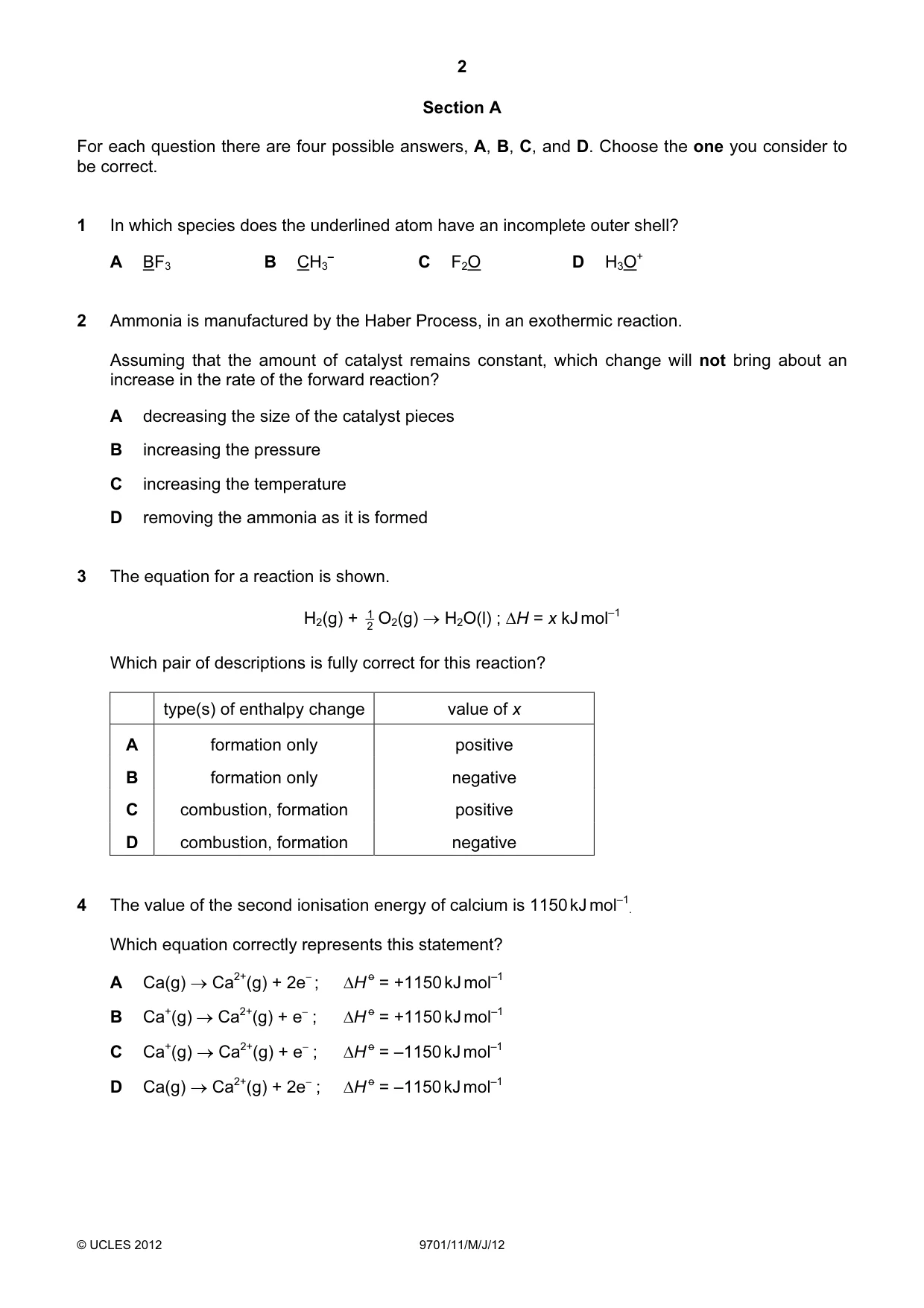
1 In which species does the underlined atom have an incomplete outer shell? A BF3 B CH3 – C F2O D H3O+
Mark scheme: A
More questions on Covalent bonding and coordinate (dative covalent) bonding
Q2 · Ammonia is manufactured by the Haber Process, in an exothermic reaction
2 Ammonia is manufactured by the Haber Process, in an exothermic reaction. Assuming that the amount of catalyst remains constant, which change will not bring about an increase in the rate of the forward reaction? A decreasing the size of the catalyst pieces B increasing the pressure C increasing the temperature D removing the ammonia as it is formed
Mark scheme: D
Q3 · The equation for a reaction is shown
3 The equation for a reaction is shown. H2(g) + 2 1 O2(g) → H2O(l) ; ∆H = x kJ mol–1 Which pair of descriptions is fully correct for this reaction? type(s) of enthalpy change value of x A formation only positive B formation only negative C combustion, formation positive D combustion, formation negative
Mark scheme: D
Q4 · The value of the second ionisation energy of calcium is 1150 kJ mol–1
4 The value of the second ionisation energy of calcium is 1150 kJ mol–1 . Which equation correctly represents this statement? A Ca(g) → Ca2+(g) + 2e− ; ∆H o = +1150 kJ mol–1 B Ca+(g) → Ca2+(g) + e− ; ∆H o = +1150 kJ mol–1 C Ca+(g) → Ca2+(g) + e− ; ∆H o = –1150 kJ mol–1 D Ca(g) → Ca2+(g) + 2e− ; ∆H o = –1150 kJ mol–1
Mark scheme: B
Q5 · Two conversions are outlined below
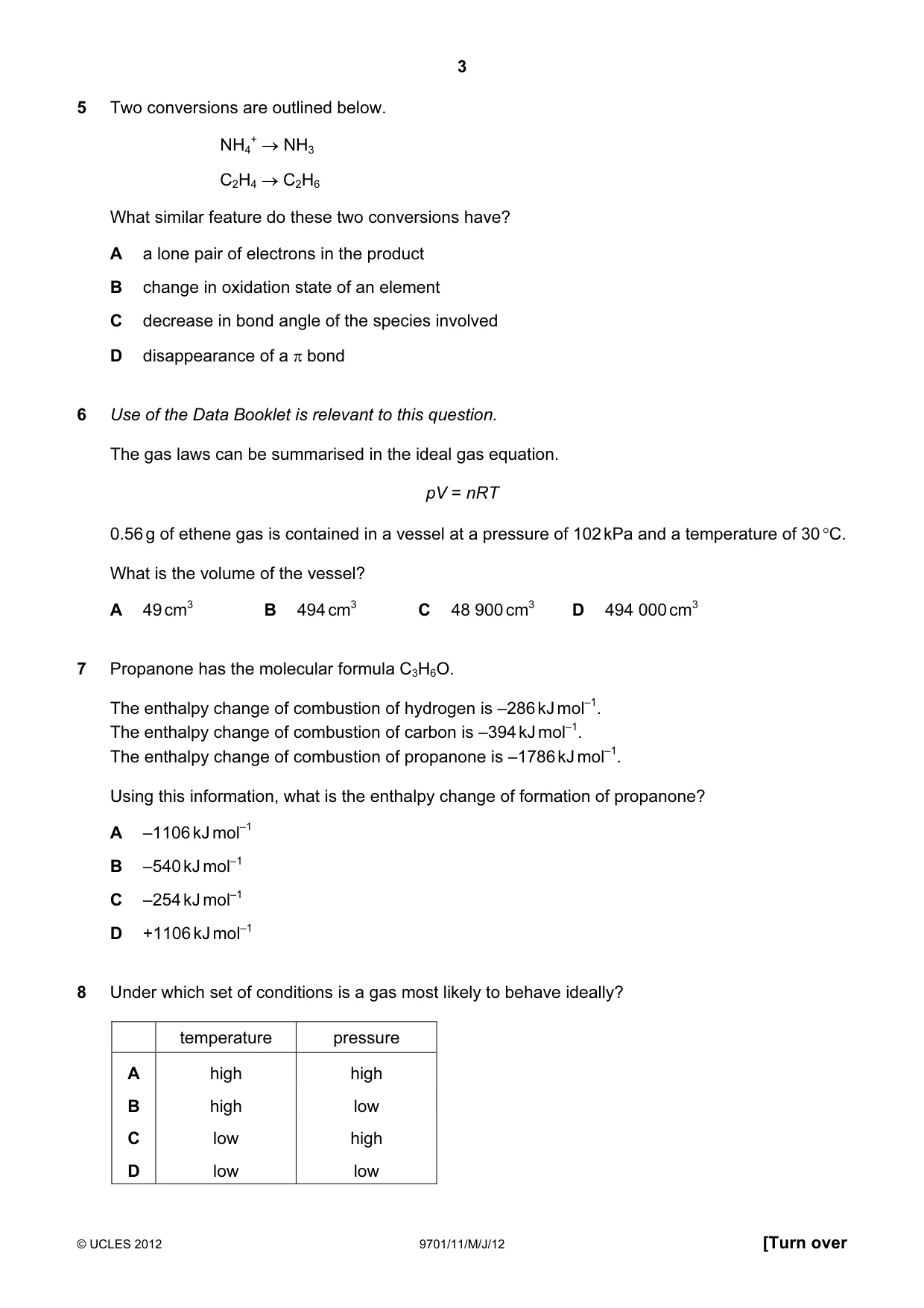
5 Two conversions are outlined below. NH4 + → NH3 C2H4 → C2H6 What similar feature do these two conversions have? A a lone pair of electrons in the product B change in oxidation state of an element C decrease in bond angle of the species involved D disappearance of a π bond
Mark scheme: C
Q6 · Use of the Data Booklet is relevant to this question
6 Use of the Data Booklet is relevant to this question. The gas laws can be summarised in the ideal gas equation. pV = nRT 0.56 g of ethene gas is contained in a vessel at a pressure of 102 kPa and a temperature of 30 °C. What is the volume of the vessel? A 49 cm3 B 494 cm3 C 48 900 cm3 D 494 000 cm3
Mark scheme: B
More questions on The gaseous state: ideal and real gases and pV = nRT
Q7 · Propanone has the molecular formula C3H6O
7 Propanone has the molecular formula C3H6O. The enthalpy change of combustion of hydrogen is –286 kJ mol–1. The enthalpy change of combustion of carbon is –394 kJ mol–1. The enthalpy change of combustion of propanone is –1786 kJ mol–1. Using this information, what is the enthalpy change of formation of propanone? A –1106 kJ mol–1 B –540 kJ mol–1 C –254 kJ mol–1 D +1106 kJ mol–1
Mark scheme: C
Q8 · Under which set of conditions is a gas most likely to behave ideally?
8 Under which set of conditions is a gas most likely to behave ideally? temperature pressure A high high B high low C low high D low low
Mark scheme: B
More questions on The gaseous state: ideal and real gases and pV = nRT
Q9 · Two moles of compound P were placed in a vessel
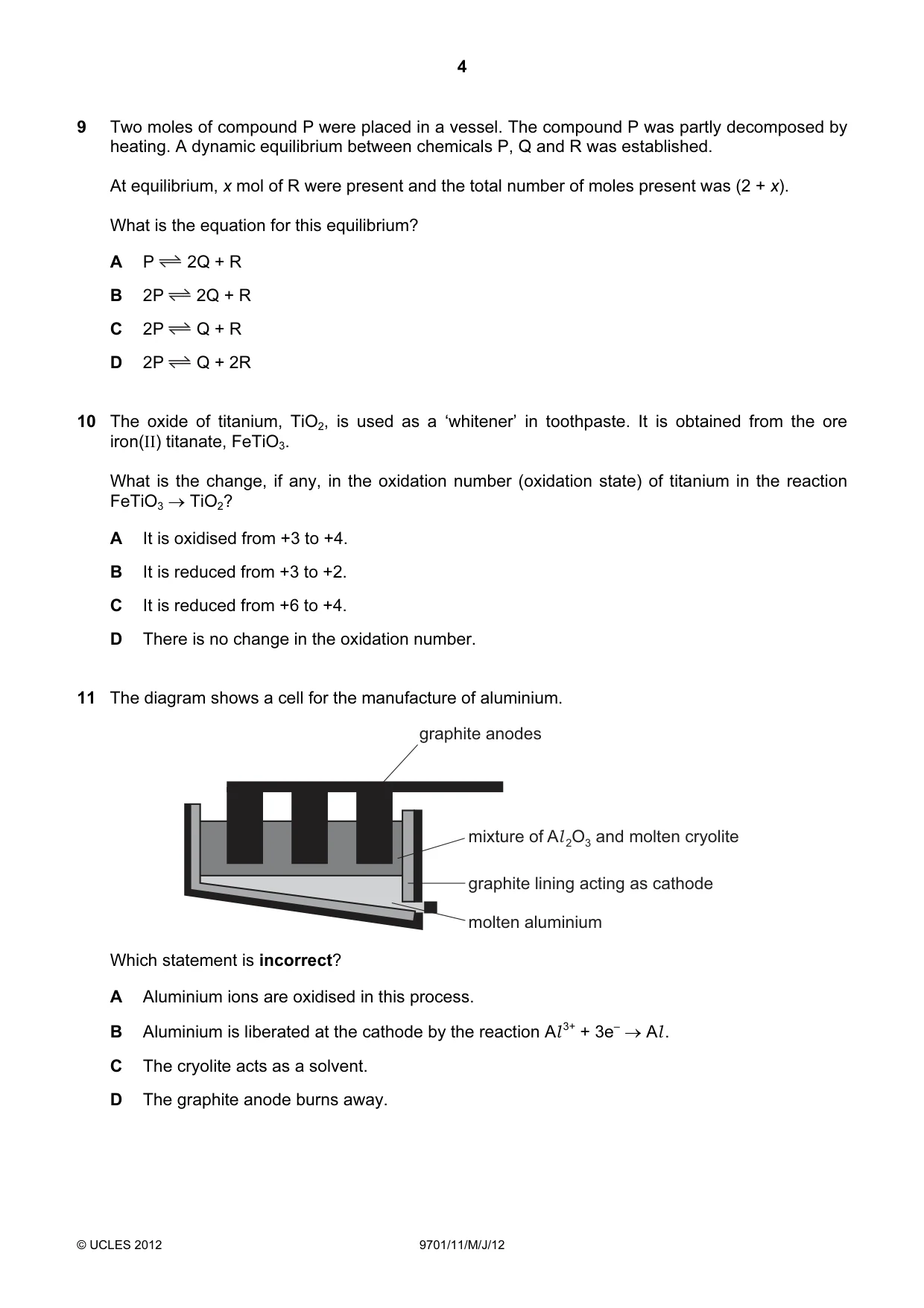
9 Two moles of compound P were placed in a vessel. The compound P was partly decomposed by heating. A dynamic equilibrium between chemicals P, Q and R was established. At equilibrium, x mol of R were present and the total number of moles present was (2 + x). What is the equation for this equilibrium? A P 2Q + R B 2P 2Q + R C 2P Q + R D 2P Q + 2R
Mark scheme: B
More questions on Chemical equilibria: reversible reactions, dynamic equilibrium
Q10 · The oxide of titanium, TiO2, is used as a ‘whitener’ in toothpaste
10 The oxide of titanium, TiO2, is used as a ‘whitener’ in toothpaste. It is obtained from the ore iron(II) titanate, FeTiO3. What is the change, if any, in the oxidation number (oxidation state) of titanium in the reaction FeTiO3 → TiO2? A It is oxidised from +3 to +4. B It is reduced from +3 to +2. C It is reduced from +6 to +4. D There is no change in the oxidation number.
Mark scheme: D
Q11 · The diagram shows a cell for the manufacture of aluminium
11 The diagram shows a cell for the manufacture of aluminium. graphite anodes mixture of Al 2O3 and molten cryolite graphite lining acting as cathode molten aluminium Which statement is incorrect? A Aluminium ions are oxidised in this process. B Aluminium is liberated at the cathode by the reaction Al 3+ + 3e– → Al . C The cryolite acts as a solvent. D The graphite anode burns away.
Mark scheme: A
Q12 · Aluminium chloride catalyses certain reactions by forming carbocations with chloroalkanes…
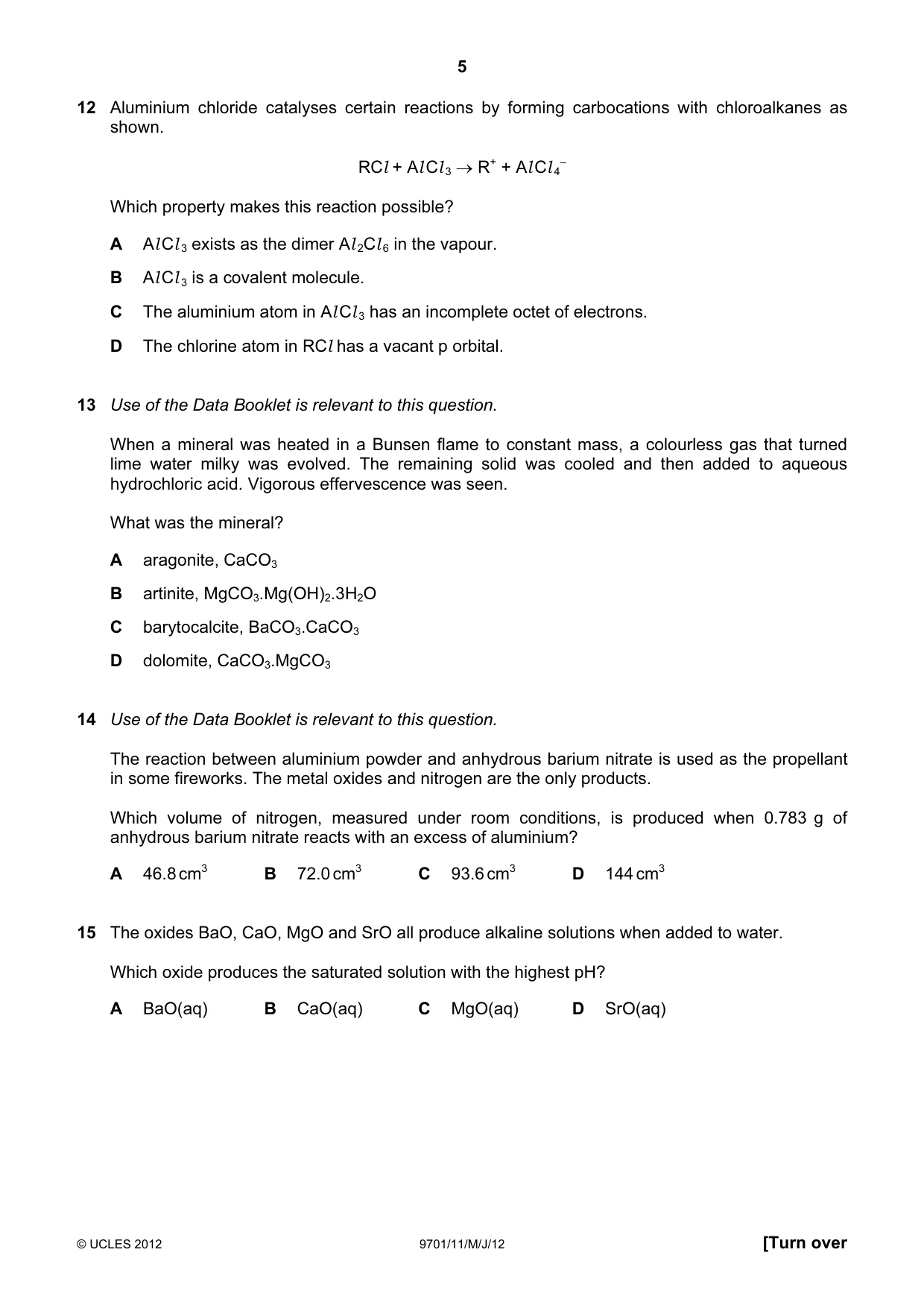
12 Aluminium chloride catalyses certain reactions by forming carbocations with chloroalkanes as shown. RCl + Al Cl 3 → R+ + Al Cl 4 – Which property makes this reaction possible? A Al Cl 3 exists as the dimer Al 2Cl 6 in the vapour. B Al Cl 3 is a covalent molecule. C The aluminium atom in Al Cl 3 has an incomplete octet of electrons. D The chlorine atom in RCl has a vacant p orbital.
Mark scheme: C
Q13 · Use of the Data Booklet is relevant to this question
13 Use of the Data Booklet is relevant to this question. When a mineral was heated in a Bunsen flame to constant mass, a colourless gas that turned lime water milky was evolved. The remaining solid was cooled and then added to aqueous hydrochloric acid. Vigorous effervescence was seen. What was the mineral? A aragonite, CaCO3 B artinite, MgCO3.Mg(OH)2.3H2O C barytocalcite, BaCO3.CaCO3 D dolomite, CaCO3.MgCO3
Mark scheme: C
Q14 · Use of the Data Booklet is relevant to this question
14 Use of the Data Booklet is relevant to this question. The reaction between aluminium powder and anhydrous barium nitrate is used as the propellant in some fireworks. The metal oxides and nitrogen are the only products. Which volume of nitrogen, measured under room conditions, is produced when 0.783 g of anhydrous barium nitrate reacts with an excess of aluminium? A 46.8 cm3 B 72.0 cm3 C 93.6 cm3 D 144 cm3
Mark scheme: B
More questions on Reacting masses and volumes (of solutions and gases)
Q15 · The oxides BaO, CaO, MgO and SrO all produce alkaline solutions when added to water
15 The oxides BaO, CaO, MgO and SrO all produce alkaline solutions when added to water. Which oxide produces the saturated solution with the highest pH? A BaO(aq) B CaO(aq) C MgO(aq) D SrO(aq)
Mark scheme: A
Q16 · In the treatment of domestic water supplies, chlorine is added to the water to form HCl O
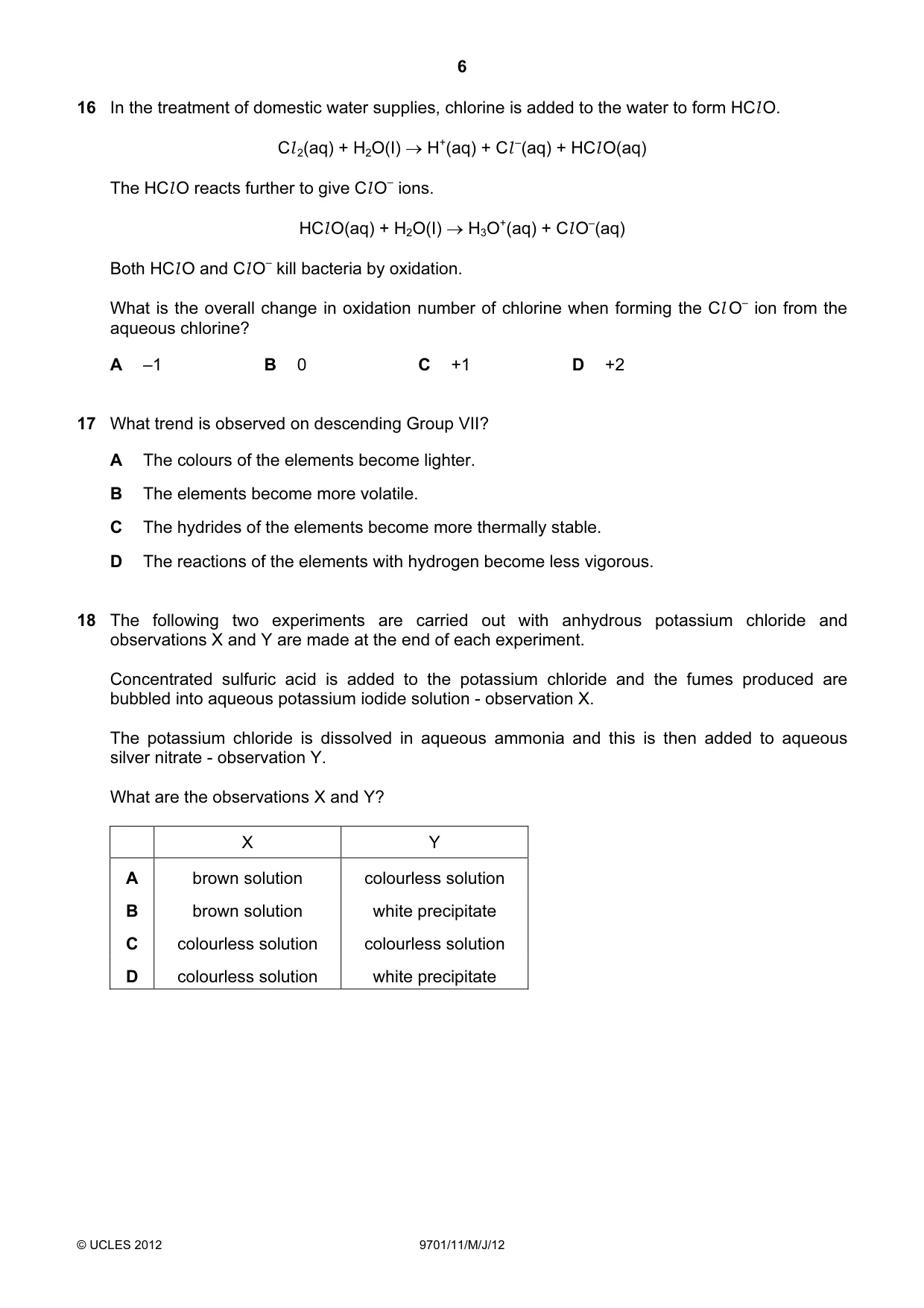
16 In the treatment of domestic water supplies, chlorine is added to the water to form HCl O. Cl 2(aq) + H2O(I) → H+(aq) + Cl –(aq) + HCl O(aq) The HCl O reacts further to give Cl O– ions. HCl O(aq) + H2O(I) → H3O+(aq) + Cl O–(aq) Both HCl O and Cl O– kill bacteria by oxidation. What is the overall change in oxidation number of chlorine when forming the Cl O– ion from the aqueous chlorine? A –1 B 0 C +1 D +2
Mark scheme: C
Q17 · What trend is observed on descending Group VII?
17 What trend is observed on descending Group VII? A The colours of the elements become lighter. B The elements become more volatile. C The hydrides of the elements become more thermally stable. D The reactions of the elements with hydrogen become less vigorous.
Mark scheme: D
More questions on Physical properties of the Group 17 elements
Q18 · The following two experiments are carried out with anhydrous potassium chloride and…
18 The following two experiments are carried out with anhydrous potassium chloride and observations X and Y are made at the end of each experiment. Concentrated sulfuric acid is added to the potassium chloride and the fumes produced are bubbled into aqueous potassium iodide solution - observation X. The potassium chloride is dissolved in aqueous ammonia and this is then added to aqueous silver nitrate - observation Y. What are the observations X and Y? X Y A brown solution colourless solution B brown solution white precipitate C colourless solution colourless solution D colourless solution white precipitate
Mark scheme: C
Q19 · Carbon monoxide, CO, nitrogen monoxide, NO, and sulfur dioxide, SO2, may all be present…
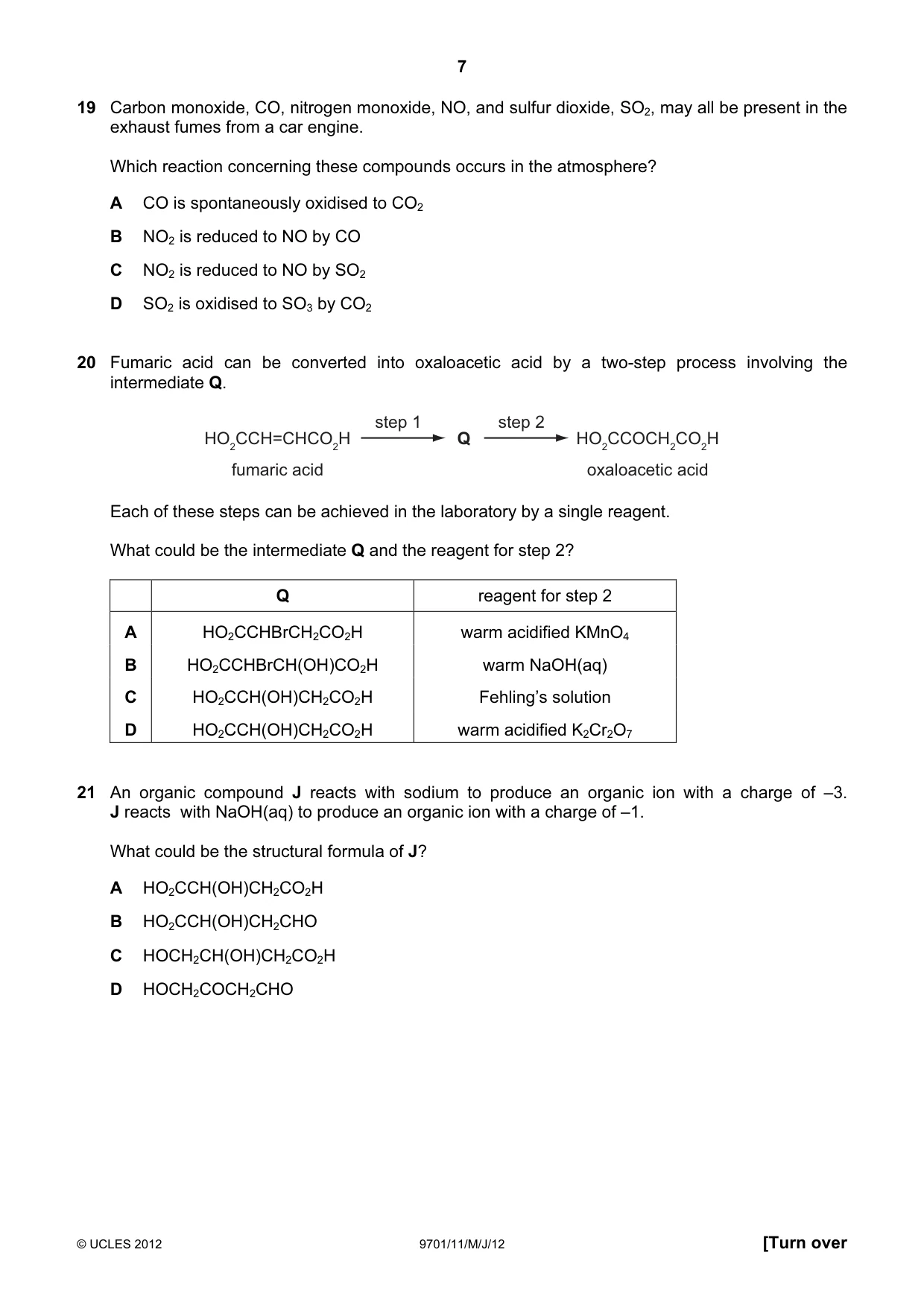
19 Carbon monoxide, CO, nitrogen monoxide, NO, and sulfur dioxide, SO2, may all be present in the exhaust fumes from a car engine. Which reaction concerning these compounds occurs in the atmosphere? A CO is spontaneously oxidised to CO2 B NO2 is reduced to NO by CO C NO2 is reduced to NO by SO2 D SO2 is oxidised to SO3 by CO2
Mark scheme: C
Q20 · Fumaric acid can be converted into oxaloacetic acid by a two-step process involving the…
20 Fumaric acid can be converted into oxaloacetic acid by a two-step process involving the intermediate Q. step 1 step 2 HO2CCH=CHCO2H Q HO2CCOCH2CO2H fumaric acid oxaloacetic acid Each of these steps can be achieved in the laboratory by a single reagent. What could be the intermediate Q and the reagent for step 2? Q reagent for step 2 A HO2CCHBrCH2CO2H warm acidified KMnO4 B HO2CCHBrCH(OH)CO2H warm NaOH(aq) C HO2CCH(OH)CH2CO2H Fehling’s solution D HO2CCH(OH)CH2CO2H warm acidified K2Cr2O7
Mark scheme: D
Q21 · An organic compound J reacts with sodium to produce an organic ion with a charge of –3
21 An organic compound J reacts with sodium to produce an organic ion with a charge of –3. J reacts with NaOH(aq) to produce an organic ion with a charge of –1. What could be the structural formula of J? A HO2CCH(OH)CH2CO2H B HO2CCH(OH)CH2CHO C HOCH2CH(OH)CH2CO2H D HOCH2COCH2CHO
Mark scheme: C
Q22 · Use of the Data Booklet is relevant to this question
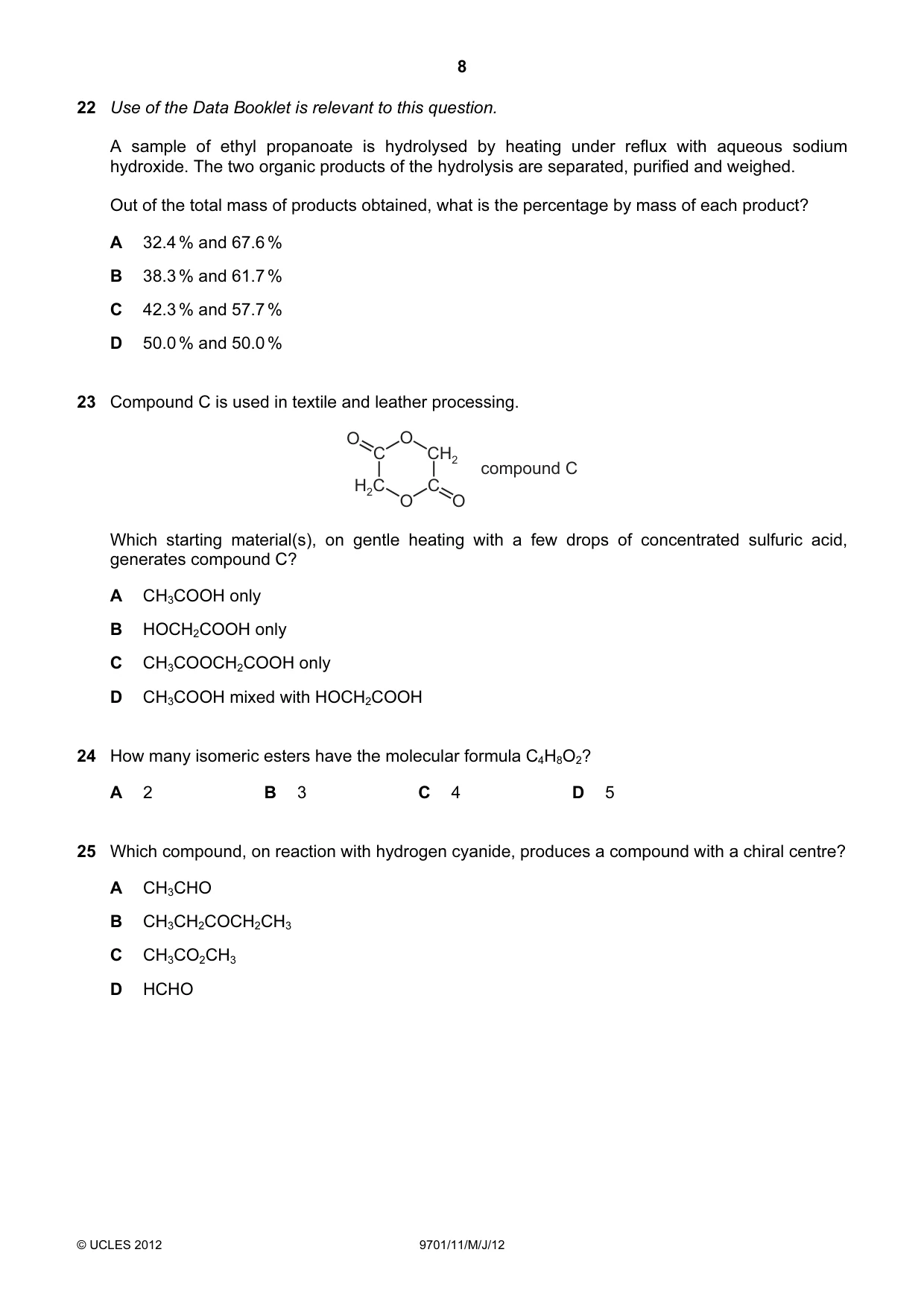
22 Use of the Data Booklet is relevant to this question. A sample of ethyl propanoate is hydrolysed by heating under reflux with aqueous sodium hydroxide. The two organic products of the hydrolysis are separated, purified and weighed. Out of the total mass of products obtained, what is the percentage by mass of each product? A 32.4 % and 67.6 % B 38.3 % and 61.7 % C 42.3 % and 57.7 % D 50.0 % and 50.0 %
Mark scheme: A
Q23 · Compound C is used in textile and leather processing
23 Compound C is used in textile and leather processing. O O C CH2 compound C H2C C O O Which starting material(s), on gentle heating with a few drops of concentrated sulfuric acid, generates compound C? A CH3COOH only B HOCH2COOH only C CH3COOCH2COOH only D CH3COOH mixed with HOCH2COOH
Mark scheme: B
Q24 · How many isomeric esters have the molecular formula C4H8O2?
24 How many isomeric esters have the molecular formula C4H8O2? A 2 B 3 C 4 D 5
Mark scheme: C
More questions on Isomerism: structural isomerism and stereoisomerism
Q25 · Which compound, on reaction with hydrogen cyanide, produces a compound with a chiral…
25 Which compound, on reaction with hydrogen cyanide, produces a compound with a chiral centre? A CH3CHO B CH3CH2COCH2CH3 C CH3CO2CH3 D HCHO
Mark scheme: A
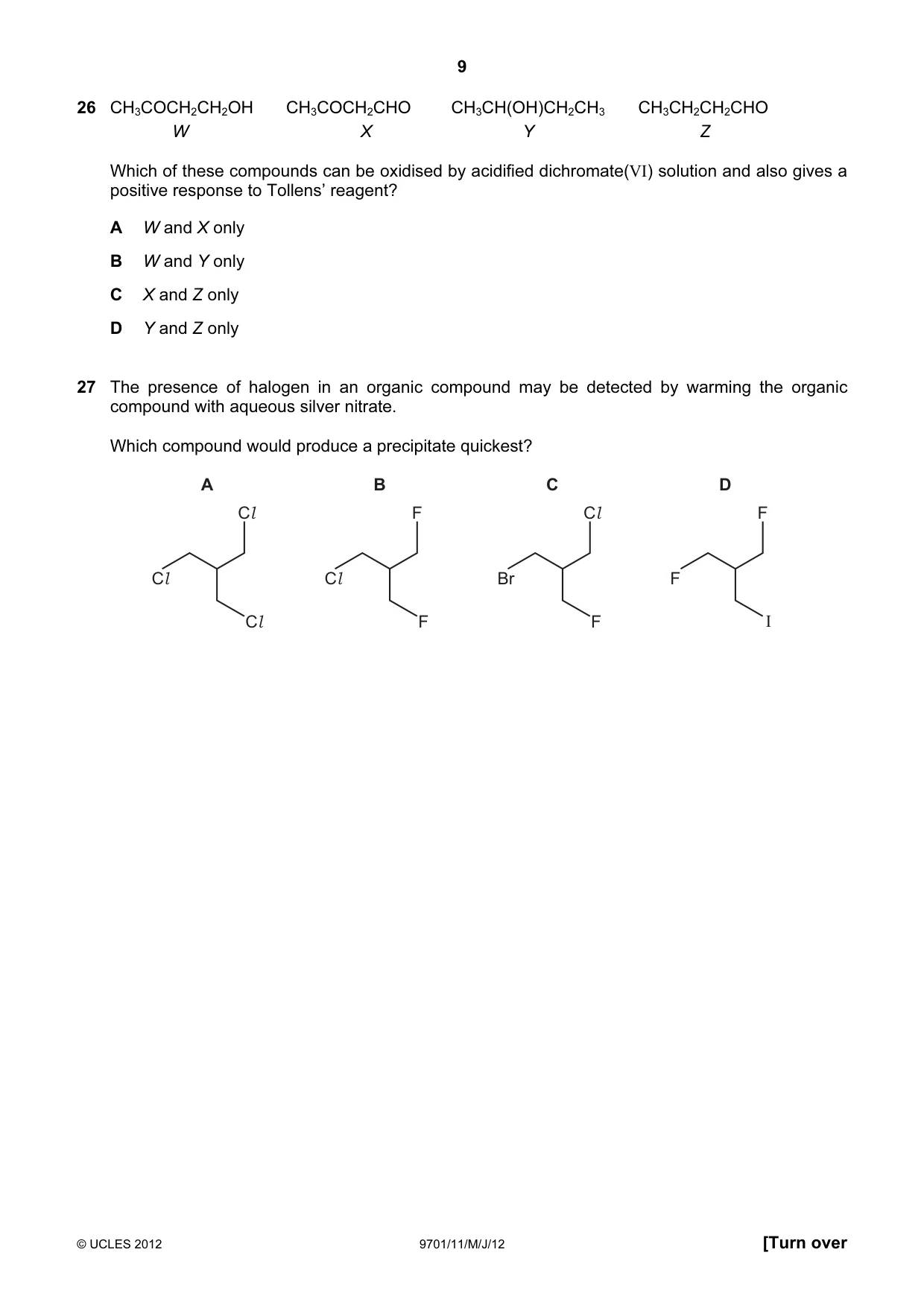
Q26 · CH3COCH2CH2OH CH3COCH2CHO CH3CH(OH)CH2CH3 CH3CH2CH2CHO W X Y Z Which of these compounds…
26 CH3COCH2CH2OH CH3COCH2CHO CH3CH(OH)CH2CH3 CH3CH2CH2CHO W X Y Z Which of these compounds can be oxidised by acidified dichromate(VI) solution and also gives a positive response to Tollens’ reagent? A W and X only B W and Y only C X and Z only D Y and Z only
Mark scheme: C
Q27 · The presence of halogen in an organic compound may be detected by warming the organic…
27 The presence of halogen in an organic compound may be detected by warming the organic compound with aqueous silver nitrate. Which compound would produce a precipitate quickest? A B C D Cl F Cl F Cl Cl Br F Cl F F I
Mark scheme: D
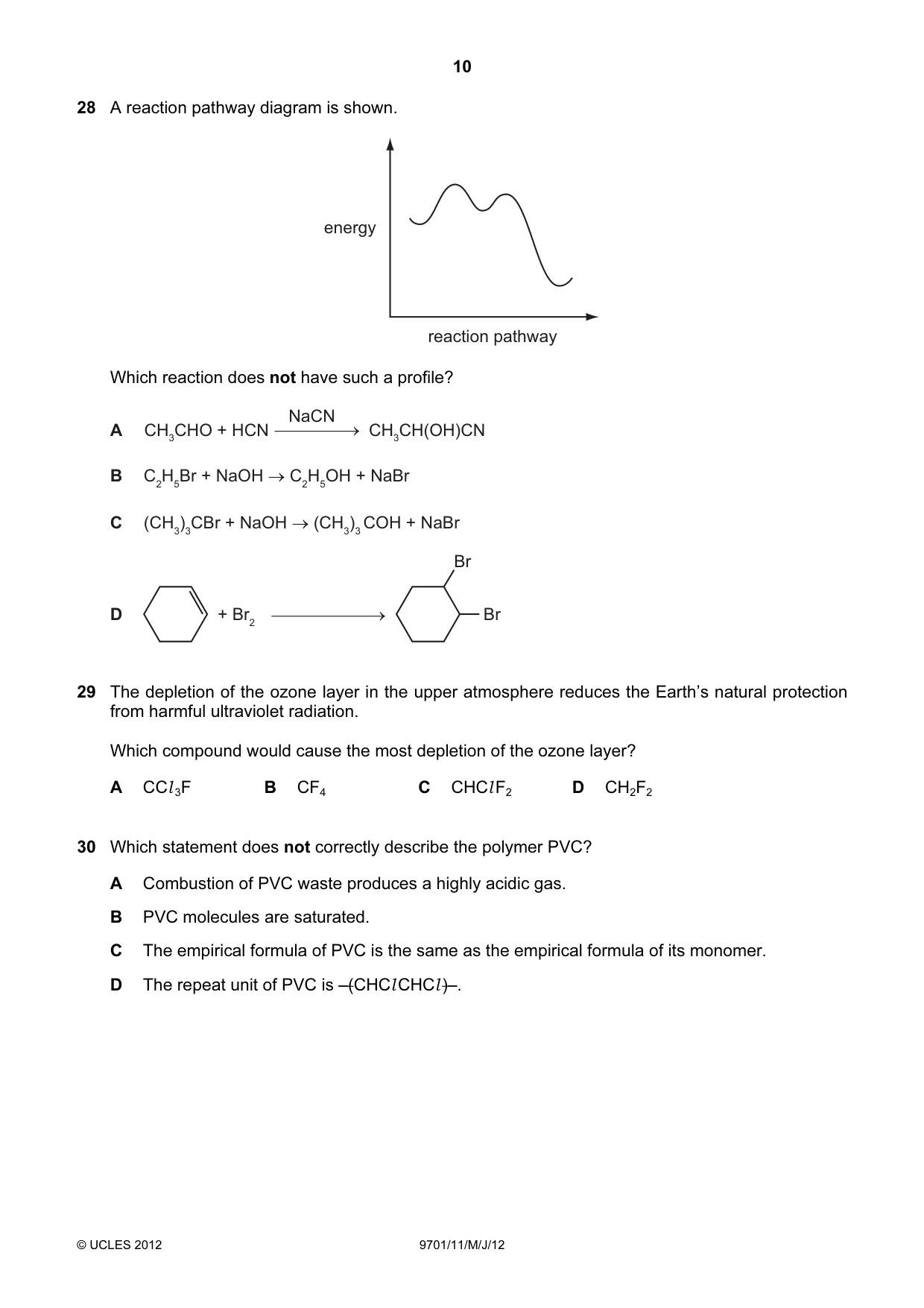
Q28 · A reaction pathway diagram is shown
28 A reaction pathway diagram is shown. energy reaction pathway Which reaction does not have such a profile? NaCN A CH3CHO + HCN CH3CH(OH)CN B C2H5Br + NaOH → C2H5OH + NaBr C (CH3)3CBr + NaOH → (CH3)3 COH + NaBr Br D + Br2 Br
Mark scheme: B
Q29 · The depletion of the ozone layer in the upper atmosphere reduces the Earth’s natural…
29 The depletion of the ozone layer in the upper atmosphere reduces the Earth’s natural protection from harmful ultraviolet radiation. Which compound would cause the most depletion of the ozone layer? A CCl 3F B CF4 C CHCl F2 D CH2F2
Mark scheme: A
Q30 · Which statement does not correctly describe the polymer PVC?
30 Which statement does not correctly describe the polymer PVC? A Combustion of PVC waste produces a highly acidic gas. B PVC molecules are saturated. C The empirical formula of PVC is the same as the empirical formula of its monomer. D The repeat unit of PVC is –(CHCl CHCl )–.
Mark scheme: D
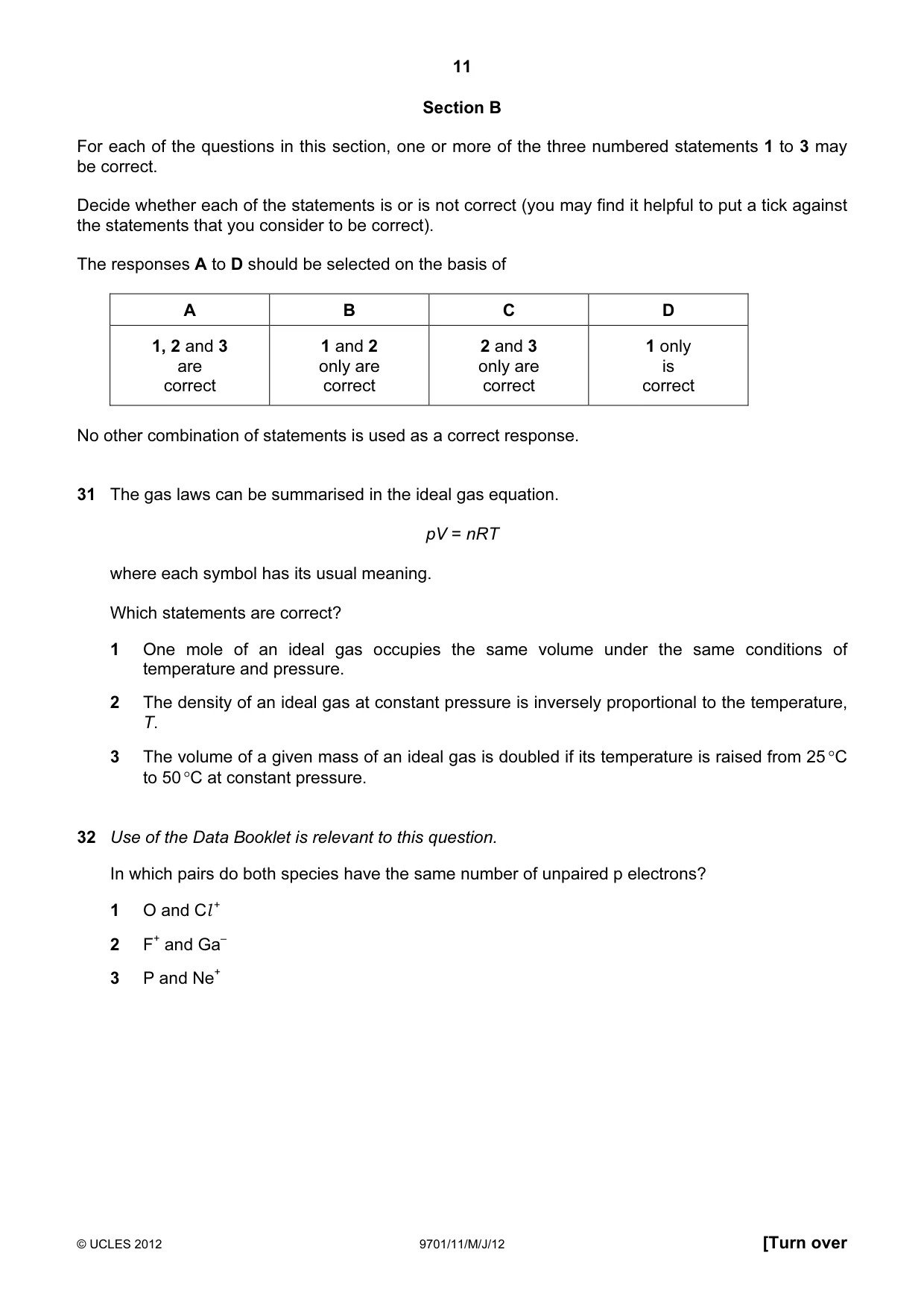
Q31 · The gas laws can be summarised in the ideal gas equation
31 The gas laws can be summarised in the ideal gas equation. pV = nRT where each symbol has its usual meaning. Which statements are correct? 1 One mole of an ideal gas occupies the same volume under the same conditions of temperature and pressure. 2 The density of an ideal gas at constant pressure is inversely proportional to the temperature, T. 3 The volume of a given mass of an ideal gas is doubled if its temperature is raised from 25 °C to 50 °C at constant pressure.
Mark scheme: B
More questions on The gaseous state: ideal and real gases and pV = nRT
Q32 · Use of the Data Booklet is relevant to this question
32 Use of the Data Booklet is relevant to this question. In which pairs do both species have the same number of unpaired p electrons? 1 O and Cl + 2 F+ and Ga– 3 P and Ne+
Mark scheme: B
More questions on Electrons, energy levels and atomic orbitals
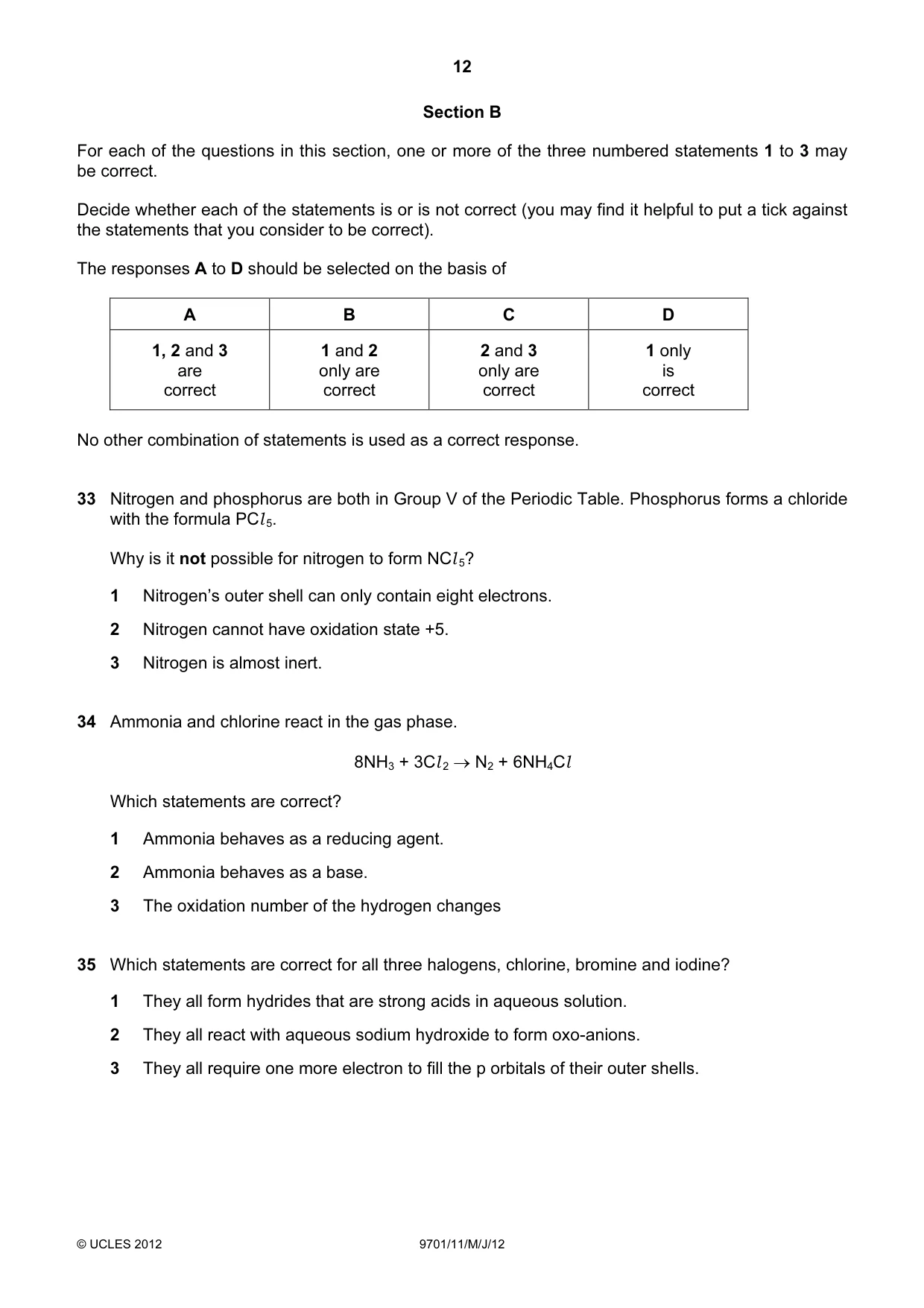
Q33 · Nitrogen and phosphorus are both in Group V of the Periodic Table
33 Nitrogen and phosphorus are both in Group V of the Periodic Table. Phosphorus forms a chloride with the formula PCl 5. Why is it not possible for nitrogen to form NCl 5? 1 Nitrogen’s outer shell can only contain eight electrons. 2 Nitrogen cannot have oxidation state +5. 3 Nitrogen is almost inert.
Mark scheme: D
Q34 · Ammonia and chlorine react in the gas phase
34 Ammonia and chlorine react in the gas phase. 8NH3 + 3Cl 2 → N2 + 6NH4Cl Which statements are correct? 1 Ammonia behaves as a reducing agent. 2 Ammonia behaves as a base. 3 The oxidation number of the hydrogen changes
Mark scheme: B
Q35 · Which statements are correct for all three halogens, chlorine, bromine and iodine?
35 Which statements are correct for all three halogens, chlorine, bromine and iodine? 1 They all form hydrides that are strong acids in aqueous solution. 2 They all react with aqueous sodium hydroxide to form oxo-anions. 3 They all require one more electron to fill the p orbitals of their outer shells.
Mark scheme: A
More questions on Physical properties of the Group 17 elements
Q36 · In the manufacture of sulfuric acid the reaction 2SO2(g) + O2(g) 2SO3(g) usually takes…
36 In the manufacture of sulfuric acid the reaction 2SO2(g) + O2(g) 2SO3(g) usually takes place at 400 °C and 1 atm pressure. In one industrial plant, it is decided to change the pressure to 20 atm. What will be the consequences of this change? 1 increased running costs 2 an increased percentage of sulfur trioxide in the equilibrium mixture 3 the rate of the backward reaction increases
Mark scheme: A
More questions on Chemical equilibria: reversible reactions, dynamic equilibrium
Q37 · What is always involved in a carbon-carbon π bond?
37 What is always involved in a carbon-carbon π bond? 1 a shared pair of electrons 2 a sideways overlap of p orbitals 3 delocalised electrons
Mark scheme: B
More questions on Shapes of organic molecules; σ and π bonds
Q38 · A number of alcohols with the formula C4H10O are separately oxidised
38 A number of alcohols with the formula C4H10O are separately oxidised. Using 70 g of the alcohols a 62 % yield of organic product is achieved. What mass of product could be obtained? 1 42.2 g of butanone 2 51.6 g of butanoic acid 3 51.6 g of 2-methyl propanoic acid
Mark scheme: A
More questions on Reacting masses and volumes (of solutions and gases)
Q39 · The compound cis-hex-3-enal is responsible for the characteristic smell of cut grass
39 The compound cis-hex-3-enal is responsible for the characteristic smell of cut grass. The human nose is particularly sensitive to this compound, being able to detect 0.25 parts per billion in air. O cis-hex-3-enal Which reagents will react with cis-hex-3-enal? 1 sodium 2 sodium borohydride 3 Fehling’s reagent
Mark scheme: C
Q40 · How can a good yield of ethylamine be made using bromoethane as starting material?
40 How can a good yield of ethylamine be made using bromoethane as starting material? 1 by heating bromoethane with an excess of ammonia gas in a sealed tube 2 by adding dilute aqueous ammonia to bromoethane at room temperature 3 by heating bromoethane under reflux with aqueous ammonium chloride
Mark scheme: D
What was in this paper
The subtopics covered by these 40 questions, and how many questions each got. Open one in a new tab to see every Cambridge question on it.
4Aldehydes and ketones3Redox processes: electron transfer and changes in oxidation number (oxidation state)3The gaseous state: ideal and real gases and pV = nRT3Alcohols2Chemical equilibria: reversible reactions, dynamic equilibrium2Esters2Physical properties of the Group 17 elements2Reacting masses and volumes (of solutions and gases)2Similarities and trends in the properties of the Group 2 metals, magnesium to barium, and their compounds2Addition polymerisation1Alkenes1Chemical periodicity of other elements1Covalent bonding and coordinate (dative covalent) bonding1Electrolysis1Electrons, energy levels and atomic orbitals1Enthalpy change, ΔH1Hess’s law1Ionisation energy1Isomerism: structural isomerism and stereoisomerism1Nitrogen and sulfur1Primary amines1Rate of reaction1Shapes of organic molecules; σ and π bonds1Some reactions of the halide ions1What you needed in this session
Cambridge’s own grade thresholds for 2012 May/June, Paper 1 · Variant 1. A higher threshold means an easier paper — the bar moves with how the cohort did.