Cambridge A Level Chemistry 9701 — 2016 Feb/March Paper 1 · Variant 2
9701/12/F/M/16 · 40 questions · 40 marks · ≈45 min
The question paper and its mark scheme, free to read here and free to download. This is Cambridge’s own paper, exactly as it was sat.
Question paper16 pages
Mark scheme2 pages
Answers below. Sit the paper first if you are practising.
Questions as text
Q1 · Which compound contains two different elements with identical oxidation states?
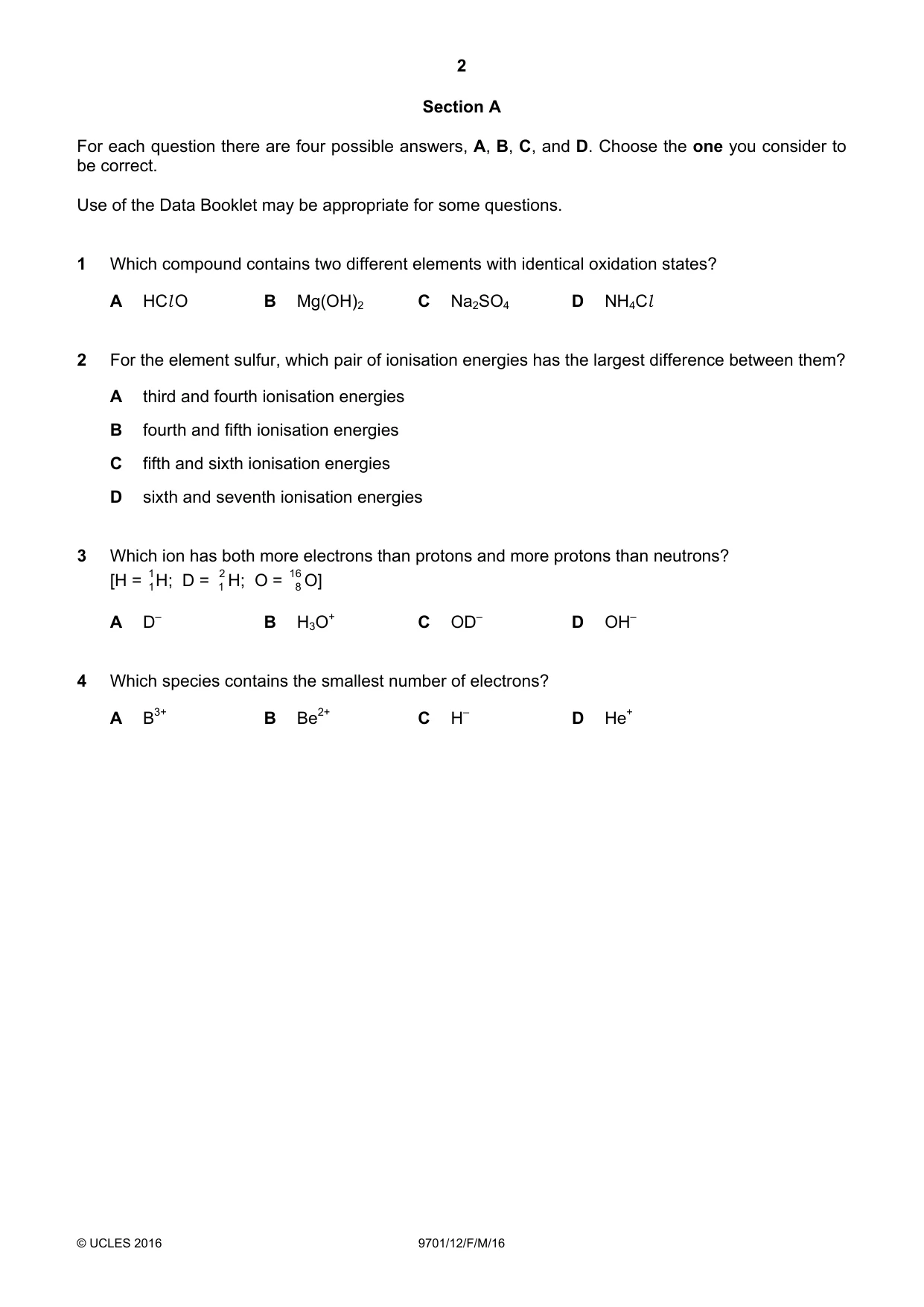
1 Which compound contains two different elements with identical oxidation states? A HCl O B Mg(OH)2 C Na2SO4 D NH4Cl
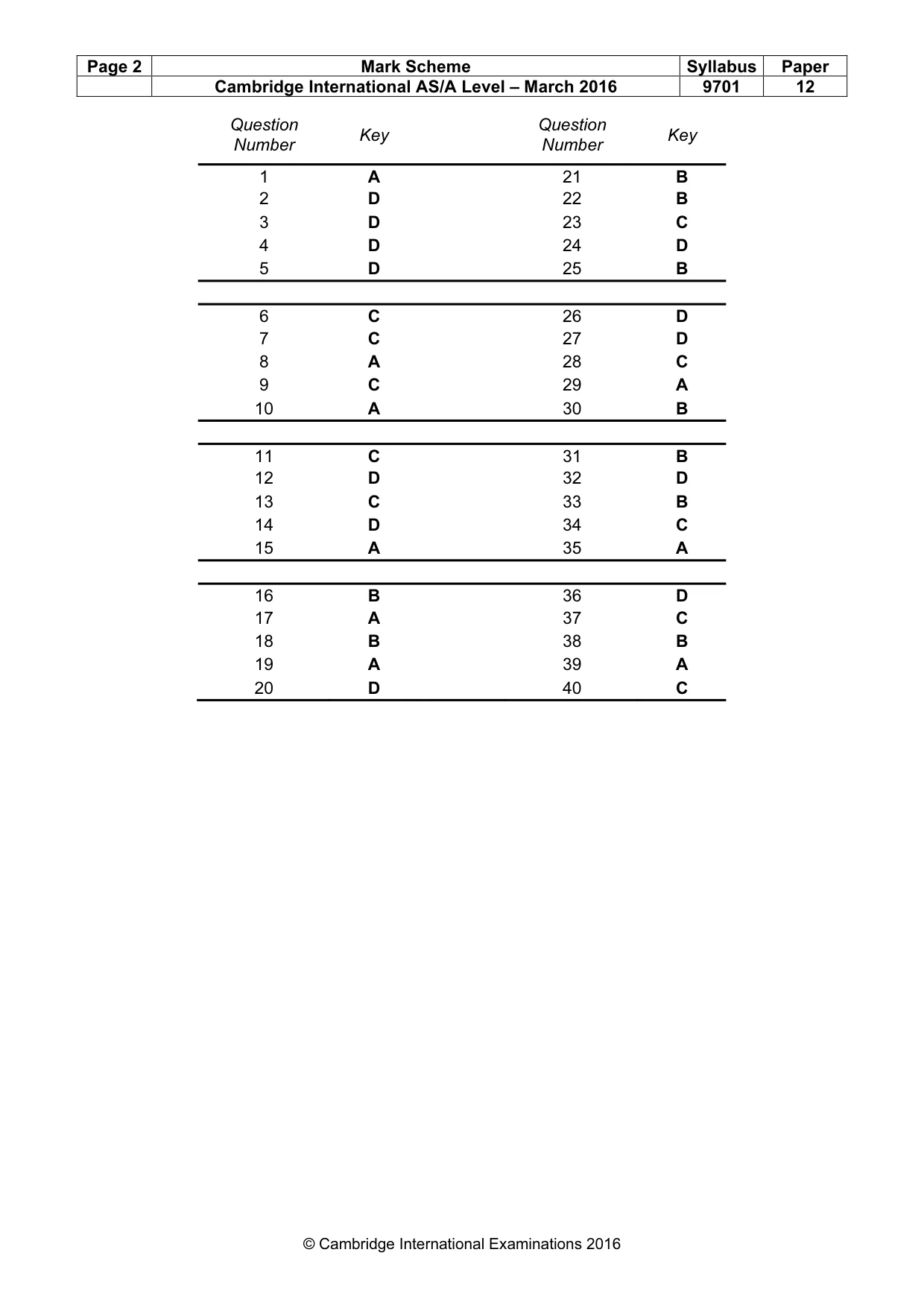
Mark scheme: A
Q2 · For the element sulfur, which pair of ionisation energies has the largest difference…
2 For the element sulfur, which pair of ionisation energies has the largest difference between them? A third and fourth ionisation energies B fourth and fifth ionisation energies C fifth and sixth ionisation energies D sixth and seventh ionisation energies
Mark scheme: D
Q3 · Which ion has both more electrons than protons and more protons than neutrons?
3 Which ion has both more electrons than protons and more protons than neutrons? [H = 1 1H; D = 2 1 H; O = 16 8 O] A D– B H3O+ C OD– D OH–
Mark scheme: D
Q4 · Which species contains the smallest number of electrons?
4 Which species contains the smallest number of electrons? A B3+ B Be2+ C H– D He+
Mark scheme: D
Q5 · Nitric oxide, NO, and bromine vapour react together according to the following equation
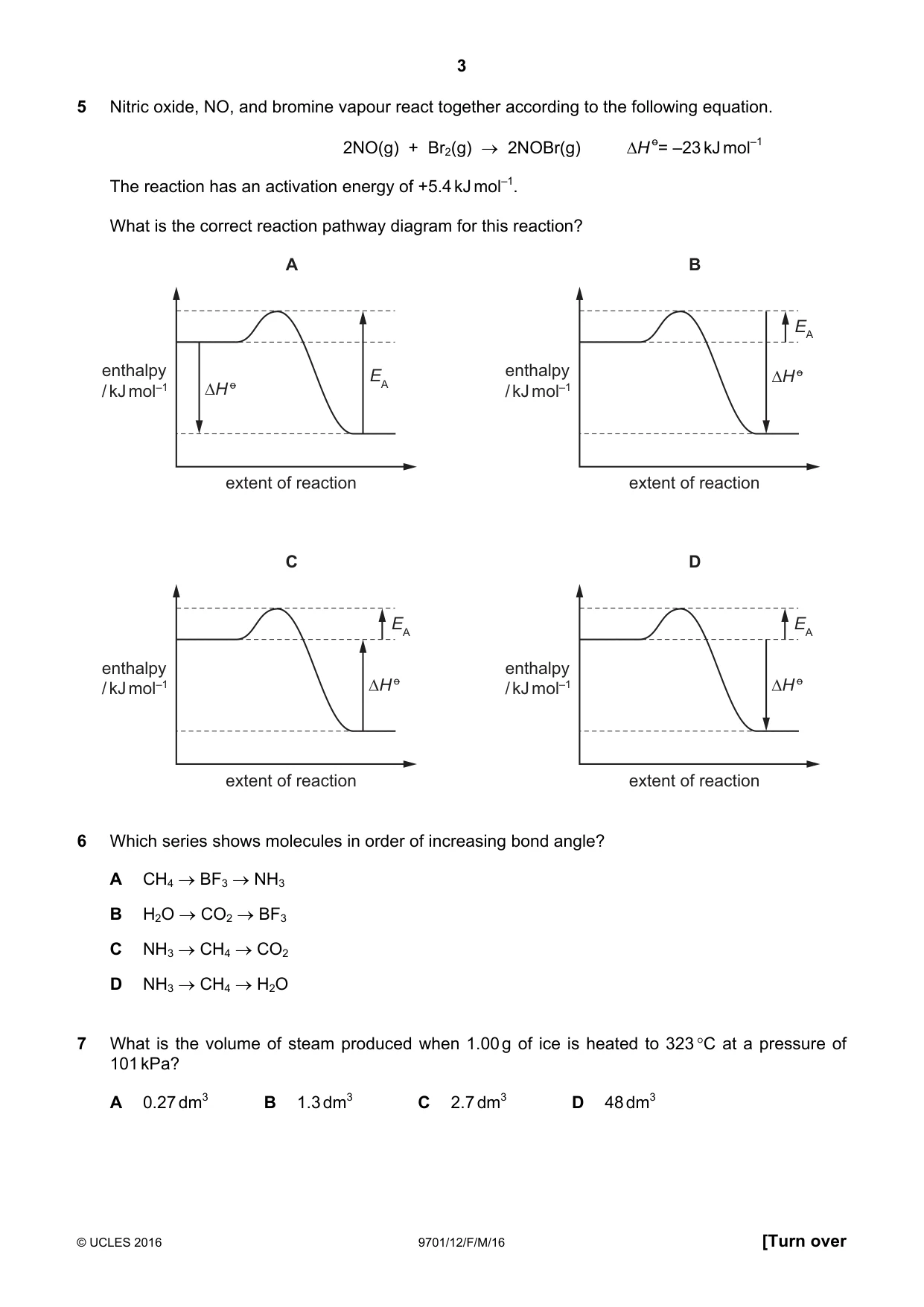
5 Nitric oxide, NO, and bromine vapour react together according to the following equation. 2NO(g) + Br2(g) → 2NOBr(g) ΔH o= –23 kJ mol–1 The reaction has an activation energy of +5.4 kJ mol–1. What is the correct reaction pathway diagram for this reaction? A B EA enthalpy EA enthalpy ΔH o / kJ mol–1 ΔH o / kJ mol–1 extent of reaction extent of reaction C D EA EA enthalpy enthalpy / kJ mol–1 ΔH o / kJ mol–1 ΔH o extent of reaction extent of reaction
Mark scheme: D
Q6 · Which series shows molecules in order of increasing bond angle?
6 Which series shows molecules in order of increasing bond angle? A CH4 → BF3 → NH3 B H2O → CO2 → BF3 C NH3 → CH4 → CO2 D NH3 → CH4 → H2O
Mark scheme: C
Q7 · What is the volume of steam produced when 1.00 g of ice is heated to 323 °C at a pressure…
7 What is the volume of steam produced when 1.00 g of ice is heated to 323 °C at a pressure of 101 kPa? A 0.27 dm3 B 1.3 dm3 C 2.7 dm3 D 48 dm3
Mark scheme: C
More questions on The gaseous state: ideal and real gases and pV = nRT
Q8 · Solid carbon dioxide, CO2, is similar to solid iodine, I2, in its structure and properties
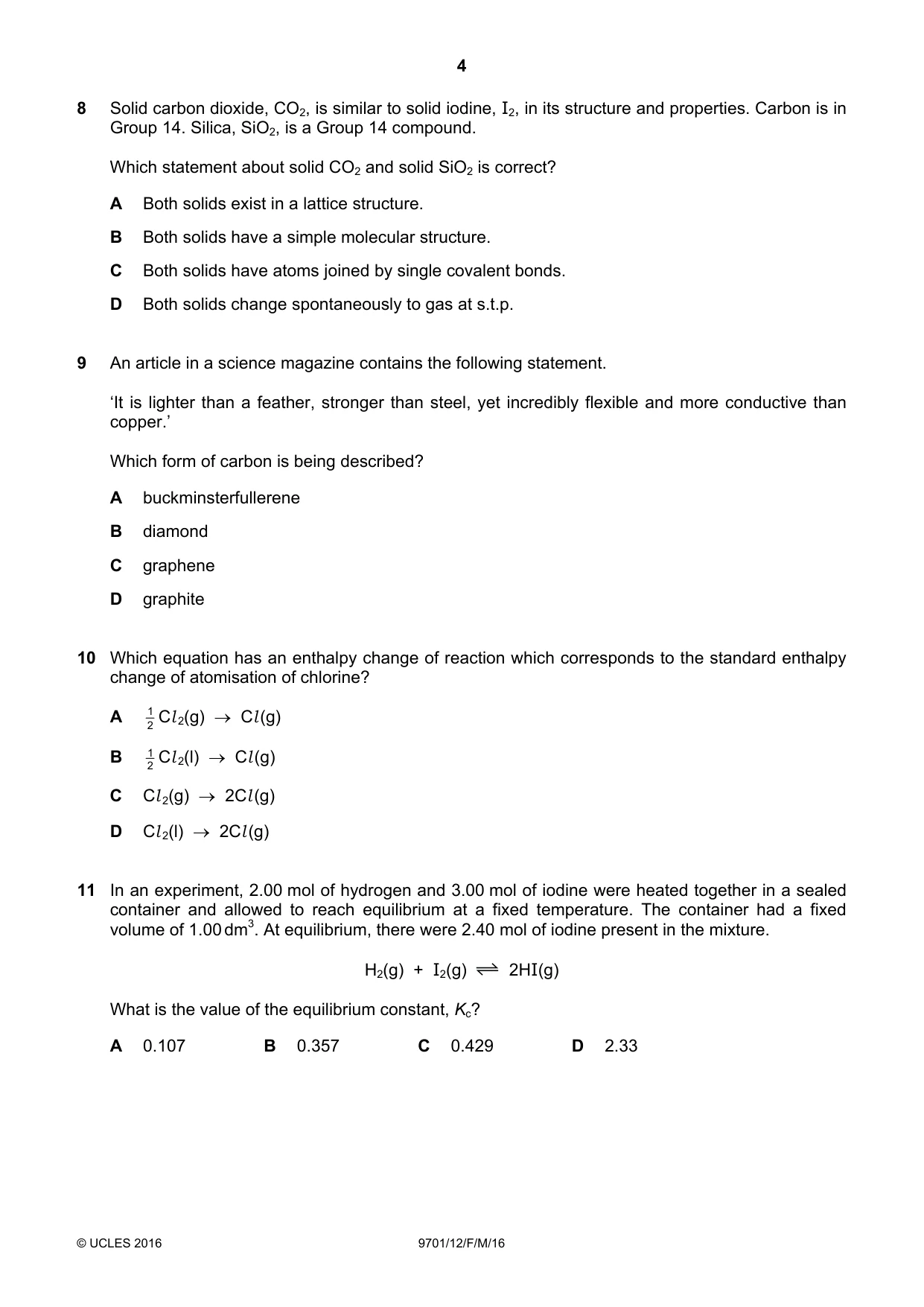
8 Solid carbon dioxide, CO2, is similar to solid iodine, I2, in its structure and properties. Carbon is in Group 14. Silica, SiO2, is a Group 14 compound. Which statement about solid CO2 and solid SiO2 is correct? A Both solids exist in a lattice structure. B Both solids have a simple molecular structure. C Both solids have atoms joined by single covalent bonds. D Both solids change spontaneously to gas at s.t.p.
Mark scheme: A
Q9 · An article in a science magazine contains the following statement
9 An article in a science magazine contains the following statement. ‘It is lighter than a feather, stronger than steel, yet incredibly flexible and more conductive than copper.’ Which form of carbon is being described? A buckminsterfullerene B diamond C graphene D graphite
Mark scheme: C
Q10 · Which equation has an enthalpy change of reaction which corresponds to the standard…
10 Which equation has an enthalpy change of reaction which corresponds to the standard enthalpy change of atomisation of chlorine? A 1 Cl 2(g) → Cl (g) 2 B 1 Cl 2(l) → Cl (g) 2 C Cl 2(g) → 2Cl (g) D Cl 2(l) → 2Cl (g)
Mark scheme: A
Q11 · In an experiment, 2.00 mol of hydrogen and 3.00 mol of iodine were heated together in a…
11 In an experiment, 2.00 mol of hydrogen and 3.00 mol of iodine were heated together in a sealed container and allowed to reach equilibrium at a fixed temperature. The container had a fixed volume of 1.00 dm3. At equilibrium, there were 2.40 mol of iodine present in the mixture. H2(g) + I2(g) 2HI(g) What is the value of the equilibrium constant, Kc? A 0.107 B 0.357 C 0.429 D 2.33
Mark scheme: C
More questions on Chemical equilibria: reversible reactions, dynamic equilibrium
Q12 · Consecutive elements X, Y and Z are in Period 3 of the Periodic Table
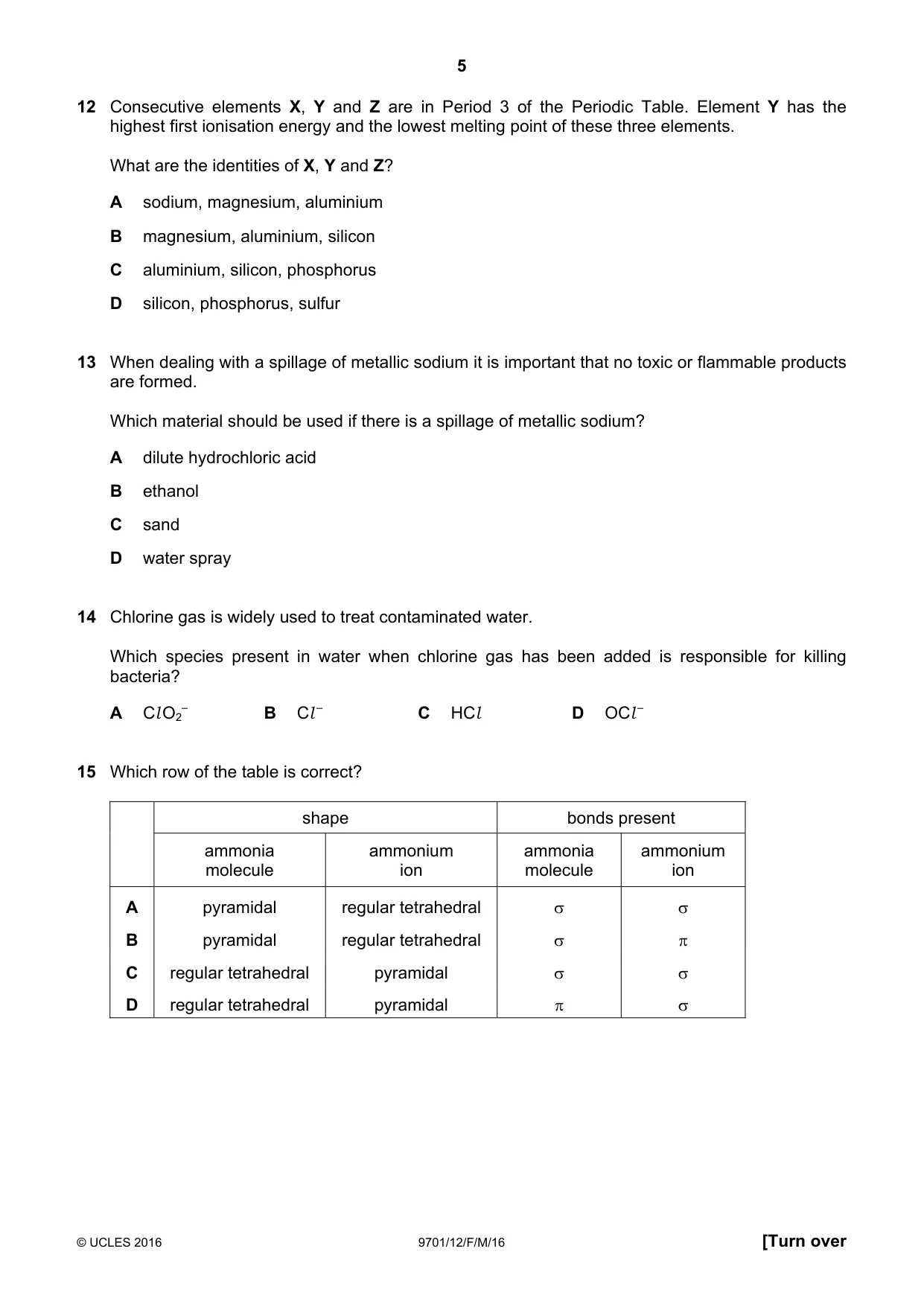
12 Consecutive elements X, Y and Z are in Period 3 of the Periodic Table. Element Y has the highest first ionisation energy and the lowest melting point of these three elements. What are the identities of X, Y and Z? A sodium, magnesium, aluminium B magnesium, aluminium, silicon C aluminium, silicon, phosphorus D silicon, phosphorus, sulfur
Mark scheme: D
More questions on Periodicity of physical properties of the elements in Period 3
Q13 · When dealing with a spillage of metallic sodium it is important that no toxic or…
13 When dealing with a spillage of metallic sodium it is important that no toxic or flammable products are formed. Which material should be used if there is a spillage of metallic sodium? A dilute hydrochloric acid B ethanol C sand D water spray
Mark scheme: C
Q14 · Chlorine gas is widely used to treat contaminated water
14 Chlorine gas is widely used to treat contaminated water. Which species present in water when chlorine gas has been added is responsible for killing bacteria? A Cl O2 – B Cl – C HCl D OCl –
Mark scheme: D
Q15 · Which row of the table is correct?
15 Which row of the table is correct? shape bonds present ammonia ammonium ammonia ammonium molecule ion molecule ion A pyramidal regular tetrahedral σ σ B pyramidal regular tetrahedral σ π C regular tetrahedral pyramidal σ σ D regular tetrahedral pyramidal π σ
Mark scheme: A
More questions on Covalent bonding and coordinate (dative covalent) bonding
Q16 · Hydrogen chloride gas and hydrogen iodide gas have different thermal stabilities
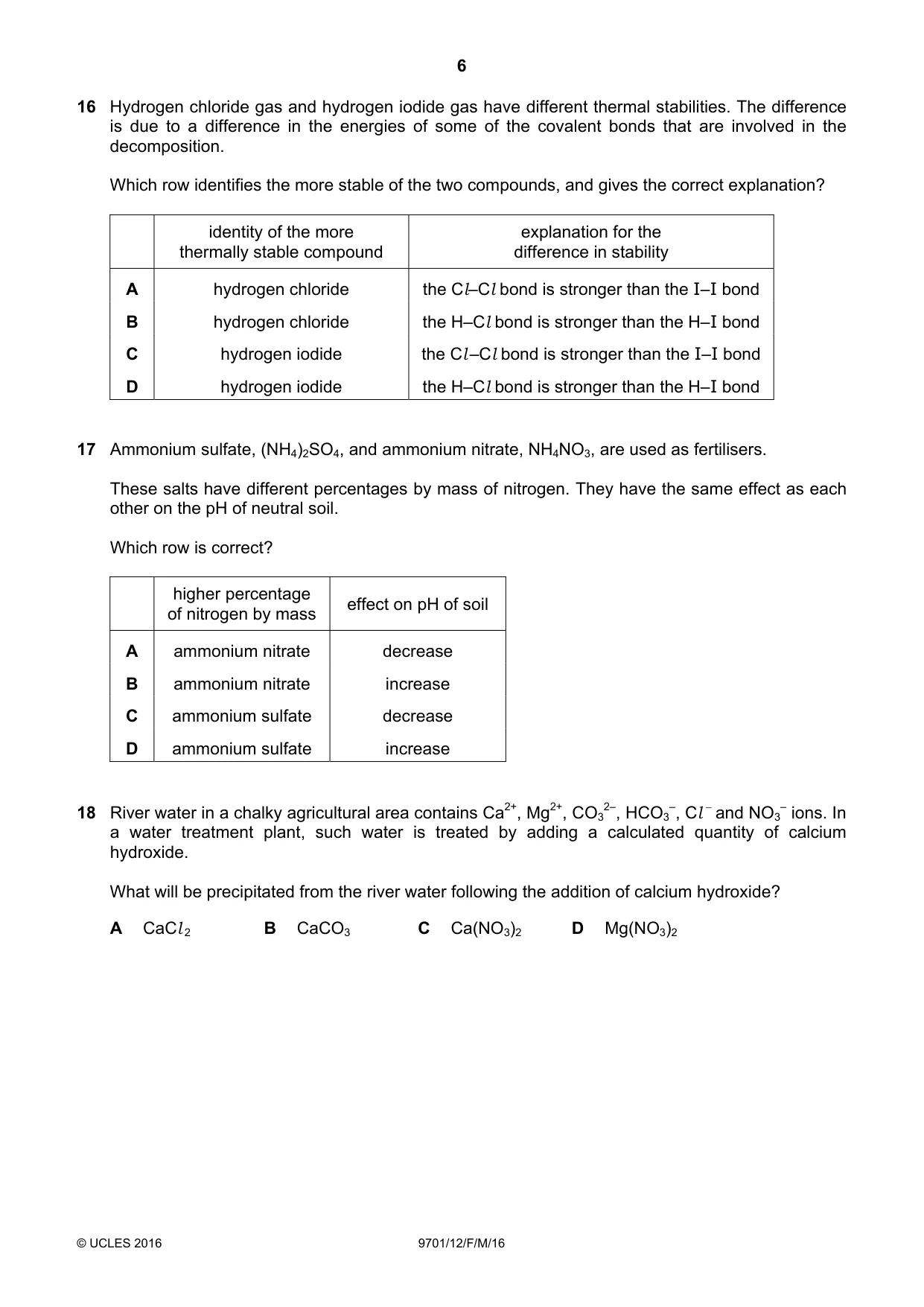
16 Hydrogen chloride gas and hydrogen iodide gas have different thermal stabilities. The difference is due to a difference in the energies of some of the covalent bonds that are involved in the decomposition. Which row identifies the more stable of the two compounds, and gives the correct explanation? identity of the more explanation for the thermally stable compound difference in stability A hydrogen chloride the Cl–Cl bond is stronger than the I–I bond B hydrogen chloride the H–Cl bond is stronger than the H–I bond C hydrogen iodide the Cl –Cl bond is stronger than the I–I bond D hydrogen iodide the H–Cl bond is stronger than the H–I bond
Mark scheme: B
More questions on The chemical properties of the halogen elements and the hydrogen halides
Q17 · Ammonium sulfate, (NH4)2SO4, and ammonium nitrate, NH4NO3, are used as fertilisers
17 Ammonium sulfate, (NH4)2SO4, and ammonium nitrate, NH4NO3, are used as fertilisers. These salts have different percentages by mass of nitrogen. They have the same effect as each other on the pH of neutral soil. Which row is correct? higher percentage effect on pH of soil of nitrogen by mass A ammonium nitrate decrease B ammonium nitrate increase C ammonium sulfate decrease D ammonium sulfate increase
Mark scheme: A
Q18 · River water in a chalky agricultural area contains Ca2+, Mg2+, CO3 2–, HCO3 –, Cl − and…
18 River water in a chalky agricultural area contains Ca2+, Mg2+, CO3 2–, HCO3 –, Cl − and NO3 – ions. In a water treatment plant, such water is treated by adding a calculated quantity of calcium hydroxide. What will be precipitated from the river water following the addition of calcium hydroxide? A CaCl 2 B CaCO3 C Ca(NO3)2 D Mg(NO3)2
Mark scheme: B
Q19 · After black and white photographic film has been developed, unreacted silver bromide is…
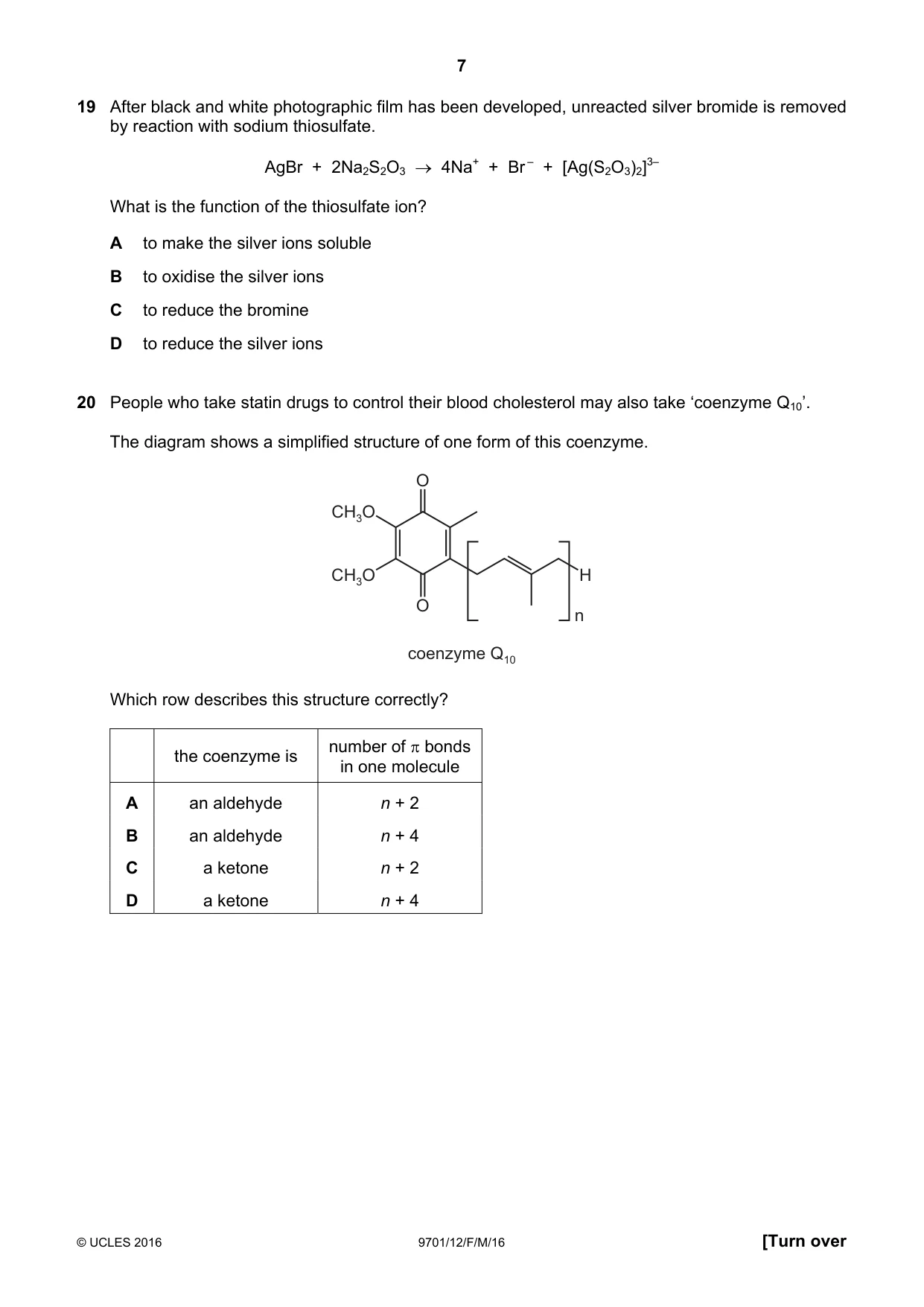
19 After black and white photographic film has been developed, unreacted silver bromide is removed by reaction with sodium thiosulfate. AgBr + 2Na2S2O3 → 4Na+ + Br – + [Ag(S2O3)2]3– What is the function of the thiosulfate ion? A to make the silver ions soluble B to oxidise the silver ions C to reduce the bromine D to reduce the silver ions
Mark scheme: A
Q20 · People who take statin drugs to control their blood cholesterol may also take ‘coenzyme…
20 People who take statin drugs to control their blood cholesterol may also take ‘coenzyme Q10’. The diagram shows a simplified structure of one form of this coenzyme. O CH3O CH3O H O n coenzyme Q10 Which row describes this structure correctly? number of π bonds the coenzyme is in one molecule A an aldehyde n + 2 B an aldehyde n + 4 C a ketone n + 2 D a ketone n + 4
Mark scheme: D
More questions on Shapes of organic molecules; σ and π bonds
Q21 · Geraniol and nerol are compounds found in some flower fragrances
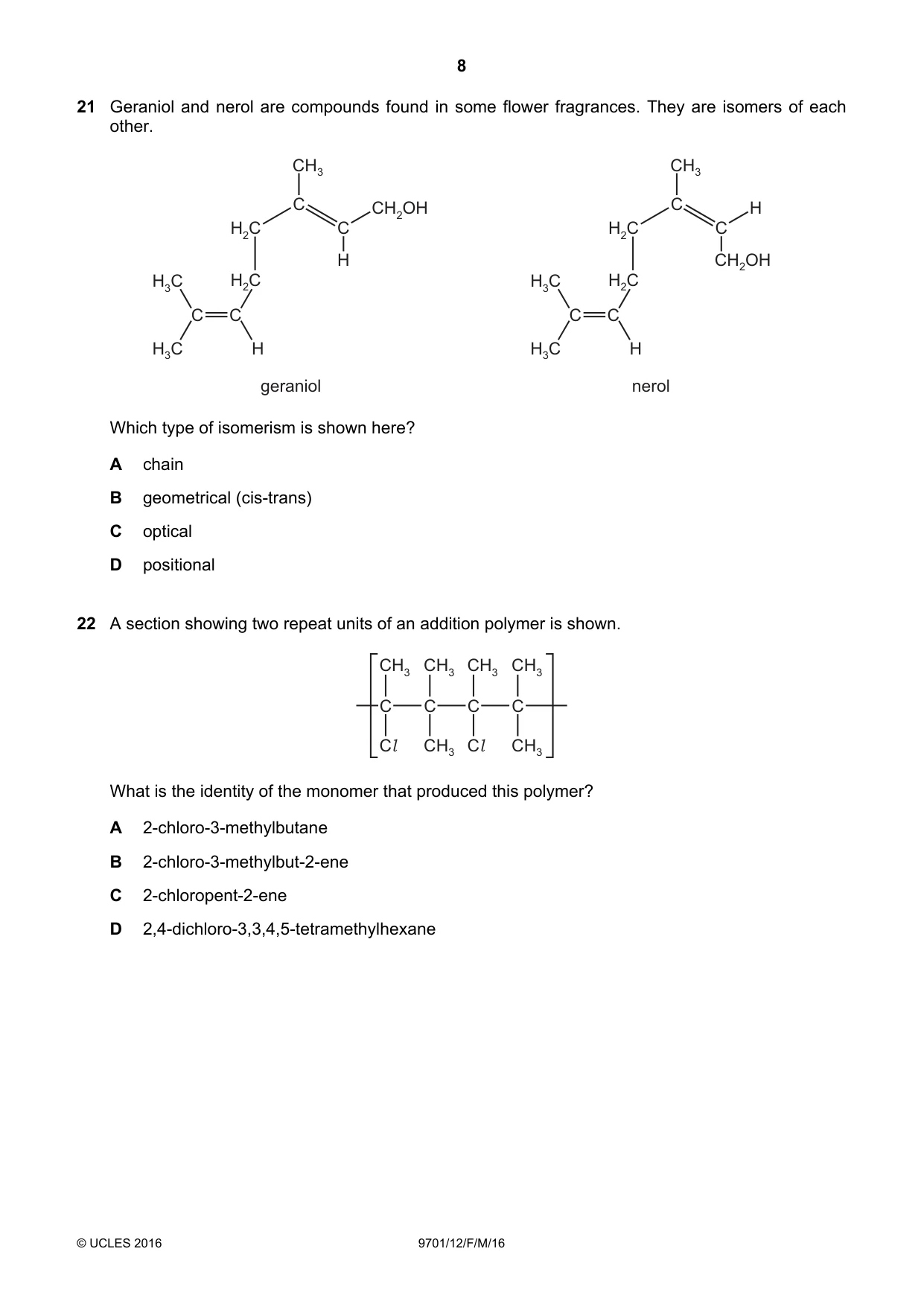
21 Geraniol and nerol are compounds found in some flower fragrances. They are isomers of each other. CH3 CH3 C CH2OH C H H2C C H2C C H CH2OH H3C H2C H3C H2C C C C C H3C H H3C H geraniol nerol Which type of isomerism is shown here? A chain B geometrical (cis-trans) C optical D positional
Mark scheme: B
More questions on Isomerism: structural isomerism and stereoisomerism
Q22 · A section showing two repeat units of an addition polymer is shown
22 A section showing two repeat units of an addition polymer is shown. CH3 CH3 CH3 CH3 C C C C Cl CH3 Cl CH3 What is the identity of the monomer that produced this polymer? A 2-chloro-3-methylbutane B 2-chloro-3-methylbut-2-ene C 2-chloropent-2-ene D 2,4-dichloro-3,3,4,5-tetramethylhexane
Mark scheme: B
Q23 · But-2-ene-1,4-diol is converted in two steps through an intermediate X into…
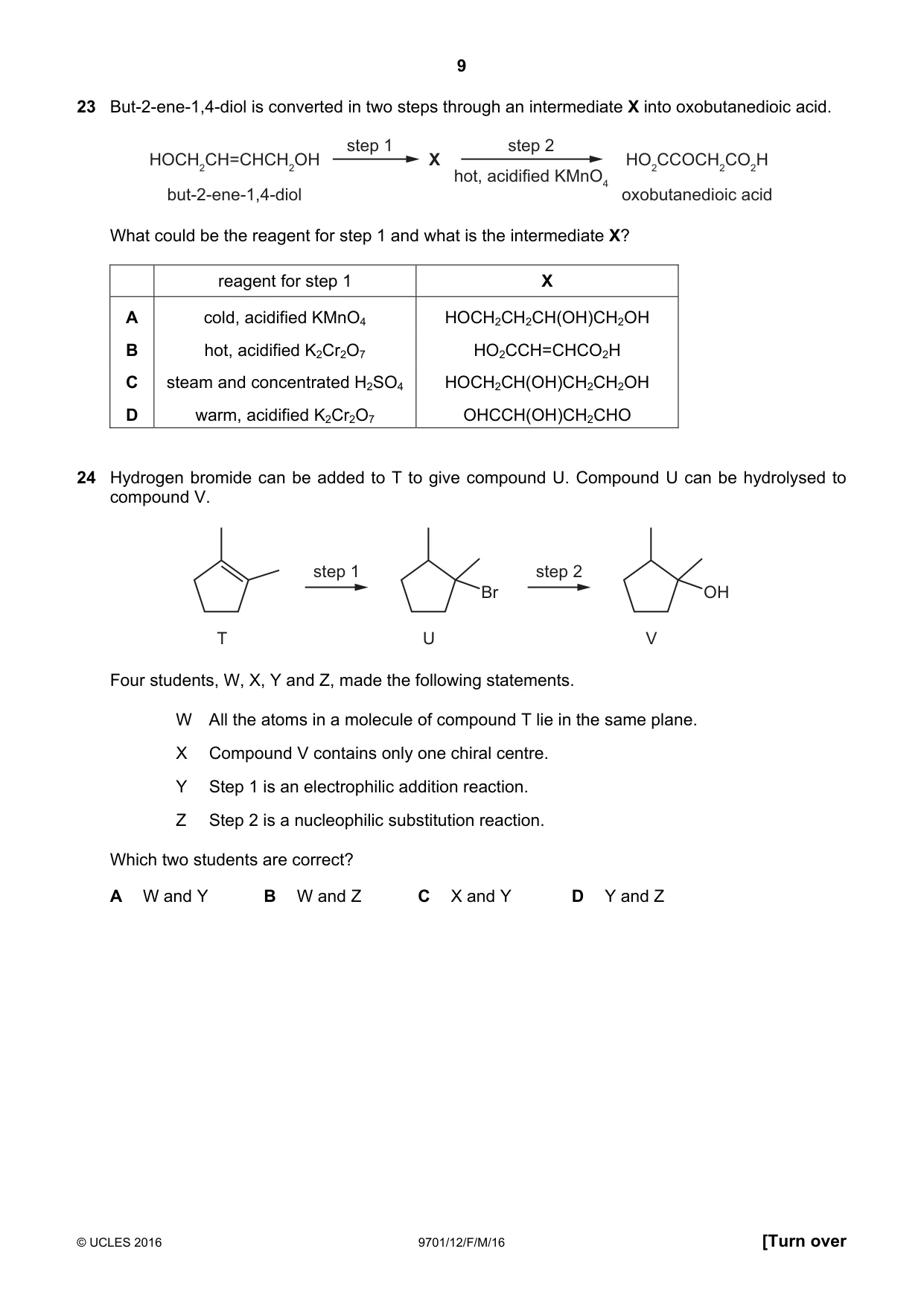
23 But-2-ene-1,4-diol is converted in two steps through an intermediate X into oxobutanedioic acid. step 1 step 2 HOCH2CH=CHCH2OH X HO2CCOCH2CO2H hot, acidified KMnO4 but-2-ene-1,4-diol oxobutanedioic acid What could be the reagent for step 1 and what is the intermediate X? reagent for step 1 X A cold, acidified KMnO4 HOCH2CH2CH(OH)CH2OH B hot, acidified K2Cr2O7 HO2CCH=CHCO2H C steam and concentrated H2SO4 HOCH2CH(OH)CH2CH2OH D warm, acidified K2Cr2O7 OHCCH(OH)CH2CHO
Mark scheme: C
Q24 · Hydrogen bromide can be added to T to give compound U
24 Hydrogen bromide can be added to T to give compound U. Compound U can be hydrolysed to compound V. step 1 step 2 Br OH T U V Four students, W, X, Y and Z, made the following statements. W All the atoms in a molecule of compound T lie in the same plane. X Compound V contains only one chiral centre. Y Step 1 is an electrophilic addition reaction. Z Step 2 is a nucleophilic substitution reaction. Which two students are correct? A W and Y B W and Z C X and Y D Y and Z
Mark scheme: D
Q25 · Structural isomerism and stereoisomerism should be considered in answering this question
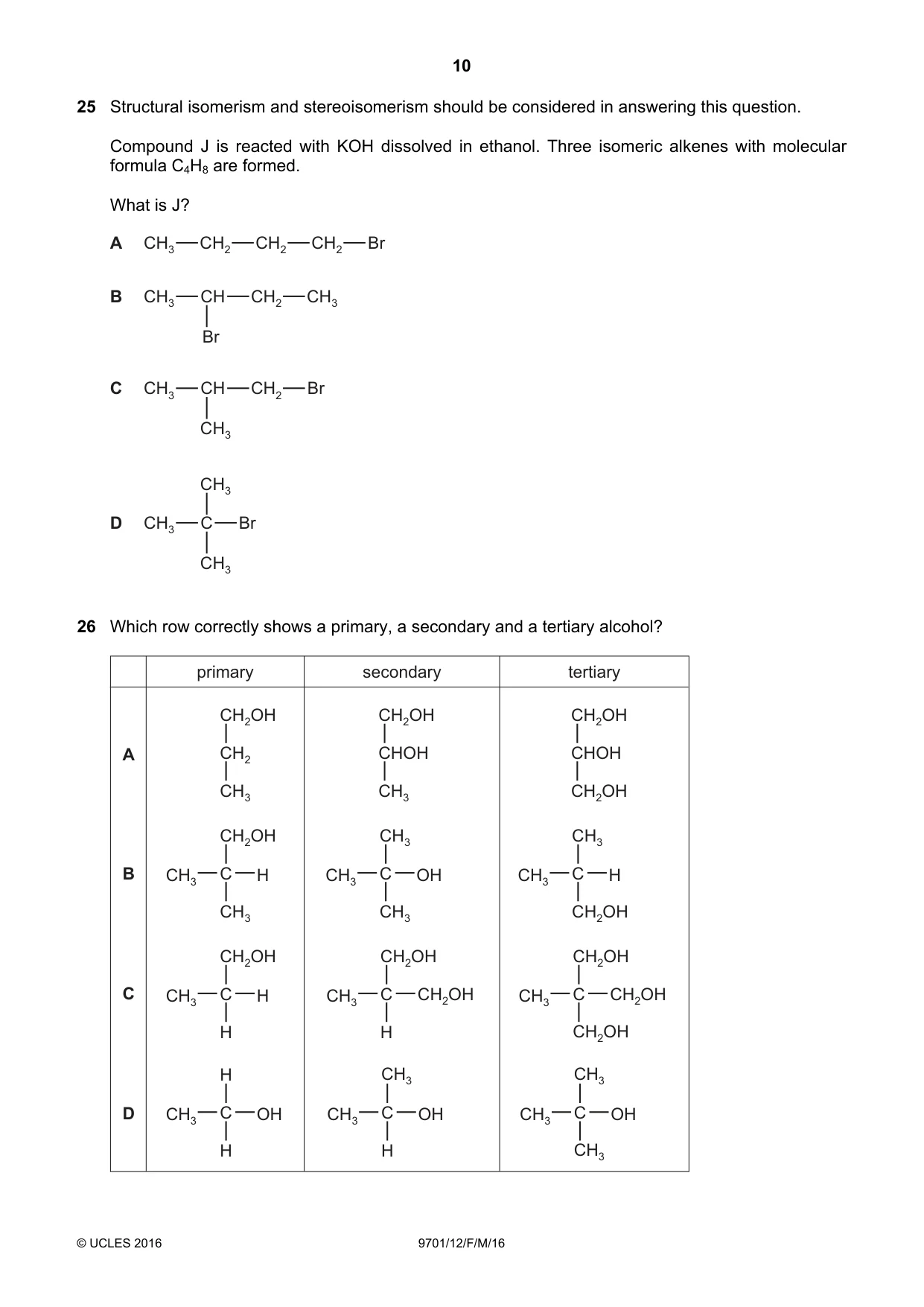
25 Structural isomerism and stereoisomerism should be considered in answering this question. Compound J is reacted with KOH dissolved in ethanol. Three isomeric alkenes with molecular formula C4H8 are formed. What is J? A CH3 CH2 CH2 CH2 Br B CH3 CH CH2 CH3 Br C CH3 CH CH2 Br CH3 CH3 D CH3 C Br CH3
Mark scheme: B
Q26 · Which row correctly shows a primary, a secondary and a tertiary alcohol?
26 Which row correctly shows a primary, a secondary and a tertiary alcohol? primary secondary tertiary CH2OH CH2OH CH2OH A CH2 CHOH CHOH CH3 CH3 CH2OH CH2OH CH3 CH3 B CH3 C H CH3 C OH CH3 C H CH3 CH3 CH2OH CH2OH CH2OH CH2OH C CH3 C H CH3 C CH2OH CH3 C CH2OH H H CH2OH H CH3 CH3 D CH3 C OH CH3 C OH CH3 C OH H H CH3
Mark scheme: D
Q27 · The fragrance compounds of perfumes are often dissolved in solvent Y, which has a…
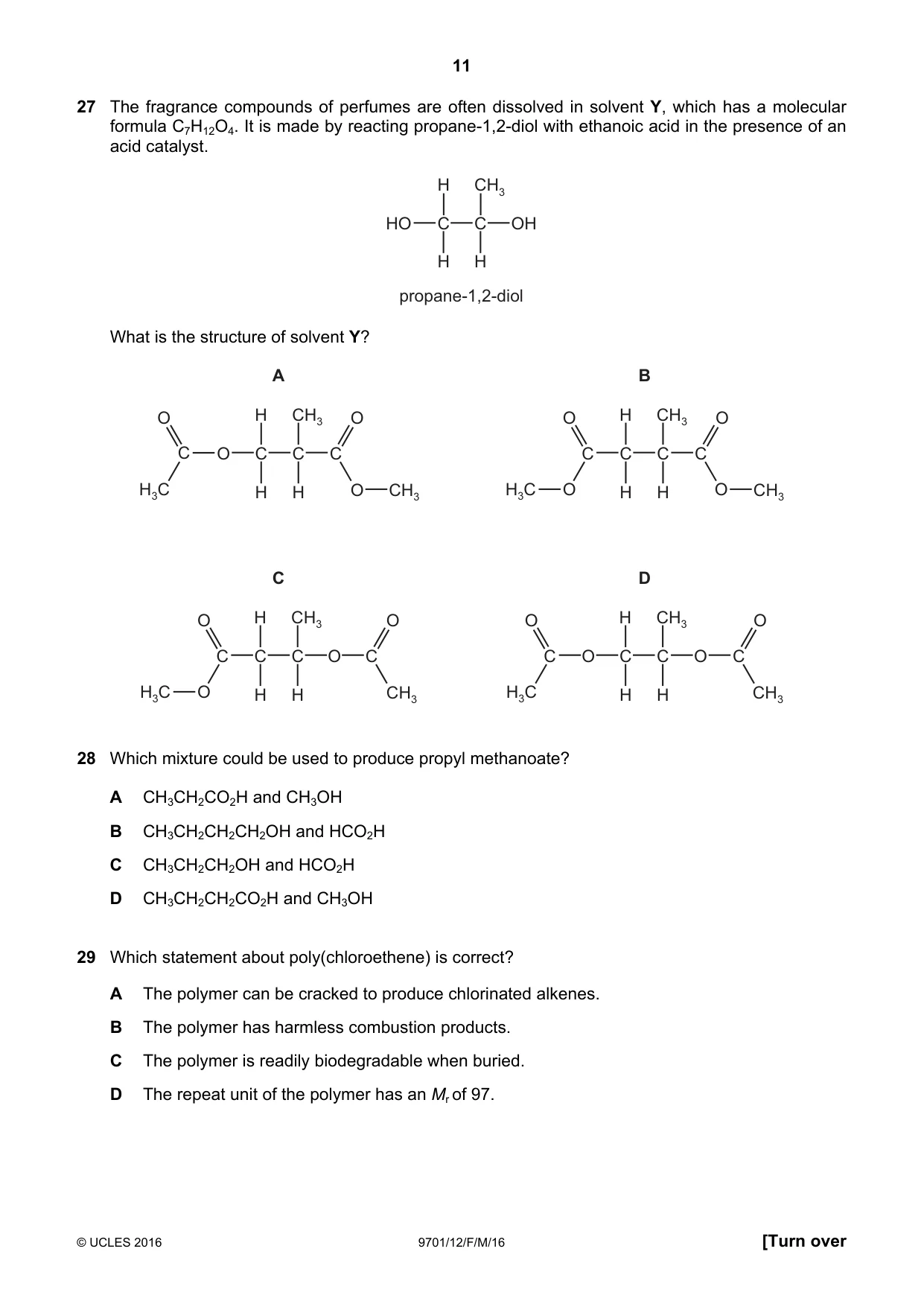
27 The fragrance compounds of perfumes are often dissolved in solvent Y, which has a molecular formula C7H12O4. It is made by reacting propane-1,2-diol with ethanoic acid in the presence of an acid catalyst. H CH3 HO C C OH H H propane-1,2-diol What is the structure of solvent Y? A B O H CH3 O O H CH3 O C O C C C C C C C H3C H H O CH3 H3C O H H O CH3 C D O H CH3 O O H CH3 O C C C O C C O C C O C H3C O H H CH3 H3C H H CH3
Mark scheme: D
Q28 · Which mixture could be used to produce propyl methanoate?
28 Which mixture could be used to produce propyl methanoate? A CH3CH2CO2H and CH3OH B CH3CH2CH2CH2OH and HCO2H C CH3CH2CH2OH and HCO2H D CH3CH2CH2CO2H and CH3OH
Mark scheme: C
Q29 · Which statement about poly(chloroethene) is correct?
29 Which statement about poly(chloroethene) is correct? A The polymer can be cracked to produce chlorinated alkenes. B The polymer has harmless combustion products. C The polymer is readily biodegradable when buried. D The repeat unit of the polymer has an Mr of 97.
Mark scheme: A
Q30 · Which row of the table is correct?
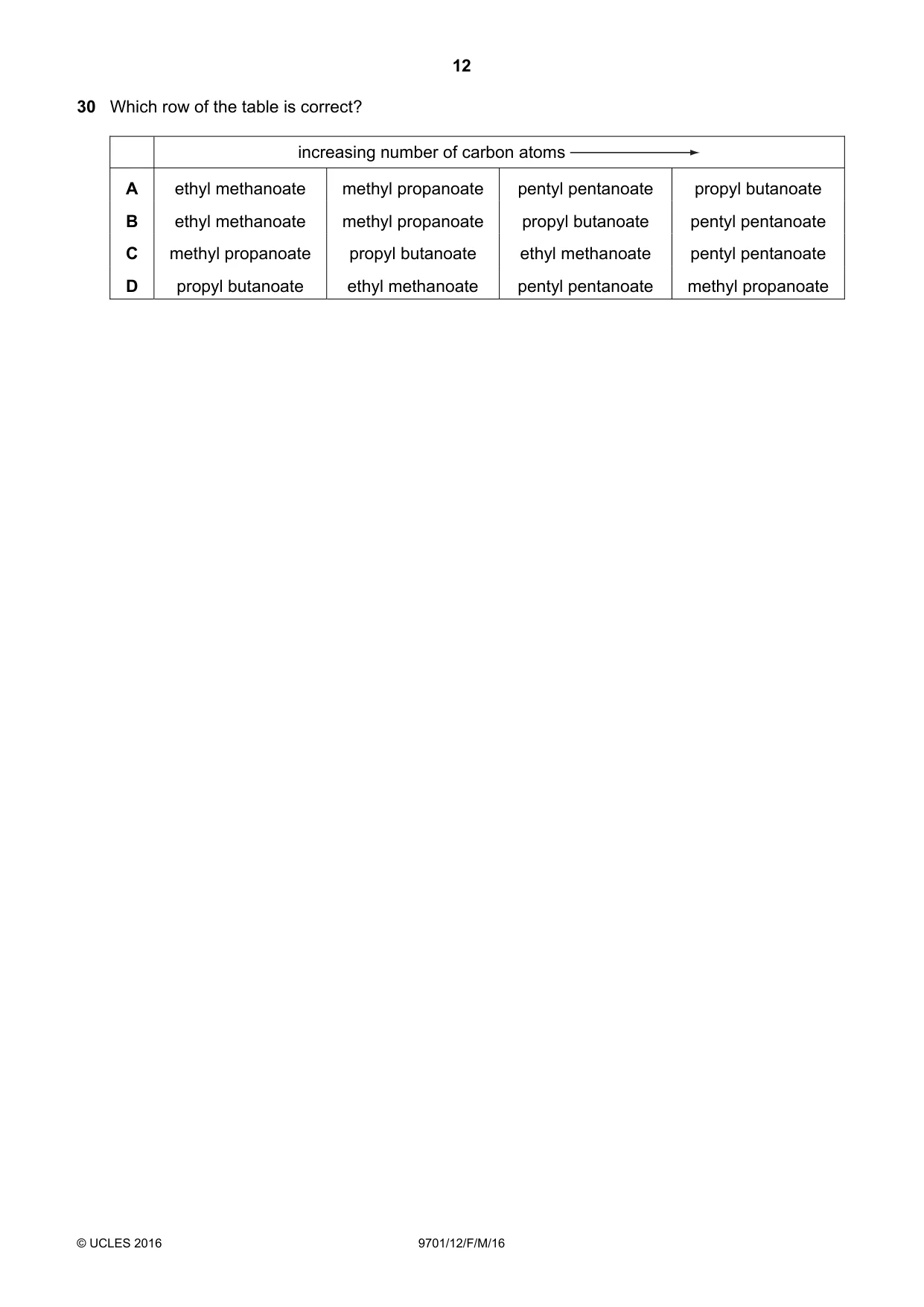
30 Which row of the table is correct? increasing number of carbon atoms A ethyl methanoate methyl propanoate pentyl pentanoate propyl butanoate B ethyl methanoate methyl propanoate propyl butanoate pentyl pentanoate C methyl propanoate propyl butanoate ethyl methanoate pentyl pentanoate D propyl butanoate ethyl methanoate pentyl pentanoate methyl propanoate
Mark scheme: B
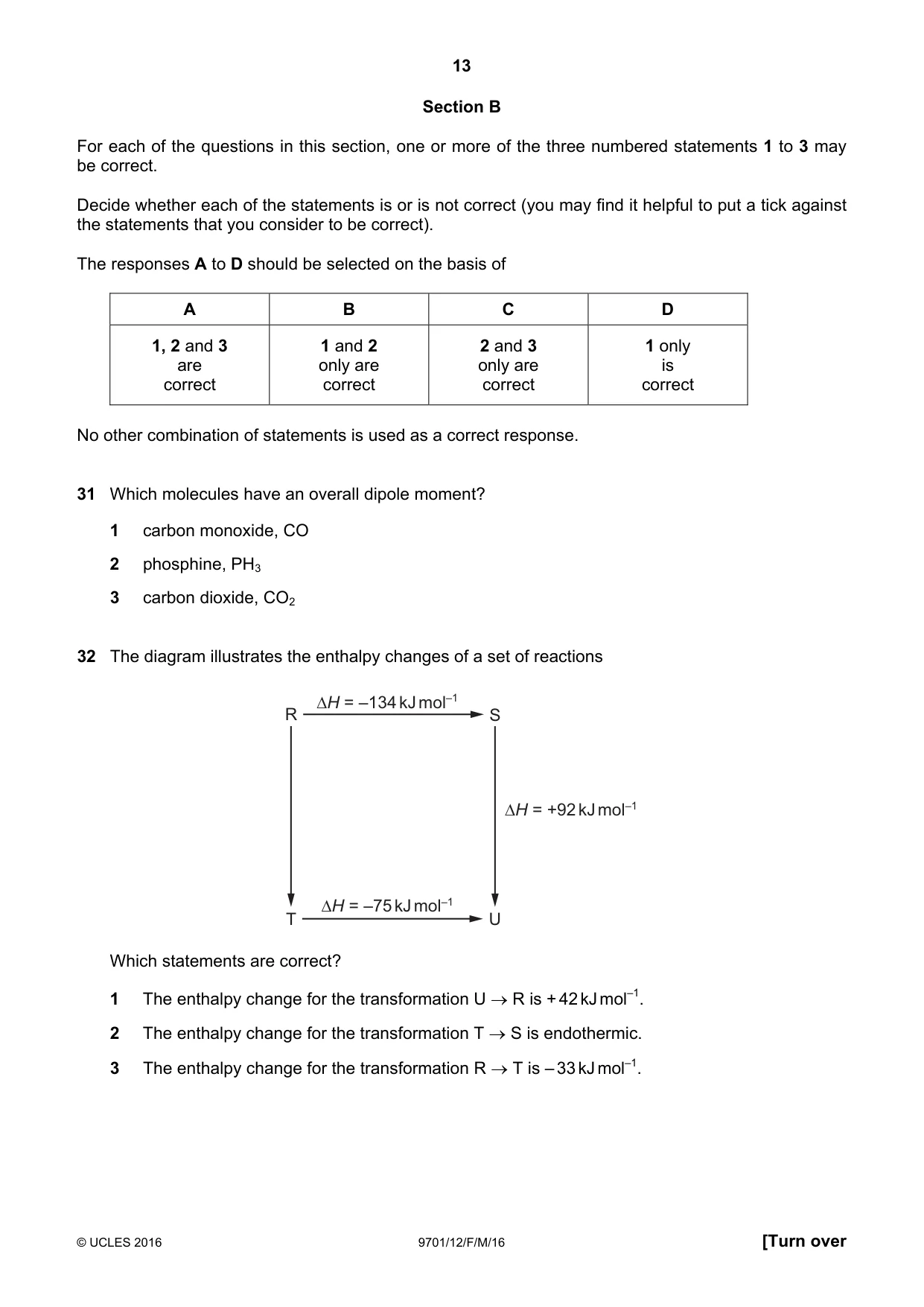
Q31 · Which molecules have an overall dipole moment?
31 Which molecules have an overall dipole moment? 1 carbon monoxide, CO 2 phosphine, PH3 3 carbon dioxide, CO2
Mark scheme: B
More questions on Intermolecular forces, electronegativity and bond properties
Q32 · The diagram illustrates the enthalpy changes of a set of reactions ΔH = –134 kJ mol–1 R S…
32 The diagram illustrates the enthalpy changes of a set of reactions ΔH = –134 kJ mol–1 R S ΔH = +92 kJ mol–1 ΔH = –75 kJ mol–1 T U Which statements are correct? 1 The enthalpy change for the transformation U → R is + 42 kJ mol–1. 2 The enthalpy change for the transformation T → S is endothermic. 3 The enthalpy change for the transformation R → T is – 33 kJ mol–1.
Mark scheme: D
Q33 · Which statements about reversible reactions are correct?
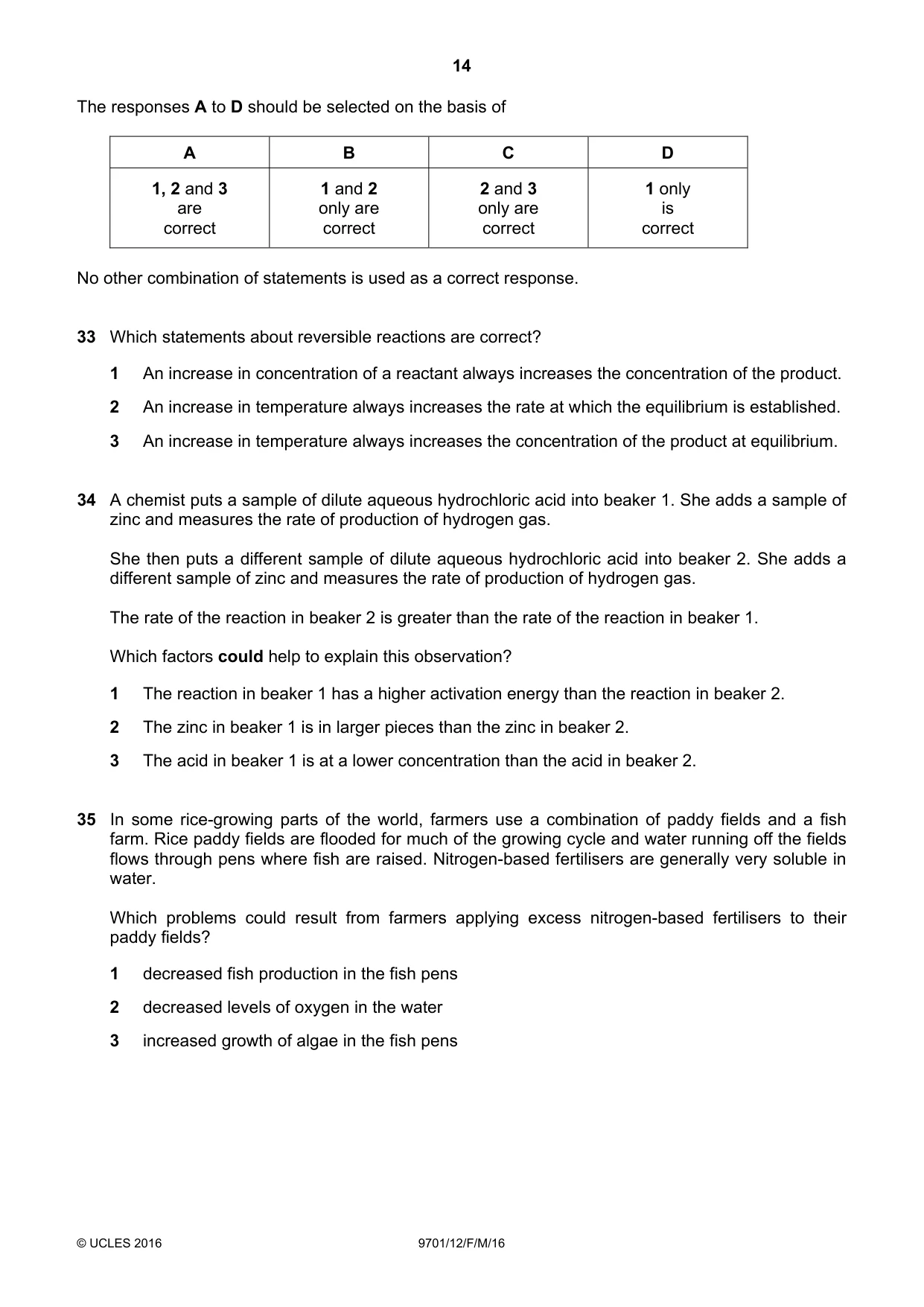
33 Which statements about reversible reactions are correct? 1 An increase in concentration of a reactant always increases the concentration of the product. 2 An increase in temperature always increases the rate at which the equilibrium is established. 3 An increase in temperature always increases the concentration of the product at equilibrium.
Mark scheme: B
More questions on Chemical equilibria: reversible reactions, dynamic equilibrium
Q34 · A chemist puts a sample of dilute aqueous hydrochloric acid into beaker 1
34 A chemist puts a sample of dilute aqueous hydrochloric acid into beaker 1. She adds a sample of zinc and measures the rate of production of hydrogen gas. She then puts a different sample of dilute aqueous hydrochloric acid into beaker 2. She adds a different sample of zinc and measures the rate of production of hydrogen gas. The rate of the reaction in beaker 2 is greater than the rate of the reaction in beaker 1. Which factors could help to explain this observation? 1 The reaction in beaker 1 has a higher activation energy than the reaction in beaker 2. 2 The zinc in beaker 1 is in larger pieces than the zinc in beaker 2. 3 The acid in beaker 1 is at a lower concentration than the acid in beaker 2.
Mark scheme: C
Q35 · In some rice-growing parts of the world, farmers use a combination of paddy fields and a…
35 In some rice-growing parts of the world, farmers use a combination of paddy fields and a fish farm. Rice paddy fields are flooded for much of the growing cycle and water running off the fields flows through pens where fish are raised. Nitrogen-based fertilisers are generally very soluble in water. Which problems could result from farmers applying excess nitrogen-based fertilisers to their paddy fields? 1 decreased fish production in the fish pens 2 decreased levels of oxygen in the water 3 increased growth of algae in the fish pens
Mark scheme: A
Q36 · A sample containing 0.40 mol of calcium nitrate was decomposed by heating in a roaring…
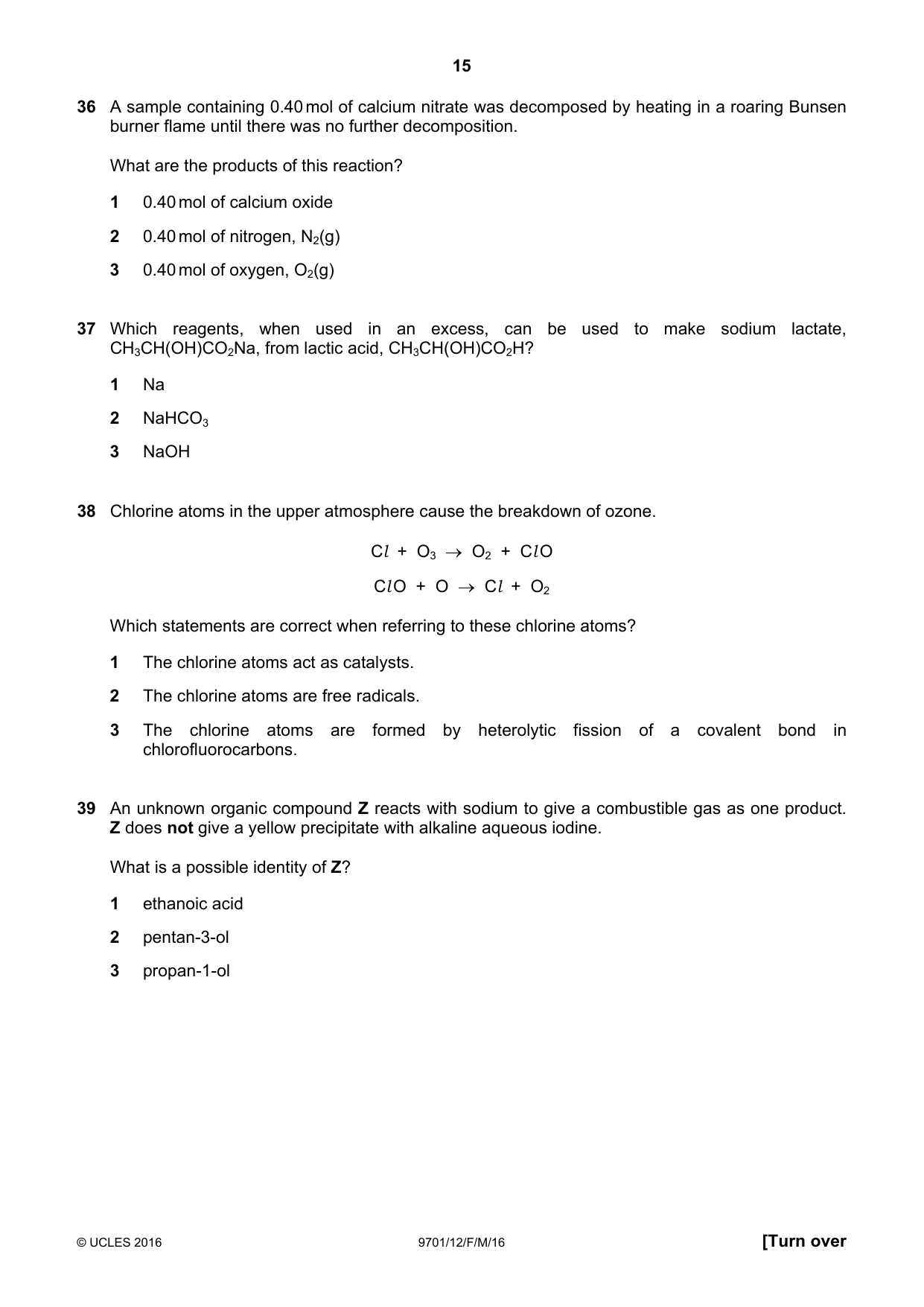
36 A sample containing 0.40 mol of calcium nitrate was decomposed by heating in a roaring Bunsen burner flame until there was no further decomposition. What are the products of this reaction? 1 0.40 mol of calcium oxide 2 0.40 mol of nitrogen, N2(g) 3 0.40 mol of oxygen, O2(g)
Mark scheme: D
Q37 · Which reagents, when used in an excess, can be used to make sodium lactate…
37 Which reagents, when used in an excess, can be used to make sodium lactate, CH3CH(OH)CO2Na, from lactic acid, CH3CH(OH)CO2H? 1 Na 2 NaHCO3 3 NaOH
Mark scheme: C
Q38 · Chlorine atoms in the upper atmosphere cause the breakdown of ozone
38 Chlorine atoms in the upper atmosphere cause the breakdown of ozone. Cl + O3 → O2 + Cl O Cl O + O → Cl + O2 Which statements are correct when referring to these chlorine atoms? 1 The chlorine atoms act as catalysts. 2 The chlorine atoms are free radicals. 3 The chlorine atoms are formed by heterolytic fission of a covalent bond in chlorofluorocarbons.
Mark scheme: B
Q39 · An unknown organic compound Z reacts with sodium to give a combustible gas as one product
39 An unknown organic compound Z reacts with sodium to give a combustible gas as one product. Z does not give a yellow precipitate with alkaline aqueous iodine. What is a possible identity of Z? 1 ethanoic acid 2 pentan-3-ol 3 propan-1-ol
Mark scheme: A
Q40 · Compound X has the molecular formula C3H6O3
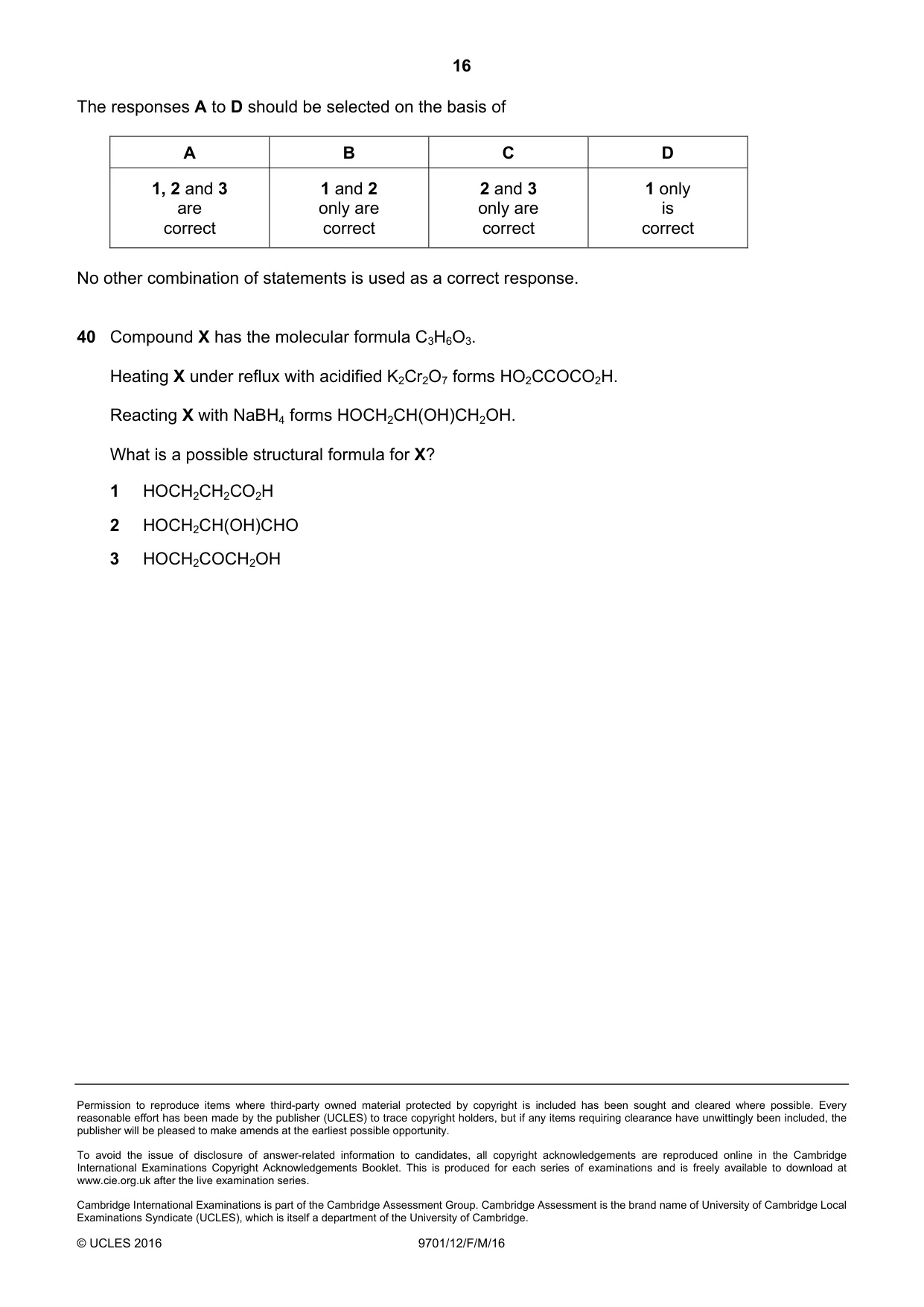
40 Compound X has the molecular formula C3H6O3. Heating X under reflux with acidified K2Cr2O7 forms HO2CCOCO2H. Reacting X with NaBH4 forms HOCH2CH(OH)CH2OH. What is a possible structural formula for X? 1 HOCH2CH2CO2H 2 HOCH2CH(OH)CHO 3 HOCH2COCH2OH
Mark scheme: C
What was in this paper
The subtopics covered by these 40 questions, and how many questions each got. Open one in a new tab to see every Cambridge question on it.
3Similarities and trends in the properties of the Group 2 metals, magnesium to barium, and their compounds3Addition polymerisation2Alcohols2Aldehydes and ketones2Bonding and structure2Chemical equilibria: reversible reactions, dynamic equilibrium2Enthalpy change, ΔH2Particles in the atom and atomic radius2Acids and bases1Alkenes1Carboxylic acids1Covalent bonding and coordinate (dative covalent) bonding1General characteristic chemical properties of the first set of transition elements, titanium to copper1Halogenoalkanes1Hess’s law1Homogeneous and heterogeneous catalysts1Intermolecular forces, electronegativity and bond properties1Ionisation energy1Isomerism: structural isomerism and stereoisomerism1Nitrogen and sulfur1Periodicity of physical properties of the elements in Period 31Rate of reaction1Redox processes: electron transfer and changes in oxidation number (oxidation state)1Shapes of molecules1Shapes of organic molecules; σ and π bonds1The chemical properties of the halogen elements and the hydrogen halides1The gaseous state: ideal and real gases and pV = nRT1The reactions of chlorine1What you needed in this session
Cambridge’s own grade thresholds for 2016 Feb/March, Paper 1 · Variant 2. A higher threshold means an easier paper — the bar moves with how the cohort did.