Cambridge A Level Chemistry 9701 — 2020 May/June Paper 1 · Variant 3
9701/13/M/J/20 · 40 questions · 40 marks · ≈45 min
The question paper and its mark scheme, free to read here and free to download. This is Cambridge’s own paper, exactly as it was sat.
Question paper16 pages

Mark scheme3 pages
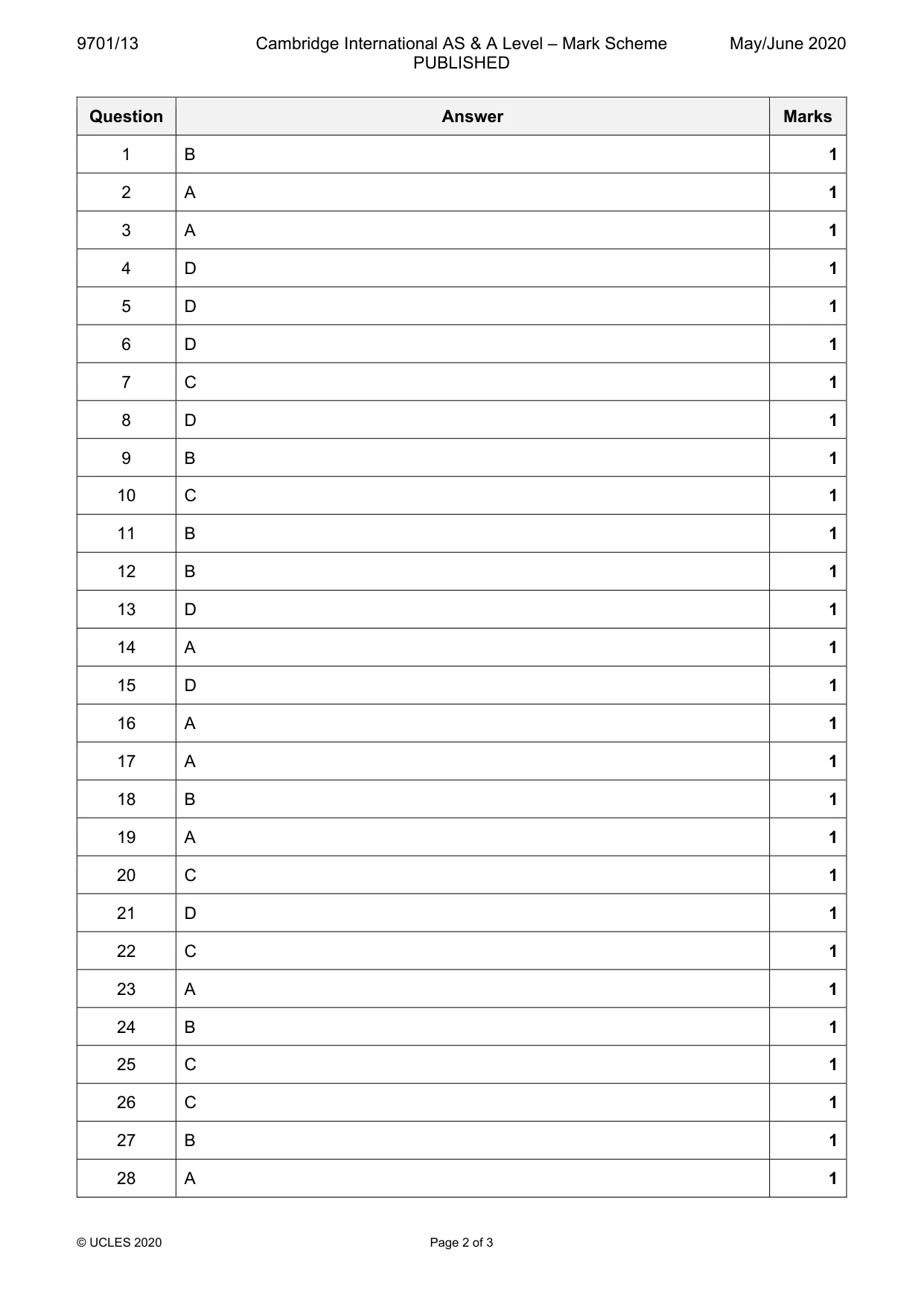
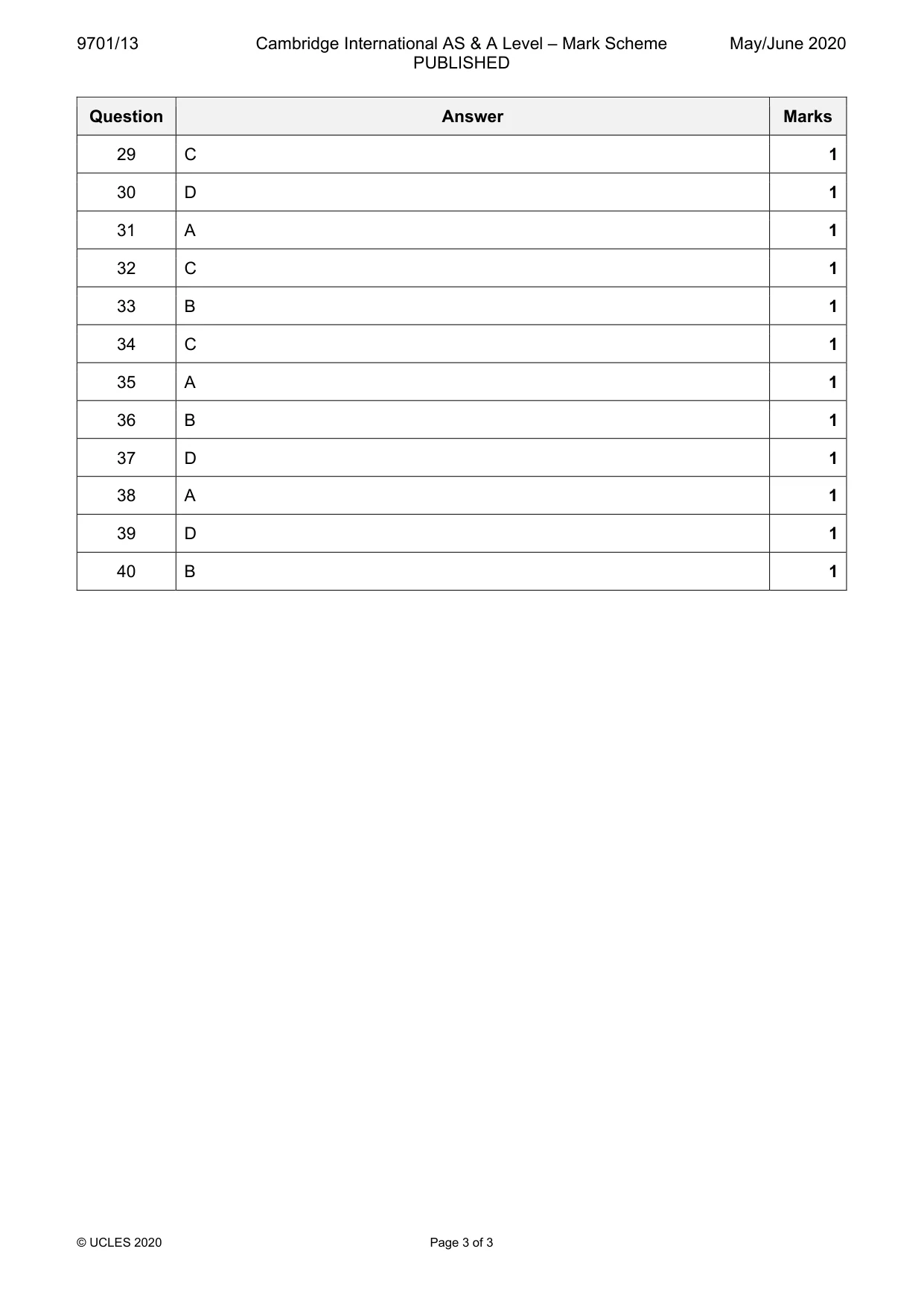
Answers below. Sit the paper first if you are practising.
Questions as text
Q1 · Which particle has equal numbers of protons and neutrons and an electronic structure of…
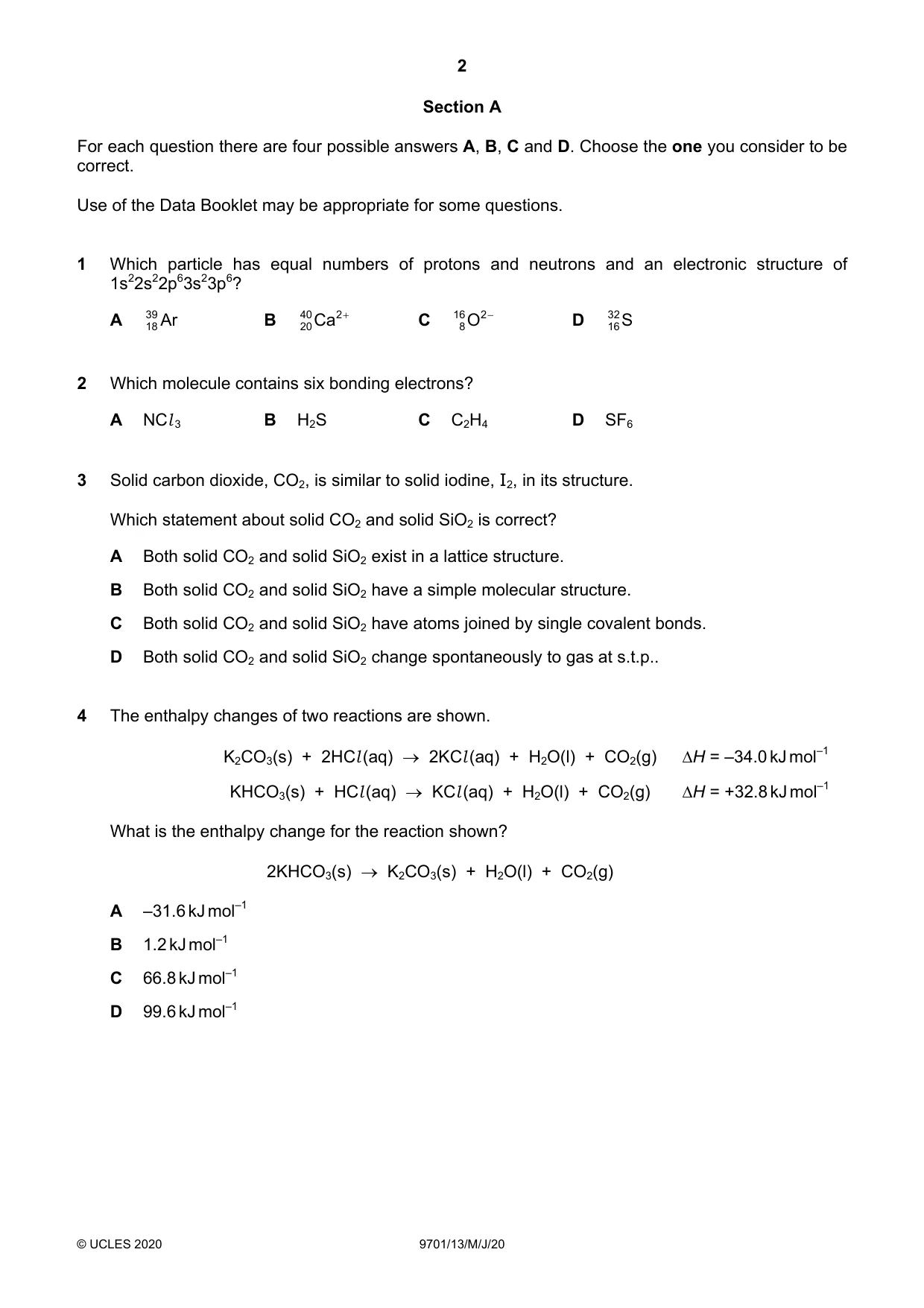
1 Which particle has equal numbers of protons and neutrons and an electronic structure of 1s22s22p63s23p6? A 39 Ar B 40 20Ca 2 + C 16 8O 2 − D 32 S 18 16
Mark scheme: B
Q2 · Which molecule contains six bonding electrons?
2 Which molecule contains six bonding electrons? A NCl 3 B H2S C C2H4 D SF6
Mark scheme: A
More questions on Covalent bonding and coordinate (dative covalent) bonding
Q3 · Solid carbon dioxide, CO2, is similar to solid iodine, I2, in its structure
3 Solid carbon dioxide, CO2, is similar to solid iodine, I2, in its structure. Which statement about solid CO2 and solid SiO2 is correct? A Both solid CO2 and solid SiO2 exist in a lattice structure. B Both solid CO2 and solid SiO2 have a simple molecular structure. C Both solid CO2 and solid SiO2 have atoms joined by single covalent bonds. D Both solid CO2 and solid SiO2 change spontaneously to gas at s.t.p..
Mark scheme: A
Q4 · The enthalpy changes of two reactions are shown
4 The enthalpy changes of two reactions are shown. K2CO3(s) + 2HCl (aq) → 2KCl (aq) + H2O(l) + CO2(g) ∆H = –34.0 kJ mol–1 KHCO3(s) + HCl (aq) → KCl (aq) + H2O(l) + CO2(g) ∆H = +32.8 kJ mol–1 What is the enthalpy change for the reaction shown? 2KHCO3(s) → K2CO3(s) + H2O(l) + CO2(g) A –31.6 kJ mol–1 B 1.2 kJ mol–1 C 66.8 kJ mol–1 D 99.6 kJ mol–1
Mark scheme: D
Q5 · Nitrogen reacts with oxygen to form nitrogen monoxide, NO, and nitrogen dioxide, NO2
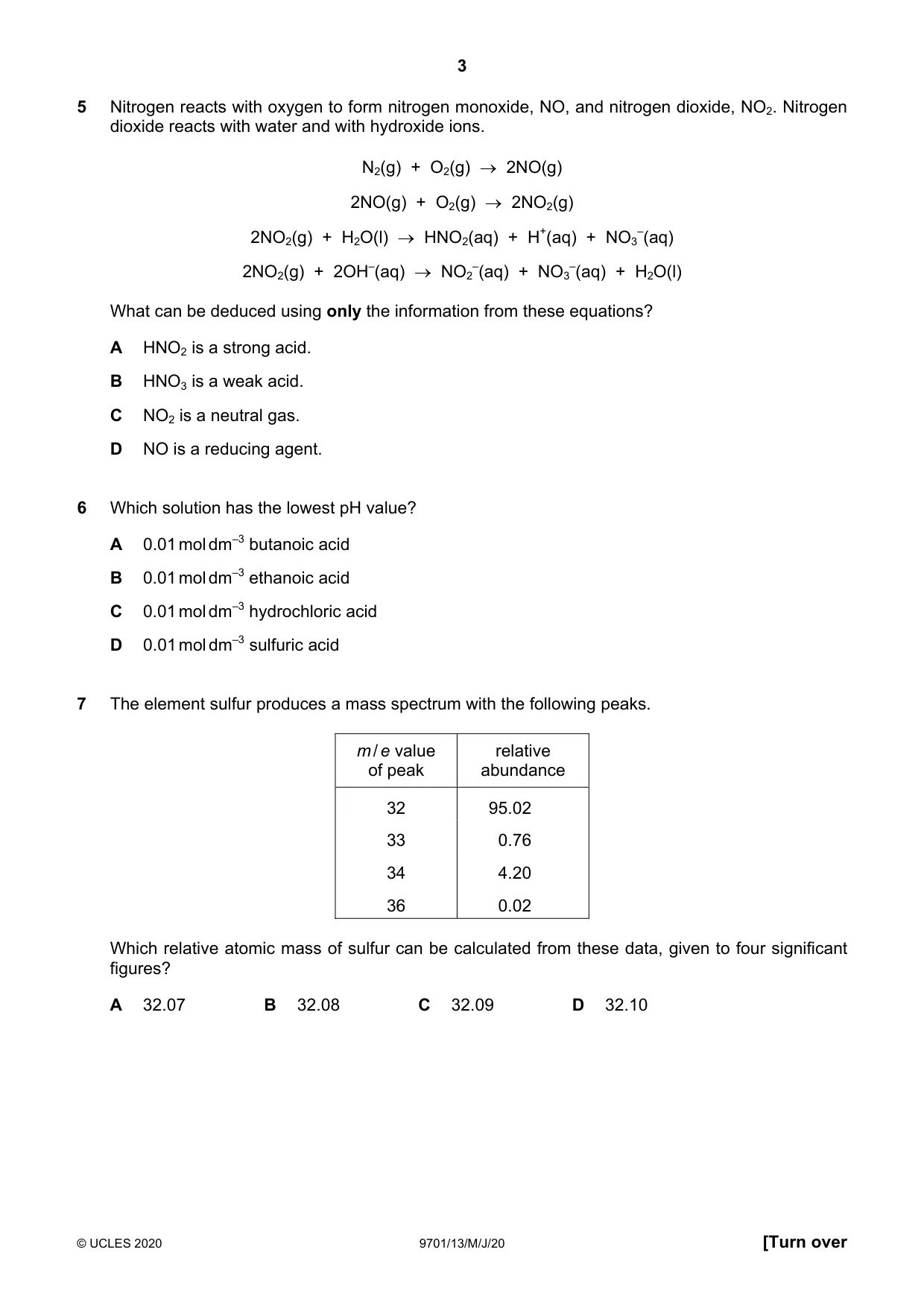
5 Nitrogen reacts with oxygen to form nitrogen monoxide, NO, and nitrogen dioxide, NO2. Nitrogen dioxide reacts with water and with hydroxide ions. N2(g) + O2(g) → 2NO(g) 2NO(g) + O2(g) → 2NO2(g) 2NO2(g) + H2O(l) → HNO2(aq) + H+(aq) + NO3 –(aq) 2NO2(g) + 2OH–(aq) → NO2 –(aq) + NO3 –(aq) + H2O(l) What can be deduced using only the information from these equations? A HNO2 is a strong acid. B HNO3 is a weak acid. C NO2 is a neutral gas. D NO is a reducing agent.
Mark scheme: D
Q6 · Which solution has the lowest pH value?
6 Which solution has the lowest pH value? A 0.01 mol dm–3 butanoic acid B 0.01 mol dm–3 ethanoic acid C 0.01 mol dm–3 hydrochloric acid D 0.01 mol dm–3 sulfuric acid
Mark scheme: D
Q7 · The element sulfur produces a mass spectrum with the following peaks
7 The element sulfur produces a mass spectrum with the following peaks. m / e value relative of peak abundance 32 95.02 33 0.76 34 4.20 36 0.02 Which relative atomic mass of sulfur can be calculated from these data, given to four significant figures? A 32.07 B 32.08 C 32.09 D 32.10
Mark scheme: C
Q8 · What is the electronic configuration of an isolated Ni2+ ion?
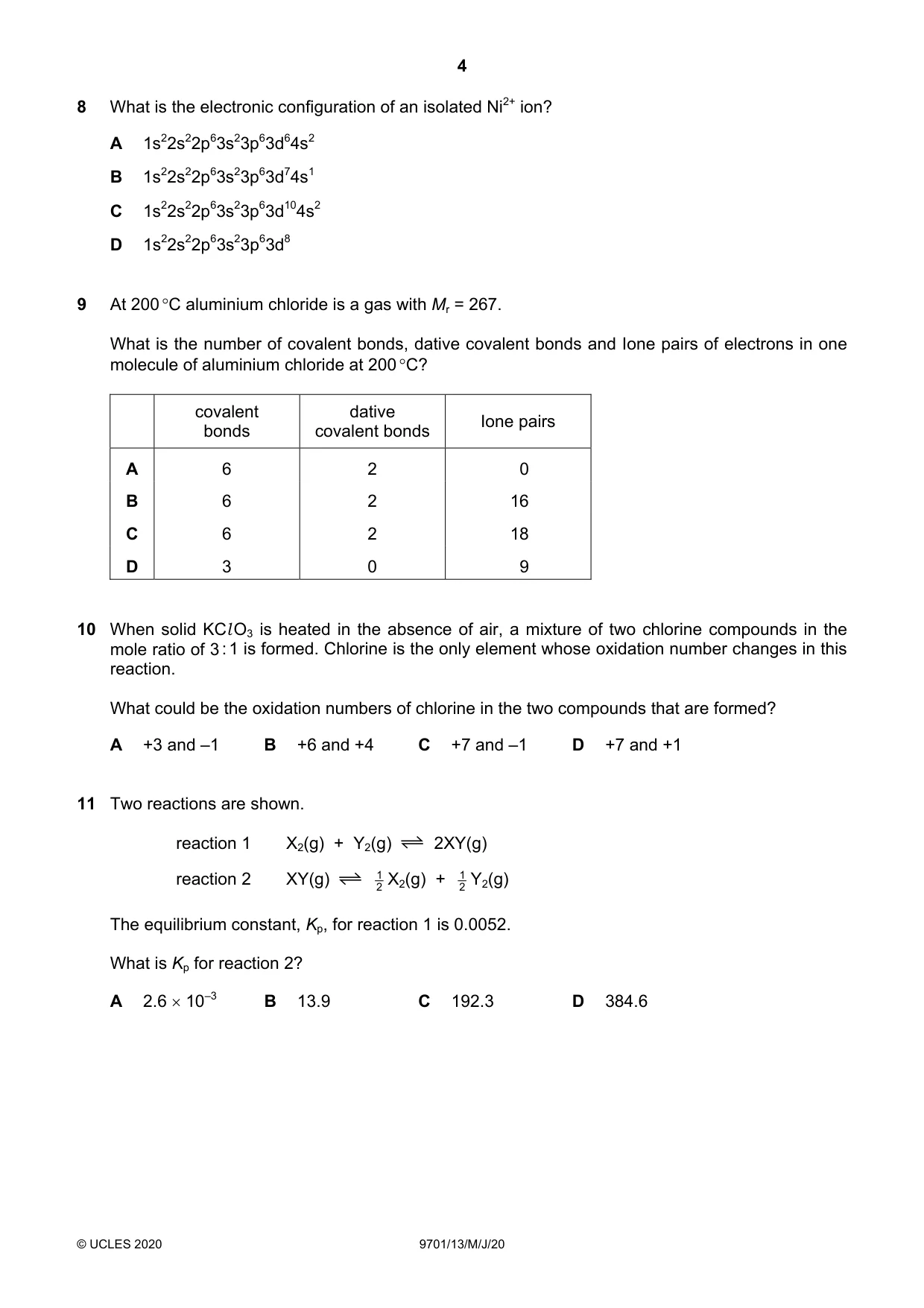
8 What is the electronic configuration of an isolated Ni2+ ion? A 1s22s22p63s23p63d64s2 B 1s22s22p63s23p63d74s1 C 1s22s22p63s23p63d104s2 D 1s22s22p63s23p63d8
Mark scheme: D
Q9 · At 200 °C aluminium chloride is a gas with Mr = 267
9 At 200 °C aluminium chloride is a gas with Mr = 267. What is the number of covalent bonds, dative covalent bonds and Ione pairs of electrons in one molecule of aluminium chloride at 200 °C? covalent dative Ione pairs bonds covalent bonds A 6 2 0 B 6 2 16 C 6 2 18 D 3 0 9
Mark scheme: B
More questions on Covalent bonding and coordinate (dative covalent) bonding
Q10 · When solid KCl O3 is heated in the absence of air, a mixture of two chlorine compounds in…
10 When solid KCl O3 is heated in the absence of air, a mixture of two chlorine compounds in the mole ratio of 3 : 1 is formed. Chlorine is the only element whose oxidation number changes in this reaction. What could be the oxidation numbers of chlorine in the two compounds that are formed? A +3 and –1 B +6 and +4 C +7 and –1 D +7 and +1
Mark scheme: C
Q11 · Two reactions are shown
11 Two reactions are shown. reaction 1 X2(g) + Y2(g) 2XY(g) reaction 2 XY(g) 2 1 X2(g) + 2 1 Y2(g) The equilibrium constant, Kp, for reaction 1 is 0.0052. What is Kp for reaction 2? A 2.6 × 10⁻³ B 13.9 C 192.3 D 384.6
Mark scheme: B
More questions on Chemical equilibria: reversible reactions, dynamic equilibrium
Q12 · Compound T is a white crystalline solid
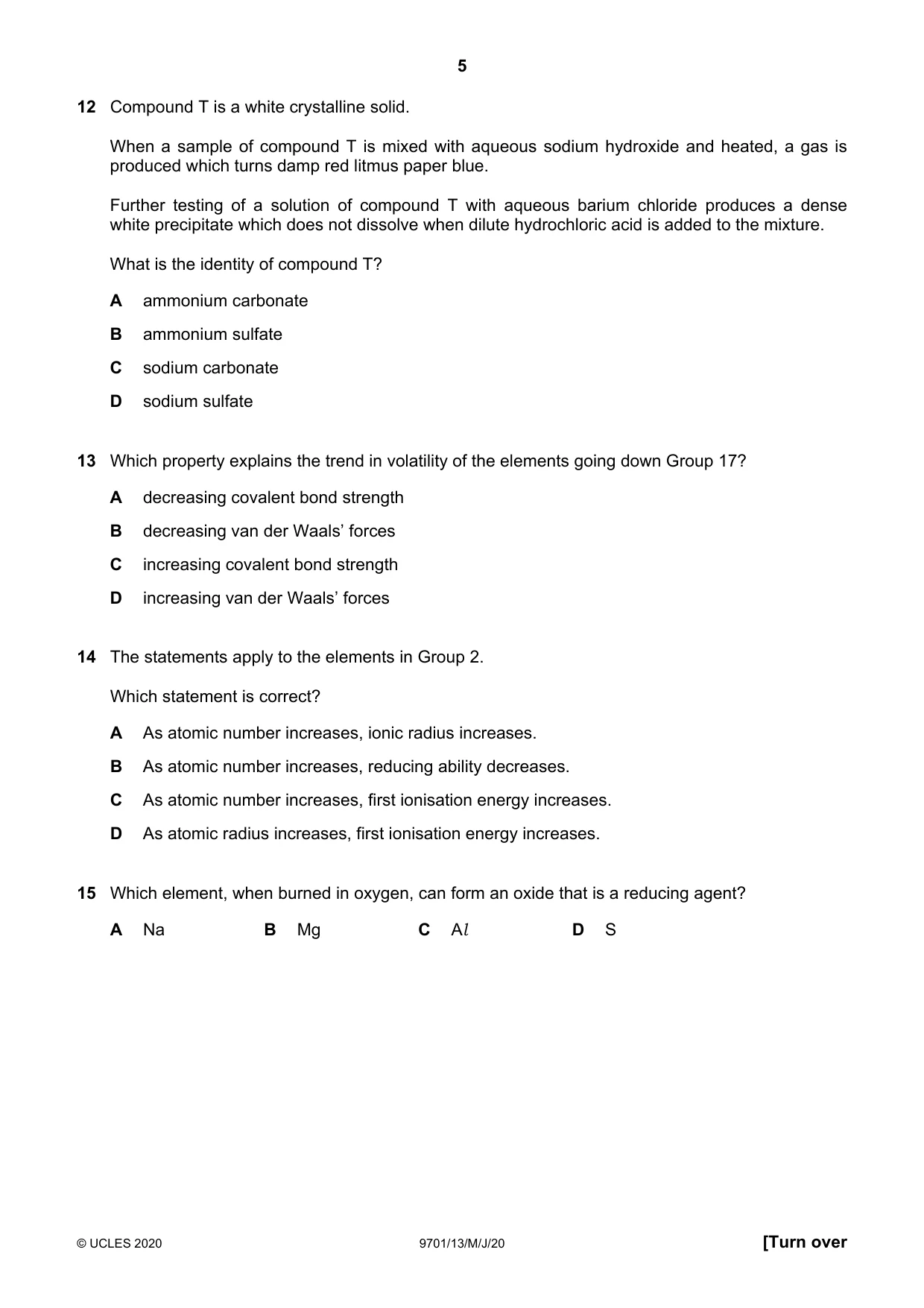
12 Compound T is a white crystalline solid. When a sample of compound T is mixed with aqueous sodium hydroxide and heated, a gas is produced which turns damp red litmus paper blue. Further testing of a solution of compound T with aqueous barium chloride produces a dense white precipitate which does not dissolve when dilute hydrochloric acid is added to the mixture. What is the identity of compound T? A ammonium carbonate B ammonium sulfate C sodium carbonate D sodium sulfate
Mark scheme: B
Q13 · Which property explains the trend in volatility of the elements going down Group 17?
13 Which property explains the trend in volatility of the elements going down Group 17? A decreasing covalent bond strength B decreasing van der Waals’ forces C increasing covalent bond strength D increasing van der Waals’ forces
Mark scheme: D
More questions on Physical properties of the Group 17 elements
Q14 · The statements apply to the elements in Group 2
14 The statements apply to the elements in Group 2. Which statement is correct? A As atomic number increases, ionic radius increases. B As atomic number increases, reducing ability decreases. C As atomic number increases, first ionisation energy increases. D As atomic radius increases, first ionisation energy increases.
Mark scheme: A
Q15 · Which element, when burned in oxygen, can form an oxide that is a reducing agent?
15 Which element, when burned in oxygen, can form an oxide that is a reducing agent? A Na B Mg C Al D S
Mark scheme: D
More questions on Periodicity of chemical properties of the elements in Period 3
Q16 · Nitrogen oxides are removed from the exhaust gases of internal combustion engines by the…
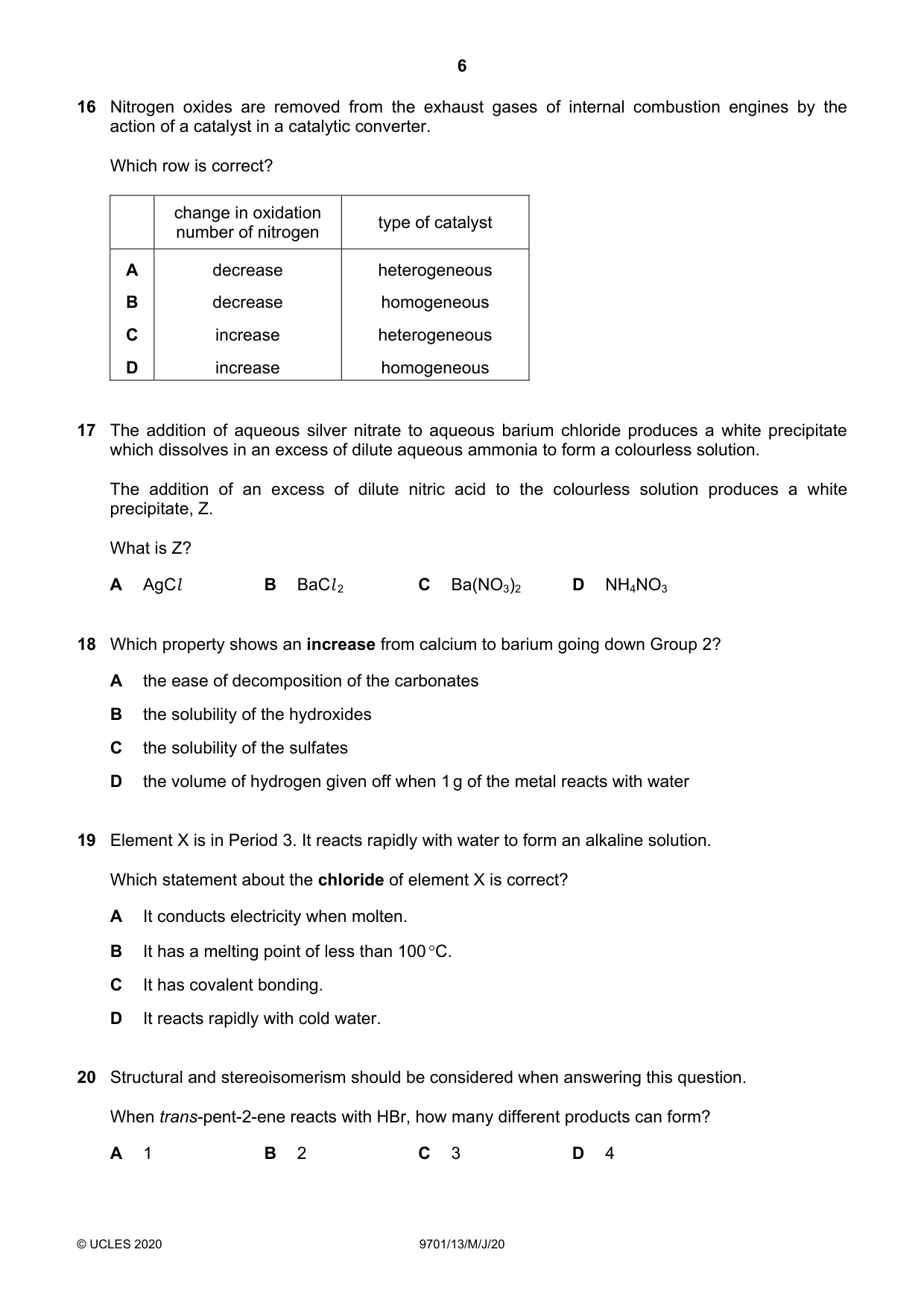
16 Nitrogen oxides are removed from the exhaust gases of internal combustion engines by the action of a catalyst in a catalytic converter. Which row is correct? change in oxidation type of catalyst number of nitrogen A decrease heterogeneous B decrease homogeneous C increase heterogeneous D increase homogeneous
Mark scheme: A
Q17 · The addition of aqueous silver nitrate to aqueous barium chloride produces a white…
17 The addition of aqueous silver nitrate to aqueous barium chloride produces a white precipitate which dissolves in an excess of dilute aqueous ammonia to form a colourless solution. The addition of an excess of dilute nitric acid to the colourless solution produces a white precipitate, Z. What is Z? A AgCl B BaCl 2 C Ba(NO3)2 D NH4NO3
Mark scheme: A
Q18 · Which property shows an increase from calcium to barium going down Group 2?
18 Which property shows an increase from calcium to barium going down Group 2? A the ease of decomposition of the carbonates B the solubility of the hydroxides C the solubility of the sulfates D the volume of hydrogen given off when 1 g of the metal reacts with water
Mark scheme: B
Q19 · Element X is in Period 3
19 Element X is in Period 3. It reacts rapidly with water to form an alkaline solution. Which statement about the chloride of element X is correct? A It conducts electricity when molten. B It has a melting point of less than 100 °C. C It has covalent bonding. D It reacts rapidly with cold water.
Mark scheme: A
More questions on Periodicity of chemical properties of the elements in Period 3
Q20 · Structural and stereoisomerism should be considered when answering this question
20 Structural and stereoisomerism should be considered when answering this question. When trans-pent-2-ene reacts with HBr, how many different products can form? A 1 B 2 C 3 D 4
Mark scheme: C
Q21 · Ester P has the following structural formula
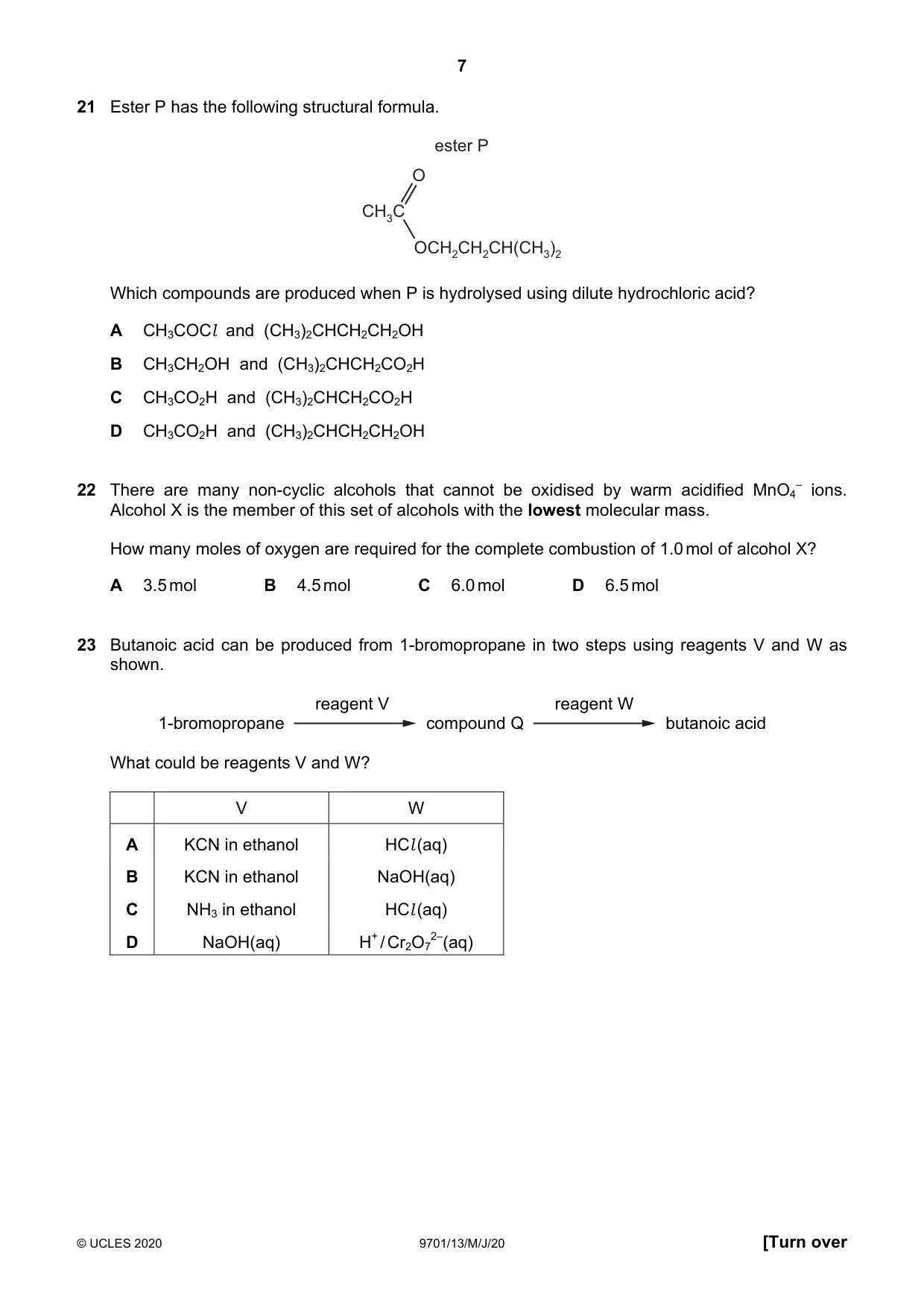
21 Ester P has the following structural formula. ester P O CH3C OCH2CH2CH(CH3)2 Which compounds are produced when P is hydrolysed using dilute hydrochloric acid? A CH3COCl and (CH3)2CHCH2CH2OH B CH3CH2OH and (CH3)2CHCH2CO2H C CH3CO2H and (CH3)2CHCH2CO2H D CH3CO2H and (CH3)2CHCH2CH2OH
Mark scheme: D
Q22 · There are many non-cyclic alcohols that cannot be oxidised by warm acidified MnO4 – ions
22 There are many non-cyclic alcohols that cannot be oxidised by warm acidified MnO4 – ions. Alcohol X is the member of this set of alcohols with the lowest molecular mass. How many moles of oxygen are required for the complete combustion of 1.0 mol of alcohol X? A 3.5 mol B 4.5 mol C 6.0 mol D 6.5 mol
Mark scheme: C
Q23 · Butanoic acid can be produced from 1-bromopropane in two steps using reagents V and W as…
23 Butanoic acid can be produced from 1-bromopropane in two steps using reagents V and W as shown. reagent V reagent W 1-bromopropane compound Q butanoic acid What could be reagents V and W? V W A KCN in ethanol HCl (aq) B KCN in ethanol NaOH(aq) C NH3 in ethanol HCl (aq) D NaOH(aq) H+ / Cr2O7 2–(aq)
Mark scheme: A
Q24 · Which statement about compound T and compound U is correct?
24 Which statement about compound T and compound U is correct? compound T compound U O O H3C C H C CH2CH2CH3 CH(CH3)CH2CH3 A T and U are stereoisomers. B T can be distinguished from U by the use of alkaline aqueous iodine. C T can be reduced by LiAl H4 but not by NaBH4. D U can be formed by the oxidation of 3-methylbutan-1-ol.
Mark scheme: B
Q25 · The diagram shows the infrared spectrum of an organic compound
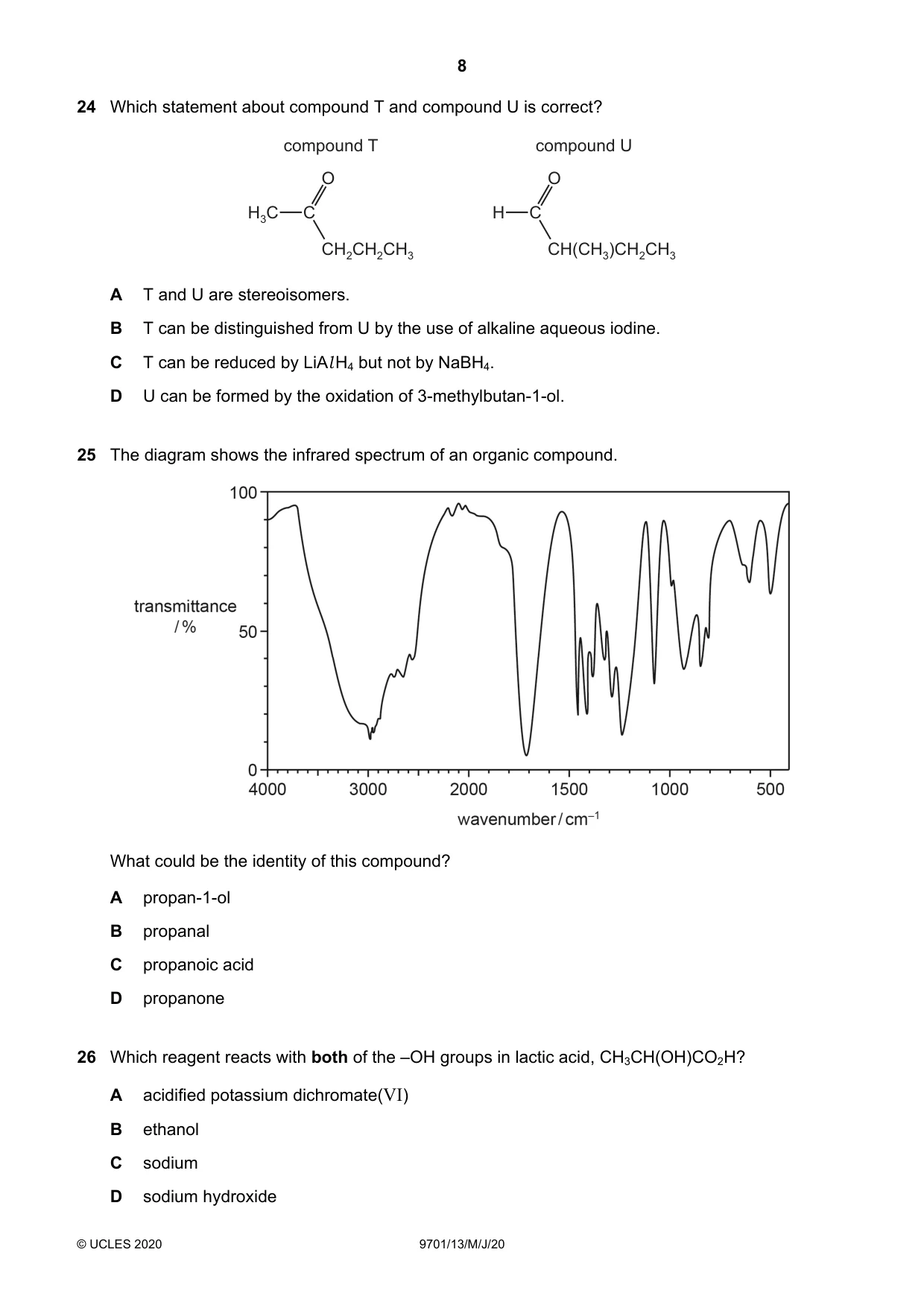
25 The diagram shows the infrared spectrum of an organic compound. What could be the identity of this compound? A propan-1-ol B propanal C propanoic acid D propanone
Mark scheme: C
Q26 · Which reagent reacts with both of the –OH groups in lactic acid, CH3CH(OH)CO2H?
26 Which reagent reacts with both of the –OH groups in lactic acid, CH3CH(OH)CO2H? A acidified potassium dichromate(VI) B ethanol C sodium D sodium hydroxide
Mark scheme: C
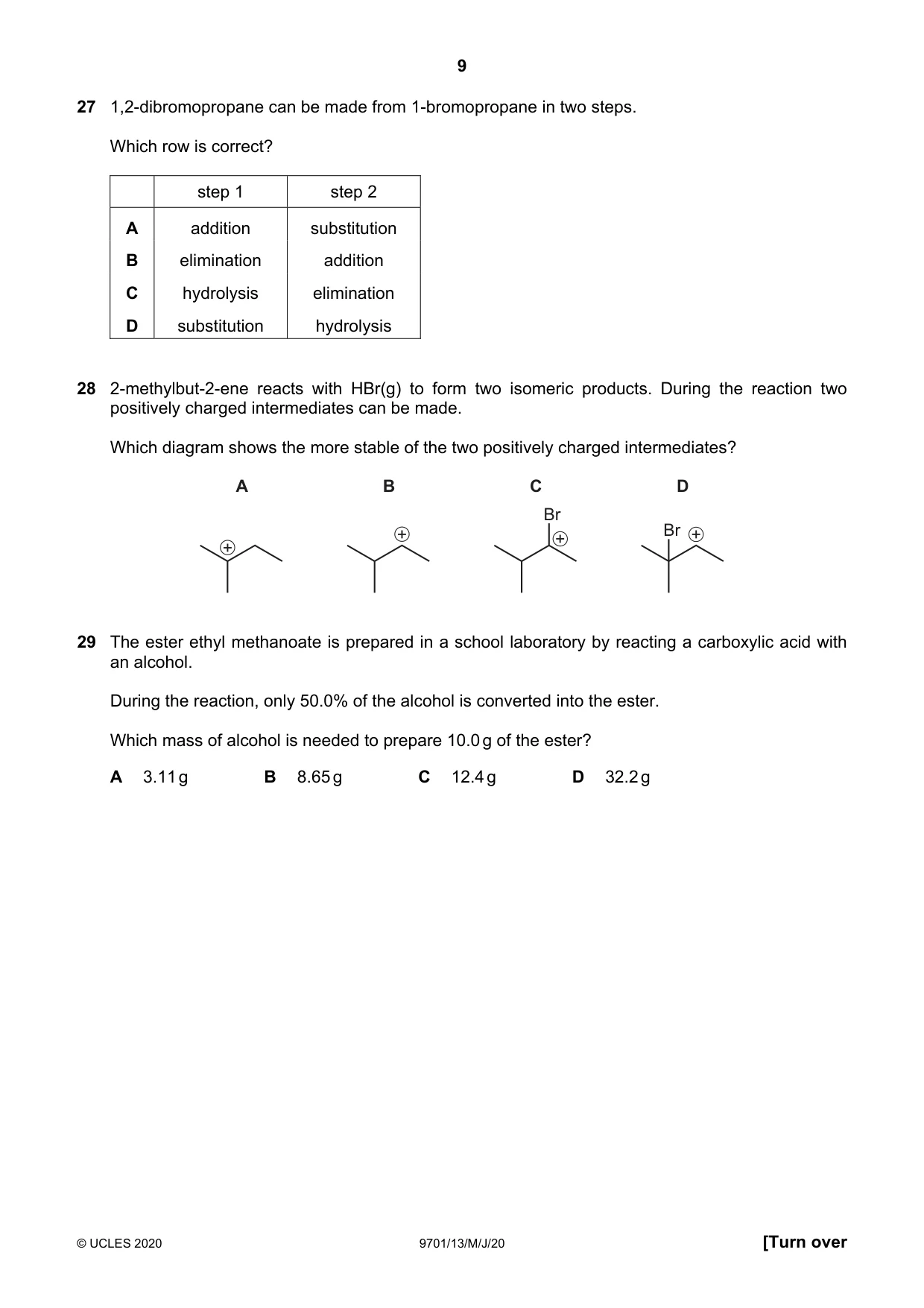
Q27 · 1,2-dibromopropane can be made from 1-bromopropane in two steps
27 1,2-dibromopropane can be made from 1-bromopropane in two steps. Which row is correct? step 1 step 2 A addition substitution B elimination addition C hydrolysis elimination D substitution hydrolysis
Mark scheme: B
Q28 · 2-methylbut-2-ene reacts with HBr(g) to form two isomeric products
28 2-methylbut-2-ene reacts with HBr(g) to form two isomeric products. During the reaction two positively charged intermediates can be made. Which diagram shows the more stable of the two positively charged intermediates? A B C D Br + Br + + +
Mark scheme: A
Q29 · The ester ethyl methanoate is prepared in a school laboratory by reacting a carboxylic…
29 The ester ethyl methanoate is prepared in a school laboratory by reacting a carboxylic acid with an alcohol. During the reaction, only 50.0% of the alcohol is converted into the ester. Which mass of alcohol is needed to prepare 10.0 g of the ester? A 3.11 g B 8.65 g C 12.4 g D 32.2 g
Mark scheme: C
More questions on Reacting masses and volumes (of solutions and gases)
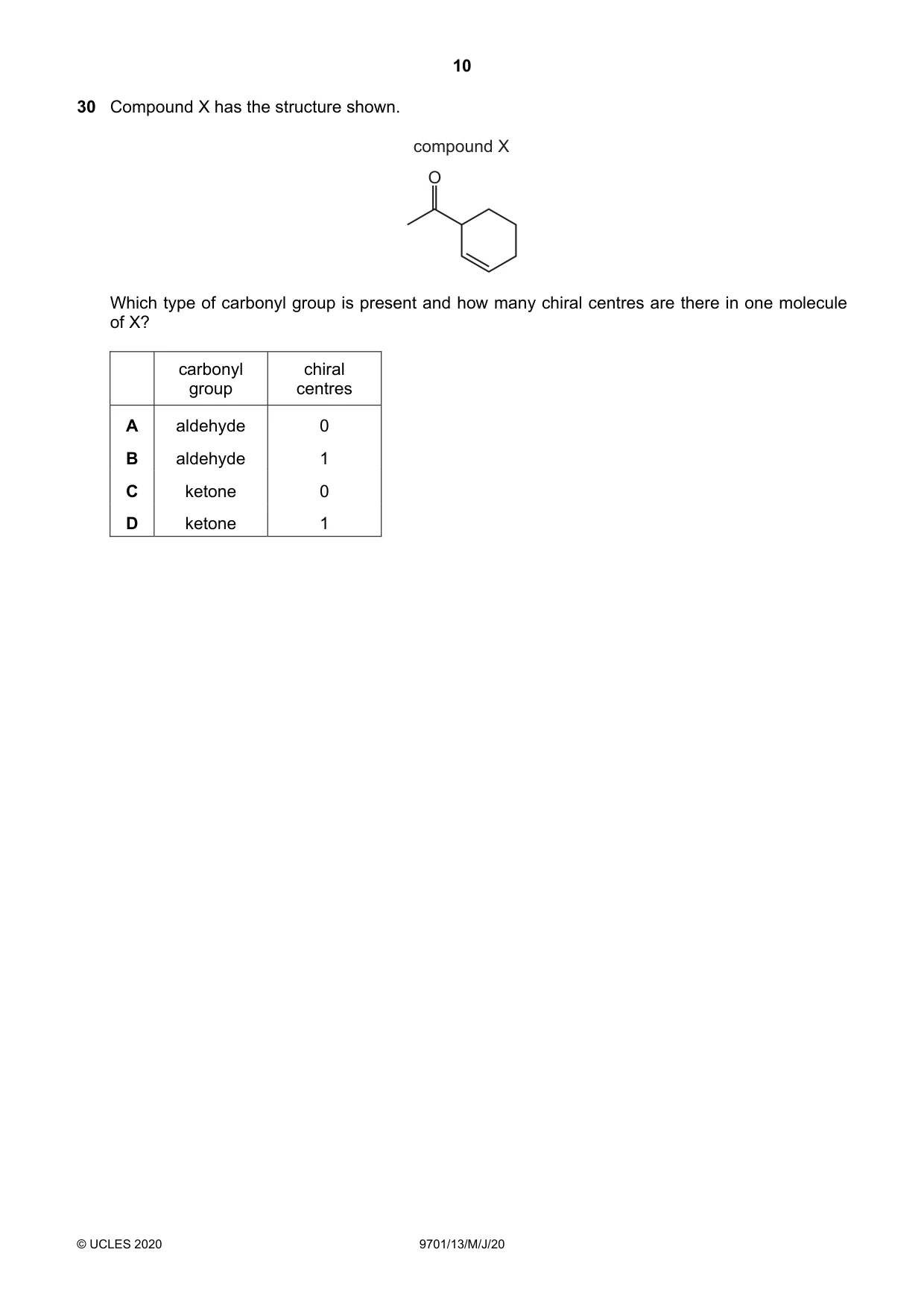
Q30 · Compound X has the structure shown
30 Compound X has the structure shown. compound X O Which type of carbonyl group is present and how many chiral centres are there in one molecule of X? carbonyl chiral group centres A aldehyde 0 B aldehyde 1 C ketone 0 D ketone 1
Mark scheme: D
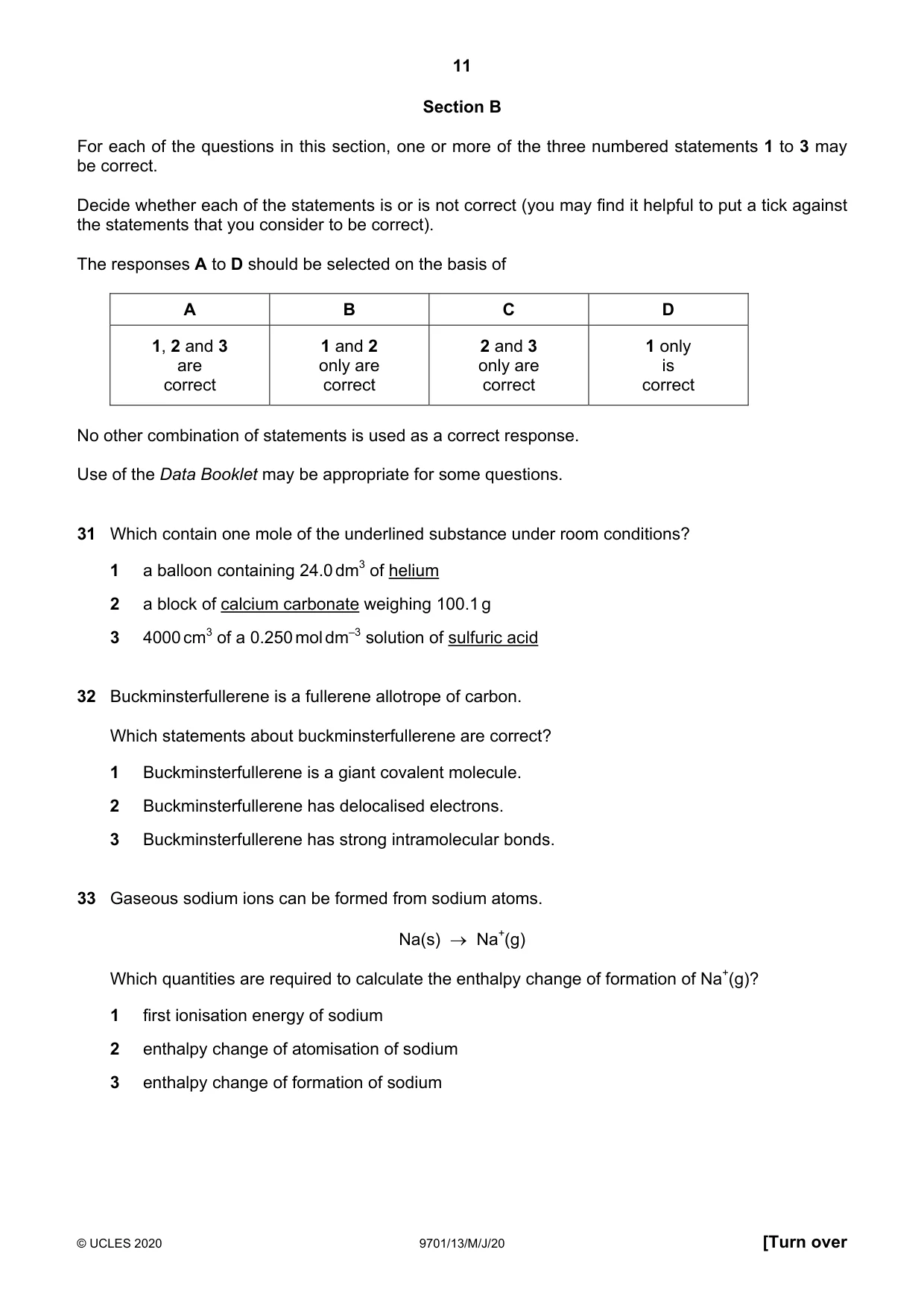
Q31 · Which contain one mole of the underlined substance under room conditions?
31 Which contain one mole of the underlined substance under room conditions? 1 a balloon containing 24.0 dm3 of helium 2 a block of calcium carbonate weighing 100.1 g 3 4000 cm3 of a 0.250 mol dm–3 solution of sulfuric acid
Mark scheme: A
Q32 · Buckminsterfullerene is a fullerene allotrope of carbon
32 Buckminsterfullerene is a fullerene allotrope of carbon. Which statements about buckminsterfullerene are correct? 1 Buckminsterfullerene is a giant covalent molecule. 2 Buckminsterfullerene has delocalised electrons. 3 Buckminsterfullerene has strong intramolecular bonds.
Mark scheme: C
Q33 · Gaseous sodium ions can be formed from sodium atoms
33 Gaseous sodium ions can be formed from sodium atoms. Na(s) → Na+(g) Which quantities are required to calculate the enthalpy change of formation of Na+(g)? 1 first ionisation energy of sodium 2 enthalpy change of atomisation of sodium 3 enthalpy change of formation of sodium
Mark scheme: B
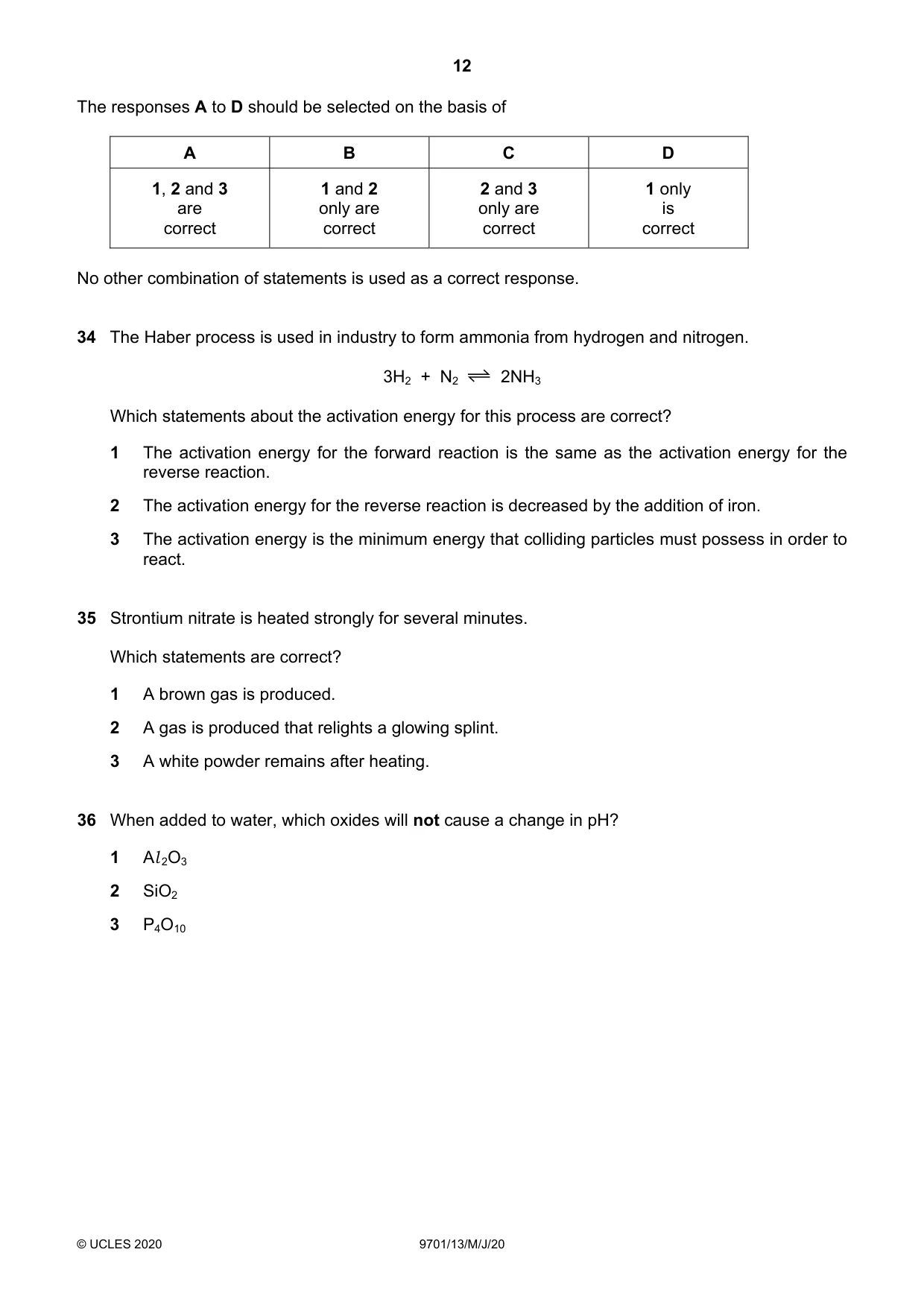
Q34 · The Haber process is used in industry to form ammonia from hydrogen and nitrogen
34 The Haber process is used in industry to form ammonia from hydrogen and nitrogen. 3H2 + N2 2NH3 Which statements about the activation energy for this process are correct? 1 The activation energy for the forward reaction is the same as the activation energy for the reverse reaction. 2 The activation energy for the reverse reaction is decreased by the addition of iron. 3 The activation energy is the minimum energy that colliding particles must possess in order to react.
Mark scheme: C
More questions on Effect of temperature on reaction rates and the concept of activation energy
Q35 · Strontium nitrate is heated strongly for several minutes
35 Strontium nitrate is heated strongly for several minutes. Which statements are correct? 1 A brown gas is produced. 2 A gas is produced that relights a glowing splint. 3 A white powder remains after heating.
Mark scheme: A
Q36 · When added to water, which oxides will not cause a change in pH?
36 When added to water, which oxides will not cause a change in pH? 1 Al 2O3 2 SiO2 3 P4O10
Mark scheme: B
More questions on Periodicity of chemical properties of the elements in Period 3
Q37 · Propanal reacts with hydrogen cyanide to form 2-hydroxybutanenitrile
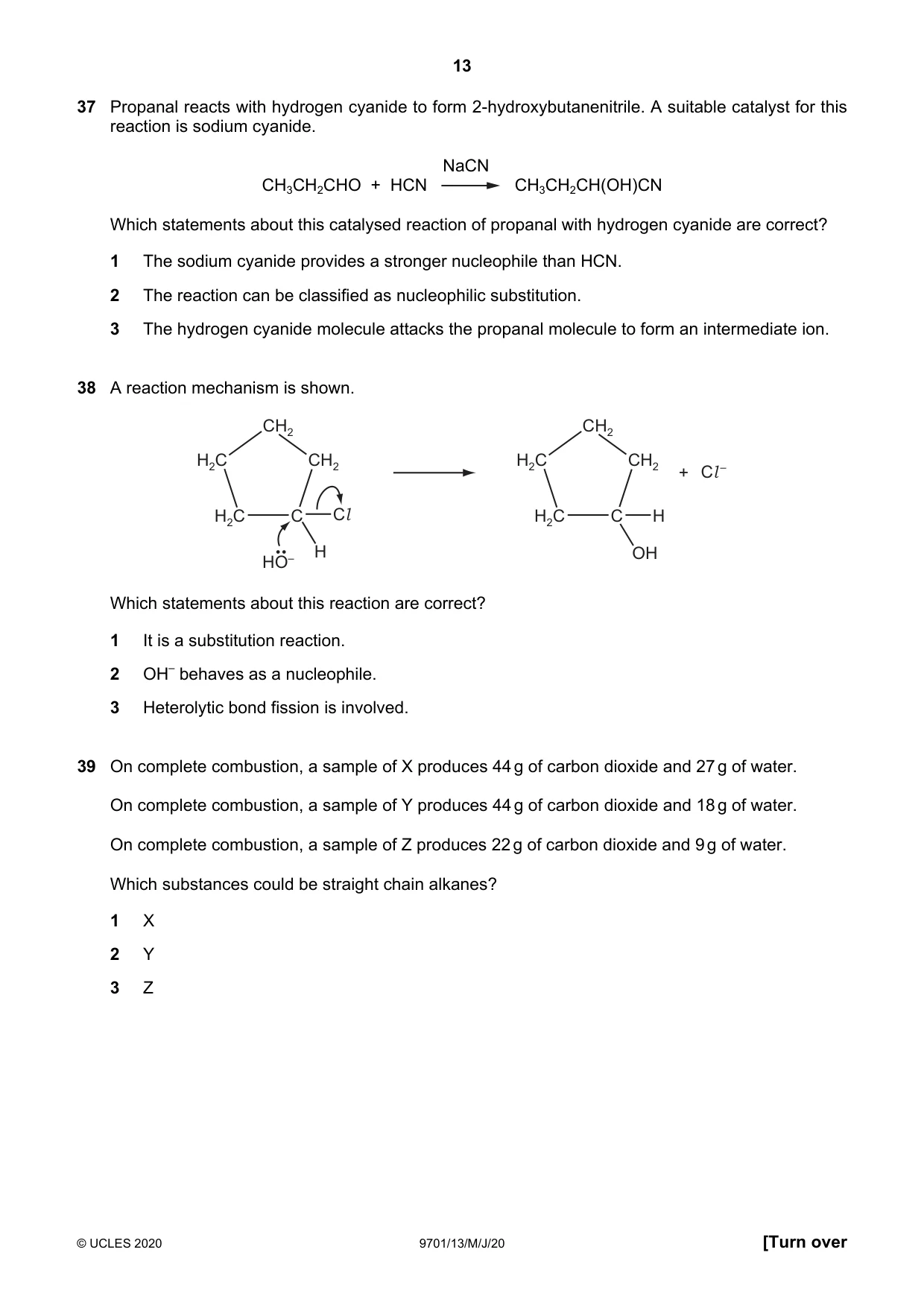
37 Propanal reacts with hydrogen cyanide to form 2-hydroxybutanenitrile. A suitable catalyst for this reaction is sodium cyanide. NaCN CH3CH2CHO + HCN CH3CH2CH(OH)CN Which statements about this catalysed reaction of propanal with hydrogen cyanide are correct? 1 The sodium cyanide provides a stronger nucleophile than HCN. 2 The reaction can be classified as nucleophilic substitution. 3 The hydrogen cyanide molecule attacks the propanal molecule to form an intermediate ion.
Mark scheme: D
Q38 · A reaction mechanism is shown
38 A reaction mechanism is shown. CH2 CH2 H2C CH2 H2C CH2 + Cl – H2C C Cl H2C C H H OH HO– Which statements about this reaction are correct? 1 It is a substitution reaction. 2 OH– behaves as a nucleophile. 3 Heterolytic bond fission is involved.
Mark scheme: A
Q39 · On complete combustion, a sample of X produces 44 g of carbon dioxide and 27 g of water
39 On complete combustion, a sample of X produces 44 g of carbon dioxide and 27 g of water. On complete combustion, a sample of Y produces 44 g of carbon dioxide and 18 g of water. On complete combustion, a sample of Z produces 22 g of carbon dioxide and 9 g of water. Which substances could be straight chain alkanes? 1 X 2 Y 3 Z
Mark scheme: D
Q40 · Which pairs are structural isomers of each other?
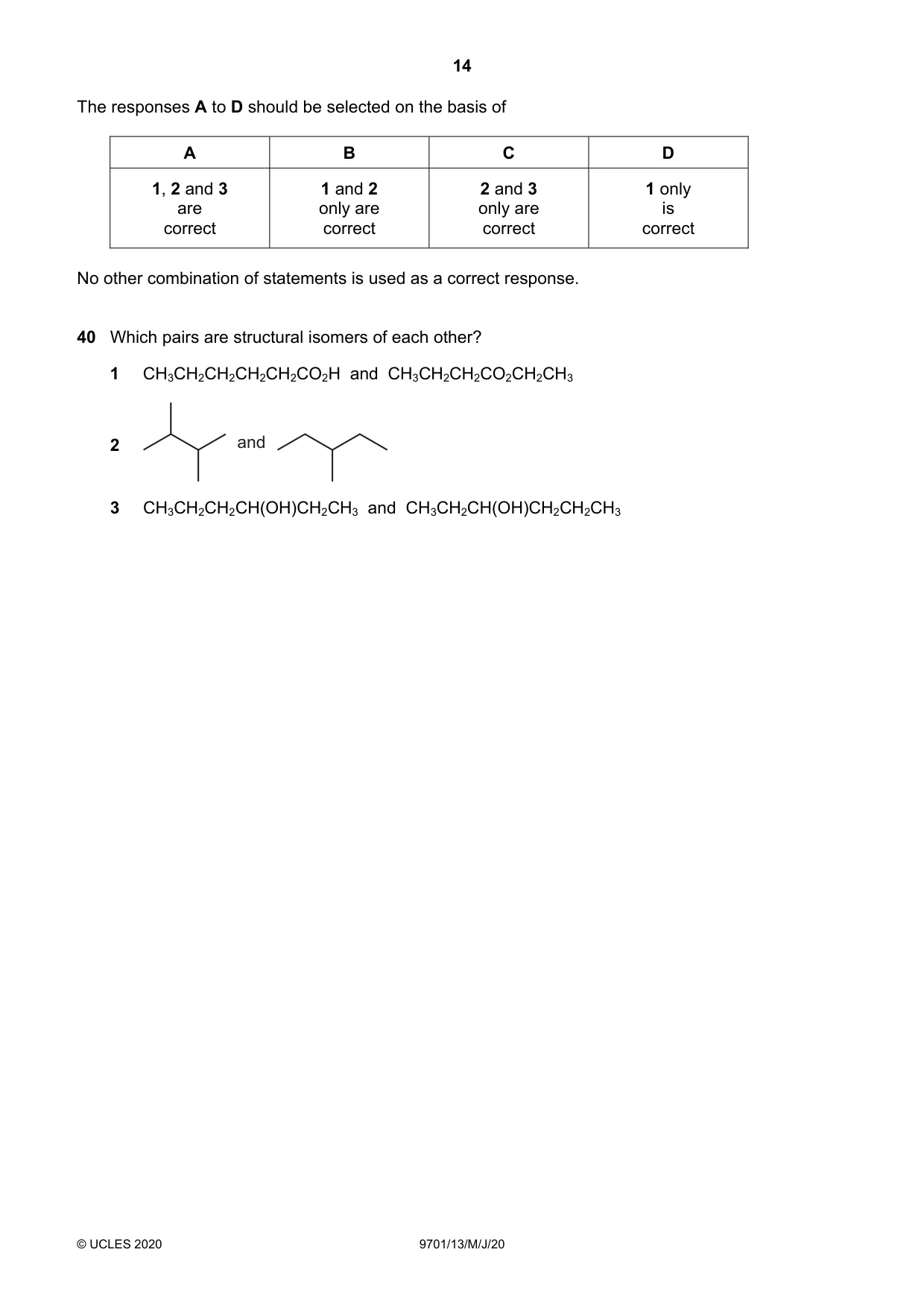
40 Which pairs are structural isomers of each other? 1 CH3CH2CH2CH2CH2CO2H and CH3CH2CH2CO2CH2CH3 2 and 3 CH3CH2CH2CH(OH)CH2CH3 and CH3CH2CH(OH)CH2CH2CH3
Mark scheme: B
More questions on Isomerism: structural isomerism and stereoisomerism
What was in this paper
The subtopics covered by these 40 questions, and how many questions each got. Open one in a new tab to see every Cambridge question on it.
4Periodicity of chemical properties of the elements in Period 33Aldehydes and ketones2Alkenes2Bonding and structure2Covalent bonding and coordinate (dative covalent) bonding2Organic synthesis2Redox processes: electron transfer and changes in oxidation number (oxidation state)2Acids and bases1Alcohols1Alkanes1Carboxylic acids1Chemical equilibria: reversible reactions, dynamic equilibrium1Effect of temperature on reaction rates and the concept of activation energy1Esters1General physical and chemical properties of the first row of transition elements, titanium to copper1Halogenoalkanes1Hess’s law1Homogeneous and heterogeneous catalysts1Infrared spectroscopy1Isomerism: structural isomerism and stereoisomerism1Lattice energy and Born-Haber cycles1Nitriles and hydroxynitriles1Particles in the atom and atomic radius1Physical properties of the Group 17 elements1Reacting masses and volumes (of solutions and gases)1Relative masses of atoms and molecules1Some reactions of the halide ions1The mole and the Avogadro constant1