Cambridge A Level Chemistry 9701 — 2013 May/June Paper 1 · Variant 2
9701/12/M/J/13 · 40 questions · 40 marks · ≈45 min
The question paper and its mark scheme, free to read here and free to download. This is Cambridge’s own paper, exactly as it was sat.
Question paper16 pages

Mark scheme2 pages
Answers below. Sit the paper first if you are practising.
Questions as text
Q1 · During the electrolysis of molten aluminium oxide to produce aluminium, using carbon…
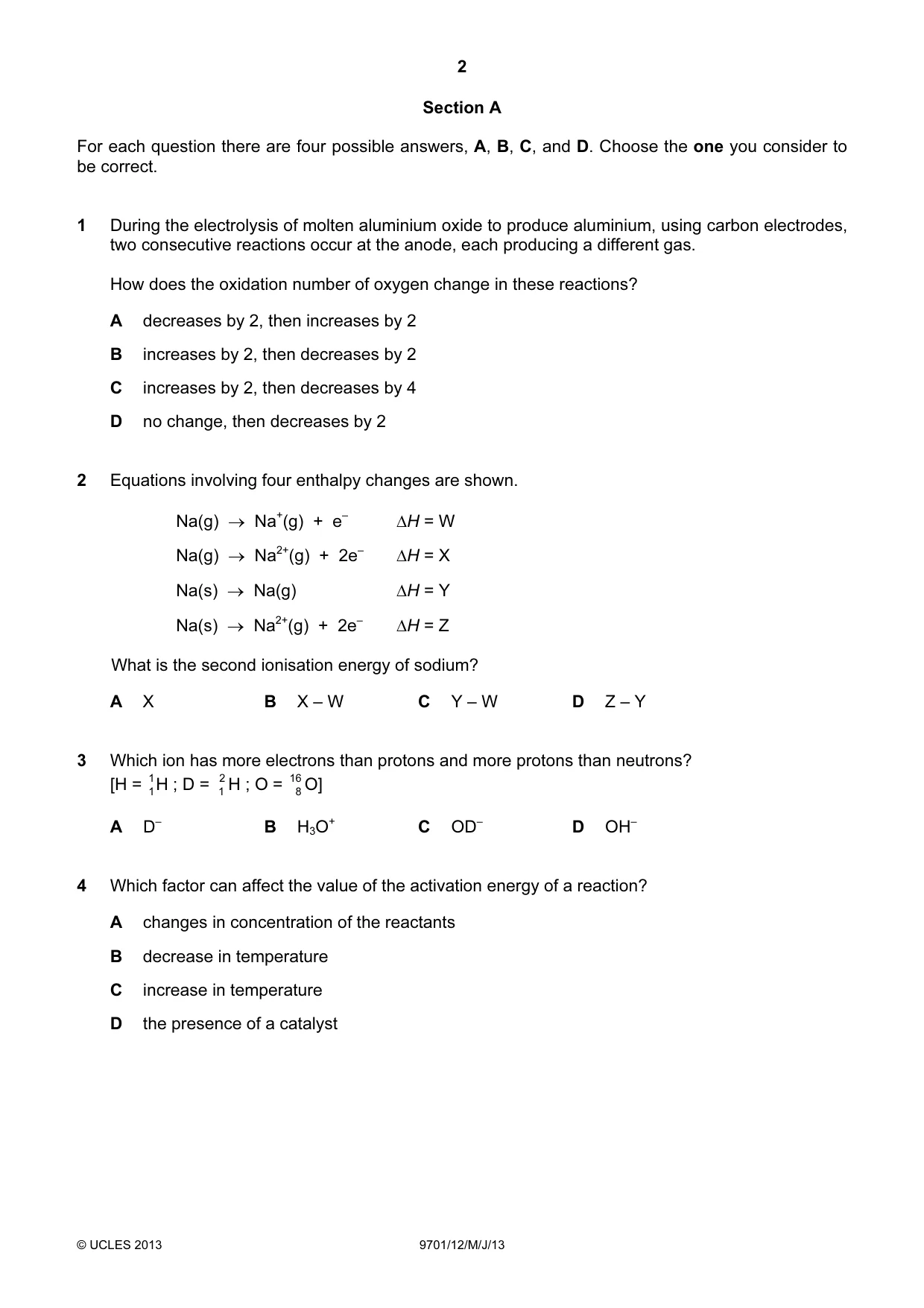
1 During the electrolysis of molten aluminium oxide to produce aluminium, using carbon electrodes, two consecutive reactions occur at the anode, each producing a different gas. How does the oxidation number of oxygen change in these reactions? A decreases by 2, then increases by 2 B increases by 2, then decreases by 2 C increases by 2, then decreases by 4 D no change, then decreases by 2
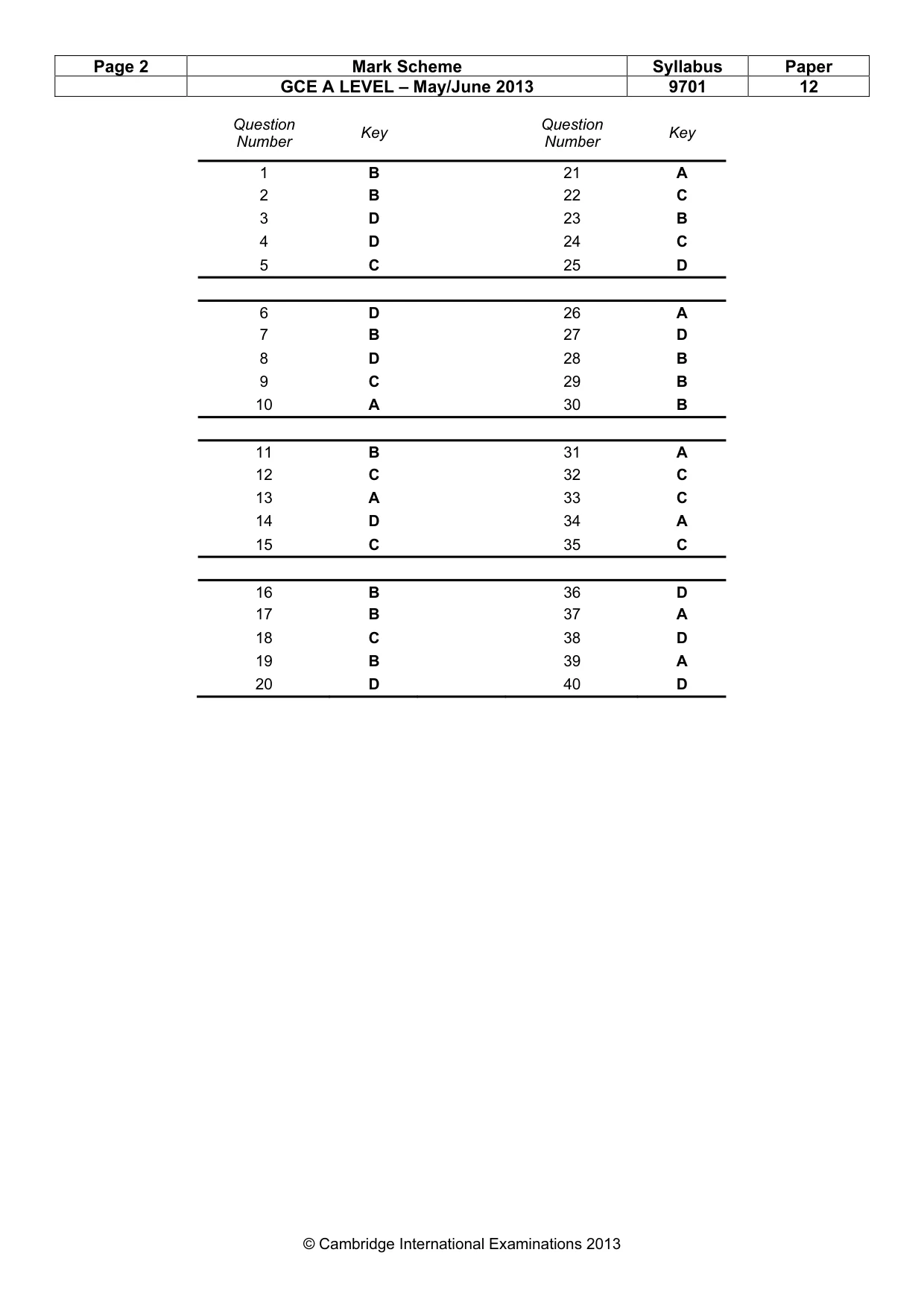
Mark scheme: B
Q2 · Equations involving four enthalpy changes are shown
2 Equations involving four enthalpy changes are shown. Na(g) → Na+(g) + e– ∆H = W Na(g) → Na2+(g) + 2e– ∆H = X Na(s) → Na(g) ∆H = Y Na(s) → Na2+(g) + 2e– ∆H = Z What is the second ionisation energy of sodium? A X B X – W C Y – W D Z – Y
Mark scheme: B
Q3 · Which ion has more electrons than protons and more protons than neutrons?
3 Which ion has more electrons than protons and more protons than neutrons? [H = 1 1H ; D = 2 1 H ; O = 16 8 O] A D– B H3O+ C OD– D OH–
Mark scheme: D
Q4 · Which factor can affect the value of the activation energy of a reaction?
4 Which factor can affect the value of the activation energy of a reaction? A changes in concentration of the reactants B decrease in temperature C increase in temperature D the presence of a catalyst
Mark scheme: D
More questions on Effect of temperature on reaction rates and the concept of activation energy
Q5 · The diagram shows the Maxwell-Boltzmann energy distribution curves for molecules of a…
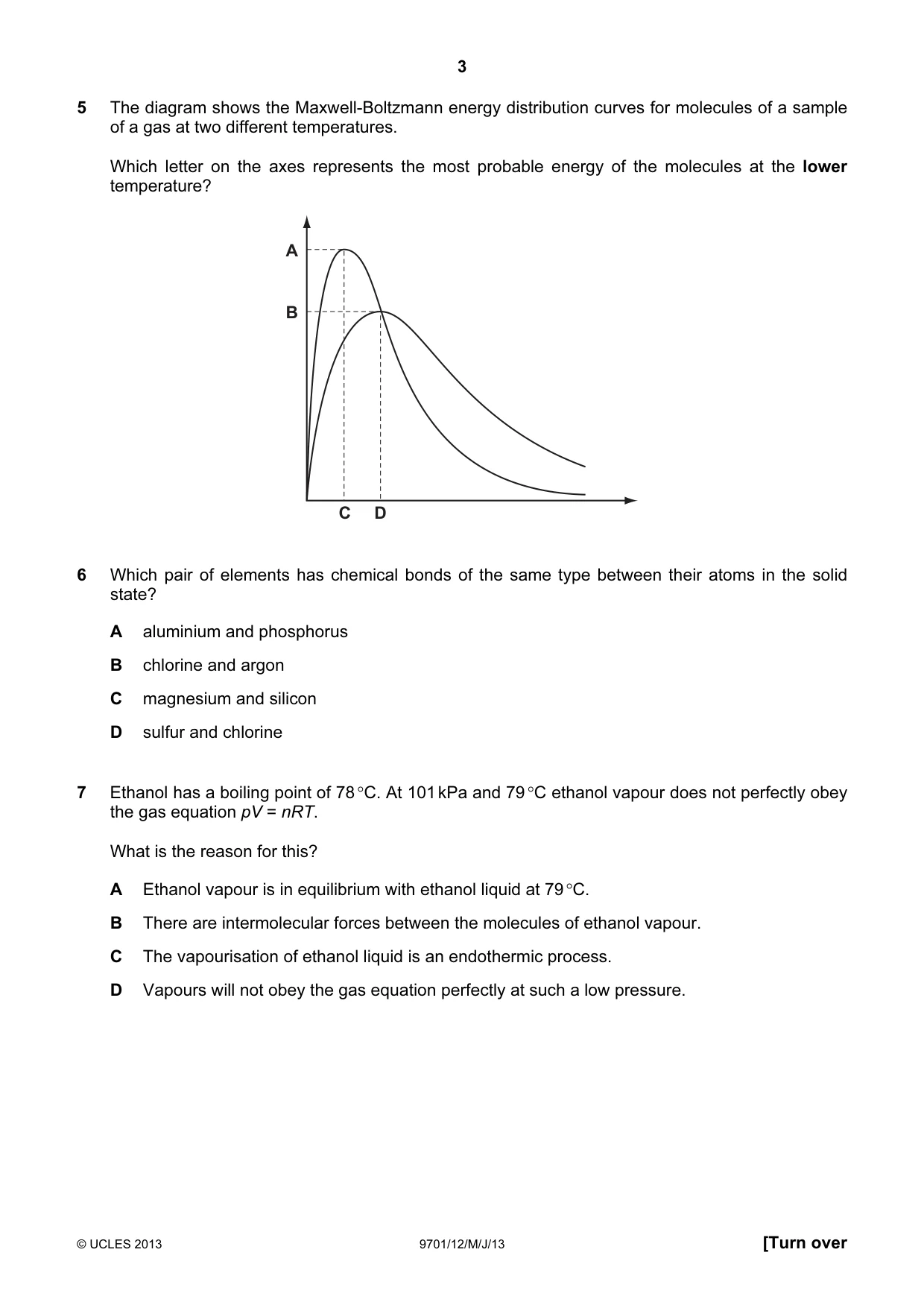
5 The diagram shows the Maxwell-Boltzmann energy distribution curves for molecules of a sample of a gas at two different temperatures. Which letter on the axes represents the most probable energy of the molecules at the lower temperature? A B C D
Mark scheme: C
More questions on Effect of temperature on reaction rates and the concept of activation energy
Q6 · Which pair of elements has chemical bonds of the same type between their atoms in the…
6 Which pair of elements has chemical bonds of the same type between their atoms in the solid state? A aluminium and phosphorus B chlorine and argon C magnesium and silicon D sulfur and chlorine
Mark scheme: D
Q7 · Ethanol has a boiling point of 78 °C
7 Ethanol has a boiling point of 78 °C. At 101 kPa and 79 °C ethanol vapour does not perfectly obey the gas equation pV = nRT. What is the reason for this? A Ethanol vapour is in equilibrium with ethanol liquid at 79 °C. B There are intermolecular forces between the molecules of ethanol vapour. C The vapourisation of ethanol liquid is an endothermic process. D Vapours will not obey the gas equation perfectly at such a low pressure.
Mark scheme: B
More questions on The gaseous state: ideal and real gases and pV = nRT
Q8 · The reaction between sulfur dioxide and oxygen is a dynamic equilibrium
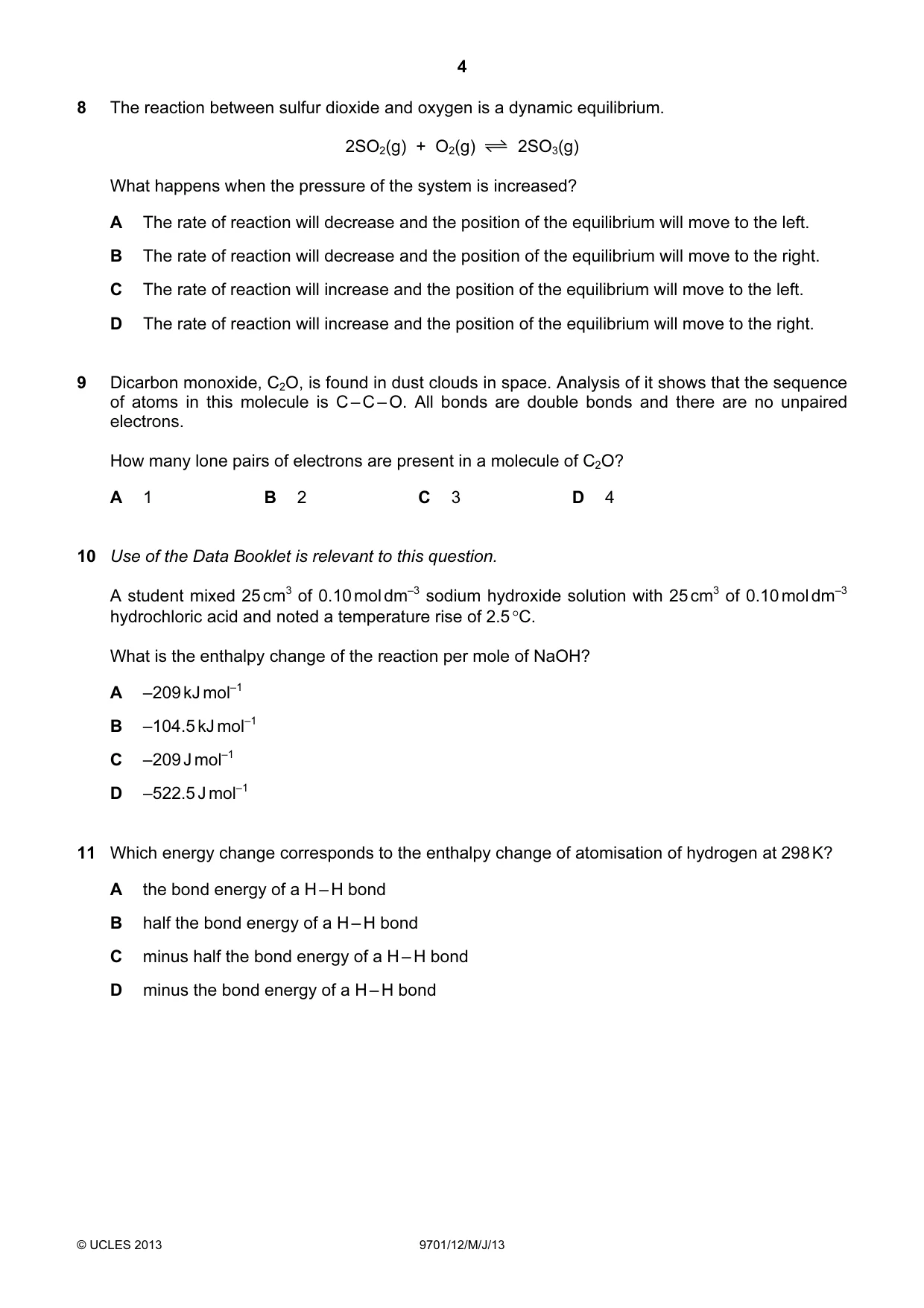
8 The reaction between sulfur dioxide and oxygen is a dynamic equilibrium. 2SO2(g) + O2(g) 2SO3(g) What happens when the pressure of the system is increased? A The rate of reaction will decrease and the position of the equilibrium will move to the left. B The rate of reaction will decrease and the position of the equilibrium will move to the right. C The rate of reaction will increase and the position of the equilibrium will move to the left. D The rate of reaction will increase and the position of the equilibrium will move to the right.
Mark scheme: D
More questions on Chemical equilibria: reversible reactions, dynamic equilibrium
Q9 · Dicarbon monoxide, C2O, is found in dust clouds in space
9 Dicarbon monoxide, C2O, is found in dust clouds in space. Analysis of it shows that the sequence of atoms in this molecule is C – C – O. All bonds are double bonds and there are no unpaired electrons. How many lone pairs of electrons are present in a molecule of C2O? A 1 B 2 C 3 D 4
Mark scheme: C
Q10 · Use of the Data Booklet is relevant to this question
10 Use of the Data Booklet is relevant to this question. A student mixed 25 cm3 of 0.10 mol dm–3 sodium hydroxide solution with 25 cm3 of 0.10 mol dm–3 hydrochloric acid and noted a temperature rise of 2.5 °C. What is the enthalpy change of the reaction per mole of NaOH? A –209 kJ mol–1 B –104.5 kJ mol–1 C –209 J mol–1 D –522.5 J mol–1
Mark scheme: A
Q11 · Which energy change corresponds to the enthalpy change of atomisation of hydrogen at 298…
11 Which energy change corresponds to the enthalpy change of atomisation of hydrogen at 298 K? A the bond energy of a H – H bond B half the bond energy of a H – H bond C minus half the bond energy of a H – H bond D minus the bond energy of a H – H bond
Mark scheme: B
Q12 · Propanone has molecular formula C3H6O
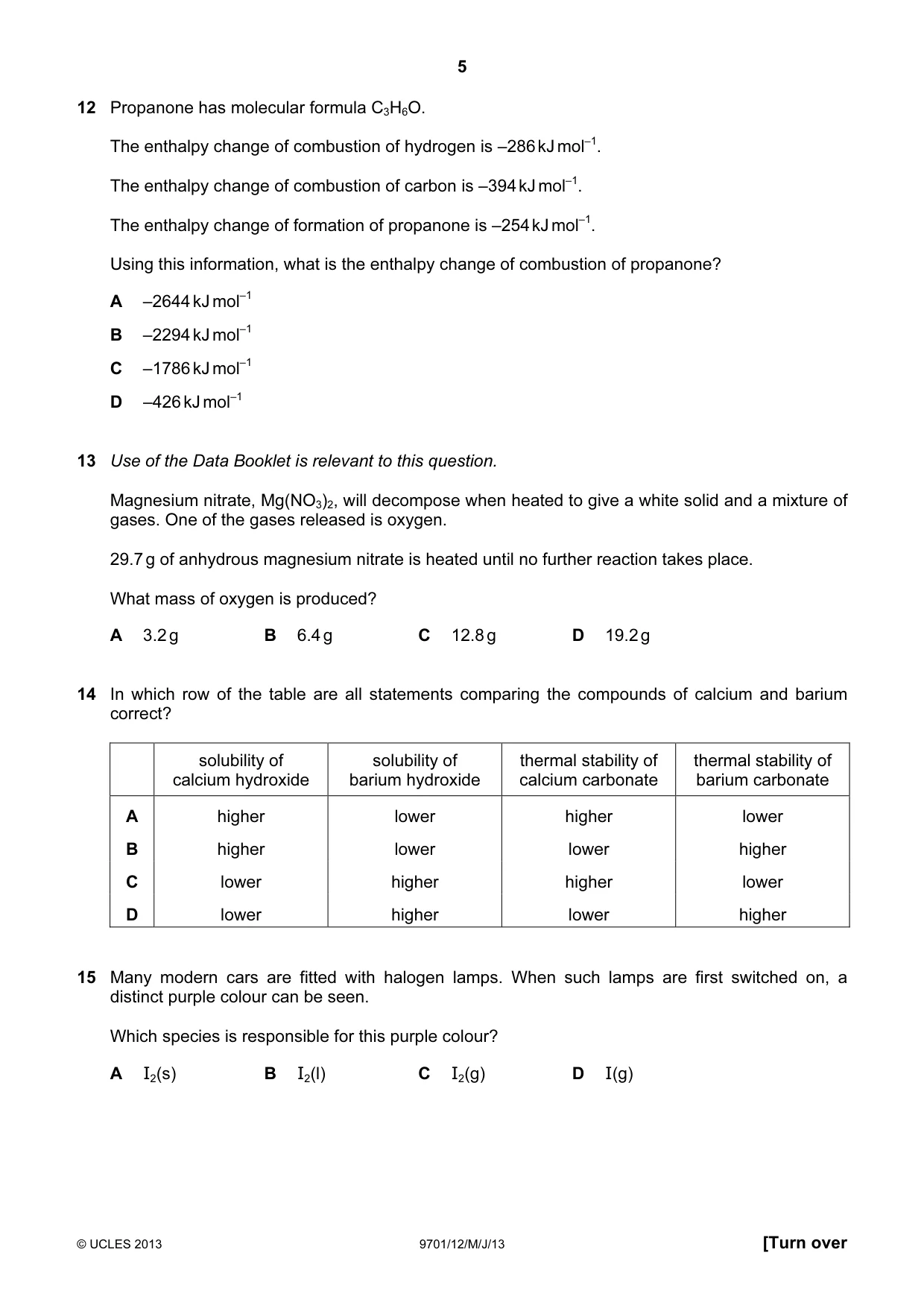
12 Propanone has molecular formula C3H6O. The enthalpy change of combustion of hydrogen is –286 kJ mol–1. The enthalpy change of combustion of carbon is –394 kJ mol–1. The enthalpy change of formation of propanone is –254 kJ mol–1. Using this information, what is the enthalpy change of combustion of propanone? A –2644 kJ mol–1 B –2294 kJ mol–1 C –1786 kJ mol–1 D –426 kJ mol–1
Mark scheme: C
Q13 · Use of the Data Booklet is relevant to this question
13 Use of the Data Booklet is relevant to this question. Magnesium nitrate, Mg(NO3)2, will decompose when heated to give a white solid and a mixture of gases. One of the gases released is oxygen. 29.7 g of anhydrous magnesium nitrate is heated until no further reaction takes place. What mass of oxygen is produced? A 3.2 g B 6.4 g C 12.8 g D 19.2 g
Mark scheme: A
More questions on Reacting masses and volumes (of solutions and gases)
Q14 · In which row of the table are all statements comparing the compounds of calcium and…
14 In which row of the table are all statements comparing the compounds of calcium and barium correct? solubility of solubility of thermal stability of thermal stability of calcium hydroxide barium hydroxide calcium carbonate barium carbonate A higher lower higher lower B higher lower lower higher C lower higher higher lower D lower higher lower higher
Mark scheme: D
Q15 · Many modern cars are fitted with halogen lamps
15 Many modern cars are fitted with halogen lamps. When such lamps are first switched on, a distinct purple colour can be seen. Which species is responsible for this purple colour? A I2(s) B I2(l) C I2(g) D I(g)
Mark scheme: C
More questions on Physical properties of the Group 17 elements
Q16 · The trends in three physical properties of the elements Na, Mg, Al, Si, P and S are shown…
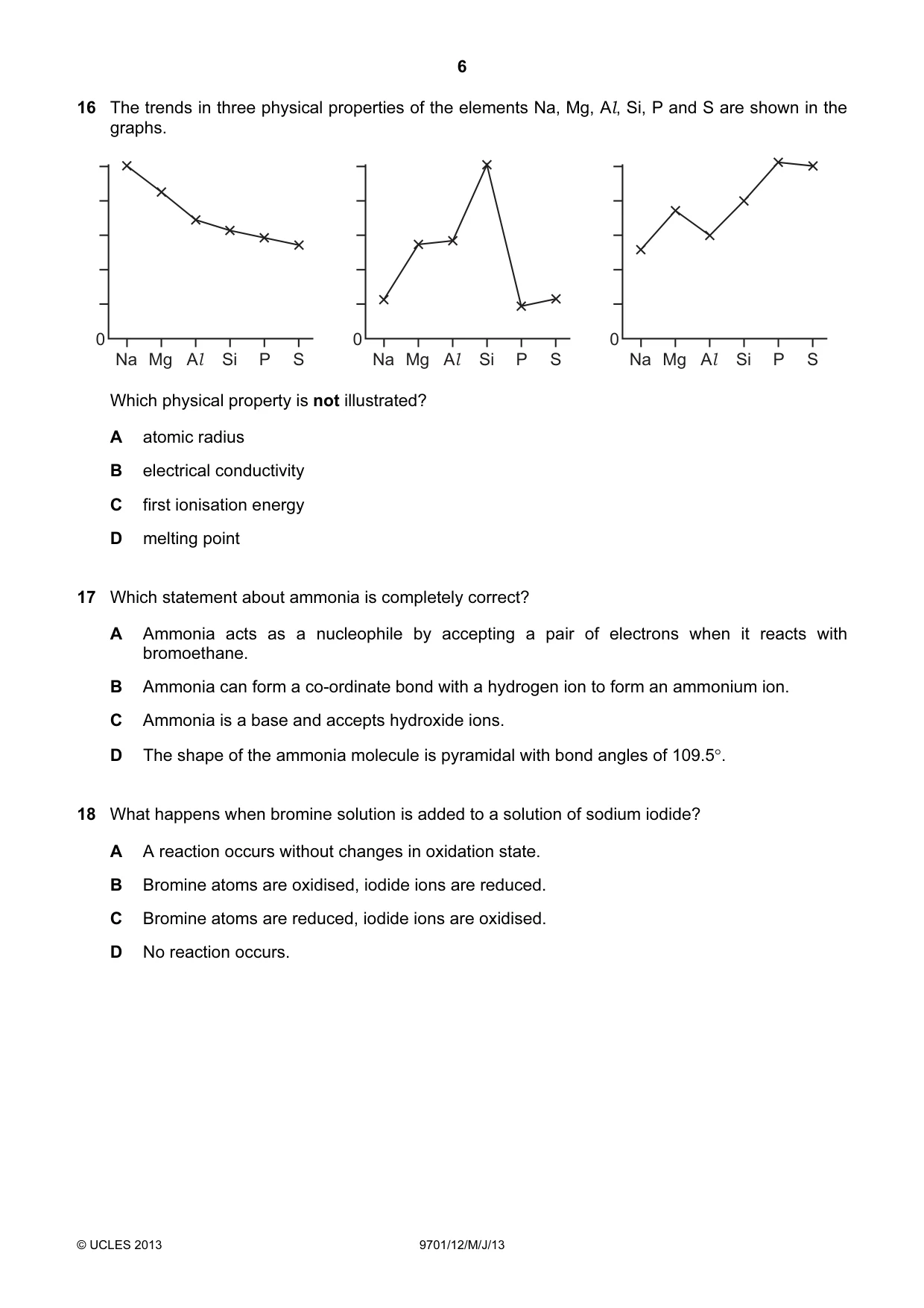
16 The trends in three physical properties of the elements Na, Mg, Al, Si, P and S are shown in the graphs. 0 0 0 Na Mg Al Si P S Na Mg Al Si P S Na Mg Al Si P S Which physical property is not illustrated? A atomic radius B electrical conductivity C first ionisation energy D melting point
Mark scheme: B
More questions on Periodicity of physical properties of the elements in Period 3
Q17 · Which statement about ammonia is completely correct?
17 Which statement about ammonia is completely correct? A Ammonia acts as a nucleophile by accepting a pair of electrons when it reacts with bromoethane. B Ammonia can form a co-ordinate bond with a hydrogen ion to form an ammonium ion. C Ammonia is a base and accepts hydroxide ions. D The shape of the ammonia molecule is pyramidal with bond angles of 109.5°.
Mark scheme: B
Q18 · What happens when bromine solution is added to a solution of sodium iodide?
18 What happens when bromine solution is added to a solution of sodium iodide? A A reaction occurs without changes in oxidation state. B Bromine atoms are oxidised, iodide ions are reduced. C Bromine atoms are reduced, iodide ions are oxidised. D No reaction occurs.
Mark scheme: C
More questions on The chemical properties of the halogen elements and the hydrogen halides
Q19 · The halogens exist as diatomic molecules, X2
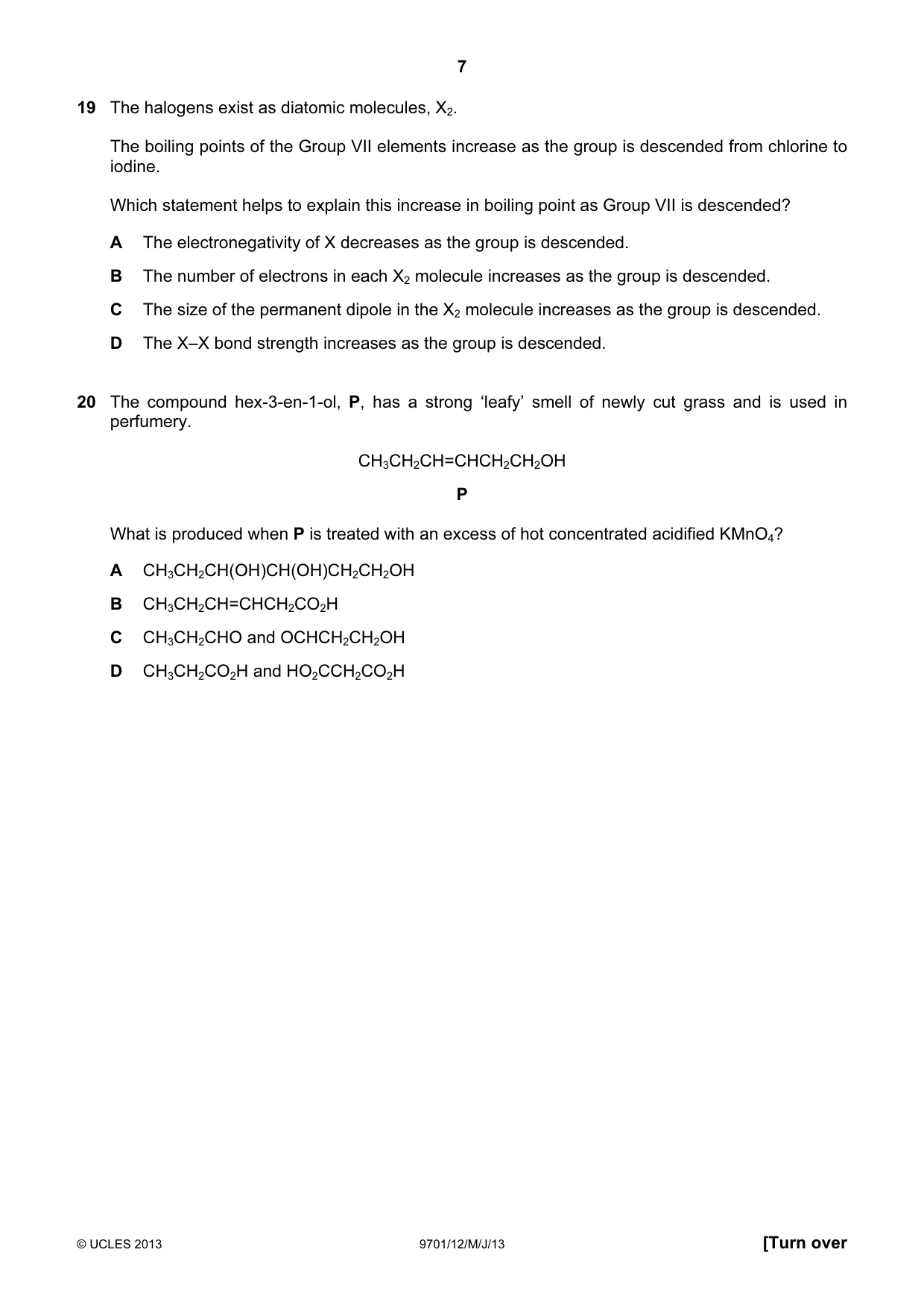
19 The halogens exist as diatomic molecules, X2. The boiling points of the Group VII elements increase as the group is descended from chlorine to iodine. Which statement helps to explain this increase in boiling point as Group VII is descended? A The electronegativity of X decreases as the group is descended. B The number of electrons in each X2 molecule increases as the group is descended. C The size of the permanent dipole in the X2 molecule increases as the group is descended. D The X–X bond strength increases as the group is descended.
Mark scheme: B
More questions on Physical properties of the Group 17 elements
Q20 · The compound hex-3-en-1-ol, P, has a strong ‘leafy’ smell of newly cut grass and is used…
20 The compound hex-3-en-1-ol, P, has a strong ‘leafy’ smell of newly cut grass and is used in perfumery. CH3CH2CH=CHCH2CH2OH P What is produced when P is treated with an excess of hot concentrated acidified KMnO4? A CH3CH2CH(OH)CH(OH)CH2CH2OH B CH3CH2CH=CHCH2CO2H C CH3CH2CHO and OCHCH2CH2OH D CH3CH2CO2H and HO2CCH2CO2H
Mark scheme: D
Q21 · Sorbic acid is used as a food preservative because it kills fungi and moulds
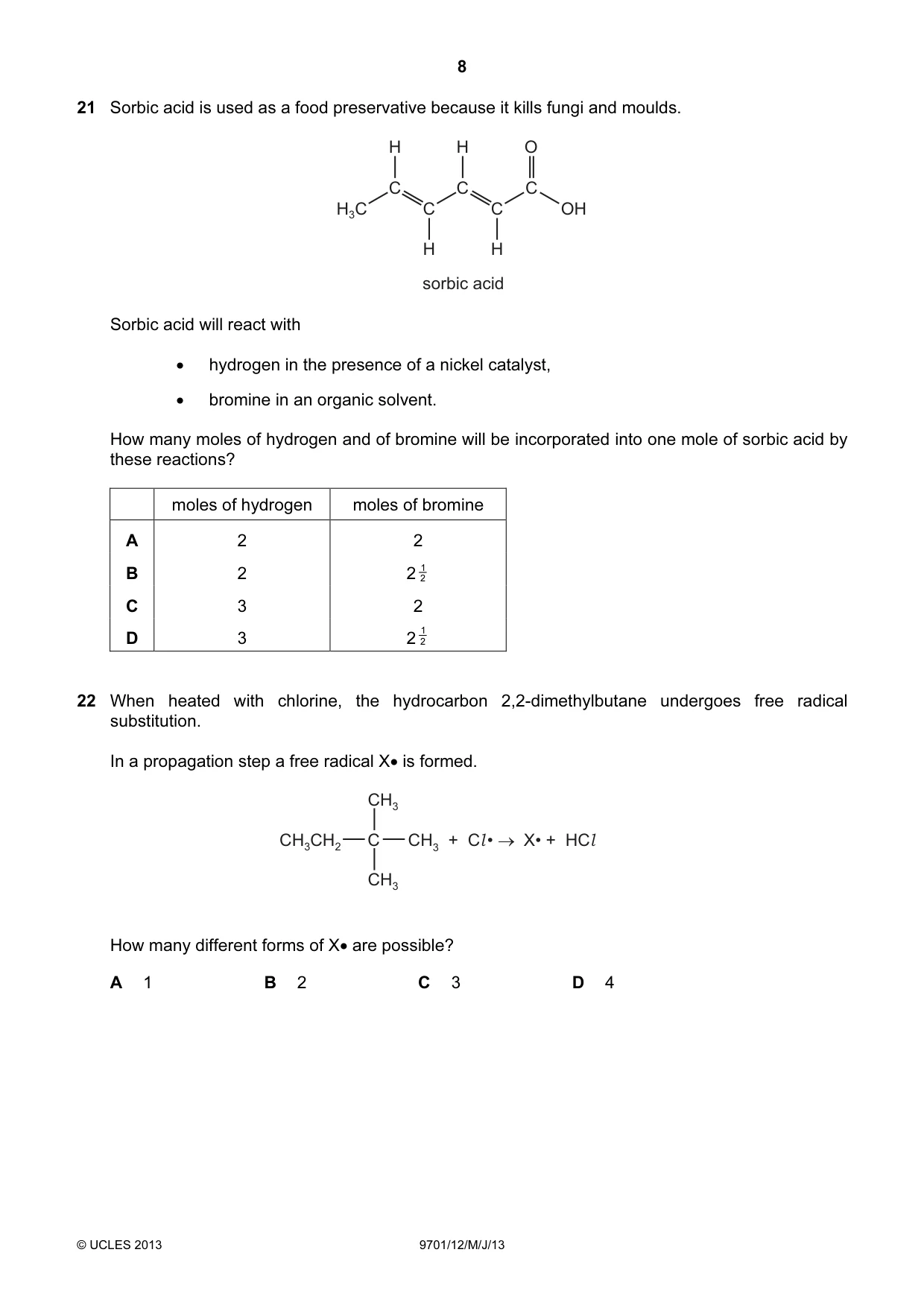
21 Sorbic acid is used as a food preservative because it kills fungi and moulds. H H O C C C H3C C C OH H H sorbic acid Sorbic acid will react with • hydrogen in the presence of a nickel catalyst, • bromine in an organic solvent. How many moles of hydrogen and of bromine will be incorporated into one mole of sorbic acid by these reactions? moles of hydrogen moles of bromine A 2 2 1 B 2 2 2 C 3 2 1 D 3 2 2
Mark scheme: A
Q22 · When heated with chlorine, the hydrocarbon 2,2-dimethylbutane undergoes free radical…
22 When heated with chlorine, the hydrocarbon 2,2-dimethylbutane undergoes free radical substitution. In a propagation step a free radical X• is formed. CH3 CH3CH2 C CH3 + Cl • → X• + HCl CH3 How many different forms of X• are possible? A 1 B 2 C 3 D 4
Mark scheme: C
Q23 · Aqueous sodium hydroxide reacts with 2-bromo-2-methylpropane to give 2-methylpropan-2-ol
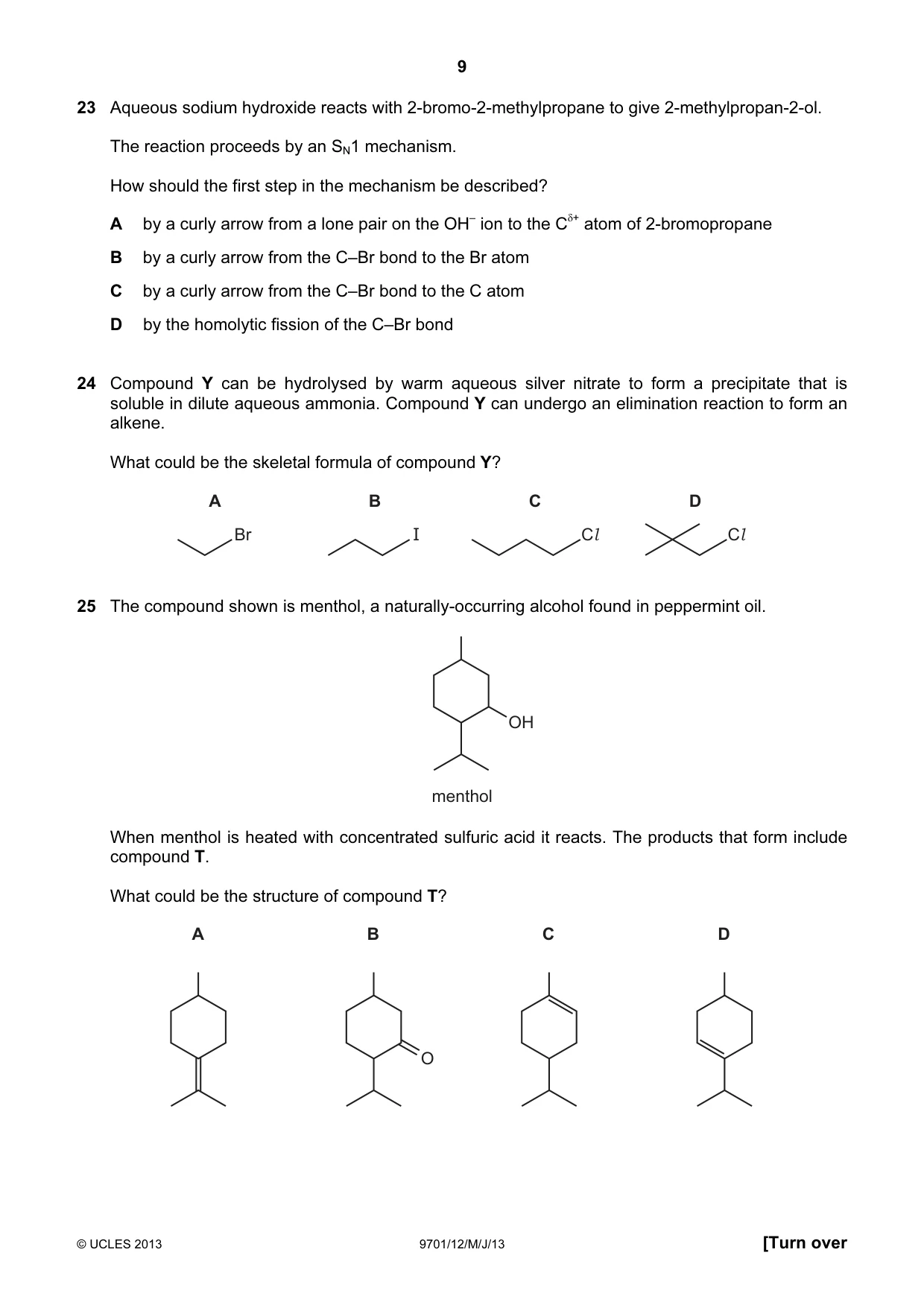
23 Aqueous sodium hydroxide reacts with 2-bromo-2-methylpropane to give 2-methylpropan-2-ol. The reaction proceeds by an SN1 mechanism. How should the first step in the mechanism be described? A by a curly arrow from a lone pair on the OH– ion to the Cδ+ atom of 2-bromopropane B by a curly arrow from the C–Br bond to the Br atom C by a curly arrow from the C–Br bond to the C atom D by the homolytic fission of the C–Br bond
Mark scheme: B
Q24 · Compound Y can be hydrolysed by warm aqueous silver nitrate to form a precipitate that is…
24 Compound Y can be hydrolysed by warm aqueous silver nitrate to form a precipitate that is soluble in dilute aqueous ammonia. Compound Y can undergo an elimination reaction to form an alkene. What could be the skeletal formula of compound Y? A B C D Br I Cl Cl
Mark scheme: C
Q25 · The compound shown is menthol, a naturally-occurring alcohol found in peppermint oil
25 The compound shown is menthol, a naturally-occurring alcohol found in peppermint oil. OH menthol When menthol is heated with concentrated sulfuric acid it reacts. The products that form include compound T. What could be the structure of compound T? A B C D O
Mark scheme: D
Q26 · Use of the Data Booklet is relevant to this question
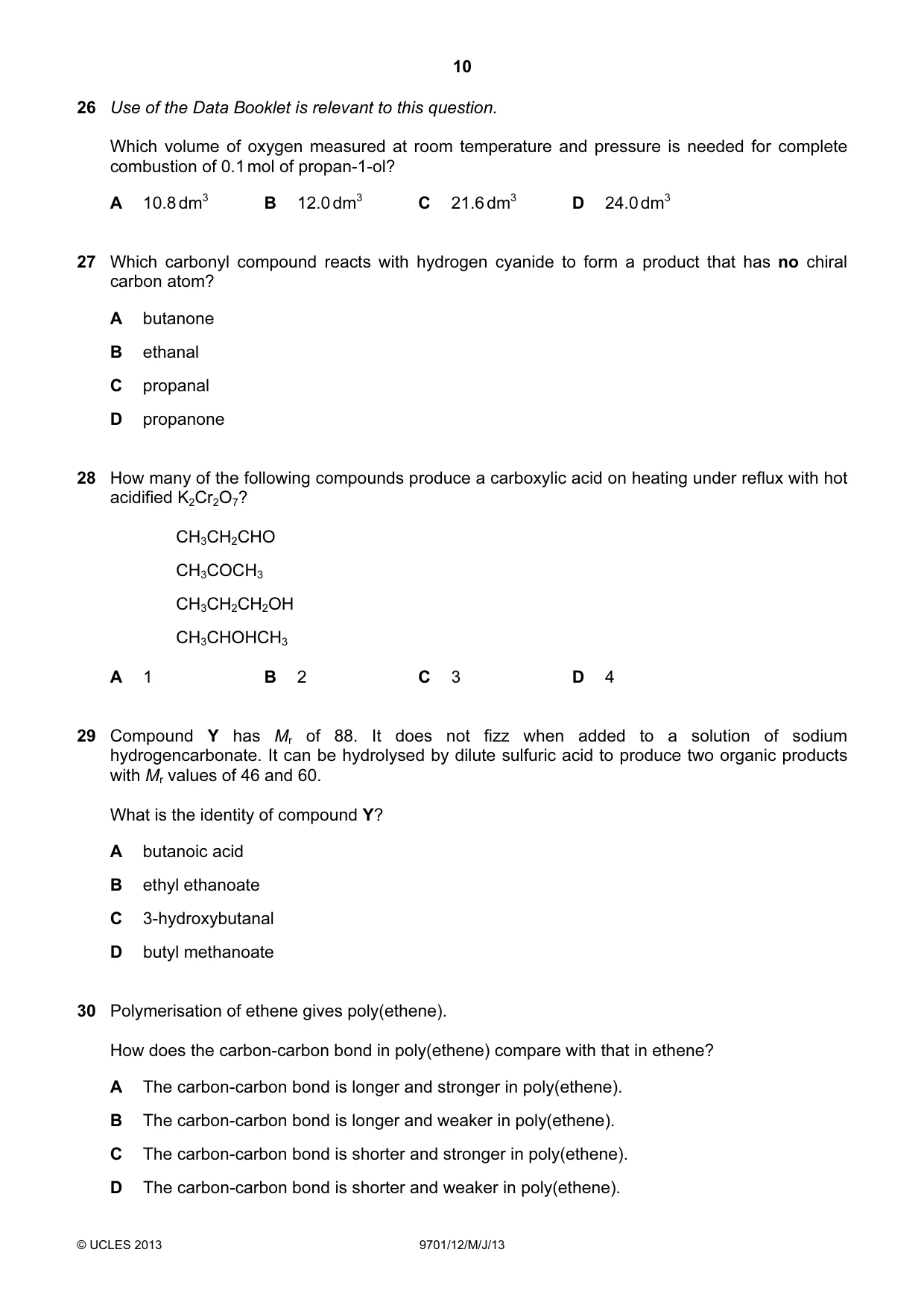
26 Use of the Data Booklet is relevant to this question. Which volume of oxygen measured at room temperature and pressure is needed for complete combustion of 0.1 mol of propan-1-ol? A 10.8 dm3 B 12.0 dm3 C 21.6 dm3 D 24.0 dm3
Mark scheme: A
More questions on Reacting masses and volumes (of solutions and gases)
Q27 · Which carbonyl compound reacts with hydrogen cyanide to form a product that has no chiral…
27 Which carbonyl compound reacts with hydrogen cyanide to form a product that has no chiral carbon atom? A butanone B ethanal C propanal D propanone
Mark scheme: D
Q28 · How many of the following compounds produce a carboxylic acid on heating under reflux…
28 How many of the following compounds produce a carboxylic acid on heating under reflux with hot acidified K2Cr2O7? CH3CH2CHO CH3COCH3 CH3CH2CH2OH CH3CHOHCH3 A 1 B 2 C 3 D 4
Mark scheme: B
Q29 · Compound Y has Mr of 88
29 Compound Y has Mr of 88. It does not fizz when added to a solution of sodium hydrogencarbonate. It can be hydrolysed by dilute sulfuric acid to produce two organic products with Mr values of 46 and 60. What is the identity of compound Y? A butanoic acid B ethyl ethanoate C 3-hydroxybutanal D butyl methanoate
Mark scheme: B
Q30 · Polymerisation of ethene gives poly(ethene)
30 Polymerisation of ethene gives poly(ethene). How does the carbon-carbon bond in poly(ethene) compare with that in ethene? A The carbon-carbon bond is longer and stronger in poly(ethene). B The carbon-carbon bond is longer and weaker in poly(ethene). C The carbon-carbon bond is shorter and stronger in poly(ethene). D The carbon-carbon bond is shorter and weaker in poly(ethene).
Mark scheme: B
Q31 · Use of the Data Booklet is relevant to this question
31 Use of the Data Booklet is relevant to this question. In which pairs do both species have the same number of unpaired p electrons? 1 Al 2– and O+ 2 N and Cl 2+ 3 C and Cl +
Mark scheme: A
More questions on Electrons, energy levels and atomic orbitals
Q32 · The diagram shows the reaction pathway for a reversible reaction
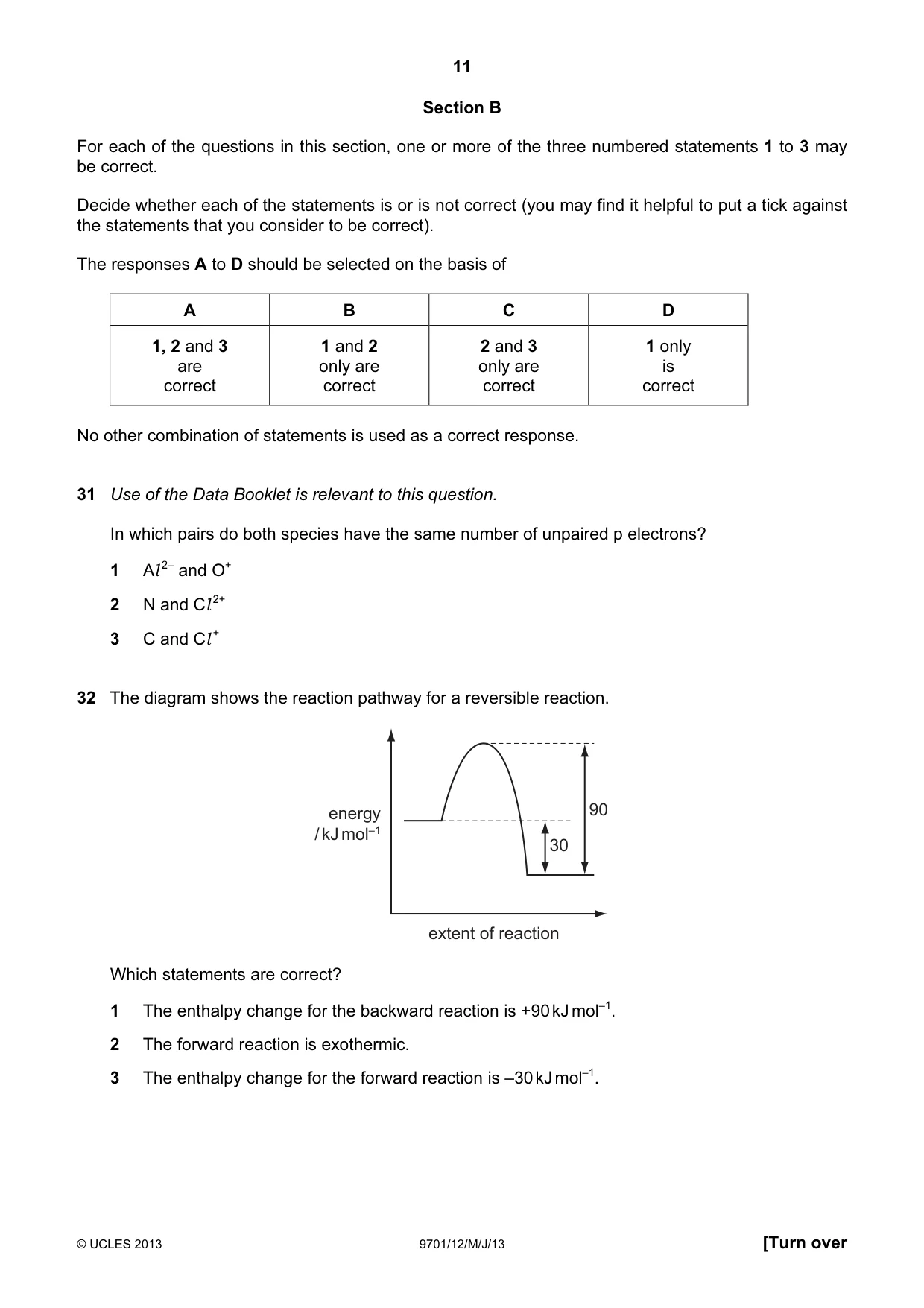
32 The diagram shows the reaction pathway for a reversible reaction. energy 90 / kJ mol–1 30 extent of reaction Which statements are correct? 1 The enthalpy change for the backward reaction is +90 kJ mol–1. 2 The forward reaction is exothermic. 3 The enthalpy change for the forward reaction is –30 kJ mol–1.
Mark scheme: C
Q33 · Which substances contain delocalised electrons?
33 Which substances contain delocalised electrons? 1 cyclohexene 2 graphite 3 sodium
Mark scheme: C
Q34 · Solids W, X, Y and Z are compounds of two different Group II metals
34 Solids W, X, Y and Z are compounds of two different Group II metals. Some of their applications are described below. Compound W is used as a refractory lining material in kilns. Compound X is used as a building material. It can also be heated in a kiln to form compound Y. When Y is hydrated, it forms compound Z which is used agriculturally to treat soils. Which statements about these compounds are correct? 1 Adding W to water has less effect on pH than adding Y. 2 Adding Z to soil increases the pH of the soil. 3 The metallic element in Y reacts with cold water more quickly than the metallic element in W.
Mark scheme: A
Q35 · Which properties increase in the sequence hydrogen chloride, hydrogen bromide and…
35 Which properties increase in the sequence hydrogen chloride, hydrogen bromide and hydrogen iodide? 1 thermal stability 2 bond length 3 ease of oxidation
Mark scheme: C
More questions on The chemical properties of the halogen elements and the hydrogen halides
Q36 · Sulfur dioxide is an atmospheric pollutant that causes acid rain
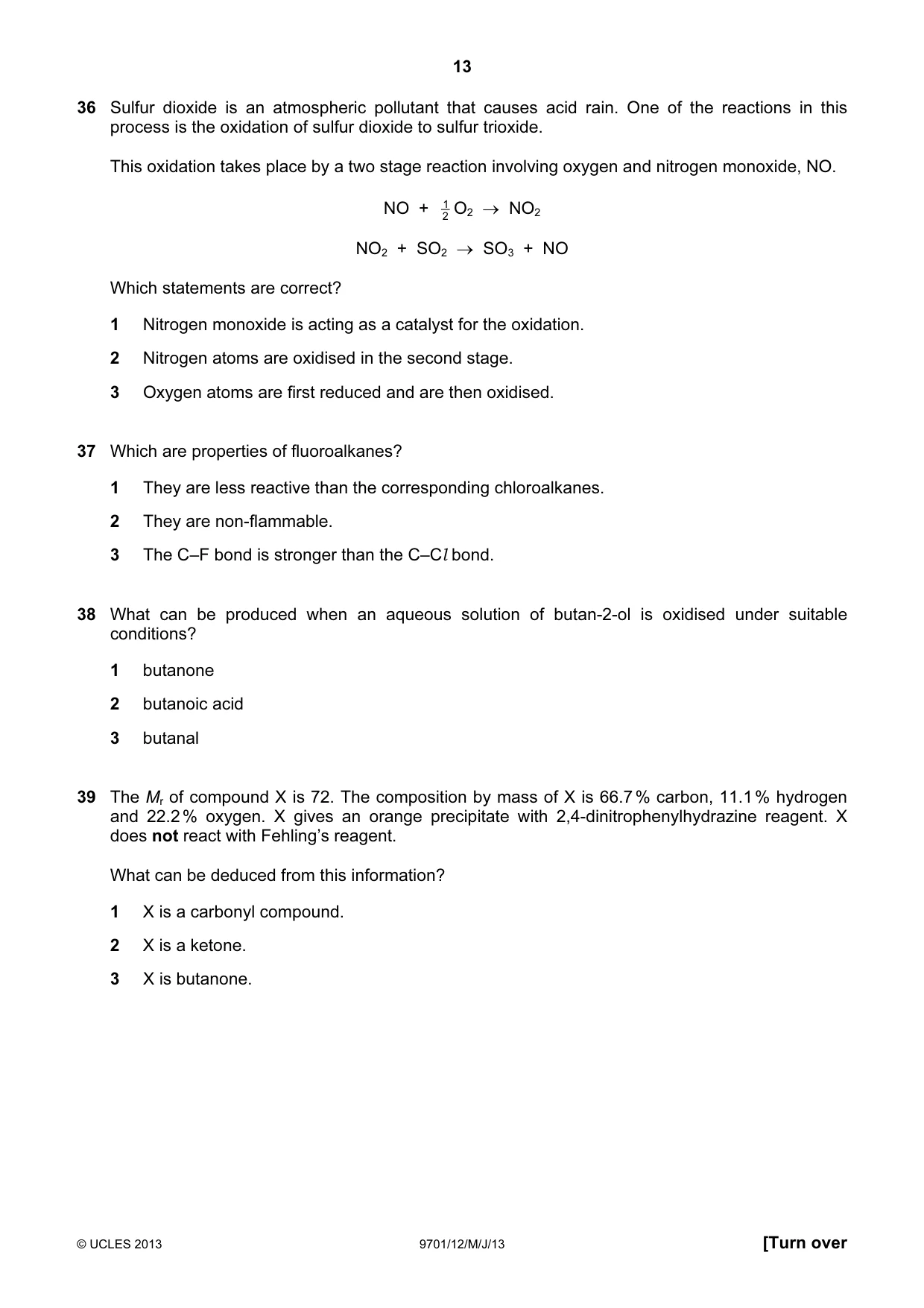
36 Sulfur dioxide is an atmospheric pollutant that causes acid rain. One of the reactions in this process is the oxidation of sulfur dioxide to sulfur trioxide. This oxidation takes place by a two stage reaction involving oxygen and nitrogen monoxide, NO. NO + 2 1 O2 → NO2 NO2 + SO2 → SO3 + NO Which statements are correct? 1 Nitrogen monoxide is acting as a catalyst for the oxidation. 2 Nitrogen atoms are oxidised in the second stage. 3 Oxygen atoms are first reduced and are then oxidised.
Mark scheme: D
Q37 · Which are properties of fluoroalkanes?
37 Which are properties of fluoroalkanes? 1 They are less reactive than the corresponding chloroalkanes. 2 They are non-flammable. 3 The C–F bond is stronger than the C–Cl bond.
Mark scheme: A
Q38 · What can be produced when an aqueous solution of butan-2-ol is oxidised under suitable…
38 What can be produced when an aqueous solution of butan-2-ol is oxidised under suitable conditions? 1 butanone 2 butanoic acid 3 butanal
Mark scheme: D
Q39 · The Mr of compound X is 72
39 The Mr of compound X is 72. The composition by mass of X is 66.7 % carbon, 11.1 % hydrogen and 22.2 % oxygen. X gives an orange precipitate with 2,4-dinitrophenylhydrazine reagent. X does not react with Fehling’s reagent. What can be deduced from this information? 1 X is a carbonyl compound. 2 X is a ketone. 3 X is butanone.
Mark scheme: A
Q40 · An organic compound, Z, will react with calcium metal to produce a salt with the…
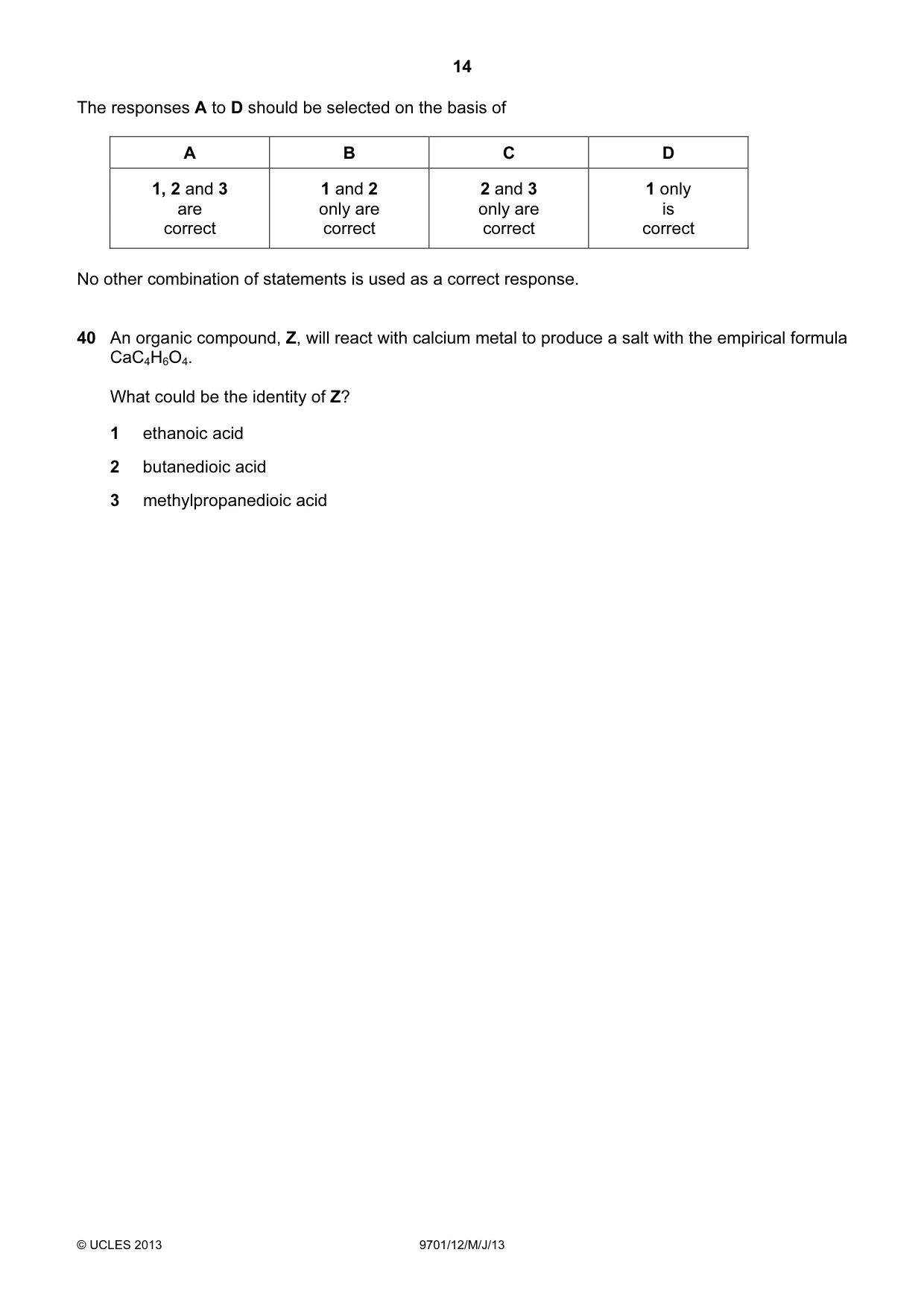
40 An organic compound, Z, will react with calcium metal to produce a salt with the empirical formula CaC4H6O4. What could be the identity of Z? 1 ethanoic acid 2 butanedioic acid 3 methylpropanedioic acid
Mark scheme: D
What was in this paper
The subtopics covered by these 40 questions, and how many questions each got. Open one in a new tab to see every Cambridge question on it.
3Enthalpy change, ΔH3Halogenoalkanes3Aldehydes and ketones2Effect of temperature on reaction rates and the concept of activation energy2Physical properties of the Group 17 elements2Reacting masses and volumes (of solutions and gases)2Shapes of molecules2Similarities and trends in the properties of the Group 2 metals, magnesium to barium, and their compounds2The chemical properties of the halogen elements and the hydrogen halides2Addition polymerisation1Alkanes1Alkenes1Carboxylic acids1Characteristic organic reactions1Chemical equilibria: reversible reactions, dynamic equilibrium1Electrons, energy levels and atomic orbitals1Esters1Hess’s law1Homogeneous and heterogeneous catalysts1Ionic bonding1Ionisation energy1Metallic bonding1Particles in the atom and atomic radius1Periodicity of physical properties of the elements in Period 31Redox processes: electron transfer and changes in oxidation number (oxidation state)1The gaseous state: ideal and real gases and pV = nRT1What you needed in this session
Cambridge’s own grade thresholds for 2013 May/June, Paper 1 · Variant 2. A higher threshold means an easier paper — the bar moves with how the cohort did.