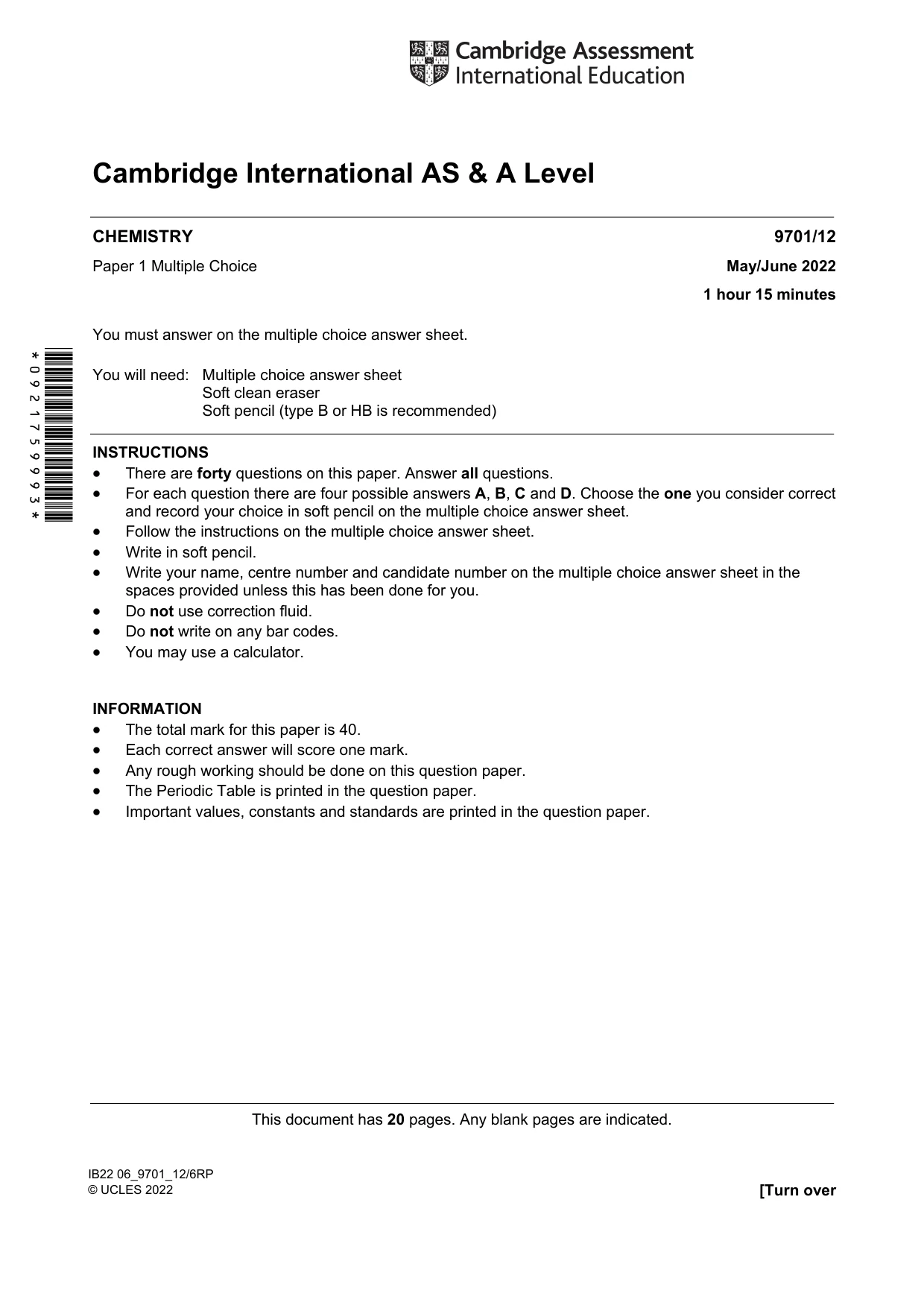
Cambridge A Level Chemistry 9701 — 2022 May/June Paper 1 · Variant 2
9701/12/M/J/22 · 40 questions · 40 marks · ≈45 min
The question paper and its mark scheme, free to read here and free to download. This is Cambridge’s own paper, exactly as it was sat.
Question paper20 pages



Mark scheme3 pages
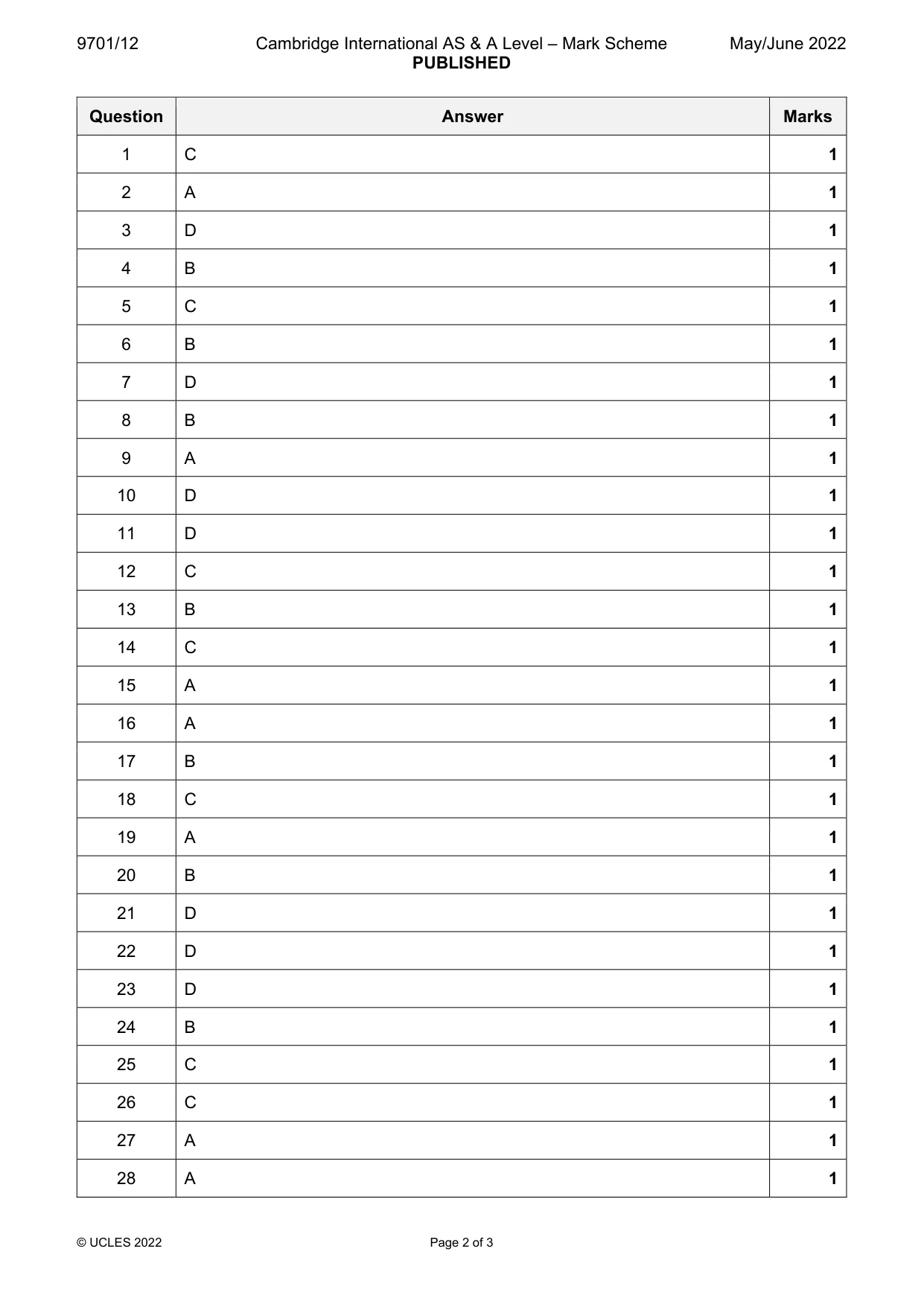
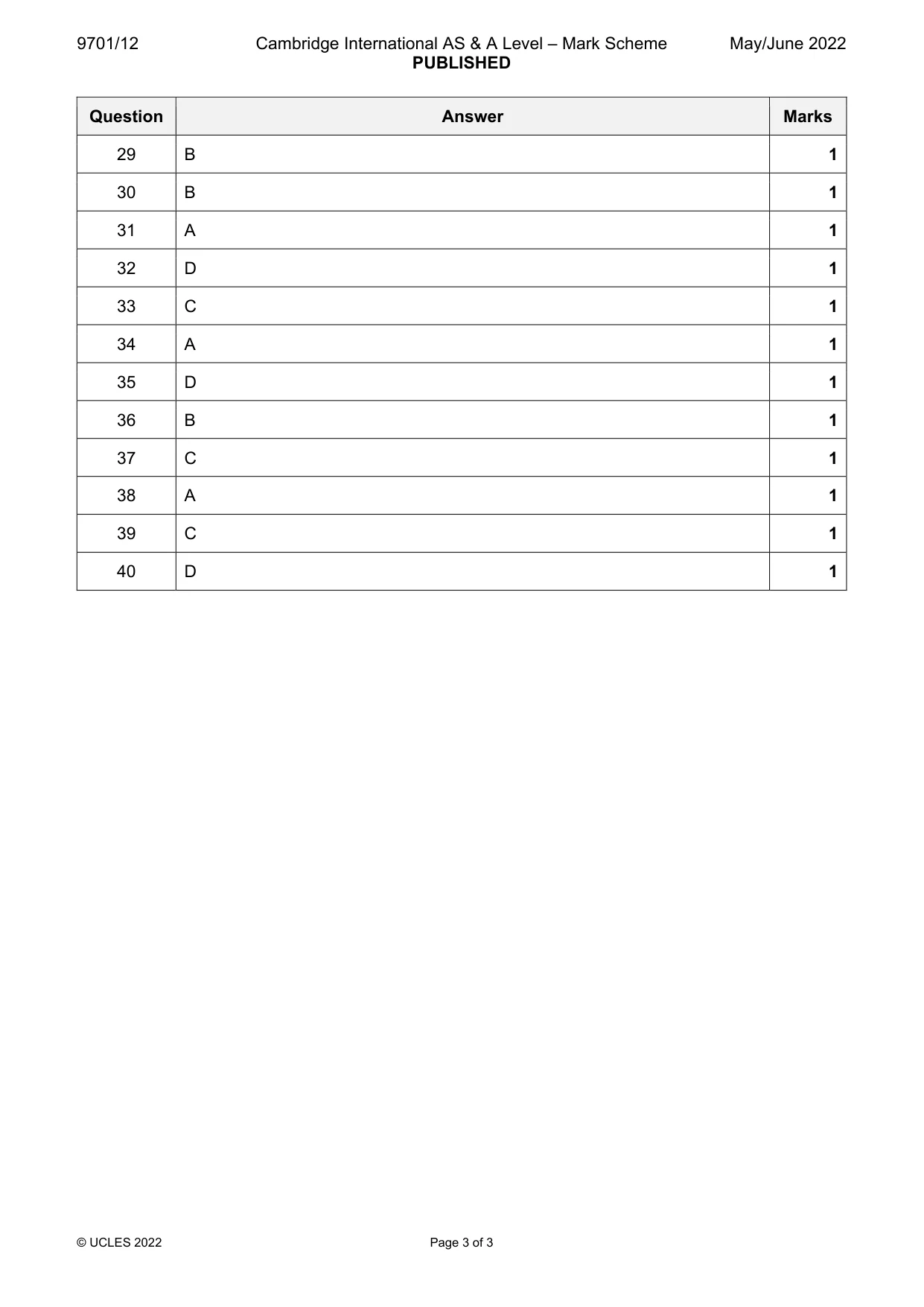
Answers below. Sit the paper first if you are practising.
Questions as text
Q1 · Equations involving four enthalpy changes are shown
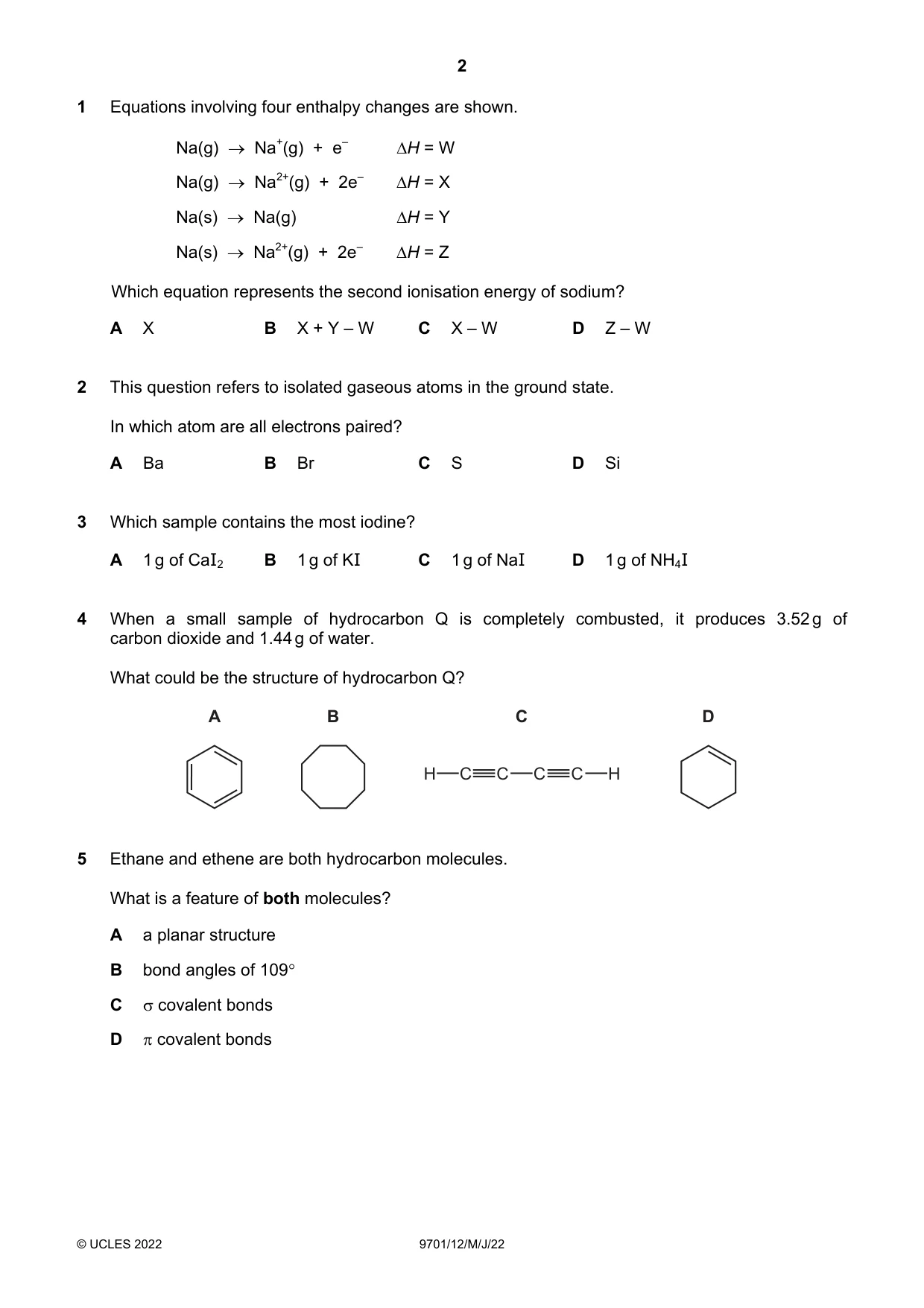
1 Equations involving four enthalpy changes are shown. Na(g) Na+(g) + e– H = W Na(g) Na2+(g) + 2e– H = X Na(s) Na(g) H = Y Na(s) Na2+(g) + 2e– H = Z Which equation represents the second ionisation energy of sodium? A X B X + Y – W C X – W D Z – W
Mark scheme: C
Q2 · This question refers to isolated gaseous atoms in the ground state
2 This question refers to isolated gaseous atoms in the ground state. In which atom are all electrons paired? A Ba B Br C S D Si
Mark scheme: A
More questions on Electrons, energy levels and atomic orbitals
Q3 · Which sample contains the most iodine?
3 Which sample contains the most iodine? A 1 g of CaI2 B 1 g of KI C 1 g of NaI D 1 g of NH4I
Mark scheme: D
Q4 · When a small sample of hydrocarbon Q is completely combusted, it produces 3.52 g of…
4 When a small sample of hydrocarbon Q is completely combusted, it produces 3.52 g of carbon dioxide and 1.44 g of water. What could be the structure of hydrocarbon Q? A B C D H C C C C H
Mark scheme: B
Q5 · Ethane and ethene are both hydrocarbon molecules
5 Ethane and ethene are both hydrocarbon molecules. What is a feature of both molecules? A a planar structure B bond angles of 109 C covalent bonds D covalent bonds
Mark scheme: C
More questions on Shapes of organic molecules; σ and π bonds
Q6 · Elements J and L are both in Group 15
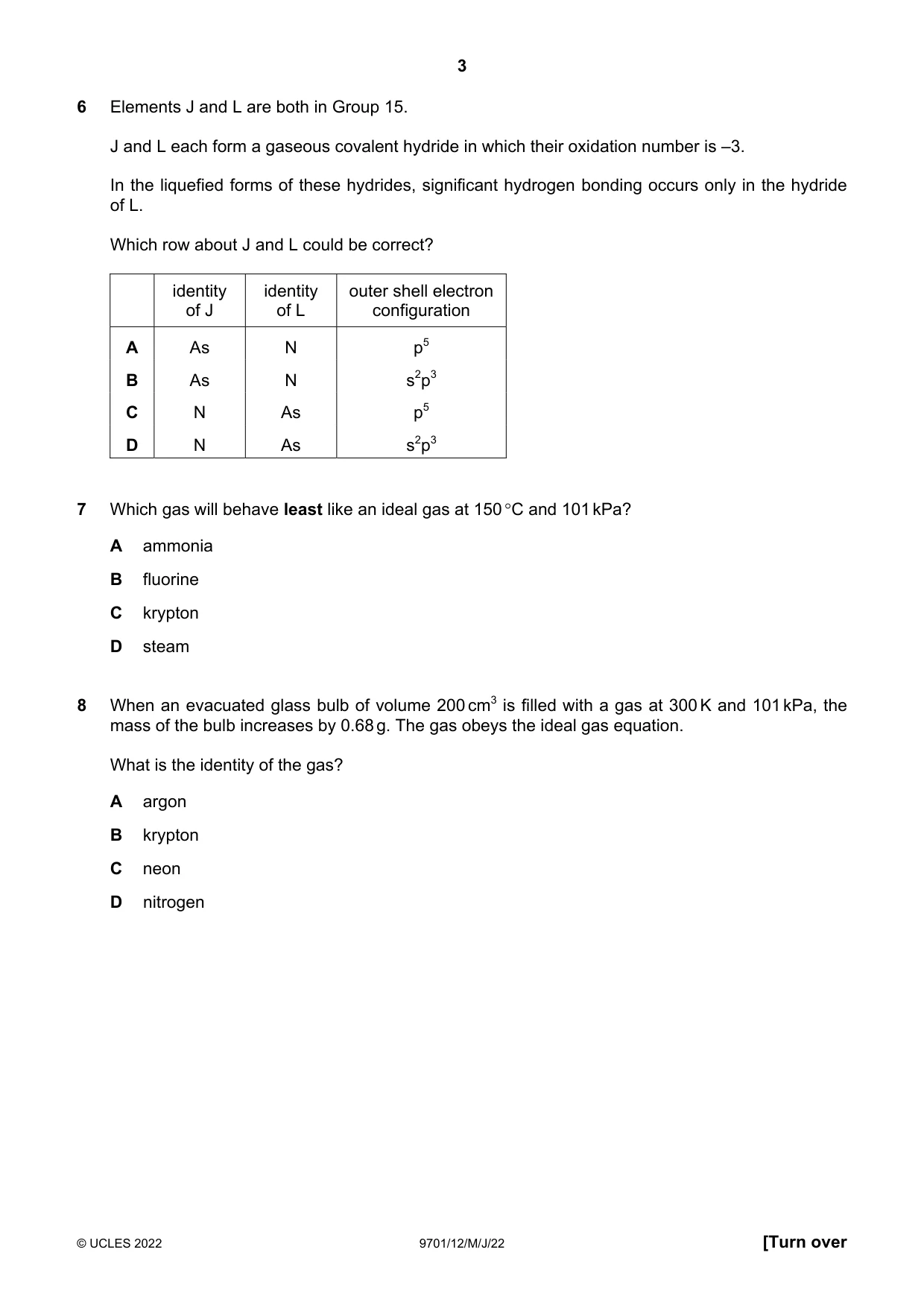
6 Elements J and L are both in Group 15. J and L each form a gaseous covalent hydride in which their oxidation number is –3. In the liquefied forms of these hydrides, significant hydrogen bonding occurs only in the hydride of L. Which row about J and L could be correct? identity identity outer shell electron of J of L configuration A As N p5 B As N s2p3 C N As p5 D N As s2p3
Mark scheme: B
More questions on Intermolecular forces, electronegativity and bond properties
Q7 · Which gas will behave least like an ideal gas at 150 C and 101 kPa?
7 Which gas will behave least like an ideal gas at 150 C and 101 kPa? A ammonia B fluorine C krypton D steam
Mark scheme: D
More questions on The gaseous state: ideal and real gases and pV = nRT
Q8 · When an evacuated glass bulb of volume 200 cm3 is filled with a gas at 300 K and 101 kPa…
8 When an evacuated glass bulb of volume 200 cm3 is filled with a gas at 300 K and 101 kPa, the mass of the bulb increases by 0.68 g. The gas obeys the ideal gas equation. What is the identity of the gas? A argon B krypton C neon D nitrogen
Mark scheme: B
More questions on The gaseous state: ideal and real gases and pV = nRT
Q9 · The standard enthalpy of formation of NO2(g) is + 33.2 kJ mol–1
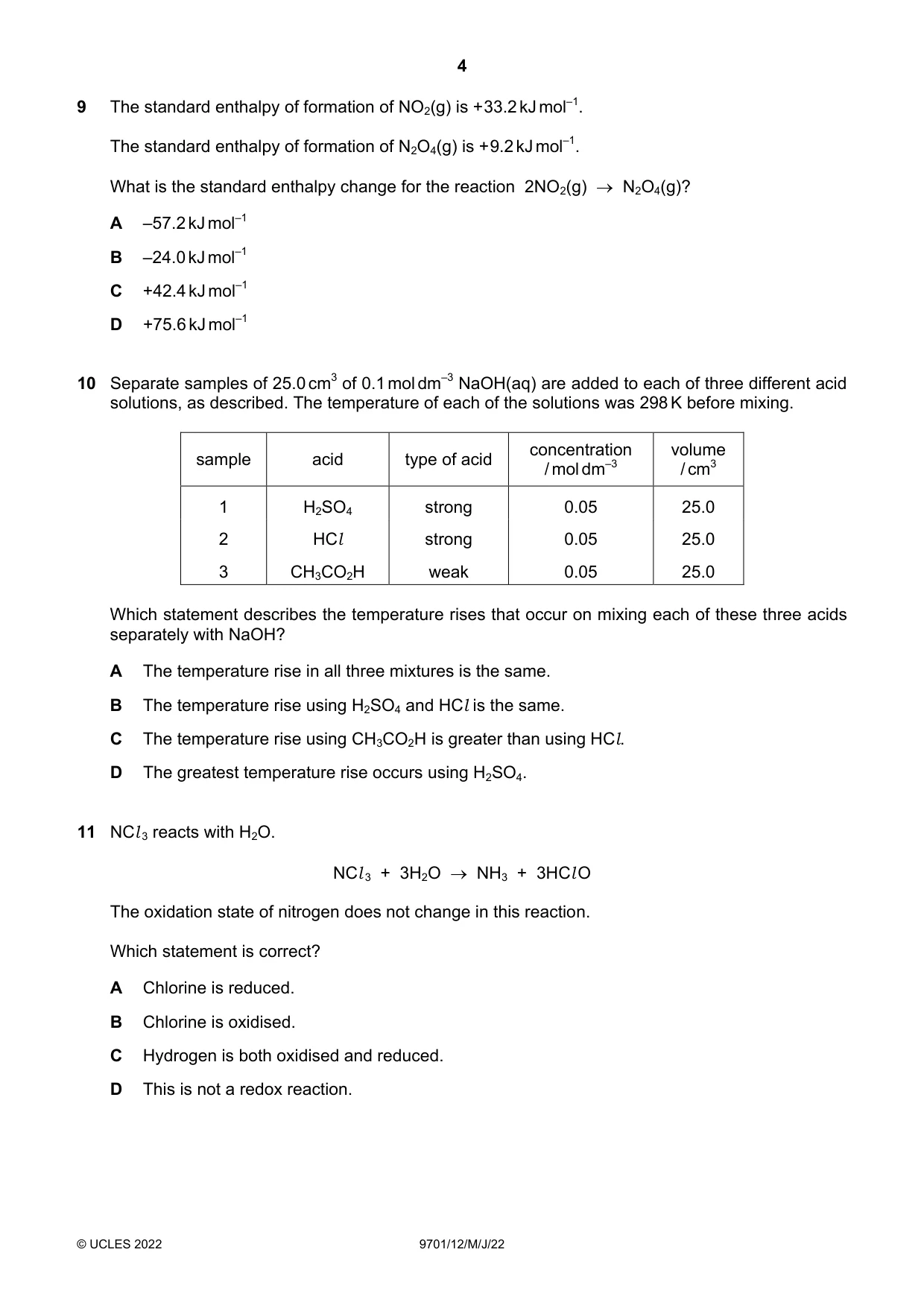
9 The standard enthalpy of formation of NO2(g) is + 33.2 kJ mol–1. The standard enthalpy of formation of N2O4(g) is + 9.2 kJ mol–1. What is the standard enthalpy change for the reaction 2NO2(g) N2O4(g)? A –57.2 kJ mol–1 B –24.0 kJ mol–1 C +42.4 kJ mol–1 D +75.6 kJ mol–1
Mark scheme: A
Q10 · Separate samples of 25.0 cm3 of 0.1 mol dm–3 NaOH(aq) are added to each of three…
10 Separate samples of 25.0 cm3 of 0.1 mol dm–3 NaOH(aq) are added to each of three different acid solutions, as described. The temperature of each of the solutions was 298 K before mixing. concentration volume sample acid type of acid / mol dm–3 / cm3 1 H2SO4 strong 0.05 25.0 2 HCl strong 0.05 25.0 3 CH3CO2H weak 0.05 25.0 Which statement describes the temperature rises that occur on mixing each of these three acids separately with NaOH? A The temperature rise in all three mixtures is the same. B The temperature rise using H2SO4 and HCl is the same. C The temperature rise using CH3CO2H is greater than using HCl. D The greatest temperature rise occurs using H2SO4.
Mark scheme: D
Q11 · NCl 3 reacts with H2O
11 NCl 3 reacts with H2O. NCl 3 + 3H2O NH3 + 3HCl O The oxidation state of nitrogen does not change in this reaction. Which statement is correct? A Chlorine is reduced. B Chlorine is oxidised. C Hydrogen is both oxidised and reduced. D This is not a redox reaction.
Mark scheme: D
Q12 · In which row do the oxidation numbers of vanadium increase?
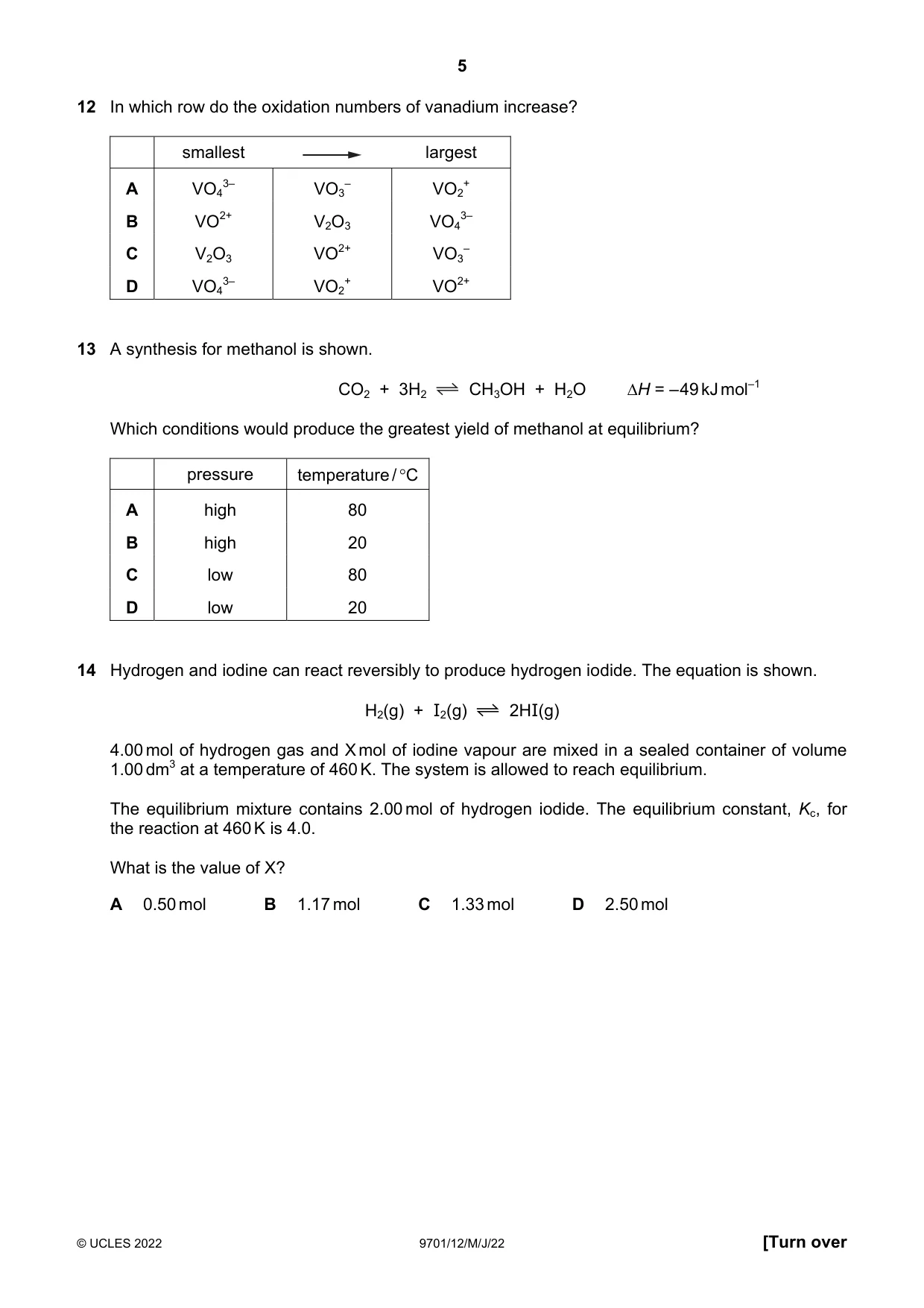
12 In which row do the oxidation numbers of vanadium increase? smallest largest A VO4 3– VO3 – VO2 + B VO2+ V2O3 VO4 3– C V2O3 VO2+ VO3 – D VO4 3– VO2 + VO2+
Mark scheme: C
Q13 · A synthesis for methanol is shown
13 A synthesis for methanol is shown. CO2 + 3H2 CH3OH + H2O H = – 49 kJ mol–1 Which conditions would produce the greatest yield of methanol at equilibrium? pressure temperature / C A high 80 B high 20 C low 80 D low 20
Mark scheme: B
More questions on Chemical equilibria: reversible reactions, dynamic equilibrium
Q14 · Hydrogen and iodine can react reversibly to produce hydrogen iodide
14 Hydrogen and iodine can react reversibly to produce hydrogen iodide. The equation is shown. H2(g) + I2(g) 2HI(g) 4.00 mol of hydrogen gas and X mol of iodine vapour are mixed in a sealed container of volume 1.00 dm3 at a temperature of 460 K. The system is allowed to reach equilibrium. The equilibrium mixture contains 2.00 mol of hydrogen iodide. The equilibrium constant, Kc, for the reaction at 460 K is 4.0. What is the value of X? A 0.50 mol B 1.17 mol C 1.33 mol D 2.50 mol
Mark scheme: C
More questions on Chemical equilibria: reversible reactions, dynamic equilibrium
Q15 · A large amount of N2O(g) decomposes into nitrogen gas and oxygen gas in the presence of a…
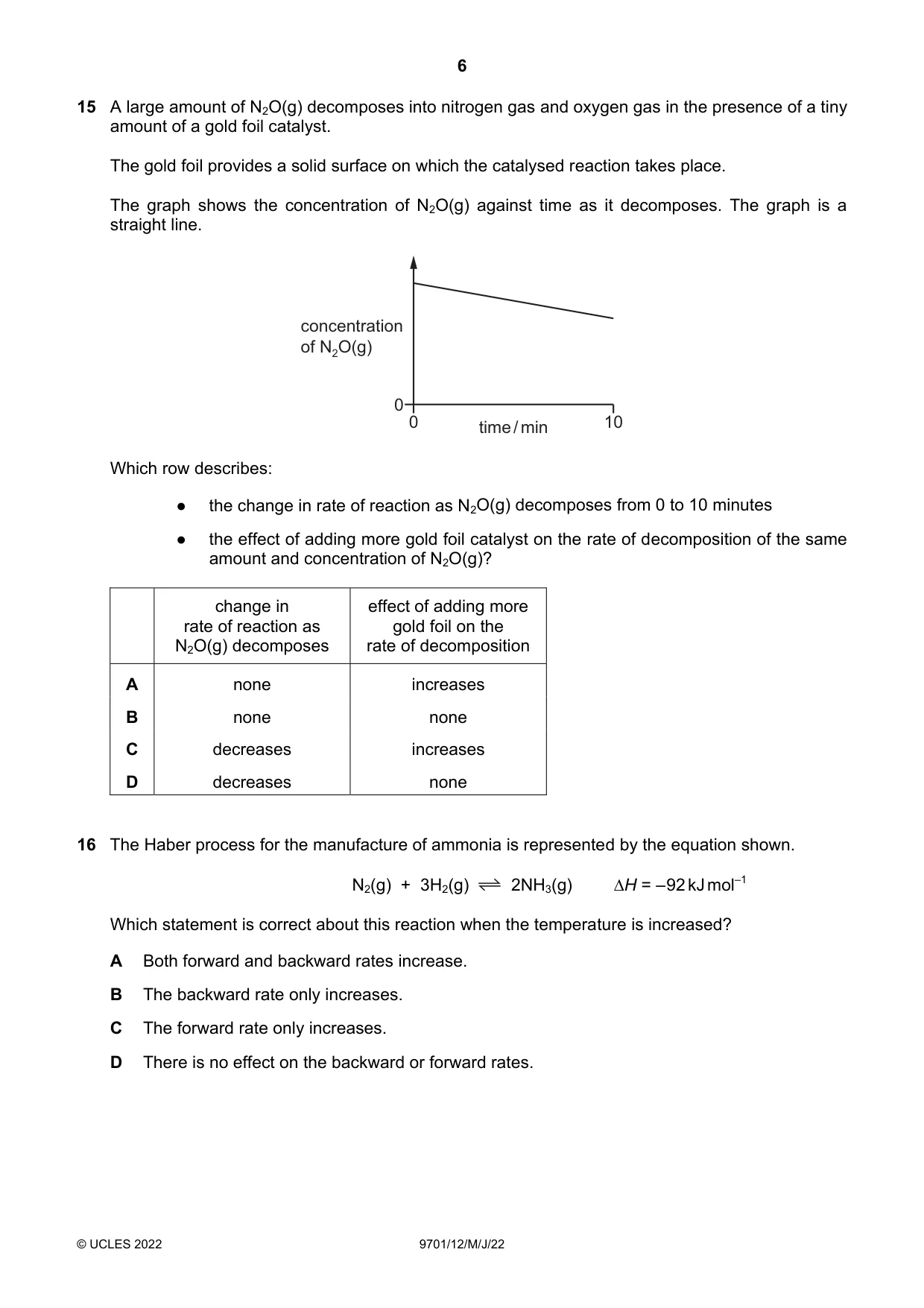
15 A large amount of N2O(g) decomposes into nitrogen gas and oxygen gas in the presence of a tiny amount of a gold foil catalyst. The gold foil provides a solid surface on which the catalysed reaction takes place. The graph shows the concentration of N2O(g) against time as it decomposes. The graph is a straight line. concentration of N2O(g) 0 0 time / min 10 Which row describes: ● the change in rate of reaction as N2O(g) decomposes from 0 to 10 minutes ● the effect of adding more gold foil catalyst on the rate of decomposition of the same amount and concentration of N2O(g)? change in effect of adding more rate of reaction as gold foil on the N2O(g) decomposes rate of decomposition A none increases B none none C decreases increases D decreases none
Mark scheme: A
Q16 · The Haber process for the manufacture of ammonia is represented by the equation shown
16 The Haber process for the manufacture of ammonia is represented by the equation shown. N2(g) + 3H2(g) 2NH3(g) H = – 92 kJ mol–1 Which statement is correct about this reaction when the temperature is increased? A Both forward and backward rates increase. B The backward rate only increases. C The forward rate only increases. D There is no effect on the backward or forward rates.
Mark scheme: A
More questions on Effect of temperature on reaction rates and the concept of activation energy
Q17 · NH3(aq) is added to separate samples of NaCl (aq), MgCl 2(aq), BaCl 2(aq) and SiCl 4(l)
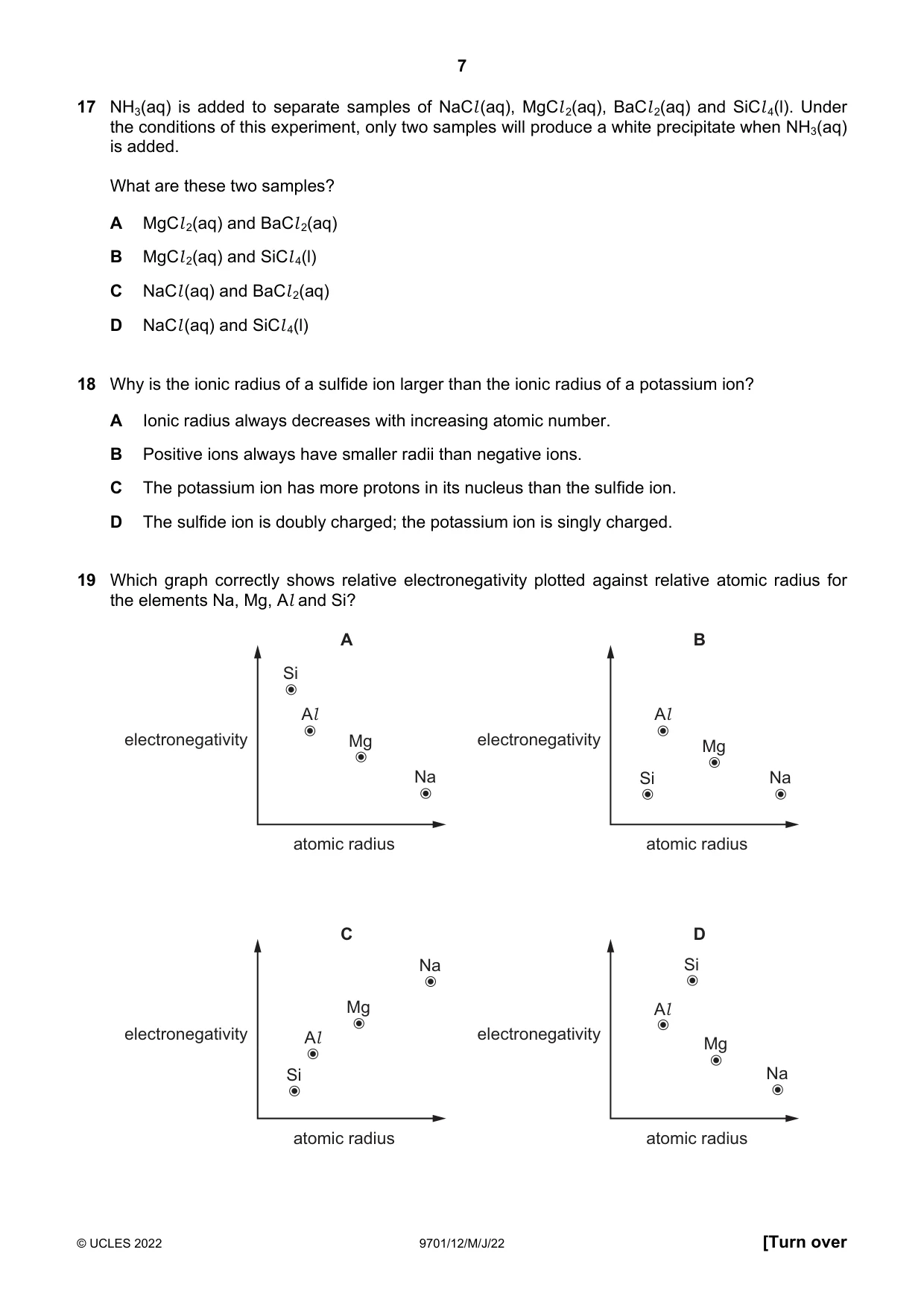
17 NH3(aq) is added to separate samples of NaCl (aq), MgCl 2(aq), BaCl 2(aq) and SiCl 4(l). Under the conditions of this experiment, only two samples will produce a white precipitate when NH3(aq) is added. What are these two samples? A MgCl 2(aq) and BaCl 2(aq) B MgCl 2(aq) and SiCl 4(l) C NaCl (aq) and BaCl 2(aq) D NaCl (aq) and SiCl 4(l)
Mark scheme: B
Q18 · Why is the ionic radius of a sulfide ion larger than the ionic radius of a potassium ion?
18 Why is the ionic radius of a sulfide ion larger than the ionic radius of a potassium ion? A Ionic radius always decreases with increasing atomic number. B Positive ions always have smaller radii than negative ions. C The potassium ion has more protons in its nucleus than the sulfide ion. D The sulfide ion is doubly charged; the potassium ion is singly charged.
Mark scheme: C
Q19 · Which graph correctly shows relative electronegativity plotted against relative atomic…
19 Which graph correctly shows relative electronegativity plotted against relative atomic radius for the elements Na, Mg, Al and Si? A B Si Al Al electronegativity Mg electronegativity Mg Na Si Na atomic radius atomic radius C D Na Si Mg Al electronegativity Al electronegativity Mg Si Na atomic radius atomic radius
Mark scheme: A
More questions on Periodicity of physical properties of the elements in Period 3
Q20 · The table gives information about calcium carbonate and calcium hydroxide
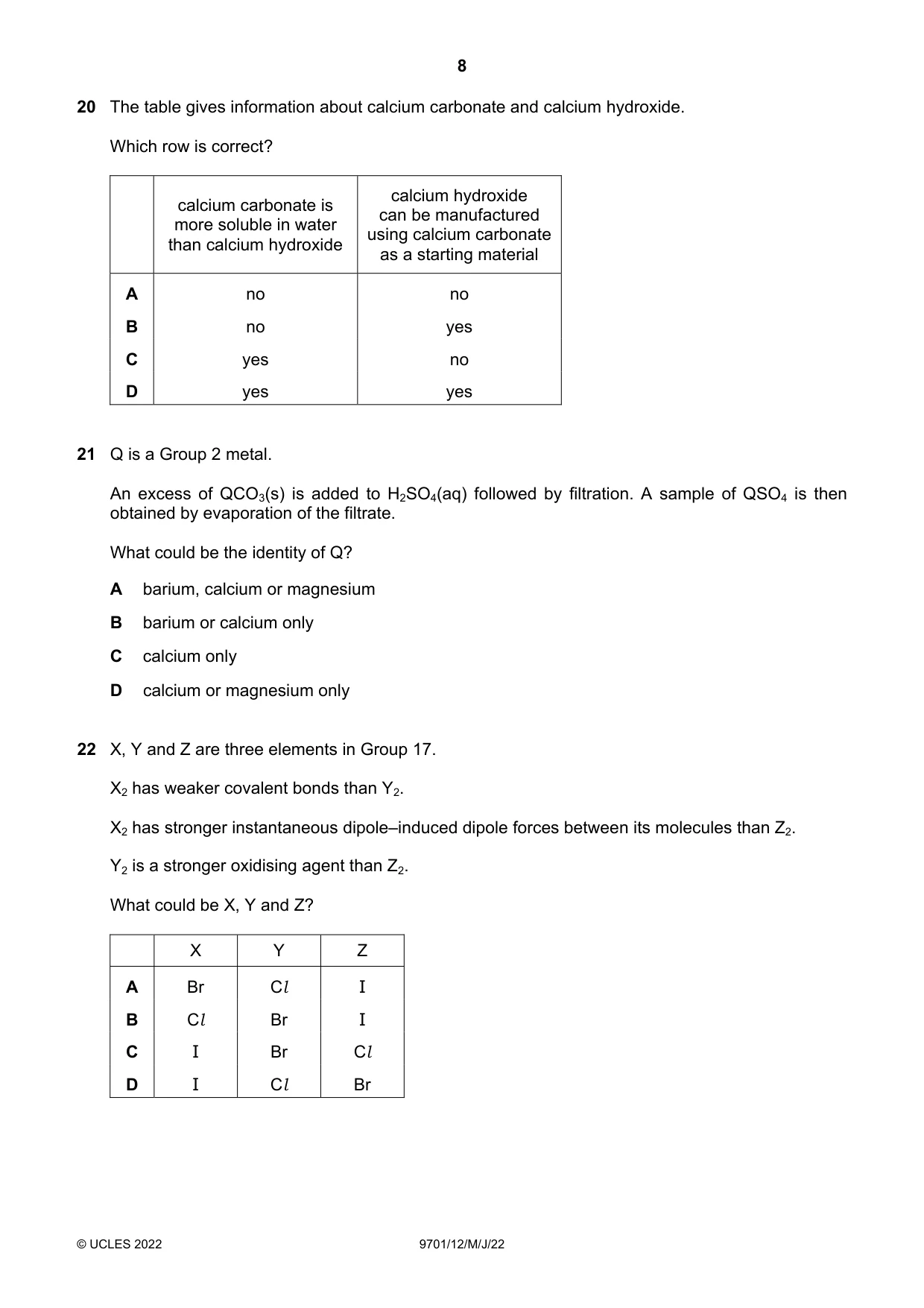
20 The table gives information about calcium carbonate and calcium hydroxide. Which row is correct? calcium hydroxide calcium carbonate is can be manufactured more soluble in water using calcium carbonate than calcium hydroxide as a starting material A no no B no yes C yes no D yes yes
Mark scheme: B
Q21 · Q is a Group 2 metal
21 Q is a Group 2 metal. An excess of QCO3(s) is added to H2SO4(aq) followed by filtration. A sample of QSO4 is then obtained by evaporation of the filtrate. What could be the identity of Q? A barium, calcium or magnesium B barium or calcium only C calcium only D calcium or magnesium only
Mark scheme: D
Q22 · X, Y and Z are three elements in Group 17
22 X, Y and Z are three elements in Group 17. X2 has weaker covalent bonds than Y2. X2 has stronger instantaneous dipole–induced dipole forces between its molecules than Z2. Y2 is a stronger oxidising agent than Z2. What could be X, Y and Z? X Y Z A Br Cl I B Cl Br I C I Br Cl D I Cl Br
Mark scheme: D
More questions on Physical properties of the Group 17 elements
Q23 · Chlorine reacts with aqueous sodium hydroxide forming two chlorine-containing products
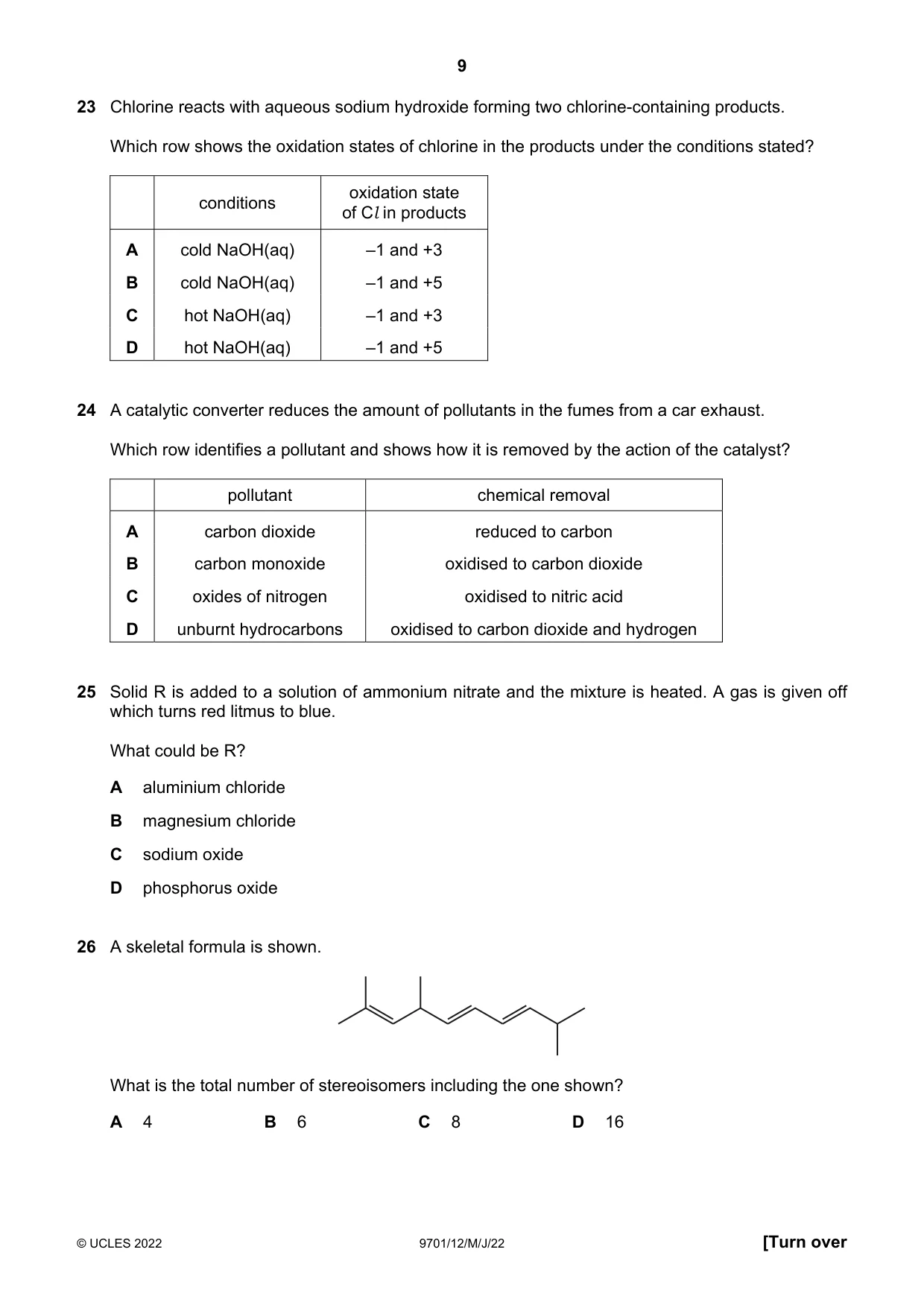
23 Chlorine reacts with aqueous sodium hydroxide forming two chlorine-containing products. Which row shows the oxidation states of chlorine in the products under the conditions stated? oxidation state conditions of Cl in products A cold NaOH(aq) –1 and +3 B cold NaOH(aq) –1 and +5 C hot NaOH(aq) –1 and +3 D hot NaOH(aq) –1 and +5
Mark scheme: D
Q24 · A catalytic converter reduces the amount of pollutants in the fumes from a car exhaust
24 A catalytic converter reduces the amount of pollutants in the fumes from a car exhaust. Which row identifies a pollutant and shows how it is removed by the action of the catalyst? pollutant chemical removal A carbon dioxide reduced to carbon B carbon monoxide oxidised to carbon dioxide C oxides of nitrogen oxidised to nitric acid D unburnt hydrocarbons oxidised to carbon dioxide and hydrogen
Mark scheme: B
Q25 · Solid R is added to a solution of ammonium nitrate and the mixture is heated
25 Solid R is added to a solution of ammonium nitrate and the mixture is heated. A gas is given off which turns red litmus to blue. What could be R? A aluminium chloride B magnesium chloride C sodium oxide D phosphorus oxide
Mark scheme: C
Q26 · A skeletal formula is shown
26 A skeletal formula is shown. What is the total number of stereoisomers including the one shown? A 4 B 6 C 8 D 16
Mark scheme: C
More questions on Isomerism: structural isomerism and stereoisomerism
Q27 · The molecular formula CH3 can represent an anion, a cation or a free radical
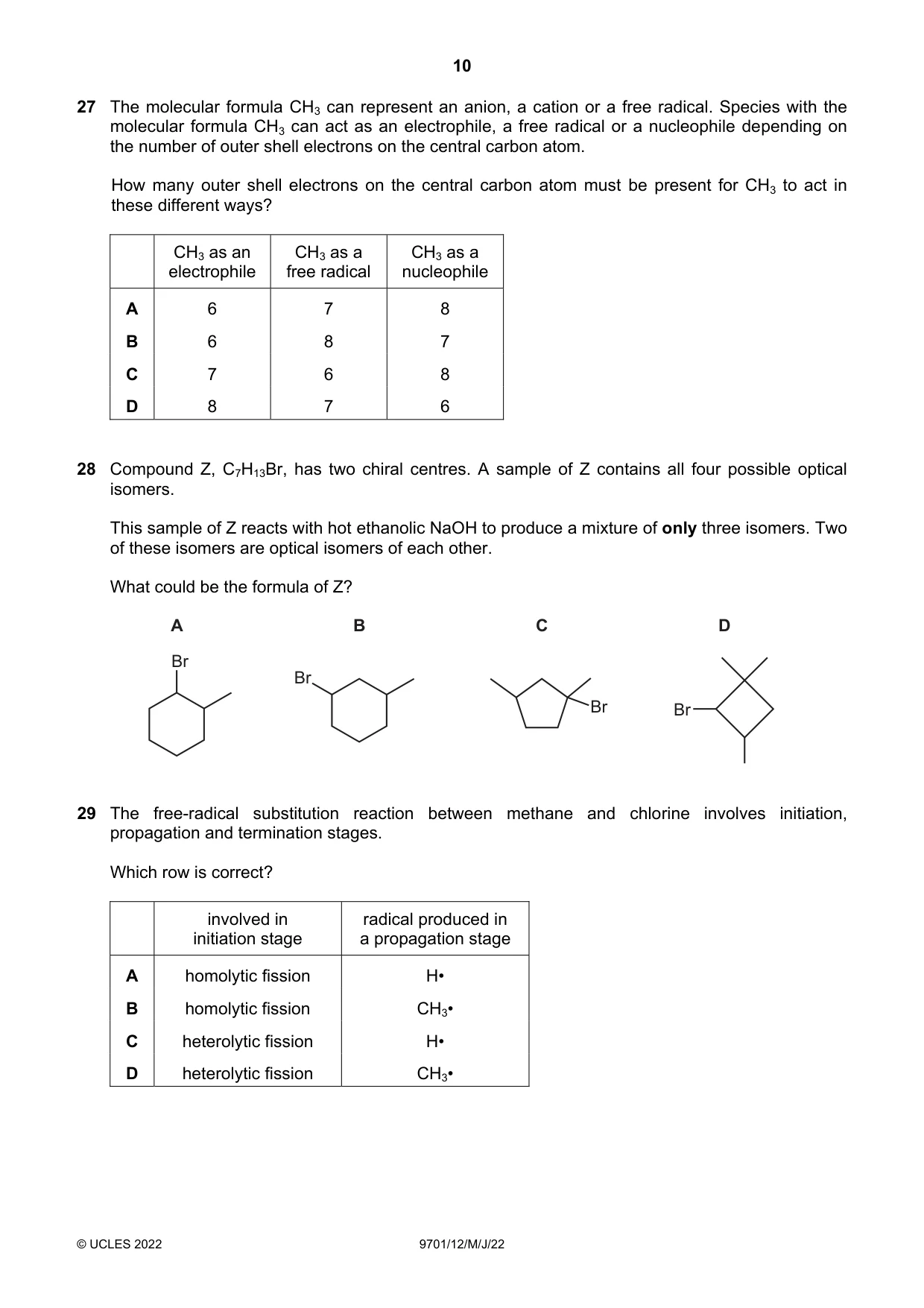
27 The molecular formula CH3 can represent an anion, a cation or a free radical. Species with the molecular formula CH3 can act as an electrophile, a free radical or a nucleophile depending on the number of outer shell electrons on the central carbon atom. How many outer shell electrons on the central carbon atom must be present for CH3 to act in these different ways? CH3 as an CH3 as a CH3 as a electrophile free radical nucleophile A 6 7 8 B 6 8 7 C 7 6 8 D 8 7 6
Mark scheme: A
Q28 · Compound Z, C7H13Br, has two chiral centres
28 Compound Z, C7H13Br, has two chiral centres. A sample of Z contains all four possible optical isomers. This sample of Z reacts with hot ethanolic NaOH to produce a mixture of only three isomers. Two of these isomers are optical isomers of each other. What could be the formula of Z? A B C D Br Br Br Br
Mark scheme: A
More questions on Isomerism: structural isomerism and stereoisomerism
Q29 · The free-radical substitution reaction between methane and chlorine involves initiation…
29 The free-radical substitution reaction between methane and chlorine involves initiation, propagation and termination stages. Which row is correct? involved in radical produced in initiation stage a propagation stage A homolytic fission H• B homolytic fission CH3• C heterolytic fission H• D heterolytic fission CH3•
Mark scheme: B
Q30 · The alkene shown reacts with an excess of HBr via an electrophilic addition reaction
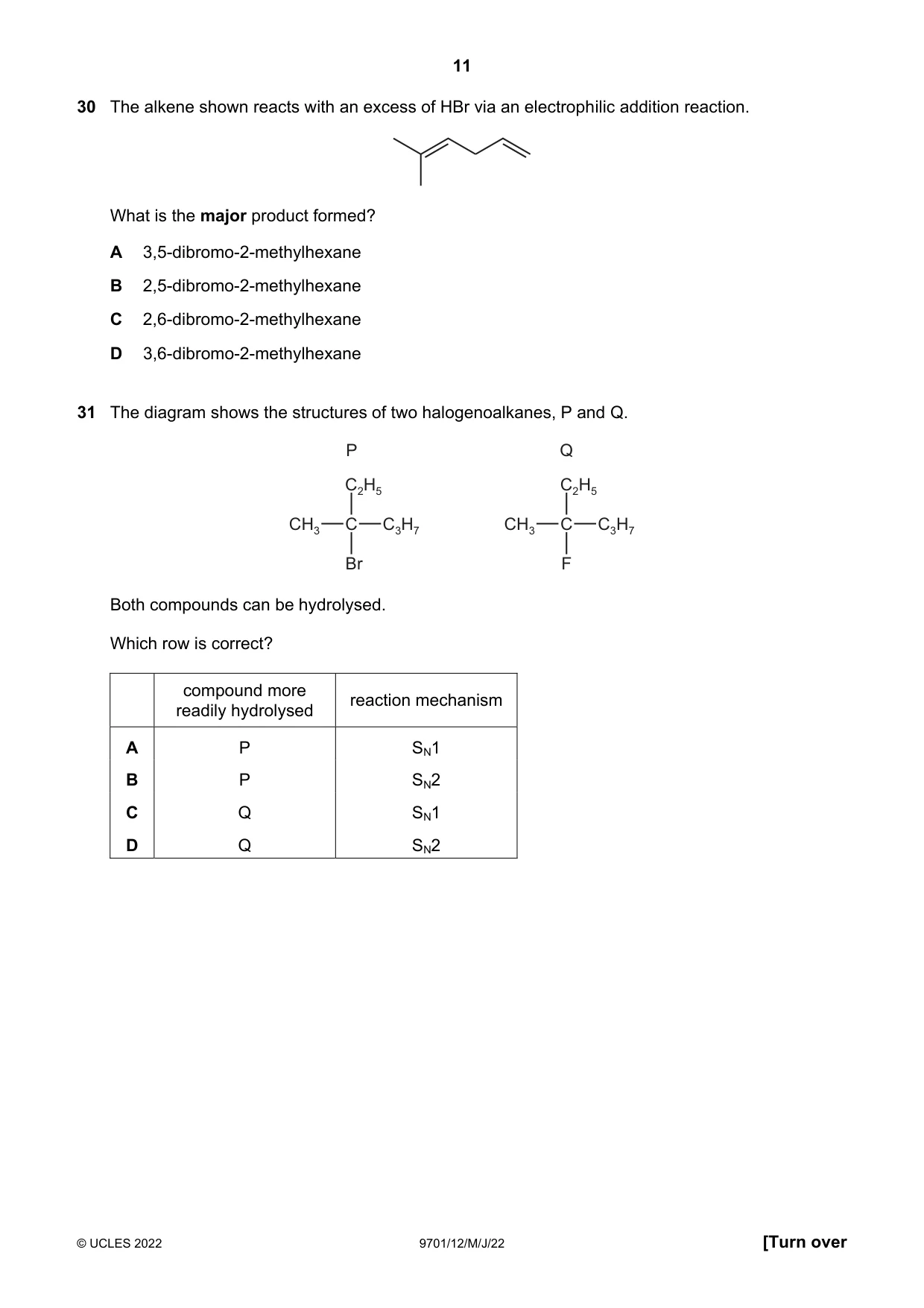
30 The alkene shown reacts with an excess of HBr via an electrophilic addition reaction. What is the major product formed? A 3,5-dibromo-2-methylhexane B 2,5-dibromo-2-methylhexane C 2,6-dibromo-2-methylhexane D 3,6-dibromo-2-methylhexane
Mark scheme: B
Q31 · The diagram shows the structures of two halogenoalkanes, P and Q
31 The diagram shows the structures of two halogenoalkanes, P and Q. P Q C2H5 C2H5 CH3 C C3H7 CH3 C C3H7 Br F Both compounds can be hydrolysed. Which row is correct? compound more reaction mechanism readily hydrolysed A P SN1 B P SN2 C Q SN1 D Q SN2
Mark scheme: A
Q32 · The structure of coniine is shown
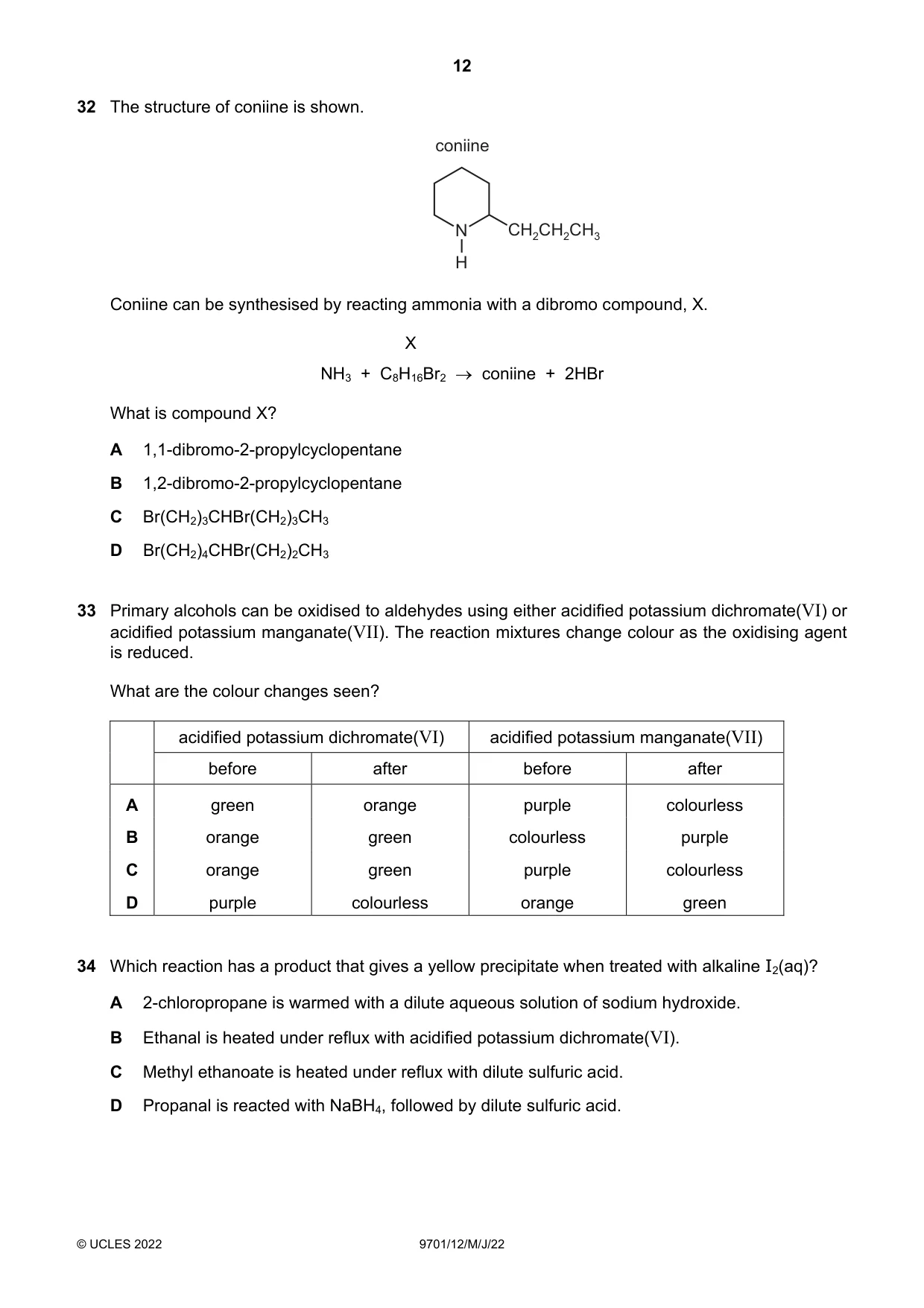
32 The structure of coniine is shown. coniine N CH2CH2CH3 H Coniine can be synthesised by reacting ammonia with a dibromo compound, X. X NH3 + C8H16Br2 coniine + 2HBr What is compound X? A 1,1-dibromo-2-propylcyclopentane B 1,2-dibromo-2-propylcyclopentane C Br(CH2)3CHBr(CH2)3CH3 D Br(CH2)4CHBr(CH2)2CH3
Mark scheme: D
Q33 · Primary alcohols can be oxidised to aldehydes using either acidified potassium…
33 Primary alcohols can be oxidised to aldehydes using either acidified potassium dichromate(VI) or acidified potassium manganate(VII). The reaction mixtures change colour as the oxidising agent is reduced. What are the colour changes seen? acidified potassium dichromate(VI) acidified potassium manganate(VII) before after before after A green orange purple colourless B orange green colourless purple C orange green purple colourless D purple colourless orange green
Mark scheme: C
Q34 · Which reaction has a product that gives a yellow precipitate when treated with alkaline…
34 Which reaction has a product that gives a yellow precipitate when treated with alkaline I2(aq)? A 2-chloropropane is warmed with a dilute aqueous solution of sodium hydroxide. B Ethanal is heated under reflux with acidified potassium dichromate(VI). C Methyl ethanoate is heated under reflux with dilute sulfuric acid. D Propanal is reacted with NaBH4, followed by dilute sulfuric acid.
Mark scheme: A
Q35 · The skeletal formula of M is shown
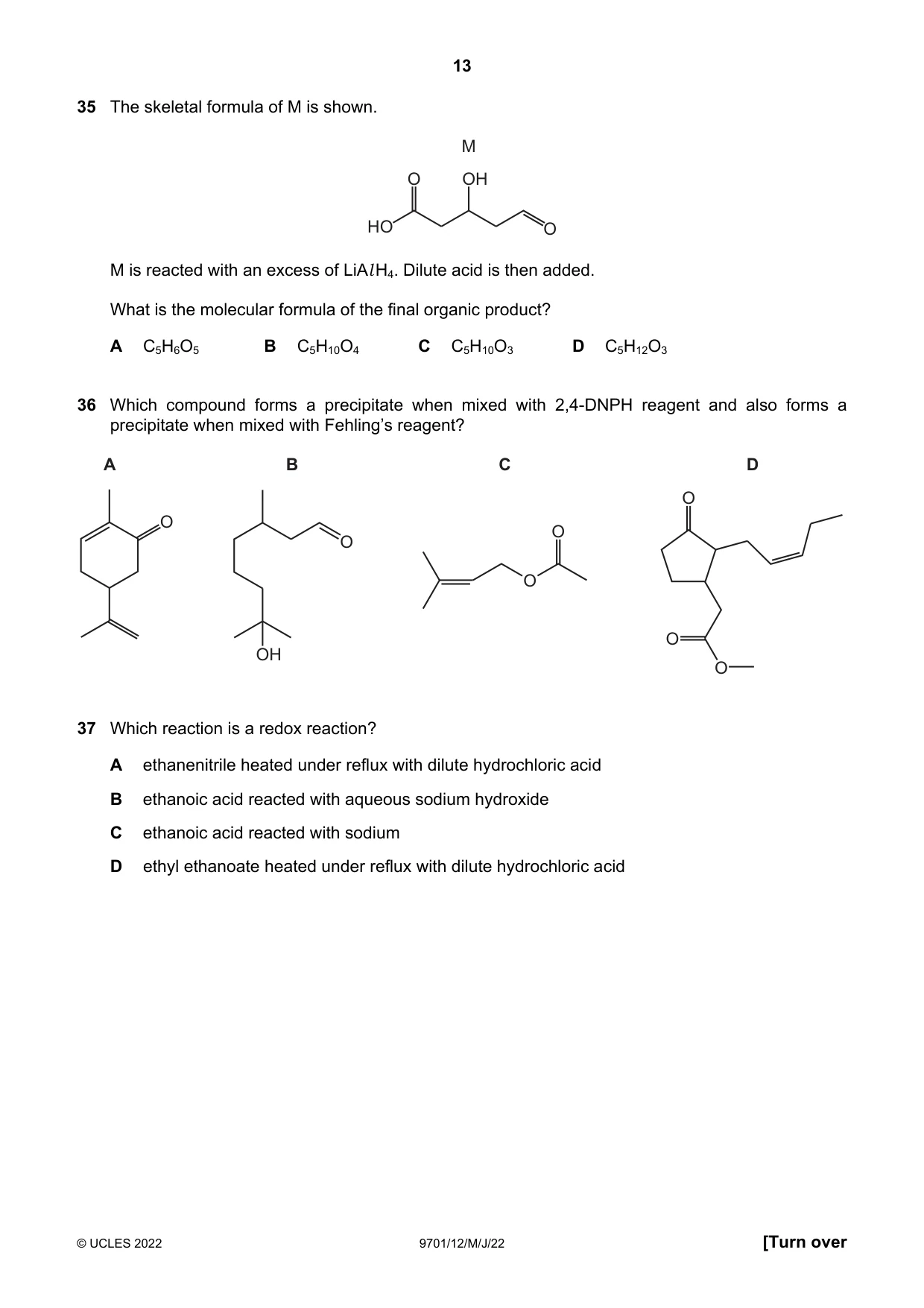
35 The skeletal formula of M is shown. M O OH HO O M is reacted with an excess of LiAl H4. Dilute acid is then added. What is the molecular formula of the final organic product? A C5H6O5 B C5H10O4 C C5H10O3 D C5H12O3
Mark scheme: D
Q36 · Which compound forms a precipitate when mixed with 2,4-DNPH reagent and also forms a…
36 Which compound forms a precipitate when mixed with 2,4-DNPH reagent and also forms a precipitate when mixed with Fehling’s reagent? A B C D O O O O O O OH O
Mark scheme: B
Q37 · Which reaction is a redox reaction?
37 Which reaction is a redox reaction? A ethanenitrile heated under reflux with dilute hydrochloric acid B ethanoic acid reacted with aqueous sodium hydroxide C ethanoic acid reacted with sodium D ethyl ethanoate heated under reflux with dilute hydrochloric acid
Mark scheme: C
Q38 · Ethyl butanoate is a flavouring, with a fruity flavour
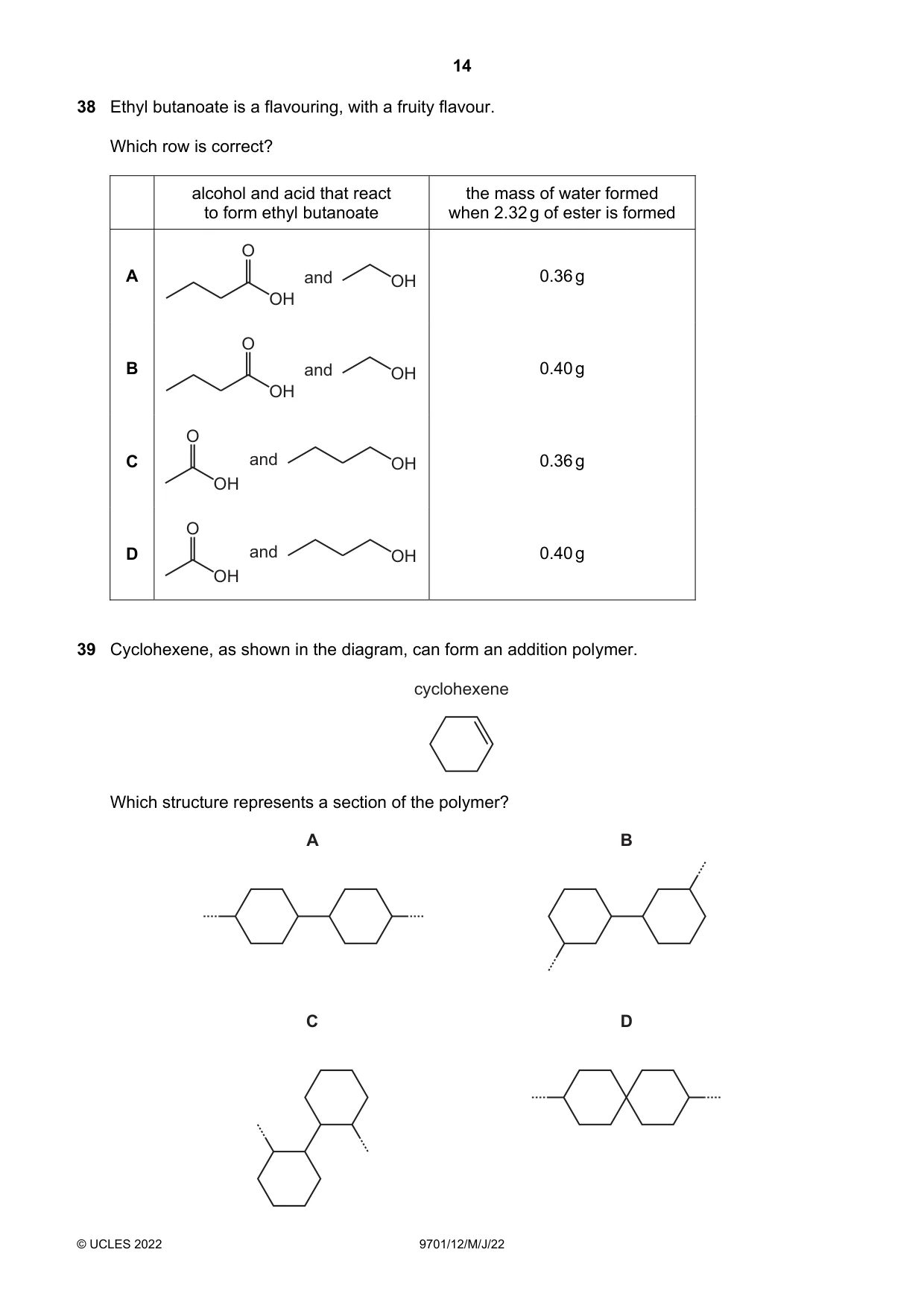
38 Ethyl butanoate is a flavouring, with a fruity flavour. Which row is correct? alcohol and acid that react the mass of water formed to form ethyl butanoate when 2.32 g of ester is formed O A and OH 0.36 g OH O B and OH 0.40 g OH O C and OH 0.36 g OH O D and OH 0.40 g OH
Mark scheme: A
Q39 · Cyclohexene, as shown in the diagram, can form an addition polymer
39 Cyclohexene, as shown in the diagram, can form an addition polymer. cyclohexene Which structure represents a section of the polymer? A B C D
Mark scheme: C
Q40 · Three organic compounds are listed
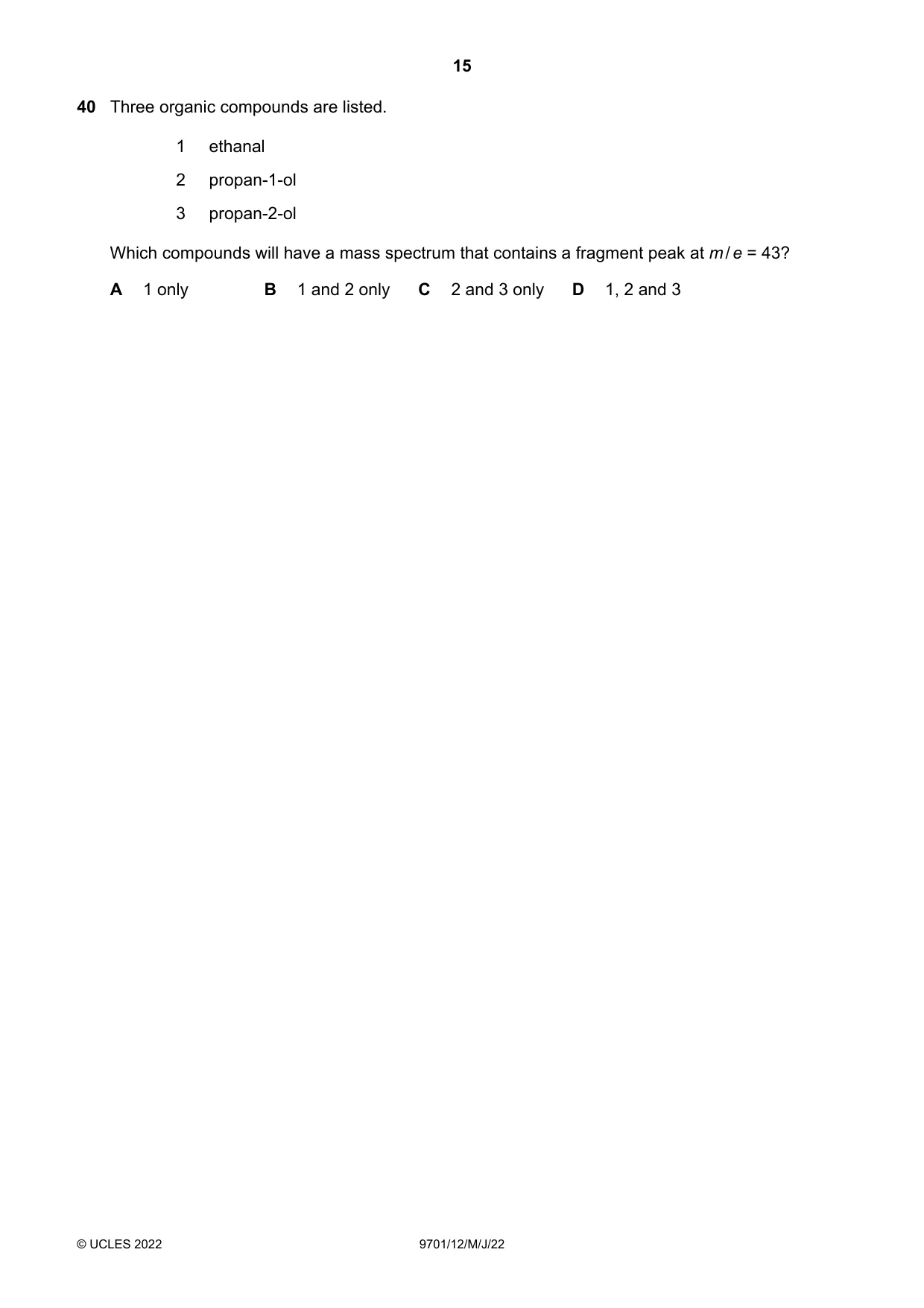
40 Three organic compounds are listed. 1 ethanal 2 propan-1-ol 3 propan-2-ol Which compounds will have a mass spectrum that contains a fragment peak at m / e = 43? A 1 only B 1 and 2 only C 2 and 3 only D 1, 2 and 3
Mark scheme: D
What was in this paper
The subtopics covered by these 40 questions, and how many questions each got. Open one in a new tab to see every Cambridge question on it.
4Similarities and trends in the properties of the Group 2 metals, magnesium to barium, and their compounds3Aldehydes and ketones2Chemical equilibria: reversible reactions, dynamic equilibrium2Esters2Halogenoalkanes2Isomerism: structural isomerism and stereoisomerism2The gaseous state: ideal and real gases and pV = nRT2Acids and bases1Addition polymerisation1Alcohols1Alkanes1Alkenes1Characteristic organic reactions1Effect of temperature on reaction rates and the concept of activation energy1Electrons, energy levels and atomic orbitals1Formulas1Hess’s law1Homogeneous and heterogeneous catalysts1Intermolecular forces, electronegativity and bond properties1Ionic bonding1Ionisation energy1Mass spectrometry1Periodicity of physical properties of the elements in Period 31Physical properties of the Group 17 elements1Rate of reaction1Shapes of organic molecules; σ and π bonds1The mole and the Avogadro constant1The reactions of chlorine1What you needed in this session
Cambridge’s own grade thresholds for 2022 May/June, Paper 1 · Variant 2. A higher threshold means an easier paper — the bar moves with how the cohort did.