Cambridge A Level Chemistry 9701 — 2023 Feb/March Paper 1 · Variant 2
9701/12/F/M/23 · 40 questions · 40 marks · ≈45 min
The question paper and its mark scheme, free to read here and free to download. This is Cambridge’s own paper, exactly as it was sat.
Question paper20 pages



Mark scheme3 pages
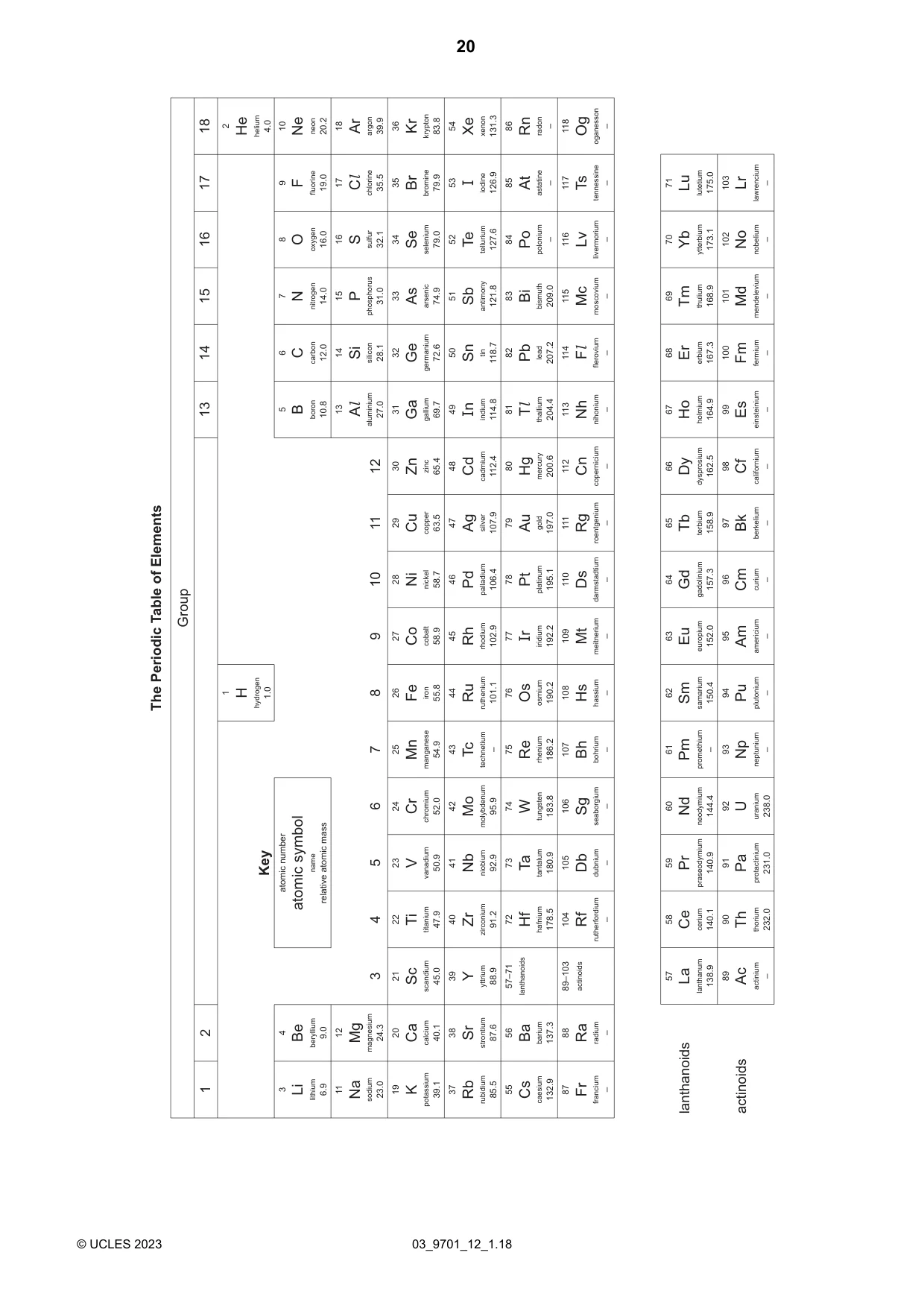
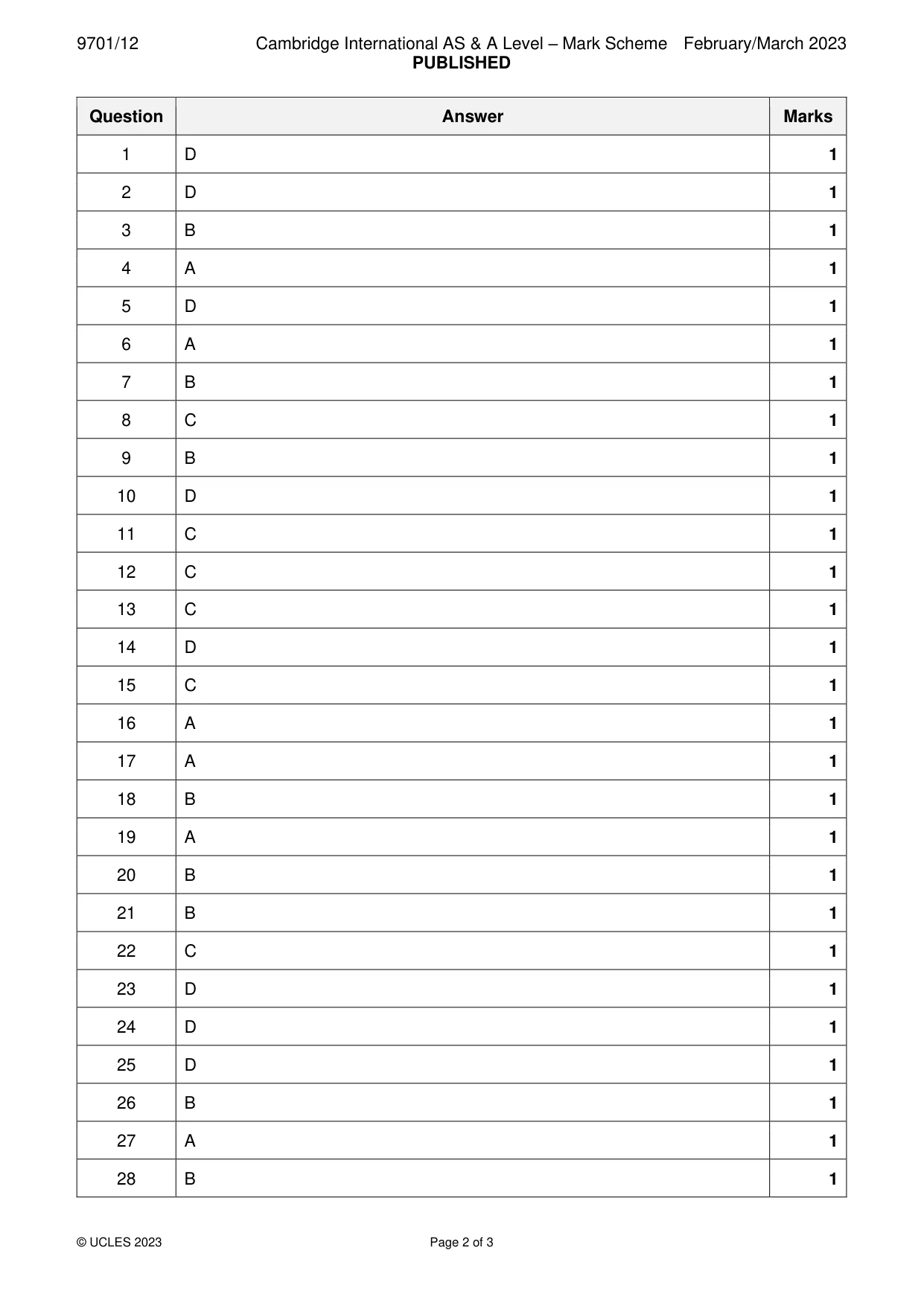
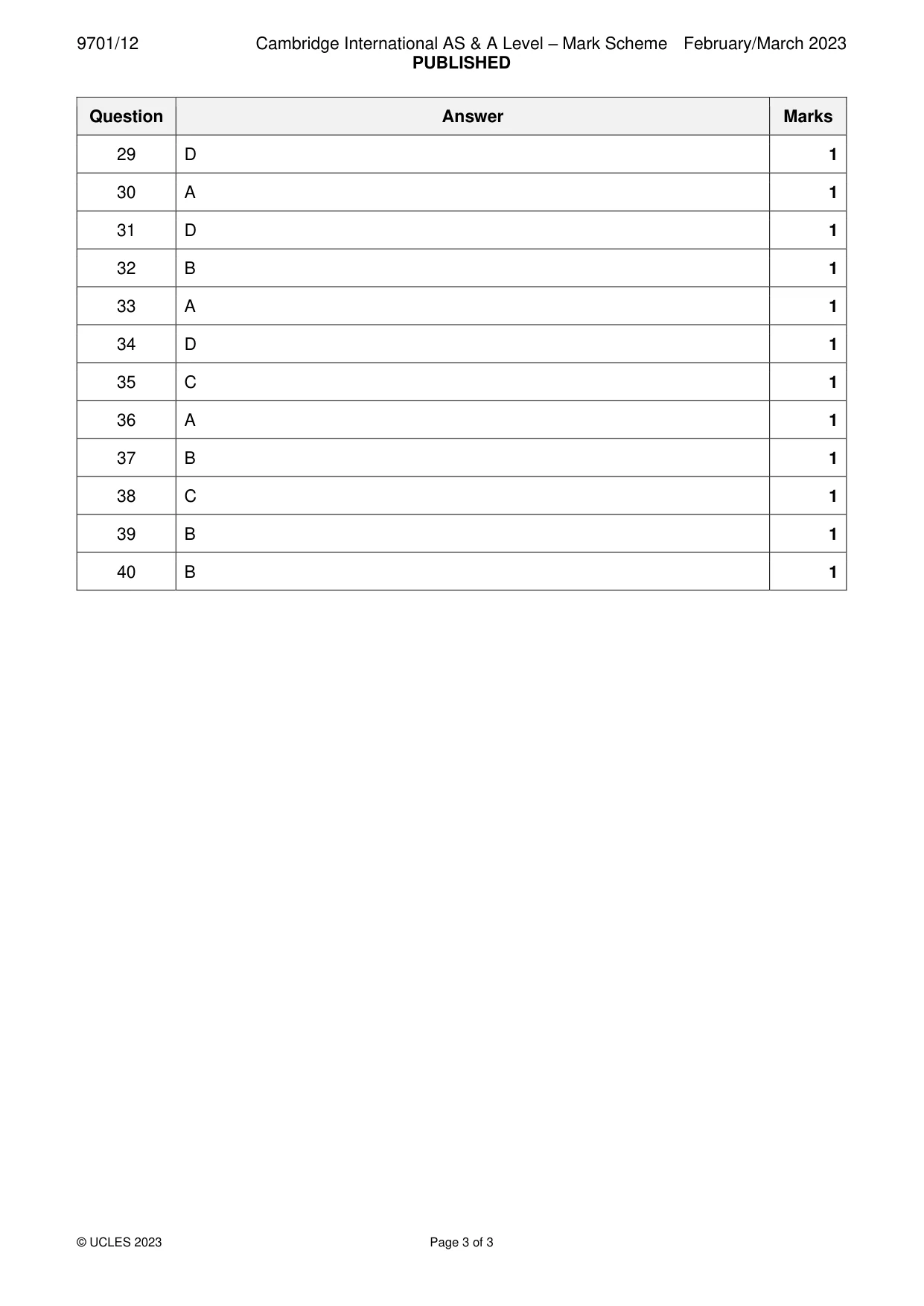
Answers below. Sit the paper first if you are practising.
Questions as text
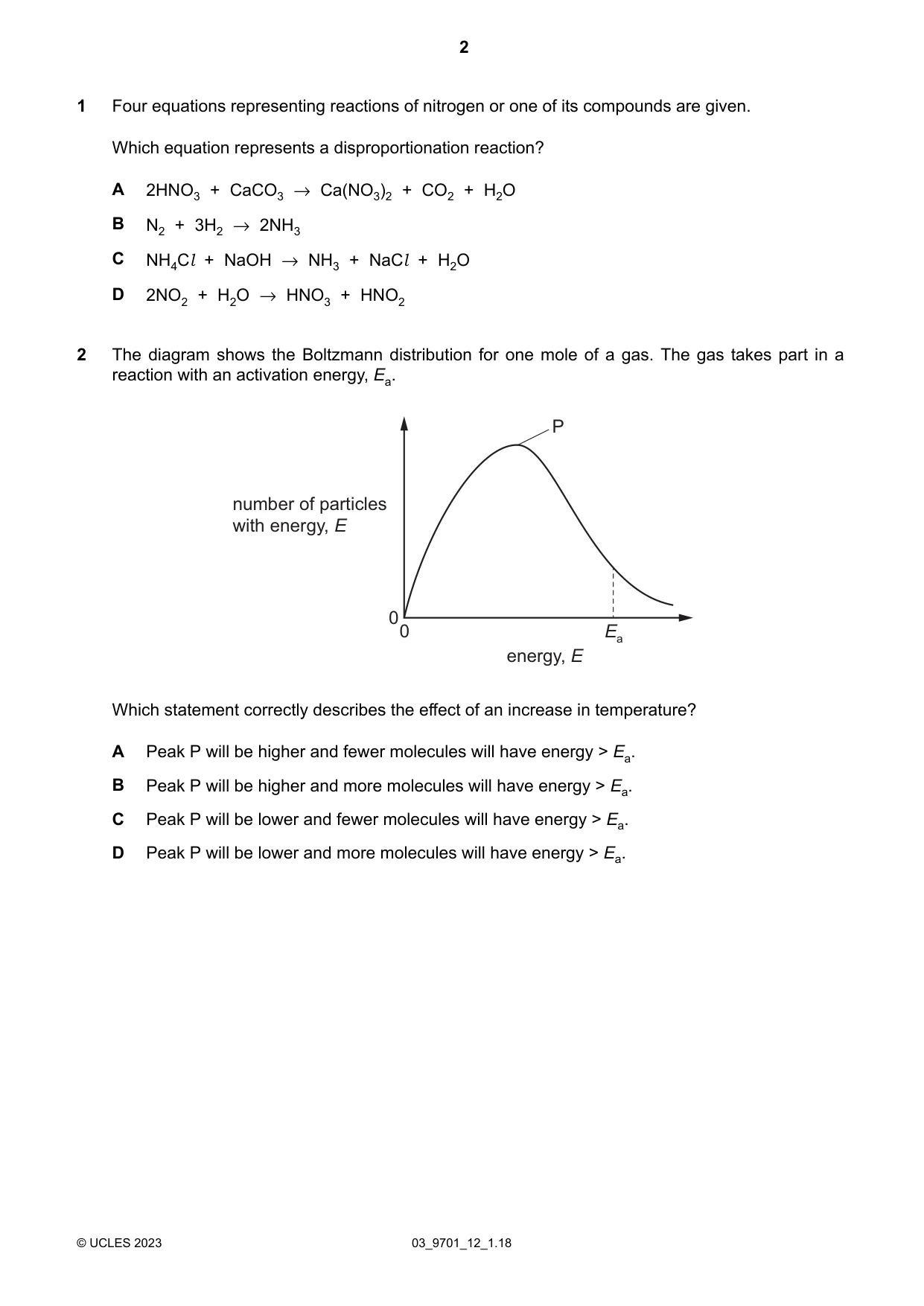
Q1 · Four equations representing reactions of nitrogen or one of its compounds are given
1 Four equations representing reactions of nitrogen or one of its compounds are given. Which equation represents a disproportionation reaction? A 2HNO3 + CaCO3 →Ca(NO3)2 + CO2 + H2O B N2 + 3H2 →2NH3 C NH4Cl + NaOH →NH3 + NaCl + H2O D 2NO2 + H2O →HNO3 + HNO2
Mark scheme: D
Q2 · The diagram shows the Boltzmann distribution for one mole of a gas
2 The diagram shows the Boltzmann distribution for one mole of a gas. The gas takes part in a reaction with an activation energy, Ea. P number of particles with energy, E 0 0 Ea energy, E Which statement correctly describes the effect of an increase in temperature? A Peak P will be higher and fewer molecules will have energy > Ea. B Peak P will be higher and more molecules will have energy > Ea. C Peak P will be lower and fewer molecules will have energy > Ea. D Peak P will be lower and more molecules will have energy > Ea.
Mark scheme: D
More questions on Effect of temperature on reaction rates and the concept of activation energy
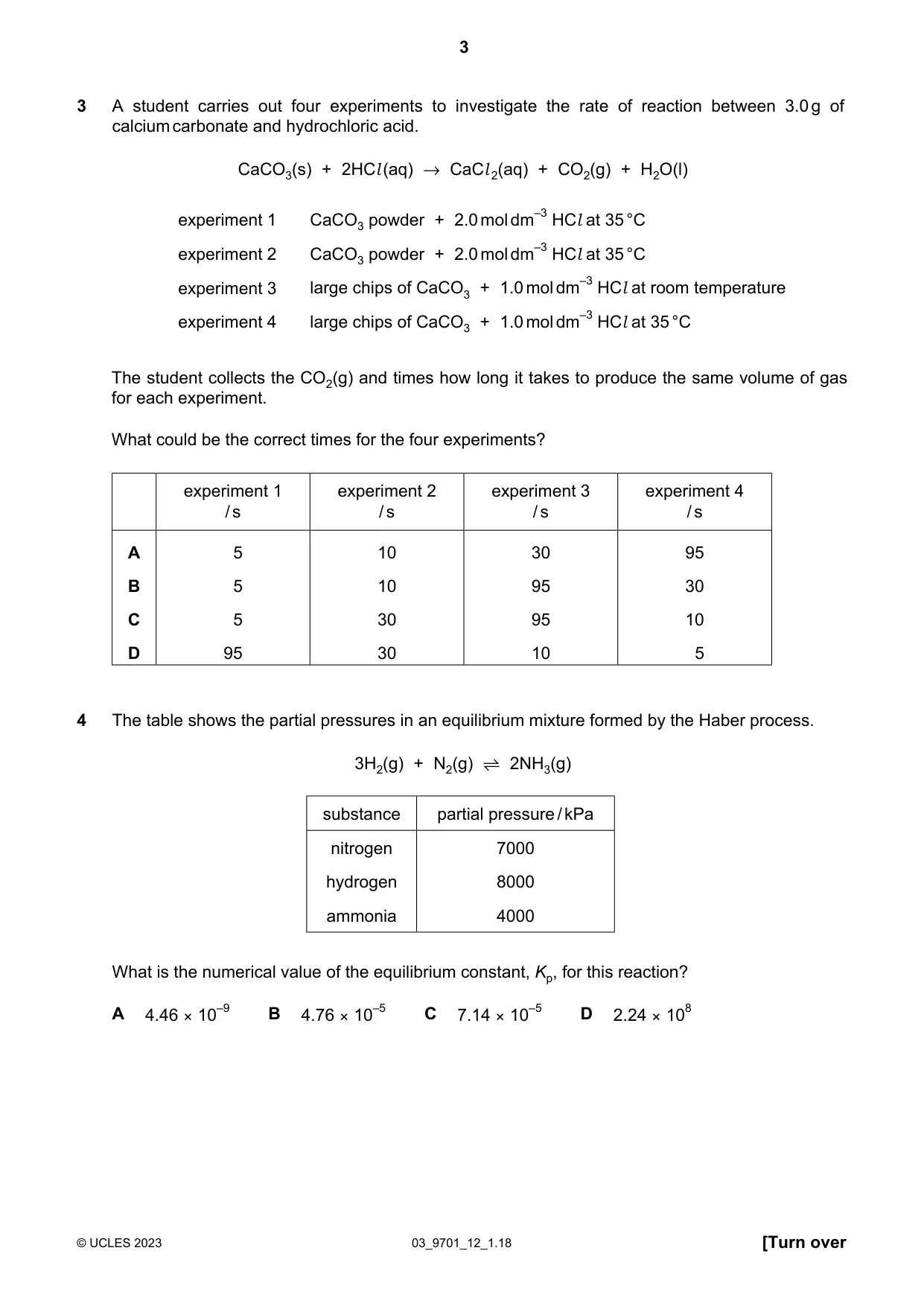
Q3 · A student carries out four experiments to investigate the rate of reaction between 3.0g…
3 A student carries out four experiments to investigate the rate of reaction between 3.0g of calciumcarbonate and hydrochloric acid. CaCO3(s) + 2HCl(aq) →CaCl 2(aq) + CO2(g) + H2O(l) CaCO3 powder + 2.0moldm–3 HCl at 35°C experiment 1 CaCO3 powder + 2.0moldm–3 HCl at 35°C experiment 2 large chips of CaCO3 + 1.0moldm–3 HCl at room temperature experiment 3 large chips of CaCO3 + 1.0moldm–3 HCl at 35°C experiment 4 The student collects the CO2(g) and times how long it takes to produce the same volume of gas for each experiment. What could be the correct times for the four experiments? experiment 1 experiment 2 experiment 3 experiment 4 /s /s /s /s A 5 10 30 95 B 5 10 95 30 C 5 30 95 10 D 95 30 10 5
Mark scheme: B
Q4 · The table shows the partial pressures in an equilibrium mixture formed by the Haber…
4 The table shows the partial pressures in an equilibrium mixture formed by the Haber process. 3H2(g) + N2(g) ⇌2NH3(g) substance partial pressure/kPa nitrogen 7000 hydrogen 8000 ammonia 4000 What is the numerical value of the equilibrium constant, Kp, for this reaction? A 4.46 × 10⁻⁹ B 4.76 × 10⁻⁵ C 7.14 × 10⁻⁵ D 2.24 × 10⁸
Mark scheme: A
More questions on Chemical equilibria: reversible reactions, dynamic equilibrium
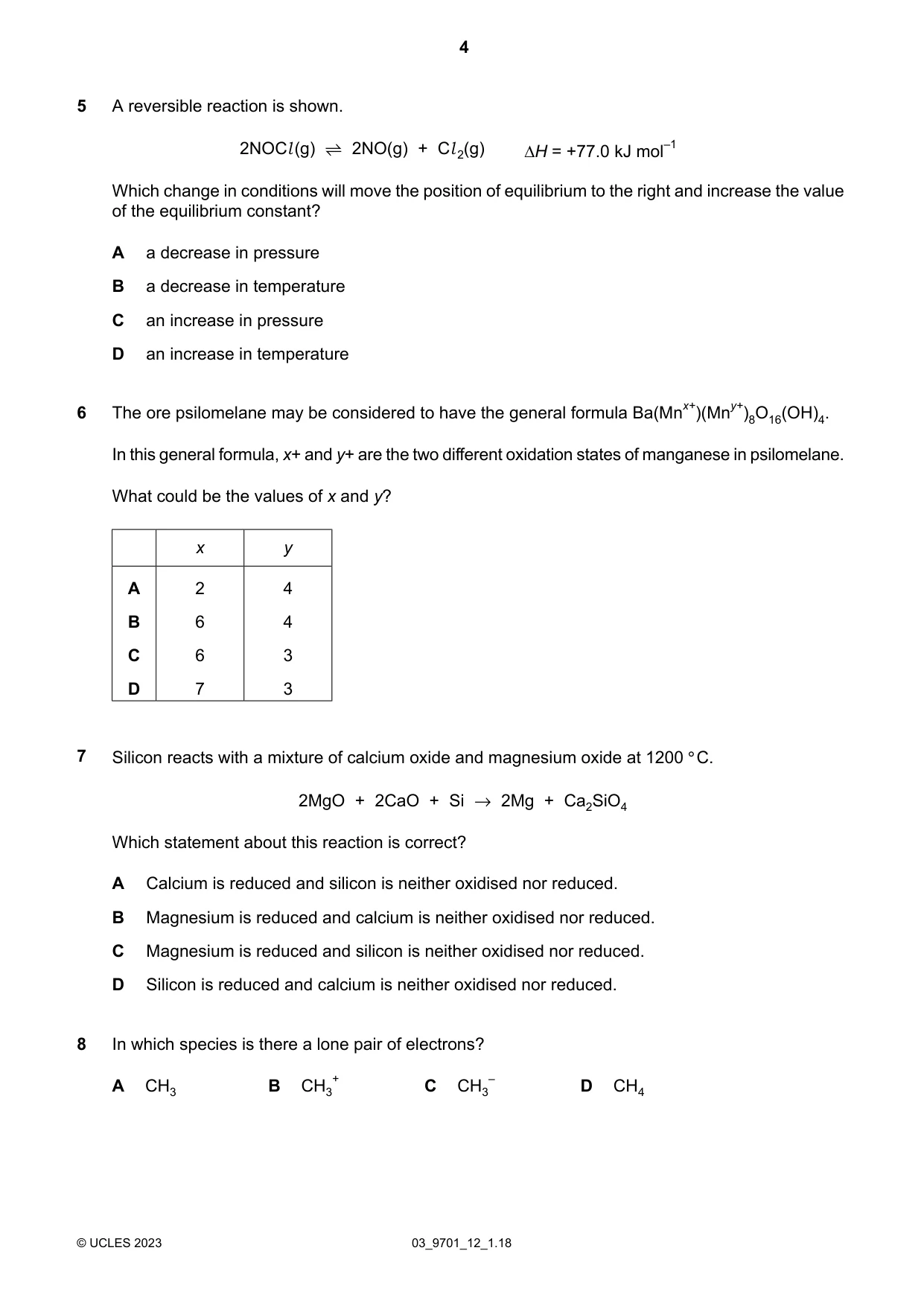
Q5 · A reversible reaction is shown
5 A reversible reaction is shown. 2NOCl(g) ⇌2NO(g) + Cl 2(g) ∆H = +77.0 kJ mol–1 Which change in conditions will move the position of equilibrium to the right and increase the value of the equilibrium constant? A a decrease in pressure B a decrease in temperature C an increase in pressure D an increase in temperature
Mark scheme: D
More questions on Chemical equilibria: reversible reactions, dynamic equilibrium
Q6 · The ore psilomelane may be considered to have the general formula Ba(Mnx+)(Mny+)8O16(OH)4
6 The ore psilomelane may be considered to have the general formula Ba(Mnx+)(Mny+)8O16(OH)4. In this general formula, x+ and y+ are the two different oxidation states of manganese in psilomelane. What could be the values of x and y? x y A 2 4 B 6 4 C 6 3 D 7 3
Mark scheme: A
Q7 · Silicon reacts with a mixture of calcium oxide and magnesium oxide at 1200 °C
7 Silicon reacts with a mixture of calcium oxide and magnesium oxide at 1200 °C. 2MgO + 2CaO + Si →2Mg + Ca2SiO4 Which statement about this reaction is correct? A Calcium is reduced and silicon is neither oxidised nor reduced. B Magnesium is reduced and calcium is neither oxidised nor reduced. C Magnesium is reduced and silicon is neither oxidised nor reduced. D Silicon is reduced and calcium is neither oxidised nor reduced.
Mark scheme: B
Q8 · In which species is there a lone pair of electrons?
8 In which species is there a lone pair of electrons? A CH3 B CH3 + C CH3 – D CH4
Mark scheme: C
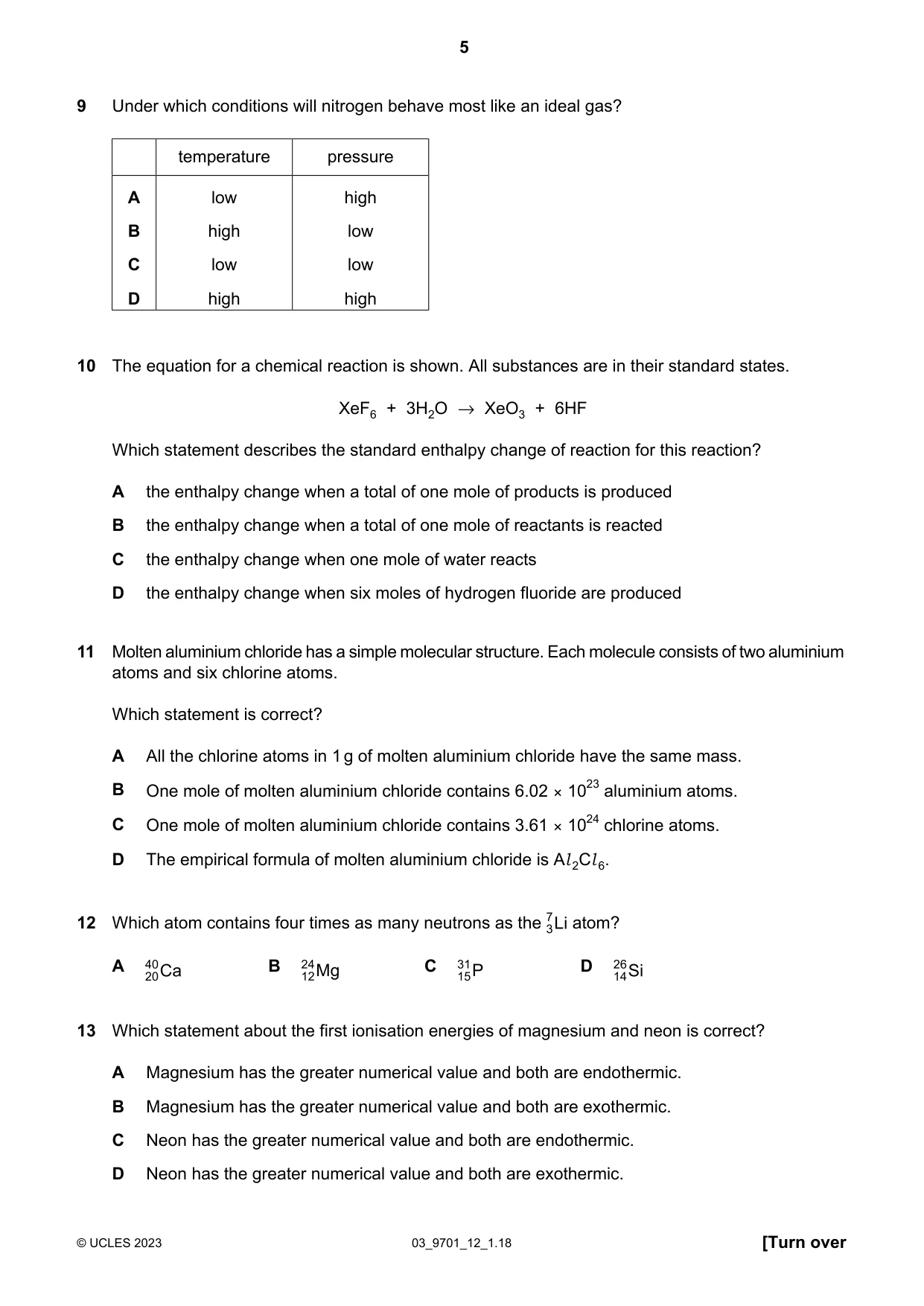
Q9 · Under which conditions will nitrogen behave most like an ideal gas?
9 Under which conditions will nitrogen behave most like an ideal gas? temperature pressure A low high B high low C low low D high high
Mark scheme: B
More questions on The gaseous state: ideal and real gases and pV = nRT
Q10 · The equation for a chemical reaction is shown
10 The equation for a chemical reaction is shown. All substances are in their standard states. XeF6 + 3H2O →XeO3 + 6HF Which statement describes the standard enthalpy change of reaction for this reaction? A the enthalpy change when a total of one mole of products is produced B the enthalpy change when a total of one mole of reactants is reacted C the enthalpy change when one mole of water reacts D the enthalpy change when six moles of hydrogen fluoride are produced
Mark scheme: D
Q11 · Molten aluminium chloride has a simple molecular structure
11 Molten aluminium chloride has a simple molecular structure. Each molecule consists of two aluminium atoms and six chlorine atoms. Which statement is correct? A All the chlorine atoms in 1g of molten aluminium chloride have the same mass. B One mole of molten aluminium chloride contains 6.02 × 10²³ aluminium atoms. C One mole of molten aluminium chloride contains 3.61 × 1024 chlorine atoms. D The empirical formula of molten aluminium chloride is Al 2Cl 6.
Mark scheme: C
Q12 · Which atom contains four times as many neutrons as the atom?
12 Which atom contains four times as many neutrons as the atom? A B C D
Mark scheme: C
Q13 · Which statement about the first ionisation energies of magnesium and neon is correct?
13 Which statement about the first ionisation energies of magnesium and neon is correct? A Magnesium has the greater numerical value and both are endothermic. B Magnesium has the greater numerical value and both are exothermic. C Neon has the greater numerical value and both are endothermic. D Neon has the greater numerical value and both are exothermic.
Mark scheme: C
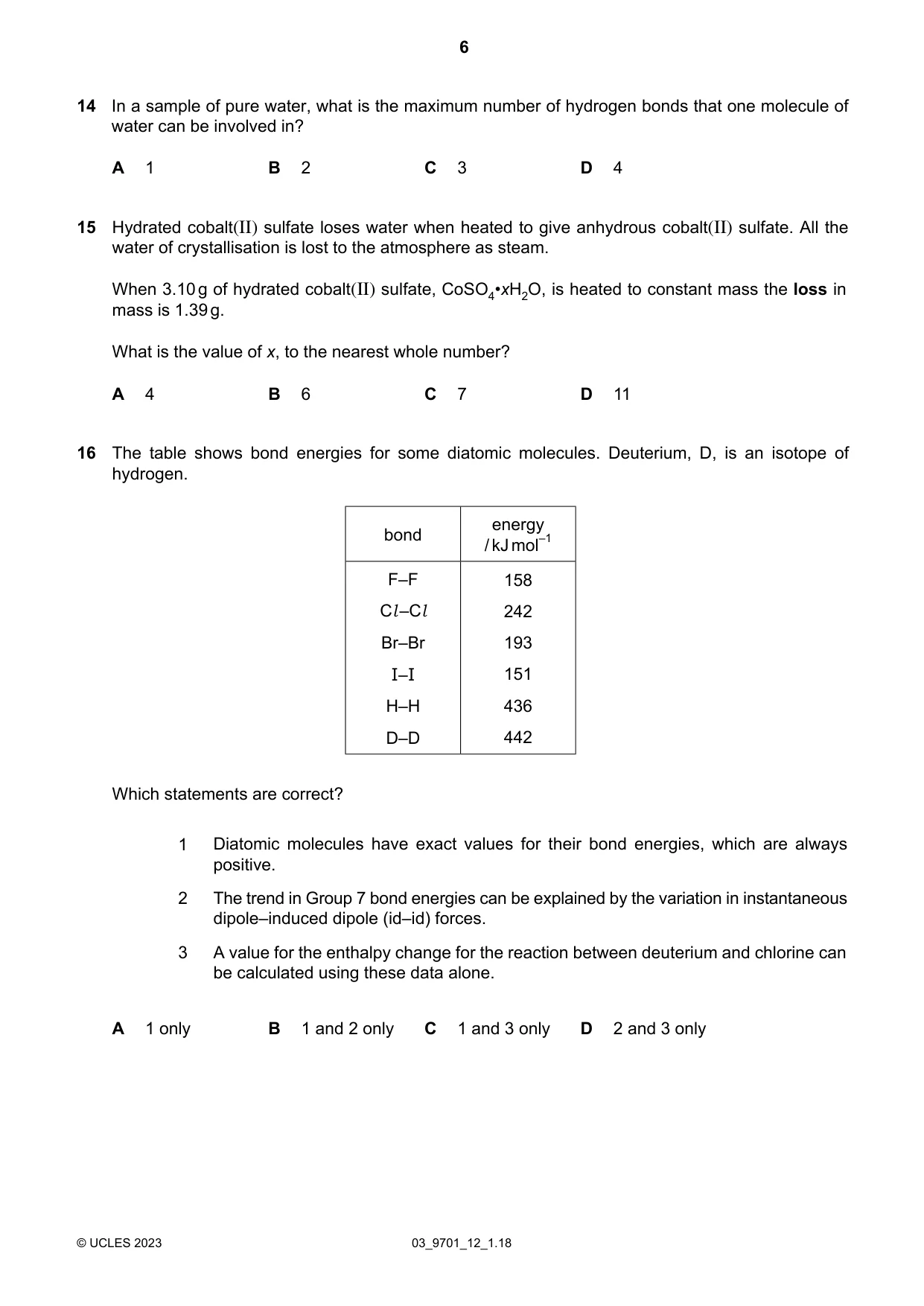
Q14 · In a sample of pure water, what is the maximum number of hydrogen bonds that one molecule…
14 In a sample of pure water, what is the maximum number of hydrogen bonds that one molecule of water can be involved in? A 1 B 2 C 3 D 4
Mark scheme: D
More questions on Intermolecular forces, electronegativity and bond properties
Q15 · Hydrated cobalt(II) sulfate loses water when heated to give anhydrous cobalt(II) sulfate
15 Hydrated cobalt(II) sulfate loses water when heated to give anhydrous cobalt(II) sulfate. All the water of crystallisation is lost to the atmosphere as steam. When 3.10 g of hydrated cobalt(II) sulfate, CoSO4•xH2O, is heated to constant mass the loss in mass is 1.39 g. What is the value of x, to the nearest whole number? A 4 B 6 C 7 D 11
Mark scheme: C
Q16 · The table shows bond energies for some diatomic molecules
16 The table shows bond energies for some diatomic molecules. Deuterium, D, is an isotope of hydrogen. energy bond /kJmol–1 F–F 158 Cl–Cl 242 Br–Br 193 I–I 151 H–H 436 D–D 442 Which statements are correct? 1 Diatomic molecules have exact values for their bond energies, which are always positive. 2 The trend in Group 7 bond energies can be explained by the variation in instantaneous dipole–induced dipole (id–id) forces. 3 A value for the enthalpy change for the reaction between deuterium and chlorine can be calculated using these data alone. A 1 only B 1 and 2 only C 1 and 3 only D 2 and 3 only
Mark scheme: A
More questions on Intermolecular forces, electronegativity and bond properties
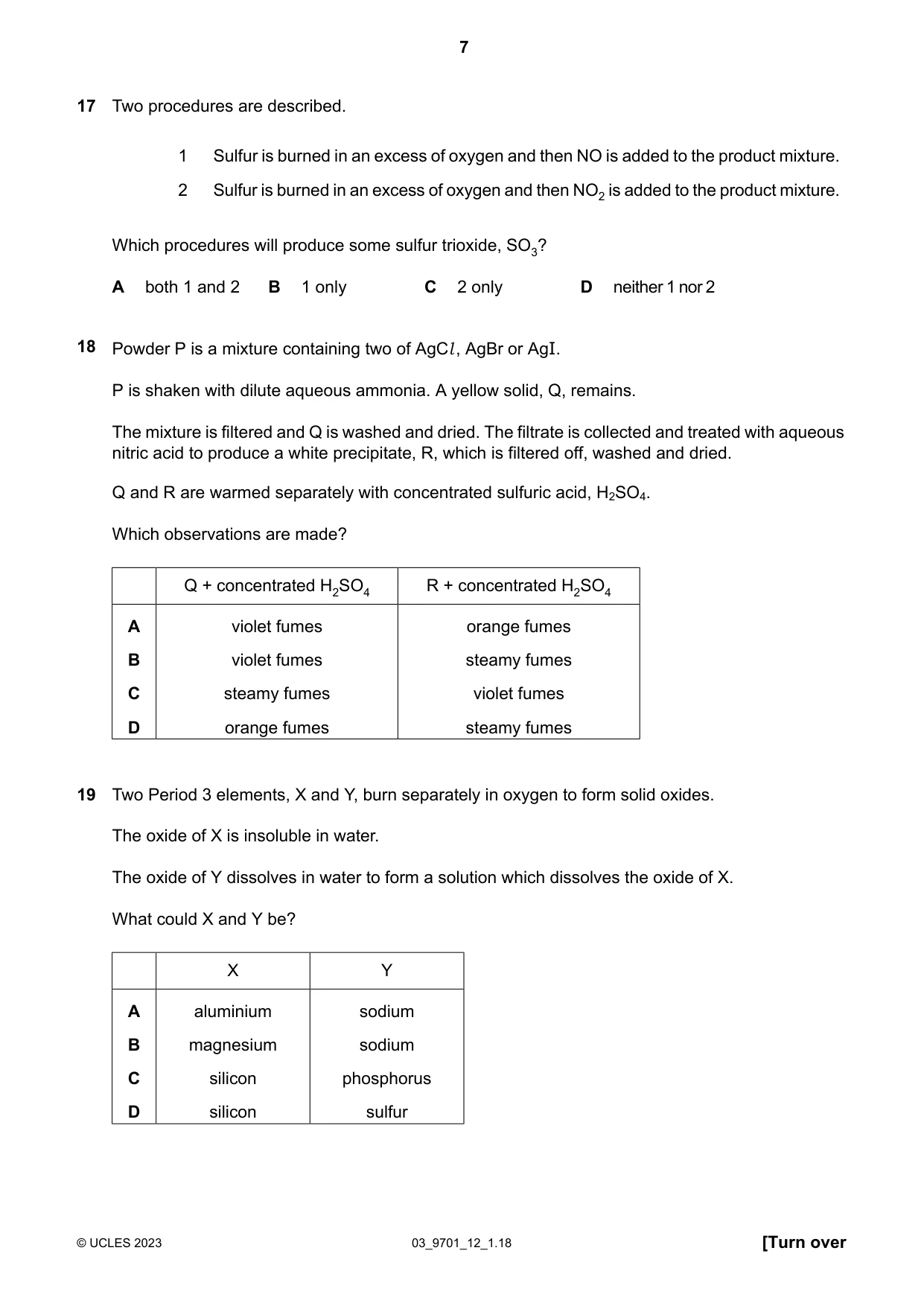
Q17 · Two procedures are described
17 Two procedures are described. 1 Sulfur is burned in an excess of oxygen and then NO is added to the product mixture. 2 Sulfur is burned in an excess of oxygen and then NO2 is added to the product mixture. Which procedures will produce some sulfur trioxide, SO3? A both 1 and 2 B 1 only C 2 only D neither 1 nor 2
Mark scheme: A
Q18 · Powder P is a mixture containing two of AgCl, AgBr or AgI
18 Powder P is a mixture containing two of AgCl, AgBr or AgI. P is shaken with dilute aqueous ammonia. A yellow solid, Q, remains. The mixture is filtered and Q is washed and dried. The filtrate is collected and treated with aqueous nitric acid to produce a white precipitate, R, which is filtered off, washed and dried. Q and R are warmed separately with concentrated sulfuric acid, H2SO4. Which observations are made? Q + concentrated H2SO4 R + concentrated H2SO4 A violet fumes orange fumes B violet fumes steamy fumes C steamy fumes violet fumes D orange fumes steamy fumes
Mark scheme: B
Q19 · Two Period 3 elements, X and Y, burn separately in oxygen to form solid oxides
19 Two Period 3 elements, X and Y, burn separately in oxygen to form solid oxides. The oxide of X is insoluble in water. The oxide of Y dissolves in water to form a solution which dissolves the oxide of X. What could X and Y be? X Y A aluminium sodium B magnesium sodium C silicon phosphorus D silicon sulfur
Mark scheme: A
More questions on Periodicity of chemical properties of the elements in Period 3
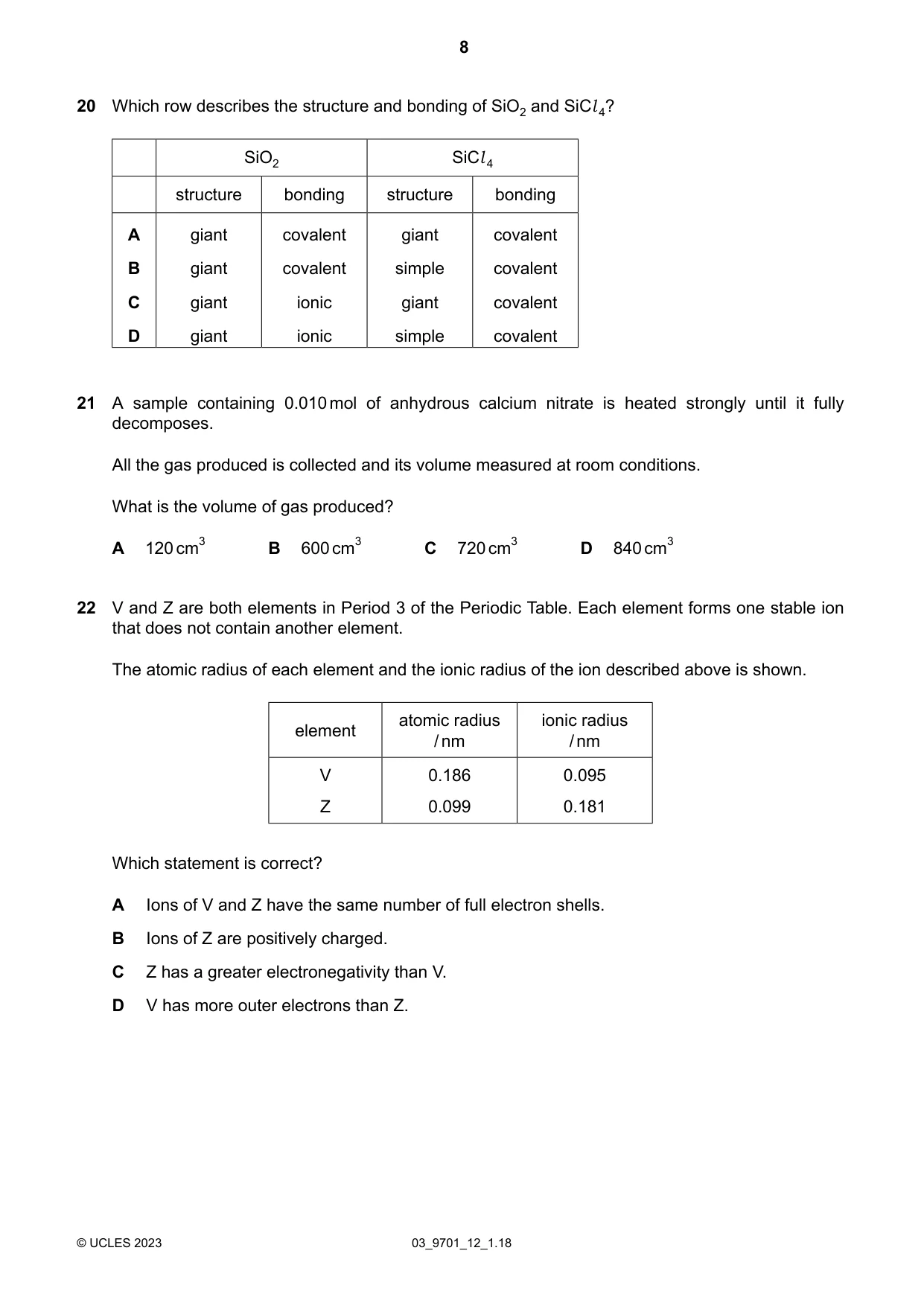
Q20 · Which row describes the structure and bonding of SiO2 and SiCl 4?
20 Which row describes the structure and bonding of SiO2 and SiCl 4? SiO2 SiCl 4 structure bonding structure bonding A giant covalent giant covalent B giant covalent simple covalent C giant ionic giant covalent D giant ionic simple covalent
Mark scheme: B
Q21 · A sample containing 0.010mol of anhydrous calcium nitrate is heated strongly until it…
21 A sample containing 0.010mol of anhydrous calcium nitrate is heated strongly until it fully decomposes. All the gas produced is collected and its volume measured at room conditions. What is the volume of gas produced? A 120cm3 B 600cm3 C 720cm3 D 840cm3
Mark scheme: B
More questions on Reacting masses and volumes (of solutions and gases)
Q22 · V and Z are both elements in Period 3 of the Periodic Table
22 V and Z are both elements in Period 3 of the Periodic Table. Each element forms one stable ion that does not contain another element. The atomic radius of each element and the ionic radius of the ion described above is shown. atomic radius ionic radius element /nm /nm V 0.186 0.095 Z 0.099 0.181 Which statement is correct? A Ions of V and Z have the same number of full electron shells. B Ions of Z are positively charged. C Z has a greater electronegativity than V. D V has more outer electrons than Z.
Mark scheme: C
Q23 · In Group 2 of the Periodic Table, the properties of the elements and their compounds show…
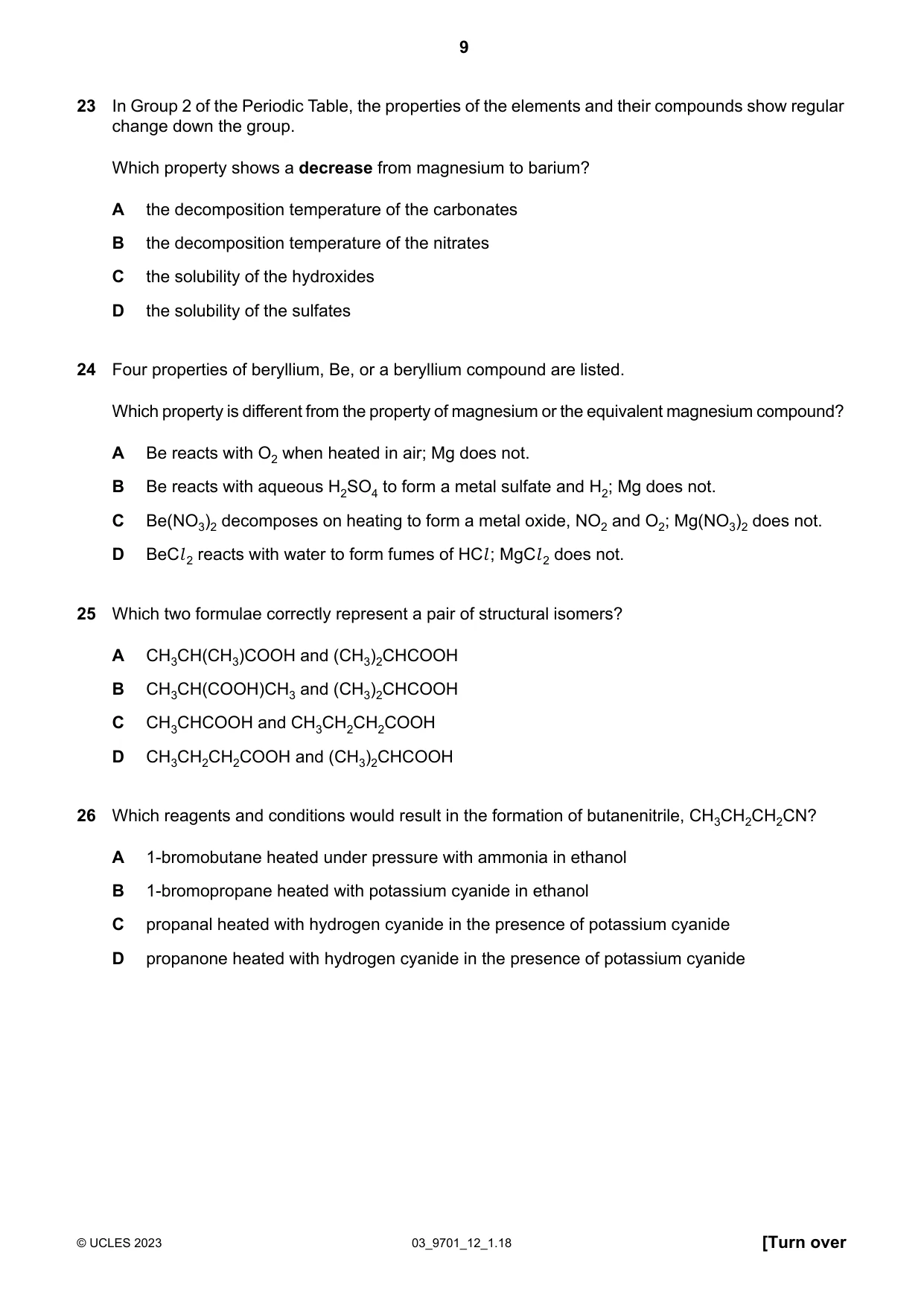
23 In Group 2 of the Periodic Table, the properties of the elements and their compounds show regular change down the group. Which property shows a decrease from magnesium to barium? A the decomposition temperature of the carbonates B the decomposition temperature of the nitrates C the solubility of the hydroxides D the solubility of the sulfates
Mark scheme: D
Q24 · Four properties of beryllium, Be, or a beryllium compound are listed
24 Four properties of beryllium, Be, or a beryllium compound are listed. Which property is different from the property of magnesium or the equivalent magnesium compound? A Be reacts with O2 when heated in air; Mg does not. B Be reacts with aqueous H2SO4 to form a metal sulfate and H2; Mg does not. C Be(NO3)2 decomposes on heating to form a metal oxide, NO2 and O2; Mg(NO3)2 does not. D BeCl 2 reacts with water to form fumes of HCl; MgCl 2 does not.
Mark scheme: D
Q25 · Which two formulae correctly represent a pair of structural isomers?
25 Which two formulae correctly represent a pair of structural isomers? A CH3CH(CH3)COOH and (CH3)2CHCOOH B CH3CH(COOH)CH3 and (CH3)2CHCOOH C CH3CHCOOH and CH3CH2CH2COOH D CH3CH2CH2COOH and (CH3)2CHCOOH
Mark scheme: D
More questions on Isomerism: structural isomerism and stereoisomerism
Q26 · Which reagents and conditions would result in the formation of butanenitrile, CH3CH2CH2CN?
26 Which reagents and conditions would result in the formation of butanenitrile, CH3CH2CH2CN? A 1-bromobutane heated under pressure with ammonia in ethanol B 1-bromopropane heated with potassium cyanide in ethanol C propanal heated with hydrogen cyanide in the presence of potassium cyanide D propanone heated with hydrogen cyanide in the presence of potassium cyanide
Mark scheme: B
Q27 · Compound X, C7H13Br, reacts with hot alcoholic NaOH to produce two compounds, Y and Z
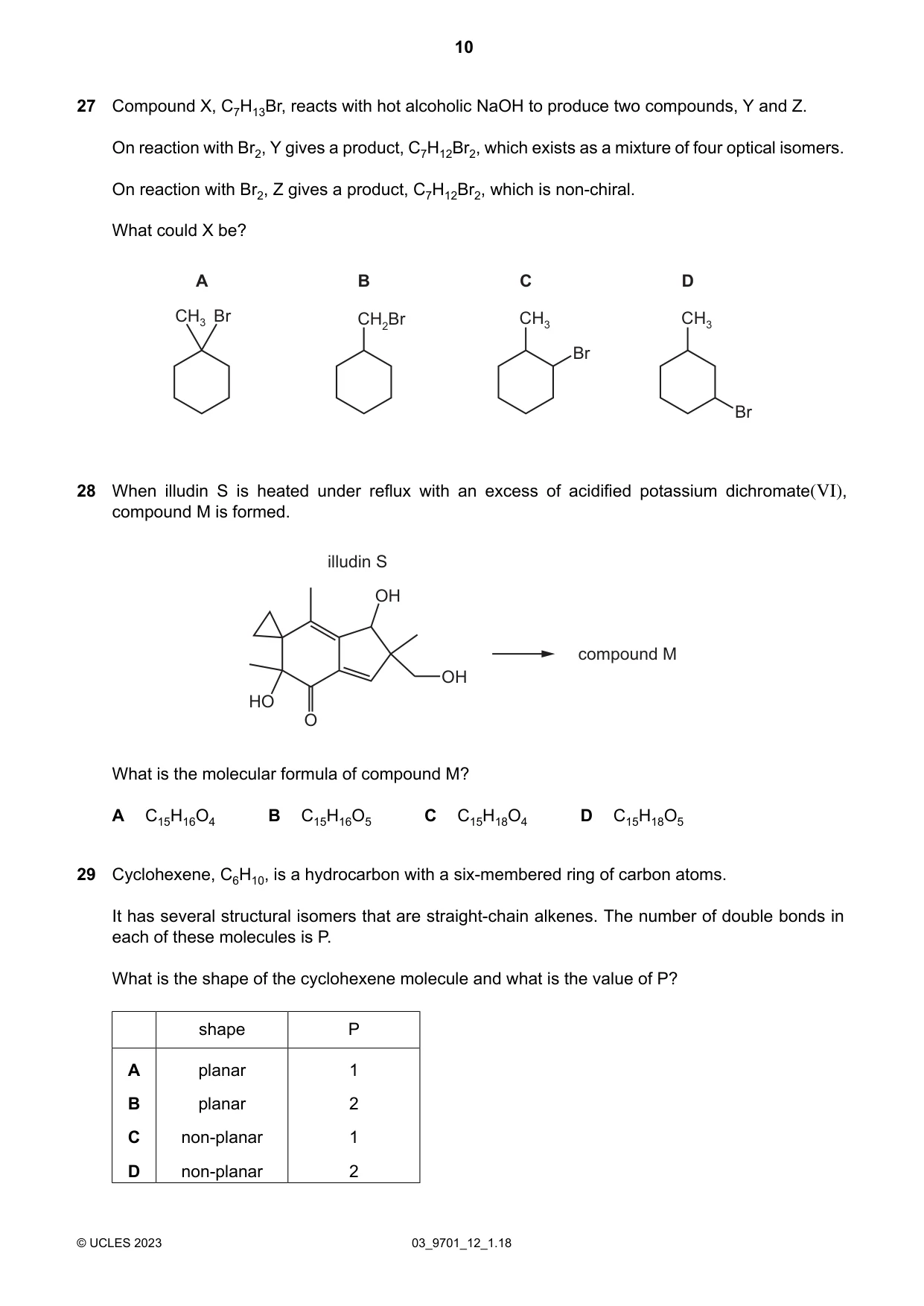
27 Compound X, C7H13Br, reacts with hot alcoholic NaOH to produce two compounds, Y and Z. On reaction with Br2, Y gives a product, C7H12Br2, which exists as a mixture of four optical isomers. On reaction with Br2, Z gives a product, C7H12Br2, which is non-chiral. What could X be? A B C D CH3 Br CH2Br CH3 CH3 Br Br
Mark scheme: A
Q28 · When illudin S is heated under reflux with an excess of acidified potassium…
28 When illudin S is heated under reflux with an excess of acidified potassium dichromate(VI), compound M is formed. illudin S OH compound M OH HO O What is the molecular formula of compound M? A C15H16O4 B C15H16O5 C C15H18O4 D C15H18O5
Mark scheme: B
Q29 · Cyclohexene, C6H10, is a hydrocarbon with a six-membered ring of carbon atoms
29 Cyclohexene, C6H10, is a hydrocarbon with a six-membered ring of carbon atoms. It has several structural isomers that are straight-chain alkenes. The number of double bonds in each of these molecules is P. What is the shape of the cyclohexene molecule and what is the value of P? shape P A planar 1 B planar 2 C non-planar 1 D non-planar 2
Mark scheme: D
Q30 · Exhaust gases from an internal combustion engine are made less harmful by passing them…
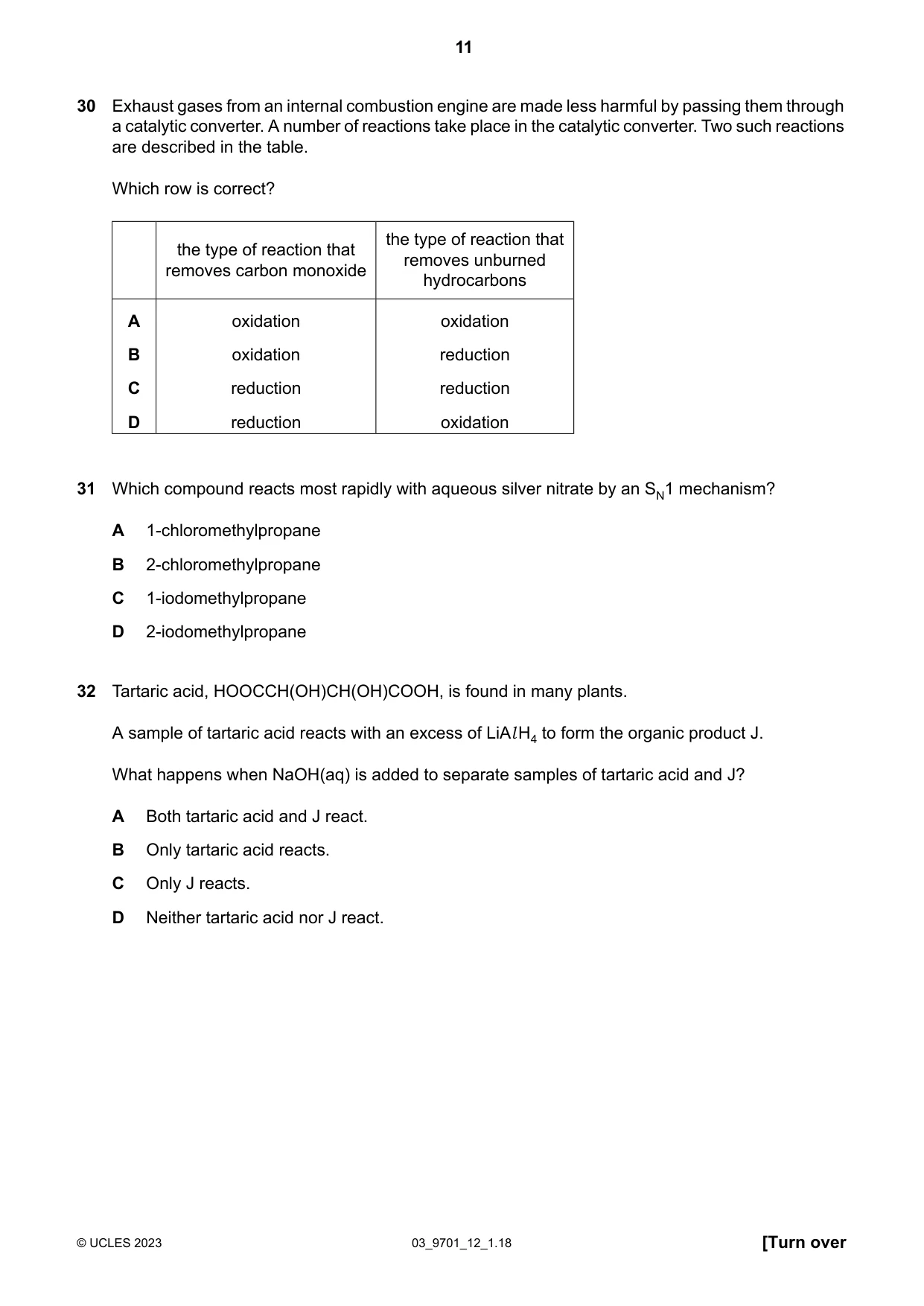
30 Exhaust gases from an internal combustion engine are made less harmful by passing them through a catalytic converter. A number of reactions take place in the catalytic converter. Two such reactions are described in the table. Which row is correct? the type of reaction that the type of reaction that removes unburned removes carbon monoxide hydrocarbons A oxidation oxidation B oxidation reduction C reduction reduction D reduction oxidation
Mark scheme: A
Q31 · Which compound reacts most rapidly with aqueous silver nitrate by an SN1 mechanism?
31 Which compound reacts most rapidly with aqueous silver nitrate by an SN1 mechanism? A 1-chloromethylpropane B 2-chloromethylpropane C 1-iodomethylpropane D 2-iodomethylpropane
Mark scheme: D
Q32 · Tartaric acid, HOOCCH(OH)CH(OH)COOH, is found in many plants
32 Tartaric acid, HOOCCH(OH)CH(OH)COOH, is found in many plants. A sample of tartaric acid reacts with an excess of LiAlH4 to form the organic product J. What happens when NaOH(aq) is added to separate samples of tartaric acid and J? A Both tartaric acid and J react. B Only tartaric acid reacts. C Only J reacts. D Neither tartaric acid nor J react.
Mark scheme: B
Q33 · Citric acid can be converted into tricarballylic acid in two stages
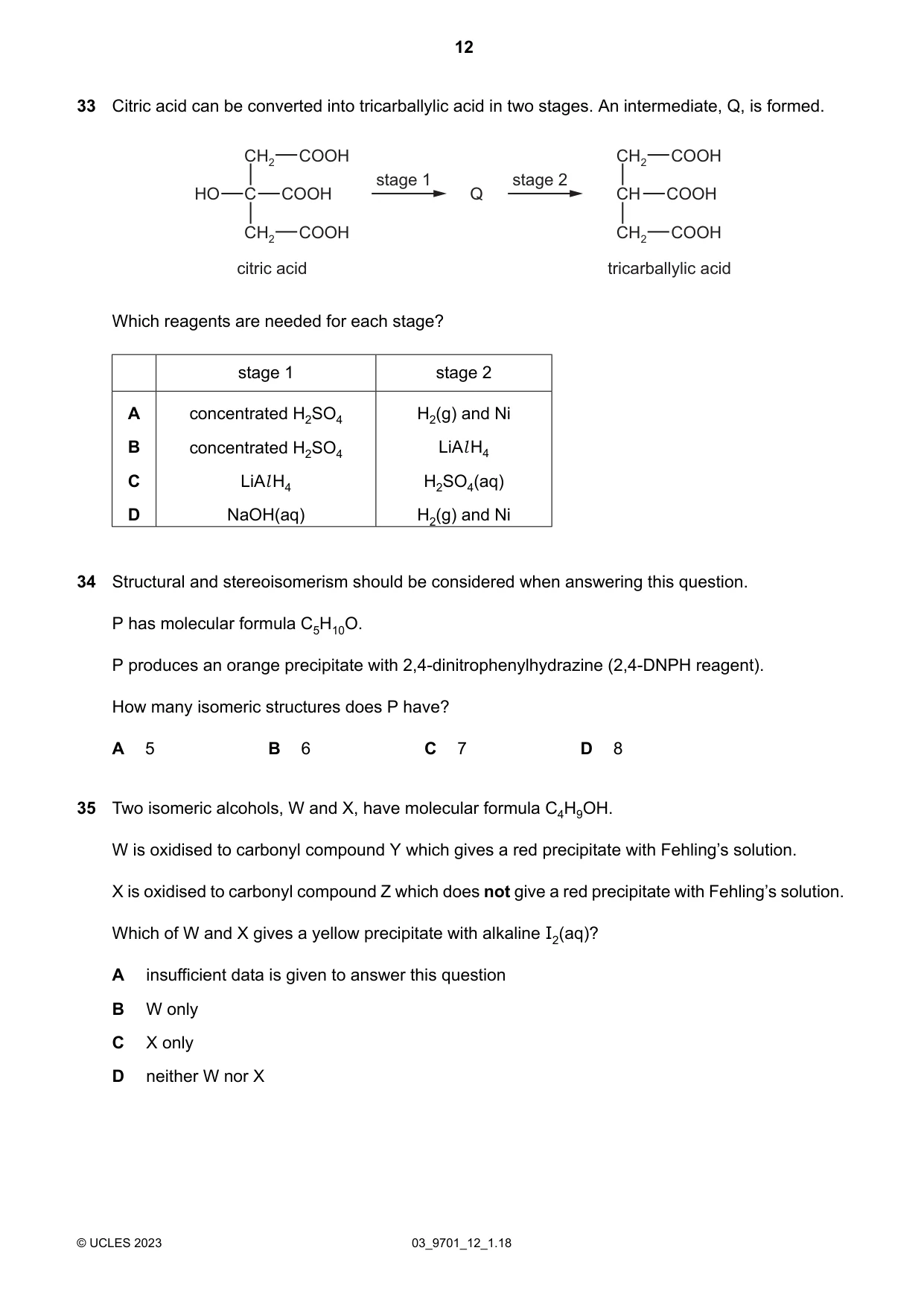
33 Citric acid can be converted into tricarballylic acid in two stages. An intermediate, Q, is formed. CH2 COOH CH2 COOH stage 1 stage 2 HO C COOH Q CH COOH CH2 COOH CH2 COOH citric acid tricarballylic acid Which reagents are needed for each stage? stage 1 stage 2 A concentrated H2SO4 H2(g) and Ni B concentrated H2SO4 LiAlH4 C LiAlH4 H2SO4(aq) D NaOH(aq) H2(g) and Ni
Mark scheme: A
Q34 · Structural and stereoisomerism should be considered when answering this question
34 Structural and stereoisomerism should be considered when answering this question. P has molecular formula C5H10O. P produces an orange precipitate with 2,4-dinitrophenylhydrazine (2,4-DNPH reagent). How many isomeric structures does P have? A 5 B 6 C 7 D 8
Mark scheme: D
Q35 · Two isomeric alcohols, W and X, have molecular formula C4H9OH
35 Two isomeric alcohols, W and X, have molecular formula C4H9OH. W is oxidised to carbonyl compound Y which gives a red precipitate with Fehling’s solution. X is oxidised to carbonyl compound Z which does not give a red precipitate with Fehling’s solution. Which of W and X gives a yellow precipitate with alkaline I2(aq)? A insufficient data is given to answer this question B W only C X only D neither W nor X
Mark scheme: C
Q36 · The ester ethyl butanoate can be hydrolysed using an excess of dilute sodium hydroxide…
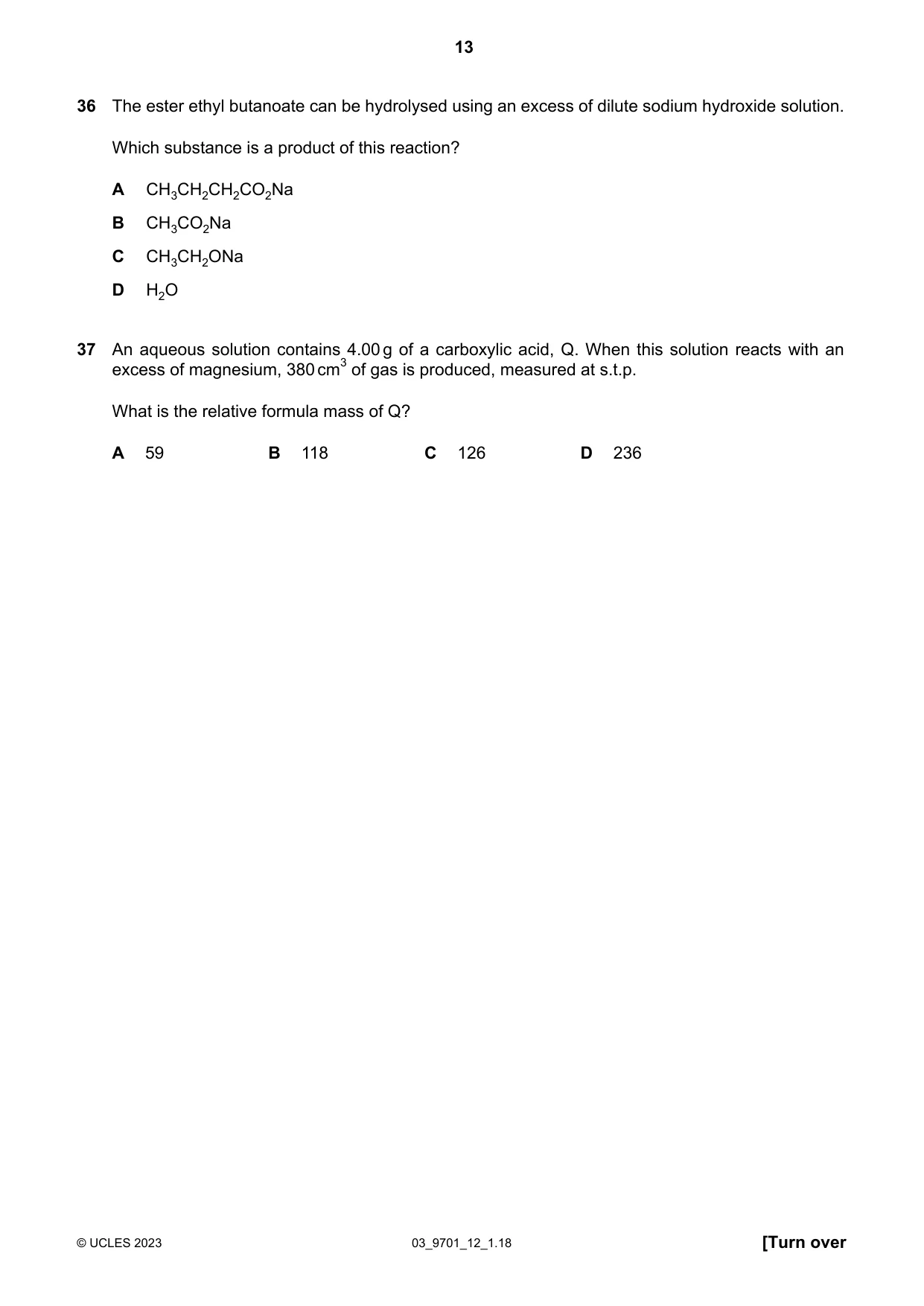
36 The ester ethyl butanoate can be hydrolysed using an excess of dilute sodium hydroxide solution. Which substance is a product of this reaction? A CH3CH2CH2CO2Na B CH3CO2Na C CH3CH2ONa D H2O
Mark scheme: A
Q37 · An aqueous solution contains 4.00g of a carboxylic acid, Q
37 An aqueous solution contains 4.00g of a carboxylic acid, Q. When this solution reacts with an excess of magnesium, 380cm3 of gas is produced, measured at s.t.p. What is the relative formula mass of Q? A 59 B 118 C 126 D 236
Mark scheme: B
More questions on Reacting masses and volumes (of solutions and gases)
Q38 · The infrared spectrum of an organic compound is shown
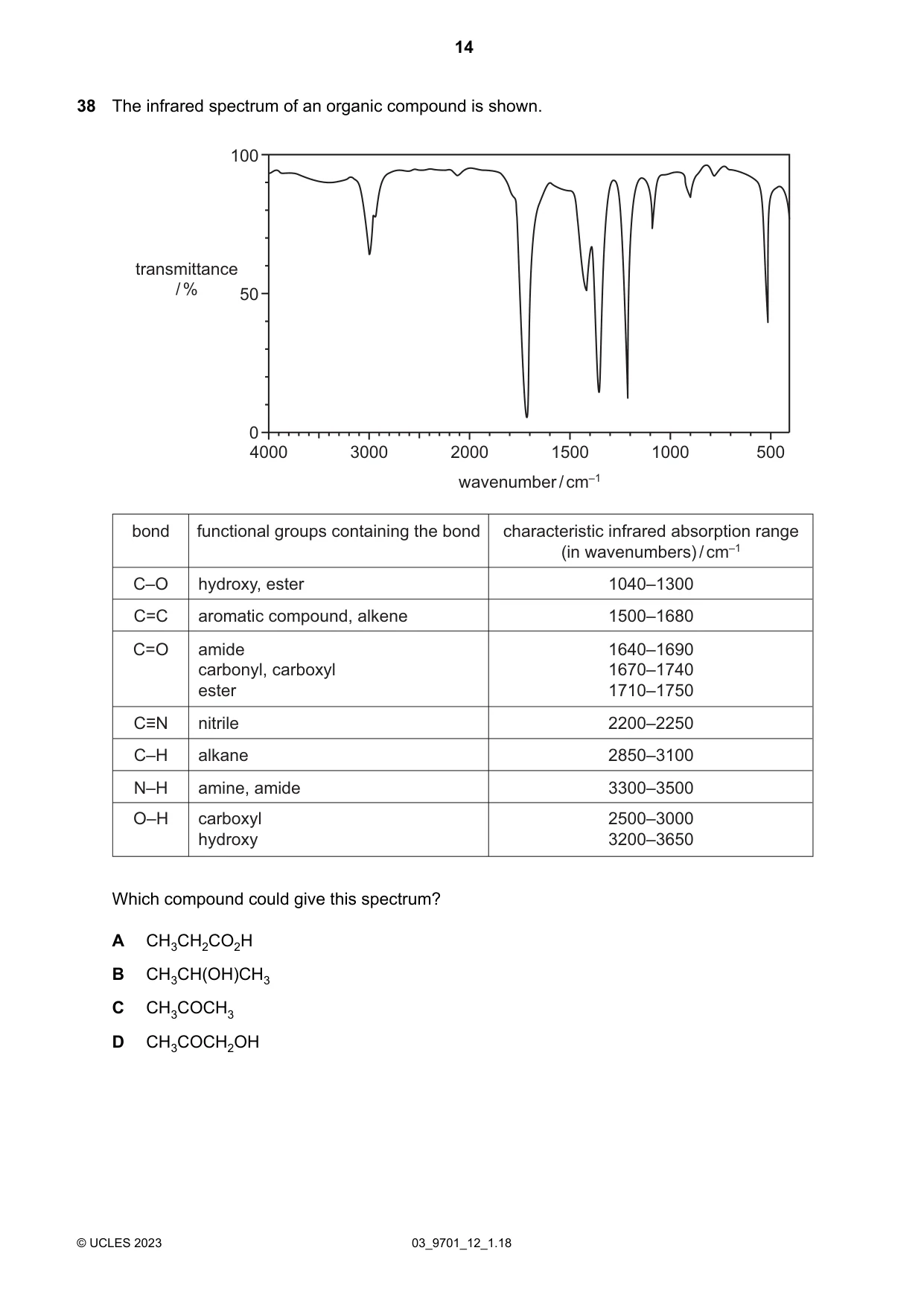
38 The infrared spectrum of an organic compound is shown. 100 transmittance / % 50 0 4000 3000 2000 1500 1000 500 wavenumber / cm–1 bond functional groups containing the bond characteristic infrared absorption range (in wavenumbers) / cm–1 C–O hydroxy, ester 1040–1300 C=C aromatic compound, alkene 1500–1680 C=O amide 1640–1690 carbonyl, carboxyl 1670–1740 ester 1710–1750 C≡N nitrile 2200–2250 C–H alkane 2850–3100 N–H amine, amide 3300–3500 O–H carboxyl 2500–3000 hydroxy 3200–3650 Which compound could give this spectrum? A CH3CH2CO2H B CH3CH(OH)CH3 C CH3COCH3 D CH3COCH2OH
Mark scheme: C
Q39 · Cyclohexa-1,4-diene is treated with a solution of bromine in tetrachloromethane in the…
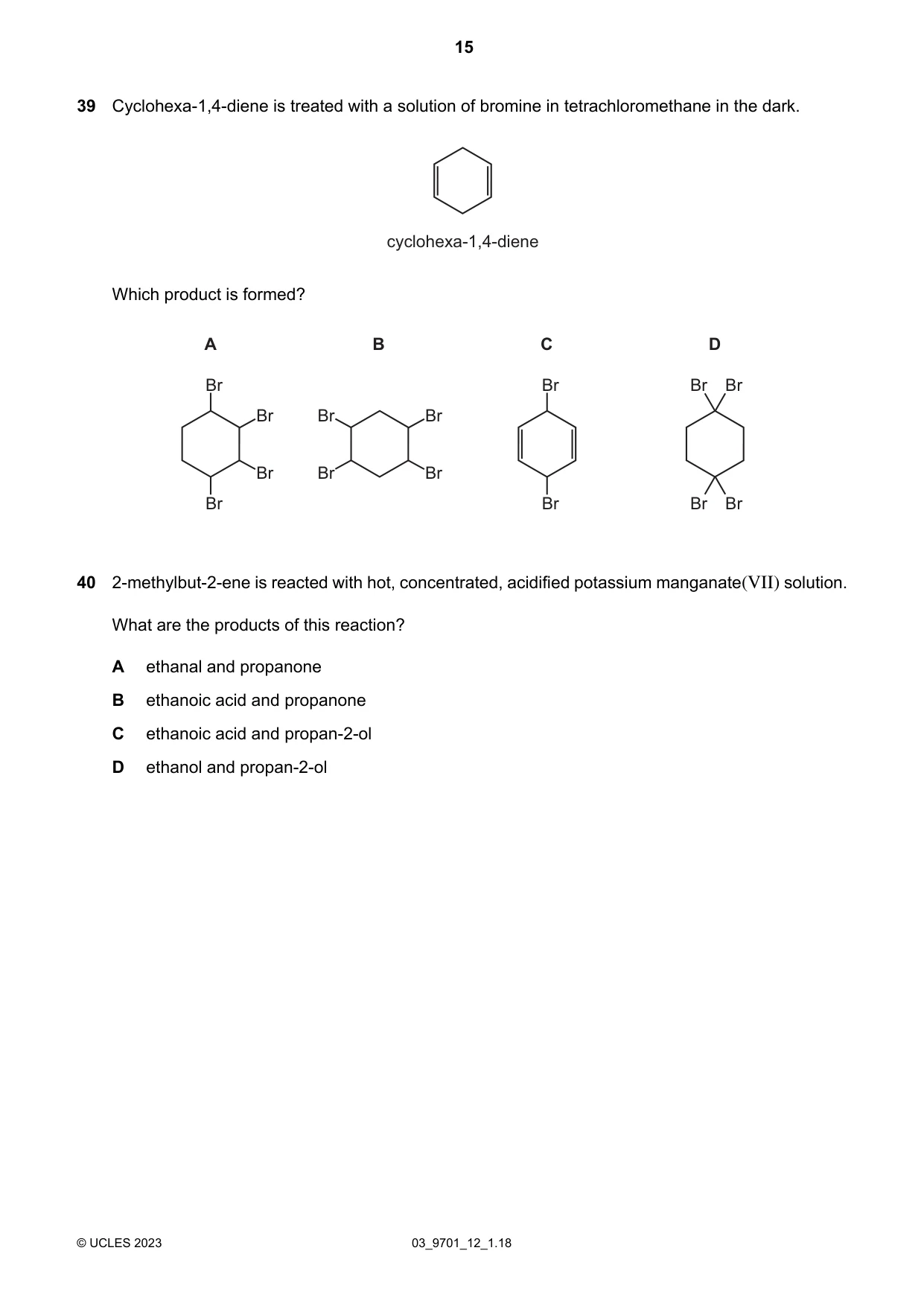
39 Cyclohexa-1,4-diene is treated with a solution of bromine in tetrachloromethane in the dark. cyclohexa-1,4-diene Which product is formed? A B C D Br Br Br Br Br Br Br Br Br Br Br Br Br Br
Mark scheme: B
Q40 · 2-methylbut-2-ene is reacted with hot, concentrated, acidified potassium manganate(VII)…
40 2-methylbut-2-ene is reacted with hot, concentrated, acidified potassium manganate(VII) solution. What are the products of this reaction? A ethanal and propanone B ethanoic acid and propanone C ethanoic acid and propan-2-ol D ethanol and propan-2-ol
Mark scheme: B
What was in this paper
The subtopics covered by these 40 questions, and how many questions each got. Open one in a new tab to see every Cambridge question on it.
3Alkenes3Redox processes: electron transfer and changes in oxidation number (oxidation state)3Chemical equilibria: reversible reactions, dynamic equilibrium2Intermolecular forces, electronegativity and bond properties2Particles in the atom and atomic radius2Reacting masses and volumes (of solutions and gases)2Similarities and trends in the properties of the Group 2 metals, magnesium to barium, and their compounds2Alcohols1Aldehydes and ketones1Bonding and structure1Effect of temperature on reaction rates and the concept of activation energy1Enthalpy change, ΔH1Esters1Formulas1Halogen compounds1Halogenoalkanes1Homogeneous and heterogeneous catalysts1Infrared spectroscopy1Ionisation energy1Isomerism: structural isomerism and stereoisomerism1Nitriles and hydroxynitriles1Nitrogen and sulfur1Periodicity of chemical properties of the elements in Period 31Rate of reaction1Shapes of molecules1Some reactions of the halide ions1The gaseous state: ideal and real gases and pV = nRT1The mole and the Avogadro constant1What you needed in this session
Cambridge’s own grade thresholds for 2023 Feb/March, Paper 1 · Variant 2. A higher threshold means an easier paper — the bar moves with how the cohort did.