Cambridge A Level Chemistry 9701 — 2020 May/June Paper 1 · Variant 2
9701/12/M/J/20 · 40 questions · 40 marks · ≈45 min
The question paper and its mark scheme, free to read here and free to download. This is Cambridge’s own paper, exactly as it was sat.
Question paper16 pages
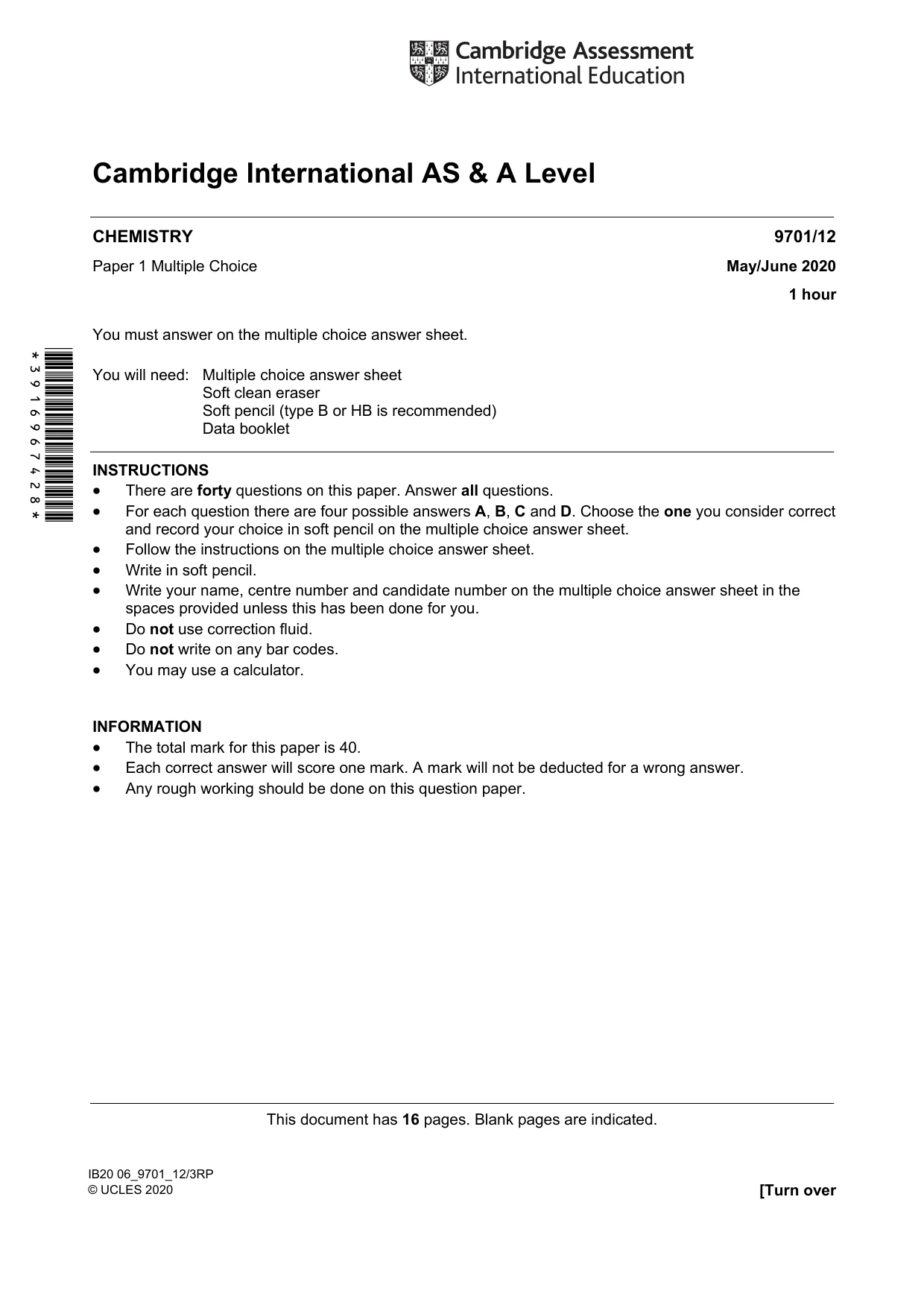
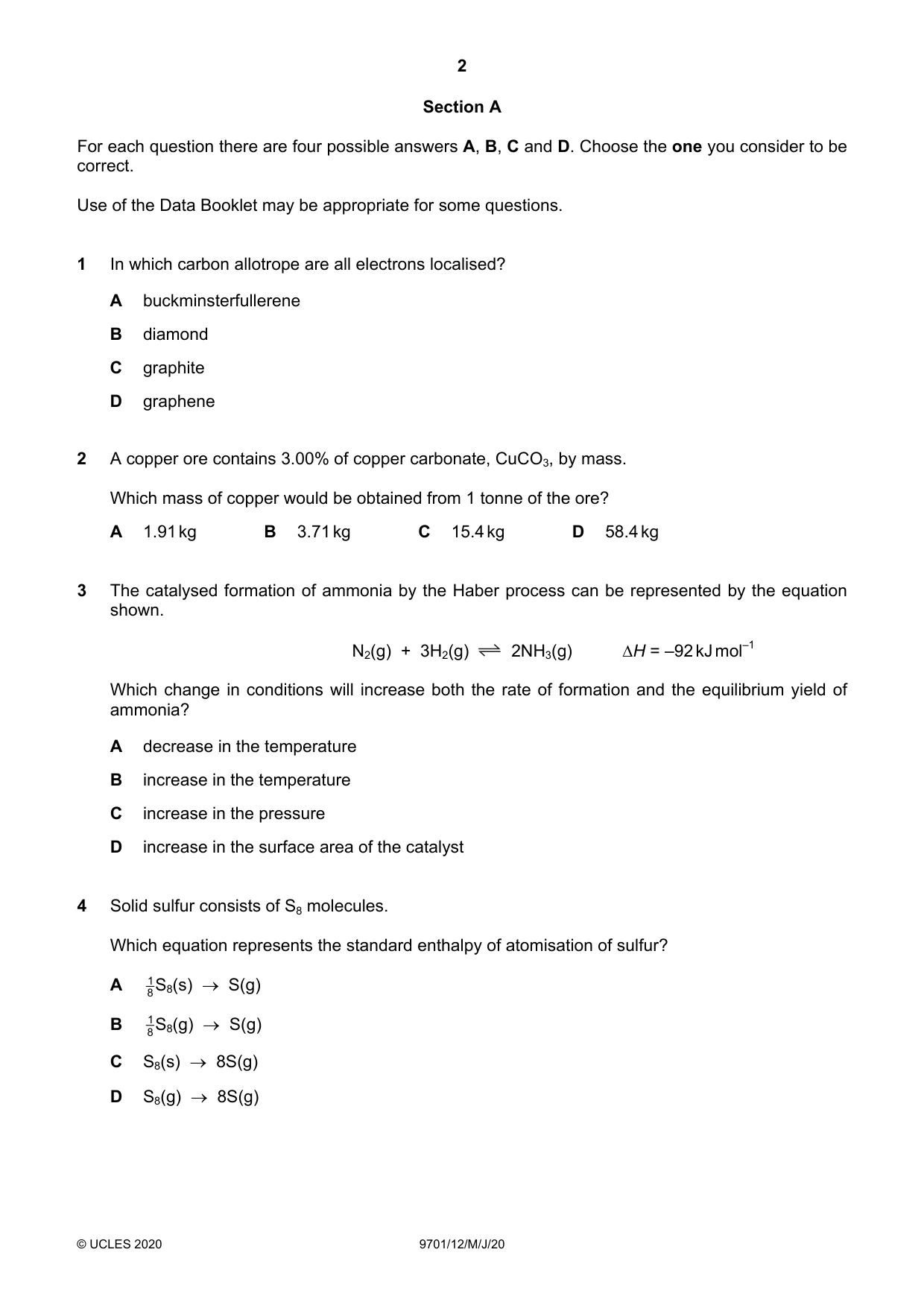
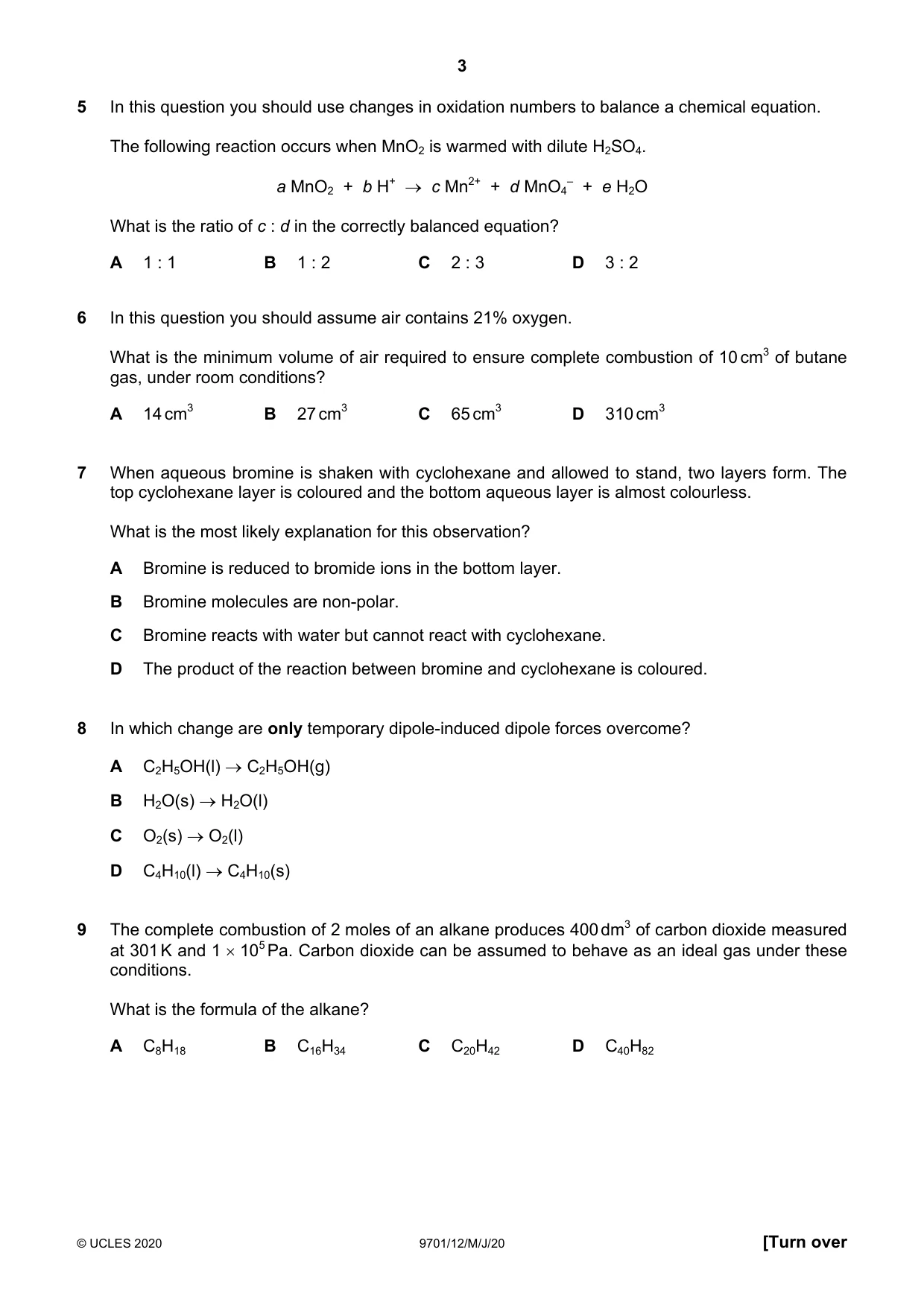
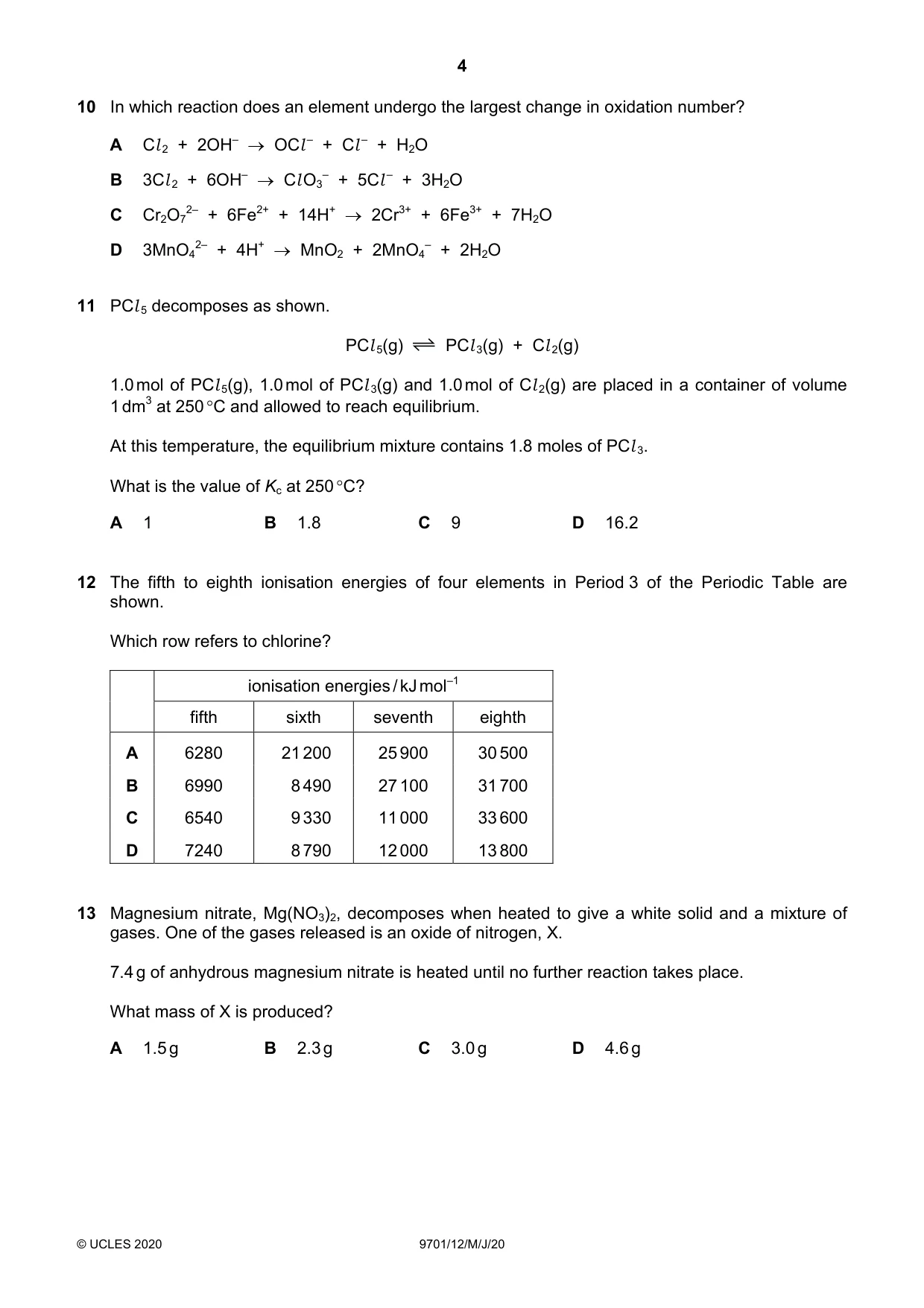

Mark scheme3 pages
Answers below. Sit the paper first if you are practising.
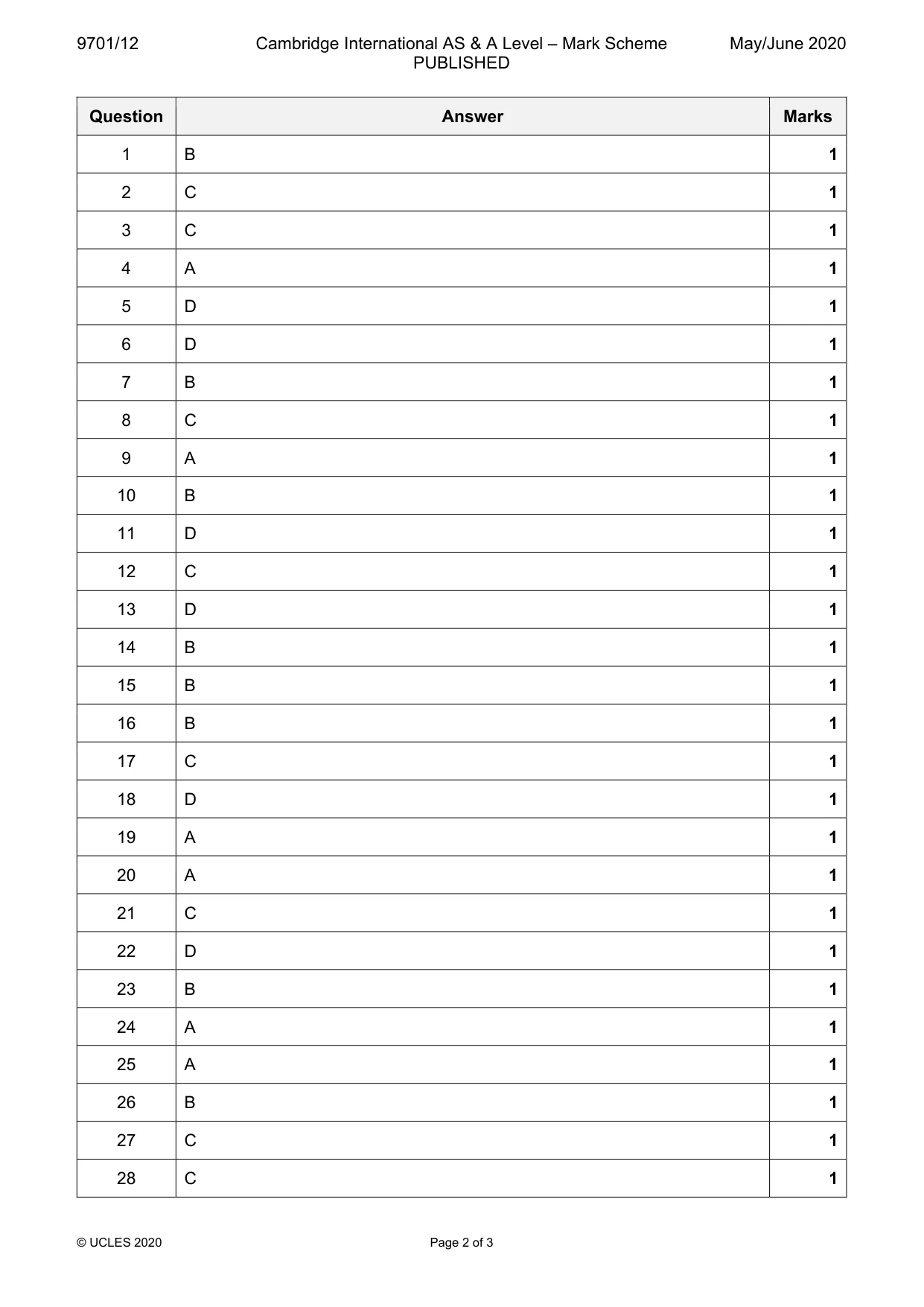
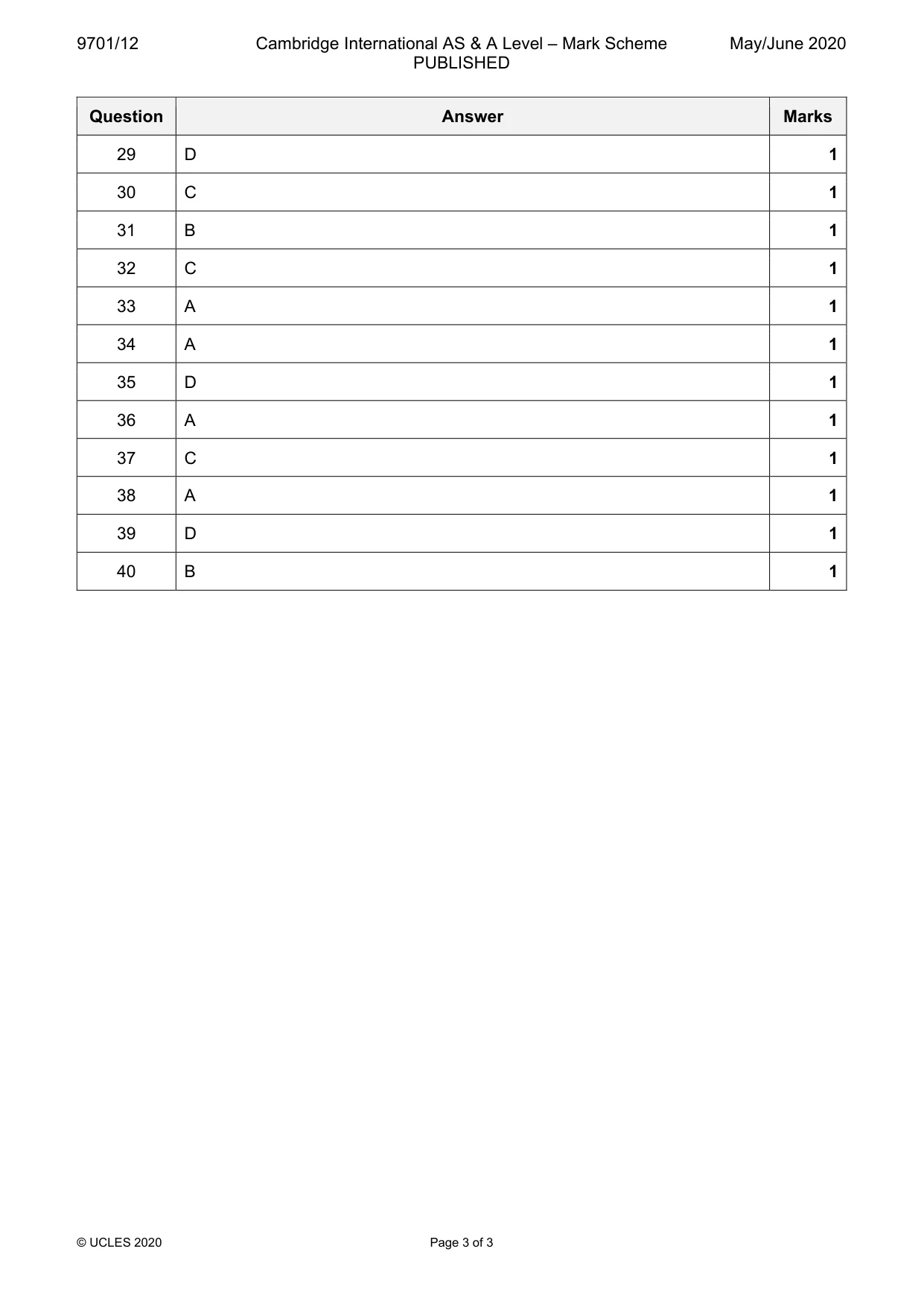
Questions as text
Q1 · In which carbon allotrope are all electrons localised?
1 In which carbon allotrope are all electrons localised? A buckminsterfullerene B diamond C graphite D graphene
Mark scheme: B
Q2 · A copper ore contains 3.00% of copper carbonate, CuCO3, by mass
2 A copper ore contains 3.00% of copper carbonate, CuCO3, by mass. Which mass of copper would be obtained from 1 tonne of the ore? A 1.91 kg B 3.71 kg C 15.4 kg D 58.4 kg
Mark scheme: C
More questions on Reacting masses and volumes (of solutions and gases)
Q3 · The catalysed formation of ammonia by the Haber process can be represented by the…
3 The catalysed formation of ammonia by the Haber process can be represented by the equation shown. N2(g) + 3H2(g) 2NH3(g) ∆H = –92 kJ mol–1 Which change in conditions will increase both the rate of formation and the equilibrium yield of ammonia? A decrease in the temperature B increase in the temperature C increase in the pressure D increase in the surface area of the catalyst
Mark scheme: C
More questions on Chemical equilibria: reversible reactions, dynamic equilibrium
Q4 · Solid sulfur consists of S8 molecules
4 Solid sulfur consists of S8 molecules. Which equation represents the standard enthalpy of atomisation of sulfur? A 1S8(s) → S(g) 8 B 1S8(g) → S(g) 8 C S8(s) → 8S(g) D S8(g) → 8S(g)
Mark scheme: A
Q5 · In this question you should use changes in oxidation numbers to balance a chemical…
5 In this question you should use changes in oxidation numbers to balance a chemical equation. The following reaction occurs when MnO2 is warmed with dilute H2SO4. a MnO2 + b H+ → c Mn2+ + d MnO4 – + e H2O What is the ratio of c : d in the correctly balanced equation? A 1 : 1 B 1 : 2 C 2 : 3 D 3 : 2
Mark scheme: D
Q6 · In this question you should assume air contains 21% oxygen
6 In this question you should assume air contains 21% oxygen. What is the minimum volume of air required to ensure complete combustion of 10 cm3 of butane gas, under room conditions? A 14 cm3 B 27 cm3 C 65 cm3 D 310 cm3
Mark scheme: D
More questions on Reacting masses and volumes (of solutions and gases)
Q7 · When aqueous bromine is shaken with cyclohexane and allowed to stand, two layers form
7 When aqueous bromine is shaken with cyclohexane and allowed to stand, two layers form. The top cyclohexane layer is coloured and the bottom aqueous layer is almost colourless. What is the most likely explanation for this observation? A Bromine is reduced to bromide ions in the bottom layer. B Bromine molecules are non-polar. C Bromine reacts with water but cannot react with cyclohexane. D The product of the reaction between bromine and cyclohexane is coloured.
Mark scheme: B
More questions on Intermolecular forces, electronegativity and bond properties
Q8 · In which change are only temporary dipole-induced dipole forces overcome?
8 In which change are only temporary dipole-induced dipole forces overcome? A C2H5OH(l) → C2H5OH(g) B H2O(s) → H2O(l) C O2(s) → O2(l) D C4H10(l) → C4H10(s)
Mark scheme: C
More questions on Intermolecular forces, electronegativity and bond properties
Q9 · The complete combustion of 2 moles of an alkane produces 400 dm3 of carbon dioxide…
9 The complete combustion of 2 moles of an alkane produces 400 dm3 of carbon dioxide measured at 301 K and 1 × 10⁵ Pa. Carbon dioxide can be assumed to behave as an ideal gas under these conditions. What is the formula of the alkane? A C8H18 B C16H34 C C20H42 D C40H82
Mark scheme: A
More questions on The gaseous state: ideal and real gases and pV = nRT
Q10 · In which reaction does an element undergo the largest change in oxidation number?
10 In which reaction does an element undergo the largest change in oxidation number? A Cl 2 + 2OH– → OCl – + Cl – + H2O B 3Cl 2 + 6OH– → Cl O3 – + 5Cl – + 3H2O C Cr2O7 2– + 6Fe2+ + 14H+ → 2Cr3+ + 6Fe3+ + 7H2O D 3MnO4 2– + 4H+ → MnO2 + 2MnO4 – + 2H2O
Mark scheme: B
Q11 · PCl 5 decomposes as shown
11 PCl 5 decomposes as shown. PCl 5(g) PCl 3(g) + Cl 2(g) 1.0 mol of PCl 5(g), 1.0 mol of PCl 3(g) and 1.0 mol of Cl 2(g) are placed in a container of volume 1 dm3 at 250 °C and allowed to reach equilibrium. At this temperature, the equilibrium mixture contains 1.8 moles of PCl 3. What is the value of Kc at 250 °C? A 1 B 1.8 C 9 D 16.2
Mark scheme: D
More questions on Chemical equilibria: reversible reactions, dynamic equilibrium
Q12 · The fifth to eighth ionisation energies of four elements in Period 3 of the Periodic…
12 The fifth to eighth ionisation energies of four elements in Period 3 of the Periodic Table are shown. Which row refers to chlorine? ionisation energies / kJ mol–1 fifth sixth seventh eighth A 6280 21 200 25 900 30 500 B 6990 8 490 27 100 31 700 C 6540 9 330 11 000 33 600 D 7240 8 790 12 000 13 800
Mark scheme: C
Q13 · Magnesium nitrate, Mg(NO3)2, decomposes when heated to give a white solid and a mixture…
13 Magnesium nitrate, Mg(NO3)2, decomposes when heated to give a white solid and a mixture of gases. One of the gases released is an oxide of nitrogen, X. 7.4 g of anhydrous magnesium nitrate is heated until no further reaction takes place. What mass of X is produced? A 1.5 g B 2.3 g C 3.0 g D 4.6 g
Mark scheme: D
More questions on Reacting masses and volumes (of solutions and gases)
Q14 · Which statement explains why iodine is less volatile than chlorine?
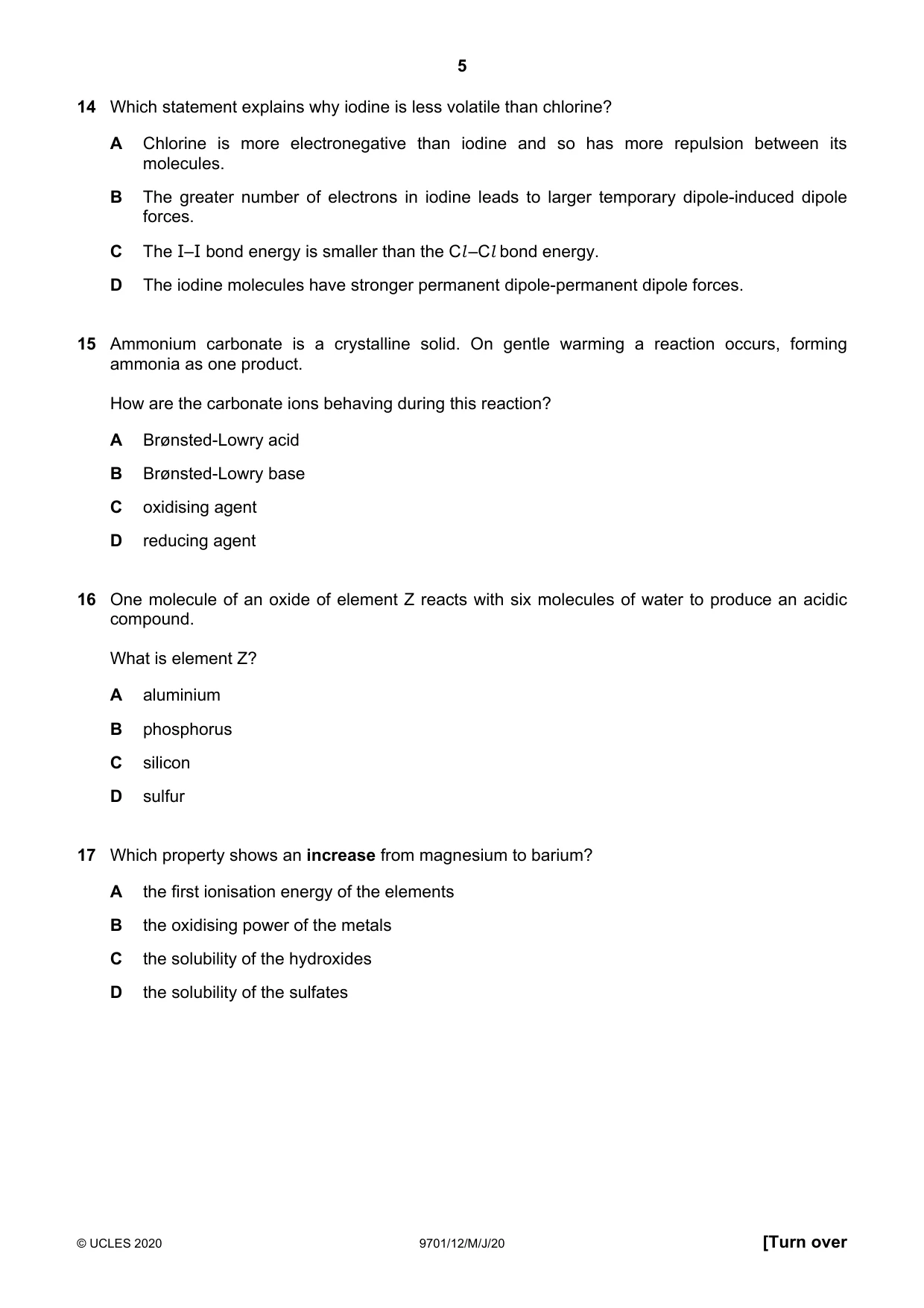
14 Which statement explains why iodine is less volatile than chlorine? A Chlorine is more electronegative than iodine and so has more repulsion between its molecules. B The greater number of electrons in iodine leads to larger temporary dipole-induced dipole forces. C The I–I bond energy is smaller than the Cl –Cl bond energy. D The iodine molecules have stronger permanent dipole-permanent dipole forces.
Mark scheme: B
More questions on Intermolecular forces, electronegativity and bond properties
Q15 · Ammonium carbonate is a crystalline solid
15 Ammonium carbonate is a crystalline solid. On gentle warming a reaction occurs, forming ammonia as one product. How are the carbonate ions behaving during this reaction? A Brønsted-Lowry acid B Brønsted-Lowry base C oxidising agent D reducing agent
Mark scheme: B
Q16 · One molecule of an oxide of element Z reacts with six molecules of water to produce an…
16 One molecule of an oxide of element Z reacts with six molecules of water to produce an acidic compound. What is element Z? A aluminium B phosphorus C silicon D sulfur
Mark scheme: B
More questions on Periodicity of chemical properties of the elements in Period 3
Q17 · Which property shows an increase from magnesium to barium?
17 Which property shows an increase from magnesium to barium? A the first ionisation energy of the elements B the oxidising power of the metals C the solubility of the hydroxides D the solubility of the sulfates
Mark scheme: C
Q18 · A test-tube of HBr(g) and a separate test-tube of HI(g) are heated to the same temperature
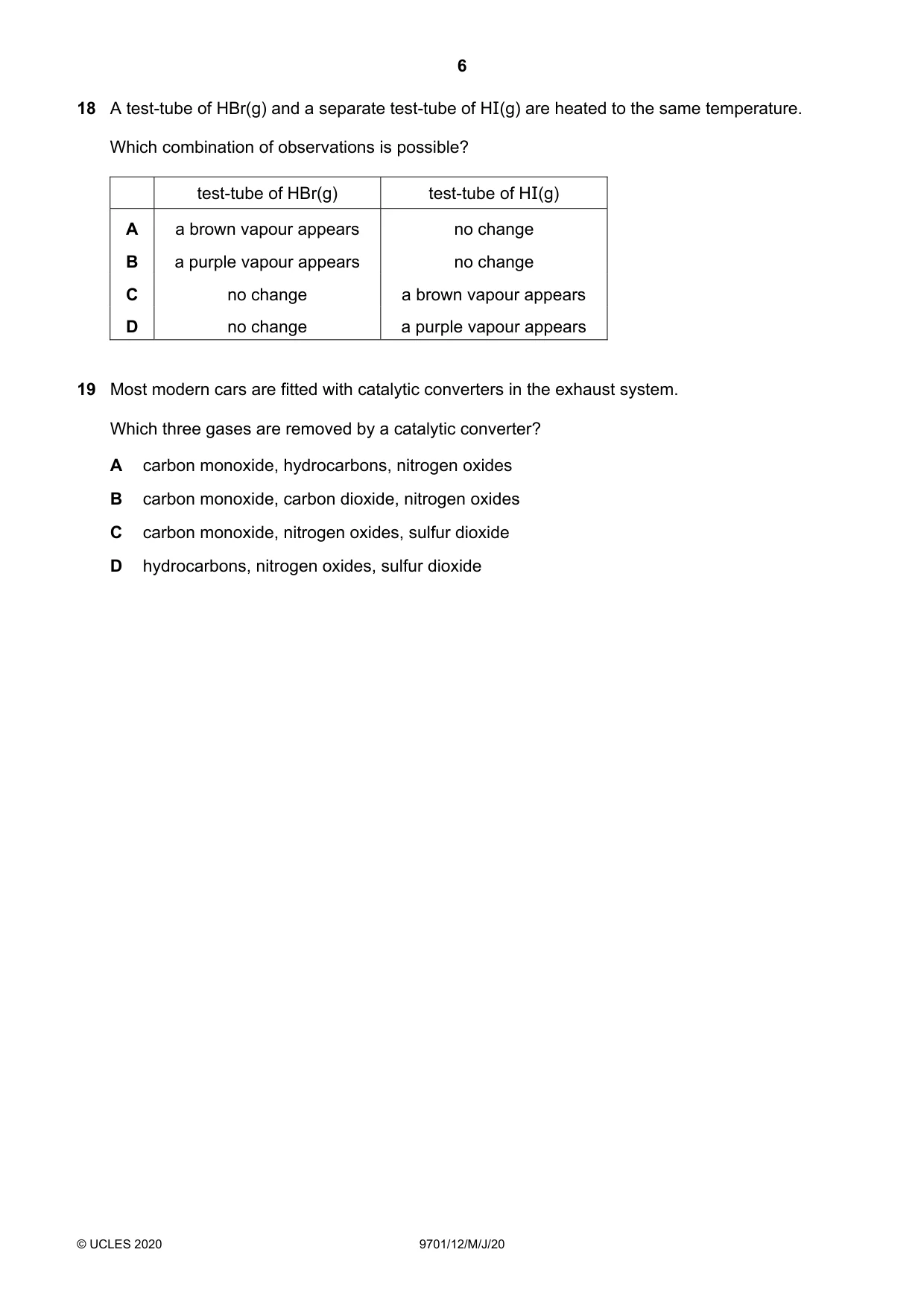
18 A test-tube of HBr(g) and a separate test-tube of HI(g) are heated to the same temperature. Which combination of observations is possible? test-tube of HBr(g) test-tube of HI(g) A a brown vapour appears no change B a purple vapour appears no change C no change a brown vapour appears D no change a purple vapour appears
Mark scheme: D
More questions on The chemical properties of the halogen elements and the hydrogen halides
Q19 · Most modern cars are fitted with catalytic converters in the exhaust system
19 Most modern cars are fitted with catalytic converters in the exhaust system. Which three gases are removed by a catalytic converter? A carbon monoxide, hydrocarbons, nitrogen oxides B carbon monoxide, carbon dioxide, nitrogen oxides C carbon monoxide, nitrogen oxides, sulfur dioxide D hydrocarbons, nitrogen oxides, sulfur dioxide
Mark scheme: A
Q20 · Compound X is shown
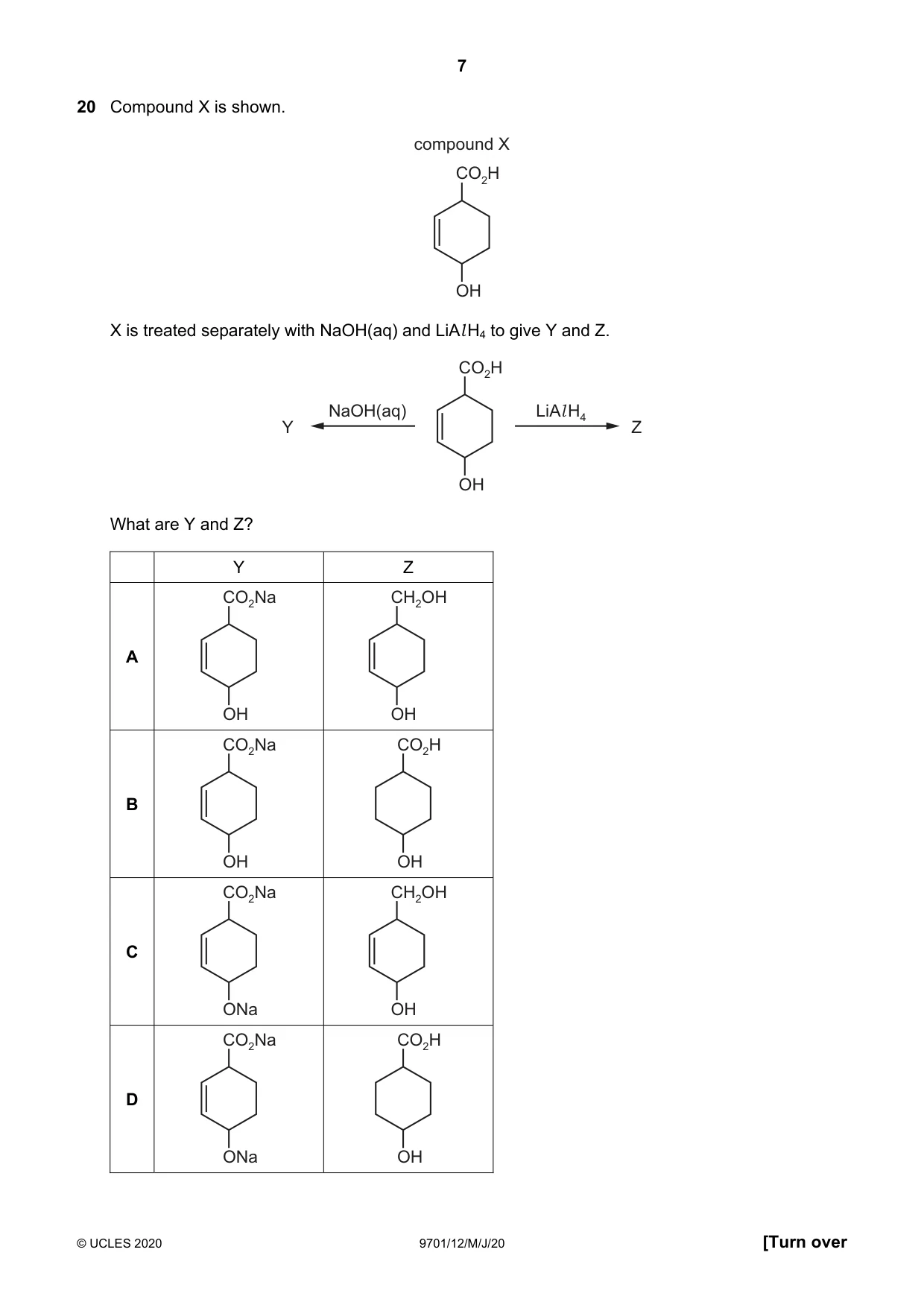
20 Compound X is shown. compound X CO2H OH X is treated separately with NaOH(aq) and LiAl H4 to give Y and Z. CO2H NaOH(aq) LiAl H4 Y Z OH What are Y and Z? Y Z CO2Na CH2OH A OH OH CO2Na CO2H B OH OH CO2Na CH2OH C ONa OH CO2Na CO2H D ONa OH
Mark scheme: A
Q21 · The table shows the molecular formulae of three molecules P, Q and R
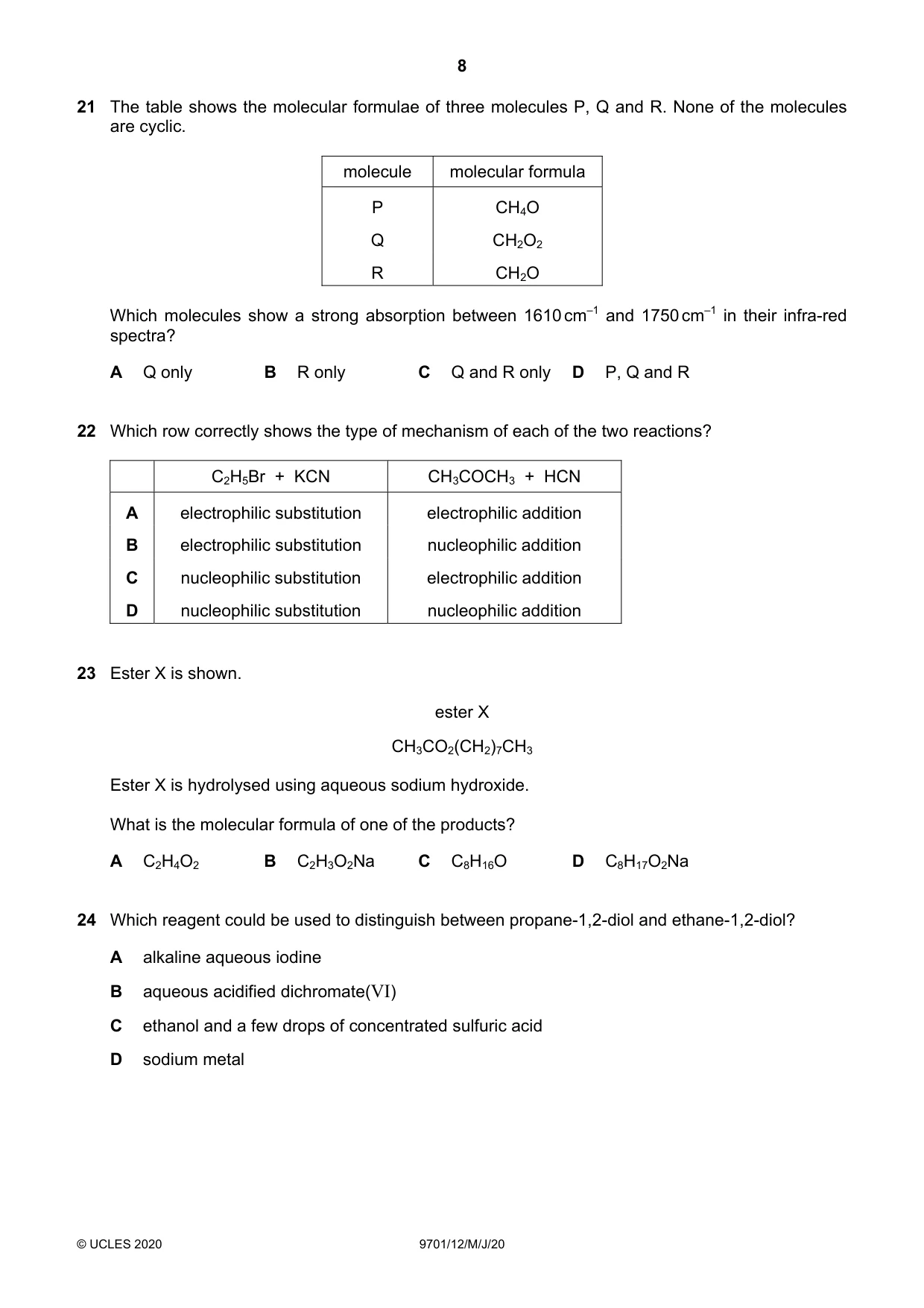
21 The table shows the molecular formulae of three molecules P, Q and R. None of the molecules are cyclic. molecule molecular formula P CH4O Q CH2O2 R CH2O Which molecules show a strong absorption between 1610 cm–1 and 1750 cm–1 in their infra-red spectra? A Q only B R only C Q and R only D P, Q and R
Mark scheme: C
Q22 · Which row correctly shows the type of mechanism of each of the two reactions?
22 Which row correctly shows the type of mechanism of each of the two reactions? C2H5Br + KCN CH3COCH3 + HCN A electrophilic substitution electrophilic addition B electrophilic substitution nucleophilic addition C nucleophilic substitution electrophilic addition D nucleophilic substitution nucleophilic addition
Mark scheme: D
Q23 · Ester X is shown
23 Ester X is shown. ester X CH3CO2(CH2)7CH3 Ester X is hydrolysed using aqueous sodium hydroxide. What is the molecular formula of one of the products? A C2H4O2 B C2H3O2Na C C8H16O D C8H17O2Na
Mark scheme: B
Q24 · Which reagent could be used to distinguish between propane-1,2-diol and ethane-1,2-diol?
24 Which reagent could be used to distinguish between propane-1,2-diol and ethane-1,2-diol? A alkaline aqueous iodine B aqueous acidified dichromate(VI) C ethanol and a few drops of concentrated sulfuric acid D sodium metal
Mark scheme: A
Q25 · Which substance forms propanoic acid as one of the products when it reacts with hot…
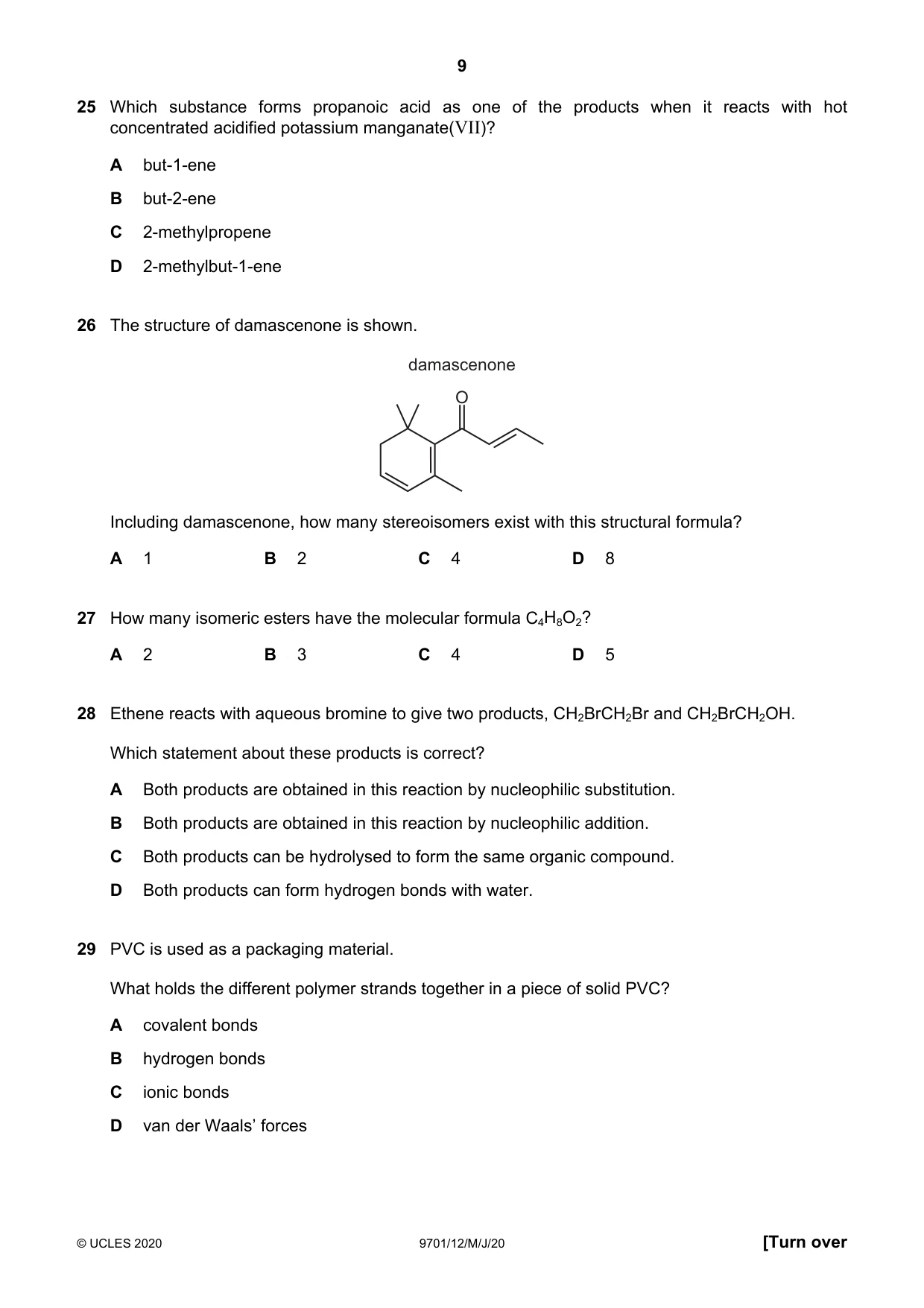
25 Which substance forms propanoic acid as one of the products when it reacts with hot concentrated acidified potassium manganate(VII)? A but-1-ene B but-2-ene C 2-methylpropene D 2-methylbut-1-ene
Mark scheme: A
Q26 · The structure of damascenone is shown
26 The structure of damascenone is shown. damascenone O Including damascenone, how many stereoisomers exist with this structural formula? A 1 B 2 C 4 D 8
Mark scheme: B
More questions on Isomerism: structural isomerism and stereoisomerism
Q27 · How many isomeric esters have the molecular formula C4H8O2?
27 How many isomeric esters have the molecular formula C4H8O2? A 2 B 3 C 4 D 5
Mark scheme: C
More questions on Isomerism: structural isomerism and stereoisomerism
Q28 · Ethene reacts with aqueous bromine to give two products, CH2BrCH2Br and CH2BrCH2OH
28 Ethene reacts with aqueous bromine to give two products, CH2BrCH2Br and CH2BrCH2OH. Which statement about these products is correct? A Both products are obtained in this reaction by nucleophilic substitution. B Both products are obtained in this reaction by nucleophilic addition. C Both products can be hydrolysed to form the same organic compound. D Both products can form hydrogen bonds with water.
Mark scheme: C
Q29 · PVC is used as a packaging material
29 PVC is used as a packaging material. What holds the different polymer strands together in a piece of solid PVC? A covalent bonds B hydrogen bonds C ionic bonds D van der Waals’ forces
Mark scheme: D
More questions on Intermolecular forces, electronegativity and bond properties
Q30 · The diagram shows the structure of buta-1,3-diene
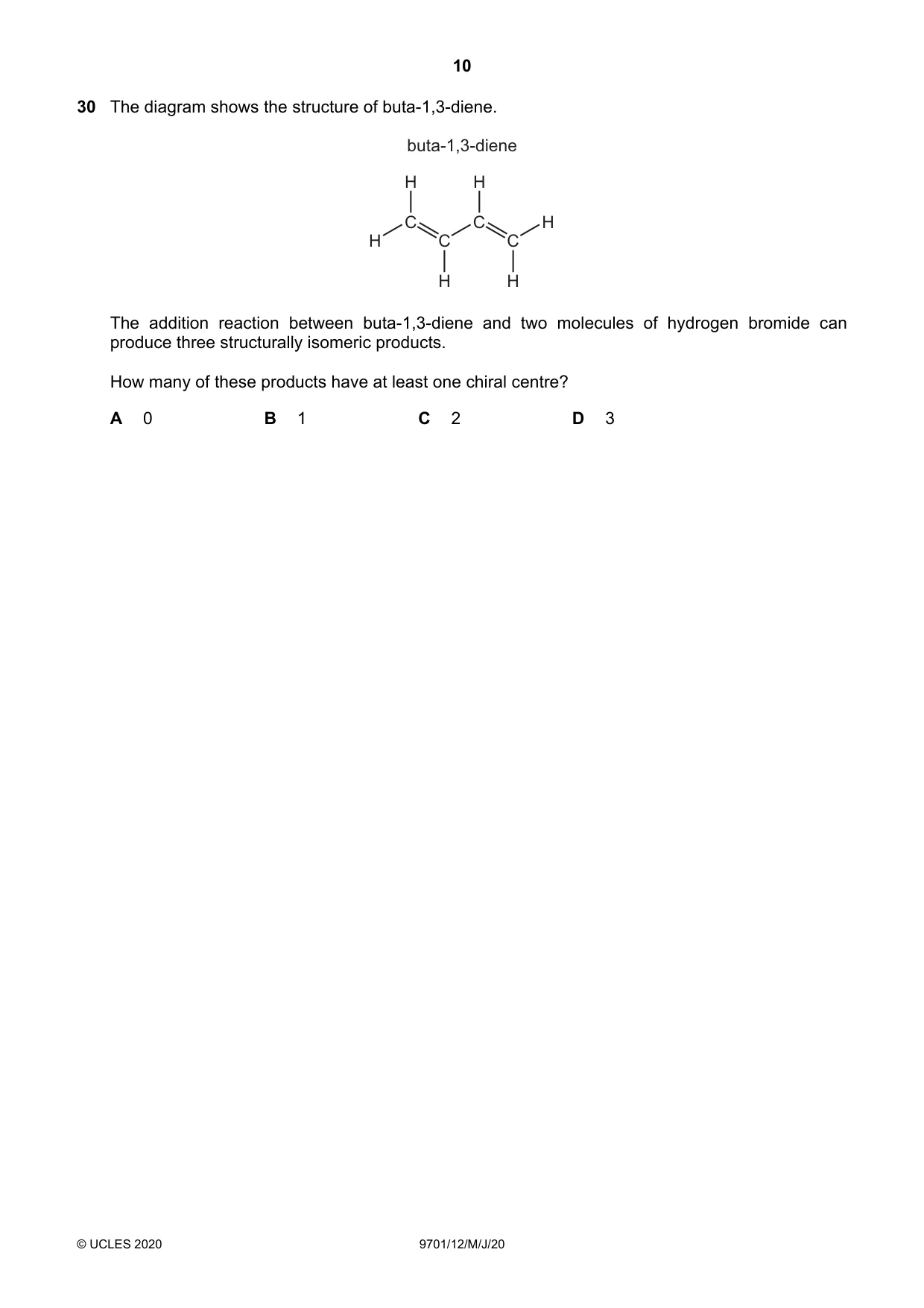
30 The diagram shows the structure of buta-1,3-diene. buta-1,3-diene H H C C H H C C H H The addition reaction between buta-1,3-diene and two molecules of hydrogen bromide can produce three structurally isomeric products. How many of these products have at least one chiral centre? A 0 B 1 C 2 D 3
Mark scheme: C
Q31 · Scientists are trying to synthesise a new element with proton number 119
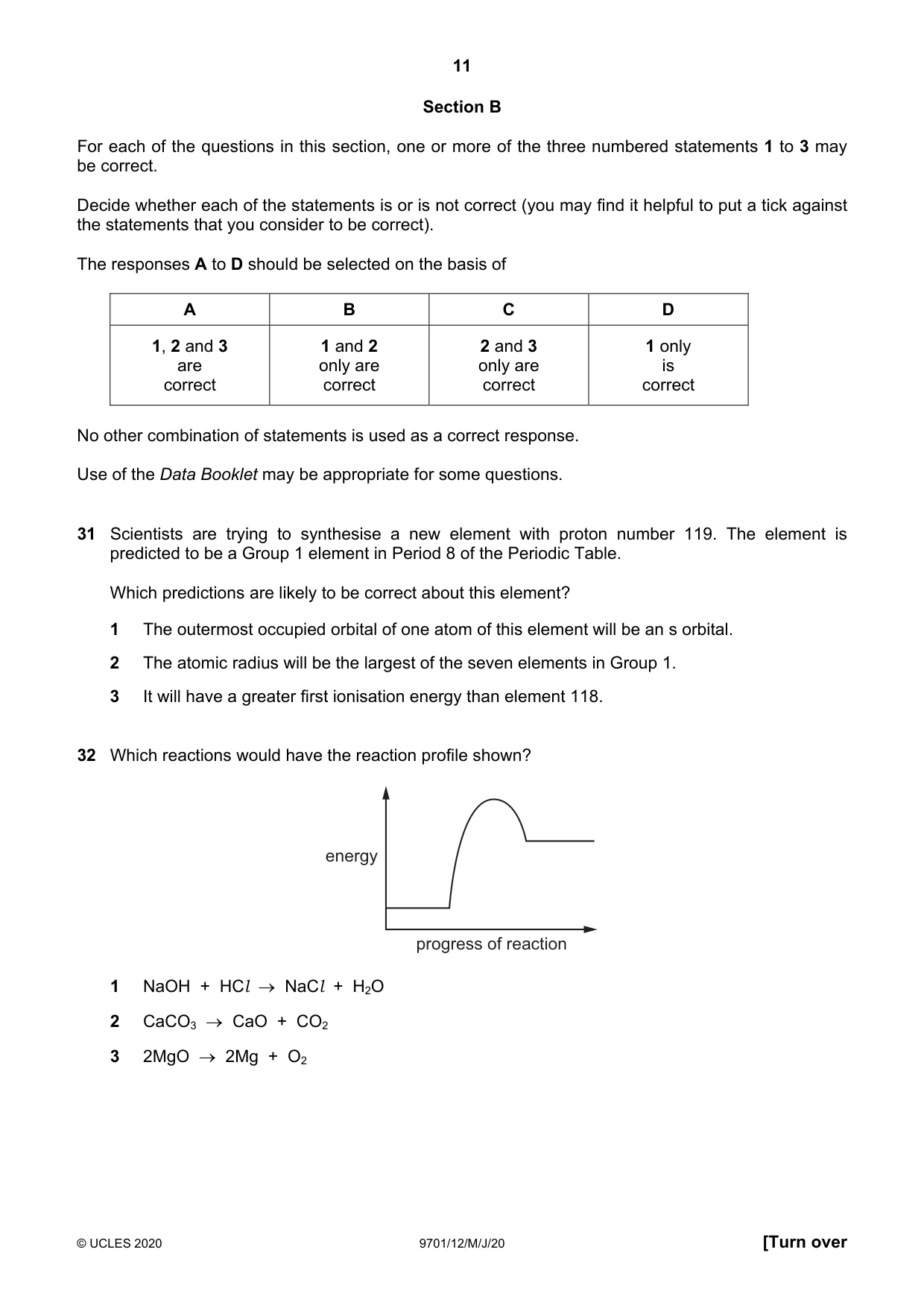
31 Scientists are trying to synthesise a new element with proton number 119. The element is predicted to be a Group 1 element in Period 8 of the Periodic Table. Which predictions are likely to be correct about this element? 1 The outermost occupied orbital of one atom of this element will be an s orbital. 2 The atomic radius will be the largest of the seven elements in Group 1. 3 It will have a greater first ionisation energy than element 118.
Mark scheme: B
Q32 · Which reactions would have the reaction profile shown?
32 Which reactions would have the reaction profile shown? energy progress of reaction 1 NaOH + HCl → NaCl + H2O 2 CaCO3 → CaO + CO2 3 2MgO → 2Mg + O2
Mark scheme: C
Q33 · Which factors can lead to an increase in the rate of a reaction?
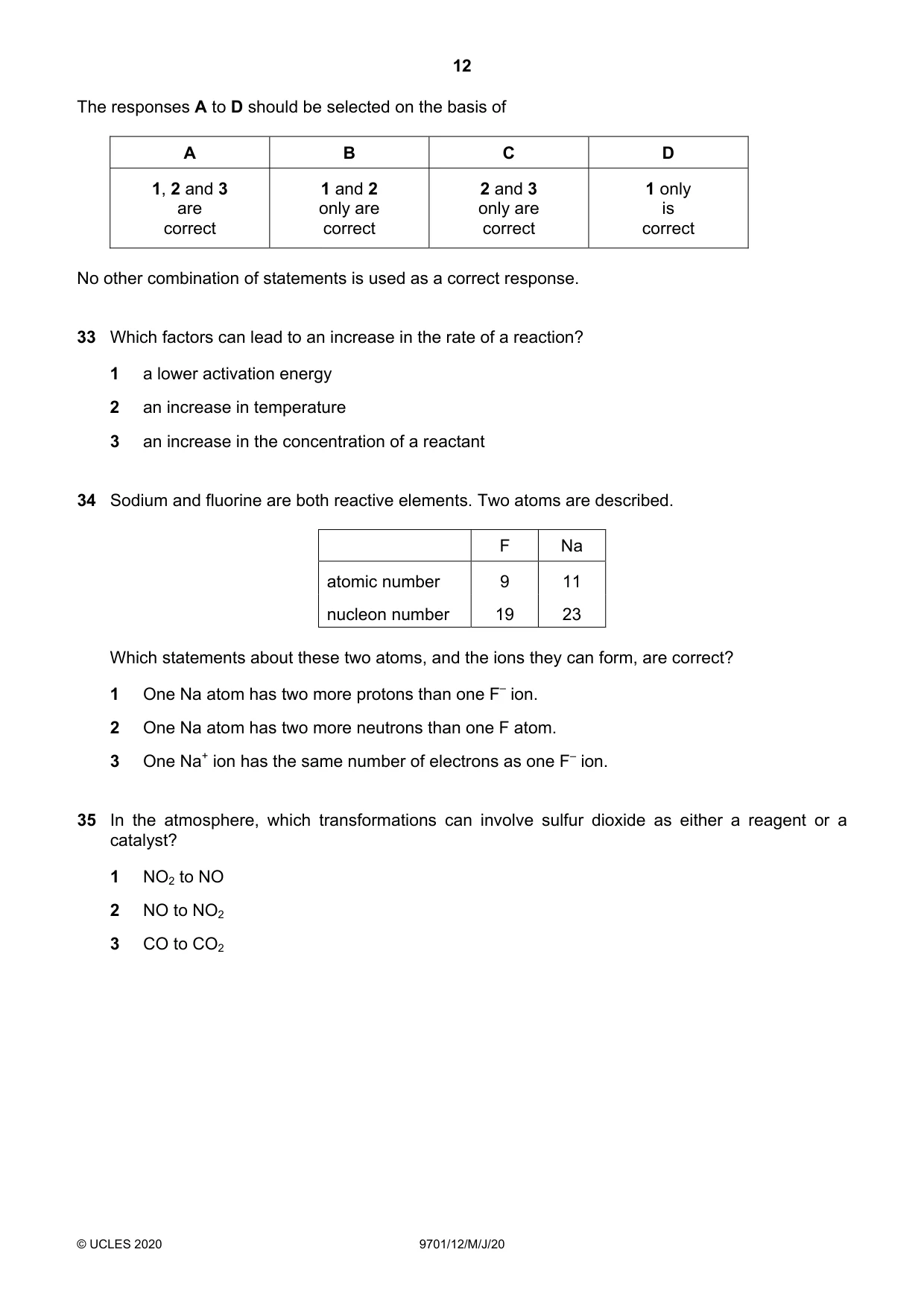
33 Which factors can lead to an increase in the rate of a reaction? 1 a lower activation energy 2 an increase in temperature 3 an increase in the concentration of a reactant
Mark scheme: A
Q34 · Sodium and fluorine are both reactive elements
34 Sodium and fluorine are both reactive elements. Two atoms are described. F Na atomic number 9 11 nucleon number 19 23 Which statements about these two atoms, and the ions they can form, are correct? 1 One Na atom has two more protons than one F– ion. 2 One Na atom has two more neutrons than one F atom. 3 One Na+ ion has the same number of electrons as one F– ion.
Mark scheme: A
Q35 · In the atmosphere, which transformations can involve sulfur dioxide as either a reagent…
35 In the atmosphere, which transformations can involve sulfur dioxide as either a reagent or a catalyst? 1 NO2 to NO 2 NO to NO2 3 CO to CO2
Mark scheme: D
Question 36
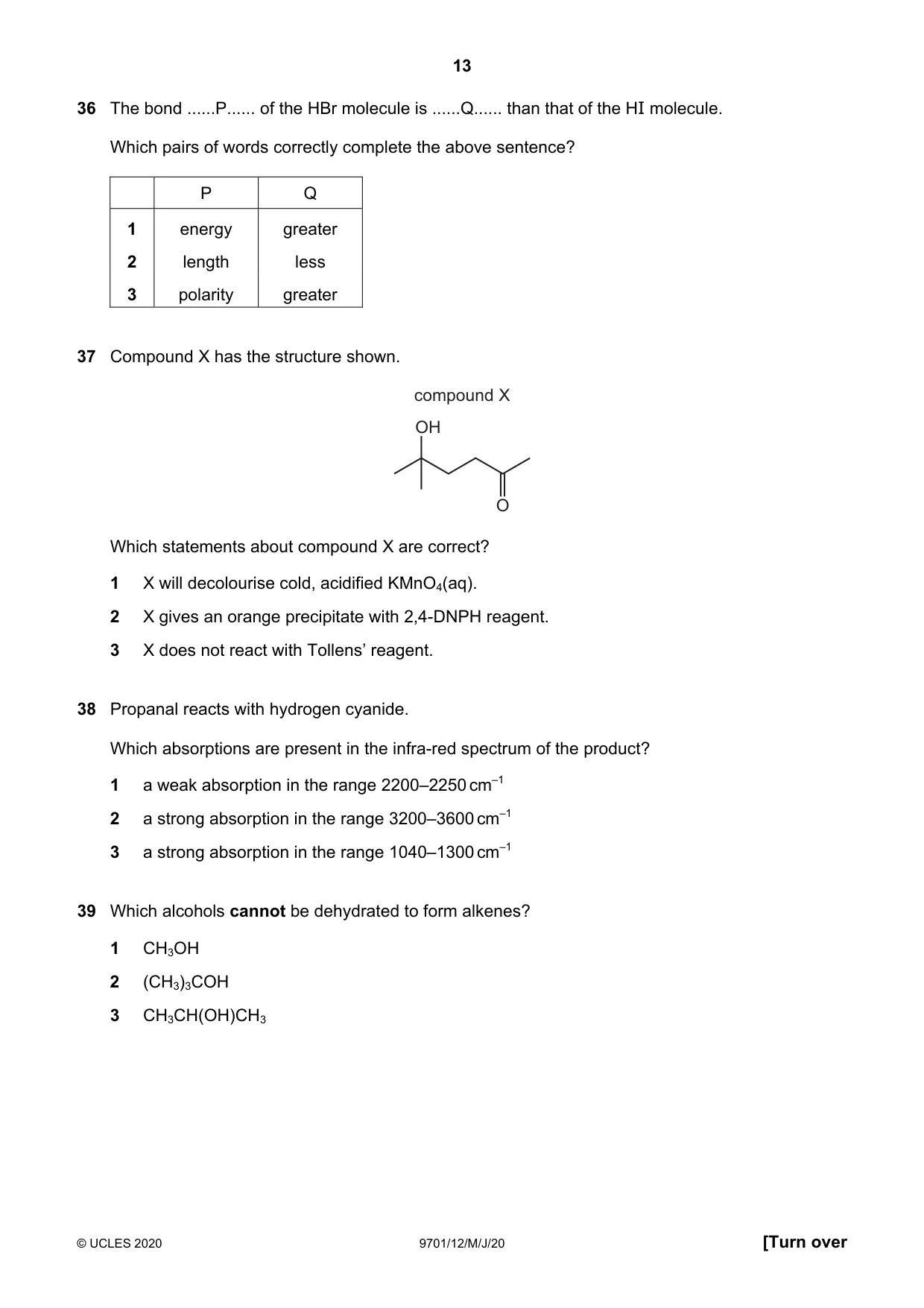
36 The bond ......P...... of the HBr molecule is ......Q...... than that of the HI molecule. Which pairs of words correctly complete the above sentence? P Q 1 energy greater 2 length less 3 polarity greater
Mark scheme: A
More questions on The chemical properties of the halogen elements and the hydrogen halides
Q37 · Compound X has the structure shown
37 Compound X has the structure shown. compound X OH O Which statements about compound X are correct? 1 X will decolourise cold, acidified KMnO4(aq). 2 X gives an orange precipitate with 2,4-DNPH reagent. 3 X does not react with Tollens’ reagent.
Mark scheme: C
Q38 · Propanal reacts with hydrogen cyanide
38 Propanal reacts with hydrogen cyanide. Which absorptions are present in the infra-red spectrum of the product? 1 a weak absorption in the range 2200–2250 cm–1 2 a strong absorption in the range 3200–3600 cm–1 3 a strong absorption in the range 1040–1300 cm–1
Mark scheme: A
Q39 · Which alcohols cannot be dehydrated to form alkenes?
39 Which alcohols cannot be dehydrated to form alkenes? 1 CH3OH 2 (CH3)3COH 3 CH3CH(OH)CH3
Mark scheme: D
Q40 · A reaction mechanism is shown
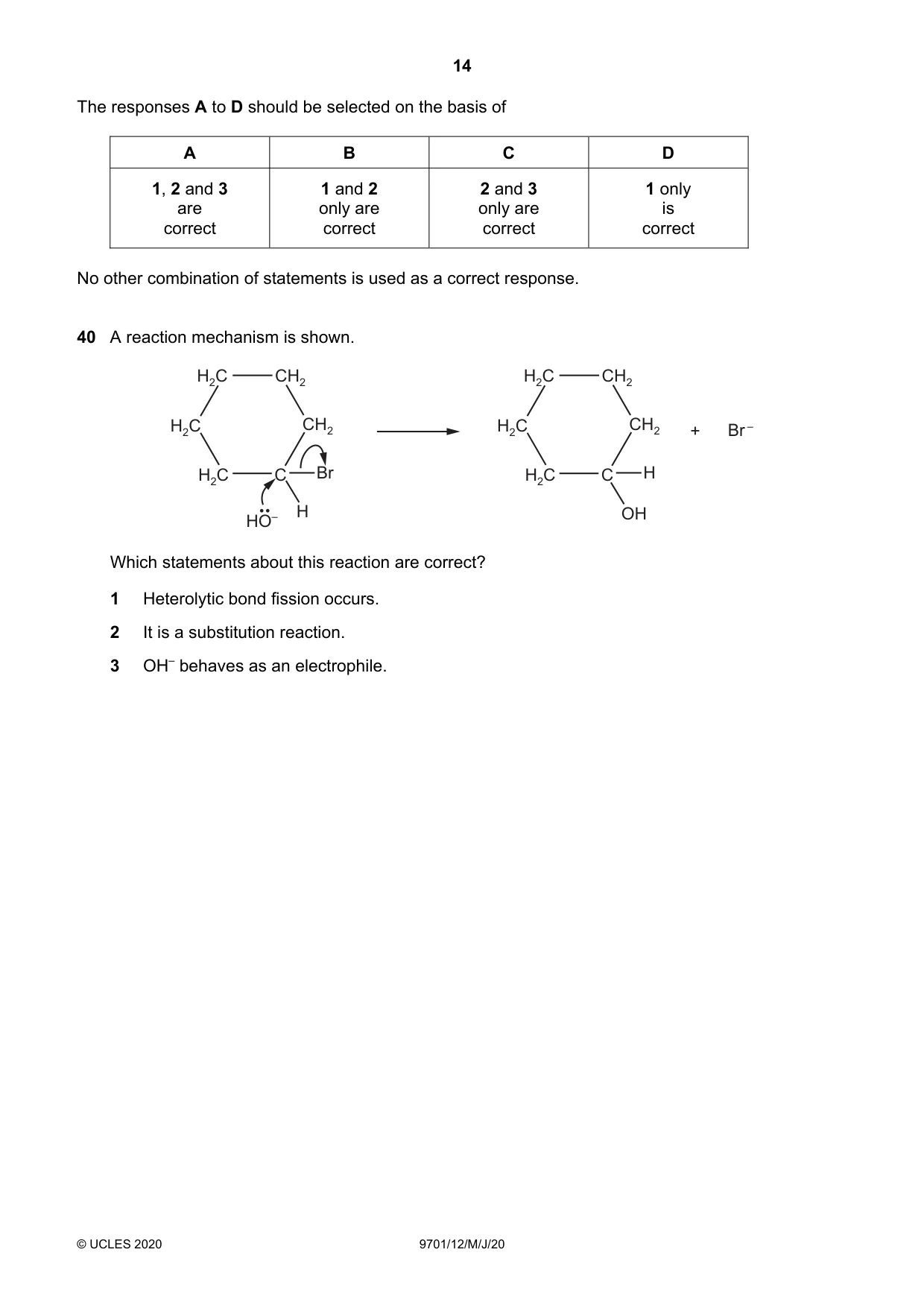
40 A reaction mechanism is shown. H2C CH2 H2C CH2 H2C CH2 H2C CH2 + Br – H2C C Br H2C C H HO– H OH Which statements about this reaction are correct? 1 Heterolytic bond fission occurs. 2 It is a substitution reaction. 3 OH– behaves as an electrophile.
Mark scheme: B
What was in this paper
The subtopics covered by these 40 questions, and how many questions each got. Open one in a new tab to see every Cambridge question on it.
4Reacting masses and volumes (of solutions and gases)3Alcohols2Alkenes2Chemical equilibria: reversible reactions, dynamic equilibrium2Enthalpy change, ΔH2Halogenoalkanes2Isomerism: structural isomerism and stereoisomerism2Nitrogen and sulfur2Particles in the atom and atomic radius2Redox processes: electron transfer and changes in oxidation number (oxidation state)2The chemical properties of the halogen elements and the hydrogen halides2Aldehydes and ketones1Bonding and structure1Brønsted–Lowry theory of acids and bases1Carboxylic acids1Esters1Infrared spectroscopy1Ionisation energy1Isomerism: optical1Nitriles and hydroxynitriles1Periodicity of chemical properties of the elements in Period 31Rate of reaction1Similarities and trends in the properties of the Group 2 metals, magnesium to barium, and their compounds1The gaseous state: ideal and real gases and pV = nRT1