Cambridge A Level Chemistry 9701 — 2025 Feb/March Paper 1 · Variant 2
9701/12/F/M/25 · 40 questions · 40 marks · 75 min
The question paper and its mark scheme, free to read here and free to download. This is Cambridge’s own paper, exactly as it was sat.
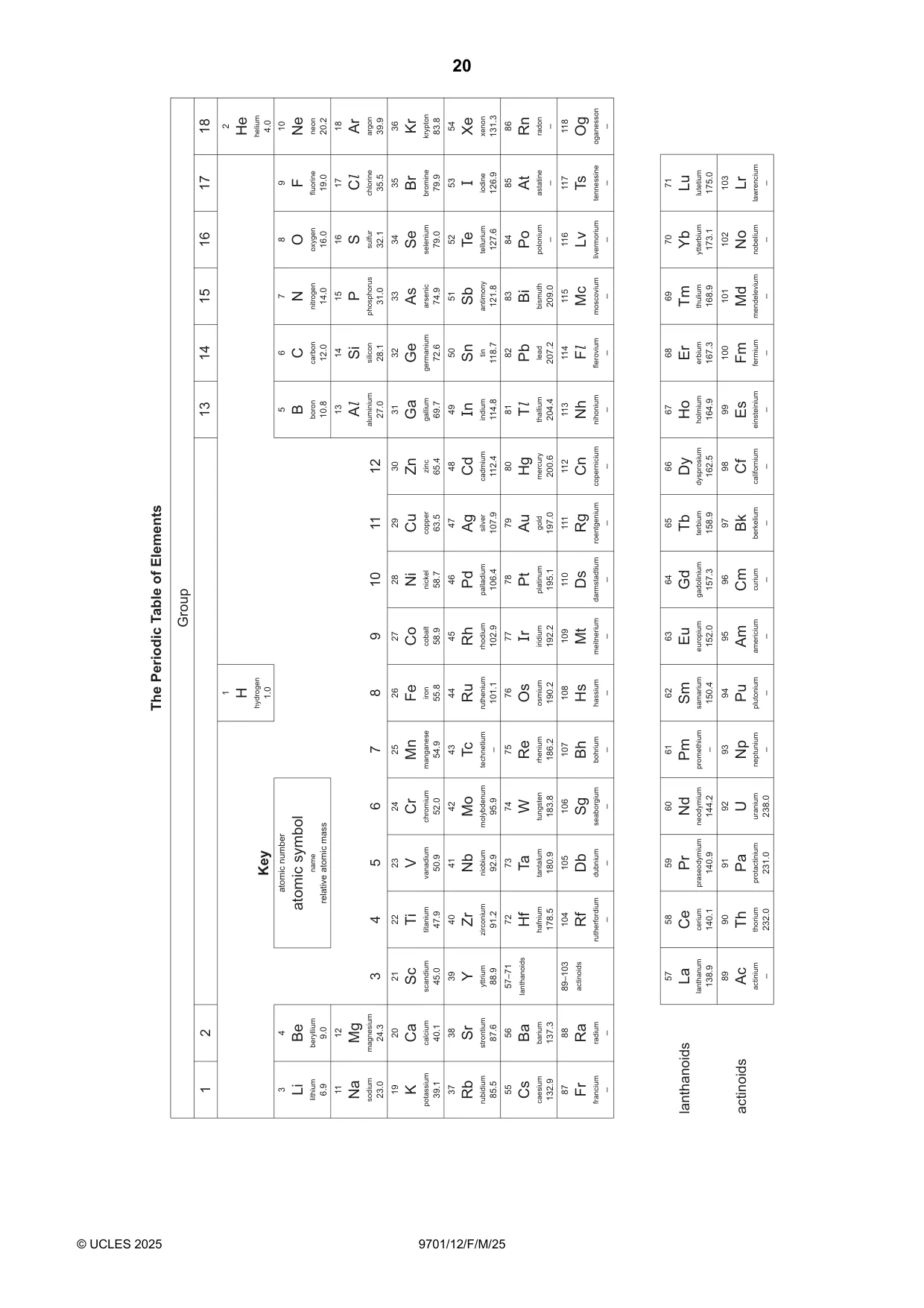
Question paper20 pages



Mark scheme3 pages
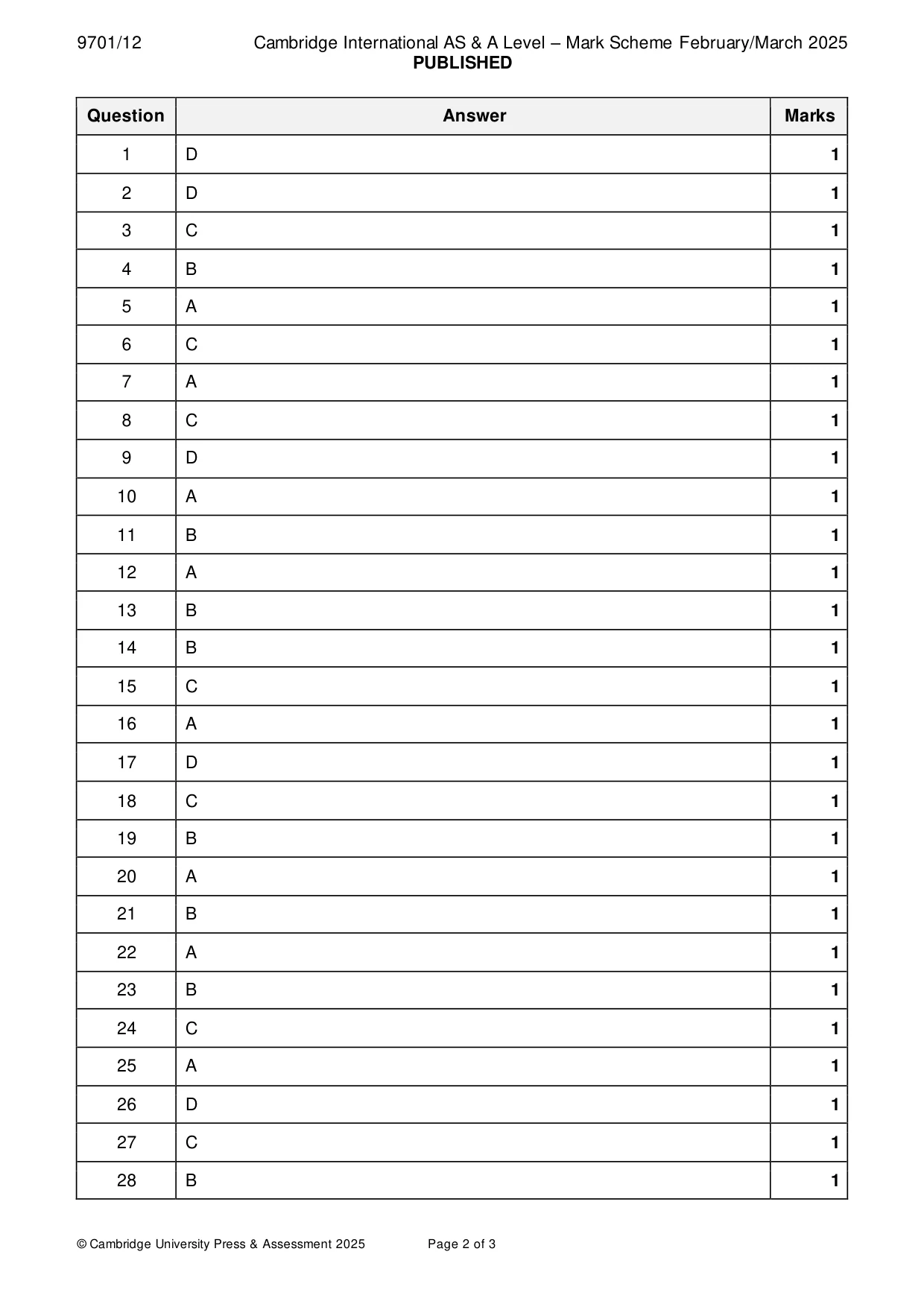
Answers below. Sit the paper first if you are practising.
Questions as text
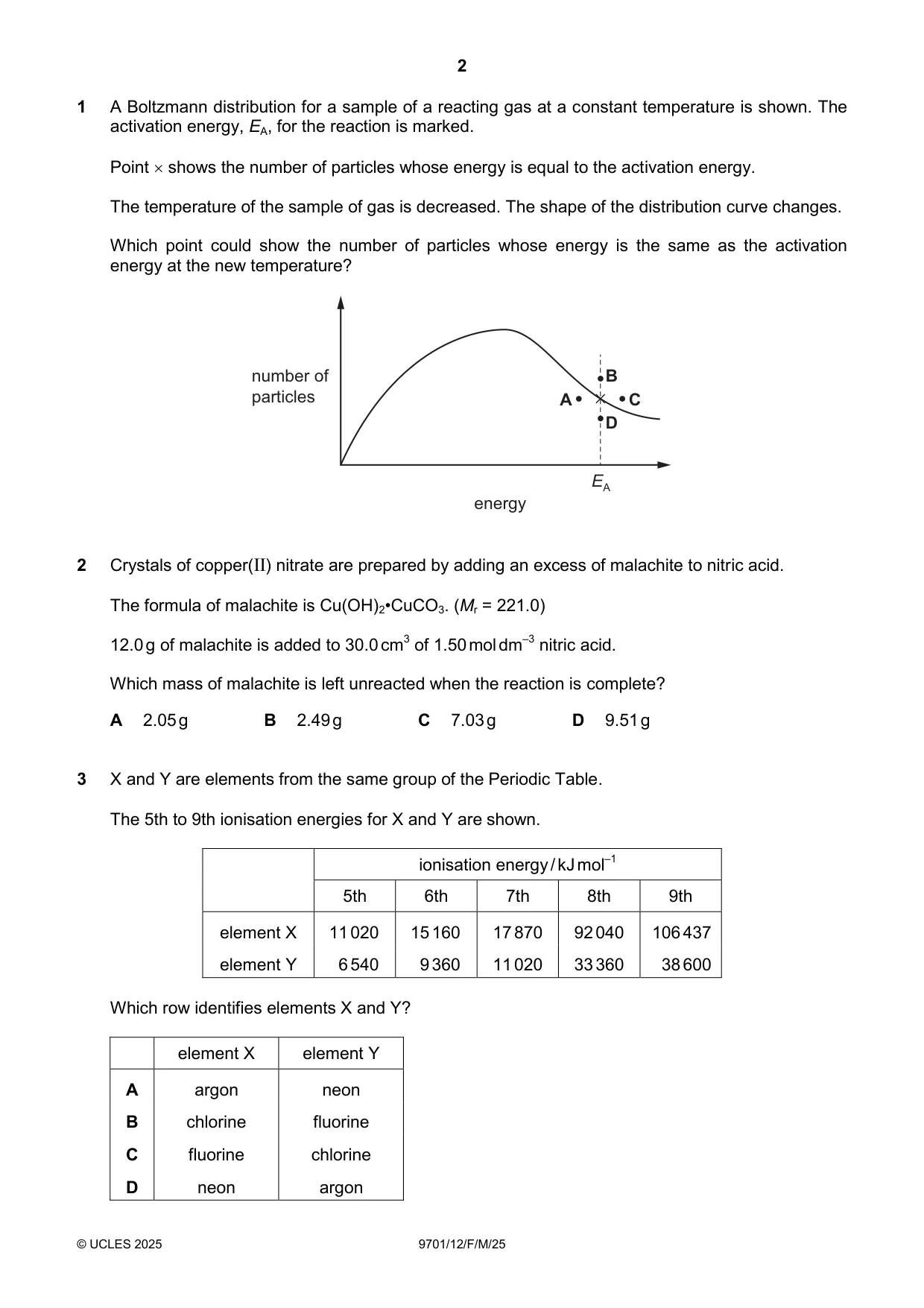
Q1 · A Boltzmann distribution for a sample of a reacting gas at a constant temperature is shown
1 A Boltzmann distribution for a sample of a reacting gas at a constant temperature is shown. The activation energy, EA, for the reaction is marked. Point shows the number of particles whose energy is equal to the activation energy. The temperature of the sample of gas is decreased. The shape of the distribution curve changes. Which point could show the number of particles whose energy is the same as the activation energy at the new temperature? number of B particles A C D EA energy
Mark scheme: D
More questions on Effect of temperature on reaction rates and the concept of activation energy
Q2 · Crystals of copper(II) nitrate are prepared by adding an excess of malachite to nitric…
2 Crystals of copper(II) nitrate are prepared by adding an excess of malachite to nitric acid. The formula of malachite is Cu(OH)2•CuCO3. (Mr = 221.0) 12.0 g of malachite is added to 30.0 cm3 of 1.50 mol dm–3 nitric acid. Which mass of malachite is left unreacted when the reaction is complete? A 2.05 g B 2.49 g C 7.03 g D 9.51 g
Mark scheme: D
More questions on Reacting masses and volumes (of solutions and gases)
Q3 · X and Y are elements from the same group of the Periodic Table
3 X and Y are elements from the same group of the Periodic Table. The 5th to 9th ionisation energies for X and Y are shown. ionisation energy / kJ mol–1 5th 6th 7th 8th 9th element X 11 020 15 160 17 870 92 040 106 437 element Y 6 540 9 360 11 020 33 360 38 600 Which row identifies elements X and Y? element X element Y A argon neon B chlorine fluorine C fluorine chlorine D neon argon
Mark scheme: C
Q4 · An ion with a charge of 2– contains 10 electrons and 14 neutrons
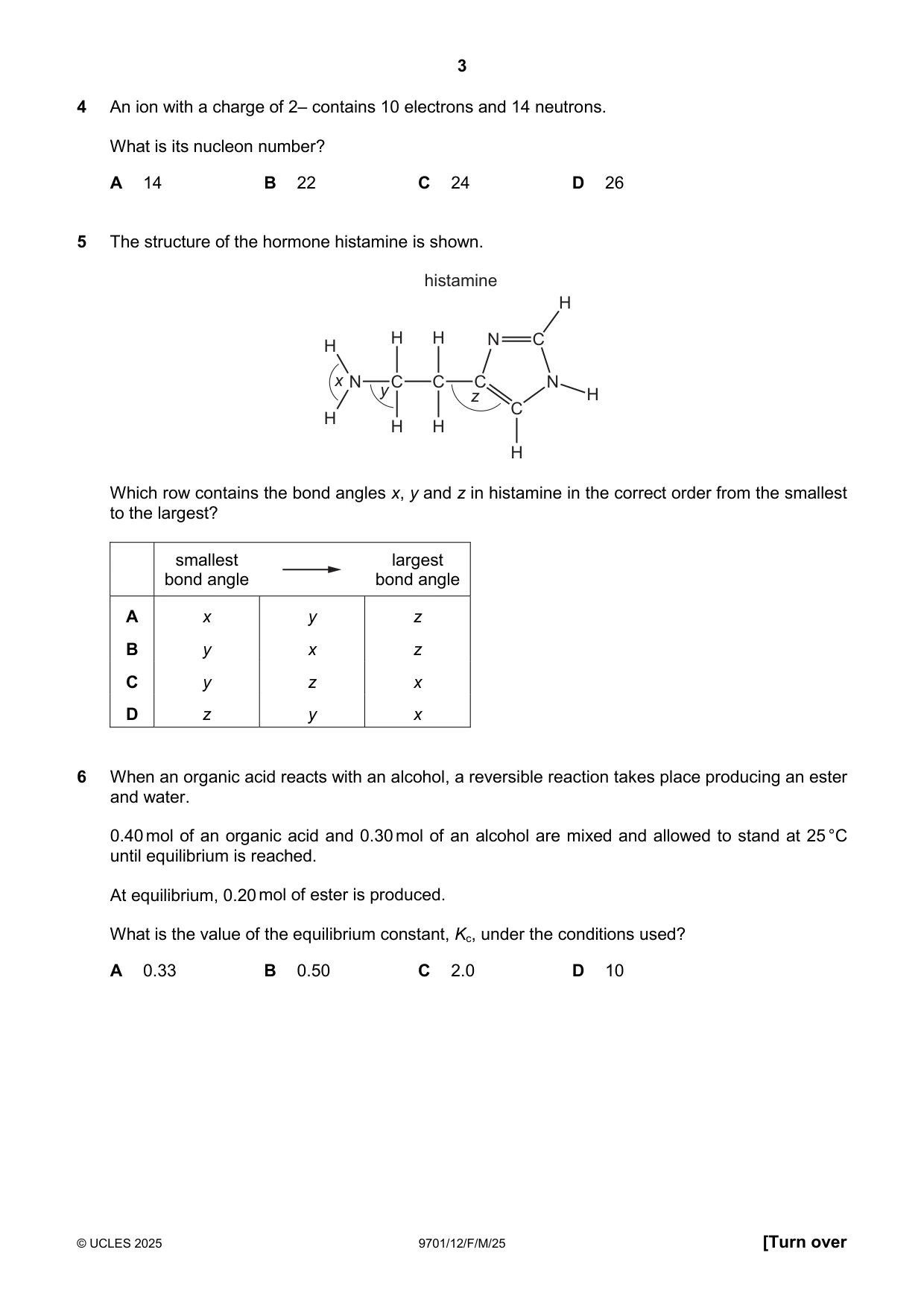
4 An ion with a charge of 2– contains 10 electrons and 14 neutrons. What is its nucleon number? A 14 B 22 C 24 D 26
Mark scheme: B
Q5 · The structure of the hormone histamine is shown
5 The structure of the hormone histamine is shown. histamine H H H N C H x N C C C N y z H C H H H H Which row contains the bond angles x, y and z in histamine in the correct order from the smallest to the largest? smallest largest bond angle bond angle A x y z B y x z C y z x D z y x
Mark scheme: A
Q6 · When an organic acid reacts with an alcohol, a reversible reaction takes place producing…
6 When an organic acid reacts with an alcohol, a reversible reaction takes place producing an ester and water. 0.40 mol of an organic acid and 0.30 mol of an alcohol are mixed and allowed to stand at 25 °C until equilibrium is reached. At equilibrium, 0.20 mol of ester is produced. What is the value of the equilibrium constant, Kc, under the conditions used? A 0.33 B 0.50 C 2.0 D 10
Mark scheme: C
More questions on Chemical equilibria: reversible reactions, dynamic equilibrium
Q7 · Information about two substances is given
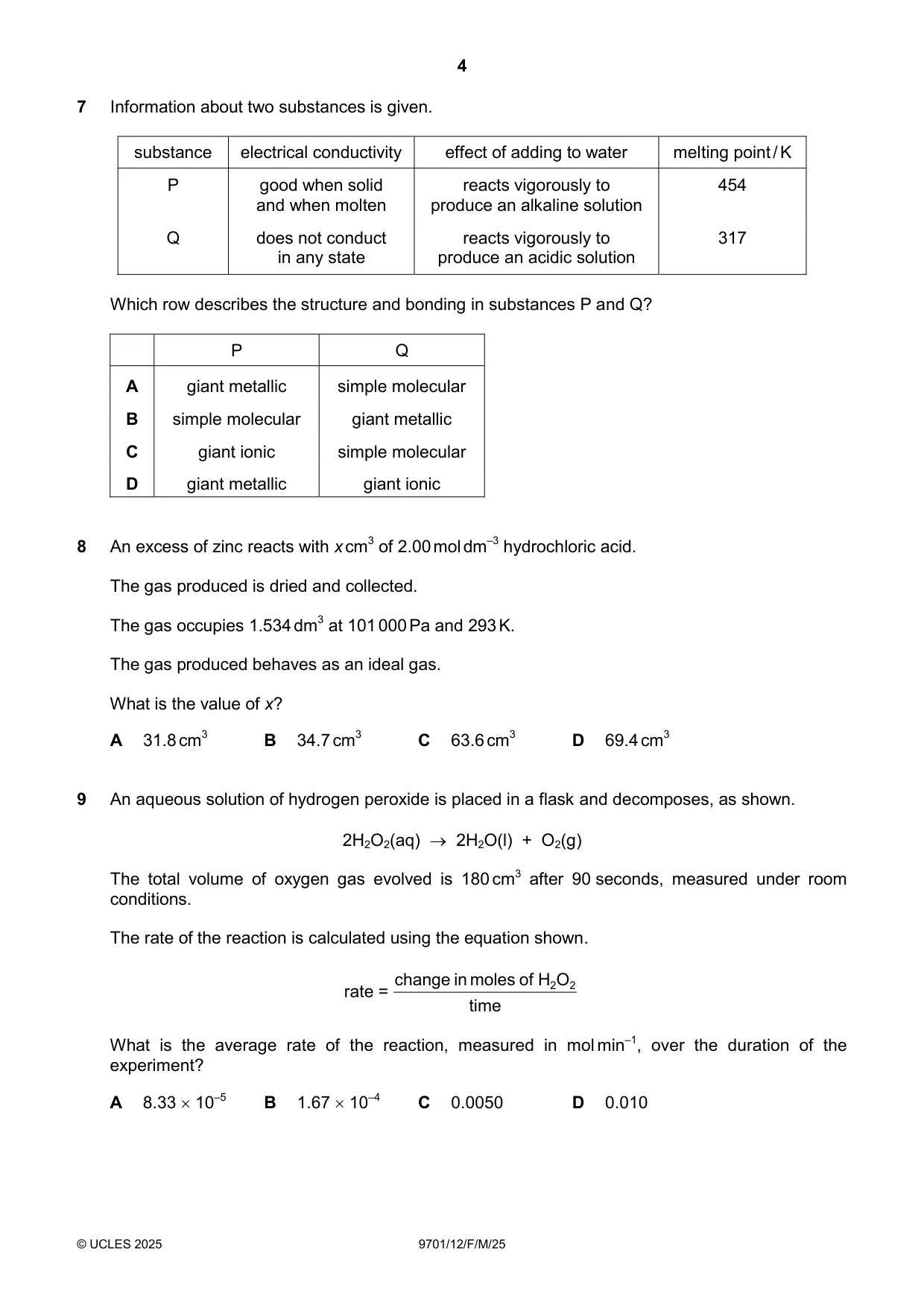
7 Information about two substances is given. substance electrical conductivity effect of adding to water melting point / K P good when solid reacts vigorously to 454 and when molten produce an alkaline solution Q does not conduct reacts vigorously to 317 in any state produce an acidic solution Which row describes the structure and bonding in substances P and Q? P Q A giant metallic simple molecular B simple molecular giant metallic C giant ionic simple molecular D giant metallic giant ionic
Mark scheme: A
Q8 · An excess of zinc reacts with x cm3 of 2.00 mol dm–3 hydrochloric acid
8 An excess of zinc reacts with x cm3 of 2.00 mol dm–3 hydrochloric acid. The gas produced is dried and collected. The gas occupies 1.534 dm3 at 101 000 Pa and 293 K. The gas produced behaves as an ideal gas. What is the value of x? A 31.8 cm3 B 34.7 cm3 C 63.6 cm3 D 69.4 cm3
Mark scheme: C
More questions on The gaseous state: ideal and real gases and pV = nRT
Q9 · An aqueous solution of hydrogen peroxide is placed in a flask and decomposes, as shown
9 An aqueous solution of hydrogen peroxide is placed in a flask and decomposes, as shown. 2H2O2(aq) 2H2O(l) + O2(g) The total volume of oxygen gas evolved is 180 cm3 after 90 seconds, measured under room conditions. The rate of the reaction is calculated using the equation shown. change in moles of H O rate = 2 2 time What is the average rate of the reaction, measured in mol min–1, over the duration of the experiment? A 8.33 10–5 B 1.67 10–4 C 0.0050 D 0.010
Mark scheme: D
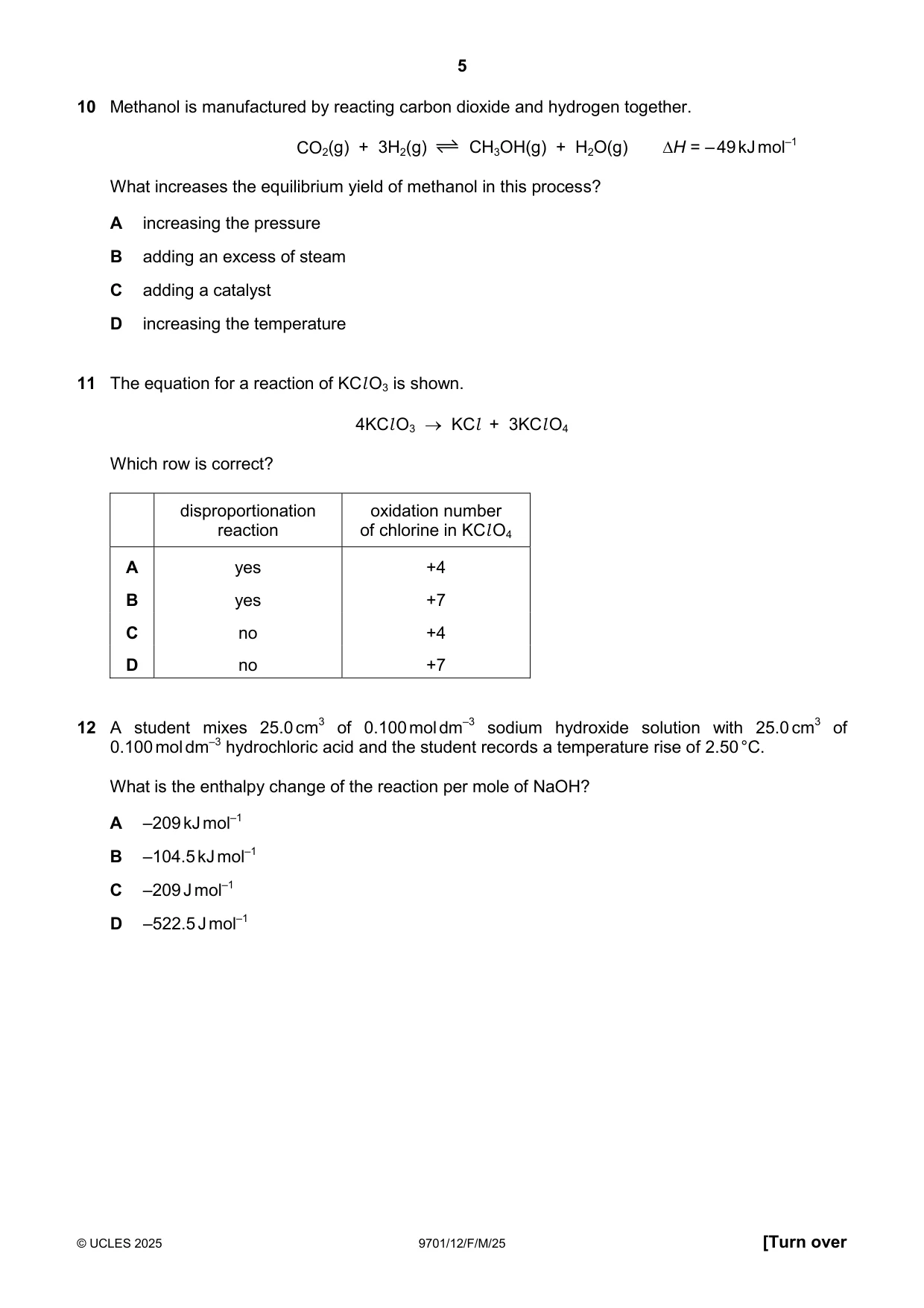
Q10 · Methanol is manufactured by reacting carbon dioxide and hydrogen together
10 Methanol is manufactured by reacting carbon dioxide and hydrogen together. CO2(g) + 3H2(g) CH3OH(g) + H2O(g) H = – 49 kJ mol–1 What increases the equilibrium yield of methanol in this process? A increasing the pressure B adding an excess of steam C adding a catalyst D increasing the temperature
Mark scheme: A
More questions on Chemical equilibria: reversible reactions, dynamic equilibrium
Q11 · The equation for a reaction of KCl O3 is shown
11 The equation for a reaction of KCl O3 is shown. 4KCl O3 KCl + 3KCl O4 Which row is correct? disproportionation oxidation number reaction of chlorine in KCl O4 A yes +4 B yes +7 C no +4 D no +7
Mark scheme: B
Q12 · A student mixes 25.0 cm3 of 0.100 mol dm–3 sodium hydroxide solution with 25.0 cm3 of…
12 A student mixes 25.0 cm3 of 0.100 mol dm–3 sodium hydroxide solution with 25.0 cm3 of 0.100 mol dm–3 hydrochloric acid and the student records a temperature rise of 2.50 °C. What is the enthalpy change of the reaction per mole of NaOH? A –209 kJ mol–1 B –104.5 kJ mol–1 C –209 J mol–1 D –522.5 J mol–1
Mark scheme: A
Q13 · Carbon monoxide and methanol can react together to form ethanoic acid
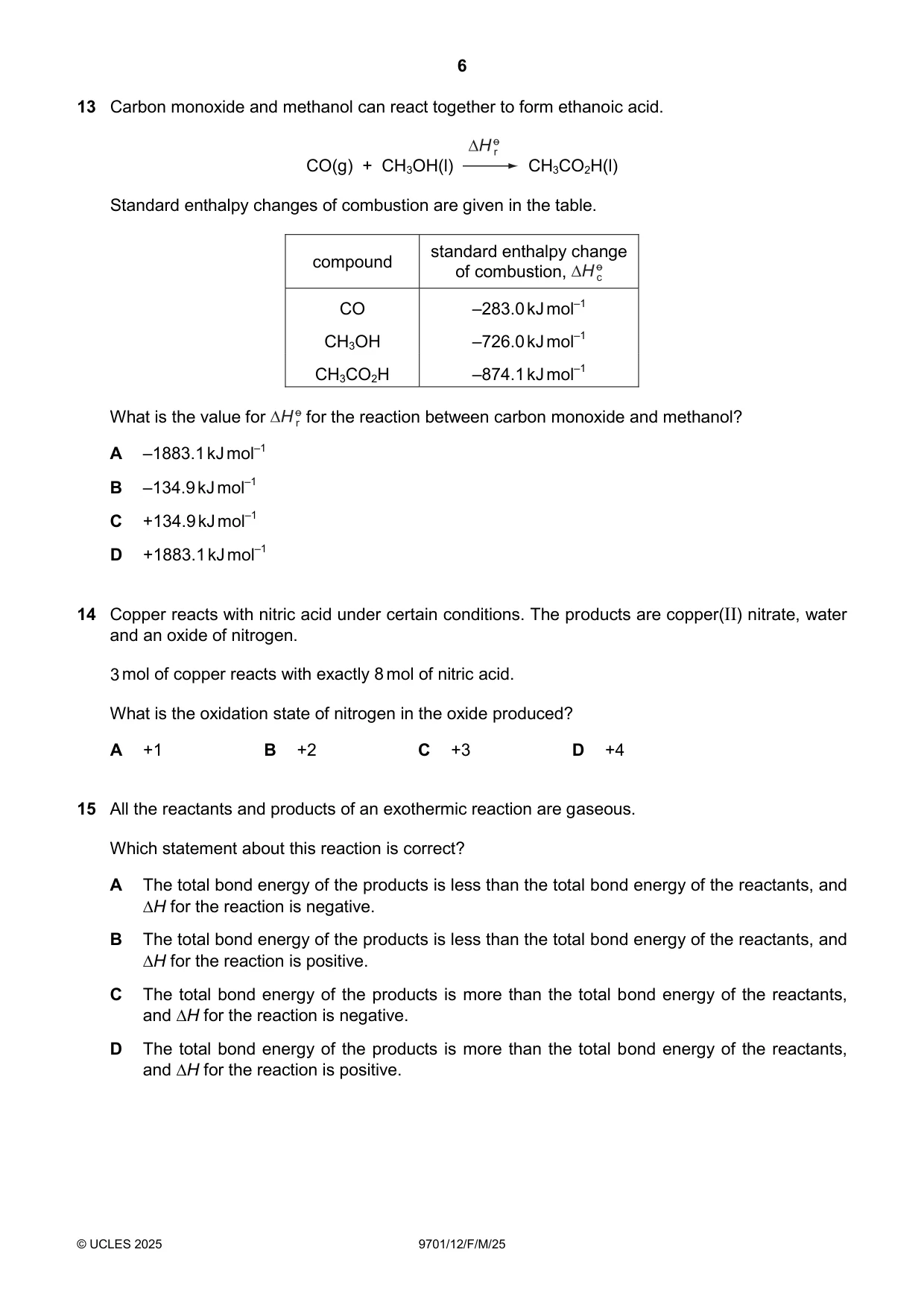
13 Carbon monoxide and methanol can react together to form ethanoic acid. CO(g) + CH3OH(l) CH3CO2H(l) Standard enthalpy changes of combustion are given in the table. standard enthalpy change compound of combustion, CO –283.0 kJ mol–1 CH3OH –726.0 kJ mol–1 CH3CO2H –874.1 kJ mol–1 What is the value for for the reaction between carbon monoxide and methanol? A –1883.1 kJ mol–1 B –134.9 kJ mol–1 C +134.9 kJ mol–1 D +1883.1 kJ mol–1
Mark scheme: B
Q14 · Copper reacts with nitric acid under certain conditions
14 Copper reacts with nitric acid under certain conditions. The products are copper(II) nitrate, water and an oxide of nitrogen. 3 mol of copper reacts with exactly 8 mol of nitric acid. What is the oxidation state of nitrogen in the oxide produced? A +1 B +2 C +3 D +4
Mark scheme: B
Q15 · All the reactants and products of an exothermic reaction are gaseous
15 All the reactants and products of an exothermic reaction are gaseous. Which statement about this reaction is correct? A The total bond energy of the products is less than the total bond energy of the reactants, and H for the reaction is negative. B The total bond energy of the products is less than the total bond energy of the reactants, and H for the reaction is positive. C The total bond energy of the products is more than the total bond energy of the reactants, and H for the reaction is negative. D The total bond energy of the products is more than the total bond energy of the reactants, and H for the reaction is positive.
Mark scheme: C
Q16 · Propene, hydrogen cyanide and carbon dioxide each contain bonds
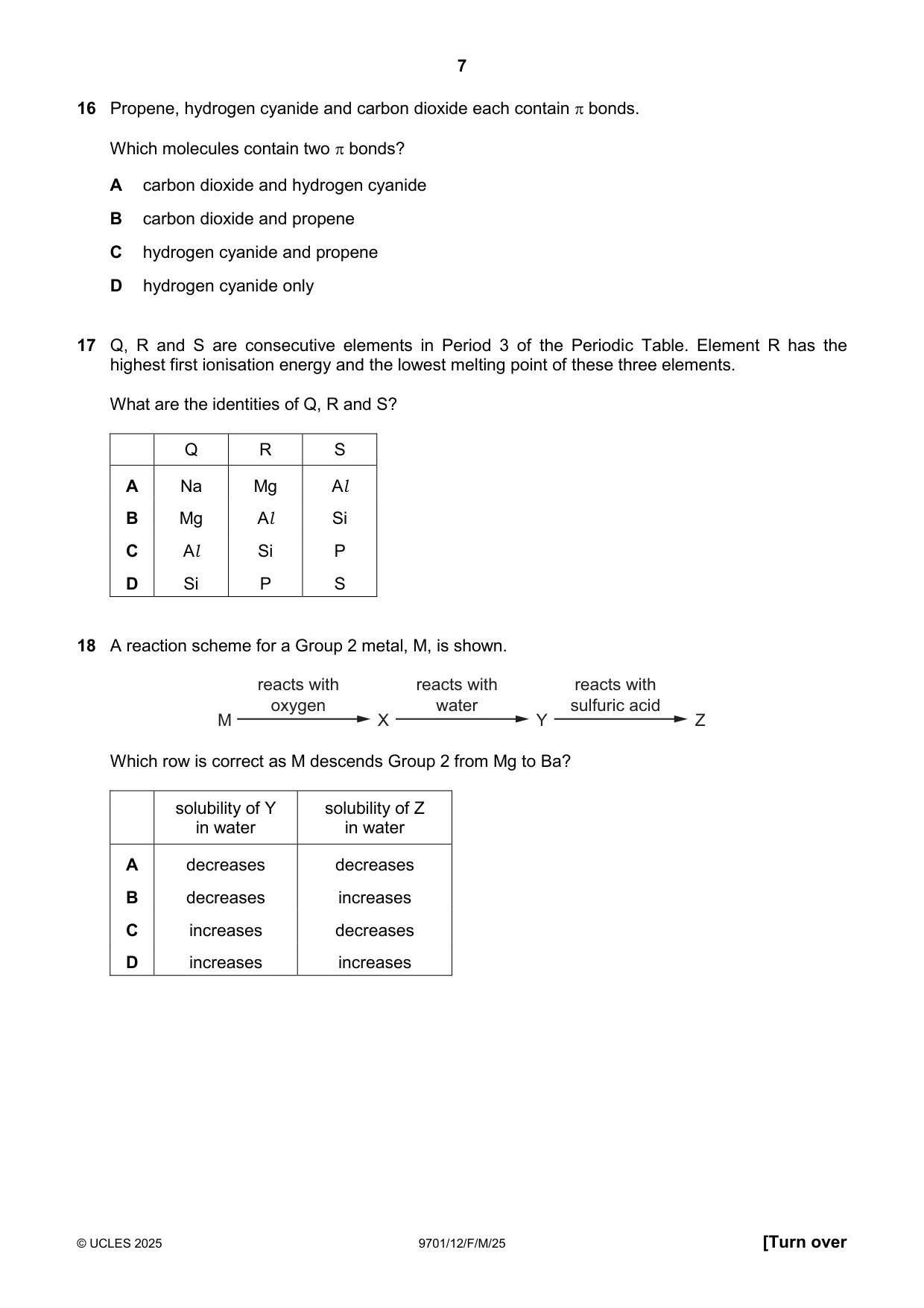
16 Propene, hydrogen cyanide and carbon dioxide each contain bonds. Which molecules contain two bonds? A carbon dioxide and hydrogen cyanide B carbon dioxide and propene C hydrogen cyanide and propene D hydrogen cyanide only
Mark scheme: A
More questions on Shapes of organic molecules; σ and π bonds
Q17 · Q, R and S are consecutive elements in Period 3 of the Periodic Table
17 Q, R and S are consecutive elements in Period 3 of the Periodic Table. Element R has the highest first ionisation energy and the lowest melting point of these three elements. What are the identities of Q, R and S? Q R S A Na Mg Al B Mg Al Si C Al Si P D Si P S
Mark scheme: D
More questions on Periodicity of physical properties of the elements in Period 3
Q18 · A reaction scheme for a Group 2 metal, M, is shown
18 A reaction scheme for a Group 2 metal, M, is shown. reacts with reacts with reacts with oxygen water sulfuric acid M X Y Z Which row is correct as M descends Group 2 from Mg to Ba? solubility of Y solubility of Z in water in water A decreases decreases B decreases increases C increases decreases D increases increases
Mark scheme: C
Q19 · U, V and W represent different halogens
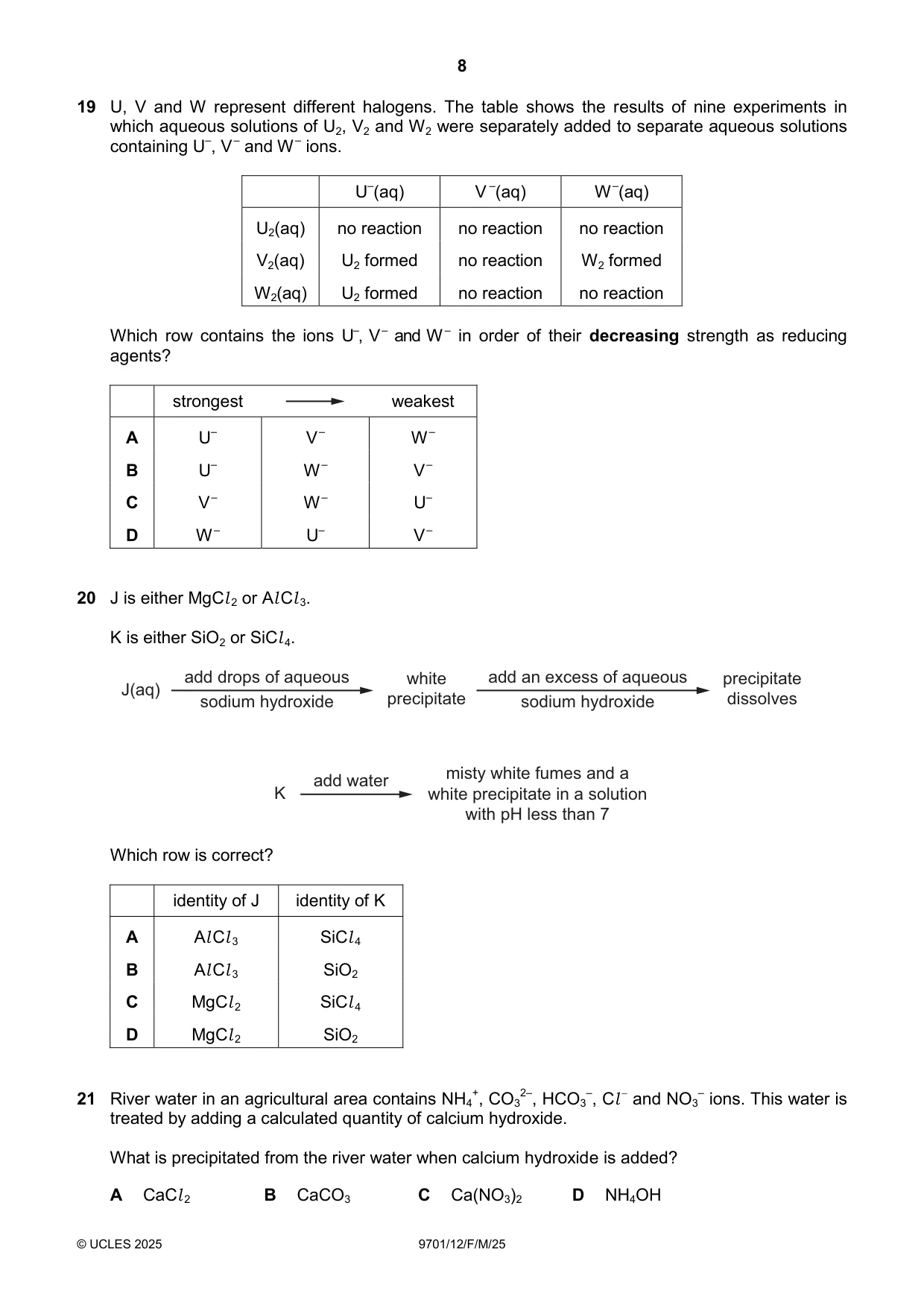
19 U, V and W represent different halogens. The table shows the results of nine experiments in which aqueous solutions of U2, V2 and W2 were separately added to separate aqueous solutions containing U–, V – and W – ions. U–(aq) V –(aq) W –(aq) U2(aq) no reaction no reaction no reaction V2(aq) U2 formed no reaction W2 formed W2(aq) U2 formed no reaction no reaction Which row contains the ions U–, V – and W – in order of their decreasing strength as reducing agents? strongest weakest A U– V – W – B U– W – V – C V – W – U– D W – U– V –
Mark scheme: B
More questions on The chemical properties of the halogen elements and the hydrogen halides
Q20 · J is either MgCl 2 or Al Cl 3
20 J is either MgCl 2 or Al Cl 3. K is either SiO2 or SiCl 4. add drops of aqueous white add an excess of aqueous precipitate J(aq) sodium hydroxide precipitate sodium hydroxide dissolves add water misty white fumes and a K white precipitate in a solution with pH less than 7 Which row is correct? identity of J identity of K A Al Cl 3 SiCl 4 B Al Cl 3 SiO2 C MgCl 2 SiCl 4 D MgCl 2 SiO2
Mark scheme: A
More questions on Periodicity of chemical properties of the elements in Period 3
Q21 · River water in an agricultural area contains NH4 +, CO3 2–, HCO3 –, Cl and NO3 – ions
21 River water in an agricultural area contains NH4 +, CO3 2–, HCO3 –, Cl and NO3 – ions. This water is treated by adding a calculated quantity of calcium hydroxide. What is precipitated from the river water when calcium hydroxide is added? A CaCl 2 B CaCO3 C Ca(NO3)2 D NH4OH
Mark scheme: B
Q22 · Four atmospheric pollutants are listed
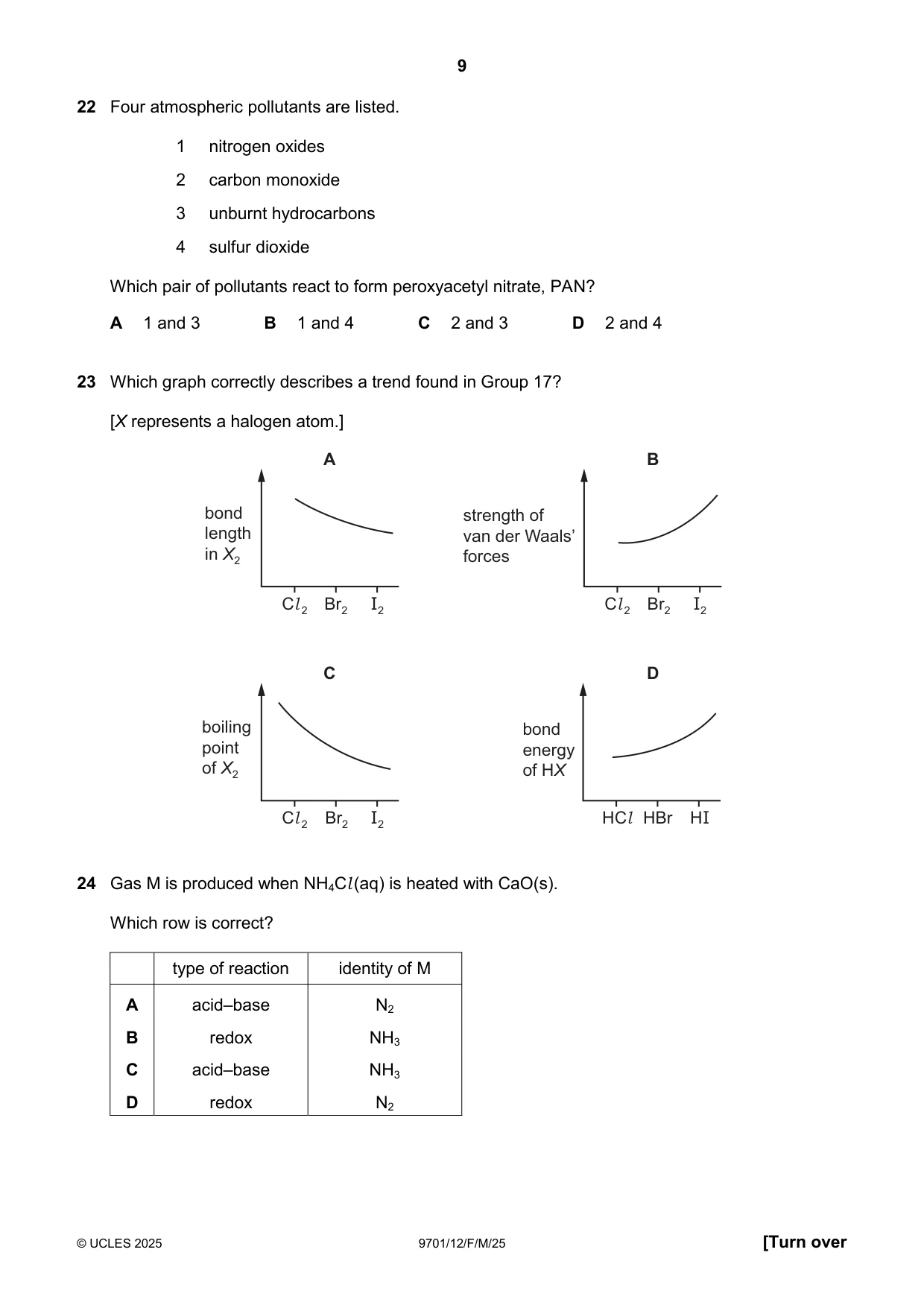
22 Four atmospheric pollutants are listed. 1 nitrogen oxides 2 carbon monoxide 3 unburnt hydrocarbons 4 sulfur dioxide Which pair of pollutants react to form peroxyacetyl nitrate, PAN? A 1 and 3 B 1 and 4 C 2 and 3 D 2 and 4
Mark scheme: A
Q23 · Which graph correctly describes a trend found in Group 17?
23 Which graph correctly describes a trend found in Group 17? [X represents a halogen atom.] A B bond strength of length van der Waals’ in X2 forces Cl 2 Br2 I2 Cl 2 Br2 I2 C D boiling bond point energy of X2 of HX Cl 2 Br2 I2 HCl HBr HI
Mark scheme: B
More questions on Physical properties of the Group 17 elements
Q24 · Gas M is produced when NH4Cl (aq) is heated with CaO(s)
24 Gas M is produced when NH4Cl (aq) is heated with CaO(s). Which row is correct? type of reaction identity of M A acid–base N2 B redox NH3 C acid–base NH3 D redox N2
Mark scheme: C
Q25 · Two nitrates decompose on heating according to the equations shown
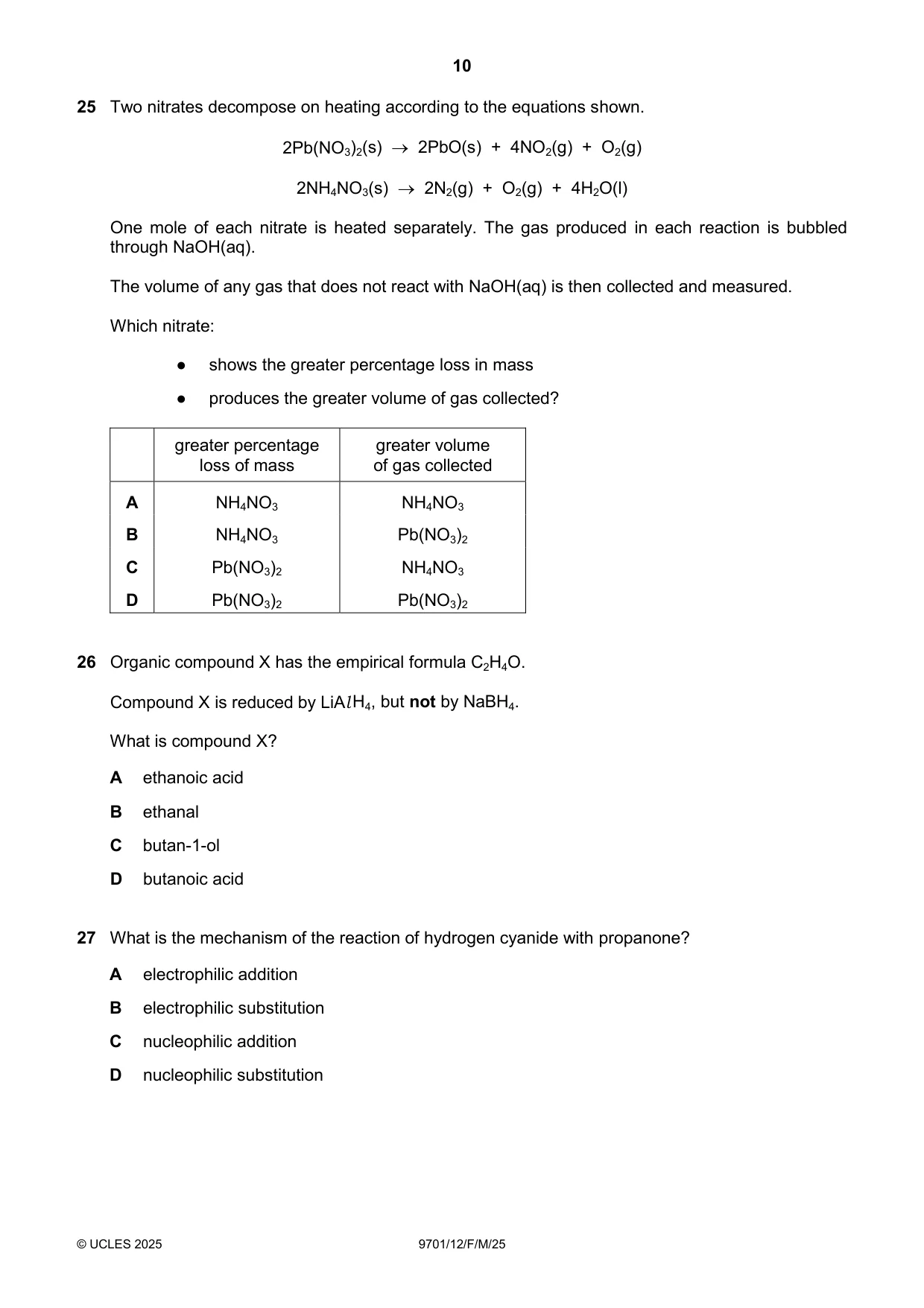
25 Two nitrates decompose on heating according to the equations shown. 2Pb(NO3)2(s) 2PbO(s) + 4NO2(g) + O2(g) 2NH4NO3(s) 2N2(g) + O2(g) + 4H2O(l) One mole of each nitrate is heated separately. The gas produced in each reaction is bubbled through NaOH(aq). The volume of any gas that does not react with NaOH(aq) is then collected and measured. Which nitrate: ● shows the greater percentage loss in mass ● produces the greater volume of gas collected? greater percentage greater volume loss of mass of gas collected A NH4NO3 NH4NO3 B NH4NO3 Pb(NO3)2 C Pb(NO3)2 NH4NO3 D Pb(NO3)2 Pb(NO3)2
Mark scheme: A
More questions on Reacting masses and volumes (of solutions and gases)
Q26 · Organic compound X has the empirical formula C2H4O
26 Organic compound X has the empirical formula C2H4O. Compound X is reduced by LiAl H4, but not by NaBH4. What is compound X? A ethanoic acid B ethanal C butan-1-ol D butanoic acid
Mark scheme: D
Q27 · What is the mechanism of the reaction of hydrogen cyanide with propanone?
27 What is the mechanism of the reaction of hydrogen cyanide with propanone? A electrophilic addition B electrophilic substitution C nucleophilic addition D nucleophilic substitution
Mark scheme: C
Q28 · Which compound may be synthesised from an alkene, with formula C4H8, by an addition…
28 Which compound may be synthesised from an alkene, with formula C4H8, by an addition reaction? A 1,1-dibromobutane B 1,2-dibromobutane C 1,3-dibromobutane D 1,3-dibromomethylpropane
Mark scheme: B
Q29 · The structure of compound G is shown
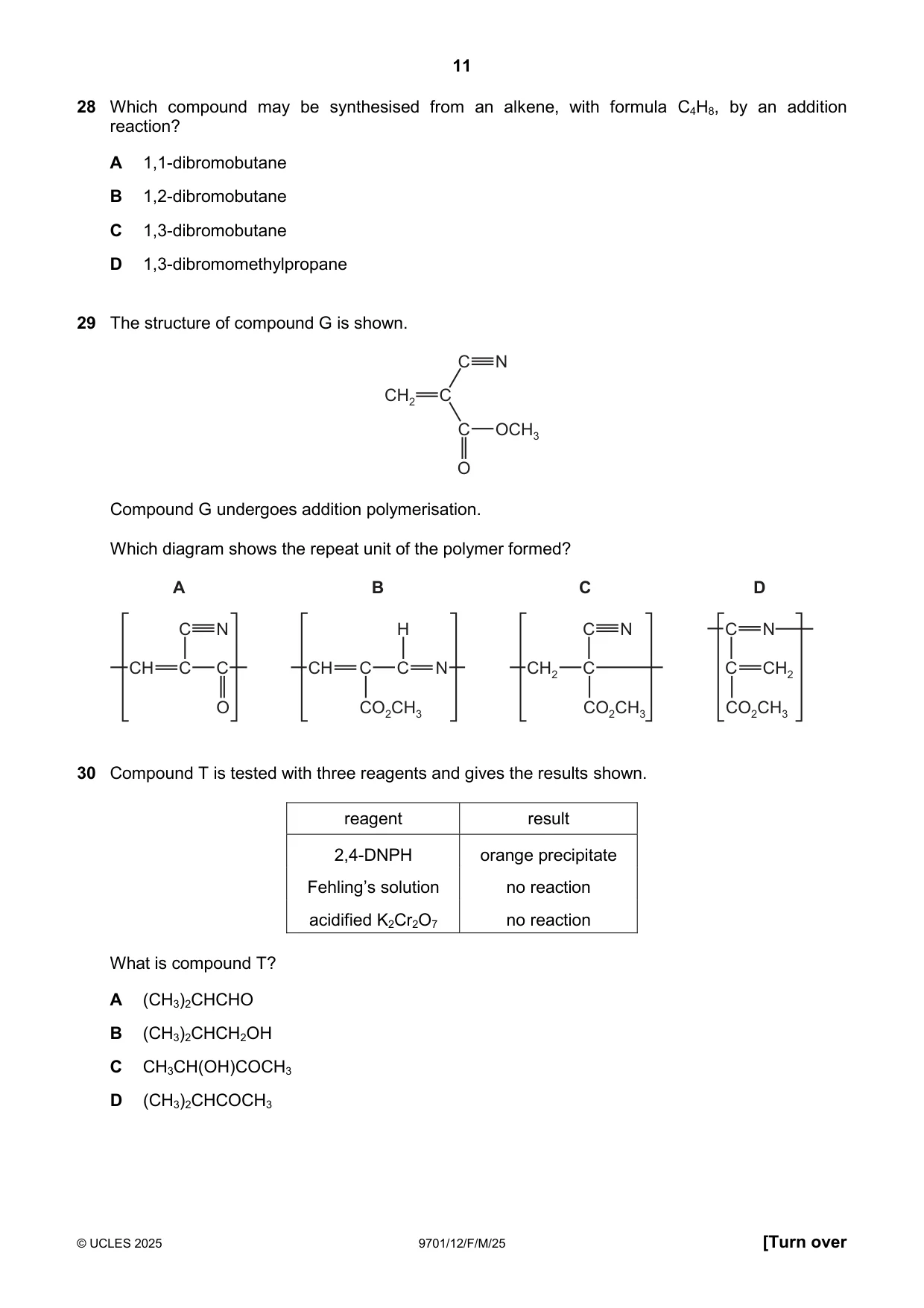
29 The structure of compound G is shown. C N CH2 C C OCH3 O Compound G undergoes addition polymerisation. Which diagram shows the repeat unit of the polymer formed? A B C D C N H C N C N CH C C CH C C N CH2 C C CH2 O CO2CH3 CO2CH3 CO2CH3
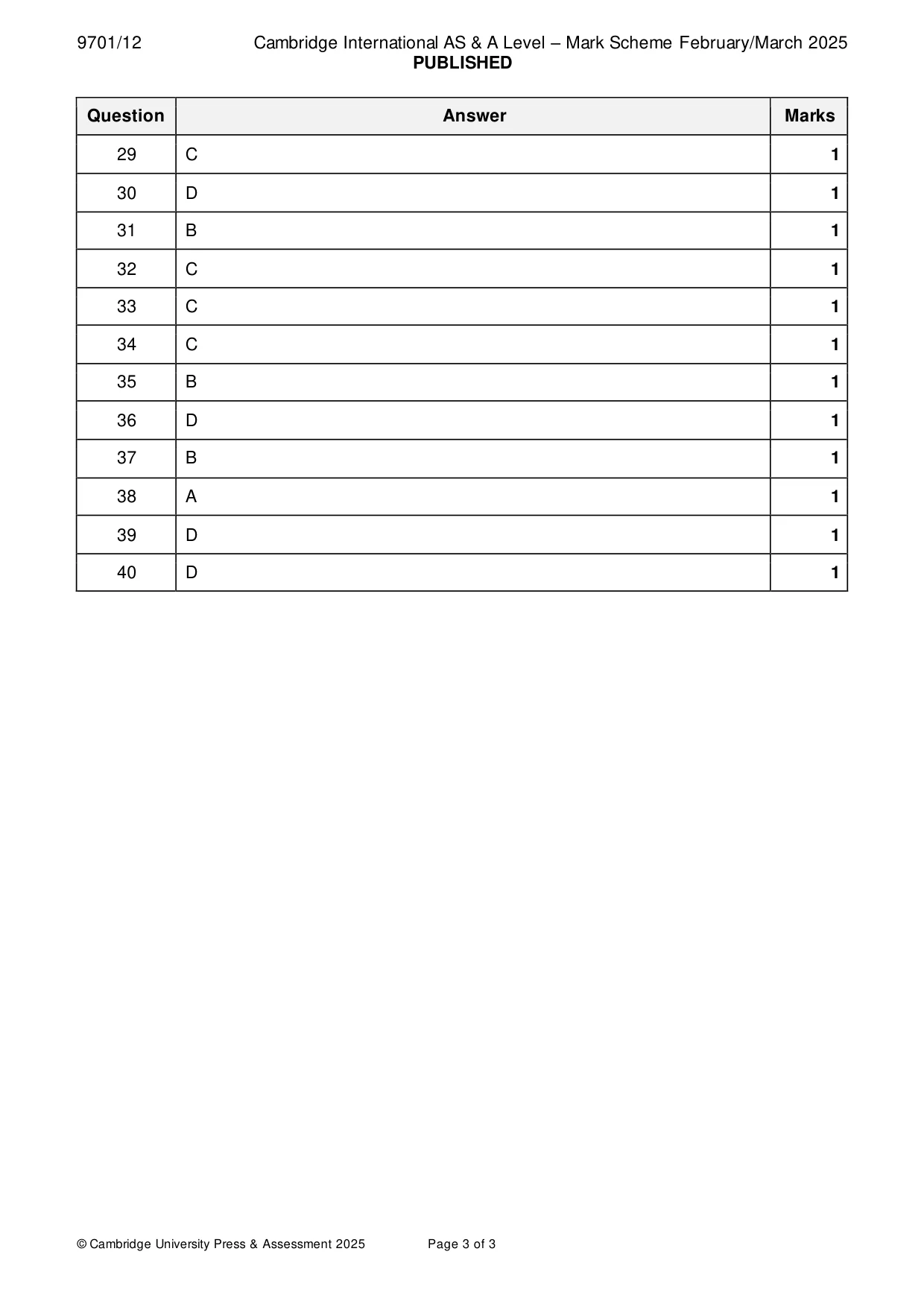
Mark scheme: C
Q30 · Compound T is tested with three reagents and gives the results shown
30 Compound T is tested with three reagents and gives the results shown. reagent result 2,4-DNPH orange precipitate Fehling’s solution no reaction acidified K2Cr2O7 no reaction What is compound T? A (CH3)2CHCHO B (CH3)2CHCH2OH C CH3CH(OH)COCH3 D (CH3)2CHCOCH3
Mark scheme: D
Q31 · Reagent X is added separately to 2-methylbutan-1-ol and 3-methylbutan-2-ol
31 Reagent X is added separately to 2-methylbutan-1-ol and 3-methylbutan-2-ol. The visible results are different. What is reagent X? A Na(s) B alkaline I2(aq) C PCl 5 D acidified KMnO4
Mark scheme: B
Q32 · Compound Y is hydrolysed by warm aqueous silver nitrate to form a precipitate that is…
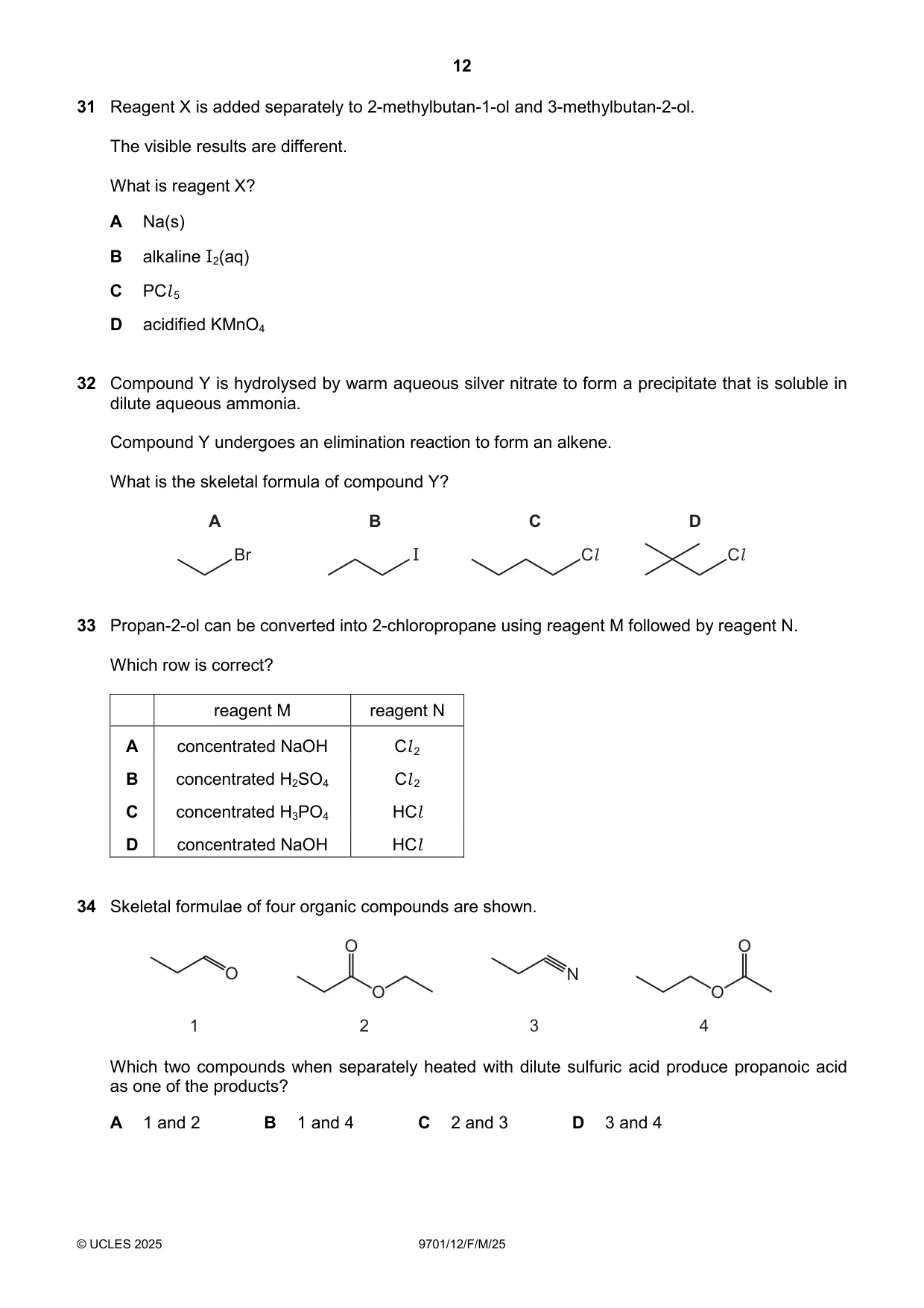
32 Compound Y is hydrolysed by warm aqueous silver nitrate to form a precipitate that is soluble in dilute aqueous ammonia. Compound Y undergoes an elimination reaction to form an alkene. What is the skeletal formula of compound Y? A B C D Br I Cl Cl
Mark scheme: C
Q33 · Propan-2-ol can be converted into 2-chloropropane using reagent M followed by reagent N
33 Propan-2-ol can be converted into 2-chloropropane using reagent M followed by reagent N. Which row is correct? reagent M reagent N A concentrated NaOH Cl 2 B concentrated H2SO4 Cl 2 C concentrated H3PO4 HCl D concentrated NaOH HCl
Mark scheme: C
Q34 · Skeletal formulae of four organic compounds are shown
34 Skeletal formulae of four organic compounds are shown. O O O N O O 1 2 3 4 Which two compounds when separately heated with dilute sulfuric acid produce propanoic acid as one of the products? A 1 and 2 B 1 and 4 C 2 and 3 D 3 and 4
Mark scheme: C
Q35 · 1-chloro-2-methylpropane and 2-bromo-2-methylbutane react separately with aqueous silver…
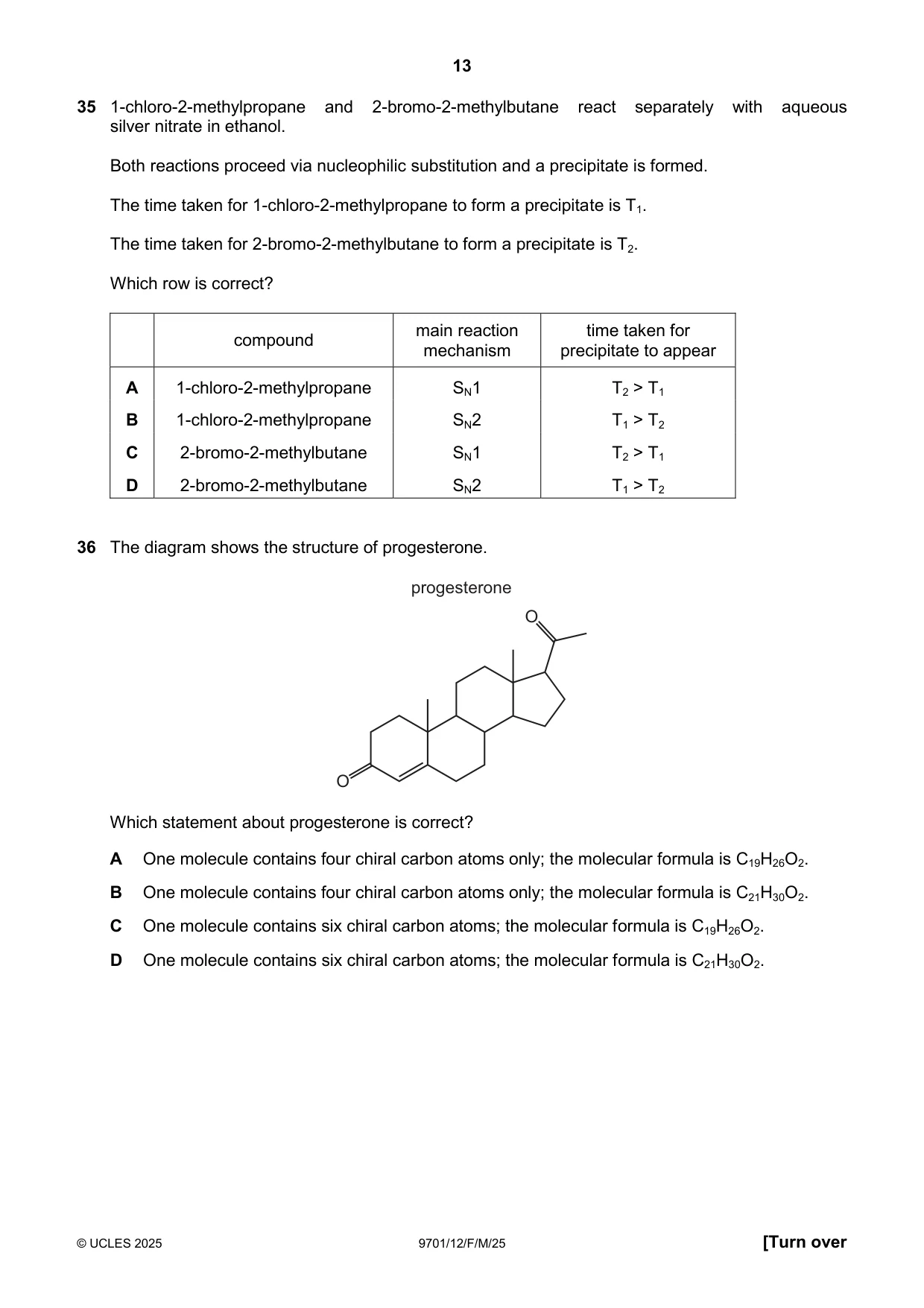
35 1-chloro-2-methylpropane and 2-bromo-2-methylbutane react separately with aqueous silver nitrate in ethanol. Both reactions proceed via nucleophilic substitution and a precipitate is formed. The time taken for 1-chloro-2-methylpropane to form a precipitate is T1. The time taken for 2-bromo-2-methylbutane to form a precipitate is T2. Which row is correct? main reaction time taken for compound mechanism precipitate to appear A 1-chloro-2-methylpropane SN1 T2 > T1 B 1-chloro-2-methylpropane SN2 T1 > T2 C 2-bromo-2-methylbutane SN1 T2 > T1 D 2-bromo-2-methylbutane SN2 T1 > T2
Mark scheme: B
Q36 · The diagram shows the structure of progesterone
36 The diagram shows the structure of progesterone. progesterone O O Which statement about progesterone is correct? A One molecule contains four chiral carbon atoms only; the molecular formula is C19H26O2. B One molecule contains four chiral carbon atoms only; the molecular formula is C21H30O2. C One molecule contains six chiral carbon atoms; the molecular formula is C19H26O2. D One molecule contains six chiral carbon atoms; the molecular formula is C21H30O2.
Mark scheme: D
Q37 · A molecule of hexane can be cracked in a number of different ways
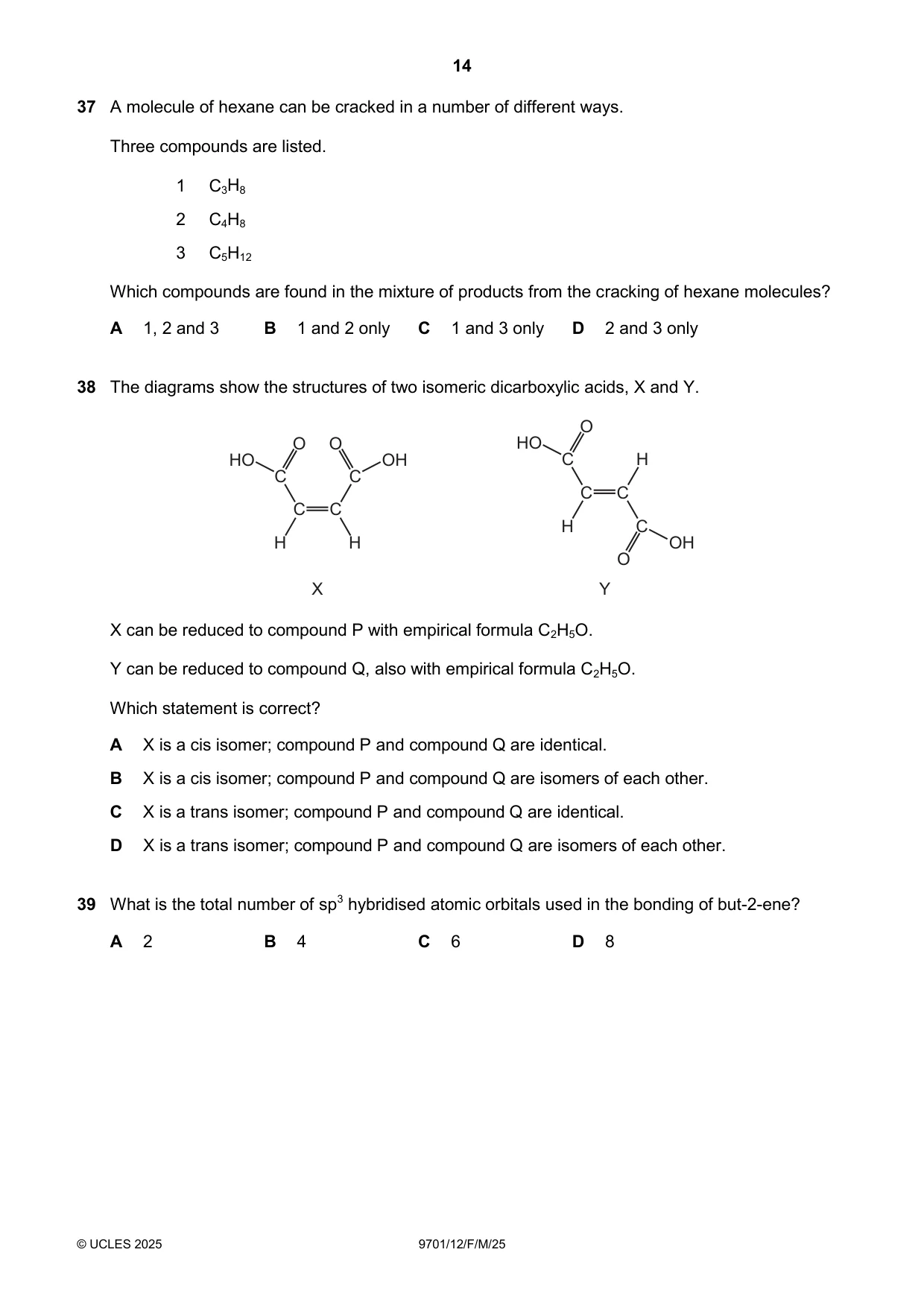
37 A molecule of hexane can be cracked in a number of different ways. Three compounds are listed. 1 C3H8 2 C4H8 3 C5H12 Which compounds are found in the mixture of products from the cracking of hexane molecules? A 1, 2 and 3 B 1 and 2 only C 1 and 3 only D 2 and 3 only
Mark scheme: B
Q38 · The diagrams show the structures of two isomeric dicarboxylic acids, X and Y
38 The diagrams show the structures of two isomeric dicarboxylic acids, X and Y. O O O HO HO OH C H C C C C C C H C H H OH O X Y X can be reduced to compound P with empirical formula C2H5O. Y can be reduced to compound Q, also with empirical formula C2H5O. Which statement is correct? A X is a cis isomer; compound P and compound Q are identical. B X is a cis isomer; compound P and compound Q are isomers of each other. C X is a trans isomer; compound P and compound Q are identical. D X is a trans isomer; compound P and compound Q are isomers of each other.
Mark scheme: A
More questions on Isomerism: structural isomerism and stereoisomerism
Q39 · What is the total number of sp3 hybridised atomic orbitals used in the bonding of…
39 What is the total number of sp3 hybridised atomic orbitals used in the bonding of but-2-ene? A 2 B 4 C 6 D 8
Mark scheme: D
More questions on Shapes of organic molecules; σ and π bonds
Q40 · Compound L contains carbon atoms
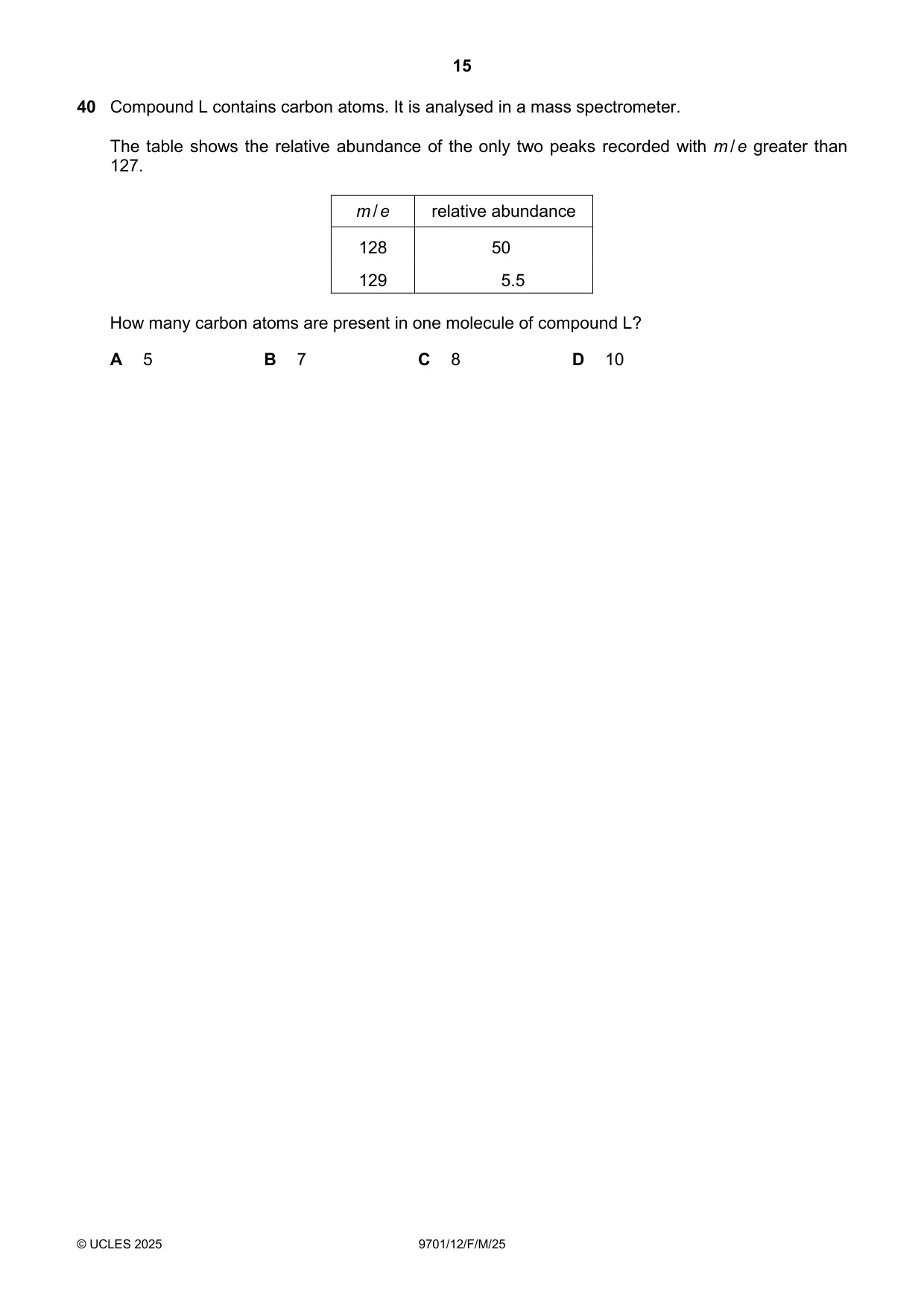
40 Compound L contains carbon atoms. It is analysed in a mass spectrometer. The table shows the relative abundance of the only two peaks recorded with m / e greater than 127. m / e relative abundance 128 50 129 5.5 How many carbon atoms are present in one molecule of compound L? A 5 B 7 C 8 D 10
Mark scheme: D
What was in this paper
The subtopics covered by these 40 questions, and how many questions each got. Open one in a new tab to see every Cambridge question on it.
2Aldehydes and ketones2Chemical equilibria: reversible reactions, dynamic equilibrium2Enthalpy change, ΔH2Reacting masses and volumes (of solutions and gases)2Shapes of organic molecules; σ and π bonds2Similarities and trends in the properties of the Group 2 metals, magnesium to barium, and their compounds2Addition polymerisation1Alkanes1Alkenes1Bonding and structure1Effect of temperature on reaction rates and the concept of activation energy1Electrolysis1Esters1Halogen compounds1Halogenoalkanes1Hess’s law1Ionisation energy1Isomerism: optical1Isomerism: structural isomerism and stereoisomerism1Mass spectrometry1Nitriles and hydroxynitriles1Nitrogen and sulfur1Particles in the atom and atomic radius1Periodicity of chemical properties of the elements in Period 31Periodicity of physical properties of the elements in Period 31Physical properties of the Group 17 elements1Rate of reaction1Redox processes: electron transfer and changes in oxidation number (oxidation state)1Shapes of molecules1The chemical properties of the halogen elements and the hydrogen halides1The gaseous state: ideal and real gases and pV = nRT1The reactions of chlorine1What you needed in this session
Cambridge’s own grade thresholds for 2025 Feb/March, Paper 1 · Variant 2. A higher threshold means an easier paper — the bar moves with how the cohort did.