Cambridge A Level Chemistry 9701 — 2010 Oct/Nov Paper 1 · Variant 2
9701/12/O/N/10 · 40 questions · 40 marks · ≈45 min
The question paper and its mark scheme, free to read here and free to download. This is Cambridge’s own paper, exactly as it was sat.
Question paper16 pages
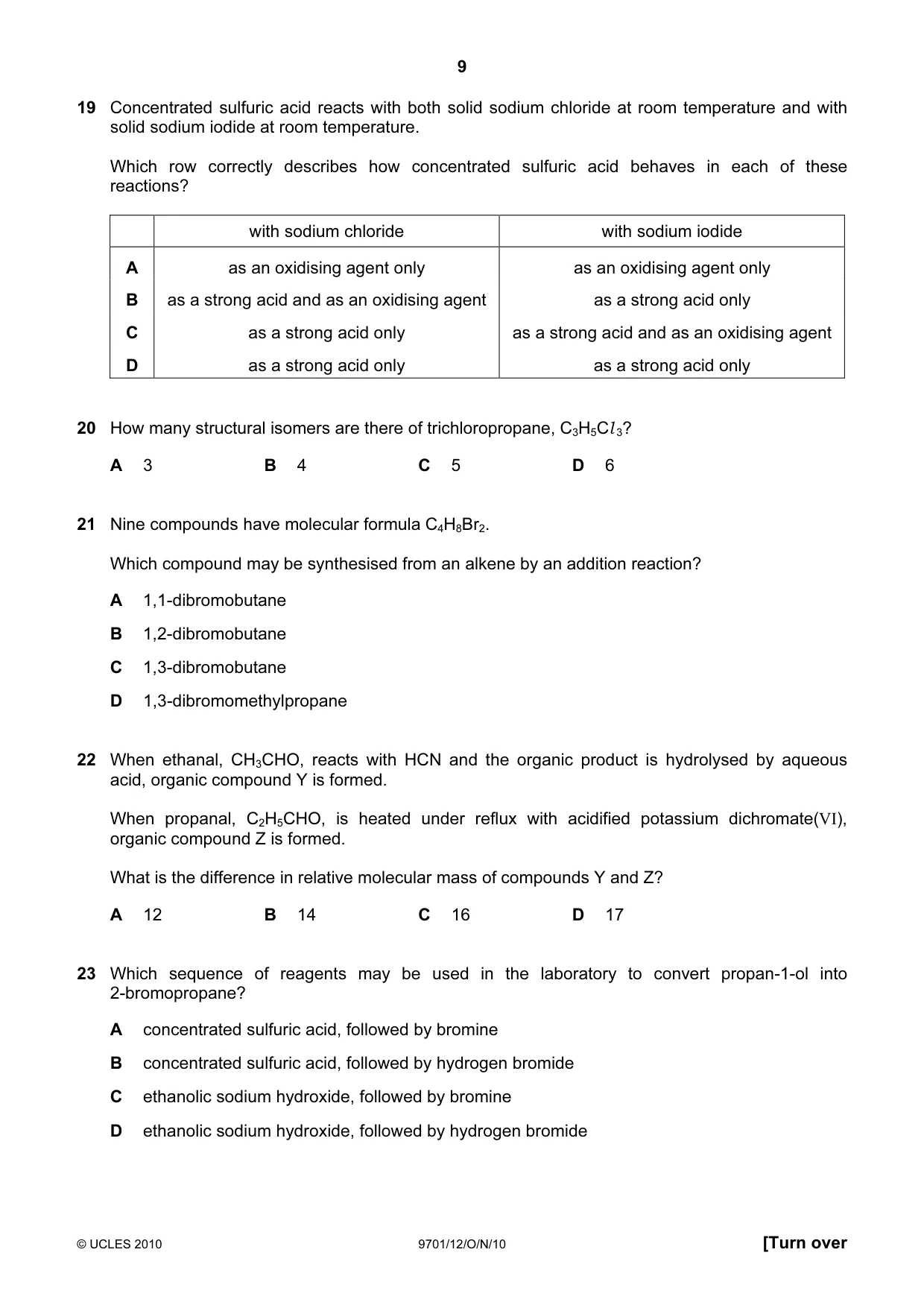
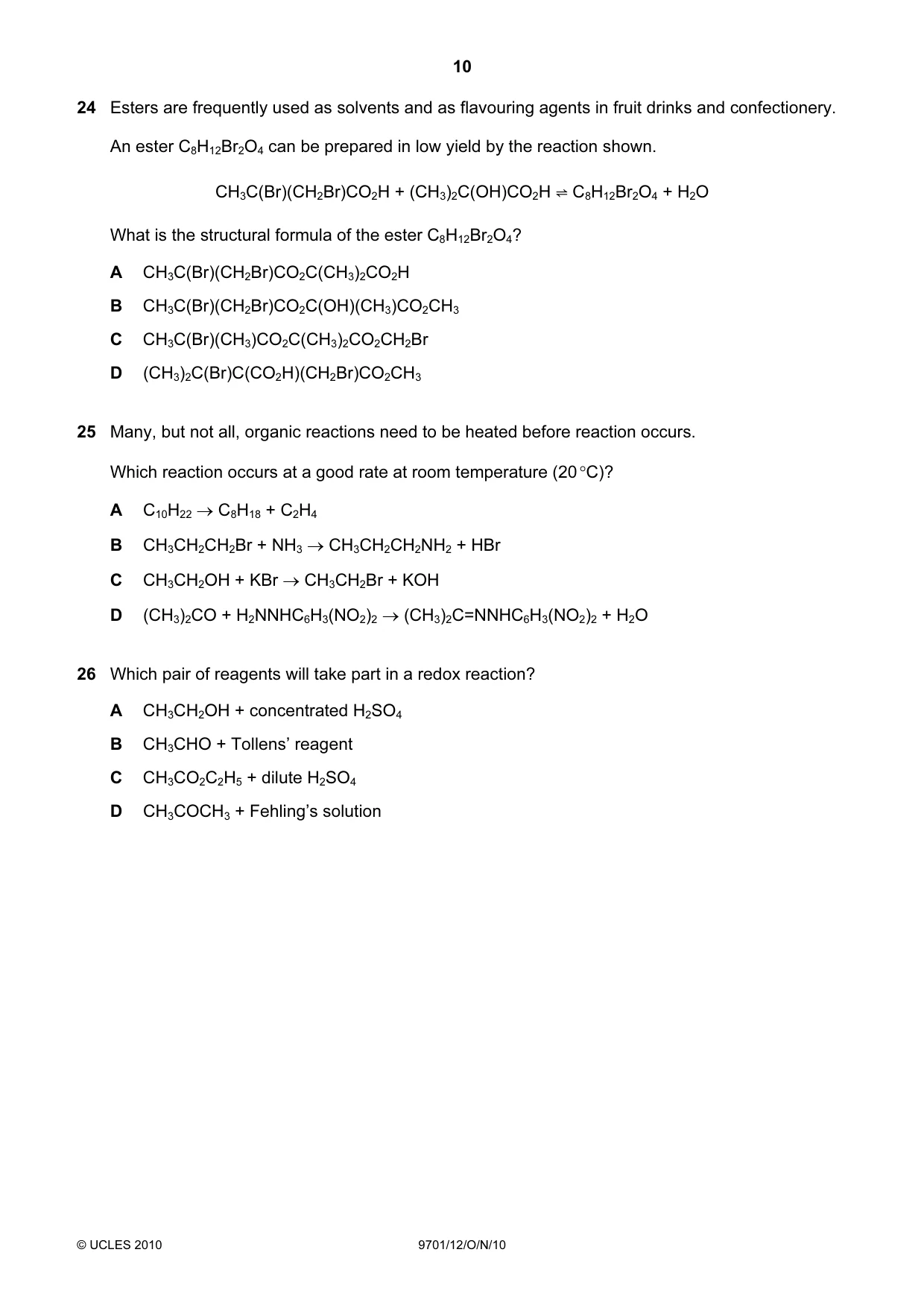
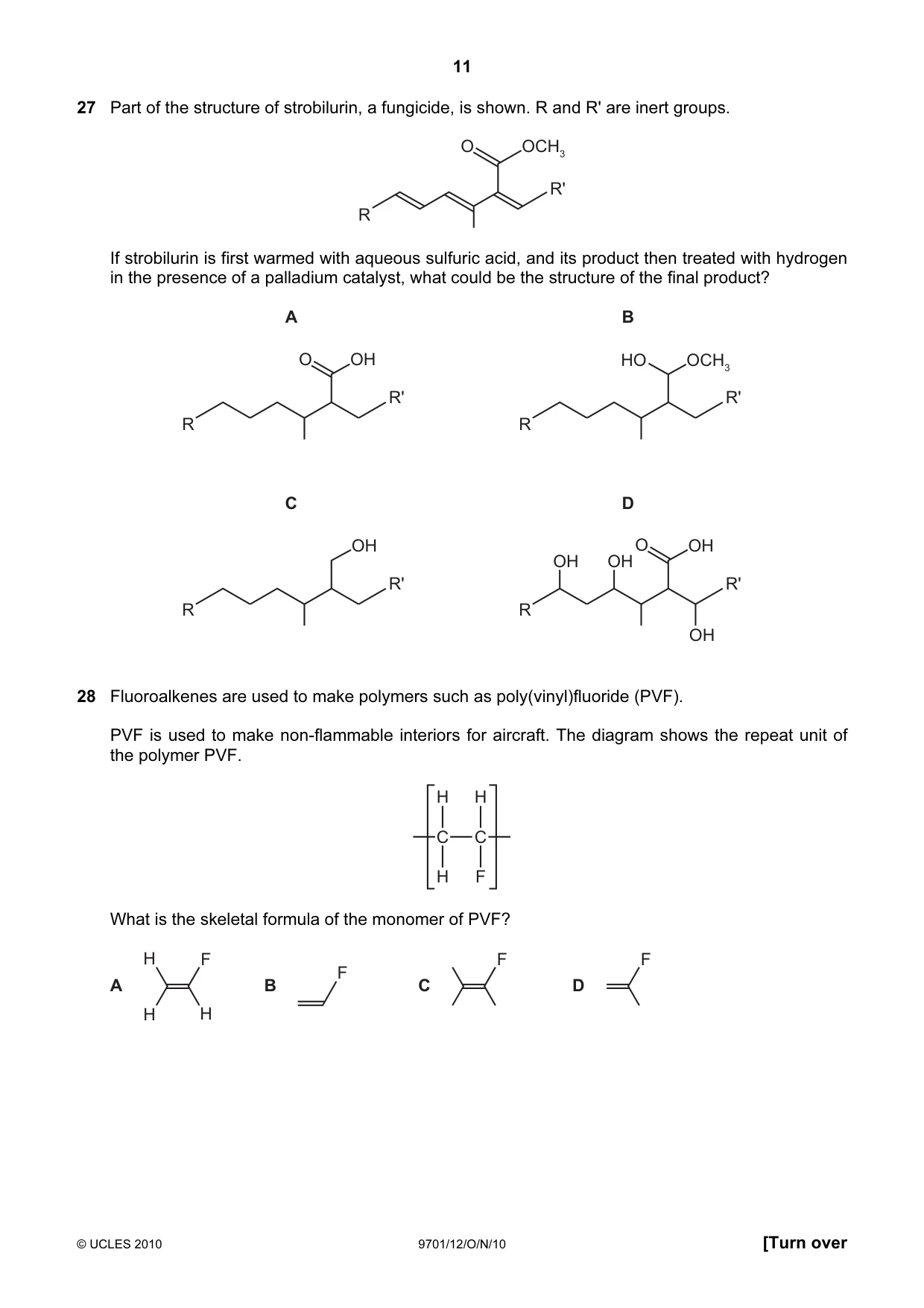
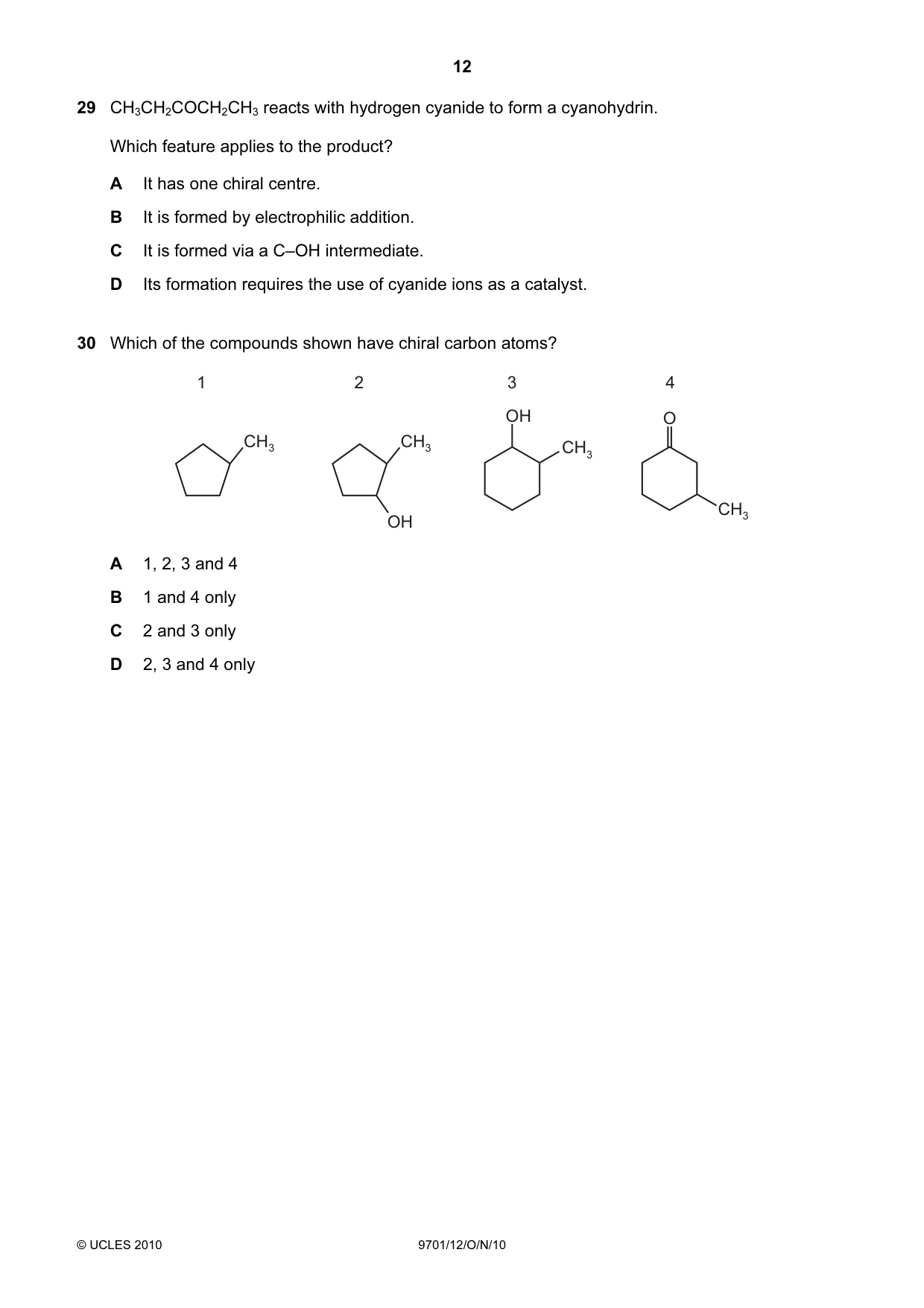
Mark scheme2 pages
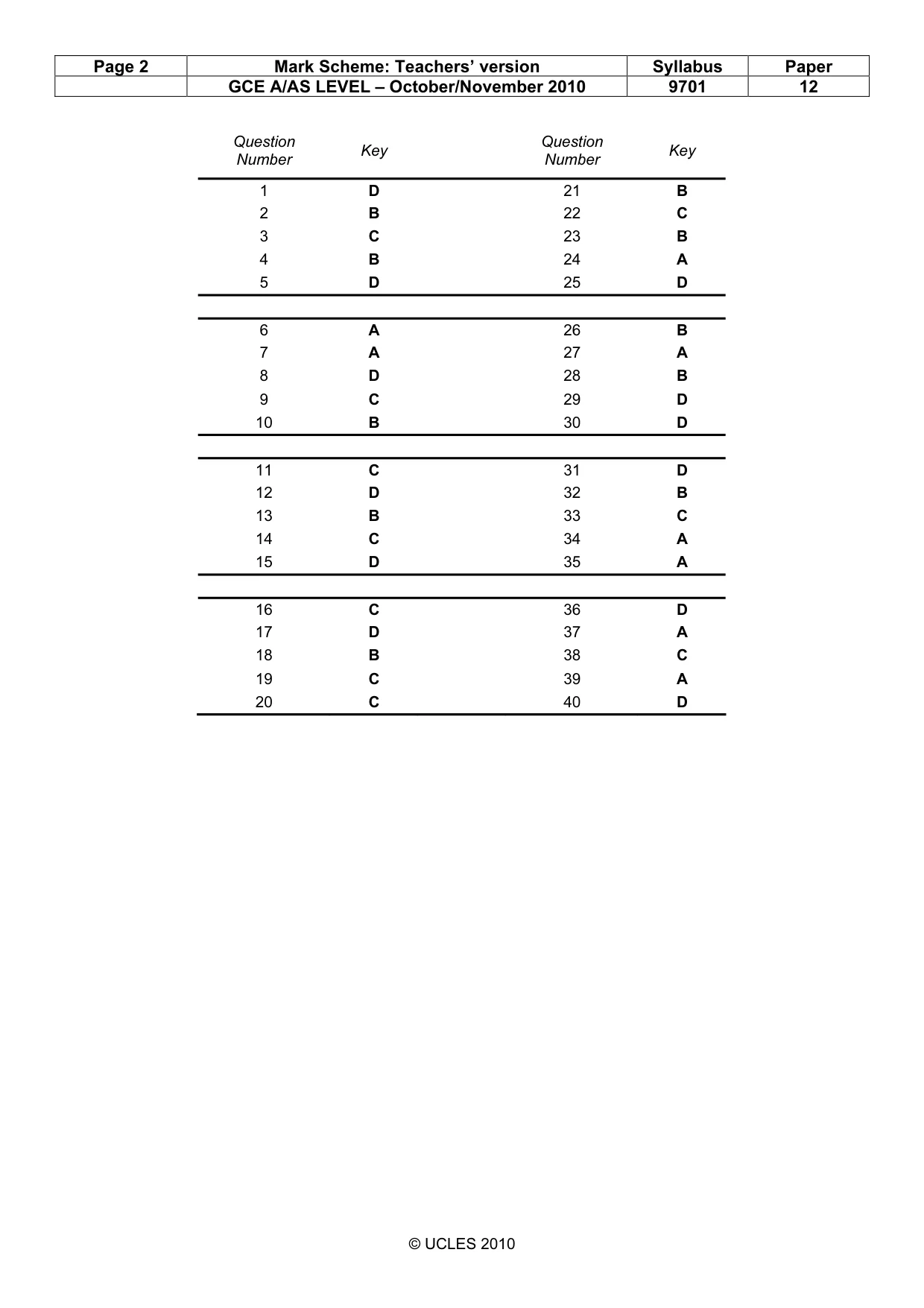
Answers below. Sit the paper first if you are practising.
Questions as text
Q1 · The ability of an atom in a covalent bond to attract electrons to itself is called its…
1 The ability of an atom in a covalent bond to attract electrons to itself is called its electronegativity. The greater the difference between the electronegativities of the two atoms in the bond, the more polar is the bond. Which pair will form the most polar covalent bond between the atoms? A chlorine and bromine B chlorine and iodine C fluorine and chlorine D fluorine and iodine
Mark scheme: D
Q2 · Which diagram correctly represents the Boltzmann distribution of molecular energies at…
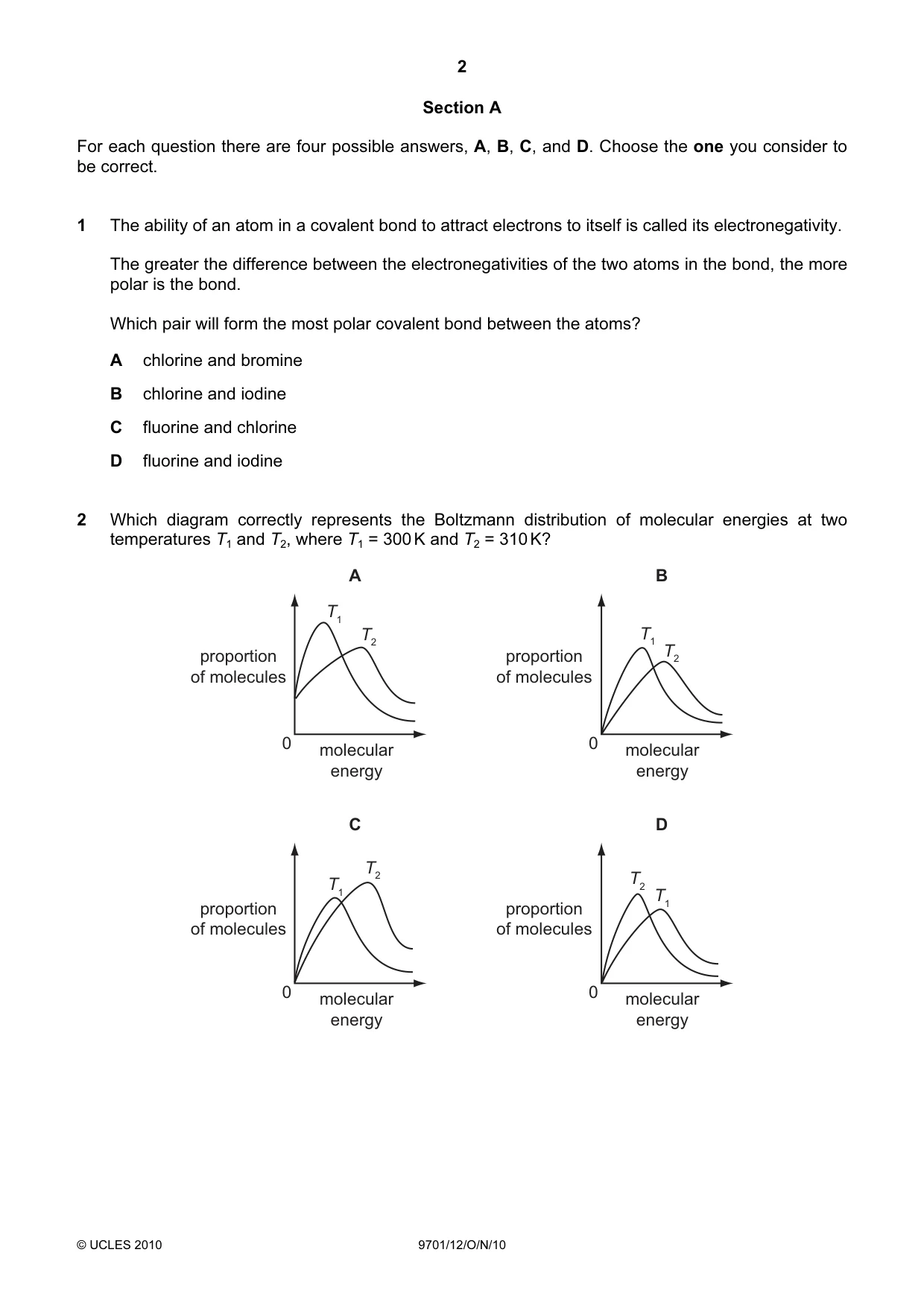
2 Which diagram correctly represents the Boltzmann distribution of molecular energies at two temperatures T1 and T2, where T1 = 300 K and T2 = 310 K? A B T1 T2 T1 proportion proportion T2 of molecules of molecules 0 molecular 0 molecular energy energy C D T2 T1 T2 T1 proportion proportion of molecules of molecules 0 molecular 0 molecular energy energy
Mark scheme: B
More questions on Effect of temperature on reaction rates and the concept of activation energy
Q3 · The table gives the radii, in pm, of some ions
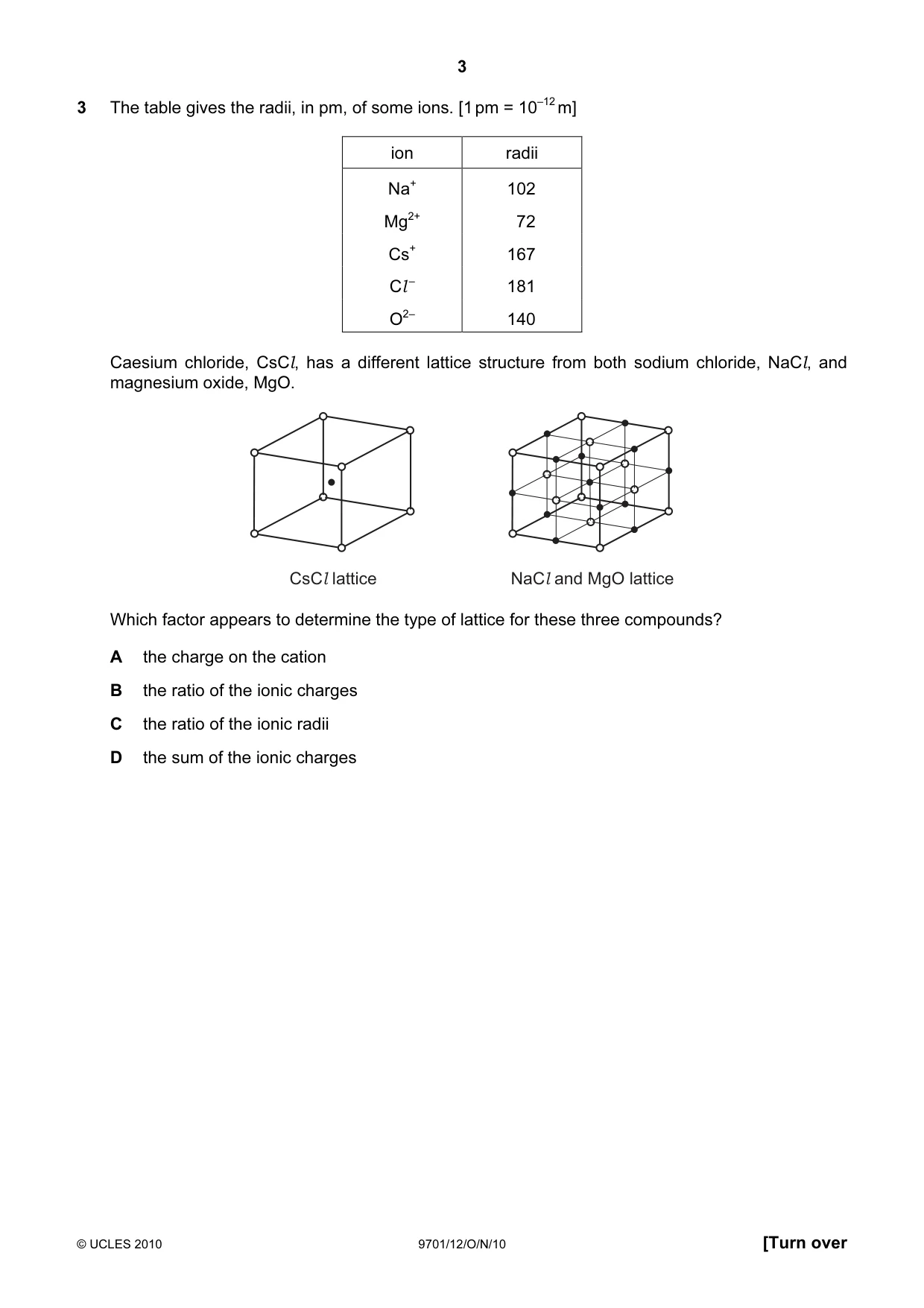
3 The table gives the radii, in pm, of some ions. [1 pm = 10–12 m] ion radii Na+ 102 Mg2+ 72 Cs+ 167 Cl – 181 O2– 140 Caesium chloride, CsCl, has a different lattice structure from both sodium chloride, NaCl, and magnesium oxide, MgO. CsCl lattice NaCl and MgO lattice Which factor appears to determine the type of lattice for these three compounds? A the charge on the cation B the ratio of the ionic charges C the ratio of the ionic radii D the sum of the ionic charges
Mark scheme: C
Q4 · Methanol may be prepared by the reaction between carbon monoxide and hydrogen
4 Methanol may be prepared by the reaction between carbon monoxide and hydrogen. CO(g) + 2H2(g) → CH3OH(g) The relevant average bond energies are given below. E(C≡O) 1077 kJ mol–1 E(C–O) 360 kJ mol–1 E(C–H) 410 kJ mol–1 E(H–H) 436 kJ mol–1 E(O–H) 460 kJ mol–1 What is the enthalpy change of this reaction? A –537 kJ mol–1 B –101 kJ mol–1 C +101 kJ mol–1 D +537 kJ mol–1
Mark scheme: B
Q5 · Which solid has a simple molecular lattice?
5 Which solid has a simple molecular lattice? A calcium fluoride B nickel C silicon(IV) oxide D sulfur
Mark scheme: D
Q6 · The reaction pathway diagram below illustrates the energies of reactants, products and…
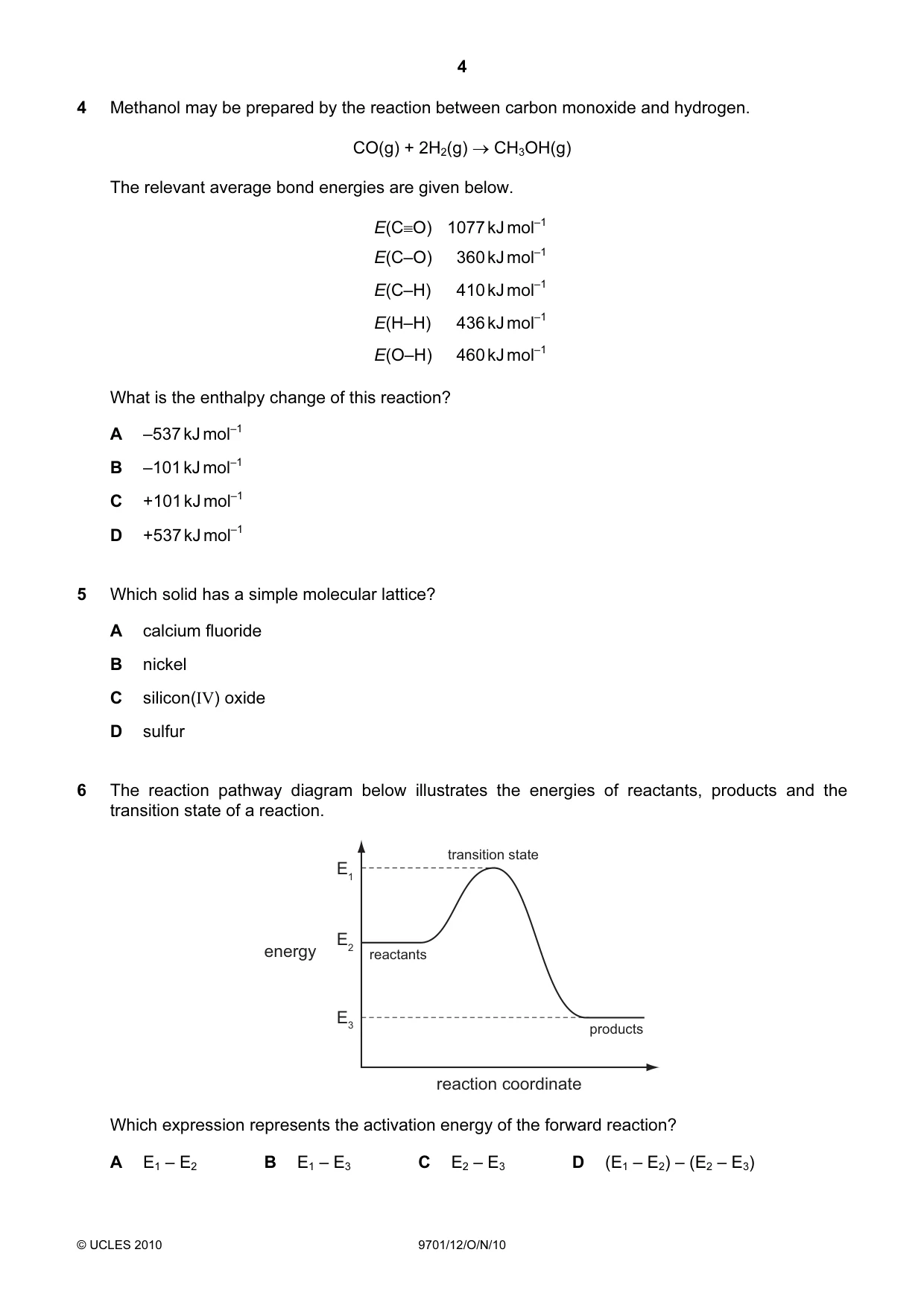
6 The reaction pathway diagram below illustrates the energies of reactants, products and the transition state of a reaction. transition state E1 E2 energy reactants E3 products reaction coordinate Which expression represents the activation energy of the forward reaction? A E1 – E2 B E1 – E3 C E2 – E3 D (E1 – E2) – (E2 – E3)
Mark scheme: A
More questions on Effect of temperature on reaction rates and the concept of activation energy
Q7 · Flask X contains 5 dm3 of helium at 12 kPa pressure and flask Y contains 10 dm3 of neon…
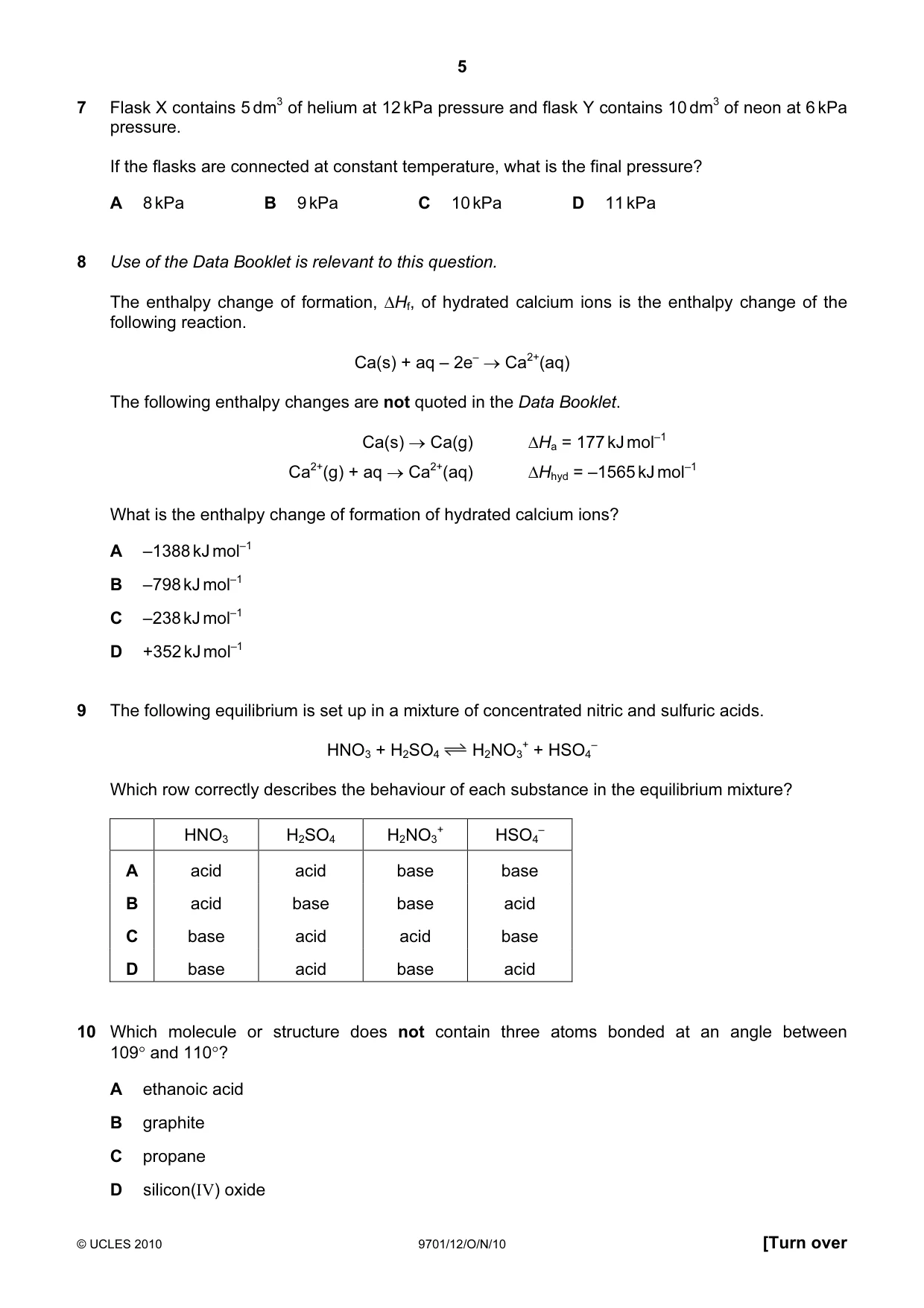
7 Flask X contains 5 dm3 of helium at 12 kPa pressure and flask Y contains 10 dm3 of neon at 6 kPa pressure. If the flasks are connected at constant temperature, what is the final pressure? A 8 kPa B 9 kPa C 10 kPa D 11 kPa
Mark scheme: A
More questions on The gaseous state: ideal and real gases and pV = nRT
Q8 · Use of the Data Booklet is relevant to this question
8 Use of the Data Booklet is relevant to this question. The enthalpy change of formation, ∆Hf, of hydrated calcium ions is the enthalpy change of the following reaction. Ca(s) + aq – 2e– → Ca2+(aq) The following enthalpy changes are not quoted in the Data Booklet. Ca(s) → Ca(g) ∆Ha = 177 kJ mol–1 Ca2+(g) + aq → Ca2+(aq) ∆Hhyd = –1565 kJ mol–1 What is the enthalpy change of formation of hydrated calcium ions? A –1388 kJ mol–1 B –798 kJ mol–1 C –238 kJ mol–1 D +352 kJ mol–1
Mark scheme: D
Q9 · The following equilibrium is set up in a mixture of concentrated nitric and sulfuric acids
9 The following equilibrium is set up in a mixture of concentrated nitric and sulfuric acids. HNO3 + H2SO4 H2NO3 + + HSO4 – Which row correctly describes the behaviour of each substance in the equilibrium mixture? HNO3 H2SO4 H2NO3 + HSO4 – A acid acid base base B acid base base acid C base acid acid base D base acid base acid
Mark scheme: C
Q10 · Which molecule or structure does not contain three atoms bonded at an angle between 109°…
10 Which molecule or structure does not contain three atoms bonded at an angle between 109° and 110°? A ethanoic acid B graphite C propane D silicon(IV) oxide
Mark scheme: B
Q11 · A dimer, X, is stable when solid but a dynamic equilibrium is set up in solution
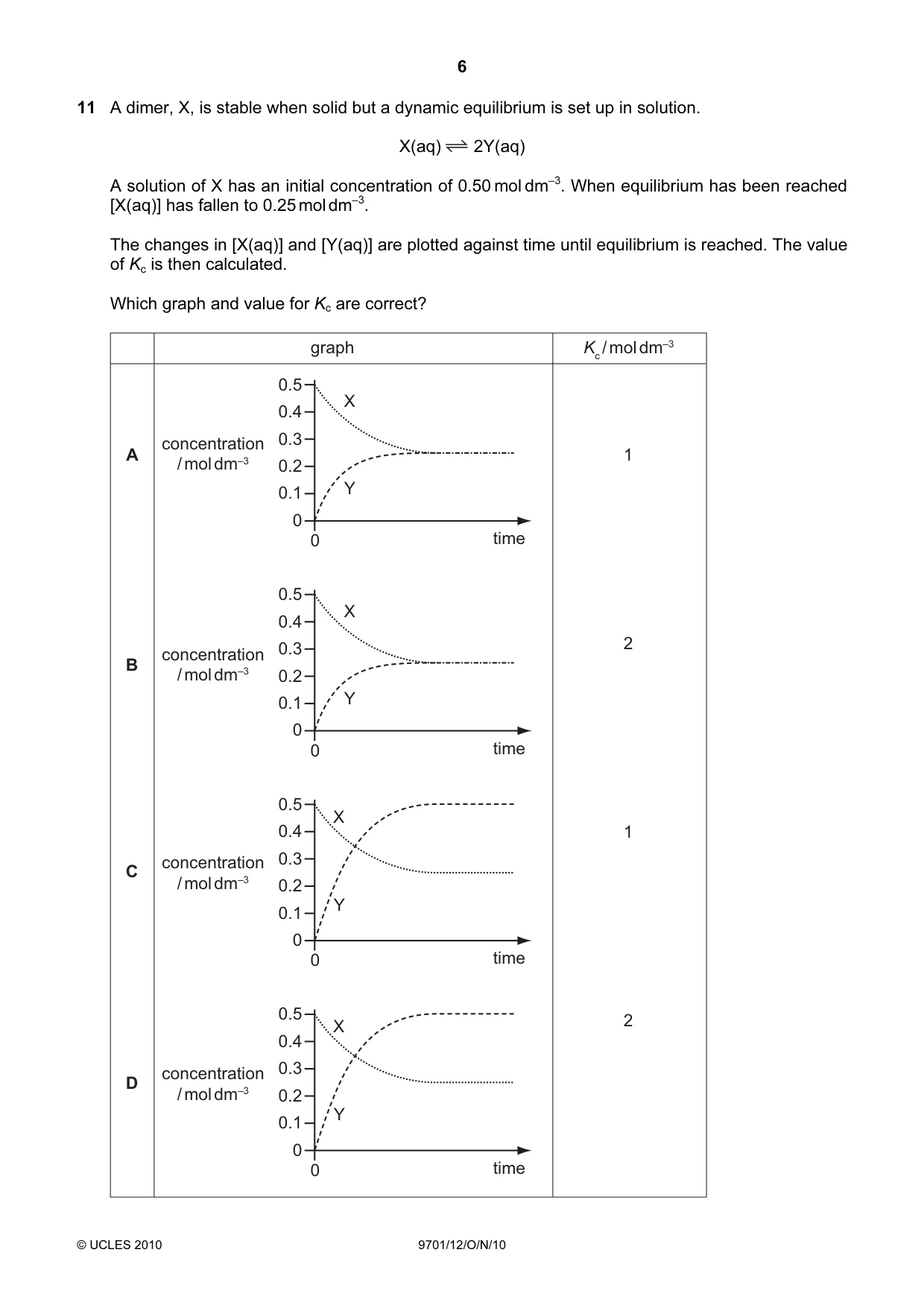
11 A dimer, X, is stable when solid but a dynamic equilibrium is set up in solution. X(aq) 2Y(aq) A solution of X has an initial concentration of 0.50 mol dm–3. When equilibrium has been reached [X(aq)] has fallen to 0.25 mol dm–3. The changes in [X(aq)] and [Y(aq)] are plotted against time until equilibrium is reached. The value of Kc is then calculated. Which graph and value for Kc are correct? graph Kc / mol dm–3 0.5 X 0.4 concentration 0.3 A 1 / mol dm–3 0.2 0.1 Y 0 0 time 0.5 X 0.4 0.3 2 concentration B / mol dm–3 0.2 0.1 Y 0 0 time 0.5 X 0.4 1 concentration 0.3 C / mol dm–3 0.2 Y 0.1 0 0 time 0.5 2 X 0.4 concentration 0.3 D / mol dm–3 0.2 Y 0.1 0 0 time
Mark scheme: C
More questions on Chemical equilibria: reversible reactions, dynamic equilibrium
Q12 · Equimolar quantities of magnesium carbonate and strontium carbonate are separately heated…
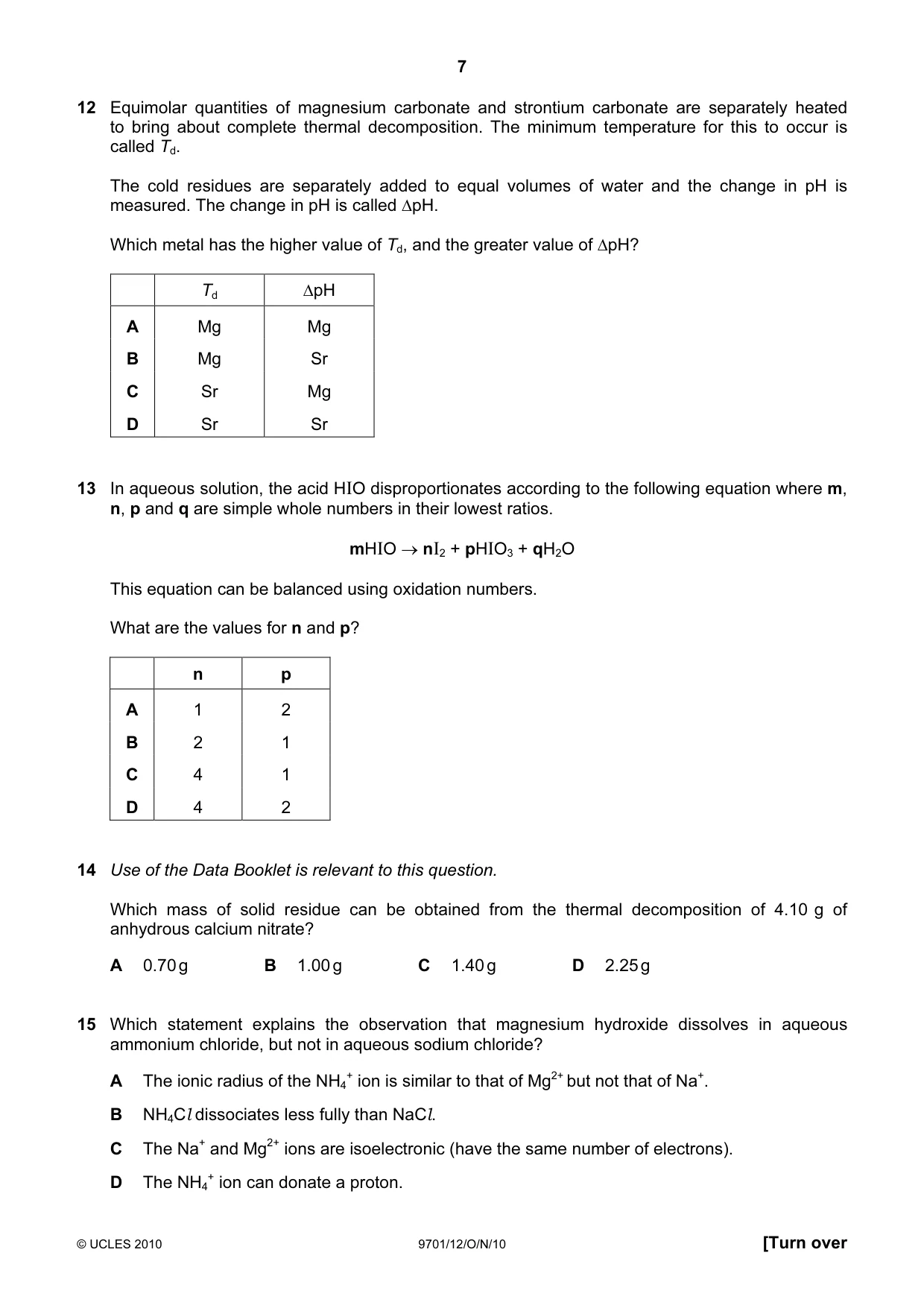
12 Equimolar quantities of magnesium carbonate and strontium carbonate are separately heated to bring about complete thermal decomposition. The minimum temperature for this to occur is called Td. The cold residues are separately added to equal volumes of water and the change in pH is measured. The change in pH is called ∆pH. Which metal has the higher value of Td, and the greater value of ∆pH? Td ∆pH A Mg Mg B Mg Sr C Sr Mg D Sr Sr
Mark scheme: D
Q13 · In aqueous solution, the acid HIO disproportionates according to the following equation…
13 In aqueous solution, the acid HIO disproportionates according to the following equation where m, n, p and q are simple whole numbers in their lowest ratios. mHIO → nI2 + pHIO3 + qH2O This equation can be balanced using oxidation numbers. What are the values for n and p? n p A 1 2 B 2 1 C 4 1 D 4 2
Mark scheme: B
Q14 · Use of the Data Booklet is relevant to this question
14 Use of the Data Booklet is relevant to this question. Which mass of solid residue can be obtained from the thermal decomposition of 4.10 g of anhydrous calcium nitrate? A 0.70 g B 1.00 g C 1.40 g D 2.25 g
Mark scheme: C
Q15 · Which statement explains the observation that magnesium hydroxide dissolves in aqueous…
15 Which statement explains the observation that magnesium hydroxide dissolves in aqueous ammonium chloride, but not in aqueous sodium chloride? A The ionic radius of the NH4 + ion is similar to that of Mg2+ but not that of Na+. B NH4Cl dissociates less fully than NaCl. C The Na+ and Mg2+ ions are isoelectronic (have the same number of electrons). D The NH4 + ion can donate a proton.
Mark scheme: D
Q16 · What happens when chlorine is bubbled through aqueous potassium iodide?
16 What happens when chlorine is bubbled through aqueous potassium iodide? A Chlorine is oxidised to chlorate(V) ions. B Chlorine is oxidised to chloride ions. C Iodide ions are oxidised to iodine. D There is no observable reaction.
Mark scheme: C
More questions on The chemical properties of the halogen elements and the hydrogen halides
Q17 · Strontium metal can be obtained by the electrolysis of molten strontium bromide, SrBr2…
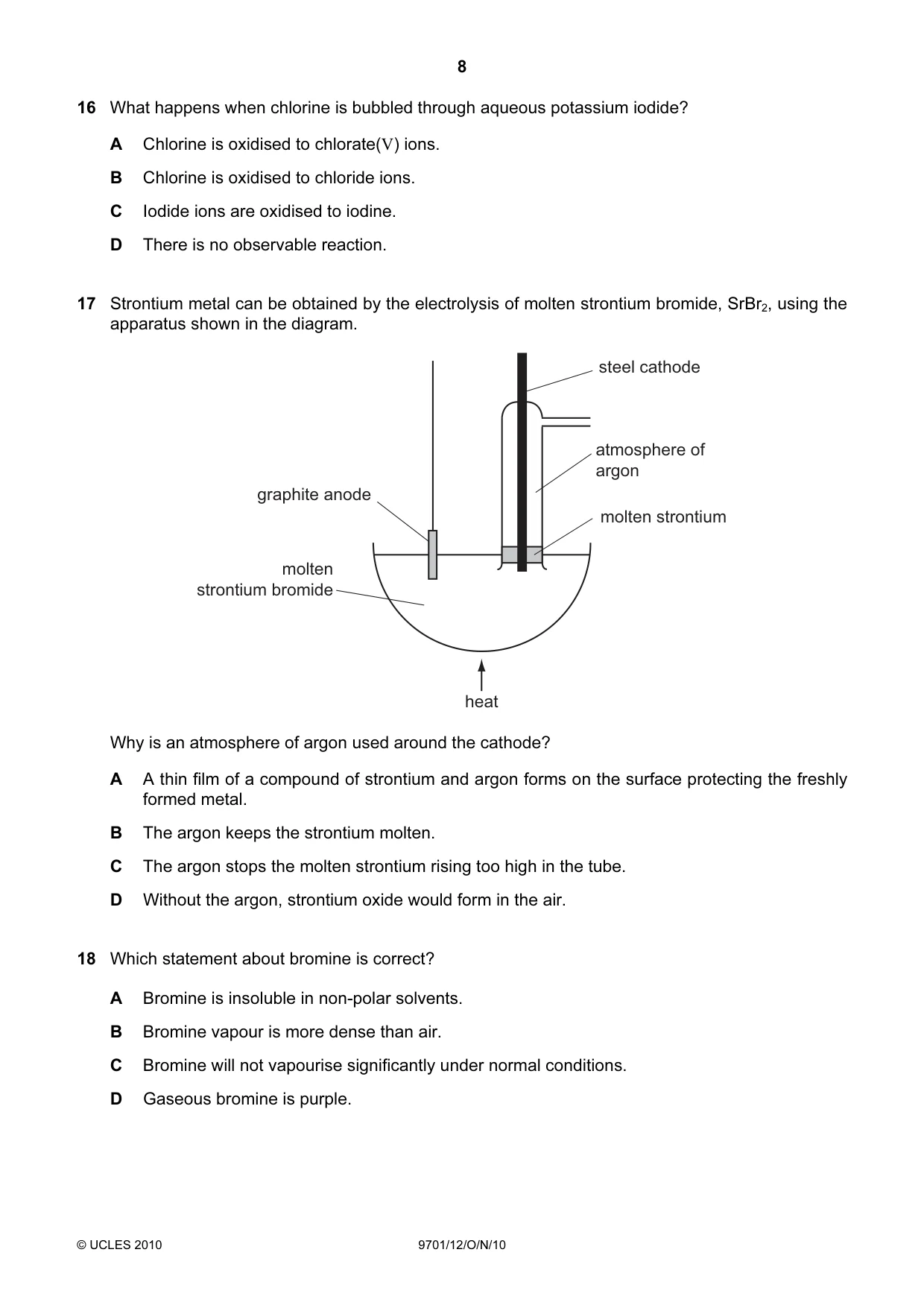
17 Strontium metal can be obtained by the electrolysis of molten strontium bromide, SrBr2, using the apparatus shown in the diagram. steel cathode atmosphere of argon graphite anode molten strontium molten strontium bromide heat Why is an atmosphere of argon used around the cathode? A A thin film of a compound of strontium and argon forms on the surface protecting the freshly formed metal. B The argon keeps the strontium molten. C The argon stops the molten strontium rising too high in the tube. D Without the argon, strontium oxide would form in the air.
Mark scheme: D
Q18 · Which statement about bromine is correct?
18 Which statement about bromine is correct? A Bromine is insoluble in non-polar solvents. B Bromine vapour is more dense than air. C Bromine will not vapourise significantly under normal conditions. D Gaseous bromine is purple.
Mark scheme: B
More questions on Physical properties of the Group 17 elements
Q19 · Concentrated sulfuric acid reacts with both solid sodium chloride at room temperature and…
19 Concentrated sulfuric acid reacts with both solid sodium chloride at room temperature and with solid sodium iodide at room temperature. Which row correctly describes how concentrated sulfuric acid behaves in each of these reactions? with sodium chloride with sodium iodide A as an oxidising agent only as an oxidising agent only B as a strong acid and as an oxidising agent as a strong acid only C as a strong acid only as a strong acid and as an oxidising agent D as a strong acid only as a strong acid only
Mark scheme: C
Q20 · How many structural isomers are there of trichloropropane, C3H5Cl 3?
20 How many structural isomers are there of trichloropropane, C3H5Cl 3? A 3 B 4 C 5 D 6
Mark scheme: C
More questions on Isomerism: structural isomerism and stereoisomerism
Q21 · Nine compounds have molecular formula C4H8Br2
21 Nine compounds have molecular formula C4H8Br2. Which compound may be synthesised from an alkene by an addition reaction? A 1,1-dibromobutane B 1,2-dibromobutane C 1,3-dibromobutane D 1,3-dibromomethylpropane
Mark scheme: B
Q22 · When ethanal, CH3CHO, reacts with HCN and the organic product is hydrolysed by aqueous…
22 When ethanal, CH3CHO, reacts with HCN and the organic product is hydrolysed by aqueous acid, organic compound Y is formed. When propanal, C2H5CHO, is heated under reflux with acidified potassium dichromate(VI), organic compound Z is formed. What is the difference in relative molecular mass of compounds Y and Z? A 12 B 14 C 16 D 17
Mark scheme: C
Q23 · Which sequence of reagents may be used in the laboratory to convert propan-1-ol into…
23 Which sequence of reagents may be used in the laboratory to convert propan-1-ol into 2-bromopropane? A concentrated sulfuric acid, followed by bromine B concentrated sulfuric acid, followed by hydrogen bromide C ethanolic sodium hydroxide, followed by bromine D ethanolic sodium hydroxide, followed by hydrogen bromide
Mark scheme: B
Q24 · Esters are frequently used as solvents and as flavouring agents in fruit drinks and…
24 Esters are frequently used as solvents and as flavouring agents in fruit drinks and confectionery. An ester C8H12Br2O4 can be prepared in low yield by the reaction shown. CH3C(Br)(CH2Br)CO2H + (CH3)2C(OH)CO2H ⇌ C8H12Br2O4 + H2O What is the structural formula of the ester C8H12Br2O4? A CH3C(Br)(CH2Br)CO2C(CH3)2CO2H B CH3C(Br)(CH2Br)CO2C(OH)(CH3)CO2CH3 C CH3C(Br)(CH3)CO2C(CH3)2CO2CH2Br D (CH3)2C(Br)C(CO2H)(CH2Br)CO2CH3
Mark scheme: A
Q25 · Many, but not all, organic reactions need to be heated before reaction occurs
25 Many, but not all, organic reactions need to be heated before reaction occurs. Which reaction occurs at a good rate at room temperature (20 °C)? A C10H22 → C8H18 + C2H4 B CH3CH2CH2Br + NH3 → CH3CH2CH2NH2 + HBr C CH3CH2OH + KBr → CH3CH2Br + KOH D (CH3)2CO + H2NNHC6H3(NO2)2 → (CH3)2C=NNHC6H3(NO2)2 + H2O
Mark scheme: D
Q26 · Which pair of reagents will take part in a redox reaction?
26 Which pair of reagents will take part in a redox reaction? A CH3CH2OH + concentrated H2SO4 B CH3CHO + Tollens’ reagent C CH3CO2C2H5 + dilute H2SO4 D CH3COCH3 + Fehling’s solution
Mark scheme: B
Q27 · Part of the structure of strobilurin, a fungicide, is shown
27 Part of the structure of strobilurin, a fungicide, is shown. R and R' are inert groups. O OCH3 R' R If strobilurin is first warmed with aqueous sulfuric acid, and its product then treated with hydrogen in the presence of a palladium catalyst, what could be the structure of the final product? A B O OH HO OCH3 R' R' R R C D OH O OH OH OH R' R' R R OH
Mark scheme: A
Q28 · Fluoroalkenes are used to make polymers such as poly(vinyl)fluoride (PVF)
28 Fluoroalkenes are used to make polymers such as poly(vinyl)fluoride (PVF). PVF is used to make non-flammable interiors for aircraft. The diagram shows the repeat unit of the polymer PVF. H H C C H F What is the skeletal formula of the monomer of PVF? H F F F F A B C D H H
Mark scheme: B
Q29 · CH3CH2COCH2CH3 reacts with hydrogen cyanide to form a cyanohydrin
29 CH3CH2COCH2CH3 reacts with hydrogen cyanide to form a cyanohydrin. Which feature applies to the product? A It has one chiral centre. B It is formed by electrophilic addition. C It is formed via a C–OH intermediate. D Its formation requires the use of cyanide ions as a catalyst.
Mark scheme: D
Q30 · Which of the compounds shown have chiral carbon atoms?
30 Which of the compounds shown have chiral carbon atoms? 1 2 3 4 OH O CH3 CH3 CH3 CH3 OH A 1, 2, 3 and 4 B 1 and 4 only C 2 and 3 only D 2, 3 and 4 only
Mark scheme: D
More questions on Isomerism: structural isomerism and stereoisomerism
Q31 · When ammonia, NH3, is produced in a school or college laboratory, it is usually dried…
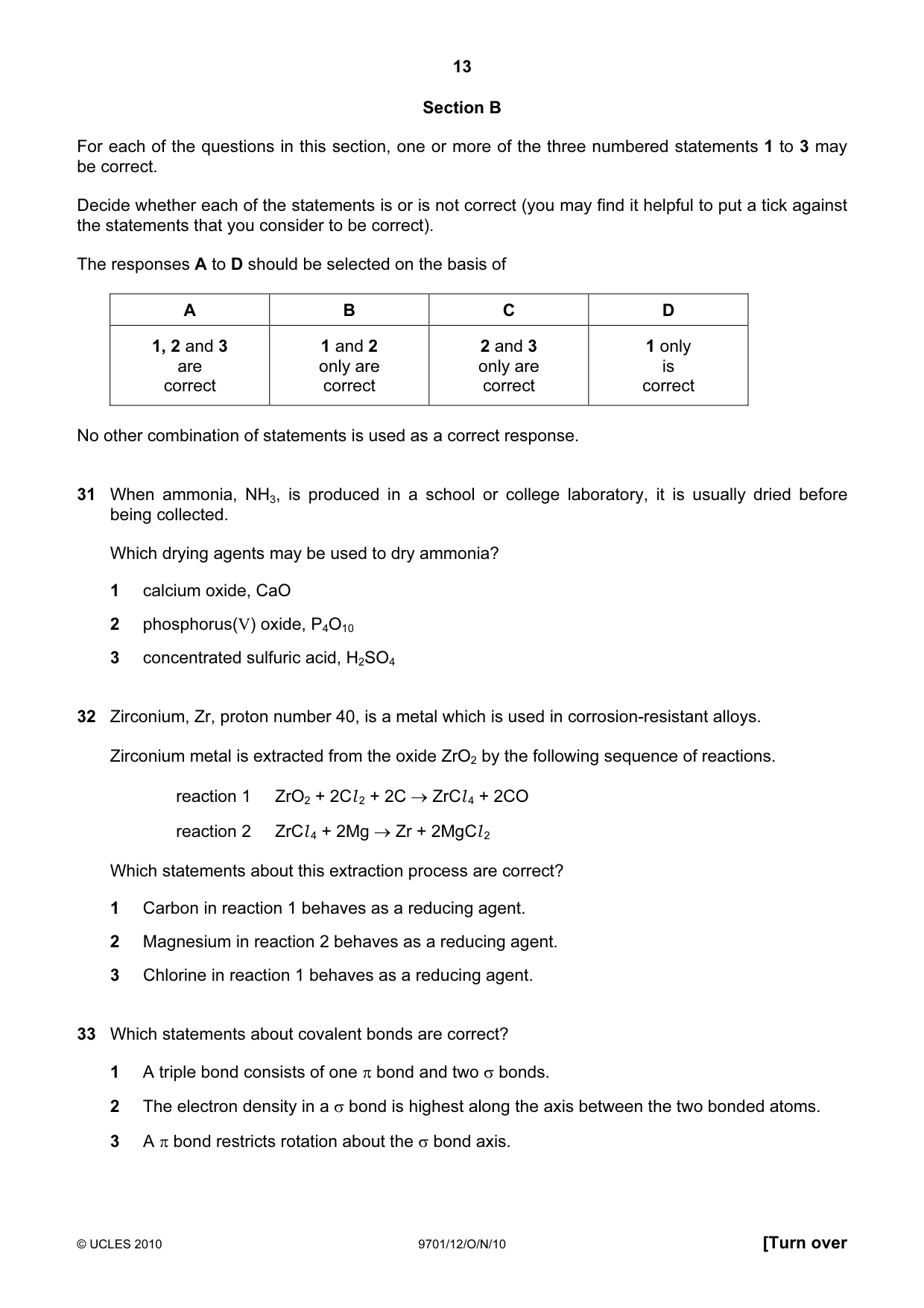
31 When ammonia, NH3, is produced in a school or college laboratory, it is usually dried before being collected. Which drying agents may be used to dry ammonia? 1 calcium oxide, CaO 2 phosphorus(V) oxide, P4O10 3 concentrated sulfuric acid, H2SO4
Mark scheme: D
Q32 · Zirconium, Zr, proton number 40, is a metal which is used in corrosion-resistant alloys
32 Zirconium, Zr, proton number 40, is a metal which is used in corrosion-resistant alloys. Zirconium metal is extracted from the oxide ZrO2 by the following sequence of reactions. reaction 1 ZrO2 + 2Cl 2 + 2C → ZrCl 4 + 2CO reaction 2 ZrCl 4 + 2Mg → Zr + 2MgCl 2 Which statements about this extraction process are correct? 1 Carbon in reaction 1 behaves as a reducing agent. 2 Magnesium in reaction 2 behaves as a reducing agent. 3 Chlorine in reaction 1 behaves as a reducing agent.
Mark scheme: B
Q33 · Which statements about covalent bonds are correct?
33 Which statements about covalent bonds are correct? 1 A triple bond consists of one π bond and two σ bonds. 2 The electron density in a σ bond is highest along the axis between the two bonded atoms. 3 A π bond restricts rotation about the σ bond axis.
Mark scheme: C
More questions on Shapes of organic molecules; σ and π bonds
Q34 · A student puts 10 cm3 of 0.100 mol dm–3 sulfuric acid into one test-tube and 10 cm3 of…
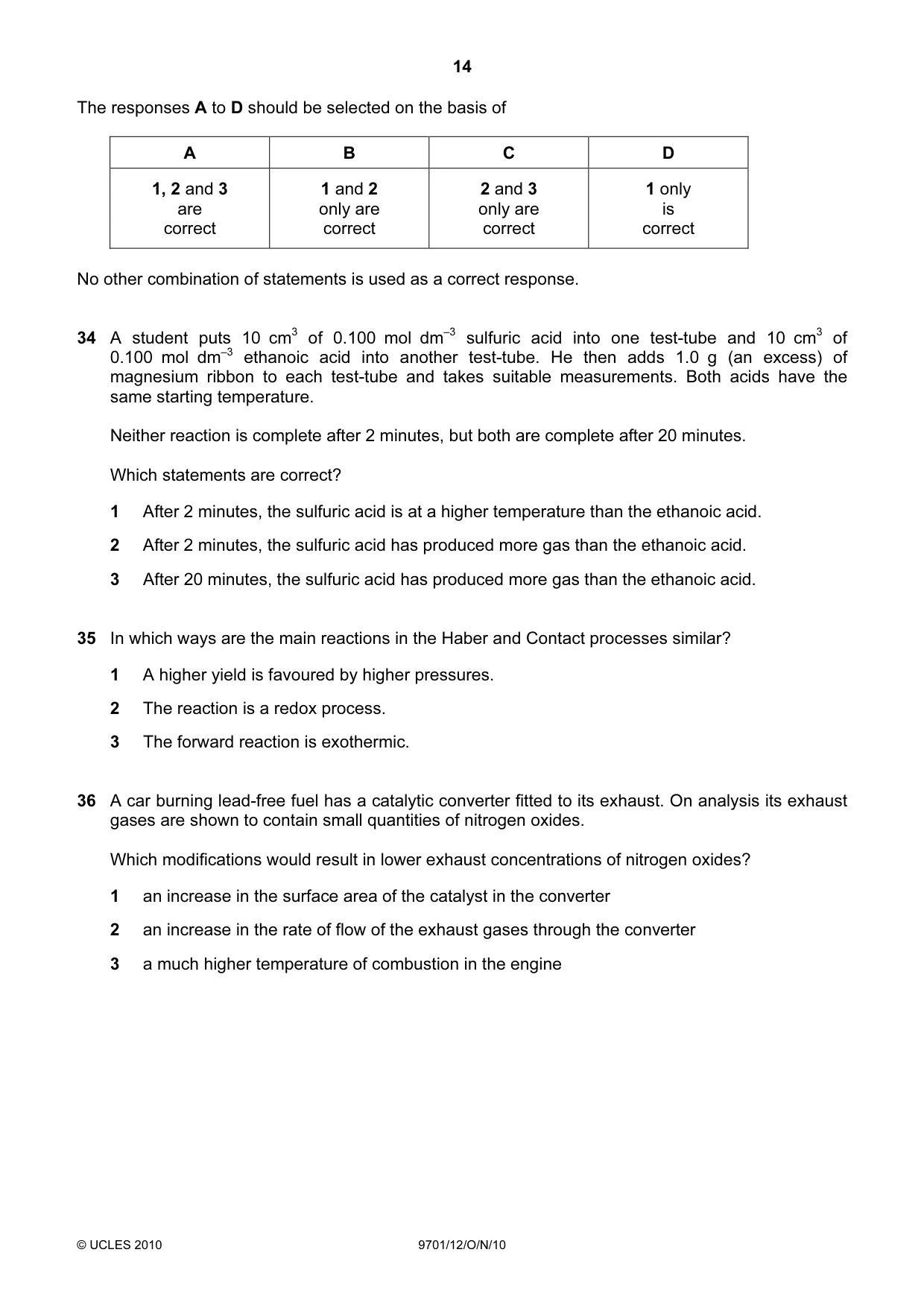
34 A student puts 10 cm3 of 0.100 mol dm–3 sulfuric acid into one test-tube and 10 cm3 of 0.100 mol dm–3 ethanoic acid into another test-tube. He then adds 1.0 g (an excess) of magnesium ribbon to each test-tube and takes suitable measurements. Both acids have the same starting temperature. Neither reaction is complete after 2 minutes, but both are complete after 20 minutes. Which statements are correct? 1 After 2 minutes, the sulfuric acid is at a higher temperature than the ethanoic acid. 2 After 2 minutes, the sulfuric acid has produced more gas than the ethanoic acid. 3 After 20 minutes, the sulfuric acid has produced more gas than the ethanoic acid.
Mark scheme: A
Q35 · In which ways are the main reactions in the Haber and Contact processes similar?
35 In which ways are the main reactions in the Haber and Contact processes similar? 1 A higher yield is favoured by higher pressures. 2 The reaction is a redox process. 3 The forward reaction is exothermic.
Mark scheme: A
More questions on Chemical equilibria: reversible reactions, dynamic equilibrium
Q36 · A car burning lead-free fuel has a catalytic converter fitted to its exhaust
36 A car burning lead-free fuel has a catalytic converter fitted to its exhaust. On analysis its exhaust gases are shown to contain small quantities of nitrogen oxides. Which modifications would result in lower exhaust concentrations of nitrogen oxides? 1 an increase in the surface area of the catalyst in the converter 2 an increase in the rate of flow of the exhaust gases through the converter 3 a much higher temperature of combustion in the engine
Mark scheme: D
Q37 · The diagram shows a compound present in smoke from burning garden waste
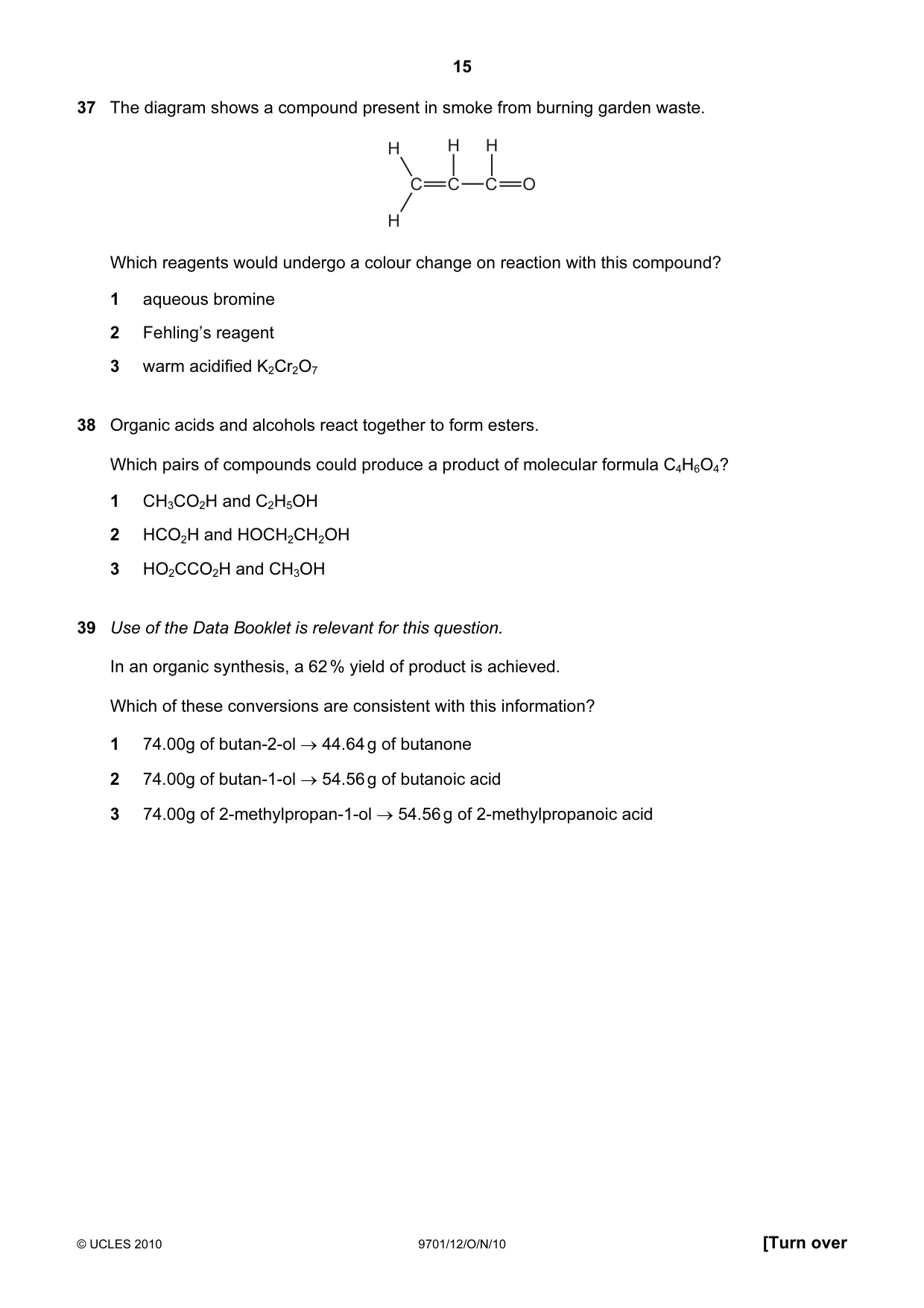
37 The diagram shows a compound present in smoke from burning garden waste. H H H C C C O H Which reagents would undergo a colour change on reaction with this compound? 1 aqueous bromine 2 Fehling’s reagent 3 warm acidified K2Cr2O7
Mark scheme: A
Q38 · Organic acids and alcohols react together to form esters
38 Organic acids and alcohols react together to form esters. Which pairs of compounds could produce a product of molecular formula C4H6O4? 1 CH3CO2H and C2H5OH 2 HCO2H and HOCH2CH2OH 3 HO2CCO2H and CH3OH
Mark scheme: C
Q39 · Use of the Data Booklet is relevant for this question
39 Use of the Data Booklet is relevant for this question. In an organic synthesis, a 62 % yield of product is achieved. Which of these conversions are consistent with this information? 1 74.00g of butan-2-ol → 44.64 g of butanone 2 74.00g of butan-1-ol → 54.56 g of butanoic acid 3 74.00g of 2-methylpropan-1-ol → 54.56 g of 2-methylpropanoic acid
Mark scheme: A
More questions on Reacting masses and volumes (of solutions and gases)
Q40 · A reaction pathway diagram is shown
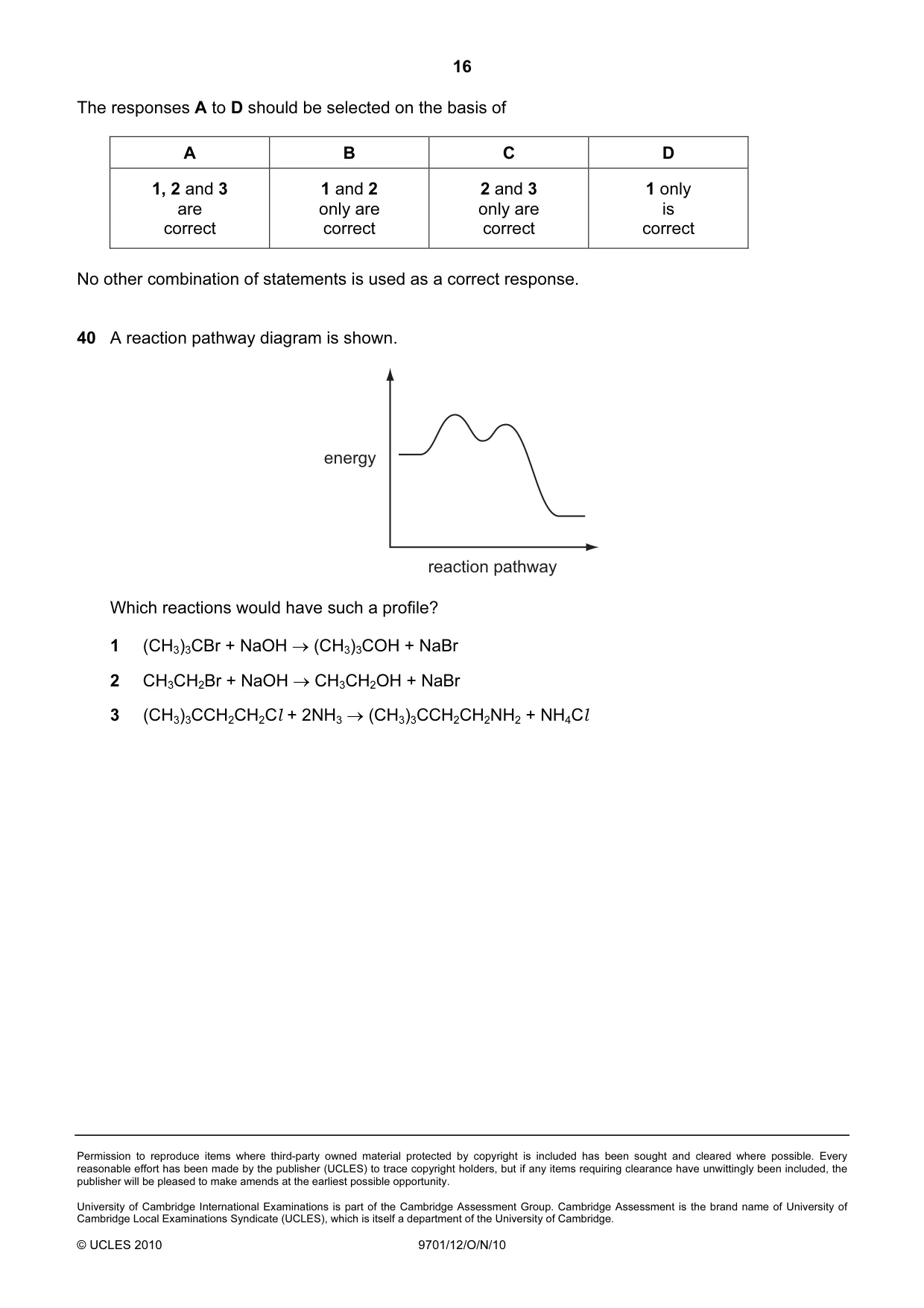
40 A reaction pathway diagram is shown. energy reaction pathway Which reactions would have such a profile? 1 (CH3)3CBr + NaOH → (CH3)3COH + NaBr 2 CH3CH2Br + NaOH → CH3CH2OH + NaBr 3 (CH3)3CCH2CH2Cl + 2NH3 → (CH3)3CCH2CH2NH2 + NH4Cl
Mark scheme: D
What was in this paper
The subtopics covered by these 40 questions, and how many questions each got. Open one in a new tab to see every Cambridge question on it.
3Alcohols2Aldehydes and ketones2Chemical equilibria: reversible reactions, dynamic equilibrium2Effect of temperature on reaction rates and the concept of activation energy2Esters2Halogenoalkanes2Isomerism: structural isomerism and stereoisomerism2Redox processes: electron transfer and changes in oxidation number (oxidation state)2Similarities and trends in the properties of the Group 2 metals, magnesium to barium, and their compounds2Addition polymerisation1Alkenes1Bonding and structure1Carboxylic acids1Electrolysis1Electronegativity and bonding1Enthalpies of solution and hydration1Enthalpy change, ΔH1Homogeneous and heterogeneous catalysts1Ionic bonding1Nitriles and hydroxynitriles1Nitrogen and sulfur1Physical properties of the Group 17 elements1Reacting masses and volumes (of solutions and gases)1Shapes of molecules1Shapes of organic molecules; σ and π bonds1Some reactions of the halide ions1The chemical properties of the halogen elements and the hydrogen halides1The gaseous state: ideal and real gases and pV = nRT1What you needed in this session
Cambridge’s own grade thresholds for 2010 Oct/Nov, Paper 1 · Variant 2. A higher threshold means an easier paper — the bar moves with how the cohort did.