Cambridge A Level Chemistry 9701 — 2022 May/June Paper 1 · Variant 3
9701/13/M/J/22 · 40 questions · 40 marks · ≈45 min
The question paper and its mark scheme, free to read here and free to download. This is Cambridge’s own paper, exactly as it was sat.
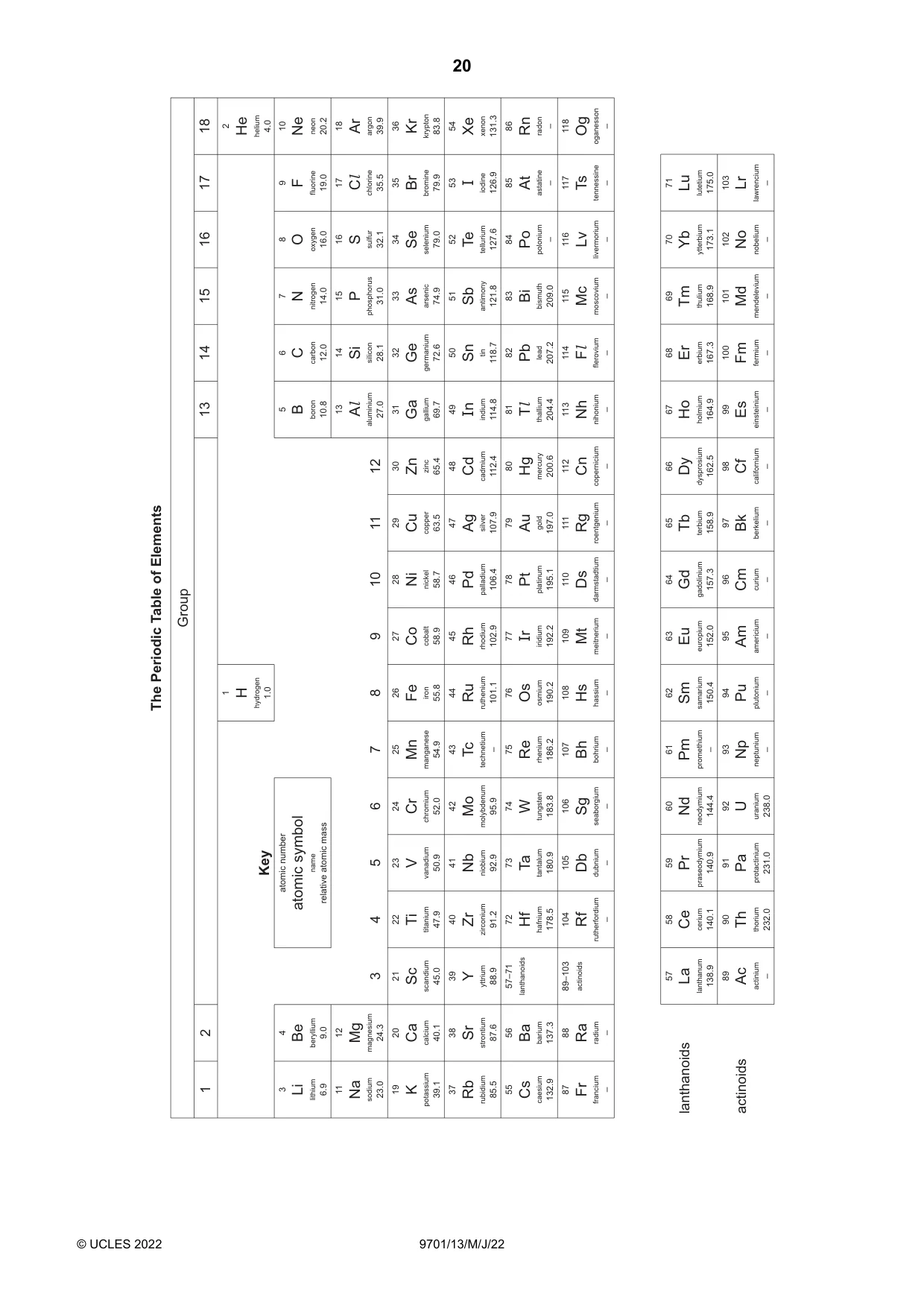
Question paper20 pages
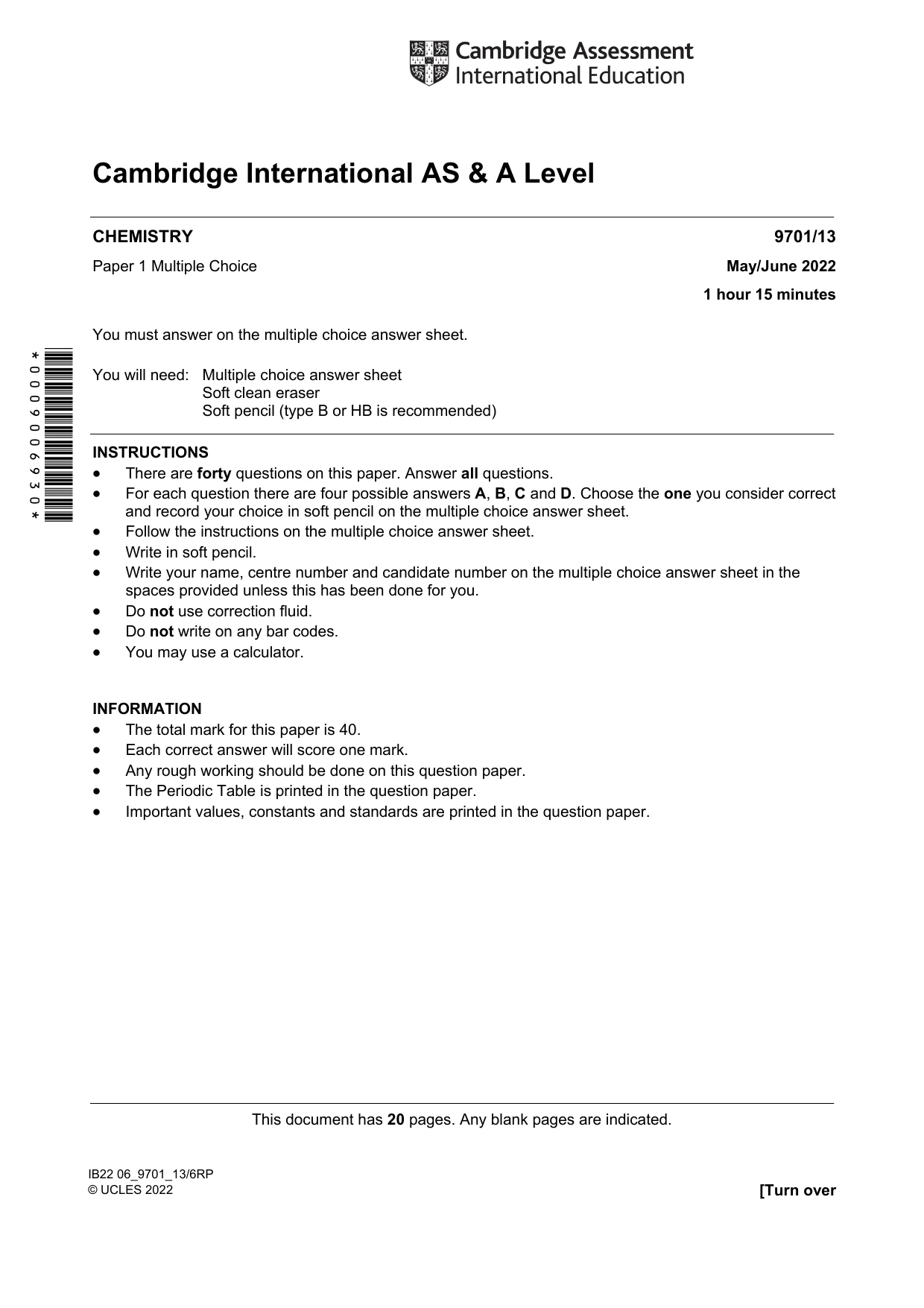
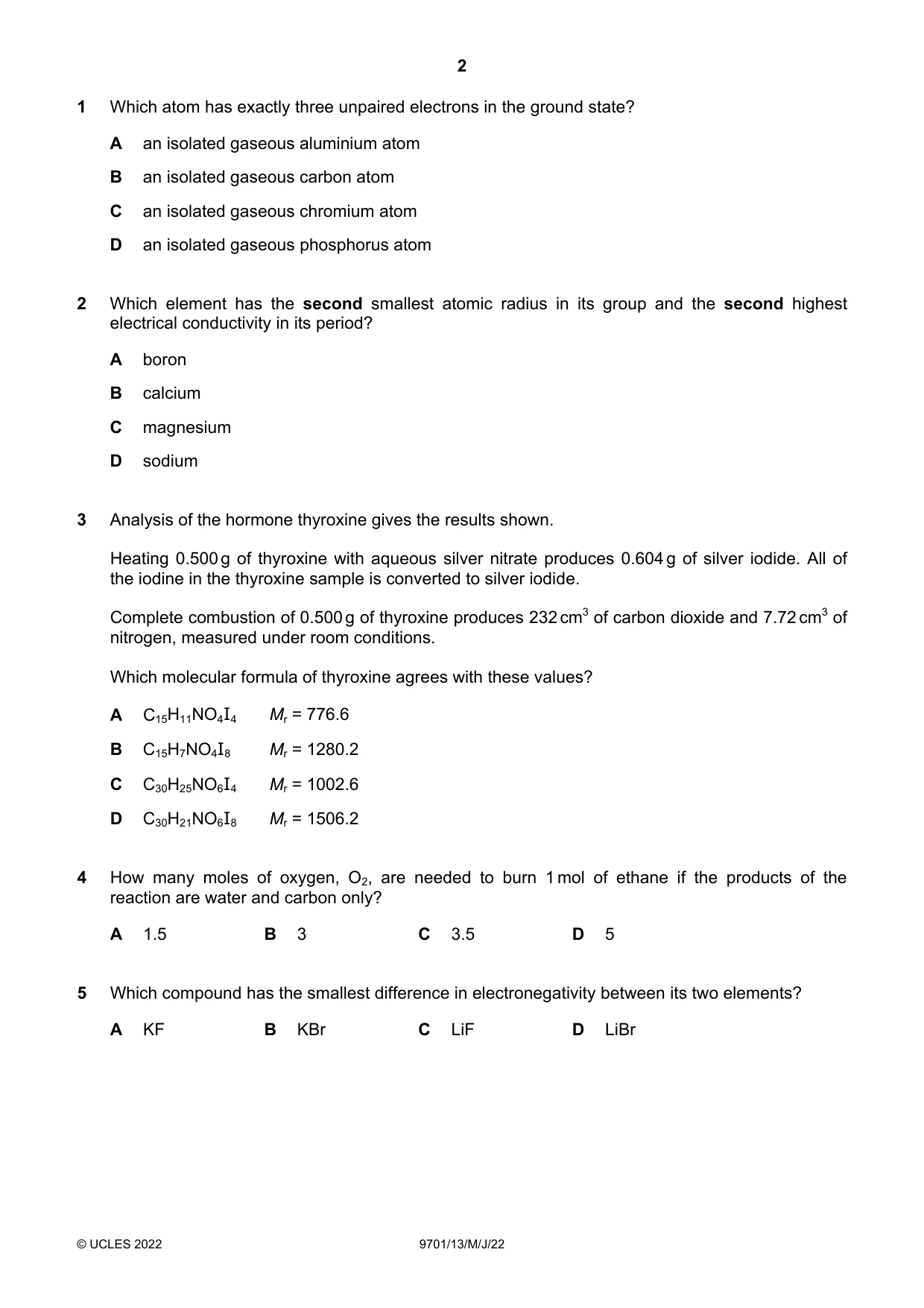
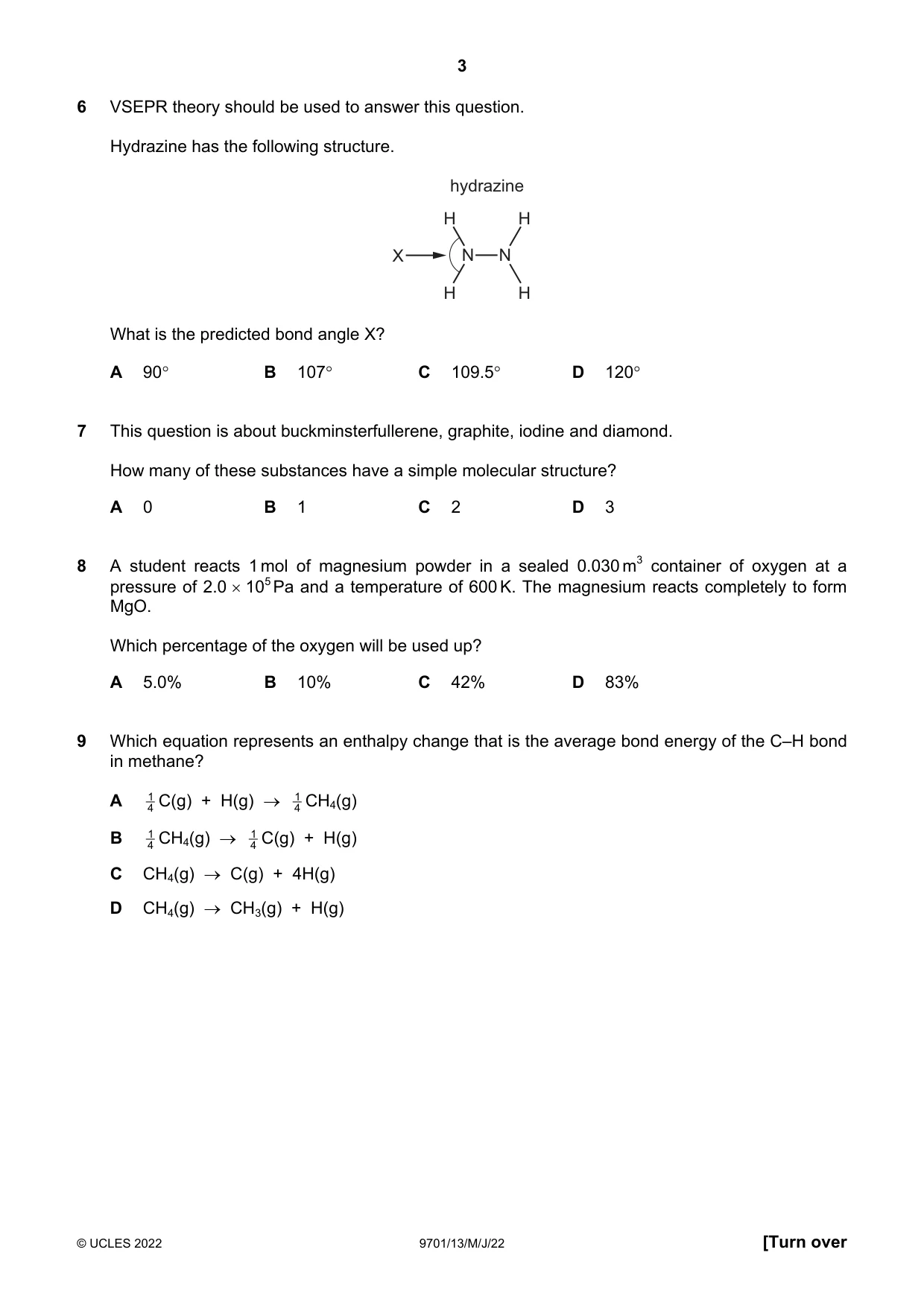
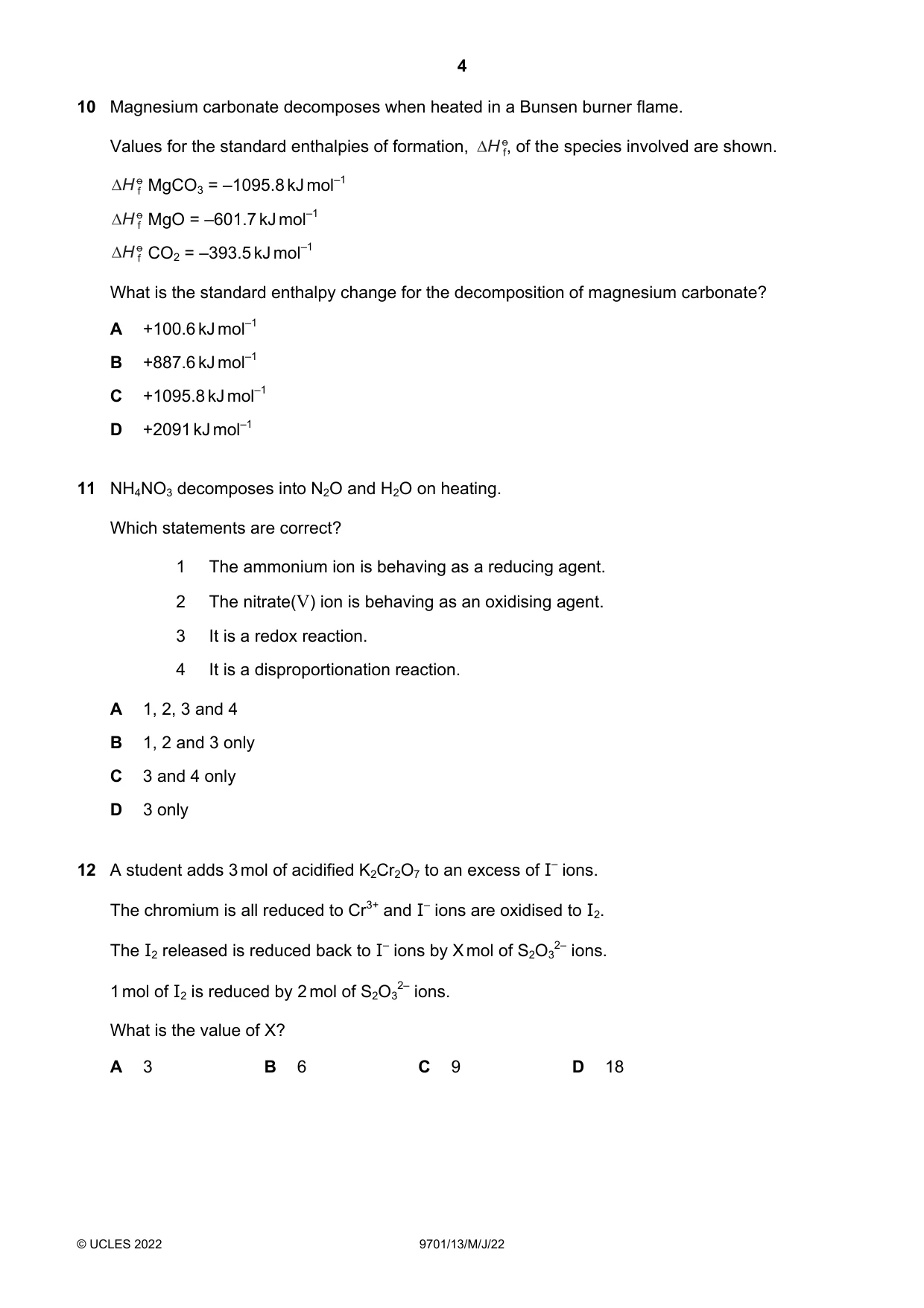



Mark scheme3 pages
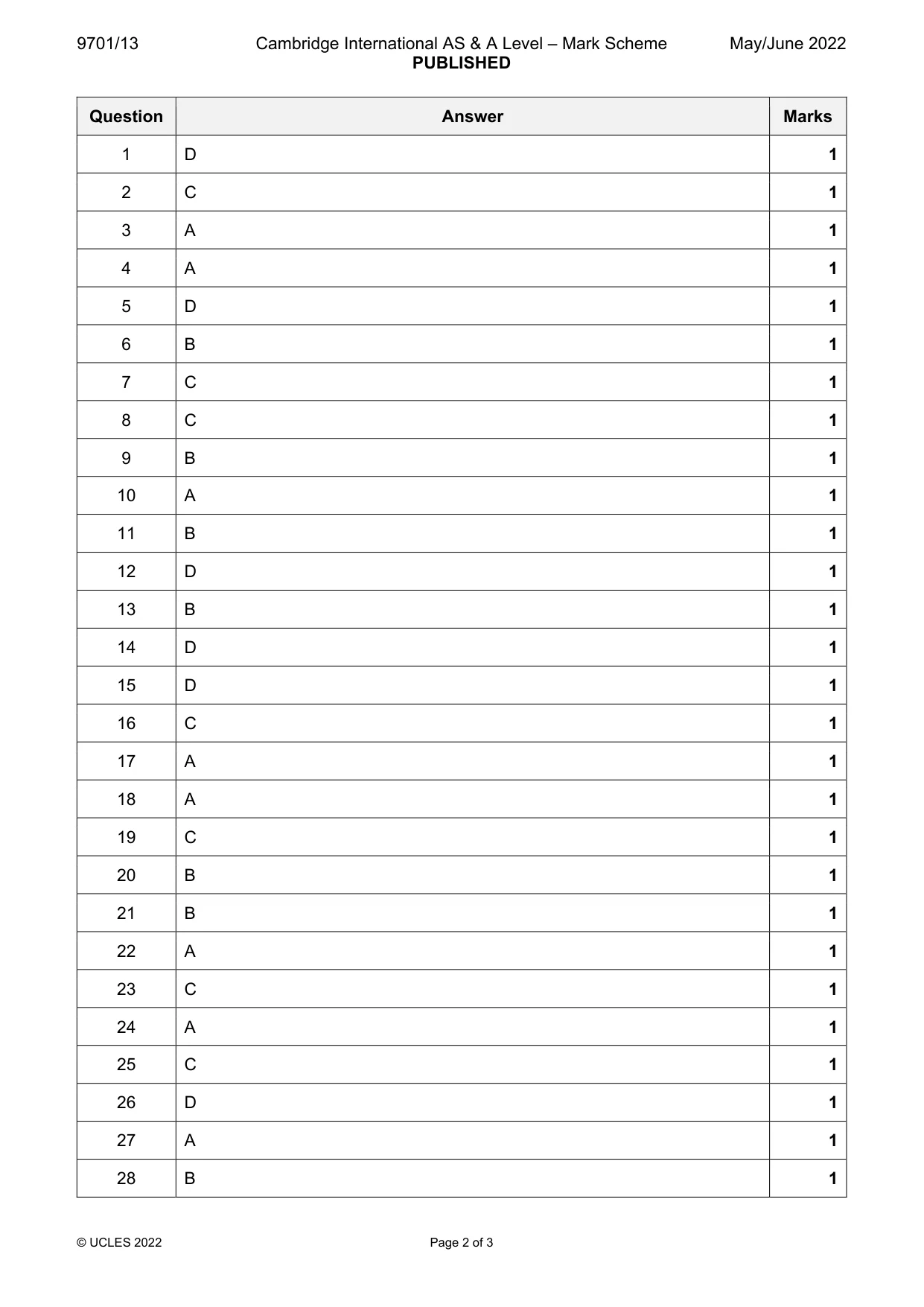
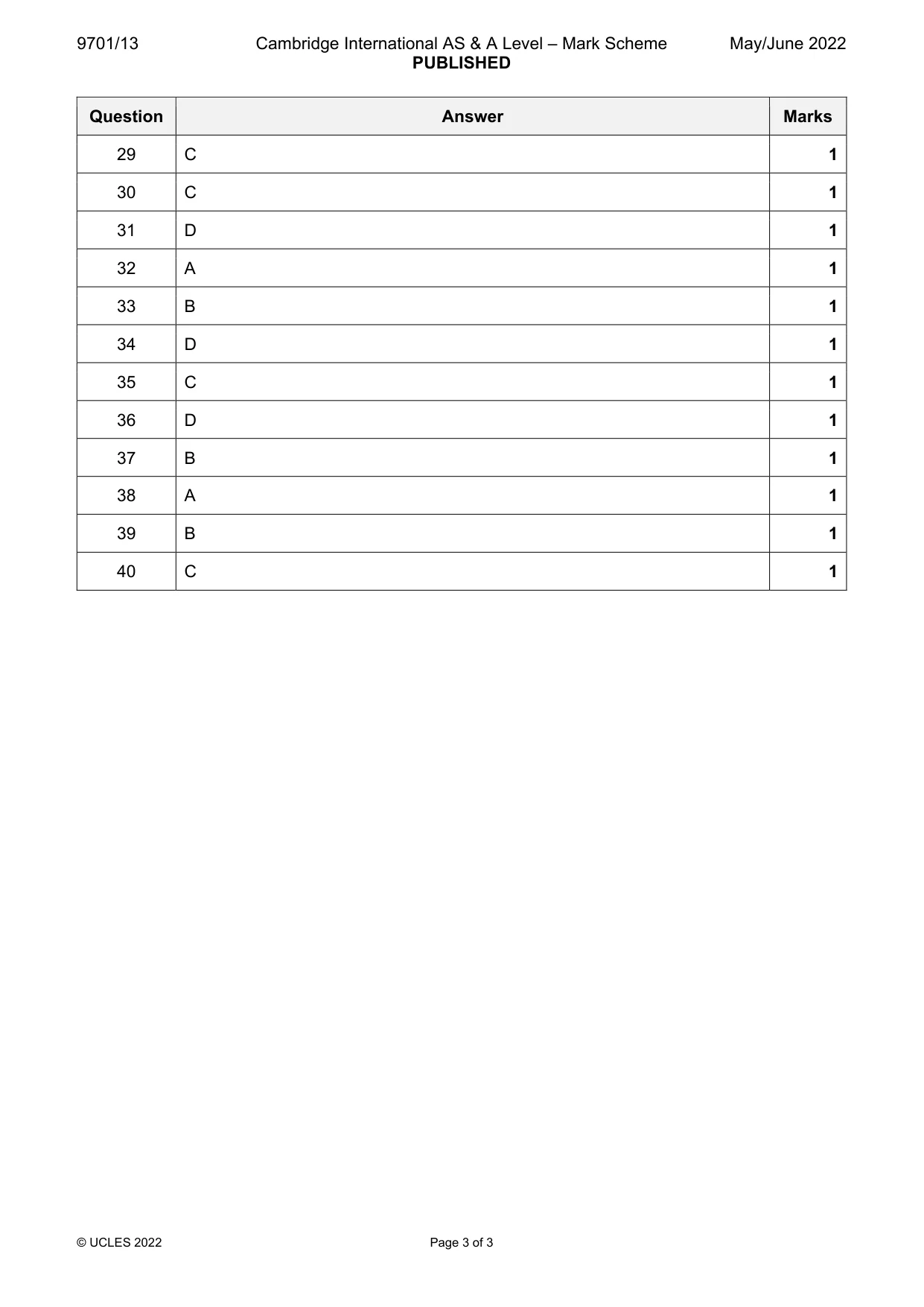
Answers below. Sit the paper first if you are practising.
Questions as text
Q1 · Which atom has exactly three unpaired electrons in the ground state?
1 Which atom has exactly three unpaired electrons in the ground state? A an isolated gaseous aluminium atom B an isolated gaseous carbon atom C an isolated gaseous chromium atom D an isolated gaseous phosphorus atom
Mark scheme: D
More questions on Electrons, energy levels and atomic orbitals
Q2 · Which element has the second smallest atomic radius in its group and the second highest…
2 Which element has the second smallest atomic radius in its group and the second highest electrical conductivity in its period? A boron B calcium C magnesium D sodium
Mark scheme: C
More questions on Periodicity of physical properties of the elements in Period 3
Q3 · Analysis of the hormone thyroxine gives the results shown
3 Analysis of the hormone thyroxine gives the results shown. Heating 0.500 g of thyroxine with aqueous silver nitrate produces 0.604 g of silver iodide. All of the iodine in the thyroxine sample is converted to silver iodide. Complete combustion of 0.500 g of thyroxine produces 232 cm3 of carbon dioxide and 7.72 cm3 of nitrogen, measured under room conditions. Which molecular formula of thyroxine agrees with these values? A C15H11NO4I4 Mr = 776.6 B C15H7NO4I8 Mr = 1280.2 C C30H25NO6I4 Mr = 1002.6 D C30H21NO6I8 Mr = 1506.2
Mark scheme: A
Q4 · How many moles of oxygen, O2, are needed to burn 1 mol of ethane if the products of the…
4 How many moles of oxygen, O2, are needed to burn 1 mol of ethane if the products of the reaction are water and carbon only? A 1.5 B 3 C 3.5 D 5
Mark scheme: A
More questions on Reacting masses and volumes (of solutions and gases)
Q5 · Which compound has the smallest difference in electronegativity between its two elements?
5 Which compound has the smallest difference in electronegativity between its two elements? A KF B KBr C LiF D LiBr
Mark scheme: D
Q6 · VSEPR theory should be used to answer this question
6 VSEPR theory should be used to answer this question. Hydrazine has the following structure. hydrazine H H X N N H H What is the predicted bond angle X? A 90 B 107 C 109.5 D 120
Mark scheme: B
Q7 · This question is about buckminsterfullerene, graphite, iodine and diamond
7 This question is about buckminsterfullerene, graphite, iodine and diamond. How many of these substances have a simple molecular structure? A 0 B 1 C 2 D 3
Mark scheme: C
Q8 · A student reacts 1 mol of magnesium powder in a sealed 0.030 m3 container of oxygen at a…
8 A student reacts 1 mol of magnesium powder in a sealed 0.030 m3 container of oxygen at a pressure of 2.0 105 Pa and a temperature of 600 K. The magnesium reacts completely to form MgO. Which percentage of the oxygen will be used up? A 5.0% B 10% C 42% D 83%
Mark scheme: C
More questions on The gaseous state: ideal and real gases and pV = nRT
Q9 · Which equation represents an enthalpy change that is the average bond energy of the C–H…
9 Which equation represents an enthalpy change that is the average bond energy of the C–H bond in methane? A 1 C(g) + H(g) 4 1 CH4(g) 4 B 1 CH4(g) 4 1 C(g) + H(g) 4 C CH4(g) C(g) + 4H(g) D CH4(g) CH3(g) + H(g)
Mark scheme: B
Q10 · Magnesium carbonate decomposes when heated in a Bunsen burner flame
10 Magnesium carbonate decomposes when heated in a Bunsen burner flame. Values for the standard enthalpies of formation, , of the species involved are shown. MgCO3 = –1095.8 kJ mol–1 MgO = –601.7 kJ mol–1 CO2 = –393.5 kJ mol–1 What is the standard enthalpy change for the decomposition of magnesium carbonate? A +100.6 kJ mol–1 B +887.6 kJ mol–1 C +1095.8 kJ mol–1 D +2091 kJ mol–1
Mark scheme: A
Q11 · NH4NO3 decomposes into N2O and H2O on heating
11 NH4NO3 decomposes into N2O and H2O on heating. Which statements are correct? 1 The ammonium ion is behaving as a reducing agent. 2 The nitrate(V) ion is behaving as an oxidising agent. 3 It is a redox reaction. 4 It is a disproportionation reaction. A 1, 2, 3 and 4 B 1, 2 and 3 only C 3 and 4 only D 3 only
Mark scheme: B
Q12 · A student adds 3 mol of acidified K2Cr2O7 to an excess of I– ions
12 A student adds 3 mol of acidified K2Cr2O7 to an excess of I– ions. The chromium is all reduced to Cr3+ and I– ions are oxidised to I2. The I2 released is reduced back to I– ions by X mol of S2O3 2– ions. 1 mol of I2 is reduced by 2 mol of S2O3 2– ions. What is the value of X? A 3 B 6 C 9 D 18
Mark scheme: D
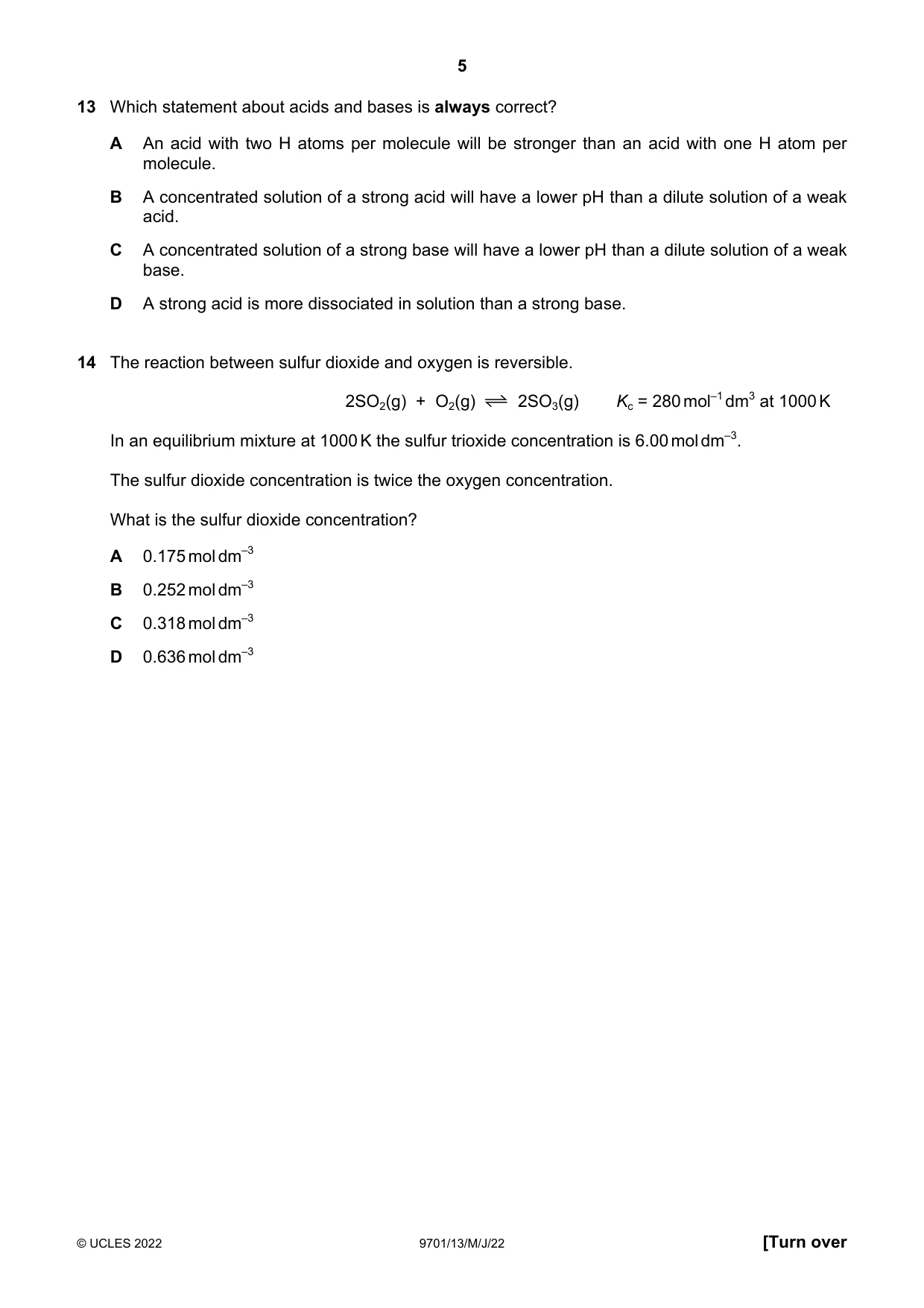
Q13 · Which statement about acids and bases is always correct?
13 Which statement about acids and bases is always correct? A An acid with two H atoms per molecule will be stronger than an acid with one H atom per molecule. B A concentrated solution of a strong acid will have a lower pH than a dilute solution of a weak acid. C A concentrated solution of a strong base will have a lower pH than a dilute solution of a weak base. D A strong acid is more dissociated in solution than a strong base.
Mark scheme: B
Q14 · The reaction between sulfur dioxide and oxygen is reversible
14 The reaction between sulfur dioxide and oxygen is reversible. 2SO2(g) + O2(g) 2SO3(g) Kc = 280 mol–1 dm3 at 1000 K In an equilibrium mixture at 1000 K the sulfur trioxide concentration is 6.00 mol dm–3. The sulfur dioxide concentration is twice the oxygen concentration. What is the sulfur dioxide concentration? A 0.175 mol dm–3 B 0.252 mol dm–3 C 0.318 mol dm–3 D 0.636 mol dm–3
Mark scheme: D
More questions on Chemical equilibria: reversible reactions, dynamic equilibrium
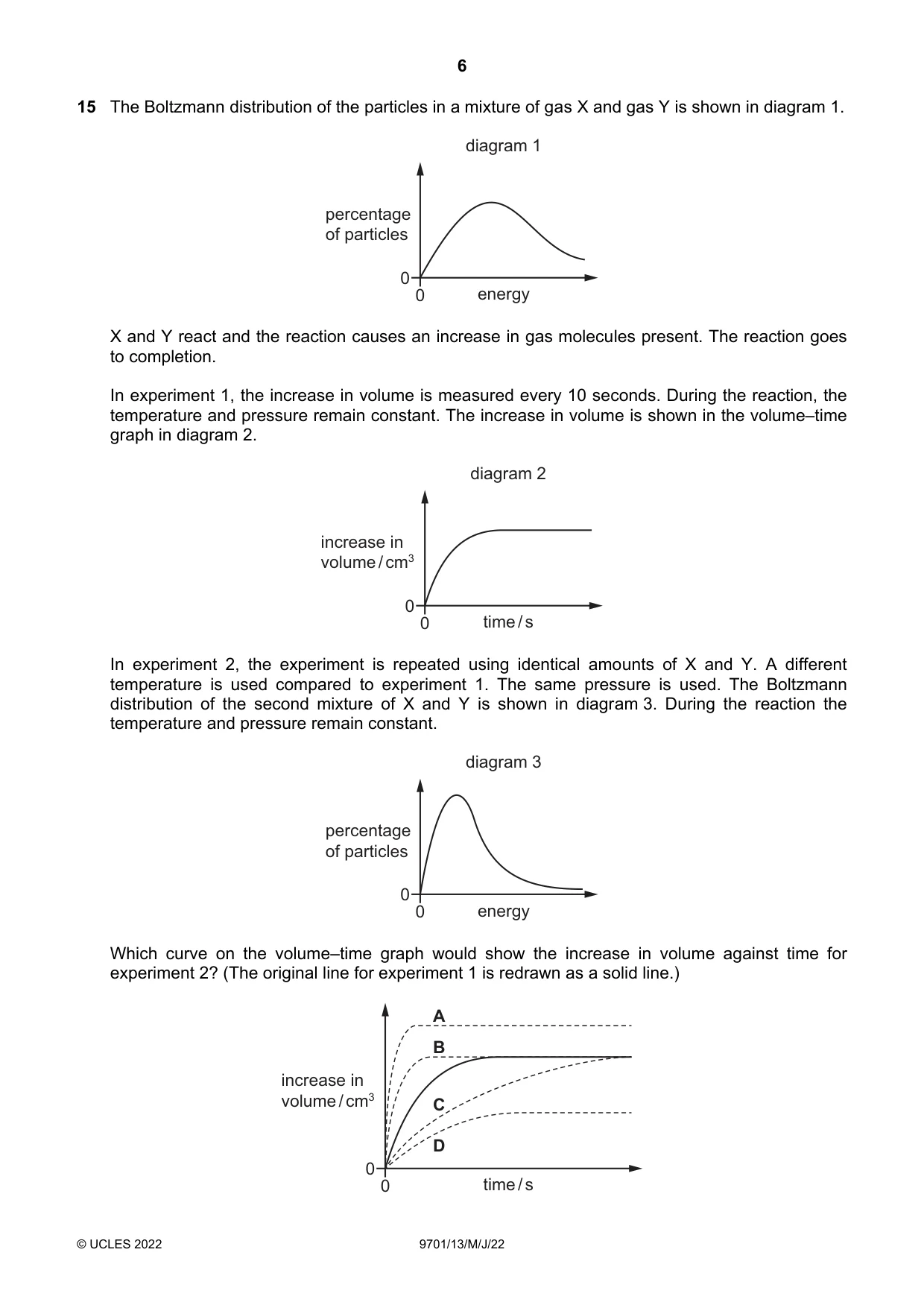
Q15 · The Boltzmann distribution of the particles in a mixture of gas X and gas Y is shown in…
15 The Boltzmann distribution of the particles in a mixture of gas X and gas Y is shown in diagram 1. diagram 1 percentage of particles 0 0 energy X and Y react and the reaction causes an increase in gas molecules present. The reaction goes to completion. In experiment 1, the increase in volume is measured every 10 seconds. During the reaction, the temperature and pressure remain constant. The increase in volume is shown in the volume–time graph in diagram 2. diagram 2 increase in volume / cm3 0 0 time / s In experiment 2, the experiment is repeated using identical amounts of X and Y. A different temperature is used compared to experiment 1. The same pressure is used. The Boltzmann distribution of the second mixture of X and Y is shown in diagram 3. During the reaction the temperature and pressure remain constant. diagram 3 percentage of particles 0 0 energy Which curve on the volume–time graph would show the increase in volume against time for experiment 2? (The original line for experiment 1 is redrawn as a solid line.) A B increase in volume / cm3 C D 0 0 time / s
Mark scheme: D
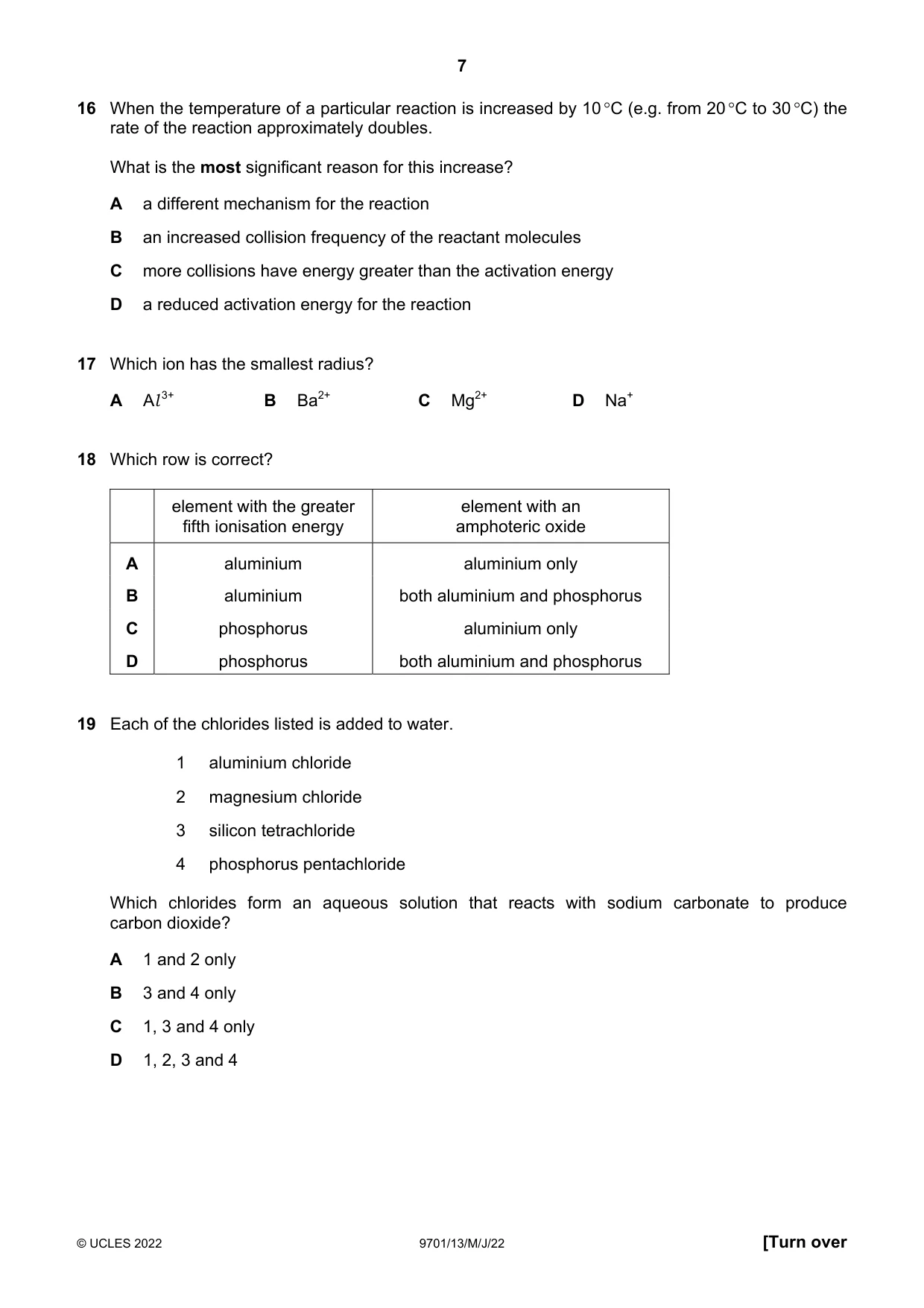
Q16 · When the temperature of a particular reaction is increased by 10 C (e.g
16 When the temperature of a particular reaction is increased by 10 C (e.g. from 20 C to 30 C) the rate of the reaction approximately doubles. What is the most significant reason for this increase? A a different mechanism for the reaction B an increased collision frequency of the reactant molecules C more collisions have energy greater than the activation energy D a reduced activation energy for the reaction
Mark scheme: C
More questions on Effect of temperature on reaction rates and the concept of activation energy
Q17 · Which ion has the smallest radius?
17 Which ion has the smallest radius? A Al 3+ B Ba2+ C Mg2+ D Na+
Mark scheme: A
Q18 · Which row is correct?
18 Which row is correct? element with the greater element with an fifth ionisation energy amphoteric oxide A aluminium aluminium only B aluminium both aluminium and phosphorus C phosphorus aluminium only D phosphorus both aluminium and phosphorus
Mark scheme: A
More questions on Periodicity of chemical properties of the elements in Period 3
Q19 · Each of the chlorides listed is added to water
19 Each of the chlorides listed is added to water. 1 aluminium chloride 2 magnesium chloride 3 silicon tetrachloride 4 phosphorus pentachloride Which chlorides form an aqueous solution that reacts with sodium carbonate to produce carbon dioxide? A 1 and 2 only B 3 and 4 only C 1, 3 and 4 only D 1, 2, 3 and 4
Mark scheme: C
More questions on Periodicity of chemical properties of the elements in Period 3
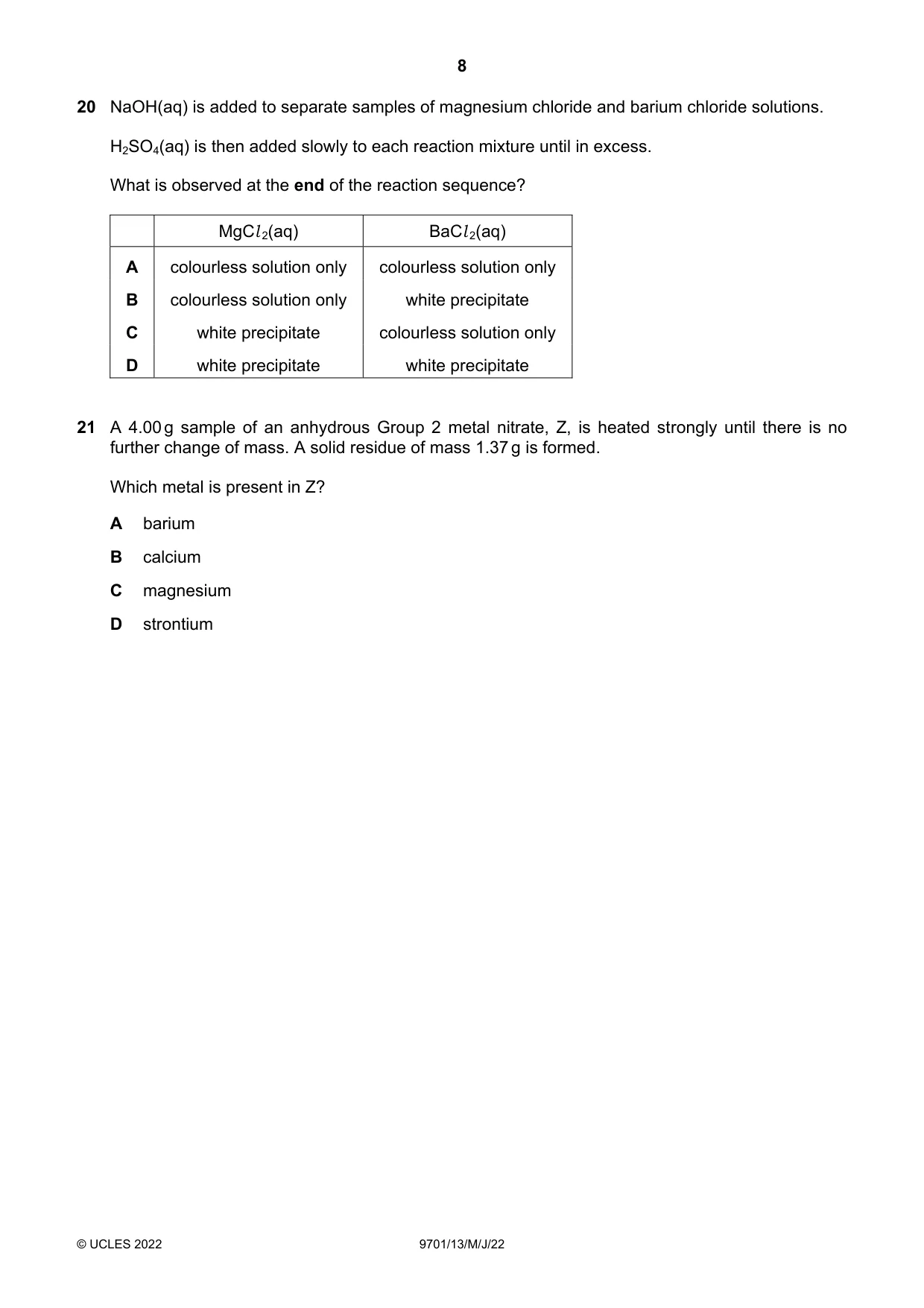
Q20 · NaOH(aq) is added to separate samples of magnesium chloride and barium chloride solutions
20 NaOH(aq) is added to separate samples of magnesium chloride and barium chloride solutions. H2SO4(aq) is then added slowly to each reaction mixture until in excess. What is observed at the end of the reaction sequence? MgCl 2(aq) BaCl 2(aq) A colourless solution only colourless solution only B colourless solution only white precipitate C white precipitate colourless solution only D white precipitate white precipitate
Mark scheme: B
Q21 · A 4.00 g sample of an anhydrous Group 2 metal nitrate, Z, is heated strongly until there…
21 A 4.00 g sample of an anhydrous Group 2 metal nitrate, Z, is heated strongly until there is no further change of mass. A solid residue of mass 1.37 g is formed. Which metal is present in Z? A barium B calcium C magnesium D strontium
Mark scheme: B
Q22 · Chlorine is bubbled through a cylinder containing aqueous sodium iodide and an immiscible…
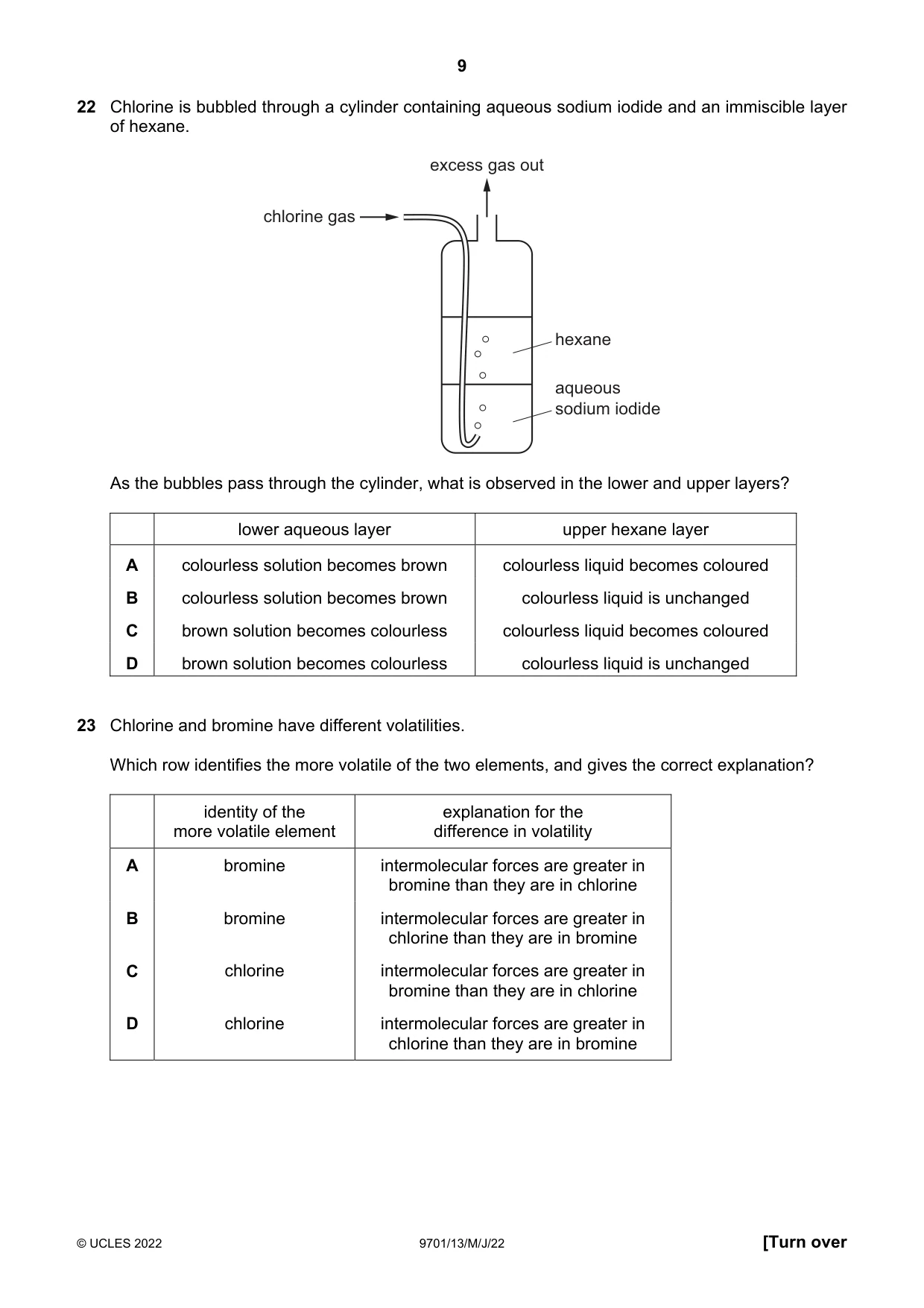
22 Chlorine is bubbled through a cylinder containing aqueous sodium iodide and an immiscible layer of hexane. excess gas out chlorine gas hexane aqueous sodium iodide As the bubbles pass through the cylinder, what is observed in the lower and upper layers? lower aqueous layer upper hexane layer A colourless solution becomes brown colourless liquid becomes coloured B colourless solution becomes brown colourless liquid is unchanged C brown solution becomes colourless colourless liquid becomes coloured D brown solution becomes colourless colourless liquid is unchanged
Mark scheme: A
More questions on The chemical properties of the halogen elements and the hydrogen halides
Q23 · Chlorine and bromine have different volatilities
23 Chlorine and bromine have different volatilities. Which row identifies the more volatile of the two elements, and gives the correct explanation? identity of the explanation for the more volatile element difference in volatility A bromine intermolecular forces are greater in bromine than they are in chlorine B bromine intermolecular forces are greater in chlorine than they are in bromine C chlorine intermolecular forces are greater in bromine than they are in chlorine D chlorine intermolecular forces are greater in chlorine than they are in bromine
Mark scheme: C
More questions on Physical properties of the Group 17 elements
Q24 · Ammonium chloride dissolves readily in water
24 Ammonium chloride dissolves readily in water. Which statement about the colourless solution formed is correct? A Ions in the solution can form hydrogen bonds with water molecules. B The solution is slightly basic. C The solution would smell of chlorine. D When sodium hydroxide is added, a gas is formed which turns damp blue litmus paper red.
Mark scheme: A
More questions on Intermolecular forces, electronegativity and bond properties
Q25 · At 550 C nitrogen dioxide reacts with unburnt hydrocarbon fragments, such as CH3, in the…
25 At 550 C nitrogen dioxide reacts with unburnt hydrocarbon fragments, such as CH3, in the catalytic converter of a motor vehicle. 4CH3 + 7NO2 3 1 N + 4CO2 + 6H2O 2 2 Which row gives the energy change for this reaction and a possible reason for it? energy change reason why the reaction is endothermic of reaction or exothermic A endothermic chemical energy is converted to heat energy B endothermic the NN bond energy is very high C exothermic CO2 and H2O have negative values D exothermic double bonds are broken in NO2
Mark scheme: C
Q26 · Compound X contains an alcohol group and a carbonyl group
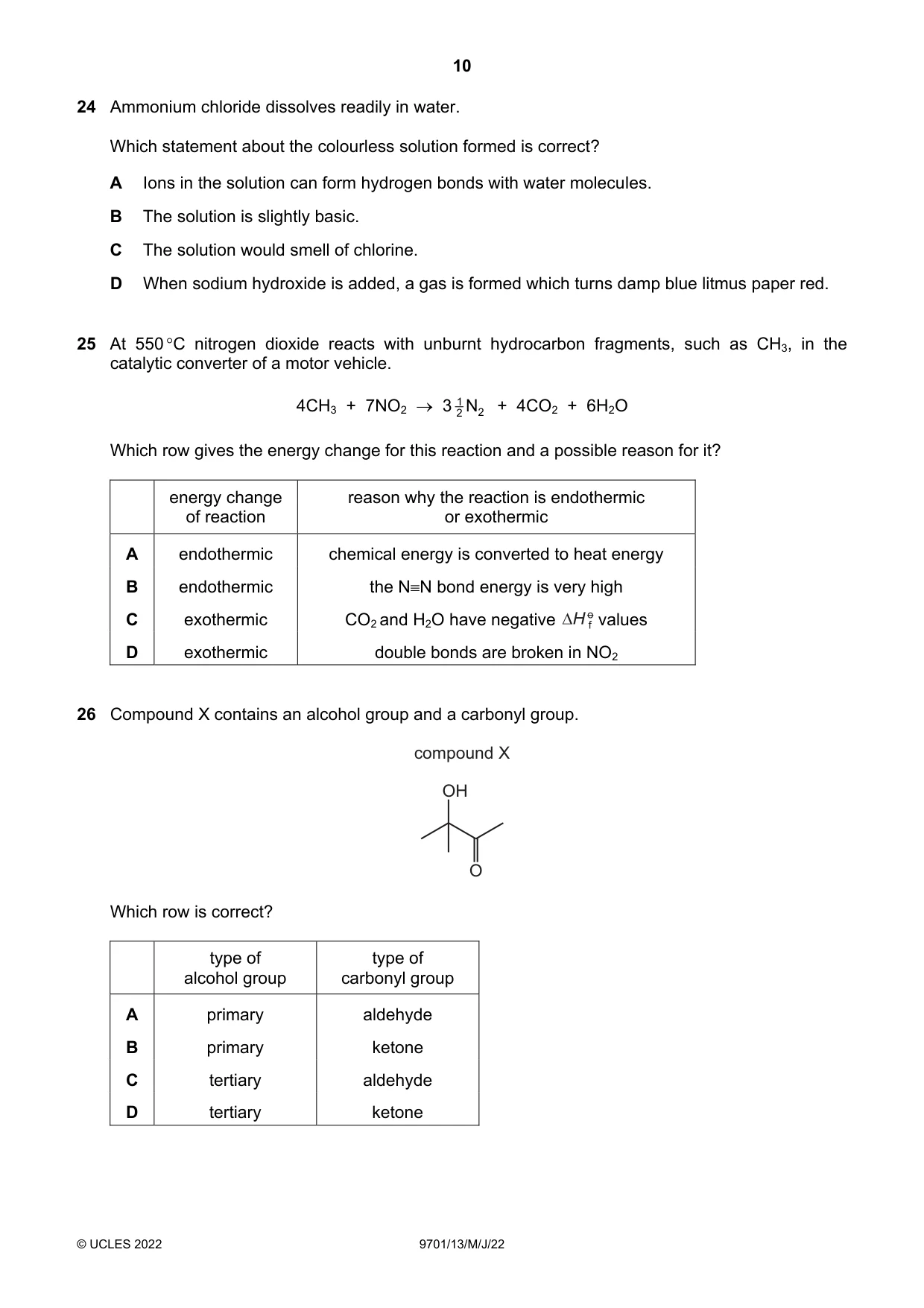
26 Compound X contains an alcohol group and a carbonyl group. compound X OH O Which row is correct? type of type of alcohol group carbonyl group A primary aldehyde B primary ketone C tertiary aldehyde D tertiary ketone
Mark scheme: D
More questions on Formulas, functional groups and the naming of organic compounds
Q27 · The diagram shows the skeletal formula of phenazine
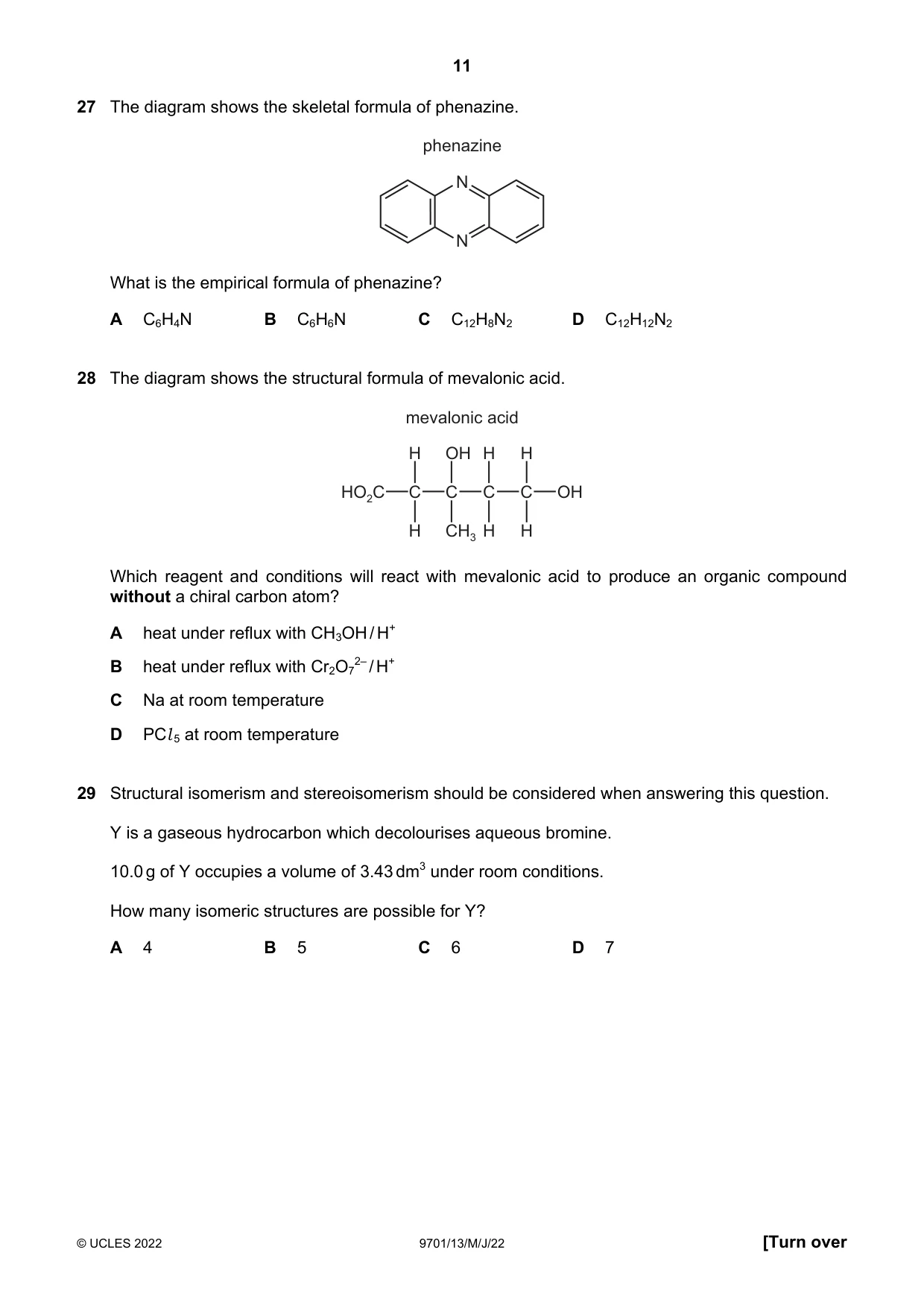
27 The diagram shows the skeletal formula of phenazine. phenazine N N What is the empirical formula of phenazine? A C6H4N B C6H6N C C12H8N2 D C12H12N2
Mark scheme: A
Q28 · The diagram shows the structural formula of mevalonic acid
28 The diagram shows the structural formula of mevalonic acid. mevalonic acid H OH H H HO2C C C C C OH H CH3 H H Which reagent and conditions will react with mevalonic acid to produce an organic compound without a chiral carbon atom? A heat under reflux with CH3OH / H+ B heat under reflux with Cr2O7 2– / H+ C Na at room temperature D PCl 5 at room temperature
Mark scheme: B
Q29 · Structural isomerism and stereoisomerism should be considered when answering this question
29 Structural isomerism and stereoisomerism should be considered when answering this question. Y is a gaseous hydrocarbon which decolourises aqueous bromine. 10.0 g of Y occupies a volume of 3.43 dm3 under room conditions. How many isomeric structures are possible for Y? A 4 B 5 C 6 D 7
Mark scheme: C
Q30 · Limonene is found in lemon and orange oils
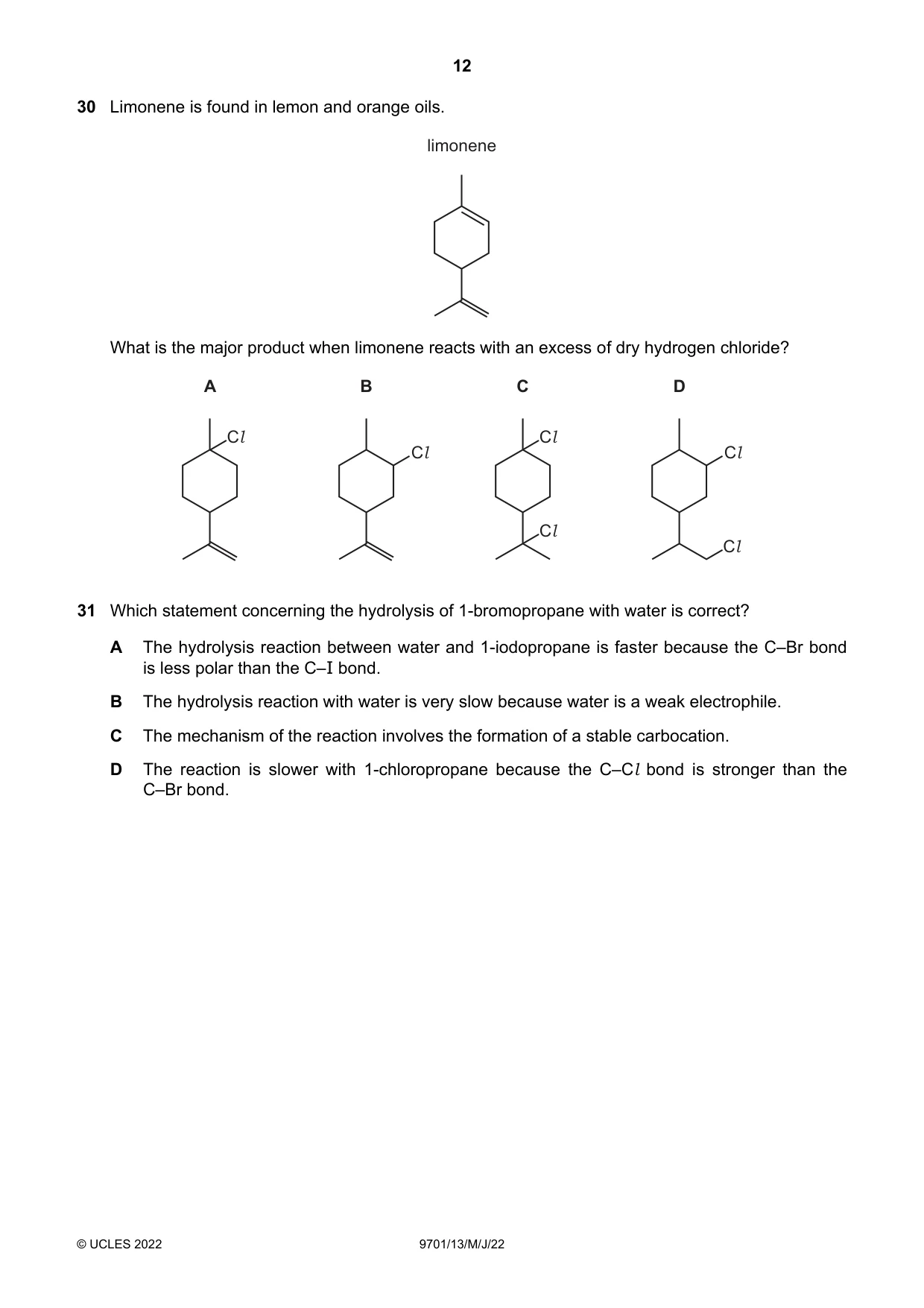
30 Limonene is found in lemon and orange oils. limonene What is the major product when limonene reacts with an excess of dry hydrogen chloride? A B C D Cl Cl Cl Cl Cl Cl
Mark scheme: C
Q31 · Which statement concerning the hydrolysis of 1-bromopropane with water is correct?
31 Which statement concerning the hydrolysis of 1-bromopropane with water is correct? A The hydrolysis reaction between water and 1-iodopropane is faster because the C–Br bond is less polar than the C–I bond. B The hydrolysis reaction with water is very slow because water is a weak electrophile. C The mechanism of the reaction involves the formation of a stable carbocation. D The reaction is slower with 1-chloropropane because the C–Cl bond is stronger than the C–Br bond.
Mark scheme: D
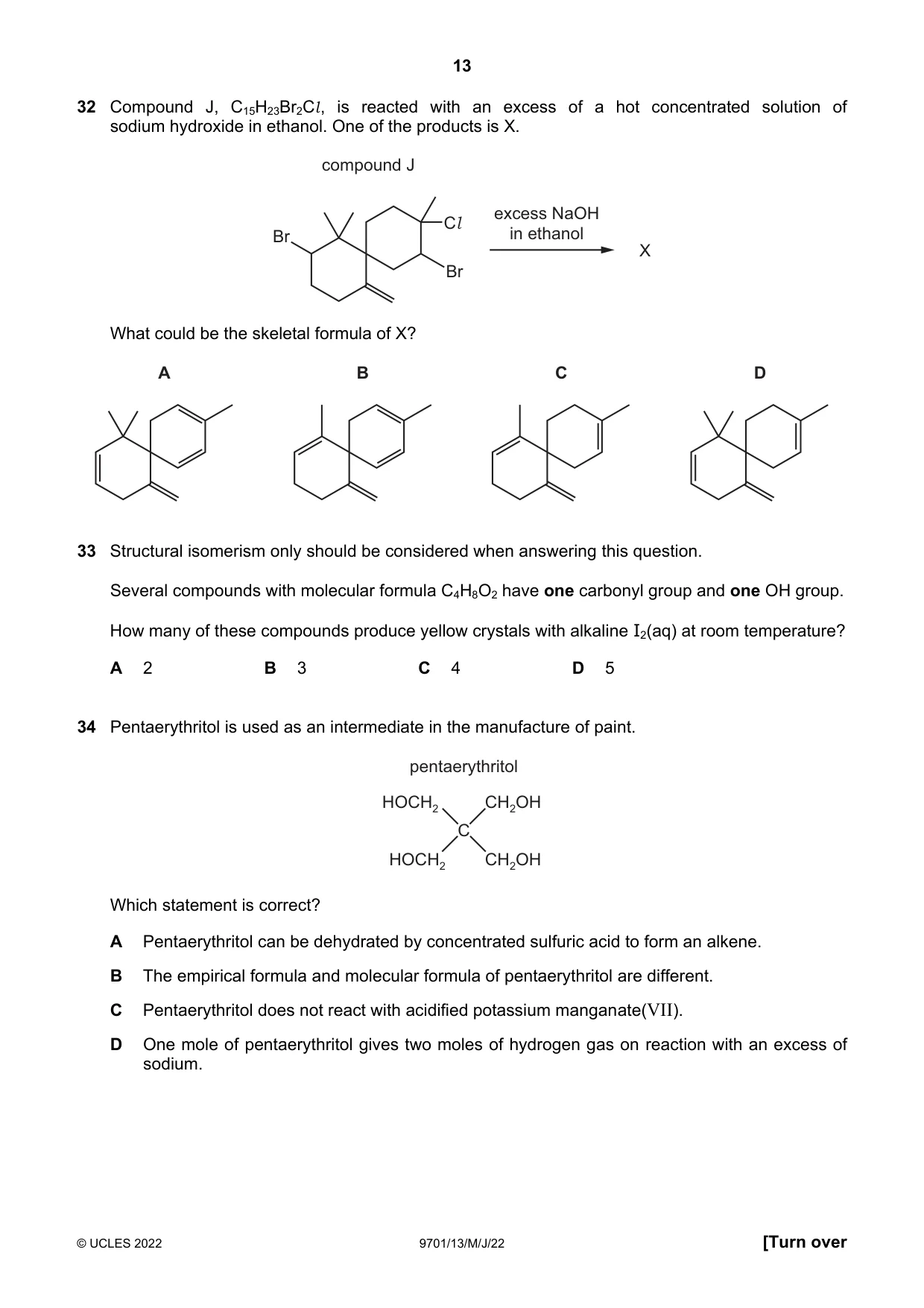
Q32 · Compound J, C15H23Br2Cl , is reacted with an excess of a hot concentrated solution of…
32 Compound J, C15H23Br2Cl , is reacted with an excess of a hot concentrated solution of sodium hydroxide in ethanol. One of the products is X. compound J excess NaOH Cl Br in ethanol X Br What could be the skeletal formula of X? A B C D
Mark scheme: A
Q33 · Structural isomerism only should be considered when answering this question
33 Structural isomerism only should be considered when answering this question. Several compounds with molecular formula C4H8O2 have one carbonyl group and one OH group. How many of these compounds produce yellow crystals with alkaline I2(aq) at room temperature? A 2 B 3 C 4 D 5
Mark scheme: B
More questions on Isomerism: structural isomerism and stereoisomerism
Q34 · Pentaerythritol is used as an intermediate in the manufacture of paint
34 Pentaerythritol is used as an intermediate in the manufacture of paint. pentaerythritol HOCH2 CH2OH C HOCH2 CH2OH Which statement is correct? A Pentaerythritol can be dehydrated by concentrated sulfuric acid to form an alkene. B The empirical formula and molecular formula of pentaerythritol are different. C Pentaerythritol does not react with acidified potassium manganate(VII). D One mole of pentaerythritol gives two moles of hydrogen gas on reaction with an excess of sodium.
Mark scheme: D
Q35 · Which reaction has a nucleophilic addition mechanism and gives a good yield of product…
35 Which reaction has a nucleophilic addition mechanism and gives a good yield of product under the stated conditions? A 1-bromopropane reacting with hot ethanolic sodium hydroxide B 2-iodopropane reacting with hot aqueous sodium hydroxide C propanal reacting with hydrogen cyanide under alkaline conditions D propanal reacting with hydrogen cyanide under acidic conditions
Mark scheme: C
Q36 · A carbonyl compound has the structural formula CH3COCHO
36 A carbonyl compound has the structural formula CH3COCHO. Which row is correct for the observations made when this compound is treated with the given reagents? 2,4-DNPH reagent Fehling’s reagent A silver mirror red precipitate B silver mirror orange precipitate C orange precipitate silver mirror D orange precipitate red precipitate
Mark scheme: D
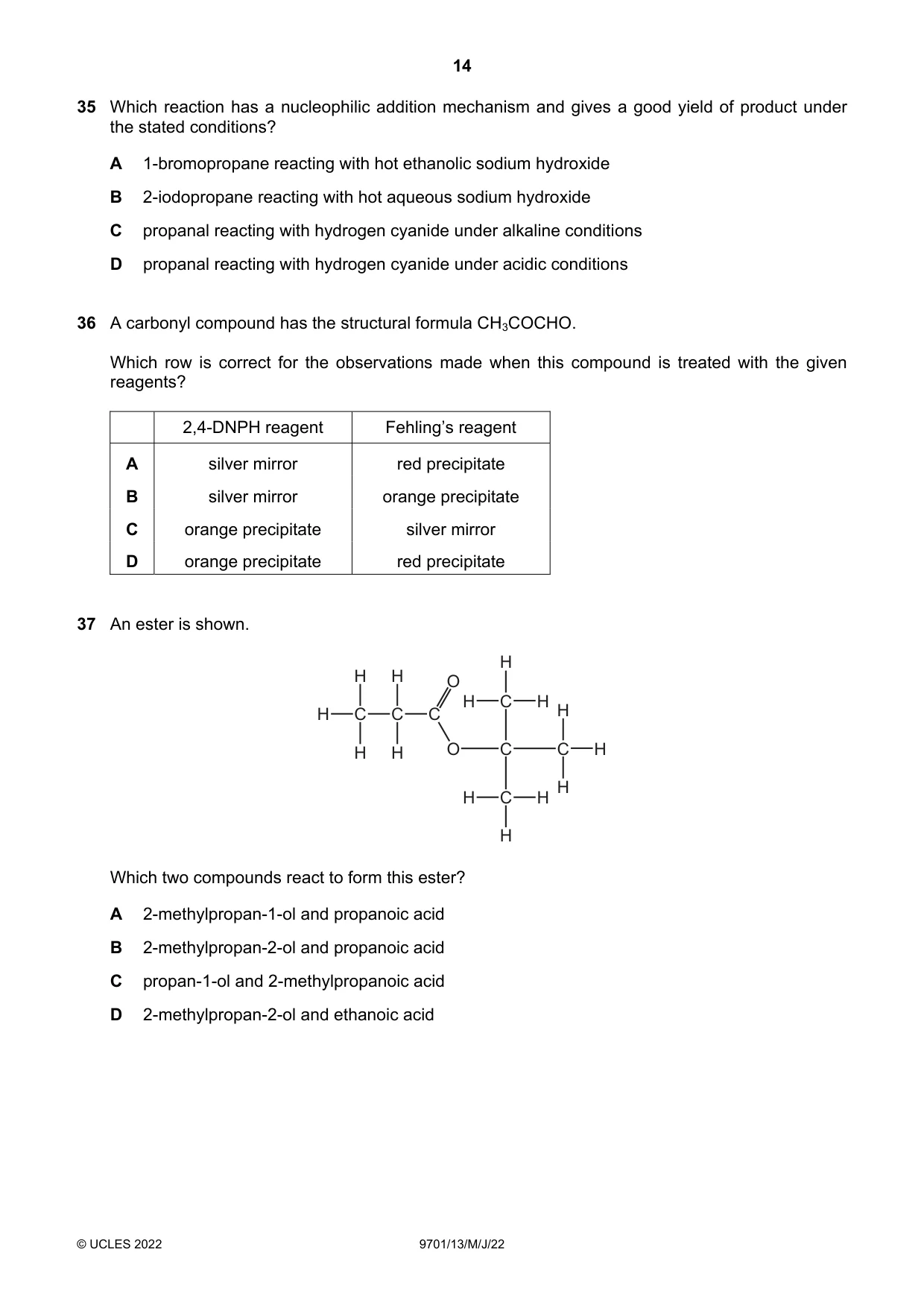
Q37 · An ester is shown
37 An ester is shown. H H H O H C H H C C C H H H O C C H H H C H H Which two compounds react to form this ester? A 2-methylpropan-1-ol and propanoic acid B 2-methylpropan-2-ol and propanoic acid C propan-1-ol and 2-methylpropanoic acid D 2-methylpropan-2-ol and ethanoic acid
Mark scheme: B
Q38 · Which compound can be used to make propanoic acid by treatment with a single reagent?
38 Which compound can be used to make propanoic acid by treatment with a single reagent? A CH2=CHCH2CH3 B CH3CH2CH2CN C CH3CH(OH)CN D CH3CH(OH)CH3
Mark scheme: A
Q39 · A sample of sulfur consists mostly of 32S
39 A sample of sulfur consists mostly of 32S. It also contains 4.2% 34S and 2.8% 36S. No other isotopes of sulfur are present. What is the relative atomic mass, Ar, of this sample of sulfur? A 32.1 B 32.2 C 34.0 D 34.3
Mark scheme: B
Q40 · One molecule of an addition polymer containing 2000 repeat units has an Mr of 112 000
40 One molecule of an addition polymer containing 2000 repeat units has an Mr of 112 000. The polymer molecule contains chiral centres. What is a possible monomer for this polymer? A CH2=CHCH3 B CH2=C(CH3)2 C CH2=CHCH2CH3 D CH2=CHCH2CH2CH3
Mark scheme: C
What was in this paper
The subtopics covered by these 40 questions, and how many questions each got. Open one in a new tab to see every Cambridge question on it.
2Formulas2Halogen compounds2Periodicity of chemical properties of the elements in Period 32Redox processes: electron transfer and changes in oxidation number (oxidation state)2Similarities and trends in the properties of the Group 2 metals, magnesium to barium, and their compounds2Acids and bases1Addition polymerisation1Alcohols1Aldehydes and ketones1Alkenes1Bonding and structure1Carboxylic acids1Chemical equilibria: reversible reactions, dynamic equilibrium1Effect of temperature on reaction rates and the concept of activation energy1Electronegativity and bonding1Electrons, energy levels and atomic orbitals1Esters1Formulas, functional groups and the naming of organic compounds1Halogenoalkanes1Hess’s law1Intermolecular forces, electronegativity and bond properties1Isomerism: optical1Isomerism: structural isomerism and stereoisomerism1Isotopes1Nitriles and hydroxynitriles1Particles in the atom and atomic radius1Periodicity of physical properties of the elements in Period 31Physical properties of the Group 17 elements1Rate of reaction1Reacting masses and volumes (of solutions and gases)1Shapes of molecules1The chemical properties of the halogen elements and the hydrogen halides1The gaseous state: ideal and real gases and pV = nRT1What you needed in this session
Cambridge’s own grade thresholds for 2022 May/June, Paper 1 · Variant 3. A higher threshold means an easier paper — the bar moves with how the cohort did.