Cambridge A Level Chemistry 9701 — 2012 May/June Paper 1 · Variant 2
9701/12/M/J/12 · 40 questions · 40 marks · ≈45 min
The question paper and its mark scheme, free to read here and free to download. This is Cambridge’s own paper, exactly as it was sat.
Question paper16 pages

Mark scheme2 pages
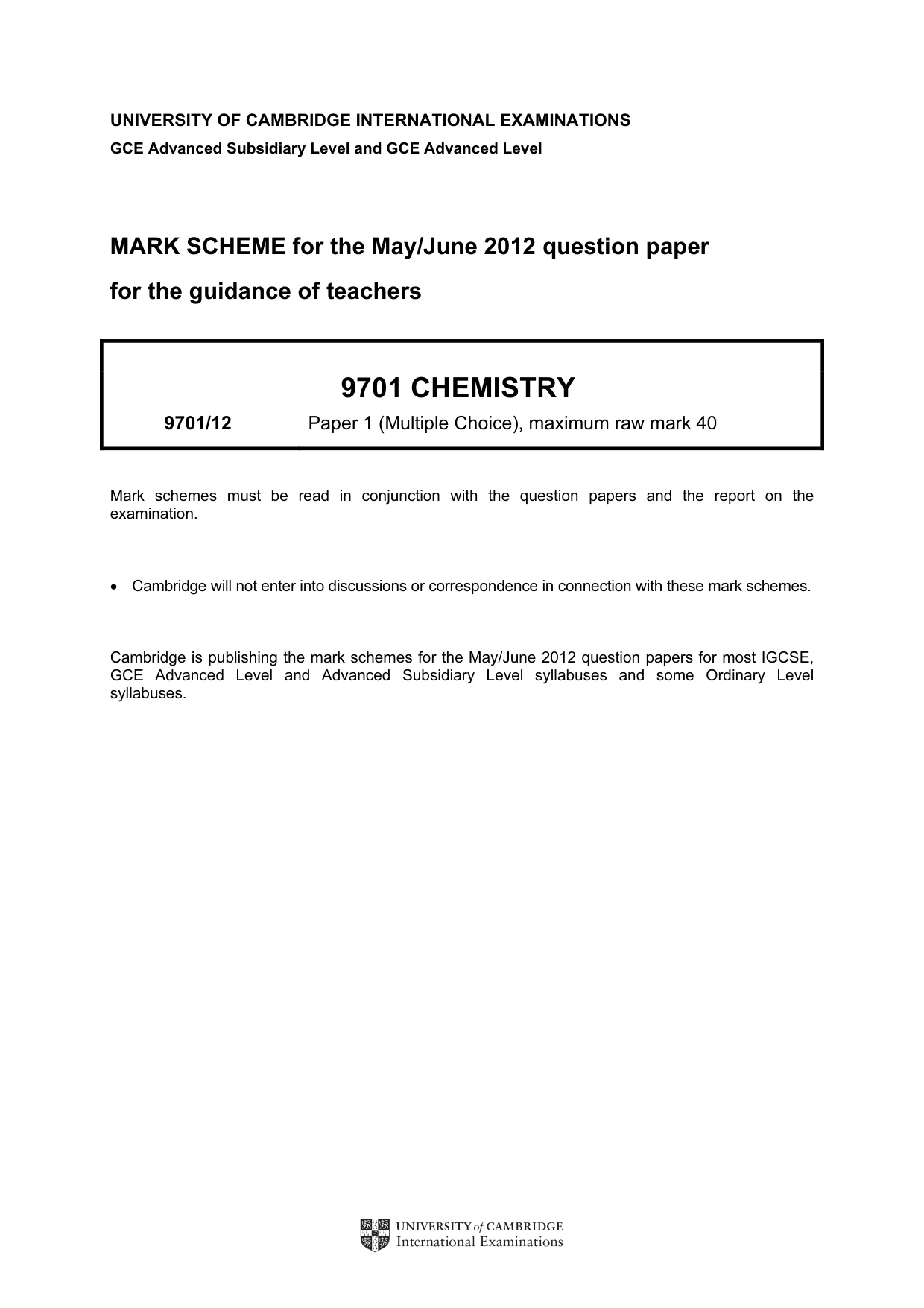
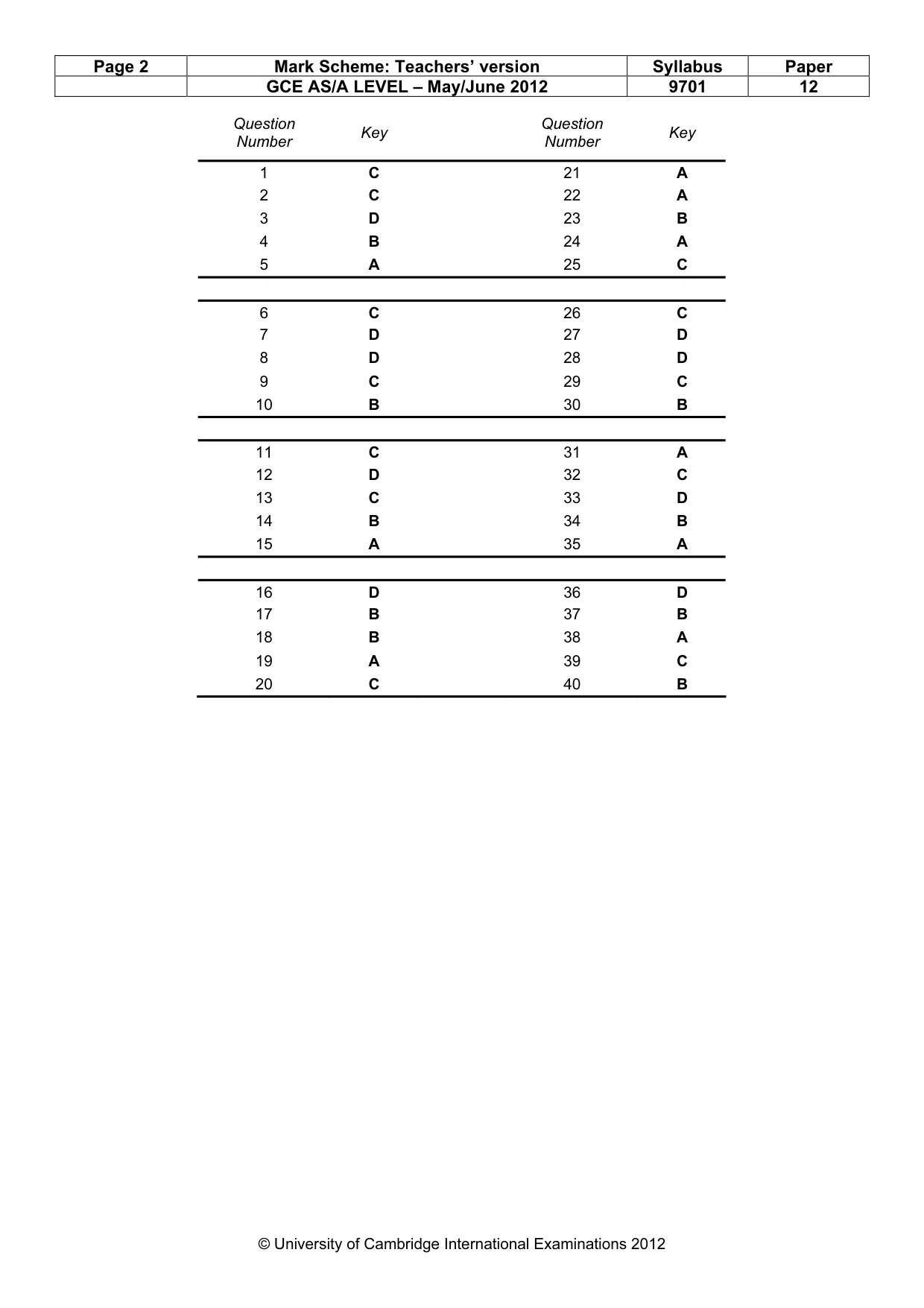
Answers below. Sit the paper first if you are practising.
Questions as text
Q1 · The molecular energy distribution curve represents the variation in energy of the…
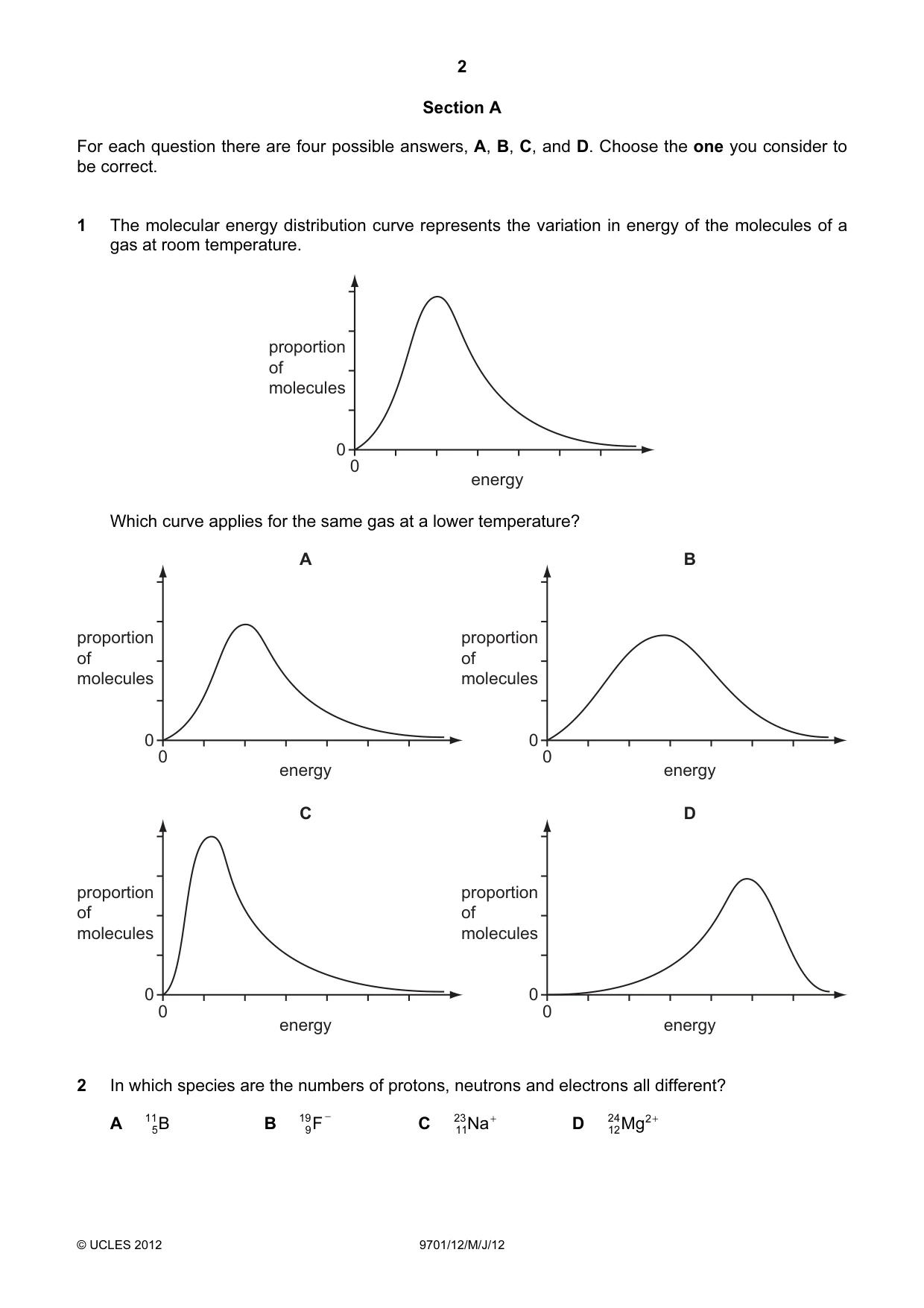
1 The molecular energy distribution curve represents the variation in energy of the molecules of a gas at room temperature. proportion of molecules 0 0 energy Which curve applies for the same gas at a lower temperature? A B proportion proportion of of molecules molecules 0 0 0 0 energy energy C D proportion proportion of of molecules molecules 0 0 0 0 energy energy
Mark scheme: C
More questions on Effect of temperature on reaction rates and the concept of activation energy
Q2 · In which species are the numbers of protons, neutrons and electrons all different?
2 In which species are the numbers of protons, neutrons and electrons all different? A 11 B B 19 F − C 23 Na + D 24 12Mg 2 + 5 9 11
Mark scheme: C
Q3 · What is the most likely shape of a molecule of hydrazine, N2H4?
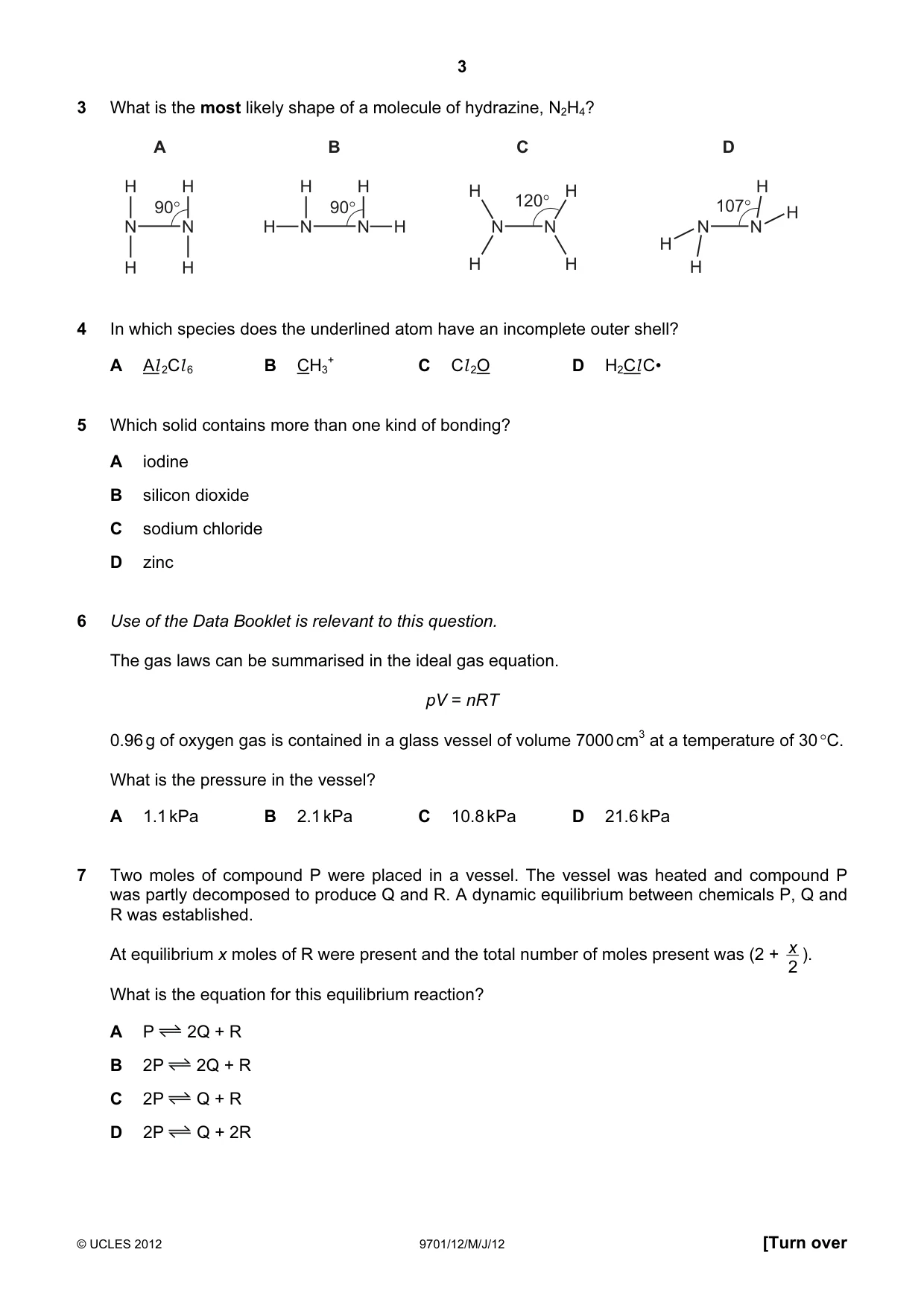
3 What is the most likely shape of a molecule of hydrazine, N2H4? A B C D H H H H H H H 90° 90° 120° 107° H N N H N N H N N N N H H H H H H
Mark scheme: D
Q4 · In which species does the underlined atom have an incomplete outer shell?
4 In which species does the underlined atom have an incomplete outer shell? A Al 2Cl 6 B CH3 + C Cl 2O D H2Cl C•
Mark scheme: B
More questions on Covalent bonding and coordinate (dative covalent) bonding
Q5 · Which solid contains more than one kind of bonding?
5 Which solid contains more than one kind of bonding? A iodine B silicon dioxide C sodium chloride D zinc
Mark scheme: A
Q6 · Use of the Data Booklet is relevant to this question
6 Use of the Data Booklet is relevant to this question. The gas laws can be summarised in the ideal gas equation. pV = nRT 0.96 g of oxygen gas is contained in a glass vessel of volume 7000 cm3 at a temperature of 30 °C. What is the pressure in the vessel? A 1.1 kPa B 2.1 kPa C 10.8 kPa D 21.6 kPa
Mark scheme: C
More questions on The gaseous state: ideal and real gases and pV = nRT
Q7 · Two moles of compound P were placed in a vessel
7 Two moles of compound P were placed in a vessel. The vessel was heated and compound P was partly decomposed to produce Q and R. A dynamic equilibrium between chemicals P, Q and R was established. At equilibrium x moles of R were present and the total number of moles present was (2 + 2 x ). What is the equation for this equilibrium reaction? A P 2Q + R B 2P 2Q + R C 2P Q + R D 2P Q + 2R
Mark scheme: D
More questions on Chemical equilibria: reversible reactions, dynamic equilibrium
Q8 · The value of the third ionisation energy of aluminium is 2740 kJ mol–1
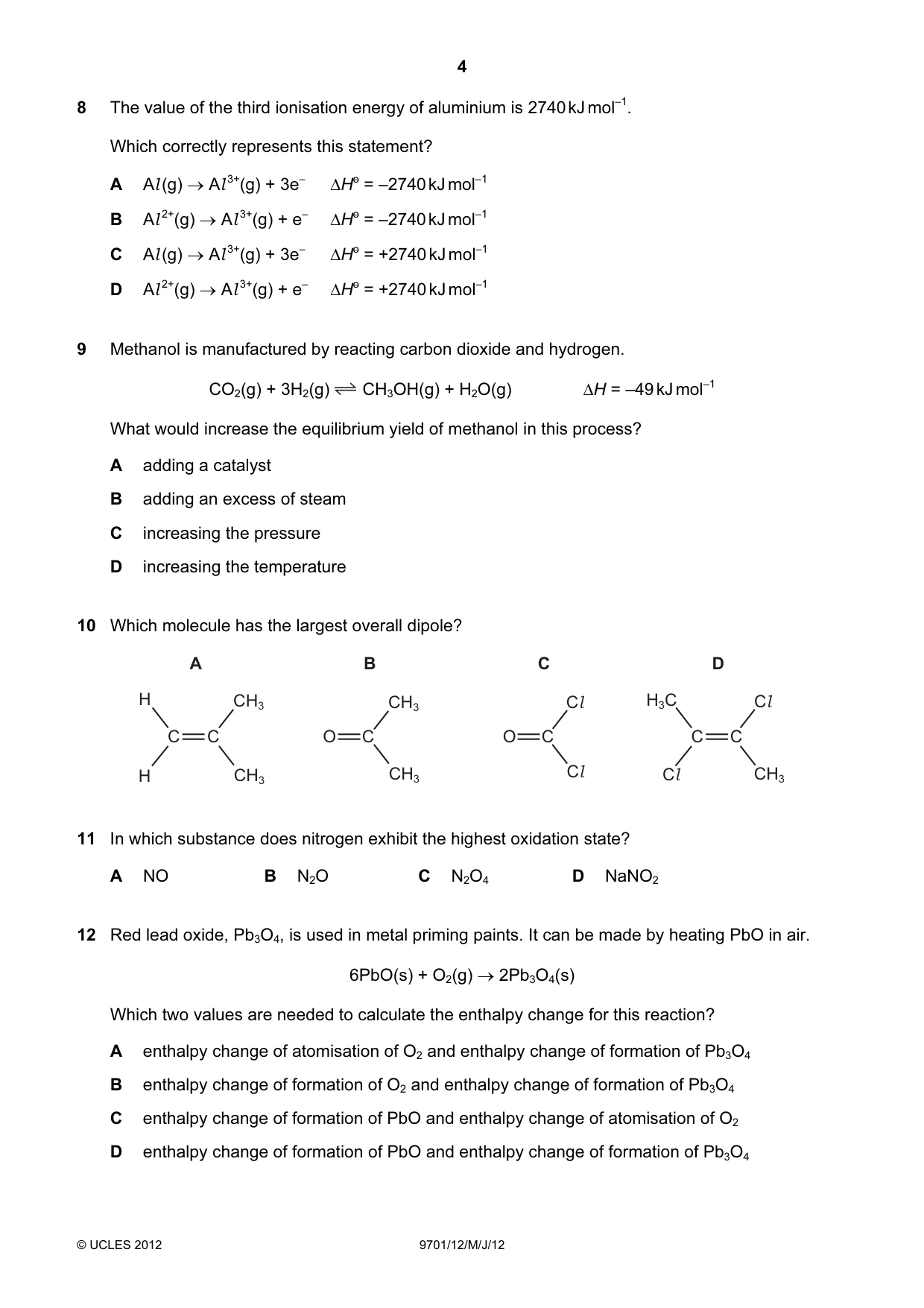
8 The value of the third ionisation energy of aluminium is 2740 kJ mol–1. Which correctly represents this statement? A Al (g) → Al 3+(g) + 3e– ∆Ho = –2740 kJ mol–1 B Al 2+(g) → Al 3+(g) + e– ∆Ho = –2740 kJ mol–1 C Al (g) → Al 3+(g) + 3e– ∆Ho = +2740 kJ mol–1 D Al 2+(g) → Al 3+(g) + e– ∆Ho = +2740 kJ mol–1
Mark scheme: D
Q9 · Methanol is manufactured by reacting carbon dioxide and hydrogen
9 Methanol is manufactured by reacting carbon dioxide and hydrogen. CO2(g) + 3H2(g) CH3OH(g) + H2O(g) ∆H = –49 kJ mol–1 What would increase the equilibrium yield of methanol in this process? A adding a catalyst B adding an excess of steam C increasing the pressure D increasing the temperature
Mark scheme: C
More questions on Chemical equilibria: reversible reactions, dynamic equilibrium
Q10 · Which molecule has the largest overall dipole?
10 Which molecule has the largest overall dipole? A B C D H CH3 CH3 Cl H3C Cl C C O C O C C C H CH3 CH3 Cl Cl CH3
Mark scheme: B
More questions on Intermolecular forces, electronegativity and bond properties
Q11 · In which substance does nitrogen exhibit the highest oxidation state?
11 In which substance does nitrogen exhibit the highest oxidation state? A NO B N2O C N2O4 D NaNO2
Mark scheme: C
Q12 · Red lead oxide, Pb3O4, is used in metal priming paints
12 Red lead oxide, Pb3O4, is used in metal priming paints. It can be made by heating PbO in air. 6PbO(s) + O2(g) → 2Pb3O4(s) Which two values are needed to calculate the enthalpy change for this reaction? A enthalpy change of atomisation of O2 and enthalpy change of formation of Pb3O4 B enthalpy change of formation of O2 and enthalpy change of formation of Pb3O4 C enthalpy change of formation of PbO and enthalpy change of atomisation of O2 D enthalpy change of formation of PbO and enthalpy change of formation of Pb3O4
Mark scheme: D
Q13 · Which gas is present in the exhaust fumes of a car engine in a much greater amount than…
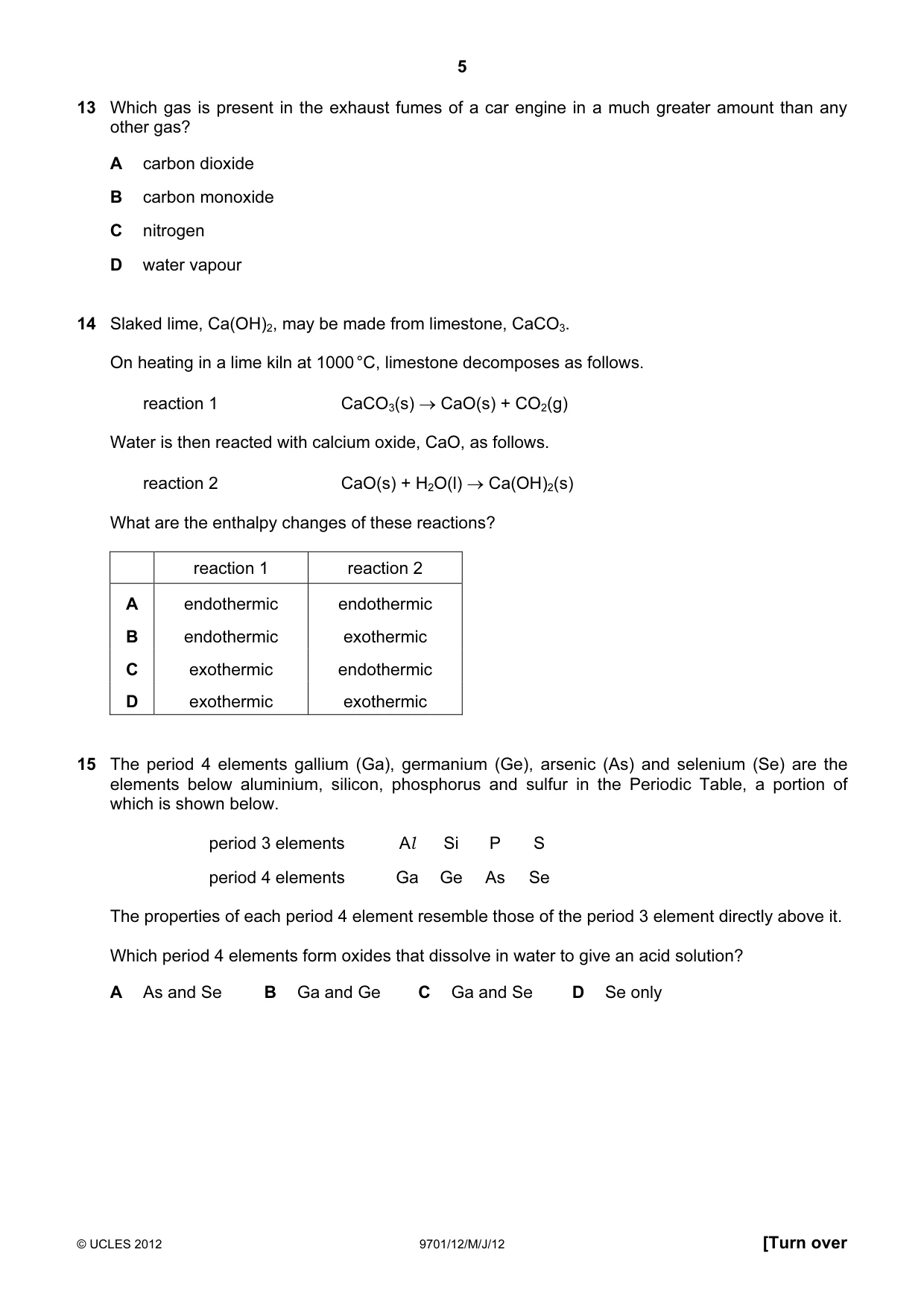
13 Which gas is present in the exhaust fumes of a car engine in a much greater amount than any other gas? A carbon dioxide B carbon monoxide C nitrogen D water vapour
Mark scheme: C
Q14 · Slaked lime, Ca(OH)2, may be made from limestone, CaCO3
14 Slaked lime, Ca(OH)2, may be made from limestone, CaCO3. On heating in a lime kiln at 1000 °C, limestone decomposes as follows. reaction 1 CaCO3(s) → CaO(s) + CO2(g) Water is then reacted with calcium oxide, CaO, as follows. reaction 2 CaO(s) + H2O(l) → Ca(OH)2(s) What are the enthalpy changes of these reactions? reaction 1 reaction 2 A endothermic endothermic B endothermic exothermic C exothermic endothermic D exothermic exothermic
Mark scheme: B
Q15 · The period 4 elements gallium (Ga), germanium (Ge), arsenic (As) and selenium (Se) are…
15 The period 4 elements gallium (Ga), germanium (Ge), arsenic (As) and selenium (Se) are the elements below aluminium, silicon, phosphorus and sulfur in the Periodic Table, a portion of which is shown below. period 3 elements Al Si P S period 4 elements Ga Ge As Se The properties of each period 4 element resemble those of the period 3 element directly above it. Which period 4 elements form oxides that dissolve in water to give an acid solution? A As and Se B Ga and Ge C Ga and Se D Se only
Mark scheme: A
More questions on Periodicity of chemical properties of the elements in Period 3
Q16 · Chlorine shows oxidation states ranging from –1 to +7 in its compounds
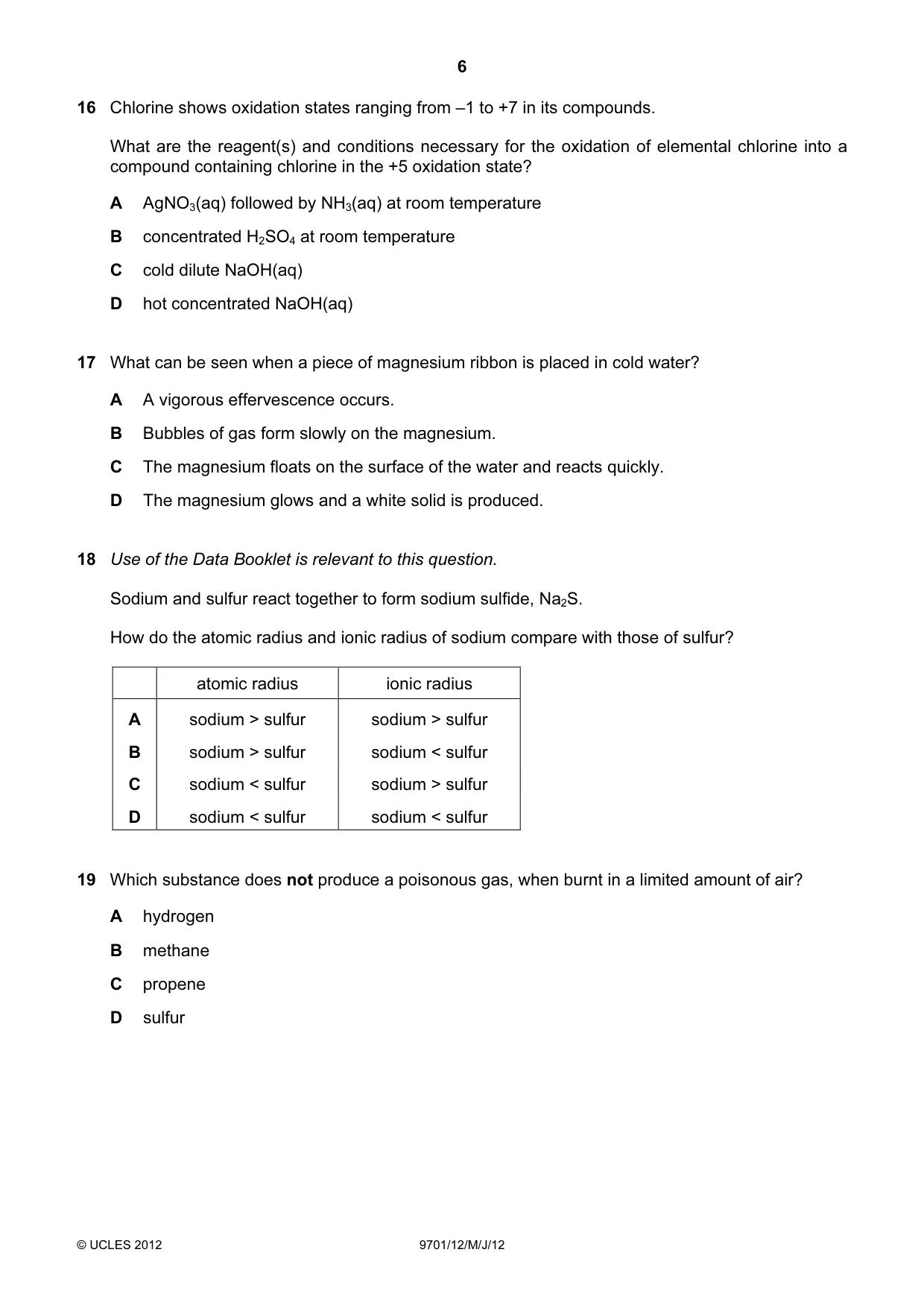
16 Chlorine shows oxidation states ranging from –1 to +7 in its compounds. What are the reagent(s) and conditions necessary for the oxidation of elemental chlorine into a compound containing chlorine in the +5 oxidation state? A AgNO3(aq) followed by NH3(aq) at room temperature B concentrated H2SO4 at room temperature C cold dilute NaOH(aq) D hot concentrated NaOH(aq)
Mark scheme: D
More questions on The chemical properties of the halogen elements and the hydrogen halides
Q17 · What can be seen when a piece of magnesium ribbon is placed in cold water?
17 What can be seen when a piece of magnesium ribbon is placed in cold water? A A vigorous effervescence occurs. B Bubbles of gas form slowly on the magnesium. C The magnesium floats on the surface of the water and reacts quickly. D The magnesium glows and a white solid is produced.
Mark scheme: B
Q18 · Use of the Data Booklet is relevant to this question
18 Use of the Data Booklet is relevant to this question. Sodium and sulfur react together to form sodium sulfide, Na2S. How do the atomic radius and ionic radius of sodium compare with those of sulfur? atomic radius ionic radius A sodium > sulfur sodium > sulfur B sodium > sulfur sodium < sulfur C sodium < sulfur sodium > sulfur D sodium < sulfur sodium < sulfur
Mark scheme: B
Q19 · Which substance does not produce a poisonous gas, when burnt in a limited amount of air?
19 Which substance does not produce a poisonous gas, when burnt in a limited amount of air? A hydrogen B methane C propene D sulfur
Mark scheme: A
Q20 · Use of the Data Booklet is relevant to this question
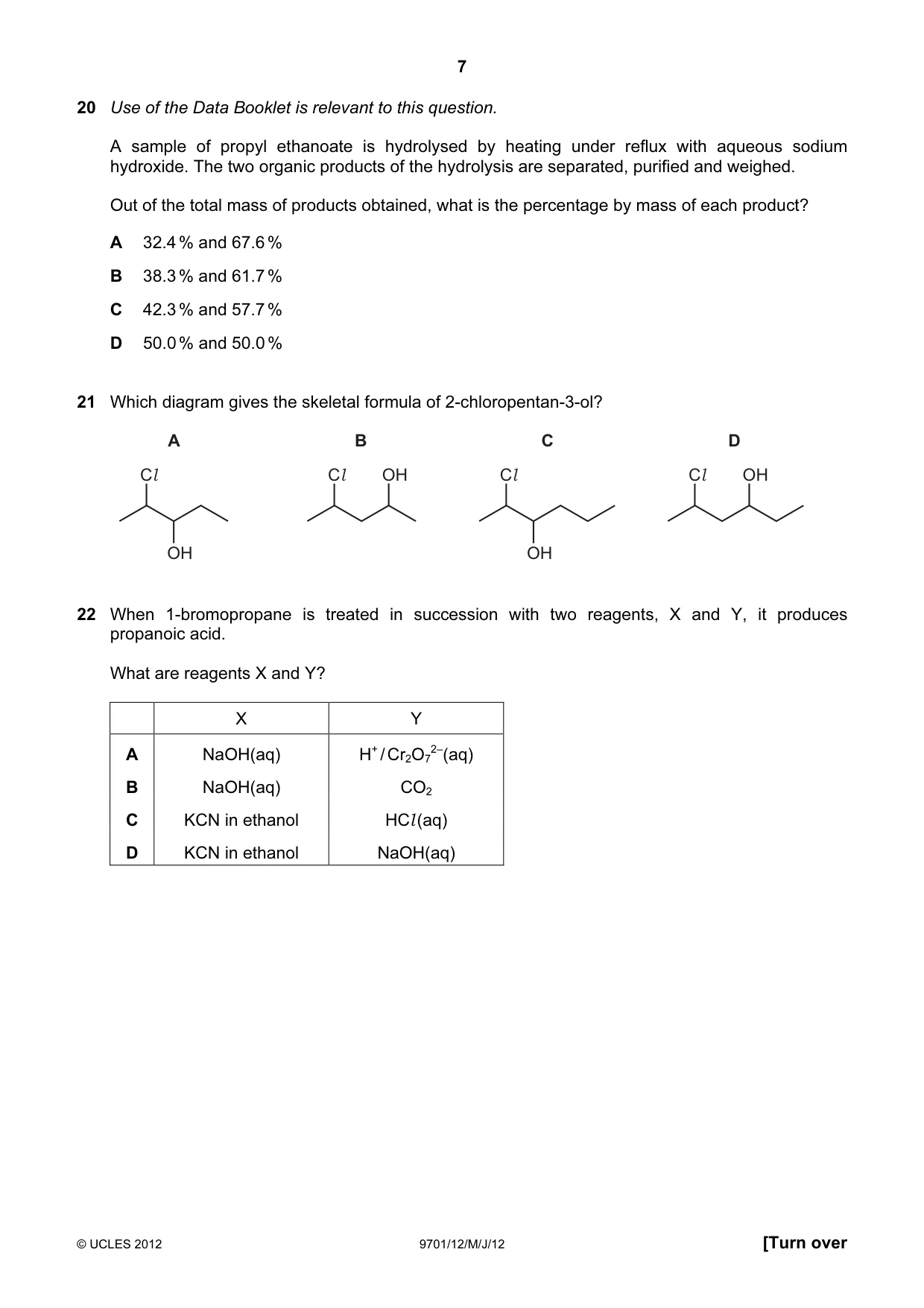
20 Use of the Data Booklet is relevant to this question. A sample of propyl ethanoate is hydrolysed by heating under reflux with aqueous sodium hydroxide. The two organic products of the hydrolysis are separated, purified and weighed. Out of the total mass of products obtained, what is the percentage by mass of each product? A 32.4 % and 67.6 % B 38.3 % and 61.7 % C 42.3 % and 57.7 % D 50.0 % and 50.0 %
Mark scheme: C
Q21 · Which diagram gives the skeletal formula of 2-chloropentan-3-ol?
21 Which diagram gives the skeletal formula of 2-chloropentan-3-ol? A B C D Cl Cl OH Cl Cl OH OH OH
Mark scheme: A
More questions on Formulas, functional groups and the naming of organic compounds
Q22 · When 1-bromopropane is treated in succession with two reagents, X and Y, it produces…
22 When 1-bromopropane is treated in succession with two reagents, X and Y, it produces propanoic acid. What are reagents X and Y? X Y A NaOH(aq) H+ / Cr2O7 2–(aq) B NaOH(aq) CO2 C KCN in ethanol HCl (aq) D KCN in ethanol NaOH(aq)
Mark scheme: A
Q23 · Isomers X and Y both react with HBr
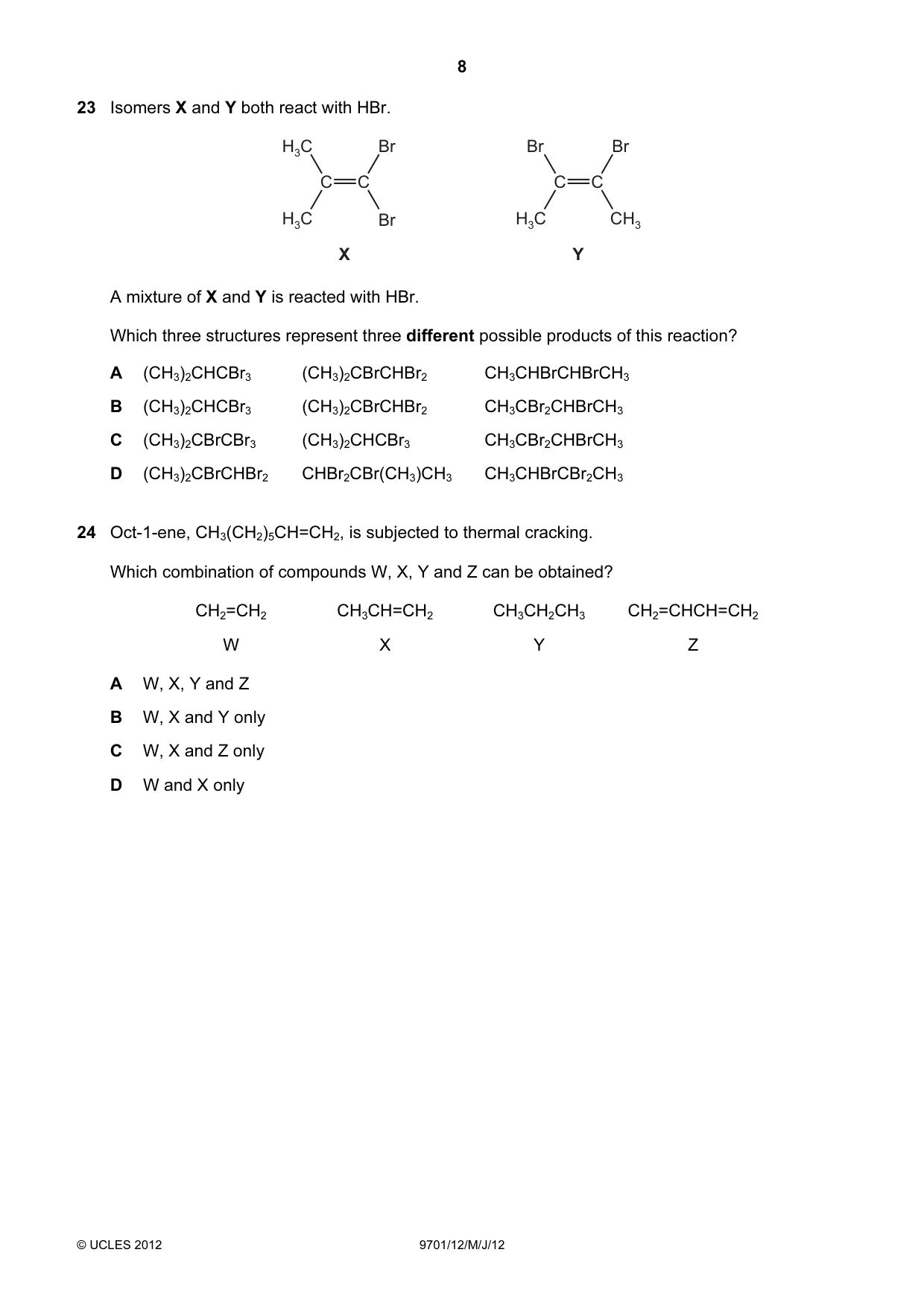
23 Isomers X and Y both react with HBr. H3C Br Br Br C C C C H3C Br H3C CH3 X Y A mixture of X and Y is reacted with HBr. Which three structures represent three different possible products of this reaction? A (CH3)2CHCBr3 (CH3)2CBrCHBr2 CH3CHBrCHBrCH3 B (CH3)2CHCBr3 (CH3)2CBrCHBr2 CH3CBr2CHBrCH3 C (CH3)2CBrCBr3 (CH3)2CHCBr3 CH3CBr2CHBrCH3 D (CH3)2CBrCHBr2 CHBr2CBr(CH3)CH3 CH3CHBrCBr2CH3
Mark scheme: B
Q24 · Oct-1-ene, CH3(CH2)5CH=CH2, is subjected to thermal cracking
24 Oct-1-ene, CH3(CH2)5CH=CH2, is subjected to thermal cracking. Which combination of compounds W, X, Y and Z can be obtained? CH2=CH2 CH3CH=CH2 CH3CH2CH3 CH2=CHCH=CH2 W X Y Z A W, X, Y and Z B W, X and Y only C W, X and Z only D W and X only
Mark scheme: A
Q25 · When phenacyl chloride, C6H5COCH2Cl, is reacted with aqueous NaOH, the substitution…
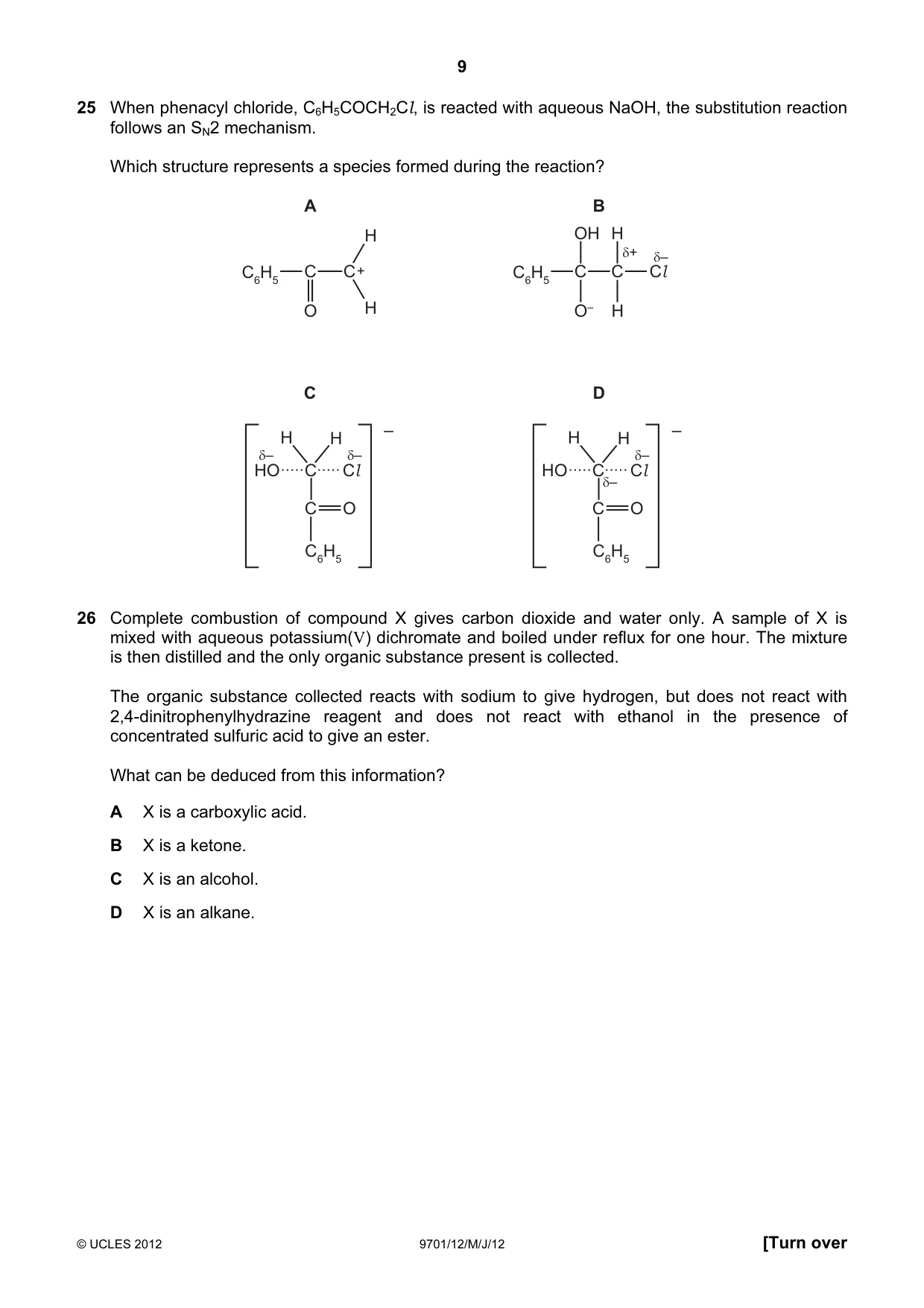
25 When phenacyl chloride, C6H5COCH2Cl, is reacted with aqueous NaOH, the substitution reaction follows an SN2 mechanism. Which structure represents a species formed during the reaction? A B H OH H δ+ δ– C6H5 C C + C6H5 C C Cl O H O– H C D – – H H H H δ– δ– δ– HO C Cl HO C Cl δ– C O C O C6H5 C6H5
Mark scheme: C
Q26 · Complete combustion of compound X gives carbon dioxide and water only
26 Complete combustion of compound X gives carbon dioxide and water only. A sample of X is mixed with aqueous potassium(V) dichromate and boiled under reflux for one hour. The mixture is then distilled and the only organic substance present is collected. The organic substance collected reacts with sodium to give hydrogen, but does not react with 2,4-dinitrophenylhydrazine reagent and does not react with ethanol in the presence of concentrated sulfuric acid to give an ester. What can be deduced from this information? A X is a carboxylic acid. B X is a ketone. C X is an alcohol. D X is an alkane.
Mark scheme: C
Q27 · A compound Y has the following properties
27 A compound Y has the following properties. • It is a liquid at room temperature and atmospheric pressure. • It does not mix completely with water. • It does not give steamy fumes with PCl5. What could Y be? A ethane B ethanoic acid C ethanol D ethyl ethanoate
Mark scheme: D
Q28 · Coniine is the major constituent of the poison ‘oil of hemlock’
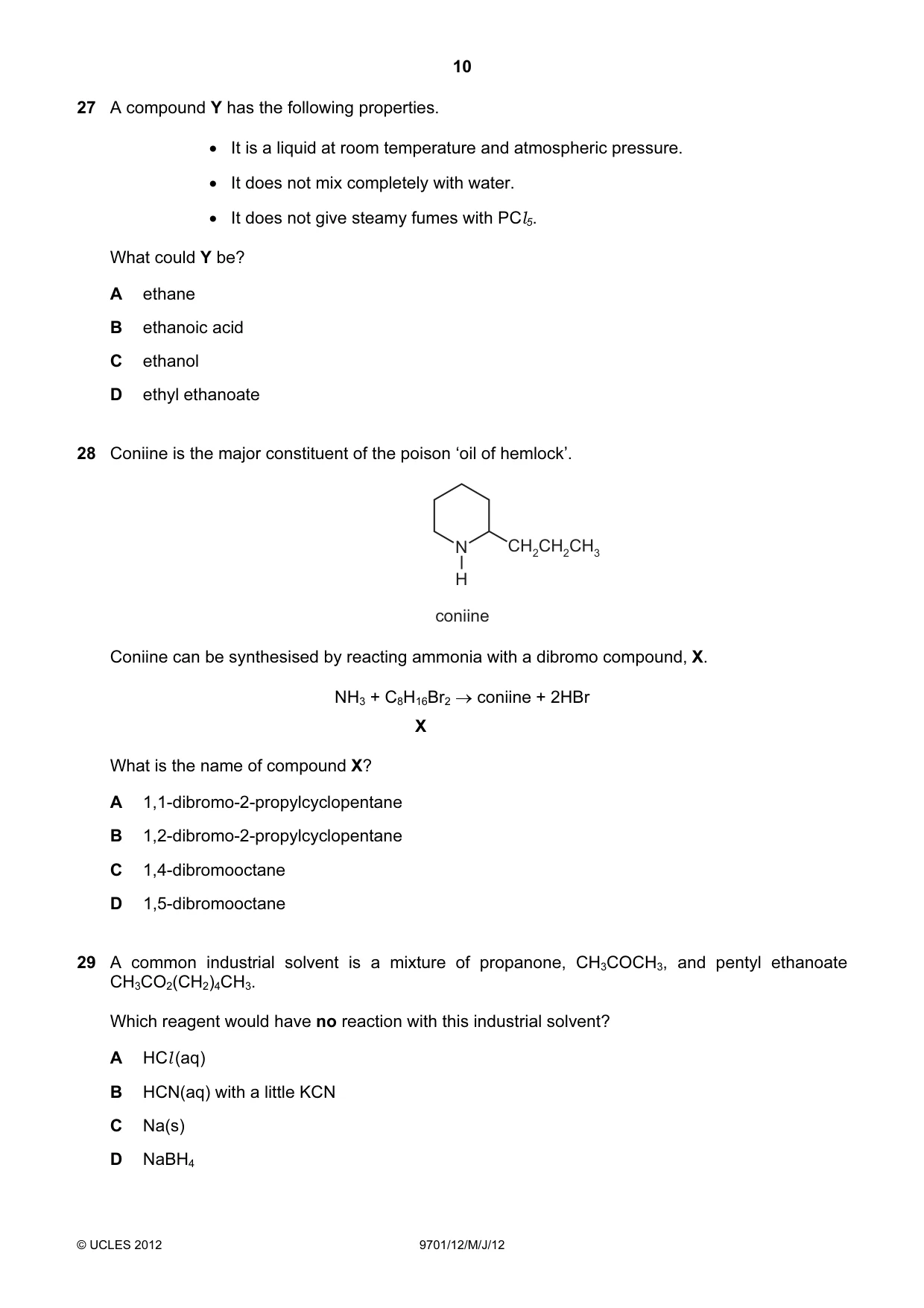
28 Coniine is the major constituent of the poison ‘oil of hemlock’. N CH2CH2CH3 H coniine Coniine can be synthesised by reacting ammonia with a dibromo compound, X. NH3 + C8H16Br2 → coniine + 2HBr X What is the name of compound X? A 1,1-dibromo-2-propylcyclopentane B 1,2-dibromo-2-propylcyclopentane C 1,4-dibromooctane D 1,5-dibromooctane
Mark scheme: D
Q29 · A common industrial solvent is a mixture of propanone, CH3COCH3, and pentyl ethanoate…
29 A common industrial solvent is a mixture of propanone, CH3COCH3, and pentyl ethanoate CH3CO2(CH2)4CH3. Which reagent would have no reaction with this industrial solvent? A HCl (aq) B HCN(aq) with a little KCN C Na(s) D NaBH4
Mark scheme: C
Q30 · An organic compound will decolorise dilute acidified aqueous potassium manganate(VII) on…
30 An organic compound will decolorise dilute acidified aqueous potassium manganate(VII) on warming, but will not decolorise bromine water. What could the organic compound be? A butane B ethanol C ethene D ethanoic acid
Mark scheme: B
Q31 · Which of the following molecules and ions have a regular trigonal planar shape?
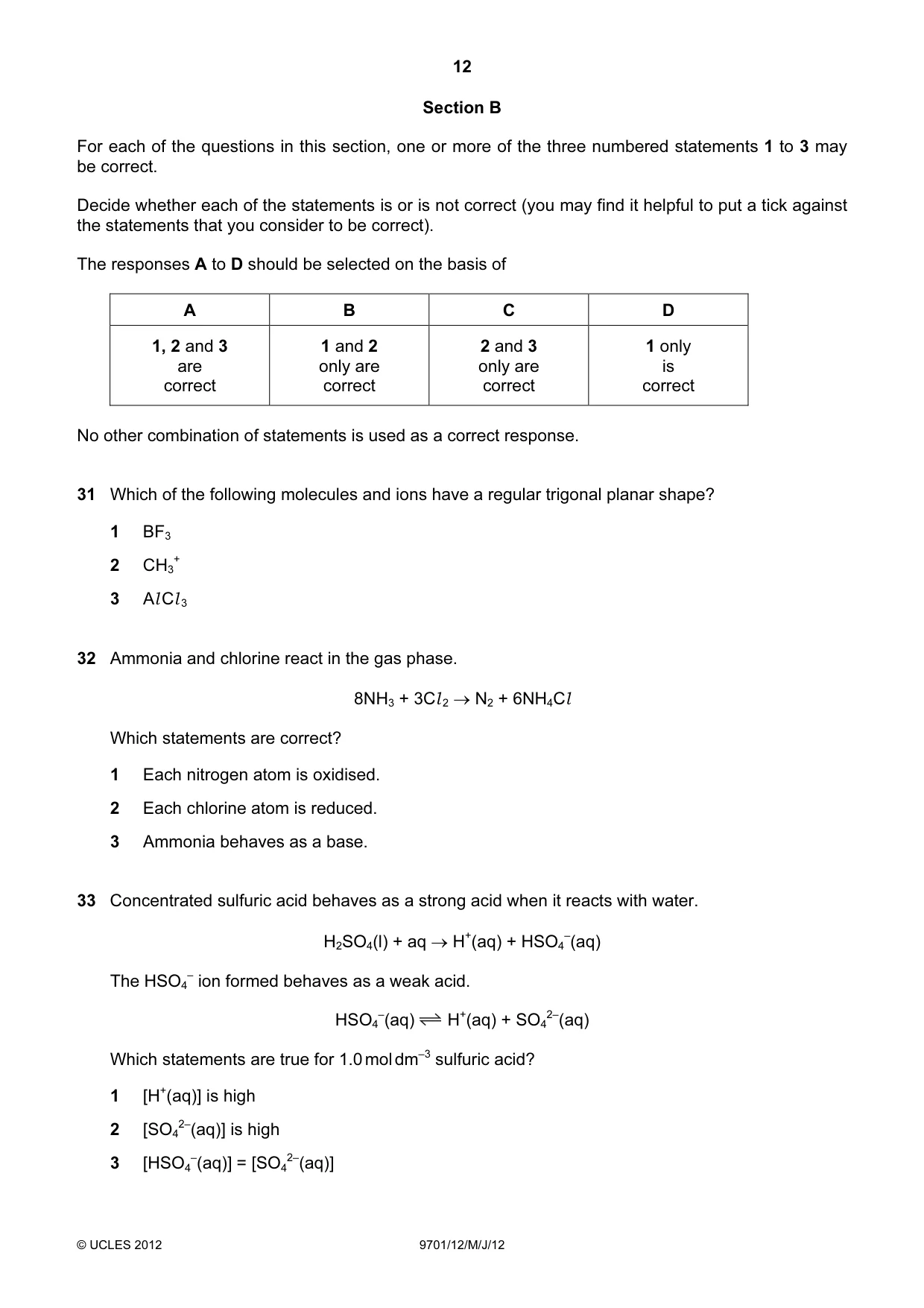
31 Which of the following molecules and ions have a regular trigonal planar shape? 1 BF3 2 CH3 + 3 Al Cl 3
Mark scheme: A
Q32 · Ammonia and chlorine react in the gas phase
32 Ammonia and chlorine react in the gas phase. 8NH3 + 3Cl 2 → N2 + 6NH4Cl Which statements are correct? 1 Each nitrogen atom is oxidised. 2 Each chlorine atom is reduced. 3 Ammonia behaves as a base.
Mark scheme: C
Q33 · Concentrated sulfuric acid behaves as a strong acid when it reacts with water
33 Concentrated sulfuric acid behaves as a strong acid when it reacts with water. H2SO4(l) + aq → H+(aq) + HSO4 –(aq) The HSO4 – ion formed behaves as a weak acid. HSO4 –(aq) H+(aq) + SO4 2–(aq) Which statements are true for 1.0 mol dm–3 sulfuric acid? 1 [H+(aq)] is high 2 [SO4 2–(aq)] is high 3 [HSO4 –(aq)] = [SO4 2–(aq)]
Mark scheme: D
Q34 · Silver chloride dissolves in aqueous ammonia
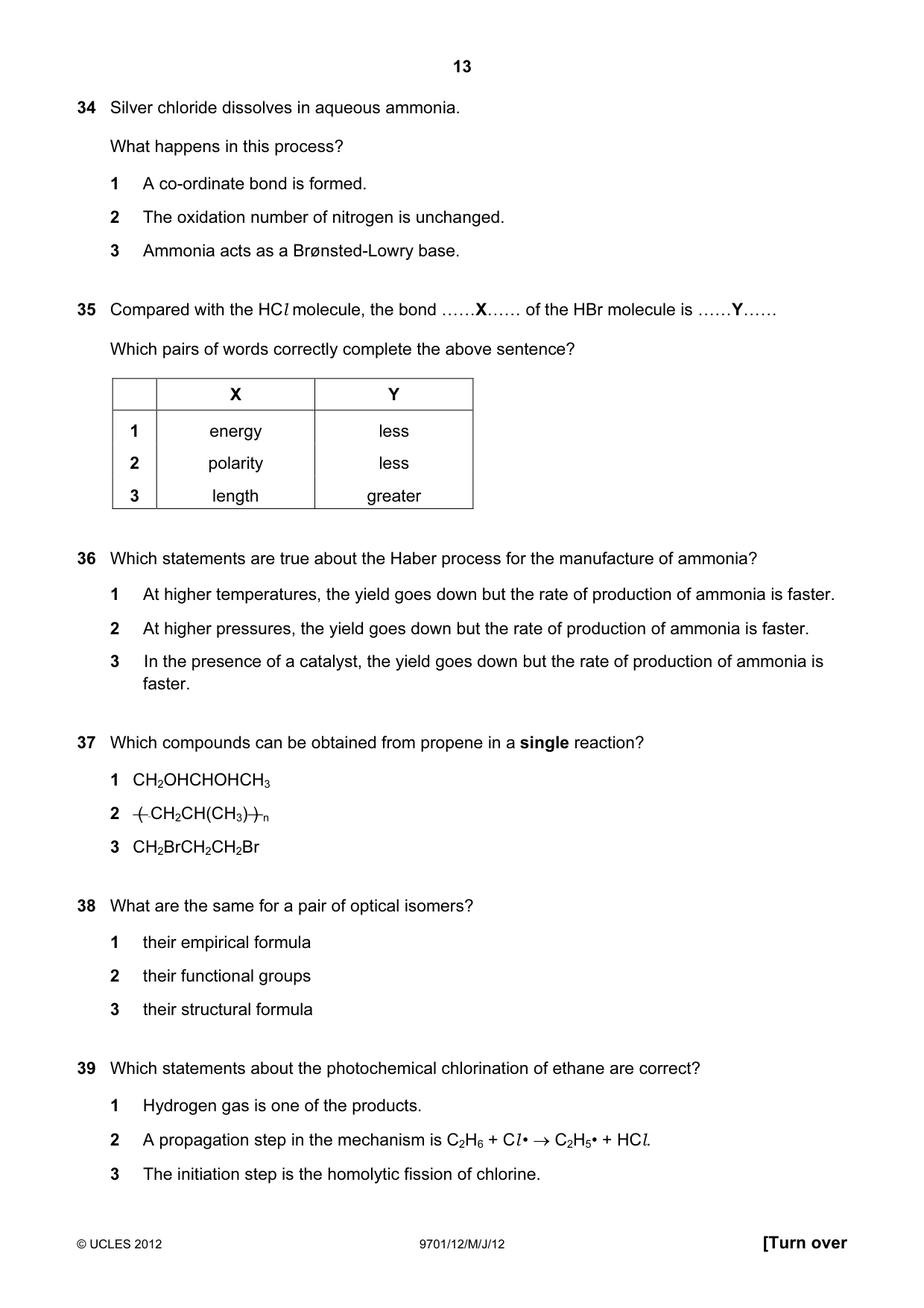
34 Silver chloride dissolves in aqueous ammonia. What happens in this process? 1 A co-ordinate bond is formed. 2 The oxidation number of nitrogen is unchanged. 3 Ammonia acts as a Brønsted-Lowry base.
Mark scheme: B
More questions on Covalent bonding and coordinate (dative covalent) bonding
Q35 · Compared with the HCl molecule, the bond ……X…… of the HBr molecule is ……Y…… Which pairs…
35 Compared with the HCl molecule, the bond ……X…… of the HBr molecule is ……Y…… Which pairs of words correctly complete the above sentence? X Y 1 energy less 2 polarity less 3 length greater
Mark scheme: A
More questions on Intermolecular forces, electronegativity and bond properties
Q36 · Which statements are true about the Haber process for the manufacture of ammonia?
36 Which statements are true about the Haber process for the manufacture of ammonia? 1 At higher temperatures, the yield goes down but the rate of production of ammonia is faster. 2 At higher pressures, the yield goes down but the rate of production of ammonia is faster. 3 In the presence of a catalyst, the yield goes down but the rate of production of ammonia is faster.
Mark scheme: D
More questions on Effect of temperature on reaction rates and the concept of activation energy
Q37 · Which compounds can be obtained from propene in a single reaction?
37 Which compounds can be obtained from propene in a single reaction? 1 CH2OHCHOHCH3 2 ( CH2CH(CH3) ) n 3 CH2BrCH2CH2Br
Mark scheme: B
Q38 · What are the same for a pair of optical isomers?
38 What are the same for a pair of optical isomers? 1 their empirical formula 2 their functional groups 3 their structural formula
Mark scheme: A
More questions on Isomerism: structural isomerism and stereoisomerism
Q39 · Which statements about the photochemical chlorination of ethane are correct?
39 Which statements about the photochemical chlorination of ethane are correct? 1 Hydrogen gas is one of the products. 2 A propagation step in the mechanism is C2H6 + Cl • → C2H5• + HCl. 3 The initiation step is the homolytic fission of chlorine.
Mark scheme: C
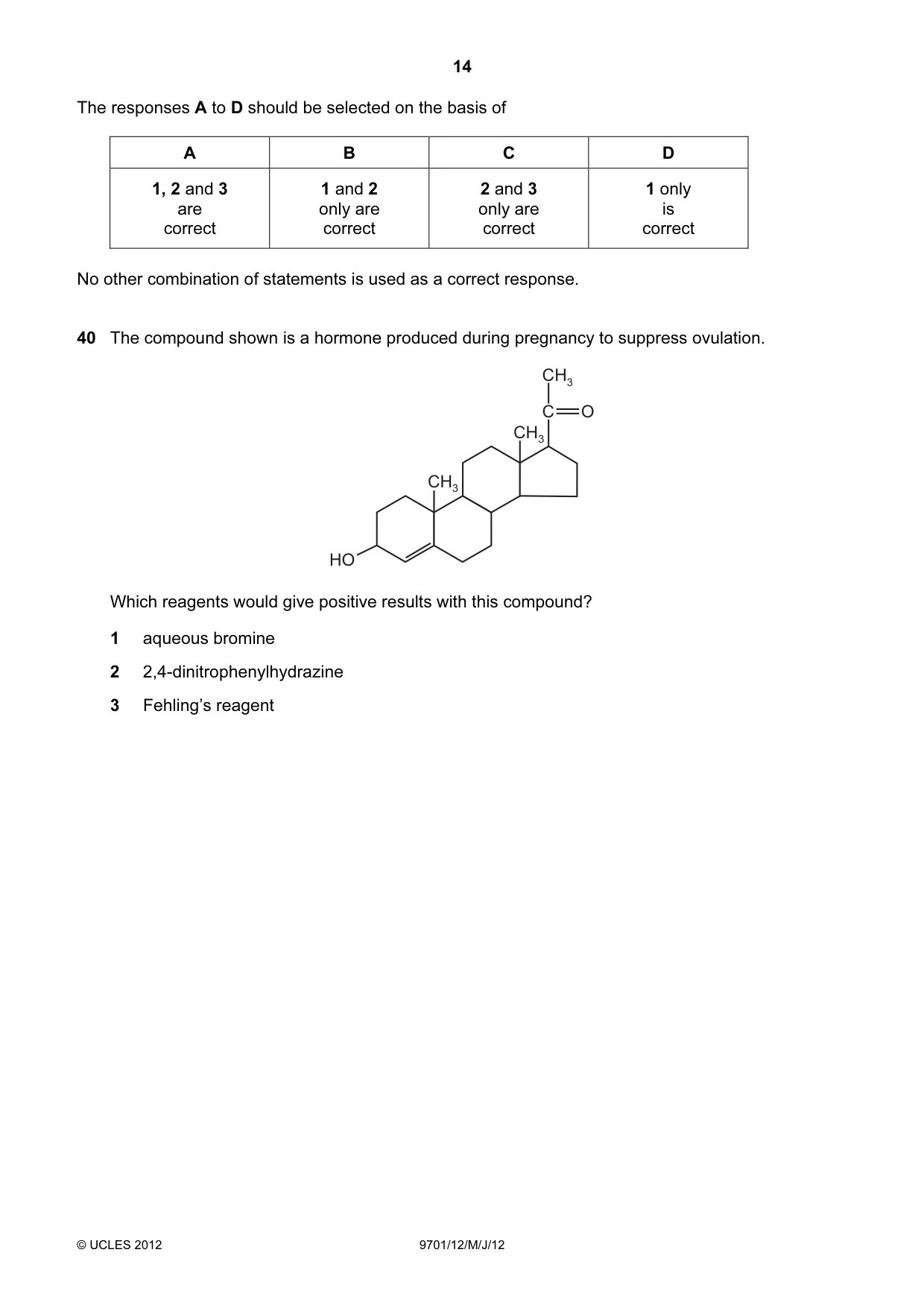
Q40 · The compound shown is a hormone produced during pregnancy to suppress ovulation
40 The compound shown is a hormone produced during pregnancy to suppress ovulation. CH3 C O CH3 CH3 HO Which reagents would give positive results with this compound? 1 aqueous bromine 2 2,4-dinitrophenylhydrazine 3 Fehling’s reagent
Mark scheme: B
What was in this paper
The subtopics covered by these 40 questions, and how many questions each got. Open one in a new tab to see every Cambridge question on it.
2Aldehydes and ketones2Alkanes2Alkenes2Chemical equilibria: reversible reactions, dynamic equilibrium2Covalent bonding and coordinate (dative covalent) bonding2Effect of temperature on reaction rates and the concept of activation energy2Esters2Intermolecular forces, electronegativity and bond properties2Nitrogen and sulfur2Particles in the atom and atomic radius2Redox processes: electron transfer and changes in oxidation number (oxidation state)2Shapes of molecules2Acids and bases1Bonding and structure1Enthalpy change, ΔH1Formulas, functional groups and the naming of organic compounds1Halogenoalkanes1Hess’s law1Ionisation energy1Isomerism: structural isomerism and stereoisomerism1Organic synthesis1Periodicity of chemical properties of the elements in Period 31Primary amines1Similarities and trends in the properties of the Group 2 metals, magnesium to barium, and their compounds1The chemical properties of the halogen elements and the hydrogen halides1The gaseous state: ideal and real gases and pV = nRT1What you needed in this session
Cambridge’s own grade thresholds for 2012 May/June, Paper 1 · Variant 2. A higher threshold means an easier paper — the bar moves with how the cohort did.