Cambridge A Level Chemistry 9701 — 2021 May/June Paper 1 · Variant 1
9701/11/M/J/21 · 40 questions · 40 marks · ≈45 min
The question paper and its mark scheme, free to read here and free to download. This is Cambridge’s own paper, exactly as it was sat.
Question paper16 pages
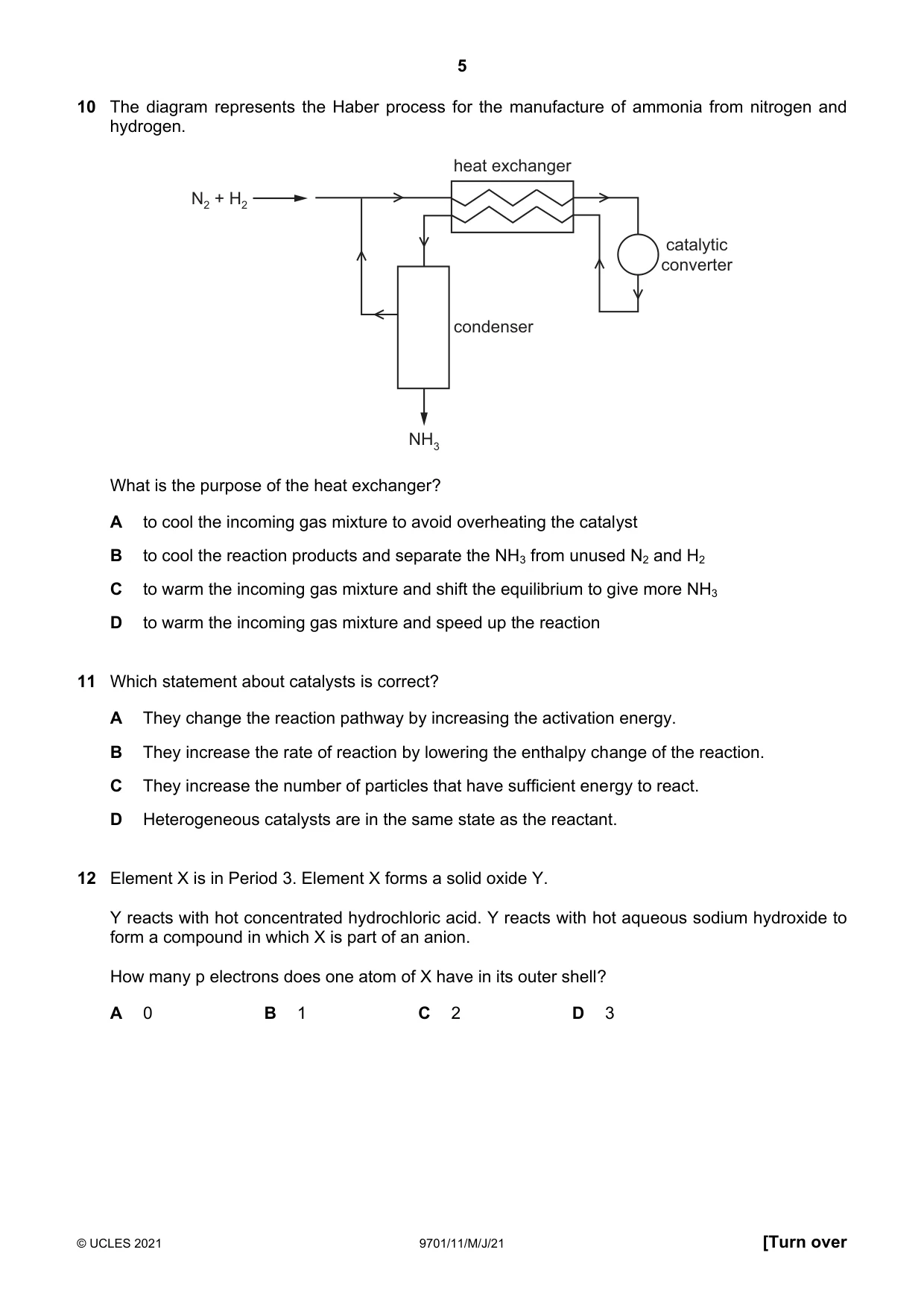
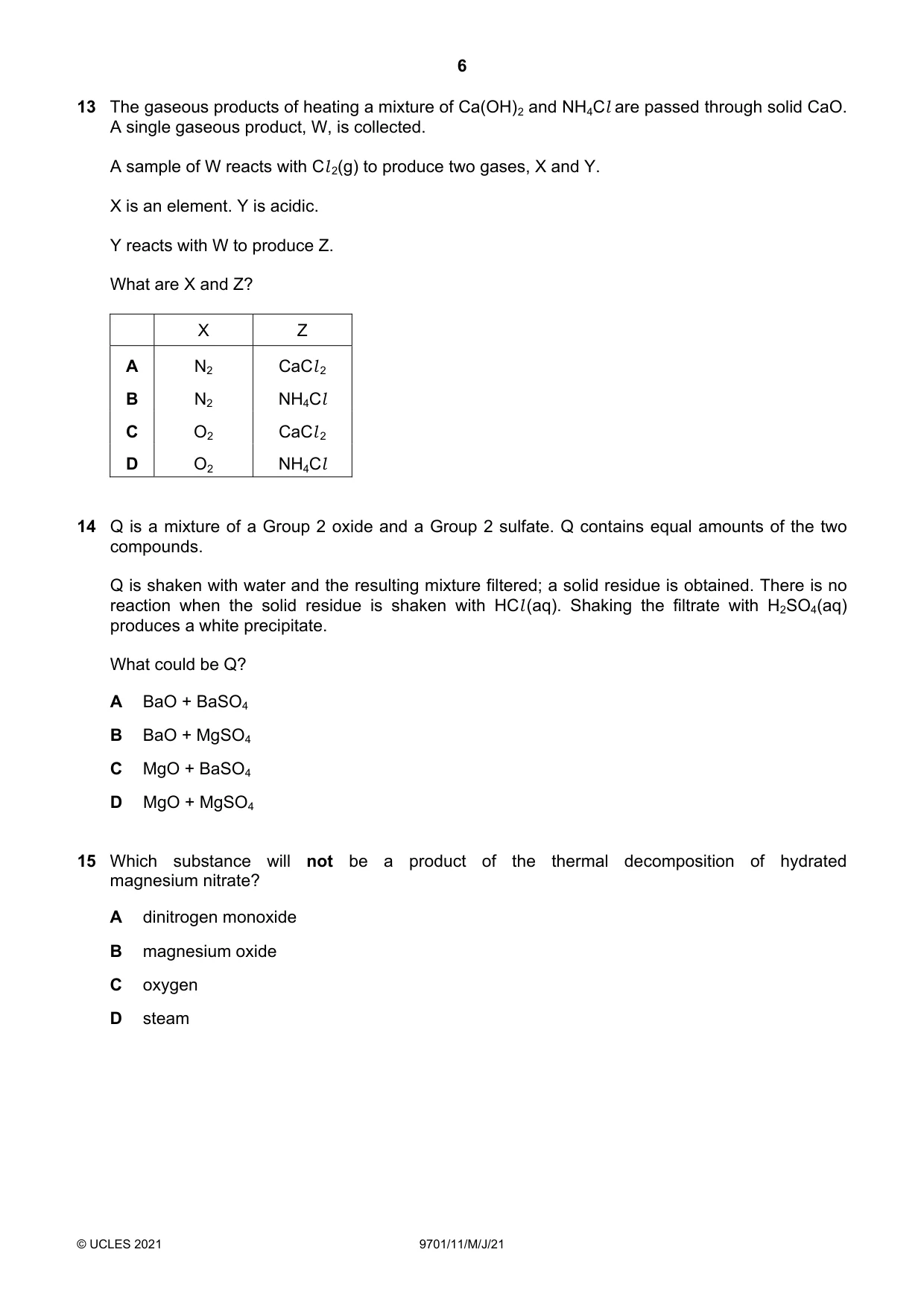
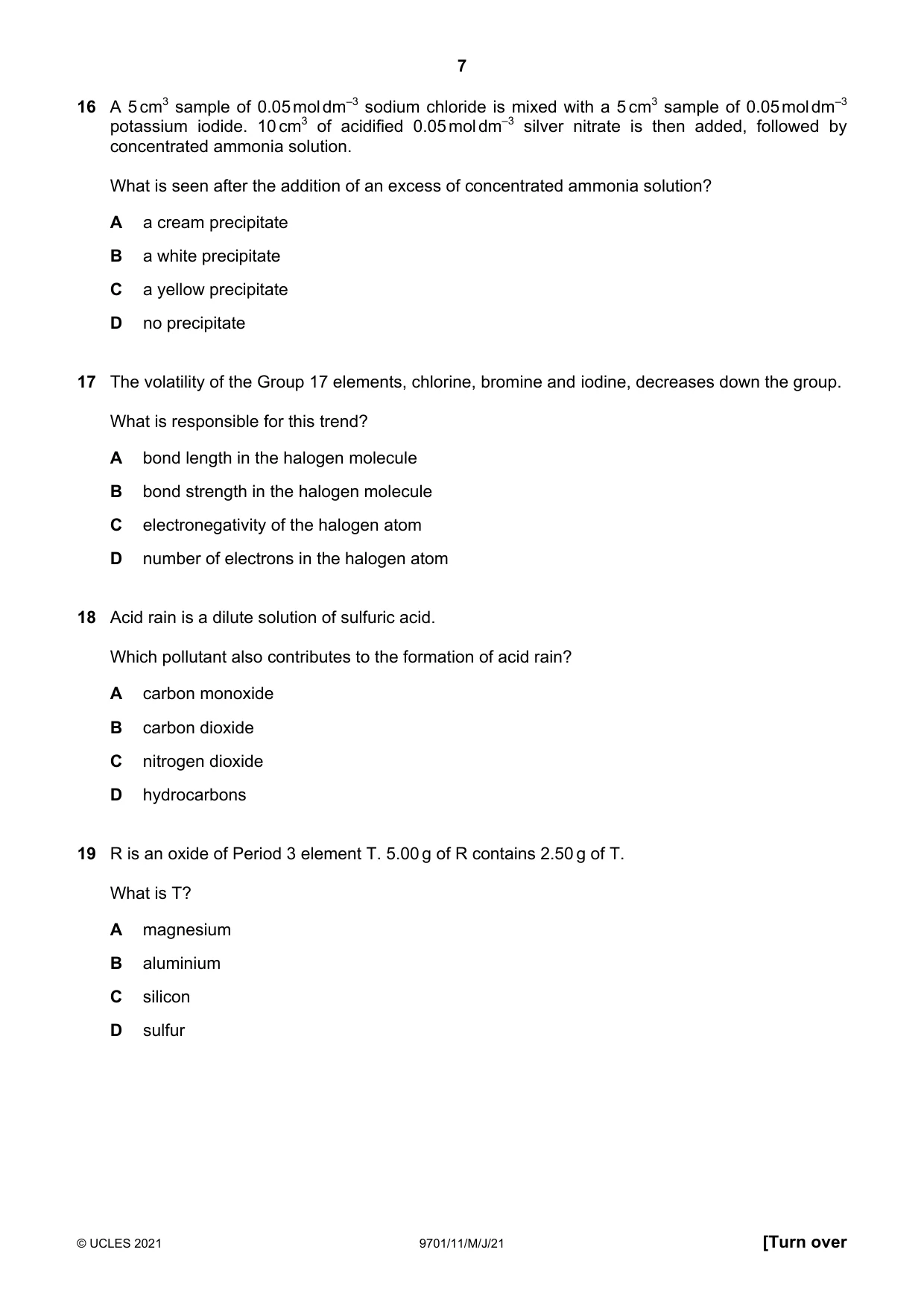
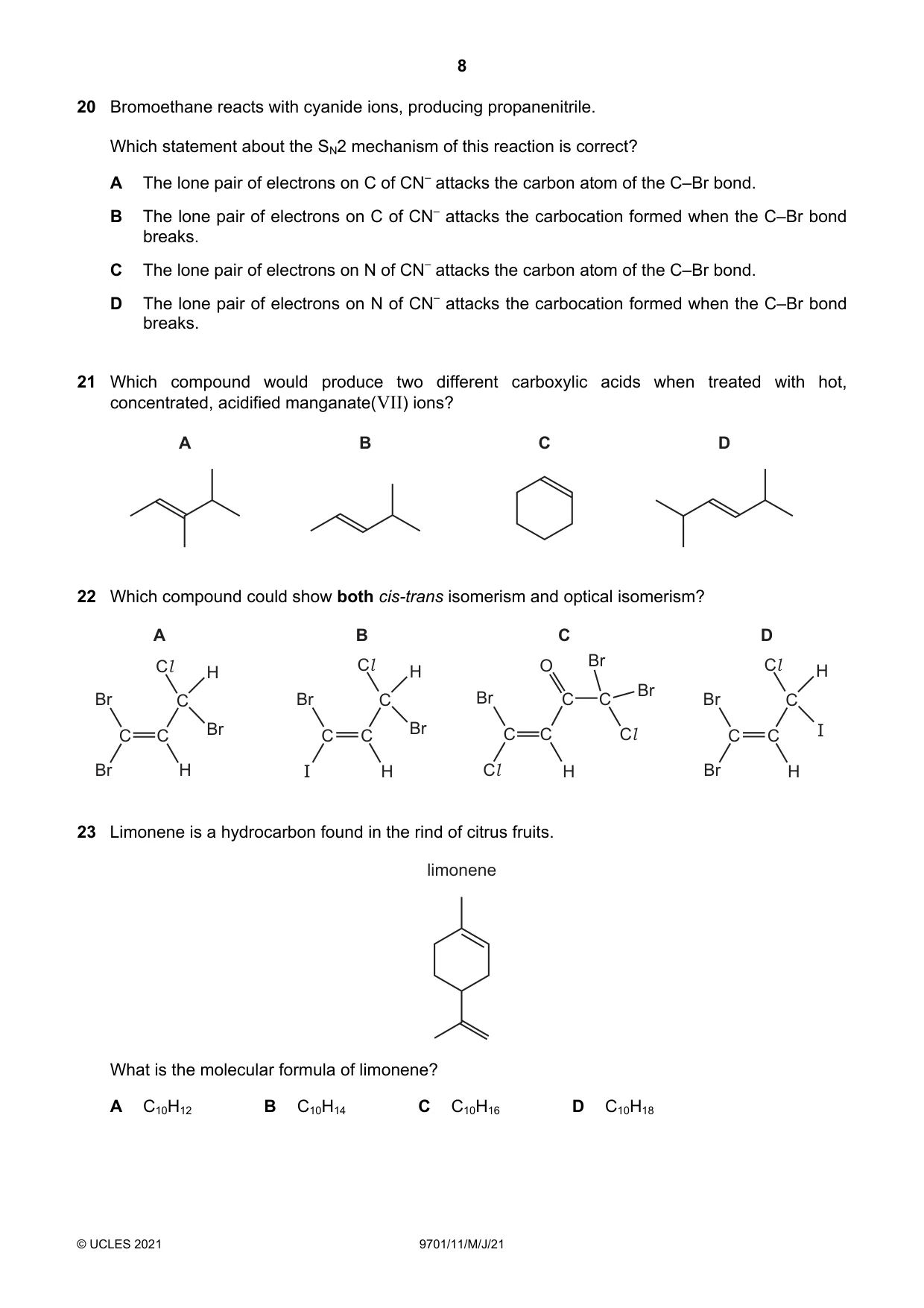

Mark scheme3 pages
Answers below. Sit the paper first if you are practising.
Questions as text
Q1 · Which contains the largest number of hydrogen atoms?
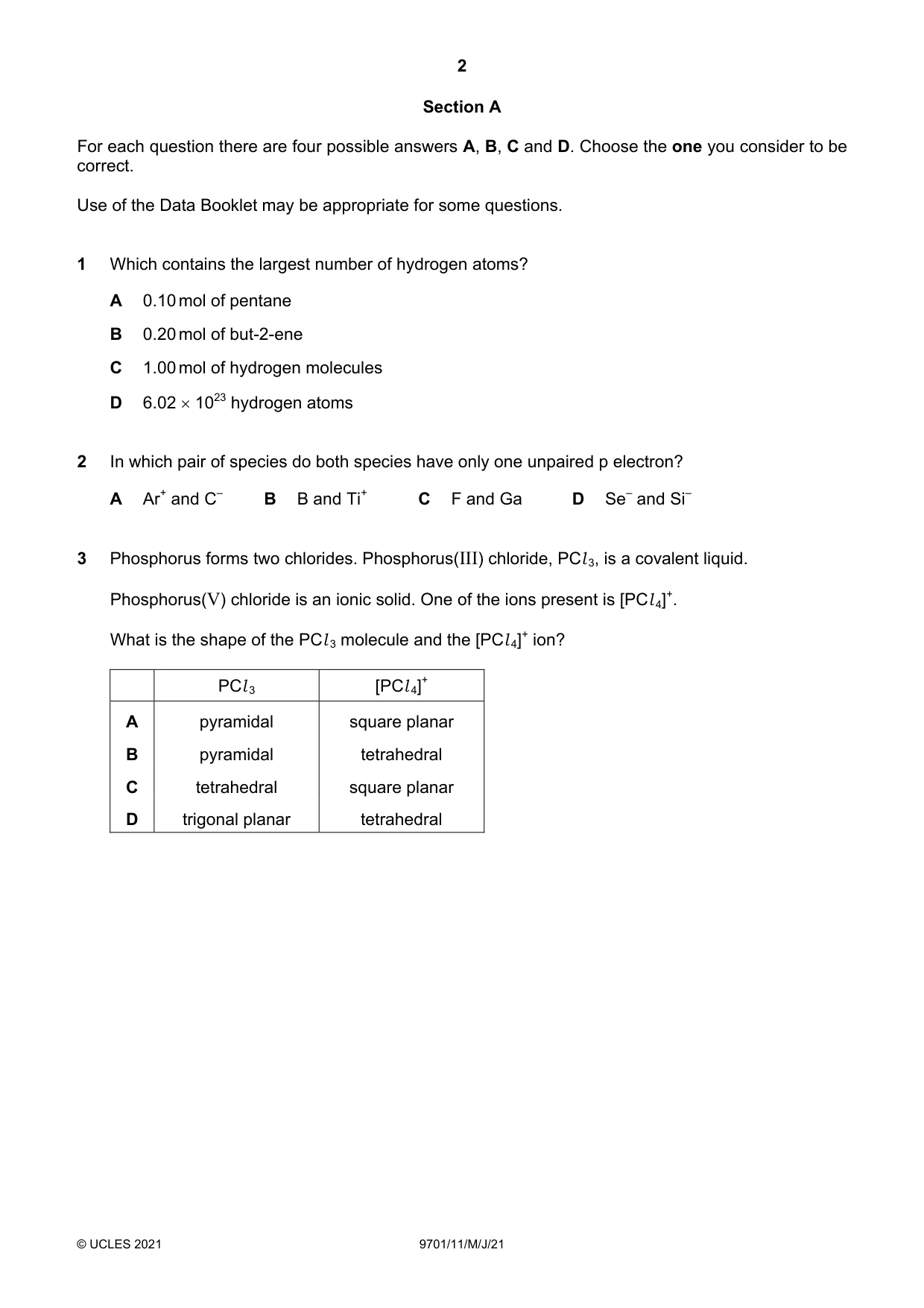
1 Which contains the largest number of hydrogen atoms? A 0.10 mol of pentane B 0.20 mol of but-2-ene C 1.00 mol of hydrogen molecules D 6.02 1023 hydrogen atoms
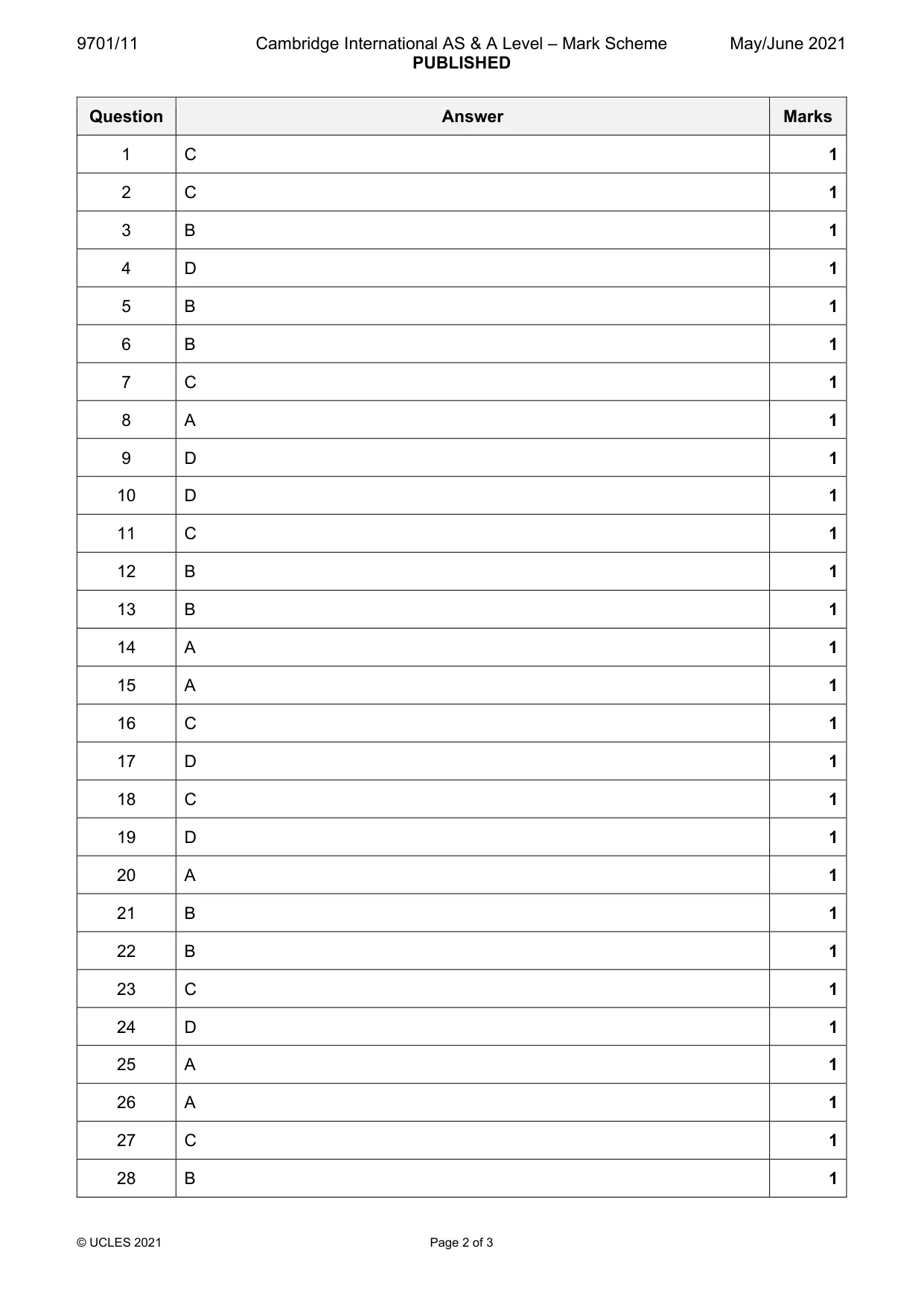
Mark scheme: C
Q2 · In which pair of species do both species have only one unpaired p electron?
2 In which pair of species do both species have only one unpaired p electron? A Ar+ and C– B B and Ti+ C F and Ga D Se– and Si–
Mark scheme: C
More questions on Electrons, energy levels and atomic orbitals
Q3 · Phosphorus forms two chlorides
3 Phosphorus forms two chlorides. Phosphorus(III) chloride, PCl 3, is a covalent liquid. Phosphorus(V) chloride is an ionic solid. One of the ions present is [PCl 4]+. What is the shape of the PCl 3 molecule and the [PCl 4]+ ion? PCl 3 [PCl 4]+ A pyramidal square planar B pyramidal tetrahedral C tetrahedral square planar D trigonal planar tetrahedral
Mark scheme: B
Q4 · Is the standard enthalpy of formation of methane
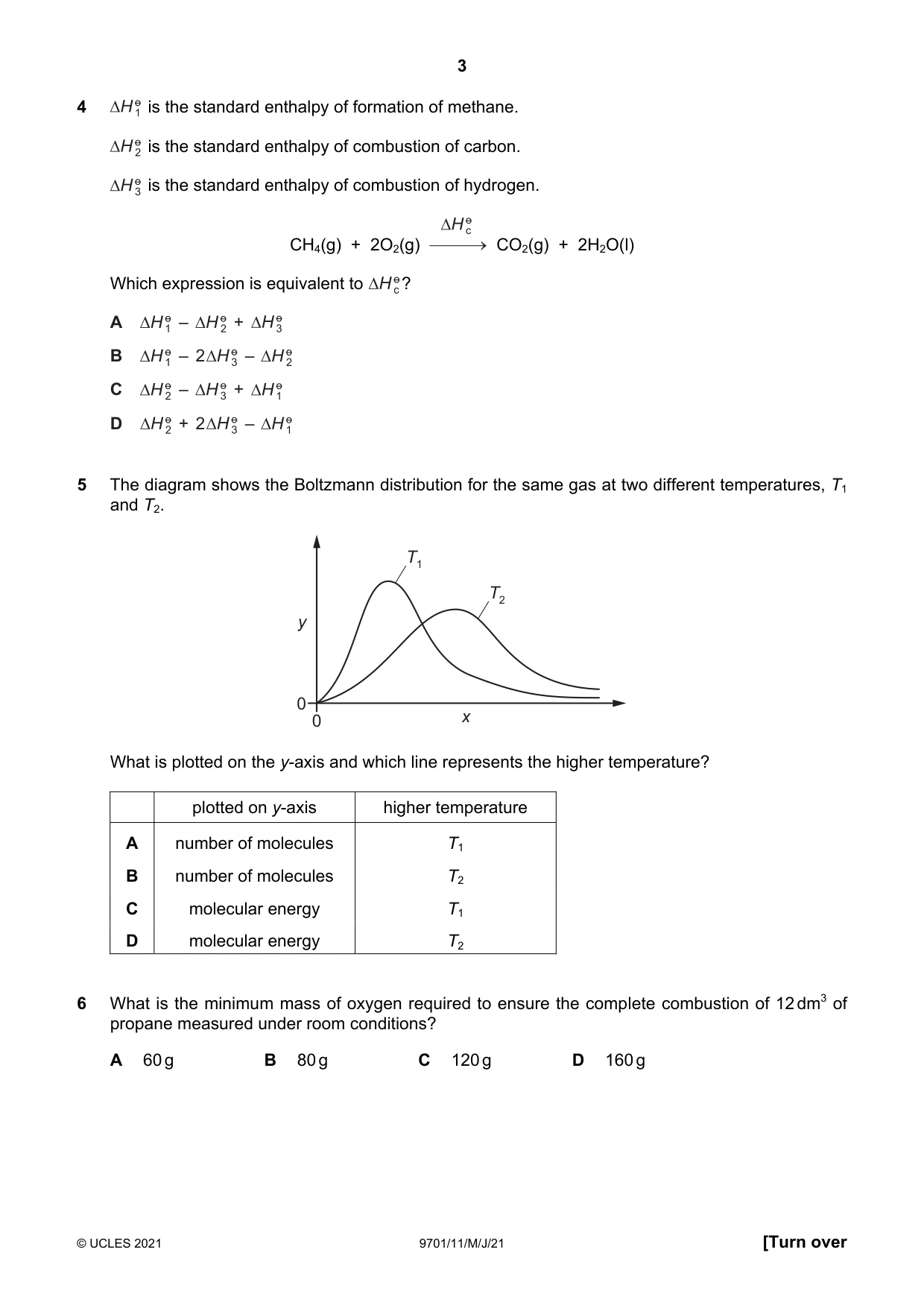
4 is the standard enthalpy of formation of methane. is the standard enthalpy of combustion of carbon. is the standard enthalpy of combustion of hydrogen. CH4(g) + 2O2(g) CO2(g) + 2H2O(l) Which expression is equivalent to ? A – + B – 2 – C – + D + 2 –
Mark scheme: D
Q5 · The diagram shows the Boltzmann distribution for the same gas at two different…
5 The diagram shows the Boltzmann distribution for the same gas at two different temperatures, T1 and T2. T1 T2 y 0 0 x What is plotted on the y-axis and which line represents the higher temperature? plotted on y-axis higher temperature A number of molecules T1 B number of molecules T2 C molecular energy T1 D molecular energy T2
Mark scheme: B
More questions on Effect of temperature on reaction rates and the concept of activation energy
Q6 · What is the minimum mass of oxygen required to ensure the complete combustion of 12 dm3…
6 What is the minimum mass of oxygen required to ensure the complete combustion of 12 dm3 of propane measured under room conditions? A 60 g B 80 g C 120 g D 160 g
Mark scheme: B
More questions on Reacting masses and volumes (of solutions and gases)
Q7 · Why is the first ionisation energy of oxygen less than that of nitrogen?
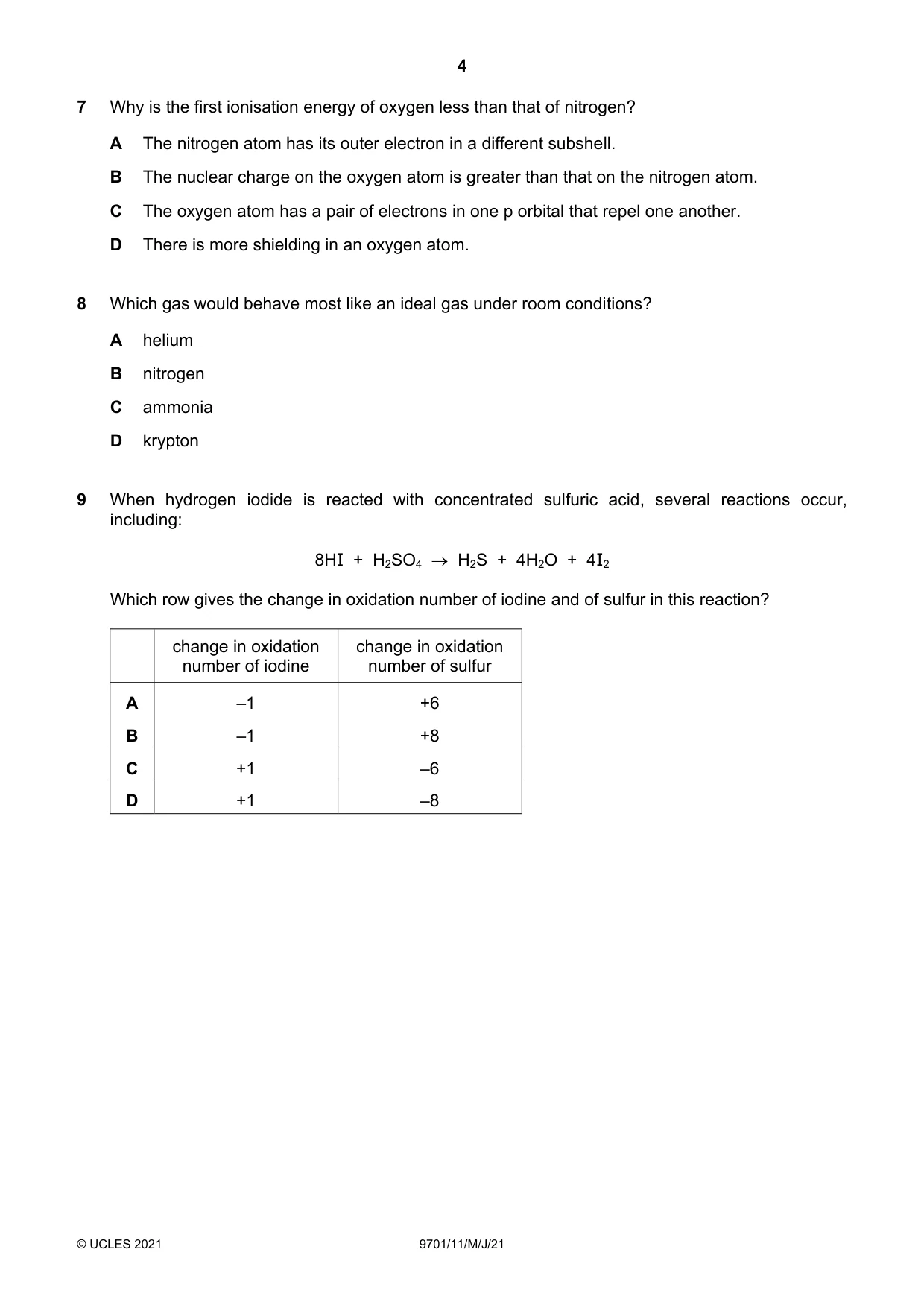
7 Why is the first ionisation energy of oxygen less than that of nitrogen? A The nitrogen atom has its outer electron in a different subshell. B The nuclear charge on the oxygen atom is greater than that on the nitrogen atom. C The oxygen atom has a pair of electrons in one p orbital that repel one another. D There is more shielding in an oxygen atom.
Mark scheme: C
Q8 · Which gas would behave most like an ideal gas under room conditions?
8 Which gas would behave most like an ideal gas under room conditions? A helium B nitrogen C ammonia D krypton
Mark scheme: A
More questions on The gaseous state: ideal and real gases and pV = nRT
Q9 · When hydrogen iodide is reacted with concentrated sulfuric acid, several reactions occur…
9 When hydrogen iodide is reacted with concentrated sulfuric acid, several reactions occur, including: 8HI + H2SO4 H2S + 4H2O + 4I2 Which row gives the change in oxidation number of iodine and of sulfur in this reaction? change in oxidation change in oxidation number of iodine number of sulfur A –1 +6 B –1 +8 C +1 –6 D +1 –8
Mark scheme: D
Q10 · The diagram represents the Haber process for the manufacture of ammonia from nitrogen and…
10 The diagram represents the Haber process for the manufacture of ammonia from nitrogen and hydrogen. heat exchanger N2 + H2 catalytic converter condenser NH3 What is the purpose of the heat exchanger? A to cool the incoming gas mixture to avoid overheating the catalyst B to cool the reaction products and separate the NH3 from unused N2 and H2 C to warm the incoming gas mixture and shift the equilibrium to give more NH3 D to warm the incoming gas mixture and speed up the reaction
Mark scheme: D
More questions on Chemical equilibria: reversible reactions, dynamic equilibrium
Q11 · Which statement about catalysts is correct?
11 Which statement about catalysts is correct? A They change the reaction pathway by increasing the activation energy. B They increase the rate of reaction by lowering the enthalpy change of the reaction. C They increase the number of particles that have sufficient energy to react. D Heterogeneous catalysts are in the same state as the reactant.
Mark scheme: C
Q12 · Element X is in Period 3
12 Element X is in Period 3. Element X forms a solid oxide Y. Y reacts with hot concentrated hydrochloric acid. Y reacts with hot aqueous sodium hydroxide to form a compound in which X is part of an anion. How many p electrons does one atom of X have in its outer shell? A 0 B 1 C 2 D 3
Mark scheme: B
More questions on Periodicity of chemical properties of the elements in Period 3
Q13 · The gaseous products of heating a mixture of Ca(OH)2 and NH4Cl are passed through solid…
13 The gaseous products of heating a mixture of Ca(OH)2 and NH4Cl are passed through solid CaO. A single gaseous product, W, is collected. A sample of W reacts with Cl 2(g) to produce two gases, X and Y. X is an element. Y is acidic. Y reacts with W to produce Z. What are X and Z? X Z A N2 CaCl 2 B N2 NH4Cl C O2 CaCl 2 D O2 NH4Cl
Mark scheme: B
Q14 · Q is a mixture of a Group 2 oxide and a Group 2 sulfate
14 Q is a mixture of a Group 2 oxide and a Group 2 sulfate. Q contains equal amounts of the two compounds. Q is shaken with water and the resulting mixture filtered; a solid residue is obtained. There is no reaction when the solid residue is shaken with HCl (aq). Shaking the filtrate with H2SO4(aq) produces a white precipitate. What could be Q? A BaO + BaSO4 B BaO + MgSO4 C MgO + BaSO4 D MgO + MgSO4
Mark scheme: A
Q15 · Which substance will not be a product of the thermal decomposition of hydrated magnesium…
15 Which substance will not be a product of the thermal decomposition of hydrated magnesium nitrate? A dinitrogen monoxide B magnesium oxide C oxygen D steam
Mark scheme: A
Q16 · A 5 cm3 sample of 0.05 mol dm–3 sodium chloride is mixed with a 5 cm3 sample of 0.05 mol…
16 A 5 cm3 sample of 0.05 mol dm–3 sodium chloride is mixed with a 5 cm3 sample of 0.05 mol dm–3 potassium iodide. 10 cm3 of acidified 0.05 mol dm–3 silver nitrate is then added, followed by concentrated ammonia solution. What is seen after the addition of an excess of concentrated ammonia solution? A a cream precipitate B a white precipitate C a yellow precipitate D no precipitate
Mark scheme: C
Q17 · The volatility of the Group 17 elements, chlorine, bromine and iodine, decreases down the…
17 The volatility of the Group 17 elements, chlorine, bromine and iodine, decreases down the group. What is responsible for this trend? A bond length in the halogen molecule B bond strength in the halogen molecule C electronegativity of the halogen atom D number of electrons in the halogen atom
Mark scheme: D
More questions on Physical properties of the Group 17 elements
Q18 · Acid rain is a dilute solution of sulfuric acid
18 Acid rain is a dilute solution of sulfuric acid. Which pollutant also contributes to the formation of acid rain? A carbon monoxide B carbon dioxide C nitrogen dioxide D hydrocarbons
Mark scheme: C
Q19 · R is an oxide of Period 3 element T
19 R is an oxide of Period 3 element T. 5.00 g of R contains 2.50 g of T. What is T? A magnesium B aluminium C silicon D sulfur
Mark scheme: D
More questions on Periodicity of chemical properties of the elements in Period 3
Q20 · Bromoethane reacts with cyanide ions, producing propanenitrile
20 Bromoethane reacts with cyanide ions, producing propanenitrile. Which statement about the SN2 mechanism of this reaction is correct? A The lone pair of electrons on C of CN– attacks the carbon atom of the C–Br bond. B The lone pair of electrons on C of CN– attacks the carbocation formed when the C–Br bond breaks. C The lone pair of electrons on N of CN– attacks the carbon atom of the C–Br bond. D The lone pair of electrons on N of CN– attacks the carbocation formed when the C–Br bond breaks.
Mark scheme: A
Q21 · Which compound would produce two different carboxylic acids when treated with hot…
21 Which compound would produce two different carboxylic acids when treated with hot, concentrated, acidified manganate(VII) ions? A B C D
Mark scheme: B
Q22 · Which compound could show both cis-trans isomerism and optical isomerism?
22 Which compound could show both cis-trans isomerism and optical isomerism? A B C D Cl Cl O Br Cl H H H Br Br Br C Br C C C Br C C C Br C C Br C C Cl C C I Br H I H Cl H Br H
Mark scheme: B
Q23 · Limonene is a hydrocarbon found in the rind of citrus fruits
23 Limonene is a hydrocarbon found in the rind of citrus fruits. limonene What is the molecular formula of limonene? A C10H12 B C10H14 C C10H16 D C10H18
Mark scheme: C
More questions on Formulas, functional groups and the naming of organic compounds
Q24 · The compound cetyl palmitate, C15H31CO2C16H33, is a waxy solid
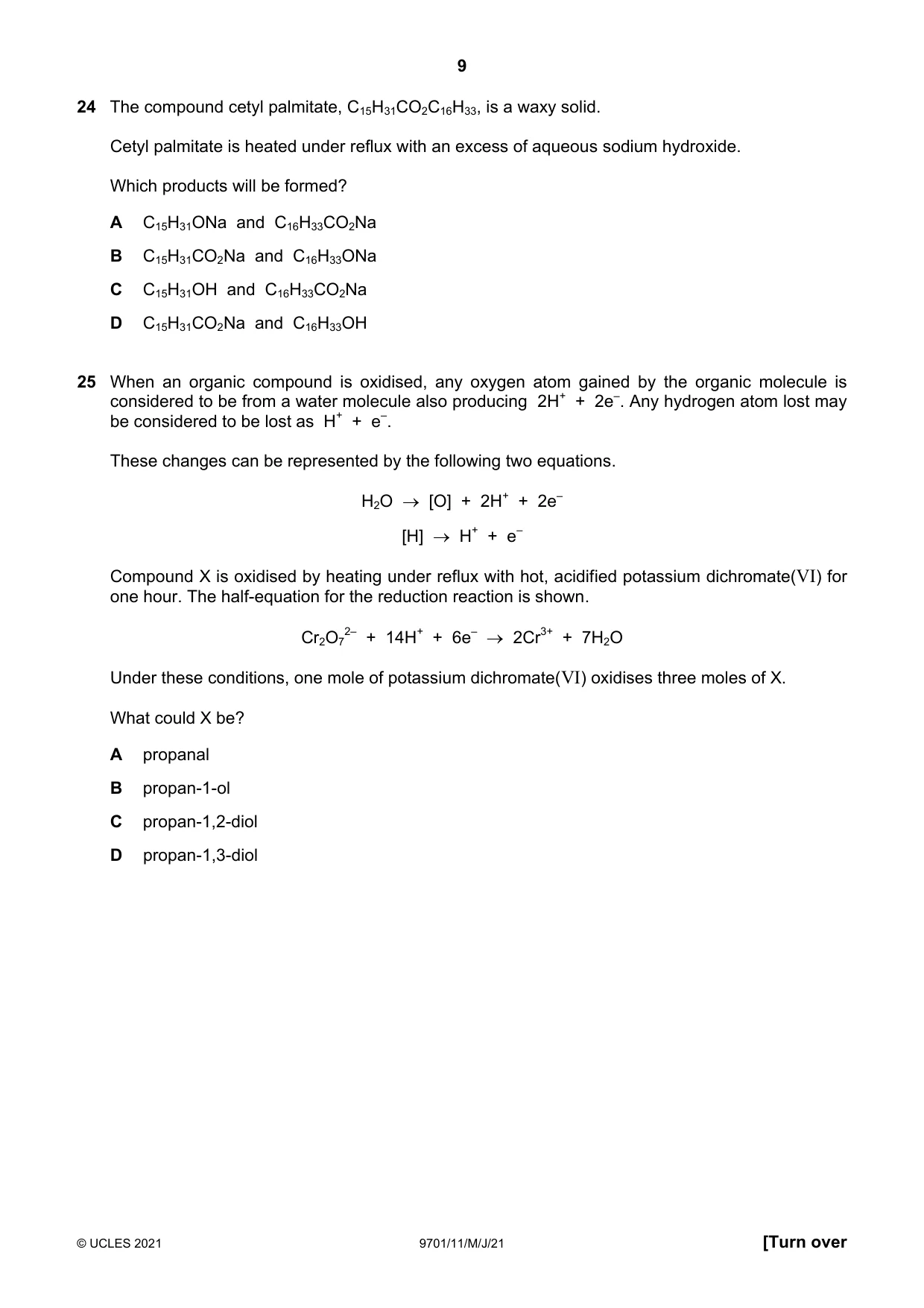
24 The compound cetyl palmitate, C15H31CO2C16H33, is a waxy solid. Cetyl palmitate is heated under reflux with an excess of aqueous sodium hydroxide. Which products will be formed? A C15H31ONa and C16H33CO2Na B C15H31CO2Na and C16H33ONa C C15H31OH and C16H33CO2Na D C15H31CO2Na and C16H33OH
Mark scheme: D
Q25 · When an organic compound is oxidised, any oxygen atom gained by the organic molecule is…
25 When an organic compound is oxidised, any oxygen atom gained by the organic molecule is considered to be from a water molecule also producing 2H+ + 2e–. Any hydrogen atom lost may be considered to be lost as H+ + e–. These changes can be represented by the following two equations. H2O [O] + 2H+ + 2e– [H] H+ + e– Compound X is oxidised by heating under reflux with hot, acidified potassium dichromate(VI) for one hour. The half-equation for the reduction reaction is shown. Cr2O7 2– + 14H+ + 6e– 2Cr3+ + 7H2O Under these conditions, one mole of potassium dichromate(VI) oxidises three moles of X. What could X be? A propanal B propan-1-ol C propan-1,2-diol D propan-1,3-diol
Mark scheme: A
Q26 · Compound X has the empirical formula C2H4O
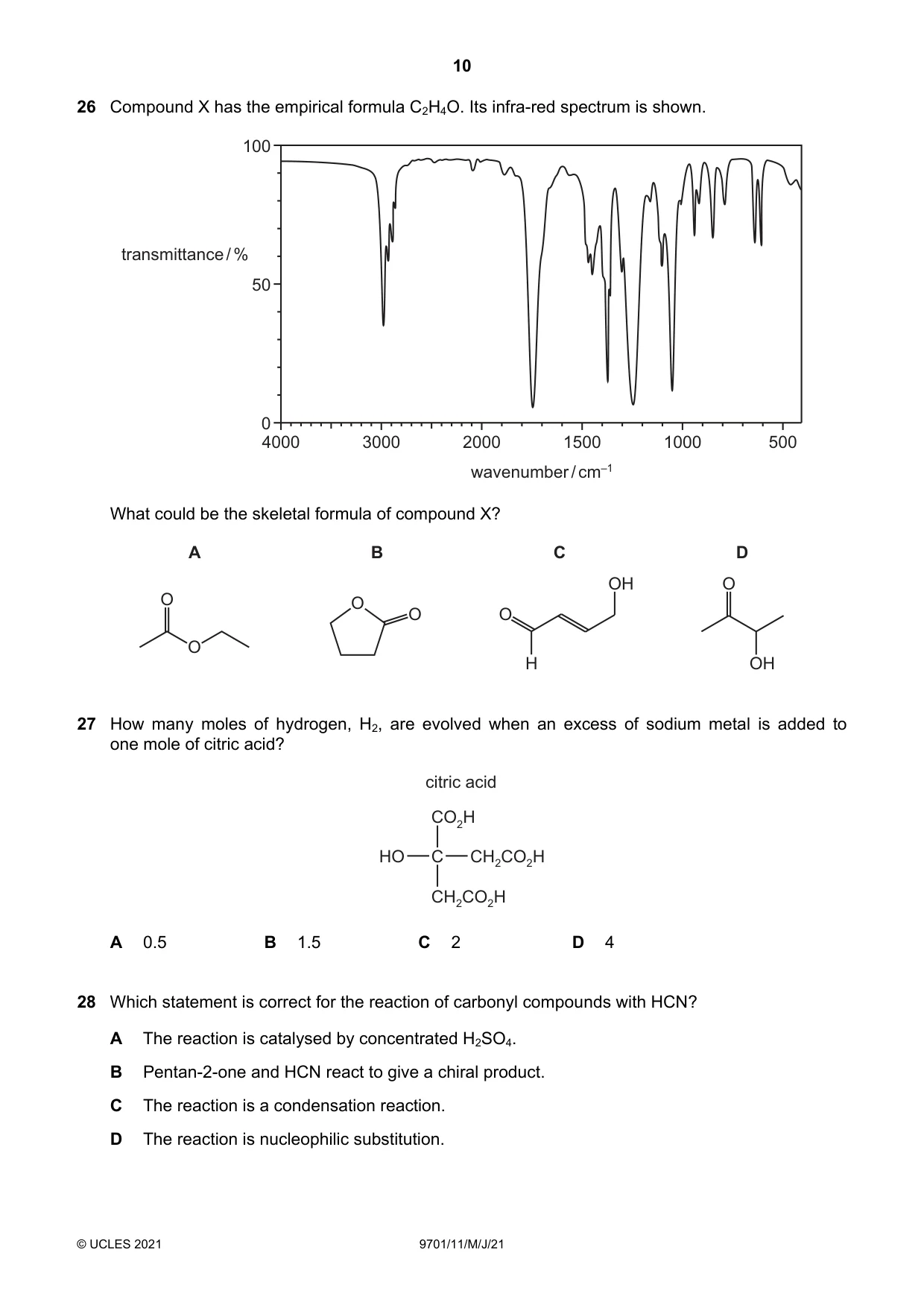
26 Compound X has the empirical formula C2H4O. Its infra-red spectrum is shown. 100 transmittance / % 50 0 4000 3000 2000 1500 1000 500 wavenumber / cm–1 What could be the skeletal formula of compound X? A B C D OH O O O O O O H OH
Mark scheme: A
Q27 · How many moles of hydrogen, H2, are evolved when an excess of sodium metal is added to…
27 How many moles of hydrogen, H2, are evolved when an excess of sodium metal is added to one mole of citric acid? citric acid CO2H HO C CH2CO2H CH2CO2H A 0.5 B 1.5 C 2 D 4
Mark scheme: C
Q28 · Which statement is correct for the reaction of carbonyl compounds with HCN?
28 Which statement is correct for the reaction of carbonyl compounds with HCN? A The reaction is catalysed by concentrated H2SO4. B Pentan-2-one and HCN react to give a chiral product. C The reaction is a condensation reaction. D The reaction is nucleophilic substitution.
Mark scheme: B
Q29 · The table describes four reactions of propene
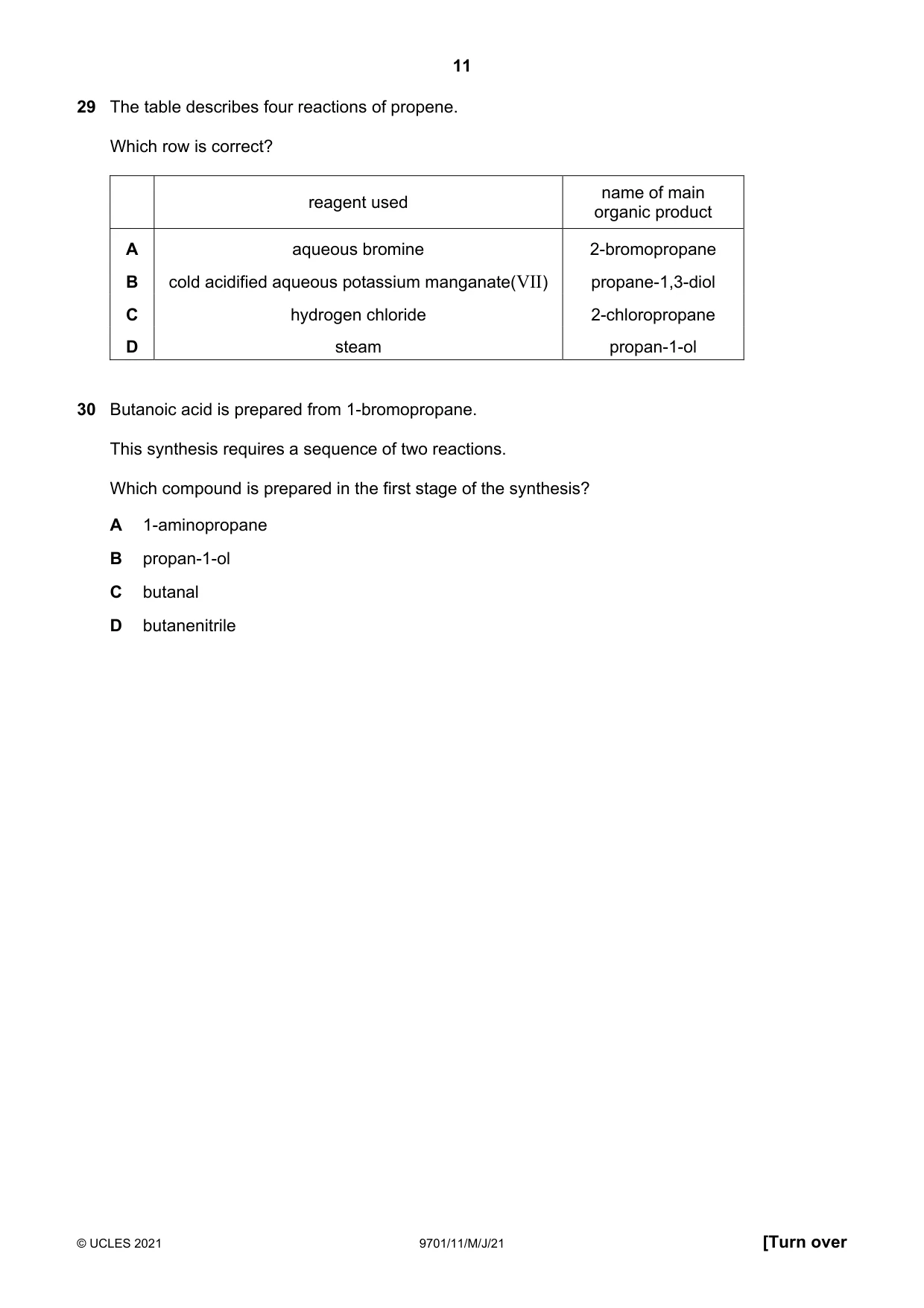
29 The table describes four reactions of propene. Which row is correct? name of main reagent used organic product A aqueous bromine 2-bromopropane B cold acidified aqueous potassium manganate(VII) propane-1,3-diol C hydrogen chloride 2-chloropropane D steam propan-1-ol
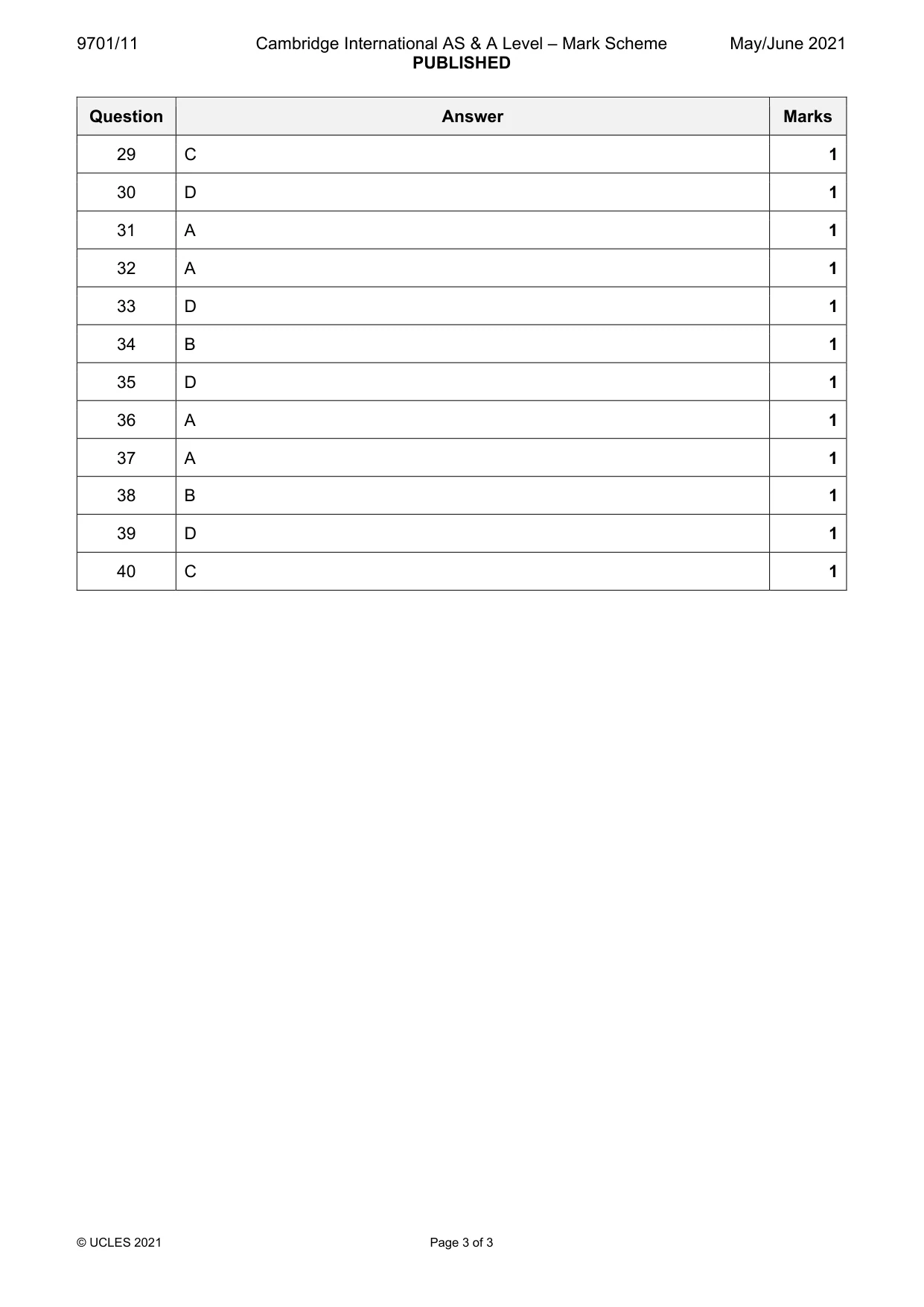
Mark scheme: C
Q30 · Butanoic acid is prepared from 1-bromopropane
30 Butanoic acid is prepared from 1-bromopropane. This synthesis requires a sequence of two reactions. Which compound is prepared in the first stage of the synthesis? A 1-aminopropane B propan-1-ol C butanal D butanenitrile
Mark scheme: D
Q31 · Ethanol combines with ethanoic acid to form ethyl ethanoate according to the following…
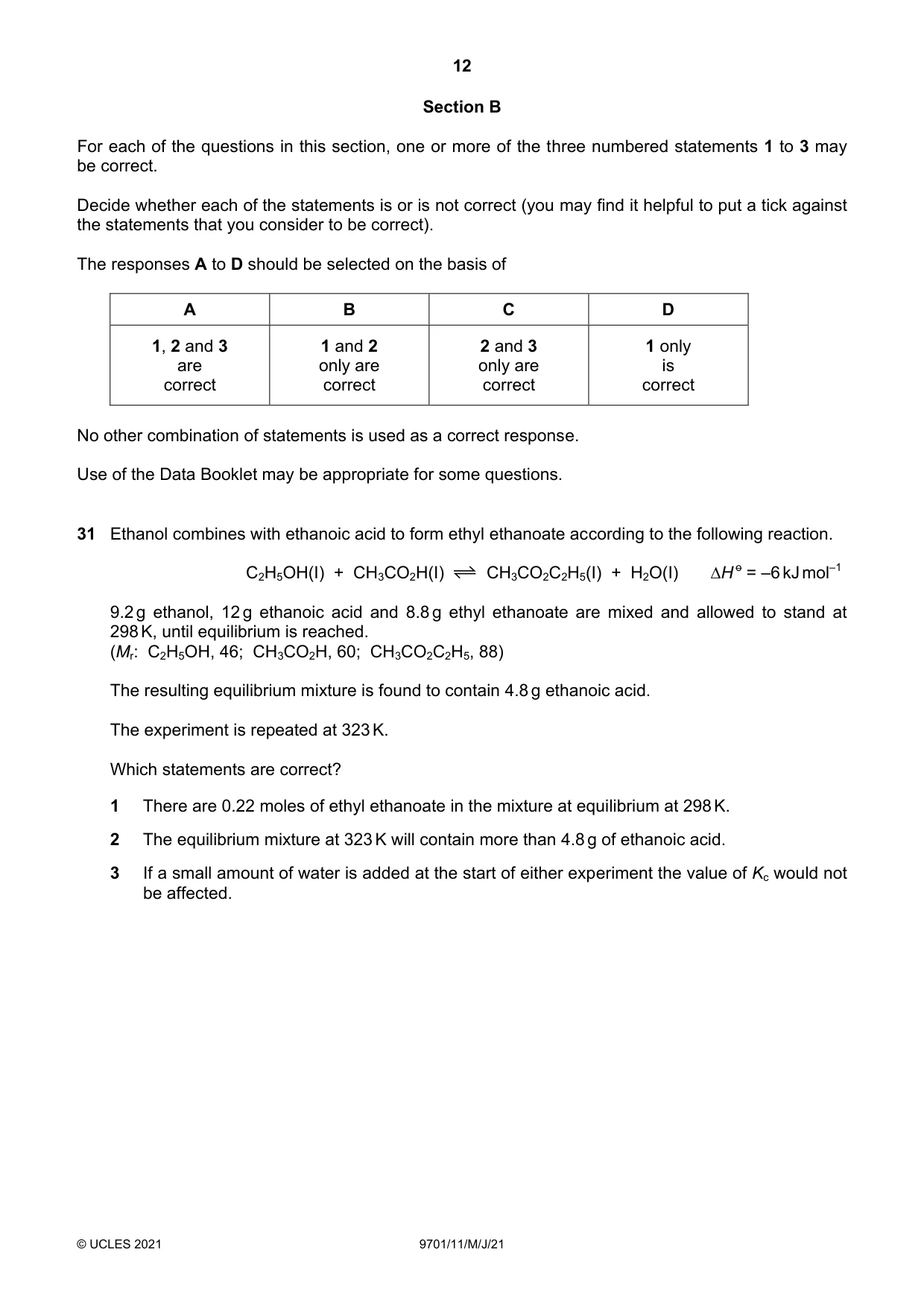
31 Ethanol combines with ethanoic acid to form ethyl ethanoate according to the following reaction. C2H5OH(I) + CH3CO2H(I) CH3CO2C2H5(I) + H2O(I) ∆H o = –6 kJ mol–1 9.2 g ethanol, 12 g ethanoic acid and 8.8 g ethyl ethanoate are mixed and allowed to stand at 298 K, until equilibrium is reached. (Mr: C2H5OH, 46; CH3CO2H, 60; CH3CO2C2H5, 88) The resulting equilibrium mixture is found to contain 4.8 g ethanoic acid. The experiment is repeated at 323 K. Which statements are correct? 1 There are 0.22 moles of ethyl ethanoate in the mixture at equilibrium at 298 K. 2 The equilibrium mixture at 323 K will contain more than 4.8 g of ethanoic acid. 3 If a small amount of water is added at the start of either experiment the value of Kc would not be affected.
Mark scheme: A
More questions on Chemical equilibria: reversible reactions, dynamic equilibrium
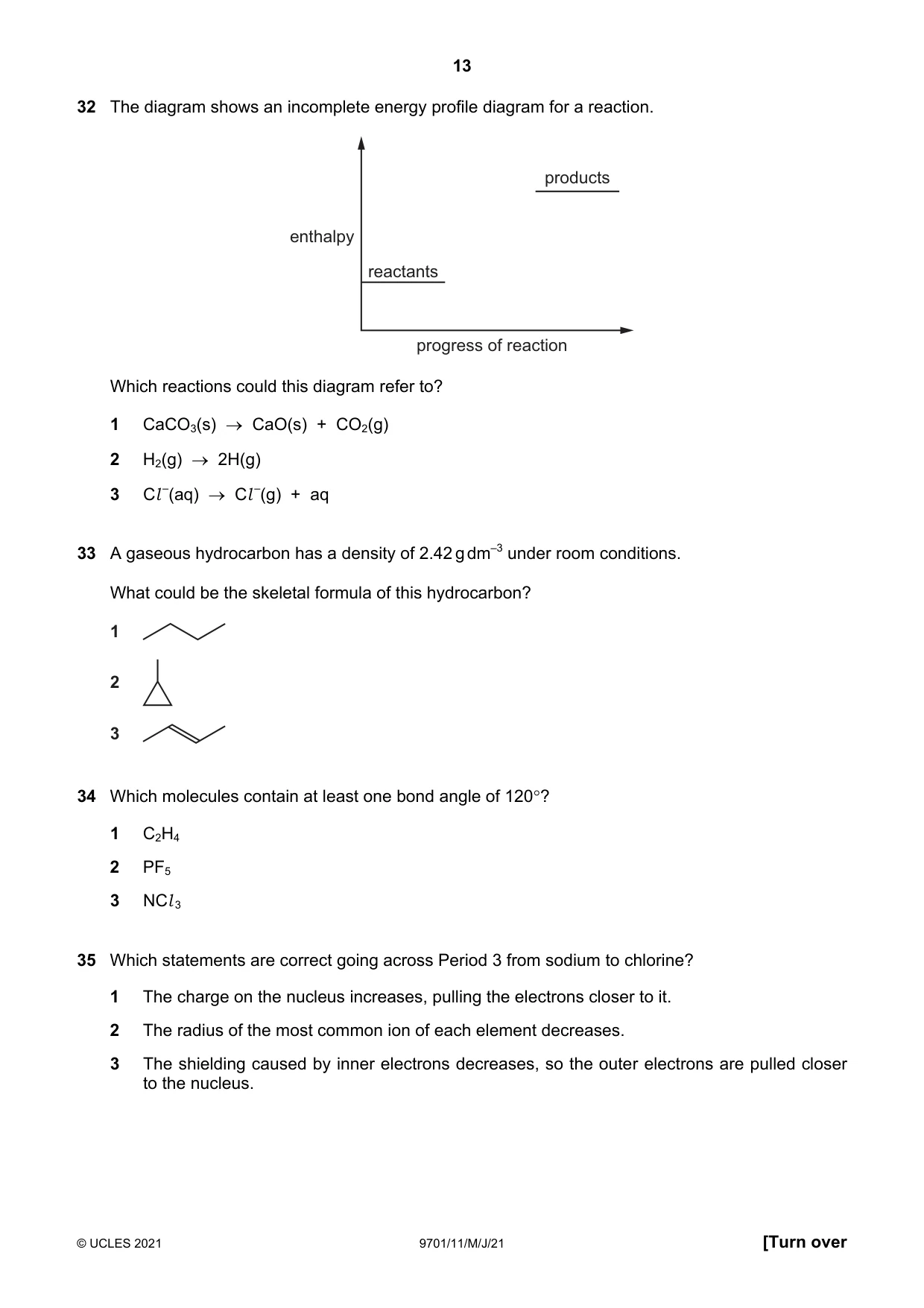
Q32 · The diagram shows an incomplete energy profile diagram for a reaction
32 The diagram shows an incomplete energy profile diagram for a reaction. products enthalpy reactants progress of reaction Which reactions could this diagram refer to? 1 CaCO3(s) CaO(s) + CO2(g) 2 H2(g) 2H(g) 3 Cl –(aq) Cl –(g) + aq
Mark scheme: A
Q33 · A gaseous hydrocarbon has a density of 2.42 g dm–3 under room conditions
33 A gaseous hydrocarbon has a density of 2.42 g dm–3 under room conditions. What could be the skeletal formula of this hydrocarbon? 1 2 3
Mark scheme: D
More questions on The gaseous state: ideal and real gases and pV = nRT
Q34 · Which molecules contain at least one bond angle of 120?
34 Which molecules contain at least one bond angle of 120? 1 C2H4 2 PF5 3 NCl 3
Mark scheme: B
Q35 · Which statements are correct going across Period 3 from sodium to chlorine?
35 Which statements are correct going across Period 3 from sodium to chlorine? 1 The charge on the nucleus increases, pulling the electrons closer to it. 2 The radius of the most common ion of each element decreases. 3 The shielding caused by inner electrons decreases, so the outer electrons are pulled closer to the nucleus.
Mark scheme: D
More questions on Periodicity of physical properties of the elements in Period 3
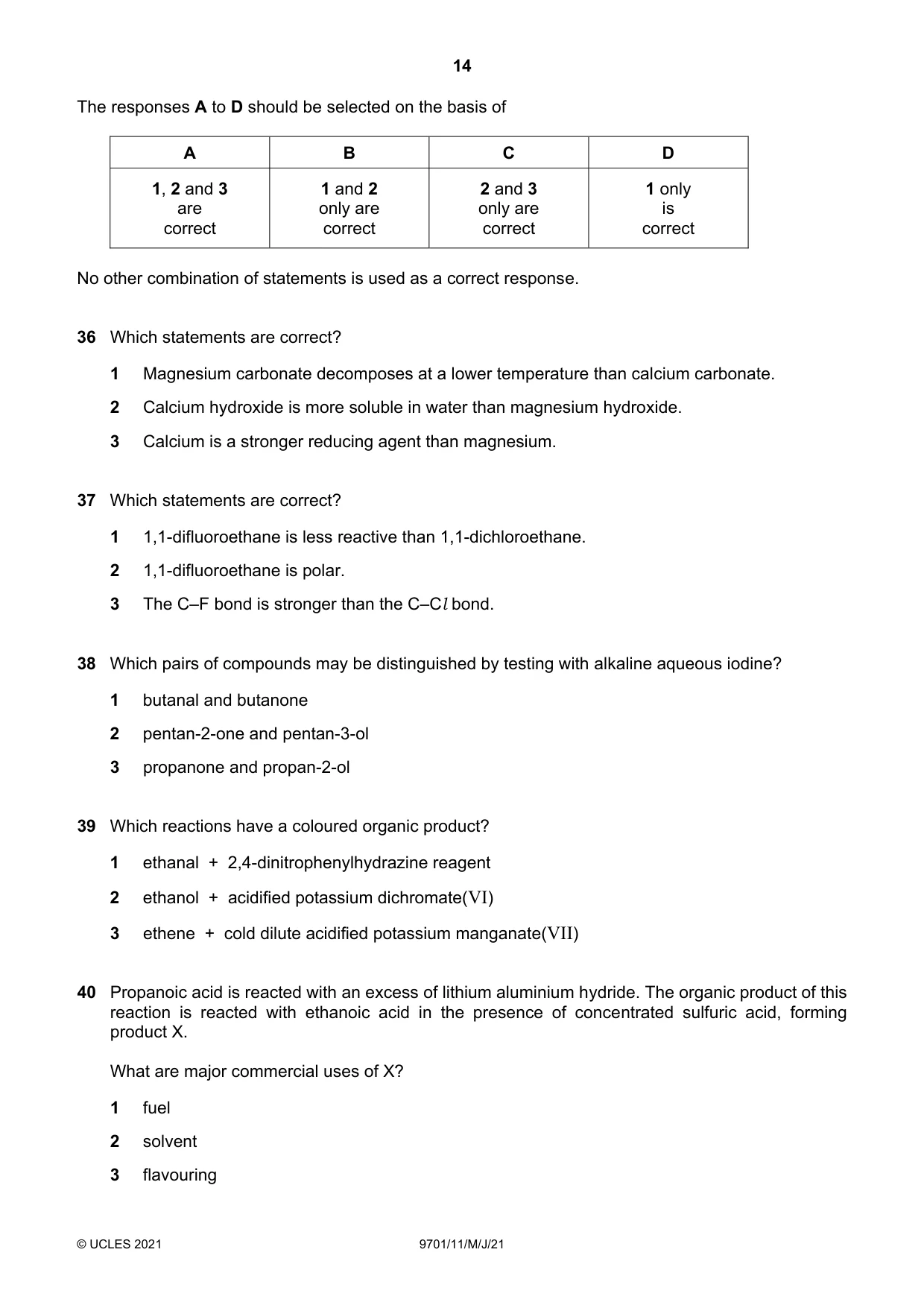
Q36 · Which statements are correct?
36 Which statements are correct? 1 Magnesium carbonate decomposes at a lower temperature than calcium carbonate. 2 Calcium hydroxide is more soluble in water than magnesium hydroxide. 3 Calcium is a stronger reducing agent than magnesium.
Mark scheme: A
Q37 · Which statements are correct?
37 Which statements are correct? 1 1,1-difluoroethane is less reactive than 1,1-dichloroethane. 2 1,1-difluoroethane is polar. 3 The C–F bond is stronger than the C–Cl bond.
Mark scheme: A
Q38 · Which pairs of compounds may be distinguished by testing with alkaline aqueous iodine?
38 Which pairs of compounds may be distinguished by testing with alkaline aqueous iodine? 1 butanal and butanone 2 pentan-2-one and pentan-3-ol 3 propanone and propan-2-ol
Mark scheme: B
Q39 · Which reactions have a coloured organic product?
39 Which reactions have a coloured organic product? 1 ethanal + 2,4-dinitrophenylhydrazine reagent 2 ethanol + acidified potassium dichromate(VI) 3 ethene + cold dilute acidified potassium manganate(VII)
Mark scheme: D
Q40 · Propanoic acid is reacted with an excess of lithium aluminium hydride
40 Propanoic acid is reacted with an excess of lithium aluminium hydride. The organic product of this reaction is reacted with ethanoic acid in the presence of concentrated sulfuric acid, forming product X. What are major commercial uses of X? 1 fuel 2 solvent 3 flavouring
Mark scheme: C
What was in this paper
The subtopics covered by these 40 questions, and how many questions each got. Open one in a new tab to see every Cambridge question on it.
3Aldehydes and ketones2Alkenes2Chemical equilibria: reversible reactions, dynamic equilibrium2Esters2Nitriles and hydroxynitriles2Nitrogen and sulfur2Periodicity of chemical properties of the elements in Period 32Shapes of molecules2The gaseous state: ideal and real gases and pV = nRT2Alcohols1Carboxylic acids1Effect of temperature on reaction rates and the concept of activation energy1Electrons, energy levels and atomic orbitals1Enthalpy change, ΔH1Formulas, functional groups and the naming of organic compounds1Halogen compounds1Halogenoalkanes1Hess’s law1Homogeneous and heterogeneous catalysts1Infrared spectroscopy1Ionisation energy1Isomerism: optical1Periodicity of physical properties of the elements in Period 31Physical properties of the Group 17 elements1Reacting masses and volumes (of solutions and gases)1Redox processes: electron transfer and changes in oxidation number (oxidation state)1Some reactions of the halide ions1The mole and the Avogadro constant1What you needed in this session
Cambridge’s own grade thresholds for 2021 May/June, Paper 1 · Variant 1. A higher threshold means an easier paper — the bar moves with how the cohort did.