Cambridge A Level Chemistry 9701 — 2017 May/June Paper 1 · Variant 2
9701/12/M/J/17 · 40 questions · 40 marks · ≈45 min
The question paper and its mark scheme, free to read here and free to download. This is Cambridge’s own paper, exactly as it was sat.
Question paper16 pages

Mark scheme3 pages
Answers below. Sit the paper first if you are practising.
Questions as text
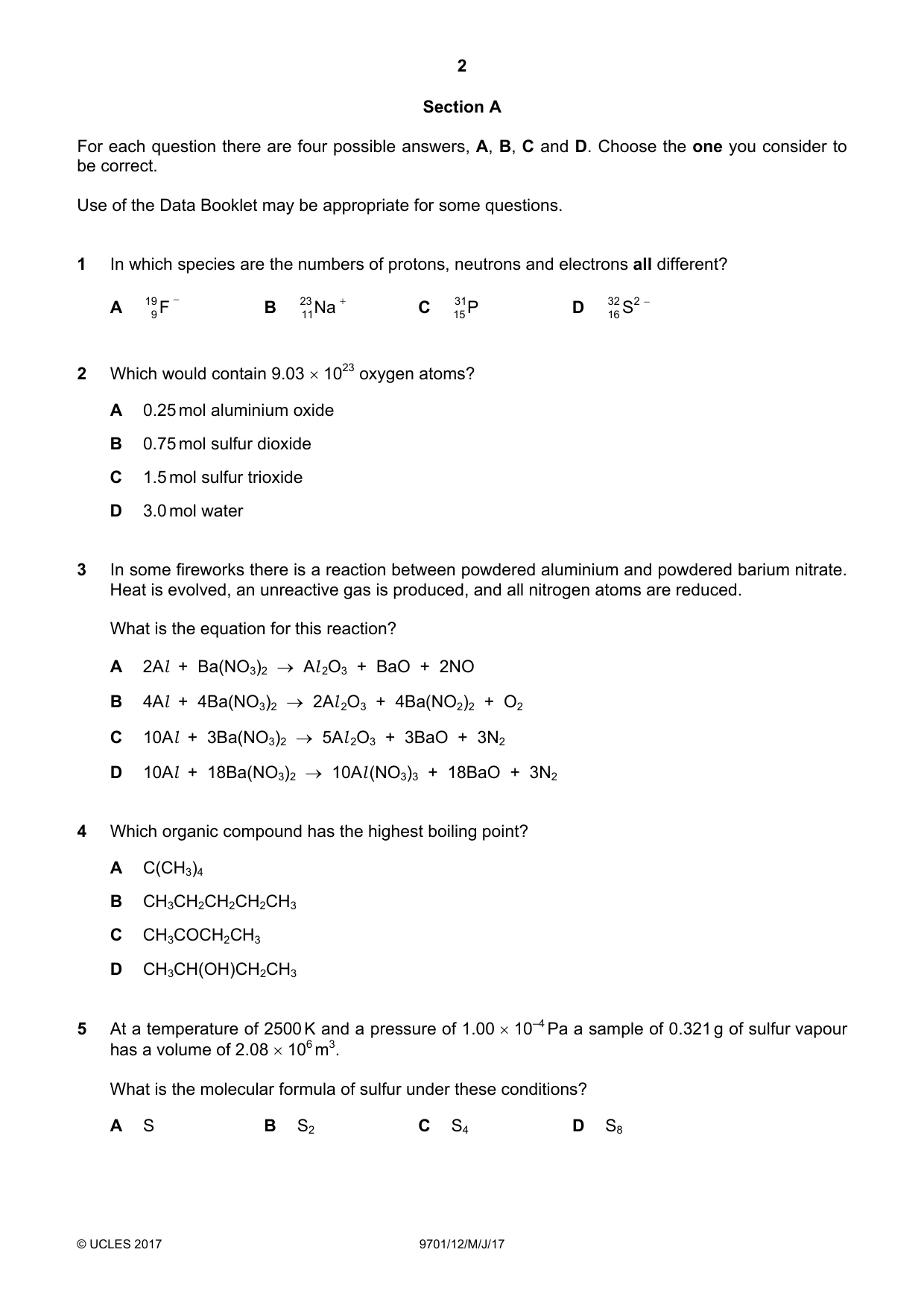
Q1 · In which species are the numbers of protons, neutrons and electrons all different?
1 In which species are the numbers of protons, neutrons and electrons all different? A 19 F − B 23 Na + C 31 P D 16 S 32 2 − 9 11 15
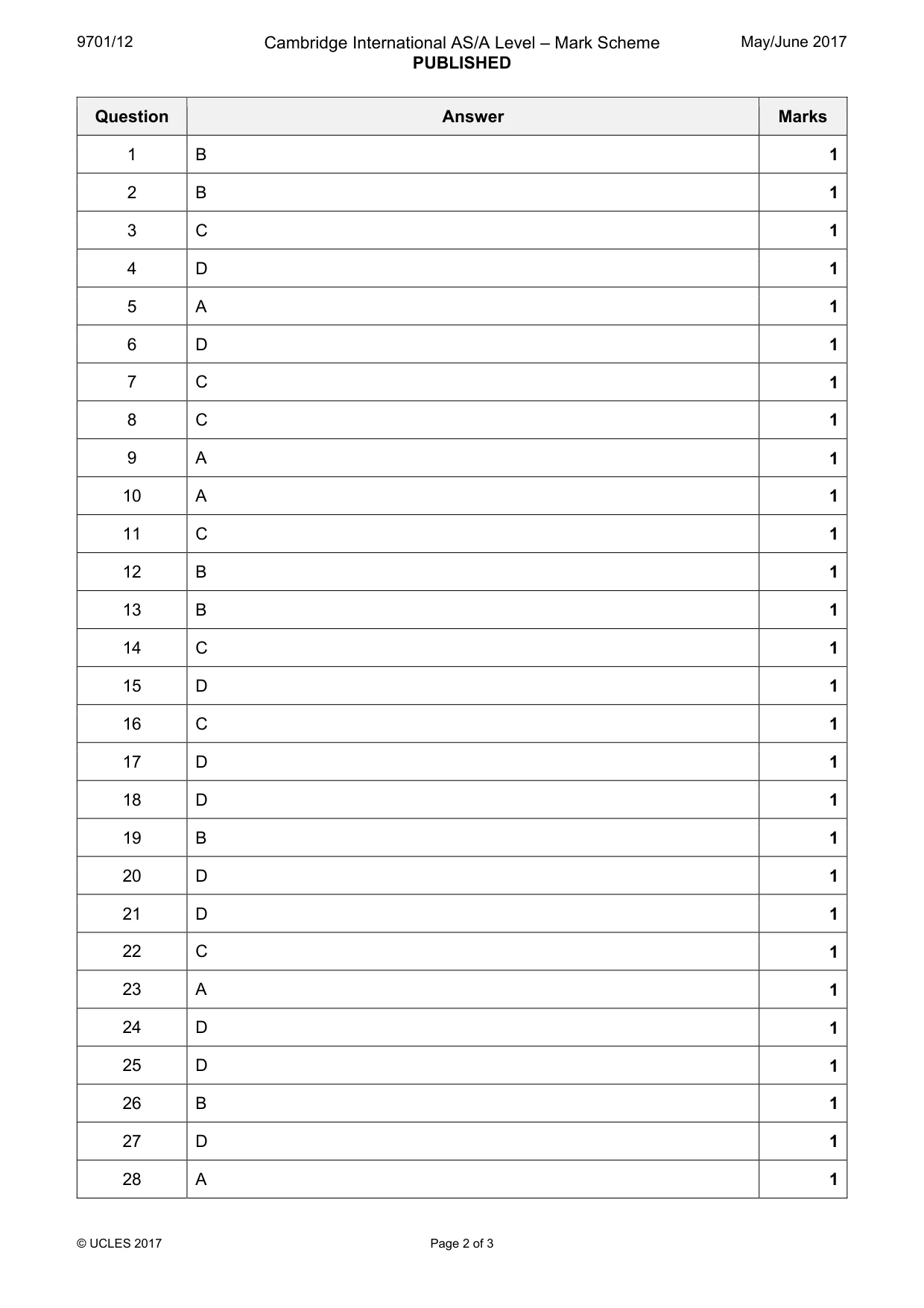
Mark scheme: B
Q2 · Which would contain 9.03 × 10²³ oxygen atoms?
2 Which would contain 9.03 × 10²³ oxygen atoms? A 0.25 mol aluminium oxide B 0.75 mol sulfur dioxide C 1.5 mol sulfur trioxide D 3.0 mol water
Mark scheme: B
Q3 · In some fireworks there is a reaction between powdered aluminium and powdered barium…
3 In some fireworks there is a reaction between powdered aluminium and powdered barium nitrate. Heat is evolved, an unreactive gas is produced, and all nitrogen atoms are reduced. What is the equation for this reaction? A 2Al + Ba(NO3)2 → Al 2O3 + BaO + 2NO B 4Al + 4Ba(NO3)2 → 2Al 2O3 + 4Ba(NO2)2 + O2 C 10Al + 3Ba(NO3)2 → 5Al 2O3 + 3BaO + 3N2 D 10Al + 18Ba(NO3)2 → 10Al (NO3)3 + 18BaO + 3N2
Mark scheme: C
Q4 · Which organic compound has the highest boiling point?
4 Which organic compound has the highest boiling point? A C(CH3)4 B CH3CH2CH2CH2CH3 C CH3COCH2CH3 D CH3CH(OH)CH2CH3
Mark scheme: D
More questions on Intermolecular forces, electronegativity and bond properties
Q5 · At a temperature of 2500 K and a pressure of 1.00 × 10⁻⁴ Pa a sample of 0.321 g of sulfur…
5 At a temperature of 2500 K and a pressure of 1.00 × 10⁻⁴ Pa a sample of 0.321 g of sulfur vapour has a volume of 2.08 × 10⁶ m3. What is the molecular formula of sulfur under these conditions? A S B S2 C S4 D S8
Mark scheme: A
More questions on The gaseous state: ideal and real gases and pV = nRT
Q6 · Which reaction involves a decrease in the bond angle at a carbon atom?
6 Which reaction involves a decrease in the bond angle at a carbon atom? A bromoethane refluxed with ethanolic sodium hydroxide B complete combustion of methane in air C ethanol heated with conc. H2SO4 D polymerisation of ethene
Mark scheme: D
More questions on Shapes of organic molecules; σ and π bonds
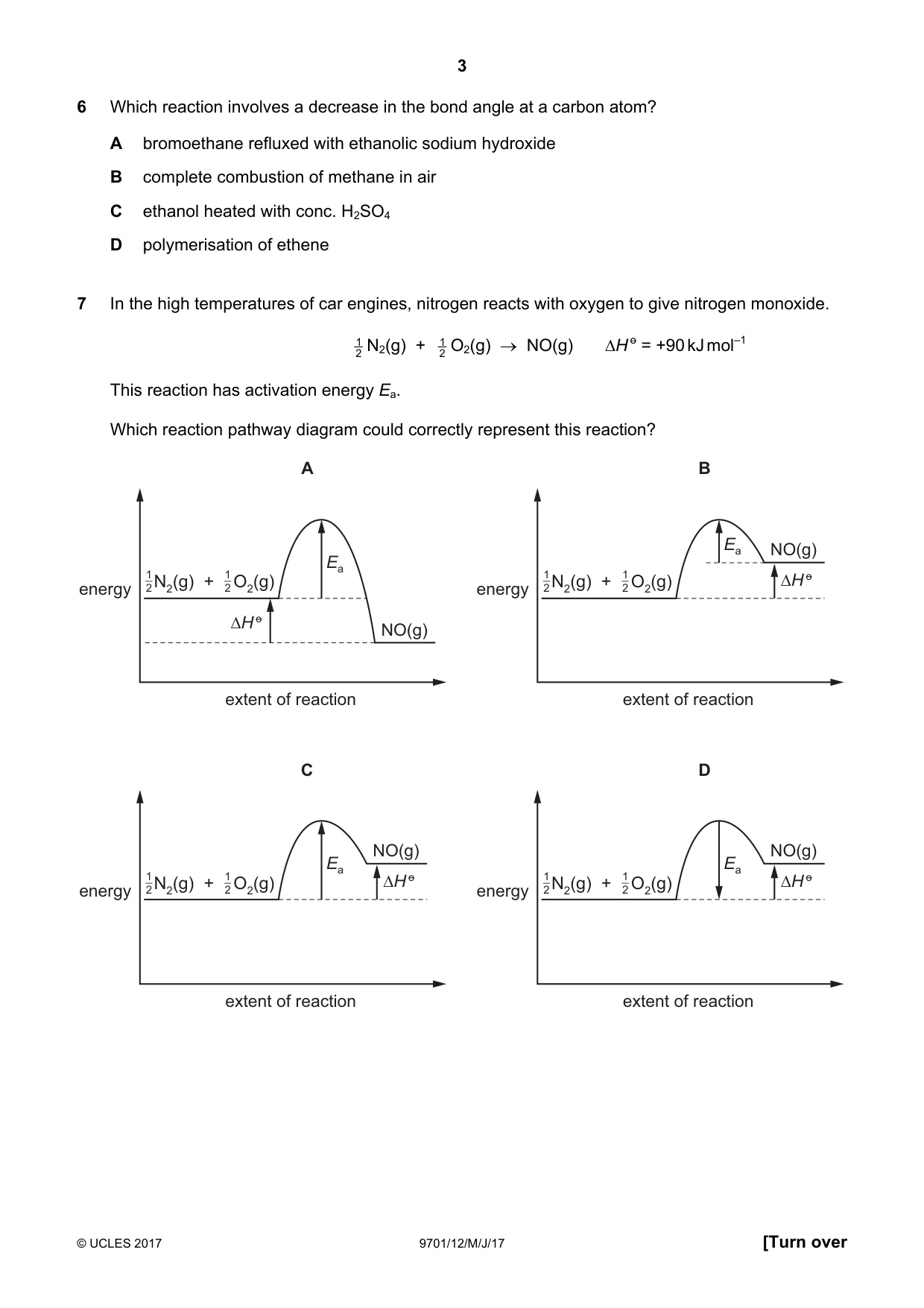
Q7 · In the high temperatures of car engines, nitrogen reacts with oxygen to give nitrogen…
7 In the high temperatures of car engines, nitrogen reacts with oxygen to give nitrogen monoxide. 1 N2(g) + 2 1 O2(g) → NO(g) ∆H o = +90 kJ mol–1 2 This reaction has activation energy Ea. Which reaction pathway diagram could correctly represent this reaction? A B Ea NO(g) Ea 1 N2(g) + O2(g) 1 1 N2(g) + O2(g) 1 ∆H o energy 2 2 energy 2 2 ∆H o NO(g) extent of reaction extent of reaction C D NO(g) NO(g) Ea Ea 1 N2(g) + O2(g) 1 ∆H o 1 N2(g) + O2(g) 1 ∆H o energy 2 2 energy 2 2 extent of reaction extent of reaction
Mark scheme: C
More questions on Effect of temperature on reaction rates and the concept of activation energy
Q8 · A reaction sequence is shown
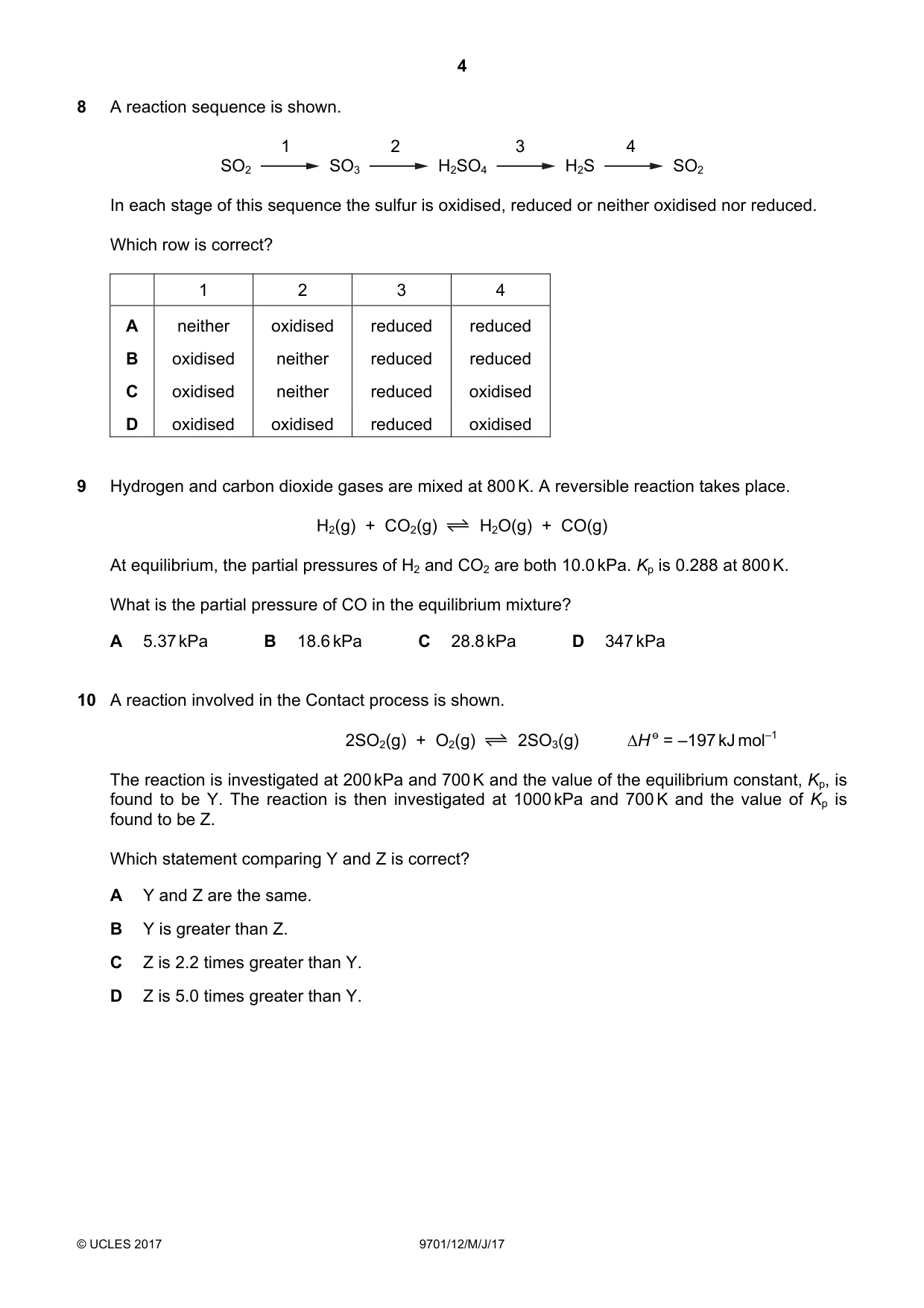
8 A reaction sequence is shown. 1 2 3 4 SO2 SO3 H2SO4 H2S SO2 In each stage of this sequence the sulfur is oxidised, reduced or neither oxidised nor reduced. Which row is correct? 1 2 3 4 A neither oxidised reduced reduced B oxidised neither reduced reduced C oxidised neither reduced oxidised D oxidised oxidised reduced oxidised
Mark scheme: C
Q9 · Hydrogen and carbon dioxide gases are mixed at 800 K
9 Hydrogen and carbon dioxide gases are mixed at 800 K. A reversible reaction takes place. H2(g) + CO2(g) H2O(g) + CO(g) At equilibrium, the partial pressures of H2 and CO2 are both 10.0 kPa. Kp is 0.288 at 800 K. What is the partial pressure of CO in the equilibrium mixture? A 5.37 kPa B 18.6 kPa C 28.8 kPa D 347 kPa
Mark scheme: A
More questions on Chemical equilibria: reversible reactions, dynamic equilibrium
Q10 · A reaction involved in the Contact process is shown
10 A reaction involved in the Contact process is shown. 2SO2(g) + O2(g) 2SO3(g) ∆H o = –197 kJ mol–1 The reaction is investigated at 200 kPa and 700 K and the value of the equilibrium constant, Kp, is found to be Y. The reaction is then investigated at 1000 kPa and 700 K and the value of Kp is found to be Z. Which statement comparing Y and Z is correct? A Y and Z are the same. B Y is greater than Z. C Z is 2.2 times greater than Y. D Z is 5.0 times greater than Y.
Mark scheme: A
More questions on Chemical equilibria: reversible reactions, dynamic equilibrium
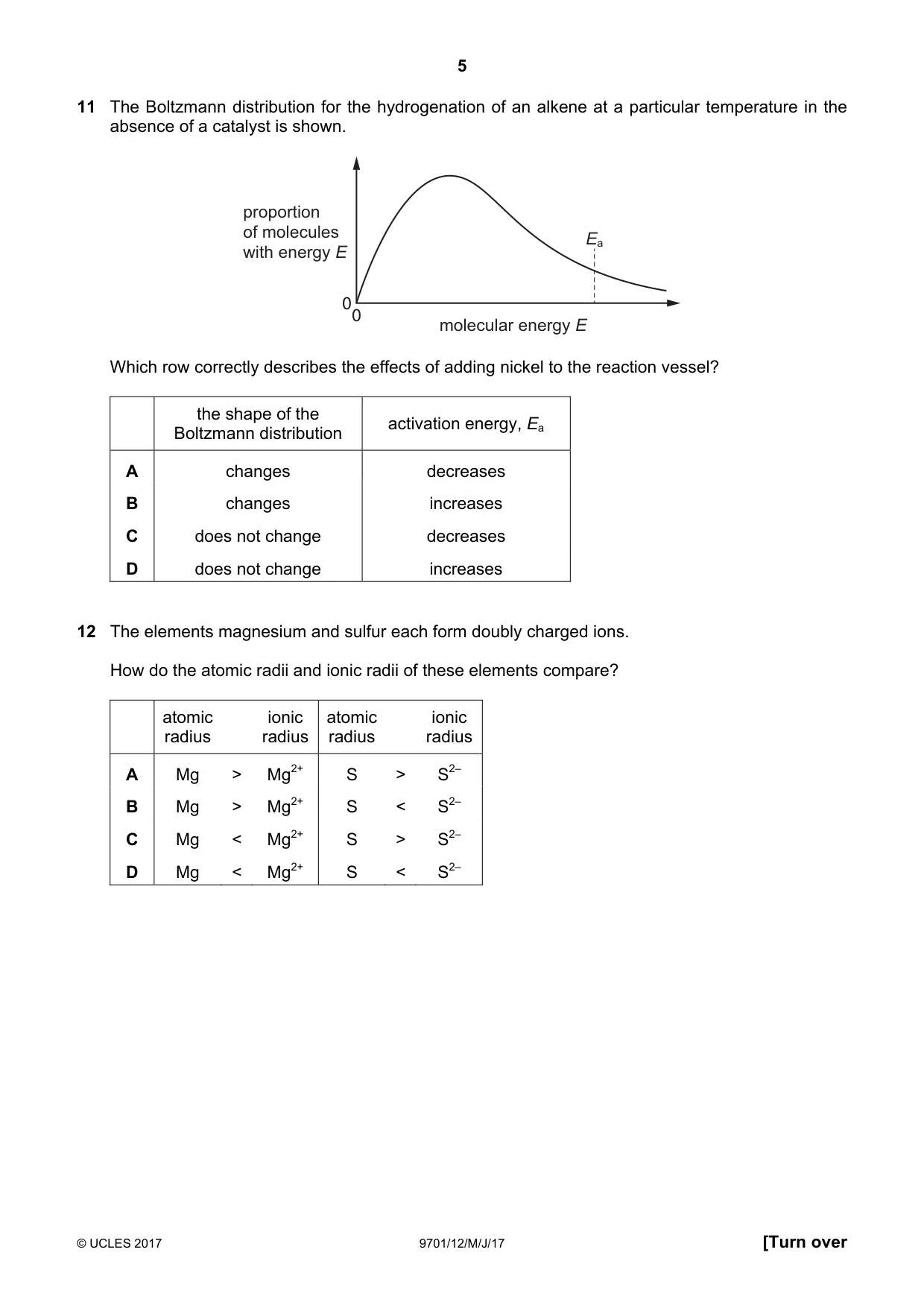
Q11 · The Boltzmann distribution for the hydrogenation of an alkene at a particular temperature…
11 The Boltzmann distribution for the hydrogenation of an alkene at a particular temperature in the absence of a catalyst is shown. proportion of molecules Ea with energy E 00 molecular energy E Which row correctly describes the effects of adding nickel to the reaction vessel? the shape of the activation energy, Ea Boltzmann distribution A changes decreases B changes increases C does not change decreases D does not change increases
Mark scheme: C
More questions on Effect of temperature on reaction rates and the concept of activation energy
Q12 · The elements magnesium and sulfur each form doubly charged ions
12 The elements magnesium and sulfur each form doubly charged ions. How do the atomic radii and ionic radii of these elements compare? atomic ionic atomic ionic radius radius radius radius A Mg > Mg2+ S > S2– B Mg > Mg2+ S < S2– C Mg < Mg2+ S > S2– D Mg < Mg2+ S < S2–
Mark scheme: B
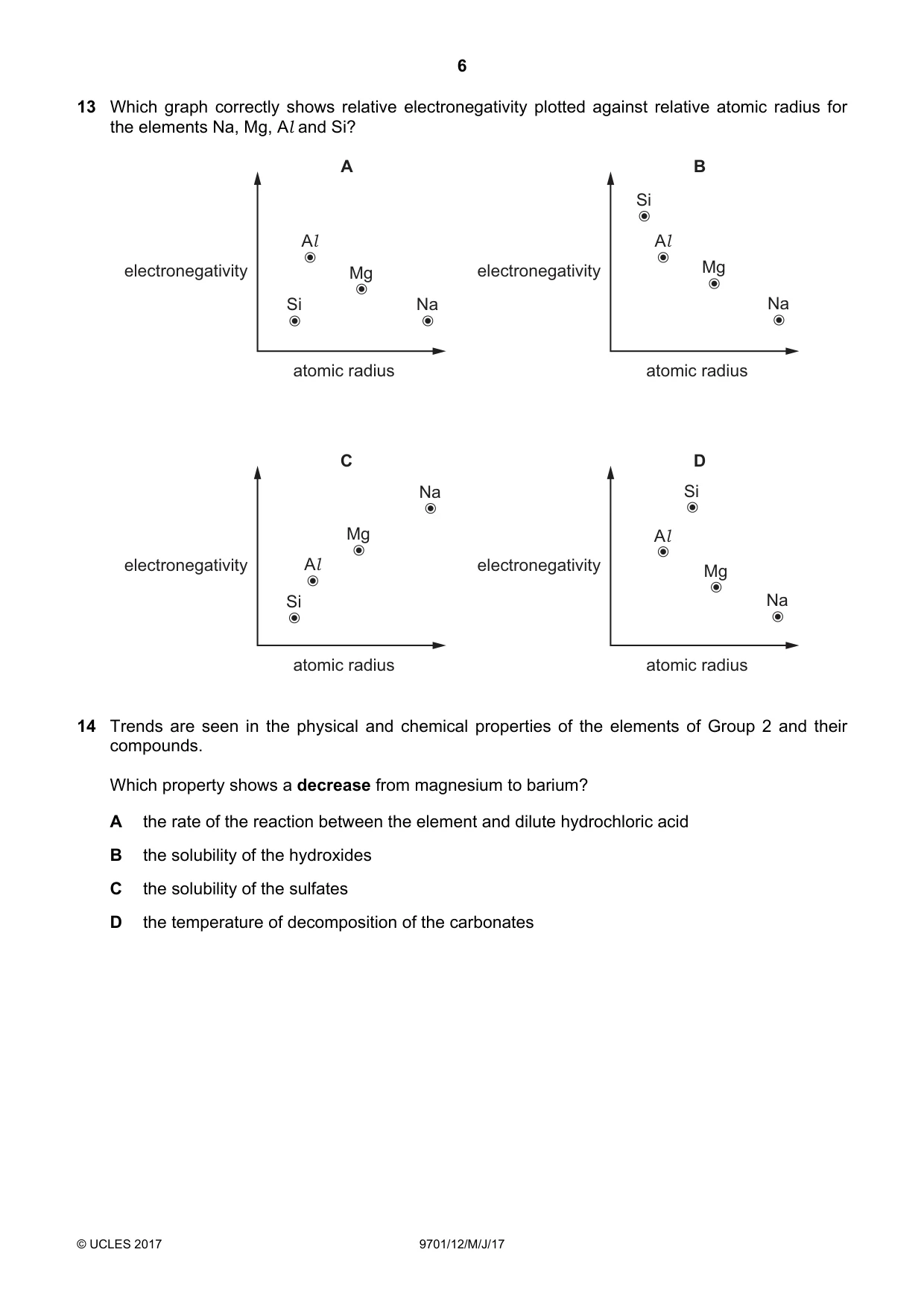
Q13 · Which graph correctly shows relative electronegativity plotted against relative atomic…
13 Which graph correctly shows relative electronegativity plotted against relative atomic radius for the elements Na, Mg, Al and Si? A B Si Al Al electronegativity Mg electronegativity Mg Si Na Na atomic radius atomic radius C D Na Si Mg Al electronegativity Al electronegativity Mg Si Na atomic radius atomic radius
Mark scheme: B
More questions on Periodicity of physical properties of the elements in Period 3
Q14 · Trends are seen in the physical and chemical properties of the elements of Group 2 and…
14 Trends are seen in the physical and chemical properties of the elements of Group 2 and their compounds. Which property shows a decrease from magnesium to barium? A the rate of the reaction between the element and dilute hydrochloric acid B the solubility of the hydroxides C the solubility of the sulfates D the temperature of decomposition of the carbonates
Mark scheme: C
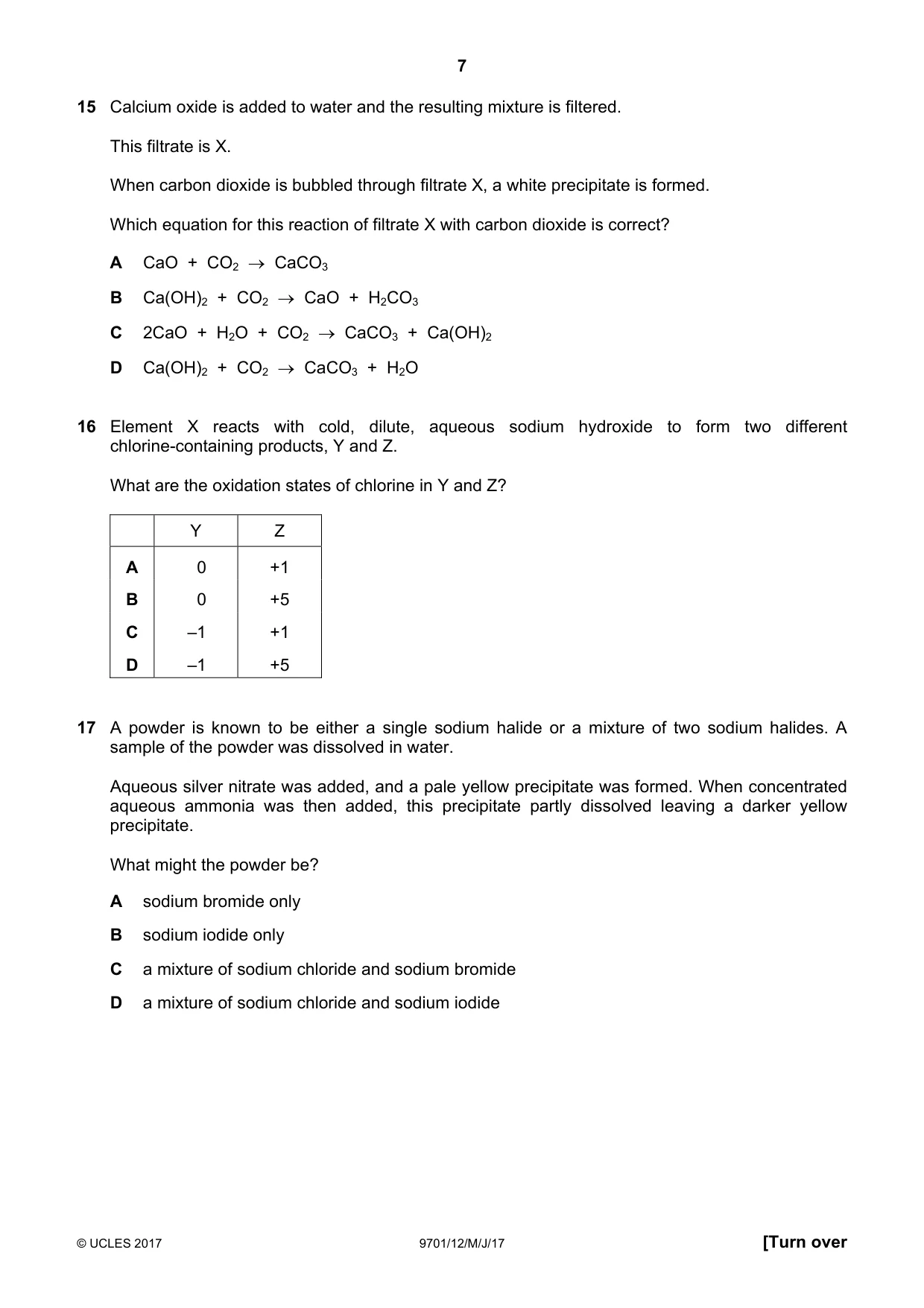
Q15 · Calcium oxide is added to water and the resulting mixture is filtered
15 Calcium oxide is added to water and the resulting mixture is filtered. This filtrate is X. When carbon dioxide is bubbled through filtrate X, a white precipitate is formed. Which equation for this reaction of filtrate X with carbon dioxide is correct? A CaO + CO2 → CaCO3 B Ca(OH)2 + CO2 → CaO + H2CO3 C 2CaO + H2O + CO2 → CaCO3 + Ca(OH)2 D Ca(OH)2 + CO2 → CaCO3 + H2O
Mark scheme: D
Q16 · Element X reacts with cold, dilute, aqueous sodium hydroxide to form two different…
16 Element X reacts with cold, dilute, aqueous sodium hydroxide to form two different chlorine-containing products, Y and Z. What are the oxidation states of chlorine in Y and Z? Y Z A 0 +1 B 0 +5 C –1 +1 D –1 +5
Mark scheme: C
Q17 · A powder is known to be either a single sodium halide or a mixture of two sodium halides
17 A powder is known to be either a single sodium halide or a mixture of two sodium halides. A sample of the powder was dissolved in water. Aqueous silver nitrate was added, and a pale yellow precipitate was formed. When concentrated aqueous ammonia was then added, this precipitate partly dissolved leaving a darker yellow precipitate. What might the powder be? A sodium bromide only B sodium iodide only C a mixture of sodium chloride and sodium bromide D a mixture of sodium chloride and sodium iodide
Mark scheme: D
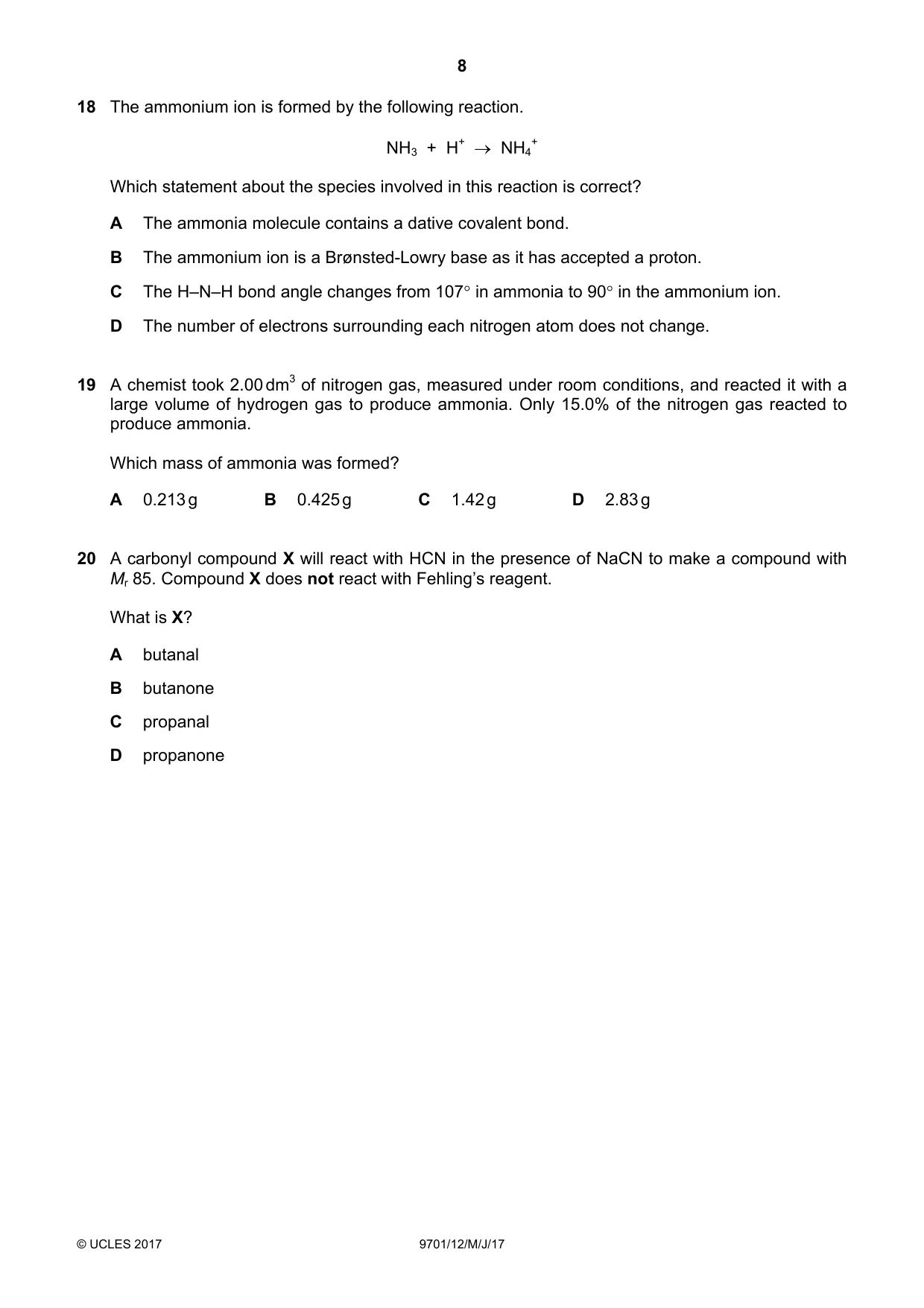
Q18 · The ammonium ion is formed by the following reaction
18 The ammonium ion is formed by the following reaction. NH3 + H+ → NH4 + Which statement about the species involved in this reaction is correct? A The ammonia molecule contains a dative covalent bond. B The ammonium ion is a Brønsted-Lowry base as it has accepted a proton. C The H–N–H bond angle changes from 107° in ammonia to 90° in the ammonium ion. D The number of electrons surrounding each nitrogen atom does not change.
Mark scheme: D
More questions on Covalent bonding and coordinate (dative covalent) bonding
Q19 · A chemist took 2.00 dm3 of nitrogen gas, measured under room conditions, and reacted it…
19 A chemist took 2.00 dm3 of nitrogen gas, measured under room conditions, and reacted it with a large volume of hydrogen gas to produce ammonia. Only 15.0% of the nitrogen gas reacted to produce ammonia. Which mass of ammonia was formed? A 0.213 g B 0.425 g C 1.42 g D 2.83 g
Mark scheme: B
More questions on Reacting masses and volumes (of solutions and gases)
Q20 · A carbonyl compound X will react with HCN in the presence of NaCN to make a compound with…
20 A carbonyl compound X will react with HCN in the presence of NaCN to make a compound with Mr 85. Compound X does not react with Fehling’s reagent. What is X? A butanal B butanone C propanal D propanone
Mark scheme: D
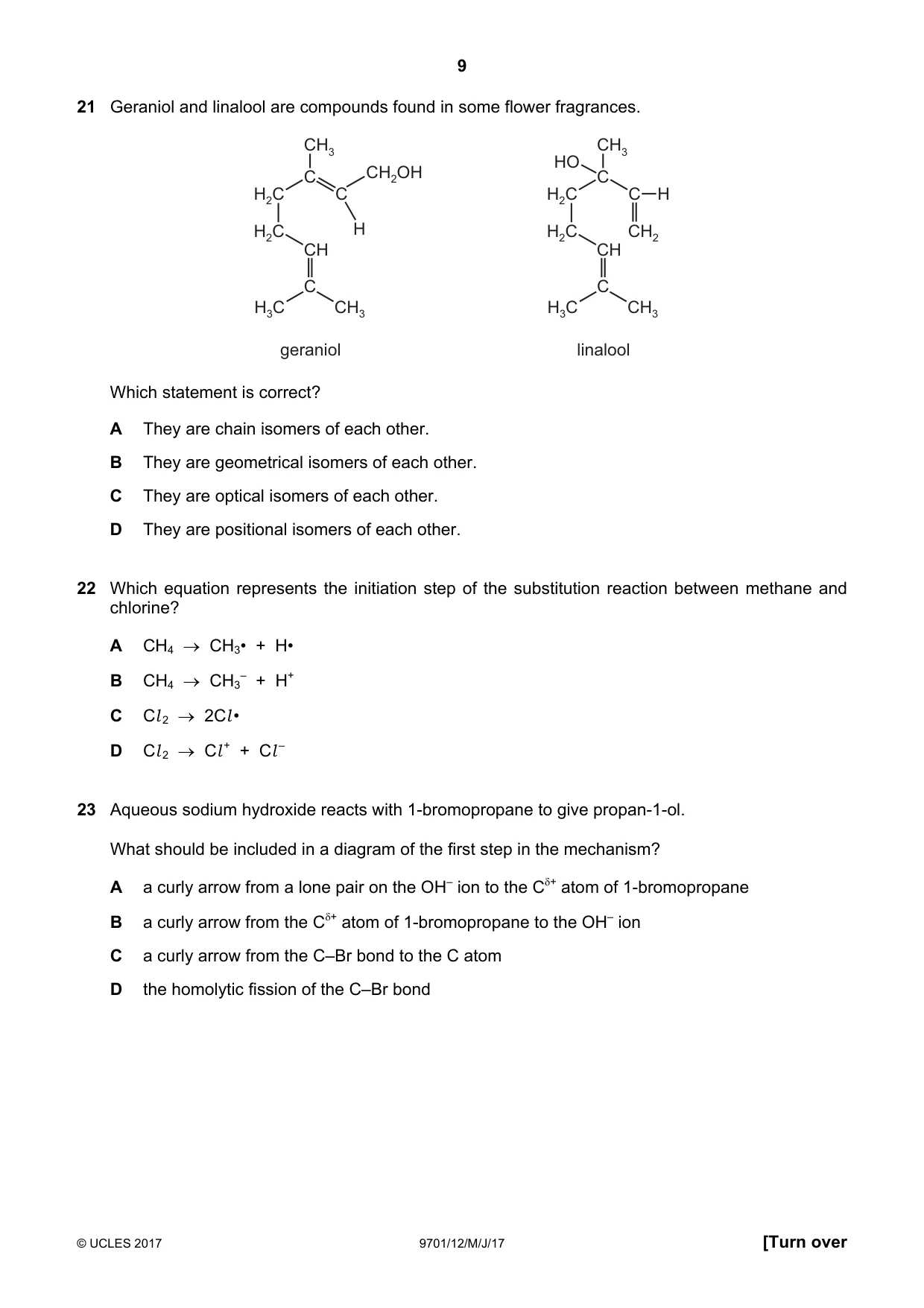
Q21 · Geraniol and linalool are compounds found in some flower fragrances
21 Geraniol and linalool are compounds found in some flower fragrances. CH3 CH3 HO C CH2OH C H2C C H2C C H H2C H H2C CH2 CH CH C C H3C CH3 H3C CH3 geraniol linalool Which statement is correct? A They are chain isomers of each other. B They are geometrical isomers of each other. C They are optical isomers of each other. D They are positional isomers of each other.
Mark scheme: D
More questions on Isomerism: structural isomerism and stereoisomerism
Q22 · Which equation represents the initiation step of the substitution reaction between…
22 Which equation represents the initiation step of the substitution reaction between methane and chlorine? A CH4 → CH3• + H• B CH4 → CH3 – + H+ C Cl 2 → 2Cl • D Cl 2 → Cl + + Cl –
Mark scheme: C
Q23 · Aqueous sodium hydroxide reacts with 1-bromopropane to give propan-1-ol
23 Aqueous sodium hydroxide reacts with 1-bromopropane to give propan-1-ol. What should be included in a diagram of the first step in the mechanism? A a curly arrow from a lone pair on the OH– ion to the Cδ+ atom of 1-bromopropane B a curly arrow from the Cδ+ atom of 1-bromopropane to the OH– ion C a curly arrow from the C–Br bond to the C atom D the homolytic fission of the C–Br bond
Mark scheme: A
Q24 · A sample of 2.76 g of ethanol was mixed with an excess of aqueous acidified potassium…
24 A sample of 2.76 g of ethanol was mixed with an excess of aqueous acidified potassium dichromate(VI). The reaction mixture was then boiled under reflux for one hour. The required organic product was then collected by distillation. The yield of product was 75.0%. Which mass of product was collected? A 1.26 g B 1.98 g C 2.07 g D 2.70 g
Mark scheme: D
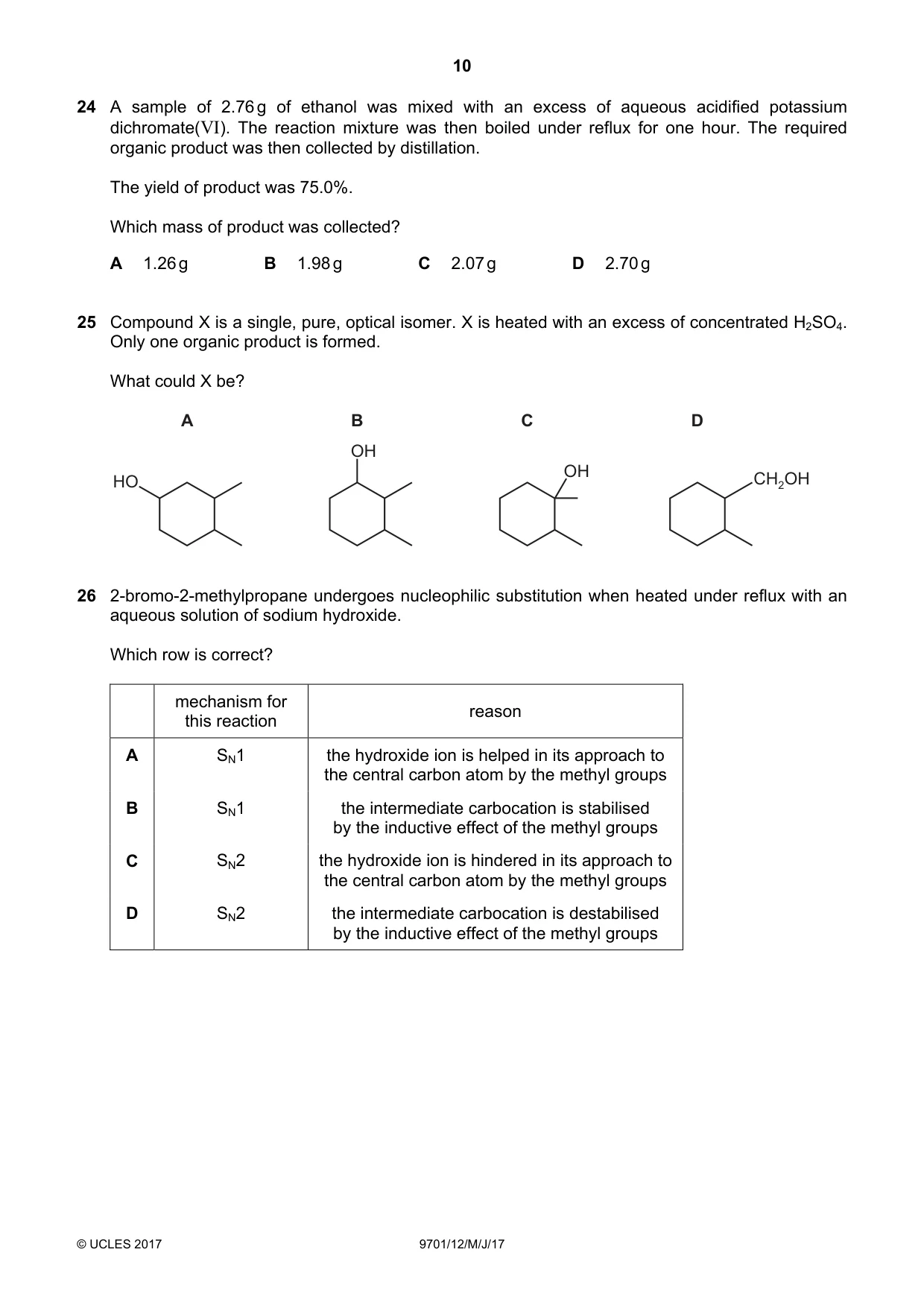
Q25 · Compound X is a single, pure, optical isomer
25 Compound X is a single, pure, optical isomer. X is heated with an excess of concentrated H2SO4. Only one organic product is formed. What could X be? A B C D OH OH CH2OH HO
Mark scheme: D
Q26 · 2-bromo-2-methylpropane undergoes nucleophilic substitution when heated under reflux with…
26 2-bromo-2-methylpropane undergoes nucleophilic substitution when heated under reflux with an aqueous solution of sodium hydroxide. Which row is correct? mechanism for reason this reaction A SN1 the hydroxide ion is helped in its approach to the central carbon atom by the methyl groups B SN1 the intermediate carbocation is stabilised by the inductive effect of the methyl groups C SN2 the hydroxide ion is hindered in its approach to the central carbon atom by the methyl groups D SN2 the intermediate carbocation is destabilised by the inductive effect of the methyl groups
Mark scheme: B
Q27 · H2NNHC6H3(NO2)2 is the structural formula of 2,4-DNPH
27 H2NNHC6H3(NO2)2 is the structural formula of 2,4-DNPH. Many, but not all, organic reactions need to be heated before reaction occurs. Which reaction occurs at a good rate at room temperature (20 °C)? A C10H22 → C8H18 + C2H4 B CH3CH2CH2Br + NH3 → CH3CH2CH2NH2 + HBr C CH3CH2OH + KBr → CH3CH2Br + KOH D (CH3)2CO + H2NNHC6H3(NO2)2 → (CH3)2C=NNHC6H3(NO2)2 + H2O
Mark scheme: D
Q28 · A carboxylic acid, P, has no possible chain isomers
28 A carboxylic acid, P, has no possible chain isomers. It reacts with an alcohol, Q, that has only one positional isomer. What could be the ester formed from a reaction between P and Q? A butyl propanoate B ethyl butanoate C pentyl ethanoate D propyl pentanoate
Mark scheme: A
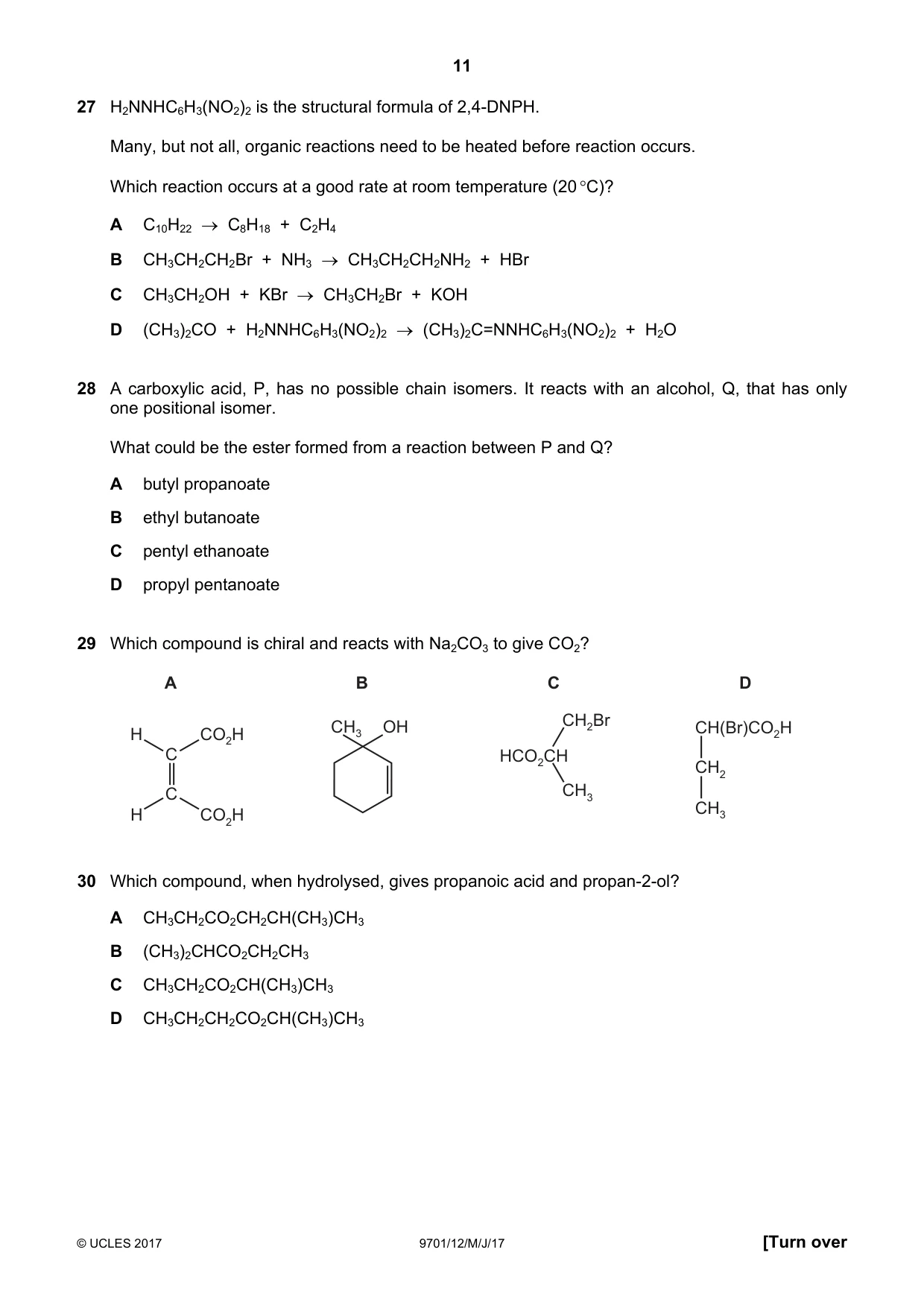
Q29 · Which compound is chiral and reacts with Na2CO3 to give CO2?
29 Which compound is chiral and reacts with Na2CO3 to give CO2? A B C D CH3 OH CH2Br CH(Br)CO2H H CO2H C HCO2CH CH2 C CH3 H CO2H CH3
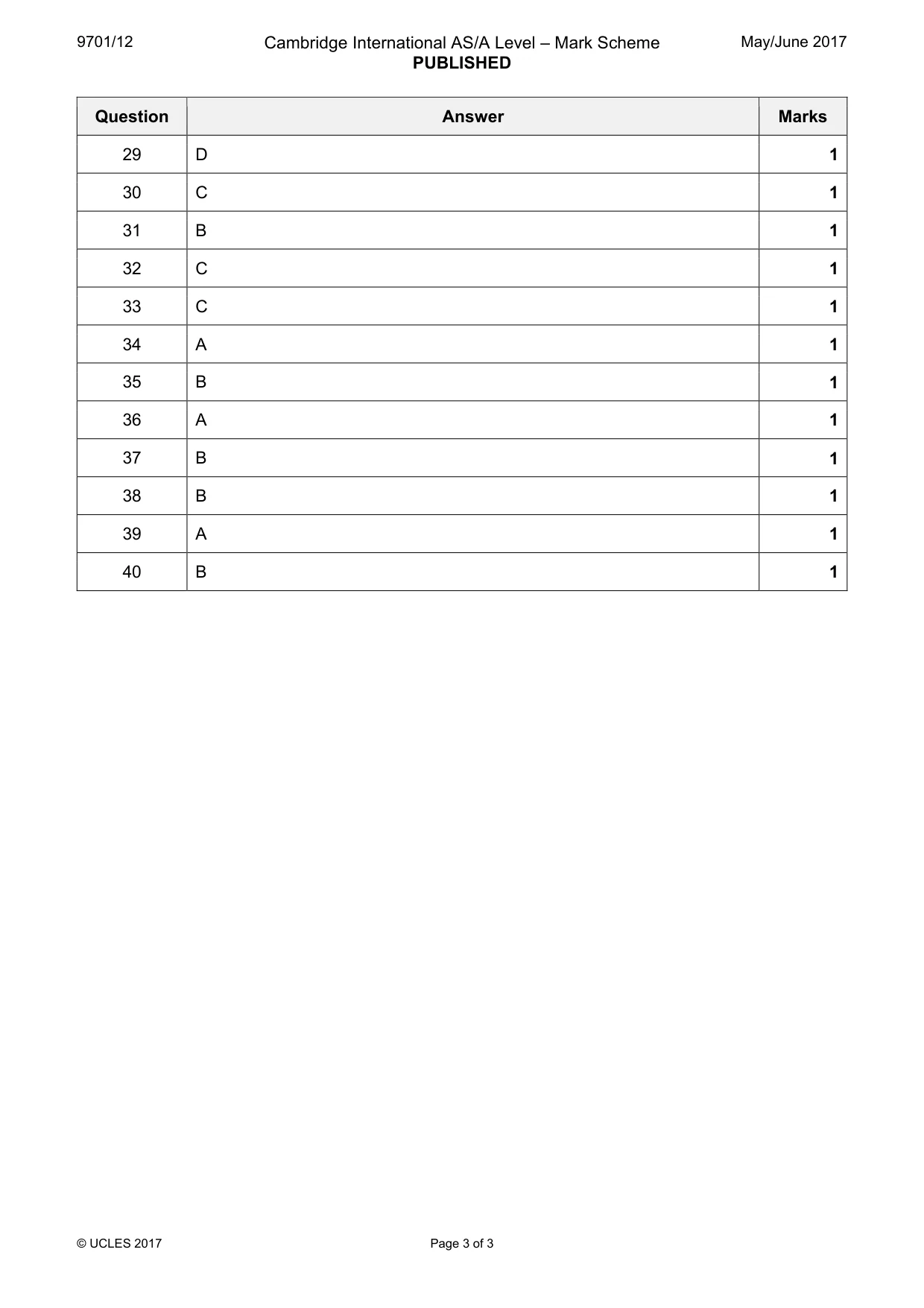
Mark scheme: D
Q30 · Which compound, when hydrolysed, gives propanoic acid and propan-2-ol?
30 Which compound, when hydrolysed, gives propanoic acid and propan-2-ol? A CH3CH2CO2CH2CH(CH3)CH3 B (CH3)2CHCO2CH2CH3 C CH3CH2CO2CH(CH3)CH3 D CH3CH2CH2CO2CH(CH3)CH3 Section B
Mark scheme: C
Q31 · An isolated gaseous atom of element X has paired electrons in at least one of its 3d…
31 An isolated gaseous atom of element X has paired electrons in at least one of its 3d orbitals and has a filled 4s subshell. What could be the identity of element X? 1 iron 2 gallium 3 copper
Mark scheme: B
Q32 · Which allotropes of carbon have a giant molecular structure?
32 Which allotropes of carbon have a giant molecular structure? 1 buckminsterfullerene 2 diamond 3 graphite
Mark scheme: C
Q33 · Which statements about endothermic reactions are correct?
33 Which statements about endothermic reactions are correct? 1 On the reaction pathway diagram the products of the reaction are lower than the reactants. 2 There is a net transfer of heat energy from the surroundings to the reacting system. 3 the total bond energies of the reactants > the total bond energies of the products
Mark scheme: C
Q34 · The rate of chemical reactions can be increased by the addition of a suitable catalyst
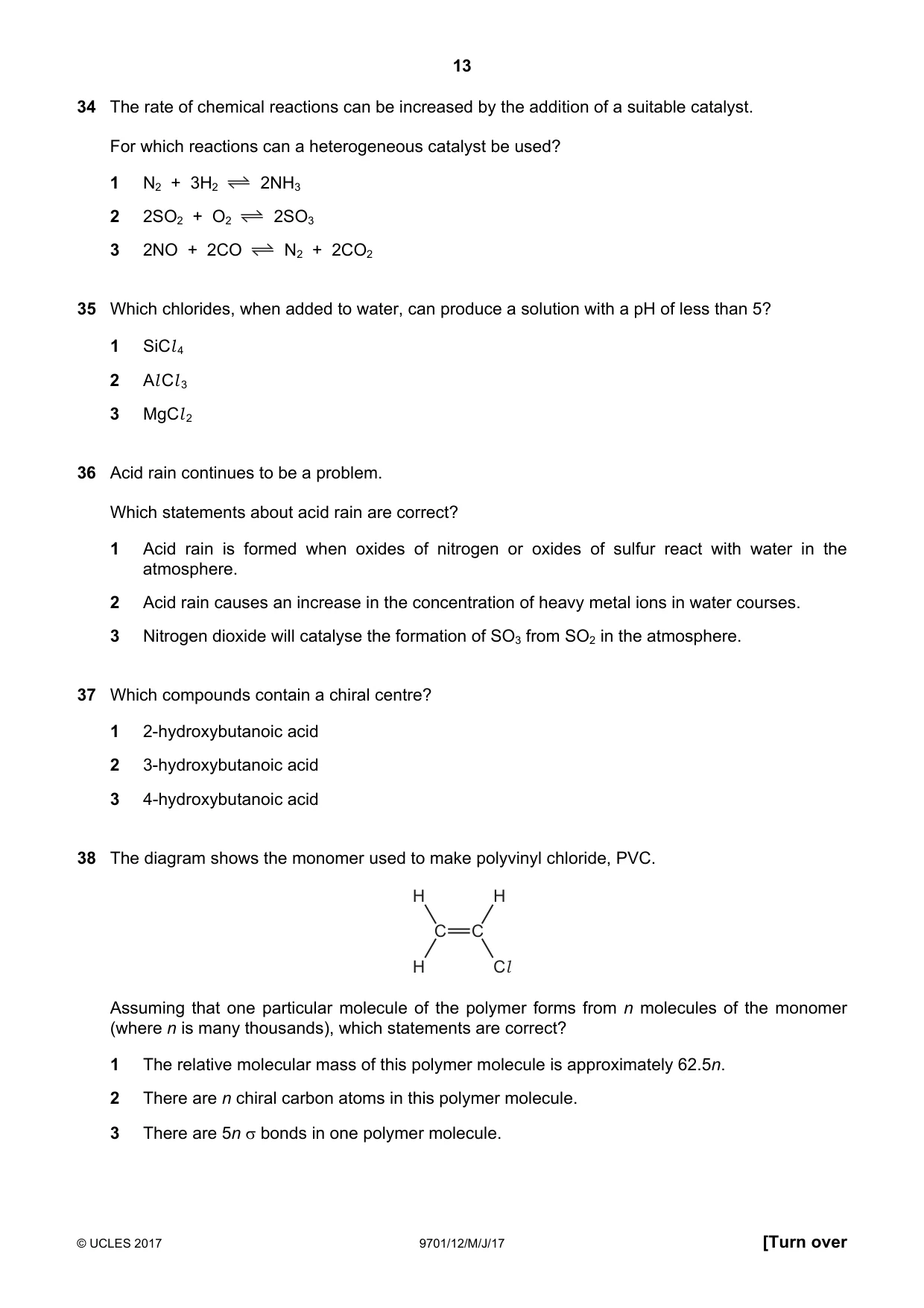
34 The rate of chemical reactions can be increased by the addition of a suitable catalyst. For which reactions can a heterogeneous catalyst be used? 1 N2 + 3H2 2NH3 2 2SO2 + O2 2SO3 3 2NO + 2CO N2 + 2CO2
Mark scheme: A
Q35 · Which chlorides, when added to water, can produce a solution with a pH of less than 5?
35 Which chlorides, when added to water, can produce a solution with a pH of less than 5? 1 SiCl 4 2 Al Cl 3 3 MgCl 2
Mark scheme: B
More questions on Periodicity of chemical properties of the elements in Period 3
Q36 · Acid rain continues to be a problem
36 Acid rain continues to be a problem. Which statements about acid rain are correct? 1 Acid rain is formed when oxides of nitrogen or oxides of sulfur react with water in the atmosphere. 2 Acid rain causes an increase in the concentration of heavy metal ions in water courses. 3 Nitrogen dioxide will catalyse the formation of SO3 from SO2 in the atmosphere.
Mark scheme: A
Q37 · Which compounds contain a chiral centre?
37 Which compounds contain a chiral centre? 1 2-hydroxybutanoic acid 2 3-hydroxybutanoic acid 3 4-hydroxybutanoic acid
Mark scheme: B
Q38 · The diagram shows the monomer used to make polyvinyl chloride, PVC
38 The diagram shows the monomer used to make polyvinyl chloride, PVC. H H C C H Cl Assuming that one particular molecule of the polymer forms from n molecules of the monomer (where n is many thousands), which statements are correct? 1 The relative molecular mass of this polymer molecule is approximately 62.5n. 2 There are n chiral carbon atoms in this polymer molecule. 3 There are 5n σ bonds in one polymer molecule.
Mark scheme: B
Q39 · An organic compound, X, has the following skeletal formula
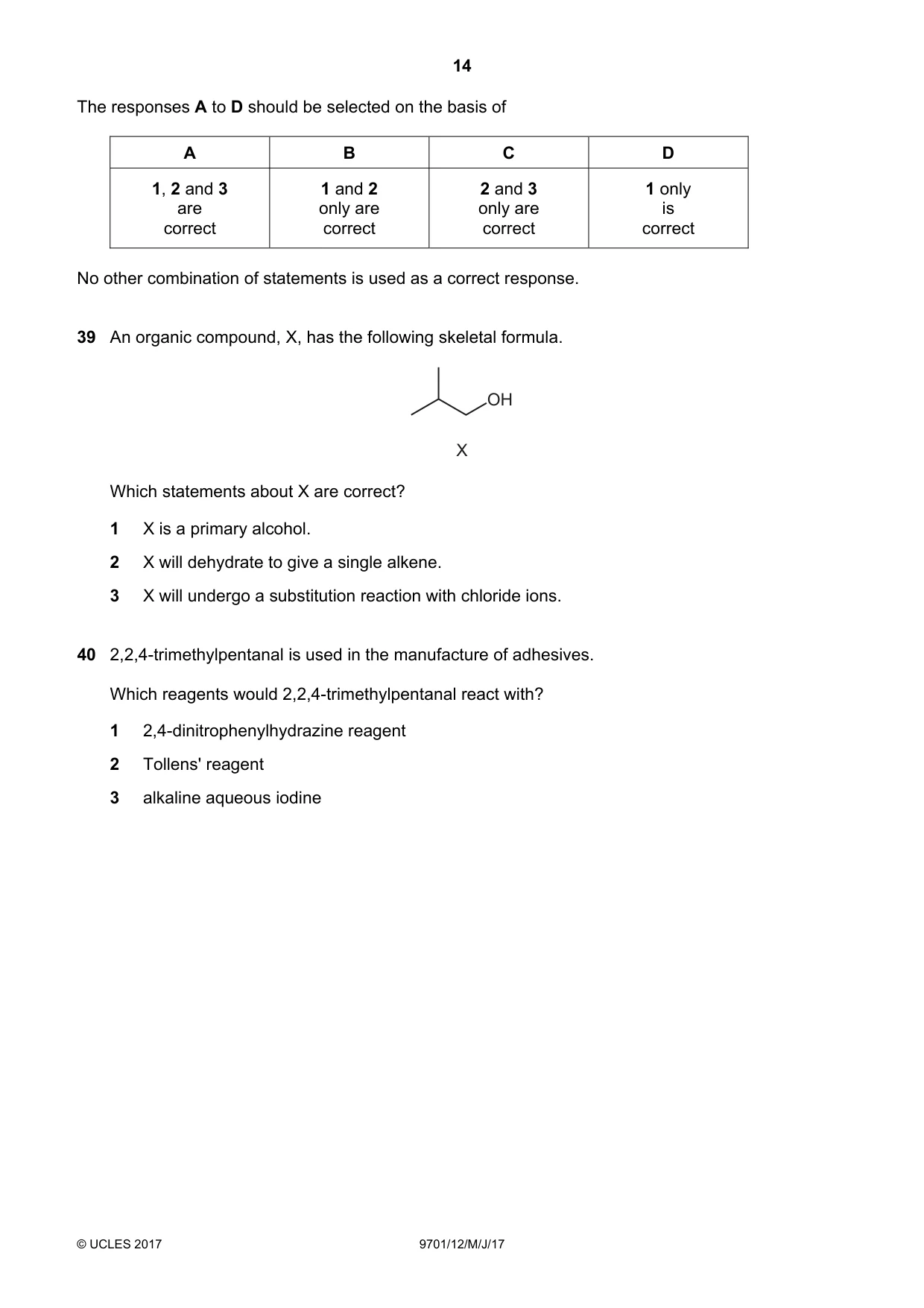
39 An organic compound, X, has the following skeletal formula. OH X Which statements about X are correct? 1 X is a primary alcohol. 2 X will dehydrate to give a single alkene. 3 X will undergo a substitution reaction with chloride ions.
Mark scheme: A
Q40 · 2,2,4-trimethylpentanal is used in the manufacture of adhesives
40 2,2,4-trimethylpentanal is used in the manufacture of adhesives. Which reagents would 2,2,4-trimethylpentanal react with? 1 2,4-dinitrophenylhydrazine reagent 2 Tollens' reagent 3 alkaline aqueous iodine
Mark scheme: B
What was in this paper
The subtopics covered by these 40 questions, and how many questions each got. Open one in a new tab to see every Cambridge question on it.
3Alcohols2Chemical equilibria: reversible reactions, dynamic equilibrium2Effect of temperature on reaction rates and the concept of activation energy2Halogenoalkanes2Isomerism: optical2Particles in the atom and atomic radius2Redox processes: electron transfer and changes in oxidation number (oxidation state)2Similarities and trends in the properties of the Group 2 metals, magnesium to barium, and their compounds2Addition polymerisation1Alkanes1Bonding and structure1Carboxylic acids1Covalent bonding and coordinate (dative covalent) bonding1Enthalpy change, ΔH1Esters1Esters1General physical and chemical properties of the first row of transition elements, titanium to copper1Homogeneous and heterogeneous catalysts1Intermolecular forces, electronegativity and bond properties1Isomerism: structural isomerism and stereoisomerism1Nitrogen and sulfur1Periodicity of chemical properties of the elements in Period 31Periodicity of physical properties of the elements in Period 31Reacting masses and volumes (of solutions and gases)1Shapes of organic molecules; σ and π bonds1Some reactions of the halide ions1The gaseous state: ideal and real gases and pV = nRT1The mole and the Avogadro constant1The reactions of chlorine1What you needed in this session
Cambridge’s own grade thresholds for 2017 May/June, Paper 1 · Variant 2. A higher threshold means an easier paper — the bar moves with how the cohort did.