Cambridge A Level Chemistry 9701 — 2008 Oct/Nov Paper 1 · Variant 1
9701/11/O/N/08 · 40 questions · 40 marks · ≈45 min
The question paper and its mark scheme, free to read here and free to download. This is Cambridge’s own paper, exactly as it was sat.
Question paper16 pages



Mark scheme2 pages
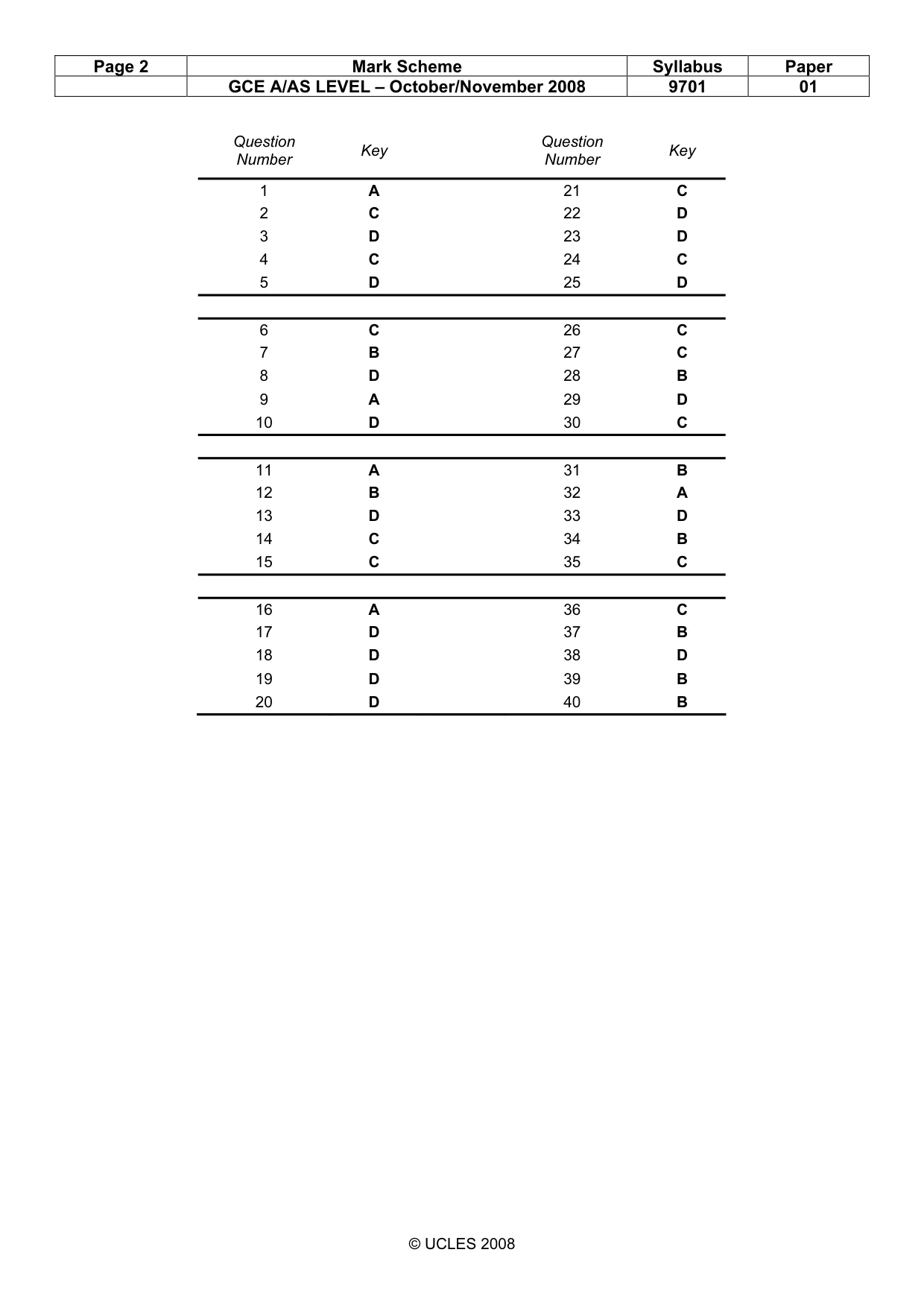
Answers below. Sit the paper first if you are practising.
Questions as text
Q1 · Use of the Data Booklet is relevant to this question
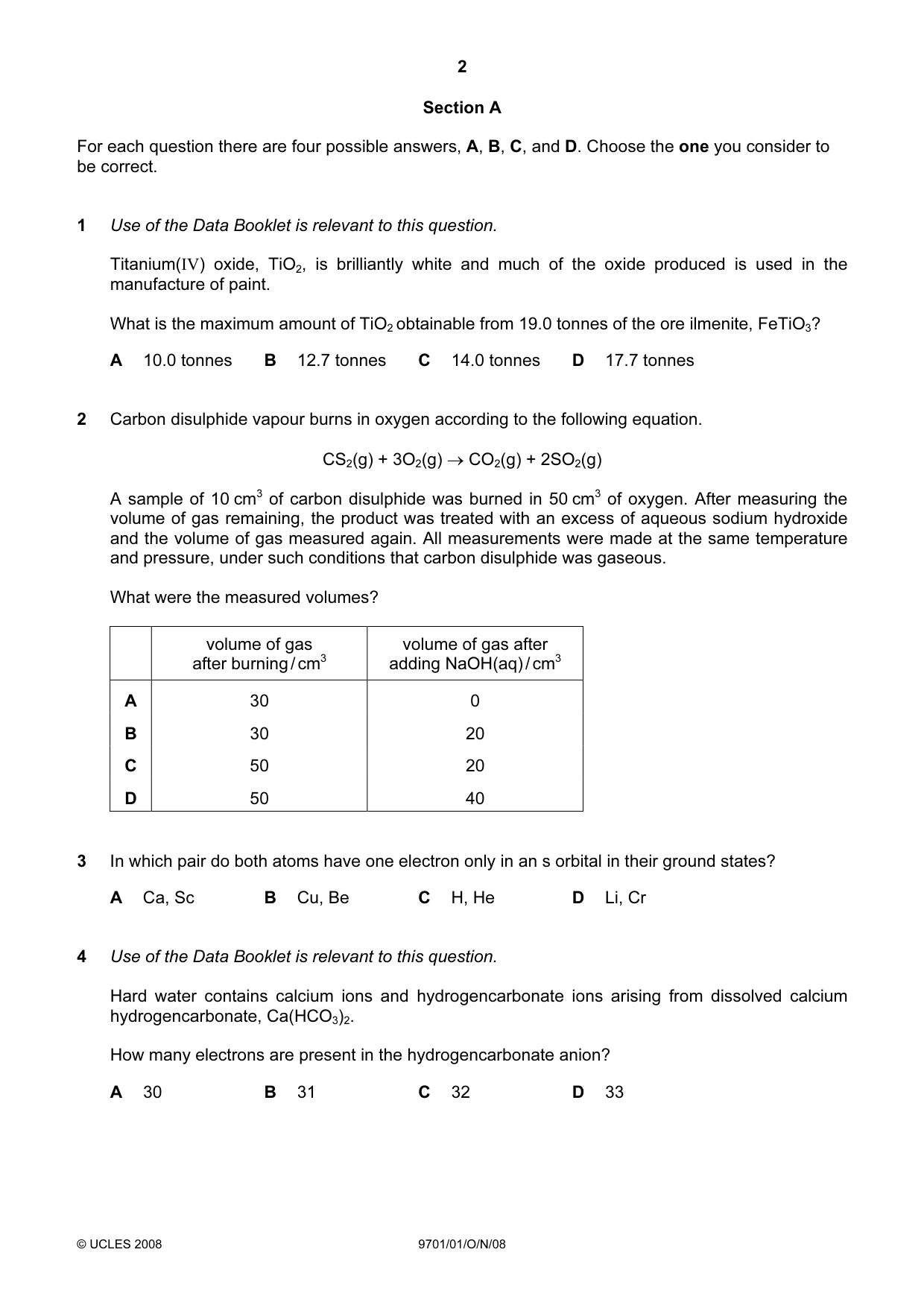
1 Use of the Data Booklet is relevant to this question. Titanium(IV) oxide, TiO2, is brilliantly white and much of the oxide produced is used in the manufacture of paint. What is the maximum amount of TiO2 obtainable from 19.0 tonnes of the ore ilmenite, FeTiO3? A 10.0 tonnes B 12.7 tonnes C 14.0 tonnes D 17.7 tonnes
Mark scheme: A
More questions on Reacting masses and volumes (of solutions and gases)
Q2 · Carbon disulphide vapour burns in oxygen according to the following equation
2 Carbon disulphide vapour burns in oxygen according to the following equation. CS2(g) + 3O2(g) → CO2(g) + 2SO2(g) A sample of 10 cm3 of carbon disulphide was burned in 50 cm3 of oxygen. After measuring the volume of gas remaining, the product was treated with an excess of aqueous sodium hydroxide and the volume of gas measured again. All measurements were made at the same temperature and pressure, under such conditions that carbon disulphide was gaseous. What were the measured volumes? volume of gas volume of gas after after burning / cm3 adding NaOH(aq) / cm3 A 30 0 B 30 20 C 50 20 D 50 40
Mark scheme: C
More questions on Reacting masses and volumes (of solutions and gases)
Q3 · In which pair do both atoms have one electron only in an s orbital in their ground states?
3 In which pair do both atoms have one electron only in an s orbital in their ground states? A Ca, Sc B Cu, Be C H, He D Li, Cr
Mark scheme: D
More questions on Electrons, energy levels and atomic orbitals
Q4 · Use of the Data Booklet is relevant to this question
4 Use of the Data Booklet is relevant to this question. Hard water contains calcium ions and hydrogencarbonate ions arising from dissolved calcium hydrogencarbonate, Ca(HCO3)2. How many electrons are present in the hydrogencarbonate anion? A 30 B 31 C 32 D 33
Mark scheme: C
Q5 · Which quantity would best indicate the relative strengths of the hydrogen bonds between…
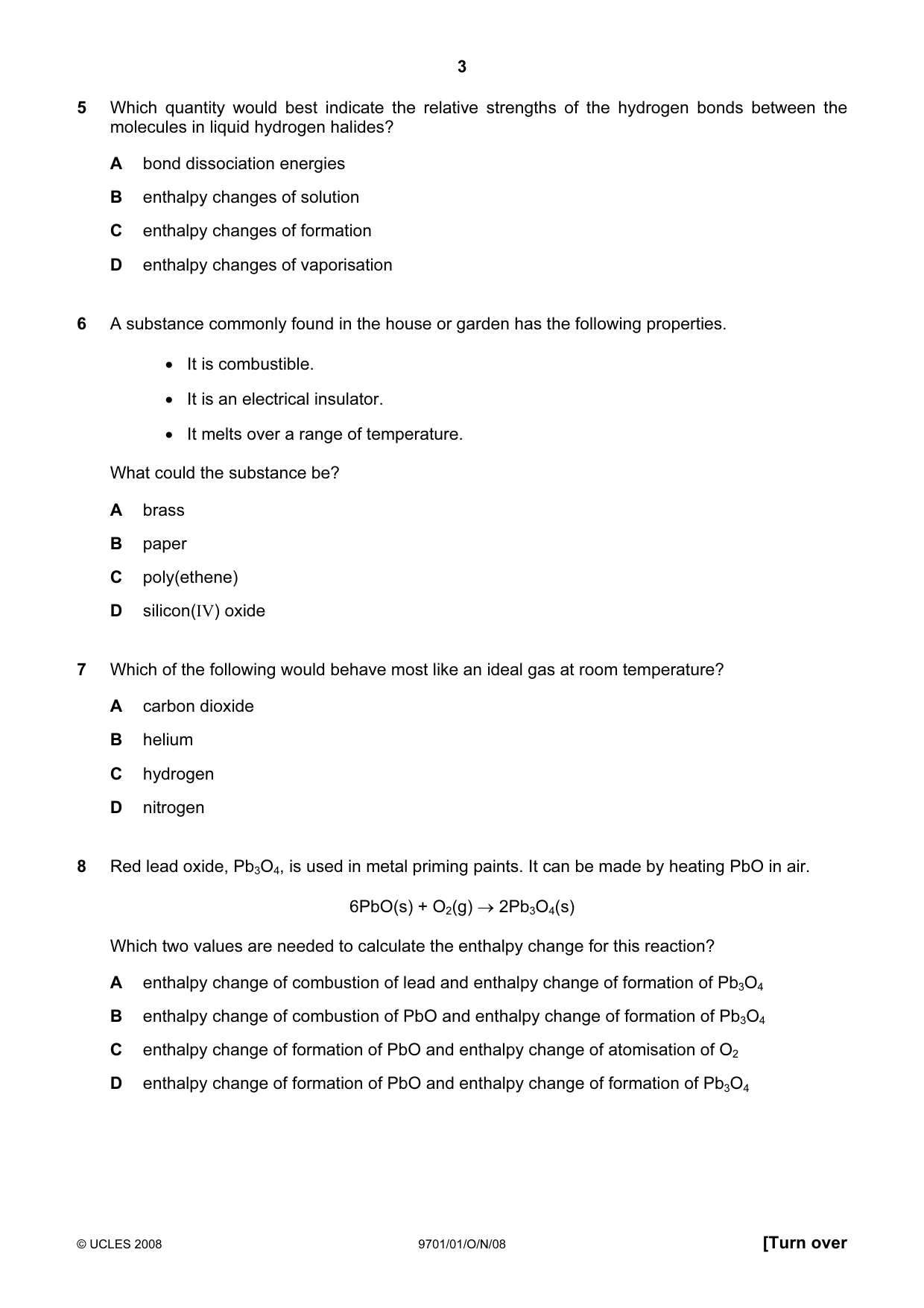
5 Which quantity would best indicate the relative strengths of the hydrogen bonds between the molecules in liquid hydrogen halides? A bond dissociation energies B enthalpy changes of solution C enthalpy changes of formation D enthalpy changes of vaporisation
Mark scheme: D
More questions on Intermolecular forces, electronegativity and bond properties
Q6 · A substance commonly found in the house or garden has the following properties
6 A substance commonly found in the house or garden has the following properties. • It is combustible. • It is an electrical insulator. • It melts over a range of temperature. What could the substance be? A brass B paper C poly(ethene) D silicon(IV) oxide
Mark scheme: C
Q7 · Which of the following would behave most like an ideal gas at room temperature?
7 Which of the following would behave most like an ideal gas at room temperature? A carbon dioxide B helium C hydrogen D nitrogen
Mark scheme: B
More questions on The gaseous state: ideal and real gases and pV = nRT
Q8 · Red lead oxide, Pb3O4, is used in metal priming paints
8 Red lead oxide, Pb3O4, is used in metal priming paints. It can be made by heating PbO in air. 6PbO(s) + O2(g) → 2Pb3O4(s) Which two values are needed to calculate the enthalpy change for this reaction? A enthalpy change of combustion of lead and enthalpy change of formation of Pb3O4 B enthalpy change of combustion of PbO and enthalpy change of formation of Pb3O4 C enthalpy change of formation of PbO and enthalpy change of atomisation of O2 D enthalpy change of formation of PbO and enthalpy change of formation of Pb3O4
Mark scheme: D
Q9 · The diagram represents the reaction pathway for the following reaction
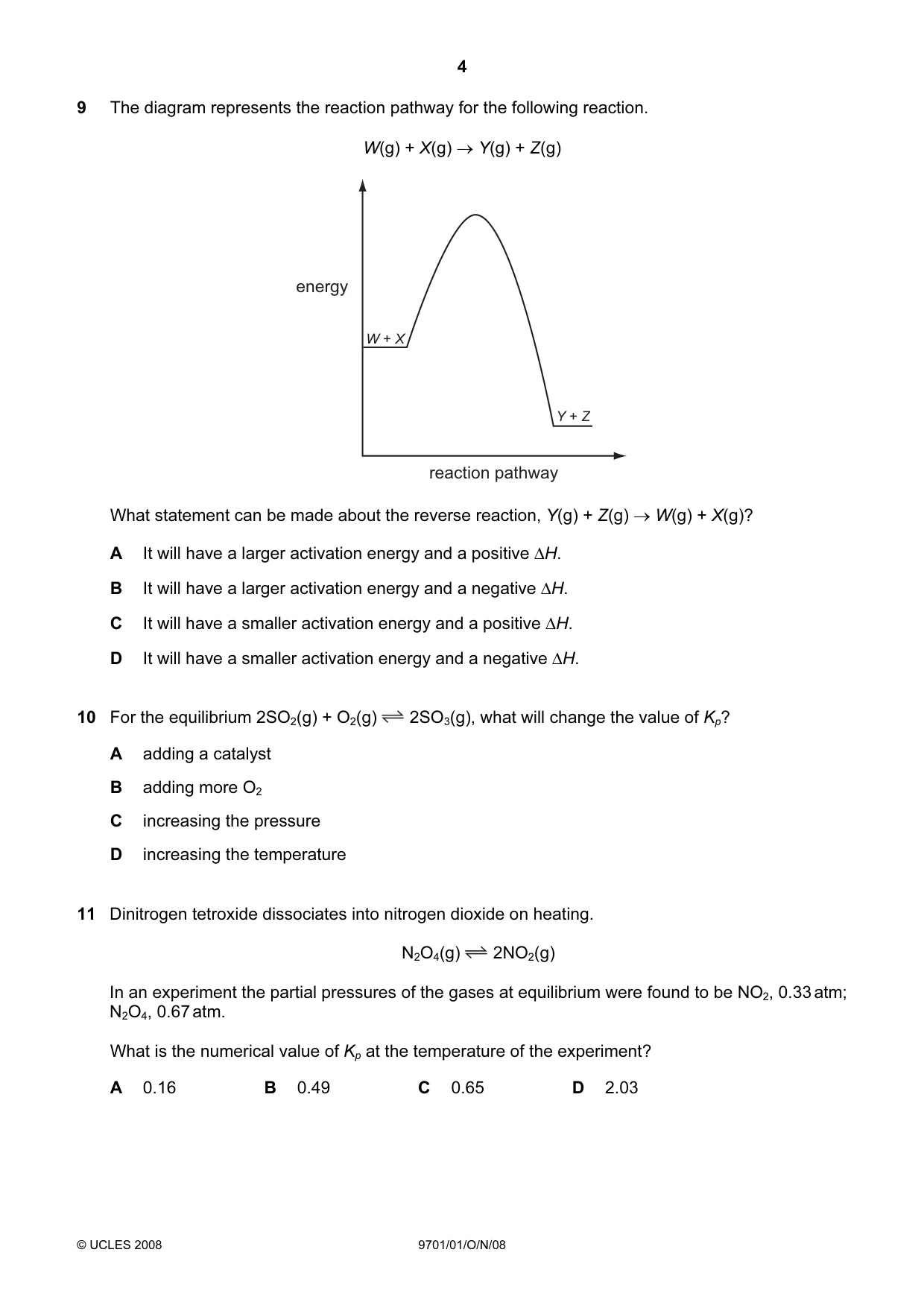
9 The diagram represents the reaction pathway for the following reaction. W(g) + X(g) → Y(g) + Z(g) energy W + X Y + Z reaction pathway What statement can be made about the reverse reaction, Y(g) + Z(g) → W(g) + X(g)? A It will have a larger activation energy and a positive ∆H. B It will have a larger activation energy and a negative ∆H. C It will have a smaller activation energy and a positive ∆H. D It will have a smaller activation energy and a negative ∆H.
Mark scheme: A
More questions on Effect of temperature on reaction rates and the concept of activation energy
Q10 · For the equilibrium 2SO2(g) + O2(g) 2SO3(g), what will change the value of Kp?
10 For the equilibrium 2SO2(g) + O2(g) 2SO3(g), what will change the value of Kp? A adding a catalyst B adding more O2 C increasing the pressure D increasing the temperature
Mark scheme: D
More questions on Chemical equilibria: reversible reactions, dynamic equilibrium
Q11 · Dinitrogen tetroxide dissociates into nitrogen dioxide on heating
11 Dinitrogen tetroxide dissociates into nitrogen dioxide on heating. N2O4(g) 2NO2(g) In an experiment the partial pressures of the gases at equilibrium were found to be NO2, 0.33 atm; N2O4, 0.67 atm. What is the numerical value of Kp at the temperature of the experiment? A 0.16 B 0.49 C 0.65 D 2.03
Mark scheme: A
More questions on Chemical equilibria: reversible reactions, dynamic equilibrium
Q12 · Crotonaldehyde, CH3CH=CHCHO, can be obtained by oxidising butadiene, CH2=CHCH=CH2, using…
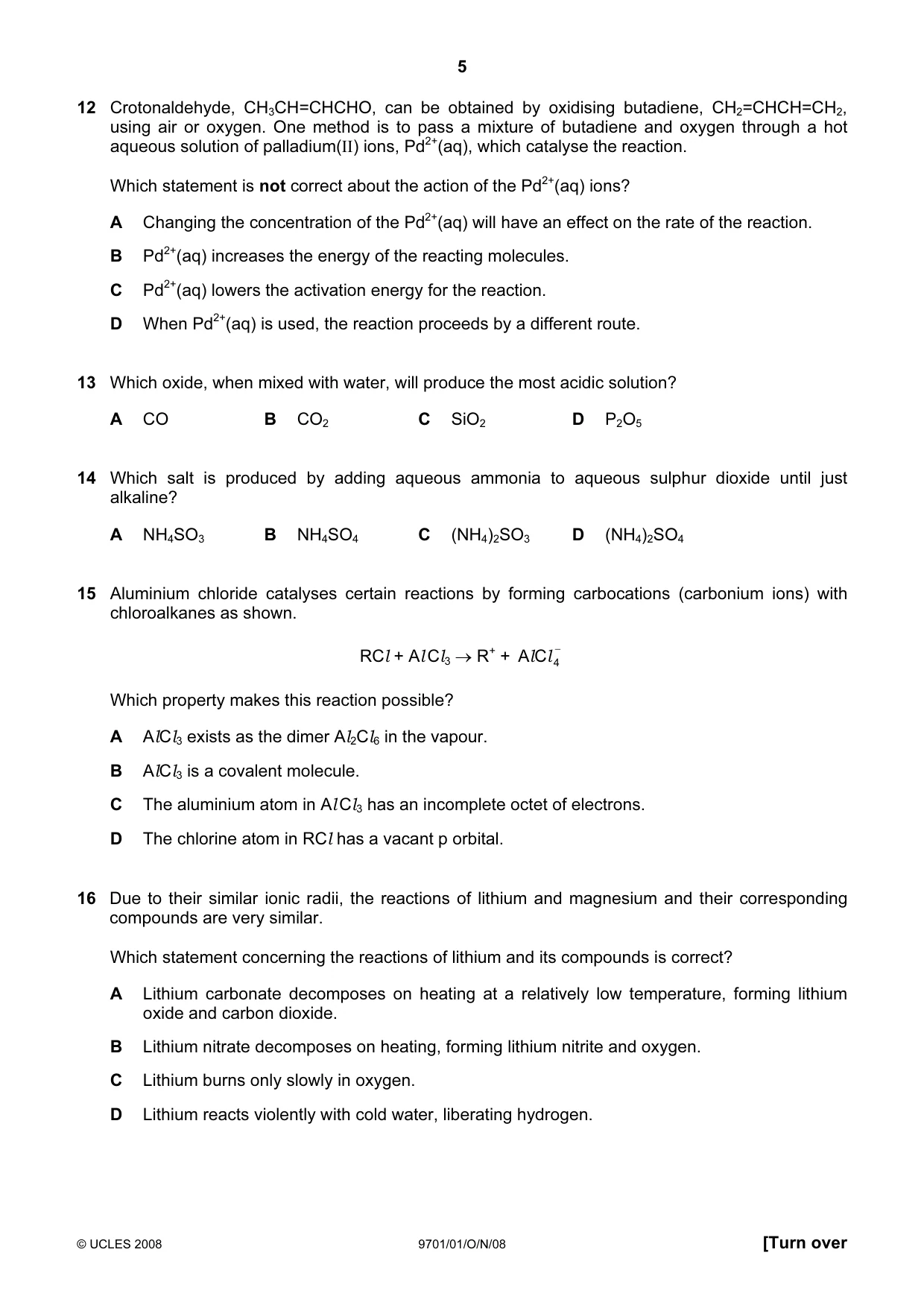
12 Crotonaldehyde, CH3CH=CHCHO, can be obtained by oxidising butadiene, CH2=CHCH=CH2, using air or oxygen. One method is to pass a mixture of butadiene and oxygen through a hot aqueous solution of palladium(II) ions, Pd2+(aq), which catalyse the reaction. Which statement is not correct about the action of the Pd2+(aq) ions? A Changing the concentration of the Pd2+(aq) will have an effect on the rate of the reaction. B Pd2+(aq) increases the energy of the reacting molecules. C Pd2+(aq) lowers the activation energy for the reaction. D When Pd2+(aq) is used, the reaction proceeds by a different route.
Mark scheme: B
Q13 · Which oxide, when mixed with water, will produce the most acidic solution?
13 Which oxide, when mixed with water, will produce the most acidic solution? A CO B CO2 C SiO2 D P2O5
Mark scheme: D
More questions on Periodicity of chemical properties of the elements in Period 3
Q14 · Which salt is produced by adding aqueous ammonia to aqueous sulphur dioxide until just…
14 Which salt is produced by adding aqueous ammonia to aqueous sulphur dioxide until just alkaline? A NH4SO3 B NH4SO4 C (NH4)2SO3 D (NH4)2SO4
Mark scheme: C
Q15 · Aluminium chloride catalyses certain reactions by forming carbocations (carbonium ions)…
15 Aluminium chloride catalyses certain reactions by forming carbocations (carbonium ions) with chloroalkanes as shown. RCl + Al Cl3 → R+ + A l C l − 4 Which property makes this reaction possible? A AlCl3 exists as the dimer Al2Cl6 in the vapour. B AlCl3 is a covalent molecule. C The aluminium atom in Al Cl3 has an incomplete octet of electrons. D The chlorine atom in RCl has a vacant p orbital.
Mark scheme: C
More questions on Covalent bonding and coordinate (dative covalent) bonding
Q16 · Due to their similar ionic radii, the reactions of lithium and magnesium and their…
16 Due to their similar ionic radii, the reactions of lithium and magnesium and their corresponding compounds are very similar. Which statement concerning the reactions of lithium and its compounds is correct? A Lithium carbonate decomposes on heating at a relatively low temperature, forming lithium oxide and carbon dioxide. B Lithium nitrate decomposes on heating, forming lithium nitrite and oxygen. C Lithium burns only slowly in oxygen. D Lithium reacts violently with cold water, liberating hydrogen.
Mark scheme: A
Q17 · A student observed the reactions when sodium chloride and sodium iodide were each reacted…
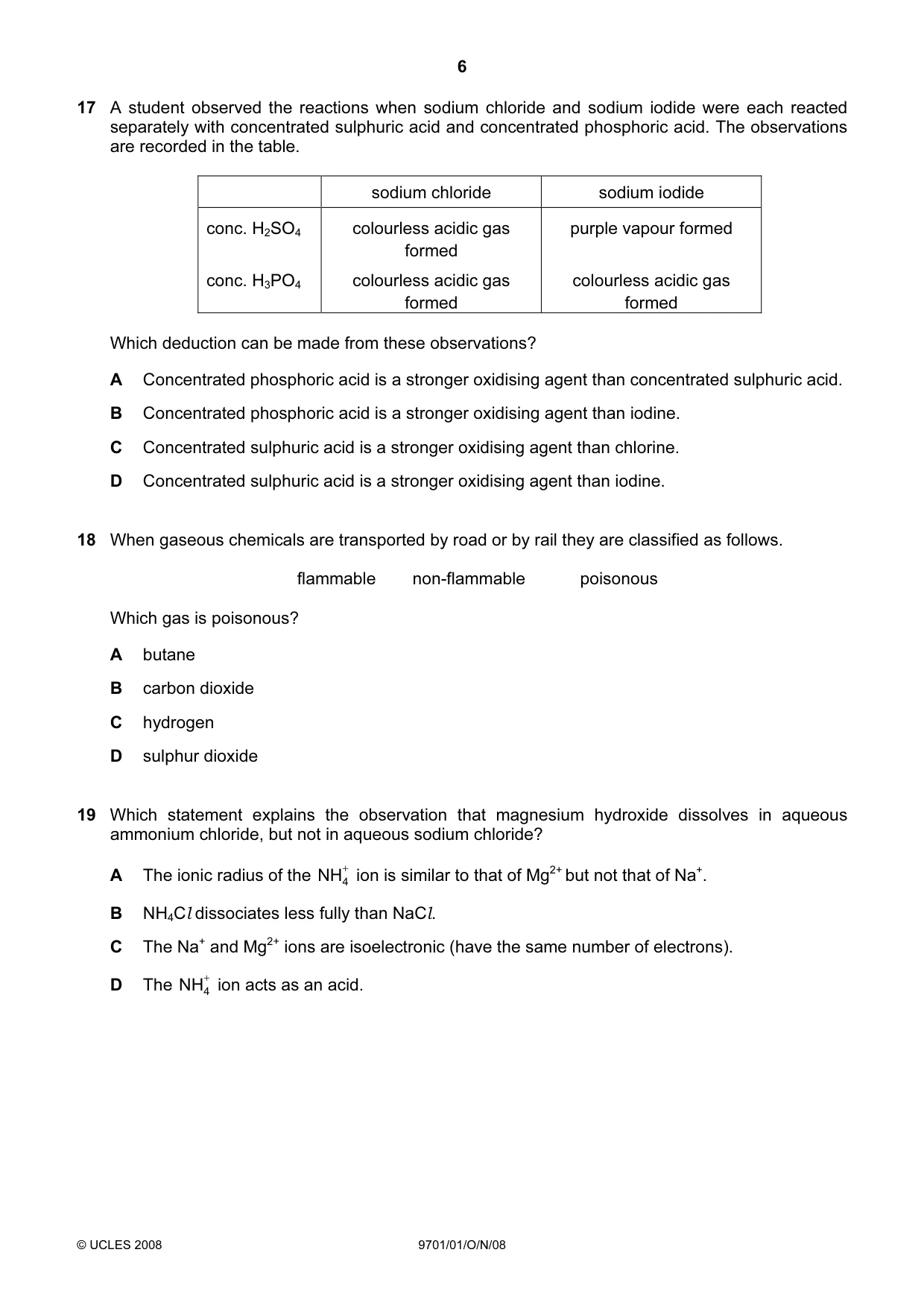
17 A student observed the reactions when sodium chloride and sodium iodide were each reacted separately with concentrated sulphuric acid and concentrated phosphoric acid. The observations are recorded in the table. sodium chloride sodium iodide conc. H2SO4 colourless acidic gas purple vapour formed formed conc. H3PO4 colourless acidic gas colourless acidic gas formed formed Which deduction can be made from these observations? A Concentrated phosphoric acid is a stronger oxidising agent than concentrated sulphuric acid. B Concentrated phosphoric acid is a stronger oxidising agent than iodine. C Concentrated sulphuric acid is a stronger oxidising agent than chlorine. D Concentrated sulphuric acid is a stronger oxidising agent than iodine.
Mark scheme: D
Q18 · When gaseous chemicals are transported by road or by rail they are classified as follows
18 When gaseous chemicals are transported by road or by rail they are classified as follows. flammable non-flammable poisonous Which gas is poisonous? A butane B carbon dioxide C hydrogen D sulphur dioxide
Mark scheme: D
Q19 · Which statement explains the observation that magnesium hydroxide dissolves in aqueous…
19 Which statement explains the observation that magnesium hydroxide dissolves in aqueous ammonium chloride, but not in aqueous sodium chloride? A The ionic radius of the NH ion is similar to that of Mg2+ but not that of Na+. + 4 B NH4Cl dissociates less fully than NaCl. C The Na+ and Mg2+ ions are isoelectronic (have the same number of electrons). D The NH ion acts as an acid. + 4
Mark scheme: D
Q20 · Sorbitol is a naturally-occurring compound with a sweet taste
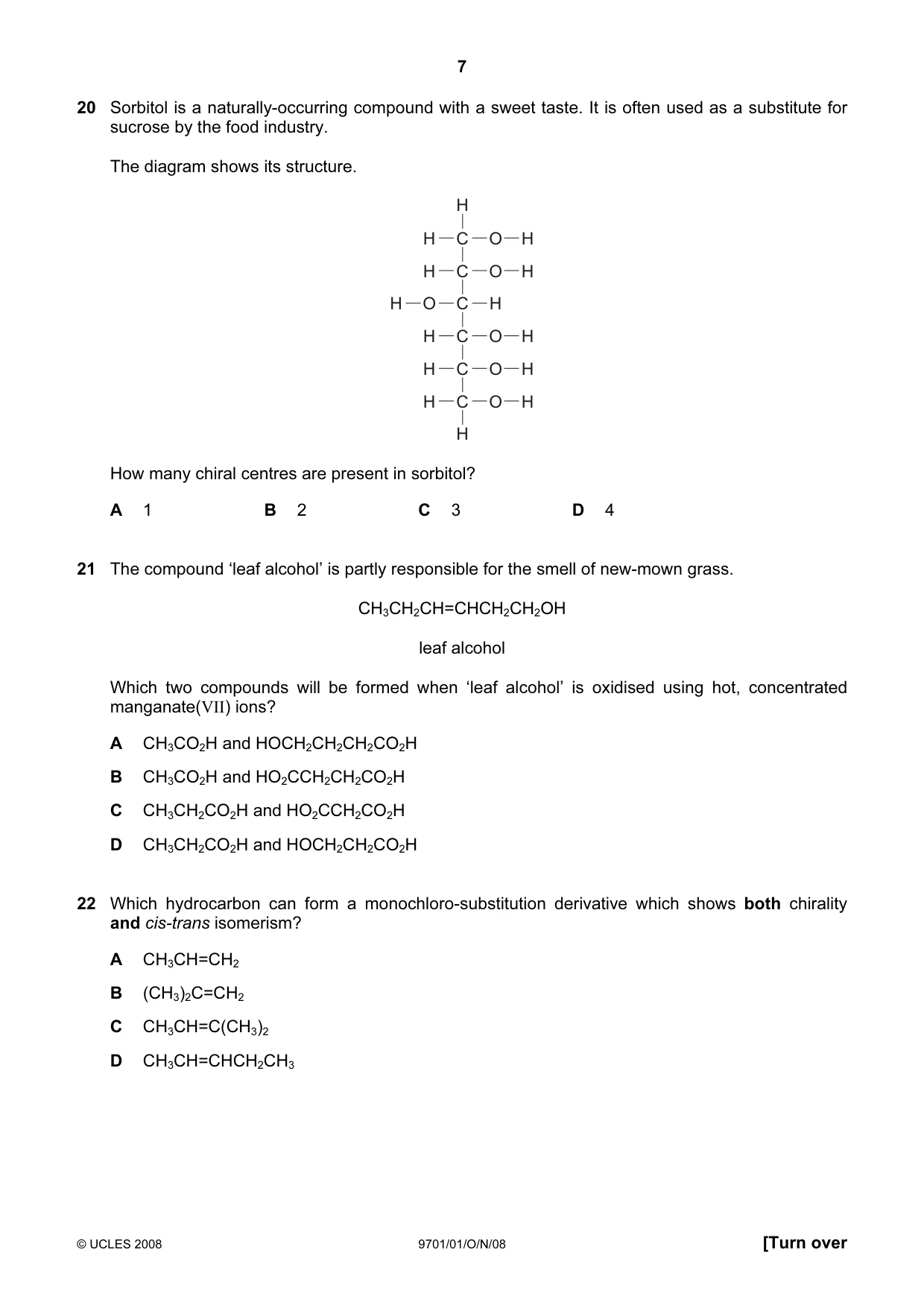
20 Sorbitol is a naturally-occurring compound with a sweet taste. It is often used as a substitute for sucrose by the food industry. The diagram shows its structure. H H C O H H C O H H O C H H C O H H C O H H C O H H How many chiral centres are present in sorbitol? A 1 B 2 C 3 D 4
Mark scheme: D
More questions on Isomerism: structural isomerism and stereoisomerism
Q21 · The compound ‘leaf alcohol’ is partly responsible for the smell of new-mown grass
21 The compound ‘leaf alcohol’ is partly responsible for the smell of new-mown grass. CH3CH2CH=CHCH2CH2OH leaf alcohol Which two compounds will be formed when ‘leaf alcohol’ is oxidised using hot, concentrated manganate(VII) ions? A CH3CO2H and HOCH2CH2CH2CO2H B CH3CO2H and HO2CCH2CH2CO2H C CH3CH2CO2H and HO2CCH2CO2H D CH3CH2CO2H and HOCH2CH2CO2H
Mark scheme: C
Q22 · Which hydrocarbon can form a monochloro-substitution derivative which shows both…
22 Which hydrocarbon can form a monochloro-substitution derivative which shows both chirality and cis-trans isomerism? A CH3CH=CH2 B (CH3)2C=CH2 C CH3CH=C(CH3)2 D CH3CH=CHCH2CH3
Mark scheme: D
More questions on Isomerism: structural isomerism and stereoisomerism
Q23 · Four drops of 1-chlorobutane, 1-bromobutane and 1-iodobutane were put separately into…
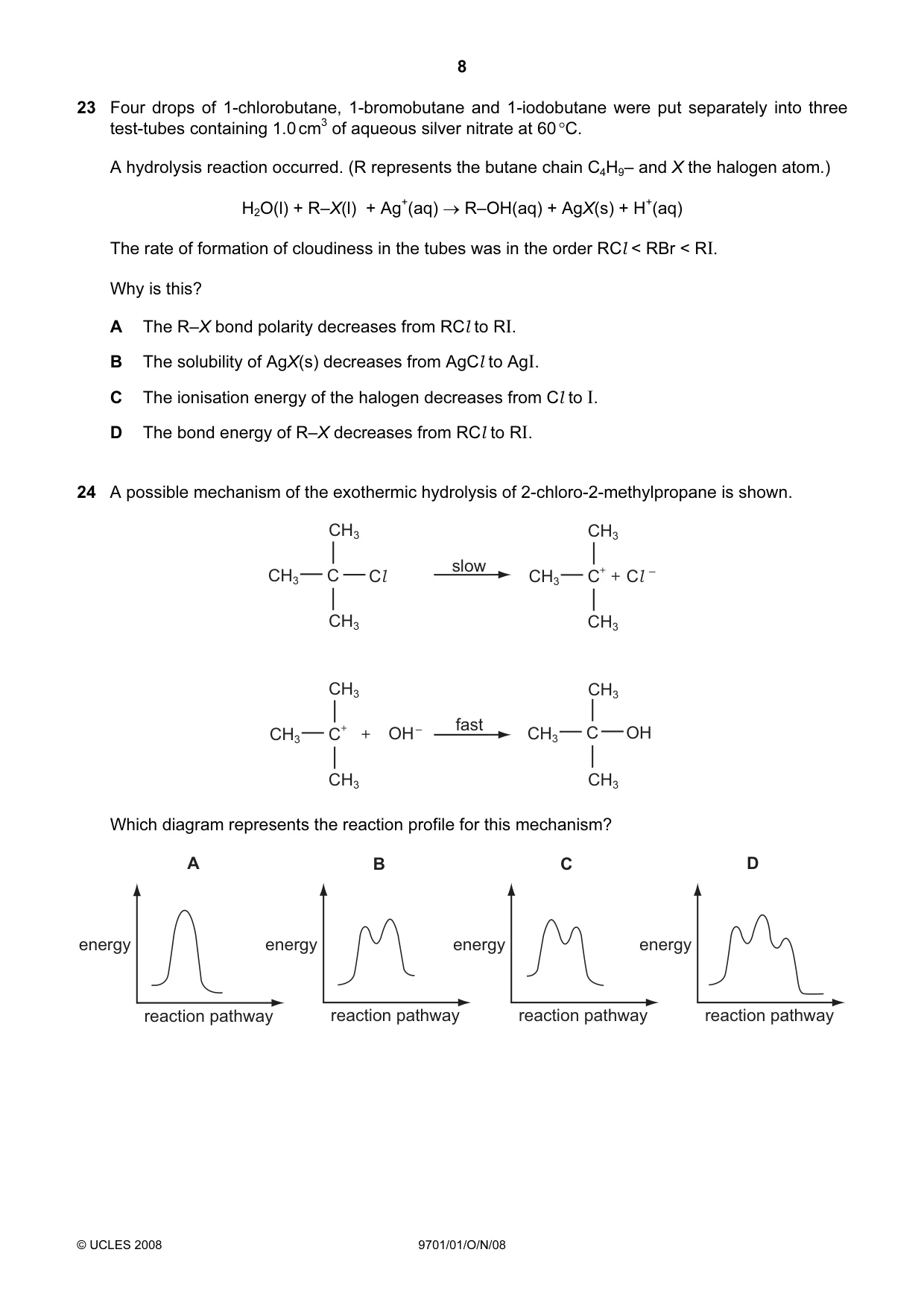
23 Four drops of 1-chlorobutane, 1-bromobutane and 1-iodobutane were put separately into three test-tubes containing 1.0 cm3 of aqueous silver nitrate at 60 °C. A hydrolysis reaction occurred. (R represents the butane chain C4H9– and X the halogen atom.) H2O(l) + R–X(l) + Ag+(aq) → R–OH(aq) + AgX(s) + H+(aq) The rate of formation of cloudiness in the tubes was in the order RCl < RBr < RI. Why is this? A The R–X bond polarity decreases from RCl to RI. B The solubility of AgX(s) decreases from AgCl to AgI. C The ionisation energy of the halogen decreases from Cl to I. D The bond energy of R–X decreases from RCl to RI.
Mark scheme: D
Q24 · A possible mechanism of the exothermic hydrolysis of 2-chloro-2-methylpropane is shown
24 A possible mechanism of the exothermic hydrolysis of 2-chloro-2-methylpropane is shown. CH3 CH3 slow + _ CH3 C Cl CH3 C + Cl CH3 CH3 CH3 CH3 + _ fast CH3 C + OH CH3 C OH CH3 CH3 Which diagram represents the reaction profile for this mechanism? A B C D energy energy energy energy reaction pathway reaction pathway reaction pathway reaction pathway
Mark scheme: C
Q25 · The functional group in a primary alcohol is –CH2OH
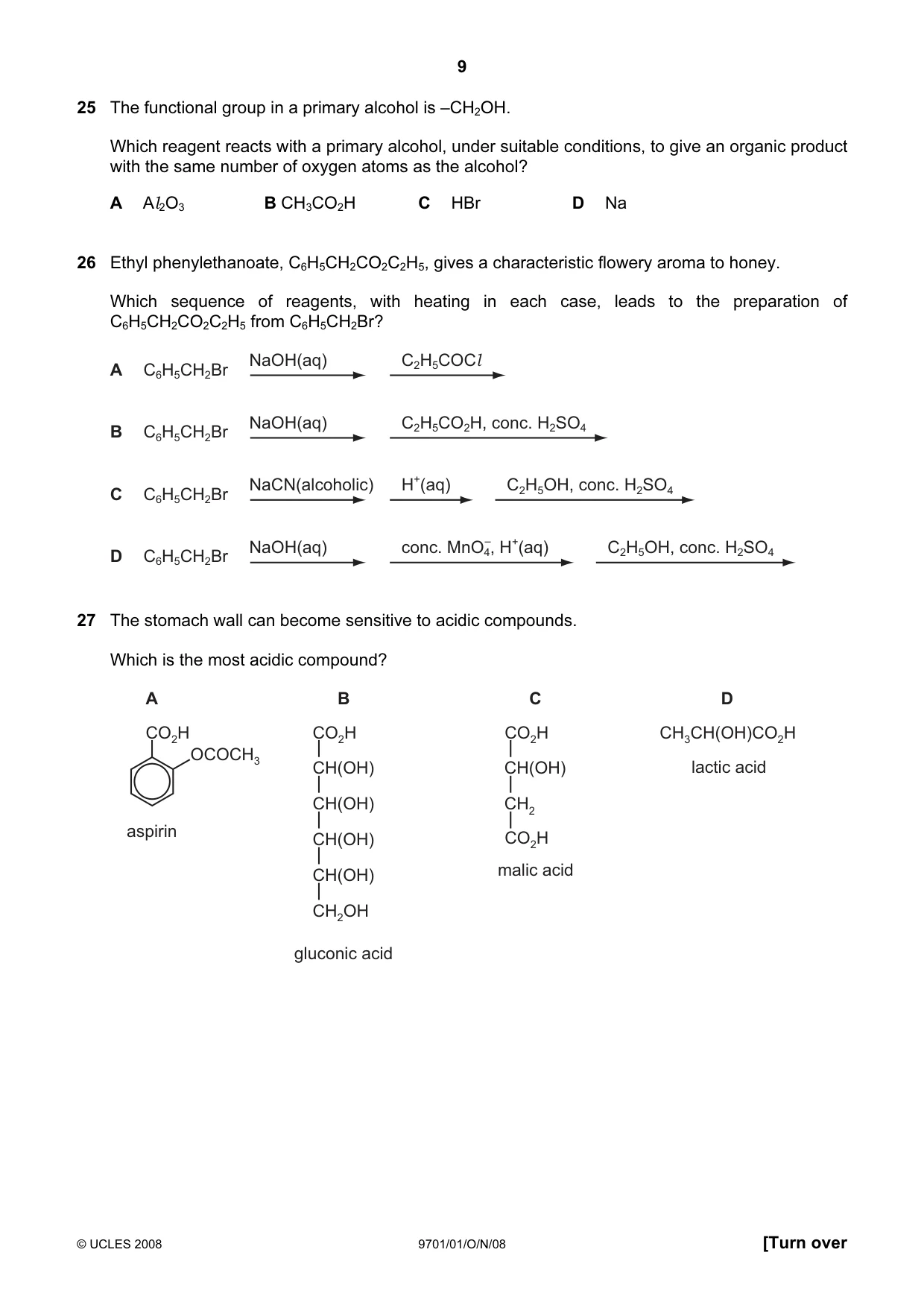
25 The functional group in a primary alcohol is –CH2OH. Which reagent reacts with a primary alcohol, under suitable conditions, to give an organic product with the same number of oxygen atoms as the alcohol? A Al2O3 B CH3CO2H C HBr D Na
Mark scheme: D
Q26 · Ethyl phenylethanoate, C6H5CH2CO2C2H5, gives a characteristic flowery aroma to honey
26 Ethyl phenylethanoate, C6H5CH2CO2C2H5, gives a characteristic flowery aroma to honey. Which sequence of reagents, with heating in each case, leads to the preparation of C6H5CH2CO2C2H5 from C6H5CH2Br? NaOH(aq) C2H5COCl A C6H5CH2Br NaOH(aq) C2H5CO2H, conc. H2SO4 B C6H5CH2Br NaCN(alcoholic) H+(aq) C2H5OH, conc. H2SO4 C C6H5CH2Br NaOH(aq) conc. MnO4, H+(aq) – C2H5OH, conc. H2SO4 D C6H5CH2Br
Mark scheme: C
Q27 · The stomach wall can become sensitive to acidic compounds
27 The stomach wall can become sensitive to acidic compounds. Which is the most acidic compound? A B C D CO2H CO2H CO2H CH3CH(OH)CO2H OCOCH3 CH(OH) CH(OH) lactic acid CH(OH) CH2 aspirin CO2H CH(OH) CH(OH) malic acid CH2OH gluconic acid
Mark scheme: C
Q28 · Bees use 2-methylbutyl ethanoate as an ‘alarm’ pheromone
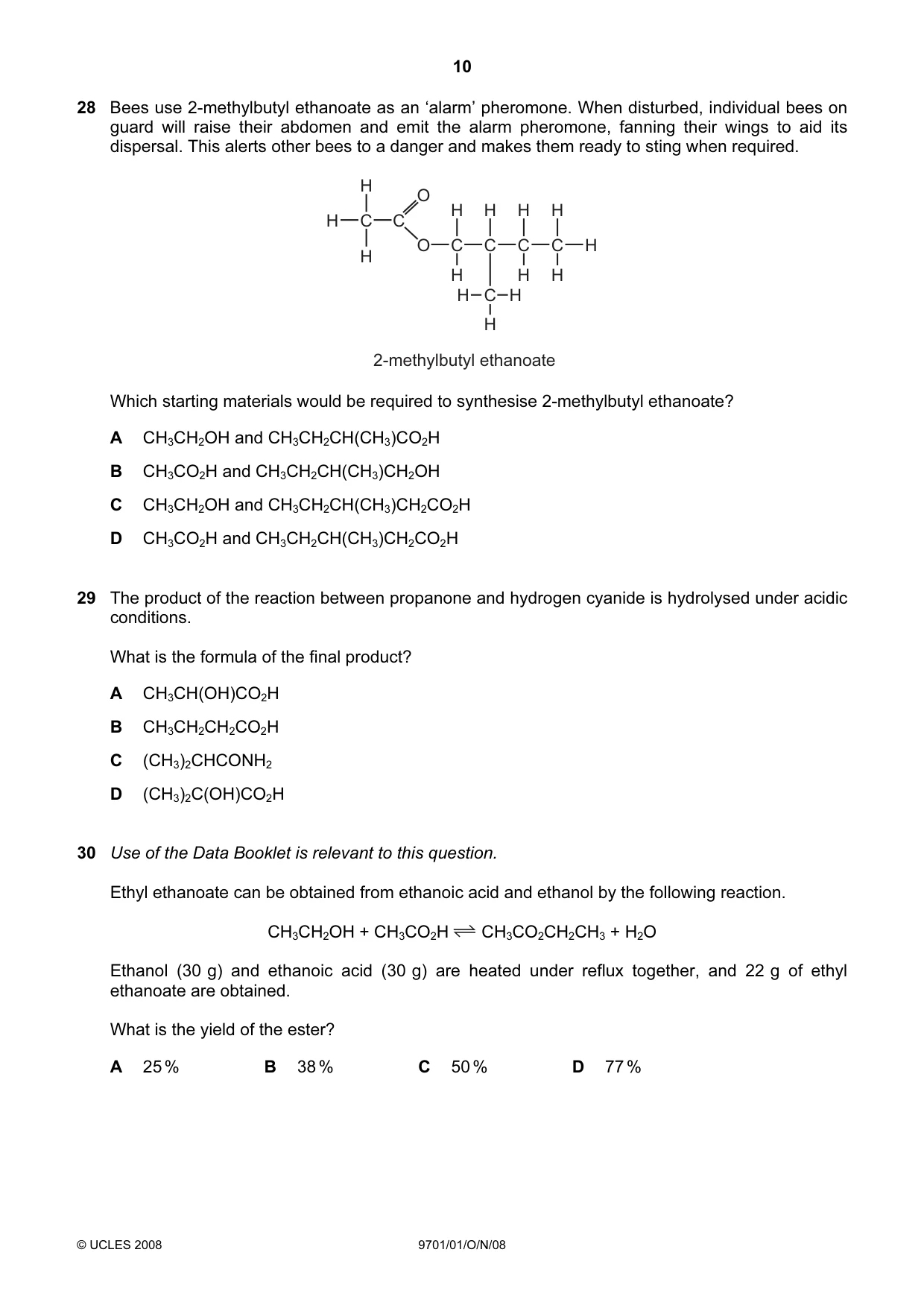
28 Bees use 2-methylbutyl ethanoate as an ‘alarm’ pheromone. When disturbed, individual bees on guard will raise their abdomen and emit the alarm pheromone, fanning their wings to aid its dispersal. This alerts other bees to a danger and makes them ready to sting when required. H O H H H H H C C O C C C C H H H H H H C H H 2-methylbutyl ethanoate Which starting materials would be required to synthesise 2-methylbutyl ethanoate? A CH3CH2OH and CH3CH2CH(CH3)CO2H B CH3CO2H and CH3CH2CH(CH3)CH2OH C CH3CH2OH and CH3CH2CH(CH3)CH2CO2H D CH3CO2H and CH3CH2CH(CH3)CH2CO2H
Mark scheme: B
Q29 · The product of the reaction between propanone and hydrogen cyanide is hydrolysed under…
29 The product of the reaction between propanone and hydrogen cyanide is hydrolysed under acidic conditions. What is the formula of the final product? A CH3CH(OH)CO2H B CH3CH2CH2CO2H C (CH3)2CHCONH2 D (CH3)2C(OH)CO2H
Mark scheme: D
Q30 · Use of the Data Booklet is relevant to this question
30 Use of the Data Booklet is relevant to this question. Ethyl ethanoate can be obtained from ethanoic acid and ethanol by the following reaction. CH3CH2OH + CH3CO2H CH3CO2CH2CH3 + H2O Ethanol (30 g) and ethanoic acid (30 g) are heated under reflux together, and 22 g of ethyl ethanoate are obtained. What is the yield of the ester? A 25 % B 38 % C 50 % D 77 %
Mark scheme: C
More questions on Reacting masses and volumes (of solutions and gases)
Q31 · Kevlar has the structure below
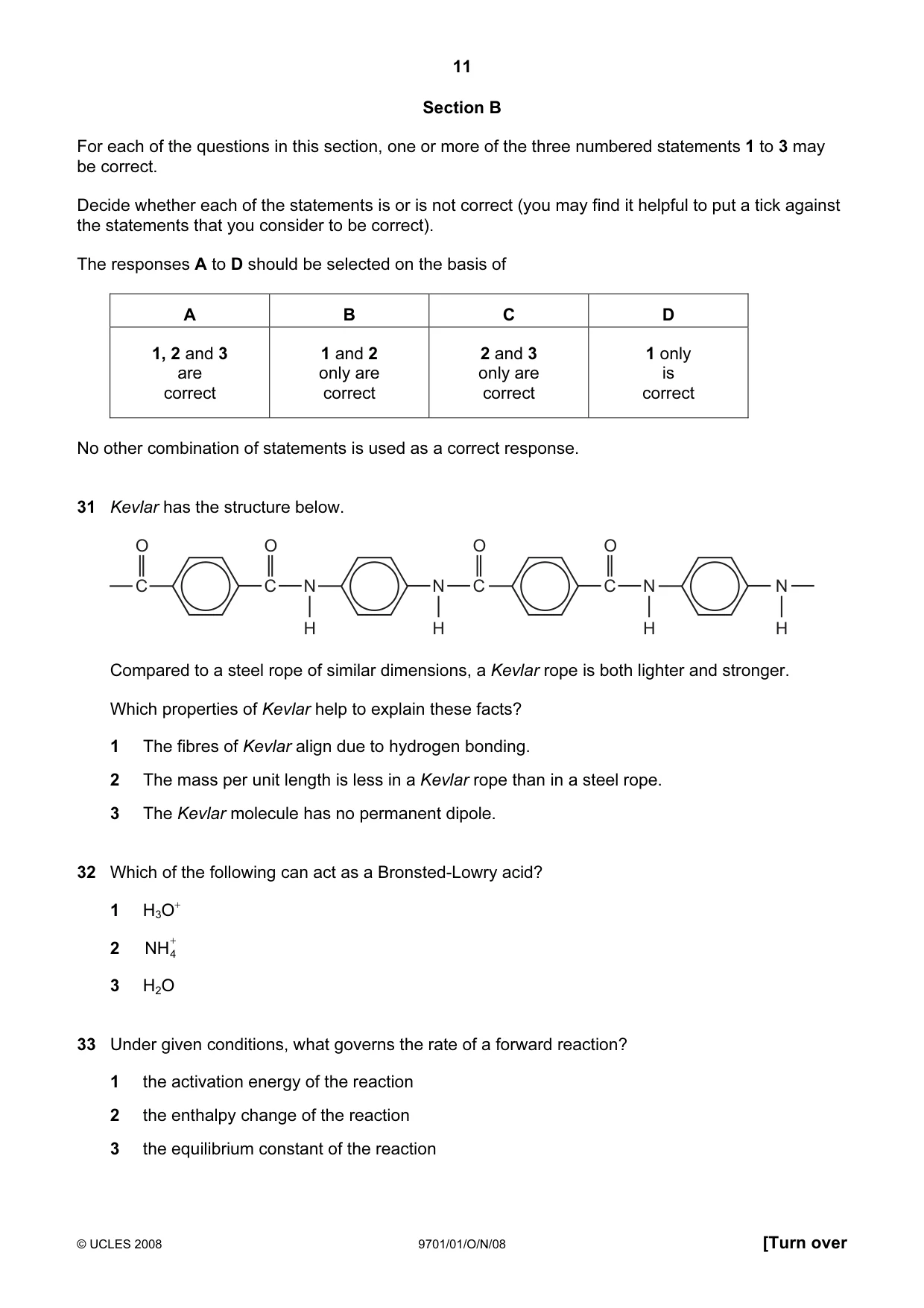
31 Kevlar has the structure below. O O O O C C N N C C N N H H H H Compared to a steel rope of similar dimensions, a Kevlar rope is both lighter and stronger. Which properties of Kevlar help to explain these facts? 1 The fibres of Kevlar align due to hydrogen bonding. 2 The mass per unit length is less in a Kevlar rope than in a steel rope. 3 The Kevlar molecule has no permanent dipole.
Mark scheme: B
Q32 · Which of the following can act as a Bronsted-Lowry acid?
32 Which of the following can act as a Bronsted-Lowry acid? 1 H3O+ 2 NH + 4 3 H2O
Mark scheme: A
Q33 · Under given conditions, what governs the rate of a forward reaction?
33 Under given conditions, what governs the rate of a forward reaction? 1 the activation energy of the reaction 2 the enthalpy change of the reaction 3 the equilibrium constant of the reaction
Mark scheme: D
More questions on Effect of temperature on reaction rates and the concept of activation energy
Q34 · Which statements concerning the Group II elements magnesium, calcium and barium are…
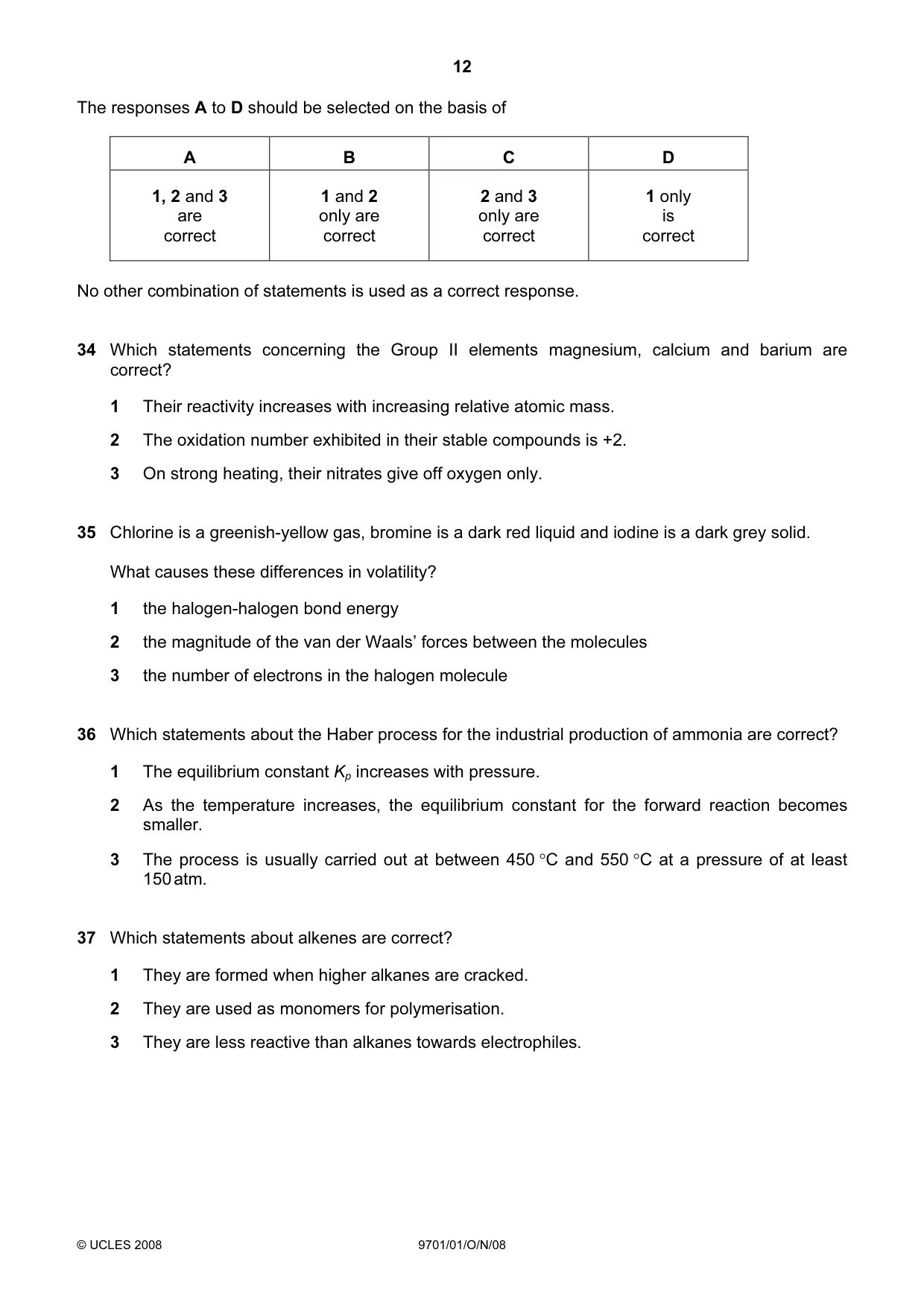
34 Which statements concerning the Group II elements magnesium, calcium and barium are correct? 1 Their reactivity increases with increasing relative atomic mass. 2 The oxidation number exhibited in their stable compounds is +2. 3 On strong heating, their nitrates give off oxygen only.
Mark scheme: B
Q35 · Chlorine is a greenish-yellow gas, bromine is a dark red liquid and iodine is a dark grey…
35 Chlorine is a greenish-yellow gas, bromine is a dark red liquid and iodine is a dark grey solid. What causes these differences in volatility? 1 the halogen-halogen bond energy 2 the magnitude of the van der Waals’ forces between the molecules 3 the number of electrons in the halogen molecule
Mark scheme: C
More questions on Physical properties of the Group 17 elements
Q36 · Which statements about the Haber process for the industrial production of ammonia are…
36 Which statements about the Haber process for the industrial production of ammonia are correct? 1 The equilibrium constant Kp increases with pressure. 2 As the temperature increases, the equilibrium constant for the forward reaction becomes smaller. 3 The process is usually carried out at between 450 °C and 550 °C at a pressure of at least 150 atm.
Mark scheme: C
More questions on Chemical equilibria: reversible reactions, dynamic equilibrium
Q37 · Which statements about alkenes are correct?
37 Which statements about alkenes are correct? 1 They are formed when higher alkanes are cracked. 2 They are used as monomers for polymerisation. 3 They are less reactive than alkanes towards electrophiles.
Mark scheme: B
Q38 · Which of the following would be suitable for use in a fire extinguisher?
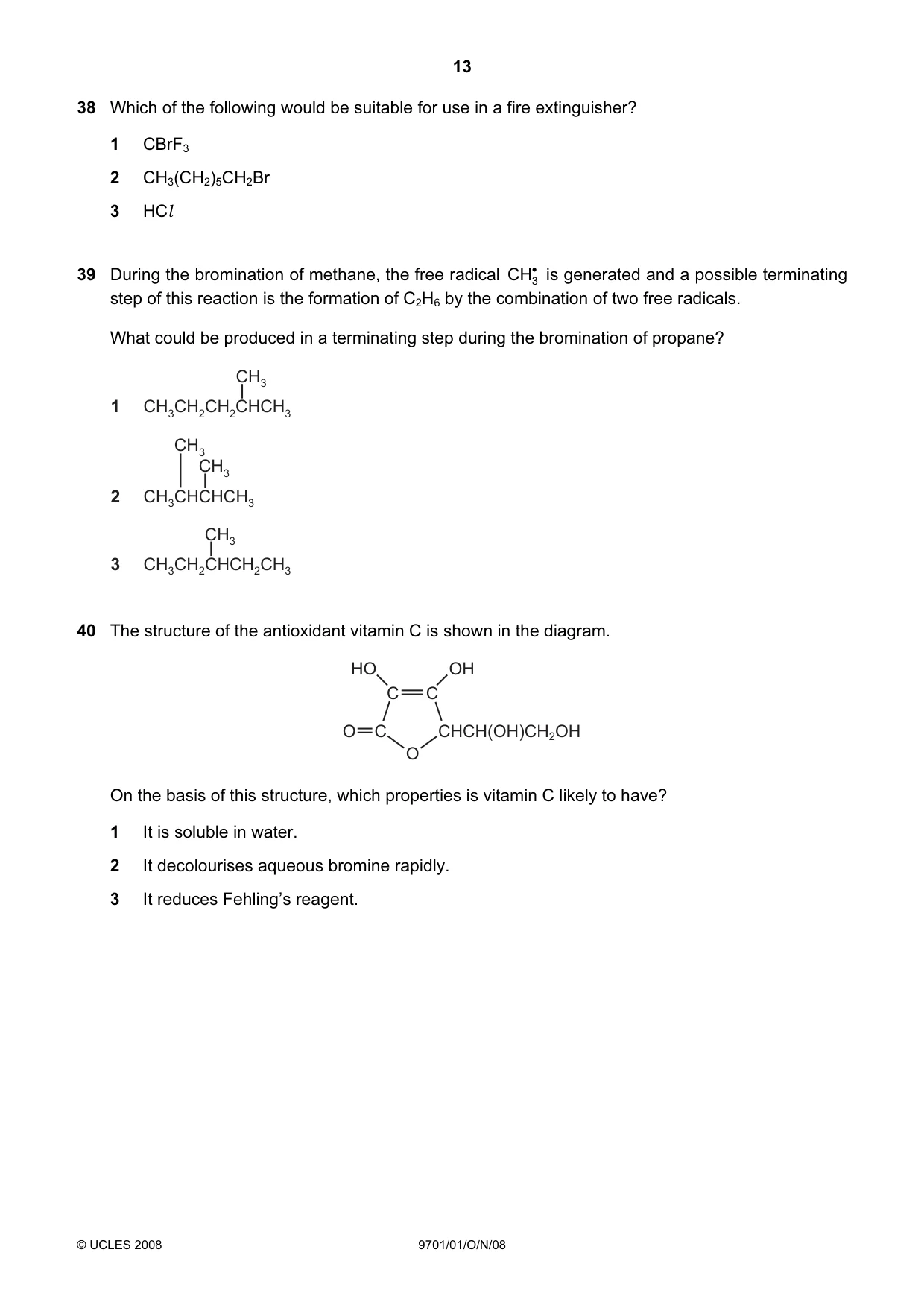
38 Which of the following would be suitable for use in a fire extinguisher? 1 CBrF3 2 CH3(CH2)5CH2Br 3 HCl
Mark scheme: D
Q39 · During the bromination of methane, the free radical CH is generated and a possible…
39 During the bromination of methane, the free radical CH is generated and a possible terminating • 3 step of this reaction is the formation of C2H6 by the combination of two free radicals. What could be produced in a terminating step during the bromination of propane? CH3 1 CH3CH2CH2CHCH3 CH3 CH3 2 CH3CHCHCH3 CH3 3 CH3CH2CHCH2CH3
Mark scheme: B
Q40 · The structure of the antioxidant vitamin C is shown in the diagram
40 The structure of the antioxidant vitamin C is shown in the diagram. HO OH C C O C CHCH(OH)CH2OH O On the basis of this structure, which properties is vitamin C likely to have? 1 It is soluble in water. 2 It decolourises aqueous bromine rapidly. 3 It reduces Fehling’s reagent.
Mark scheme: B
What was in this paper
The subtopics covered by these 40 questions, and how many questions each got. Open one in a new tab to see every Cambridge question on it.
3Chemical equilibria: reversible reactions, dynamic equilibrium3Reacting masses and volumes (of solutions and gases)3Alcohols2Effect of temperature on reaction rates and the concept of activation energy2Halogenoalkanes2Isomerism: structural isomerism and stereoisomerism2Similarities and trends in the properties of the Group 2 metals, magnesium to barium, and their compounds2Aldehydes and ketones1Alkanes1Alkenes1Bonding and structure1Brønsted–Lowry theory of acids and bases1Condensation polymerisation1Covalent bonding and coordinate (dative covalent) bonding1Electrons, energy levels and atomic orbitals1Esters1Halogen compounds1Hess’s law1Homogeneous and heterogeneous catalysts1Intermolecular forces, electronegativity and bond properties1Nitriles and hydroxynitriles1Nitrogen and sulfur1Organic synthesis1Particles in the atom and atomic radius1Periodicity of chemical properties of the elements in Period 31Physical properties of the Group 17 elements1Some reactions of the halide ions1The gaseous state: ideal and real gases and pV = nRT1What you needed in this session
Cambridge’s own grade thresholds for 2008 Oct/Nov, Paper 1 · Variant 1. A higher threshold means an easier paper — the bar moves with how the cohort did.