Cambridge A Level Chemistry 9701 — 2007 Oct/Nov Paper 1 · Variant 1
9701/11/O/N/07 · 40 questions · 40 marks · ≈45 min
The question paper and its mark scheme, free to read here and free to download. This is Cambridge’s own paper, exactly as it was sat.
Question paper16 pages

Mark scheme2 pages
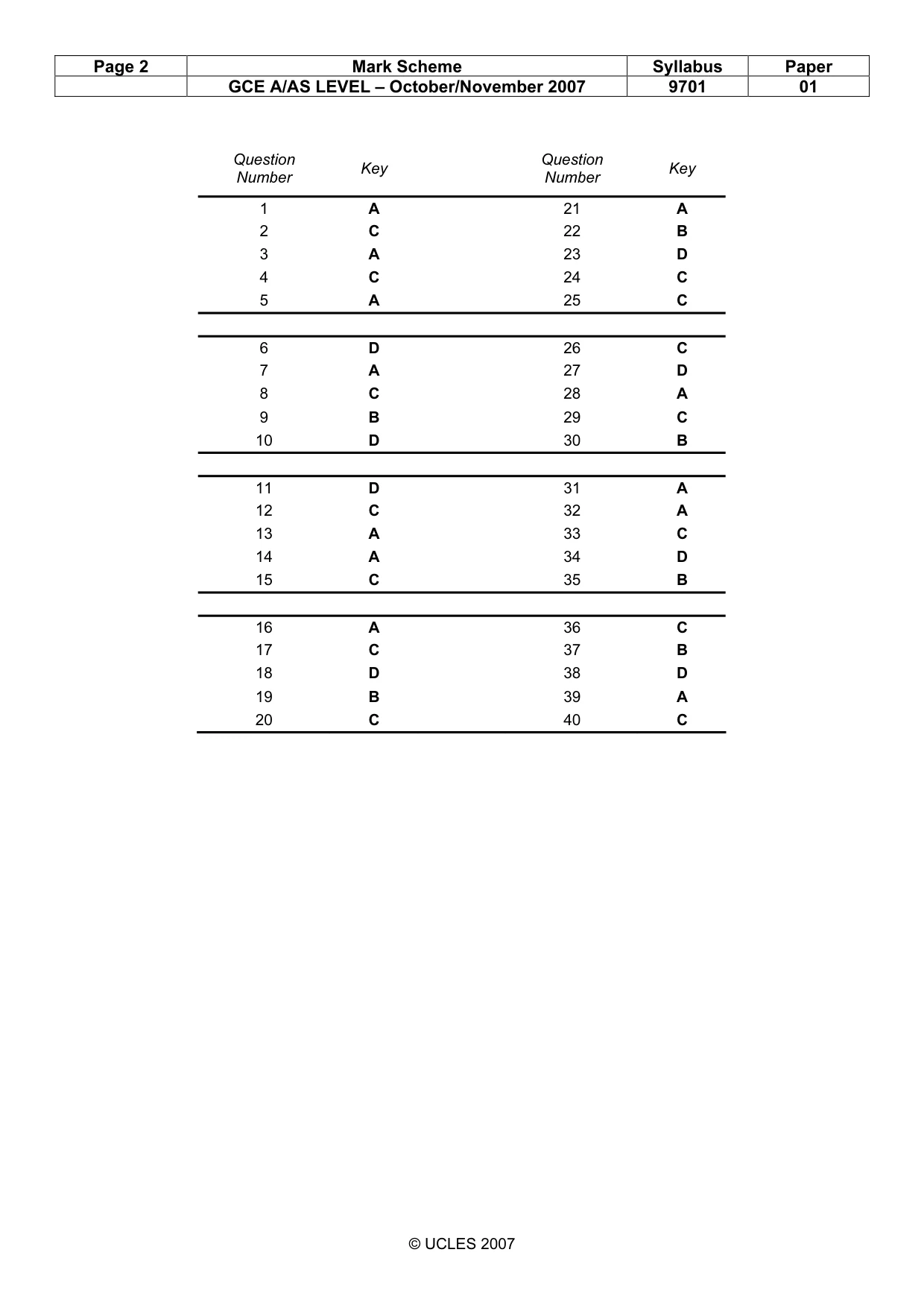
Answers below. Sit the paper first if you are practising.
Questions as text
Q1 · Use of the Data Booklet is relevant to this question
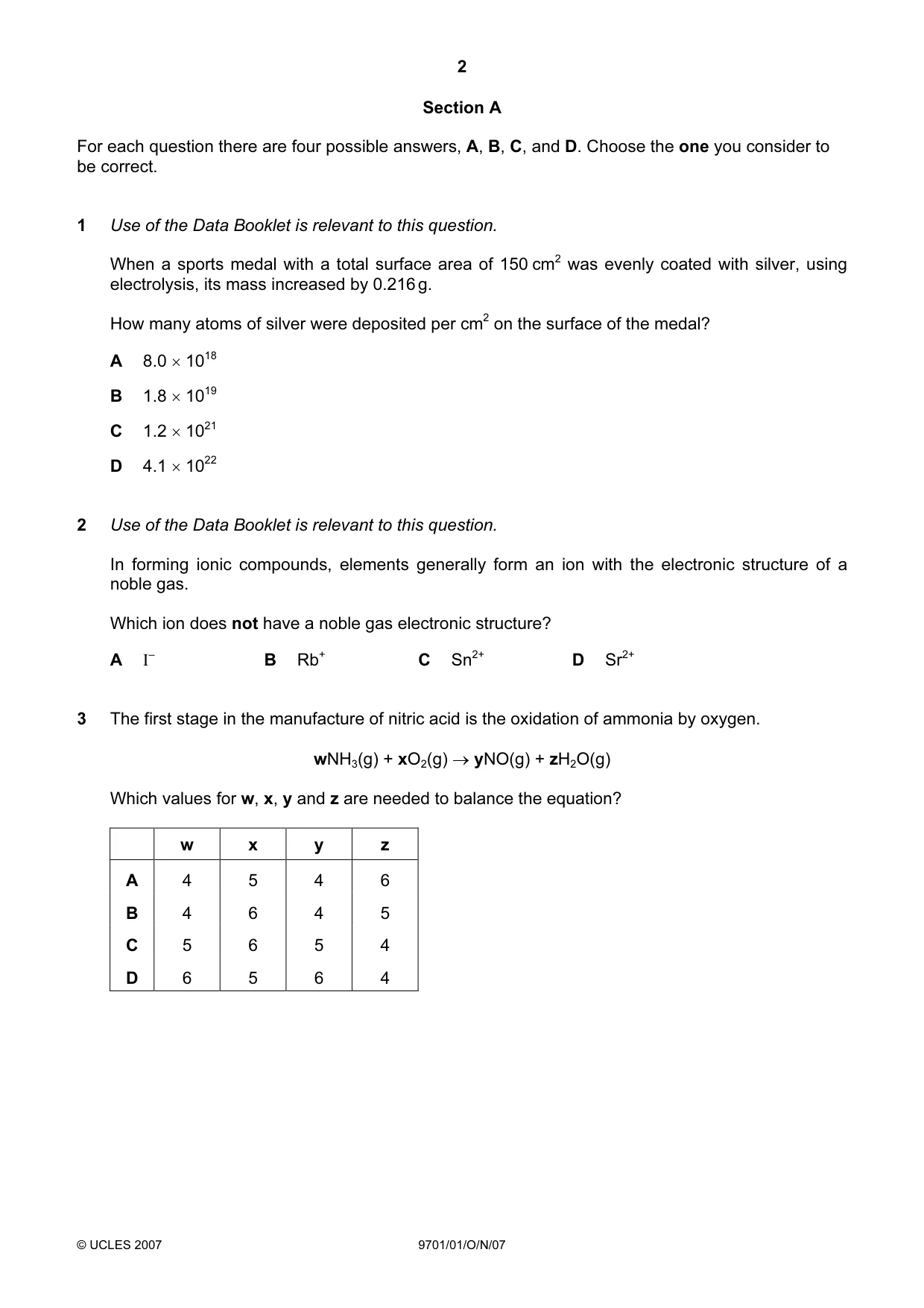
1 Use of the Data Booklet is relevant to this question. When a sports medal with a total surface area of 150 cm2 was evenly coated with silver, using electrolysis, its mass increased by 0.216 g. How many atoms of silver were deposited per cm2 on the surface of the medal? A 8.0 × 10¹⁸ B 1.8 × 10¹⁹ C 1.2 × 10²¹ D 4.1 × 10²²
Mark scheme: A
Q2 · Use of the Data Booklet is relevant to this question
2 Use of the Data Booklet is relevant to this question. In forming ionic compounds, elements generally form an ion with the electronic structure of a noble gas. Which ion does not have a noble gas electronic structure? A I– B Rb+ C Sn2+ D Sr2+
Mark scheme: C
Q3 · The first stage in the manufacture of nitric acid is the oxidation of ammonia by oxygen
3 The first stage in the manufacture of nitric acid is the oxidation of ammonia by oxygen. wNH3(g) + xO2(g) → yNO(g) + zH2O(g) Which values for w, x, y and z are needed to balance the equation? w x y z A 4 5 4 6 B 4 6 4 5 C 5 6 5 4 D 6 5 6 4
Mark scheme: A
More questions on Reacting masses and volumes (of solutions and gases)
Q4 · The graph shows the first thirteen ionisation energies for element X
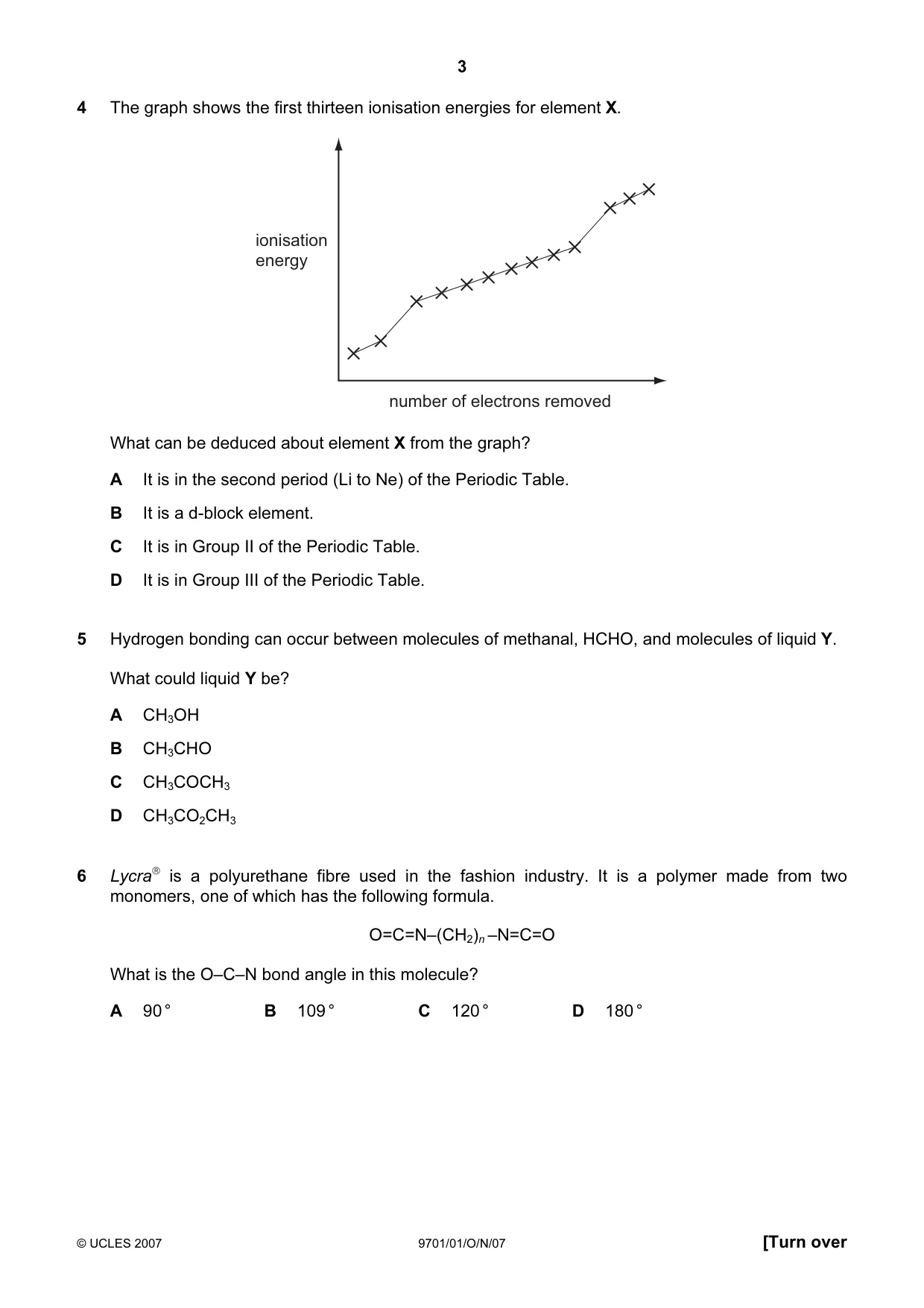
4 The graph shows the first thirteen ionisation energies for element X. ionisation energy number of electrons removed What can be deduced about element X from the graph? A It is in the second period (Li to Ne) of the Periodic Table. B It is a d-block element. C It is in Group II of the Periodic Table. D It is in Group III of the Periodic Table.
Mark scheme: C
Q5 · Hydrogen bonding can occur between molecules of methanal, HCHO, and molecules of liquid Y
5 Hydrogen bonding can occur between molecules of methanal, HCHO, and molecules of liquid Y. What could liquid Y be? A CH3OH B CH3CHO C CH3COCH3 D CH3CO2CH3
Mark scheme: A
More questions on Intermolecular forces, electronegativity and bond properties
Q6 · Lycra is a polyurethane fibre used in the fashion industry
6 Lycra is a polyurethane fibre used in the fashion industry. It is a polymer made from two monomers, one of which has the following formula. O=C=N–(CH2)n –N=C=O What is the O–C–N bond angle in this molecule? A 90 ° B 109 ° C 120 ° D 180 °
Mark scheme: D
Q7 · What are the lattice structures of solid diamond, iodine and silicon(IV) oxide?
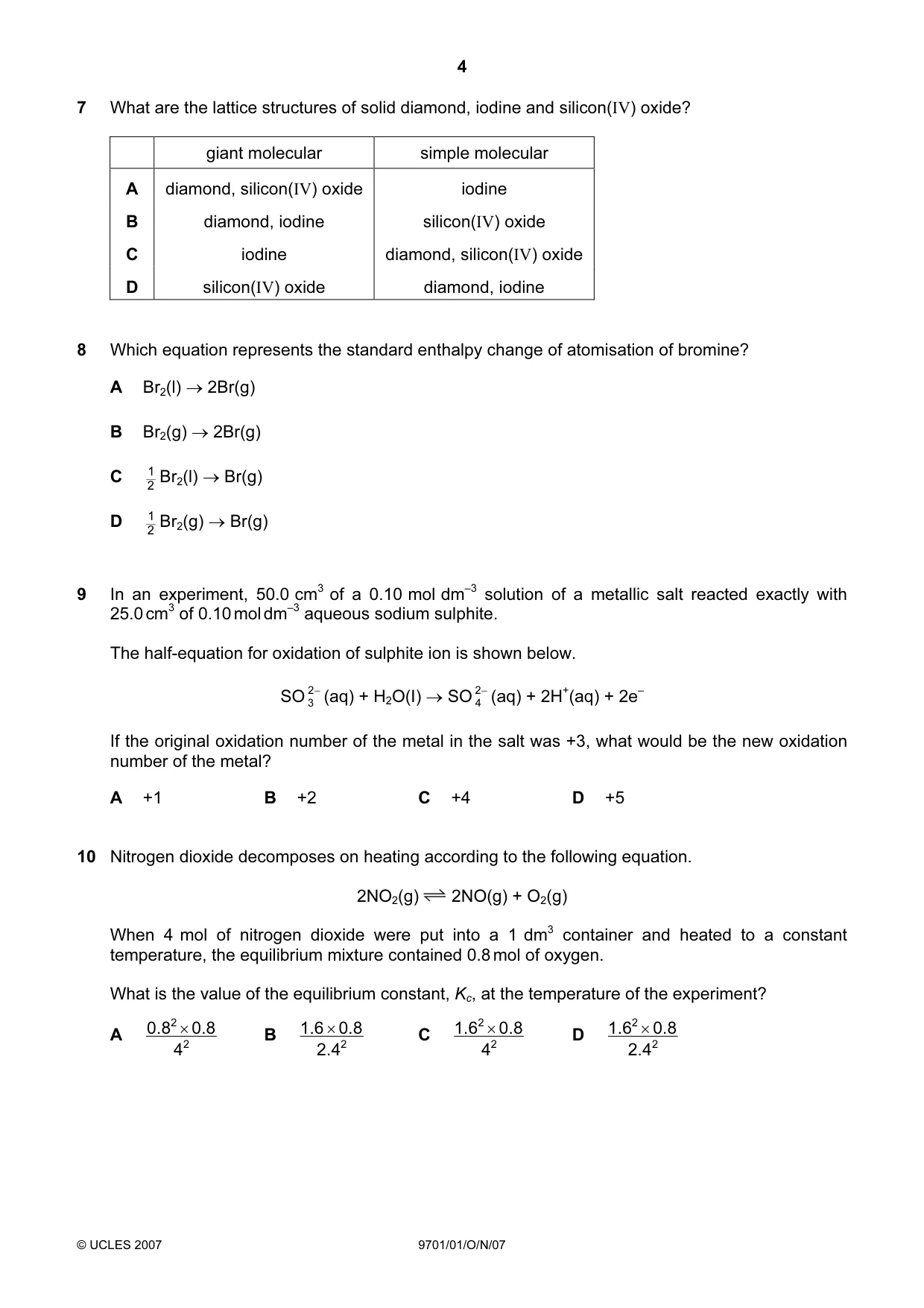
7 What are the lattice structures of solid diamond, iodine and silicon(IV) oxide? giant molecular simple molecular A diamond, silicon(IV) oxide iodine B diamond, iodine silicon(IV) oxide C iodine diamond, silicon(IV) oxide D silicon(IV) oxide diamond, iodine
Mark scheme: A
Q8 · Which equation represents the standard enthalpy change of atomisation of bromine?
8 Which equation represents the standard enthalpy change of atomisation of bromine? A Br2(l) → 2Br(g) B Br2(g) → 2Br(g) C 2 Br2(l) → Br(g) 1 D 2 Br2(g) → Br(g) 1
Mark scheme: C
Q9 · In an experiment, 50.0 cm3 of a 0.10 mol dm–3 solution of a metallic salt reacted exactly…
9 In an experiment, 50.0 cm3 of a 0.10 mol dm–3 solution of a metallic salt reacted exactly with 25.0 cm3 of 0.10 mol dm–3 aqueous sodium sulphite. The half-equation for oxidation of sulphite ion is shown below. SO 3 (aq) + H2O(I) → SO 2 − 2 4 (aq) + 2H+(aq) + 2e– − If the original oxidation number of the metal in the salt was +3, what would be the new oxidation number of the metal? A +1 B +2 C +4 D +5
Mark scheme: B
Q10 · Nitrogen dioxide decomposes on heating according to the following equation
10 Nitrogen dioxide decomposes on heating according to the following equation. 2NO2(g) 2NO(g) + O2(g) When 4 mol of nitrogen dioxide were put into a 1 dm3 container and heated to a constant temperature, the equilibrium mixture contained 0.8 mol of oxygen. What is the value of the equilibrium constant, Kc, at the temperature of the experiment? 0 . 8 2 × 0 . 8 1 . 6 × 0 . 8 1 . 6 2 × 0 . 8 1 . 6 2 × 0 . 8 A B C D 4 2 2 . 4 2 4 2 2 . 4 2
Mark scheme: D
More questions on Chemical equilibria: reversible reactions, dynamic equilibrium
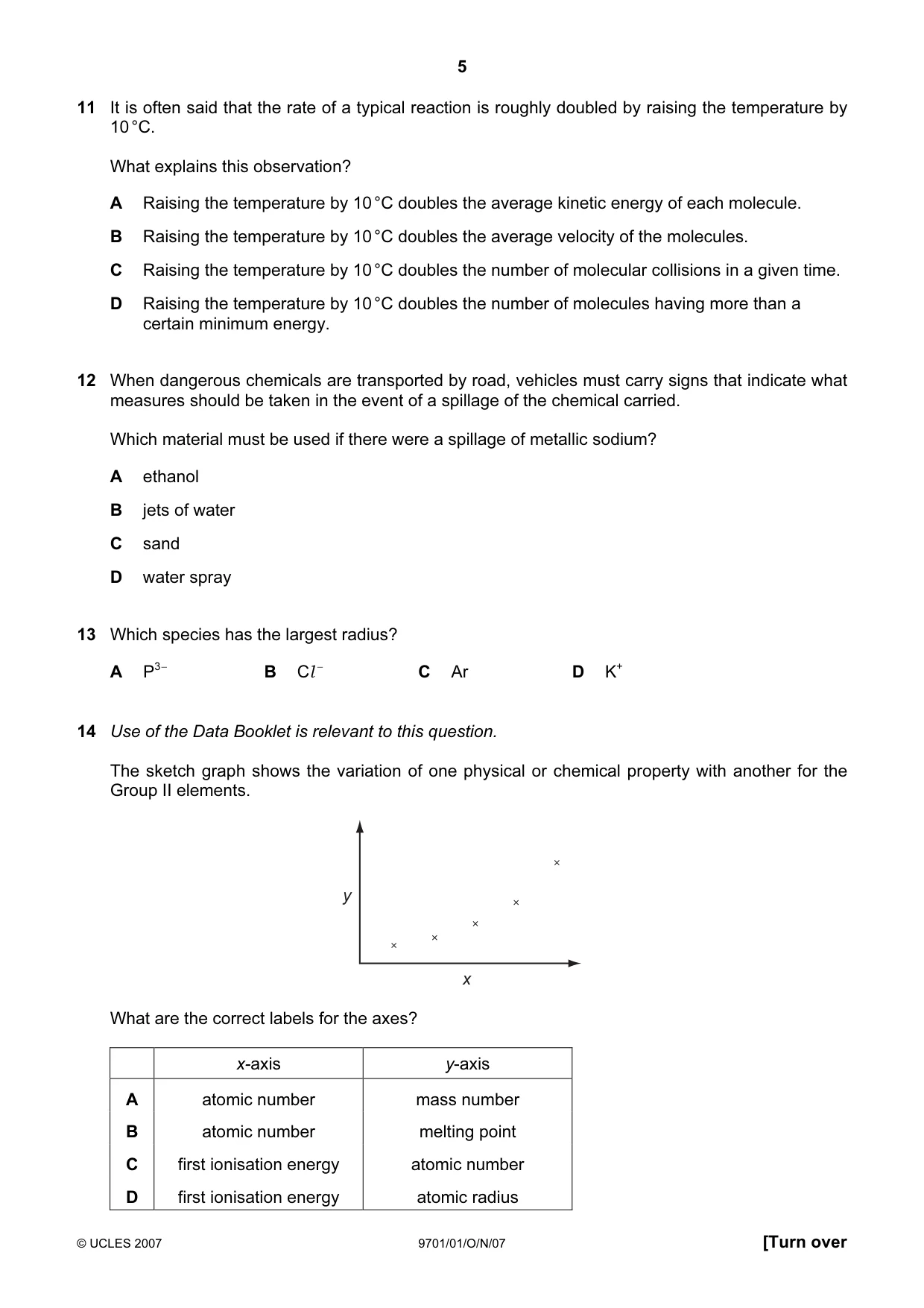
Q11 · It is often said that the rate of a typical reaction is roughly doubled by raising the…
11 It is often said that the rate of a typical reaction is roughly doubled by raising the temperature by 10 °C. What explains this observation? A Raising the temperature by 10 °C doubles the average kinetic energy of each molecule. B Raising the temperature by 10 °C doubles the average velocity of the molecules. C Raising the temperature by 10 °C doubles the number of molecular collisions in a given time. D Raising the temperature by 10 °C doubles the number of molecules having more than a certain minimum energy.
Mark scheme: D
More questions on Effect of temperature on reaction rates and the concept of activation energy
Q12 · When dangerous chemicals are transported by road, vehicles must carry signs that indicate…
12 When dangerous chemicals are transported by road, vehicles must carry signs that indicate what measures should be taken in the event of a spillage of the chemical carried. Which material must be used if there were a spillage of metallic sodium? A ethanol B jets of water C sand D water spray
Mark scheme: C
Q13 · Which species has the largest radius?
13 Which species has the largest radius? A P3 − B Cl − C Ar D K+
Mark scheme: A
Q14 · Use of the Data Booklet is relevant to this question
14 Use of the Data Booklet is relevant to this question. The sketch graph shows the variation of one physical or chemical property with another for the Group II elements. y x What are the correct labels for the axes? x-axis y-axis A atomic number mass number B atomic number melting point C first ionisation energy atomic number D first ionisation energy atomic radius
Mark scheme: A
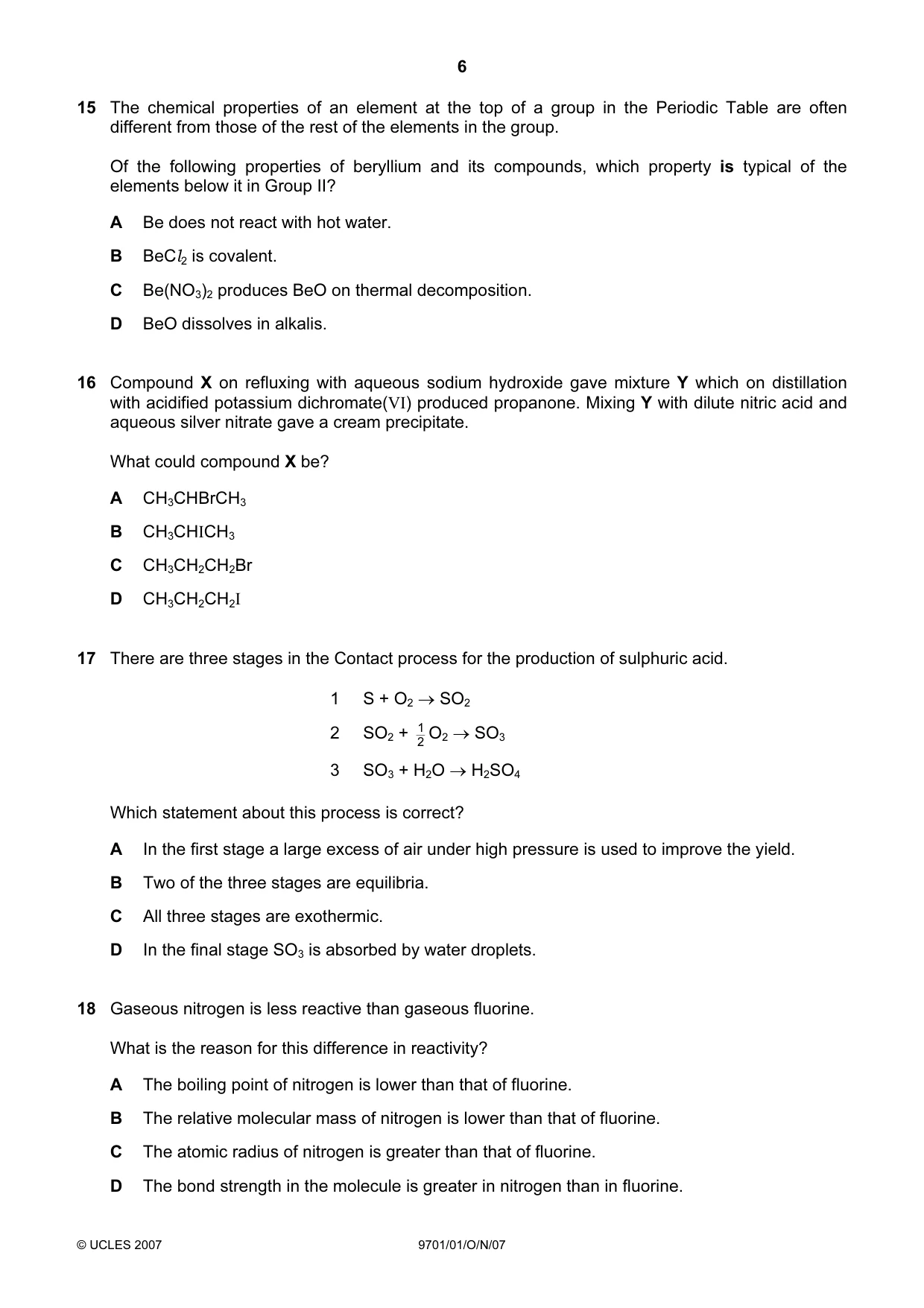
Q15 · The chemical properties of an element at the top of a group in the Periodic Table are…
15 The chemical properties of an element at the top of a group in the Periodic Table are often different from those of the rest of the elements in the group. Of the following properties of beryllium and its compounds, which property is typical of the elements below it in Group II? A Be does not react with hot water. B BeCl2 is covalent. C Be(NO3)2 produces BeO on thermal decomposition. D BeO dissolves in alkalis.
Mark scheme: C
Q16 · Compound X on refluxing with aqueous sodium hydroxide gave mixture Y which on…
16 Compound X on refluxing with aqueous sodium hydroxide gave mixture Y which on distillation with acidified potassium dichromate(VI) produced propanone. Mixing Y with dilute nitric acid and aqueous silver nitrate gave a cream precipitate. What could compound X be? A CH3CHBrCH3 B CH3CHICH3 C CH3CH2CH2Br D CH3CH2CH2I
Mark scheme: A
Q17 · There are three stages in the Contact process for the production of sulphuric acid
17 There are three stages in the Contact process for the production of sulphuric acid. 1 S + O2 → SO2 2 SO2 + 1 2 O2 → SO3 3 SO3 + H2O → H2SO4 Which statement about this process is correct? A In the first stage a large excess of air under high pressure is used to improve the yield. B Two of the three stages are equilibria. C All three stages are exothermic. D In the final stage SO3 is absorbed by water droplets.
Mark scheme: C
Q18 · Gaseous nitrogen is less reactive than gaseous fluorine
18 Gaseous nitrogen is less reactive than gaseous fluorine. What is the reason for this difference in reactivity? A The boiling point of nitrogen is lower than that of fluorine. B The relative molecular mass of nitrogen is lower than that of fluorine. C The atomic radius of nitrogen is greater than that of fluorine. D The bond strength in the molecule is greater in nitrogen than in fluorine.
Mark scheme: D
More questions on Intermolecular forces, electronegativity and bond properties
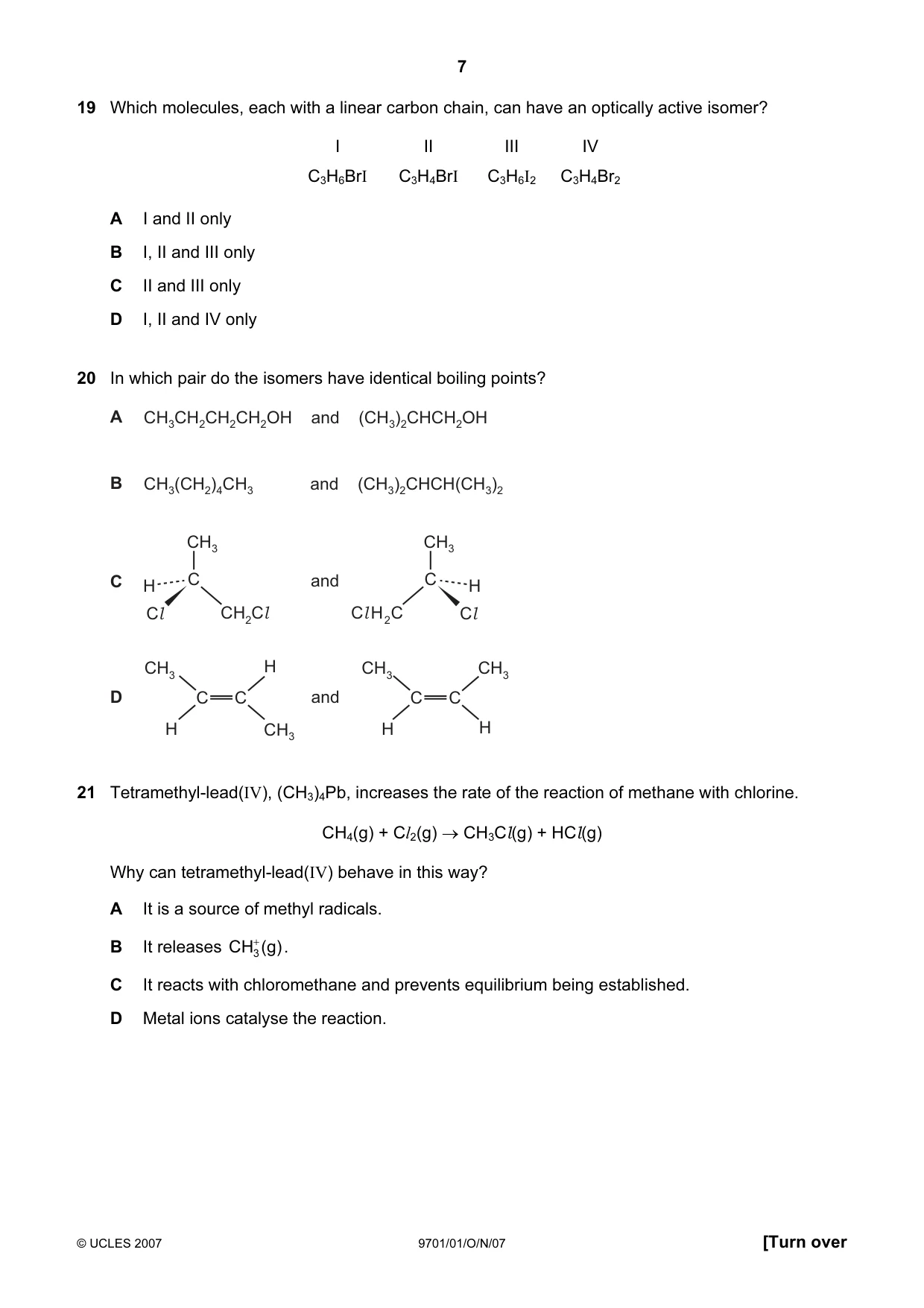
Q19 · Which molecules, each with a linear carbon chain, can have an optically active isomer?
19 Which molecules, each with a linear carbon chain, can have an optically active isomer? I II III IV C3H6BrI C3H4BrI C3H6I2 C3H4Br2 A I and II only B I, II and III only C II and III only D I, II and IV only
Mark scheme: B
More questions on Isomerism: structural isomerism and stereoisomerism
Q20 · In which pair do the isomers have identical boiling points?
20 In which pair do the isomers have identical boiling points? A CH3CH2CH2CH2OH and (CH3)2CHCH2OH B CH3(CH2)4CH3 and (CH3)2CHCH(CH3)2 CH3 CH3 C H C and C H Cl CH2Cl Cl H C Cl 2 CH3 H CH3 CH3 D C C and C C H CH3 H H
Mark scheme: C
More questions on Isomerism: structural isomerism and stereoisomerism
Q21 · Tetramethyl-lead(IV), (CH3)4Pb, increases the rate of the reaction of methane with…
21 Tetramethyl-lead(IV), (CH3)4Pb, increases the rate of the reaction of methane with chlorine. CH4(g) + Cl2(g) → CH3Cl(g) + HCl(g) Why can tetramethyl-lead(IV) behave in this way? A It is a source of methyl radicals. B It releases CH3 + (g) . C It reacts with chloromethane and prevents equilibrium being established. D Metal ions catalyse the reaction.
Mark scheme: A
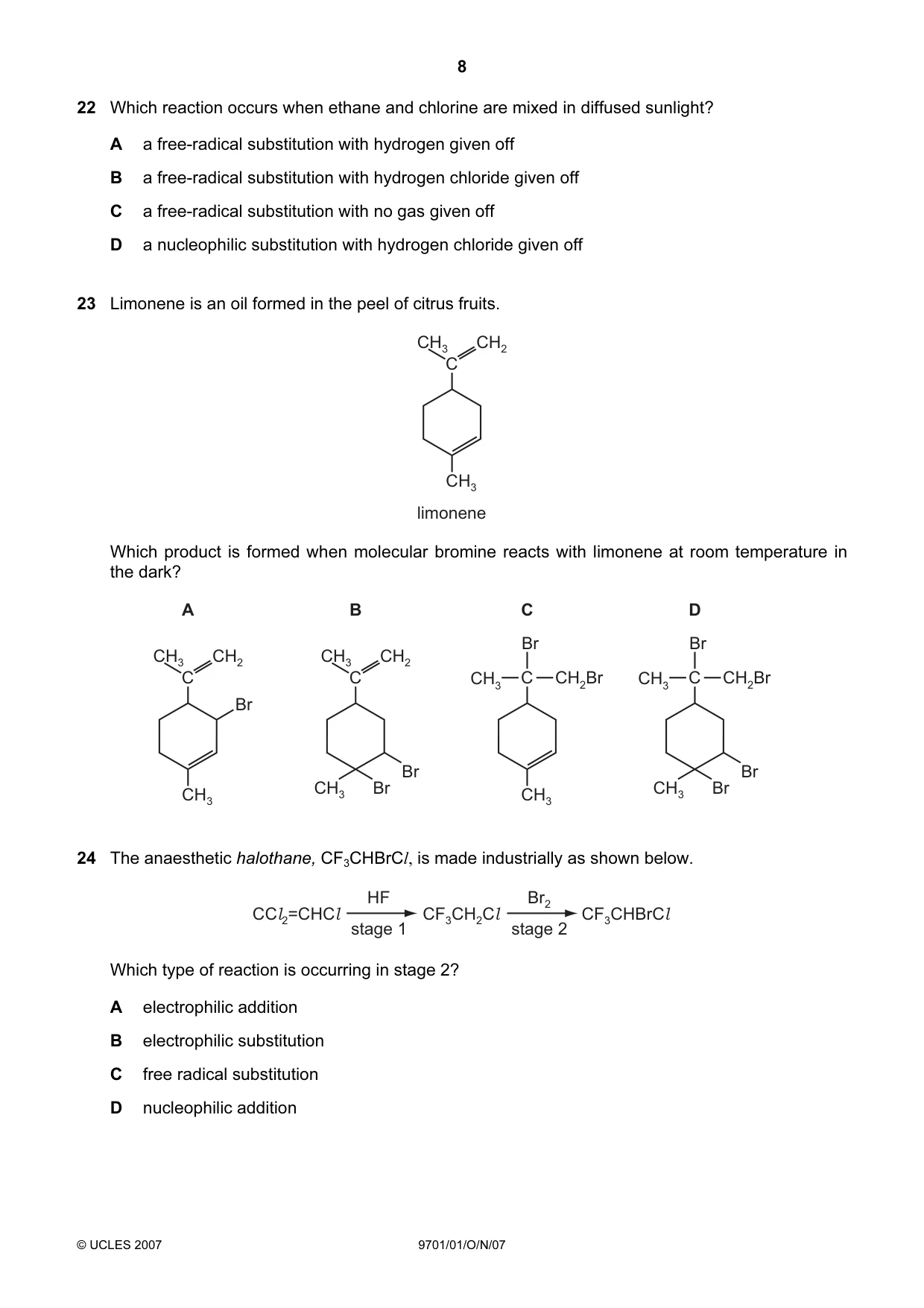
Q22 · Which reaction occurs when ethane and chlorine are mixed in diffused sunlight?
22 Which reaction occurs when ethane and chlorine are mixed in diffused sunlight? A a free-radical substitution with hydrogen given off B a free-radical substitution with hydrogen chloride given off C a free-radical substitution with no gas given off D a nucleophilic substitution with hydrogen chloride given off
Mark scheme: B
Q23 · Limonene is an oil formed in the peel of citrus fruits
23 Limonene is an oil formed in the peel of citrus fruits. CH3 CH2 C CH3 limonene Which product is formed when molecular bromine reacts with limonene at room temperature in the dark? A B C D Br Br CH3 CH2 CH3 CH2 C C CH3 C CH2Br CH3 C CH2Br Br Br Br CH3 CH3 Br CH3 CH3 Br
Mark scheme: D
Q24 · The anaesthetic halothane, CF3CHBrCl, is made industrially as shown below
24 The anaesthetic halothane, CF3CHBrCl, is made industrially as shown below. HF Br2 CCl2=CHCl CF3CH2Cl CF3CHBrCl stage 1 stage 2 Which type of reaction is occurring in stage 2? A electrophilic addition B electrophilic substitution C free radical substitution D nucleophilic addition
Mark scheme: C
Q25 · Chlorofluoroalkanes, CFCs, can be used as refrigerants, aerosol propellants and fire…
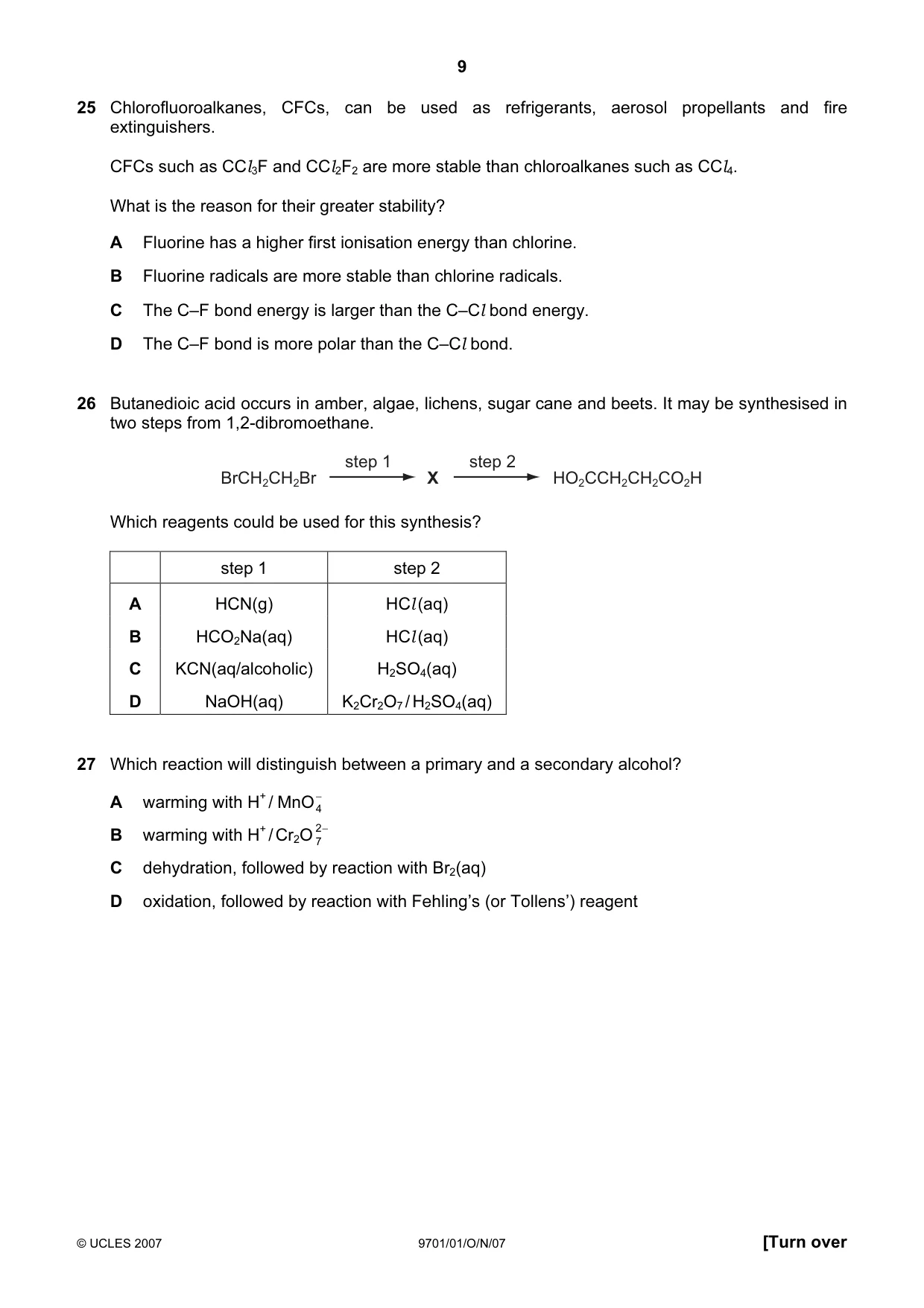
25 Chlorofluoroalkanes, CFCs, can be used as refrigerants, aerosol propellants and fire extinguishers. CFCs such as CCl3F and CCl2F2 are more stable than chloroalkanes such as CCl4. What is the reason for their greater stability? A Fluorine has a higher first ionisation energy than chlorine. B Fluorine radicals are more stable than chlorine radicals. C The C–F bond energy is larger than the C–Cl bond energy. D The C–F bond is more polar than the C–Cl bond.
Mark scheme: C
More questions on Intermolecular forces, electronegativity and bond properties
Q26 · Butanedioic acid occurs in amber, algae, lichens, sugar cane and beets
26 Butanedioic acid occurs in amber, algae, lichens, sugar cane and beets. It may be synthesised in two steps from 1,2-dibromoethane. step 1 step 2 BrCH2CH2Br X HO2CCH2CH2CO2H Which reagents could be used for this synthesis? step 1 step 2 A HCN(g) HCl (aq) B HCO2Na(aq) HCl (aq) C KCN(aq/alcoholic) H2SO4(aq) D NaOH(aq) K2Cr2O7 / H2SO4(aq)
Mark scheme: C
Q27 · Which reaction will distinguish between a primary and a secondary alcohol?
27 Which reaction will distinguish between a primary and a secondary alcohol? A warming with H+ / MnO − 4 B warming with H+ / Cr2O 2 − 7 C dehydration, followed by reaction with Br2(aq) D oxidation, followed by reaction with Fehling’s (or Tollens’) reagent
Mark scheme: D
Q28 · Hept-4-enal is present in cow’s milk
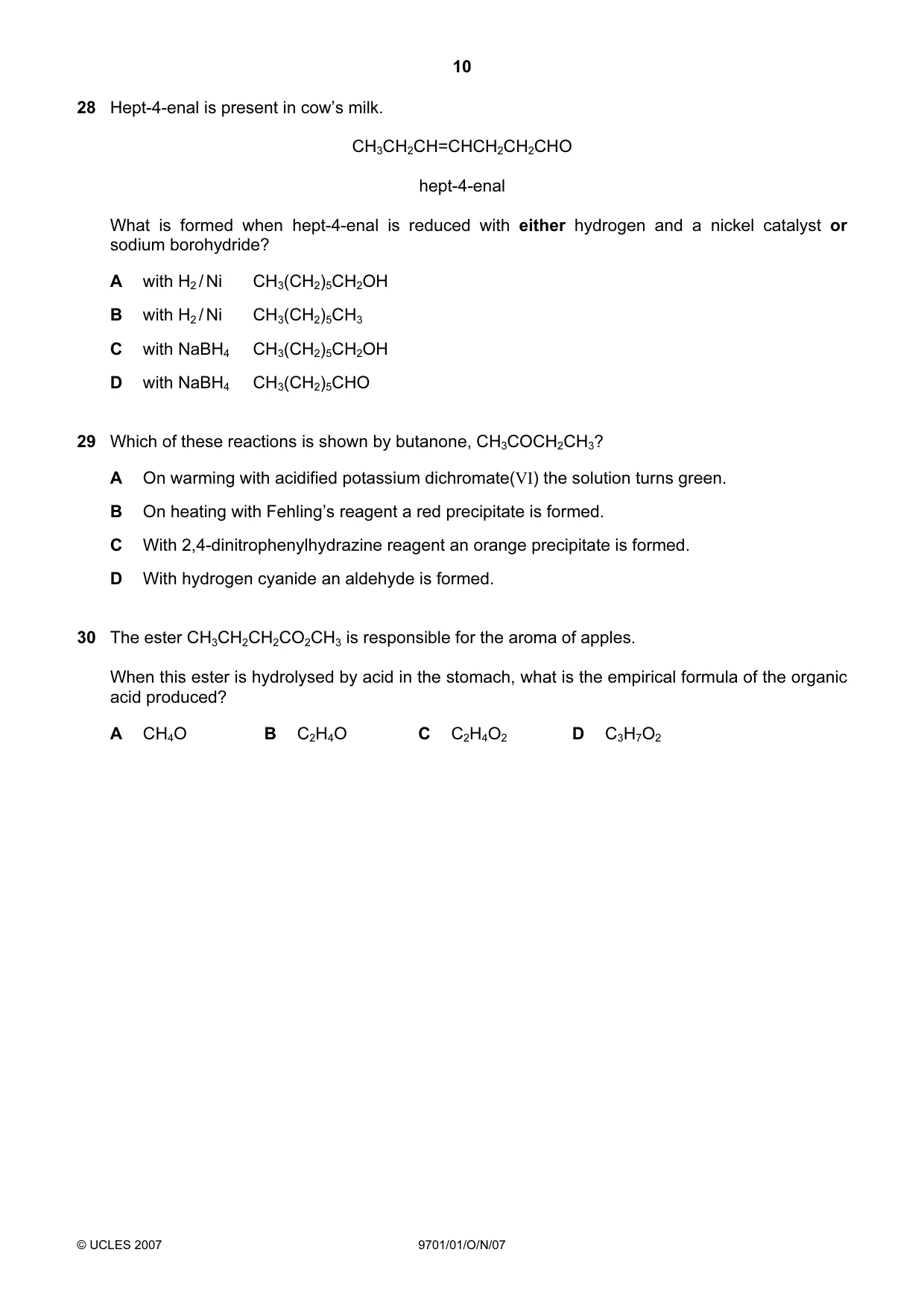
28 Hept-4-enal is present in cow’s milk. CH3CH2CH=CHCH2CH2CHO hept-4-enal What is formed when hept-4-enal is reduced with either hydrogen and a nickel catalyst or sodium borohydride? A with H2 / Ni CH3(CH2)5CH2OH B with H2 / Ni CH3(CH2)5CH3 C with NaBH4 CH3(CH2)5CH2OH D with NaBH4 CH3(CH2)5CHO
Mark scheme: A
Q29 · Which of these reactions is shown by butanone, CH3COCH2CH3?
29 Which of these reactions is shown by butanone, CH3COCH2CH3? A On warming with acidified potassium dichromate(VI) the solution turns green. B On heating with Fehling’s reagent a red precipitate is formed. C With 2,4-dinitrophenylhydrazine reagent an orange precipitate is formed. D With hydrogen cyanide an aldehyde is formed.
Mark scheme: C
Q30 · The ester CH3CH2CH2CO2CH3 is responsible for the aroma of apples
30 The ester CH3CH2CH2CO2CH3 is responsible for the aroma of apples. When this ester is hydrolysed by acid in the stomach, what is the empirical formula of the organic acid produced? A CH4O B C2H4O C C2H4O2 D C3H7O2
Mark scheme: B
Q31 · What are assumptions of the kinetic theory of gases and hence of the ideal gas equation…
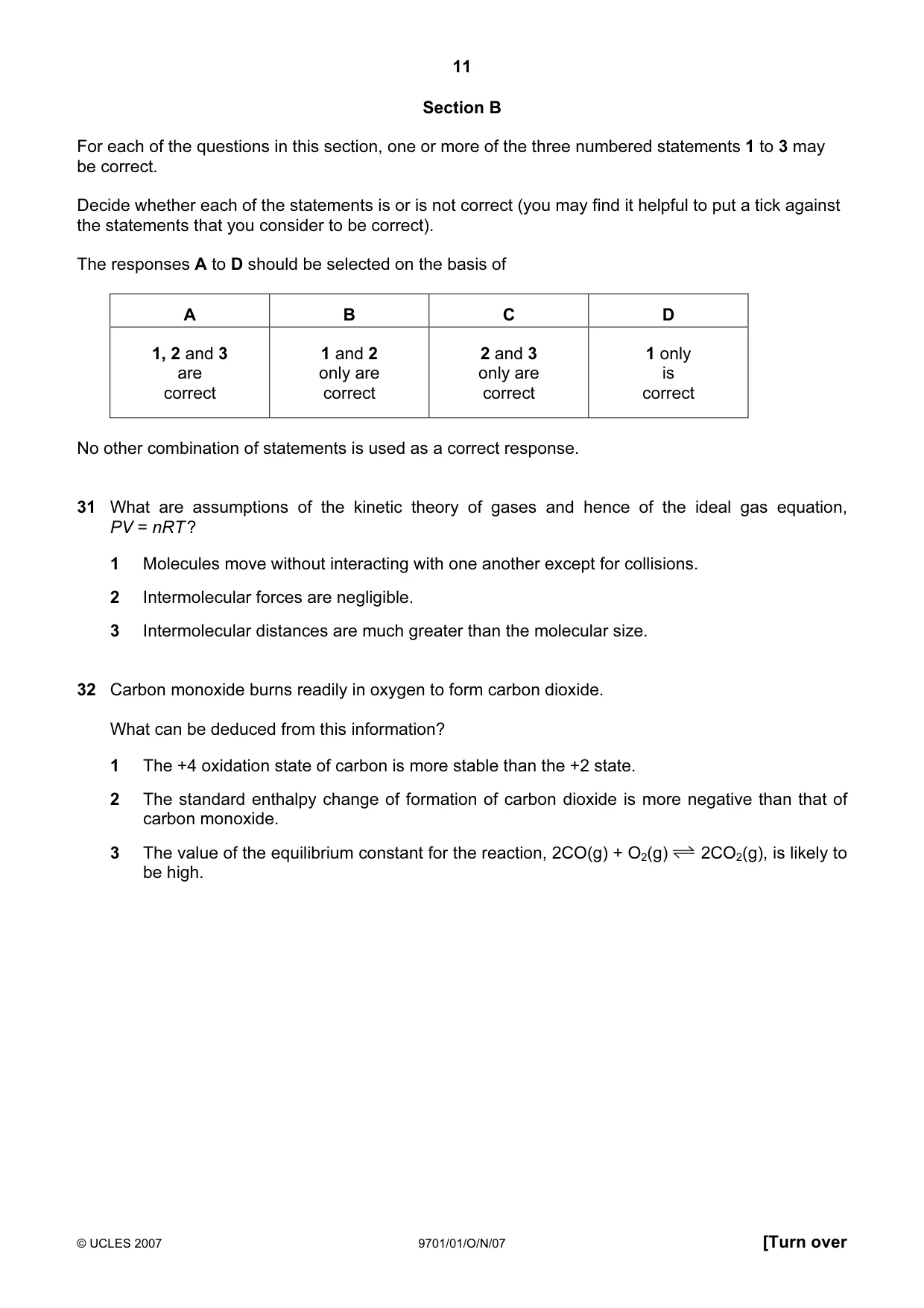
31 What are assumptions of the kinetic theory of gases and hence of the ideal gas equation, PV = nRT ? 1 Molecules move without interacting with one another except for collisions. 2 Intermolecular forces are negligible. 3 Intermolecular distances are much greater than the molecular size.
Mark scheme: A
More questions on The gaseous state: ideal and real gases and pV = nRT
Q32 · Carbon monoxide burns readily in oxygen to form carbon dioxide
32 Carbon monoxide burns readily in oxygen to form carbon dioxide. What can be deduced from this information? 1 The +4 oxidation state of carbon is more stable than the +2 state. 2 The standard enthalpy change of formation of carbon dioxide is more negative than that of carbon monoxide. 3 The value of the equilibrium constant for the reaction, 2CO(g) + O2(g) 2CO2(g), is likely to be high.
Mark scheme: A
Q33 · Phosphorus pentachloride is introduced into an empty gas syringe which has a movable…
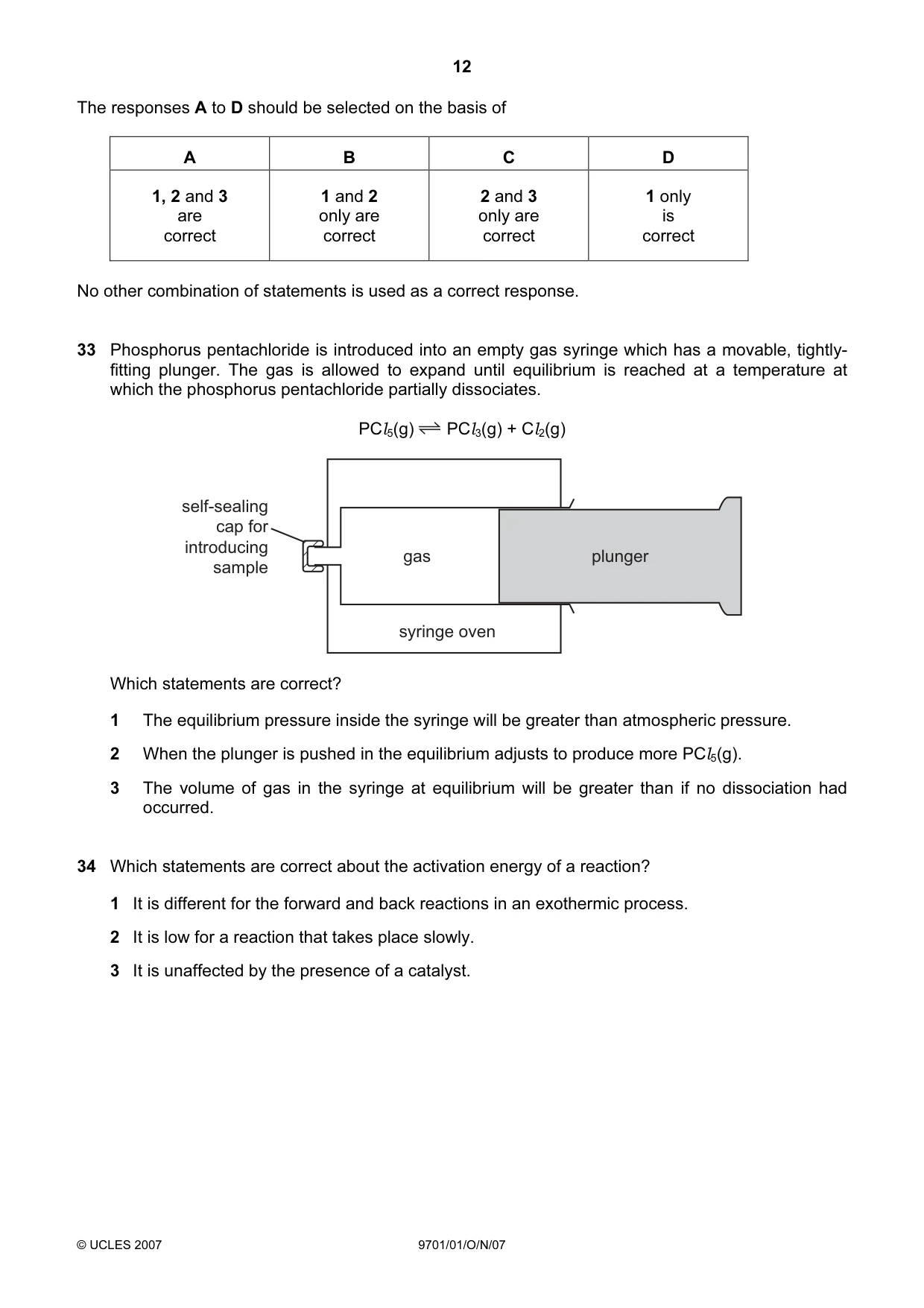
33 Phosphorus pentachloride is introduced into an empty gas syringe which has a movable, tightly- fitting plunger. The gas is allowed to expand until equilibrium is reached at a temperature at which the phosphorus pentachloride partially dissociates. PCl5(g) PCl3(g) + Cl2(g) self-sealing cap for introducing gas plunger sample syringe oven Which statements are correct? 1 The equilibrium pressure inside the syringe will be greater than atmospheric pressure. 2 When the plunger is pushed in the equilibrium adjusts to produce more PCl5(g). 3 The volume of gas in the syringe at equilibrium will be greater than if no dissociation had occurred.
Mark scheme: C
More questions on Chemical equilibria: reversible reactions, dynamic equilibrium
Q34 · Which statements are correct about the activation energy of a reaction?
34 Which statements are correct about the activation energy of a reaction? 1 It is different for the forward and back reactions in an exothermic process. 2 It is low for a reaction that takes place slowly. 3 It is unaffected by the presence of a catalyst.
Mark scheme: D
More questions on Effect of temperature on reaction rates and the concept of activation energy
Q35 · When a firework is lit a fuel and an oxidising agent react
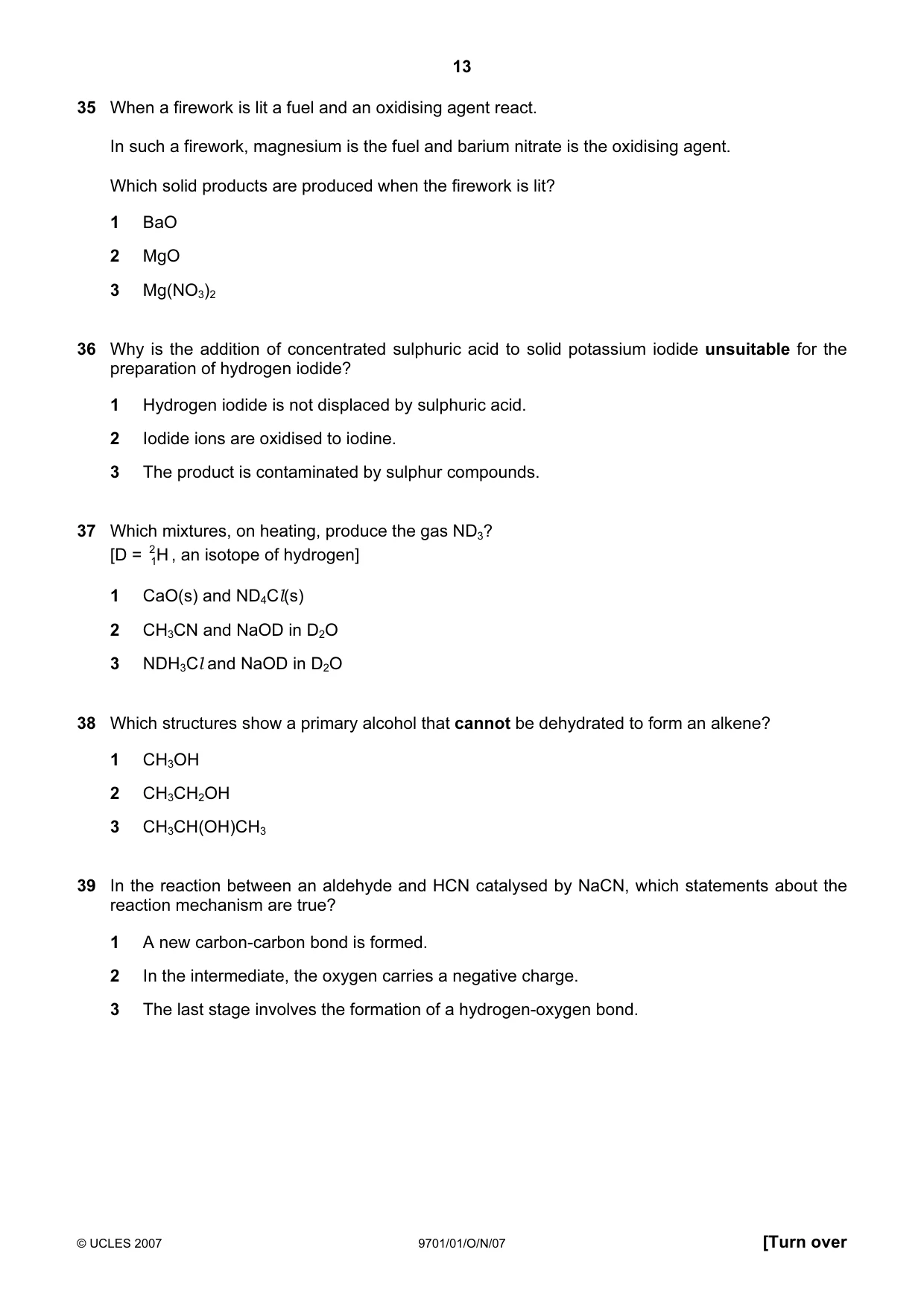
35 When a firework is lit a fuel and an oxidising agent react. In such a firework, magnesium is the fuel and barium nitrate is the oxidising agent. Which solid products are produced when the firework is lit? 1 BaO 2 MgO 3 Mg(NO3)2
Mark scheme: B
Q36 · Why is the addition of concentrated sulphuric acid to solid potassium iodide unsuitable…
36 Why is the addition of concentrated sulphuric acid to solid potassium iodide unsuitable for the preparation of hydrogen iodide? 1 Hydrogen iodide is not displaced by sulphuric acid. 2 Iodide ions are oxidised to iodine. 3 The product is contaminated by sulphur compounds.
Mark scheme: C
Q37 · Which mixtures, on heating, produce the gas ND3?
37 Which mixtures, on heating, produce the gas ND3? [D = H 2 , an isotope of hydrogen] 1 1 CaO(s) and ND4Cl(s) 2 CH3CN and NaOD in D2O 3 NDH3Cl and NaOD in D2O
Mark scheme: B
Q38 · Which structures show a primary alcohol that cannot be dehydrated to form an alkene?
38 Which structures show a primary alcohol that cannot be dehydrated to form an alkene? 1 CH3OH 2 CH3CH2OH 3 CH3CH(OH)CH3
Mark scheme: D
Q39 · In the reaction between an aldehyde and HCN catalysed by NaCN, which statements about the…
39 In the reaction between an aldehyde and HCN catalysed by NaCN, which statements about the reaction mechanism are true? 1 A new carbon-carbon bond is formed. 2 In the intermediate, the oxygen carries a negative charge. 3 The last stage involves the formation of a hydrogen-oxygen bond.
Mark scheme: A
Q40 · Monopotassium citrate is used as an emulsifying agent in powdered milk and in powdered…
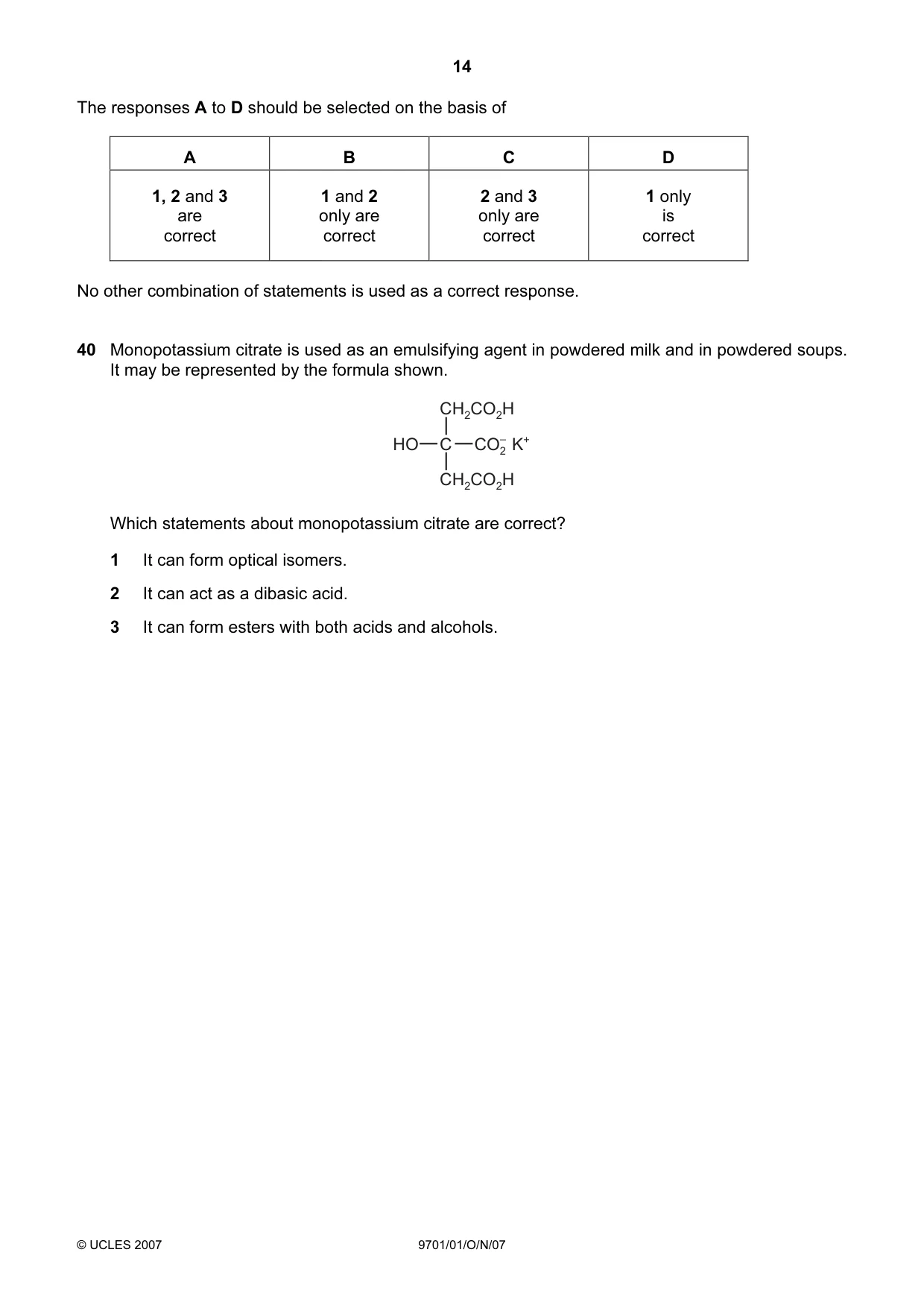
40 Monopotassium citrate is used as an emulsifying agent in powdered milk and in powdered soups. It may be represented by the formula shown. CH2CO2H HO C CO2 K+ – CH2CO2H Which statements about monopotassium citrate are correct? 1 It can form optical isomers. 2 It can act as a dibasic acid. 3 It can form esters with both acids and alcohols.
Mark scheme: C
What was in this paper
The subtopics covered by these 40 questions, and how many questions each got. Open one in a new tab to see every Cambridge question on it.
4Alcohols3Intermolecular forces, electronegativity and bond properties3Alkanes2Chemical equilibria: reversible reactions, dynamic equilibrium2Effect of temperature on reaction rates and the concept of activation energy2Enthalpy change, ΔH2Halogenoalkanes2Isomerism: structural isomerism and stereoisomerism2Nitriles and hydroxynitriles2Aldehydes and ketones1Alkenes1Bonding and structure1Carboxylic acids1Electrolysis1Esters1Ionic bonding1Ionisation energy1Nitrogen and sulfur1Particles in the atom and atomic radius1Primary amines1Reacting masses and volumes (of solutions and gases)1Redox processes: electron transfer and changes in oxidation number (oxidation state)1Shapes of molecules1Some reactions of the halide ions1The gaseous state: ideal and real gases and pV = nRT1What you needed in this session
Cambridge’s own grade thresholds for 2007 Oct/Nov, Paper 1 · Variant 1. A higher threshold means an easier paper — the bar moves with how the cohort did.