Cambridge A Level Chemistry 9701 — 2021 Feb/March Paper 1 · Variant 2
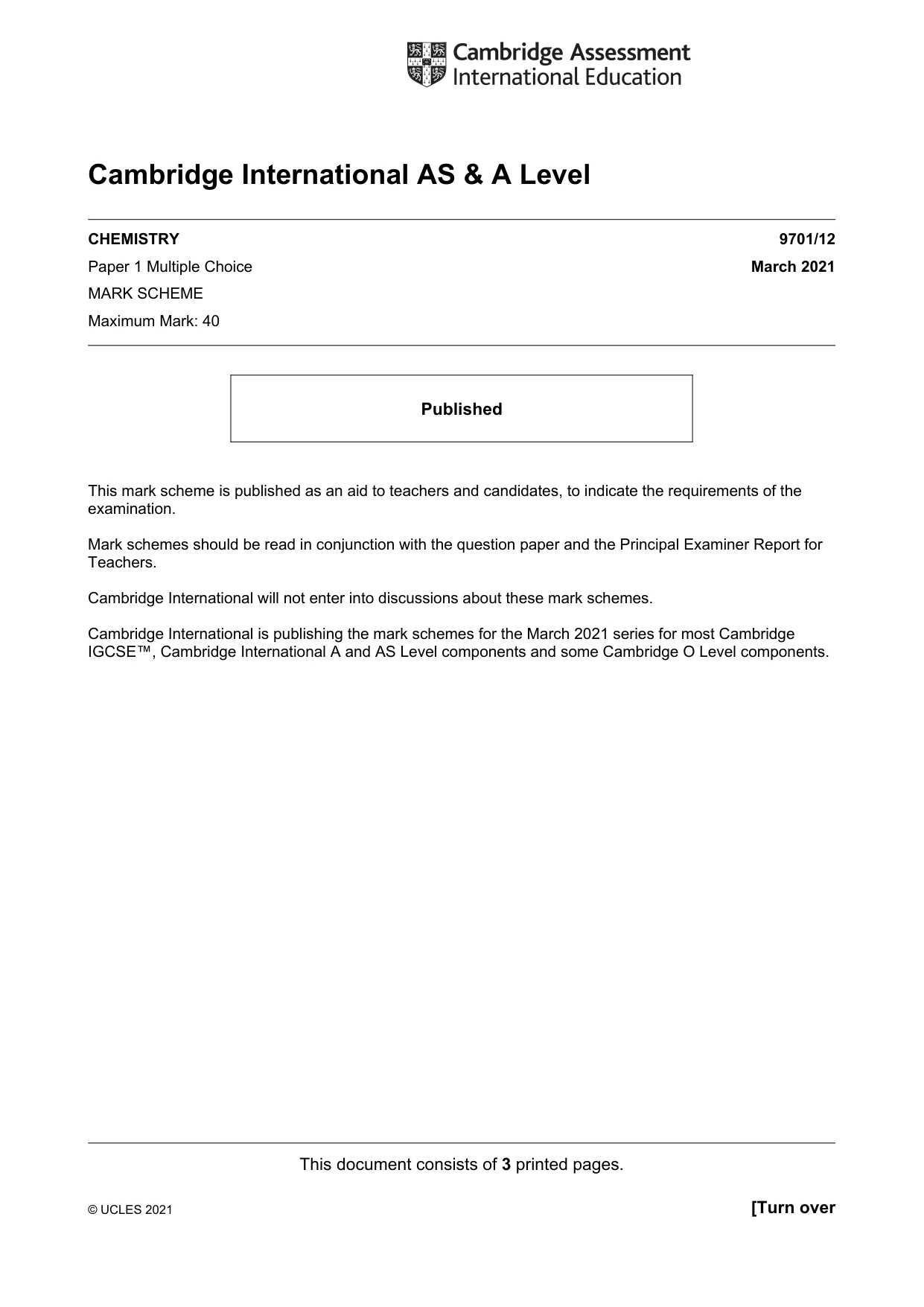
9701/12/F/M/21 · 40 questions · 40 marks · ≈45 min
The question paper and its mark scheme, free to read here and free to download. This is Cambridge’s own paper, exactly as it was sat.
Question paper16 pages
Mark scheme3 pages
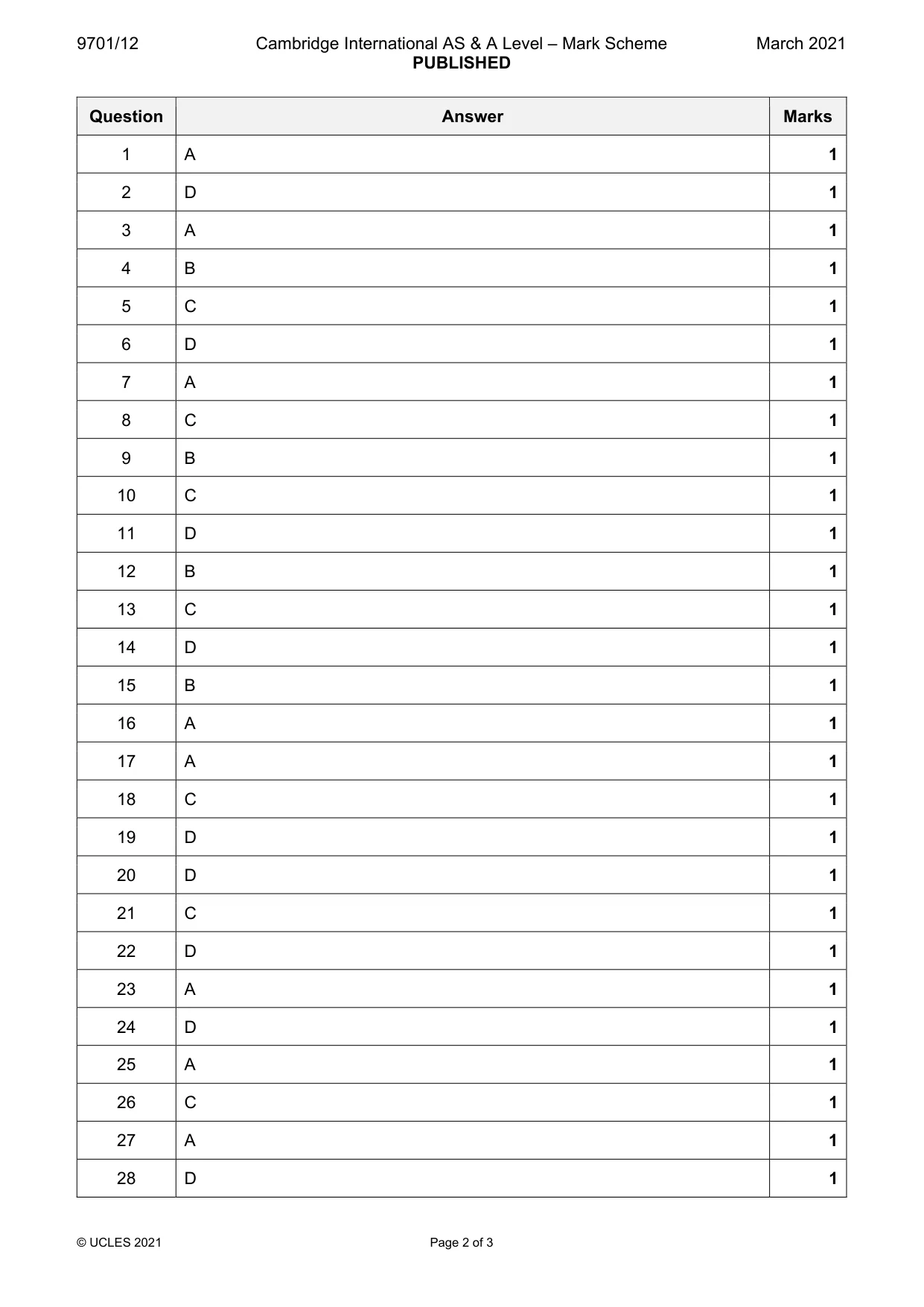
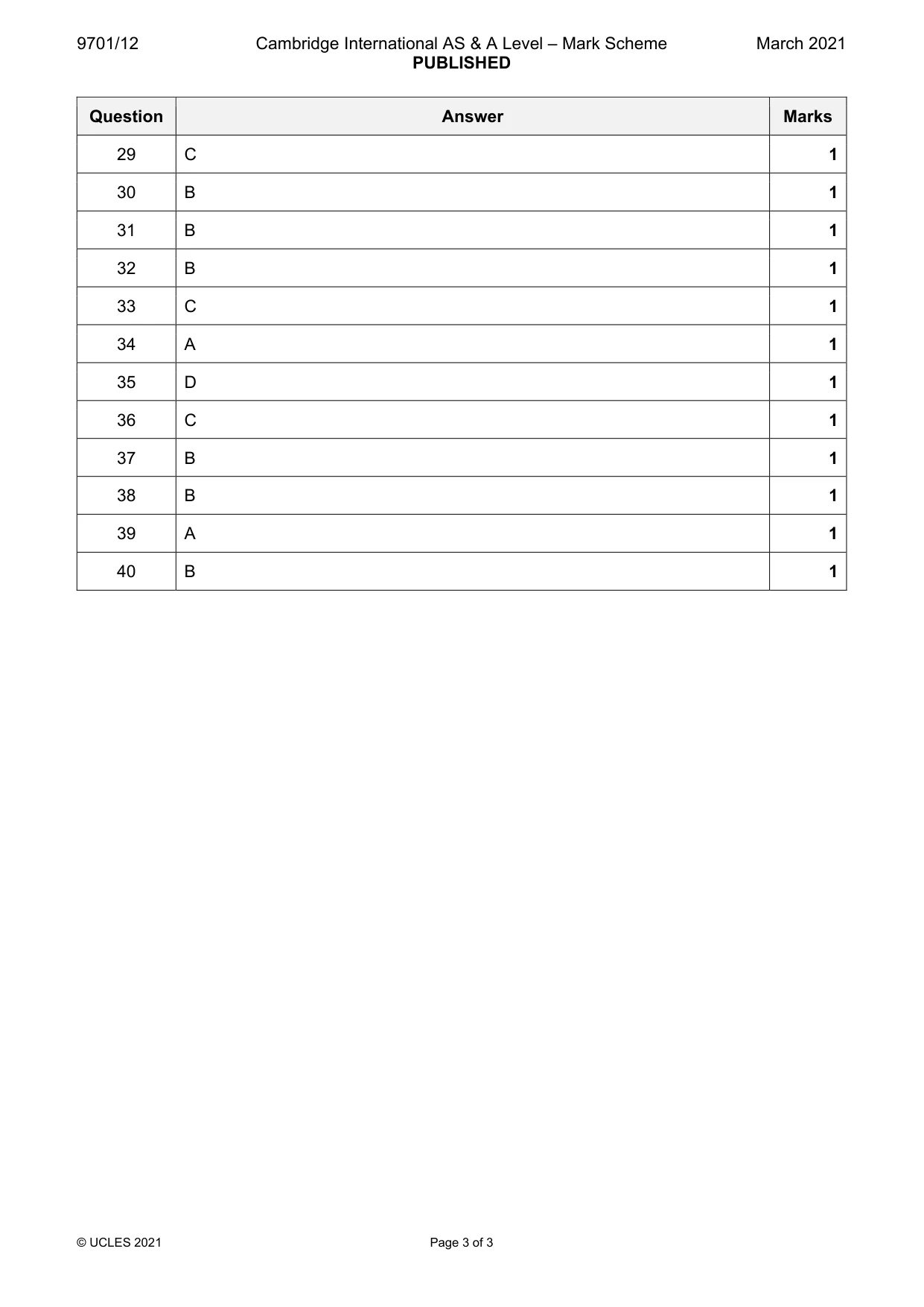
Answers below. Sit the paper first if you are practising.
Questions as text
Q1 · The table shows the numbers of protons, neutrons and electrons in four different…
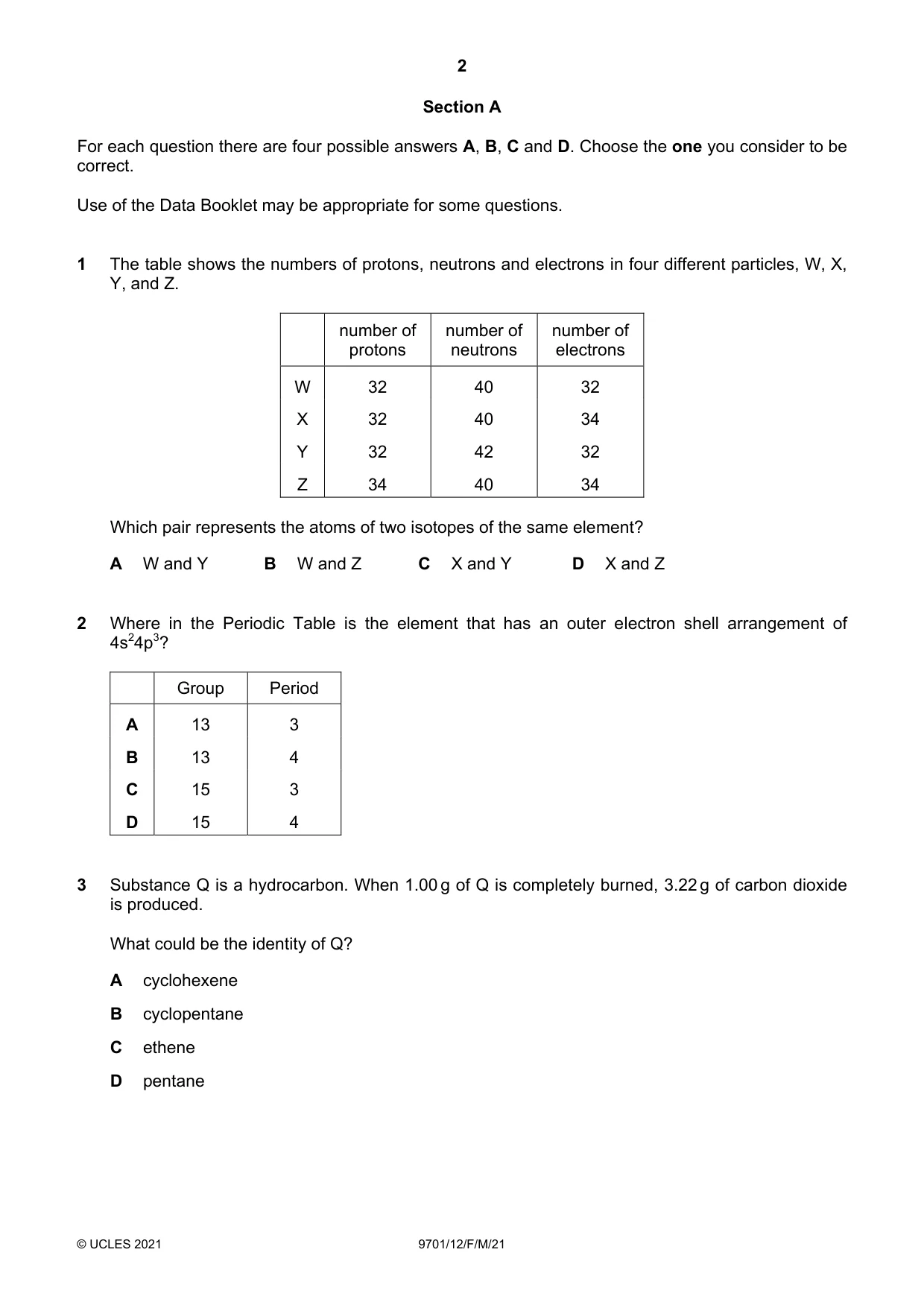
1 The table shows the numbers of protons, neutrons and electrons in four different particles, W, X, Y, and Z. number of number of number of protons neutrons electrons W 32 40 32 X 32 40 34 Y 32 42 32 Z 34 40 34 Which pair represents the atoms of two isotopes of the same element? A W and Y B W and Z C X and Y D X and Z
Mark scheme: A
Q2 · Where in the Periodic Table is the element that has an outer electron shell arrangement…
2 Where in the Periodic Table is the element that has an outer electron shell arrangement of 4s24p3? Group Period A 13 3 B 13 4 C 15 3 D 15 4
Mark scheme: D
More questions on Electrons, energy levels and atomic orbitals
Q3 · Substance Q is a hydrocarbon
3 Substance Q is a hydrocarbon. When 1.00 g of Q is completely burned, 3.22 g of carbon dioxide is produced. What could be the identity of Q? A cyclohexene B cyclopentane C ethene D pentane
Mark scheme: A
Q4 · Originally, chemists thought indium oxide had the formula InO
4 Originally, chemists thought indium oxide had the formula InO. By experiment they showed that 4.8 g of indium combined with 1.0 g of oxygen to produce 5.8 g of indium oxide. The Ar of oxygen was known to be 16. Which value for the Ar of indium is calculated using these data? A 38 B 77 C 115 D 154
Mark scheme: B
Q5 · In which substance are the only intermolecular forces temporary dipole-induced dipole…
5 In which substance are the only intermolecular forces temporary dipole-induced dipole attractions? A hydrogen chloride B methanol C octane D water
Mark scheme: C
More questions on Intermolecular forces, electronegativity and bond properties
Q6 · A solution contains 0.25 g of sulfur dioxide in 1.00 dm3 of water
6 A solution contains 0.25 g of sulfur dioxide in 1.00 dm3 of water. Which volume of sulfur dioxide, measured at 50 C and a pressure of 1 105 Pa, must be added to 1.00 dm3 of water to produce this solution? A 0.0162 cm3 B 0.105 cm3 C 16.2 cm3 D 105 cm3
Mark scheme: D
More questions on The gaseous state: ideal and real gases and pV = nRT
Q7 · An experiment was performed to determine the enthalpy of combustion of ethanol
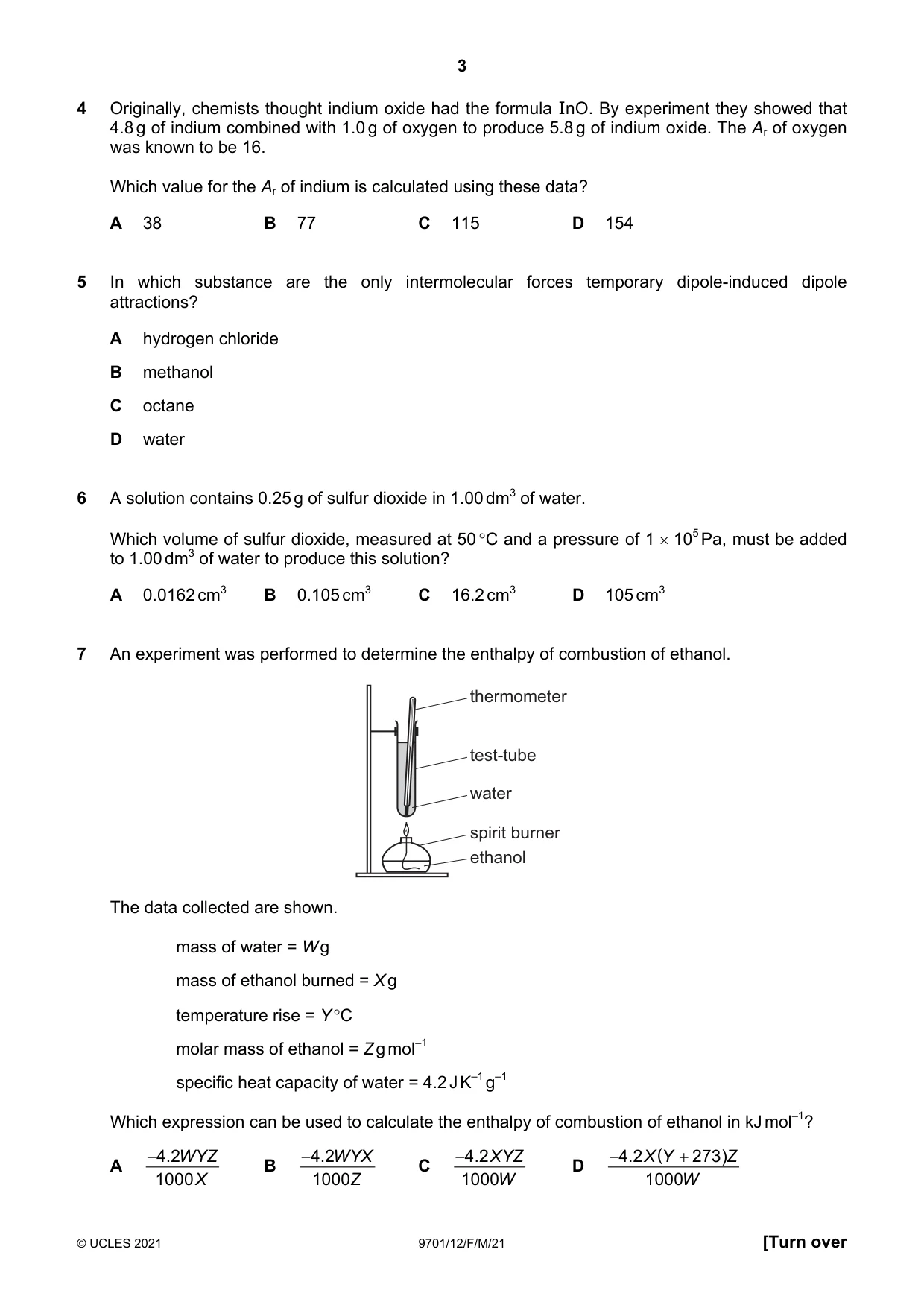
7 An experiment was performed to determine the enthalpy of combustion of ethanol. thermometer test-tube water spirit burner ethanol The data collected are shown. mass of water = W g mass of ethanol burned = X g temperature rise = Y C molar mass of ethanol = Z g mol–1 specific heat capacity of water = 4.2 J K–1 g–1 Which expression can be used to calculate the enthalpy of combustion of ethanol in kJ mol–1? 4.2 WYZ 4.2 WYX 4.2 XYZ 4.2 X Y ( 273) Z A B C D 1000 X 1000 Z 1000 W 1000 W
Mark scheme: A
Q8 · VO2Cl reacts with NaI under acidic conditions
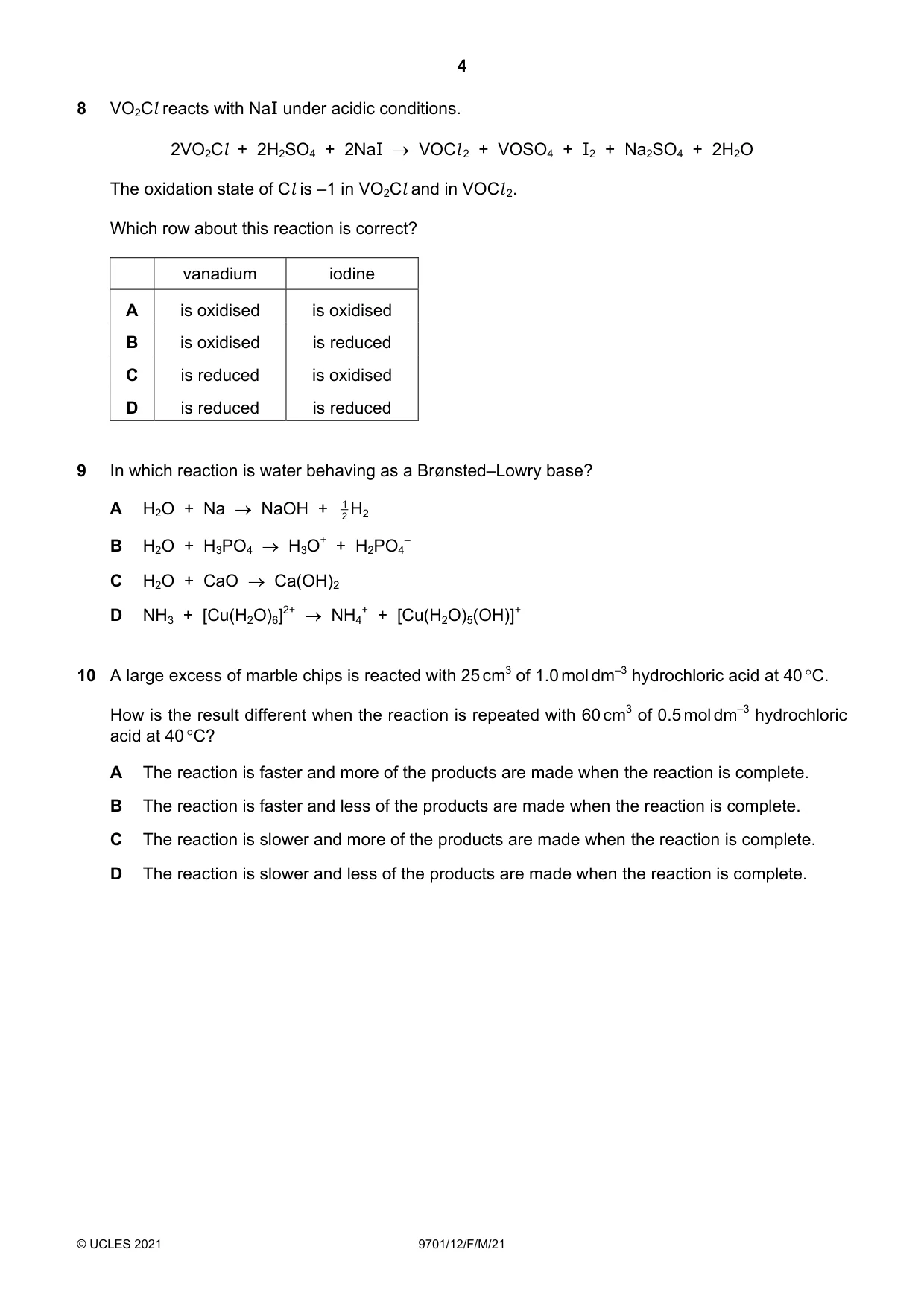
8 VO2Cl reacts with NaI under acidic conditions. 2VO2Cl + 2H2SO4 + 2NaI VOCl 2 + VOSO4 + I2 + Na2SO4 + 2H2O The oxidation state of Cl is –1 in VO2Cl and in VOCl 2. Which row about this reaction is correct? vanadium iodine A is oxidised is oxidised B is oxidised is reduced C is reduced is oxidised D is reduced is reduced
Mark scheme: C
Q9 · In which reaction is water behaving as a Brønsted–Lowry base?
9 In which reaction is water behaving as a Brønsted–Lowry base? A H2O + Na NaOH + 1 H 2 2 B H2O + H3PO4 H3O+ + H2PO4 – C H2O + CaO Ca(OH)2 D NH3 + [Cu(H2O)6]2+ NH4 + + [Cu(H2O)5(OH)]+
Mark scheme: B
Q10 · A large excess of marble chips is reacted with 25 cm3 of 1.0 mol dm–3 hydrochloric acid…
10 A large excess of marble chips is reacted with 25 cm3 of 1.0 mol dm–3 hydrochloric acid at 40 C. How is the result different when the reaction is repeated with 60 cm3 of 0.5 mol dm–3 hydrochloric acid at 40 C? A The reaction is faster and more of the products are made when the reaction is complete. B The reaction is faster and less of the products are made when the reaction is complete. C The reaction is slower and more of the products are made when the reaction is complete. D The reaction is slower and less of the products are made when the reaction is complete.
Mark scheme: C
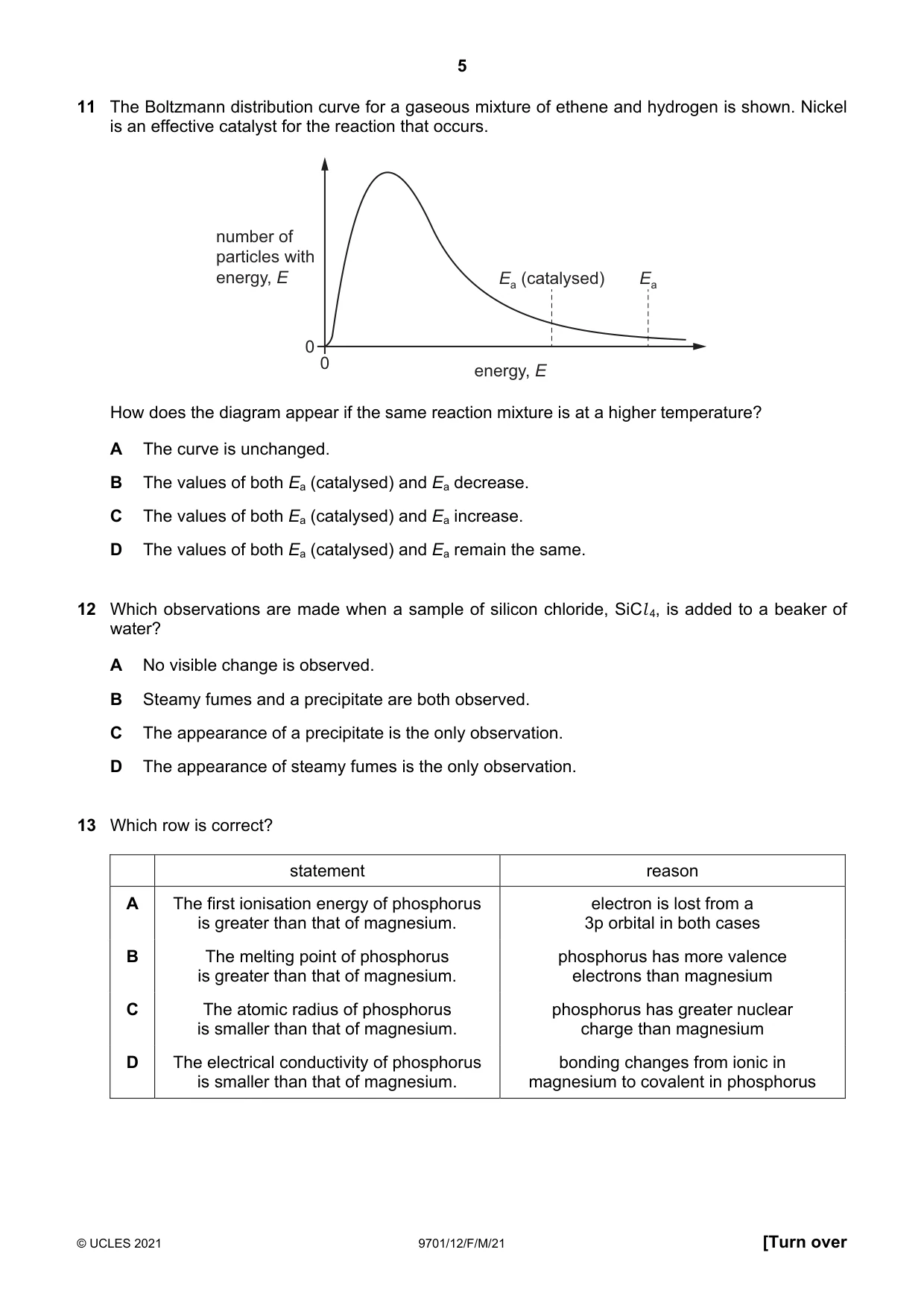
Q11 · The Boltzmann distribution curve for a gaseous mixture of ethene and hydrogen is shown
11 The Boltzmann distribution curve for a gaseous mixture of ethene and hydrogen is shown. Nickel is an effective catalyst for the reaction that occurs. number of particles with energy, E Ea (catalysed) Ea 0 0 energy, E How does the diagram appear if the same reaction mixture is at a higher temperature? A The curve is unchanged. B The values of both Ea (catalysed) and Ea decrease. C The values of both Ea (catalysed) and Ea increase. D The values of both Ea (catalysed) and Ea remain the same.
Mark scheme: D
More questions on Effect of temperature on reaction rates and the concept of activation energy
Q12 · Which observations are made when a sample of silicon chloride, SiCl 4, is added to a…
12 Which observations are made when a sample of silicon chloride, SiCl 4, is added to a beaker of water? A No visible change is observed. B Steamy fumes and a precipitate are both observed. C The appearance of a precipitate is the only observation. D The appearance of steamy fumes is the only observation.
Mark scheme: B
More questions on Periodicity of chemical properties of the elements in Period 3
Q13 · Which row is correct?
13 Which row is correct? statement reason A The first ionisation energy of phosphorus electron is lost from a is greater than that of magnesium. 3p orbital in both cases B The melting point of phosphorus phosphorus has more valence is greater than that of magnesium. electrons than magnesium C The atomic radius of phosphorus phosphorus has greater nuclear is smaller than that of magnesium. charge than magnesium D The electrical conductivity of phosphorus bonding changes from ionic in is smaller than that of magnesium. magnesium to covalent in phosphorus
Mark scheme: C
More questions on Periodicity of physical properties of the elements in Period 3
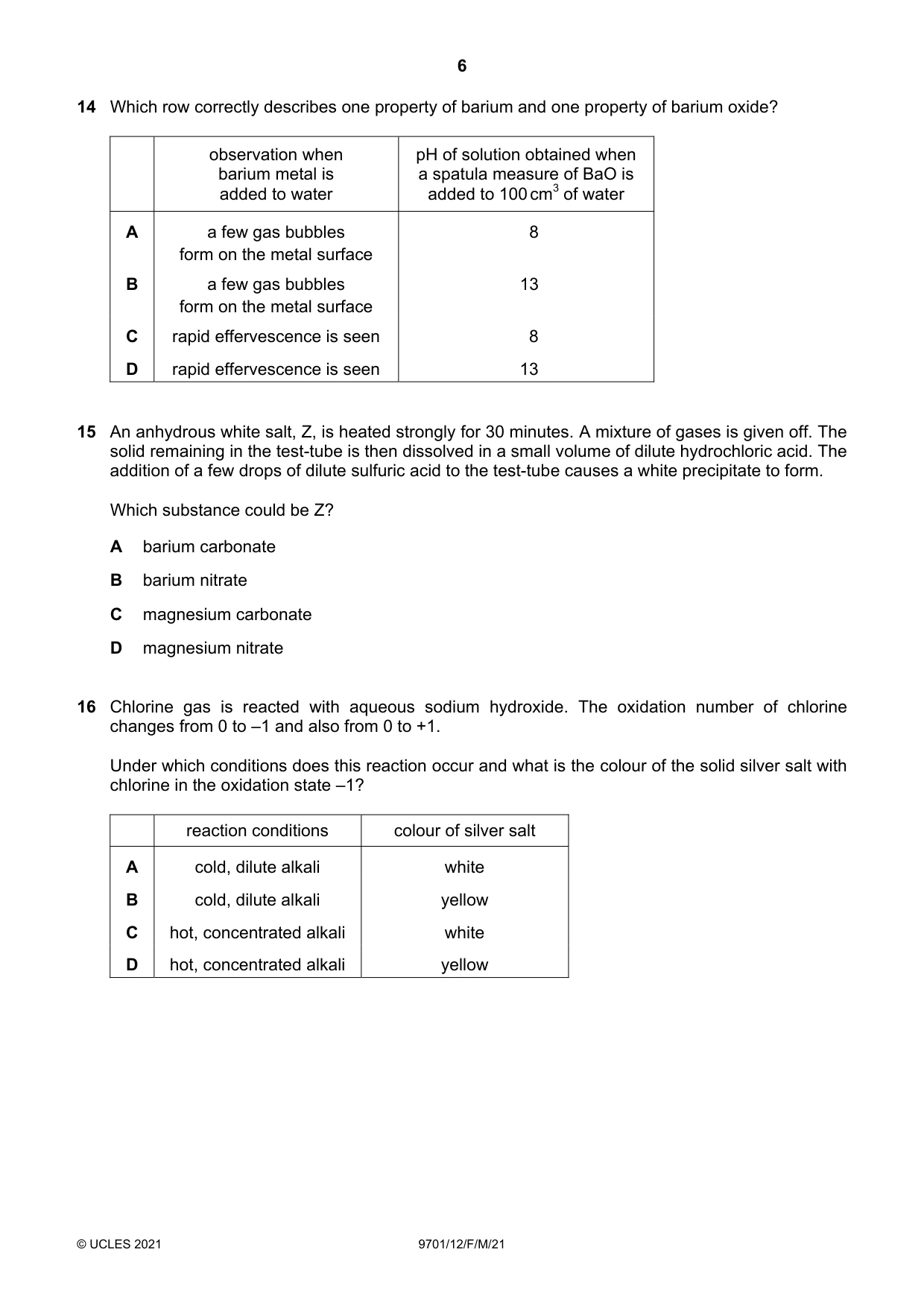
Q14 · Which row correctly describes one property of barium and one property of barium oxide?
14 Which row correctly describes one property of barium and one property of barium oxide? observation when pH of solution obtained when barium metal is a spatula measure of BaO is added to water added to 100 cm3 of water A a few gas bubbles 8 form on the metal surface B a few gas bubbles 13 form on the metal surface C rapid effervescence is seen 8 D rapid effervescence is seen 13
Mark scheme: D
Q15 · An anhydrous white salt, Z, is heated strongly for 30 minutes
15 An anhydrous white salt, Z, is heated strongly for 30 minutes. A mixture of gases is given off. The solid remaining in the test-tube is then dissolved in a small volume of dilute hydrochloric acid. The addition of a few drops of dilute sulfuric acid to the test-tube causes a white precipitate to form. Which substance could be Z? A barium carbonate B barium nitrate C magnesium carbonate D magnesium nitrate
Mark scheme: B
Q16 · Chlorine gas is reacted with aqueous sodium hydroxide
16 Chlorine gas is reacted with aqueous sodium hydroxide. The oxidation number of chlorine changes from 0 to –1 and also from 0 to +1. Under which conditions does this reaction occur and what is the colour of the solid silver salt with chlorine in the oxidation state –1? reaction conditions colour of silver salt A cold, dilute alkali white B cold, dilute alkali yellow C hot, concentrated alkali white D hot, concentrated alkali yellow
Mark scheme: A
Q17 · When concentrated sulfuric acid reacts with sodium iodide the products include sulfur…
17 When concentrated sulfuric acid reacts with sodium iodide the products include sulfur, iodine, hydrogen sulfide and sulfur dioxide. Which statement is correct? A Hydrogen sulfide is the product of a reduction reaction. B Iodide ions are stronger oxidising agents than sulfate ions. C Sulfur atoms from the sulfuric acid are both oxidised and reduced. D Sulfur atoms from the sulfuric acid are oxidised to make sulfur dioxide.
Mark scheme: A
More questions on The chemical properties of the halogen elements and the hydrogen halides
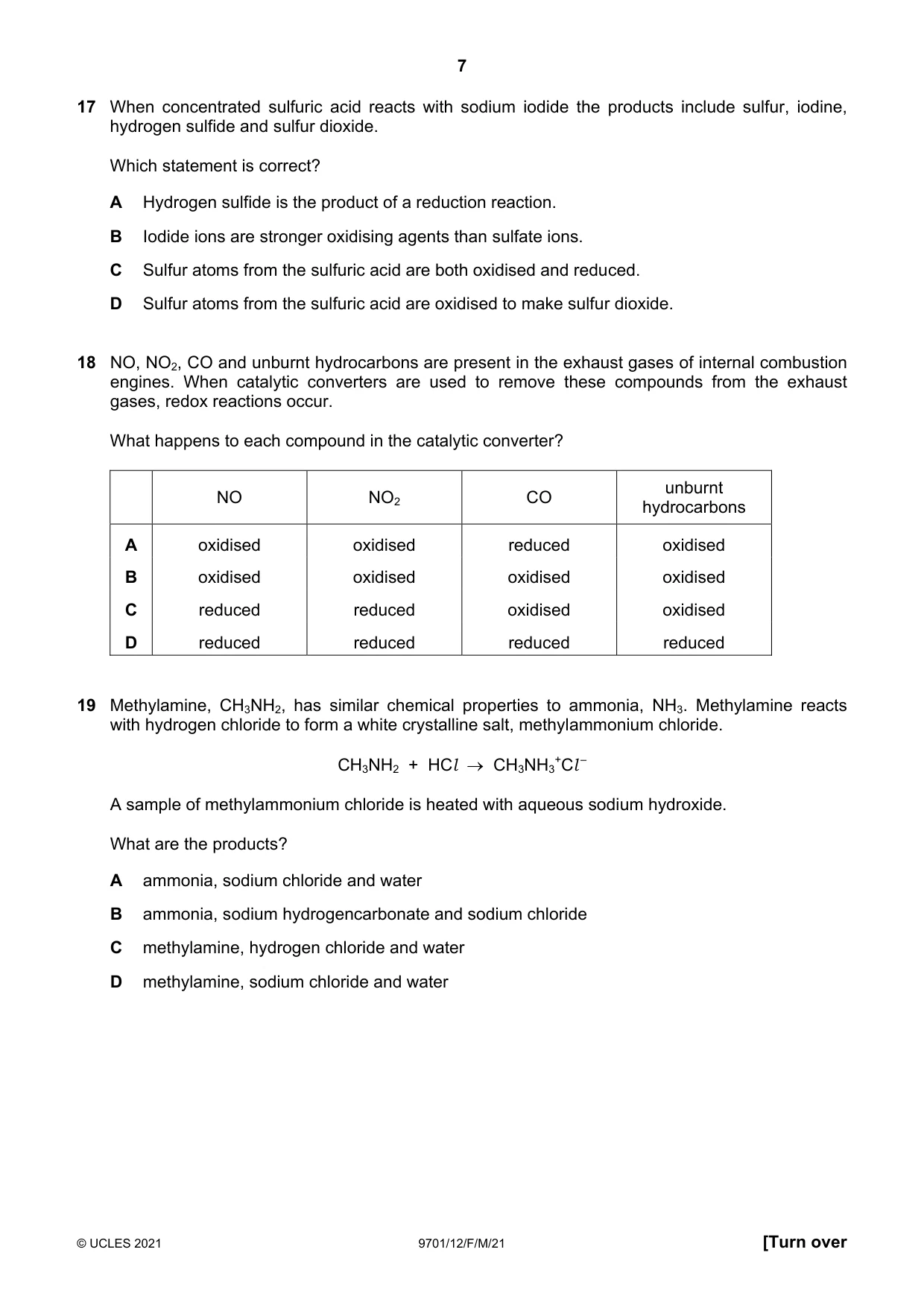
Q18 · NO, NO2, CO and unburnt hydrocarbons are present in the exhaust gases of internal…
18 NO, NO2, CO and unburnt hydrocarbons are present in the exhaust gases of internal combustion engines. When catalytic converters are used to remove these compounds from the exhaust gases, redox reactions occur. What happens to each compound in the catalytic converter? unburnt NO NO2 CO hydrocarbons A oxidised oxidised reduced oxidised B oxidised oxidised oxidised oxidised C reduced reduced oxidised oxidised D reduced reduced reduced reduced
Mark scheme: C
Q19 · Methylamine, CH3NH2, has similar chemical properties to ammonia, NH3
19 Methylamine, CH3NH2, has similar chemical properties to ammonia, NH3. Methylamine reacts with hydrogen chloride to form a white crystalline salt, methylammonium chloride. CH3NH2 + HCl CH3NH3 +Cl – A sample of methylammonium chloride is heated with aqueous sodium hydroxide. What are the products? A ammonia, sodium chloride and water B ammonia, sodium hydrogencarbonate and sodium chloride C methylamine, hydrogen chloride and water D methylamine, sodium chloride and water
Mark scheme: D
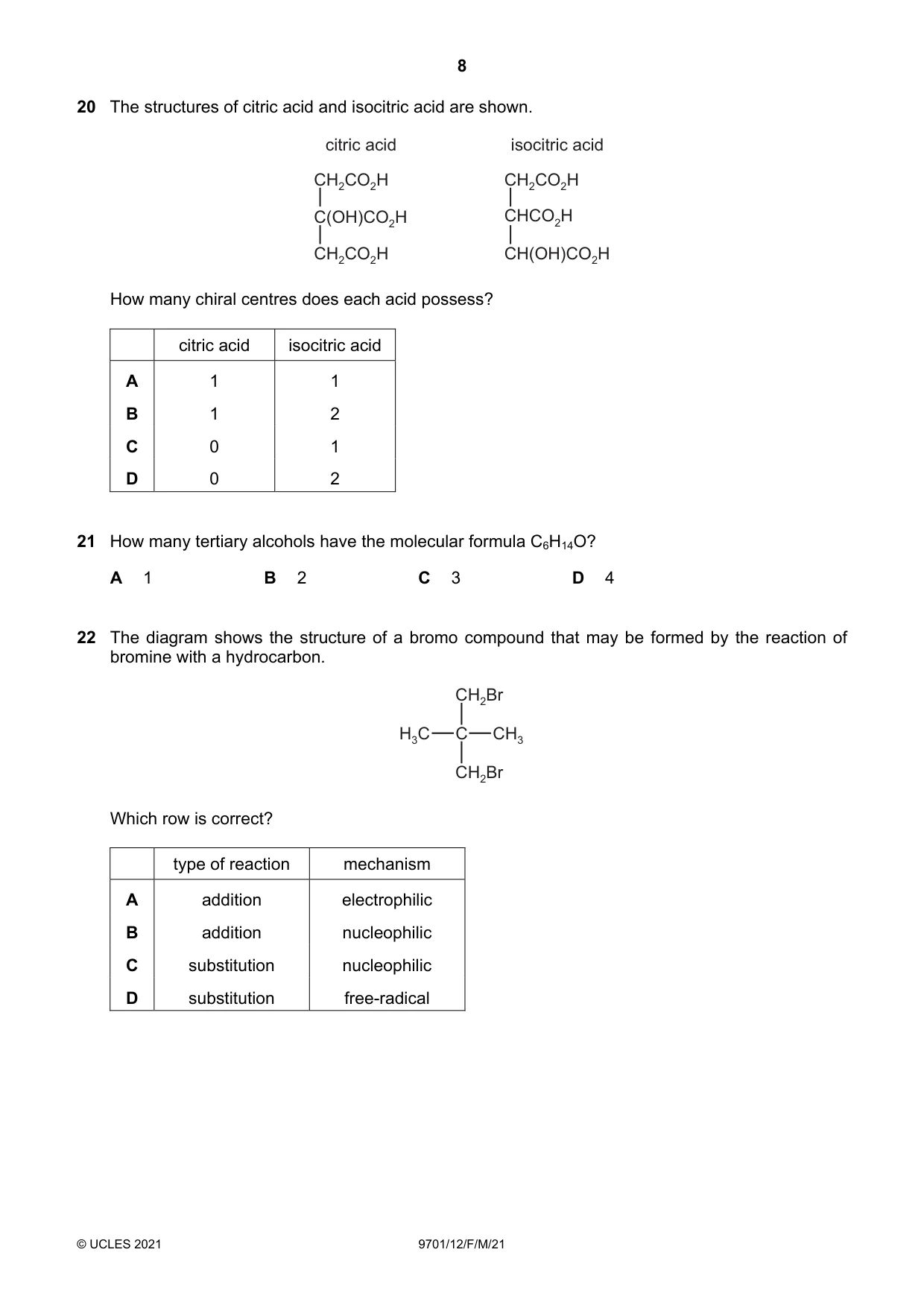
Q20 · The structures of citric acid and isocitric acid are shown
20 The structures of citric acid and isocitric acid are shown. citric acid isocitric acid CH2CO2H CH2CO2H C(OH)CO2H CHCO2H CH2CO2H CH(OH)CO2H How many chiral centres does each acid possess? citric acid isocitric acid A 1 1 B 1 2 C 0 1 D 0 2
Mark scheme: D
More questions on Isomerism: structural isomerism and stereoisomerism
Q21 · How many tertiary alcohols have the molecular formula C6H14O?
21 How many tertiary alcohols have the molecular formula C6H14O? A 1 B 2 C 3 D 4
Mark scheme: C
Q22 · The diagram shows the structure of a bromo compound that may be formed by the reaction of…
22 The diagram shows the structure of a bromo compound that may be formed by the reaction of bromine with a hydrocarbon. CH2Br H3C C CH3 CH2Br Which row is correct? type of reaction mechanism A addition electrophilic B addition nucleophilic C substitution nucleophilic D substitution free-radical
Mark scheme: D
Q23 · Part of the structure of strobilurin is shown
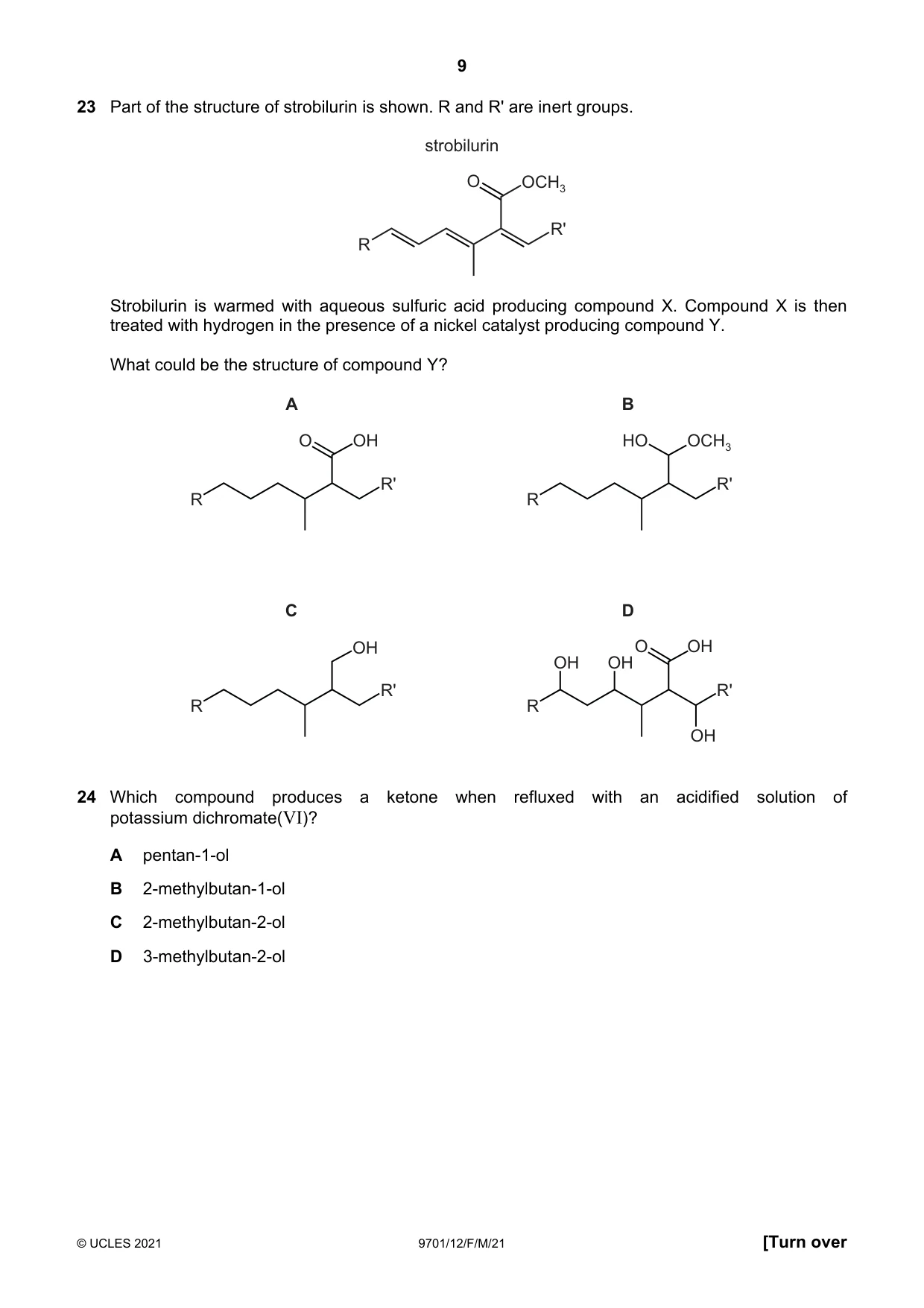
23 Part of the structure of strobilurin is shown. R and R' are inert groups. strobilurin O OCH3 R' R Strobilurin is warmed with aqueous sulfuric acid producing compound X. Compound X is then treated with hydrogen in the presence of a nickel catalyst producing compound Y. What could be the structure of compound Y? A B O OH HO OCH3 R' R' R R C D OH O OH OH OH R' R' R R OH
Mark scheme: A
Q24 · Which compound produces a ketone when refluxed with an acidified solution of potassium…
24 Which compound produces a ketone when refluxed with an acidified solution of potassium dichromate(VI)? A pentan-1-ol B 2-methylbutan-1-ol C 2-methylbutan-2-ol D 3-methylbutan-2-ol
Mark scheme: D
Q25 · Dibromopentanes can undergo ‘double elimination’ reactions to produce hydrocarbons
25 Dibromopentanes can undergo ‘double elimination’ reactions to produce hydrocarbons. 2NaOH + C5H10Br2 C5H8 + 2NaBr + 2H2O Which isomer produces only one hydrocarbon product? A 1,5-dibromopentane B 1,4-dibromopentane C 2,3-dibromopentane D 2,4-dibromopentane
Mark scheme: A
Q26 · The diagram shows the formation of compound Y from compound X in a chemical reaction
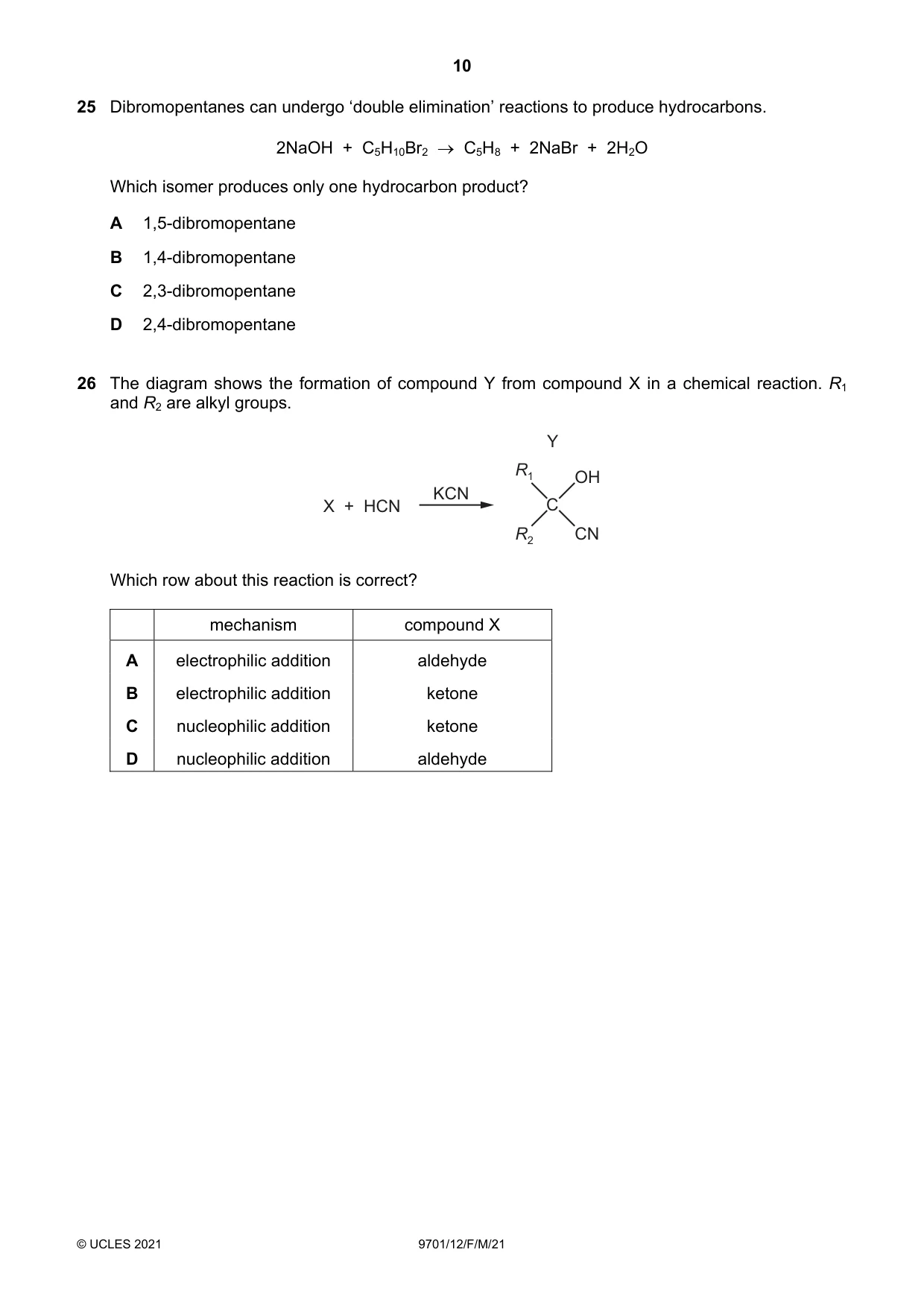
26 The diagram shows the formation of compound Y from compound X in a chemical reaction. R1 and R2 are alkyl groups. Y R1 OH KCN X + HCN C R2 CN Which row about this reaction is correct? mechanism compound X A electrophilic addition aldehyde B electrophilic addition ketone C nucleophilic addition ketone D nucleophilic addition aldehyde
Mark scheme: C
Q27 · In this question you can assume that 1H and 3H have the same chemical properties
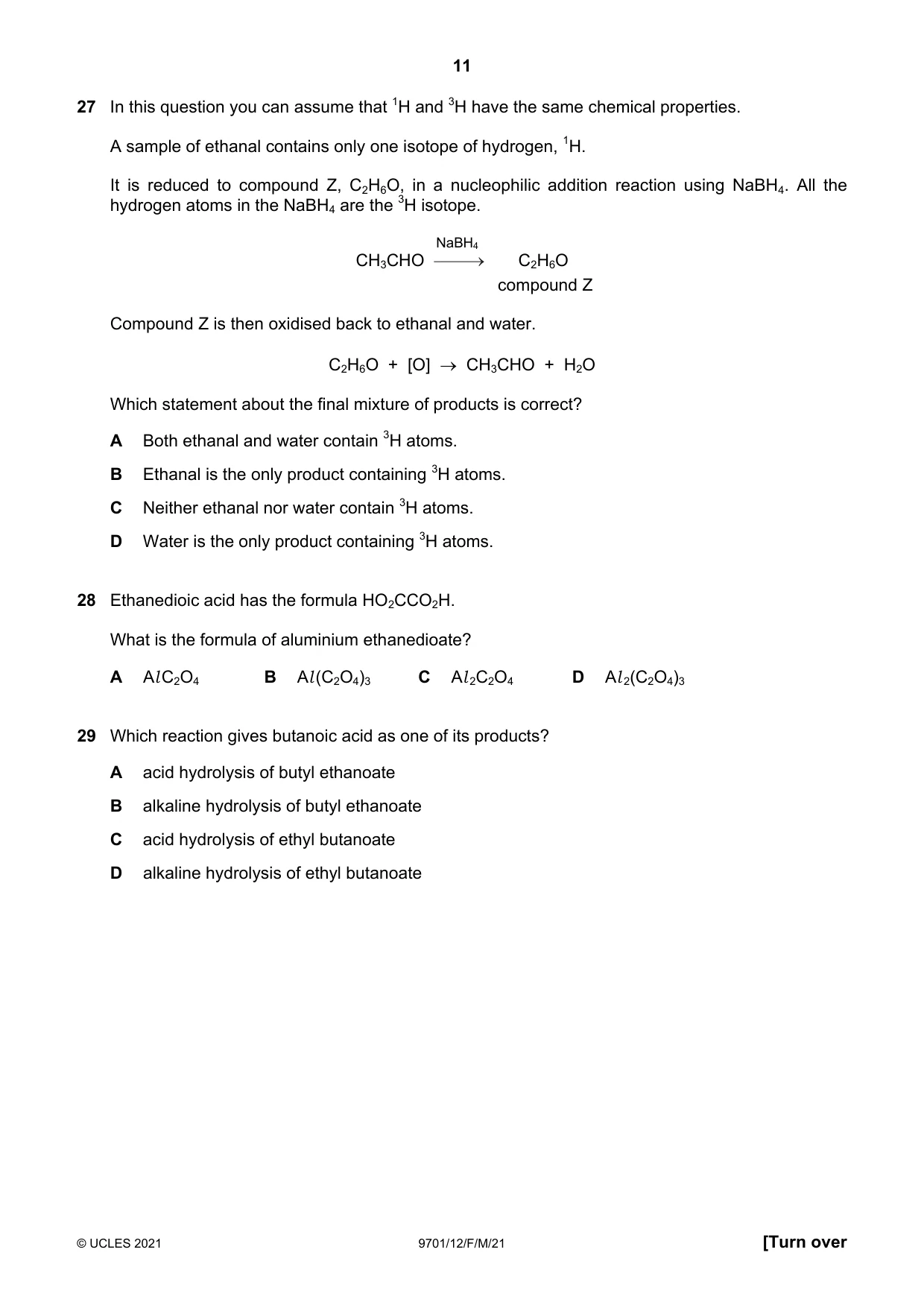
27 In this question you can assume that 1H and 3H have the same chemical properties. A sample of ethanal contains only one isotope of hydrogen, 1H. It is reduced to compound Z, C2H6O, in a nucleophilic addition reaction using NaBH4. All the hydrogen atoms in the NaBH4 are the 3H isotope. NaBH4 CH3CHO C2H6O compound Z Compound Z is then oxidised back to ethanal and water. C2H6O + [O] CH3CHO + H2O Which statement about the final mixture of products is correct? A Both ethanal and water contain 3H atoms. B Ethanal is the only product containing 3H atoms. C Neither ethanal nor water contain 3H atoms. D Water is the only product containing 3H atoms.
Mark scheme: A
Q28 · Ethanedioic acid has the formula HO2CCO2H
28 Ethanedioic acid has the formula HO2CCO2H. What is the formula of aluminium ethanedioate? A Al C2O4 B Al (C2O4)3 C Al 2C2O4 D Al 2(C2O4)3
Mark scheme: D
Q29 · Which reaction gives butanoic acid as one of its products?
29 Which reaction gives butanoic acid as one of its products? A acid hydrolysis of butyl ethanoate B alkaline hydrolysis of butyl ethanoate C acid hydrolysis of ethyl butanoate D alkaline hydrolysis of ethyl butanoate
Mark scheme: C
Q30 · When reactant X is treated with a suitable reagent, products Y and Z are formed
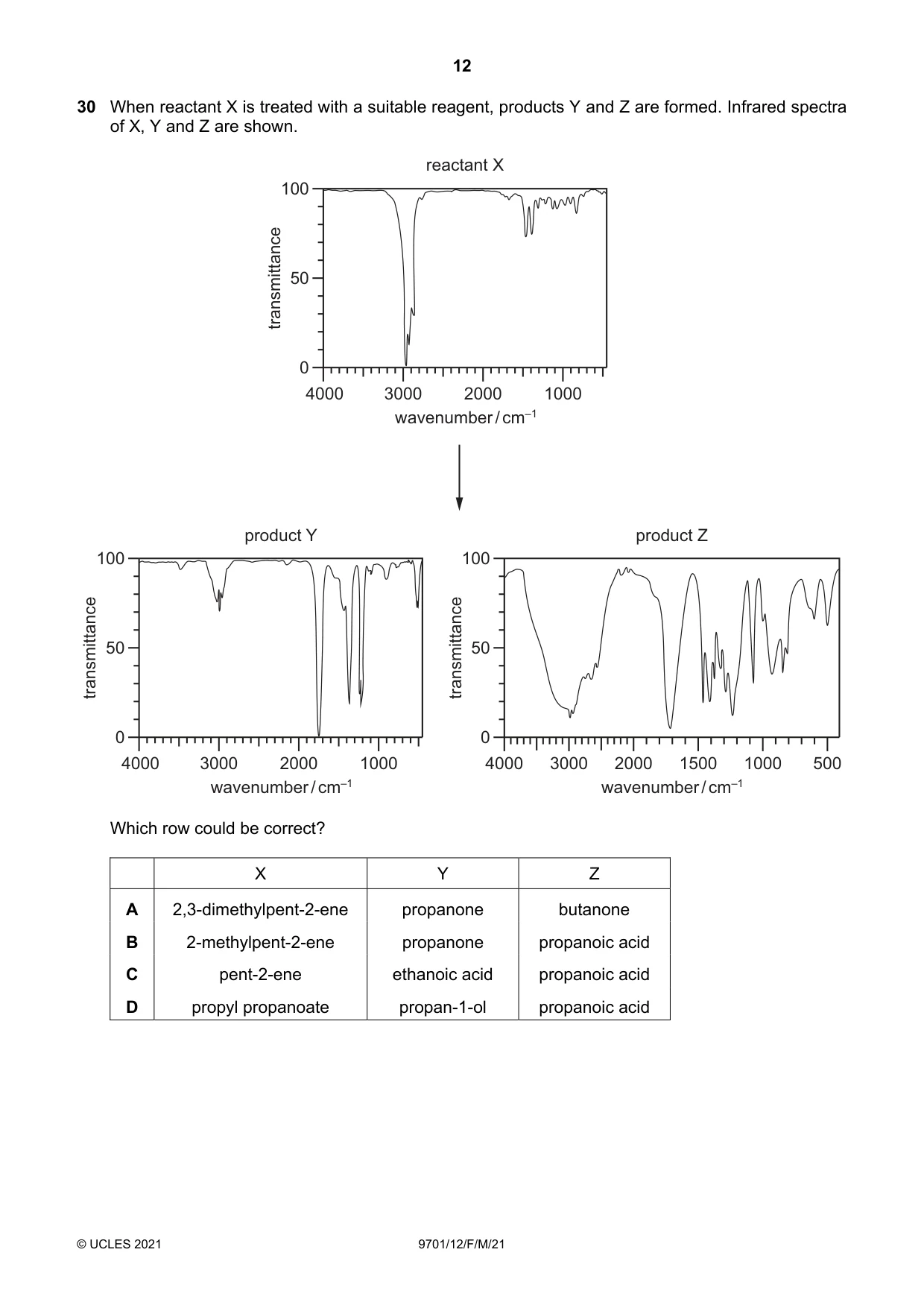
30 When reactant X is treated with a suitable reagent, products Y and Z are formed. Infrared spectra of X, Y and Z are shown. reactant X 100 transmittance 50 0 4000 3000 2000 1000 wavenumber / cm–1 product Y product Z 100 100 transmittance transmittance 50 50 0 0 4000 3000 2000 1000 4000 3000 2000 1500 1000 500 wavenumber / cm–1 wavenumber / cm–1 Which row could be correct? X Y Z A 2,3-dimethylpent-2-ene propanone butanone B 2-methylpent-2-ene propanone propanoic acid C pent-2-ene ethanoic acid propanoic acid D propyl propanoate propan-1-ol propanoic acid
Mark scheme: B
Q31 · A sample of 17.15 mol HI(g) is in dynamic equilibrium with 2.27 mol H2(g) and 2.84 mol…
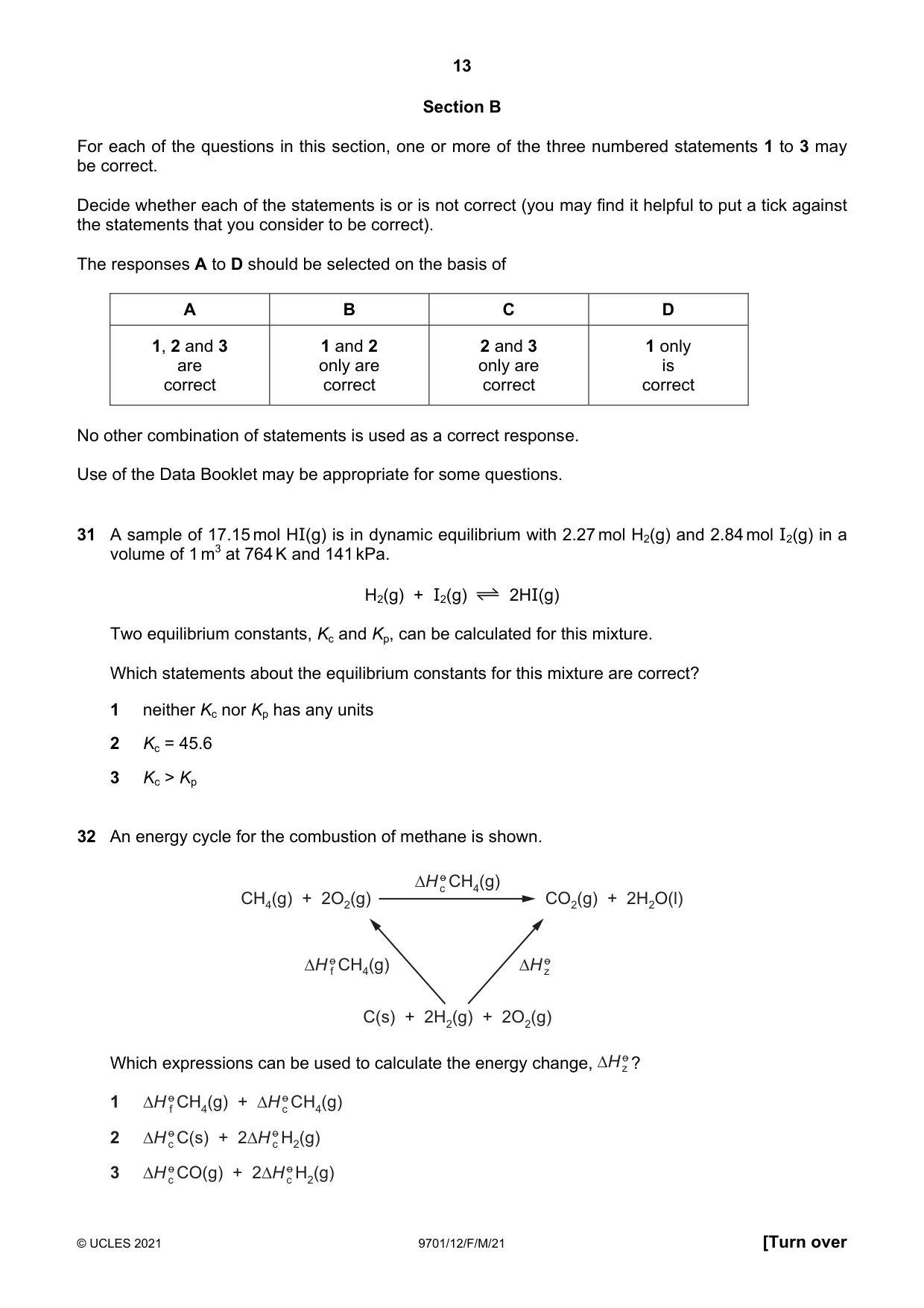
31 A sample of 17.15 mol HI(g) is in dynamic equilibrium with 2.27 mol H2(g) and 2.84 mol I2(g) in a volume of 1 m3 at 764 K and 141 kPa. H2(g) + I2(g) 2HI(g) Two equilibrium constants, Kc and Kp, can be calculated for this mixture. Which statements about the equilibrium constants for this mixture are correct? 1 neither Kc nor Kp has any units 2 Kc = 45.6 3 Kc > Kp
Mark scheme: B
More questions on Chemical equilibria: reversible reactions, dynamic equilibrium
Q32 · An energy cycle for the combustion of methane is shown
32 An energy cycle for the combustion of methane is shown. ∆H o CH4(g) CH4(g) + 2O2(g) c CO2(g) + 2H2O(l) ∆H o CH4(g) ∆H o f z C(s) + 2H2(g) + 2O2(g) Which expressions can be used to calculate the energy change, ? ∆H o z 1 ∆H o CH4(g) + ∆H o CH4(g) f c 2 ∆H o C(s) + 2∆H o H2(g) c c 3 ∆H o CO(g) + 2∆H o H2(g) c c
Mark scheme: B
Q33 · Many gases do not obey the general gas equation at high pressures
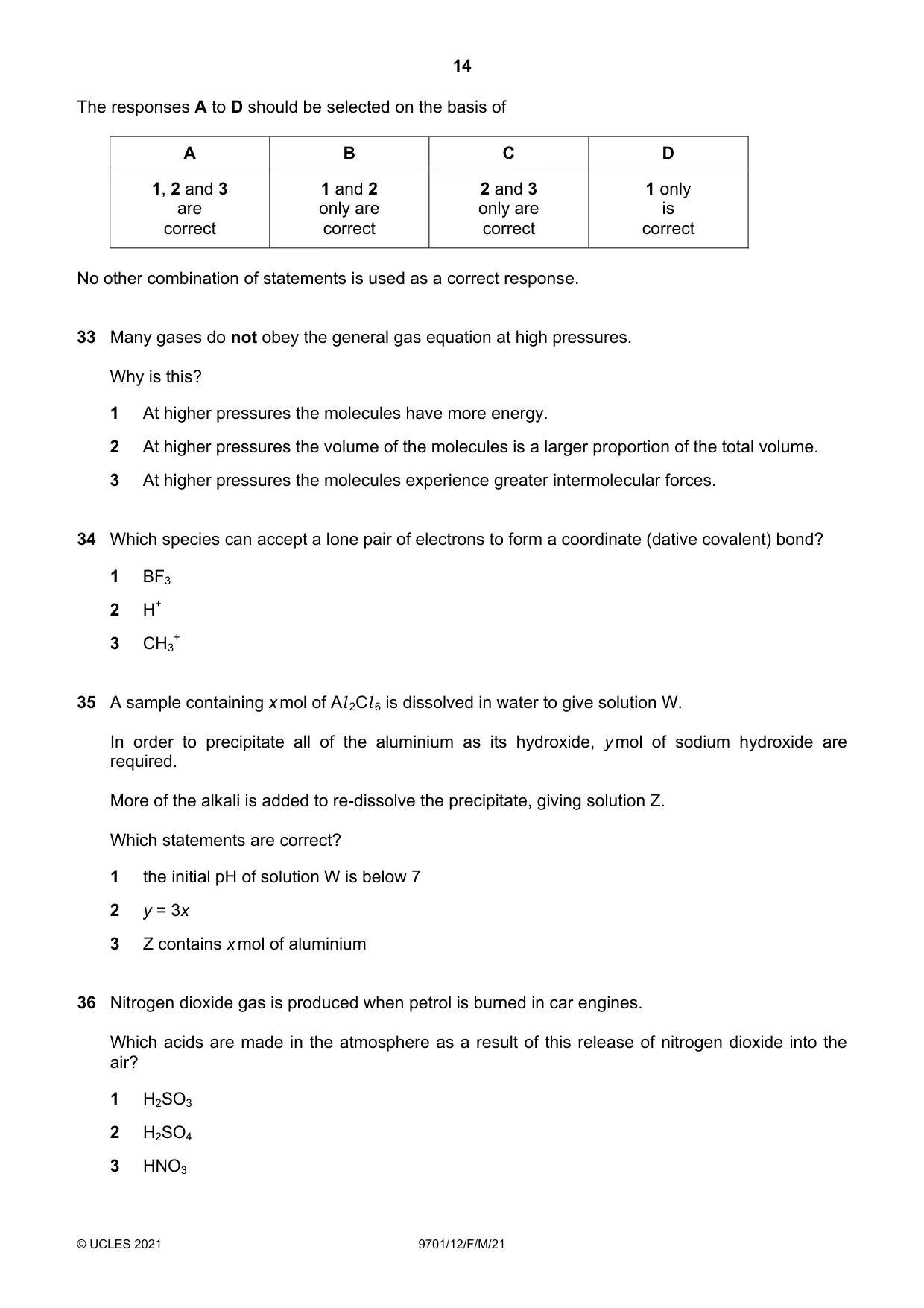
33 Many gases do not obey the general gas equation at high pressures. Why is this? 1 At higher pressures the molecules have more energy. 2 At higher pressures the volume of the molecules is a larger proportion of the total volume. 3 At higher pressures the molecules experience greater intermolecular forces.
Mark scheme: C
More questions on The gaseous state: ideal and real gases and pV = nRT
Q34 · Which species can accept a lone pair of electrons to form a coordinate (dative covalent)…
34 Which species can accept a lone pair of electrons to form a coordinate (dative covalent) bond? 1 BF3 2 H+ 3 CH3 +
Mark scheme: A
More questions on Covalent bonding and coordinate (dative covalent) bonding
Q35 · A sample containing x mol of Al 2Cl 6 is dissolved in water to give solution W
35 A sample containing x mol of Al 2Cl 6 is dissolved in water to give solution W. In order to precipitate all of the aluminium as its hydroxide, y mol of sodium hydroxide are required. More of the alkali is added to re-dissolve the precipitate, giving solution Z. Which statements are correct? 1 the initial pH of solution W is below 7 2 y = 3x 3 Z contains x mol of aluminium
Mark scheme: D
More questions on Periodicity of chemical properties of the elements in Period 3
Q36 · Nitrogen dioxide gas is produced when petrol is burned in car engines
36 Nitrogen dioxide gas is produced when petrol is burned in car engines. Which acids are made in the atmosphere as a result of this release of nitrogen dioxide into the air? 1 H2SO3 2 H2SO4 3 HNO3
Mark scheme: C
Q37 · In which reactions is the major product formed by a nucleophilic substitution reaction?
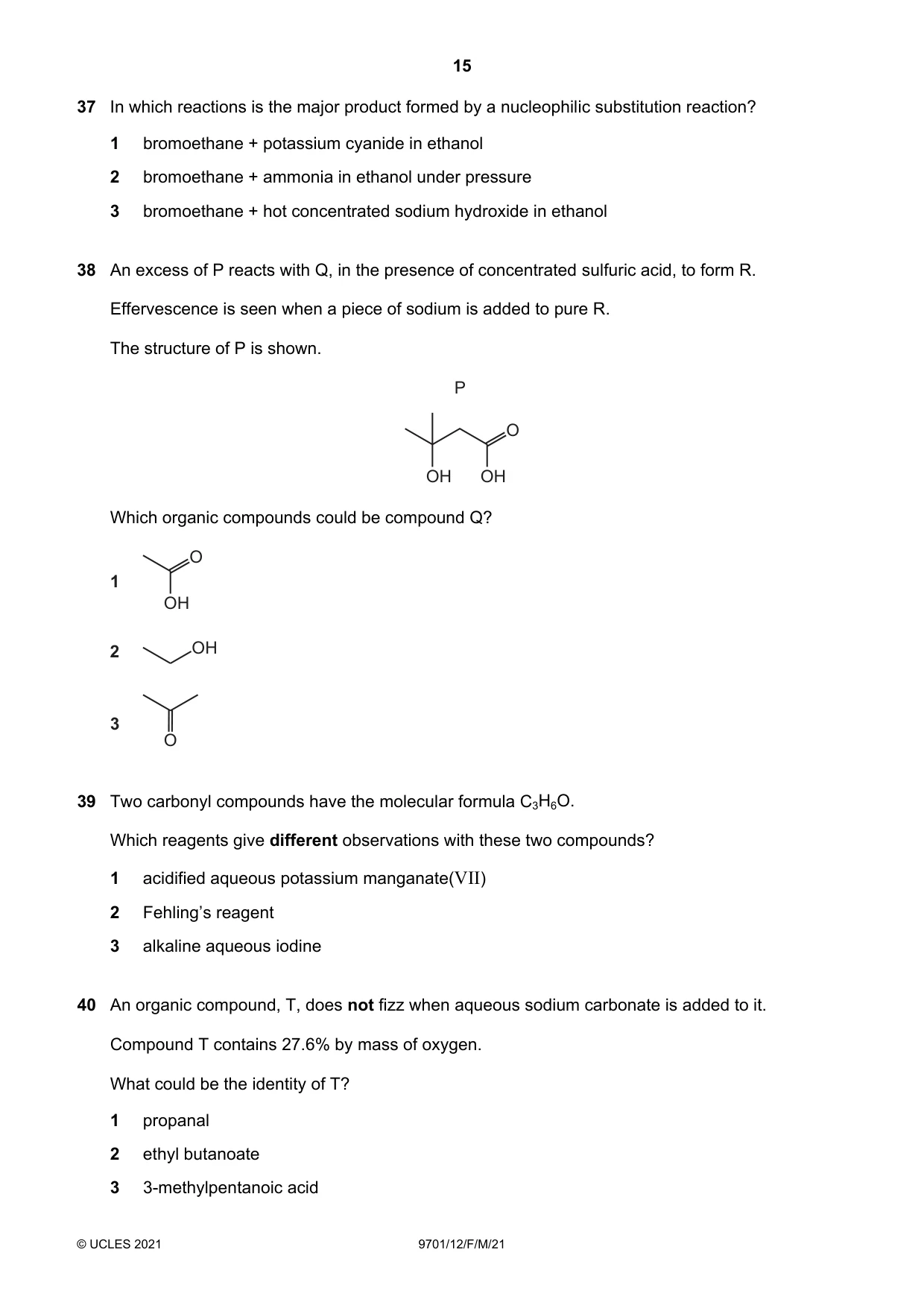
37 In which reactions is the major product formed by a nucleophilic substitution reaction? 1 bromoethane + potassium cyanide in ethanol 2 bromoethane + ammonia in ethanol under pressure 3 bromoethane + hot concentrated sodium hydroxide in ethanol
Mark scheme: B
Q38 · An excess of P reacts with Q, in the presence of concentrated sulfuric acid, to form R
38 An excess of P reacts with Q, in the presence of concentrated sulfuric acid, to form R. Effervescence is seen when a piece of sodium is added to pure R. The structure of P is shown. P O OH OH Which organic compounds could be compound Q? O 1 OH 2 OH 3 O
Mark scheme: B
Q39 · Two carbonyl compounds have the molecular formula C3H6O
39 Two carbonyl compounds have the molecular formula C3H6O. Which reagents give different observations with these two compounds? 1 acidified aqueous potassium manganate(VII) 2 Fehling’s reagent 3 alkaline aqueous iodine
Mark scheme: A
Q40 · An organic compound, T, does not fizz when aqueous sodium carbonate is added to it
40 An organic compound, T, does not fizz when aqueous sodium carbonate is added to it. Compound T contains 27.6% by mass of oxygen. What could be the identity of T? 1 propanal 2 ethyl butanoate 3 3-methylpentanoic acid
Mark scheme: B
What was in this paper
The subtopics covered by these 40 questions, and how many questions each got. Open one in a new tab to see every Cambridge question on it.
4Esters3Alkenes2Periodicity of chemical properties of the elements in Period 32Redox processes: electron transfer and changes in oxidation number (oxidation state)2Similarities and trends in the properties of the Group 2 metals, magnesium to barium, and their compounds2The gaseous state: ideal and real gases and pV = nRT2Alcohols1Brønsted–Lowry theory of acids and bases1Carboxylic acids1Chemical equilibria: reversible reactions, dynamic equilibrium1Covalent bonding and coordinate (dative covalent) bonding1Effect of temperature on reaction rates and the concept of activation energy1Electrons, energy levels and atomic orbitals1Enthalpy change, ΔH1Formulas1Halogenoalkanes1Hess’s law1Infrared spectroscopy1Intermolecular forces, electronegativity and bond properties1Isomerism: structural isomerism and stereoisomerism1Isotopes1Nitriles and hydroxynitriles1Nitrogen and sulfur1Periodicity of physical properties of the elements in Period 31Primary amines1Rate of reaction1Relative masses of atoms and molecules1The chemical properties of the halogen elements and the hydrogen halides1The reactions of chlorine1What you needed in this session
Cambridge’s own grade thresholds for 2021 Feb/March, Paper 1 · Variant 2. A higher threshold means an easier paper — the bar moves with how the cohort did.