Cambridge A Level Chemistry 9701 — 2011 Oct/Nov Paper 1 · Variant 2
9701/12/O/N/11 · 40 questions · 40 marks · ≈45 min
The question paper and its mark scheme, free to read here and free to download. This is Cambridge’s own paper, exactly as it was sat.
Question paper16 pages
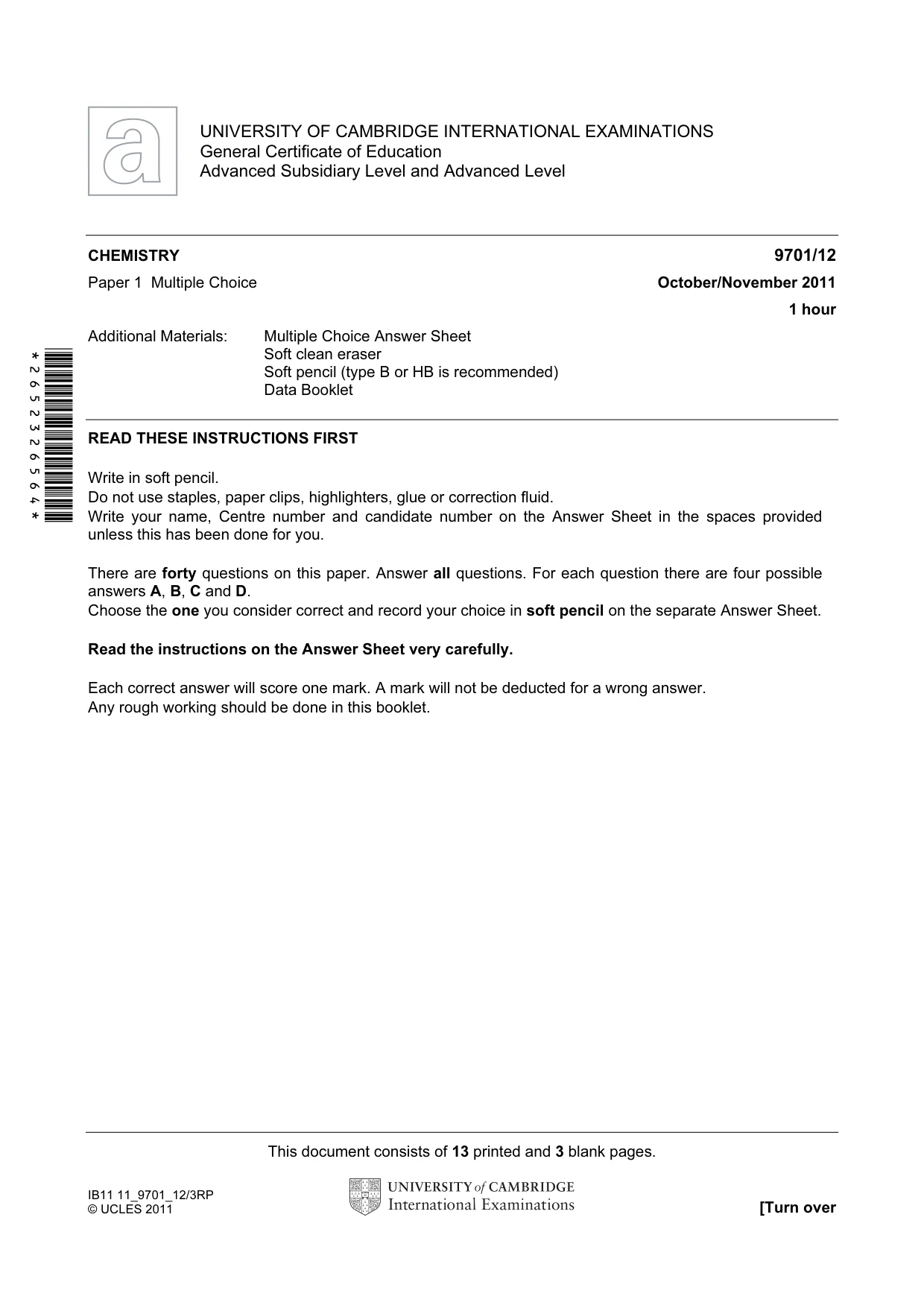
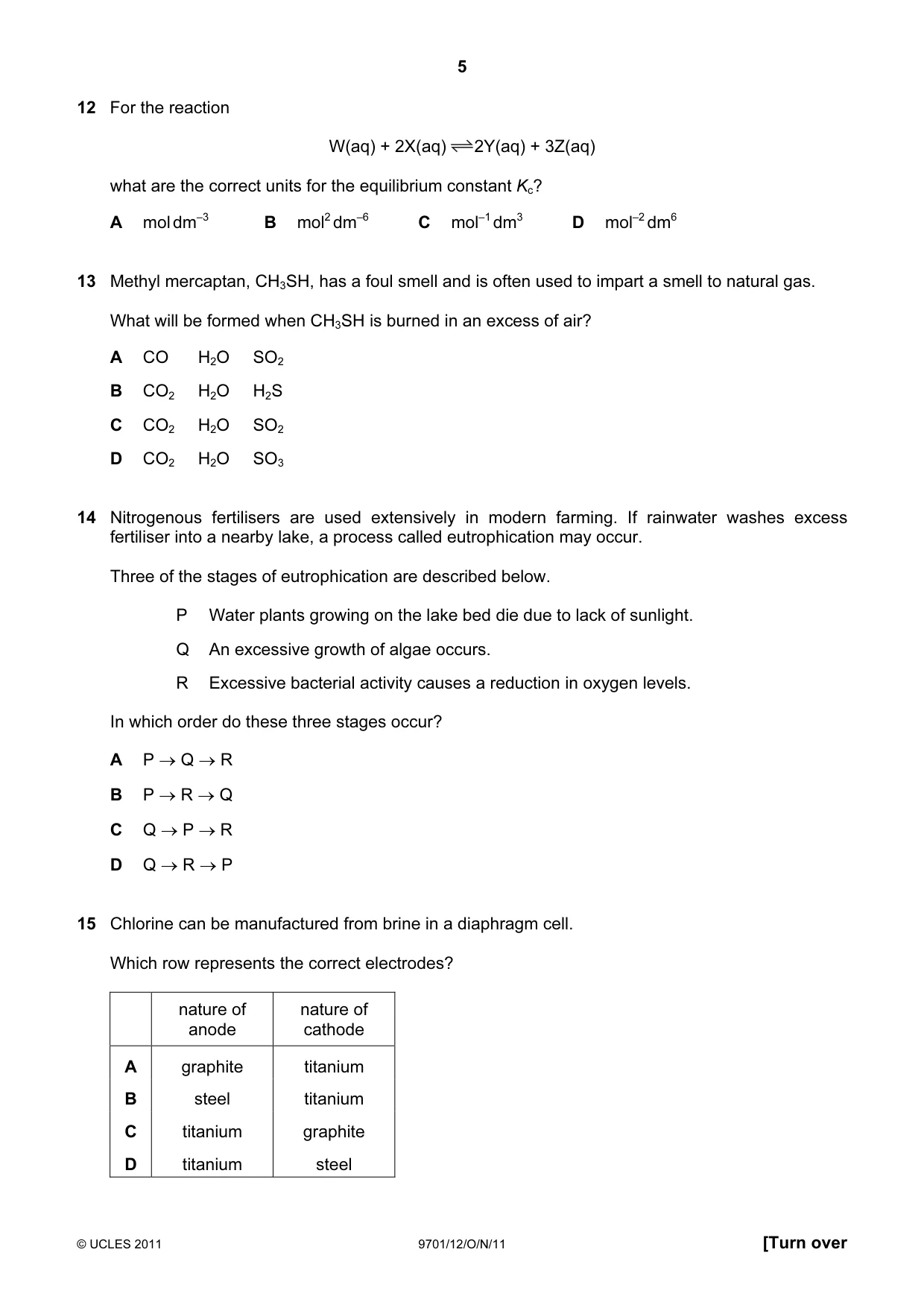
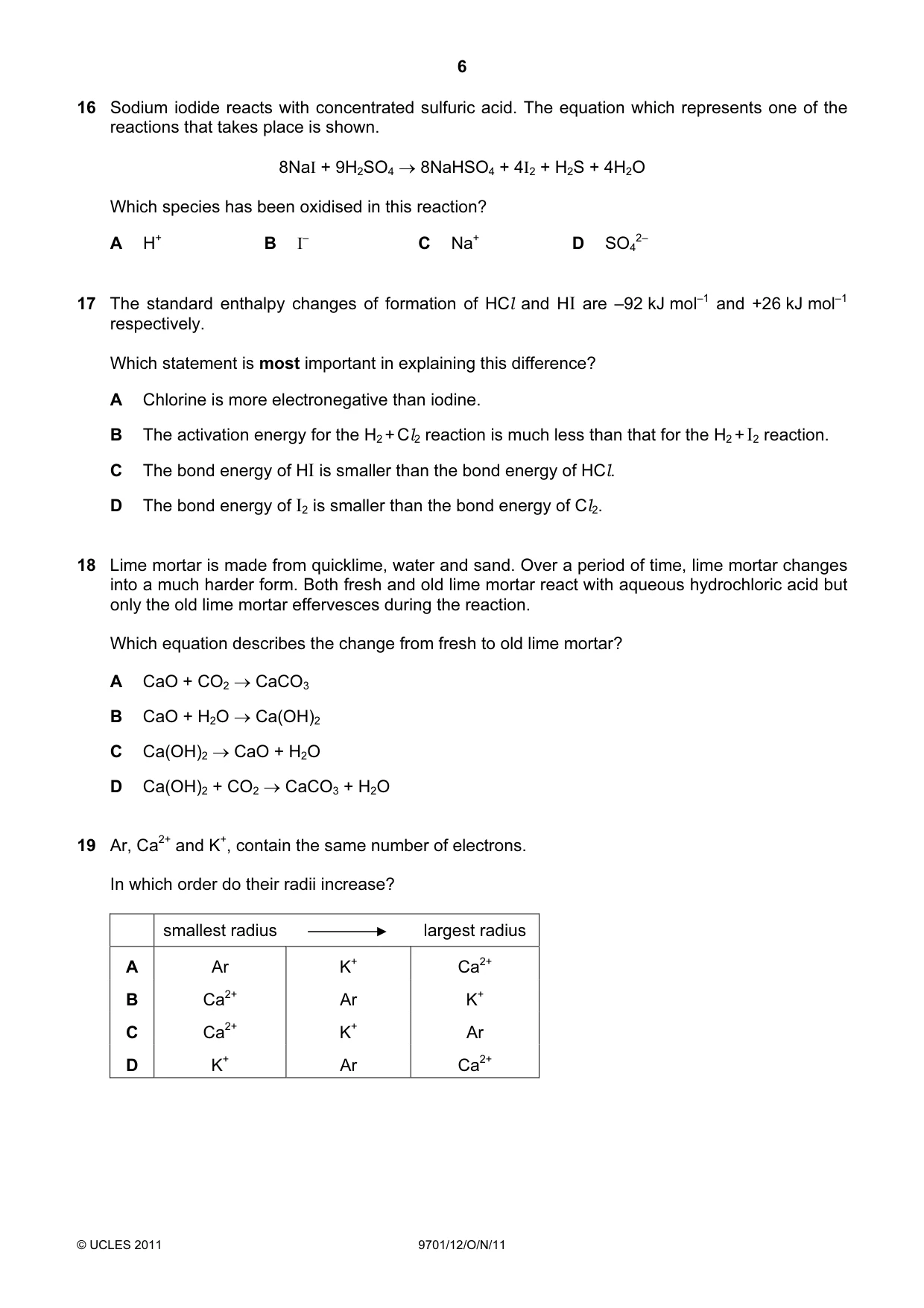
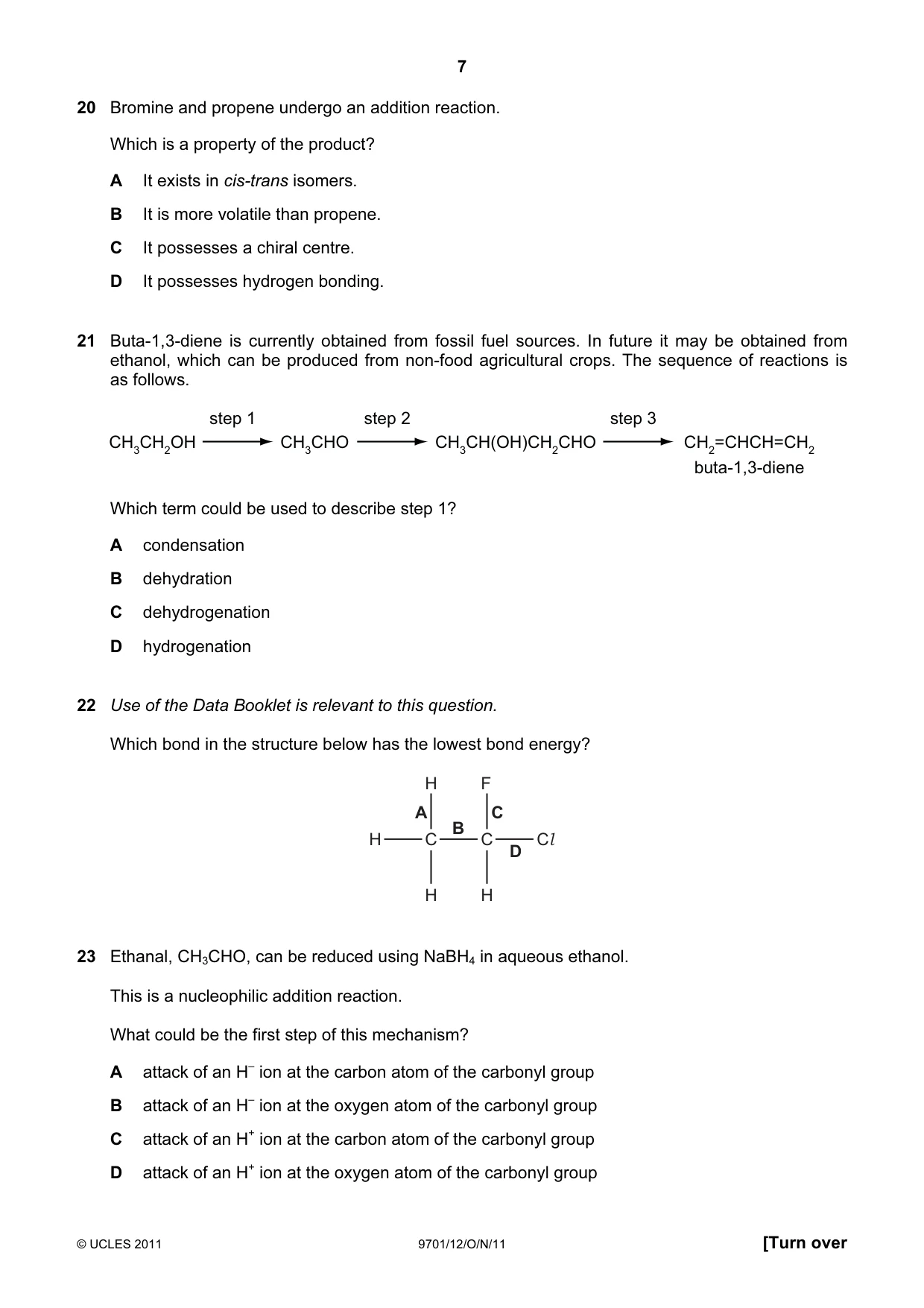
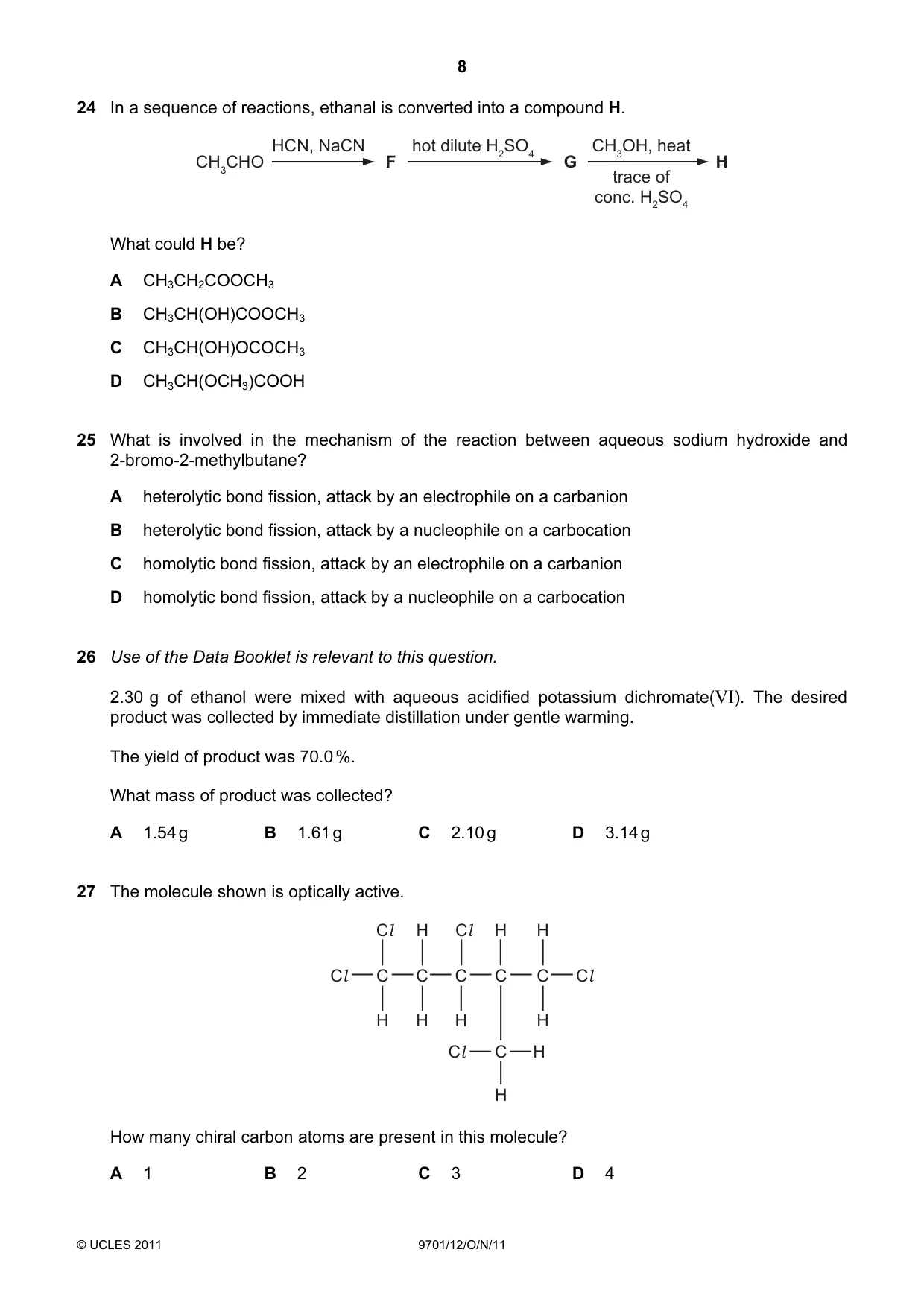


Mark scheme2 pages
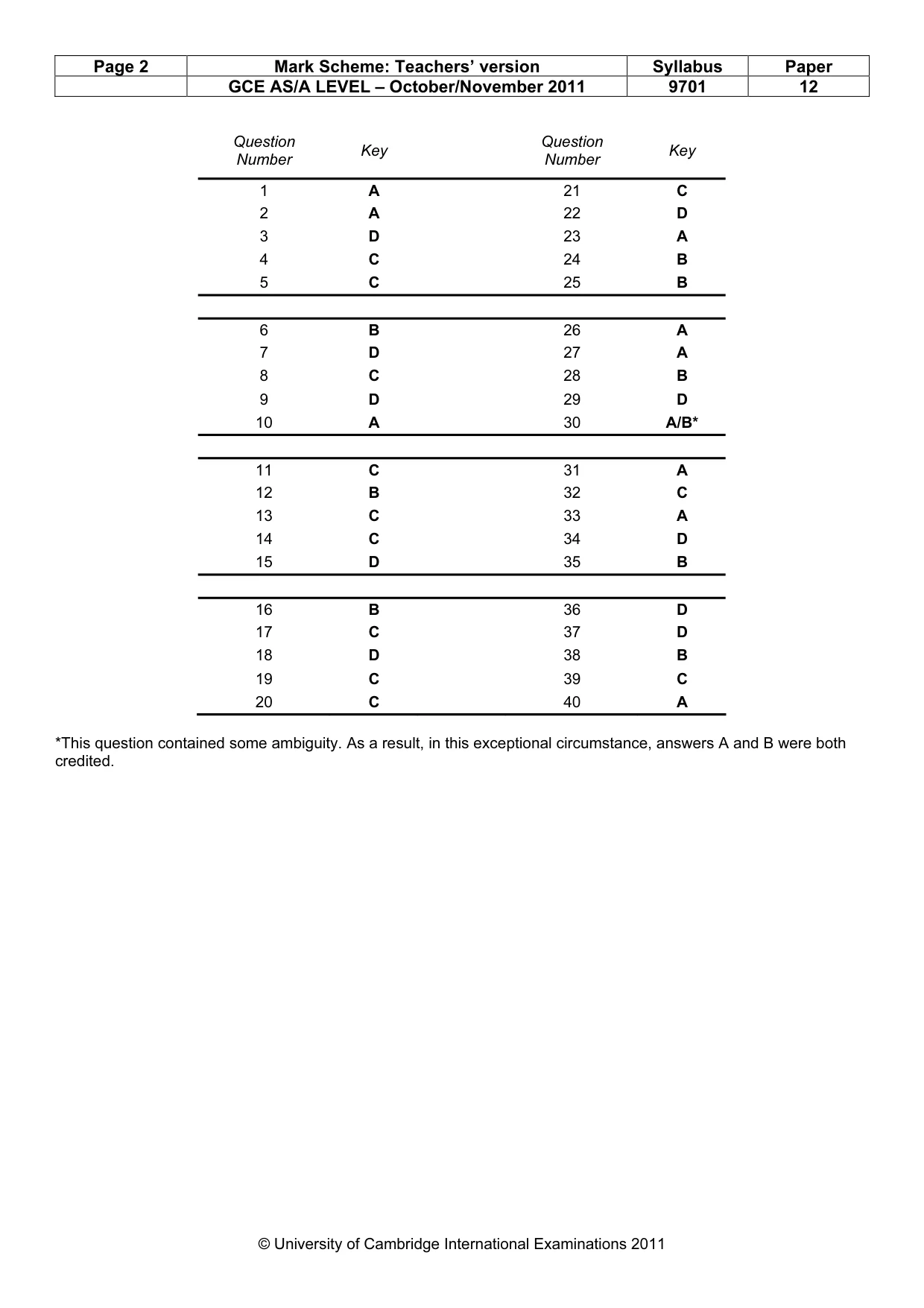
Answers below. Sit the paper first if you are practising.
Questions as text
Q1 · In the Haber process for the manufacture of ammonia, why is the heterogeneous catalyst…
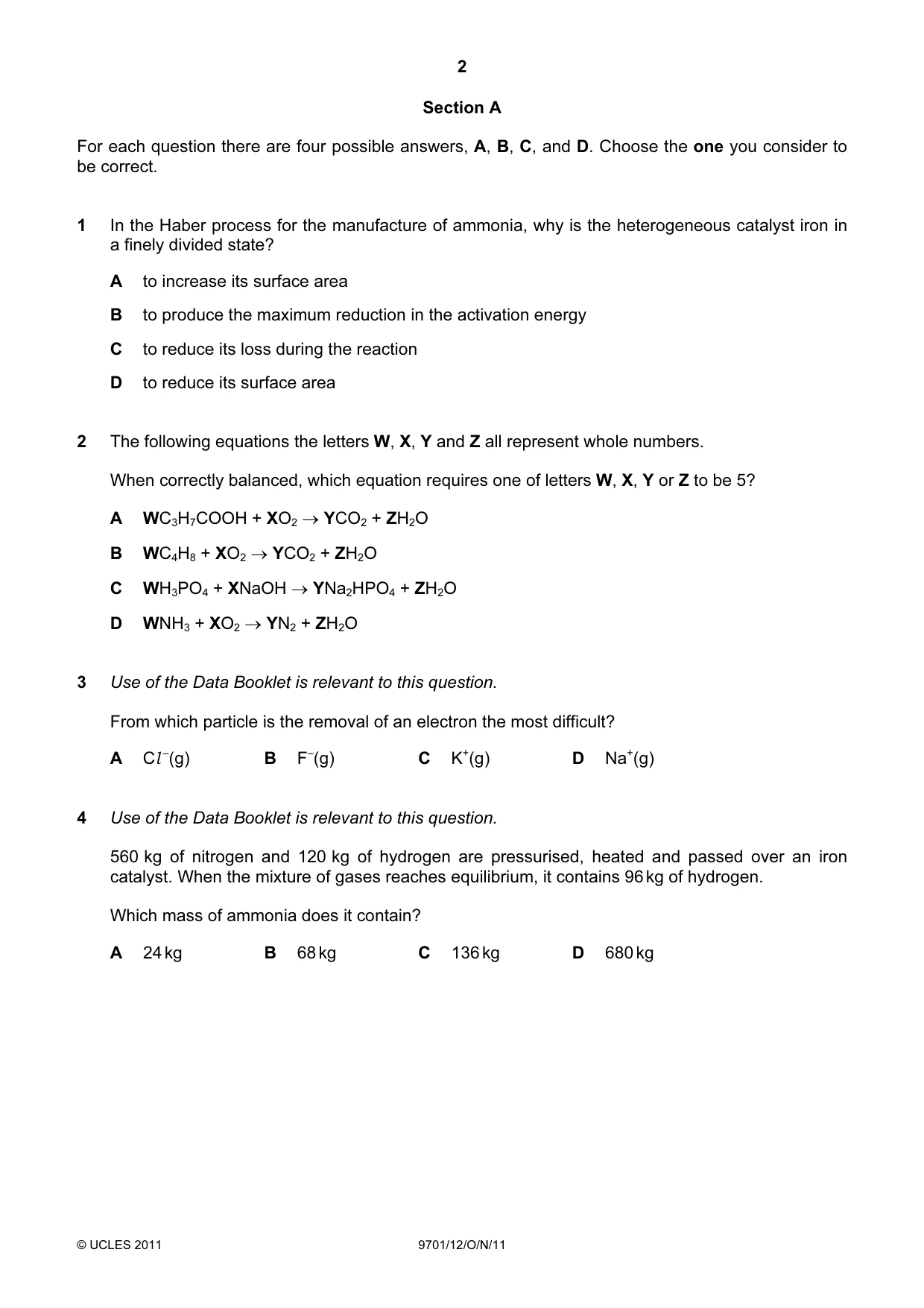
1 In the Haber process for the manufacture of ammonia, why is the heterogeneous catalyst iron in a finely divided state? A to increase its surface area B to produce the maximum reduction in the activation energy C to reduce its loss during the reaction D to reduce its surface area
Q2 · The following equations the letters W, X, Y and Z all represent whole numbers
2 The following equations the letters W, X, Y and Z all represent whole numbers. When correctly balanced, which equation requires one of letters W, X, Y or Z to be 5? A WC3H7COOH + XO2 → YCO2 + ZH2O B WC4H8 + XO2 → YCO2 + ZH2O C WH3PO4 + XNaOH → YNa2HPO4 + ZH2O D WNH3 + XO2 → YN2 + ZH2O
More questions on Reacting masses and volumes (of solutions and gases)
Q3 · Use of the Data Booklet is relevant to this question
3 Use of the Data Booklet is relevant to this question. From which particle is the removal of an electron the most difficult? A Cl –(g) B F–(g) C K+(g) D Na+(g)
Q4 · Use of the Data Booklet is relevant to this question
4 Use of the Data Booklet is relevant to this question. 560 kg of nitrogen and 120 kg of hydrogen are pressurised, heated and passed over an iron catalyst. When the mixture of gases reaches equilibrium, it contains 96 kg of hydrogen. Which mass of ammonia does it contain? A 24 kg B 68 kg C 136 kg D 680 kg
More questions on Reacting masses and volumes (of solutions and gases)
Q5 · The presence of dipoles helps to explain why the element Br2 and the compound CHCl 3…
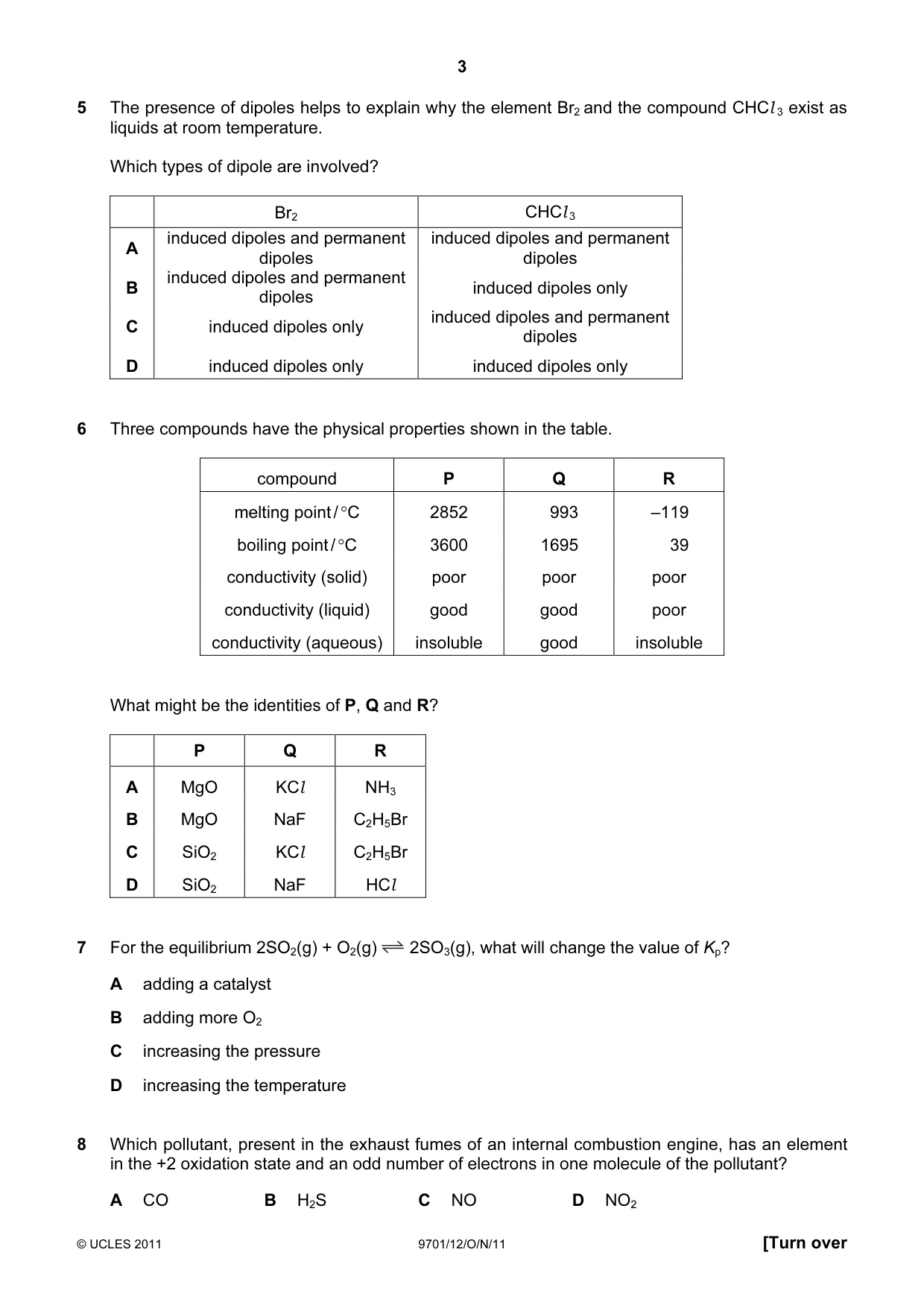
5 The presence of dipoles helps to explain why the element Br2 and the compound CHCl 3 exist as liquids at room temperature. Which types of dipole are involved? Br2 CHCl 3 induced dipoles and permanent induced dipoles and permanent A dipoles dipoles induced dipoles and permanent B induced dipoles only dipoles induced dipoles and permanent C induced dipoles only dipoles D induced dipoles only induced dipoles only
More questions on Intermolecular forces, electronegativity and bond properties
Q6 · Three compounds have the physical properties shown in the table
6 Three compounds have the physical properties shown in the table. compound P Q R melting point / °C 2852 993 –119 boiling point / °C 3600 1695 39 conductivity (solid) poor poor poor conductivity (liquid) good good poor conductivity (aqueous) insoluble good insoluble What might be the identities of P, Q and R? P Q R A MgO KCl NH3 B MgO NaF C2H5Br C SiO2 KCl C2H5Br D SiO2 NaF HCl
Q7 · For the equilibrium 2SO2(g) + O2(g) 2SO3(g), what will change the value of Kp?
7 For the equilibrium 2SO2(g) + O2(g) 2SO3(g), what will change the value of Kp? A adding a catalyst B adding more O2 C increasing the pressure D increasing the temperature
More questions on Chemical equilibria: reversible reactions, dynamic equilibrium
Q8 · Which pollutant, present in the exhaust fumes of an internal combustion engine, has an…
8 Which pollutant, present in the exhaust fumes of an internal combustion engine, has an element in the +2 oxidation state and an odd number of electrons in one molecule of the pollutant? A CO B H2S C NO D NO2
Q9 · The use of sucrose in food processing depends in part on osmotic pressure, symbol Π
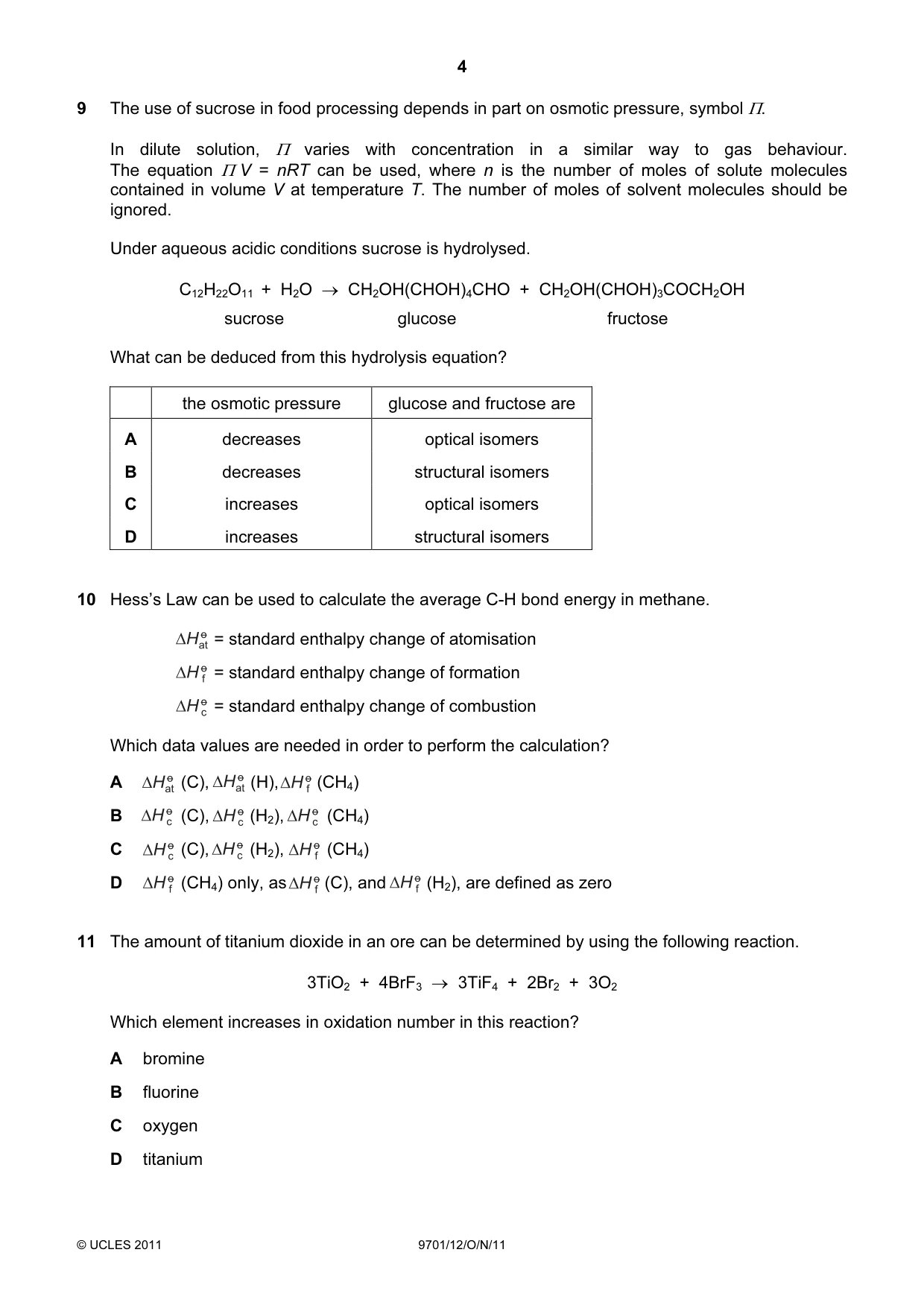
9 The use of sucrose in food processing depends in part on osmotic pressure, symbol Π. In dilute solution, Π varies with concentration in a similar way to gas behaviour. The equation Π V = nRT can be used, where n is the number of moles of solute molecules contained in volume V at temperature T. The number of moles of solvent molecules should be ignored. Under aqueous acidic conditions sucrose is hydrolysed. C12H22O11 + H2O → CH2OH(CHOH)4CHO + CH2OH(CHOH)3COCH2OH sucrose glucose fructose What can be deduced from this hydrolysis equation? the osmotic pressure glucose and fructose are A decreases optical isomers B decreases structural isomers C increases optical isomers D increases structural isomers
More questions on Isomerism: structural isomerism and stereoisomerism
Q10 · Hess’s Law can be used to calculate the average C-H bond energy in methane
10 Hess’s Law can be used to calculate the average C-H bond energy in methane. = standard enthalpy change of atomisation = standard enthalpy change of formation = standard enthalpy change of combustion Which data values are needed in order to perform the calculation? A (C), (H), (CH4) B (C), (H2), (CH4) C (C), (H2), (CH4) D (CH4) only, as (C), and (H2), are defined as zero
Q11 · The amount of titanium dioxide in an ore can be determined by using the following reaction
11 The amount of titanium dioxide in an ore can be determined by using the following reaction. 3TiO2 + 4BrF3 → 3TiF4 + 2Br2 + 3O2 Which element increases in oxidation number in this reaction? A bromine B fluorine C oxygen D titanium
Q12 · For the reaction W(aq) + 2X(aq) 2Y(aq) + 3Z(aq) what are the correct units for the…
12 For the reaction W(aq) + 2X(aq) 2Y(aq) + 3Z(aq) what are the correct units for the equilibrium constant Kc? A mol dm–3 B mol2 dm–6 C mol–1 dm3 D mol–2 dm6
More questions on Chemical equilibria: reversible reactions, dynamic equilibrium
Q13 · Methyl mercaptan, CH3SH, has a foul smell and is often used to impart a smell to natural…
13 Methyl mercaptan, CH3SH, has a foul smell and is often used to impart a smell to natural gas. What will be formed when CH3SH is burned in an excess of air? A CO H2O SO2 B CO2 H2O H2S C CO2 H2O SO2 D CO2 H2O SO3
Q14 · Nitrogenous fertilisers are used extensively in modern farming
14 Nitrogenous fertilisers are used extensively in modern farming. If rainwater washes excess fertiliser into a nearby lake, a process called eutrophication may occur. Three of the stages of eutrophication are described below. P Water plants growing on the lake bed die due to lack of sunlight. Q An excessive growth of algae occurs. R Excessive bacterial activity causes a reduction in oxygen levels. In which order do these three stages occur? A P → Q → R B P → R → Q C Q → P → R D Q → R → P
Q15 · Chlorine can be manufactured from brine in a diaphragm cell
15 Chlorine can be manufactured from brine in a diaphragm cell. Which row represents the correct electrodes? nature of nature of anode cathode A graphite titanium B steel titanium C titanium graphite D titanium steel
Q16 · Sodium iodide reacts with concentrated sulfuric acid
16 Sodium iodide reacts with concentrated sulfuric acid. The equation which represents one of the reactions that takes place is shown. 8NaI + 9H2SO4 → 8NaHSO4 + 4I2 + H2S + 4H2O Which species has been oxidised in this reaction? A H+ B I– C Na+ D SO4 2–
Q17 · The standard enthalpy changes of formation of HCl and HI are –92 kJ mol–1 and +26 kJ…
17 The standard enthalpy changes of formation of HCl and HI are –92 kJ mol–1 and +26 kJ mol–1 respectively. Which statement is most important in explaining this difference? A Chlorine is more electronegative than iodine. B The activation energy for the H2 + Cl2 reaction is much less than that for the H2 + I2 reaction. C The bond energy of HI is smaller than the bond energy of HCl. D The bond energy of I2 is smaller than the bond energy of Cl2.
More questions on The chemical properties of the halogen elements and the hydrogen halides
Q18 · Lime mortar is made from quicklime, water and sand
18 Lime mortar is made from quicklime, water and sand. Over a period of time, lime mortar changes into a much harder form. Both fresh and old lime mortar react with aqueous hydrochloric acid but only the old lime mortar effervesces during the reaction. Which equation describes the change from fresh to old lime mortar? A CaO + CO2 → CaCO3 B CaO + H2O → Ca(OH)2 C Ca(OH)2 → CaO + H2O D Ca(OH)2 + CO2 → CaCO3 + H2O
Q19 · Ar, Ca2+ and K+, contain the same number of electrons
19 Ar, Ca2+ and K+, contain the same number of electrons. In which order do their radii increase? smallest radius largest radius A Ar K+ Ca2+ B Ca2+ Ar K+ C Ca2+ K+ Ar D K+ Ar Ca2+
Q20 · Bromine and propene undergo an addition reaction
20 Bromine and propene undergo an addition reaction. Which is a property of the product? A It exists in cis-trans isomers. B It is more volatile than propene. C It possesses a chiral centre. D It possesses hydrogen bonding.
Q21 · Buta-1,3-diene is currently obtained from fossil fuel sources
21 Buta-1,3-diene is currently obtained from fossil fuel sources. In future it may be obtained from ethanol, which can be produced from non-food agricultural crops. The sequence of reactions is as follows. step 1 step 2 step 3 CH3CH2OH CH3CHO CH3CH(OH)CH2CHO CH2=CHCH=CH2 buta-1,3-diene Which term could be used to describe step 1? A condensation B dehydration C dehydrogenation D hydrogenation
Q22 · Use of the Data Booklet is relevant to this question
22 Use of the Data Booklet is relevant to this question. Which bond in the structure below has the lowest bond energy? H F A C B H C C Cl D H H
More questions on Intermolecular forces, electronegativity and bond properties
Q23 · Ethanal, CH3CHO, can be reduced using NaBH4 in aqueous ethanol
23 Ethanal, CH3CHO, can be reduced using NaBH4 in aqueous ethanol. This is a nucleophilic addition reaction. What could be the first step of this mechanism? A attack of an H– ion at the carbon atom of the carbonyl group B attack of an H– ion at the oxygen atom of the carbonyl group C attack of an H+ ion at the carbon atom of the carbonyl group D attack of an H+ ion at the oxygen atom of the carbonyl group
Q24 · In a sequence of reactions, ethanal is converted into a compound H
24 In a sequence of reactions, ethanal is converted into a compound H. HCN, NaCN hot dilute H2SO4 CH3OH, heat CH3CHO F G H trace of conc. H2SO4 What could H be? A CH3CH2COOCH3 B CH3CH(OH)COOCH3 C CH3CH(OH)OCOCH3 D CH3CH(OCH3)COOH
Q25 · What is involved in the mechanism of the reaction between aqueous sodium hydroxide and…
25 What is involved in the mechanism of the reaction between aqueous sodium hydroxide and 2-bromo-2-methylbutane? A heterolytic bond fission, attack by an electrophile on a carbanion B heterolytic bond fission, attack by a nucleophile on a carbocation C homolytic bond fission, attack by an electrophile on a carbanion D homolytic bond fission, attack by a nucleophile on a carbocation
Q26 · Use of the Data Booklet is relevant to this question
26 Use of the Data Booklet is relevant to this question. 2.30 g of ethanol were mixed with aqueous acidified potassium dichromate(VI). The desired product was collected by immediate distillation under gentle warming. The yield of product was 70.0 %. What mass of product was collected? A 1.54 g B 1.61 g C 2.10 g D 3.14 g
More questions on Reacting masses and volumes (of solutions and gases)
Q27 · The molecule shown is optically active
27 The molecule shown is optically active. Cl H Cl H H Cl C C C C C Cl H H H H Cl C H H How many chiral carbon atoms are present in this molecule? A 1 B 2 C 3 D 4
Q28 · Which reagent could best be used to distinguish between cyclohexene and cyclohexanol?
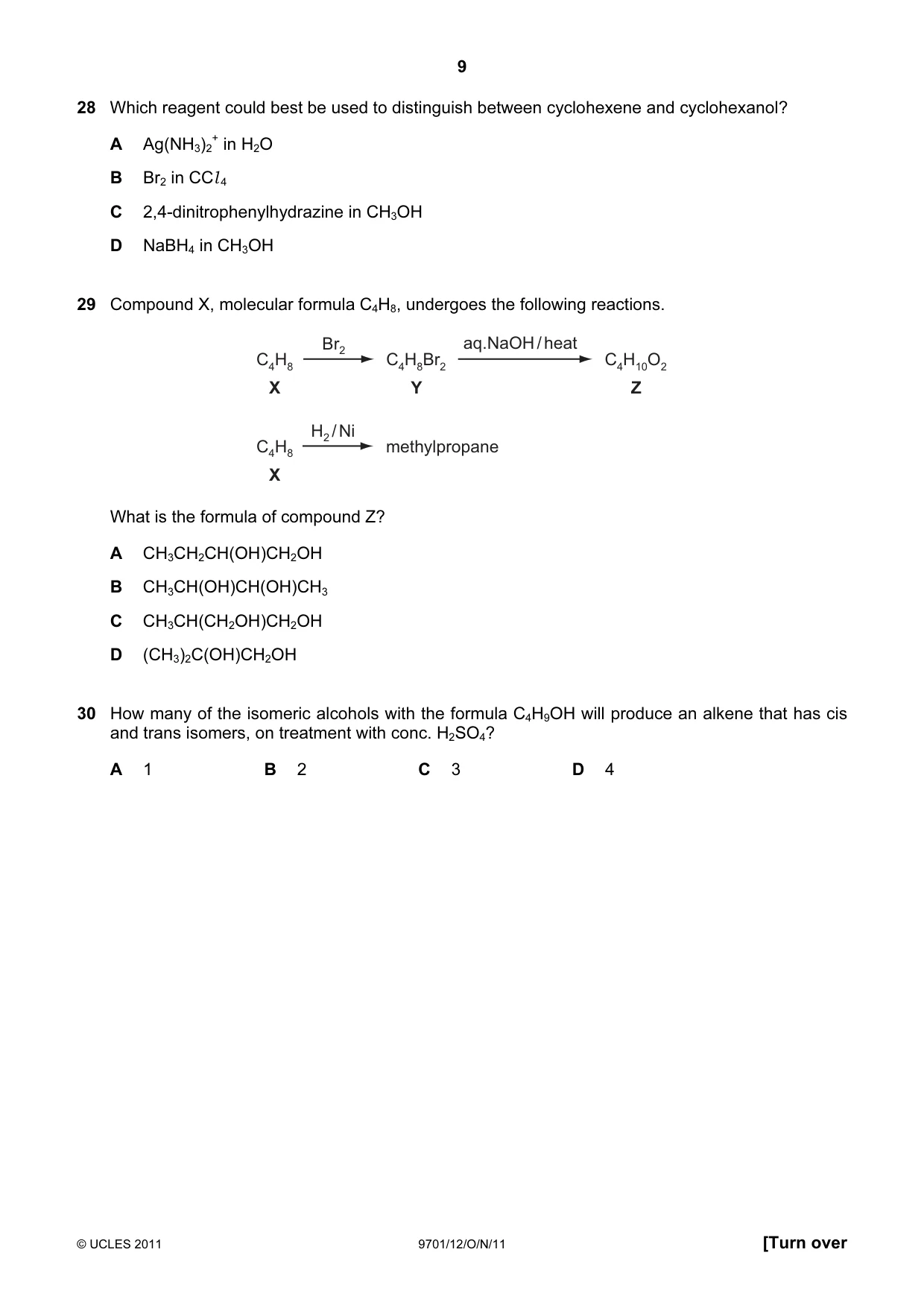
28 Which reagent could best be used to distinguish between cyclohexene and cyclohexanol? A Ag(NH3)2 + in H2O B Br2 in CCl 4 C 2,4-dinitrophenylhydrazine in CH3OH D NaBH4 in CH3OH
Q29 · Compound X, molecular formula C4H8, undergoes the following reactions
29 Compound X, molecular formula C4H8, undergoes the following reactions. Br2 aq.NaOH / heat C4H8 C4H8Br2 C4H10O2 X Y Z H2 / Ni C4H8 methylpropane X What is the formula of compound Z? A CH3CH2CH(OH)CH2OH B CH3CH(OH)CH(OH)CH3 C CH3CH(CH2OH)CH2OH D (CH3)2C(OH)CH2OH
Q30 · How many of the isomeric alcohols with the formula C4H9OH will produce an alkene that has…
30 How many of the isomeric alcohols with the formula C4H9OH will produce an alkene that has cis and trans isomers, on treatment with conc. H2SO4? A 1 B 2 C 3 D 4
Q31 · Which statements about bond angles are correct?
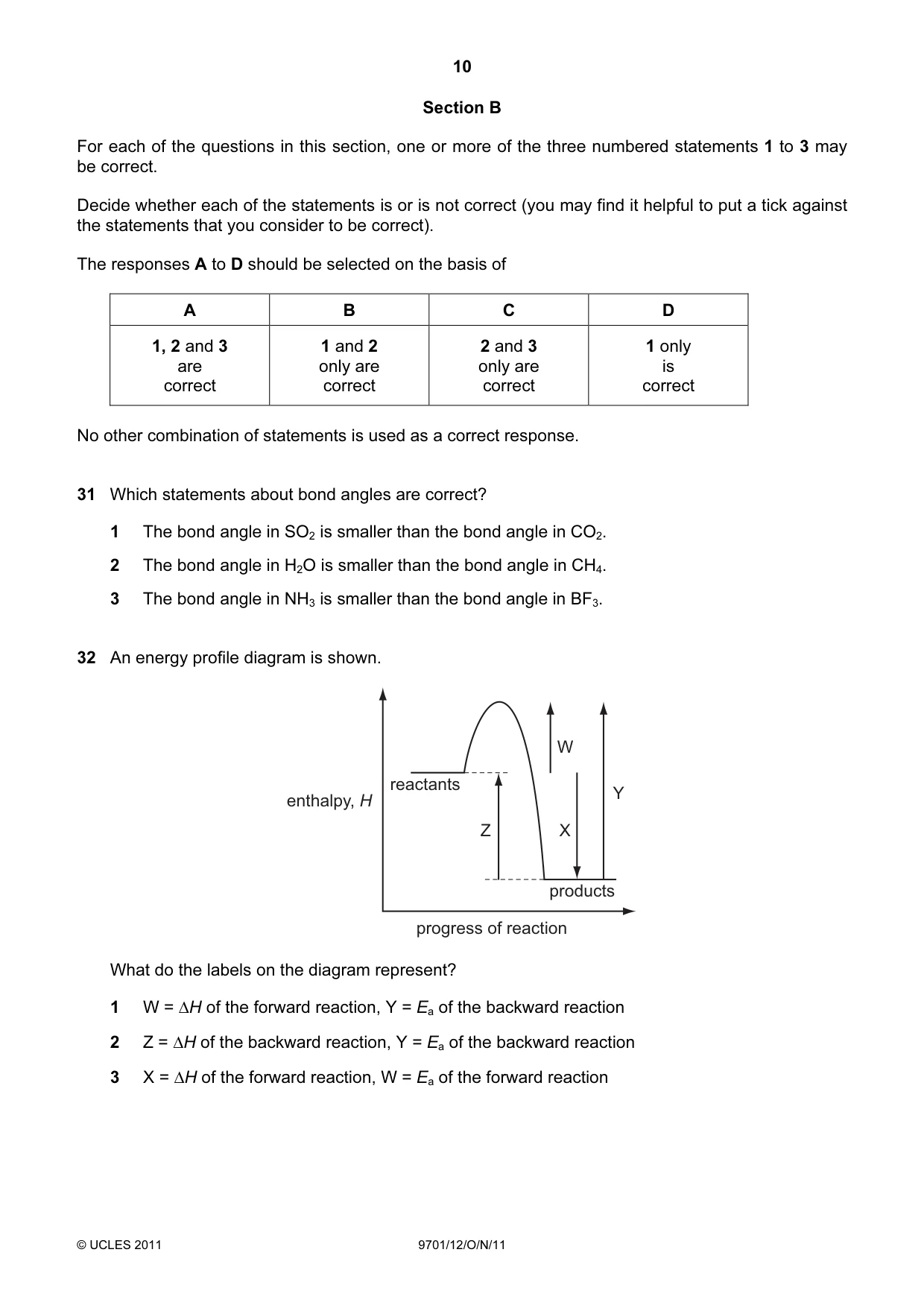
31 Which statements about bond angles are correct? 1 The bond angle in SO2 is smaller than the bond angle in CO2. 2 The bond angle in H2O is smaller than the bond angle in CH4. 3 The bond angle in NH3 is smaller than the bond angle in BF3.
Q32 · An energy profile diagram is shown
32 An energy profile diagram is shown. W reactants enthalpy, H Y Z X products progress of reaction What do the labels on the diagram represent? 1 W = ∆H of the forward reaction, Y = Ea of the backward reaction 2 Z = ∆H of the backward reaction, Y = Ea of the backward reaction 3 X = ∆H of the forward reaction, W = Ea of the forward reaction
Q33 · Which are assumptions of the kinetic theory of gases and hence of the ideal gas equation…
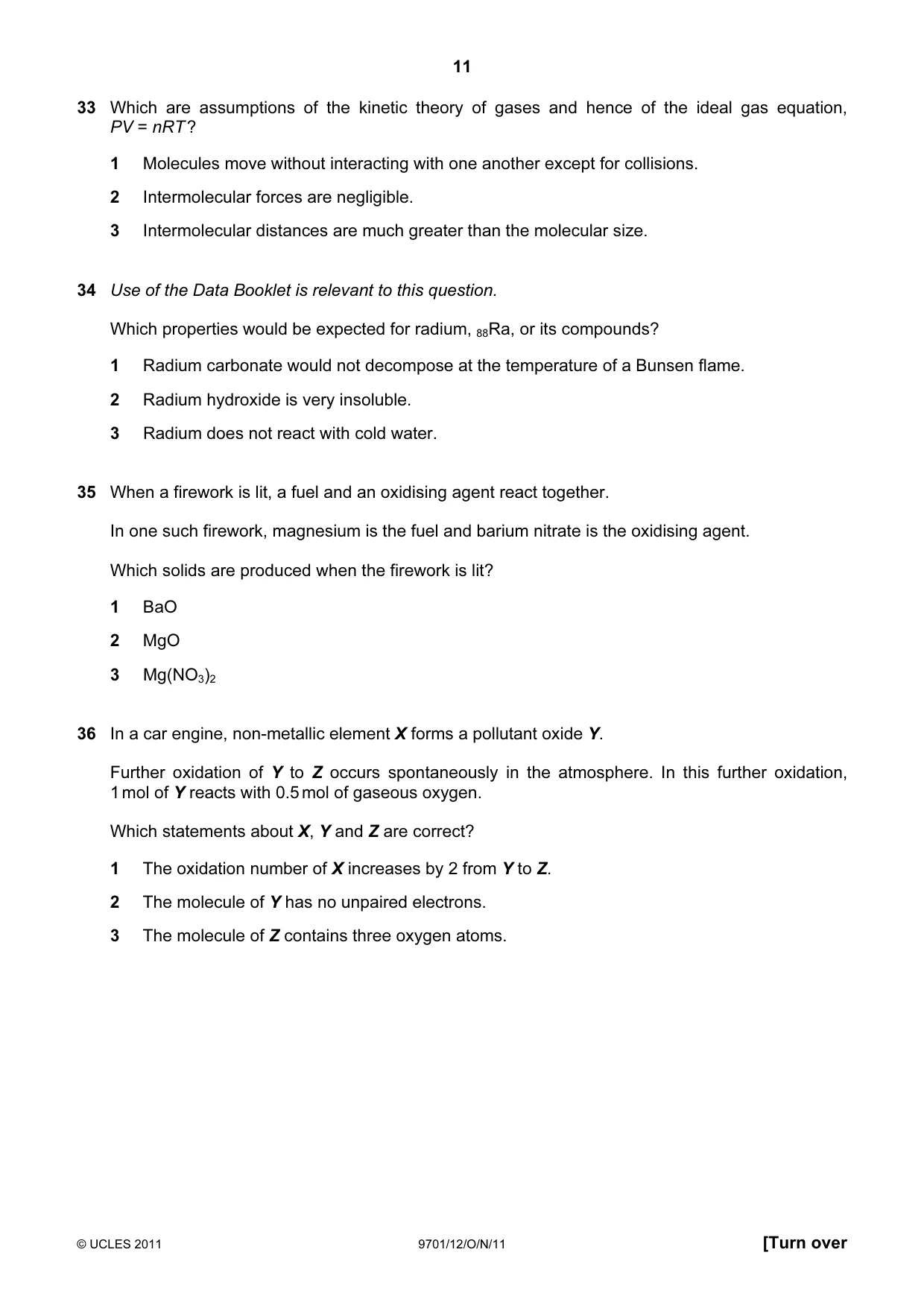
33 Which are assumptions of the kinetic theory of gases and hence of the ideal gas equation, PV = nRT ? 1 Molecules move without interacting with one another except for collisions. 2 Intermolecular forces are negligible. 3 Intermolecular distances are much greater than the molecular size.
More questions on The gaseous state: ideal and real gases and pV = nRT
Q34 · Use of the Data Booklet is relevant to this question
34 Use of the Data Booklet is relevant to this question. Which properties would be expected for radium, 88Ra, or its compounds? 1 Radium carbonate would not decompose at the temperature of a Bunsen flame. 2 Radium hydroxide is very insoluble. 3 Radium does not react with cold water.
Q35 · When a firework is lit, a fuel and an oxidising agent react together
35 When a firework is lit, a fuel and an oxidising agent react together. In one such firework, magnesium is the fuel and barium nitrate is the oxidising agent. Which solids are produced when the firework is lit? 1 BaO 2 MgO 3 Mg(NO3)2
Q36 · In a car engine, non-metallic element X forms a pollutant oxide Y
36 In a car engine, non-metallic element X forms a pollutant oxide Y. Further oxidation of Y to Z occurs spontaneously in the atmosphere. In this further oxidation, 1 mol of Y reacts with 0.5 mol of gaseous oxygen. Which statements about X, Y and Z are correct? 1 The oxidation number of X increases by 2 from Y to Z. 2 The molecule of Y has no unpaired electrons. 3 The molecule of Z contains three oxygen atoms.
Q37 · Compound X has molecular formula C4H10O
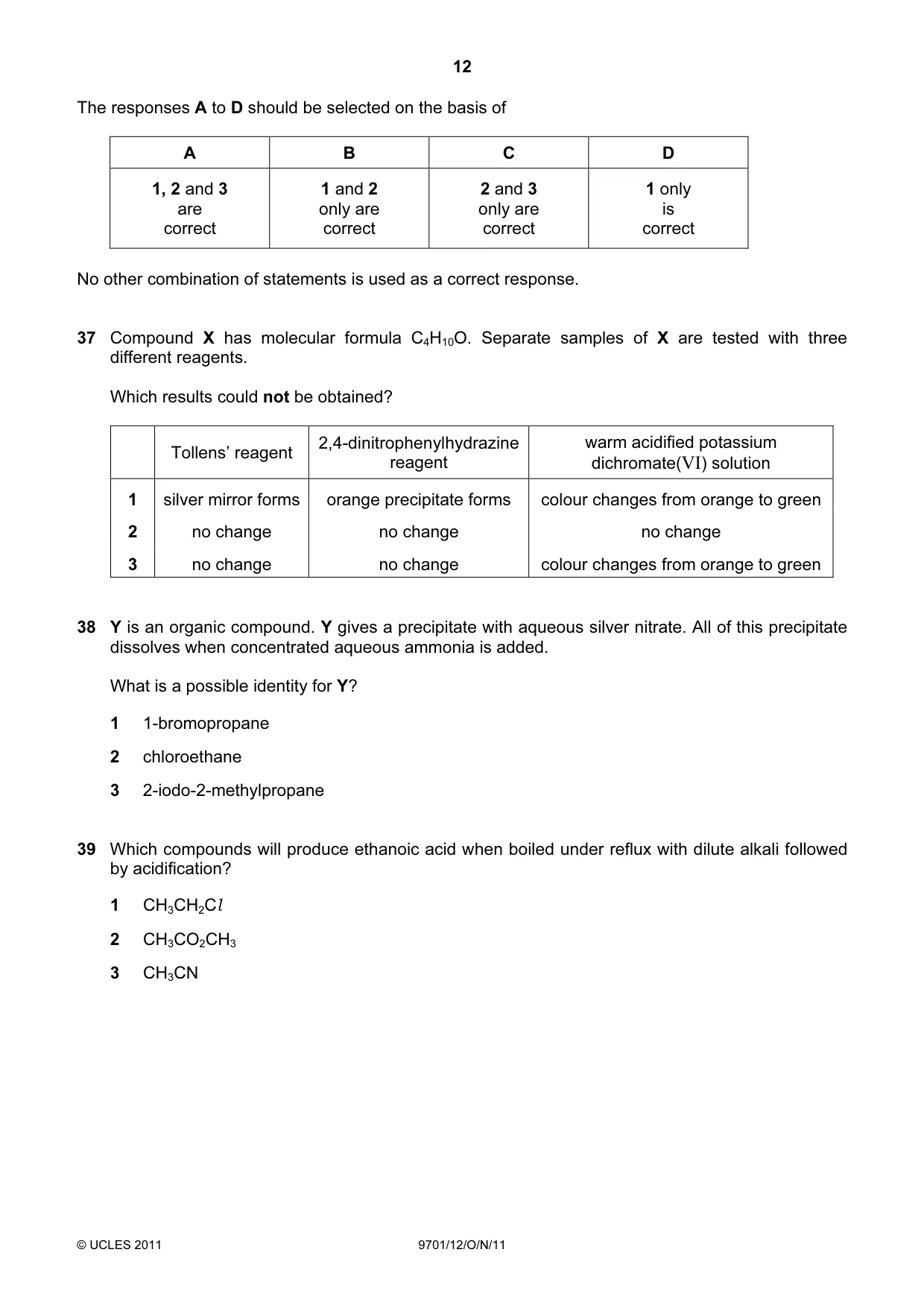
37 Compound X has molecular formula C4H10O. Separate samples of X are tested with three different reagents. Which results could not be obtained? 2,4-dinitrophenylhydrazine warm acidified potassium Tollens’ reagent reagent dichromate(VI) solution 1 silver mirror forms orange precipitate forms colour changes from orange to green 2 no change no change no change 3 no change no change colour changes from orange to green
Q38 · Y is an organic compound
38 Y is an organic compound. Y gives a precipitate with aqueous silver nitrate. All of this precipitate dissolves when concentrated aqueous ammonia is added. What is a possible identity for Y? 1 1-bromopropane 2 chloroethane 3 2-iodo-2-methylpropane
Q39 · Which compounds will produce ethanoic acid when boiled under reflux with dilute alkali…
39 Which compounds will produce ethanoic acid when boiled under reflux with dilute alkali followed by acidification? 1 CH3CH2Cl 2 CH3CO2CH3 3 CH3CN
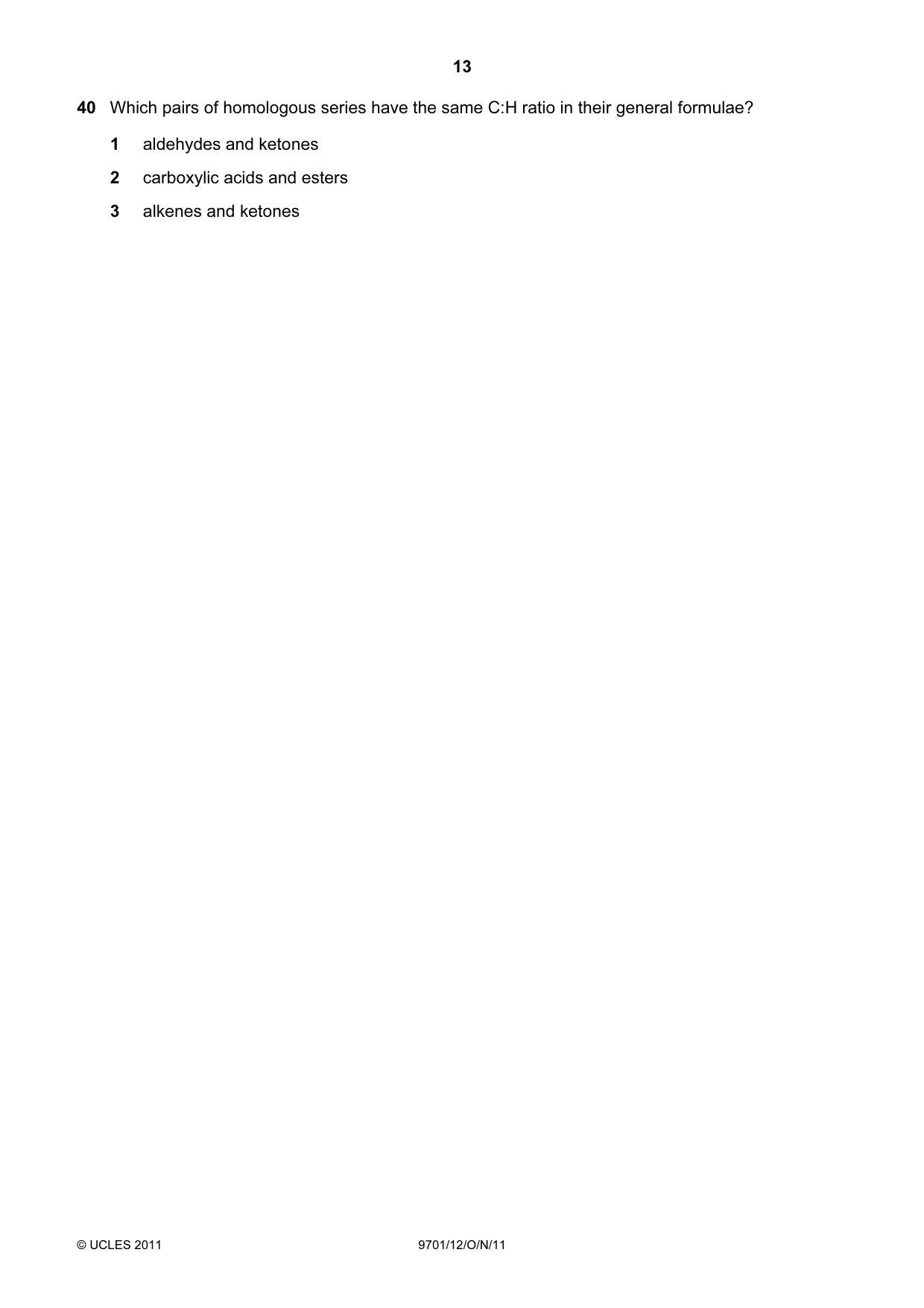
Q40 · Which pairs of homologous series have the same C:H ratio in their general formulae?
40 Which pairs of homologous series have the same C:H ratio in their general formulae? 1 aldehydes and ketones 2 carboxylic acids and esters 3 alkenes and ketones
What was in this paper
The subtopics covered by these 40 questions, and how many questions each got. Open one in a new tab to see every Cambridge question on it.
3Reacting masses and volumes (of solutions and gases)3Redox processes: electron transfer and changes in oxidation number (oxidation state)3Similarities and trends in the properties of the Group 2 metals, magnesium to barium, and their compounds3Alcohols2Aldehydes and ketones2Chemical equilibria: reversible reactions, dynamic equilibrium2Enthalpy change, ΔH2Halogenoalkanes2Intermolecular forces, electronegativity and bond properties2Alkanes1Alkenes1Bonding and structure1Electrolysis1Esters1Homogeneous and heterogeneous catalysts1Ionisation energy1Isomerism: optical1Isomerism: structural isomerism and stereoisomerism1Nitriles and hydroxynitriles1Nitrogen and sulfur1Particles in the atom and atomic radius1Shapes of molecules1Some reactions of the halide ions1The chemical properties of the halogen elements and the hydrogen halides1The gaseous state: ideal and real gases and pV = nRT1What you needed in this session
Cambridge’s own grade thresholds for 2011 Oct/Nov, Paper 1 · Variant 2. A higher threshold means an easier paper — the bar moves with how the cohort did.