Cambridge A Level Chemistry 9701 — 2021 Oct/Nov Paper 1 · Variant 3
9701/13/O/N/21 · 40 questions · 40 marks · ≈45 min
The question paper and its mark scheme, free to read here and free to download. This is Cambridge’s own paper, exactly as it was sat.
Question paper16 pages

Mark scheme3 pages
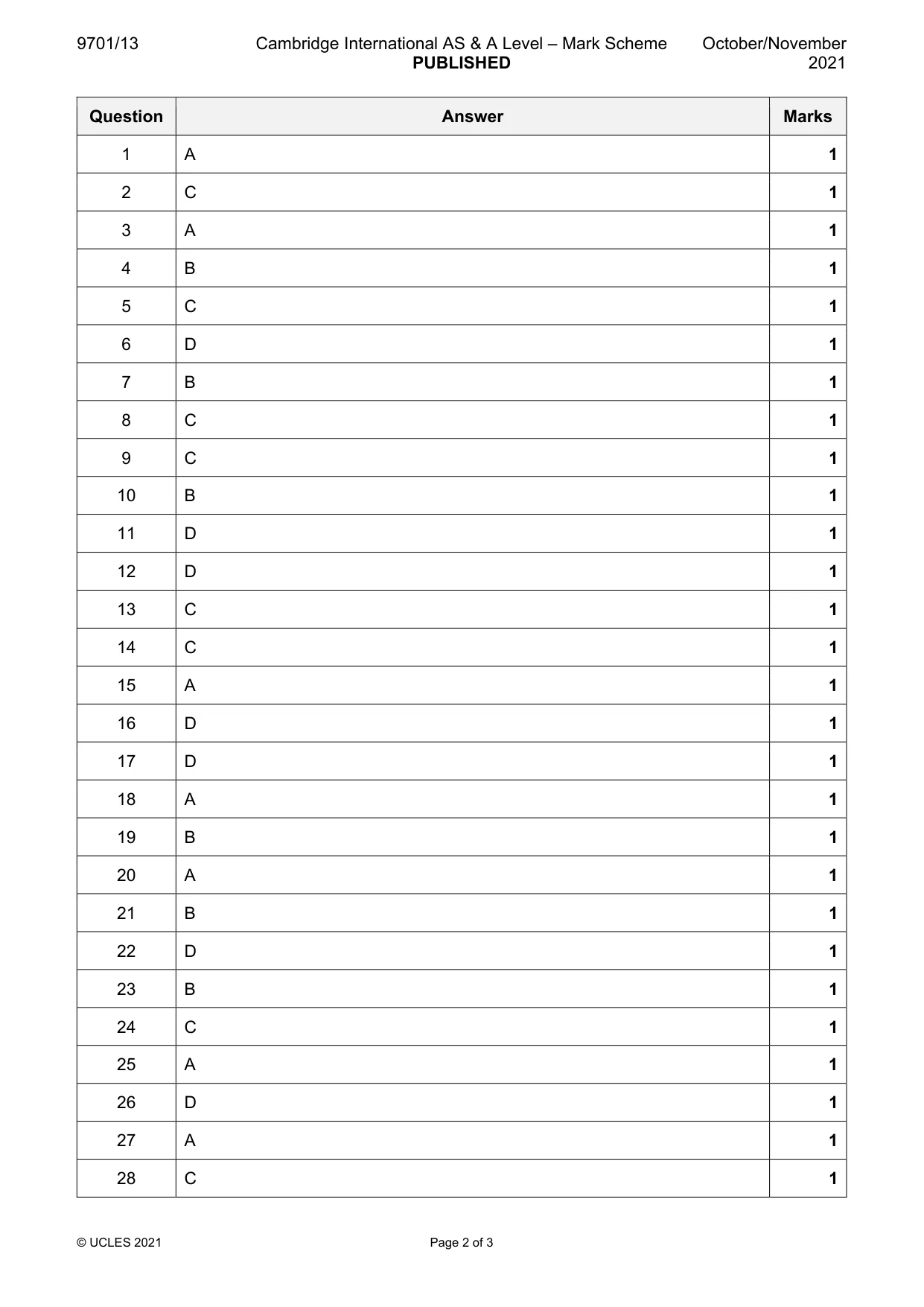
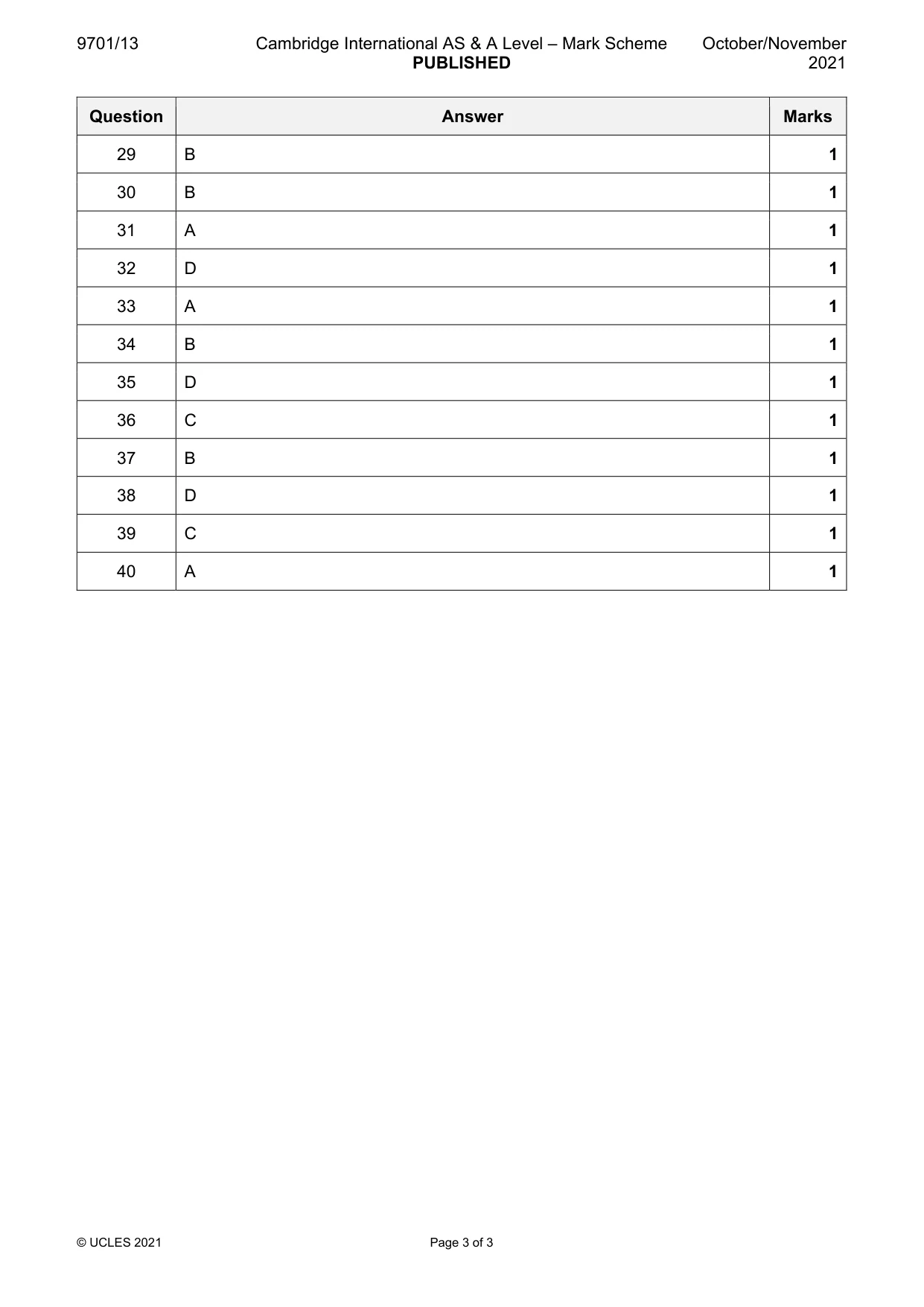
Answers below. Sit the paper first if you are practising.
Questions as text
Q1 · The mass spectrum of a sample of neon is shown
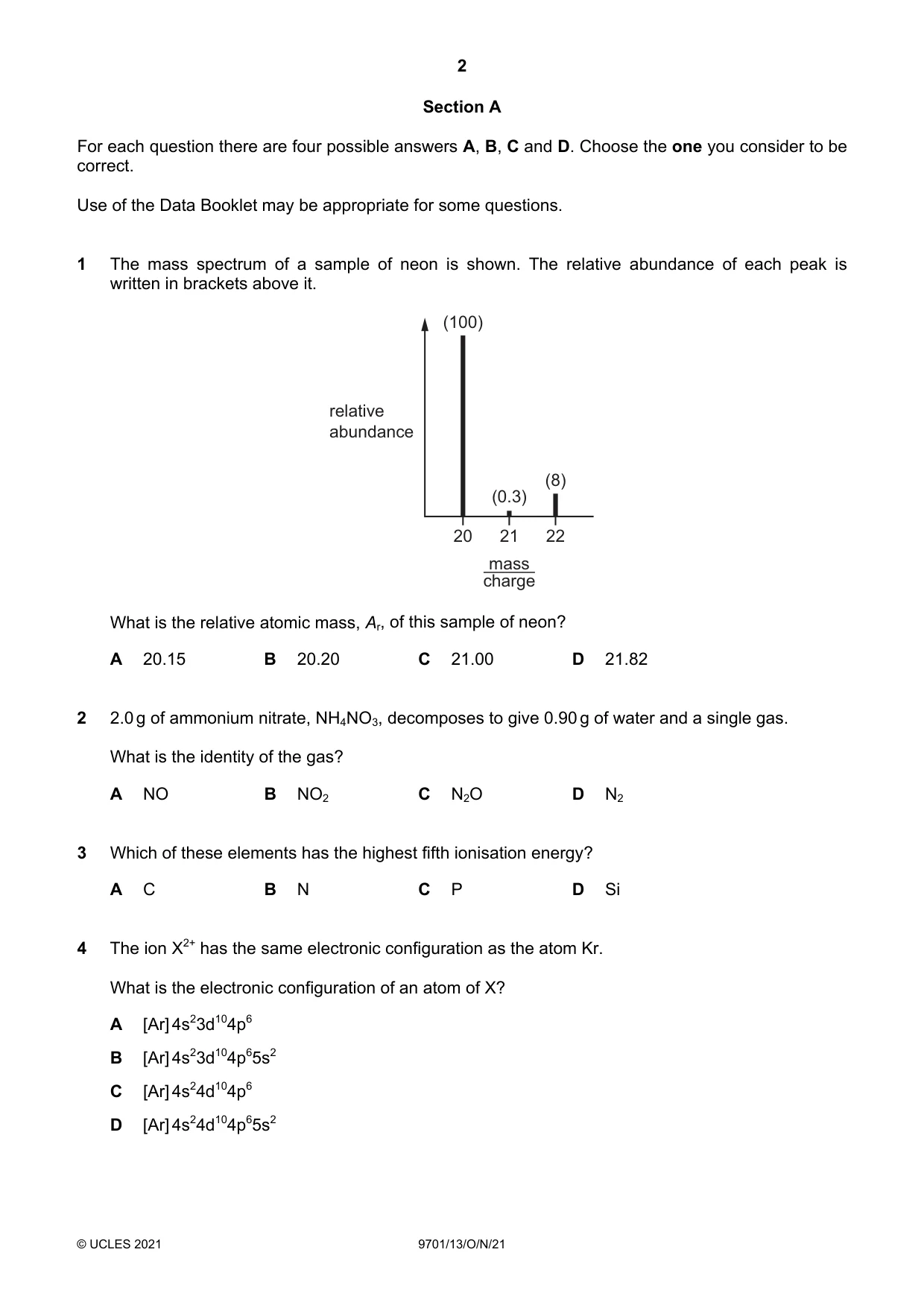
1 The mass spectrum of a sample of neon is shown. The relative abundance of each peak is written in brackets above it. (100) relative abundance (8) (0.3) 20 21 22 mass charge What is the relative atomic mass, Ar, of this sample of neon? A 20.15 B 20.20 C 21.00 D 21.82
Mark scheme: A
Q2 · 2.0 g of ammonium nitrate, NH4NO3, decomposes to give 0.90 g of water and a single gas
2 2.0 g of ammonium nitrate, NH4NO3, decomposes to give 0.90 g of water and a single gas. What is the identity of the gas? A NO B NO2 C N2O D N2
Mark scheme: C
More questions on Reacting masses and volumes (of solutions and gases)
Q3 · Which of these elements has the highest fifth ionisation energy?
3 Which of these elements has the highest fifth ionisation energy? A C B N C P D Si
Mark scheme: A
Q4 · The ion X2+ has the same electronic configuration as the atom Kr
4 The ion X2+ has the same electronic configuration as the atom Kr. What is the electronic configuration of an atom of X? A [Ar] 4s23d104p6 B [Ar] 4s23d104p65s2 C [Ar] 4s24d104p6 D [Ar] 4s24d104p65s2
Mark scheme: B
More questions on Electrons, energy levels and atomic orbitals
Q5 · Which type of interaction exists between water molecules and metal cations in aqueous…
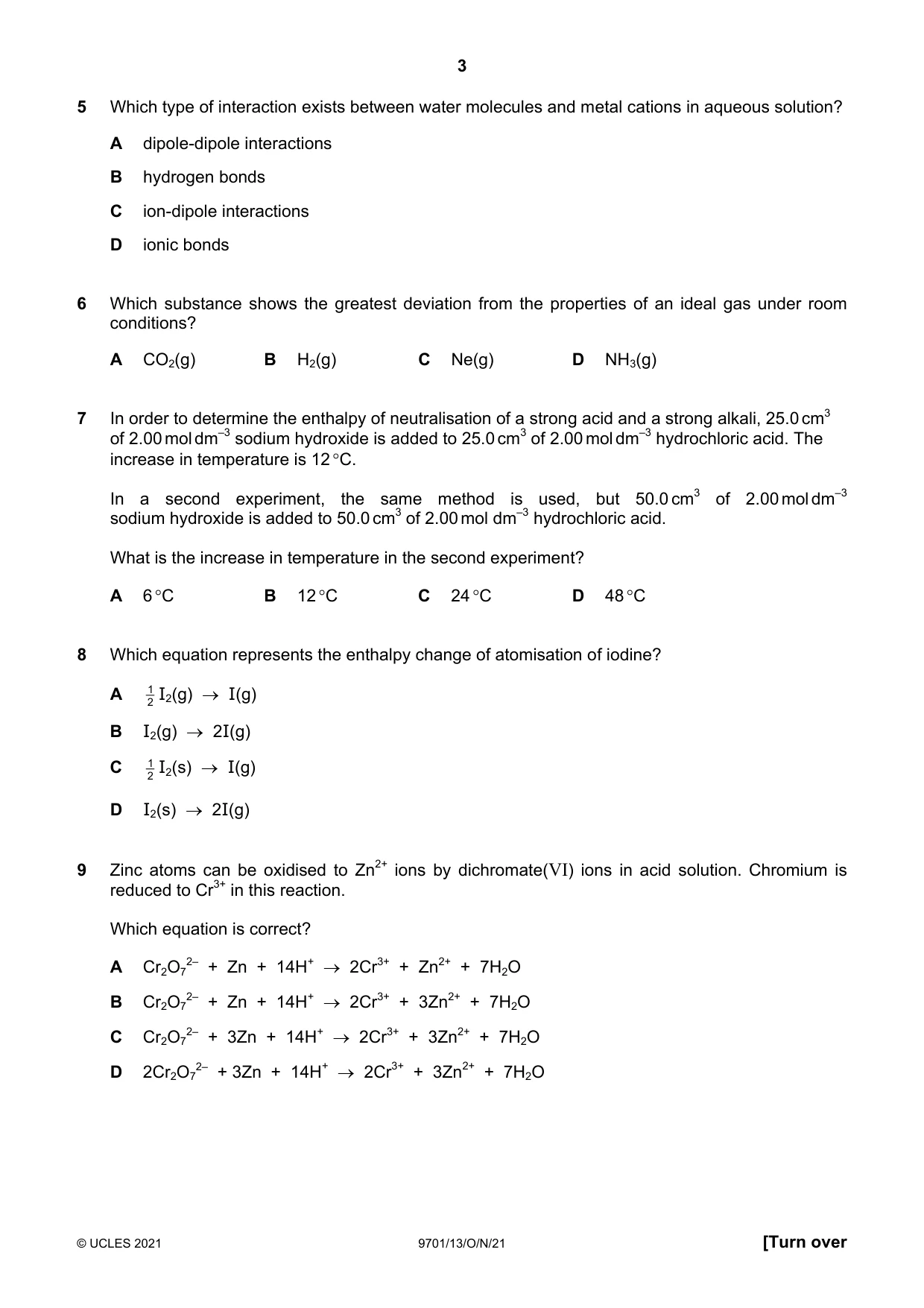
5 Which type of interaction exists between water molecules and metal cations in aqueous solution? A dipole-dipole interactions B hydrogen bonds C ion-dipole interactions D ionic bonds
Mark scheme: C
More questions on Intermolecular forces, electronegativity and bond properties
Q6 · Which substance shows the greatest deviation from the properties of an ideal gas under…
6 Which substance shows the greatest deviation from the properties of an ideal gas under room conditions? A CO2(g) B H2(g) C Ne(g) D NH3(g)
Mark scheme: D
More questions on The gaseous state: ideal and real gases and pV = nRT
Q7 · In order to determine the enthalpy of neutralisation of a strong acid and a strong…
7 In order to determine the enthalpy of neutralisation of a strong acid and a strong alkali, 25.0 cm3 of 2.00 mol dm‒3 sodium hydroxide is added to 25.0 cm3 of 2.00 mol dm‒3 hydrochloric acid. The increase in temperature is 12 C. In a second experiment, the same method is used, but 50.0 cm3 of 2.00 mol dm‒3 sodium hydroxide is added to 50.0 cm3 of 2.00 mol dm‒3 hydrochloric acid. What is the increase in temperature in the second experiment? A 6 C B 12 C C 24 C D 48 C
Mark scheme: B
Q8 · Which equation represents the enthalpy change of atomisation of iodine?
8 Which equation represents the enthalpy change of atomisation of iodine? 1 I2(g) I(g) A 2 B I2(g) 2I(g) 1 I2(s) I(g) C 2 D I2(s) 2I(g)
Mark scheme: C
Q9 · Zinc atoms can be oxidised to Zn2+ ions by dichromate(VI) ions in acid solution
9 Zinc atoms can be oxidised to Zn2+ ions by dichromate(VI) ions in acid solution. Chromium is reduced to Cr3+ in this reaction. Which equation is correct? A Cr2O7 2– + Zn + 14H+ 2Cr3+ + Zn2+ + 7H2O B Cr2O7 2– + Zn + 14H+ 2Cr3+ + 3Zn2+ + 7H2O C Cr2O7 2– + 3Zn + 14H+ 2Cr3+ + 3Zn2+ + 7H2O D 2Cr2O7 2– + 3Zn + 14H+ 2Cr3+ + 3Zn2+ + 7H2O
Mark scheme: C
Q10 · The equation shows that H2(g) and I2(g) react to form an equilibrium mixture
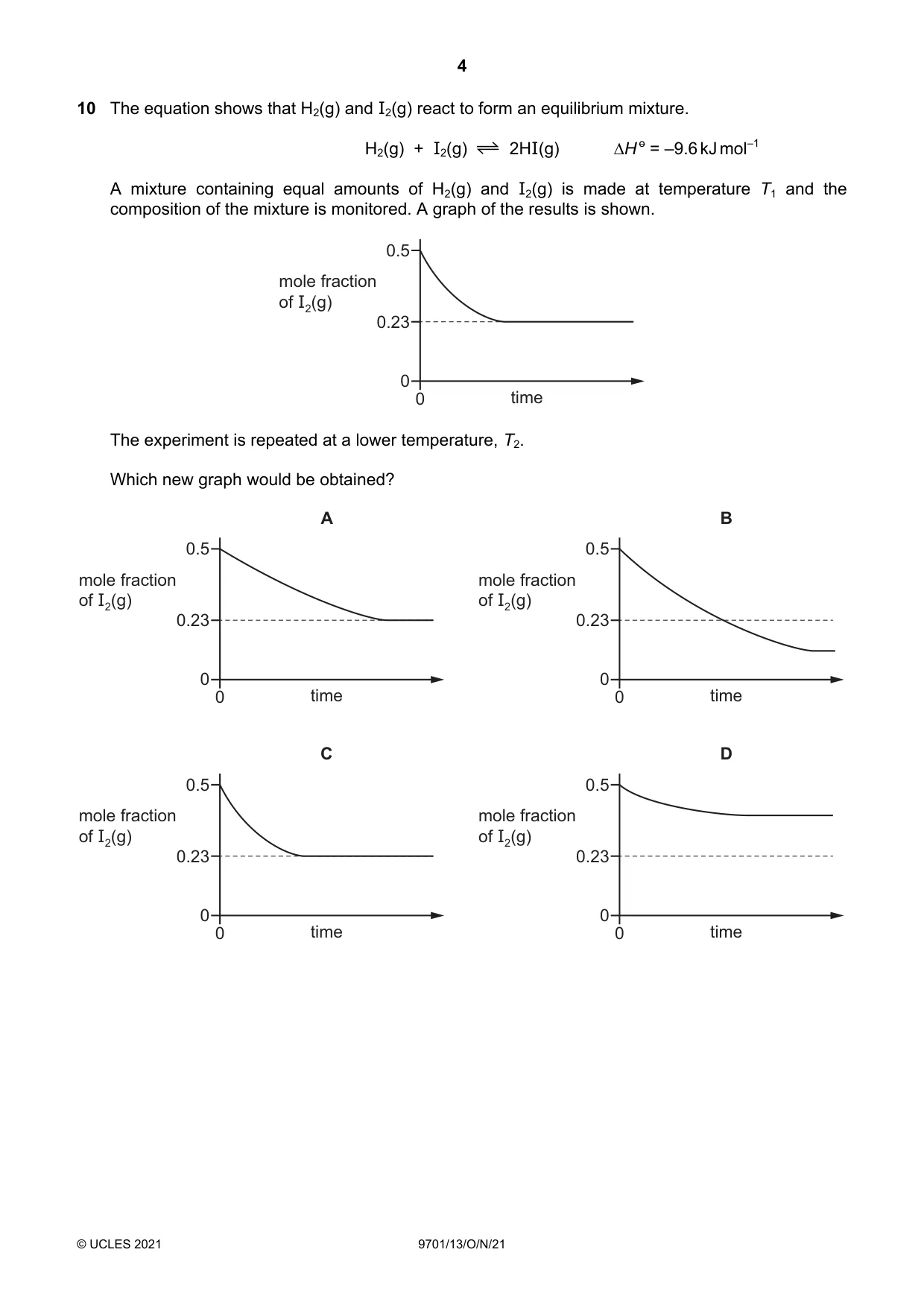
10 The equation shows that H2(g) and I2(g) react to form an equilibrium mixture. H2(g) + I2(g) 2HI(g) H o = –9.6 kJ mol–1 A mixture containing equal amounts of H2(g) and I2(g) is made at temperature T1 and the composition of the mixture is monitored. A graph of the results is shown. 0.5 mole fraction of I2(g) 0.23 0 0 time The experiment is repeated at a lower temperature, T2. Which new graph would be obtained? A B 0.5 0.5 mole fraction mole fraction of I2(g) of I2(g) 0.23 0.23 0 0 0 time 0 time C D 0.5 0.5 mole fraction mole fraction of I2(g) of I2(g) 0.23 0.23 0 0 0 time 0 time
Mark scheme: B
More questions on Chemical equilibria: reversible reactions, dynamic equilibrium
Q11 · The diagram shows the Boltzmann distribution of energies for a reactant gas
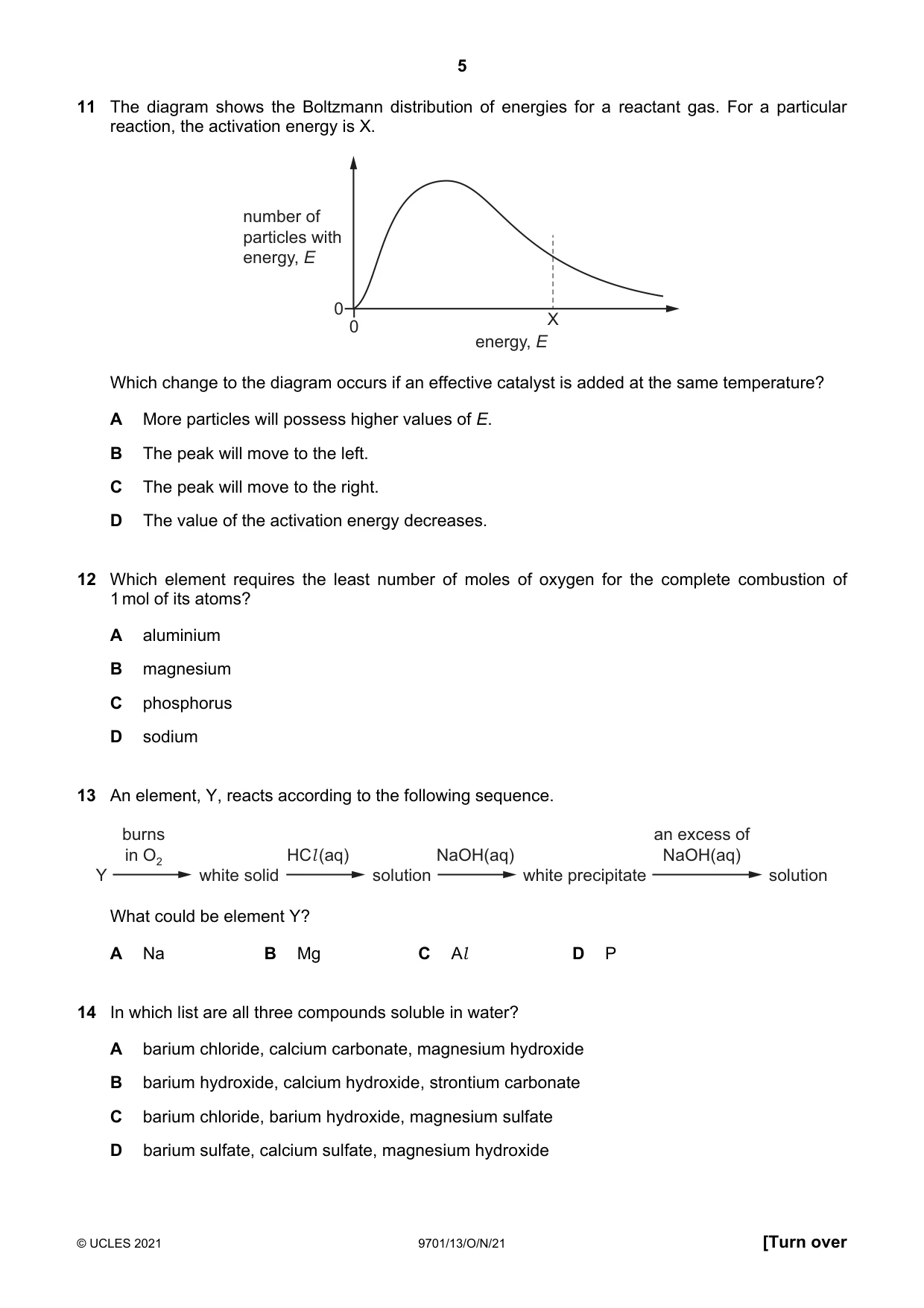
11 The diagram shows the Boltzmann distribution of energies for a reactant gas. For a particular reaction, the activation energy is X. number of particles with energy, E 0 0 X energy, E Which change to the diagram occurs if an effective catalyst is added at the same temperature? A More particles will possess higher values of E. B The peak will move to the left. C The peak will move to the right. D The value of the activation energy decreases.
Mark scheme: D
More questions on Effect of temperature on reaction rates and the concept of activation energy
Q12 · Which element requires the least number of moles of oxygen for the complete combustion of…
12 Which element requires the least number of moles of oxygen for the complete combustion of 1 mol of its atoms? A aluminium B magnesium C phosphorus D sodium
Mark scheme: D
More questions on Periodicity of chemical properties of the elements in Period 3
Q13 · An element, Y, reacts according to the following sequence
13 An element, Y, reacts according to the following sequence. burns an excess of in O2 HCl (aq) NaOH(aq) NaOH(aq) Y white solid solution white precipitate solution What could be element Y? A Na B Mg C Al D P
Mark scheme: C
More questions on Periodicity of chemical properties of the elements in Period 3
Q14 · In which list are all three compounds soluble in water?
14 In which list are all three compounds soluble in water? A barium chloride, calcium carbonate, magnesium hydroxide B barium hydroxide, calcium hydroxide, strontium carbonate C barium chloride, barium hydroxide, magnesium sulfate D barium sulfate, calcium sulfate, magnesium hydroxide
Mark scheme: C
Q15 · Anhydrous magnesium nitrate, Mg(NO3)2, decomposes when heated, giving a white solid and a…
15 Anhydrous magnesium nitrate, Mg(NO3)2, decomposes when heated, giving a white solid and a mixture of two gases, X and Y. Y is oxygen. What is the ratio mass of X released ? mass of Y released A 1 B 1 C 1 D 1 0 . 174 0 . 267 0 . 348 3 . 43
Mark scheme: A
Q16 · In a series of nine experiments, to test the reactivity of the halogens, an aqueous…
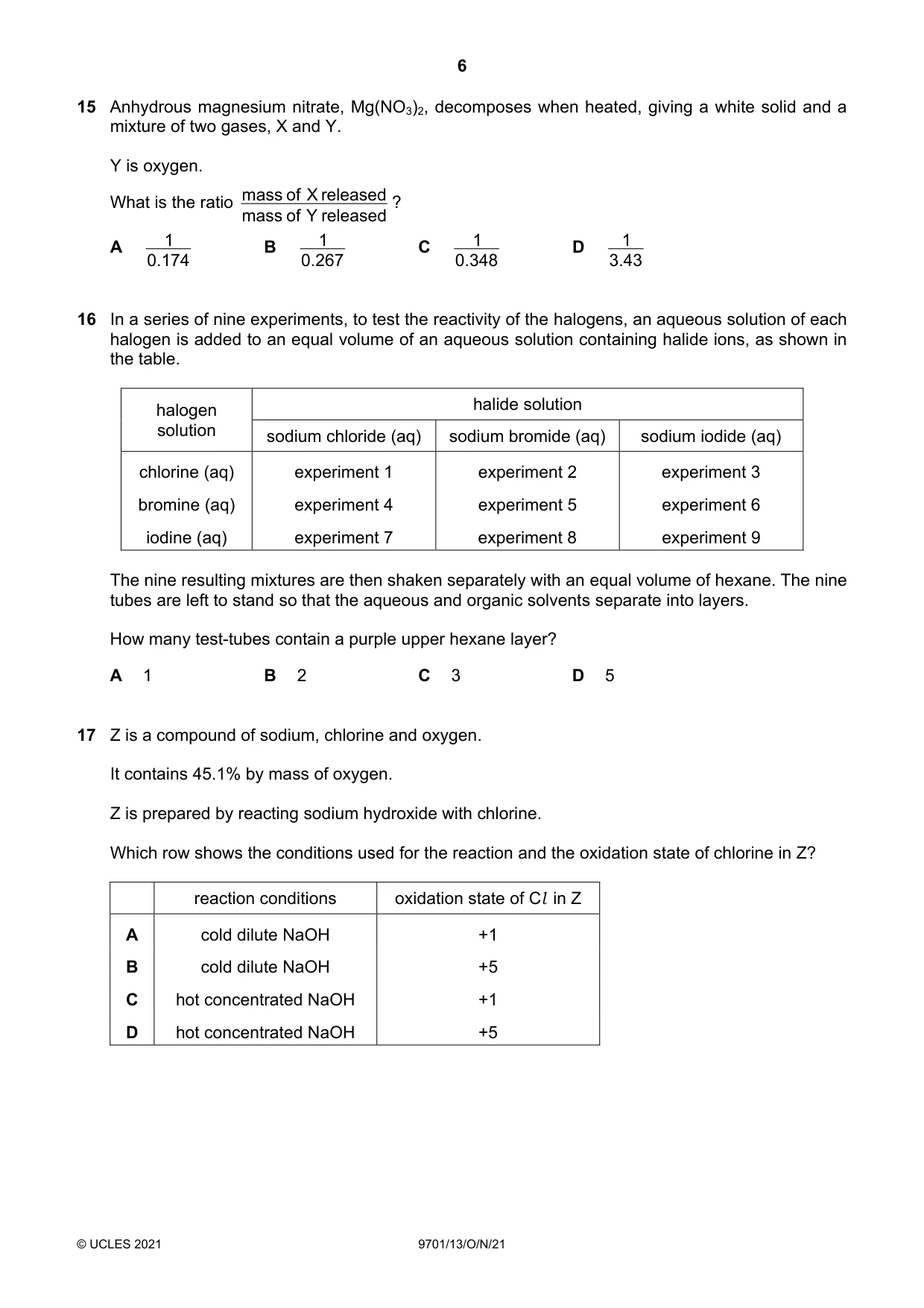
16 In a series of nine experiments, to test the reactivity of the halogens, an aqueous solution of each halogen is added to an equal volume of an aqueous solution containing halide ions, as shown in the table. halogen halide solution solution sodium chloride (aq) sodium bromide (aq) sodium iodide (aq) chlorine (aq) experiment 1 experiment 2 experiment 3 bromine (aq) experiment 4 experiment 5 experiment 6 iodine (aq) experiment 7 experiment 8 experiment 9 The nine resulting mixtures are then shaken separately with an equal volume of hexane. The nine tubes are left to stand so that the aqueous and organic solvents separate into layers. How many test-tubes contain a purple upper hexane layer? A 1 B 2 C 3 D 5
Mark scheme: D
More questions on The chemical properties of the halogen elements and the hydrogen halides
Q17 · Z is a compound of sodium, chlorine and oxygen
17 Z is a compound of sodium, chlorine and oxygen. It contains 45.1% by mass of oxygen. Z is prepared by reacting sodium hydroxide with chlorine. Which row shows the conditions used for the reaction and the oxidation state of chlorine in Z? reaction conditions oxidation state of Cl in Z A cold dilute NaOH +1 B cold dilute NaOH +5 C hot concentrated NaOH +1 D hot concentrated NaOH +5
Mark scheme: D
Q18 · Which row is correct?
18 Which row is correct? shape bonds present ammonia ammonium ammonia ammonium molecule ion molecule ion A pyramidal regular tetrahedral B pyramidal regular tetrahedral C regular tetrahedral pyramidal D regular tetrahedral pyramidal
Mark scheme: A
Q19 · The table describes two possible environmental consequences of adding too much ammonium…
19 The table describes two possible environmental consequences of adding too much ammonium nitrate fertiliser to the soil. Which row is correct? increased plant photochemical growth in rivers smog 0 OD > \ « \ x \ \ x x
Mark scheme: B
Q20 · Hex-2-ene can be made by the reaction shown
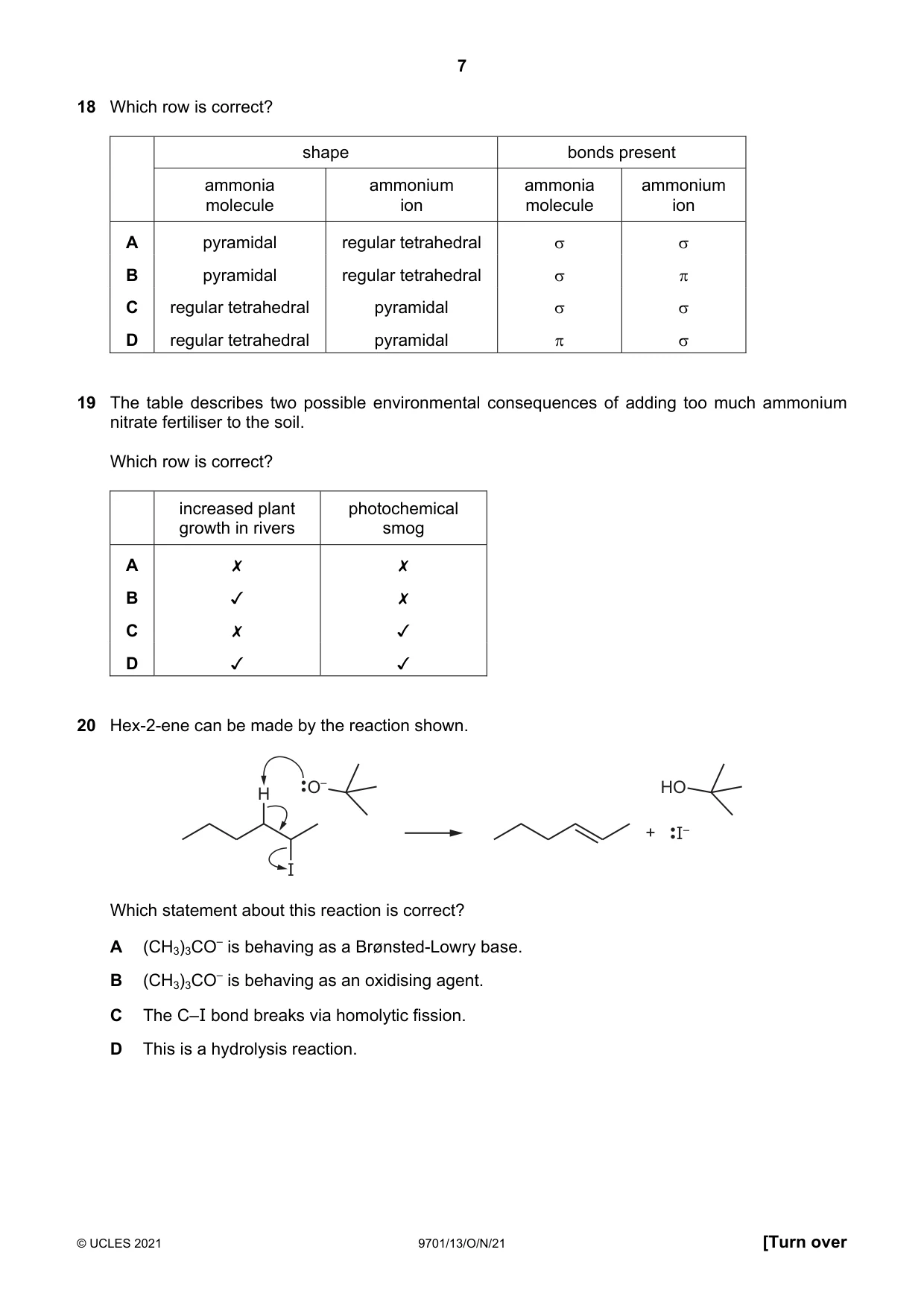
20 Hex-2-ene can be made by the reaction shown. O– HO H + I– I Which statement about this reaction is correct? A (CH3)3CO– is behaving as a Brønsted-Lowry base. B (CH3)3CO– is behaving as an oxidising agent. C The C–I bond breaks via homolytic fission. D This is a hydrolysis reaction.
Mark scheme: A
Q21 · Structural isomerism only should be considered when answering this question
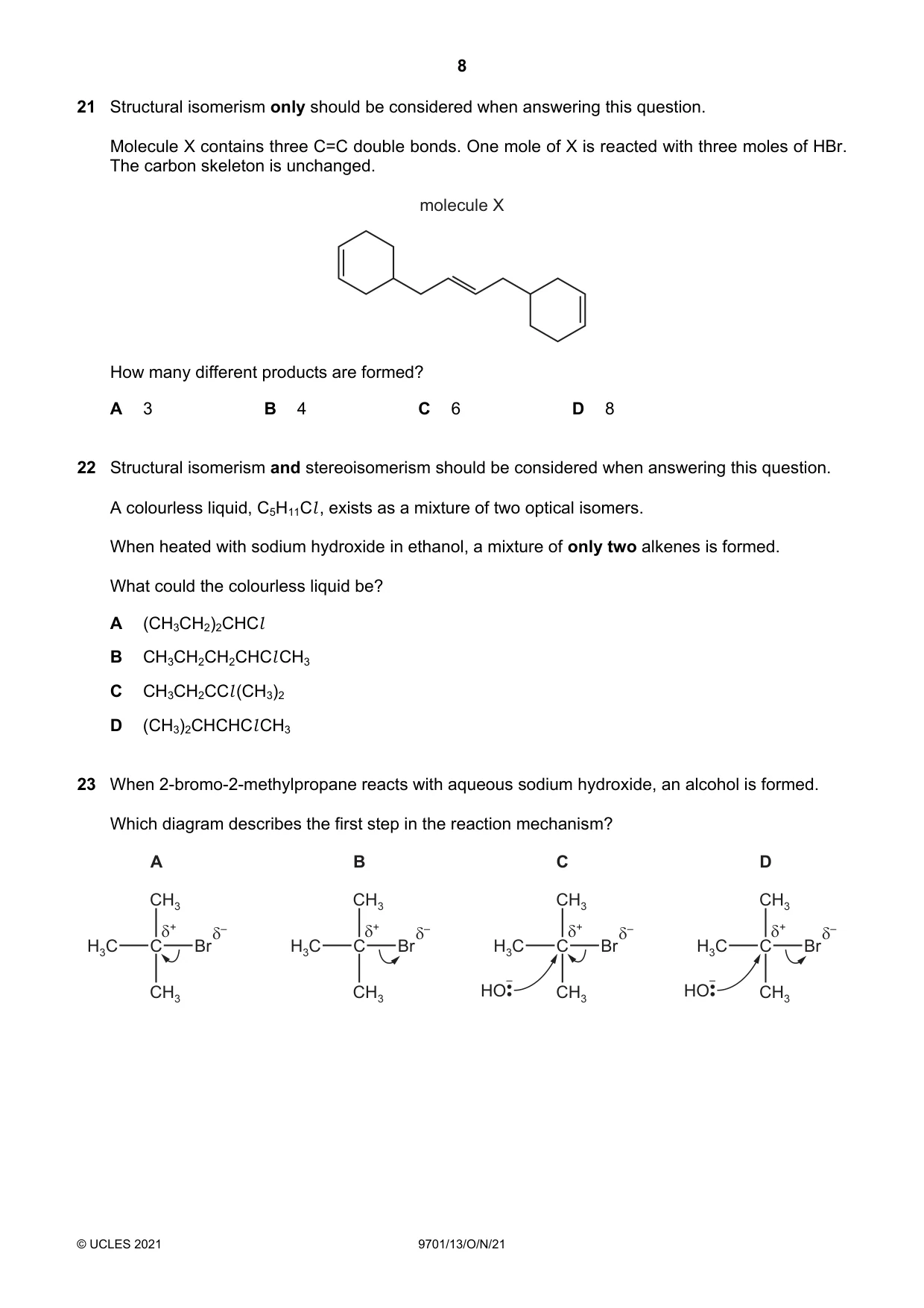
21 Structural isomerism only should be considered when answering this question. Molecule X contains three C=C double bonds. One mole of X is reacted with three moles of HBr. The carbon skeleton is unchanged. molecule X How many different products are formed? A 3 B 4 C 6 D 8
Mark scheme: B
More questions on Isomerism: structural isomerism and stereoisomerism
Q22 · Structural isomerism and stereoisomerism should be considered when answering this question
22 Structural isomerism and stereoisomerism should be considered when answering this question. A colourless liquid, C5H11Cl , exists as a mixture of two optical isomers. When heated with sodium hydroxide in ethanol, a mixture of only two alkenes is formed. What could the colourless liquid be? A (CH3CH2)2CHCl B CH3CH2CH2CHCl CH3 C CH3CH2CCl (CH3)2 D (CH3)2CHCHCl CH3
Mark scheme: D
Q23 · When 2-bromo-2-methylpropane reacts with aqueous sodium hydroxide, an alcohol is formed
23 When 2-bromo-2-methylpropane reacts with aqueous sodium hydroxide, an alcohol is formed. Which diagram describes the first step in the reaction mechanism? H;c— A CH, \~ CH, Br Ss B HO: CH,
Mark scheme: B
Q24 · When an organic compound, Q, is treated with phosphorus pentachloride, fumes of hydrogen…
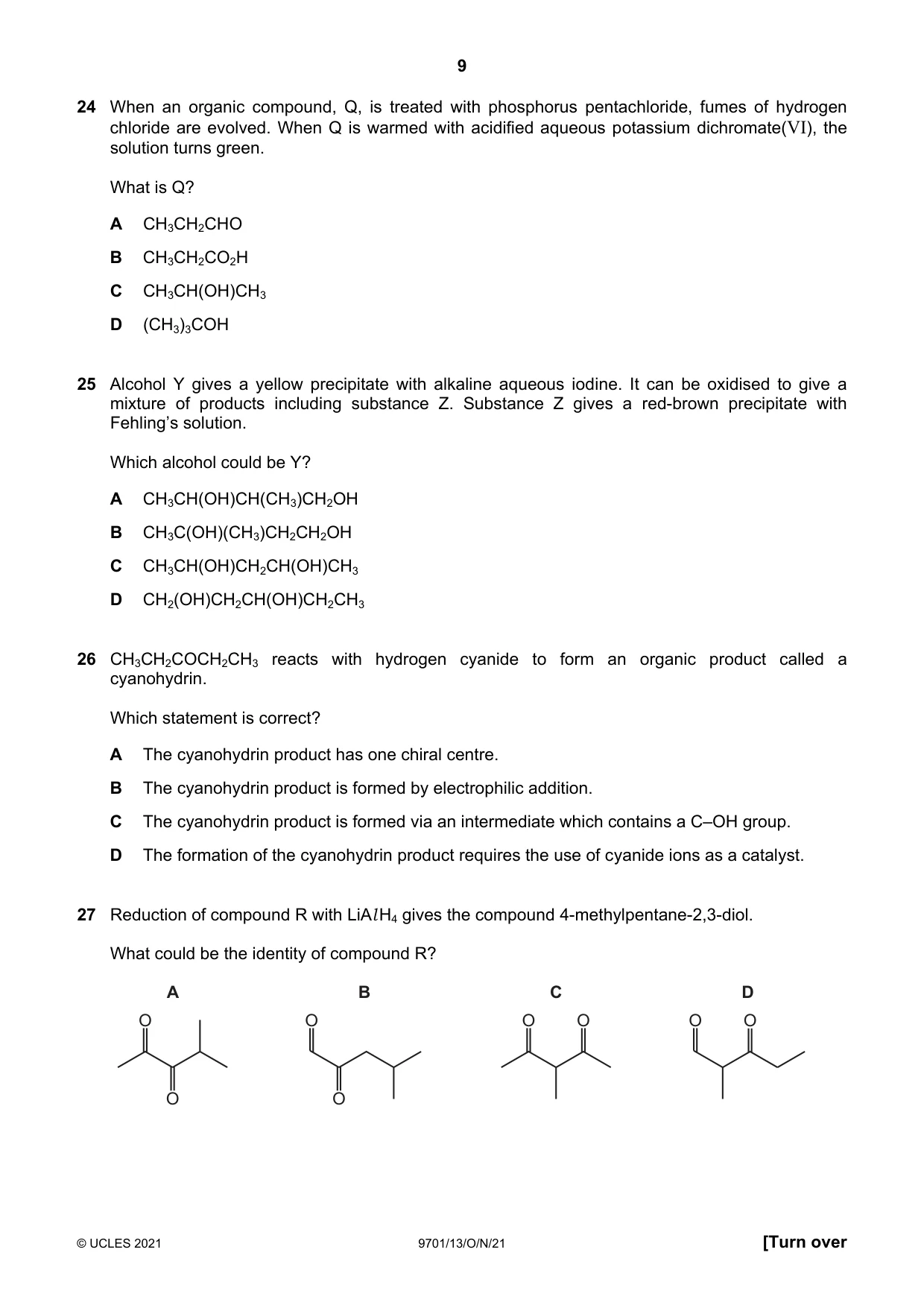
24 When an organic compound, Q, is treated with phosphorus pentachloride, fumes of hydrogen chloride are evolved. When Q is warmed with acidified aqueous potassium dichromate(VI), the solution turns green. What is Q? A CH3CH2CHO B CH3CH2CO2H C CH3CH(OH)CH3 D (CH3)3COH
Mark scheme: C
Q25 · Alcohol Y gives a yellow precipitate with alkaline aqueous iodine
25 Alcohol Y gives a yellow precipitate with alkaline aqueous iodine. It can be oxidised to give a mixture of products including substance Z. Substance Z gives a red-brown precipitate with Fehling’s solution. Which alcohol could be Y? A CH3CH(OH)CH(CH3)CH2OH B CH3C(OH)(CH3)CH2CH2OH C CH3CH(OH)CH2CH(OH)CH3 D CH2(OH)CH2CH(OH)CH2CH3
Mark scheme: A
Q26 · CH3CH2COCH2CH3 reacts with hydrogen cyanide to form an organic product called a…
26 CH3CH2COCH2CH3 reacts with hydrogen cyanide to form an organic product called a cyanohydrin. Which statement is correct? A The cyanohydrin product has one chiral centre. B The cyanohydrin product is formed by electrophilic addition. C The cyanohydrin product is formed via an intermediate which contains a C–OH group. D The formation of the cyanohydrin product requires the use of cyanide ions as a catalyst.
Mark scheme: D
Q27 · Reduction of compound R with LiAl H4 gives the compound 4-methylpentane-2,3-diol
27 Reduction of compound R with LiAl H4 gives the compound 4-methylpentane-2,3-diol. What could be the identity of compound R? A B C D O O O O O O O O
Mark scheme: A
Q28 · Citric acid is found in lemon juice
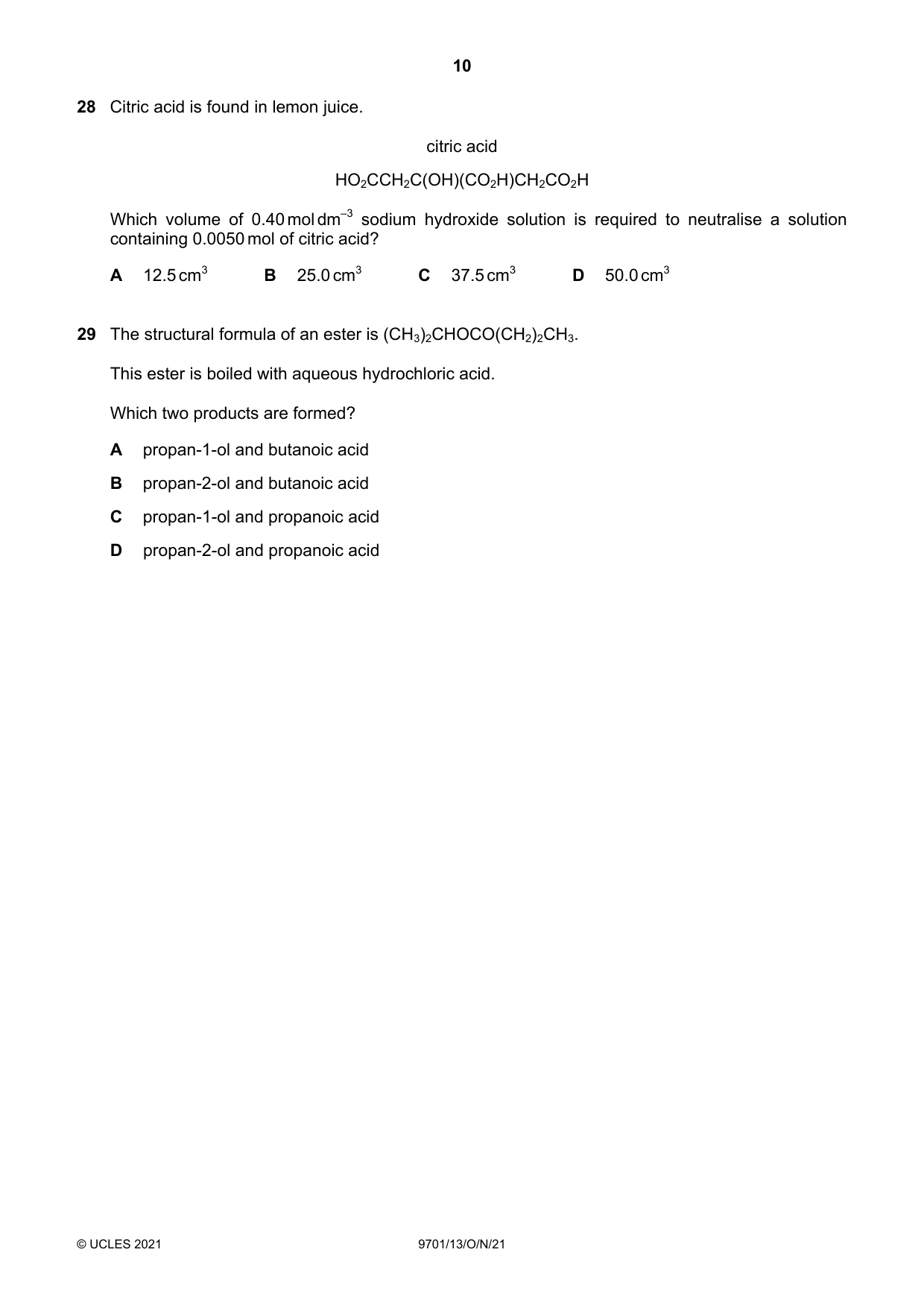
28 Citric acid is found in lemon juice. citric acid HO2CCH2C(OH)(CO2H)CH2CO2H Which volume of 0.40 mol dm–3 sodium hydroxide solution is required to neutralise a solution containing 0.0050 mol of citric acid? A 12.5 cm3 B 25.0 cm3 C 37.5 cm3 D 50.0 cm3
Mark scheme: C
More questions on Reacting masses and volumes (of solutions and gases)
Q29 · The structural formula of an ester is (CH3)2CHOCO(CH2)2CH3
29 The structural formula of an ester is (CH3)2CHOCO(CH2)2CH3. This ester is boiled with aqueous hydrochloric acid. Which two products are formed? A propan-1-ol and butanoic acid B propan-2-ol and butanoic acid C propan-1-ol and propanoic acid D propan-2-ol and propanoic acid
Mark scheme: B
Q30 · The infra-red spectra of three organic compounds are shown
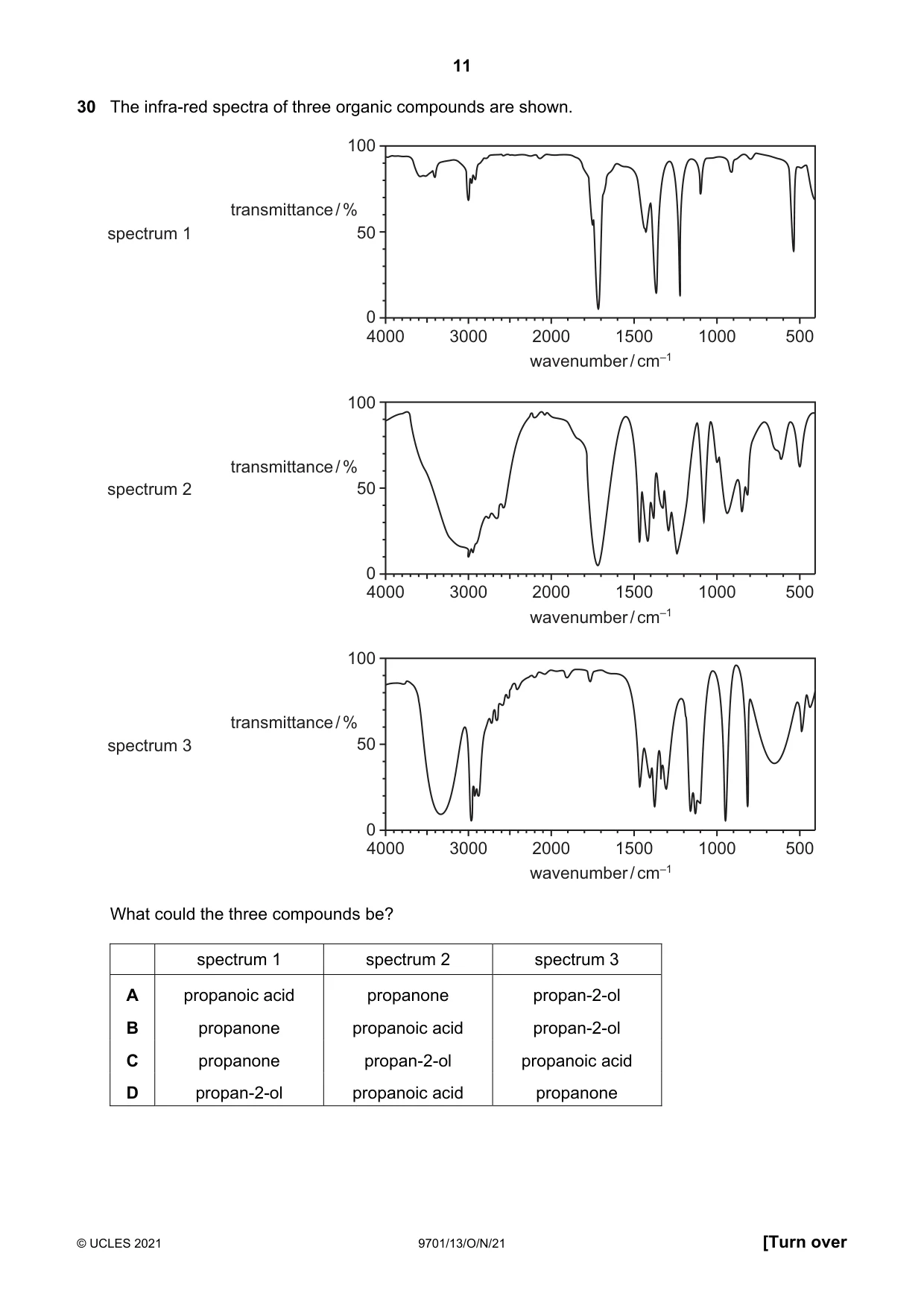
30 The infra-red spectra of three organic compounds are shown. 100 transmittance / % spectrum 1 50 0 4000 3000 2000 1500 1000 500 wavenumber / cm–1 100 transmittance / % spectrum 2 50 0 4000 3000 2000 1500 1000 500 wavenumber / cm–1 100 transmittance / % spectrum 3 50 0 4000 3000 2000 1500 1000 500 wavenumber / cm–1 What could the three compounds be? spectrum 1 spectrum 2 spectrum 3 A propanoic acid propanone propan-2-ol B propanone propanoic acid propan-2-ol C propanone propan-2-ol propanoic acid D propan-2-ol propanoic acid propanone
Mark scheme: B
Q31 · Which changes can be used to measure the rates of chemical reactions?
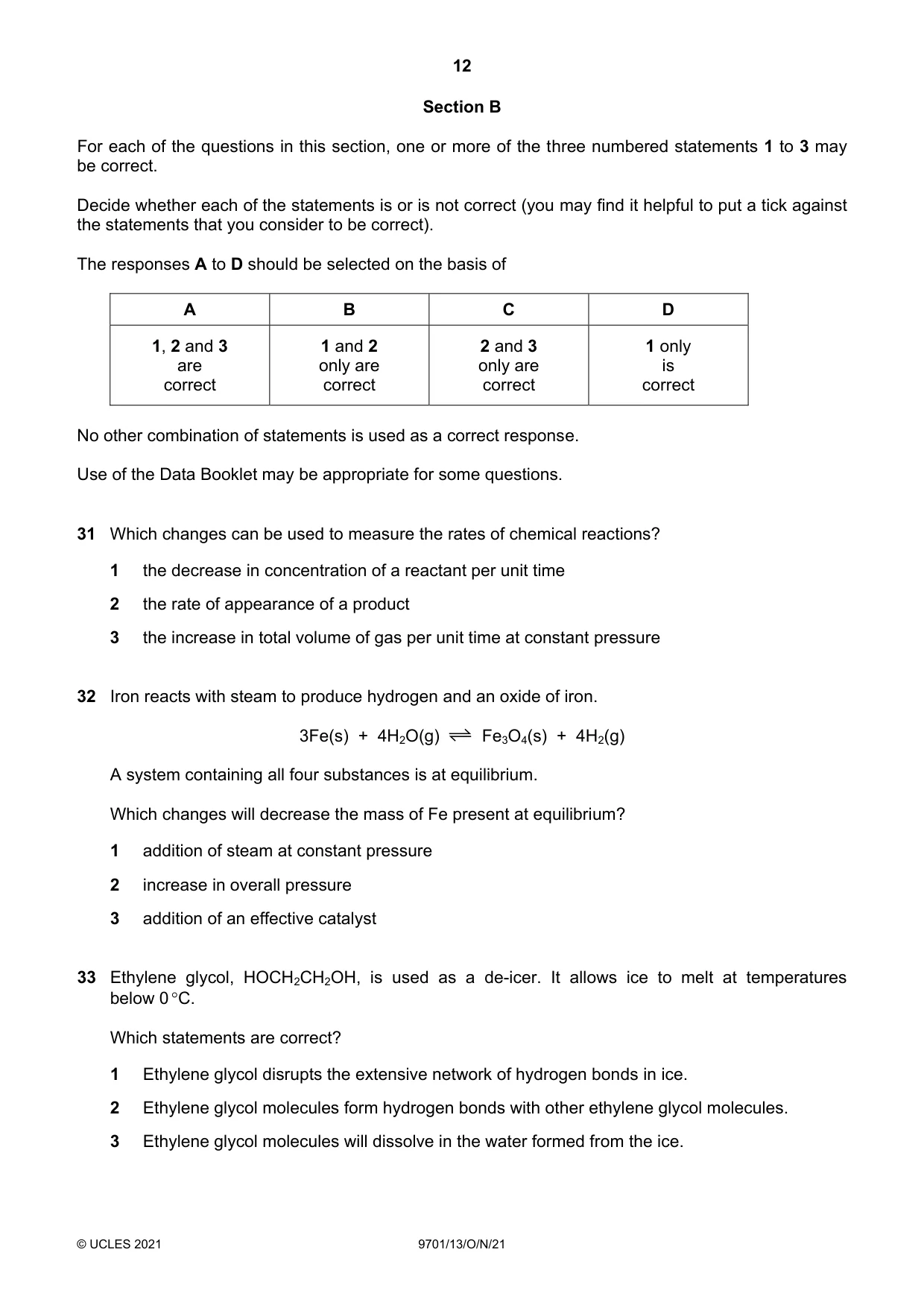
31 Which changes can be used to measure the rates of chemical reactions? 1 the decrease in concentration of a reactant per unit time 2 the rate of appearance of a product 3 the increase in total volume of gas per unit time at constant pressure
Mark scheme: A
Q32 · Iron reacts with steam to produce hydrogen and an oxide of iron
32 Iron reacts with steam to produce hydrogen and an oxide of iron. 3Fe(s) + 4H2O(g) Fe3O4(s) + 4H2(g) A system containing all four substances is at equilibrium. Which changes will decrease the mass of Fe present at equilibrium? 1 addition of steam at constant pressure 2 increase in overall pressure 3 addition of an effective catalyst
Mark scheme: D
More questions on Chemical equilibria: reversible reactions, dynamic equilibrium
Q33 · Ethylene glycol, HOCH2CH2OH, is used as a de-icer
33 Ethylene glycol, HOCH2CH2OH, is used as a de-icer. It allows ice to melt at temperatures below 0 C. Which statements are correct? 1 Ethylene glycol disrupts the extensive network of hydrogen bonds in ice. 2 Ethylene glycol molecules form hydrogen bonds with other ethylene glycol molecules. 3 Ethylene glycol molecules will dissolve in the water formed from the ice.
Mark scheme: A
More questions on Intermolecular forces, electronegativity and bond properties
Q34 · Which molecules contain at least one unpaired electron?
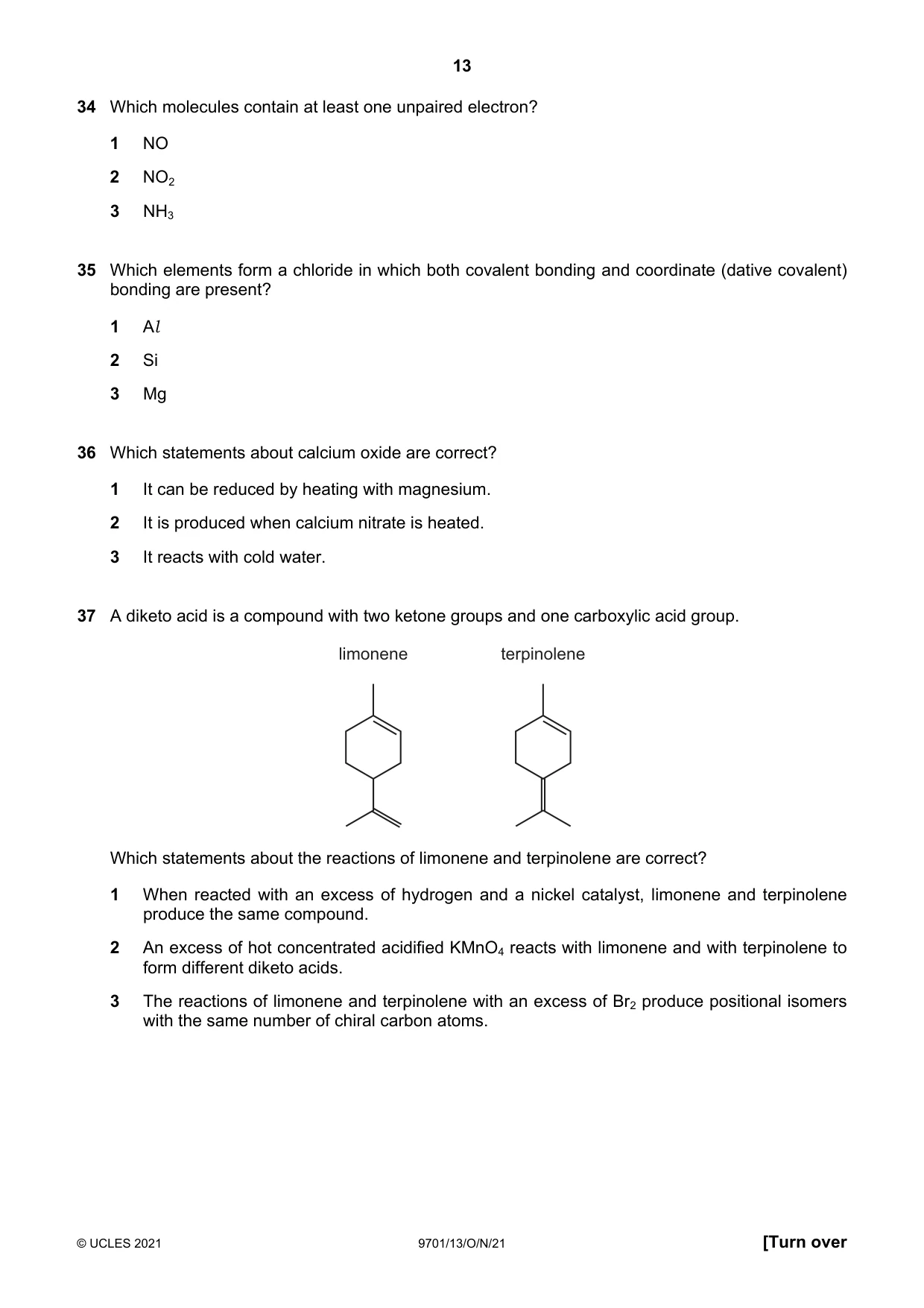
34 Which molecules contain at least one unpaired electron? 1 NO 2 NO2 3 NH3
Mark scheme: B
Q35 · Which elements form a chloride in which both covalent bonding and coordinate (dative…
35 Which elements form a chloride in which both covalent bonding and coordinate (dative covalent) bonding are present? 1 Al 2 Si 3 Mg
Mark scheme: D
More questions on Covalent bonding and coordinate (dative covalent) bonding
Q36 · Which statements about calcium oxide are correct?
36 Which statements about calcium oxide are correct? 1 It can be reduced by heating with magnesium. 2 It is produced when calcium nitrate is heated. 3 It reacts with cold water.
Mark scheme: C
Q37 · A diketo acid is a compound with two ketone groups and one carboxylic acid group
37 A diketo acid is a compound with two ketone groups and one carboxylic acid group. limonene terpinolene Which statements about the reactions of limonene and terpinolene are correct? 1 When reacted with an excess of hydrogen and a nickel catalyst, limonene and terpinolene produce the same compound. 2 An excess of hot concentrated acidified KMnO4 reacts with limonene and with terpinolene to form different diketo acids. 3 The reactions of limonene and terpinolene with an excess of Br2 produce positional isomers with the same number of chiral carbon atoms.
Mark scheme: B
Q38 · One molecule of dodecane, C12H26, is cracked, producing three product molecules, X, Y and…
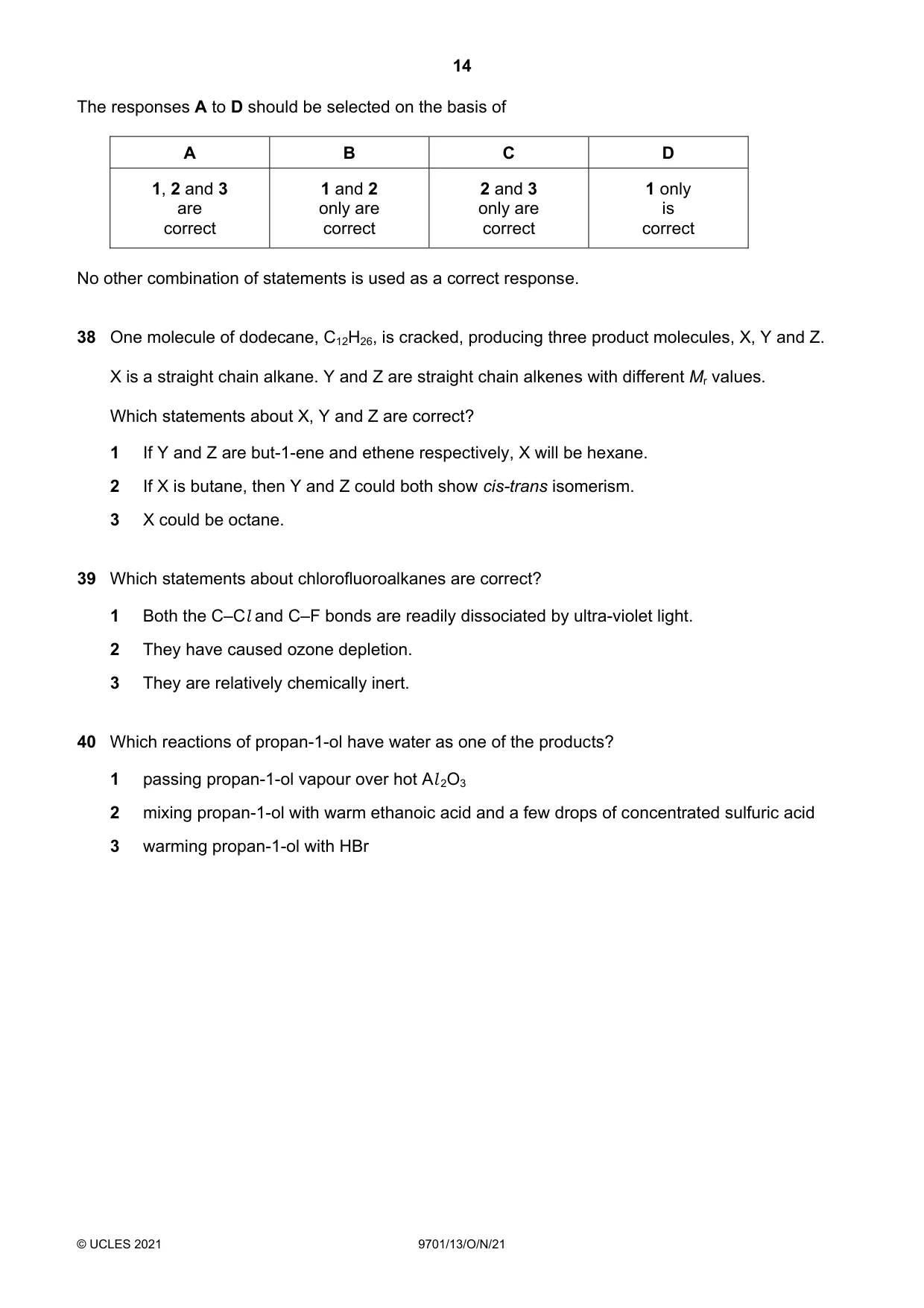
38 One molecule of dodecane, C12H26, is cracked, producing three product molecules, X, Y and Z. X is a straight chain alkane. Y and Z are straight chain alkenes with different Mr values. Which statements about X, Y and Z are correct? 1 If Y and Z are but-1-ene and ethene respectively, X will be hexane. 2 If X is butane, then Y and Z could both show cis-trans isomerism. 3 X could be octane.
Mark scheme: D
Q39 · Which statements about chlorofluoroalkanes are correct?
39 Which statements about chlorofluoroalkanes are correct? 1 Both the C–Cl and C–F bonds are readily dissociated by ultra-violet light. 2 They have caused ozone depletion. 3 They are relatively chemically inert.
Mark scheme: C
Q40 · Which reactions of propan-1-ol have water as one of the products?
40 Which reactions of propan-1-ol have water as one of the products? 1 passing propan-1-ol vapour over hot Al 2O3 2 mixing propan-1-ol with warm ethanoic acid and a few drops of concentrated sulfuric acid 3 warming propan-1-ol with HBr
Mark scheme: A
What was in this paper
The subtopics covered by these 40 questions, and how many questions each got. Open one in a new tab to see every Cambridge question on it.
3Similarities and trends in the properties of the Group 2 metals, magnesium to barium, and their compounds3Chemical equilibria: reversible reactions, dynamic equilibrium2Enthalpy change, ΔH2Halogenoalkanes2Intermolecular forces, electronegativity and bond properties2Periodicity of chemical properties of the elements in Period 32Reacting masses and volumes (of solutions and gases)2Aldehydes and ketones1Alkanes1Alkenes1Characteristic organic reactions1Covalent bonding and coordinate (dative covalent) bonding1Effect of temperature on reaction rates and the concept of activation energy1Electrons, energy levels and atomic orbitals1Esters1Halogen compounds1Infrared spectroscopy1Ionisation energy1Isomerism: structural isomerism and stereoisomerism1Mass spectrometry1Nitriles and hydroxynitriles1Nitrogen and sulfur1Particles in the atom and atomic radius1Rate of reaction1Redox processes: electron transfer and changes in oxidation number (oxidation state)1Shapes of molecules1The chemical properties of the halogen elements and the hydrogen halides1The gaseous state: ideal and real gases and pV = nRT1The reactions of chlorine1What you needed in this session
Cambridge’s own grade thresholds for 2021 Oct/Nov, Paper 1 · Variant 3. A higher threshold means an easier paper — the bar moves with how the cohort did.