Cambridge A Level Chemistry 9701 — 2006 Oct/Nov Paper 1 · Variant 1
9701/11/O/N/06 · 40 questions · 40 marks · ≈45 min
The question paper and its mark scheme, free to read here and free to download. This is Cambridge’s own paper, exactly as it was sat.
Question paper16 pages
Mark scheme2 pages
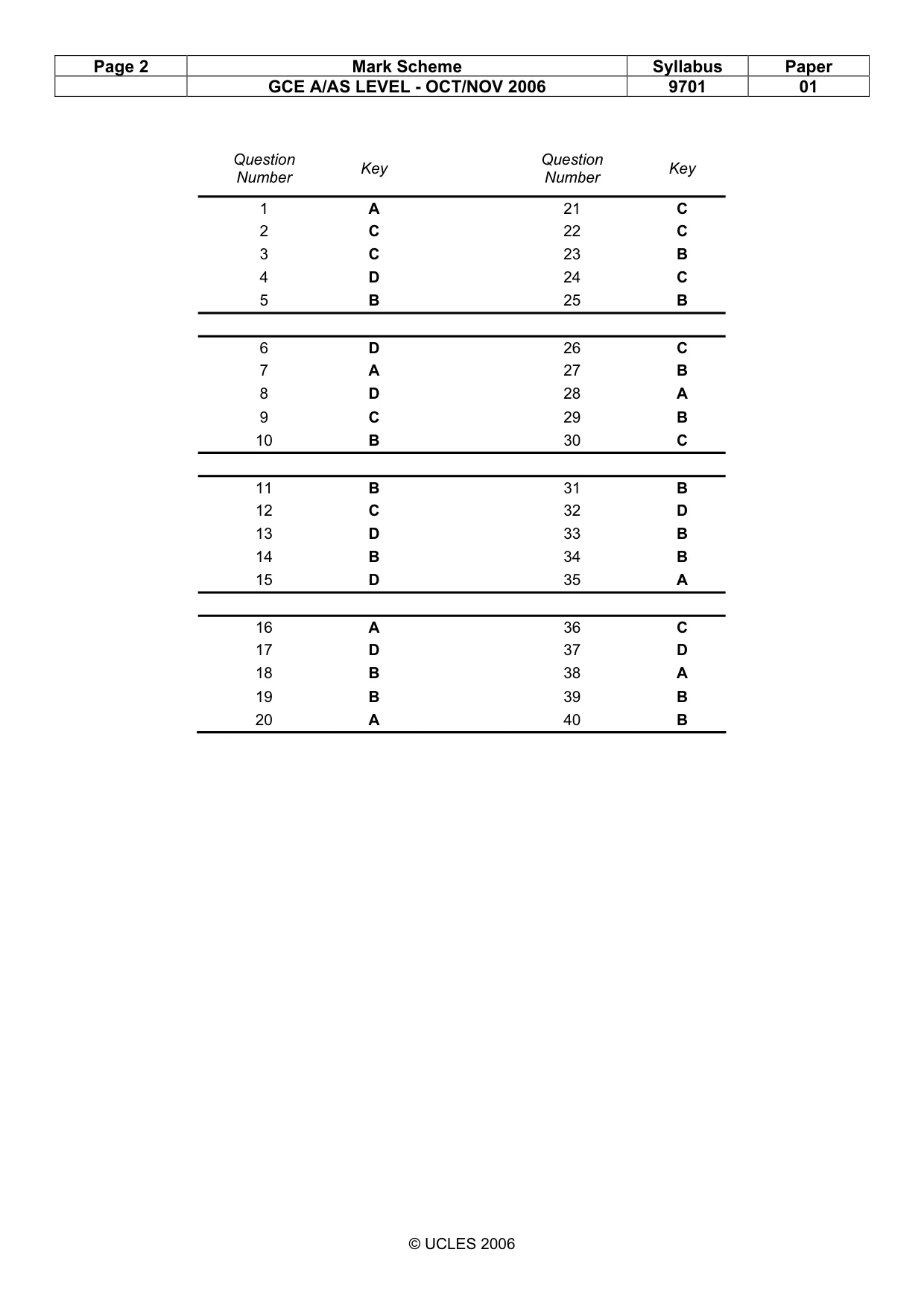
Answers below. Sit the paper first if you are practising.
Questions as text
Q1 · The amount of calcium ions in a sample of natural water can be determined by using an…
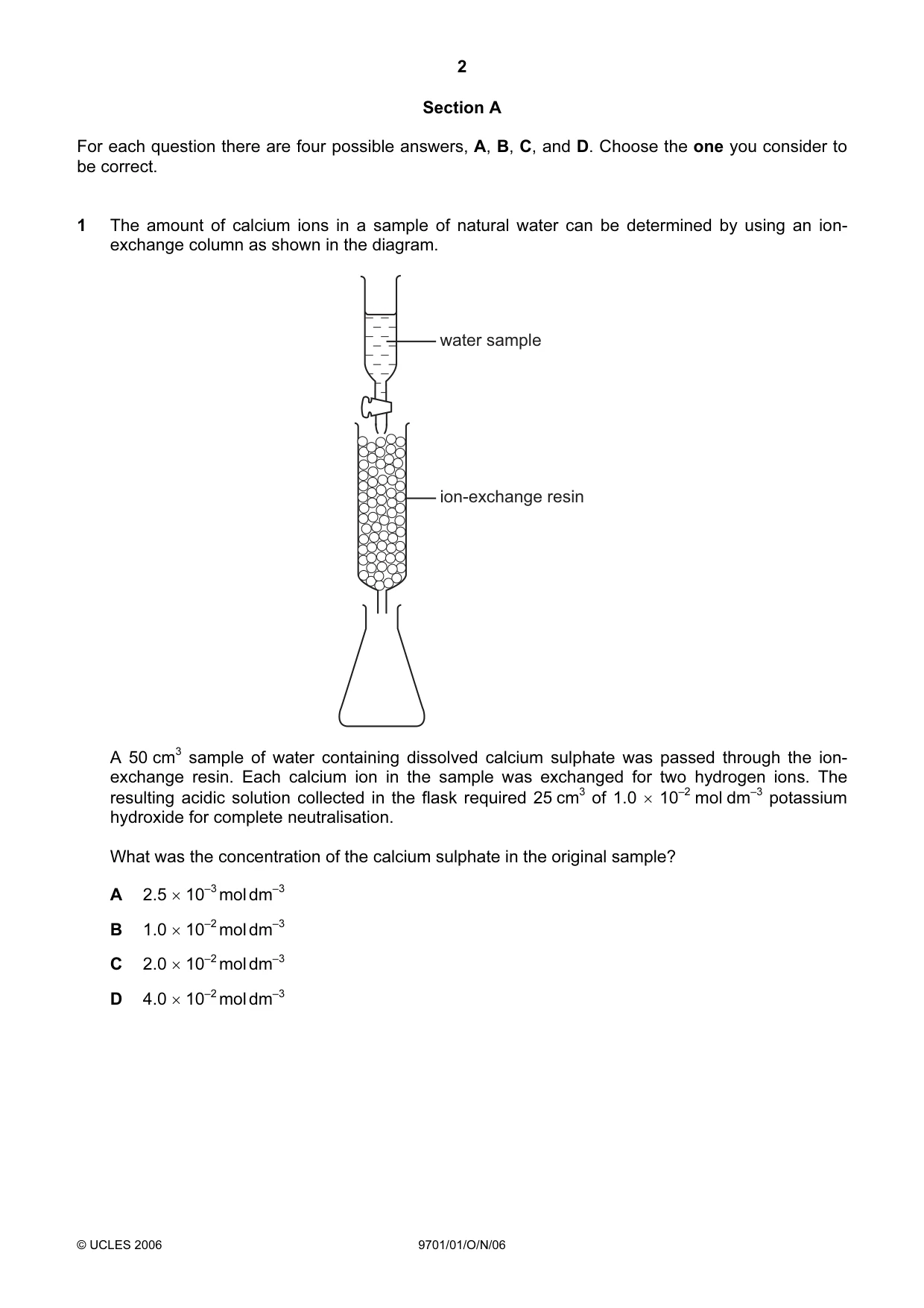
1 The amount of calcium ions in a sample of natural water can be determined by using an ion- exchange column as shown in the diagram. water sample ion-exchange resin A 50 cm3 sample of water containing dissolved calcium sulphate was passed through the ion- exchange resin. Each calcium ion in the sample was exchanged for two hydrogen ions. The resulting acidic solution collected in the flask required 25 cm3 of 1.0 × 10⁻² mol dm–3 potassium hydroxide for complete neutralisation. What was the concentration of the calcium sulphate in the original sample? A 2.5 × 10⁻³ mol dm–3 B 1.0 × 10⁻² mol dm–3 C 2.0 × 10⁻² mol dm–3 D 4.0 × 10⁻² mol dm–3
Mark scheme: A
More questions on Reacting masses and volumes (of solutions and gases)
Q2 · Three successive elements in the Periodic Table have first ionisation energies which have…
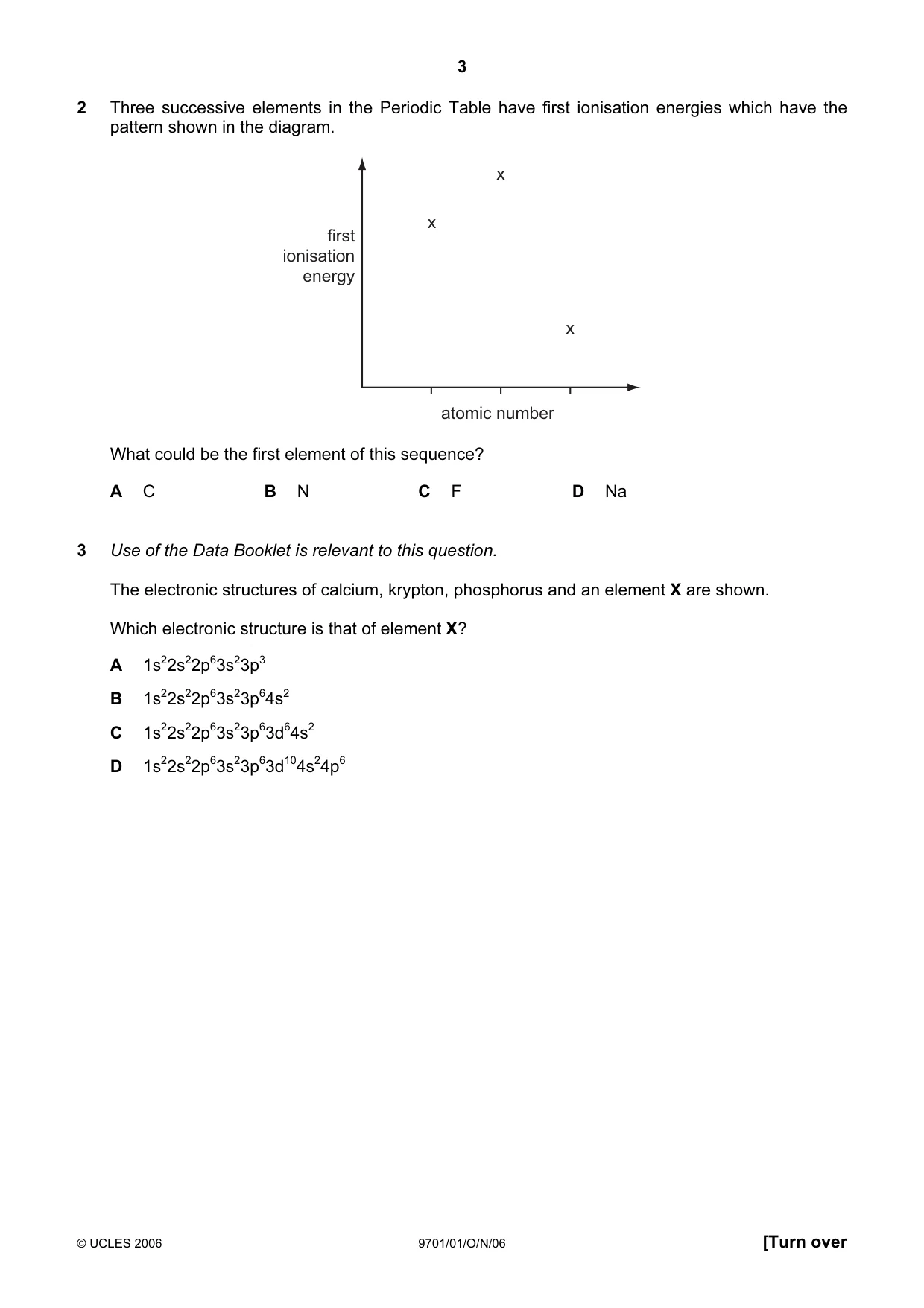
2 Three successive elements in the Periodic Table have first ionisation energies which have the pattern shown in the diagram. x x first ionisation energy x atomic number What could be the first element of this sequence? A C B N C F D Na
Mark scheme: C
Q3 · Use of the Data Booklet is relevant to this question
3 Use of the Data Booklet is relevant to this question. The electronic structures of calcium, krypton, phosphorus and an element X are shown. Which electronic structure is that of element X? A 1s22s22p63s23p3 B 1s22s22p63s23p64s2 C 1s22s22p63s23p63d64s2 D 1s22s22p63s23p63d104s24p6
Mark scheme: C
More questions on Electrons, energy levels and atomic orbitals
Q4 · Samples of 10 cm3 of each of the first four members of the alkane series are separately…
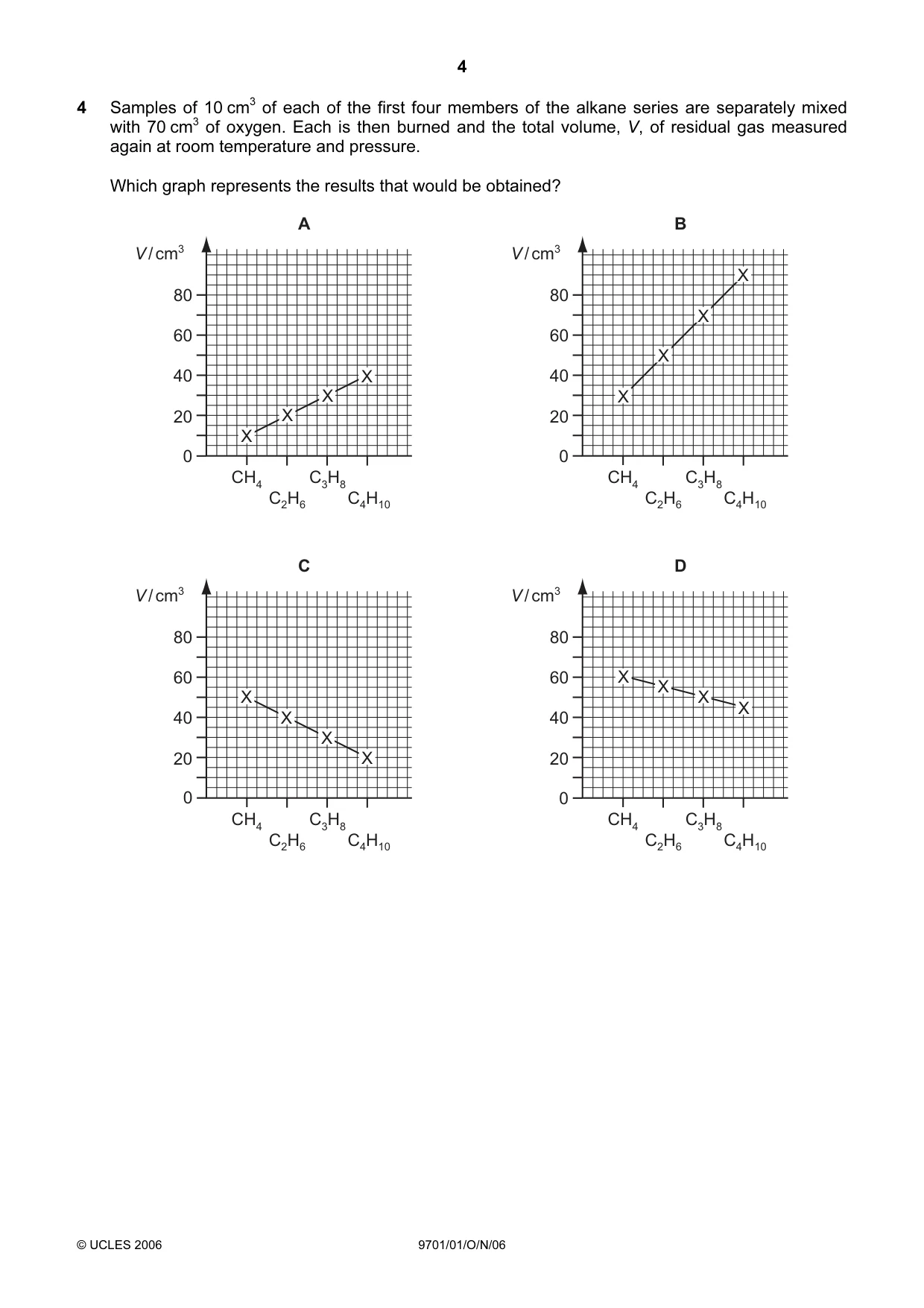
4 Samples of 10 cm3 of each of the first four members of the alkane series are separately mixed with 70 cm3 of oxygen. Each is then burned and the total volume, V, of residual gas measured again at room temperature and pressure. Which graph represents the results that would be obtained? A B V / cm3 V / cm3 X 80 80 X 60 60 X 40 X 40 X X 20 X 20 X 0 0 CH4 C3H8 CH4 C3H8 C2H6 C4H10 C2H6 C4H10 C D V / cm3 V / cm3 80 80 60 60 X X X X X 40 X 40 X 20 X 20 0 0 CH4 C3H8 CH4 C3H8 C2H6 C4H10 C2H6 C4H10
Mark scheme: D
More questions on Reacting masses and volumes (of solutions and gases)
Q5 · Which diagram describes the formation of a π bond from the overlap of its orbitals?
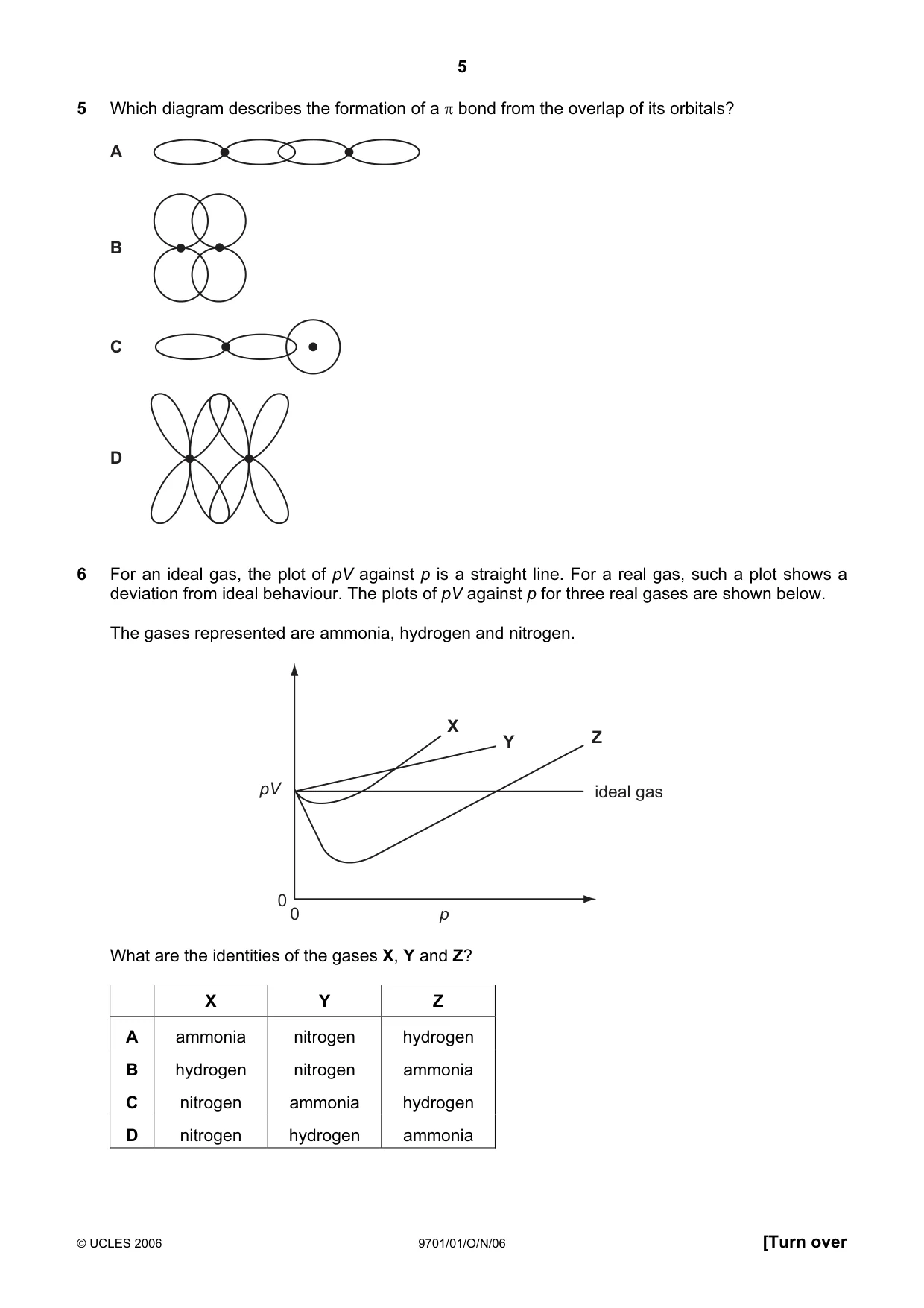
5 Which diagram describes the formation of a π bond from the overlap of its orbitals? A B C D
Mark scheme: B
More questions on Shapes of organic molecules; σ and π bonds
Q6 · For an ideal gas, the plot of pV against p is a straight line
6 For an ideal gas, the plot of pV against p is a straight line. For a real gas, such a plot shows a deviation from ideal behaviour. The plots of pV against p for three real gases are shown below. The gases represented are ammonia, hydrogen and nitrogen. X Y Z pV ideal gas 0 0 p What are the identities of the gases X, Y and Z? X Y Z A ammonia nitrogen hydrogen B hydrogen nitrogen ammonia C nitrogen ammonia hydrogen D nitrogen hydrogen ammonia
Mark scheme: D
More questions on The gaseous state: ideal and real gases and pV = nRT
Q7 · Magnesium oxide may be used for the lining of an electric furnace for making crockery
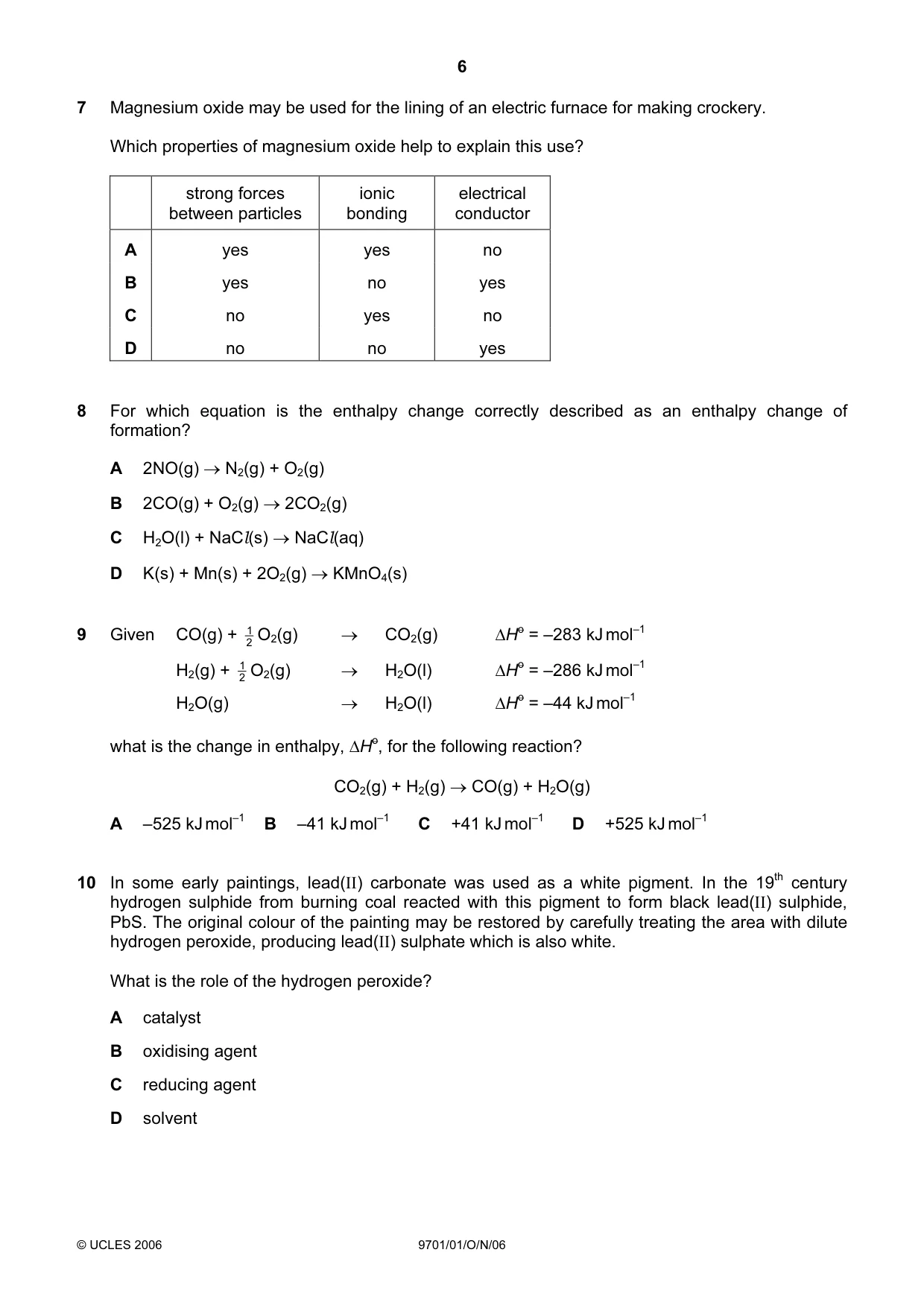
7 Magnesium oxide may be used for the lining of an electric furnace for making crockery. Which properties of magnesium oxide help to explain this use? strong forces ionic electrical between particles bonding conductor A yes yes no B yes no yes C no yes no D no no yes
Mark scheme: A
Q8 · For which equation is the enthalpy change correctly described as an enthalpy change of…
8 For which equation is the enthalpy change correctly described as an enthalpy change of formation? A 2NO(g) → N2(g) + O2(g) B 2CO(g) + O2(g) → 2CO2(g) C H2O(l) + NaCl(s) → NaCl(aq) D K(s) + Mn(s) + 2O2(g) → KMnO4(s)
Mark scheme: D
Q9 · Given CO(g) + 2 1 O2(g) → CO2(g) ∆Ho = –283 kJ mol–1 H2(g) + 2 1 O2(g) → H2O(l) ∆Ho =…
9 Given CO(g) + 2 1 O2(g) → CO2(g) ∆Ho = –283 kJ mol–1 H2(g) + 2 1 O2(g) → H2O(l) ∆Ho = –286 kJ mol–1 H2O(g) → H2O(l) ∆Ho = –44 kJ mol–1 what is the change in enthalpy, ∆Ho, for the following reaction? CO2(g) + H2(g) → CO(g) + H2O(g) A –525 kJ mol–1 B –41 kJ mol–1 C +41 kJ mol–1 D +525 kJ mol–1
Mark scheme: C
Q10 · In some early paintings, lead(II) carbonate was used as a white pigment
10 In some early paintings, lead(II) carbonate was used as a white pigment. In the 19th century hydrogen sulphide from burning coal reacted with this pigment to form black lead(II) sulphide, PbS. The original colour of the painting may be restored by carefully treating the area with dilute hydrogen peroxide, producing lead(II) sulphate which is also white. What is the role of the hydrogen peroxide? A catalyst B oxidising agent C reducing agent D solvent
Mark scheme: B
Q11 · The equilibrium constant, Kc, for the reaction to form ethyl ethanoate from ethanol and…
11 The equilibrium constant, Kc, for the reaction to form ethyl ethanoate from ethanol and ethanoic acid, C2H5OH + CH3CO2H CH3CO2C2H5 + H2O, at 60 oC is 4.00. When 1.00 mol each of ethanol and ethanoic acid are allowed to reach equilibrium at 60 oC, what is the number of moles of ethyl ethanoate formed? A 1 B 2 C 1 D 3 3 3 4 4
Mark scheme: B
More questions on Chemical equilibria: reversible reactions, dynamic equilibrium
Q12 · The diagram shows the Maxwell-Boltzmann energy distribution curves for molecules of a…
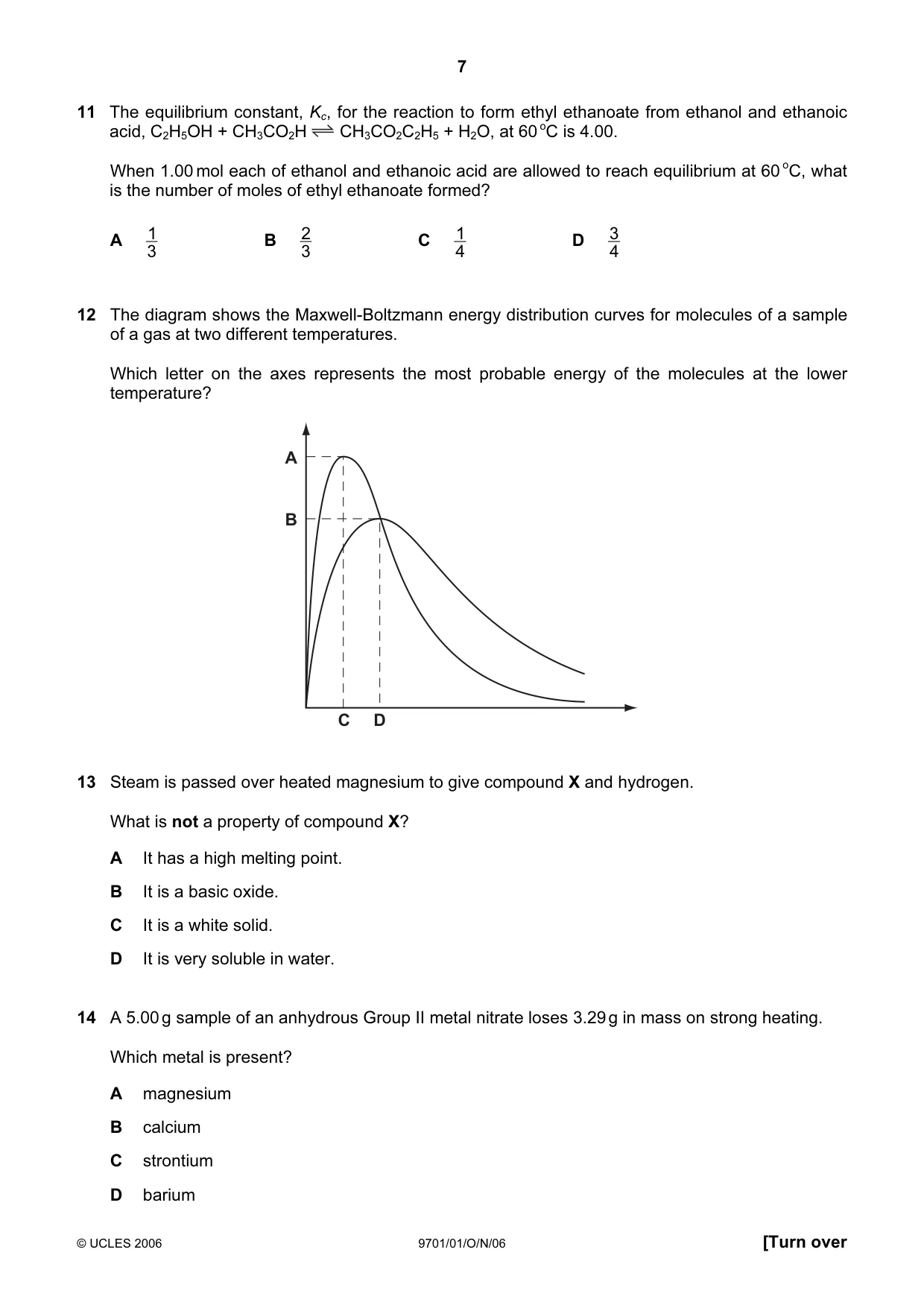
12 The diagram shows the Maxwell-Boltzmann energy distribution curves for molecules of a sample of a gas at two different temperatures. Which letter on the axes represents the most probable energy of the molecules at the lower temperature? A B C D
Mark scheme: C
More questions on Effect of temperature on reaction rates and the concept of activation energy
Q13 · Steam is passed over heated magnesium to give compound X and hydrogen
13 Steam is passed over heated magnesium to give compound X and hydrogen. What is not a property of compound X? A It has a high melting point. B It is a basic oxide. C It is a white solid. D It is very soluble in water.
Mark scheme: D
More questions on Periodicity of chemical properties of the elements in Period 3
Q14 · A 5.00 g sample of an anhydrous Group II metal nitrate loses 3.29 g in mass on strong…
14 A 5.00 g sample of an anhydrous Group II metal nitrate loses 3.29 g in mass on strong heating. Which metal is present? A magnesium B calcium C strontium D barium
Mark scheme: B
Q15 · Which of the following is not a correct statement about iodine?
15 Which of the following is not a correct statement about iodine? A A crystal of iodine contains covalent bonds and van der Waals’ forces. B Iodine vapour is purple. C The first ionisation energy of iodine is less than that of bromine. D The hydride of iodine is of greater thermal stability than that of bromine.
Mark scheme: D
More questions on Physical properties of the Group 17 elements
Q16 · Mixing aqueous silver nitrate and aqueous sodium chloride produces a precipitate
16 Mixing aqueous silver nitrate and aqueous sodium chloride produces a precipitate. Addition of which reagent to the mixture gives a colourless solution? A aqueous ammonia B aqueous potassium iodide C dilute hydrochloric acid D dilute nitric acid
Mark scheme: A
Q17 · Which is the complete list of all the products from the reaction of concentrated…
17 Which is the complete list of all the products from the reaction of concentrated sulphuric acid with potassium bromide? A potassium hydrogensulphate and hydrogen bromide B potassium hydrogensulphate, hydrogen bromide and bromine C potassium hydrogensulphate, hydrogen bromide, bromine and water D potassium hydrogensulphate, hydrogen bromide, bromine, water and sulphur dioxide
Mark scheme: D
More questions on The chemical properties of the halogen elements and the hydrogen halides
Q18 · Sulphur dioxide is an important food preservative
18 Sulphur dioxide is an important food preservative. Which property makes sulphur dioxide useful in this role? A It is a gas. B It is a reducing agent. C It reacts with oxygen to form sulphur trioxide. D It reacts with water to form an acidic solution.
Mark scheme: B
Q19 · In the Contact process for the production of sulphuric acid, sulphur dioxide is mixed…
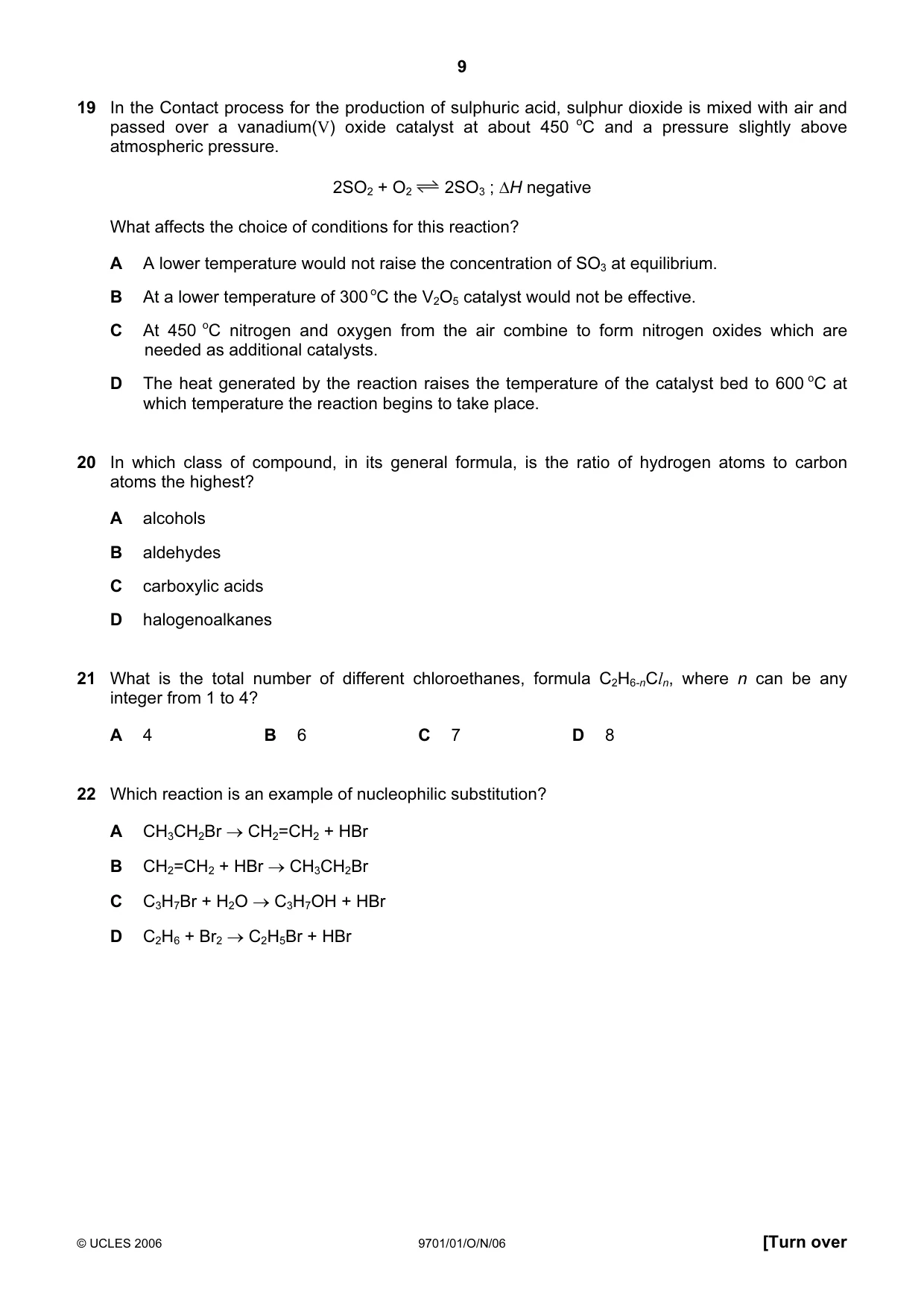
19 In the Contact process for the production of sulphuric acid, sulphur dioxide is mixed with air and passed over a vanadium(V) oxide catalyst at about 450 oC and a pressure slightly above atmospheric pressure. 2SO2 + O2 2SO3 ; ∆H negative What affects the choice of conditions for this reaction? A A lower temperature would not raise the concentration of SO3 at equilibrium. B At a lower temperature of 300 oC the V2O5 catalyst would not be effective. C At 450 oC nitrogen and oxygen from the air combine to form nitrogen oxides which are needed as additional catalysts. D The heat generated by the reaction raises the temperature of the catalyst bed to 600 oC at which temperature the reaction begins to take place.
Mark scheme: B
Q20 · In which class of compound, in its general formula, is the ratio of hydrogen atoms to…
20 In which class of compound, in its general formula, is the ratio of hydrogen atoms to carbon atoms the highest? A alcohols B aldehydes C carboxylic acids D halogenoalkanes
Mark scheme: A
More questions on Formulas, functional groups and the naming of organic compounds
Q21 · What is the total number of different chloroethanes, formula C2H6-nCln, where n can be…
21 What is the total number of different chloroethanes, formula C2H6-nCln, where n can be any integer from 1 to 4? A 4 B 6 C 7 D 8
Mark scheme: C
More questions on Isomerism: structural isomerism and stereoisomerism
Q22 · Which reaction is an example of nucleophilic substitution?
22 Which reaction is an example of nucleophilic substitution? A CH3CH2Br → CH2=CH2 + HBr B CH2=CH2 + HBr → CH3CH2Br C C3H7Br + H2O → C3H7OH + HBr D C2H6 + Br2 → C2H5Br + HBr
Mark scheme: C
Q23 · Which alkene could exist in cis and trans forms?
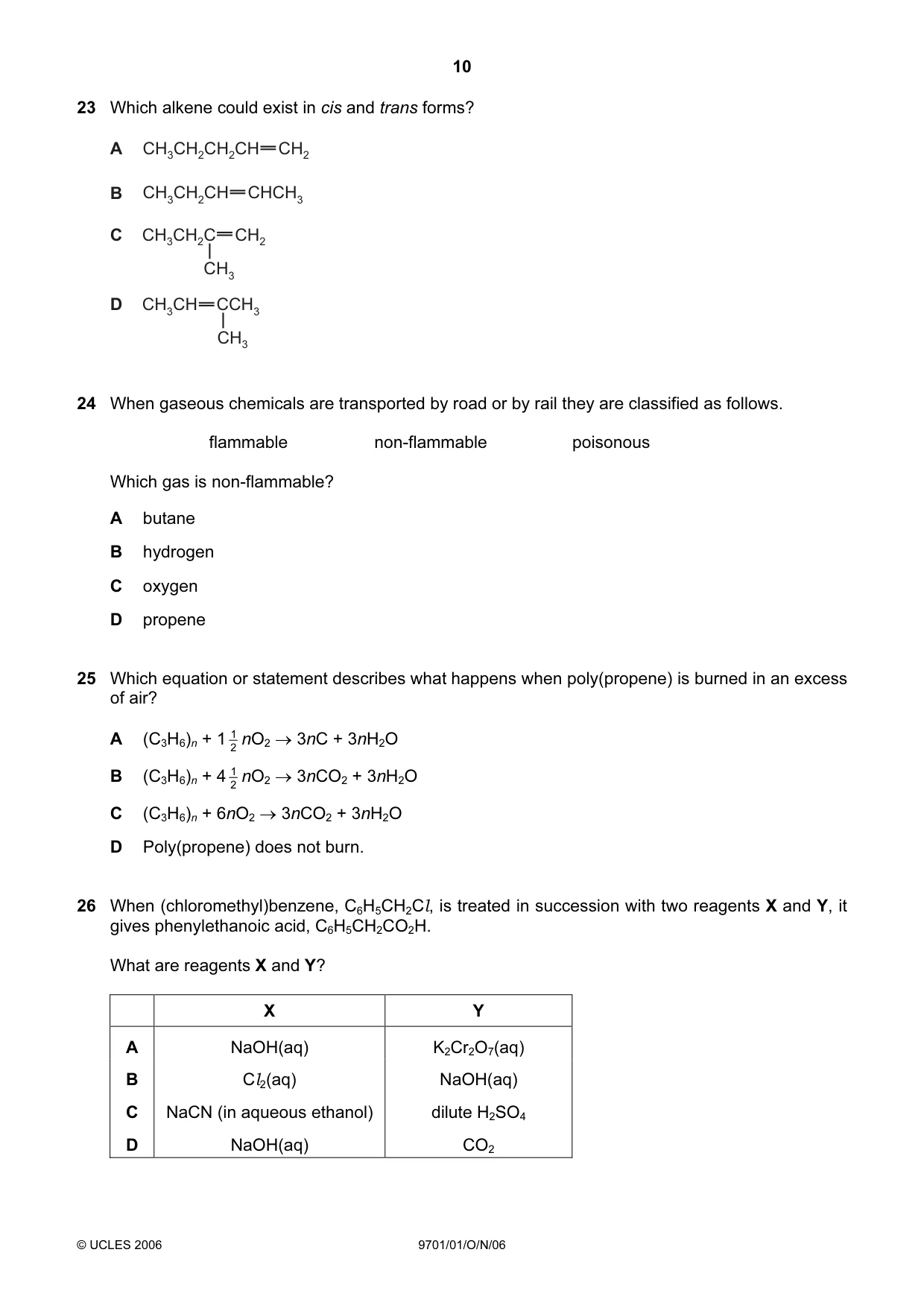
23 Which alkene could exist in cis and trans forms? A CH3CH2CH2CH CH2 B CH3CH2CH CHCH3 C CH3CH2C CH2 CH3 D CH3CH CCH3 CH3
Mark scheme: B
More questions on Isomerism: structural isomerism and stereoisomerism
Q24 · When gaseous chemicals are transported by road or by rail they are classified as follows
24 When gaseous chemicals are transported by road or by rail they are classified as follows. flammable non-flammable poisonous Which gas is non-flammable? A butane B hydrogen C oxygen D propene
Mark scheme: C
Q25 · Which equation or statement describes what happens when poly(propene) is burned in an…
25 Which equation or statement describes what happens when poly(propene) is burned in an excess of air? A (C3H6)n + 1 2 1 nO2 → 3nC + 3nH2O B (C3H6)n + 4 2 1 nO2 → 3nCO2 + 3nH2O C (C3H6)n + 6nO2 → 3nCO2 + 3nH2O D Poly(propene) does not burn.
Mark scheme: B
Q26 · When (chloromethyl)benzene, C6H5CH2Cl, is treated in succession with two reagents X and…
26 When (chloromethyl)benzene, C6H5CH2Cl, is treated in succession with two reagents X and Y, it gives phenylethanoic acid, C6H5CH2CO2H. What are reagents X and Y? X Y A NaOH(aq) K2Cr2O7(aq) B Cl2(aq) NaOH(aq) C NaCN (in aqueous ethanol) dilute H2SO4 D NaOH(aq) CO2
Mark scheme: C
Q27 · Which compound • is unaffected by hot alkaline potassium manganate(VII); • gives hydrogen…
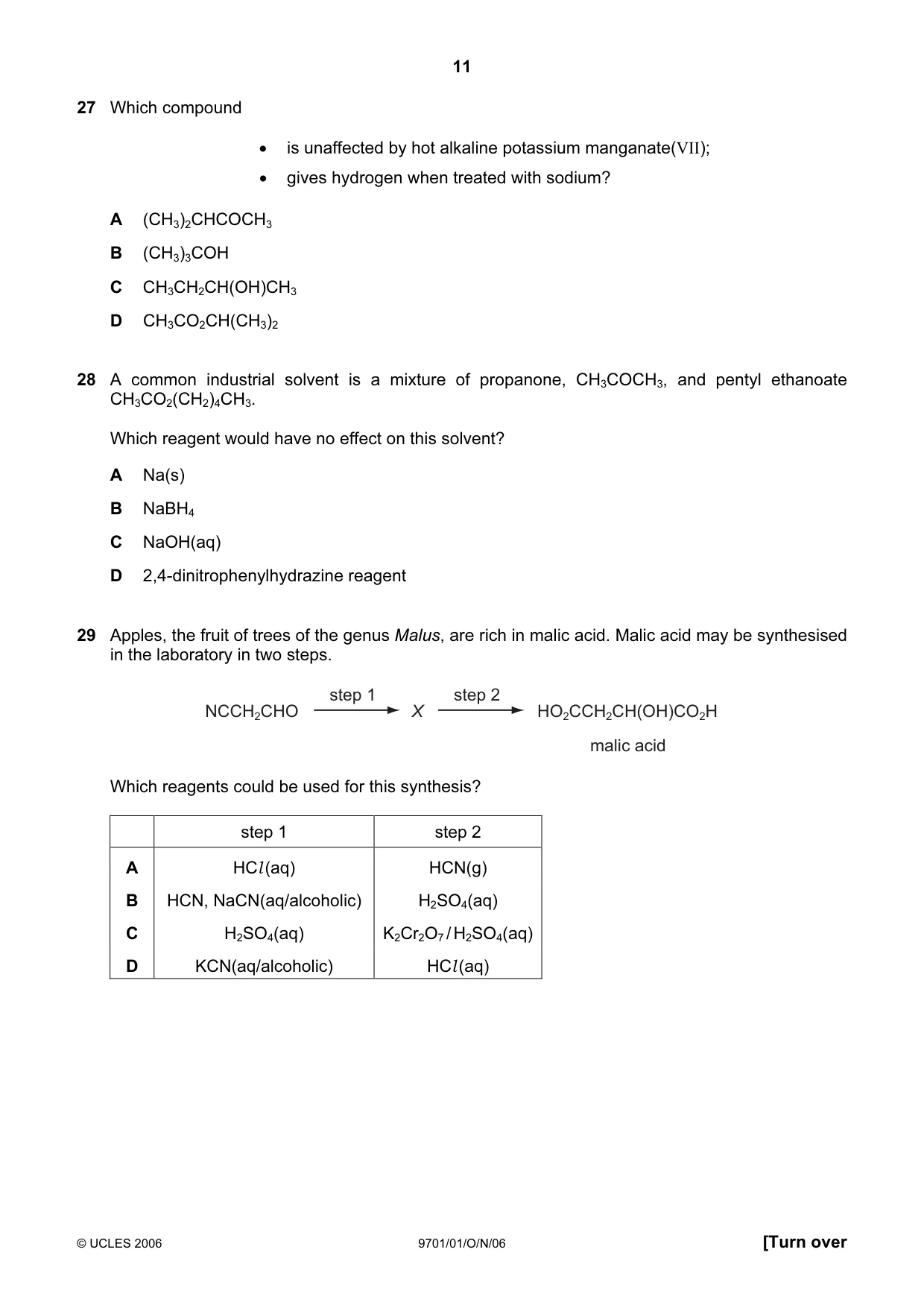
27 Which compound • is unaffected by hot alkaline potassium manganate(VII); • gives hydrogen when treated with sodium? A (CH3)2CHCOCH3 B (CH3)3COH C CH3CH2CH(OH)CH3 D CH3CO2CH(CH3)2
Mark scheme: B
Q28 · A common industrial solvent is a mixture of propanone, CH3COCH3, and pentyl ethanoate…
28 A common industrial solvent is a mixture of propanone, CH3COCH3, and pentyl ethanoate CH3CO2(CH2)4CH3. Which reagent would have no effect on this solvent? A Na(s) B NaBH4 C NaOH(aq) D 2,4-dinitrophenylhydrazine reagent
Mark scheme: A
Q29 · Apples, the fruit of trees of the genus Malus, are rich in malic acid
29 Apples, the fruit of trees of the genus Malus, are rich in malic acid. Malic acid may be synthesised in the laboratory in two steps. step 1 step 2 NCCH2CHO X HO2CCH2CH(OH)CO2H malic acid Which reagents could be used for this synthesis? step 1 step 2 A HCl (aq) HCN(g) B HCN, NaCN(aq/alcoholic) H2SO4(aq) C H2SO4(aq) K2Cr2O7 / H2SO4(aq) D KCN(aq/alcoholic) HCl (aq)
Mark scheme: B
Q30 · Which pair of compounds is formed when the ester C2H5CO2CH3 is boiled with aqueous sodium…
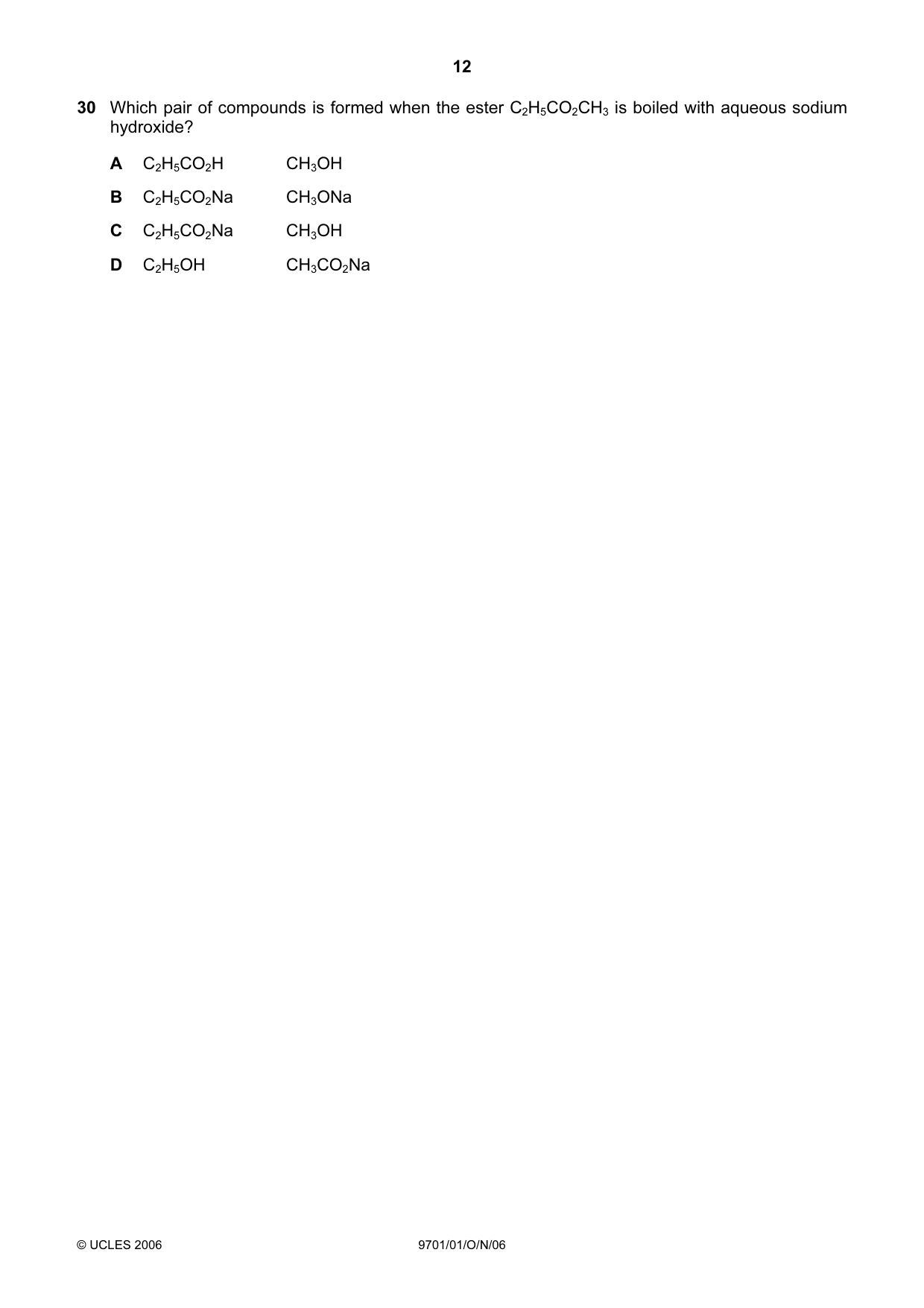
30 Which pair of compounds is formed when the ester C2H5CO2CH3 is boiled with aqueous sodium hydroxide? A C2H5CO2H CH3OH B C2H5CO2Na CH3ONa C C2H5CO2Na CH3OH D C2H5OH CH3CO2Na
Mark scheme: C
Q31 · The chlorine oxide free radical, ClO•, is formed during the depletion of the ozone layer…
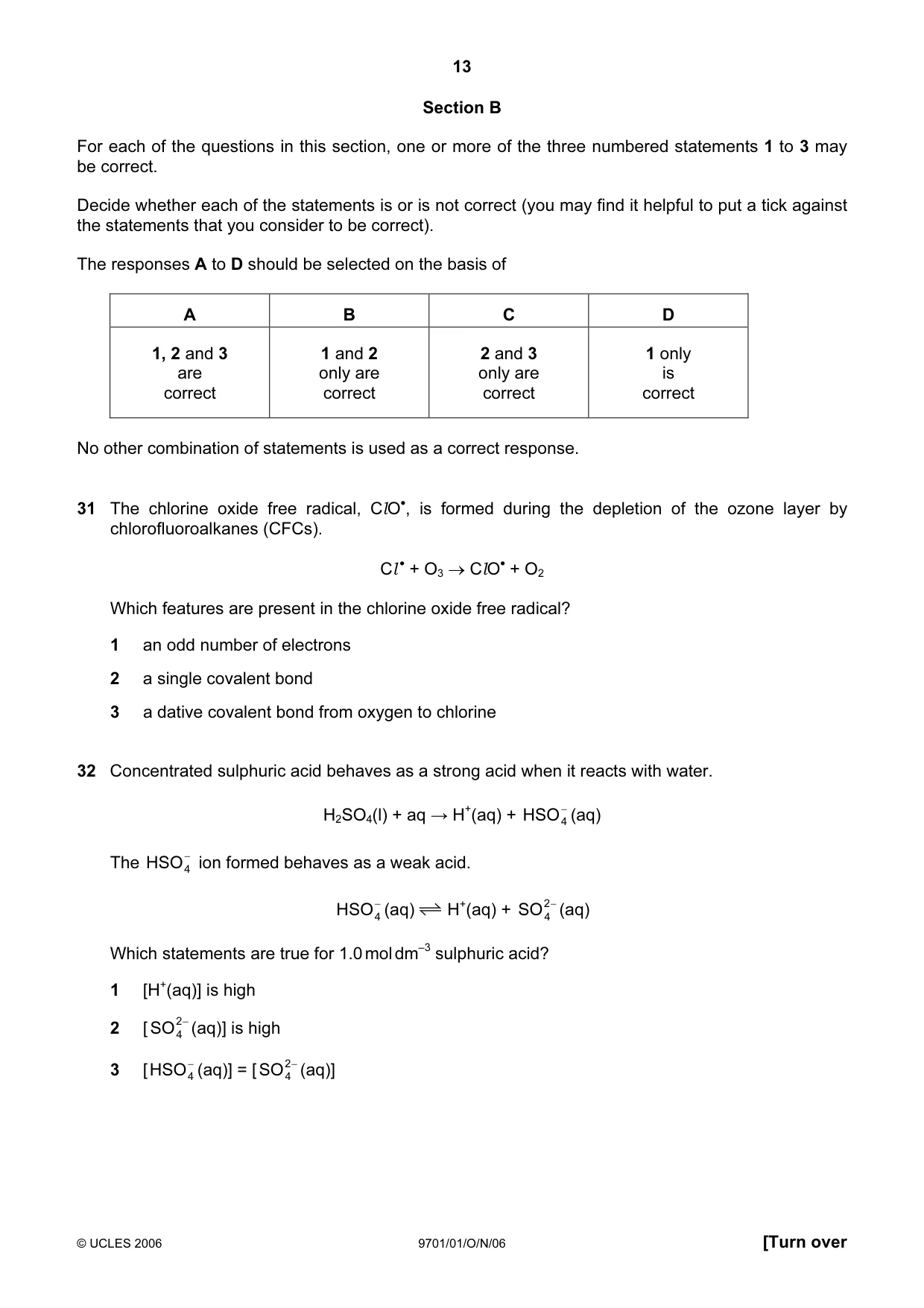
31 The chlorine oxide free radical, ClO•, is formed during the depletion of the ozone layer by chlorofluoroalkanes (CFCs). Cl • + O3 → ClO• + O2 Which features are present in the chlorine oxide free radical? 1 an odd number of electrons 2 a single covalent bond 3 a dative covalent bond from oxygen to chlorine
Mark scheme: B
Q32 · Concentrated sulphuric acid behaves as a strong acid when it reacts with water
32 Concentrated sulphuric acid behaves as a strong acid when it reacts with water. H2SO4(l) + aq → H+(aq) + HSO (aq) − 4 The HSO ion formed behaves as a weak acid. − 4 HSO (aq) − H+(aq) + SO 2 − (aq) 4 4 Which statements are true for 1.0 mol dm–3 sulphuric acid? 1 [H+(aq)] is high 2 [ SO 2 − (aq)] is high 4 3 [ HSO (aq)] = [ − SO 2 − (aq)] 4 4
Mark scheme: D
Q33 · A reversible reaction is catalysed
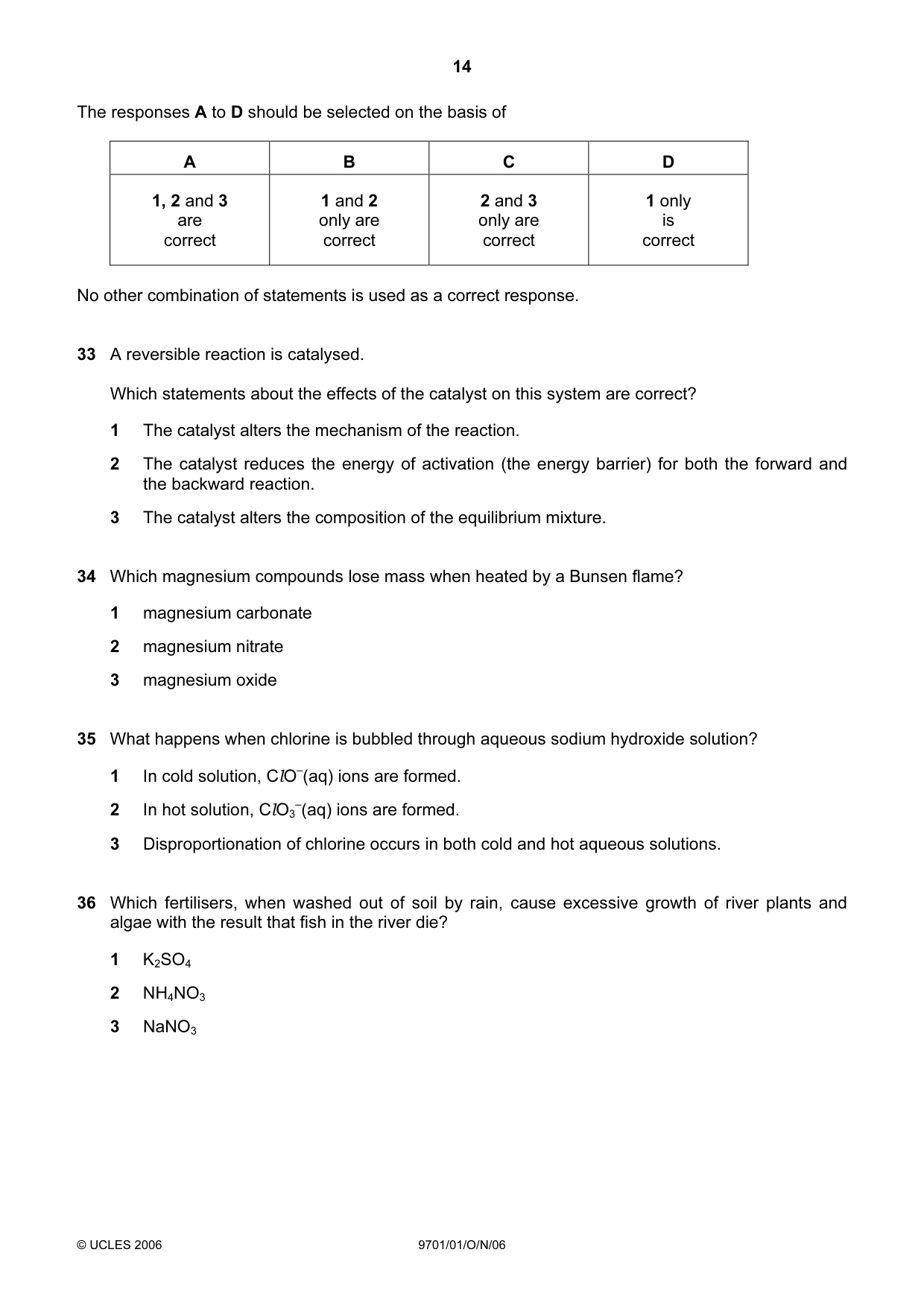
33 A reversible reaction is catalysed. Which statements about the effects of the catalyst on this system are correct? 1 The catalyst alters the mechanism of the reaction. 2 The catalyst reduces the energy of activation (the energy barrier) for both the forward and the backward reaction. 3 The catalyst alters the composition of the equilibrium mixture.
Mark scheme: B
Q34 · Which magnesium compounds lose mass when heated by a Bunsen flame?
34 Which magnesium compounds lose mass when heated by a Bunsen flame? 1 magnesium carbonate 2 magnesium nitrate 3 magnesium oxide
Mark scheme: B
Q35 · What happens when chlorine is bubbled through aqueous sodium hydroxide solution?
35 What happens when chlorine is bubbled through aqueous sodium hydroxide solution? 1 In cold solution, ClO–(aq) ions are formed. 2 In hot solution, ClO3 –(aq) ions are formed. 3 Disproportionation of chlorine occurs in both cold and hot aqueous solutions.
Mark scheme: A
Q36 · Which fertilisers, when washed out of soil by rain, cause excessive growth of river…
36 Which fertilisers, when washed out of soil by rain, cause excessive growth of river plants and algae with the result that fish in the river die? 1 K2SO4 2 NH4NO3 3 NaNO3
Mark scheme: C
Q37 · The following three hydrocarbons all occur naturally
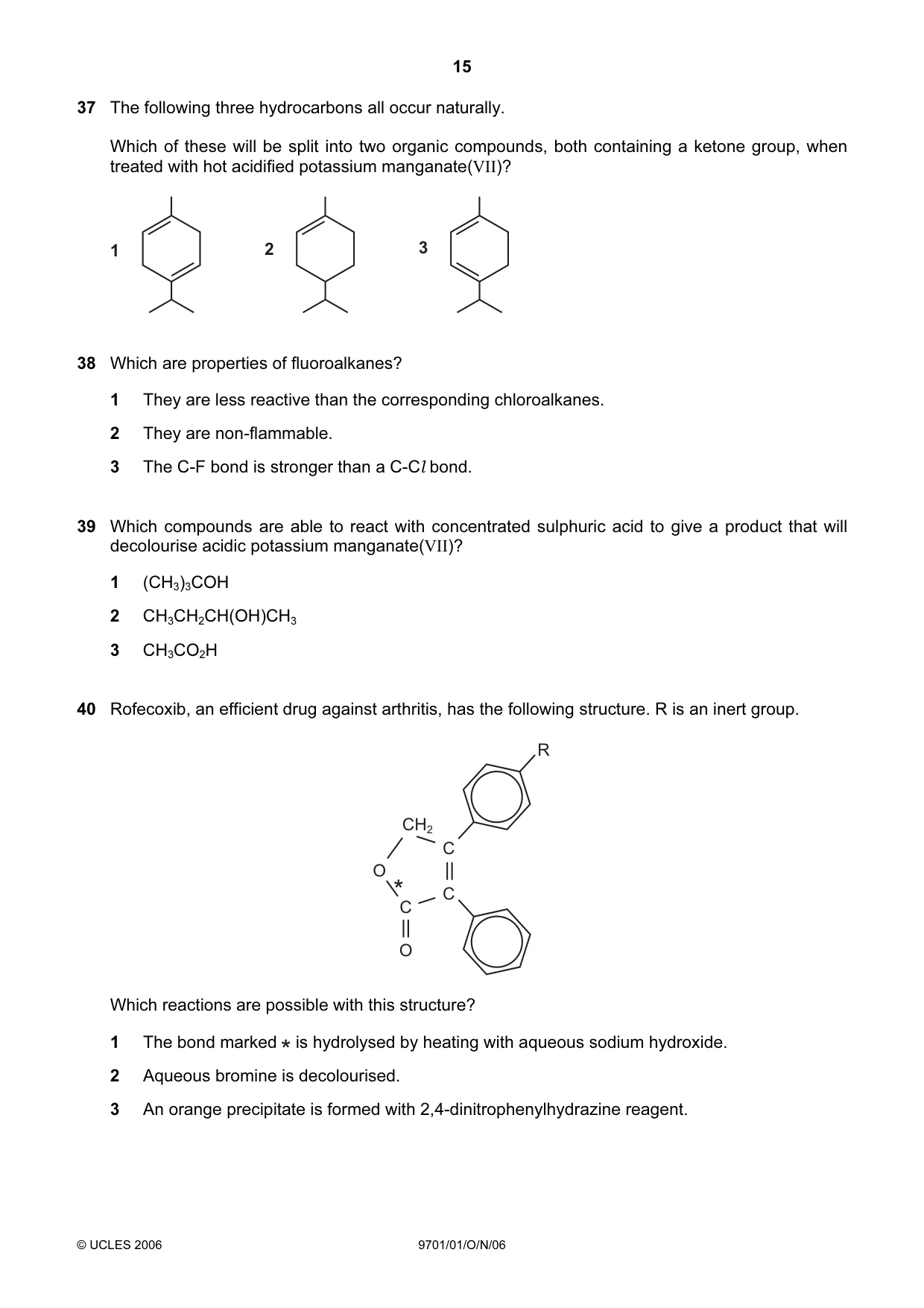
37 The following three hydrocarbons all occur naturally. Which of these will be split into two organic compounds, both containing a ketone group, when treated with hot acidified potassium manganate(VII)? 1 2 3
Mark scheme: D
Q38 · Which are properties of fluoroalkanes?
38 Which are properties of fluoroalkanes? 1 They are less reactive than the corresponding chloroalkanes. 2 They are non-flammable. 3 The C-F bond is stronger than a C-Cl bond.
Mark scheme: A
Q39 · Which compounds are able to react with concentrated sulphuric acid to give a product that…
39 Which compounds are able to react with concentrated sulphuric acid to give a product that will decolourise acidic potassium manganate(VII)? 1 (CH3)3COH 2 CH3CH2CH(OH)CH3 3 CH3CO2H
Mark scheme: B
Q40 · Rofecoxib, an efficient drug against arthritis, has the following structure
40 Rofecoxib, an efficient drug against arthritis, has the following structure. R is an inert group. R CH2 C O * C C O Which reactions are possible with this structure? 1 The bond marked is hydrolysed by heating with aqueous sodium hydroxide. 2 Aqueous bromine is decolourised. 3 An orange precipitate is formed with 2,4-dinitrophenylhydrazine reagent.
Mark scheme: B
What was in this paper
The subtopics covered by these 40 questions, and how many questions each got. Open one in a new tab to see every Cambridge question on it.
2Aldehydes and ketones2Isomerism: structural isomerism and stereoisomerism2Nitrogen and sulfur2Reacting masses and volumes (of solutions and gases)2Similarities and trends in the properties of the Group 2 metals, magnesium to barium, and their compounds2Acids and bases1Addition polymerisation1Alkanes1Alkenes1Bonding and structure1Chemical equilibria: reversible reactions, dynamic equilibrium1Effect of temperature on reaction rates and the concept of activation energy1Electrons, energy levels and atomic orbitals1Enthalpy change, ΔH1Esters1Formulas, functional groups and the naming of organic compounds1Halogen compounds1Halogenoalkanes1Hess’s law1Homogeneous and heterogeneous catalysts1Homogeneous and heterogeneous catalysts1Ionisation energy1Nitriles and hydroxynitriles1Organic synthesis1Particles in the atom and atomic radius1Periodicity of chemical properties of the elements in Period 31Physical properties of the Group 17 elements1Redox processes: electron transfer and changes in oxidation number (oxidation state)1Shapes of organic molecules; σ and π bonds1Some reactions of the halide ions1The chemical properties of the halogen elements and the hydrogen halides1The gaseous state: ideal and real gases and pV = nRT1The reactions of chlorine1What you needed in this session
Cambridge’s own grade thresholds for 2006 Oct/Nov, Paper 1 · Variant 1. A higher threshold means an easier paper — the bar moves with how the cohort did.