Cambridge A Level Chemistry 9701 — 2024 May/June Paper 1 · Variant 1
9701/11/M/J/24 · 40 questions · 40 marks · ≈45 min
The question paper and its mark scheme, free to read here and free to download. This is Cambridge’s own paper, exactly as it was sat.
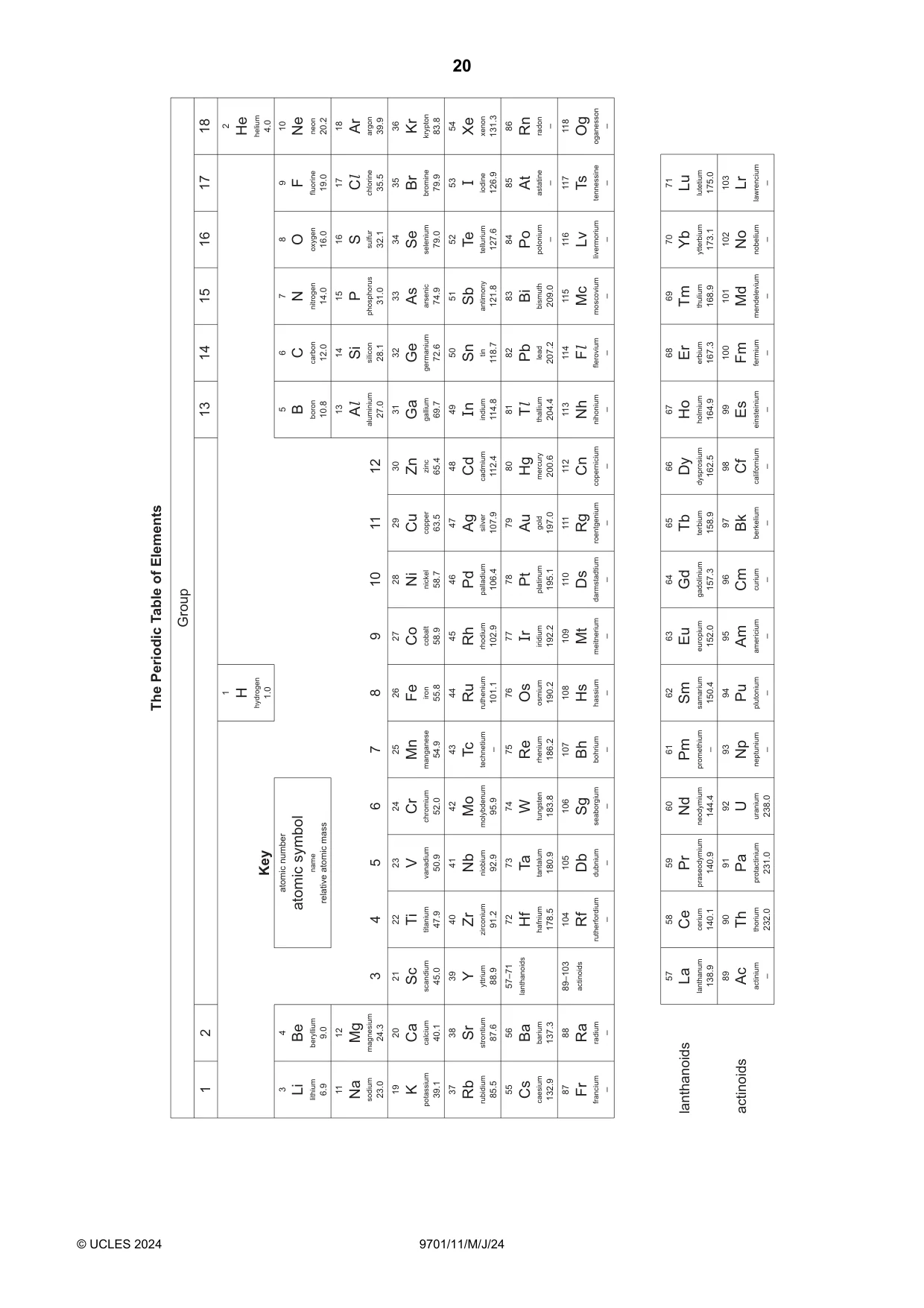
Question paper20 pages
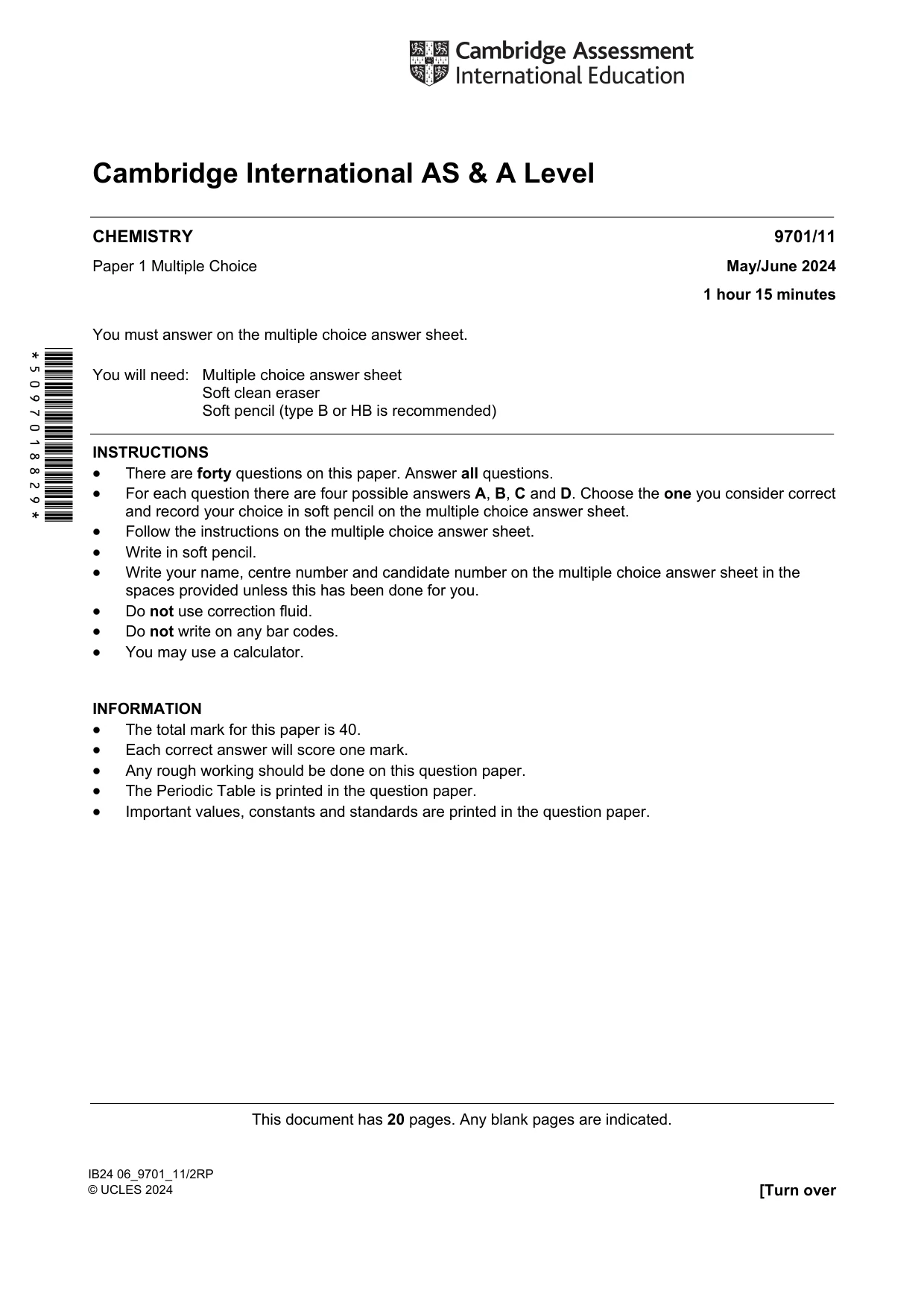
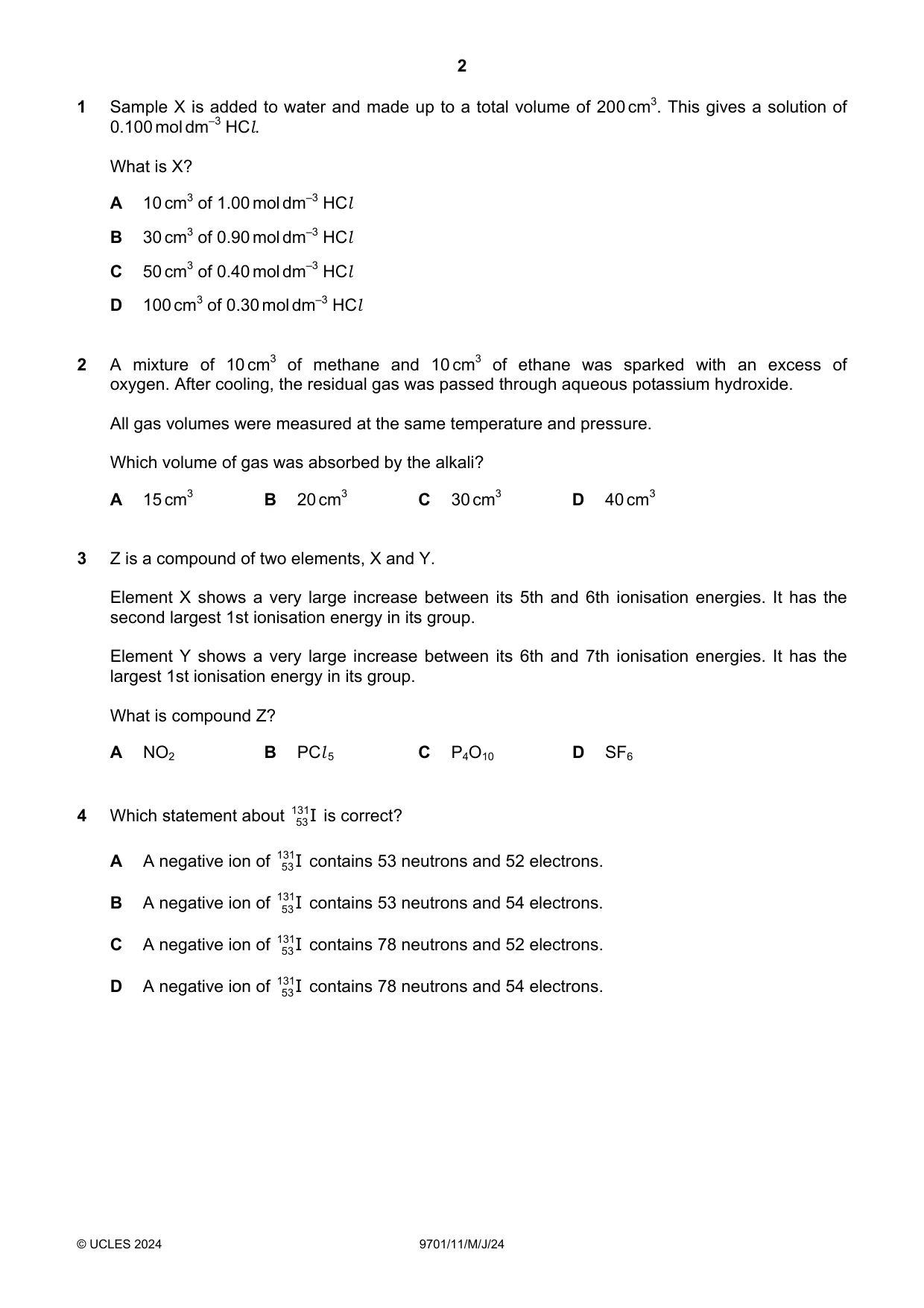
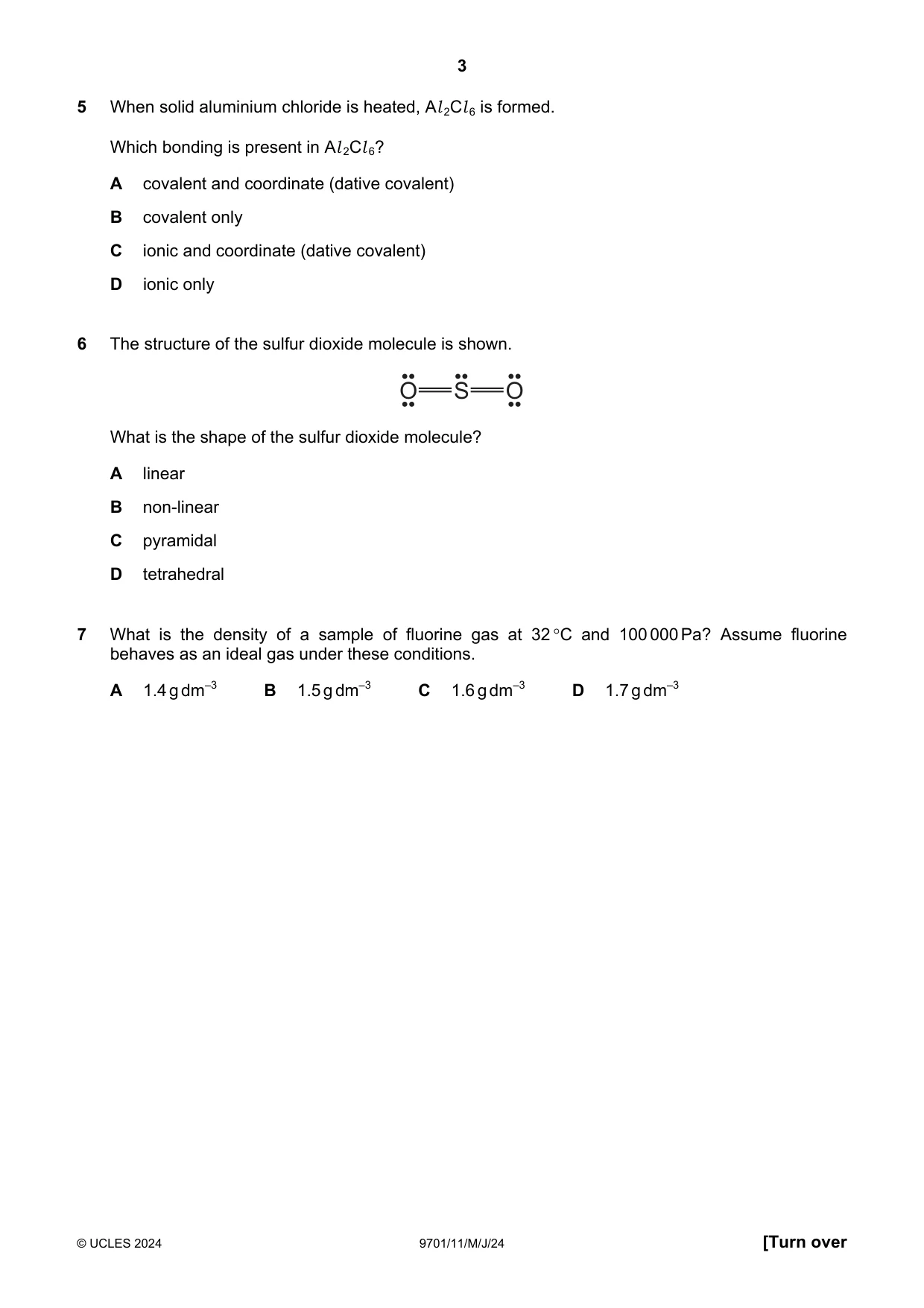
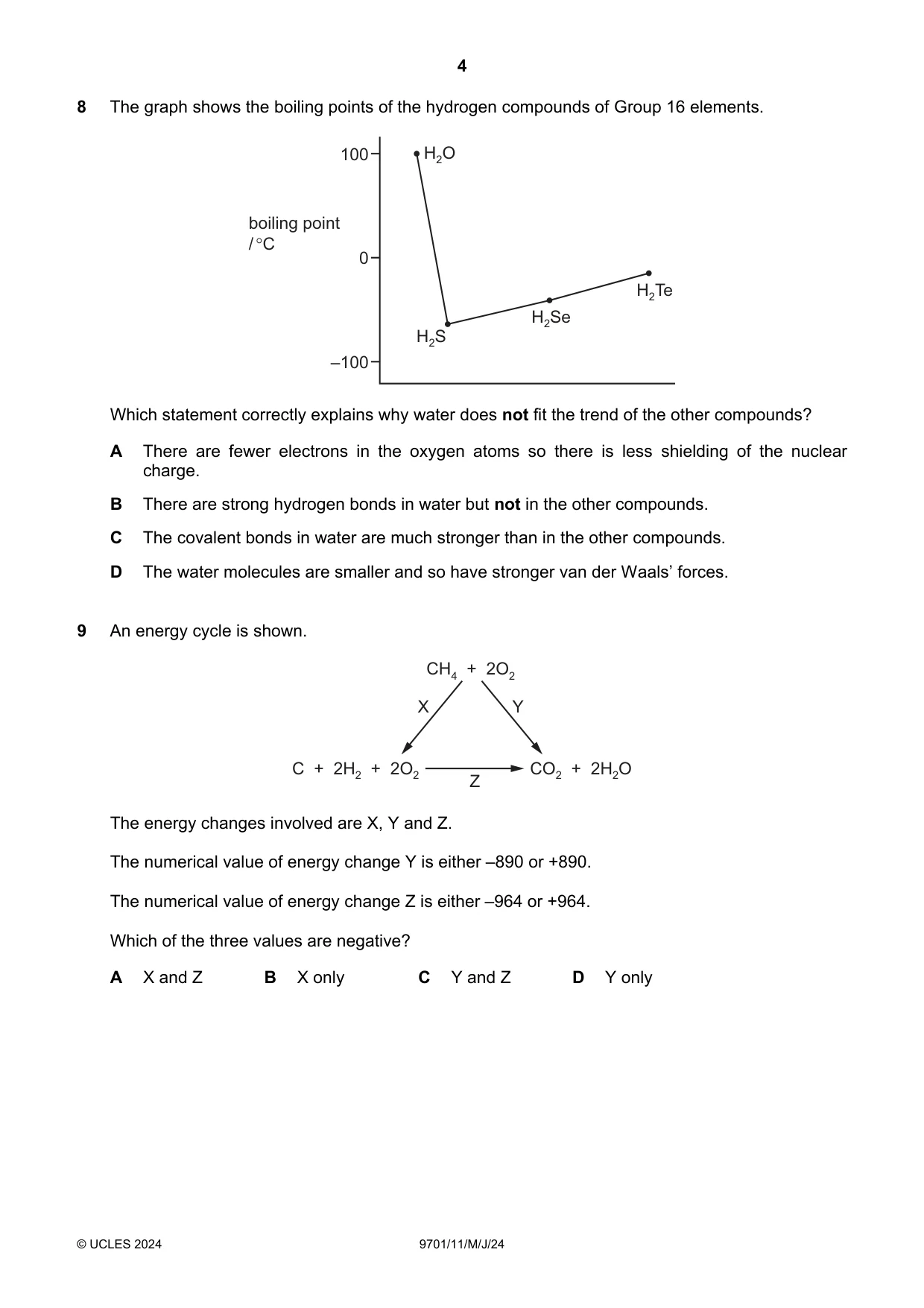



Mark scheme3 pages
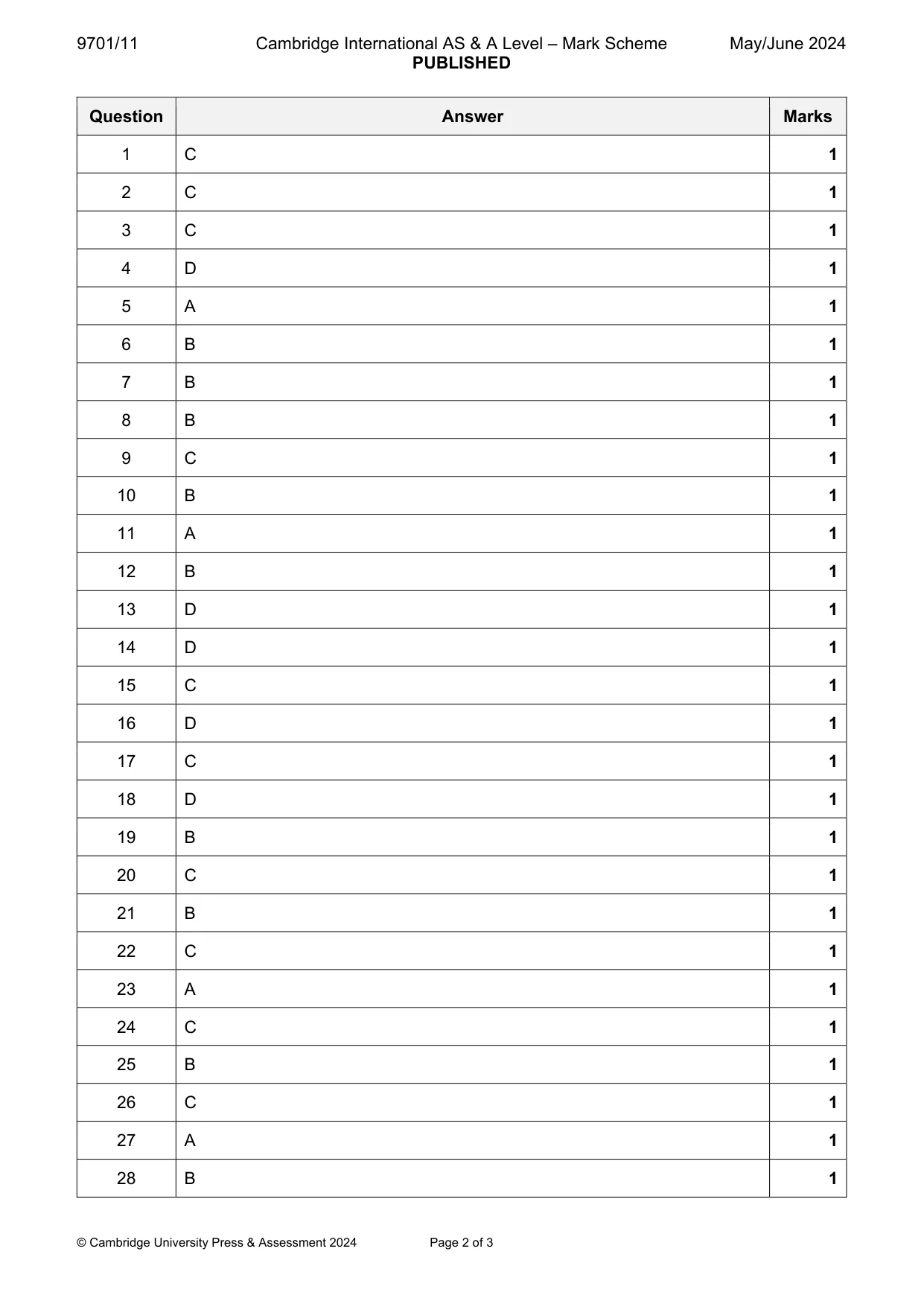
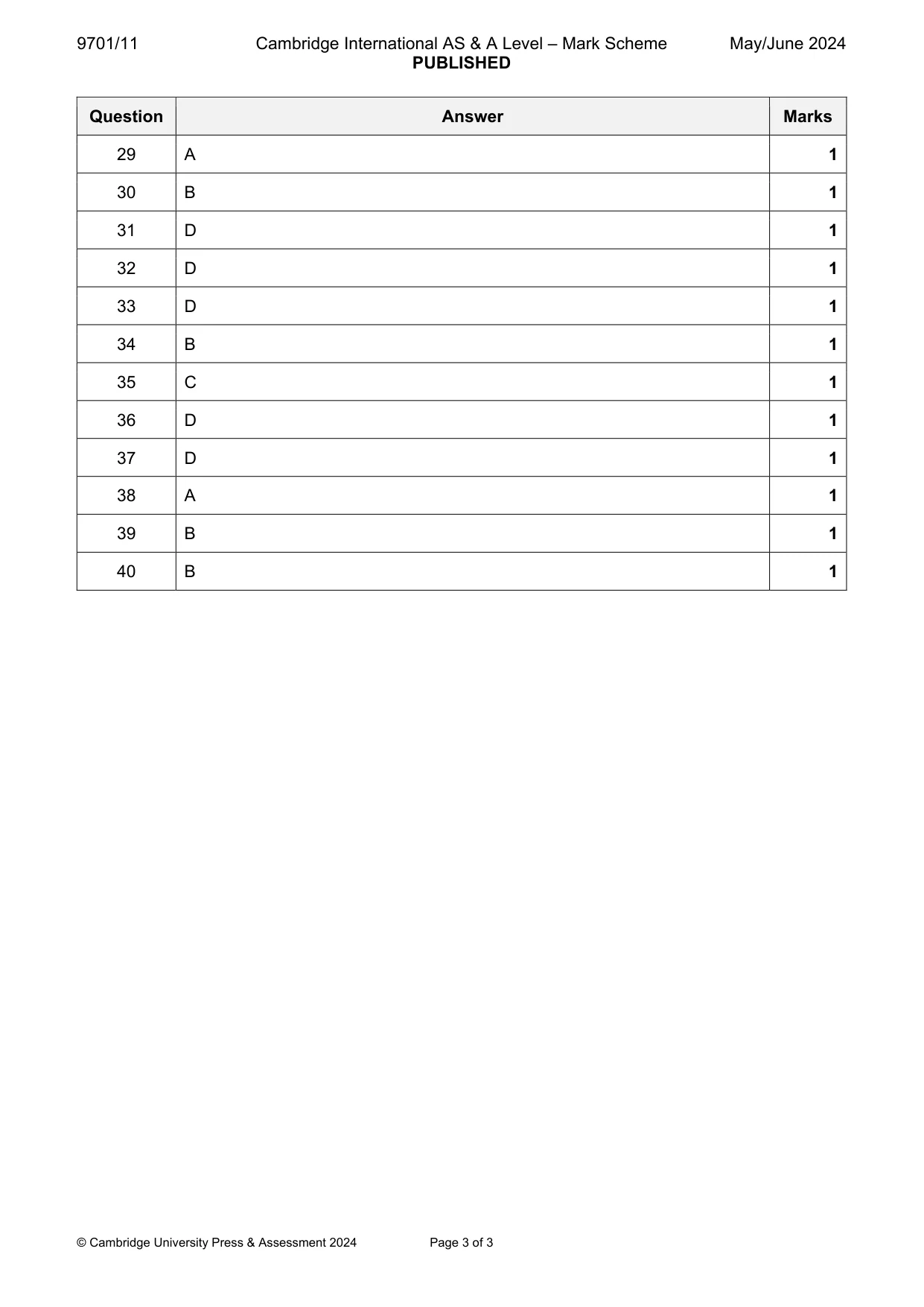
Answers below. Sit the paper first if you are practising.
Questions as text
Q1 · Sample X is added to water and made up to a total volume of 200 cm3
1 Sample X is added to water and made up to a total volume of 200 cm3. This gives a solution of 0.100 mol dm–3 HCl. What is X? A 10 cm3 of 1.00 mol dm–3 HCl B 30 cm3 of 0.90 mol dm–3 HCl C 50 cm3 of 0.40 mol dm–3 HCl D 100 cm3 of 0.30 mol dm–3 HCl
Mark scheme: C
More questions on Reacting masses and volumes (of solutions and gases)
Q2 · A mixture of 10 cm3 of methane and 10 cm3 of ethane was sparked with an excess of oxygen
2 A mixture of 10 cm3 of methane and 10 cm3 of ethane was sparked with an excess of oxygen. After cooling, the residual gas was passed through aqueous potassium hydroxide. All gas volumes were measured at the same temperature and pressure. Which volume of gas was absorbed by the alkali? A 15 cm3 B 20 cm3 C 30 cm3 D 40 cm3
Mark scheme: C
More questions on Reacting masses and volumes (of solutions and gases)
Q3 · Z is a compound of two elements, X and Y
3 Z is a compound of two elements, X and Y. Element X shows a very large increase between its 5th and 6th ionisation energies. It has the second largest 1st ionisation energy in its group. Element Y shows a very large increase between its 6th and 7th ionisation energies. It has the largest 1st ionisation energy in its group. What is compound Z? A NO2 B PCl 5 C P4O10 D SF6
Mark scheme: C
Q4 · Which statement about 131 53 is correct?
4 Which statement about 131 53 is correct? I A A negative ion of 131 53 contains 53 neutrons and 52 electrons. I B A negative ion of 131 53 contains 53 neutrons and 54 electrons. I C A negative ion of 131 53 contains 78 neutrons and 52 electrons. I D A negative ion of 131 53 contains 78 neutrons and 54 electrons. I
Mark scheme: D
Q5 · When solid aluminium chloride is heated, Al 2Cl 6 is formed
5 When solid aluminium chloride is heated, Al 2Cl 6 is formed. Which bonding is present in Al 2Cl 6? A covalent and coordinate (dative covalent) B covalent only C ionic and coordinate (dative covalent) D ionic only
Mark scheme: A
More questions on Covalent bonding and coordinate (dative covalent) bonding
Q6 · The structure of the sulfur dioxide molecule is shown
6 The structure of the sulfur dioxide molecule is shown. O S O What is the shape of the sulfur dioxide molecule? A linear B non-linear C pyramidal D tetrahedral
Mark scheme: B
Q7 · What is the density of a sample of fluorine gas at 32 C and 100 000 Pa?
7 What is the density of a sample of fluorine gas at 32 C and 100 000 Pa? Assume fluorine behaves as an ideal gas under these conditions. A 1.4 g dm–3 B 1.5 g dm–3 C 1.6 g dm–3 D 1.7 g dm–3
Mark scheme: B
More questions on The gaseous state: ideal and real gases and pV = nRT
Q8 · The graph shows the boiling points of the hydrogen compounds of Group 16 elements
8 The graph shows the boiling points of the hydrogen compounds of Group 16 elements. 100 boiling point °C —100 Which statement correctly explains why water does not fit the trend of the other compounds? A_ There are fewer electrons in the oxygen atoms so there is less shielding of the nuclear charge. There are strong hydrogen bonds in water but not in the other compounds. The covalent bonds in water are much stronger than in the other compounds. The water molecules are smaller and so have stronger van der Waals’ forces.
Mark scheme: B
More questions on Intermolecular forces, electronegativity and bond properties
Q9 · An energy cycle is shown
9 An energy cycle is shown. CH4 + 2O2 X Y C + 2H2 + 2O2 CO2 + 2H2O Z The energy changes involved are X, Y and Z. The numerical value of energy change Y is either –890 or +890. The numerical value of energy change Z is either –964 or +964. Which of the three values are negative? A X and Z B X only C Y and Z D Y only
Mark scheme: C
Q10 · For a certain endothermic reaction, the activation energy is numerically equal to twice…
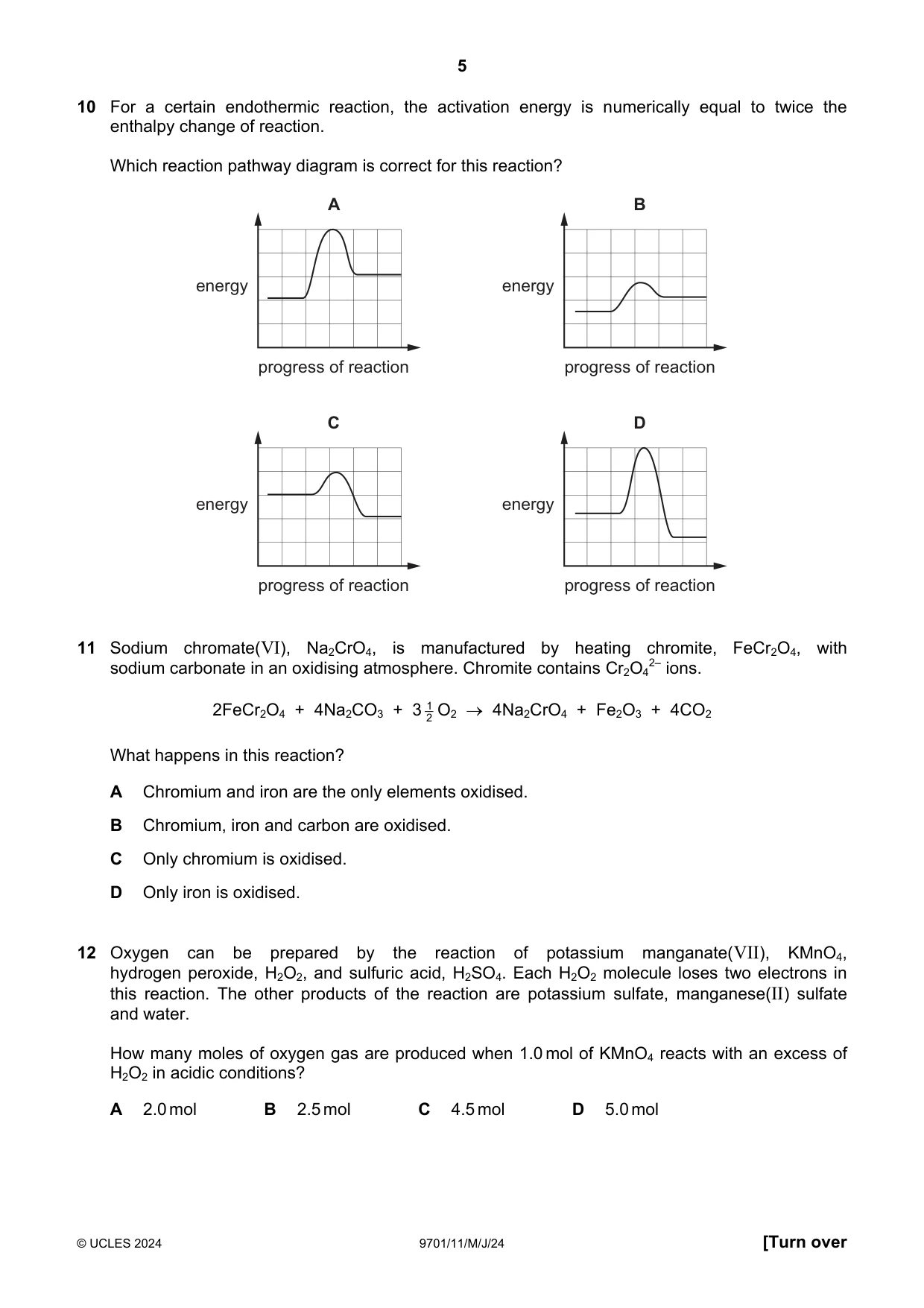
10 For a certain endothermic reaction, the activation energy is numerically equal to twice the enthalpy change of reaction. Which reaction pathway diagram is correct for this reaction? A B energy energy progress of reaction progress of reaction C D energy energy progress of reaction progress of reaction
Mark scheme: B
More questions on Effect of temperature on reaction rates and the concept of activation energy
Q11 · Sodium chromate(VI), Na2CrO4, is manufactured by heating chromite, FeCr2O4, with sodium…
11 Sodium chromate(VI), Na2CrO4, is manufactured by heating chromite, FeCr2O4, with sodium carbonate in an oxidising atmosphere. Chromite contains Cr2O4 2– ions. 2FeCr2O4 + 4Na2CO3 + 3 2 1 O2 4Na2CrO4 + Fe2O3 + 4CO2 What happens in this reaction? A Chromium and iron are the only elements oxidised. B Chromium, iron and carbon are oxidised. C Only chromium is oxidised. D Only iron is oxidised.
Mark scheme: A
Q12 · Oxygen can be prepared by the reaction of potassium manganate(VII), KMnO4, hydrogen…
12 Oxygen can be prepared by the reaction of potassium manganate(VII), KMnO4, hydrogen peroxide, H2O2, and sulfuric acid, H2SO4. Each H2O2 molecule loses two electrons in this reaction. The other products of the reaction are potassium sulfate, manganese(II) sulfate and water. How many moles of oxygen gas are produced when 1.0 mol of KMnO4 reacts with an excess of H2O2 in acidic conditions? A 2.0 mol B 2.5 mol C 4.5 mol D 5.0 mol
Mark scheme: B
Q13 · An alcohol, ROH, reacts reversibly with ethanoic acid to produce an ester
13 An alcohol, ROH, reacts reversibly with ethanoic acid to produce an ester. ROH(l) + CH3COOH(l) CH3COOR(l) + H2O(l) 3.0 mol of ROH, 2.0 mol of ethanoic acid and 1.0 mol of water are mixed together. At equilibrium, 1.5 mol of CH3COOR is present. What is the value of the equilibrium constant, Kc, for this reaction? A 0.20 B 0.25 C 2.00 D 5.00
Mark scheme: D
More questions on Chemical equilibria: reversible reactions, dynamic equilibrium
Q14 · Graphs can be drawn to show the percentage of ammonia at equilibrium when nitrogen and…
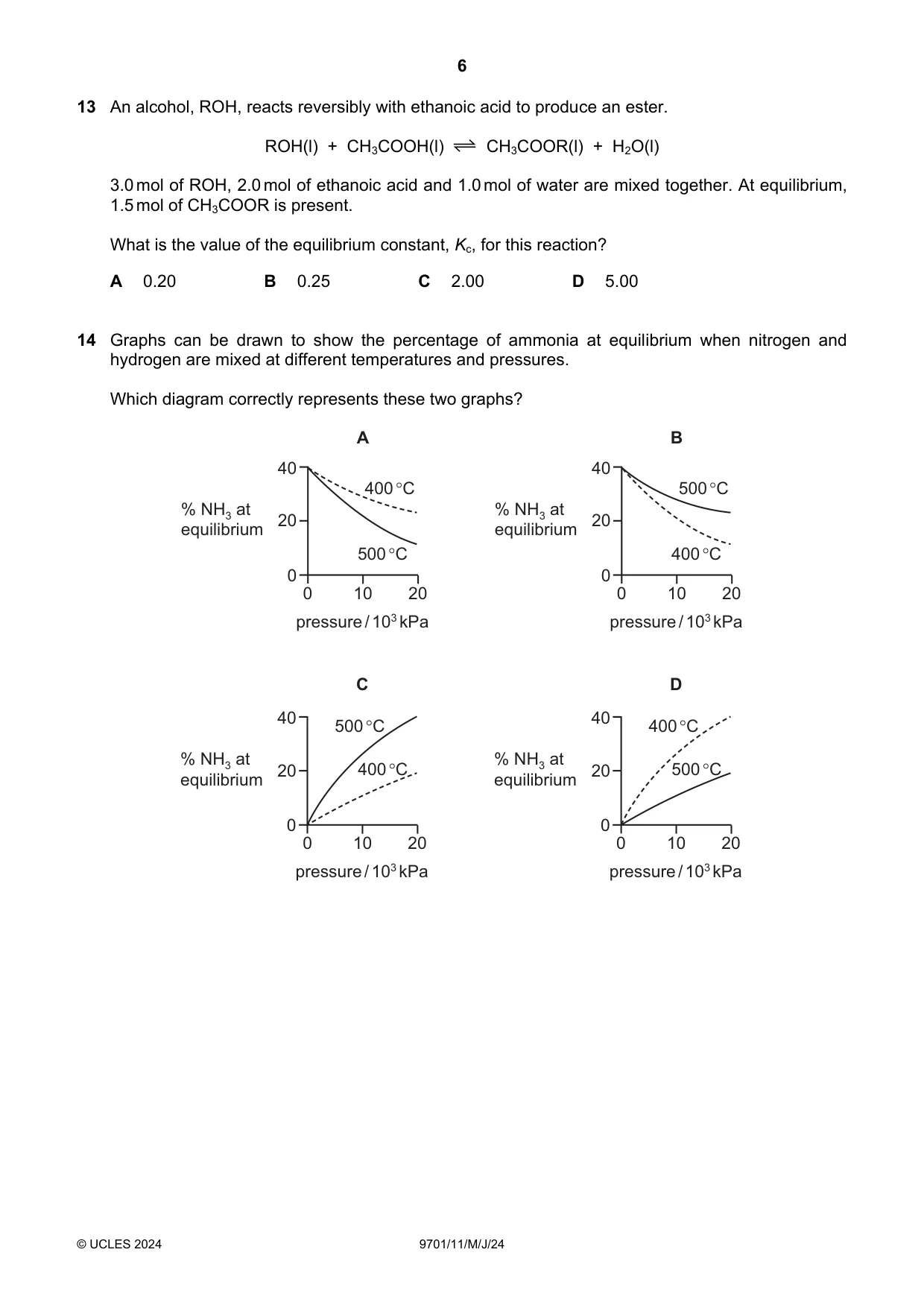
14 Graphs can be drawn to show the percentage of ammonia at equilibrium when nitrogen and hydrogen are mixed at different temperatures and pressures. Which diagram correctly represents these two graphs? % NH, at equilibrium 0 10 20 pressure/10°kPa Cc % NH, at equilibrium 0 10 20 pressure/10°kPa % NH, at equilibrium 0 10 20 pressure/10°kPa D % NH, at equilibrium 0 10 20 pressure/10°kPa
Mark scheme: D
More questions on Chemical equilibria: reversible reactions, dynamic equilibrium
Q15 · The Boltzmann distribution for the hydrogenation of an alkene at a particular temperature…
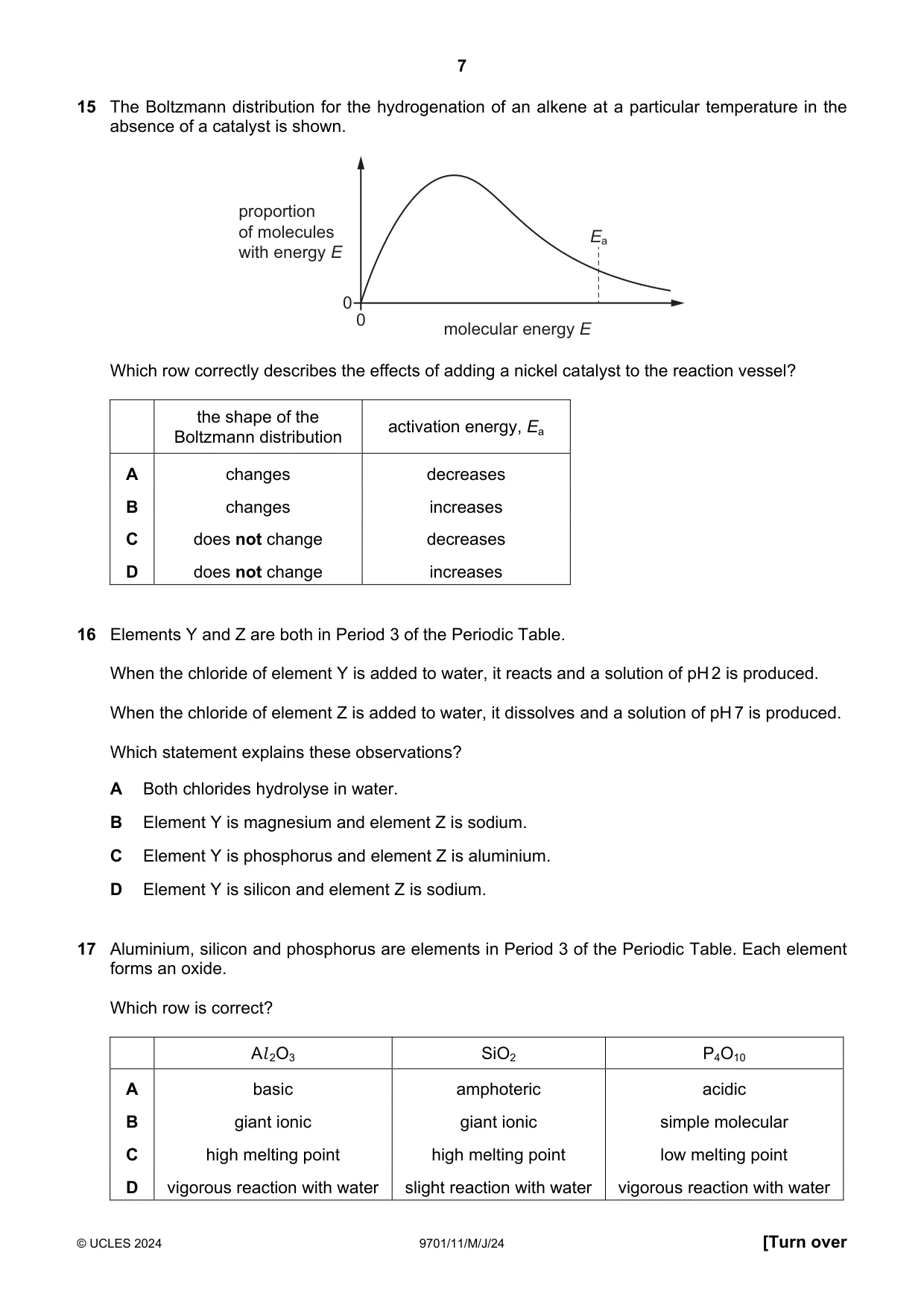
15 The Boltzmann distribution for the hydrogenation of an alkene at a particular temperature in the absence of a catalyst is shown. proportion of molecules Ea with energy E 0 0 molecular energy E Which row correctly describes the effects of adding a nickel catalyst to the reaction vessel? the shape of the activation energy, Ea Boltzmann distribution A changes decreases B changes increases C does not change decreases D does not change increases
Mark scheme: C
More questions on Effect of temperature on reaction rates and the concept of activation energy
Q16 · Elements Y and Z are both in Period 3 of the Periodic Table
16 Elements Y and Z are both in Period 3 of the Periodic Table. When the chloride of element Y is added to water, it reacts and a solution of pH 2 is produced. When the chloride of element Z is added to water, it dissolves and a solution of pH 7 is produced. Which statement explains these observations? A Both chlorides hydrolyse in water. B Element Y is magnesium and element Z is sodium. C Element Y is phosphorus and element Z is aluminium. D Element Y is silicon and element Z is sodium.
Mark scheme: D
More questions on Periodicity of chemical properties of the elements in Period 3
Q17 · Aluminium, silicon and phosphorus are elements in Period 3 of the Periodic Table
17 Aluminium, silicon and phosphorus are elements in Period 3 of the Periodic Table. Each element forms an oxide. Which row is correct? Al 2O3 SiO2 P4O10 A basic amphoteric acidic B giant ionic giant ionic simple molecular C high melting point high melting point low melting point D vigorous reaction with water slight reaction with water vigorous reaction with water
Mark scheme: C
More questions on Periodicity of chemical properties of the elements in Period 3
Q18 · Which statement is correct?
18 Which statement is correct? A The atomic radius of silicon is larger than that of aluminium. B The boiling point of chlorine is higher than that of silicon. C The first ionisation energy of sulfur is greater than that of phosphorus. D The electrical conductivity of magnesium is greater than that of sodium.
Mark scheme: D
More questions on Periodicity of physical properties of the elements in Period 3
Q19 · All solubility data in this question is given at the same temperature
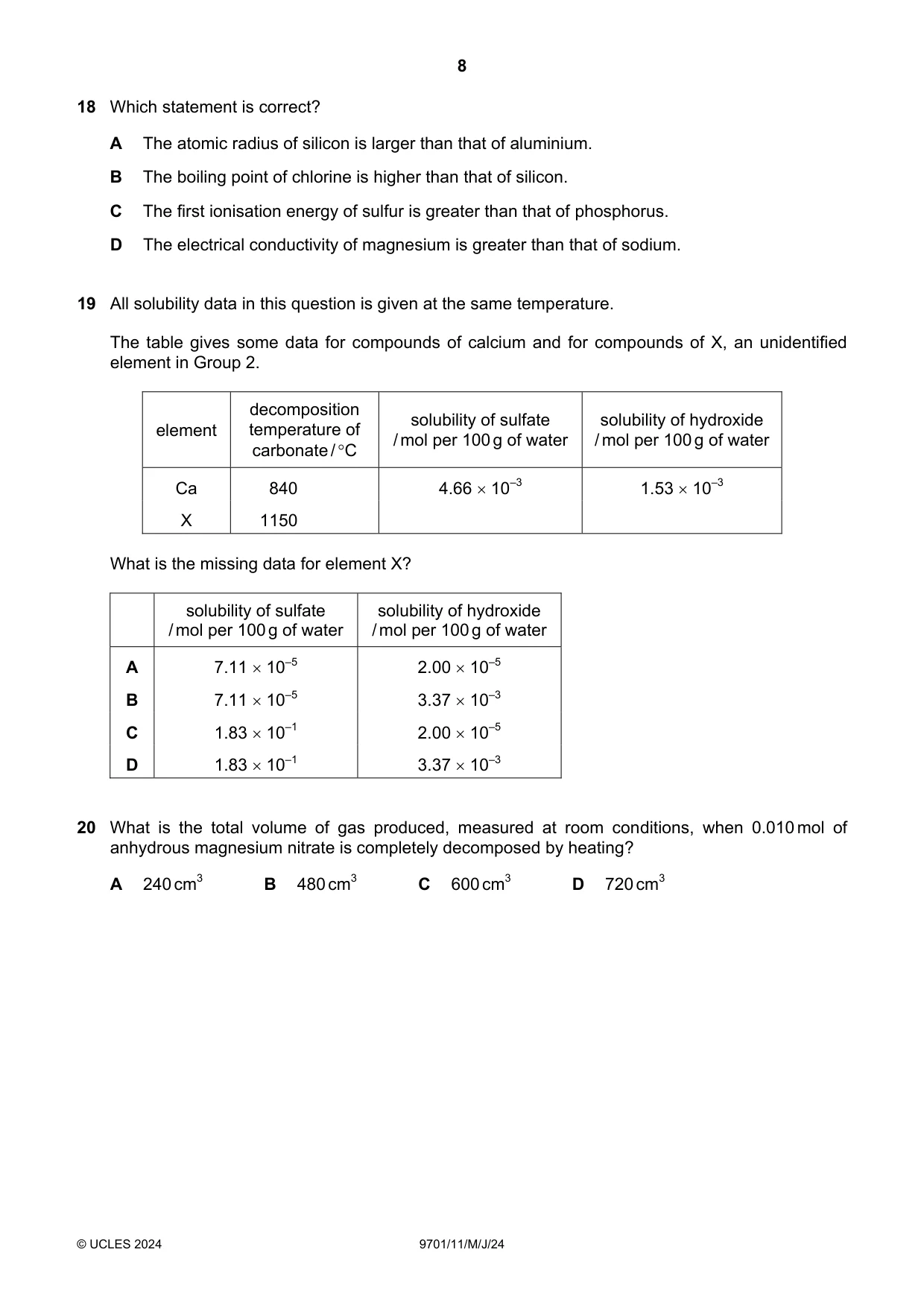
19 All solubility data in this question is given at the same temperature. The table gives some data for compounds of calcium and for compounds of X, an unidentified element in Group 2. decomposition solubility of sulfate solubility of hydroxide element temperature of / mol per 100 g of water / mol per 100 g of water carbonate / C Ca 840 4.66 10–3 1.53 10–3 X 1150 What is the missing data for element X? solubility of sulfate solubility of hydroxide / mol per 100 g of water / mol per 100 g of water A 7.11 10–5 2.00 10–5 B 7.11 10–5 3.37 10–3 C 1.83 10–1 2.00 10–5 D 1.83 10–1 3.37 10–3
Mark scheme: B
Q20 · What is the total volume of gas produced, measured at room conditions, when 0.010 mol of…
20 What is the total volume of gas produced, measured at room conditions, when 0.010 mol of anhydrous magnesium nitrate is completely decomposed by heating? A 240 cm3 B 480 cm3 C 600 cm3 D 720 cm3
Mark scheme: C
More questions on Reacting masses and volumes (of solutions and gases)
Q21 · A solid sodium halide, NaX, is reacted with concentrated sulfuric acid
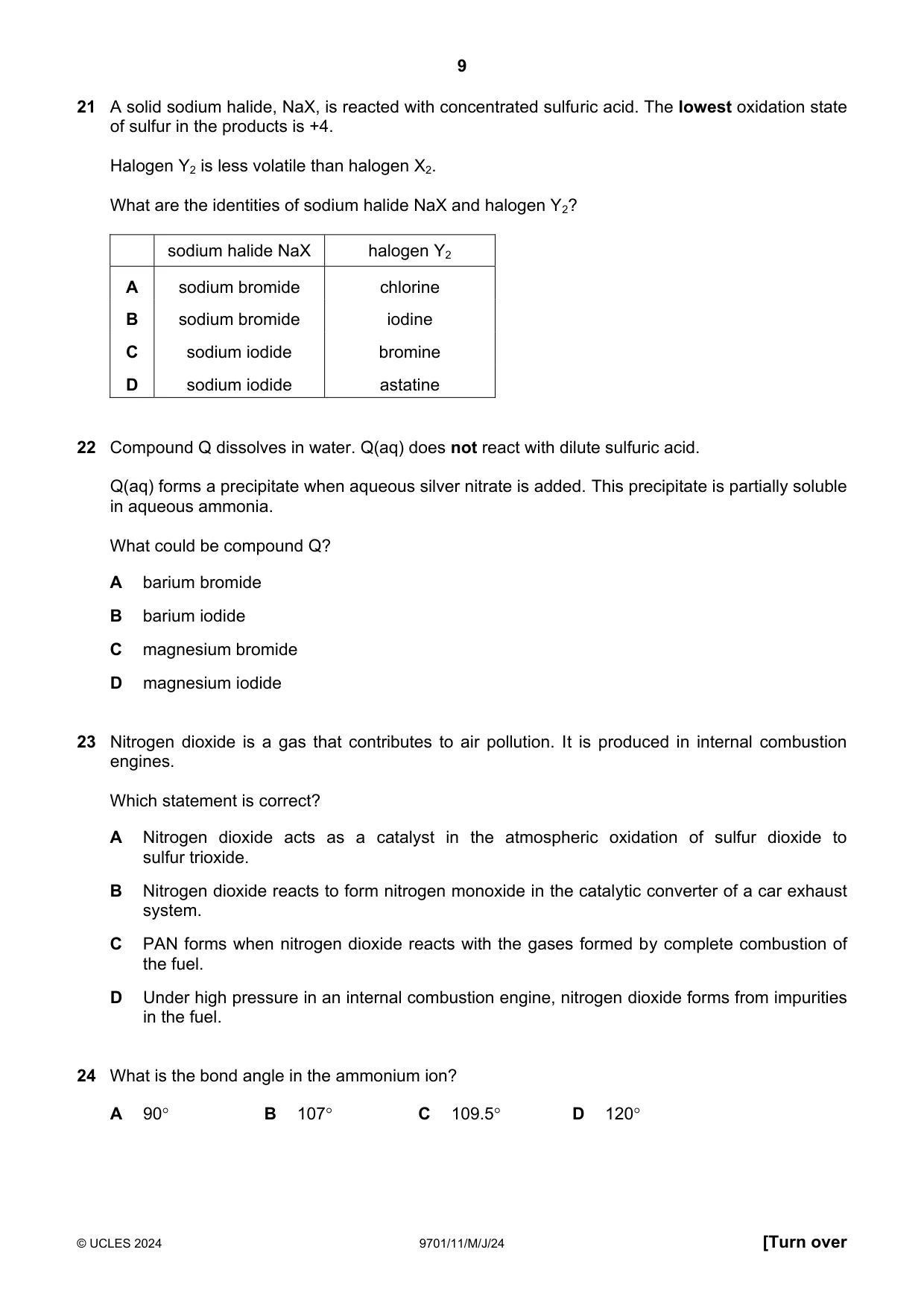
21 A solid sodium halide, NaX, is reacted with concentrated sulfuric acid. The lowest oxidation state of sulfur in the products is +4. Halogen Y2 is less volatile than halogen X2. What are the identities of sodium halide NaX and halogen Y2? sodium halide NaX halogen Y2 A sodium bromide chlorine B sodium bromide iodine C sodium iodide bromine D sodium iodide astatine
Mark scheme: B
Q22 · Compound Q dissolves in water
22 Compound Q dissolves in water. Q(aq) does not react with dilute sulfuric acid. Q(aq) forms a precipitate when aqueous silver nitrate is added. This precipitate is partially soluble in aqueous ammonia. What could be compound Q? A barium bromide B barium iodide C magnesium bromide D magnesium iodide
Mark scheme: C
Q23 · Nitrogen dioxide is a gas that contributes to air pollution
23 Nitrogen dioxide is a gas that contributes to air pollution. It is produced in internal combustion engines. Which statement is correct? A Nitrogen dioxide acts as a catalyst in the atmospheric oxidation of sulfur dioxide to sulfur trioxide. B Nitrogen dioxide reacts to form nitrogen monoxide in the catalytic converter of a car exhaust system. C PAN forms when nitrogen dioxide reacts with the gases formed by complete combustion of the fuel. D Under high pressure in an internal combustion engine, nitrogen dioxide forms from impurities in the fuel.
Mark scheme: A
Q24 · What is the bond angle in the ammonium ion?
24 What is the bond angle in the ammonium ion? A 90 B 107 C 109.5 D 120
Mark scheme: C
Q25 · Structural isomerism and stereoisomerism should be taken into account when answering this…
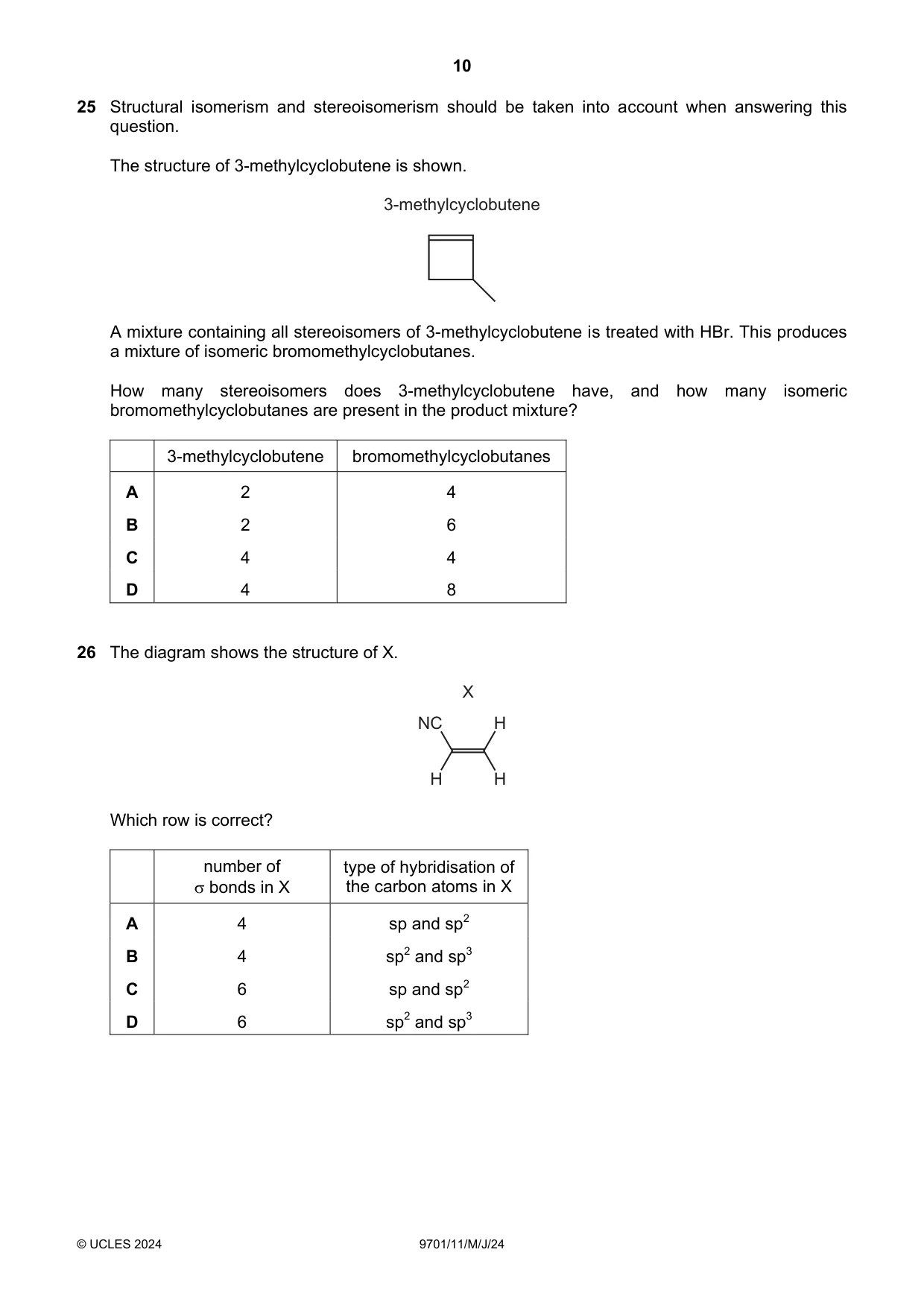
25 Structural isomerism and stereoisomerism should be taken into account when answering this question. The structure of 3-methylcyclobutene is shown. 3-methylcyclobutene A mixture containing all stereoisomers of 3-methylcyclobutene is treated with HBr. This produces a mixture of isomeric bromomethylcyclobutanes. How many stereoisomers does 3-methylcyclobutene have, and how many isomeric bromomethylcyclobutanes are present in the product mixture? 3-methylcyclobutene bromomethylcyclobutanes A 2 4 B 2 6 C 4 4 D 4 8
Mark scheme: B
More questions on Isomerism: structural isomerism and stereoisomerism
Q26 · The diagram shows the structure of X
26 The diagram shows the structure of X. X NC H H H Which row is correct? number of type of hybridisation of bonds in X the carbon atoms in X A 4 sp and sp2 B 4 sp2 and sp3 C 6 sp and sp2 D 6 sp2 and sp3
Mark scheme: C
More questions on Shapes of organic molecules; σ and π bonds
Q27 · The diagram shows the skeletal formula of citric acid
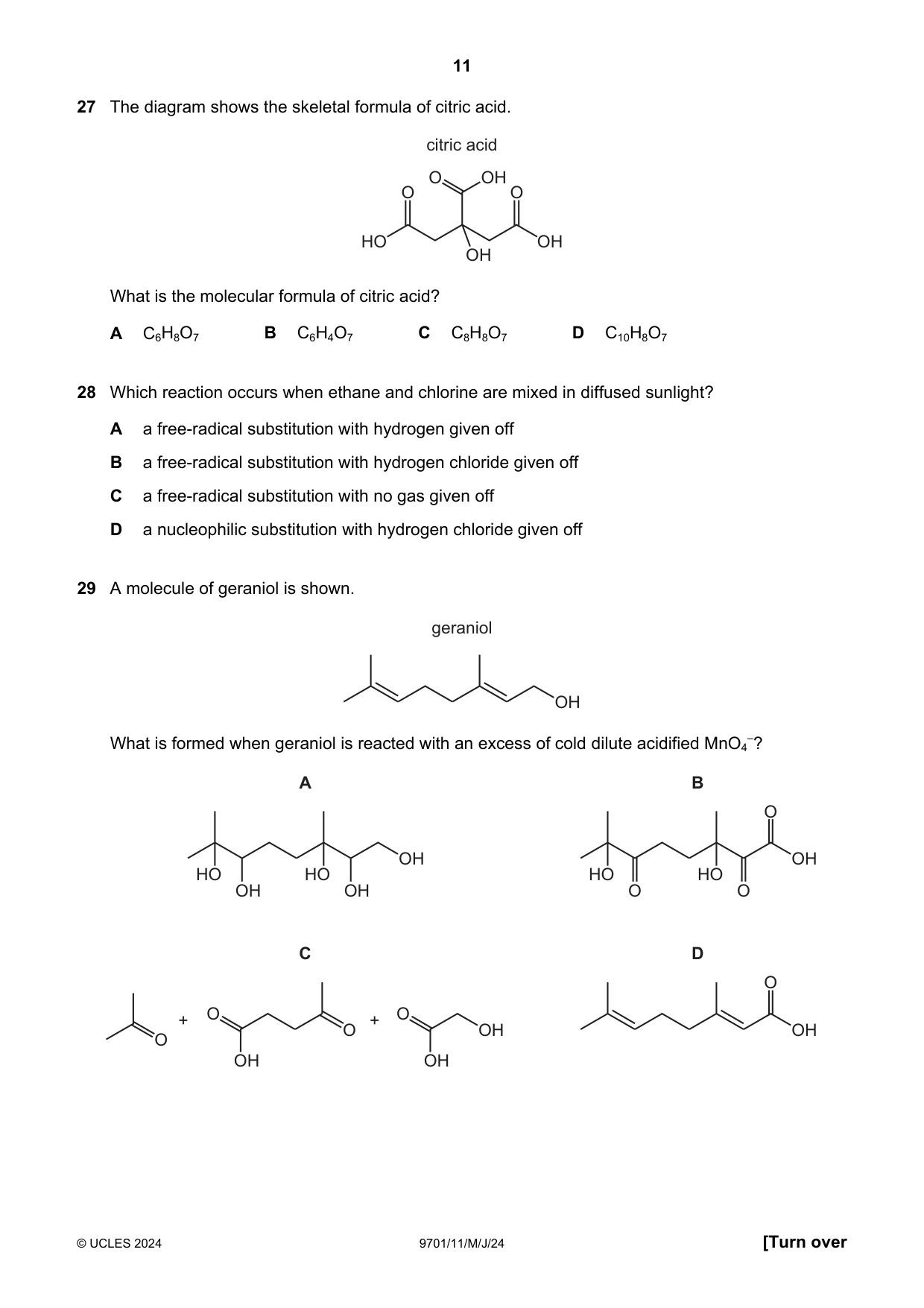
27 The diagram shows the skeletal formula of citric acid. citric acid O OH O O HO OH OH What is the molecular formula of citric acid? A C6H8O7 B C6H4O7 C C8H8O7 D C10H8O7
Mark scheme: A
More questions on Formulas, functional groups and the naming of organic compounds
Q28 · Which reaction occurs when ethane and chlorine are mixed in diffused sunlight?
28 Which reaction occurs when ethane and chlorine are mixed in diffused sunlight? A a free-radical substitution with hydrogen given off B a free-radical substitution with hydrogen chloride given off C a free-radical substitution with no gas given off D a nucleophilic substitution with hydrogen chloride given off
Mark scheme: B
Q29 · A molecule of geraniol is shown
29 A molecule of geraniol is shown. geraniol OH What is formed when geraniol is reacted with an excess of cold dilute acidified MnO4 –? A B O OH OH HO HO HO HO OH OH O O C D O + O + O O OH OH O OH OH
Mark scheme: A
Q30 · Q is either a primary or a tertiary halogenoalkane
30 Q is either a primary or a tertiary halogenoalkane. Q undergoes hydrolysis with aqueous sodium hydroxide. The first step in the mechanism of this reaction involves two species reacting together. Which row is correct? Q behaviour of hydroxide ion A primary halogenoalkane electrophile B primary halogenoalkane nucleophile C tertiary halogenoalkane electrophile D tertiary halogenoalkane nucleophile
Mark scheme: B
Q31 · 2-bromopropane is converted to 1,2-dibromopropane in a pathway involving two reactions
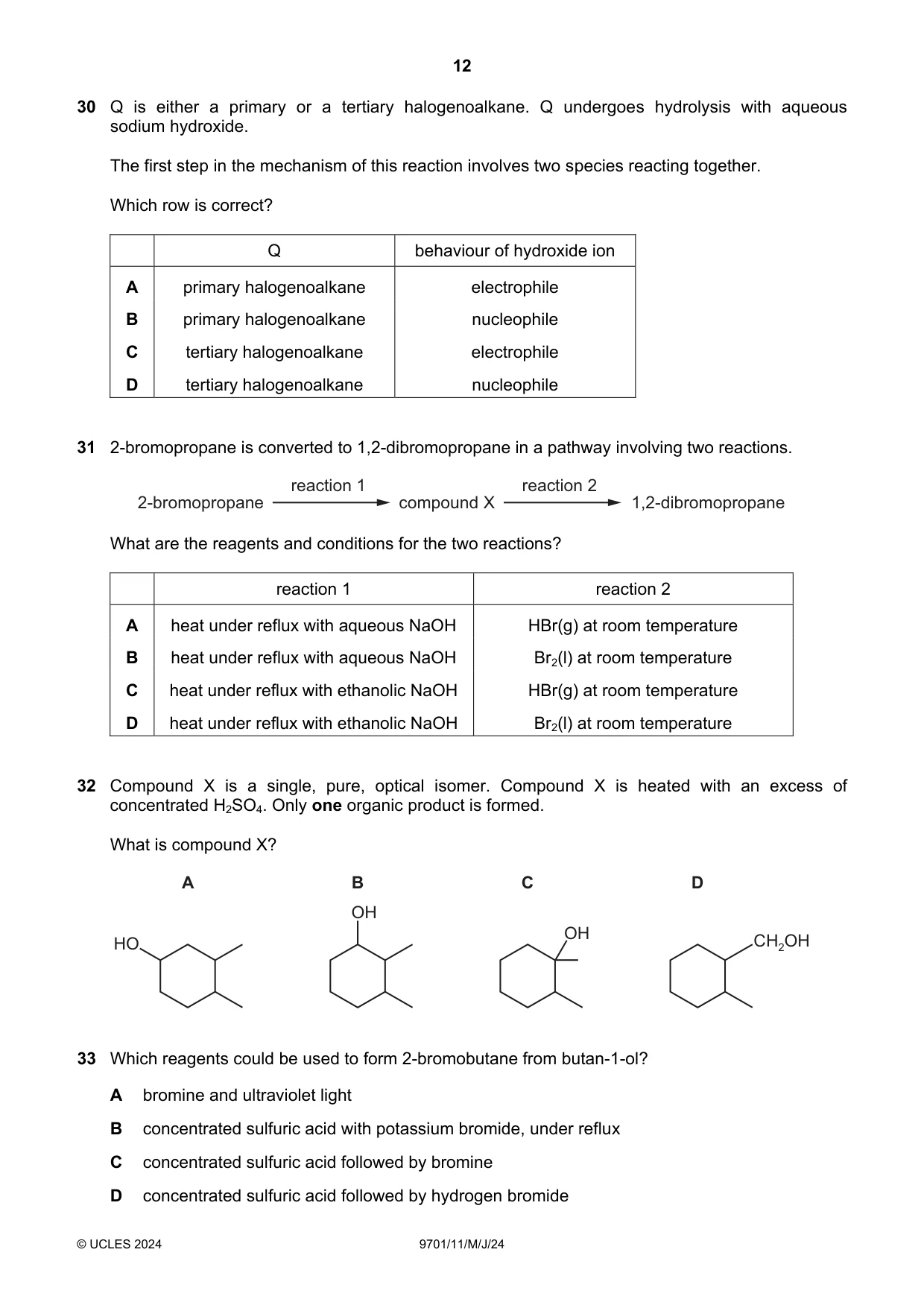
31 2-bromopropane is converted to 1,2-dibromopropane in a pathway involving two reactions. reaction 1 reaction 2 2-bromopropane compound X 1,2-dibromopropane What are the reagents and conditions for the two reactions? reaction 1 reaction 2 A heat under reflux with aqueous NaOH HBr(g) at room temperature B heat under reflux with aqueous NaOH Br2(l) at room temperature C heat under reflux with ethanolic NaOH HBr(g) at room temperature D heat under reflux with ethanolic NaOH Br2(l) at room temperature
Mark scheme: D
Q32 · Compound X is a single, pure, optical isomer
32 Compound X is a single, pure, optical isomer. Compound X is heated with an excess of concentrated H2SO4. Only one organic product is formed. What is compound X? A B C D OH OH CH2OH HO
Mark scheme: D
Q33 · Which reagents could be used to form 2-bromobutane from butan-1-ol?
33 Which reagents could be used to form 2-bromobutane from butan-1-ol? A bromine and ultraviolet light B concentrated sulfuric acid with potassium bromide, under reflux C concentrated sulfuric acid followed by bromine D concentrated sulfuric acid followed by hydrogen bromide
Mark scheme: D
Q34 · X is a non-cyclic ketone with a single carbonyl group and no other functional groups
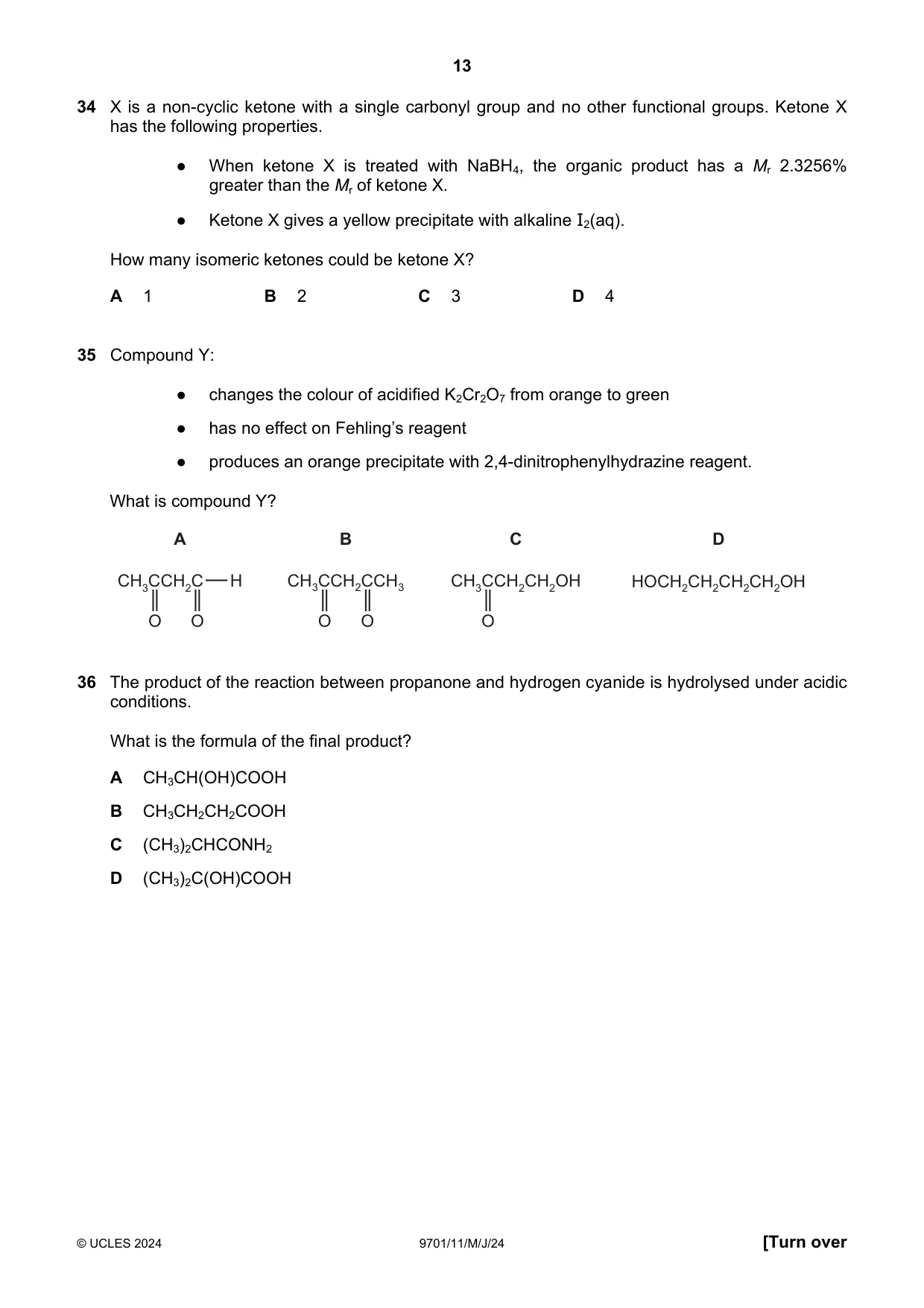
34 X is a non-cyclic ketone with a single carbonyl group and no other functional groups. Ketone X has the following properties. ● When ketone X is treated with NaBH4, the organic product has a Mr 2.3256% greater than the Mr of ketone X. ● Ketone X gives a yellow precipitate with alkaline I2(aq). How many isomeric ketones could be ketone X? A 1 B 2 C 3 D 4
Mark scheme: B
Q35 · Compound Y: ● changes the colour of acidified K2Cr2O7 from orange to green ● has no…
35 Compound Y: ● changes the colour of acidified K2Cr2O7 from orange to green ● has no effect on Fehling’s reagent ● produces an orange precipitate with 2,4-dinitrophenylhydrazine reagent. What is compound Y? A B C D CH3CCH2C H CH3CCH2CCH3 CH3CCH2CH2OH HOCH2CH2CH2CH2OH O O O O O
Mark scheme: C
Q36 · The product of the reaction between propanone and hydrogen cyanide is hydrolysed under…
36 The product of the reaction between propanone and hydrogen cyanide is hydrolysed under acidic conditions. What is the formula of the final product? A CH3CH(OH)COOH B CH3CH2CH2COOH C (CH3)2CHCONH2 D (CH3)2C(OH)COOH
Mark scheme: D
Q37 · P is a carboxylic acid with molecular formula C5H10O2
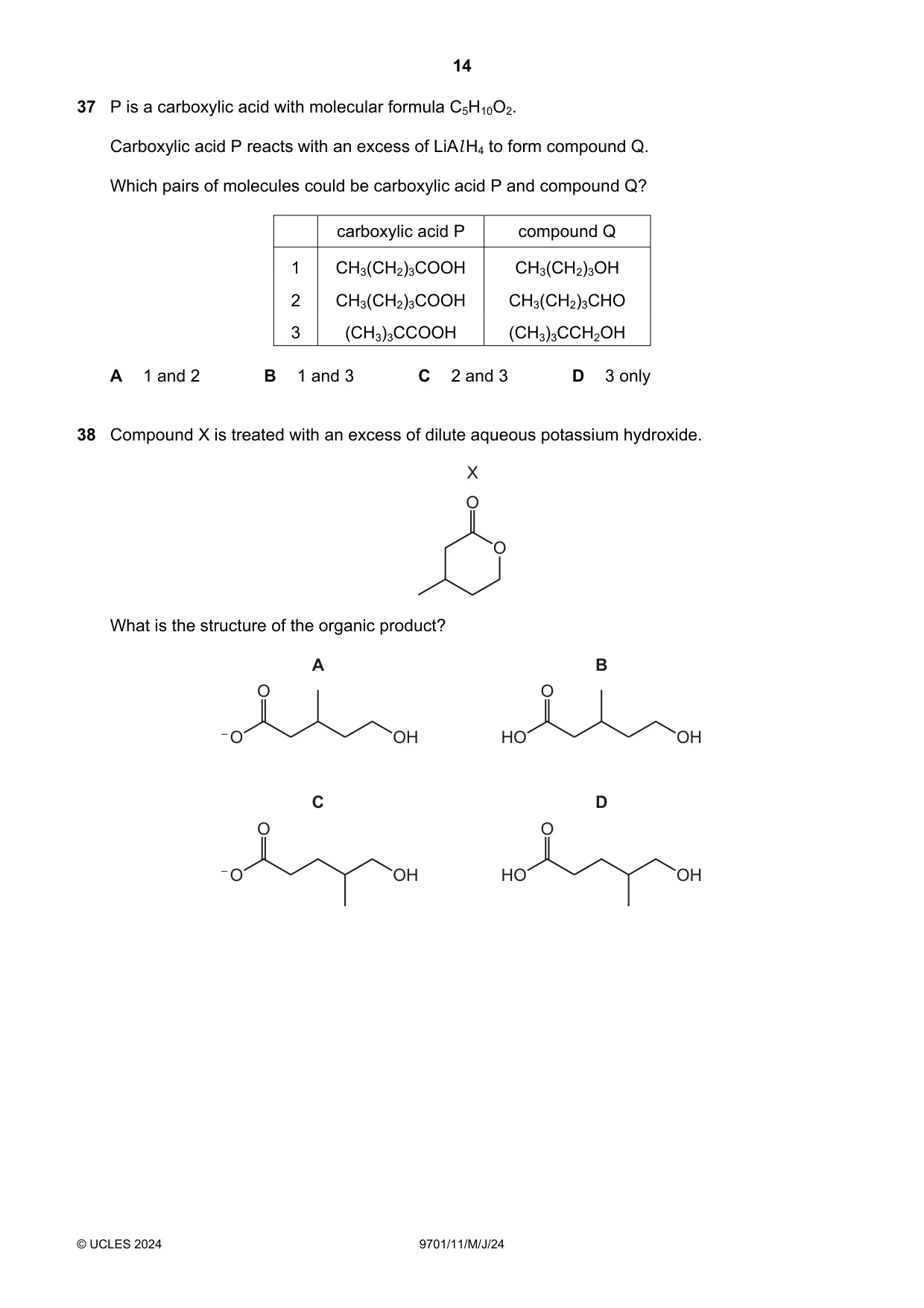
37 P is a carboxylic acid with molecular formula C5H10O2. Carboxylic acid P reacts with an excess of LiAl H4 to form compound Q. Which pairs of molecules could be carboxylic acid P and compound Q? carboxylic acid P compound Q 1 CH3(CH2)3COOH CH3(CH2)3OH 2 CH3(CH2)3COOH CH3(CH2)3CHO 3 (CH3)3CCOOH (CH3)3CCH2OH A 1 and 2 B 1 and 3 C 2 and 3 D 3 only
Mark scheme: D
Q38 · Compound X is treated with an excess of dilute aqueous potassium hydroxide
38 Compound X is treated with an excess of dilute aqueous potassium hydroxide. X O O What is the structure of the organic product? A B O O – O OH HO OH C D O O – O OH HO OH
Mark scheme: A
Q39 · A section showing two repeat units of an addition polymer is shown
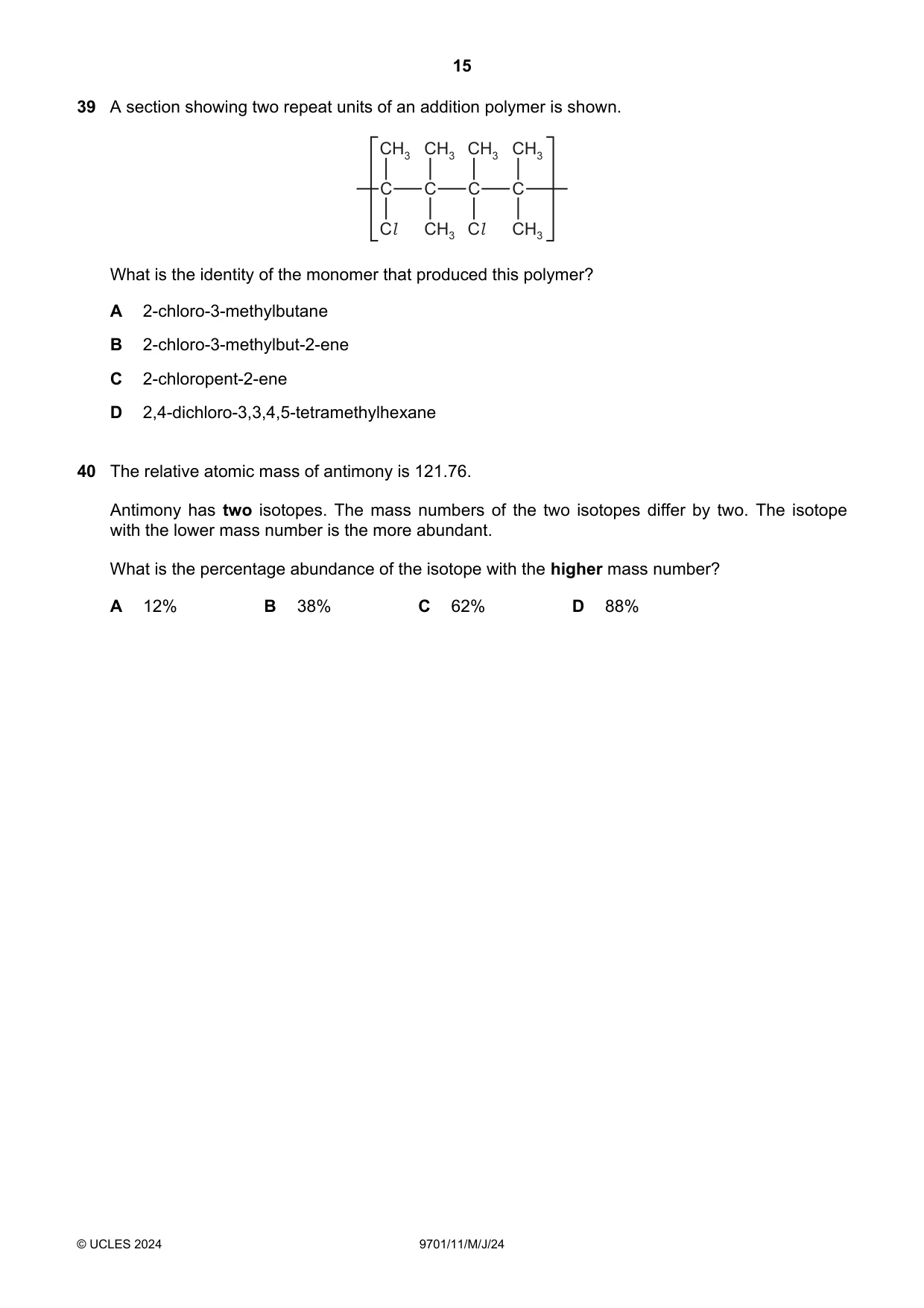
39 A section showing two repeat units of an addition polymer is shown. CH3 CH3 CH3 CH3 C C C C Cl CH3 Cl CH3 What is the identity of the monomer that produced this polymer? A 2-chloro-3-methylbutane B 2-chloro-3-methylbut-2-ene C 2-chloropent-2-ene D 2,4-dichloro-3,3,4,5-tetramethylhexane
Mark scheme: B
Q40 · The relative atomic mass of antimony is 121.76
40 The relative atomic mass of antimony is 121.76. Antimony has two isotopes. The mass numbers of the two isotopes differ by two. The isotope with the lower mass number is the more abundant. What is the percentage abundance of the isotope with the higher mass number? A 12% B 38% C 62% D 88%
Mark scheme: B
What was in this paper
The subtopics covered by these 40 questions, and how many questions each got. Open one in a new tab to see every Cambridge question on it.
3Reacting masses and volumes (of solutions and gases)3Aldehydes and ketones2Chemical equilibria: reversible reactions, dynamic equilibrium2Effect of temperature on reaction rates and the concept of activation energy2Periodicity of chemical properties of the elements in Period 32Redox processes: electron transfer and changes in oxidation number (oxidation state)2Shapes of molecules2Some reactions of the halide ions2Addition polymerisation1Alcohols1Alkanes1Alkenes1Carboxylic acids1Covalent bonding and coordinate (dative covalent) bonding1Esters1Formulas, functional groups and the naming of organic compounds1Hess’s law1Intermolecular forces, electronegativity and bond properties1Ionisation energy1Isomerism: structural isomerism and stereoisomerism1Isotopes1Nitriles and hydroxynitriles1Nitrogen and sulfur1Particles in the atom and atomic radius1Periodicity of physical properties of the elements in Period 31Shapes of organic molecules; σ and π bonds1Similarities and trends in the properties of the Group 2 metals, magnesium to barium, and their compounds1The gaseous state: ideal and real gases and pV = nRT1What you needed in this session
Cambridge’s own grade thresholds for 2024 May/June, Paper 1 · Variant 1. A higher threshold means an easier paper — the bar moves with how the cohort did.