Cambridge A Level Chemistry 9701 — 2023 Oct/Nov Paper 1 · Variant 2
9701/12/O/N/23 · 40 questions · 40 marks · ≈45 min
The question paper and its mark scheme, free to read here and free to download. This is Cambridge’s own paper, exactly as it was sat.
Question paper16 pages
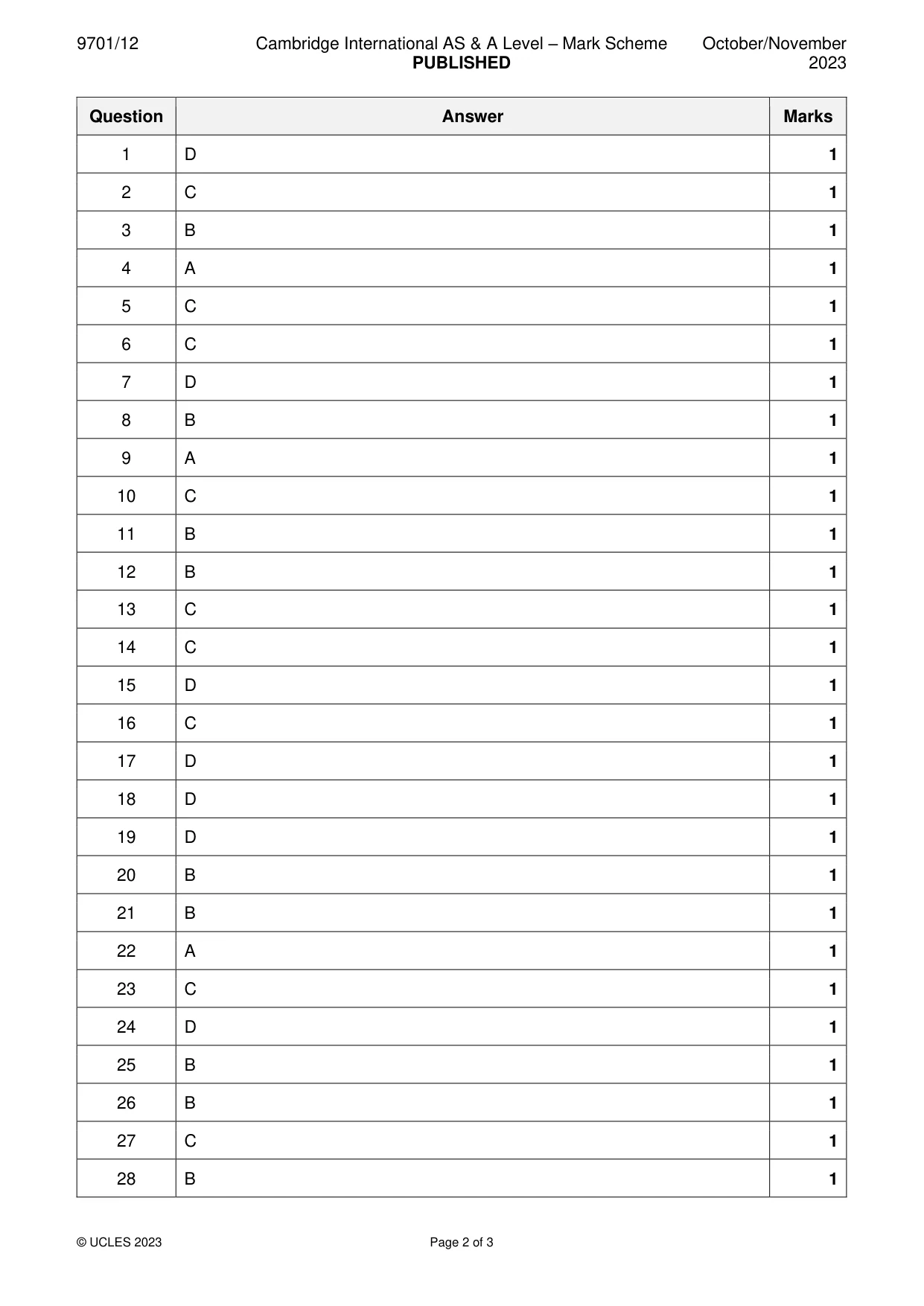
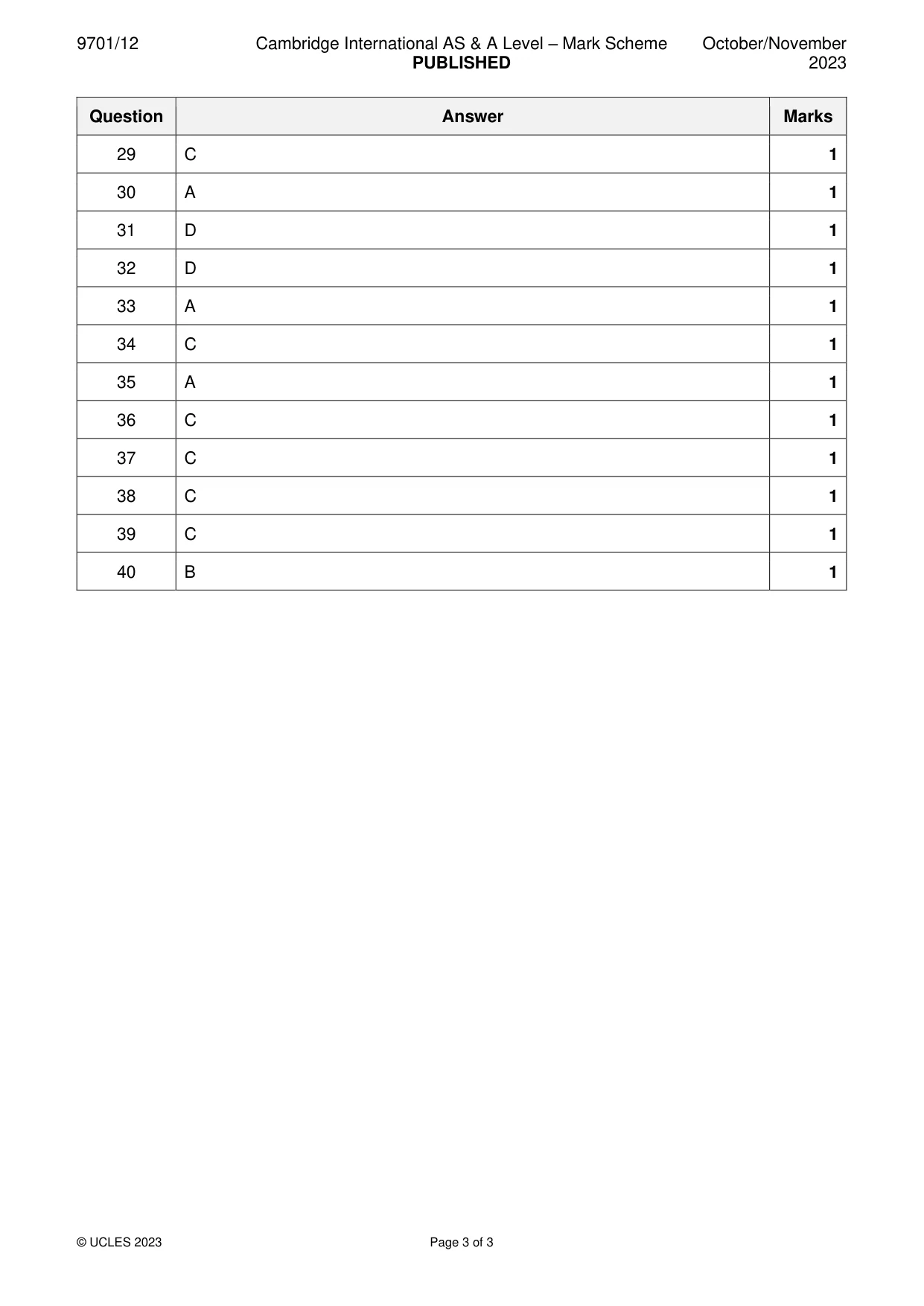
Mark scheme3 pages
Answers below. Sit the paper first if you are practising.
Questions as text
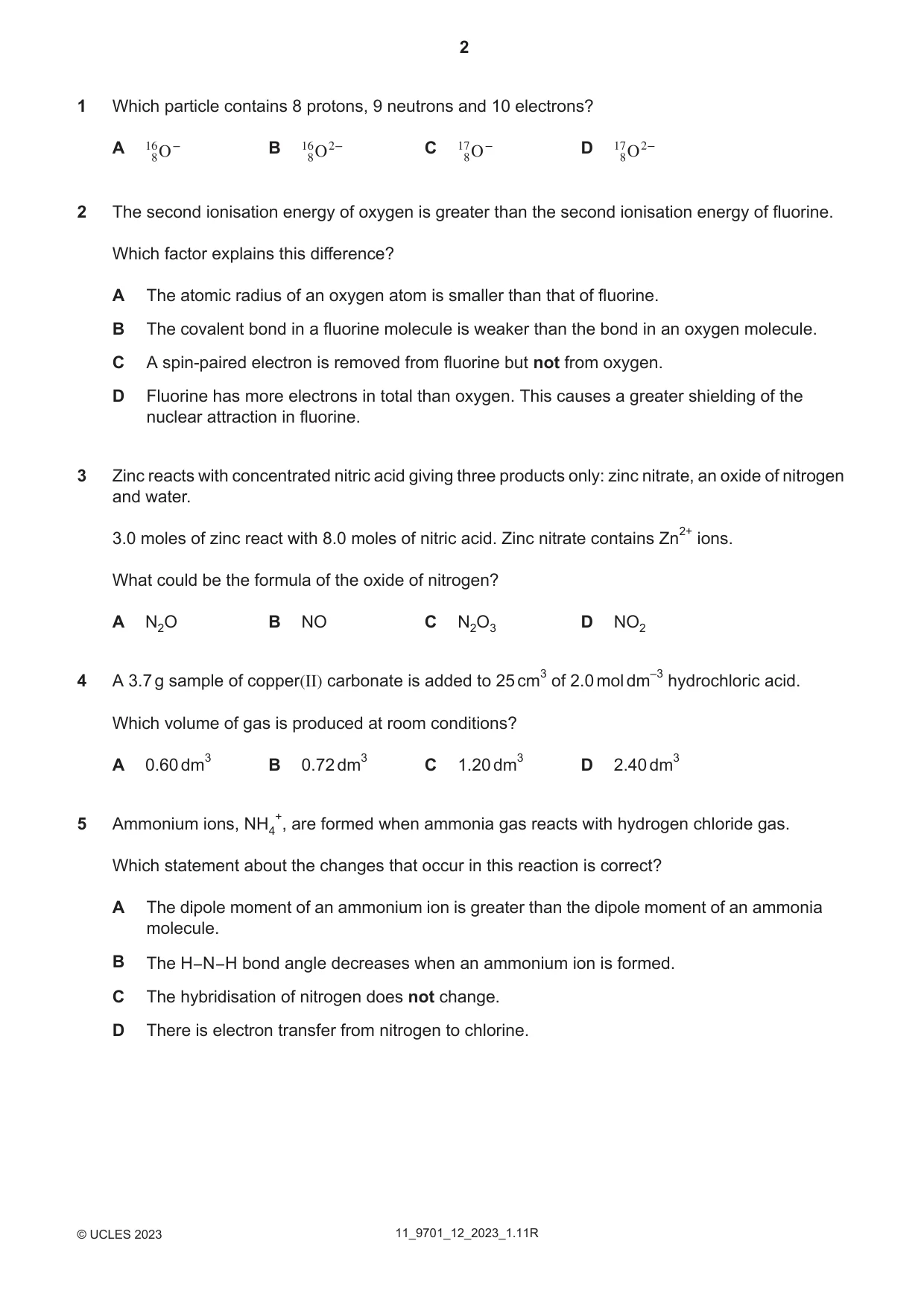
Q1 · Which particle contains 8 protons, 9 neutrons and 10 electrons?
1 Which particle contains 8 protons, 9 neutrons and 10 electrons? A B C D
Mark scheme: D
Q2 · The second ionisation energy of oxygen is greater than the second ionisation energy of…
2 The second ionisation energy of oxygen is greater than the second ionisation energy of fluorine. Which factor explains this difference? A The atomic radius of an oxygen atom is smaller than that of fluorine. B The covalent bond in a fluorine molecule is weaker than the bond in an oxygen molecule. C A spin-paired electron is removed from fluorine but not from oxygen. D Fluorine has more electrons in total than oxygen. This causes a greater shielding of the nuclear attraction in fluorine.
Mark scheme: C
Q3 · Zinc reacts with concentrated nitric acid giving three products only: zinc nitrate, an…
3 Zinc reacts with concentrated nitric acid giving three products only: zinc nitrate, an oxide of nitrogen and water. 3.0 moles of zinc react with 8.0 moles of nitric acid. Zinc nitrate contains Zn2+ ions. What could be the formula of the oxide of nitrogen? A N2O B NO C N2O3 D NO2 A 3.7g sample of copper(II) carbonate is added to 25cm3 of 2.0moldm–3 hydrochloric acid.
Mark scheme: B
More questions on Reacting masses and volumes (of solutions and gases)
Q4 · Which volume of gas is produced at room conditions?
4 Which volume of gas is produced at room conditions? A 0.60dm3 B 0.72dm3 C 1.20dm3 D 2.40dm3
Mark scheme: A
More questions on Reacting masses and volumes (of solutions and gases)
Q5 · Ammonium ions, NH4 +, are formed when ammonia gas reacts with hydrogen chloride gas
5 Ammonium ions, NH4 +, are formed when ammonia gas reacts with hydrogen chloride gas. Which statement about the changes that occur in this reaction is correct? A The dipole moment of an ammonium ion is greater than the dipole moment of an ammonia molecule. B The H−N−H bond angle decreases when an ammonium ion is formed. C The hybridisation of nitrogen does not change. D There is electron transfer from nitrogen to chlorine.
Mark scheme: C
Q6 · Which feature is present in both ethene and poly(ethene)?
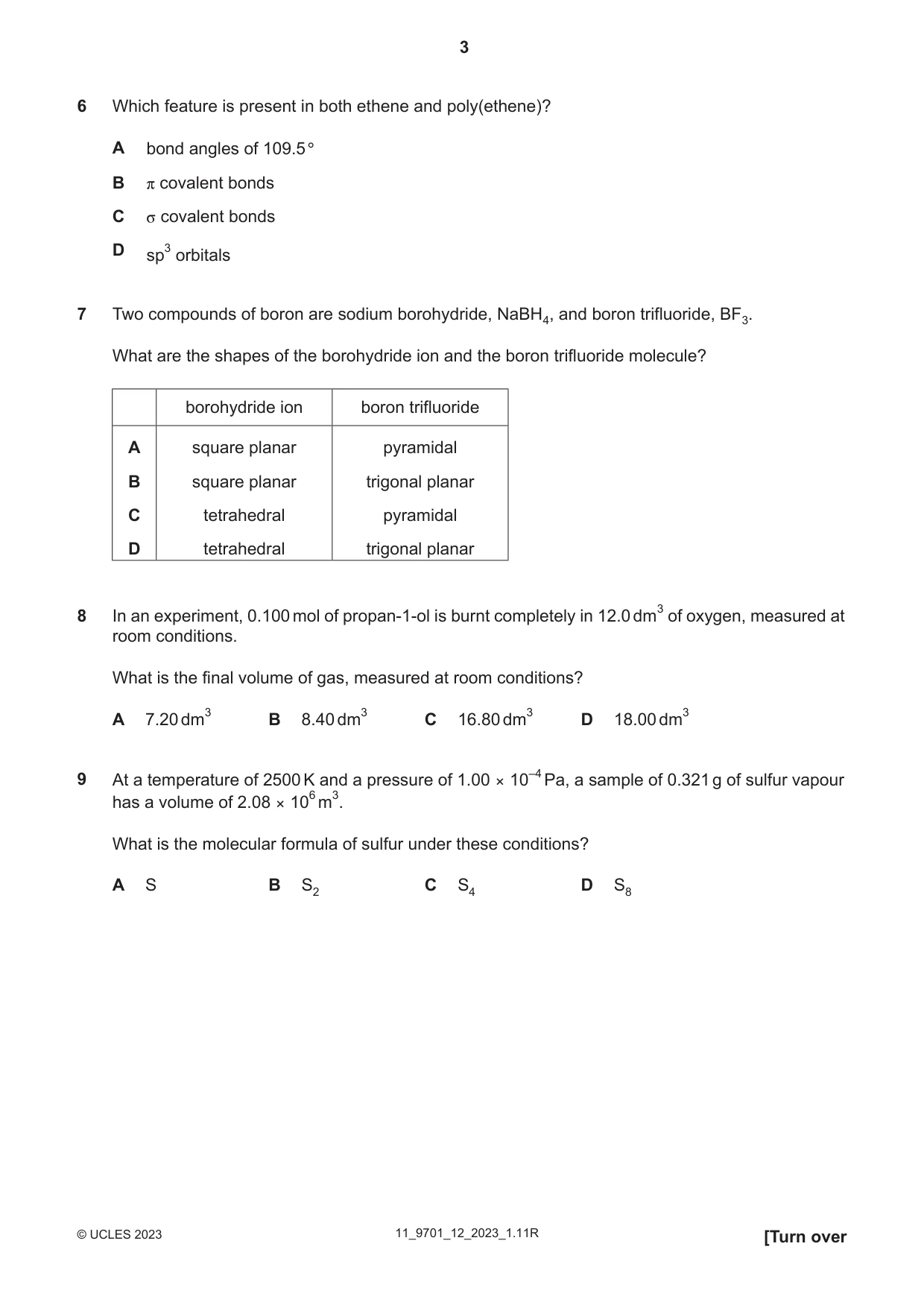
6 Which feature is present in both ethene and poly(ethene)? A bond angles of 109.5° B covalent bonds C covalent bonds D sp3 orbitals
Mark scheme: C
More questions on Shapes of organic molecules; σ and π bonds
Q7 · Two compounds of boron are sodium borohydride, NaBH4, and boron trifluoride, BF3
7 Two compounds of boron are sodium borohydride, NaBH4, and boron trifluoride, BF3. What are the shapes of the borohydride ion and the boron trifluoride molecule? borohydride ion boron trifluoride A square planar pyramidal B square planar trigonal planar C tetrahedral pyramidal D tetrahedral trigonal planar In an experiment, 0.100mol of propan-1-ol is burnt completely in 12.0dm3 of oxygen, measured at
Mark scheme: D
Question 8
8 room conditions. What is the final volume of gas, measured at room conditions? A 7.20dm3 B 8.40dm3 C 16.80dm3 D 18.00dm3
Mark scheme: B
More questions on Reacting masses and volumes (of solutions and gases)
Q9 · At a temperature of 2500K and a pressure of 1.00 × 10⁻⁴Pa, a sample of 0.321g of sulfur…
9 At a temperature of 2500K and a pressure of 1.00 × 10⁻⁴Pa, a sample of 0.321g of sulfur vapour has a volume of 2.08 × 10⁶m3. What is the molecular formula of sulfur under these conditions? A S B S2 C S4 D S8
Mark scheme: A
More questions on The gaseous state: ideal and real gases and pV = nRT
Q10 · In the structure of solid SiO2 each silicon atom is bonded to x oxygen atoms each oxygen…
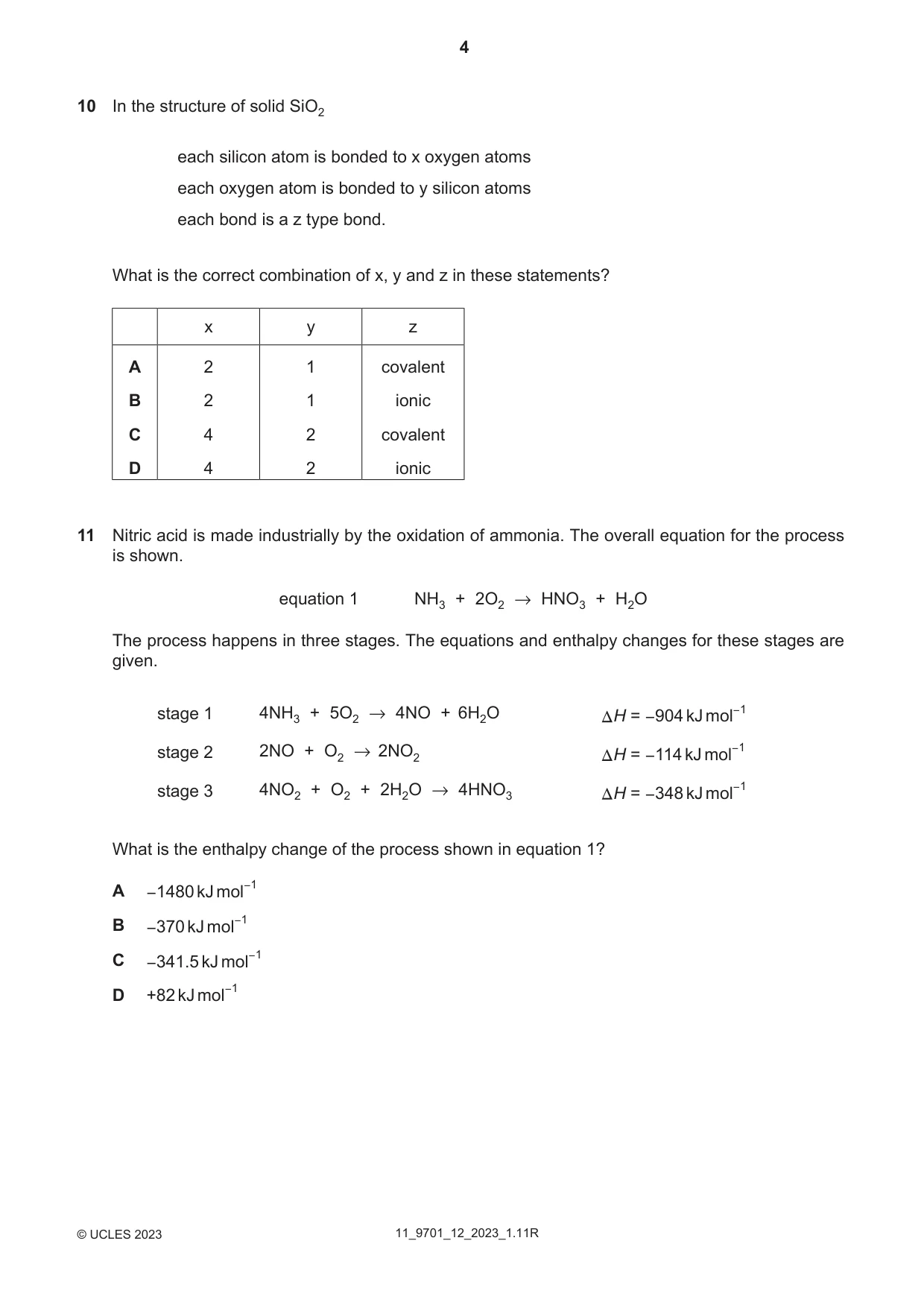
10 In the structure of solid SiO2 each silicon atom is bonded to x oxygen atoms each oxygen atom is bonded to y silicon atoms each bond is a z type bond. What is the correct combination of x, y and z in these statements? x y z A 2 1 covalent B 2 1 ionic C 4 2 covalent D 4 2 ionic
Mark scheme: C
Q11 · Nitric acid is made industrially by the oxidation of ammonia
11 Nitric acid is made industrially by the oxidation of ammonia. The overall equation for the process is shown. equation 1 NH3 + 2O2 →HNO3 + H2O The process happens in three stages. The equations and enthalpy changes for these stages are given. stage 1 4NH3 + 5O2 →4NO + 6H2O H = −904kJmol−1 stage 2 2NO + O2 →2NO2 H = −114kJmol−1 stage 3 4NO2 + O2 + 2H2O →4HNO3 H = −348kJmol−1 What is the enthalpy change of the process shown in equation 1? A −1480kJmol−1 B −370kJmol−1 C −341.5kJmol−1 D +82kJmol−1
Mark scheme: B
Q12 · Chlorine reacts with sodium bromide
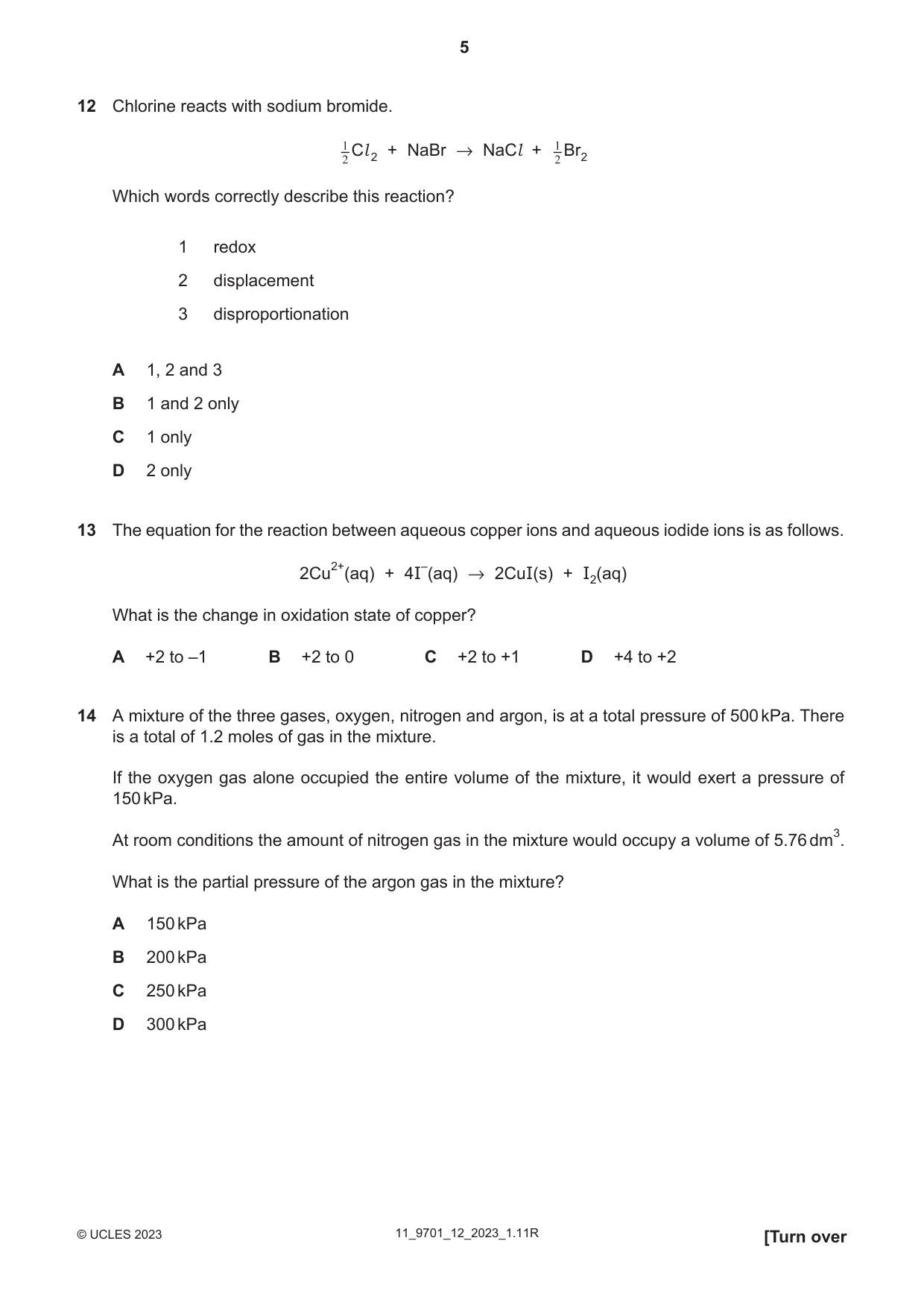
12 Chlorine reacts with sodium bromide. Cl 2 + NaBr →NaCl + Br2 Which words correctly describe this reaction? 1 redox 2 displacement 3 disproportionation A 1, 2 and 3 B 1 and 2 only C 1 only D 2 only
Mark scheme: B
More questions on The chemical properties of the halogen elements and the hydrogen halides
Q13 · The equation for the reaction between aqueous copper ions and aqueous iodide ions is as…
13 The equation for the reaction between aqueous copper ions and aqueous iodide ions is as follows. 2Cu2+(aq) + 4I–(aq) →2CuI(s) + I2(aq) What is the change in oxidation state of copper? A +2 to –1 B +2 to 0 C +2 to +1 D +4 to +2
Mark scheme: C
Q14 · A mixture of the three gases, oxygen, nitrogen and argon, is at a total pressure of 500kPa
14 A mixture of the three gases, oxygen, nitrogen and argon, is at a total pressure of 500kPa. There is a total of 1.2 moles of gas in the mixture. If the oxygen gas alone occupied the entire volume of the mixture, it would exert a pressure of 150kPa. At room conditions the amount of nitrogen gas in the mixture would occupy a volume of 5.76dm3. What is the partial pressure of the argon gas in the mixture? A 150kPa B 200kPa C 250kPa D 300kPa 0.200mol of sulfur dioxide and 0.200mol of oxygen are placed in a 1.00dm3 sealed container. The
Mark scheme: C
More questions on The gaseous state: ideal and real gases and pV = nRT
Q15 · Gases are allowed to react until equilibrium is reached
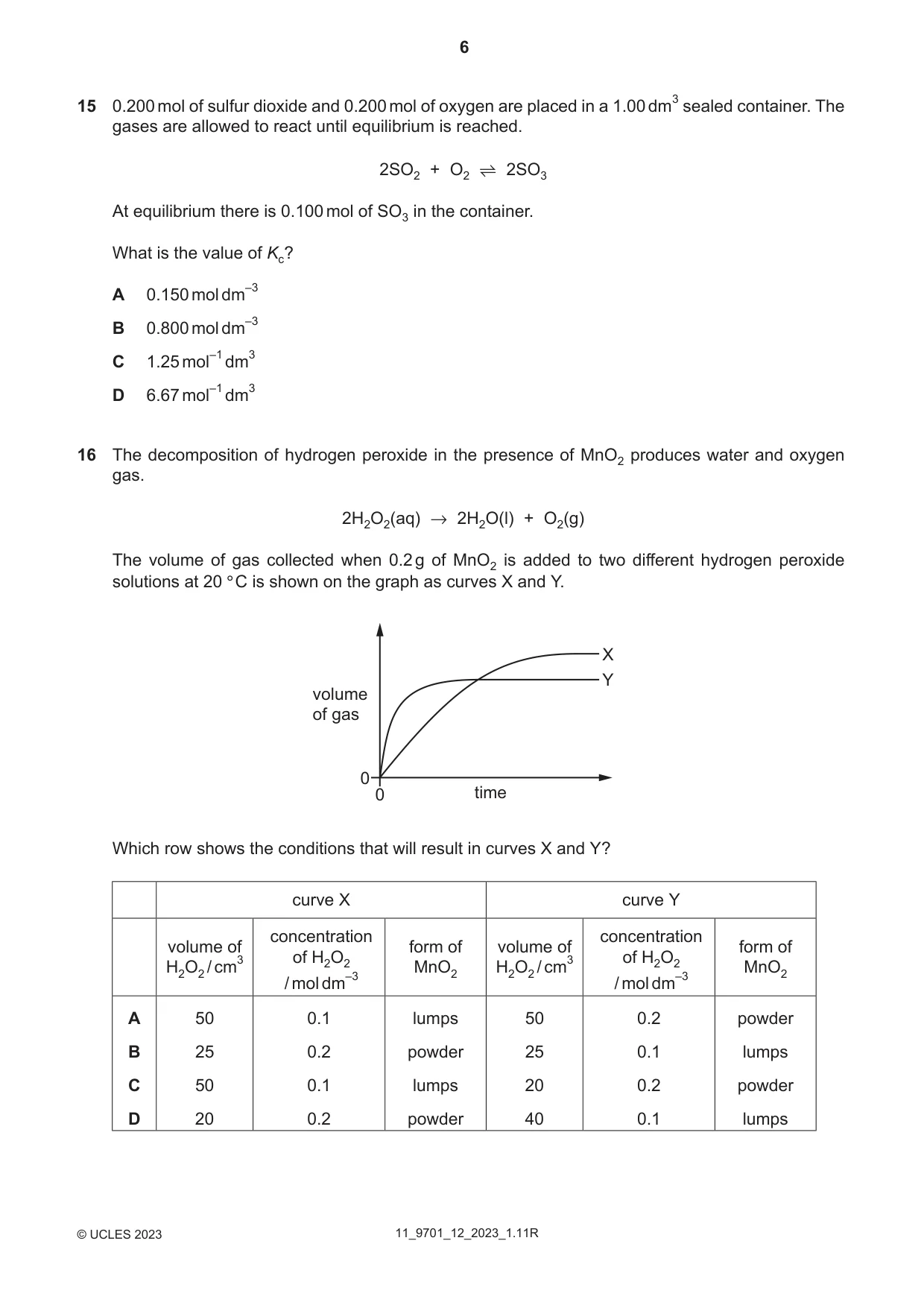
15 gases are allowed to react until equilibrium is reached. 2SO2 + O2 ⇋2SO3 At equilibrium there is 0.100mol of SO3 in the container. What is the value of Kc? A 0.150moldm–3 B 0.800moldm–3 C 1.25mol–1dm3 D 6.67mol–1dm3
Mark scheme: D
More questions on Chemical equilibria: reversible reactions, dynamic equilibrium
Q16 · The decomposition of hydrogen peroxide in the presence of MnO, produces water and oxygen…
16 The decomposition of hydrogen peroxide in the presence of MnO, produces water and oxygen gas. 2H,0,(aq) — 2H,O(!) + O,(g) The volume of gas collected when 0.2g of MnO, is added to two different hydrogen peroxide solutions at 20 °C is shown on the graph as curves X and Y. < x volume of gas 0) time Which row shows the conditions that will result in curves X and Y? curve X curve Y concentration concentration volume of of H.O form of volume of of H.O form of H,0,/cm* an MnO, | H,0,/cm* 22, MnO, /moldm /moldm A 50 0.1 lumps 50 0.2 powder B 25 0.2 powder 25 0.1 lumps Cc 50 0.1 lumps 20 0.2 powder D 20 0.2 powder 40 0.1 lumps
Mark scheme: C
Q17 · The diagram shows a gas syringe with a free-moving piston
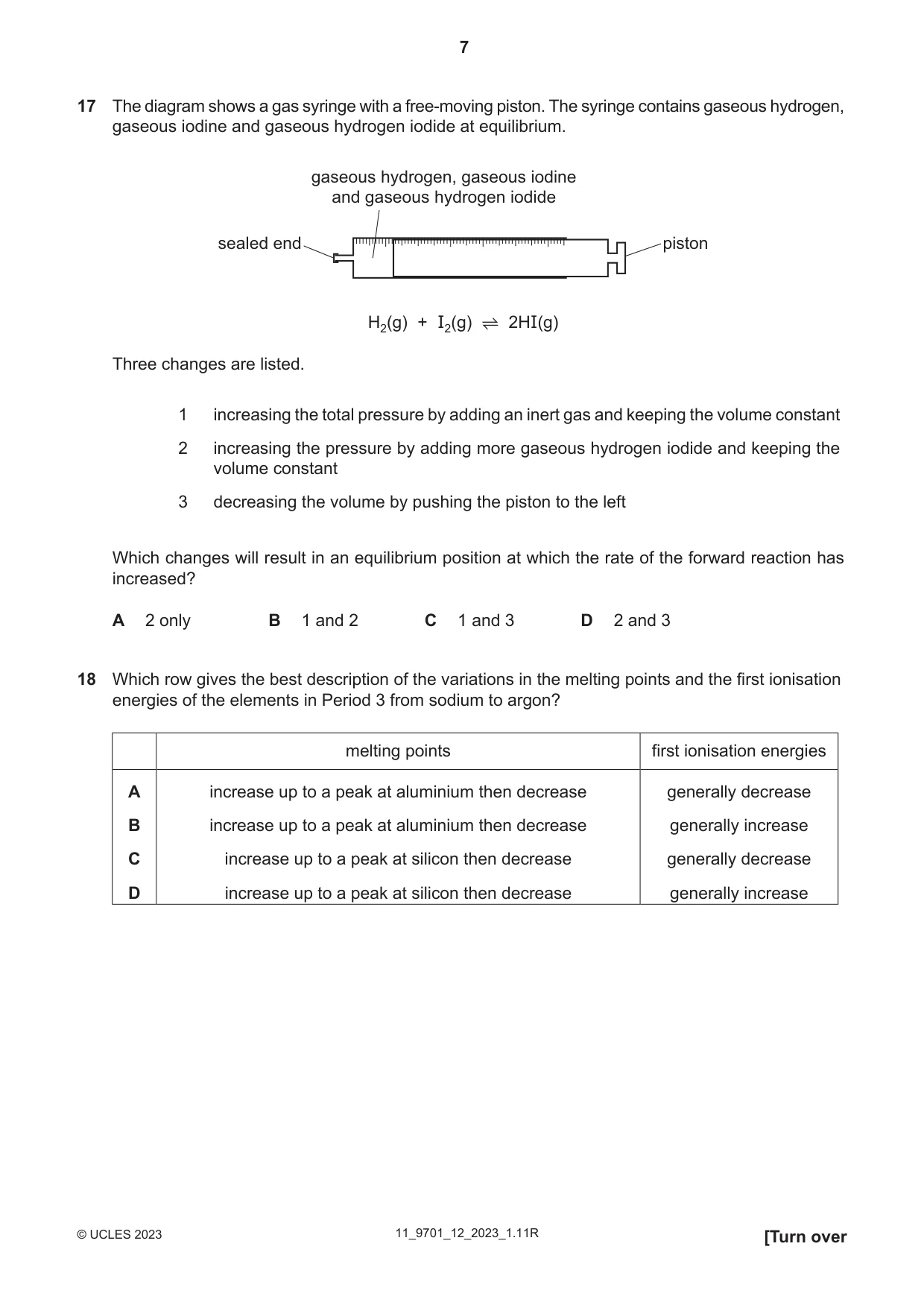
17 The diagram shows a gas syringe with a free-moving piston. The syringe contains gaseous hydrogen, gaseous iodine and gaseous hydrogen iodide at equilibrium. gaseous hydrogen, gaseous iodine and gaseous hydrogen iodide sealed end piston H2(g) + I2(g) ⇋2HI(g) Three changes are listed. 1 increasing the total pressure by adding an inert gas and keeping the volume constant 2 increasing the pressure by adding more gaseous hydrogen iodide and keeping the volume constant 3 decreasing the volume by pushing the piston to the left Which changes will result in an equilibrium position at which the rate of the forward reaction has increased? A 2 only B 1 and 2 C 1 and 3 D 2 and 3
Mark scheme: D
More questions on Chemical equilibria: reversible reactions, dynamic equilibrium
Q18 · Which row gives the best description of the variations in the melting points and the…
18 Which row gives the best description of the variations in the melting points and the first ionisation energies of the elements in Period 3 from sodium to argon? melting points first ionisation energies A increase up to a peak at aluminium then decrease generally decrease B increase up to a peak at aluminium then decrease generally increase C increase up to a peak at silicon then decrease generally decrease D increase up to a peak at silicon then decrease generally increase
Mark scheme: D
More questions on Periodicity of physical properties of the elements in Period 3
Q19 · X and Y are atoms of different elements in Period 3 of the Periodic Table
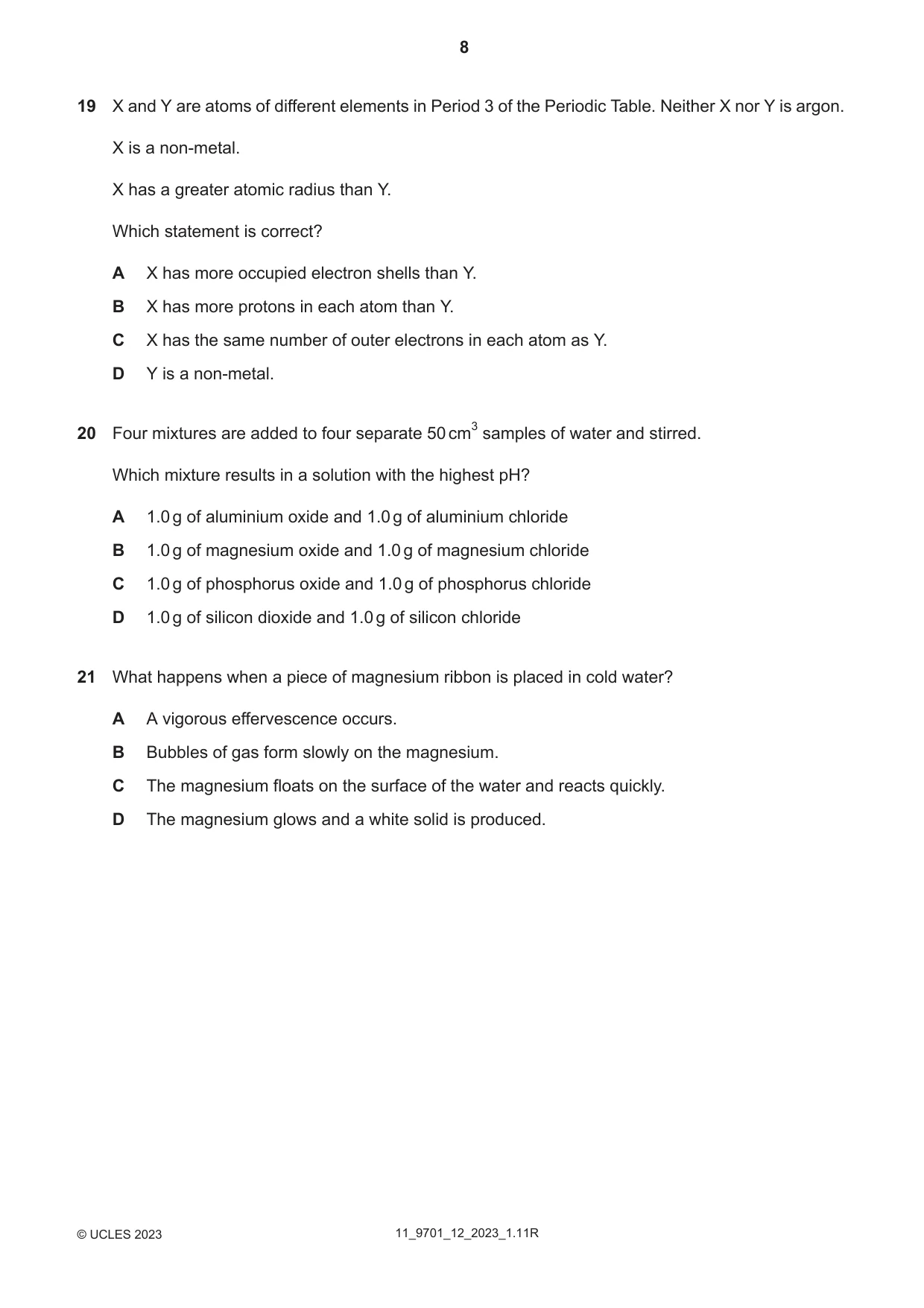
19 X and Y are atoms of different elements in Period 3 of the Periodic Table. Neither X nor Y is argon. X is a non-metal. X has a greater atomic radius than Y. Which statement is correct? A X has more occupied electron shells than Y. B X has more protons in each atom than Y. C X has the same number of outer electrons in each atom as Y. D Y is a non-metal. Four mixtures are added to four separate 50cm3 samples of water and stirred.
Mark scheme: D
More questions on Periodicity of physical properties of the elements in Period 3
Q20 · Which mixture results in a solution with the highest pH?
20 Which mixture results in a solution with the highest pH? A 1.0g of aluminium oxide and 1.0g of aluminium chloride B 1.0g of magnesium oxide and 1.0g of magnesium chloride C 1.0g of phosphorus oxide and 1.0g of phosphorus chloride D 1.0g of silicon dioxide and 1.0g of silicon chloride
Mark scheme: B
More questions on Periodicity of chemical properties of the elements in Period 3
Q21 · What happens when a piece of magnesium ribbon is placed in cold water?
21 What happens when a piece of magnesium ribbon is placed in cold water? A A vigorous effervescence occurs. B Bubbles of gas form slowly on the magnesium. C The magnesium floats on the surface of the water and reacts quickly. D The magnesium glows and a white solid is produced.
Mark scheme: B
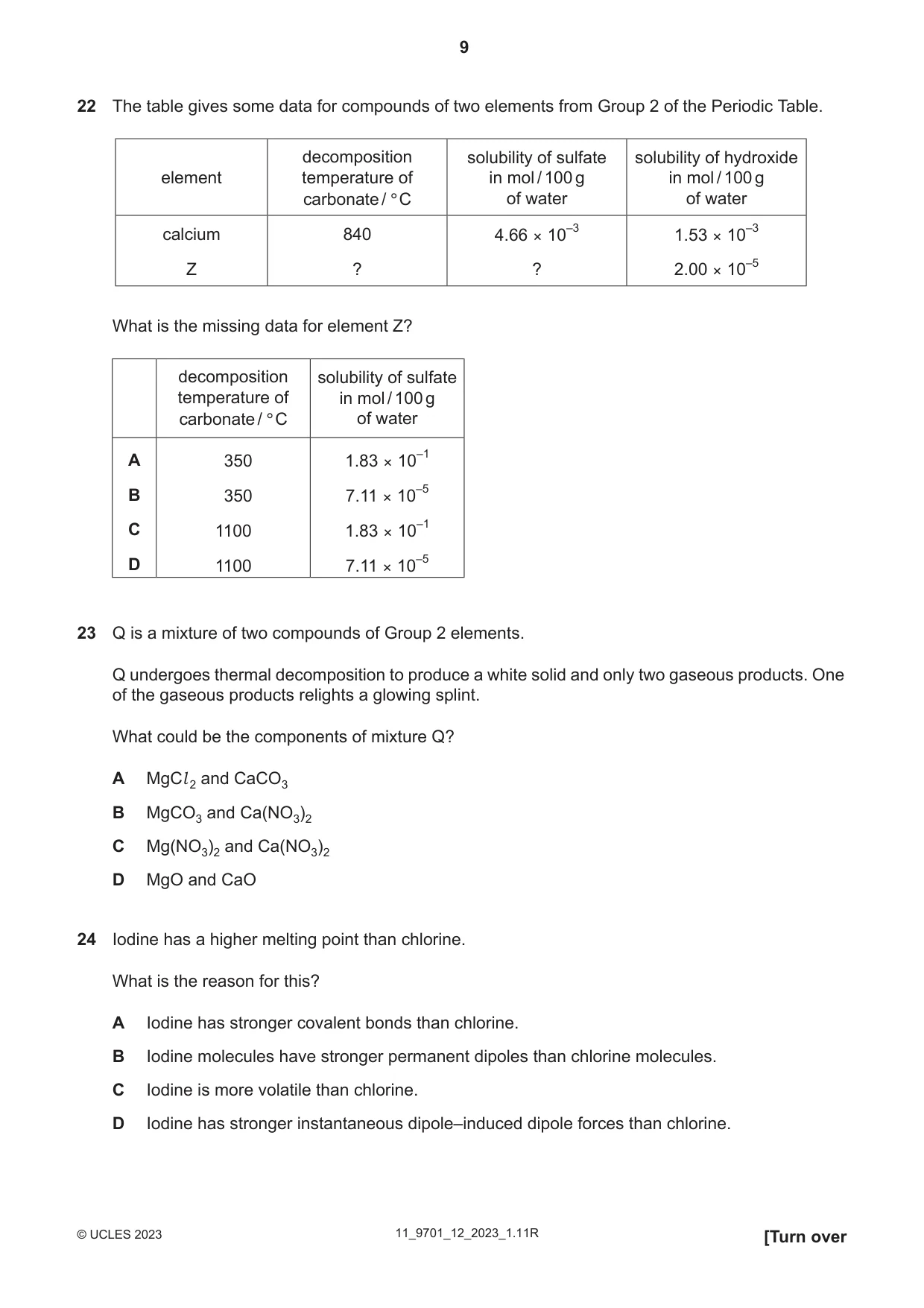
Q22 · The table gives some data for compounds of two elements from Group 2 of the Periodic Table
22 The table gives some data for compounds of two elements from Group 2 of the Periodic Table. decomposition solubility of sulfate solubility of hydroxide element temperature of in mol/100g in mol/100g carbonate/°C of water of water calcium 840 4.66 × 10⁻³ 1.53 × 10⁻³ Z ? ? 2.00 × 10⁻⁵ What is the missing data for element Z? decomposition solubility of sulfate temperature of in mol/100g carbonate/°C of water A 350 1.83 × 10⁻¹ B 350 7.11 × 10⁻⁵ C 1100 1.83 × 10⁻¹ D 1100 7.11 × 10⁻⁵
Mark scheme: A
Q23 · Q is a mixture of two compounds of Group 2 elements
23 Q is a mixture of two compounds of Group 2 elements. Q undergoes thermal decomposition to produce a white solid and only two gaseous products. One of the gaseous products relights a glowing splint. What could be the components of mixture Q? A MgCl 2 and CaCO3 B MgCO3 and Ca(NO3)2 C Mg(NO3)2 and Ca(NO3)2 D MgO and CaO
Mark scheme: C
Q24 · Iodine has a higher melting point than chlorine
24 Iodine has a higher melting point than chlorine. What is the reason for this? A Iodine has stronger covalent bonds than chlorine. B Iodine molecules have stronger permanent dipoles than chlorine molecules. C Iodine is more volatile than chlorine. D Iodine has stronger instantaneous dipole–induced dipole forces than chlorine.
Mark scheme: D
More questions on Physical properties of the Group 17 elements
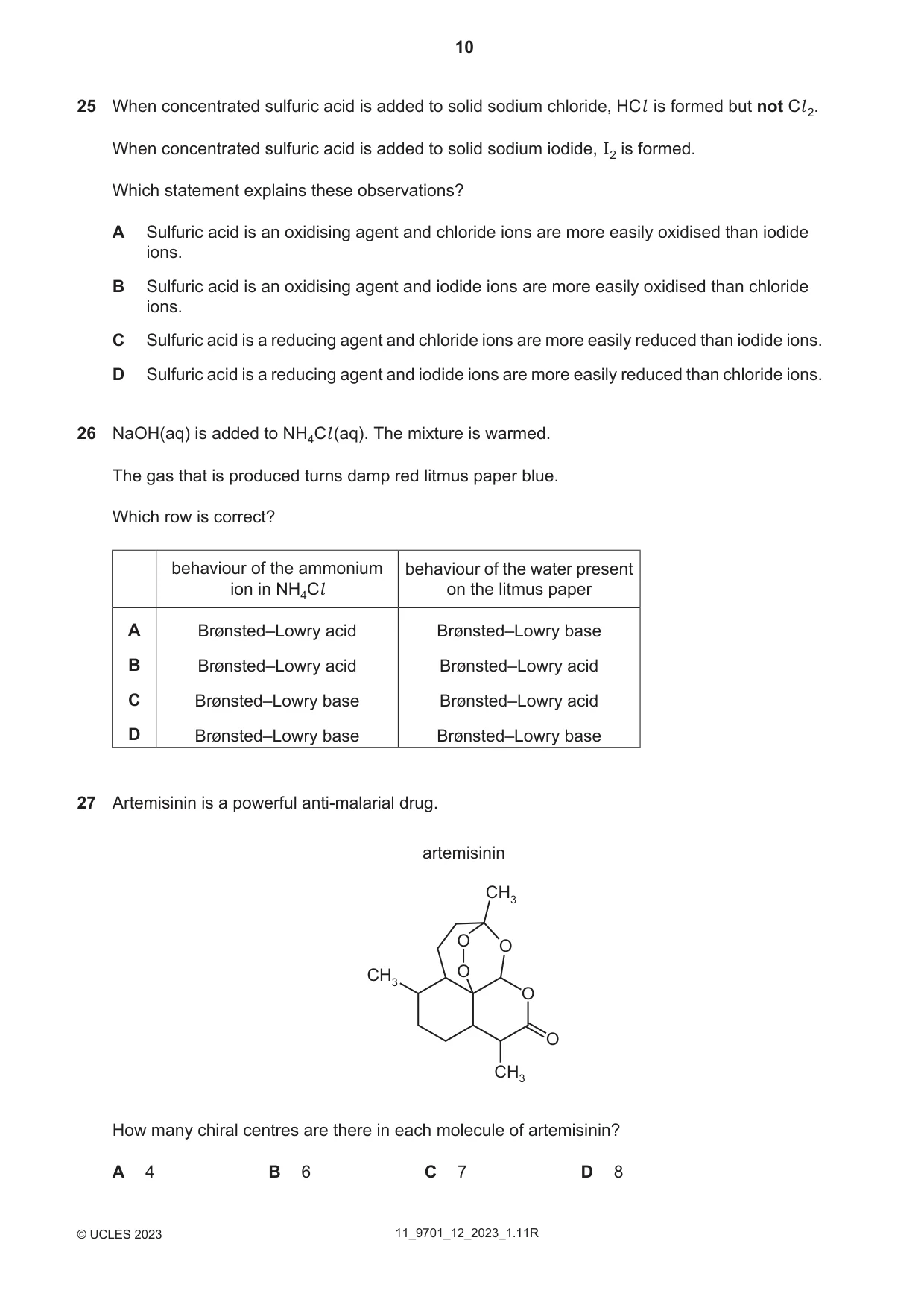
Q25 · When concentrated sulfuric acid is added to solid sodium chloride, HCl is formed but not…
25 When concentrated sulfuric acid is added to solid sodium chloride, HCl is formed but not Cl 2. When concentrated sulfuric acid is added to solid sodium iodide, I2 is formed. Which statement explains these observations? A Sulfuric acid is an oxidising agent and chloride ions are more easily oxidised than iodide ions. B Sulfuric acid is an oxidising agent and iodide ions are more easily oxidised than chloride ions. C Sulfuric acid is a reducing agent and chloride ions are more easily reduced than iodide ions. D Sulfuric acid is a reducing agent and iodide ions are more easily reduced than chloride ions.
Mark scheme: B
More questions on The chemical properties of the halogen elements and the hydrogen halides
Q26 · NaOH(aq) is added to NH4Cl(aq)
26 NaOH(aq) is added to NH4Cl(aq). The mixture is warmed. The gas that is produced turns damp red litmus paper blue. Which row is correct? behaviour of the ammonium behaviour of the water present ion in NH4Cl on the litmus paper A Brønsted–Lowry acid Brønsted–Lowry base B Brønsted–Lowry acid Brønsted–Lowry acid C Brønsted–Lowry base Brønsted–Lowry acid D Brønsted–Lowry base Brønsted–Lowry base
Mark scheme: B
Q27 · Artemisinin is a powerful anti-malarial drug
27 Artemisinin is a powerful anti-malarial drug. artemisinin CH3 O O CH3 O O O CH3 How many chiral centres are there in each molecule of artemisinin? A 4 B 6 C 7 D 8
Mark scheme: C
More questions on Isomerism: structural isomerism and stereoisomerism
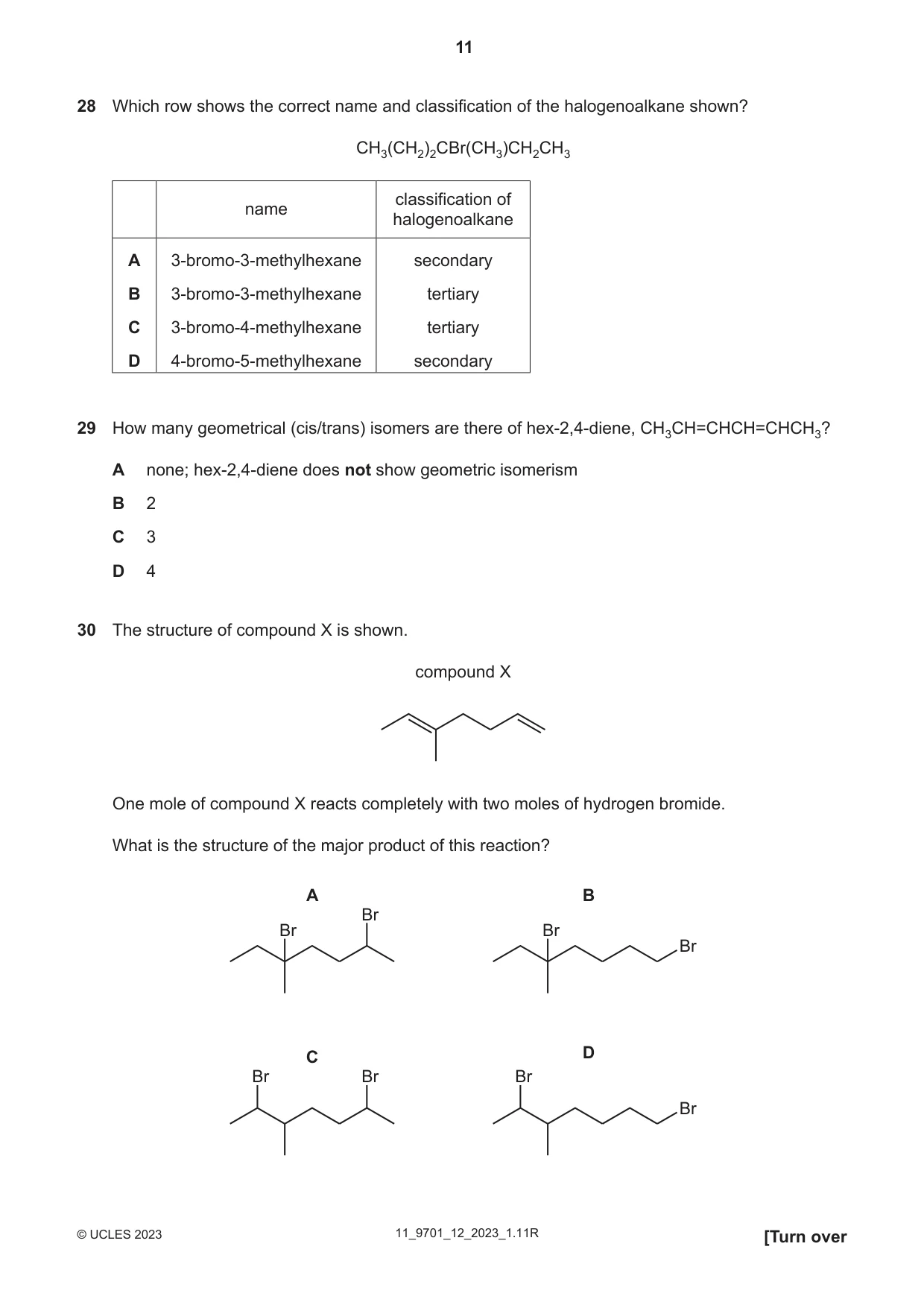
Q28 · Which row shows the correct name and classification of the halogenoalkane shown?
28 Which row shows the correct name and classification of the halogenoalkane shown? CH3(CH2)2CBr(CH3)CH2CH3 classification of name halogenoalkane A 3-bromo-3-methylhexane secondary B 3-bromo-3-methylhexane tertiary C 3-bromo-4-methylhexane tertiary D 4-bromo-5-methylhexane secondary
Mark scheme: B
Q29 · How many geometrical (cis/trans) isomers are there of hex-2,4-diene, CH3CH=CHCH=CHCH3?
29 How many geometrical (cis/trans) isomers are there of hex-2,4-diene, CH3CH=CHCH=CHCH3? A none; hex-2,4-diene does not show geometric isomerism B 2 C 3 D 4
Mark scheme: C
More questions on Isomerism: structural isomerism and stereoisomerism
Q30 · The structure of compound X is shown
30 The structure of compound X is shown. compound X One mole of compound X reacts completely with two moles of hydrogen bromide. What is the structure of the major product of this reaction? A B Br Br Br Br C D Br Br Br Br
Mark scheme: A
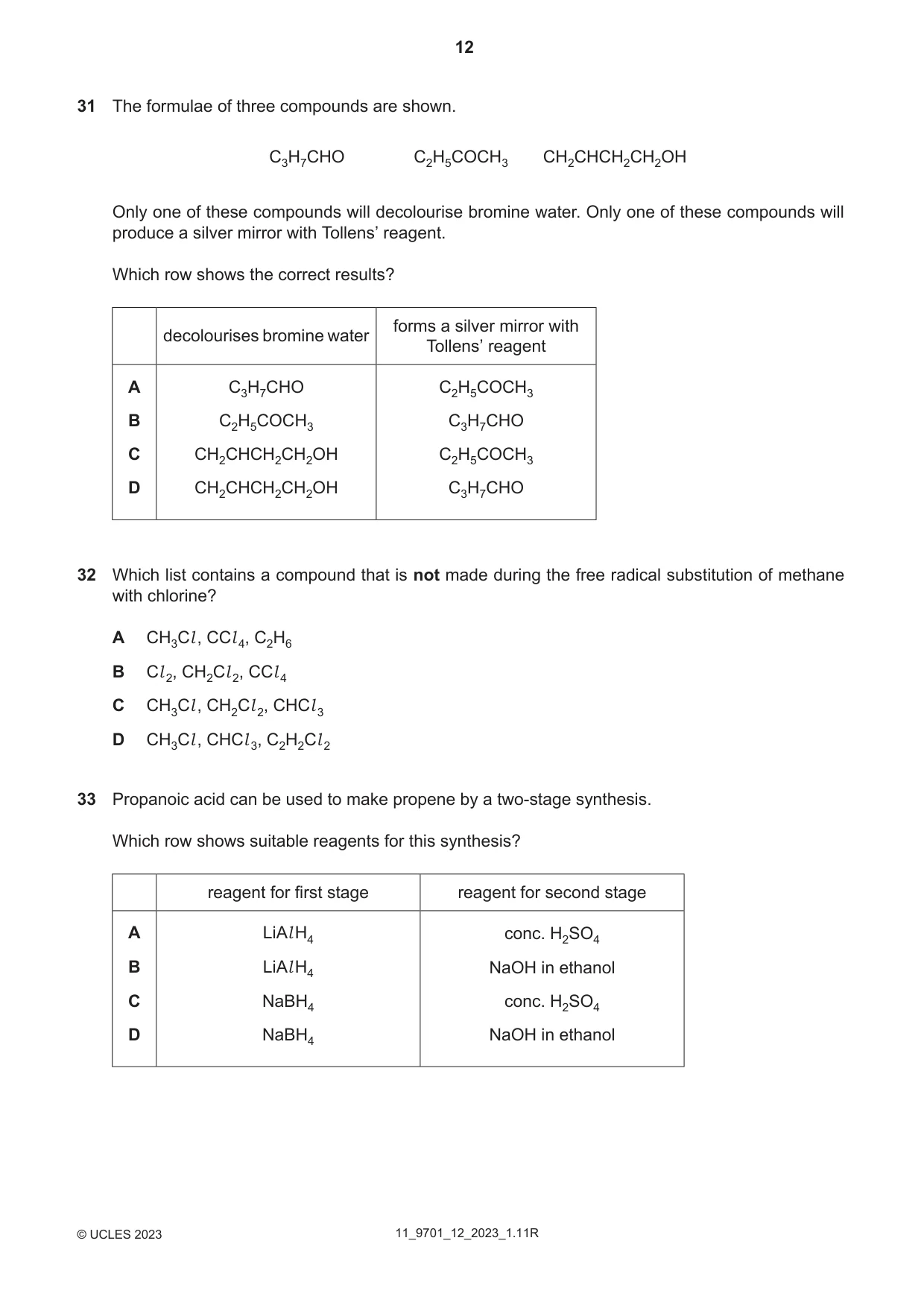
Q31 · The formulae of three compounds are shown
31 The formulae of three compounds are shown. C3H7CHO C2H5COCH3 CH2CHCH2CH2OH Only one of these compounds will decolourise bromine water. Only one of these compounds will produce a silver mirror with Tollens’ reagent. Which row shows the correct results? forms a silver mirror with decolourises bromine water Tollens’ reagent A C3H7CHO C2H5COCH3 B C2H5COCH3 C3H7CHO C CH2CHCH2CH2OH C2H5COCH3 D CH2CHCH2CH2OH C3H7CHO
Mark scheme: D
Q32 · Which list contains a compound that is not made during the free radical substitution of…
32 Which list contains a compound that is not made during the free radical substitution of methane with chlorine? A CH3Cl, CCl 4, C2H6 B Cl 2, CH2Cl 2, CCl 4 C CH3Cl, CH2Cl 2, CHCl 3 D CH3Cl, CHCl 3, C2H2Cl 2
Mark scheme: D
Q33 · Propanoic acid can be used to make propene by a two-stage synthesis
33 Propanoic acid can be used to make propene by a two-stage synthesis. Which row shows suitable reagents for this synthesis? reagent for first stage reagent for second stage A LiAlH4 conc. H2SO4 B LiAlH4 NaOH in ethanol C NaBH4 conc. H2SO4 D NaBH4 NaOH in ethanol
Mark scheme: A
Q34 · Which alcohol reacts with alkaline I2(aq) to produce ethanoate ions?
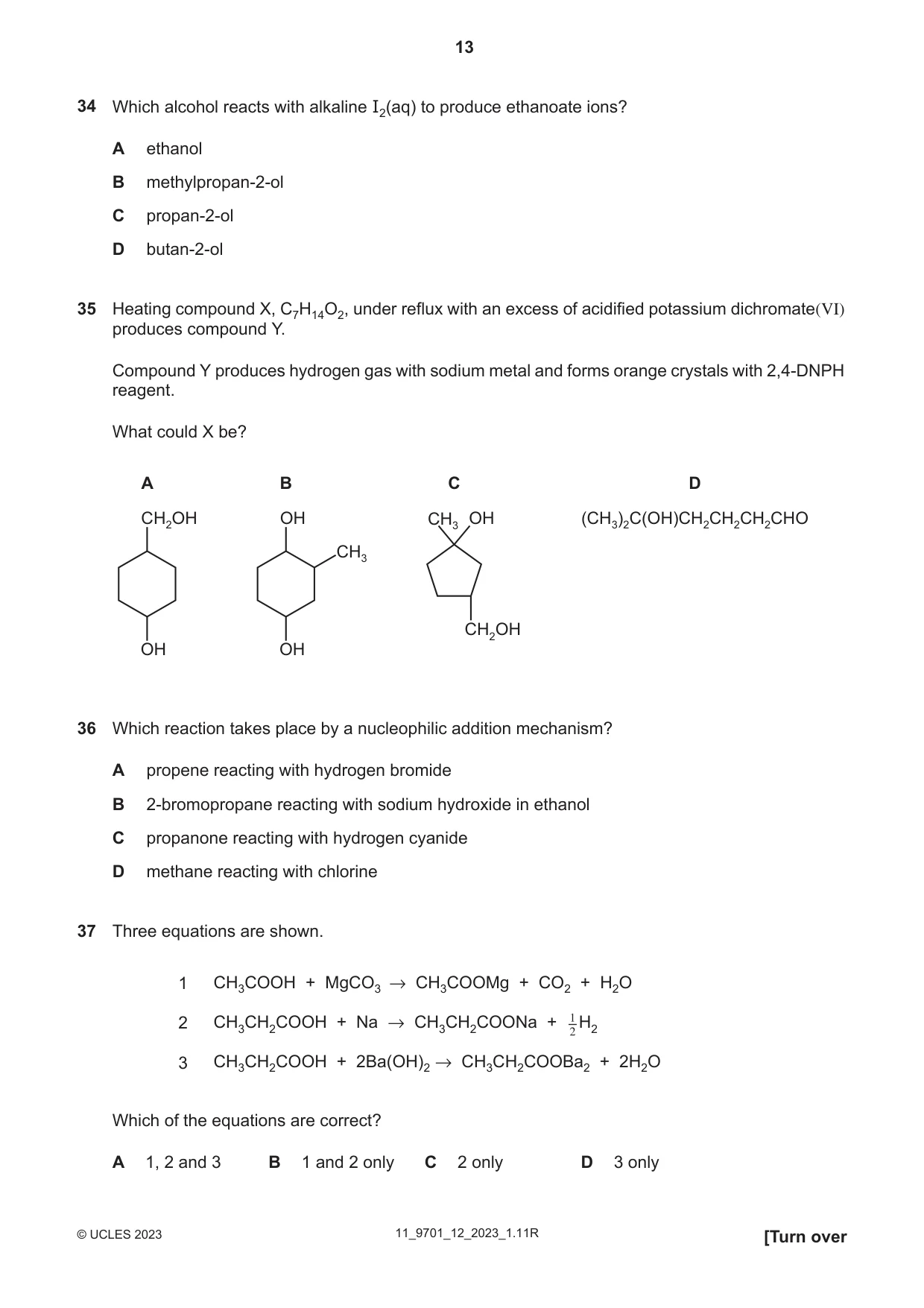
34 Which alcohol reacts with alkaline I2(aq) to produce ethanoate ions? A ethanol B methylpropan-2-ol C propan-2-ol D butan-2-ol
Mark scheme: C
Q35 · Heating compound X, C7H,,0,, under reflux with an excess of acidified potassium…
35 Heating compound X, C7H,,0,, under reflux with an excess of acidified potassium dichromate(VI) produces compound Y. Compound Y produces hydrogen gas with sodium metal and forms orange crystals with 2,4-DNPH reagent. What could X be? A B Cc D CH,OH OH CH, OH (CH,),C(OH)CH,CH,CH,CHO CH, CH,OH OH OH
Mark scheme: A
Q36 · Which reaction takes place by a nucleophilic addition mechanism?
36 Which reaction takes place by a nucleophilic addition mechanism? A propene reacting with hydrogen bromide B 2-bromopropane reacting with sodium hydroxide in ethanol C propanone reacting with hydrogen cyanide D methane reacting with chlorine
Mark scheme: C
Q37 · Three equations are shown
37 Three equations are shown. 1 CH3COOH + MgCO3 →CH3COOMg + CO2 + H2O 2 CH3CH2COOH + Na →CH3CH2COONa + H2 3 CH3CH2COOH + 2Ba(OH)2 →CH3CH2COOBa2 + 2H2O Which of the equations are correct? A 1, 2 and 3 B 1 and 2 only C 2 only D 3 only
Mark scheme: C
Q38 · How many esters with the molecular formula C5H10O2 can be made by reacting a primary…
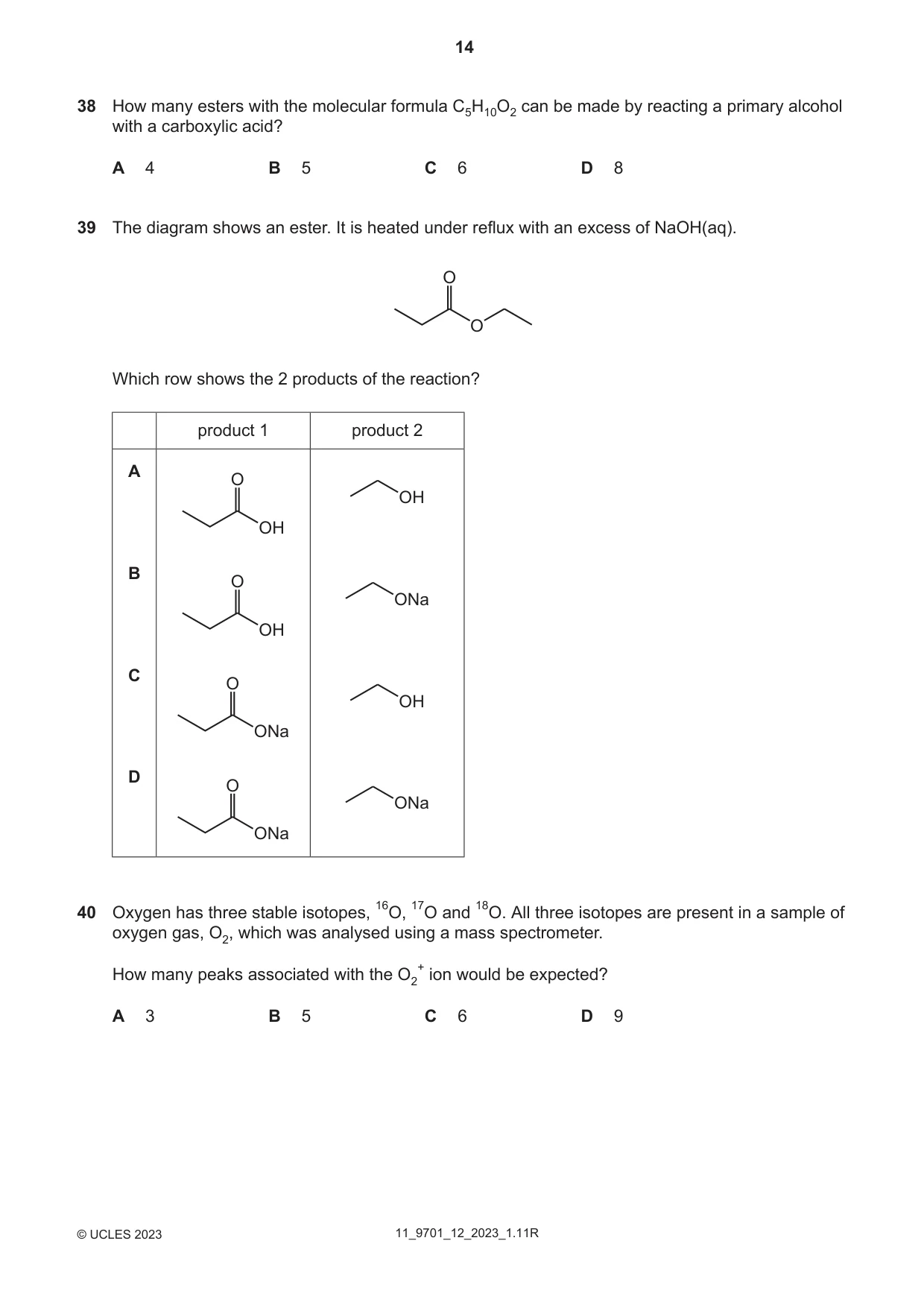
38 How many esters with the molecular formula C5H10O2 can be made by reacting a primary alcohol with a carboxylic acid? A 4 B 5 C 6 D 8
Mark scheme: C
Q39 · The diagram shows an ester
39 The diagram shows an ester. It is heated under reflux with an excess of NaOH(aq). O O Which row shows the 2 products of the reaction? product 1 product 2 A O OH OH B O ONa OH C O OH ONa D O ONa ONa
Mark scheme: C
Q40 · Oxygen has three stable isotopes, 16O, 17O and 18O
40 Oxygen has three stable isotopes, 16O, 17O and 18O. All three isotopes are present in a sample of oxygen gas, O2, which was analysed using a mass spectrometer. + ion would be expected? How many peaks associated with the O2 A 3 B 5 C 6 D 9
Mark scheme: B
What was in this paper
The subtopics covered by these 40 questions, and how many questions each got. Open one in a new tab to see every Cambridge question on it.
3Chemical equilibria: reversible reactions, dynamic equilibrium2Esters2Isomerism: structural isomerism and stereoisomerism2Periodicity of physical properties of the elements in Period 32Shapes of molecules2Similarities and trends in the properties of the Group 2 metals, magnesium to barium, and their compounds2The chemical properties of the halogen elements and the hydrogen halides2The gaseous state: ideal and real gases and pV = nRT2Alcohols1Alcohols1Aldehydes and ketones1Alkanes1Alkenes1Bonding and structure1Brønsted–Lowry theory of acids and bases1Carboxylic acids1Halogenoalkanes1Hess’s law1Ionisation energy1Mass spectrometry1Nitriles and hydroxynitriles1Organic synthesis1Particles in the atom and atomic radius1Periodicity of chemical properties of the elements in Period 31Physical properties of the Group 17 elements1Rate of reaction1Redox processes: electron transfer and changes in oxidation number (oxidation state)1Shapes of organic molecules; σ and π bonds1Similarities and trends in the properties of the Group 2 metals, magnesium to barium, and their compounds1What you needed in this session
Cambridge’s own grade thresholds for 2023 Oct/Nov, Paper 1 · Variant 2. A higher threshold means an easier paper — the bar moves with how the cohort did.