Cambridge A Level Chemistry 9701 — 2009 May/June Paper 1 · Variant 1
9701/11/M/J/09 · 40 questions · 40 marks · ≈45 min
The question paper and its mark scheme, free to read here and free to download. This is Cambridge’s own paper, exactly as it was sat.
Question paper16 pages

Mark scheme2 pages
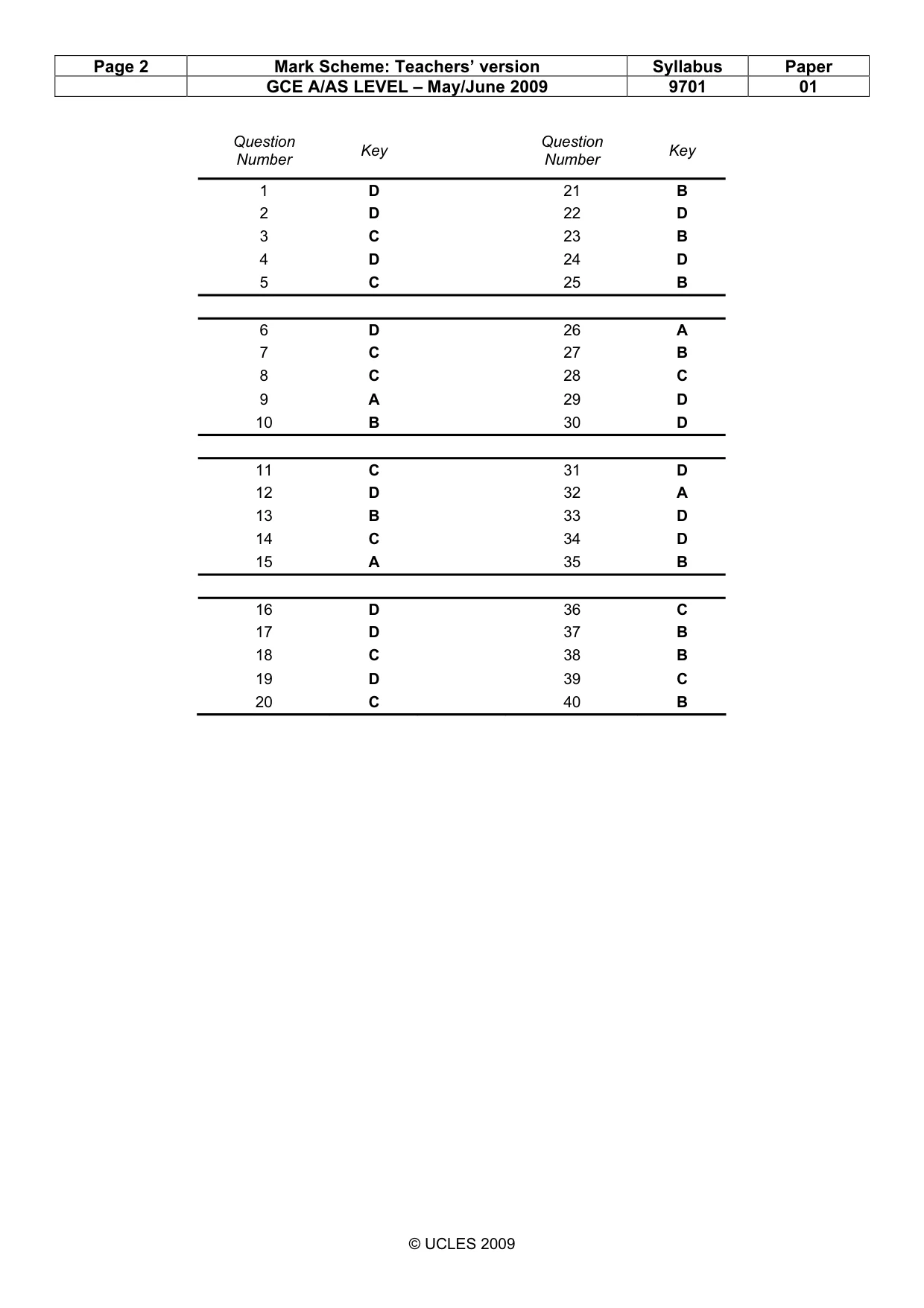
Answers below. Sit the paper first if you are practising.
Questions as text
Q1 · Use of the Data Booklet is relevant to this question
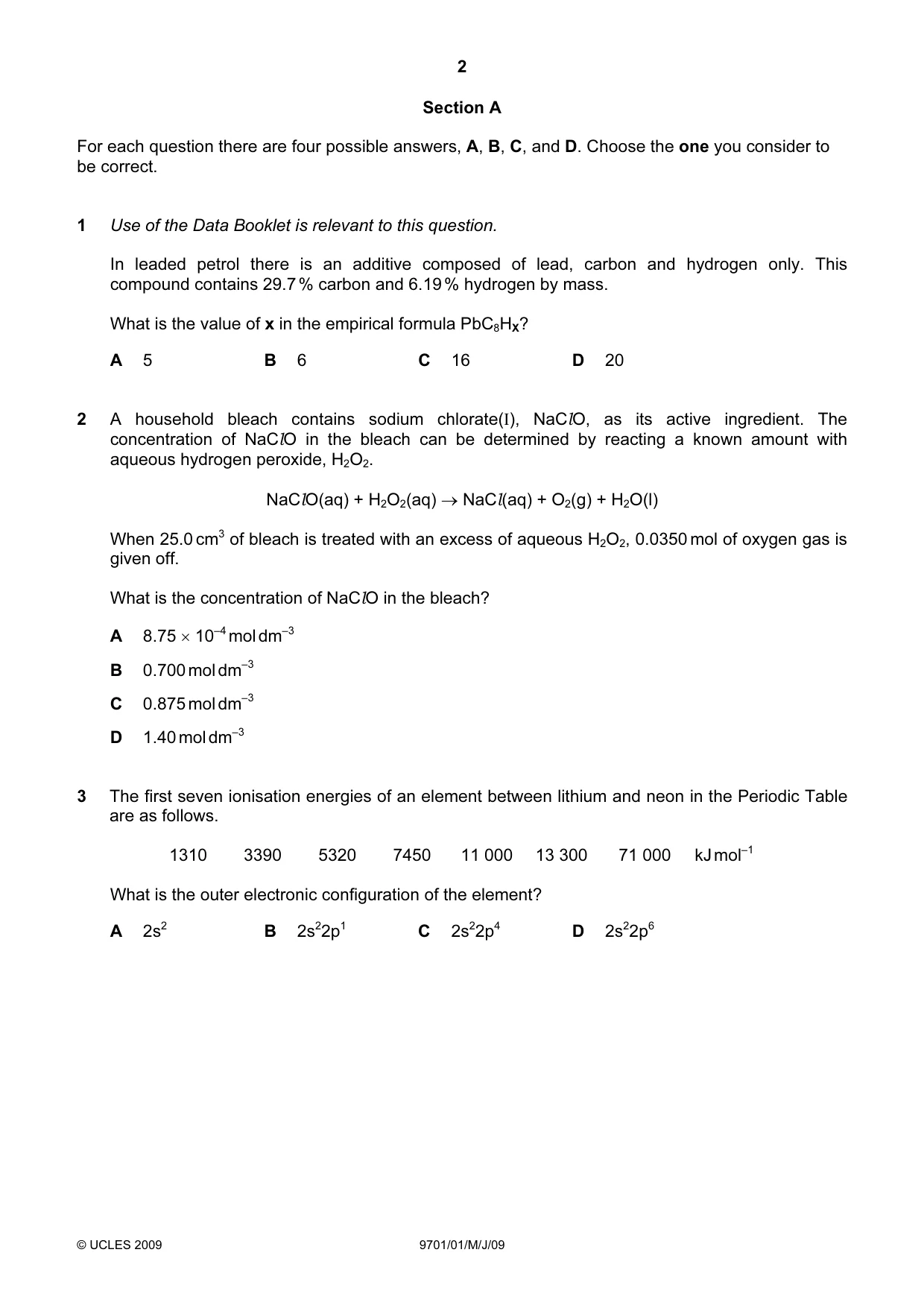
1 Use of the Data Booklet is relevant to this question. In leaded petrol there is an additive composed of lead, carbon and hydrogen only. This compound contains 29.7 % carbon and 6.19 % hydrogen by mass. What is the value of x in the empirical formula PbC8HX? A 5 B 6 C 16 D 20
Mark scheme: D
Q2 · A household bleach contains sodium chlorate(I), NaClO, as its active ingredient
2 A household bleach contains sodium chlorate(I), NaClO, as its active ingredient. The concentration of NaClO in the bleach can be determined by reacting a known amount with aqueous hydrogen peroxide, H2O2. NaClO(aq) + H2O2(aq) → NaCl(aq) + O2(g) + H2O(l) When 25.0 cm3 of bleach is treated with an excess of aqueous H2O2, 0.0350 mol of oxygen gas is given off. What is the concentration of NaClO in the bleach? A 8.75 × 10⁻⁴ mol dm–3 B 0.700 mol dm–3 C 0.875 mol dm–3 D 1.40 mol dm–3
Mark scheme: D
More questions on Reacting masses and volumes (of solutions and gases)
Q3 · The first seven ionisation energies of an element between lithium and neon in the…
3 The first seven ionisation energies of an element between lithium and neon in the Periodic Table are as follows. 1310 3390 5320 7450 11 000 13 300 71 000 kJ mol–1 What is the outer electronic configuration of the element? A 2s2 B 2s22p1 C 2s22p4 D 2s22p6
Mark scheme: C
Q4 · Use of the Data Booklet is relevant to this question
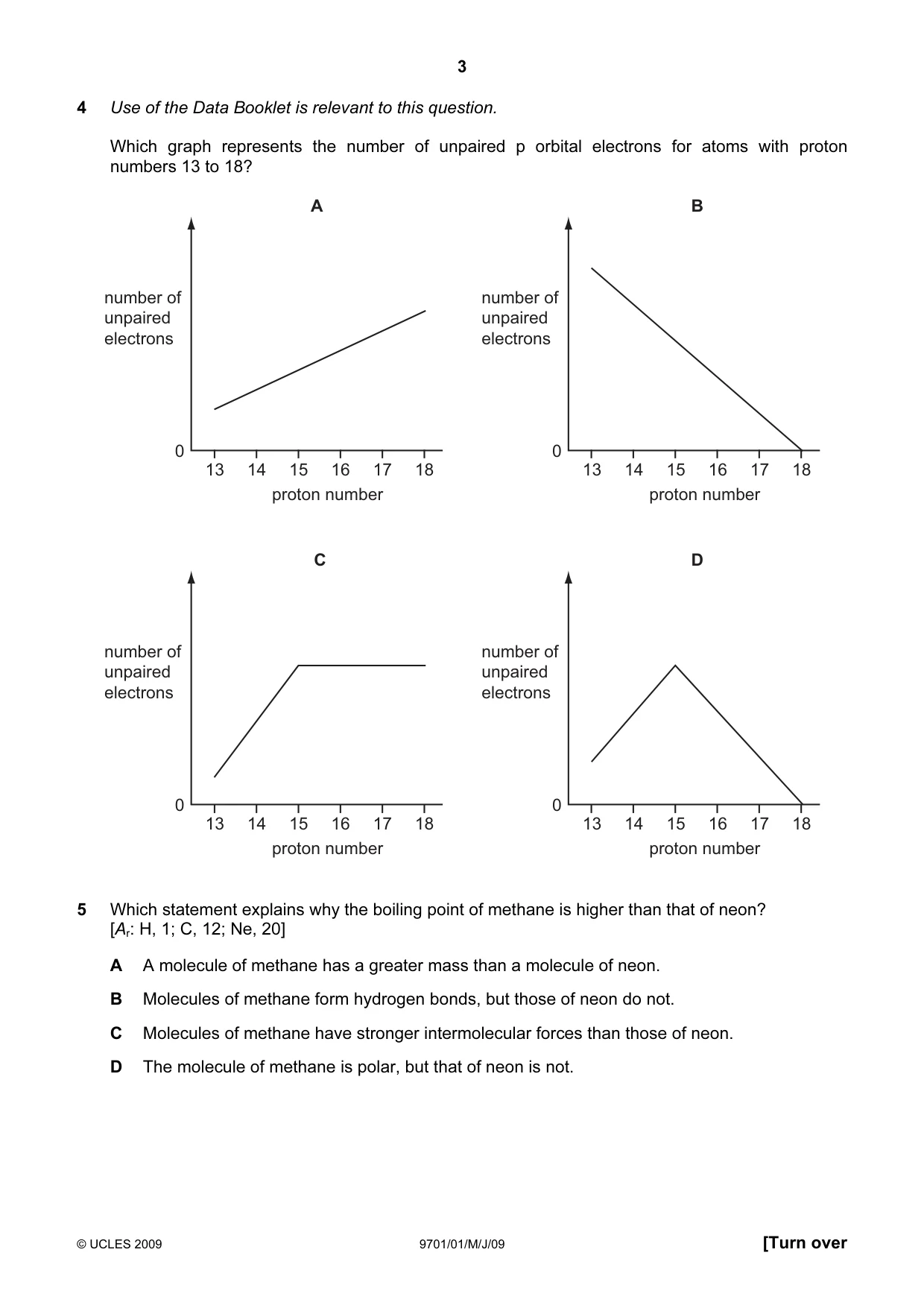
4 Use of the Data Booklet is relevant to this question. Which graph represents the number of unpaired p orbital electrons for atoms with proton numbers 13 to 18? A B number of number of unpaired unpaired electrons electrons 0 0 13 14 15 16 17 18 13 14 15 16 17 18 proton number proton number C D number of number of unpaired unpaired electrons electrons 0 0 13 14 15 16 17 18 13 14 15 16 17 18 proton number proton number
Mark scheme: D
More questions on Electrons, energy levels and atomic orbitals
Q5 · Which statement explains why the boiling point of methane is higher than that of neon?
5 Which statement explains why the boiling point of methane is higher than that of neon? [Ar: H, 1; C, 12; Ne, 20] A A molecule of methane has a greater mass than a molecule of neon. B Molecules of methane form hydrogen bonds, but those of neon do not. C Molecules of methane have stronger intermolecular forces than those of neon. D The molecule of methane is polar, but that of neon is not.
Mark scheme: C
More questions on Intermolecular forces, electronegativity and bond properties
Q6 · In which reaction does the carbon-containing product have a smaller bond angle than the…
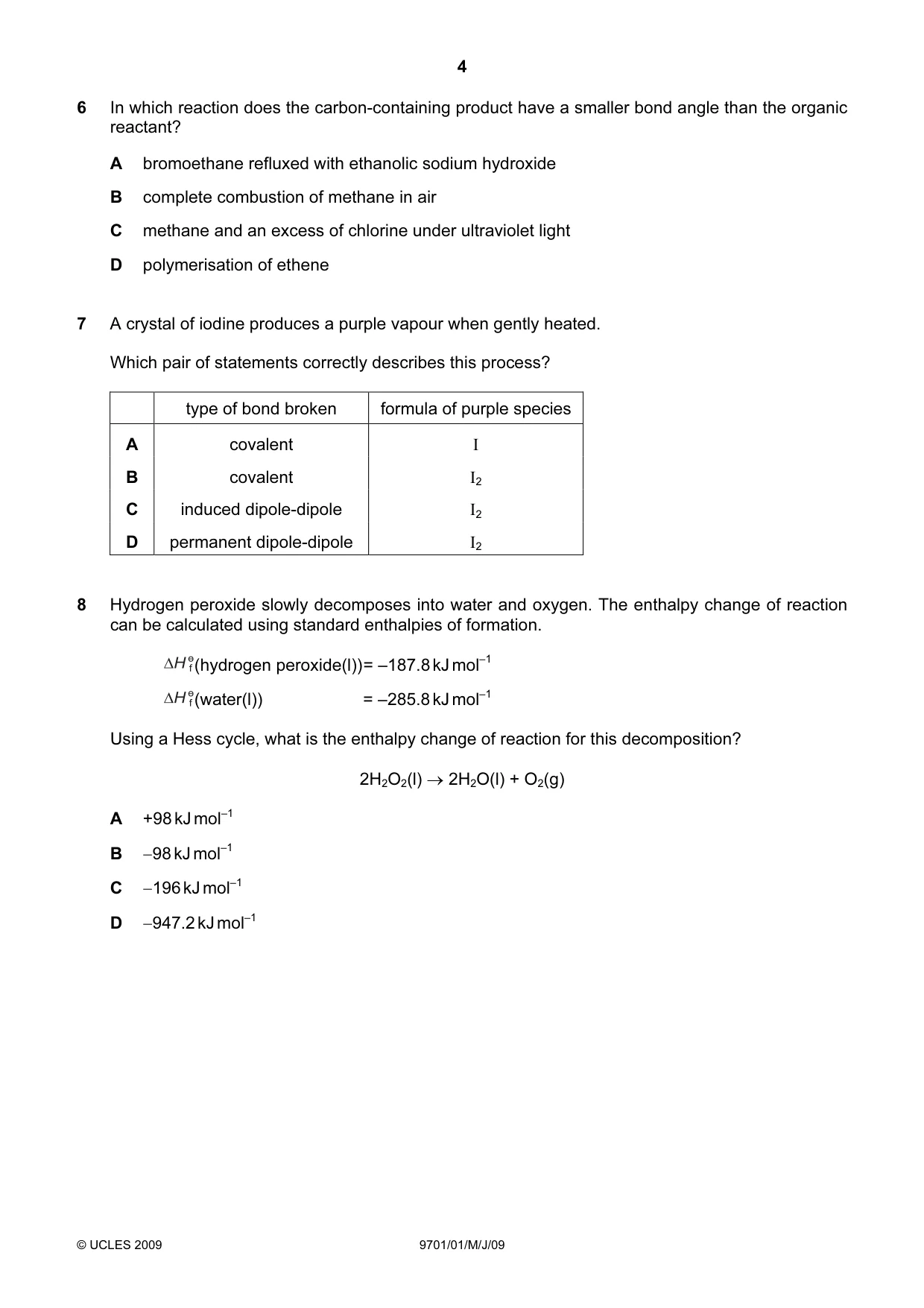
6 In which reaction does the carbon-containing product have a smaller bond angle than the organic reactant? A bromoethane refluxed with ethanolic sodium hydroxide B complete combustion of methane in air C methane and an excess of chlorine under ultraviolet light D polymerisation of ethene
Mark scheme: D
More questions on Shapes of organic molecules; σ and π bonds
Q7 · A crystal of iodine produces a purple vapour when gently heated
7 A crystal of iodine produces a purple vapour when gently heated. Which pair of statements correctly describes this process? type of bond broken formula of purple species A covalent I B covalent I2 C induced dipole-dipole I2 D permanent dipole-dipole I2
Mark scheme: C
More questions on Intermolecular forces, electronegativity and bond properties
Q8 · Hydrogen peroxide slowly decomposes into water and oxygen
8 Hydrogen peroxide slowly decomposes into water and oxygen. The enthalpy change of reaction can be calculated using standard enthalpies of formation. (hydrogen peroxide(l)) = –187.8 kJ mol–1 (water(l)) = –285.8 kJ mol–1 Using a Hess cycle, what is the enthalpy change of reaction for this decomposition? 2H2O2(l) → 2H2O(l) + O2(g) A +98 kJ mol–1 B −98 kJ mol–1 C −196 kJ mol–1 D −947.2 kJ mol–1
Mark scheme: C
Q9 · When copper is extracted from its ores, the metal is not pure enough for electrical uses
9 When copper is extracted from its ores, the metal is not pure enough for electrical uses. The impure copper, which contains small amounts of silver and gold, is purified by electrolysis. During this process a ‘sludge’ forms beneath the anode which is found to contain silver and traces of gold. Why is silver found in this sludge? A Silver is less electropositive than copper. B Silver is more dense than copper and falls off the cathode. C Silver reacts with the electrolyte to form an insoluble chloride salt. D Silver reacts with the electrolyte to form an insoluble sulfate salt.
Mark scheme: A
Q10 · The diagram shows the Maxwell-Boltzmann energy distribution curve for molecules of a…
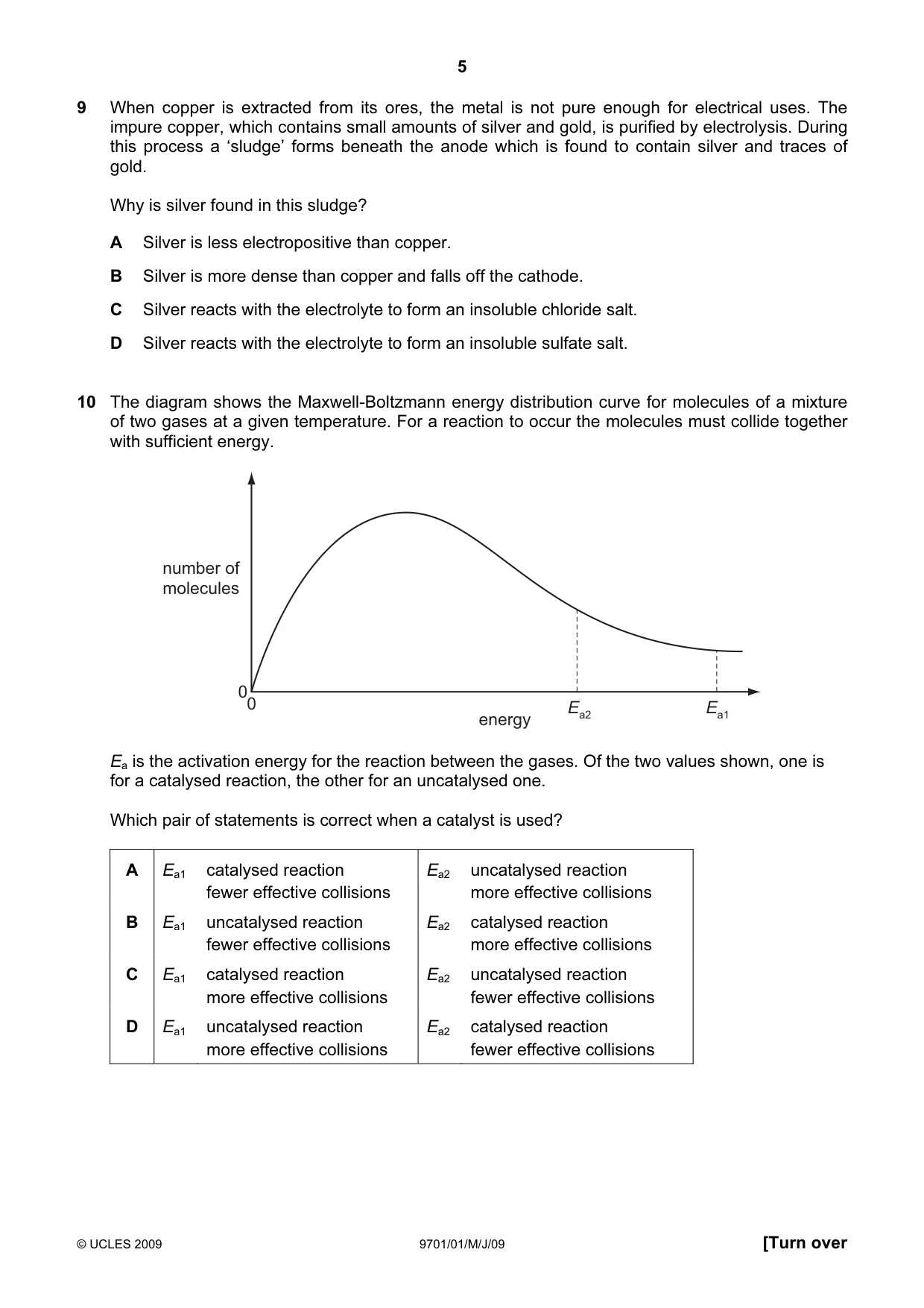
10 The diagram shows the Maxwell-Boltzmann energy distribution curve for molecules of a mixture of two gases at a given temperature. For a reaction to occur the molecules must collide together with sufficient energy. number of molecules 00 Ea2 Ea1 energy Ea is the activation energy for the reaction between the gases. Of the two values shown, one is for a catalysed reaction, the other for an uncatalysed one. Which pair of statements is correct when a catalyst is used? A Ea1 catalysed reaction Ea2 uncatalysed reaction fewer effective collisions more effective collisions B Ea1 uncatalysed reaction Ea2 catalysed reaction fewer effective collisions more effective collisions C Ea1 catalysed reaction Ea2 uncatalysed reaction more effective collisions fewer effective collisions D Ea1 uncatalysed reaction Ea2 catalysed reaction more effective collisions fewer effective collisions
Mark scheme: B
More questions on Effect of temperature on reaction rates and the concept of activation energy
Q11 · In some fireworks there is a reaction between powdered aluminium and powdered barium…
11 In some fireworks there is a reaction between powdered aluminium and powdered barium nitrate in which heat is evolved and an unreactive gas is produced. What is the equation for this reaction? A 2Al + Ba(NO3)2 → Al2O3 + BaO + 2NO B 4Al + 4Ba(NO3)2 → 2Al2O3 + 4Ba(NO2)2 + O2 C 10Al + 3Ba(NO3)2 → 5Al2O3 + 3BaO + 3N2 D 10Al + 18Ba(NO3)2 → 10Al(NO3)3 + 18BaO + 3N2
Mark scheme: C
Q12 · Which group of particles is in order of increasing size?
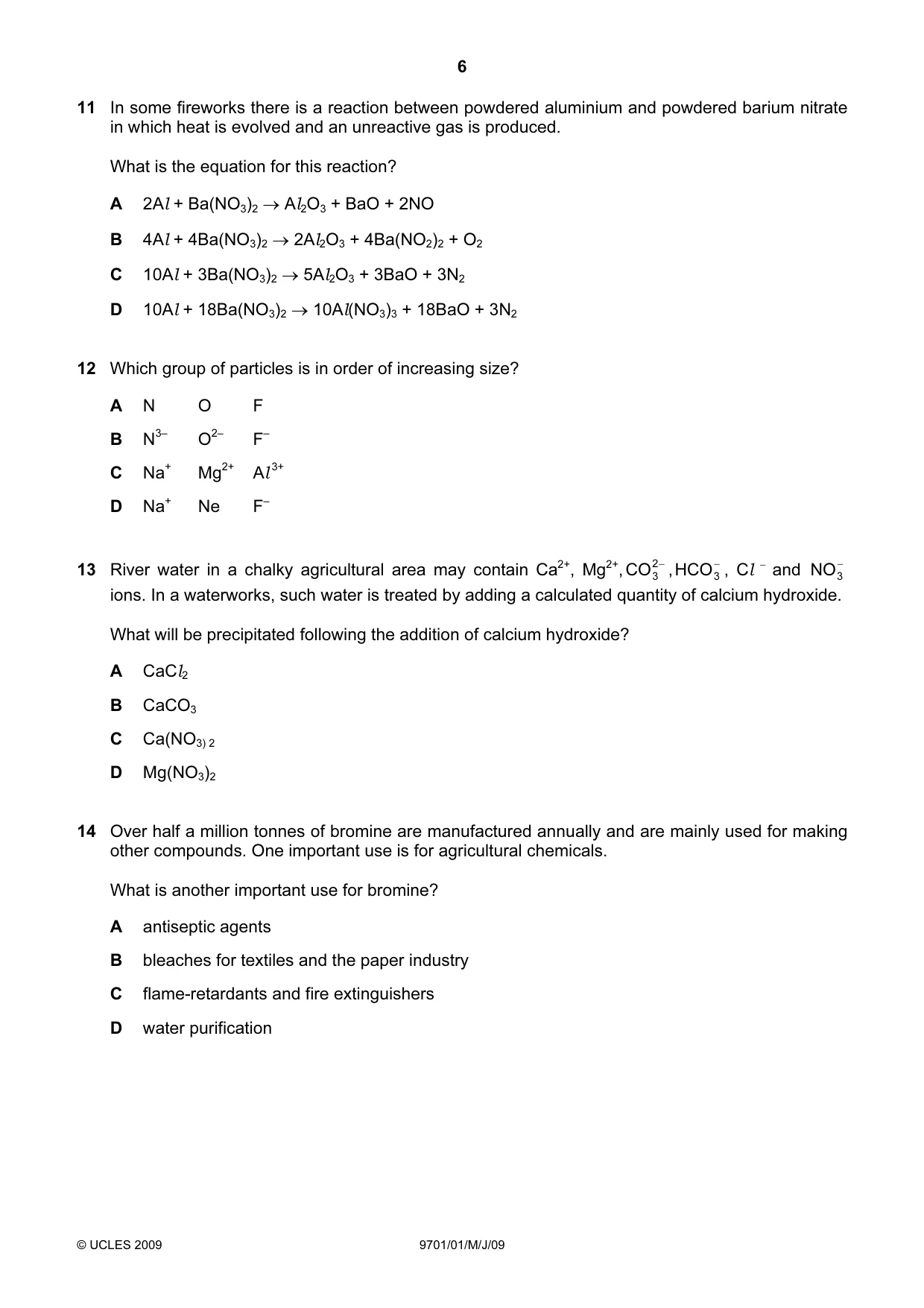
12 Which group of particles is in order of increasing size? A N O F B N3– O2– F– C Na+ Mg2+ Al 3+ D Na+ Ne F–
Mark scheme: D
Q13 · River water in a chalky agricultural area may contain Ca2+, Mg2+, CO 2 − , HCO , Cl − and…
13 River water in a chalky agricultural area may contain Ca2+, Mg2+, CO 2 − , HCO , Cl − and − NO − 3 3 3 ions. In a waterworks, such water is treated by adding a calculated quantity of calcium hydroxide. What will be precipitated following the addition of calcium hydroxide? A CaCl2 B CaCO3 C Ca(NO3) 2 D Mg(NO3)2
Mark scheme: B
Q14 · Over half a million tonnes of bromine are manufactured annually and are mainly used for…
14 Over half a million tonnes of bromine are manufactured annually and are mainly used for making other compounds. One important use is for agricultural chemicals. What is another important use for bromine? A antiseptic agents B bleaches for textiles and the paper industry C flame-retardants and fire extinguishers D water purification
Mark scheme: C
More questions on Physical properties of the Group 17 elements
Q15 · In black and white photographic film, light converts silver chloride into metallic silver
15 In black and white photographic film, light converts silver chloride into metallic silver. After the film has been developed, the unreacted silver chloride is removed by reaction with sodium thiosulfate to produce a ‘fixed’ negative. AgCl + 2Na2S2O3 → 4Na+ + Cl – + [Ag(S2O3)2]3– What is the function of the thiosulfate ion? A to make the silver ions soluble B to oxidise the silver ions C to oxidise the silver metal D to reduce the silver ions
Mark scheme: A
Q16 · Which statement is most likely to be true for astatine, which is below iodine in Group…
16 Which statement is most likely to be true for astatine, which is below iodine in Group VII of the Periodic Table? A Astatine and aqueous potassium chloride react to form aqueous potassium astatide and chlorine. B Potassium astatide and hot dilute sulfuric acid react to form white fumes of only hydrogen astatide. C Silver astatide reacts with dilute aqueous ammonia in excess to form a solution of a soluble complex. D Sodium astatide and hot concentrated sulfuric acid react to form astatine.
Mark scheme: D
More questions on The chemical properties of the halogen elements and the hydrogen halides
Q17 · Deposits of ammonium compounds have been discovered in areas of high atmospheric pollution
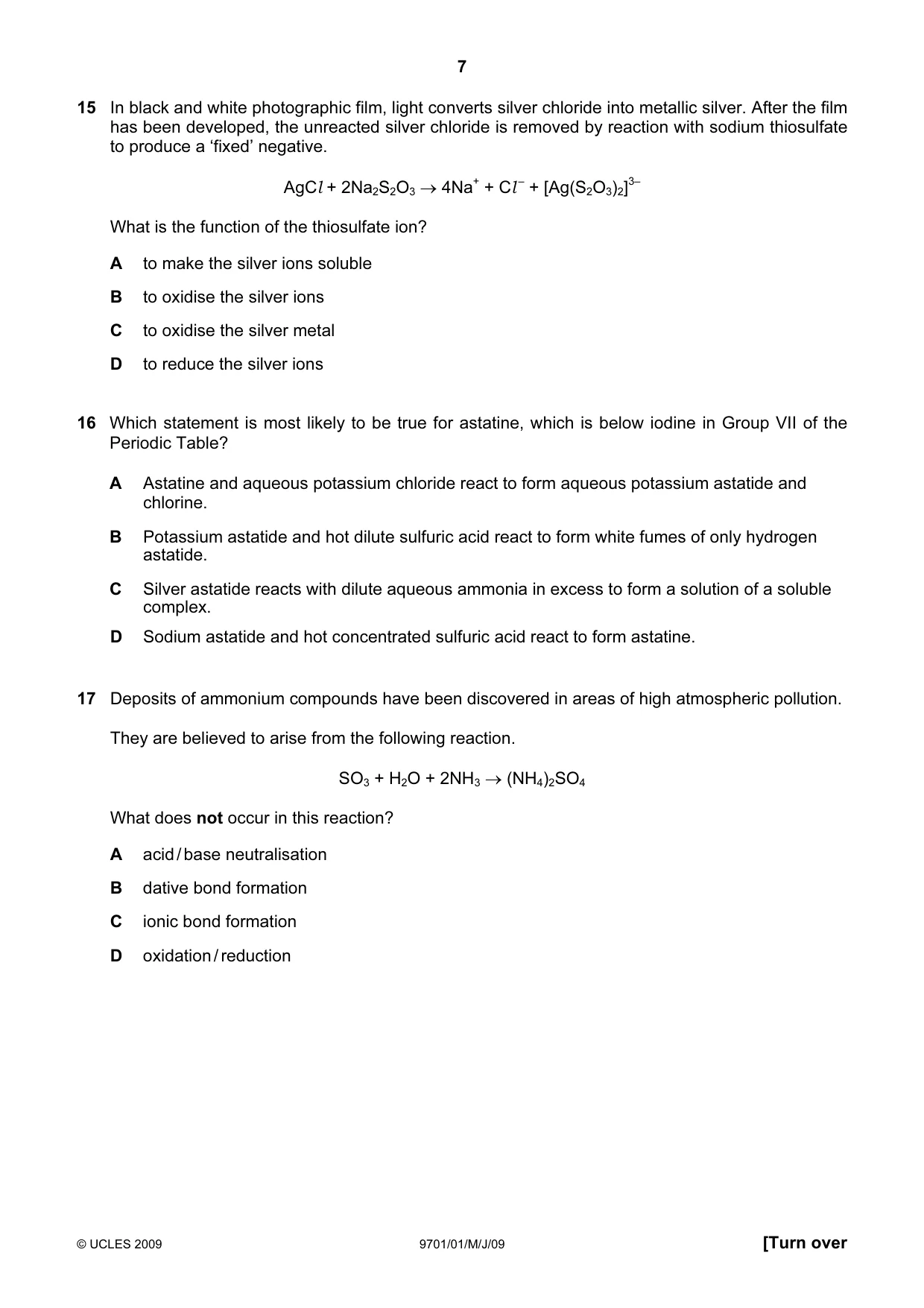
17 Deposits of ammonium compounds have been discovered in areas of high atmospheric pollution. They are believed to arise from the following reaction. SO3 + H2O + 2NH3 → (NH4)2SO4 What does not occur in this reaction? A acid / base neutralisation B dative bond formation C ionic bond formation D oxidation / reduction
Mark scheme: D
More questions on Covalent bonding and coordinate (dative covalent) bonding
Q18 · Mohr’s salt is a pale green crystalline solid which is soluble in water
18 Mohr’s salt is a pale green crystalline solid which is soluble in water. It is a ‘double sulfate’ which contains two cations, one of which is Fe2+. The identity of the second cation was determined by heating solid Mohr’s salt with solid sodium hydroxide and a colourless gas was evolved. The gas readily dissolved in water giving an alkaline solution. A grey-green solid residue was also formed which was insoluble in water. What are the identities of the gas and the solid residue? gas residue A H2 FeSO4 B NH3 Na2SO4 C NH3 Fe(OH)2 D SO2 Fe(OH)2
Mark scheme: C
Q19 · In recent years a number of athletes have been banned from sports because of their…
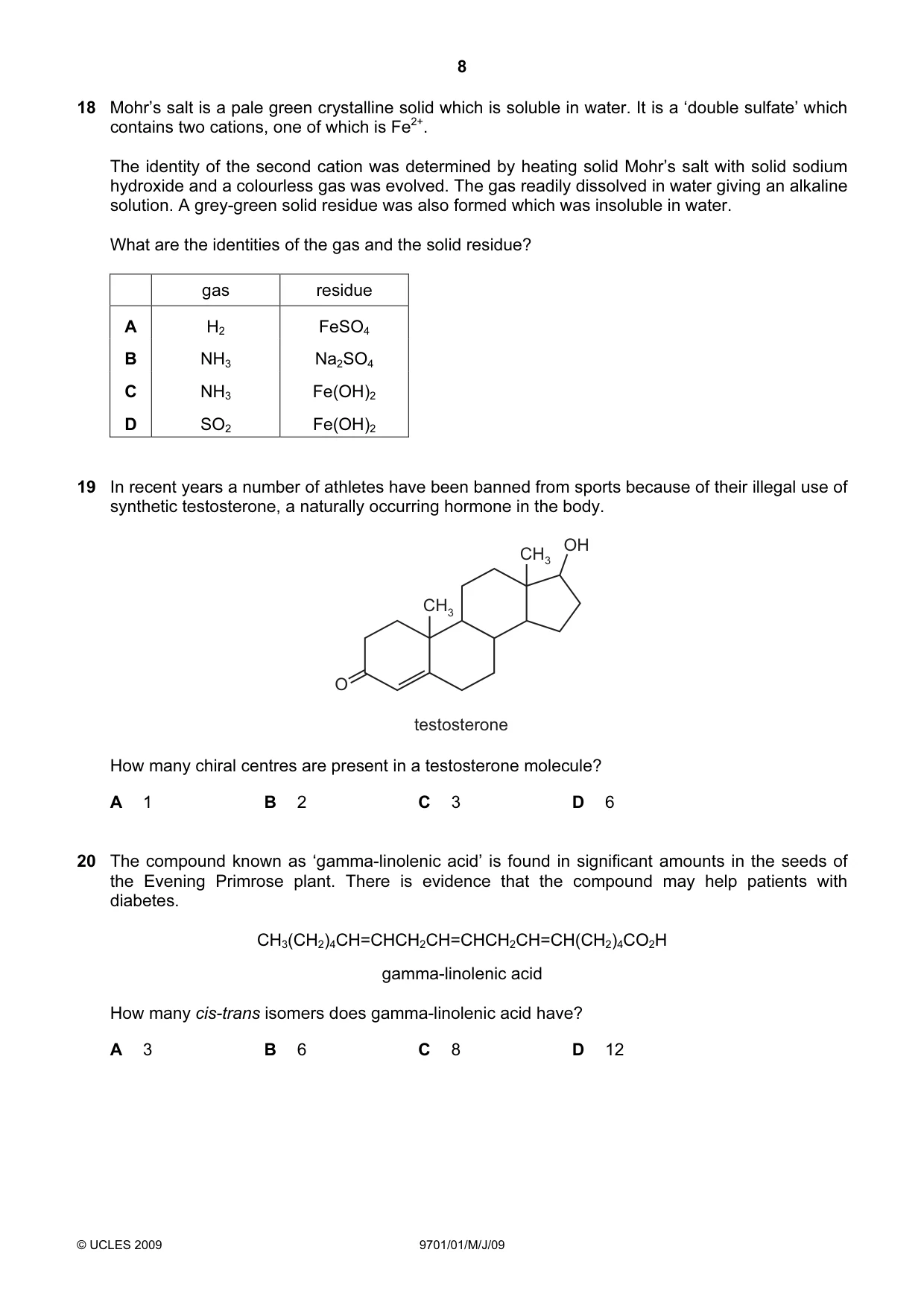
19 In recent years a number of athletes have been banned from sports because of their illegal use of synthetic testosterone, a naturally occurring hormone in the body. OH CH3 CH3 O testosterone How many chiral centres are present in a testosterone molecule? A 1 B 2 C 3 D 6
Mark scheme: D
More questions on Isomerism: structural isomerism and stereoisomerism
Q20 · The compound known as ‘gamma-linolenic acid’ is found in significant amounts in the seeds…
20 The compound known as ‘gamma-linolenic acid’ is found in significant amounts in the seeds of the Evening Primrose plant. There is evidence that the compound may help patients with diabetes. CH3(CH2)4CH=CHCH2CH=CHCH2CH=CH(CH2)4CO2H gamma-linolenic acid How many cis-trans isomers does gamma-linolenic acid have? A 3 B 6 C 8 D 12
Mark scheme: C
More questions on Isomerism: structural isomerism and stereoisomerism
Q21 · What always applies to a nucleophile?
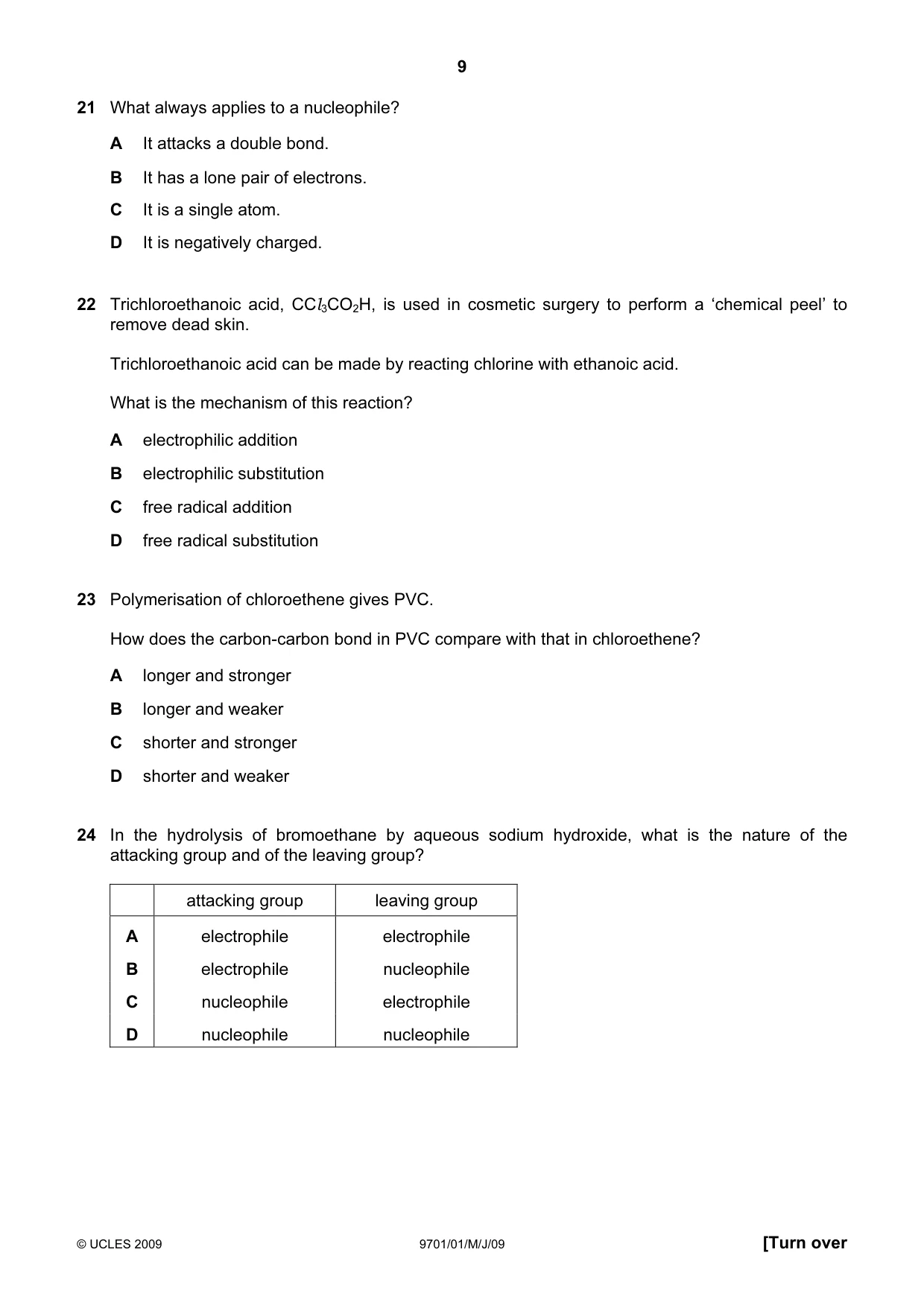
21 What always applies to a nucleophile? A It attacks a double bond. B It has a lone pair of electrons. C It is a single atom. D It is negatively charged.
Mark scheme: B
Q22 · Trichloroethanoic acid, CCl3CO2H, is used in cosmetic surgery to perform a ‘chemical…
22 Trichloroethanoic acid, CCl3CO2H, is used in cosmetic surgery to perform a ‘chemical peel’ to remove dead skin. Trichloroethanoic acid can be made by reacting chlorine with ethanoic acid. What is the mechanism of this reaction? A electrophilic addition B electrophilic substitution C free radical addition D free radical substitution
Mark scheme: D
Q23 · Polymerisation of chloroethene gives PVC
23 Polymerisation of chloroethene gives PVC. How does the carbon-carbon bond in PVC compare with that in chloroethene? A longer and stronger B longer and weaker C shorter and stronger D shorter and weaker
Mark scheme: B
More questions on Shapes of organic molecules; σ and π bonds
Q24 · In the hydrolysis of bromoethane by aqueous sodium hydroxide, what is the nature of the…
24 In the hydrolysis of bromoethane by aqueous sodium hydroxide, what is the nature of the attacking group and of the leaving group? attacking group leaving group A electrophile electrophile B electrophile nucleophile C nucleophile electrophile D nucleophile nucleophile
Mark scheme: D
Q25 · Which reaction would not give propene as one product?
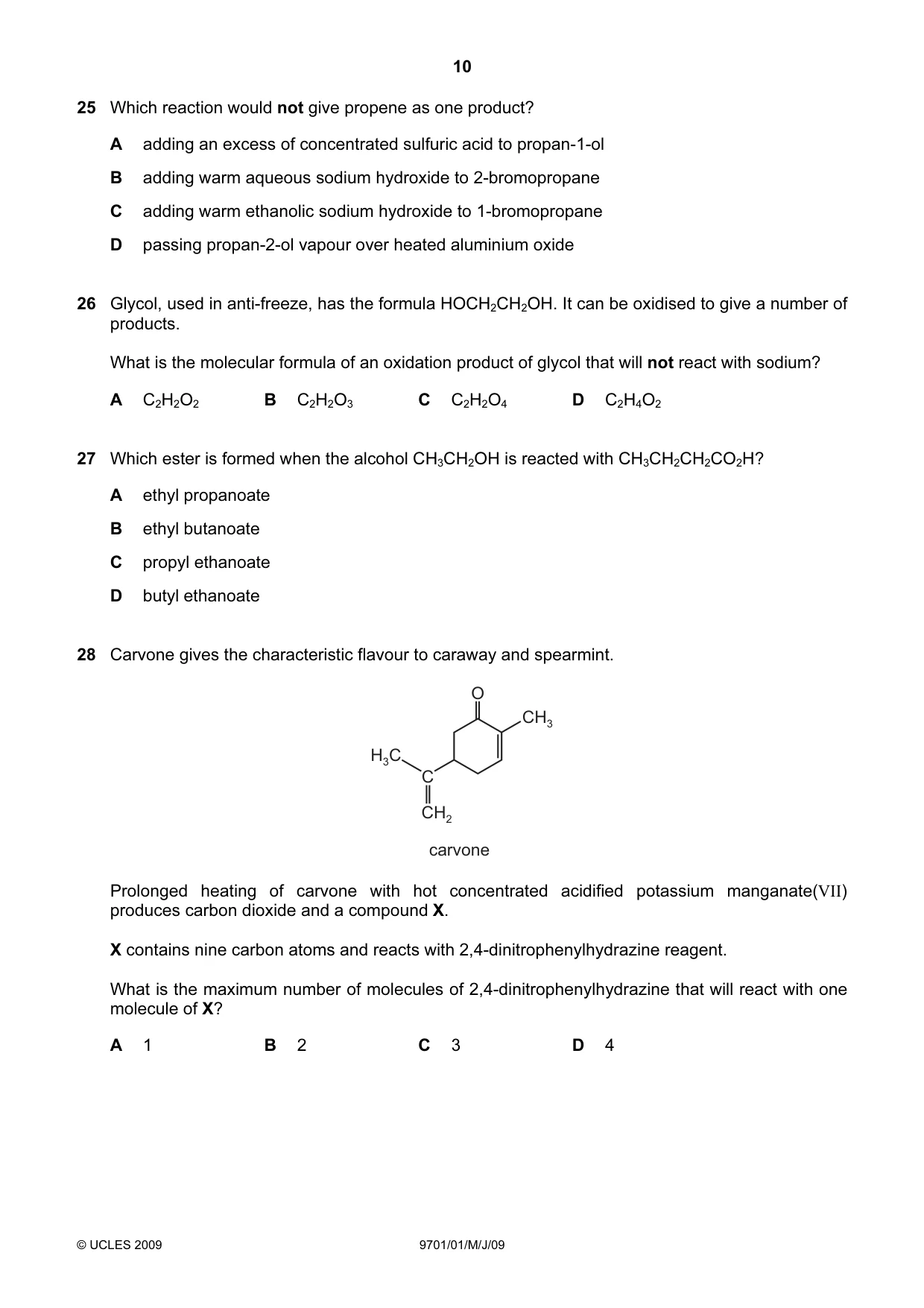
25 Which reaction would not give propene as one product? A adding an excess of concentrated sulfuric acid to propan-1-ol B adding warm aqueous sodium hydroxide to 2-bromopropane C adding warm ethanolic sodium hydroxide to 1-bromopropane D passing propan-2-ol vapour over heated aluminium oxide
Mark scheme: B
Q26 · Glycol, used in anti-freeze, has the formula HOCH2CH2OH
26 Glycol, used in anti-freeze, has the formula HOCH2CH2OH. It can be oxidised to give a number of products. What is the molecular formula of an oxidation product of glycol that will not react with sodium? A C2H2O2 B C2H2O3 C C2H2O4 D C2H4O2
Mark scheme: A
Q27 · Which ester is formed when the alcohol CH3CH2OH is reacted with CH3CH2CH2CO2H?
27 Which ester is formed when the alcohol CH3CH2OH is reacted with CH3CH2CH2CO2H? A ethyl propanoate B ethyl butanoate C propyl ethanoate D butyl ethanoate
Mark scheme: B
Q28 · Carvone gives the characteristic flavour to caraway and spearmint
28 Carvone gives the characteristic flavour to caraway and spearmint. O CH3 H3C C CH2 carvone Prolonged heating of carvone with hot concentrated acidified potassium manganate(VII) produces carbon dioxide and a compound X. X contains nine carbon atoms and reacts with 2,4-dinitrophenylhydrazine reagent. What is the maximum number of molecules of 2,4-dinitrophenylhydrazine that will react with one molecule of X? A 1 B 2 C 3 D 4
Mark scheme: C
Q29 · 2-Methylbuta-1,3-diene, CH2=C(CH3)–CH=CH2, is used as a monomer in the manufacture of…
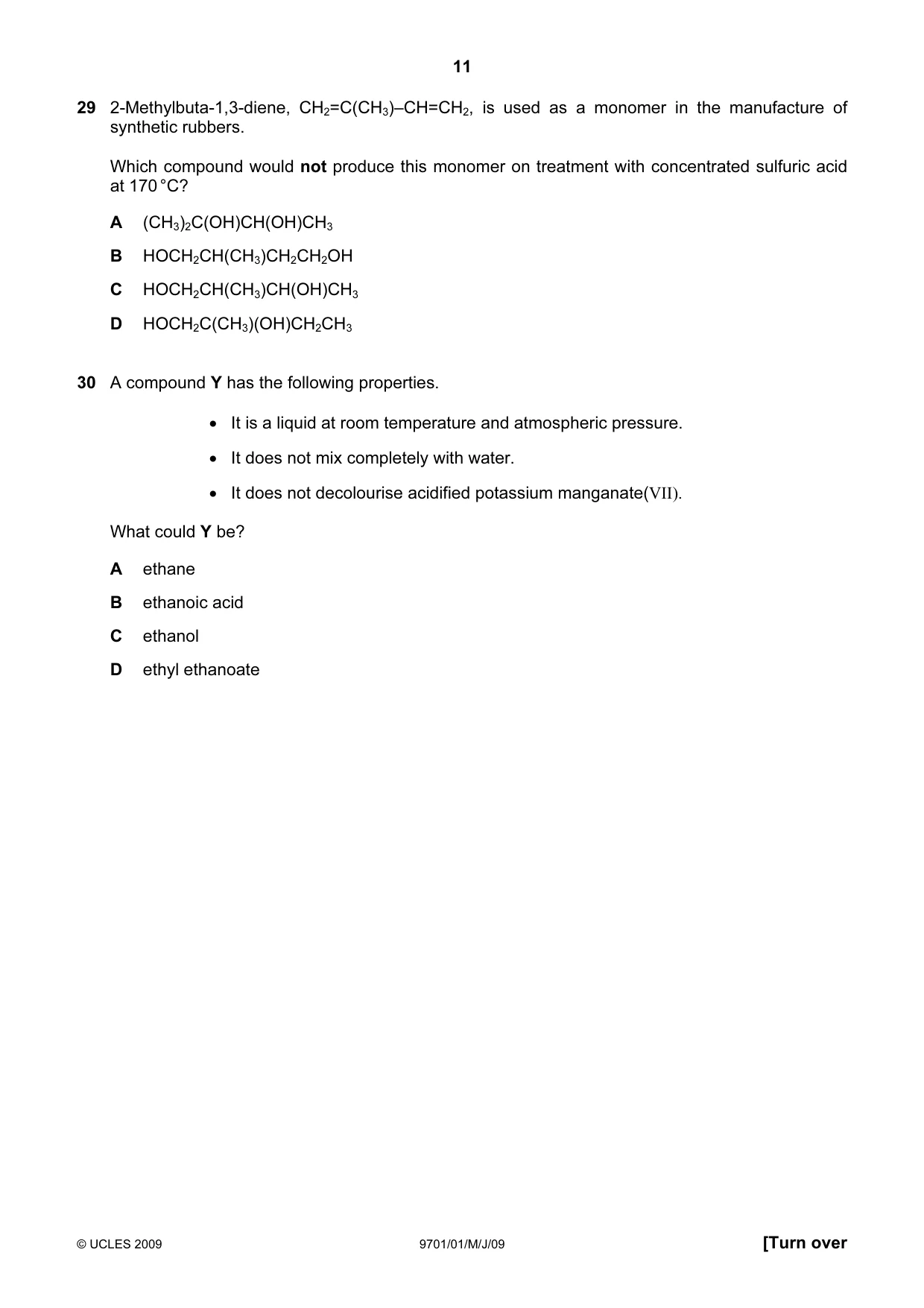
29 2-Methylbuta-1,3-diene, CH2=C(CH3)–CH=CH2, is used as a monomer in the manufacture of synthetic rubbers. Which compound would not produce this monomer on treatment with concentrated sulfuric acid at 170 °C? A (CH3)2C(OH)CH(OH)CH3 B HOCH2CH(CH3)CH2CH2OH C HOCH2CH(CH3)CH(OH)CH3 D HOCH2C(CH3)(OH)CH2CH3
Mark scheme: D
Q30 · A compound Y has the following properties
30 A compound Y has the following properties. • It is a liquid at room temperature and atmospheric pressure. • It does not mix completely with water. • It does not decolourise acidified potassium manganate(VII). What could Y be? A ethane B ethanoic acid C ethanol D ethyl ethanoate
Mark scheme: D
Q31 · On a scale in which the mass of a 12C atom is 12 the relative molecular mass of a…
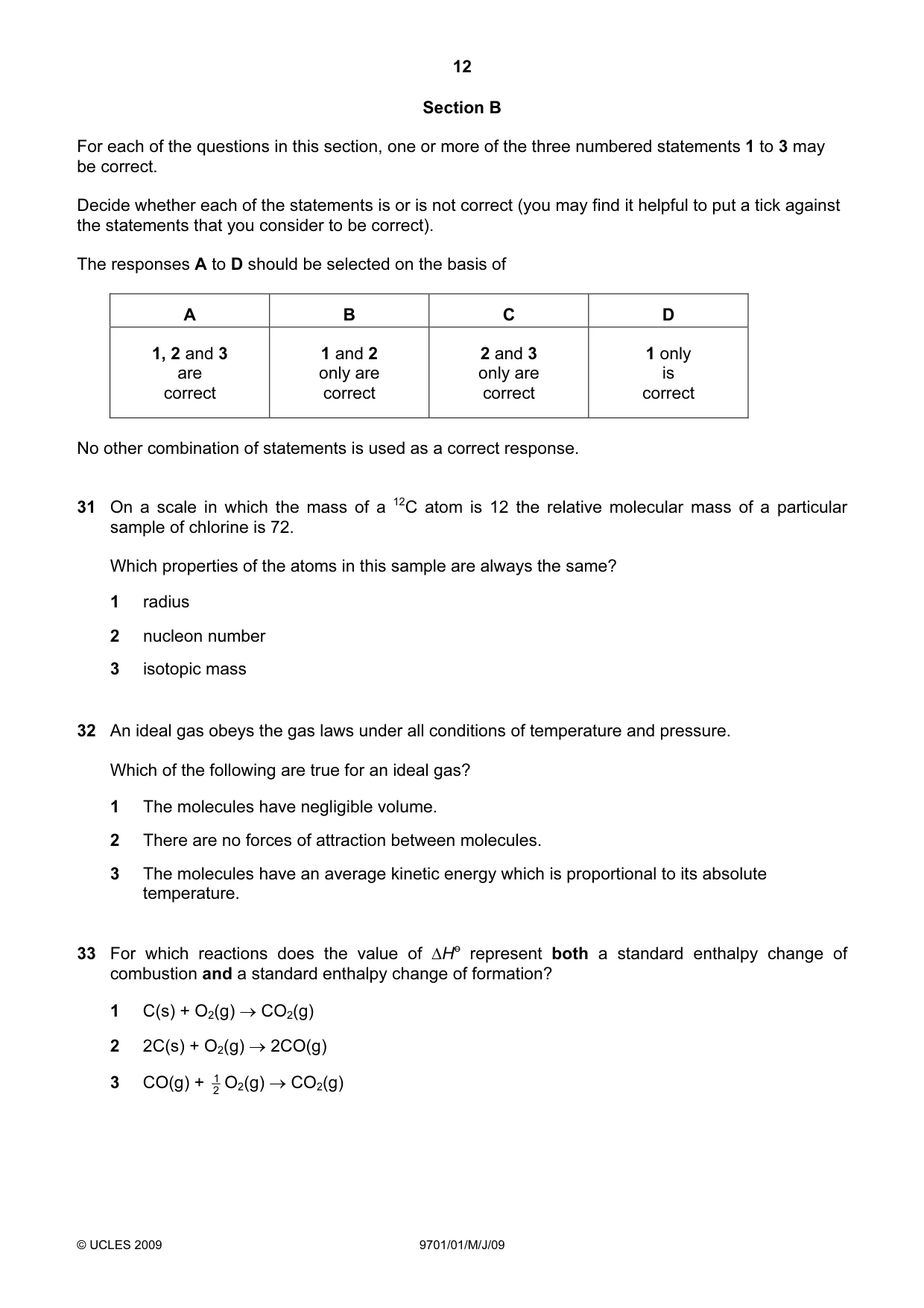
31 On a scale in which the mass of a 12C atom is 12 the relative molecular mass of a particular sample of chlorine is 72. Which properties of the atoms in this sample are always the same? 1 radius 2 nucleon number 3 isotopic mass
Mark scheme: D
Q32 · An ideal gas obeys the gas laws under all conditions of temperature and pressure
32 An ideal gas obeys the gas laws under all conditions of temperature and pressure. Which of the following are true for an ideal gas? 1 The molecules have negligible volume. 2 There are no forces of attraction between molecules. 3 The molecules have an average kinetic energy which is proportional to its absolute temperature.
Mark scheme: A
More questions on The gaseous state: ideal and real gases and pV = nRT
Q33 · For which reactions does the value of ∆Ho represent both a standard enthalpy change of…
33 For which reactions does the value of ∆Ho represent both a standard enthalpy change of combustion and a standard enthalpy change of formation? 1 C(s) + O2(g) → CO2(g) 2 2C(s) + O2(g) → 2CO(g) 3 CO(g) + 2 1 O2(g) → CO2(g)
Mark scheme: D
Q34 · The following reaction takes place using liquid ammonia as a solvent
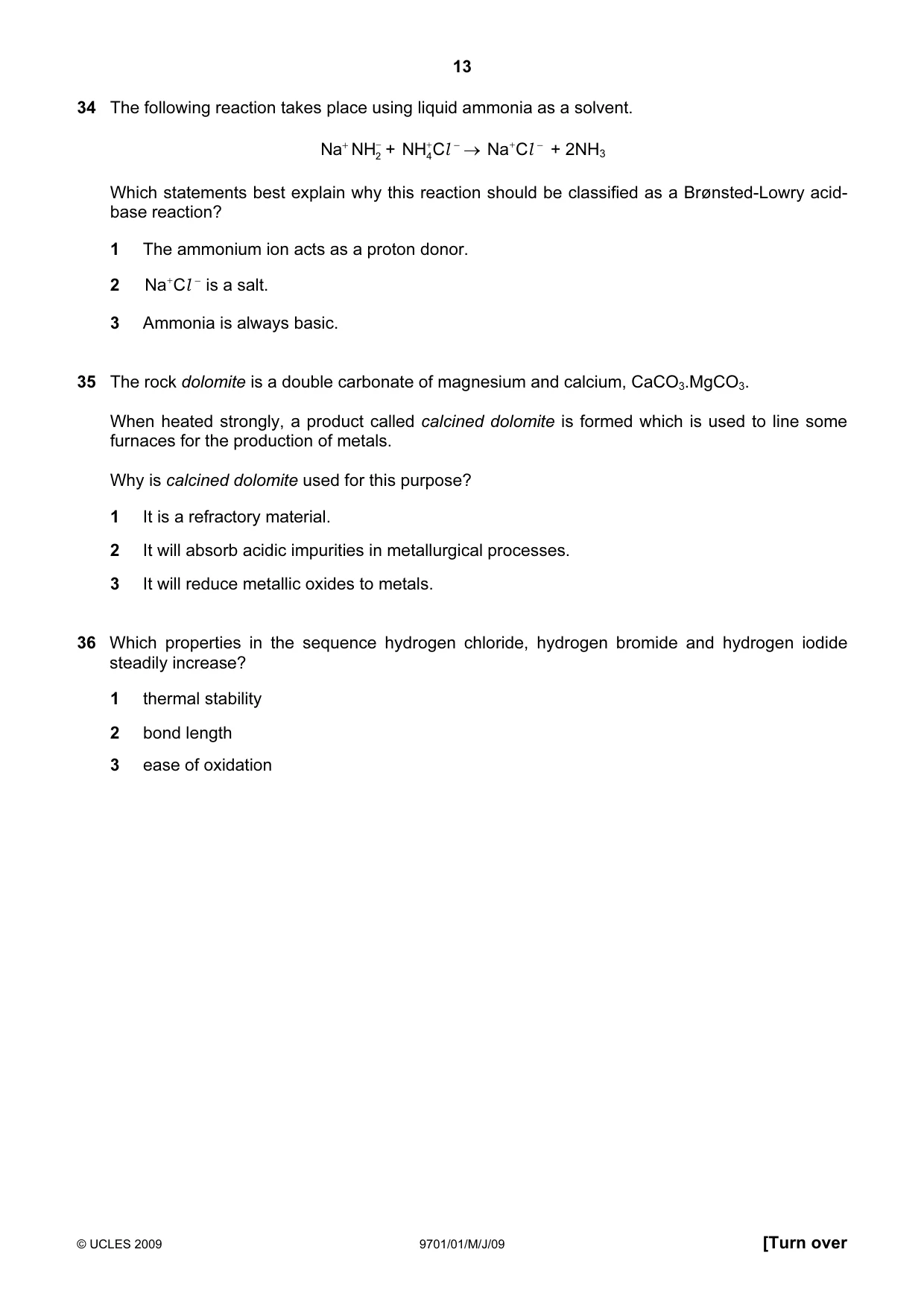
34 The following reaction takes place using liquid ammonia as a solvent. Na NH− + + NH C + l − → Na C + l + 2NH3 − 2 4 Which statements best explain why this reaction should be classified as a Brønsted-Lowry acid- base reaction? 1 The ammonium ion acts as a proton donor. 2 Na C + l − is a salt. 3 Ammonia is always basic.
Mark scheme: D
Q35 · The rock dolomite is a double carbonate of magnesium and calcium, CaCO3.MgCO3
35 The rock dolomite is a double carbonate of magnesium and calcium, CaCO3.MgCO3. When heated strongly, a product called calcined dolomite is formed which is used to line some furnaces for the production of metals. Why is calcined dolomite used for this purpose? 1 It is a refractory material. 2 It will absorb acidic impurities in metallurgical processes. 3 It will reduce metallic oxides to metals.
Mark scheme: B
Q36 · Which properties in the sequence hydrogen chloride, hydrogen bromide and hydrogen iodide…
36 Which properties in the sequence hydrogen chloride, hydrogen bromide and hydrogen iodide steadily increase? 1 thermal stability 2 bond length 3 ease of oxidation
Mark scheme: C
More questions on The chemical properties of the halogen elements and the hydrogen halides
Q37 · A fraction of distilled crude oil contains molecules with between 15 and 19 carbon atoms
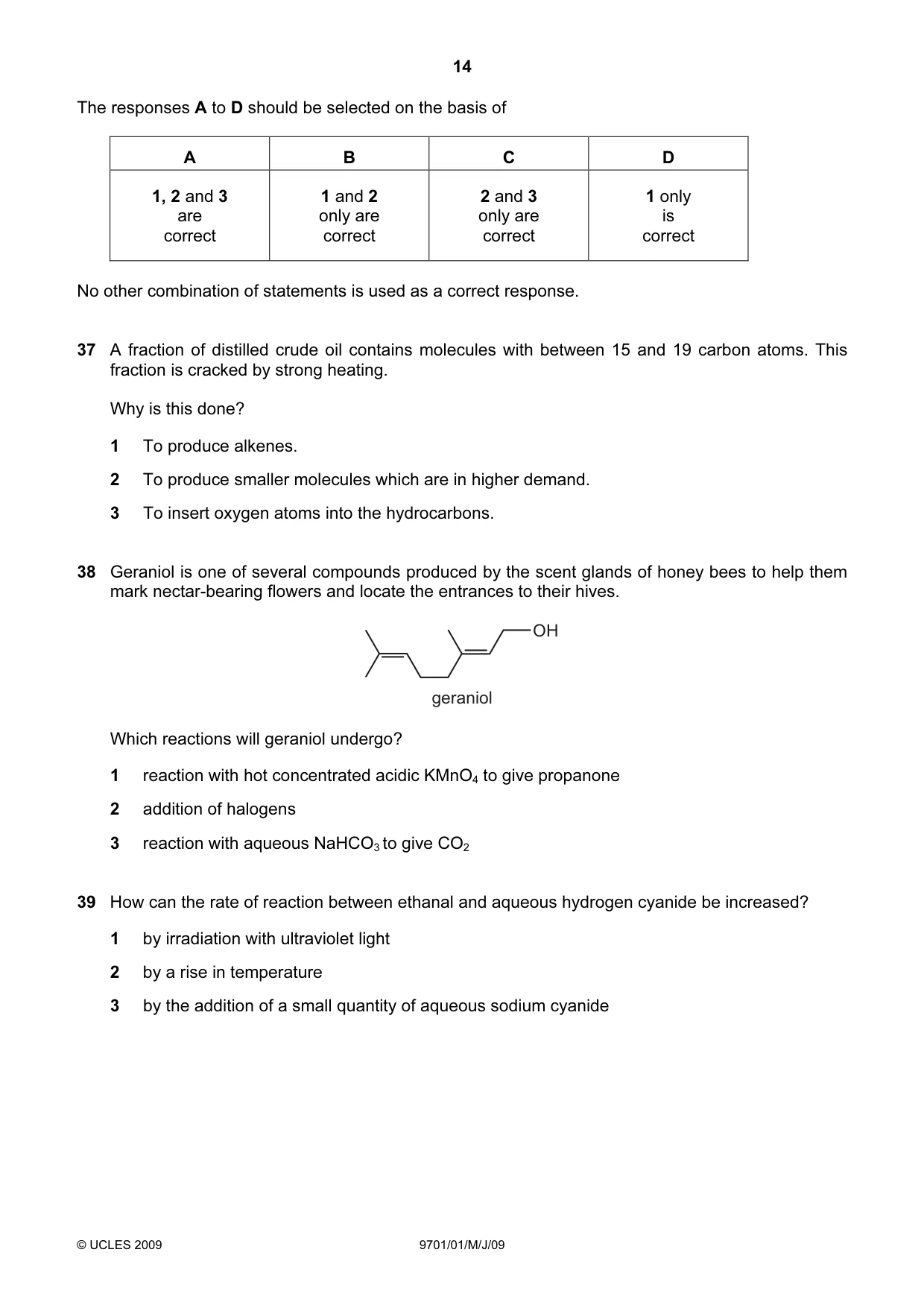
37 A fraction of distilled crude oil contains molecules with between 15 and 19 carbon atoms. This fraction is cracked by strong heating. Why is this done? 1 To produce alkenes. 2 To produce smaller molecules which are in higher demand. 3 To insert oxygen atoms into the hydrocarbons.
Mark scheme: B
Q38 · Geraniol is one of several compounds produced by the scent glands of honey bees to help…
38 Geraniol is one of several compounds produced by the scent glands of honey bees to help them mark nectar-bearing flowers and locate the entrances to their hives. OH geraniol Which reactions will geraniol undergo? 1 reaction with hot concentrated acidic KMnO4 to give propanone 2 addition of halogens 3 reaction with aqueous NaHCO3 to give CO2
Mark scheme: B
Q39 · How can the rate of reaction between ethanal and aqueous hydrogen cyanide be increased?
39 How can the rate of reaction between ethanal and aqueous hydrogen cyanide be increased? 1 by irradiation with ultraviolet light 2 by a rise in temperature 3 by the addition of a small quantity of aqueous sodium cyanide
Mark scheme: C
Q40 · A sun protection cream contains the following ester as its active ingredient
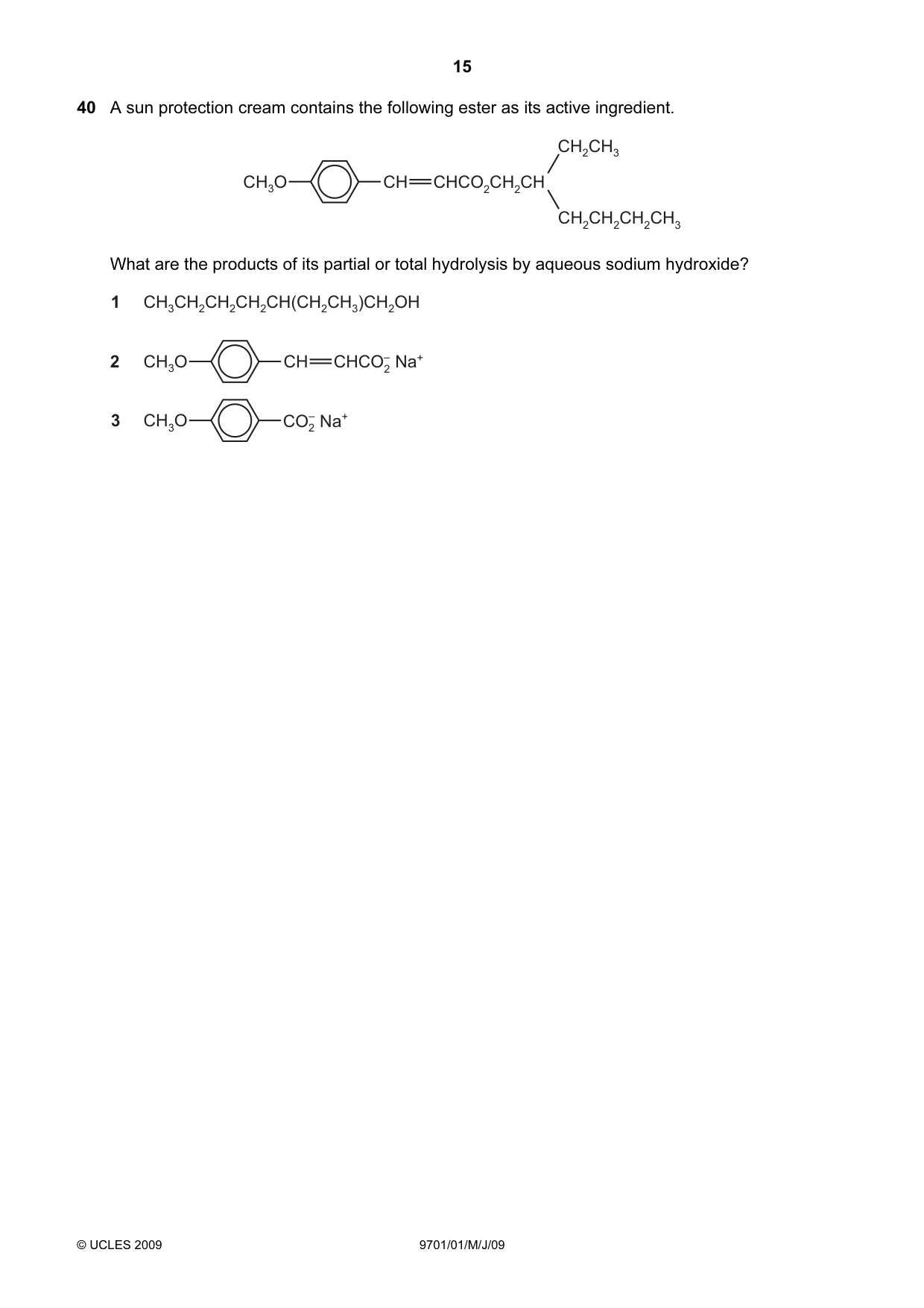
40 A sun protection cream contains the following ester as its active ingredient. CH2CH3 CH3O CH CHCO2CH2CH CH2CH2CH2CH3 What are the products of its partial or total hydrolysis by aqueous sodium hydroxide? 1 CH3CH2CH2CH2CH(CH2CH3)CH2OH 2 CH3O CH CHCO2 Na+ – 3 CH3O CO2 Na+ –
Mark scheme: B
What was in this paper
The subtopics covered by these 40 questions, and how many questions each got. Open one in a new tab to see every Cambridge question on it.
4Esters3Alkanes2Intermolecular forces, electronegativity and bond properties2Isomerism: structural isomerism and stereoisomerism2Shapes of organic molecules; σ and π bonds2Similarities and trends in the properties of the Group 2 metals, magnesium to barium, and their compounds2The chemical properties of the halogen elements and the hydrogen halides2Aldehydes and ketones1Brønsted–Lowry theory of acids and bases1Characteristic organic reactions1Covalent bonding and coordinate (dative covalent) bonding1Effect of temperature on reaction rates and the concept of activation energy1Electrolysis1Electrons, energy levels and atomic orbitals1Enthalpy change, ΔH1Formulas1General characteristic chemical properties of the first set of transition elements, titanium to copper1Halogenoalkanes1Hess’s law1Ionisation energy1Isotopes1Nitriles and hydroxynitriles1Nitrogen and sulfur1Particles in the atom and atomic radius1Physical properties of the Group 17 elements1Reacting masses and volumes (of solutions and gases)1Redox processes: electron transfer and changes in oxidation number (oxidation state)1The gaseous state: ideal and real gases and pV = nRT1What you needed in this session
Cambridge’s own grade thresholds for 2009 May/June, Paper 1 · Variant 1. A higher threshold means an easier paper — the bar moves with how the cohort did.