Cambridge A Level Chemistry 9701 — 2015 May/June Paper 1 · Variant 1
9701/11/M/J/15 · 40 questions · 40 marks · ≈45 min
The question paper and its mark scheme, free to read here and free to download. This is Cambridge’s own paper, exactly as it was sat.
Question paper16 pages
Mark scheme2 pages
Answers below. Sit the paper first if you are practising.
Questions as text
Q1 · The diagram shows a Boltzmann distribution of molecular energies for a gaseous mixture
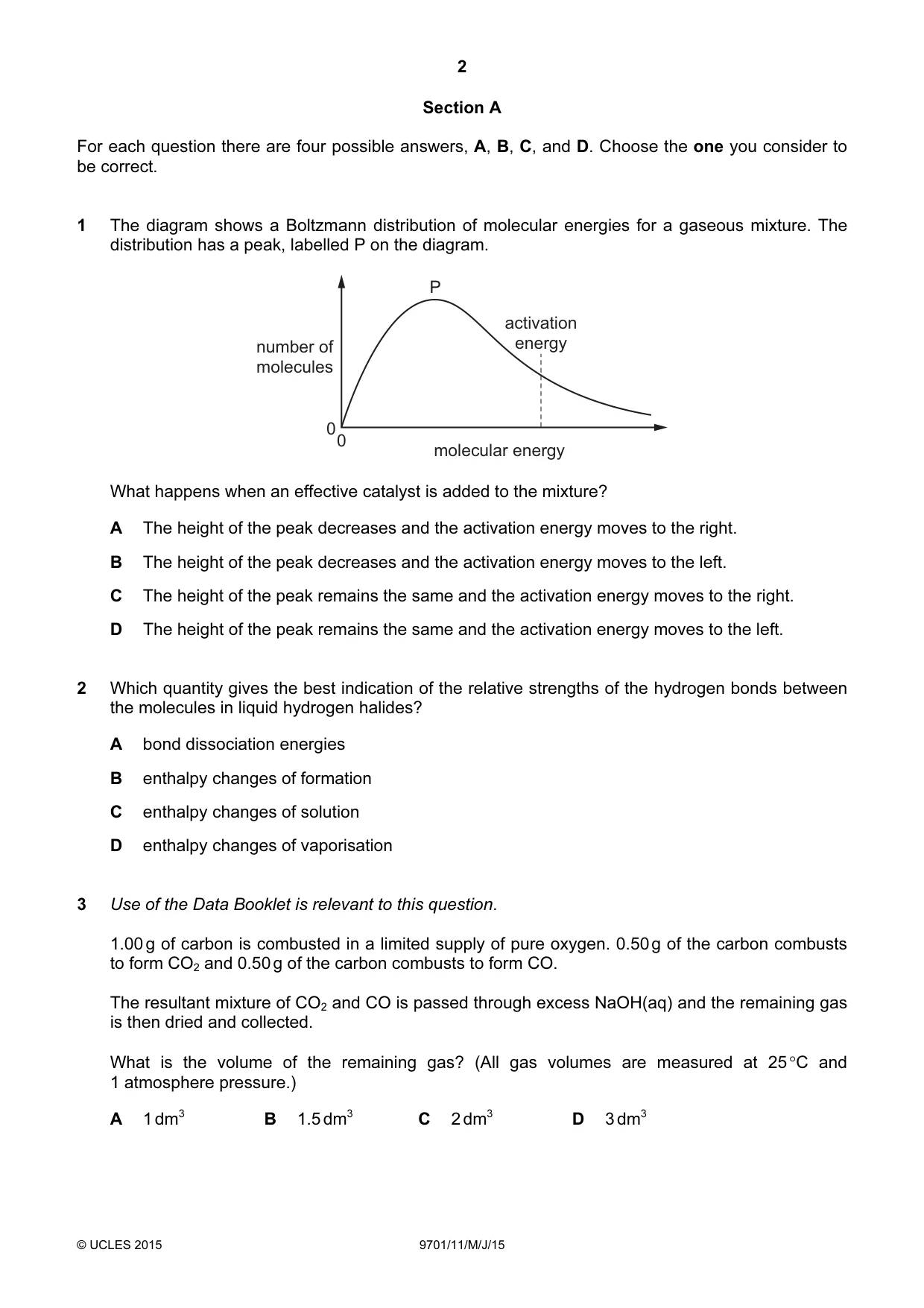
1 The diagram shows a Boltzmann distribution of molecular energies for a gaseous mixture. The distribution has a peak, labelled P on the diagram. P activation number of energy molecules 00 molecular energy What happens when an effective catalyst is added to the mixture? A The height of the peak decreases and the activation energy moves to the right. B The height of the peak decreases and the activation energy moves to the left. C The height of the peak remains the same and the activation energy moves to the right. D The height of the peak remains the same and the activation energy moves to the left.
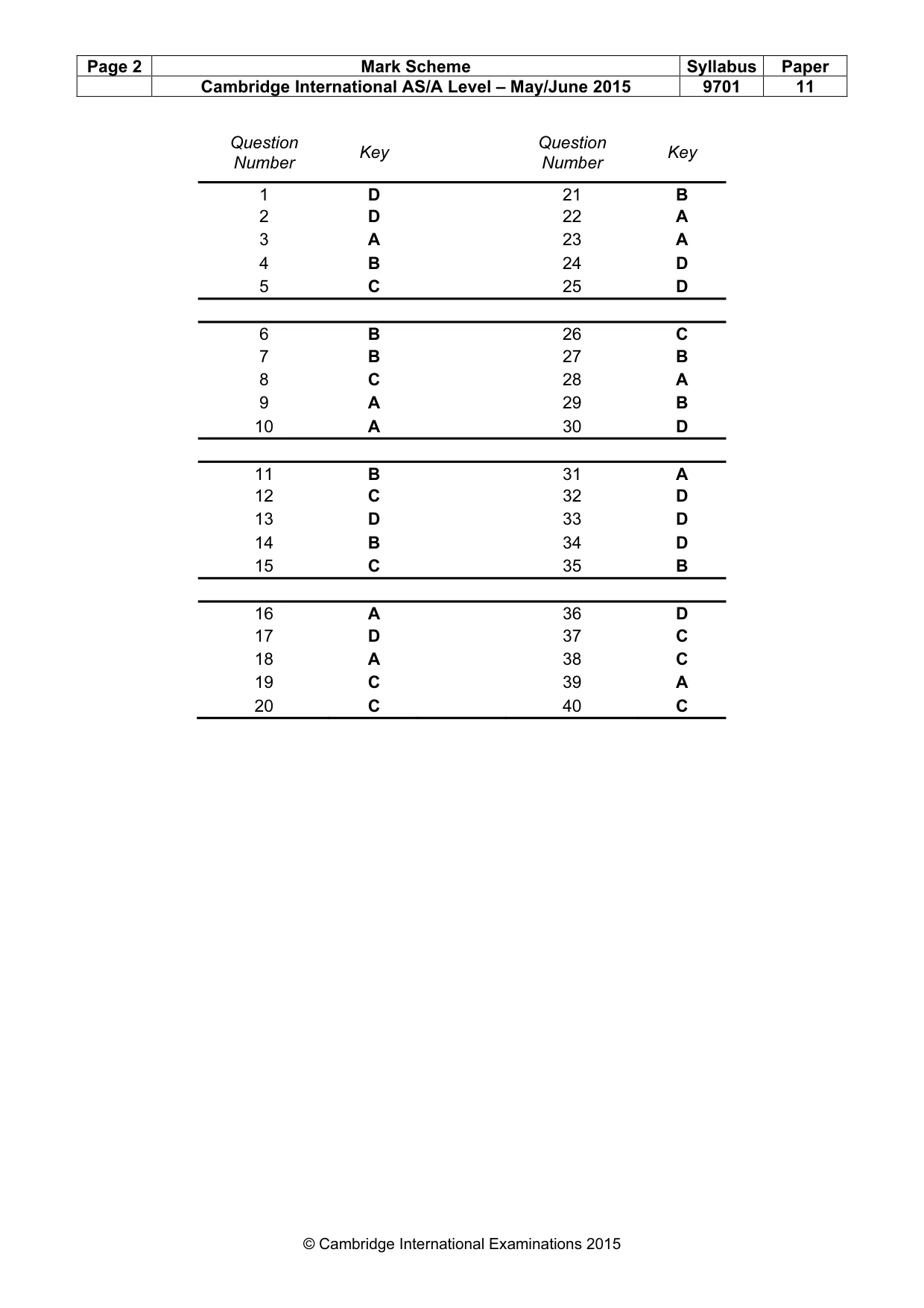
Mark scheme: D
More questions on Effect of temperature on reaction rates and the concept of activation energy
Q2 · Which quantity gives the best indication of the relative strengths of the hydrogen bonds…
2 Which quantity gives the best indication of the relative strengths of the hydrogen bonds between the molecules in liquid hydrogen halides? A bond dissociation energies B enthalpy changes of formation C enthalpy changes of solution D enthalpy changes of vaporisation
Mark scheme: D
More questions on Intermolecular forces, electronegativity and bond properties
Q3 · Use of the Data Booklet is relevant to this question
3 Use of the Data Booklet is relevant to this question. 1.00 g of carbon is combusted in a limited supply of pure oxygen. 0.50 g of the carbon combusts to form CO2 and 0.50 g of the carbon combusts to form CO. The resultant mixture of CO2 and CO is passed through excess NaOH(aq) and the remaining gas is then dried and collected. What is the volume of the remaining gas? (All gas volumes are measured at 25 °C and 1 atmosphere pressure.) A 1 dm3 B 1.5 dm3 C 2 dm3 D 3 dm3
Mark scheme: A
More questions on Reacting masses and volumes (of solutions and gases)
Q4 · In oxygen difluoride, OF2, fluorine has an oxidation number of –1
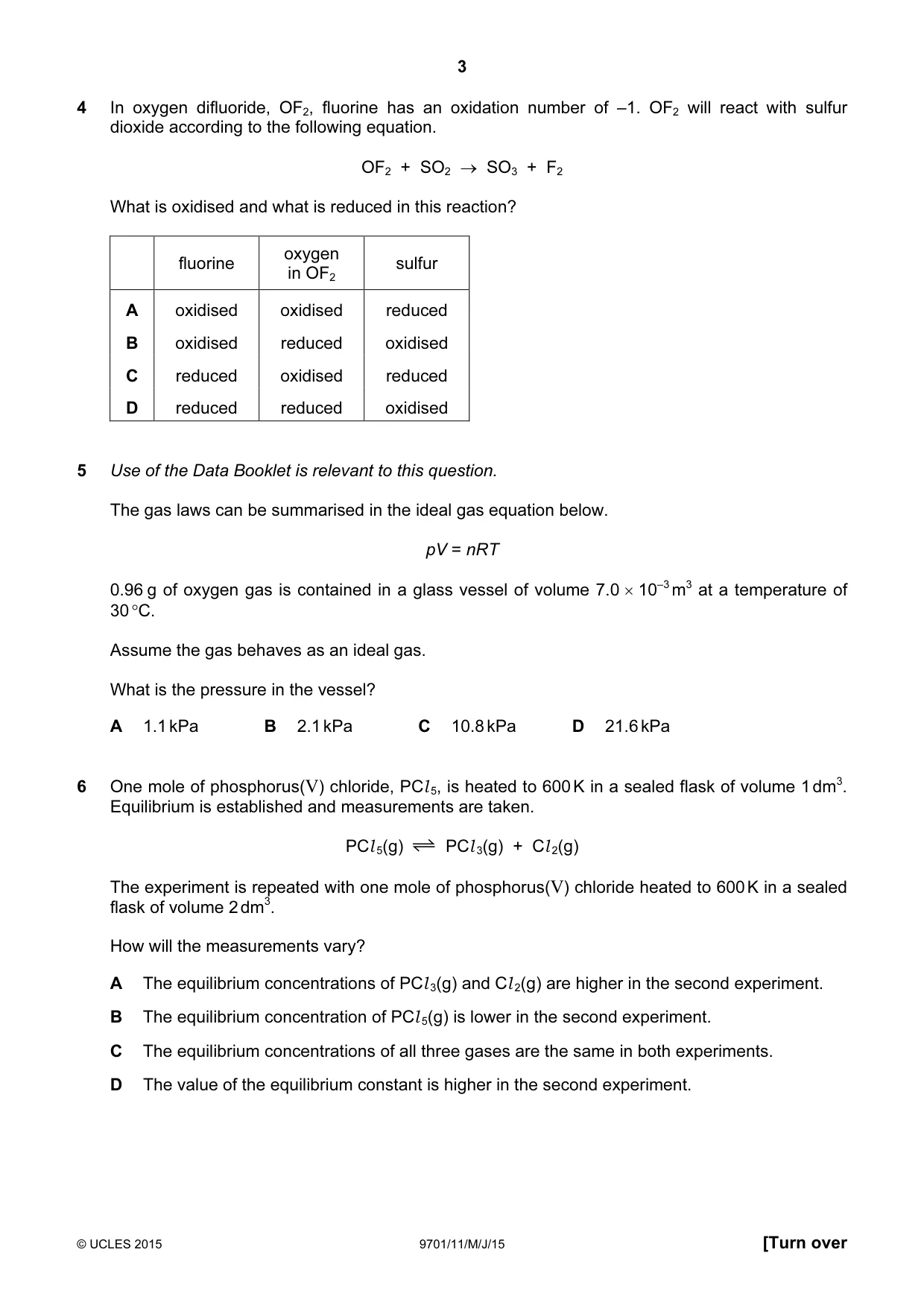
4 In oxygen difluoride, OF2, fluorine has an oxidation number of –1. OF2 will react with sulfur dioxide according to the following equation. OF2 + SO2 → SO3 + F2 What is oxidised and what is reduced in this reaction? oxygen fluorine sulfur in OF2 A oxidised oxidised reduced B oxidised reduced oxidised C reduced oxidised reduced D reduced reduced oxidised
Mark scheme: B
Q5 · Use of the Data Booklet is relevant to this question
5 Use of the Data Booklet is relevant to this question. The gas laws can be summarised in the ideal gas equation below. pV = nRT 0.96 g of oxygen gas is contained in a glass vessel of volume 7.0 × 10⁻³ m3 at a temperature of 30 °C. Assume the gas behaves as an ideal gas. What is the pressure in the vessel? A 1.1 kPa B 2.1 kPa C 10.8 kPa D 21.6 kPa
Mark scheme: C
More questions on The gaseous state: ideal and real gases and pV = nRT
Q6 · One mole of phosphorus(V) chloride, PCl 5, is heated to 600 K in a sealed flask of volume…
6 One mole of phosphorus(V) chloride, PCl 5, is heated to 600 K in a sealed flask of volume 1 dm3. Equilibrium is established and measurements are taken. PCl 5(g) PCl 3(g) + Cl 2(g) The experiment is repeated with one mole of phosphorus(V) chloride heated to 600 K in a sealed flask of volume 2 dm3. How will the measurements vary? A The equilibrium concentrations of PCl 3(g) and Cl 2(g) are higher in the second experiment. B The equilibrium concentration of PCl 5(g) is lower in the second experiment. C The equilibrium concentrations of all three gases are the same in both experiments. D The value of the equilibrium constant is higher in the second experiment.
Mark scheme: B
More questions on Chemical equilibria: reversible reactions, dynamic equilibrium
Q7 · The standard enthalpy changes of combustion of glucose and ethanol are given as –2820 and…
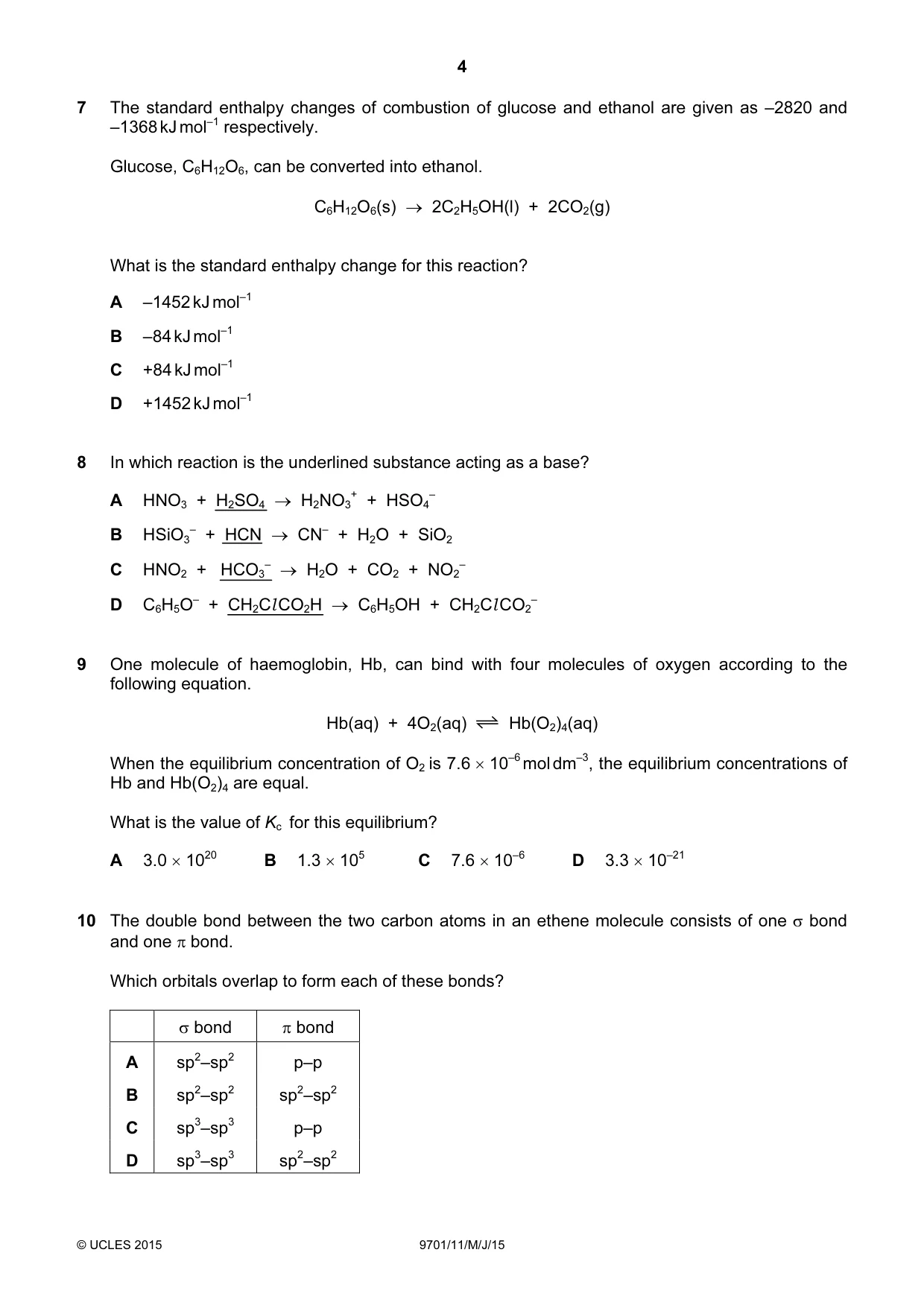
7 The standard enthalpy changes of combustion of glucose and ethanol are given as –2820 and –1368 kJ mol–1 respectively. Glucose, C6H12O6, can be converted into ethanol. C6H12O6(s) → 2C2H5OH(l) + 2CO2(g) What is the standard enthalpy change for this reaction? A –1452 kJ mol–1 B –84 kJ mol–1 C +84 kJ mol–1 D +1452 kJ mol–1
Mark scheme: B
Q8 · In which reaction is the underlined substance acting as a base?
8 In which reaction is the underlined substance acting as a base? A HNO3 + H2SO4 → H2NO3 + + HSO4 – B HSiO3 – + HCN → CN– + H2O + SiO2 C HNO2 + HCO3 – → H2O + CO2 + NO2 – D C6H5O– + CH2Cl CO2H → C6H5OH + CH2Cl CO2 –
Mark scheme: C
Q9 · One molecule of haemoglobin, Hb, can bind with four molecules of oxygen according to the…
9 One molecule of haemoglobin, Hb, can bind with four molecules of oxygen according to the following equation. Hb(aq) + 4O2(aq) Hb(O2)4(aq) When the equilibrium concentration of O2 is 7.6 × 10⁻⁶ mol dm–3, the equilibrium concentrations of Hb and Hb(O2)4 are equal. What is the value of Kc for this equilibrium? A 3.0 × 10²⁰ B 1.3 × 10⁵ C 7.6 × 10⁻⁶ D 3.3 × 10⁻²¹
Mark scheme: A
More questions on Chemical equilibria: reversible reactions, dynamic equilibrium
Q10 · The double bond between the two carbon atoms in an ethene molecule consists of one σ bond…
10 The double bond between the two carbon atoms in an ethene molecule consists of one σ bond and one π bond. Which orbitals overlap to form each of these bonds? σ bond π bond A sp2–sp2 p–p B sp2–sp2 sp2–sp2 C sp3–sp3 p–p D sp3–sp3 sp2–sp2
Mark scheme: A
More questions on Shapes of organic molecules; σ and π bonds
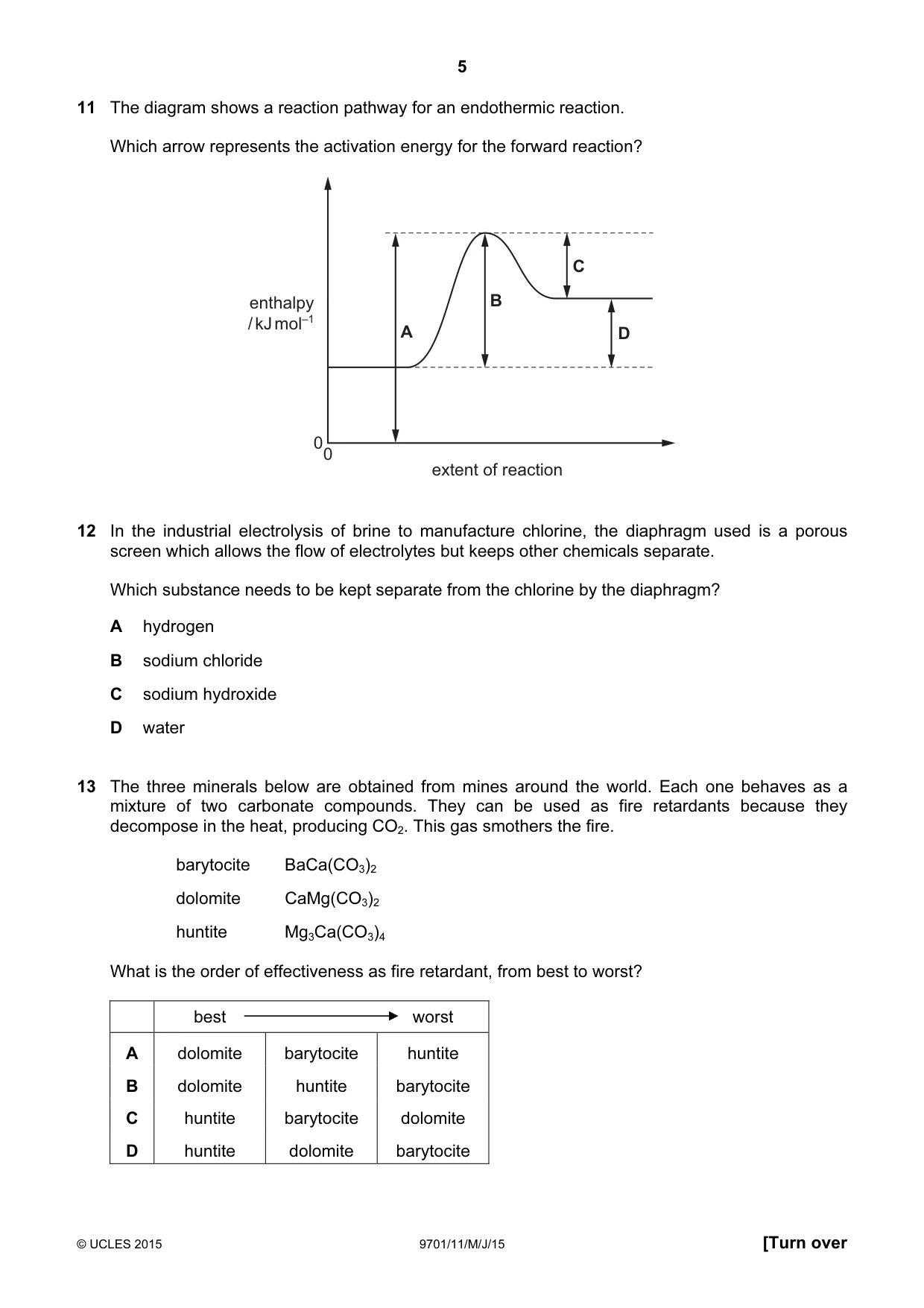
Q11 · The diagram shows a reaction pathway for an endothermic reaction
11 The diagram shows a reaction pathway for an endothermic reaction. Which arrow represents the activation energy for the forward reaction? C enthalpy B / kJ mol–1 A D 00 extent of reaction
Mark scheme: B
Q12 · In the industrial electrolysis of brine to manufacture chlorine, the diaphragm used is a…
12 In the industrial electrolysis of brine to manufacture chlorine, the diaphragm used is a porous screen which allows the flow of electrolytes but keeps other chemicals separate. Which substance needs to be kept separate from the chlorine by the diaphragm? A hydrogen B sodium chloride C sodium hydroxide D water
Mark scheme: C
Q13 · The three minerals below are obtained from mines around the world
13 The three minerals below are obtained from mines around the world. Each one behaves as a mixture of two carbonate compounds. They can be used as fire retardants because they decompose in the heat, producing CO2. This gas smothers the fire. barytocite BaCa(CO3)2 dolomite CaMg(CO3)2 huntite Mg3Ca(CO3)4 What is the order of effectiveness as fire retardant, from best to worst? best worst A dolomite barytocite huntite B dolomite huntite barytocite C huntite barytocite dolomite D huntite dolomite barytocite
Mark scheme: D
Q14 · Which observations are made when a sample of silicon chloride, SiCl 4, is added to a…
14 Which observations are made when a sample of silicon chloride, SiCl 4, is added to a beaker of water? A No visible changes are observed. B Steamy fumes and a white precipitate are both observed. C The appearance of a white precipitate is the only observation. D The appearance of steamy fumes is the only observation.
Mark scheme: B
More questions on Periodicity of chemical properties of the elements in Period 3
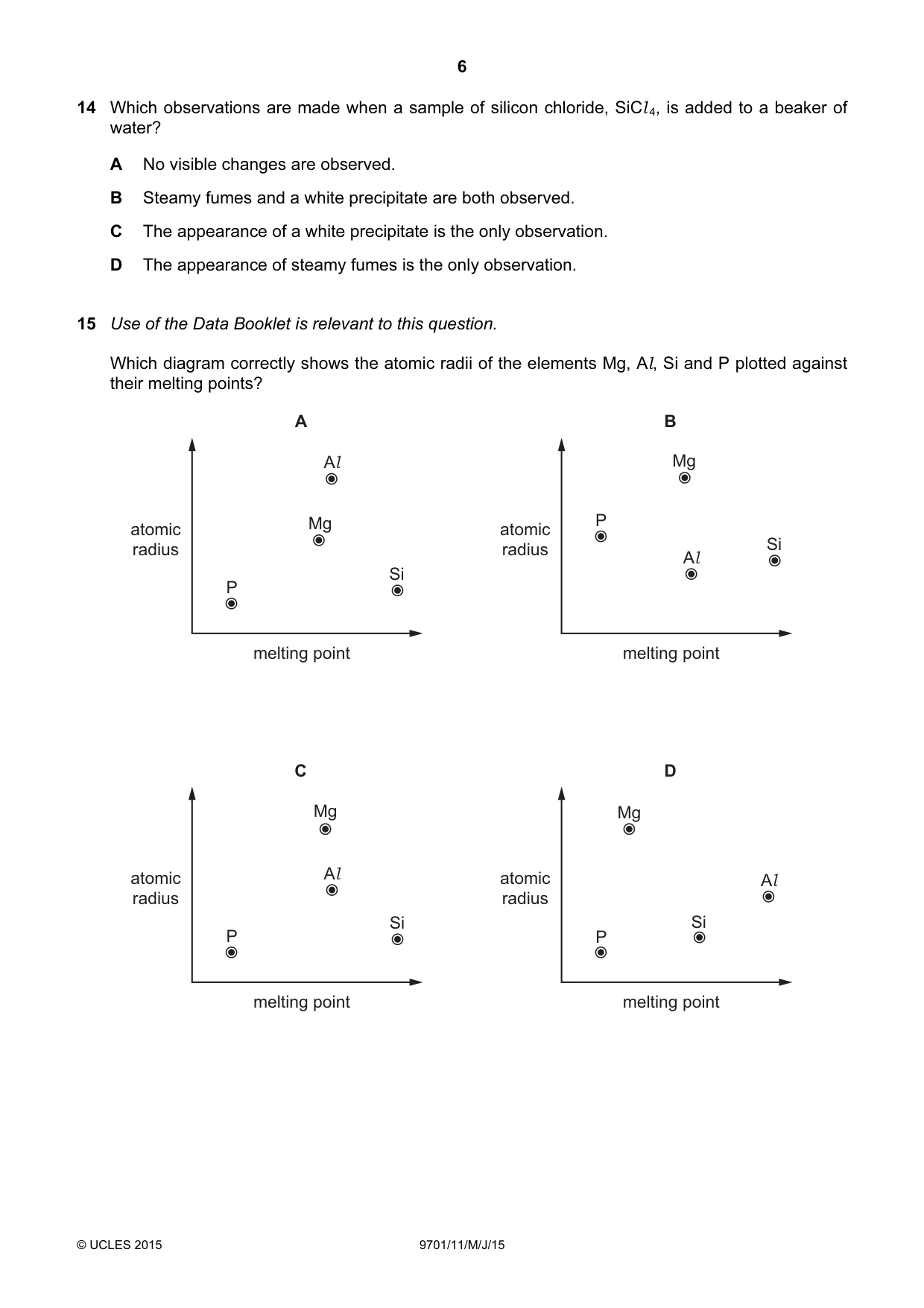
Q15 · Use of the Data Booklet is relevant to this question
15 Use of the Data Booklet is relevant to this question. Which diagram correctly shows the atomic radii of the elements Mg, Al, Si and P plotted against their melting points? A B Al Mg Mg P atomic atomic radius radius Si Al Si P melting point melting point C D Mg Mg atomic Al atomic Al radius radius Si Si P P melting point melting point
Mark scheme: C
More questions on Periodicity of physical properties of the elements in Period 3
Q16 · Chlorine is widely used in water treatment plants
16 Chlorine is widely used in water treatment plants. Which reaction takes place when chlorine dissolves in water? A Cl 2 + H2O → HCl + HCl O B 2Cl 2 + 2H2O → 3HCl + HCl O2 C 3Cl 2 + 3H2O → 5HCl + HCl O3 D 4Cl 2 + 4H2O → 7HCl + HCl O4
Mark scheme: A
Q17 · Astatine, At, is below iodine in Group VII of the Periodic Table
17 Astatine, At, is below iodine in Group VII of the Periodic Table. Which statement is most likely to be correct? A AgAt(s) reacts with excess dilute aqueous ammonia to form a solution of a soluble complex. B Astatine and KCl (aq) react to form KAt(aq) and chlorine. C KAt(aq) and dilute sulfuric acid react to form white fumes of HAt(g). D NaAt(s) and concentrated sulfuric acid react to form astatine.
Mark scheme: D
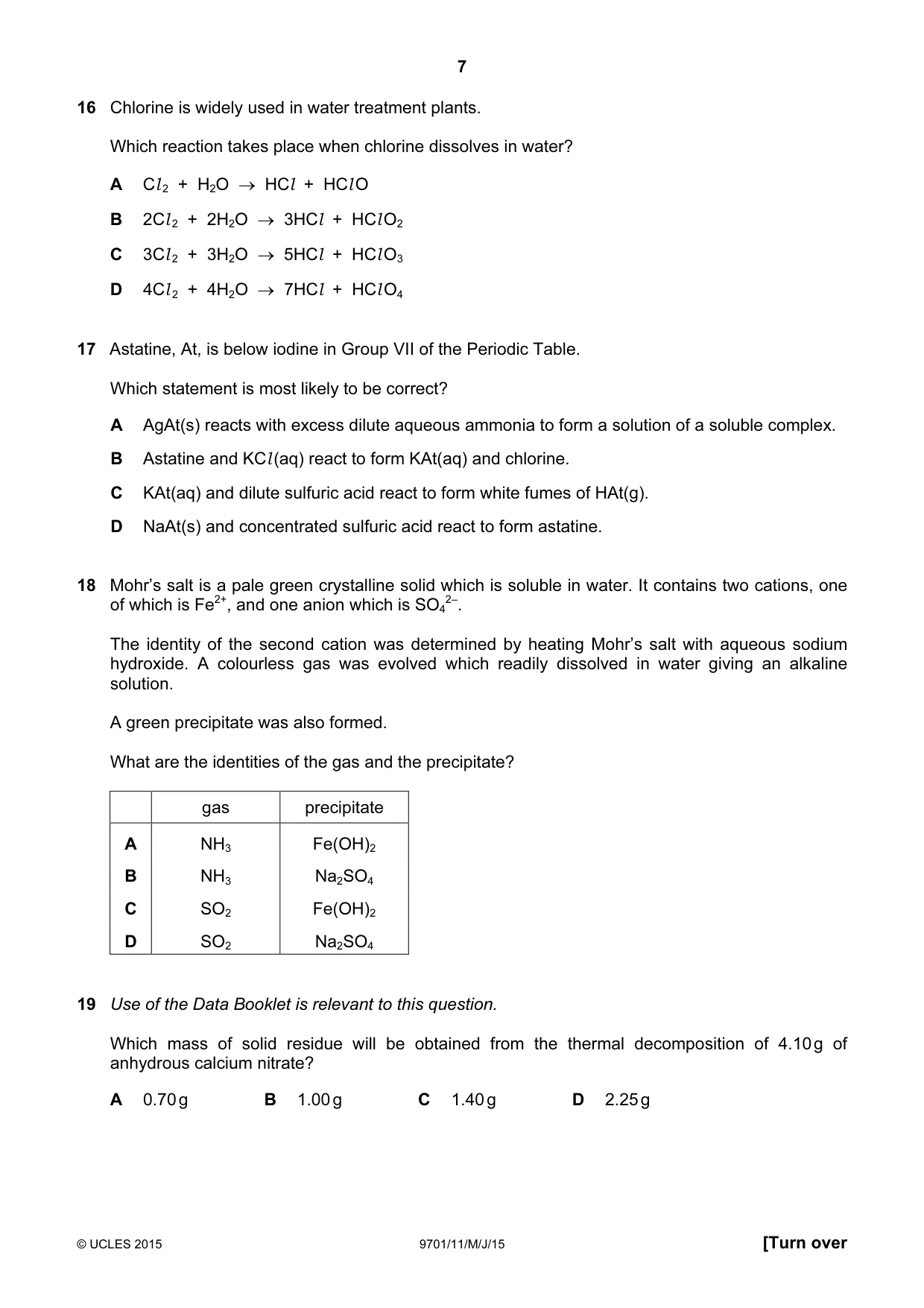
Q18 · Mohr’s salt is a pale green crystalline solid which is soluble in water
18 Mohr’s salt is a pale green crystalline solid which is soluble in water. It contains two cations, one of which is Fe2+, and one anion which is SO4 2–. The identity of the second cation was determined by heating Mohr’s salt with aqueous sodium hydroxide. A colourless gas was evolved which readily dissolved in water giving an alkaline solution. A green precipitate was also formed. What are the identities of the gas and the precipitate? gas precipitate A NH3 Fe(OH)2 B NH3 Na2SO4 C SO2 Fe(OH)2 D SO2 Na2SO4
Mark scheme: A
Q19 · Use of the Data Booklet is relevant to this question
19 Use of the Data Booklet is relevant to this question. Which mass of solid residue will be obtained from the thermal decomposition of 4.10 g of anhydrous calcium nitrate? A 0.70 g B 1.00 g C 1.40 g D 2.25 g
Mark scheme: C
Q20 · Which reagent will give a different observation with compounds P and Q?
20 Which reagent will give a different observation with compounds P and Q? HOCH2CH(OH)CHO HOCH2COCH2OH P Q A Br2(aq) B hot acidified KMnO4 C silver nitrate in ammonia solution D warm acidified K2Cr2O7
Mark scheme: C
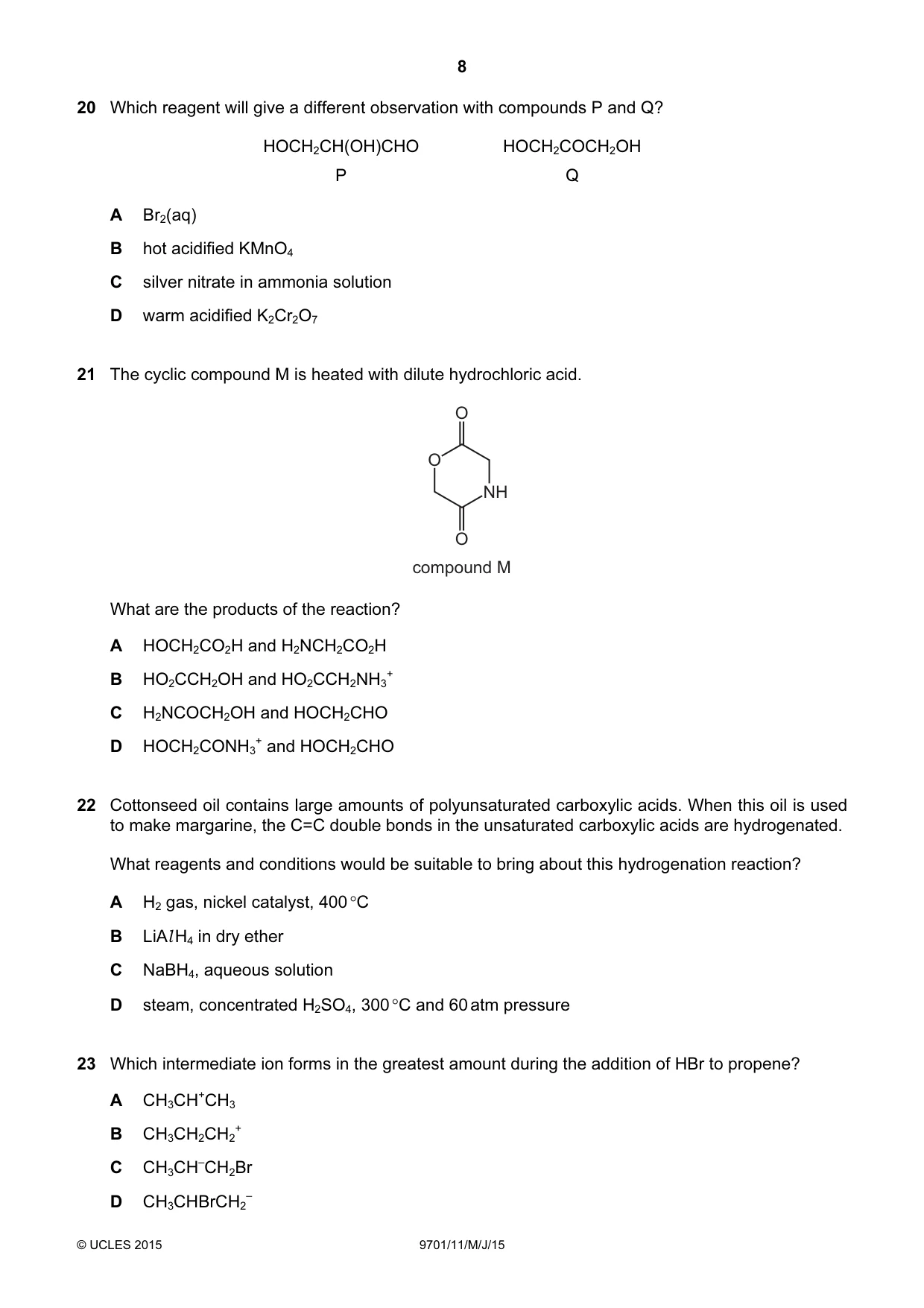
Q21 · The cyclic compound M is heated with dilute hydrochloric acid
21 The cyclic compound M is heated with dilute hydrochloric acid. O O NH O compound M What are the products of the reaction? A HOCH2CO2H and H2NCH2CO2H B HO2CCH2OH and HO2CCH2NH3 + C H2NCOCH2OH and HOCH2CHO D HOCH2CONH3 + and HOCH2CHO
Mark scheme: B
Q22 · Cottonseed oil contains large amounts of polyunsaturated carboxylic acids
22 Cottonseed oil contains large amounts of polyunsaturated carboxylic acids. When this oil is used to make margarine, the C=C double bonds in the unsaturated carboxylic acids are hydrogenated. What reagents and conditions would be suitable to bring about this hydrogenation reaction? A H2 gas, nickel catalyst, 400 °C B LiAl H4 in dry ether C NaBH4, aqueous solution D steam, concentrated H2SO4, 300 °C and 60 atm pressure
Mark scheme: A
Q23 · Which intermediate ion forms in the greatest amount during the addition of HBr to propene?
23 Which intermediate ion forms in the greatest amount during the addition of HBr to propene? A CH3CH+CH3 B CH3CH2CH2 + C CH3CH–CH2Br D CH3CHBrCH2 –
Mark scheme: A
Q24 · Coniine is the major constituent of the poison ‘oil of hemlock’
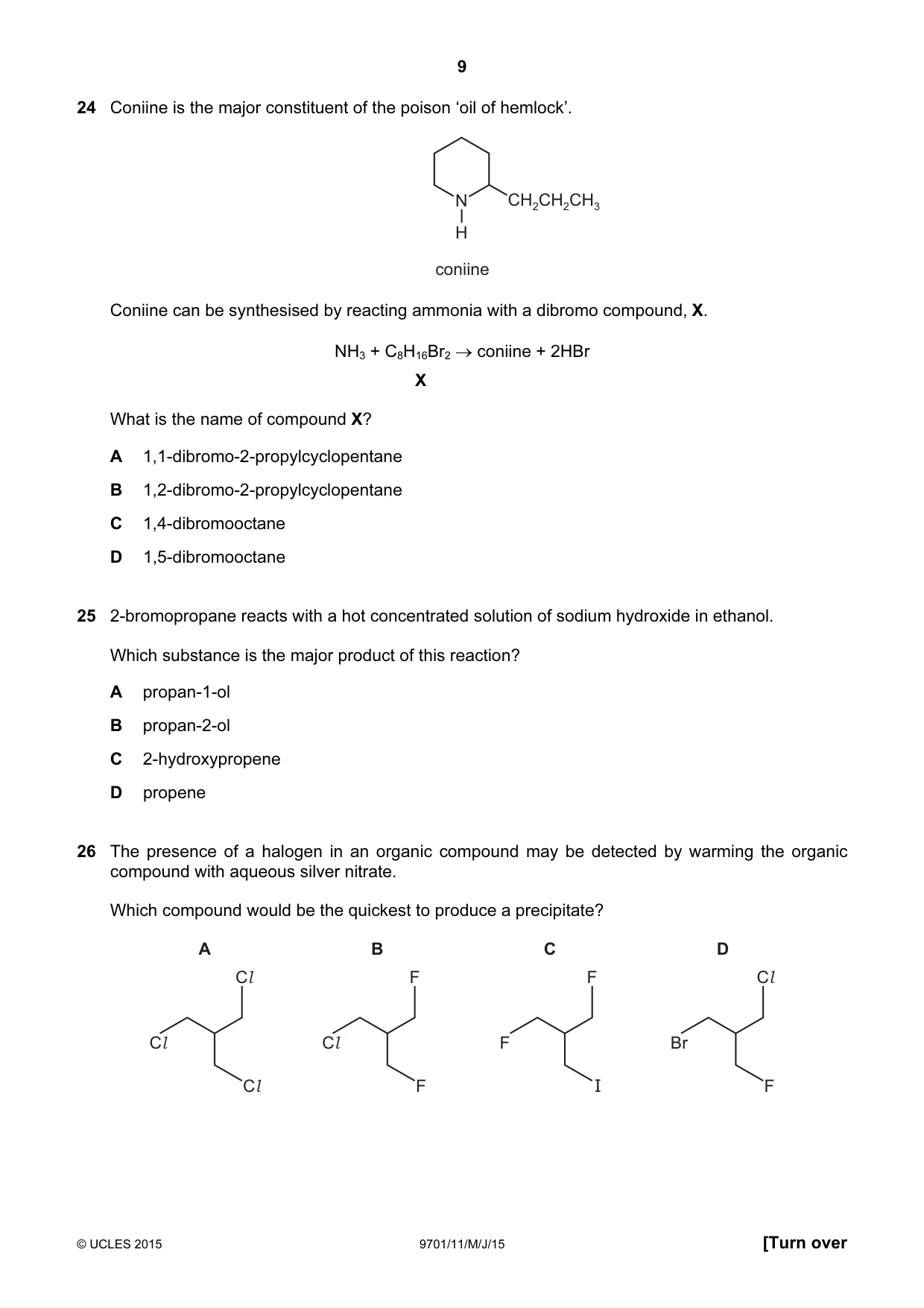
24 Coniine is the major constituent of the poison ‘oil of hemlock’. N CH2CH2CH3 H coniine Coniine can be synthesised by reacting ammonia with a dibromo compound, X. NH3 + C8H16Br2 → coniine + 2HBr X What is the name of compound X? A 1,1-dibromo-2-propylcyclopentane B 1,2-dibromo-2-propylcyclopentane C 1,4-dibromooctane D 1,5-dibromooctane
Mark scheme: D
Q25 · 2-bromopropane reacts with a hot concentrated solution of sodium hydroxide in ethanol
25 2-bromopropane reacts with a hot concentrated solution of sodium hydroxide in ethanol. Which substance is the major product of this reaction? A propan-1-ol B propan-2-ol C 2-hydroxypropene D propene
Mark scheme: D
Q26 · The presence of a halogen in an organic compound may be detected by warming the organic…
26 The presence of a halogen in an organic compound may be detected by warming the organic compound with aqueous silver nitrate. Which compound would be the quickest to produce a precipitate? A B C D Cl F F Cl Cl Cl F Br Cl F I F
Mark scheme: C
Q27 · Which reagent will give a different observation with compounds W and X?
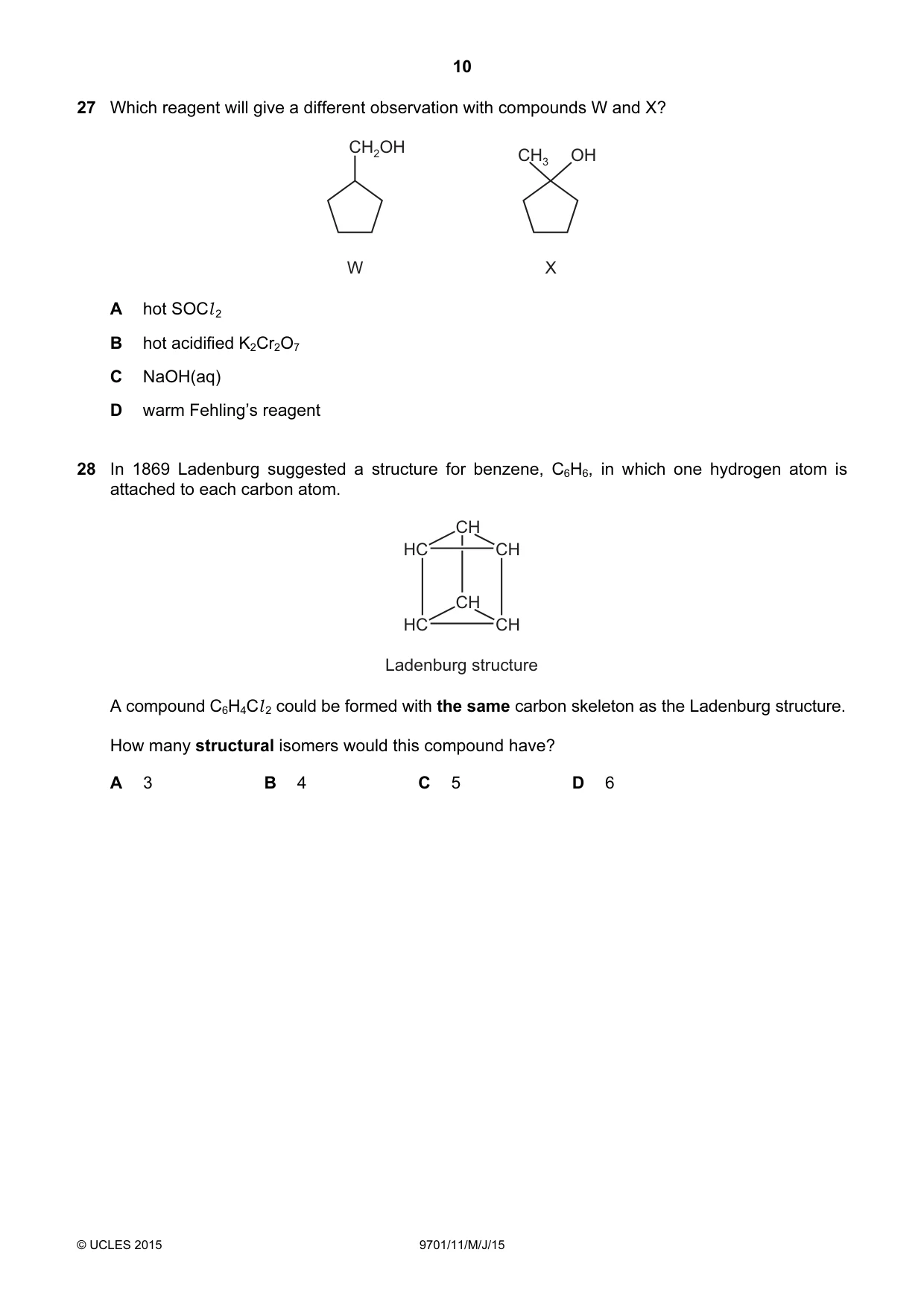
27 Which reagent will give a different observation with compounds W and X? CH2OH CH3 OH W X A hot SOCl 2 B hot acidified K2Cr2O7 C NaOH(aq) D warm Fehling’s reagent
Mark scheme: B
Q28 · In 1869 Ladenburg suggested a structure for benzene, C6H6, in which one hydrogen atom is…
28 In 1869 Ladenburg suggested a structure for benzene, C6H6, in which one hydrogen atom is attached to each carbon atom. CH HC CH CH HC CH Ladenburg structure A compound C6H4Cl 2 could be formed with the same carbon skeleton as the Ladenburg structure. How many structural isomers would this compound have? A 3 B 4 C 5 D 6
Mark scheme: A
More questions on Isomerism: structural isomerism and stereoisomerism
Q29 · The citrus flavour of lemons is due to the compound limonene, present in both the peel…
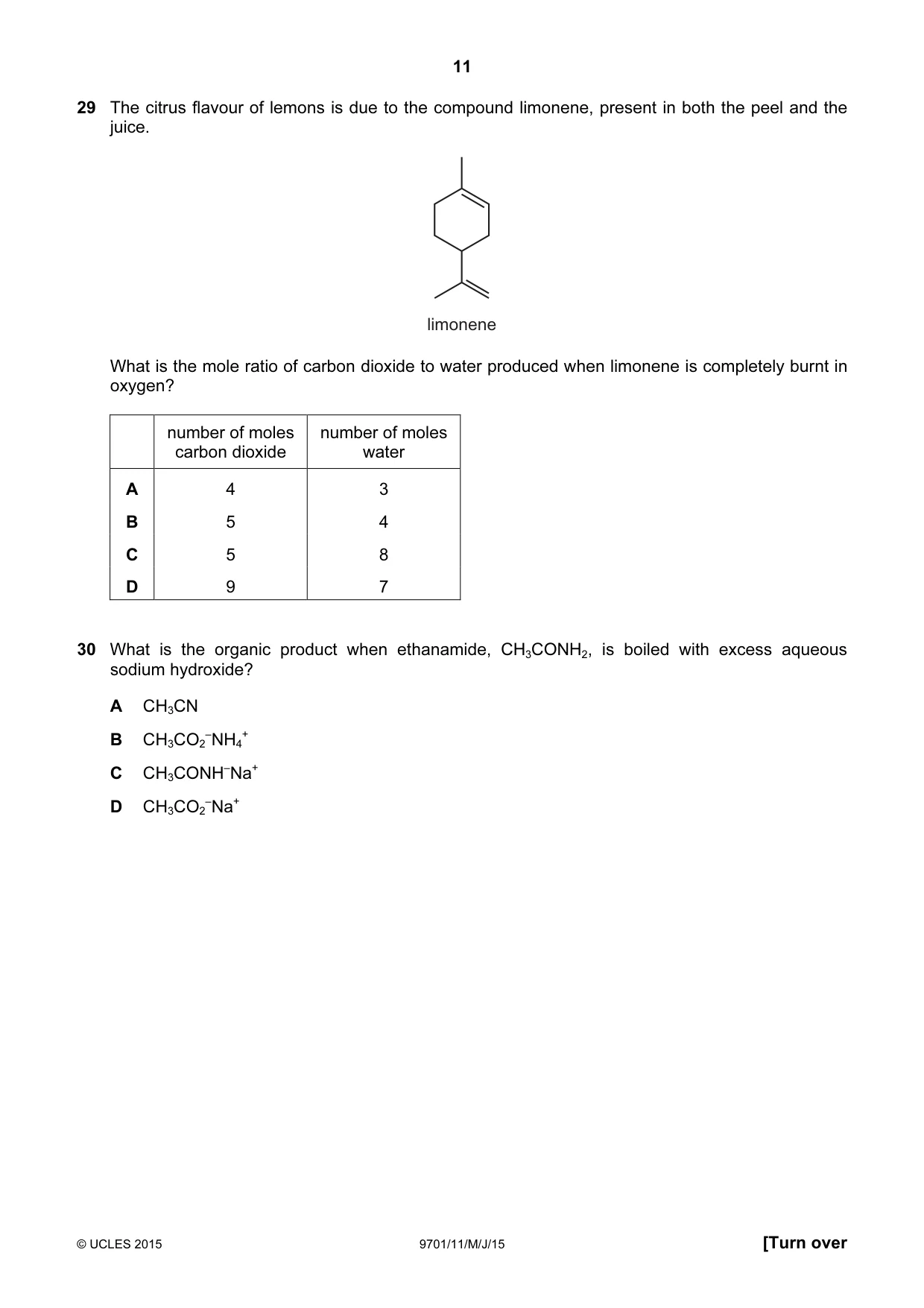
29 The citrus flavour of lemons is due to the compound limonene, present in both the peel and the juice. limonene What is the mole ratio of carbon dioxide to water produced when limonene is completely burnt in oxygen? number of moles number of moles carbon dioxide water A 4 3 B 5 4 C 5 8 D 9 7
Mark scheme: B
More questions on Reacting masses and volumes (of solutions and gases)
Q30 · What is the organic product when ethanamide, CH3CONH2, is boiled with excess aqueous…
30 What is the organic product when ethanamide, CH3CONH2, is boiled with excess aqueous sodium hydroxide? A CH3CN B CH3CO2 –NH4 + C CH3CONH–Na+ D CH3CO2 –Na+ Section B
Mark scheme: D
Q31 · Use of the Data Booklet is relevant to this question
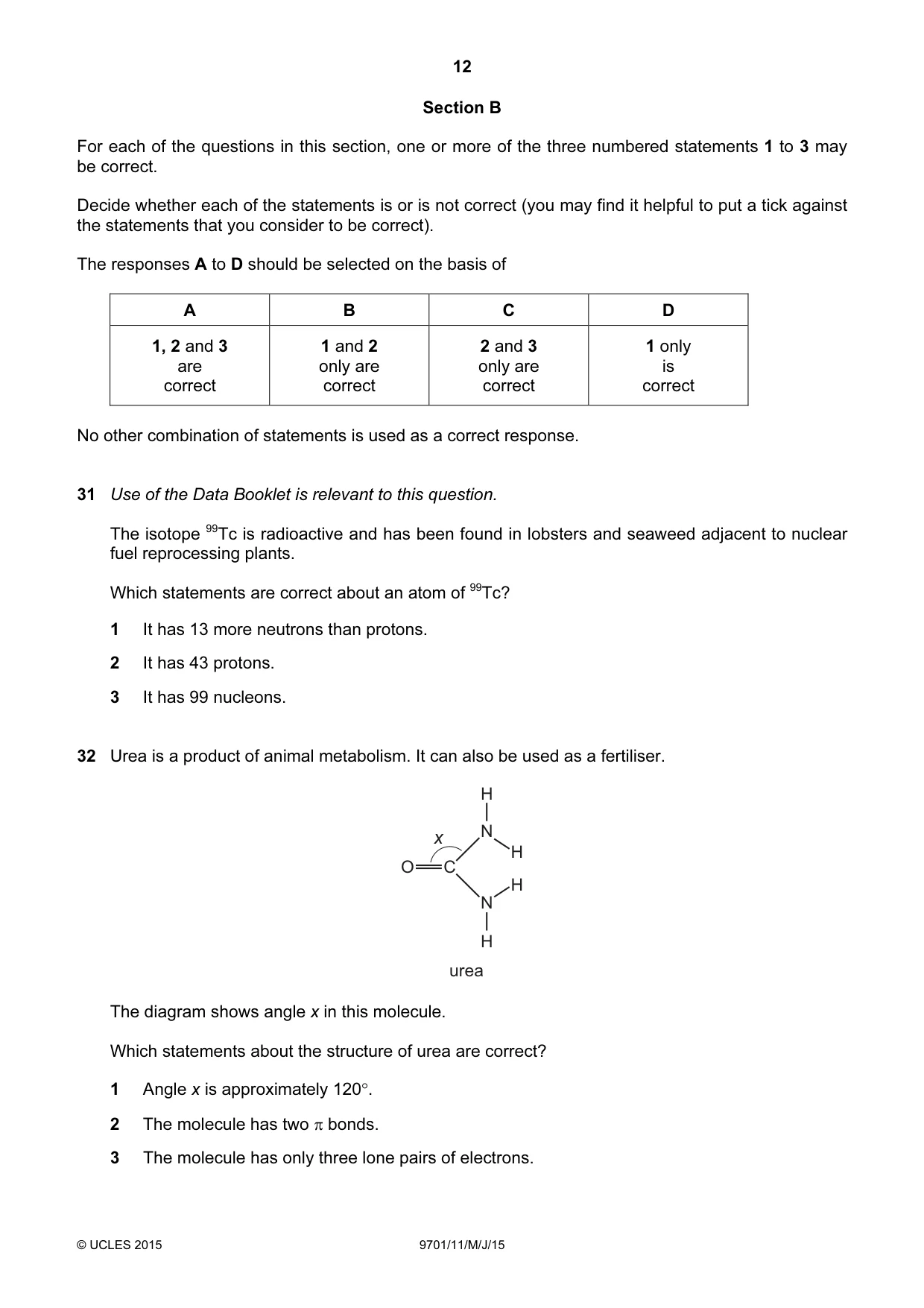
31 Use of the Data Booklet is relevant to this question. The isotope 99Tc is radioactive and has been found in lobsters and seaweed adjacent to nuclear fuel reprocessing plants. Which statements are correct about an atom of 99Tc? 1 It has 13 more neutrons than protons. 2 It has 43 protons. 3 It has 99 nucleons.
Mark scheme: A
Q32 · Urea is a product of animal metabolism
32 Urea is a product of animal metabolism. It can also be used as a fertiliser. H x N H O C H N H urea The diagram shows angle x in this molecule. Which statements about the structure of urea are correct? 1 Angle x is approximately 120°. 2 The molecule has two π bonds. 3 The molecule has only three lone pairs of electrons.
Mark scheme: D
Q33 · Aluminium is extracted from aluminium oxide by electrolysis
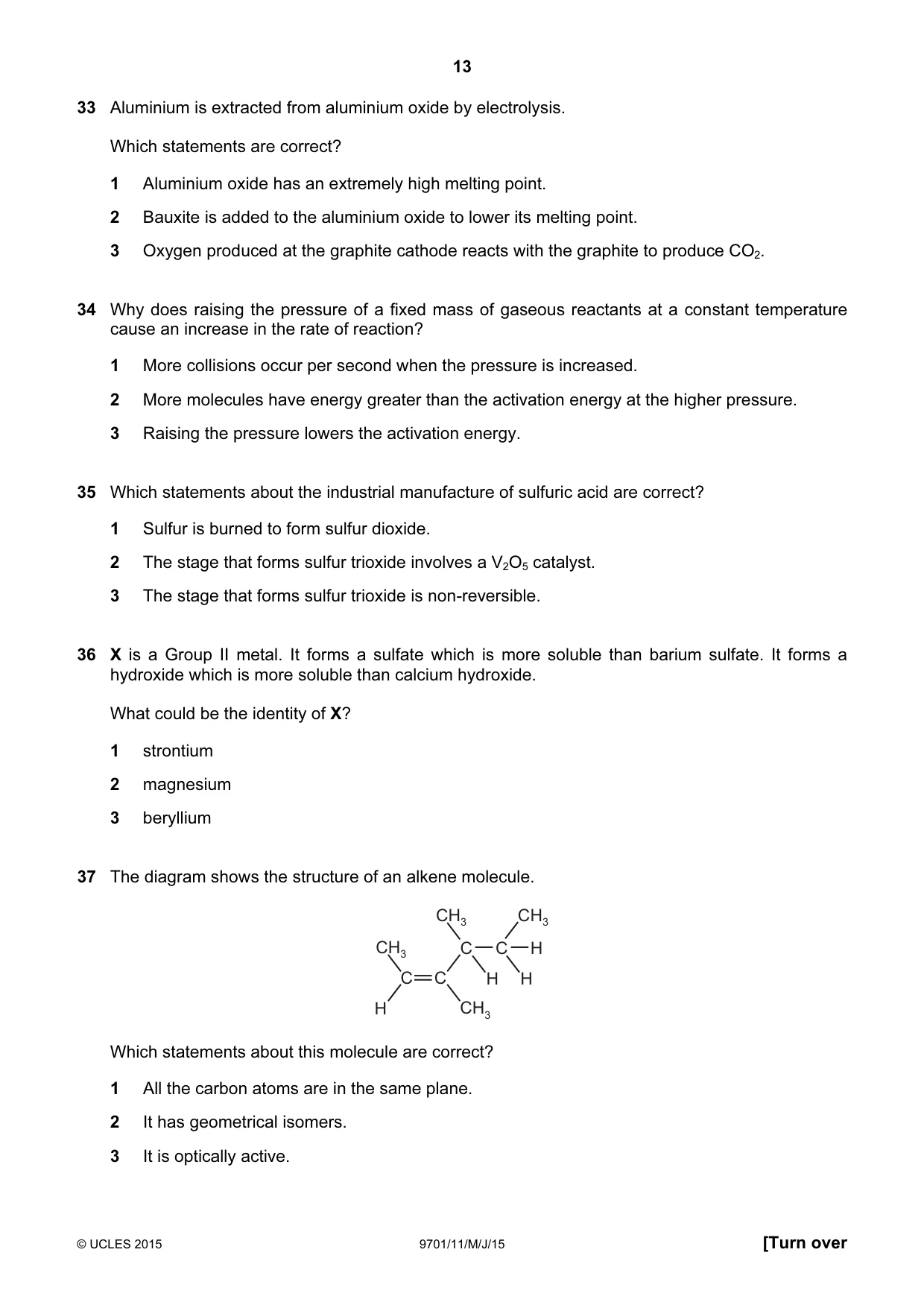
33 Aluminium is extracted from aluminium oxide by electrolysis. Which statements are correct? 1 Aluminium oxide has an extremely high melting point. 2 Bauxite is added to the aluminium oxide to lower its melting point. 3 Oxygen produced at the graphite cathode reacts with the graphite to produce CO2.
Mark scheme: D
Q34 · Why does raising the pressure of a fixed mass of gaseous reactants at a constant…
34 Why does raising the pressure of a fixed mass of gaseous reactants at a constant temperature cause an increase in the rate of reaction? 1 More collisions occur per second when the pressure is increased. 2 More molecules have energy greater than the activation energy at the higher pressure. 3 Raising the pressure lowers the activation energy.
Mark scheme: D
Q35 · Which statements about the industrial manufacture of sulfuric acid are correct?
35 Which statements about the industrial manufacture of sulfuric acid are correct? 1 Sulfur is burned to form sulfur dioxide. 2 The stage that forms sulfur trioxide involves a V2O5 catalyst. 3 The stage that forms sulfur trioxide is non-reversible.
Mark scheme: B
Q36 · X is a Group II metal
36 X is a Group II metal. It forms a sulfate which is more soluble than barium sulfate. It forms a hydroxide which is more soluble than calcium hydroxide. What could be the identity of X? 1 strontium 2 magnesium 3 beryllium
Mark scheme: D
Q37 · The diagram shows the structure of an alkene molecule
37 The diagram shows the structure of an alkene molecule. CH3 CH3 CH3 C C H C C H H H CH3 Which statements about this molecule are correct? 1 All the carbon atoms are in the same plane. 2 It has geometrical isomers. 3 It is optically active.
Mark scheme: C
More questions on Isomerism: structural isomerism and stereoisomerism
Q38 · An organic compound, X, will react with calcium metal to produce a salt with the…
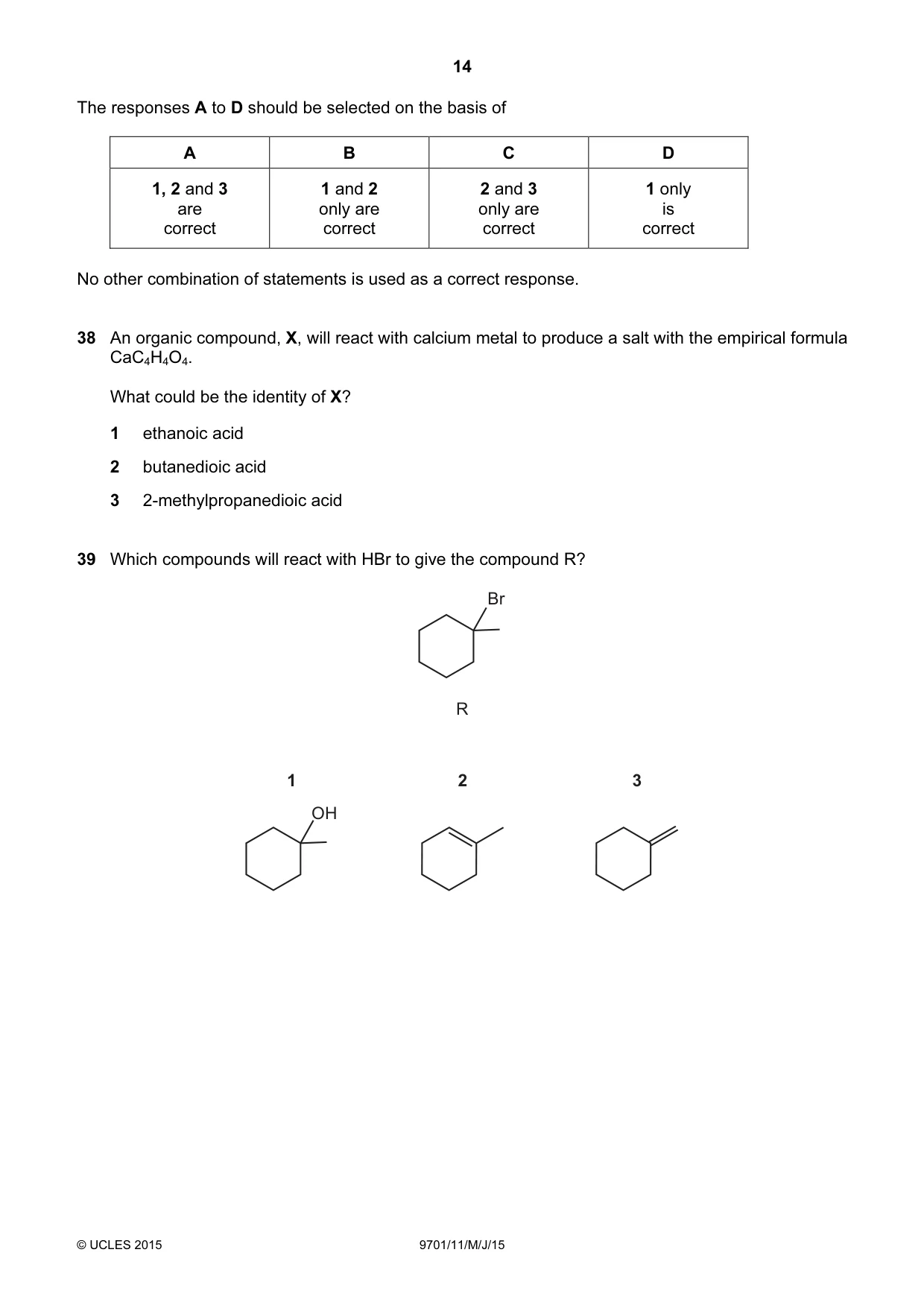
38 An organic compound, X, will react with calcium metal to produce a salt with the empirical formula CaC4H4O4. What could be the identity of X? 1 ethanoic acid 2 butanedioic acid 3 2-methylpropanedioic acid
Mark scheme: C
Q39 · Which compounds will react with HBr to give the compound R?
39 Which compounds will react with HBr to give the compound R? Br R 1 2 3 OH
Mark scheme: A
Q40 · 5-hydroxypentanoic acid is readily converted into the cyclic compound L
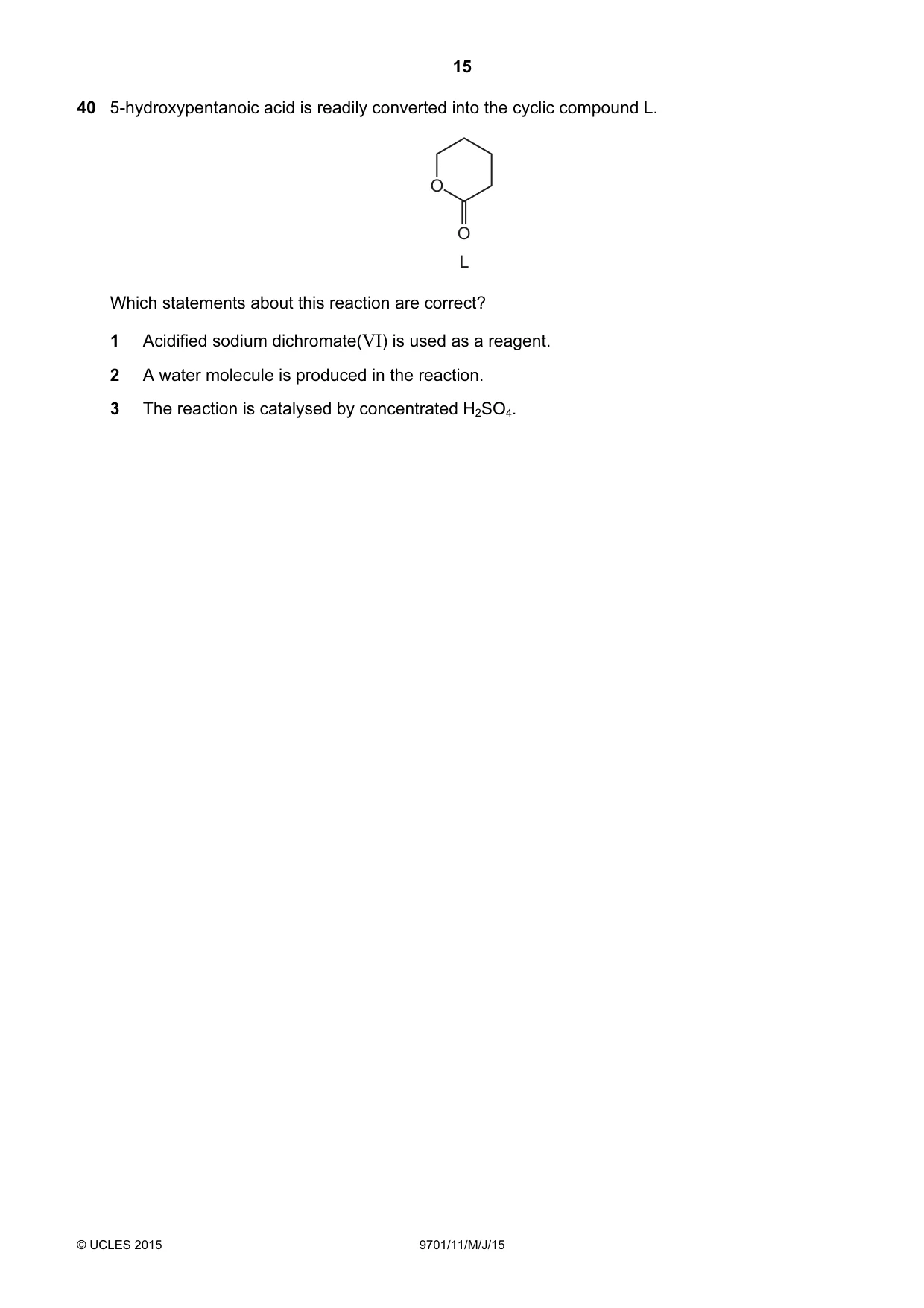
40 5-hydroxypentanoic acid is readily converted into the cyclic compound L. O O L Which statements about this reaction are correct? 1 Acidified sodium dichromate(VI) is used as a reagent. 2 A water molecule is produced in the reaction. 3 The reaction is catalysed by concentrated H2SO4.
Mark scheme: C
What was in this paper
The subtopics covered by these 40 questions, and how many questions each got. Open one in a new tab to see every Cambridge question on it.
3Similarities and trends in the properties of the Group 2 metals, magnesium to barium, and their compounds3Chemical equilibria: reversible reactions, dynamic equilibrium2Electrolysis2Isomerism: structural isomerism and stereoisomerism2Reacting masses and volumes (of solutions and gases)2Acids and bases1Acyl chlorides1Alcohols1Aldehydes and ketones1Amino acids1Carboxylic acids1Effect of temperature on reaction rates and the concept of activation energy1Enthalpy change, ΔH1Esters1General characteristic chemical properties of the first set of transition elements, titanium to copper1Halogen compounds1Halogenoalkanes1Hess’s law1Intermolecular forces, electronegativity and bond properties1Isotopes1Nitrogen and sulfur1Periodicity of chemical properties of the elements in Period 31Periodicity of physical properties of the elements in Period 31Primary and secondary amines1Rate of reaction1Redox processes: electron transfer and changes in oxidation number (oxidation state)1Shapes of molecules1Shapes of organic molecules; σ and π bonds1Some reactions of the halide ions1The gaseous state: ideal and real gases and pV = nRT1The reactions of chlorine1What you needed in this session
Cambridge’s own grade thresholds for 2015 May/June, Paper 1 · Variant 1. A higher threshold means an easier paper — the bar moves with how the cohort did.