Cambridge A Level Chemistry 9701 — 2011 Oct/Nov Paper 1 · Variant 1
9701/11/O/N/11 · 40 questions · 40 marks · ≈45 min
The question paper and its mark scheme, free to read here and free to download. This is Cambridge’s own paper, exactly as it was sat.
Question paper16 pages
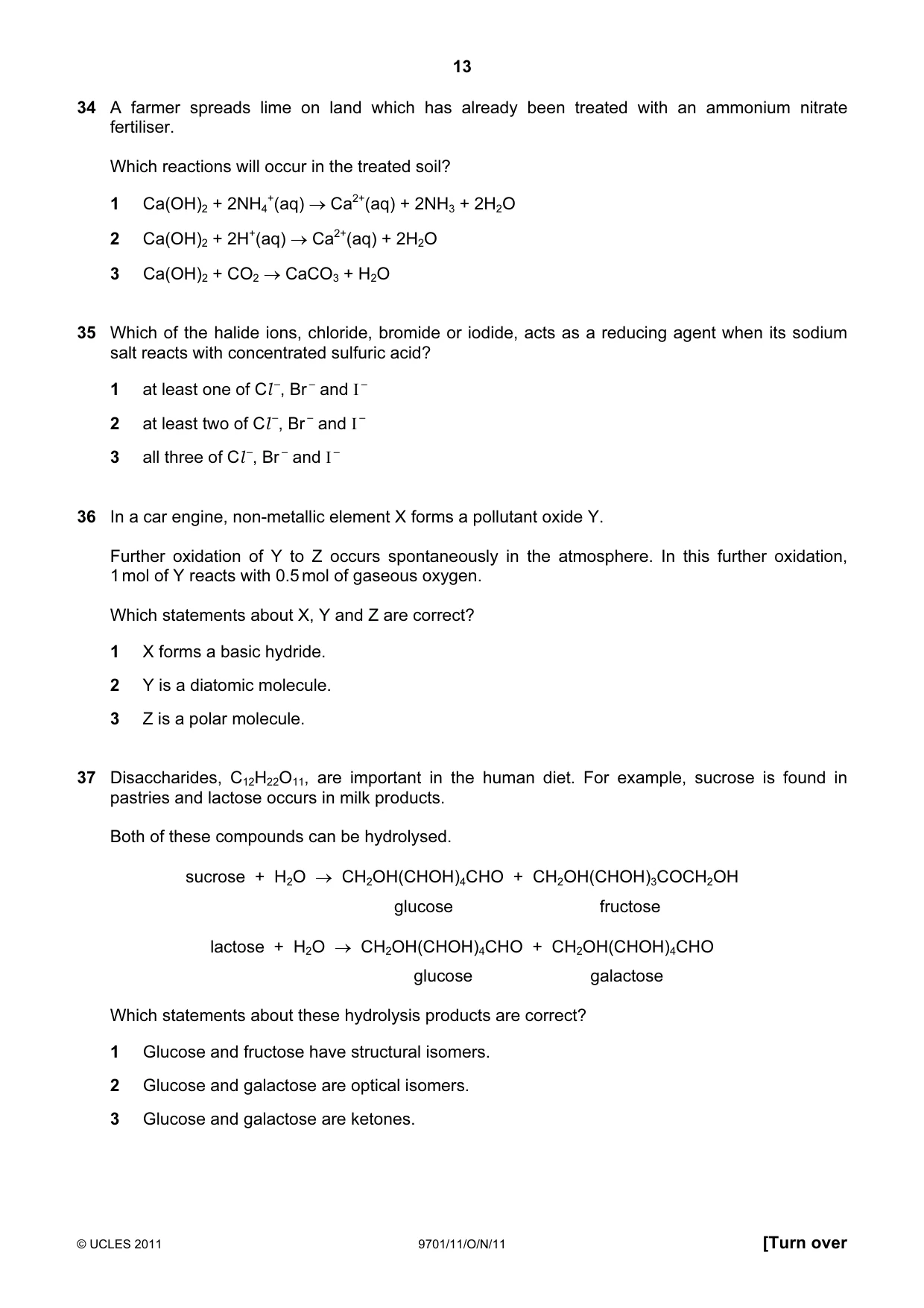
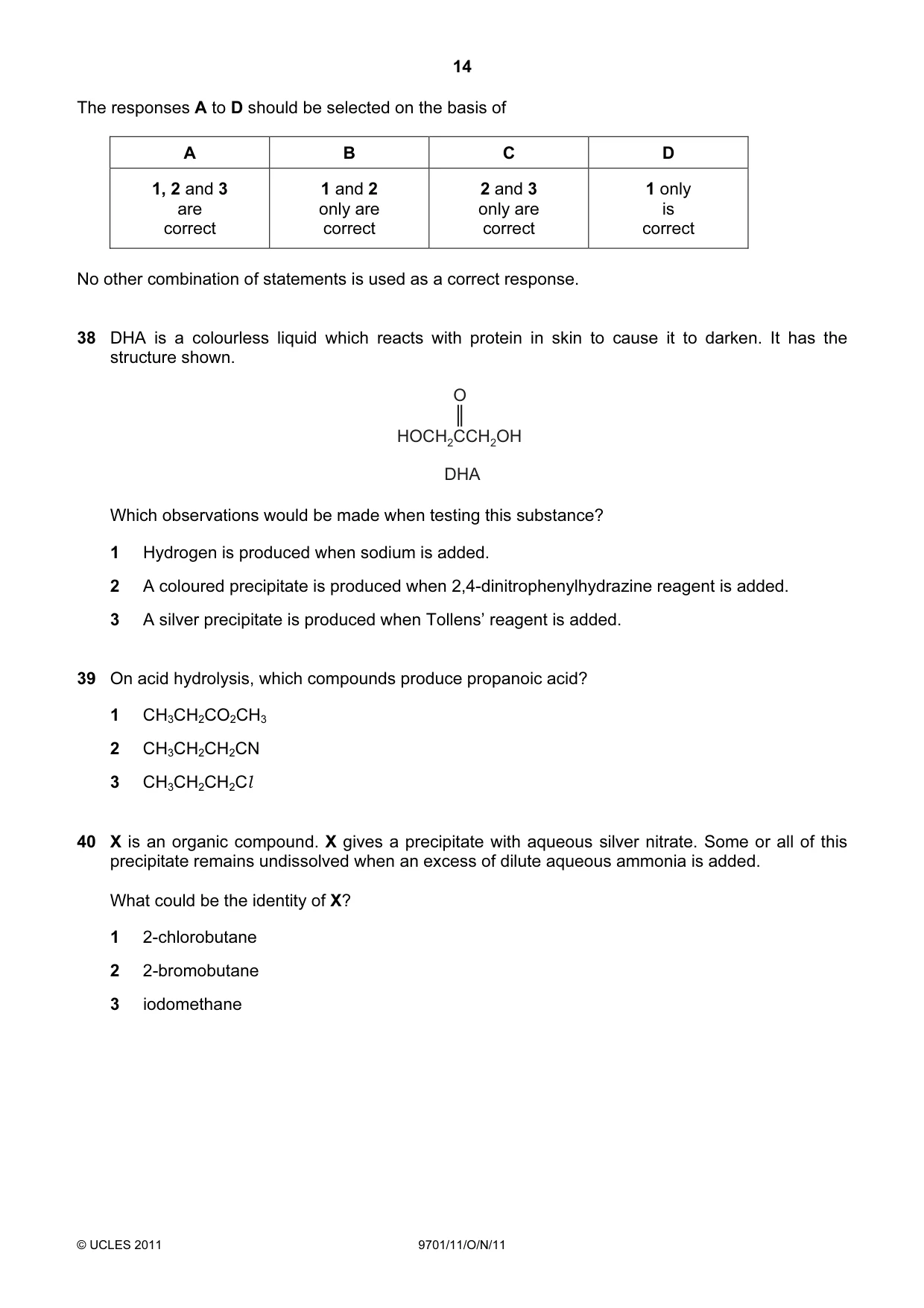


Mark scheme2 pages
Answers below. Sit the paper first if you are practising.
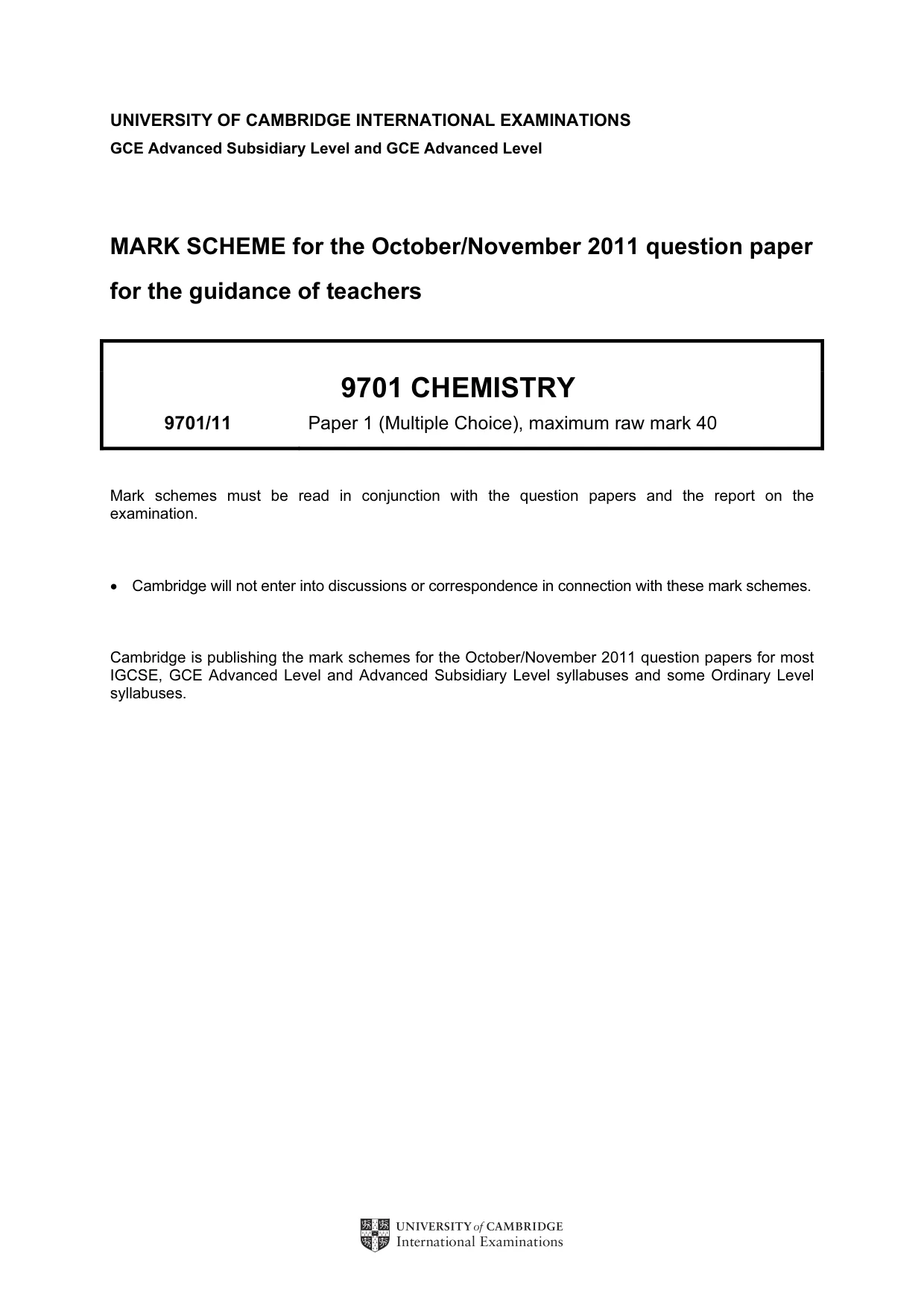
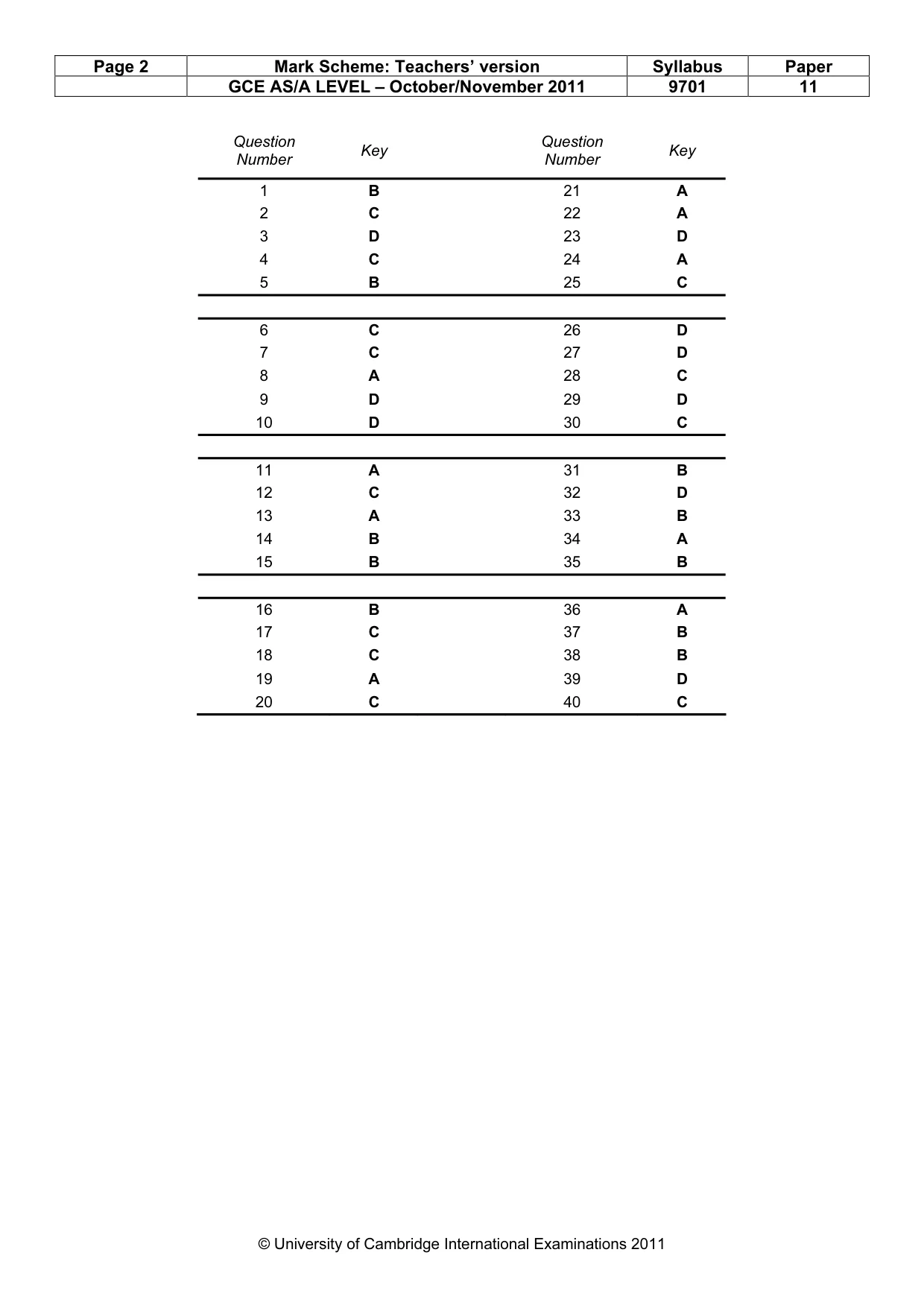
Questions as text
Q1 · Three elements, X, Y and Z, have the physical properties shown in the table
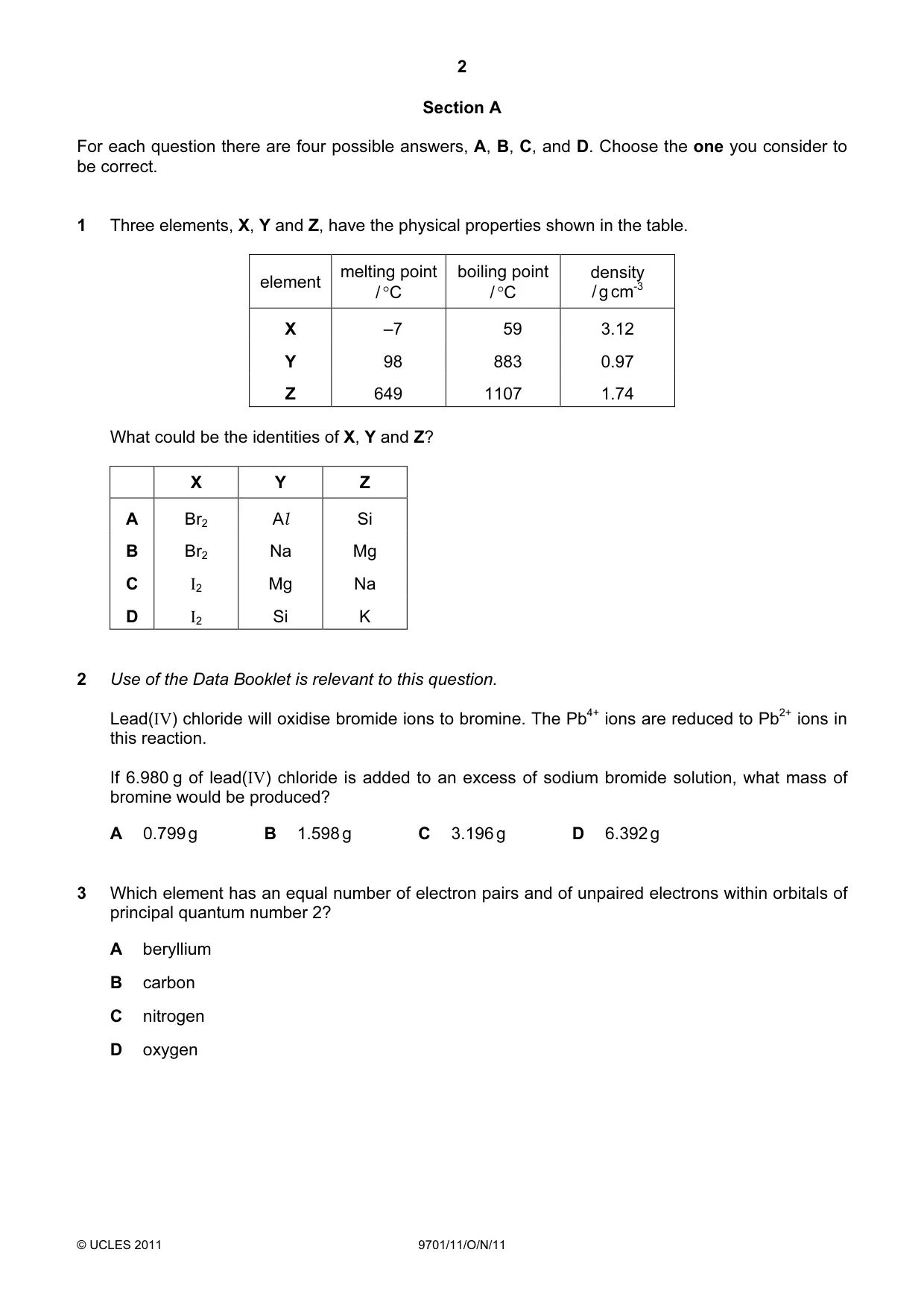
1 Three elements, X, Y and Z, have the physical properties shown in the table. melting point boiling point density element / g cm-3 / °C / °C X –7 59 3.12 Y 98 883 0.97 Z 649 1107 1.74 What could be the identities of X, Y and Z? X Y Z A Br2 Al Si B Br2 Na Mg C I2 Mg Na D I2 Si K
Mark scheme: B
More questions on Periodicity of physical properties of the elements in Period 3
Q2 · Use of the Data Booklet is relevant to this question
2 Use of the Data Booklet is relevant to this question. Lead(IV) chloride will oxidise bromide ions to bromine. The Pb4+ ions are reduced to Pb2+ ions in this reaction. If 6.980 g of lead(IV) chloride is added to an excess of sodium bromide solution, what mass of bromine would be produced? A 0.799 g B 1.598 g C 3.196 g D 6.392 g
Mark scheme: C
More questions on Reacting masses and volumes (of solutions and gases)
Q3 · Which element has an equal number of electron pairs and of unpaired electrons within…
3 Which element has an equal number of electron pairs and of unpaired electrons within orbitals of principal quantum number 2? A beryllium B carbon C nitrogen D oxygen
Mark scheme: D
More questions on Electrons, energy levels and atomic orbitals
Q4 · Methyl isocyanate, CH3NCO, is a toxic liquid which is used in the manufacture of some…
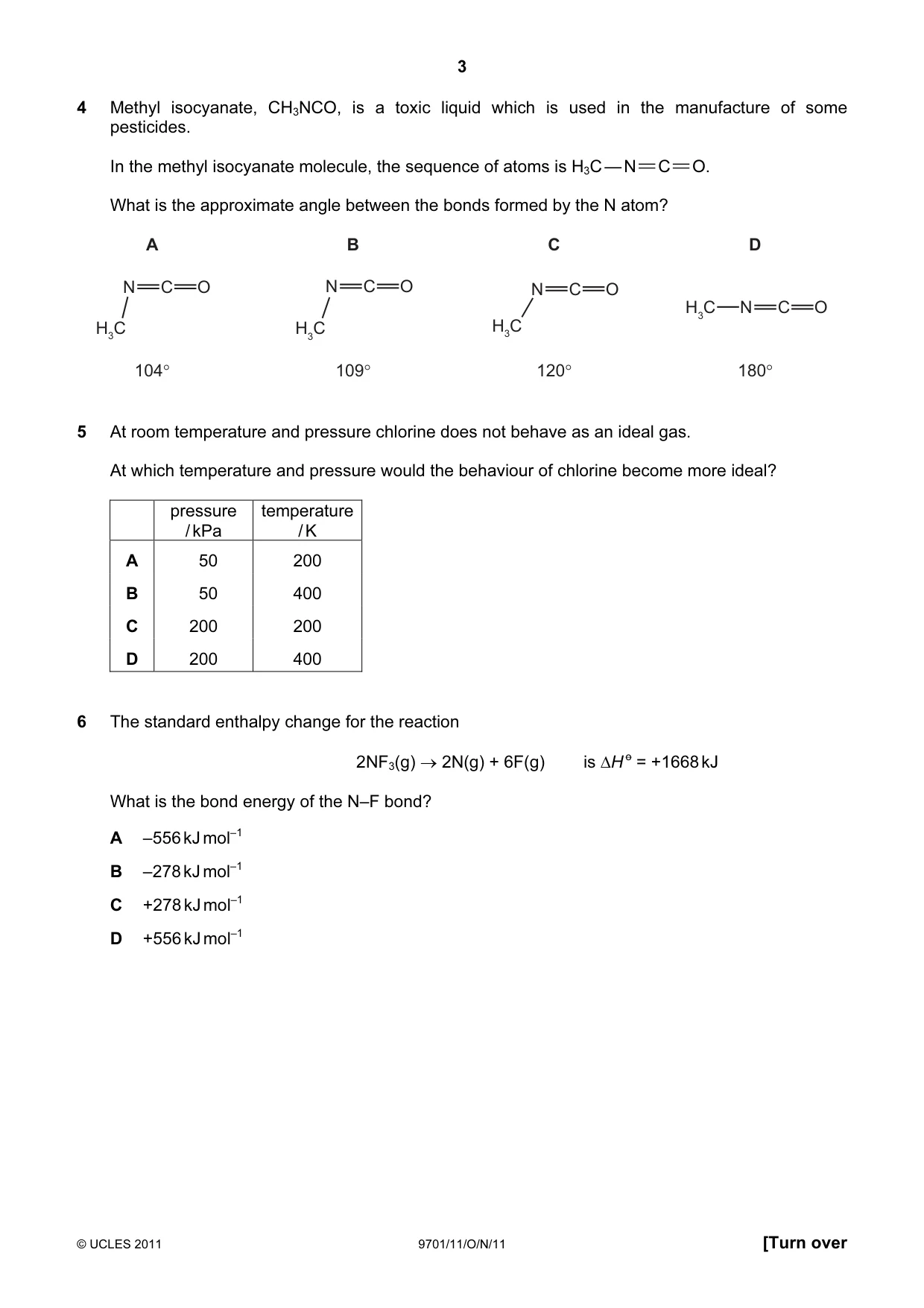
4 Methyl isocyanate, CH3NCO, is a toxic liquid which is used in the manufacture of some pesticides. In the methyl isocyanate molecule, the sequence of atoms is H3C — N C O. What is the approximate angle between the bonds formed by the N atom? A B C D N C O N C O N C O H3C N C O H3C H3C H3C 104° 109° 120° 180°
Mark scheme: C
Q5 · At room temperature and pressure chlorine does not behave as an ideal gas
5 At room temperature and pressure chlorine does not behave as an ideal gas. At which temperature and pressure would the behaviour of chlorine become more ideal? pressure temperature / kPa / K A 50 200 B 50 400 C 200 200 D 200 400
Mark scheme: B
More questions on The gaseous state: ideal and real gases and pV = nRT
Q6 · The standard enthalpy change for the reaction 2NF3(g) → 2N(g) + 6F(g) is ∆H o = +1668 kJ…
6 The standard enthalpy change for the reaction 2NF3(g) → 2N(g) + 6F(g) is ∆H o = +1668 kJ What is the bond energy of the N–F bond? A –556 kJ mol–1 B –278 kJ mol–1 C +278 kJ mol–1 D +556 kJ mol–1
Mark scheme: C
Q7 · When chlorine and aqueous sodium hydroxide are heated together the following overall…
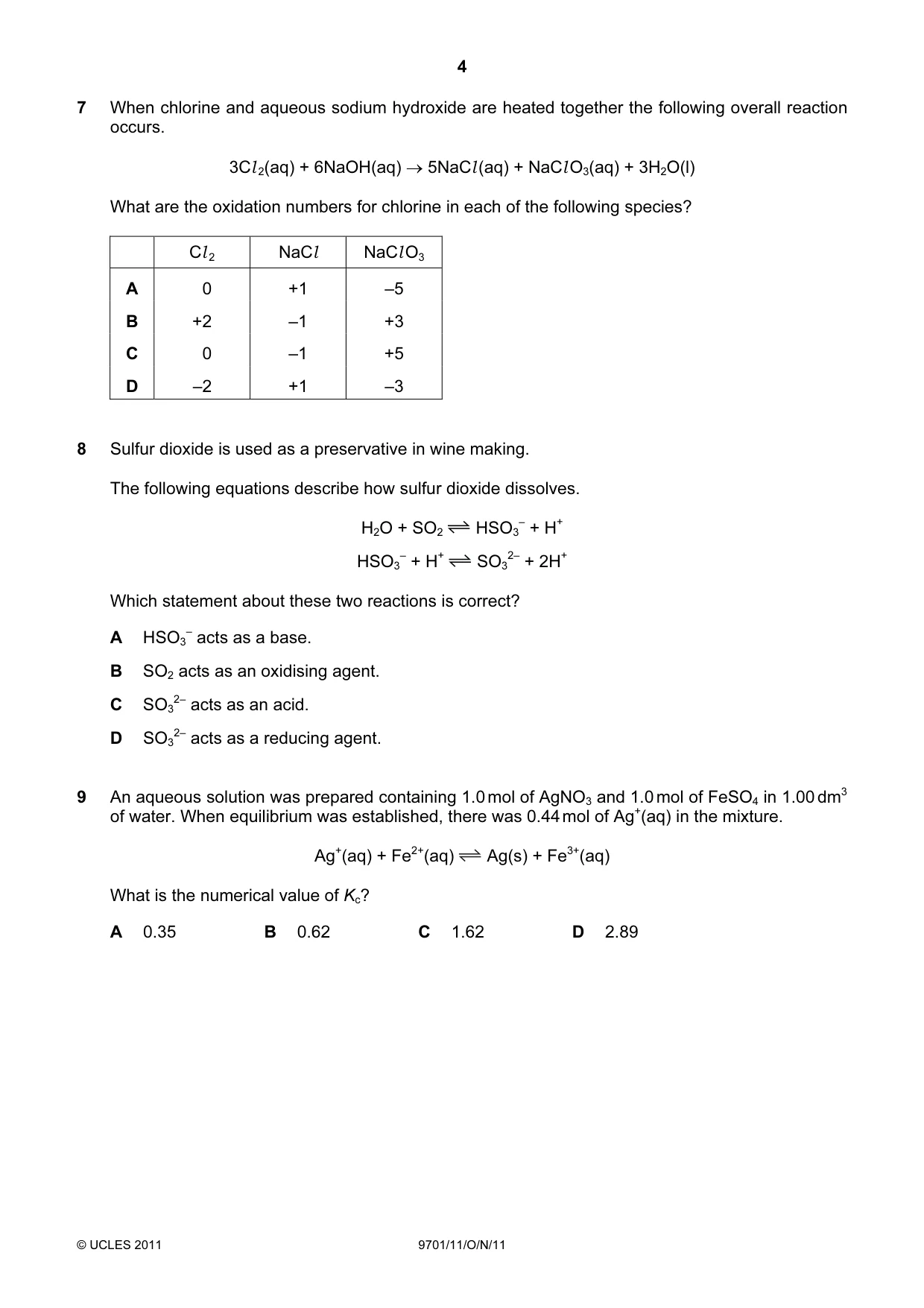
7 When chlorine and aqueous sodium hydroxide are heated together the following overall reaction occurs. 3Cl 2(aq) + 6NaOH(aq) → 5NaCl (aq) + NaCl O3(aq) + 3H2O(l) What are the oxidation numbers for chlorine in each of the following species? Cl 2 NaCl NaCl O3 A 0 +1 –5 B +2 –1 +3 C 0 –1 +5 D –2 +1 –3
Mark scheme: C
Q8 · Sulfur dioxide is used as a preservative in wine making
8 Sulfur dioxide is used as a preservative in wine making. The following equations describe how sulfur dioxide dissolves. H2O + SO2 HSO3 – + H+ HSO3 – + H+ SO3 2– + 2H+ Which statement about these two reactions is correct? A HSO3 – acts as a base. B SO2 acts as an oxidising agent. C SO3 2– acts as an acid. D SO3 2– acts as a reducing agent.
Mark scheme: A
Q9 · An aqueous solution was prepared containing 1.0 mol of AgNO3 and 1.0 mol of FeSO4 in 1.00…
9 An aqueous solution was prepared containing 1.0 mol of AgNO3 and 1.0 mol of FeSO4 in 1.00 dm3 of water. When equilibrium was established, there was 0.44 mol of Ag+(aq) in the mixture. Ag+(aq) + Fe2+(aq) Ag(s) + Fe3+(aq) What is the numerical value of Kc? A 0.35 B 0.62 C 1.62 D 2.89
Mark scheme: D
More questions on Chemical equilibria: reversible reactions, dynamic equilibrium
Q10 · When gaseous iodine is heated with hydrogen at 450 °C, an equilibrium is established
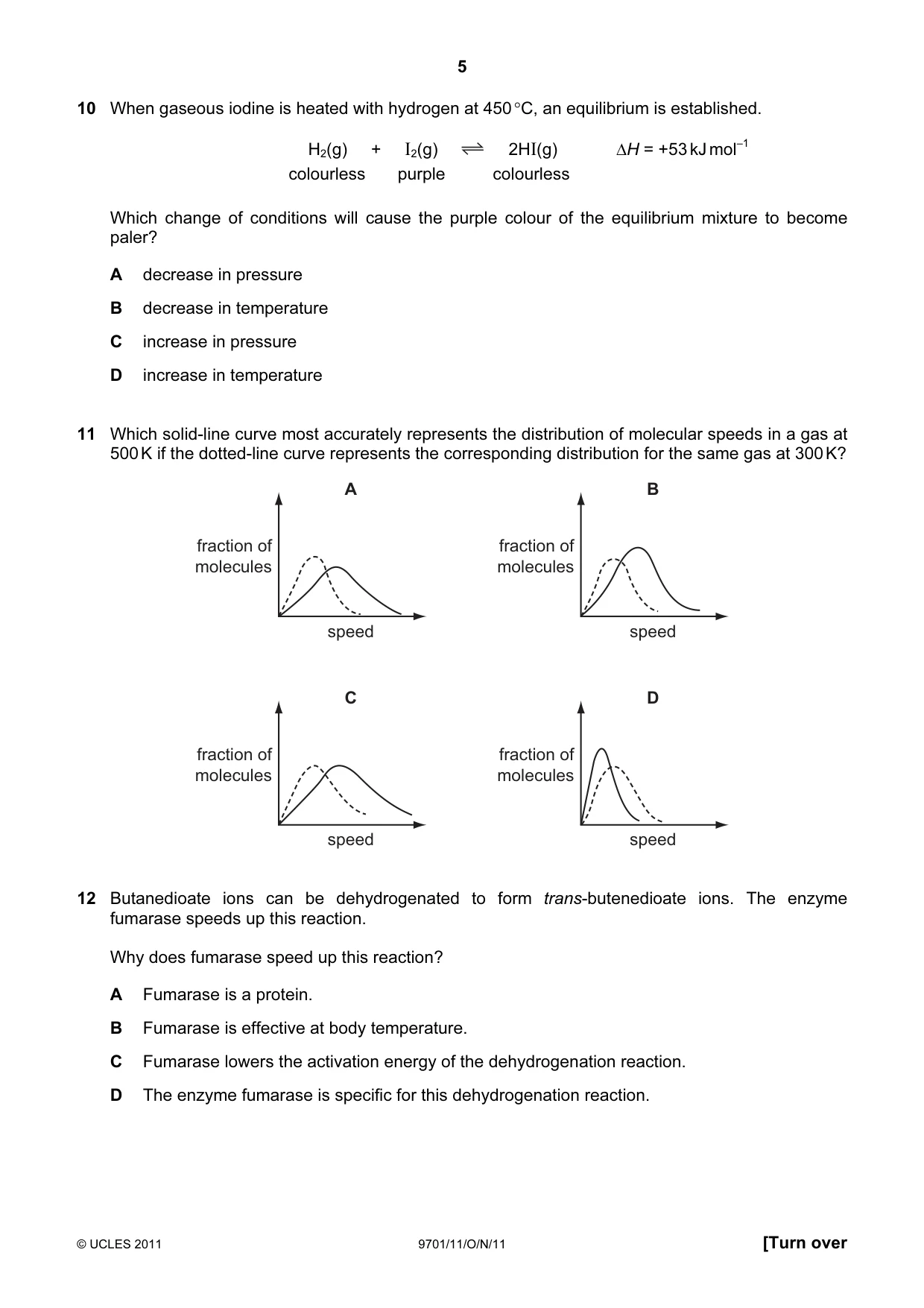
10 When gaseous iodine is heated with hydrogen at 450 °C, an equilibrium is established. H2(g) + I2(g) 2HI(g) ∆H = +53 kJ mol–1 colourless purple colourless Which change of conditions will cause the purple colour of the equilibrium mixture to become paler? A decrease in pressure B decrease in temperature C increase in pressure D increase in temperature
Mark scheme: D
More questions on Chemical equilibria: reversible reactions, dynamic equilibrium
Q11 · Which solid-line curve most accurately represents the distribution of molecular speeds in…
11 Which solid-line curve most accurately represents the distribution of molecular speeds in a gas at 500 K if the dotted-line curve represents the corresponding distribution for the same gas at 300 K? A B fraction of fraction of molecules molecules speed speed C D fraction of fraction of molecules molecules speed speed
Mark scheme: A
More questions on The gaseous state: ideal and real gases and pV = nRT
Q12 · Butanedioate ions can be dehydrogenated to form trans-butenedioate ions
12 Butanedioate ions can be dehydrogenated to form trans-butenedioate ions. The enzyme fumarase speeds up this reaction. Why does fumarase speed up this reaction? A Fumarase is a protein. B Fumarase is effective at body temperature. C Fumarase lowers the activation energy of the dehydrogenation reaction. D The enzyme fumarase is specific for this dehydrogenation reaction.
Mark scheme: C
Q13 · Which element shows the greatest tendency to form some covalent compounds?
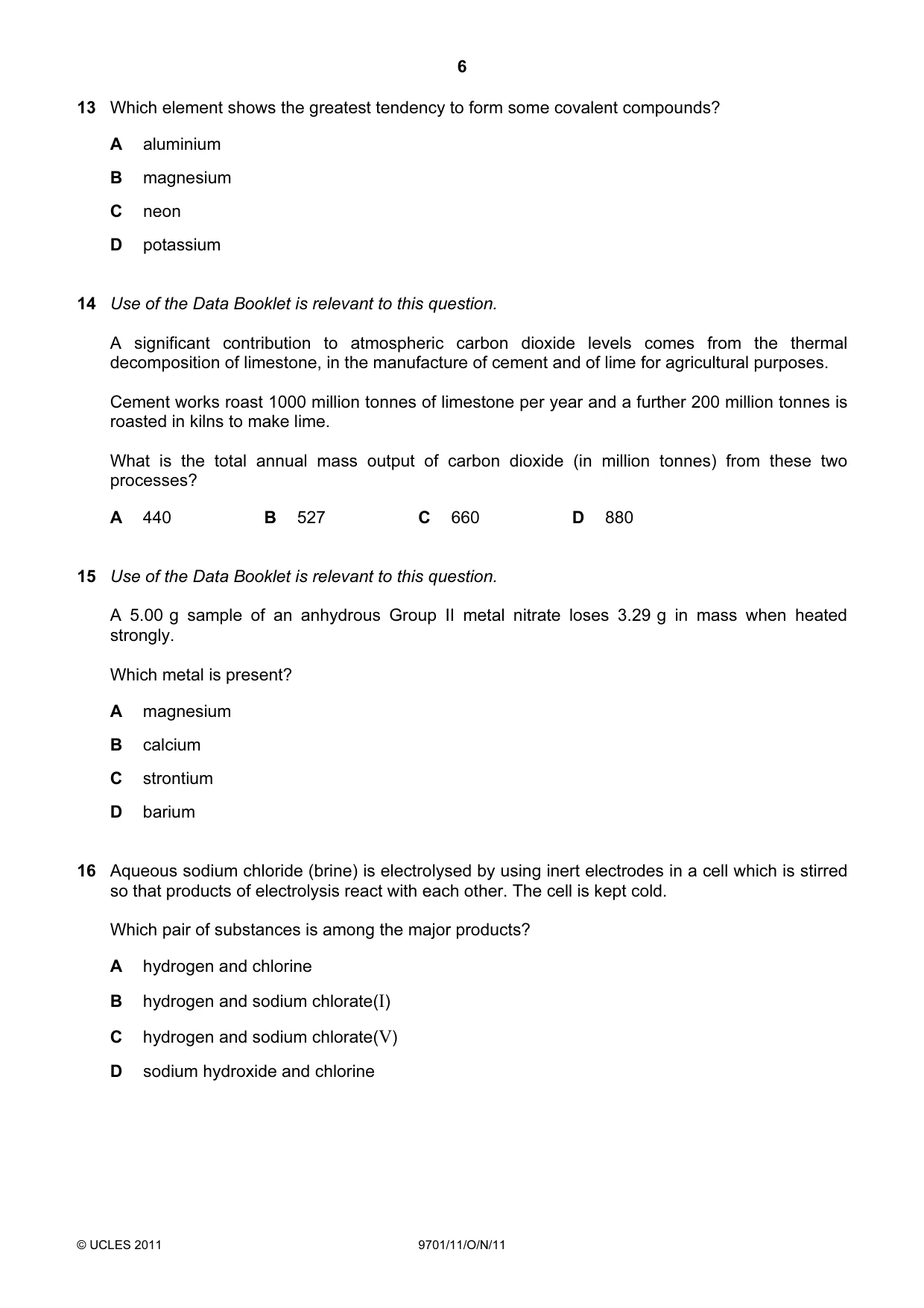
13 Which element shows the greatest tendency to form some covalent compounds? A aluminium B magnesium C neon D potassium
Mark scheme: A
Q14 · Use of the Data Booklet is relevant to this question
14 Use of the Data Booklet is relevant to this question. A significant contribution to atmospheric carbon dioxide levels comes from the thermal decomposition of limestone, in the manufacture of cement and of lime for agricultural purposes. Cement works roast 1000 million tonnes of limestone per year and a further 200 million tonnes is roasted in kilns to make lime. What is the total annual mass output of carbon dioxide (in million tonnes) from these two processes? A 440 B 527 C 660 D 880
Mark scheme: B
More questions on Reacting masses and volumes (of solutions and gases)
Q15 · Use of the Data Booklet is relevant to this question
15 Use of the Data Booklet is relevant to this question. A 5.00 g sample of an anhydrous Group II metal nitrate loses 3.29 g in mass when heated strongly. Which metal is present? A magnesium B calcium C strontium D barium
Mark scheme: B
Q16 · Aqueous sodium chloride (brine) is electrolysed by using inert electrodes in a cell which…
16 Aqueous sodium chloride (brine) is electrolysed by using inert electrodes in a cell which is stirred so that products of electrolysis react with each other. The cell is kept cold. Which pair of substances is among the major products? A hydrogen and chlorine B hydrogen and sodium chlorate(I) C hydrogen and sodium chlorate(V) D sodium hydroxide and chlorine
Mark scheme: B
Q17 · Why do the halogens become less volatile as Group VII is descended?
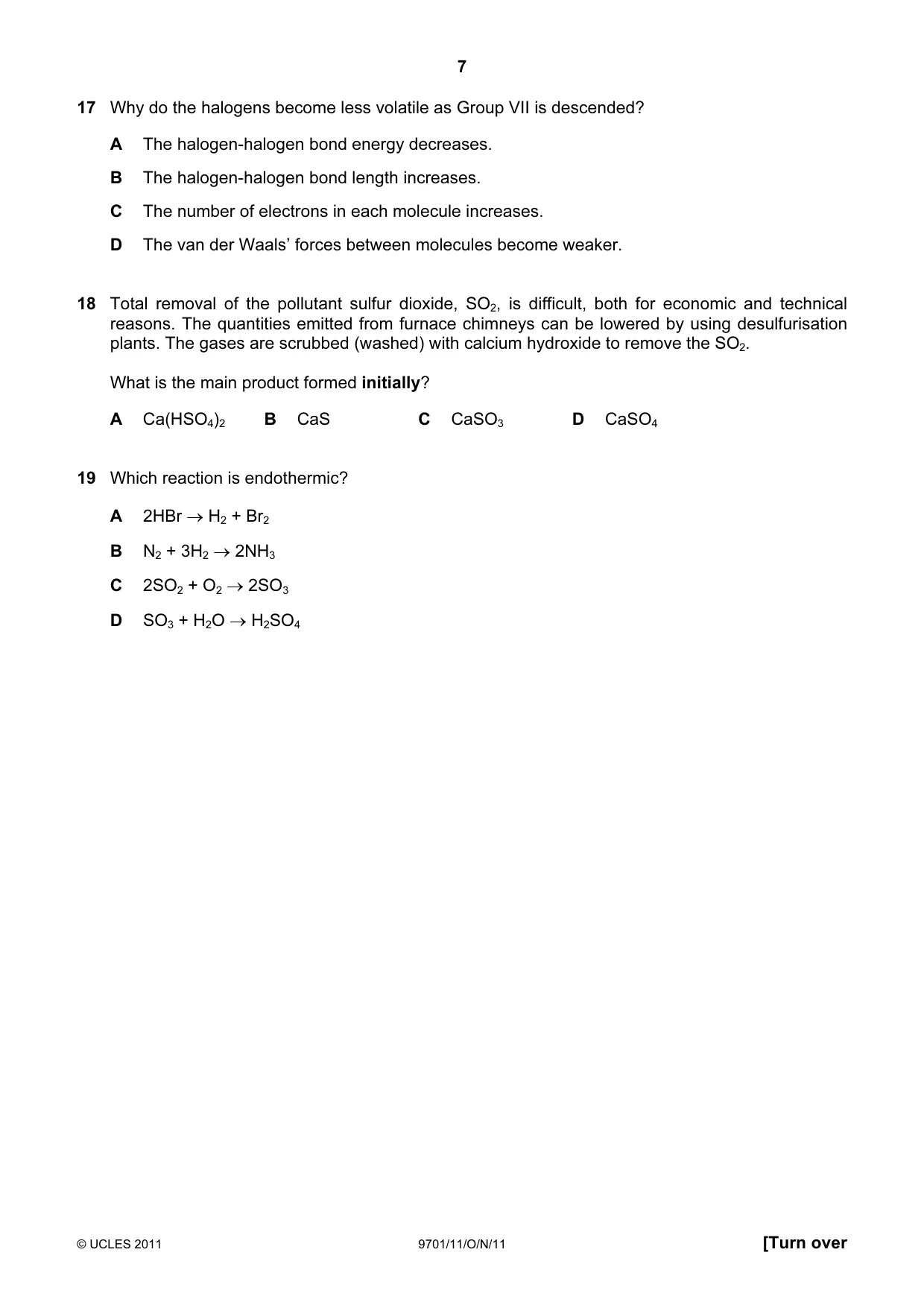
17 Why do the halogens become less volatile as Group VII is descended? A The halogen-halogen bond energy decreases. B The halogen-halogen bond length increases. C The number of electrons in each molecule increases. D The van der Waals’ forces between molecules become weaker.
Mark scheme: C
More questions on Intermolecular forces, electronegativity and bond properties
Q18 · Total removal of the pollutant sulfur dioxide, SO2, is difficult, both for economic and…
18 Total removal of the pollutant sulfur dioxide, SO2, is difficult, both for economic and technical reasons. The quantities emitted from furnace chimneys can be lowered by using desulfurisation plants. The gases are scrubbed (washed) with calcium hydroxide to remove the SO2. What is the main product formed initially? A Ca(HSO4)2 B CaS C CaSO3 D CaSO4
Mark scheme: C
Q19 · Which reaction is endothermic?
19 Which reaction is endothermic? A 2HBr → H2 + Br2 B N2 + 3H2 → 2NH3 C 2SO2 + O2 → 2SO3 D SO3 + H2O → H2SO4
Mark scheme: A
Q20 · This question should be answered by considering the reactions of KMnO4 with different…
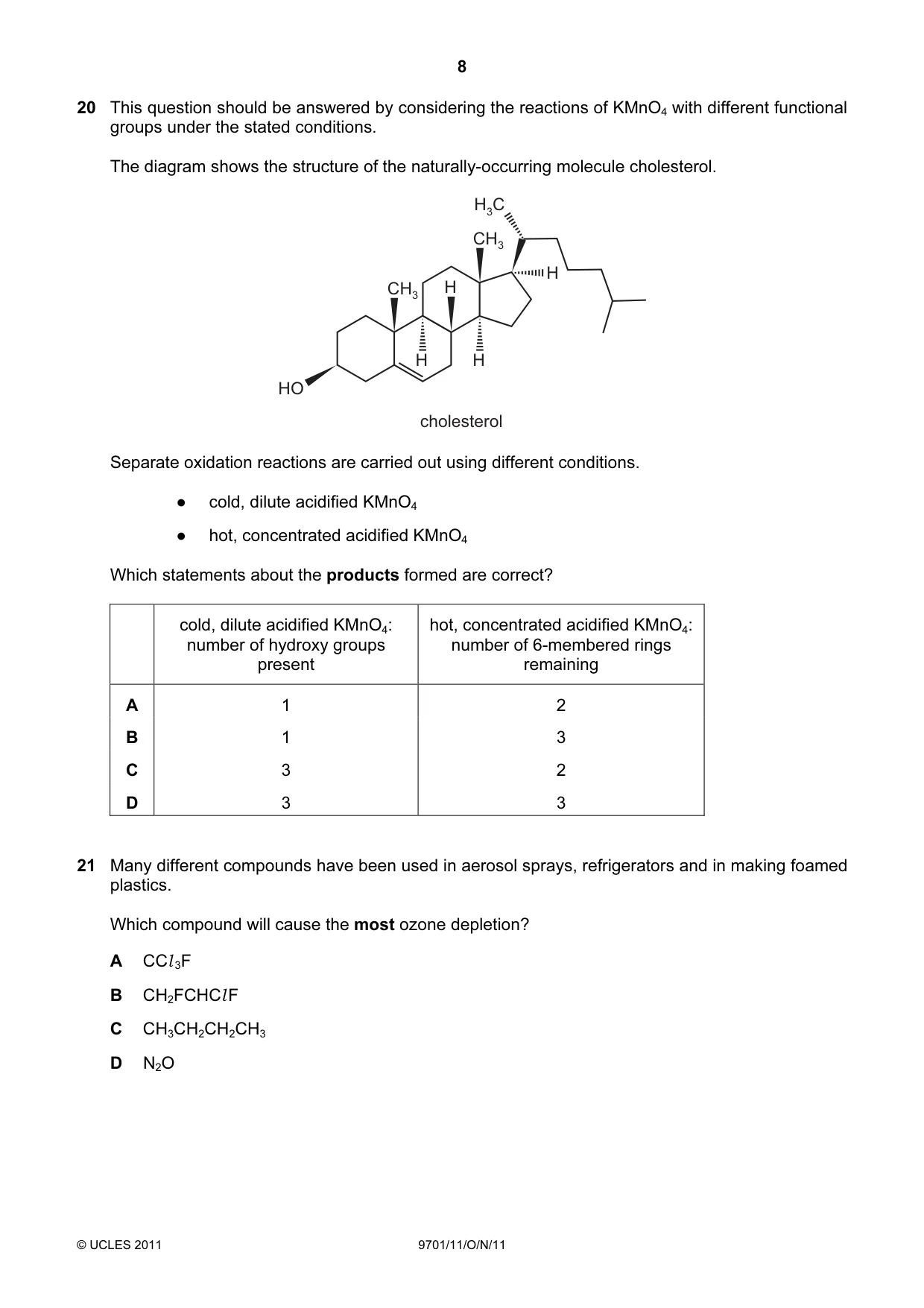
20 This question should be answered by considering the reactions of KMnO4 with different functional groups under the stated conditions. The diagram shows the structure of the naturally-occurring molecule cholesterol. H3C CH3 H CH3 H H H HO cholesterol Separate oxidation reactions are carried out using different conditions. ● cold, dilute acidified KMnO4 ● hot, concentrated acidified KMnO4 Which statements about the products formed are correct? cold, dilute acidified KMnO4: hot, concentrated acidified KMnO4: number of hydroxy groups number of 6-membered rings present remaining A 1 2 B 1 3 C 3 2 D 3 3
Mark scheme: C
Q21 · Many different compounds have been used in aerosol sprays, refrigerators and in making…
21 Many different compounds have been used in aerosol sprays, refrigerators and in making foamed plastics. Which compound will cause the most ozone depletion? A CCl 3F B CH2FCHCl F C CH3CH2CH2CH3 D N2O
Mark scheme: A
Q22 · In the general formula of which class of compound, is the ratio of hydrogen atoms to…
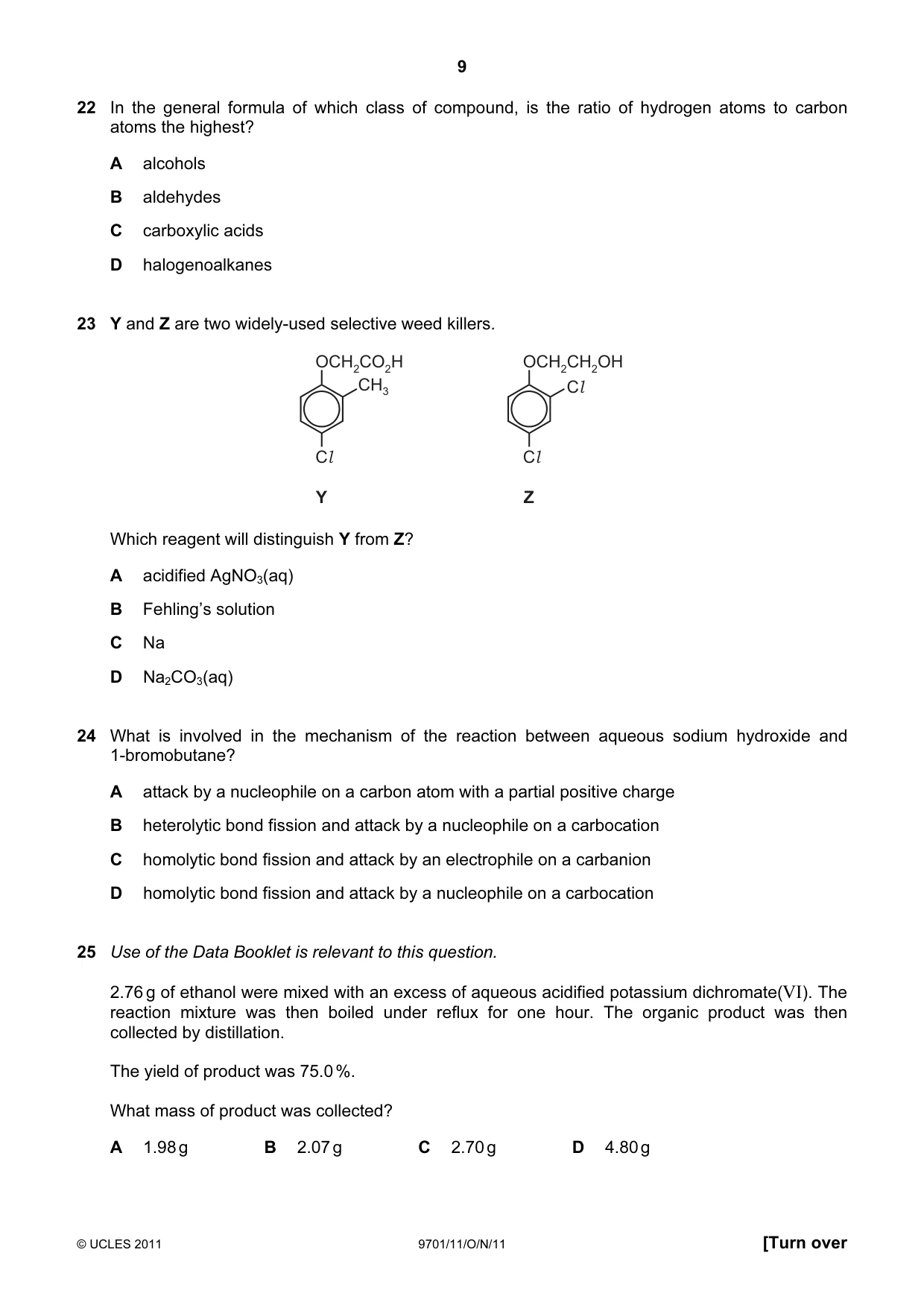
22 In the general formula of which class of compound, is the ratio of hydrogen atoms to carbon atoms the highest? A alcohols B aldehydes C carboxylic acids D halogenoalkanes
Mark scheme: A
More questions on Formulas, functional groups and the naming of organic compounds
Q23 · Y and Z are two widely-used selective weed killers
23 Y and Z are two widely-used selective weed killers. OCH2CO2H OCH2CH2OH CH3 Cl Cl Cl Y Z Which reagent will distinguish Y from Z? A acidified AgNO3(aq) B Fehling’s solution C Na D Na2CO3(aq)
Mark scheme: D
Q24 · What is involved in the mechanism of the reaction between aqueous sodium hydroxide and…
24 What is involved in the mechanism of the reaction between aqueous sodium hydroxide and 1-bromobutane? A attack by a nucleophile on a carbon atom with a partial positive charge B heterolytic bond fission and attack by a nucleophile on a carbocation C homolytic bond fission and attack by an electrophile on a carbanion D homolytic bond fission and attack by a nucleophile on a carbocation
Mark scheme: A
Q25 · Use of the Data Booklet is relevant to this question
25 Use of the Data Booklet is relevant to this question. 2.76 g of ethanol were mixed with an excess of aqueous acidified potassium dichromate(VI). The reaction mixture was then boiled under reflux for one hour. The organic product was then collected by distillation. The yield of product was 75.0 %. What mass of product was collected? A 1.98 g B 2.07 g C 2.70 g D 4.80 g
Mark scheme: C
More questions on Reacting masses and volumes (of solutions and gases)
Q26 · Energy is released in the human body by the oxidation of glucose in a complex sequence of…
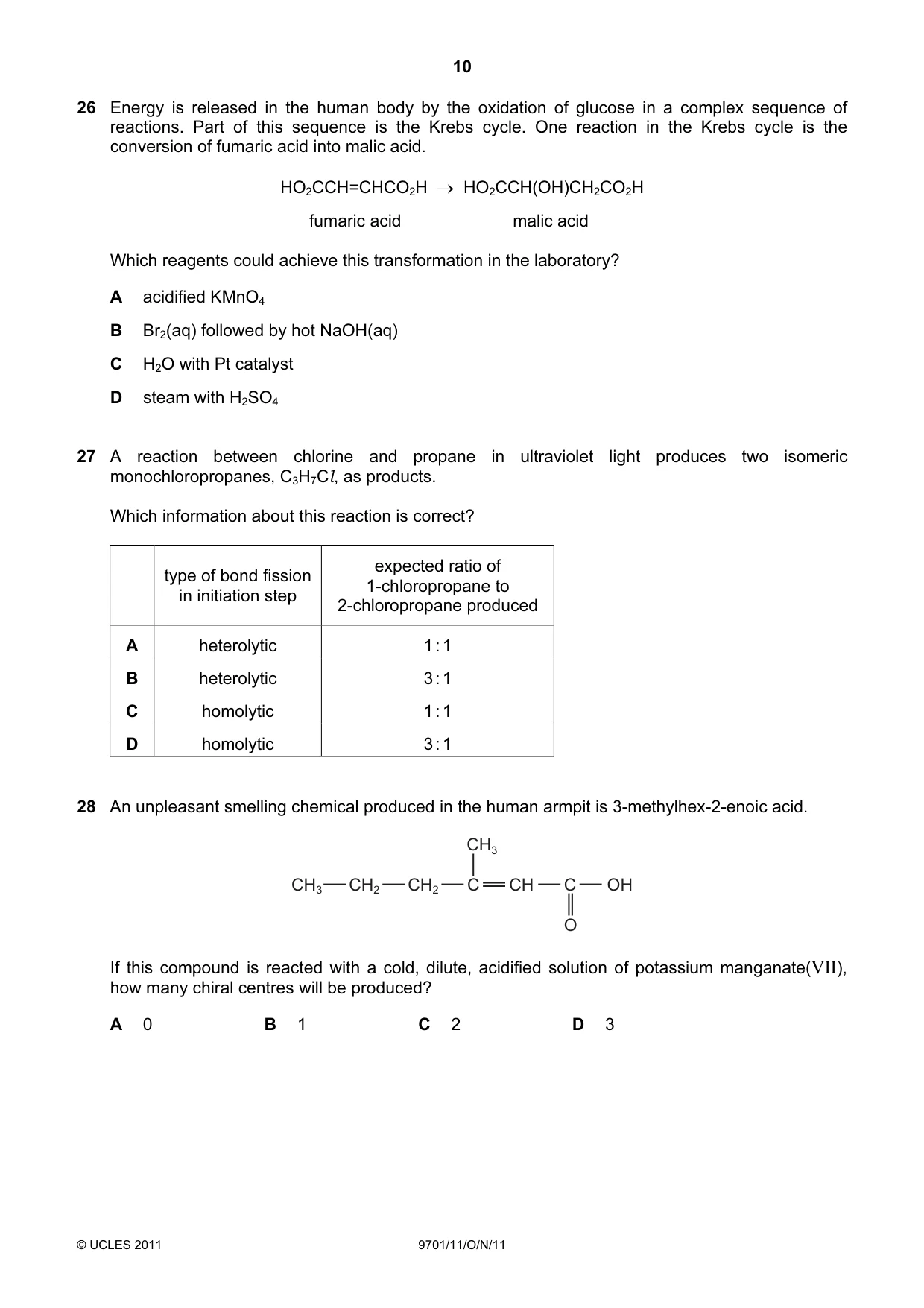
26 Energy is released in the human body by the oxidation of glucose in a complex sequence of reactions. Part of this sequence is the Krebs cycle. One reaction in the Krebs cycle is the conversion of fumaric acid into malic acid. HO2CCH=CHCO2H → HO2CCH(OH)CH2CO2H fumaric acid malic acid Which reagents could achieve this transformation in the laboratory? A acidified KMnO4 B Br2(aq) followed by hot NaOH(aq) C H2O with Pt catalyst D steam with H2SO4
Mark scheme: D
Q27 · A reaction between chlorine and propane in ultraviolet light produces two isomeric…
27 A reaction between chlorine and propane in ultraviolet light produces two isomeric monochloropropanes, C3H7Cl, as products. Which information about this reaction is correct? expected ratio of type of bond fission 1-chloropropane to in initiation step 2-chloropropane produced A heterolytic 1 : 1 B heterolytic 3 : 1 C homolytic 1 : 1 D homolytic 3 : 1
Mark scheme: D
Q28 · An unpleasant smelling chemical produced in the human armpit is 3-methylhex-2-enoic acid
28 An unpleasant smelling chemical produced in the human armpit is 3-methylhex-2-enoic acid. CH3 CH3 CH2 CH2 C CH C OH O If this compound is reacted with a cold, dilute, acidified solution of potassium manganate(VII), how many chiral centres will be produced? A 0 B 1 C 2 D 3
Mark scheme: C
Q29 · Geraniol is a constituent of some perfumes
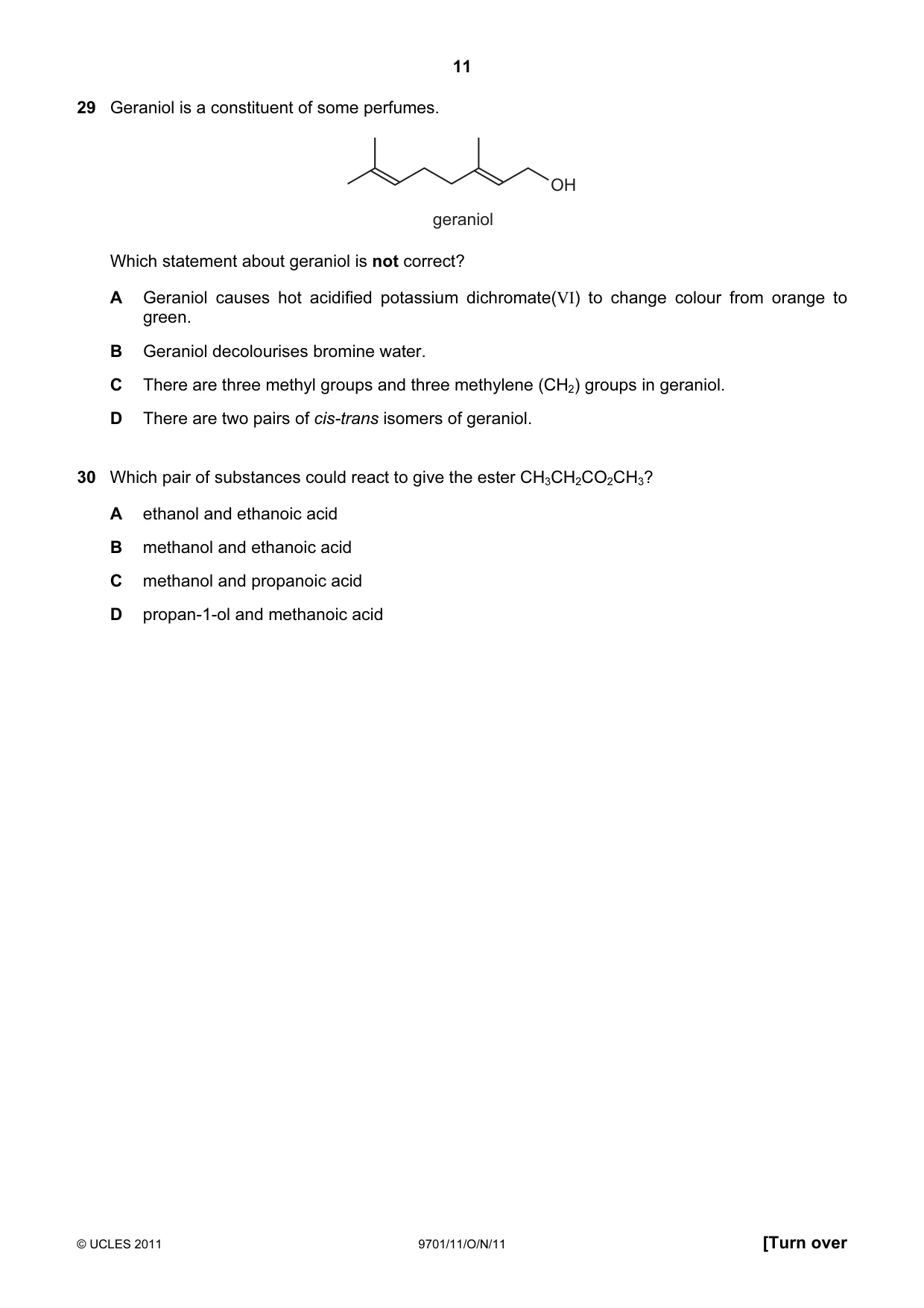
29 Geraniol is a constituent of some perfumes. OH geraniol Which statement about geraniol is not correct? A Geraniol causes hot acidified potassium dichromate(VI) to change colour from orange to green. B Geraniol decolourises bromine water. C There are three methyl groups and three methylene (CH2) groups in geraniol. D There are two pairs of cis-trans isomers of geraniol.
Mark scheme: D
Q30 · Which pair of substances could react to give the ester CH3CH2CO2CH3?
30 Which pair of substances could react to give the ester CH3CH2CO2CH3? A ethanol and ethanoic acid B methanol and ethanoic acid C methanol and propanoic acid D propan-1-ol and methanoic acid
Mark scheme: C
Q31 · The definitions of many chemical terms can be illustrated by chemical equations
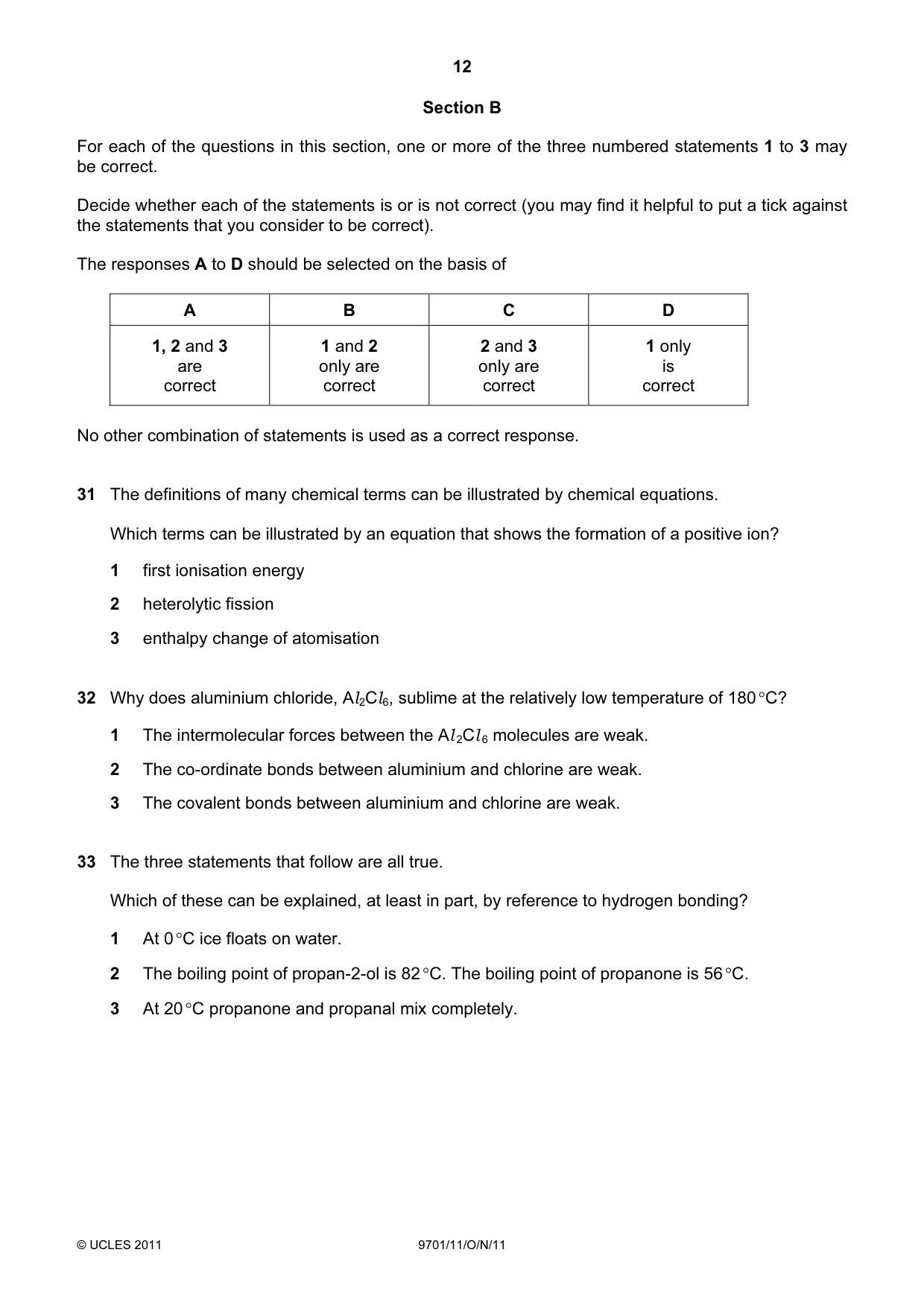
31 The definitions of many chemical terms can be illustrated by chemical equations. Which terms can be illustrated by an equation that shows the formation of a positive ion? 1 first ionisation energy 2 heterolytic fission 3 enthalpy change of atomisation
Mark scheme: B
Q32 · Why does aluminium chloride, Al 2Cl 6, sublime at the relatively low temperature of 180…
32 Why does aluminium chloride, Al 2Cl 6, sublime at the relatively low temperature of 180 °C? 1 The intermolecular forces between the Al 2Cl 6 molecules are weak. 2 The co-ordinate bonds between aluminium and chlorine are weak. 3 The covalent bonds between aluminium and chlorine are weak.
Mark scheme: D
Q33 · The three statements that follow are all true
33 The three statements that follow are all true. Which of these can be explained, at least in part, by reference to hydrogen bonding? 1 At 0 °C ice floats on water. 2 The boiling point of propan-2-ol is 82 °C. The boiling point of propanone is 56 °C. 3 At 20 °C propanone and propanal mix completely.
Mark scheme: B
More questions on Intermolecular forces, electronegativity and bond properties
Q34 · A farmer spreads lime on land which has already been treated with an ammonium nitrate…
34 A farmer spreads lime on land which has already been treated with an ammonium nitrate fertiliser. Which reactions will occur in the treated soil? 1 Ca(OH)2 + 2NH4 +(aq) → Ca2+(aq) + 2NH3 + 2H2O 2 Ca(OH)2 + 2H+(aq) → Ca2+(aq) + 2H2O 3 Ca(OH)2 + CO2 → CaCO3 + H2O
Mark scheme: A
Q35 · Which of the halide ions, chloride, bromide or iodide, acts as a reducing agent when its…
35 Which of the halide ions, chloride, bromide or iodide, acts as a reducing agent when its sodium salt reacts with concentrated sulfuric acid? 1 at least one of Cl –, Br – and I – 2 at least two of Cl –, Br – and I – 3 all three of Cl –, Br – and I –
Mark scheme: B
Q36 · In a car engine, non-metallic element X forms a pollutant oxide Y
36 In a car engine, non-metallic element X forms a pollutant oxide Y. Further oxidation of Y to Z occurs spontaneously in the atmosphere. In this further oxidation, 1 mol of Y reacts with 0.5 mol of gaseous oxygen. Which statements about X, Y and Z are correct? 1 X forms a basic hydride. 2 Y is a diatomic molecule. 3 Z is a polar molecule.
Mark scheme: A
Q37 · Disaccharides, C12H22O11, are important in the human diet
37 Disaccharides, C12H22O11, are important in the human diet. For example, sucrose is found in pastries and lactose occurs in milk products. Both of these compounds can be hydrolysed. sucrose + H2O → CH2OH(CHOH)4CHO + CH2OH(CHOH)3COCH2OH glucose fructose lactose + H2O → CH2OH(CHOH)4CHO + CH2OH(CHOH)4CHO glucose galactose Which statements about these hydrolysis products are correct? 1 Glucose and fructose have structural isomers. 2 Glucose and galactose are optical isomers. 3 Glucose and galactose are ketones.
Mark scheme: B
More questions on Isomerism: structural isomerism and stereoisomerism
Q38 · DHA is a colourless liquid which reacts with protein in skin to cause it to darken
38 DHA is a colourless liquid which reacts with protein in skin to cause it to darken. It has the structure shown. O HOCH2CCH2OH DHA Which observations would be made when testing this substance? 1 Hydrogen is produced when sodium is added. 2 A coloured precipitate is produced when 2,4-dinitrophenylhydrazine reagent is added. 3 A silver precipitate is produced when Tollens’ reagent is added.
Mark scheme: B
Q39 · On acid hydrolysis, which compounds produce propanoic acid?
39 On acid hydrolysis, which compounds produce propanoic acid? 1 CH3CH2CO2CH3 2 CH3CH2CH2CN 3 CH3CH2CH2Cl
Mark scheme: D
Q40 · X is an organic compound
40 X is an organic compound. X gives a precipitate with aqueous silver nitrate. Some or all of this precipitate remains undissolved when an excess of dilute aqueous ammonia is added. What could be the identity of X? 1 2-chlorobutane 2 2-bromobutane 3 iodomethane
Mark scheme: C
What was in this paper
The subtopics covered by these 40 questions, and how many questions each got. Open one in a new tab to see every Cambridge question on it.
3Chemical equilibria: reversible reactions, dynamic equilibrium2Enthalpy change, ΔH2Esters2Halogen compounds2Intermolecular forces, electronegativity and bond properties2Nitrogen and sulfur2Similarities and trends in the properties of the Group 2 metals, magnesium to barium, and their compounds2The gaseous state: ideal and real gases and pV = nRT2Alcohols1Alcohols1Aldehydes and ketones1Alkanes1Alkenes1Bonding and structure1Brønsted–Lowry theory of acids and bases1Electronegativity and bonding1Electrons, energy levels and atomic orbitals1Formulas, functional groups and the naming of organic compounds1Halogenoalkanes1Homogeneous and heterogeneous catalysts1Ionisation energy1Isomerism: optical1Isomerism: structural isomerism and stereoisomerism1Periodicity of physical properties of the elements in Period 31Phenol1Redox processes: electron transfer and changes in oxidation number (oxidation state)1Shapes of molecules1Some reactions of the halide ions1The reactions of chlorine1What you needed in this session
Cambridge’s own grade thresholds for 2011 Oct/Nov, Paper 1 · Variant 1. A higher threshold means an easier paper — the bar moves with how the cohort did.