Cambridge A Level Chemistry 9701 — 2005 Oct/Nov Paper 1 · Variant 1
9701/11/O/N/05 · 40 questions · 40 marks · ≈45 min
The question paper and its mark scheme, free to read here and free to download. This is Cambridge’s own paper, exactly as it was sat.
Question paper16 pages
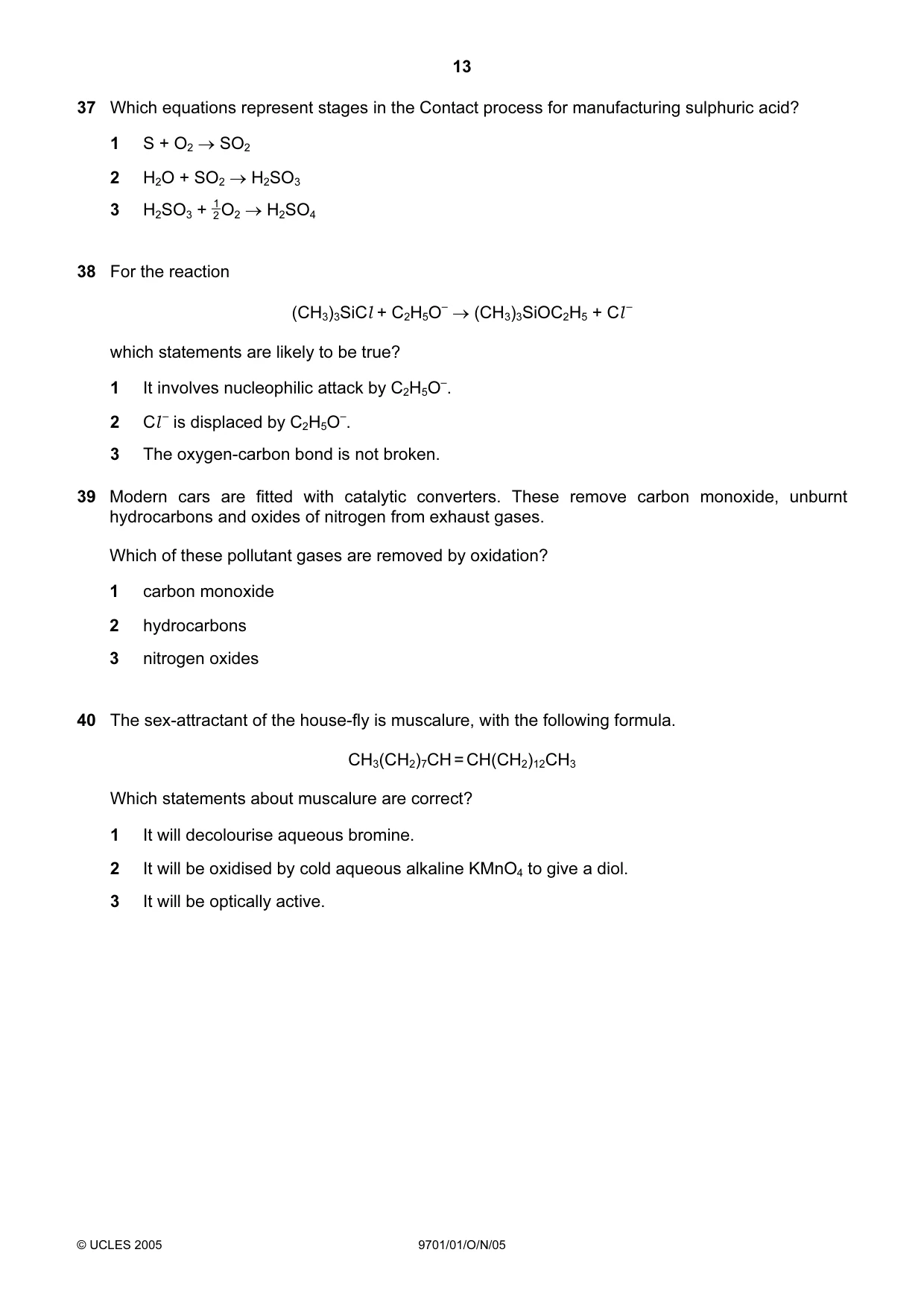



Mark scheme2 pages
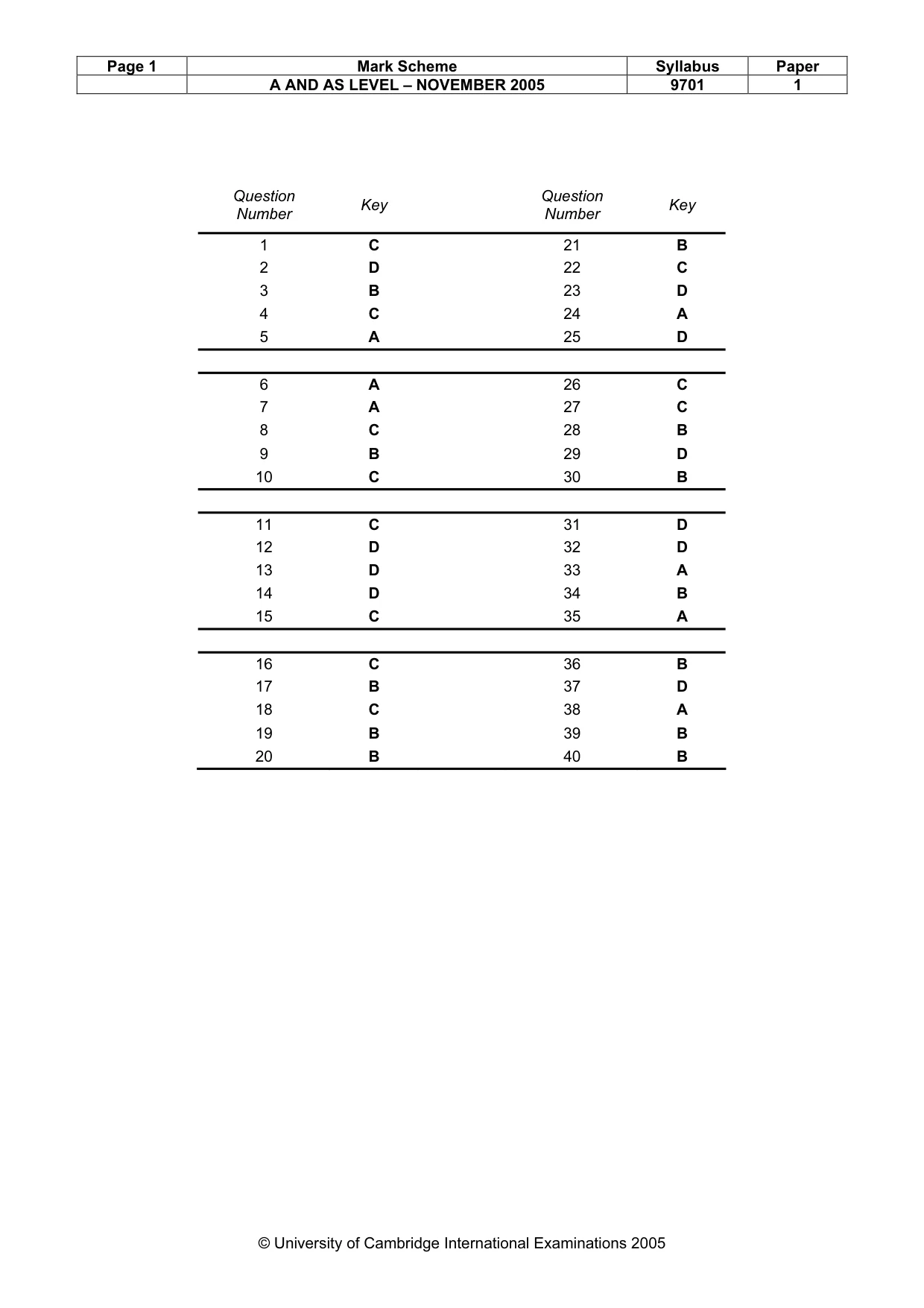
Answers below. Sit the paper first if you are practising.
Questions as text
Q1 · The petrol additive tetraethyl-lead(IV), Pb(C2H5)4, is now banned in many countries
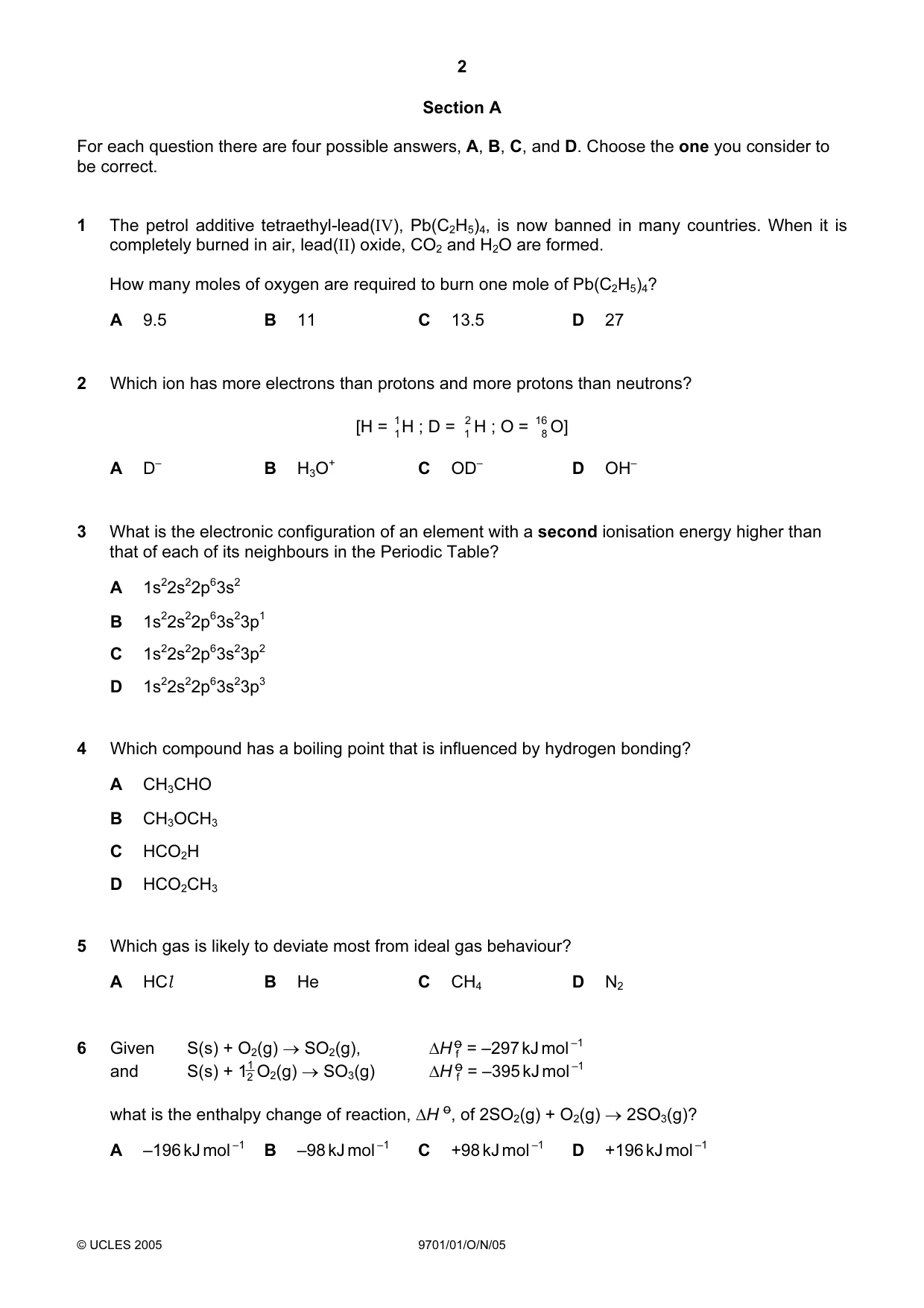
1 The petrol additive tetraethyl-lead(IV), Pb(C2H5)4, is now banned in many countries. When it is completely burned in air, lead(II) oxide, CO2 and H2O are formed. How many moles of oxygen are required to burn one mole of Pb(C2H5)4? A 9.5 B 11 C 13.5 D 27
Mark scheme: C
More questions on Reacting masses and volumes (of solutions and gases)
Q2 · Which ion has more electrons than protons and more protons than neutrons?
2 Which ion has more electrons than protons and more protons than neutrons? [H = 1 1H ; D = 2 1 H ; O = 16 8 O] A D– B H3O+ C OD– D OH–
Mark scheme: D
Q3 · What is the electronic configuration of an element with a second ionisation energy higher…
3 What is the electronic configuration of an element with a second ionisation energy higher than that of each of its neighbours in the Periodic Table? A 1s22s22p63s2 B 1s22s22p63s23p1 C 1s22s22p63s23p2 D 1s22s22p63s23p3
Mark scheme: B
Q4 · Which compound has a boiling point that is influenced by hydrogen bonding?
4 Which compound has a boiling point that is influenced by hydrogen bonding? A CH3CHO B CH3OCH3 C HCO2H D HCO2CH3
Mark scheme: C
More questions on Intermolecular forces, electronegativity and bond properties
Q5 · Which gas is likely to deviate most from ideal gas behaviour?
5 Which gas is likely to deviate most from ideal gas behaviour? A HCl B He C CH4 D N2
Mark scheme: A
More questions on The gaseous state: ideal and real gases and pV = nRT
Q6 · Given S(s) + O2(g) → SO2(g), ∆H o = –297 kJ mol –1 f and S(s) + 1 O2(g) → SO3(g) 1 ∆H o =…
6 Given S(s) + O2(g) → SO2(g), ∆H o = –297 kJ mol –1 f and S(s) + 1 O2(g) → SO3(g) 1 ∆H o = –395 kJ mol –1 2 f what is the enthalpy change of reaction, ∆H o, of 2SO2(g) + O2(g) → 2SO3(g)? A –196 kJ mol –1 B –98 kJ mol –1 C +98 kJ mol –1 D +196 kJ mol –1
Mark scheme: A
Q7 · The table shows the enthalpy change of neutralisation per mole of water formed, ∆H, for…
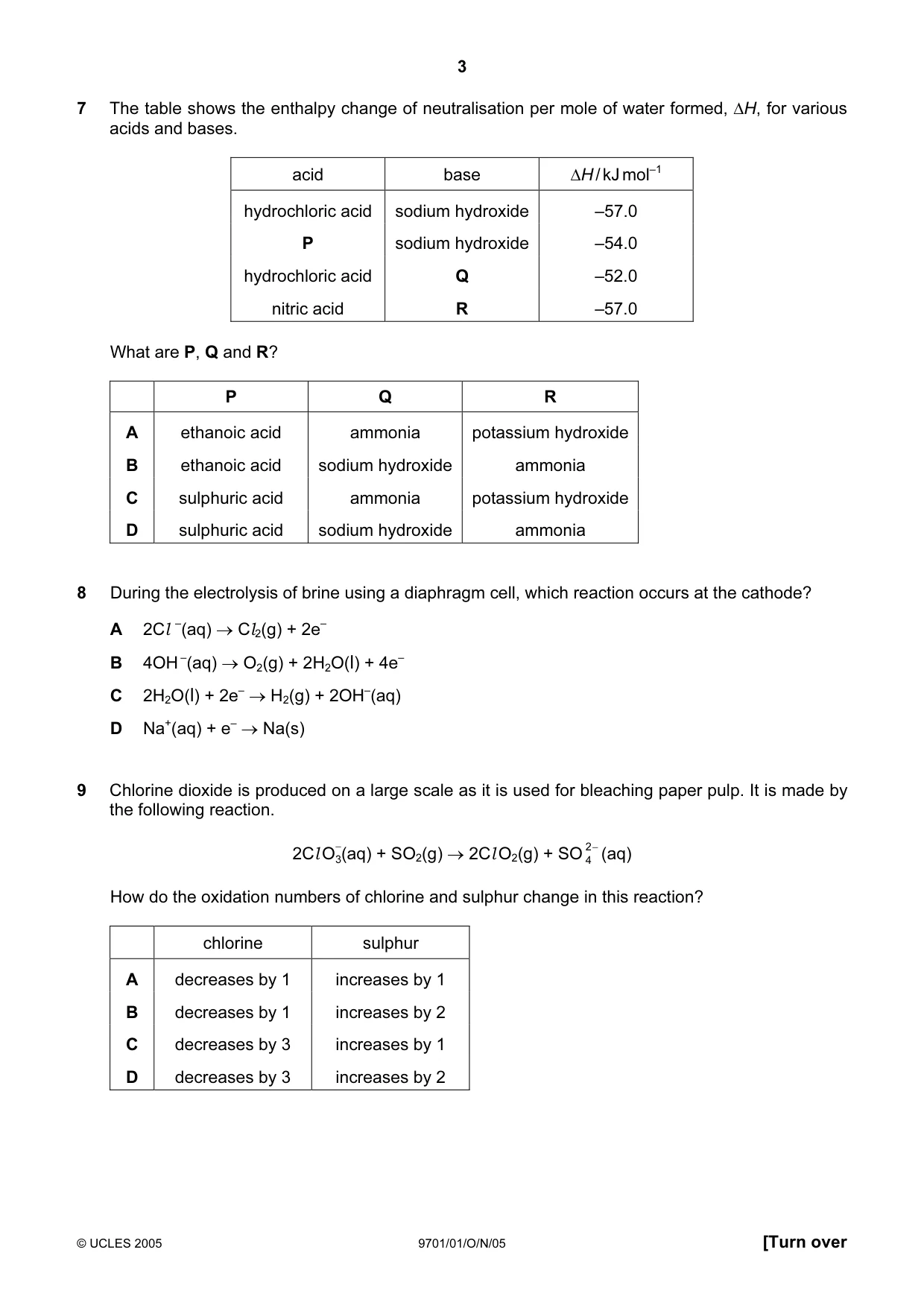
7 The table shows the enthalpy change of neutralisation per mole of water formed, ∆H, for various acids and bases. acid base ∆H / kJ mol–1 hydrochloric acid sodium hydroxide –57.0 P sodium hydroxide –54.0 hydrochloric acid Q –52.0 nitric acid R –57.0 What are P, Q and R? P Q R A ethanoic acid ammonia potassium hydroxide B ethanoic acid sodium hydroxide ammonia C sulphuric acid ammonia potassium hydroxide D sulphuric acid sodium hydroxide ammonia
Mark scheme: A
Q8 · During the electrolysis of brine using a diaphragm cell, which reaction occurs at the…
8 During the electrolysis of brine using a diaphragm cell, which reaction occurs at the cathode? A 2Cl –(aq) → Cl2(g) + 2e– B 4OH –(aq) → O2(g) + 2H2O(l) + 4e– C 2H2O(l) + 2e– → H2(g) + 2OH–(aq) D Na+(aq) + e– → Na(s)
Mark scheme: C
Q9 · Chlorine dioxide is produced on a large scale as it is used for bleaching paper pulp
9 Chlorine dioxide is produced on a large scale as it is used for bleaching paper pulp. It is made by the following reaction. 2Cl O (aq) + SO2(g) → 2Cl O2(g) + SO − 2 4 (aq) − 3 How do the oxidation numbers of chlorine and sulphur change in this reaction? chlorine sulphur A decreases by 1 increases by 1 B decreases by 1 increases by 2 C decreases by 3 increases by 1 D decreases by 3 increases by 2
Mark scheme: B
Q10 · An experiment is set up to measure the rate of hydrolysis of methyl ethanoate
10 An experiment is set up to measure the rate of hydrolysis of methyl ethanoate. CH3CO2CH3 + H2O CH3CO2H + CH3OH The hydrolysis is found to be slow in neutral aqueous solution but it proceeds at a measurable rate when the solution is acidified with hydrochloric acid. What is the function of the hydrochloric acid? A to dissolve the methyl ethanoate B to ensure that the reaction reaches equilibrium C to increase the reaction rate by catalytic action D to suppress ionisation of the ethanoic acid formed
Mark scheme: C
Q11 · The distribution of molecular kinetic energies within a gas at temperature T1 and T2 are…
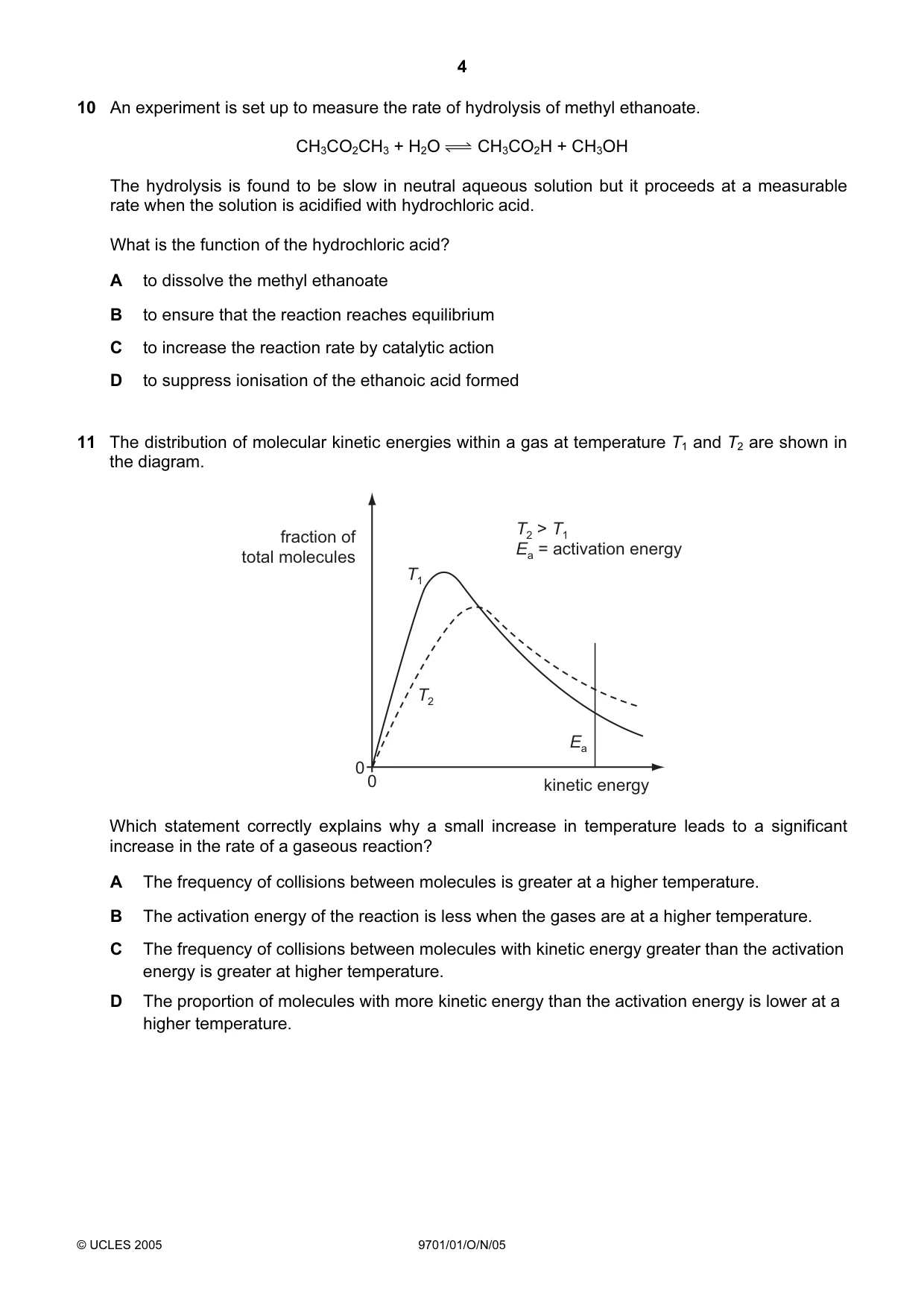
11 The distribution of molecular kinetic energies within a gas at temperature T1 and T2 are shown in the diagram. T2 > T1 fraction of Ea = activation energy total molecules T1 T2 Ea 00 kinetic energy Which statement correctly explains why a small increase in temperature leads to a significant increase in the rate of a gaseous reaction? A The frequency of collisions between molecules is greater at a higher temperature. B The activation energy of the reaction is less when the gases are at a higher temperature. C The frequency of collisions between molecules with kinetic energy greater than the activation energy is greater at higher temperature. D The proportion of molecules with more kinetic energy than the activation energy is lower at a higher temperature.
Mark scheme: C
More questions on Effect of temperature on reaction rates and the concept of activation energy
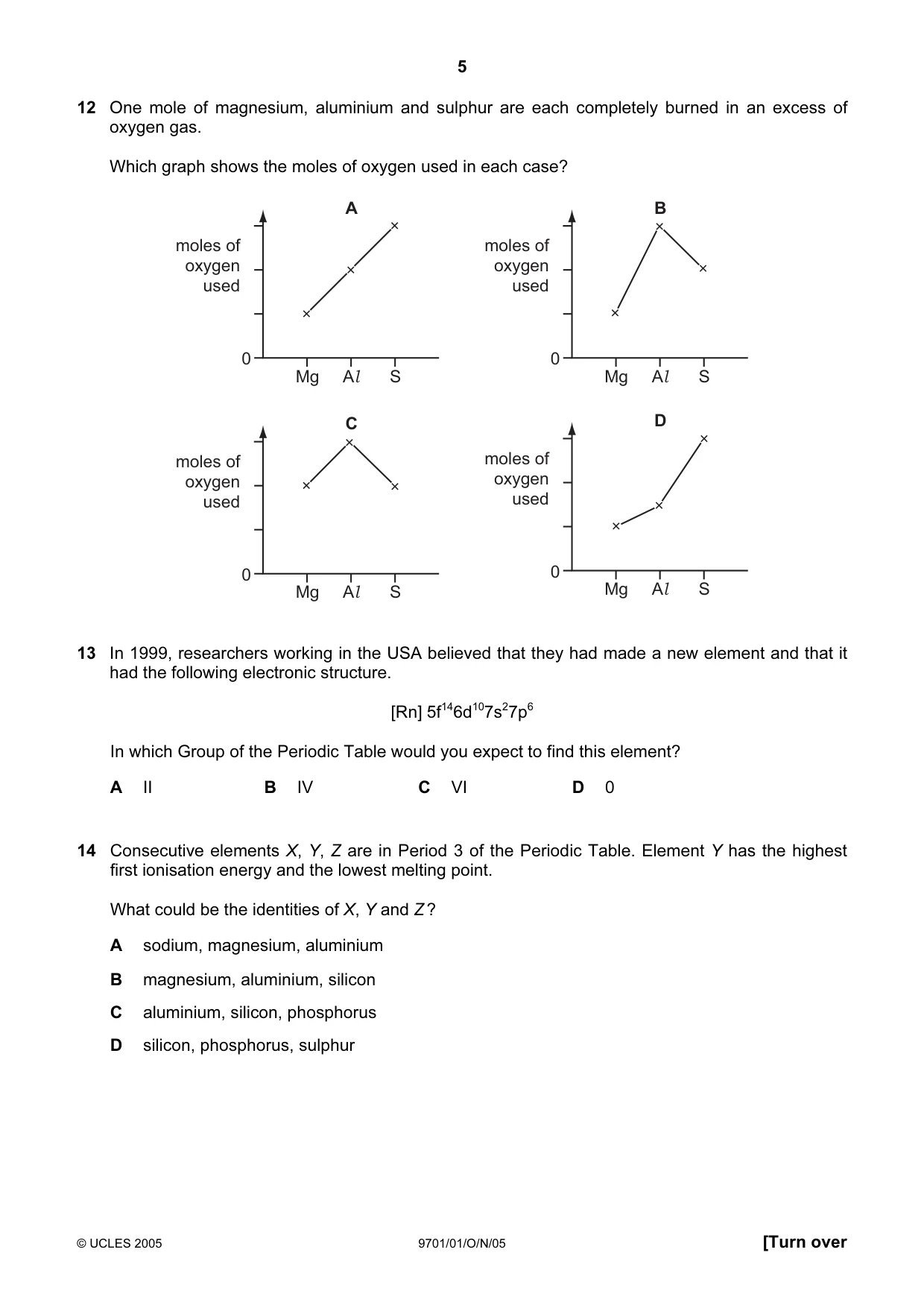
Q12 · One mole of magnesium, aluminium and sulphur are each completely burned in an excess of…
12 One mole of magnesium, aluminium and sulphur are each completely burned in an excess of oxygen gas. Which graph shows the moles of oxygen used in each case? A B moles of moles of oxygen oxygen used used 0 0 Mg Al S Mg Al S C D moles of moles of oxygen oxygen used used 0 0 Mg Al S Mg Al S
Mark scheme: D
More questions on Periodicity of chemical properties of the elements in Period 3
Q13 · In 1999, researchers working in the USA believed that they had made a new element and…
13 In 1999, researchers working in the USA believed that they had made a new element and that it had the following electronic structure. [Rn] 5f146d107s27p6 In which Group of the Periodic Table would you expect to find this element? A II B IV C VI D 0
Mark scheme: D
More questions on Electrons, energy levels and atomic orbitals
Q14 · Consecutive elements X, Y, Z are in Period 3 of the Periodic Table
14 Consecutive elements X, Y, Z are in Period 3 of the Periodic Table. Element Y has the highest first ionisation energy and the lowest melting point. What could be the identities of X, Y and Z ? A sodium, magnesium, aluminium B magnesium, aluminium, silicon C aluminium, silicon, phosphorus D silicon, phosphorus, sulphur
Mark scheme: D
More questions on Periodicity of physical properties of the elements in Period 3
Q15 · Use of the Data Booklet is relevant to this question
15 Use of the Data Booklet is relevant to this question. What volume of oxygen, measured under room conditions, can be obtained from the thermal decomposition of 8.2 g of calcium nitrate (Mr = 164)? A 150 cm3 B 300 cm3 C 600 cm3 D 1200 cm3
Mark scheme: C
More questions on Reacting masses and volumes (of solutions and gases)
Q16 · When a mineral was heated in a Bunsen flame to constant mass, a colourless gas that…
16 When a mineral was heated in a Bunsen flame to constant mass, a colourless gas that turned lime water milky was evolved. The remaining solid was cooled and then added to aqueous hydrochloric acid. Vigorous effervescence was seen. What was the mineral? A aragonite, CaCO3 B artinite, MgCO3.Mg(OH)2.3H2O C barytocalcite, BaCO3.CaCO3 D dolomite, CaCO3.MgCO3
Mark scheme: C
Q17 · How does ammonia behave when its aqueous solution is used to dissolve silver chloride…
17 How does ammonia behave when its aqueous solution is used to dissolve silver chloride, AgCl ? A as a base B as a ligand with the Ag+ ion C as a ligand with the Cl – ion D as a reducing agent
Mark scheme: B
Q18 · Lime, CaO, is used to reduce the acidity of soil, and ammonium sulphate is a nitrogenous…
18 Lime, CaO, is used to reduce the acidity of soil, and ammonium sulphate is a nitrogenous fertiliser. Why can they not be used in a mixed form? A The dry mixture is explosive. B CaSO4, formed on mixing, causes hard water. C When dampened, ammonia is given off. D Sulphuric acid will form.
Mark scheme: C
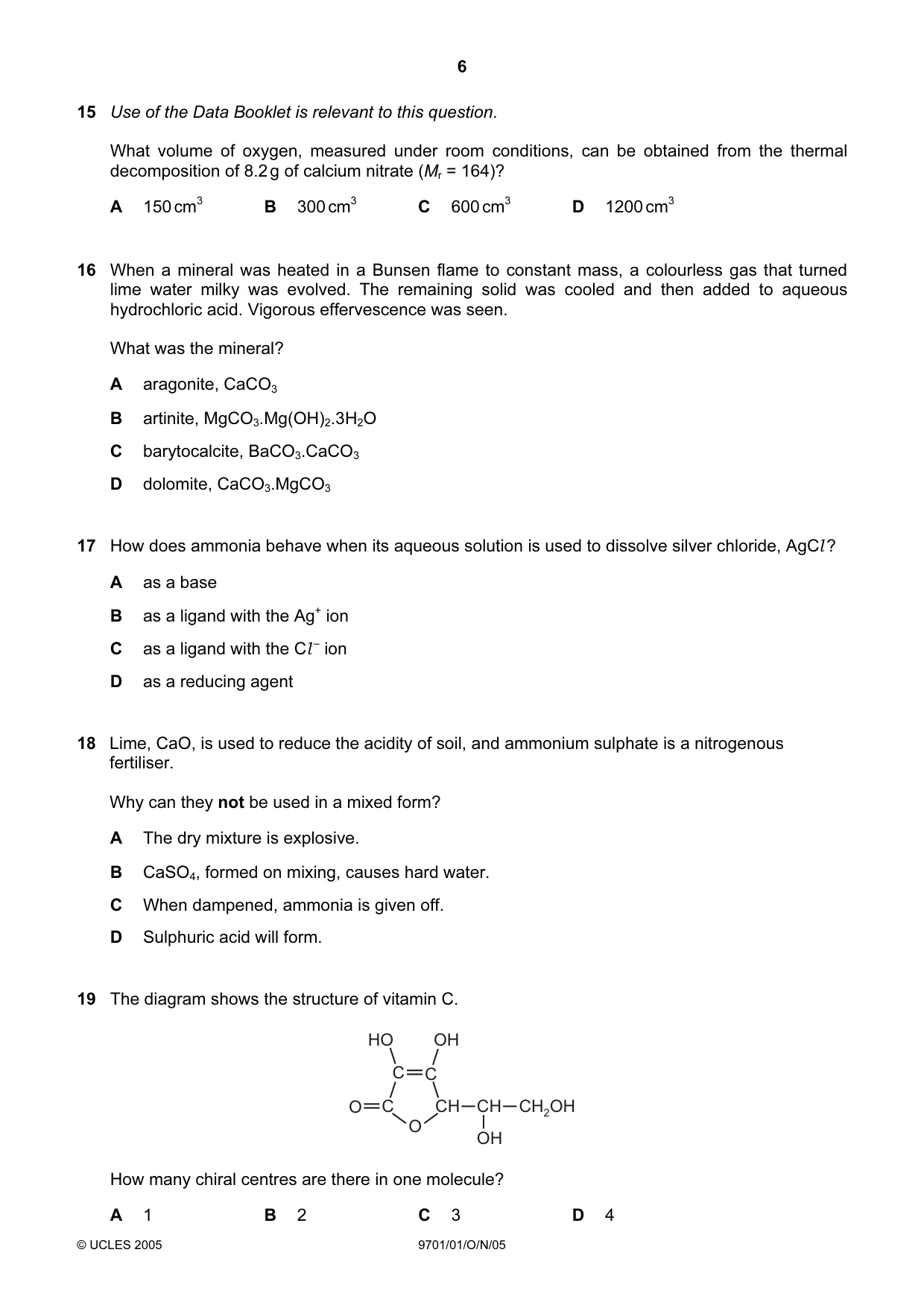
Q19 · The diagram shows the structure of vitamin C
19 The diagram shows the structure of vitamin C. HO OH C C O C CH CH CH2OH O OH How many chiral centres are there in one molecule?
Mark scheme: B
More questions on Isomerism: structural isomerism and stereoisomerism
Q20 · What is the number of isomers of C2H2Cl2 including cis-trans isomers?
20 What is the number of isomers of C2H2Cl2 including cis-trans isomers? A 2 B 3 C 4 D 5
Mark scheme: B
More questions on Isomerism: structural isomerism and stereoisomerism
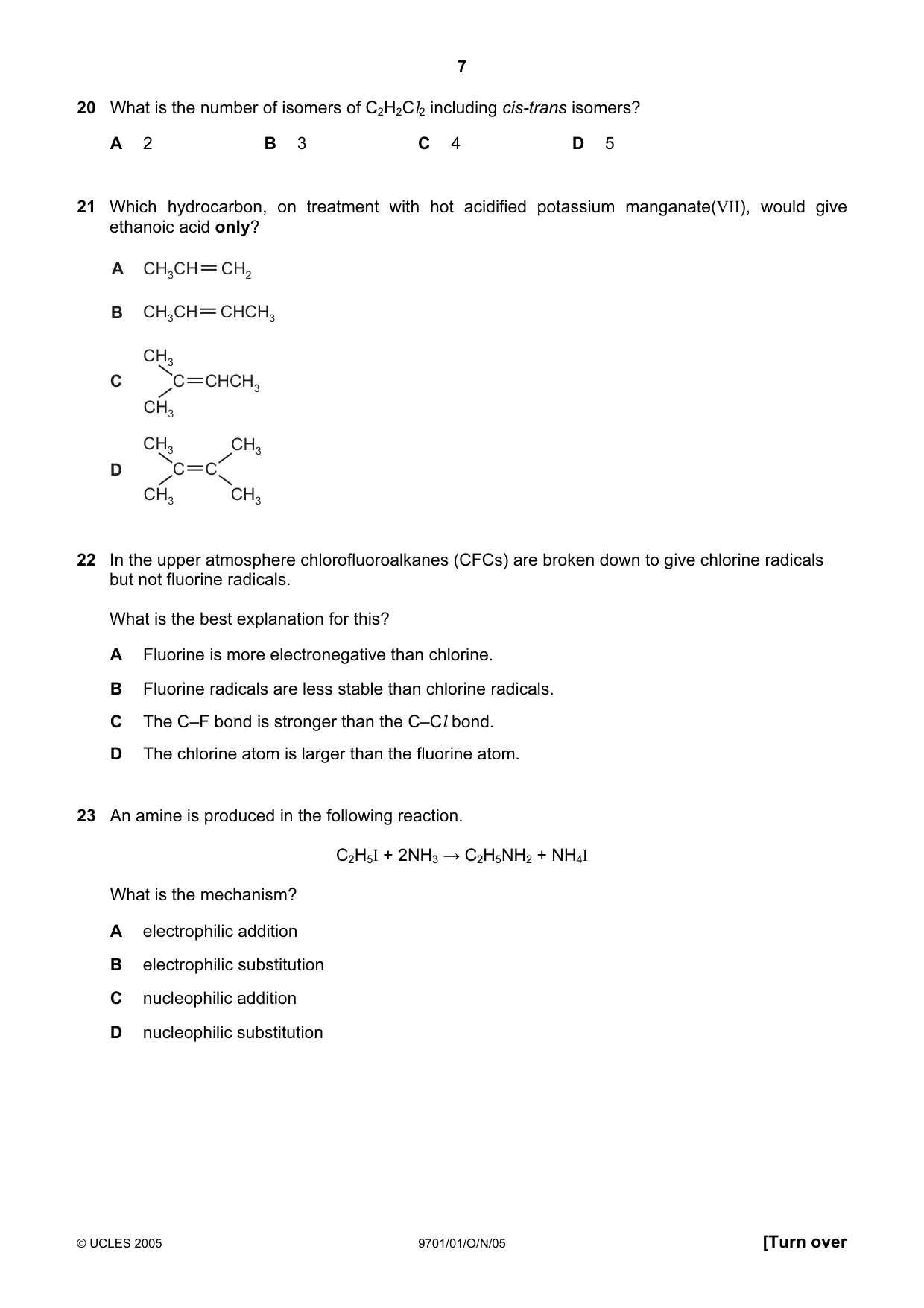
Q21 · Which hydrocarbon, on treatment with hot acidified potassium manganate(VII), would give…
21 Which hydrocarbon, on treatment with hot acidified potassium manganate(VII), would give ethanoic acid only? A CH3CH CH2 B CH3CH CHCH3 CH3 C C CHCH3 CH3 CH3 CH3 D C C CH3 CH3
Mark scheme: B
Q22 · In the upper atmosphere chlorofluoroalkanes (CFCs) are broken down to give chlorine…
22 In the upper atmosphere chlorofluoroalkanes (CFCs) are broken down to give chlorine radicals but not fluorine radicals. What is the best explanation for this? A Fluorine is more electronegative than chlorine. B Fluorine radicals are less stable than chlorine radicals. C The C–F bond is stronger than the C–Cl bond. D The chlorine atom is larger than the fluorine atom.
Mark scheme: C
More questions on Intermolecular forces, electronegativity and bond properties
Q23 · An amine is produced in the following reaction
23 An amine is produced in the following reaction. C2H5I + 2NH3 → C2H5NH2 + NH4I What is the mechanism? A electrophilic addition B electrophilic substitution C nucleophilic addition D nucleophilic substitution
Mark scheme: D
Q24 · Compound X on reaction with hot concentrated sulphuric acid gave a mixture of three…
24 Compound X on reaction with hot concentrated sulphuric acid gave a mixture of three alkenes. What could X be? A butan-2-ol B propan-2-ol C 2-methylbutan-2-ol D 2-methylpropan-2-ol
Mark scheme: A
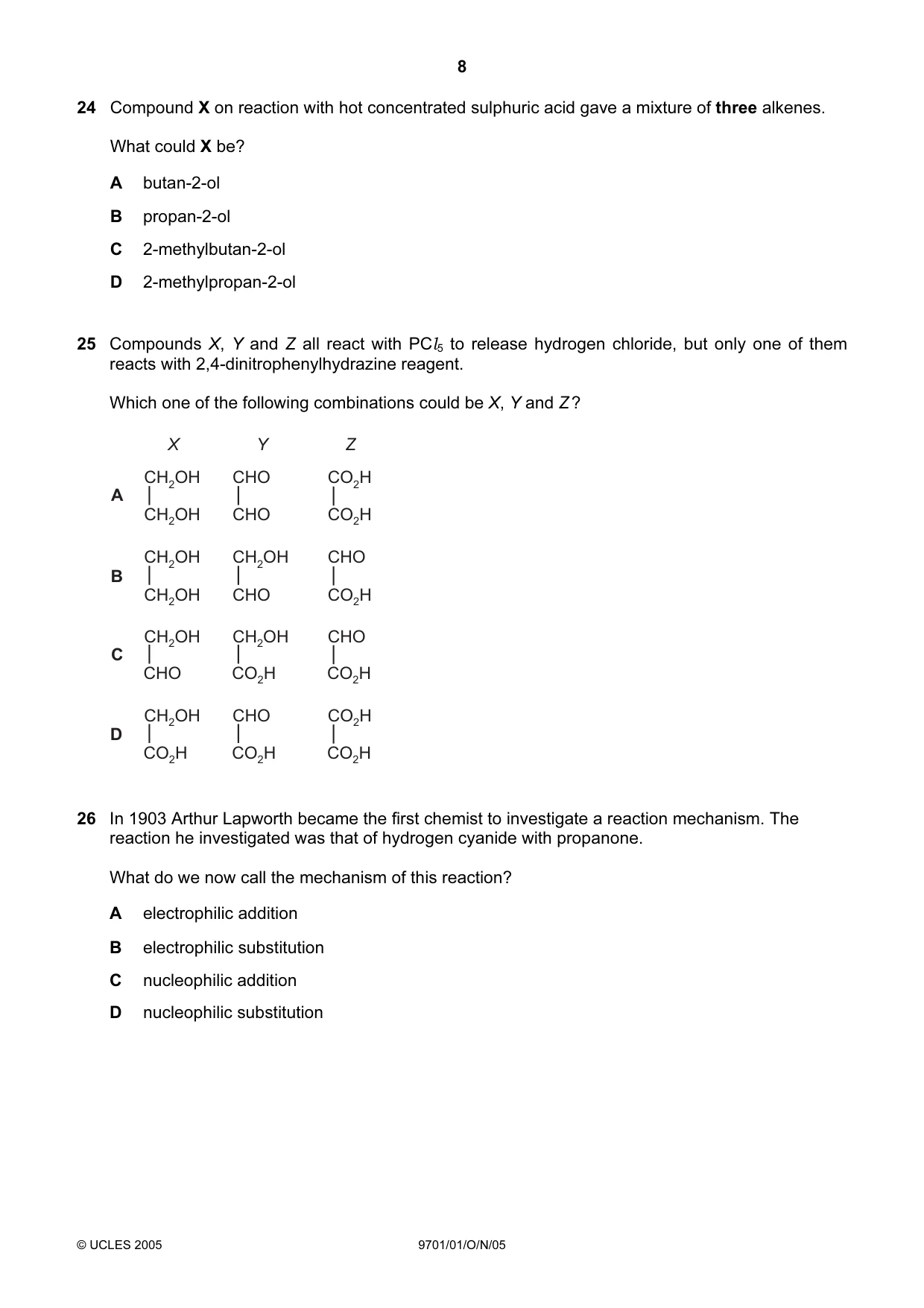
Q25 · Compounds X, Y and Z all react with PCl5 to release hydrogen chloride, but only one of…
25 Compounds X, Y and Z all react with PCl5 to release hydrogen chloride, but only one of them reacts with 2,4-dinitrophenylhydrazine reagent. Which one of the following combinations could be X, Y and Z ? X Y Z CH2OH CHO CO2H A CH2OH CHO CO2H CH2OH CH2OH CHO B CH2OH CHO CO2H CH2OH CH2OH CHO C CHO CO2H CO2H CH2OH CHO CO2H D CO2H CO2H CO2H
Mark scheme: D
More questions on Formulas, functional groups and the naming of organic compounds
Q26 · In 1903 Arthur Lapworth became the first chemist to investigate a reaction mechanism
26 In 1903 Arthur Lapworth became the first chemist to investigate a reaction mechanism. The reaction he investigated was that of hydrogen cyanide with propanone. What do we now call the mechanism of this reaction? A electrophilic addition B electrophilic substitution C nucleophilic addition D nucleophilic substitution
Mark scheme: C
Q27 · What is formed when propanone is refluxed with an anhydrous solution of NaBH4?
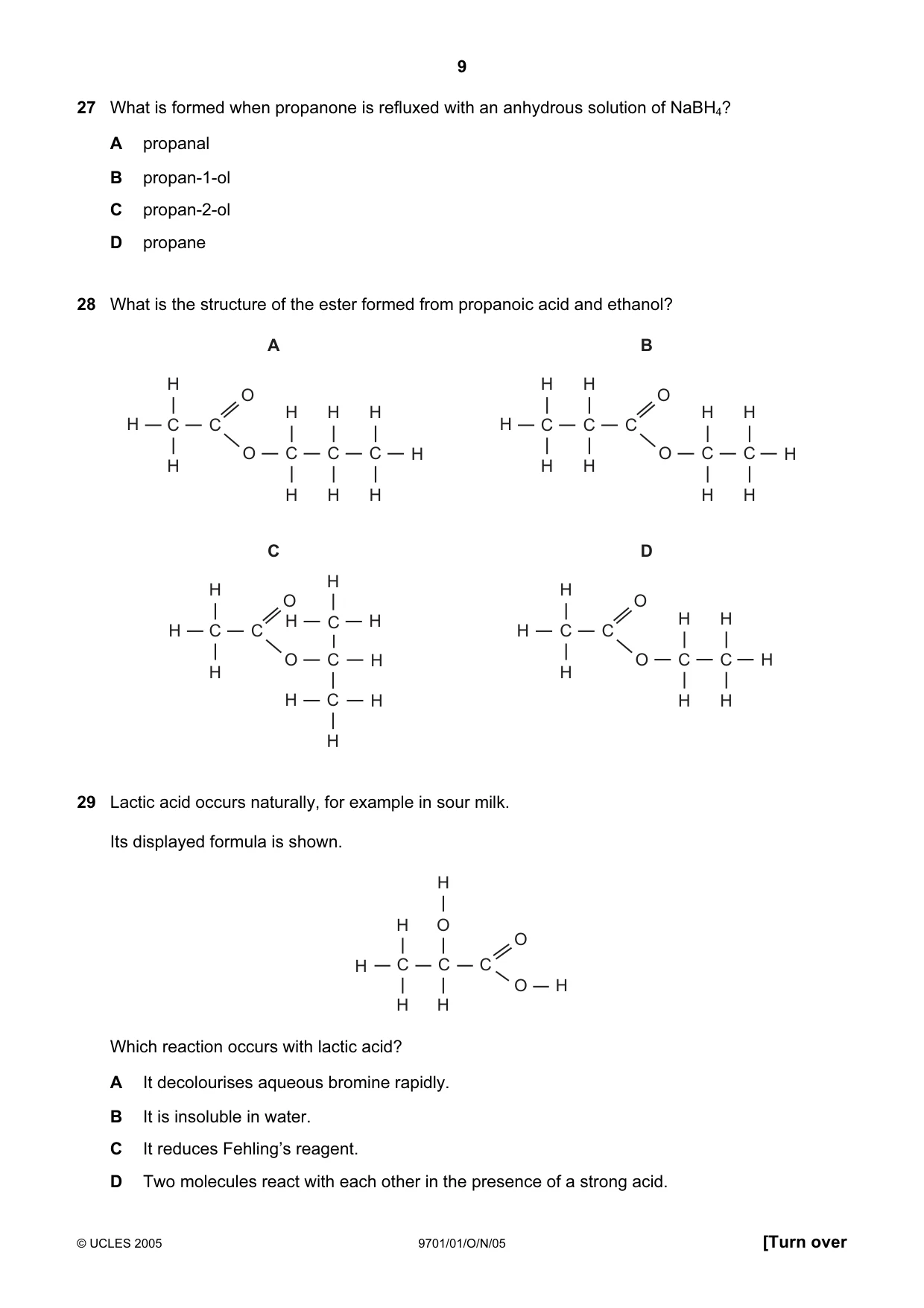
27 What is formed when propanone is refluxed with an anhydrous solution of NaBH4? A propanal B propan-1-ol C propan-2-ol D propane
Mark scheme: C
Q28 · What is the structure of the ester formed from propanoic acid and ethanol?
28 What is the structure of the ester formed from propanoic acid and ethanol? A B H H H O O H H H H H H C C H C C C O C C C H O C C H H H H H H H H H C D H H H O O H C H H H H C C H C C O C H O C C H H H H C H H H H
Mark scheme: B
Q29 · Lactic acid occurs naturally, for example in sour milk
29 Lactic acid occurs naturally, for example in sour milk. Its displayed formula is shown. H H O O H C C C O H H H Which reaction occurs with lactic acid? A It decolourises aqueous bromine rapidly. B It is insoluble in water. C It reduces Fehling’s reagent. D Two molecules react with each other in the presence of a strong acid.
Mark scheme: D
Q30 · PHB (polyhydroxybutyric acid) is a natural polymer produced by a range of micro-organisms
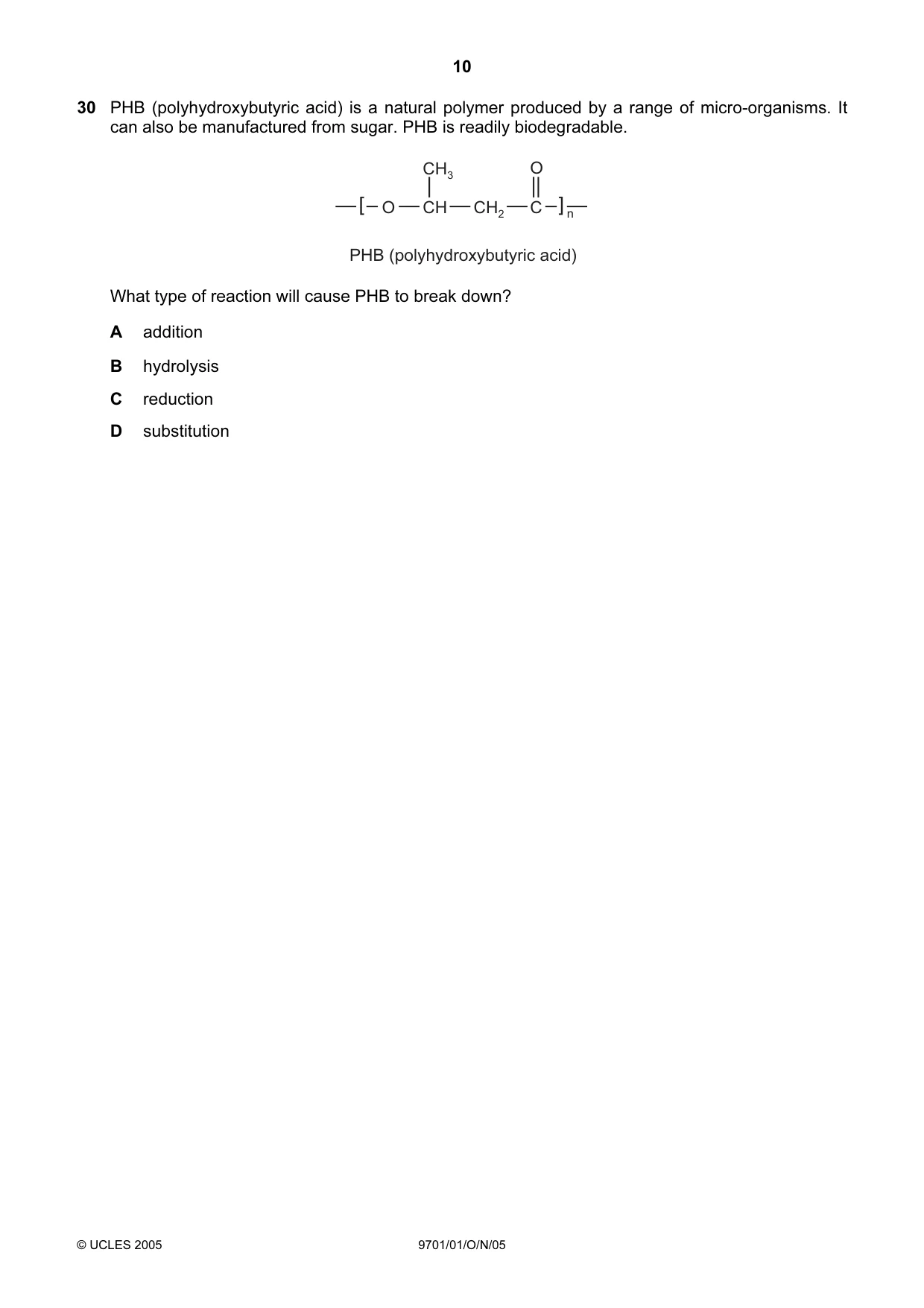
30 PHB (polyhydroxybutyric acid) is a natural polymer produced by a range of micro-organisms. It can also be manufactured from sugar. PHB is readily biodegradable. CH3 O [ O CH CH2 C [ n PHB (polyhydroxybutyric acid) What type of reaction will cause PHB to break down? A addition B hydrolysis C reduction D substitution
Mark scheme: B
Q31 · The relative molecular mass of a molecule of chlorine is 72
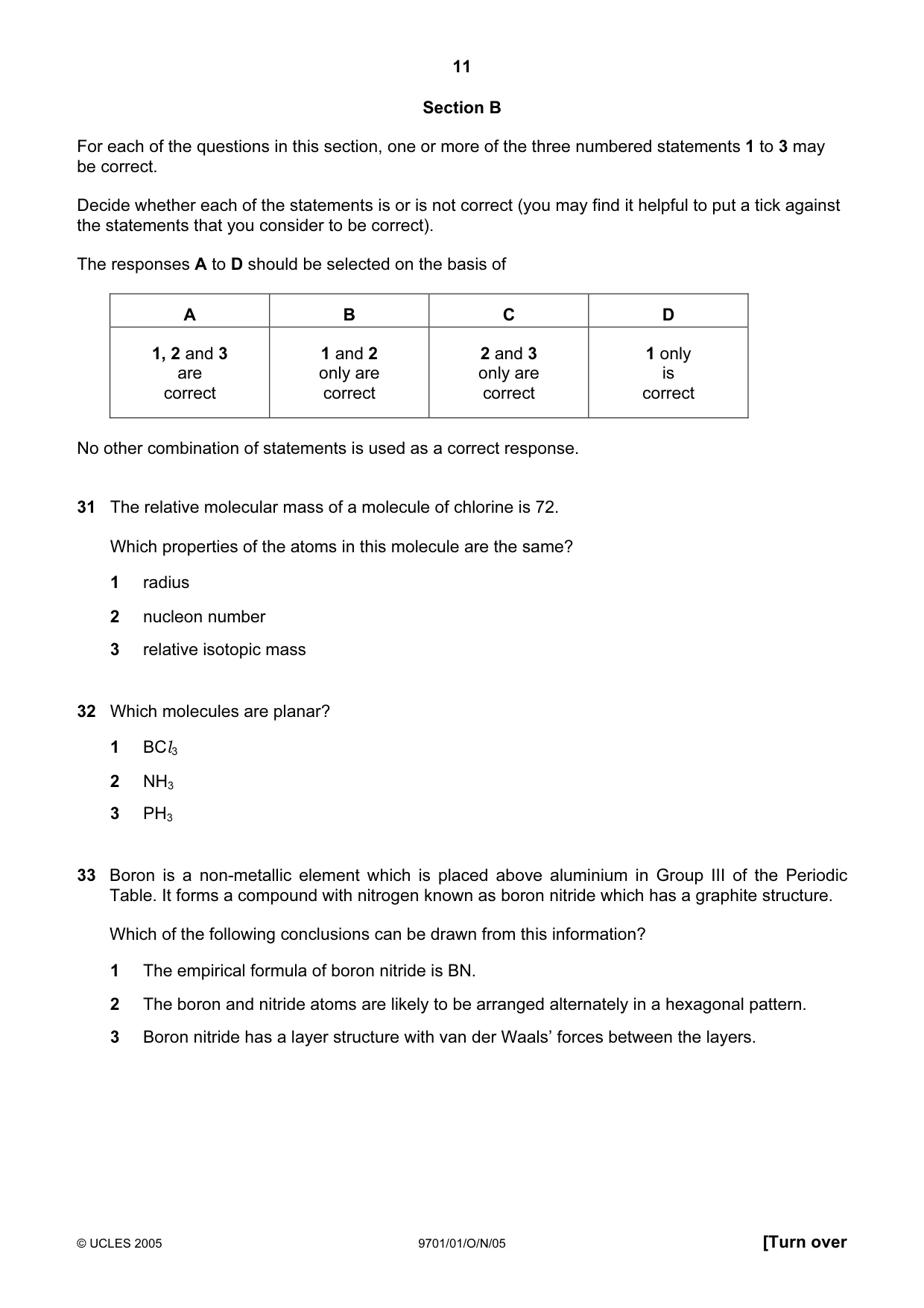
31 The relative molecular mass of a molecule of chlorine is 72. Which properties of the atoms in this molecule are the same? 1 radius 2 nucleon number 3 relative isotopic mass
Mark scheme: D
Q32 · Which molecules are planar?
32 Which molecules are planar? 1 BCl3 2 NH3 3 PH3
Mark scheme: D
Q33 · Boron is a non-metallic element which is placed above aluminium in Group III of the…
33 Boron is a non-metallic element which is placed above aluminium in Group III of the Periodic Table. It forms a compound with nitrogen known as boron nitride which has a graphite structure. Which of the following conclusions can be drawn from this information? 1 The empirical formula of boron nitride is BN. 2 The boron and nitride atoms are likely to be arranged alternately in a hexagonal pattern. 3 Boron nitride has a layer structure with van der Waals’ forces between the layers.
Mark scheme: A
Q34 · Hydroxyapatite, Ca5(PO4)3OH, is the main constituent of tooth enamel
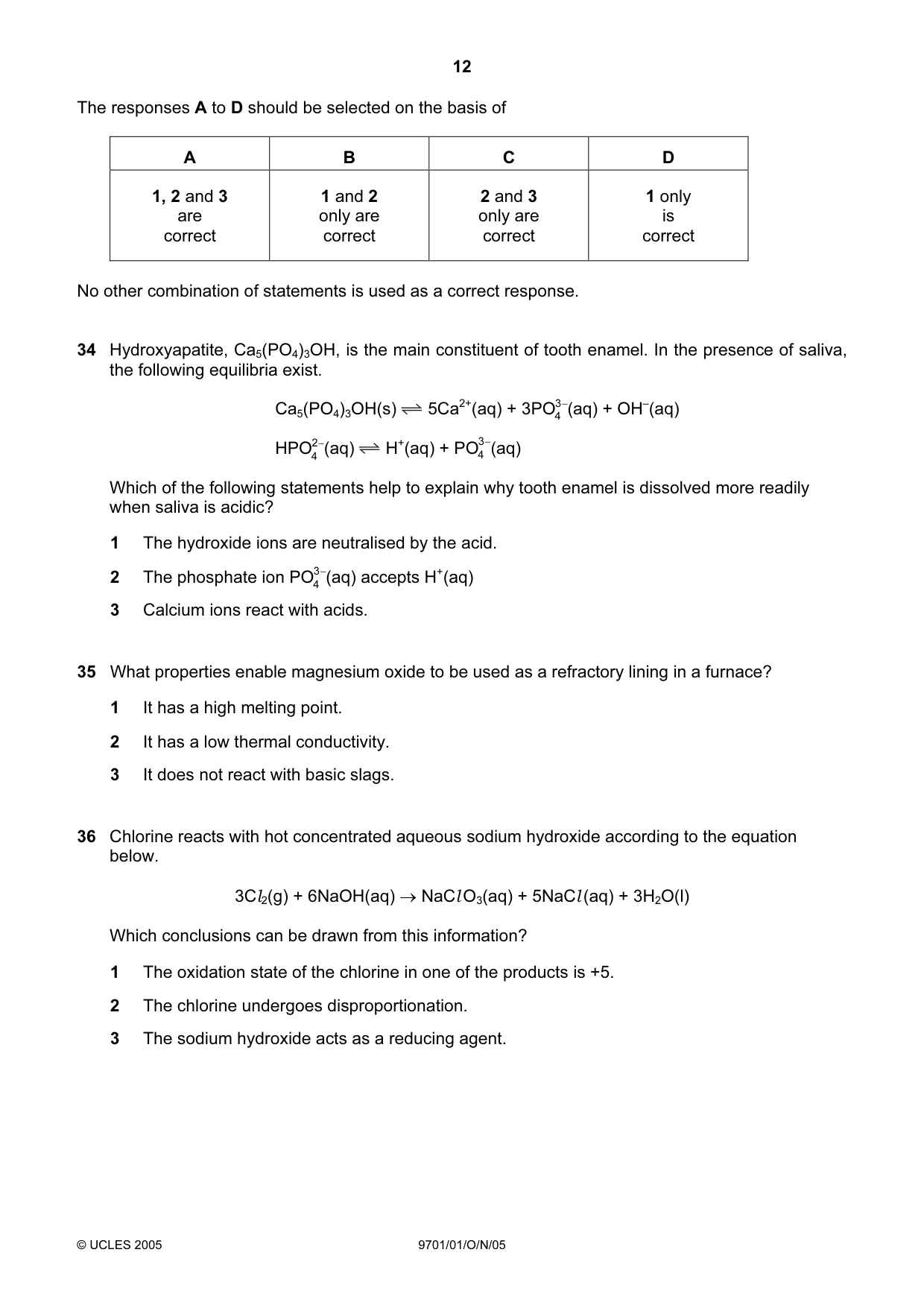
34 Hydroxyapatite, Ca5(PO4)3OH, is the main constituent of tooth enamel. In the presence of saliva, the following equilibria exist. Ca5(PO4)3OH(s) 5Ca2+(aq) + 3PO (aq) + OH–(aq) 3 − 4 HPO (aq) 2 − H+(aq) + PO (aq) 3 − 4 4 Which of the following statements help to explain why tooth enamel is dissolved more readily when saliva is acidic? 1 The hydroxide ions are neutralised by the acid. 2 The phosphate ion PO (aq) accepts H+(aq) 3 − 4 3 Calcium ions react with acids.
Mark scheme: B
Q35 · What properties enable magnesium oxide to be used as a refractory lining in a furnace?
35 What properties enable magnesium oxide to be used as a refractory lining in a furnace? 1 It has a high melting point. 2 It has a low thermal conductivity. 3 It does not react with basic slags.
Mark scheme: A
Q36 · Chlorine reacts with hot concentrated aqueous sodium hydroxide according to the equation…
36 Chlorine reacts with hot concentrated aqueous sodium hydroxide according to the equation below. 3Cl2(g) + 6NaOH(aq) → NaCl O3(aq) + 5NaCl (aq) + 3H2O(l) Which conclusions can be drawn from this information? 1 The oxidation state of the chlorine in one of the products is +5. 2 The chlorine undergoes disproportionation. 3 The sodium hydroxide acts as a reducing agent.
Mark scheme: B
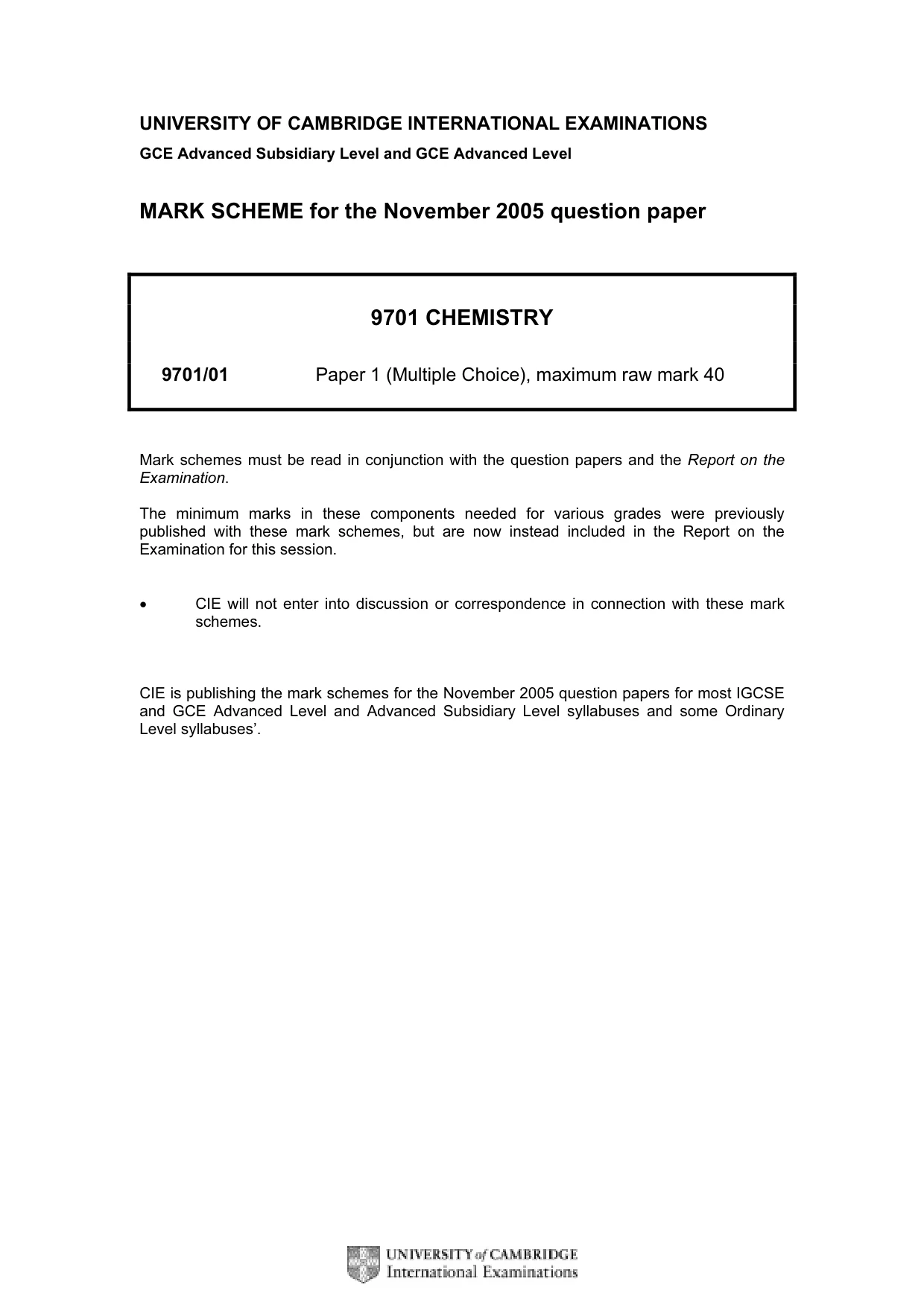
Q37 · Which equations represent stages in the Contact process for manufacturing sulphuric acid?
37 Which equations represent stages in the Contact process for manufacturing sulphuric acid? 1 S + O2 → SO2 2 H2O + SO2 → H2SO3 3 H2SO3 + O2 → H2SO4 1 2
Mark scheme: D
Q38 · For the reaction (CH3)3SiCl + C2H5O– → (CH3)3SiOC2H5 + Cl – which statements are likely…
38 For the reaction (CH3)3SiCl + C2H5O– → (CH3)3SiOC2H5 + Cl – which statements are likely to be true? 1 It involves nucleophilic attack by C2H5O–. 2 Cl – is displaced by C2H5O–. 3 The oxygen-carbon bond is not broken.
Mark scheme: A
Q39 · Modern cars are fitted with catalytic converters
39 Modern cars are fitted with catalytic converters. These remove carbon monoxide, unburnt hydrocarbons and oxides of nitrogen from exhaust gases. Which of these pollutant gases are removed by oxidation? 1 carbon monoxide 2 hydrocarbons 3 nitrogen oxides
Mark scheme: B
Q40 · The sex-attractant of the house-fly is muscalure, with the following formula
40 The sex-attractant of the house-fly is muscalure, with the following formula. CH3(CH2)7CH = CH(CH2)12CH3 Which statements about muscalure are correct? 1 It will decolourise aqueous bromine. 2 It will be oxidised by cold aqueous alkaline KMnO4 to give a diol. 3 It will be optically active.
Mark scheme: B
What was in this paper
The subtopics covered by these 40 questions, and how many questions each got. Open one in a new tab to see every Cambridge question on it.
2Homogeneous and heterogeneous catalysts2Intermolecular forces, electronegativity and bond properties2Isomerism: structural isomerism and stereoisomerism2Nitrogen and sulfur2Reacting masses and volumes (of solutions and gases)2Similarities and trends in the properties of the Group 2 metals, magnesium to barium, and their compounds2Acids and bases1Alcohols1Aldehydes and ketones1Bonding and structure1Carboxylic acids1Condensation polymerisation1Effect of temperature on reaction rates and the concept of activation energy1Electrolysis1Electrons, energy levels and atomic orbitals1Enthalpy change, ΔH1Esters1Formulas, functional groups and the naming of organic compounds1General characteristic chemical properties of the first set of transition elements, titanium to copper1Halogen compounds1Halogenoalkanes1Hess’s law1Ionisation energy1Isotopes1Nitriles and hydroxynitriles1Particles in the atom and atomic radius1Periodicity of chemical properties of the elements in Period 31Periodicity of physical properties of the elements in Period 31Redox processes: electron transfer and changes in oxidation number (oxidation state)1Shapes of molecules1The gaseous state: ideal and real gases and pV = nRT1The reactions of chlorine1