Cambridge A Level Chemistry 9701 — 2017 Oct/Nov Paper 1 · Variant 2
9701/12/O/N/17 · 40 questions · 40 marks · ≈45 min
The question paper and its mark scheme, free to read here and free to download. This is Cambridge’s own paper, exactly as it was sat.
Question paper16 pages


Mark scheme3 pages
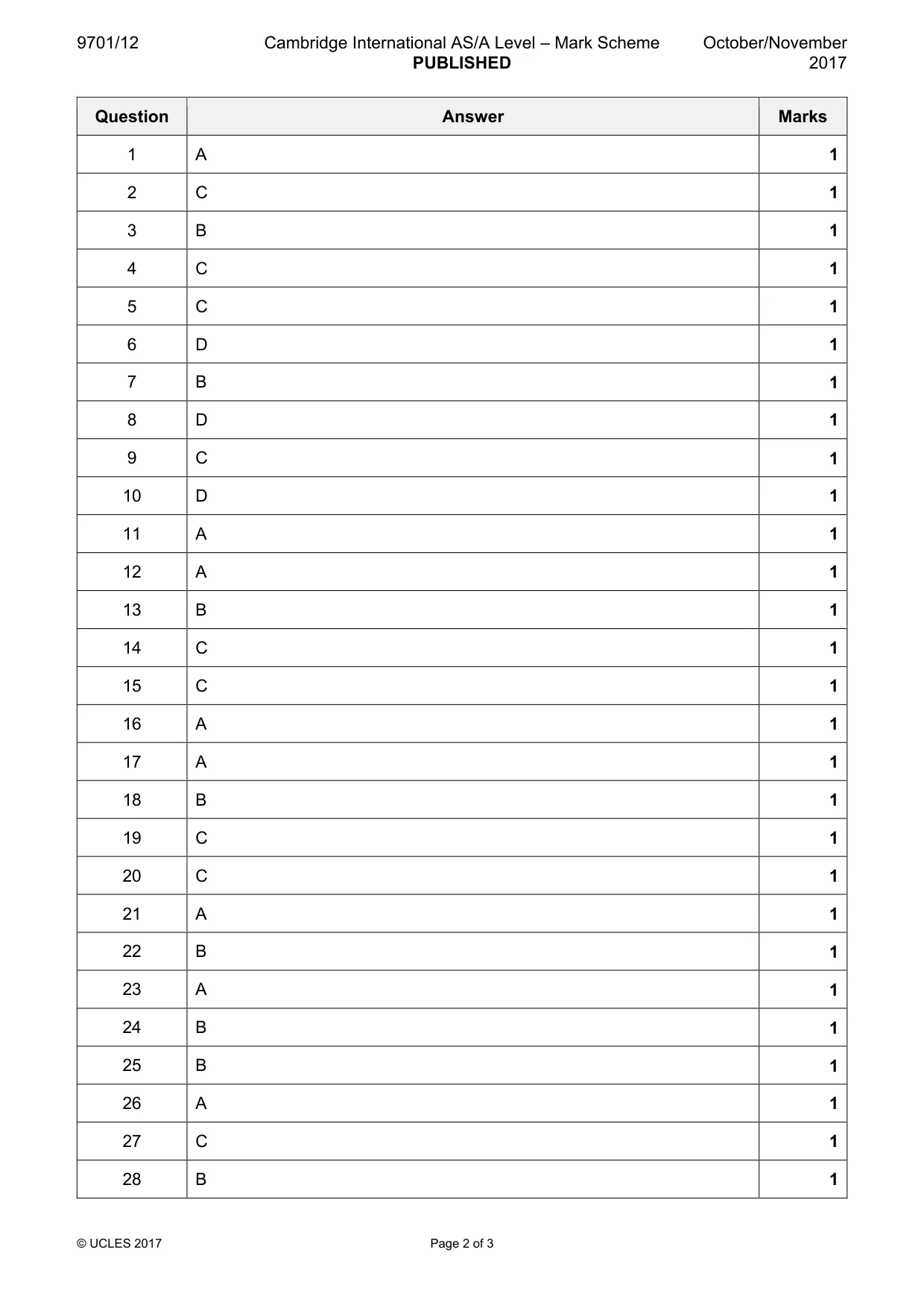
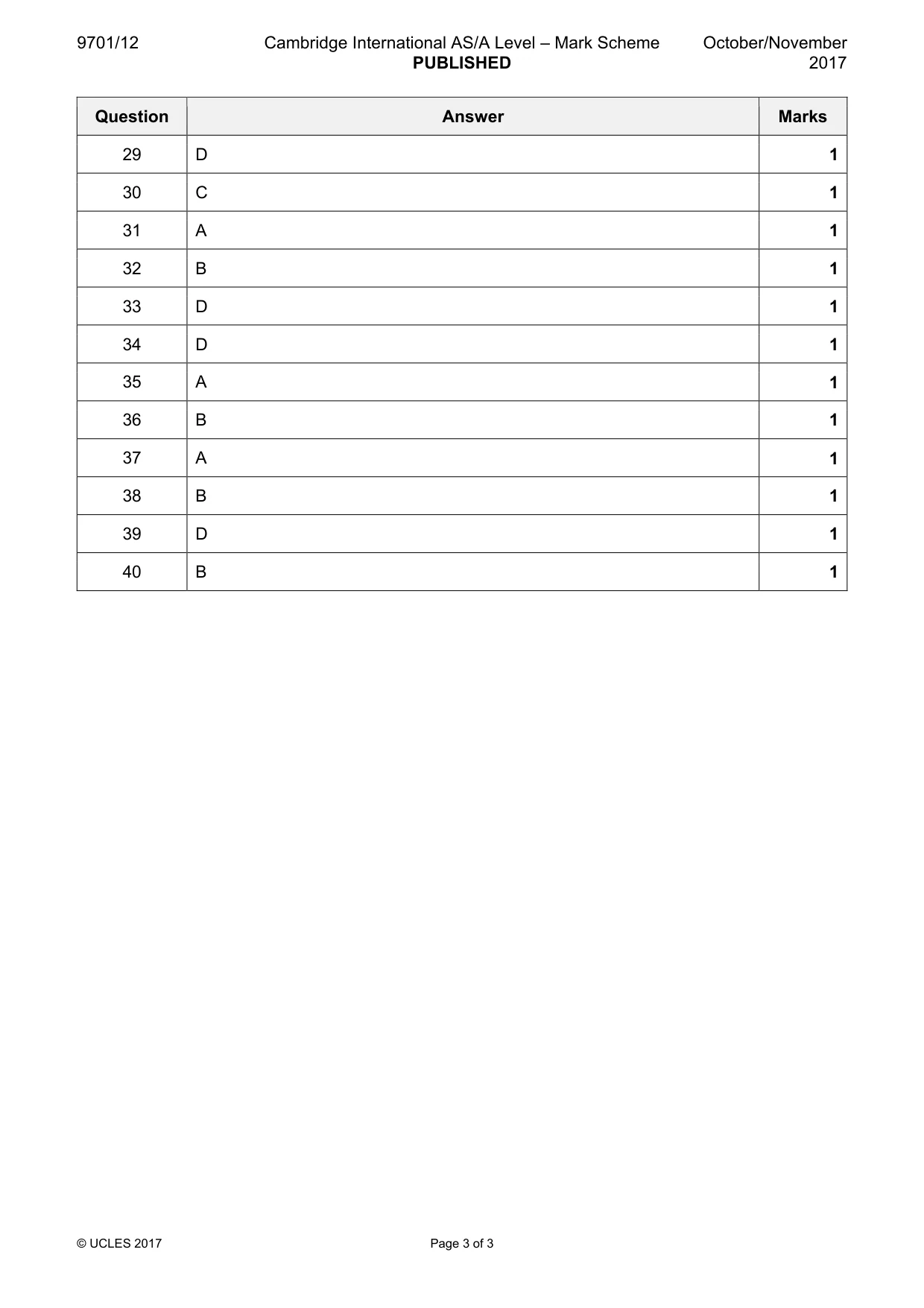
Answers below. Sit the paper first if you are practising.
Questions as text
Q1 · In which pair do the atoms contain the same number of neutrons?
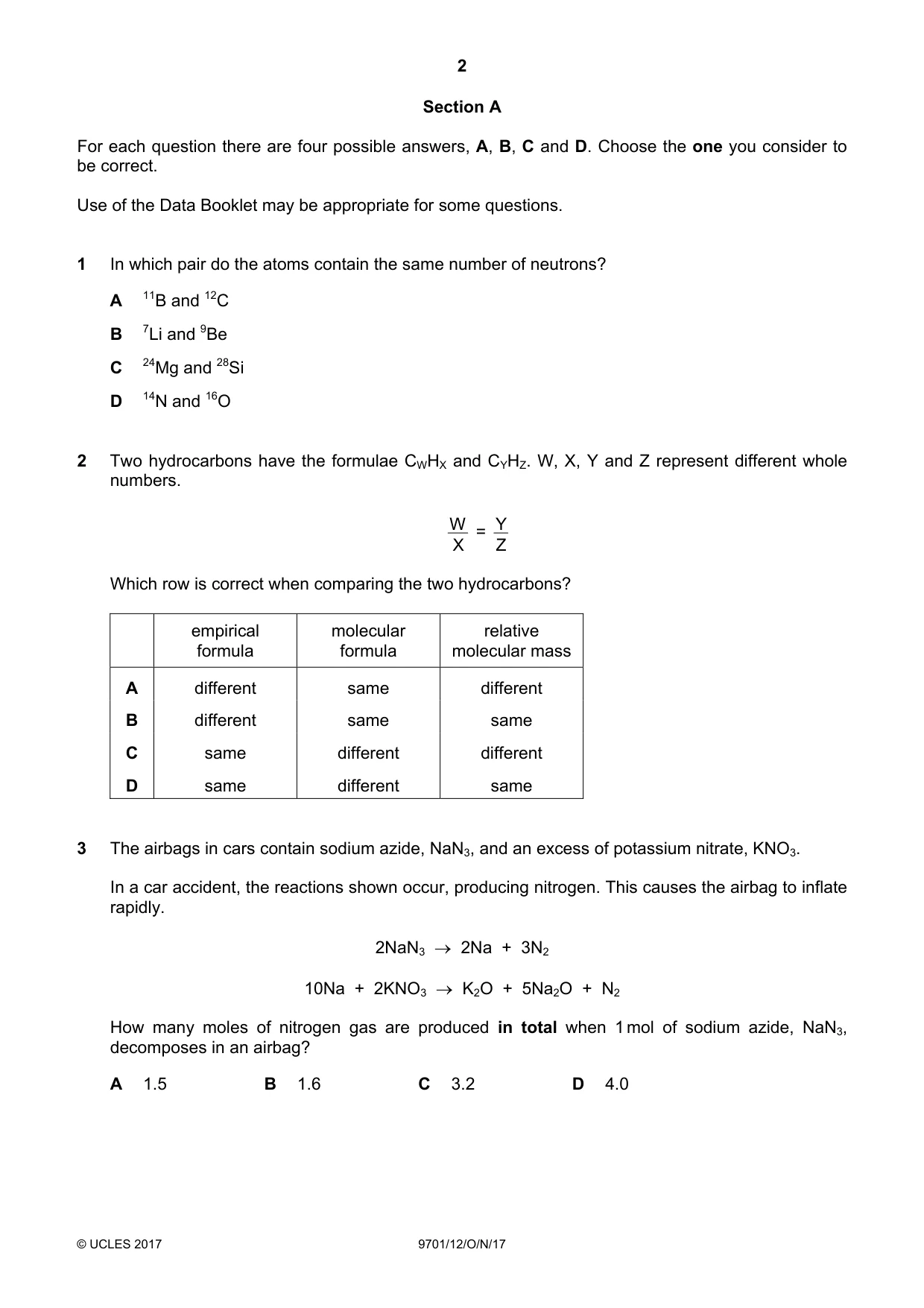
1 In which pair do the atoms contain the same number of neutrons? A 11B and 12C B 7Li and 9Be C 24Mg and 28Si D 14N and 16O
Mark scheme: A
Q2 · Two hydrocarbons have the formulae CWHX and CYHZ
2 Two hydrocarbons have the formulae CWHX and CYHZ. W, X, Y and Z represent different whole numbers. W = Z Y X Which row is correct when comparing the two hydrocarbons? empirical molecular relative formula formula molecular mass A different same different B different same same C same different different D same different same
Mark scheme: C
Q3 · The airbags in cars contain sodium azide, NaN3, and an excess of potassium nitrate, KNO3
3 The airbags in cars contain sodium azide, NaN3, and an excess of potassium nitrate, KNO3. In a car accident, the reactions shown occur, producing nitrogen. This causes the airbag to inflate rapidly. 2NaN3 → 2Na + 3N2 10Na + 2KNO3 → K2O + 5Na2O + N2 How many moles of nitrogen gas are produced in total when 1 mol of sodium azide, NaN3, decomposes in an airbag? A 1.5 B 1.6 C 3.2 D 4.0
Mark scheme: B
More questions on Reacting masses and volumes (of solutions and gases)
Q4 · Ethane burns in oxygen to produce carbon dioxide and water vapour
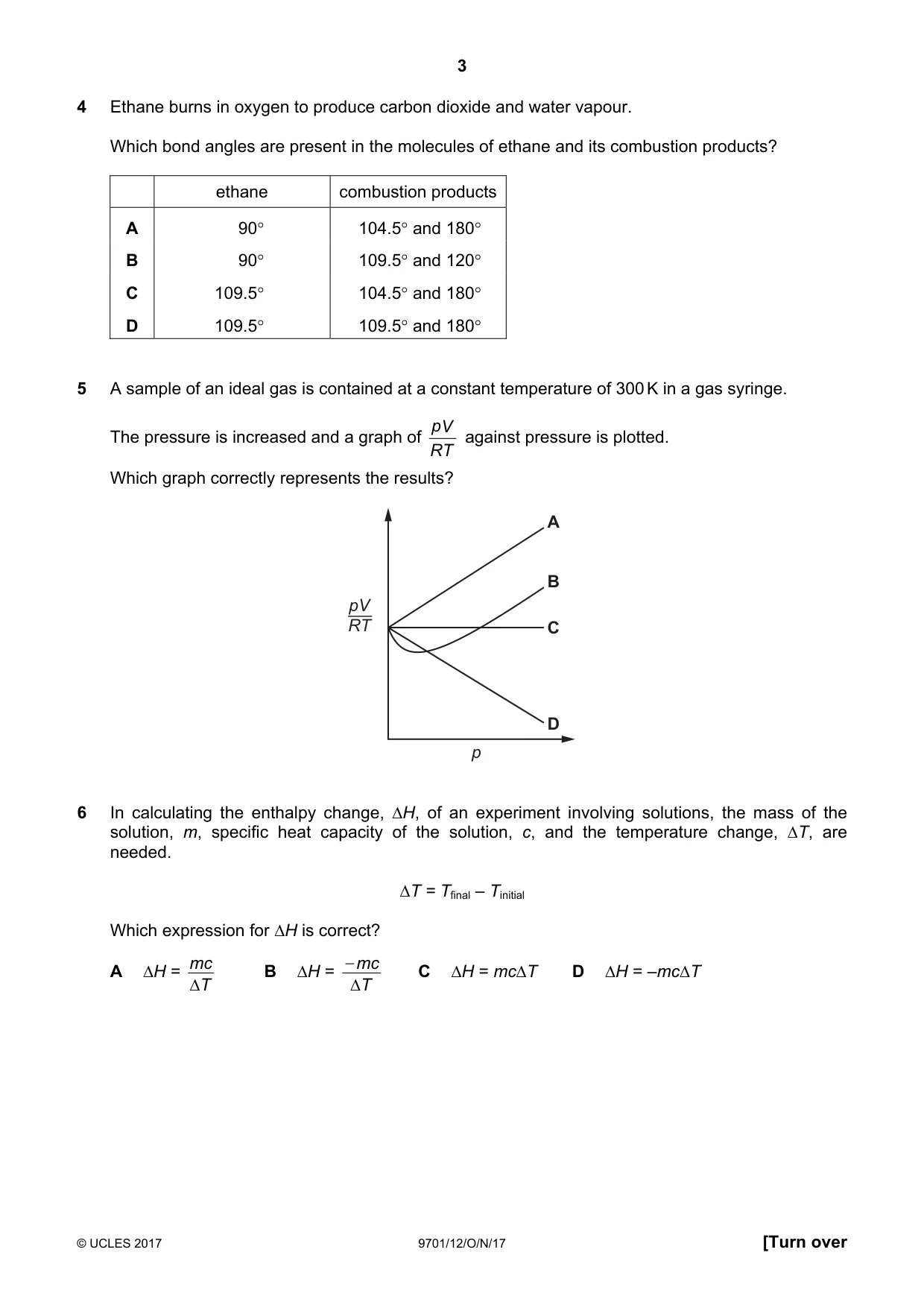
4 Ethane burns in oxygen to produce carbon dioxide and water vapour. Which bond angles are present in the molecules of ethane and its combustion products? ethane combustion products A 90° 104.5° and 180° B 90° 109.5° and 120° C 109.5° 104.5° and 180° D 109.5° 109.5° and 180°
Mark scheme: C
Q5 · A sample of an ideal gas is contained at a constant temperature of 300 K in a gas syringe
5 A sample of an ideal gas is contained at a constant temperature of 300 K in a gas syringe. p V The pressure is increased and a graph of RT against pressure is plotted. Which graph correctly represents the results? A B pV RT C D p
Mark scheme: C
More questions on The gaseous state: ideal and real gases and pV = nRT
Q6 · In calculating the enthalpy change, ∆H, of an experiment involving solutions, the mass of…
6 In calculating the enthalpy change, ∆H, of an experiment involving solutions, the mass of the solution, m, specific heat capacity of the solution, c, and the temperature change, ∆T, are needed. ∆T = Tfinal – Tinitial Which expression for ∆H is correct? mc − mc A ∆H = B ∆H = C ∆H = mc∆T D ∆H = –mc∆T ∆ T ∆ T
Mark scheme: D
Q7 · The following data are needed for this question
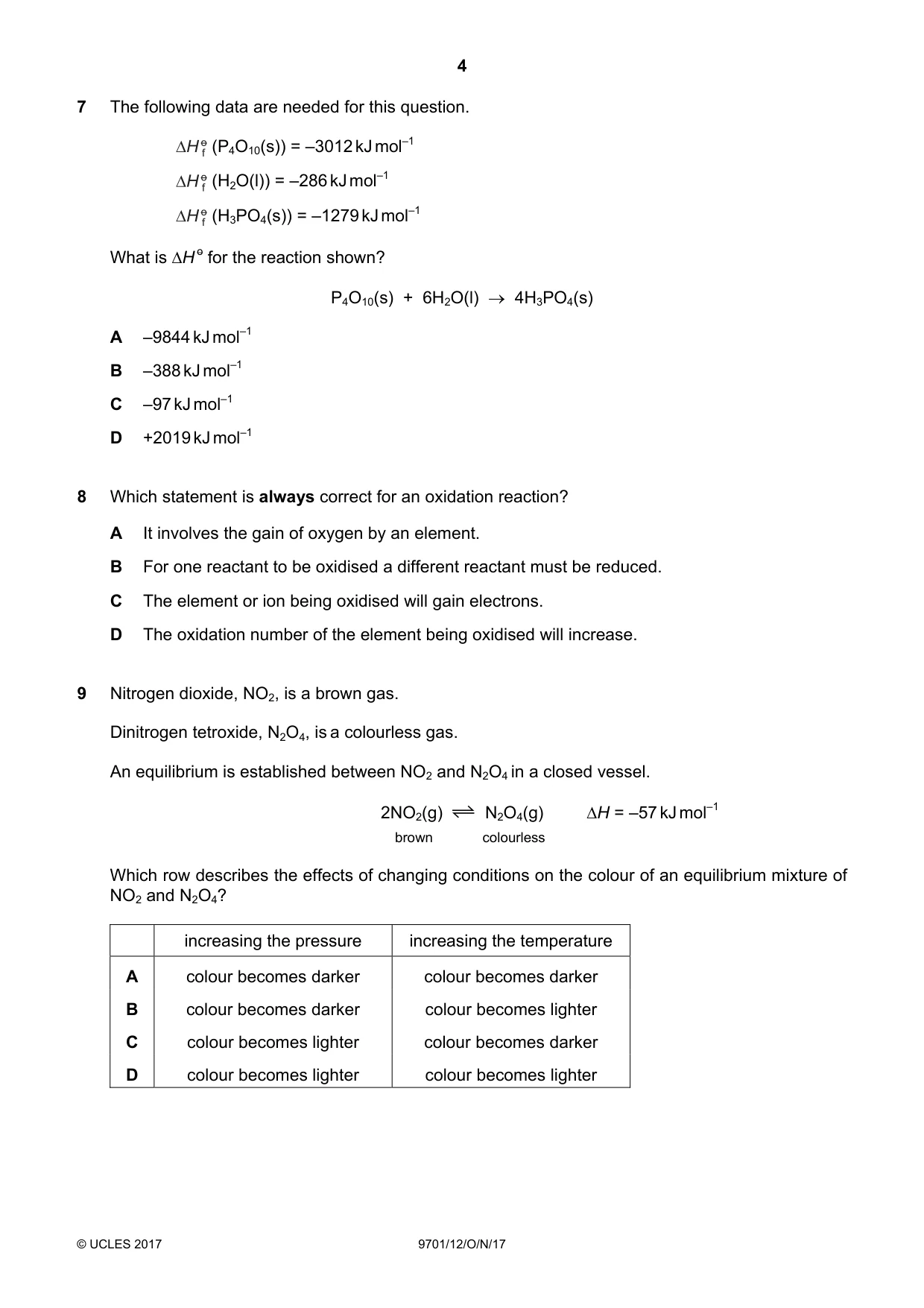
7 The following data are needed for this question. (P4O10(s)) = –3012 kJ mol–1 (H2O(l)) = –286 kJ mol–1 (H3PO4(s)) = –1279 kJ mol–1 What is ∆H o for the reaction shown? P4O10(s) + 6H2O(l) → 4H3PO4(s) A –9844 kJ mol–1 B –388 kJ mol–1 C –97 kJ mol–1 D +2019 kJ mol–1
Mark scheme: B
Q8 · Which statement is always correct for an oxidation reaction?
8 Which statement is always correct for an oxidation reaction? A It involves the gain of oxygen by an element. B For one reactant to be oxidised a different reactant must be reduced. C The element or ion being oxidised will gain electrons. D The oxidation number of the element being oxidised will increase.
Mark scheme: D
Q9 · Nitrogen dioxide, NO2, is a brown gas
9 Nitrogen dioxide, NO2, is a brown gas. Dinitrogen tetroxide, N2O4, is a colourless gas. An equilibrium is established between NO2 and N2O4 in a closed vessel. 2NO2(g) N2O4(g) ∆H = –57 kJ mol–1 brown colourless Which row describes the effects of changing conditions on the colour of an equilibrium mixture of NO2 and N2O4? increasing the pressure increasing the temperature A colour becomes darker colour becomes darker B colour becomes darker colour becomes lighter C colour becomes lighter colour becomes darker D colour becomes lighter colour becomes lighter
Mark scheme: C
More questions on Chemical equilibria: reversible reactions, dynamic equilibrium
Q10 · A large excess of marble chips was reacted with 25 cm3 of 1.0 mol dm–3 hydrochloric acid…
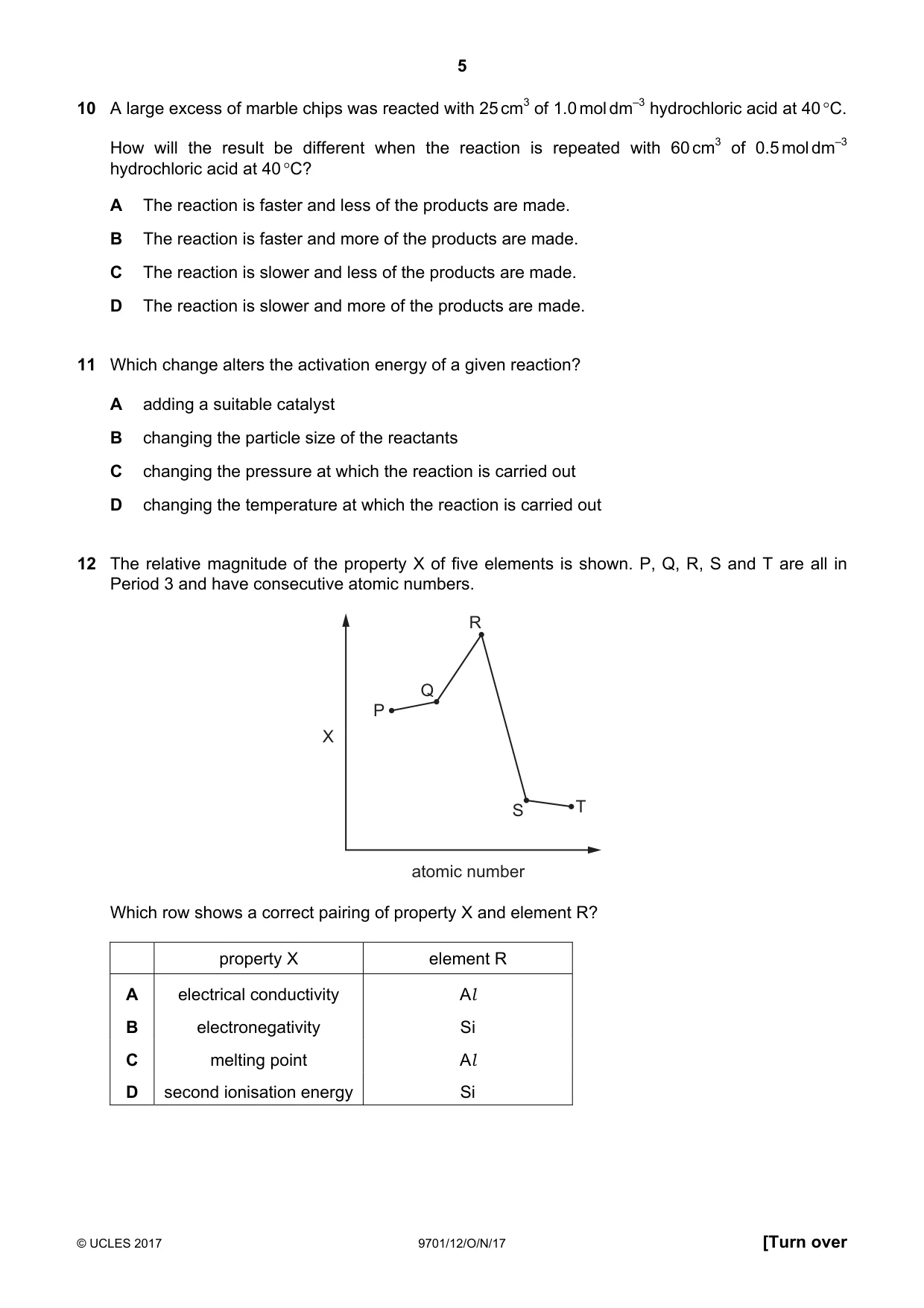
10 A large excess of marble chips was reacted with 25 cm3 of 1.0 mol dm–3 hydrochloric acid at 40 °C. How will the result be different when the reaction is repeated with 60 cm3 of 0.5 mol dm–3 hydrochloric acid at 40 °C? A The reaction is faster and less of the products are made. B The reaction is faster and more of the products are made. C The reaction is slower and less of the products are made. D The reaction is slower and more of the products are made.
Mark scheme: D
Q11 · Which change alters the activation energy of a given reaction?
11 Which change alters the activation energy of a given reaction? A adding a suitable catalyst B changing the particle size of the reactants C changing the pressure at which the reaction is carried out D changing the temperature at which the reaction is carried out
Mark scheme: A
More questions on Effect of temperature on reaction rates and the concept of activation energy
Q12 · The relative magnitude of the property X of five elements is shown
12 The relative magnitude of the property X of five elements is shown. P, Q, R, S and T are all in Period 3 and have consecutive atomic numbers. R Q P X S T atomic number Which row shows a correct pairing of property X and element R? property X element R A electrical conductivity Al B electronegativity Si C melting point Al D second ionisation energy Si
Mark scheme: A
More questions on Periodicity of physical properties of the elements in Period 3
Q13 · Element Z has a giant structure
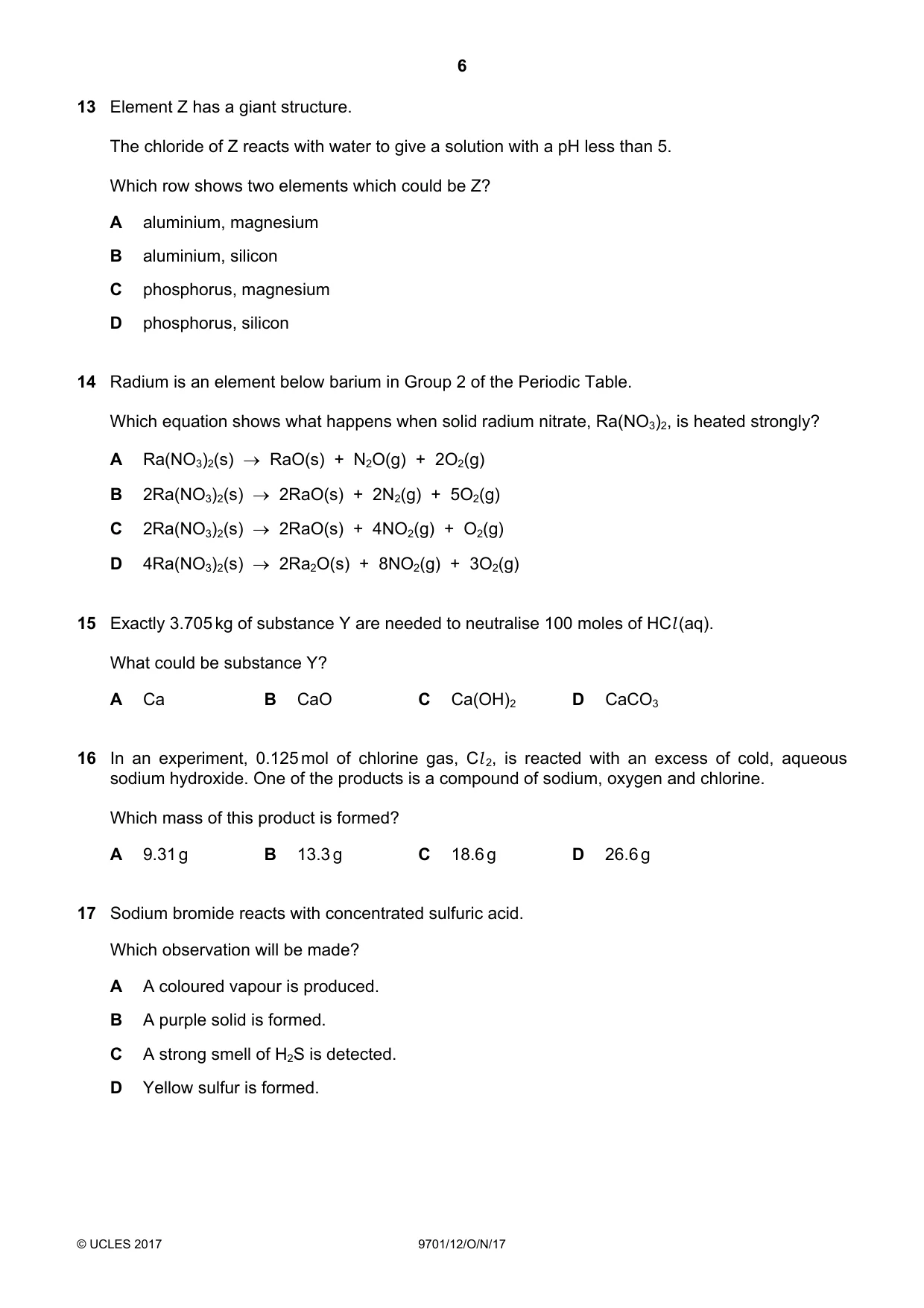
13 Element Z has a giant structure. The chloride of Z reacts with water to give a solution with a pH less than 5. Which row shows two elements which could be Z? A aluminium, magnesium B aluminium, silicon C phosphorus, magnesium D phosphorus, silicon
Mark scheme: B
More questions on Periodicity of chemical properties of the elements in Period 3
Q14 · Radium is an element below barium in Group 2 of the Periodic Table
14 Radium is an element below barium in Group 2 of the Periodic Table. Which equation shows what happens when solid radium nitrate, Ra(NO3)2, is heated strongly? A Ra(NO3)2(s) → RaO(s) + N2O(g) + 2O2(g) B 2Ra(NO3)2(s) → 2RaO(s) + 2N2(g) + 5O2(g) C 2Ra(NO3)2(s) → 2RaO(s) + 4NO2(g) + O2(g) D 4Ra(NO3)2(s) → 2Ra2O(s) + 8NO2(g) + 3O2(g)
Mark scheme: C
Q15 · Exactly 3.705 kg of substance Y are needed to neutralise 100 moles of HCl (aq)
15 Exactly 3.705 kg of substance Y are needed to neutralise 100 moles of HCl (aq). What could be substance Y? A Ca B CaO C Ca(OH)2 D CaCO3
Mark scheme: C
More questions on Reacting masses and volumes (of solutions and gases)
Q16 · In an experiment, 0.125 mol of chlorine gas, Cl 2, is reacted with an excess of cold…
16 In an experiment, 0.125 mol of chlorine gas, Cl 2, is reacted with an excess of cold, aqueous sodium hydroxide. One of the products is a compound of sodium, oxygen and chlorine. Which mass of this product is formed? A 9.31 g B 13.3 g C 18.6 g D 26.6 g
Mark scheme: A
Q17 · Sodium bromide reacts with concentrated sulfuric acid
17 Sodium bromide reacts with concentrated sulfuric acid. Which observation will be made? A A coloured vapour is produced. B A purple solid is formed. C A strong smell of H2S is detected. D Yellow sulfur is formed.
Mark scheme: A
More questions on The chemical properties of the halogen elements and the hydrogen halides
Q18 · The reaction of nitrogen and oxygen to produce oxides of nitrogen happens at high…
18 The reaction of nitrogen and oxygen to produce oxides of nitrogen happens at high temperatures in car engines or lightning strikes during thunderstorms. What is the main reason for these reactions requiring such high temperatures? A the lack of reactivity of nitrogen, due to the half-filled 2p subshell in the nitrogen atom B the lack of reactivity of nitrogen, due to the strength of the bond in N2 C the lack of reactivity of oxygen, due to electron-electron repulsion in one of its 2p orbitals D the lack of reactivity of oxygen, due to the strength of the bond in O2
Mark scheme: B
More questions on Covalent bonding and coordinate (dative covalent) bonding
Q19 · X is a mixture of two compounds of Group 2 elements
19 X is a mixture of two compounds of Group 2 elements. X undergoes thermal decomposition to produce a white solid and only two gaseous products. One of the gaseous products relights a glowing splint. What could be the components of mixture X? A MgCl 2 and CaCO3 B MgCO3 and Ca(NO3)2 C Mg(NO3)2 and Ca(NO3)2 D MgO and CaO
Mark scheme: C
Q20 · Which compound does not exhibit stereoisomerism?
20 Which compound does not exhibit stereoisomerism? A CH3CHCl CH2CHO B CH3CHCHCH3 C CH2Cl CH2CCl 2H D CHCl CHCl
Mark scheme: C
More questions on Isomerism: structural isomerism and stereoisomerism
Q21 · The diagram shows the skeletal formula of citric acid
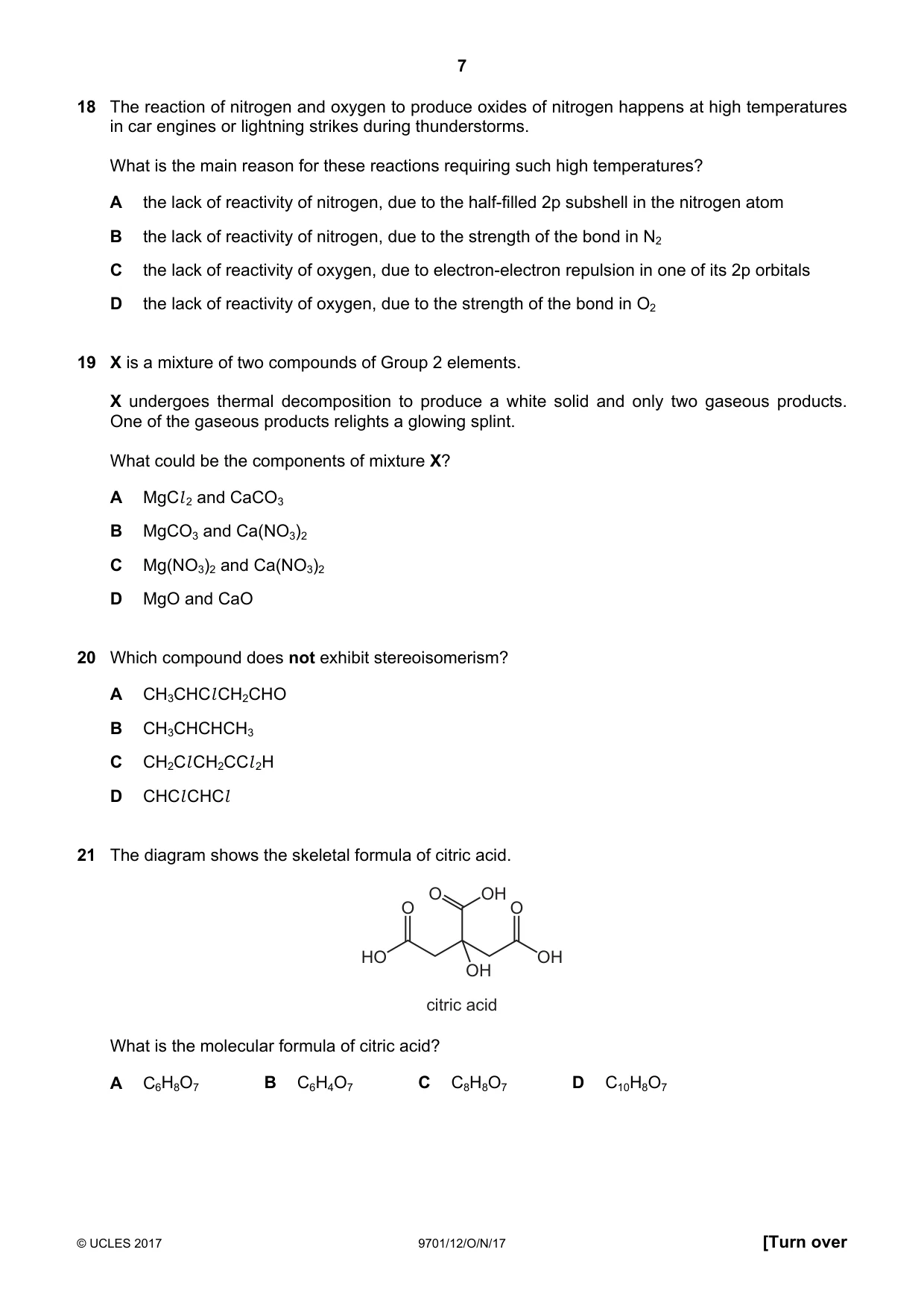
21 The diagram shows the skeletal formula of citric acid. O OH O O HO OH OH citric acid What is the molecular formula of citric acid? A C6H8O7 B C6H4O7 C C8H8O7 D C10H8O7
Mark scheme: A
More questions on Formulas, functional groups and the naming of organic compounds
Q22 · Which compound would produce two different carboxylic acids when treated with hot…
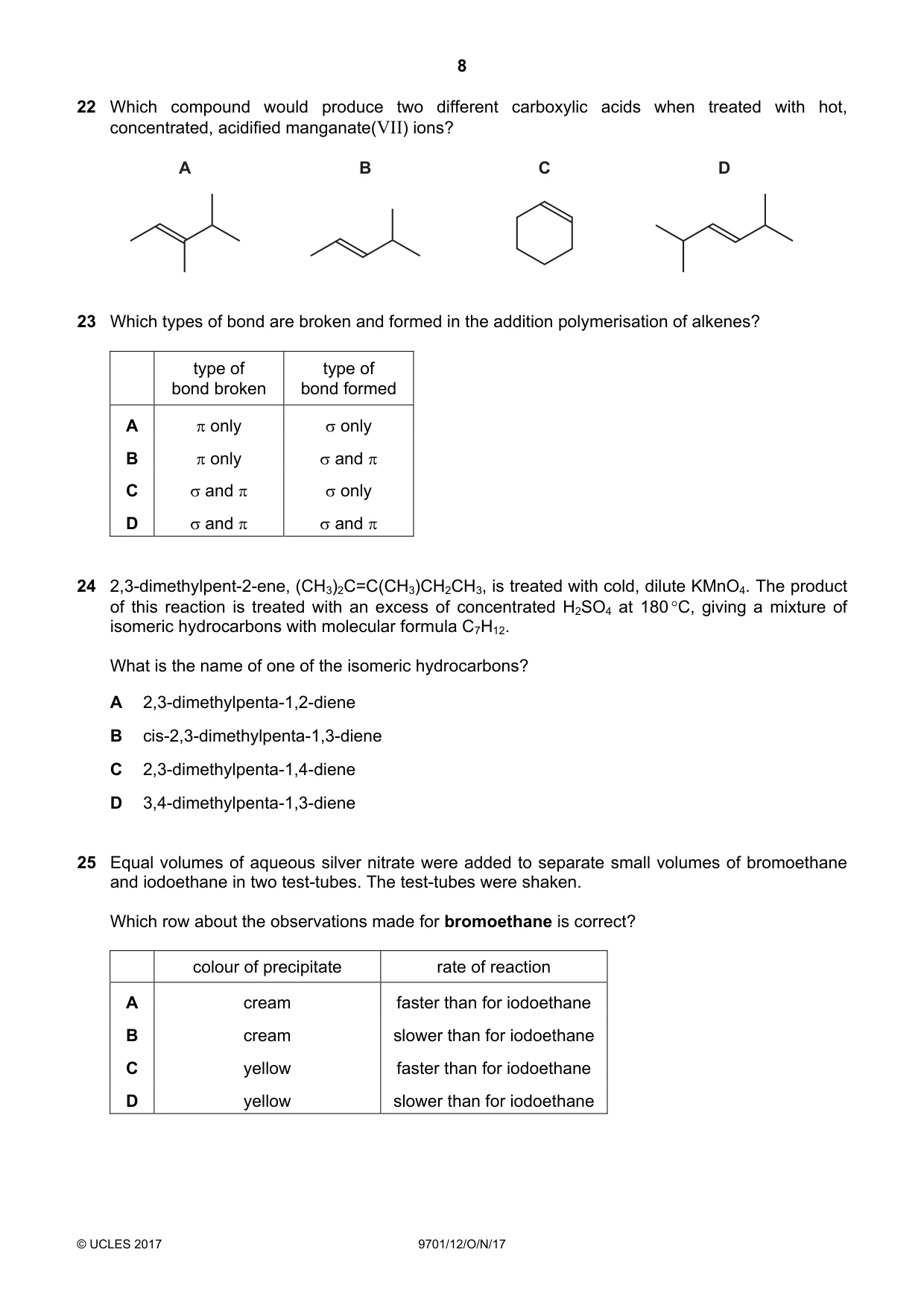
22 Which compound would produce two different carboxylic acids when treated with hot, concentrated, acidified manganate(VII) ions? A B C D
Mark scheme: B
Q23 · Which types of bond are broken and formed in the addition polymerisation of alkenes?
23 Which types of bond are broken and formed in the addition polymerisation of alkenes? type of type of bond broken bond formed A π only σ only B π only σ and π C σ and π σ only D σ and π σ and π
Mark scheme: A
More questions on Shapes of organic molecules; σ and π bonds
Q24 · 2,3-dimethylpent-2-ene, (CH3)2C=C(CH3)CH2CH3, is treated with cold, dilute KMnO4
24 2,3-dimethylpent-2-ene, (CH3)2C=C(CH3)CH2CH3, is treated with cold, dilute KMnO4. The product of this reaction is treated with an excess of concentrated H2SO4 at 180 °C, giving a mixture of isomeric hydrocarbons with molecular formula C7H12. What is the name of one of the isomeric hydrocarbons? A 2,3-dimethylpenta-1,2-diene B cis-2,3-dimethylpenta-1,3-diene C 2,3-dimethylpenta-1,4-diene D 3,4-dimethylpenta-1,3-diene
Mark scheme: B
Q25 · Equal volumes of aqueous silver nitrate were added to separate small volumes of…
25 Equal volumes of aqueous silver nitrate were added to separate small volumes of bromoethane and iodoethane in two test-tubes. The test-tubes were shaken. Which row about the observations made for bromoethane is correct? colour of precipitate rate of reaction A cream faster than for iodoethane B cream slower than for iodoethane C yellow faster than for iodoethane D yellow slower than for iodoethane
Mark scheme: B
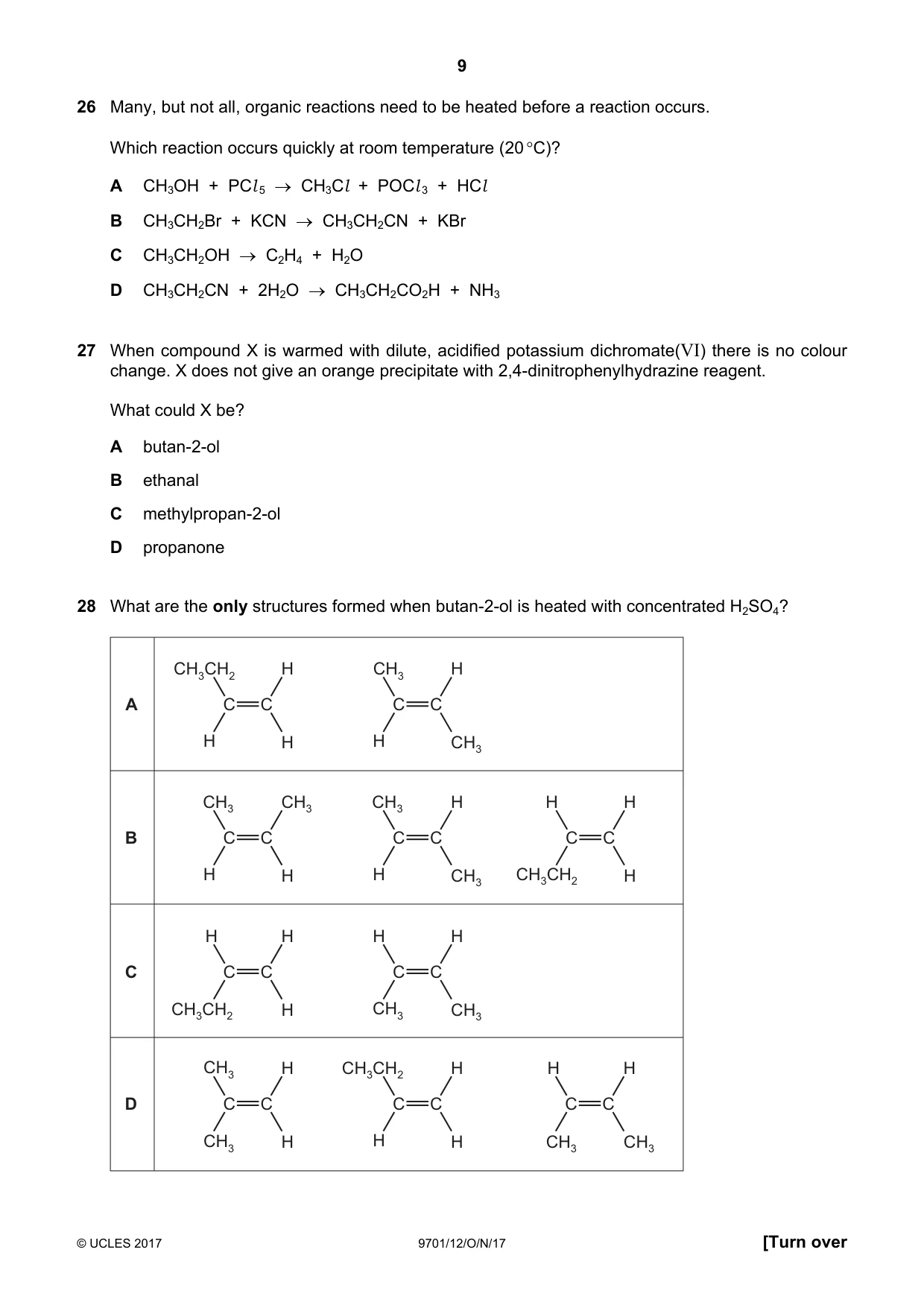
Q26 · Many, but not all, organic reactions need to be heated before a reaction occurs
26 Many, but not all, organic reactions need to be heated before a reaction occurs. Which reaction occurs quickly at room temperature (20 °C)? A CH3OH + PCl 5 → CH3Cl + POCl 3 + HCl B CH3CH2Br + KCN → CH3CH2CN + KBr C CH3CH2OH → C2H4 + H2O D CH3CH2CN + 2H2O → CH3CH2CO2H + NH3
Mark scheme: A
Q27 · When compound X is warmed with dilute, acidified potassium dichromate(VI) there is no…
27 When compound X is warmed with dilute, acidified potassium dichromate(VI) there is no colour change. X does not give an orange precipitate with 2,4-dinitrophenylhydrazine reagent. What could X be? A butan-2-ol B ethanal C methylpropan-2-ol D propanone
Mark scheme: C
Q28 · What are the only structures formed when butan-2-ol is heated with concentrated H2SO4?
28 What are the only structures formed when butan-2-ol is heated with concentrated H2SO4? CH3CH2 H CH3 H A C C C C H H H CH3 CH3 CH3 CH3 H H H B C C C C C C H H H CH3 CH3CH2 H H H H H C C C C C CH3CH2 H CH3 CH3 CH3 H CH3CH2 H H H D C C C C C C CH3 H H H CH3 CH3
Mark scheme: B
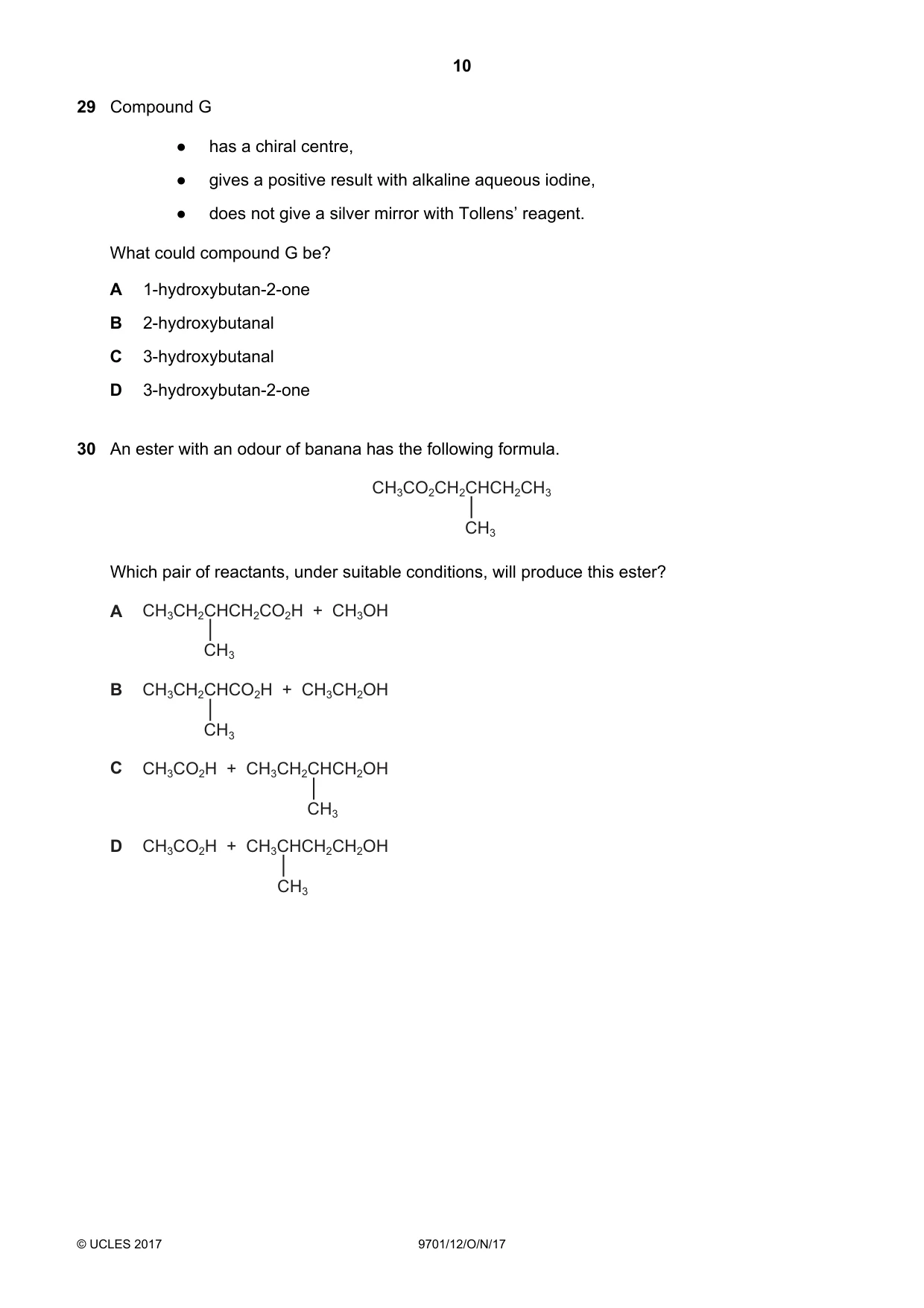
Q29 · Compound G ● has a chiral centre, ● gives a positive result with alkaline aqueous iodine…
29 Compound G ● has a chiral centre, ● gives a positive result with alkaline aqueous iodine, ● does not give a silver mirror with Tollens’ reagent. What could compound G be? A 1-hydroxybutan-2-one B 2-hydroxybutanal C 3-hydroxybutanal D 3-hydroxybutan-2-one
Mark scheme: D
Q30 · An ester with an odour of banana has the following formula
30 An ester with an odour of banana has the following formula. CH3CO2CH2CHCH2CH3 CH3 Which pair of reactants, under suitable conditions, will produce this ester? A CH3CH2CHCH2CO2H + CH3OH CH3 B CH3CH2CHCO2H + CH3CH2OH CH3 C CH3CO2H + CH3CH2CHCH2OH CH3 D CH3CO2H + CH3CHCH2CH2OH CH3
Mark scheme: C
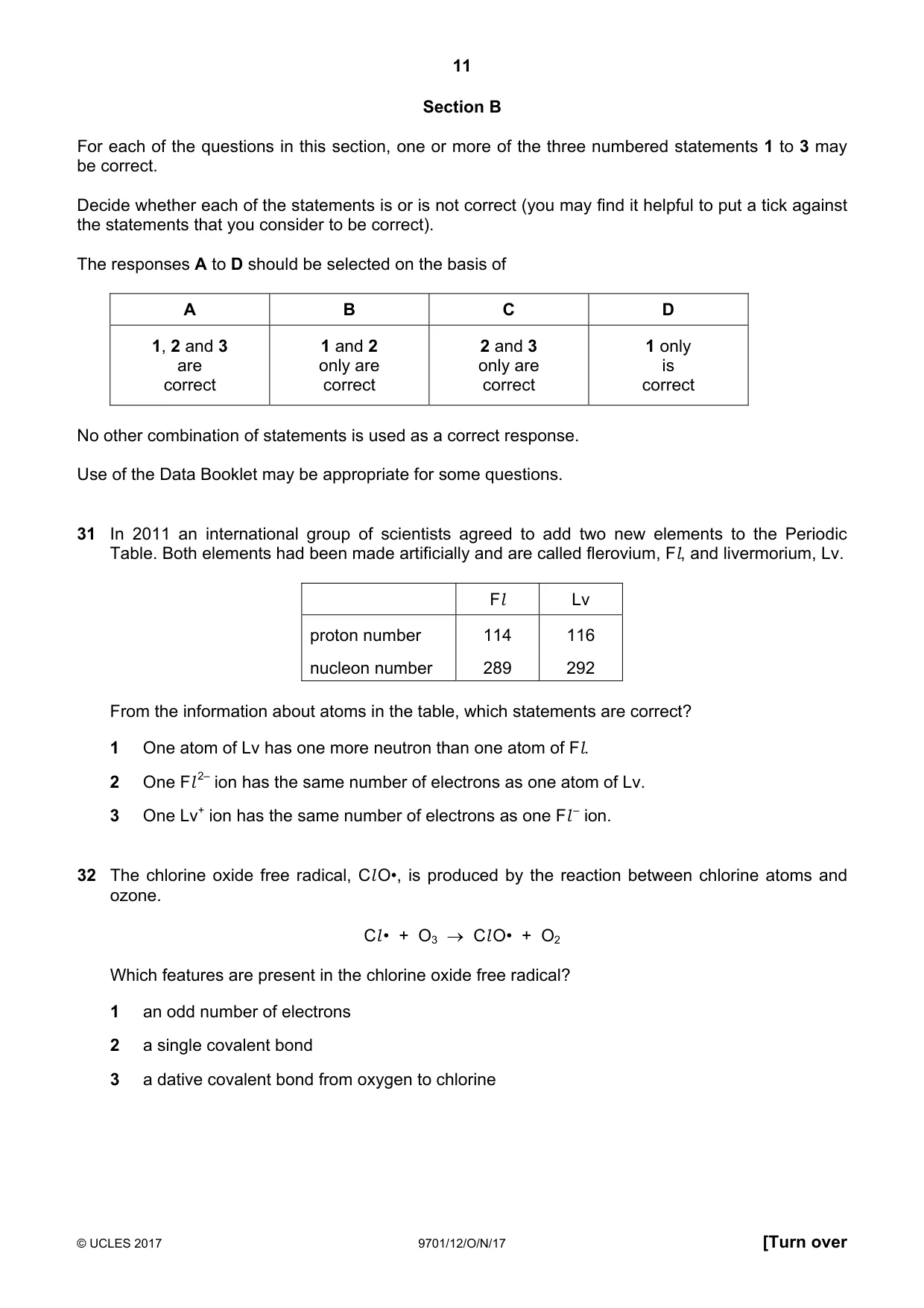
Q31 · In 2011 an international group of scientists agreed to add two new elements to the…
31 In 2011 an international group of scientists agreed to add two new elements to the Periodic Table. Both elements had been made artificially and are called flerovium, Fl, and livermorium, Lv. Fl Lv proton number 114 116 nucleon number 289 292 From the information about atoms in the table, which statements are correct? 1 One atom of Lv has one more neutron than one atom of Fl. 2 One Fl 2– ion has the same number of electrons as one atom of Lv. 3 One Lv+ ion has the same number of electrons as one Fl – ion.
Mark scheme: A
Q32 · The chlorine oxide free radical, Cl O•, is produced by the reaction between chlorine…
32 The chlorine oxide free radical, Cl O•, is produced by the reaction between chlorine atoms and ozone. Cl • + O3 → Cl O• + O2 Which features are present in the chlorine oxide free radical? 1 an odd number of electrons 2 a single covalent bond 3 a dative covalent bond from oxygen to chlorine
Mark scheme: B
More questions on Covalent bonding and coordinate (dative covalent) bonding
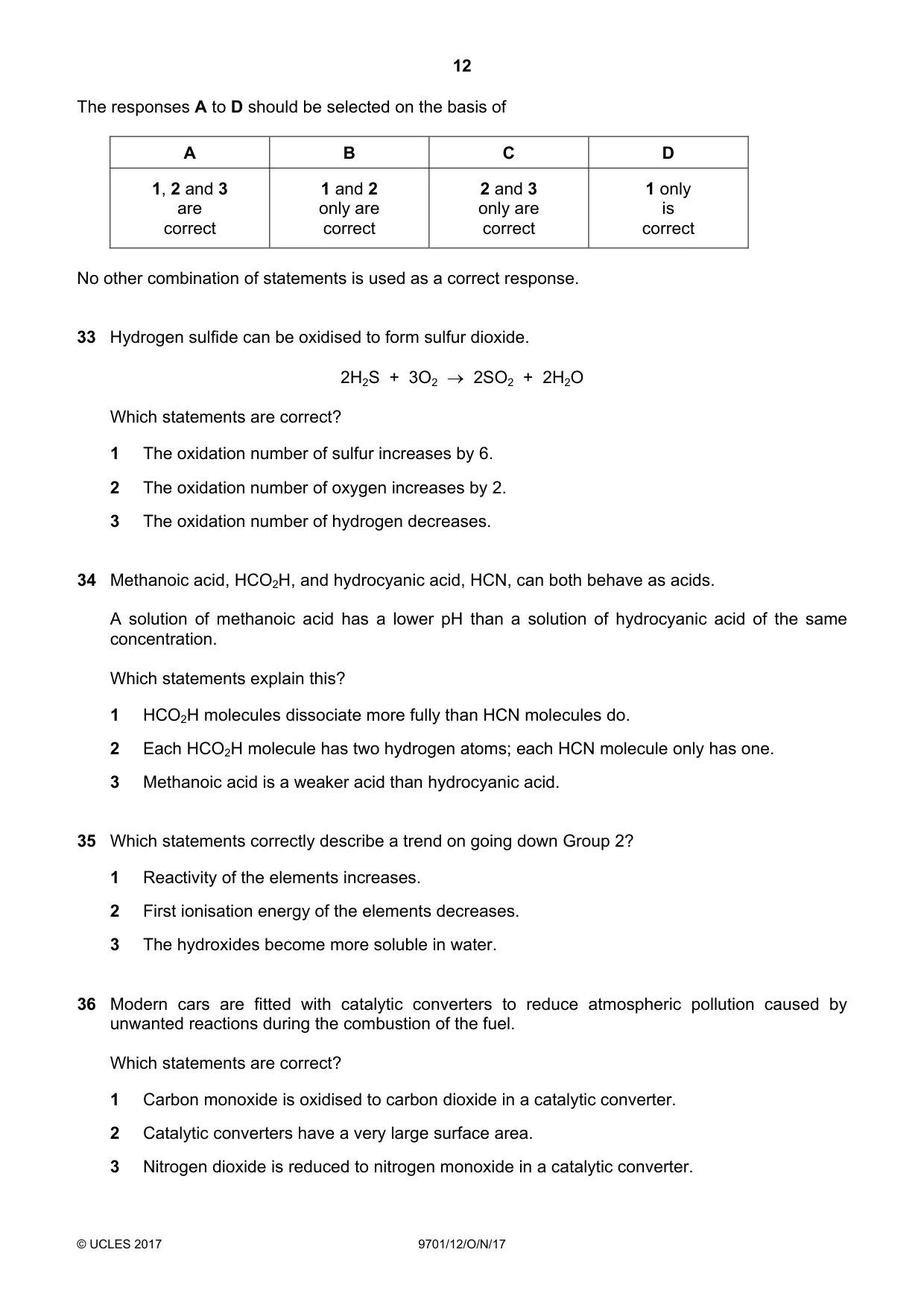
Q33 · Hydrogen sulfide can be oxidised to form sulfur dioxide
33 Hydrogen sulfide can be oxidised to form sulfur dioxide. 2H2S + 3O2 → 2SO2 + 2H2O Which statements are correct? 1 The oxidation number of sulfur increases by 6. 2 The oxidation number of oxygen increases by 2. 3 The oxidation number of hydrogen decreases.
Mark scheme: D
Q34 · Methanoic acid, HCO2H, and hydrocyanic acid, HCN, can both behave as acids
34 Methanoic acid, HCO2H, and hydrocyanic acid, HCN, can both behave as acids. A solution of methanoic acid has a lower pH than a solution of hydrocyanic acid of the same concentration. Which statements explain this? 1 HCO2H molecules dissociate more fully than HCN molecules do. 2 Each HCO2H molecule has two hydrogen atoms; each HCN molecule only has one. 3 Methanoic acid is a weaker acid than hydrocyanic acid.
Mark scheme: D
Q35 · Which statements correctly describe a trend on going down Group 2?
35 Which statements correctly describe a trend on going down Group 2? 1 Reactivity of the elements increases. 2 First ionisation energy of the elements decreases. 3 The hydroxides become more soluble in water.
Mark scheme: A
Q36 · Modern cars are fitted with catalytic converters to reduce atmospheric pollution caused…
36 Modern cars are fitted with catalytic converters to reduce atmospheric pollution caused by unwanted reactions during the combustion of the fuel. Which statements are correct? 1 Carbon monoxide is oxidised to carbon dioxide in a catalytic converter. 2 Catalytic converters have a very large surface area. 3 Nitrogen dioxide is reduced to nitrogen monoxide in a catalytic converter.
Mark scheme: B
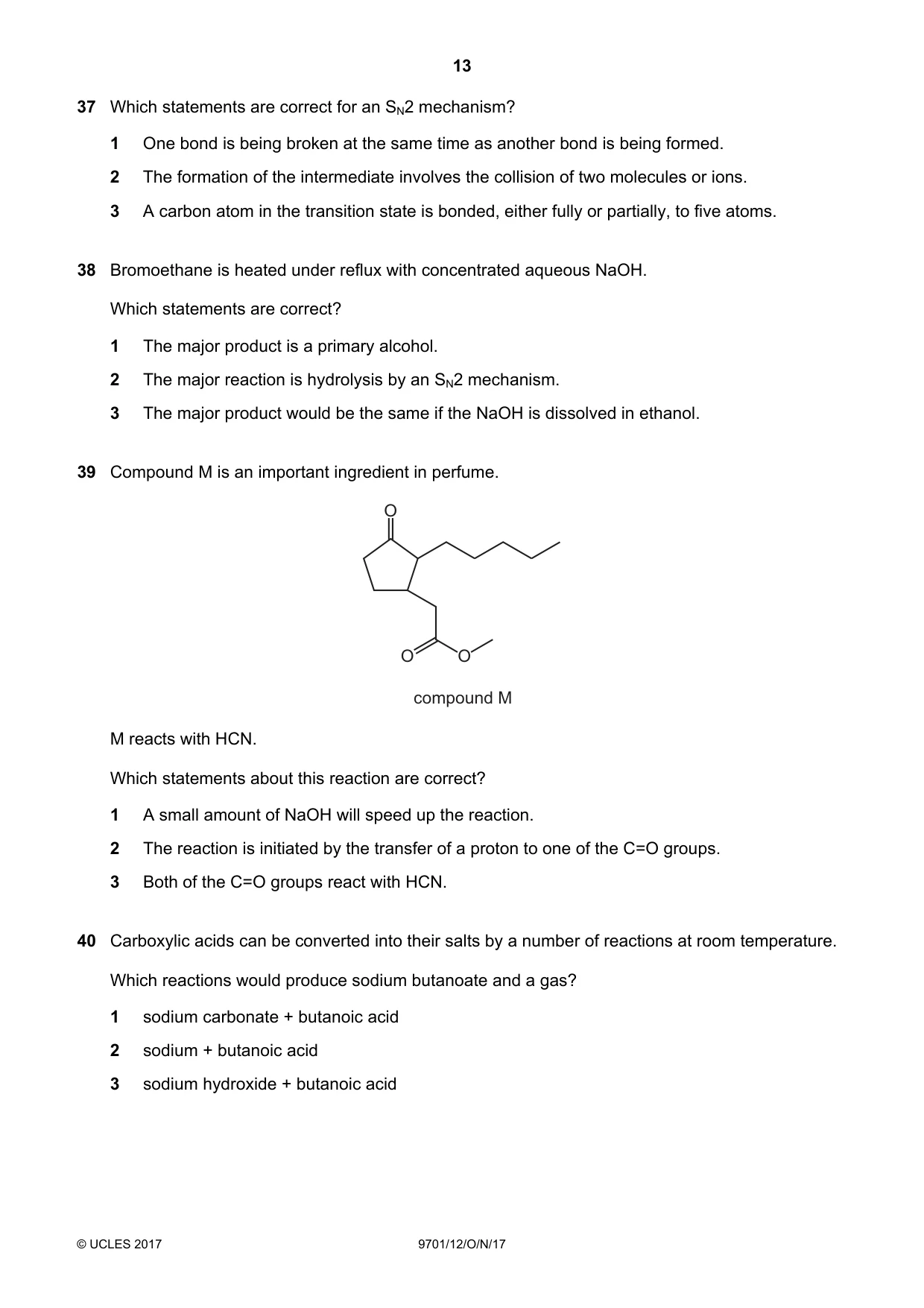
Q37 · Which statements are correct for an SN2 mechanism?
37 Which statements are correct for an SN2 mechanism? 1 One bond is being broken at the same time as another bond is being formed. 2 The formation of the intermediate involves the collision of two molecules or ions. 3 A carbon atom in the transition state is bonded, either fully or partially, to five atoms.
Mark scheme: A
Q38 · Bromoethane is heated under reflux with concentrated aqueous NaOH
38 Bromoethane is heated under reflux with concentrated aqueous NaOH. Which statements are correct? 1 The major product is a primary alcohol. 2 The major reaction is hydrolysis by an SN2 mechanism. 3 The major product would be the same if the NaOH is dissolved in ethanol.
Mark scheme: B
Q39 · Compound M is an important ingredient in perfume
39 Compound M is an important ingredient in perfume. O O O compound M M reacts with HCN. Which statements about this reaction are correct? 1 A small amount of NaOH will speed up the reaction. 2 The reaction is initiated by the transfer of a proton to one of the C=O groups. 3 Both of the C=O groups react with HCN.
Mark scheme: D
Q40 · Carboxylic acids can be converted into their salts by a number of reactions at room…
40 Carboxylic acids can be converted into their salts by a number of reactions at room temperature. Which reactions would produce sodium butanoate and a gas? 1 sodium carbonate + butanoic acid 2 sodium + butanoic acid 3 sodium hydroxide + butanoic acid
Mark scheme: B
What was in this paper
The subtopics covered by these 40 questions, and how many questions each got. Open one in a new tab to see every Cambridge question on it.
4Similarities and trends in the properties of the Group 2 metals, magnesium to barium, and their compounds3Alcohols2Alkenes2Covalent bonding and coordinate (dative covalent) bonding2Particles in the atom and atomic radius2Reacting masses and volumes (of solutions and gases)2Redox processes: electron transfer and changes in oxidation number (oxidation state)2Acids and bases1Carboxylic acids1Chemical equilibria: reversible reactions, dynamic equilibrium1Effect of temperature on reaction rates and the concept of activation energy1Enthalpy change, ΔH1Esters1Formulas1Formulas, functional groups and the naming of organic compounds1Hess’s law1Homogeneous and heterogeneous catalysts1Isomerism: optical1Isomerism: structural isomerism and stereoisomerism1Nitriles and hydroxynitriles1Periodicity of chemical properties of the elements in Period 31Periodicity of physical properties of the elements in Period 31Rate of reaction1Shapes of molecules1Shapes of organic molecules; σ and π bonds1The chemical properties of the halogen elements and the hydrogen halides1The gaseous state: ideal and real gases and pV = nRT1The reactions of chlorine1What you needed in this session
Cambridge’s own grade thresholds for 2017 Oct/Nov, Paper 1 · Variant 2. A higher threshold means an easier paper — the bar moves with how the cohort did.