Cambridge A Level Chemistry 9701 — 2014 May/June Paper 1 · Variant 2
9701/12/M/J/14 · 40 questions · 40 marks · ≈45 min
The question paper and its mark scheme, free to read here and free to download. This is Cambridge’s own paper, exactly as it was sat.
Question paper16 pages

Mark scheme2 pages
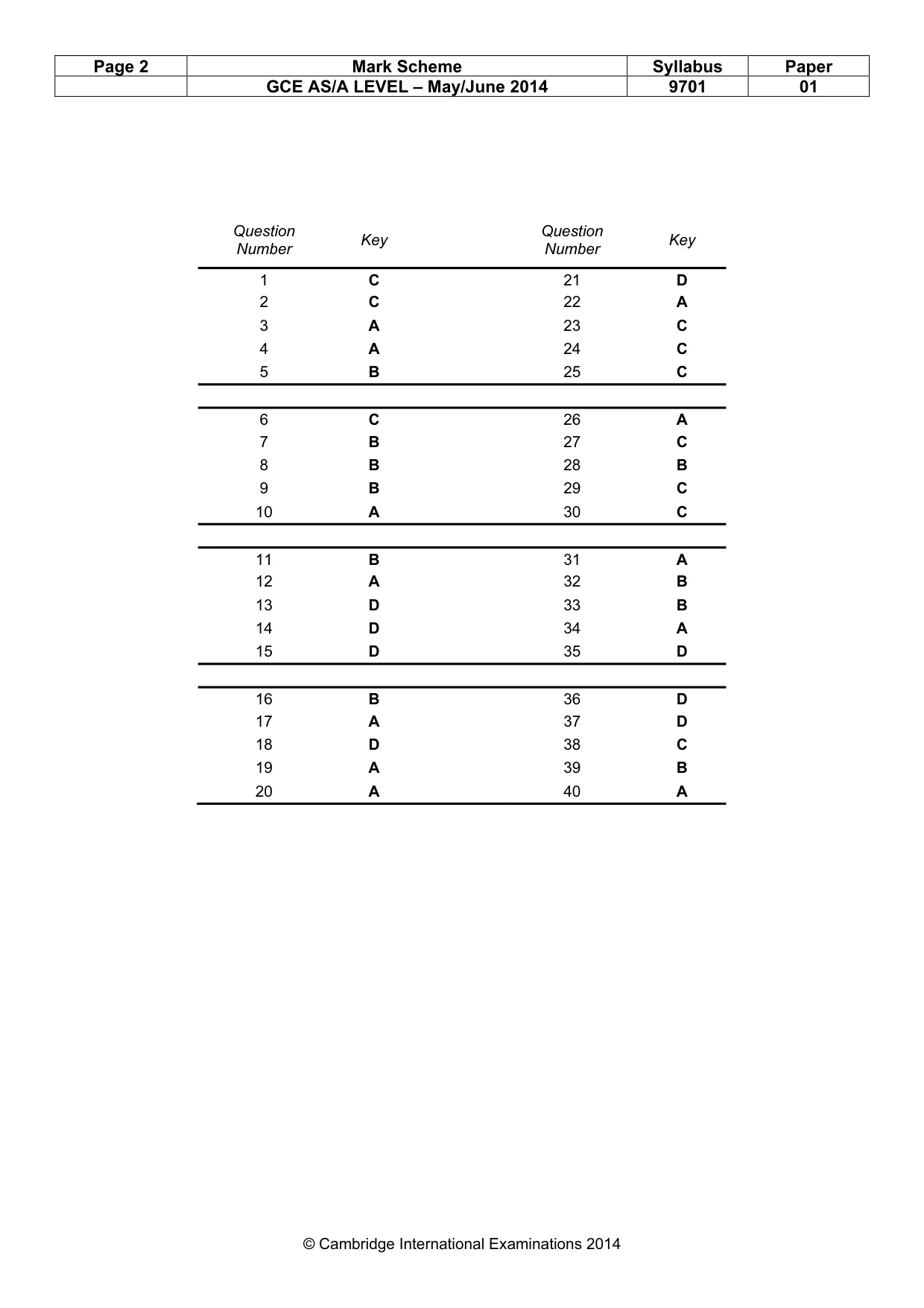
Answers below. Sit the paper first if you are practising.
Questions as text
Q1 · The diagram shows a Boltzmann distribution of molecular energies for a gaseous mixture
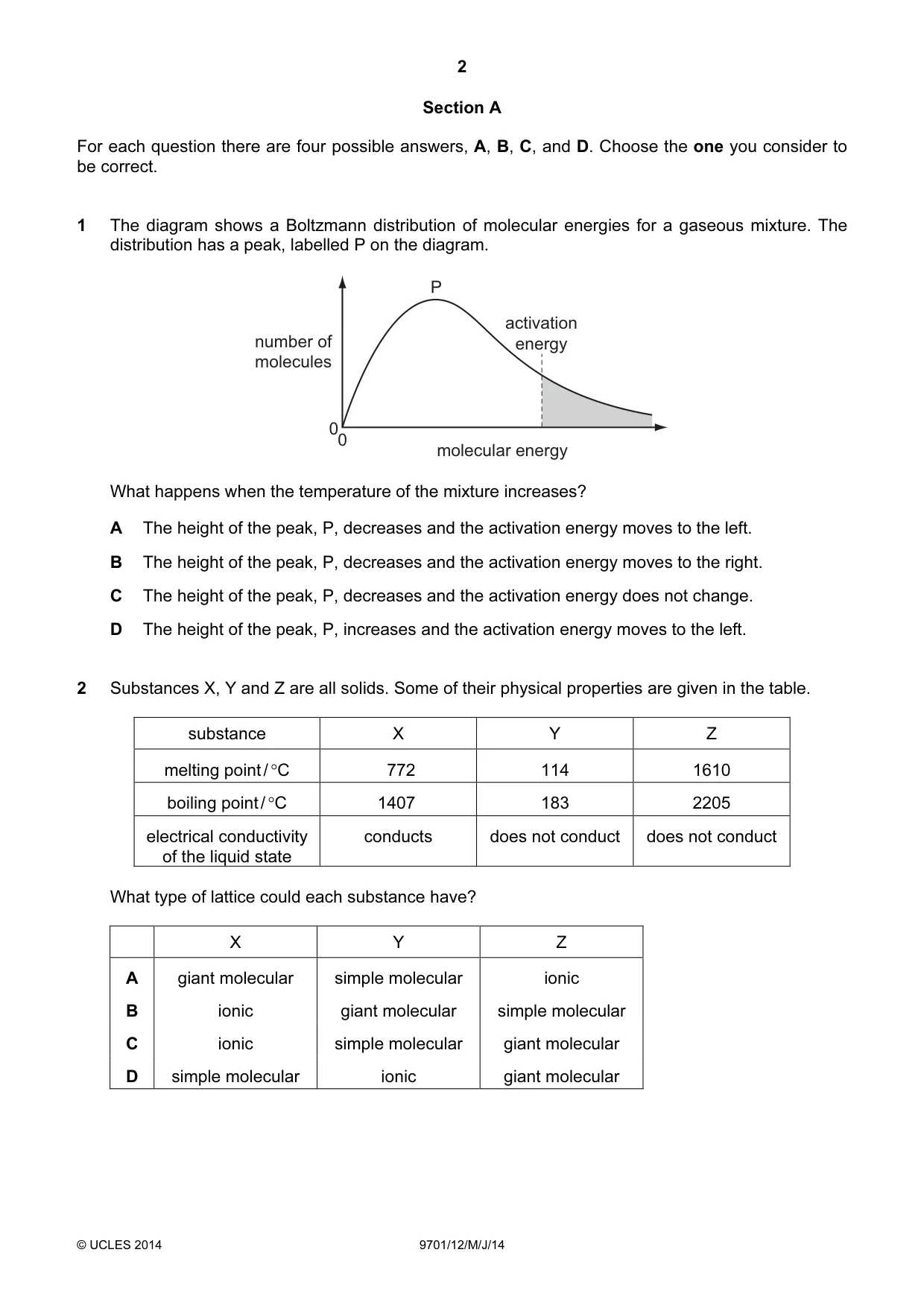
1 The diagram shows a Boltzmann distribution of molecular energies for a gaseous mixture. The distribution has a peak, labelled P on the diagram. P activation number of energy molecules 00 molecular energy What happens when the temperature of the mixture increases? A The height of the peak, P, decreases and the activation energy moves to the left. B The height of the peak, P, decreases and the activation energy moves to the right. C The height of the peak, P, decreases and the activation energy does not change. D The height of the peak, P, increases and the activation energy moves to the left.
Mark scheme: C
More questions on Effect of temperature on reaction rates and the concept of activation energy
Q2 · Substances X, Y and Z are all solids
2 Substances X, Y and Z are all solids. Some of their physical properties are given in the table. substance X Y Z melting point / °C 772 114 1610 boiling point / °C 1407 183 2205 electrical conductivity conducts does not conduct does not conduct of the liquid state What type of lattice could each substance have? X Y Z A giant molecular simple molecular ionic B ionic giant molecular simple molecular C ionic simple molecular giant molecular D simple molecular ionic giant molecular
Mark scheme: C
Q3 · The enthalpy change of formation of carbon dioxide is –394 kJ mol–1
3 The enthalpy change of formation of carbon dioxide is –394 kJ mol–1. The enthalpy change of formation of water is –286 kJ mol–1. The enthalpy change of formation of methane is –74 kJ mol–1. What is the enthalpy change of combustion of methane? A –892 kJ mol–1 B –606 kJ mol–1 C +606 kJ mol–1 D +892 kJ mol–1
Mark scheme: A
Q4 · Hydrogen and carbon dioxide gases are mixed in equal molar amounts at 800 K
4 Hydrogen and carbon dioxide gases are mixed in equal molar amounts at 800 K. A reversible reaction takes place. H2(g) + CO2(g) H2O(g) + CO(g) At equilibrium, the partial pressures of H2 and CO2 are both 10.0 kPa. Kp is 0.288 at 800 K. What is the partial pressure of CO in the equilibrium mixture? A 5.37 kPa B 18.6 kPa C 28.8 kPa D 347 kPa
Mark scheme: A
More questions on Chemical equilibria: reversible reactions, dynamic equilibrium
Q5 · In the diagram, curve X was obtained by observing the decomposition of 100 cm3 of 1.0 mol…
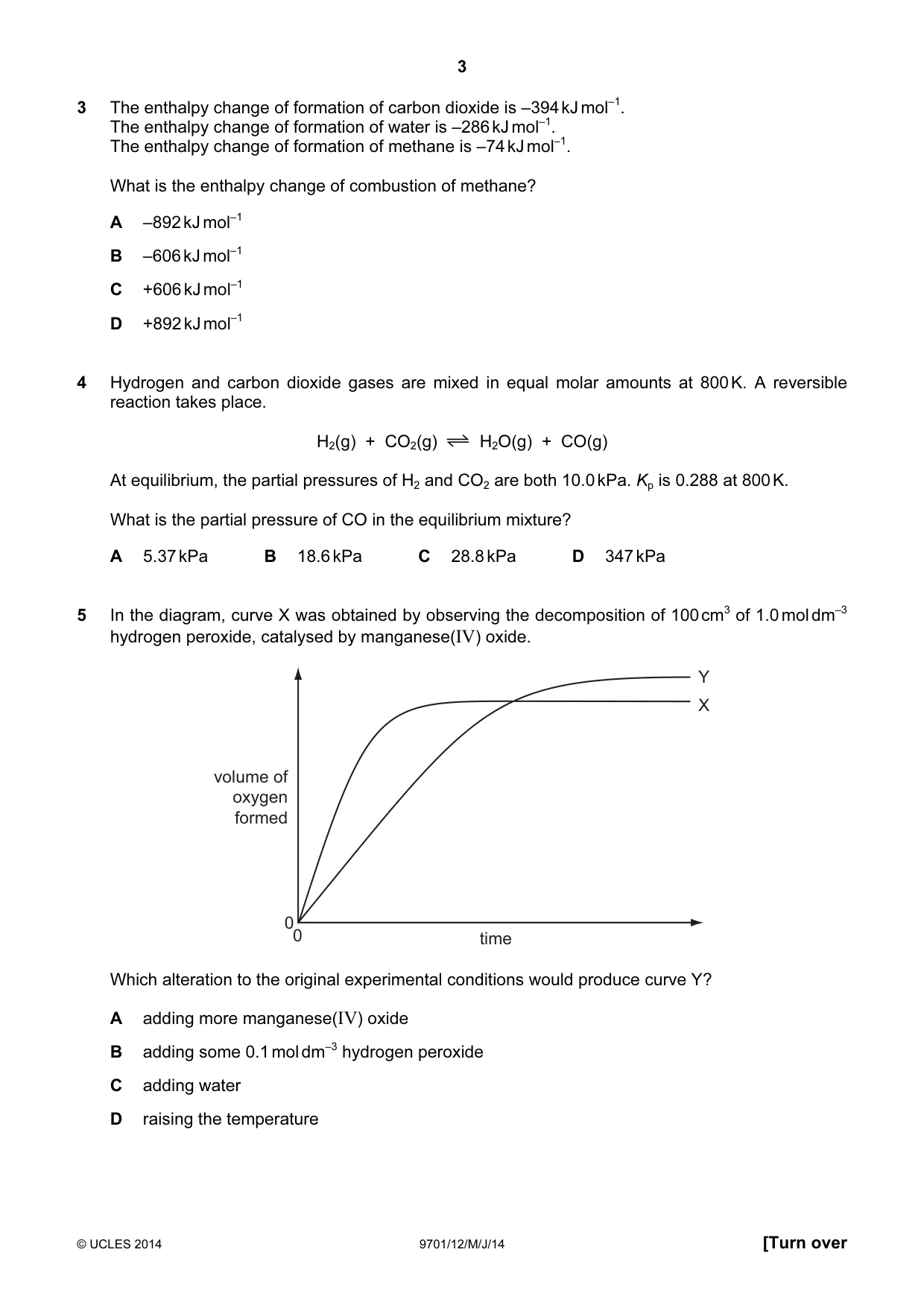
5 In the diagram, curve X was obtained by observing the decomposition of 100 cm3 of 1.0 mol dm–3 hydrogen peroxide, catalysed by manganese(IV) oxide. Y X volume of oxygen formed 0 0 time Which alteration to the original experimental conditions would produce curve Y? A adding more manganese(IV) oxide B adding some 0.1 mol dm–3 hydrogen peroxide C adding water D raising the temperature
Mark scheme: B
Q6 · In which reaction is the species in bold acting as an oxidising agent?
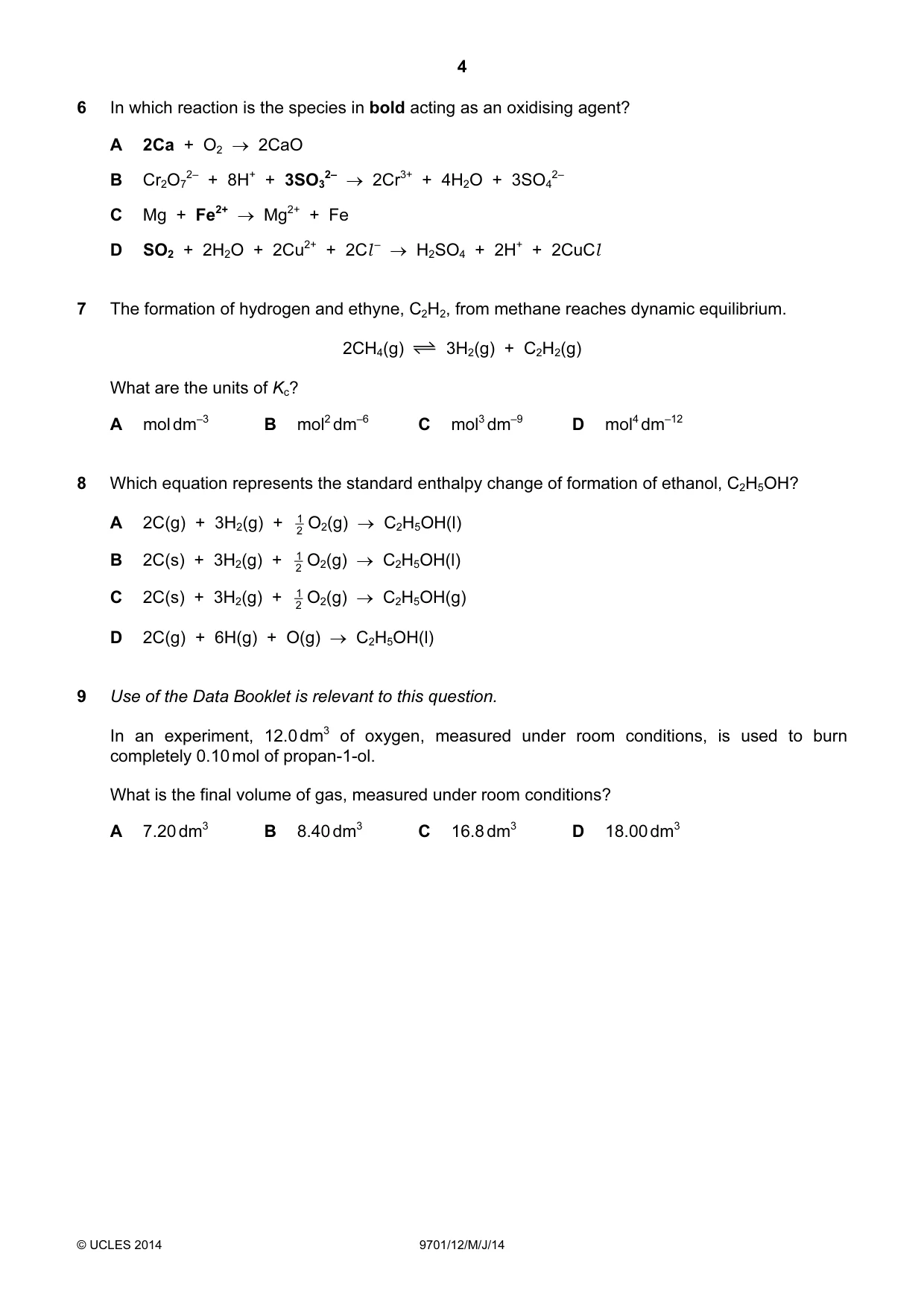
6 In which reaction is the species in bold acting as an oxidising agent? A 2Ca + O2 → 2CaO B Cr2O7 2– + 8H+ + 3SO3 2– → 2Cr3+ + 4H2O + 3SO4 2– C Mg + Fe2+ → Mg2+ + Fe D SO2 + 2H2O + 2Cu2+ + 2Cl – → H2SO4 + 2H+ + 2CuCl
Mark scheme: C
Q7 · The formation of hydrogen and ethyne, C2H2, from methane reaches dynamic equilibrium
7 The formation of hydrogen and ethyne, C2H2, from methane reaches dynamic equilibrium. 2CH4(g) 3H2(g) + C2H2(g) What are the units of Kc? A mol dm–3 B mol2 dm–6 C mol3 dm–9 D mol4 dm–12
Mark scheme: B
More questions on Chemical equilibria: reversible reactions, dynamic equilibrium
Q8 · Which equation represents the standard enthalpy change of formation of ethanol, C2H5OH?
8 Which equation represents the standard enthalpy change of formation of ethanol, C2H5OH? A 2C(g) + 3H2(g) + 2 1 O2(g) → C2H5OH(l) B 2C(s) + 3H2(g) + 2 1 O2(g) → C2H5OH(l) C 2C(s) + 3H2(g) + 2 1 O2(g) → C2H5OH(g) D 2C(g) + 6H(g) + O(g) → C2H5OH(l)
Mark scheme: B
Q9 · Use of the Data Booklet is relevant to this question
9 Use of the Data Booklet is relevant to this question. In an experiment, 12.0 dm3 of oxygen, measured under room conditions, is used to burn completely 0.10 mol of propan-1-ol. What is the final volume of gas, measured under room conditions? A 7.20 dm3 B 8.40 dm3 C 16.8 dm3 D 18.00 dm3
Mark scheme: B
More questions on Reacting masses and volumes (of solutions and gases)
Q10 · Shown on the graph are the relative values of the first ionisation energies of four…
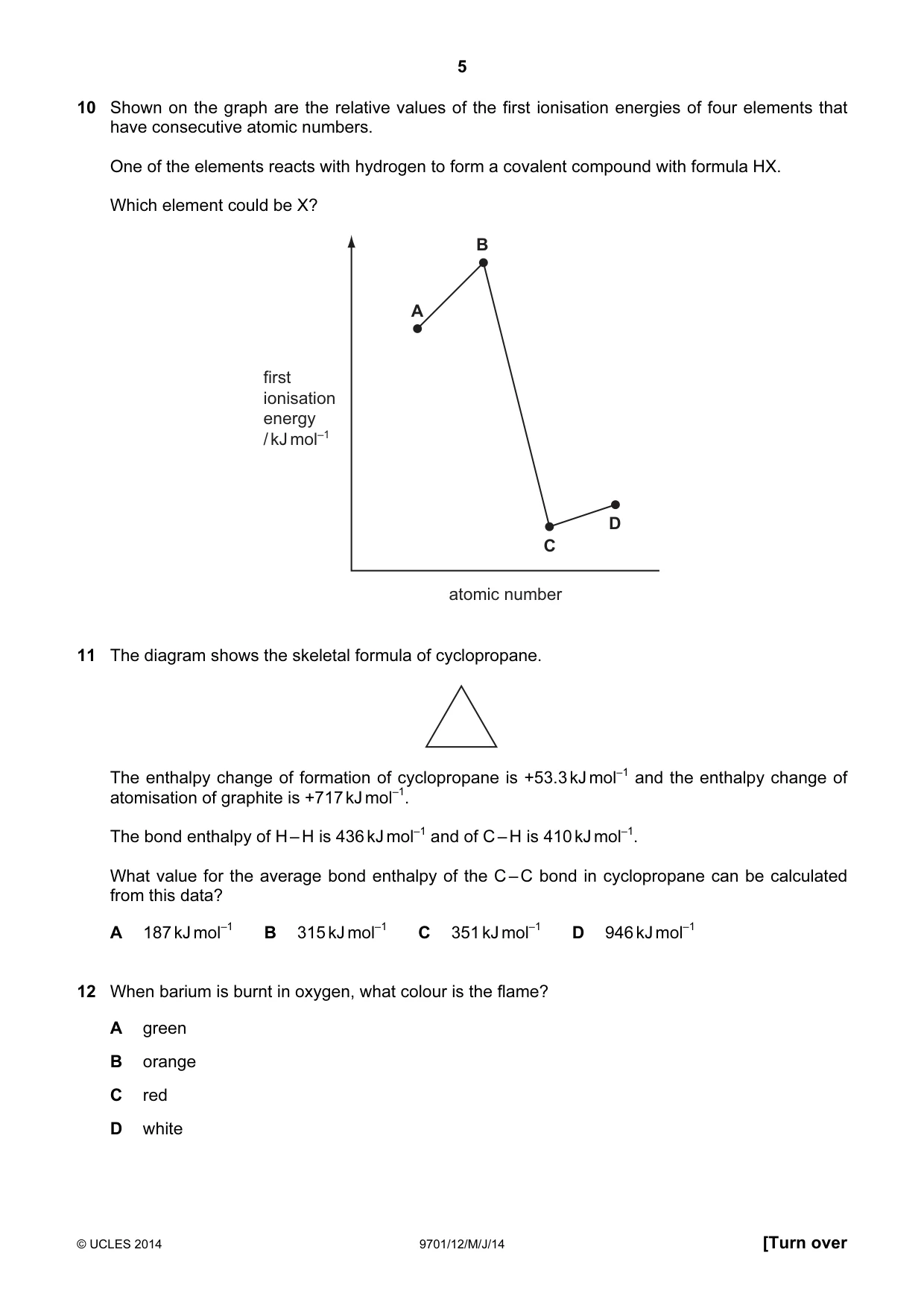
10 Shown on the graph are the relative values of the first ionisation energies of four elements that have consecutive atomic numbers. One of the elements reacts with hydrogen to form a covalent compound with formula HX. Which element could be X? B A first ionisation energy / kJ mol–1 D C atomic number
Mark scheme: A
Q11 · The diagram shows the skeletal formula of cyclopropane
11 The diagram shows the skeletal formula of cyclopropane. The enthalpy change of formation of cyclopropane is +53.3 kJ mol–1 and the enthalpy change of atomisation of graphite is +717 kJ mol–1. The bond enthalpy of H – H is 436 kJ mol–1 and of C – H is 410 kJ mol–1. What value for the average bond enthalpy of the C – C bond in cyclopropane can be calculated from this data? A 187 kJ mol–1 B 315 kJ mol–1 C 351 kJ mol–1 D 946 kJ mol–1
Mark scheme: B
Q12 · When barium is burnt in oxygen, what colour is the flame?
12 When barium is burnt in oxygen, what colour is the flame? A green B orange C red D white
Mark scheme: A
Q13 · X and Y are oxides of different Period 3 elements
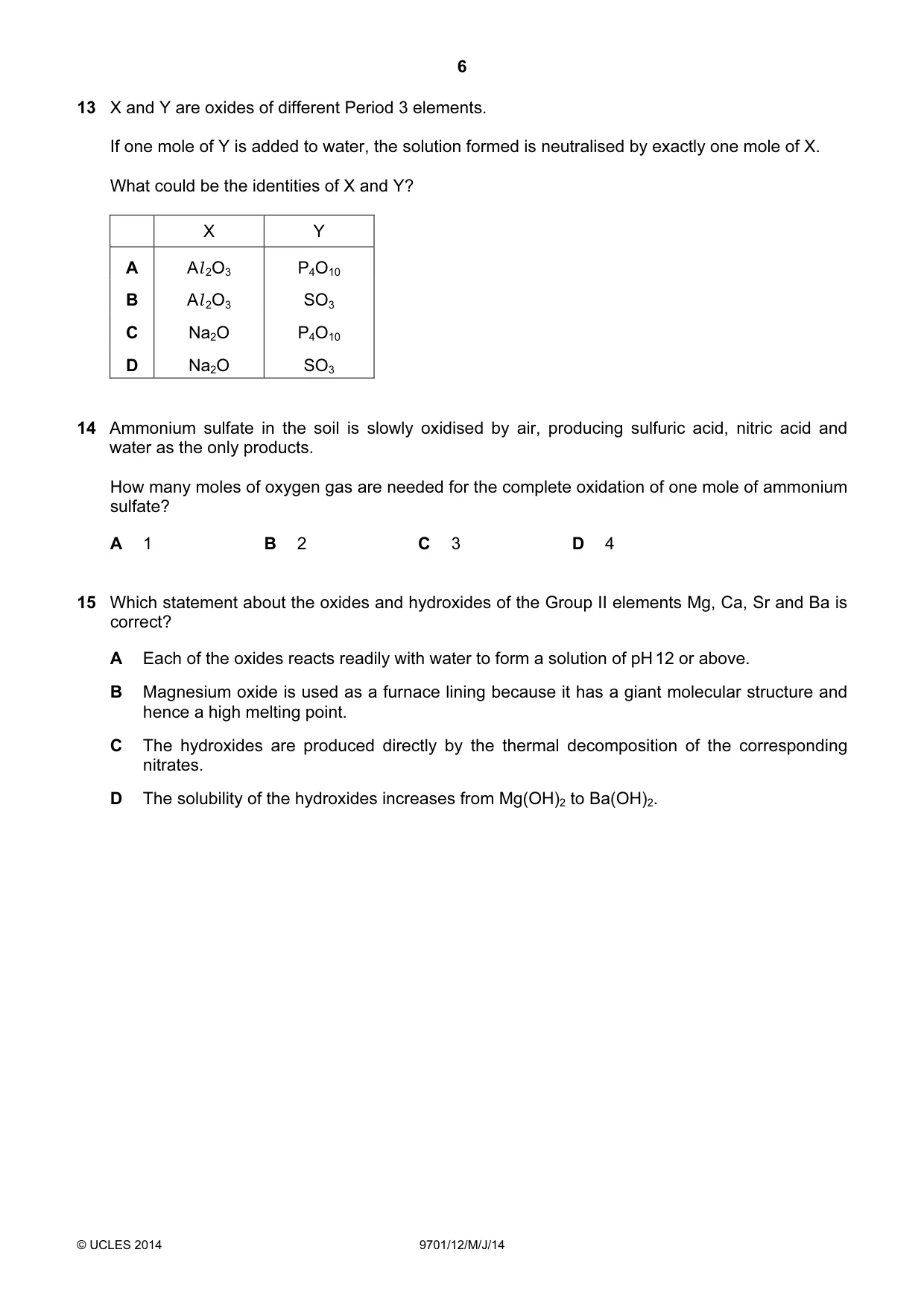
13 X and Y are oxides of different Period 3 elements. If one mole of Y is added to water, the solution formed is neutralised by exactly one mole of X. What could be the identities of X and Y? X Y A Al 2O3 P4O10 B Al 2O3 SO3 C Na2O P4O10 D Na2O SO3
Mark scheme: D
More questions on Periodicity of chemical properties of the elements in Period 3
Q14 · Ammonium sulfate in the soil is slowly oxidised by air, producing sulfuric acid, nitric…
14 Ammonium sulfate in the soil is slowly oxidised by air, producing sulfuric acid, nitric acid and water as the only products. How many moles of oxygen gas are needed for the complete oxidation of one mole of ammonium sulfate? A 1 B 2 C 3 D 4
Mark scheme: D
Q15 · Which statement about the oxides and hydroxides of the Group II elements Mg, Ca, Sr and…
15 Which statement about the oxides and hydroxides of the Group II elements Mg, Ca, Sr and Ba is correct? A Each of the oxides reacts readily with water to form a solution of pH 12 or above. B Magnesium oxide is used as a furnace lining because it has a giant molecular structure and hence a high melting point. C The hydroxides are produced directly by the thermal decomposition of the corresponding nitrates. D The solubility of the hydroxides increases from Mg(OH)2 to Ba(OH)2.
Mark scheme: D
Q16 · Which graph correctly shows the relative melting points of the elements Mg, Al, Si and P…
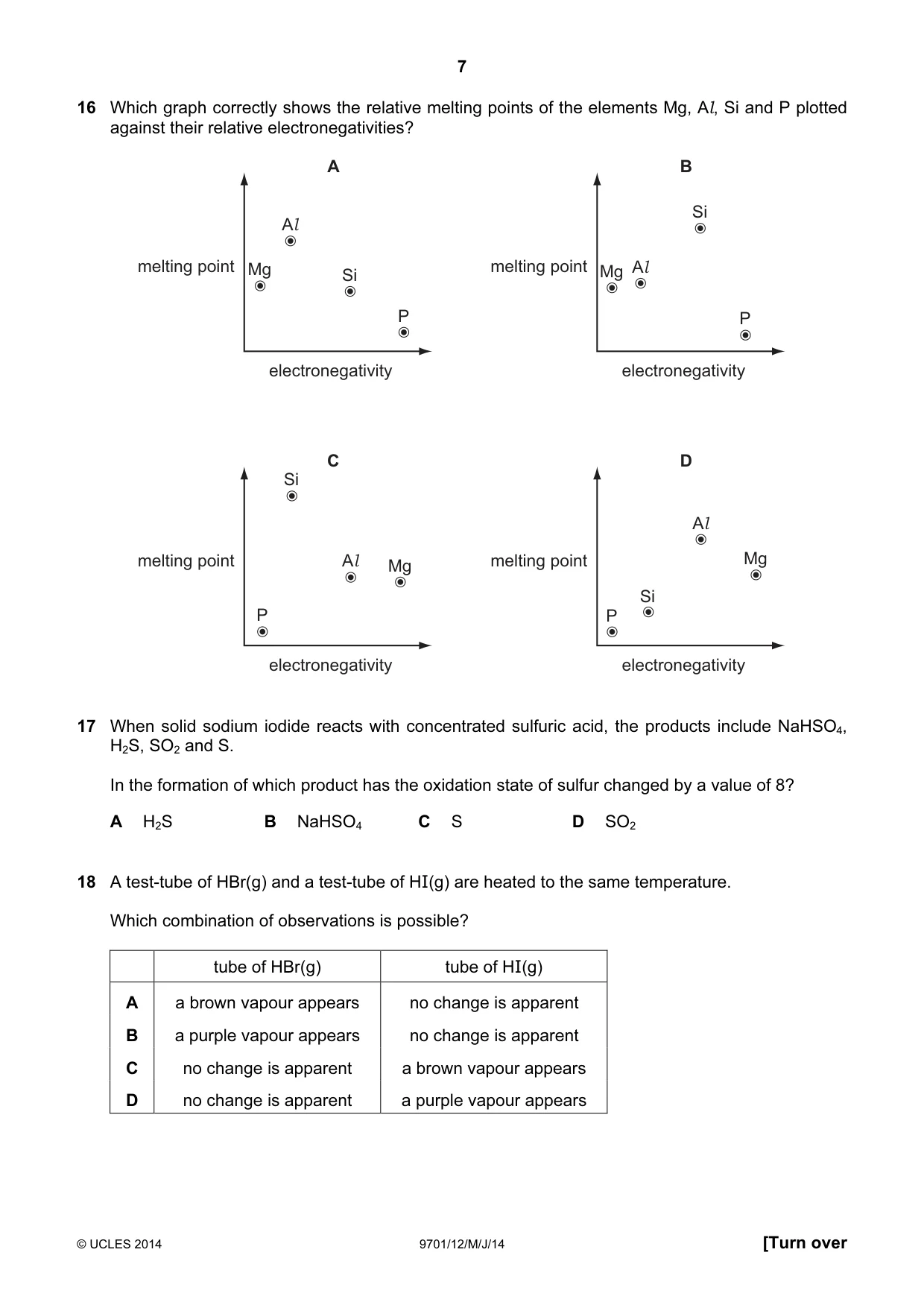
16 Which graph correctly shows the relative melting points of the elements Mg, Al, Si and P plotted against their relative electronegativities? A B Si Al melting point Mg melting point Mg Al Si P P electronegativity electronegativity C D Si Al melting point Al Mg melting point Mg Si P P electronegativity electronegativity
Mark scheme: B
More questions on Periodicity of physical properties of the elements in Period 3
Q17 · When solid sodium iodide reacts with concentrated sulfuric acid, the products include…
17 When solid sodium iodide reacts with concentrated sulfuric acid, the products include NaHSO4, H2S, SO2 and S. In the formation of which product has the oxidation state of sulfur changed by a value of 8? A H2S B NaHSO4 C S D SO2
Mark scheme: A
Q18 · A test-tube of HBr(g) and a test-tube of HI(g) are heated to the same temperature
18 A test-tube of HBr(g) and a test-tube of HI(g) are heated to the same temperature. Which combination of observations is possible? tube of HBr(g) tube of HI(g) A a brown vapour appears no change is apparent B a purple vapour appears no change is apparent C no change is apparent a brown vapour appears D no change is apparent a purple vapour appears
Mark scheme: D
More questions on The chemical properties of the halogen elements and the hydrogen halides
Q19 · Use of the Data Booklet is relevant to this question
19 Use of the Data Booklet is relevant to this question. In an experiment, 0.125 mol of chlorine gas, Cl 2, is reacted with an excess of cold aqueous sodium hydroxide. One of the products is a compound of sodium, oxygen, and chlorine. Which mass of this product is formed? A 9.31 g B 13.3 g C 18.6 g D 26.6 g
Mark scheme: A
Q20 · The diagram shows the skeletal formula of phenazine
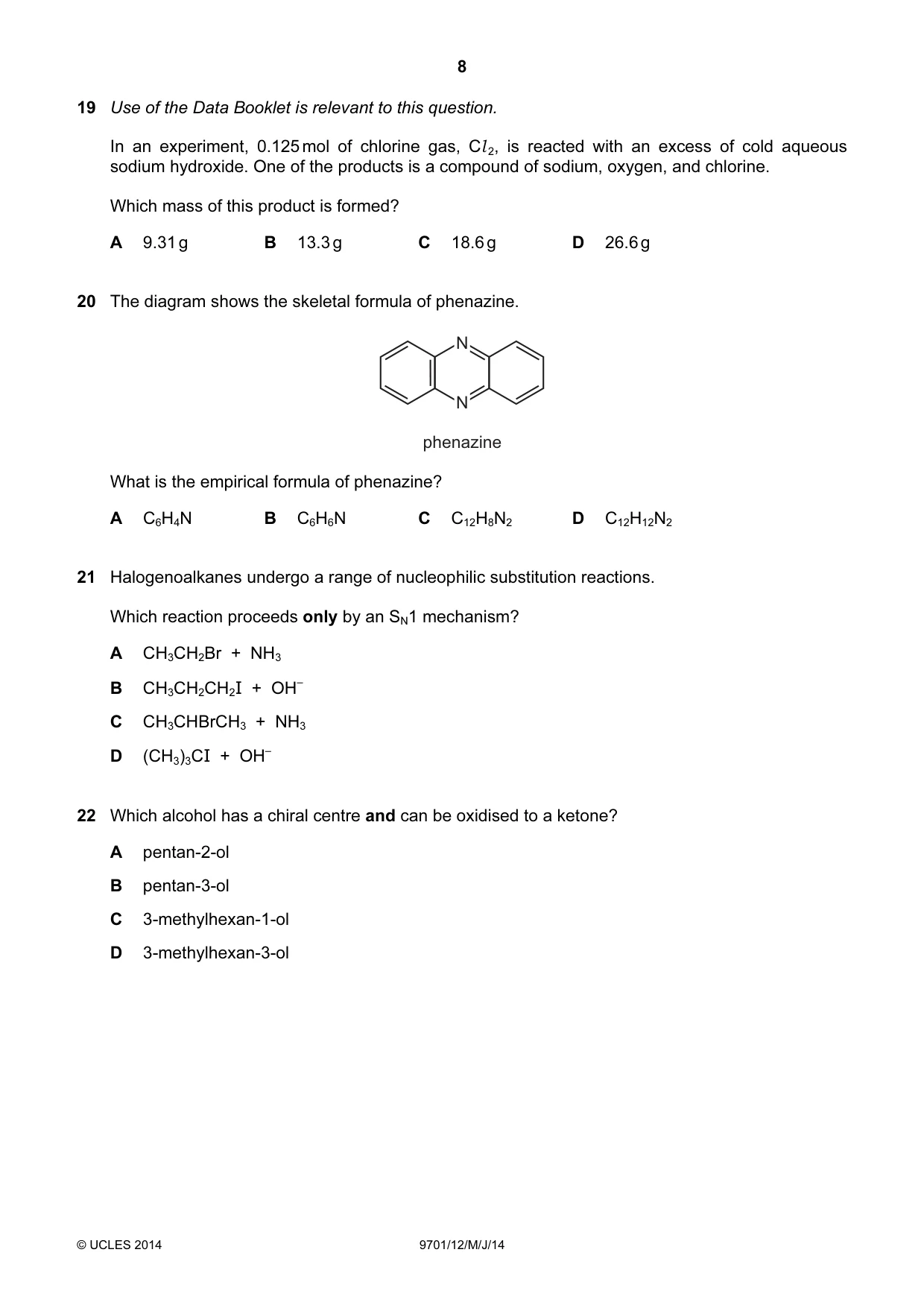
20 The diagram shows the skeletal formula of phenazine. N N N N phenazine What is the empirical formula of phenazine? A C6H4N B C6H6N C C12H8N2 D C12H12N2
Mark scheme: A
Q21 · Halogenoalkanes undergo a range of nucleophilic substitution reactions
21 Halogenoalkanes undergo a range of nucleophilic substitution reactions. Which reaction proceeds only by an SN1 mechanism? A CH3CH2Br + NH3 B CH3CH2CH2I + OH– C CH3CHBrCH3 + NH3 D (CH3)3CI + OH–
Mark scheme: D
Q22 · Which alcohol has a chiral centre and can be oxidised to a ketone?
22 Which alcohol has a chiral centre and can be oxidised to a ketone? A pentan-2-ol B pentan-3-ol C 3-methylhexan-1-ol D 3-methylhexan-3-ol
Mark scheme: A
Q23 · An ester of structural formula CH3CO2CH3 is heated with an aqueous solution of sodium…
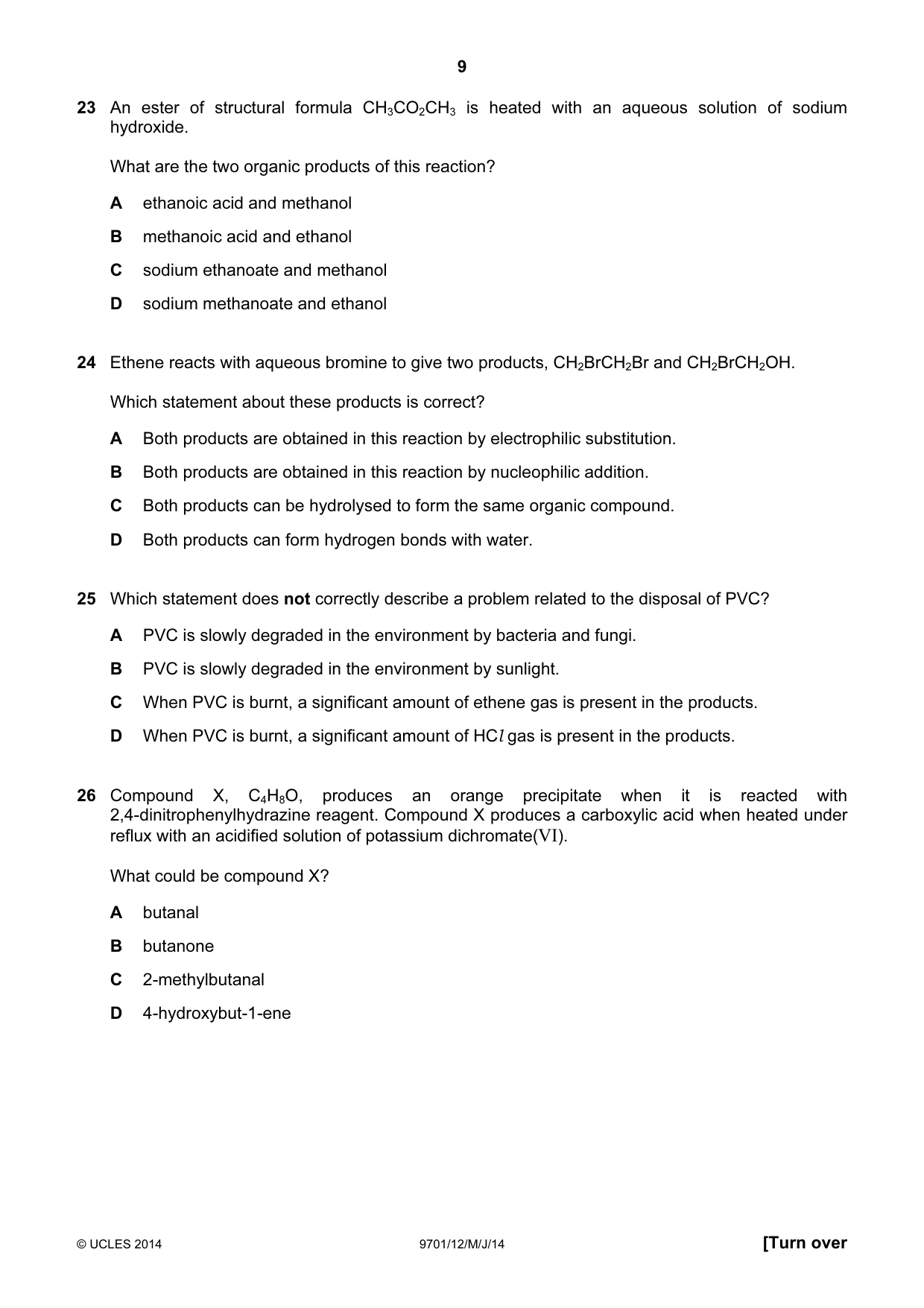
23 An ester of structural formula CH3CO2CH3 is heated with an aqueous solution of sodium hydroxide. What are the two organic products of this reaction? A ethanoic acid and methanol B methanoic acid and ethanol C sodium ethanoate and methanol D sodium methanoate and ethanol
Mark scheme: C
Q24 · Ethene reacts with aqueous bromine to give two products, CH2BrCH2Br and CH2BrCH2OH
24 Ethene reacts with aqueous bromine to give two products, CH2BrCH2Br and CH2BrCH2OH. Which statement about these products is correct? A Both products are obtained in this reaction by electrophilic substitution. B Both products are obtained in this reaction by nucleophilic addition. C Both products can be hydrolysed to form the same organic compound. D Both products can form hydrogen bonds with water.
Mark scheme: C
Q25 · Which statement does not correctly describe a problem related to the disposal of PVC?
25 Which statement does not correctly describe a problem related to the disposal of PVC? A PVC is slowly degraded in the environment by bacteria and fungi. B PVC is slowly degraded in the environment by sunlight. C When PVC is burnt, a significant amount of ethene gas is present in the products. D When PVC is burnt, a significant amount of HCl gas is present in the products.
Mark scheme: C
Q26 · Compound X, C4H8O, produces an orange precipitate when it is reacted with…
26 Compound X, C4H8O, produces an orange precipitate when it is reacted with 2,4-dinitrophenylhydrazine reagent. Compound X produces a carboxylic acid when heated under reflux with an acidified solution of potassium dichromate(VI). What could be compound X? A butanal B butanone C 2-methylbutanal D 4-hydroxybut-1-ene
Mark scheme: A
Q27 · Dichlorodifluoromethane, CCl 2F2, has been used in aerosol propellants and as a…
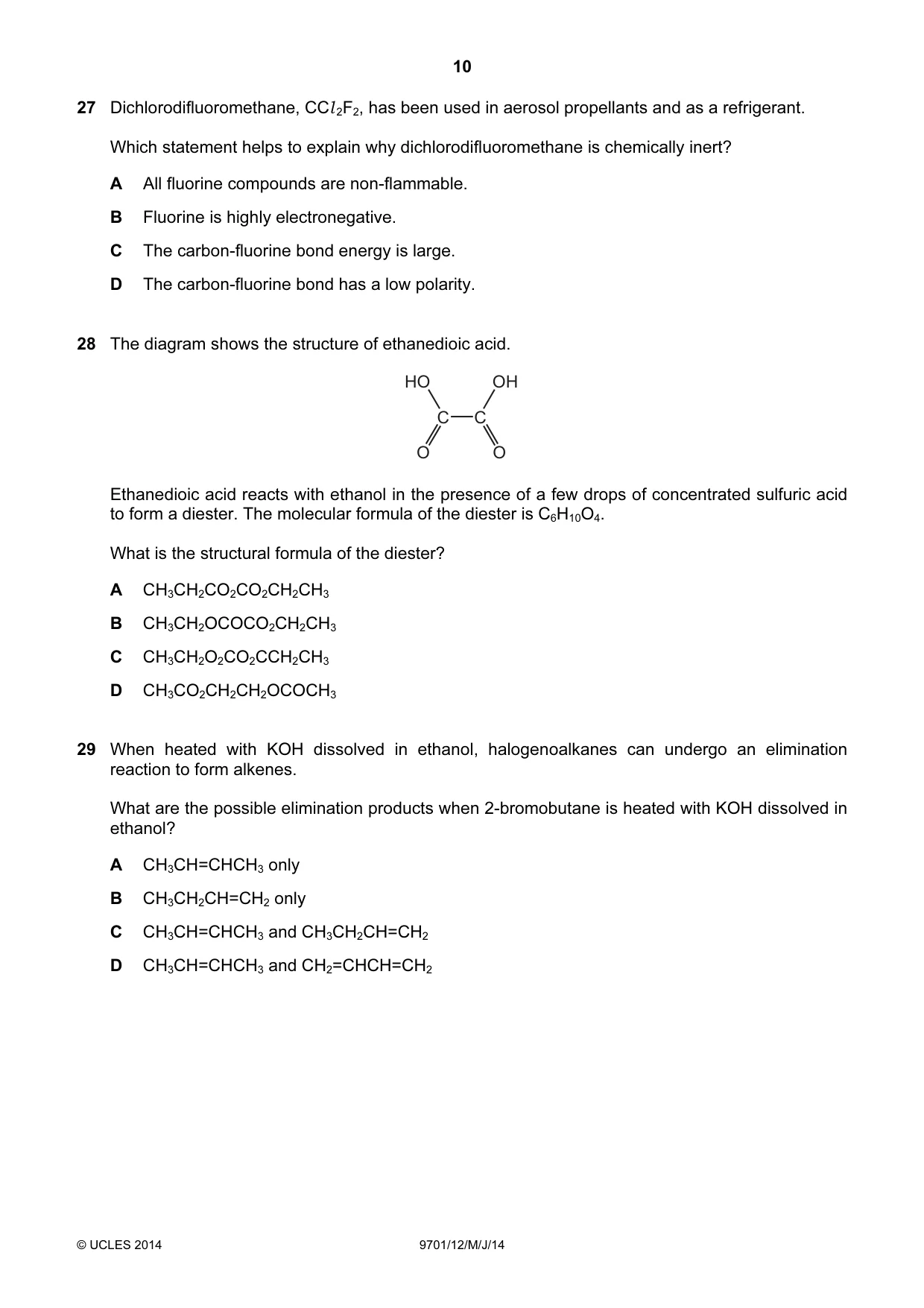
27 Dichlorodifluoromethane, CCl 2F2, has been used in aerosol propellants and as a refrigerant. Which statement helps to explain why dichlorodifluoromethane is chemically inert? A All fluorine compounds are non-flammable. B Fluorine is highly electronegative. C The carbon-fluorine bond energy is large. D The carbon-fluorine bond has a low polarity.
Mark scheme: C
More questions on Intermolecular forces, electronegativity and bond properties
Q28 · The diagram shows the structure of ethanedioic acid
28 The diagram shows the structure of ethanedioic acid. HO OH C C O O Ethanedioic acid reacts with ethanol in the presence of a few drops of concentrated sulfuric acid to form a diester. The molecular formula of the diester is C6H10O4. What is the structural formula of the diester? A CH3CH2CO2CO2CH2CH3 B CH3CH2OCOCO2CH2CH3 C CH3CH2O2CO2CCH2CH3 D CH3CO2CH2CH2OCOCH3
Mark scheme: B
Q29 · When heated with KOH dissolved in ethanol, halogenoalkanes can undergo an elimination…
29 When heated with KOH dissolved in ethanol, halogenoalkanes can undergo an elimination reaction to form alkenes. What are the possible elimination products when 2-bromobutane is heated with KOH dissolved in ethanol? A CH3CH=CHCH3 only B CH3CH2CH=CH2 only C CH3CH=CHCH3 and CH3CH2CH=CH2 D CH3CH=CHCH3 and CH2=CHCH=CH2
Mark scheme: C
Q30 · Artemisinin is a powerful anti-malarial drug
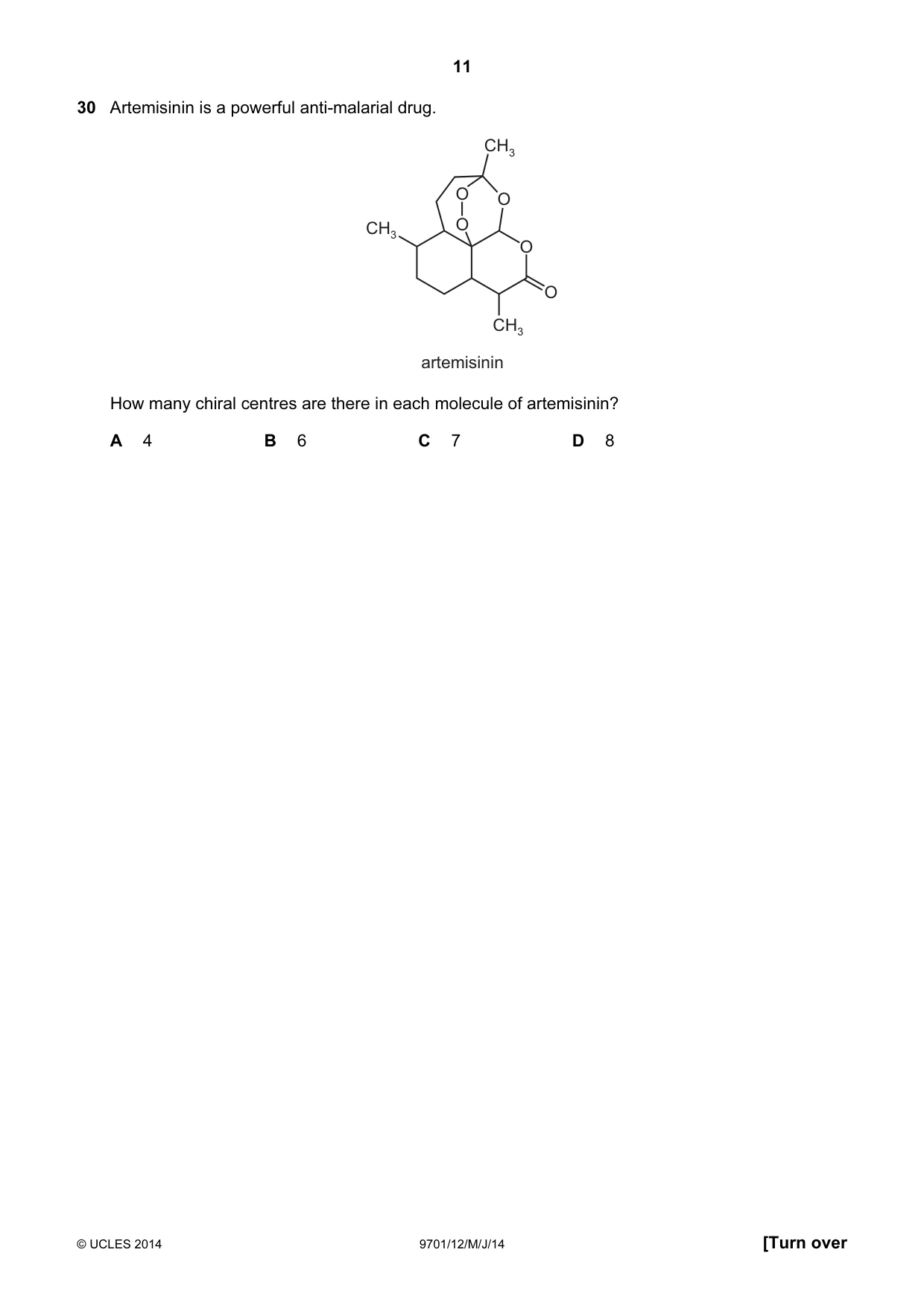
30 Artemisinin is a powerful anti-malarial drug. CH3 O O CH3 O O O CH3 artemisinin How many chiral centres are there in each molecule of artemisinin? A 4 B 6 C 7 D 8
Mark scheme: C
Q31 · P and Q are two compounds with similar Mr values
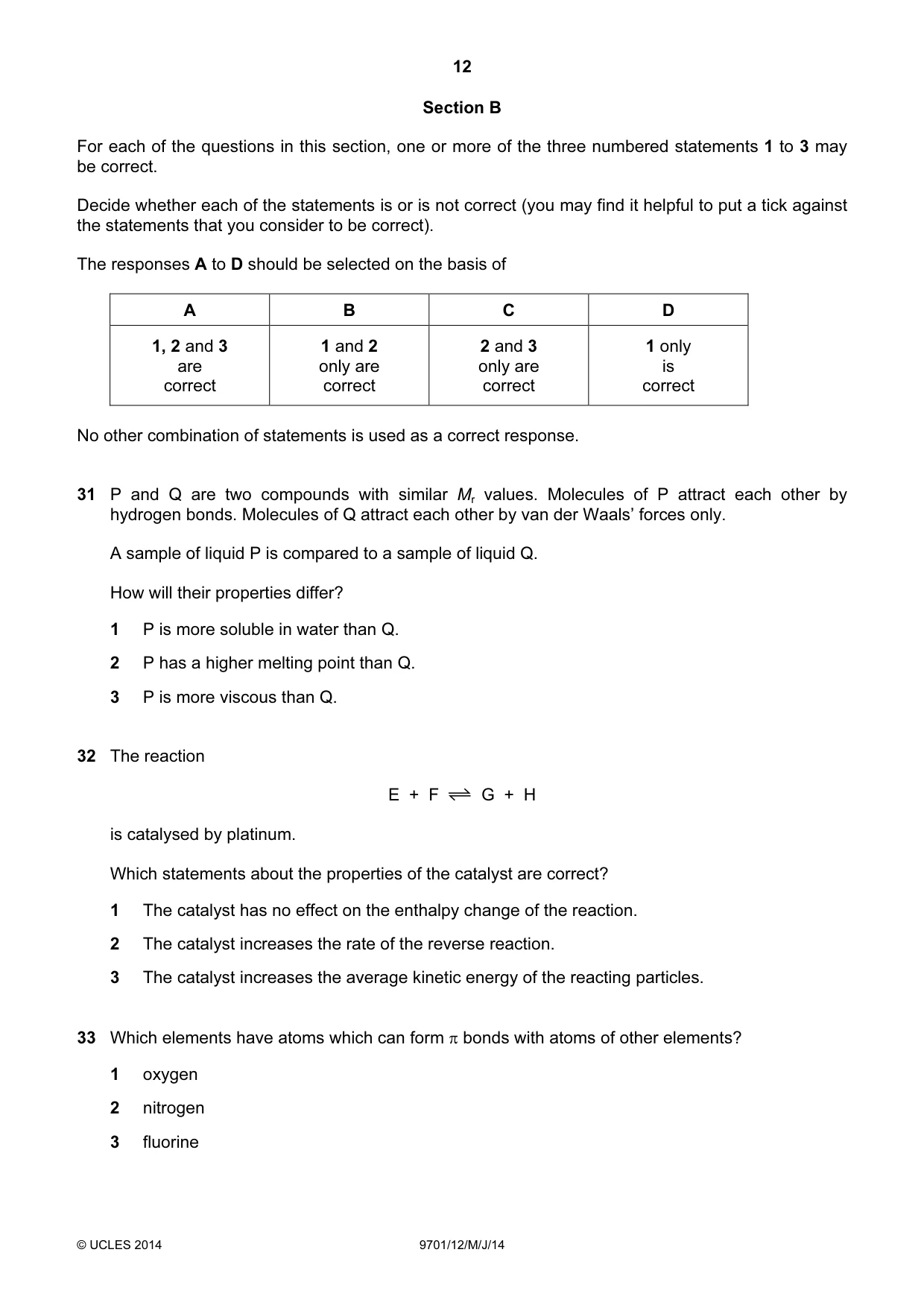
31 P and Q are two compounds with similar Mr values. Molecules of P attract each other by hydrogen bonds. Molecules of Q attract each other by van der Waals’ forces only. A sample of liquid P is compared to a sample of liquid Q. How will their properties differ? 1 P is more soluble in water than Q. 2 P has a higher melting point than Q. 3 P is more viscous than Q.
Mark scheme: A
More questions on Intermolecular forces, electronegativity and bond properties
Q32 · The reaction E + F G + H is catalysed by platinum
32 The reaction E + F G + H is catalysed by platinum. Which statements about the properties of the catalyst are correct? 1 The catalyst has no effect on the enthalpy change of the reaction. 2 The catalyst increases the rate of the reverse reaction. 3 The catalyst increases the average kinetic energy of the reacting particles.
Mark scheme: B
Q33 · Which elements have atoms which can form π bonds with atoms of other elements?
33 Which elements have atoms which can form π bonds with atoms of other elements? 1 oxygen 2 nitrogen 3 fluorine
Mark scheme: B
More questions on Shapes of organic molecules; σ and π bonds
Q34 · Sulfuric acid is a Brønsted-Lowry acid
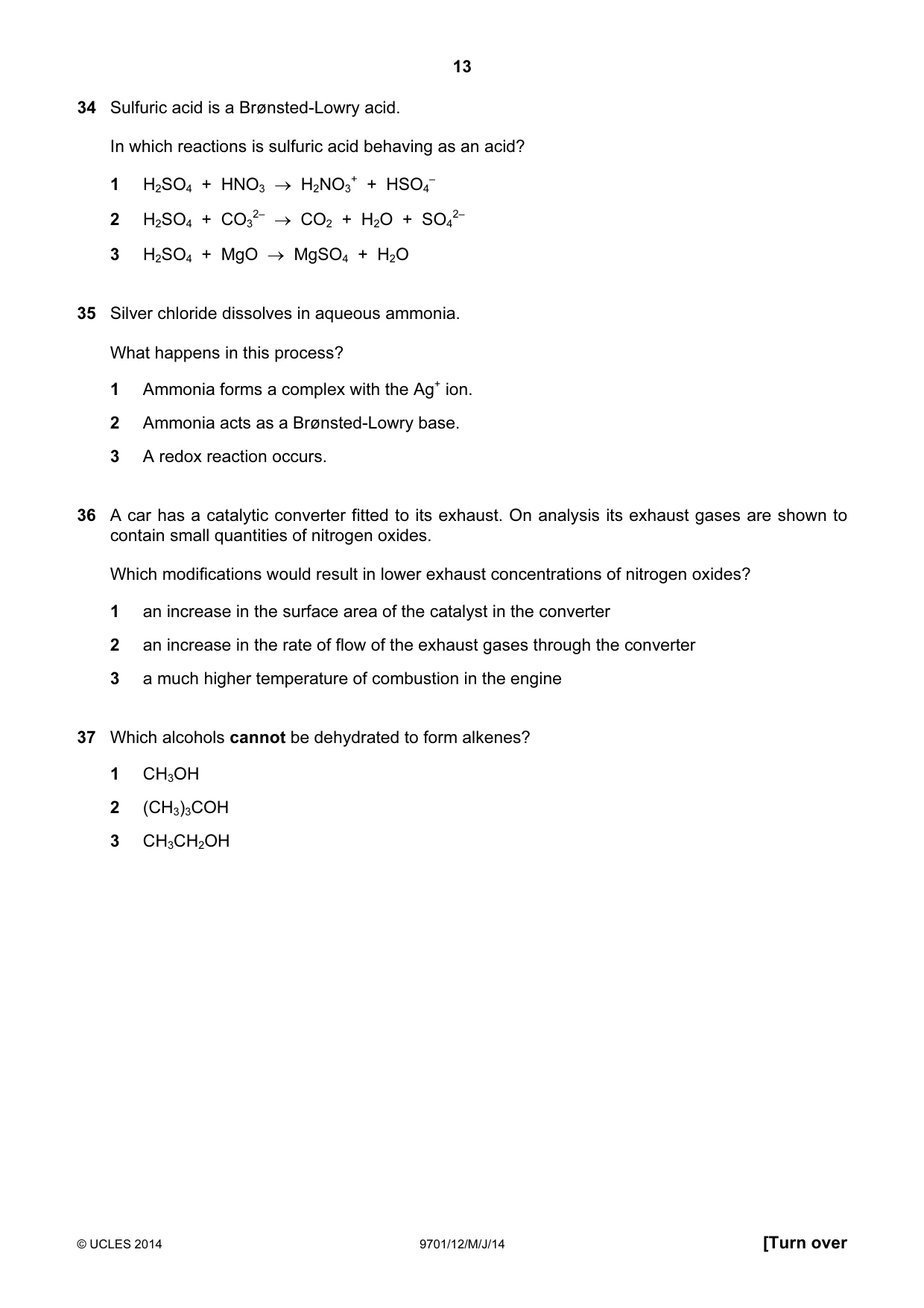
34 Sulfuric acid is a Brønsted-Lowry acid. In which reactions is sulfuric acid behaving as an acid? 1 H2SO4 + HNO3 → H2NO3 + + HSO4 – 2 H2SO4 + CO3 2– → CO2 + H2O + SO4 2– 3 H2SO4 + MgO → MgSO4 + H2O
Mark scheme: A
Q35 · Silver chloride dissolves in aqueous ammonia
35 Silver chloride dissolves in aqueous ammonia. What happens in this process? 1 Ammonia forms a complex with the Ag+ ion. 2 Ammonia acts as a Brønsted-Lowry base. 3 A redox reaction occurs.
Mark scheme: D
Q36 · A car has a catalytic converter fitted to its exhaust
36 A car has a catalytic converter fitted to its exhaust. On analysis its exhaust gases are shown to contain small quantities of nitrogen oxides. Which modifications would result in lower exhaust concentrations of nitrogen oxides? 1 an increase in the surface area of the catalyst in the converter 2 an increase in the rate of flow of the exhaust gases through the converter 3 a much higher temperature of combustion in the engine
Mark scheme: D
Q37 · Which alcohols cannot be dehydrated to form alkenes?
37 Which alcohols cannot be dehydrated to form alkenes? 1 CH3OH 2 (CH3)3COH 3 CH3CH2OH
Mark scheme: D
Q38 · Menthol is a naturally-occurring alcohol found in peppermint oil
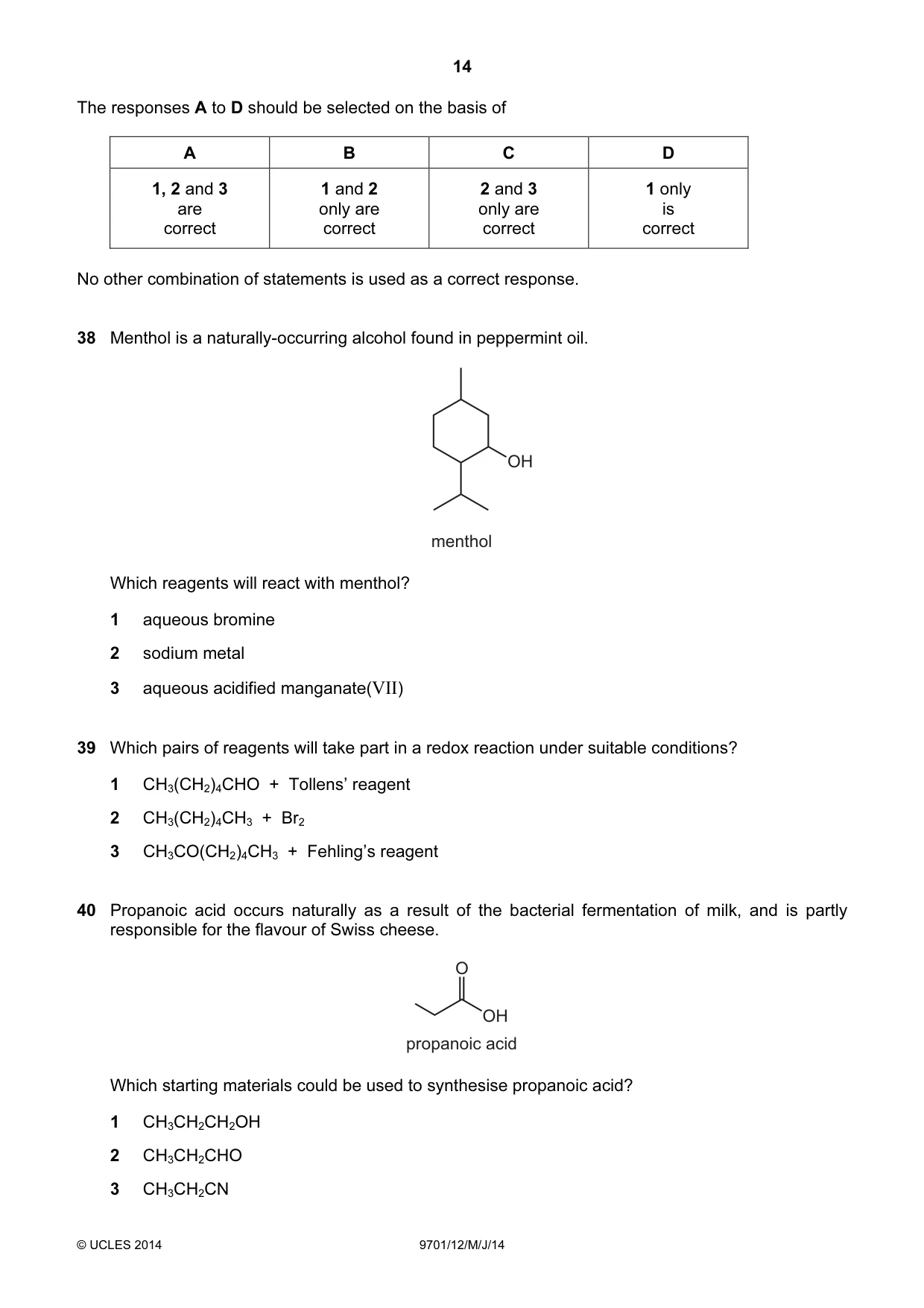
38 Menthol is a naturally-occurring alcohol found in peppermint oil. OH menthol Which reagents will react with menthol? 1 aqueous bromine 2 sodium metal 3 aqueous acidified manganate(VII)
Mark scheme: C
Q39 · Which pairs of reagents will take part in a redox reaction under suitable conditions?
39 Which pairs of reagents will take part in a redox reaction under suitable conditions? 1 CH3(CH2)4CHO + Tollens’ reagent 2 CH3(CH2)4CH3 + Br2 3 CH3CO(CH2)4CH3 + Fehling’s reagent
Mark scheme: B
Q40 · Propanoic acid occurs naturally as a result of the bacterial fermentation of milk, and is…
40 Propanoic acid occurs naturally as a result of the bacterial fermentation of milk, and is partly responsible for the flavour of Swiss cheese. O OH propanoic acid Which starting materials could be used to synthesise propanoic acid? 1 CH3CH2CH2OH 2 CH3CH2CHO 3 CH3CH2CN
Mark scheme: A
What was in this paper
The subtopics covered by these 40 questions, and how many questions each got. Open one in a new tab to see every Cambridge question on it.
3Homogeneous and heterogeneous catalysts3Redox processes: electron transfer and changes in oxidation number (oxidation state)3Aldehydes and ketones2Chemical equilibria: reversible reactions, dynamic equilibrium2Esters2Halogenoalkanes2Hess’s law2Intermolecular forces, electronegativity and bond properties2Similarities and trends in the properties of the Group 2 metals, magnesium to barium, and their compounds2Alkenes1Bonding and structure1Brønsted–Lowry theory of acids and bases1Degradable polymers1Effect of temperature on reaction rates and the concept of activation energy1Enthalpy change, ΔH1Formulas1General characteristic chemical properties of the first set of transition elements, titanium to copper1Ionisation energy1Isomerism: optical1Organic synthesis1Periodicity of chemical properties of the elements in Period 31Periodicity of physical properties of the elements in Period 31Reacting masses and volumes (of solutions and gases)1Shapes of organic molecules; σ and π bonds1The chemical properties of the halogen elements and the hydrogen halides1The reactions of chlorine1What you needed in this session
Cambridge’s own grade thresholds for 2014 May/June, Paper 1 · Variant 2. A higher threshold means an easier paper — the bar moves with how the cohort did.