Cambridge A Level Chemistry 9701 — 2014 Oct/Nov Paper 1 · Variant 3
9701/13/O/N/14 · 40 questions · 40 marks · ≈45 min
The question paper and its mark scheme, free to read here and free to download. This is Cambridge’s own paper, exactly as it was sat.
Question paper16 pages
Mark scheme2 pages
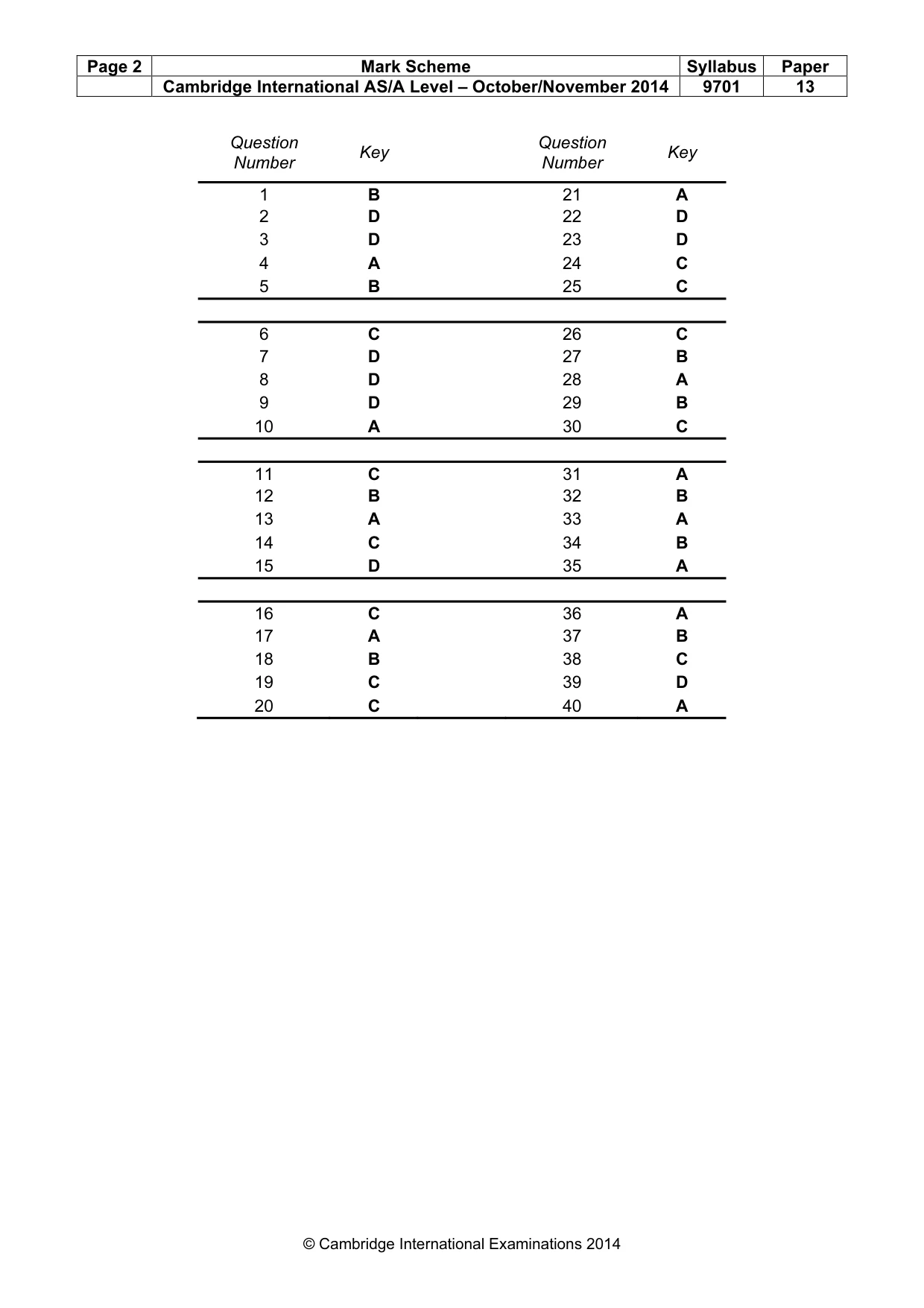
Answers below. Sit the paper first if you are practising.
Questions as text
Q1 · The diagram below represents, for a given temperature, the Boltzmann distribution of the…
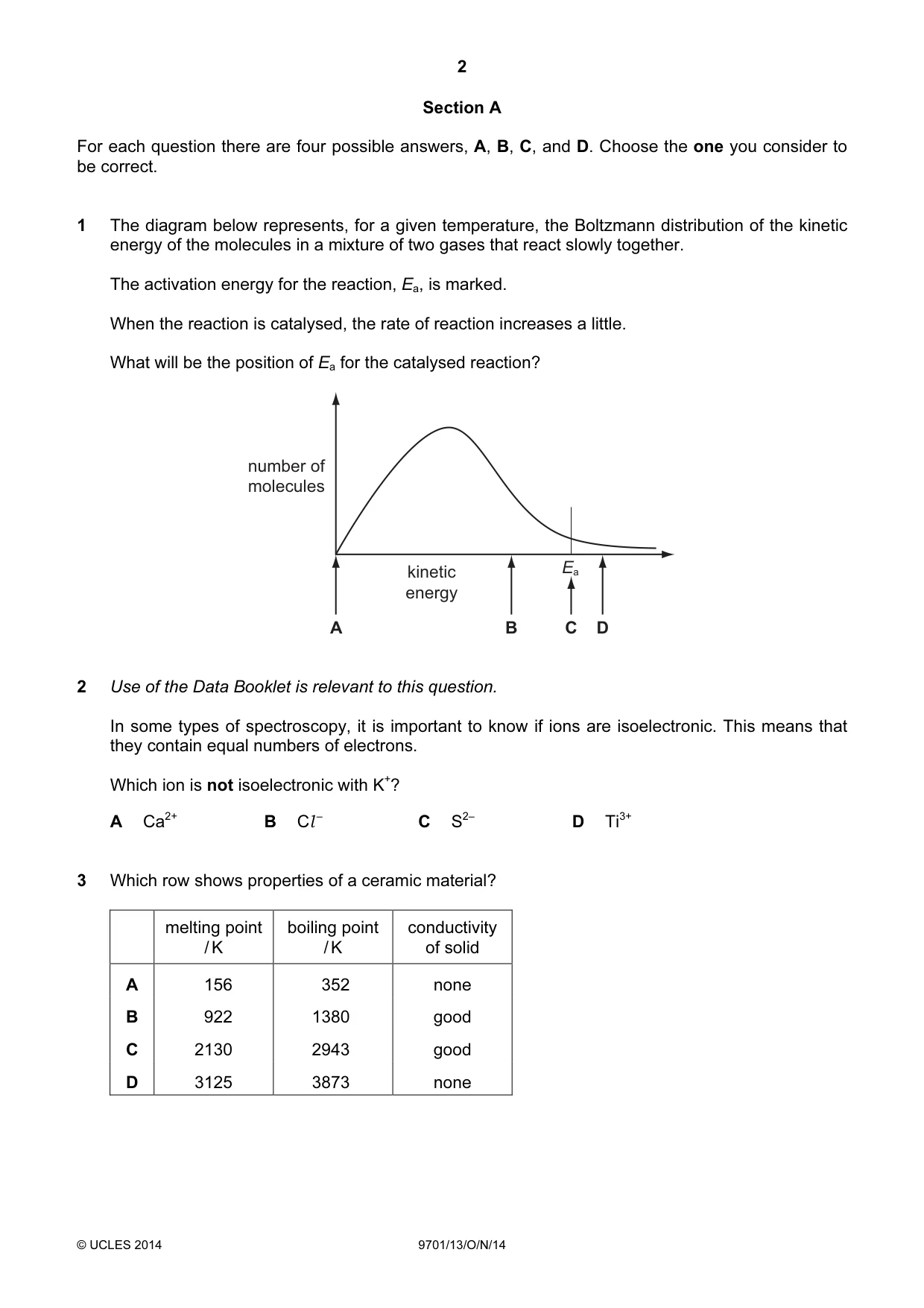
1 The diagram below represents, for a given temperature, the Boltzmann distribution of the kinetic energy of the molecules in a mixture of two gases that react slowly together. The activation energy for the reaction, Ea, is marked. When the reaction is catalysed, the rate of reaction increases a little. What will be the position of Ea for the catalysed reaction? number of molecules kinetic Ea energy A B C D
Mark scheme: B
More questions on Effect of temperature on reaction rates and the concept of activation energy
Q2 · Use of the Data Booklet is relevant to this question
2 Use of the Data Booklet is relevant to this question. In some types of spectroscopy, it is important to know if ions are isoelectronic. This means that they contain equal numbers of electrons. Which ion is not isoelectronic with K+? A Ca2+ B Cl – C S2– D Ti3+
Mark scheme: D
Q3 · Which row shows properties of a ceramic material?
3 Which row shows properties of a ceramic material? melting point boiling point conductivity / K / K of solid A 156 352 none B 922 1380 good C 2130 2943 good D 3125 3873 none
Mark scheme: D
Q4 · Impure copper is purified by electrolysis
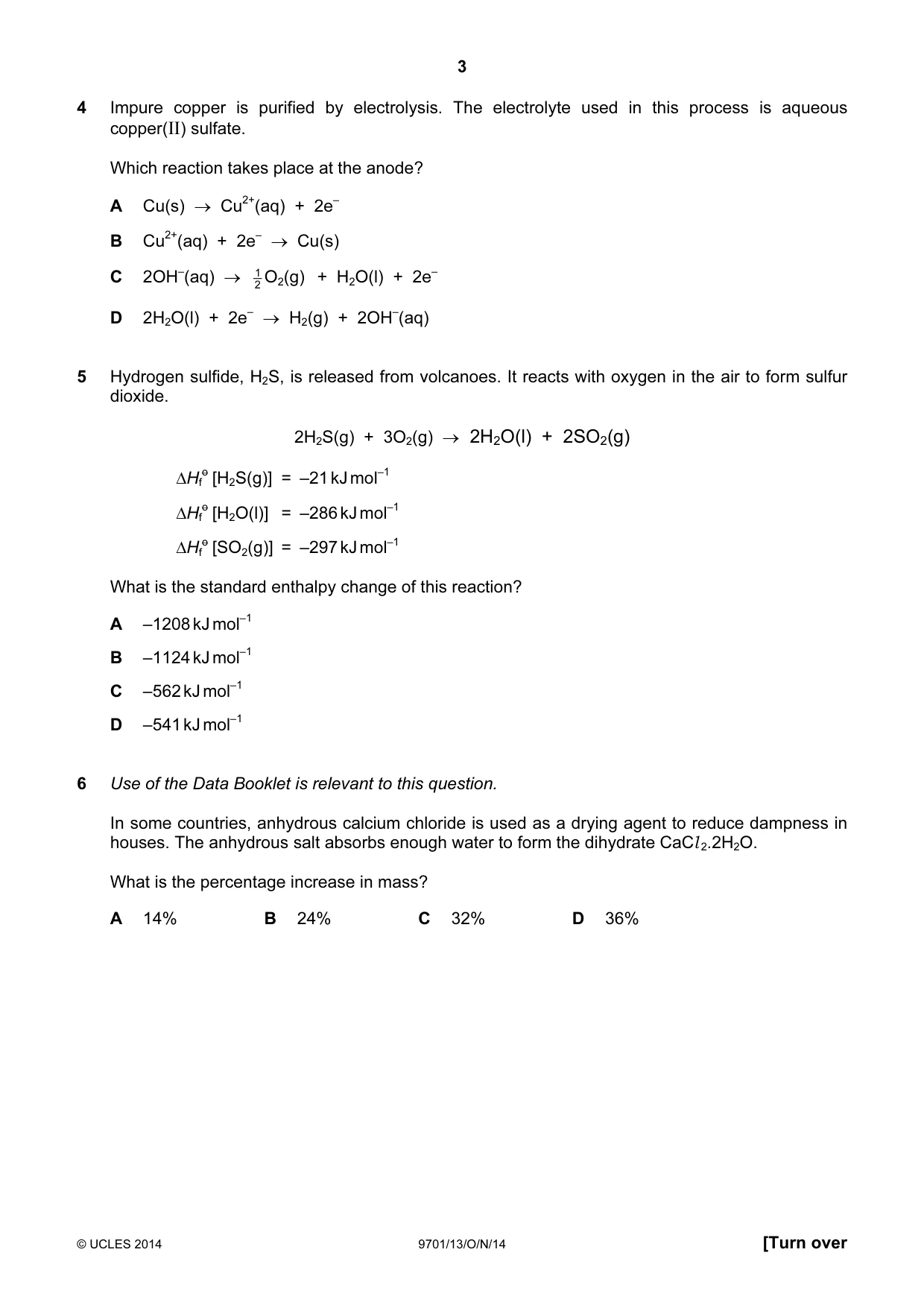
4 Impure copper is purified by electrolysis. The electrolyte used in this process is aqueous copper(II) sulfate. Which reaction takes place at the anode? A Cu(s) → Cu2+(aq) + 2e– B Cu2+(aq) + 2e– → Cu(s) C 2OH–(aq) → 1 O2 (g) + H2O(l) + 2e– 2 D 2H2O(l) + 2e– → H2(g) + 2OH–(aq)
Mark scheme: A
Q5 · Hydrogen sulfide, H2S, is released from volcanoes
5 Hydrogen sulfide, H2S, is released from volcanoes. It reacts with oxygen in the air to form sulfur dioxide. 2H2S(g) + 3O2(g) → 2H2O(l) + 2SO2(g) ∆Hf o [H2S(g)] = –21 kJ mol–1 ∆Hf o [H2O(l)] = –286 kJ mol–1 ∆Hf o [SO2(g)] = –297 kJ mol–1 What is the standard enthalpy change of this reaction? A –1208 kJ mol–1 B –1124 kJ mol–1 C –562 kJ mol–1 D –541 kJ mol–1
Mark scheme: B
Q6 · Use of the Data Booklet is relevant to this question
6 Use of the Data Booklet is relevant to this question. In some countries, anhydrous calcium chloride is used as a drying agent to reduce dampness in houses. The anhydrous salt absorbs enough water to form the dihydrate CaCl 2.2H2O. What is the percentage increase in mass? A 14% B 24% C 32% D 36%
Mark scheme: C
Q7 · Copper and iodine are both shiny crystalline solids
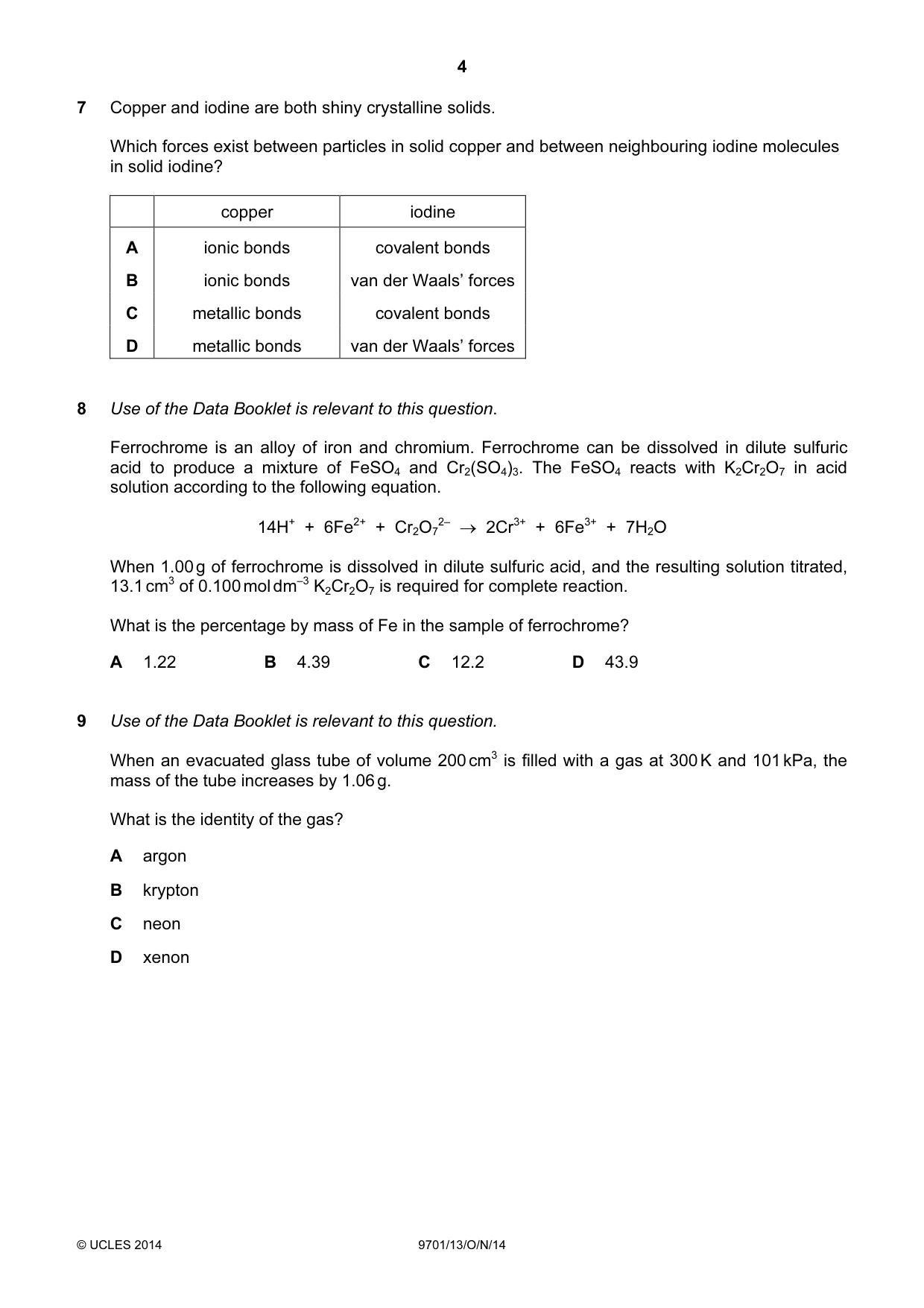
7 Copper and iodine are both shiny crystalline solids. Which forces exist between particles in solid copper and between neighbouring iodine molecules in solid iodine? copper iodine A ionic bonds covalent bonds B ionic bonds van der Waals’ forces C metallic bonds covalent bonds D metallic bonds van der Waals’ forces
Mark scheme: D
Q8 · Use of the Data Booklet is relevant to this question
8 Use of the Data Booklet is relevant to this question. Ferrochrome is an alloy of iron and chromium. Ferrochrome can be dissolved in dilute sulfuric acid to produce a mixture of FeSO4 and Cr2(SO4)3. The FeSO4 reacts with K2Cr2O7 in acid solution according to the following equation. 14H+ + 6Fe2+ + Cr2O7 2– → 2Cr3+ + 6Fe3+ + 7H2O When 1.00 g of ferrochrome is dissolved in dilute sulfuric acid, and the resulting solution titrated, 13.1 cm3 of 0.100 mol dm–3 K2Cr2O7 is required for complete reaction. What is the percentage by mass of Fe in the sample of ferrochrome? A 1.22 B 4.39 C 12.2 D 43.9
Mark scheme: D
More questions on Reacting masses and volumes (of solutions and gases)
Q9 · Use of the Data Booklet is relevant to this question
9 Use of the Data Booklet is relevant to this question. When an evacuated glass tube of volume 200 cm3 is filled with a gas at 300 K and 101 kPa, the mass of the tube increases by 1.06 g. What is the identity of the gas? A argon B krypton C neon D xenon
Mark scheme: D
More questions on The gaseous state: ideal and real gases and pV = nRT
Q10 · Nitrogen monoxide is an atmospheric pollutant that is formed inside car engines by an…
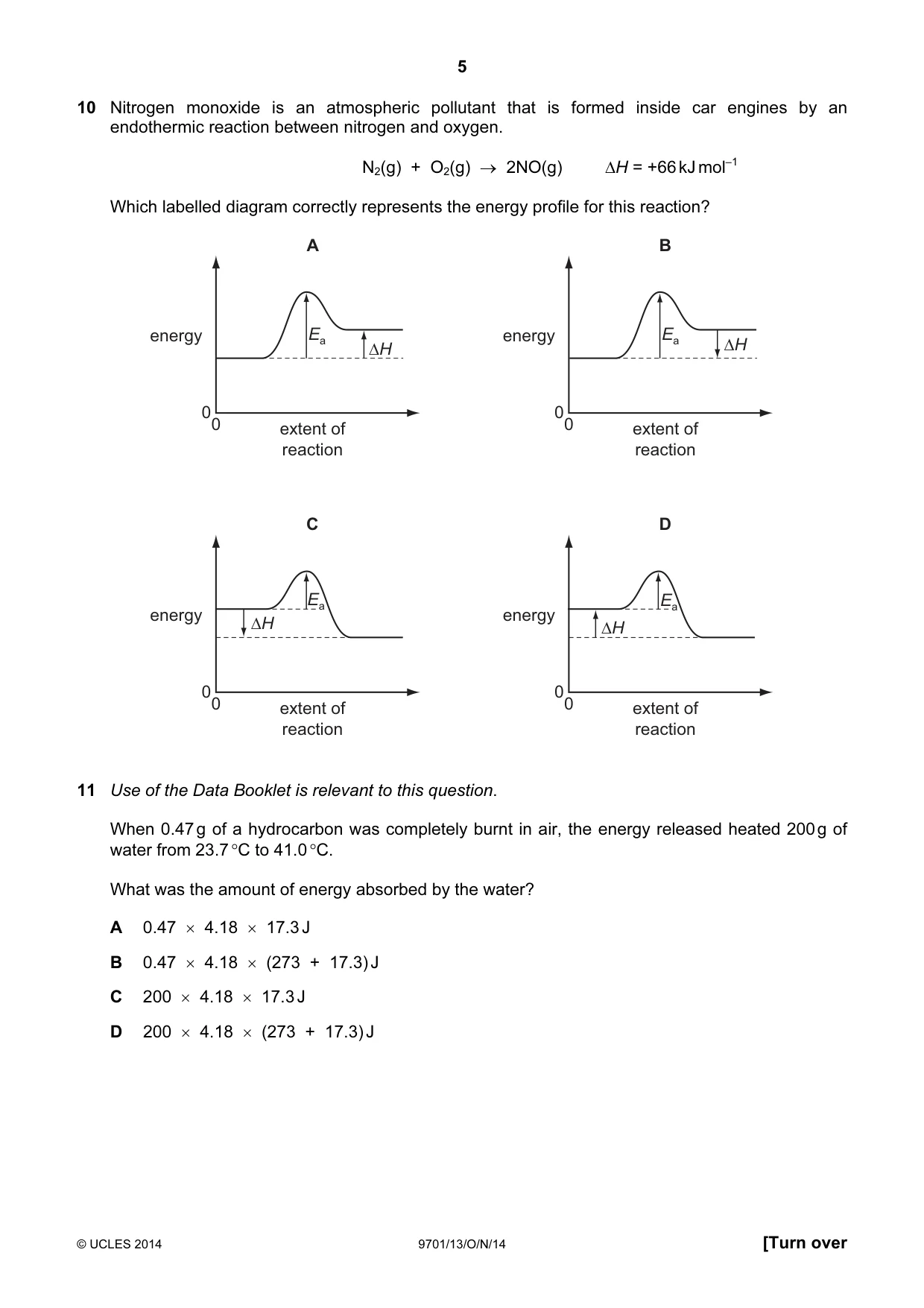
10 Nitrogen monoxide is an atmospheric pollutant that is formed inside car engines by an endothermic reaction between nitrogen and oxygen. N2(g) + O2(g) → 2NO(g) ∆H = +66 kJ mol–1 Which labelled diagram correctly represents the energy profile for this reaction? A B energy Ea energy Ea ∆H ∆H 00 00 extent of extent of reaction reaction C D Ea Ea energy energy ∆H ∆H 00 00 extent of extent of reaction reaction
Mark scheme: A
Q11 · Use of the Data Booklet is relevant to this question
11 Use of the Data Booklet is relevant to this question. When 0.47 g of a hydrocarbon was completely burnt in air, the energy released heated 200 g of water from 23.7 °C to 41.0 °C. What was the amount of energy absorbed by the water? A 0.47 × 4.18 × 17.3 J B 0.47 × 4.18 × (273 + 17.3) J C 200 × 4.18 × 17.3 J D 200 × 4.18 × (273 + 17.3) J
Mark scheme: C
Q12 · What is the ionic equation for the reaction between aqueous sodium carbonate and dilute…
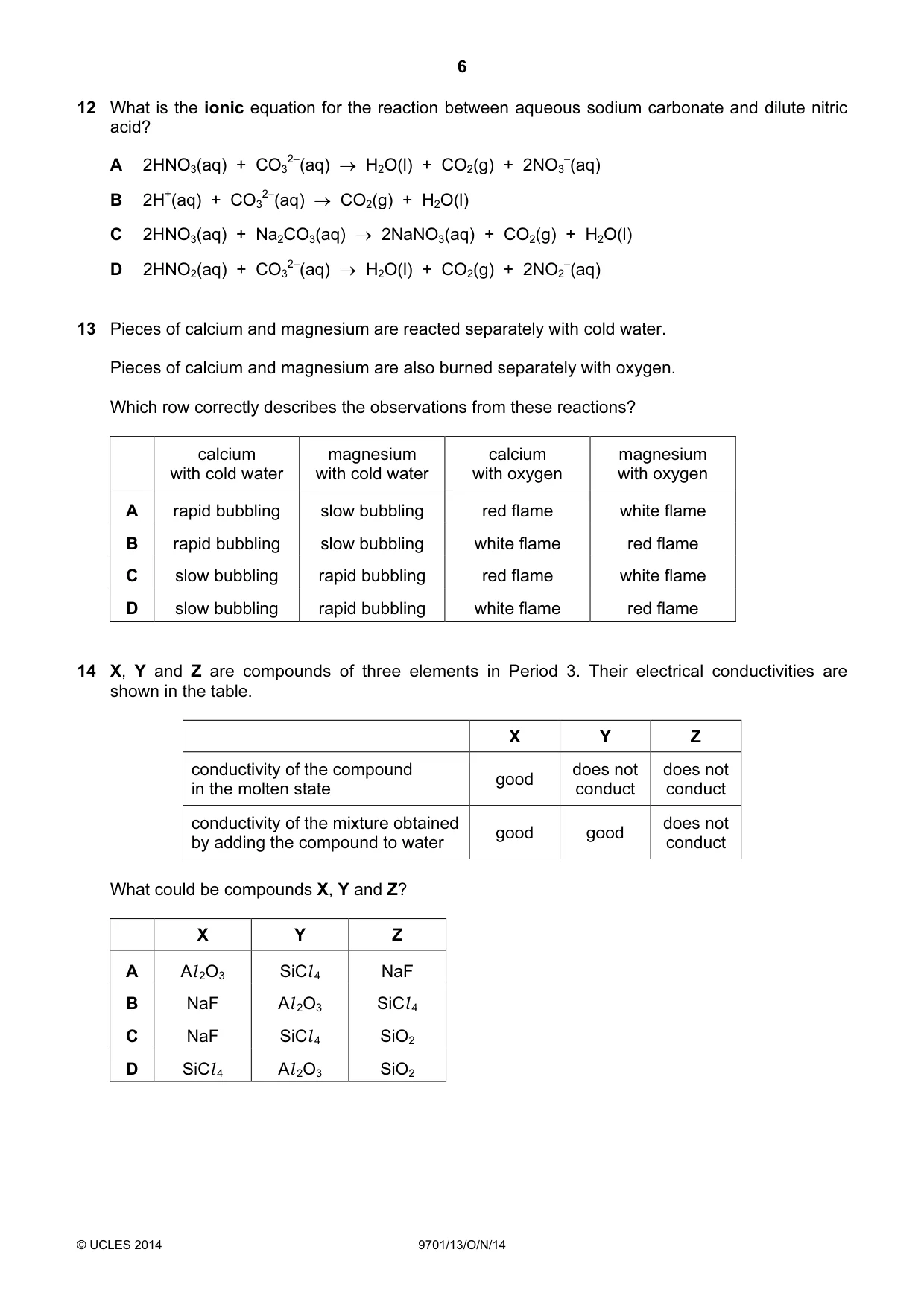
12 What is the ionic equation for the reaction between aqueous sodium carbonate and dilute nitric acid? A 2HNO3(aq) + CO3 2–(aq) → H2O(l) + CO2(g) + 2NO3 –(aq) B 2H+(aq) + CO3 2–(aq) → CO2(g) + H2O(l) C 2HNO3(aq) + Na2CO3(aq) → 2NaNO3(aq) + CO2(g) + H2O(l) D 2HNO2(aq) + CO3 2–(aq) → H2O(l) + CO2(g) + 2NO2 –(aq)
Mark scheme: B
More questions on Reacting masses and volumes (of solutions and gases)
Q13 · Pieces of calcium and magnesium are reacted separately with cold water
13 Pieces of calcium and magnesium are reacted separately with cold water. Pieces of calcium and magnesium are also burned separately with oxygen. Which row correctly describes the observations from these reactions? calcium magnesium calcium magnesium with cold water with cold water with oxygen with oxygen A rapid bubbling slow bubbling red flame white flame B rapid bubbling slow bubbling white flame red flame C slow bubbling rapid bubbling red flame white flame D slow bubbling rapid bubbling white flame red flame
Mark scheme: A
Q14 · X, Y and Z are compounds of three elements in Period 3
14 X, Y and Z are compounds of three elements in Period 3. Their electrical conductivities are shown in the table. X Y Z conductivity of the compound does not does not good in the molten state conduct conduct conductivity of the mixture obtained does not good good by adding the compound to water conduct What could be compounds X, Y and Z? X Y Z A Al 2O3 SiCl 4 NaF B NaF Al 2O3 SiCl 4 C NaF SiCl 4 SiO2 D SiCl 4 Al 2O3 SiO2
Mark scheme: C
More questions on Periodicity of physical properties of the elements in Period 3
Q15 · A powder is known to be either a single sodium halide or a mixture of two sodium halides
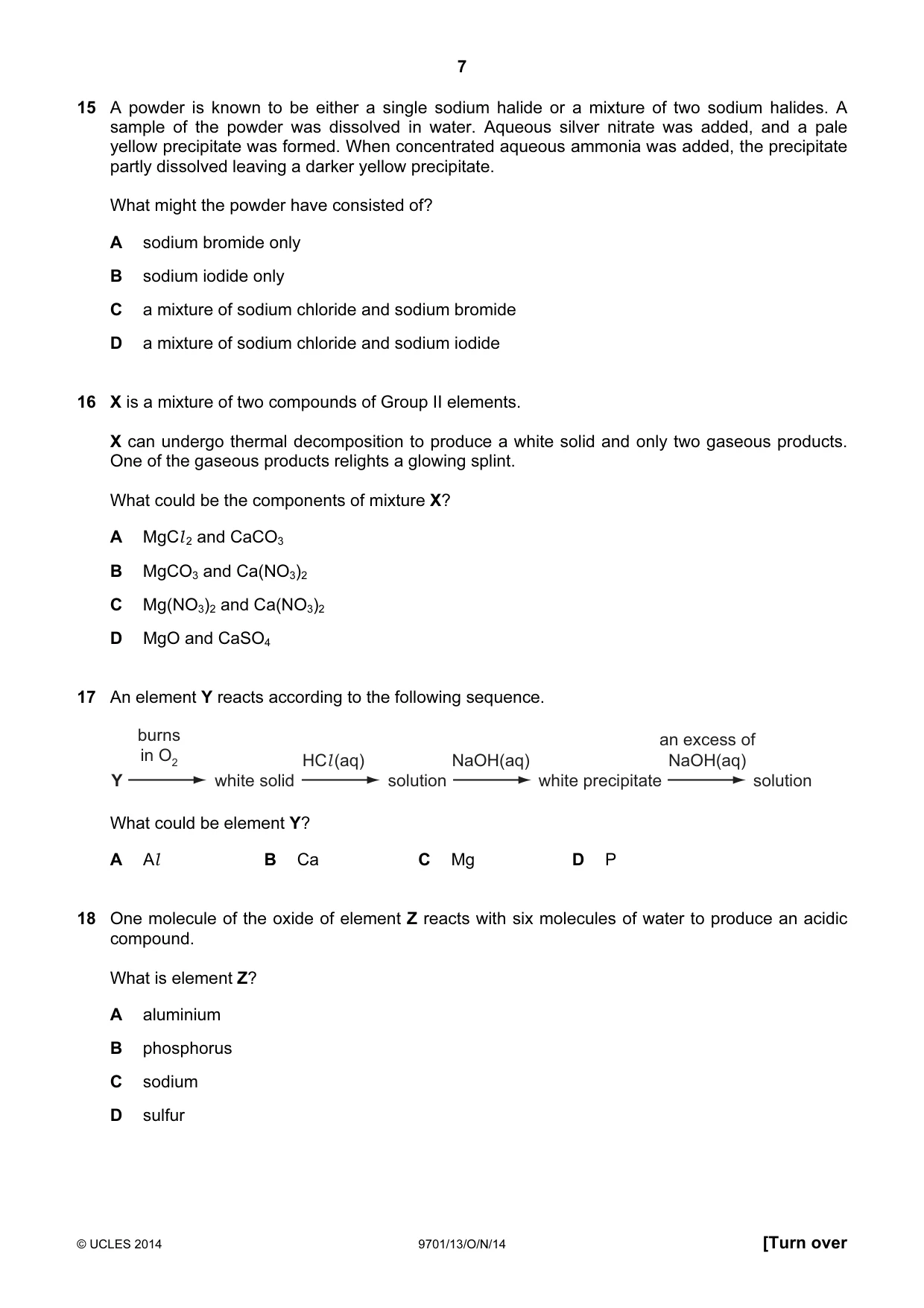
15 A powder is known to be either a single sodium halide or a mixture of two sodium halides. A sample of the powder was dissolved in water. Aqueous silver nitrate was added, and a pale yellow precipitate was formed. When concentrated aqueous ammonia was added, the precipitate partly dissolved leaving a darker yellow precipitate. What might the powder have consisted of? A sodium bromide only B sodium iodide only C a mixture of sodium chloride and sodium bromide D a mixture of sodium chloride and sodium iodide
Mark scheme: D
Q16 · X is a mixture of two compounds of Group II elements
16 X is a mixture of two compounds of Group II elements. X can undergo thermal decomposition to produce a white solid and only two gaseous products. One of the gaseous products relights a glowing splint. What could be the components of mixture X? A MgCl 2 and CaCO3 B MgCO3 and Ca(NO3)2 C Mg(NO3)2 and Ca(NO3)2 D MgO and CaSO4
Mark scheme: C
Q17 · An element Y reacts according to the following sequence
17 An element Y reacts according to the following sequence. burns an excess of in O2 HCl (aq) NaOH(aq) NaOH(aq) Y white solid solution white precipitate solution What could be element Y? A Al B Ca C Mg D P
Mark scheme: A
More questions on Periodicity of chemical properties of the elements in Period 3
Q18 · One molecule of the oxide of element Z reacts with six molecules of water to produce an…
18 One molecule of the oxide of element Z reacts with six molecules of water to produce an acidic compound. What is element Z? A aluminium B phosphorus C sodium D sulfur
Mark scheme: B
More questions on Periodicity of chemical properties of the elements in Period 3
Q19 · A student examines two semi-precious stones; one is agate, SiO2, and the other is…
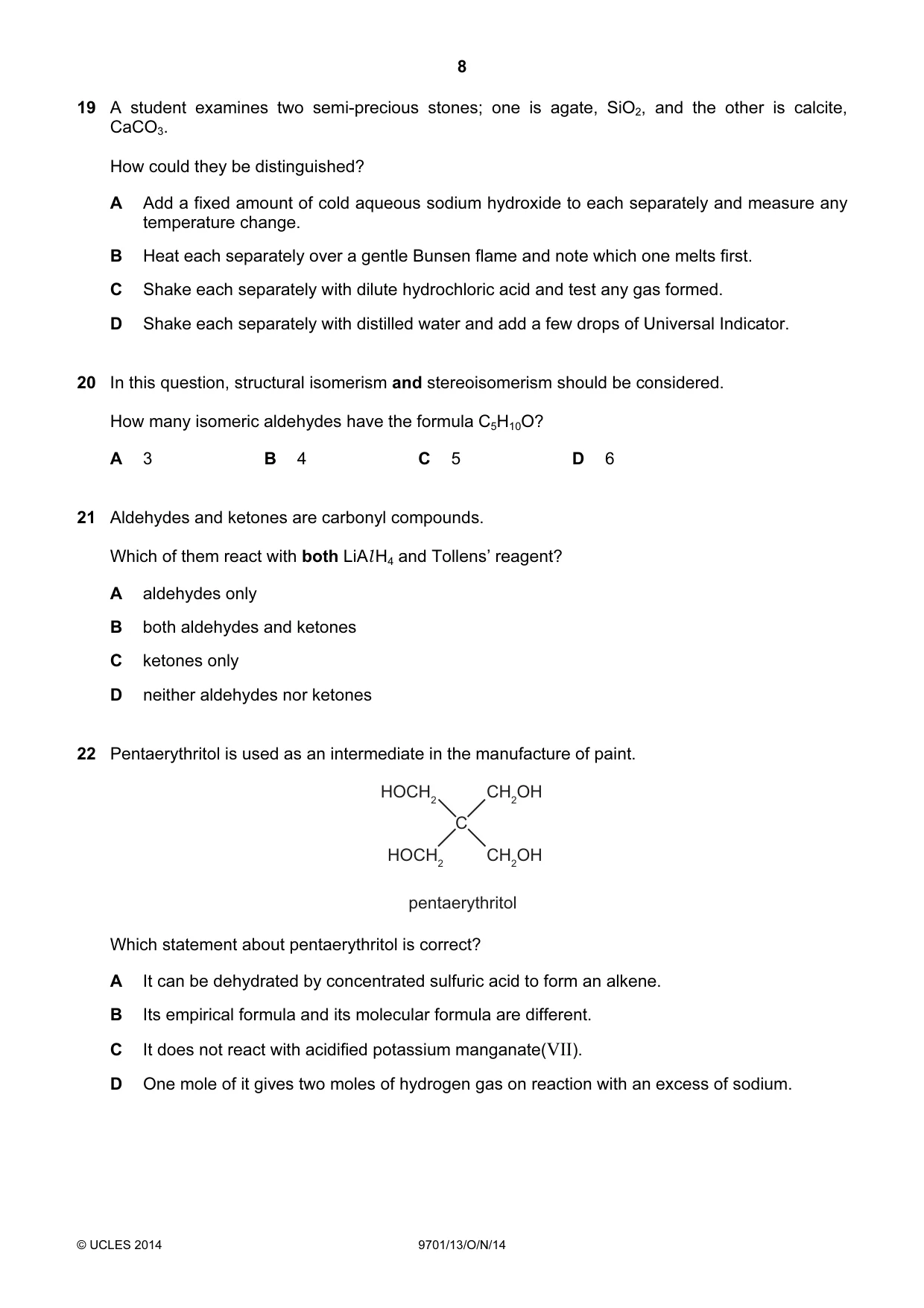
19 A student examines two semi-precious stones; one is agate, SiO2, and the other is calcite, CaCO3. How could they be distinguished? A Add a fixed amount of cold aqueous sodium hydroxide to each separately and measure any temperature change. B Heat each separately over a gentle Bunsen flame and note which one melts first. C Shake each separately with dilute hydrochloric acid and test any gas formed. D Shake each separately with distilled water and add a few drops of Universal Indicator.
Mark scheme: C
Q20 · In this question, structural isomerism and stereoisomerism should be considered
20 In this question, structural isomerism and stereoisomerism should be considered. How many isomeric aldehydes have the formula C5H10O? A 3 B 4 C 5 D 6
Mark scheme: C
More questions on Isomerism: structural isomerism and stereoisomerism
Q21 · Aldehydes and ketones are carbonyl compounds
21 Aldehydes and ketones are carbonyl compounds. Which of them react with both LiAl H4 and Tollens’ reagent? A aldehydes only B both aldehydes and ketones C ketones only D neither aldehydes nor ketones
Mark scheme: A
Q22 · Pentaerythritol is used as an intermediate in the manufacture of paint
22 Pentaerythritol is used as an intermediate in the manufacture of paint. HOCH2 CH2OH C HOCH2 CH2OH pentaerythritol Which statement about pentaerythritol is correct? A It can be dehydrated by concentrated sulfuric acid to form an alkene. B Its empirical formula and its molecular formula are different. C It does not react with acidified potassium manganate(VII). D One mole of it gives two moles of hydrogen gas on reaction with an excess of sodium.
Mark scheme: D
Q23 · A compound Y, C4H9Br, undergoes hydrolysis in aqueous alkali to form an alcohol, C4H9OH
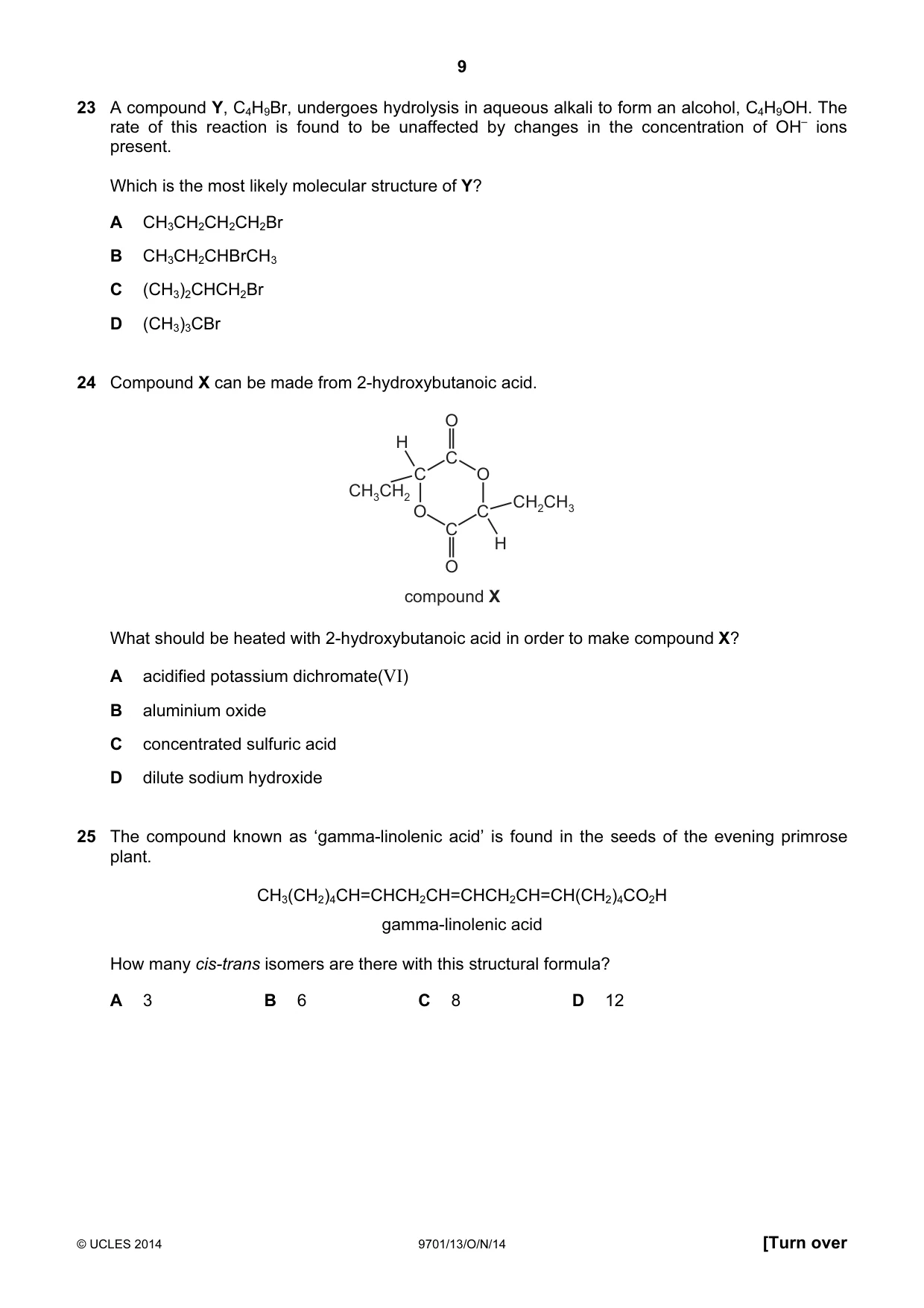
23 A compound Y, C4H9Br, undergoes hydrolysis in aqueous alkali to form an alcohol, C4H9OH. The rate of this reaction is found to be unaffected by changes in the concentration of OH– ions present. Which is the most likely molecular structure of Y? A CH3CH2CH2CH2Br B CH3CH2CHBrCH3 C (CH3)2CHCH2Br D (CH3)3CBr
Mark scheme: D
Q24 · Compound X can be made from 2-hydroxybutanoic acid
24 Compound X can be made from 2-hydroxybutanoic acid. O H C C O CH3CH2 CH2CH3 O C C H O compound X What should be heated with 2-hydroxybutanoic acid in order to make compound X? A acidified potassium dichromate(VI) B aluminium oxide C concentrated sulfuric acid D dilute sodium hydroxide
Mark scheme: C
Q25 · The compound known as ‘gamma-linolenic acid’ is found in the seeds of the evening…
25 The compound known as ‘gamma-linolenic acid’ is found in the seeds of the evening primrose plant. CH3(CH2)4CH=CHCH2CH=CHCH2CH=CH(CH2)4CO2H gamma-linolenic acid How many cis-trans isomers are there with this structural formula? A 3 B 6 C 8 D 12
Mark scheme: C
More questions on Isomerism: structural isomerism and stereoisomerism
Q26 · Pheromones are used by insects and other animals as a means of communication
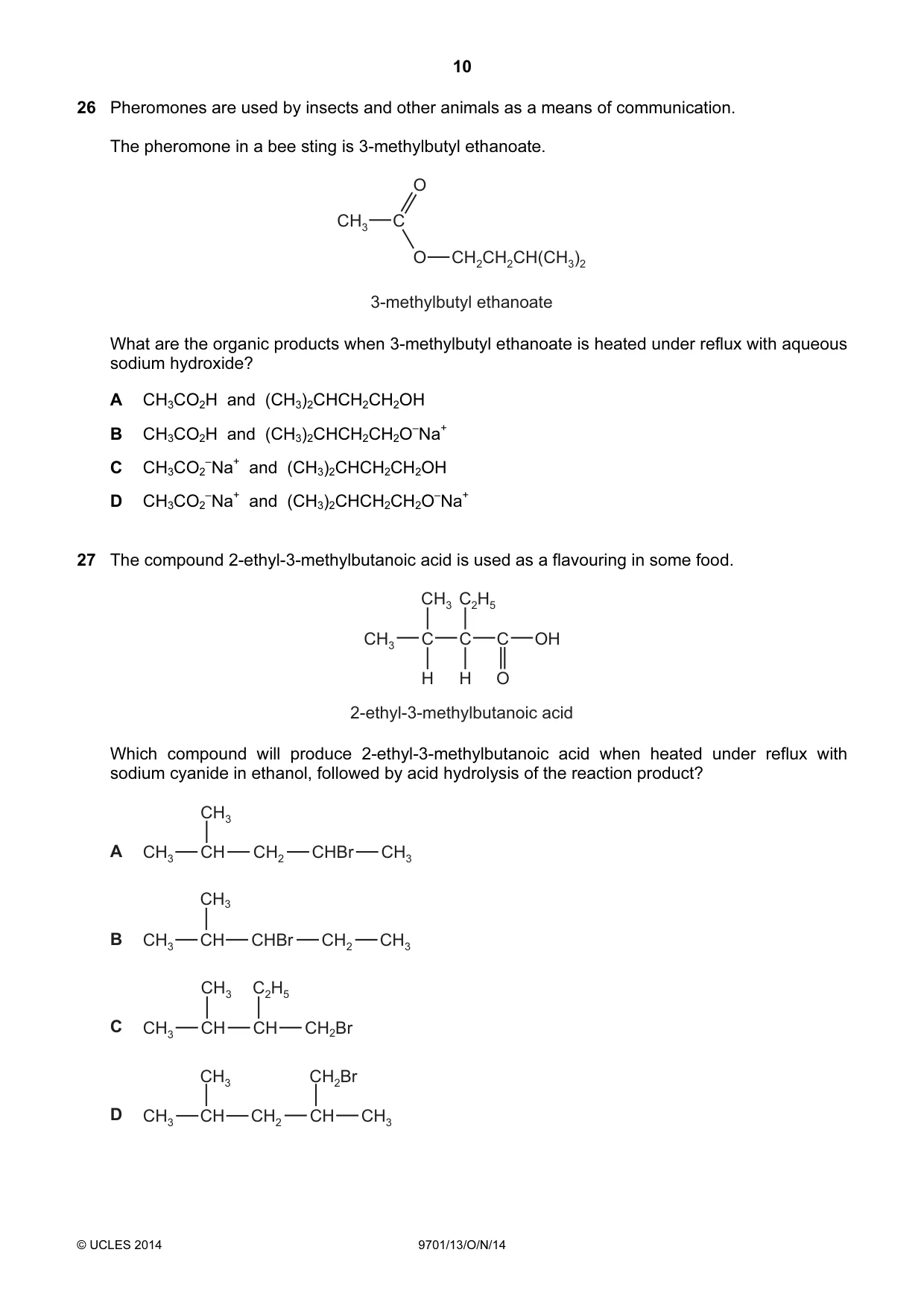
26 Pheromones are used by insects and other animals as a means of communication. The pheromone in a bee sting is 3-methylbutyl ethanoate. O CH3 C O CH2CH2CH(CH3)2 3-methylbutyl ethanoate What are the organic products when 3-methylbutyl ethanoate is heated under reflux with aqueous sodium hydroxide? A CH3CO2H and (CH3)2CHCH2CH2OH B CH3CO2H and (CH3)2CHCH2CH2O–Na+ C CH3CO2 –Na+ and (CH3)2CHCH2CH2OH D CH3CO2 –Na+ and (CH3)2CHCH2CH2O–Na+
Mark scheme: C
Q27 · The compound 2-ethyl-3-methylbutanoic acid is used as a flavouring in some food
27 The compound 2-ethyl-3-methylbutanoic acid is used as a flavouring in some food. CH3 C2H5 CH3 C C C OH H H O 2-ethyl-3-methylbutanoic acid Which compound will produce 2-ethyl-3-methylbutanoic acid when heated under reflux with sodium cyanide in ethanol, followed by acid hydrolysis of the reaction product? CH3 A CH3 CH CH2 CHBr CH3 CH3 B CH3 CH CHBr CH2 CH3 CH3 C2H5 C CH3 CH CH CH2Br CH3 CH2Br D CH3 CH CH2 CH CH3
Mark scheme: B
Q28 · Poly(ethenol) can be used to make plastic bags that dissolve in water
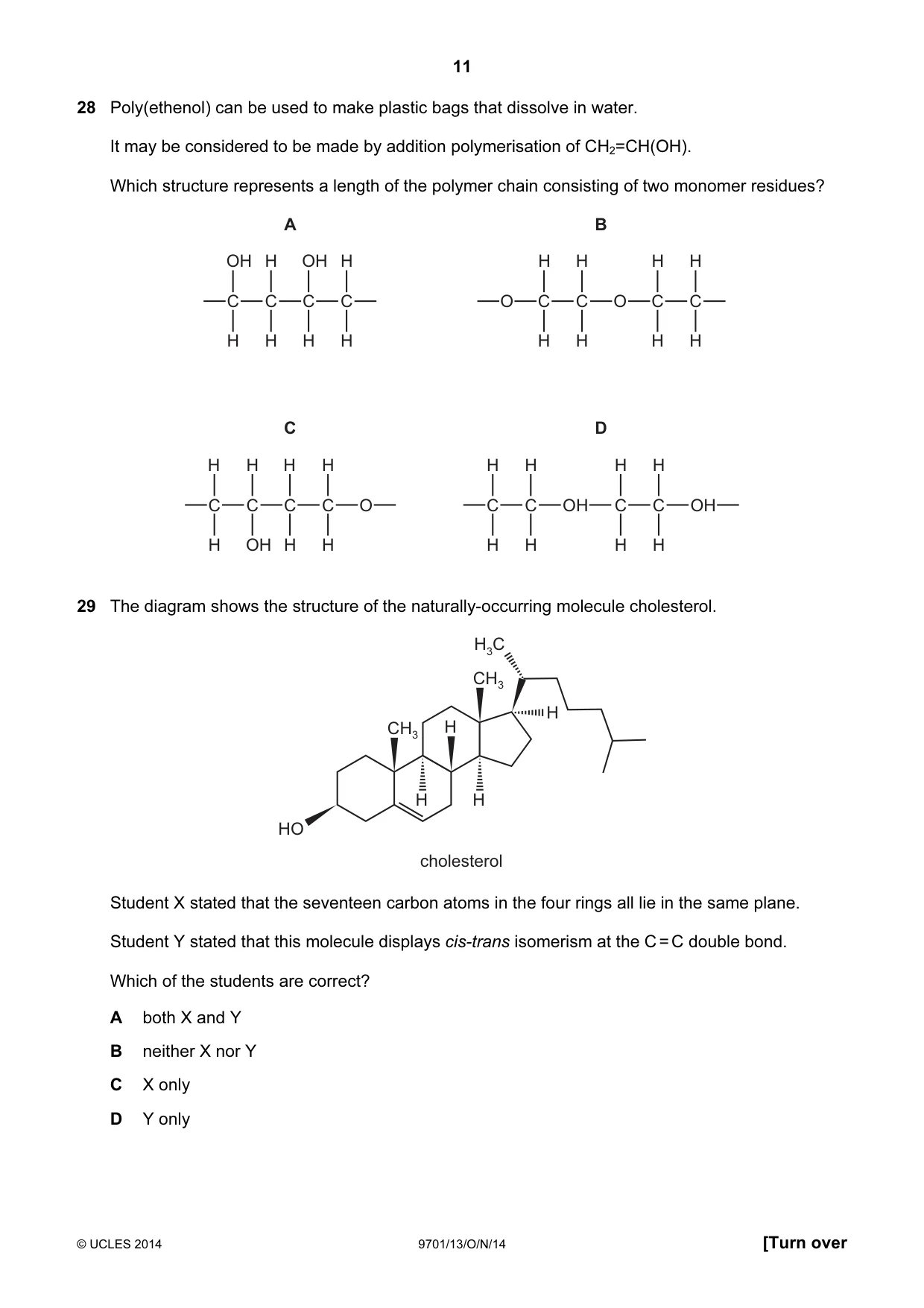
28 Poly(ethenol) can be used to make plastic bags that dissolve in water. It may be considered to be made by addition polymerisation of CH2=CH(OH). Which structure represents a length of the polymer chain consisting of two monomer residues? A B OH H OH H H H H H C C C C O C C O C C H H H H H H H H C D H H H H H H H H C C C C O C C OH C C OH H OH H H H H H H
Mark scheme: A
Q29 · The diagram shows the structure of the naturally-occurring molecule cholesterol
29 The diagram shows the structure of the naturally-occurring molecule cholesterol. H3C CH3 H CH3 H H H HO cholesterol Student X stated that the seventeen carbon atoms in the four rings all lie in the same plane. Student Y stated that this molecule displays cis-trans isomerism at the C = C double bond. Which of the students are correct? A both X and Y B neither X nor Y C X only D Y only
Mark scheme: B
More questions on Isomerism: structural isomerism and stereoisomerism
Q30 · Methyl butanoate, C5H10O2, is an ester used in the food industry to give products the…
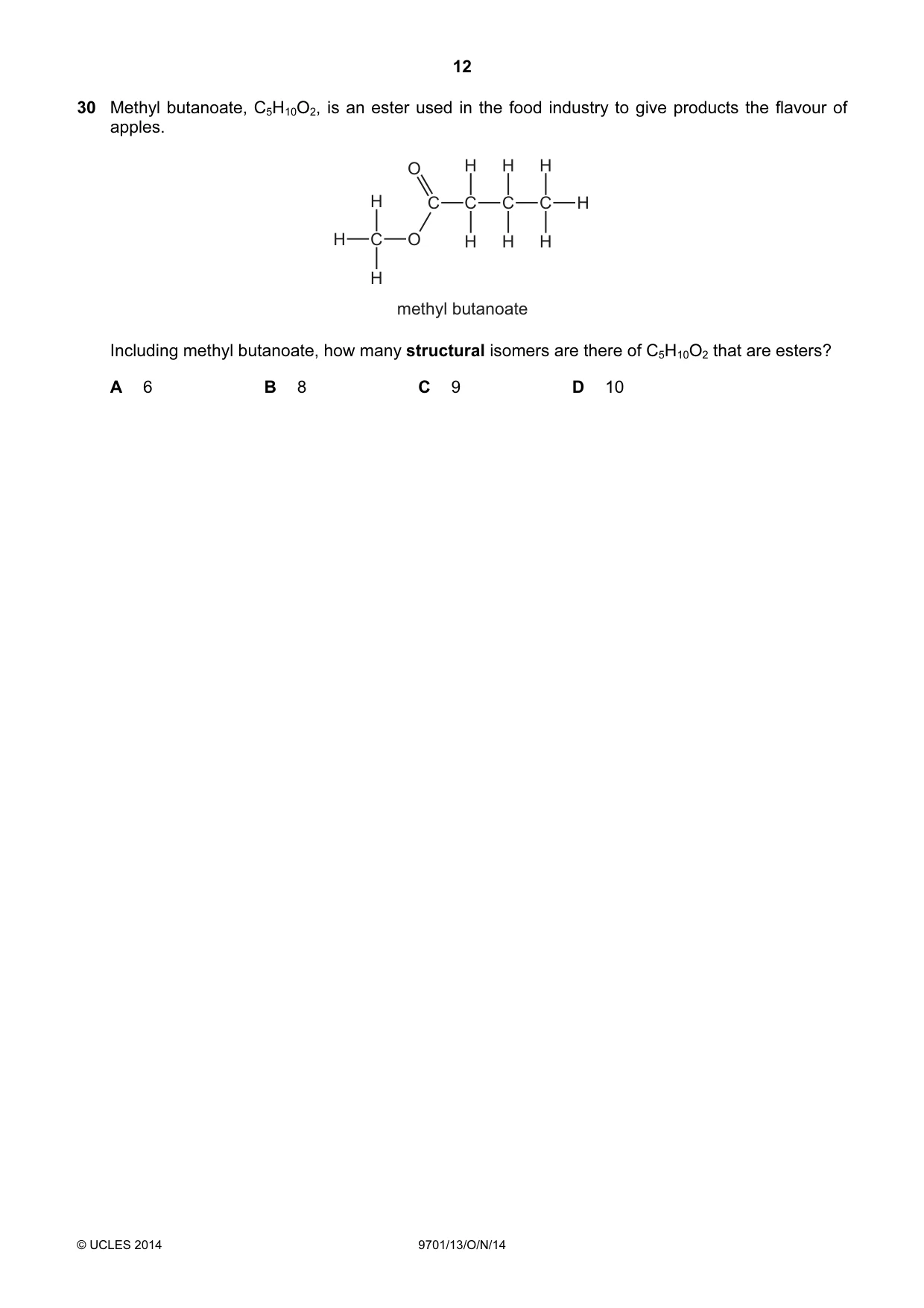
30 Methyl butanoate, C5H10O2, is an ester used in the food industry to give products the flavour of apples. O H H H H C C C C H H C O H H H H methyl butanoate Including methyl butanoate, how many structural isomers are there of C5H10O2 that are esters? A 6 B 8 C 9 D 10
Mark scheme: C
More questions on Isomerism: structural isomerism and stereoisomerism
Q31 · In a solution that contains both Br2 and Cl 2, a process takes place that produces BrO3…
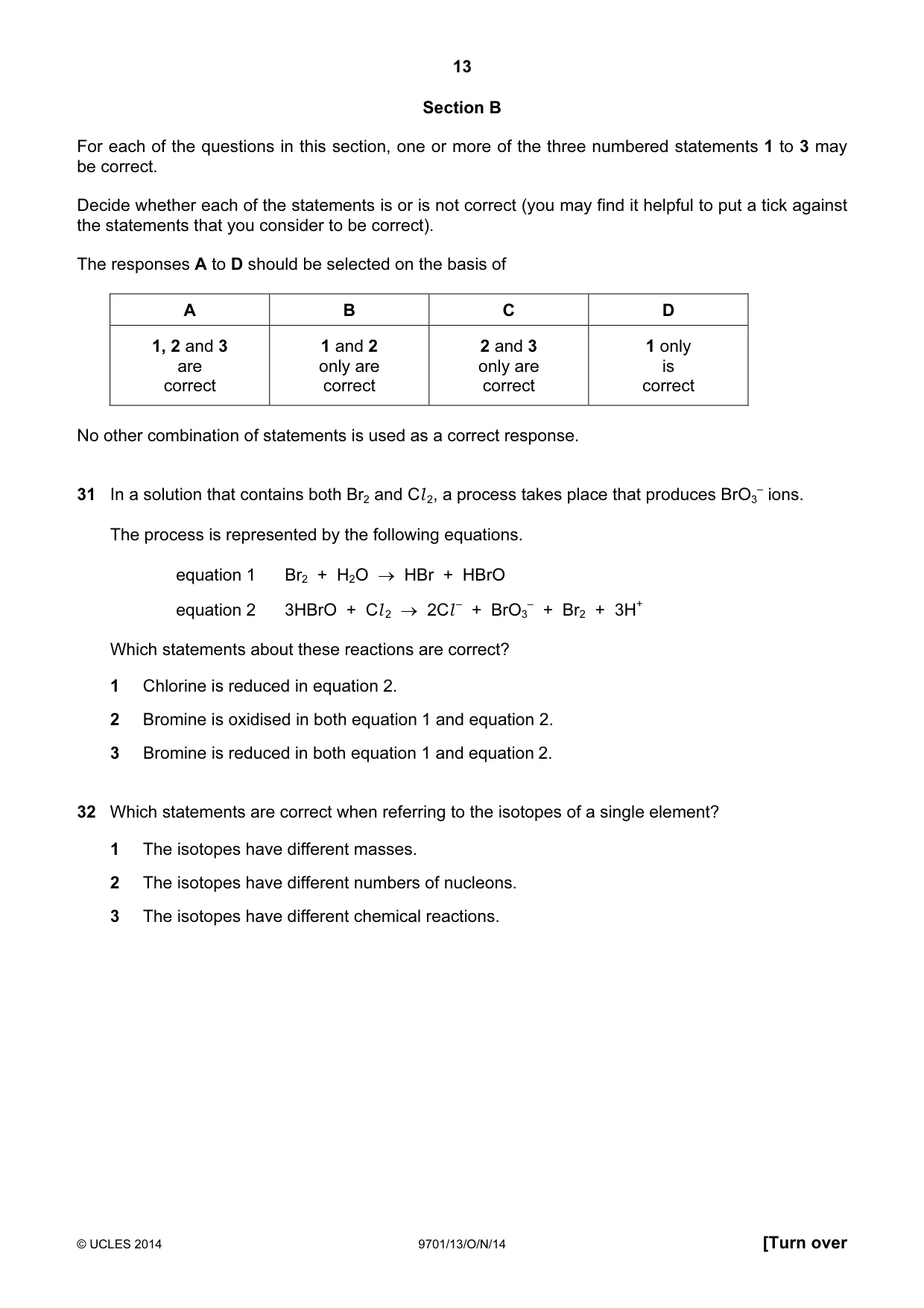
31 In a solution that contains both Br2 and Cl 2, a process takes place that produces BrO3 – ions. The process is represented by the following equations. equation 1 Br2 + H2O → HBr + HBrO equation 2 3HBrO + Cl 2 → 2Cl – + BrO3 – + Br2 + 3H+ Which statements about these reactions are correct? 1 Chlorine is reduced in equation 2. 2 Bromine is oxidised in both equation 1 and equation 2. 3 Bromine is reduced in both equation 1 and equation 2.
Mark scheme: A
Q32 · Which statements are correct when referring to the isotopes of a single element?
32 Which statements are correct when referring to the isotopes of a single element? 1 The isotopes have different masses. 2 The isotopes have different numbers of nucleons. 3 The isotopes have different chemical reactions.
Mark scheme: B
Q33 · Which types of intermolecular forces can exist between adjacent urea molecules?
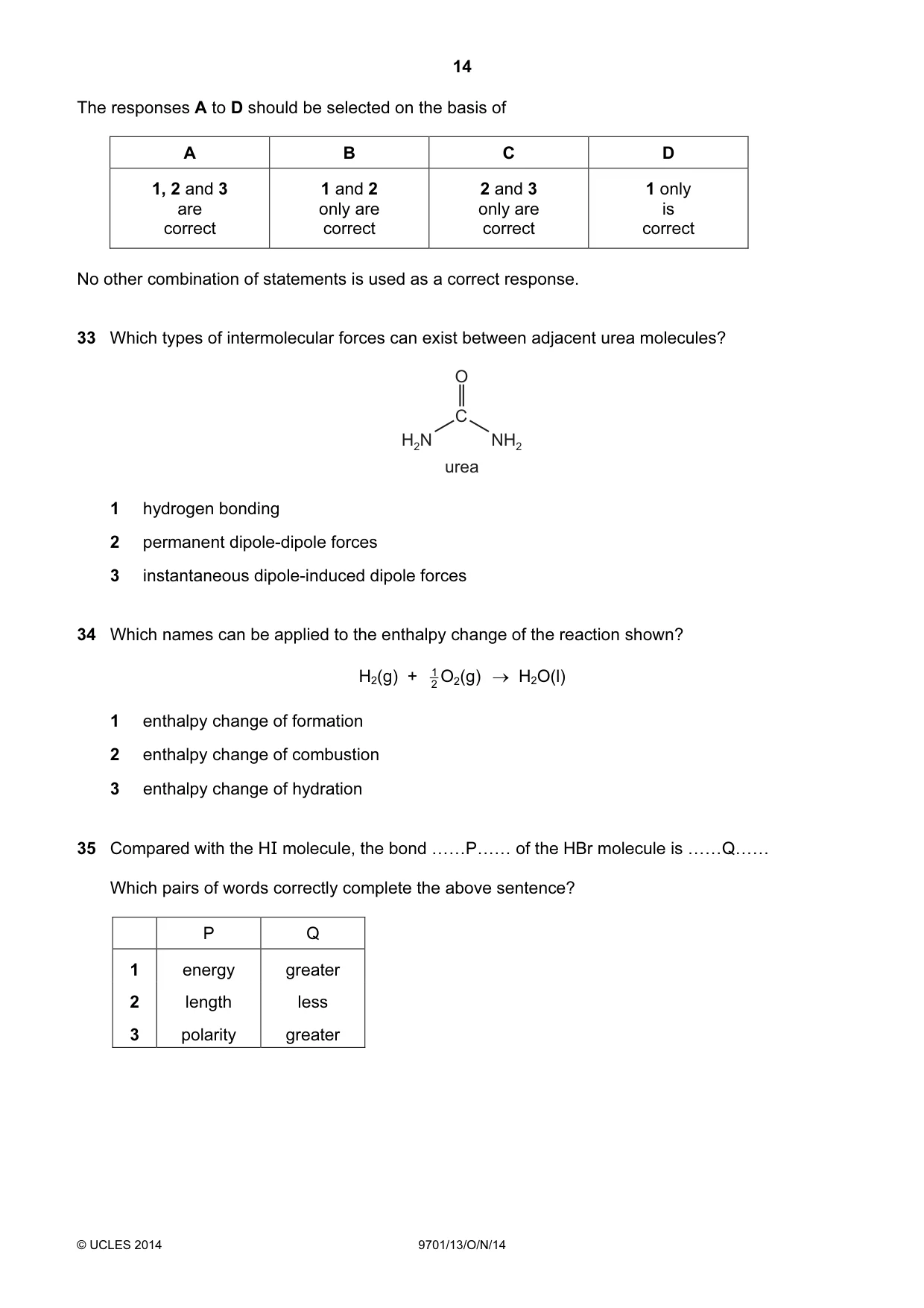
33 Which types of intermolecular forces can exist between adjacent urea molecules? O C H2N NH2 urea 1 hydrogen bonding 2 permanent dipole-dipole forces 3 instantaneous dipole-induced dipole forces
Mark scheme: A
More questions on Intermolecular forces, electronegativity and bond properties
Q34 · Which names can be applied to the enthalpy change of the reaction shown?
34 Which names can be applied to the enthalpy change of the reaction shown? H2(g) + 1 O2 (g) → H2O(l) 2 1 enthalpy change of formation 2 enthalpy change of combustion 3 enthalpy change of hydration
Mark scheme: B
Q35 · Compared with the HI molecule, the bond ……P…… of the HBr molecule is ……Q…… Which pairs of…
35 Compared with the HI molecule, the bond ……P…… of the HBr molecule is ……Q…… Which pairs of words correctly complete the above sentence? P Q 1 energy greater 2 length less 3 polarity greater
Mark scheme: A
More questions on Intermolecular forces, electronegativity and bond properties
Q36 · Element X is a solid
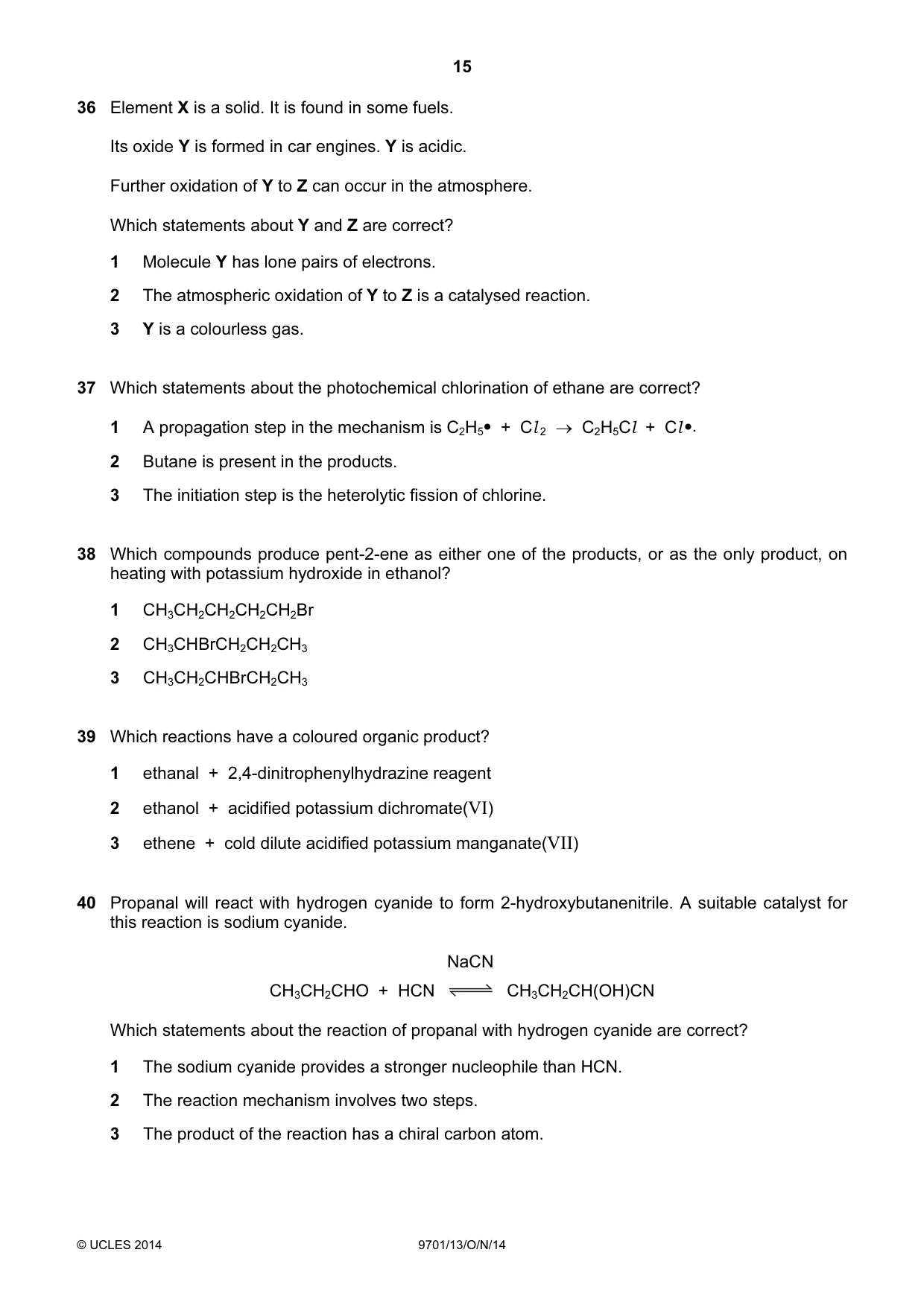
36 Element X is a solid. It is found in some fuels. Its oxide Y is formed in car engines. Y is acidic. Further oxidation of Y to Z can occur in the atmosphere. Which statements about Y and Z are correct? 1 Molecule Y has lone pairs of electrons. 2 The atmospheric oxidation of Y to Z is a catalysed reaction. 3 Y is a colourless gas.
Mark scheme: A
Q37 · Which statements about the photochemical chlorination of ethane are correct?
37 Which statements about the photochemical chlorination of ethane are correct? 1 A propagation step in the mechanism is C2H5• + Cl 2 → C2H5Cl + Cl •. 2 Butane is present in the products. 3 The initiation step is the heterolytic fission of chlorine.
Mark scheme: B
Q38 · Which compounds produce pent-2-ene as either one of the products, or as the only product…
38 Which compounds produce pent-2-ene as either one of the products, or as the only product, on heating with potassium hydroxide in ethanol? 1 CH3CH2CH2CH2CH2Br 2 CH3CHBrCH2CH2CH3 3 CH3CH2CHBrCH2CH3
Mark scheme: C
Q39 · Which reactions have a coloured organic product?
39 Which reactions have a coloured organic product? 1 ethanal + 2,4-dinitrophenylhydrazine reagent 2 ethanol + acidified potassium dichromate(VI) 3 ethene + cold dilute acidified potassium manganate(VII)
Mark scheme: D
Q40 · Propanal will react with hydrogen cyanide to form 2-hydroxybutanenitrile
40 Propanal will react with hydrogen cyanide to form 2-hydroxybutanenitrile. A suitable catalyst for this reaction is sodium cyanide. NaCN CH3CH2CHO + HCN CH3CH2CH(OH)CN Which statements about the reaction of propanal with hydrogen cyanide are correct? 1 The sodium cyanide provides a stronger nucleophile than HCN. 2 The reaction mechanism involves two steps. 3 The product of the reaction has a chiral carbon atom.
Mark scheme: A
What was in this paper
The subtopics covered by these 40 questions, and how many questions each got. Open one in a new tab to see every Cambridge question on it.
4Isomerism: structural isomerism and stereoisomerism4Similarities and trends in the properties of the Group 2 metals, magnesium to barium, and their compounds3Aldehydes and ketones2Esters2Halogenoalkanes2Intermolecular forces, electronegativity and bond properties2Nitriles and hydroxynitriles2Periodicity of chemical properties of the elements in Period 32Reacting masses and volumes (of solutions and gases)2Addition polymerisation1Alcohols1Alkanes1Bonding and structure1Effect of temperature on reaction rates and the concept of activation energy1Electrolysis1Isotopes1Metallic bonding1Nitrogen and sulfur1Particles in the atom and atomic radius1Periodicity of physical properties of the elements in Period 31Redox processes: electron transfer and changes in oxidation number (oxidation state)1Some reactions of the halide ions1The gaseous state: ideal and real gases and pV = nRT1The mole and the Avogadro constant1What you needed in this session
Cambridge’s own grade thresholds for 2014 Oct/Nov, Paper 1 · Variant 3. A higher threshold means an easier paper — the bar moves with how the cohort did.