Cambridge A Level Chemistry 9701 — 2022 Oct/Nov Paper 1 · Variant 3
9701/13/O/N/22 · 40 questions · 40 marks · ≈45 min
The question paper and its mark scheme, free to read here and free to download. This is Cambridge’s own paper, exactly as it was sat.
Question paper16 pages

Mark scheme3 pages
Answers below. Sit the paper first if you are practising.
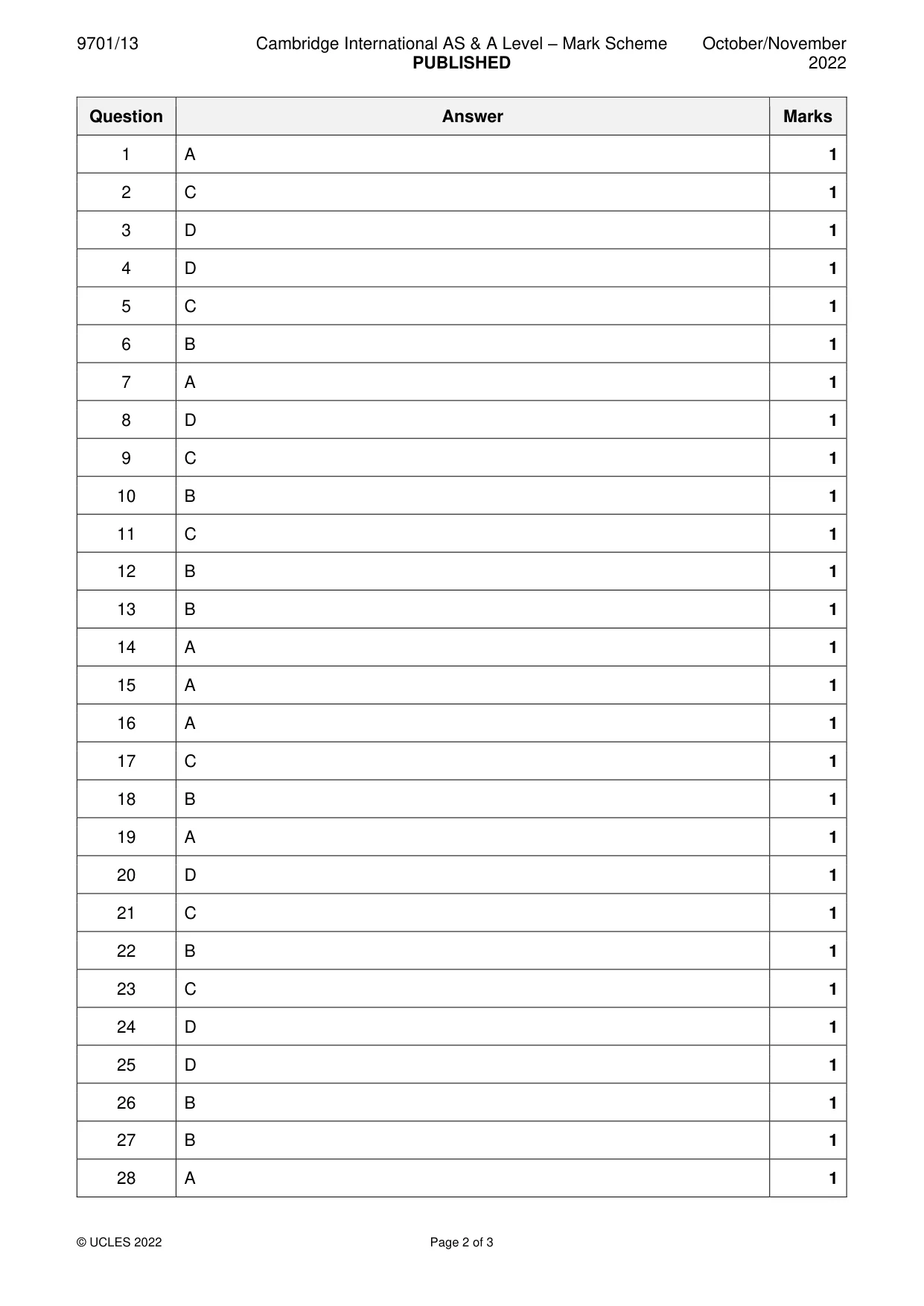
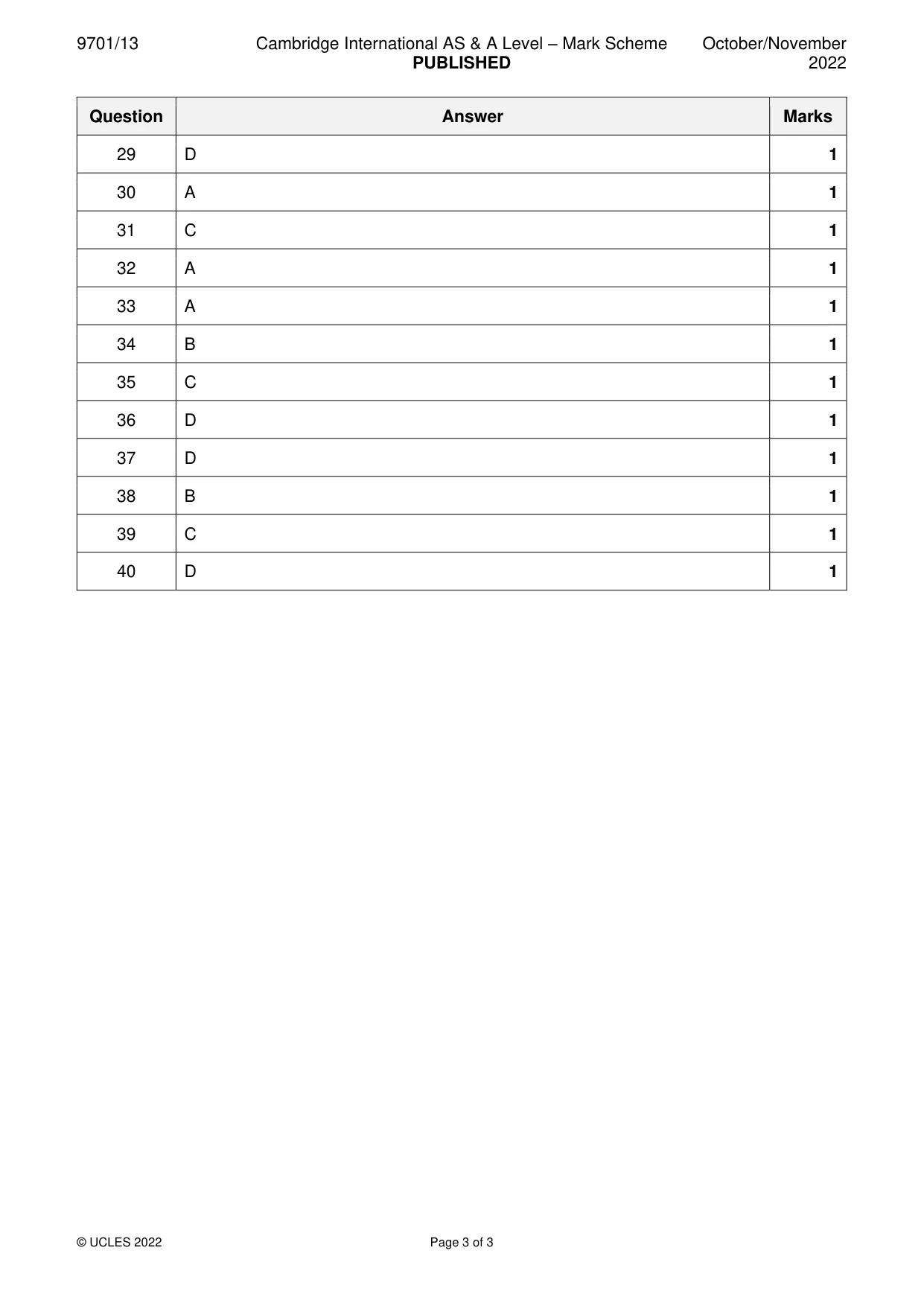
Questions as text
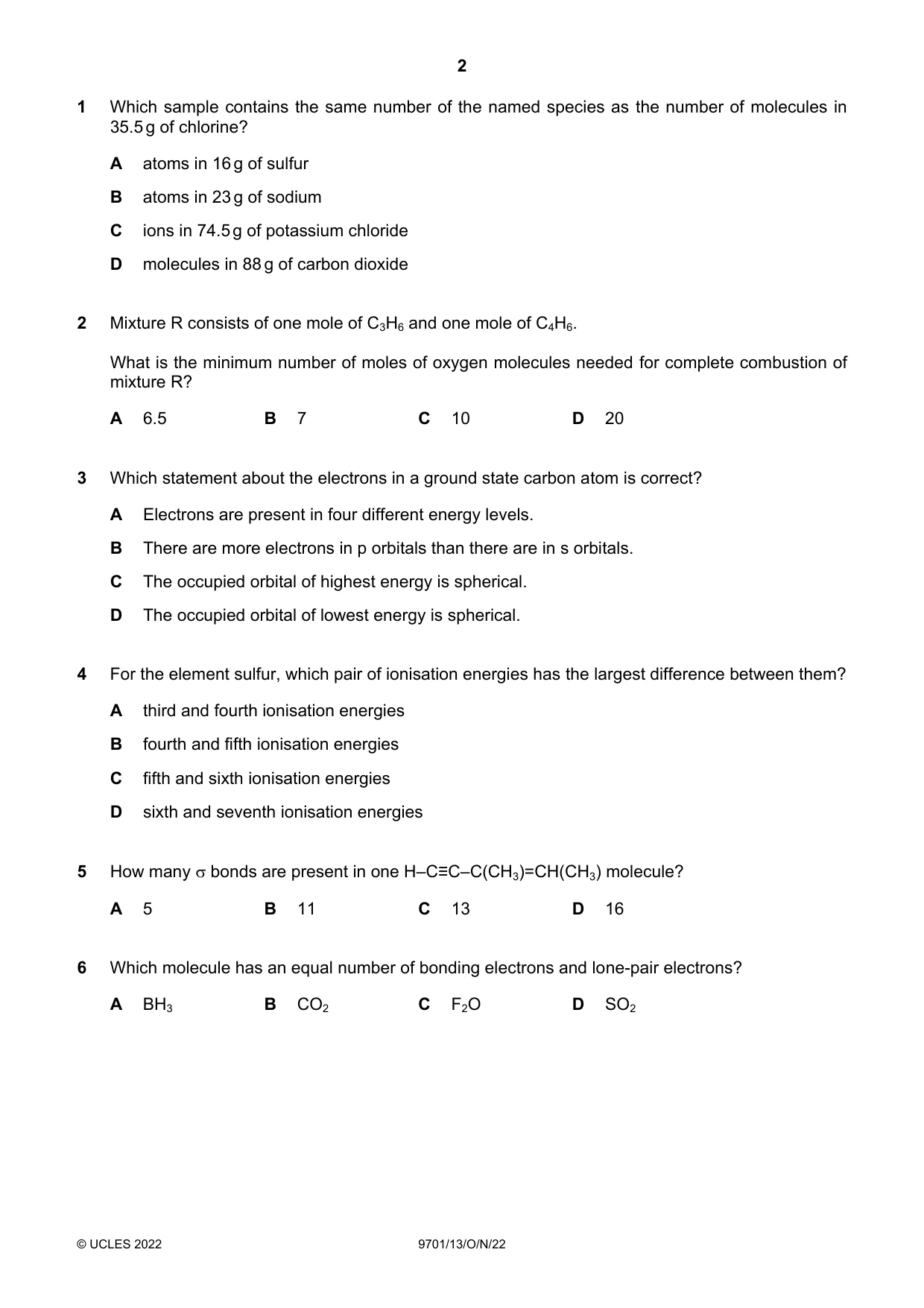
Q1 · Which sample contains the same number of the named species as the number of molecules in…
1 Which sample contains the same number of the named species as the number of molecules in 35.5 g of chlorine? A atoms in 16 g of sulfur B atoms in 23 g of sodium C ions in 74.5 g of potassium chloride D molecules in 88 g of carbon dioxide
Mark scheme: A
Q2 · Mixture R consists of one mole of C3H6 and one mole of C4H6
2 Mixture R consists of one mole of C3H6 and one mole of C4H6. What is the minimum number of moles of oxygen molecules needed for complete combustion of mixture R? A 6.5 B 7 C 10 D 20
Mark scheme: C
More questions on Reacting masses and volumes (of solutions and gases)
Q3 · Which statement about the electrons in a ground state carbon atom is correct?
3 Which statement about the electrons in a ground state carbon atom is correct? A Electrons are present in four different energy levels. B There are more electrons in p orbitals than there are in s orbitals. C The occupied orbital of highest energy is spherical. D The occupied orbital of lowest energy is spherical.
Mark scheme: D
More questions on Electrons, energy levels and atomic orbitals
Q4 · For the element sulfur, which pair of ionisation energies has the largest difference…
4 For the element sulfur, which pair of ionisation energies has the largest difference between them? A third and fourth ionisation energies B fourth and fifth ionisation energies C fifth and sixth ionisation energies D sixth and seventh ionisation energies
Mark scheme: D
Q5 · How many bonds are present in one H–C≡C–C(CH3)=CH(CH3) molecule?
5 How many bonds are present in one H–C≡C–C(CH3)=CH(CH3) molecule? A 5 B 11 C 13 D 16
Mark scheme: C
More questions on Shapes of organic molecules; σ and π bonds
Q6 · Which molecule has an equal number of bonding electrons and lone-pair electrons?
6 Which molecule has an equal number of bonding electrons and lone-pair electrons? A BH3 B CO2 C F2O D SO2
Mark scheme: B
Q7 · The table shows properties of four solids held together by different types of bonding
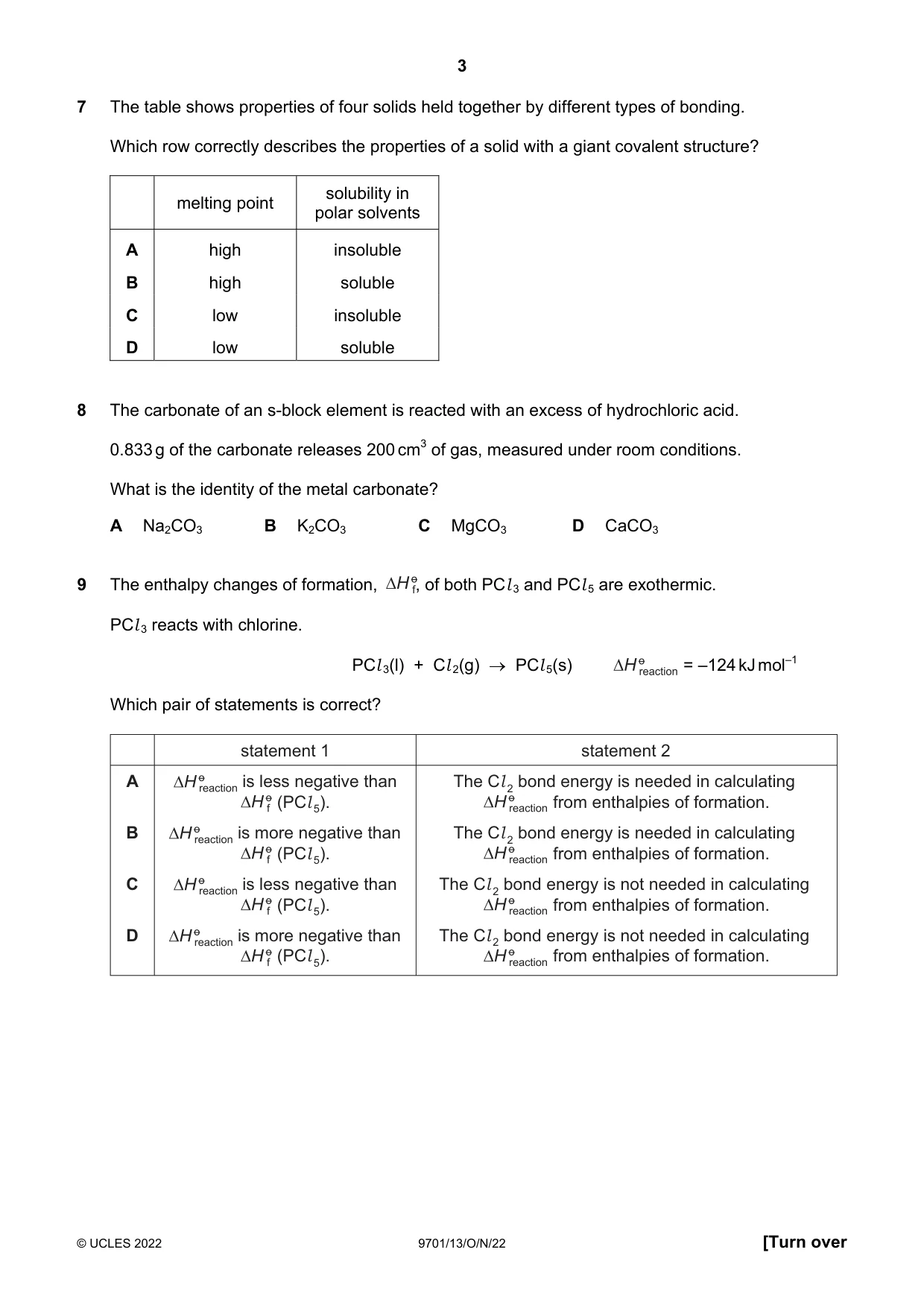
7 The table shows properties of four solids held together by different types of bonding. Which row correctly describes the properties of a solid with a giant covalent structure? solubility in melting point polar solvents A high insoluble B high soluble C low insoluble D low soluble
Mark scheme: A
Q8 · The carbonate of an s-block element is reacted with an excess of hydrochloric acid
8 The carbonate of an s-block element is reacted with an excess of hydrochloric acid. 0.833 g of the carbonate releases 200 cm3 of gas, measured under room conditions. What is the identity of the metal carbonate? A Na2CO3 B K2CO3 C MgCO3 D CaCO3
Mark scheme: D
Q9 · The enthalpy changes of formation, , of both PCl 3 and PCl 5 are exothermic
9 The enthalpy changes of formation, , of both PCl 3 and PCl 5 are exothermic. PCl 3 reacts with chlorine. PCl 3(l) + Cl 2(g) PCl 5(s) = –124 kJ mol–1 Which pair of statements is correct? statement 1 statement 2 A is less negative than The Cl 2 bond energy is needed in calculating (PCl 5). from enthalpies of formation. B is more negative than The Cl 2 bond energy is needed in calculating (PCl 5). from enthalpies of formation. C is less negative than The Cl 2 bond energy is not needed in calculating (PCl 5). from enthalpies of formation. D is more negative than The Cl 2 bond energy is not needed in calculating (PCl 5). from enthalpies of formation.
Mark scheme: C
Q10 · A student mixes 25.0 cm3 of 0.350 mol dm–3 sodium hydroxide solution with 25.0 cm3 of…
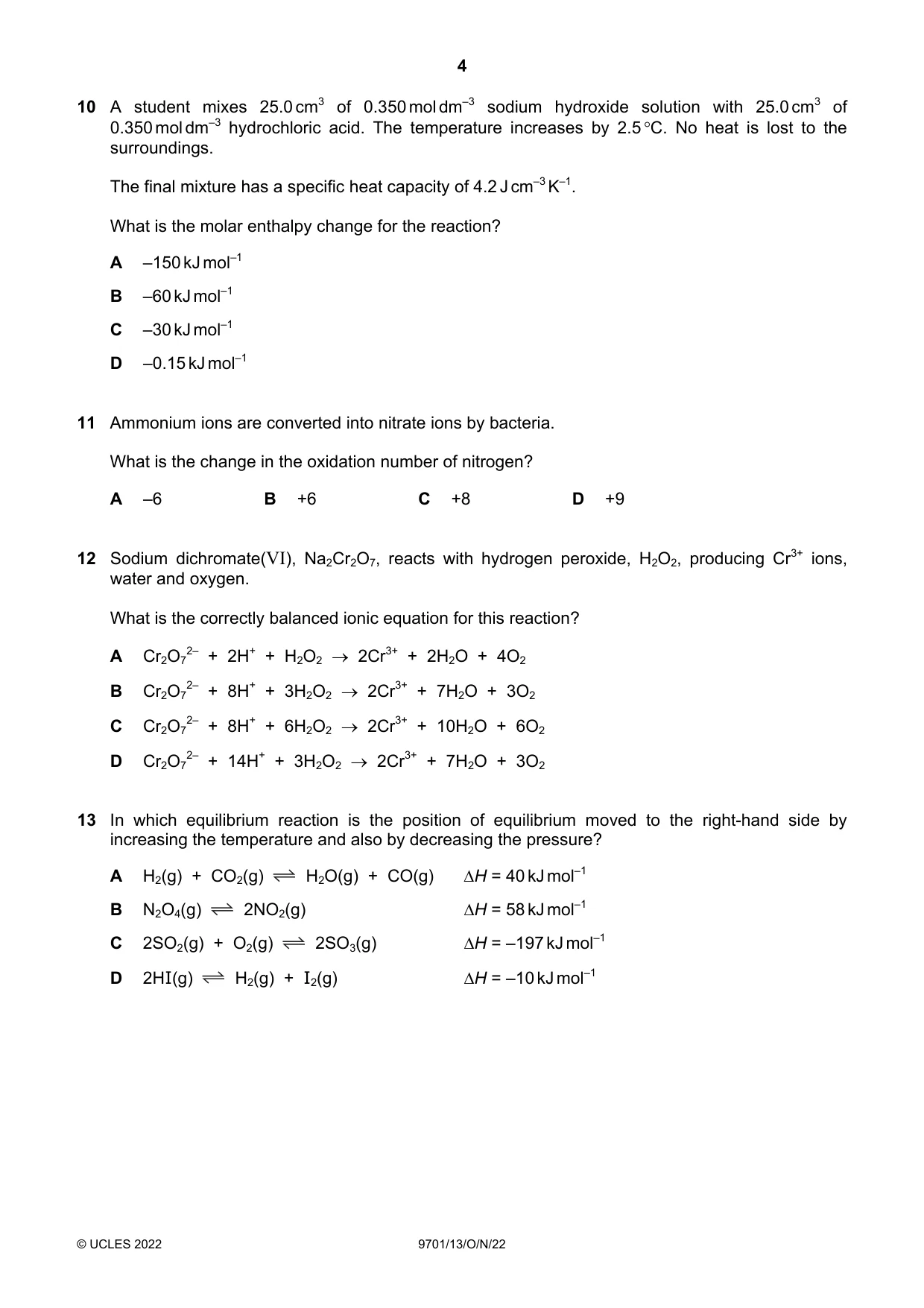
10 A student mixes 25.0 cm3 of 0.350 mol dm–3 sodium hydroxide solution with 25.0 cm3 of 0.350 mol dm–3 hydrochloric acid. The temperature increases by 2.5 C. No heat is lost to the surroundings. The final mixture has a specific heat capacity of 4.2 J cm–3 K–1. What is the molar enthalpy change for the reaction? A –150 kJ mol–1 B –60 kJ mol–1 C –30 kJ mol–1 D –0.15 kJ mol–1
Mark scheme: B
Q11 · Ammonium ions are converted into nitrate ions by bacteria
11 Ammonium ions are converted into nitrate ions by bacteria. What is the change in the oxidation number of nitrogen? A –6 B +6 C +8 D +9
Mark scheme: C
Q12 · Sodium dichromate(VI), Na2Cr2O7, reacts with hydrogen peroxide, H2O2, producing Cr3+…
12 Sodium dichromate(VI), Na2Cr2O7, reacts with hydrogen peroxide, H2O2, producing Cr3+ ions, water and oxygen. What is the correctly balanced ionic equation for this reaction? A Cr2O7 2– + 2H+ + H2O2 2Cr3+ + 2H2O + 4O2 B Cr2O7 2– + 8H+ + 3H2O2 2Cr3+ + 7H2O + 3O2 C Cr2O7 2– + 8H+ + 6H2O2 2Cr3+ + 10H2O + 6O2 D Cr2O7 2– + 14H+ + 3H2O2 2Cr3+ + 7H2O + 3O2
Mark scheme: B
Q13 · In which equilibrium reaction is the position of equilibrium moved to the right-hand side…
13 In which equilibrium reaction is the position of equilibrium moved to the right-hand side by increasing the temperature and also by decreasing the pressure? A H2(g) + CO2(g) H2O(g) + CO(g) ∆H = 40 kJ mol–1 B N2O4(g) 2NO2(g) ∆H = 58 kJ mol–1 C 2SO2(g) + O2(g) 2SO3(g) ∆H = –197 kJ mol–1 D 2HI(g) H2(g) + I2(g) ∆H = –10 kJ mol–1
Mark scheme: B
More questions on Chemical equilibria: reversible reactions, dynamic equilibrium
Q14 · Ethanol is produced industrially by reacting ethene and steam
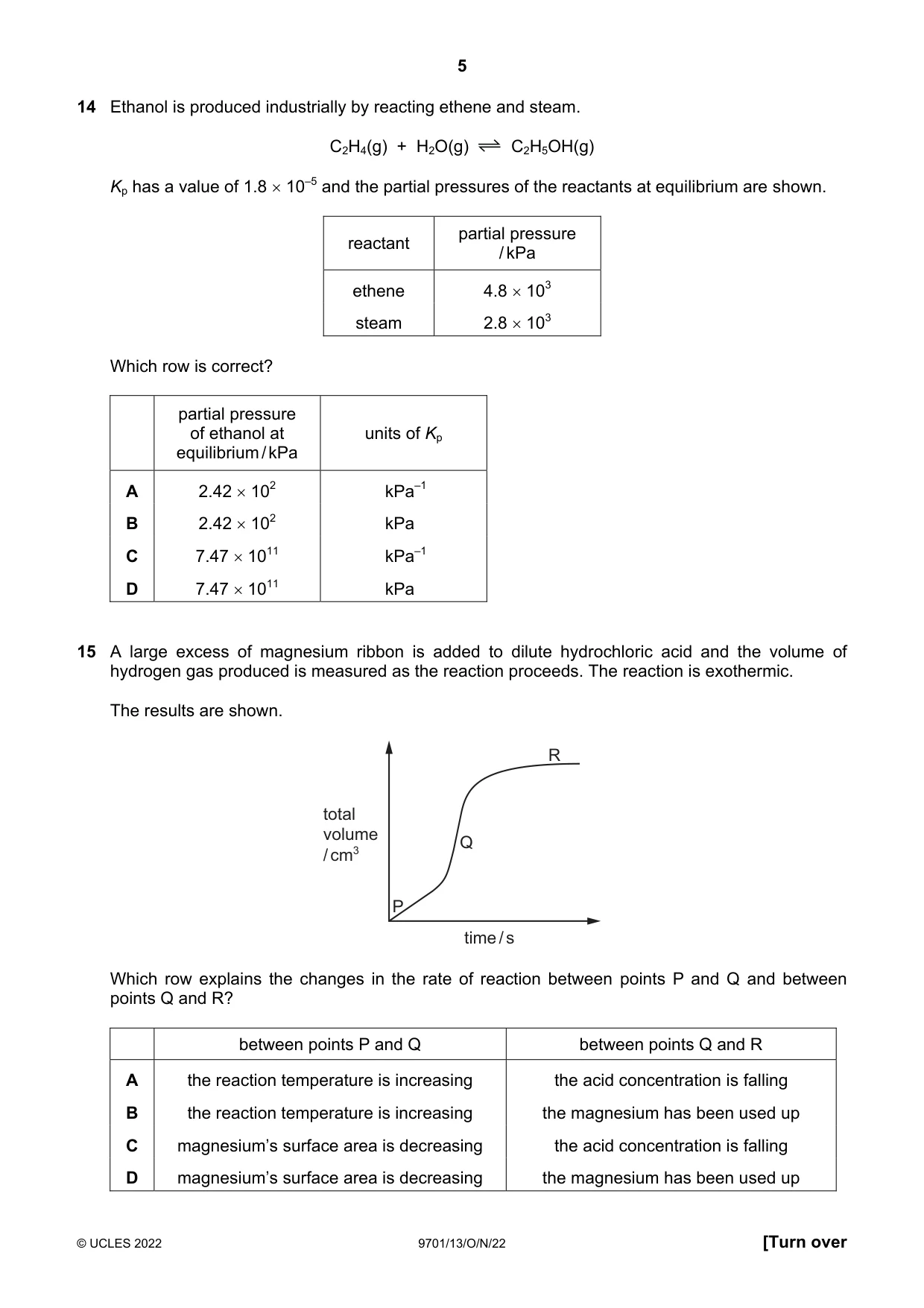
14 Ethanol is produced industrially by reacting ethene and steam. C2H4(g) + H2O(g) C2H5OH(g) Kp has a value of 1.8 10–5 and the partial pressures of the reactants at equilibrium are shown. partial pressure reactant / kPa ethene 4.8 103 steam 2.8 103 Which row is correct? partial pressure of ethanol at units of Kp equilibrium / kPa A 2.42 102 kPa–1 B 2.42 102 kPa C 7.47 1011 kPa–1 D 7.47 1011 kPa
Mark scheme: A
More questions on Chemical equilibria: reversible reactions, dynamic equilibrium
Q15 · A large excess of magnesium ribbon is added to dilute hydrochloric acid and the volume of…
15 A large excess of magnesium ribbon is added to dilute hydrochloric acid and the volume of hydrogen gas produced is measured as the reaction proceeds. The reaction is exothermic. The results are shown. R total volume Q / cm3 P time / s Which row explains the changes in the rate of reaction between points P and Q and between points Q and R? between points P and Q between points Q and R A the reaction temperature is increasing the acid concentration is falling B the reaction temperature is increasing the magnesium has been used up C magnesium’s surface area is decreasing the acid concentration is falling D magnesium’s surface area is decreasing the magnesium has been used up
Mark scheme: A
Q16 · Measurements are made to determine the activation energy, Ea, of a reaction
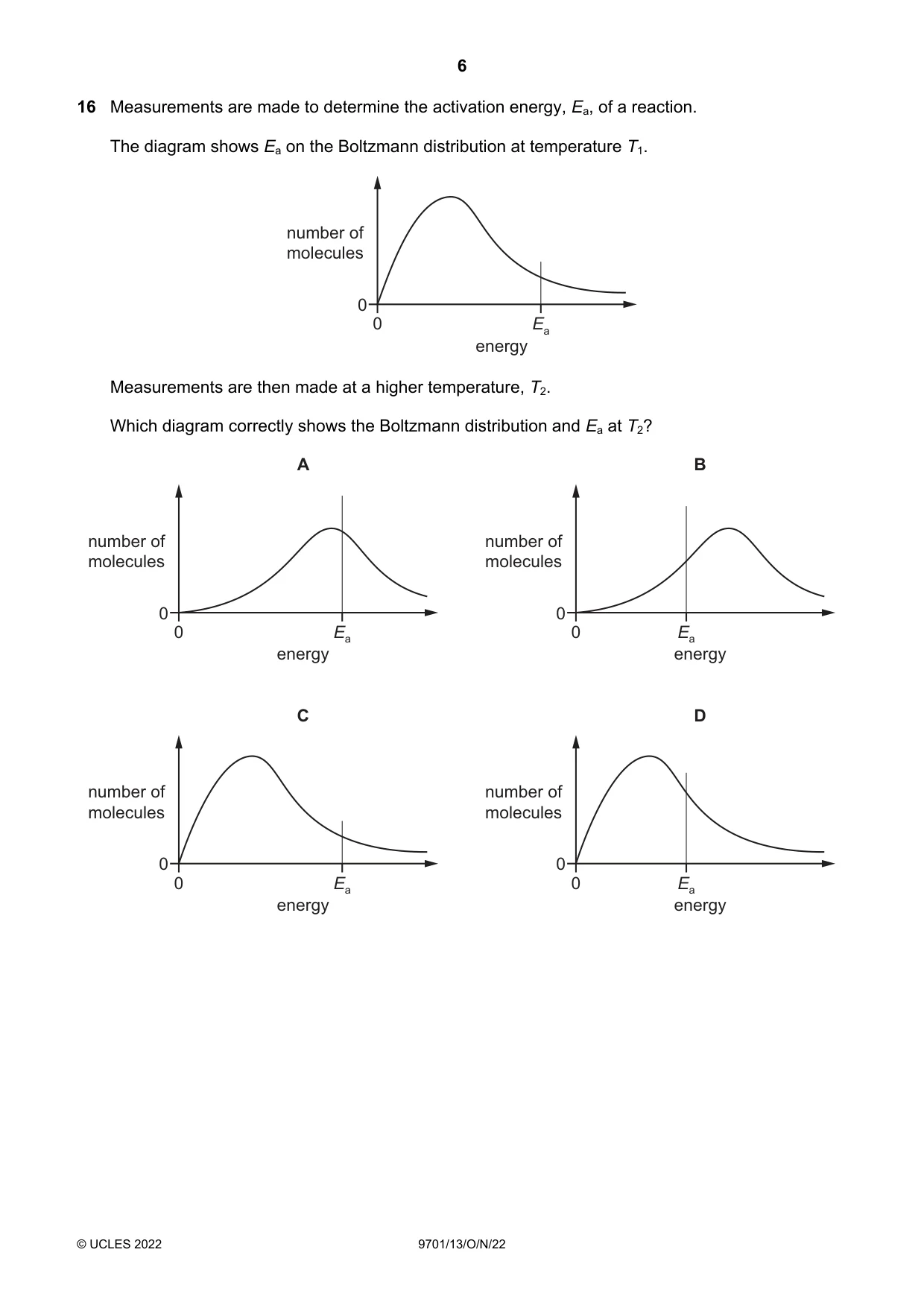
16 Measurements are made to determine the activation energy, Ea, of a reaction. The diagram shows Ea on the Boltzmann distribution at temperature T1. number of molecules 0 0 Ea energy Measurements are then made at a higher temperature, T2. Which diagram correctly shows the Boltzmann distribution and Ea at T2? A B number of number of molecules molecules 0 0 0 Ea 0 Ea energy energy C D number of number of molecules molecules 0 0 0 Ea 0 Ea energy energy
Mark scheme: A
More questions on Effect of temperature on reaction rates and the concept of activation energy
Q17 · The electrical conductivities of two compounds, Y and Z, are shown
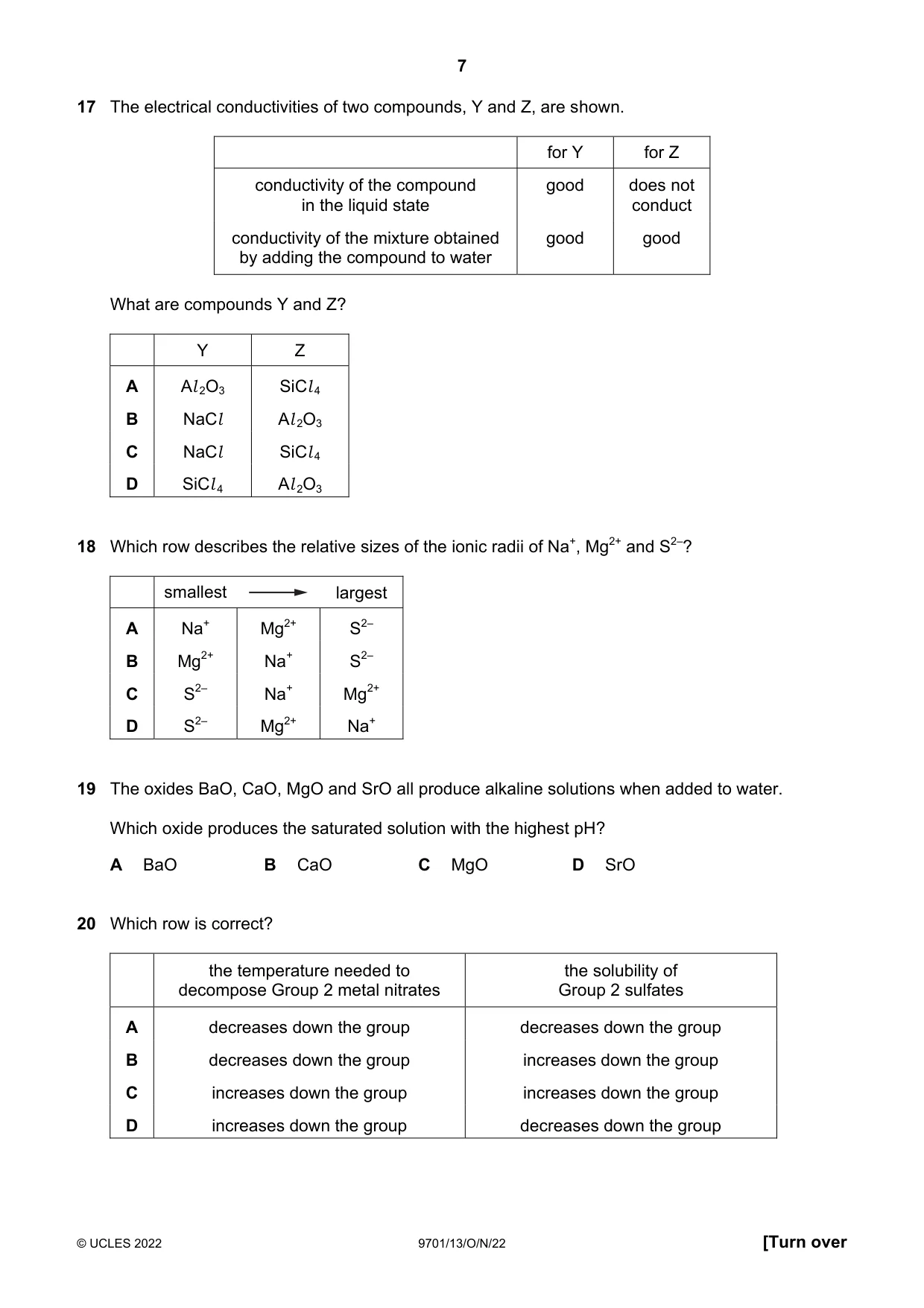
17 The electrical conductivities of two compounds, Y and Z, are shown. for Y for Z conductivity of the compound good does not in the liquid state conduct conductivity of the mixture obtained good good by adding the compound to water What are compounds Y and Z? Y Z A Al 2O3 SiCl 4 B NaCl Al 2O3 C NaCl SiCl 4 D SiCl 4 Al 2O3
Mark scheme: C
More questions on Periodicity of chemical properties of the elements in Period 3
Q18 · Which row describes the relative sizes of the ionic radii of Na+, Mg2+ and S2–?
18 Which row describes the relative sizes of the ionic radii of Na+, Mg2+ and S2–? smallest largest A Na+ Mg2+ S2– B Mg2+ Na+ S2– C S2– Na+ Mg2+ D S2– Mg2+ Na+
Mark scheme: B
More questions on Periodicity of physical properties of the elements in Period 3
Q19 · The oxides BaO, CaO, MgO and SrO all produce alkaline solutions when added to water
19 The oxides BaO, CaO, MgO and SrO all produce alkaline solutions when added to water. Which oxide produces the saturated solution with the highest pH? A BaO B CaO C MgO D SrO
Mark scheme: A
Q20 · Which row is correct?
20 Which row is correct? the temperature needed to the solubility of decompose Group 2 metal nitrates Group 2 sulfates A decreases down the group decreases down the group B decreases down the group increases down the group C increases down the group increases down the group D increases down the group decreases down the group
Mark scheme: D
Q21 · Which statement about Group 17 elements and compounds is correct?
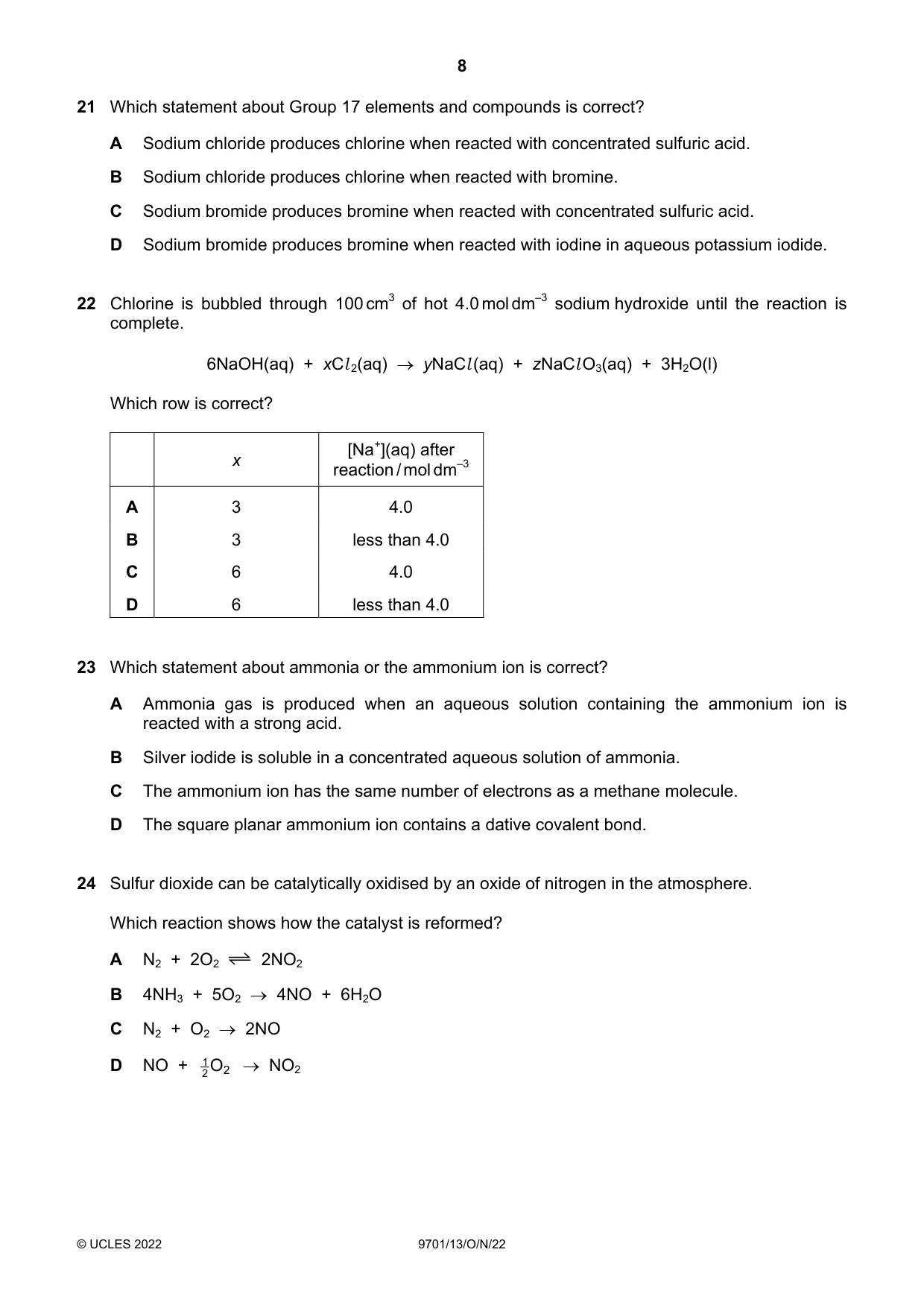
21 Which statement about Group 17 elements and compounds is correct? A Sodium chloride produces chlorine when reacted with concentrated sulfuric acid. B Sodium chloride produces chlorine when reacted with bromine. C Sodium bromide produces bromine when reacted with concentrated sulfuric acid. D Sodium bromide produces bromine when reacted with iodine in aqueous potassium iodide.
Mark scheme: C
More questions on The chemical properties of the halogen elements and the hydrogen halides
Q22 · Chlorine is bubbled through 100 cm3 of hot 4.0 mol dm–3 sodium hydroxide until the…
22 Chlorine is bubbled through 100 cm3 of hot 4.0 mol dm–3 sodium hydroxide until the reaction is complete. 6NaOH(aq) + xCl 2(aq) yNaCl (aq) + zNaCl O3(aq) + 3H2O(l) Which row is correct? [Na+](aq) after x reaction / mol dm–3 A 3 4.0 B 3 less than 4.0 C 6 4.0 D 6 less than 4.0
Mark scheme: B
Q23 · Which statement about ammonia or the ammonium ion is correct?
23 Which statement about ammonia or the ammonium ion is correct? A Ammonia gas is produced when an aqueous solution containing the ammonium ion is reacted with a strong acid. B Silver iodide is soluble in a concentrated aqueous solution of ammonia. C The ammonium ion has the same number of electrons as a methane molecule. D The square planar ammonium ion contains a dative covalent bond.
Mark scheme: C
More questions on Covalent bonding and coordinate (dative covalent) bonding
Q24 · Sulfur dioxide can be catalytically oxidised by an oxide of nitrogen in the atmosphere
24 Sulfur dioxide can be catalytically oxidised by an oxide of nitrogen in the atmosphere. Which reaction shows how the catalyst is reformed? A N2 + 2O2 2NO2 B 4NH3 + 5O2 4NO + 6H2O C N2 + O2 2NO D NO + 1 O NO2 2 2
Mark scheme: D
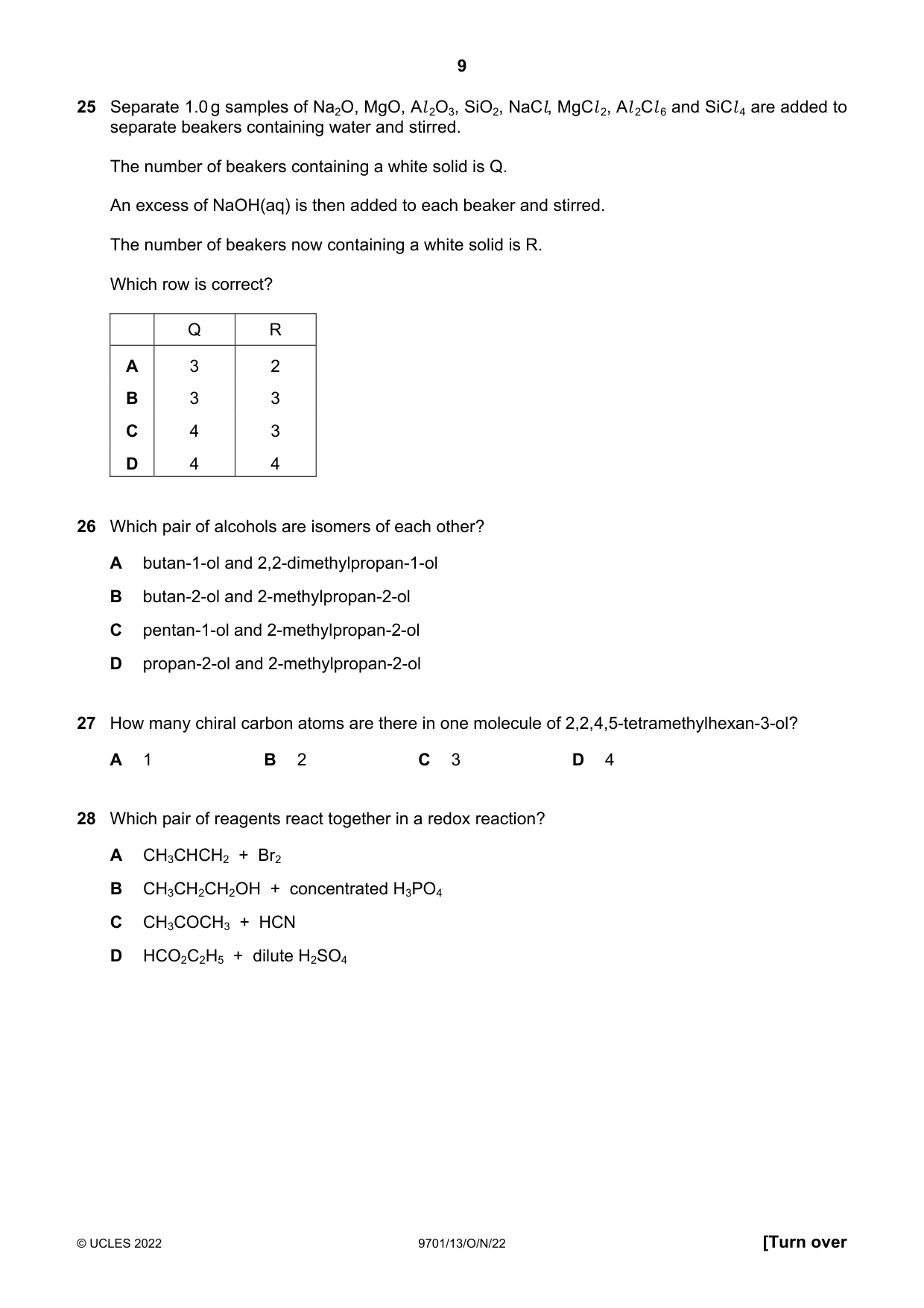
Q25 · Separate 1.0 g samples of Na2O, MgO, Al 2O3, SiO2, NaCl, MgCl 2, Al 2Cl 6 and SiCl 4 are…
25 Separate 1.0 g samples of Na2O, MgO, Al 2O3, SiO2, NaCl, MgCl 2, Al 2Cl 6 and SiCl 4 are added to separate beakers containing water and stirred. The number of beakers containing a white solid is Q. An excess of NaOH(aq) is then added to each beaker and stirred. The number of beakers now containing a white solid is R. Which row is correct? Q R A 3 2 B 3 3 C 4 3 D 4 4
Mark scheme: D
More questions on Periodicity of chemical properties of the elements in Period 3
Q26 · Which pair of alcohols are isomers of each other?
26 Which pair of alcohols are isomers of each other? A butan-1-ol and 2,2-dimethylpropan-1-ol B butan-2-ol and 2-methylpropan-2-ol C pentan-1-ol and 2-methylpropan-2-ol D propan-2-ol and 2-methylpropan-2-ol
Mark scheme: B
More questions on Isomerism: structural isomerism and stereoisomerism
Q27 · How many chiral carbon atoms are there in one molecule of 2,2,4,5-tetramethylhexan-3-ol?
27 How many chiral carbon atoms are there in one molecule of 2,2,4,5-tetramethylhexan-3-ol? A 1 B 2 C 3 D 4
Mark scheme: B
Q28 · Which pair of reagents react together in a redox reaction?
28 Which pair of reagents react together in a redox reaction? A CH3CHCH2 + Br2 B CH3CH2CH2OH + concentrated H3PO4 C CH3COCH3 + HCN D HCO2C2H5 + dilute H2SO4
Mark scheme: A
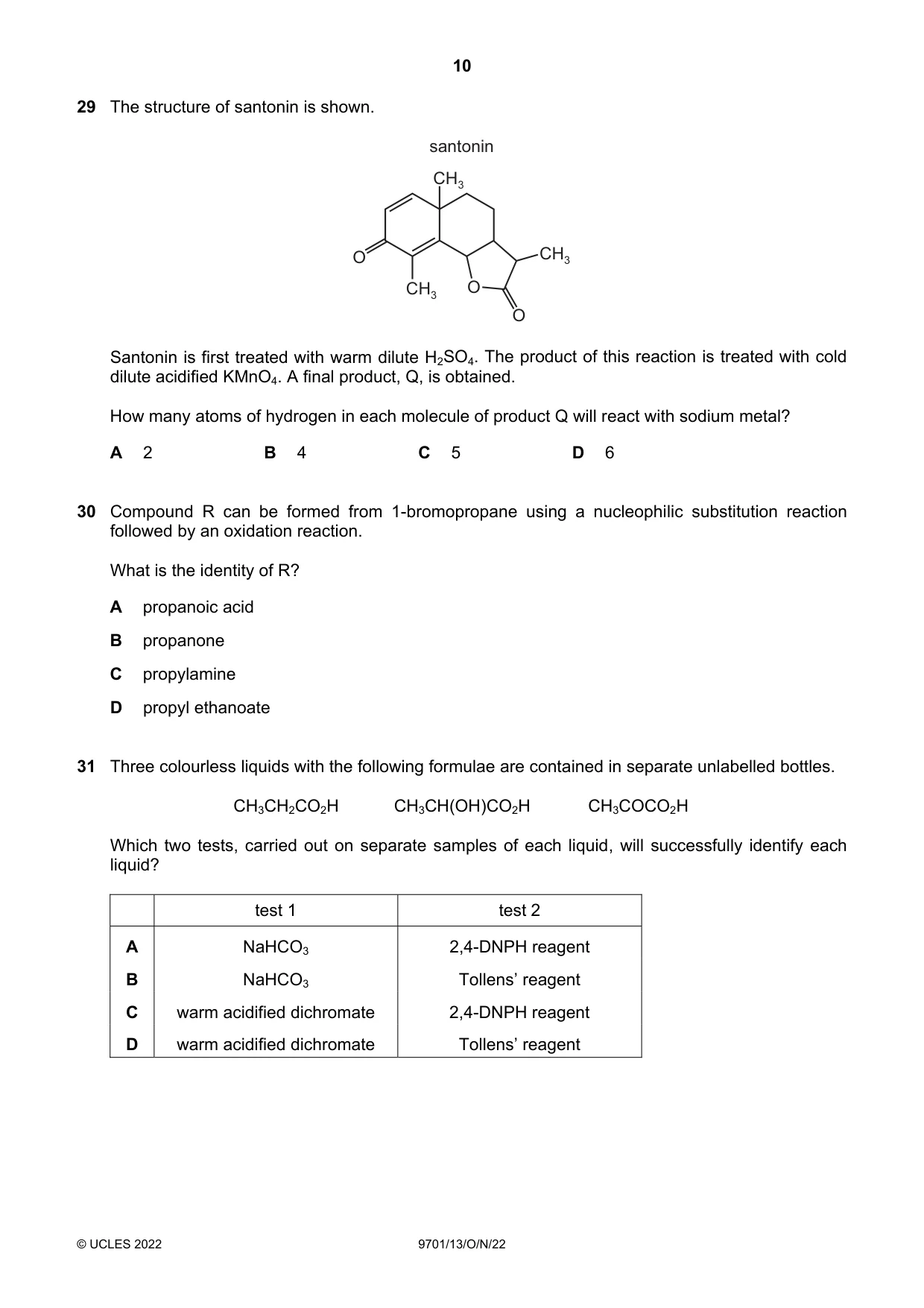
Q29 · The structure of santonin is shown
29 The structure of santonin is shown. santonin CH3 O CH3 CH3 O O Santonin is first treated with warm dilute H2SO4. The product of this reaction is treated with cold dilute acidified KMnO4. A final product, Q, is obtained. How many atoms of hydrogen in each molecule of product Q will react with sodium metal? A 2 B 4 C 5 D 6
Mark scheme: D
Q30 · Compound R can be formed from 1-bromopropane using a nucleophilic substitution reaction…
30 Compound R can be formed from 1-bromopropane using a nucleophilic substitution reaction followed by an oxidation reaction. What is the identity of R? A propanoic acid B propanone C propylamine D propyl ethanoate
Mark scheme: A
Q31 · Three colourless liquids with the following formulae are contained in separate unlabelled…
31 Three colourless liquids with the following formulae are contained in separate unlabelled bottles. CH3CH2CO2H CH3CH(OH)CO2H CH3COCO2H Which two tests, carried out on separate samples of each liquid, will successfully identify each liquid? test 1 test 2 A NaHCO3 2,4-DNPH reagent B NaHCO3 Tollens’ reagent C warm acidified dichromate 2,4-DNPH reagent D warm acidified dichromate Tollens’ reagent
Mark scheme: C
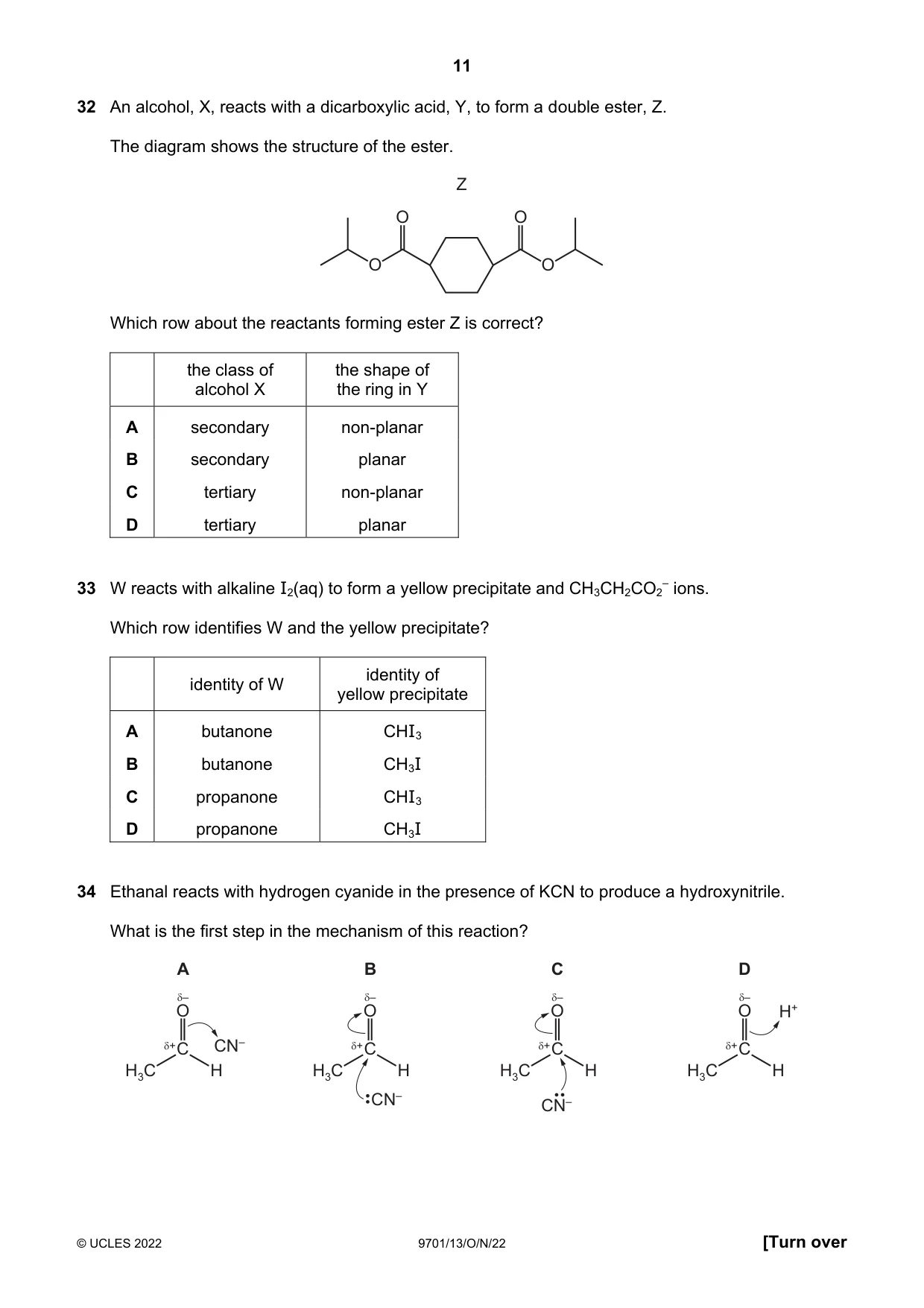
Q32 · An alcohol, X, reacts with a dicarboxylic acid, Y, to form a double ester, Z
32 An alcohol, X, reacts with a dicarboxylic acid, Y, to form a double ester, Z. The diagram shows the structure of the ester. Z O O O O Which row about the reactants forming ester Z is correct? the class of the shape of alcohol X the ring in Y A secondary non-planar B secondary planar C tertiary non-planar D tertiary planar
Mark scheme: A
Q33 · W reacts with alkaline I2(aq) to form a yellow precipitate and CH3CH2CO2 – ions
33 W reacts with alkaline I2(aq) to form a yellow precipitate and CH3CH2CO2 – ions. Which row identifies W and the yellow precipitate? identity of identity of W yellow precipitate A butanone CHI3 B butanone CH3I C propanone CHI3 D propanone CH3I
Mark scheme: A
Q34 · Ethanal reacts with hydrogen cyanide in the presence of KCN to produce a hydroxynitrile
34 Ethanal reacts with hydrogen cyanide in the presence of KCN to produce a hydroxynitrile. What is the first step in the mechanism of this reaction? A B c D 0 0 0 0 H* In, Cl C| |“ st+C ~=CN sC aC tC H,cC~ H H.07/ ™“H H,c~ oH H,cC~ H 2CN- chi
Mark scheme: B
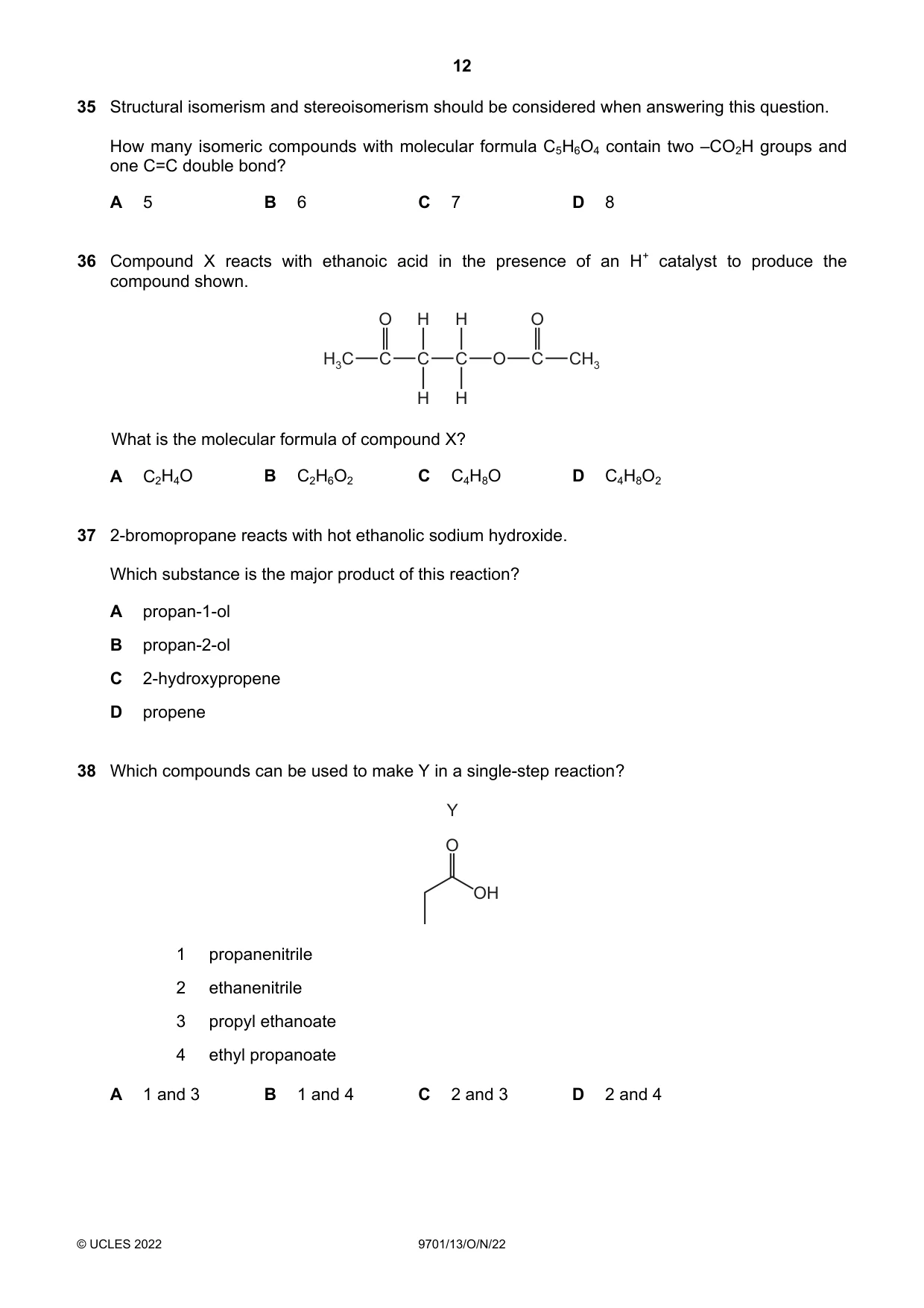
Q35 · Structural isomerism and stereoisomerism should be considered when answering this question
35 Structural isomerism and stereoisomerism should be considered when answering this question. How many isomeric compounds with molecular formula C5H6O4 contain two –CO2H groups and one C=C double bond? A 5 B 6 C 7 D 8
Mark scheme: C
More questions on Isomerism: structural isomerism and stereoisomerism
Q36 · Compound X reacts with ethanoic acid in the presence of an H+ catalyst to produce the…
36 Compound X reacts with ethanoic acid in the presence of an H+ catalyst to produce the compound shown. O H H O H3C C C C O C CH3 H H What is the molecular formula of compound X? A C2H4O B C2H6O2 C C4H8O D C4H8O2
Mark scheme: D
Q37 · 2-bromopropane reacts with hot ethanolic sodium hydroxide
37 2-bromopropane reacts with hot ethanolic sodium hydroxide. Which substance is the major product of this reaction? A propan-1-ol B propan-2-ol C 2-hydroxypropene D propene
Mark scheme: D
Q38 · Which compounds can be used to make Y in a single-step reaction?
38 Which compounds can be used to make Y in a single-step reaction? Y O OH 1 propanenitrile 2 ethanenitrile 3 propyl ethanoate 4 ethyl propanoate A 1 and 3 B 1 and 4 C 2 and 3 D 2 and 4
Mark scheme: B
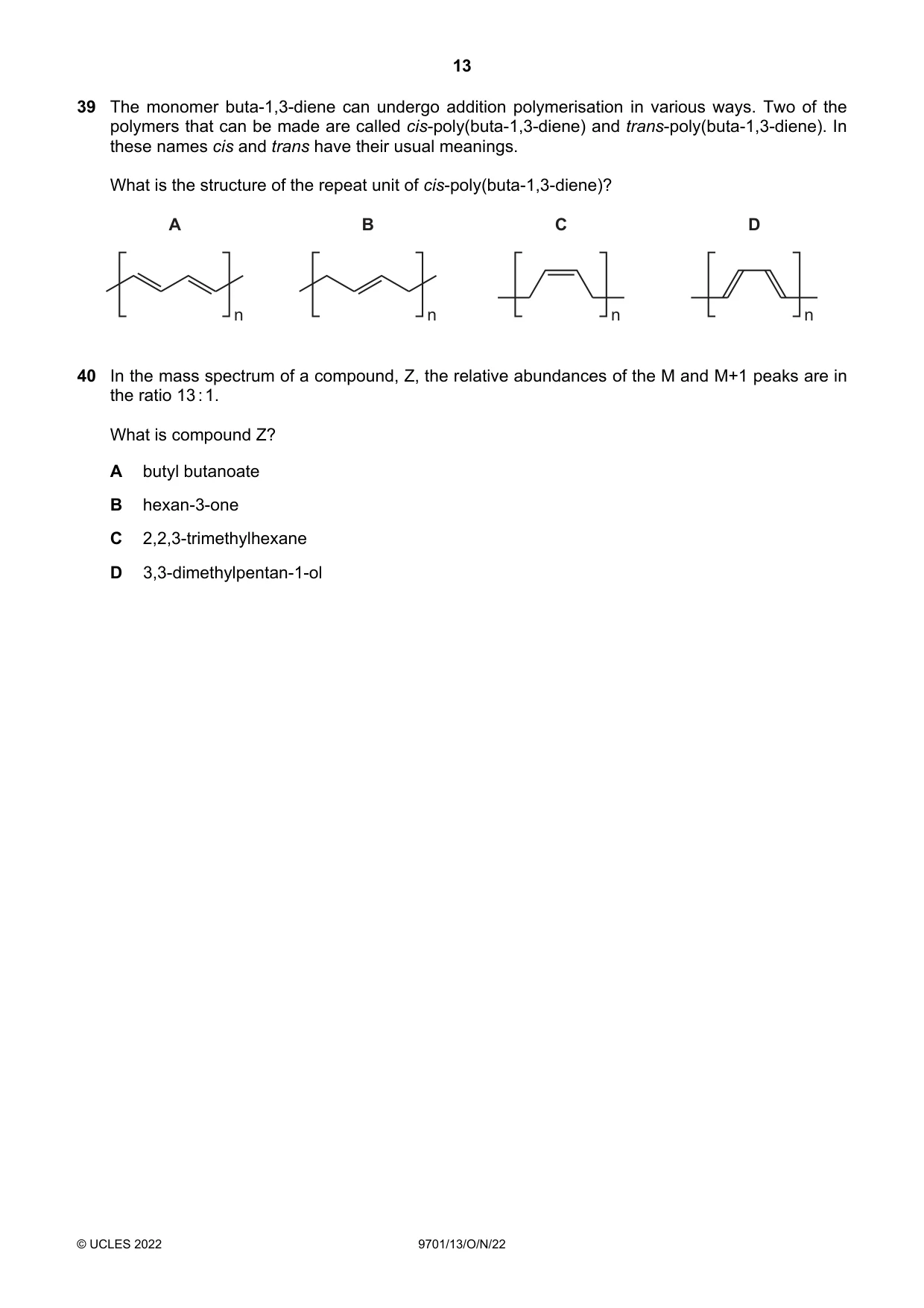
Q39 · The monomer buta-1,3-diene can undergo addition polymerisation in various ways
39 The monomer buta-1,3-diene can undergo addition polymerisation in various ways. Two of the polymers that can be made are called cis-poly(buta-1,3-diene) and trans-poly(buta-1,3-diene). In these names cis and trans have their usual meanings. What is the structure of the repeat unit of cis-poly(buta-1,3-diene)? A B C D n n n n
Mark scheme: C
Q40 · In the mass spectrum of a compound, Z, the relative abundances of the M and M+1 peaks are…
40 In the mass spectrum of a compound, Z, the relative abundances of the M and M+1 peaks are in the ratio 13 : 1. What is compound Z? A butyl butanoate B hexan-3-one C 2,2,3-trimethylhexane D 3,3-dimethylpentan-1-ol
Mark scheme: D
What was in this paper
The subtopics covered by these 40 questions, and how many questions each got. Open one in a new tab to see every Cambridge question on it.
2Chemical equilibria: reversible reactions, dynamic equilibrium2Esters2Isomerism: structural isomerism and stereoisomerism2Periodicity of chemical properties of the elements in Period 32Redox processes: electron transfer and changes in oxidation number (oxidation state)2Similarities and trends in the properties of the Group 2 metals, magnesium to barium, and their compounds2Addition polymerisation1Alkenes1Bonding and structure1Carboxylic acids1Covalent bonding and coordinate (dative covalent) bonding1Effect of temperature on reaction rates and the concept of activation energy1Electrons, energy levels and atomic orbitals1Enthalpy change, ΔH1Esters1Halogenoalkanes1Hess’s law1Homogeneous and heterogeneous catalysts1Ionisation energy1Isomerism: optical1Mass spectrometry1Nitriles and hydroxynitriles1Organic synthesis1Periodicity of physical properties of the elements in Period 31Rate of reaction1Reacting masses and volumes (of solutions and gases)1Shapes of molecules1Shapes of organic molecules; σ and π bonds1Similarities and trends in the properties of the Group 2 metals, magnesium to barium, and their compounds1The chemical properties of the halogen elements and the hydrogen halides1The mole and the Avogadro constant1The reactions of chlorine1What you needed in this session
Cambridge’s own grade thresholds for 2022 Oct/Nov, Paper 1 · Variant 3. A higher threshold means an easier paper — the bar moves with how the cohort did.