Cambridge A Level Chemistry 9701 — 2025 May/June Paper 1 · Variant 1
9701/11/M/J/25 · 39 questions · 40 marks · 75 min
The question paper and its mark scheme, free to read here and free to download. This is Cambridge’s own paper, exactly as it was sat.
Question paper20 pages
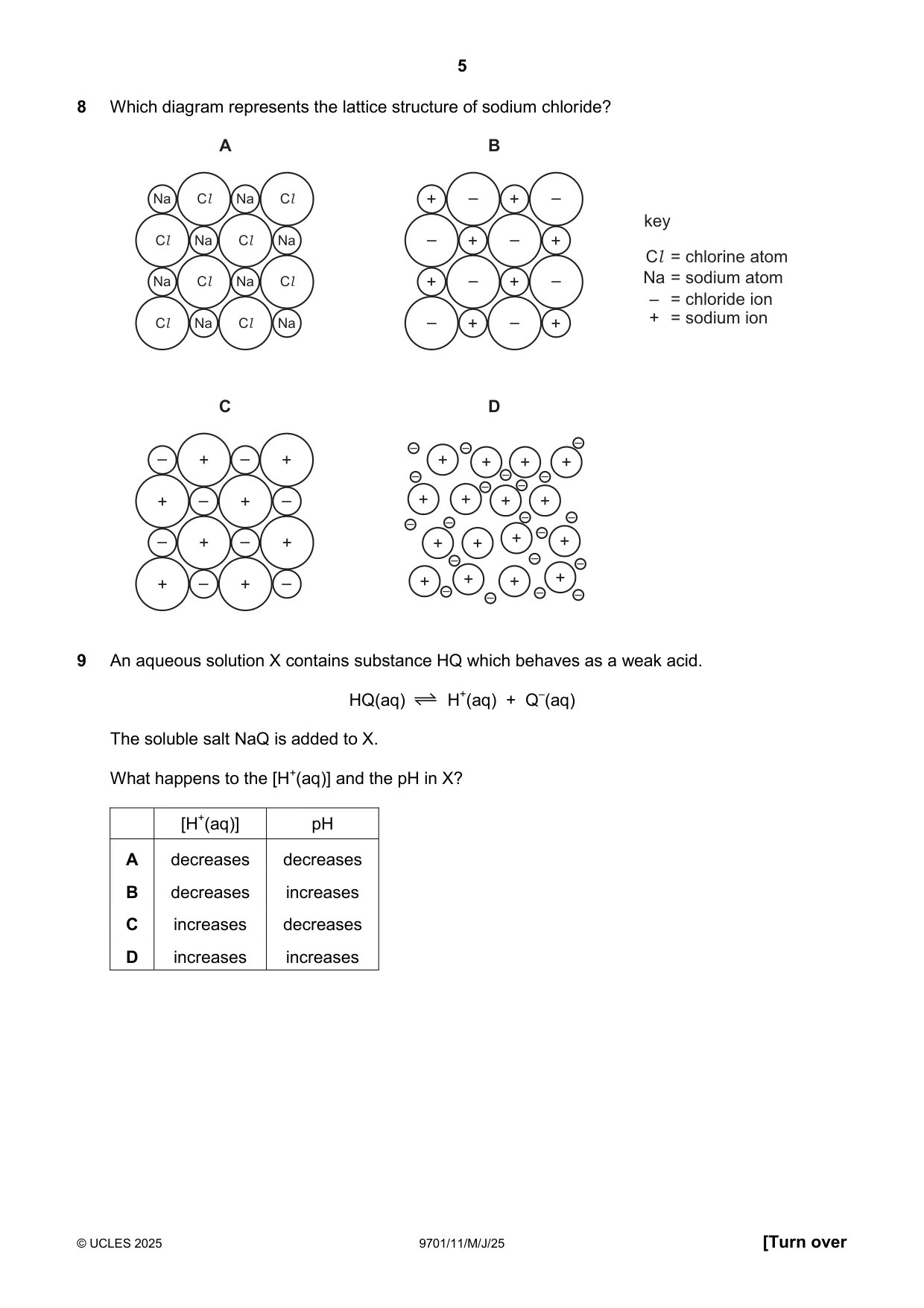
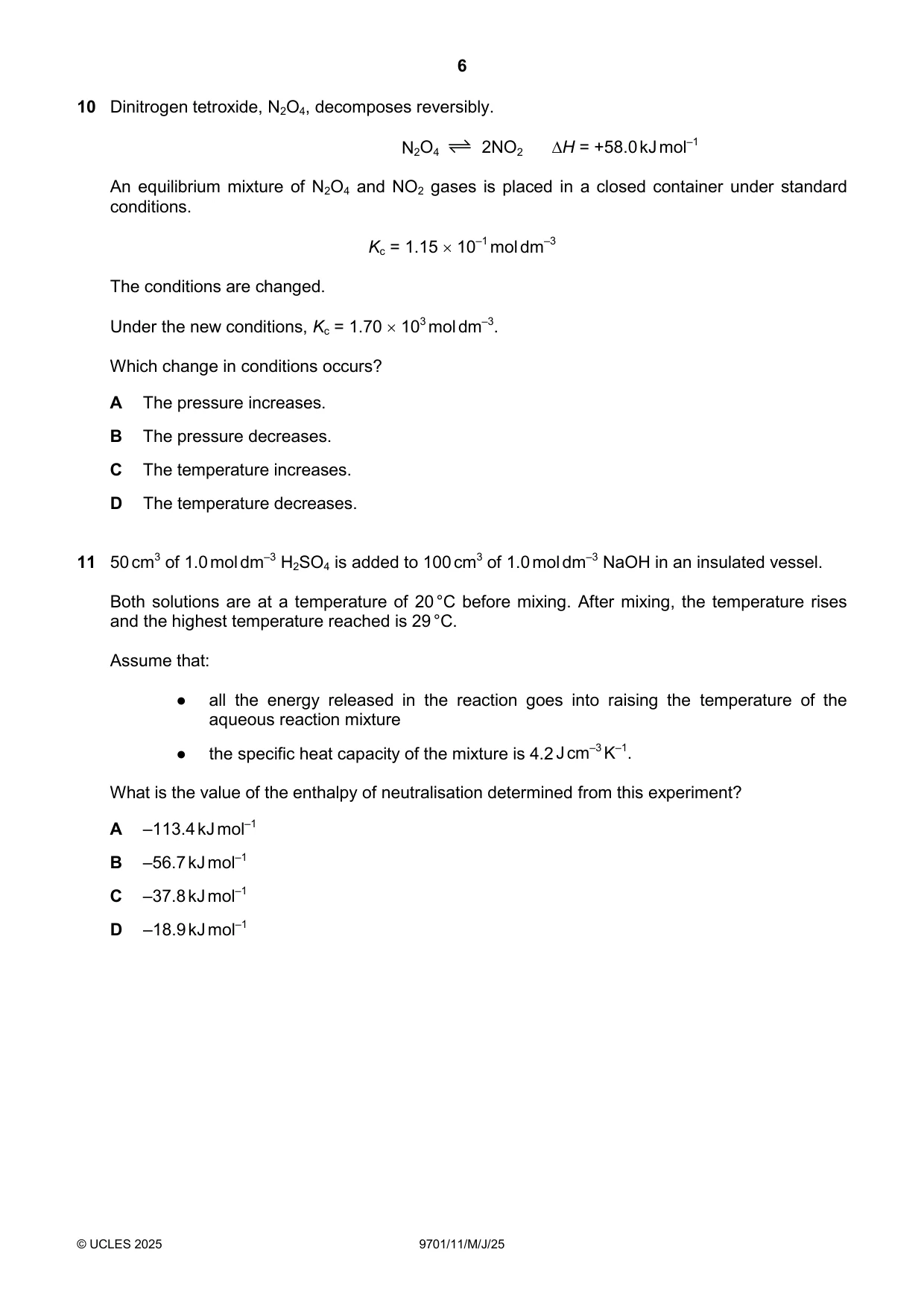
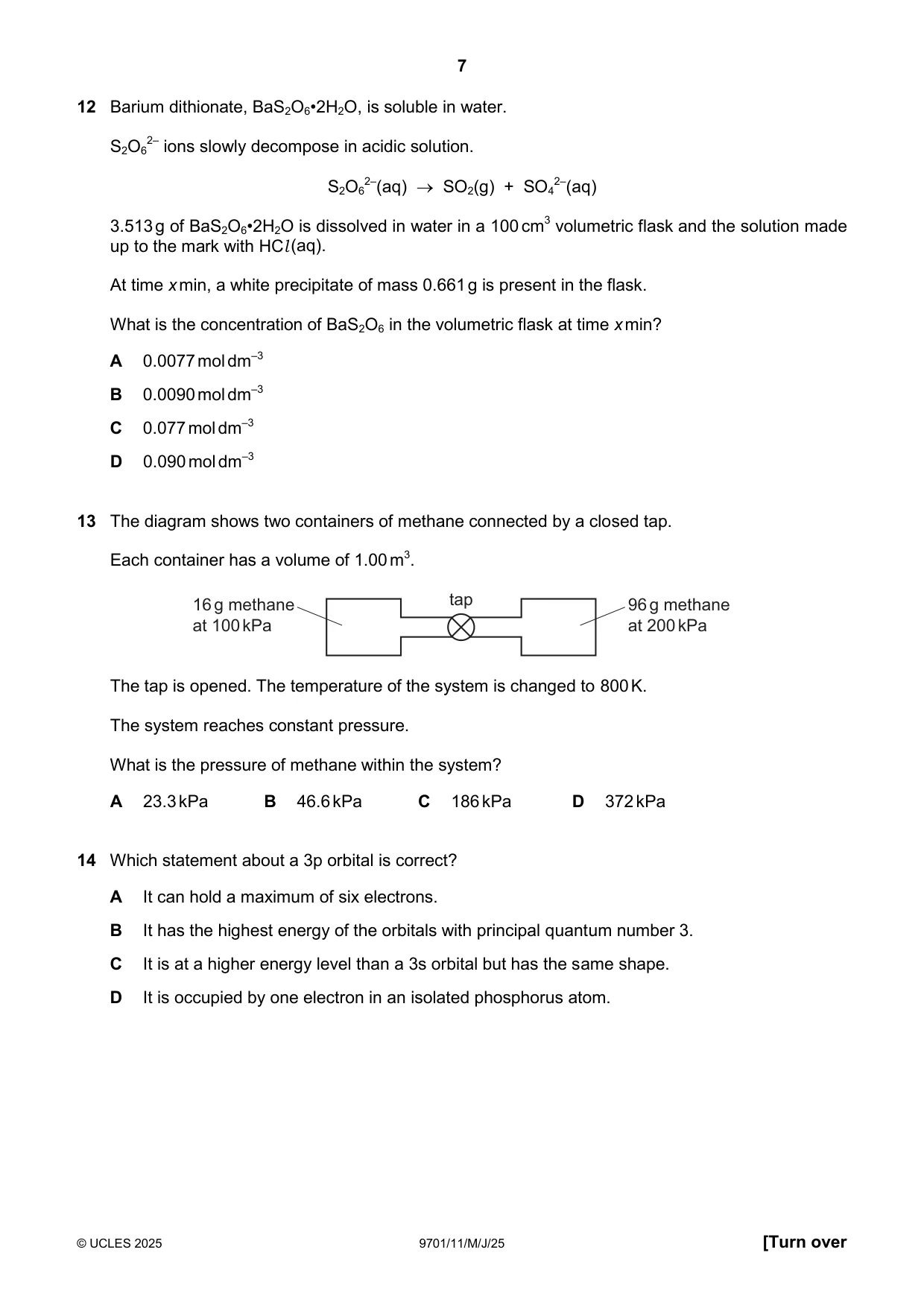
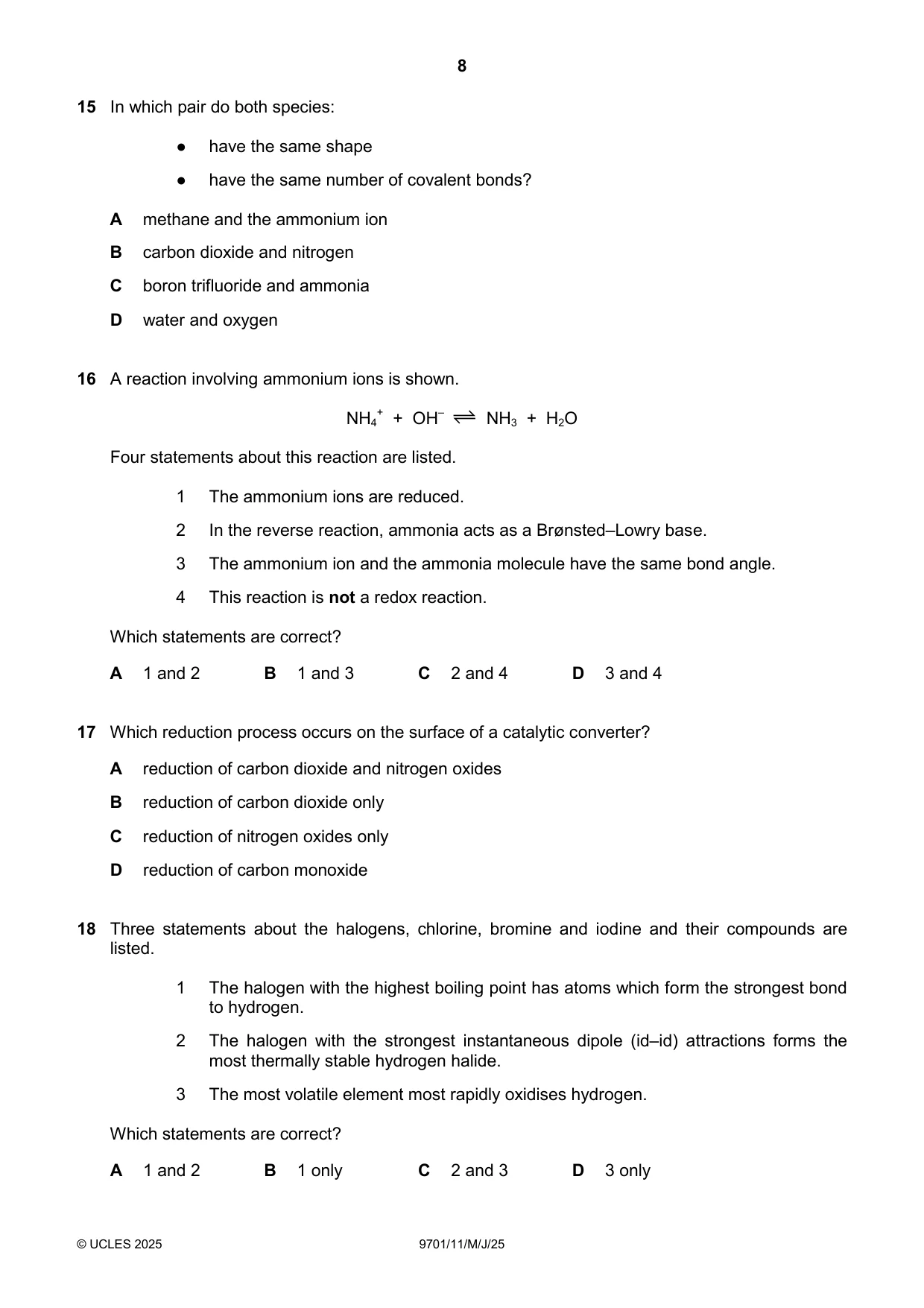


Mark scheme3 pages
Answers below. Sit the paper first if you are practising.
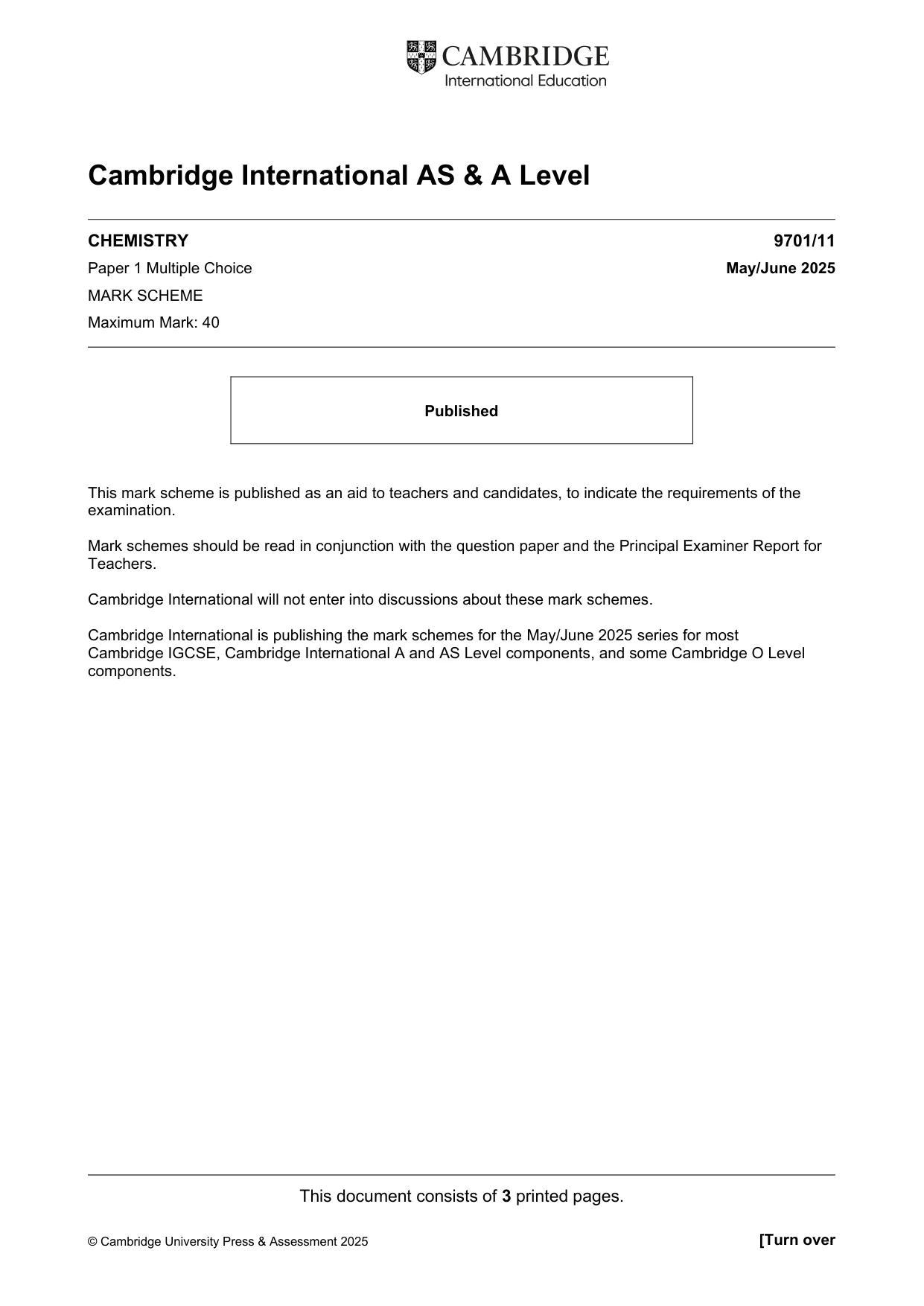
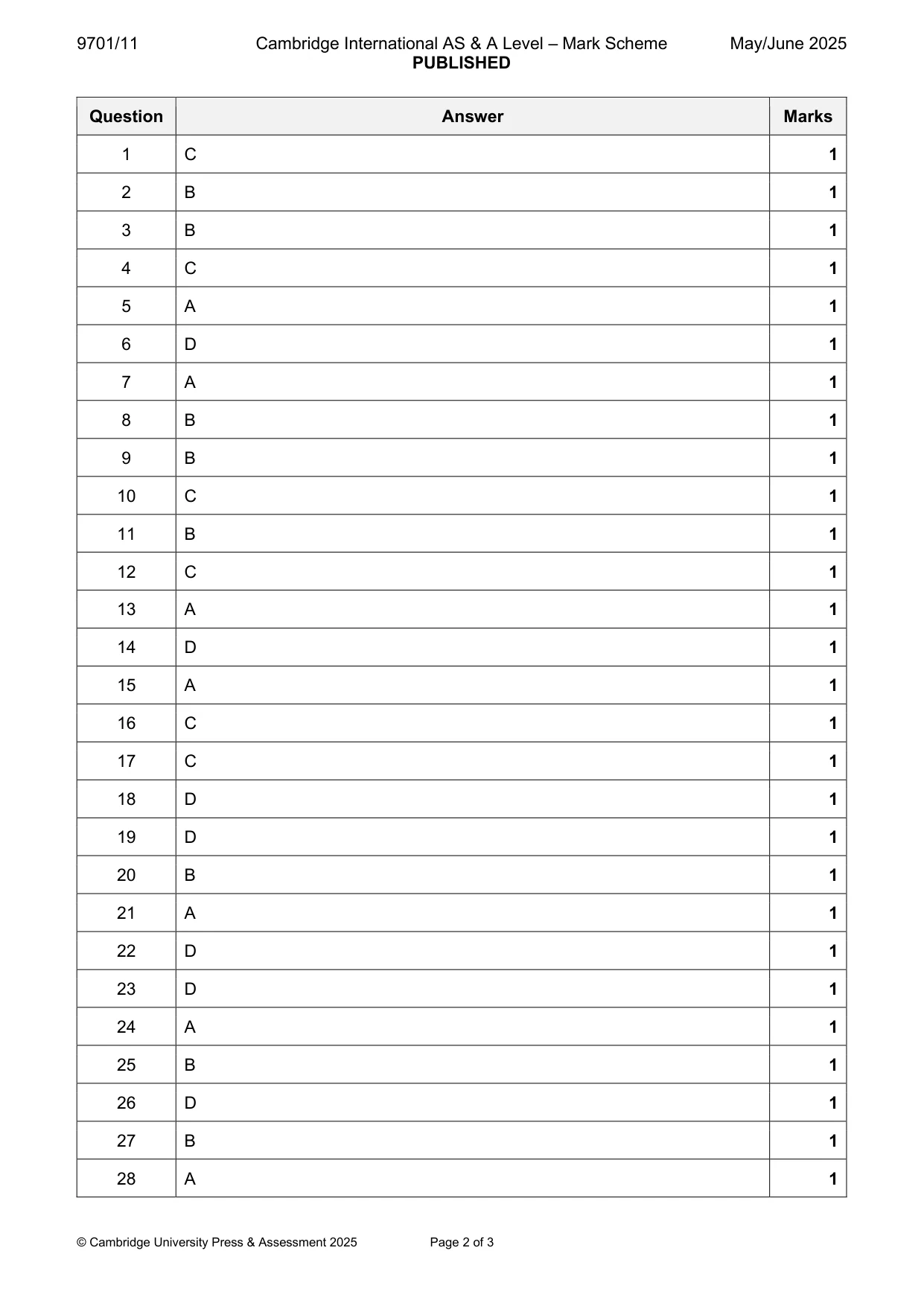
Questions as text
Q1 · ICl3 reacts with water in a redox reaction
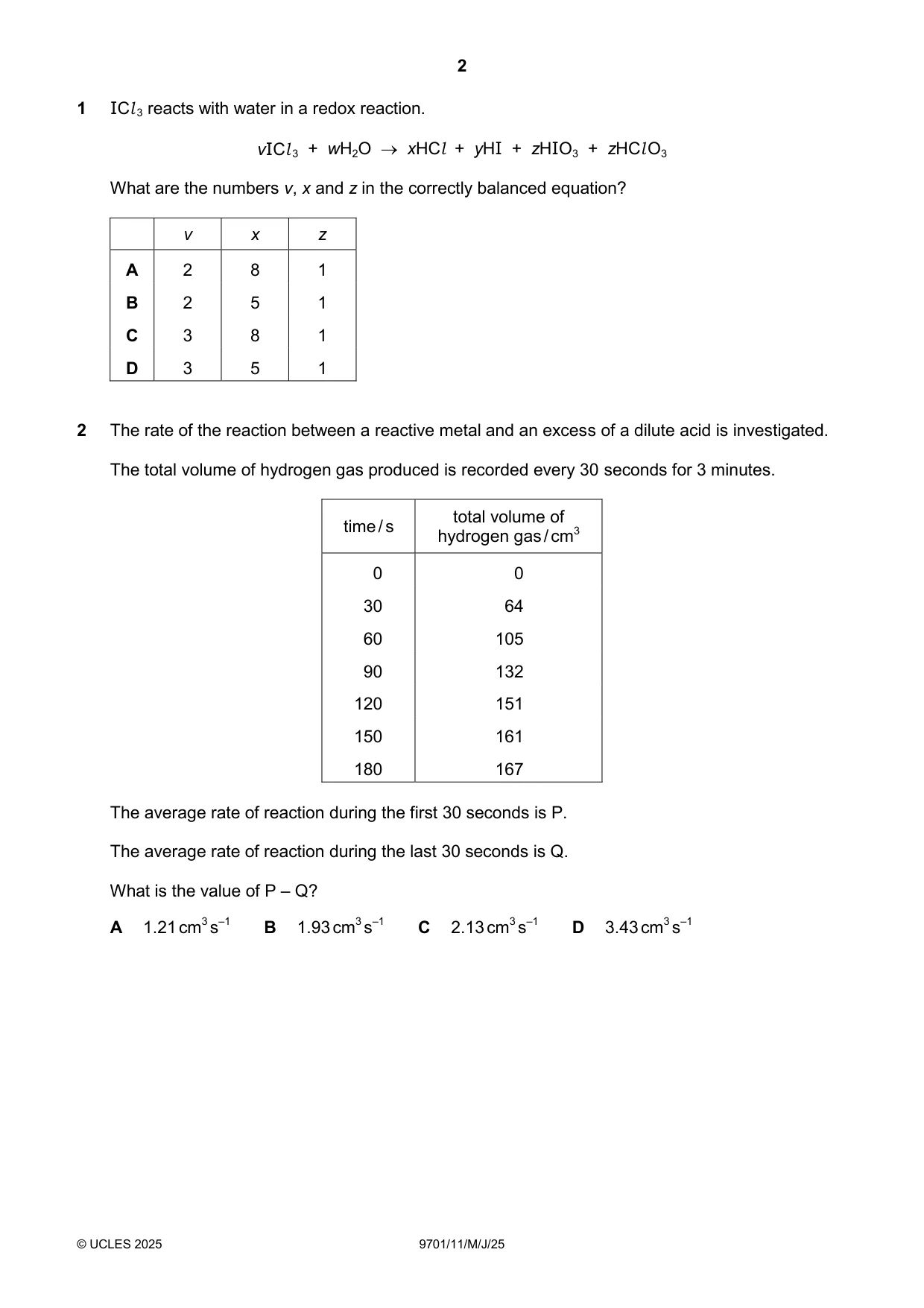
1 ICl3 reacts with water in a redox reaction. vICl3 + wH2O xHCl + yHI + zHIO3 + zHClO3 What are the numbers v, x and z in the correctly balanced equation? v x z A 2 8 1 B 2 5 1 C 3 8 1 D 3 5 1
Mark scheme: Question Answer Marks 1 C 1
Q2 · The rate of the reaction between a reactive metal and an excess of a dilute acid is…
2 The rate of the reaction between a reactive metal and an excess of a dilute acid is investigated. The total volume of hydrogen gas produced is recorded every 30 seconds for 3 minutes. time/s total volume of hydrogen gas/cm3 0 0 30 64 60 105 90 132 120 151 150 161 180 167 The average rate of reaction during the first 30 seconds is P. The average rate of reaction during the last 30 seconds is Q. What is the value of P – Q? A 1.21cm3 s–1 B 1.93cm3 s–1 C 2.13cm3 s–1 D 3.43cm3 s–1
Mark scheme: B
Q3 · In the diagram, curve X was obtained by measuring the volume of oxygen produced during…
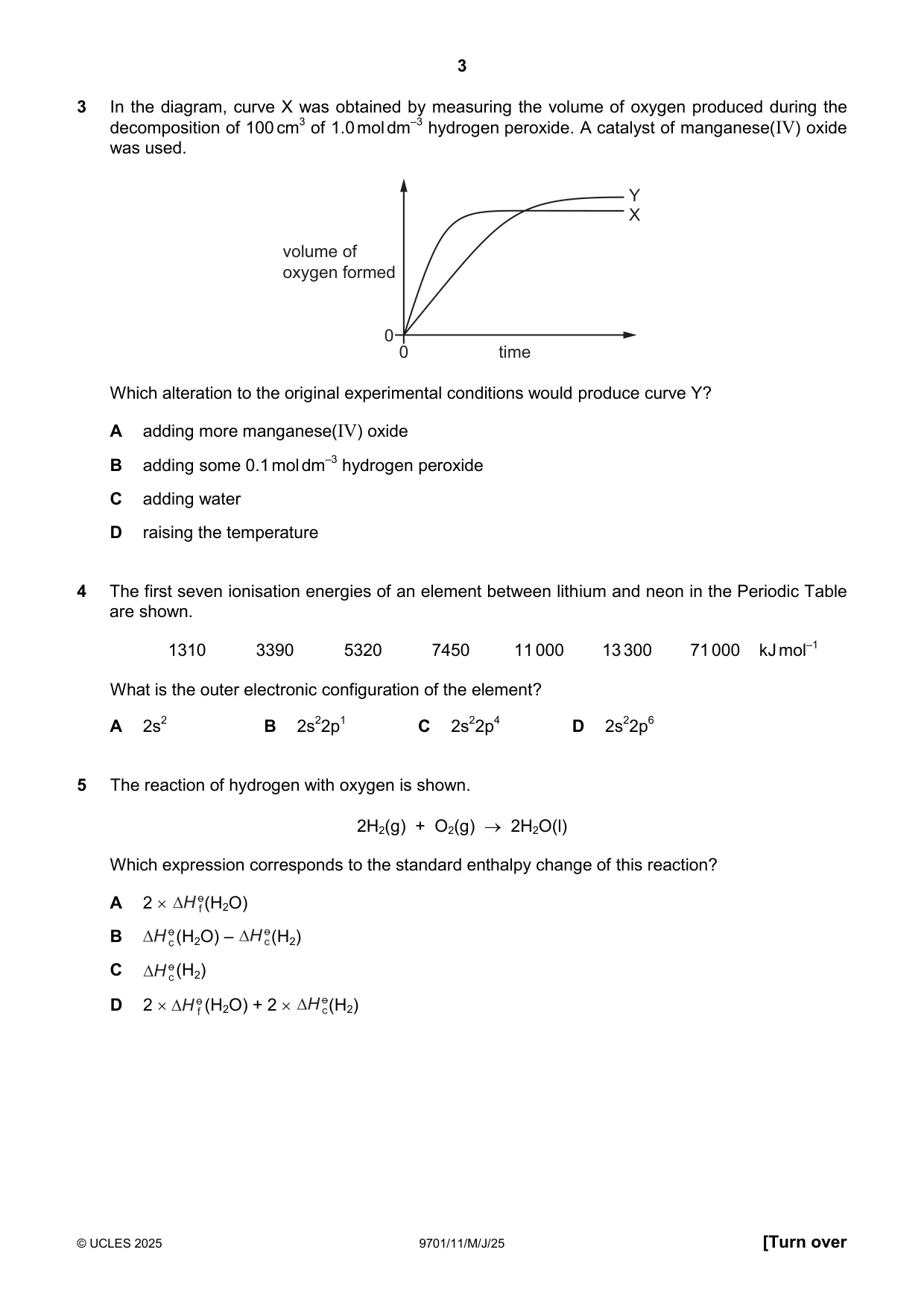
3 In the diagram, curve X was obtained by measuring the volume of oxygen produced during the decomposition of 100cm3 of 1.0moldm–3 hydrogen peroxide. A catalyst of manganese(IV) oxide was used. volume of oxygen formed 0 0 time Y X Which alteration to the original experimental conditions would produce curve Y? A adding more manganese(IV) oxide B adding some 0.1moldm–3 hydrogen peroxide C adding water D raising the temperature
Mark scheme: B
Q4 · The first seven ionisation energies of an element between lithium and neon in the…
4 The first seven ionisation energies of an element between lithium and neon in the Periodic Table are shown. 1310 3390 5320 7450 11000 13300 71000 kJmol–1 What is the outer electronic configuration of the element? A 2s2 B 2s22p1 C 2s22p4 D 2s22p6
Mark scheme: C
Q5 · The reaction of hydrogen with oxygen is shown
5 The reaction of hydrogen with oxygen is shown. 2H2(g) + O2(g) 2H2O(l) Which expression corresponds to the standard enthalpy change of this reaction? A 2 (H2O) B (H2O) – (H2) C (H2) D 2 (H2O) + 2 (H2)
Mark scheme: A
Q6 · P is a compound that burns in an excess of oxygen to give carbon dioxide and water only
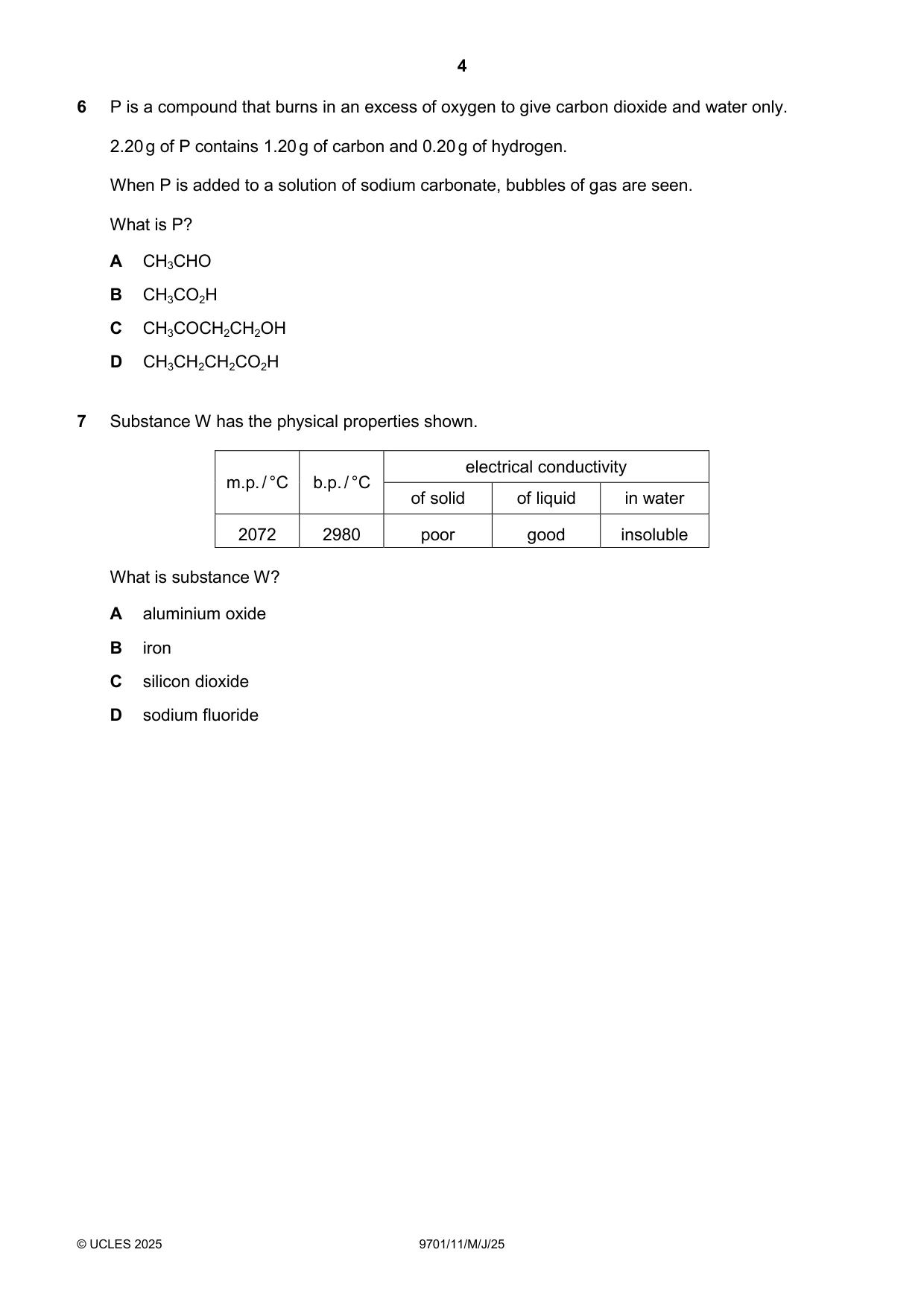
6 P is a compound that burns in an excess of oxygen to give carbon dioxide and water only. 2.20g of P contains 1.20g of carbon and 0.20g of hydrogen. When P is added to a solution of sodium carbonate, bubbles of gas are seen. What is P? A CH3CHO B CH3CO2H C CH3COCH2CH2OH D CH3CH2CH2CO2H
Mark scheme: D
Q7 · Substance W has the physical properties shown
7 Substance W has the physical properties shown. m.p./°C b.p./°C electrical conductivity of solid of liquid in water 2072 2980 poor good insoluble What is substance W? A aluminium oxide B iron C silicon dioxide D sodium fluoride
Mark scheme: A
Q8 · Which diagram represents the lattice structure of sodium chloride?
8 Which diagram represents the lattice structure of sodium chloride? Na Cl Na Cl Na Cl Na Cl Na Cl Na Cl Na Cl Na Cl A + – + – + – + – + – + – + – + – B – + + – + + + + + + + + + + + + + + + + – + – + – + – + – + – + C D key Cl Na – + = chlorine atom = sodium atom = chloride ion = sodium ion – – – – – – – – – – – – – – – – – – – –
Mark scheme: B
Q9 · An aqueous solution X contains substance HQ which behaves as a weak acid
9 An aqueous solution X contains substance HQ which behaves as a weak acid. HQ(aq) H+(aq) + Q–(aq) The soluble salt NaQ is added to X. What happens to the [H+(aq)] and the pH in X? [H+(aq)] pH A decreases decreases B decreases increases C increases decreases D increases increases
Mark scheme: B
Q10 · Dinitrogen tetroxide, N2O4, decomposes reversibly
10 Dinitrogen tetroxide, N2O4, decomposes reversibly. N2O4 2NO2 H = +58.0kJmol–1 An equilibrium mixture of N2O4 and NO2 gases is placed in a closed container under standard conditions. Kc = 1.15 10–1 moldm–3 The conditions are changed. Under the new conditions, Kc = 1.70 103 moldm–3. Which change in conditions occurs? A The pressure increases. B The pressure decreases. C The temperature increases. D The temperature decreases.
Mark scheme: C
More questions on Chemical equilibria: reversible reactions, dynamic equilibrium
Q11 · 50cm3 of 1.0moldm–3 H2SO4 is added to 100cm3 of 1.0moldm–3 NaOH in an insulated vessel
11 50cm3 of 1.0moldm–3 H2SO4 is added to 100cm3 of 1.0moldm–3 NaOH in an insulated vessel. Both solutions are at a temperature of 20°C before mixing. After mixing, the temperature rises and the highest temperature reached is 29°C. Assume that: ● all the energy released in the reaction goes into raising the temperature of the aqueous reaction mixture ● the specific heat capacity of the mixture is 4.2Jcm–3 K–1. What is the value of the enthalpy of neutralisation determined from this experiment? A –113.4kJmol–1 B –56.7kJmol–1 C –37.8kJmol–1 D –18.9kJmol–1
Mark scheme: B
Q12 · Barium dithionate, BaS2O6•2H2O, is soluble in water
12 Barium dithionate, BaS2O6•2H2O, is soluble in water. S2O6 2– ions slowly decompose in acidic solution. S2O6 2–(aq) SO2(g) + SO4 2–(aq) 3.513g of BaS2O6•2H2O is dissolved in water in a 100cm3 volumetric flask and the solution made up to the mark with HCl(aq). At time xmin, a white precipitate of mass 0.661g is present in the flask. What is the concentration of BaS2O6 in the volumetric flask at time xmin? A 0.0077moldm–3 B 0.0090moldm–3 C 0.077moldm–3 D 0.090moldm–3
Mark scheme: C
More questions on Reacting masses and volumes (of solutions and gases)
Q13 · The diagram shows two containers of methane connected by a closed tap
13 The diagram shows two containers of methane connected by a closed tap. Each container has a volume of 1.00m3. tap 16g methane at 100kPa 96g methane at 200kPa The tap is opened. The temperature of the system is changed to 800K. The system reaches constant pressure. What is the pressure of methane within the system? A 23.3kPa B 46.6kPa C 186kPa D 372kPa
Mark scheme: A
More questions on The gaseous state: ideal and real gases and pV = nRT
Q14 · Which statement about a 3p orbital is correct?
14 Which statement about a 3p orbital is correct? A It can hold a maximum of six electrons. B It has the highest energy of the orbitals with principal quantum number 3. C It is at a higher energy level than a 3s orbital but has the same shape. D It is occupied by one electron in an isolated phosphorus atom.
Mark scheme: D
More questions on Electrons, energy levels and atomic orbitals
Q15 · In which pair do both species: ● have the same shape ● have the same number of covalent…
15 In which pair do both species: ● have the same shape ● have the same number of covalent bonds? A methane and the ammonium ion B carbon dioxide and nitrogen C boron trifluoride and ammonia D water and oxygen
Mark scheme: A
Q16 · A reaction involving ammonium ions is shown
16 A reaction involving ammonium ions is shown. NH4 + + OH– NH3 + H2O Four statements about this reaction are listed. 1 The ammonium ions are reduced. 2 In the reverse reaction, ammonia acts as a Brønsted–Lowry base. 3 The ammonium ion and the ammonia molecule have the same bond angle. 4 This reaction is not a redox reaction. Which statements are correct? A 1 and 2 B 1 and 3 C 2 and 4 D 3 and 4
Mark scheme: C
Q17 · Which reduction process occurs on the surface of a catalytic converter?
17 Which reduction process occurs on the surface of a catalytic converter? A reduction of carbon dioxide and nitrogen oxides B reduction of carbon dioxide only C reduction of nitrogen oxides only D reduction of carbon monoxide
Mark scheme: C
Q18 · Three statements about the halogens, chlorine, bromine and iodine and their compounds are…
18 Three statements about the halogens, chlorine, bromine and iodine and their compounds are listed. 1 The halogen with the highest boiling point has atoms which form the strongest bond to hydrogen. 2 The halogen with the strongest instantaneous dipole (id–id) attractions forms the most thermally stable hydrogen halide. 3 The most volatile element most rapidly oxidises hydrogen. Which statements are correct? A 1 and 2 B 1 only C 2 and 3 D 3 only
Mark scheme: D
More questions on The chemical properties of the halogen elements and the hydrogen halides
Q19 · Which reagent or reagents and conditions will oxidise chlorine, Cl2, into a compound…
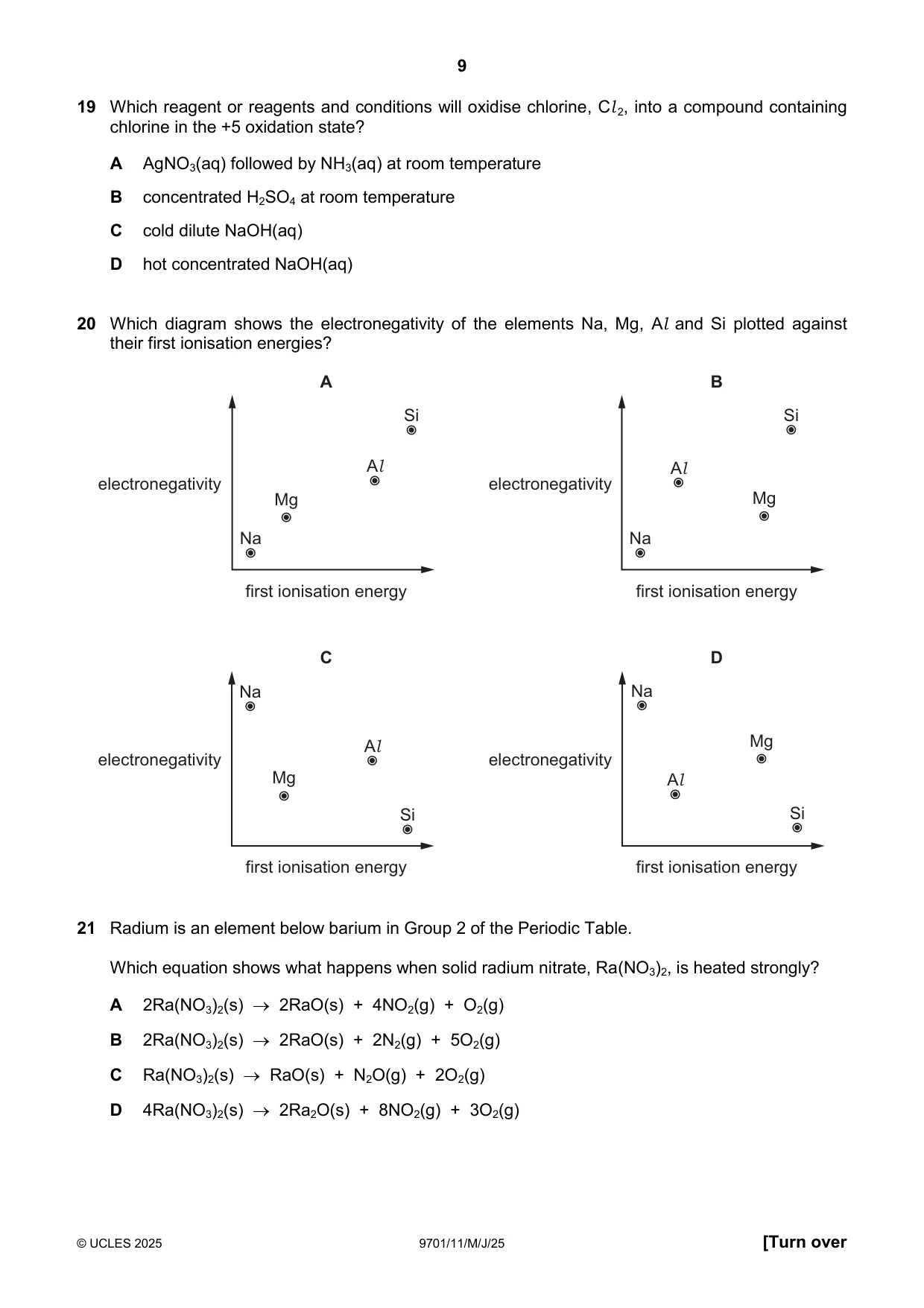
19 Which reagent or reagents and conditions will oxidise chlorine, Cl2, into a compound containing chlorine in the +5 oxidation state? A AgNO3(aq) followed by NH3(aq) at room temperature B concentrated H2SO4 at room temperature C cold dilute NaOH(aq) D hot concentrated NaOH(aq)
Mark scheme: D
Q20 · Which diagram shows the electronegativity of the elements Na, Mg, Al and Si plotted…
20 Which diagram shows the electronegativity of the elements Na, Mg, Al and Si plotted against their first ionisation energies? first ionisation energy electronegativity Si Na Al Mg A first ionisation energy electronegativity Si Na Al Mg B first ionisation energy electronegativity Si Na Al Mg C first ionisation energy electronegativity Si Na Al Mg D
Mark scheme: B
More questions on Periodicity of physical properties of the elements in Period 3
Q21 · Radium is an element below barium in Group 2 of the Periodic Table
21 Radium is an element below barium in Group 2 of the Periodic Table. Which equation shows what happens when solid radium nitrate, Ra(NO3)2, is heated strongly? A 2Ra(NO3)2(s) 2RaO(s) + 4NO2(g) + O2(g) B 2Ra(NO3)2(s) 2RaO(s) + 2N2(g) + 5O2(g) C Ra(NO3)2(s) RaO(s) + N2O(g) + 2O2(g) D 4Ra(NO3)2(s) 2Ra2O(s) + 8NO2(g) + 3O2(g)
Mark scheme: A
Q22 · The table shows some data for the elements in Period 3 of the Periodic Table
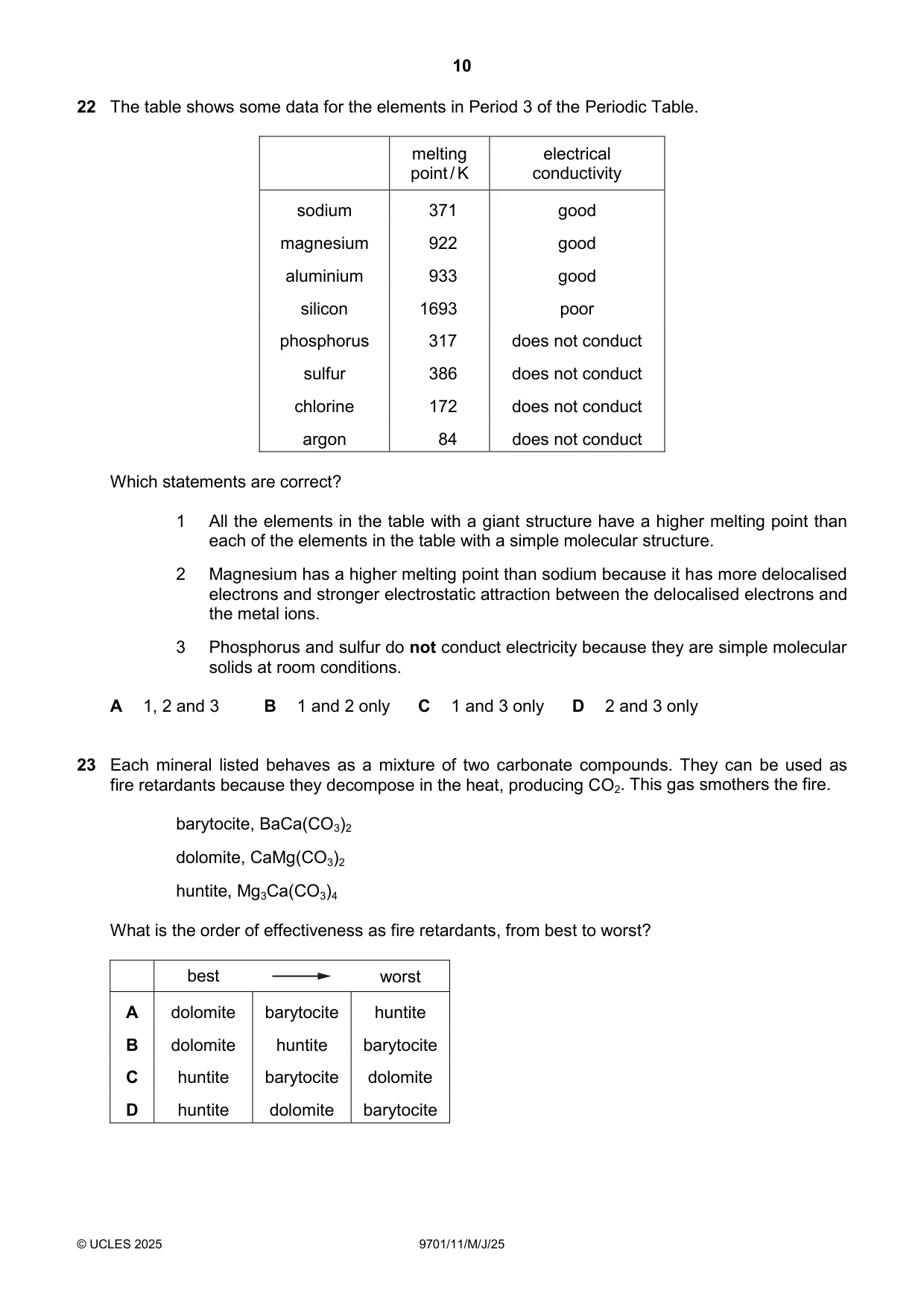
22 The table shows some data for the elements in Period 3 of the Periodic Table. melting point/K electrical conductivity sodium 371 good magnesium 922 good aluminium 933 good silicon 1693 poor phosphorus 317 does not conduct sulfur 386 does not conduct chlorine 172 does not conduct argon 84 does not conduct Which statements are correct? 1 All the elements in the table with a giant structure have a higher melting point than each of the elements in the table with a simple molecular structure. 2 Magnesium has a higher melting point than sodium because it has more delocalised electrons and stronger electrostatic attraction between the delocalised electrons and the metal ions. 3 Phosphorus and sulfur do not conduct electricity because they are simple molecular solids at room conditions. A 1, 2 and 3 B 1 and 2 only C 1 and 3 only D 2 and 3 only
Mark scheme: D
More questions on Periodicity of physical properties of the elements in Period 3
Q24 · Compound X contains two Period 3 elements, Y and Z
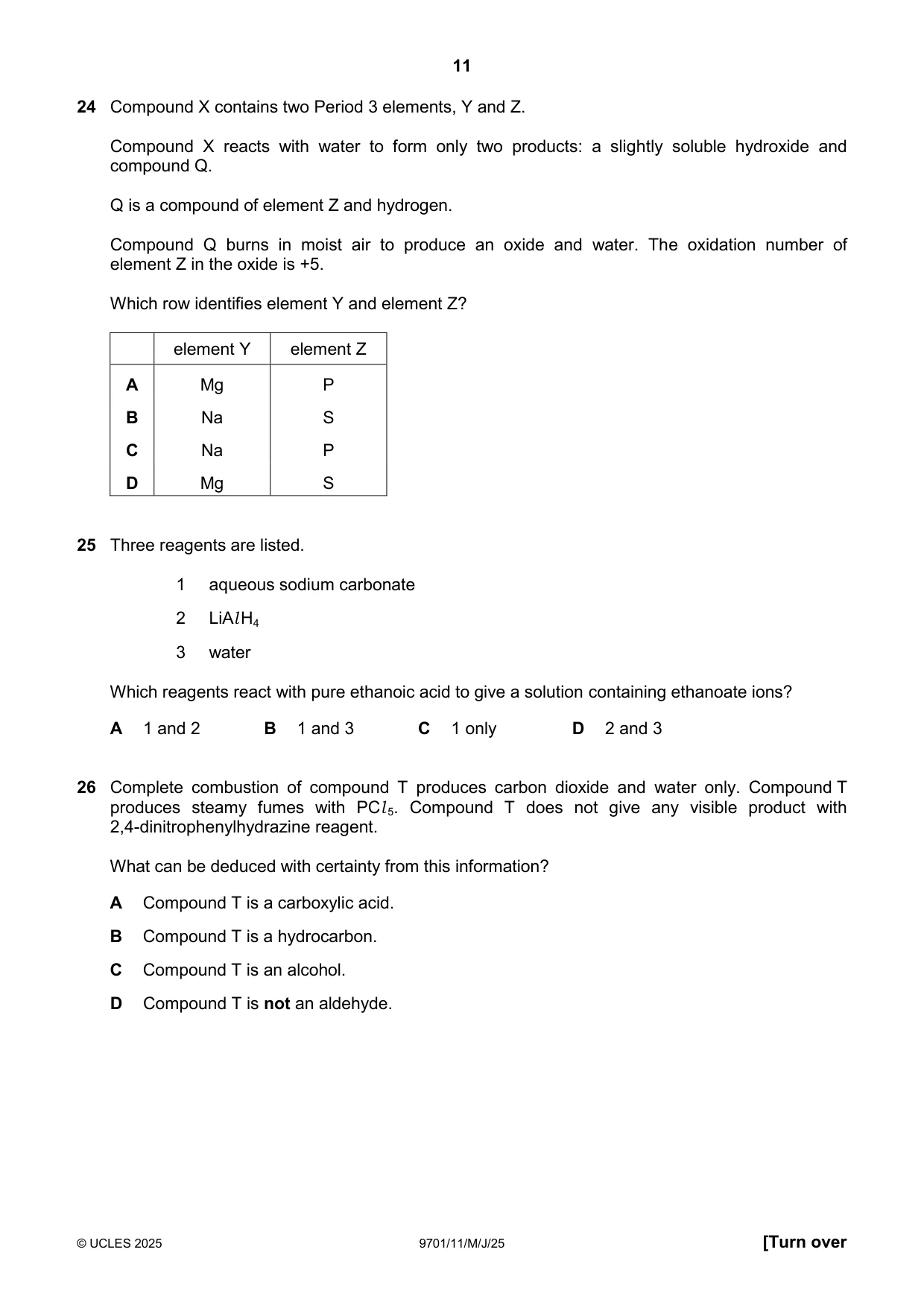
24 Compound X contains two Period 3 elements, Y and Z. Compound X reacts with water to form only two products: a slightly soluble hydroxide and compound Q. Q is a compound of element Z and hydrogen. Compound Q burns in moist air to produce an oxide and water. The oxidation number of element Z in the oxide is +5. Which row identifies element Y and element Z? element Y element Z A Mg P B Na S C Na P D Mg S
Mark scheme: A
More questions on Periodicity of chemical properties of the elements in Period 3
Q25 · Three reagents are listed
25 Three reagents are listed. 1 aqueous sodium carbonate 2 LiAlH4 3 water Which reagents react with pure ethanoic acid to give a solution containing ethanoate ions? A 1 and 2 B 1 and 3 C 1 only D 2 and 3
Mark scheme: B
Q26 · Complete combustion of compound T produces carbon dioxide and water only
26 Complete combustion of compound T produces carbon dioxide and water only. Compound T produces steamy fumes with PCl5. Compound T does not give any visible product with 2,4-dinitrophenylhydrazine reagent. What can be deduced with certainty from this information? A Compound T is a carboxylic acid. B Compound T is a hydrocarbon. C Compound T is an alcohol. D Compound T is not an aldehyde.
Mark scheme: D
Q27 · Information about carbonyl compound X is given
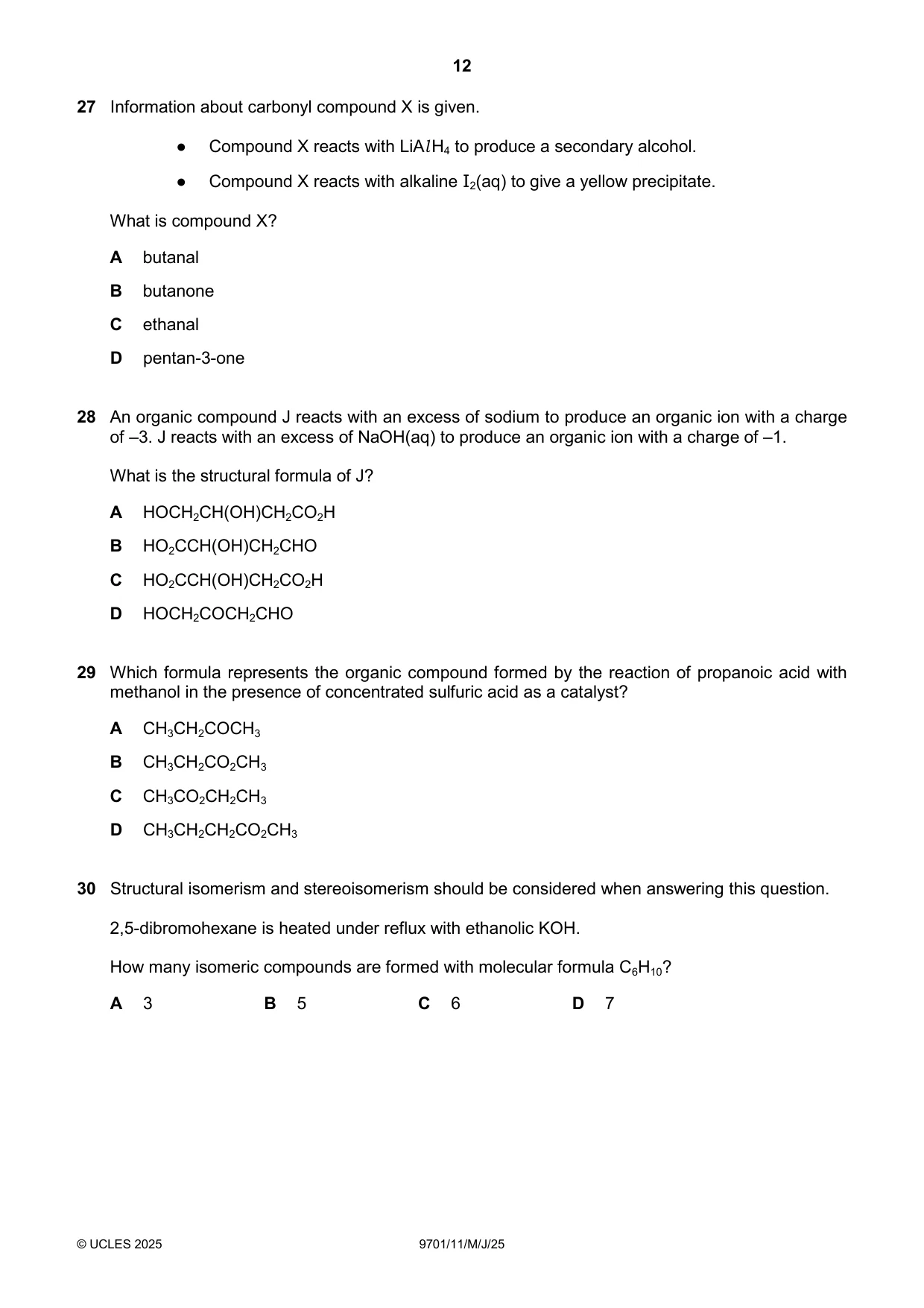
27 Information about carbonyl compound X is given. ● Compound X reacts with LiAlH4 to produce a secondary alcohol. ● Compound X reacts with alkaline I2(aq) to give a yellow precipitate. What is compound X? A butanal B butanone C ethanal D pentan-3-one
Mark scheme: B
Q28 · An organic compound J reacts with an excess of sodium to produce an organic ion with a…
28 An organic compound J reacts with an excess of sodium to produce an organic ion with a charge of –3. J reacts with an excess of NaOH(aq) to produce an organic ion with a charge of –1. What is the structural formula of J? A HOCH2CH(OH)CH2CO2H B HO2CCH(OH)CH2CHO C HO2CCH(OH)CH2CO2H D HOCH2COCH2CHO
Mark scheme: A
Q29 · Which formula represents the organic compound formed by the reaction of propanoic acid…
29 Which formula represents the organic compound formed by the reaction of propanoic acid with methanol in the presence of concentrated sulfuric acid as a catalyst? A CH3CH2COCH3 B CH3CH2CO2CH3 C CH3CO2CH2CH3 D CH3CH2CH2CO2CH3
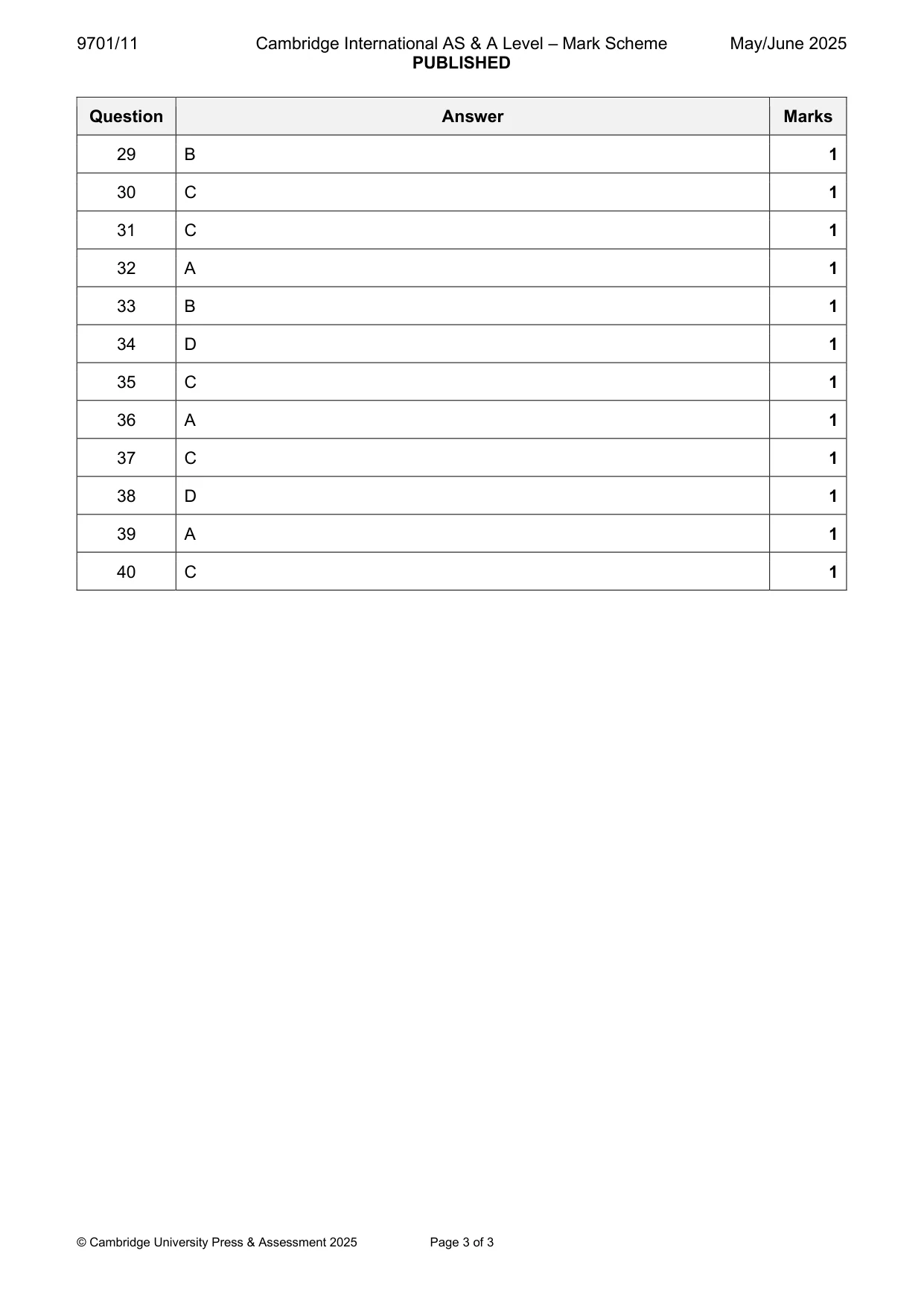
Mark scheme: B
Q30 · Structural isomerism and stereoisomerism should be considered when answering this question
30 Structural isomerism and stereoisomerism should be considered when answering this question. 2,5-dibromohexane is heated under reflux with ethanolic KOH. How many isomeric compounds are formed with molecular formula C6H10? A 3 B 5 C 6 D 7
Mark scheme: C
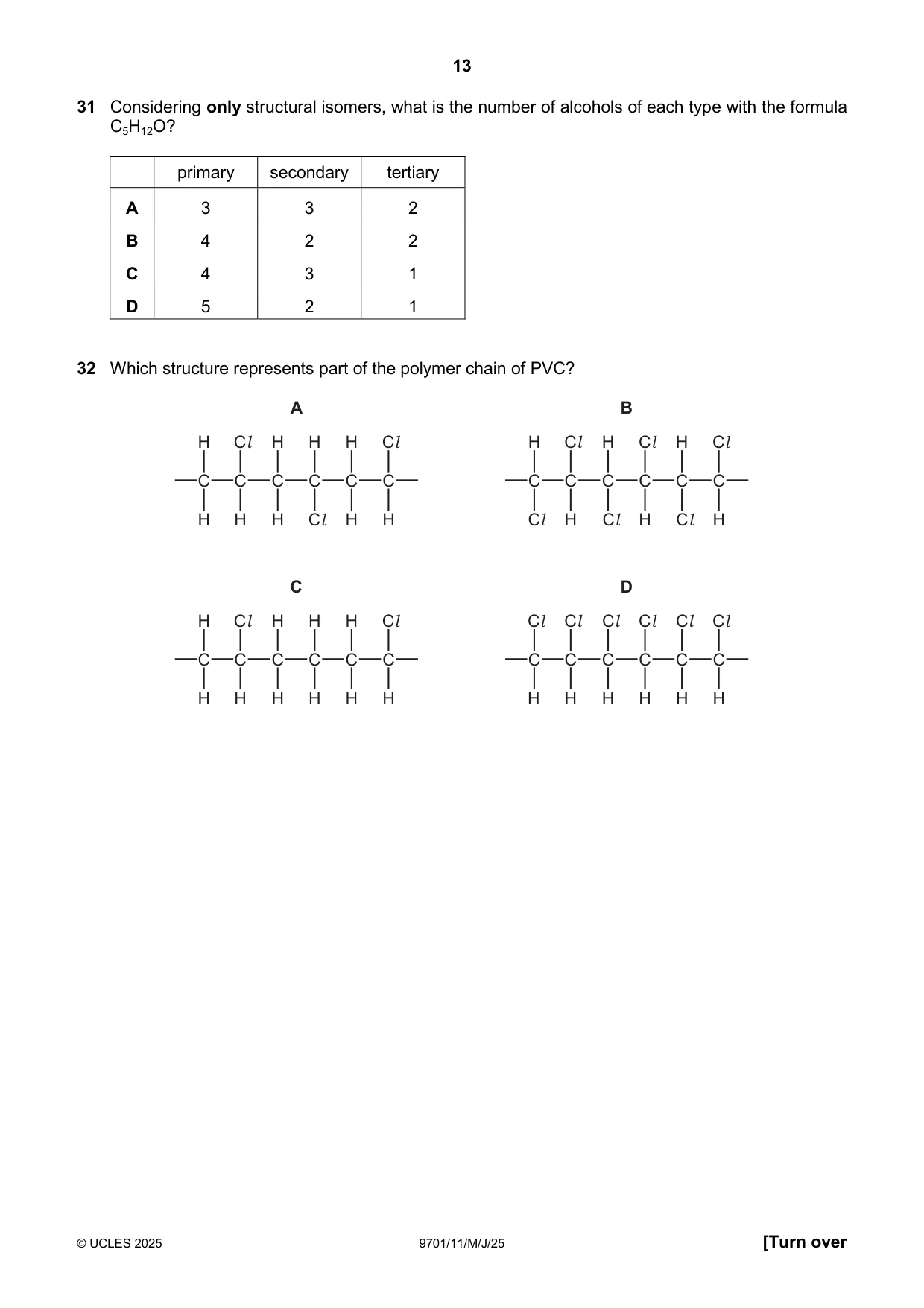
Q31 · Considering only structural isomers, what is the number of alcohols of each type with the…
31 Considering only structural isomers, what is the number of alcohols of each type with the formula C5H12O? primary secondary tertiary A 3 3 2 B 4 2 2 C 4 3 1 D 5 2 1
Mark scheme: C
Q32 · Which structure represents part of the polymer chain of PVC?
32 Which structure represents part of the polymer chain of PVC? C H H C H H C H H C H A H C H C Cl Cl H C H C H C H C B H C H C Cl Cl Cl Cl Cl Cl H C H H C H H C H H C H C C H C Cl Cl Cl H C C C C D H C H C Cl Cl Cl Cl Cl Cl H H H H
Mark scheme: A
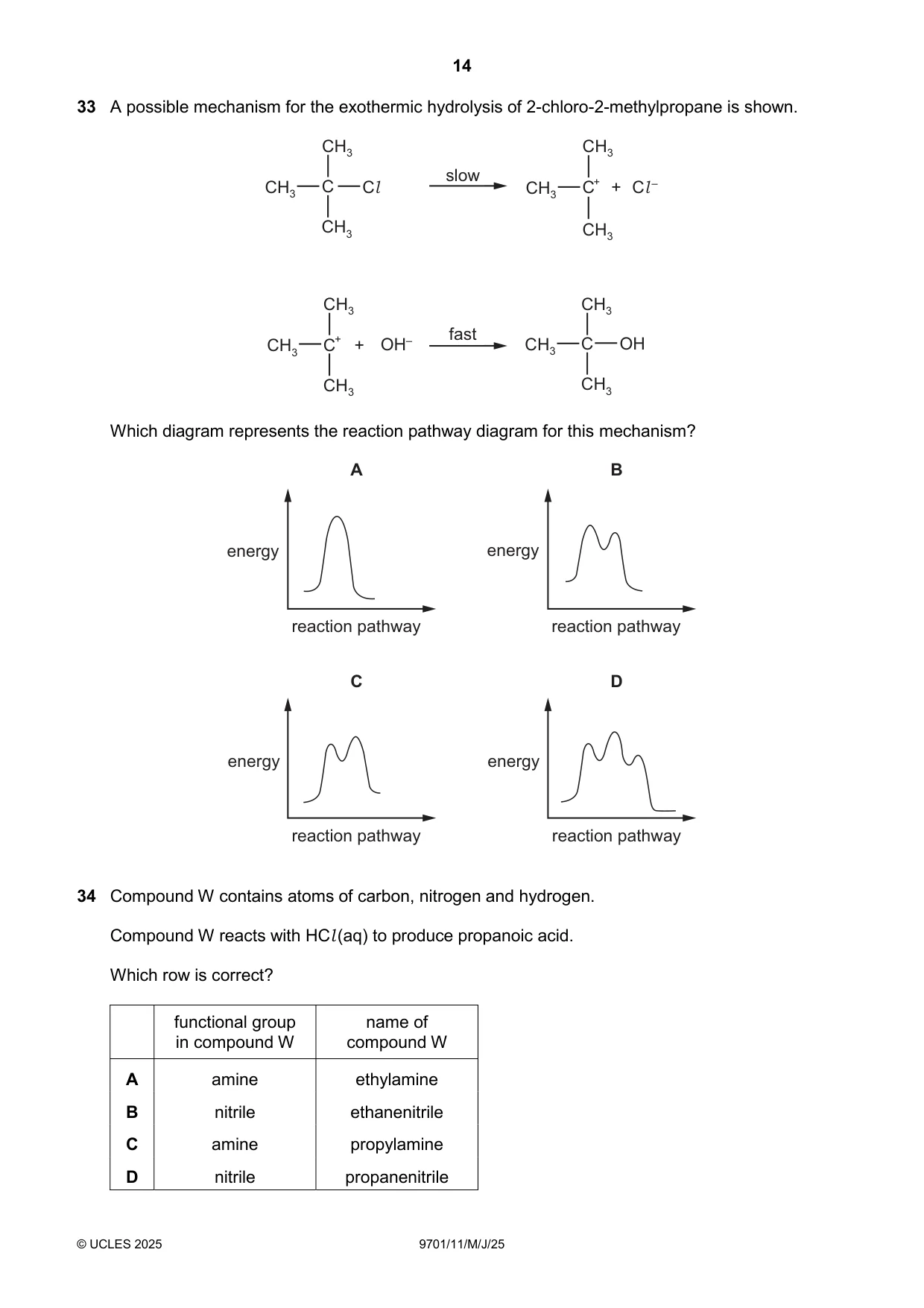
Q33 · A possible mechanism for the exothermic hydrolysis of 2-chloro-2-methylpropane is shown
33 A possible mechanism for the exothermic hydrolysis of 2-chloro-2-methylpropane is shown. CH3 C Cl CH3 CH3 CH3 C Cl– CH3 CH3 + CH3 C CH3 CH3 CH3 C CH3 CH3 slow fast OH– + OH + + Which diagram represents the reaction pathway diagram for this mechanism? reaction pathway energy reaction pathway energy reaction pathway energy reaction pathway energy A B C D
Mark scheme: B
More questions on Effect of temperature on reaction rates and the concept of activation energy
Q34 · Compound W contains atoms of carbon, nitrogen and hydrogen
34 Compound W contains atoms of carbon, nitrogen and hydrogen. Compound W reacts with HCl(aq) to produce propanoic acid. Which row is correct? functional group in compound W name of compound W A amine ethylamine B nitrile ethanenitrile C amine propylamine D nitrile propanenitrile
Mark scheme: D
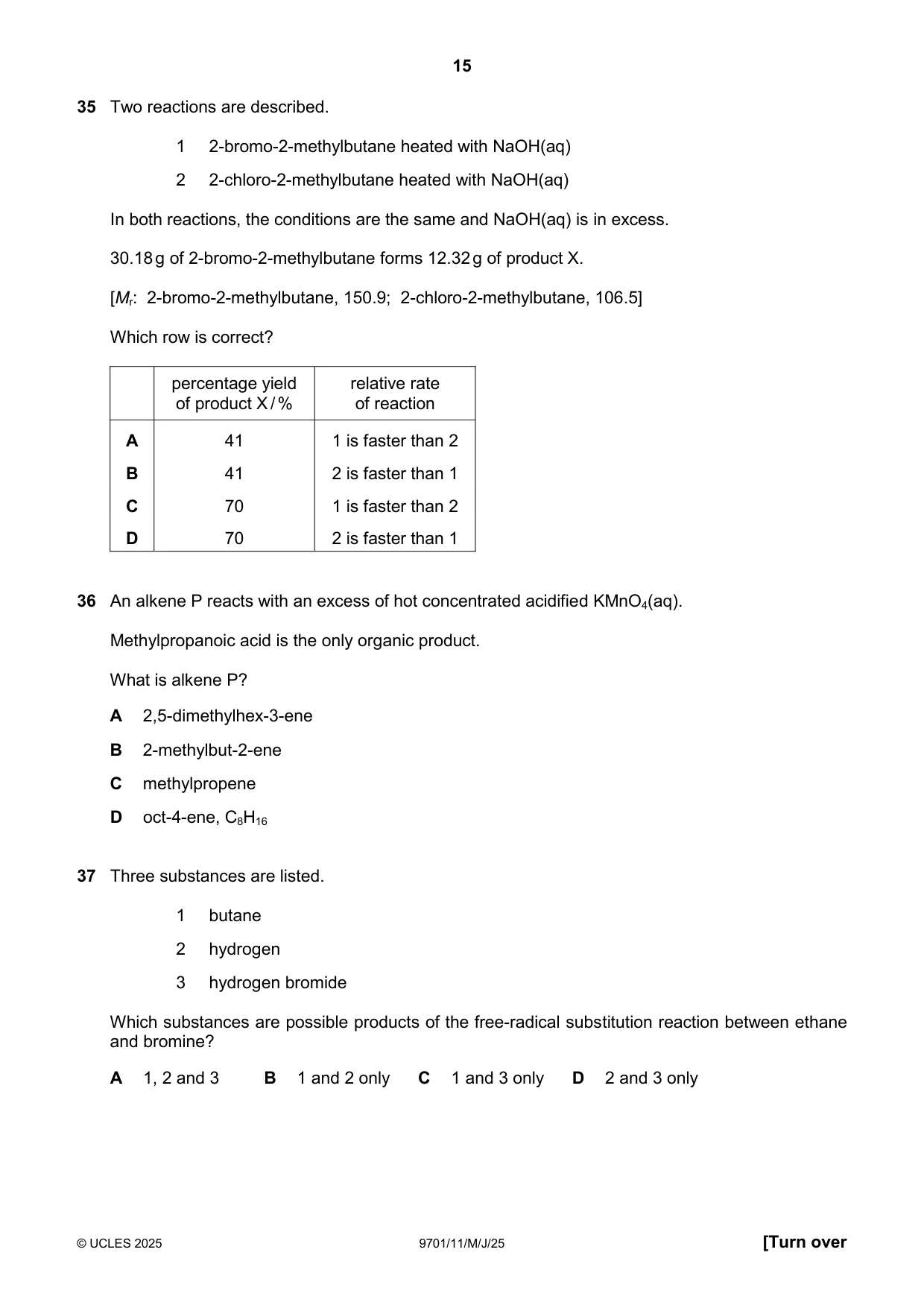
Q35 · Two reactions are described
35 Two reactions are described. 1 2-bromo-2-methylbutane heated with NaOH(aq) 2 2-chloro-2-methylbutane heated with NaOH(aq) In both reactions, the conditions are the same and NaOH(aq) is in excess. 30.18g of 2-bromo-2-methylbutane forms 12.32g of product X. [Mr: 2-bromo-2-methylbutane, 150.9; 2-chloro-2-methylbutane, 106.5] Which row is correct? percentage yield of product X/% relative rate of reaction A 41 1 is faster than 2 B 41 2 is faster than 1 C 70 1 is faster than 2 D 70 2 is faster than 1
Mark scheme: C
Q36 · An alkene P reacts with an excess of hot concentrated acidified KMnO4(aq)
36 An alkene P reacts with an excess of hot concentrated acidified KMnO4(aq). Methylpropanoic acid is the only organic product. What is alkene P? A 2,5-dimethylhex-3-ene B 2-methylbut-2-ene C methylpropene D oct-4-ene, C8H16
Mark scheme: A
Q37 · Three substances are listed
37 Three substances are listed. 1 butane 2 hydrogen 3 hydrogen bromide Which substances are possible products of the free-radical substitution reaction between ethane and bromine? A 1, 2 and 3 B 1 and 2 only C 1 and 3 only D 2 and 3 only
Mark scheme: C
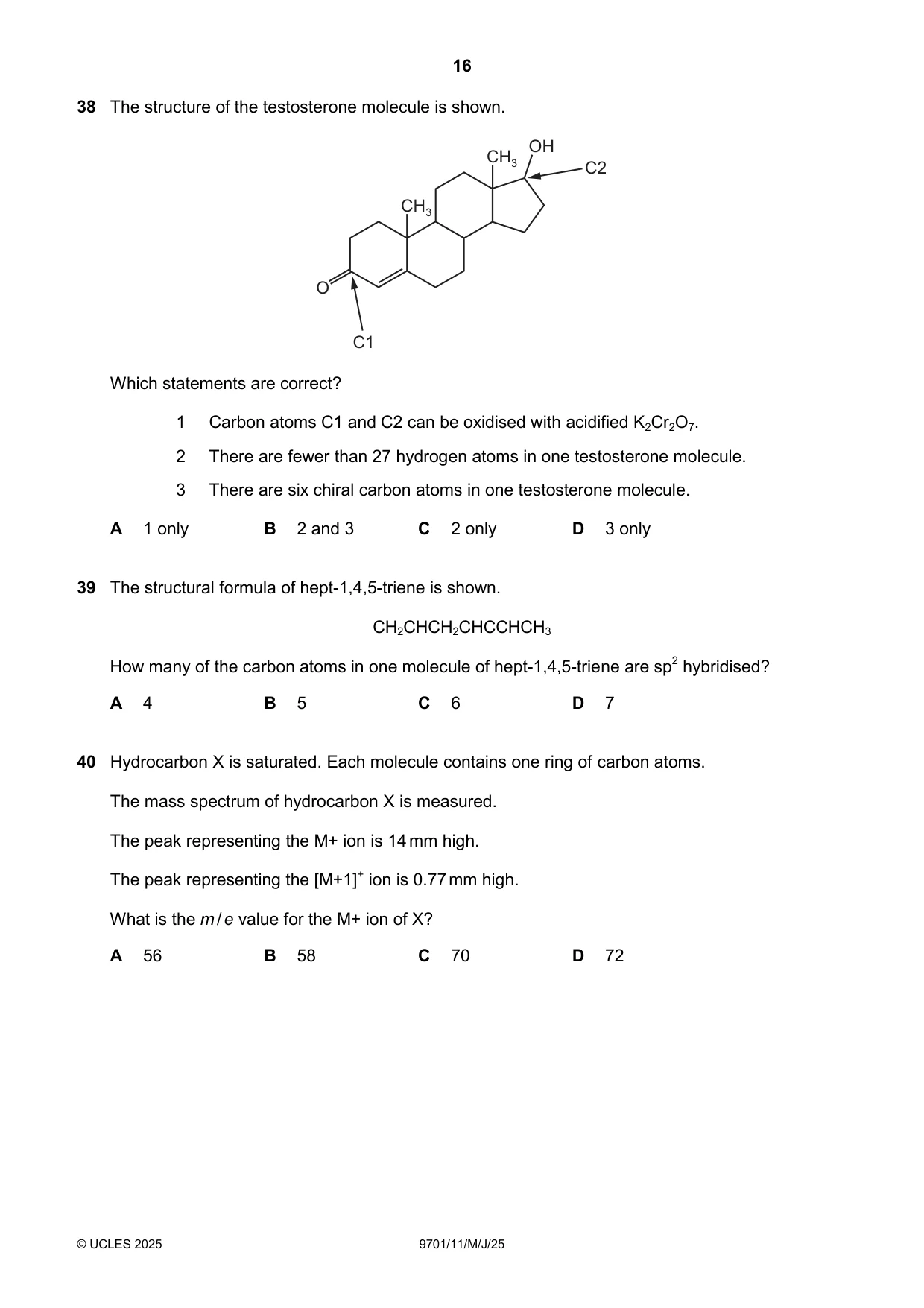
Q38 · The structure of the testosterone molecule is shown
38 The structure of the testosterone molecule is shown. O CH3 OH CH3 C2 C1 Which statements are correct? 1 Carbon atoms C1 and C2 can be oxidised with acidified K2Cr2O7. 2 There are fewer than 27 hydrogen atoms in one testosterone molecule. 3 There are six chiral carbon atoms in one testosterone molecule. A 1 only B 2 and 3 C 2 only D 3 only
Mark scheme: D
Q39 · The structural formula of hept-1,4,5-triene is shown
39 The structural formula of hept-1,4,5-triene is shown. CH2CHCH2CHCCHCH3 How many of the carbon atoms in one molecule of hept-1,4,5-triene are sp2 hybridised? A 4 B 5 C 6 D 7
Mark scheme: A
More questions on Shapes of organic molecules; σ and π bonds
Q40 · Hydrocarbon X is saturated
40 Hydrocarbon X is saturated. Each molecule contains one ring of carbon atoms. The mass spectrum of hydrocarbon X is measured. The peak representing the M+ ion is 14mm high. The peak representing the [M+1]+ ion is 0.77mm high. What is the m/e value for the M+ ion of X? A 56 B 58 C 70 D 72
Mark scheme: C
What was in this paper
The subtopics covered by these 39 questions, and how many questions each got. Open one in a new tab to see every Cambridge question on it.
3Alcohols2Alkenes2Enthalpy change, ΔH2Periodicity of physical properties of the elements in Period 32Acids and bases1Addition polymerisation1Aldehydes and ketones1Alkanes1Bonding and structure1Brønsted–Lowry theory of acids and bases1Chemical equilibria: reversible reactions, dynamic equilibrium1Effect of temperature on reaction rates and the concept of activation energy1Electrons, energy levels and atomic orbitals1Esters1Halogenoalkanes1Homogeneous and heterogeneous catalysts1Homogeneous and heterogeneous catalysts1Ionic bonding1Ionisation energy1Isomerism: optical1Mass spectrometry1Nitriles and hydroxynitriles1Periodicity of chemical properties of the elements in Period 31Rate of reaction1Reacting masses and volumes (of solutions and gases)1Redox processes: electron transfer and changes in oxidation number (oxidation state)1Shapes of molecules1Shapes of organic molecules; σ and π bonds1Similarities and trends in the properties of the Group 2 metals, magnesium to barium, and their compounds1The chemical properties of the halogen elements and the hydrogen halides1The gaseous state: ideal and real gases and pV = nRT1The reactions of chlorine1What you needed in this session
Cambridge’s own grade thresholds for 2025 May/June, Paper 1 · Variant 1. A higher threshold means an easier paper — the bar moves with how the cohort did.