Cambridge A Level Chemistry 9701 — 2013 Oct/Nov Paper 1 · Variant 2
9701/12/O/N/13 · 40 questions · 40 marks · ≈45 min
The question paper and its mark scheme, free to read here and free to download. This is Cambridge’s own paper, exactly as it was sat.
Question paper16 pages
Mark scheme2 pages
Answers below. Sit the paper first if you are practising.
Questions as text
Q1 · At the age of 17, in a woodshed in Ohio, Charles Martin Hall discovered the commercial…
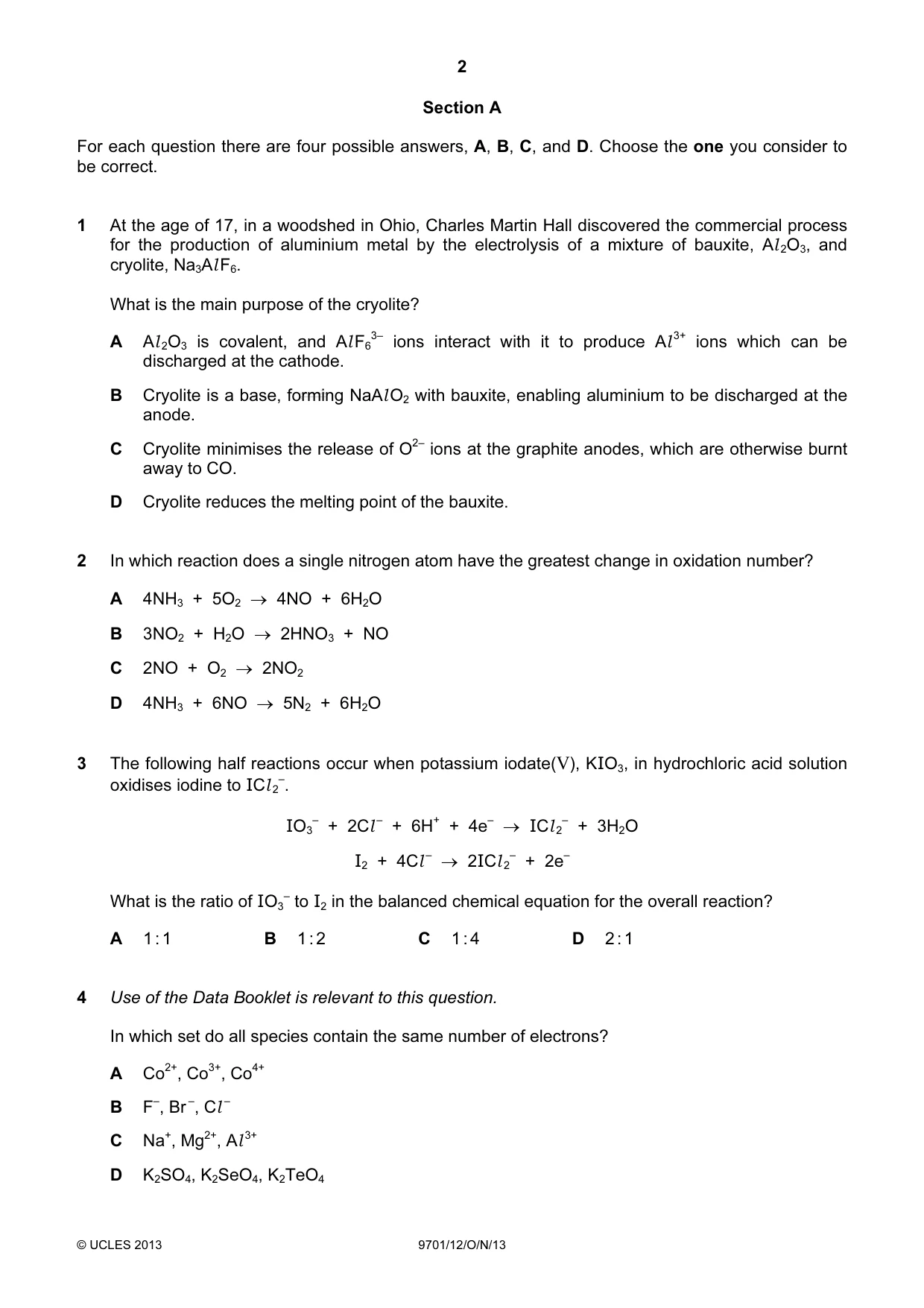
1 At the age of 17, in a woodshed in Ohio, Charles Martin Hall discovered the commercial process for the production of aluminium metal by the electrolysis of a mixture of bauxite, Al 2O3, and cryolite, Na3Al F6. What is the main purpose of the cryolite? A Al 2O3 is covalent, and Al F6 3– ions interact with it to produce Al 3+ ions which can be discharged at the cathode. B Cryolite is a base, forming NaAl O2 with bauxite, enabling aluminium to be discharged at the anode. C Cryolite minimises the release of O2– ions at the graphite anodes, which are otherwise burnt away to CO. D Cryolite reduces the melting point of the bauxite.
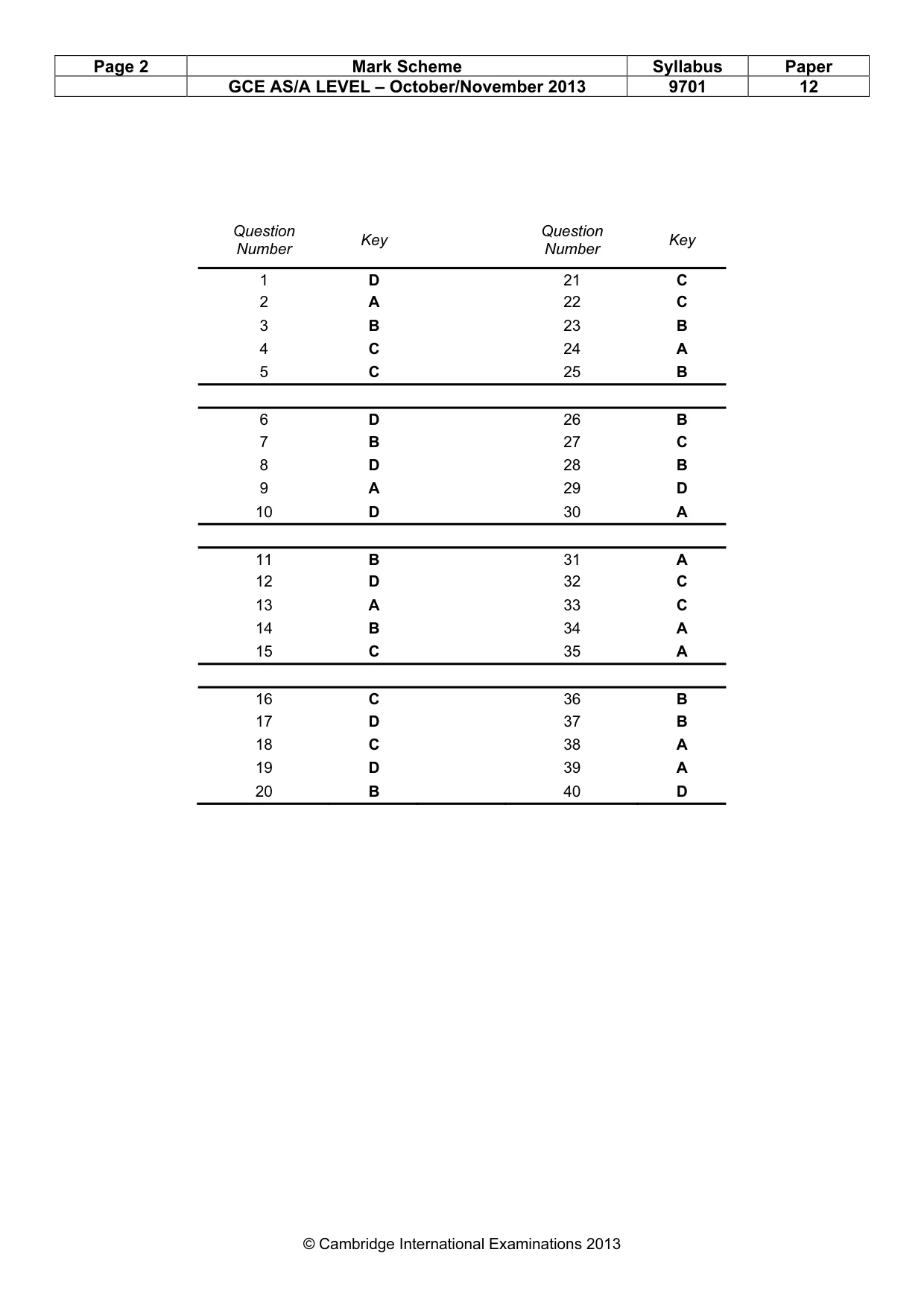
Mark scheme: D
Q2 · In which reaction does a single nitrogen atom have the greatest change in oxidation…
2 In which reaction does a single nitrogen atom have the greatest change in oxidation number? A 4NH3 + 5O2 → 4NO + 6H2O B 3NO2 + H2O → 2HNO3 + NO C 2NO + O2 → 2NO2 D 4NH3 + 6NO → 5N2 + 6H2O
Mark scheme: A
Q3 · The following half reactions occur when potassium iodate(V), KIO3, in hydrochloric acid…
3 The following half reactions occur when potassium iodate(V), KIO3, in hydrochloric acid solution oxidises iodine to ICl 2 –. IO3 – + 2Cl – + 6H+ + 4e– → ICl 2 – + 3H2O I2 + 4Cl – → 2ICl 2 – + 2e– What is the ratio of IO3 – to I2 in the balanced chemical equation for the overall reaction? A 1 : 1 B 1 : 2 C 1 : 4 D 2 : 1
Mark scheme: B
Q4 · Use of the Data Booklet is relevant to this question
4 Use of the Data Booklet is relevant to this question. In which set do all species contain the same number of electrons? A Co2+, Co3+, Co4+ B F–, Br –, Cl – C Na+, Mg2+, Al 3+ D K2SO4, K2SeO4, K2TeO4
Mark scheme: C
Q5 · An autocatalytic reaction is a reaction in which one of the products catalyses the…
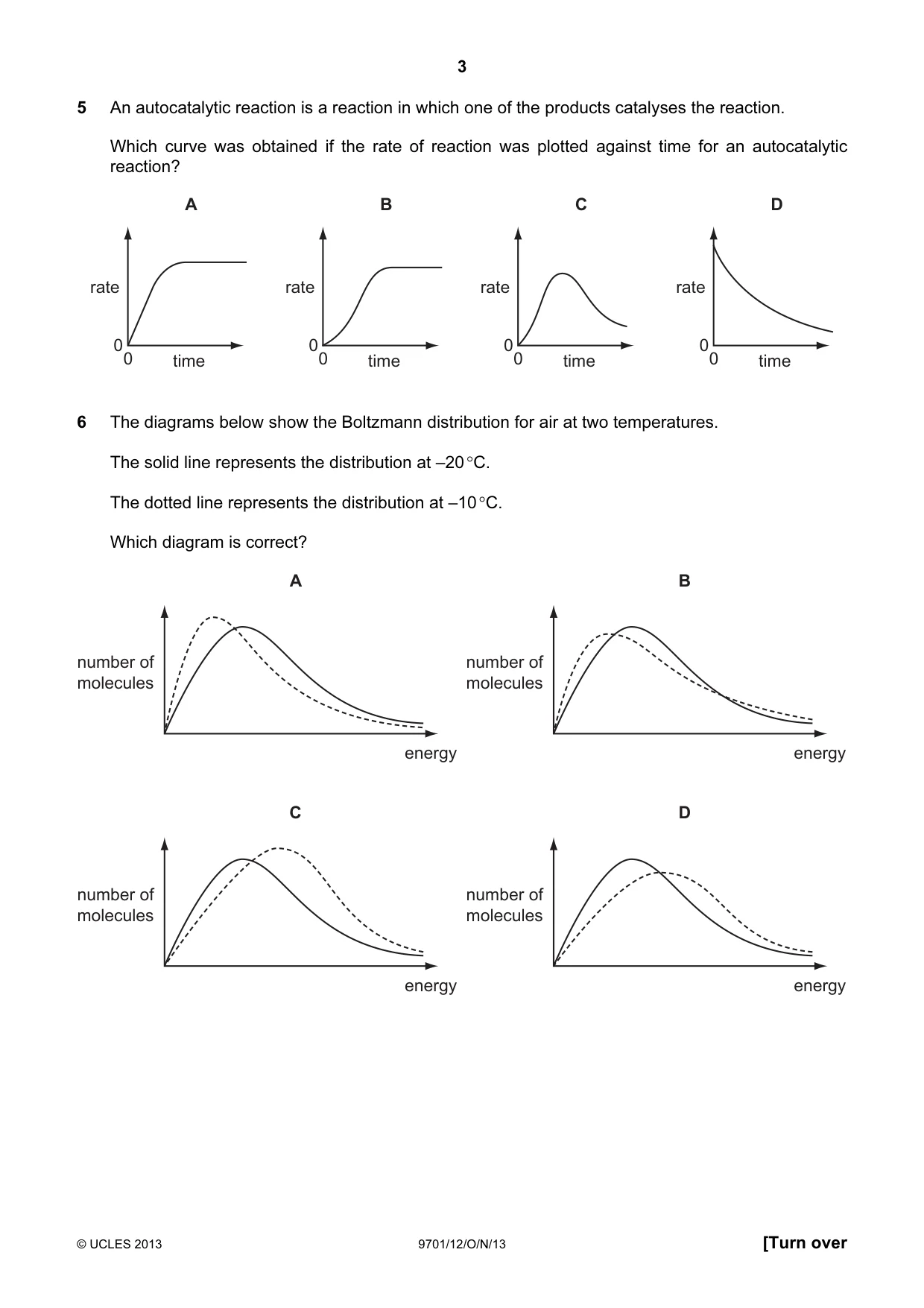
5 An autocatalytic reaction is a reaction in which one of the products catalyses the reaction. Which curve was obtained if the rate of reaction was plotted against time for an autocatalytic reaction? A B C D rate rate rate rate 00 00 00 00 time time time time
Mark scheme: C
Q6 · The diagrams below show the Boltzmann distribution for air at two temperatures
6 The diagrams below show the Boltzmann distribution for air at two temperatures. The solid line represents the distribution at –20 °C. The dotted line represents the distribution at –10 °C. Which diagram is correct? A B number of number of molecules molecules energy energy C D number of number of molecules molecules energy energy
Mark scheme: D
More questions on Effect of temperature on reaction rates and the concept of activation energy
Q7 · Which stage in the free radical substitution of methane by chlorine will have the lowest…
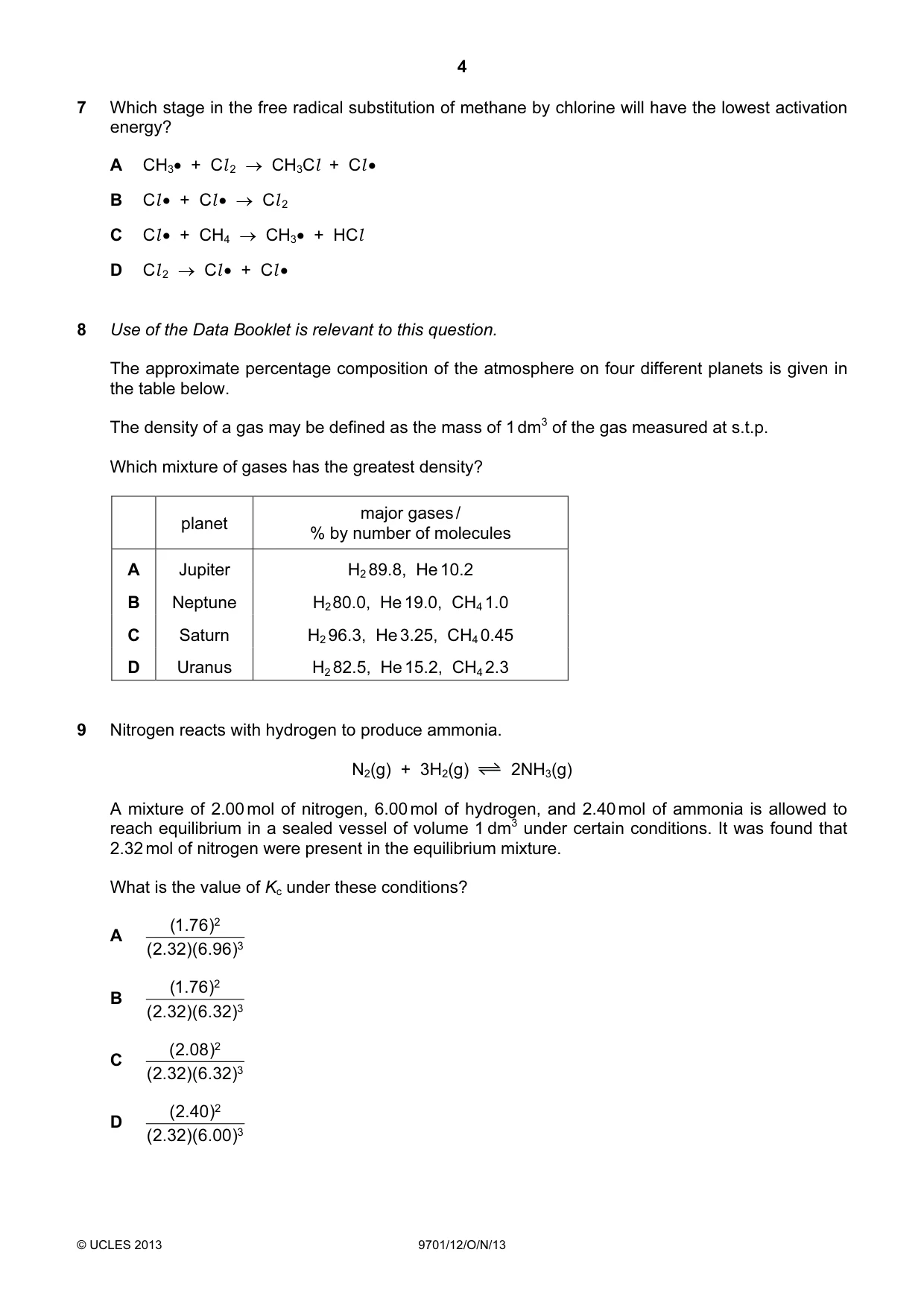
7 Which stage in the free radical substitution of methane by chlorine will have the lowest activation energy? A CH3• + Cl 2 → CH3Cl + Cl • B Cl • + Cl • → Cl 2 C Cl • + CH4 → CH3• + HCl D Cl 2 → Cl • + Cl •
Mark scheme: B
More questions on Effect of temperature on reaction rates and the concept of activation energy
Q8 · Use of the Data Booklet is relevant to this question
8 Use of the Data Booklet is relevant to this question. The approximate percentage composition of the atmosphere on four different planets is given in the table below. The density of a gas may be defined as the mass of 1 dm3 of the gas measured at s.t.p. Which mixture of gases has the greatest density? major gases / planet % by number of molecules A Jupiter H2 89.8, He 10.2 B Neptune H2 80.0, He 19.0, CH4 1.0 C Saturn H2 96.3, He 3.25, CH4 0.45 D Uranus H2 82.5, He 15.2, CH4 2.3
Mark scheme: D
More questions on The gaseous state: ideal and real gases and pV = nRT
Q9 · Nitrogen reacts with hydrogen to produce ammonia
9 Nitrogen reacts with hydrogen to produce ammonia. N2(g) + 3H2(g) 2NH3(g) A mixture of 2.00 mol of nitrogen, 6.00 mol of hydrogen, and 2.40 mol of ammonia is allowed to reach equilibrium in a sealed vessel of volume 1 dm3 under certain conditions. It was found that 2.32 mol of nitrogen were present in the equilibrium mixture. What is the value of Kc under these conditions? ( 1 . 76 ) 2 A ( 2 . 32 )( 6 . 96 ) 3 ( 1 . 76 ) 2 B ( 2 . 32 )( 6 . 32 ) 3 ( 2 . 08 ) 2 C ( 2 . 32 )( 6 . 32 ) 3 ( 2 . 40 ) 2 D ( 2 . 32 )( 6 . 00 ) 3
Mark scheme: A
More questions on Chemical equilibria: reversible reactions, dynamic equilibrium
Q10 · Use of the Data Booklet is relevant to this question
10 Use of the Data Booklet is relevant to this question. Which sodium compound contains 74.2 % by mass of sodium? A sodium carbonate B sodium chloride C sodium hydroxide D sodium oxide
Mark scheme: D
Q11 · Use of the Data Booklet is relevant to this question
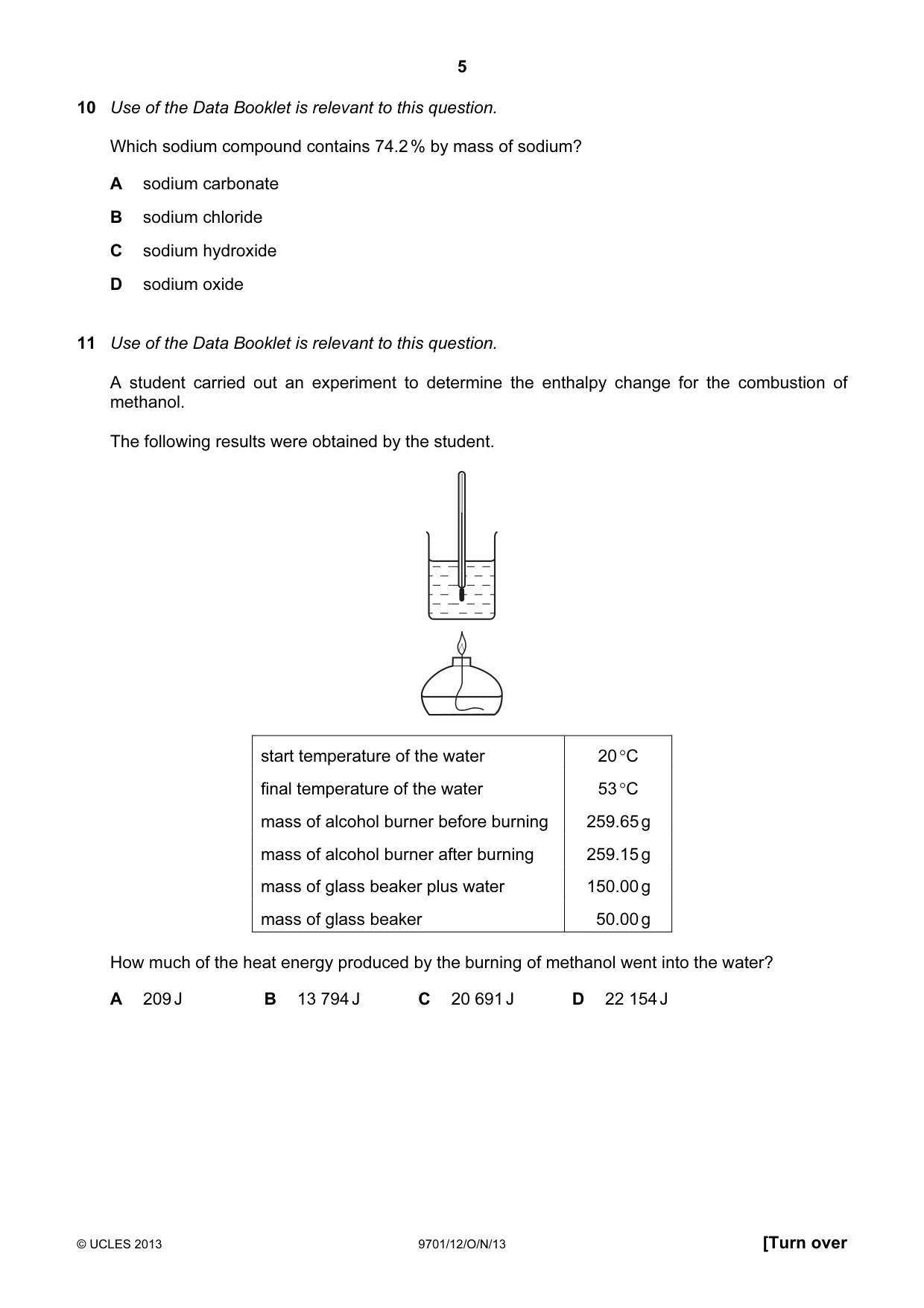
11 Use of the Data Booklet is relevant to this question. A student carried out an experiment to determine the enthalpy change for the combustion of methanol. The following results were obtained by the student. start temperature of the water 20 °C final temperature of the water 53 °C mass of alcohol burner before burning 259.65 g mass of alcohol burner after burning 259.15 g mass of glass beaker plus water 150.00 g mass of glass beaker 50.00 g How much of the heat energy produced by the burning of methanol went into the water? A 209 J B 13 794 J C 20 691 J D 22 154 J
Mark scheme: B
Q12 · Strontium metal can be obtained by the electrolysis of molten strontium bromide, SrBr2…
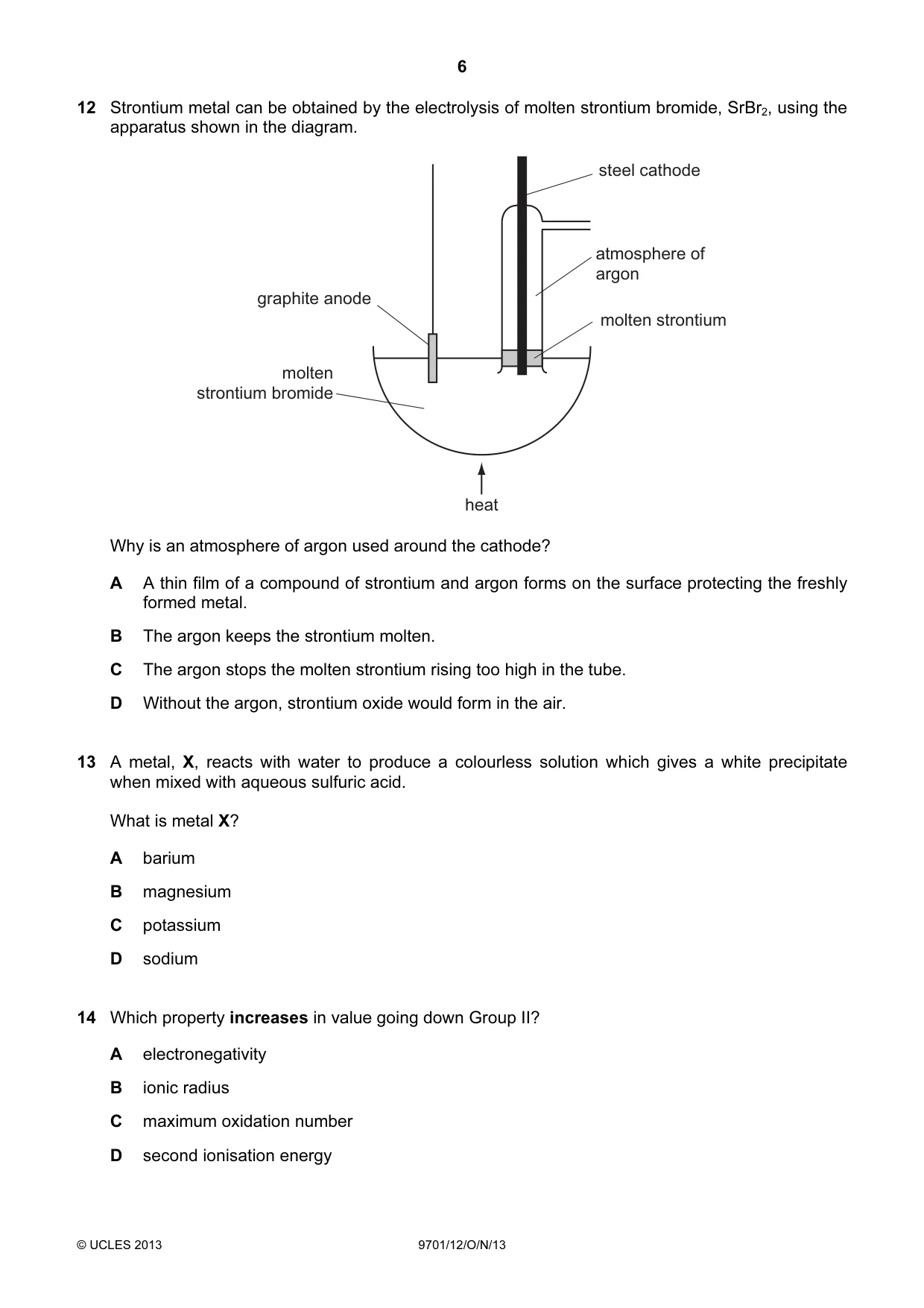
12 Strontium metal can be obtained by the electrolysis of molten strontium bromide, SrBr2, using the apparatus shown in the diagram. steel cathode atmosphere of argon graphite anode molten strontium molten strontium bromide heat Why is an atmosphere of argon used around the cathode? A A thin film of a compound of strontium and argon forms on the surface protecting the freshly formed metal. B The argon keeps the strontium molten. C The argon stops the molten strontium rising too high in the tube. D Without the argon, strontium oxide would form in the air.
Mark scheme: D
Q13 · A metal, X, reacts with water to produce a colourless solution which gives a white…
13 A metal, X, reacts with water to produce a colourless solution which gives a white precipitate when mixed with aqueous sulfuric acid. What is metal X? A barium B magnesium C potassium D sodium
Mark scheme: A
Q14 · Which property increases in value going down Group II?
14 Which property increases in value going down Group II? A electronegativity B ionic radius C maximum oxidation number D second ionisation energy
Mark scheme: B
Q15 · Which row correctly identifies the uses of some of the compounds of Group II metals?
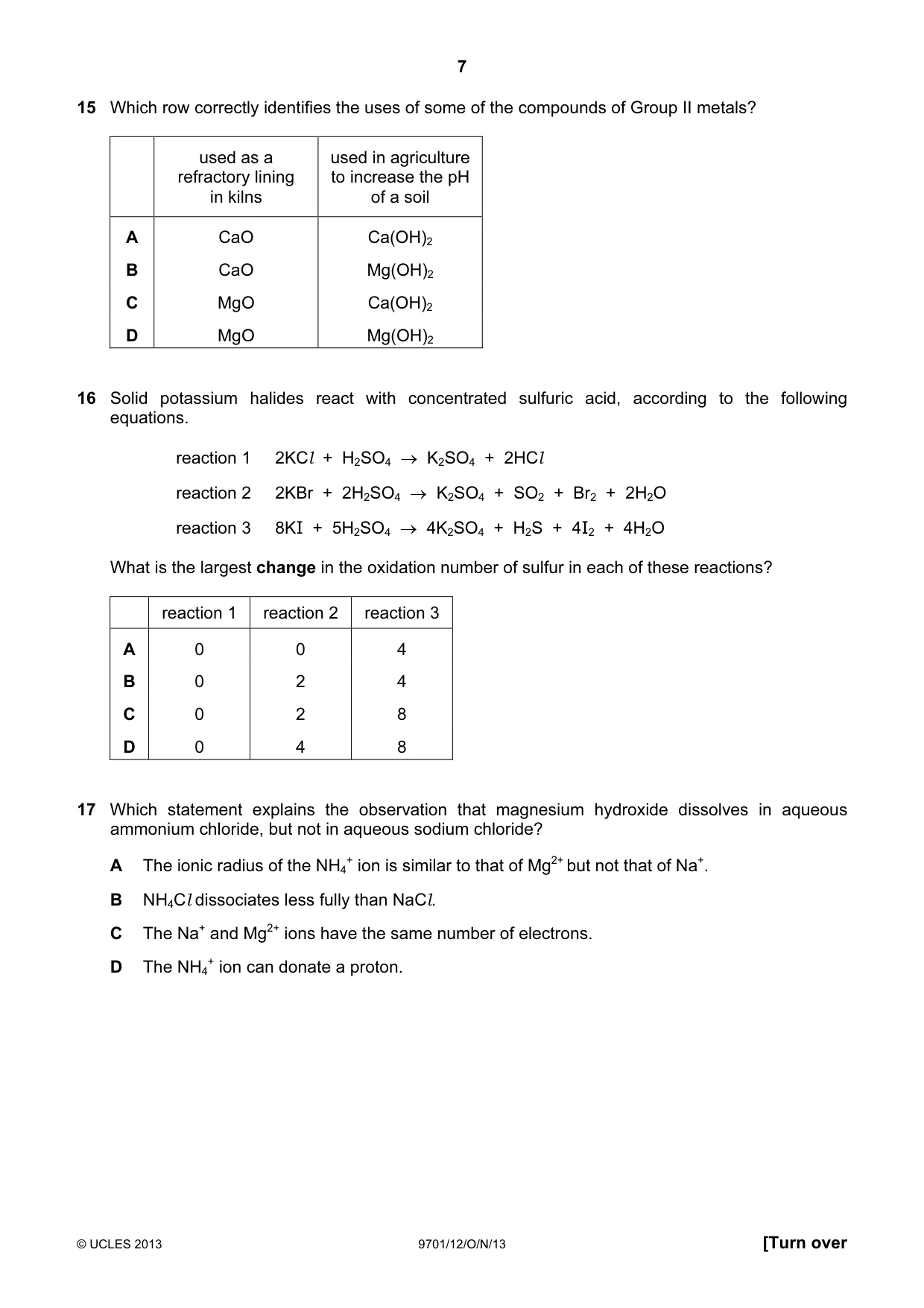
15 Which row correctly identifies the uses of some of the compounds of Group II metals? used as a used in agriculture refractory lining to increase the pH in kilns of a soil A CaO Ca(OH)2 B CaO Mg(OH)2 C MgO Ca(OH)2 D MgO Mg(OH)2
Mark scheme: C
Q16 · Solid potassium halides react with concentrated sulfuric acid, according to the following…
16 Solid potassium halides react with concentrated sulfuric acid, according to the following equations. reaction 1 2KCl + H2SO4 → K2SO4 + 2HCl reaction 2 2KBr + 2H2SO4 → K2SO4 + SO2 + Br2 + 2H2O reaction 3 8KI + 5H2SO4 → 4K2SO4 + H2S + 4I2 + 4H2O What is the largest change in the oxidation number of sulfur in each of these reactions? reaction 1 reaction 2 reaction 3 A 0 0 4 B 0 2 4 C 0 2 8 D 0 4 8
Mark scheme: C
Q17 · Which statement explains the observation that magnesium hydroxide dissolves in aqueous…
17 Which statement explains the observation that magnesium hydroxide dissolves in aqueous ammonium chloride, but not in aqueous sodium chloride? A The ionic radius of the NH4 + ion is similar to that of Mg2+ but not that of Na+. B NH4Cl dissociates less fully than NaCl. C The Na+ and Mg2+ ions have the same number of electrons. D The NH4 + ion can donate a proton.
Mark scheme: D
Q18 · Transition metals and their compounds are used as catalysts
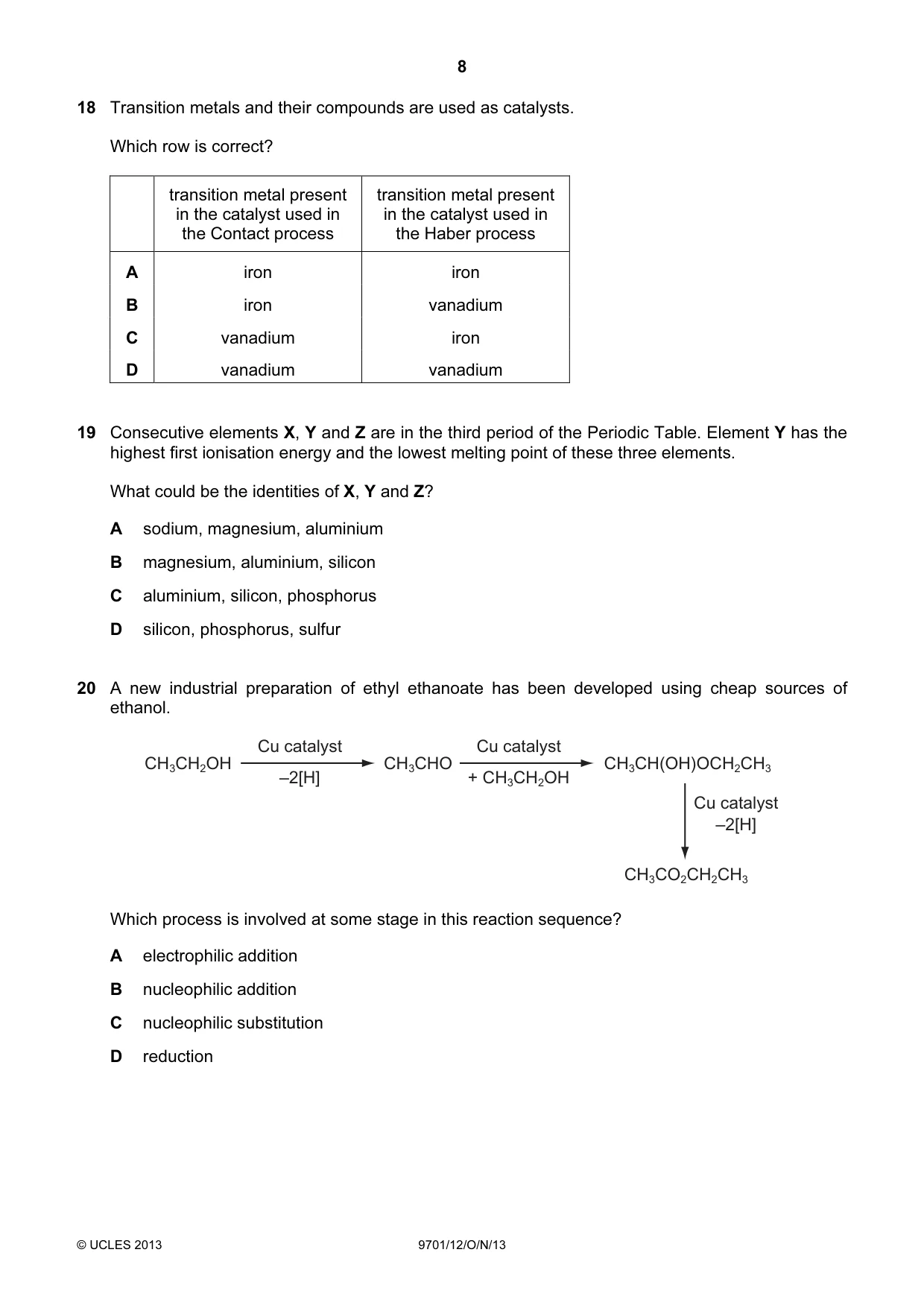
18 Transition metals and their compounds are used as catalysts. Which row is correct? transition metal present transition metal present in the catalyst used in in the catalyst used in the Contact process the Haber process A iron iron B iron vanadium C vanadium iron D vanadium vanadium
Mark scheme: C
Q19 · Consecutive elements X, Y and Z are in the third period of the Periodic Table
19 Consecutive elements X, Y and Z are in the third period of the Periodic Table. Element Y has the highest first ionisation energy and the lowest melting point of these three elements. What could be the identities of X, Y and Z? A sodium, magnesium, aluminium B magnesium, aluminium, silicon C aluminium, silicon, phosphorus D silicon, phosphorus, sulfur
Mark scheme: D
More questions on Periodicity of physical properties of the elements in Period 3
Q20 · A new industrial preparation of ethyl ethanoate has been developed using cheap sources of…
20 A new industrial preparation of ethyl ethanoate has been developed using cheap sources of ethanol. Cu catalyst Cu catalyst CH3CH2OH CH3CHO CH3CH(OH)OCH2CH3 –2[H] + CH3CH2OH Cu catalyst –2[H] CH3CO2CH2CH3 Which process is involved at some stage in this reaction sequence? A electrophilic addition B nucleophilic addition C nucleophilic substitution D reduction
Mark scheme: B
Q21 · Which reaction will give the best yield of 1-chloropropane?
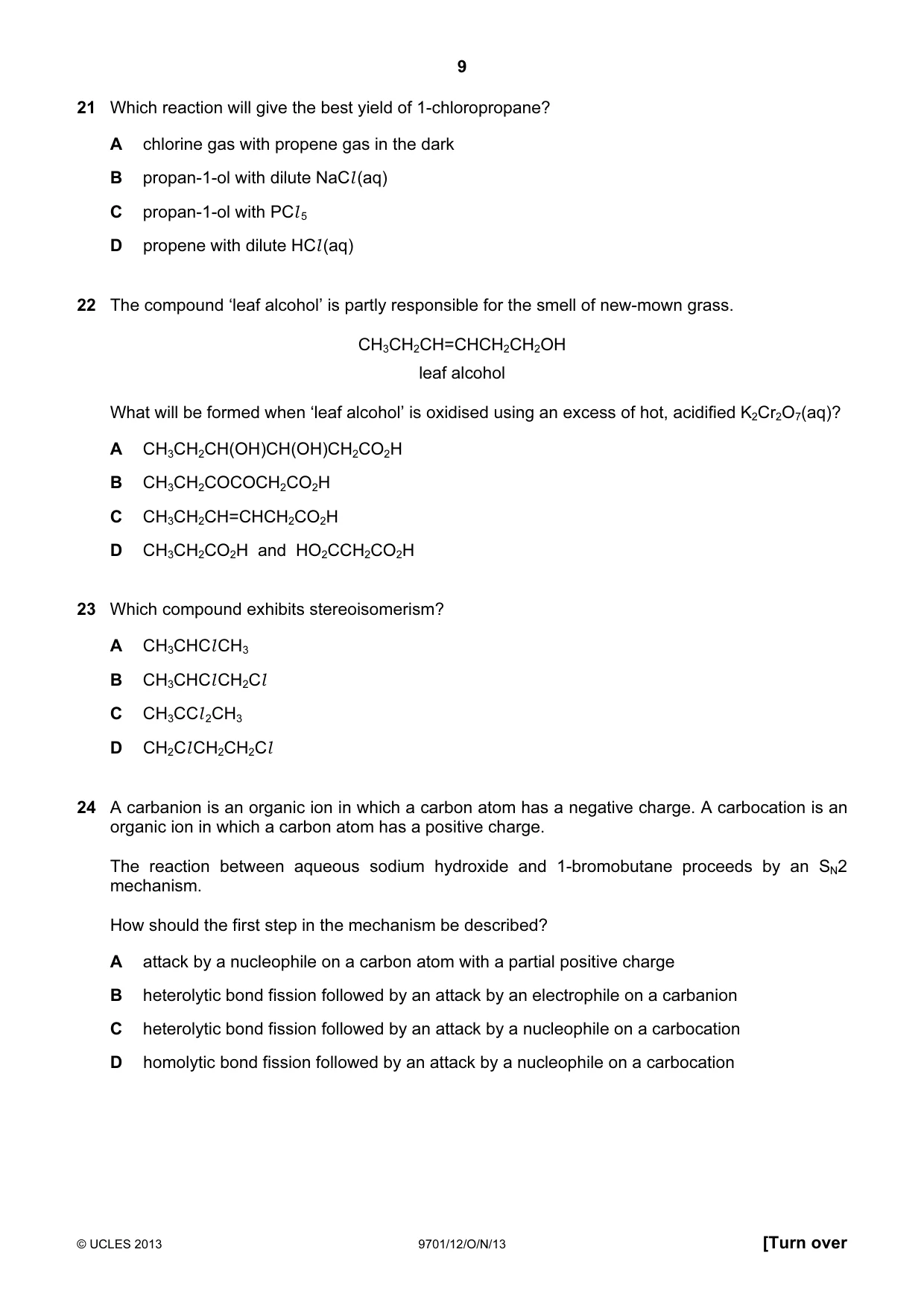
21 Which reaction will give the best yield of 1-chloropropane? A chlorine gas with propene gas in the dark B propan-1-ol with dilute NaCl (aq) C propan-1-ol with PCl 5 D propene with dilute HCl (aq)
Mark scheme: C
Q22 · The compound ‘leaf alcohol’ is partly responsible for the smell of new-mown grass
22 The compound ‘leaf alcohol’ is partly responsible for the smell of new-mown grass. CH3CH2CH=CHCH2CH2OH leaf alcohol What will be formed when ‘leaf alcohol’ is oxidised using an excess of hot, acidified K2Cr2O7(aq)? A CH3CH2CH(OH)CH(OH)CH2CO2H B CH3CH2COCOCH2CO2H C CH3CH2CH=CHCH2CO2H D CH3CH2CO2H and HO2CCH2CO2H
Mark scheme: C
Q23 · Which compound exhibits stereoisomerism?
23 Which compound exhibits stereoisomerism? A CH3CHCl CH3 B CH3CHCl CH2Cl C CH3CCl 2CH3 D CH2Cl CH2CH2Cl
Mark scheme: B
More questions on Isomerism: structural isomerism and stereoisomerism
Q24 · A carbanion is an organic ion in which a carbon atom has a negative charge
24 A carbanion is an organic ion in which a carbon atom has a negative charge. A carbocation is an organic ion in which a carbon atom has a positive charge. The reaction between aqueous sodium hydroxide and 1-bromobutane proceeds by an SN2 mechanism. How should the first step in the mechanism be described? A attack by a nucleophile on a carbon atom with a partial positive charge B heterolytic bond fission followed by an attack by an electrophile on a carbanion C heterolytic bond fission followed by an attack by a nucleophile on a carbocation D homolytic bond fission followed by an attack by a nucleophile on a carbocation
Mark scheme: A
Q25 · What are the only structures formed when butan-2-ol is heated with concentrated H2SO4?
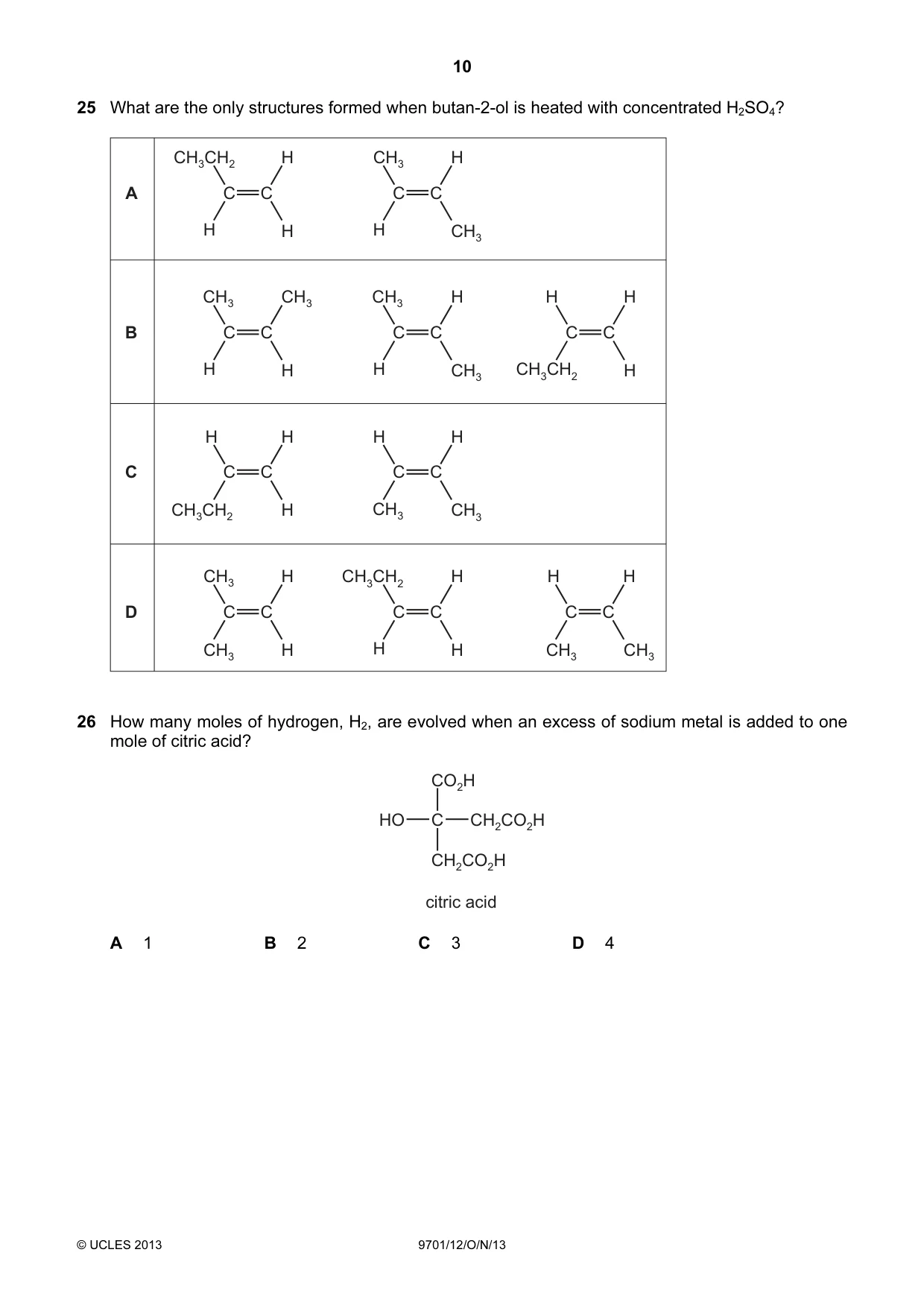
25 What are the only structures formed when butan-2-ol is heated with concentrated H2SO4? CH3CH2 H CH3 H A C C C C H H H CH3 CH3 CH3 CH3 H H H B C C C C C C H H H CH3 CH3CH2 H H H H H C C C C C CH3CH2 H CH3 CH3 CH3 H CH3CH2 H H H D C C C C C C CH3 H H H CH3 CH3
Mark scheme: B
Q26 · How many moles of hydrogen, H2, are evolved when an excess of sodium metal is added to…
26 How many moles of hydrogen, H2, are evolved when an excess of sodium metal is added to one mole of citric acid? CO2H HO C CH2CO2H CH2CO2H citric acid A 1 B 2 C 3 D 4
Mark scheme: B
Q27 · Primary alcohols can be oxidised to aldehydes using either acidified potassium…
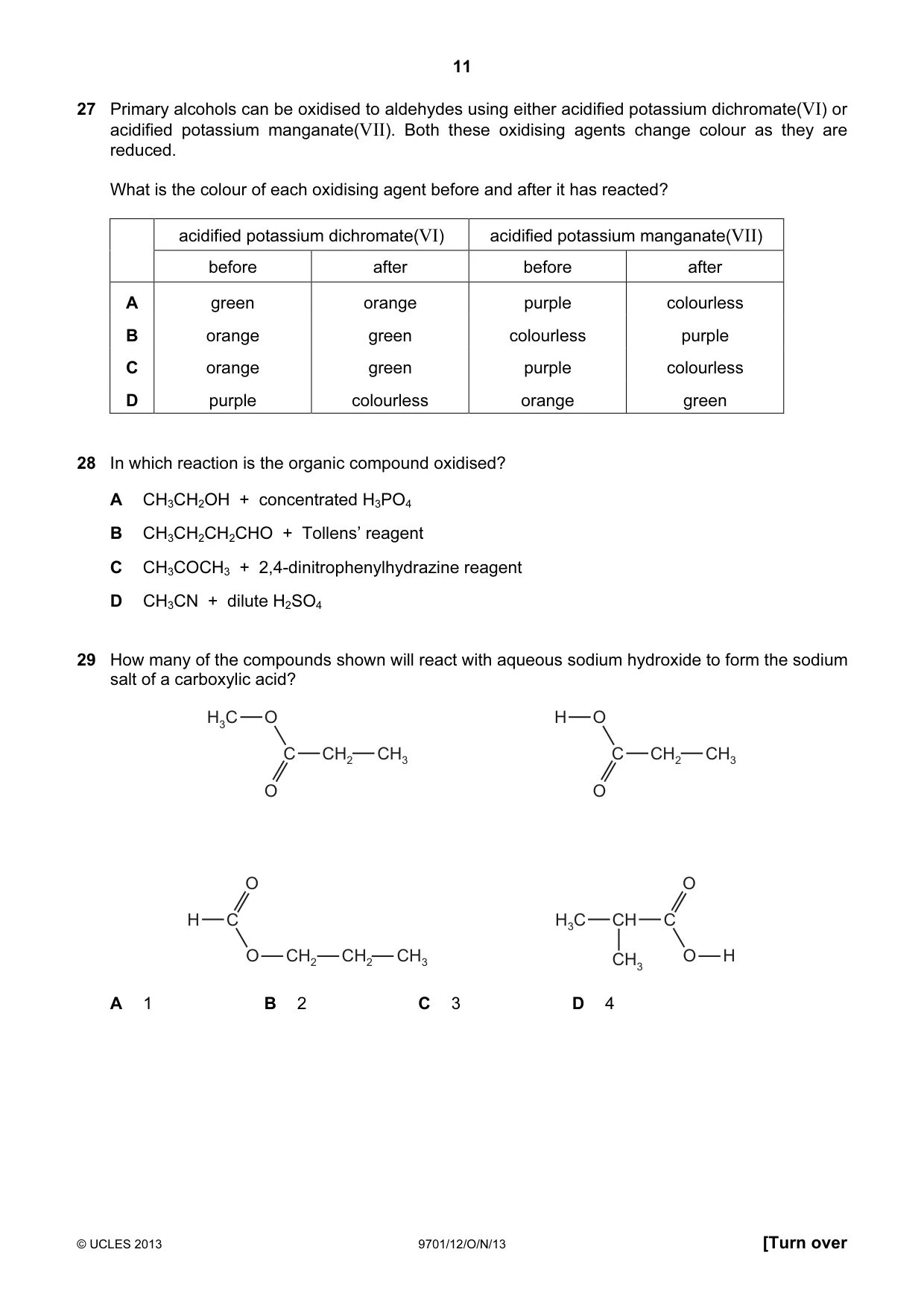
27 Primary alcohols can be oxidised to aldehydes using either acidified potassium dichromate(VI) or acidified potassium manganate(VII). Both these oxidising agents change colour as they are reduced. What is the colour of each oxidising agent before and after it has reacted? acidified potassium dichromate(VI) acidified potassium manganate(VII) before after before after A green orange purple colourless B orange green colourless purple C orange green purple colourless D purple colourless orange green
Mark scheme: C
Q28 · In which reaction is the organic compound oxidised?
28 In which reaction is the organic compound oxidised? A CH3CH2OH + concentrated H3PO4 B CH3CH2CH2CHO + Tollens’ reagent C CH3COCH3 + 2,4-dinitrophenylhydrazine reagent D CH3CN + dilute H2SO4
Mark scheme: B
Q29 · How many of the compounds shown will react with aqueous sodium hydroxide to form the…
29 How many of the compounds shown will react with aqueous sodium hydroxide to form the sodium salt of a carboxylic acid? H3C O H O C CH2 CH3 C CH2 CH3 O O O O H C H3C CH C O CH2 CH2 CH3 CH3 O H A 1 B 2 C 3 D 4
Mark scheme: D
Q30 · Which types of bond breakage and bond formation occur in the addition polymerisation of…
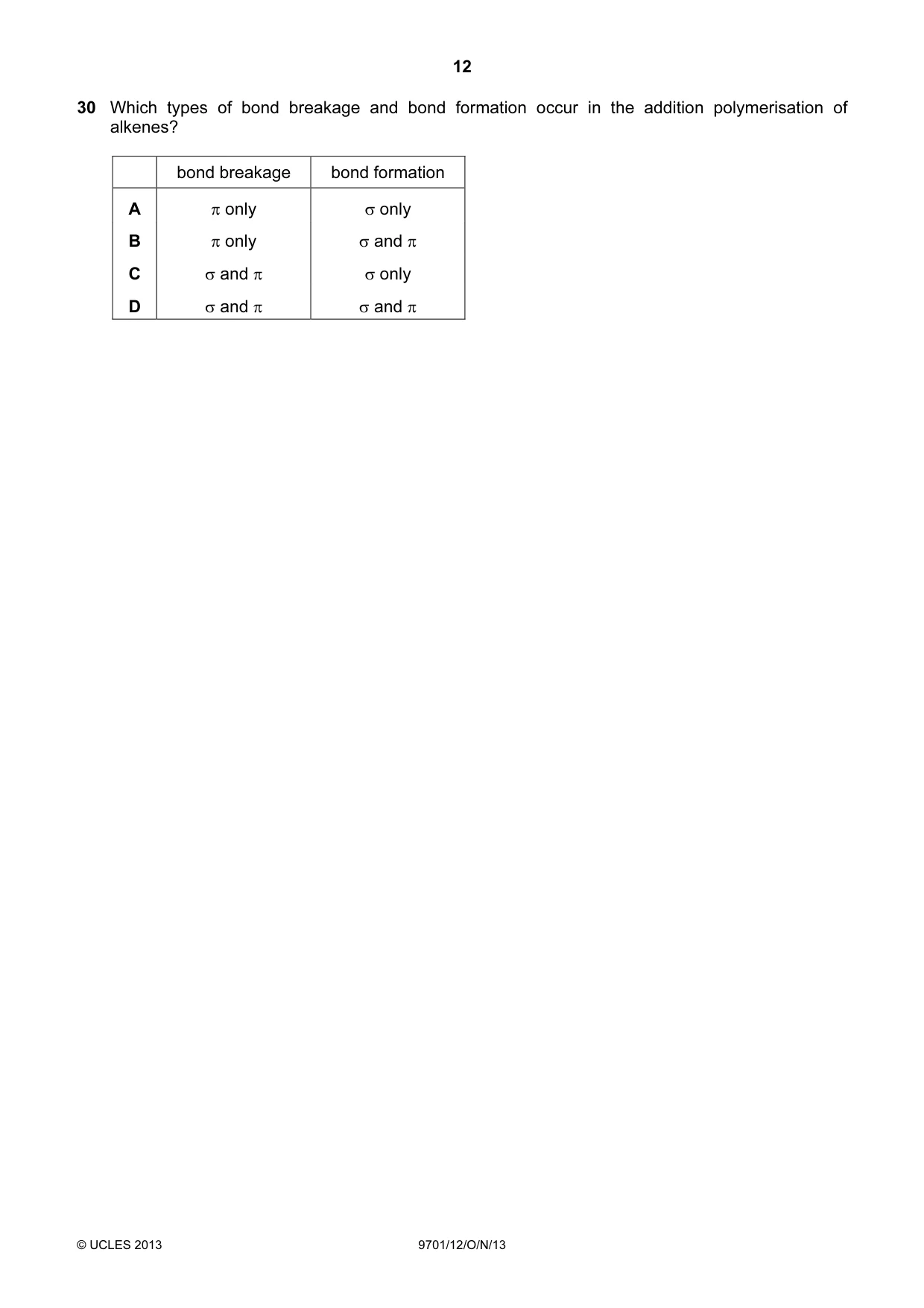
30 Which types of bond breakage and bond formation occur in the addition polymerisation of alkenes? bond breakage bond formation A π only σ only B π only σ and π C σ and π σ only D σ and π σ and π
Mark scheme: A
Q31 · X is a particle with 18 electrons and 20 neutrons
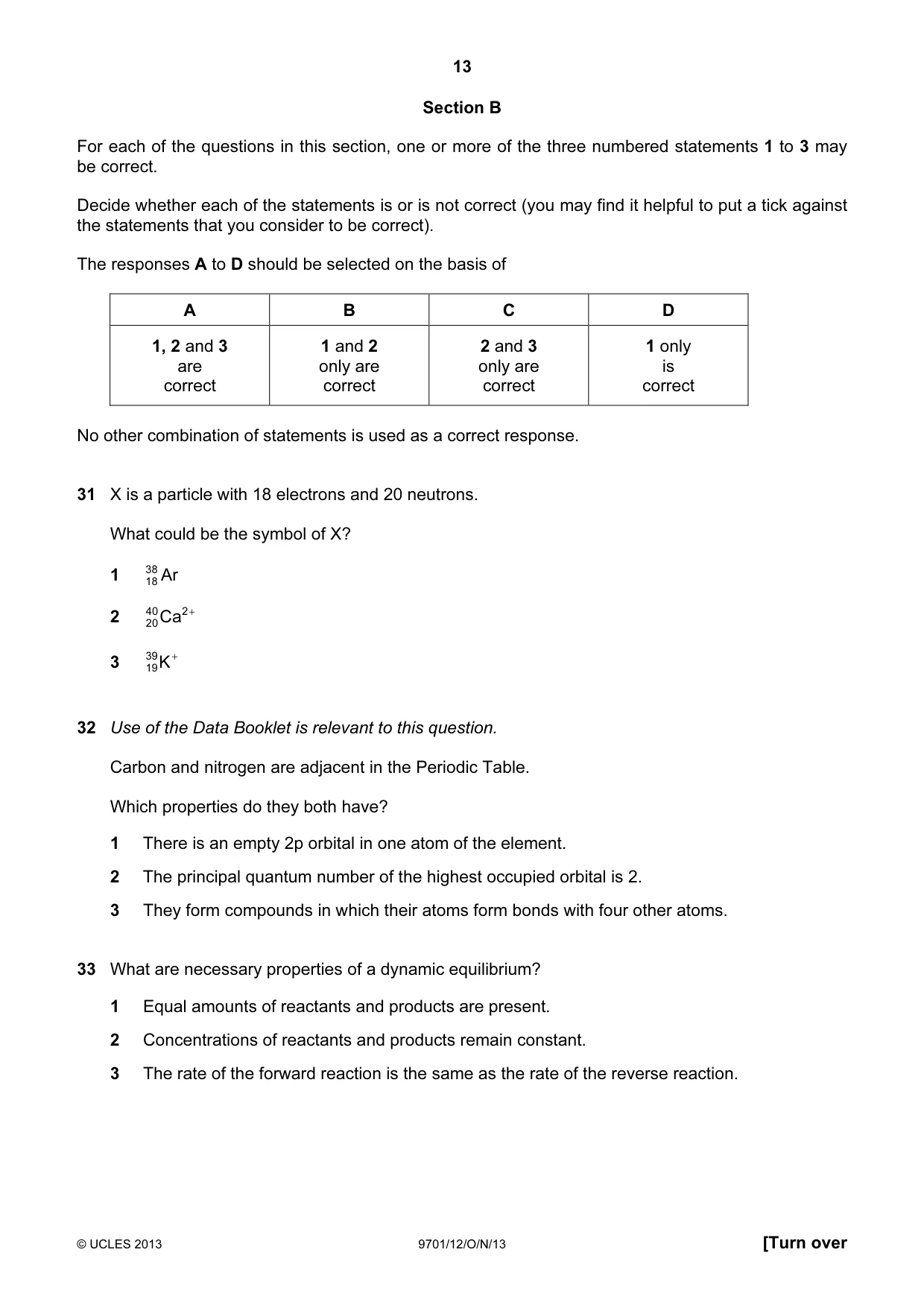
31 X is a particle with 18 electrons and 20 neutrons. What could be the symbol of X? 1 38 Ar 18 2 40 20Ca 2 + 3 39 K + 19
Mark scheme: A
Q32 · Use of the Data Booklet is relevant to this question
32 Use of the Data Booklet is relevant to this question. Carbon and nitrogen are adjacent in the Periodic Table. Which properties do they both have? 1 There is an empty 2p orbital in one atom of the element. 2 The principal quantum number of the highest occupied orbital is 2. 3 They form compounds in which their atoms form bonds with four other atoms.
Mark scheme: C
More questions on Electrons, energy levels and atomic orbitals
Q33 · What are necessary properties of a dynamic equilibrium?
33 What are necessary properties of a dynamic equilibrium? 1 Equal amounts of reactants and products are present. 2 Concentrations of reactants and products remain constant. 3 The rate of the forward reaction is the same as the rate of the reverse reaction.
Mark scheme: C
More questions on Chemical equilibria: reversible reactions, dynamic equilibrium
Q34 · If N2O4 gas is placed in a sealed vessel the following equilibrium is established
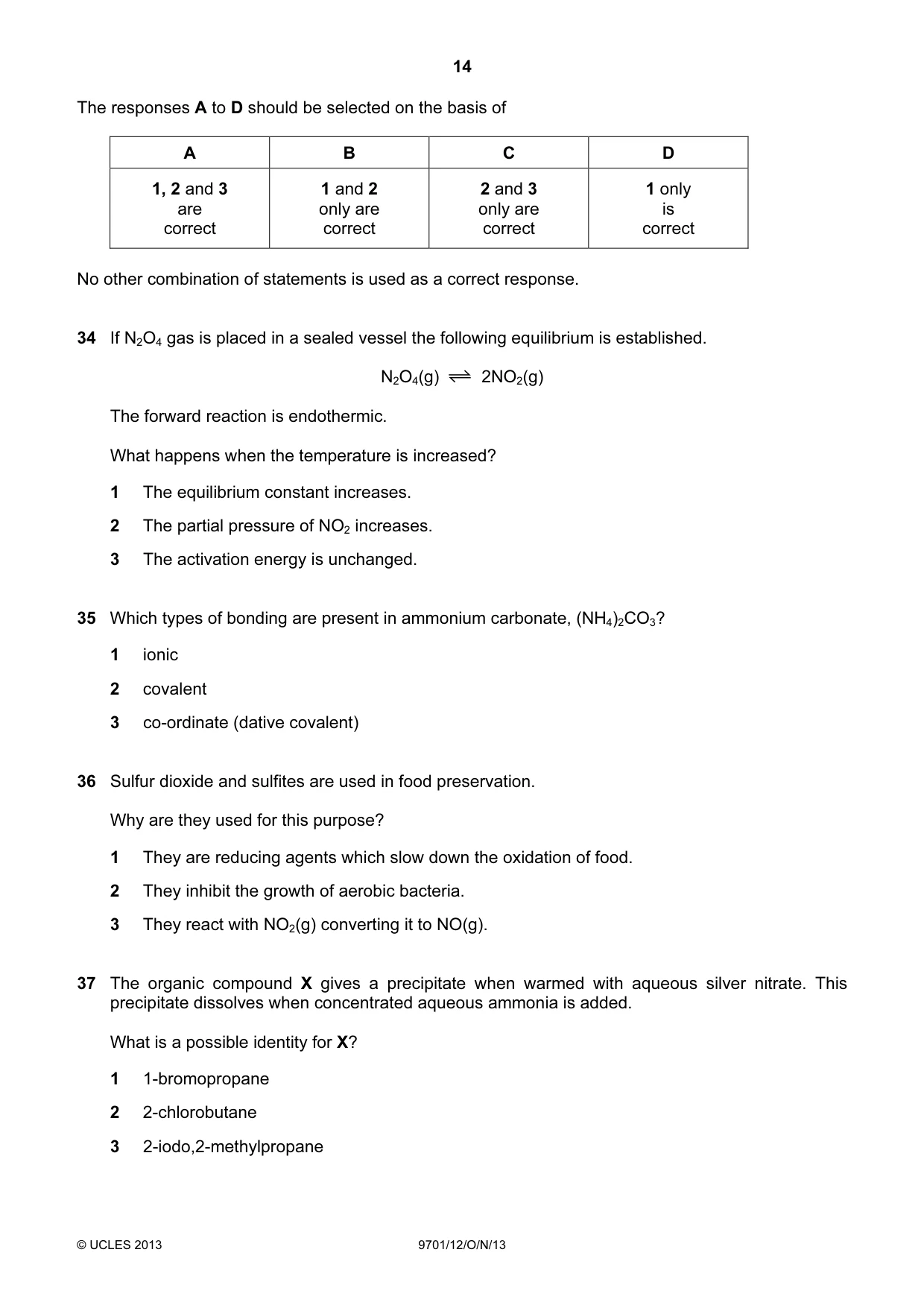
34 If N2O4 gas is placed in a sealed vessel the following equilibrium is established. N2O4(g) 2NO2(g) The forward reaction is endothermic. What happens when the temperature is increased? 1 The equilibrium constant increases. 2 The partial pressure of NO2 increases. 3 The activation energy is unchanged.
Mark scheme: A
More questions on Chemical equilibria: reversible reactions, dynamic equilibrium
Q35 · Which types of bonding are present in ammonium carbonate, (NH4)2CO3?
35 Which types of bonding are present in ammonium carbonate, (NH4)2CO3? 1 ionic 2 covalent 3 co-ordinate (dative covalent)
Mark scheme: A
More questions on Covalent bonding and coordinate (dative covalent) bonding
Q36 · Sulfur dioxide and sulfites are used in food preservation
36 Sulfur dioxide and sulfites are used in food preservation. Why are they used for this purpose? 1 They are reducing agents which slow down the oxidation of food. 2 They inhibit the growth of aerobic bacteria. 3 They react with NO2(g) converting it to NO(g).
Mark scheme: B
Q37 · The organic compound X gives a precipitate when warmed with aqueous silver nitrate
37 The organic compound X gives a precipitate when warmed with aqueous silver nitrate. This precipitate dissolves when concentrated aqueous ammonia is added. What is a possible identity for X? 1 1-bromopropane 2 2-chlorobutane 3 2-iodo,2-methylpropane
Mark scheme: B
Q38 · An organic compound Y, molecular formula C6H14O, may be oxidised to compound Z, molecular…
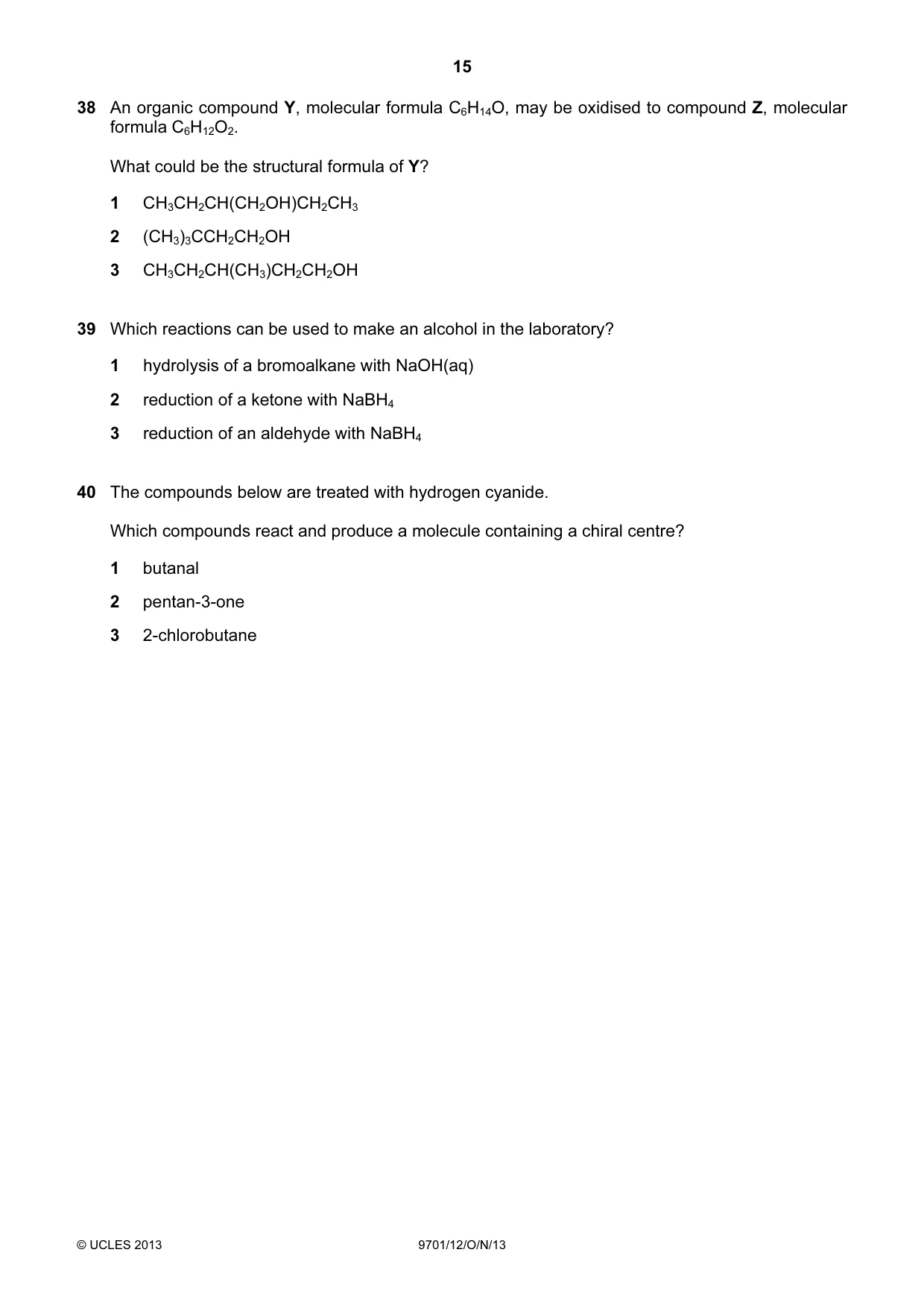
38 An organic compound Y, molecular formula C6H14O, may be oxidised to compound Z, molecular formula C6H12O2. What could be the structural formula of Y? 1 CH3CH2CH(CH2OH)CH2CH3 2 (CH3)3CCH2CH2OH 3 CH3CH2CH(CH3)CH2CH2OH
Mark scheme: A
Q39 · Which reactions can be used to make an alcohol in the laboratory?
39 Which reactions can be used to make an alcohol in the laboratory? 1 hydrolysis of a bromoalkane with NaOH(aq) 2 reduction of a ketone with NaBH4 3 reduction of an aldehyde with NaBH4
Mark scheme: A
Q40 · The compounds below are treated with hydrogen cyanide
40 The compounds below are treated with hydrogen cyanide. Which compounds react and produce a molecule containing a chiral centre? 1 butanal 2 pentan-3-one 3 2-chlorobutane
Mark scheme: D
What was in this paper
The subtopics covered by these 40 questions, and how many questions each got. Open one in a new tab to see every Cambridge question on it.
3Chemical equilibria: reversible reactions, dynamic equilibrium3Redox processes: electron transfer and changes in oxidation number (oxidation state)3Similarities and trends in the properties of the Group 2 metals, magnesium to barium, and their compounds3Alcohols2Effect of temperature on reaction rates and the concept of activation energy2Electrolysis2Halogenoalkanes2Acids and bases1Addition polymerisation1Aldehydes and ketones1Carboxylic acids1Covalent bonding and coordinate (dative covalent) bonding1Electrons, energy levels and atomic orbitals1Enthalpy change, ΔH1Esters1Formulas1Halogen compounds1Homogeneous and heterogeneous catalysts1Isomerism: structural isomerism and stereoisomerism1Isotopes1Nitriles and hydroxynitriles1Nitrogen and sulfur1Organic synthesis1Particles in the atom and atomic radius1Periodicity of physical properties of the elements in Period 31Rate of reaction1The gaseous state: ideal and real gases and pV = nRT1What you needed in this session
Cambridge’s own grade thresholds for 2013 Oct/Nov, Paper 1 · Variant 2. A higher threshold means an easier paper — the bar moves with how the cohort did.