Cambridge A Level Chemistry 9701 — 2010 Oct/Nov Paper 1 · Variant 3
9701/13/O/N/10 · 40 questions · 40 marks · ≈45 min
The question paper and its mark scheme, free to read here and free to download. This is Cambridge’s own paper, exactly as it was sat.
Question paper16 pages
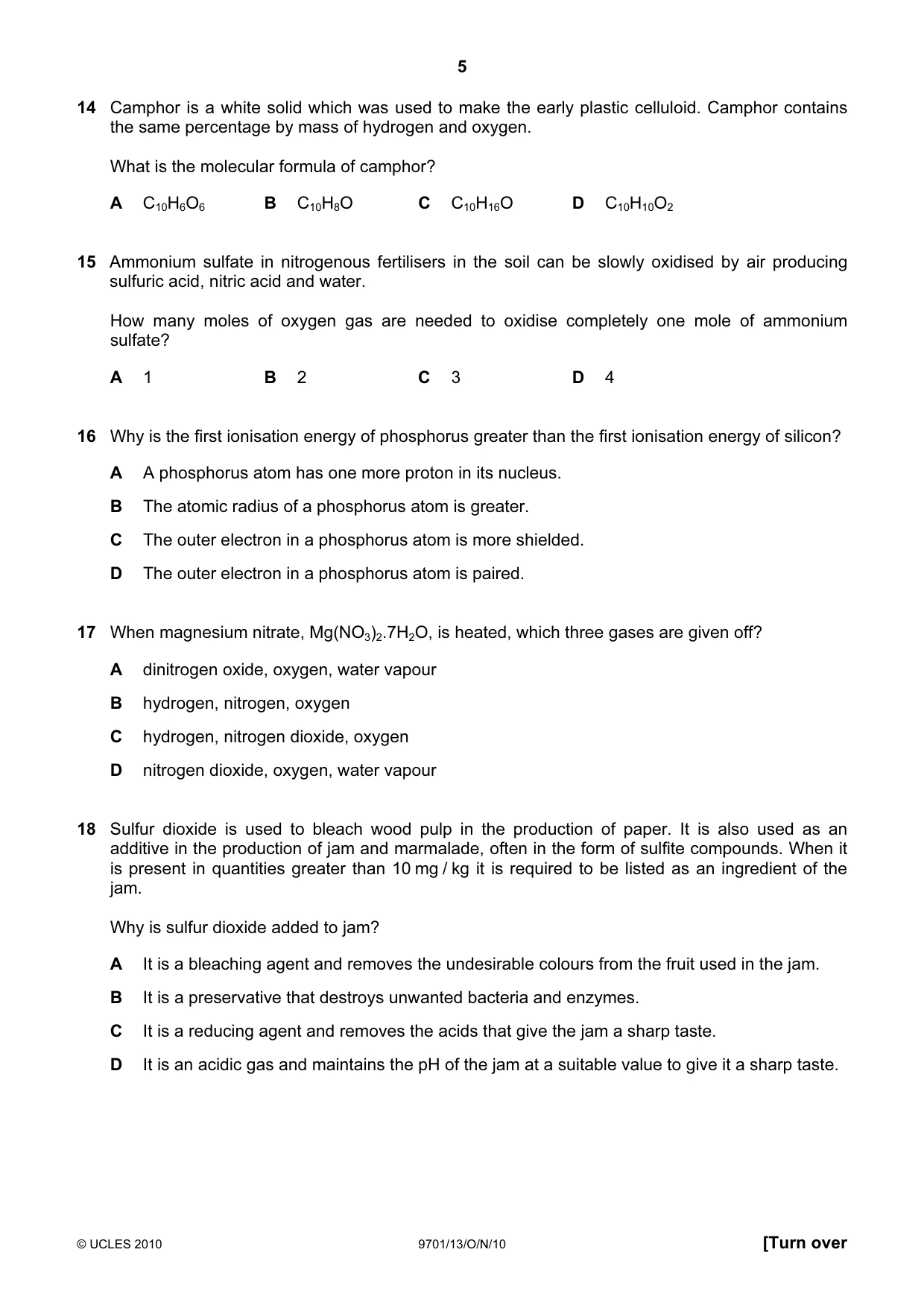
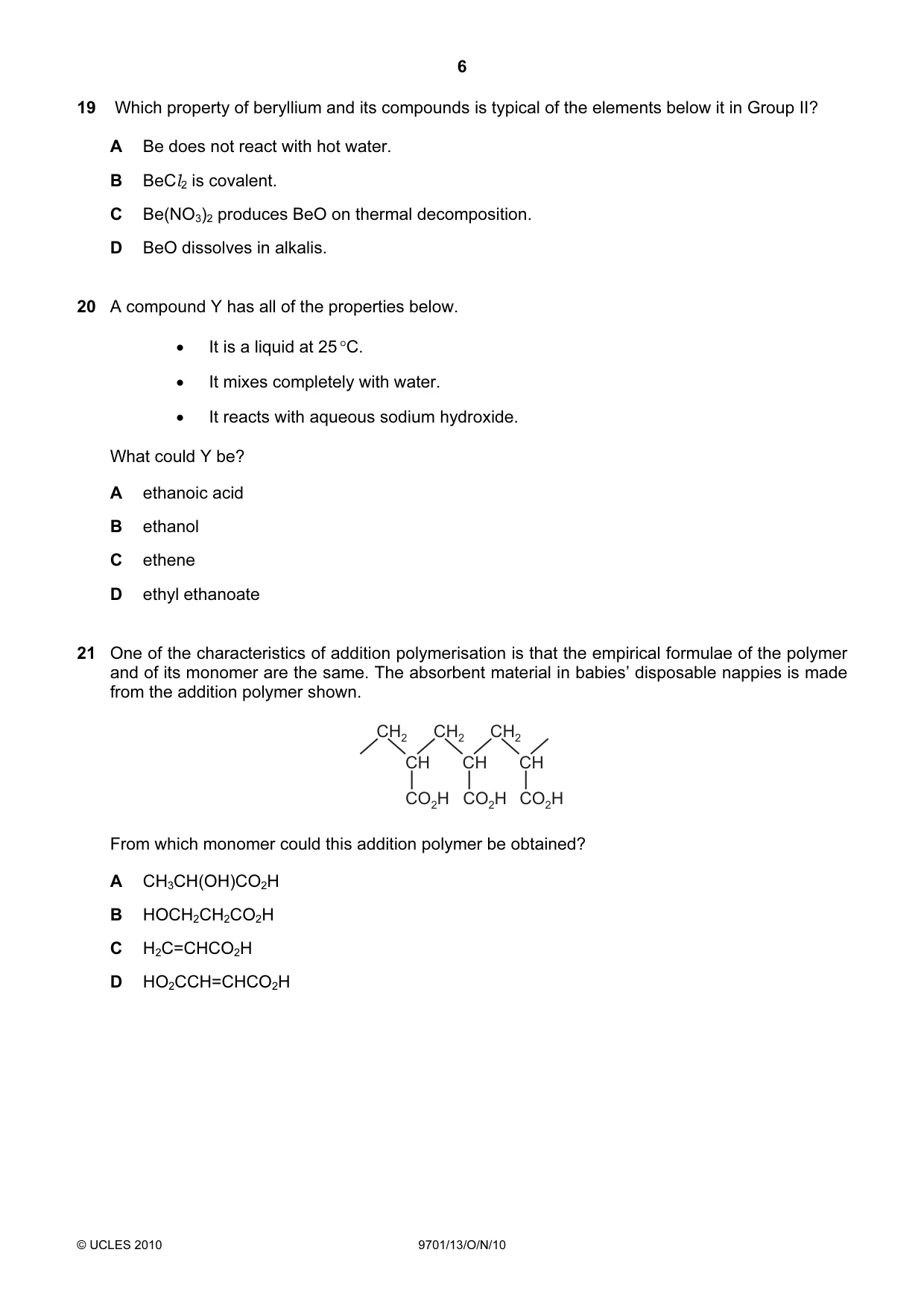
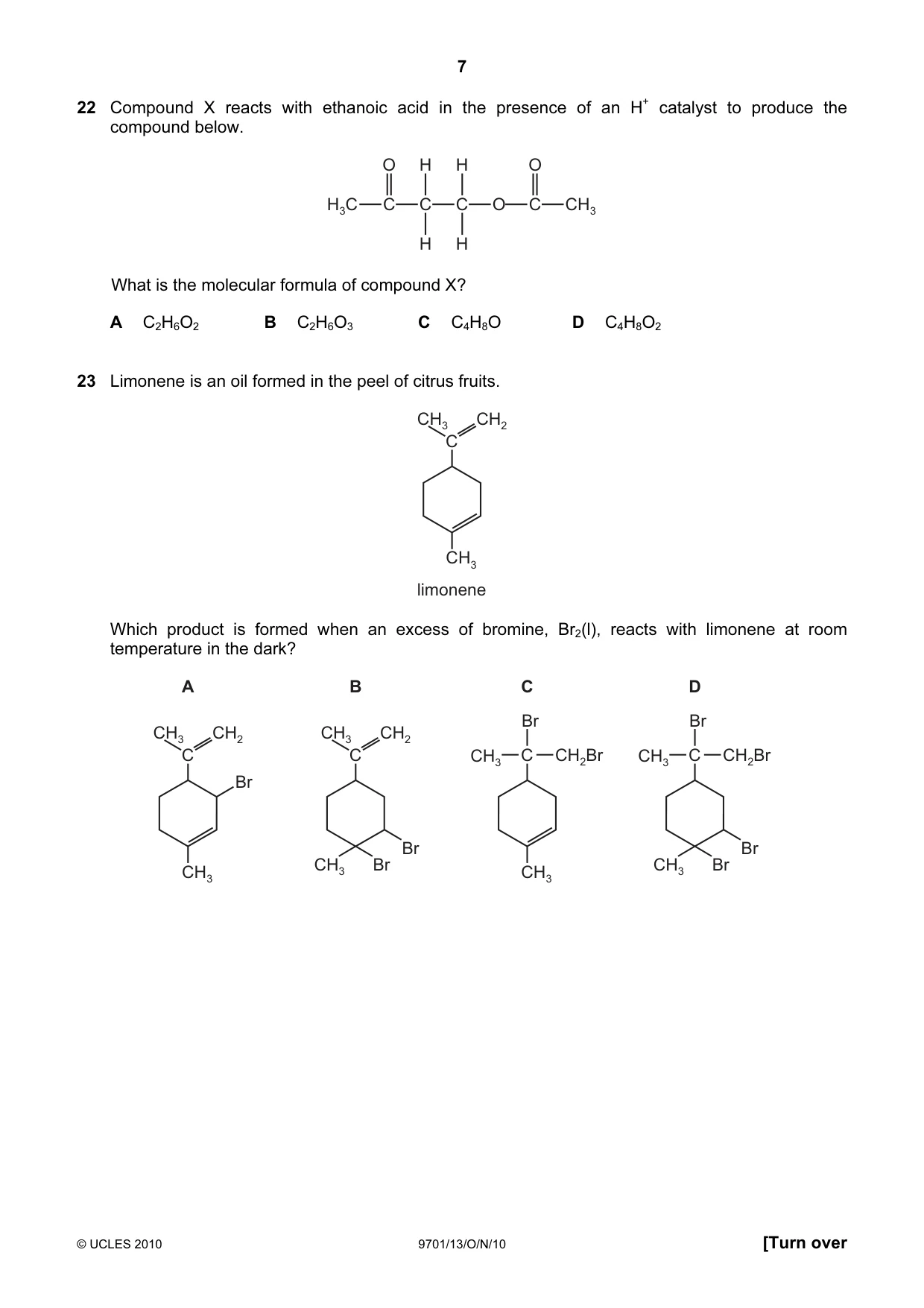
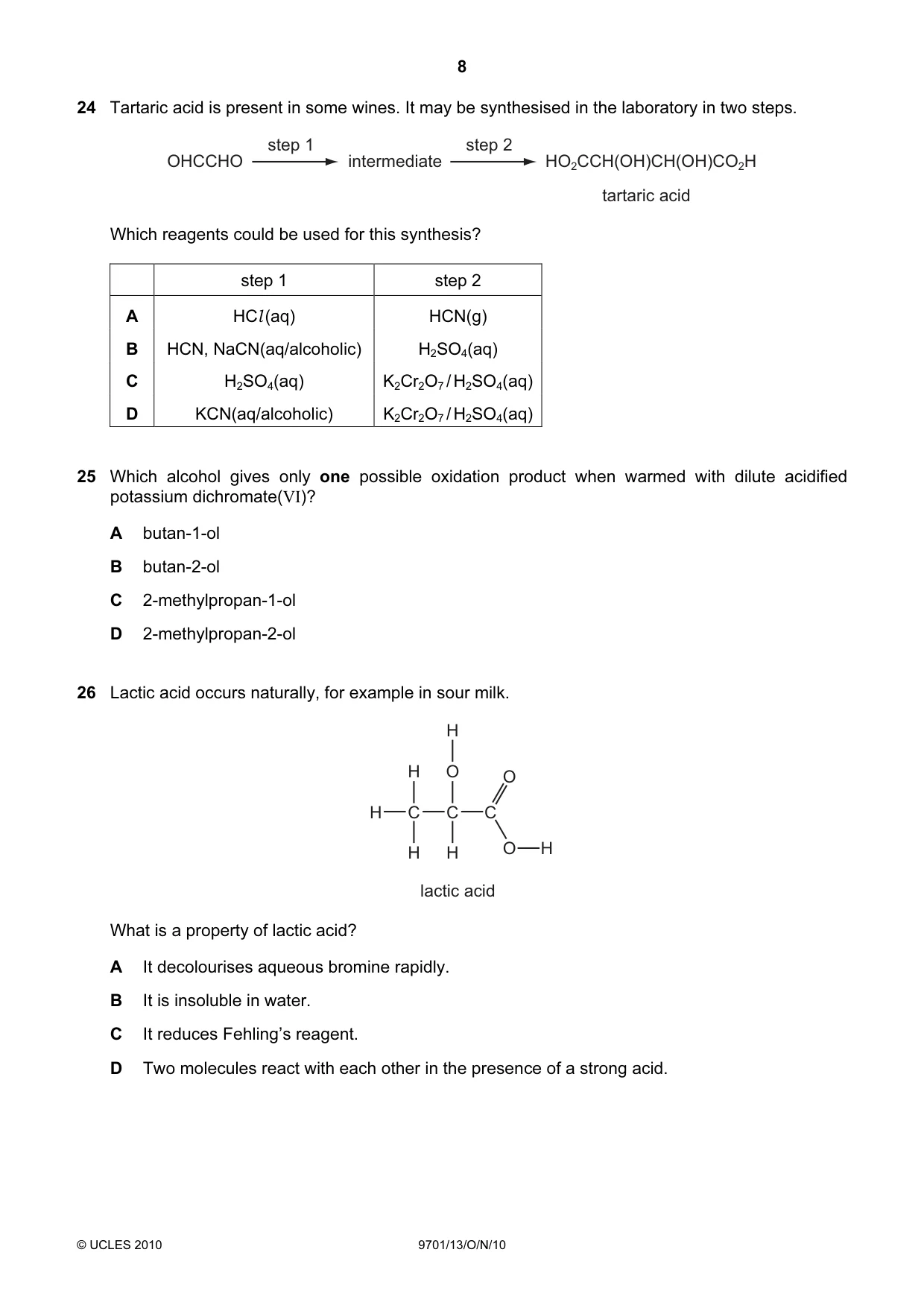
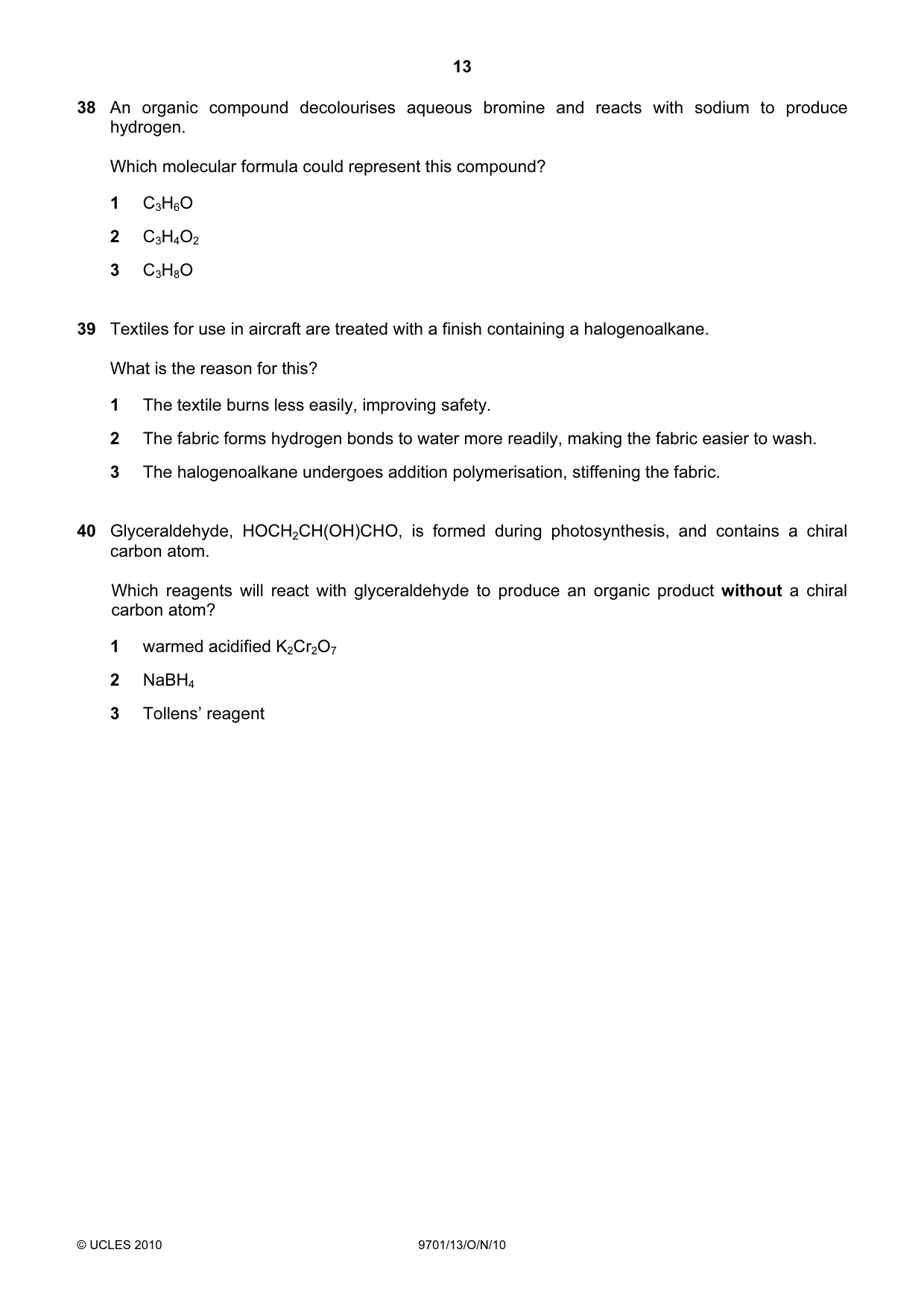


Mark scheme2 pages
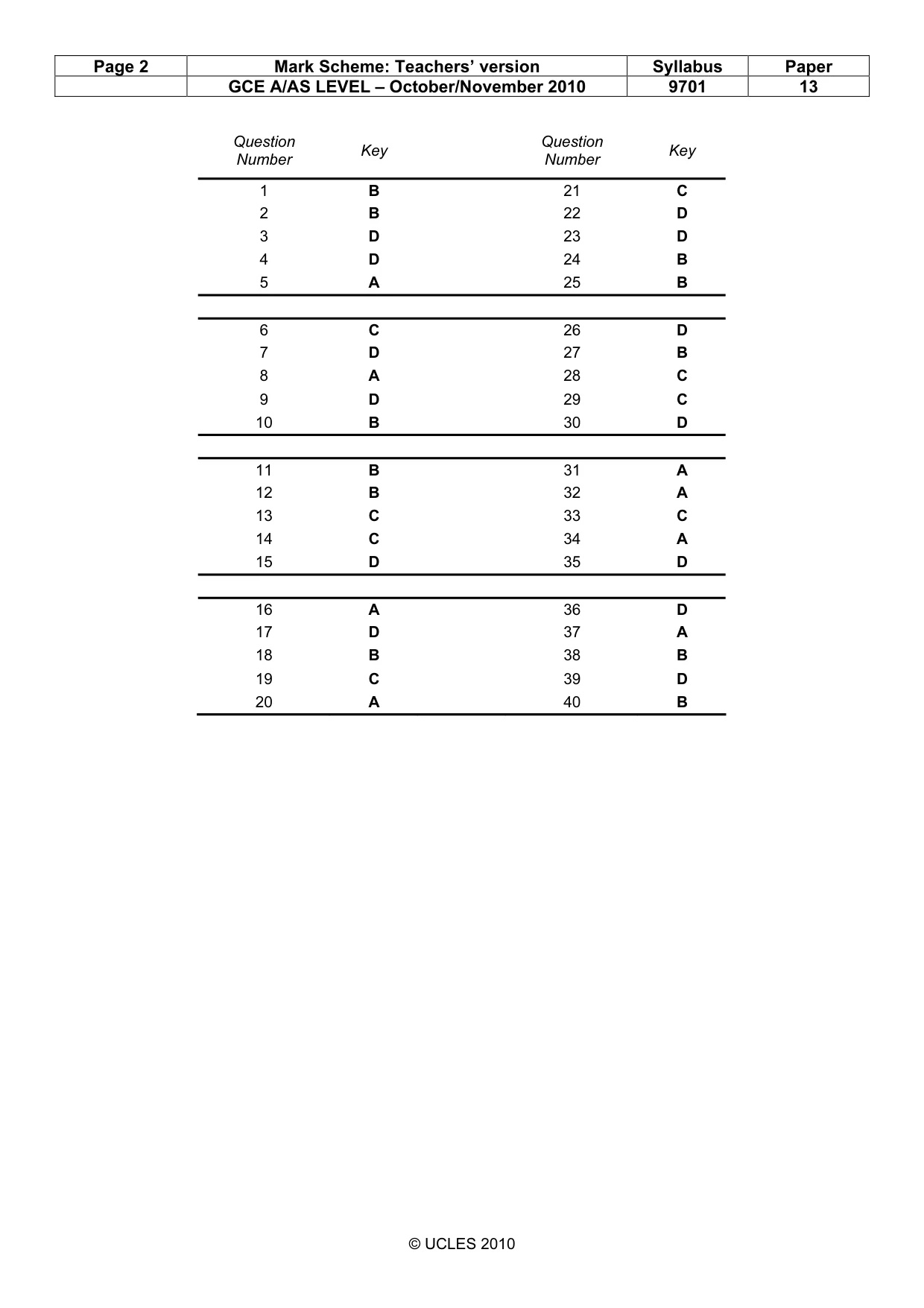
Answers below. Sit the paper first if you are practising.
Questions as text
Q1 · A simple ion X+ contains eight protons
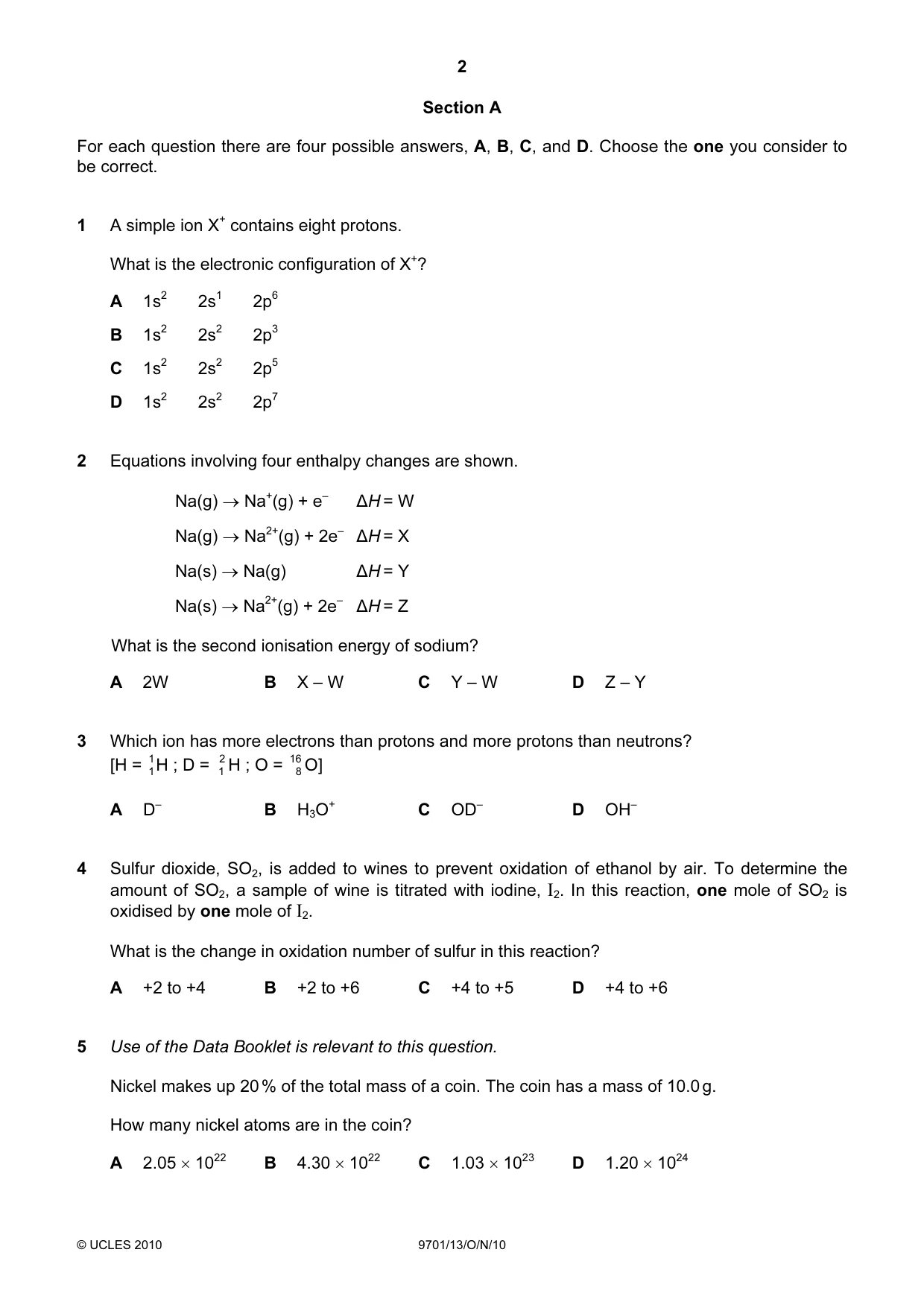
1 A simple ion X+ contains eight protons. What is the electronic configuration of X+? A 1s2 2s1 2p6 B 1s2 2s2 2p3 C 1s2 2s2 2p5 D 1s2 2s2 2p7
Mark scheme: B
More questions on Electrons, energy levels and atomic orbitals
Q2 · Equations involving four enthalpy changes are shown
2 Equations involving four enthalpy changes are shown. Na(g) → Na+(g) + e– ∆H = W Na(g) → Na2+(g) + 2e– ∆H = X Na(s) → Na(g) ∆H = Y Na(s) → Na2+(g) + 2e– ∆H = Z What is the second ionisation energy of sodium? A 2W B X – W C Y – W D Z – Y
Mark scheme: B
Q3 · Which ion has more electrons than protons and more protons than neutrons?
3 Which ion has more electrons than protons and more protons than neutrons? [H = 1 1H ; D = 2 1 H ; O = 16 8 O] A D– B H3O+ C OD– D OH–
Mark scheme: D
Q4 · Sulfur dioxide, SO2, is added to wines to prevent oxidation of ethanol by air
4 Sulfur dioxide, SO2, is added to wines to prevent oxidation of ethanol by air. To determine the amount of SO2, a sample of wine is titrated with iodine, I2. In this reaction, one mole of SO2 is oxidised by one mole of I2. What is the change in oxidation number of sulfur in this reaction? A +2 to +4 B +2 to +6 C +4 to +5 D +4 to +6
Mark scheme: D
Q5 · Use of the Data Booklet is relevant to this question
5 Use of the Data Booklet is relevant to this question. Nickel makes up 20 % of the total mass of a coin. The coin has a mass of 10.0 g. How many nickel atoms are in the coin? A 2.05 × 10²² B 4.30 × 10²² C 1.03 × 10²³ D 1.20 × 1024
Mark scheme: A
Q6 · Organic nitrates in photochemical smog can cause breathing difficulties
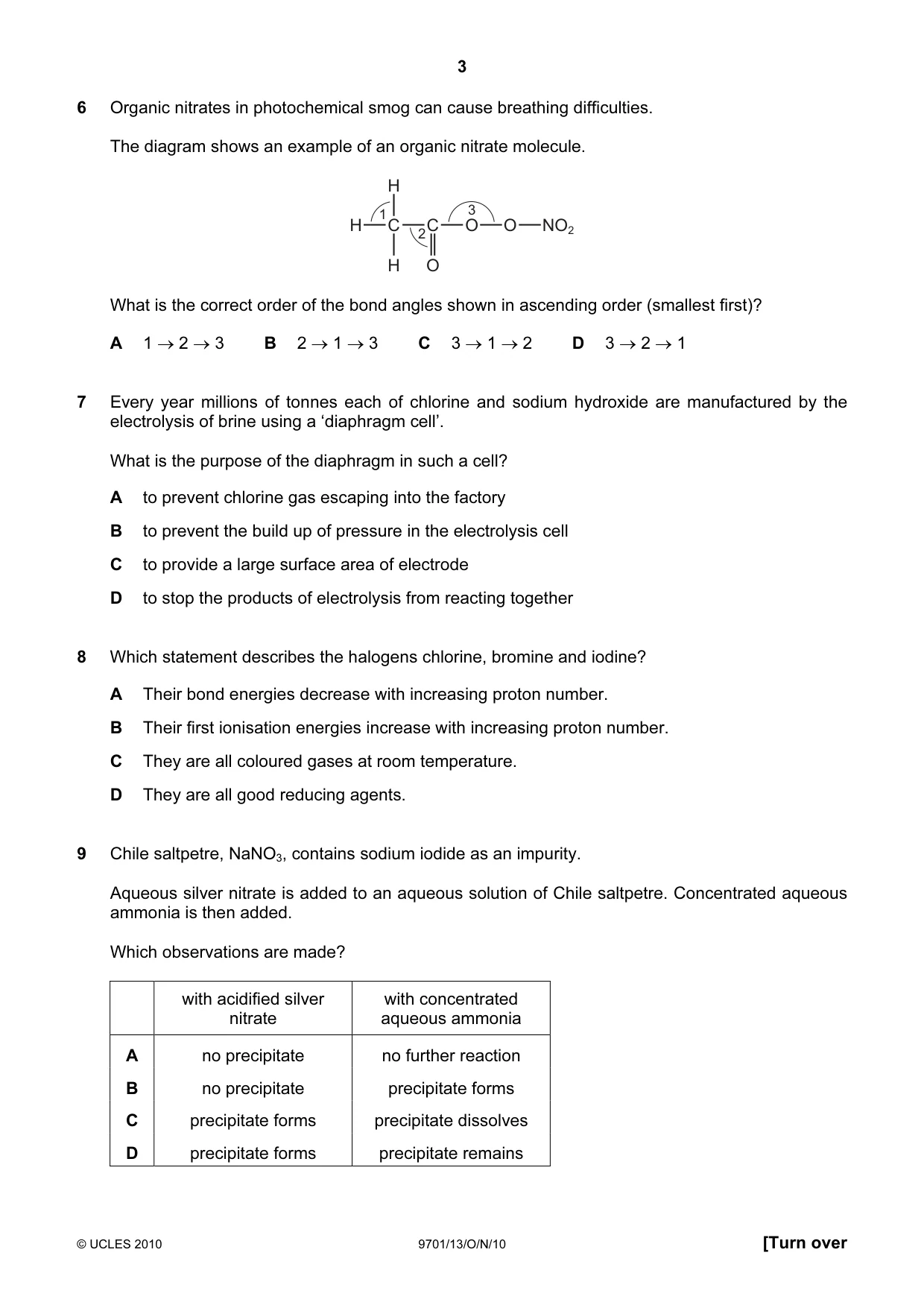
6 Organic nitrates in photochemical smog can cause breathing difficulties. The diagram shows an example of an organic nitrate molecule. H 1 3 H C C O O NO2 2 H O What is the correct order of the bond angles shown in ascending order (smallest first)? A 1 → 2 → 3 B 2 → 1 → 3 C 3 → 1 → 2 D 3 → 2 → 1
Mark scheme: C
Q7 · Every year millions of tonnes each of chlorine and sodium hydroxide are manufactured by…
7 Every year millions of tonnes each of chlorine and sodium hydroxide are manufactured by the electrolysis of brine using a ‘diaphragm cell’. What is the purpose of the diaphragm in such a cell? A to prevent chlorine gas escaping into the factory B to prevent the build up of pressure in the electrolysis cell C to provide a large surface area of electrode D to stop the products of electrolysis from reacting together
Mark scheme: D
Q8 · Which statement describes the halogens chlorine, bromine and iodine?
8 Which statement describes the halogens chlorine, bromine and iodine? A Their bond energies decrease with increasing proton number. B Their first ionisation energies increase with increasing proton number. C They are all coloured gases at room temperature. D They are all good reducing agents.
Mark scheme: A
More questions on Physical properties of the Group 17 elements
Q9 · Chile saltpetre, NaNO3, contains sodium iodide as an impurity
9 Chile saltpetre, NaNO3, contains sodium iodide as an impurity. Aqueous silver nitrate is added to an aqueous solution of Chile saltpetre. Concentrated aqueous ammonia is then added. Which observations are made? with acidified silver with concentrated nitrate aqueous ammonia A no precipitate no further reaction B no precipitate precipitate forms C precipitate forms precipitate dissolves D precipitate forms precipitate remains
Mark scheme: D
Q10 · The value of the equilibrium constant, Kc, for the reaction to form ethyl ethanoate from…
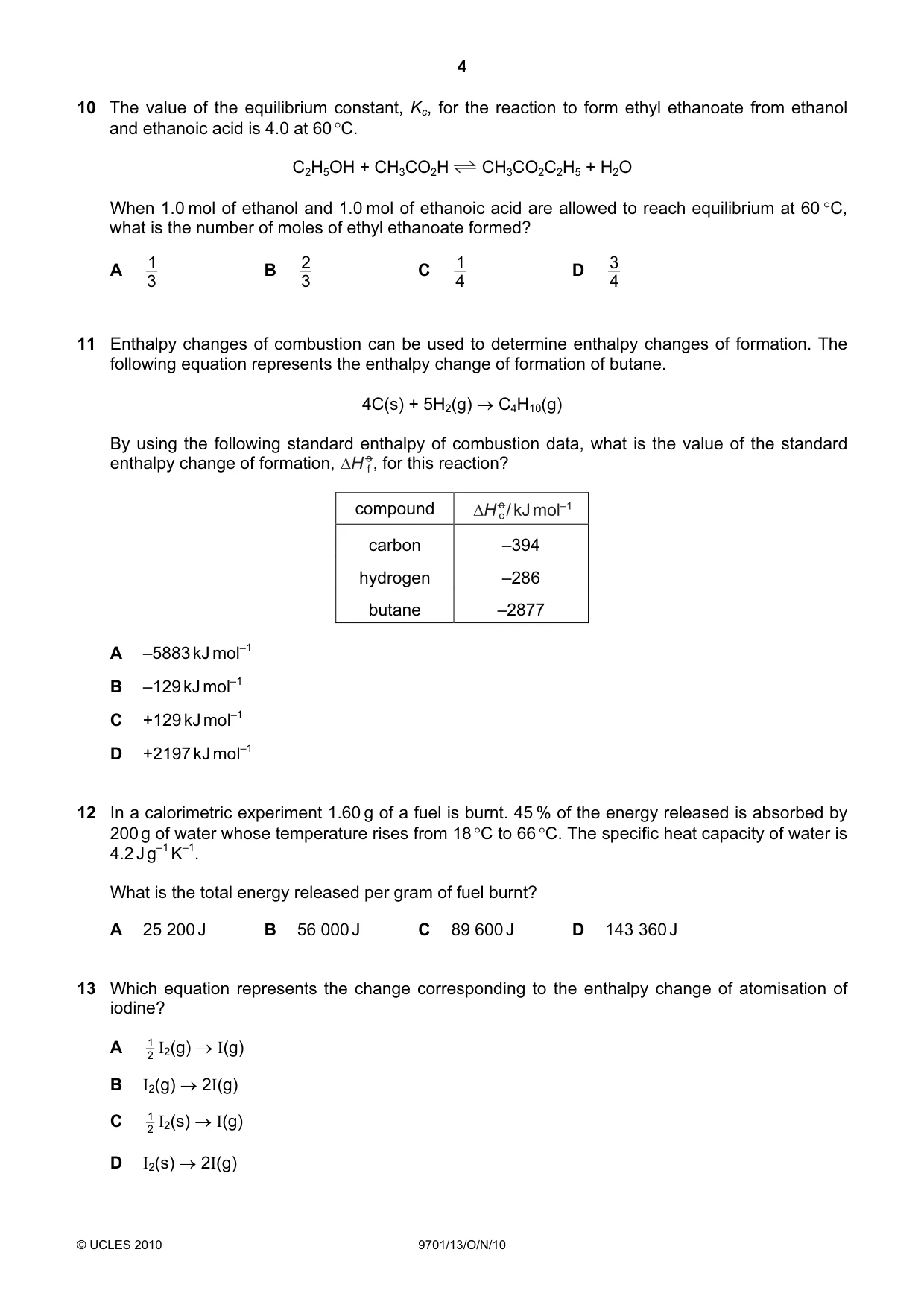
10 The value of the equilibrium constant, Kc, for the reaction to form ethyl ethanoate from ethanol and ethanoic acid is 4.0 at 60 °C. C2H5OH + CH3CO2H CH3CO2C2H5 + H2O When 1.0 mol of ethanol and 1.0 mol of ethanoic acid are allowed to reach equilibrium at 60 °C, what is the number of moles of ethyl ethanoate formed? A 1 B 2 C 1 D 3 3 3 4 4
Mark scheme: B
More questions on Chemical equilibria: reversible reactions, dynamic equilibrium
Q11 · Enthalpy changes of combustion can be used to determine enthalpy changes of formation
11 Enthalpy changes of combustion can be used to determine enthalpy changes of formation. The following equation represents the enthalpy change of formation of butane. 4C(s) + 5H2(g) → C4H10(g) By using the following standard enthalpy of combustion data, what is the value of the standard enthalpy change of formation, , for this reaction? compound o carbon –394 hydrogen –286 butane –2877 A –5883 kJ mol–1 B –129 kJ mol–1 C +129 kJ mol–1 D +2197 kJ mol–1
Mark scheme: B
Q12 · In a calorimetric experiment 1.60 g of a fuel is burnt
12 In a calorimetric experiment 1.60 g of a fuel is burnt. 45 % of the energy released is absorbed by 200 g of water whose temperature rises from 18 °C to 66 °C. The specific heat capacity of water is 4.2 J g–1 K–1. What is the total energy released per gram of fuel burnt? A 25 200 J B 56 000 J C 89 600 J D 143 360 J
Mark scheme: B
Q13 · Which equation represents the change corresponding to the enthalpy change of atomisation…
13 Which equation represents the change corresponding to the enthalpy change of atomisation of iodine? A 1 I2(g) → I(g) 2 B I2(g) → 2I(g) C 1 I2(s) → I(g) 2 D I2(s) → 2I(g)
Mark scheme: C
Q14 · Camphor is a white solid which was used to make the early plastic celluloid
14 Camphor is a white solid which was used to make the early plastic celluloid. Camphor contains the same percentage by mass of hydrogen and oxygen. What is the molecular formula of camphor? A C10H6O6 B C10H8O C C10H16O D C10H10O2
Mark scheme: C
Q15 · Ammonium sulfate in nitrogenous fertilisers in the soil can be slowly oxidised by air…
15 Ammonium sulfate in nitrogenous fertilisers in the soil can be slowly oxidised by air producing sulfuric acid, nitric acid and water. How many moles of oxygen gas are needed to oxidise completely one mole of ammonium sulfate? A 1 B 2 C 3 D 4
Mark scheme: D
Q16 · Why is the first ionisation energy of phosphorus greater than the first ionisation energy…
16 Why is the first ionisation energy of phosphorus greater than the first ionisation energy of silicon? A A phosphorus atom has one more proton in its nucleus. B The atomic radius of a phosphorus atom is greater. C The outer electron in a phosphorus atom is more shielded. D The outer electron in a phosphorus atom is paired.
Mark scheme: A
Q17 · When magnesium nitrate, Mg(NO3)2.7H2O, is heated, which three gases are given off?
17 When magnesium nitrate, Mg(NO3)2.7H2O, is heated, which three gases are given off? A dinitrogen oxide, oxygen, water vapour B hydrogen, nitrogen, oxygen C hydrogen, nitrogen dioxide, oxygen D nitrogen dioxide, oxygen, water vapour
Mark scheme: D
Q18 · Sulfur dioxide is used to bleach wood pulp in the production of paper
18 Sulfur dioxide is used to bleach wood pulp in the production of paper. It is also used as an additive in the production of jam and marmalade, often in the form of sulfite compounds. When it is present in quantities greater than 10 mg / kg it is required to be listed as an ingredient of the jam. Why is sulfur dioxide added to jam? A It is a bleaching agent and removes the undesirable colours from the fruit used in the jam. B It is a preservative that destroys unwanted bacteria and enzymes. C It is a reducing agent and removes the acids that give the jam a sharp taste. D It is an acidic gas and maintains the pH of the jam at a suitable value to give it a sharp taste.
Mark scheme: B
Q19 · Which property of beryllium and its compounds is typical of the elements below it in…
19 Which property of beryllium and its compounds is typical of the elements below it in Group II? A Be does not react with hot water. B BeCl2 is covalent. C Be(NO3)2 produces BeO on thermal decomposition. D BeO dissolves in alkalis.
Mark scheme: C
Q20 · A compound Y has all of the properties below
20 A compound Y has all of the properties below. • It is a liquid at 25 °C. • It mixes completely with water. • It reacts with aqueous sodium hydroxide. What could Y be? A ethanoic acid B ethanol C ethene D ethyl ethanoate
Mark scheme: A
Q21 · One of the characteristics of addition polymerisation is that the empirical formulae of…
21 One of the characteristics of addition polymerisation is that the empirical formulae of the polymer and of its monomer are the same. The absorbent material in babies’ disposable nappies is made from the addition polymer shown. CH2 CH2 CH2 CH CH CH CO2H CO2H CO2H From which monomer could this addition polymer be obtained? A CH3CH(OH)CO2H B HOCH2CH2CO2H C H2C=CHCO2H D HO2CCH=CHCO2H
Mark scheme: C
Q22 · Compound X reacts with ethanoic acid in the presence of an H+ catalyst to produce the…
22 Compound X reacts with ethanoic acid in the presence of an H+ catalyst to produce the compound below. O H H O H3C C C C O C CH3 H H What is the molecular formula of compound X? A C2H6O2 B C2H6O3 C C4H8O D C4H8O2
Mark scheme: D
Q23 · Limonene is an oil formed in the peel of citrus fruits
23 Limonene is an oil formed in the peel of citrus fruits. CH3 CH2 C CH3 limonene Which product is formed when an excess of bromine, Br2(l), reacts with limonene at room temperature in the dark? A B C D Br Br CH3 CH2 CH3 CH2 C C CH3 C CH2Br CH3 C CH2Br Br Br Br CH3 CH3 Br CH3 CH3 Br
Mark scheme: D
Q24 · Tartaric acid is present in some wines
24 Tartaric acid is present in some wines. It may be synthesised in the laboratory in two steps. step 1 step 2 OHCCHO intermediate HO2CCH(OH)CH(OH)CO2H tartaric acid Which reagents could be used for this synthesis? step 1 step 2 A HCl (aq) HCN(g) B HCN, NaCN(aq/alcoholic) H2SO4(aq) C H2SO4(aq) K2Cr2O7 / H2SO4(aq) D KCN(aq/alcoholic) K2Cr2O7 / H2SO4(aq)
Mark scheme: B
Q25 · Which alcohol gives only one possible oxidation product when warmed with dilute acidified…
25 Which alcohol gives only one possible oxidation product when warmed with dilute acidified potassium dichromate(VI)? A butan-1-ol B butan-2-ol C 2-methylpropan-1-ol D 2-methylpropan-2-ol
Mark scheme: B
Q26 · Lactic acid occurs naturally, for example in sour milk
26 Lactic acid occurs naturally, for example in sour milk. H H O O H C C C H H O H lactic acid What is a property of lactic acid? A It decolourises aqueous bromine rapidly. B It is insoluble in water. C It reduces Fehling’s reagent. D Two molecules react with each other in the presence of a strong acid.
Mark scheme: D
Q27 · Which compound would undergo nucleophilic addition?
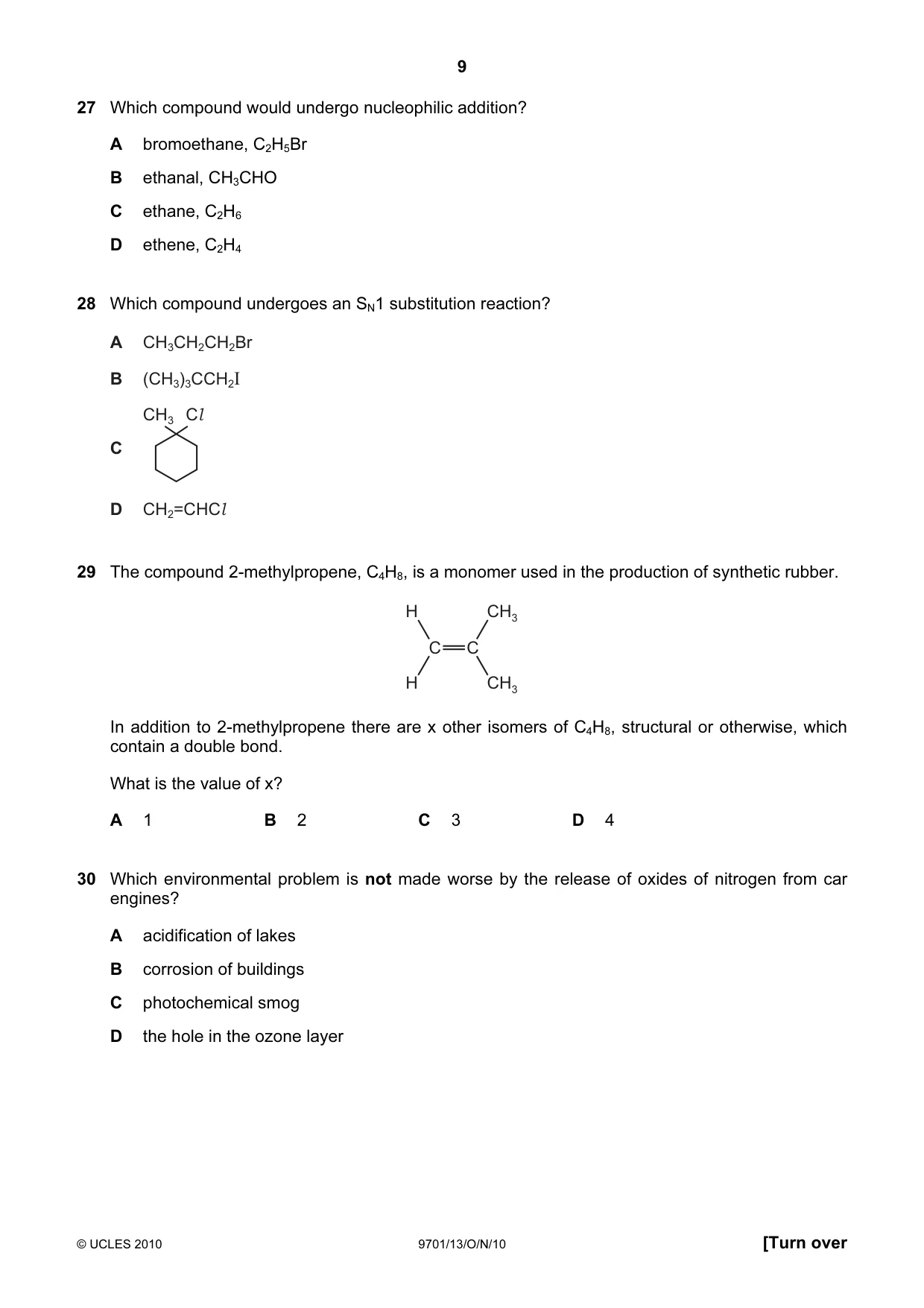
27 Which compound would undergo nucleophilic addition? A bromoethane, C2H5Br B ethanal, CH3CHO C ethane, C2H6 D ethene, C2H4
Mark scheme: B
Q28 · Which compound undergoes an SN1 substitution reaction?
28 Which compound undergoes an SN1 substitution reaction? A CH3CH2CH2Br B (CH3)3CCH2I CH3 Cl C D CH2=CHCl
Mark scheme: C
Q29 · The compound 2-methylpropene, C4H8, is a monomer used in the production of synthetic…
29 The compound 2-methylpropene, C4H8, is a monomer used in the production of synthetic rubber. H CH3 C C H CH3 In addition to 2-methylpropene there are x other isomers of C4H8, structural or otherwise, which contain a double bond. What is the value of x? A 1 B 2 C 3 D 4
Mark scheme: C
More questions on Isomerism: structural isomerism and stereoisomerism
Q30 · Which environmental problem is not made worse by the release of oxides of nitrogen from…
30 Which environmental problem is not made worse by the release of oxides of nitrogen from car engines? A acidification of lakes B corrosion of buildings C photochemical smog D the hole in the ozone layer
Mark scheme: D
Q31 · Which types of intermolecular forces can exist between adjacent urea molecules?
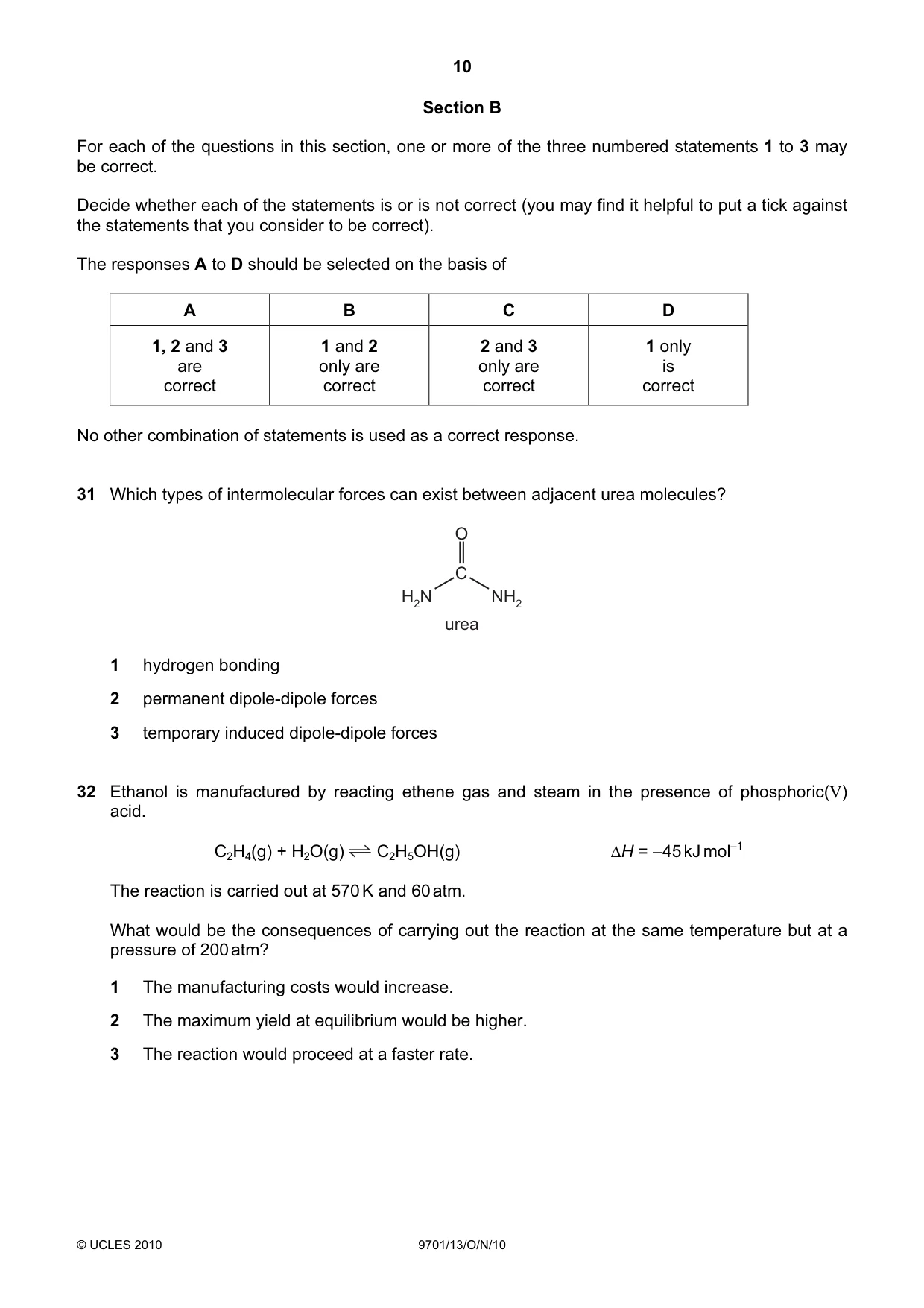
31 Which types of intermolecular forces can exist between adjacent urea molecules? O C H2N NH2 urea 1 hydrogen bonding 2 permanent dipole-dipole forces 3 temporary induced dipole-dipole forces
Mark scheme: A
More questions on Intermolecular forces, electronegativity and bond properties
Q32 · Ethanol is manufactured by reacting ethene gas and steam in the presence of phosphoric(V)…
32 Ethanol is manufactured by reacting ethene gas and steam in the presence of phosphoric(V) acid. C2H4(g) + H2O(g) C2H5OH(g) ∆H = –45 kJ mol–1 The reaction is carried out at 570 K and 60 atm. What would be the consequences of carrying out the reaction at the same temperature but at a pressure of 200 atm? 1 The manufacturing costs would increase. 2 The maximum yield at equilibrium would be higher. 3 The reaction would proceed at a faster rate.
Mark scheme: A
More questions on Chemical equilibria: reversible reactions, dynamic equilibrium
Q33 · The diagram represents the Boltzmann distribution of molecular energies at a given…
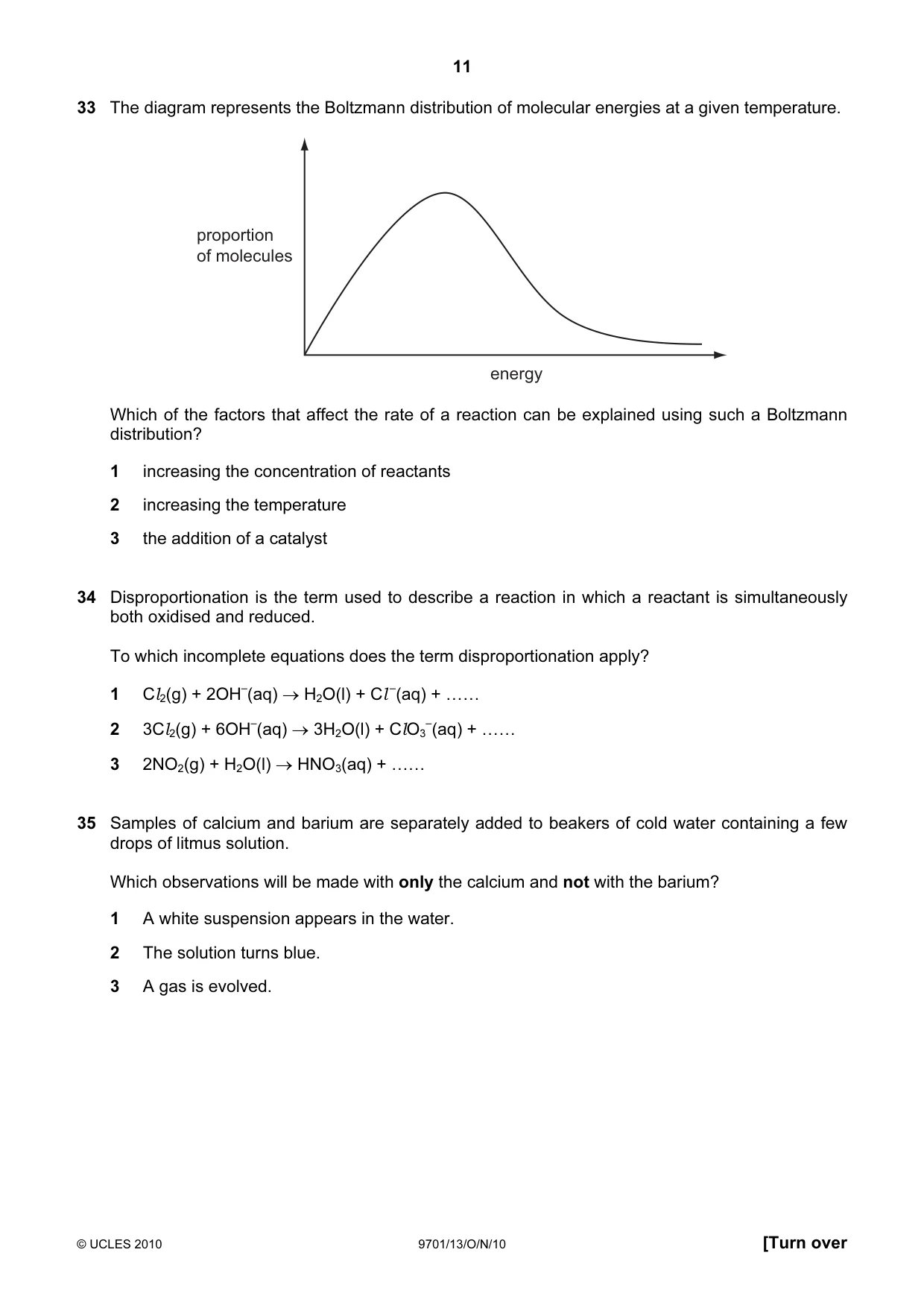
33 The diagram represents the Boltzmann distribution of molecular energies at a given temperature. proportion of molecules energy Which of the factors that affect the rate of a reaction can be explained using such a Boltzmann distribution? 1 increasing the concentration of reactants 2 increasing the temperature 3 the addition of a catalyst
Mark scheme: C
More questions on Effect of temperature on reaction rates and the concept of activation energy
Q34 · Disproportionation is the term used to describe a reaction in which a reactant is…
34 Disproportionation is the term used to describe a reaction in which a reactant is simultaneously both oxidised and reduced. To which incomplete equations does the term disproportionation apply? 1 Cl2(g) + 2OH–(aq) → H2O(l) + Cl –(aq) + …… 2 3Cl2(g) + 6OH–(aq) → 3H2O(l) + ClO3 –(aq) + …… 3 2NO2(g) + H2O(l) → HNO3(aq) + ……
Mark scheme: A
Q35 · Samples of calcium and barium are separately added to beakers of cold water containing a…
35 Samples of calcium and barium are separately added to beakers of cold water containing a few drops of litmus solution. Which observations will be made with only the calcium and not with the barium? 1 A white suspension appears in the water. 2 The solution turns blue. 3 A gas is evolved.
Mark scheme: D
Q36 · The diagram shows the structure of the naturally-occurring molecule cholesterol
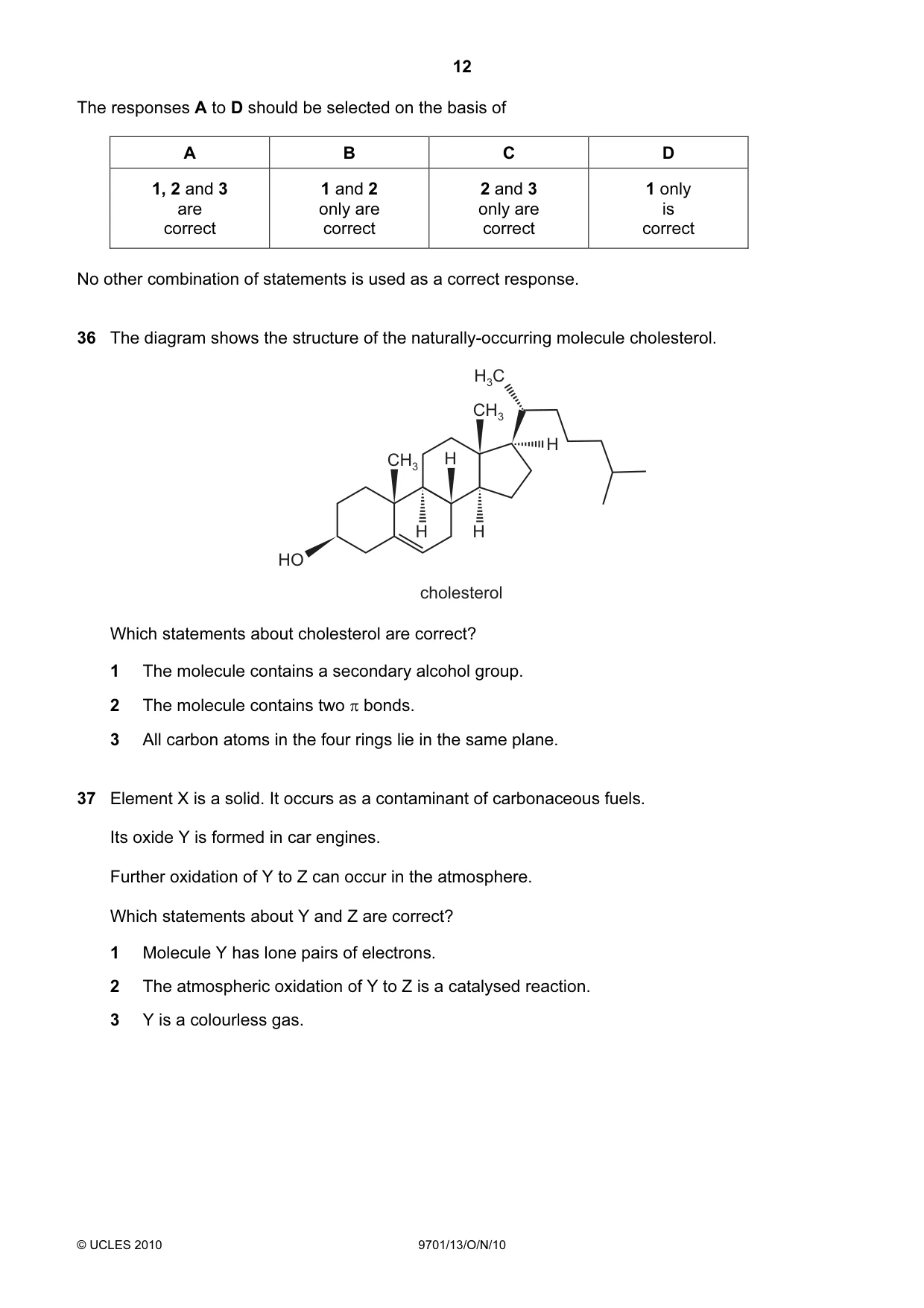
36 The diagram shows the structure of the naturally-occurring molecule cholesterol. H3C CH3 H CH3 H H H HO cholesterol Which statements about cholesterol are correct? 1 The molecule contains a secondary alcohol group. 2 The molecule contains two π bonds. 3 All carbon atoms in the four rings lie in the same plane.
Mark scheme: D
Q37 · Element X is a solid
37 Element X is a solid. It occurs as a contaminant of carbonaceous fuels. Its oxide Y is formed in car engines. Further oxidation of Y to Z can occur in the atmosphere. Which statements about Y and Z are correct? 1 Molecule Y has lone pairs of electrons. 2 The atmospheric oxidation of Y to Z is a catalysed reaction. 3 Y is a colourless gas.
Mark scheme: A
Q38 · An organic compound decolourises aqueous bromine and reacts with sodium to produce…
38 An organic compound decolourises aqueous bromine and reacts with sodium to produce hydrogen. Which molecular formula could represent this compound? 1 C3H6O 2 C3H4O2 3 C3H8O
Mark scheme: B
Q39 · Textiles for use in aircraft are treated with a finish containing a halogenoalkane
39 Textiles for use in aircraft are treated with a finish containing a halogenoalkane. What is the reason for this? 1 The textile burns less easily, improving safety. 2 The fabric forms hydrogen bonds to water more readily, making the fabric easier to wash. 3 The halogenoalkane undergoes addition polymerisation, stiffening the fabric.
Mark scheme: D
Q40 · Glyceraldehyde, HOCH2CH(OH)CHO, is formed during photosynthesis, and contains a chiral…
40 Glyceraldehyde, HOCH2CH(OH)CHO, is formed during photosynthesis, and contains a chiral carbon atom. Which reagents will react with glyceraldehyde to produce an organic product without a chiral carbon atom? 1 warmed acidified K2Cr2O7 2 NaBH4 3 Tollens’ reagent
Mark scheme: B
What was in this paper
The subtopics covered by these 40 questions, and how many questions each got. Open one in a new tab to see every Cambridge question on it.
3Nitrogen and sulfur3Redox processes: electron transfer and changes in oxidation number (oxidation state)3Similarities and trends in the properties of the Group 2 metals, magnesium to barium, and their compounds3Carboxylic acids2Chemical equilibria: reversible reactions, dynamic equilibrium2Enthalpy change, ΔH2Halogenoalkanes2Ionisation energy2Addition polymerisation1Aldehydes and ketones1Alkenes1Effect of temperature on reaction rates and the concept of activation energy1Electrolysis1Electrons, energy levels and atomic orbitals1Esters1Formulas1Hess’s law1Intermolecular forces, electronegativity and bond properties1Isomerism: optical1Isomerism: structural isomerism and stereoisomerism1Organic synthesis1Particles in the atom and atomic radius1Physical properties of the Group 17 elements1Shapes of molecules1Some reactions of the halide ions1The mole and the Avogadro constant1What you needed in this session
Cambridge’s own grade thresholds for 2010 Oct/Nov, Paper 1 · Variant 3. A higher threshold means an easier paper — the bar moves with how the cohort did.