Cambridge A Level Chemistry 9701 — 2018 Oct/Nov Paper 1 · Variant 1
9701/11/O/N/18 · 40 questions · 40 marks · ≈45 min
The question paper and its mark scheme, free to read here and free to download. This is Cambridge’s own paper, exactly as it was sat.
Question paper16 pages
Mark scheme3 pages
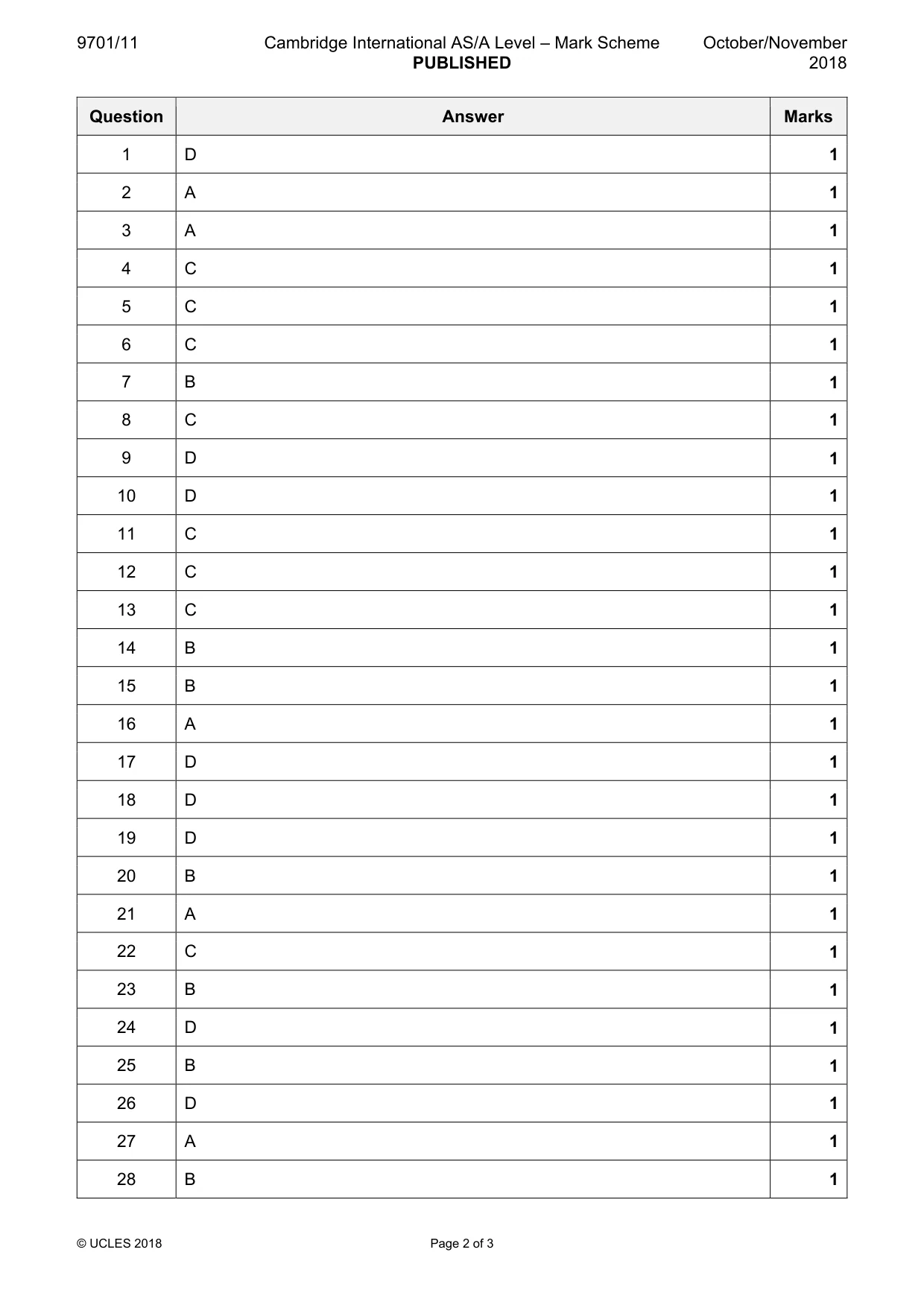
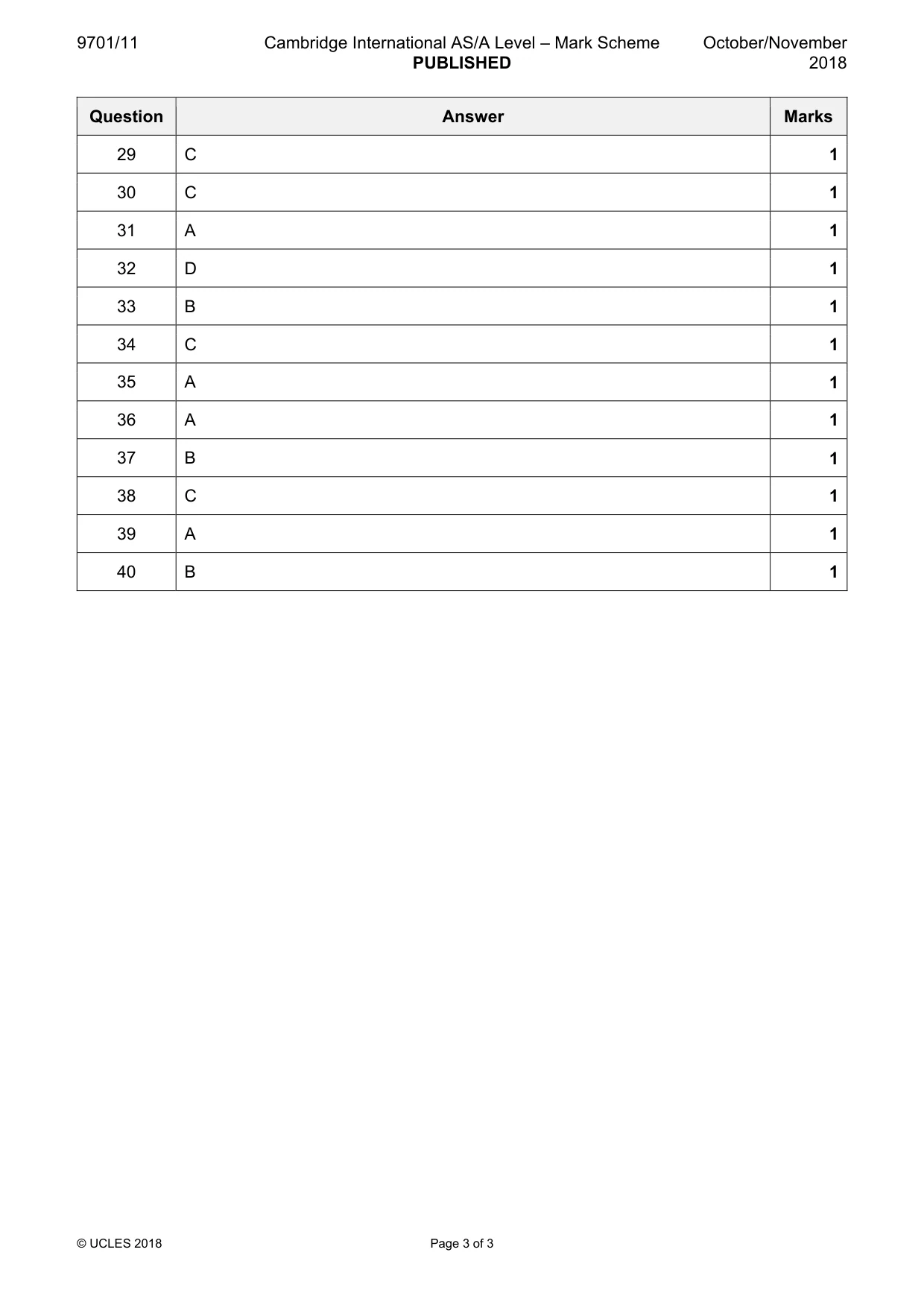
Answers below. Sit the paper first if you are practising.
Questions as text
Q1 · The first four ionisation energies for element X are shown in the table
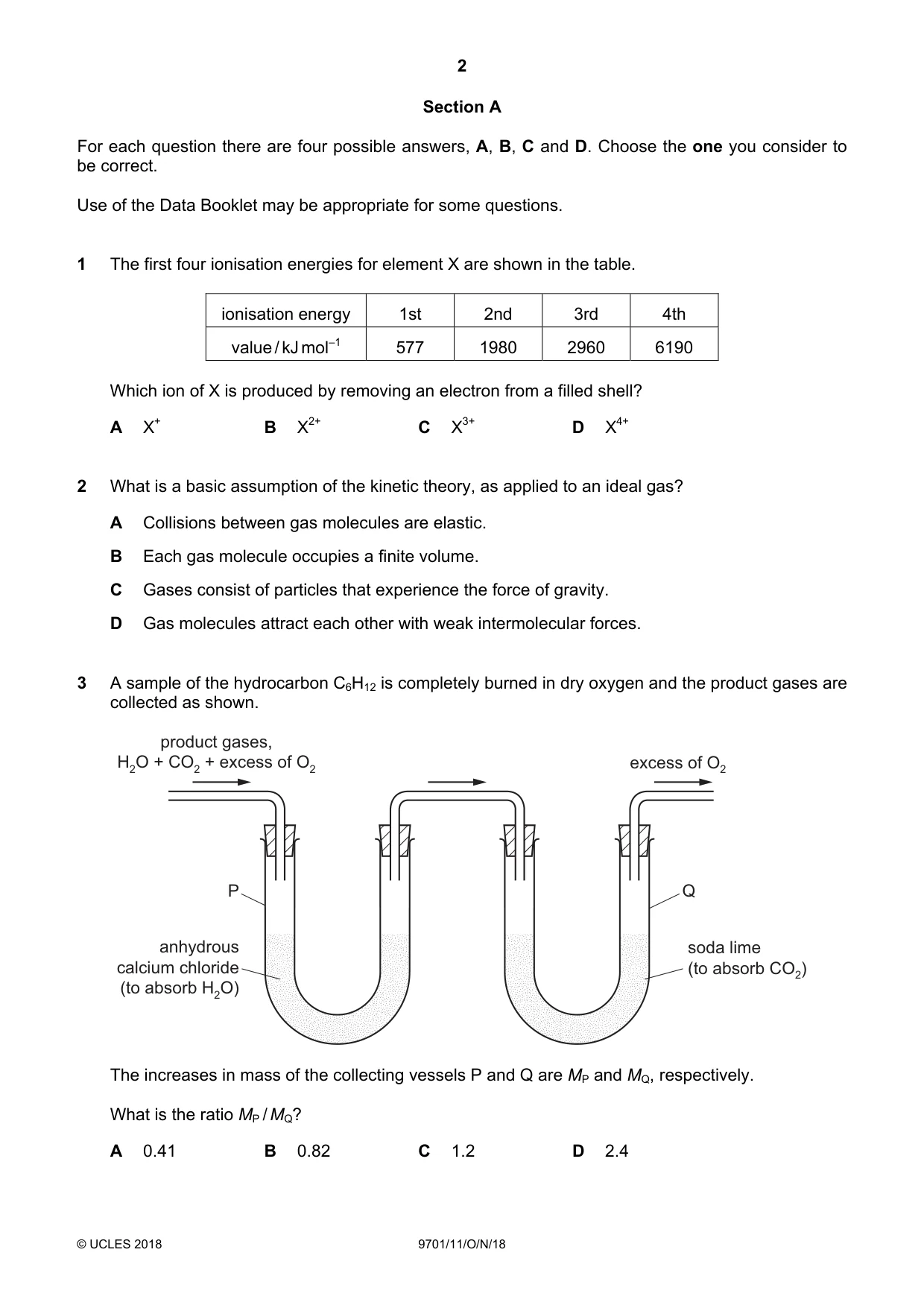
1 The first four ionisation energies for element X are shown in the table. ionisation energy 1st 2nd 3rd 4th value / kJ mol–1 577 1980 2960 6190 Which ion of X is produced by removing an electron from a filled shell? A X+ B X2+ C X3+ D X4+
Mark scheme: D
Q2 · What is a basic assumption of the kinetic theory, as applied to an ideal gas?
2 What is a basic assumption of the kinetic theory, as applied to an ideal gas? A Collisions between gas molecules are elastic. B Each gas molecule occupies a finite volume. C Gases consist of particles that experience the force of gravity. D Gas molecules attract each other with weak intermolecular forces.
Mark scheme: A
More questions on The gaseous state: ideal and real gases and pV = nRT
Q3 · A sample of the hydrocarbon C6H12 is completely burned in dry oxygen and the product…
3 A sample of the hydrocarbon C6H12 is completely burned in dry oxygen and the product gases are collected as shown. product gases, H2O + CO2 + excess of O2 excess of O2 P Q anhydrous soda lime calcium chloride (to absorb CO2) (to absorb H2O) The increases in mass of the collecting vessels P and Q are MP and MQ, respectively. What is the ratio MP / MQ? A 0.41 B 0.82 C 1.2 D 2.4
Mark scheme: A
More questions on Reacting masses and volumes (of solutions and gases)
Q4 · 5.0 g samples of the carbonates of barium, copper, lithium and magnesium are decomposed…
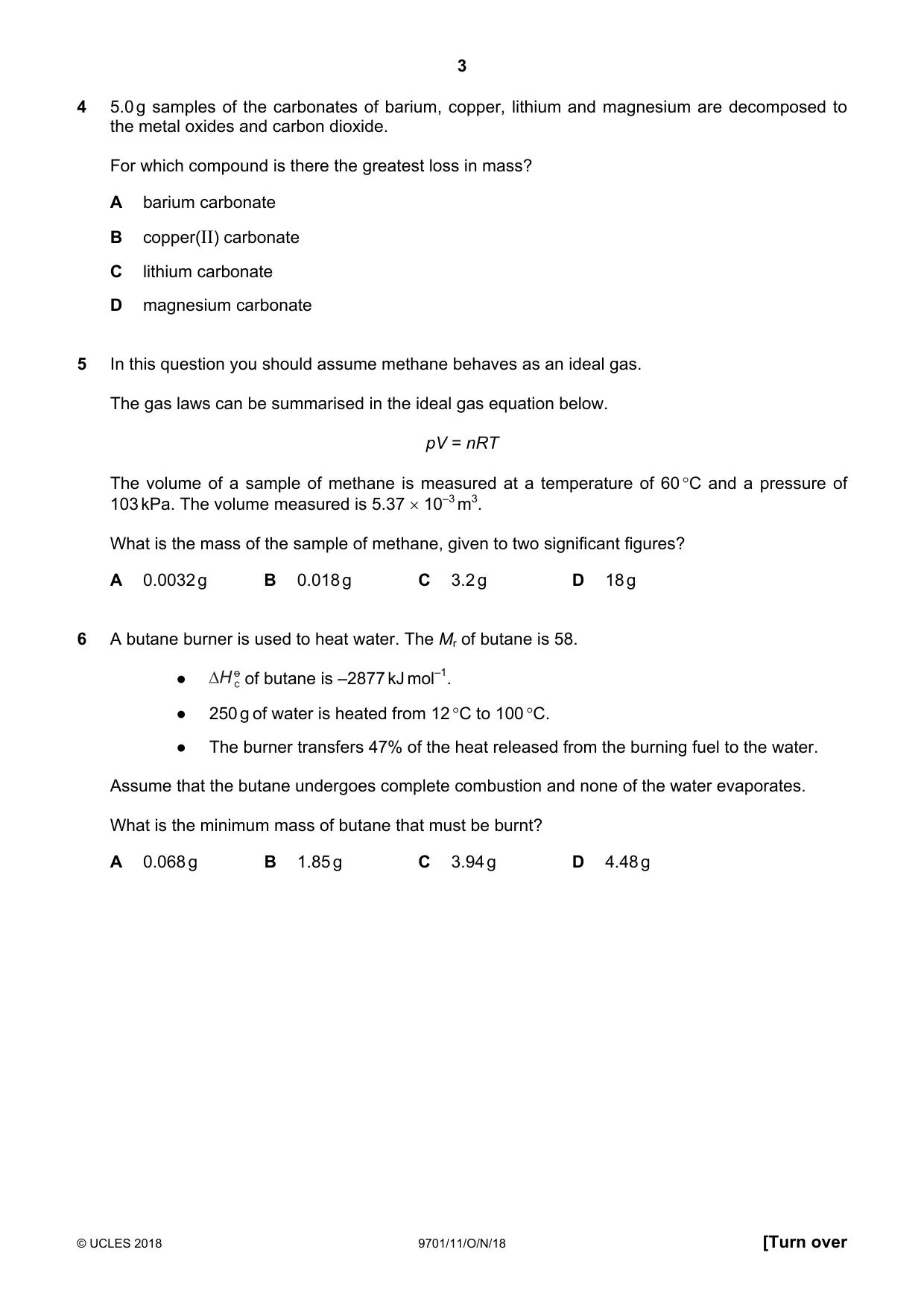
4 5.0 g samples of the carbonates of barium, copper, lithium and magnesium are decomposed to the metal oxides and carbon dioxide. For which compound is there the greatest loss in mass? A barium carbonate B copper(II) carbonate C lithium carbonate D magnesium carbonate
Mark scheme: C
Q5 · In this question you should assume methane behaves as an ideal gas
5 In this question you should assume methane behaves as an ideal gas. The gas laws can be summarised in the ideal gas equation below. pV = nRT The volume of a sample of methane is measured at a temperature of 60 °C and a pressure of 103 kPa. The volume measured is 5.37 × 10⁻³ m3. What is the mass of the sample of methane, given to two significant figures? A 0.0032 g B 0.018 g C 3.2 g D 18 g
Mark scheme: C
More questions on The gaseous state: ideal and real gases and pV = nRT
Q6 · A butane burner is used to heat water
6 A butane burner is used to heat water. The Mr of butane is 58. ● of butane is –2877 kJ mol–1. ● 250 g of water is heated from 12 °C to 100 °C. ● The burner transfers 47% of the heat released from the burning fuel to the water. Assume that the butane undergoes complete combustion and none of the water evaporates. What is the minimum mass of butane that must be burnt? A 0.068 g B 1.85 g C 3.94 g D 4.48 g
Mark scheme: C
Q7 · Nitric acid is known to take part in the oxidation of atmospheric sulfur dioxide
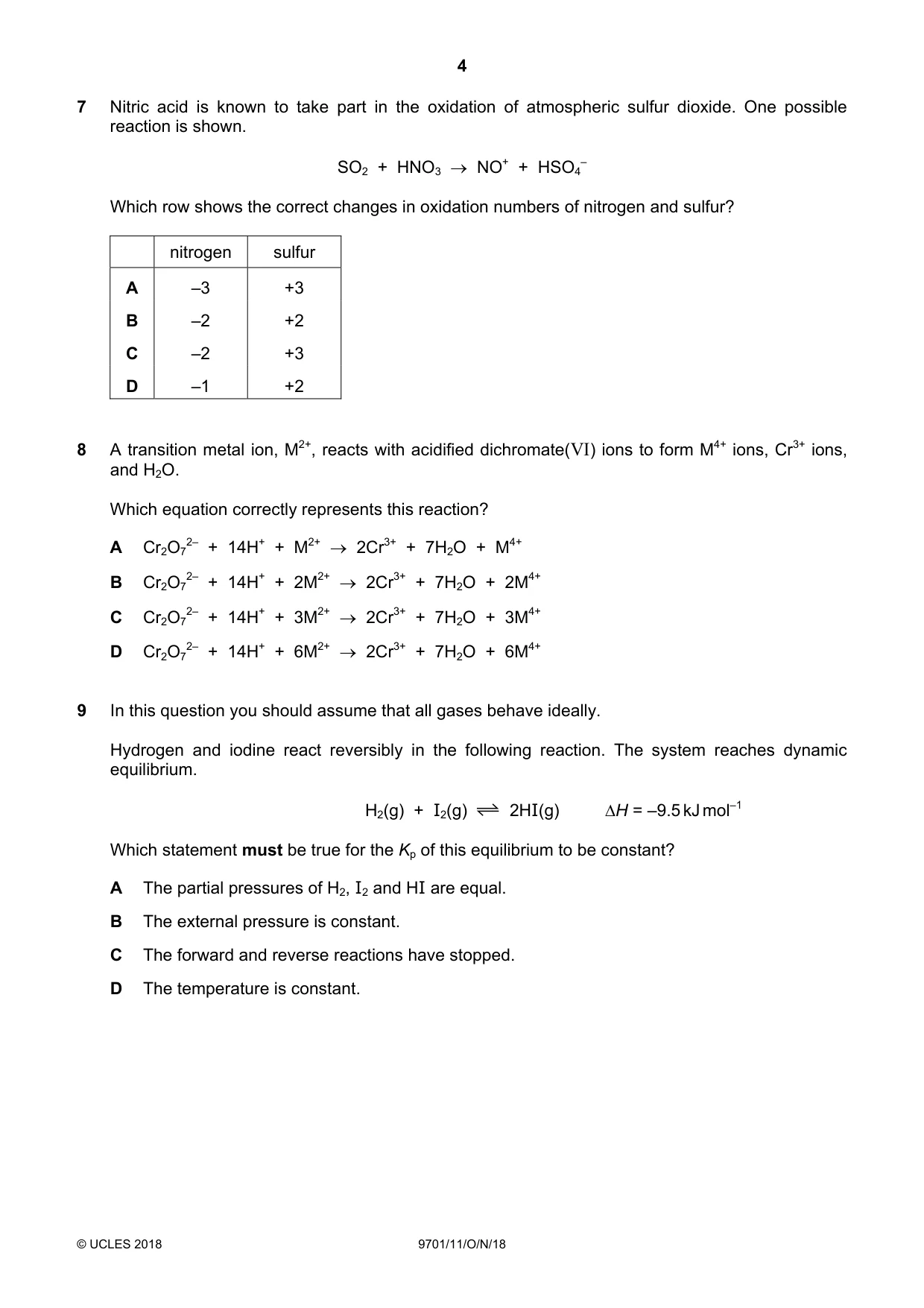
7 Nitric acid is known to take part in the oxidation of atmospheric sulfur dioxide. One possible reaction is shown. SO2 + HNO3 → NO+ + HSO4 – Which row shows the correct changes in oxidation numbers of nitrogen and sulfur? nitrogen sulfur A –3 +3 B –2 +2 C –2 +3 D –1 +2
Mark scheme: B
Q8 · A transition metal ion, M2+, reacts with acidified dichromate(VI) ions to form M4+ ions…
8 A transition metal ion, M2+, reacts with acidified dichromate(VI) ions to form M4+ ions, Cr3+ ions, and H2O. Which equation correctly represents this reaction? A Cr2O7 2– + 14H+ + M2+ → 2Cr3+ + 7H2O + M4+ B Cr2O7 2– + 14H+ + 2M2+ → 2Cr3+ + 7H2O + 2M4+ C Cr2O7 2– + 14H+ + 3M2+ → 2Cr3+ + 7H2O + 3M4+ D Cr2O7 2– + 14H+ + 6M2+ → 2Cr3+ + 7H2O + 6M4+
Mark scheme: C
Q9 · In this question you should assume that all gases behave ideally
9 In this question you should assume that all gases behave ideally. Hydrogen and iodine react reversibly in the following reaction. The system reaches dynamic equilibrium. H2(g) + I2(g) 2HI(g) ∆H = –9.5 kJ mol–1 Which statement must be true for the Kp of this equilibrium to be constant? A The partial pressures of H2, I2 and HI are equal. B The external pressure is constant. C The forward and reverse reactions have stopped. D The temperature is constant.
Mark scheme: D
More questions on Chemical equilibria: reversible reactions, dynamic equilibrium
Q10 · 0.200 mol of sulfur dioxide and 0.200 mol of oxygen are placed in a 1.00 dm3 sealed…
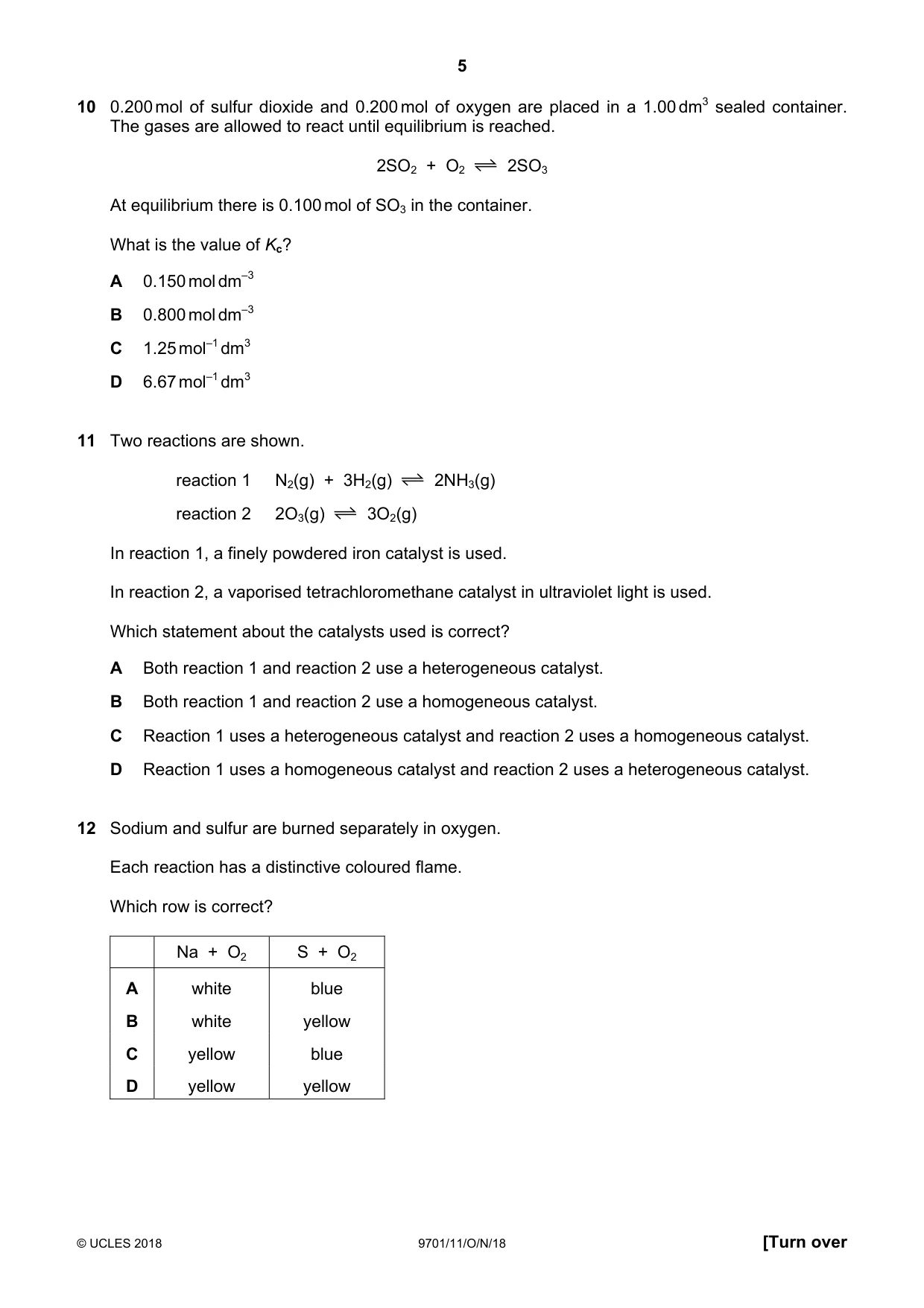
10 0.200 mol of sulfur dioxide and 0.200 mol of oxygen are placed in a 1.00 dm3 sealed container. The gases are allowed to react until equilibrium is reached. 2SO2 + O2 2SO3 At equilibrium there is 0.100 mol of SO3 in the container. What is the value of Kc? A 0.150 mol dm–3 B 0.800 mol dm–3 C 1.25 mol–1 dm3 D 6.67 mol–1 dm3
Mark scheme: D
More questions on Chemical equilibria: reversible reactions, dynamic equilibrium
Q11 · Two reactions are shown
11 Two reactions are shown. reaction 1 N2(g) + 3H2(g) 2NH3(g) reaction 2 2O3(g) 3O2(g) In reaction 1, a finely powdered iron catalyst is used. In reaction 2, a vaporised tetrachloromethane catalyst in ultraviolet light is used. Which statement about the catalysts used is correct? A Both reaction 1 and reaction 2 use a heterogeneous catalyst. B Both reaction 1 and reaction 2 use a homogeneous catalyst. C Reaction 1 uses a heterogeneous catalyst and reaction 2 uses a homogeneous catalyst. D Reaction 1 uses a homogeneous catalyst and reaction 2 uses a heterogeneous catalyst.
Mark scheme: C
Q12 · Sodium and sulfur are burned separately in oxygen
12 Sodium and sulfur are burned separately in oxygen. Each reaction has a distinctive coloured flame. Which row is correct? Na + O2 S + O2 A white blue B white yellow C yellow blue D yellow yellow
Mark scheme: C
More questions on Periodicity of chemical properties of the elements in Period 3
Q13 · X and Y are elements in Period 3 of the Periodic Table
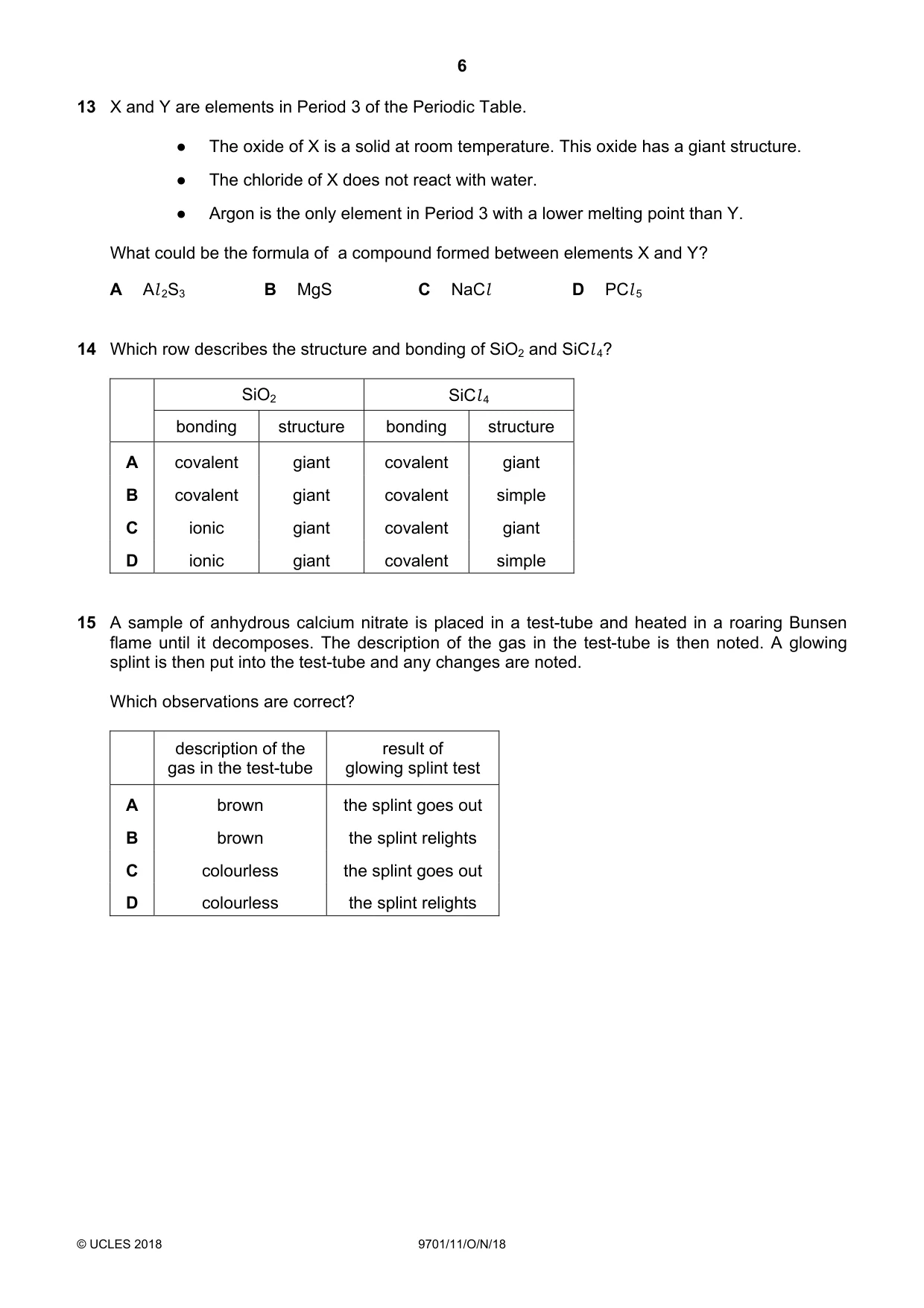
13 X and Y are elements in Period 3 of the Periodic Table. ● The oxide of X is a solid at room temperature. This oxide has a giant structure. ● The chloride of X does not react with water. ● Argon is the only element in Period 3 with a lower melting point than Y. What could be the formula of a compound formed between elements X and Y? A Al 2S3 B MgS C NaCl D PCl 5
Mark scheme: C
More questions on Periodicity of chemical properties of the elements in Period 3
Q14 · Which row describes the structure and bonding of SiO2 and SiCl 4?
14 Which row describes the structure and bonding of SiO2 and SiCl 4? SiO2 SiCl 4 bonding structure bonding structure A covalent giant covalent giant B covalent giant covalent simple C ionic giant covalent giant D ionic giant covalent simple
Mark scheme: B
Q15 · A sample of anhydrous calcium nitrate is placed in a test-tube and heated in a roaring…
15 A sample of anhydrous calcium nitrate is placed in a test-tube and heated in a roaring Bunsen flame until it decomposes. The description of the gas in the test-tube is then noted. A glowing splint is then put into the test-tube and any changes are noted. Which observations are correct? description of the result of gas in the test-tube glowing splint test A brown the splint goes out B brown the splint relights C colourless the splint goes out D colourless the splint relights
Mark scheme: B
Q16 · Which row correctly describes the properties of the halogens as Group 17 is descended…
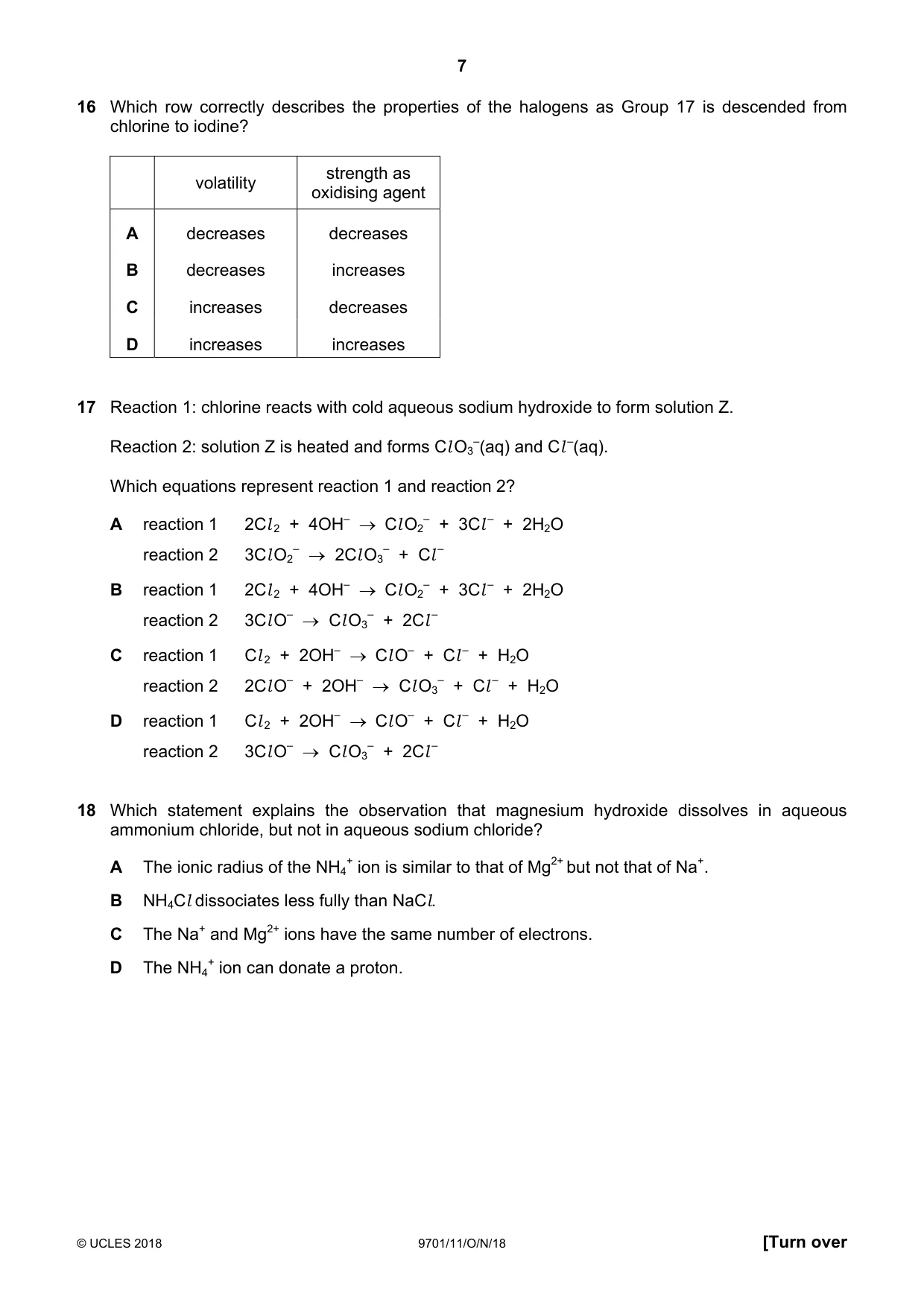
16 Which row correctly describes the properties of the halogens as Group 17 is descended from chlorine to iodine? strength as volatility oxidising agent A decreases decreases B decreases increases C increases decreases D increases increases
Mark scheme: A
More questions on Physical properties of the Group 17 elements
Q17 · Reaction 1: chlorine reacts with cold aqueous sodium hydroxide to form solution Z
17 Reaction 1: chlorine reacts with cold aqueous sodium hydroxide to form solution Z. Reaction 2: solution Z is heated and forms Cl O3 –(aq) and Cl –(aq). Which equations represent reaction 1 and reaction 2? A reaction 1 2Cl 2 + 4OH– → Cl O2 – + 3Cl – + 2H2O reaction 2 3Cl O2 – → 2Cl O3 – + Cl – B reaction 1 2Cl 2 + 4OH– → Cl O2 – + 3Cl – + 2H2O reaction 2 3Cl O– → Cl O3 – + 2Cl – C reaction 1 Cl 2 + 2OH– → Cl O– + Cl – + H2O reaction 2 2Cl O– + 2OH– → Cl O3 – + Cl – + H2O D reaction 1 Cl 2 + 2OH– → Cl O– + Cl – + H2O reaction 2 3Cl O– → Cl O3 – + 2Cl –
Mark scheme: D
Q18 · Which statement explains the observation that magnesium hydroxide dissolves in aqueous…
18 Which statement explains the observation that magnesium hydroxide dissolves in aqueous ammonium chloride, but not in aqueous sodium chloride? A The ionic radius of the NH4 + ion is similar to that of Mg2+ but not that of Na+. B NH4Cl dissociates less fully than NaCl. C The Na+ and Mg2+ ions have the same number of electrons. D The NH4 + ion can donate a proton.
Mark scheme: D
Q19 · Transition elements and their compounds are widely used as catalysts
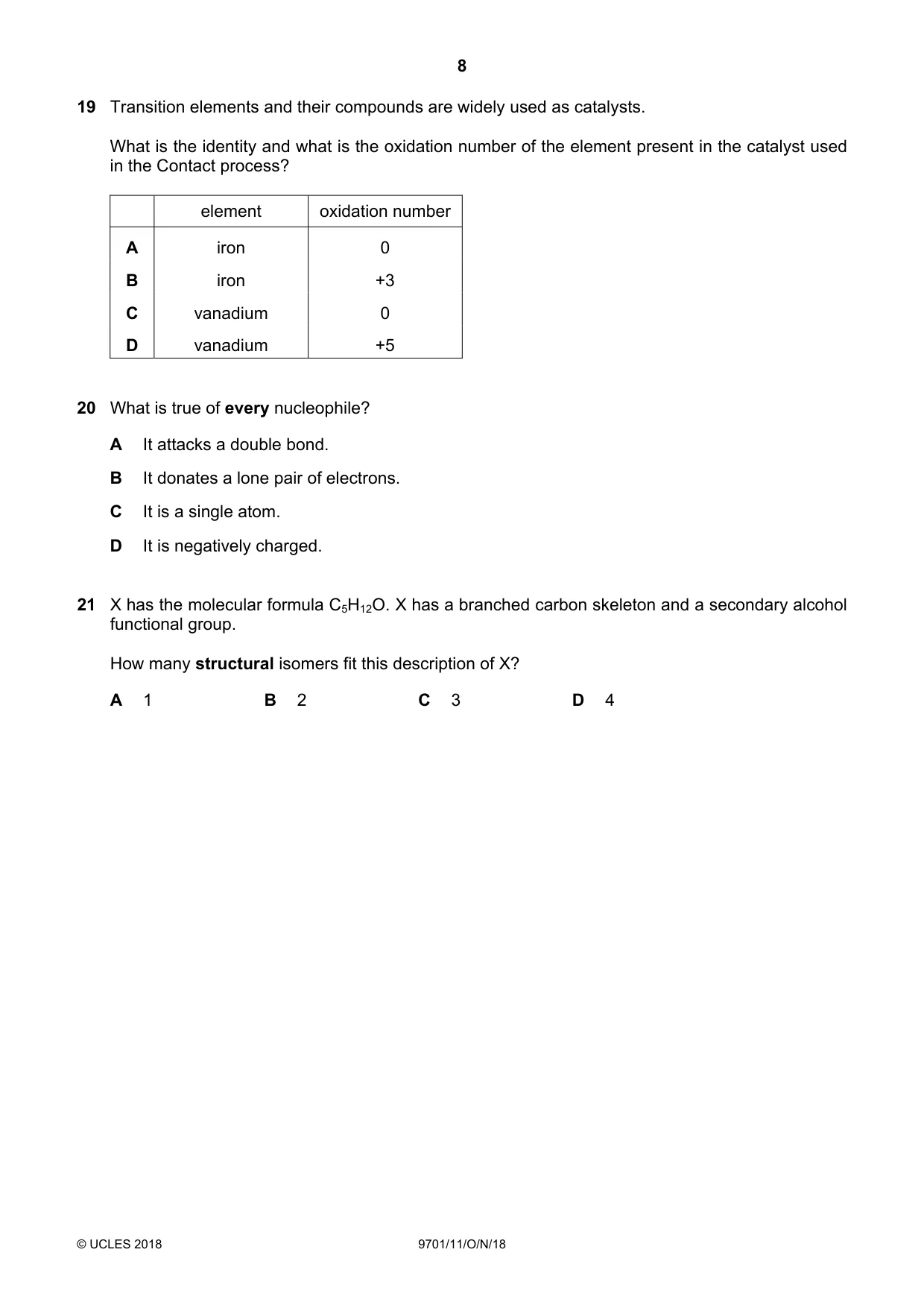
19 Transition elements and their compounds are widely used as catalysts. What is the identity and what is the oxidation number of the element present in the catalyst used in the Contact process? element oxidation number A iron 0 B iron +3 C vanadium 0 D vanadium +5
Mark scheme: D
Q20 · What is true of every nucleophile?
20 What is true of every nucleophile? A It attacks a double bond. B It donates a lone pair of electrons. C It is a single atom. D It is negatively charged.
Mark scheme: B
Q21 · X has the molecular formula C5H12O
21 X has the molecular formula C5H12O. X has a branched carbon skeleton and a secondary alcohol functional group. How many structural isomers fit this description of X? A 1 B 2 C 3 D 4
Mark scheme: A
More questions on Isomerism: structural isomerism and stereoisomerism
Q22 · A new jet fuel has been produced that is a mixture of different structural isomers of…
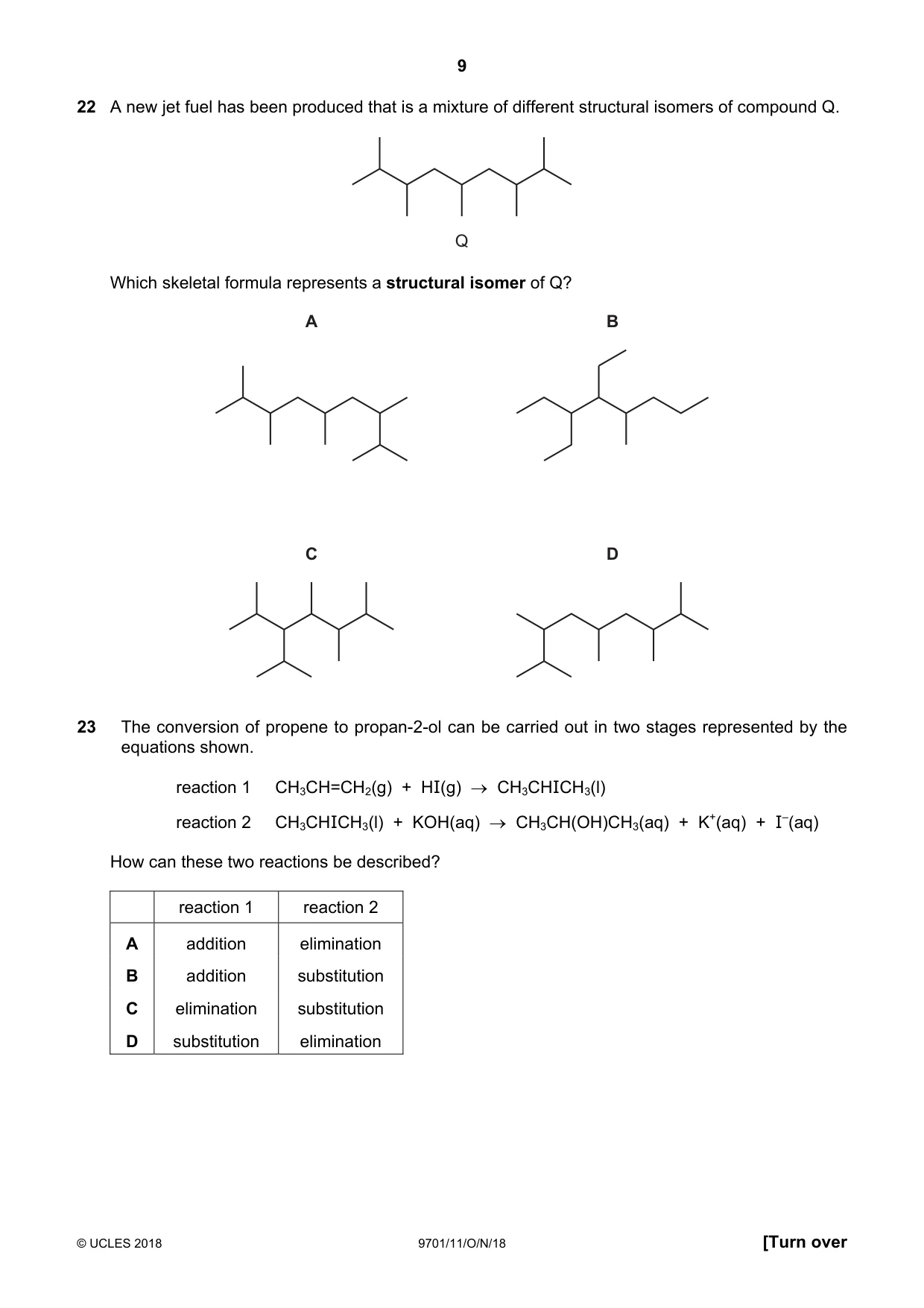
22 A new jet fuel has been produced that is a mixture of different structural isomers of compound Q. Q Which skeletal formula represents a structural isomer of Q? A B C D
Mark scheme: C
More questions on Isomerism: structural isomerism and stereoisomerism
Q23 · The conversion of propene to propan-2-ol can be carried out in two stages represented by…
23 The conversion of propene to propan-2-ol can be carried out in two stages represented by the equations shown. reaction 1 CH3CH=CH2(g) + HI(g) → CH3CHICH3(l) reaction 2 CH3CHICH3(l) + KOH(aq) → CH3CH(OH)CH3(aq) + K+(aq) + I–(aq) How can these two reactions be described? reaction 1 reaction 2 A addition elimination B addition substitution C elimination substitution D substitution elimination
Mark scheme: B
Q24 · An organic molecule W contains 3 carbon atoms
24 An organic molecule W contains 3 carbon atoms. It requires 4.5 molecules of oxygen for complete combustion. What could W be? A propane B propanoic acid C propanone D propan-1-ol
Mark scheme: D
Q25 · Compound J, C15H23Br2Cl, is reacted with an excess of a hot concentrated solution of…
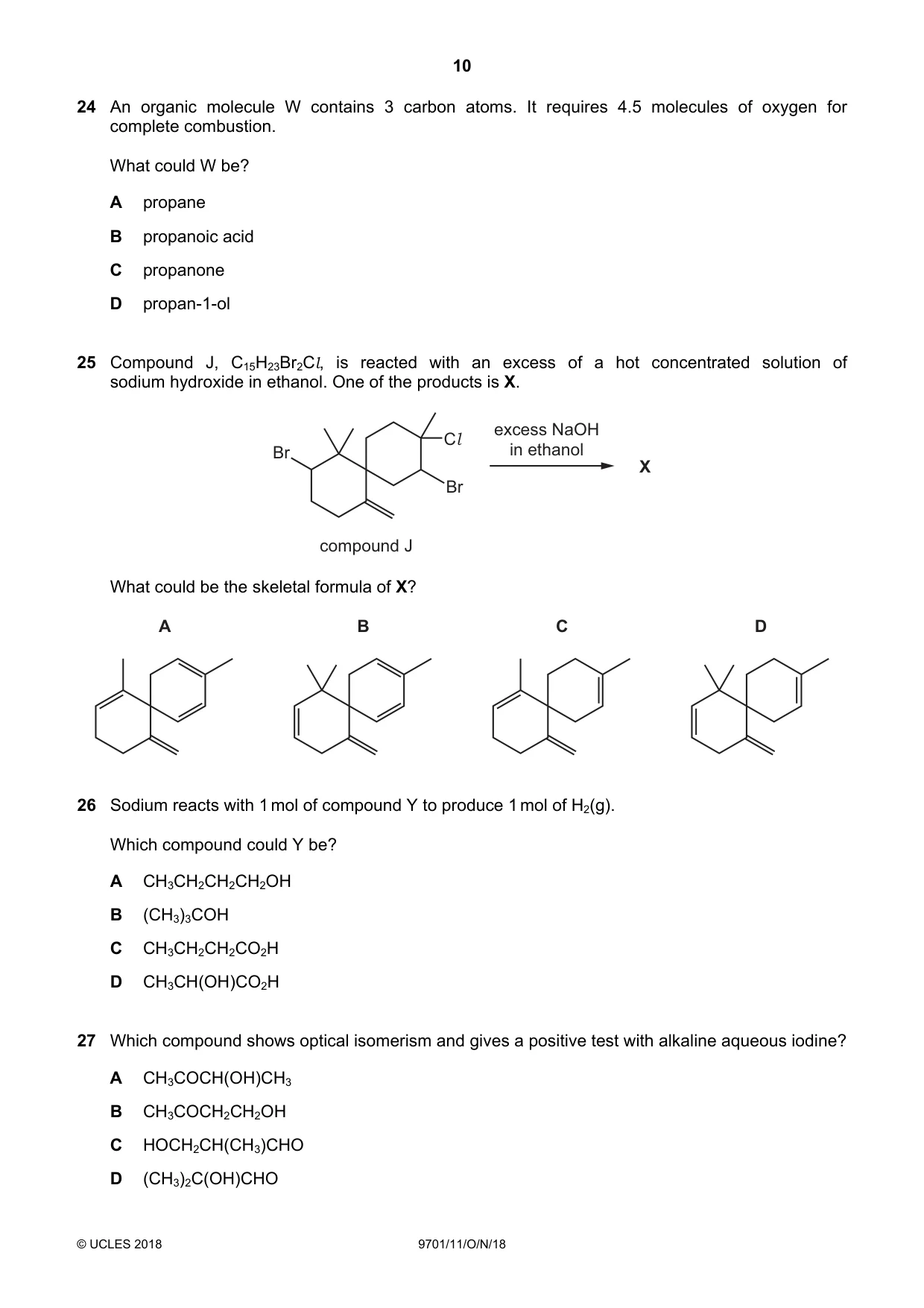
25 Compound J, C15H23Br2Cl, is reacted with an excess of a hot concentrated solution of sodium hydroxide in ethanol. One of the products is X. excess NaOH Cl Br in ethanol X Br compound J What could be the skeletal formula of X? A B C D
Mark scheme: B
Q26 · Sodium reacts with 1 mol of compound Y to produce 1 mol of H2(g)
26 Sodium reacts with 1 mol of compound Y to produce 1 mol of H2(g). Which compound could Y be? A CH3CH2CH2CH2OH B (CH3)3COH C CH3CH2CH2CO2H D CH3CH(OH)CO2H
Mark scheme: D
Q27 · Which compound shows optical isomerism and gives a positive test with alkaline aqueous…
27 Which compound shows optical isomerism and gives a positive test with alkaline aqueous iodine? A CH3COCH(OH)CH3 B CH3COCH2CH2OH C HOCH2CH(CH3)CHO D (CH3)2C(OH)CHO
Mark scheme: A
Q28 · Ethanedioic acid, HO2CCO2H, is reduced using an excess of lithium aluminium hydride, LiAl…
28 Ethanedioic acid, HO2CCO2H, is reduced using an excess of lithium aluminium hydride, LiAl H4. What is the organic product of the reaction? A ethanol B ethane-1,2-diol C ethanedial, OHCCHO D methane
Mark scheme: B
Q29 · The diester shown can be hydrolysed by heating with an excess of aqueous sodium hydroxide
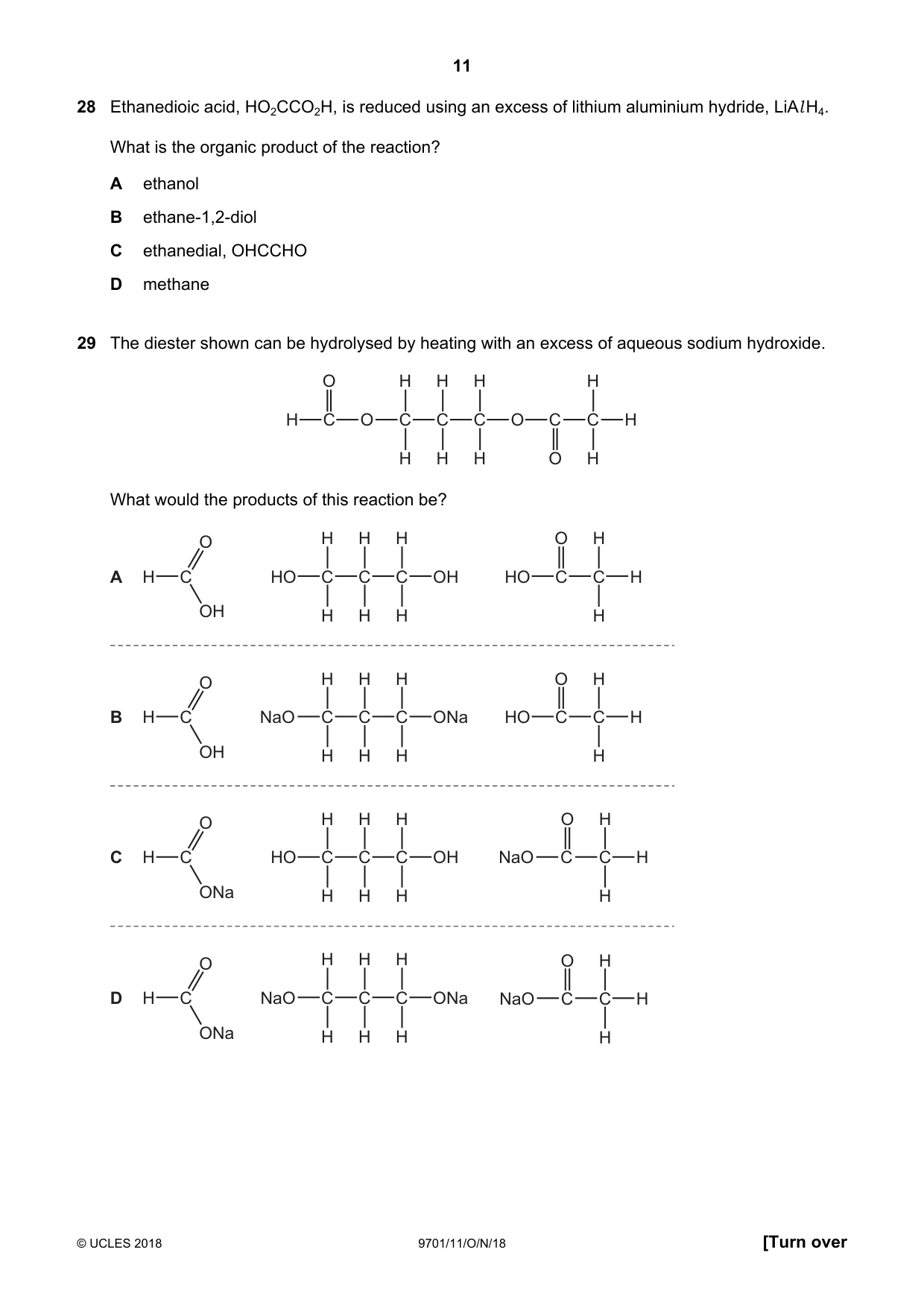
29 The diester shown can be hydrolysed by heating with an excess of aqueous sodium hydroxide. O H H H H H C O C C C O C C H H H H O H What would the products of this reaction be? O H H H O H A H C HO C C C OH HO C C H OH H H H H O H H H O H B H C NaO C C C ONa HO C C H OH H H H H O H H H O H C H C HO C C C OH NaO C C H ONa H H H H O H H H O H D H C NaO C C C ONa NaO C C H ONa H H H H
Mark scheme: C
Q30 · J is a branched-chain alcohol, C5H12O
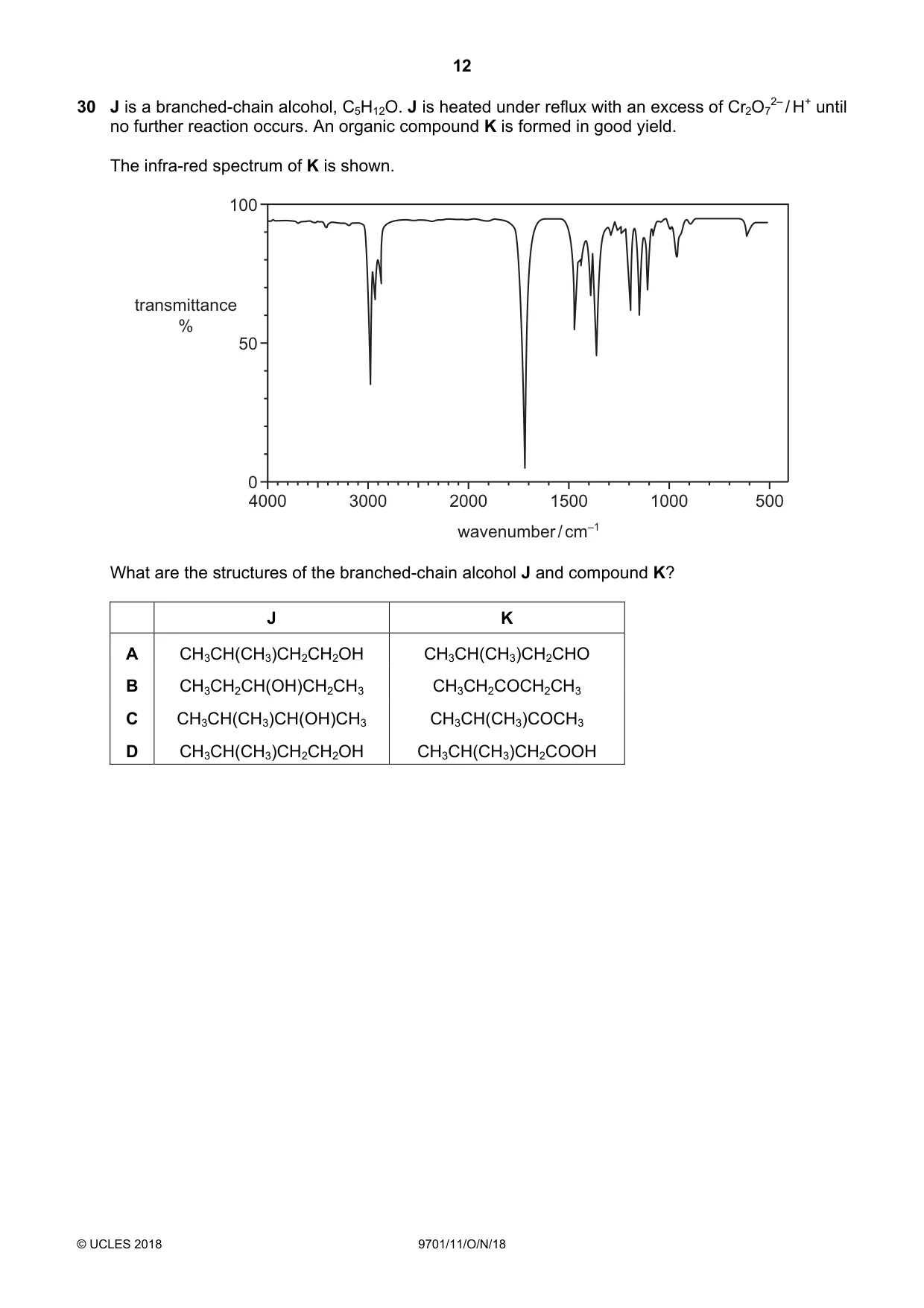
30 J is a branched-chain alcohol, C5H12O. J is heated under reflux with an excess of Cr2O7 2– / H+ until no further reaction occurs. An organic compound K is formed in good yield. The infra-red spectrum of K is shown. 100 transmittance % 50 0 4000 3000 2000 1500 1000 500 wavenumber / cm–1 What are the structures of the branched-chain alcohol J and compound K? J K A CH3CH(CH3)CH2CH2OH CH3CH(CH3)CH2CHO B CH3CH2CH(OH)CH2CH3 CH3CH2COCH2CH3 C CH3CH(CH3)CH(OH)CH3 CH3CH(CH3)COCH3 D CH3CH(CH3)CH2CH2OH CH3CH(CH3)CH2COOH
Mark scheme: C
Q31 · Which ions contain one or more unpaired electrons?
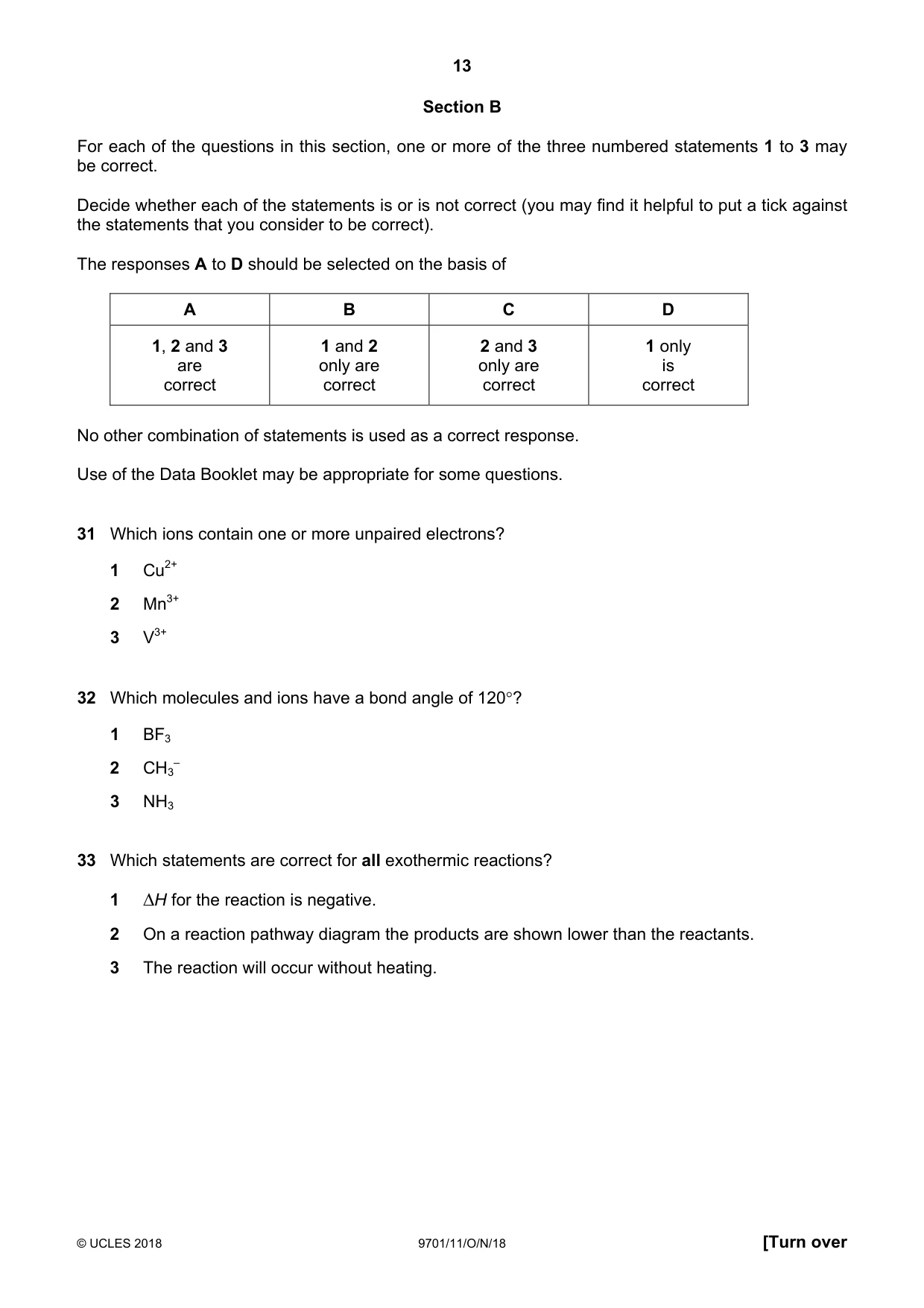
31 Which ions contain one or more unpaired electrons? 1 Cu2+ 2 Mn3+ 3 V3+
Mark scheme: A
Q32 · Which molecules and ions have a bond angle of 120°?
32 Which molecules and ions have a bond angle of 120°? 1 BF3 2 CH3 – 3 NH3
Mark scheme: D
Q33 · Which statements are correct for all exothermic reactions?
33 Which statements are correct for all exothermic reactions? 1 ∆H for the reaction is negative. 2 On a reaction pathway diagram the products are shown lower than the reactants. 3 The reaction will occur without heating.
Mark scheme: B
Q34 · The factors affecting the rate of reaction between aqueous sodium thiosulfate and…
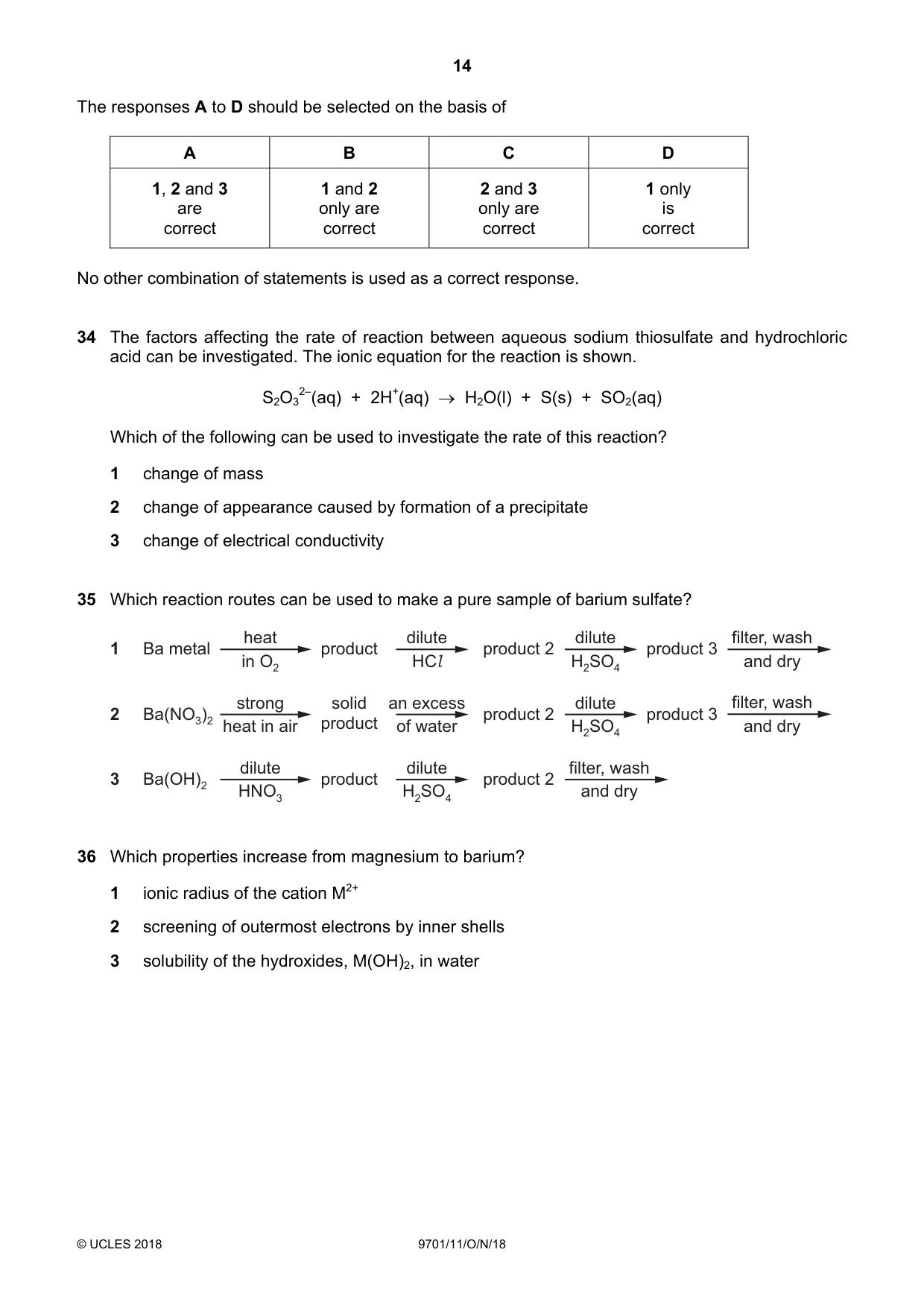
34 The factors affecting the rate of reaction between aqueous sodium thiosulfate and hydrochloric acid can be investigated. The ionic equation for the reaction is shown. S2O3 2–(aq) + 2H+(aq) → H2O(l) + S(s) + SO2(aq) Which of the following can be used to investigate the rate of this reaction? 1 change of mass 2 change of appearance caused by formation of a precipitate 3 change of electrical conductivity
Mark scheme: C
Q35 · Which reaction routes can be used to make a pure sample of barium sulfate?
35 Which reaction routes can be used to make a pure sample of barium sulfate? heat dilute dilute filter, wash 1 Ba metal product product 2 product 3 in O2 HCl H2SO4 and dry strong solid an excess dilute filter, wash 2 Ba(NO3)2 product 2 product 3 heat in air product of water H2SO4 and dry dilute dilute filter, wash 3 Ba(OH)2 product product 2 HNO3 H2SO4 and dry
Mark scheme: A
Q36 · Which properties increase from magnesium to barium?
36 Which properties increase from magnesium to barium? 1 ionic radius of the cation M2+ 2 screening of outermost electrons by inner shells 3 solubility of the hydroxides, M(OH)2, in water
Mark scheme: A
Q37 · 2-methylpropene can react in more than one way with chlorine
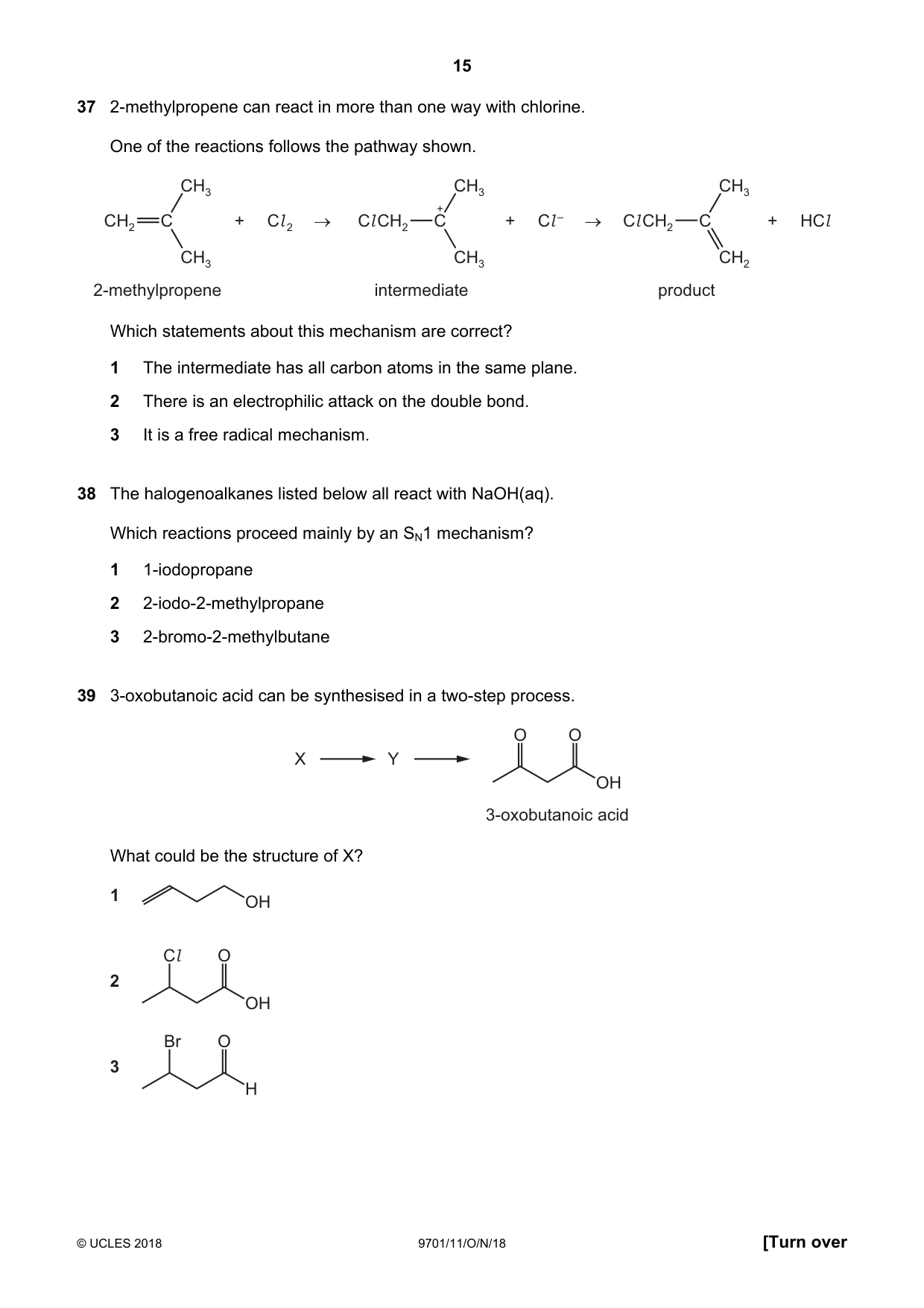
37 2-methylpropene can react in more than one way with chlorine. One of the reactions follows the pathway shown. CH3 CH3 CH3 + CH2 C + Cl 2 → Cl CH2 C + Cl – → Cl CH2 C + HCl CH3 CH3 CH2 2-methylpropene intermediate product Which statements about this mechanism are correct? 1 The intermediate has all carbon atoms in the same plane. 2 There is an electrophilic attack on the double bond. 3 It is a free radical mechanism.
Mark scheme: B
Q38 · The halogenoalkanes listed below all react with NaOH(aq)
38 The halogenoalkanes listed below all react with NaOH(aq). Which reactions proceed mainly by an SN1 mechanism? 1 1-iodopropane 2 2-iodo-2-methylpropane 3 2-bromo-2-methylbutane
Mark scheme: C
Q39 · 3-oxobutanoic acid can be synthesised in a two-step process
39 3-oxobutanoic acid can be synthesised in a two-step process. O O X Y OH 3-oxobutanoic acid What could be the structure of X? 1 OH Cl O 2 OH Br O 3 H
Mark scheme: A
Q40 · Ethanal reacts with HCN in the presence of KCN
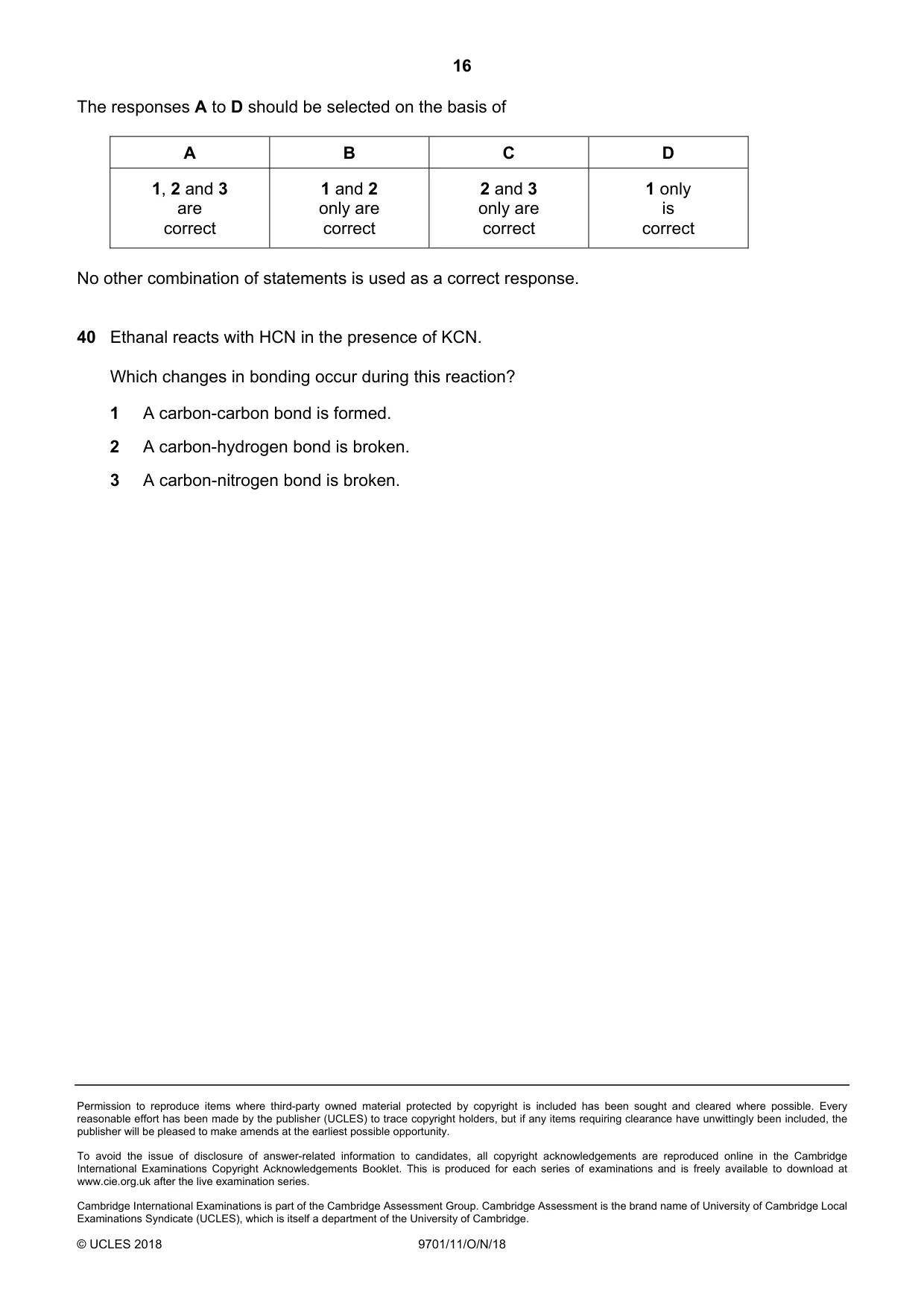
40 Ethanal reacts with HCN in the presence of KCN. Which changes in bonding occur during this reaction? 1 A carbon-carbon bond is formed. 2 A carbon-hydrogen bond is broken. 3 A carbon-nitrogen bond is broken.
Mark scheme: B
What was in this paper
The subtopics covered by these 40 questions, and how many questions each got. Open one in a new tab to see every Cambridge question on it.
4Characteristic organic reactions2Chemical equilibria: reversible reactions, dynamic equilibrium2Enthalpy change, ΔH2Isomerism: structural isomerism and stereoisomerism2Nitriles and hydroxynitriles2Periodicity of chemical properties of the elements in Period 32Redox processes: electron transfer and changes in oxidation number (oxidation state)2The gaseous state: ideal and real gases and pV = nRT2Acids and bases1Alcohols1Aldehydes and ketones1Alkanes1Alkenes1Bonding and structure1Carboxylic acids1Colour of complexes1Esters1General characteristic chemical properties of the first set of transition elements, titanium to copper1Halogen compounds1Halogenoalkanes1Homogeneous and heterogeneous catalysts1Infrared spectroscopy1Ionisation energy1Physical properties of the Group 17 elements1Rate of reaction1Reacting masses and volumes (of solutions and gases)1Shapes of molecules1The reactions of chlorine1What you needed in this session
Cambridge’s own grade thresholds for 2018 Oct/Nov, Paper 1 · Variant 1. A higher threshold means an easier paper — the bar moves with how the cohort did.