Cambridge A Level Chemistry 9701 — 2017 Oct/Nov Paper 1 · Variant 3
9701/13/O/N/17 · 40 questions · 40 marks · ≈45 min
The question paper and its mark scheme, free to read here and free to download. This is Cambridge’s own paper, exactly as it was sat.
Question paper16 pages

Mark scheme3 pages
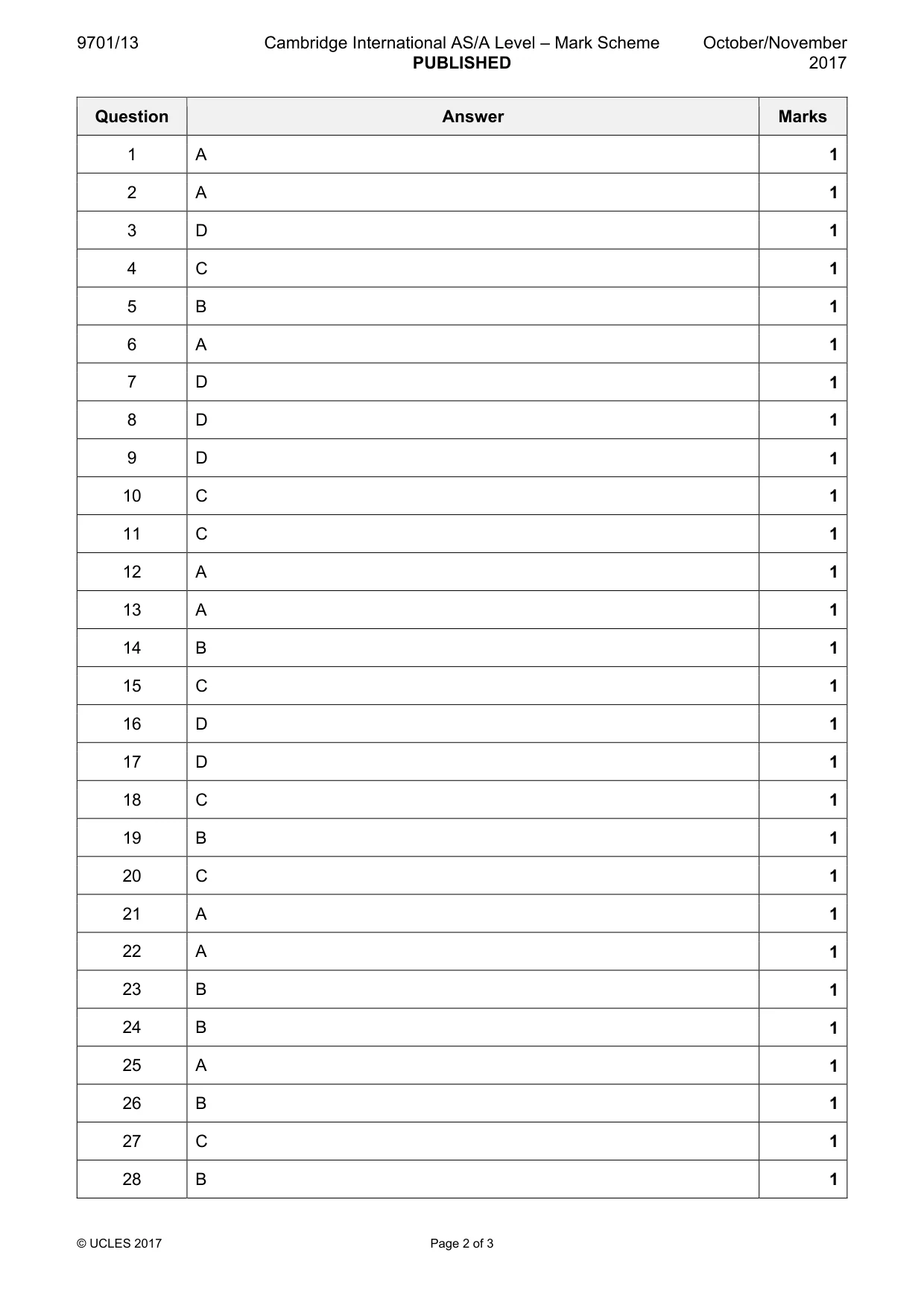
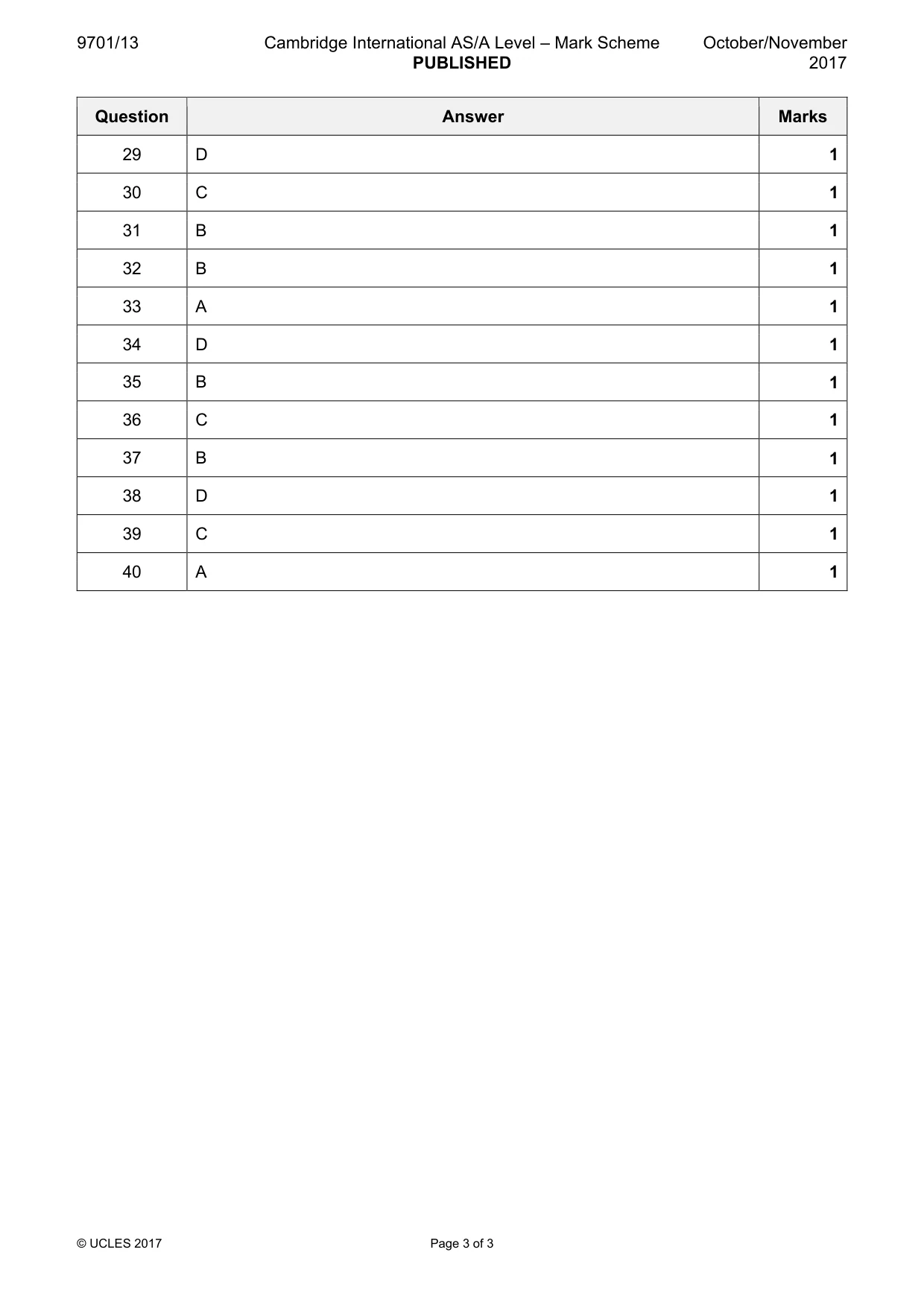
Answers below. Sit the paper first if you are practising.
Questions as text
Q1 · Which formula represents the empirical formula of a compound?
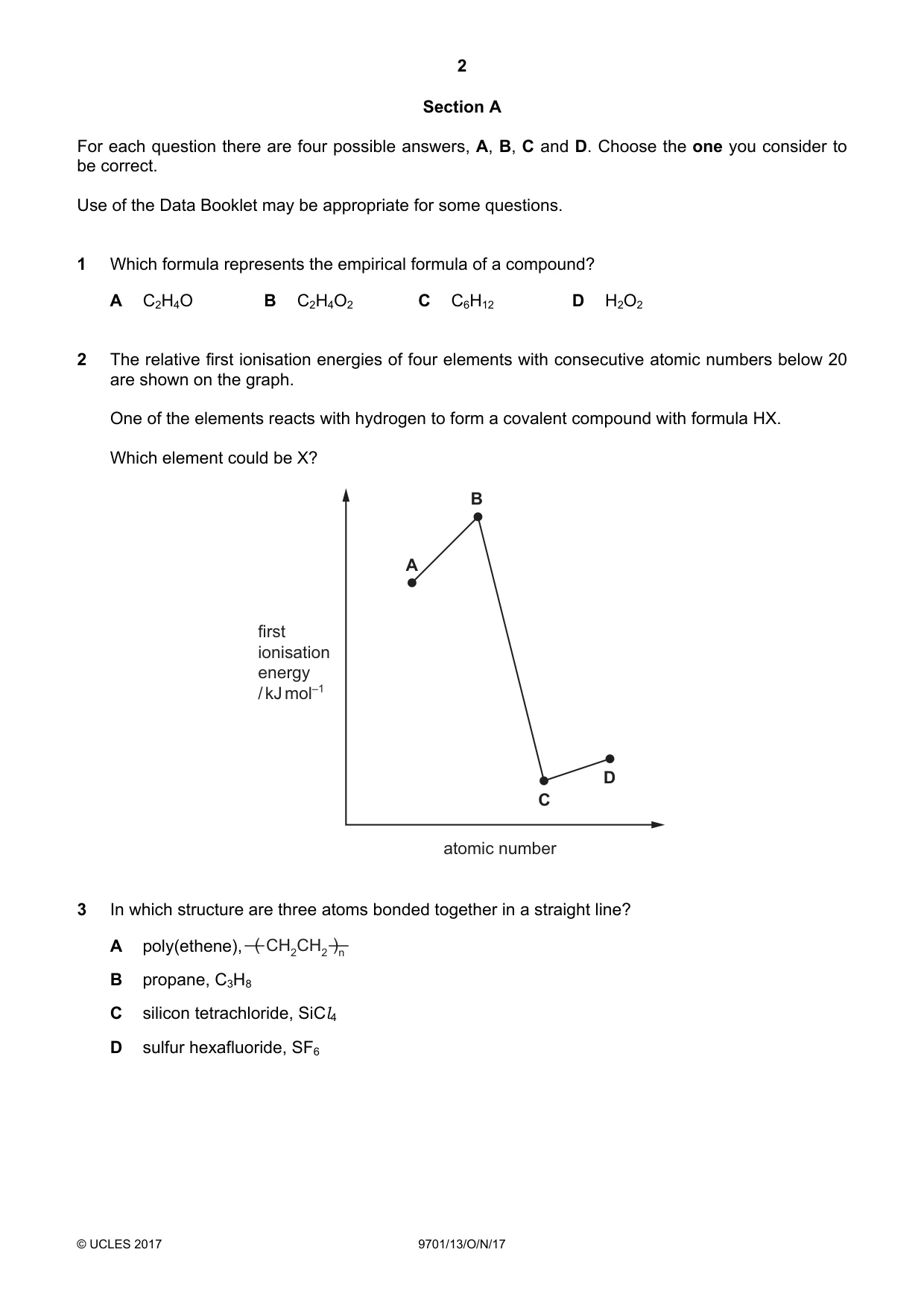
1 Which formula represents the empirical formula of a compound? A C2H4O B C2H4O2 C C6H12 D H2O2
Mark scheme: A
Q2 · The relative first ionisation energies of four elements with consecutive atomic numbers…
2 The relative first ionisation energies of four elements with consecutive atomic numbers below 20 are shown on the graph. One of the elements reacts with hydrogen to form a covalent compound with formula HX. Which element could be X? B A first ionisation energy / kJ mol–1 D C atomic number
Mark scheme: A
Q3 · In which structure are three atoms bonded together in a straight line?
3 In which structure are three atoms bonded together in a straight line? A poly(ethene), ] ( CH2CH2 ) n B propane, C3H8 C silicon tetrachloride, SiCl4 D sulfur hexafluoride, SF6
Mark scheme: D
Q4 · In the sodium chloride lattice the number of chloride ions that surround each sodium ion…
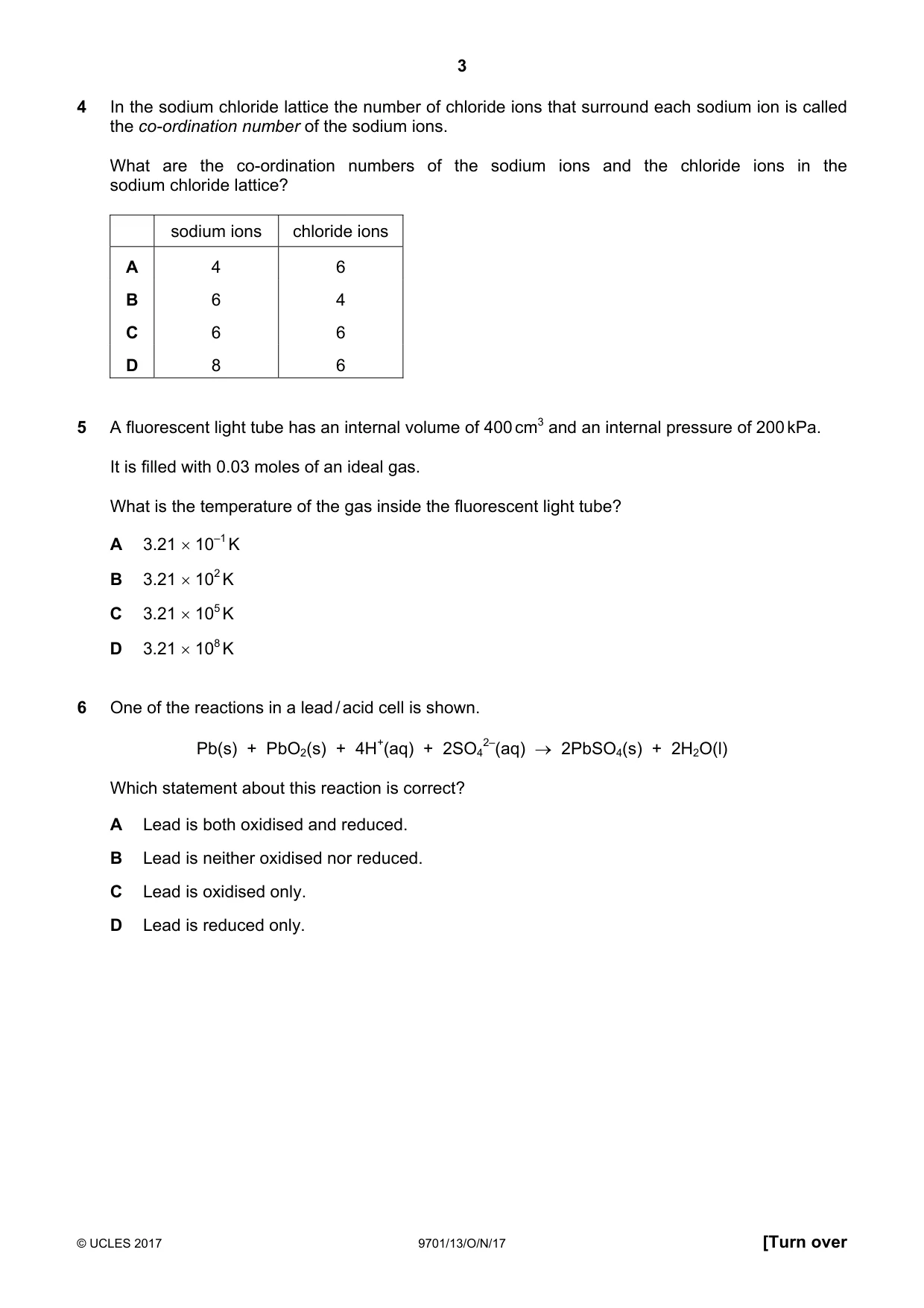
4 In the sodium chloride lattice the number of chloride ions that surround each sodium ion is called the co-ordination number of the sodium ions. What are the co-ordination numbers of the sodium ions and the chloride ions in the sodium chloride lattice? sodium ions chloride ions A 4 6 B 6 4 C 6 6 D 8 6
Mark scheme: C
Q5 · A fluorescent light tube has an internal volume of 400 cm3 and an internal pressure of…
5 A fluorescent light tube has an internal volume of 400 cm3 and an internal pressure of 200 kPa. It is filled with 0.03 moles of an ideal gas. What is the temperature of the gas inside the fluorescent light tube? A 3.21 × 10⁻¹ K B 3.21 × 10² K C 3.21 × 10⁵ K D 3.21 × 10⁸ K
Mark scheme: B
More questions on The gaseous state: ideal and real gases and pV = nRT
Q6 · One of the reactions in a lead / acid cell is shown
6 One of the reactions in a lead / acid cell is shown. Pb(s) + PbO2(s) + 4H+(aq) + 2SO4 2–(aq) → 2PbSO4(s) + 2H2O(l) Which statement about this reaction is correct? A Lead is both oxidised and reduced. B Lead is neither oxidised nor reduced. C Lead is oxidised only. D Lead is reduced only.
Mark scheme: A
Q7 · Iodine and propanone react according to the following equation
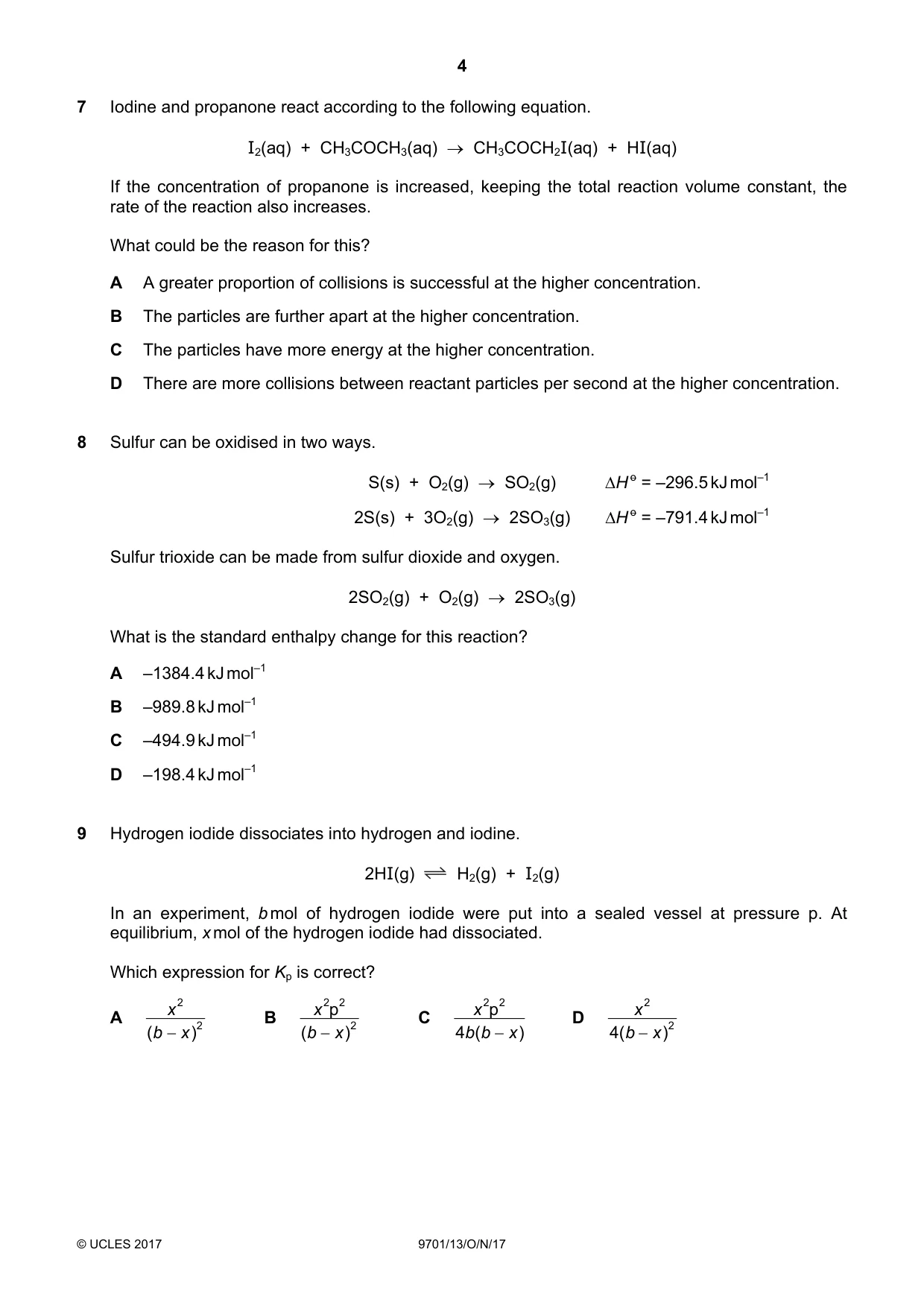
7 Iodine and propanone react according to the following equation. I2(aq) + CH3COCH3(aq) → CH3COCH2I(aq) + HI(aq) If the concentration of propanone is increased, keeping the total reaction volume constant, the rate of the reaction also increases. What could be the reason for this? A A greater proportion of collisions is successful at the higher concentration. B The particles are further apart at the higher concentration. C The particles have more energy at the higher concentration. D There are more collisions between reactant particles per second at the higher concentration.
Mark scheme: D
Q8 · Sulfur can be oxidised in two ways
8 Sulfur can be oxidised in two ways. S(s) + O2(g) → SO2(g) ∆H o = –296.5 kJ mol–1 2S(s) + 3O2(g) → 2SO3(g) ∆H o = –791.4 kJ mol–1 Sulfur trioxide can be made from sulfur dioxide and oxygen. 2SO2(g) + O2(g) → 2SO3(g) What is the standard enthalpy change for this reaction? A –1384.4 kJ mol–1 B –989.8 kJ mol–1 C –494.9 kJ mol–1 D –198.4 kJ mol–1
Mark scheme: D
Q9 · Hydrogen iodide dissociates into hydrogen and iodine
9 Hydrogen iodide dissociates into hydrogen and iodine. 2HI(g) H2(g) + I2(g) In an experiment, b mol of hydrogen iodide were put into a sealed vessel at pressure p. At equilibrium, x mol of the hydrogen iodide had dissociated. Which expression for Kp is correct? x 2 x 2 p 2 x 2 p2 x 2 A B C D ( b − x ) 2 ( b − x ) 2 4 b ( b − x ) 4( b − x ) 2
Mark scheme: D
More questions on Chemical equilibria: reversible reactions, dynamic equilibrium
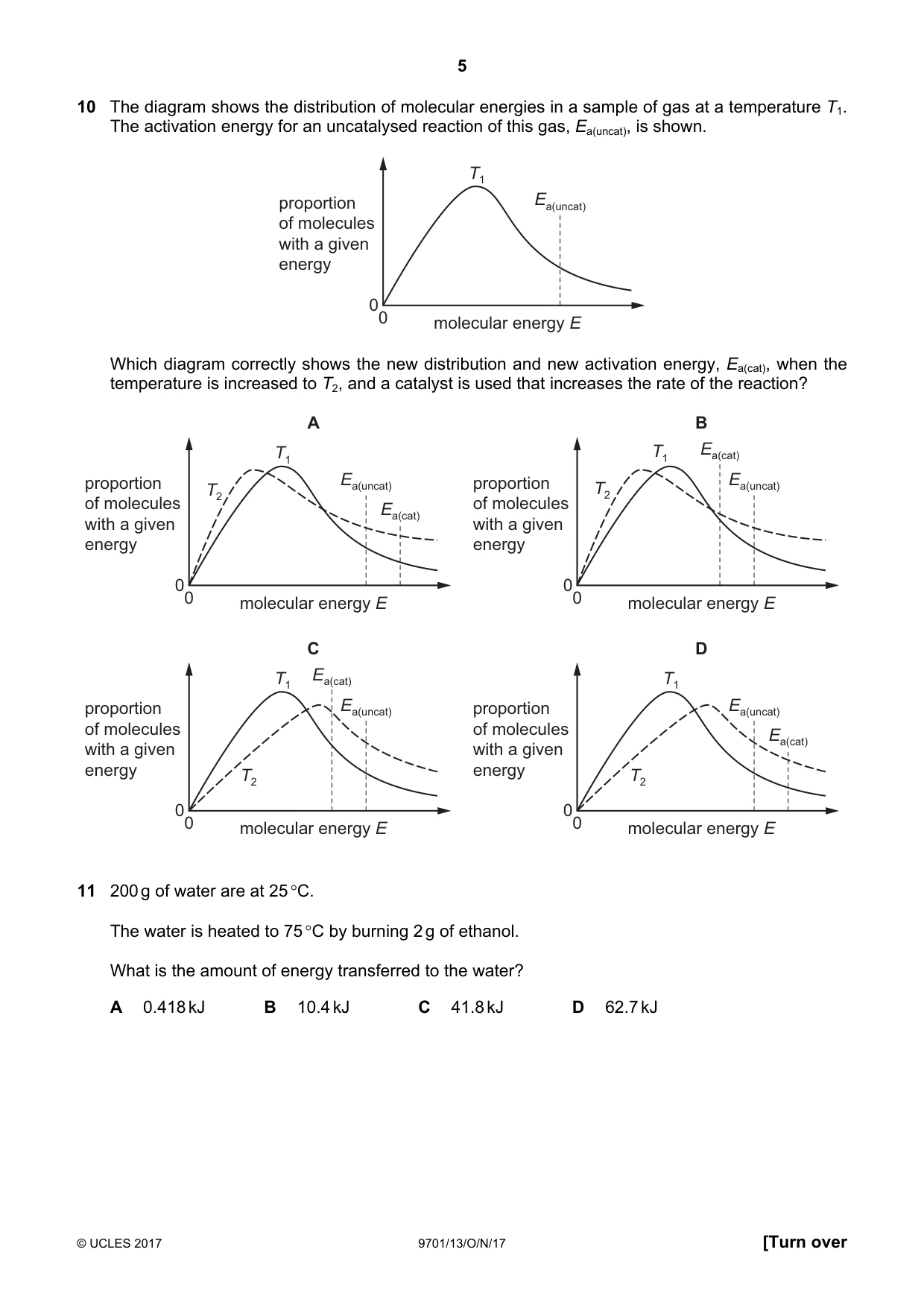
Q10 · The diagram shows the distribution of molecular energies in a sample of gas at a…
10 The diagram shows the distribution of molecular energies in a sample of gas at a temperature T1. The activation energy for an uncatalysed reaction of this gas, Ea(uncat), is shown. T1 proportion Ea(uncat) of molecules with a given energy 0 0 molecular energy E Which diagram correctly shows the new distribution and new activation energy, Ea(cat), when the temperature is increased to T2, and a catalyst is used that increases the rate of the reaction? A B T1 T1 Ea(cat) proportion Ea(uncat) proportion Ea(uncat) T2 T2 of molecules Ea(cat) of molecules with a given with a given energy energy 0 0 0 molecular energy E 0 molecular energy E C D T1 Ea(cat) T1 proportion Ea(uncat) proportion Ea(uncat) of molecules of molecules Ea(cat) with a given with a given energy T2 energy T2 0 0 0 molecular energy E 0 molecular energy E
Mark scheme: C
More questions on Effect of temperature on reaction rates and the concept of activation energy
Q11 · 200 g of water are at 25 °C
11 200 g of water are at 25 °C. The water is heated to 75 °C by burning 2 g of ethanol. What is the amount of energy transferred to the water? A 0.418 kJ B 10.4 kJ C 41.8 kJ D 62.7 kJ
Mark scheme: C
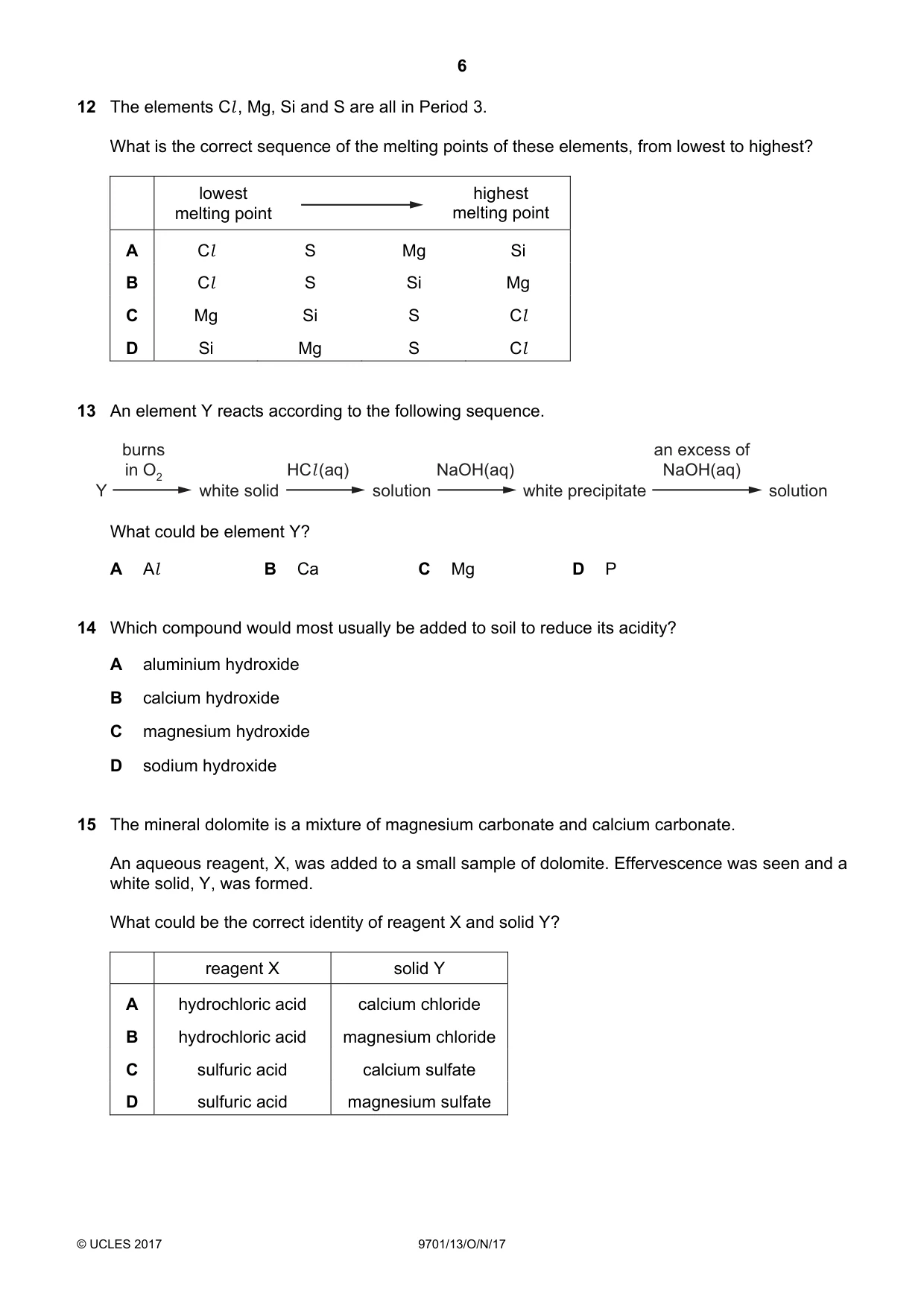
Q12 · The elements Cl , Mg, Si and S are all in Period 3
12 The elements Cl , Mg, Si and S are all in Period 3. What is the correct sequence of the melting points of these elements, from lowest to highest? lowest highest melting point melting point A Cl S Mg Si B Cl S Si Mg C Mg Si S Cl D Si Mg S Cl
Mark scheme: A
More questions on Periodicity of physical properties of the elements in Period 3
Q13 · An element Y reacts according to the following sequence
13 An element Y reacts according to the following sequence. burns an excess of in O2 HCl (aq) NaOH(aq) NaOH(aq) Y white solid solution white precipitate solution What could be element Y? A Al B Ca C Mg D P
Mark scheme: A
More questions on Periodicity of chemical properties of the elements in Period 3
Q14 · Which compound would most usually be added to soil to reduce its acidity?
14 Which compound would most usually be added to soil to reduce its acidity? A aluminium hydroxide B calcium hydroxide C magnesium hydroxide D sodium hydroxide
Mark scheme: B
Q15 · The mineral dolomite is a mixture of magnesium carbonate and calcium carbonate
15 The mineral dolomite is a mixture of magnesium carbonate and calcium carbonate. An aqueous reagent, X, was added to a small sample of dolomite. Effervescence was seen and a white solid, Y, was formed. What could be the correct identity of reagent X and solid Y? reagent X solid Y A hydrochloric acid calcium chloride B hydrochloric acid magnesium chloride C sulfuric acid calcium sulfate D sulfuric acid magnesium sulfate
Mark scheme: C
Q16 · Which fertiliser contains the greatest percentage of nitrogen by mass?
16 Which fertiliser contains the greatest percentage of nitrogen by mass? A ammonium nitrate, NH4NO3 B ammonium sulfate, (NH4)2SO4 C diammonium hydrogen phosphate, (NH4)2HPO4 D urea, CO(NH2)2
Mark scheme: D
Q17 · 71.0 g of chlorine, Cl 2, react with an excess of sodium hydroxide solution at a…
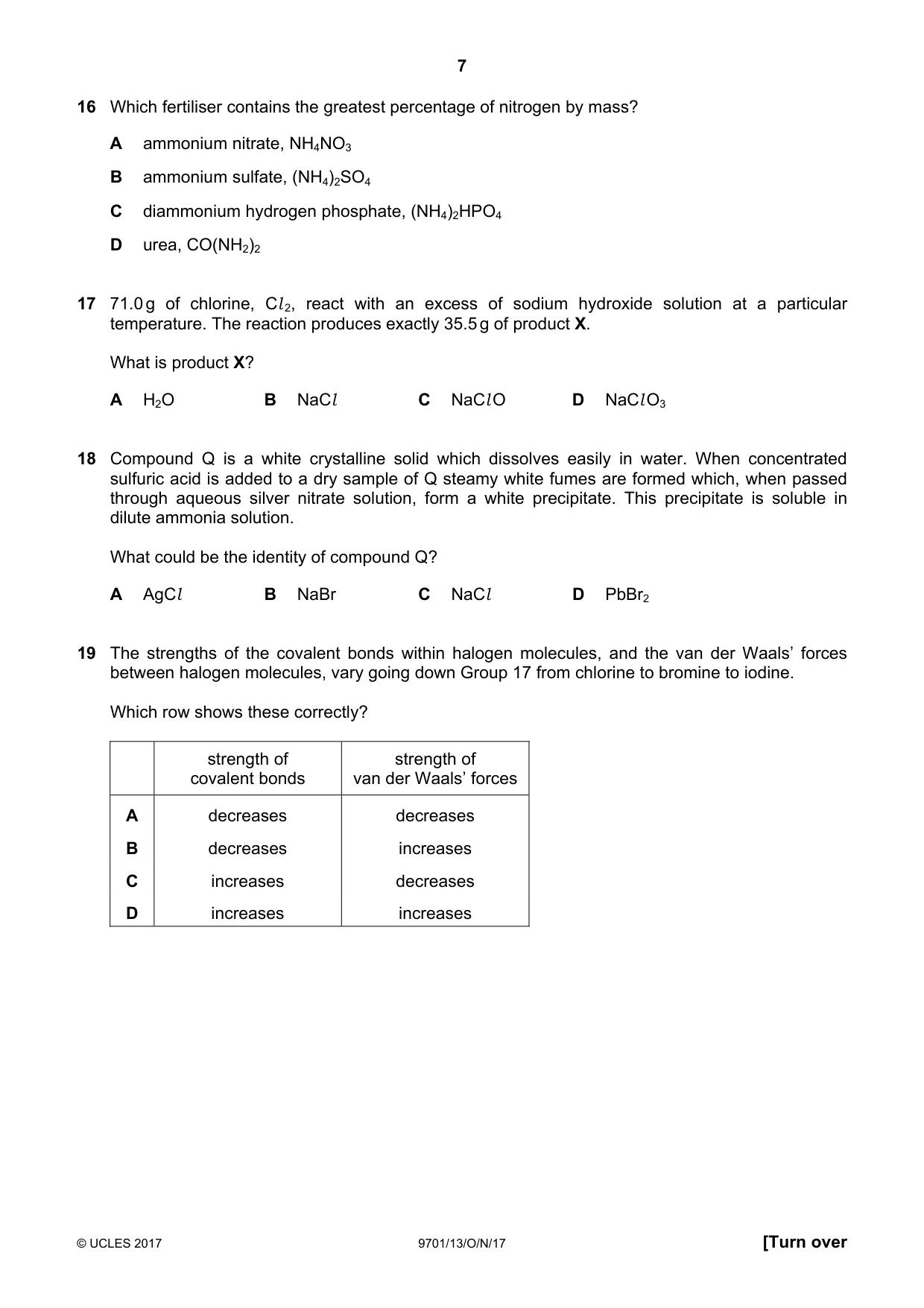
17 71.0 g of chlorine, Cl 2, react with an excess of sodium hydroxide solution at a particular temperature. The reaction produces exactly 35.5 g of product X. What is product X? A H2O B NaCl C NaCl O D NaCl O3
Mark scheme: D
Q18 · Compound Q is a white crystalline solid which dissolves easily in water
18 Compound Q is a white crystalline solid which dissolves easily in water. When concentrated sulfuric acid is added to a dry sample of Q steamy white fumes are formed which, when passed through aqueous silver nitrate solution, form a white precipitate. This precipitate is soluble in dilute ammonia solution. What could be the identity of compound Q? A AgCl B NaBr C NaCl D PbBr2
Mark scheme: C
Q19 · The strengths of the covalent bonds within halogen molecules, and the van der Waals’…
19 The strengths of the covalent bonds within halogen molecules, and the van der Waals’ forces between halogen molecules, vary going down Group 17 from chlorine to bromine to iodine. Which row shows these correctly? strength of strength of covalent bonds van der Waals’ forces A decreases decreases B decreases increases C increases decreases D increases increases
Mark scheme: B
More questions on Physical properties of the Group 17 elements
Q20 · The structural formula of compound Q is shown
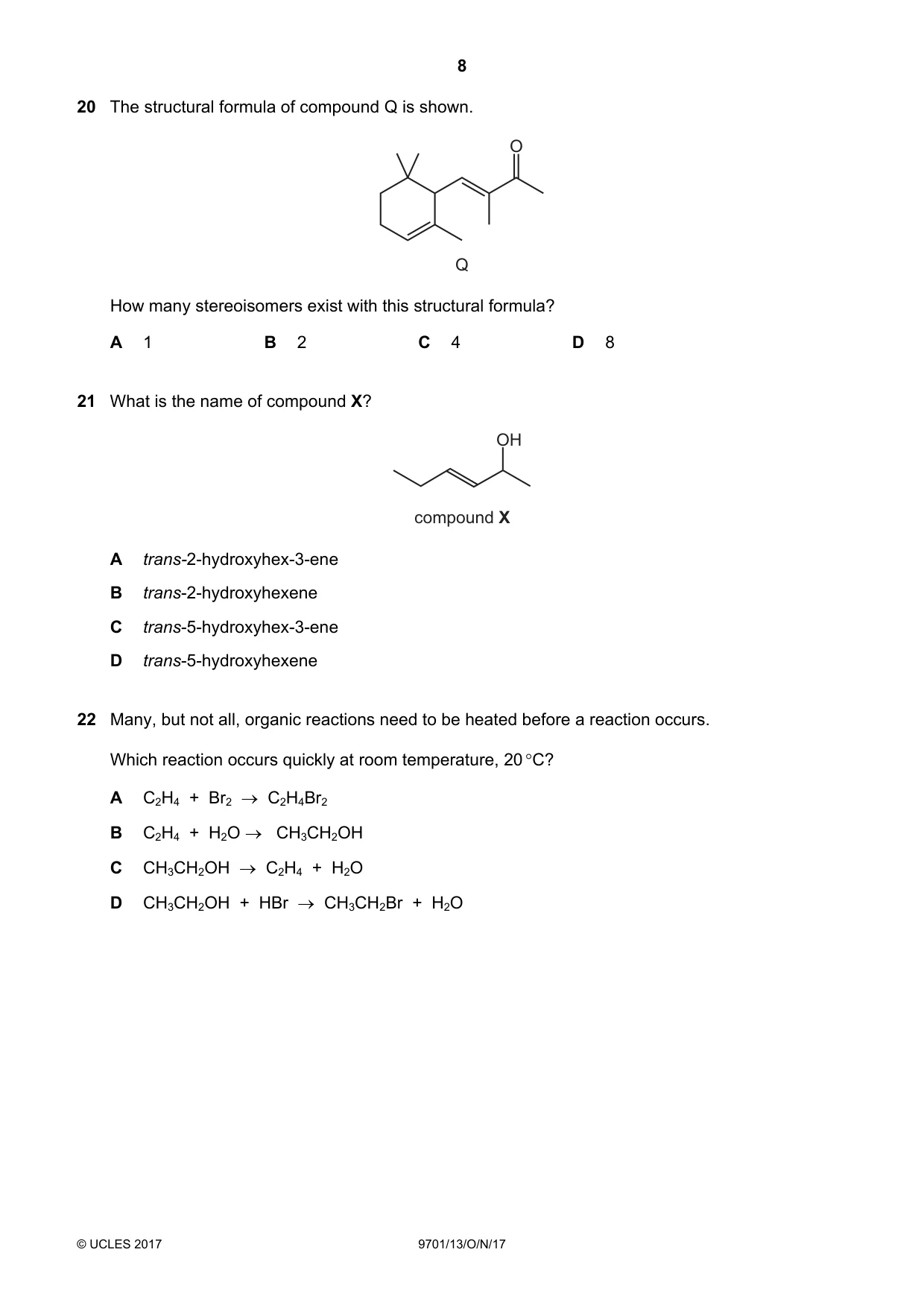
20 The structural formula of compound Q is shown. O Q How many stereoisomers exist with this structural formula? A 1 B 2 C 4 D 8
Mark scheme: C
More questions on Isomerism: structural isomerism and stereoisomerism
Q21 · What is the name of compound X?
21 What is the name of compound X? OH compound X A trans-2-hydroxyhex-3-ene B trans-2-hydroxyhexene C trans-5-hydroxyhex-3-ene D trans-5-hydroxyhexene
Mark scheme: A
More questions on Formulas, functional groups and the naming of organic compounds
Q22 · Many, but not all, organic reactions need to be heated before a reaction occurs
22 Many, but not all, organic reactions need to be heated before a reaction occurs. Which reaction occurs quickly at room temperature, 20 °C? A C2H4 + Br2 → C2H4Br2 B C2H4 + H2O → CH3CH2OH C CH3CH2OH → C2H4 + H2O D CH3CH2OH + HBr → CH3CH2Br + H2O
Mark scheme: A
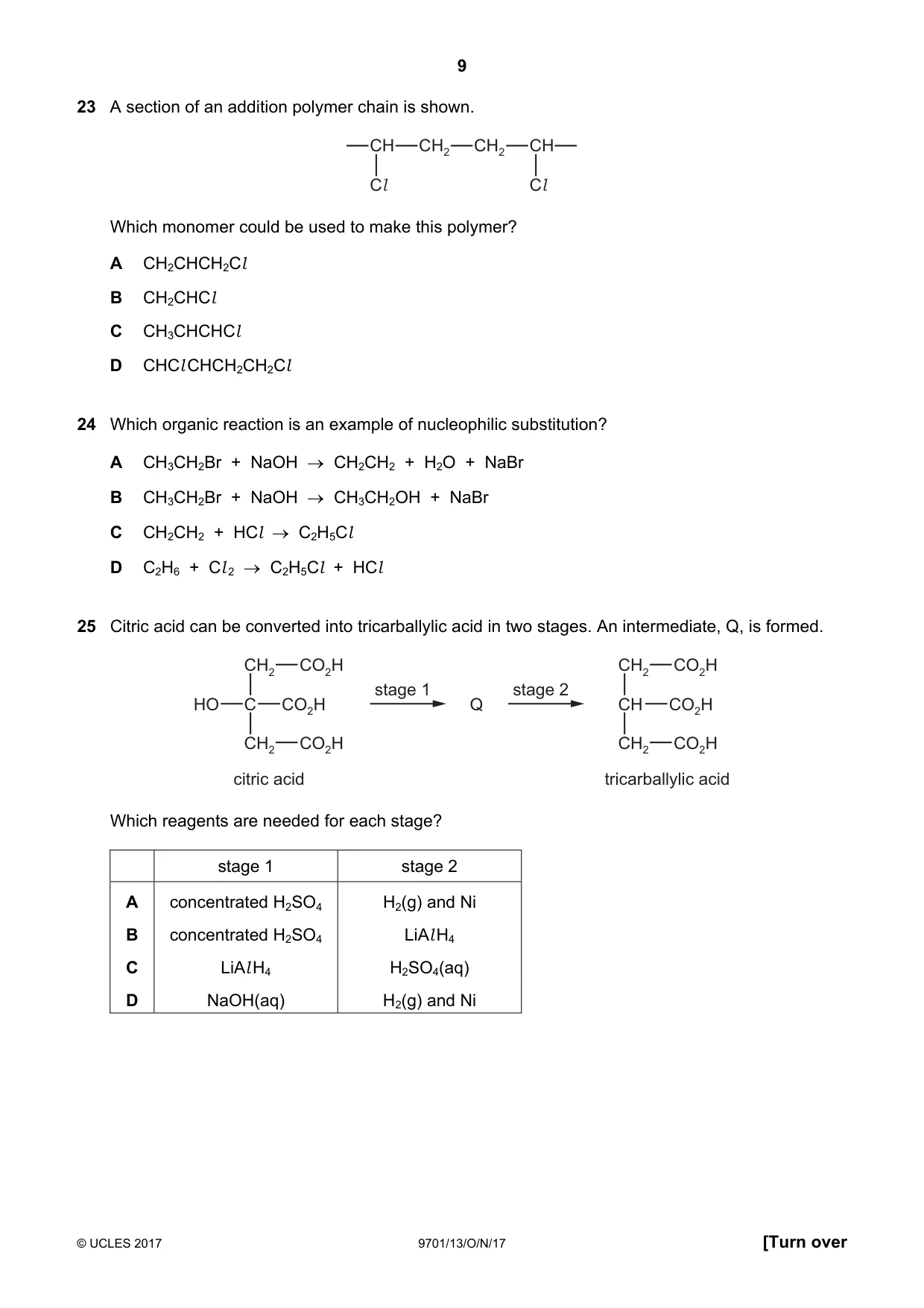
Q23 · A section of an addition polymer chain is shown
23 A section of an addition polymer chain is shown. CH CH2 CH2 CH Cl Cl Which monomer could be used to make this polymer? A CH2CHCH2Cl B CH2CHCl C CH3CHCHCl D CHCl CHCH2CH2Cl
Mark scheme: B
Q24 · Which organic reaction is an example of nucleophilic substitution?
24 Which organic reaction is an example of nucleophilic substitution? A CH3CH2Br + NaOH → CH2CH2 + H2O + NaBr B CH3CH2Br + NaOH → CH3CH2OH + NaBr C CH2CH2 + HCl → C2H5Cl D C2H6 + Cl 2 → C2H5Cl + HCl
Mark scheme: B
Q25 · Citric acid can be converted into tricarballylic acid in two stages
25 Citric acid can be converted into tricarballylic acid in two stages. An intermediate, Q, is formed. CH2 CO2H CH2 CO2H stage 1 stage 2 HO C CO2H Q CH CO2H CH2 CO2H CH2 CO2H citric acid tricarballylic acid Which reagents are needed for each stage? stage 1 stage 2 A concentrated H2SO4 H2(g) and Ni B concentrated H2SO4 LiAl H4 C LiAl H4 H2SO4(aq) D NaOH(aq) H2(g) and Ni
Mark scheme: A
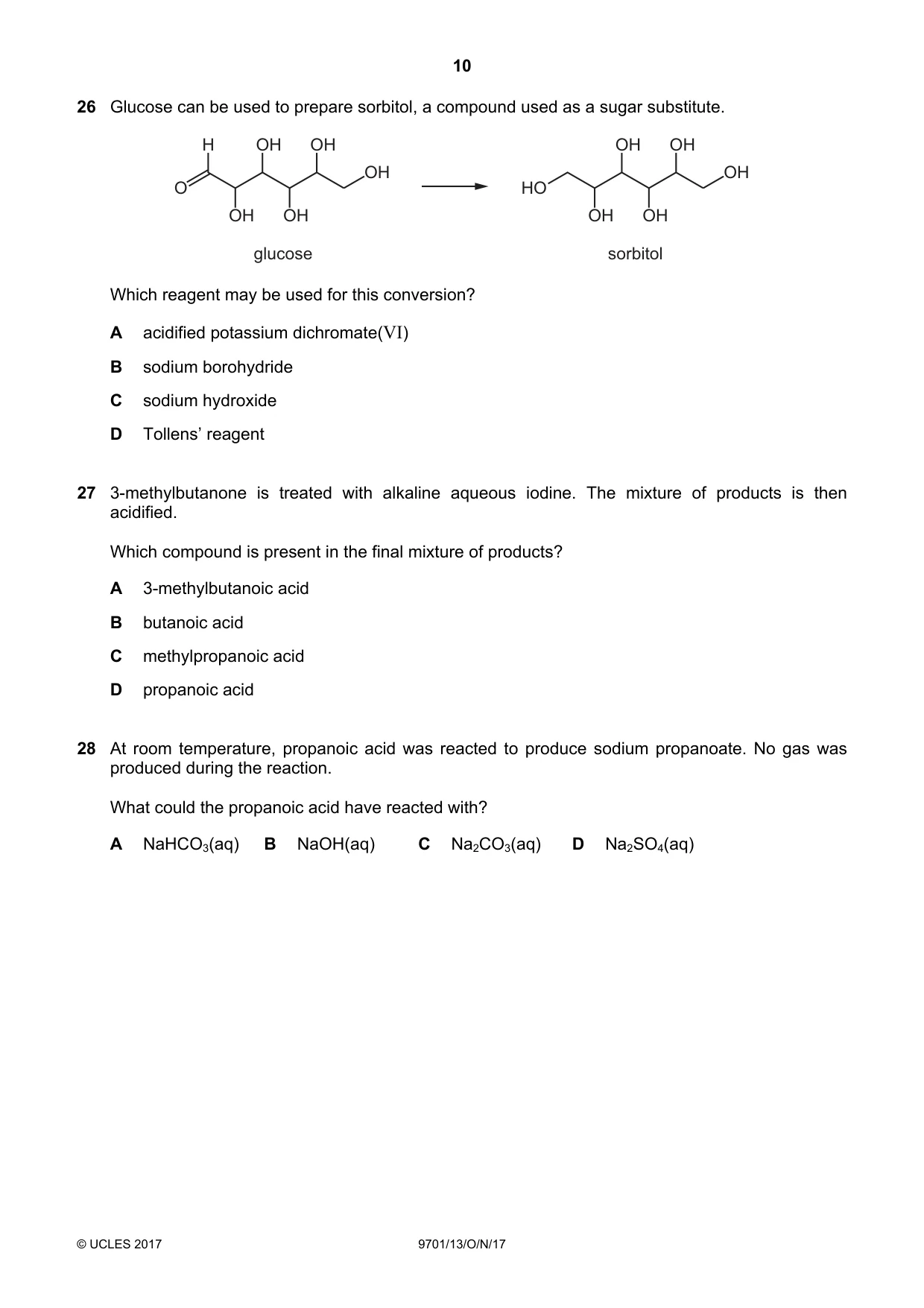
Q26 · Glucose can be used to prepare sorbitol, a compound used as a sugar substitute
26 Glucose can be used to prepare sorbitol, a compound used as a sugar substitute. H OH OH OH OH OH OH O HO OH OH OH OH glucose sorbitol Which reagent may be used for this conversion? A acidified potassium dichromate(VI) B sodium borohydride C sodium hydroxide D Tollens’ reagent
Mark scheme: B
Q27 · 3-methylbutanone is treated with alkaline aqueous iodine
27 3-methylbutanone is treated with alkaline aqueous iodine. The mixture of products is then acidified. Which compound is present in the final mixture of products? A 3-methylbutanoic acid B butanoic acid C methylpropanoic acid D propanoic acid
Mark scheme: C
Q28 · At room temperature, propanoic acid was reacted to produce sodium propanoate
28 At room temperature, propanoic acid was reacted to produce sodium propanoate. No gas was produced during the reaction. What could the propanoic acid have reacted with? A NaHCO3(aq) B NaOH(aq) C Na2CO3(aq) D Na2SO4(aq)
Mark scheme: B
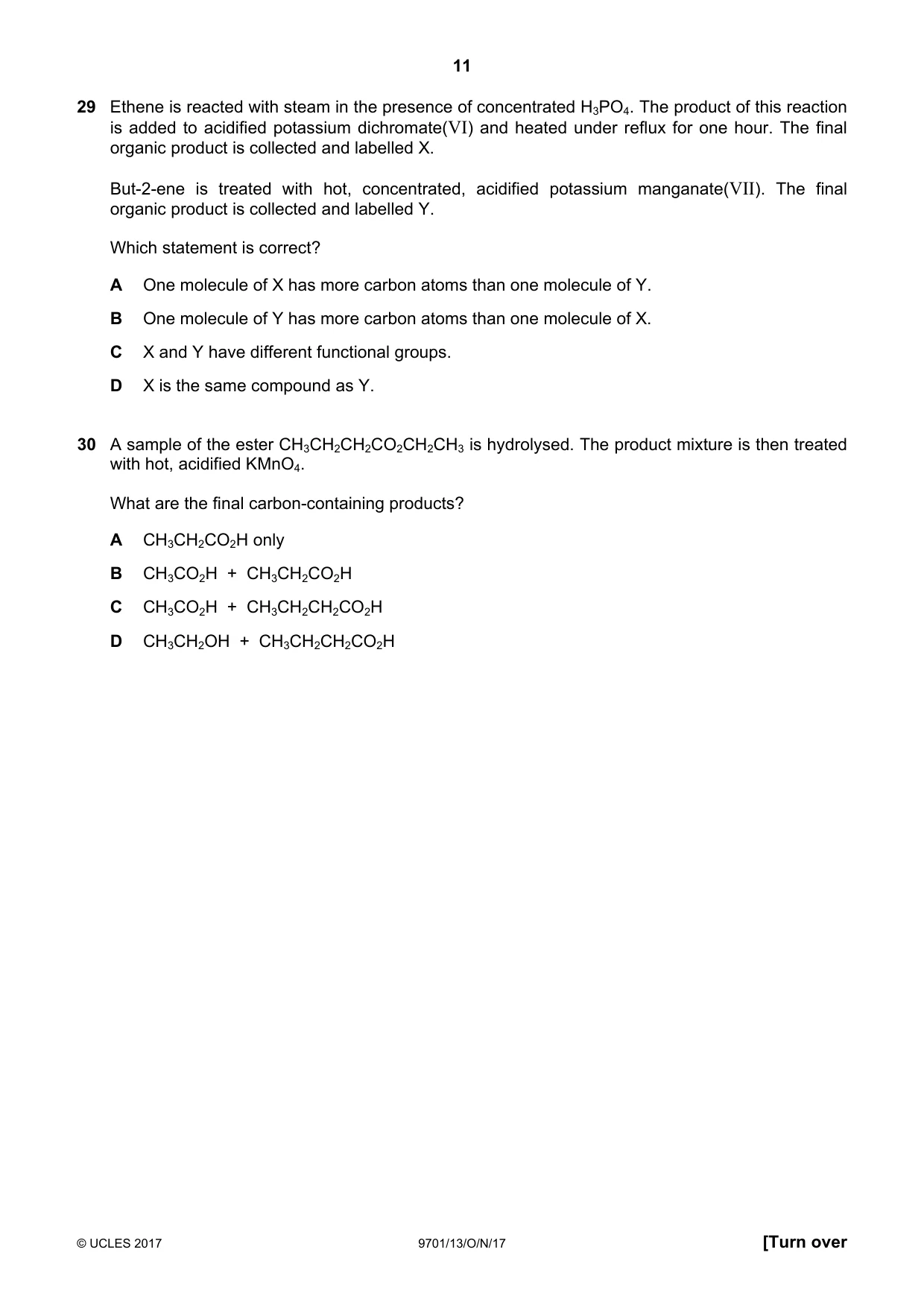
Q29 · Ethene is reacted with steam in the presence of concentrated H3PO4
29 Ethene is reacted with steam in the presence of concentrated H3PO4. The product of this reaction is added to acidified potassium dichromate(VI) and heated under reflux for one hour. The final organic product is collected and labelled X. But-2-ene is treated with hot, concentrated, acidified potassium manganate(VII). The final organic product is collected and labelled Y. Which statement is correct? A One molecule of X has more carbon atoms than one molecule of Y. B One molecule of Y has more carbon atoms than one molecule of X. C X and Y have different functional groups. D X is the same compound as Y.
Mark scheme: D
Q30 · A sample of the ester CH3CH2CH2CO2CH2CH3 is hydrolysed
30 A sample of the ester CH3CH2CH2CO2CH2CH3 is hydrolysed. The product mixture is then treated with hot, acidified KMnO4. What are the final carbon-containing products? A CH3CH2CO2H only B CH3CO2H + CH3CH2CO2H C CH3CO2H + CH3CH2CH2CO2H D CH3CH2OH + CH3CH2CH2CO2H
Mark scheme: C
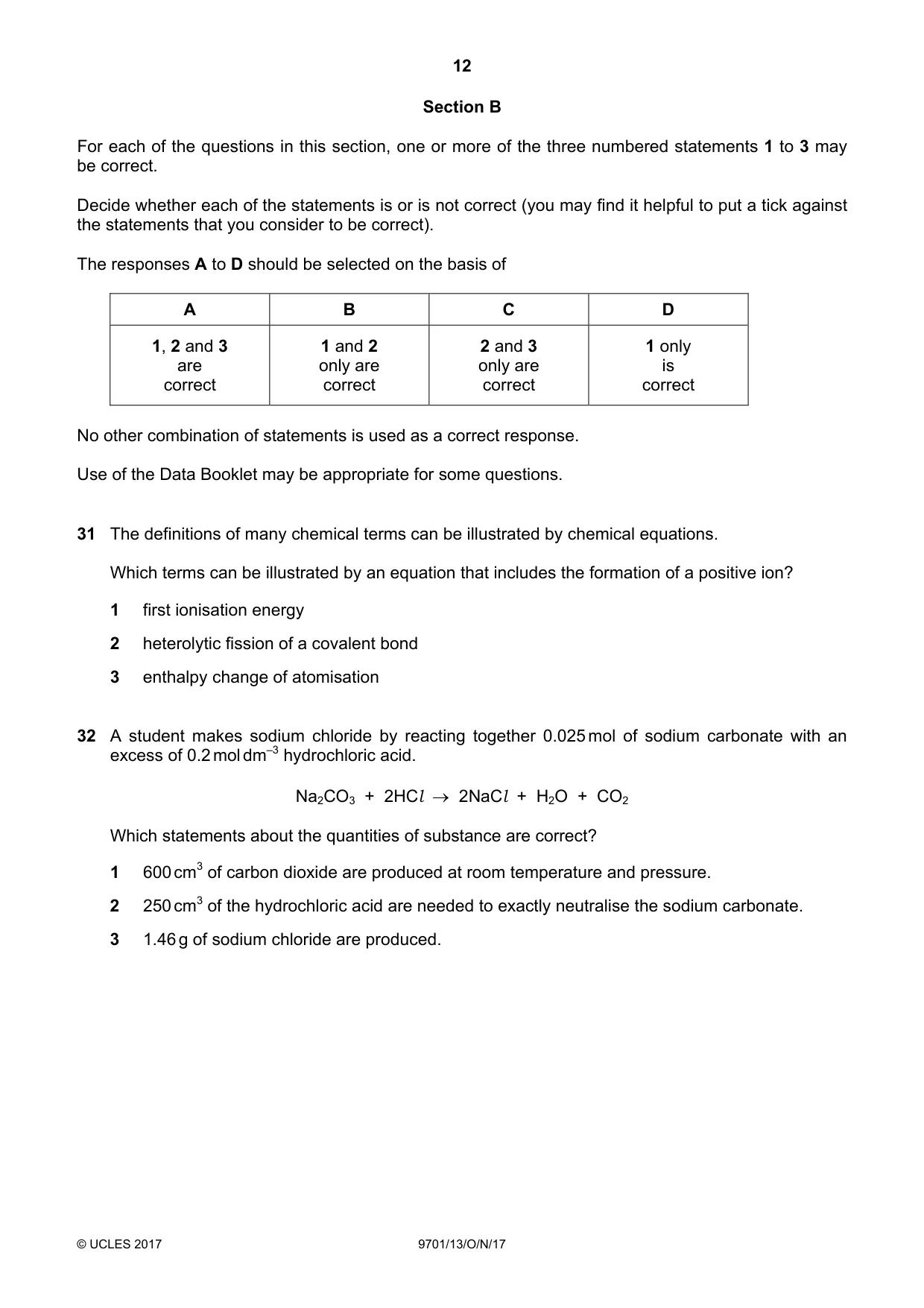
Q31 · The definitions of many chemical terms can be illustrated by chemical equations
31 The definitions of many chemical terms can be illustrated by chemical equations. Which terms can be illustrated by an equation that includes the formation of a positive ion? 1 first ionisation energy 2 heterolytic fission of a covalent bond 3 enthalpy change of atomisation
Mark scheme: B
Q32 · A student makes sodium chloride by reacting together 0.025 mol of sodium carbonate with…
32 A student makes sodium chloride by reacting together 0.025 mol of sodium carbonate with an excess of 0.2 mol dm–3 hydrochloric acid. Na2CO3 + 2HCl → 2NaCl + H2O + CO2 Which statements about the quantities of substance are correct? 1 600 cm3 of carbon dioxide are produced at room temperature and pressure. 2 250 cm3 of the hydrochloric acid are needed to exactly neutralise the sodium carbonate. 3 1.46 g of sodium chloride are produced.
Mark scheme: B
More questions on Reacting masses and volumes (of solutions and gases)
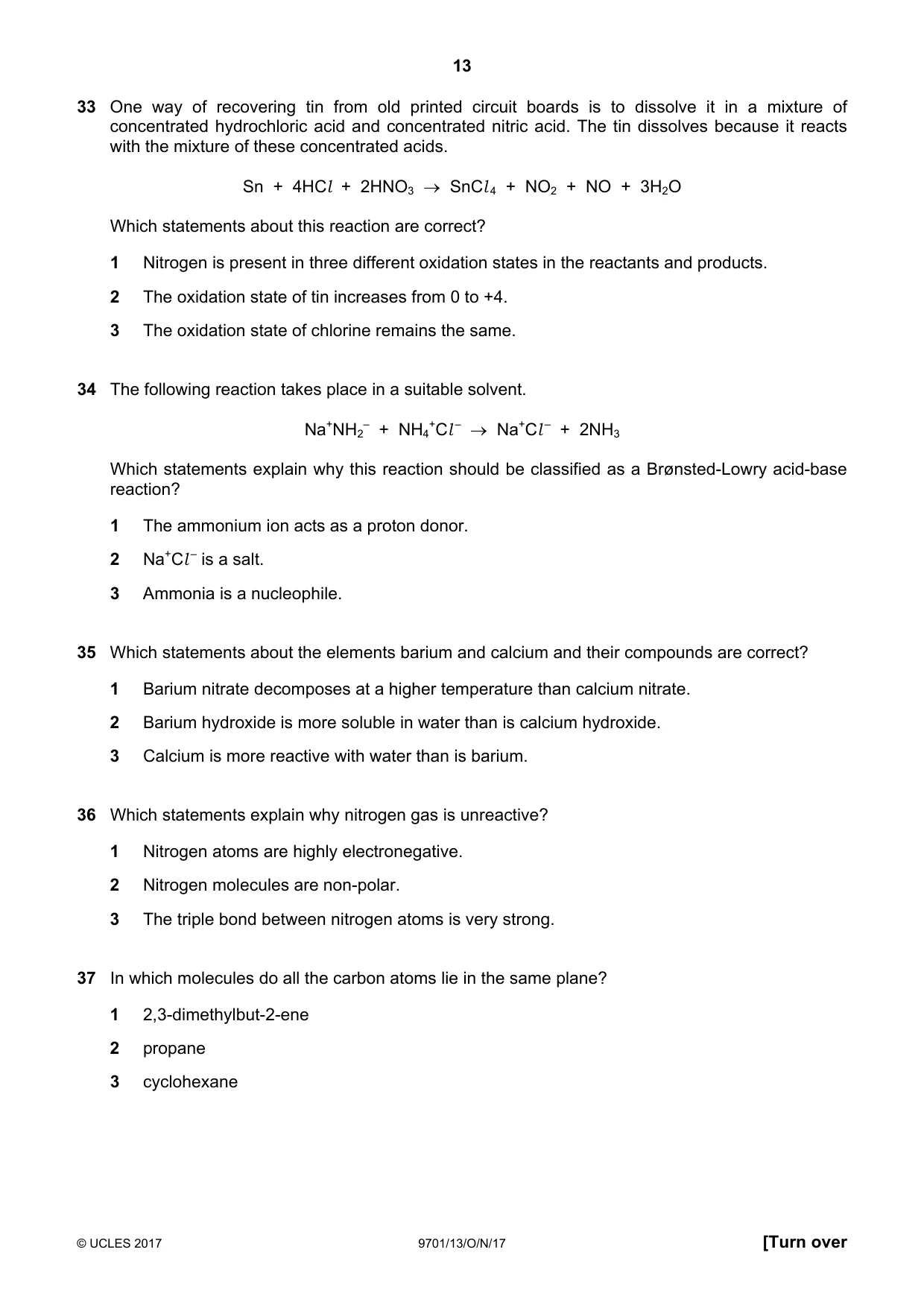
Q33 · One way of recovering tin from old printed circuit boards is to dissolve it in a mixture…
33 One way of recovering tin from old printed circuit boards is to dissolve it in a mixture of concentrated hydrochloric acid and concentrated nitric acid. The tin dissolves because it reacts with the mixture of these concentrated acids. Sn + 4HCl + 2HNO3 → SnCl 4 + NO2 + NO + 3H2O Which statements about this reaction are correct? 1 Nitrogen is present in three different oxidation states in the reactants and products. 2 The oxidation state of tin increases from 0 to +4. 3 The oxidation state of chlorine remains the same.
Mark scheme: A
Q34 · The following reaction takes place in a suitable solvent
34 The following reaction takes place in a suitable solvent. Na+NH2 – + NH4 +Cl – → Na+Cl – + 2NH3 Which statements explain why this reaction should be classified as a Brønsted-Lowry acid-base reaction? 1 The ammonium ion acts as a proton donor. 2 Na+Cl – is a salt. 3 Ammonia is a nucleophile.
Mark scheme: D
Q35 · Which statements about the elements barium and calcium and their compounds are correct?
35 Which statements about the elements barium and calcium and their compounds are correct? 1 Barium nitrate decomposes at a higher temperature than calcium nitrate. 2 Barium hydroxide is more soluble in water than is calcium hydroxide. 3 Calcium is more reactive with water than is barium.
Mark scheme: B
Q36 · Which statements explain why nitrogen gas is unreactive?
36 Which statements explain why nitrogen gas is unreactive? 1 Nitrogen atoms are highly electronegative. 2 Nitrogen molecules are non-polar. 3 The triple bond between nitrogen atoms is very strong.
Mark scheme: C
Q37 · In which molecules do all the carbon atoms lie in the same plane?
37 In which molecules do all the carbon atoms lie in the same plane? 1 2,3-dimethylbut-2-ene 2 propane 3 cyclohexane
Mark scheme: B
More questions on Shapes of organic molecules; σ and π bonds
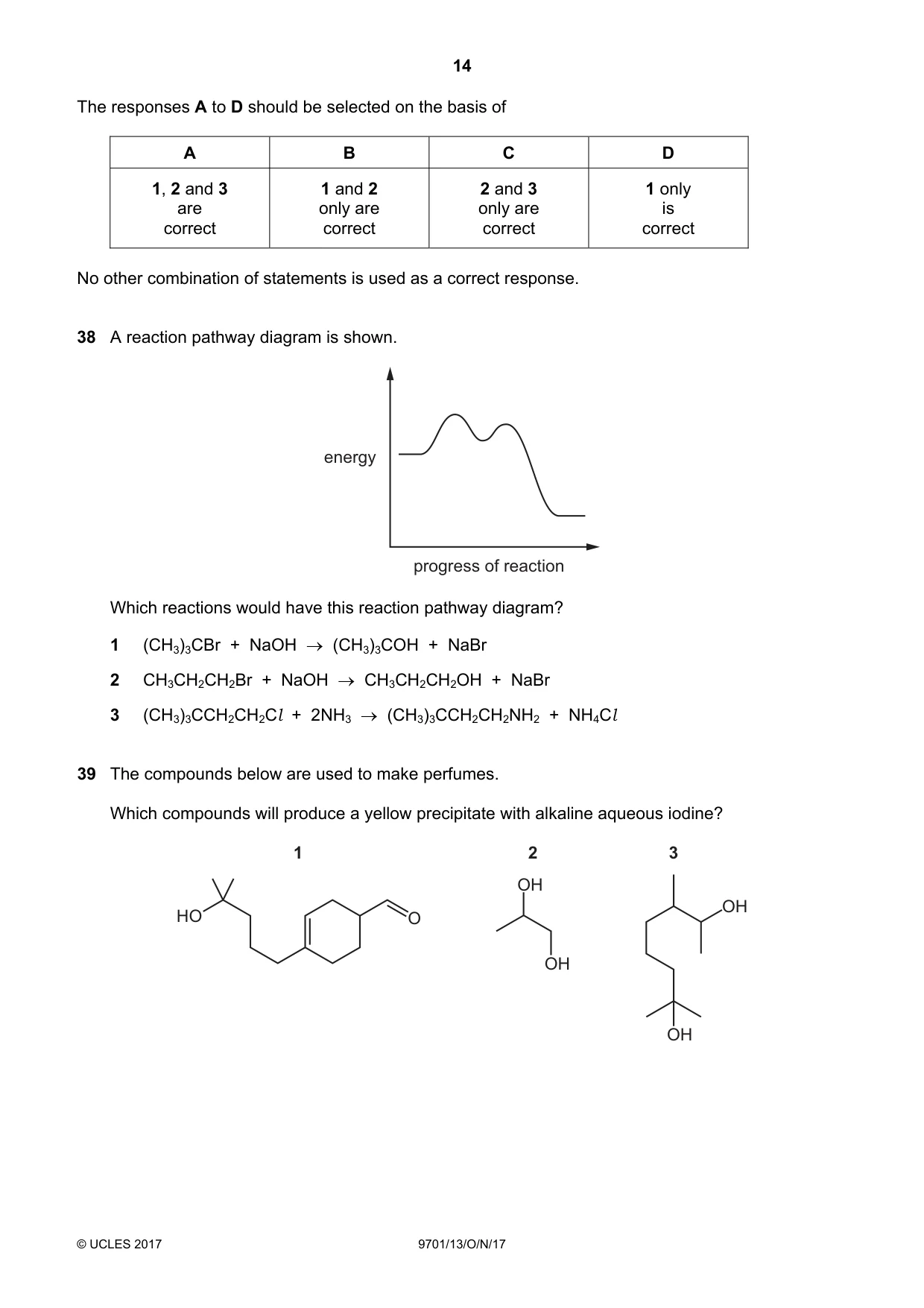
Q38 · A reaction pathway diagram is shown
38 A reaction pathway diagram is shown. energy progress of reaction Which reactions would have this reaction pathway diagram? 1 (CH3)3CBr + NaOH → (CH3)3COH + NaBr 2 CH3CH2CH2Br + NaOH → CH3CH2CH2OH + NaBr 3 (CH3)3CCH2CH2Cl + 2NH3 → (CH3)3CCH2CH2NH2 + NH4Cl
Mark scheme: D
Q39 · The compounds below are used to make perfumes
39 The compounds below are used to make perfumes. Which compounds will produce a yellow precipitate with alkaline aqueous iodine? 1 2 3 OH OH HO O OH OH
Mark scheme: C
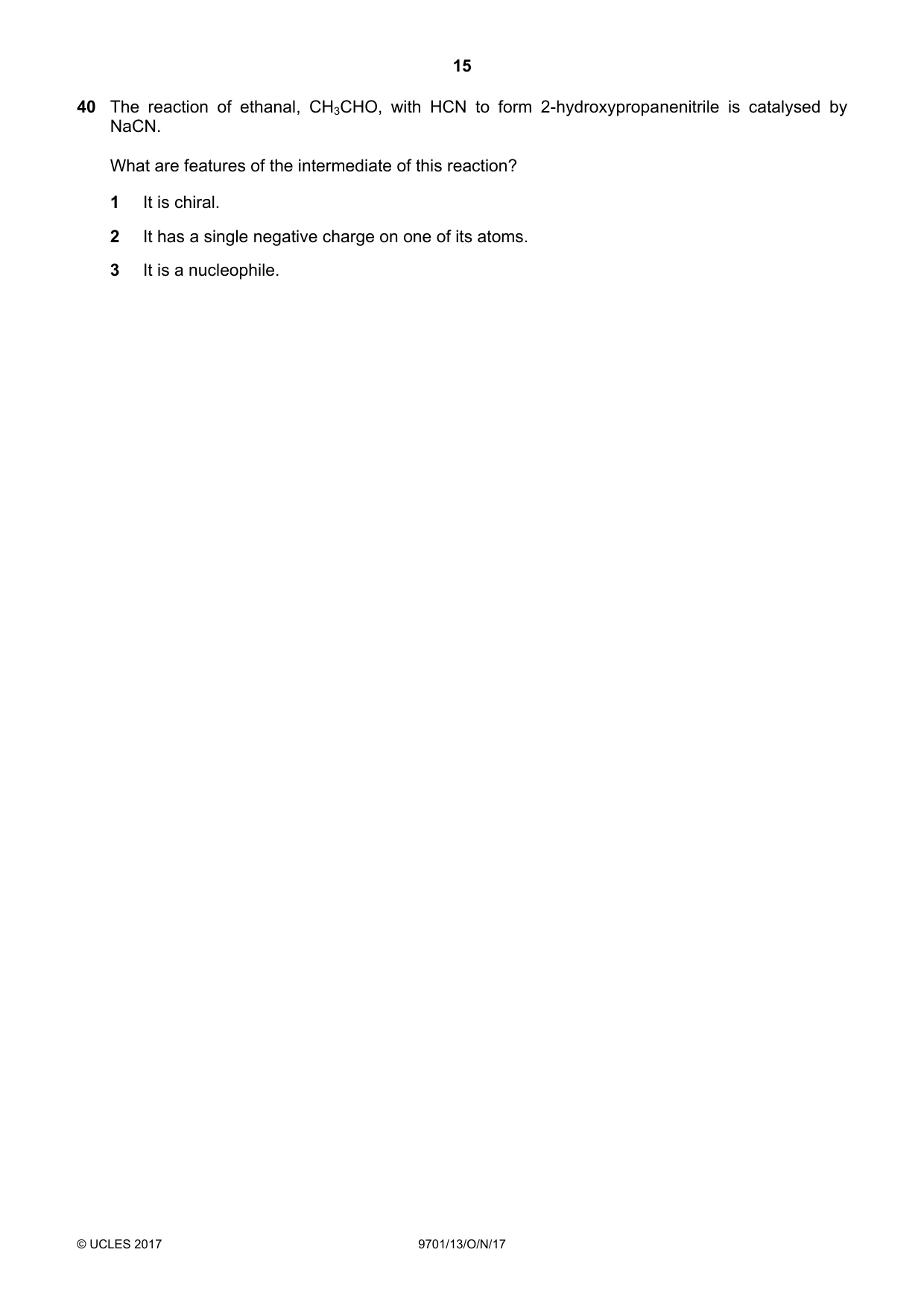
Q40 · The reaction of ethanal, CH3CHO, with HCN to form 2-hydroxypropanenitrile is catalysed by…
40 The reaction of ethanal, CH3CHO, with HCN to form 2-hydroxypropanenitrile is catalysed by NaCN. What are features of the intermediate of this reaction? 1 It is chiral. 2 It has a single negative charge on one of its atoms. 3 It is a nucleophile.
Mark scheme: A
What was in this paper
The subtopics covered by these 40 questions, and how many questions each got. Open one in a new tab to see every Cambridge question on it.
2Aldehydes and ketones2Formulas2Halogenoalkanes2Ionisation energy2Redox processes: electron transfer and changes in oxidation number (oxidation state)2Similarities and trends in the properties of the Group 2 metals, magnesium to barium, and their compounds2Acids and bases1Addition polymerisation1Alcohols1Alkenes1Brønsted–Lowry theory of acids and bases1Carboxylic acids1Chemical equilibria: reversible reactions, dynamic equilibrium1Effect of temperature on reaction rates and the concept of activation energy1Enthalpy change, ΔH1Esters1Formulas, functional groups and the naming of organic compounds1Hess’s law1Ionic bonding1Isomerism: structural isomerism and stereoisomerism1Nitriles and hydroxynitriles1Nitrogen and sulfur1Periodicity of chemical properties of the elements in Period 31Periodicity of physical properties of the elements in Period 31Physical properties of the Group 17 elements1Rate of reaction1Reacting masses and volumes (of solutions and gases)1Shapes of molecules1Shapes of organic molecules; σ and π bonds1Some reactions of the halide ions1The gaseous state: ideal and real gases and pV = nRT1The reactions of chlorine1What you needed in this session
Cambridge’s own grade thresholds for 2017 Oct/Nov, Paper 1 · Variant 3. A higher threshold means an easier paper — the bar moves with how the cohort did.