Cambridge A Level Chemistry 9701 — 2019 Oct/Nov Paper 1 · Variant 3
9701/13/O/N/19 · 40 questions · 40 marks · ≈45 min
The question paper and its mark scheme, free to read here and free to download. This is Cambridge’s own paper, exactly as it was sat.
Question paper16 pages
Mark scheme3 pages
Answers below. Sit the paper first if you are practising.
Questions as text
Q1 · The diagram shows the Boltzmann distribution of energies in a gas
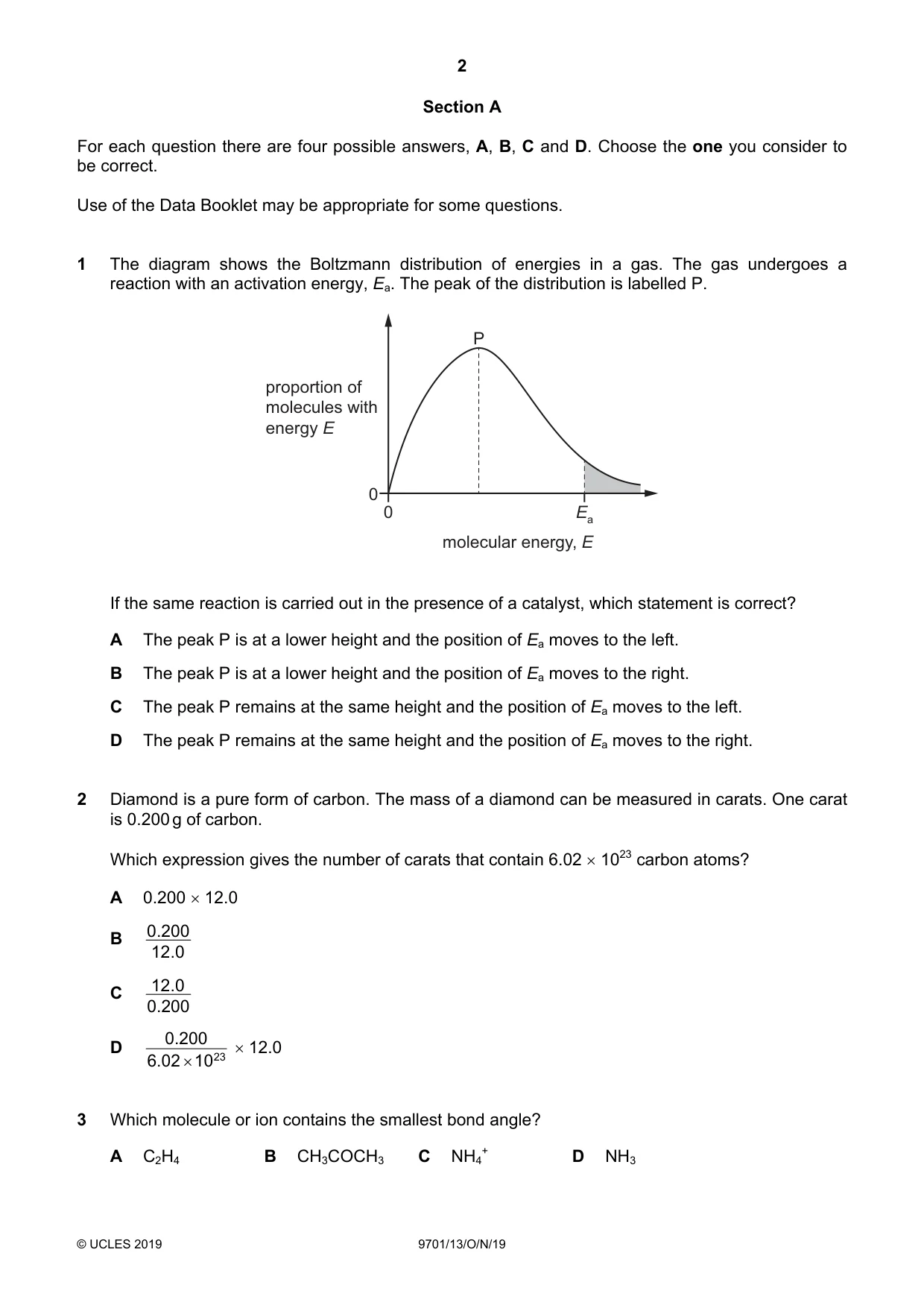
1 The diagram shows the Boltzmann distribution of energies in a gas. The gas undergoes a reaction with an activation energy, Ea. The peak of the distribution is labelled P. P proportion of molecules with energy E 0 0 Ea molecular energy, E If the same reaction is carried out in the presence of a catalyst, which statement is correct? A The peak P is at a lower height and the position of Ea moves to the left. B The peak P is at a lower height and the position of Ea moves to the right. C The peak P remains at the same height and the position of Ea moves to the left. D The peak P remains at the same height and the position of Ea moves to the right.
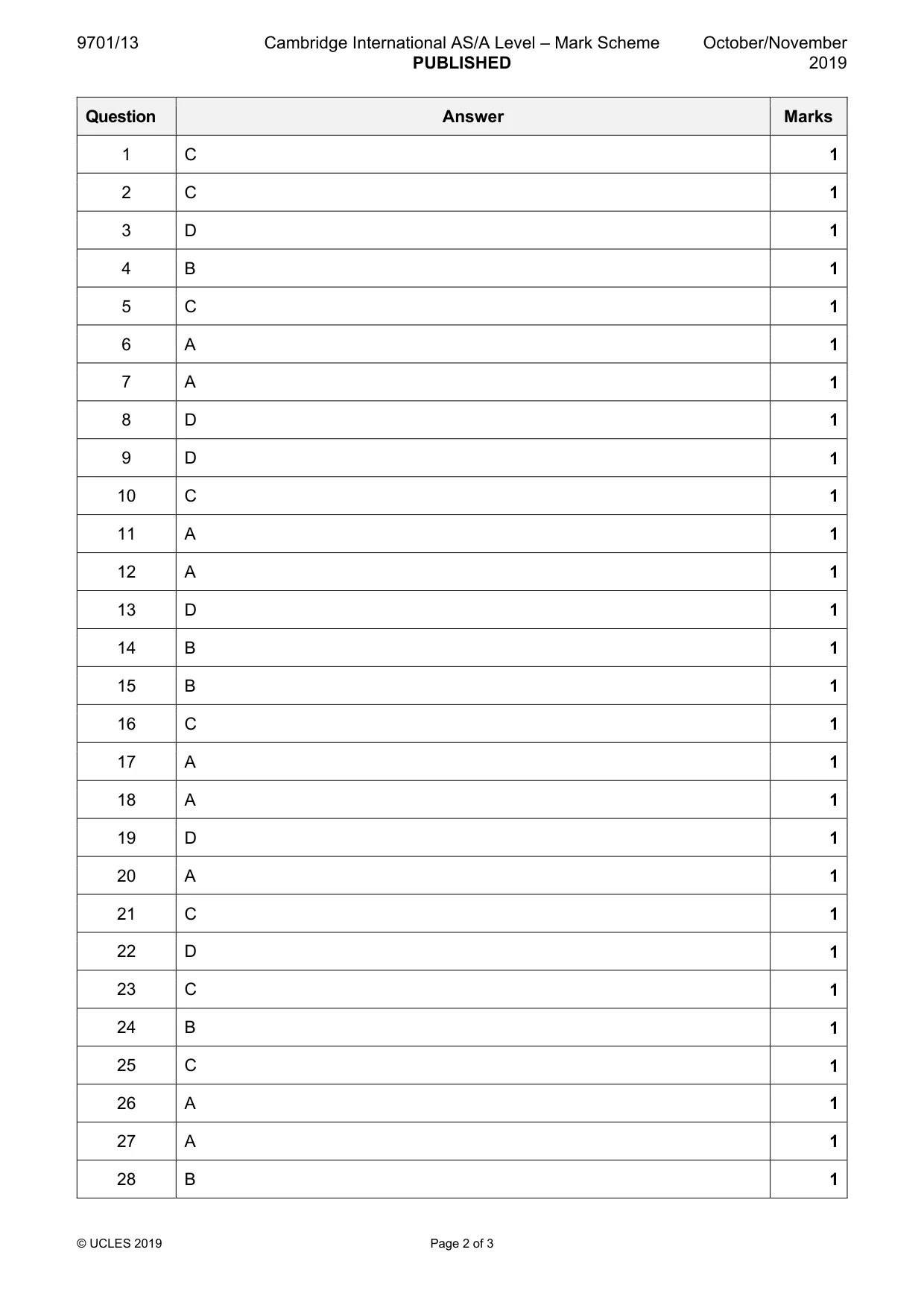
Mark scheme: C
More questions on Effect of temperature on reaction rates and the concept of activation energy
Q2 · Diamond is a pure form of carbon
2 Diamond is a pure form of carbon. The mass of a diamond can be measured in carats. One carat is 0.200 g of carbon. Which expression gives the number of carats that contain 6.02 × 10²³ carbon atoms? A 0.200 × 12.0 B 0 . 200 12 . 0 C 12 . 0 0 . 200 0.200 × 12.0 D 6.02 × 10 23
Mark scheme: C
Q3 · Which molecule or ion contains the smallest bond angle?
3 Which molecule or ion contains the smallest bond angle? A C2H4 B CH3COCH3 C NH4 + D NH3
Mark scheme: D
Q4 · Four compounds are shown
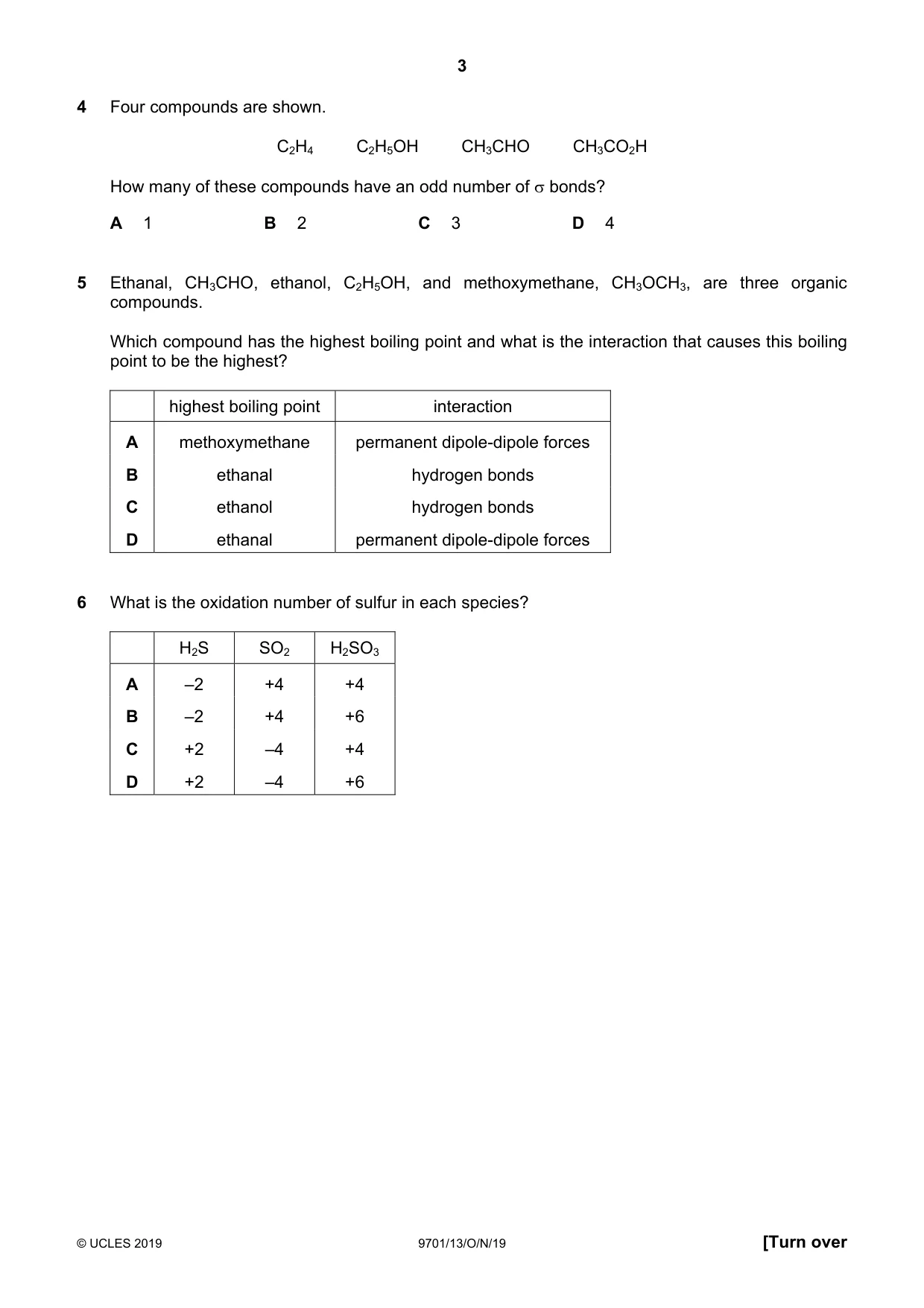
4 Four compounds are shown. C2H4 C2H5OH CH3CHO CH3CO2H How many of these compounds have an odd number of σ bonds? A 1 B 2 C 3 D 4
Mark scheme: B
More questions on Shapes of organic molecules; σ and π bonds
Q5 · Ethanal, CH3CHO, ethanol, C2H5OH, and methoxymethane, CH3OCH3, are three organic compounds
5 Ethanal, CH3CHO, ethanol, C2H5OH, and methoxymethane, CH3OCH3, are three organic compounds. Which compound has the highest boiling point and what is the interaction that causes this boiling point to be the highest? highest boiling point interaction A methoxymethane permanent dipole-dipole forces B ethanal hydrogen bonds C ethanol hydrogen bonds D ethanal permanent dipole-dipole forces
Mark scheme: C
More questions on Intermolecular forces, electronegativity and bond properties
Q6 · What is the oxidation number of sulfur in each species?
6 What is the oxidation number of sulfur in each species? H2S SO2 H2SO3 A –2 +4 +4 B –2 +4 +6 C +2 –4 +4 D +2 –4 +6
Mark scheme: A
Q7 · The following data are needed for this question
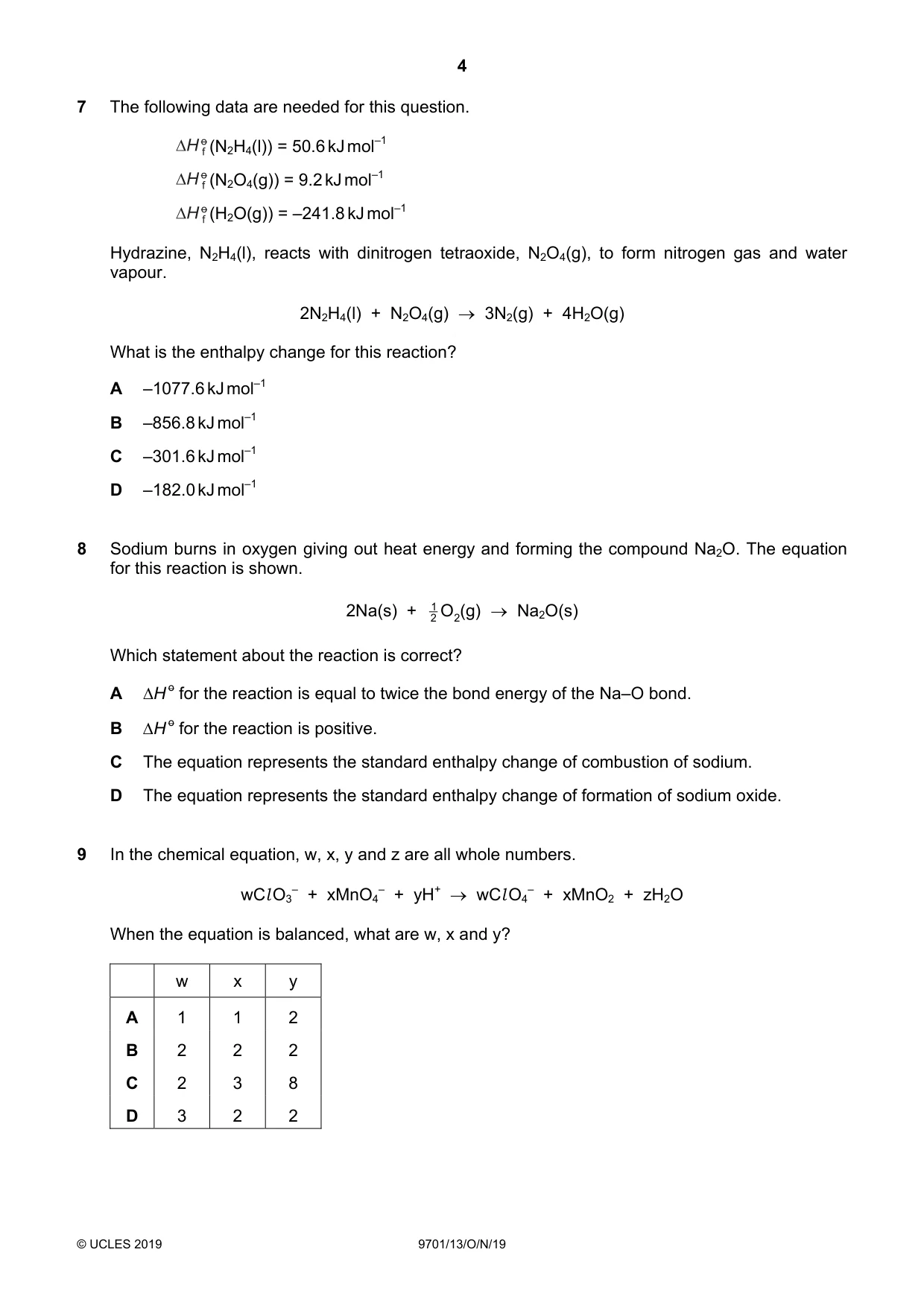
7 The following data are needed for this question. (N2H4(l)) = 50.6 kJ mol–1 (N2O4(g)) = 9.2 kJ mol–1 (H2O(g)) = –241.8 kJ mol–1 Hydrazine, N2H4(l), reacts with dinitrogen tetraoxide, N2O4(g), to form nitrogen gas and water vapour. 2N2H4(l) + N2O4(g) → 3N2(g) + 4H2O(g) What is the enthalpy change for this reaction? A –1077.6 kJ mol–1 B –856.8 kJ mol–1 C –301.6 kJ mol–1 D –182.0 kJ mol–1
Mark scheme: A
Q8 · Sodium burns in oxygen giving out heat energy and forming the compound Na2O
8 Sodium burns in oxygen giving out heat energy and forming the compound Na2O. The equation for this reaction is shown. 2Na(s) + 1 O2 (g) → Na2O(s) 2 Which statement about the reaction is correct? A ∆H o for the reaction is equal to twice the bond energy of the Na–O bond. B ∆H o for the reaction is positive. C The equation represents the standard enthalpy change of combustion of sodium. D The equation represents the standard enthalpy change of formation of sodium oxide.
Mark scheme: D
Q9 · In the chemical equation, w, x, y and z are all whole numbers
9 In the chemical equation, w, x, y and z are all whole numbers. wCl O3 – + xMnO4 – + yH+ → wCl O4 – + xMnO2 + zH2O When the equation is balanced, what are w, x and y? w x y A 1 1 2 B 2 2 2 C 2 3 8 D 3 2 2
Mark scheme: D
Q10 · Two compounds X and Y react to produce compound Z
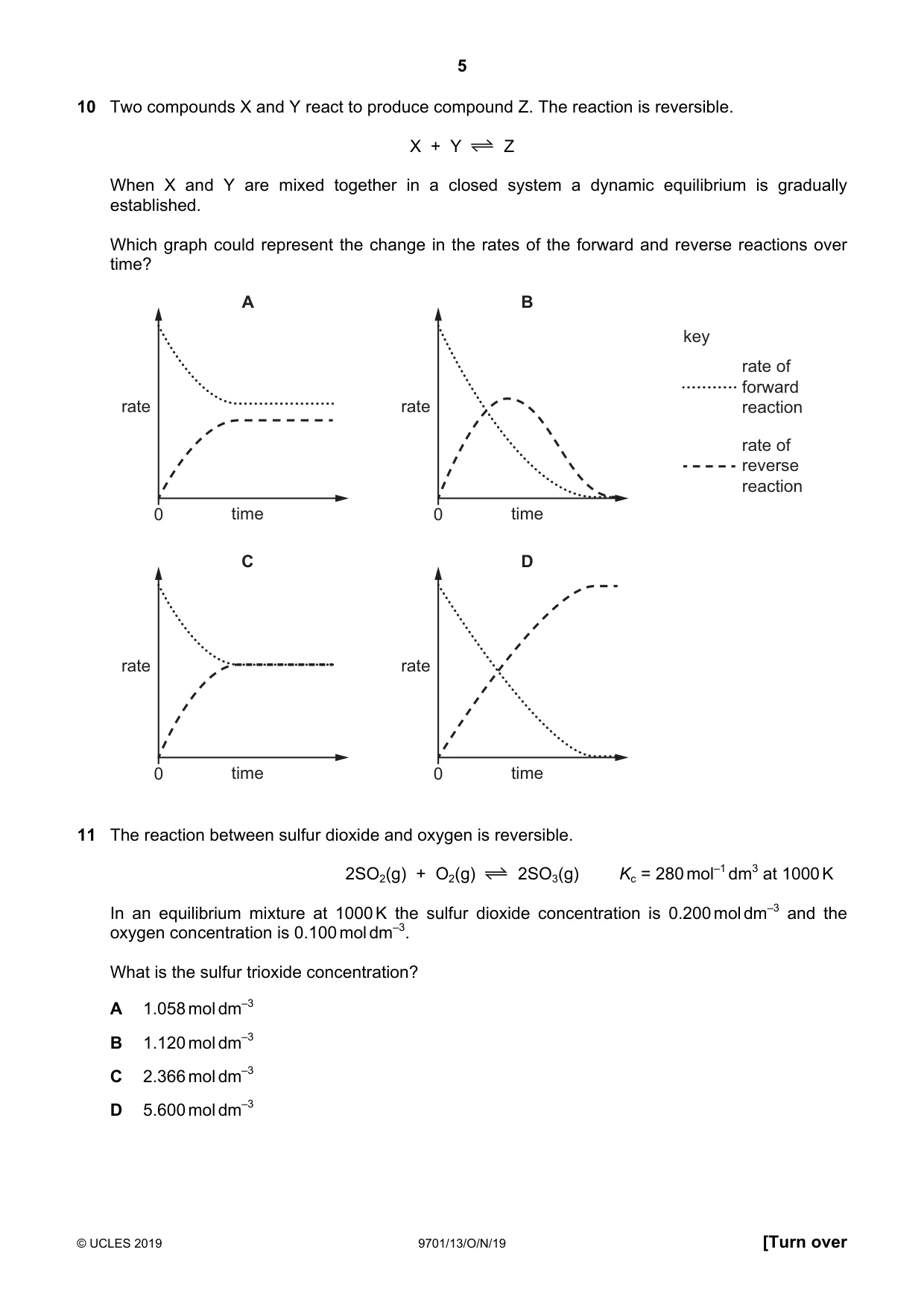
10 Two compounds X and Y react to produce compound Z. The reaction is reversible. X + Y Z When X and Y are mixed together in a closed system a dynamic equilibrium is gradually established. Which graph could represent the change in the rates of the forward and reverse reactions over time? A B key rate of forward rate rate reaction rate of reverse reaction 0 time 0 time C D rate rate 0 time 0 time
Mark scheme: C
More questions on Chemical equilibria: reversible reactions, dynamic equilibrium
Q11 · The reaction between sulfur dioxide and oxygen is reversible
11 The reaction between sulfur dioxide and oxygen is reversible. 2SO2(g) + O2(g) 2SO3(g) Kc = 280 mol–1 dm3 at 1000 K In an equilibrium mixture at 1000 K the sulfur dioxide concentration is 0.200 mol dm–3 and the oxygen concentration is 0.100 mol dm–3. What is the sulfur trioxide concentration? A 1.058 mol dm–3 B 1.120 mol dm–3 C 2.366 mol dm–3 D 5.600 mol dm–3
Mark scheme: A
More questions on Chemical equilibria: reversible reactions, dynamic equilibrium
Q12 · Which oxide will cause an increase in pH when added to water?
12 Which oxide will cause an increase in pH when added to water? A MgO B Al 2O3 C SiO2 D SO2
Mark scheme: A
More questions on Periodicity of chemical properties of the elements in Period 3
Q13 · X, Y and Z are consecutive elements in Period 3 of the Periodic Table
13 X, Y and Z are consecutive elements in Period 3 of the Periodic Table. Element Y has the highest first ionisation energy and the lowest melting point of these three elements. What are the identities of X, Y and Z? X Y Z A Na Mg Al B Mg Al Si C Al Si P D Si P S
Mark scheme: D
More questions on Periodicity of physical properties of the elements in Period 3
Q14 · A 5.00 g sample of an anhydrous Group 2 metal nitrate loses 3.29 g in mass when heated…
14 A 5.00 g sample of an anhydrous Group 2 metal nitrate loses 3.29 g in mass when heated strongly. Which metal is present? A magnesium B calcium C strontium D barium
Mark scheme: B
Q15 · Solutions P and Q each contain a different Group 2 ion at the same concentration
15 Solutions P and Q each contain a different Group 2 ion at the same concentration. One contains Mg2+, the other contains Ba2+. Tests are carried out on separate 5 cm3 samples of P and Q. test 1: add 1 cm3 of 0.1 mol dm–3 Na2SO4(aq) test 2: add 1 cm3 of 0.1 mol dm–3 NaOH(aq) What are the results of these tests? results in test 1 results in test 2 A more precipitate with Ba2+ more precipitate with Ba2+ B more precipitate with Ba2+ more precipitate with Mg2+ C more precipitate with Mg2+ more precipitate with Ba2+ D more precipitate with Mg2+ more precipitate with Mg2+
Mark scheme: B
Q16 · Chlorine and bromine have different volatilities
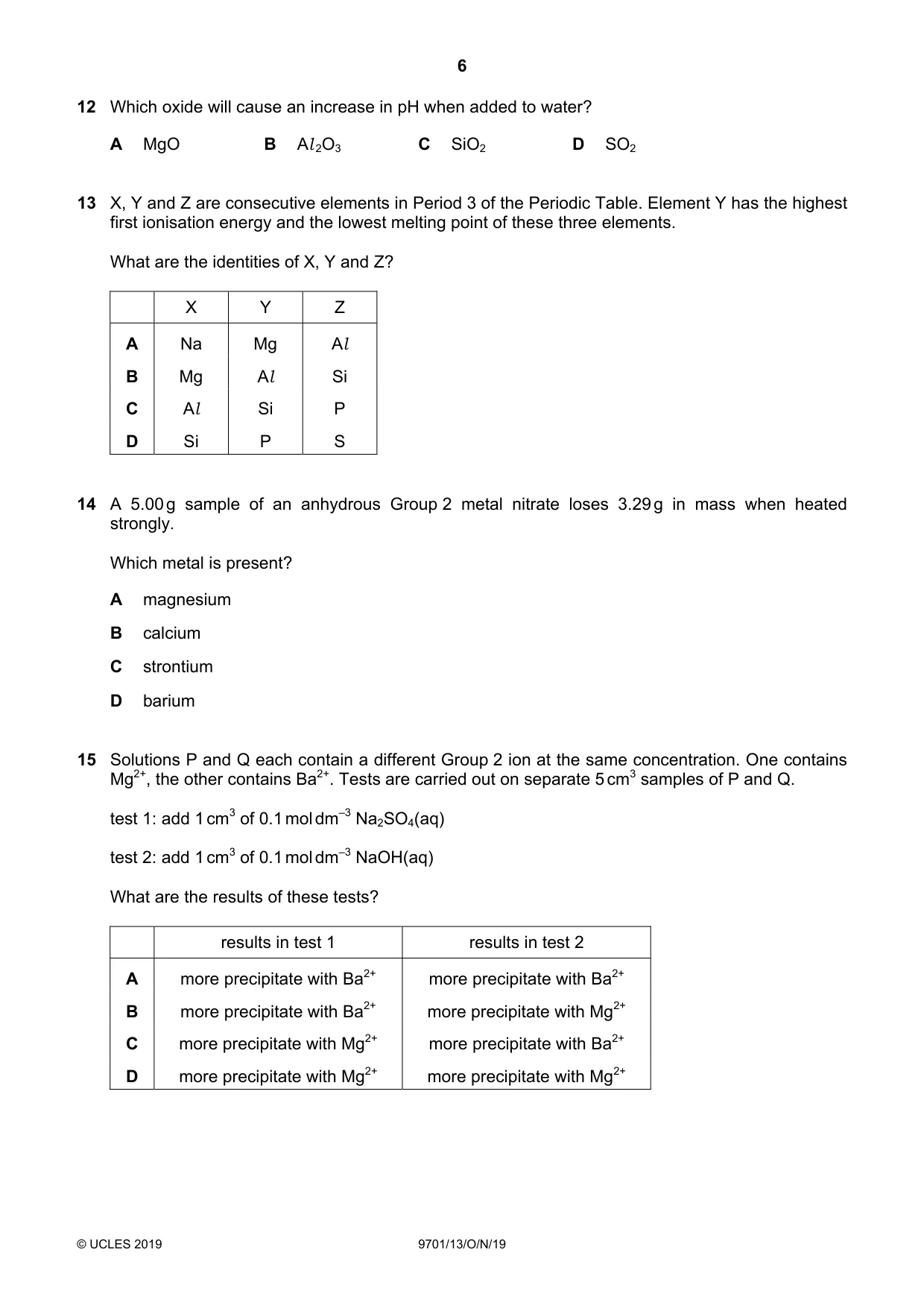
16 Chlorine and bromine have different volatilities. Which row identifies the more volatile of the two elements, and gives the correct explanation? identity of the explanation for the more volatile element difference in volatility A bromine instantaneous dipole-induced dipole forces are greater in bromine than they are in chlorine B bromine instantaneous dipole-induced dipole forces are greater in chlorine than they are in bromine C chlorine instantaneous dipole-induced dipole forces are greater in bromine than they are in chlorine D chlorine instantaneous dipole-induced dipole forces are greater in chlorine than they are in bromine
Mark scheme: C
More questions on Physical properties of the Group 17 elements
Q17 · Sodium azide, NaN3, is dissolved in water
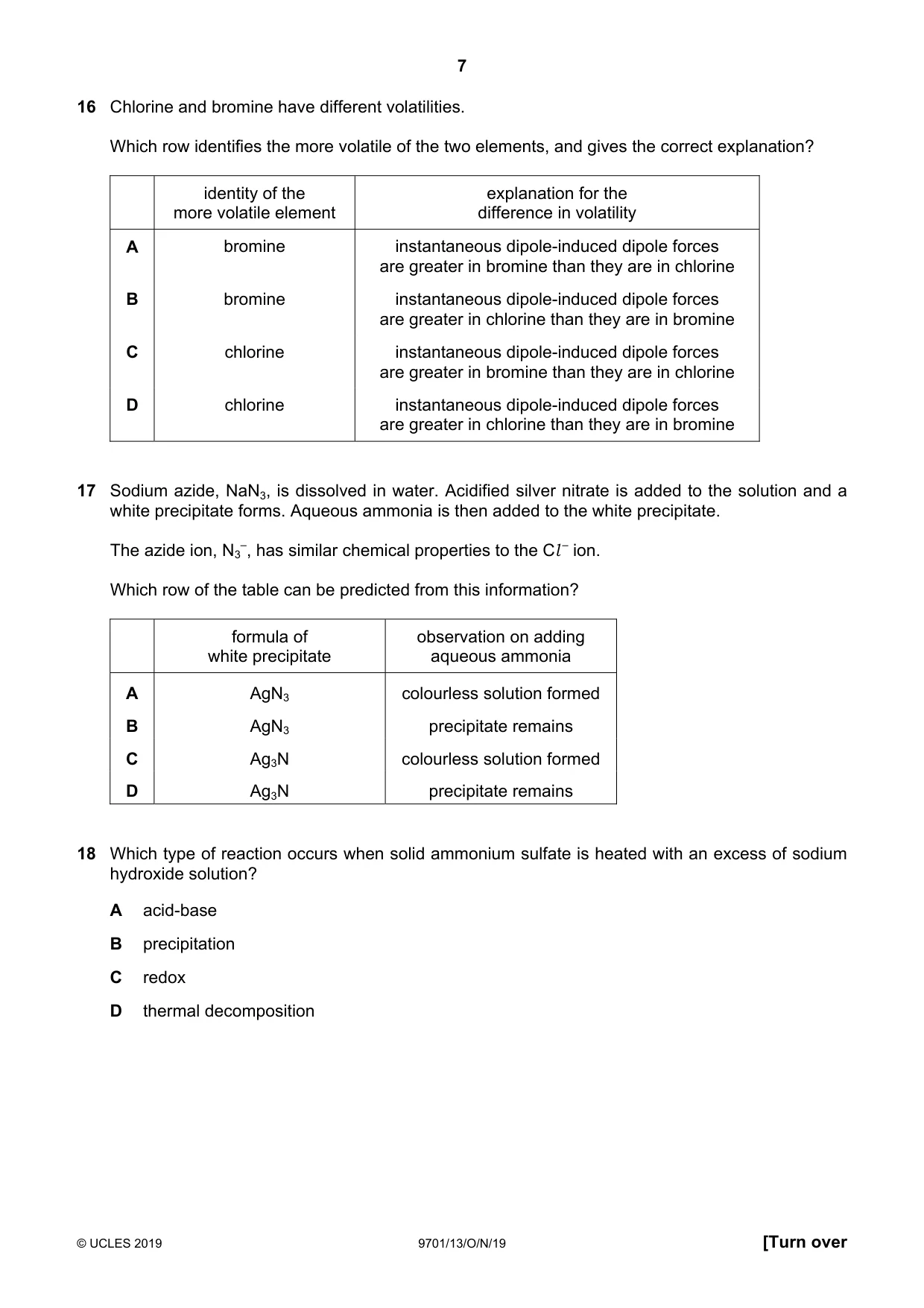
17 Sodium azide, NaN3, is dissolved in water. Acidified silver nitrate is added to the solution and a white precipitate forms. Aqueous ammonia is then added to the white precipitate. The azide ion, N3 –, has similar chemical properties to the Cl – ion. Which row of the table can be predicted from this information? formula of observation on adding white precipitate aqueous ammonia A AgN3 colourless solution formed B AgN3 precipitate remains C Ag3N colourless solution formed D Ag3N precipitate remains
Mark scheme: A
Q18 · Which type of reaction occurs when solid ammonium sulfate is heated with an excess of…
18 Which type of reaction occurs when solid ammonium sulfate is heated with an excess of sodium hydroxide solution? A acid-base B precipitation C redox D thermal decomposition
Mark scheme: A
Q19 · Catalytic converters are fitted in the exhaust systems of many cars
19 Catalytic converters are fitted in the exhaust systems of many cars. Which gas: ● causes acid rain if it is released into the air ● is removed from car exhaust fumes by a catalytic converter? A carbon dioxide B carbon monoxide C hydrocarbon vapour D nitrogen dioxide
Mark scheme: D
Q20 · Which substance reacts with trichloroethene to give a chiral product?
20 Which substance reacts with trichloroethene to give a chiral product? A Br2 B HCl C NaCN D NaOH
Mark scheme: A
Q21 · Alkanes are saturated hydrocarbons
21 Alkanes are saturated hydrocarbons. Which type of reaction are alkanes most likely to undergo? A electrophilic addition B electrophilic substitution C free radical substitution D nucleophilic addition
Mark scheme: C
Q22 · An alkene reacts with hot, concentrated, acidified potassium manganate(VII) to produce a…
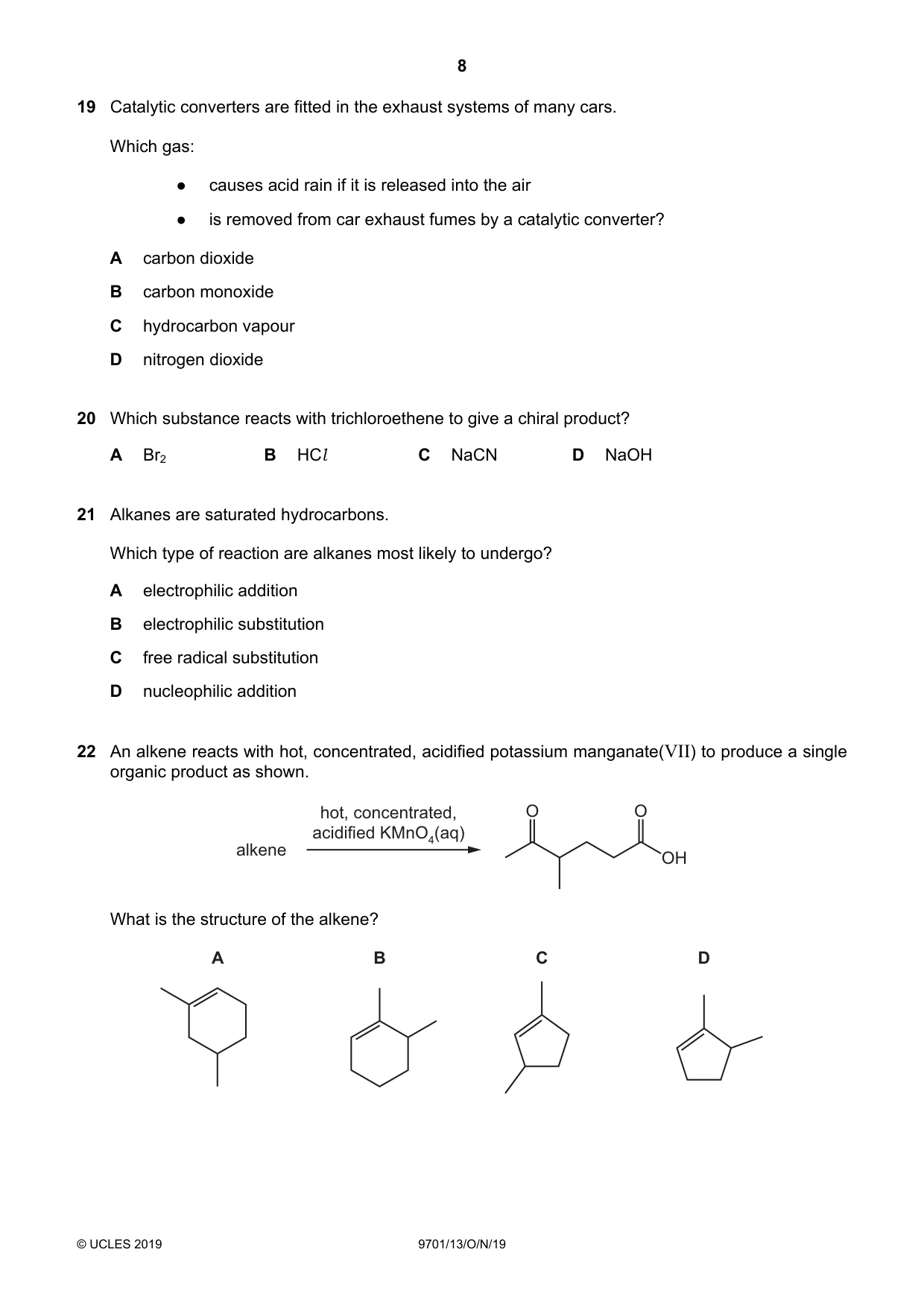
22 An alkene reacts with hot, concentrated, acidified potassium manganate(VII) to produce a single organic product as shown. hot, concentrated, O O acidified KMnO4(aq) alkene OH What is the structure of the alkene? A B C D
Mark scheme: D
Q23 · A tertiary bromoalkane, indicated here by C–Br, reacts with aqueous NaOH
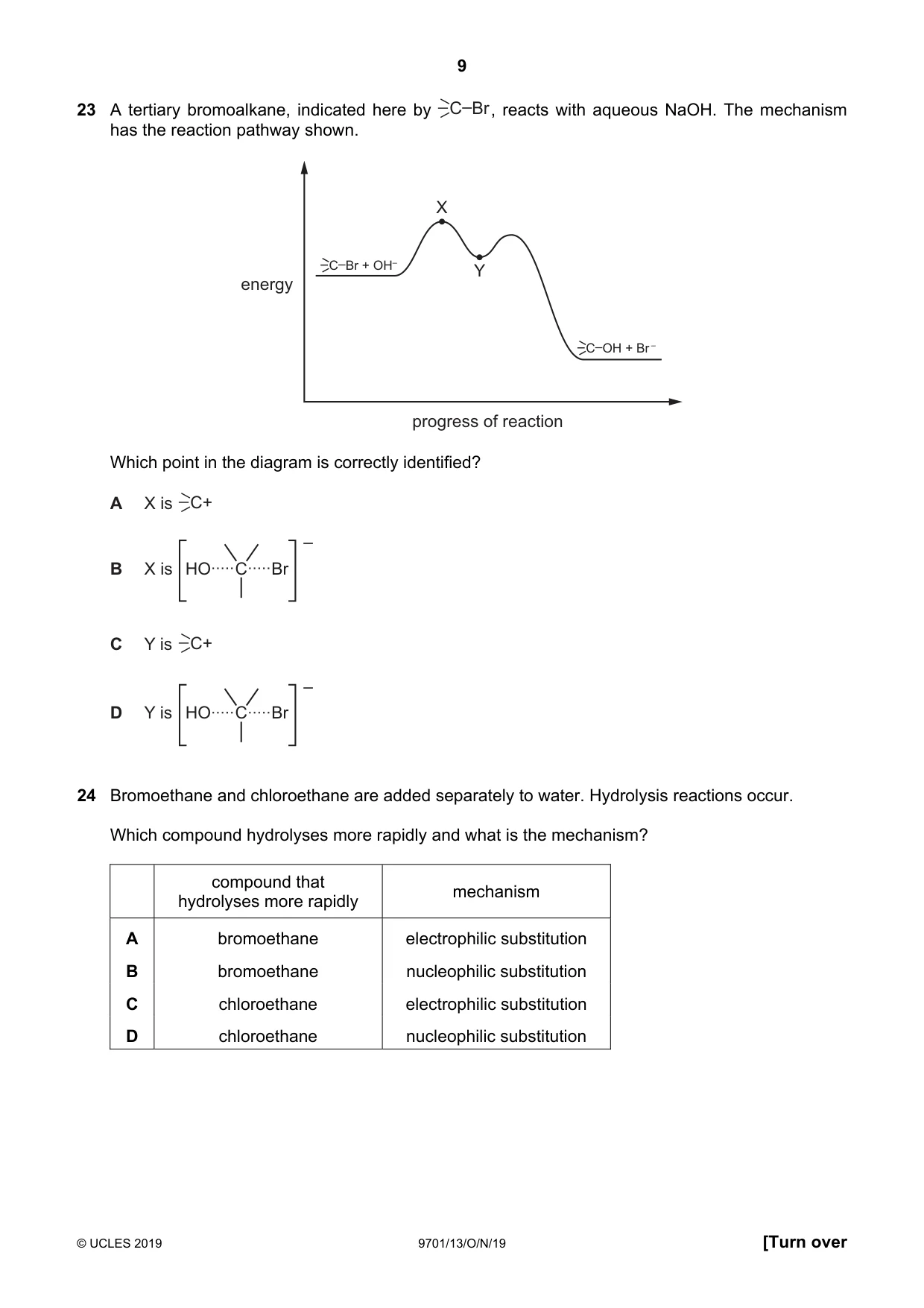
23 A tertiary bromoalkane, indicated here by C–Br, reacts with aqueous NaOH. The mechanism has the reaction pathway shown. X C–Br + OH– Y energy C–OH + Br – progress of reaction Which point in the diagram is correctly identified? A X is C+ – B X is HO C Br C Y is C+ – D Y is HO C Br
Mark scheme: C
Q24 · Bromoethane and chloroethane are added separately to water
24 Bromoethane and chloroethane are added separately to water. Hydrolysis reactions occur. Which compound hydrolyses more rapidly and what is the mechanism? compound that mechanism hydrolyses more rapidly A bromoethane electrophilic substitution B bromoethane nucleophilic substitution C chloroethane electrophilic substitution D chloroethane nucleophilic substitution
Mark scheme: B
Q25 · Alcohol X is oxidised to form compound Y
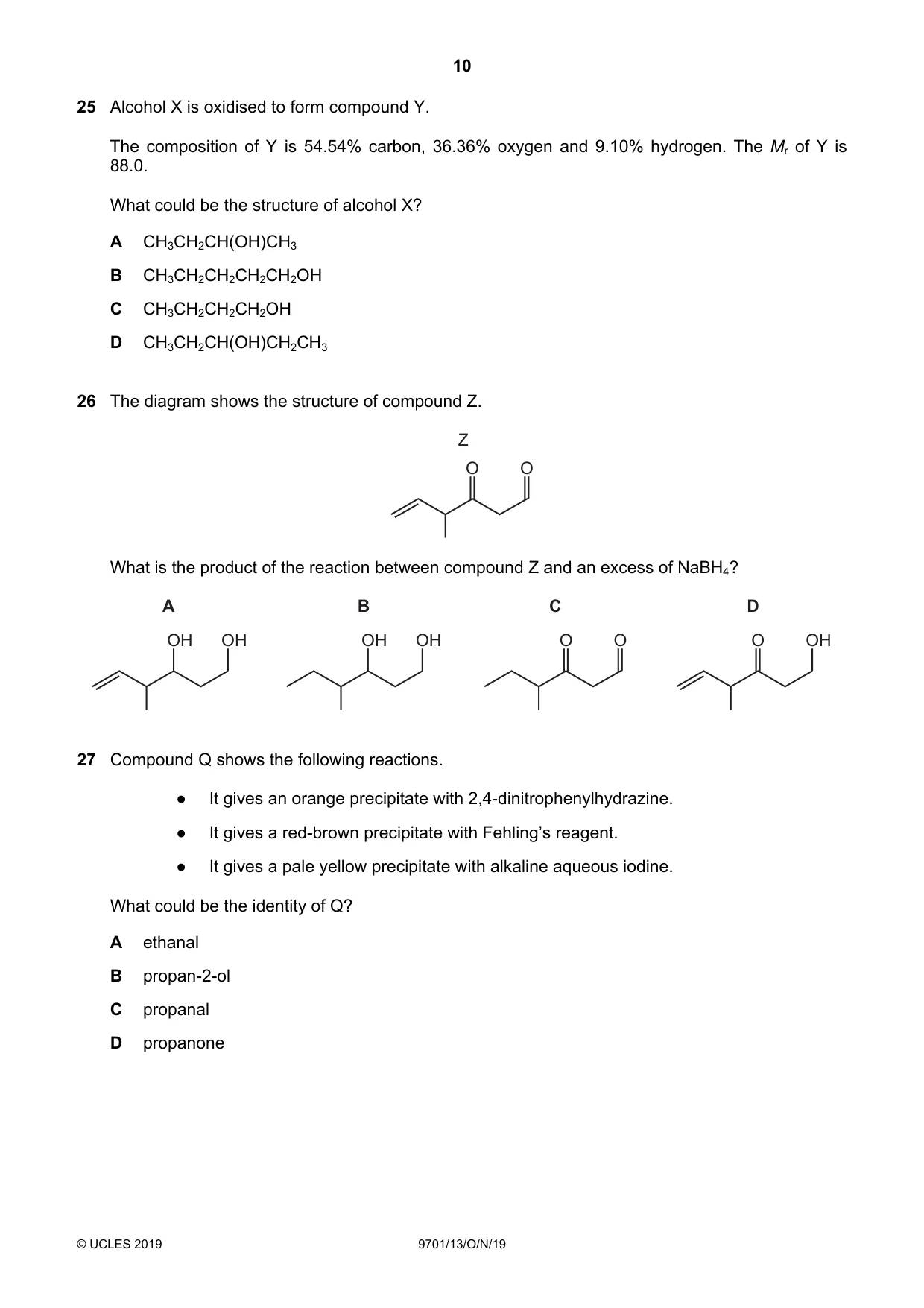
25 Alcohol X is oxidised to form compound Y. The composition of Y is 54.54% carbon, 36.36% oxygen and 9.10% hydrogen. The Mr of Y is 88.0. What could be the structure of alcohol X? A CH3CH2CH(OH)CH3 B CH3CH2CH2CH2CH2OH C CH3CH2CH2CH2OH D CH3CH2CH(OH)CH2CH3
Mark scheme: C
Q26 · The diagram shows the structure of compound Z
26 The diagram shows the structure of compound Z. Z O O What is the product of the reaction between compound Z and an excess of NaBH4? A B C D OH OH OH OH O O O OH
Mark scheme: A
Q27 · Compound Q shows the following reactions
27 Compound Q shows the following reactions. ● It gives an orange precipitate with 2,4-dinitrophenylhydrazine. ● It gives a red-brown precipitate with Fehling’s reagent. ● It gives a pale yellow precipitate with alkaline aqueous iodine. What could be the identity of Q? A ethanal B propan-2-ol C propanal D propanone
Mark scheme: A
Q28 · Tartaric acid, HO2CCH(OH)CH(OH)CO2H, is found in many plants
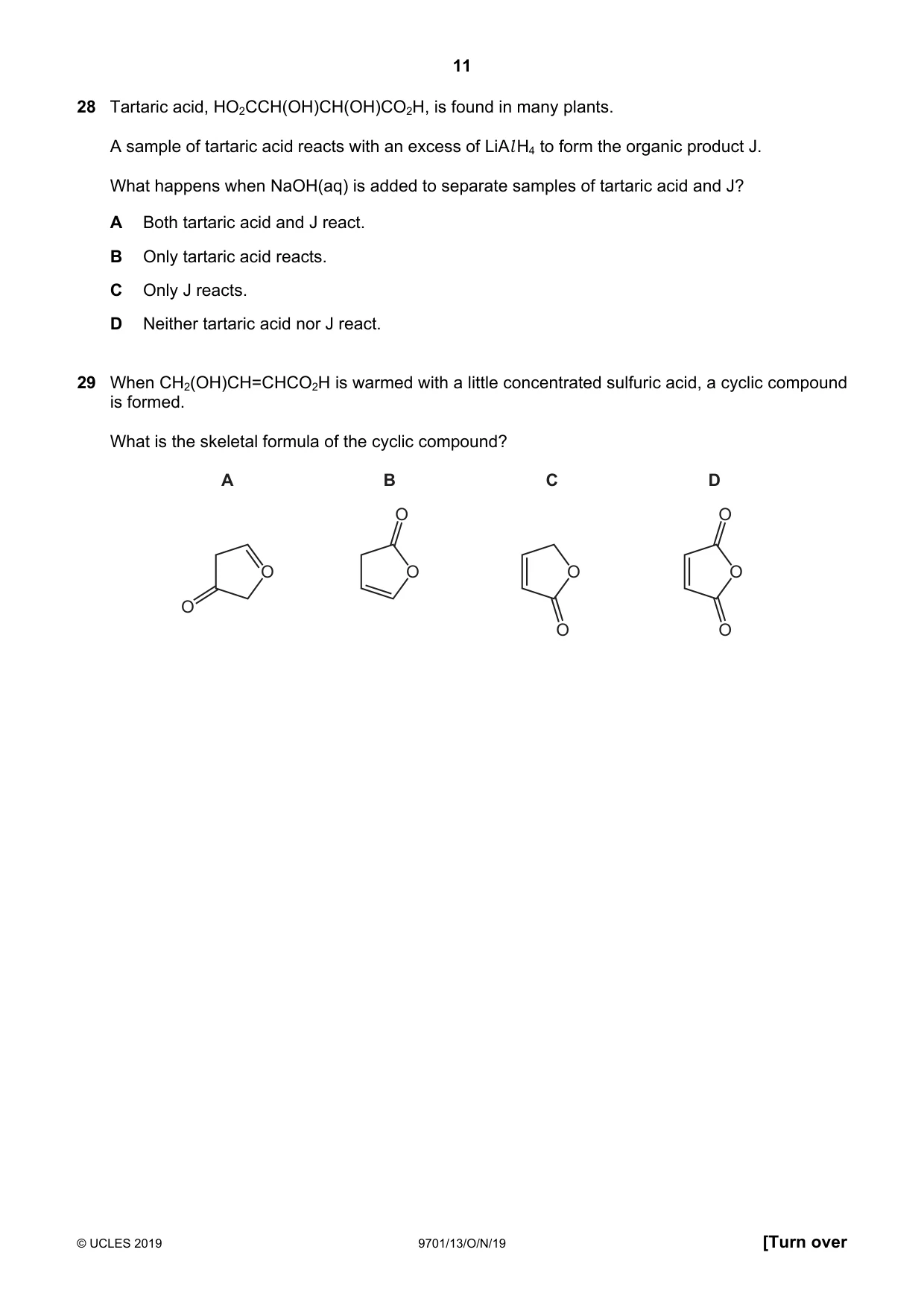
28 Tartaric acid, HO2CCH(OH)CH(OH)CO2H, is found in many plants. A sample of tartaric acid reacts with an excess of LiAl H4 to form the organic product J. What happens when NaOH(aq) is added to separate samples of tartaric acid and J? A Both tartaric acid and J react. B Only tartaric acid reacts. C Only J reacts. D Neither tartaric acid nor J react.
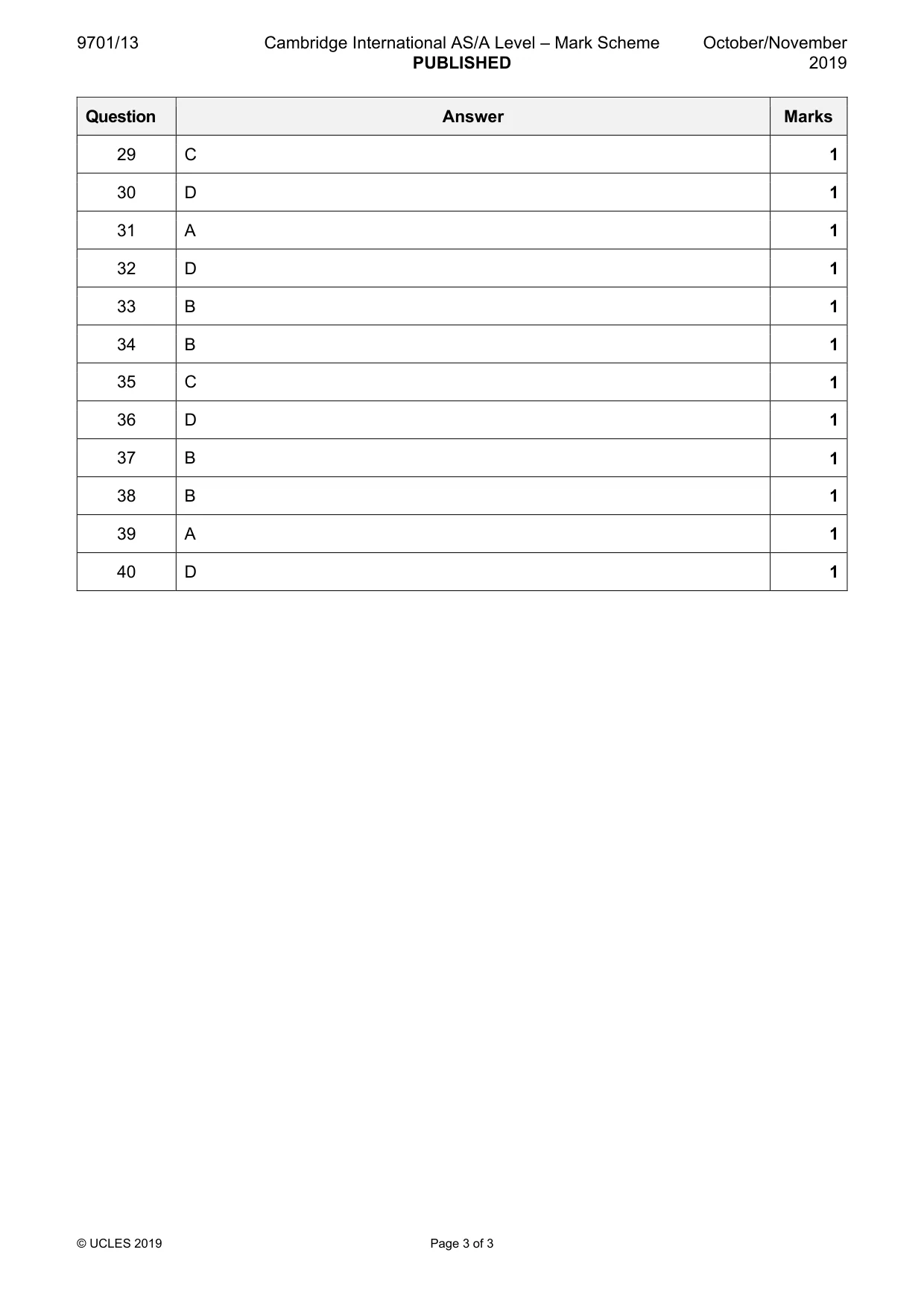
Mark scheme: B
Q29 · When CH2(OH)CH=CHCO2H is warmed with a little concentrated sulfuric acid, a cyclic…
29 When CH2(OH)CH=CHCO2H is warmed with a little concentrated sulfuric acid, a cyclic compound is formed. What is the skeletal formula of the cyclic compound? A B C D O O O O O O O O O
Mark scheme: C
Q30 · The infra-red spectrum of compound P is shown
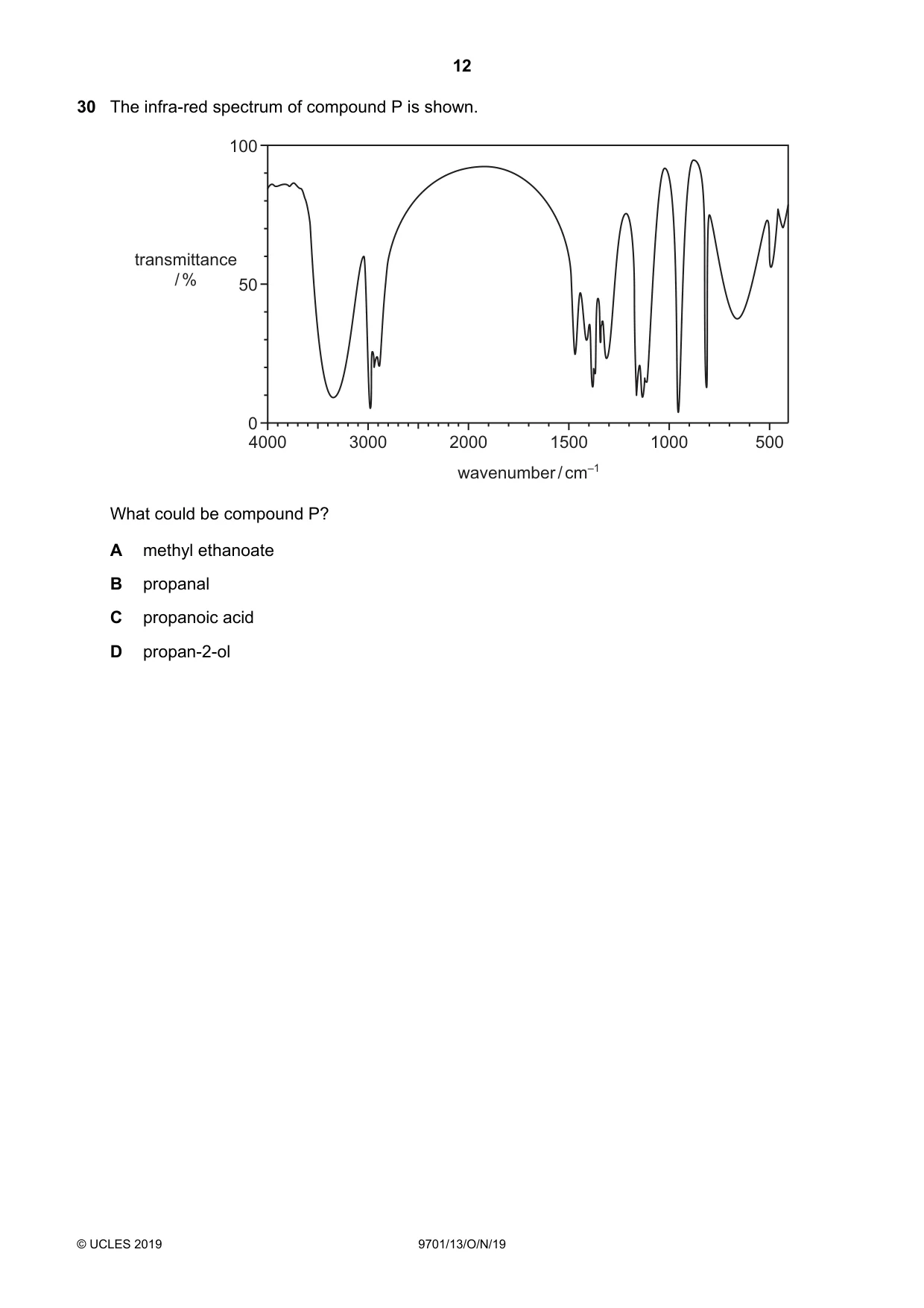
30 The infra-red spectrum of compound P is shown. 100 transmittance / % 50 0 4000 3000 2000 1500 1000 500 wavenumber / cm–1 What could be compound P? A methyl ethanoate B propanal C propanoic acid D propan-2-ol
Mark scheme: D
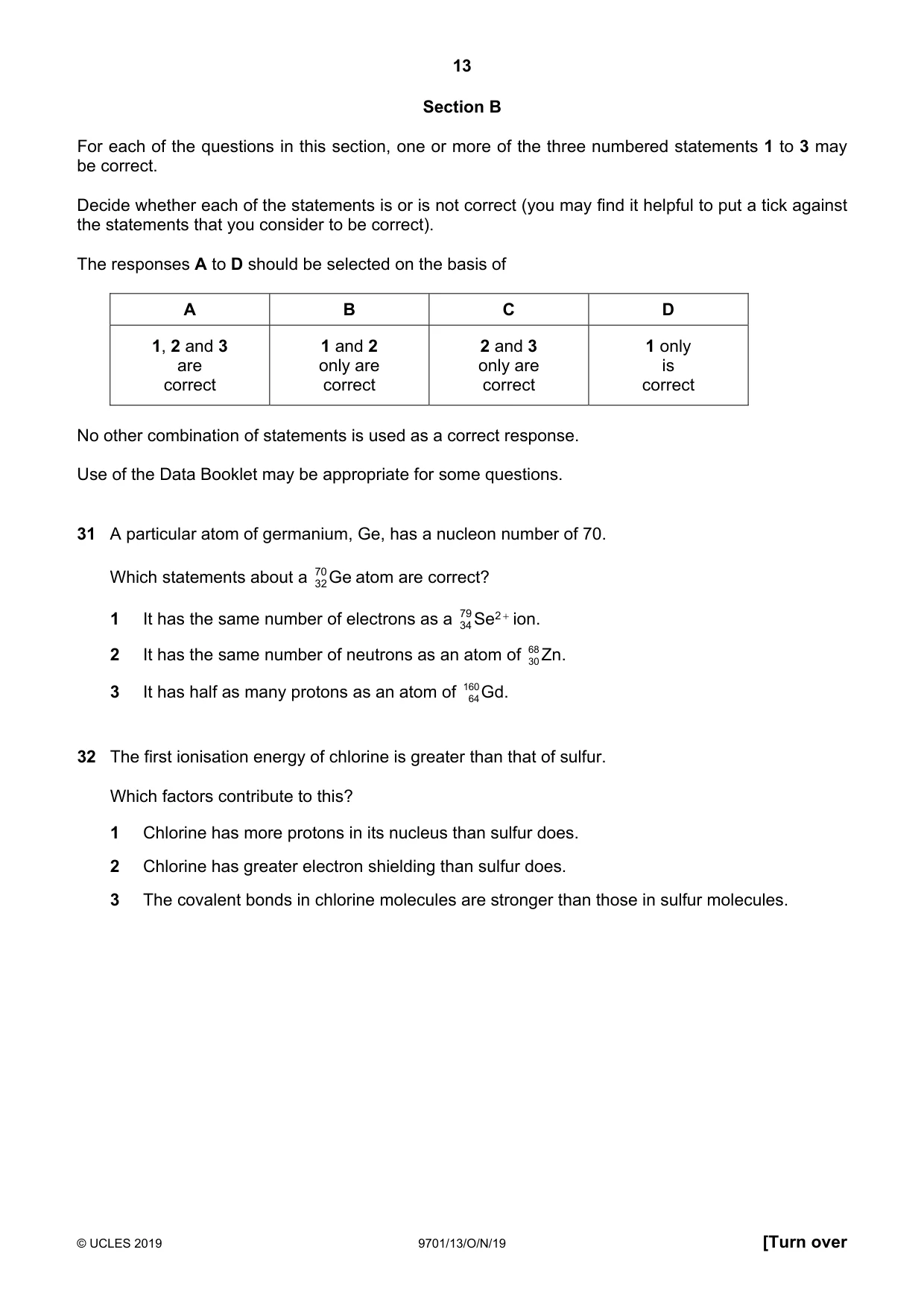
Q31 · A particular atom of germanium, Ge, has a nucleon number of 70
31 A particular atom of germanium, Ge, has a nucleon number of 70. Which statements about a 70 Ge atom are correct? 32 1 It has the same number of electrons as a 79 34Se 2 + ion. 2 It has the same number of neutrons as an atom of 68 30Zn. 3 It has half as many protons as an atom of 160 64Gd.
Mark scheme: A
Q32 · The first ionisation energy of chlorine is greater than that of sulfur
32 The first ionisation energy of chlorine is greater than that of sulfur. Which factors contribute to this? 1 Chlorine has more protons in its nucleus than sulfur does. 2 Chlorine has greater electron shielding than sulfur does. 3 The covalent bonds in chlorine molecules are stronger than those in sulfur molecules.
Mark scheme: D
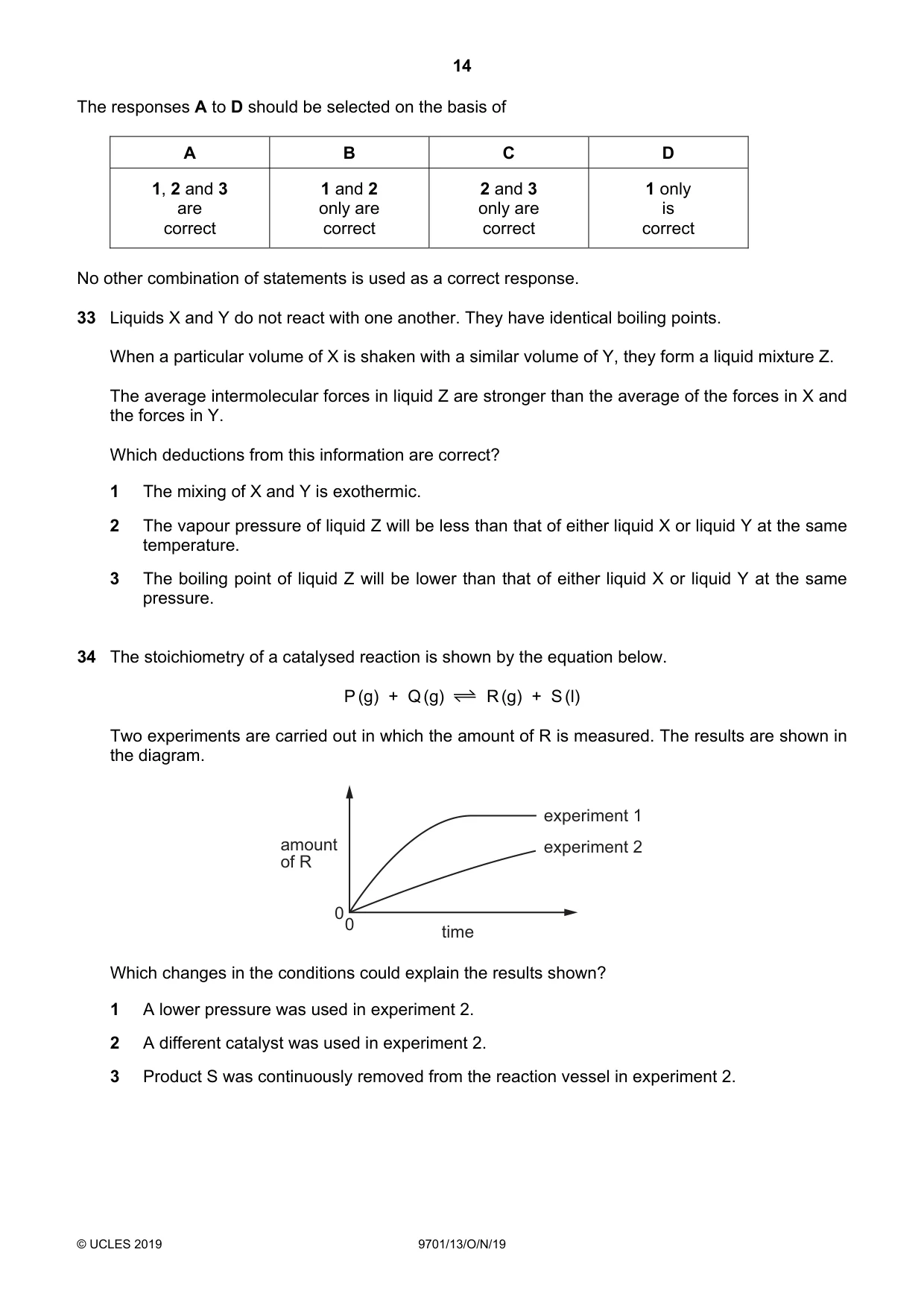
Q33 · Liquids X and Y do not react with one another
33 Liquids X and Y do not react with one another. They have identical boiling points. When a particular volume of X is shaken with a similar volume of Y, they form a liquid mixture Z. The average intermolecular forces in liquid Z are stronger than the average of the forces in X and the forces in Y. Which deductions from this information are correct? 1 The mixing of X and Y is exothermic. 2 The vapour pressure of liquid Z will be less than that of either liquid X or liquid Y at the same temperature. 3 The boiling point of liquid Z will be lower than that of either liquid X or liquid Y at the same pressure.
Mark scheme: B
More questions on Intermolecular forces, electronegativity and bond properties
Q34 · The stoichiometry of a catalysed reaction is shown by the equation below
34 The stoichiometry of a catalysed reaction is shown by the equation below. P (g) + Q (g) R (g) + S (l) Two experiments are carried out in which the amount of R is measured. The results are shown in the diagram. experiment 1 amount experiment 2 of R 00 time Which changes in the conditions could explain the results shown? 1 A lower pressure was used in experiment 2. 2 A different catalyst was used in experiment 2. 3 Product S was continuously removed from the reaction vessel in experiment 2.
Mark scheme: B
Q35 · Which statements are correct?
35 Which statements are correct? 1 Chloride ions are oxidised when concentrated sulfuric acid is added to NaCl (s). 2 A disproportionation reaction takes place when chlorine is added to cold NaOH(aq). 3 An acidic solution forms when chlorine is added to water.
Mark scheme: C
Q36 · Nitrogen gas is unreactive, whereas oxygen gas and chlorine gas are reactive
36 Nitrogen gas is unreactive, whereas oxygen gas and chlorine gas are reactive. Which statements help to explain this difference? 1 The two N atoms in an N2 molecule are held together by a very strong triple bond. 2 The triple bond between two N atoms is not polar. The bonds in O2 and Cl 2 are polar. 3 The atoms in N2 have a full outer shell of electrons. The atoms in O2 and Cl 2 do not have a full outer shell of electrons.
Mark scheme: D
Q37 · The structure of tiglic acid is CH3CH=C(CH3)CO2H
37 The structure of tiglic acid is CH3CH=C(CH3)CO2H. Which statements about the properties of one molecule of this acid are correct? 1 It contains two π bonds. 2 It contains four lone pairs of electrons. 3 It has all its atoms in the same plane.
Mark scheme: B
More questions on Shapes of organic molecules; σ and π bonds
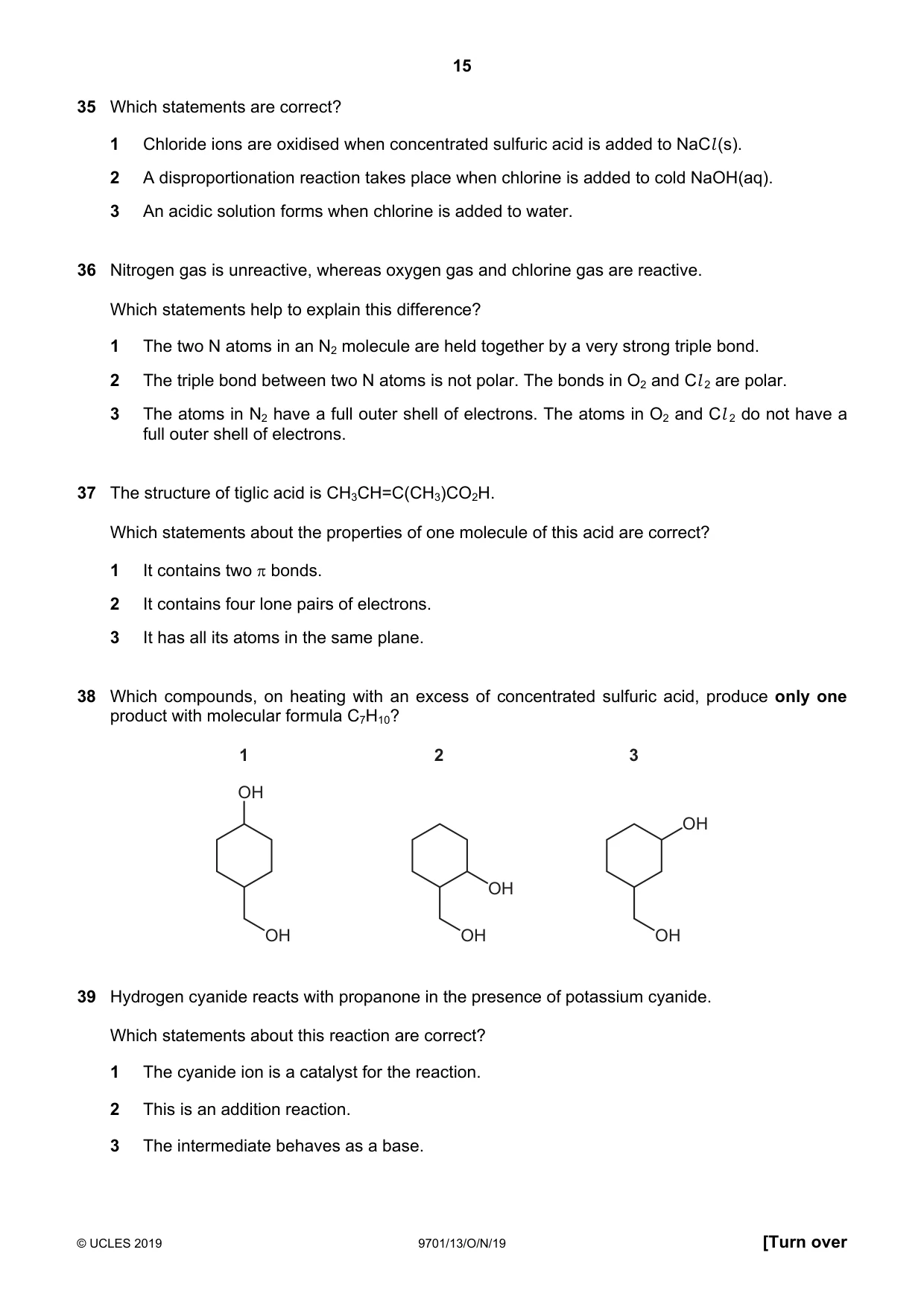
Q38 · Which compounds, on heating with an excess of concentrated sulfuric acid, produce only…
38 Which compounds, on heating with an excess of concentrated sulfuric acid, produce only one product with molecular formula C7H10? 1 2 3 OH OH OH OH OH OH
Mark scheme: B
Q39 · Hydrogen cyanide reacts with propanone in the presence of potassium cyanide
39 Hydrogen cyanide reacts with propanone in the presence of potassium cyanide. Which statements about this reaction are correct? 1 The cyanide ion is a catalyst for the reaction. 2 This is an addition reaction. 3 The intermediate behaves as a base.
Mark scheme: A
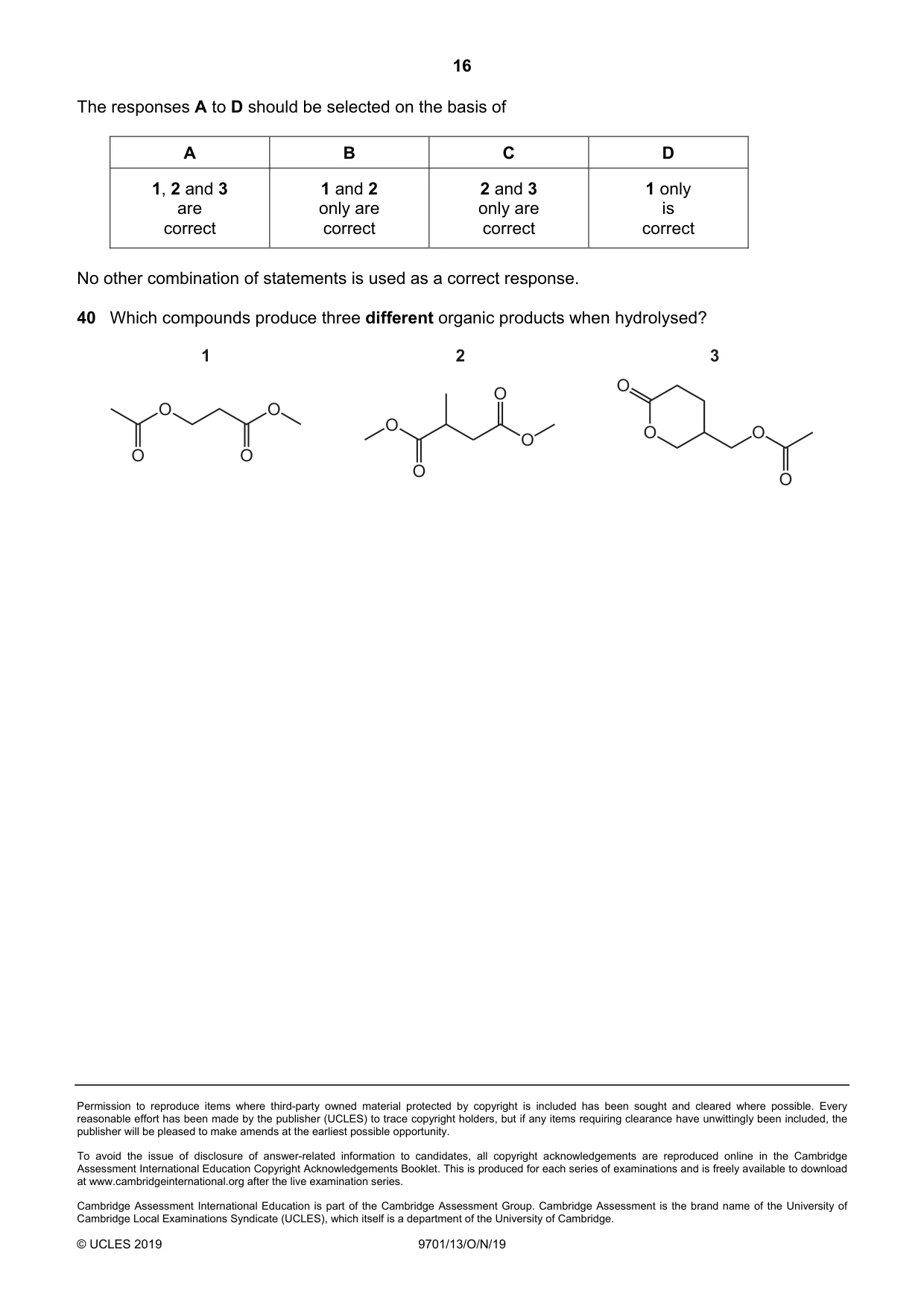
Q40 · Which compounds produce three different organic products when hydrolysed?
40 Which compounds produce three different organic products when hydrolysed? 1 2 3 O O O O O O O O O O O O
Mark scheme: D
What was in this paper
The subtopics covered by these 40 questions, and how many questions each got. Open one in a new tab to see every Cambridge question on it.
2Alkenes2Chemical equilibria: reversible reactions, dynamic equilibrium2Halogenoalkanes2Intermolecular forces, electronegativity and bond properties2Redox processes: electron transfer and changes in oxidation number (oxidation state)2Shapes of organic molecules; σ and π bonds2Similarities and trends in the properties of the Group 2 metals, magnesium to barium, and their compounds2Acids and bases1Alcohols1Alcohols1Alkanes1Carboxylic acids1Effect of temperature on reaction rates and the concept of activation energy1Electronegativity and bonding1Enthalpy change, ΔH1Esters1Esters1Hess’s law1Infrared spectroscopy1Ionisation energy1Isotopes1Nitriles and hydroxynitriles1Nitrogen and sulfur1Periodicity of chemical properties of the elements in Period 31Periodicity of physical properties of the elements in Period 31Physical properties of the Group 17 elements1Rate of reaction1Shapes of molecules1Some reactions of the halide ions1The mole and the Avogadro constant1The reactions of chlorine1What you needed in this session
Cambridge’s own grade thresholds for 2019 Oct/Nov, Paper 1 · Variant 3. A higher threshold means an easier paper — the bar moves with how the cohort did.