Cambridge A Level Chemistry 9701 — 2018 May/June Paper 1 · Variant 3
9701/13/M/J/18 · 40 questions · 40 marks · ≈45 min
The question paper and its mark scheme, free to read here and free to download. This is Cambridge’s own paper, exactly as it was sat.
Question paper16 pages

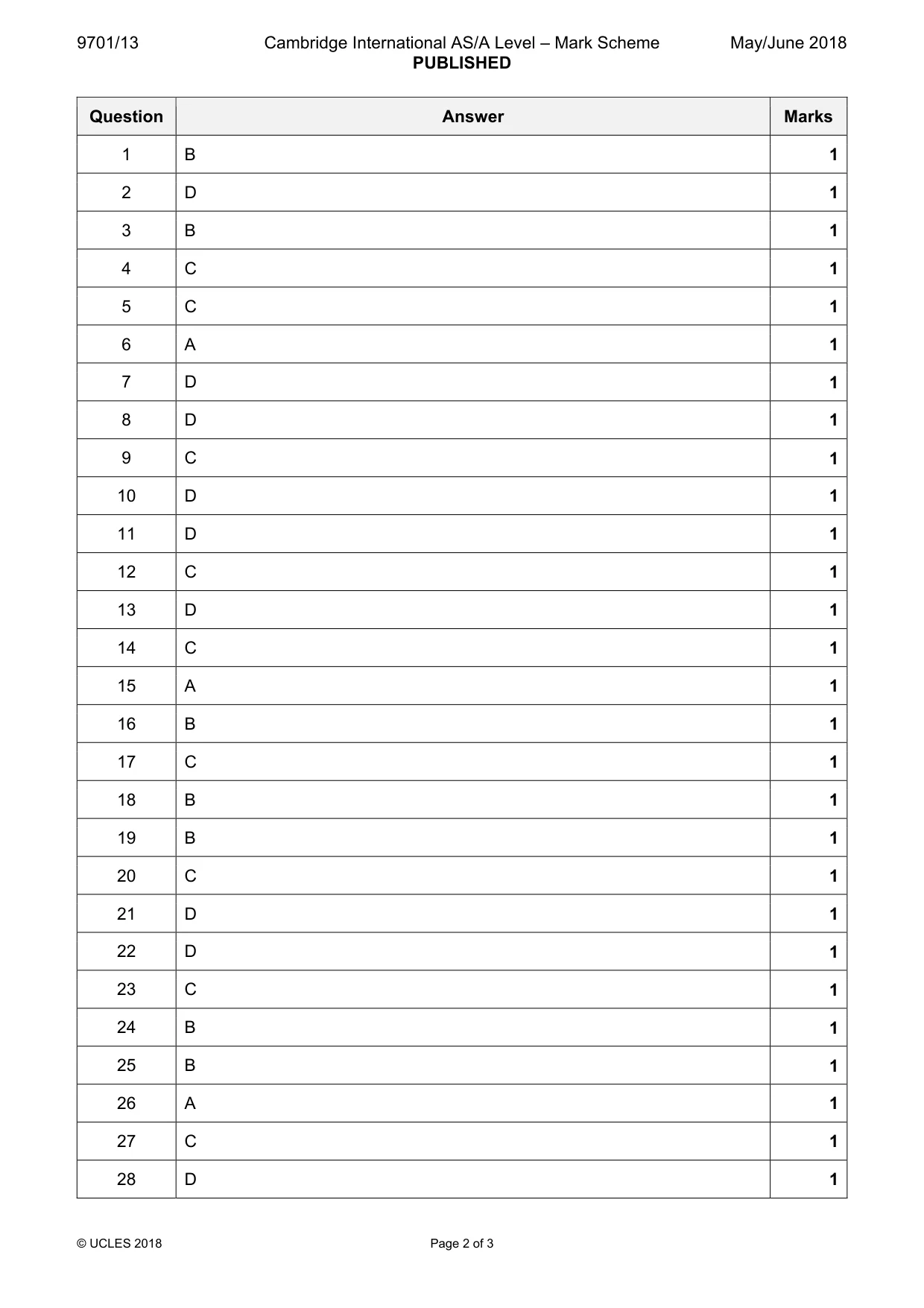
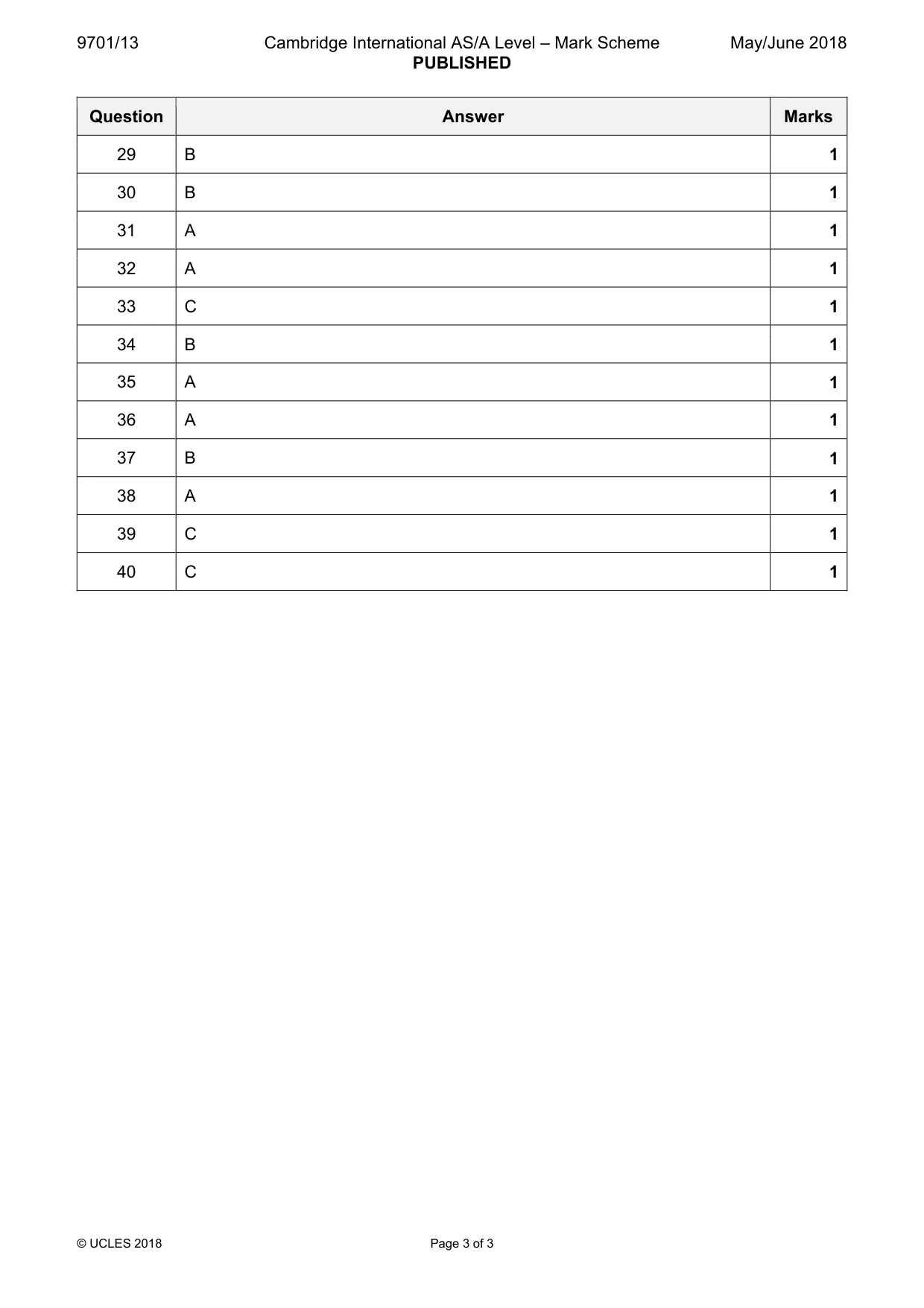
Mark scheme3 pages
Answers below. Sit the paper first if you are practising.
Questions as text
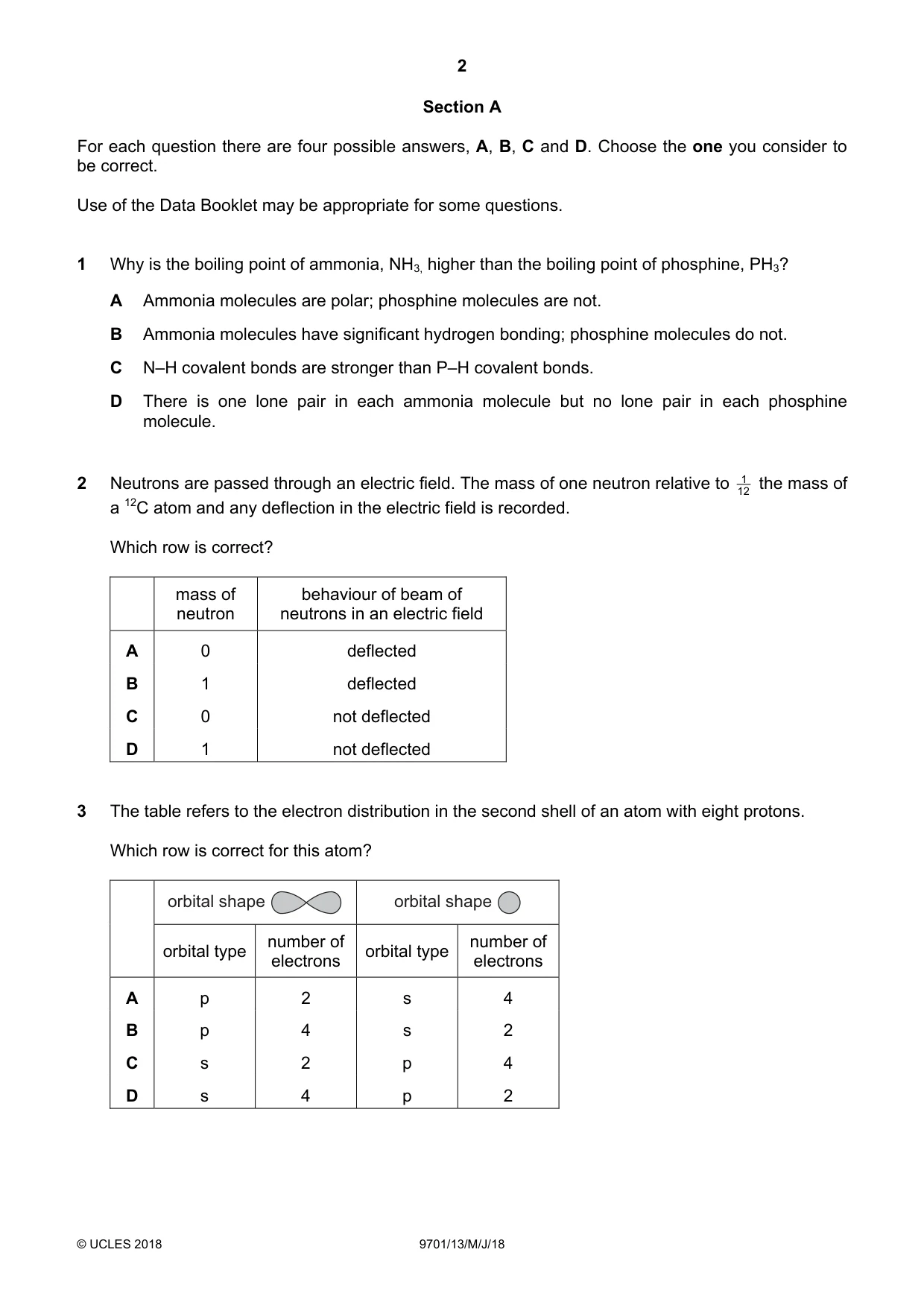
Q1 · Why is the boiling point of ammonia, NH3, higher than the boiling point of phosphine, PH3?
1 Why is the boiling point of ammonia, NH3, higher than the boiling point of phosphine, PH3? A Ammonia molecules are polar; phosphine molecules are not. B Ammonia molecules have significant hydrogen bonding; phosphine molecules do not. C N–H covalent bonds are stronger than P–H covalent bonds. D There is one lone pair in each ammonia molecule but no lone pair in each phosphine molecule.
Mark scheme: B
More questions on Intermolecular forces, electronegativity and bond properties
Q2 · Neutrons are passed through an electric field
2 Neutrons are passed through an electric field. The mass of one neutron relative to 12 1 the mass of a 12C atom and any deflection in the electric field is recorded. Which row is correct? mass of behaviour of beam of neutron neutrons in an electric field A 0 deflected B 1 deflected C 0 not deflected D 1 not deflected
Mark scheme: D
Q3 · The table refers to the electron distribution in the second shell of an atom with eight…
3 The table refers to the electron distribution in the second shell of an atom with eight protons. Which row is correct for this atom? orbital shape orbital shape number of number of orbital type orbital type electrons electrons A p 2 s 4 B p 4 s 2 C s 2 p 4 D s 4 p 2
Mark scheme: B
More questions on Electrons, energy levels and atomic orbitals
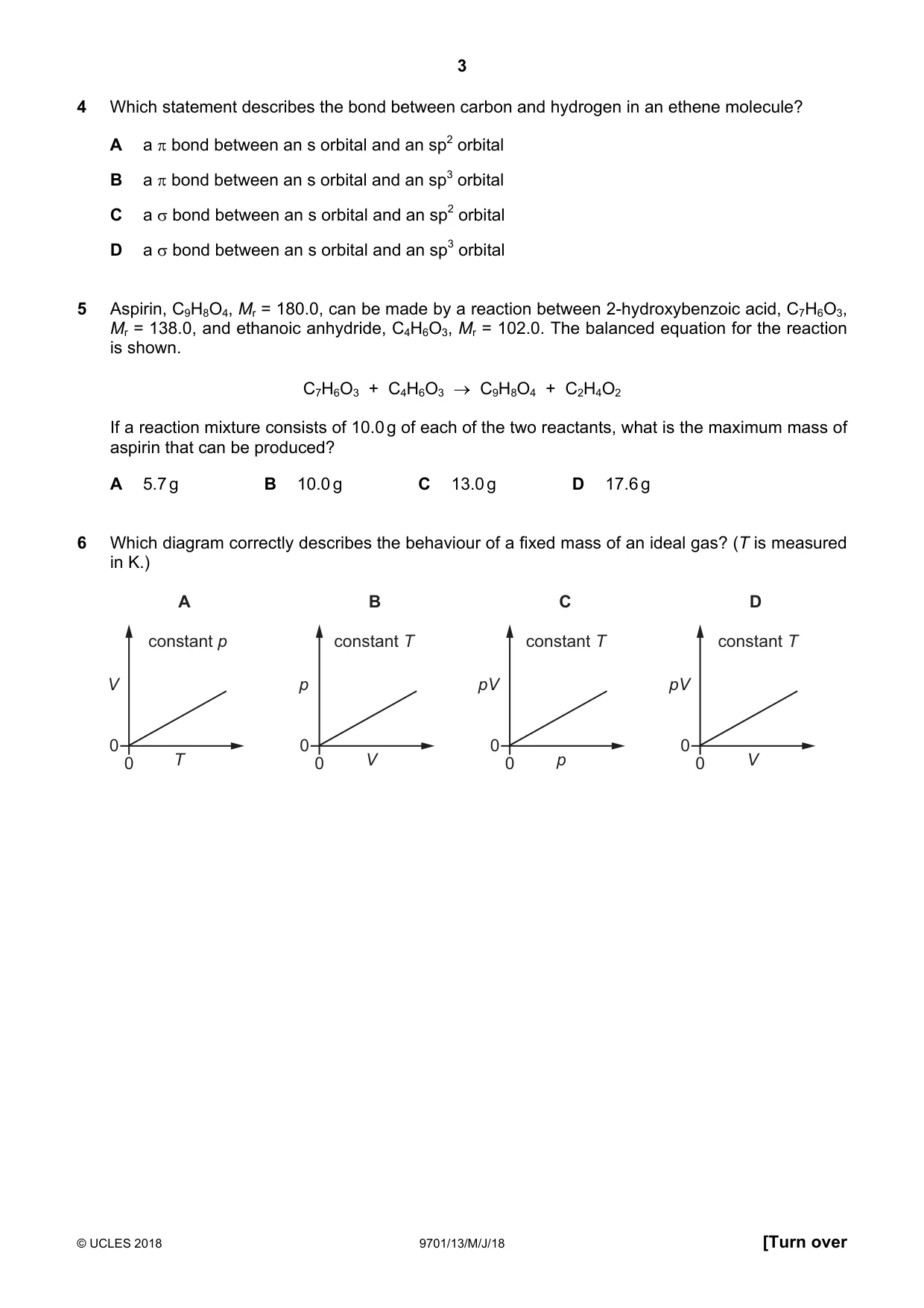
Q4 · Which statement describes the bond between carbon and hydrogen in an ethene molecule?
4 Which statement describes the bond between carbon and hydrogen in an ethene molecule? A a π bond between an s orbital and an sp2 orbital B a π bond between an s orbital and an sp3 orbital C a σ bond between an s orbital and an sp2 orbital D a σ bond between an s orbital and an sp3 orbital
Mark scheme: C
More questions on Shapes of organic molecules; σ and π bonds
Q5 · Aspirin, C9H8O4, Mr = 180.0, can be made by a reaction between 2-hydroxybenzoic acid…
5 Aspirin, C9H8O4, Mr = 180.0, can be made by a reaction between 2-hydroxybenzoic acid, C7H6O3, Mr = 138.0, and ethanoic anhydride, C4H6O3, Mr = 102.0. The balanced equation for the reaction is shown. C7H6O3 + C4H6O3 → C9H8O4 + C2H4O2 If a reaction mixture consists of 10.0 g of each of the two reactants, what is the maximum mass of aspirin that can be produced? A 5.7 g B 10.0 g C 13.0 g D 17.6 g
Mark scheme: C
More questions on Reacting masses and volumes (of solutions and gases)
Q6 · Which diagram correctly describes the behaviour of a fixed mass of an ideal gas?
6 Which diagram correctly describes the behaviour of a fixed mass of an ideal gas? (T is measured in K.) A B C D constant p constant T constant T constant T V p pV pV 0 0 0 0 0 T 0 V 0 p 0 V
Mark scheme: A
More questions on The gaseous state: ideal and real gases and pV = nRT
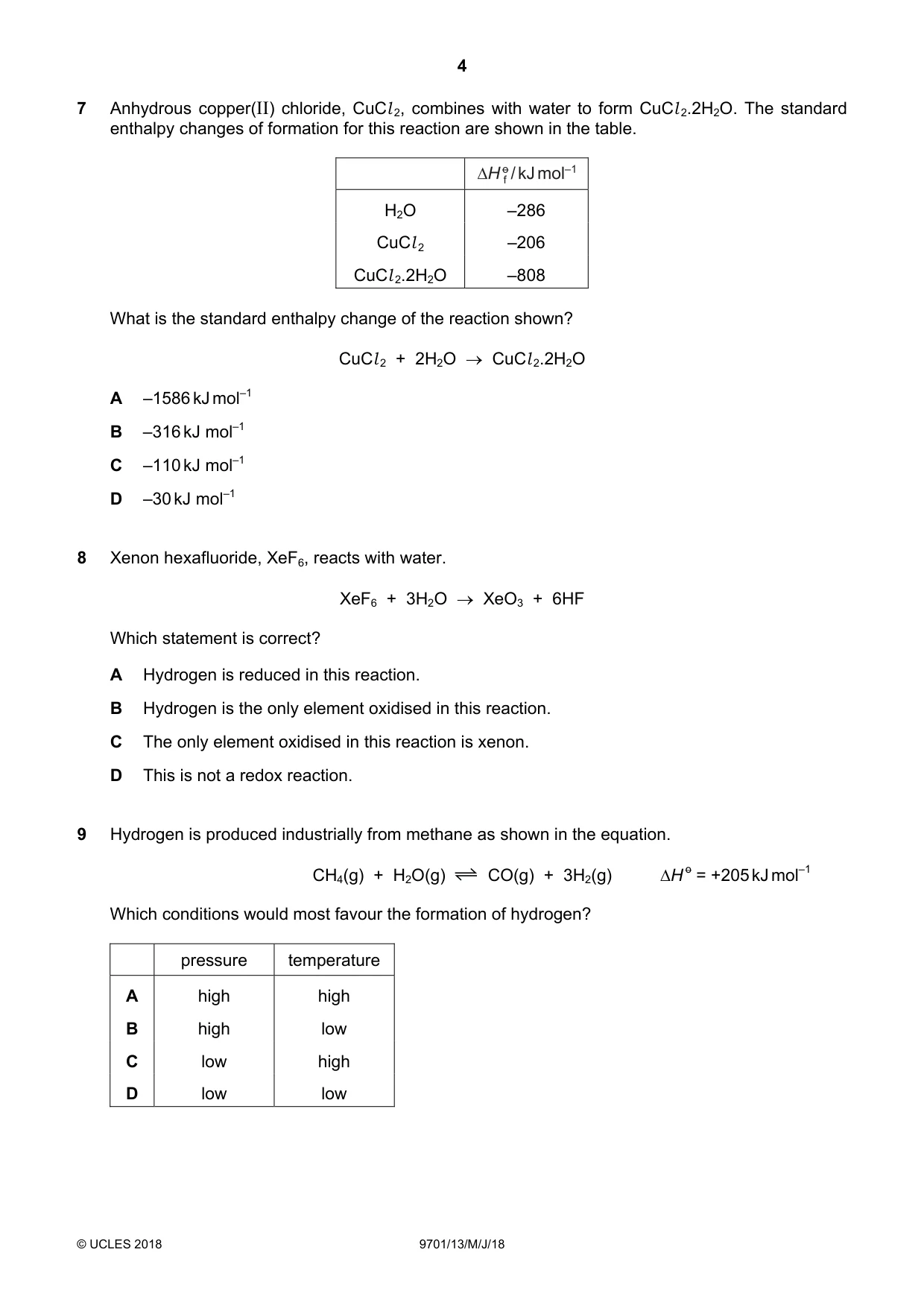
Q7 · Anhydrous copper(II) chloride, CuCl 2, combines with water to form CuCl 2.2H2O
7 Anhydrous copper(II) chloride, CuCl 2, combines with water to form CuCl 2.2H2O. The standard enthalpy changes of formation for this reaction are shown in the table. H2O –286 CuCl 2 –206 CuCl 2.2H2O –808 What is the standard enthalpy change of the reaction shown? CuCl 2 + 2H2O → CuCl 2.2H2O A –1586 kJ mol–1 B –316 kJ mol–1 C –110 kJ mol–1 D –30 kJ mol–1
Mark scheme: D
Q8 · Xenon hexafluoride, XeF6, reacts with water
8 Xenon hexafluoride, XeF6, reacts with water. XeF6 + 3H2O → XeO3 + 6HF Which statement is correct? A Hydrogen is reduced in this reaction. B Hydrogen is the only element oxidised in this reaction. C The only element oxidised in this reaction is xenon. D This is not a redox reaction.
Mark scheme: D
Q9 · Hydrogen is produced industrially from methane as shown in the equation
9 Hydrogen is produced industrially from methane as shown in the equation. CH4(g) + H2O(g) CO(g) + 3H2(g) ∆H o = +205 kJ mol–1 Which conditions would most favour the formation of hydrogen? pressure temperature A high high B high low C low high D low low
Mark scheme: C
More questions on Chemical equilibria: reversible reactions, dynamic equilibrium
Q10 · The chemical equilibrium shown is formed when ammonia is produced in the Haber process
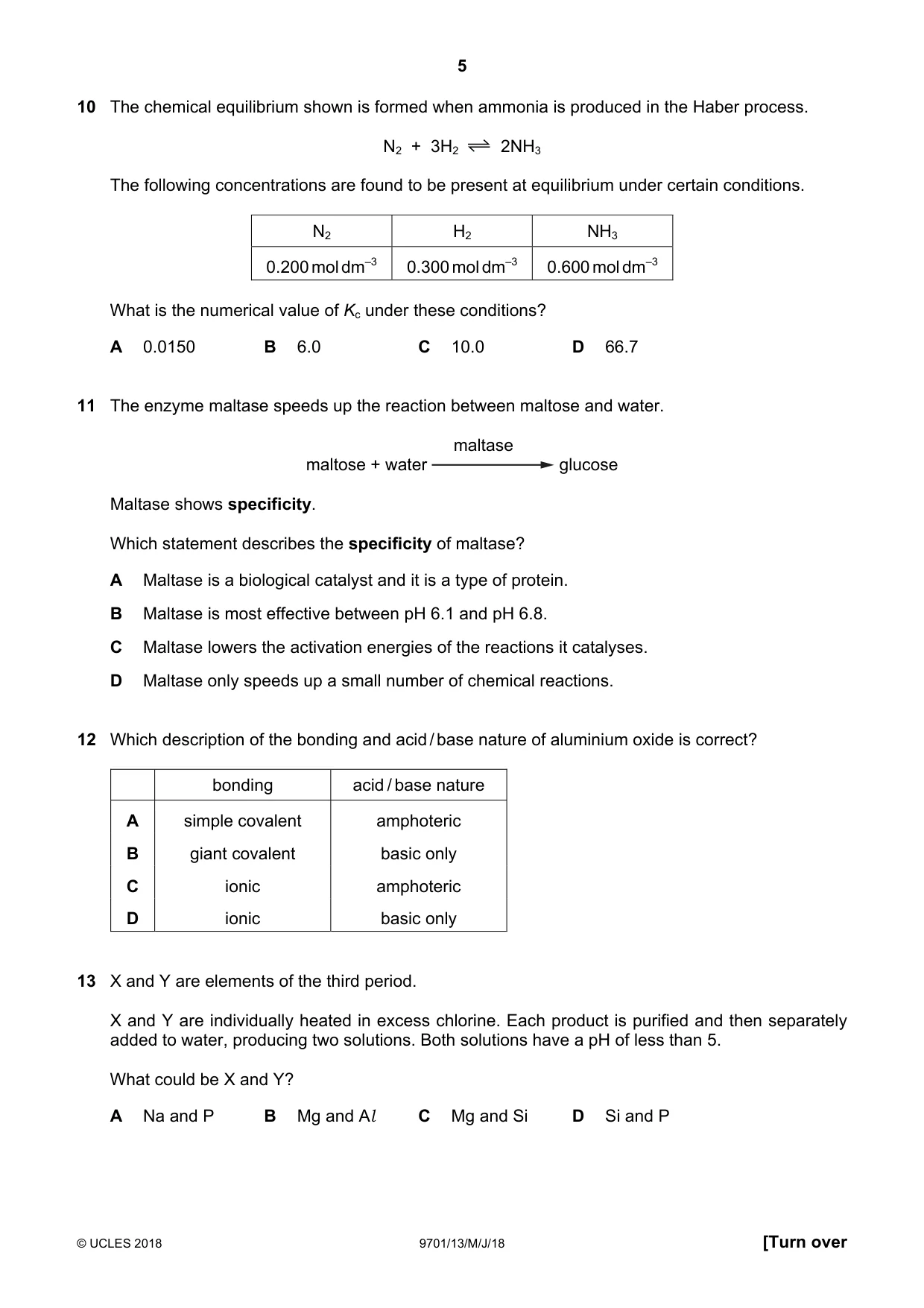
10 The chemical equilibrium shown is formed when ammonia is produced in the Haber process. N2 + 3H2 2NH3 The following concentrations are found to be present at equilibrium under certain conditions. N2 H2 NH3 0.200 mol dm–3 0.300 mol dm–3 0.600 mol dm–3 What is the numerical value of Kc under these conditions? A 0.0150 B 6.0 C 10.0 D 66.7
Mark scheme: D
More questions on Chemical equilibria: reversible reactions, dynamic equilibrium
Q11 · The enzyme maltase speeds up the reaction between maltose and water
11 The enzyme maltase speeds up the reaction between maltose and water. maltase maltose + water glucose Maltase shows specificity. Which statement describes the specificity of maltase? A Maltase is a biological catalyst and it is a type of protein. B Maltase is most effective between pH 6.1 and pH 6.8. C Maltase lowers the activation energies of the reactions it catalyses. D Maltase only speeds up a small number of chemical reactions.
Mark scheme: D
Q12 · Which description of the bonding and acid / base nature of aluminium oxide is correct?
12 Which description of the bonding and acid / base nature of aluminium oxide is correct? bonding acid / base nature A simple covalent amphoteric B giant covalent basic only C ionic amphoteric D ionic basic only
Mark scheme: C
More questions on Periodicity of chemical properties of the elements in Period 3
Q13 · X and Y are elements of the third period
13 X and Y are elements of the third period. X and Y are individually heated in excess chlorine. Each product is purified and then separately added to water, producing two solutions. Both solutions have a pH of less than 5. What could be X and Y? A Na and P B Mg and Al C Mg and Si D Si and P
Mark scheme: D
More questions on Periodicity of chemical properties of the elements in Period 3
Q14 · An ore contains magnesium carbonate and barium carbonate
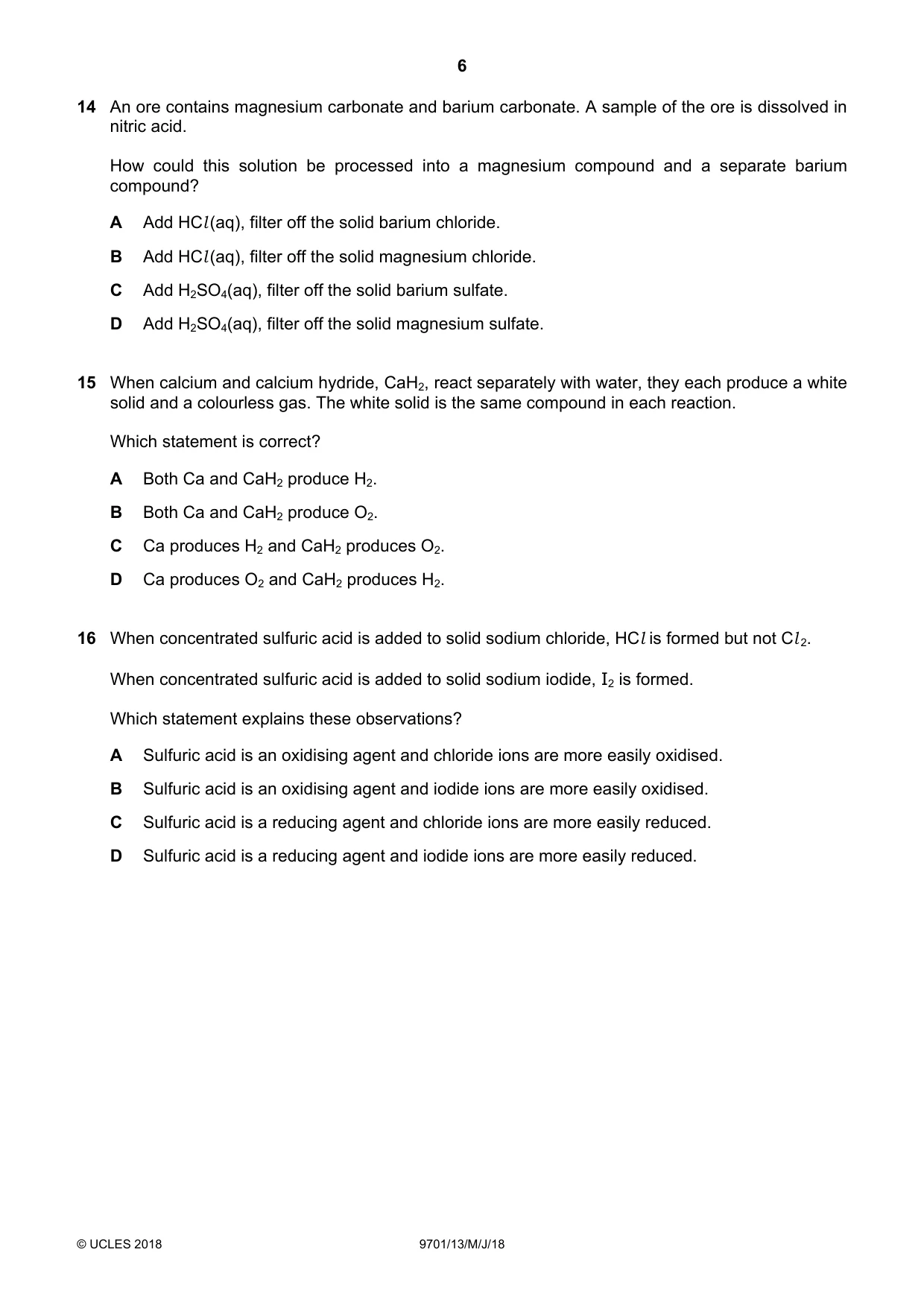
14 An ore contains magnesium carbonate and barium carbonate. A sample of the ore is dissolved in nitric acid. How could this solution be processed into a magnesium compound and a separate barium compound? A Add HCl (aq), filter off the solid barium chloride. B Add HCl (aq), filter off the solid magnesium chloride. C Add H2SO4(aq), filter off the solid barium sulfate. D Add H2SO4(aq), filter off the solid magnesium sulfate.
Mark scheme: C
Q15 · When calcium and calcium hydride, CaH2, react separately with water, they each produce a…
15 When calcium and calcium hydride, CaH2, react separately with water, they each produce a white solid and a colourless gas. The white solid is the same compound in each reaction. Which statement is correct? A Both Ca and CaH2 produce H2. B Both Ca and CaH2 produce O2. C Ca produces H2 and CaH2 produces O2. D Ca produces O2 and CaH2 produces H2.
Mark scheme: A
Q16 · When concentrated sulfuric acid is added to solid sodium chloride, HCl is formed but not…
16 When concentrated sulfuric acid is added to solid sodium chloride, HCl is formed but not Cl 2. When concentrated sulfuric acid is added to solid sodium iodide, I2 is formed. Which statement explains these observations? A Sulfuric acid is an oxidising agent and chloride ions are more easily oxidised. B Sulfuric acid is an oxidising agent and iodide ions are more easily oxidised. C Sulfuric acid is a reducing agent and chloride ions are more easily reduced. D Sulfuric acid is a reducing agent and iodide ions are more easily reduced.
Mark scheme: B
More questions on The chemical properties of the halogen elements and the hydrogen halides
Q17 · Silver chloride and silver iodide form equilibria when added to water
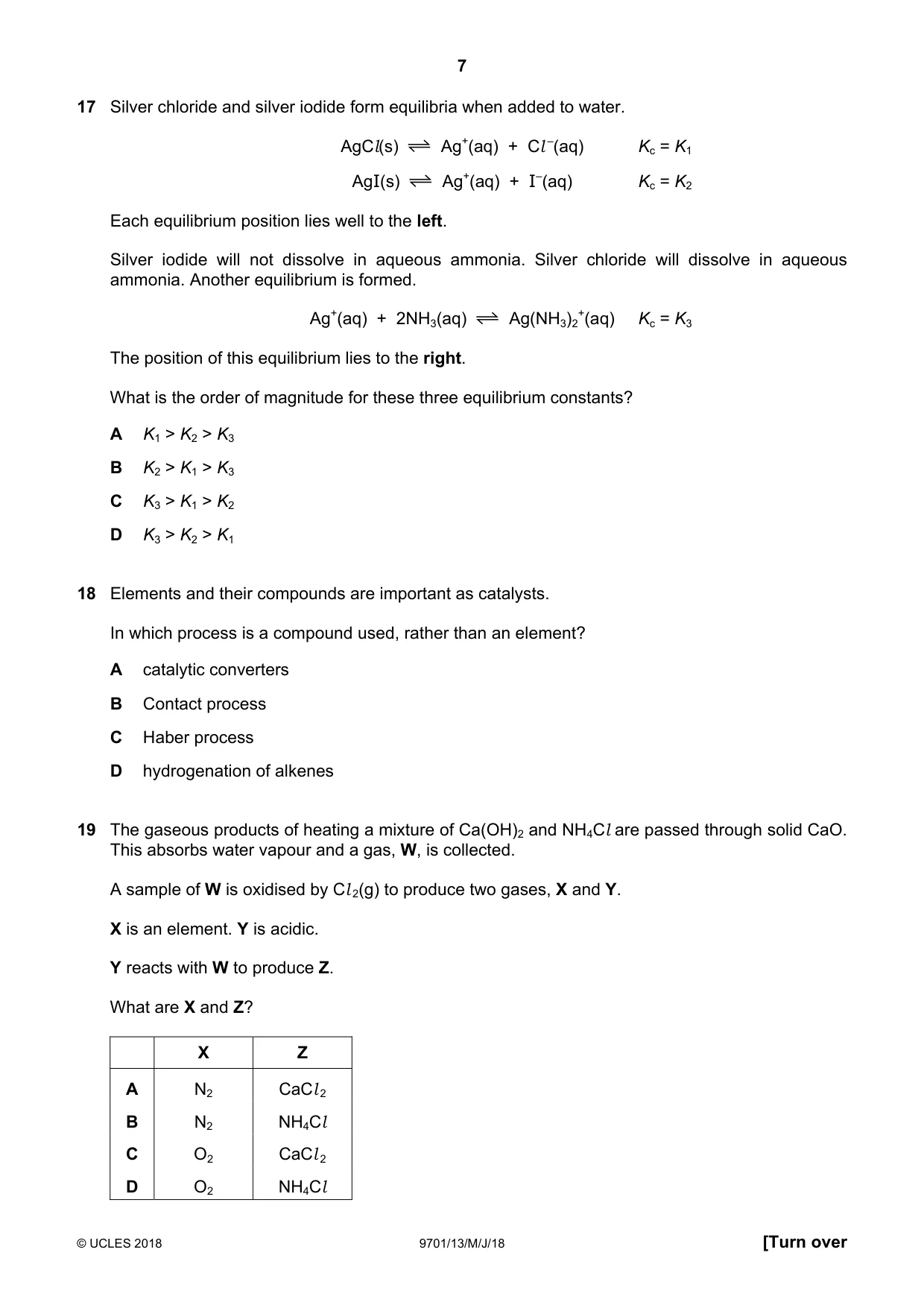
17 Silver chloride and silver iodide form equilibria when added to water. AgCl(s) Ag+(aq) + Cl –(aq) Kc = K1 AgI(s) Ag+(aq) + I–(aq) Kc = K2 Each equilibrium position lies well to the left. Silver iodide will not dissolve in aqueous ammonia. Silver chloride will dissolve in aqueous ammonia. Another equilibrium is formed. Ag+(aq) + 2NH3(aq) Ag(NH3)2 +(aq) Kc = K3 The position of this equilibrium lies to the right. What is the order of magnitude for these three equilibrium constants? A K1 > K2 > K3 B K2 > K1 > K3 C K3 > K1 > K2 D K3 > K2 > K1
Mark scheme: C
Q18 · Elements and their compounds are important as catalysts
18 Elements and their compounds are important as catalysts. In which process is a compound used, rather than an element? A catalytic converters B Contact process C Haber process D hydrogenation of alkenes
Mark scheme: B
Q19 · The gaseous products of heating a mixture of Ca(OH)2 and NH4Cl are passed through solid…
19 The gaseous products of heating a mixture of Ca(OH)2 and NH4Cl are passed through solid CaO. This absorbs water vapour and a gas, W, is collected. A sample of W is oxidised by Cl 2(g) to produce two gases, X and Y. X is an element. Y is acidic. Y reacts with W to produce Z. What are X and Z? X Z A N2 CaCl 2 B N2 NH4Cl C O2 CaCl 2 D O2 NH4Cl
Mark scheme: B
Q20 · Molecule G is shown
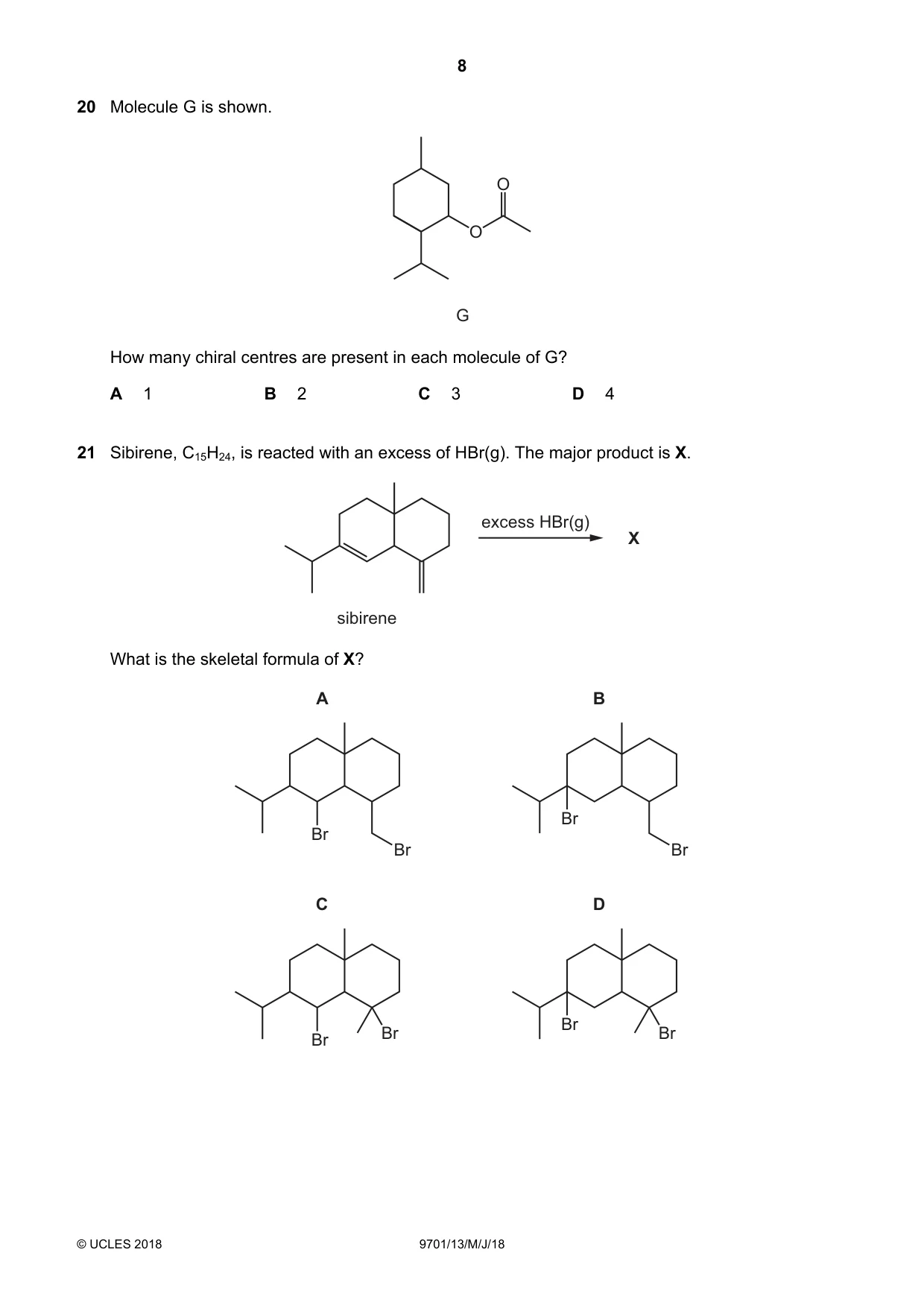
20 Molecule G is shown. O O G How many chiral centres are present in each molecule of G? A 1 B 2 C 3 D 4
Mark scheme: C
More questions on Isomerism: structural isomerism and stereoisomerism
Q21 · Sibirene, C15H24, is reacted with an excess of HBr(g)
21 Sibirene, C15H24, is reacted with an excess of HBr(g). The major product is X. excess HBr(g) X sibirene What is the skeletal formula of X? A B Br Br Br Br C D Br Br Br Br
Mark scheme: D
Q22 · Which statement is not correct?
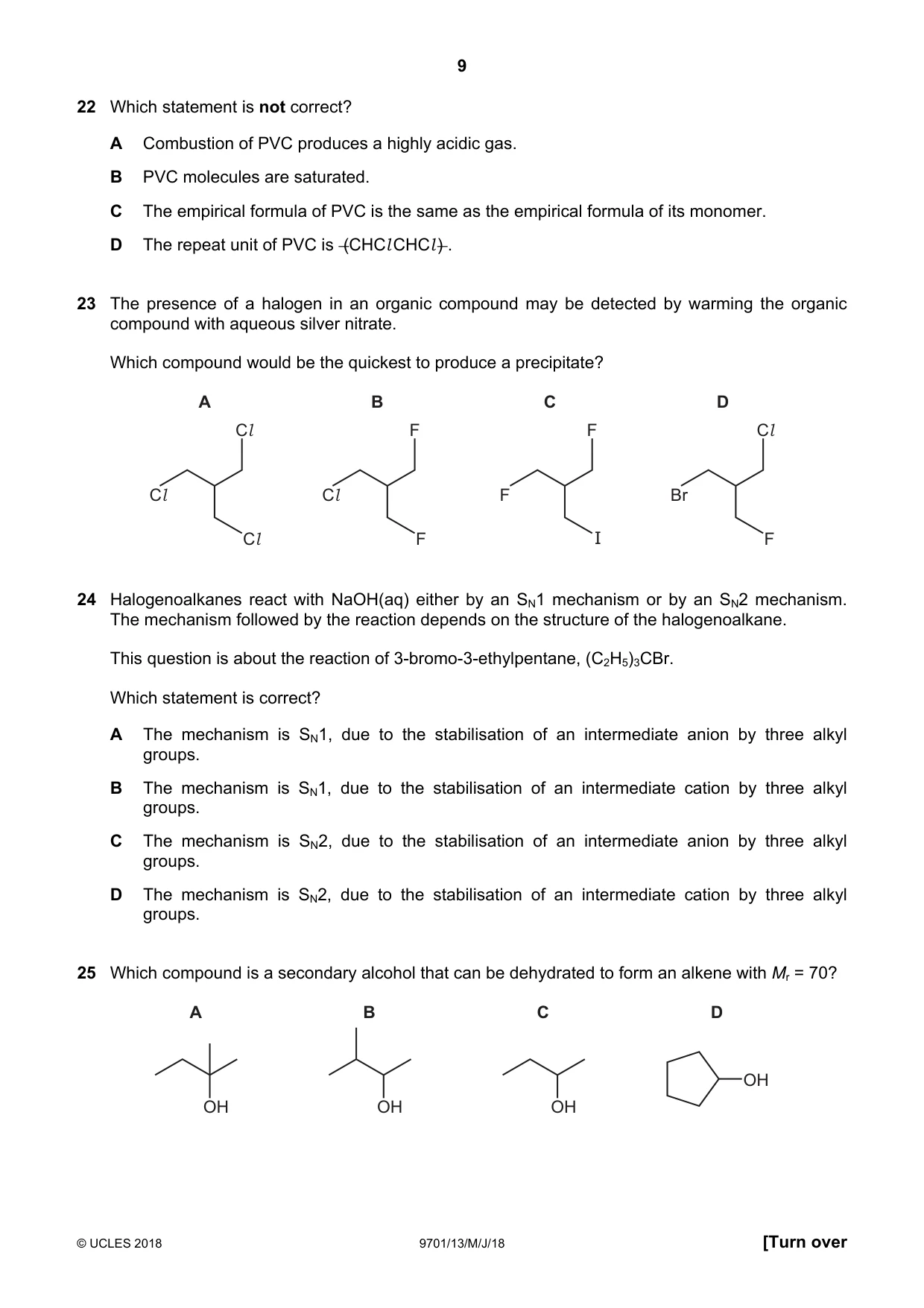
22 Which statement is not correct? A Combustion of PVC produces a highly acidic gas. B PVC molecules are saturated. C The empirical formula of PVC is the same as the empirical formula of its monomer. D The repeat unit of PVC is (CHCl CHCl ) .
Mark scheme: D
Q23 · The presence of a halogen in an organic compound may be detected by warming the organic…
23 The presence of a halogen in an organic compound may be detected by warming the organic compound with aqueous silver nitrate. Which compound would be the quickest to produce a precipitate? A B C D Cl F F Cl Cl Cl F Br Cl F I F
Mark scheme: C
Q24 · Halogenoalkanes react with NaOH(aq) either by an SN1 mechanism or by an SN2 mechanism
24 Halogenoalkanes react with NaOH(aq) either by an SN1 mechanism or by an SN2 mechanism. The mechanism followed by the reaction depends on the structure of the halogenoalkane. This question is about the reaction of 3-bromo-3-ethylpentane, (C2H5)3CBr. Which statement is correct? A The mechanism is SN1, due to the stabilisation of an intermediate anion by three alkyl groups. B The mechanism is SN1, due to the stabilisation of an intermediate cation by three alkyl groups. C The mechanism is SN2, due to the stabilisation of an intermediate anion by three alkyl groups. D The mechanism is SN2, due to the stabilisation of an intermediate cation by three alkyl groups.
Mark scheme: B
Q25 · Which compound is a secondary alcohol that can be dehydrated to form an alkene with Mr =…
25 Which compound is a secondary alcohol that can be dehydrated to form an alkene with Mr = 70? A B C D OH OH OH OH
Mark scheme: B
Q26 · When 0.0075 mol of alcohol X are completely burnt in excess oxygen and the gases produced…
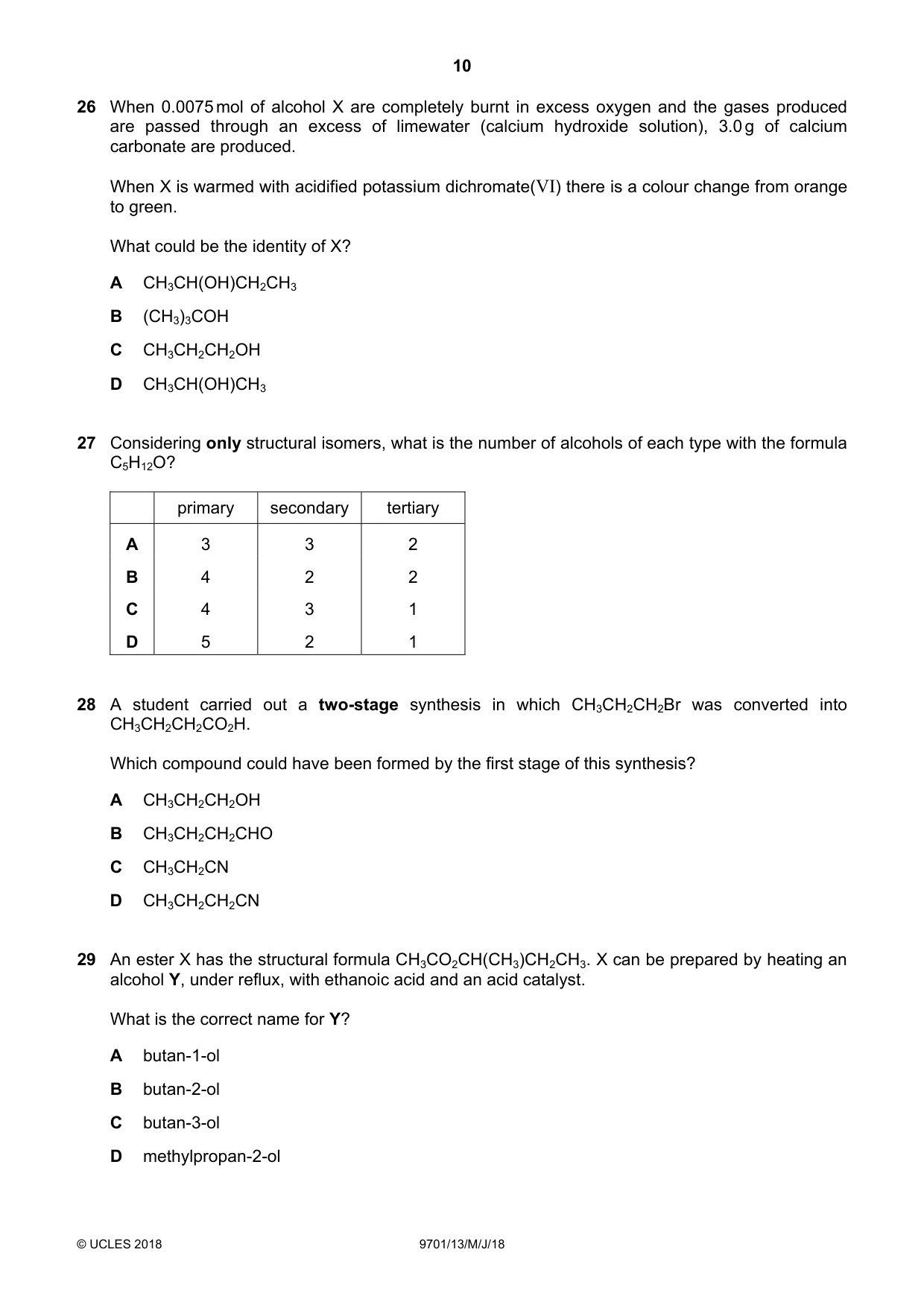
26 When 0.0075 mol of alcohol X are completely burnt in excess oxygen and the gases produced are passed through an excess of limewater (calcium hydroxide solution), 3.0 g of calcium carbonate are produced. When X is warmed with acidified potassium dichromate(VI) there is a colour change from orange to green. What could be the identity of X? A CH3CH(OH)CH2CH3 B (CH3)3COH C CH3CH2CH2OH D CH3CH(OH)CH3
Mark scheme: A
Q27 · Considering only structural isomers, what is the number of alcohols of each type with the…
27 Considering only structural isomers, what is the number of alcohols of each type with the formula C5H12O? primary secondary tertiary A 3 3 2 B 4 2 2 C 4 3 1 D 5 2 1
Mark scheme: C
More questions on Isomerism: structural isomerism and stereoisomerism
Q28 · A student carried out a two-stage synthesis in which CH3CH2CH2Br was converted into…
28 A student carried out a two-stage synthesis in which CH3CH2CH2Br was converted into CH3CH2CH2CO2H. Which compound could have been formed by the first stage of this synthesis? A CH3CH2CH2OH B CH3CH2CH2CHO C CH3CH2CN D CH3CH2CH2CN
Mark scheme: D
Q29 · An ester X has the structural formula CH3CO2CH(CH3)CH2CH3
29 An ester X has the structural formula CH3CO2CH(CH3)CH2CH3. X can be prepared by heating an alcohol Y, under reflux, with ethanoic acid and an acid catalyst. What is the correct name for Y? A butan-1-ol B butan-2-ol C butan-3-ol D methylpropan-2-ol
Mark scheme: B
Q30 · Compound S can be extracted from natural compounds
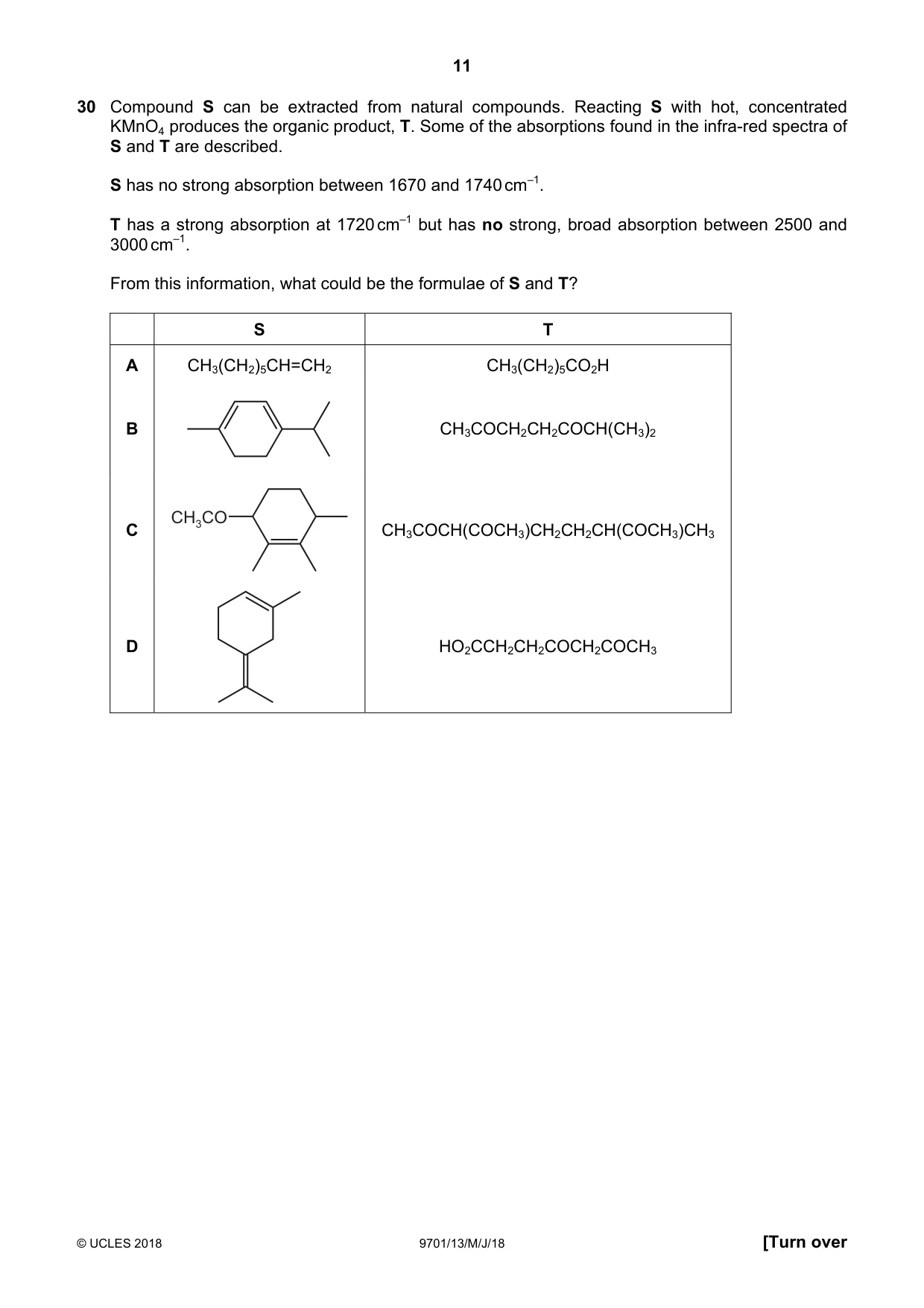
30 Compound S can be extracted from natural compounds. Reacting S with hot, concentrated KMnO4 produces the organic product, T. Some of the absorptions found in the infra-red spectra of S and T are described. S has no strong absorption between 1670 and 1740 cm–1. T has a strong absorption at 1720 cm–1 but has no strong, broad absorption between 2500 and 3000 cm–1. From this information, what could be the formulae of S and T? S T A CH3(CH2)5CH=CH2 CH3(CH2)5CO2H B CH3COCH2CH2COCH(CH3)2 CH3CO C CH3COCH(COCH3)CH2CH2CH(COCH3)CH3 D HO2CCH2CH2COCH2COCH3
Mark scheme: B
Q31 · Complete combustion of a sample of a hydrocarbon gave 0.132 g of carbon dioxide and 0.054…
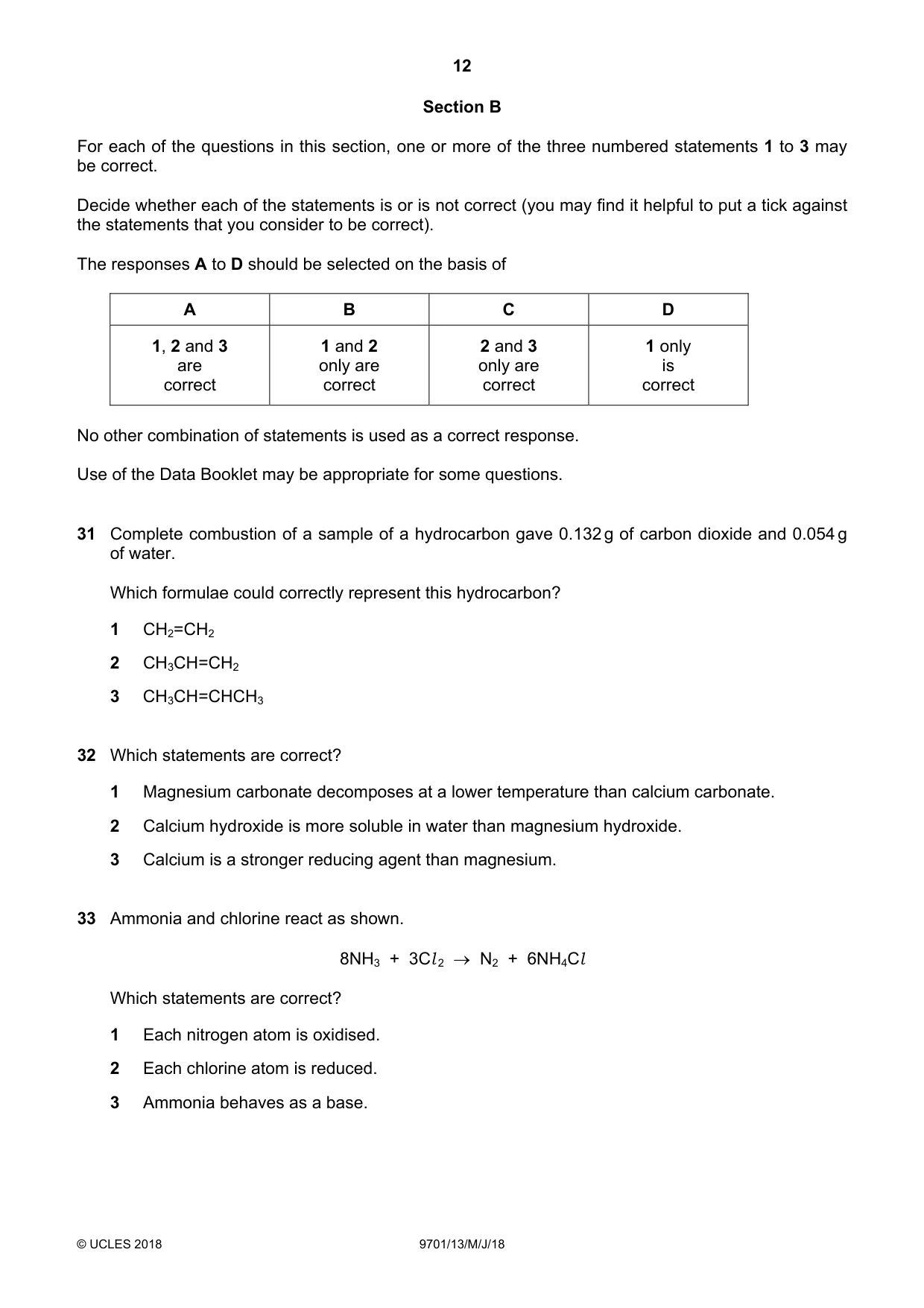
31 Complete combustion of a sample of a hydrocarbon gave 0.132 g of carbon dioxide and 0.054 g of water. Which formulae could correctly represent this hydrocarbon? 1 CH2=CH2 2 CH3CH=CH2 3 CH3CH=CHCH3
Mark scheme: A
Q32 · Which statements are correct?
32 Which statements are correct? 1 Magnesium carbonate decomposes at a lower temperature than calcium carbonate. 2 Calcium hydroxide is more soluble in water than magnesium hydroxide. 3 Calcium is a stronger reducing agent than magnesium.
Mark scheme: A
Q33 · Ammonia and chlorine react as shown
33 Ammonia and chlorine react as shown. 8NH3 + 3Cl 2 → N2 + 6NH4Cl Which statements are correct? 1 Each nitrogen atom is oxidised. 2 Each chlorine atom is reduced. 3 Ammonia behaves as a base.
Mark scheme: C
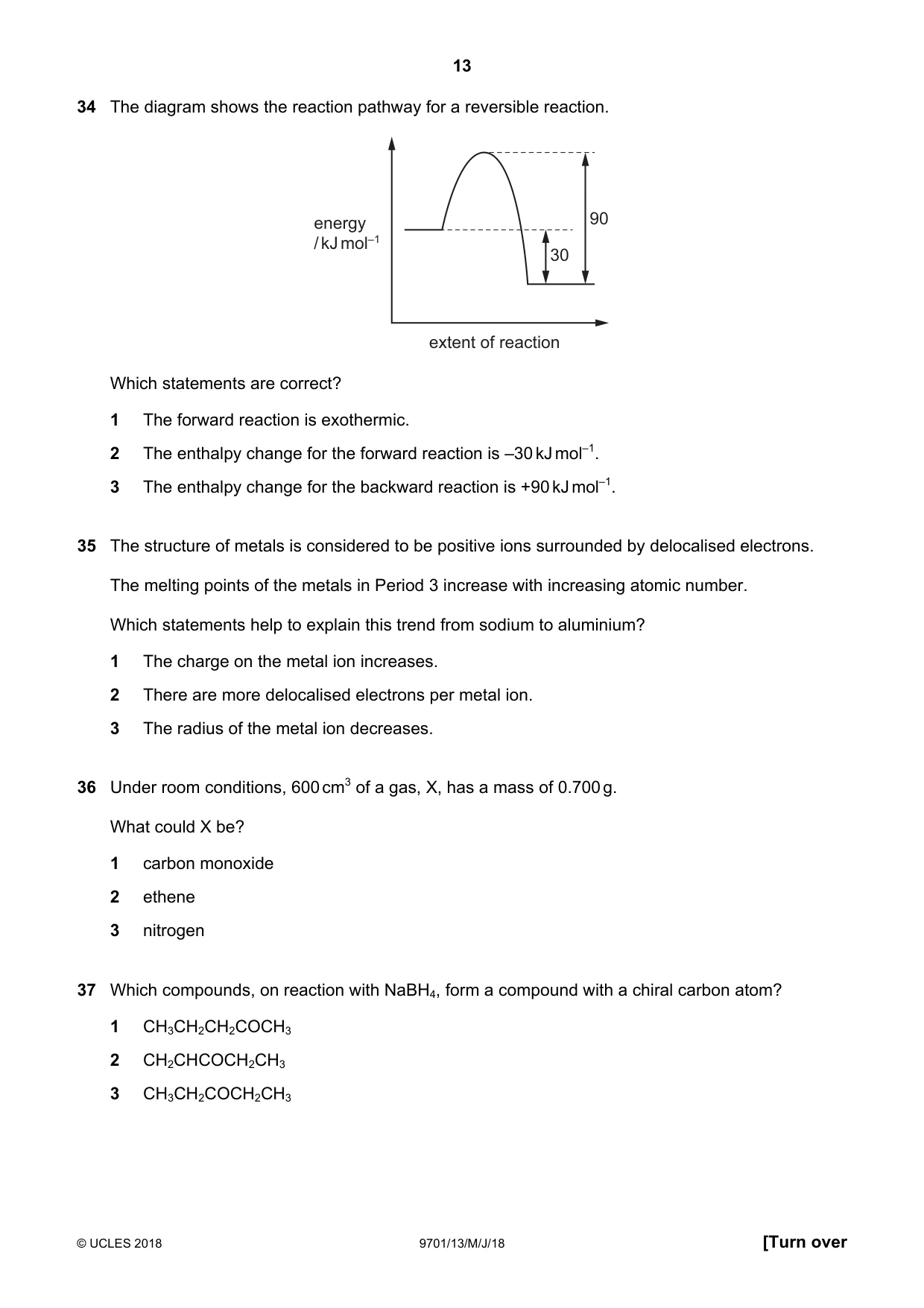
Q34 · The diagram shows the reaction pathway for a reversible reaction
34 The diagram shows the reaction pathway for a reversible reaction. energy 90 / kJ mol–1 30 extent of reaction Which statements are correct? 1 The forward reaction is exothermic. 2 The enthalpy change for the forward reaction is –30 kJ mol–1. 3 The enthalpy change for the backward reaction is +90 kJ mol–1.
Mark scheme: B
Q35 · The structure of metals is considered to be positive ions surrounded by delocalised…
35 The structure of metals is considered to be positive ions surrounded by delocalised electrons. The melting points of the metals in Period 3 increase with increasing atomic number. Which statements help to explain this trend from sodium to aluminium? 1 The charge on the metal ion increases. 2 There are more delocalised electrons per metal ion. 3 The radius of the metal ion decreases.
Mark scheme: A
More questions on Periodicity of physical properties of the elements in Period 3
Q36 · Under room conditions, 600 cm3 of a gas, X, has a mass of 0.700 g
36 Under room conditions, 600 cm3 of a gas, X, has a mass of 0.700 g. What could X be? 1 carbon monoxide 2 ethene 3 nitrogen
Mark scheme: A
More questions on The gaseous state: ideal and real gases and pV = nRT
Q37 · Which compounds, on reaction with NaBH4, form a compound with a chiral carbon atom?
37 Which compounds, on reaction with NaBH4, form a compound with a chiral carbon atom? 1 CH3CH2CH2COCH3 2 CH2CHCOCH2CH3 3 CH3CH2COCH2CH3
Mark scheme: B
Q38 · Compound Y is a straight chain molecule with formula CnH2n+1X
38 Compound Y is a straight chain molecule with formula CnH2n+1X. X is a halogen. The Mr of Y is 137. The halogen atom is on the second carbon atom in the chain. Which statements are correct? 1 Y contains a chiral centre. 2 Y can eliminate HX to form two structurally isomeric alkenes. 3 Y can eliminate HX to form two geometrically isomeric alkenes.
Mark scheme: A
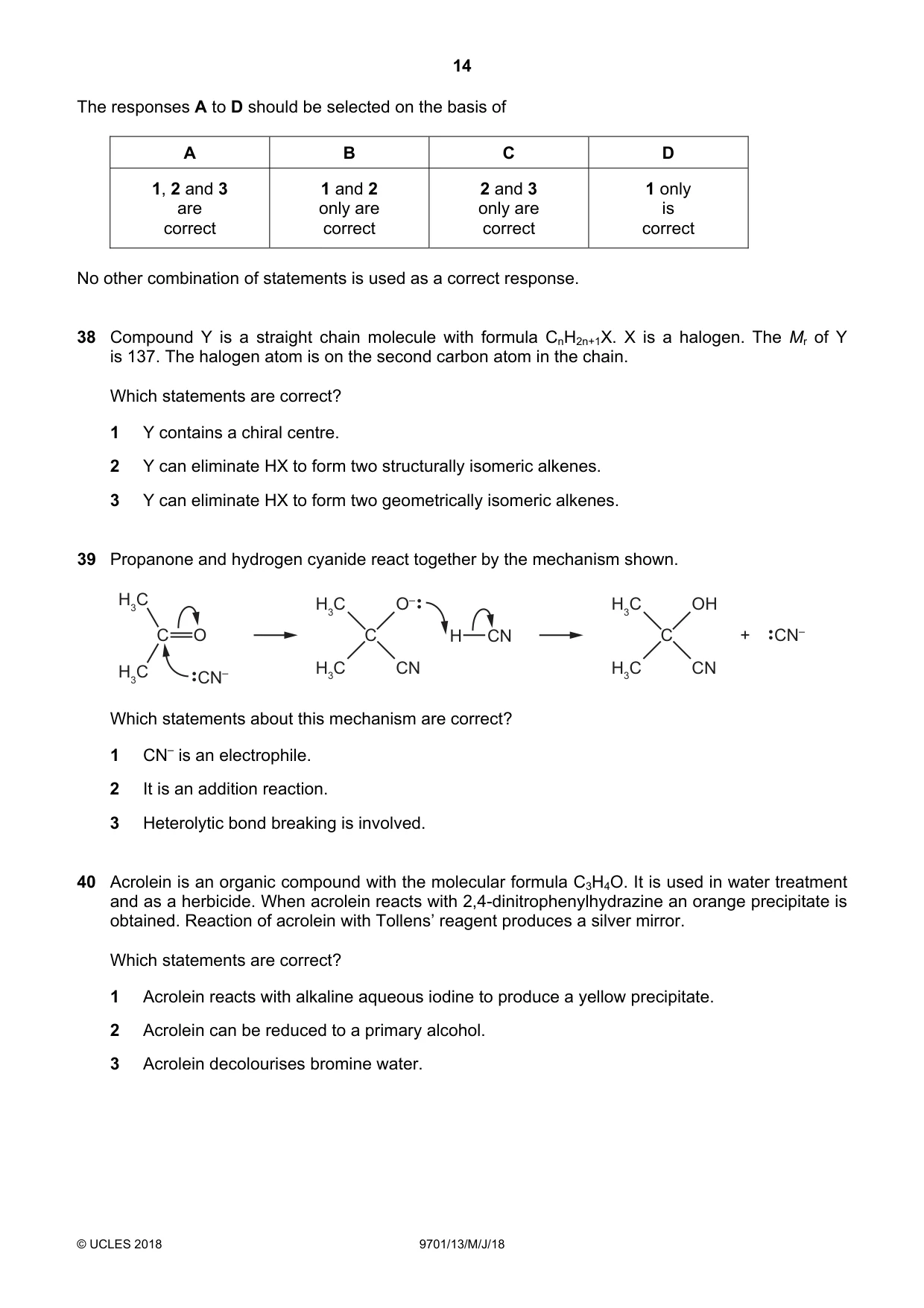
Q39 · Propanone and hydrogen cyanide react together by the mechanism shown
39 Propanone and hydrogen cyanide react together by the mechanism shown. H3C H3C O– H3C OH C O C H CN C + CN– H3C H3C CN H3C CN CN– Which statements about this mechanism are correct? 1 CN– is an electrophile. 2 It is an addition reaction. 3 Heterolytic bond breaking is involved.
Mark scheme: C
Q40 · Acrolein is an organic compound with the molecular formula C3H4O
40 Acrolein is an organic compound with the molecular formula C3H4O. It is used in water treatment and as a herbicide. When acrolein reacts with 2,4-dinitrophenylhydrazine an orange precipitate is obtained. Reaction of acrolein with Tollens’ reagent produces a silver mirror. Which statements are correct? 1 Acrolein reacts with alkaline aqueous iodine to produce a yellow precipitate. 2 Acrolein can be reduced to a primary alcohol. 3 Acrolein decolourises bromine water.
Mark scheme: C
What was in this paper
The subtopics covered by these 40 questions, and how many questions each got. Open one in a new tab to see every Cambridge question on it.
3Halogenoalkanes3Similarities and trends in the properties of the Group 2 metals, magnesium to barium, and their compounds3Alcohols2Chemical equilibria: reversible reactions, dynamic equilibrium2Homogeneous and heterogeneous catalysts2Isomerism: structural isomerism and stereoisomerism2Nitriles and hydroxynitriles2Periodicity of chemical properties of the elements in Period 32Redox processes: electron transfer and changes in oxidation number (oxidation state)2The gaseous state: ideal and real gases and pV = nRT2Acids and bases1Addition polymerisation1Alkenes1Electrons, energy levels and atomic orbitals1Enthalpy change, ΔH1Esters1Formulas1Hess’s law1Intermolecular forces, electronegativity and bond properties1Nitrogen and sulfur1Particles in the atom and atomic radius1Periodicity of physical properties of the elements in Period 31Reacting masses and volumes (of solutions and gases)1Shapes of organic molecules; σ and π bonds1The chemical properties of the halogen elements and the hydrogen halides1What you needed in this session
Cambridge’s own grade thresholds for 2018 May/June, Paper 1 · Variant 3. A higher threshold means an easier paper — the bar moves with how the cohort did.