Cambridge A Level Chemistry 9701 — 2016 May/June Paper 1 · Variant 1
9701/11/M/J/16 · 40 questions · 40 marks · ≈45 min
The question paper and its mark scheme, free to read here and free to download. This is Cambridge’s own paper, exactly as it was sat.
Question paper16 pages

Mark scheme2 pages
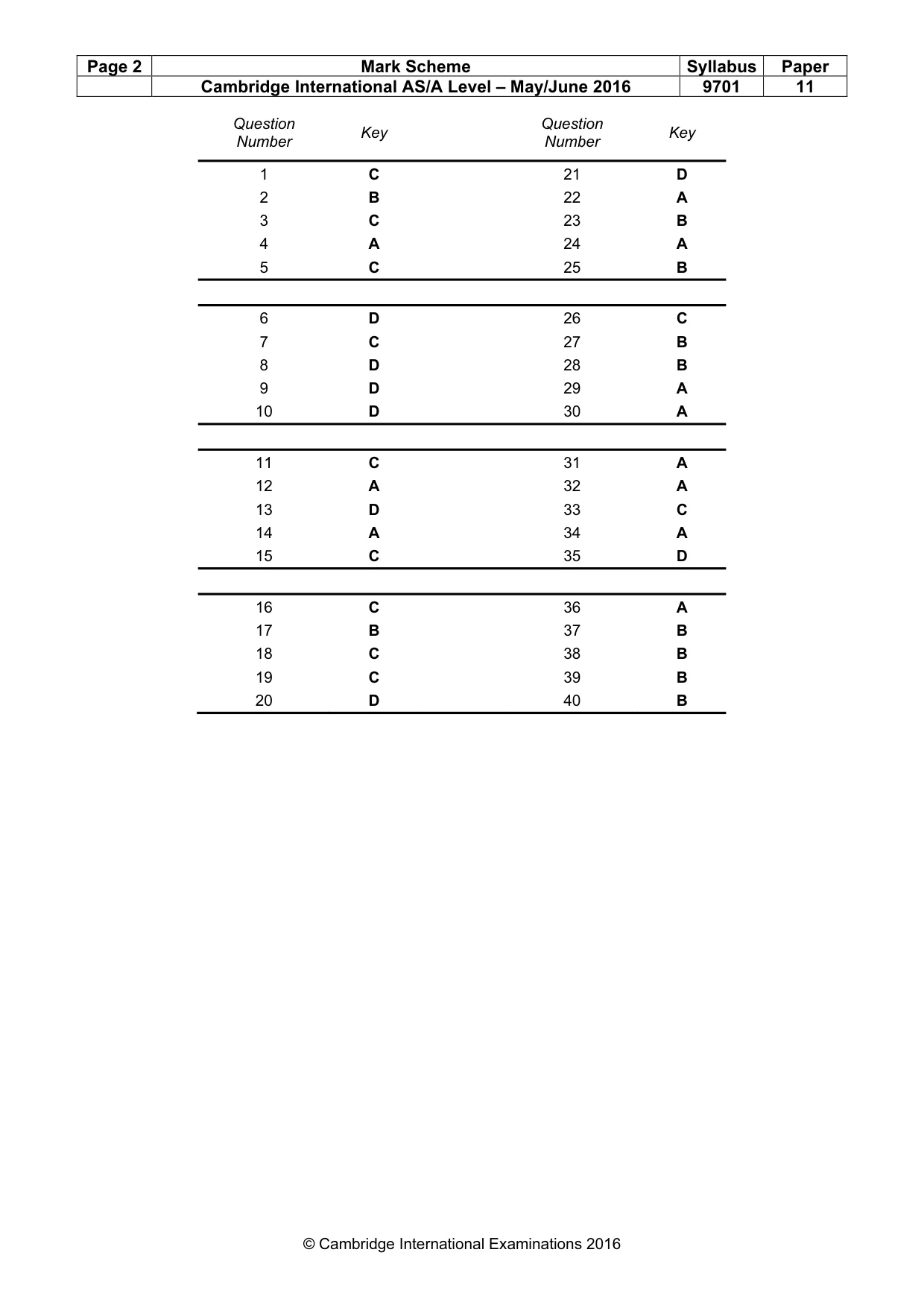
Answers below. Sit the paper first if you are practising.
Questions as text
Q1 · Which equation shows the reaction that occurs during the standard enthalpy change of…
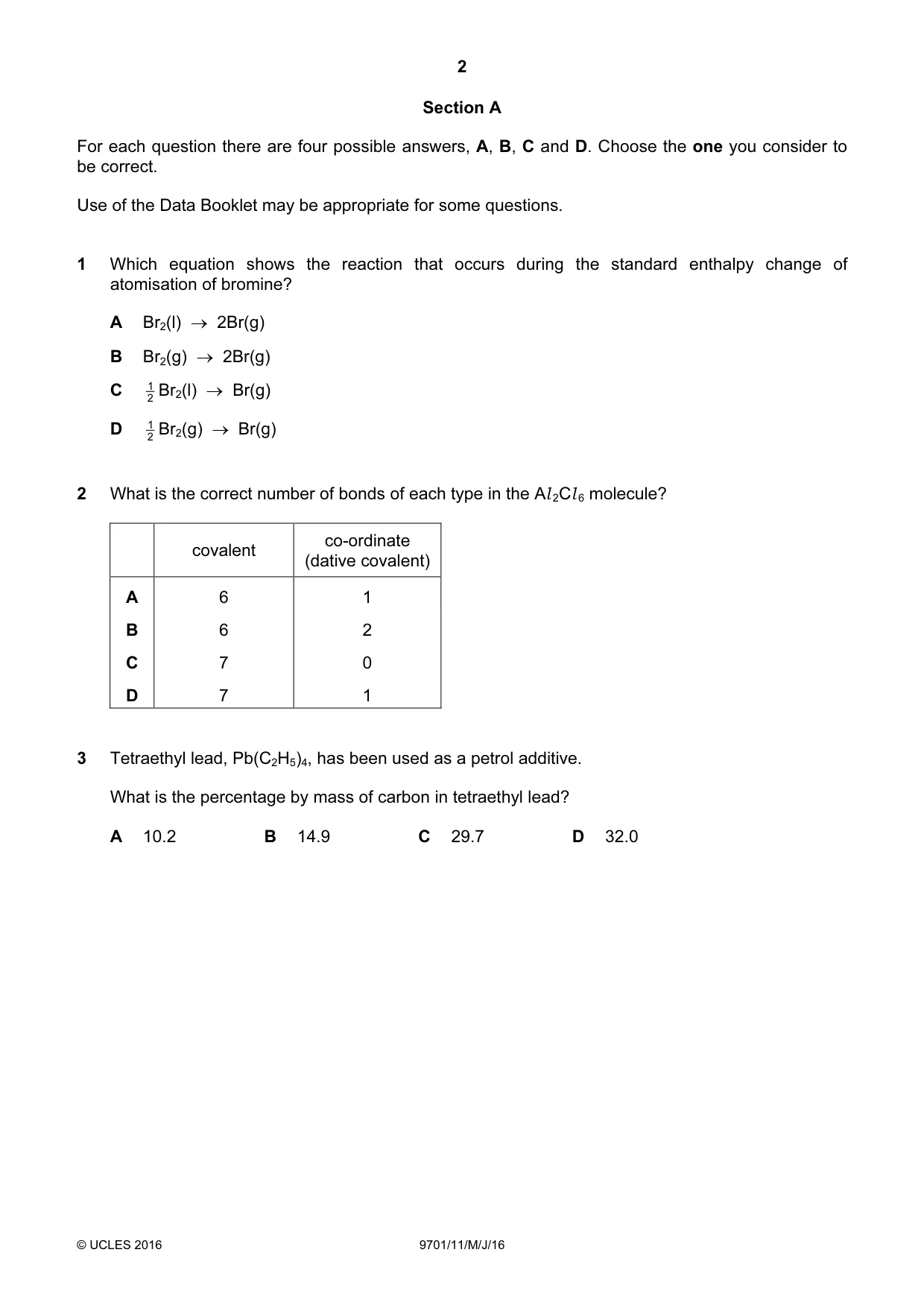
1 Which equation shows the reaction that occurs during the standard enthalpy change of atomisation of bromine? A Br2(l) → 2Br(g) B Br2(g) → 2Br(g) C 1 Br2(l) → Br(g) 2 D 1 Br2(g) → Br(g) 2
Mark scheme: C
Q2 · What is the correct number of bonds of each type in the Al 2Cl 6 molecule?
2 What is the correct number of bonds of each type in the Al 2Cl 6 molecule? co-ordinate covalent (dative covalent) A 6 1 B 6 2 C 7 0 D 7 1
Mark scheme: B
More questions on Covalent bonding and coordinate (dative covalent) bonding
Q3 · Tetraethyl lead, Pb(C2H5)4, has been used as a petrol additive
3 Tetraethyl lead, Pb(C2H5)4, has been used as a petrol additive. What is the percentage by mass of carbon in tetraethyl lead? A 10.2 B 14.9 C 29.7 D 32.0
Mark scheme: C
Q4 · When nuclear reactions take place, the elements produced are different from the elements…
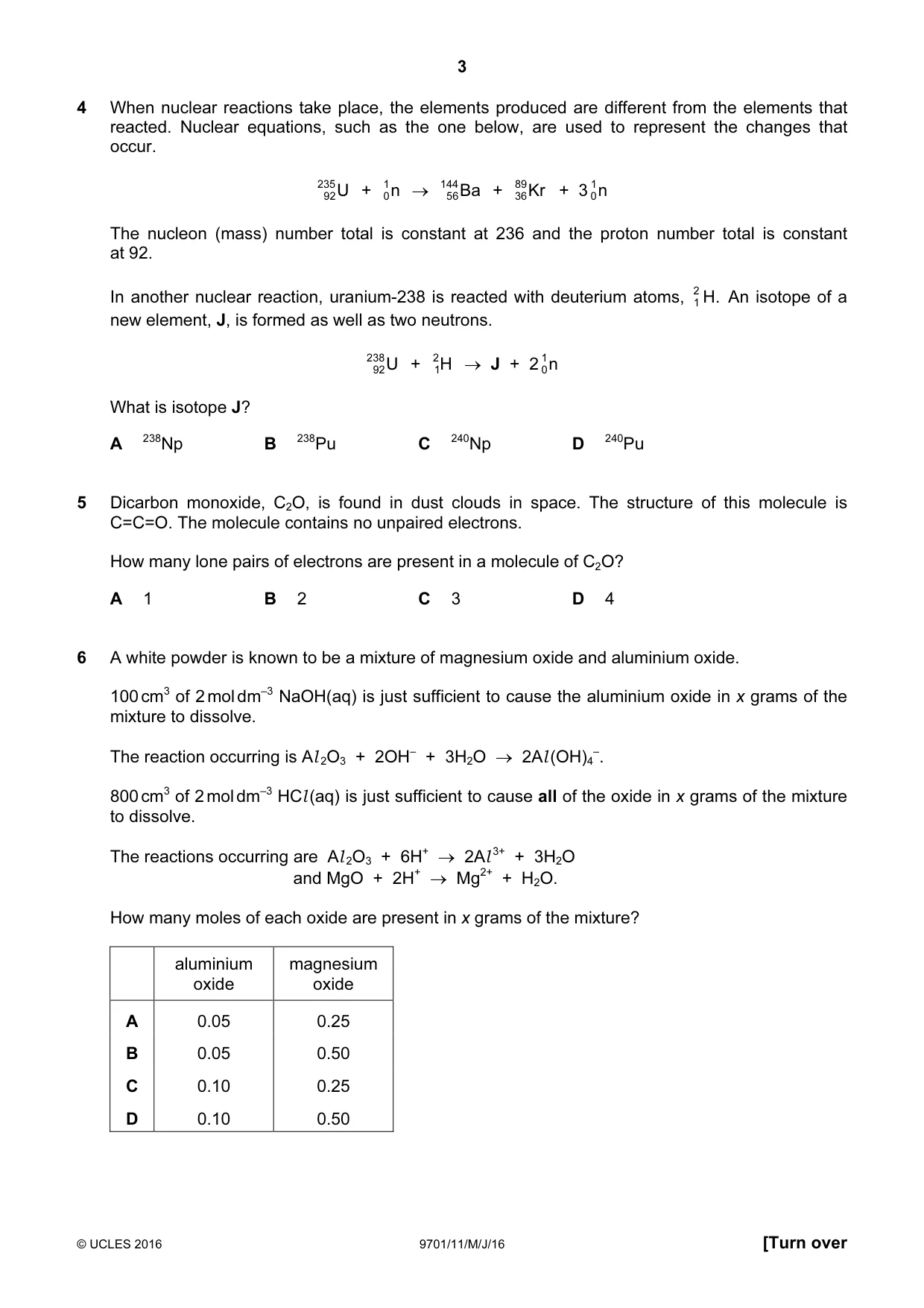
4 When nuclear reactions take place, the elements produced are different from the elements that reacted. Nuclear equations, such as the one below, are used to represent the changes that occur. 235 U + n 1 0 → 144 Ba + 89 Kr + 3 n 0 1 92 56 36 The nucleon (mass) number total is constant at 236 and the proton number total is constant at 92. In another nuclear reaction, uranium-238 is reacted with deuterium atoms, 2 H. An isotope of a 1 new element, J, is formed as well as two neutrons. 238 U + H 2 → J + 2 n 0 1 92 1 What is isotope J? A 238Np B 238Pu C 240Np D 240Pu
Mark scheme: A
Q5 · Dicarbon monoxide, C2O, is found in dust clouds in space
5 Dicarbon monoxide, C2O, is found in dust clouds in space. The structure of this molecule is C=C=O. The molecule contains no unpaired electrons. How many lone pairs of electrons are present in a molecule of C2O? A 1 B 2 C 3 D 4
Mark scheme: C
Q6 · A white powder is known to be a mixture of magnesium oxide and aluminium oxide
6 A white powder is known to be a mixture of magnesium oxide and aluminium oxide. 100 cm3 of 2 mol dm–3 NaOH(aq) is just sufficient to cause the aluminium oxide in x grams of the mixture to dissolve. The reaction occurring is Al 2O3 + 2OH– + 3H2O → 2Al (OH)4 –. 800 cm3 of 2 mol dm–3 HCl (aq) is just sufficient to cause all of the oxide in x grams of the mixture to dissolve. The reactions occurring are Al 2O3 + 6H+ → 2Al 3+ + 3H2O and MgO + 2H+ → Mg2+ + H2O. How many moles of each oxide are present in x grams of the mixture? aluminium magnesium oxide oxide A 0.05 0.25 B 0.05 0.50 C 0.10 0.25 D 0.10 0.50
Mark scheme: D
More questions on Reacting masses and volumes (of solutions and gases)
Q7 · At room temperature and pressure, H2O is a liquid and H2S is a gas
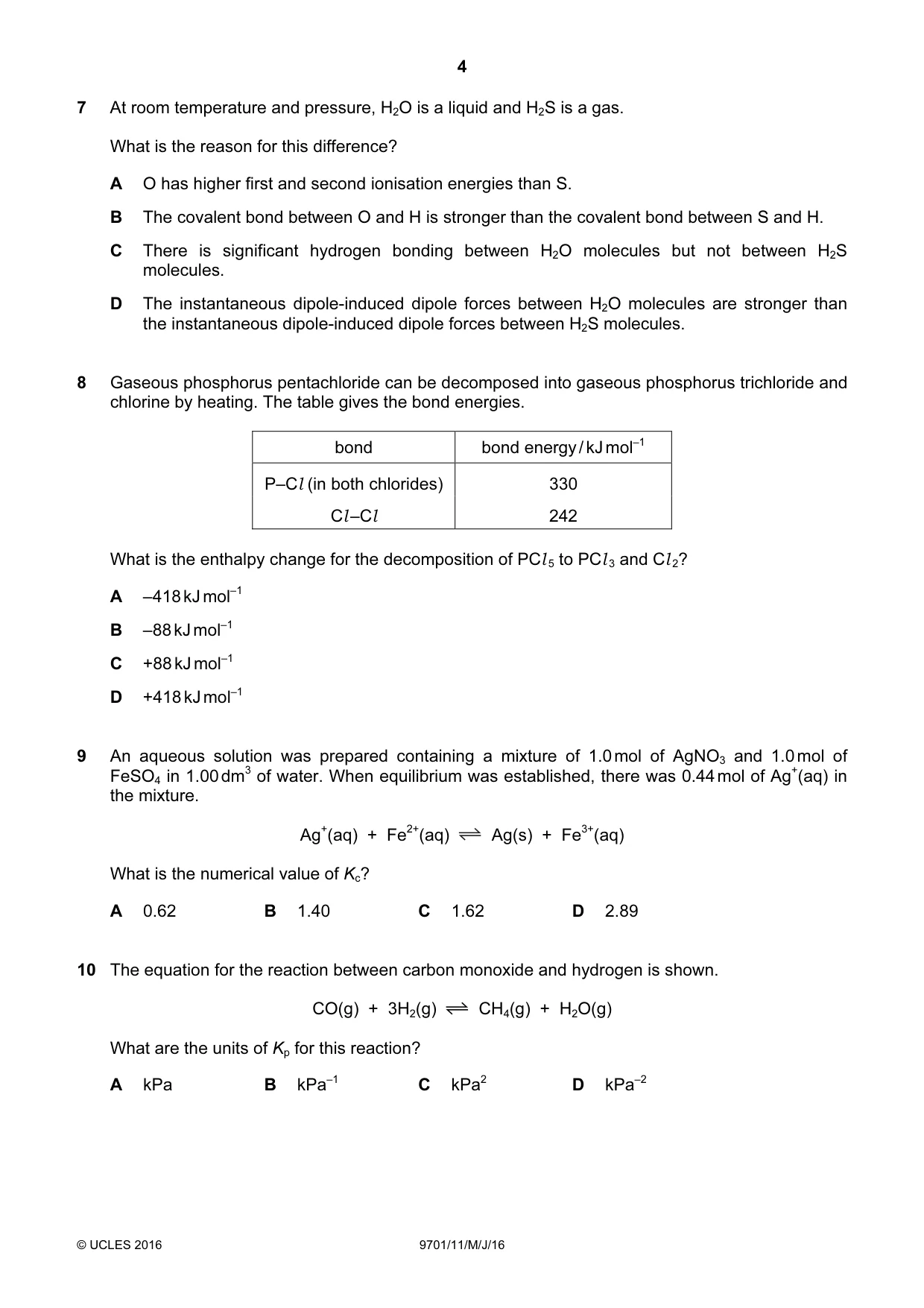
7 At room temperature and pressure, H2O is a liquid and H2S is a gas. What is the reason for this difference? A O has higher first and second ionisation energies than S. B The covalent bond between O and H is stronger than the covalent bond between S and H. C There is significant hydrogen bonding between H2O molecules but not between H2S molecules. D The instantaneous dipole-induced dipole forces between H2O molecules are stronger than the instantaneous dipole-induced dipole forces between H2S molecules.
Mark scheme: C
More questions on Intermolecular forces, electronegativity and bond properties
Q8 · Gaseous phosphorus pentachloride can be decomposed into gaseous phosphorus trichloride…
8 Gaseous phosphorus pentachloride can be decomposed into gaseous phosphorus trichloride and chlorine by heating. The table gives the bond energies. bond bond energy / kJ mol–1 P–Cl (in both chlorides) 330 Cl –Cl 242 What is the enthalpy change for the decomposition of PCl 5 to PCl 3 and Cl 2? A –418 kJ mol–1 B –88 kJ mol–1 C +88 kJ mol–1 D +418 kJ mol–1
Mark scheme: D
Q9 · An aqueous solution was prepared containing a mixture of 1.0 mol of AgNO3 and 1.0 mol of…
9 An aqueous solution was prepared containing a mixture of 1.0 mol of AgNO3 and 1.0 mol of FeSO4 in 1.00 dm3 of water. When equilibrium was established, there was 0.44 mol of Ag+(aq) in the mixture. Ag+(aq) + Fe2+(aq) Ag(s) + Fe3+(aq) What is the numerical value of Kc? A 0.62 B 1.40 C 1.62 D 2.89
Mark scheme: D
More questions on Chemical equilibria: reversible reactions, dynamic equilibrium
Q10 · The equation for the reaction between carbon monoxide and hydrogen is shown
10 The equation for the reaction between carbon monoxide and hydrogen is shown. CO(g) + 3H2(g) CH4(g) + H2O(g) What are the units of Kp for this reaction? A kPa B kPa–1 C kPa2 D kPa–2
Mark scheme: D
More questions on Chemical equilibria: reversible reactions, dynamic equilibrium
Q11 · Enzymes are biological catalysts
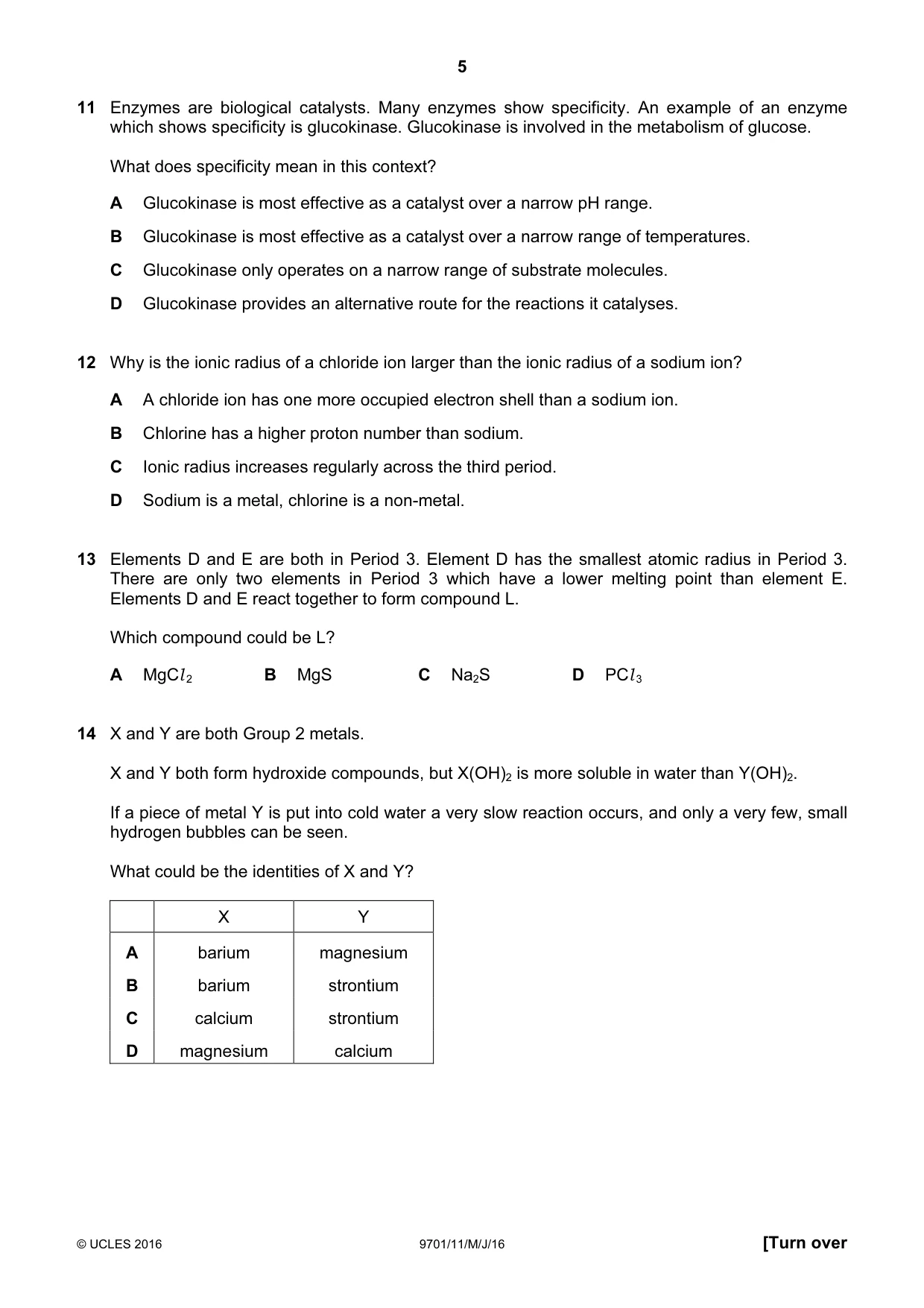
11 Enzymes are biological catalysts. Many enzymes show specificity. An example of an enzyme which shows specificity is glucokinase. Glucokinase is involved in the metabolism of glucose. What does specificity mean in this context? A Glucokinase is most effective as a catalyst over a narrow pH range. B Glucokinase is most effective as a catalyst over a narrow range of temperatures. C Glucokinase only operates on a narrow range of substrate molecules. D Glucokinase provides an alternative route for the reactions it catalyses.
Mark scheme: C
Q12 · Why is the ionic radius of a chloride ion larger than the ionic radius of a sodium ion?
12 Why is the ionic radius of a chloride ion larger than the ionic radius of a sodium ion? A A chloride ion has one more occupied electron shell than a sodium ion. B Chlorine has a higher proton number than sodium. C Ionic radius increases regularly across the third period. D Sodium is a metal, chlorine is a non-metal.
Mark scheme: A
Q13 · Elements D and E are both in Period 3
13 Elements D and E are both in Period 3. Element D has the smallest atomic radius in Period 3. There are only two elements in Period 3 which have a lower melting point than element E. Elements D and E react together to form compound L. Which compound could be L? A MgCl 2 B MgS C Na2S D PCl 3
Mark scheme: D
More questions on Periodicity of physical properties of the elements in Period 3
Q14 · X and Y are both Group 2 metals
14 X and Y are both Group 2 metals. X and Y both form hydroxide compounds, but X(OH)2 is more soluble in water than Y(OH)2. If a piece of metal Y is put into cold water a very slow reaction occurs, and only a very few, small hydrogen bubbles can be seen. What could be the identities of X and Y? X Y A barium magnesium B barium strontium C calcium strontium D magnesium calcium
Mark scheme: A
Q15 · The solids sodium chloride and sodium iodide both react with concentrated sulfuric acid…
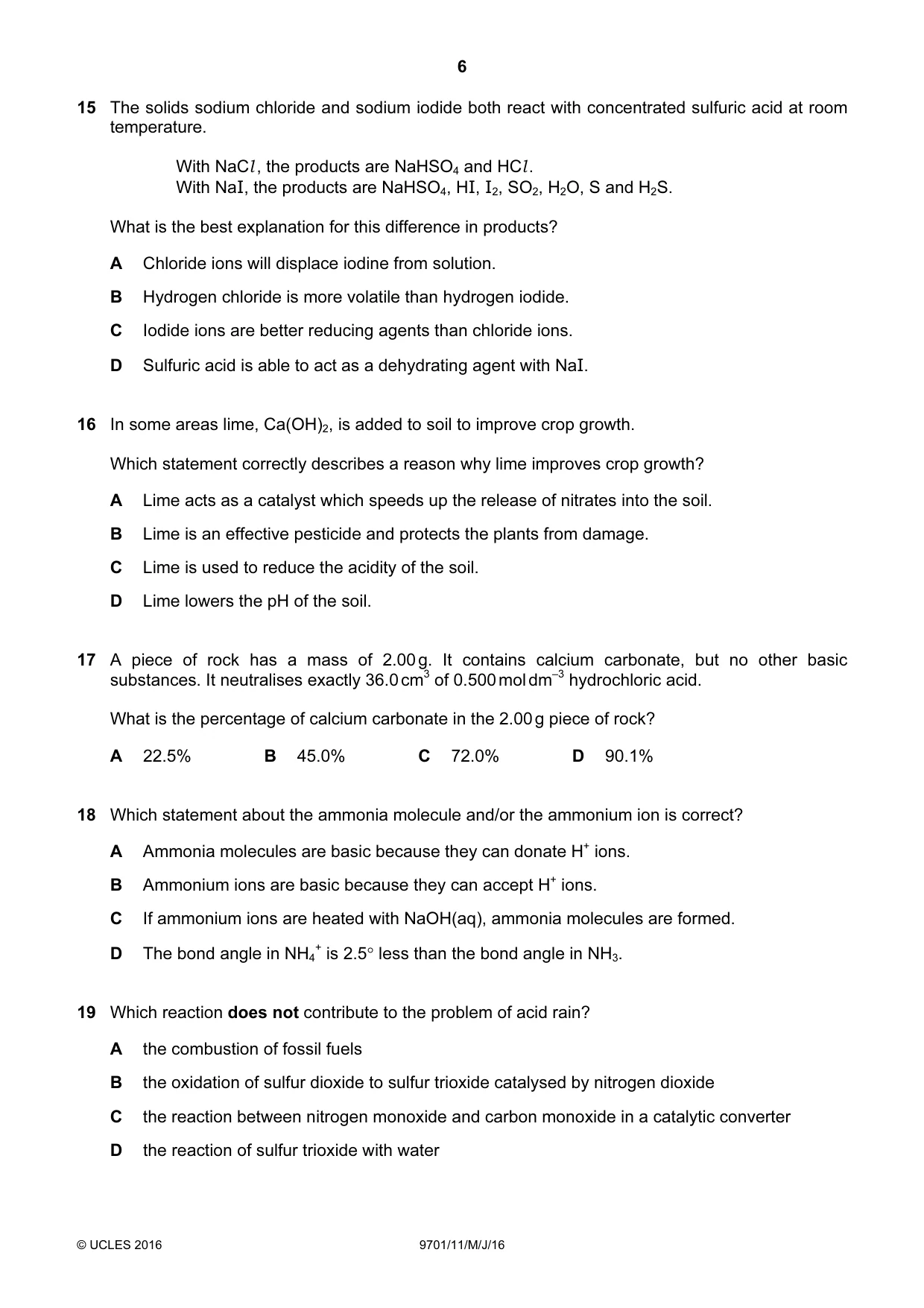
15 The solids sodium chloride and sodium iodide both react with concentrated sulfuric acid at room temperature. With NaCl , the products are NaHSO4 and HCl . With NaI, the products are NaHSO4, HI, I2, SO2, H2O, S and H2S. What is the best explanation for this difference in products? A Chloride ions will displace iodine from solution. B Hydrogen chloride is more volatile than hydrogen iodide. C Iodide ions are better reducing agents than chloride ions. D Sulfuric acid is able to act as a dehydrating agent with NaI.
Mark scheme: C
Q16 · In some areas lime, Ca(OH)2, is added to soil to improve crop growth
16 In some areas lime, Ca(OH)2, is added to soil to improve crop growth. Which statement correctly describes a reason why lime improves crop growth? A Lime acts as a catalyst which speeds up the release of nitrates into the soil. B Lime is an effective pesticide and protects the plants from damage. C Lime is used to reduce the acidity of the soil. D Lime lowers the pH of the soil.
Mark scheme: C
Q17 · A piece of rock has a mass of 2.00 g
17 A piece of rock has a mass of 2.00 g. It contains calcium carbonate, but no other basic substances. It neutralises exactly 36.0 cm3 of 0.500 mol dm–3 hydrochloric acid. What is the percentage of calcium carbonate in the 2.00 g piece of rock? A 22.5% B 45.0% C 72.0% D 90.1%
Mark scheme: B
More questions on Reacting masses and volumes (of solutions and gases)
Q18 · Which statement about the ammonia molecule and/or the ammonium ion is correct?
18 Which statement about the ammonia molecule and/or the ammonium ion is correct? A Ammonia molecules are basic because they can donate H+ ions. B Ammonium ions are basic because they can accept H+ ions. C If ammonium ions are heated with NaOH(aq), ammonia molecules are formed. D The bond angle in NH4 + is 2.5° less than the bond angle in NH3.
Mark scheme: C
Q19 · Which reaction does not contribute to the problem of acid rain?
19 Which reaction does not contribute to the problem of acid rain? A the combustion of fossil fuels B the oxidation of sulfur dioxide to sulfur trioxide catalysed by nitrogen dioxide C the reaction between nitrogen monoxide and carbon monoxide in a catalytic converter D the reaction of sulfur trioxide with water
Mark scheme: C
Q20 · The diagrams show two different compounds
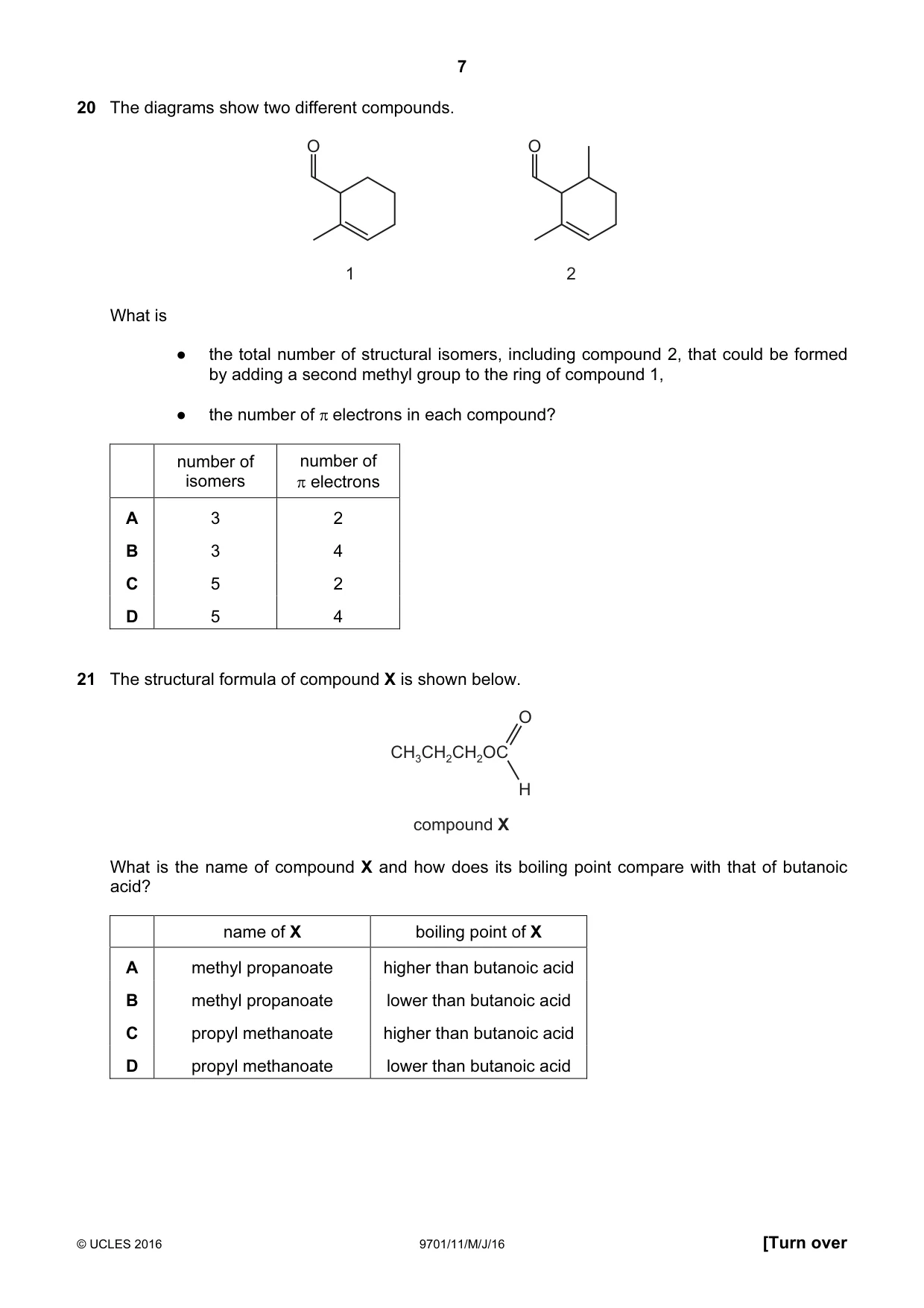
20 The diagrams show two different compounds. O O 1 2 What is ● the total number of structural isomers, including compound 2, that could be formed by adding a second methyl group to the ring of compound 1, ● the number of π electrons in each compound? number of number of isomers π electrons A 3 2 B 3 4 C 5 2 D 5 4
Mark scheme: D
Q21 · The structural formula of compound X is shown below
21 The structural formula of compound X is shown below. O CH3CH2CH2OC H compound X What is the name of compound X and how does its boiling point compare with that of butanoic acid? name of X boiling point of X A methyl propanoate higher than butanoic acid B methyl propanoate lower than butanoic acid C propyl methanoate higher than butanoic acid D propyl methanoate lower than butanoic acid
Mark scheme: D
Q22 · Which pair of reagents will take part in a redox reaction?
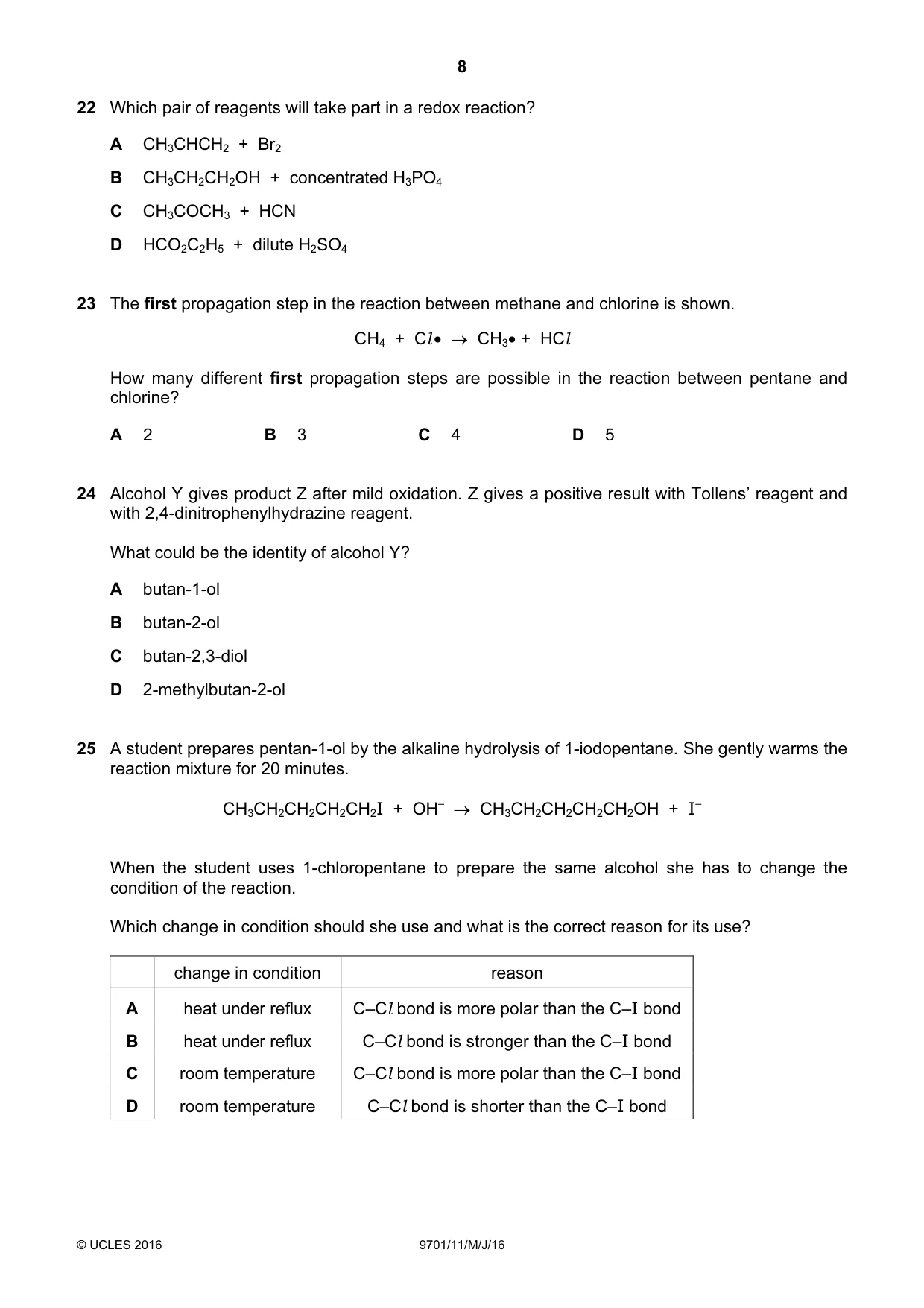
22 Which pair of reagents will take part in a redox reaction? A CH3CHCH2 + Br2 B CH3CH2CH2OH + concentrated H3PO4 C CH3COCH3 + HCN D HCO2C2H5 + dilute H2SO4
Mark scheme: A
Q23 · The first propagation step in the reaction between methane and chlorine is shown
23 The first propagation step in the reaction between methane and chlorine is shown. CH4 + Cl • → CH3• + HCl How many different first propagation steps are possible in the reaction between pentane and chlorine? A 2 B 3 C 4 D 5
Mark scheme: B
Q24 · Alcohol Y gives product Z after mild oxidation
24 Alcohol Y gives product Z after mild oxidation. Z gives a positive result with Tollens’ reagent and with 2,4-dinitrophenylhydrazine reagent. What could be the identity of alcohol Y? A butan-1-ol B butan-2-ol C butan-2,3-diol D 2-methylbutan-2-ol
Mark scheme: A
Q25 · A student prepares pentan-1-ol by the alkaline hydrolysis of 1-iodopentane
25 A student prepares pentan-1-ol by the alkaline hydrolysis of 1-iodopentane. She gently warms the reaction mixture for 20 minutes. CH3CH2CH2CH2CH2I + OH– → CH3CH2CH2CH2CH2OH + I– When the student uses 1-chloropentane to prepare the same alcohol she has to change the condition of the reaction. Which change in condition should she use and what is the correct reason for its use? change in condition reason A heat under reflux C–Cl bond is more polar than the C–I bond B heat under reflux C–Cl bond is stronger than the C–I bond C room temperature C–Cl bond is more polar than the C–I bond D room temperature C–Cl bond is shorter than the C–I bond
Mark scheme: B
Q26 · Malic acid is found in apples
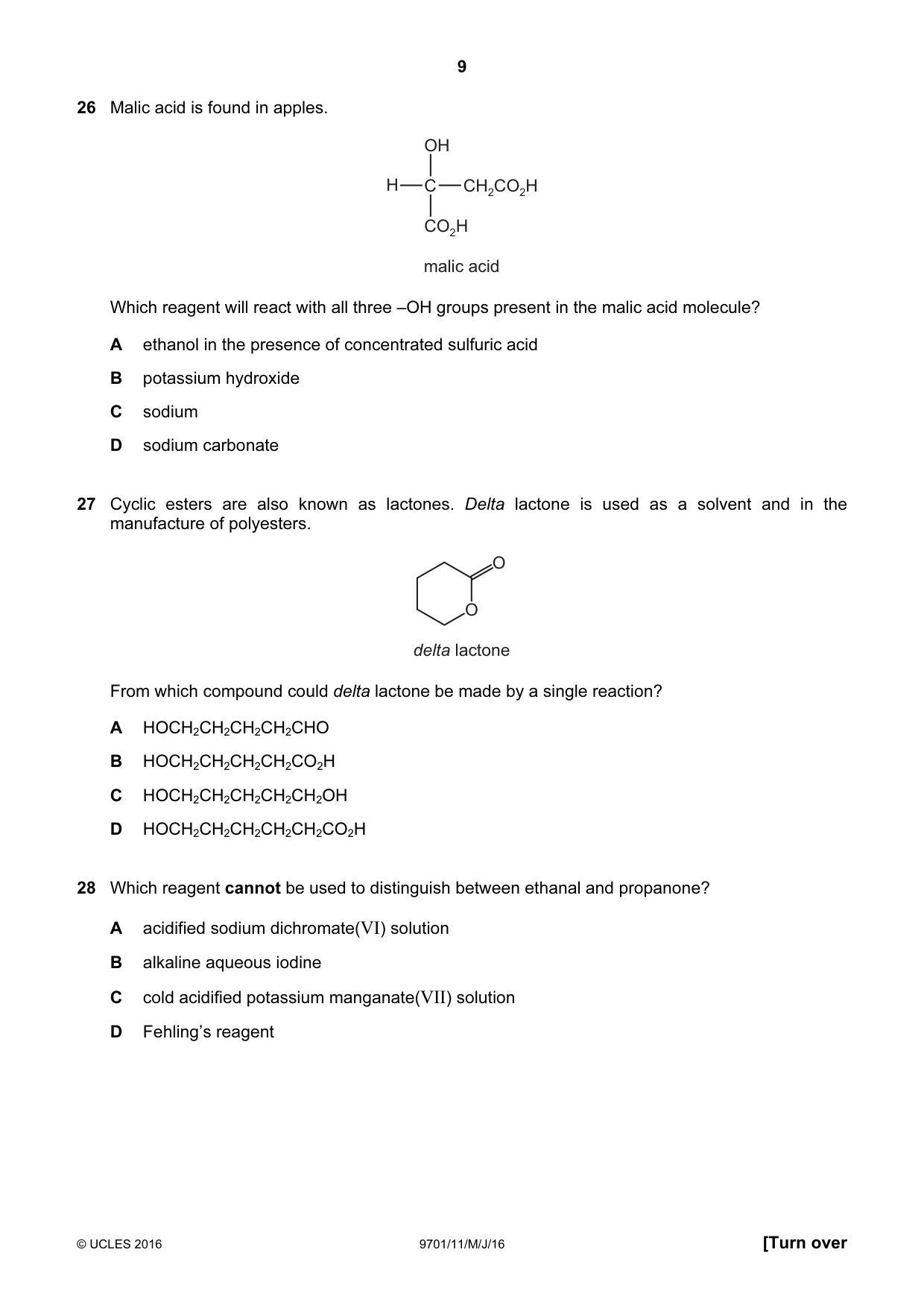
26 Malic acid is found in apples. OH H C CH2CO2H CO2H malic acid Which reagent will react with all three –OH groups present in the malic acid molecule? A ethanol in the presence of concentrated sulfuric acid B potassium hydroxide C sodium D sodium carbonate
Mark scheme: C
Q27 · Cyclic esters are also known as lactones
27 Cyclic esters are also known as lactones. Delta lactone is used as a solvent and in the manufacture of polyesters. O O delta lactone From which compound could delta lactone be made by a single reaction? A HOCH2CH2CH2CH2CHO B HOCH2CH2CH2CH2CO2H C HOCH2CH2CH2CH2CH2OH D HOCH2CH2CH2CH2CH2CO2H
Mark scheme: B
Q28 · Which reagent cannot be used to distinguish between ethanal and propanone?
28 Which reagent cannot be used to distinguish between ethanal and propanone? A acidified sodium dichromate(VI) solution B alkaline aqueous iodine C cold acidified potassium manganate(VII) solution D Fehling’s reagent
Mark scheme: B
Q29 · The ester CH3CH2CH2CO2CH2CH(CH3)2 was hydrolysed under acidic conditions
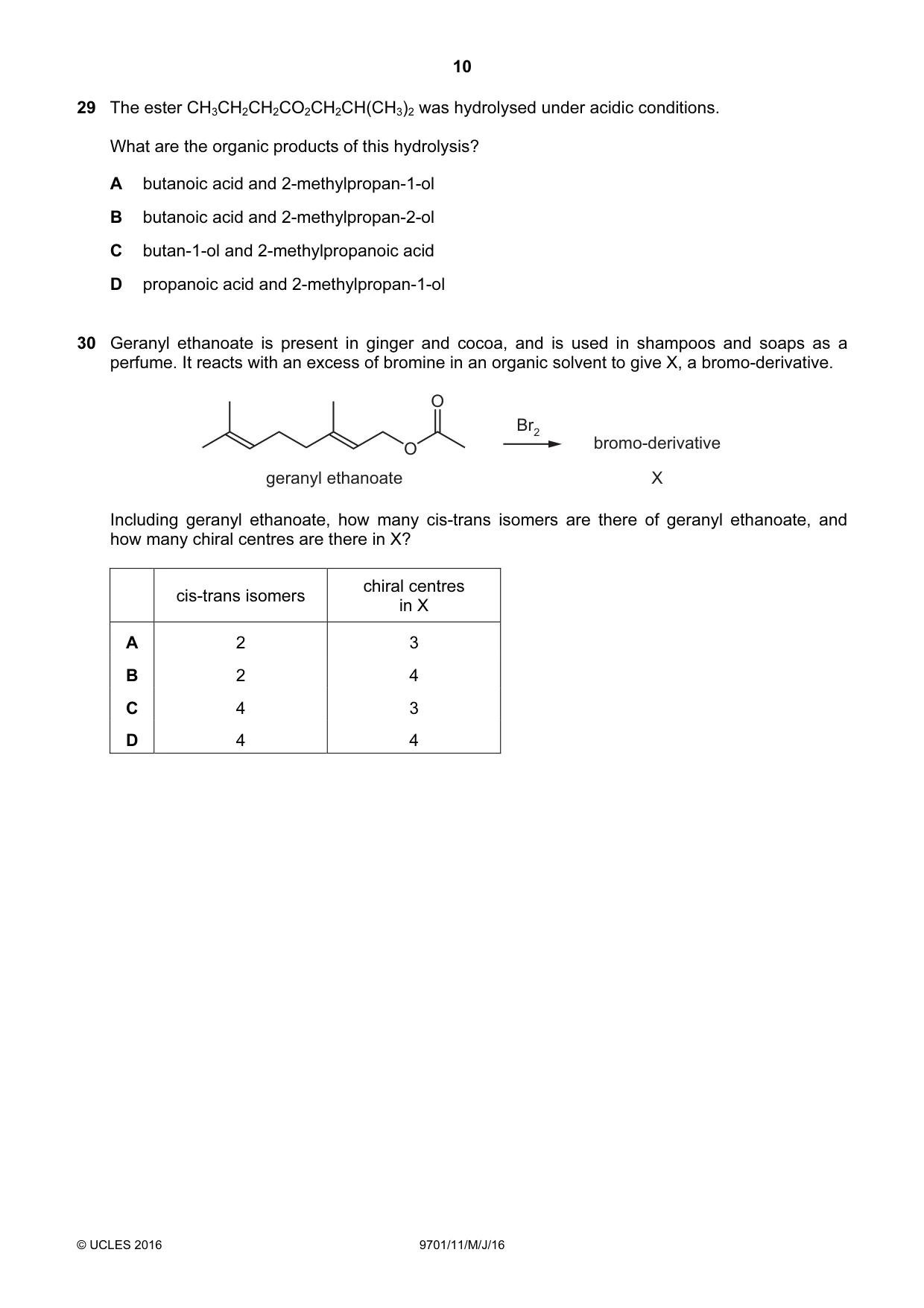
29 The ester CH3CH2CH2CO2CH2CH(CH3)2 was hydrolysed under acidic conditions. What are the organic products of this hydrolysis? A butanoic acid and 2-methylpropan-1-ol B butanoic acid and 2-methylpropan-2-ol C butan-1-ol and 2-methylpropanoic acid D propanoic acid and 2-methylpropan-1-ol
Mark scheme: A
Q30 · Geranyl ethanoate is present in ginger and cocoa, and is used in shampoos and soaps as a…
30 Geranyl ethanoate is present in ginger and cocoa, and is used in shampoos and soaps as a perfume. It reacts with an excess of bromine in an organic solvent to give X, a bromo-derivative. O Br2 O bromo-derivative geranyl ethanoate X Including geranyl ethanoate, how many cis-trans isomers are there of geranyl ethanoate, and how many chiral centres are there in X? chiral centres cis-trans isomers in X A 2 3 B 2 4 C 4 3 D 4 4
Mark scheme: A
Q31 · X is a particle with 18 electrons and 20 neutrons
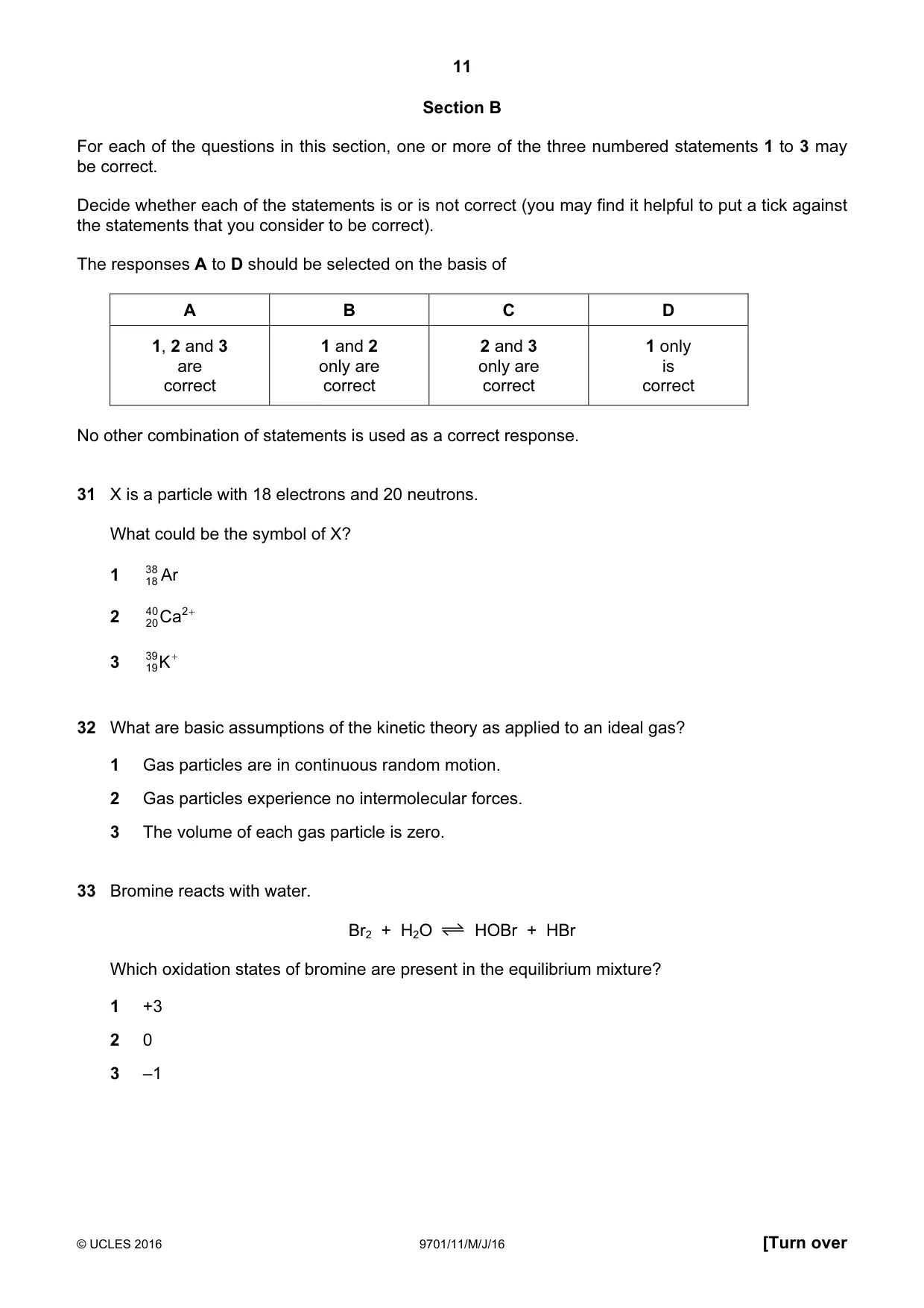
31 X is a particle with 18 electrons and 20 neutrons. What could be the symbol of X? 1 38 Ar 18 2 40 20Ca 2 + 3 39 K + 19
Mark scheme: A
Q32 · What are basic assumptions of the kinetic theory as applied to an ideal gas?
32 What are basic assumptions of the kinetic theory as applied to an ideal gas? 1 Gas particles are in continuous random motion. 2 Gas particles experience no intermolecular forces. 3 The volume of each gas particle is zero.
Mark scheme: A
More questions on The gaseous state: ideal and real gases and pV = nRT
Q33 · Bromine reacts with water
33 Bromine reacts with water. Br2 + H2O HOBr + HBr Which oxidation states of bromine are present in the equilibrium mixture? 1 +3 2 0 3 –1
Mark scheme: C
Q34 · A little water is added to each of the following compounds and the mixture warmed
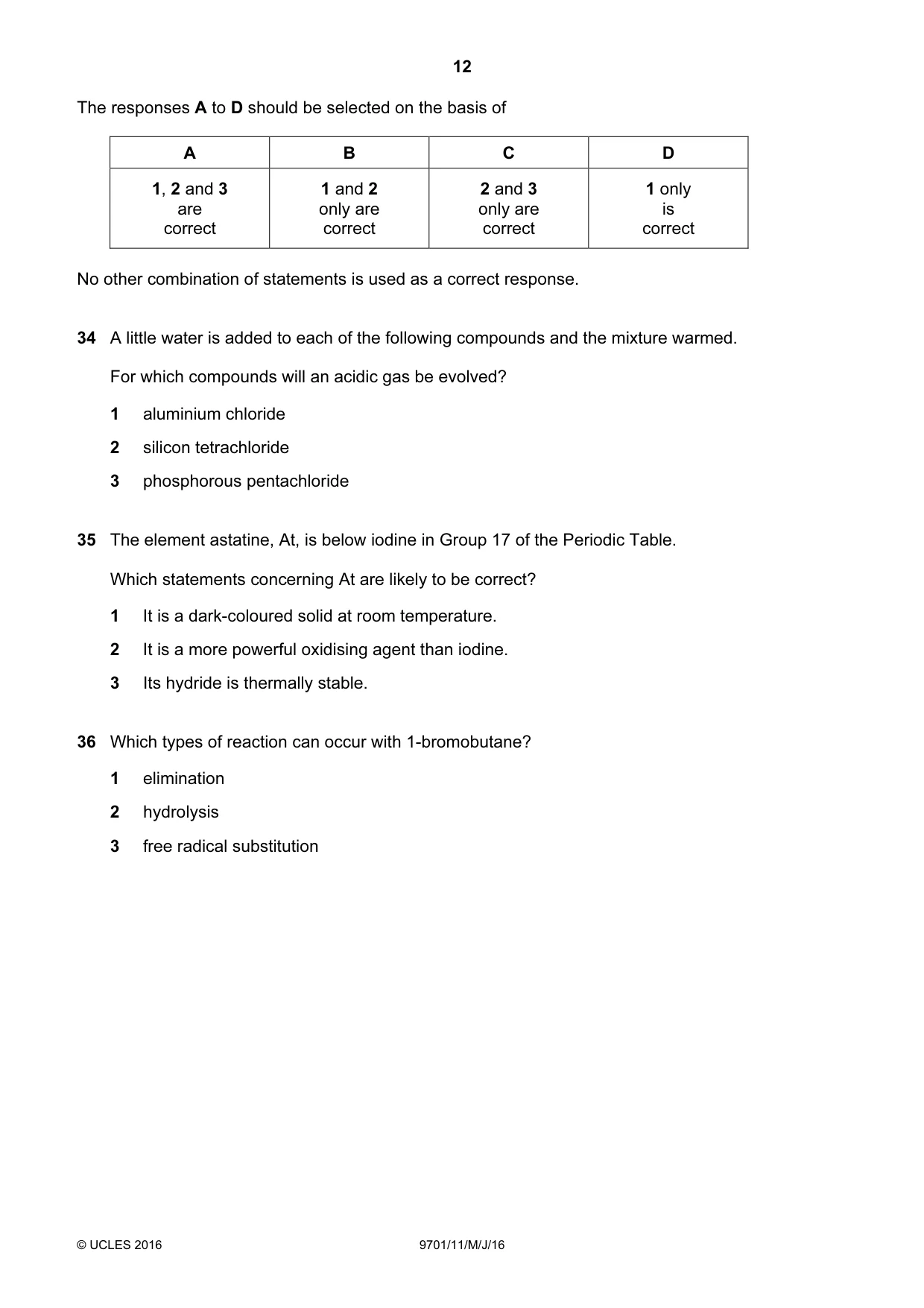
34 A little water is added to each of the following compounds and the mixture warmed. For which compounds will an acidic gas be evolved? 1 aluminium chloride 2 silicon tetrachloride 3 phosphorous pentachloride
Mark scheme: A
More questions on Periodicity of chemical properties of the elements in Period 3
Q35 · The element astatine, At, is below iodine in Group 17 of the Periodic Table
35 The element astatine, At, is below iodine in Group 17 of the Periodic Table. Which statements concerning At are likely to be correct? 1 It is a dark-coloured solid at room temperature. 2 It is a more powerful oxidising agent than iodine. 3 Its hydride is thermally stable.
Mark scheme: D
More questions on Physical properties of the Group 17 elements
Q36 · Which types of reaction can occur with 1-bromobutane?
36 Which types of reaction can occur with 1-bromobutane? 1 elimination 2 hydrolysis 3 free radical substitution
Mark scheme: A
Q37 · The equation shows a gas phase reaction
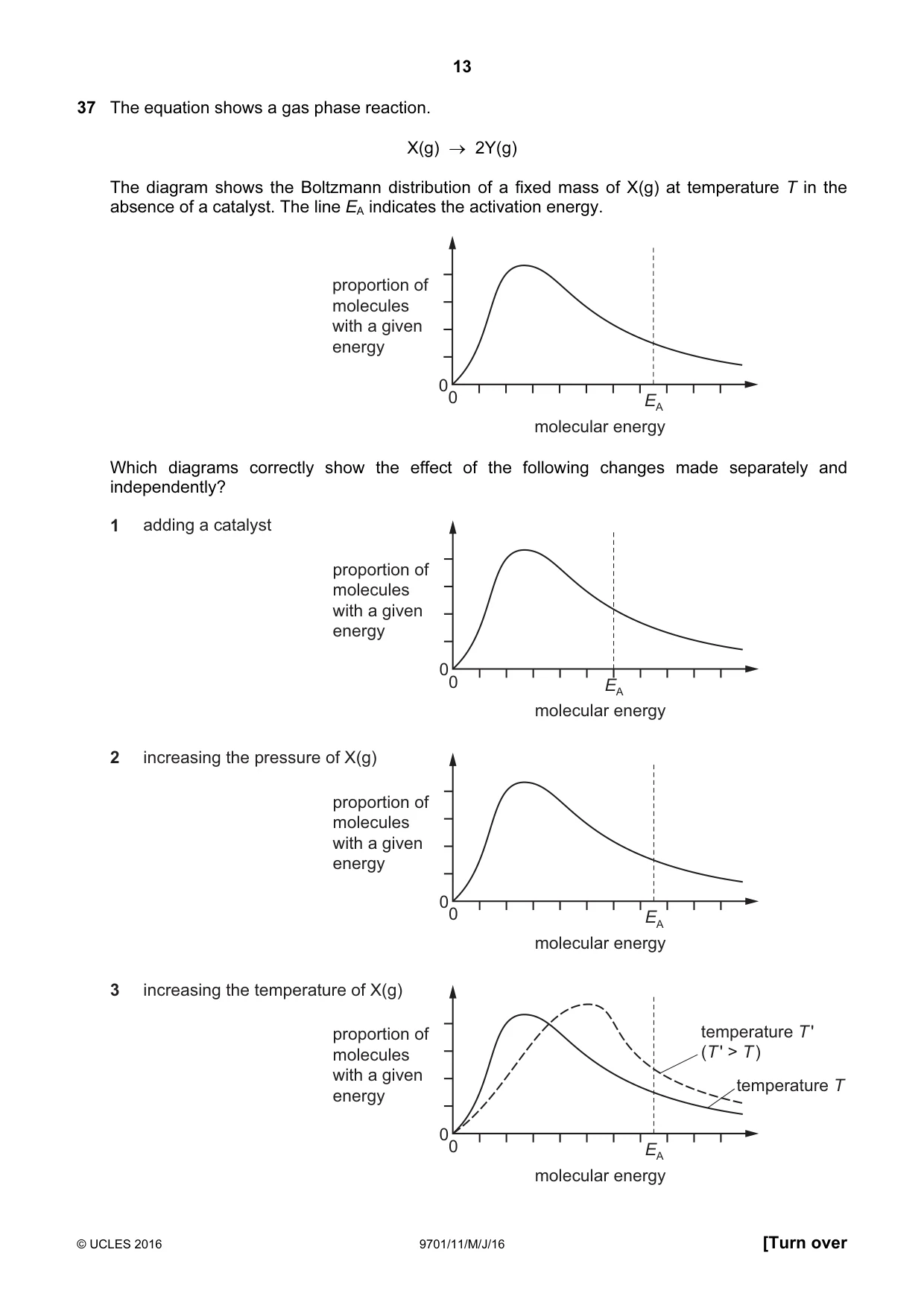
37 The equation shows a gas phase reaction. X(g) → 2Y(g) The diagram shows the Boltzmann distribution of a fixed mass of X(g) at temperature T in the absence of a catalyst. The line EA indicates the activation energy. proportion of molecules with a given energy 00 EA molecular energy Which diagrams correctly show the effect of the following changes made separately and independently? 1 adding a catalyst proportion of molecules with a given energy 00 EA molecular energy 2 increasing the pressure of X(g) proportion of molecules with a given energy 00 EA molecular energy 3 increasing the temperature of X(g) proportion of temperature T ' molecules (T ' > T ) with a given temperature T energy 00 EA molecular energy
Mark scheme: B
More questions on Effect of temperature on reaction rates and the concept of activation energy
Q38 · The diagram shows the structure of cyclohexene
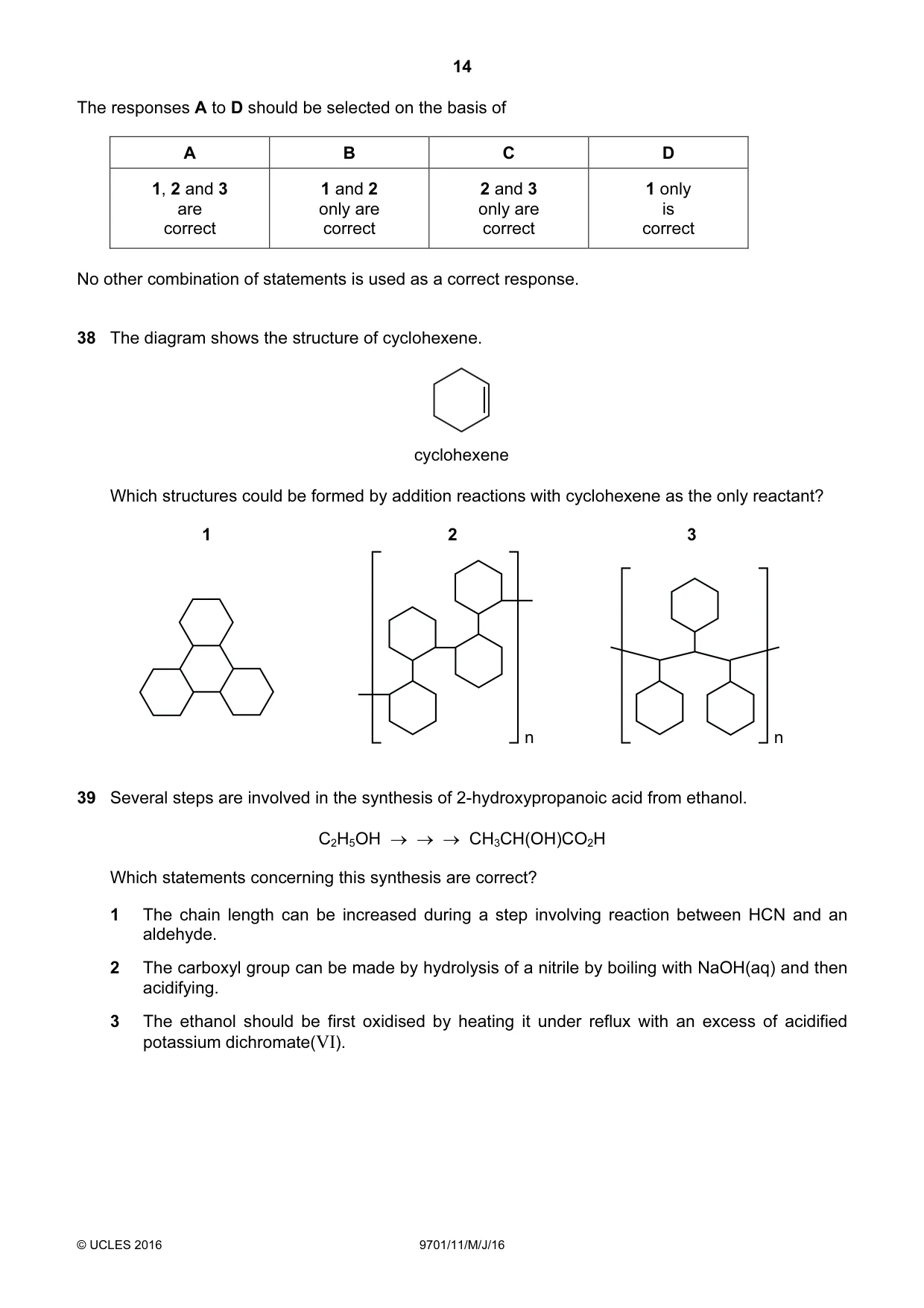
38 The diagram shows the structure of cyclohexene. cyclohexene Which structures could be formed by addition reactions with cyclohexene as the only reactant? 1 2 3 n n
Mark scheme: B
Q39 · Several steps are involved in the synthesis of 2-hydroxypropanoic acid from ethanol
39 Several steps are involved in the synthesis of 2-hydroxypropanoic acid from ethanol. C2H5OH → → → CH3CH(OH)CO2H Which statements concerning this synthesis are correct? 1 The chain length can be increased during a step involving reaction between HCN and an aldehyde. 2 The carboxyl group can be made by hydrolysis of a nitrile by boiling with NaOH(aq) and then acidifying. 3 The ethanol should be first oxidised by heating it under reflux with an excess of acidified potassium dichromate(VI).
Mark scheme: B
Q40 · The diagram shows the structure of an addition polymer, X
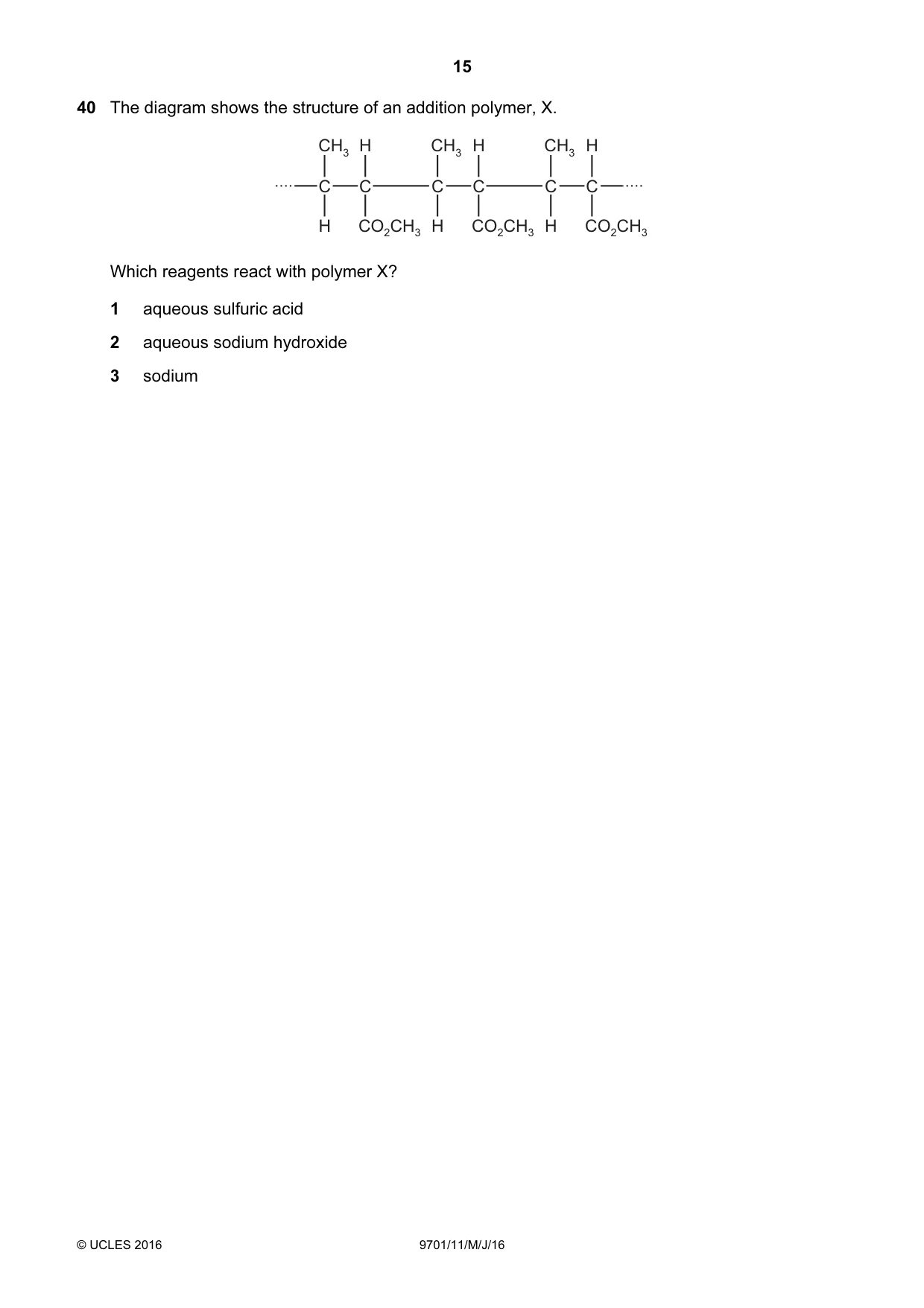
40 The diagram shows the structure of an addition polymer, X. CH3 H CH3 H CH3 H C C C C C C H CO2CH3 H CO2CH3 H CO2CH3 Which reagents react with polymer X? 1 aqueous sulfuric acid 2 aqueous sodium hydroxide 3 sodium
Mark scheme: B
What was in this paper
The subtopics covered by these 40 questions, and how many questions each got. Open one in a new tab to see every Cambridge question on it.
3Addition polymerisation2Alcohols2Chemical equilibria: reversible reactions, dynamic equilibrium2Enthalpy change, ΔH2Halogenoalkanes2Isotopes2Reacting masses and volumes (of solutions and gases)2Redox processes: electron transfer and changes in oxidation number (oxidation state)2Similarities and trends in the properties of the Group 2 metals, magnesium to barium, and their compounds2Aldehydes and ketones1Alkanes1Arenes1Brønsted–Lowry theory of acids and bases1Covalent bonding and coordinate (dative covalent) bonding1Dot-and-cross diagrams1Effect of temperature on reaction rates and the concept of activation energy1Formulas1Homogeneous and heterogeneous catalysts1Intermolecular forces, electronegativity and bond properties1Isomerism: optical1Nitrogen and sulfur1Organic synthesis1Particles in the atom and atomic radius1Periodicity of chemical properties of the elements in Period 31Periodicity of physical properties of the elements in Period 31Physical properties of the Group 17 elements1Some reactions of the halide ions1The gaseous state: ideal and real gases and pV = nRT1What you needed in this session
Cambridge’s own grade thresholds for 2016 May/June, Paper 1 · Variant 1. A higher threshold means an easier paper — the bar moves with how the cohort did.