Cambridge A Level Chemistry 9701 — 2022 May/June Paper 1 · Variant 1
9701/11/M/J/22 · 40 questions · 40 marks · ≈45 min
The question paper and its mark scheme, free to read here and free to download. This is Cambridge’s own paper, exactly as it was sat.
Question paper16 pages
Mark scheme3 pages
Answers below. Sit the paper first if you are practising.
Questions as text
Q1 · Which atom has its outermost electron in an orbital of the shape shown, with principal…
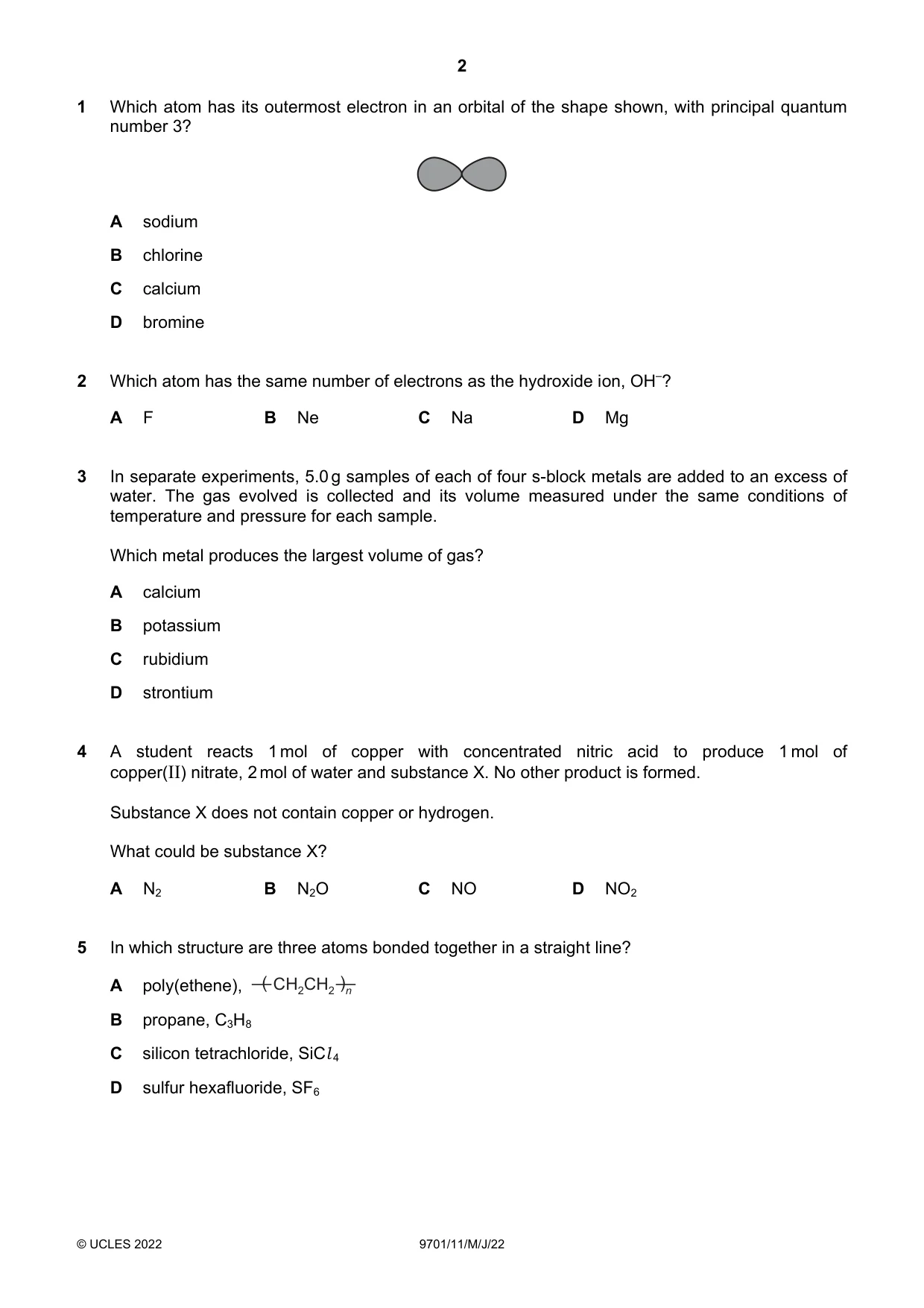
1 Which atom has its outermost electron in an orbital of the shape shown, with principal quantum number 3? A sodium B chlorine C calcium D bromine
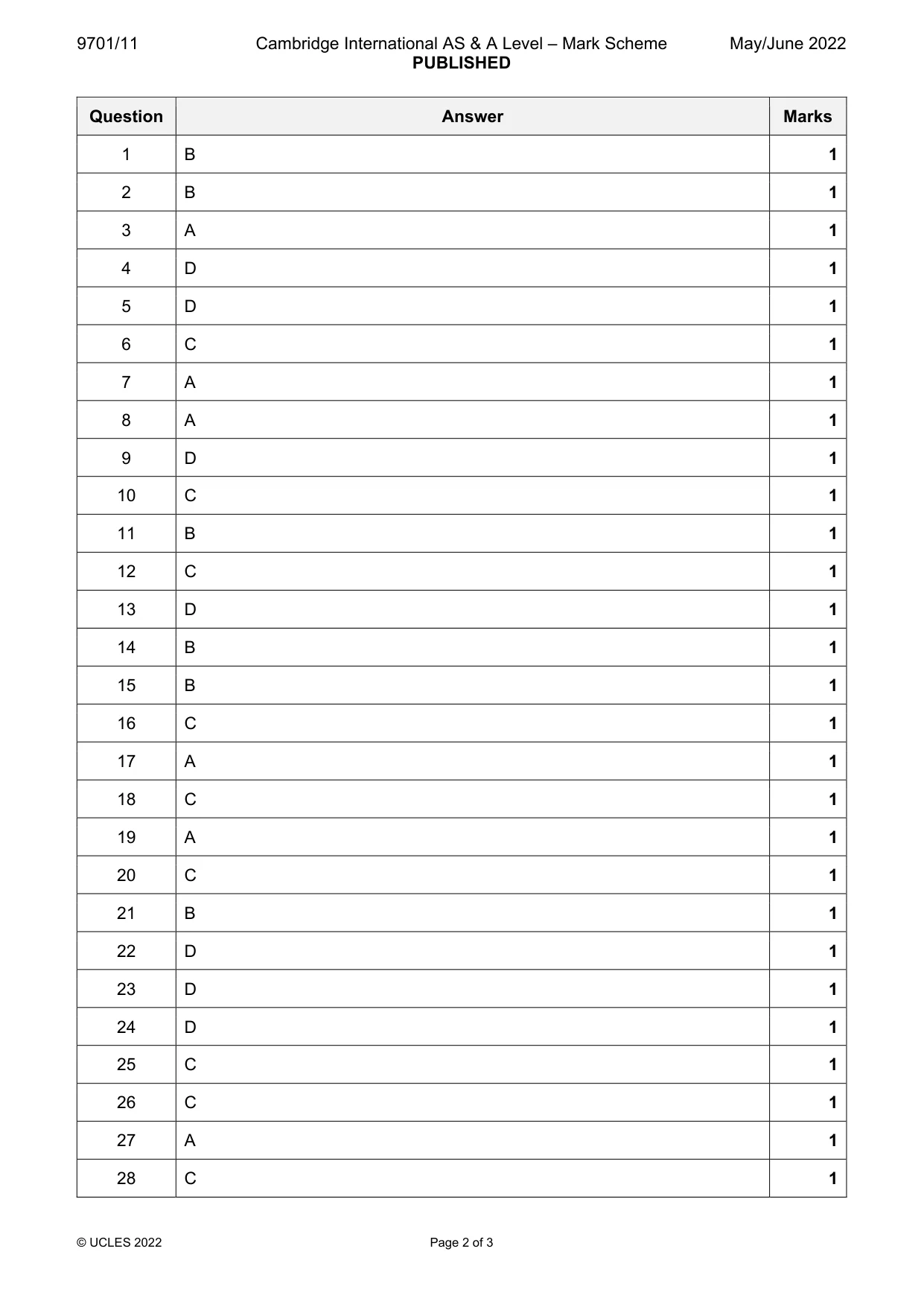
Mark scheme: B
More questions on Electrons, energy levels and atomic orbitals
Q2 · Which atom has the same number of electrons as the hydroxide ion, OH–?
2 Which atom has the same number of electrons as the hydroxide ion, OH–? A F B Ne C Na D Mg
Mark scheme: B
Q3 · In separate experiments, 5.0 g samples of each of four s-block metals are added to an…
3 In separate experiments, 5.0 g samples of each of four s-block metals are added to an excess of water. The gas evolved is collected and its volume measured under the same conditions of temperature and pressure for each sample. Which metal produces the largest volume of gas? A calcium B potassium C rubidium D strontium
Mark scheme: A
Q4 · A student reacts 1 mol of copper with concentrated nitric acid to produce 1 mol of…
4 A student reacts 1 mol of copper with concentrated nitric acid to produce 1 mol of copper(II) nitrate, 2 mol of water and substance X. No other product is formed. Substance X does not contain copper or hydrogen. What could be substance X? A N2 B N2O C NO D NO2
Mark scheme: D
Q5 · In which structure are three atoms bonded together in a straight line?
5 In which structure are three atoms bonded together in a straight line? A poly(ethene), ] ( CH2CH2 ) n B propane, C3H8 C silicon tetrachloride, SiCl 4 D sulfur hexafluoride, SF6
Mark scheme: D
Q6 · Which statement about aluminium chloride is correct?
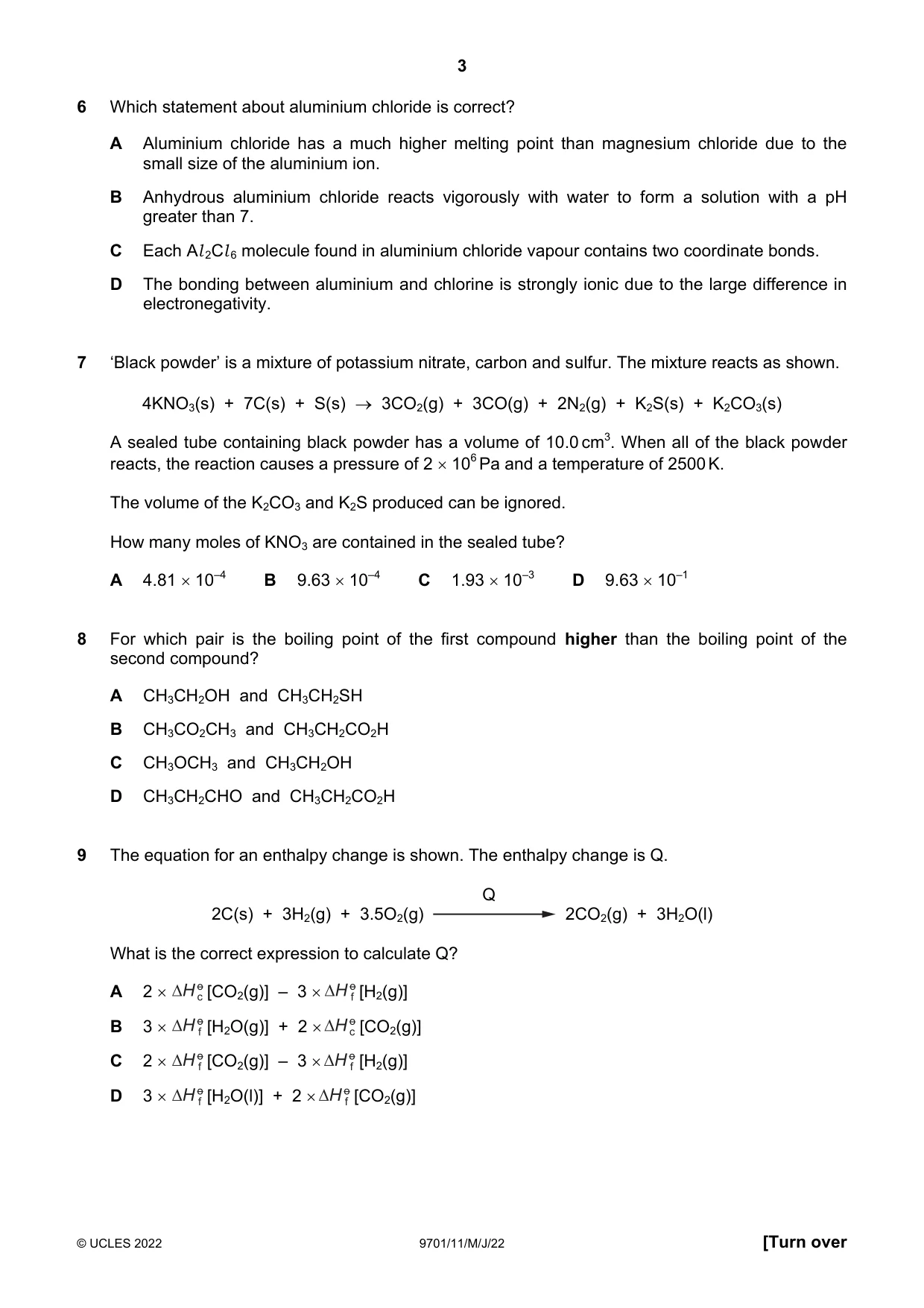
6 Which statement about aluminium chloride is correct? A Aluminium chloride has a much higher melting point than magnesium chloride due to the small size of the aluminium ion. B Anhydrous aluminium chloride reacts vigorously with water to form a solution with a pH greater than 7. C Each Al 2Cl 6 molecule found in aluminium chloride vapour contains two coordinate bonds. D The bonding between aluminium and chlorine is strongly ionic due to the large difference in electronegativity.
Mark scheme: C
More questions on Covalent bonding and coordinate (dative covalent) bonding
Q7 · ‘Black powder’ is a mixture of potassium nitrate, carbon and sulfur
7 ‘Black powder’ is a mixture of potassium nitrate, carbon and sulfur. The mixture reacts as shown. 4KNO3(s) + 7C(s) + S(s) 3CO2(g) + 3CO(g) + 2N2(g) + K2S(s) + K2CO3(s) A sealed tube containing black powder has a volume of 10.0 cm3. When all of the black powder reacts, the reaction causes a pressure of 2 106 Pa and a temperature of 2500 K. The volume of the K2CO3 and K2S produced can be ignored. How many moles of KNO3 are contained in the sealed tube? A 4.81 10–4 B 9.63 10–4 C 1.93 10–3 D 9.63 10–1
Mark scheme: A
More questions on The gaseous state: ideal and real gases and pV = nRT
Q8 · For which pair is the boiling point of the first compound higher than the boiling point…
8 For which pair is the boiling point of the first compound higher than the boiling point of the second compound? A CH3CH2OH and CH3CH2SH B CH3CO2CH3 and CH3CH2CO2H C CH3OCH3 and CH3CH2OH D CH3CH2CHO and CH3CH2CO2H
Mark scheme: A
More questions on Intermolecular forces, electronegativity and bond properties
Q9 · The equation for an enthalpy change is shown
9 The equation for an enthalpy change is shown. The enthalpy change is Q. Q 2C(s) + 3H2(g) + 3.5O2(g) 2CO2(g) + 3H2O(l) What is the correct expression to calculate Q? A 2 [CO2(g)] – 3 [H2(g)] B 3 [H2O(g)] + 2 [CO2(g)] C 2 [CO2(g)] – 3 [H2(g)] D 3 [H2O(l)] + 2 [CO2(g)]
Mark scheme: D
Q10 · A reaction pathway diagram for the reaction of aqueous sodium hydroxide and dilute…
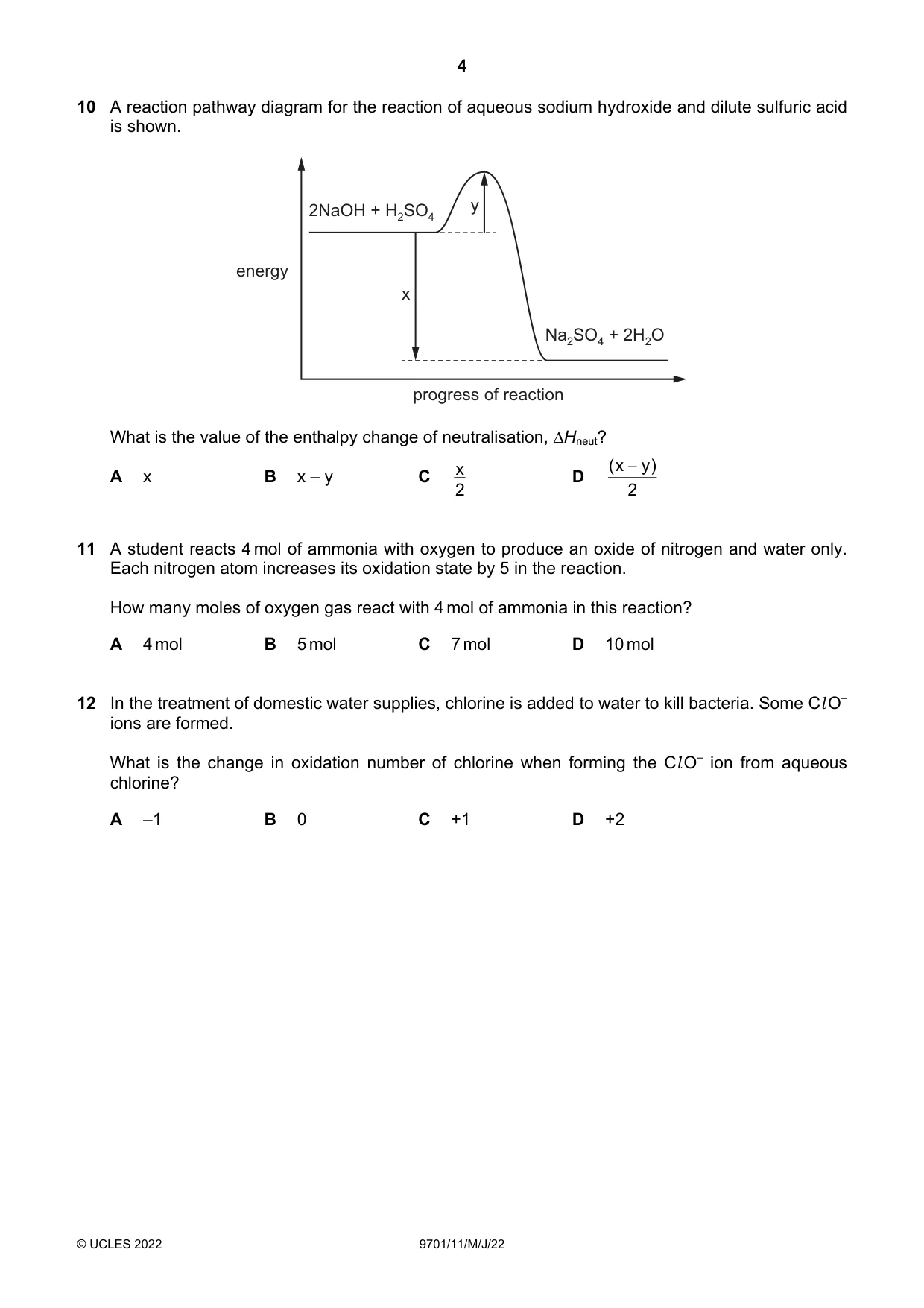
10 A reaction pathway diagram for the reaction of aqueous sodium hydroxide and dilute sulfuric acid is shown. 2NaOH + H2SO4 y energy x Na2SO4 + 2H2O progress of reaction What is the value of the enthalpy change of neutralisation, Hneut? x (x y) A x B x – y C 2 D 2
Mark scheme: C
Q11 · A student reacts 4 mol of ammonia with oxygen to produce an oxide of nitrogen and water…
11 A student reacts 4 mol of ammonia with oxygen to produce an oxide of nitrogen and water only. Each nitrogen atom increases its oxidation state by 5 in the reaction. How many moles of oxygen gas react with 4 mol of ammonia in this reaction? A 4 mol B 5 mol C 7 mol D 10 mol
Mark scheme: B
Q12 · In the treatment of domestic water supplies, chlorine is added to water to kill bacteria
12 In the treatment of domestic water supplies, chlorine is added to water to kill bacteria. Some Cl O– ions are formed. What is the change in oxidation number of chlorine when forming the Cl O– ion from aqueous chlorine? A –1 B 0 C +1 D +2
Mark scheme: C
Q13 · Ethanoic acid is mixed with ethanol
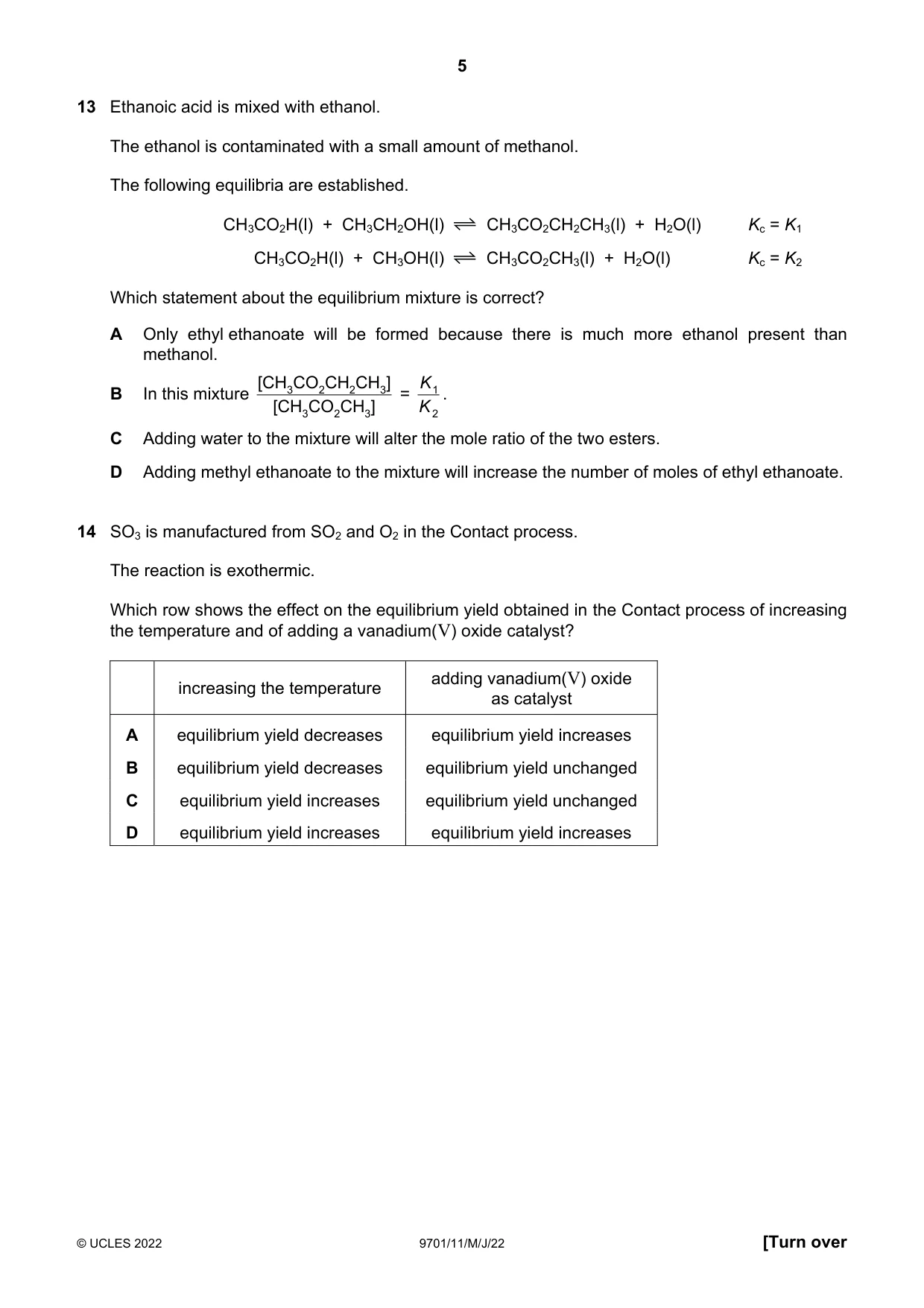
13 Ethanoic acid is mixed with ethanol. The ethanol is contaminated with a small amount of methanol. The following equilibria are established. CH3CO2H(l) + CH3CH2OH(l) CH3CO2CH2CH3(l) + H2O(l) Kc = K1 CH3CO2H(l) + CH3OH(l) CH3CO2CH3(l) + H2O(l) Kc = K2 Which statement about the equilibrium mixture is correct? A Only ethyl ethanoate will be formed because there is much more ethanol present than methanol. [CH CO CH CH ] K . B In this mixture 3 2 2 3 = 1 [CH CO CH ] K 3 2 3 2 C Adding water to the mixture will alter the mole ratio of the two esters. D Adding methyl ethanoate to the mixture will increase the number of moles of ethyl ethanoate.
Mark scheme: D
More questions on Chemical equilibria: reversible reactions, dynamic equilibrium
Q14 · SO3 is manufactured from SO2 and O2 in the Contact process
14 SO3 is manufactured from SO2 and O2 in the Contact process. The reaction is exothermic. Which row shows the effect on the equilibrium yield obtained in the Contact process of increasing the temperature and of adding a vanadium(V) oxide catalyst? adding vanadium(V) oxide increasing the temperature as catalyst A equilibrium yield decreases equilibrium yield increases B equilibrium yield decreases equilibrium yield unchanged C equilibrium yield increases equilibrium yield unchanged D equilibrium yield increases equilibrium yield increases
Mark scheme: B
More questions on Chemical equilibria: reversible reactions, dynamic equilibrium
Q15 · The Boltzmann distribution for a gas at a constant temperature of 50 C is shown
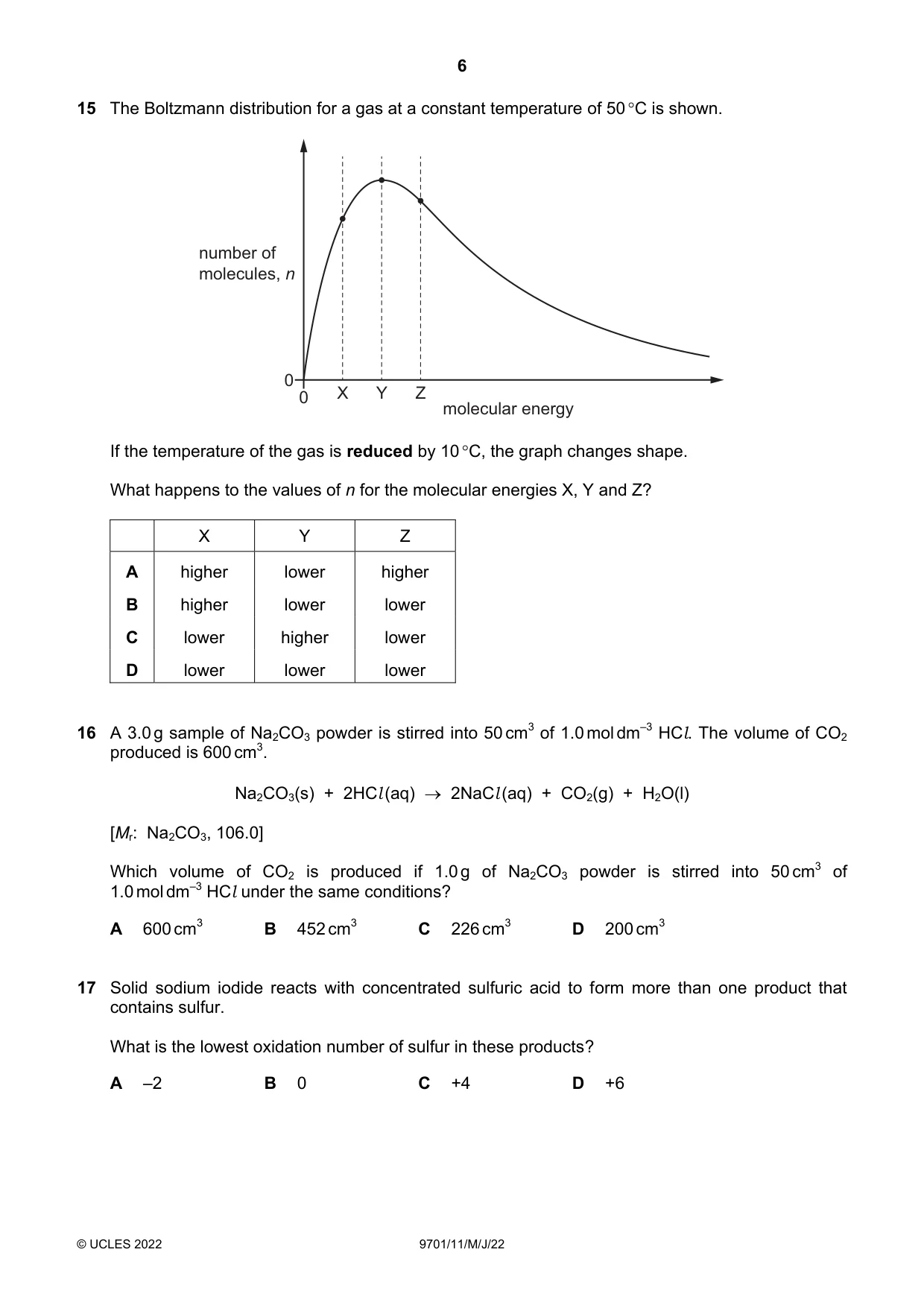
15 The Boltzmann distribution for a gas at a constant temperature of 50 C is shown. number of molecules, n 0 0 X Y Z molecular energy If the temperature of the gas is reduced by 10 C, the graph changes shape. What happens to the values of n for the molecular energies X, Y and Z? X Y Z A higher lower higher B higher lower lower C lower higher lower D lower lower lower
Mark scheme: B
More questions on Effect of temperature on reaction rates and the concept of activation energy
Q16 · A 3.0 g sample of Na2CO3 powder is stirred into 50 cm3 of 1.0 mol dm–3 HCl
16 A 3.0 g sample of Na2CO3 powder is stirred into 50 cm3 of 1.0 mol dm–3 HCl. The volume of CO2 produced is 600 cm3. Na2CO3(s) + 2HCl (aq) 2NaCl (aq) + CO2(g) + H2O(l) [Mr: Na2CO3, 106.0] Which volume of CO2 is produced if 1.0 g of Na2CO3 powder is stirred into 50 cm3 of 1.0 mol dm–3 HCl under the same conditions? A 600 cm3 B 452 cm3 C 226 cm3 D 200 cm3
Mark scheme: C
More questions on Reacting masses and volumes (of solutions and gases)
Q17 · Solid sodium iodide reacts with concentrated sulfuric acid to form more than one product…
17 Solid sodium iodide reacts with concentrated sulfuric acid to form more than one product that contains sulfur. What is the lowest oxidation number of sulfur in these products? A –2 B 0 C +4 D +6
Mark scheme: A
Q18 · Which statement for the element in Period 3 and Group 13 of the Periodic Table is correct?
18 Which statement for the element in Period 3 and Group 13 of the Periodic Table is correct? A It has the highest melting point of the elements in its period. B It has exactly one electron in its shell with principal quantum number 3. C It forms an oxide that reacts with aqueous sodium hydroxide. D It forms a chloride that dissolves in water to give a neutral solution.
Mark scheme: C
More questions on Periodicity of chemical properties of the elements in Period 3
Q19 · A student reacts 0.100 mol of each of sodium, magnesium and phosphorus atoms separately…
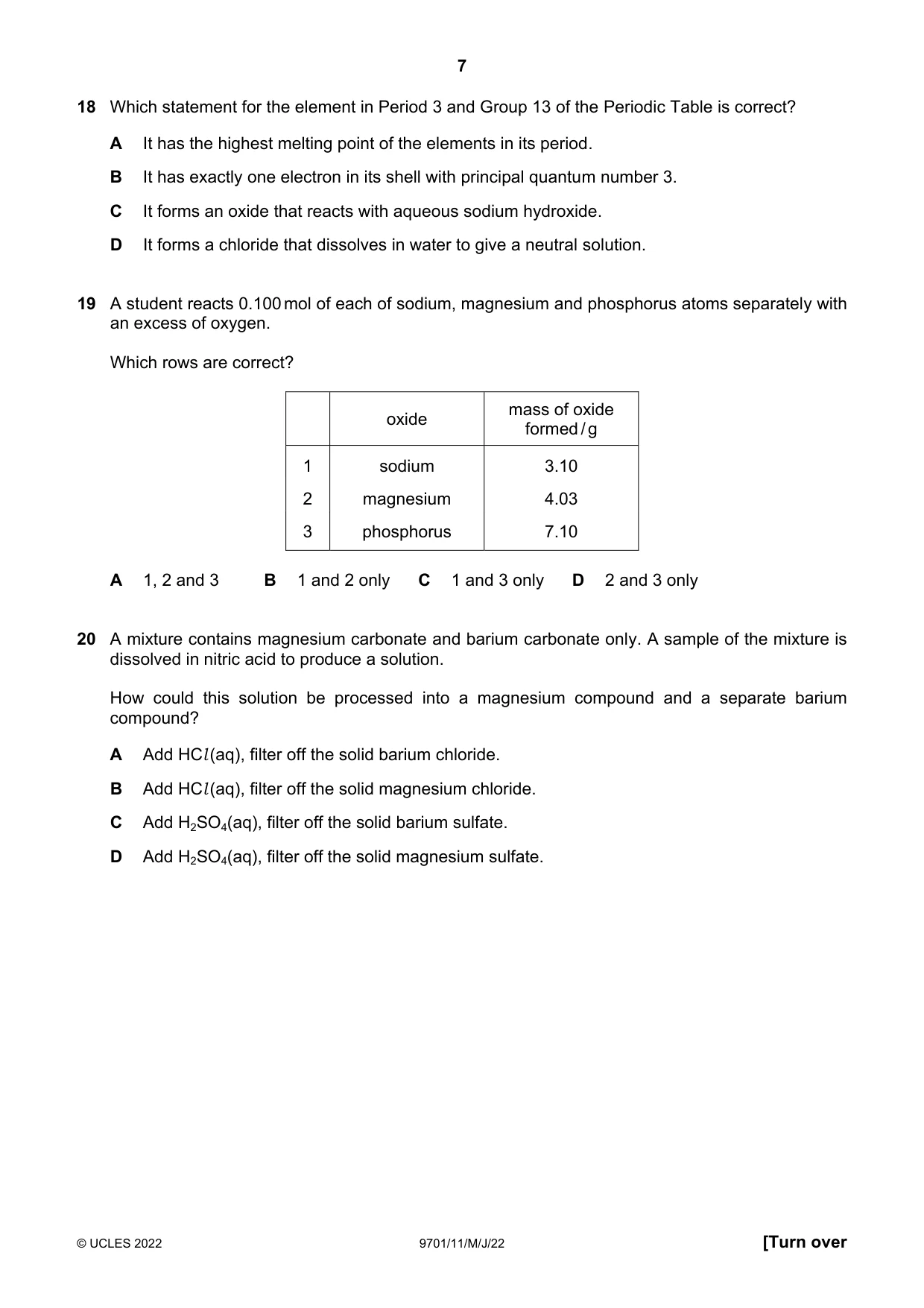
19 A student reacts 0.100 mol of each of sodium, magnesium and phosphorus atoms separately with an excess of oxygen. Which rows are correct? mass of oxide oxide formed / g 1 sodium 3.10 2 magnesium 4.03 3 phosphorus 7.10 A 1, 2 and 3 B 1 and 2 only C 1 and 3 only D 2 and 3 only
Mark scheme: A
More questions on Periodicity of chemical properties of the elements in Period 3
Q20 · A mixture contains magnesium carbonate and barium carbonate only
20 A mixture contains magnesium carbonate and barium carbonate only. A sample of the mixture is dissolved in nitric acid to produce a solution. How could this solution be processed into a magnesium compound and a separate barium compound? A Add HCl (aq), filter off the solid barium chloride. B Add HCl (aq), filter off the solid magnesium chloride. C Add H2SO4(aq), filter off the solid barium sulfate. D Add H2SO4(aq), filter off the solid magnesium sulfate.
Mark scheme: C
Q21 · A sample of magnesium nitrate is heated in the apparatus shown
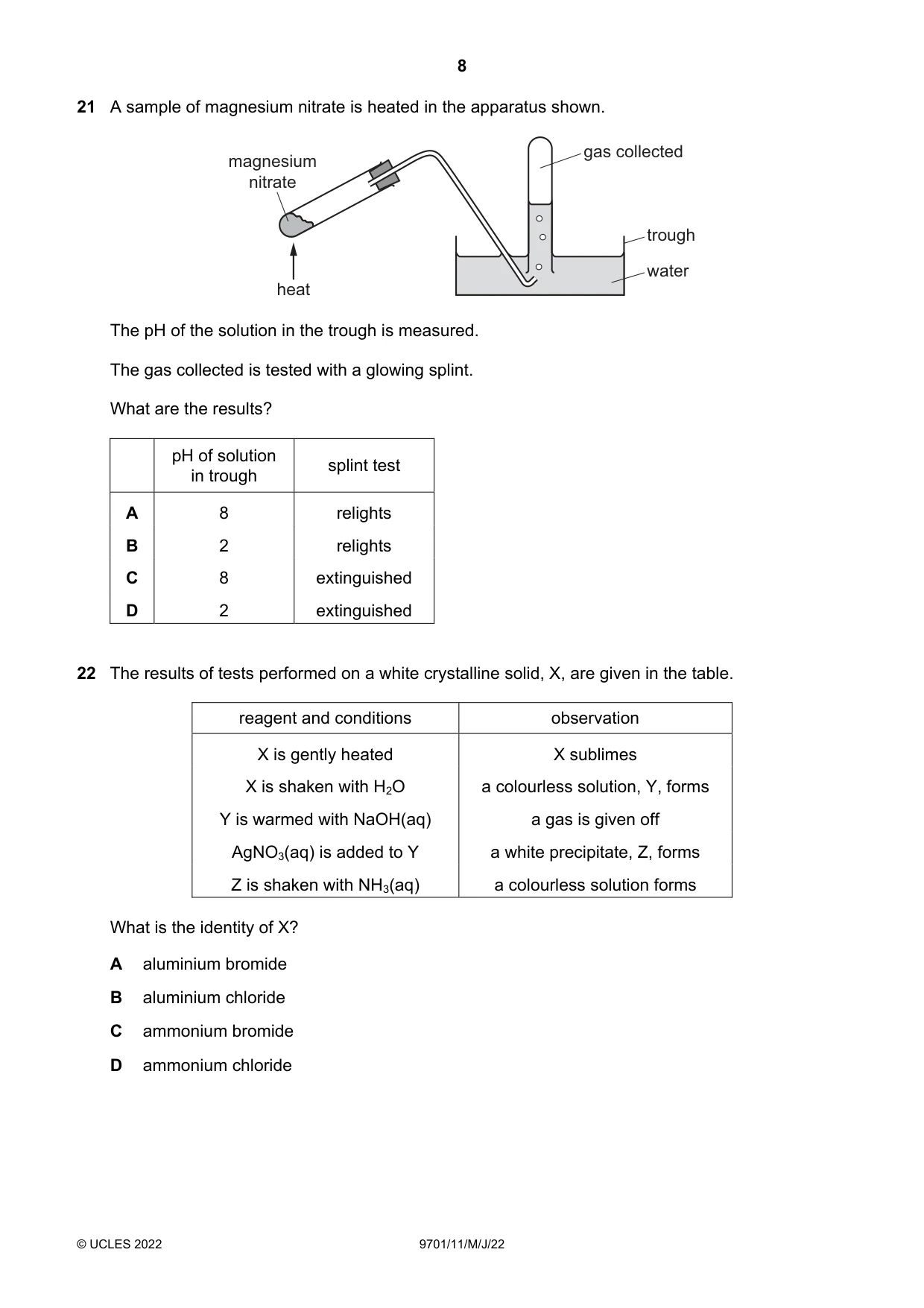
21 A sample of magnesium nitrate is heated in the apparatus shown. gas collected magnesium nitrate trough water heat The pH of the solution in the trough is measured. The gas collected is tested with a glowing splint. What are the results? pH of solution splint test in trough A 8 relights B 2 relights C 8 extinguished D 2 extinguished
Mark scheme: B
Q22 · The results of tests performed on a white crystalline solid, X, are given in the table
22 The results of tests performed on a white crystalline solid, X, are given in the table. reagent and conditions observation X is gently heated X sublimes X is shaken with H2O a colourless solution, Y, forms Y is warmed with NaOH(aq) a gas is given off AgNO3(aq) is added to Y a white precipitate, Z, forms Z is shaken with NH3(aq) a colourless solution forms What is the identity of X? A aluminium bromide B aluminium chloride C ammonium bromide D ammonium chloride
Mark scheme: D
Q23 · Silicon is heated in an excess of chlorine, producing compound J
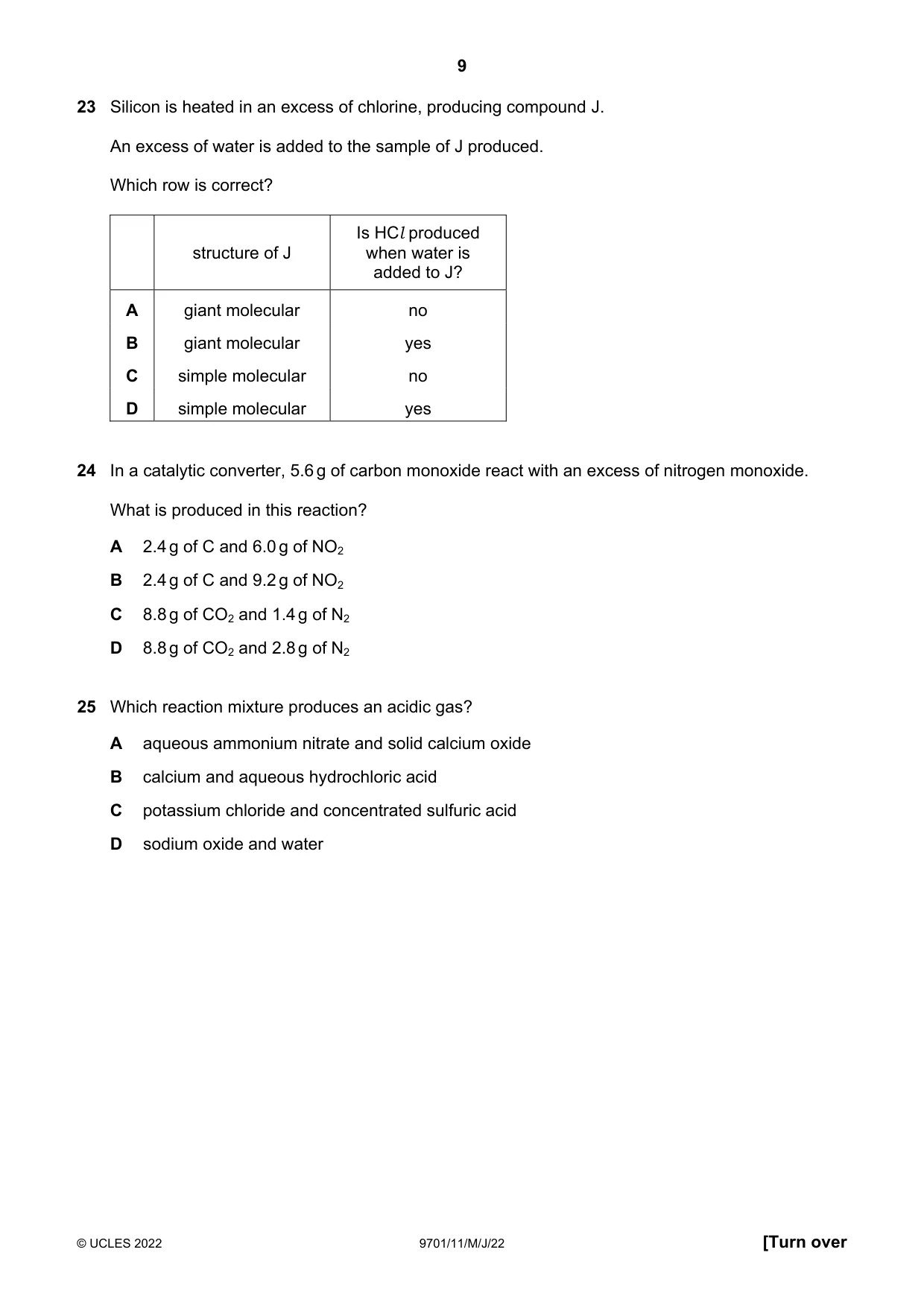
23 Silicon is heated in an excess of chlorine, producing compound J. An excess of water is added to the sample of J produced. Which row is correct? Is HCl produced structure of J when water is added to J? A giant molecular no B giant molecular yes C simple molecular no D simple molecular yes
Mark scheme: D
More questions on Periodicity of chemical properties of the elements in Period 3
Q24 · In a catalytic converter, 5.6 g of carbon monoxide react with an excess of nitrogen…
24 In a catalytic converter, 5.6 g of carbon monoxide react with an excess of nitrogen monoxide. What is produced in this reaction? A 2.4 g of C and 6.0 g of NO2 B 2.4 g of C and 9.2 g of NO2 C 8.8 g of CO2 and 1.4 g of N2 D 8.8 g of CO2 and 2.8 g of N2
Mark scheme: D
More questions on Reacting masses and volumes (of solutions and gases)
Q25 · Which reaction mixture produces an acidic gas?
25 Which reaction mixture produces an acidic gas? A aqueous ammonium nitrate and solid calcium oxide B calcium and aqueous hydrochloric acid C potassium chloride and concentrated sulfuric acid D sodium oxide and water
Mark scheme: C
More questions on The chemical properties of the halogen elements and the hydrogen halides
Q26 · Ethanol can be used to make propanenitrile in two steps
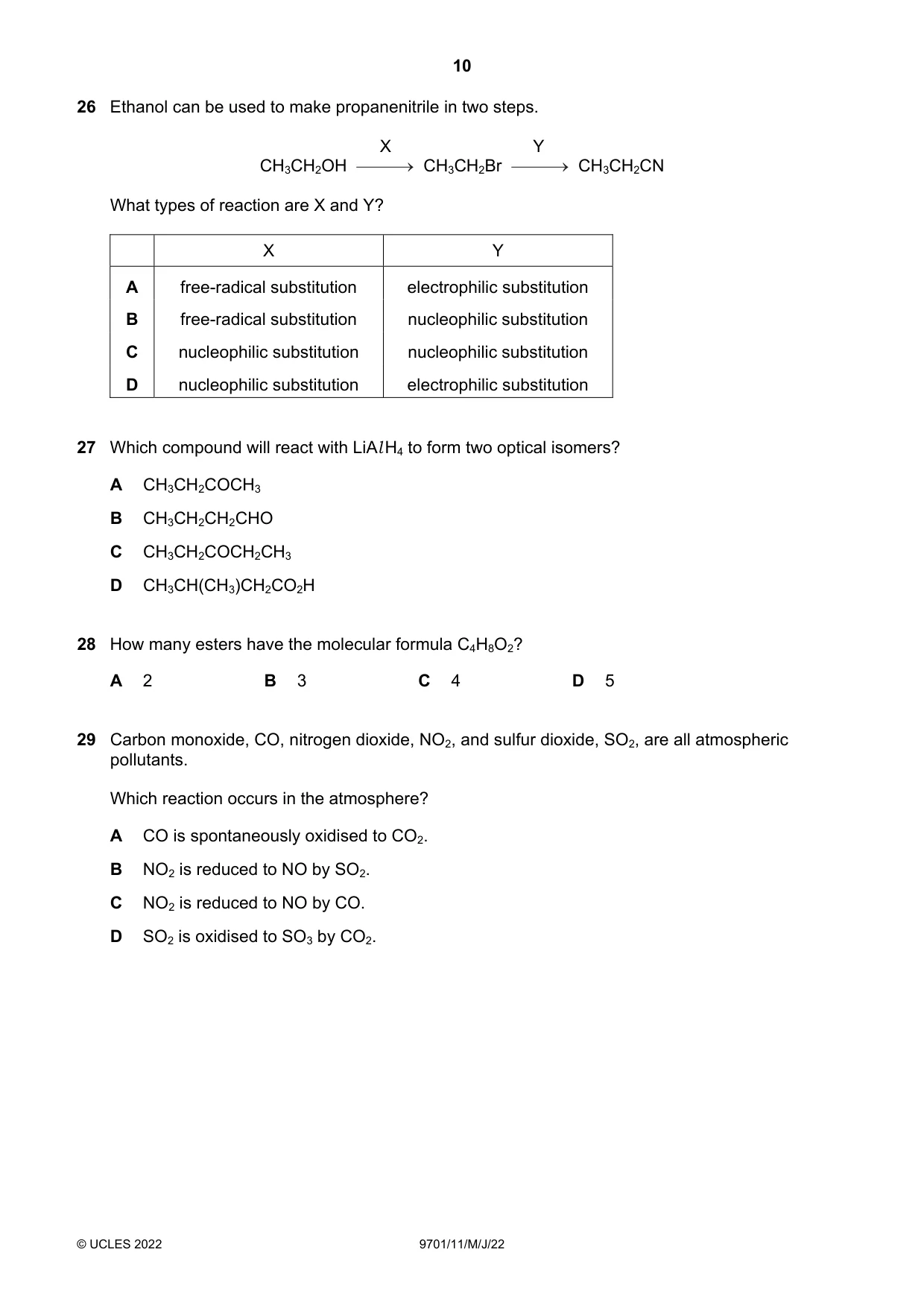
26 Ethanol can be used to make propanenitrile in two steps. X Y CH3CH2OH CH3CH2Br CH3CH2CN What types of reaction are X and Y? X Y A free-radical substitution electrophilic substitution B free-radical substitution nucleophilic substitution C nucleophilic substitution nucleophilic substitution D nucleophilic substitution electrophilic substitution
Mark scheme: C
Q27 · Which compound will react with LiAl H4 to form two optical isomers?
27 Which compound will react with LiAl H4 to form two optical isomers? A CH3CH2COCH3 B CH3CH2CH2CHO C CH3CH2COCH2CH3 D CH3CH(CH3)CH2CO2H
Mark scheme: A
Q28 · How many esters have the molecular formula C4H8O2?
28 How many esters have the molecular formula C4H8O2? A 2 B 3 C 4 D 5
Mark scheme: C
More questions on Isomerism: structural isomerism and stereoisomerism
Q29 · Carbon monoxide, CO, nitrogen dioxide, NO2, and sulfur dioxide, SO2, are all atmospheric…
29 Carbon monoxide, CO, nitrogen dioxide, NO2, and sulfur dioxide, SO2, are all atmospheric pollutants. Which reaction occurs in the atmosphere? A CO is spontaneously oxidised to CO2. B NO2 is reduced to NO by SO2. C NO2 is reduced to NO by CO. D SO2 is oxidised to SO3 by CO2.
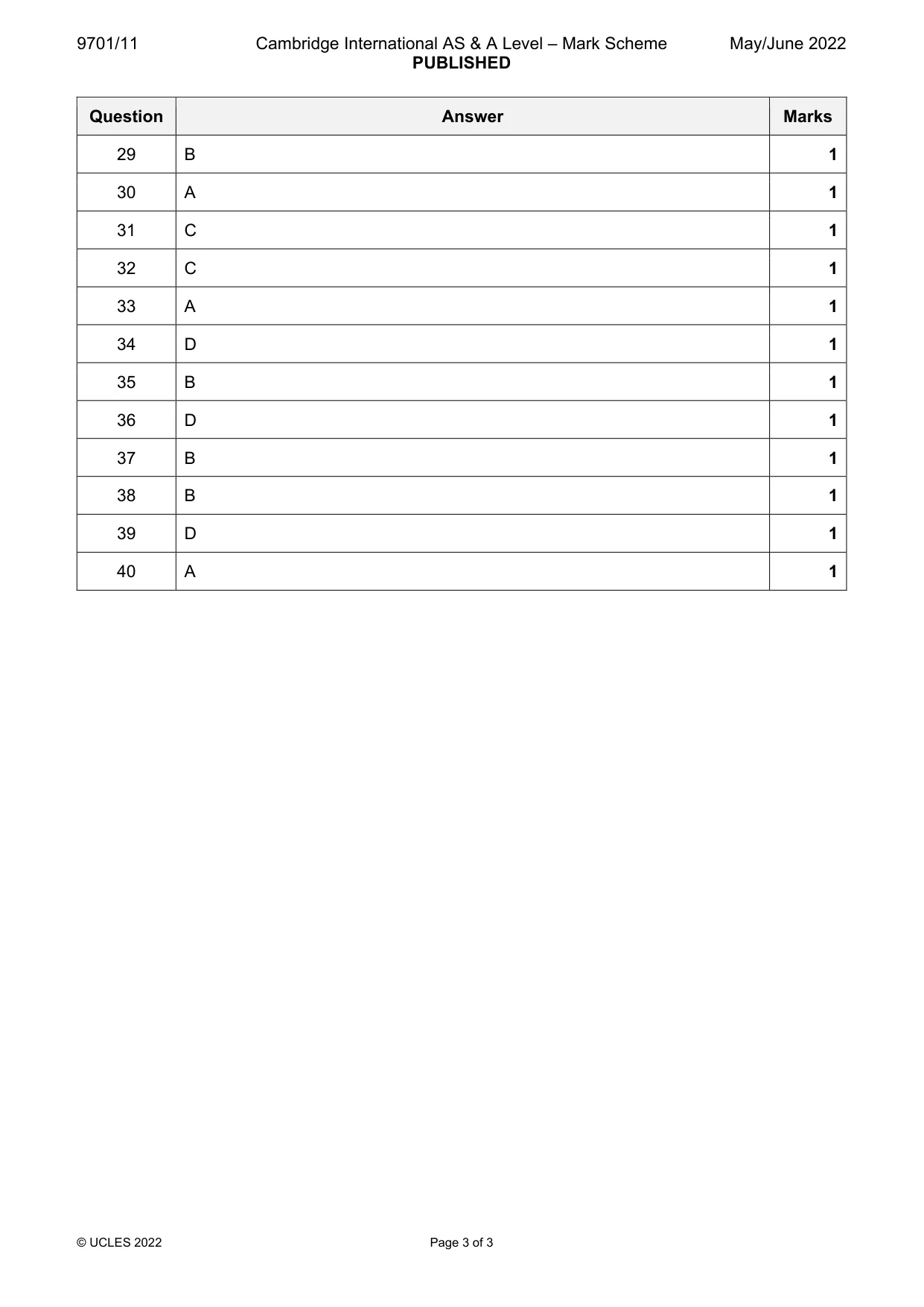
Mark scheme: B
Q30 · Oct-1-ene, CH3(CH2)5CH=CH2, can be thermally cracked
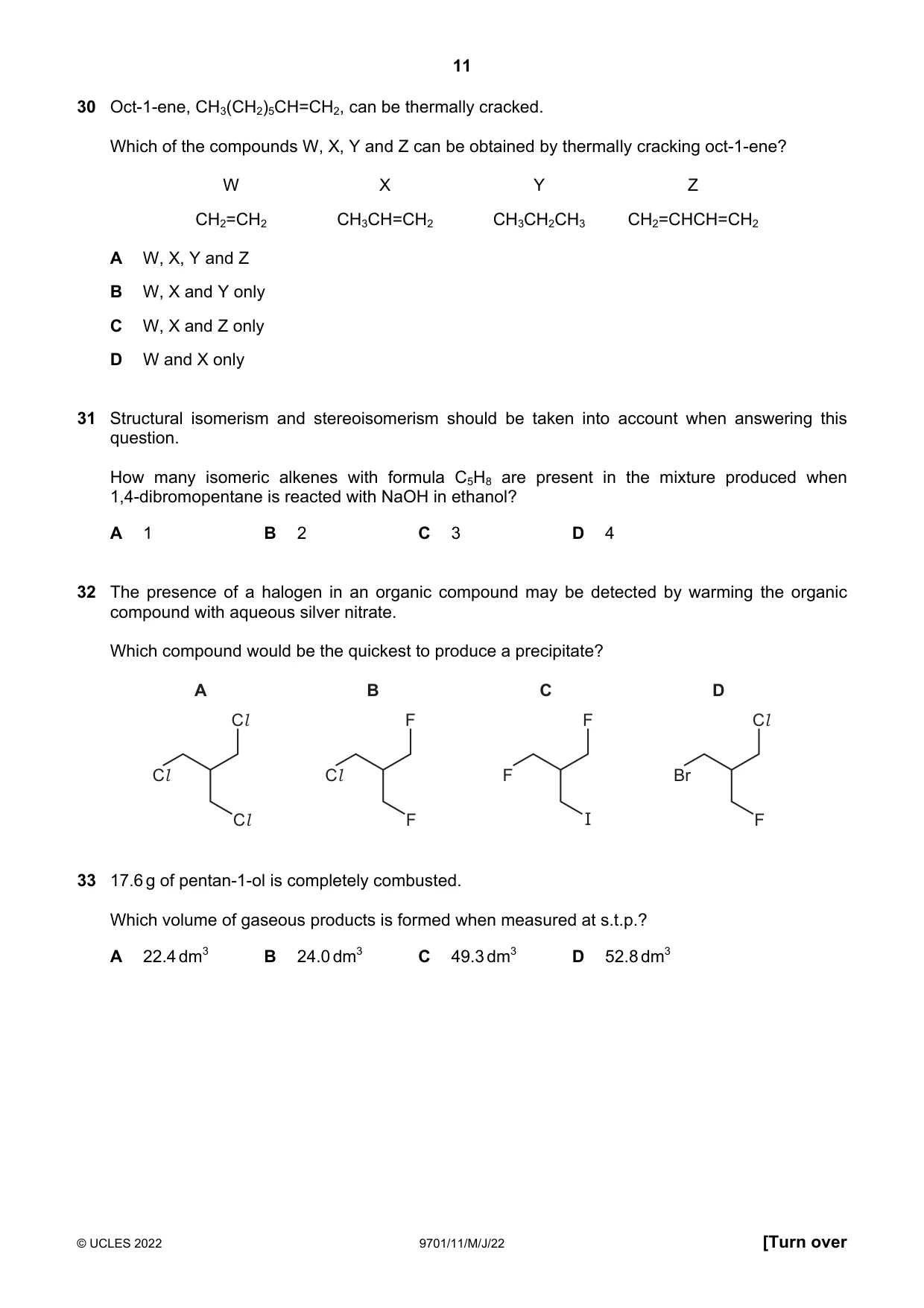
30 Oct-1-ene, CH3(CH2)5CH=CH2, can be thermally cracked. Which of the compounds W, X, Y and Z can be obtained by thermally cracking oct-1-ene? W X Y Z CH2=CH2 CH3CH=CH2 CH3CH2CH3 CH2=CHCH=CH2 A W, X, Y and Z B W, X and Y only C W, X and Z only D W and X only
Mark scheme: A
Q31 · Structural isomerism and stereoisomerism should be taken into account when answering this…
31 Structural isomerism and stereoisomerism should be taken into account when answering this question. How many isomeric alkenes with formula C5H8 are present in the mixture produced when 1,4-dibromopentane is reacted with NaOH in ethanol? A 1 B 2 C 3 D 4
Mark scheme: C
More questions on Isomerism: structural isomerism and stereoisomerism
Q32 · The presence of a halogen in an organic compound may be detected by warming the organic…
32 The presence of a halogen in an organic compound may be detected by warming the organic compound with aqueous silver nitrate. Which compound would be the quickest to produce a precipitate? A B C D Cl F F Cl Cl Cl F Br Cl F I F
Mark scheme: C
Q33 · 17.6 g of pentan-1-ol is completely combusted
33 17.6 g of pentan-1-ol is completely combusted. Which volume of gaseous products is formed when measured at s.t.p.? A 22.4 dm3 B 24.0 dm3 C 49.3 dm3 D 52.8 dm3
Mark scheme: A
More questions on Reacting masses and volumes (of solutions and gases)
Q34 · Crotyl alcohol, CH3CH=CHCH2OH, is a colourless liquid which is used as a solvent
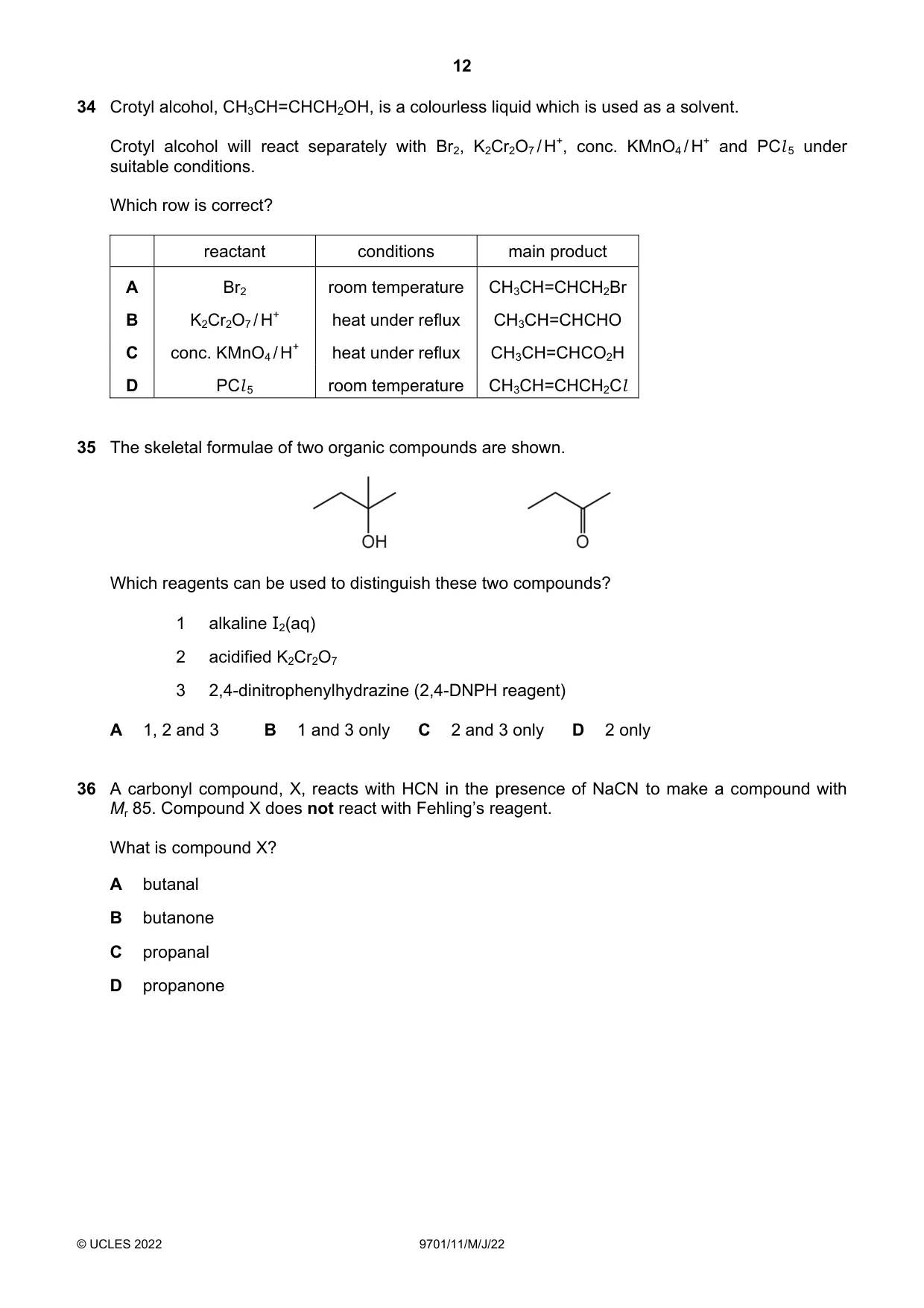
34 Crotyl alcohol, CH3CH=CHCH2OH, is a colourless liquid which is used as a solvent. Crotyl alcohol will react separately with Br2, K2Cr2O7 / H+, conc. KMnO4 / H+ and PCl 5 under suitable conditions. Which row is correct? reactant conditions main product A Br2 room temperature CH3CH=CHCH2Br B K2Cr2O7 / H+ heat under reflux CH3CH=CHCHO C conc. KMnO4 / H+ heat under reflux CH3CH=CHCO2H D PCl 5 room temperature CH3CH=CHCH2Cl
Mark scheme: D
Q35 · The skeletal formulae of two organic compounds are shown
35 The skeletal formulae of two organic compounds are shown. Which reagents can be used to distinguish these two compounds? 1 alkaline I2(aq) 2 acidified K2Cr2O7 3 2,4-dinitrophenylhydrazine (2,4-DNPH reagent) A 1, 2 and 3 B 1 and 3 only C 2 and 3 only D 2 only
Mark scheme: B
Q36 · A carbonyl compound, X, reacts with HCN in the presence of NaCN to make a compound with…
36 A carbonyl compound, X, reacts with HCN in the presence of NaCN to make a compound with Mr 85. Compound X does not react with Fehling’s reagent. What is compound X? A butanal B butanone C propanal D propanone
Mark scheme: D
Q37 · Which compound produces butan-2-ol and ethanoic acid on hydrolysis?
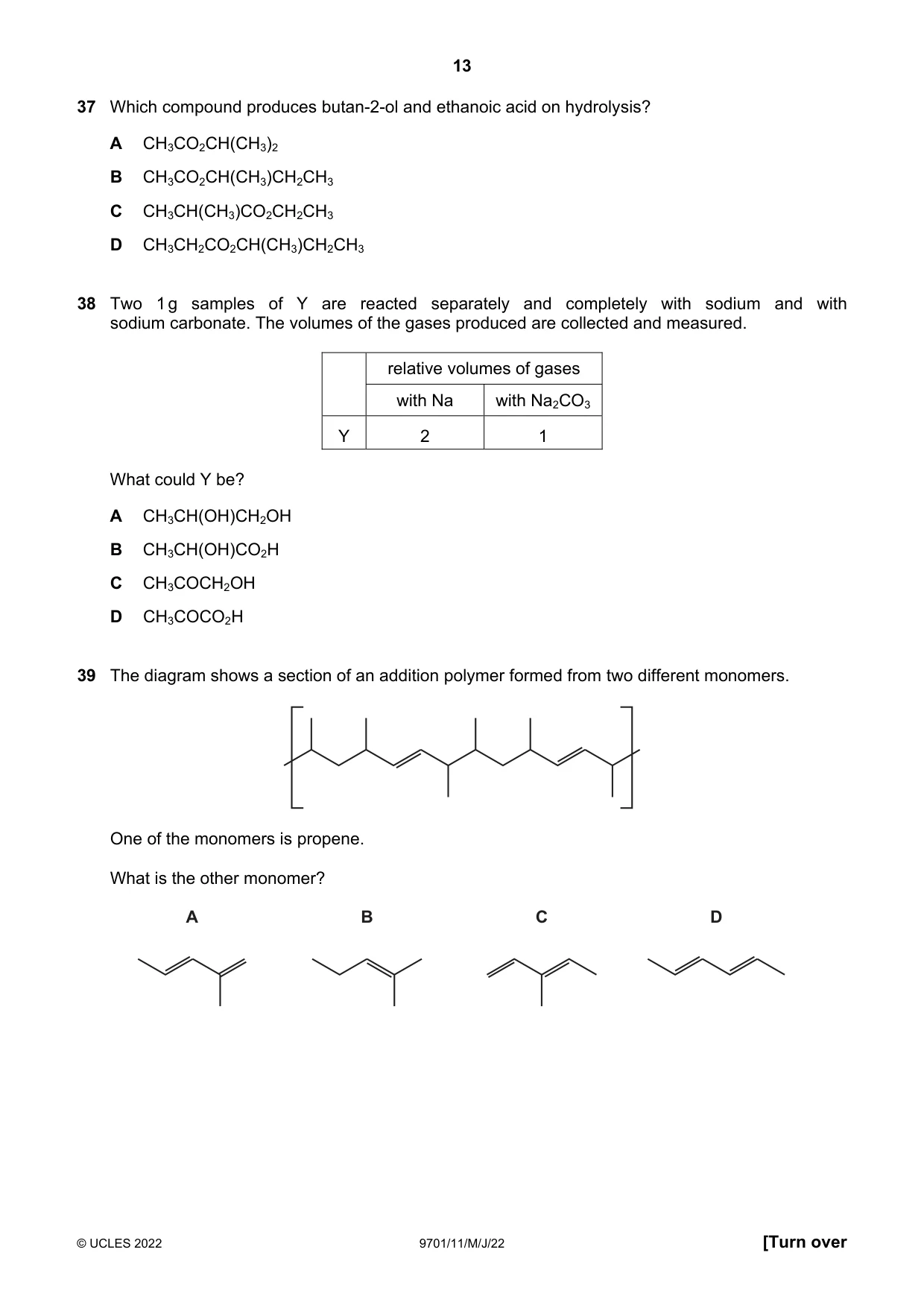
37 Which compound produces butan-2-ol and ethanoic acid on hydrolysis? A CH3CO2CH(CH3)2 B CH3CO2CH(CH3)CH2CH3 C CH3CH(CH3)CO2CH2CH3 D CH3CH2CO2CH(CH3)CH2CH3
Mark scheme: B
Q38 · Two 1 g samples of Y are reacted separately and completely with sodium and with sodium…
38 Two 1 g samples of Y are reacted separately and completely with sodium and with sodium carbonate. The volumes of the gases produced are collected and measured. relative volumes of gases with Na with Na2CO3 Y 2 1 What could Y be? A CH3CH(OH)CH2OH B CH3CH(OH)CO2H C CH3COCH2OH D CH3COCO2H
Mark scheme: B
Q39 · The diagram shows a section of an addition polymer formed from two different monomers
39 The diagram shows a section of an addition polymer formed from two different monomers. One of the monomers is propene. What is the other monomer? A B C D
Mark scheme: D
Q40 · A scientist chooses either infrared spectroscopy or mass spectrometry to find a…
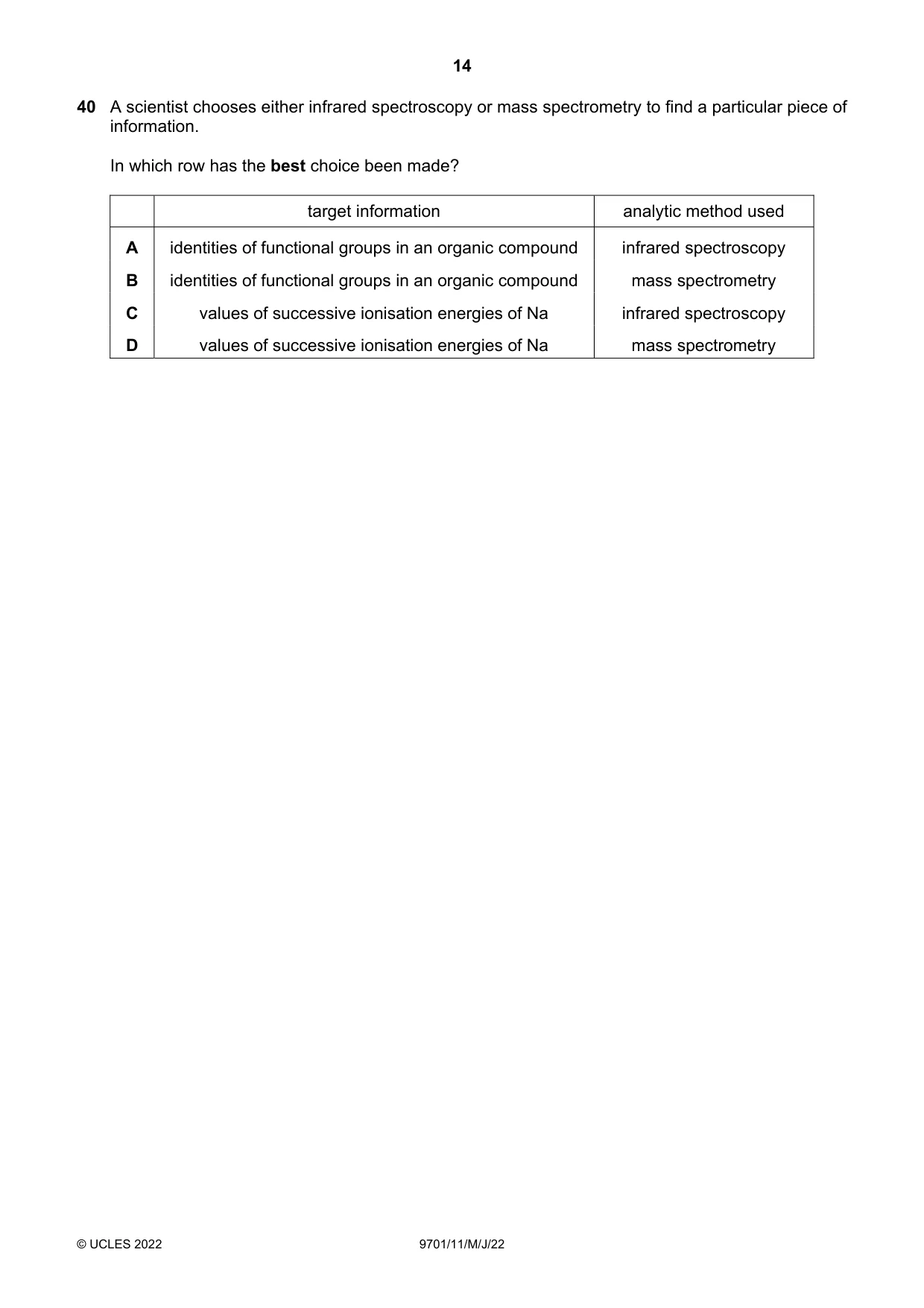
40 A scientist chooses either infrared spectroscopy or mass spectrometry to find a particular piece of information. In which row has the best choice been made? target information analytic method used A identities of functional groups in an organic compound infrared spectroscopy B identities of functional groups in an organic compound mass spectrometry C values of successive ionisation energies of Na infrared spectroscopy D values of successive ionisation energies of Na mass spectrometry
Mark scheme: A
What was in this paper
The subtopics covered by these 40 questions, and how many questions each got. Open one in a new tab to see every Cambridge question on it.
4Periodicity of chemical properties of the elements in Period 33Reacting masses and volumes (of solutions and gases)3Similarities and trends in the properties of the Group 2 metals, magnesium to barium, and their compounds3Chemical equilibria: reversible reactions, dynamic equilibrium2Enthalpy change, ΔH2Isomerism: structural isomerism and stereoisomerism2Some reactions of the halide ions2Addition polymerisation1Alcohols1Aldehydes and ketones1Alkanes1Carboxylic acids1Covalent bonding and coordinate (dative covalent) bonding1Effect of temperature on reaction rates and the concept of activation energy1Electrons, energy levels and atomic orbitals1Esters1Halogen compounds1Halogenoalkanes1Infrared spectroscopy1Intermolecular forces, electronegativity and bond properties1Isomerism: optical1Nitriles and hydroxynitriles1Particles in the atom and atomic radius1Shapes of molecules1The chemical properties of the halogen elements and the hydrogen halides1The gaseous state: ideal and real gases and pV = nRT1What you needed in this session
Cambridge’s own grade thresholds for 2022 May/June, Paper 1 · Variant 1. A higher threshold means an easier paper — the bar moves with how the cohort did.