Cambridge A Level Chemistry 9701 — 2011 May/June Paper 1 · Variant 2
9701/12/M/J/11 · 40 questions · 40 marks · ≈45 min
The question paper and its mark scheme, free to read here and free to download. This is Cambridge’s own paper, exactly as it was sat.
Question paper16 pages

Mark scheme2 pages
Answers below. Sit the paper first if you are practising.
Questions as text
Q1 · Helium, He, is the second element in the Periodic Table
1 Helium, He, is the second element in the Periodic Table. Tritium is the isotope of hydrogen 3H. What is the same in an atom of 4He and an atom of 3H? A the number of electrons B the number of neutrons C the number of protons D the relative atomic mass
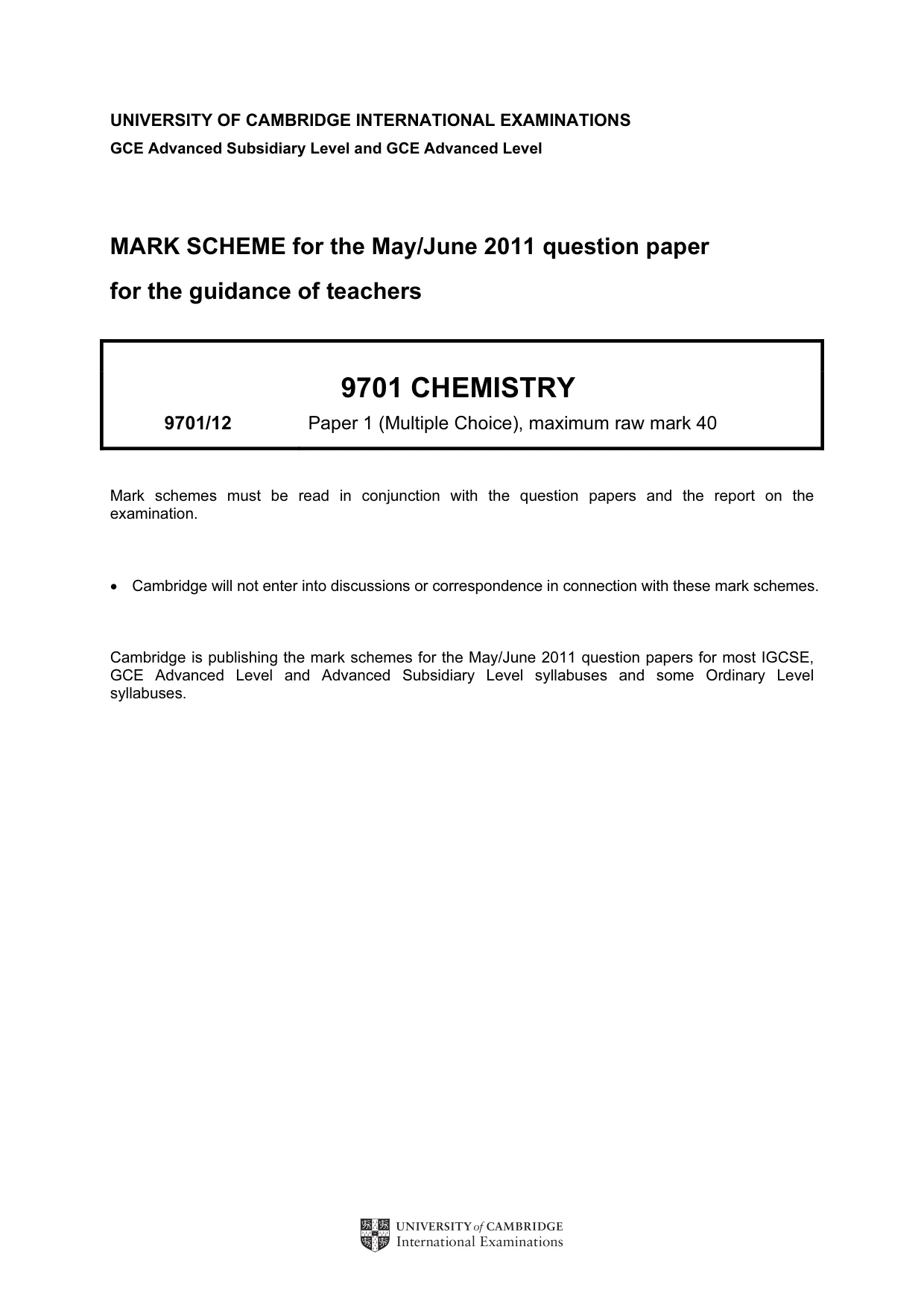
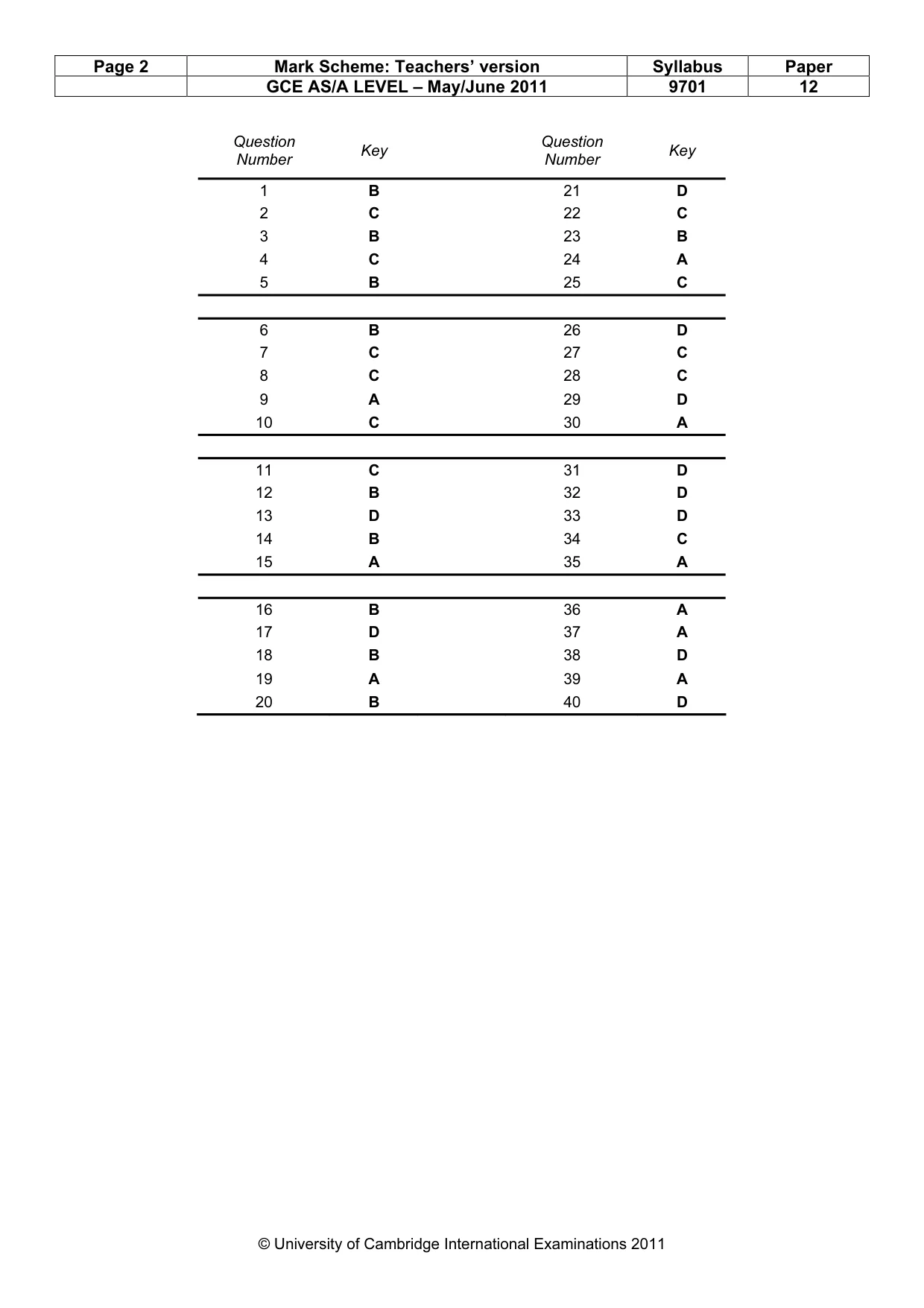
Mark scheme: B
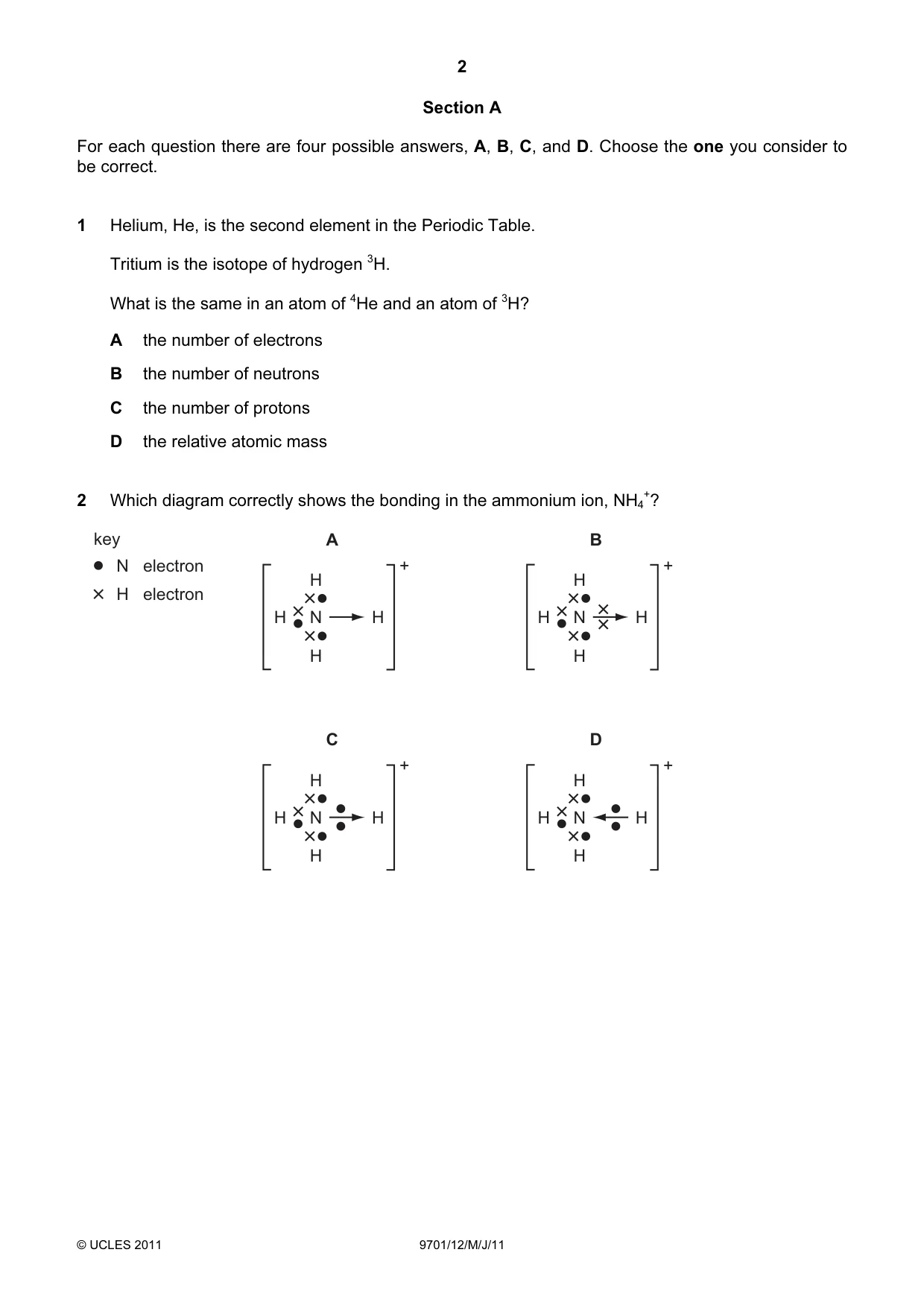
Q2 · Which diagram correctly shows the bonding in the ammonium ion, NH4 +?
2 Which diagram correctly shows the bonding in the ammonium ion, NH4 +? key A B N electron + + H H H electron H N H H N H H H C D + + H H H N H H N H H H
Mark scheme: C
More questions on Covalent bonding and coordinate (dative covalent) bonding
Q3 · Aluminium is the most abundant metal in the Earth’s crust
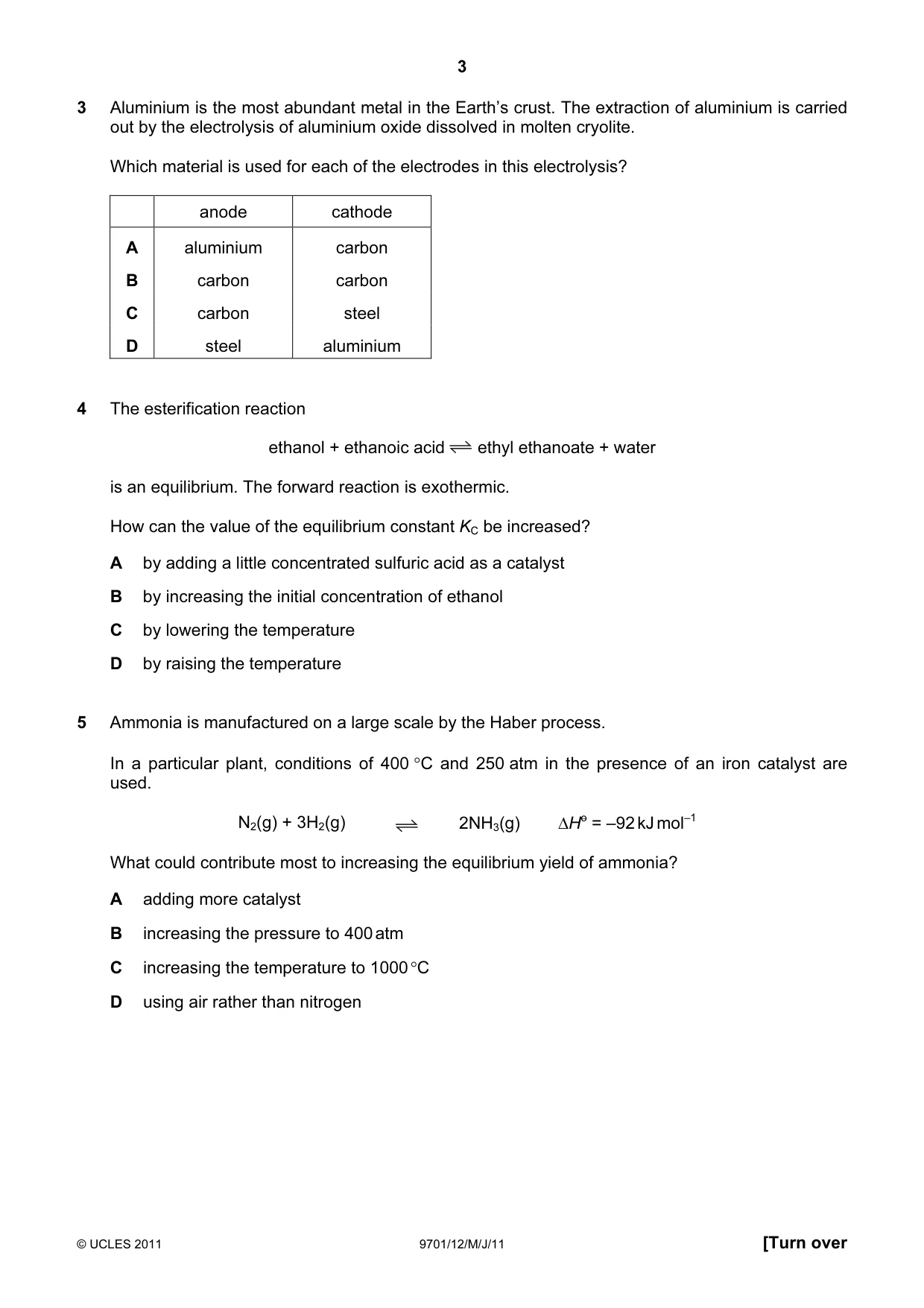
3 Aluminium is the most abundant metal in the Earth’s crust. The extraction of aluminium is carried out by the electrolysis of aluminium oxide dissolved in molten cryolite. Which material is used for each of the electrodes in this electrolysis? anode cathode A aluminium carbon B carbon carbon C carbon steel D steel aluminium
Mark scheme: B
Q4 · The esterification reaction ethanol + ethanoic acid ethyl ethanoate + water is an…
4 The esterification reaction ethanol + ethanoic acid ethyl ethanoate + water is an equilibrium. The forward reaction is exothermic. How can the value of the equilibrium constant KC be increased? A by adding a little concentrated sulfuric acid as a catalyst B by increasing the initial concentration of ethanol C by lowering the temperature D by raising the temperature
Mark scheme: C
More questions on Chemical equilibria: reversible reactions, dynamic equilibrium
Q5 · Ammonia is manufactured on a large scale by the Haber process
5 Ammonia is manufactured on a large scale by the Haber process. In a particular plant, conditions of 400 °C and 250 atm in the presence of an iron catalyst are used. N2(g) + 3H2(g) 2NH3(g) ∆Ho = –92 kJ mol–1 What could contribute most to increasing the equilibrium yield of ammonia? A adding more catalyst B increasing the pressure to 400 atm C increasing the temperature to 1000 °C D using air rather than nitrogen
Mark scheme: B
More questions on Chemical equilibria: reversible reactions, dynamic equilibrium
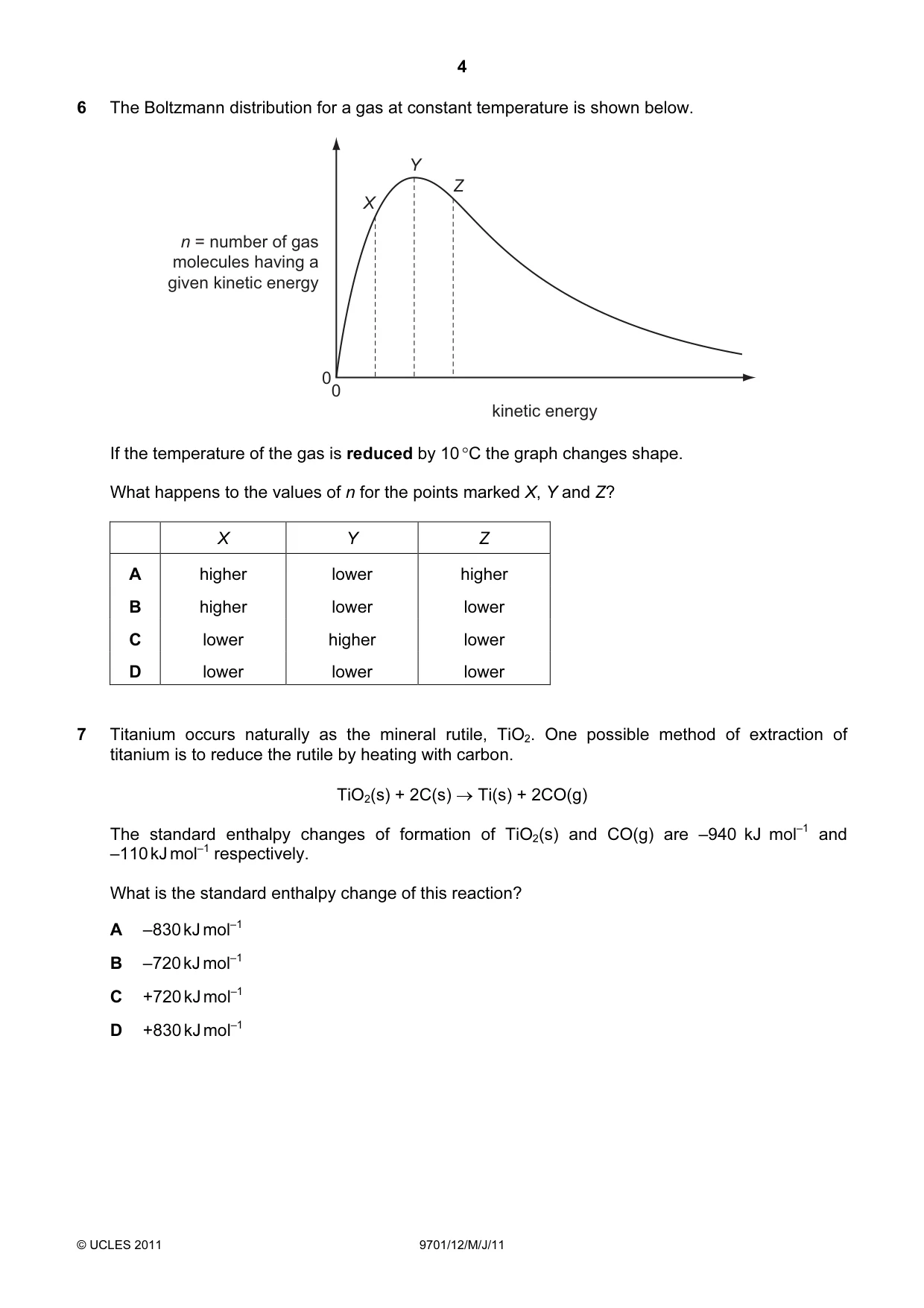
Q6 · The Boltzmann distribution for a gas at constant temperature is shown below
6 The Boltzmann distribution for a gas at constant temperature is shown below. Y Z X n = number of gas molecules having a given kinetic energy 0 0 kinetic energy If the temperature of the gas is reduced by 10 °C the graph changes shape. What happens to the values of n for the points marked X, Y and Z? X Y Z A higher lower higher B higher lower lower C lower higher lower D lower lower lower
Mark scheme: B
More questions on Effect of temperature on reaction rates and the concept of activation energy
Q7 · Titanium occurs naturally as the mineral rutile, TiO2
7 Titanium occurs naturally as the mineral rutile, TiO2. One possible method of extraction of titanium is to reduce the rutile by heating with carbon. TiO2(s) + 2C(s) → Ti(s) + 2CO(g) The standard enthalpy changes of formation of TiO2(s) and CO(g) are –940 kJ mol–1 and –110 kJ mol–1 respectively. What is the standard enthalpy change of this reaction? A –830 kJ mol–1 B –720 kJ mol–1 C +720 kJ mol–1 D +830 kJ mol–1
Mark scheme: C
Q8 · Which reaction has an enthalpy change equal to the standard enthalpy change of formation…
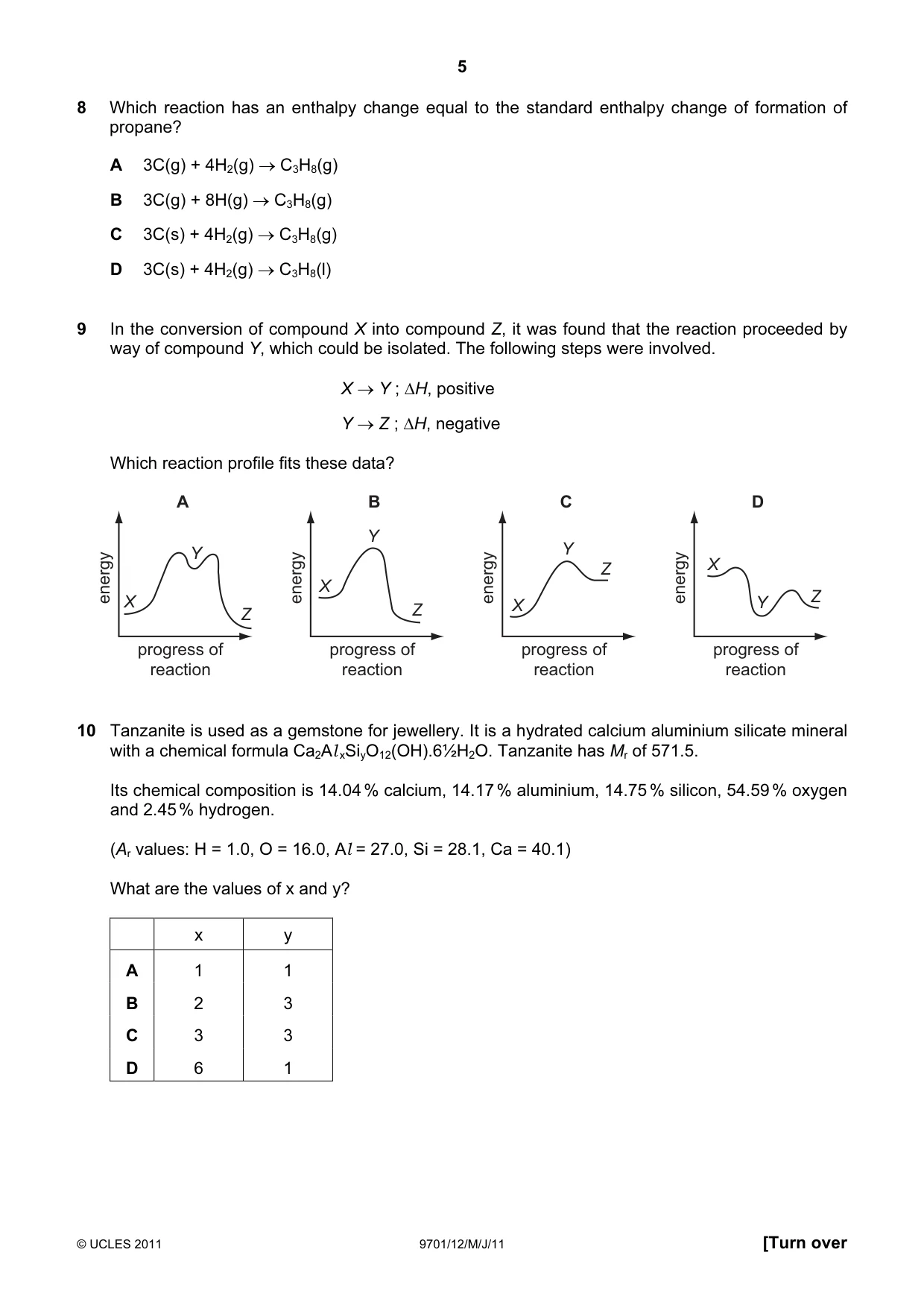
8 Which reaction has an enthalpy change equal to the standard enthalpy change of formation of propane? A 3C(g) + 4H2(g) → C3H8(g) B 3C(g) + 8H(g) → C3H8(g) C 3C(s) + 4H2(g) → C3H8(g) D 3C(s) + 4H2(g) → C3H8(l)
Mark scheme: C
Q9 · In the conversion of compound X into compound Z, it was found that the reaction proceeded…
9 In the conversion of compound X into compound Z, it was found that the reaction proceeded by way of compound Y, which could be isolated. The following steps were involved. X → Y ; ∆H, positive Y → Z ; ∆H, negative Which reaction profile fits these data? A B C D Y Y Y energy energy energy energy X Z X X Y Z Z X Z progress of progress of progress of progress of reaction reaction reaction reaction
Mark scheme: A
Q10 · Tanzanite is used as a gemstone for jewellery
10 Tanzanite is used as a gemstone for jewellery. It is a hydrated calcium aluminium silicate mineral with a chemical formula Ca2Al xSiyO12(OH).6½H2O. Tanzanite has Mr of 571.5. Its chemical composition is 14.04 % calcium, 14.17 % aluminium, 14.75 % silicon, 54.59 % oxygen and 2.45 % hydrogen. (Ar values: H = 1.0, O = 16.0, Al = 27.0, Si = 28.1, Ca = 40.1) What are the values of x and y? x y A 1 1 B 2 3 C 3 3 D 6 1
Mark scheme: C
Q11 · 0.144 g of an aluminium compound X react with an excess of water, to produce a gas
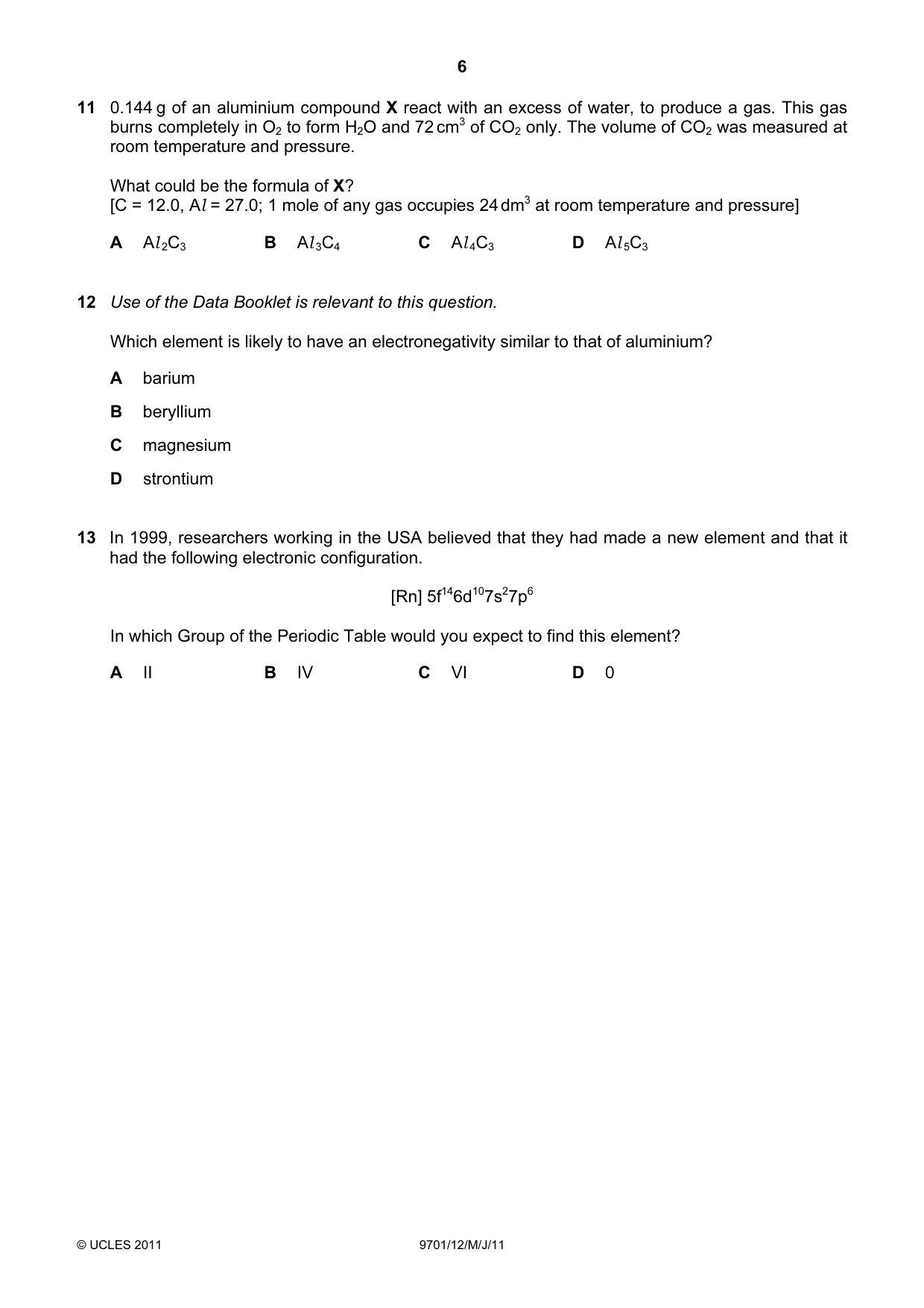
11 0.144 g of an aluminium compound X react with an excess of water, to produce a gas. This gas burns completely in O2 to form H2O and 72 cm3 of CO2 only. The volume of CO2 was measured at room temperature and pressure. What could be the formula of X? [C = 12.0, Al = 27.0; 1 mole of any gas occupies 24 dm3 at room temperature and pressure] A Al 2C3 B Al 3C4 C Al 4C3 D Al 5C3
Mark scheme: C
More questions on Reacting masses and volumes (of solutions and gases)
Q12 · Use of the Data Booklet is relevant to this question
12 Use of the Data Booklet is relevant to this question. Which element is likely to have an electronegativity similar to that of aluminium? A barium B beryllium C magnesium D strontium
Mark scheme: B
Q13 · In 1999, researchers working in the USA believed that they had made a new element and…
13 In 1999, researchers working in the USA believed that they had made a new element and that it had the following electronic configuration. [Rn] 5f146d107s27p6 In which Group of the Periodic Table would you expect to find this element? A II B IV C VI D 0
Mark scheme: D
More questions on Electrons, energy levels and atomic orbitals
Q14 · The highest oxides of the elements sodium to chlorine are separately added to water
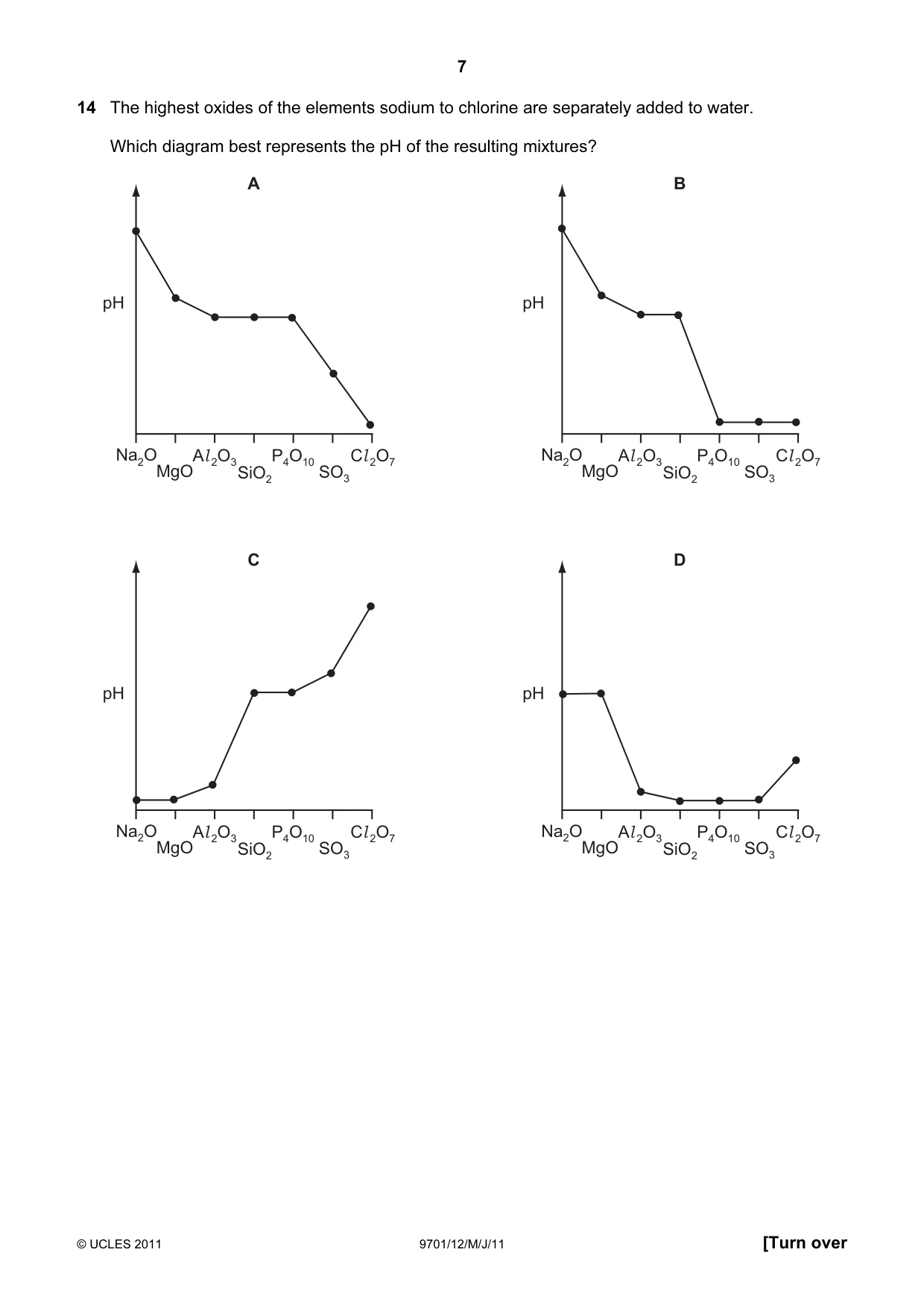
14 The highest oxides of the elements sodium to chlorine are separately added to water. Which diagram best represents the pH of the resulting mixtures? A B pH pH Na2O Al 2O3SiO2 P4O10 SO3 Cl 2O7 Na2O Al 2O3SiO2 P4O10 SO3 Cl 2O7 MgO MgO C D pH pH Na2O Al 2O3SiO2 P4O10 SO3 Cl 2O7 Na2O Al 2O3SiO2 P4O10 SO3 Cl 2O7 MgO MgO
Mark scheme: B
More questions on Periodicity of chemical properties of the elements in Period 3
Q15 · The diagram shows the first ionisation energies of 11 consecutive elements
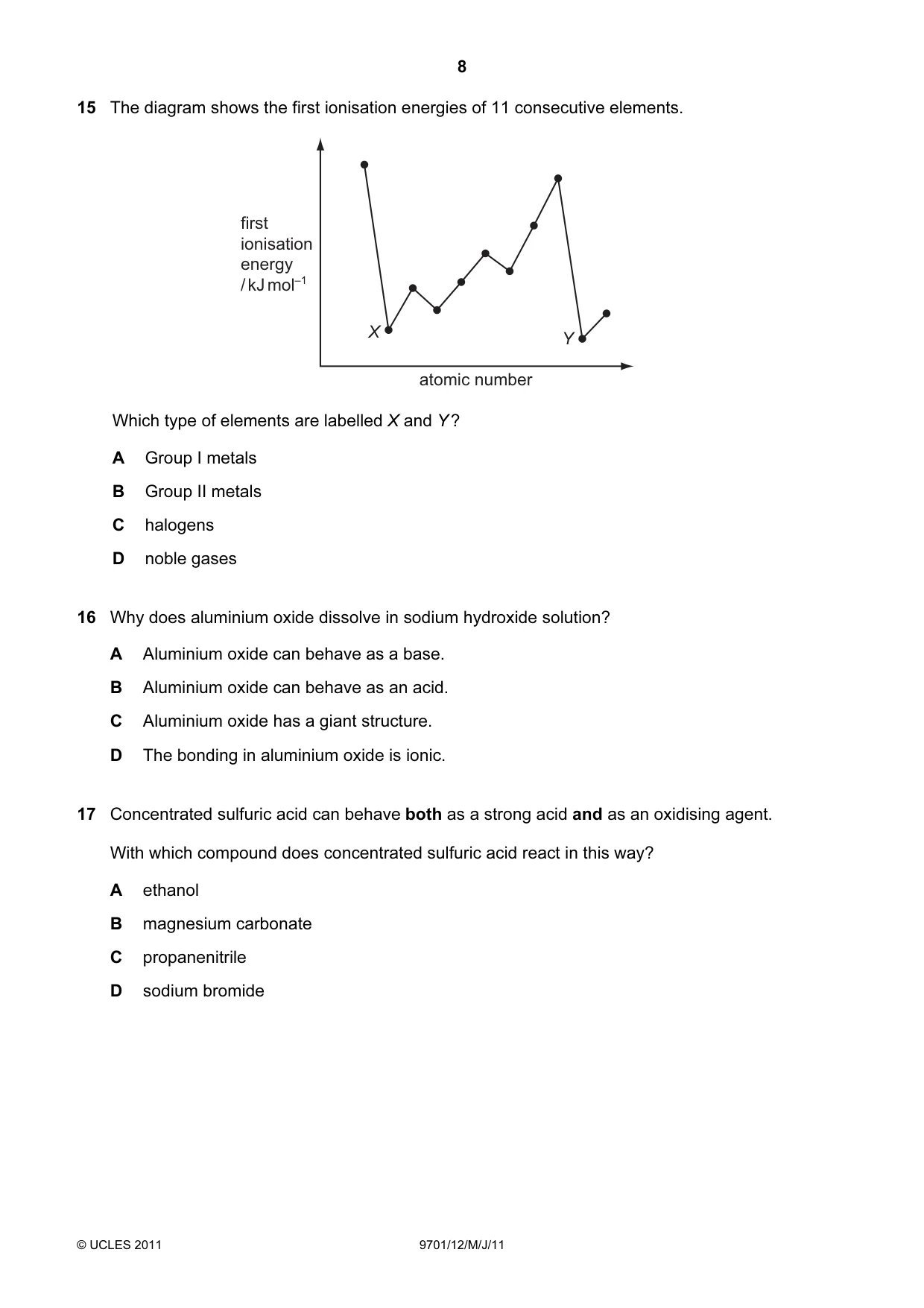
15 The diagram shows the first ionisation energies of 11 consecutive elements. first ionisation energy / kJ mol–1 X Y atomic number Which type of elements are labelled X and Y ? A Group I metals B Group II metals C halogens D noble gases
Mark scheme: A
Q16 · Why does aluminium oxide dissolve in sodium hydroxide solution?
16 Why does aluminium oxide dissolve in sodium hydroxide solution? A Aluminium oxide can behave as a base. B Aluminium oxide can behave as an acid. C Aluminium oxide has a giant structure. D The bonding in aluminium oxide is ionic.
Mark scheme: B
More questions on Periodicity of chemical properties of the elements in Period 3
Q17 · Concentrated sulfuric acid can behave both as a strong acid and as an oxidising agent
17 Concentrated sulfuric acid can behave both as a strong acid and as an oxidising agent. With which compound does concentrated sulfuric acid react in this way? A ethanol B magnesium carbonate C propanenitrile D sodium bromide
Mark scheme: D
Q18 · In the Contact process, what is the nature of the gaseous product and what is the…
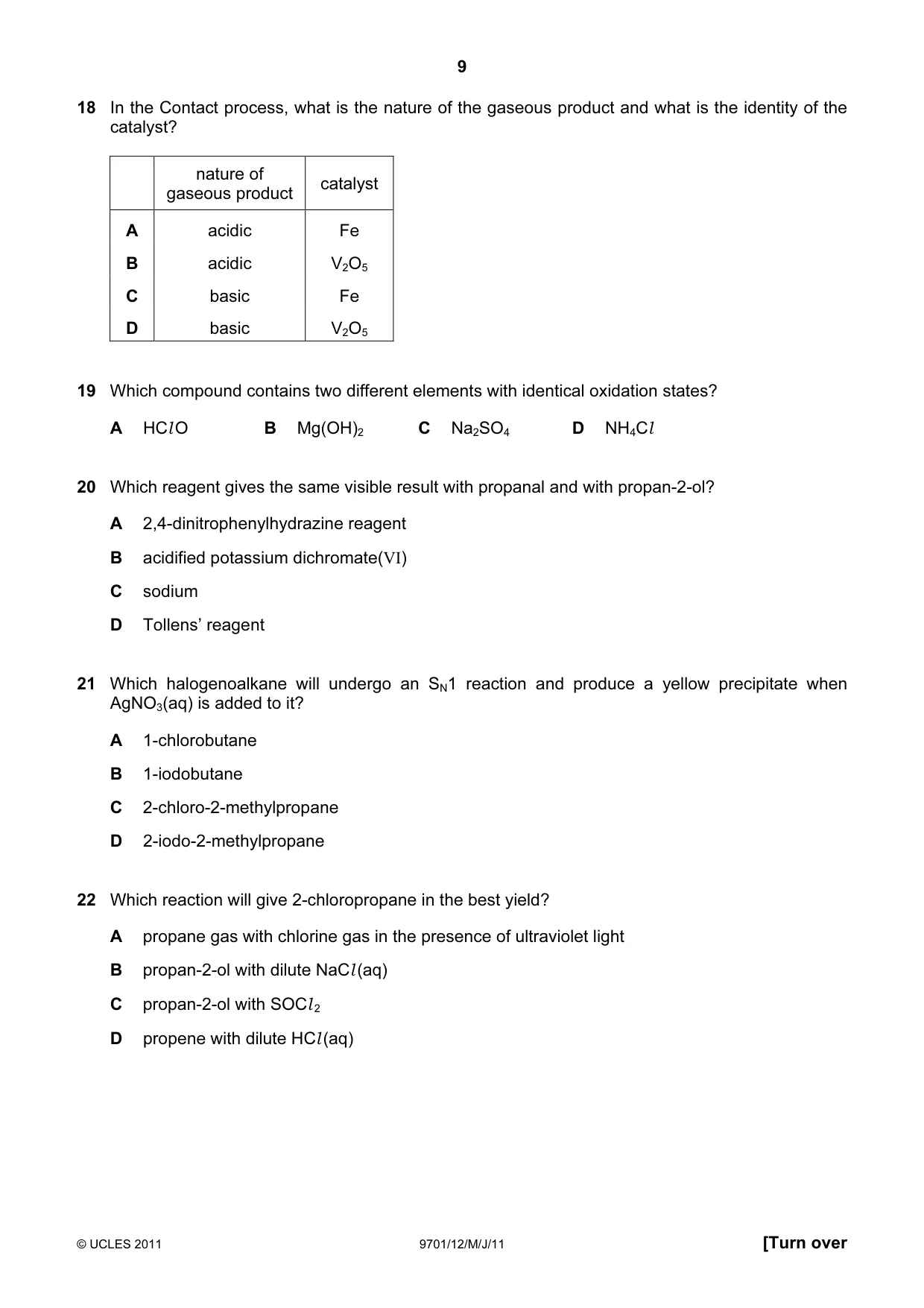
18 In the Contact process, what is the nature of the gaseous product and what is the identity of the catalyst? nature of catalyst gaseous product A acidic Fe B acidic V2O5 C basic Fe D basic V2O5
Mark scheme: B
Q19 · Which compound contains two different elements with identical oxidation states?
19 Which compound contains two different elements with identical oxidation states? A HCl O B Mg(OH)2 C Na2SO4 D NH4Cl
Mark scheme: A
Q20 · Which reagent gives the same visible result with propanal and with propan-2-ol?
20 Which reagent gives the same visible result with propanal and with propan-2-ol? A 2,4-dinitrophenylhydrazine reagent B acidified potassium dichromate(VI) C sodium D Tollens’ reagent
Mark scheme: B
Q21 · Which halogenoalkane will undergo an SN1 reaction and produce a yellow precipitate when…
21 Which halogenoalkane will undergo an SN1 reaction and produce a yellow precipitate when AgNO3(aq) is added to it? A 1-chlorobutane B 1-iodobutane C 2-chloro-2-methylpropane D 2-iodo-2-methylpropane
Mark scheme: D
Q22 · Which reaction will give 2-chloropropane in the best yield?
22 Which reaction will give 2-chloropropane in the best yield? A propane gas with chlorine gas in the presence of ultraviolet light B propan-2-ol with dilute NaCl (aq) C propan-2-ol with SOCl 2 D propene with dilute HCl (aq)
Mark scheme: C
Q23 · The products obtained by cracking an alkane, X, are methane, ethene and propene
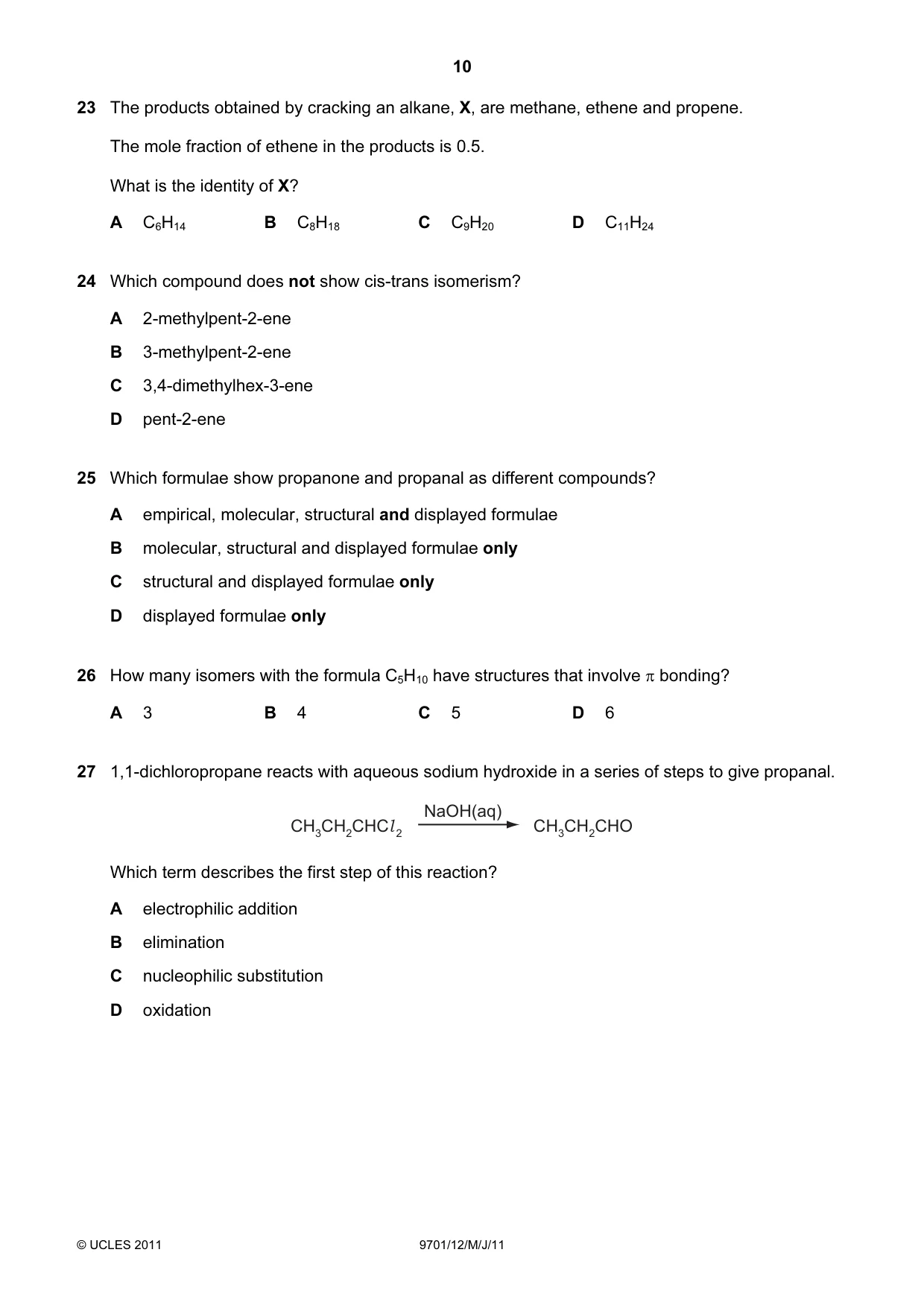
23 The products obtained by cracking an alkane, X, are methane, ethene and propene. The mole fraction of ethene in the products is 0.5. What is the identity of X? A C6H14 B C8H18 C C9H20 D C11H24
Mark scheme: B
Q24 · Which compound does not show cis-trans isomerism?
24 Which compound does not show cis-trans isomerism? A 2-methylpent-2-ene B 3-methylpent-2-ene C 3,4-dimethylhex-3-ene D pent-2-ene
Mark scheme: A
More questions on Isomerism: structural isomerism and stereoisomerism
Q25 · Which formulae show propanone and propanal as different compounds?
25 Which formulae show propanone and propanal as different compounds? A empirical, molecular, structural and displayed formulae B molecular, structural and displayed formulae only C structural and displayed formulae only D displayed formulae only
Mark scheme: C
More questions on Formulas, functional groups and the naming of organic compounds
Q26 · How many isomers with the formula C5H10 have structures that involve π bonding?
26 How many isomers with the formula C5H10 have structures that involve π bonding? A 3 B 4 C 5 D 6
Mark scheme: D
More questions on Shapes of organic molecules; σ and π bonds
Q27 · 1,1-dichloropropane reacts with aqueous sodium hydroxide in a series of steps to give…
27 1,1-dichloropropane reacts with aqueous sodium hydroxide in a series of steps to give propanal. NaOH(aq) CH3CH2CHCl 2 CH3CH2CHO Which term describes the first step of this reaction? A electrophilic addition B elimination C nucleophilic substitution D oxidation
Mark scheme: C
Q28 · The ester CH3CH2CH2CO2CH3 is responsible for the aroma of apples
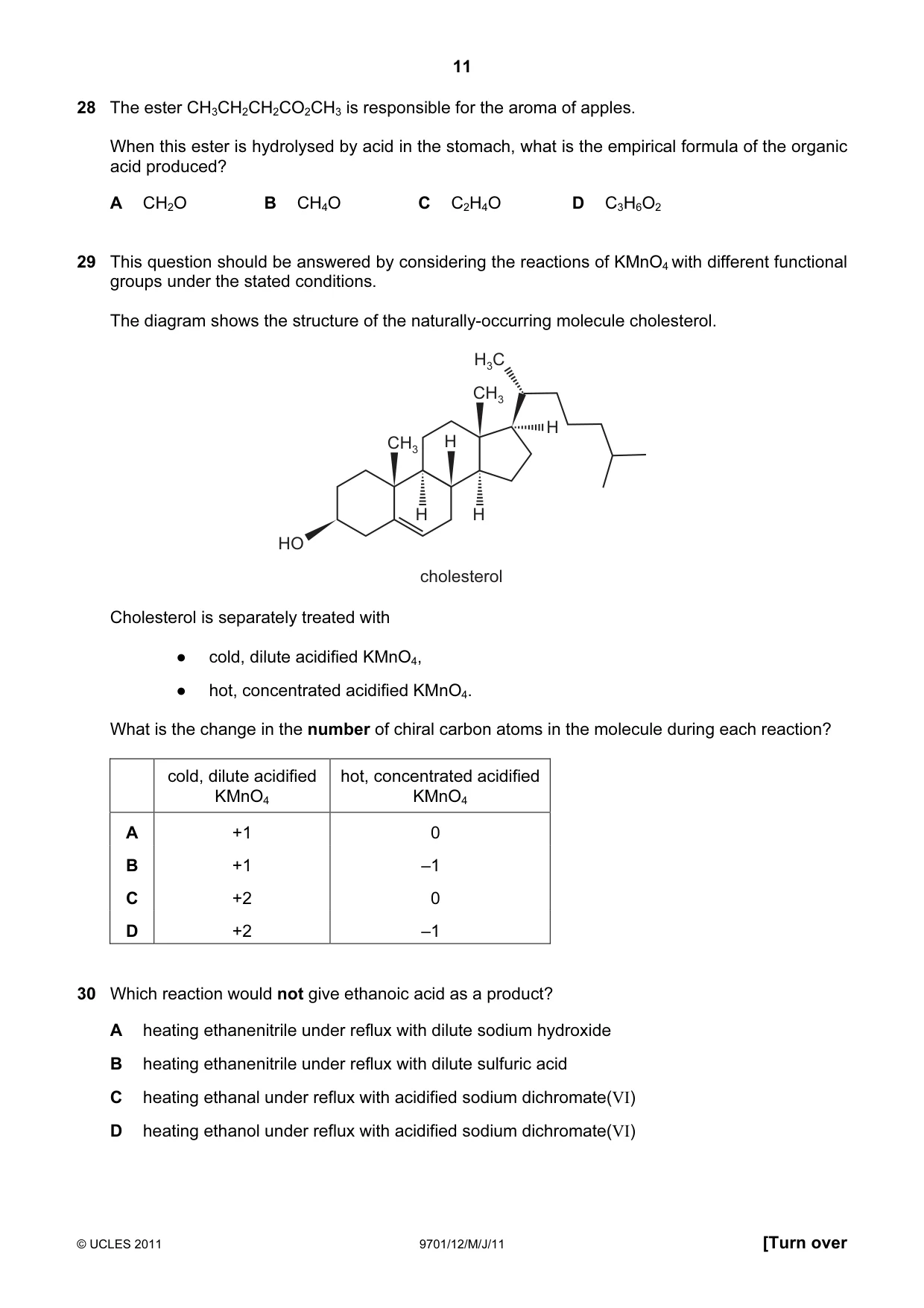
28 The ester CH3CH2CH2CO2CH3 is responsible for the aroma of apples. When this ester is hydrolysed by acid in the stomach, what is the empirical formula of the organic acid produced? A CH2O B CH4O C C2H4O D C3H6O2
Mark scheme: C
Q29 · This question should be answered by considering the reactions of KMnO4 with different…
29 This question should be answered by considering the reactions of KMnO4 with different functional groups under the stated conditions. The diagram shows the structure of the naturally-occurring molecule cholesterol. H3C CH3 H CH3 H H H HO cholesterol Cholesterol is separately treated with ● cold, dilute acidified KMnO4, ● hot, concentrated acidified KMnO4. What is the change in the number of chiral carbon atoms in the molecule during each reaction? cold, dilute acidified hot, concentrated acidified KMnO4 KMnO4 A +1 0 B +1 –1 C +2 0 D +2 –1
Mark scheme: D
Q30 · Which reaction would not give ethanoic acid as a product?
30 Which reaction would not give ethanoic acid as a product? A heating ethanenitrile under reflux with dilute sodium hydroxide B heating ethanenitrile under reflux with dilute sulfuric acid C heating ethanal under reflux with acidified sodium dichromate(VI) D heating ethanol under reflux with acidified sodium dichromate(VI)
Mark scheme: A
Q31 · Solid calcium carbonate is added to 100 cm3 of dilute hydrochloric acid and the rate of…
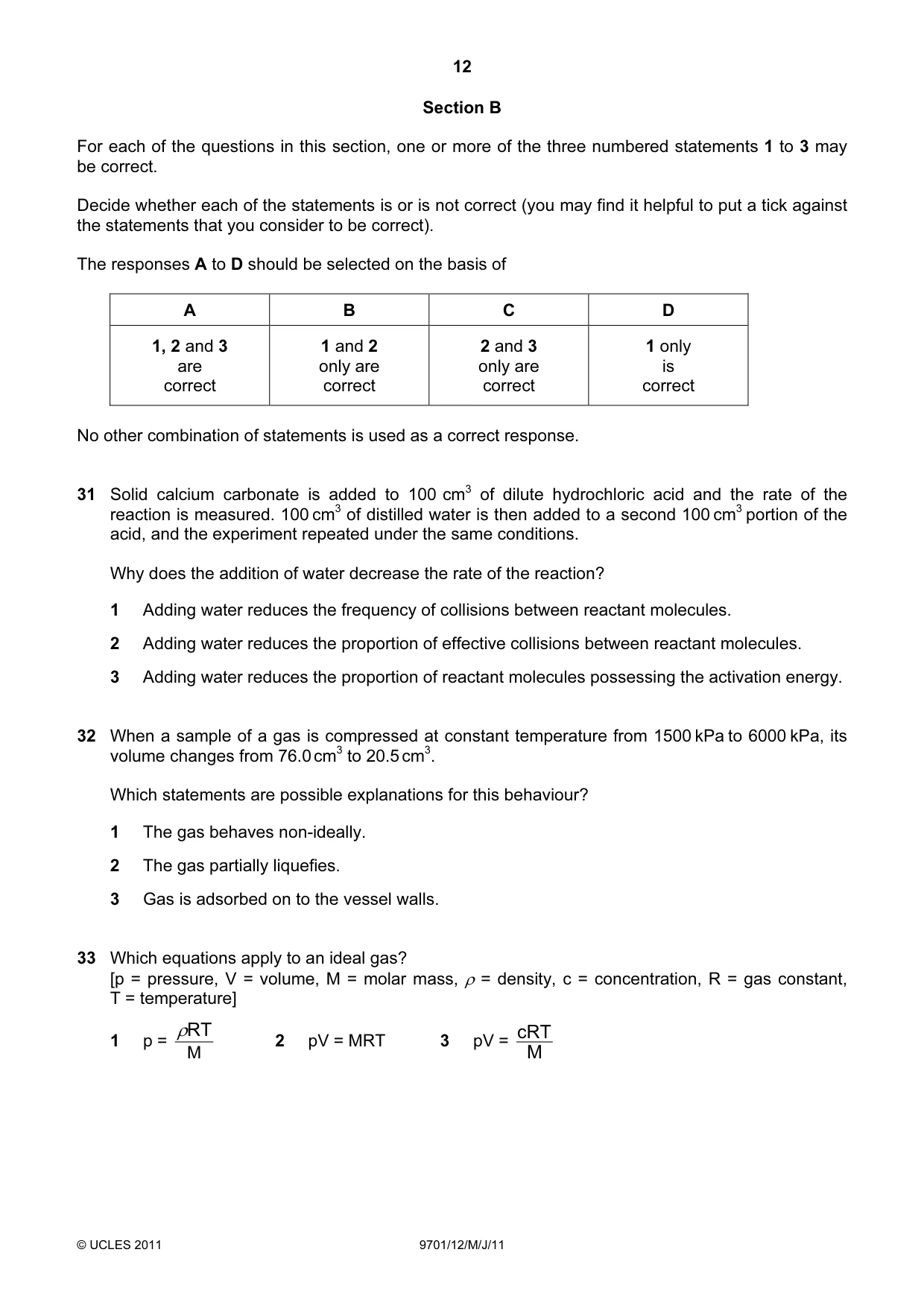
31 Solid calcium carbonate is added to 100 cm3 of dilute hydrochloric acid and the rate of the reaction is measured. 100 cm3 of distilled water is then added to a second 100 cm3 portion of the acid, and the experiment repeated under the same conditions. Why does the addition of water decrease the rate of the reaction? 1 Adding water reduces the frequency of collisions between reactant molecules. 2 Adding water reduces the proportion of effective collisions between reactant molecules. 3 Adding water reduces the proportion of reactant molecules possessing the activation energy.
Mark scheme: D
Q32 · When a sample of a gas is compressed at constant temperature from 1500 kPa to 6000 kPa…
32 When a sample of a gas is compressed at constant temperature from 1500 kPa to 6000 kPa, its volume changes from 76.0 cm3 to 20.5 cm3. Which statements are possible explanations for this behaviour? 1 The gas behaves non-ideally. 2 The gas partially liquefies. 3 Gas is adsorbed on to the vessel walls.
Mark scheme: D
More questions on The gaseous state: ideal and real gases and pV = nRT
Q33 · Which equations apply to an ideal gas?
33 Which equations apply to an ideal gas? [p = pressure, V = volume, M = molar mass, ρ = density, c = concentration, R = gas constant, T = temperature] ρ RT cRT 1 p = 2 pV = MRT 3 pV = M M
Mark scheme: D
More questions on The gaseous state: ideal and real gases and pV = nRT
Q34 · What is involved when a hydrogen bond is formed between two molecules?
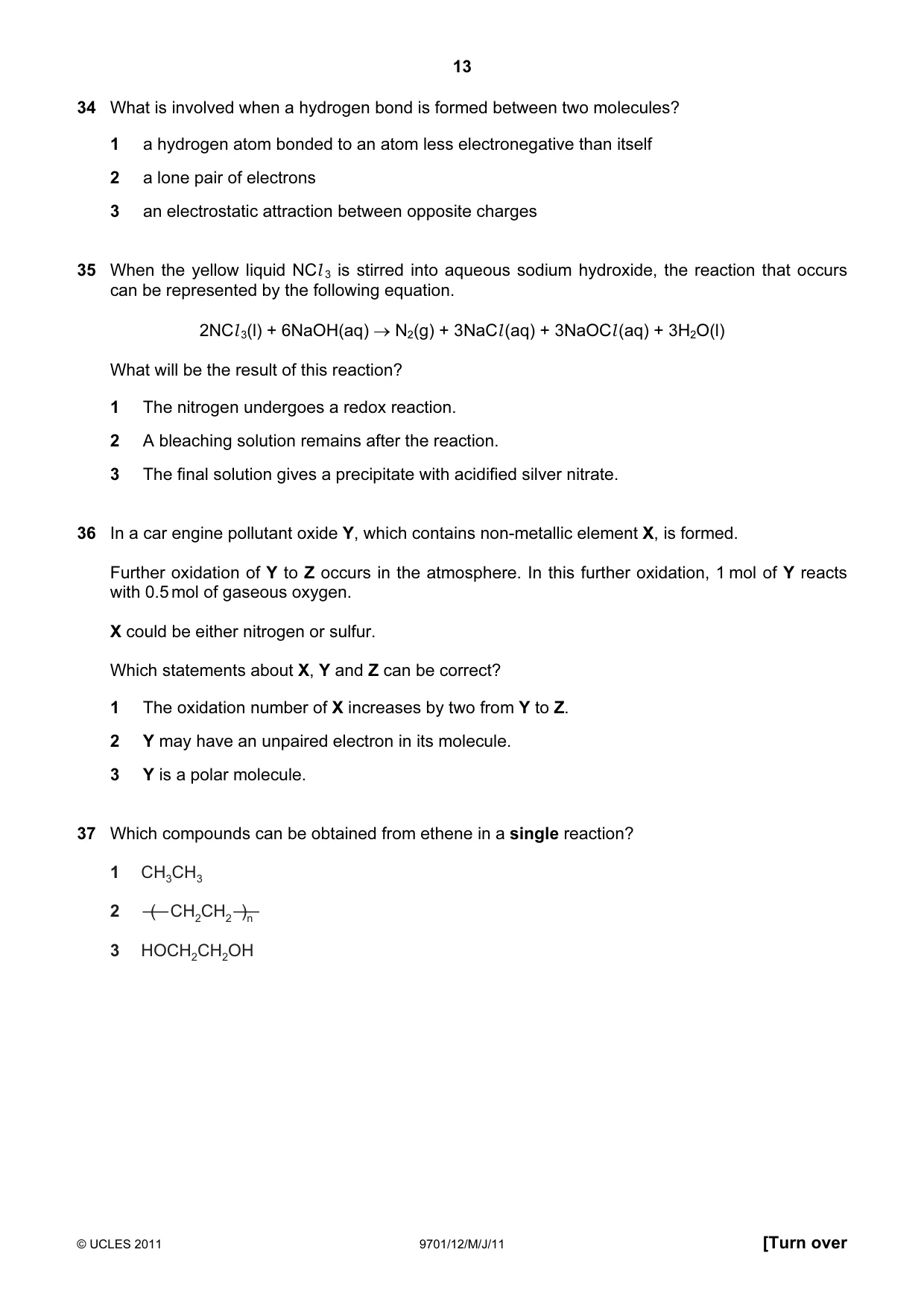
34 What is involved when a hydrogen bond is formed between two molecules? 1 a hydrogen atom bonded to an atom less electronegative than itself 2 a lone pair of electrons 3 an electrostatic attraction between opposite charges
Mark scheme: C
More questions on Intermolecular forces, electronegativity and bond properties
Q35 · When the yellow liquid NCl 3 is stirred into aqueous sodium hydroxide, the reaction that…
35 When the yellow liquid NCl 3 is stirred into aqueous sodium hydroxide, the reaction that occurs can be represented by the following equation. 2NCl 3(l) + 6NaOH(aq) → N2(g) + 3NaCl (aq) + 3NaOCl (aq) + 3H2O(l) What will be the result of this reaction? 1 The nitrogen undergoes a redox reaction. 2 A bleaching solution remains after the reaction. 3 The final solution gives a precipitate with acidified silver nitrate.
Mark scheme: A
Q36 · In a car engine pollutant oxide Y, which contains non-metallic element X, is formed
36 In a car engine pollutant oxide Y, which contains non-metallic element X, is formed. Further oxidation of Y to Z occurs in the atmosphere. In this further oxidation, 1 mol of Y reacts with 0.5 mol of gaseous oxygen. X could be either nitrogen or sulfur. Which statements about X, Y and Z can be correct? 1 The oxidation number of X increases by two from Y to Z. 2 Y may have an unpaired electron in its molecule. 3 Y is a polar molecule.
Mark scheme: A
Q37 · Which compounds can be obtained from ethene in a single reaction?
37 Which compounds can be obtained from ethene in a single reaction? 1 CH3CH3 2 ( CH2CH2 )n 3 HOCH2CH2OH
Mark scheme: A
Q38 · Which compounds when heated under reflux with an excess of hot acidified potassium…
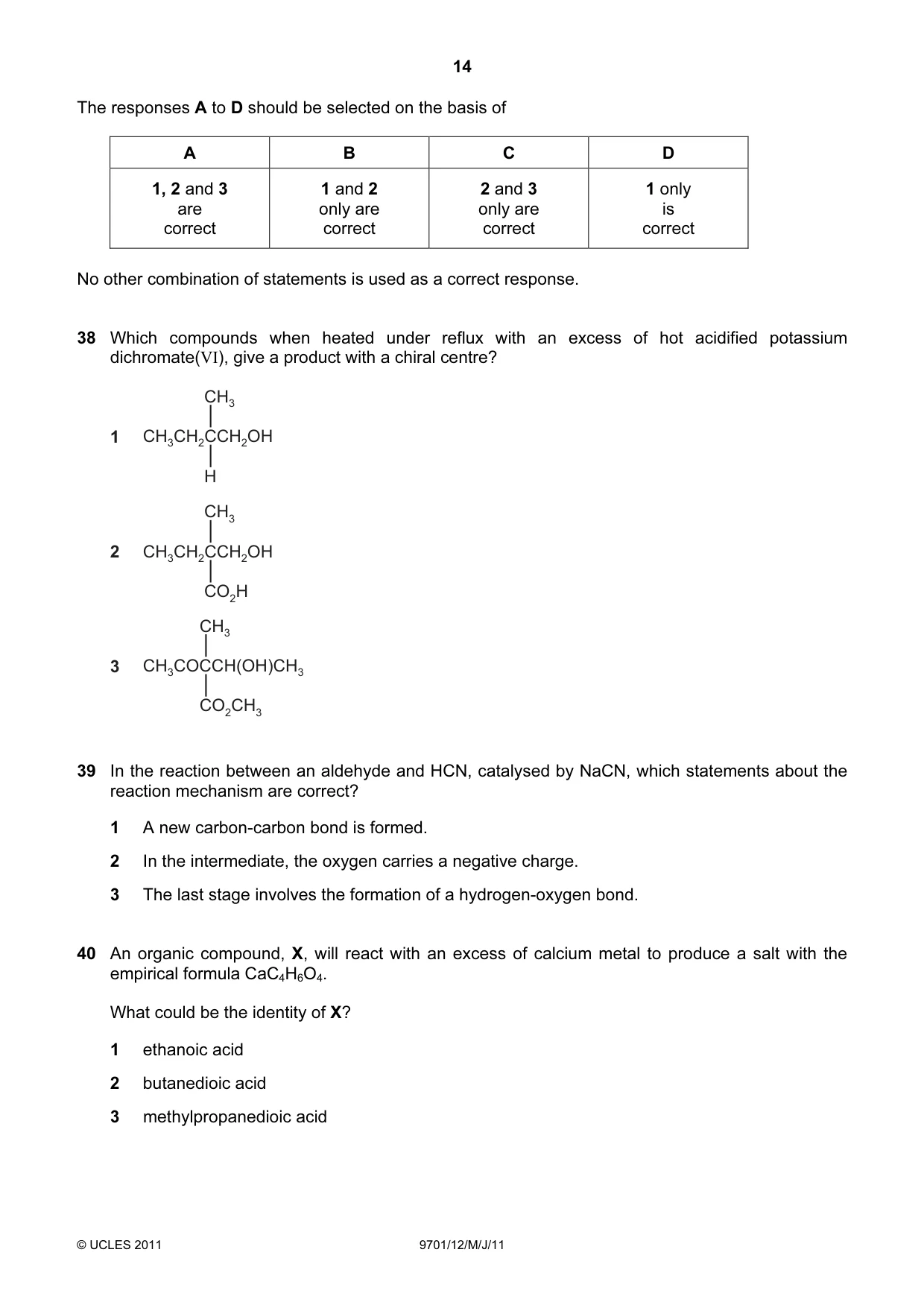
38 Which compounds when heated under reflux with an excess of hot acidified potassium dichromate(VI), give a product with a chiral centre? CH3 1 CH3CH2CCH2OH H CH3 2 CH3CH2CCH2OH CO2H CH3 3 CH3COCCH(OH)CH3 CO2CH3
Mark scheme: D
Q39 · In the reaction between an aldehyde and HCN, catalysed by NaCN, which statements about…
39 In the reaction between an aldehyde and HCN, catalysed by NaCN, which statements about the reaction mechanism are correct? 1 A new carbon-carbon bond is formed. 2 In the intermediate, the oxygen carries a negative charge. 3 The last stage involves the formation of a hydrogen-oxygen bond.
Mark scheme: A
Q40 · An organic compound, X, will react with an excess of calcium metal to produce a salt with…
40 An organic compound, X, will react with an excess of calcium metal to produce a salt with the empirical formula CaC4H6O4. What could be the identity of X? 1 ethanoic acid 2 butanedioic acid 3 methylpropanedioic acid
Mark scheme: D
What was in this paper
The subtopics covered by these 40 questions, and how many questions each got. Open one in a new tab to see every Cambridge question on it.
3Redox processes: electron transfer and changes in oxidation number (oxidation state)3Chemical equilibria: reversible reactions, dynamic equilibrium2Enthalpy change, ΔH2Isomerism: optical2Periodicity of chemical properties of the elements in Period 32The gaseous state: ideal and real gases and pV = nRT2Alcohols1Alkanes1Alkenes1Carboxylic acids1Characteristic organic reactions1Covalent bonding and coordinate (dative covalent) bonding1Effect of temperature on reaction rates and the concept of activation energy1Electrolysis1Electronegativity and bonding1Electrons, energy levels and atomic orbitals1Formulas1Formulas, functional groups and the naming of organic compounds1Hess’s law1Homogeneous and heterogeneous catalysts1Intermolecular forces, electronegativity and bond properties1Ionisation energy1Isomerism: structural isomerism and stereoisomerism1Isotopes1Nitriles and hydroxynitriles1Rate of reaction1Reacting masses and volumes (of solutions and gases)1Relative masses of atoms and molecules1Shapes of organic molecules; σ and π bonds1Some reactions of the halide ions1What you needed in this session
Cambridge’s own grade thresholds for 2011 May/June, Paper 1 · Variant 2. A higher threshold means an easier paper — the bar moves with how the cohort did.