Cambridge A Level Chemistry 9701 — 2024 May/June Paper 1 · Variant 2
9701/12/M/J/24 · 40 questions · 40 marks · ≈45 min
The question paper and its mark scheme, free to read here and free to download. This is Cambridge’s own paper, exactly as it was sat.
Question paper16 pages
Mark scheme3 pages
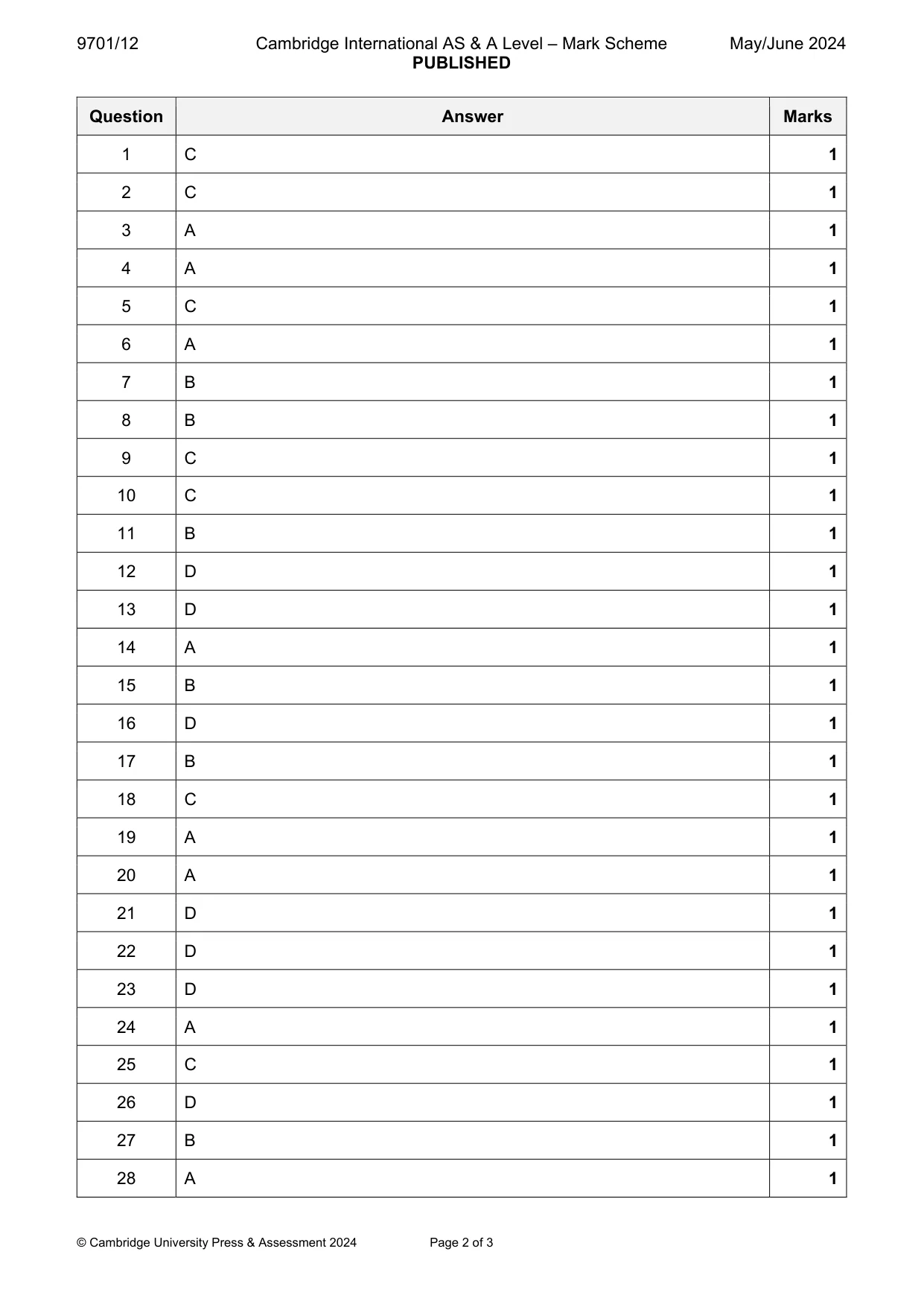
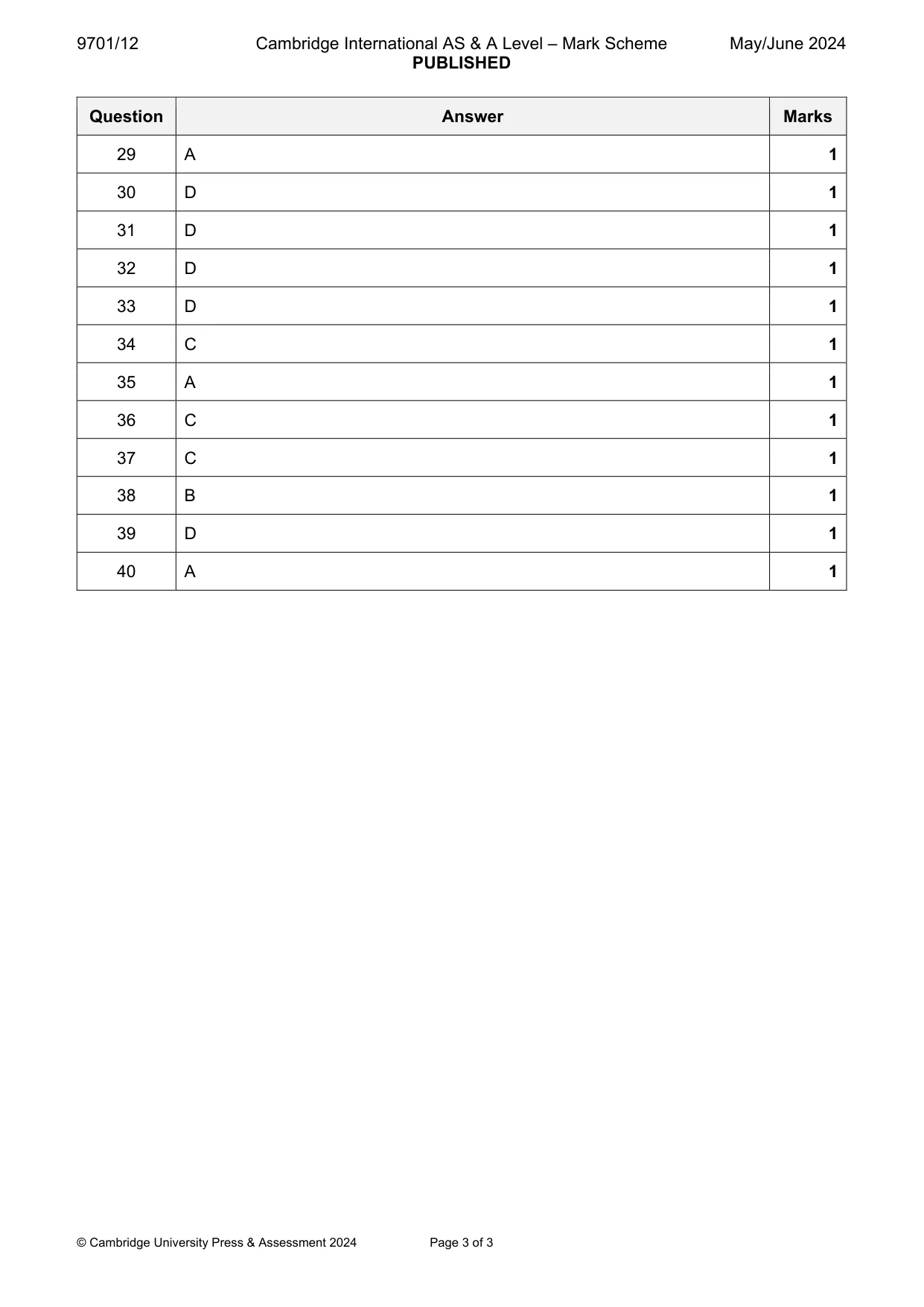
Answers below. Sit the paper first if you are practising.
Questions as text
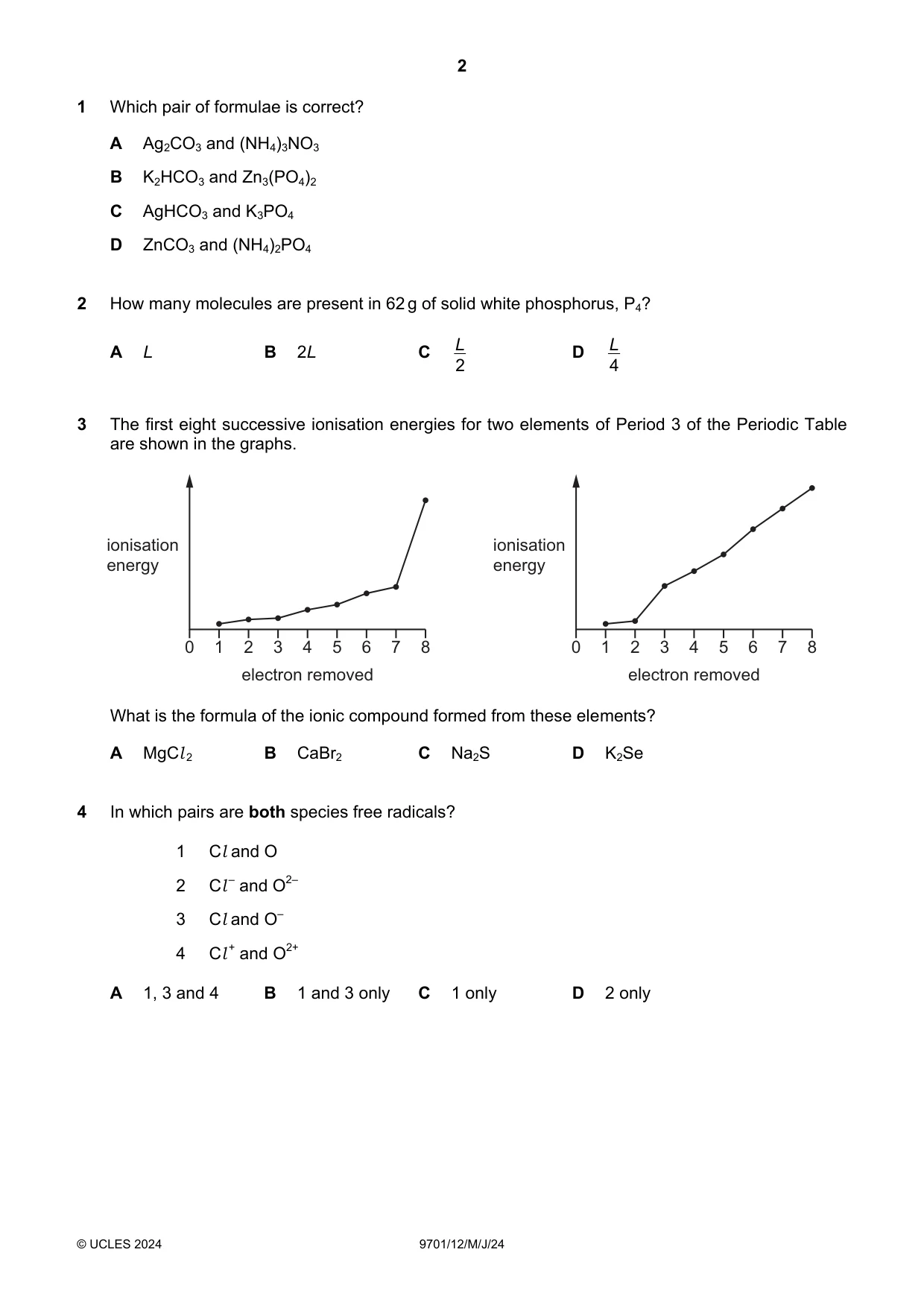
Q1 · Which pair of formulae is correct?
1 Which pair of formulae is correct? A Ag2CO3 and (NH4)3NO3 B K2HCO3 and Zn3(PO4)2 C AgHCO3 and K3PO4 D ZnCO3 and (NH4)2PO4
Mark scheme: C
Q2 · How many molecules are present in 62 g of solid white phosphorus, P4?
2 How many molecules are present in 62 g of solid white phosphorus, P4? A L B 2L C L D L 2 4
Mark scheme: C
Q3 · The first eight successive ionisation energies for two elements of Period 3 of the…
3 The first eight successive ionisation energies for two elements of Period 3 of the Periodic Table are shown in the graphs. ionisation ionisation energy energy 0 1 2 3 4 5 6 7 8 0 1 2 3 4 5 6 7 8 electron removed electron removed What is the formula of the ionic compound formed from these elements? A MgCl 2 B CaBr2 C Na2S D K2Se
Mark scheme: A
Q4 · In which pairs are both species free radicals?
4 In which pairs are both species free radicals? 1 Cl and O 2 Cl – and O2– 3 Cl and O– 4 Cl + and O2+ A 1, 3 and 4 B 1 and 3 only C 1 only D 2 only
Mark scheme: A
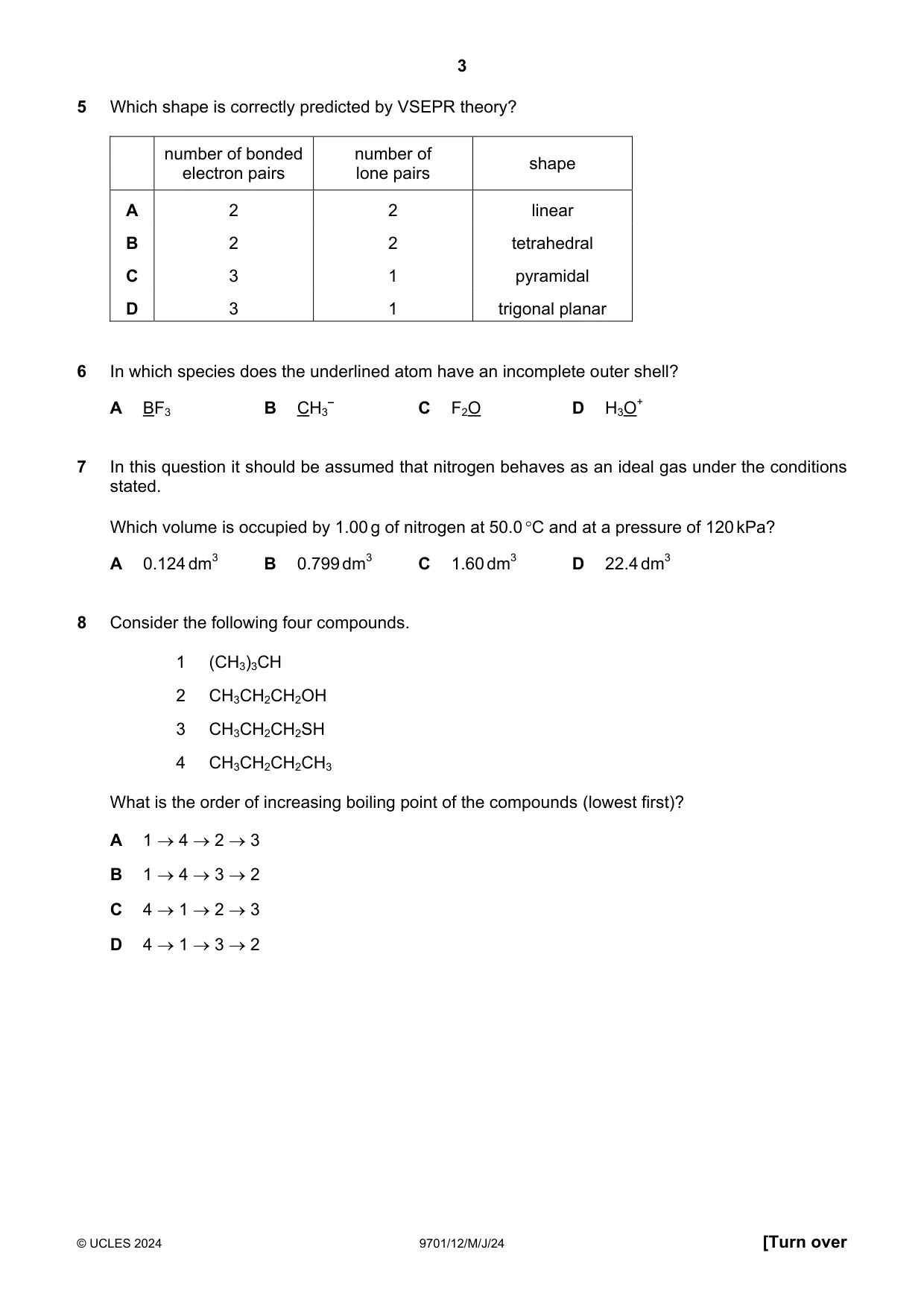
Q5 · Which shape is correctly predicted by VSEPR theory?
5 Which shape is correctly predicted by VSEPR theory? number of bonded number of shape electron pairs lone pairs A 2 2 linear B 2 2 tetrahedral C 3 1 pyramidal D 3 1 trigonal planar
Mark scheme: C
Q6 · In which species does the underlined atom have an incomplete outer shell?
6 In which species does the underlined atom have an incomplete outer shell? A BF3 B CH3 – C F2O D H3O+
Mark scheme: A
More questions on Covalent bonding and coordinate (dative covalent) bonding
Q7 · In this question it should be assumed that nitrogen behaves as an ideal gas under the…
7 In this question it should be assumed that nitrogen behaves as an ideal gas under the conditions stated. Which volume is occupied by 1.00 g of nitrogen at 50.0 C and at a pressure of 120 kPa? A 0.124 dm3 B 0.799 dm3 C 1.60 dm3 D 22.4 dm3
Mark scheme: B
More questions on The gaseous state: ideal and real gases and pV = nRT
Q8 · Consider the following four compounds
8 Consider the following four compounds. 1 (CH3)3CH 2 CH3CH2CH2OH 3 CH3CH2CH2SH 4 CH3CH2CH2CH3 What is the order of increasing boiling point of the compounds (lowest first)? A 1 4 2 3 B 1 4 3 2 C 4 1 2 3 D 4 1 3 2
Mark scheme: B
More questions on Intermolecular forces, electronegativity and bond properties
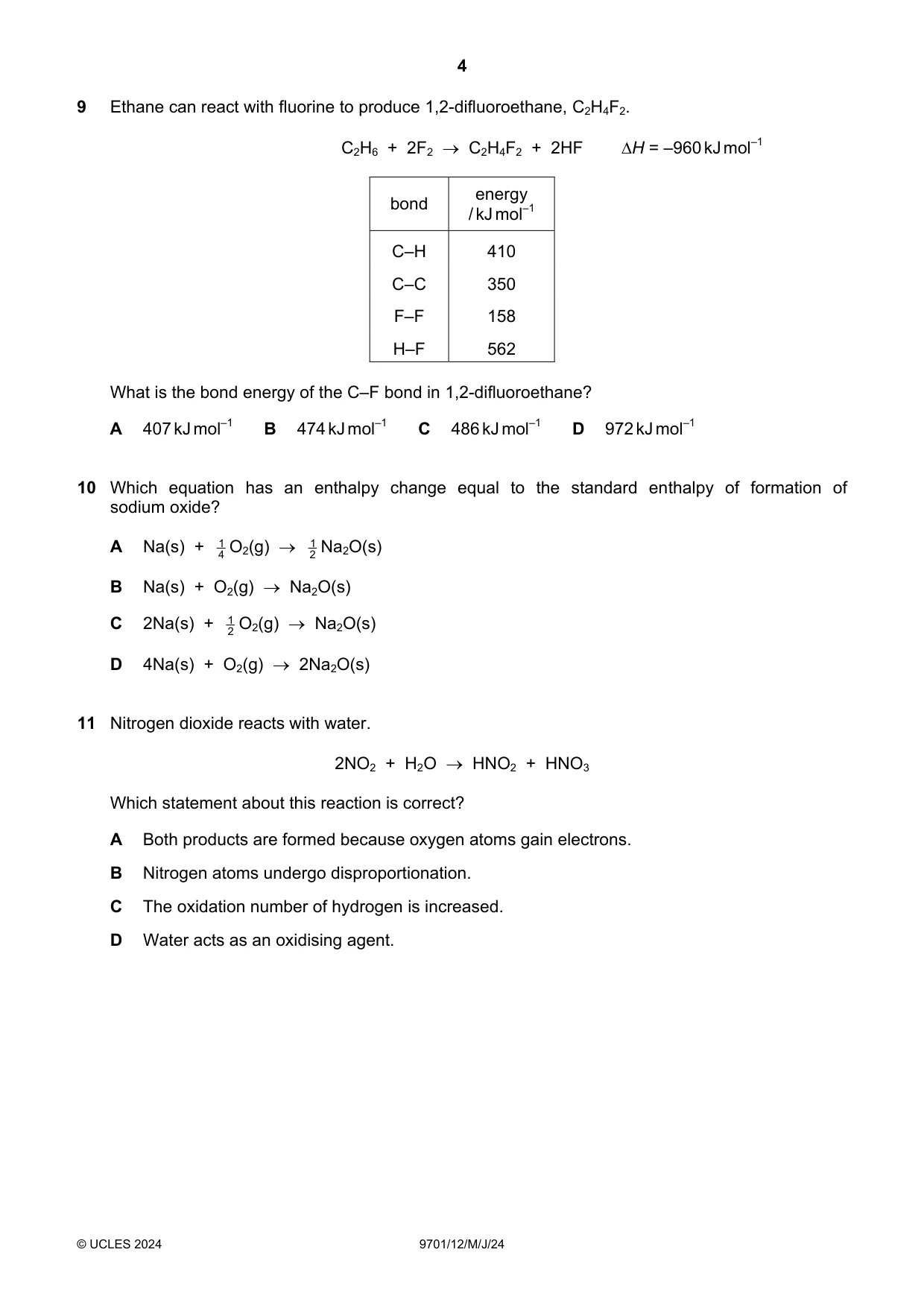
Q9 · Ethane can react with fluorine to produce 1,2-difluoroethane, C2H4F2
9 Ethane can react with fluorine to produce 1,2-difluoroethane, C2H4F2. C2H6 + 2F2 C2H4F2 + 2HF H = –960 kJ mol–1 energy bond / kJ mol–1 C–H 410 C–C 350 F–F 158 H–F 562 What is the bond energy of the C–F bond in 1,2-difluoroethane? A 407 kJ mol–1 B 474 kJ mol–1 C 486 kJ mol–1 D 972 kJ mol–1
Mark scheme: C
Q10 · Which equation has an enthalpy change equal to the standard enthalpy of formation of…
10 Which equation has an enthalpy change equal to the standard enthalpy of formation of sodium oxide? A Na(s) + 4 1 O2(g) 2 1 Na2O(s) B Na(s) + O2(g) Na2O(s) C 2Na(s) + 2 1 O2(g) Na2O(s) D 4Na(s) + O2(g) 2Na2O(s)
Mark scheme: C
Q11 · Nitrogen dioxide reacts with water
11 Nitrogen dioxide reacts with water. 2NO2 + H2O HNO2 + HNO3 Which statement about this reaction is correct? A Both products are formed because oxygen atoms gain electrons. B Nitrogen atoms undergo disproportionation. C The oxidation number of hydrogen is increased. D Water acts as an oxidising agent.
Mark scheme: B
Q12 · Phosphorus reacts with concentrated sulfuric acid to produce phosphoric acid, sulfur…
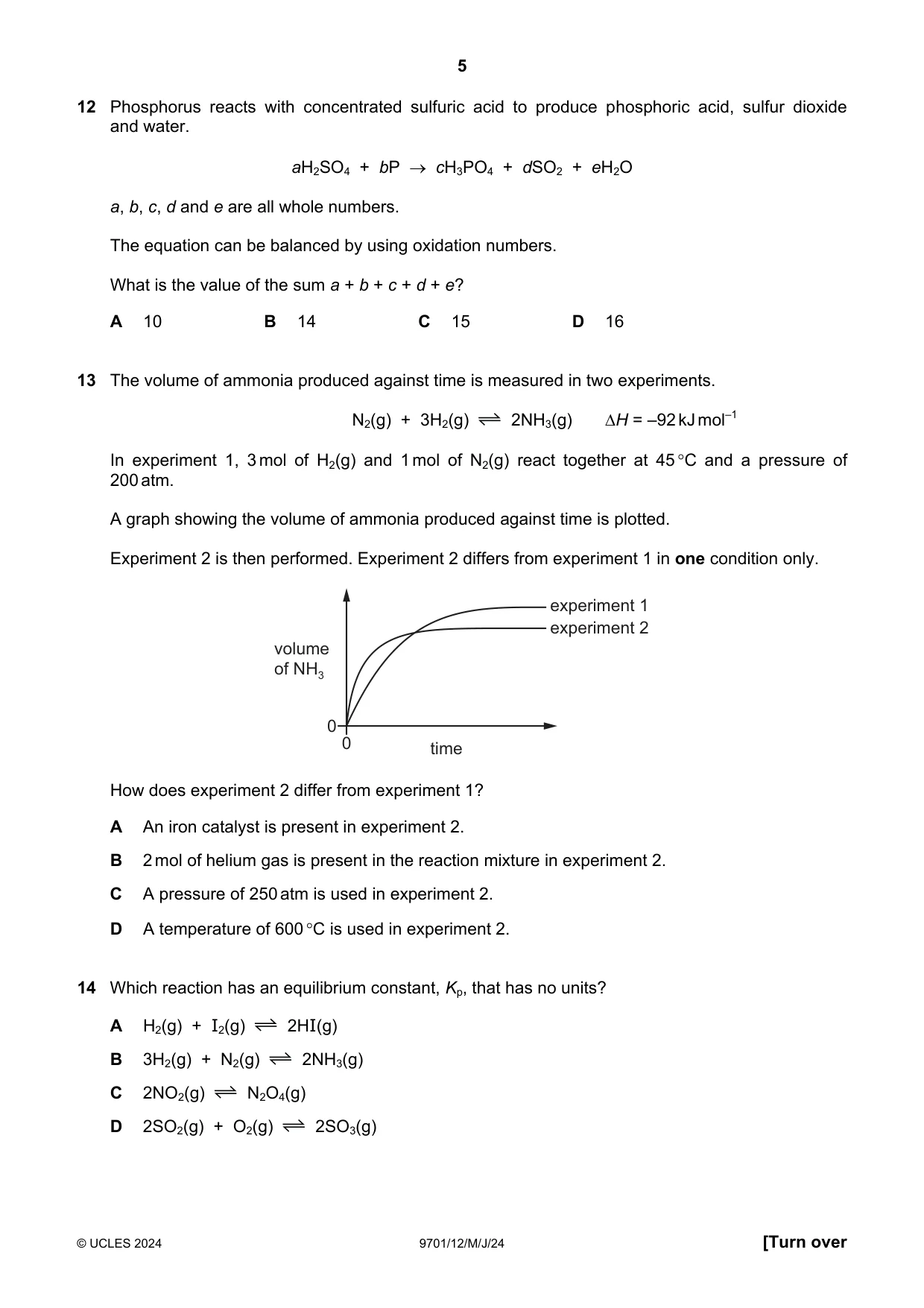
12 Phosphorus reacts with concentrated sulfuric acid to produce phosphoric acid, sulfur dioxide and water. aH2SO4 + bP cH3PO4 + dSO2 + eH2O a, b, c, d and e are all whole numbers. The equation can be balanced by using oxidation numbers. What is the value of the sum a + b + c + d + e? A 10 B 14 C 15 D 16
Mark scheme: D
Q13 · The volume of ammonia produced against time is measured in two experiments
13 The volume of ammonia produced against time is measured in two experiments. N2(g) + 3H2(g) 2NH3(g) ∆H = –92 kJ mol–1 In experiment 1, 3 mol of H2(g) and 1 mol of N2(g) react together at 45 C and a pressure of 200 atm. A graph showing the volume of ammonia produced against time is plotted. Experiment 2 is then performed. Experiment 2 differs from experiment 1 in one condition only. experiment 1 experiment 2 volume of NH3 0 0 time How does experiment 2 differ from experiment 1? A An iron catalyst is present in experiment 2. B 2 mol of helium gas is present in the reaction mixture in experiment 2. C A pressure of 250 atm is used in experiment 2. D A temperature of 600 C is used in experiment 2.
Mark scheme: D
More questions on Effect of temperature on reaction rates and the concept of activation energy
Q14 · Which reaction has an equilibrium constant, Kp, that has no units?
14 Which reaction has an equilibrium constant, Kp, that has no units? A H2(g) + I2(g) 2HI(g) B 3H2(g) + N2(g) 2NH3(g) C 2NO2(g) N2O4(g) D 2SO2(g) + O2(g) 2SO3(g)
Mark scheme: A
More questions on Chemical equilibria: reversible reactions, dynamic equilibrium
Q15 · Gas Q decomposes slowly at room temperature
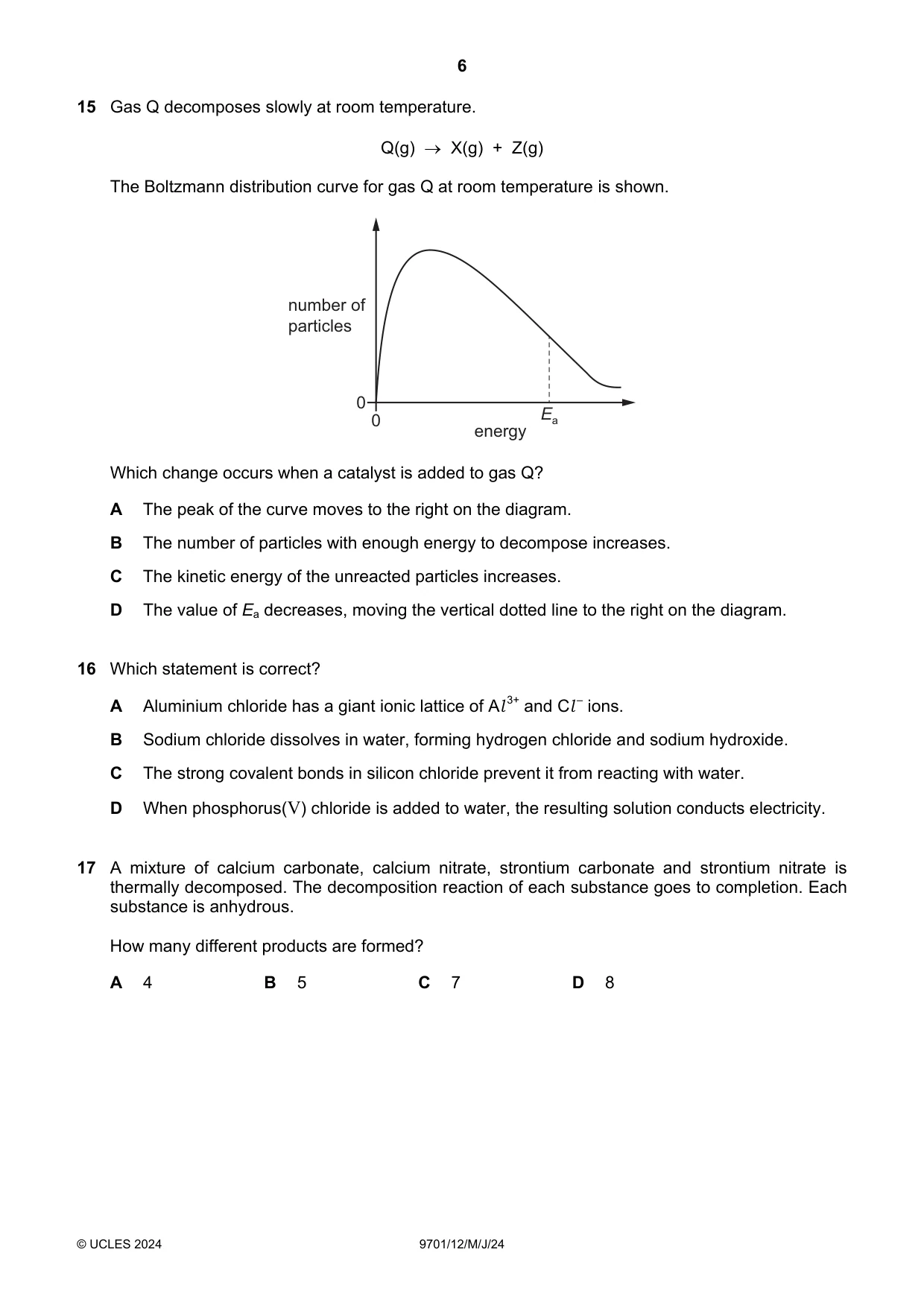
15 Gas Q decomposes slowly at room temperature. Q(g) X(g) + Z(g) The Boltzmann distribution curve for gas Q at room temperature is shown. number of particles 0 0 Ea energy Which change occurs when a catalyst is added to gas Q? A The peak of the curve moves to the right on the diagram. B The number of particles with enough energy to decompose increases. C The kinetic energy of the unreacted particles increases. D The value of Ea decreases, moving the vertical dotted line to the right on the diagram.
Mark scheme: B
More questions on Effect of temperature on reaction rates and the concept of activation energy
Q16 · Which statement is correct?
16 Which statement is correct? A Aluminium chloride has a giant ionic lattice of Al 3+ and Cl – ions. B Sodium chloride dissolves in water, forming hydrogen chloride and sodium hydroxide. C The strong covalent bonds in silicon chloride prevent it from reacting with water. D When phosphorus(V) chloride is added to water, the resulting solution conducts electricity.
Mark scheme: D
More questions on Periodicity of chemical properties of the elements in Period 3
Q17 · A mixture of calcium carbonate, calcium nitrate, strontium carbonate and strontium…
17 A mixture of calcium carbonate, calcium nitrate, strontium carbonate and strontium nitrate is thermally decomposed. The decomposition reaction of each substance goes to completion. Each substance is anhydrous. How many different products are formed? A 4 B 5 C 7 D 8
Mark scheme: B
Q18 · W is a solid that reacts with water to produce an alkaline solution
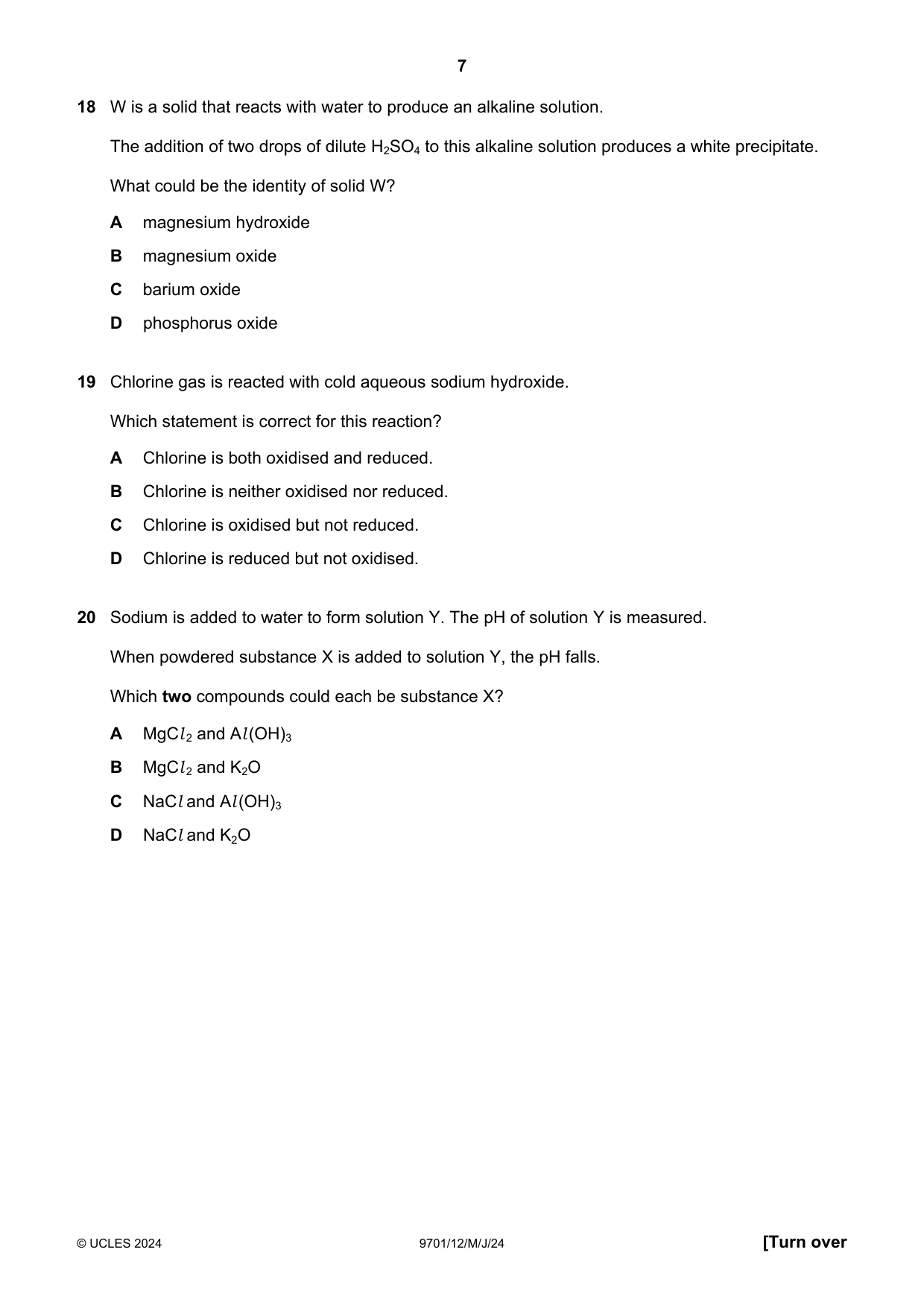
18 W is a solid that reacts with water to produce an alkaline solution. The addition of two drops of dilute H2SO4 to this alkaline solution produces a white precipitate. What could be the identity of solid W? A magnesium hydroxide B magnesium oxide C barium oxide D phosphorus oxide
Mark scheme: C
Q19 · Chlorine gas is reacted with cold aqueous sodium hydroxide
19 Chlorine gas is reacted with cold aqueous sodium hydroxide. Which statement is correct for this reaction? A Chlorine is both oxidised and reduced. B Chlorine is neither oxidised nor reduced. C Chlorine is oxidised but not reduced. D Chlorine is reduced but not oxidised.
Mark scheme: A
Q20 · Sodium is added to water to form solution Y
20 Sodium is added to water to form solution Y. The pH of solution Y is measured. When powdered substance X is added to solution Y, the pH falls. Which two compounds could each be substance X? A MgCl 2 and Al (OH)3 B MgCl 2 and K2O C NaCl and Al (OH)3 D NaCl and K2O
Mark scheme: A
More questions on Periodicity of chemical properties of the elements in Period 3
Q21 · The table shows statements about some of the properties of halogens and their compounds…
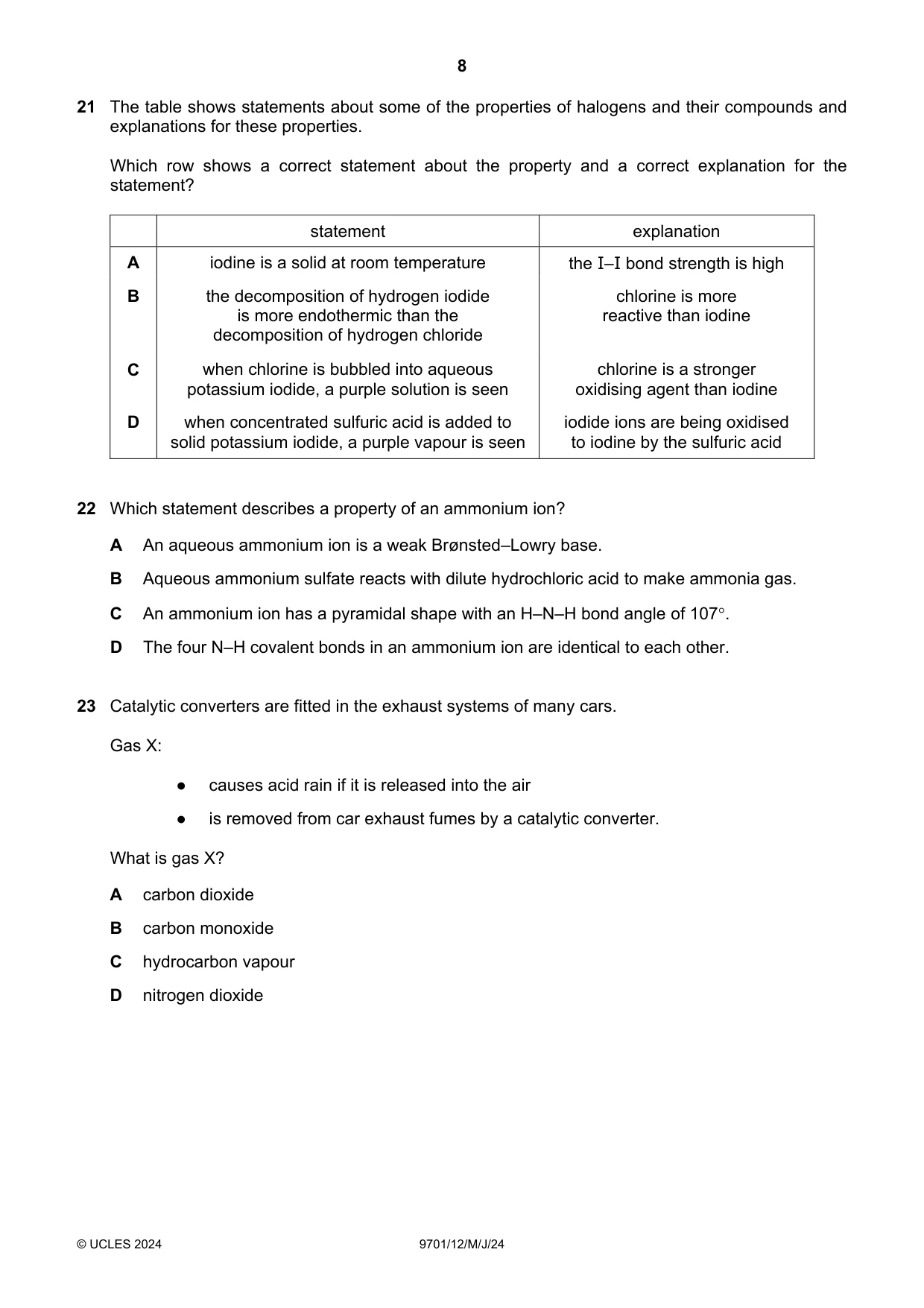
21 The table shows statements about some of the properties of halogens and their compounds and explanations for these properties. Which row shows a correct statement about the property and a correct explanation for the statement? statement explanation A iodine is a solid at room temperature the I–I bond strength is high B the decomposition of hydrogen iodide chlorine is more is more endothermic than the reactive than iodine decomposition of hydrogen chloride C when chlorine is bubbled into aqueous chlorine is a stronger potassium iodide, a purple solution is seen oxidising agent than iodine D when concentrated sulfuric acid is added to iodide ions are being oxidised solid potassium iodide, a purple vapour is seen to iodine by the sulfuric acid
Mark scheme: D
Q22 · Which statement describes a property of an ammonium ion?
22 Which statement describes a property of an ammonium ion? A An aqueous ammonium ion is a weak Brønsted–Lowry base. B Aqueous ammonium sulfate reacts with dilute hydrochloric acid to make ammonia gas. C An ammonium ion has a pyramidal shape with an H–N–H bond angle of 107. D The four N–H covalent bonds in an ammonium ion are identical to each other.
Mark scheme: D
Q23 · Catalytic converters are fitted in the exhaust systems of many cars
23 Catalytic converters are fitted in the exhaust systems of many cars. Gas X: ● causes acid rain if it is released into the air ● is removed from car exhaust fumes by a catalytic converter. What is gas X? A carbon dioxide B carbon monoxide C hydrocarbon vapour D nitrogen dioxide
Mark scheme: D
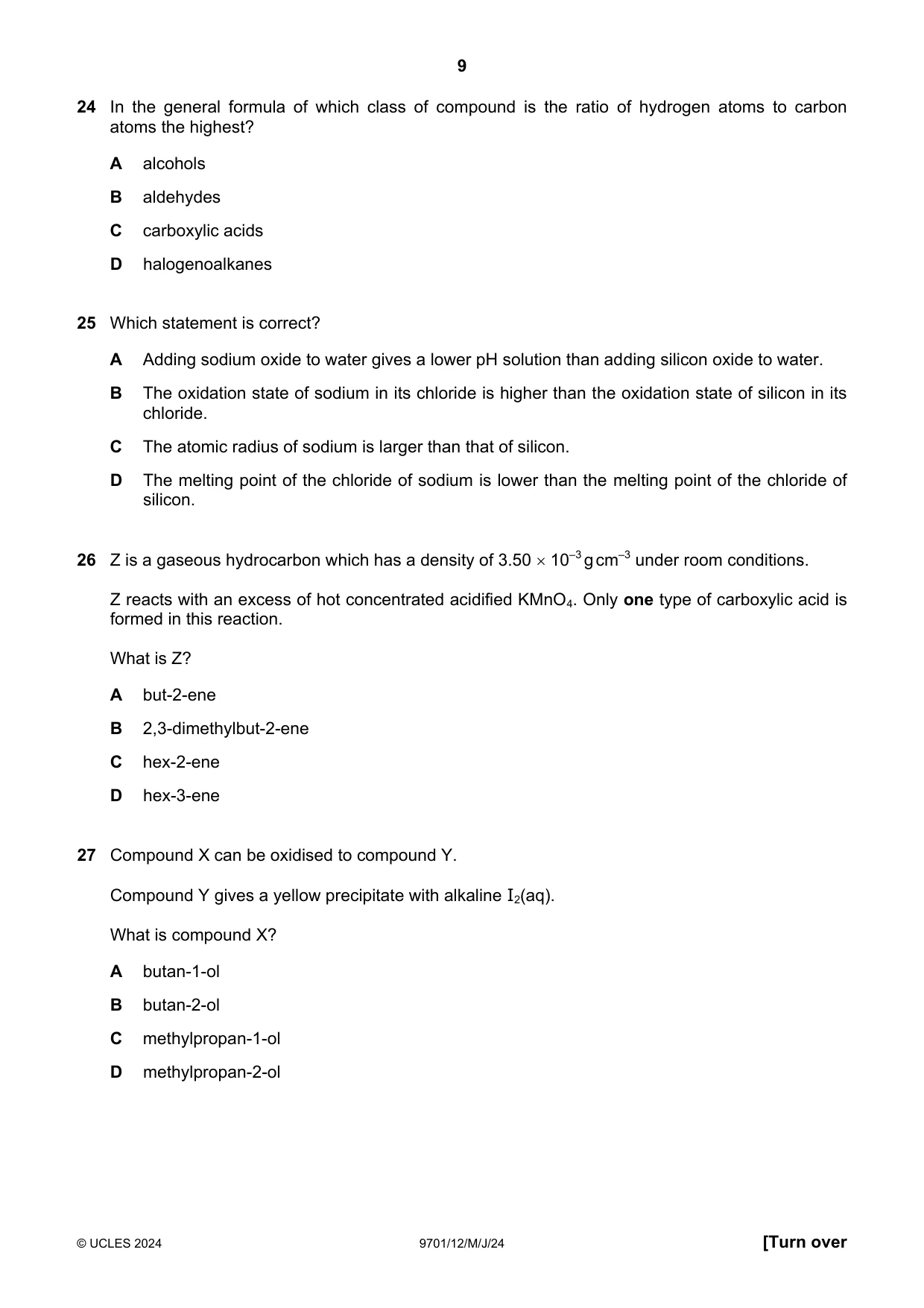
Q24 · In the general formula of which class of compound is the ratio of hydrogen atoms to…
24 In the general formula of which class of compound is the ratio of hydrogen atoms to carbon atoms the highest? A alcohols B aldehydes C carboxylic acids D halogenoalkanes
Mark scheme: A
More questions on Formulas, functional groups and the naming of organic compounds
Q25 · Which statement is correct?
25 Which statement is correct? A Adding sodium oxide to water gives a lower pH solution than adding silicon oxide to water. B The oxidation state of sodium in its chloride is higher than the oxidation state of silicon in its chloride. C The atomic radius of sodium is larger than that of silicon. D The melting point of the chloride of sodium is lower than the melting point of the chloride of silicon.
Mark scheme: C
More questions on Periodicity of physical properties of the elements in Period 3
Q26 · Z is a gaseous hydrocarbon which has a density of 3.50 10–3 g cm–3 under room conditions
26 Z is a gaseous hydrocarbon which has a density of 3.50 10–3 g cm–3 under room conditions. Z reacts with an excess of hot concentrated acidified KMnO4. Only one type of carboxylic acid is formed in this reaction. What is Z? A but-2-ene B 2,3-dimethylbut-2-ene C hex-2-ene D hex-3-ene
Mark scheme: D
Q27 · Compound X can be oxidised to compound Y
27 Compound X can be oxidised to compound Y. Compound Y gives a yellow precipitate with alkaline I2(aq). What is compound X? A butan-1-ol B butan-2-ol C methylpropan-1-ol D methylpropan-2-ol
Mark scheme: B
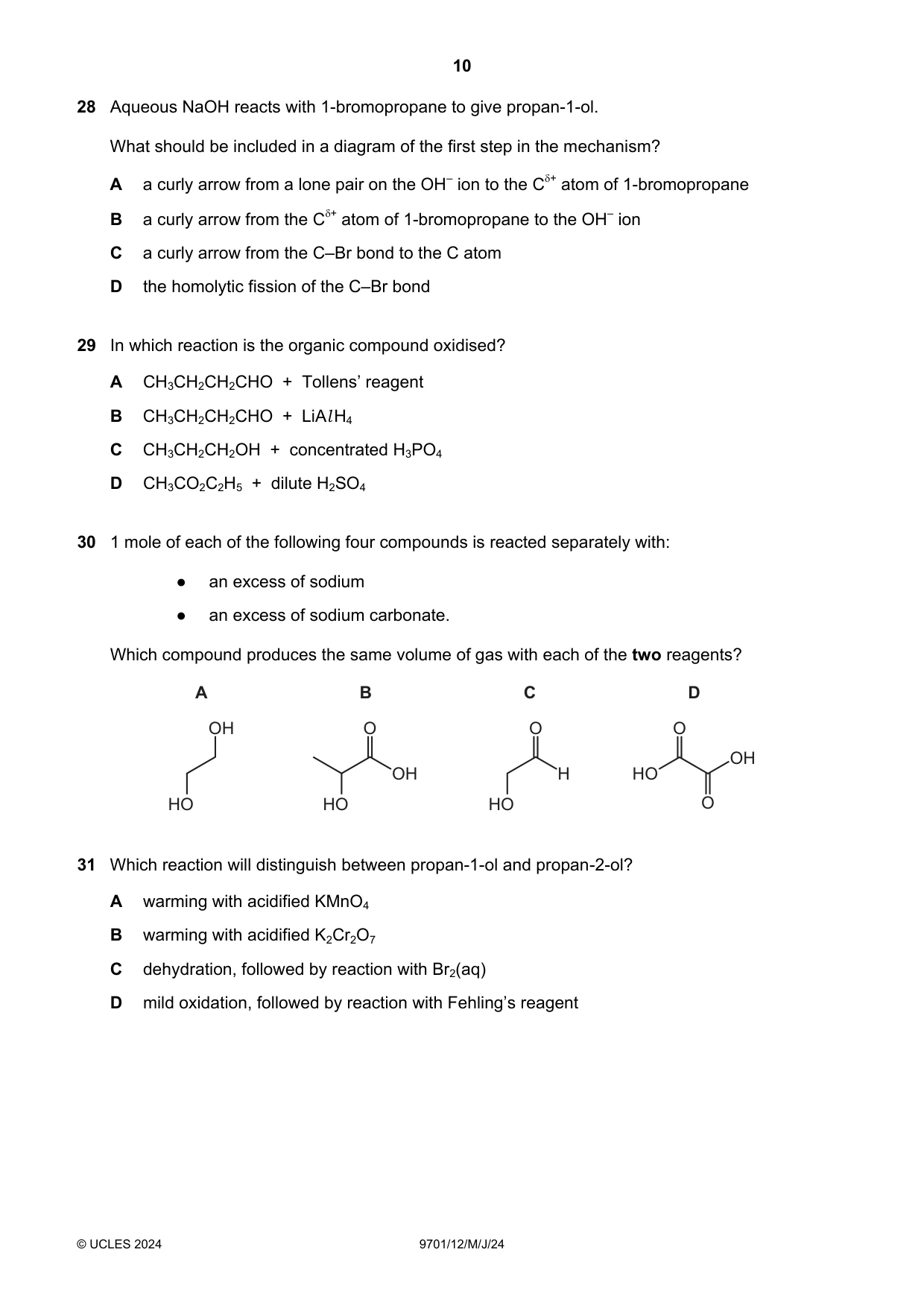
Q28 · Aqueous NaOH reacts with 1-bromopropane to give propan-1-ol
28 Aqueous NaOH reacts with 1-bromopropane to give propan-1-ol. What should be included in a diagram of the first step in the mechanism? A a curly arrow from a lone pair on the OH– ion to the C+ atom of 1-bromopropane B a curly arrow from the C+ atom of 1-bromopropane to the OH– ion C a curly arrow from the C–Br bond to the C atom D the homolytic fission of the C–Br bond
Mark scheme: A
Q29 · In which reaction is the organic compound oxidised?
29 In which reaction is the organic compound oxidised? A CH3CH2CH2CHO + Tollens’ reagent B CH3CH2CH2CHO + LiAl H4 C CH3CH2CH2OH + concentrated H3PO4 D CH3CO2C2H5 + dilute H2SO4
Mark scheme: A
Q30 · 1 mole of each of the following four compounds is reacted separately with: ● an excess of…
30 1 mole of each of the following four compounds is reacted separately with: ● an excess of sodium ● an excess of sodium carbonate. Which compound produces the same volume of gas with each of the two reagents? A B C D OH O O O OH OH H HO HO HO HO O
Mark scheme: D
Q31 · Which reaction will distinguish between propan-1-ol and propan-2-ol?
31 Which reaction will distinguish between propan-1-ol and propan-2-ol? A warming with acidified KMnO4 B warming with acidified K2Cr2O7 C dehydration, followed by reaction with Br2(aq) D mild oxidation, followed by reaction with Fehling’s reagent
Mark scheme: D
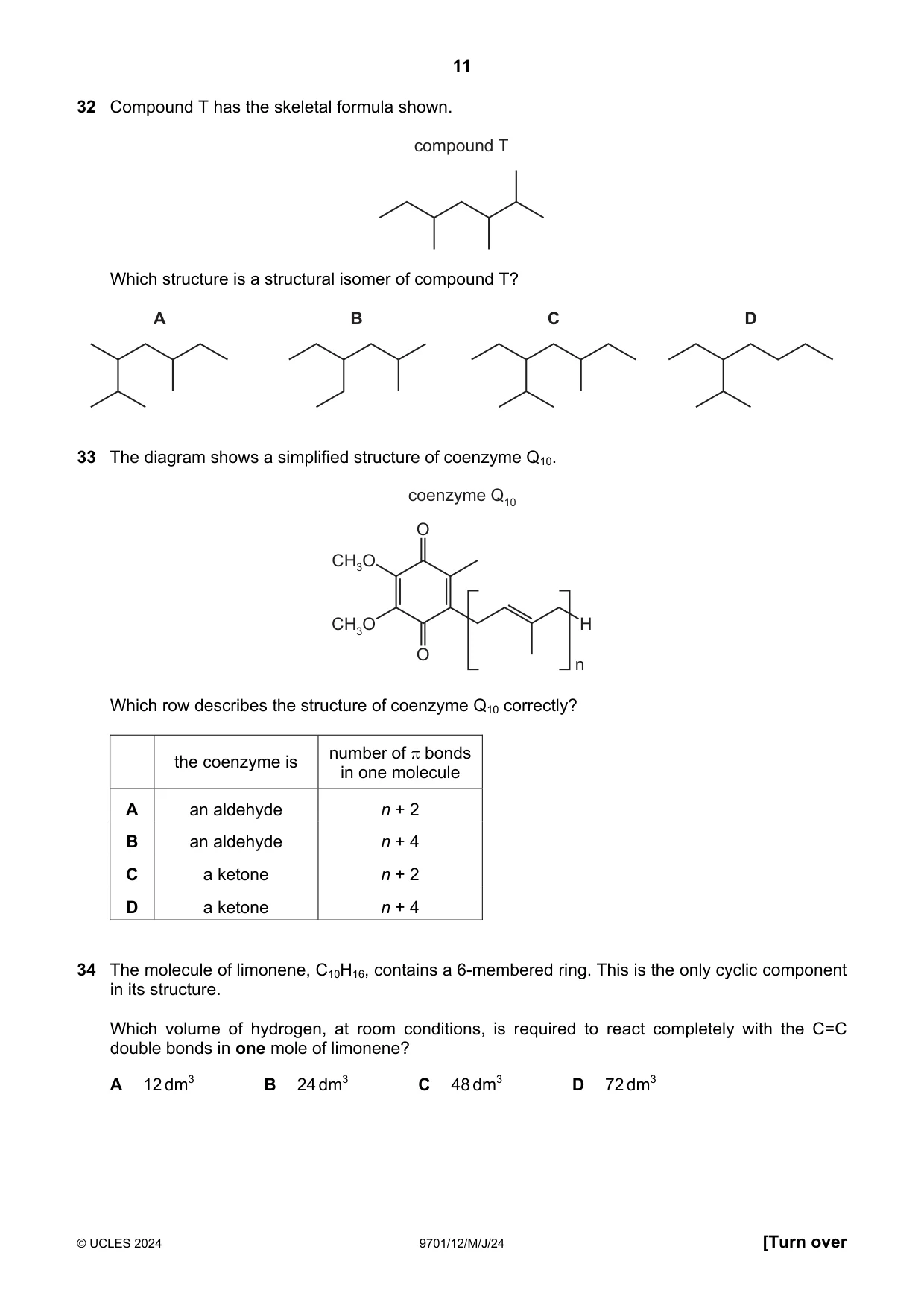
Q32 · Compound T has the skeletal formula shown
32 Compound T has the skeletal formula shown. compound T Which structure is a structural isomer of compound T? A B C D
Mark scheme: D
More questions on Isomerism: structural isomerism and stereoisomerism
Q33 · The diagram shows a simplified structure of coenzyme Q10
33 The diagram shows a simplified structure of coenzyme Q10. coenzyme Q10 O CH3O CH3O H O n Which row describes the structure of coenzyme Q10 correctly? number of bonds the coenzyme is in one molecule A an aldehyde n + 2 B an aldehyde n + 4 C a ketone n + 2 D a ketone n + 4
Mark scheme: D
More questions on Shapes of organic molecules; σ and π bonds
Q34 · The molecule of limonene, C10H16, contains a 6-membered ring
34 The molecule of limonene, C10H16, contains a 6-membered ring. This is the only cyclic component in its structure. Which volume of hydrogen, at room conditions, is required to react completely with the C=C double bonds in one mole of limonene? A 12 dm3 B 24 dm3 C 48 dm3 D 72 dm3
Mark scheme: C
Q35 · 1-bromopropane reacts with hot ethanolic NaOH
35 1-bromopropane reacts with hot ethanolic NaOH. What is the molecular formula of the product in this reaction? A C3H6 B C3H8 C C3H7O D C3H8O
Mark scheme: A
Q36 · A sample of pent-2-en-4-ol, C5H10O, contains all the possible stereoisomers of this…
36 A sample of pent-2-en-4-ol, C5H10O, contains all the possible stereoisomers of this compound. How many stereoisomers are there in the sample? A 2 B 3 C 4 D 5
Mark scheme: C
More questions on Isomerism: structural isomerism and stereoisomerism
Q37 · Which pair of reagents reacts to form a product with a chiral carbon atom?
37 Which pair of reagents reacts to form a product with a chiral carbon atom? A CH3CH=CH2 + HBr B (CH3)2C=O + NaBH4 C CH3CH2CHO + HCN D CH3COOH + CH3CH2OH
Mark scheme: C
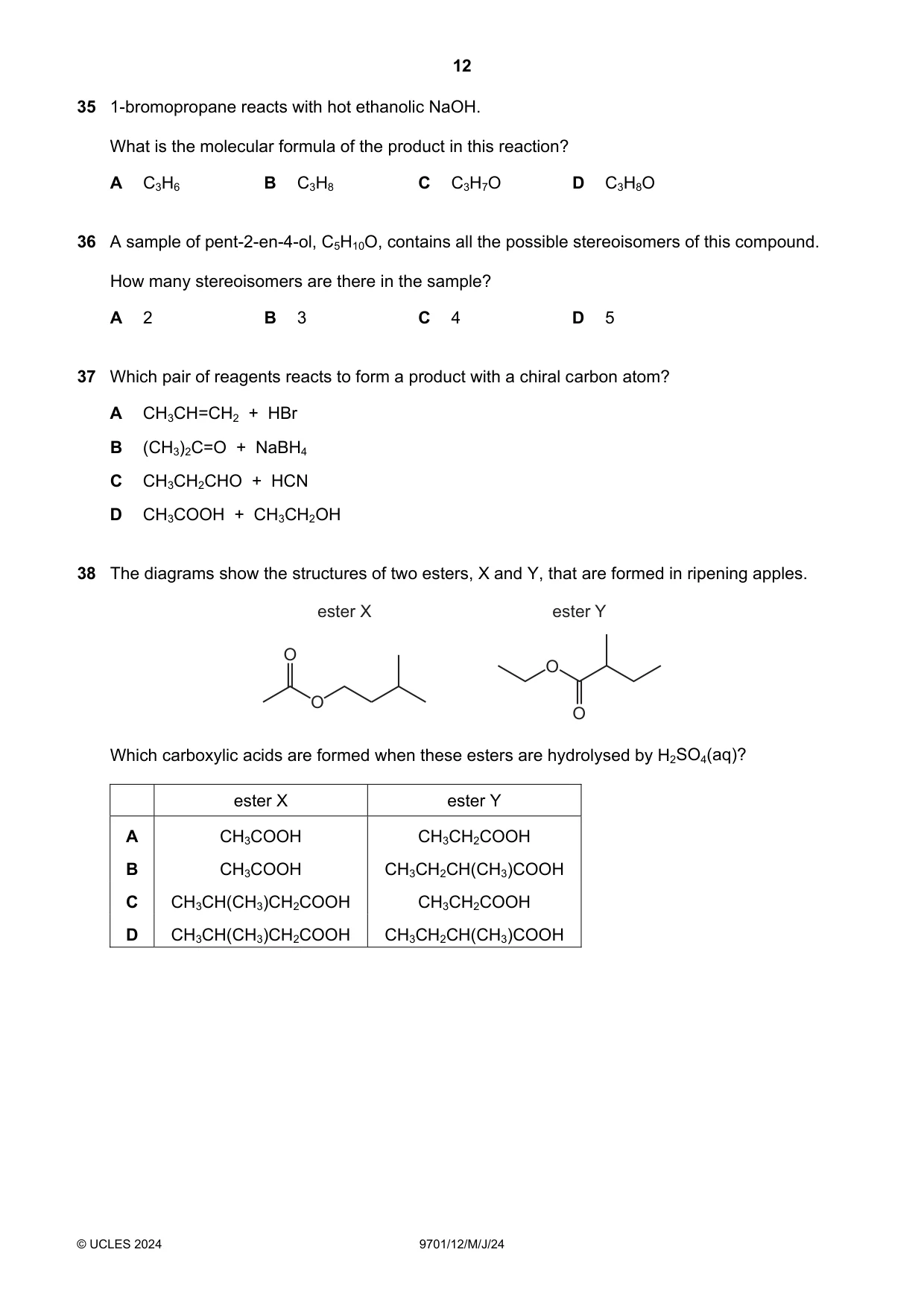
Q38 · The diagrams show the structures of two esters, X and Y, that are formed in ripening…
38 The diagrams show the structures of two esters, X and Y, that are formed in ripening apples. ester X ester Y O O O O Which carboxylic acids are formed when these esters are hydrolysed by H2SO4(aq)? ester X ester Y A CH3COOH CH3CH2COOH B CH3COOH CH3CH2CH(CH3)COOH C CH3CH(CH3)CH2COOH CH3CH2COOH D CH3CH(CH3)CH2COOH CH3CH2CH(CH3)COOH
Mark scheme: B
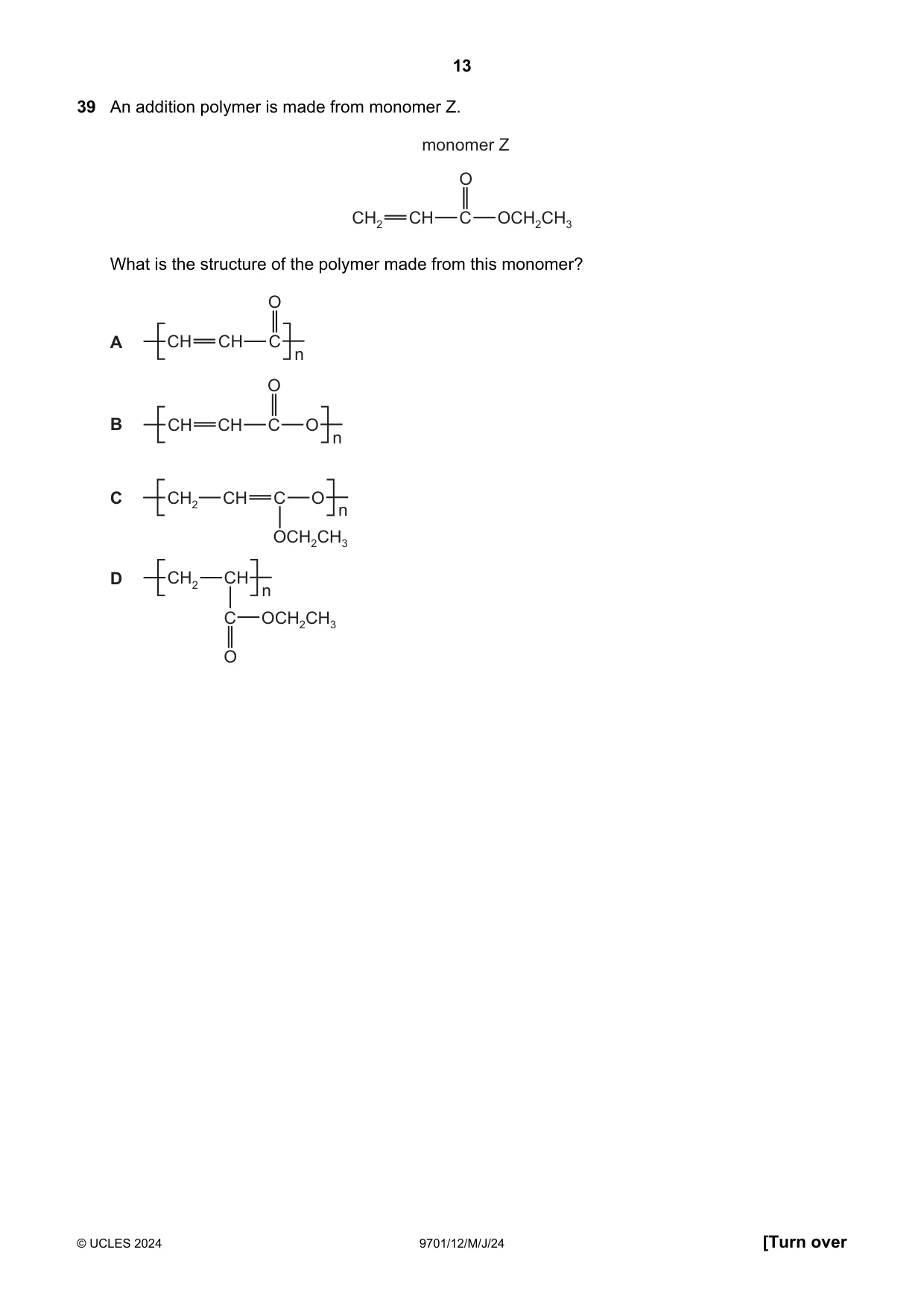
Q39 · An addition polymer is made from monomer Z
39 An addition polymer is made from monomer Z. monomer Z O CH2 CH C OCH2CH3 What is the structure of the polymer made from this monomer? O A CH CH C n O B CH CH C O n C CH2 CH C O n OCH2CH3 D CH2 CH n C OCH2CH3 O
Mark scheme: D
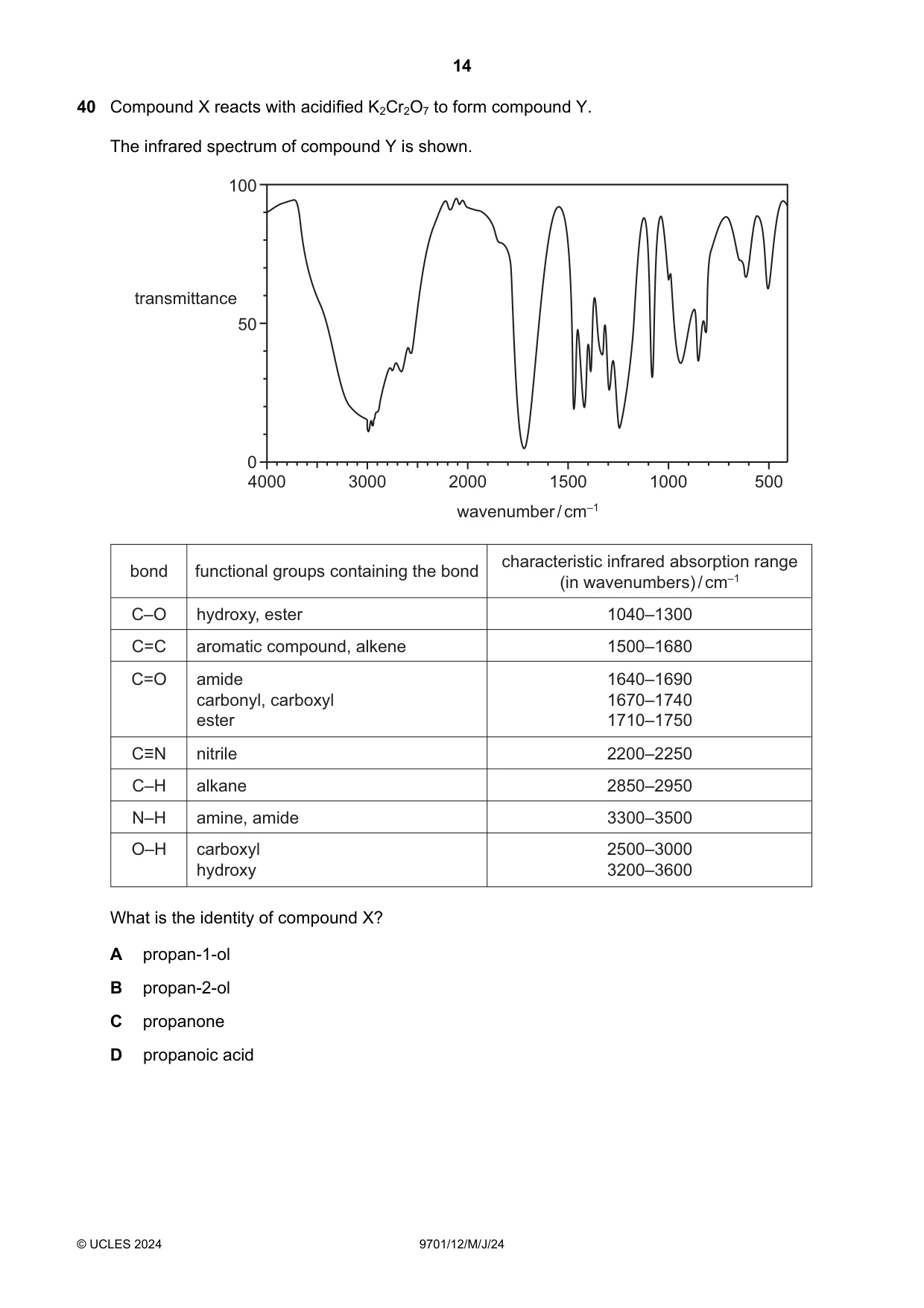
Q40 · Compound X reacts with acidified K2Cr2O7 to form compound Y
40 Compound X reacts with acidified K2Cr2O7 to form compound Y. The infrared spectrum of compound Y is shown. 100 transmittance 50 0 4000 3000 2000 1500 1000 500 wavenumber / cm–1 characteristic infrared absorption range bond functional groups containing the bond (in wavenumbers) / cm–1 C–O hydroxy, ester 1040–1300 C=C aromatic compound, alkene 1500–1680 C=O amide 1640–1690 carbonyl, carboxyl 1670–1740 ester 1710–1750 C≡N nitrile 2200–2250 C–H alkane 2850–2950 N–H amine, amide 3300–3500 O–H carboxyl 2500–3000 hydroxy 3200–3600 What is the identity of compound X? A propan-1-ol B propan-2-ol C propanone D propanoic acid
Mark scheme: A
What was in this paper
The subtopics covered by these 40 questions, and how many questions each got. Open one in a new tab to see every Cambridge question on it.
3Alcohols2Alkenes2Effect of temperature on reaction rates and the concept of activation energy2Enthalpy change, ΔH2Halogenoalkanes2Isomerism: structural isomerism and stereoisomerism2Periodicity of chemical properties of the elements in Period 32Shapes of molecules2Similarities and trends in the properties of the Group 2 metals, magnesium to barium, and their compounds2Addition polymerisation1Aldehydes and ketones1Carboxylic acids1Chemical equilibria: reversible reactions, dynamic equilibrium1Covalent bonding and coordinate (dative covalent) bonding1Esters1Formulas1Formulas, functional groups and the naming of organic compounds1Infrared spectroscopy1Intermolecular forces, electronegativity and bond properties1Ionisation energy1Nitriles and hydroxynitriles1Nitrogen and sulfur1Periodicity of physical properties of the elements in Period 31Shapes of organic molecules; σ and π bonds1Some reactions of the halide ions1The gaseous state: ideal and real gases and pV = nRT1The mole and the Avogadro constant1The reactions of chlorine1What you needed in this session
Cambridge’s own grade thresholds for 2024 May/June, Paper 1 · Variant 2. A higher threshold means an easier paper — the bar moves with how the cohort did.