Cambridge A Level Chemistry 9701 — 2021 May/June Paper 1 · Variant 3
9701/13/M/J/21 · 40 questions · 40 marks · ≈45 min
The question paper and its mark scheme, free to read here and free to download. This is Cambridge’s own paper, exactly as it was sat.
Question paper16 pages
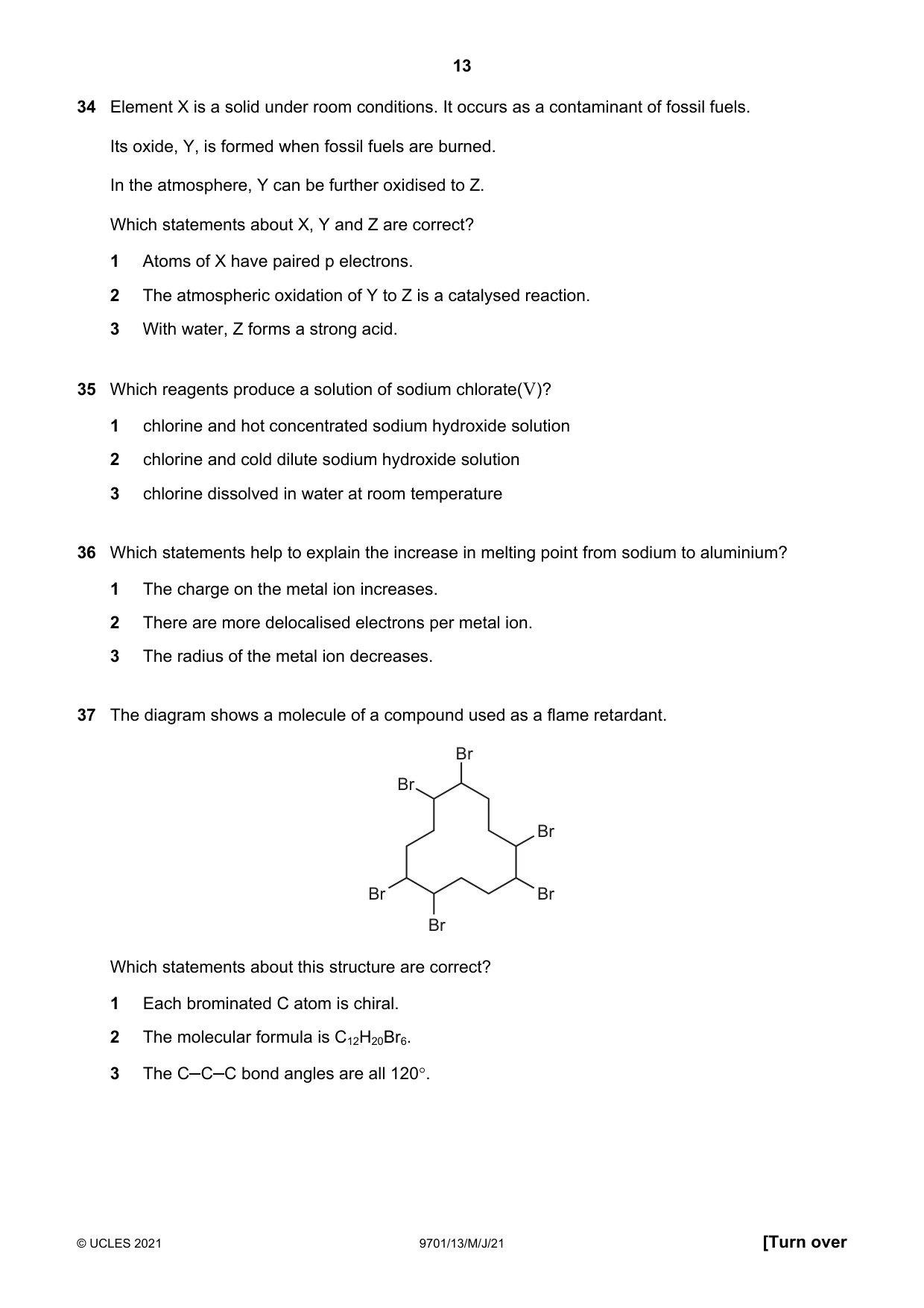
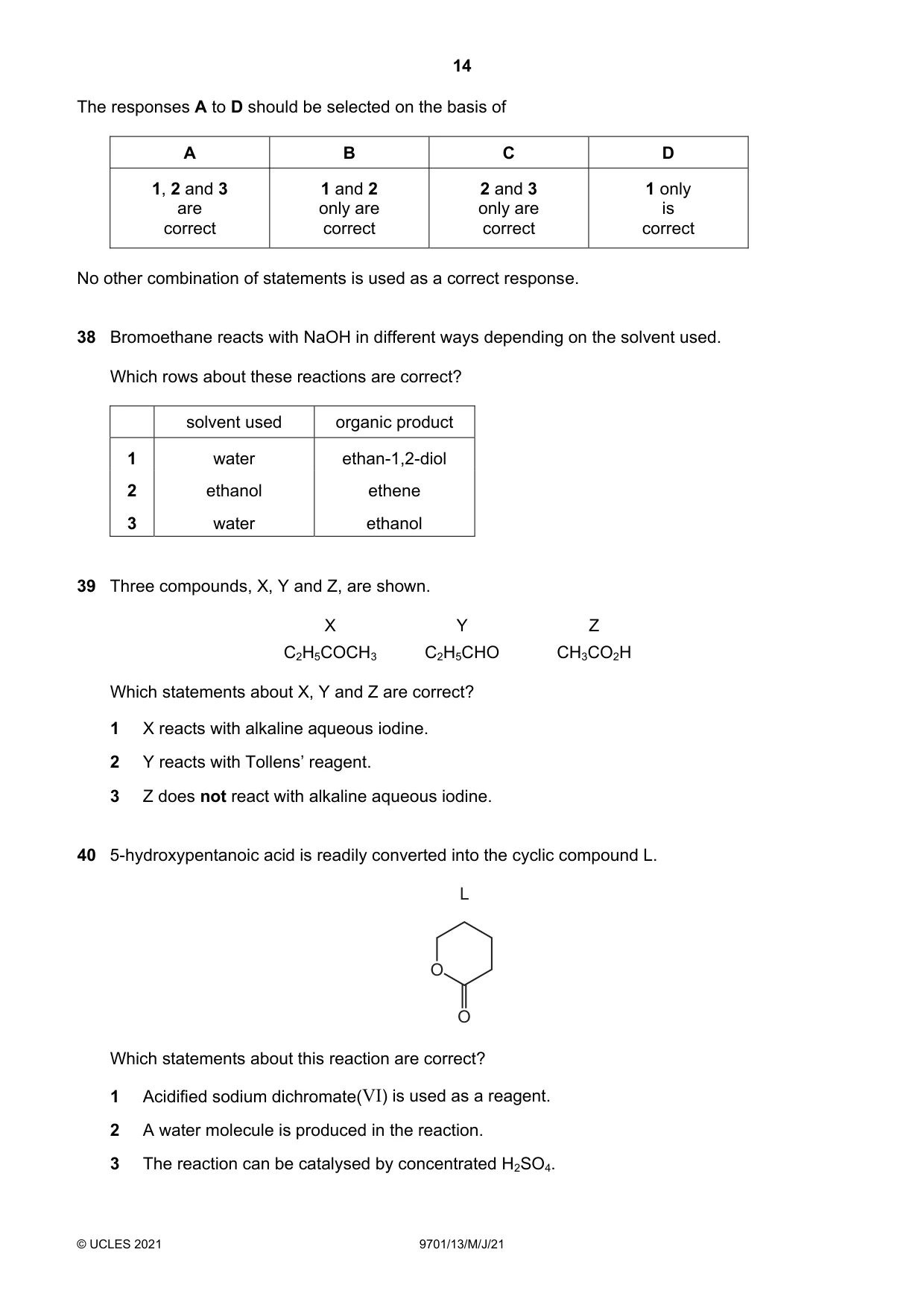


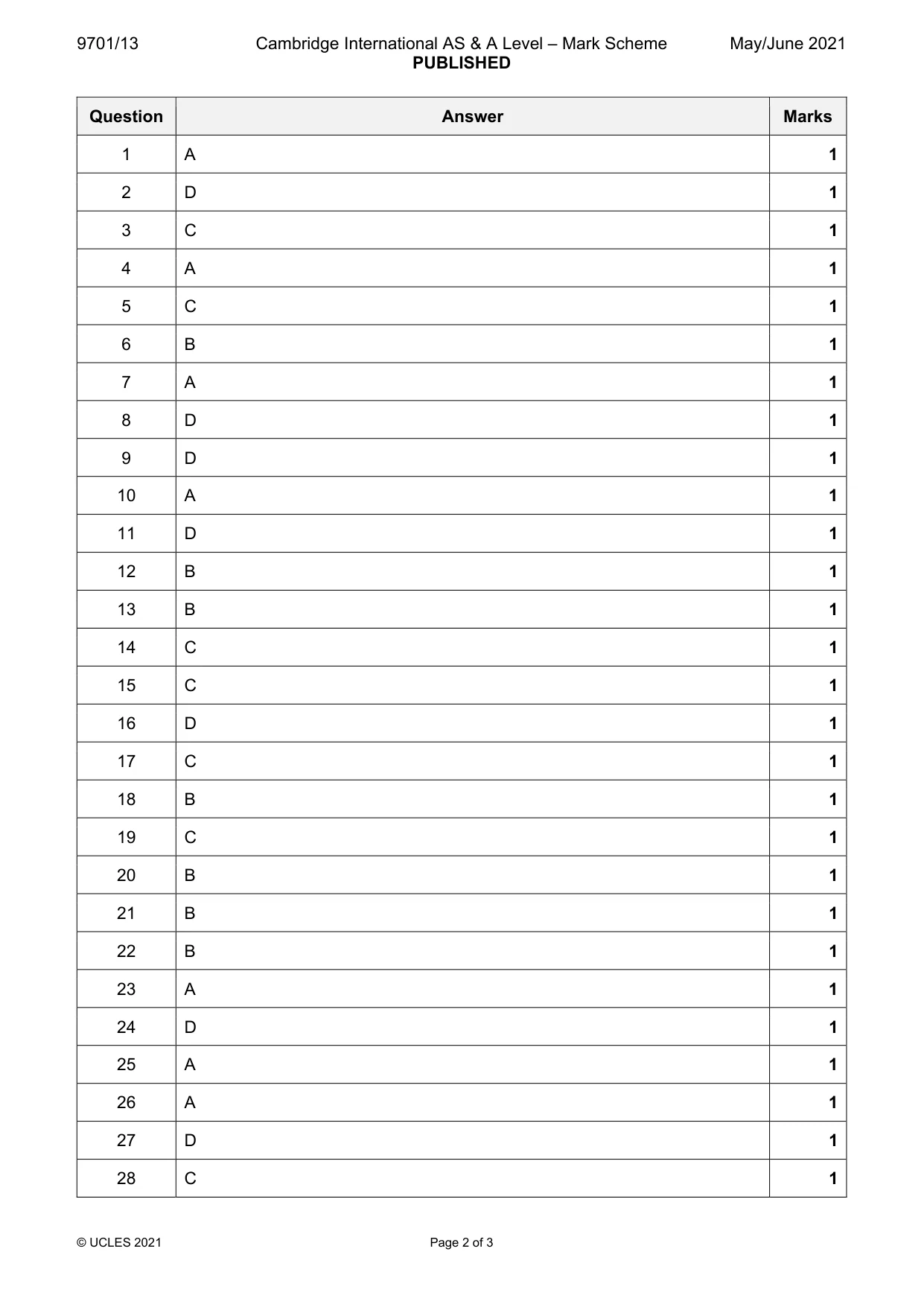
Mark scheme3 pages
Answers below. Sit the paper first if you are practising.
Questions as text
Q1 · Compound X is an organic compound that contains 30.6% carbon, 3.8% hydrogen, 20.4% oxygen…
1 Compound X is an organic compound that contains 30.6% carbon, 3.8% hydrogen, 20.4% oxygen and 45.2% chlorine by mass. What is the empirical formula of X? A C2H3OCl B C2H4OCl C C3H4OCl D C4H3O2Cl 2
Mark scheme: A
Q2 · A sample of propane, C3H8, with a mass of 9.61 g is completely combusted in an excess of…
2 A sample of propane, C3H8, with a mass of 9.61 g is completely combusted in an excess of oxygen under room conditions. Which volume of carbon dioxide gas is produced? A 4.89 dm3 B 5.24 dm3 C 14.7 dm3 D 15.7 dm3
Mark scheme: D
More questions on Reacting masses and volumes (of solutions and gases)
Q3 · Which atom has the same number of electrons as an ammonium ion?
3 Which atom has the same number of electrons as an ammonium ion? A Mg B Na C Ne D O
Mark scheme: C
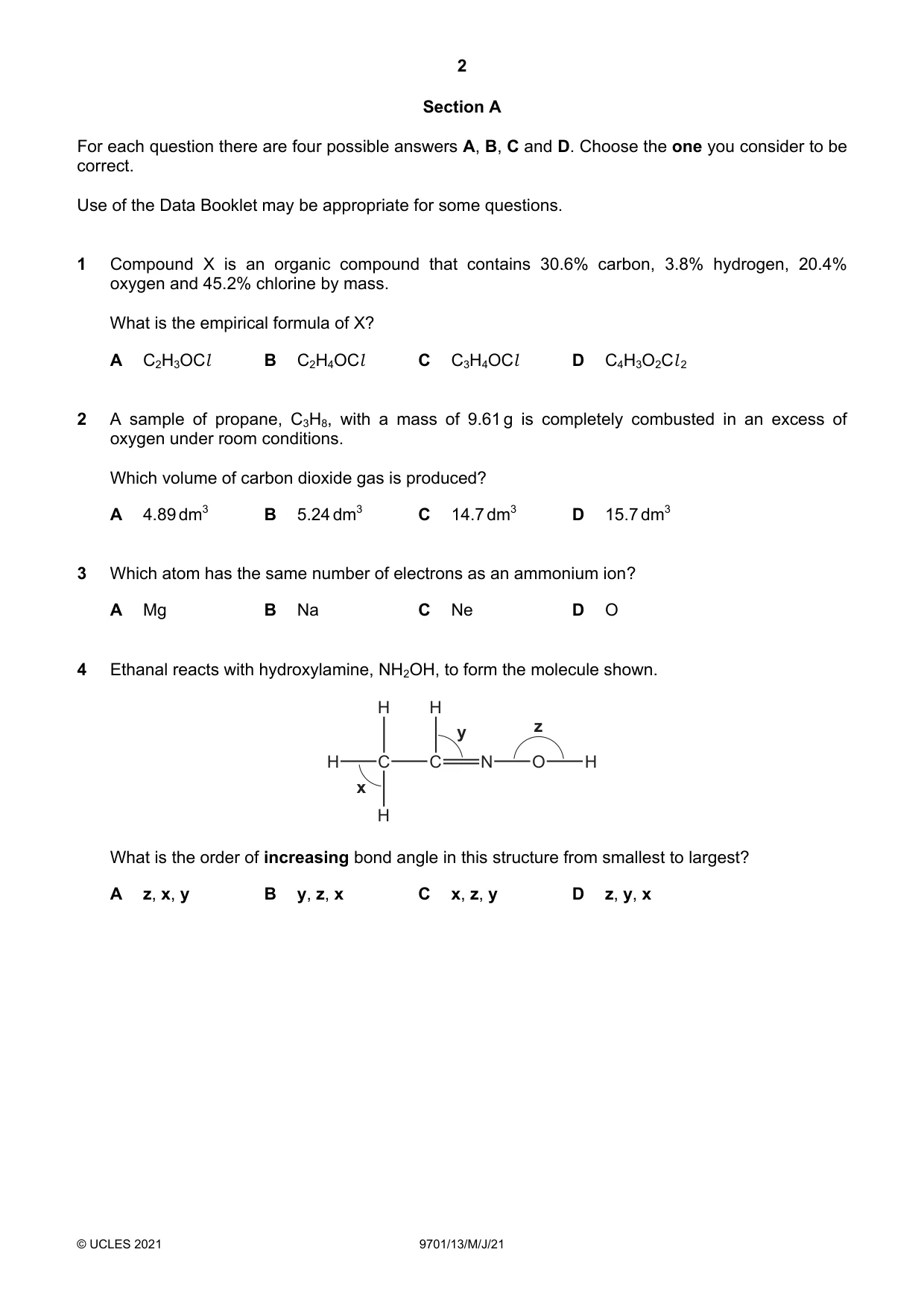
Q4 · Ethanal reacts with hydroxylamine, NH2OH, to form the molecule shown
4 Ethanal reacts with hydroxylamine, NH2OH, to form the molecule shown. H H y z H C C N O H x H What is the order of increasing bond angle in this structure from smallest to largest? A z, x, y B y, z, x C x, z, y D z, y, x
Mark scheme: A
Q5 · Descriptions of the bonding in three substances are given
5 Descriptions of the bonding in three substances are given. substance 1 strong covalent bonds between atoms, permanent dipole-dipole attractions between molecules substance 2 strong covalent bonds between atoms, weak forces between molecules substance 3 strong covalent bonds between atoms, hydrogen bonding between molecules Which compounds could be substances 1, 2 and 3? substance 1 substance 2 substance 3 A CH3OH Al 2Cl 6 CH2Cl 2 B Al 2Cl 6 CH2Cl 2 CH4 C CH2Cl 2 CH4 CH3OH D CH4 CH3OH H2O
Mark scheme: C
More questions on Intermolecular forces, electronegativity and bond properties
Q6 · Which type of bonding is never found in elements?
6 Which type of bonding is never found in elements? A covalent B ionic C metallic D van der Waals’ forces
Mark scheme: B
Q7 · Using the information in the table, what is the enthalpy change, q, for the reaction…
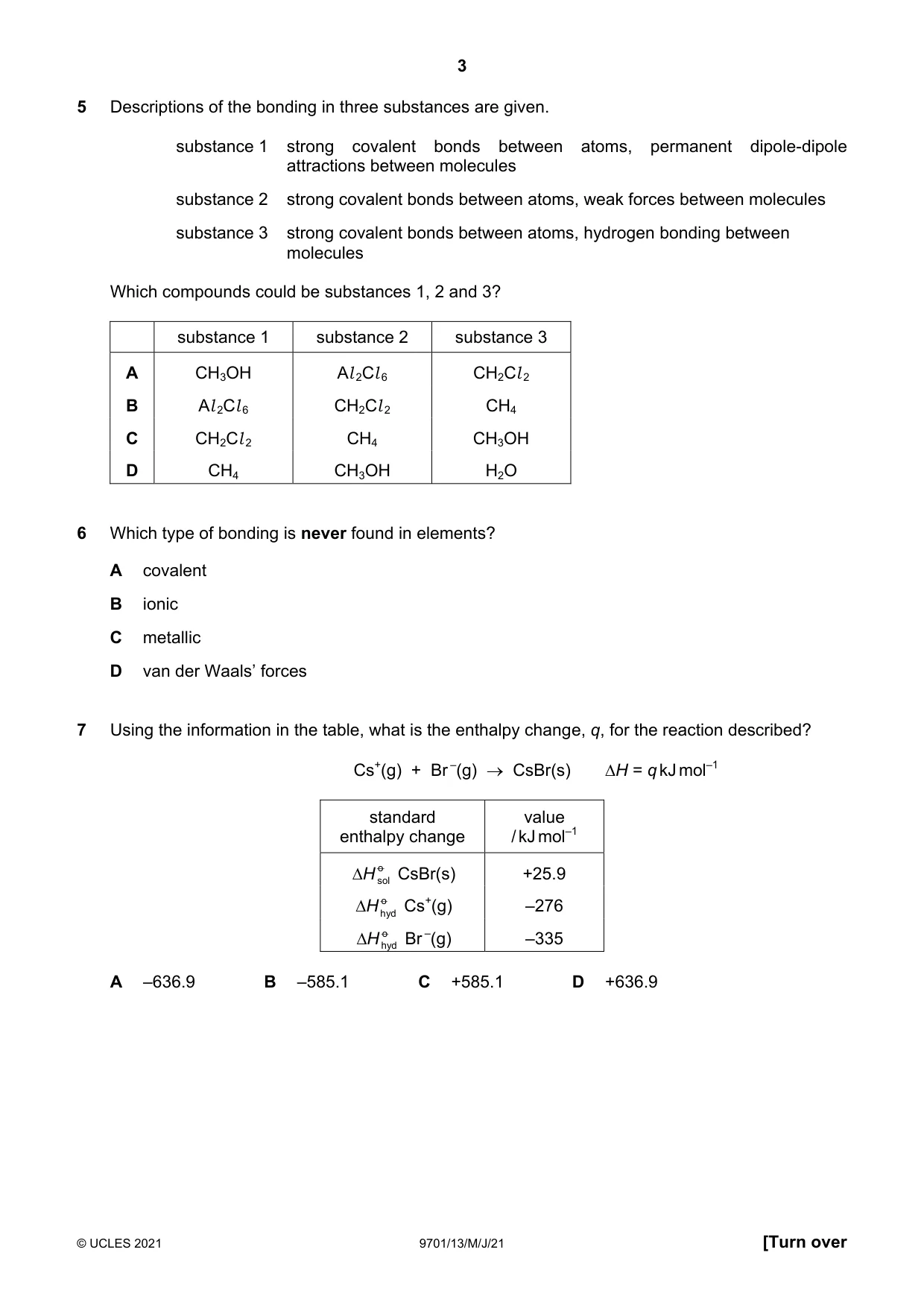
7 Using the information in the table, what is the enthalpy change, q, for the reaction described? Cs+(g) + Br –(g) CsBr(s) ∆H = q kJ mol–1 standard value enthalpy change / kJ mol–1 H o CsBr(s) +25.9 sol H o Cs+(g) –276 hyd H o Br –(g) –335 hyd A –636.9 B –585.1 C +585.1 D +636.9
Mark scheme: A
Q8 · Which enthalpy change is indicated by X in the enthalpy cycle shown?
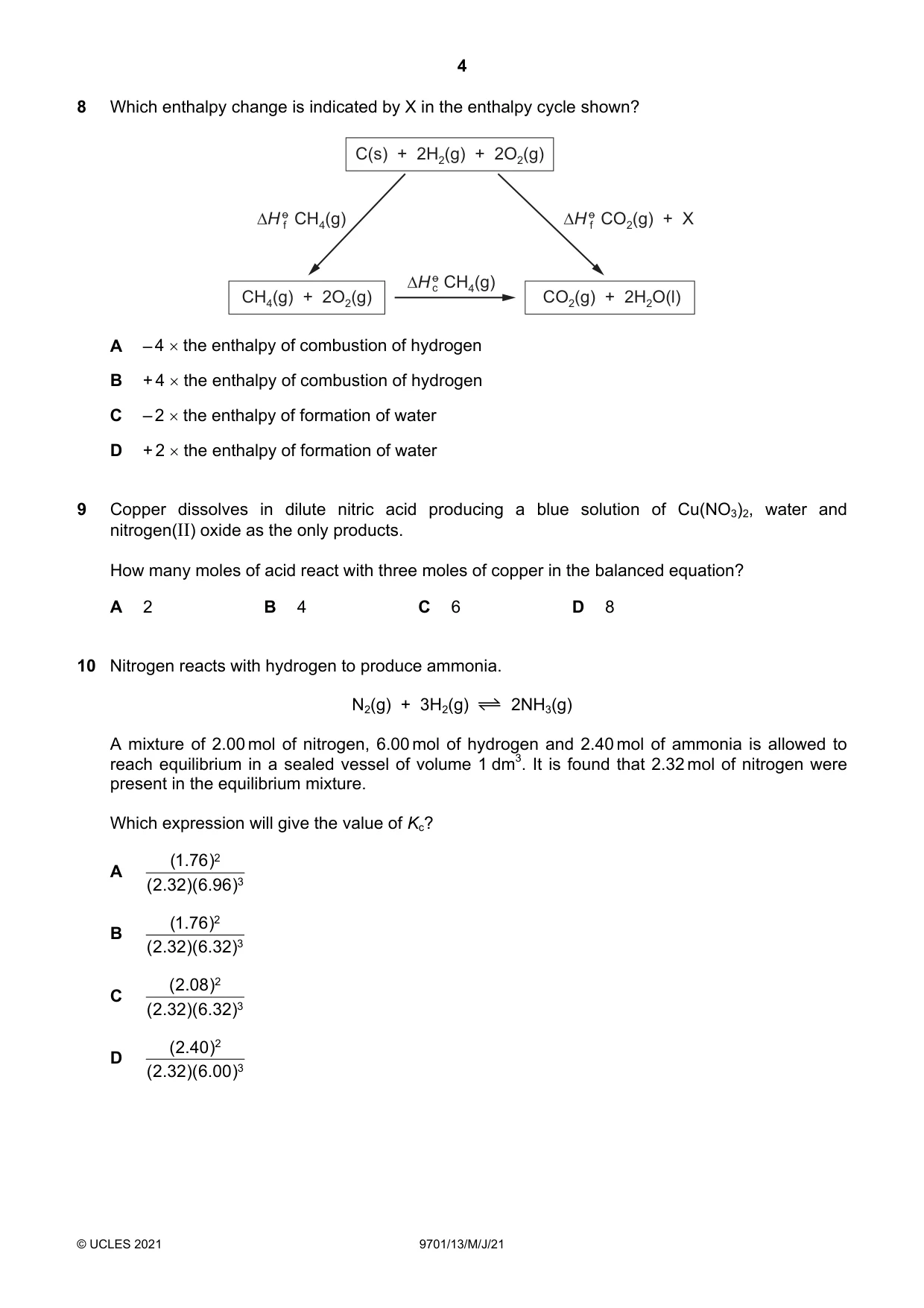
8 Which enthalpy change is indicated by X in the enthalpy cycle shown? C(s) + 2H2(g) + 2O2(g) CH4(g) CO2(g) + X CH4(g) CH4(g) + 2O2(g) CO2(g) + 2H2O(l) A – 4 the enthalpy of combustion of hydrogen B + 4 the enthalpy of combustion of hydrogen C – 2 the enthalpy of formation of water D + 2 the enthalpy of formation of water
Mark scheme: D
Q9 · Copper dissolves in dilute nitric acid producing a blue solution of Cu(NO3)2, water and…
9 Copper dissolves in dilute nitric acid producing a blue solution of Cu(NO3)2, water and nitrogen(II) oxide as the only products. How many moles of acid react with three moles of copper in the balanced equation? A 2 B 4 C 6 D 8
Mark scheme: D
Q10 · Nitrogen reacts with hydrogen to produce ammonia
10 Nitrogen reacts with hydrogen to produce ammonia. N2(g) + 3H2(g) 2NH3(g) A mixture of 2.00 mol of nitrogen, 6.00 mol of hydrogen and 2.40 mol of ammonia is allowed to reach equilibrium in a sealed vessel of volume 1 dm3. It is found that 2.32 mol of nitrogen were present in the equilibrium mixture. Which expression will give the value of Kc? ( 1 . 76 ) 2 A ( 2 . 32 )( 6 . 96 ) 3 ( 1 . 76 ) 2 B ( 2 . 32 )( 6 . 32 ) 3 ( 2 . 08 ) 2 C ( 2 . 32 )( 6 . 32 ) 3 ( 2 . 40 ) 2 D ( 2 . 32 )( 6 . 00 ) 3
Mark scheme: A
More questions on Chemical equilibria: reversible reactions, dynamic equilibrium
Q11 · Nitric acid is produced by oxidising ammonia
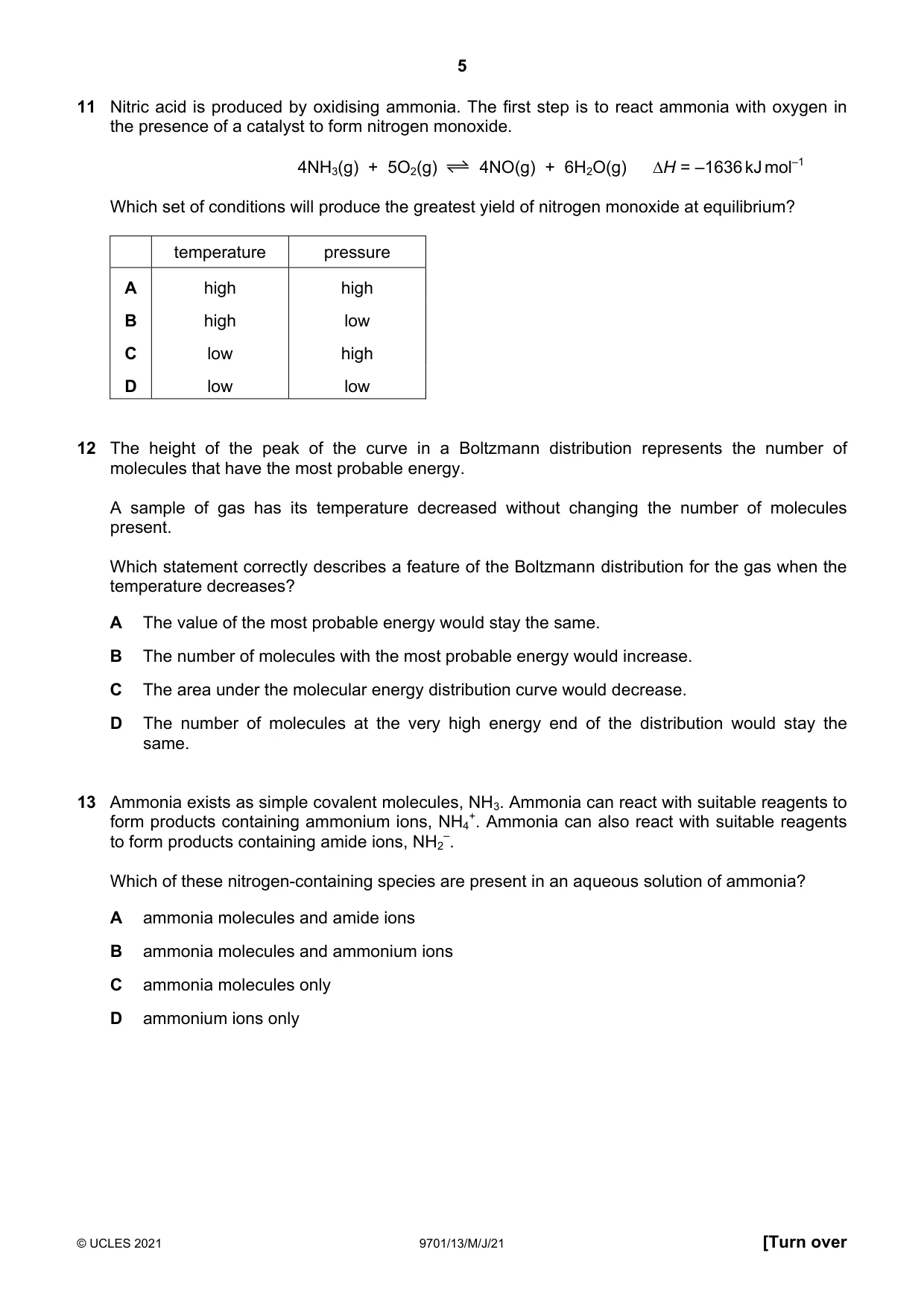
11 Nitric acid is produced by oxidising ammonia. The first step is to react ammonia with oxygen in the presence of a catalyst to form nitrogen monoxide. 4NH3(g) + 5O2(g) 4NO(g) + 6H2O(g) H = –1636 kJ mol–1 Which set of conditions will produce the greatest yield of nitrogen monoxide at equilibrium? temperature pressure A high high B high low C low high D low low
Mark scheme: D
More questions on Chemical equilibria: reversible reactions, dynamic equilibrium
Q12 · The height of the peak of the curve in a Boltzmann distribution represents the number of…
12 The height of the peak of the curve in a Boltzmann distribution represents the number of molecules that have the most probable energy. A sample of gas has its temperature decreased without changing the number of molecules present. Which statement correctly describes a feature of the Boltzmann distribution for the gas when the temperature decreases? A The value of the most probable energy would stay the same. B The number of molecules with the most probable energy would increase. C The area under the molecular energy distribution curve would decrease. D The number of molecules at the very high energy end of the distribution would stay the same.
Mark scheme: B
More questions on Effect of temperature on reaction rates and the concept of activation energy
Q13 · Ammonia exists as simple covalent molecules, NH3
13 Ammonia exists as simple covalent molecules, NH3. Ammonia can react with suitable reagents to form products containing ammonium ions, NH4 +. Ammonia can also react with suitable reagents to form products containing amide ions, NH2 –. Which of these nitrogen-containing species are present in an aqueous solution of ammonia? A ammonia molecules and amide ions B ammonia molecules and ammonium ions C ammonia molecules only D ammonium ions only
Mark scheme: B
Q14 · Which problem can result if too much NH4NO3 is applied to crops by farmers?
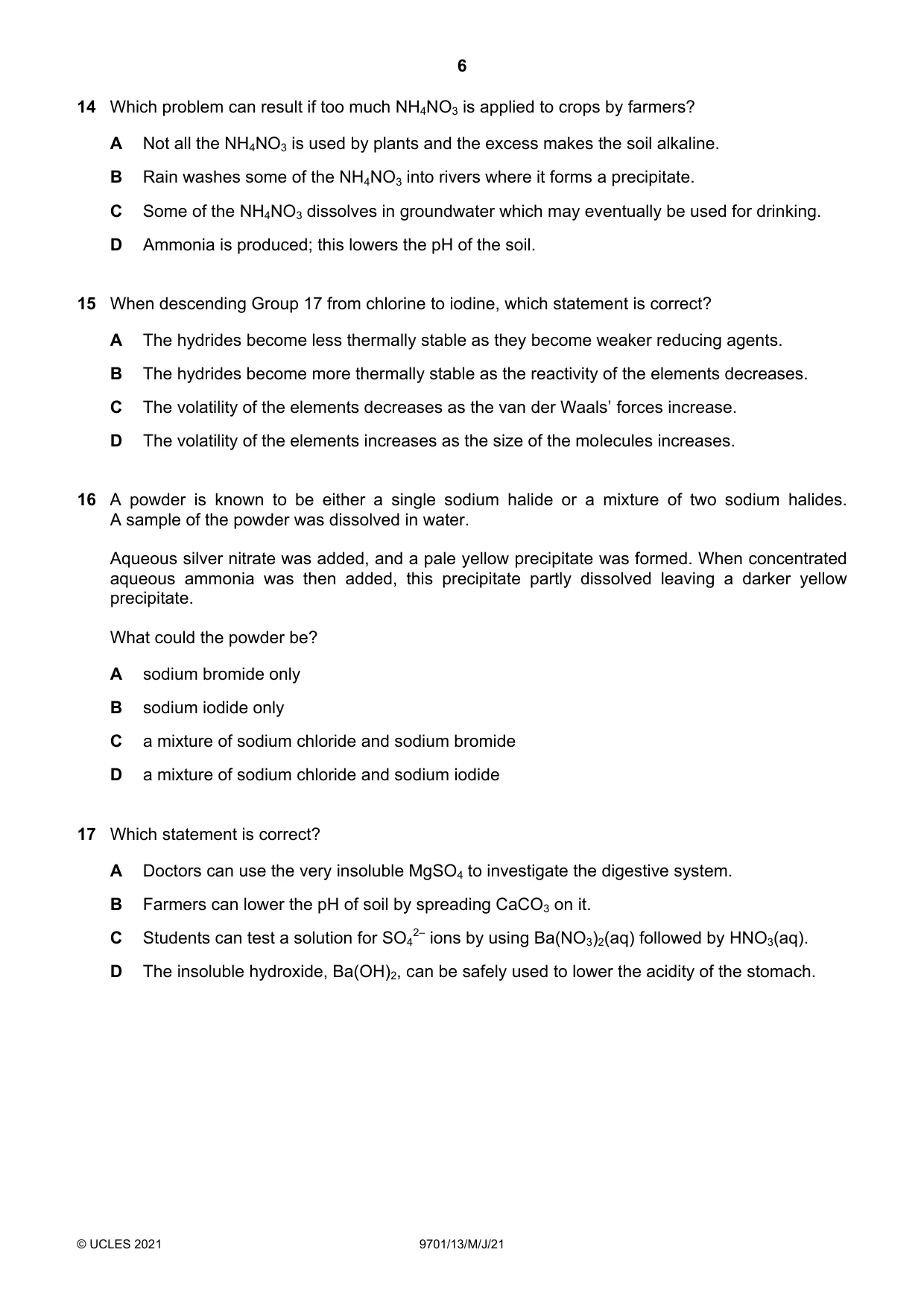
14 Which problem can result if too much NH4NO3 is applied to crops by farmers? A Not all the NH4NO3 is used by plants and the excess makes the soil alkaline. B Rain washes some of the NH4NO3 into rivers where it forms a precipitate. C Some of the NH4NO3 dissolves in groundwater which may eventually be used for drinking. D Ammonia is produced; this lowers the pH of the soil.
Mark scheme: C
Q15 · When descending Group 17 from chlorine to iodine, which statement is correct?
15 When descending Group 17 from chlorine to iodine, which statement is correct? A The hydrides become less thermally stable as they become weaker reducing agents. B The hydrides become more thermally stable as the reactivity of the elements decreases. C The volatility of the elements decreases as the van der Waals’ forces increase. D The volatility of the elements increases as the size of the molecules increases.
Mark scheme: C
More questions on Physical properties of the Group 17 elements
Q16 · A powder is known to be either a single sodium halide or a mixture of two sodium halides
16 A powder is known to be either a single sodium halide or a mixture of two sodium halides. A sample of the powder was dissolved in water. Aqueous silver nitrate was added, and a pale yellow precipitate was formed. When concentrated aqueous ammonia was then added, this precipitate partly dissolved leaving a darker yellow precipitate. What could the powder be? A sodium bromide only B sodium iodide only C a mixture of sodium chloride and sodium bromide D a mixture of sodium chloride and sodium iodide
Mark scheme: D
Q17 · Which statement is correct?
17 Which statement is correct? A Doctors can use the very insoluble MgSO4 to investigate the digestive system. B Farmers can lower the pH of soil by spreading CaCO3 on it. C Students can test a solution for SO4 2– ions by using Ba(NO3)2(aq) followed by HNO3(aq). D The insoluble hydroxide, Ba(OH)2, can be safely used to lower the acidity of the stomach.
Mark scheme: C
Q18 · A solid, X, was placed in an excess of the liquid Y
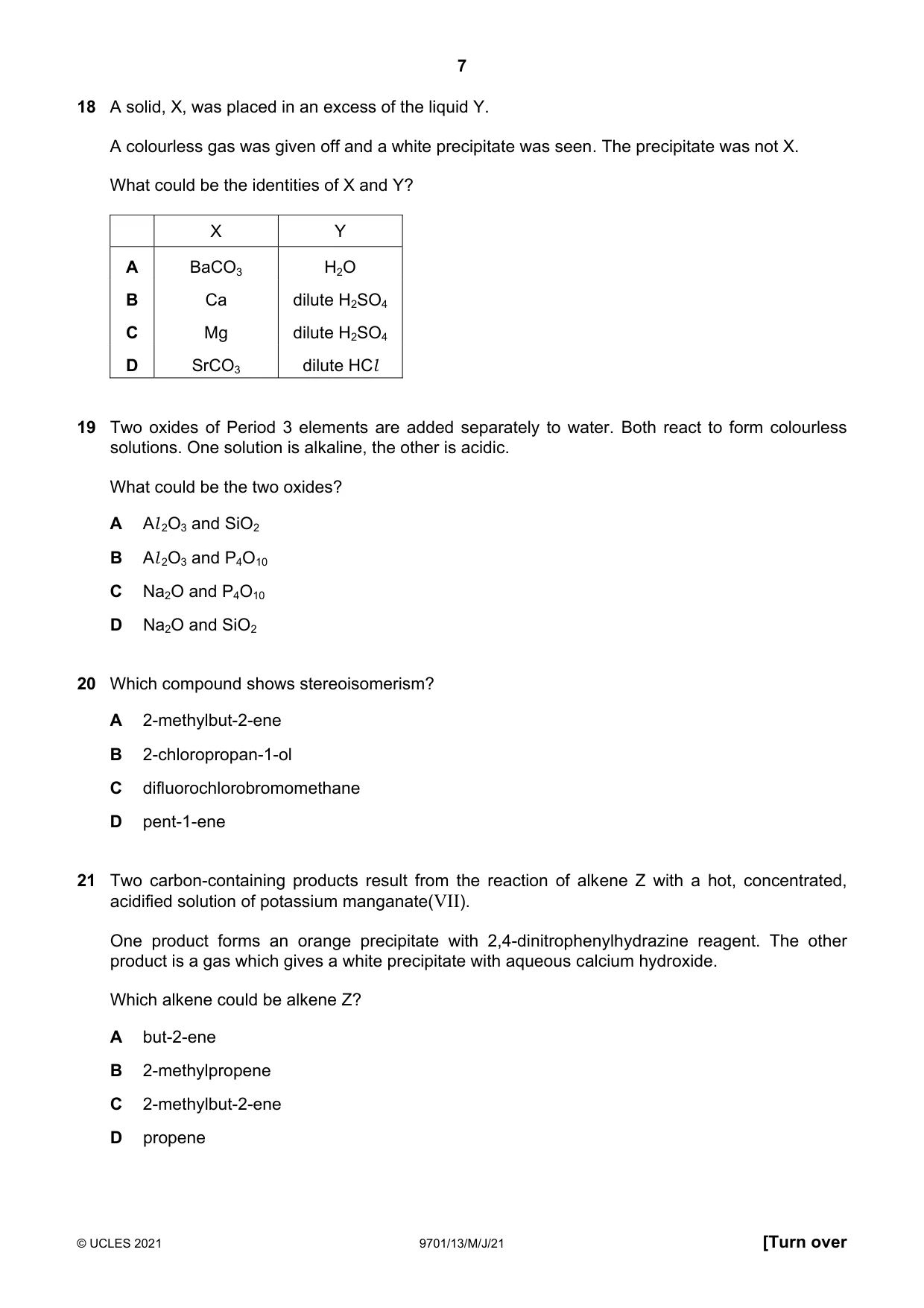
18 A solid, X, was placed in an excess of the liquid Y. A colourless gas was given off and a white precipitate was seen. The precipitate was not X. What could be the identities of X and Y? X Y A BaCO3 H2O B Ca dilute H2SO4 C Mg dilute H2SO4 D SrCO3 dilute HCl
Mark scheme: B
Q19 · Two oxides of Period 3 elements are added separately to water
19 Two oxides of Period 3 elements are added separately to water. Both react to form colourless solutions. One solution is alkaline, the other is acidic. What could be the two oxides? A Al 2O3 and SiO2 B Al 2O3 and P4O10 C Na2O and P4O10 D Na2O and SiO2
Mark scheme: C
More questions on Periodicity of chemical properties of the elements in Period 3
Q20 · Which compound shows stereoisomerism?
20 Which compound shows stereoisomerism? A 2-methylbut-2-ene B 2-chloropropan-1-ol C difluorochlorobromomethane D pent-1-ene
Mark scheme: B
More questions on Isomerism: structural isomerism and stereoisomerism
Q21 · Two carbon-containing products result from the reaction of alkene Z with a hot…
21 Two carbon-containing products result from the reaction of alkene Z with a hot, concentrated, acidified solution of potassium manganate(VII). One product forms an orange precipitate with 2,4-dinitrophenylhydrazine reagent. The other product is a gas which gives a white precipitate with aqueous calcium hydroxide. Which alkene could be alkene Z? A but-2-ene B 2-methylpropene C 2-methylbut-2-ene D propene
Mark scheme: B
Q22 · What is the correct mechanism for the addition of hydrogen bromide to ethene?
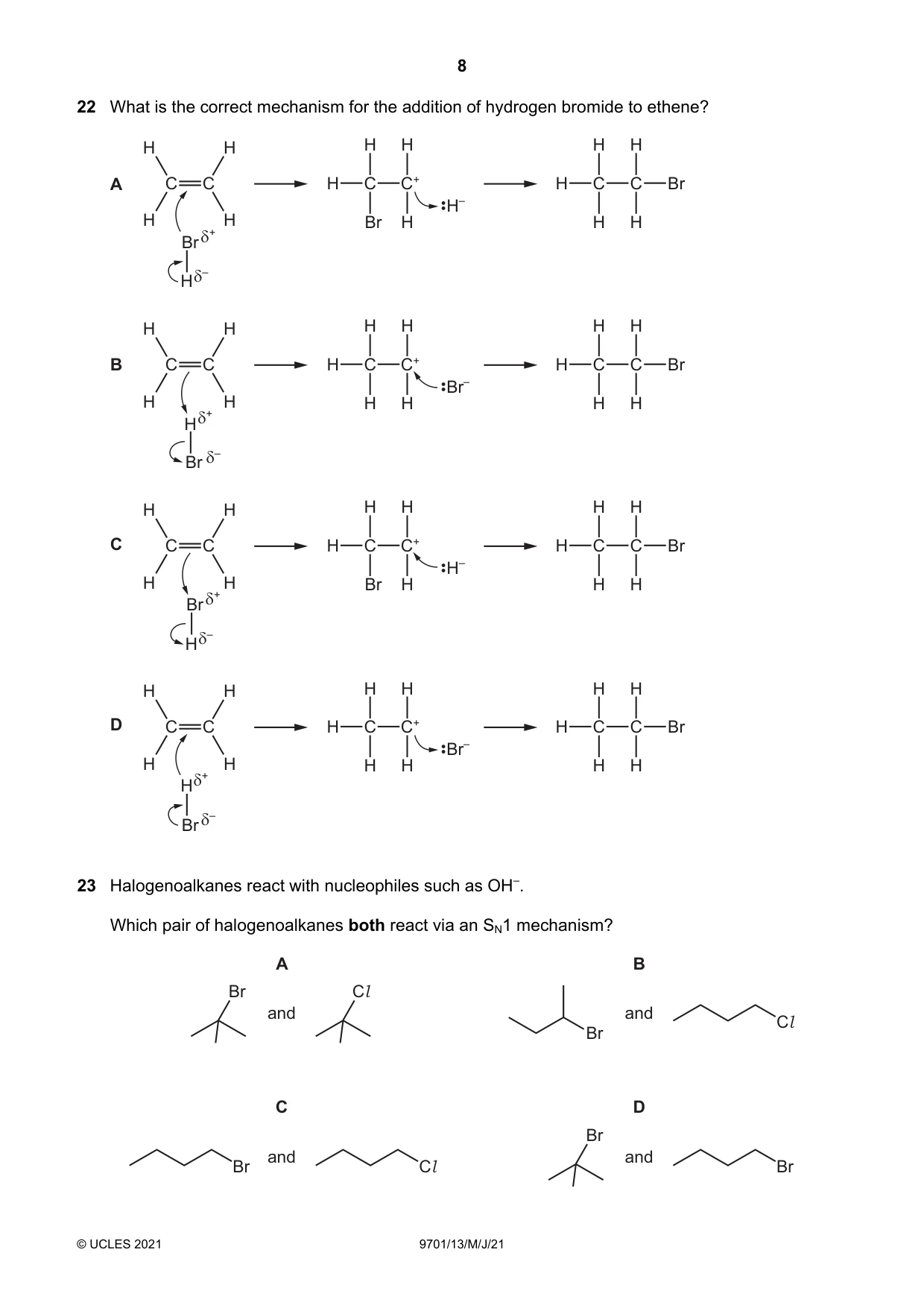
22 What is the correct mechanism for the addition of hydrogen bromide to ethene? H H H 4H H 4H \_ / |_| |_| C=C H—C—C* —»> H—C—C—Br /¢ \ | [Near || H H Br H H H ro Chis. H H H 4H H H \_ / |_| |_| C=C —, H—C—C; —»> H—C—C—Br H _H H H H H ato Chee H H H H H H \ |_| |_| C==C —, H—C—C — > H—C—C—Br H wa Br H H oH Bro Che. H H H H H H \ |_| |_| D —=C H—C—C* H—C—C—Br “( \ \ Br H H H H H Ho
Mark scheme: B
Q23 · Halogenoalkanes react with nucleophiles such as OH–
23 Halogenoalkanes react with nucleophiles such as OH–. Which pair of halogenoalkanes both react via an SN1 mechanism? A B Br Cl and and Cl Br C D Br and and Br Cl Br
Mark scheme: A
Q24 · A mixture of ethanol and methanol is burned in oxygen to produce 35 cm3 of CO2 and 55 cm3…
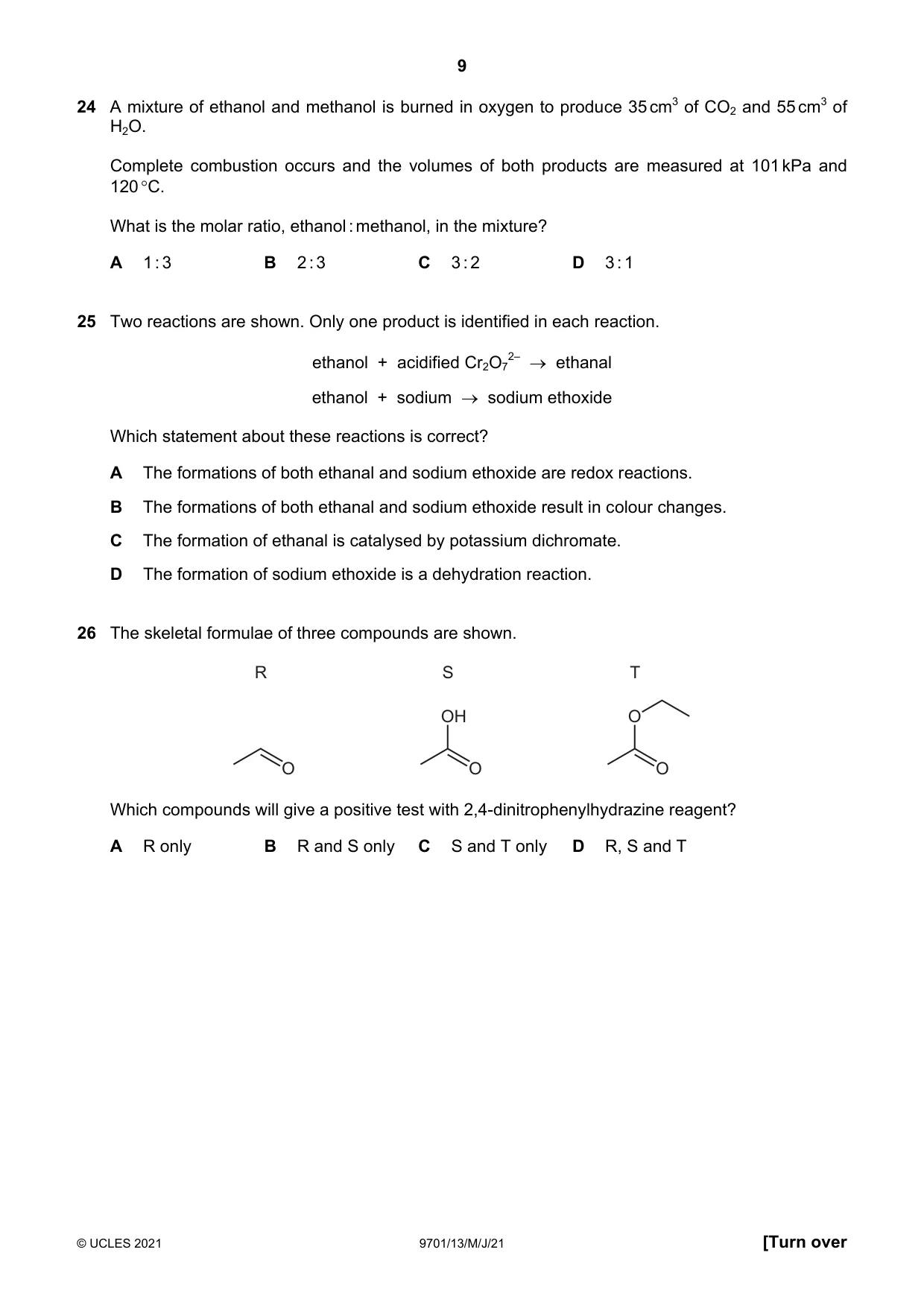
24 A mixture of ethanol and methanol is burned in oxygen to produce 35 cm3 of CO2 and 55 cm3 of H2O. Complete combustion occurs and the volumes of both products are measured at 101 kPa and 120 C. What is the molar ratio, ethanol : methanol, in the mixture? A 1 : 3 B 2 : 3 C 3 : 2 D 3 : 1
Mark scheme: D
More questions on Reacting masses and volumes (of solutions and gases)
Q25 · Two reactions are shown
25 Two reactions are shown. Only one product is identified in each reaction. ethanol + acidified Cr2O7 2– ethanal ethanol + sodium sodium ethoxide Which statement about these reactions is correct? A The formations of both ethanal and sodium ethoxide are redox reactions. B The formations of both ethanal and sodium ethoxide result in colour changes. C The formation of ethanal is catalysed by potassium dichromate. D The formation of sodium ethoxide is a dehydration reaction.
Mark scheme: A
Q26 · The skeletal formulae of three compounds are shown
26 The skeletal formulae of three compounds are shown. R S T OH O O O O Which compounds will give a positive test with 2,4-dinitrophenylhydrazine reagent? A R only B R and S only C S and T only D R, S and T
Mark scheme: A
Q27 · The diagram shows the structure of a compound formed by the reaction of HCN with a…
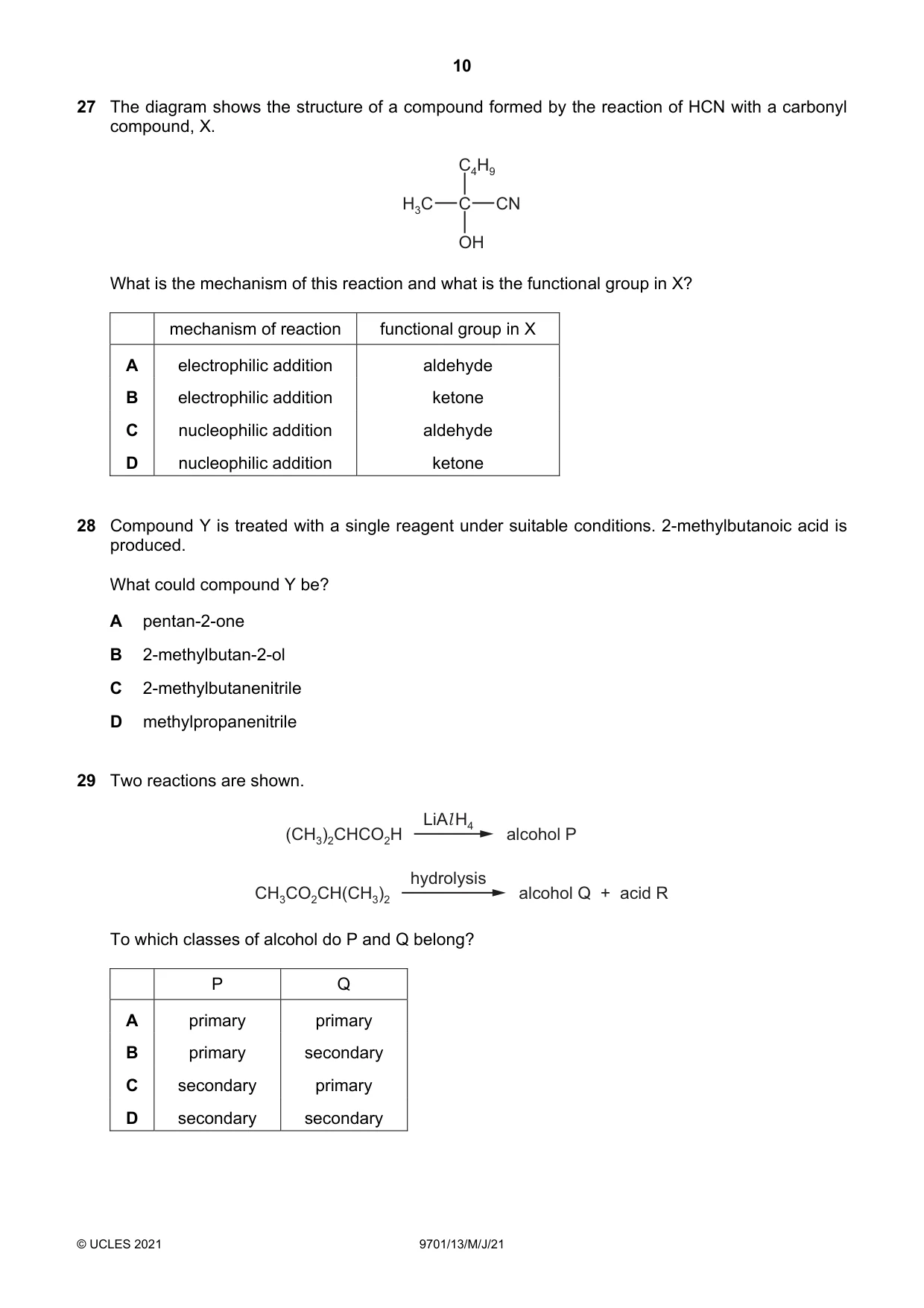
27 The diagram shows the structure of a compound formed by the reaction of HCN with a carbonyl compound, X. C4H9 H3C C CN OH What is the mechanism of this reaction and what is the functional group in X? mechanism of reaction functional group in X A electrophilic addition aldehyde B electrophilic addition ketone C nucleophilic addition aldehyde D nucleophilic addition ketone
Mark scheme: D
Q28 · Compound Y is treated with a single reagent under suitable conditions
28 Compound Y is treated with a single reagent under suitable conditions. 2-methylbutanoic acid is produced. What could compound Y be? A pentan-2-one B 2-methylbutan-2-ol C 2-methylbutanenitrile D methylpropanenitrile
Mark scheme: C
Q29 · Two reactions are shown
29 Two reactions are shown. LiAl H4 (CH3)2CHCO2H alcohol P hydrolysis CH3CO2CH(CH3)2 alcohol Q + acid R To which classes of alcohol do P and Q belong? P Q A primary primary B primary secondary C secondary primary D secondary secondary
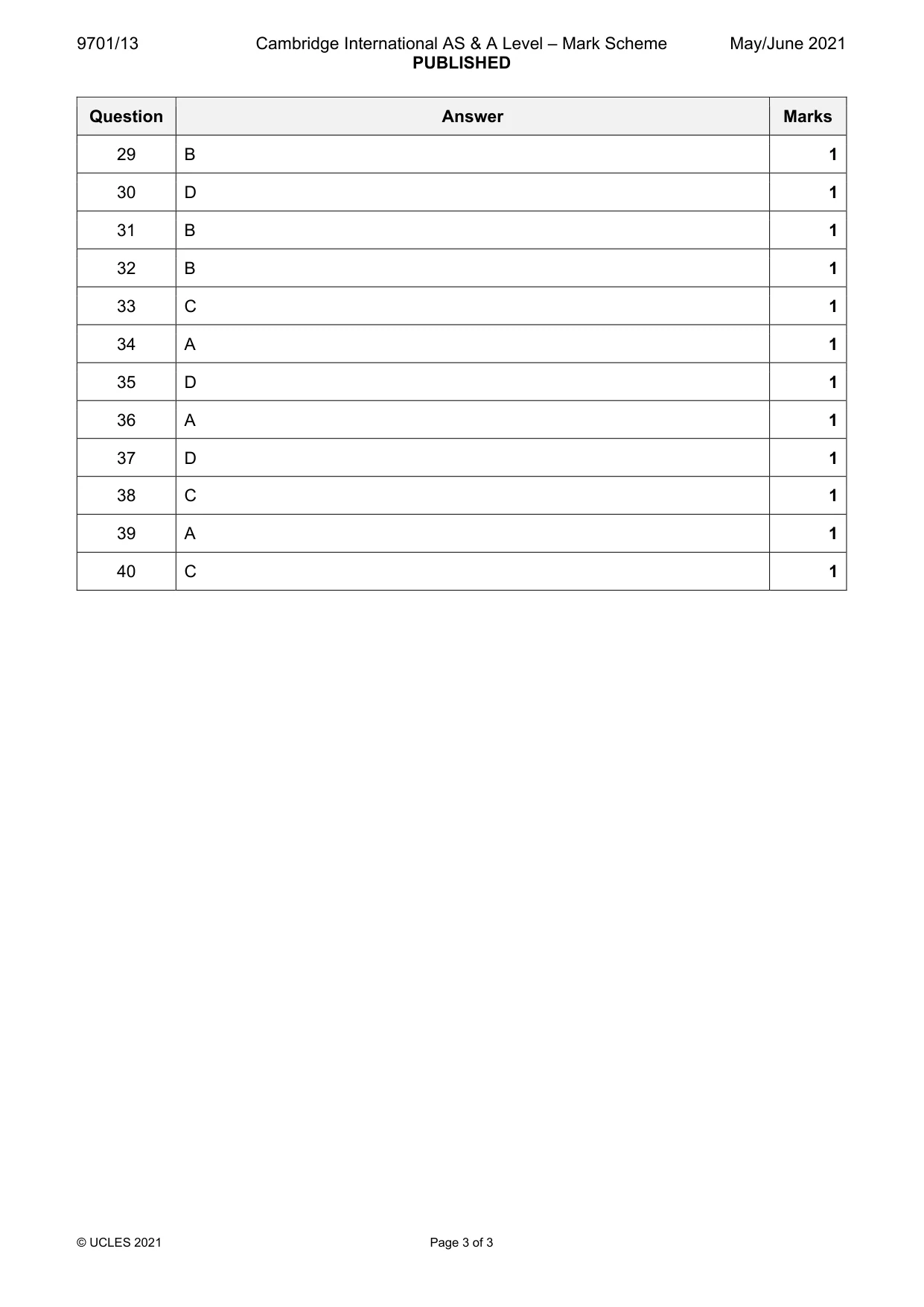
Mark scheme: B
Q30 · The infra-red spectrum of molecule Z is shown
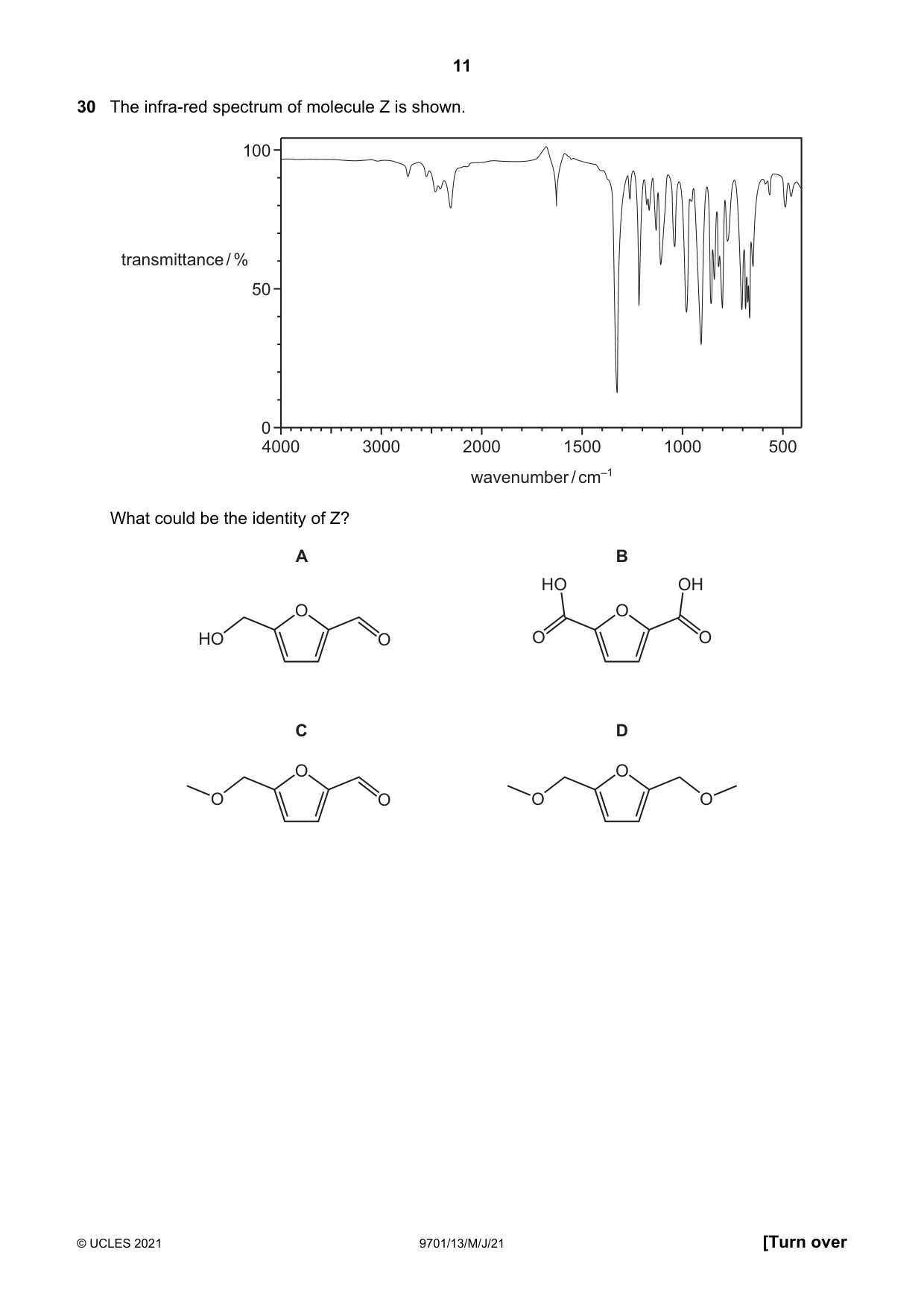
30 The infra-red spectrum of molecule Z is shown. 100 transmittance / % 50 0 4000 3000 2000 1500 1000 500 wavenumber / cm–1 What could be the identity of Z? A B HO OH O O HO O O O C D O O O O O O
Mark scheme: D
Q31 · Which statements about first ionisation energies are correct?
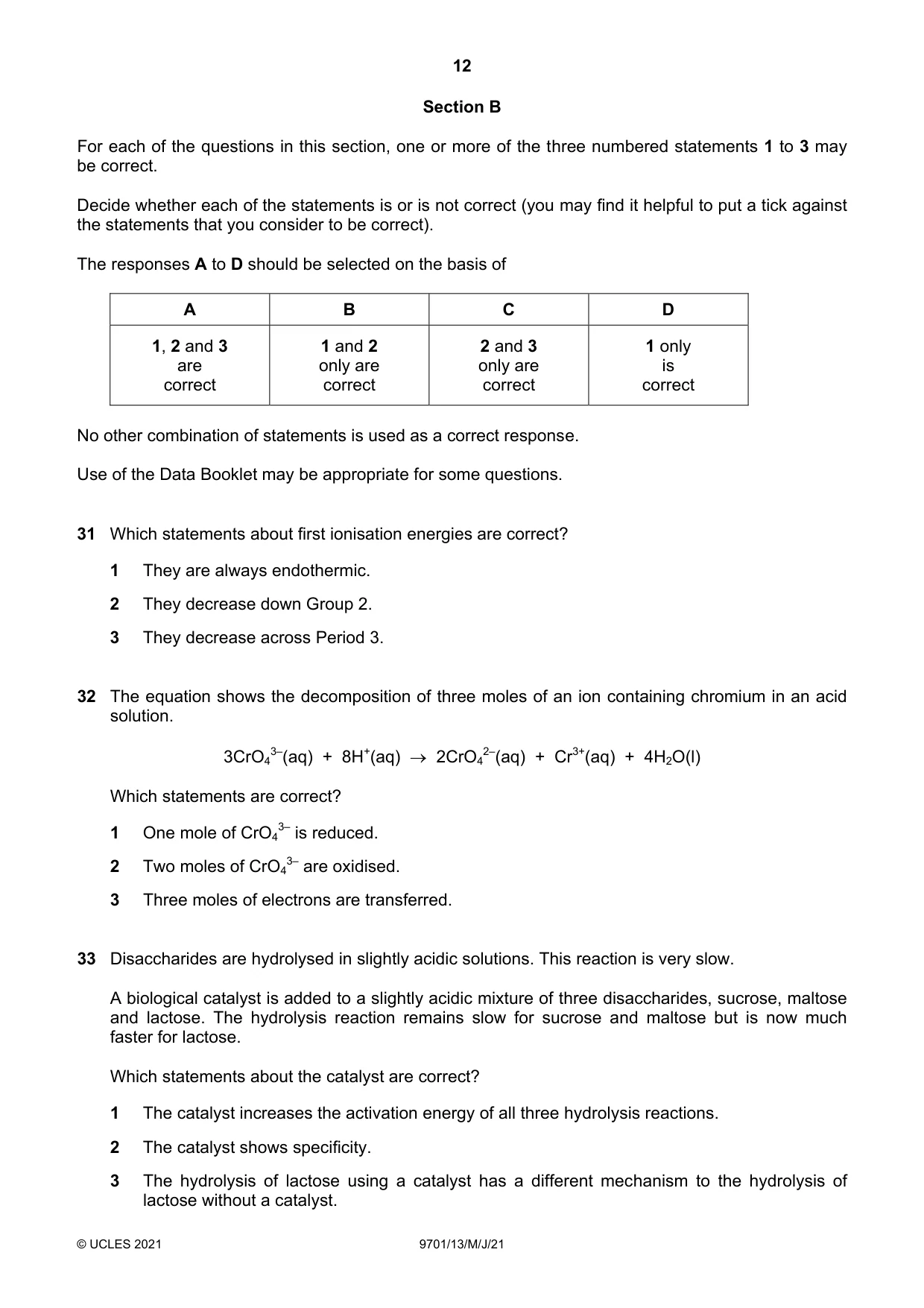
31 Which statements about first ionisation energies are correct? 1 They are always endothermic. 2 They decrease down Group 2. 3 They decrease across Period 3.
Mark scheme: B
Q32 · The equation shows the decomposition of three moles of an ion containing chromium in an…
32 The equation shows the decomposition of three moles of an ion containing chromium in an acid solution. 3CrO4 3–(aq) + 8H+(aq) 2CrO4 2–(aq) + Cr3+(aq) + 4H2O(l) Which statements are correct? 1 One mole of CrO4 3– is reduced. 2 Two moles of CrO4 3– are oxidised. 3 Three moles of electrons are transferred.
Mark scheme: B
Q33 · Disaccharides are hydrolysed in slightly acidic solutions
33 Disaccharides are hydrolysed in slightly acidic solutions. This reaction is very slow. A biological catalyst is added to a slightly acidic mixture of three disaccharides, sucrose, maltose and lactose. The hydrolysis reaction remains slow for sucrose and maltose but is now much faster for lactose. Which statements about the catalyst are correct? 1 The catalyst increases the activation energy of all three hydrolysis reactions. 2 The catalyst shows specificity. 3 The hydrolysis of lactose using a catalyst has a different mechanism to the hydrolysis of lactose without a catalyst.
Mark scheme: C
Q34 · Element X is a solid under room conditions
34 Element X is a solid under room conditions. It occurs as a contaminant of fossil fuels. Its oxide, Y, is formed when fossil fuels are burned. In the atmosphere, Y can be further oxidised to Z. Which statements about X, Y and Z are correct? 1 Atoms of X have paired p electrons. 2 The atmospheric oxidation of Y to Z is a catalysed reaction. 3 With water, Z forms a strong acid.
Mark scheme: A
Q35 · Which reagents produce a solution of sodium chlorate(V)?
35 Which reagents produce a solution of sodium chlorate(V)? 1 chlorine and hot concentrated sodium hydroxide solution 2 chlorine and cold dilute sodium hydroxide solution 3 chlorine dissolved in water at room temperature
Mark scheme: D
Q36 · Which statements help to explain the increase in melting point from sodium to aluminium?
36 Which statements help to explain the increase in melting point from sodium to aluminium? 1 The charge on the metal ion increases. 2 There are more delocalised electrons per metal ion. 3 The radius of the metal ion decreases.
Mark scheme: A
Q37 · The diagram shows a molecule of a compound used as a flame retardant
37 The diagram shows a molecule of a compound used as a flame retardant. Br Br Br Br Br Br Which statements about this structure are correct? 1 Each brominated C atom is chiral. 2 The molecular formula is C12H20Br6. 3 The C–C–C bond angles are all 120.
Mark scheme: D
Q38 · Bromoethane reacts with NaOH in different ways depending on the solvent used
38 Bromoethane reacts with NaOH in different ways depending on the solvent used. Which rows about these reactions are correct? solvent used organic product 1 water ethan-1,2-diol 2 ethanol ethene 3 water ethanol
Mark scheme: C
Q39 · Three compounds, X, Y and Z, are shown
39 Three compounds, X, Y and Z, are shown. X Y Z C2H5COCH3 C2H5CHO CH3CO2H Which statements about X, Y and Z are correct? 1 X reacts with alkaline aqueous iodine. 2 Y reacts with Tollens’ reagent. 3 Z does not react with alkaline aqueous iodine.
Mark scheme: A
Q40 · 5-hydroxypentanoic acid is readily converted into the cyclic compound L
40 5-hydroxypentanoic acid is readily converted into the cyclic compound L. L O O Which statements about this reaction are correct? 1 Acidified sodium dichromate(VI) is used as a reagent. 2 A water molecule is produced in the reaction. 3 The reaction can be catalysed by concentrated H2SO4.
Mark scheme: C
What was in this paper
The subtopics covered by these 40 questions, and how many questions each got. Open one in a new tab to see every Cambridge question on it.
2Aldehydes and ketones2Alkenes2Chemical equilibria: reversible reactions, dynamic equilibrium2Halogenoalkanes2Nitriles and hydroxynitriles2Reacting masses and volumes (of solutions and gases)2Redox processes: electron transfer and changes in oxidation number (oxidation state)2Similarities and trends in the properties of the Group 2 metals, magnesium to barium, and their compounds2Alcohols1Effect of temperature on reaction rates and the concept of activation energy1Electronegativity and bonding1Enthalpies of solution and hydration1Esters1Esters1Formulas1Hess’s law1Homogeneous and heterogeneous catalysts1Infrared spectroscopy1Intermolecular forces, electronegativity and bond properties1Ionisation energy1Isomerism: optical1Isomerism: structural isomerism and stereoisomerism1Metallic bonding1Nitrogen and sulfur1Particles in the atom and atomic radius1Periodicity of chemical properties of the elements in Period 31Physical properties of the Group 17 elements1Shapes of molecules1Some reactions of the halide ions1The reactions of chlorine1What you needed in this session
Cambridge’s own grade thresholds for 2021 May/June, Paper 1 · Variant 3. A higher threshold means an easier paper — the bar moves with how the cohort did.