Cambridge A Level Chemistry 9701 — 2023 Oct/Nov Paper 1 · Variant 1
9701/11/O/N/23 · 40 questions · 40 marks · ≈45 min
The question paper and its mark scheme, free to read here and free to download. This is Cambridge’s own paper, exactly as it was sat.
Question paper20 pages


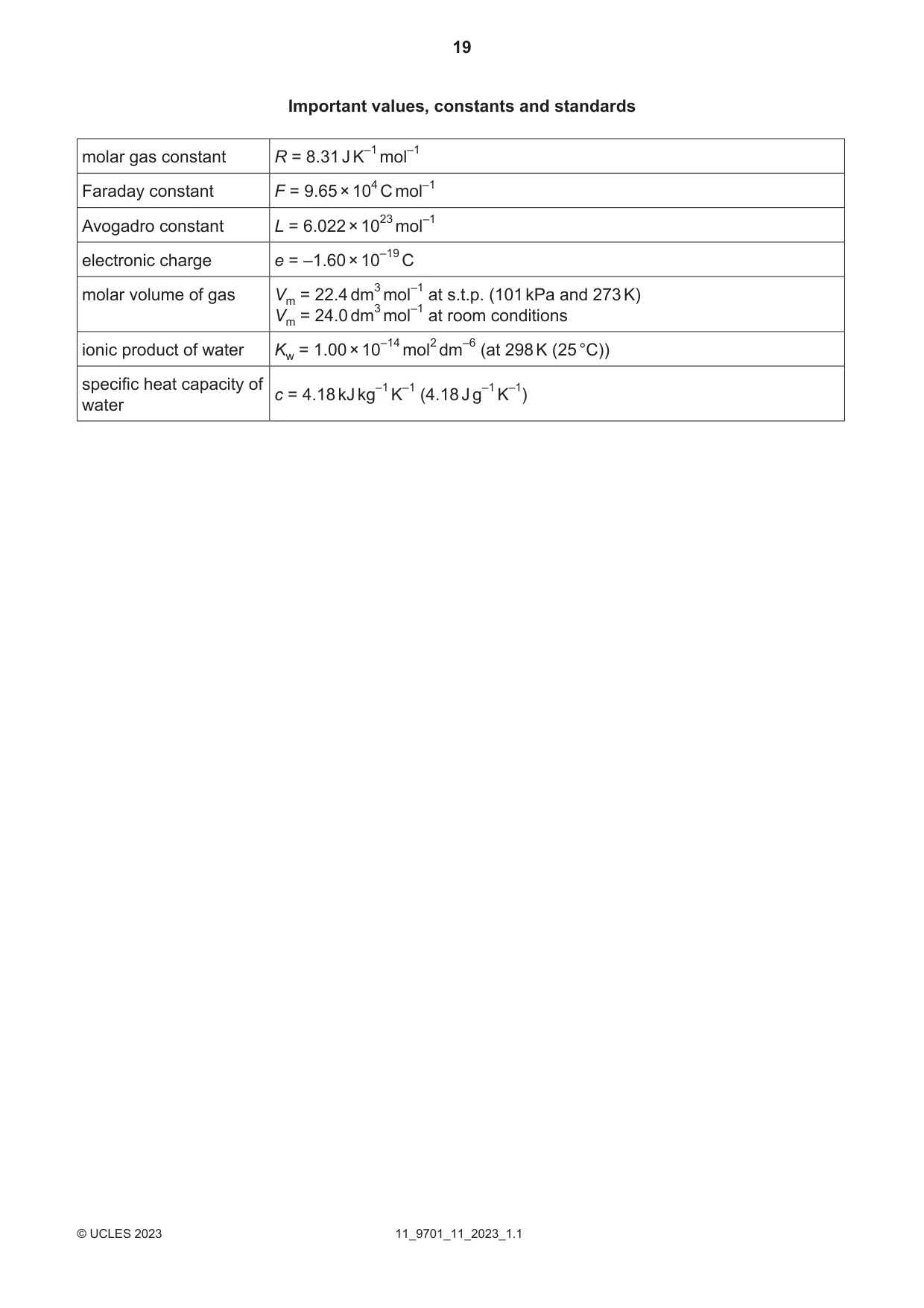
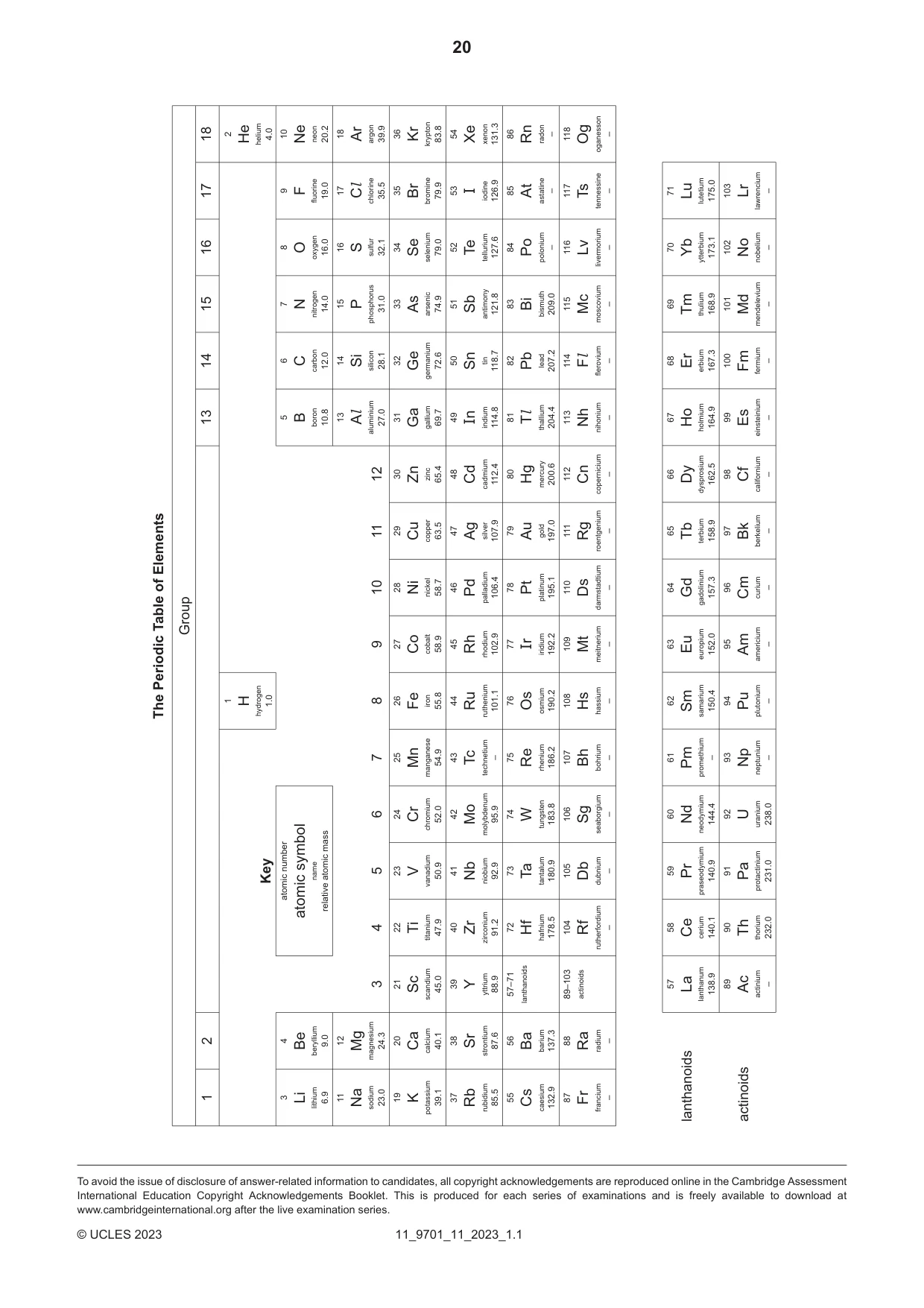
Mark scheme3 pages
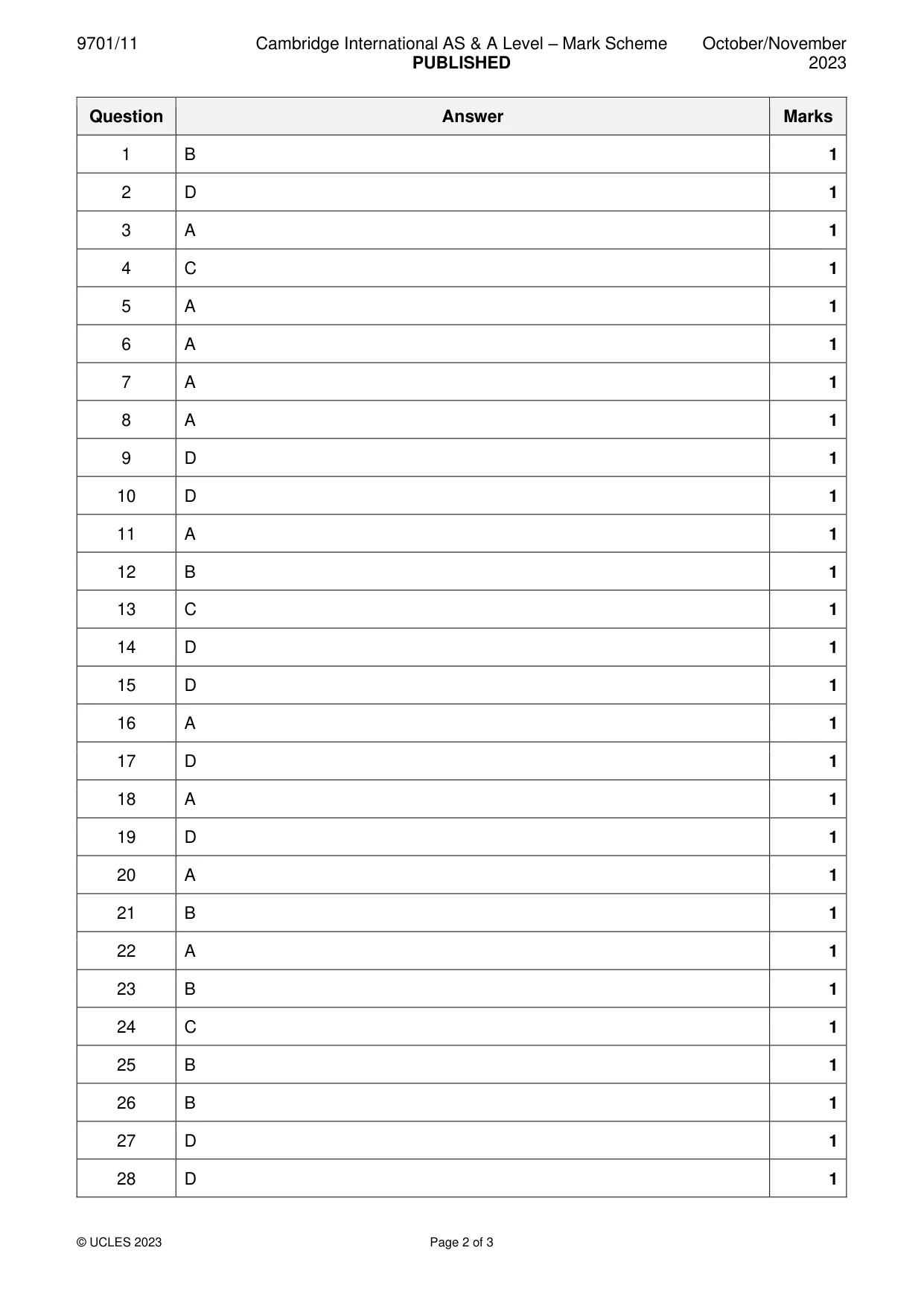
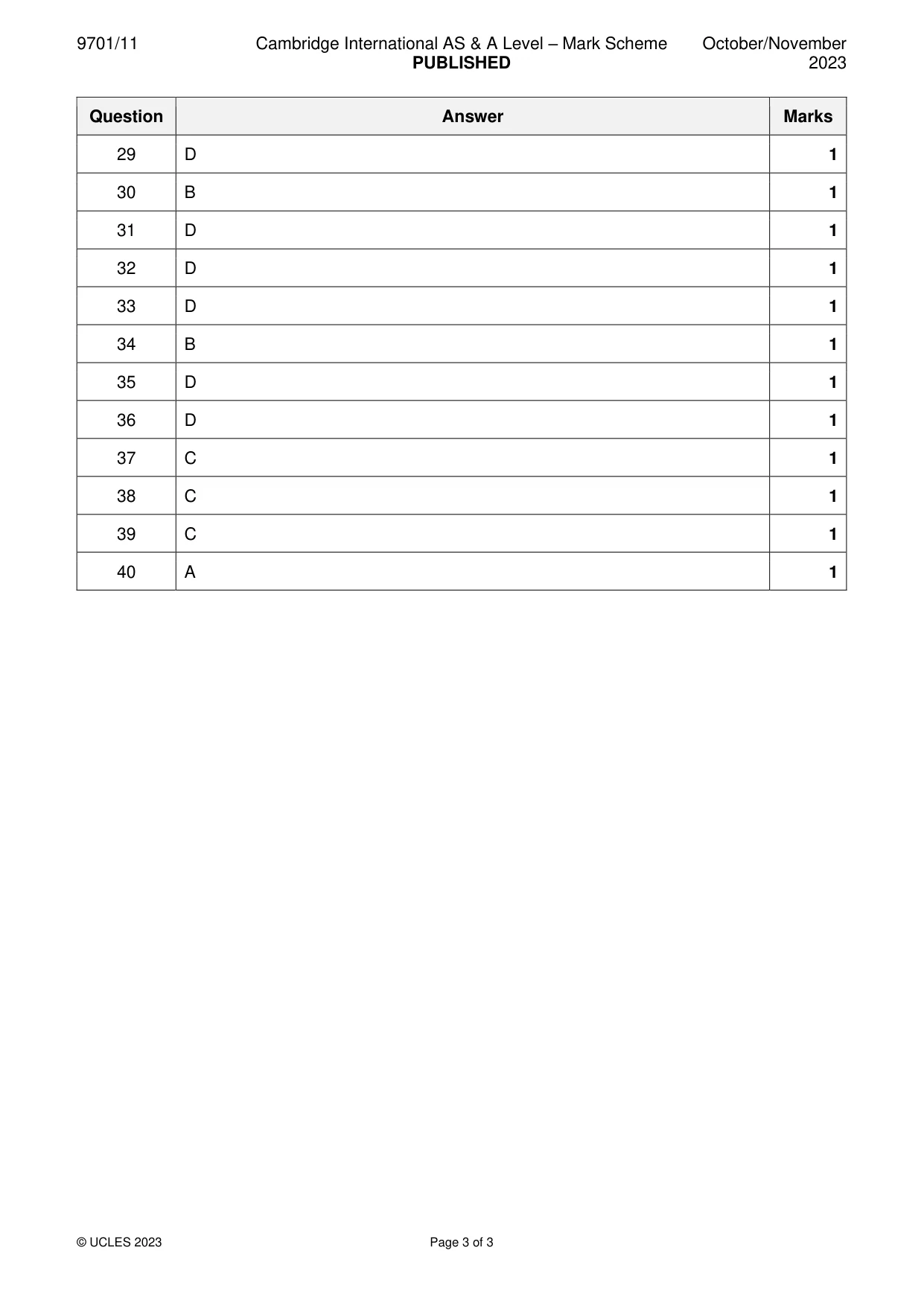
Answers below. Sit the paper first if you are practising.
Questions as text
Q1 · Sodium azide, NaN3 is an explosive used to inflate airbags in cars when they crash
1 Sodium azide, NaN3 is an explosive used to inflate airbags in cars when they crash. It consists of positive sodium ions and negative azide ions. What are the numbers of electrons in the sodium ion and the azide ion? sodium ion azide ion A 10 20 B 10 22 C 12 20 D 12 22
Mark scheme: B
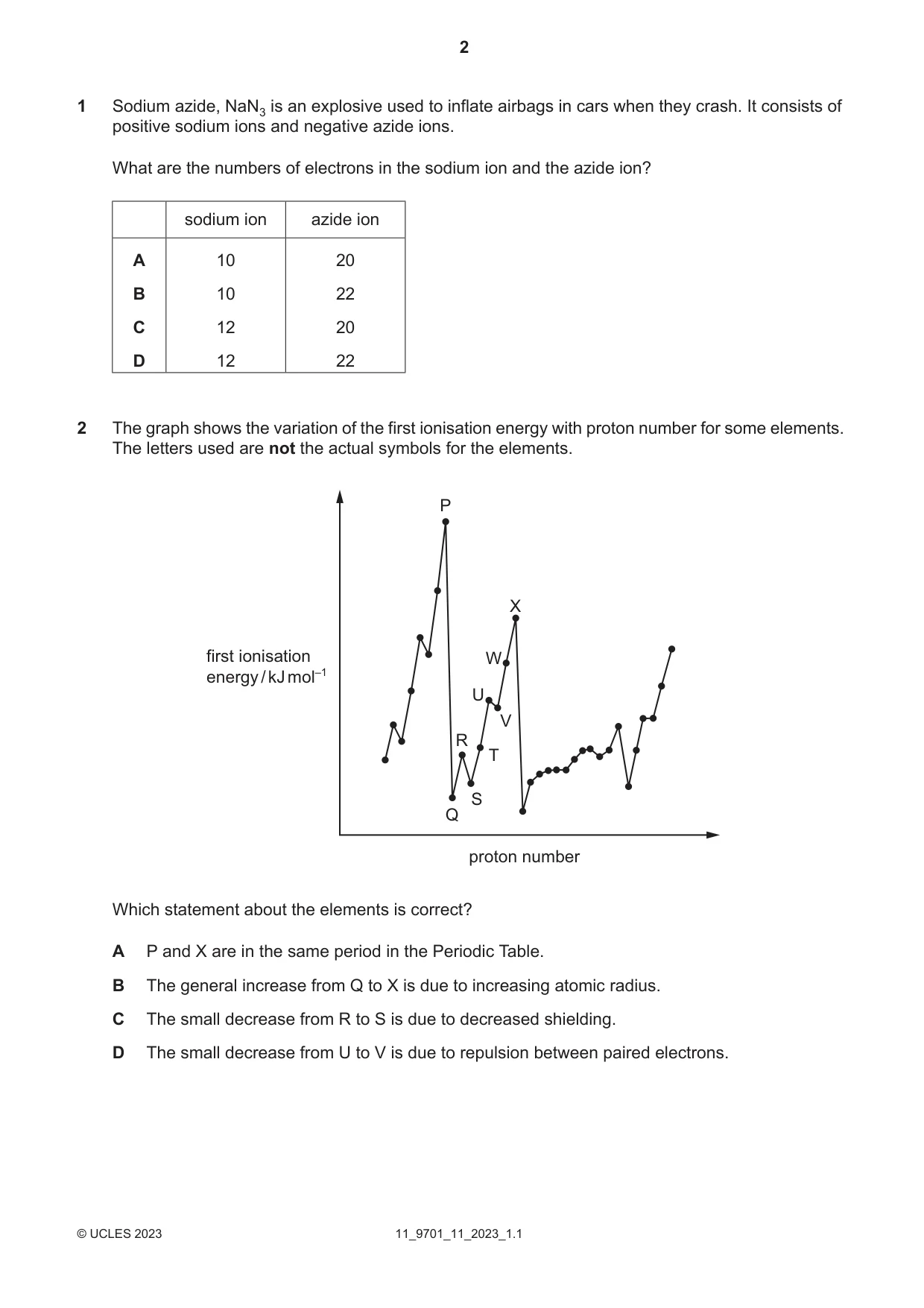
Q2 · The graph shows the variation of the first ionisation energy with proton number for some…
2 The graph shows the variation of the first ionisation energy with proton number for some elements. The letters used are not the actual symbols for the elements. P X first ionisation W energy / kJ mol–1 U V R T S Q proton number Which statement about the elements is correct? A P and X are in the same period in the Periodic Table. B The general increase from Q to X is due to increasing atomic radius. C The small decrease from R to S is due to decreased shielding. D The small decrease from U to V is due to repulsion between paired electrons.
Mark scheme: D
Q3 · Aluminium carbide, Al 4C3, reacts readily with aqueous sodium hydroxide
3 Aluminium carbide, Al 4C3, reacts readily with aqueous sodium hydroxide. The two products of the reaction are NaAlO2 and a hydrocarbon. Water molecules are also involved as reactants. What is the formula of the hydrocarbon? A CH4 B C2H6 C C3H8 D C6H12
Mark scheme: A
Q4 · A sample of 35.6g of hydrated sodium carbonate contains 25.84% sodium ions by mass
4 A sample of 35.6g of hydrated sodium carbonate contains 25.84% sodium ions by mass. When this sample is heated, anhydrous sodium carbonate and water are formed. Which mass of water is given off? A 7.2g B 10.6g C 14.4g D 21.2g
Mark scheme: C
More questions on Reacting masses and volumes (of solutions and gases)
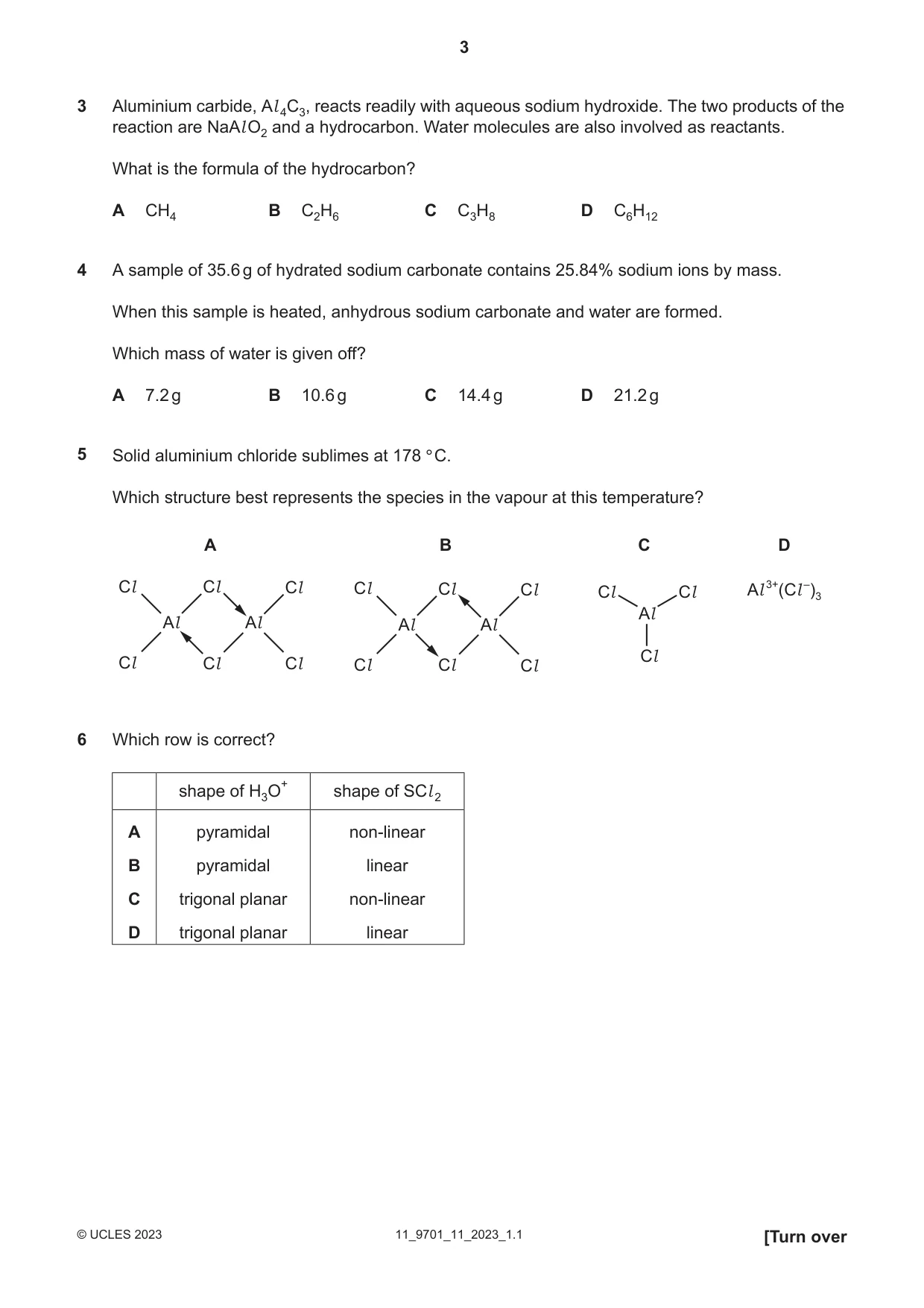
Q5 · Solid aluminium chloride sublimes at 178 °C
5 Solid aluminium chloride sublimes at 178 °C. Which structure best represents the species in the vapour at this temperature? A B C D Cl Cl Cl Cl Cl Cl Cl Cl Al 3+(Cl –)3 Al Al Al Al Al Cl Cl Cl Cl Cl Cl Cl
Mark scheme: A
More questions on Covalent bonding and coordinate (dative covalent) bonding
Q6 · Which row is correct?
6 Which row is correct? shape of H3O+ shape of SCl 2 A pyramidal non-linear B pyramidal linear C trigonal planar non-linear D trigonal planar linear When an evacuated tube of volume 400cm3 is filled with gas at 300K and 101kPa, the mass of
Mark scheme: A
Q7 · The tube increases by 0.65g
7 the tube increases by 0.65g. Assume the gas behaves as an ideal gas. What is the identity of the gas? A argon B helium C krypton D neon
Mark scheme: A
More questions on The gaseous state: ideal and real gases and pV = nRT
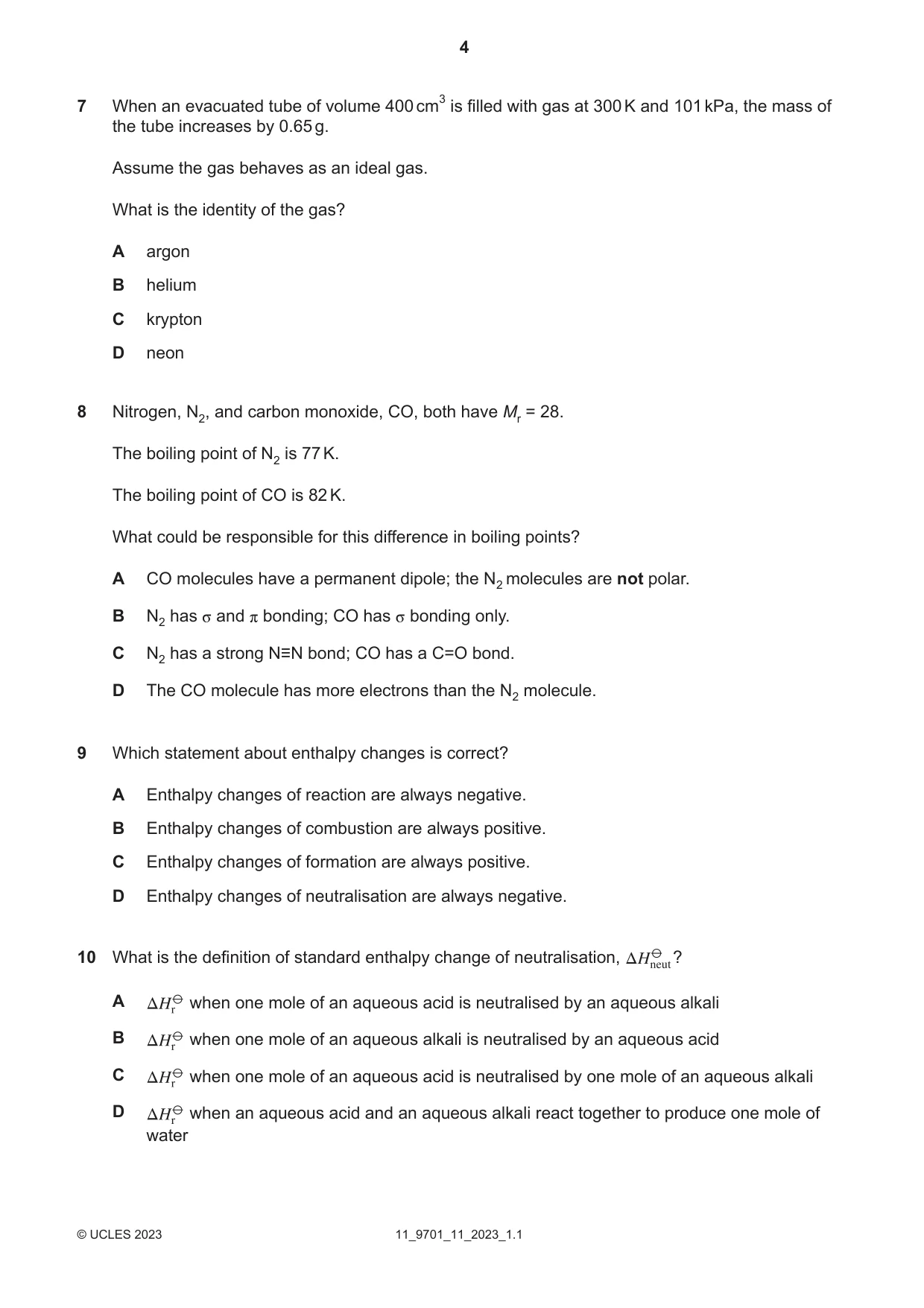
Q8 · Nitrogen, N2, and carbon monoxide, CO, both have Mr = 28
8 Nitrogen, N2, and carbon monoxide, CO, both have Mr = 28. The boiling point of N2 is 77K. The boiling point of CO is 82K. What could be responsible for this difference in boiling points? A CO molecules have a permanent dipole; the N2 molecules are not polar. B N2 has and bonding; CO has bonding only. C N2 has a strong NŁN bond; CO has a C=O bond. D The CO molecule has more electrons than the N2 molecule.
Mark scheme: A
More questions on Intermolecular forces, electronegativity and bond properties
Q9 · Which statement about enthalpy changes is correct?
9 Which statement about enthalpy changes is correct? A Enthalpy changes of reaction are always negative. B Enthalpy changes of combustion are always positive. C Enthalpy changes of formation are always positive. D Enthalpy changes of neutralisation are always negative.
Mark scheme: D
Q10 · What is the definition of standard enthalpy change of neutralisation, ?
10 What is the definition of standard enthalpy change of neutralisation, ? A when one mole of an aqueous acid is neutralised by an aqueous alkali B when one mole of an aqueous alkali is neutralised by an aqueous acid C when one mole of an aqueous acid is neutralised by one mole of an aqueous alkali D when an aqueous acid and an aqueous alkali react together to produce one mole of water
Mark scheme: D
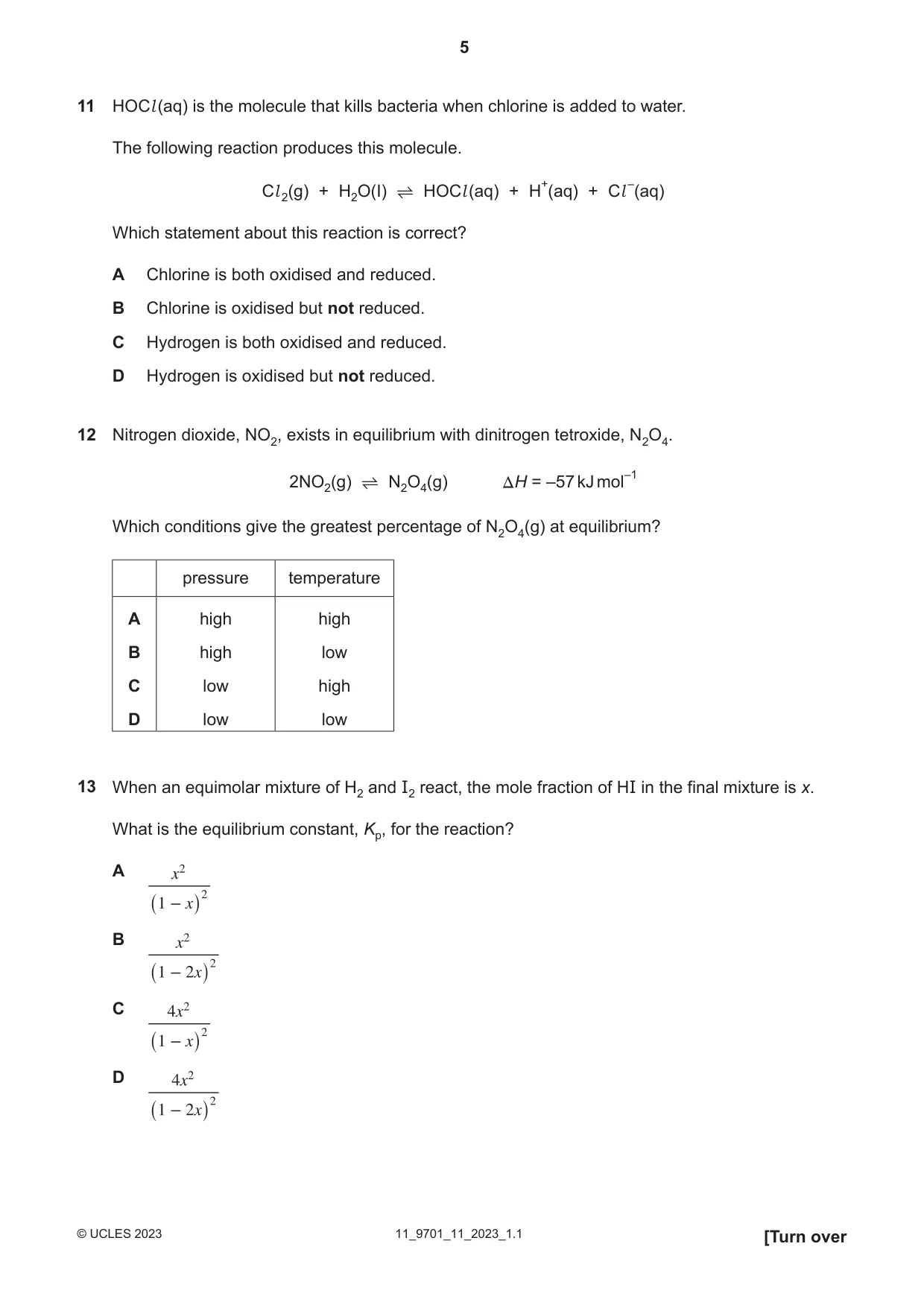
Q11 · HOCl(aq) is the molecule that kills bacteria when chlorine is added to water
11 HOCl(aq) is the molecule that kills bacteria when chlorine is added to water. The following reaction produces this molecule. Cl 2(g) + H2O(I) ⇋HOCl(aq) + H+(aq) + Cl –(aq) Which statement about this reaction is correct? A Chlorine is both oxidised and reduced. B Chlorine is oxidised but not reduced. C Hydrogen is both oxidised and reduced. D Hydrogen is oxidised but not reduced.
Mark scheme: A
Q12 · Nitrogen dioxide, NO2, exists in equilibrium with dinitrogen tetroxide, N2O4
12 Nitrogen dioxide, NO2, exists in equilibrium with dinitrogen tetroxide, N2O4. 2NO2(g) ⇋N2O4(g) H = –57kJmol–1 Which conditions give the greatest percentage of N2O4(g) at equilibrium? pressure temperature A high high B high low C low high D low low
Mark scheme: B
More questions on Chemical equilibria: reversible reactions, dynamic equilibrium
Q13 · When an equimolar mixture of H2 and I2 react, the mole fraction of HI in the final…
13 When an equimolar mixture of H2 and I2 react, the mole fraction of HI in the final mixture is x. What is the equilibrium constant, Kp, for the reaction? A B C D
Mark scheme: C
More questions on Chemical equilibria: reversible reactions, dynamic equilibrium
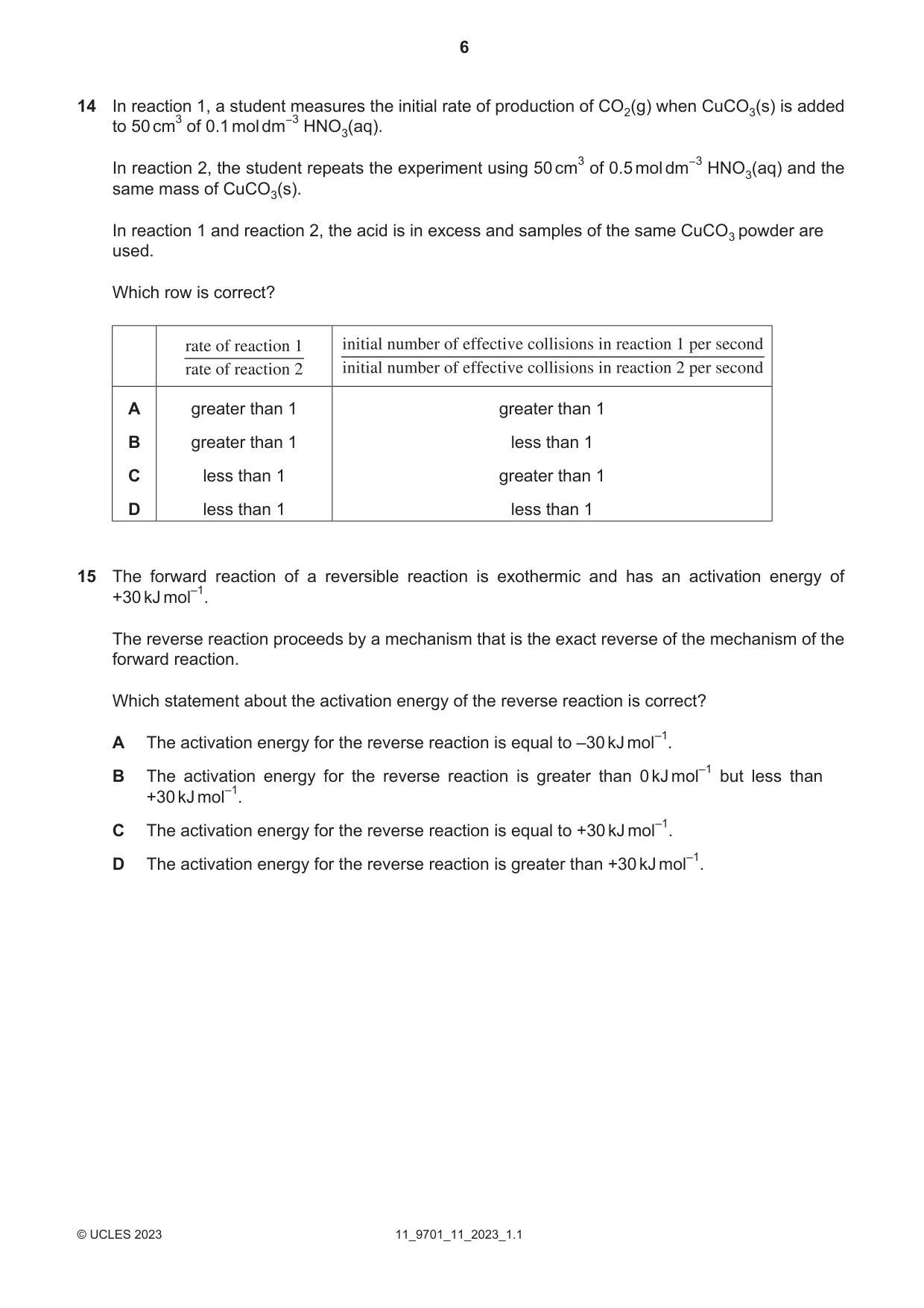
Q14 · In reaction 1, a student measures the initial rate of production of CO2(g) when CuCO3(s)…
14 In reaction 1, a student measures the initial rate of production of CO2(g) when CuCO3(s) is added to 50cm3 of 0.1moldm−3 HNO3(aq). In reaction 2, the student repeats the experiment using 50cm3 of 0.5moldm−3 HNO3(aq) and the same mass of CuCO3(s). In reaction 1 and reaction 2, the acid is in excess and samples of the same CuCO3 powder are used. Which row is correct? A greater than 1 greater than 1 B greater than 1 less than 1 C less than 1 greater than 1 D less than 1 less than 1
Mark scheme: D
Q15 · The forward reaction of a reversible reaction is exothermic and has an activation energy…
15 The forward reaction of a reversible reaction is exothermic and has an activation energy of +30kJmol–1. The reverse reaction proceeds by a mechanism that is the exact reverse of the mechanism of the forward reaction. Which statement about the activation energy of the reverse reaction is correct? A The activation energy for the reverse reaction is equal to –30kJmol–1. The activation energy for the reverse reaction is greater than 0kJmol–1 but less than B +30kJmol–1. C The activation energy for the reverse reaction is equal to +30kJmol–1. D The activation energy for the reverse reaction is greater than +30kJmol–1.
Mark scheme: D
More questions on Effect of temperature on reaction rates and the concept of activation energy
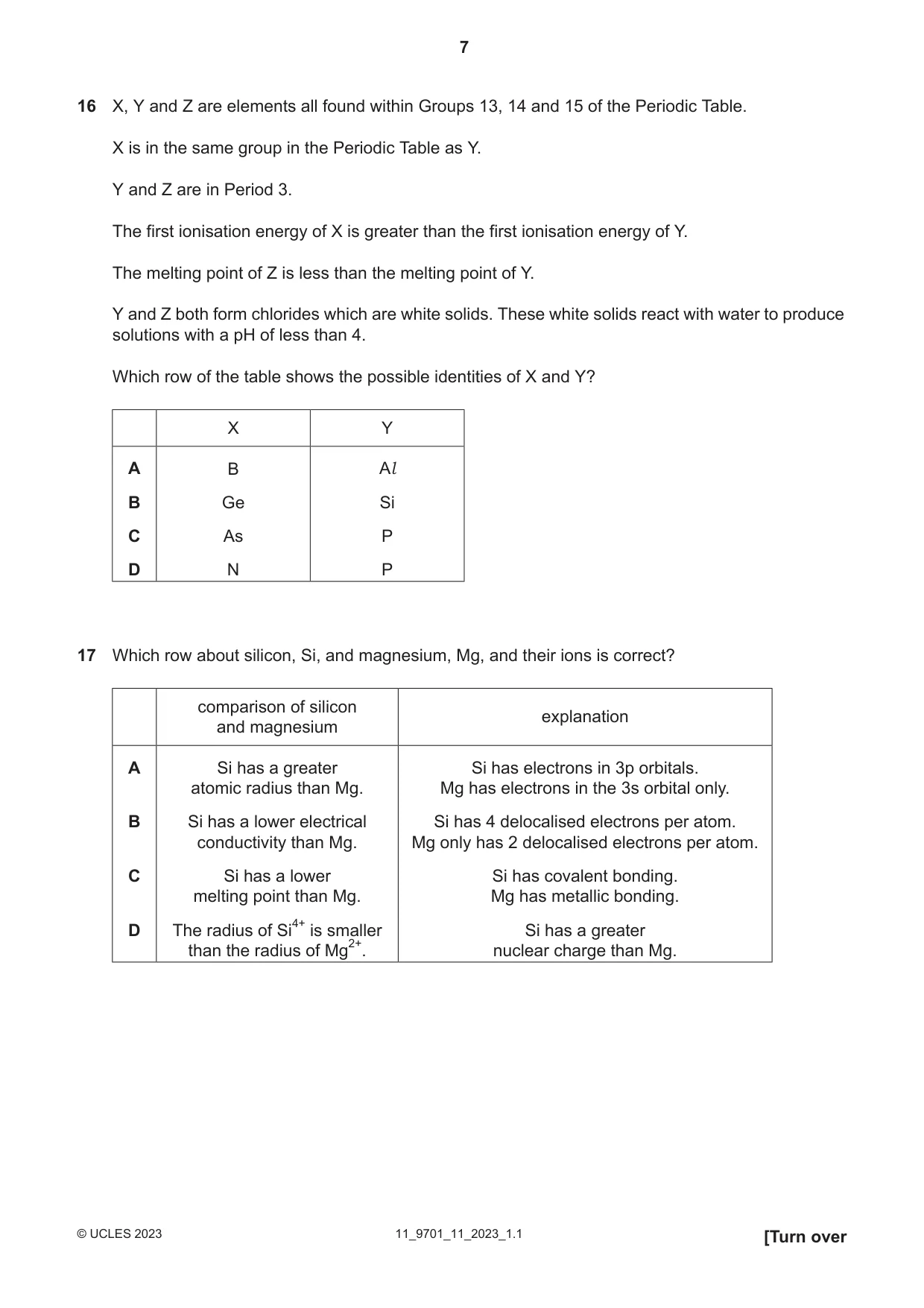
Q16 · X, Y and Z are elements all found within Groups 13, 14 and 15 of the Periodic Table
16 X, Y and Z are elements all found within Groups 13, 14 and 15 of the Periodic Table. X is in the same group in the Periodic Table as Y. Y and Z are in Period 3. The first ionisation energy of X is greater than the first ionisation energy of Y. The melting point of Z is less than the melting point of Y. Y and Z both form chlorides which are white solids. These white solids react with water to produce solutions with a pH of less than 4. Which row of the table shows the possible identities of X and Y? X Y A B Al B Ge Si C As P D N P
Mark scheme: A
More questions on Periodicity of chemical properties of the elements in Period 3
Q17 · Which row about silicon, Si, and magnesium, Mg, and their ions is correct?
17 Which row about silicon, Si, and magnesium, Mg, and their ions is correct? comparison of silicon explanation and magnesium A Si has a greater Si has electrons in 3p orbitals. atomic radius than Mg. Mg has electrons in the 3s orbital only. B Si has a lower electrical Si has 4 delocalised electrons per atom. conductivity than Mg. Mg only has 2 delocalised electrons per atom. C Si has a lower Si has covalent bonding. melting point than Mg. Mg has metallic bonding. The radius of Si4+ is smaller D Si has a greater than the radius of Mg2+. nuclear charge than Mg.
Mark scheme: D
More questions on Periodicity of physical properties of the elements in Period 3
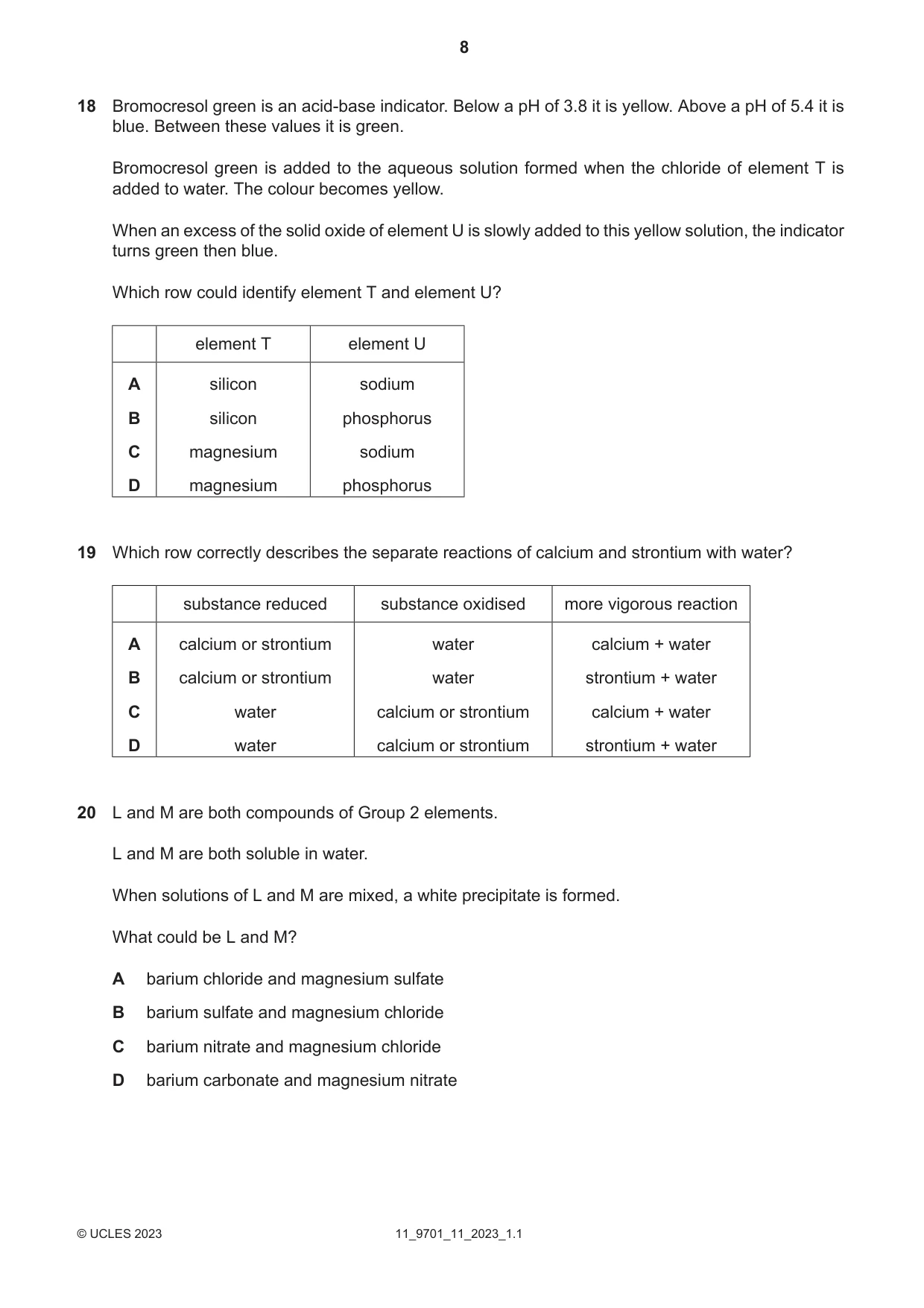
Q18 · Bromocresol green is an acid-base indicator
18 Bromocresol green is an acid-base indicator. Below a pH of 3.8 it is yellow. Above a pH of 5.4 it is blue. Between these values it is green. Bromocresol green is added to the aqueous solution formed when the chloride of element T is added to water. The colour becomes yellow. When an excess of the solid oxide of element U is slowly added to this yellow solution, the indicator turns green then blue. Which row could identify element T and element U? element T element U A silicon sodium B silicon phosphorus C magnesium sodium D magnesium phosphorus
Mark scheme: A
More questions on Periodicity of chemical properties of the elements in Period 3
Q19 · Which row correctly describes the separate reactions of calcium and strontium with water?
19 Which row correctly describes the separate reactions of calcium and strontium with water? substance reduced substance oxidised more vigorous reaction A calcium or strontium water calcium + water B calcium or strontium water strontium + water C water calcium or strontium calcium + water D water calcium or strontium strontium + water
Mark scheme: D
Q20 · L and M are both compounds of Group 2 elements
20 L and M are both compounds of Group 2 elements. L and M are both soluble in water. When solutions of L and M are mixed, a white precipitate is formed. What could be L and M? A barium chloride and magnesium sulfate B barium sulfate and magnesium chloride C barium nitrate and magnesium chloride D barium carbonate and magnesium nitrate
Mark scheme: A
Q21 · A 5.00g sample of an anhydrous Group 2 metal nitrate loses 3.29g in mass when heated…
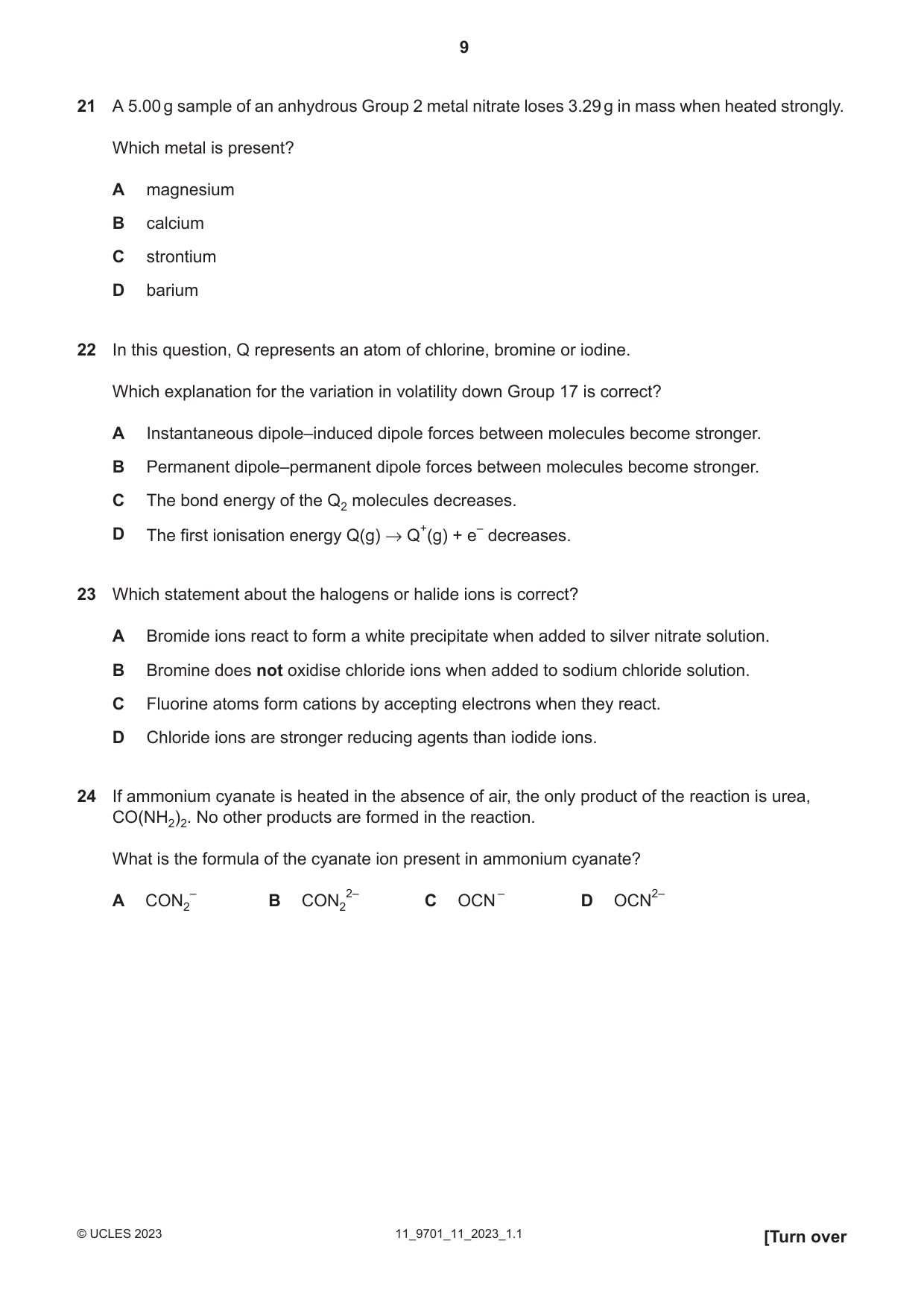
21 A 5.00g sample of an anhydrous Group 2 metal nitrate loses 3.29g in mass when heated strongly. Which metal is present? A magnesium B calcium C strontium D barium
Mark scheme: B
Q22 · In this question, Q represents an atom of chlorine, bromine or iodine
22 In this question, Q represents an atom of chlorine, bromine or iodine. Which explanation for the variation in volatility down Group 17 is correct? A Instantaneous dipole–induced dipole forces between molecules become stronger. B Permanent dipole–permanent dipole forces between molecules become stronger. C The bond energy of the Q2 molecules decreases. D The first ionisation energy Q(g) →Q+(g) + e– decreases.
Mark scheme: A
More questions on Physical properties of the Group 17 elements
Q23 · Which statement about the halogens or halide ions is correct?
23 Which statement about the halogens or halide ions is correct? A Bromide ions react to form a white precipitate when added to silver nitrate solution. B Bromine does not oxidise chloride ions when added to sodium chloride solution. C Fluorine atoms form cations by accepting electrons when they react. D Chloride ions are stronger reducing agents than iodide ions.
Mark scheme: B
Q24 · If ammonium cyanate is heated in the absence of air, the only product of the reaction is…
24 If ammonium cyanate is heated in the absence of air, the only product of the reaction is urea, CO(NH2)2. No other products are formed in the reaction. What is the formula of the cyanate ion present in ammonium cyanate? A CON2 – B CON2 2– C OCN – D OCN2–
Mark scheme: C
More questions on Formulas, functional groups and the naming of organic compounds
Q25 · Hexamine is a crystalline solid used as a fuel in portable stoves
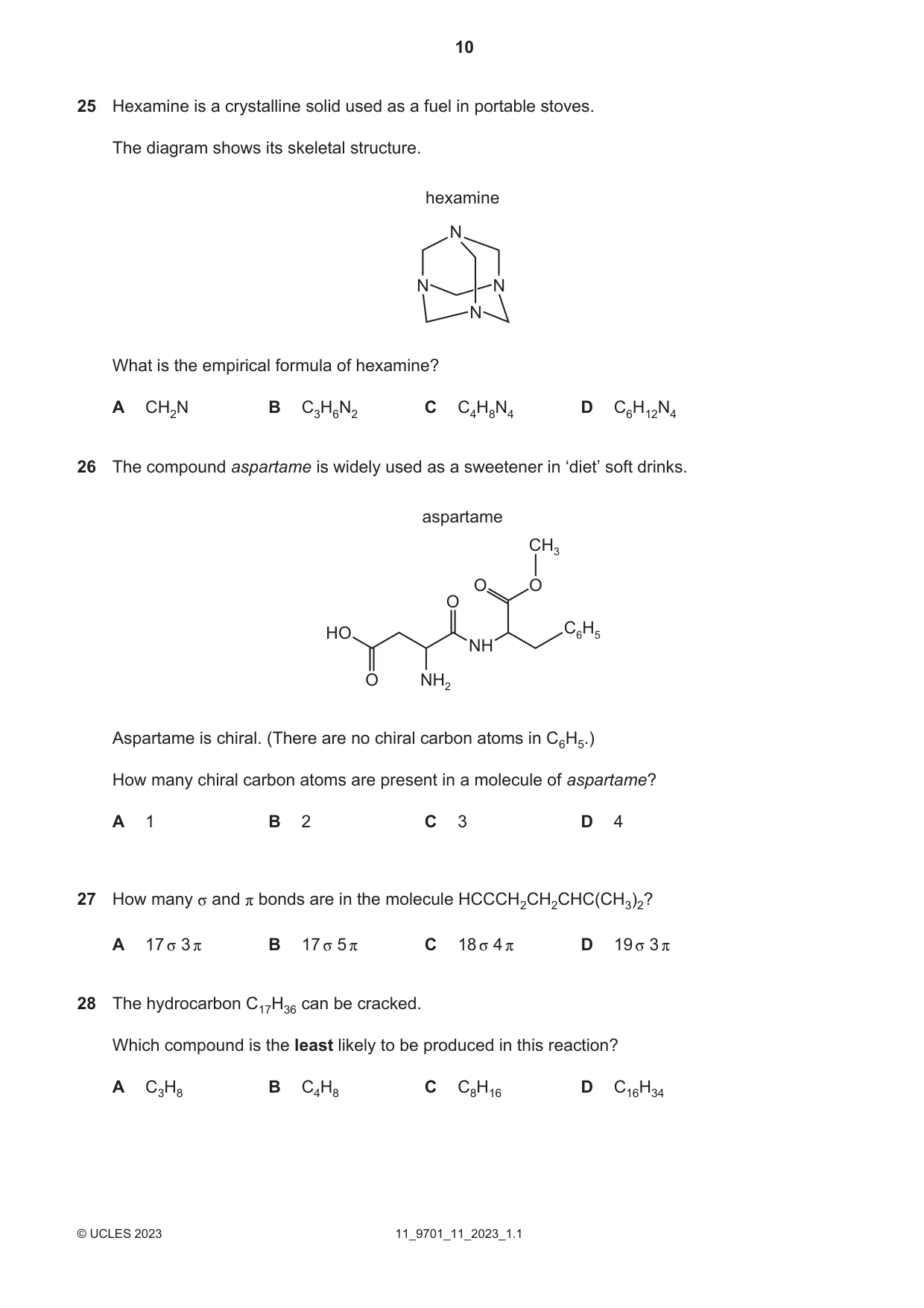
25 Hexamine is a crystalline solid used as a fuel in portable stoves. The diagram shows its skeletal structure. hexamine N N N N What is the empirical formula of hexamine? A CH2N B C3H6N2 C C4H8N4 D C6H12N4
Mark scheme: B
Q26 · The compound aspartame is widely used as a sweetener in ‘diet’ soft drinks
26 The compound aspartame is widely used as a sweetener in ‘diet’ soft drinks. aspartame CH3 O O O HO C6H5 NH O NH2 Aspartame is chiral. (There are no chiral carbon atoms in C6H5.) How many chiral carbon atoms are present in a molecule of aspartame? A 1 B 2 C 3 D 4
Mark scheme: B
Q27 · How many and bonds are in the molecule HCCCH2CH2CHC(CH3)2?
27 How many and bonds are in the molecule HCCCH2CH2CHC(CH3)2? A 17 3 B 17 5 C 18 4 D 19 3
Mark scheme: D
More questions on Shapes of organic molecules; σ and π bonds
Q28 · The hydrocarbon C17H36 can be cracked
28 The hydrocarbon C17H36 can be cracked. Which compound is the least likely to be produced in this reaction? A C3H8 B C4H8 C C8H16 D C16H34
Mark scheme: D
Q29 · Which compound has an Mr of 84 and will react with HBr to give a product with an Mr of…
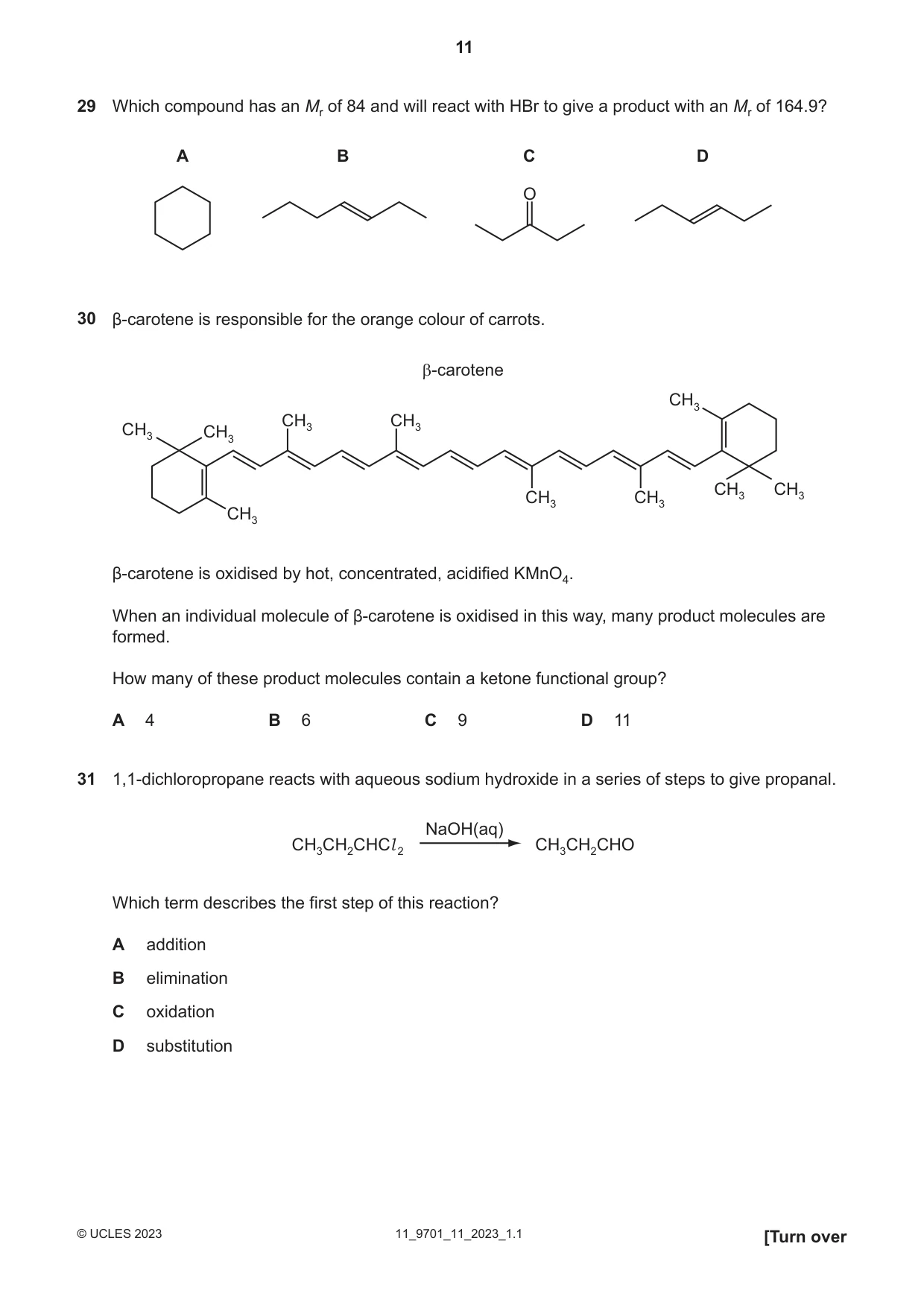
29 Which compound has an Mr of 84 and will react with HBr to give a product with an Mr of 164.9? A B C D O
Mark scheme: D
Q30 · Β-carotene is responsible for the orange colour of carrots
30 β-carotene is responsible for the orange colour of carrots. β-carotene CH3 CH3 CH3 CH3 CH3 CH3 CH3 CH3 CH3 CH3 β-carotene is oxidised by hot, concentrated, acidified KMnO4. When an individual molecule of β-carotene is oxidised in this way, many product molecules are formed. How many of these product molecules contain a ketone functional group? A 4 B 6 C 9 D 11
Mark scheme: B
Q31 · 1,1-dichloropropane reacts with aqueous sodium hydroxide in a series of steps to give…
31 1,1-dichloropropane reacts with aqueous sodium hydroxide in a series of steps to give propanal. NaOH(aq) CH3CH2CHCl 2 CH3CH2CHO Which term describes the first step of this reaction? A addition B elimination C oxidation D substitution
Mark scheme: D
Q32 · Propanoic acid can be made from bromoethane using a two-stage synthesis
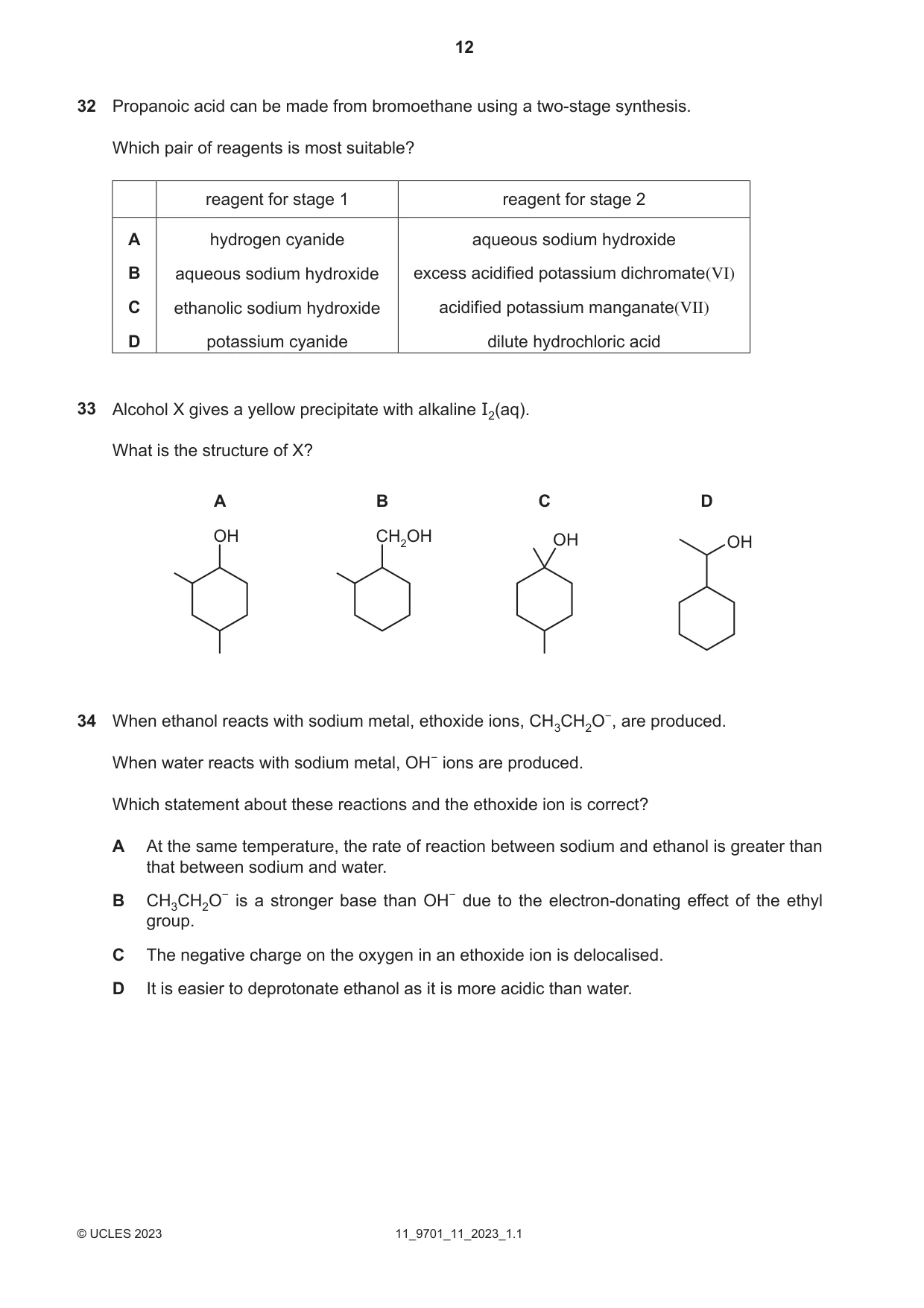
32 Propanoic acid can be made from bromoethane using a two-stage synthesis. Which pair of reagents is most suitable? reagent for stage 1 reagent for stage 2 A hydrogen cyanide aqueous sodium hydroxide B aqueous sodium hydroxide excess acidified potassium dichromate(VI) C ethanolic sodium hydroxide acidified potassium manganate(VII) D potassium cyanide dilute hydrochloric acid
Mark scheme: D
Q33 · Alcohol X gives a yellow precipitate with alkaline I2(aq)
33 Alcohol X gives a yellow precipitate with alkaline I2(aq). What is the structure of X? A B C D OH CH2OH OH OH
Mark scheme: D
Q34 · When ethanol reacts with sodium metal, ethoxide ions, CH3CH2O−, are produced
34 When ethanol reacts with sodium metal, ethoxide ions, CH3CH2O−, are produced. When water reacts with sodium metal, OH−ions are produced. Which statement about these reactions and the ethoxide ion is correct? A At the same temperature, the rate of reaction between sodium and ethanol is greater than that between sodium and water. B CH3CH2O−is a stronger base than OH−due to the electron-donating effect of the ethyl group. C The negative charge on the oxygen in an ethoxide ion is delocalised. D It is easier to deprotonate ethanol as it is more acidic than water.
Mark scheme: B
Q35 · Menthol is a naturally occurring alcohol
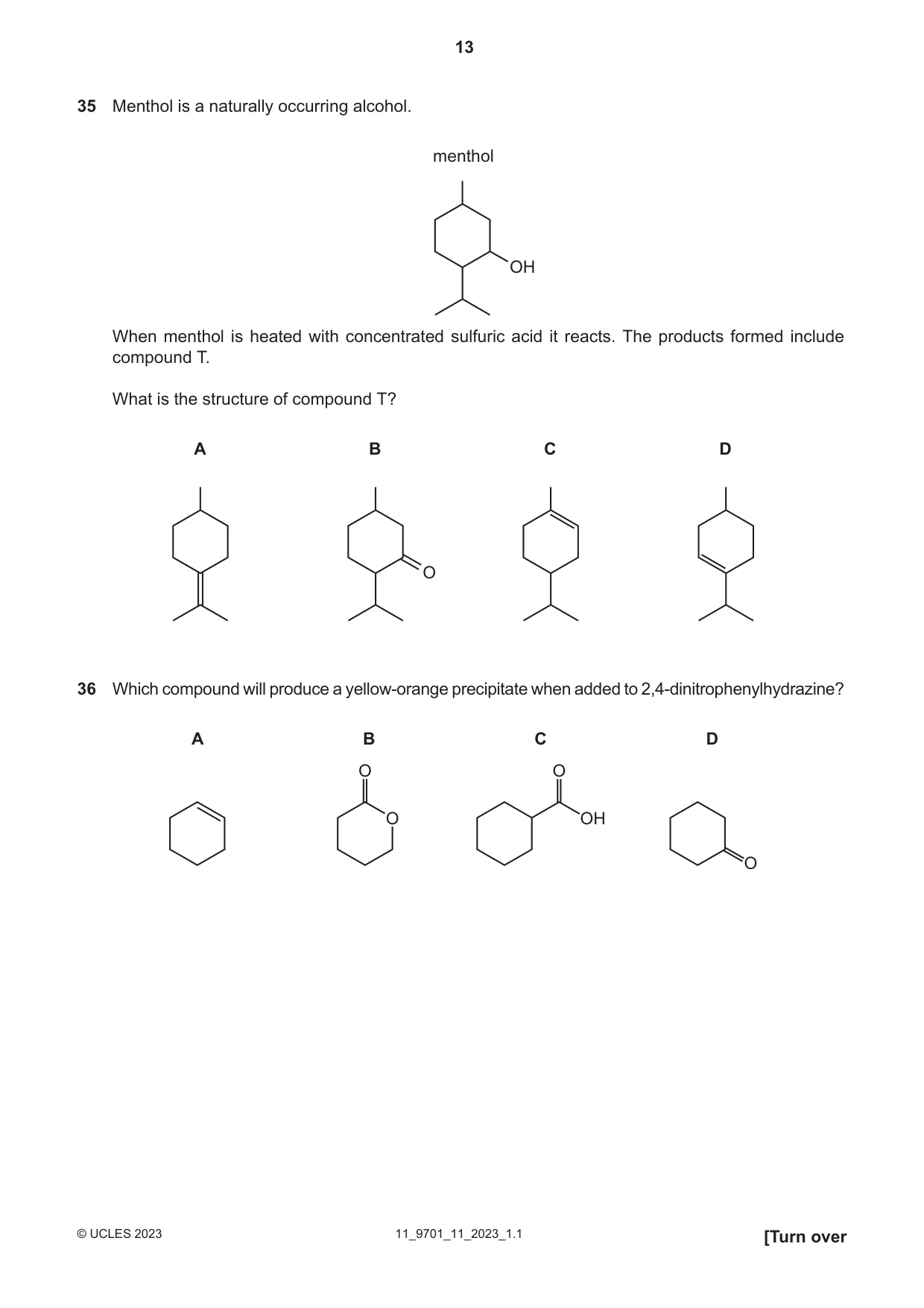
35 Menthol is a naturally occurring alcohol. menthol OH When menthol is heated with concentrated sulfuric acid it reacts. The products formed include compound T. What is the structure of compound T? A B C D O
Mark scheme: D
Q36 · Which compound will produce a yellow-orange precipitate when added to…
36 Which compound will produce a yellow-orange precipitate when added to 2,4-dinitrophenylhydrazine? A B C D O O O OH O Ethanal, CH3CHO, undergoes an addition reaction with HCN in the presence of CN– ions.
Mark scheme: D
Q37 · Which row identifies the type of reaction and the name of the product formed?
37 Which row identifies the type of reaction and the name of the product formed? type of reaction name of product A electrophilic addition 2-hydroxypropanenitrile B electrophilic addition 2-hydroxyethanenitrile C nucleophilic addition 2-hydroxypropanenitrile D nucleophilic addition 2-hydroxyethanenitrile
Mark scheme: C
Q38 · The structure of compound X is shown
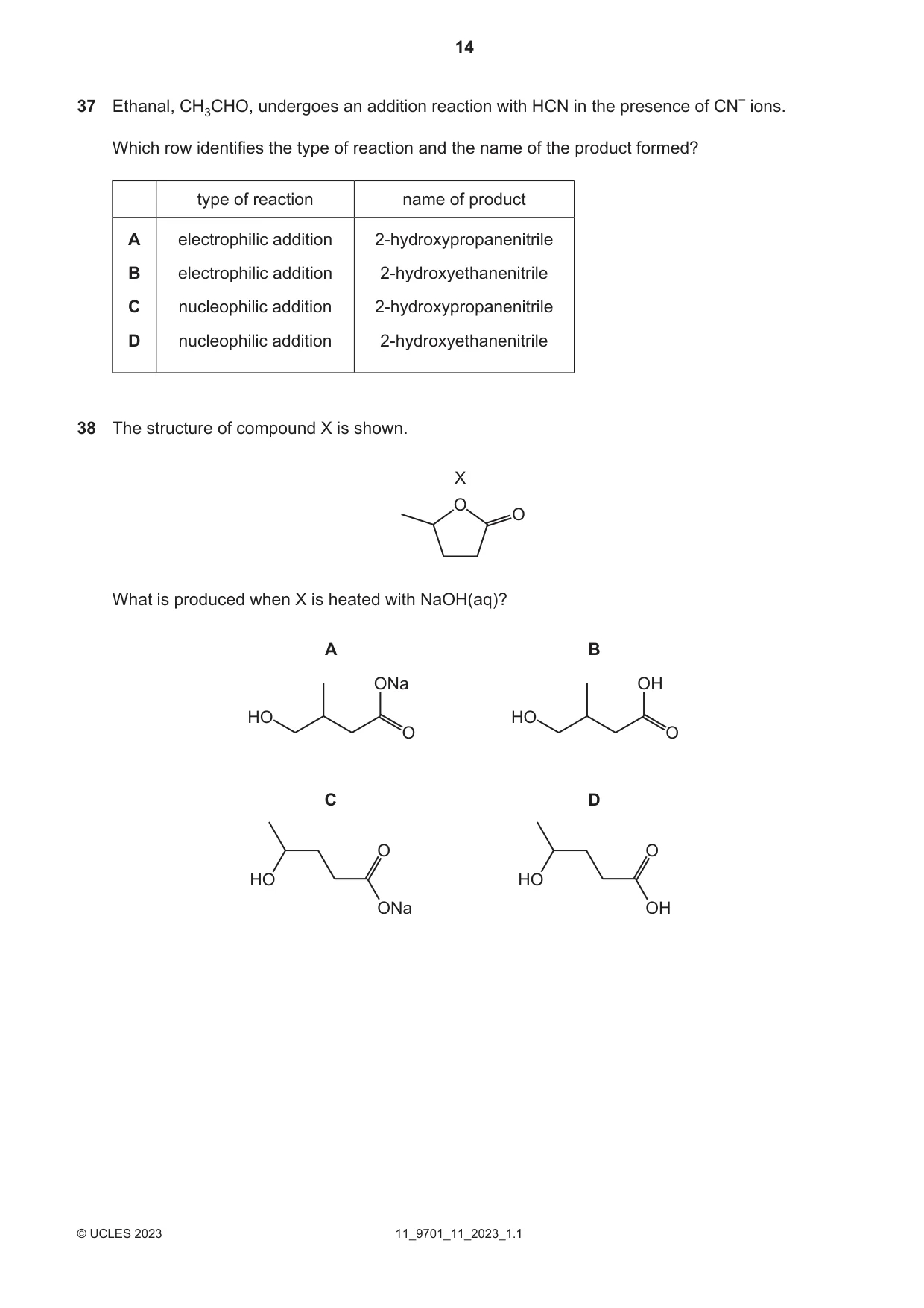
38 The structure of compound X is shown. X O O What is produced when X is heated with NaOH(aq)? A B ONa OH HO HO O O C D O O HO HO ONa OH
Mark scheme: C
Q39 · The infrared spectrum of compound L is shown
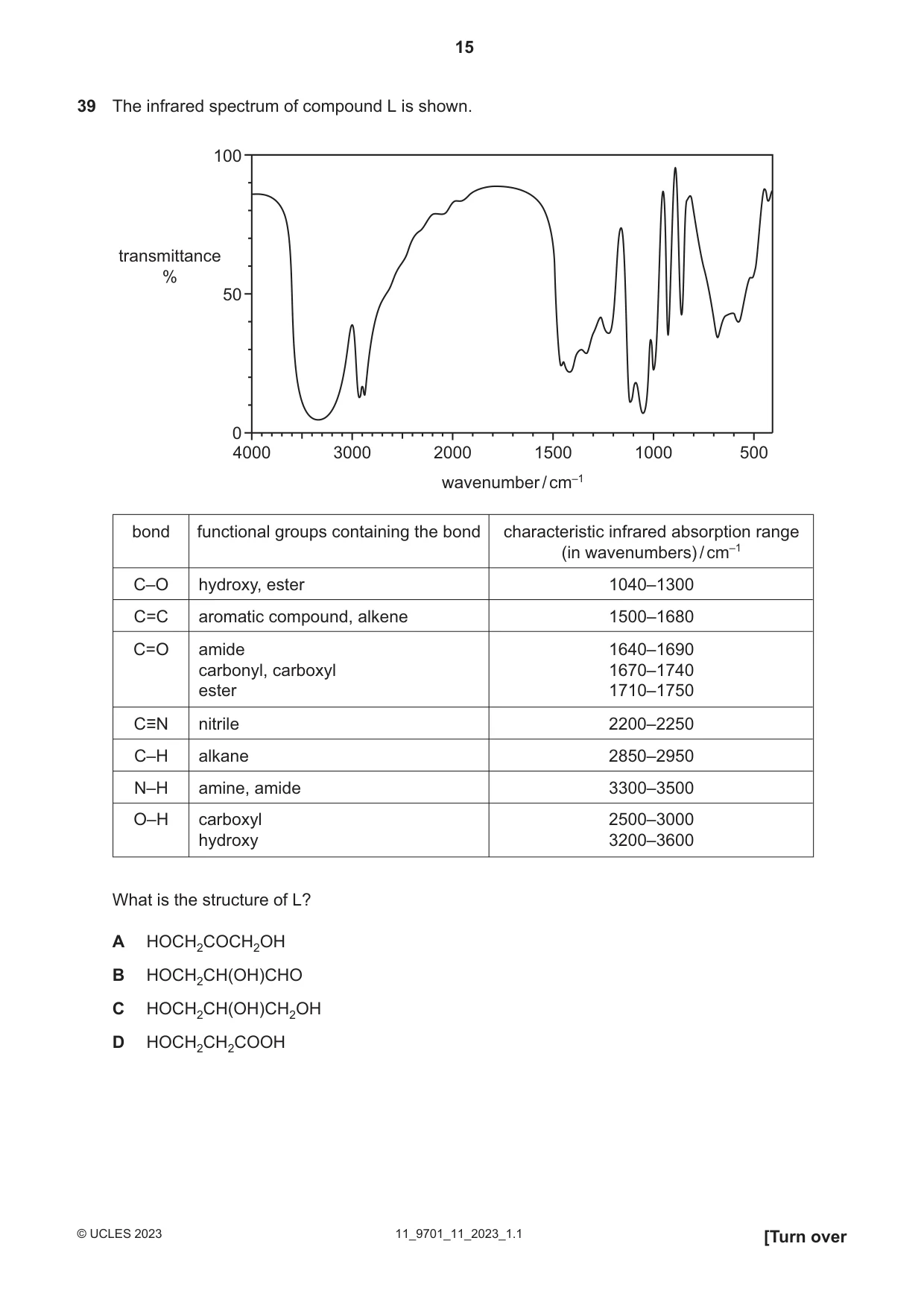
39 The infrared spectrum of compound L is shown. 100 transmittance % 50 0 4000 3000 2000 1500 1000 500 wavenumber / cm–1 bond functional groups containing the bond characteristic infrared absorption range (in wavenumbers) / cm–1 C–O hydroxy, ester 1040–1300 C=C aromatic compound, alkene 1500–1680 C=O amide 1640–1690 carbonyl, carboxyl 1670–1740 ester 1710–1750 C≡N nitrile 2200–2250 C–H alkane 2850–2950 N–H amine, amide 3300–3500 O–H carboxyl 2500–3000 hydroxy 3200–3600 What is the structure of L? A HOCH2COCH2OH B HOCH2CH(OH)CHO C HOCH2CH(OH)CH2OH D HOCH2CH2COOH
Mark scheme: C
Q40 · In the mass spectrum of compound J, the ratio of the height of the M +1 ion peak to the…
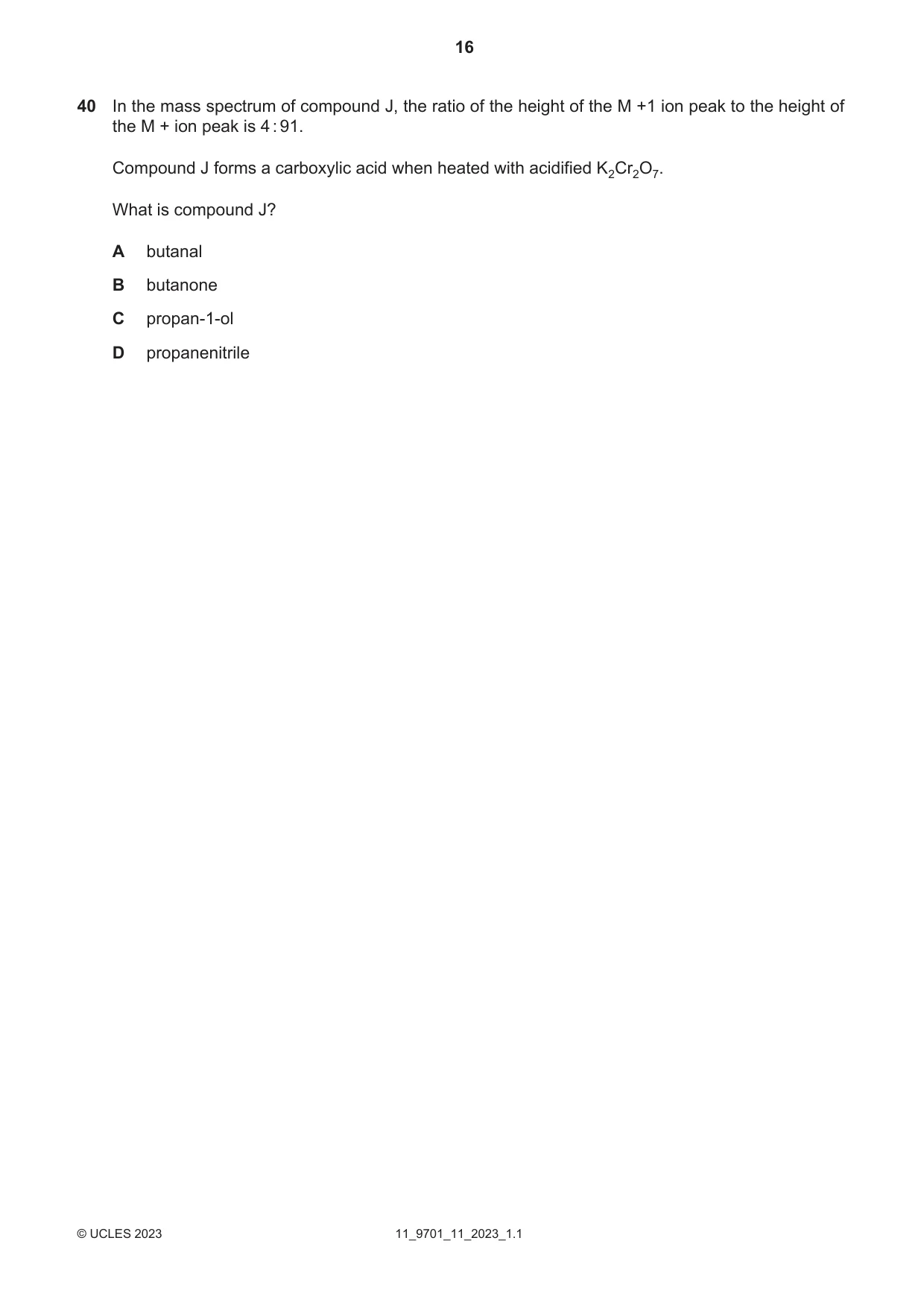
40 In the mass spectrum of compound J, the ratio of the height of the M +1 ion peak to the height of the M + ion peak is 4:91. Compound J forms a carboxylic acid when heated with acidified K2Cr2O7. What is compound J? A butanal B butanone C propan-1-ol D propanenitrile
Mark scheme: A
What was in this paper
The subtopics covered by these 40 questions, and how many questions each got. Open one in a new tab to see every Cambridge question on it.
3Similarities and trends in the properties of the Group 2 metals, magnesium to barium, and their compounds3Aldehydes and ketones2Chemical equilibria: reversible reactions, dynamic equilibrium2Enthalpy change, ΔH2Formulas2Halogenoalkanes2Periodicity of chemical properties of the elements in Period 32Alkanes1Covalent bonding and coordinate (dative covalent) bonding1Effect of temperature on reaction rates and the concept of activation energy1Esters1Formulas, functional groups and the naming of organic compounds1Infrared spectroscopy1Intermolecular forces, electronegativity and bond properties1Ionisation energy1Isomerism: optical1Mass spectrometry1Nitriles and hydroxynitriles1Organic synthesis1Particles in the atom and atomic radius1Periodicity of physical properties of the elements in Period 31Physical properties of the Group 17 elements1Rate of reaction1Reacting masses and volumes (of solutions and gases)1Redox processes: electron transfer and changes in oxidation number (oxidation state)1Shapes of molecules1Shapes of organic molecules; σ and π bonds1Some reactions of the halide ions1The gaseous state: ideal and real gases and pV = nRT1What you needed in this session
Cambridge’s own grade thresholds for 2023 Oct/Nov, Paper 1 · Variant 1. A higher threshold means an easier paper — the bar moves with how the cohort did.