Cambridge A Level Chemistry 9701 — 2011 May/June Paper 1 · Variant 1
9701/11/M/J/11 · 40 questions · 40 marks · ≈45 min
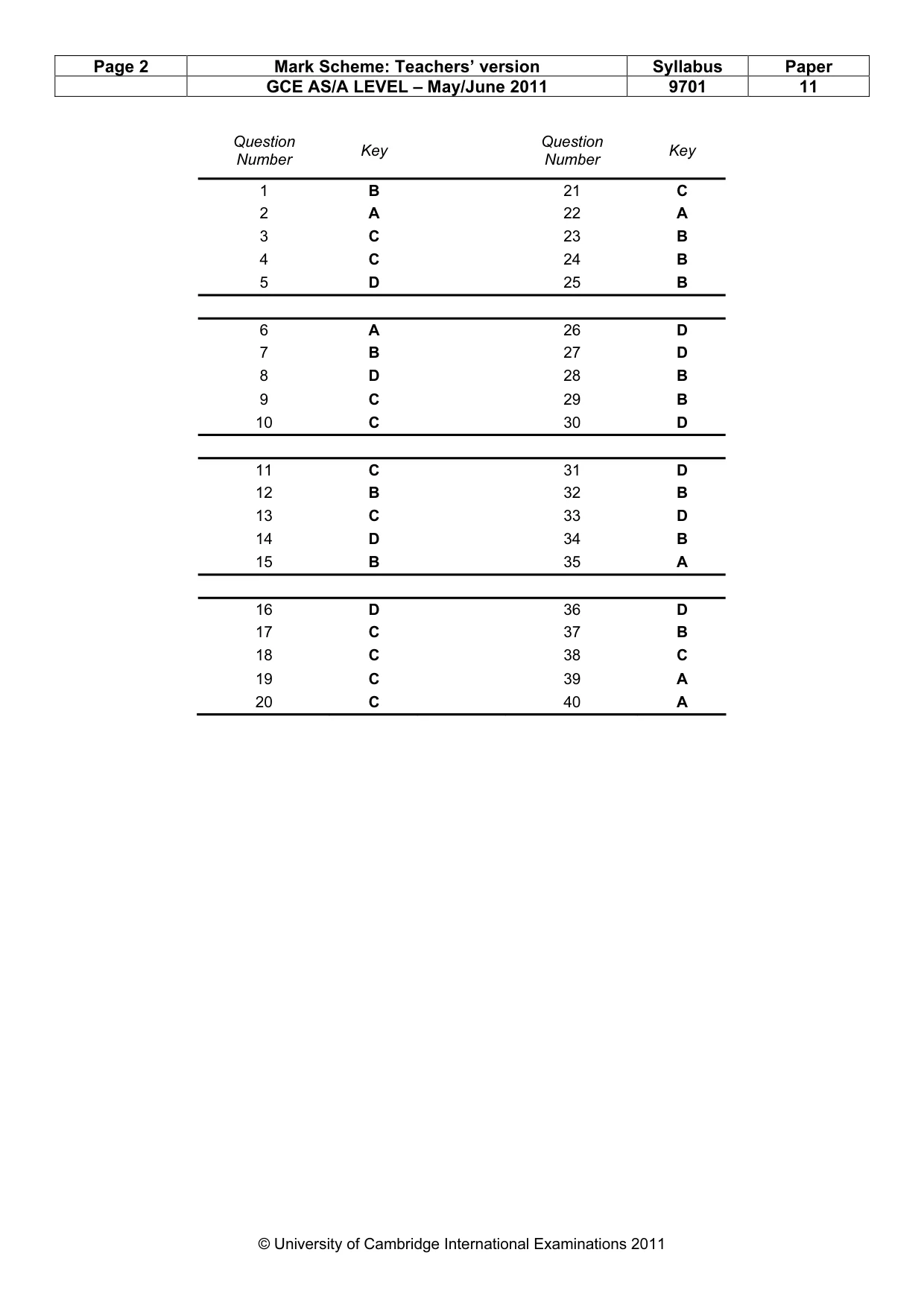
The question paper and its mark scheme, free to read here and free to download. This is Cambridge’s own paper, exactly as it was sat.
Question paper16 pages

Mark scheme2 pages
Answers below. Sit the paper first if you are practising.
Questions as text
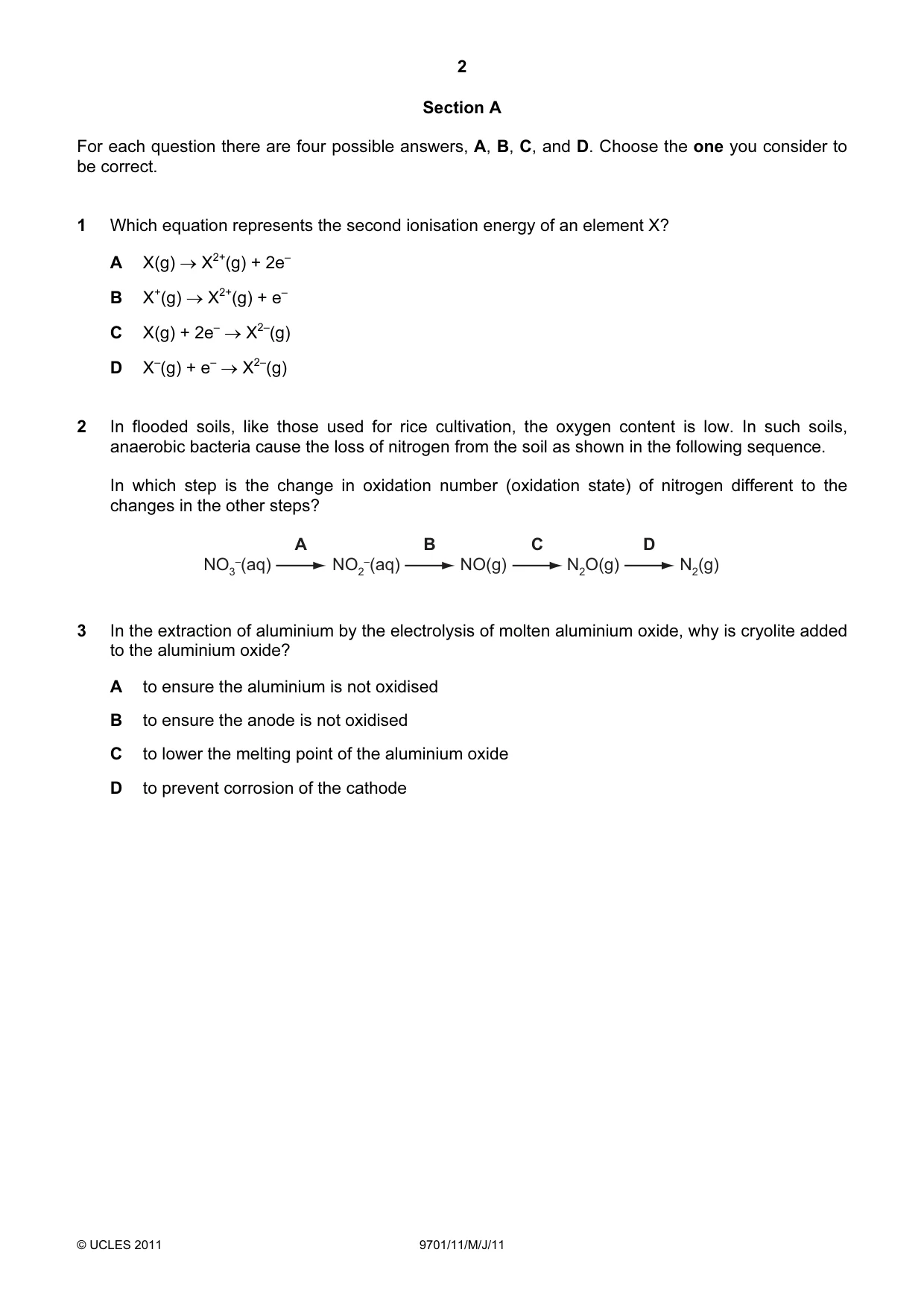
Q1 · Which equation represents the second ionisation energy of an element X?
1 Which equation represents the second ionisation energy of an element X? A X(g) → X2+(g) + 2e– B X+(g) → X2+(g) + e– C X(g) + 2e– → X2–(g) D X–(g) + e– → X2–(g)
Mark scheme: B
Q2 · In flooded soils, like those used for rice cultivation, the oxygen content is low
2 In flooded soils, like those used for rice cultivation, the oxygen content is low. In such soils, anaerobic bacteria cause the loss of nitrogen from the soil as shown in the following sequence. In which step is the change in oxidation number (oxidation state) of nitrogen different to the changes in the other steps? A B C D NO3 –(aq) NO2 –(aq) NO(g) N2O(g) N2(g)
Mark scheme: A
Q3 · In the extraction of aluminium by the electrolysis of molten aluminium oxide, why is…
3 In the extraction of aluminium by the electrolysis of molten aluminium oxide, why is cryolite added to the aluminium oxide? A to ensure the aluminium is not oxidised B to ensure the anode is not oxidised C to lower the melting point of the aluminium oxide D to prevent corrosion of the cathode
Mark scheme: C
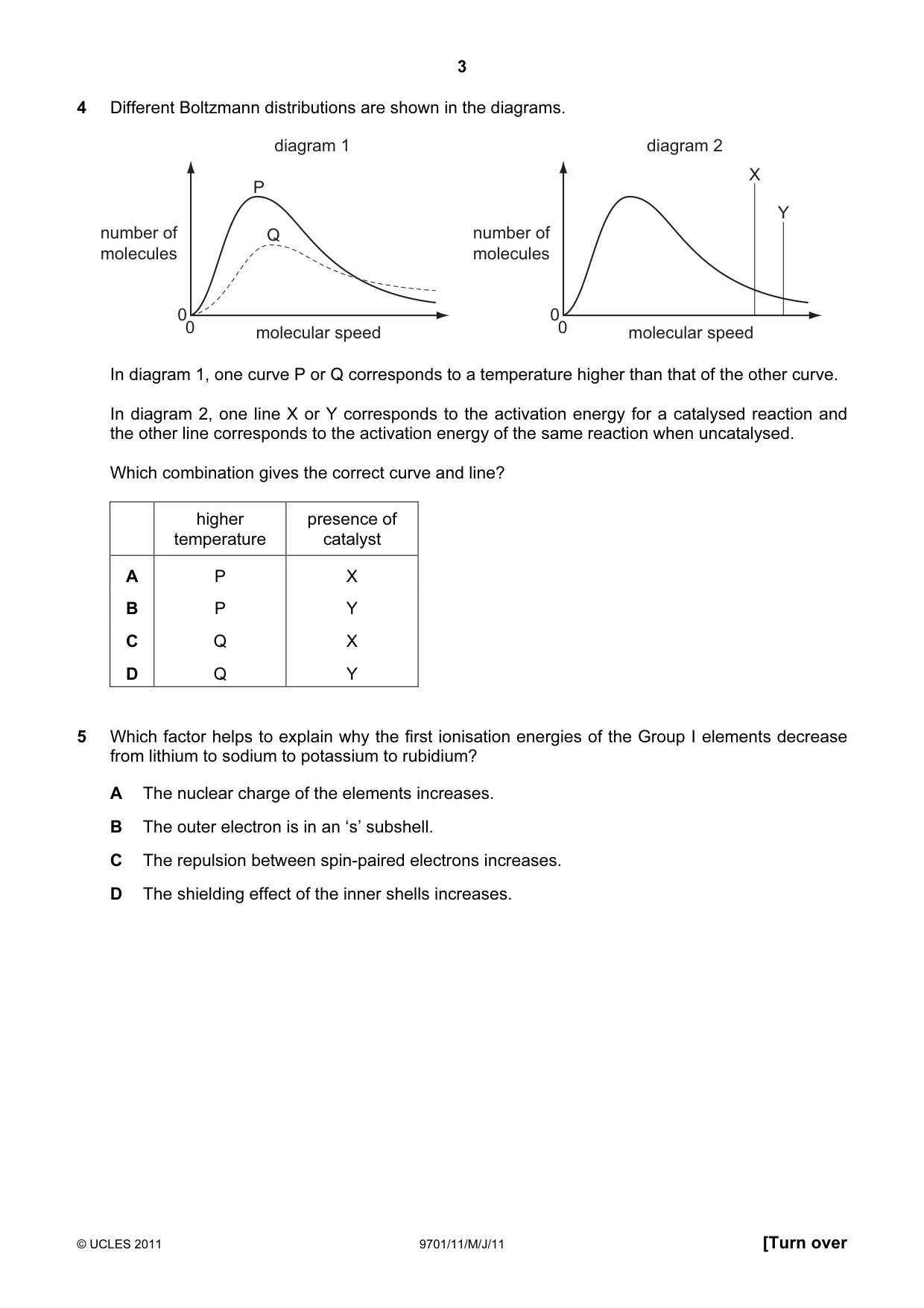
Q4 · Different Boltzmann distributions are shown in the diagrams
4 Different Boltzmann distributions are shown in the diagrams. diagram 1 diagram 2 X P Y number of Q number of molecules molecules 00 00 molecular speed molecular speed In diagram 1, one curve P or Q corresponds to a temperature higher than that of the other curve. In diagram 2, one line X or Y corresponds to the activation energy for a catalysed reaction and the other line corresponds to the activation energy of the same reaction when uncatalysed. Which combination gives the correct curve and line? higher presence of temperature catalyst A P X B P Y C Q X D Q Y
Mark scheme: C
More questions on Effect of temperature on reaction rates and the concept of activation energy
Q5 · Which factor helps to explain why the first ionisation energies of the Group I elements…
5 Which factor helps to explain why the first ionisation energies of the Group I elements decrease from lithium to sodium to potassium to rubidium? A The nuclear charge of the elements increases. B The outer electron is in an ‘s’ subshell. C The repulsion between spin-paired electrons increases. D The shielding effect of the inner shells increases.
Mark scheme: D
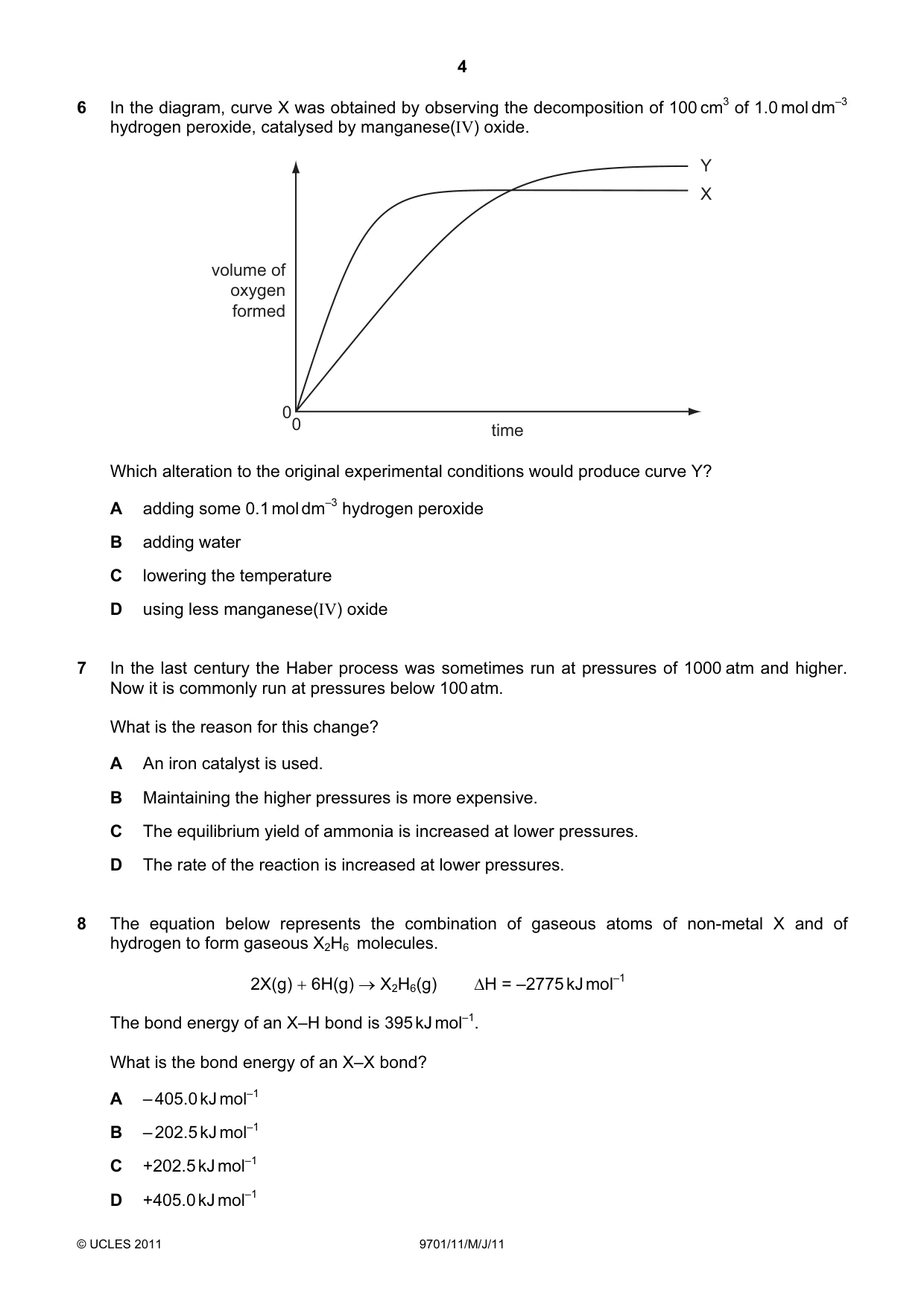
Q6 · In the diagram, curve X was obtained by observing the decomposition of 100 cm3 of 1.0 mol…
6 In the diagram, curve X was obtained by observing the decomposition of 100 cm3 of 1.0 mol dm–3 hydrogen peroxide, catalysed by manganese(IV) oxide. Y X volume of oxygen formed 00 time Which alteration to the original experimental conditions would produce curve Y? A adding some 0.1 mol dm–3 hydrogen peroxide B adding water C lowering the temperature D using less manganese(IV) oxide
Mark scheme: A
Q7 · In the last century the Haber process was sometimes run at pressures of 1000 atm and…
7 In the last century the Haber process was sometimes run at pressures of 1000 atm and higher. Now it is commonly run at pressures below 100 atm. What is the reason for this change? A An iron catalyst is used. B Maintaining the higher pressures is more expensive. C The equilibrium yield of ammonia is increased at lower pressures. D The rate of the reaction is increased at lower pressures.
Mark scheme: B
More questions on Chemical equilibria: reversible reactions, dynamic equilibrium
Q8 · The equation below represents the combination of gaseous atoms of non-metal X and of…
8 The equation below represents the combination of gaseous atoms of non-metal X and of hydrogen to form gaseous X2H6 molecules. 2X(g) + 6H(g) → X2H6(g) ∆H = –2775 kJ mol–1 The bond energy of an X–H bond is 395 kJ mol–1. What is the bond energy of an X–X bond? A – 405.0 kJ mol–1 B – 202.5 kJ mol–1 C +202.5 kJ mol–1 D +405.0 kJ mol–1
Mark scheme: D
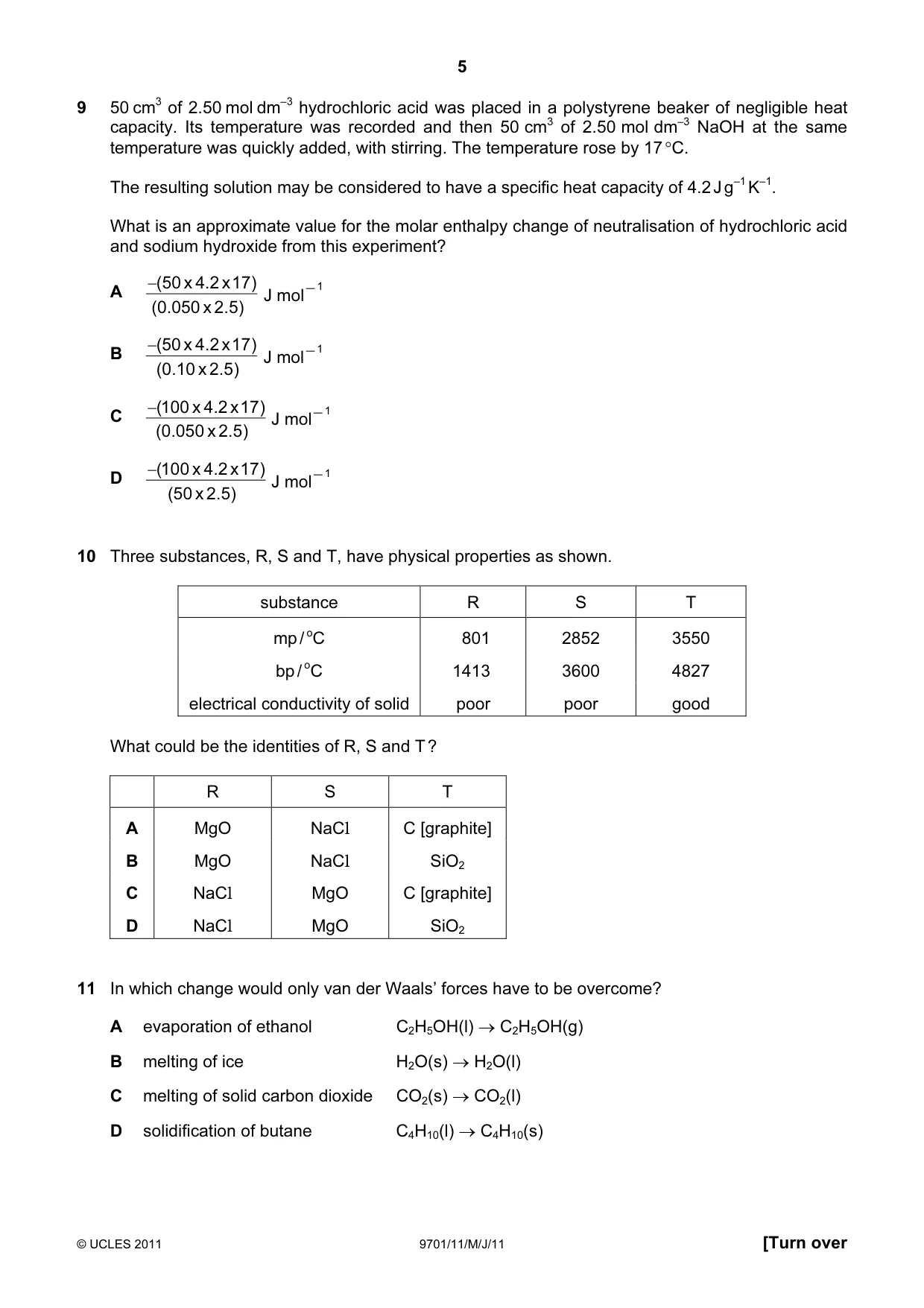
Q9 · 50 cm3 of 2.50 mol dm–3 hydrochloric acid was placed in a polystyrene beaker of…
9 50 cm3 of 2.50 mol dm–3 hydrochloric acid was placed in a polystyrene beaker of negligible heat capacity. Its temperature was recorded and then 50 cm3 of 2.50 mol dm–3 NaOH at the same temperature was quickly added, with stirring. The temperature rose by 17 °C. The resulting solution may be considered to have a specific heat capacity of 4.2 J g–1 K–1. What is an approximate value for the molar enthalpy change of neutralisation of hydrochloric acid and sodium hydroxide from this experiment? − ( 50 x 4 . 2 x 17 ) − 1 A J mol ( 0 . 050 x 2 . 5 ) − ( 50 x 4 . 2 x 17 ) − 1 B J mol ( 0 . 10 x 2 . 5 ) − ( 100 x 4 . 2 x 17 ) − 1 C J mol ( 0 . 050 x 2 . 5 ) − ( 100 x 4 . 2 x 17 ) − 1 D J mol ( 50 x 2 . 5 )
Mark scheme: C
More questions on Reacting masses and volumes (of solutions and gases)
Q10 · Three substances, R, S and T, have physical properties as shown
10 Three substances, R, S and T, have physical properties as shown. substance R S T mp / oC 801 2852 3550 bp / oC 1413 3600 4827 electrical conductivity of solid poor poor good What could be the identities of R, S and T ? R S T A MgO NaCl C [graphite] B MgO NaCl SiO2 C NaCl MgO C [graphite] D NaCl MgO SiO2
Mark scheme: C
Q11 · In which change would only van der Waals’ forces have to be overcome?
11 In which change would only van der Waals’ forces have to be overcome? A evaporation of ethanol C2H5OH(l) → C2H5OH(g) B melting of ice H2O(s) → H2O(l) C melting of solid carbon dioxide CO2(s) → CO2(l) D solidification of butane C4H10(l) → C4H10(s)
Mark scheme: C
More questions on Intermolecular forces, electronegativity and bond properties
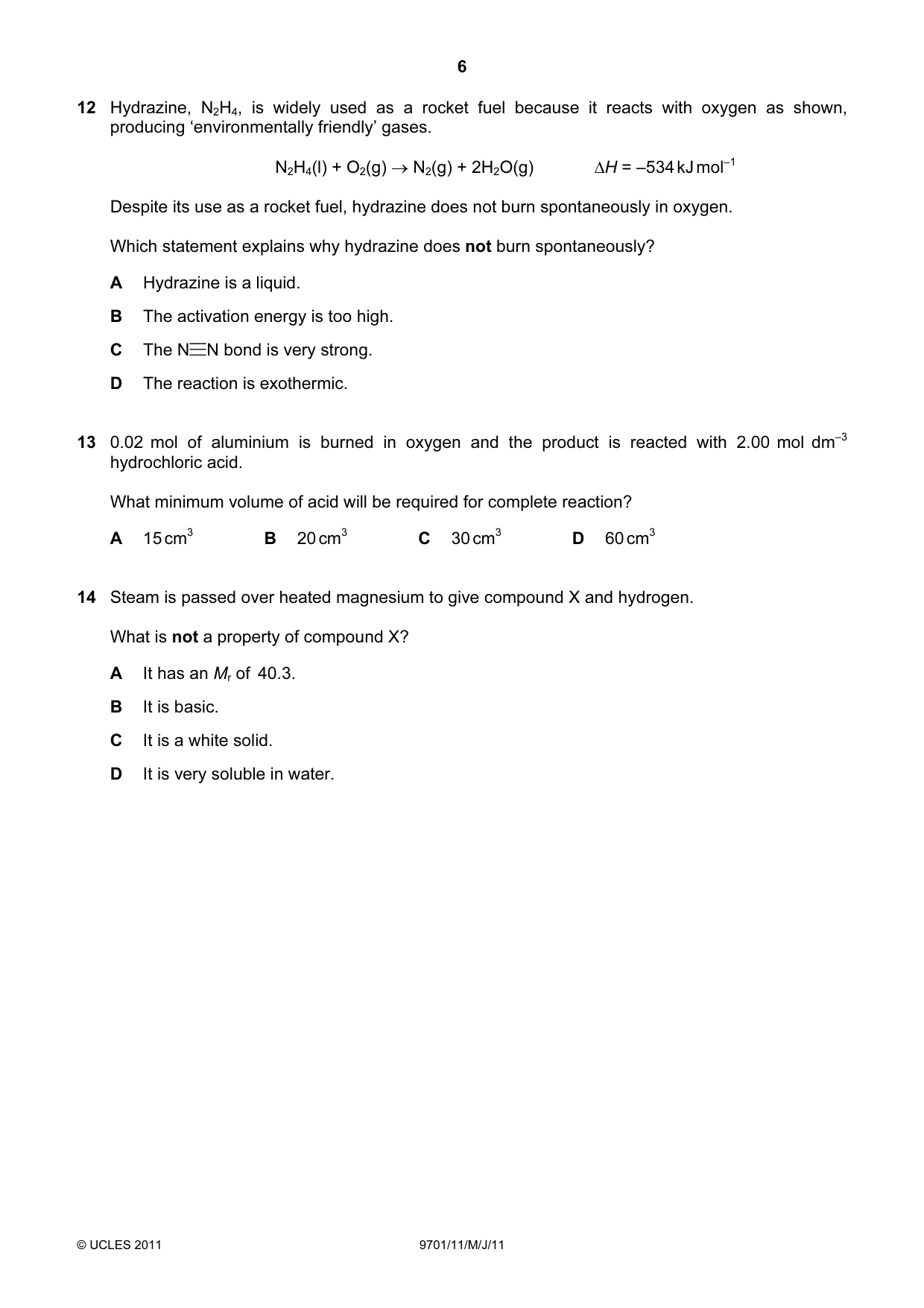
Q12 · Hydrazine, N2H4, is widely used as a rocket fuel because it reacts with oxygen as shown…
12 Hydrazine, N2H4, is widely used as a rocket fuel because it reacts with oxygen as shown, producing ‘environmentally friendly’ gases. N2H4(l) + O2(g) → N2(g) + 2H2O(g) ∆H = –534 kJ mol–1 Despite its use as a rocket fuel, hydrazine does not burn spontaneously in oxygen. Which statement explains why hydrazine does not burn spontaneously? A Hydrazine is a liquid. B The activation energy is too high. C The N N bond is very strong. D The reaction is exothermic.
Mark scheme: B
More questions on Effect of temperature on reaction rates and the concept of activation energy
Q13 · 0.02 mol of aluminium is burned in oxygen and the product is reacted with 2.00 mol dm–3…
13 0.02 mol of aluminium is burned in oxygen and the product is reacted with 2.00 mol dm–3 hydrochloric acid. What minimum volume of acid will be required for complete reaction? A 15 cm3 B 20 cm3 C 30 cm3 D 60 cm3
Mark scheme: C
More questions on Reacting masses and volumes (of solutions and gases)
Q14 · Steam is passed over heated magnesium to give compound X and hydrogen
14 Steam is passed over heated magnesium to give compound X and hydrogen. What is not a property of compound X? A It has an Mr of 40.3. B It is basic. C It is a white solid. D It is very soluble in water.
Mark scheme: D
More questions on Periodicity of physical properties of the elements in Period 3
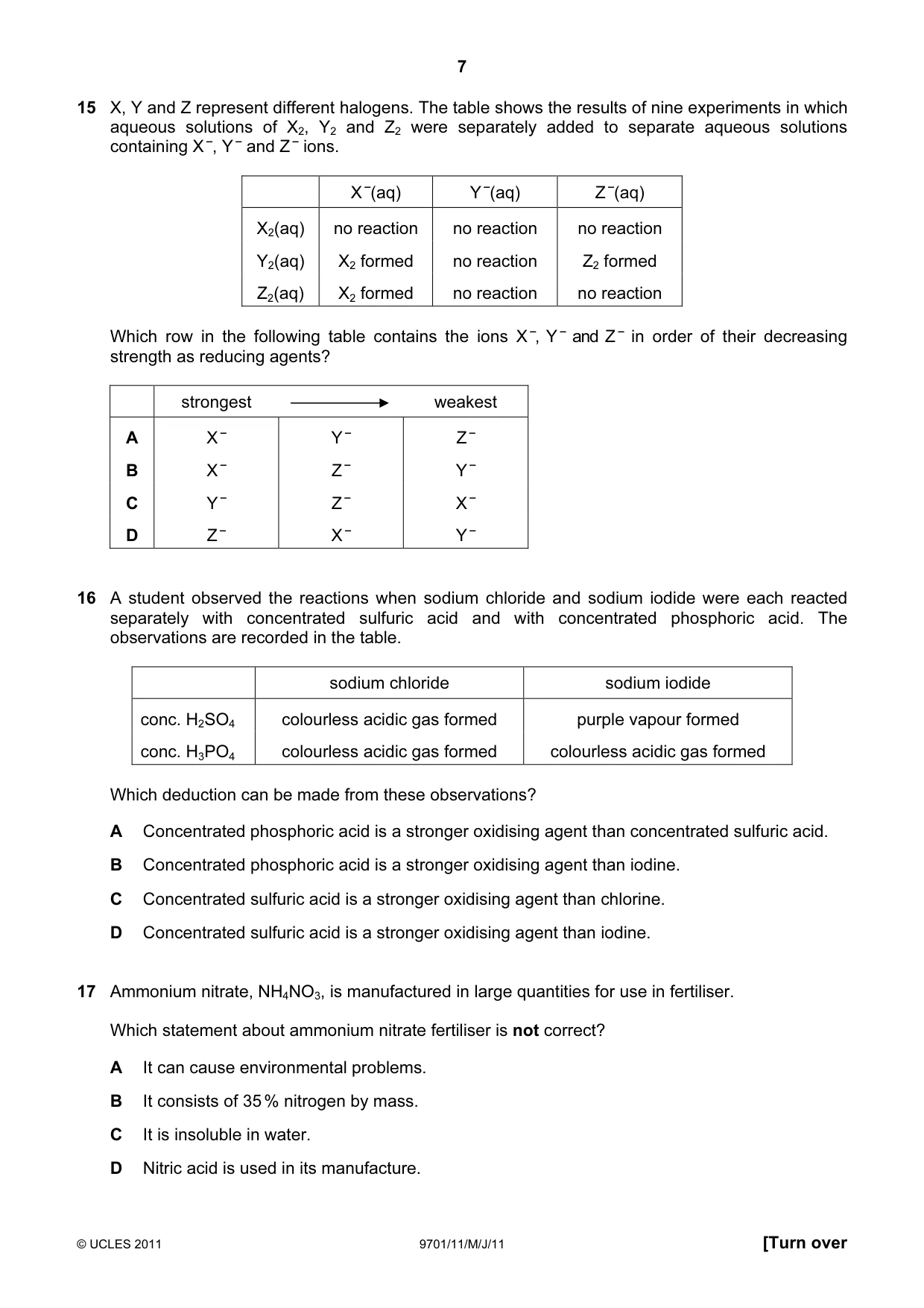
Q15 · X, Y and Z represent different halogens
15 X, Y and Z represent different halogens. The table shows the results of nine experiments in which aqueous solutions of X2, Y2 and Z2 were separately added to separate aqueous solutions containing X –, Y – and Z – ions. X –(aq) Y –(aq) Z –(aq) X2(aq) no reaction no reaction no reaction Y2(aq) X2 formed no reaction Z2 formed Z2(aq) X2 formed no reaction no reaction Which row in the following table contains the ions X –, Y – and Z – in order of their decreasing strength as reducing agents? strongest weakest A X – Y – Z – B X – Z – Y – C Y – Z – X – D Z – X – Y –
Mark scheme: B
More questions on The chemical properties of the halogen elements and the hydrogen halides
Q16 · A student observed the reactions when sodium chloride and sodium iodide were each reacted…
16 A student observed the reactions when sodium chloride and sodium iodide were each reacted separately with concentrated sulfuric acid and with concentrated phosphoric acid. The observations are recorded in the table. sodium chloride sodium iodide conc. H2SO4 colourless acidic gas formed purple vapour formed conc. H3PO4 colourless acidic gas formed colourless acidic gas formed Which deduction can be made from these observations? A Concentrated phosphoric acid is a stronger oxidising agent than concentrated sulfuric acid. B Concentrated phosphoric acid is a stronger oxidising agent than iodine. C Concentrated sulfuric acid is a stronger oxidising agent than chlorine. D Concentrated sulfuric acid is a stronger oxidising agent than iodine.
Mark scheme: D
Q17 · Ammonium nitrate, NH4NO3, is manufactured in large quantities for use in fertiliser
17 Ammonium nitrate, NH4NO3, is manufactured in large quantities for use in fertiliser. Which statement about ammonium nitrate fertiliser is not correct? A It can cause environmental problems. B It consists of 35 % nitrogen by mass. C It is insoluble in water. D Nitric acid is used in its manufacture.
Mark scheme: C
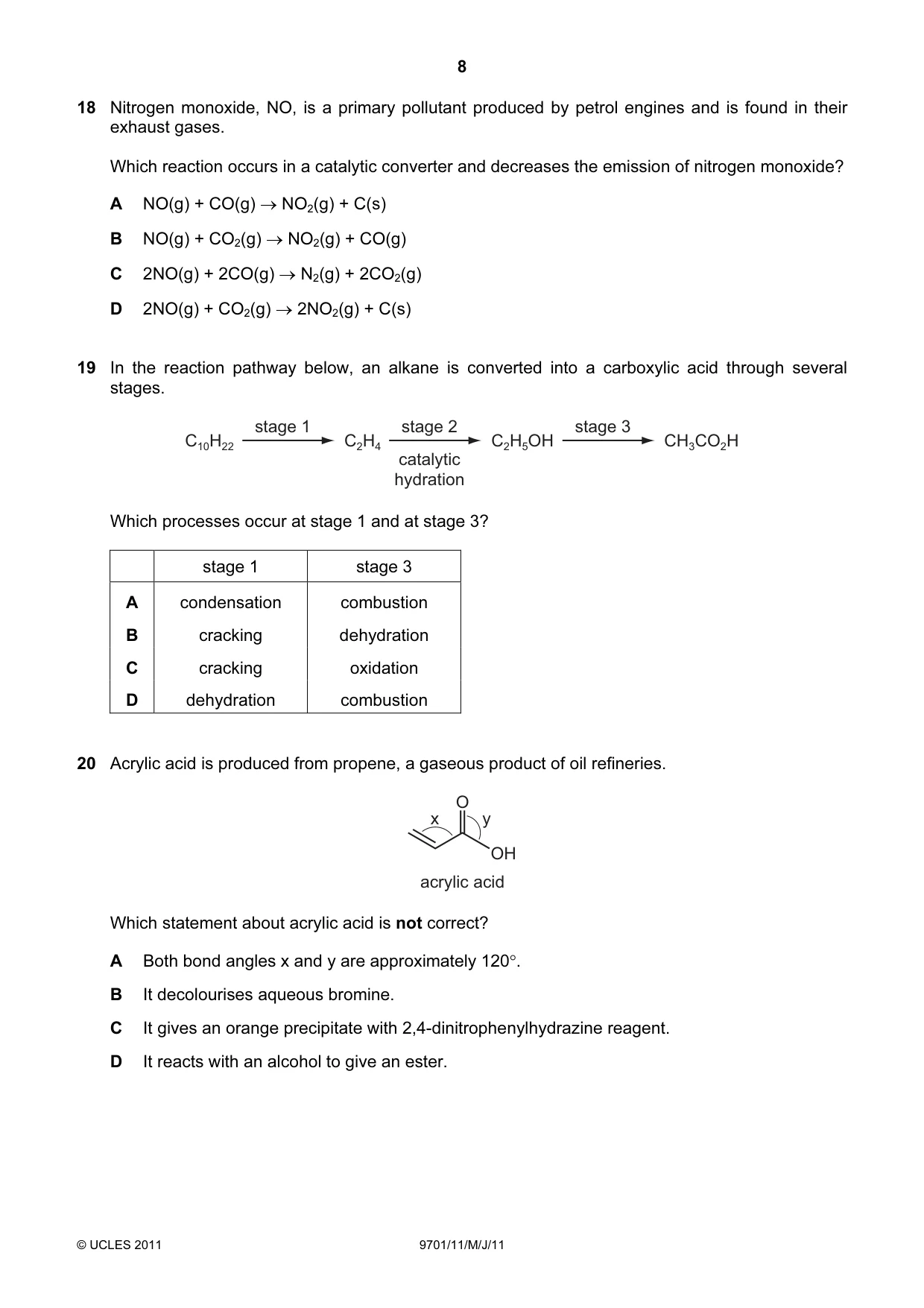
Q18 · Nitrogen monoxide, NO, is a primary pollutant produced by petrol engines and is found in…
18 Nitrogen monoxide, NO, is a primary pollutant produced by petrol engines and is found in their exhaust gases. Which reaction occurs in a catalytic converter and decreases the emission of nitrogen monoxide? A NO(g) + CO(g) → NO2(g) + C(s) B NO(g) + CO2(g) → NO2(g) + CO(g) C 2NO(g) + 2CO(g) → N2(g) + 2CO2(g) D 2NO(g) + CO2(g) → 2NO2(g) + C(s)
Mark scheme: C
Q19 · In the reaction pathway below, an alkane is converted into a carboxylic acid through…
19 In the reaction pathway below, an alkane is converted into a carboxylic acid through several stages. stage 1 stage 2 stage 3 C10H22 C2H4 C2H5OH CH3CO2H catalytic hydration Which processes occur at stage 1 and at stage 3? stage 1 stage 3 A condensation combustion B cracking dehydration C cracking oxidation D dehydration combustion
Mark scheme: C
Q20 · Acrylic acid is produced from propene, a gaseous product of oil refineries
20 Acrylic acid is produced from propene, a gaseous product of oil refineries. O x y OH acrylic acid Which statement about acrylic acid is not correct? A Both bond angles x and y are approximately 120°. B It decolourises aqueous bromine. C It gives an orange precipitate with 2,4-dinitrophenylhydrazine reagent. D It reacts with an alcohol to give an ester.
Mark scheme: C
Q21 · Butanedioic acid occurs in amber, algae, lichens, sugar cane and beets
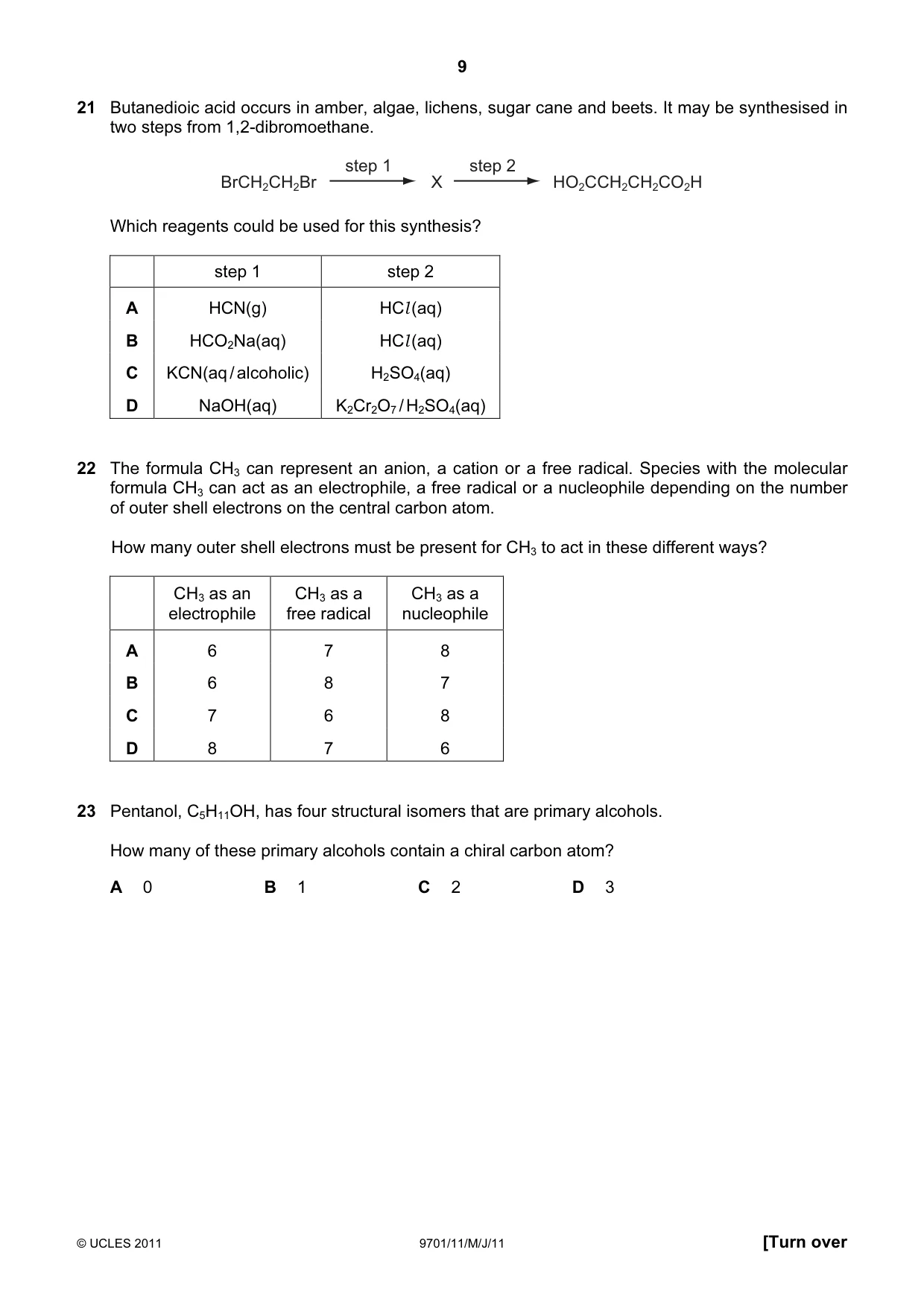
21 Butanedioic acid occurs in amber, algae, lichens, sugar cane and beets. It may be synthesised in two steps from 1,2-dibromoethane. step 1 step 2 BrCH2CH2Br X HO2CCH2CH2CO2H Which reagents could be used for this synthesis? step 1 step 2 A HCN(g) HCl (aq) B HCO2Na(aq) HCl (aq) C KCN(aq / alcoholic) H2SO4(aq) D NaOH(aq) K2Cr2O7 / H2SO4(aq)
Mark scheme: C
Q22 · The formula CH3 can represent an anion, a cation or a free radical
22 The formula CH3 can represent an anion, a cation or a free radical. Species with the molecular formula CH3 can act as an electrophile, a free radical or a nucleophile depending on the number of outer shell electrons on the central carbon atom. How many outer shell electrons must be present for CH3 to act in these different ways? CH3 as an CH3 as a CH3 as a electrophile free radical nucleophile A 6 7 8 B 6 8 7 C 7 6 8 D 8 7 6
Mark scheme: A
More questions on Electrons, energy levels and atomic orbitals
Q23 · Pentanol, C5H11OH, has four structural isomers that are primary alcohols
23 Pentanol, C5H11OH, has four structural isomers that are primary alcohols. How many of these primary alcohols contain a chiral carbon atom? A 0 B 1 C 2 D 3
Mark scheme: B
More questions on Isomerism: structural isomerism and stereoisomerism
Q24 · The diagram shows the structure of the naturally-occurring molecule cholesterol
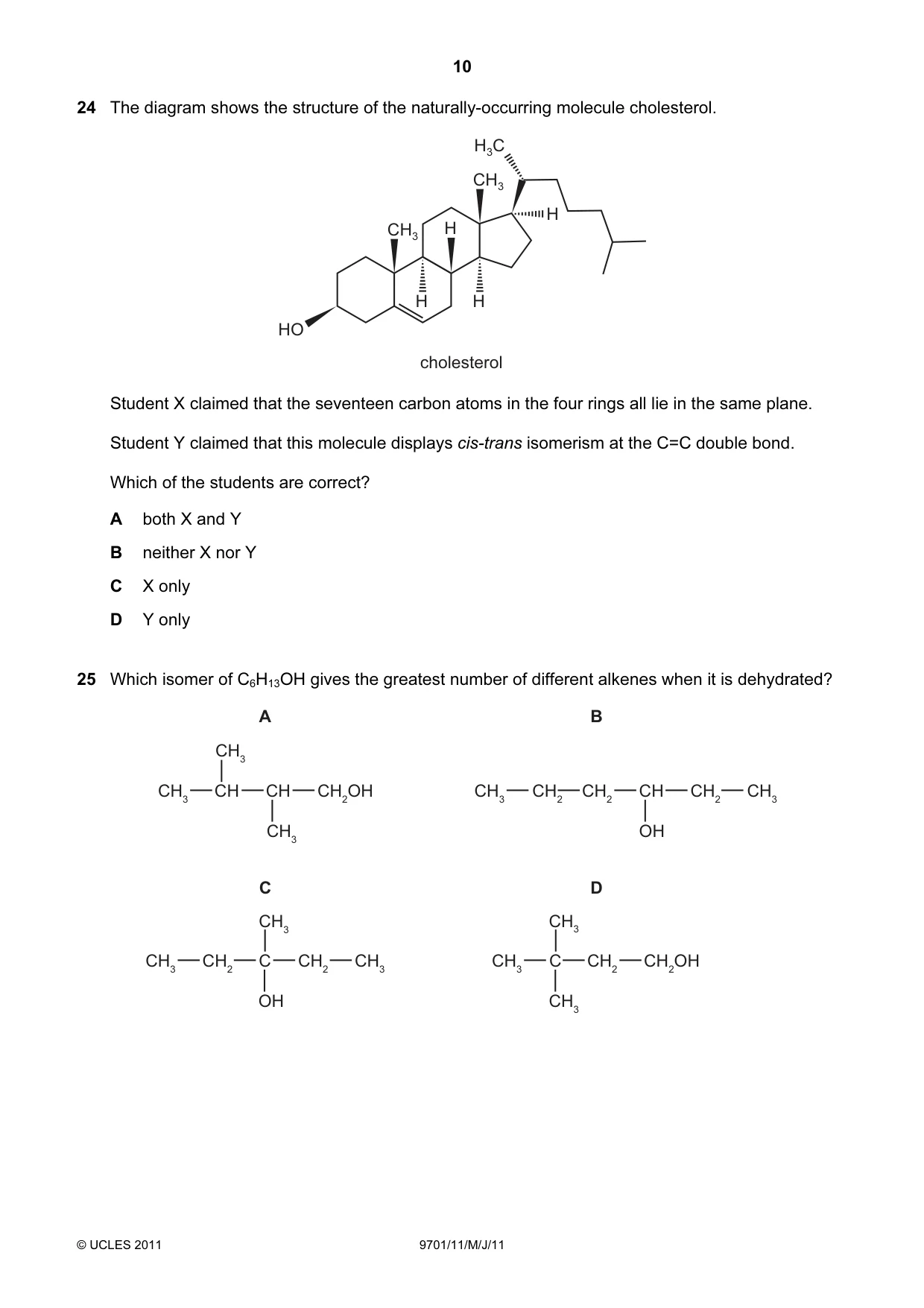
24 The diagram shows the structure of the naturally-occurring molecule cholesterol. H3C CH3 H CH3 H H H HO cholesterol Student X claimed that the seventeen carbon atoms in the four rings all lie in the same plane. Student Y claimed that this molecule displays cis-trans isomerism at the C=C double bond. Which of the students are correct? A both X and Y B neither X nor Y C X only D Y only
Mark scheme: B
More questions on Isomerism: structural isomerism and stereoisomerism
Q25 · Which isomer of C6H13OH gives the greatest number of different alkenes when it is…
25 Which isomer of C6H13OH gives the greatest number of different alkenes when it is dehydrated? A B CH3 CH3 CH CH CH2OH CH3 CH2 CH2 CH CH2 CH3 CH3 OH C D CH3 CH3 CH3 CH2 C CH2 CH3 CH3 C CH2 CH2OH OH CH3
Mark scheme: B
Q26 · Compound X changes the colour of warm acidified sodium dichromate(VI) from orange to green
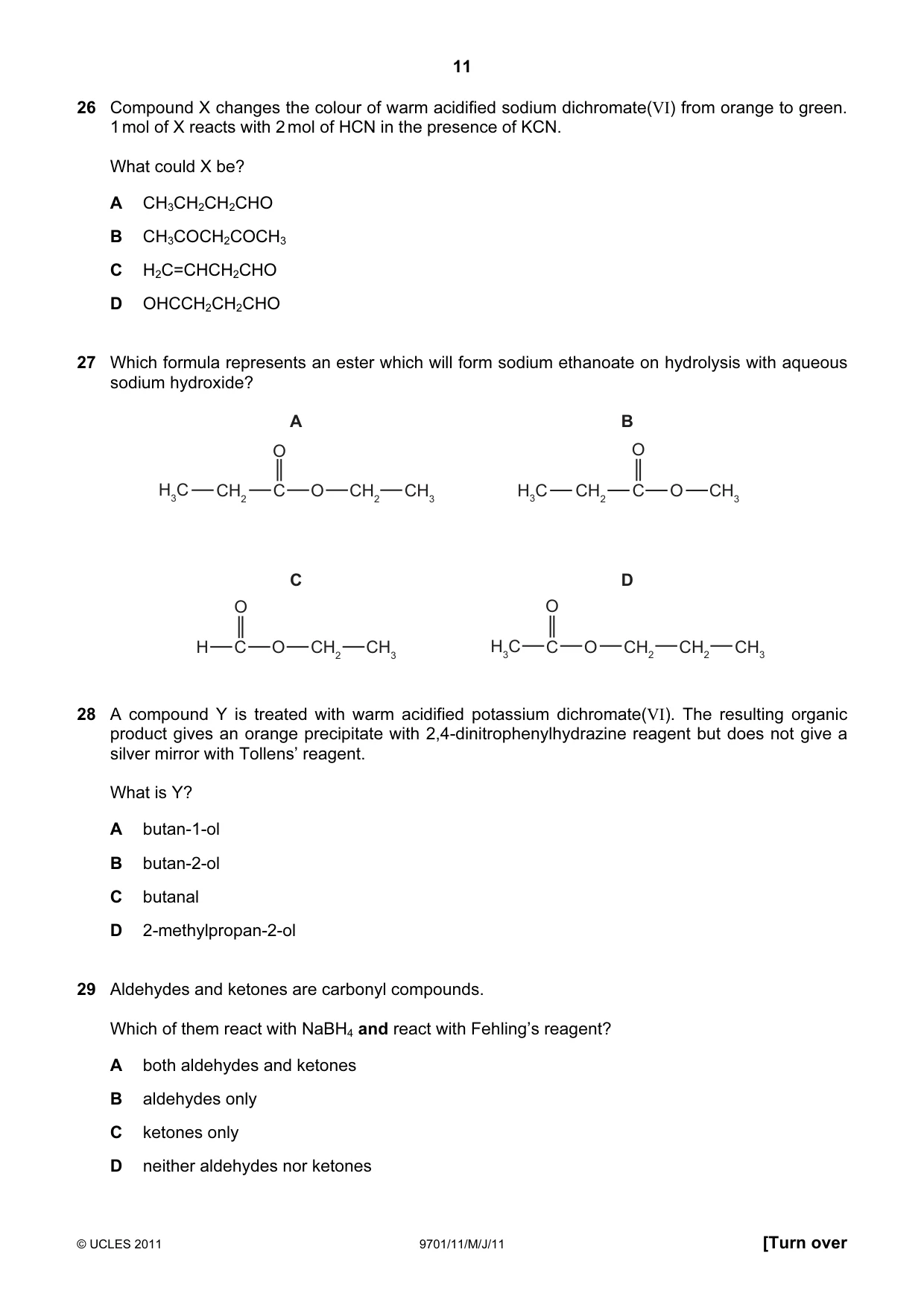
26 Compound X changes the colour of warm acidified sodium dichromate(VI) from orange to green. 1 mol of X reacts with 2 mol of HCN in the presence of KCN. What could X be? A CH3CH2CH2CHO B CH3COCH2COCH3 C H2C=CHCH2CHO D OHCCH2CH2CHO
Mark scheme: D
Q27 · Which formula represents an ester which will form sodium ethanoate on hydrolysis with…
27 Which formula represents an ester which will form sodium ethanoate on hydrolysis with aqueous sodium hydroxide? A B O O H3C CH2 C O CH2 CH3 H3C CH2 C O CH3 C D O O H C O CH2 CH3 H3C C O CH2 CH2 CH3
Mark scheme: D
Q28 · A compound Y is treated with warm acidified potassium dichromate(VI)
28 A compound Y is treated with warm acidified potassium dichromate(VI). The resulting organic product gives an orange precipitate with 2,4-dinitrophenylhydrazine reagent but does not give a silver mirror with Tollens’ reagent. What is Y? A butan-1-ol B butan-2-ol C butanal D 2-methylpropan-2-ol
Mark scheme: B
Q29 · Aldehydes and ketones are carbonyl compounds
29 Aldehydes and ketones are carbonyl compounds. Which of them react with NaBH4 and react with Fehling’s reagent? A both aldehydes and ketones B aldehydes only C ketones only D neither aldehydes nor ketones
Mark scheme: B
Q30 · The functional group in a primary alcohol is –CH2OH
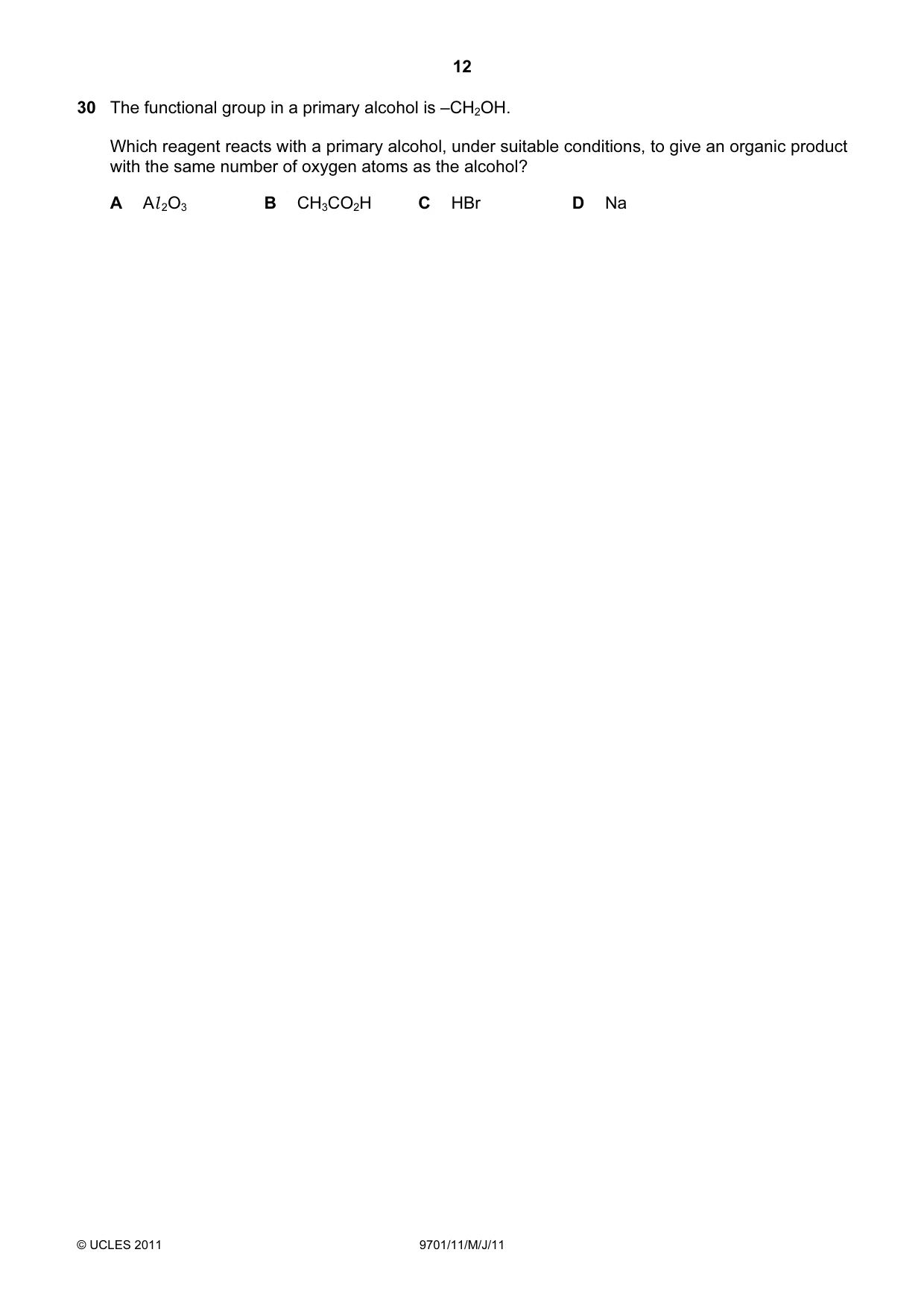
30 The functional group in a primary alcohol is –CH2OH. Which reagent reacts with a primary alcohol, under suitable conditions, to give an organic product with the same number of oxygen atoms as the alcohol? A Al 2O3 B CH3CO2H C HBr D Na
Mark scheme: D
Q31 · Which statements are correct in terms of the Brønsted-Lowry theory of acids and bases?
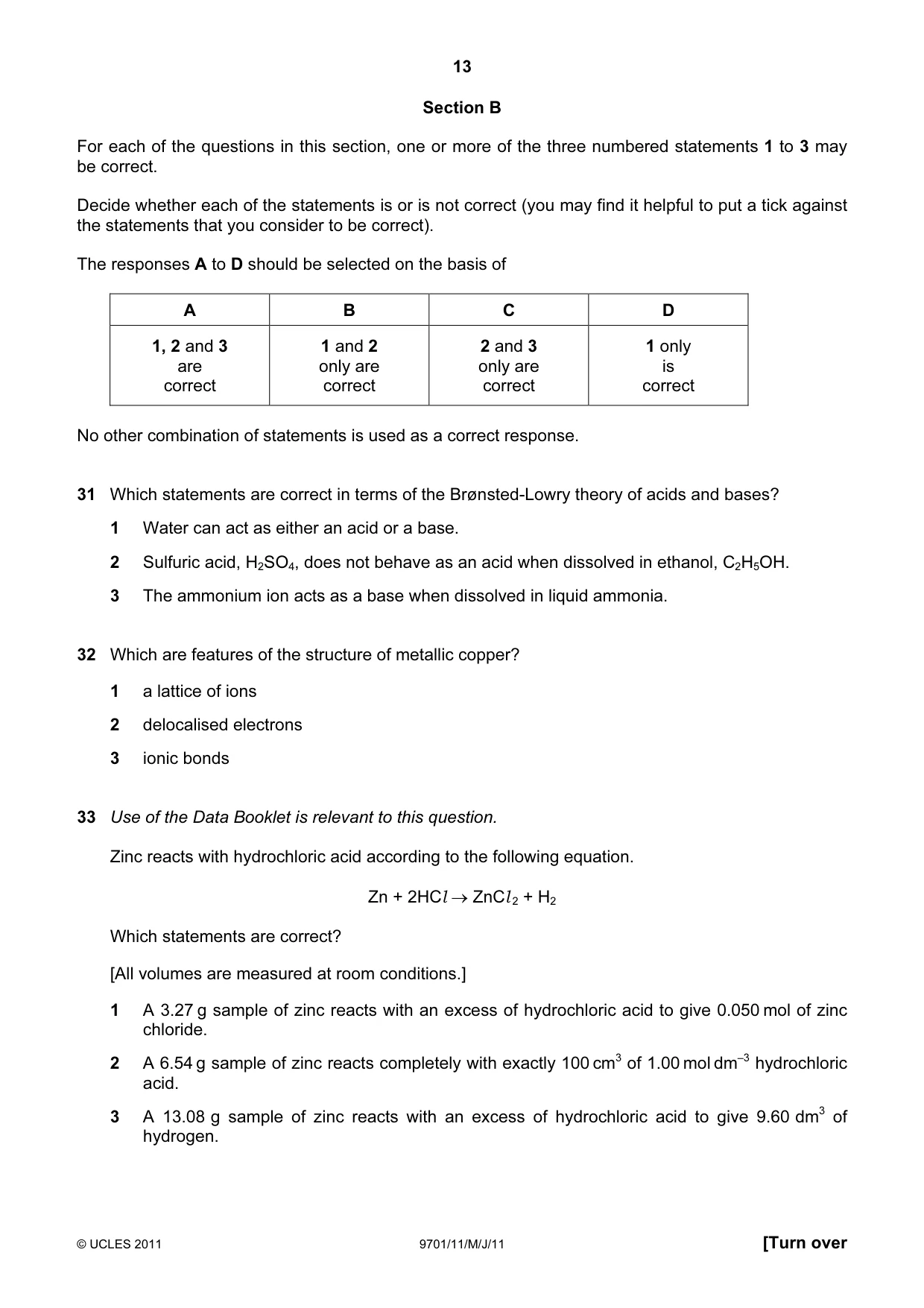
31 Which statements are correct in terms of the Brønsted-Lowry theory of acids and bases? 1 Water can act as either an acid or a base. 2 Sulfuric acid, H2SO4, does not behave as an acid when dissolved in ethanol, C2H5OH. 3 The ammonium ion acts as a base when dissolved in liquid ammonia.
Mark scheme: D
Q32 · Which are features of the structure of metallic copper?
32 Which are features of the structure of metallic copper? 1 a lattice of ions 2 delocalised electrons 3 ionic bonds
Mark scheme: B
Q33 · Use of the Data Booklet is relevant to this question
33 Use of the Data Booklet is relevant to this question. Zinc reacts with hydrochloric acid according to the following equation. Zn + 2HCl → ZnCl 2 + H2 Which statements are correct? [All volumes are measured at room conditions.] 1 A 3.27 g sample of zinc reacts with an excess of hydrochloric acid to give 0.050 mol of zinc chloride. 2 A 6.54 g sample of zinc reacts completely with exactly 100 cm3 of 1.00 mol dm–3 hydrochloric acid. 3 A 13.08 g sample of zinc reacts with an excess of hydrochloric acid to give 9.60 dm3 of hydrogen.
Mark scheme: D
More questions on Reacting masses and volumes (of solutions and gases)
Q34 · Which statements are correct?
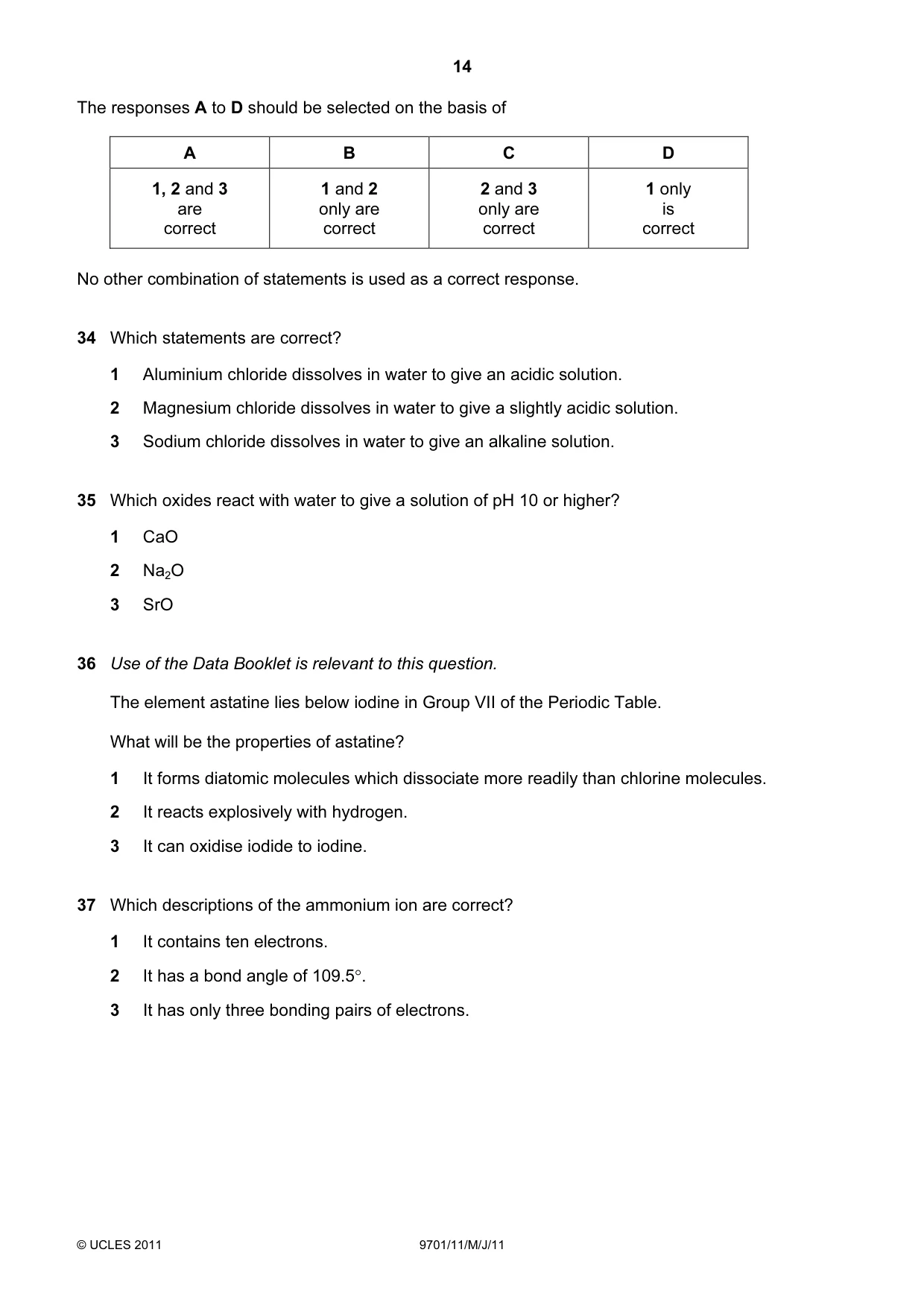
34 Which statements are correct? 1 Aluminium chloride dissolves in water to give an acidic solution. 2 Magnesium chloride dissolves in water to give a slightly acidic solution. 3 Sodium chloride dissolves in water to give an alkaline solution.
Mark scheme: B
More questions on Periodicity of chemical properties of the elements in Period 3
Q35 · Which oxides react with water to give a solution of pH 10 or higher?
35 Which oxides react with water to give a solution of pH 10 or higher? 1 CaO 2 Na2O 3 SrO
Mark scheme: A
Q36 · Use of the Data Booklet is relevant to this question
36 Use of the Data Booklet is relevant to this question. The element astatine lies below iodine in Group VII of the Periodic Table. What will be the properties of astatine? 1 It forms diatomic molecules which dissociate more readily than chlorine molecules. 2 It reacts explosively with hydrogen. 3 It can oxidise iodide to iodine.
Mark scheme: D
More questions on Physical properties of the Group 17 elements
Q37 · Which descriptions of the ammonium ion are correct?
37 Which descriptions of the ammonium ion are correct? 1 It contains ten electrons. 2 It has a bond angle of 109.5°. 3 It has only three bonding pairs of electrons.
Mark scheme: B
Q38 · Which alkenes, on reaction with steam at 600 K and 6 x 10⁶ Pa pressure in the presence of…
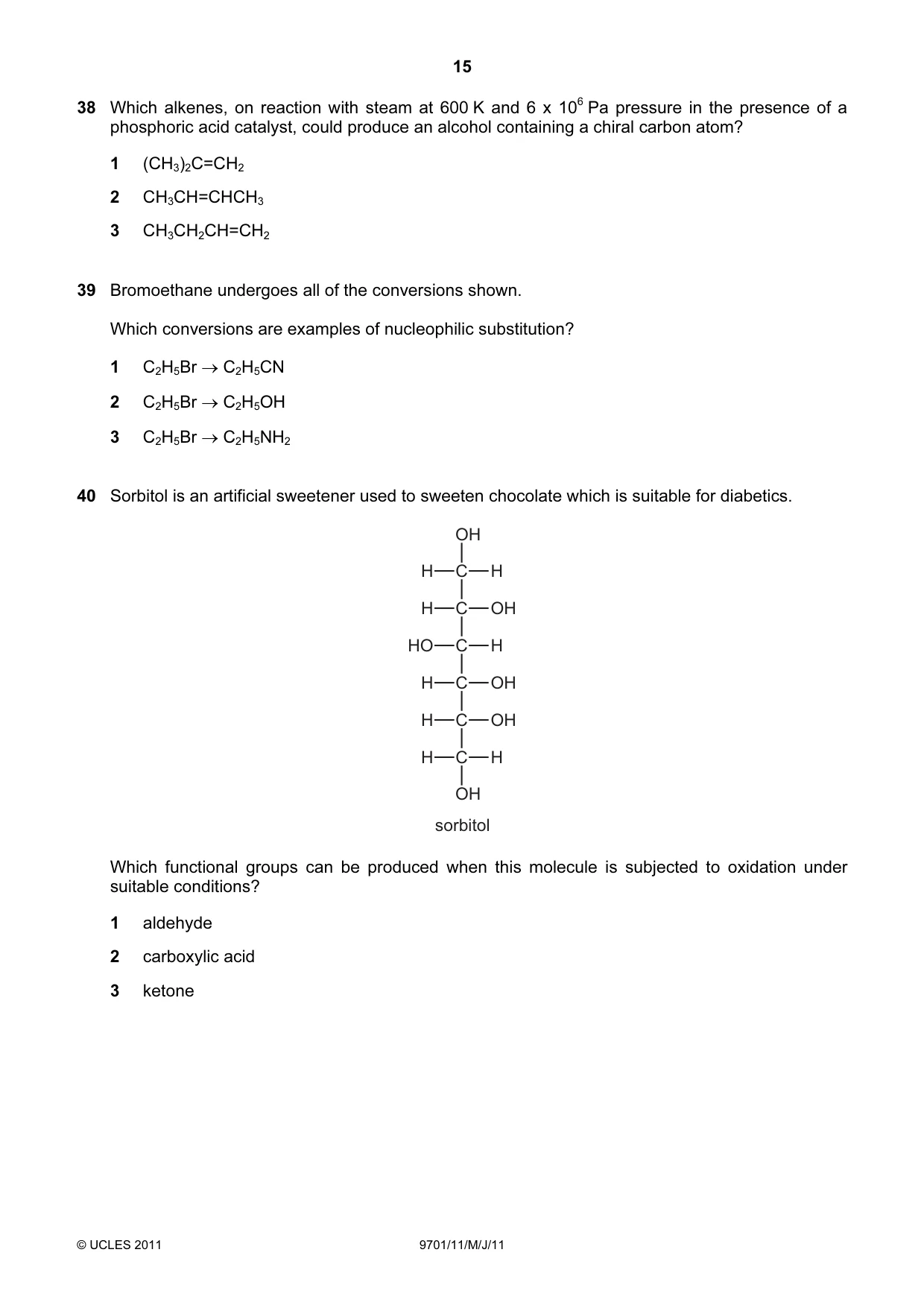
38 Which alkenes, on reaction with steam at 600 K and 6 x 10⁶ Pa pressure in the presence of a phosphoric acid catalyst, could produce an alcohol containing a chiral carbon atom? 1 (CH3)2C=CH2 2 CH3CH=CHCH3 3 CH3CH2CH=CH2
Mark scheme: C
Q39 · Bromoethane undergoes all of the conversions shown
39 Bromoethane undergoes all of the conversions shown. Which conversions are examples of nucleophilic substitution? 1 C2H5Br → C2H5CN 2 C2H5Br → C2H5OH 3 C2H5Br → C2H5NH2
Mark scheme: A
Q40 · Sorbitol is an artificial sweetener used to sweeten chocolate which is suitable for…
40 Sorbitol is an artificial sweetener used to sweeten chocolate which is suitable for diabetics. OH H C H H C OH HO C H H C OH H C OH H C H OH sorbitol Which functional groups can be produced when this molecule is subjected to oxidation under suitable conditions? 1 aldehyde 2 carboxylic acid 3 ketone
Mark scheme: A
What was in this paper
The subtopics covered by these 40 questions, and how many questions each got. Open one in a new tab to see every Cambridge question on it.
3Aldehydes and ketones3Alkenes3Reacting masses and volumes (of solutions and gases)3Effect of temperature on reaction rates and the concept of activation energy2Halogenoalkanes2Isomerism: structural isomerism and stereoisomerism2Bonding and structure1Brønsted–Lowry theory of acids and bases1Chemical equilibria: reversible reactions, dynamic equilibrium1Electrolysis1Electrons, energy levels and atomic orbitals1Enthalpy change, ΔH1Esters1Formulas1Intermolecular forces, electronegativity and bond properties1Ionisation energy1Metallic bonding1Nitrogen and sulfur1Particles in the atom and atomic radius1Periodicity of chemical properties of the elements in Period 31Periodicity of physical properties of the elements in Period 31Physical properties of the Group 17 elements1Rate of reaction1Redox processes: electron transfer and changes in oxidation number (oxidation state)1Shapes of molecules1Similarities and trends in the properties of the Group 2 metals, magnesium to barium, and their compounds1Some reactions of the halide ions1The chemical properties of the halogen elements and the hydrogen halides1What you needed in this session
Cambridge’s own grade thresholds for 2011 May/June, Paper 1 · Variant 1. A higher threshold means an easier paper — the bar moves with how the cohort did.