Cambridge A Level Chemistry 9701 — 2020 Oct/Nov Paper 1 · Variant 3
9701/13/O/N/20 · 40 questions · 40 marks · ≈45 min
The question paper and its mark scheme, free to read here and free to download. This is Cambridge’s own paper, exactly as it was sat.
Question paper16 pages


Mark scheme3 pages
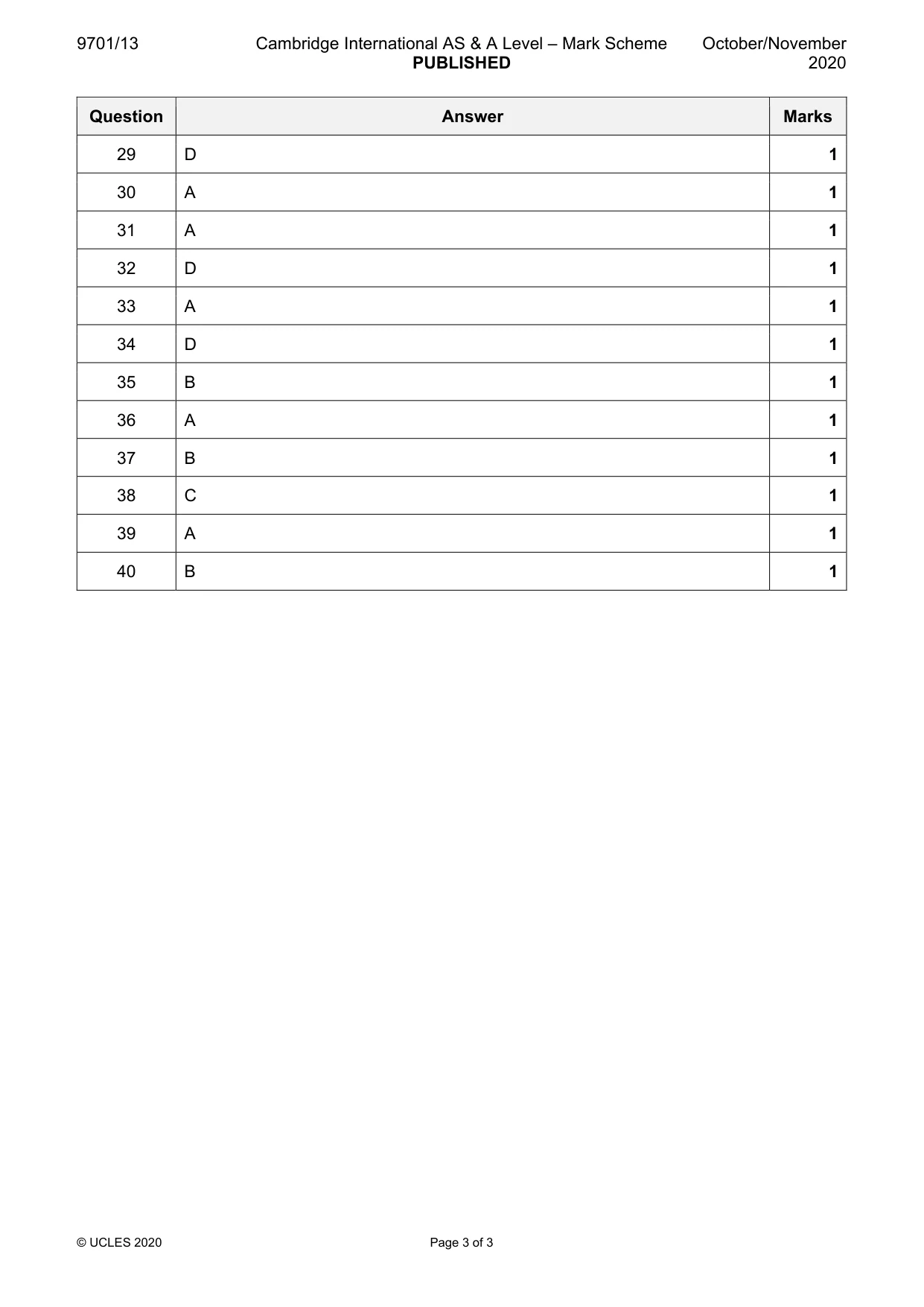
Answers below. Sit the paper first if you are practising.
Questions as text
Q1 · Which statement is correct?
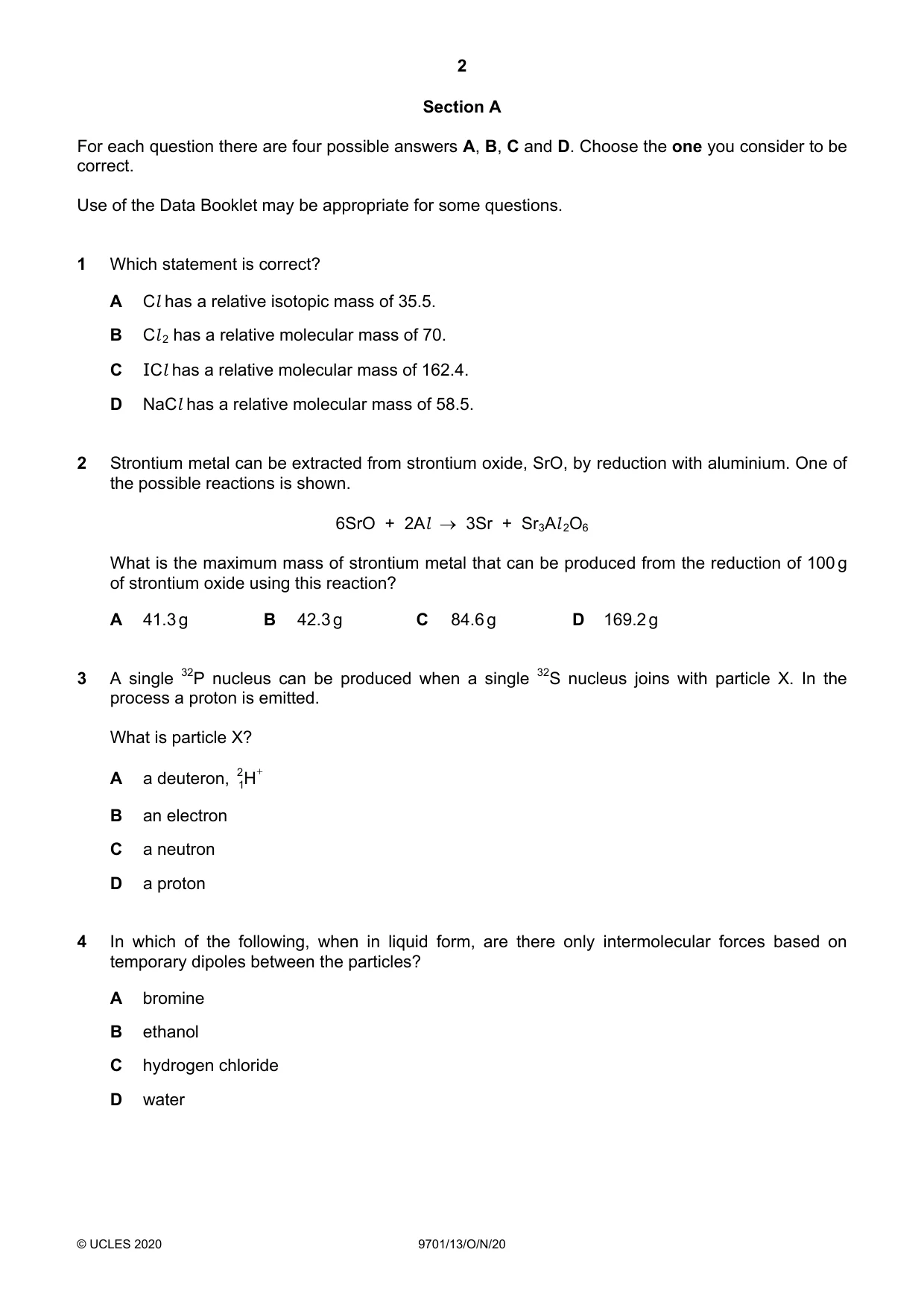
1 Which statement is correct? A Cl has a relative isotopic mass of 35.5. B Cl 2 has a relative molecular mass of 70. C ICl has a relative molecular mass of 162.4. D NaCl has a relative molecular mass of 58.5.
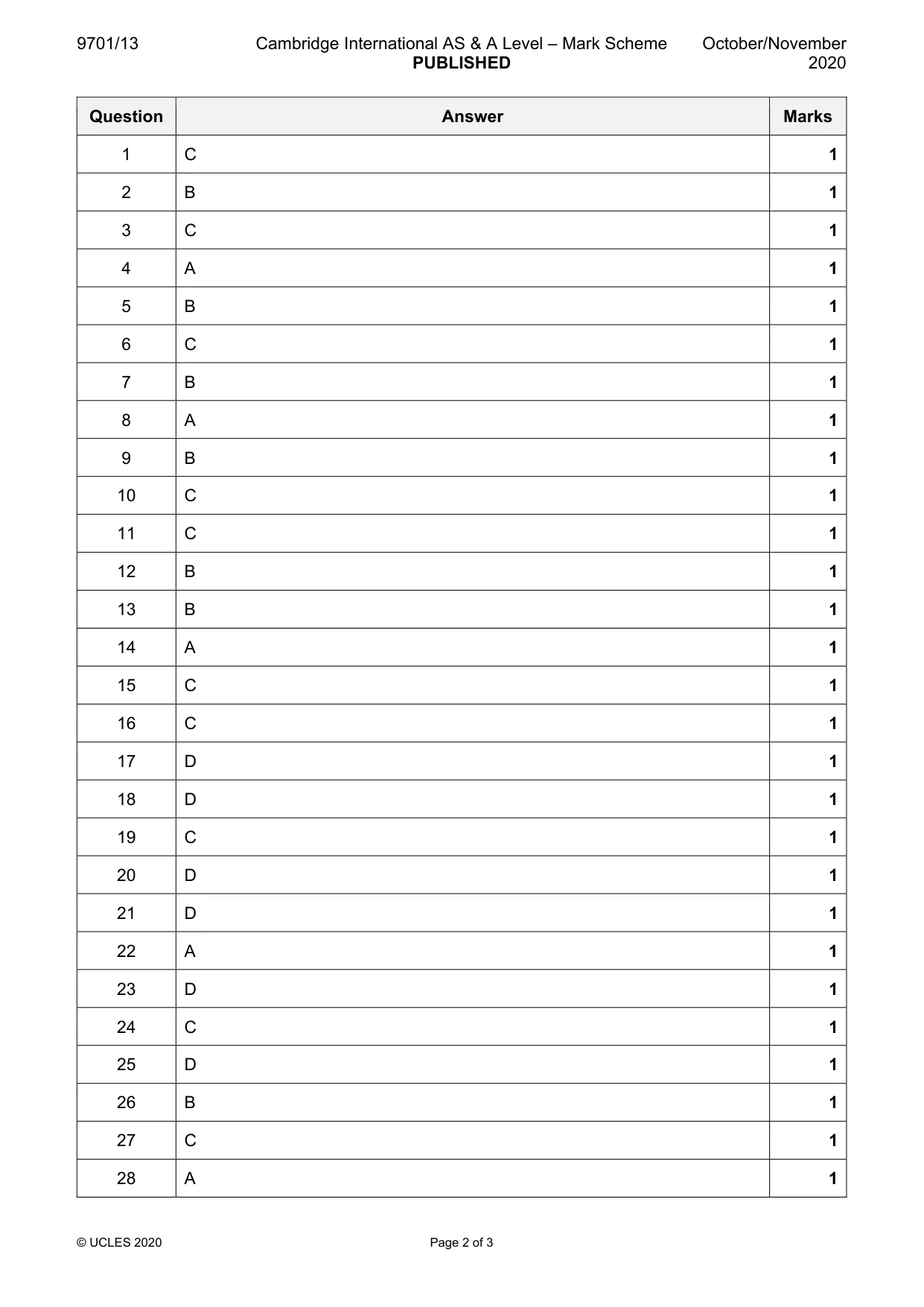
Mark scheme: C
Q2 · Strontium metal can be extracted from strontium oxide, SrO, by reduction with aluminium
2 Strontium metal can be extracted from strontium oxide, SrO, by reduction with aluminium. One of the possible reactions is shown. 6SrO + 2Al 3Sr + Sr3Al 2O6 What is the maximum mass of strontium metal that can be produced from the reduction of 100 g of strontium oxide using this reaction? A 41.3 g B 42.3 g C 84.6 g D 169.2 g
Mark scheme: B
More questions on Reacting masses and volumes (of solutions and gases)
Q3 · A single 32P nucleus can be produced when a single 32S nucleus joins with particle X
3 A single 32P nucleus can be produced when a single 32S nucleus joins with particle X. In the process a proton is emitted. What is particle X? A a deuteron, 2 H 1 B an electron C a neutron D a proton
Mark scheme: C
Q4 · In which of the following, when in liquid form, are there only intermolecular forces…
4 In which of the following, when in liquid form, are there only intermolecular forces based on temporary dipoles between the particles? A bromine B ethanol C hydrogen chloride D water
Mark scheme: A
More questions on Intermolecular forces, electronegativity and bond properties
Q5 · Copper has a high melting point
5 Copper has a high melting point. What is the reason for the high melting point of copper? A strong attractive forces between copper atoms only B strong attractive forces between copper ions and delocalised electrons C strong attractive forces between copper ions only D strong attractive forces between copper atoms and delocalised electrons
Mark scheme: B
Q6 · Which pair of standard enthalpy changes are numerically equal?
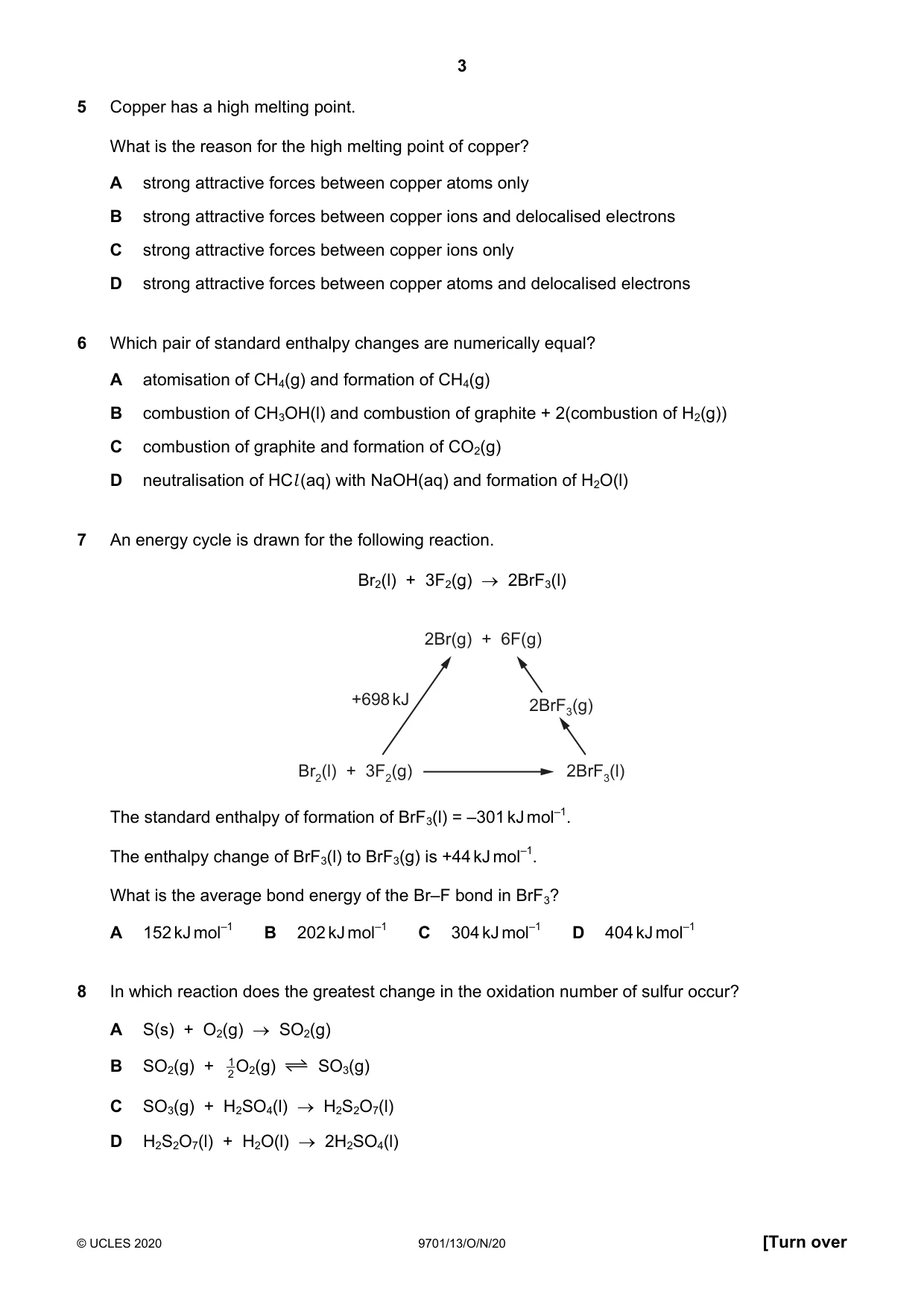
6 Which pair of standard enthalpy changes are numerically equal? A atomisation of CH4(g) and formation of CH4(g) B combustion of CH3OH(l) and combustion of graphite + 2(combustion of H2(g)) C combustion of graphite and formation of CO2(g) D neutralisation of HCl (aq) with NaOH(aq) and formation of H2O(l)
Mark scheme: C
Q7 · An energy cycle is drawn for the following reaction
7 An energy cycle is drawn for the following reaction. Br2(l) + 3F2(g) 2BrF3(l) 2Br(g) + 6F(g) +698 kJ 2BrF3(g) Br2(l) + 3F2(g) 2BrF3(l) The standard enthalpy of formation of BrF3(l) = –301 kJ mol–1. The enthalpy change of BrF3(l) to BrF3(g) is +44 kJ mol–1. What is the average bond energy of the Br–F bond in BrF3? A 152 kJ mol–1 B 202 kJ mol–1 C 304 kJ mol–1 D 404 kJ mol–1
Mark scheme: B
Q8 · In which reaction does the greatest change in the oxidation number of sulfur occur?
8 In which reaction does the greatest change in the oxidation number of sulfur occur? A S(s) + O2(g) SO2(g) B SO2(g) + 2 1O2(g) SO3(g) C SO3(g) + H2SO4(l) H2S2O7(l) D H2S2O7(l) + H2O(l) 2H2SO4(l)
Mark scheme: A
Q9 · The first stage in the chloride process for the manufacture of titanium consists of the…
9 The first stage in the chloride process for the manufacture of titanium consists of the following reaction. 2TiO2 + 4Cl 2 + 3C 2TiCl 4 + 2CO + CO2 What is reduced in this reaction? A carbon B chlorine C oxygen D titanium
Mark scheme: B
Q10 · In aqueous solution, sulfuric acid dissociates as shown
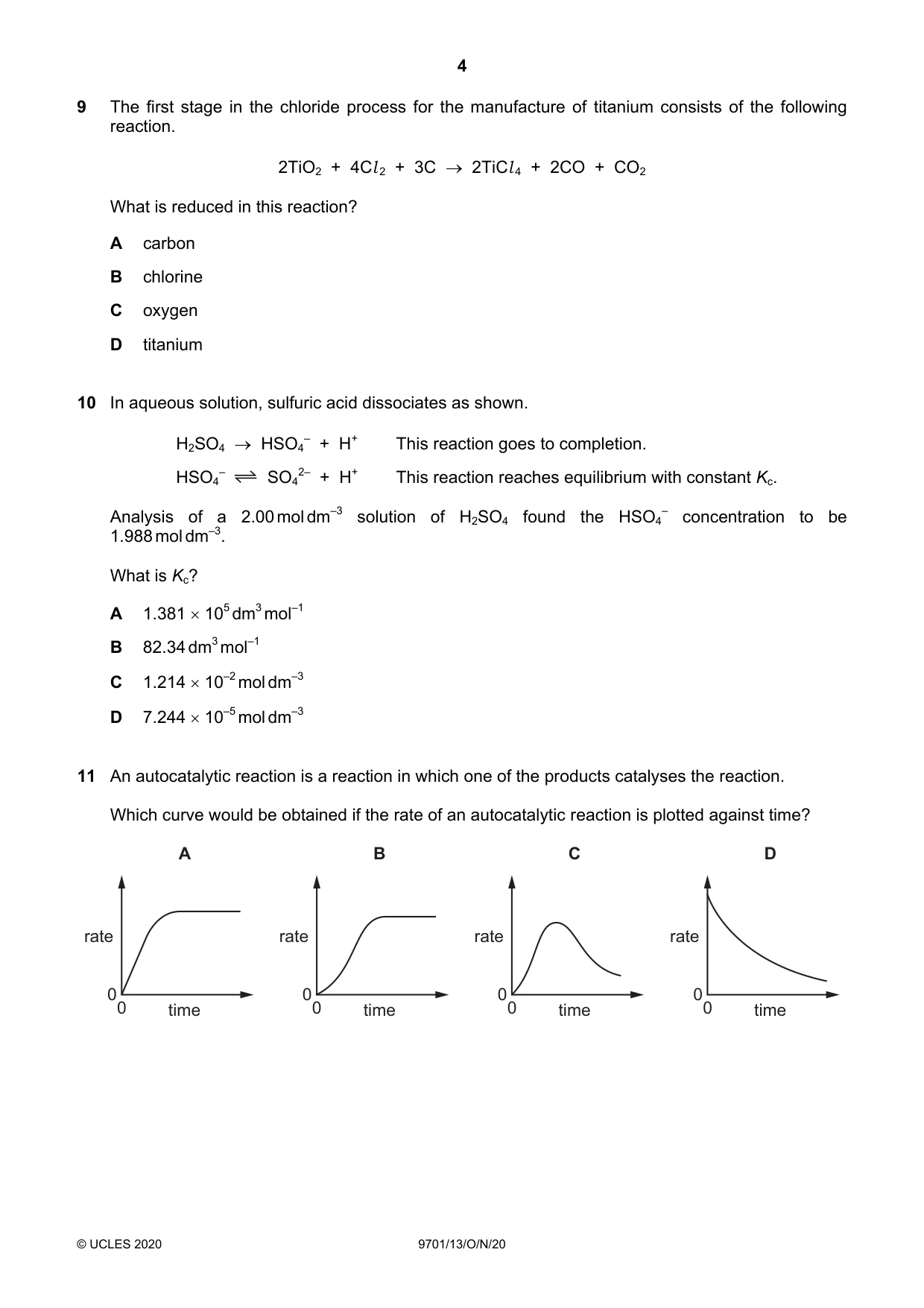
10 In aqueous solution, sulfuric acid dissociates as shown. H2SO4 HSO4 – + H+ This reaction goes to completion. HSO4 – SO4 2– + H+ This reaction reaches equilibrium with constant Kc. Analysis of a 2.00 mol dm–3 solution of H2SO4 found the HSO4 – concentration to be 1.988 mol dm–3. What is Kc? A 1.381 105 dm3 mol–1 B 82.34 dm3 mol–1 C 1.214 10–2 mol dm–3 D 7.244 10–5 mol dm–3
Mark scheme: C
More questions on Chemical equilibria: reversible reactions, dynamic equilibrium
Q11 · An autocatalytic reaction is a reaction in which one of the products catalyses the…
11 An autocatalytic reaction is a reaction in which one of the products catalyses the reaction. Which curve would be obtained if the rate of an autocatalytic reaction is plotted against time? A B C D rate rate rate rate 00 00 00 00 time time time time
Mark scheme: C
Q12 · X and Y are two elements in Period 3 of the Periodic Table
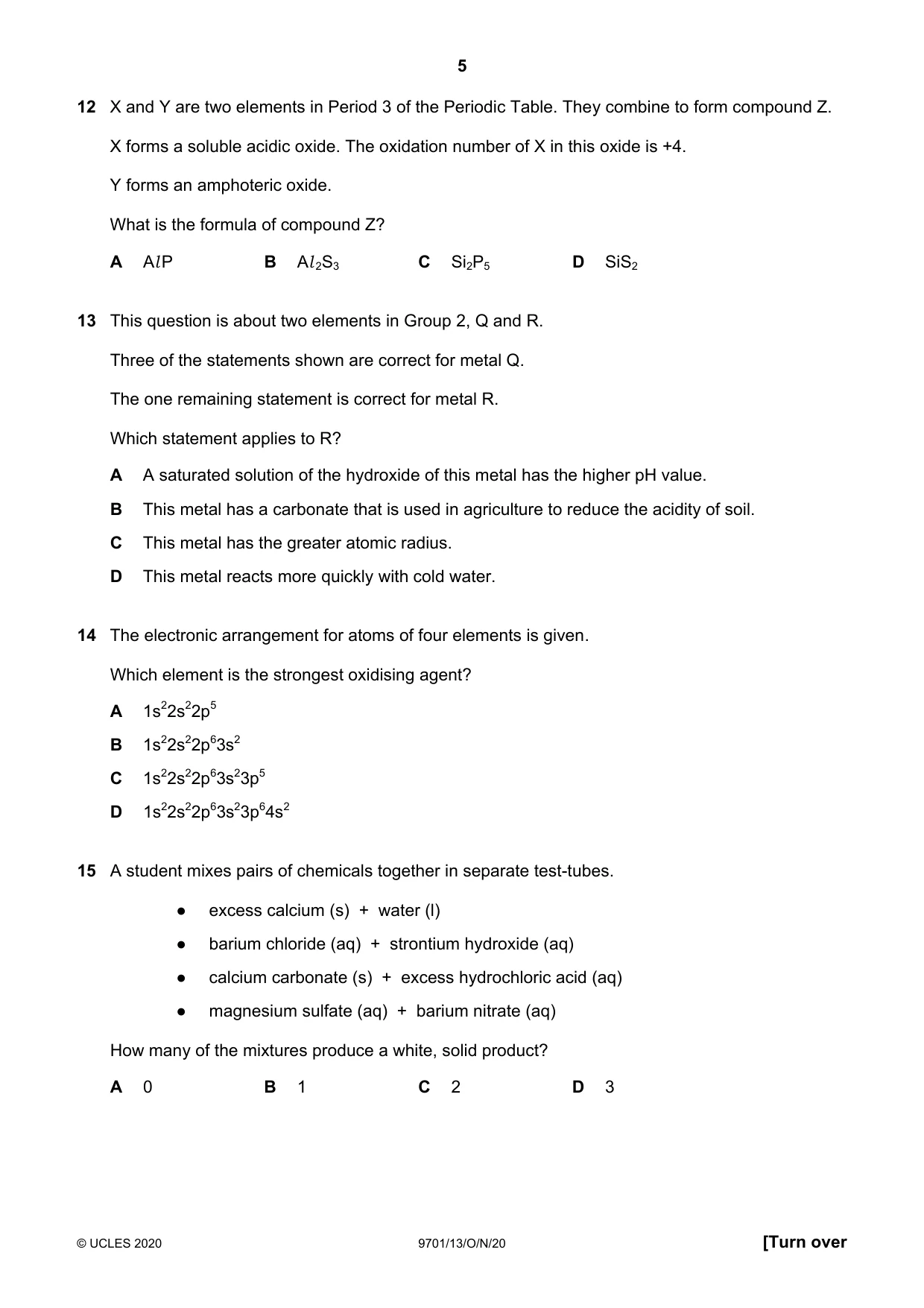
12 X and Y are two elements in Period 3 of the Periodic Table. They combine to form compound Z. X forms a soluble acidic oxide. The oxidation number of X in this oxide is +4. Y forms an amphoteric oxide. What is the formula of compound Z? A Al P B Al 2S3 C Si2P5 D SiS2
Mark scheme: B
More questions on Periodicity of chemical properties of the elements in Period 3
Q13 · This question is about two elements in Group 2, Q and R
13 This question is about two elements in Group 2, Q and R. Three of the statements shown are correct for metal Q. The one remaining statement is correct for metal R. Which statement applies to R? A A saturated solution of the hydroxide of this metal has the higher pH value. B This metal has a carbonate that is used in agriculture to reduce the acidity of soil. C This metal has the greater atomic radius. D This metal reacts more quickly with cold water.
Mark scheme: B
Q14 · The electronic arrangement for atoms of four elements is given
14 The electronic arrangement for atoms of four elements is given. Which element is the strongest oxidising agent? A 1s22s22p5 B 1s22s22p63s2 C 1s22s22p63s23p5 D 1s22s22p63s23p64s2
Mark scheme: A
More questions on Physical properties of the Group 17 elements
Q15 · A student mixes pairs of chemicals together in separate test-tubes
15 A student mixes pairs of chemicals together in separate test-tubes. ● excess calcium (s) + water (l) ● barium chloride (aq) + strontium hydroxide (aq) ● calcium carbonate (s) + excess hydrochloric acid (aq) ● magnesium sulfate (aq) + barium nitrate (aq) How many of the mixtures produce a white, solid product? A 0 B 1 C 2 D 3
Mark scheme: C
Q16 · With which compound does concentrated sulfuric acid react both as a strong acid and as an…
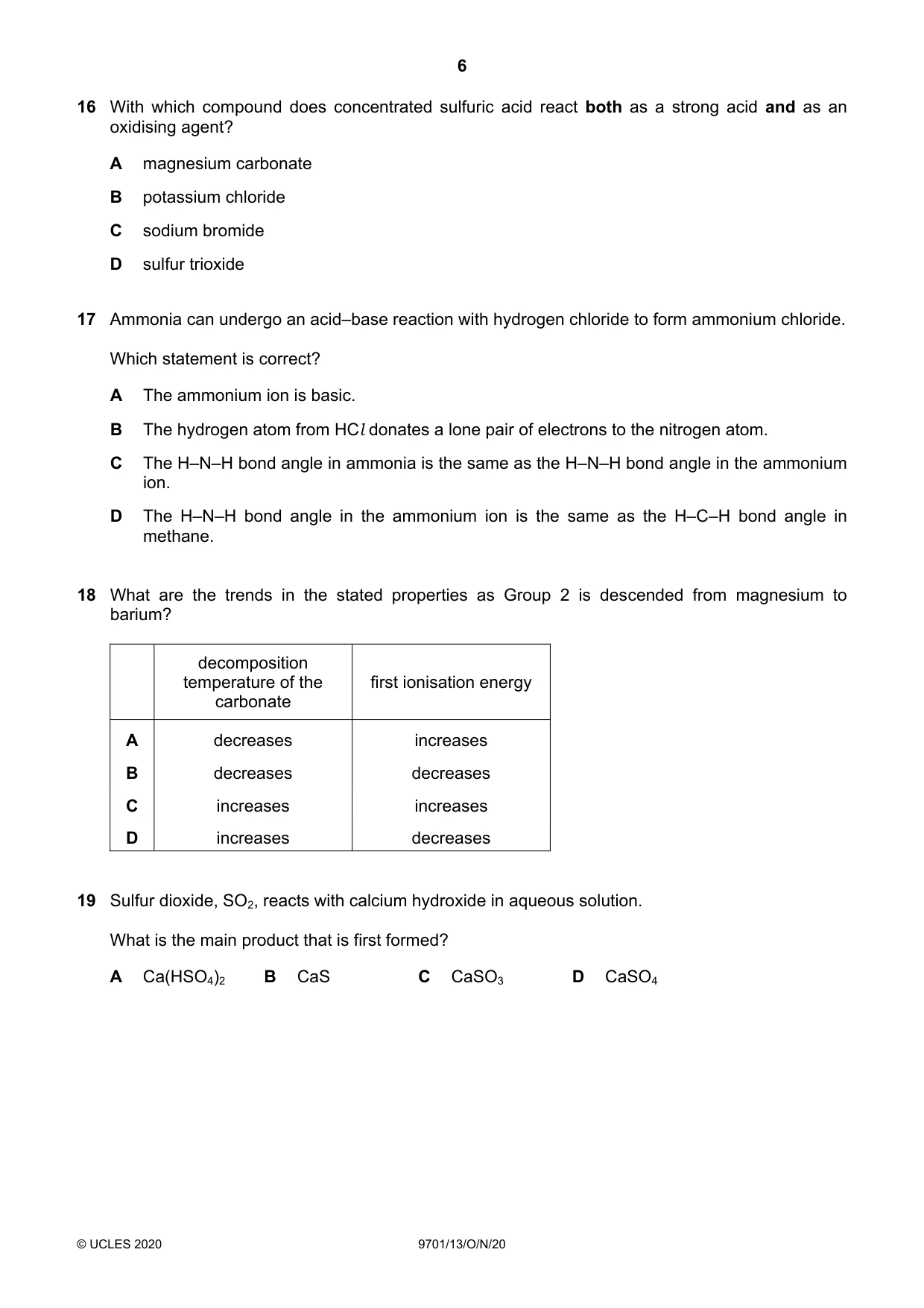
16 With which compound does concentrated sulfuric acid react both as a strong acid and as an oxidising agent? A magnesium carbonate B potassium chloride C sodium bromide D sulfur trioxide
Mark scheme: C
More questions on The chemical properties of the halogen elements and the hydrogen halides
Q17 · Ammonia can undergo an acid–base reaction with hydrogen chloride to form ammonium chloride
17 Ammonia can undergo an acid–base reaction with hydrogen chloride to form ammonium chloride. Which statement is correct? A The ammonium ion is basic. B The hydrogen atom from HCl donates a lone pair of electrons to the nitrogen atom. C The H–N–H bond angle in ammonia is the same as the H–N–H bond angle in the ammonium ion. D The H–N–H bond angle in the ammonium ion is the same as the H–C–H bond angle in methane.
Mark scheme: D
Q18 · What are the trends in the stated properties as Group 2 is descended from magnesium to…
18 What are the trends in the stated properties as Group 2 is descended from magnesium to barium? decomposition temperature of the first ionisation energy carbonate A decreases increases B decreases decreases C increases increases D increases decreases
Mark scheme: D
Q19 · Sulfur dioxide, SO2, reacts with calcium hydroxide in aqueous solution
19 Sulfur dioxide, SO2, reacts with calcium hydroxide in aqueous solution. What is the main product that is first formed? A Ca(HSO4)2 B CaS C CaSO3 D CaSO4
Mark scheme: C
Q20 · Structural and stereoisomerism should be considered when answering this question
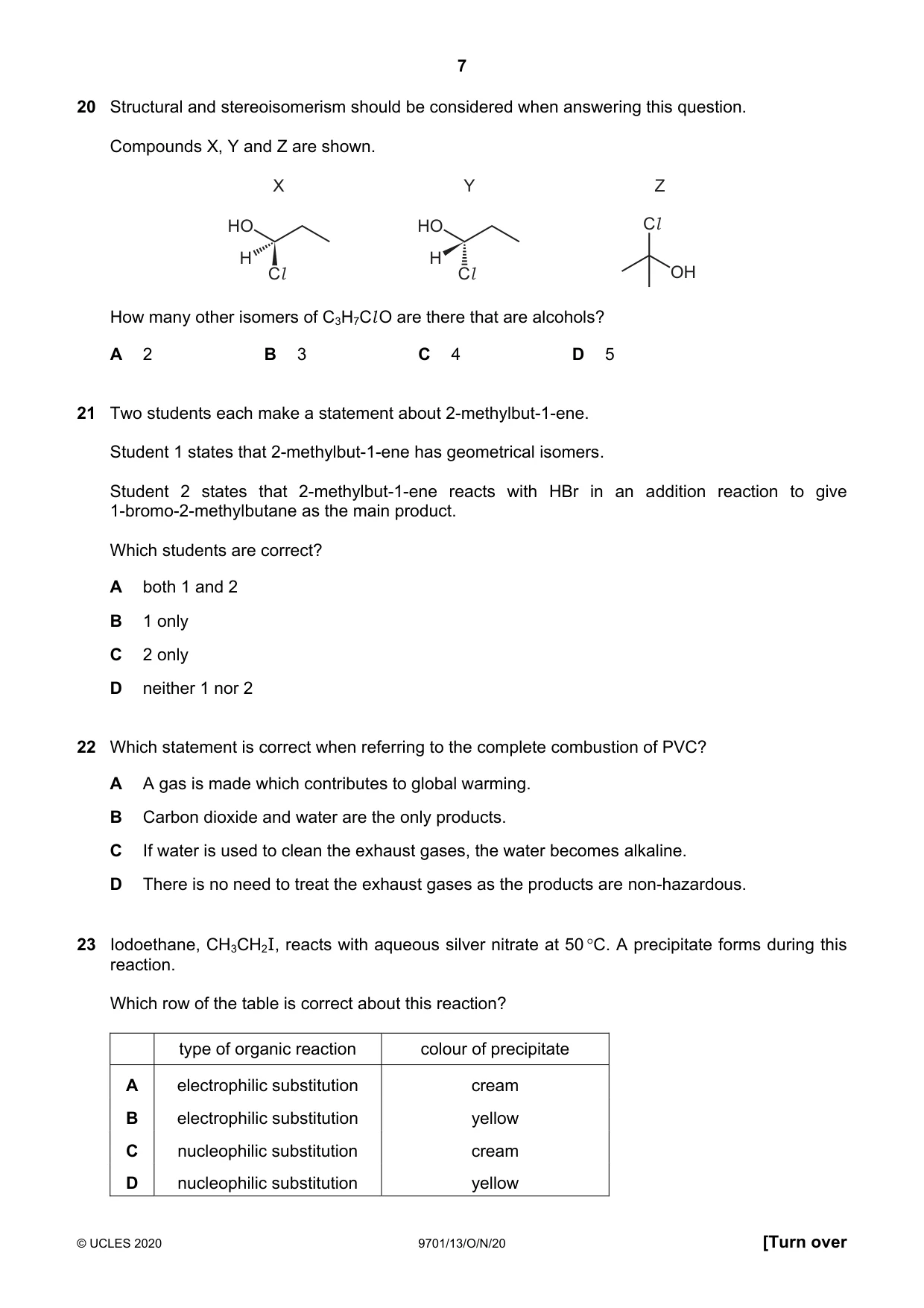
20 Structural and stereoisomerism should be considered when answering this question. Compounds X, Y and Z are shown. X Y Z HO HO Cl H H Cl Cl OH How many other isomers of C3H7Cl O are there that are alcohols? A 2 B 3 C 4 D 5
Mark scheme: D
More questions on Isomerism: structural isomerism and stereoisomerism
Q21 · Two students each make a statement about 2-methylbut-1-ene
21 Two students each make a statement about 2-methylbut-1-ene. Student 1 states that 2-methylbut-1-ene has geometrical isomers. Student 2 states that 2-methylbut-1-ene reacts with HBr in an addition reaction to give 1-bromo-2-methylbutane as the main product. Which students are correct? A both 1 and 2 B 1 only C 2 only D neither 1 nor 2
Mark scheme: D
Q22 · Which statement is correct when referring to the complete combustion of PVC?
22 Which statement is correct when referring to the complete combustion of PVC? A A gas is made which contributes to global warming. B Carbon dioxide and water are the only products. C If water is used to clean the exhaust gases, the water becomes alkaline. D There is no need to treat the exhaust gases as the products are non-hazardous.
Mark scheme: A
Q23 · Iodoethane, CH3CH2I, reacts with aqueous silver nitrate at 50 C
23 Iodoethane, CH3CH2I, reacts with aqueous silver nitrate at 50 C. A precipitate forms during this reaction. Which row of the table is correct about this reaction? type of organic reaction colour of precipitate A electrophilic substitution cream B electrophilic substitution yellow C nucleophilic substitution cream D nucleophilic substitution yellow
Mark scheme: D
Q24 · A student converts 1-iodopropane, C3H7I, into butanoic acid, C3H7CO2H, by a two-stage…
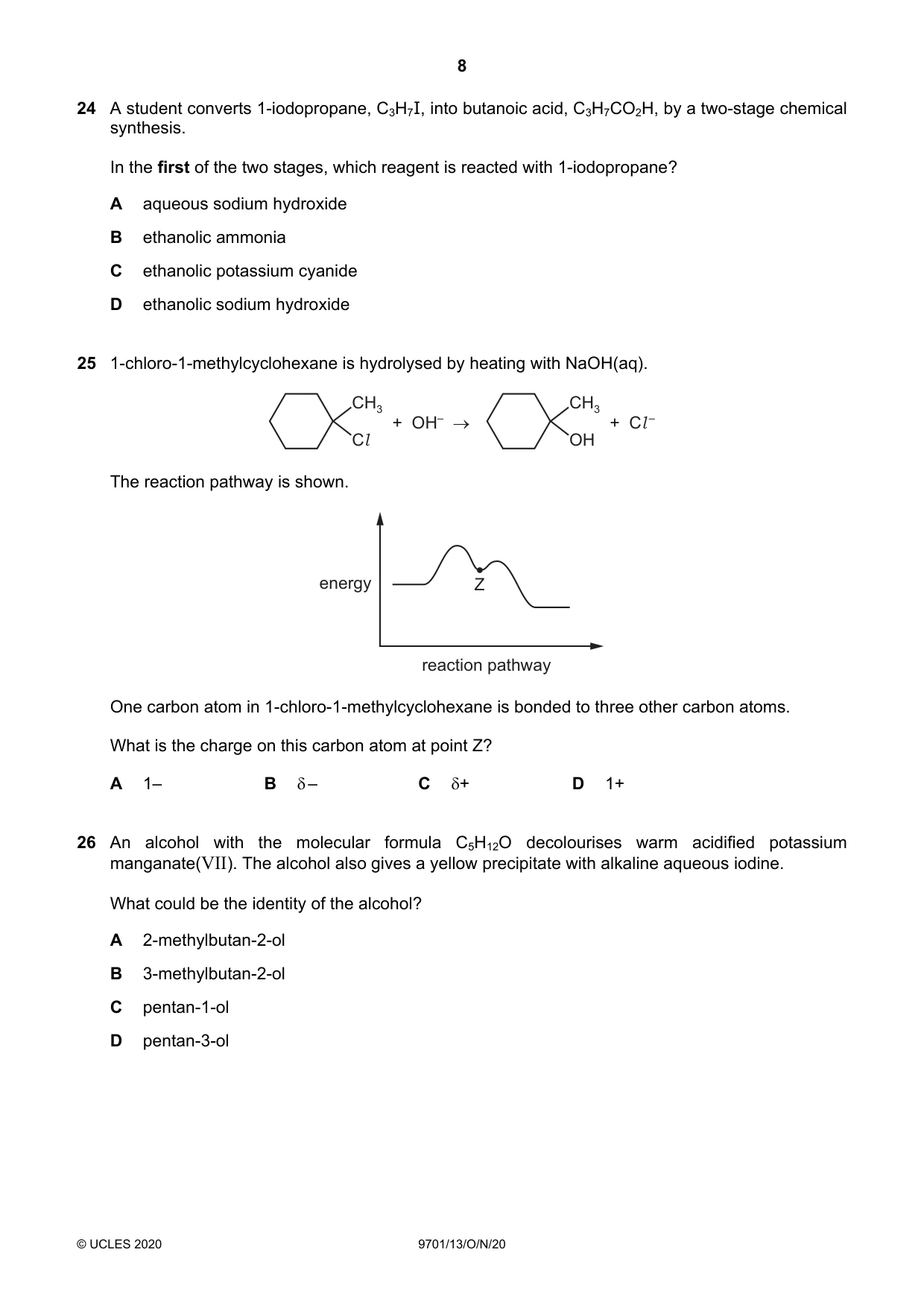
24 A student converts 1-iodopropane, C3H7I, into butanoic acid, C3H7CO2H, by a two-stage chemical synthesis. In the first of the two stages, which reagent is reacted with 1-iodopropane? A aqueous sodium hydroxide B ethanolic ammonia C ethanolic potassium cyanide D ethanolic sodium hydroxide
Mark scheme: C
Q25 · 1-chloro-1-methylcyclohexane is hydrolysed by heating with NaOH(aq)
25 1-chloro-1-methylcyclohexane is hydrolysed by heating with NaOH(aq). CH3 CH3 + OH– → + Cl – Cl OH The reaction pathway is shown. energy Z reaction pathway One carbon atom in 1-chloro-1-methylcyclohexane is bonded to three other carbon atoms. What is the charge on this carbon atom at point Z? A 1– B – C + D 1+
Mark scheme: D
Q26 · An alcohol with the molecular formula C5H12O decolourises warm acidified potassium…
26 An alcohol with the molecular formula C5H12O decolourises warm acidified potassium manganate(VII). The alcohol also gives a yellow precipitate with alkaline aqueous iodine. What could be the identity of the alcohol? A 2-methylbutan-2-ol B 3-methylbutan-2-ol C pentan-1-ol D pentan-3-ol
Mark scheme: B
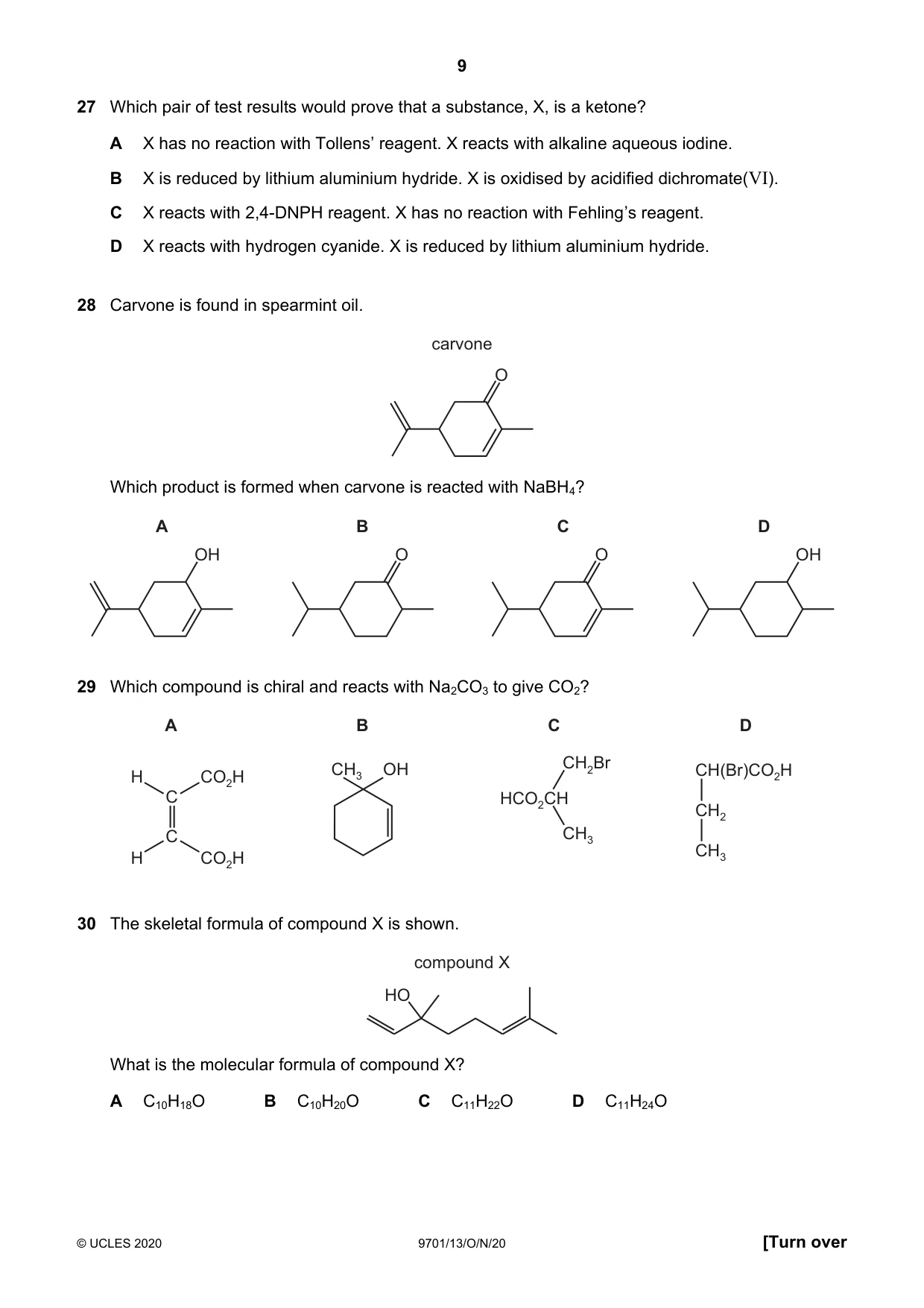
Q27 · Which pair of test results would prove that a substance, X, is a ketone?
27 Which pair of test results would prove that a substance, X, is a ketone? A X has no reaction with Tollens’ reagent. X reacts with alkaline aqueous iodine. B X is reduced by lithium aluminium hydride. X is oxidised by acidified dichromate(VI). C X reacts with 2,4-DNPH reagent. X has no reaction with Fehling’s reagent. D X reacts with hydrogen cyanide. X is reduced by lithium aluminium hydride.
Mark scheme: C
Q28 · Carvone is found in spearmint oil
28 Carvone is found in spearmint oil. carvone O Which product is formed when carvone is reacted with NaBH4? A B C D OH O O OH
Mark scheme: A
Q29 · Which compound is chiral and reacts with Na2CO3 to give CO2?
29 Which compound is chiral and reacts with Na2CO3 to give CO2? A B C D CH3 OH CH2Br CH(Br)CO2H H CO2H C HCO2CH CH2 C CH3 H CO2H CH3
Mark scheme: D
Q30 · The skeletal formula of compound X is shown
30 The skeletal formula of compound X is shown. compound X HO What is the molecular formula of compound X? A C10H18O B C10H20O C C11H22O D C11H24O Section B
Mark scheme: A
More questions on Formulas, functional groups and the naming of organic compounds
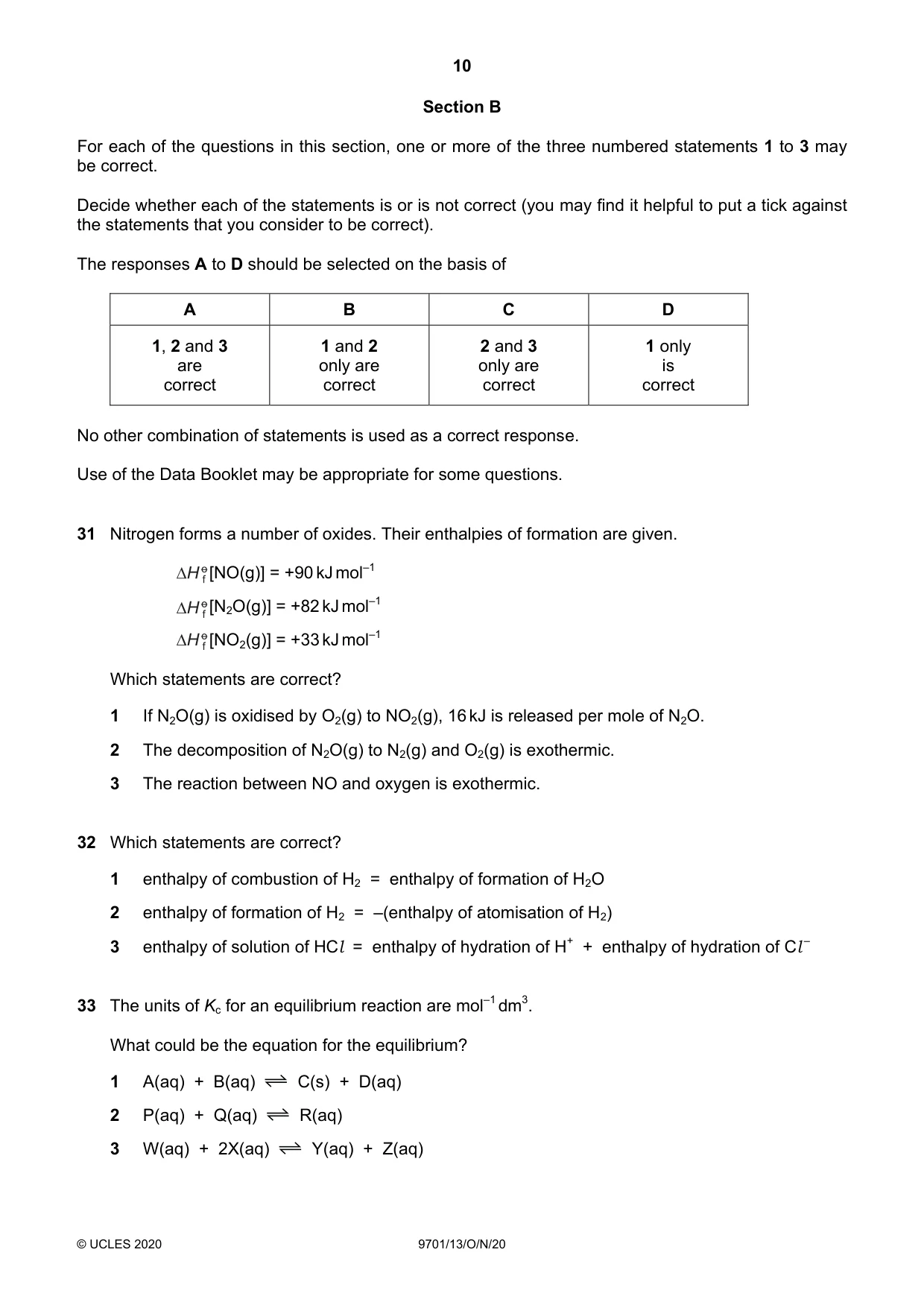
Q31 · Nitrogen forms a number of oxides
31 Nitrogen forms a number of oxides. Their enthalpies of formation are given. [NO(g)] = +90 kJ mol–1 [N2O(g)] = +82 kJ mol–1 [NO2(g)] = +33 kJ mol–1 Which statements are correct? 1 If N2O(g) is oxidised by O2(g) to NO2(g), 16 kJ is released per mole of N2O. 2 The decomposition of N2O(g) to N2(g) and O2(g) is exothermic. 3 The reaction between NO and oxygen is exothermic.
Mark scheme: A
Q32 · Which statements are correct?
32 Which statements are correct? 1 enthalpy of combustion of H2 = enthalpy of formation of H2O 2 enthalpy of formation of H2 = –(enthalpy of atomisation of H2) 3 enthalpy of solution of HCl = enthalpy of hydration of H+ + enthalpy of hydration of Cl –
Mark scheme: D
Q33 · The units of Kc for an equilibrium reaction are mol–1 dm3
33 The units of Kc for an equilibrium reaction are mol–1 dm3. What could be the equation for the equilibrium? 1 A(aq) + B(aq) C(s) + D(aq) 2 P(aq) + Q(aq) R(aq) 3 W(aq) + 2X(aq) Y(aq) + Z(aq)
Mark scheme: A
More questions on Chemical equilibria: reversible reactions, dynamic equilibrium
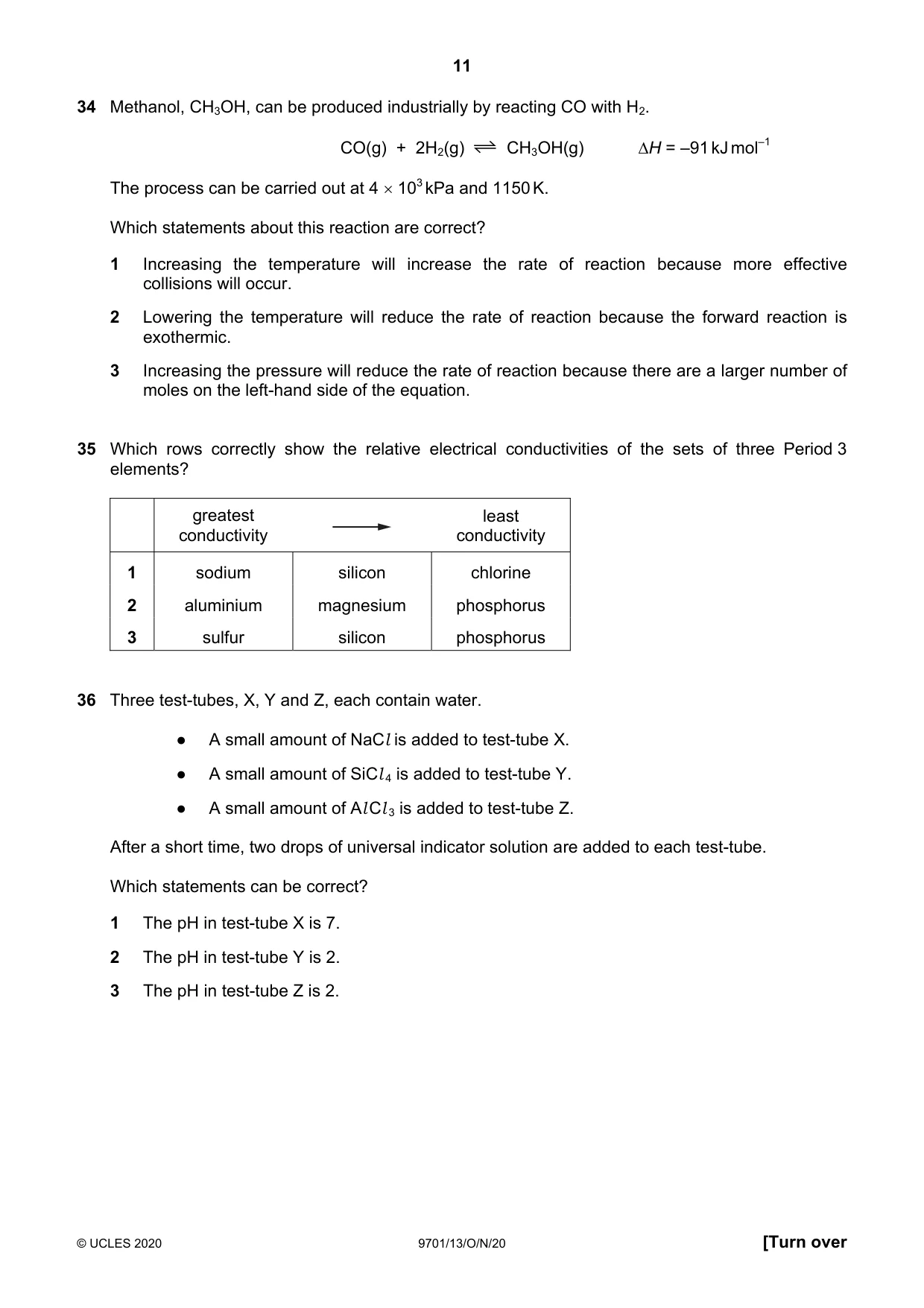
Q34 · Methanol, CH3OH, can be produced industrially by reacting CO with H2
34 Methanol, CH3OH, can be produced industrially by reacting CO with H2. CO(g) + 2H2(g) CH3OH(g) H = –91 kJ mol–1 The process can be carried out at 4 103 kPa and 1150 K. Which statements about this reaction are correct? 1 Increasing the temperature will increase the rate of reaction because more effective collisions will occur. 2 Lowering the temperature will reduce the rate of reaction because the forward reaction is exothermic. 3 Increasing the pressure will reduce the rate of reaction because there are a larger number of moles on the left-hand side of the equation.
Mark scheme: D
More questions on Effect of temperature on reaction rates and the concept of activation energy
Q35 · Which rows correctly show the relative electrical conductivities of the sets of three…
35 Which rows correctly show the relative electrical conductivities of the sets of three Period 3 elements? greatest least conductivity conductivity 1 sodium silicon chlorine 2 aluminium magnesium phosphorus 3 sulfur silicon phosphorus
Mark scheme: B
More questions on Periodicity of physical properties of the elements in Period 3
Q36 · Three test-tubes, X, Y and Z, each contain water
36 Three test-tubes, X, Y and Z, each contain water. ● A small amount of NaCl is added to test-tube X. ● A small amount of SiCl 4 is added to test-tube Y. ● A small amount of Al Cl 3 is added to test-tube Z. After a short time, two drops of universal indicator solution are added to each test-tube. Which statements can be correct? 1 The pH in test-tube X is 7. 2 The pH in test-tube Y is 2. 3 The pH in test-tube Z is 2.
Mark scheme: A
More questions on Periodicity of chemical properties of the elements in Period 3
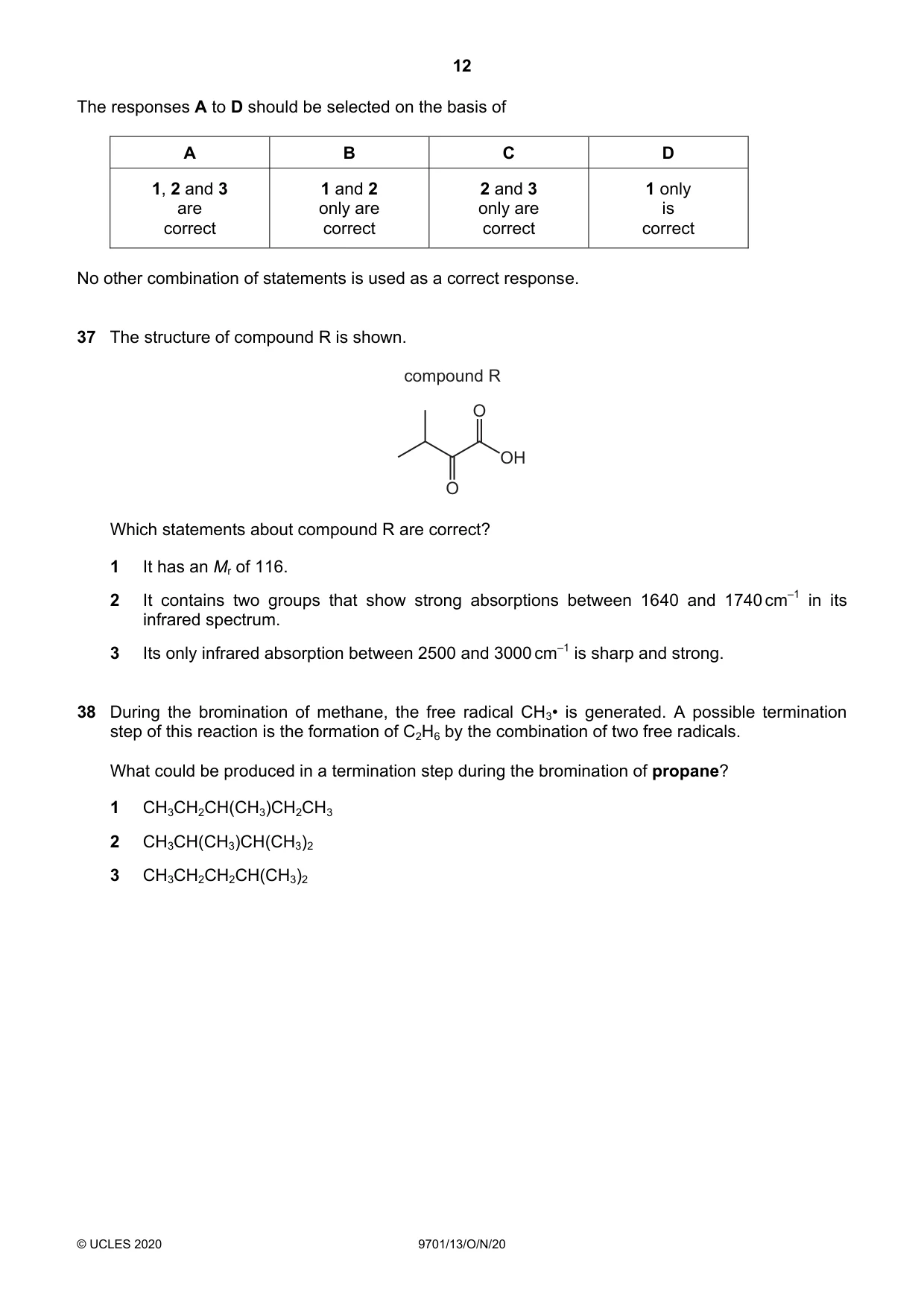
Q37 · The structure of compound R is shown
37 The structure of compound R is shown. compound R O OH O Which statements about compound R are correct? 1 It has an Mr of 116. 2 It contains two groups that show strong absorptions between 1640 and 1740 cm–1 in its infrared spectrum. 3 Its only infrared absorption between 2500 and 3000 cm–1 is sharp and strong.
Mark scheme: B
Q38 · During the bromination of methane, the free radical CH3• is generated
38 During the bromination of methane, the free radical CH3• is generated. A possible termination step of this reaction is the formation of C2H6 by the combination of two free radicals. What could be produced in a termination step during the bromination of propane? 1 CH3CH2CH(CH3)CH2CH3 2 CH3CH(CH3)CH(CH3)2 3 CH3CH2CH2CH(CH3)2
Mark scheme: C
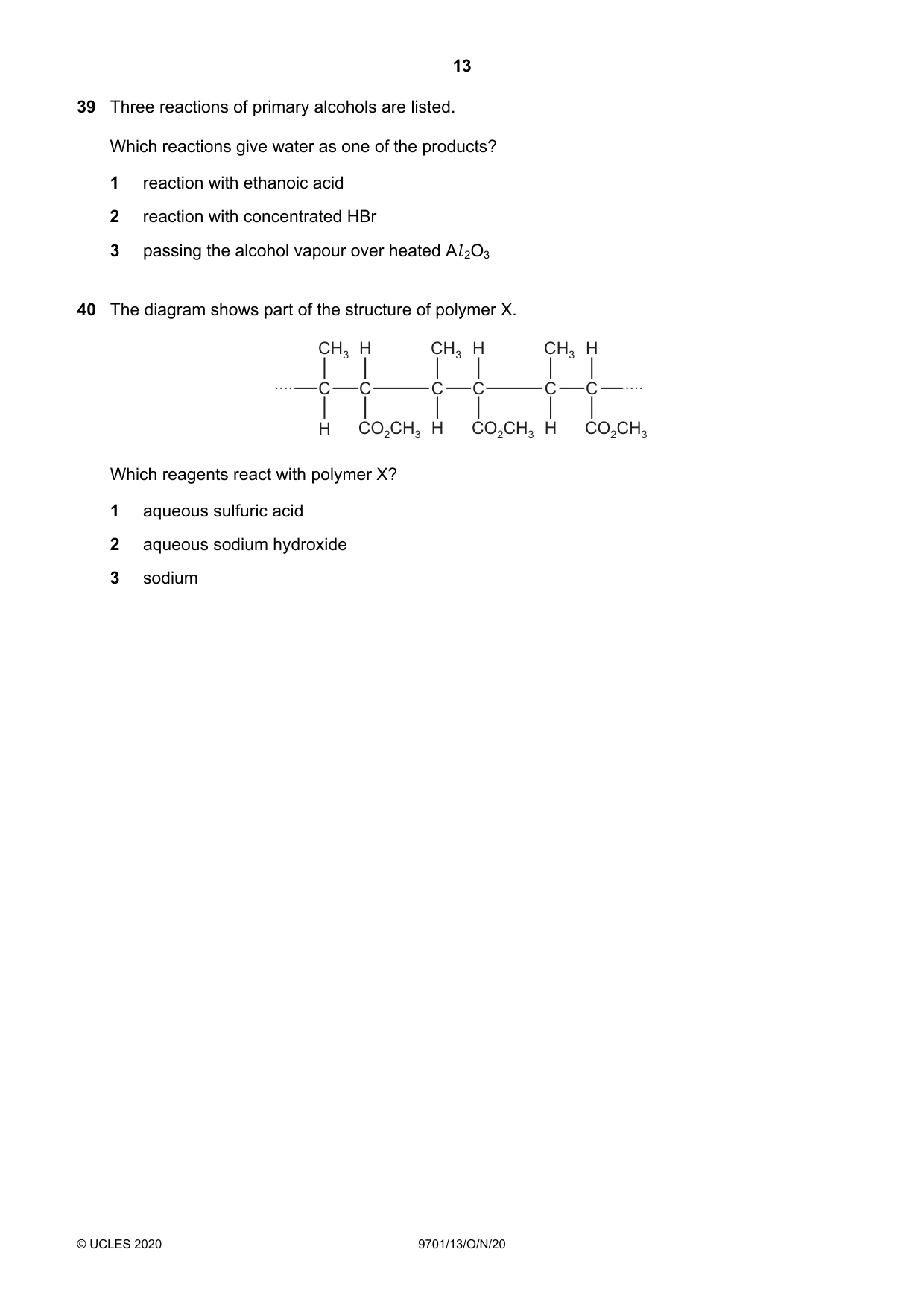
Q39 · Three reactions of primary alcohols are listed
39 Three reactions of primary alcohols are listed. Which reactions give water as one of the products? 1 reaction with ethanoic acid 2 reaction with concentrated HBr 3 passing the alcohol vapour over heated Al 2O3
Mark scheme: A
Q40 · The diagram shows part of the structure of polymer X
40 The diagram shows part of the structure of polymer X. CH3 H CH3 H CH3 H C C C C C C H CO2CH3 H CO2CH3 H CO2CH3 Which reagents react with polymer X? 1 aqueous sulfuric acid 2 aqueous sodium hydroxide 3 sodium
Mark scheme: B
What was in this paper
The subtopics covered by these 40 questions, and how many questions each got. Open one in a new tab to see every Cambridge question on it.
3Halogenoalkanes3Similarities and trends in the properties of the Group 2 metals, magnesium to barium, and their compounds3Aldehydes and ketones2Chemical equilibria: reversible reactions, dynamic equilibrium2Periodicity of chemical properties of the elements in Period 32Redox processes: electron transfer and changes in oxidation number (oxidation state)2Addition polymerisation1Alcohols1Alkanes1Alkenes1Carboxylic acids1Effect of temperature on reaction rates and the concept of activation energy1Esters1Formulas, functional groups and the naming of organic compounds1Hess’s law1Infrared spectroscopy1Intermolecular forces, electronegativity and bond properties1Isomerism: structural isomerism and stereoisomerism1Isotopes1Metallic bonding1Nitriles and hydroxynitriles1Nitrogen and sulfur1Periodicity of physical properties of the elements in Period 31Physical properties of the Group 17 elements1Rate of reaction1Reacting masses and volumes (of solutions and gases)1Relative masses of atoms and molecules1Shapes of molecules1The chemical properties of the halogen elements and the hydrogen halides1What you needed in this session
Cambridge’s own grade thresholds for 2020 Oct/Nov, Paper 1 · Variant 3. A higher threshold means an easier paper — the bar moves with how the cohort did.