Cambridge A Level Chemistry 9701 — 2019 May/June Paper 1 · Variant 1
9701/11/M/J/19 · 40 questions · 40 marks · ≈45 min
The question paper and its mark scheme, free to read here and free to download. This is Cambridge’s own paper, exactly as it was sat.
Question paper16 pages
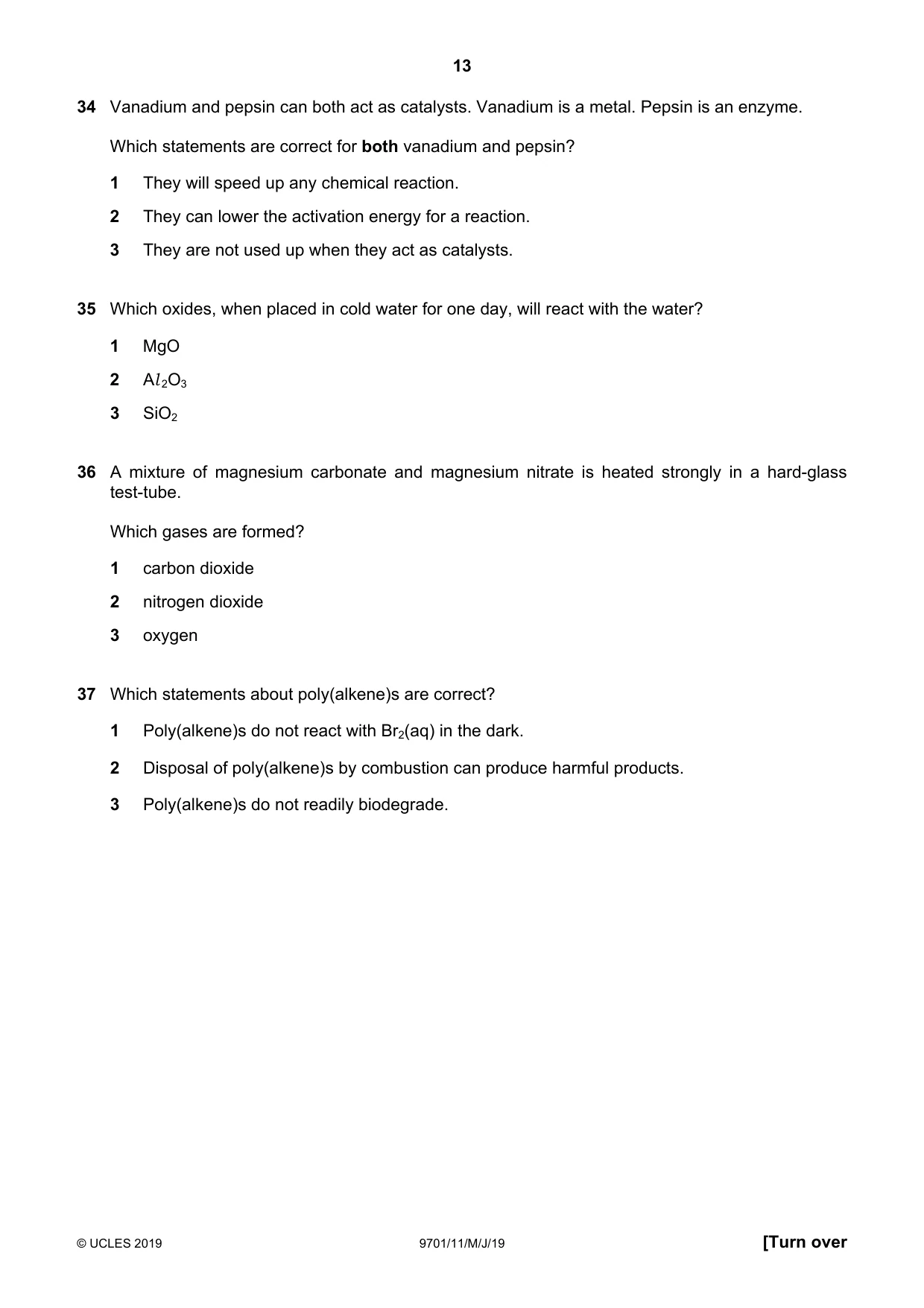
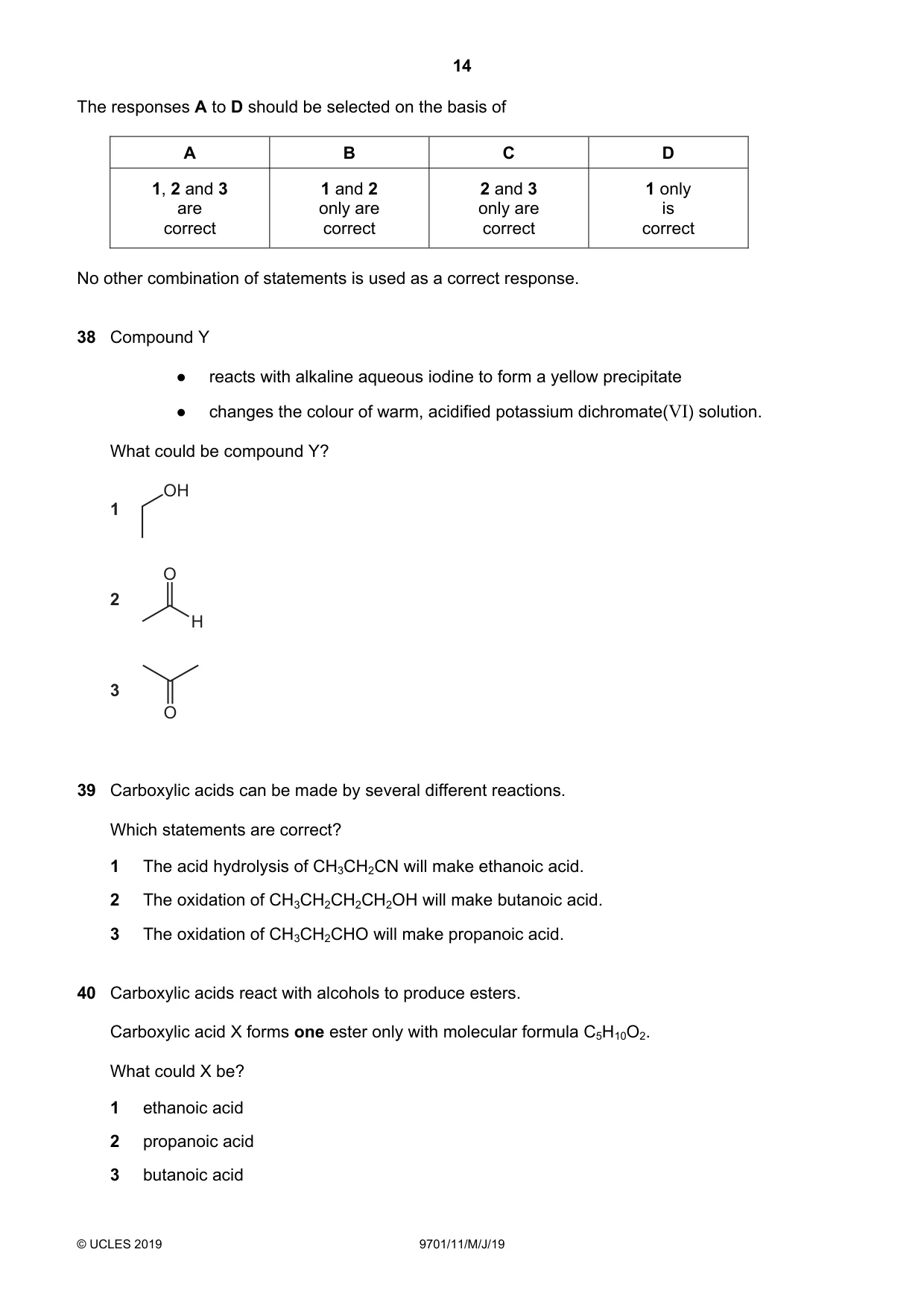


Mark scheme3 pages
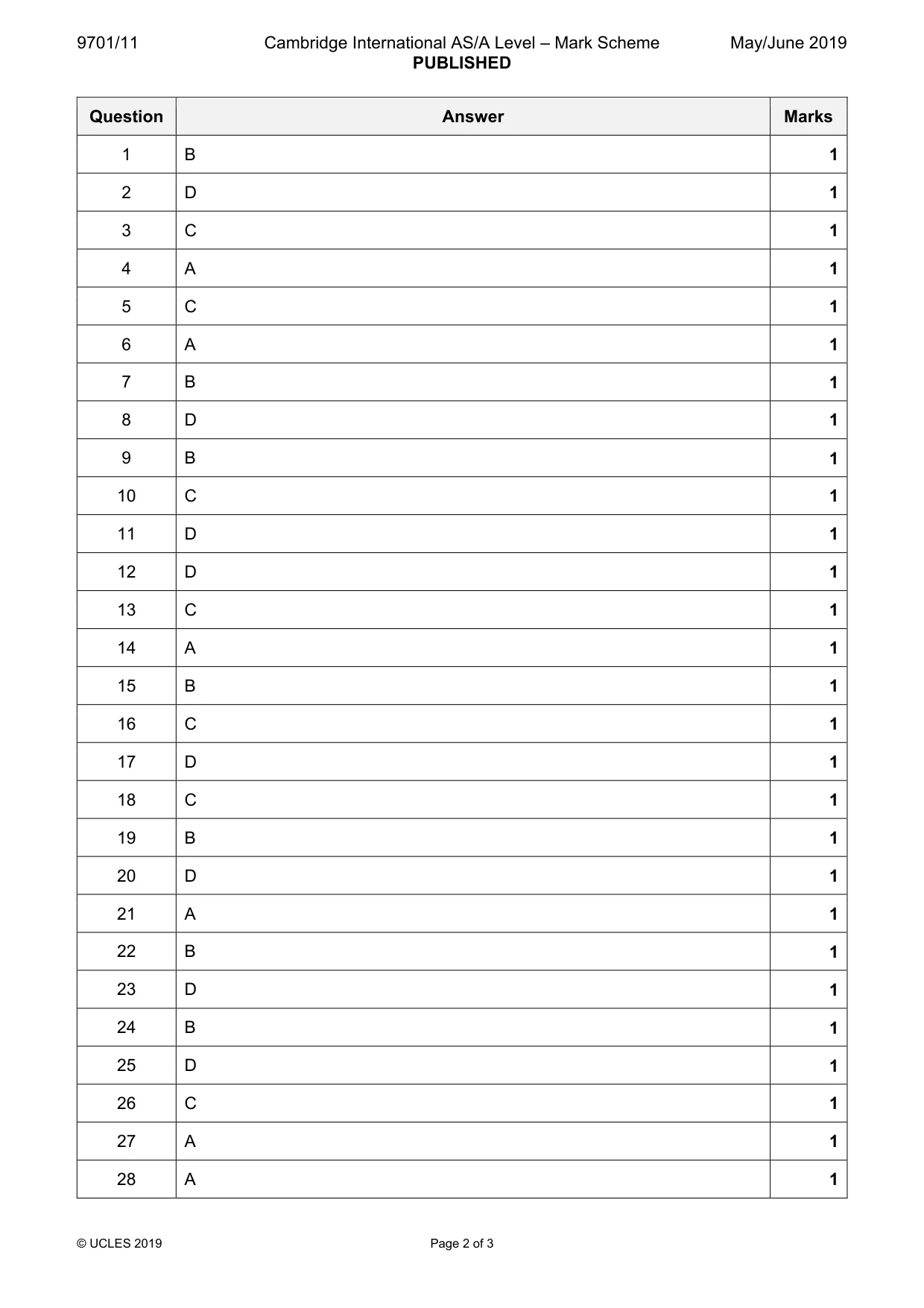
Answers below. Sit the paper first if you are practising.
Questions as text
Q1 · The temperature of a sample of an inert gas is increased
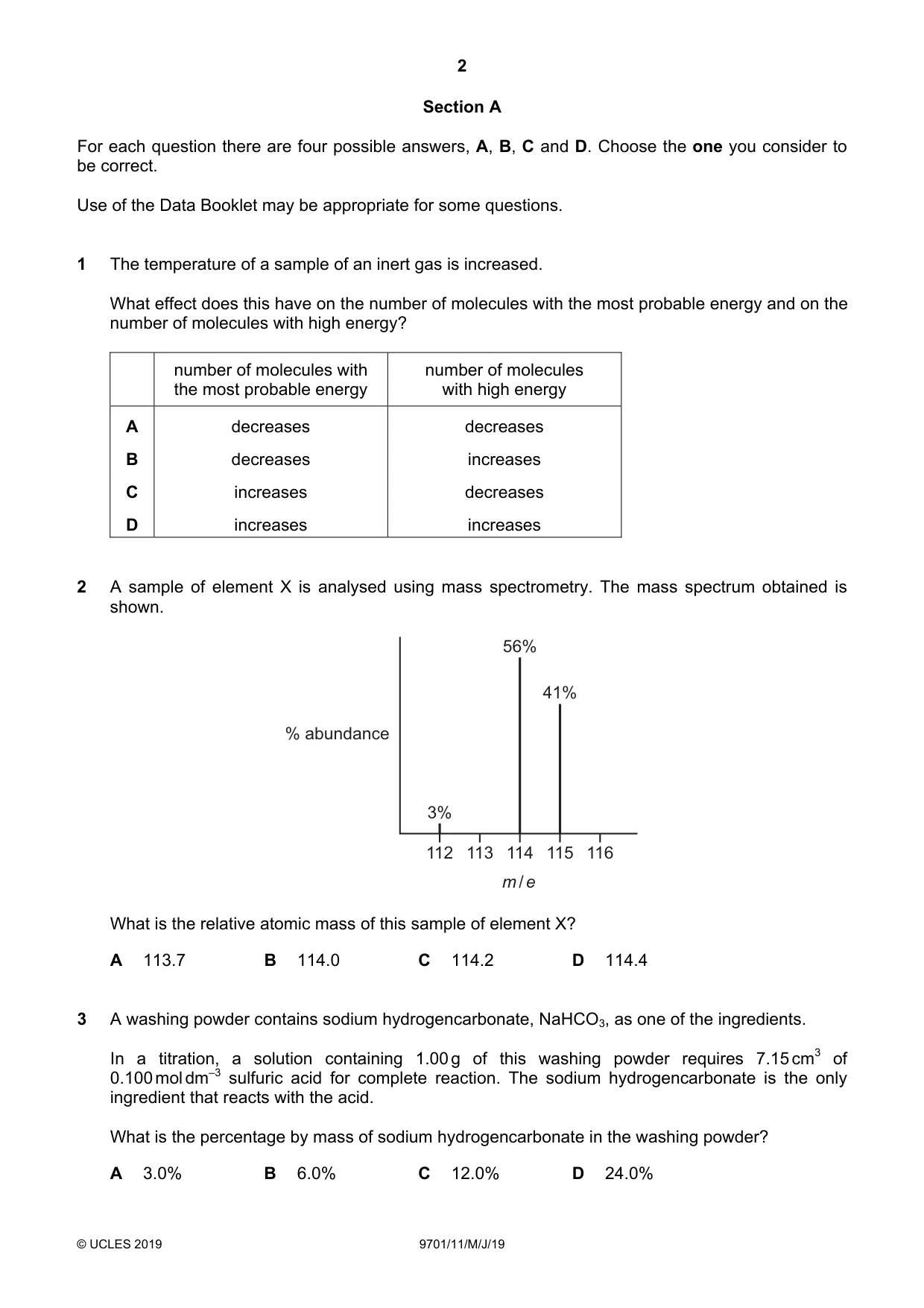
1 The temperature of a sample of an inert gas is increased. What effect does this have on the number of molecules with the most probable energy and on the number of molecules with high energy? number of molecules with number of molecules the most probable energy with high energy A decreases decreases B decreases increases C increases decreases D increases increases
Mark scheme: B
More questions on Effect of temperature on reaction rates and the concept of activation energy
Q2 · A sample of element X is analysed using mass spectrometry
2 A sample of element X is analysed using mass spectrometry. The mass spectrum obtained is shown. 56% 41% % abundance 3% 112 113 114 115 116 m / e What is the relative atomic mass of this sample of element X? A 113.7 B 114.0 C 114.2 D 114.4
Mark scheme: D
Q3 · A washing powder contains sodium hydrogencarbonate, NaHCO3, as one of the ingredients
3 A washing powder contains sodium hydrogencarbonate, NaHCO3, as one of the ingredients. In a titration, a solution containing 1.00 g of this washing powder requires 7.15 cm3 of 0.100 mol dm–3 sulfuric acid for complete reaction. The sodium hydrogencarbonate is the only ingredient that reacts with the acid. What is the percentage by mass of sodium hydrogencarbonate in the washing powder? A 3.0% B 6.0% C 12.0% D 24.0%
Mark scheme: C
More questions on Reacting masses and volumes (of solutions and gases)
Q4 · The outermost electron in an atom of neon occupies a particular orbital
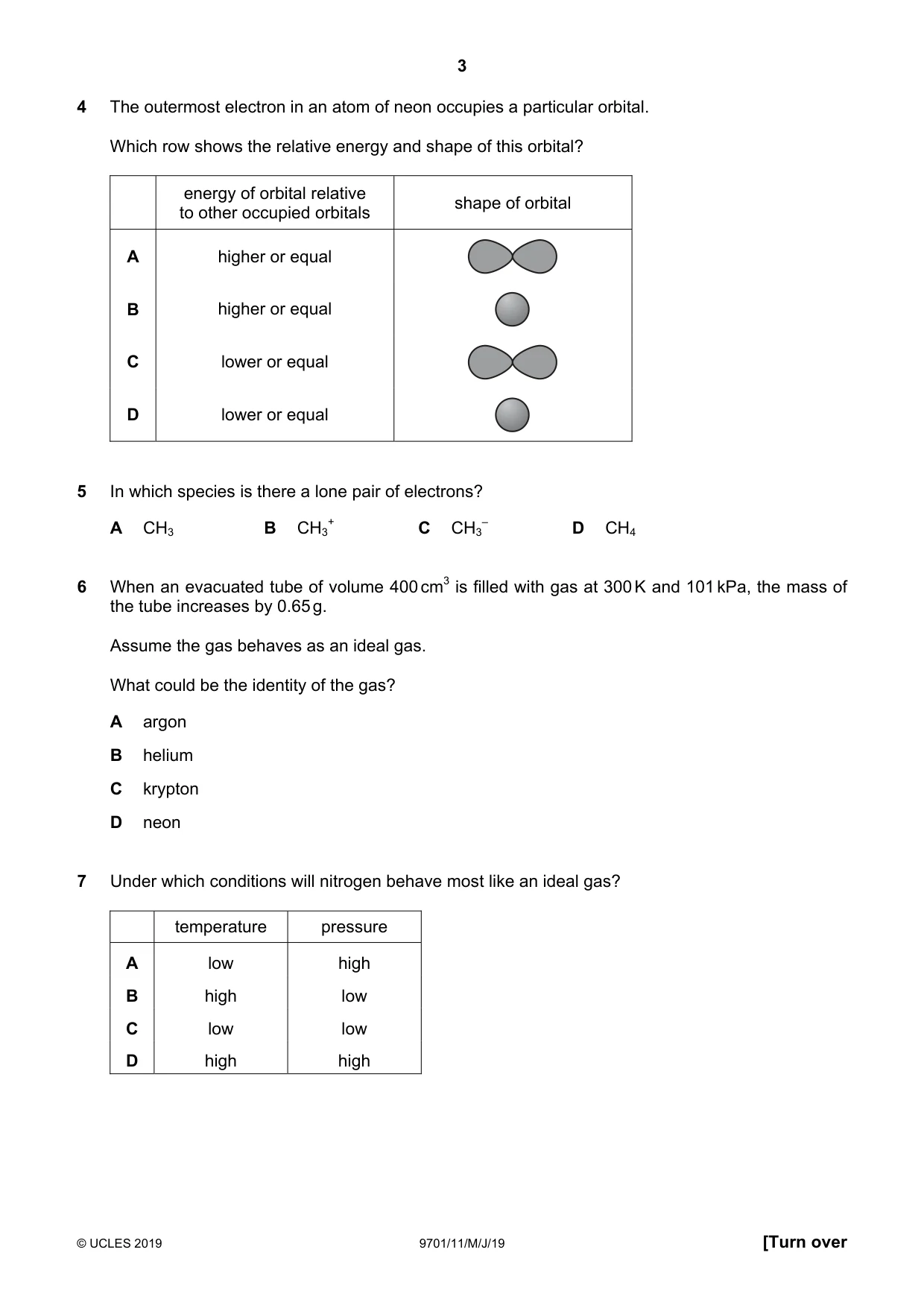
4 The outermost electron in an atom of neon occupies a particular orbital. Which row shows the relative energy and shape of this orbital? energy of orbital relative shape of orbital to other occupied orbitals A higher or equal B higher or equal C lower or equal D lower or equal
Mark scheme: A
More questions on Electrons, energy levels and atomic orbitals
Q5 · In which species is there a lone pair of electrons?
5 In which species is there a lone pair of electrons? A CH3 B CH3 + C CH3 – D CH4
Mark scheme: C
Q6 · When an evacuated tube of volume 400 cm3 is filled with gas at 300 K and 101 kPa, the…
6 When an evacuated tube of volume 400 cm3 is filled with gas at 300 K and 101 kPa, the mass of the tube increases by 0.65 g. Assume the gas behaves as an ideal gas. What could be the identity of the gas? A argon B helium C krypton D neon
Mark scheme: A
More questions on The gaseous state: ideal and real gases and pV = nRT
Q7 · Under which conditions will nitrogen behave most like an ideal gas?
7 Under which conditions will nitrogen behave most like an ideal gas? temperature pressure A low high B high low C low low D high high
Mark scheme: B
More questions on The gaseous state: ideal and real gases and pV = nRT
Q8 · Two reactions and their enthalpy changes are shown
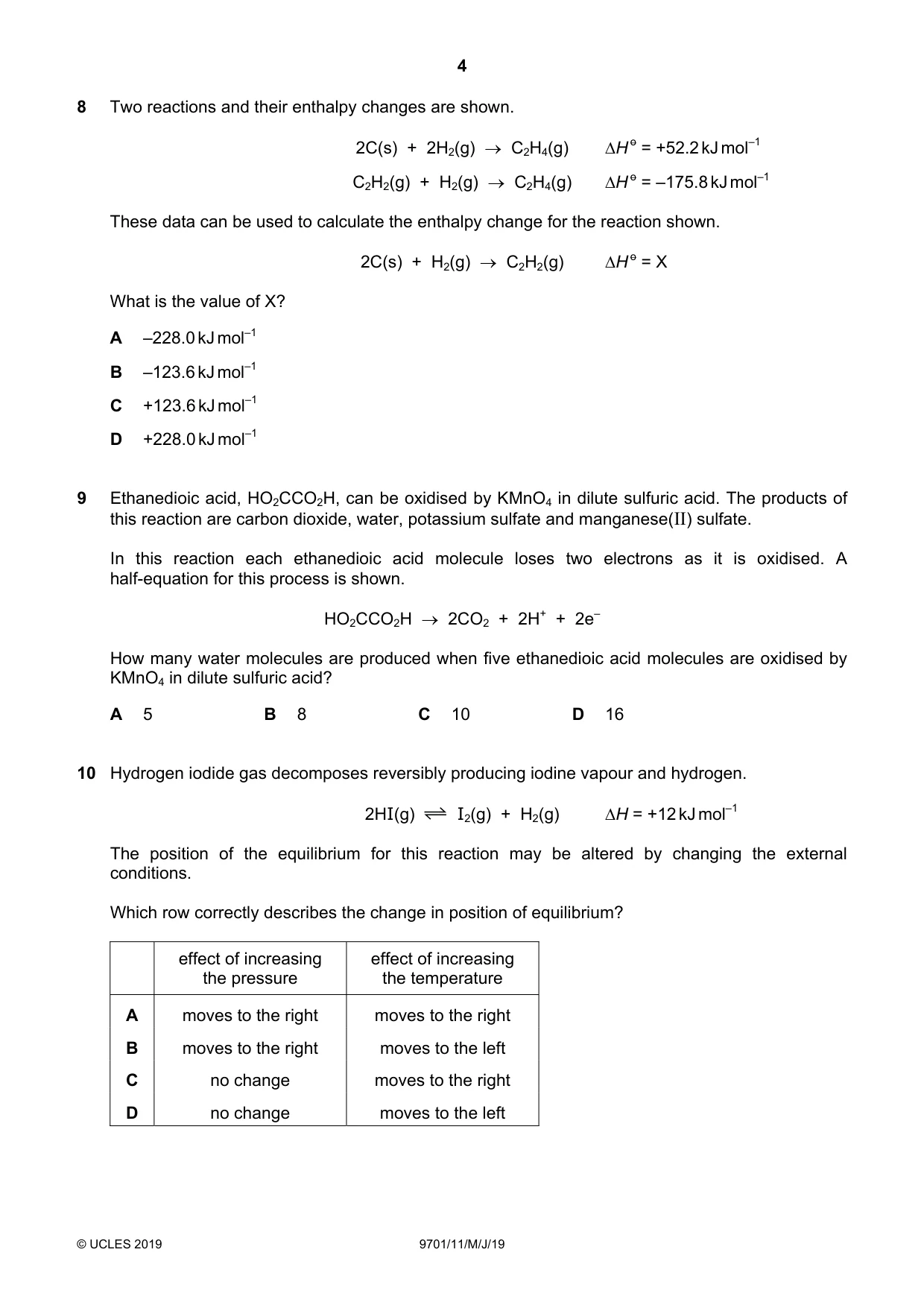
8 Two reactions and their enthalpy changes are shown. 2C(s) + 2H2(g) → C2H4(g) ∆H o = +52.2 kJ mol–1 C2H2(g) + H2(g) → C2H4(g) ∆H o = –175.8 kJ mol–1 These data can be used to calculate the enthalpy change for the reaction shown. 2C(s) + H2(g) → C2H2(g) ∆H o = X What is the value of X? A –228.0 kJ mol–1 B –123.6 kJ mol–1 C +123.6 kJ mol–1 D +228.0 kJ mol–1
Mark scheme: D
Q9 · Ethanedioic acid, HO2CCO2H, can be oxidised by KMnO4 in dilute sulfuric acid
9 Ethanedioic acid, HO2CCO2H, can be oxidised by KMnO4 in dilute sulfuric acid. The products of this reaction are carbon dioxide, water, potassium sulfate and manganese(II) sulfate. In this reaction each ethanedioic acid molecule loses two electrons as it is oxidised. A half-equation for this process is shown. HO2CCO2H → 2CO2 + 2H+ + 2e– How many water molecules are produced when five ethanedioic acid molecules are oxidised by KMnO4 in dilute sulfuric acid? A 5 B 8 C 10 D 16
Mark scheme: B
Q10 · Hydrogen iodide gas decomposes reversibly producing iodine vapour and hydrogen
10 Hydrogen iodide gas decomposes reversibly producing iodine vapour and hydrogen. 2HI(g) I2(g) + H2(g) ∆H = +12 kJ mol–1 The position of the equilibrium for this reaction may be altered by changing the external conditions. Which row correctly describes the change in position of equilibrium? effect of increasing effect of increasing the pressure the temperature A moves to the right moves to the right B moves to the right moves to the left C no change moves to the right D no change moves to the left
Mark scheme: C
More questions on Chemical equilibria: reversible reactions, dynamic equilibrium
Q11 · The reaction between sulfur dioxide and oxygen is reversible
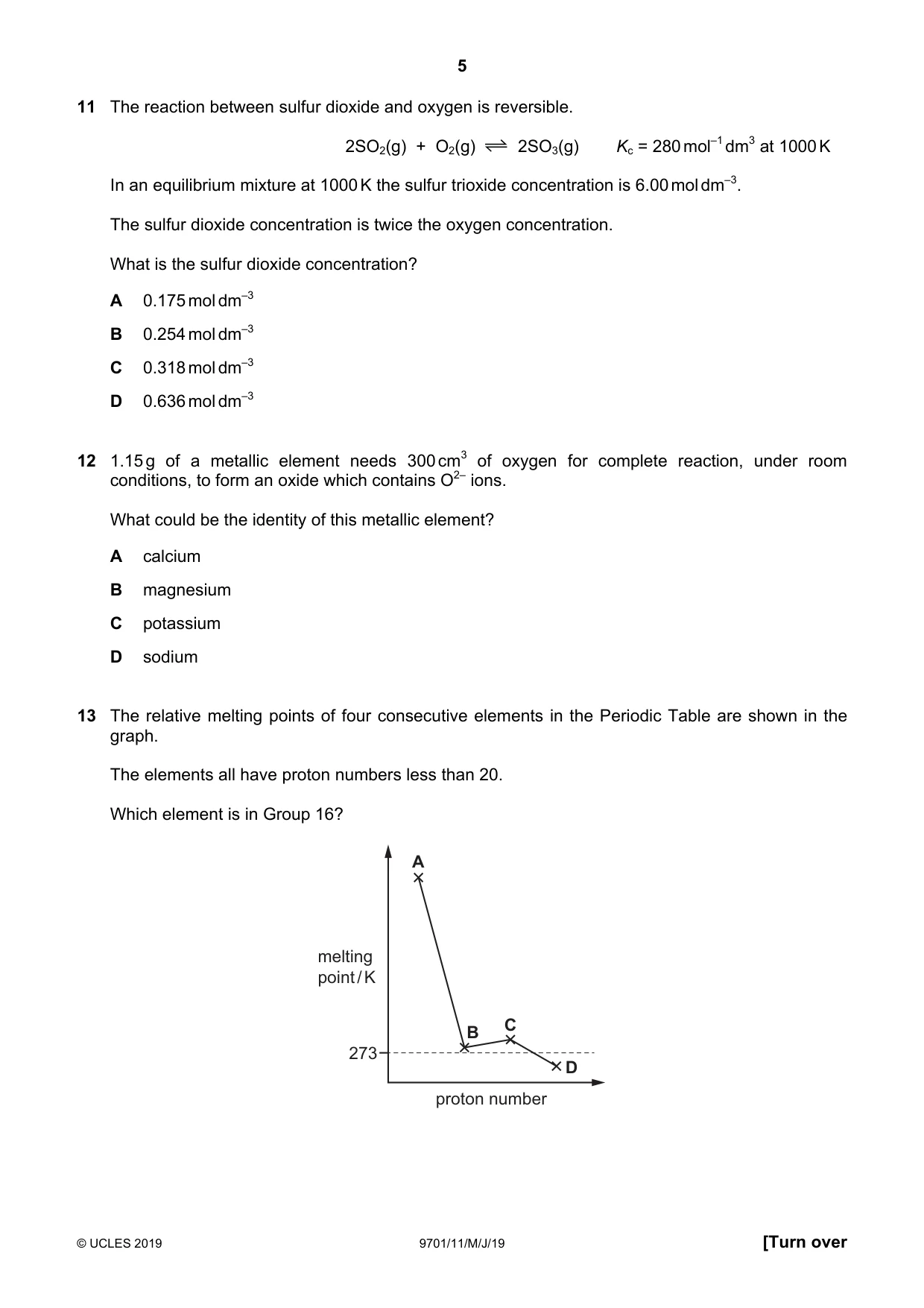
11 The reaction between sulfur dioxide and oxygen is reversible. 2SO2(g) + O2(g) 2SO3(g) Kc = 280 mol–1 dm3 at 1000 K In an equilibrium mixture at 1000 K the sulfur trioxide concentration is 6.00 mol dm–3. The sulfur dioxide concentration is twice the oxygen concentration. What is the sulfur dioxide concentration? A 0.175 mol dm–3 B 0.254 mol dm–3 C 0.318 mol dm–3 D 0.636 mol dm–3
Mark scheme: D
More questions on Chemical equilibria: reversible reactions, dynamic equilibrium
Q12 · 1.15 g of a metallic element needs 300 cm3 of oxygen for complete reaction, under room…
12 1.15 g of a metallic element needs 300 cm3 of oxygen for complete reaction, under room conditions, to form an oxide which contains O2– ions. What could be the identity of this metallic element? A calcium B magnesium C potassium D sodium
Mark scheme: D
More questions on Reacting masses and volumes (of solutions and gases)
Q13 · The relative melting points of four consecutive elements in the Periodic Table are shown…
13 The relative melting points of four consecutive elements in the Periodic Table are shown in the graph. The elements all have proton numbers less than 20. Which element is in Group 16? A melting point / K B C 273 D proton number
Mark scheme: C
More questions on Periodicity of physical properties of the elements in Period 3
Q14 · Substance X reacts with water
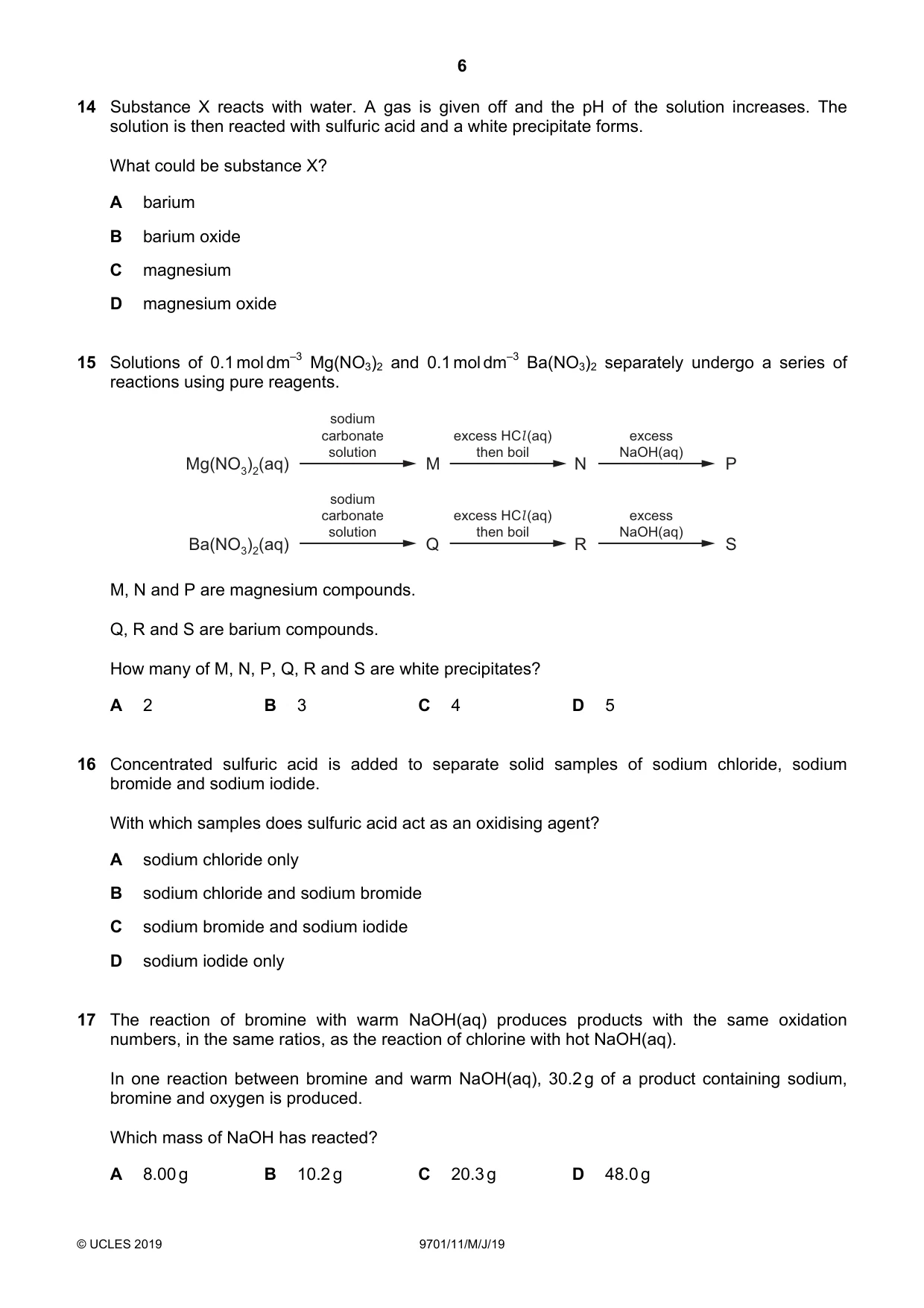
14 Substance X reacts with water. A gas is given off and the pH of the solution increases. The solution is then reacted with sulfuric acid and a white precipitate forms. What could be substance X? A barium B barium oxide C magnesium D magnesium oxide
Mark scheme: A
Q15 · Solutions of 0.1 mol dm–3 Mg(NO3)2 and 0.1 mol dm–3 Ba(NO3)2 separately undergo a series…
15 Solutions of 0.1 mol dm–3 Mg(NO3)2 and 0.1 mol dm–3 Ba(NO3)2 separately undergo a series of reactions using pure reagents. sodium carbonate excess HCl (aq) excess solution then boil NaOH(aq) Mg(NO3)2(aq) M N P sodium carbonate excess HCl (aq) excess solution then boil NaOH(aq) Ba(NO3)2(aq) Q R S M, N and P are magnesium compounds. Q, R and S are barium compounds. How many of M, N, P, Q, R and S are white precipitates? A 2 B 3 C 4 D 5
Mark scheme: B
Q16 · Concentrated sulfuric acid is added to separate solid samples of sodium chloride, sodium…
16 Concentrated sulfuric acid is added to separate solid samples of sodium chloride, sodium bromide and sodium iodide. With which samples does sulfuric acid act as an oxidising agent? A sodium chloride only B sodium chloride and sodium bromide C sodium bromide and sodium iodide D sodium iodide only
Mark scheme: C
Q17 · The reaction of bromine with warm NaOH(aq) produces products with the same oxidation…
17 The reaction of bromine with warm NaOH(aq) produces products with the same oxidation numbers, in the same ratios, as the reaction of chlorine with hot NaOH(aq). In one reaction between bromine and warm NaOH(aq), 30.2 g of a product containing sodium, bromine and oxygen is produced. Which mass of NaOH has reacted? A 8.00 g B 10.2 g C 20.3 g D 48.0 g
Mark scheme: D
Q18 · At 550 °C nitrogen dioxide reacts with unburnt hydrocarbon fragments such as CH3 in the…
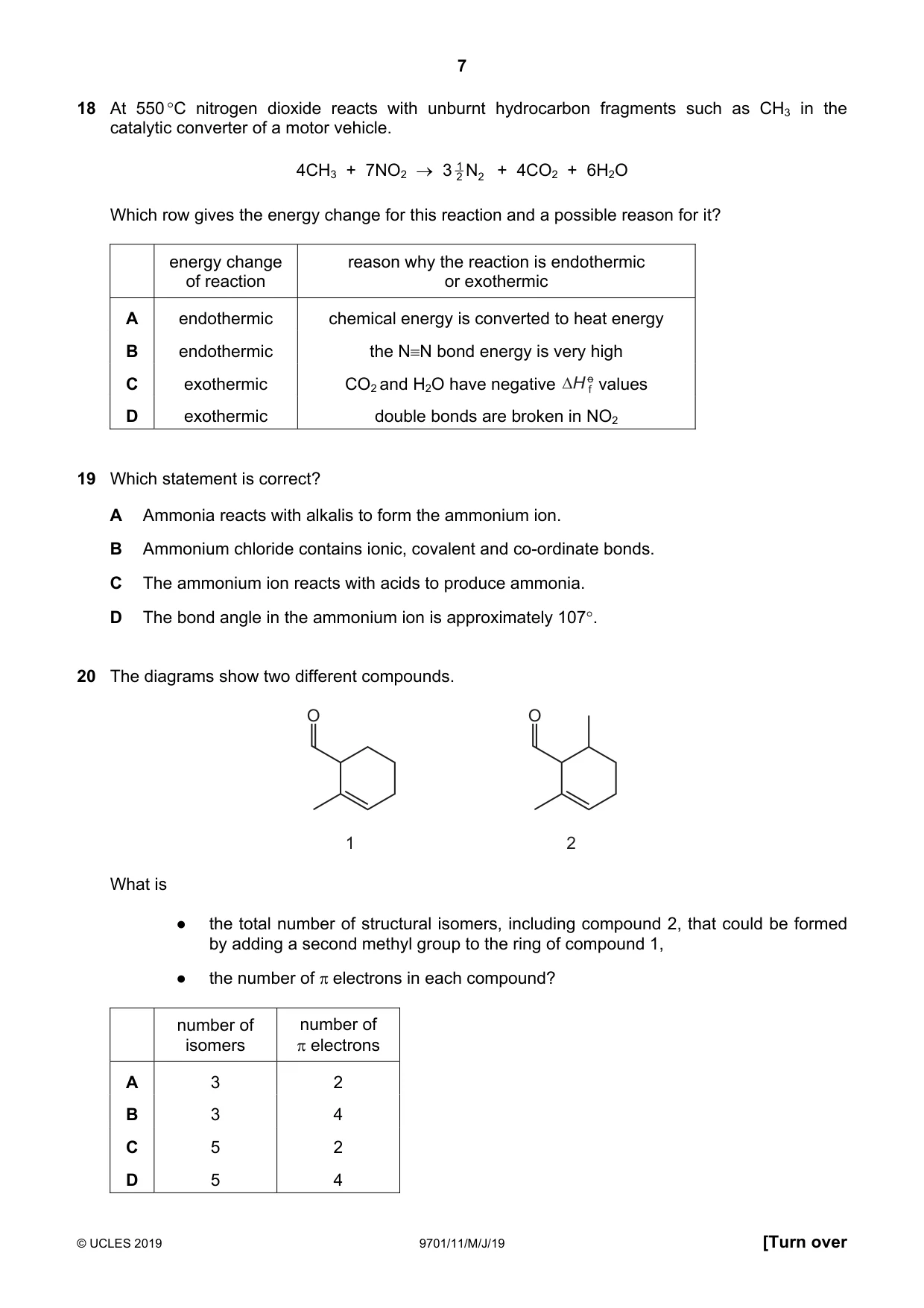
18 At 550 °C nitrogen dioxide reacts with unburnt hydrocarbon fragments such as CH3 in the catalytic converter of a motor vehicle. 4CH3 + 7NO2 → 3 1 N + 4CO2 + 6H2O 2 2 Which row gives the energy change for this reaction and a possible reason for it? energy change reason why the reaction is endothermic of reaction or exothermic A endothermic chemical energy is converted to heat energy B endothermic the N≡N bond energy is very high C exothermic CO2 and H2O have negative values D exothermic double bonds are broken in NO2
Mark scheme: C
Q19 · Which statement is correct?
19 Which statement is correct? A Ammonia reacts with alkalis to form the ammonium ion. B Ammonium chloride contains ionic, covalent and co-ordinate bonds. C The ammonium ion reacts with acids to produce ammonia. D The bond angle in the ammonium ion is approximately 107°.
Mark scheme: B
More questions on Covalent bonding and coordinate (dative covalent) bonding
Q20 · The diagrams show two different compounds
20 The diagrams show two different compounds. O O 1 2 What is ● the total number of structural isomers, including compound 2, that could be formed by adding a second methyl group to the ring of compound 1, ● the number of π electrons in each compound? number of number of isomers π electrons A 3 2 B 3 4 C 5 2 D 5 4
Mark scheme: D
More questions on Isomerism: structural isomerism and stereoisomerism
Q21 · Which compound has the molecular formula C6H10O?
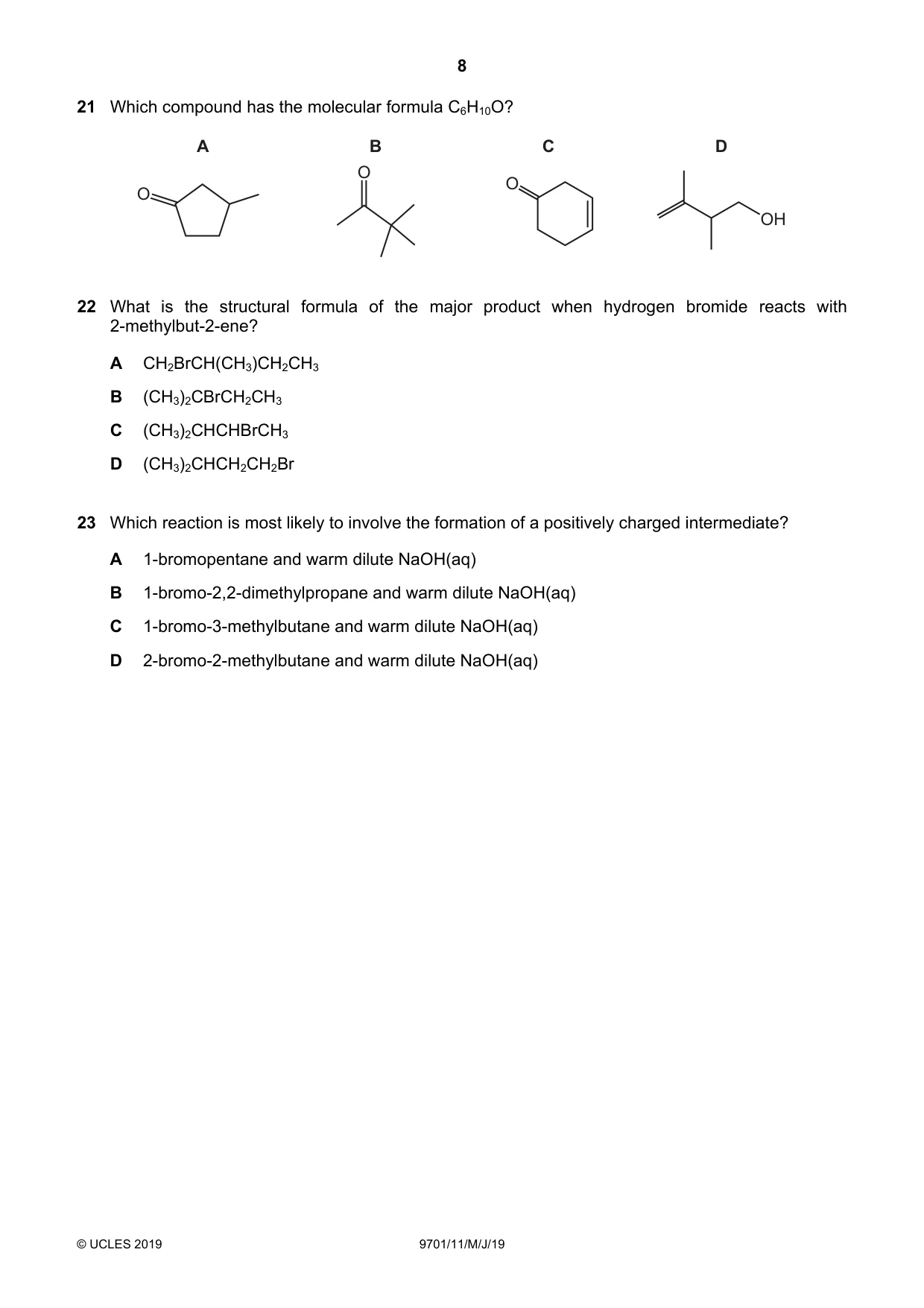
21 Which compound has the molecular formula C6H10O? A B C D O O O OH
Mark scheme: A
More questions on Formulas, functional groups and the naming of organic compounds
Q22 · What is the structural formula of the major product when hydrogen bromide reacts with…
22 What is the structural formula of the major product when hydrogen bromide reacts with 2-methylbut-2-ene? A CH2BrCH(CH3)CH2CH3 B (CH3)2CBrCH2CH3 C (CH3)2CHCHBrCH3 D (CH3)2CHCH2CH2Br
Mark scheme: B
Q23 · Which reaction is most likely to involve the formation of a positively charged…
23 Which reaction is most likely to involve the formation of a positively charged intermediate? A 1-bromopentane and warm dilute NaOH(aq) B 1-bromo-2,2-dimethylpropane and warm dilute NaOH(aq) C 1-bromo-3-methylbutane and warm dilute NaOH(aq) D 2-bromo-2-methylbutane and warm dilute NaOH(aq)
Mark scheme: D
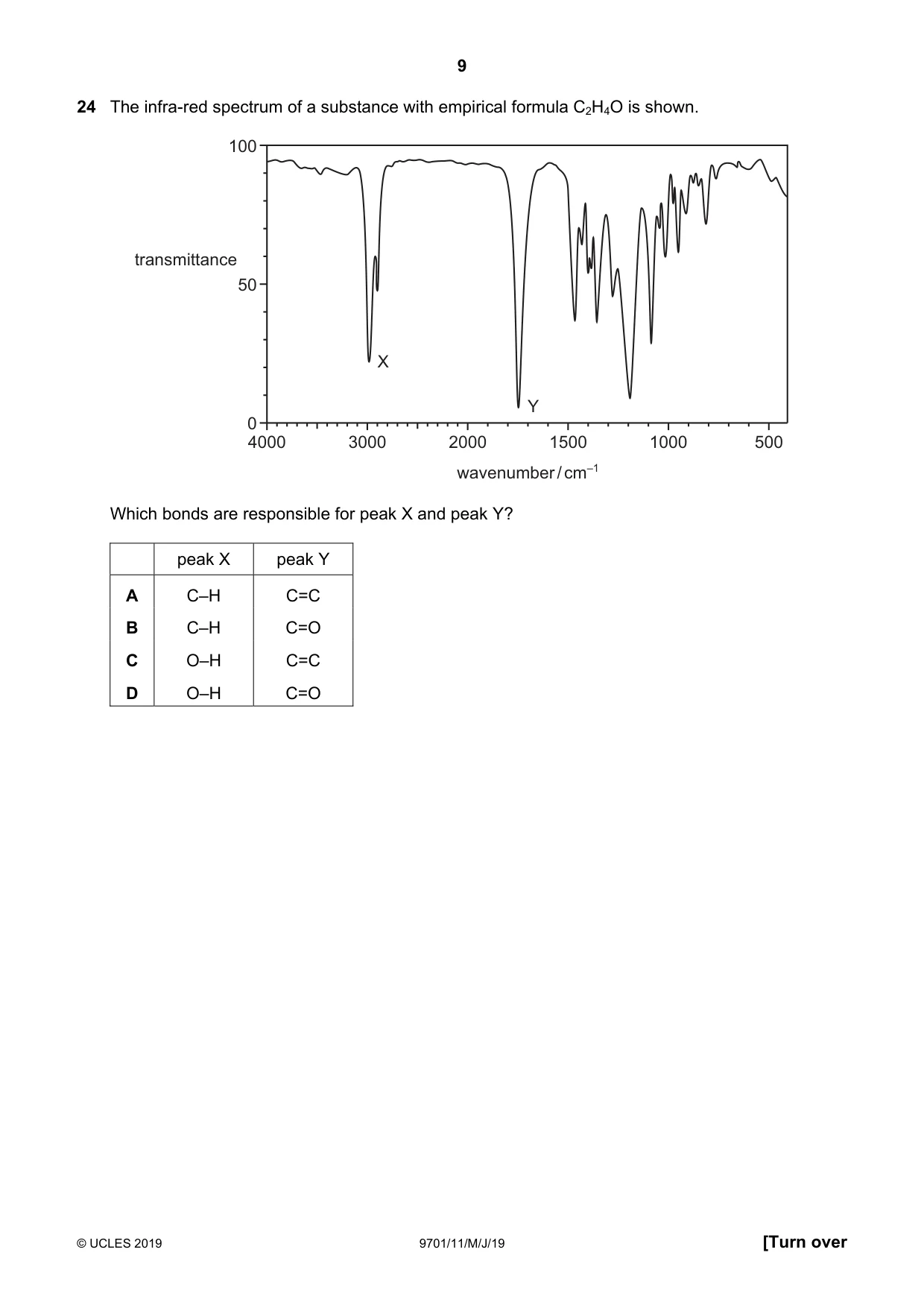
Q24 · The infra-red spectrum of a substance with empirical formula C2H4O is shown
24 The infra-red spectrum of a substance with empirical formula C2H4O is shown. 100 transmittance 50 X Y 0 4000 3000 2000 1500 1000 500 wavenumber / cm–1 Which bonds are responsible for peak X and peak Y? peak X peak Y A C–H C=C B C–H C=O C O–H C=C D O–H C=O
Mark scheme: B
Q25 · The structure of coniine is shown
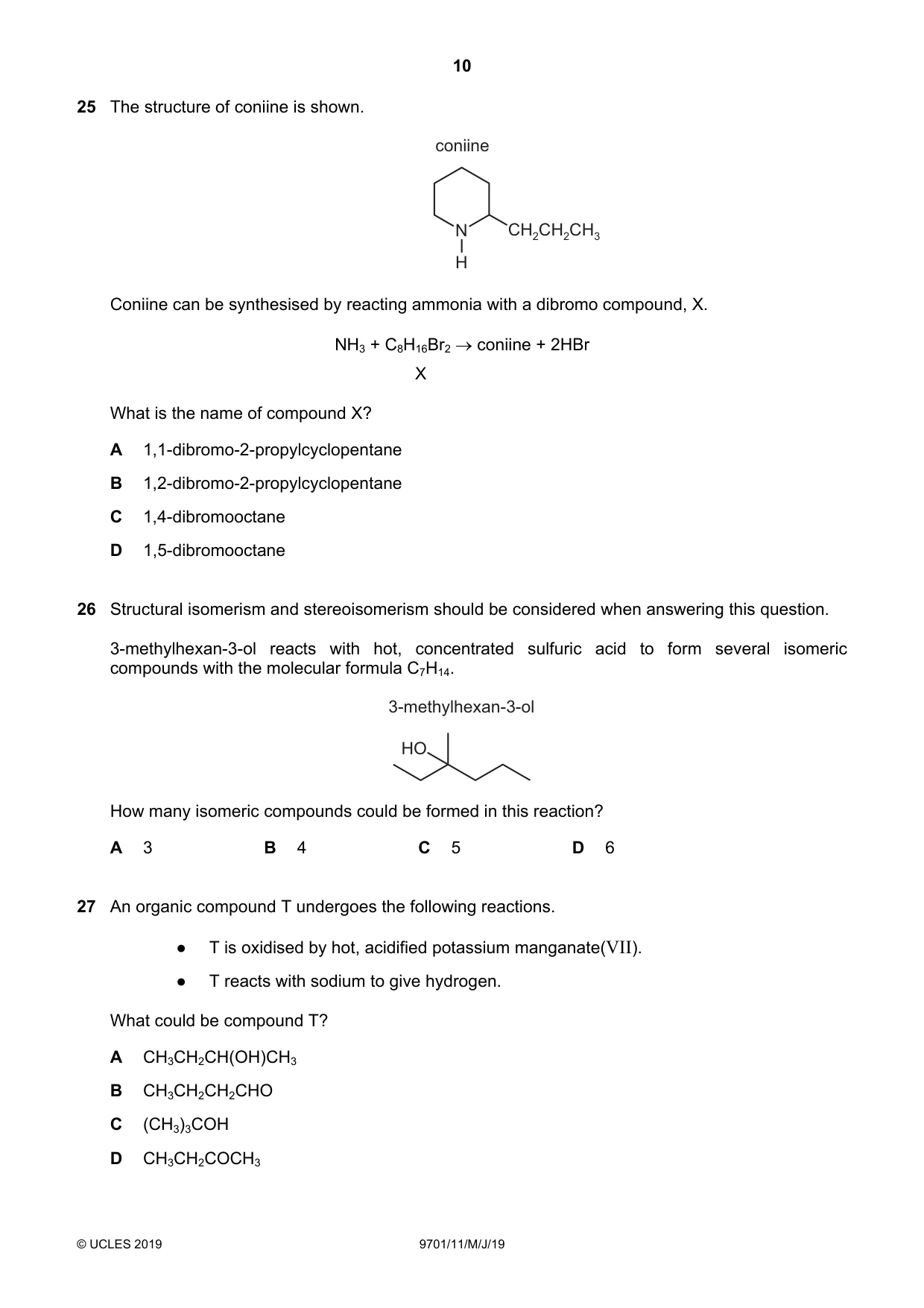
25 The structure of coniine is shown. coniine N CH2CH2CH3 H Coniine can be synthesised by reacting ammonia with a dibromo compound, X. NH3 + C8H16Br2 → coniine + 2HBr X What is the name of compound X? A 1,1-dibromo-2-propylcyclopentane B 1,2-dibromo-2-propylcyclopentane C 1,4-dibromooctane D 1,5-dibromooctane
Mark scheme: D
Q26 · Structural isomerism and stereoisomerism should be considered when answering this question
26 Structural isomerism and stereoisomerism should be considered when answering this question. 3-methylhexan-3-ol reacts with hot, concentrated sulfuric acid to form several isomeric compounds with the molecular formula C7H14. 3-methylhexan-3-ol HO How many isomeric compounds could be formed in this reaction? A 3 B 4 C 5 D 6
Mark scheme: C
More questions on Isomerism: structural isomerism and stereoisomerism
Q27 · An organic compound T undergoes the following reactions
27 An organic compound T undergoes the following reactions. ● T is oxidised by hot, acidified potassium manganate(VII). ● T reacts with sodium to give hydrogen. What could be compound T? A CH3CH2CH(OH)CH3 B CH3CH2CH2CHO C (CH3)3COH D CH3CH2COCH3
Mark scheme: A
Q28 · Compound X is treated with two reagents successively, forming compound Z
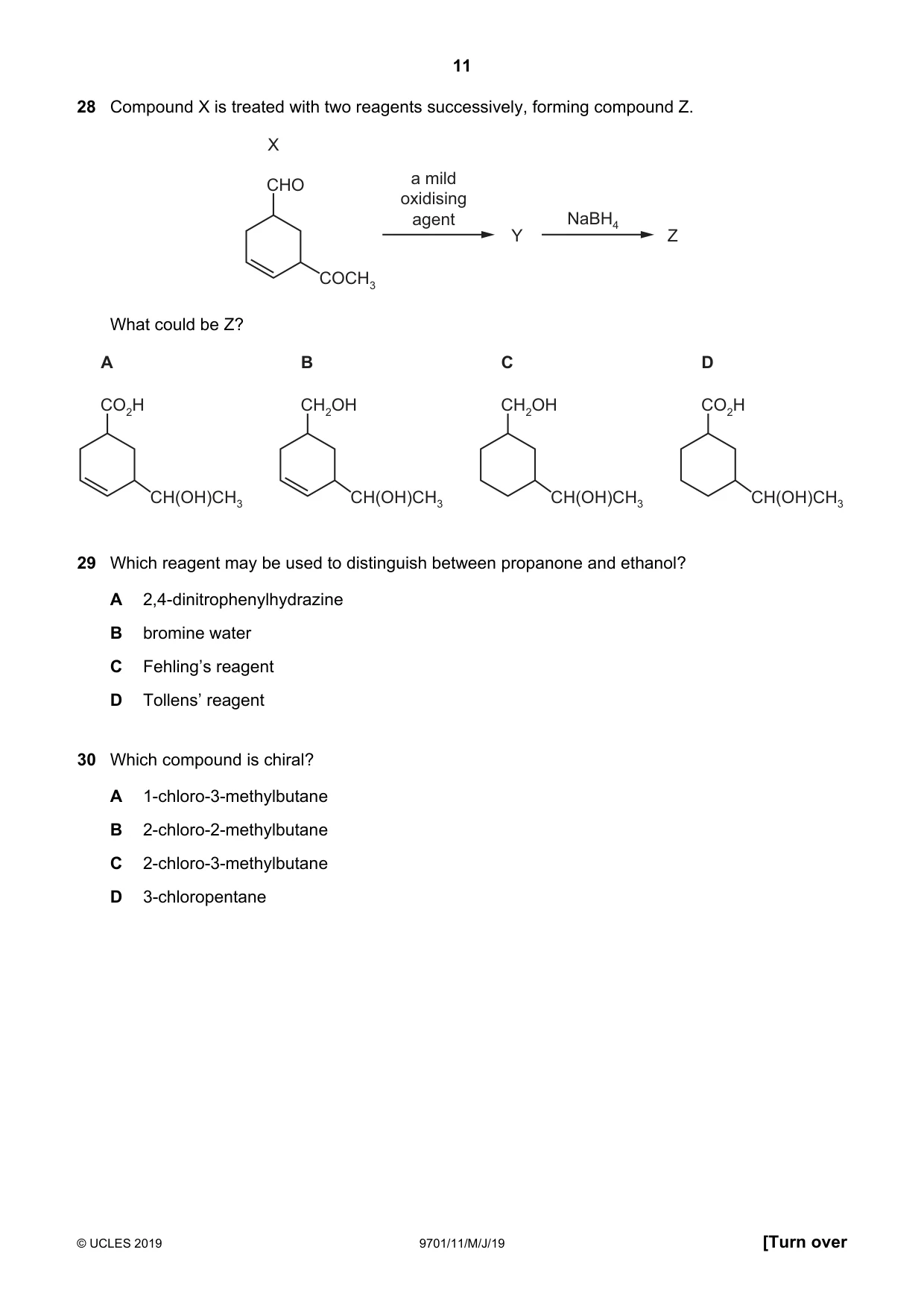
28 Compound X is treated with two reagents successively, forming compound Z. X CHO a mild oxidising agent NaBH4 Y Z COCH3 What could be Z? A B C D CO2H CH2OH CH2OH CO2H CH(OH)CH3 CH(OH)CH3 CH(OH)CH3 CH(OH)CH3
Mark scheme: A
Q29 · Which reagent may be used to distinguish between propanone and ethanol?
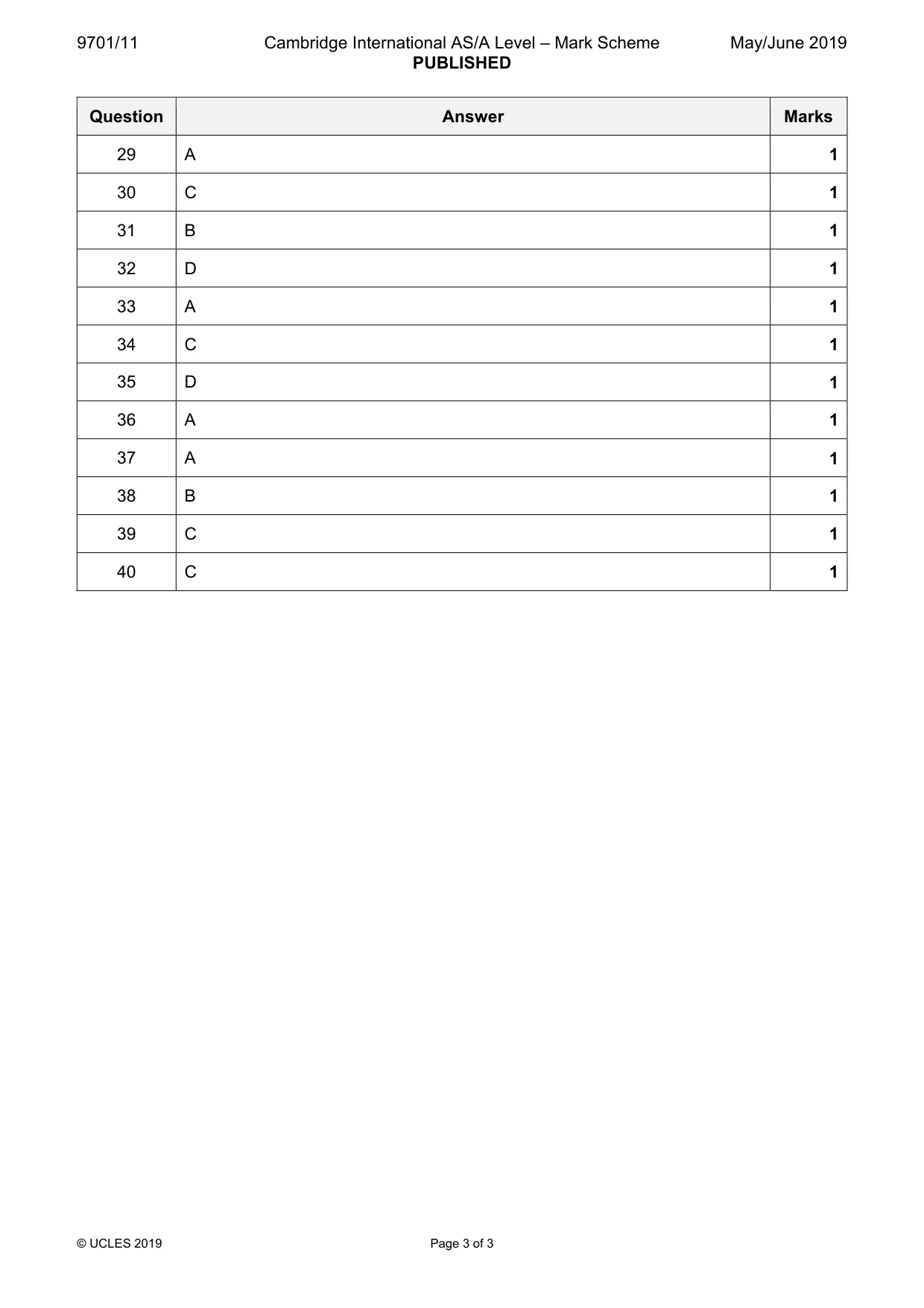
29 Which reagent may be used to distinguish between propanone and ethanol? A 2,4-dinitrophenylhydrazine B bromine water C Fehling’s reagent D Tollens’ reagent
Mark scheme: A
Q30 · Which compound is chiral?
30 Which compound is chiral? A 1-chloro-3-methylbutane B 2-chloro-2-methylbutane C 2-chloro-3-methylbutane D 3-chloropentane Section B
Mark scheme: C
Q31 · An atom of calcium-48 can form a 2+ ion
31 An atom of calcium-48 can form a 2+ ion. Which statements about this ion are correct? 1 It has 20 protons. 2 It has 28 neutrons. 3 It has 22 electrons.
Mark scheme: B
Q32 · Four elements, W, X, Y and Z, have electronic configurations as shown
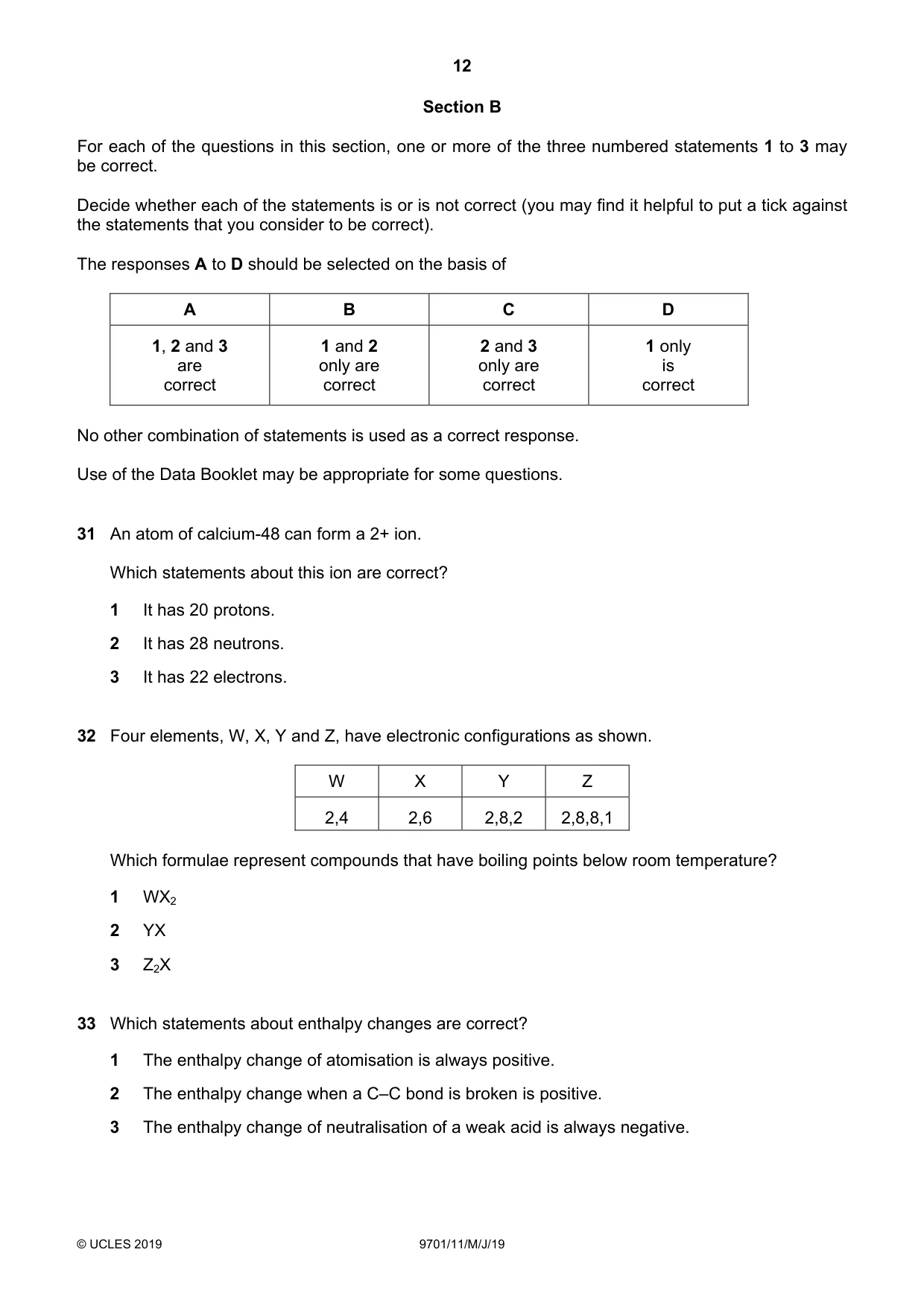
32 Four elements, W, X, Y and Z, have electronic configurations as shown. W X Y Z 2,4 2,6 2,8,2 2,8,8,1 Which formulae represent compounds that have boiling points below room temperature? 1 WX2 2 YX 3 Z2X
Mark scheme: D
More questions on Intermolecular forces, electronegativity and bond properties
Q33 · Which statements about enthalpy changes are correct?
33 Which statements about enthalpy changes are correct? 1 The enthalpy change of atomisation is always positive. 2 The enthalpy change when a C–C bond is broken is positive. 3 The enthalpy change of neutralisation of a weak acid is always negative.
Mark scheme: A
Q34 · Vanadium and pepsin can both act as catalysts
34 Vanadium and pepsin can both act as catalysts. Vanadium is a metal. Pepsin is an enzyme. Which statements are correct for both vanadium and pepsin? 1 They will speed up any chemical reaction. 2 They can lower the activation energy for a reaction. 3 They are not used up when they act as catalysts.
Mark scheme: C
Q35 · Which oxides, when placed in cold water for one day, will react with the water?
35 Which oxides, when placed in cold water for one day, will react with the water? 1 MgO 2 Al 2O3 3 SiO2
Mark scheme: D
More questions on Periodicity of chemical properties of the elements in Period 3
Q36 · A mixture of magnesium carbonate and magnesium nitrate is heated strongly in a hard-glass…
36 A mixture of magnesium carbonate and magnesium nitrate is heated strongly in a hard-glass test-tube. Which gases are formed? 1 carbon dioxide 2 nitrogen dioxide 3 oxygen
Mark scheme: A
Q37 · Which statements about poly(alkene)s are correct?
37 Which statements about poly(alkene)s are correct? 1 Poly(alkene)s do not react with Br2(aq) in the dark. 2 Disposal of poly(alkene)s by combustion can produce harmful products. 3 Poly(alkene)s do not readily biodegrade.
Mark scheme: A
Q38 · Compound Y ● reacts with alkaline aqueous iodine to form a yellow precipitate ● changes…
38 Compound Y ● reacts with alkaline aqueous iodine to form a yellow precipitate ● changes the colour of warm, acidified potassium dichromate(VI) solution. What could be compound Y? OH 1 O 2 H 3 O
Mark scheme: B
Q39 · Carboxylic acids can be made by several different reactions
39 Carboxylic acids can be made by several different reactions. Which statements are correct? 1 The acid hydrolysis of CH3CH2CN will make ethanoic acid. 2 The oxidation of CH3CH2CH2CH2OH will make butanoic acid. 3 The oxidation of CH3CH2CHO will make propanoic acid.
Mark scheme: C
Q40 · Carboxylic acids react with alcohols to produce esters
40 Carboxylic acids react with alcohols to produce esters. Carboxylic acid X forms one ester only with molecular formula C5H10O2. What could X be? 1 ethanoic acid 2 propanoic acid 3 butanoic acid
Mark scheme: C
What was in this paper
The subtopics covered by these 40 questions, and how many questions each got. Open one in a new tab to see every Cambridge question on it.
3Alcohols2Aldehydes and ketones2Carboxylic acids2Chemical equilibria: reversible reactions, dynamic equilibrium2Enthalpy change, ΔH2Halogenoalkanes2Isomerism: structural isomerism and stereoisomerism2Reacting masses and volumes (of solutions and gases)2The gaseous state: ideal and real gases and pV = nRT2Alkenes1Covalent bonding and coordinate (dative covalent) bonding1Degradable polymers1Effect of temperature on reaction rates and the concept of activation energy1Electrons, energy levels and atomic orbitals1Formulas, functional groups and the naming of organic compounds1Hess’s law1Homogeneous and heterogeneous catalysts1Infrared spectroscopy1Intermolecular forces, electronegativity and bond properties1Isomerism: optical1Mass spectrometry1Particles in the atom and atomic radius1Periodicity of chemical properties of the elements in Period 31Periodicity of physical properties of the elements in Period 31Redox processes: electron transfer and changes in oxidation number (oxidation state)1Shapes of molecules1Some reactions of the halide ions1The reactions of chlorine1What you needed in this session
Cambridge’s own grade thresholds for 2019 May/June, Paper 1 · Variant 1. A higher threshold means an easier paper — the bar moves with how the cohort did.