Cambridge A Level Chemistry 9701 — 2025 Oct/Nov Paper 1 · Variant 2
9701/12/O/N/25 · 39 questions · 40 marks · 75 min
The question paper and its mark scheme, free to read here and free to download. This is Cambridge’s own paper, exactly as it was sat.
Question paper20 pages



Mark scheme3 pages
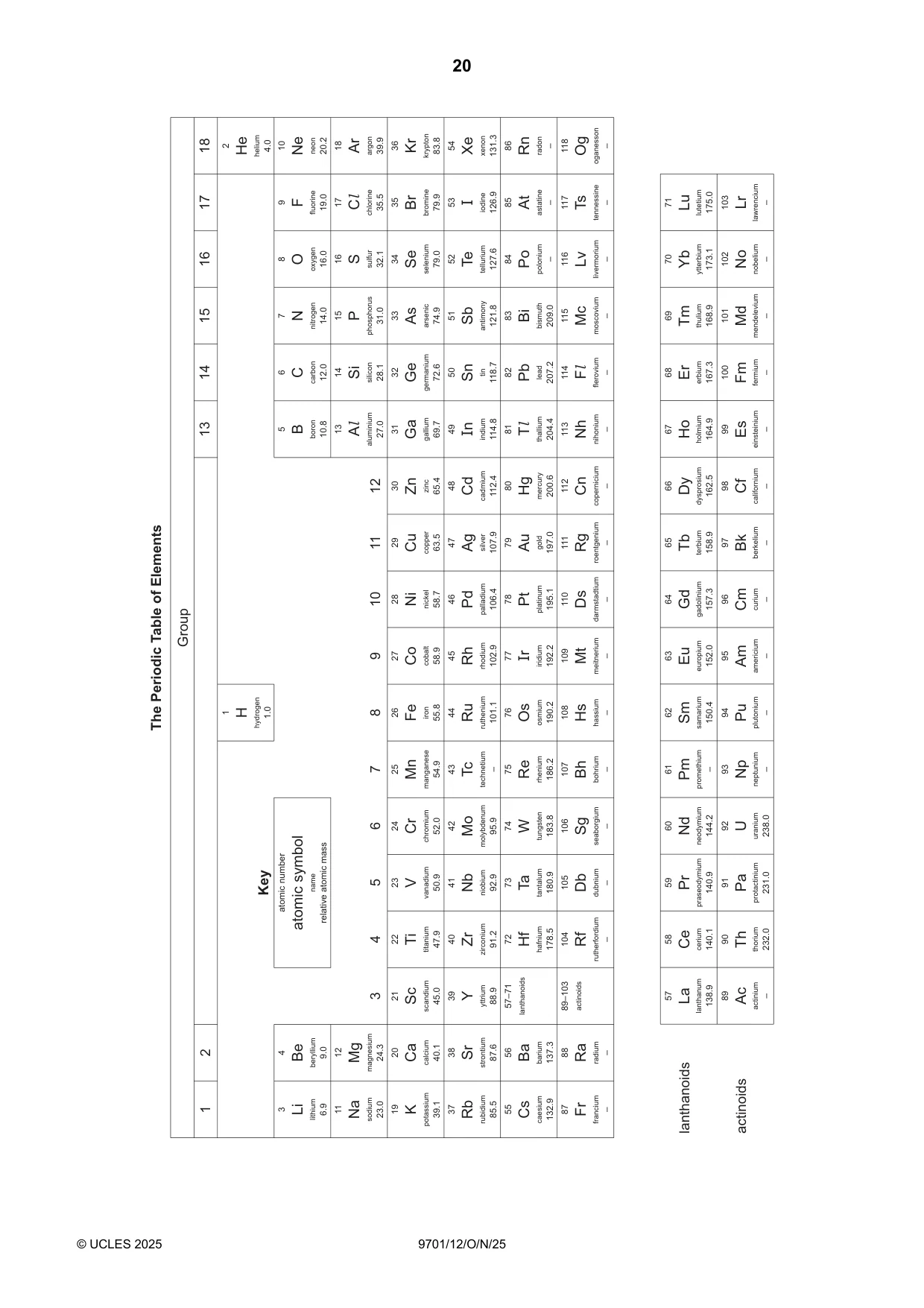
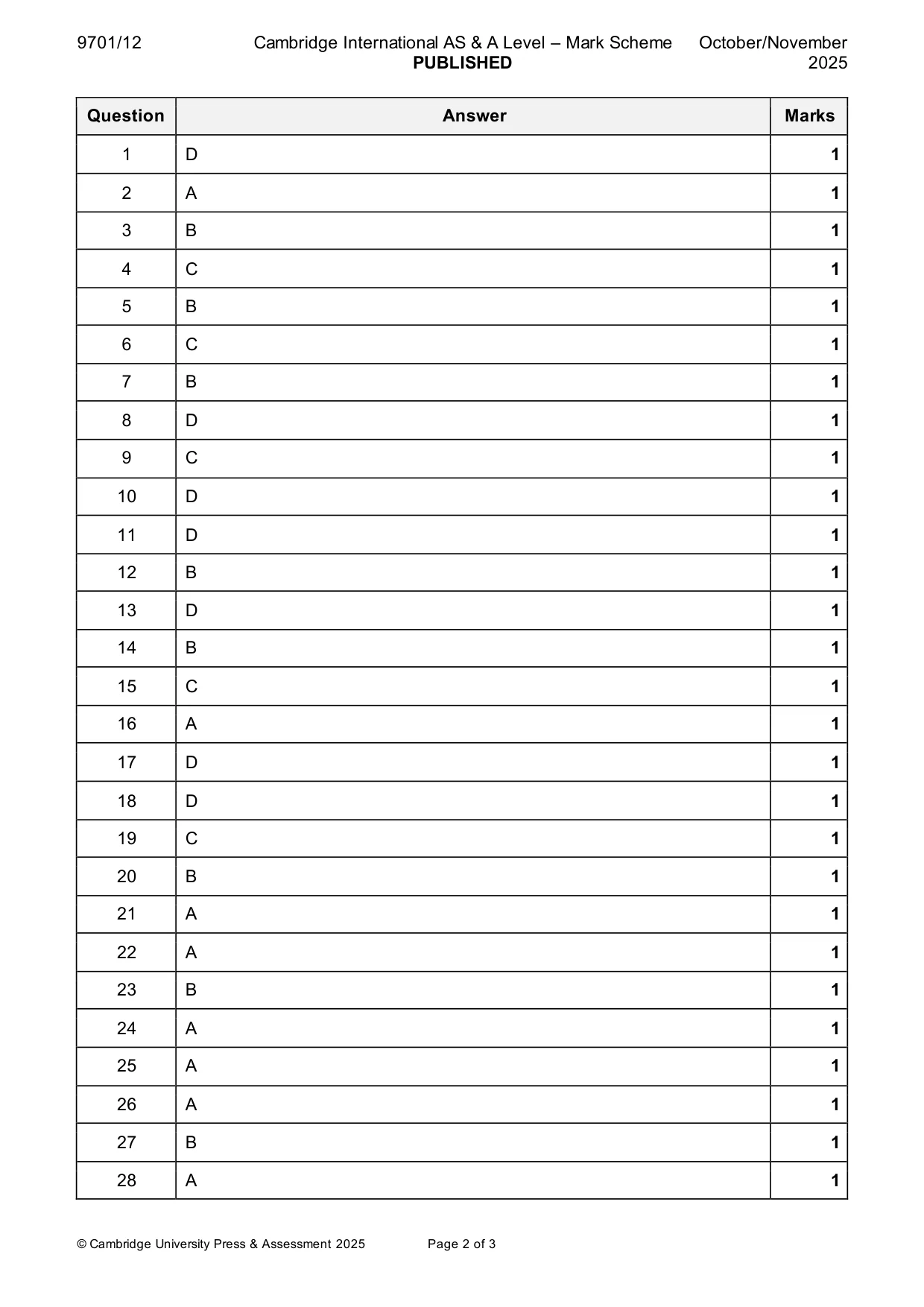
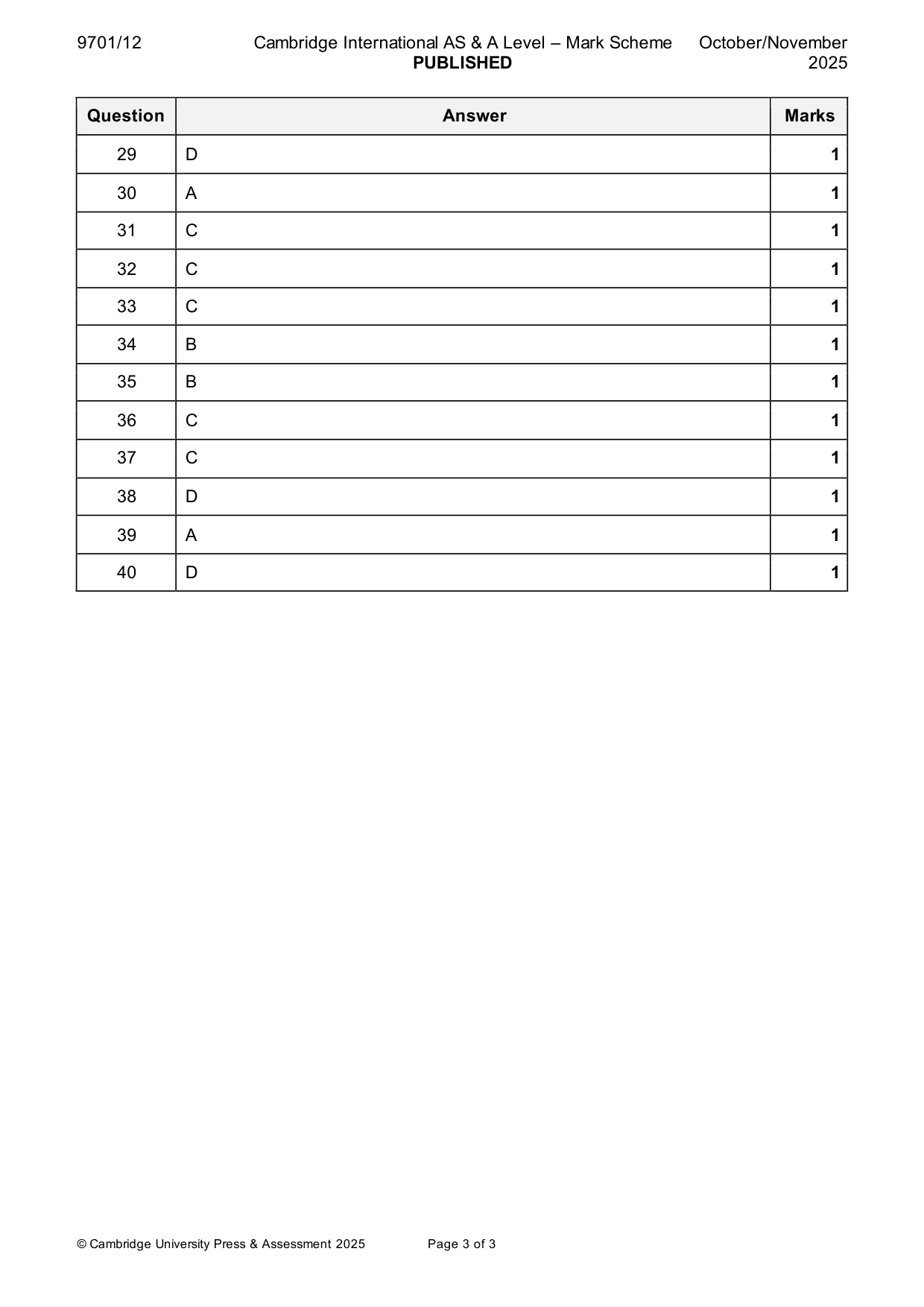
Answers below. Sit the paper first if you are practising.
Questions as text
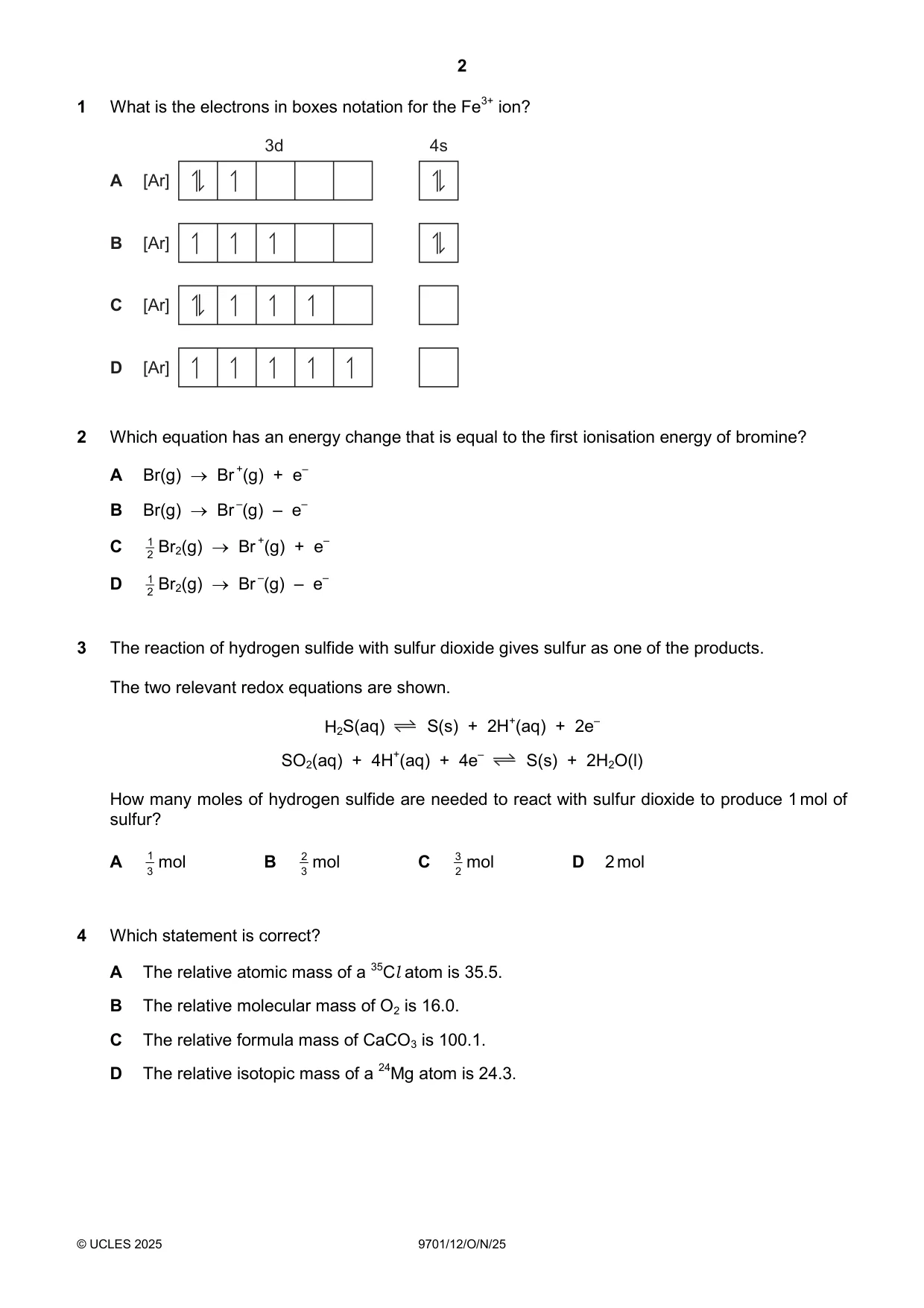
Q1 · What is the electrons in boxes notation for the Fe3+ ion?
1 What is the electrons in boxes notation for the Fe3+ ion? 3d 4s A [Ar] B [Ar] C [Ar] D [Ar]
Mark scheme: Question Answer Marks 1 D 1
More questions on Electrons, energy levels and atomic orbitals
Q3 · The reaction of hydrogen sulfide with sulfur dioxide gives sulfur as one of the products
3 The reaction of hydrogen sulfide with sulfur dioxide gives sulfur as one of the products. The two relevant redox equations are shown. H2S(aq) S(s) + 2H+(aq) + 2e– SO2(aq) + 4H+(aq) + 4e– S(s) + 2H2O(l) How many moles of hydrogen sulfide are needed to react with sulfur dioxide to produce 1 mol of sulfur? 1 mol 2 mol C 3 mol A B D 2 mol 3 3 2
Mark scheme: B
More questions on Reacting masses and volumes (of solutions and gases)
Q4 · Which statement is correct?
4 Which statement is correct? A The relative atomic mass of a 35Cl atom is 35.5. B The relative molecular mass of O2 is 16.0. C The relative formula mass of CaCO3 is 100.1. D The relative isotopic mass of a 24Mg atom is 24.3.
Mark scheme: C
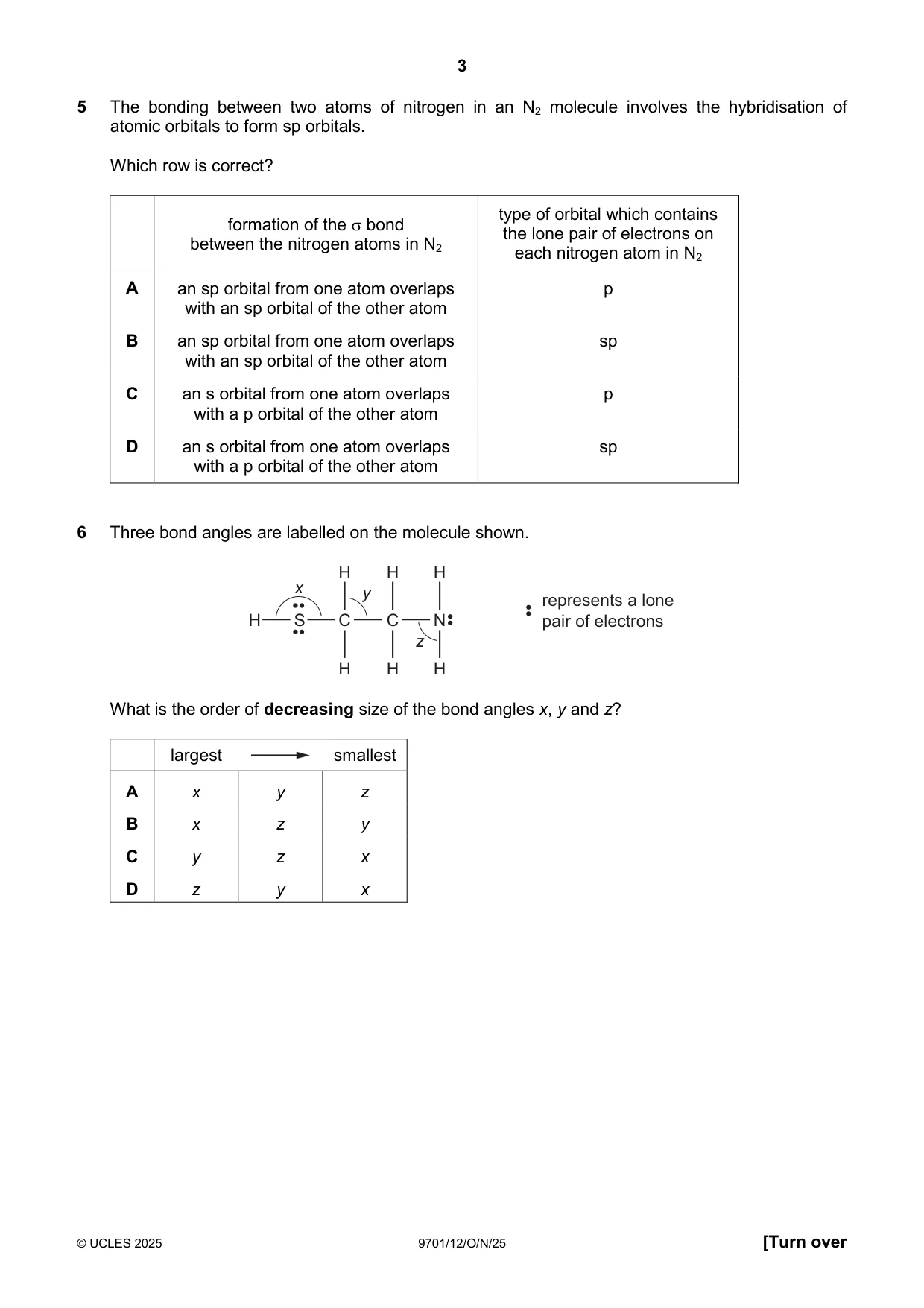
Q5 · The bonding between two atoms of nitrogen in an N2 molecule involves the hybridisation of…
5 The bonding between two atoms of nitrogen in an N2 molecule involves the hybridisation of atomic orbitals to form sp orbitals. Which row is correct? type of orbital which contains formation of the bond the lone pair of electrons on between the nitrogen atoms in N2 each nitrogen atom in N2 A an sp orbital from one atom overlaps p with an sp orbital of the other atom B an sp orbital from one atom overlaps sp with an sp orbital of the other atom C an s orbital from one atom overlaps p with a p orbital of the other atom D an s orbital from one atom overlaps sp with a p orbital of the other atom
Mark scheme: B
More questions on Shapes of organic molecules; σ and π bonds
Q6 · Three bond angles are labelled on the molecule shown
6 Three bond angles are labelled on the molecule shown. H H H x y represents a lone H S C C N pair of electrons z H H H What is the order of decreasing size of the bond angles x, y and z? largest smallest A x y z B x z y C y z x D z y x
Mark scheme: C
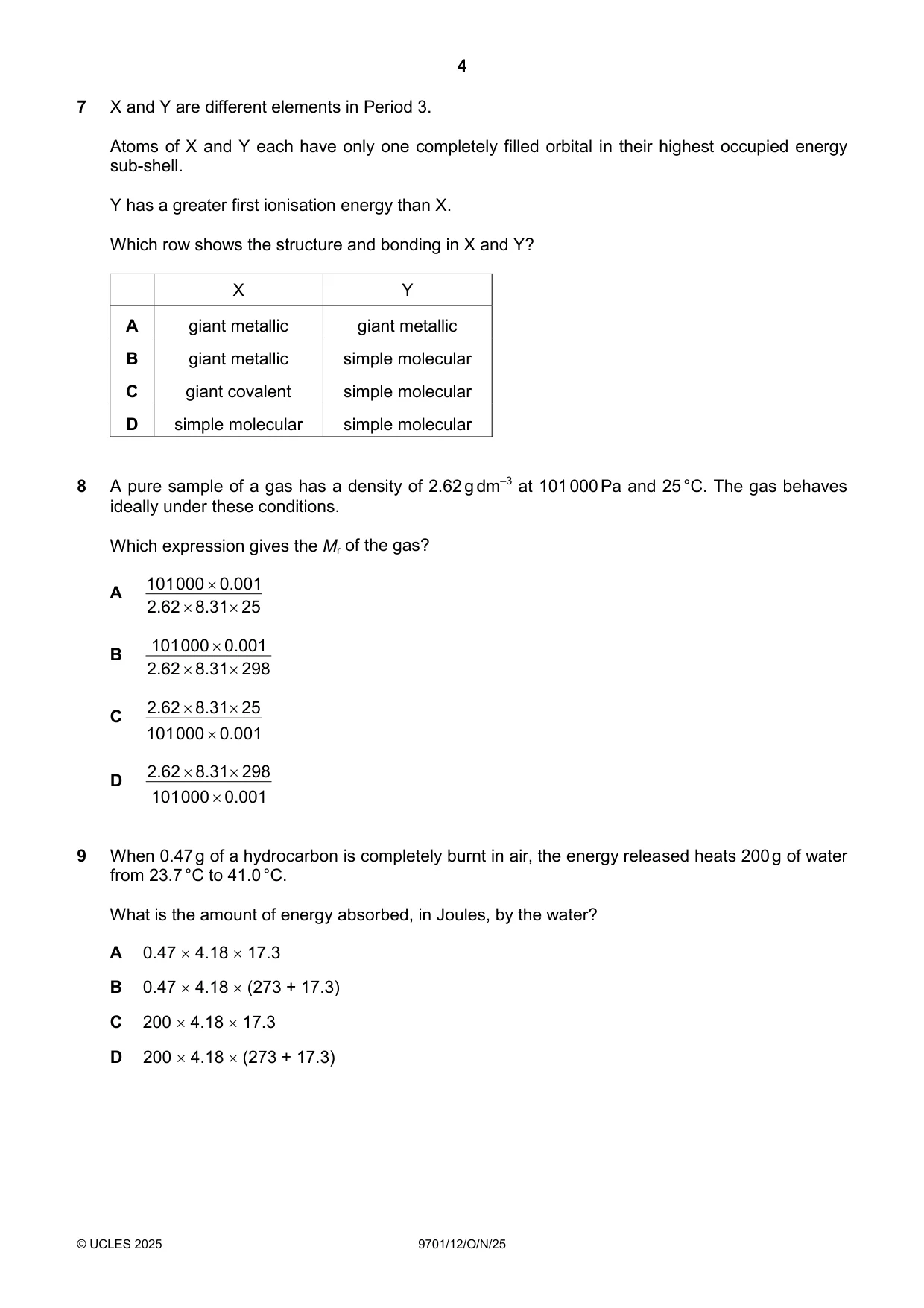
Q7 · X and Y are different elements in Period 3
7 X and Y are different elements in Period 3. Atoms of X and Y each have only one completely filled orbital in their highest occupied energy sub-shell. Y has a greater first ionisation energy than X. Which row shows the structure and bonding in X and Y? X Y A giant metallic giant metallic B giant metallic simple molecular C giant covalent simple molecular D simple molecular simple molecular
Mark scheme: B
More questions on Periodicity of physical properties of the elements in Period 3
Q8 · A pure sample of a gas has a density of 2.62 g dm–3 at 101 000 Pa and 25 °C
8 A pure sample of a gas has a density of 2.62 g dm–3 at 101 000 Pa and 25 °C. The gas behaves ideally under these conditions. Which expression gives the Mr of the gas? 101 000 0.001 A 2.62 8.31 25 101 000 0.001 B 2.62 8.31 298 2.62 8.31 25 C 101 000 0.001 2.62 8.31 298 D 101 000 0.001
Mark scheme: D
More questions on The gaseous state: ideal and real gases and pV = nRT
Q9 · When 0.47 g of a hydrocarbon is completely burnt in air, the energy released heats 200 g…
9 When 0.47 g of a hydrocarbon is completely burnt in air, the energy released heats 200 g of water from 23.7 °C to 41.0 °C. What is the amount of energy absorbed, in Joules, by the water? A 0.47 4.18 17.3 B 0.47 4.18 (273 + 17.3) C 200 4.18 17.3 D 200 4.18 (273 + 17.3)
Mark scheme: C
Q10 · One commercially available ‘heat pad’ contains iron, activated carbon and water
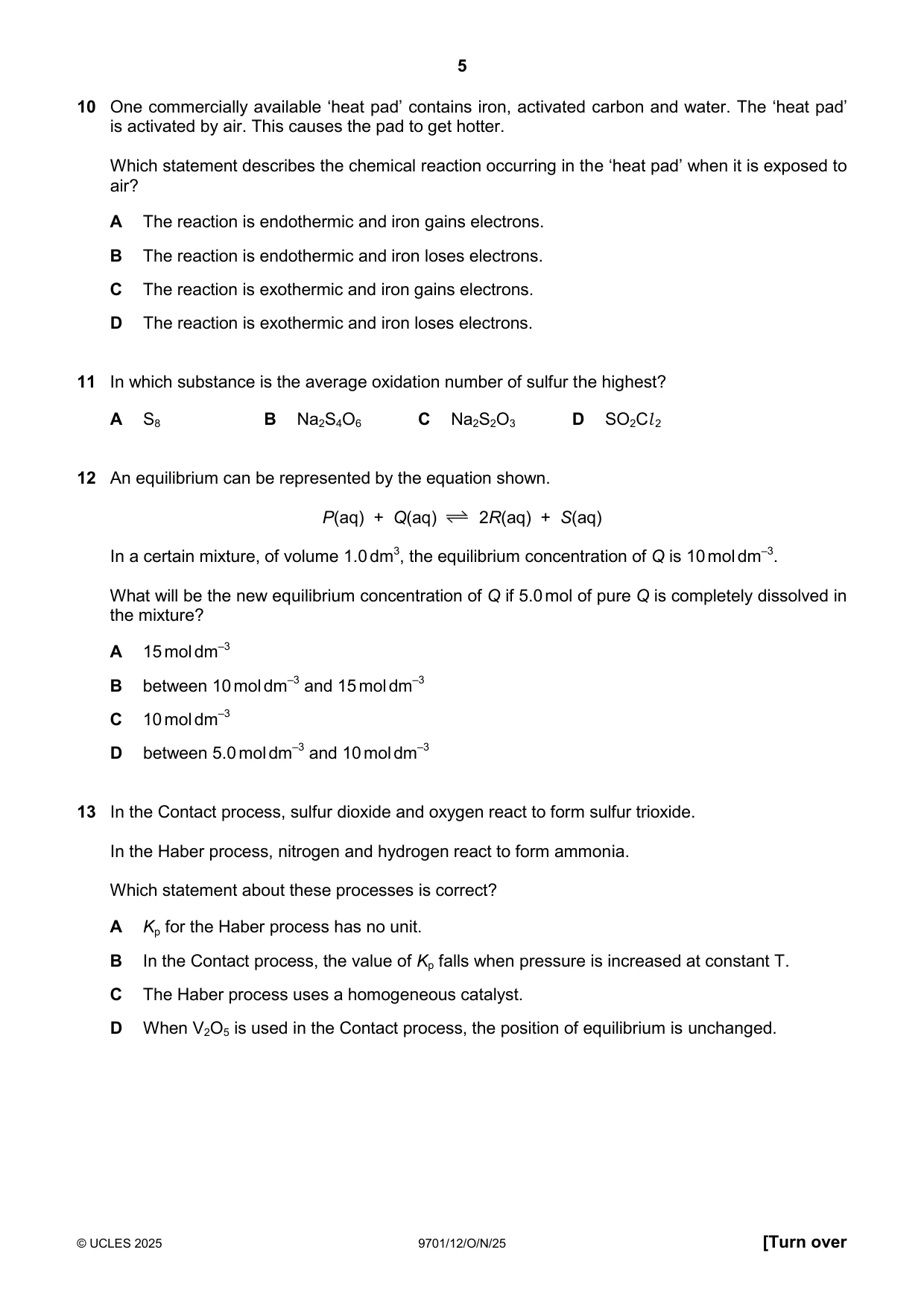
10 One commercially available ‘heat pad’ contains iron, activated carbon and water. The ‘heat pad’ is activated by air. This causes the pad to get hotter. Which statement describes the chemical reaction occurring in the ‘heat pad’ when it is exposed to air? A The reaction is endothermic and iron gains electrons. B The reaction is endothermic and iron loses electrons. C The reaction is exothermic and iron gains electrons. D The reaction is exothermic and iron loses electrons.
Mark scheme: D
Q11 · In which substance is the average oxidation number of sulfur the highest?
11 In which substance is the average oxidation number of sulfur the highest? A S8 B Na2S4O6 C Na2S2O3 D SO2Cl 2
Mark scheme: D
Q12 · An equilibrium can be represented by the equation shown
12 An equilibrium can be represented by the equation shown. P(aq) + Q(aq) 2R(aq) + S(aq) In a certain mixture, of volume 1.0 dm3, the equilibrium concentration of Q is 10 mol dm–3. What will be the new equilibrium concentration of Q if 5.0 mol of pure Q is completely dissolved in the mixture? A 15 mol dm–3 B between 10 mol dm–3 and 15 mol dm–3 C 10 mol dm–3 D between 5.0 mol dm–3 and 10 mol dm–3
Mark scheme: B
More questions on Chemical equilibria: reversible reactions, dynamic equilibrium
Q13 · In the Contact process, sulfur dioxide and oxygen react to form sulfur trioxide
13 In the Contact process, sulfur dioxide and oxygen react to form sulfur trioxide. In the Haber process, nitrogen and hydrogen react to form ammonia. Which statement about these processes is correct? A Kp for the Haber process has no unit. B In the Contact process, the value of Kp falls when pressure is increased at constant T. C The Haber process uses a homogeneous catalyst. D When V2O5 is used in the Contact process, the position of equilibrium is unchanged.
Mark scheme: D
More questions on Chemical equilibria: reversible reactions, dynamic equilibrium
Q14 · 20.0 cm3 of hydrogen peroxide decomposes to water and oxygen in the presence of a…
14 20.0 cm3 of hydrogen peroxide decomposes to water and oxygen in the presence of a suitable catalyst. 160 cm3 of oxygen, measured at room conditions, is produced in 5.00 minutes. What is the average rate of decomposition of hydrogen peroxide during this reaction period? A 2.22 10–5 mol s–1 B 4.44 10–5 mol s–1 C 1.76 10– 4 mol s–1 D 2.67 10–3 mol s–1
Mark scheme: B
Q15 · Which reaction pathway diagram shows an endothermic reaction that occurs in two steps and…
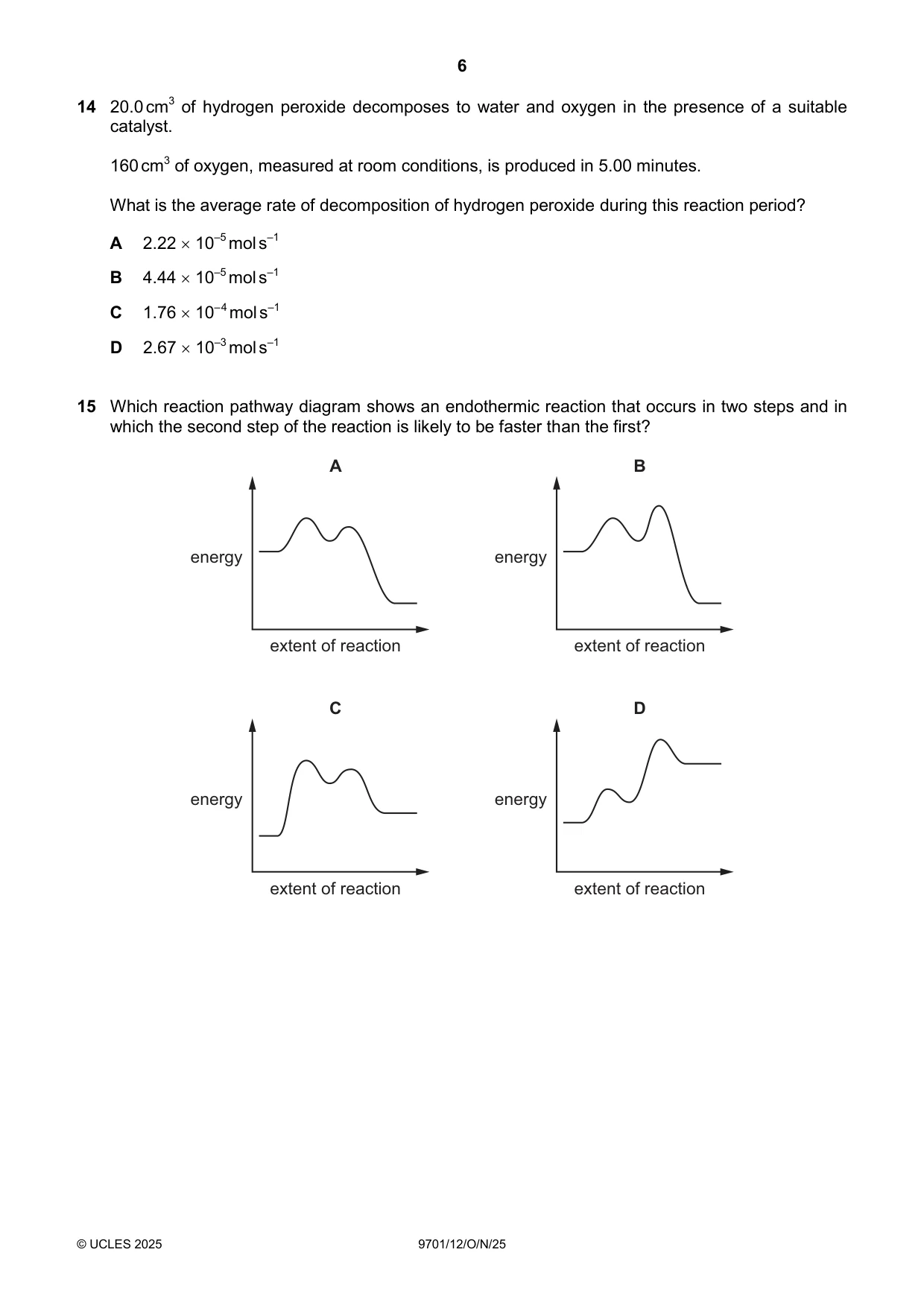
15 Which reaction pathway diagram shows an endothermic reaction that occurs in two steps and in which the second step of the reaction is likely to be faster than the first? A B energy energy extent of reaction extent of reaction C D energy energy extent of reaction extent of reaction
Mark scheme: C
More questions on Effect of temperature on reaction rates and the concept of activation energy
Q16 · Oxides of nitrogen, NO,, are involved in formation of photochemical smog and acid rain
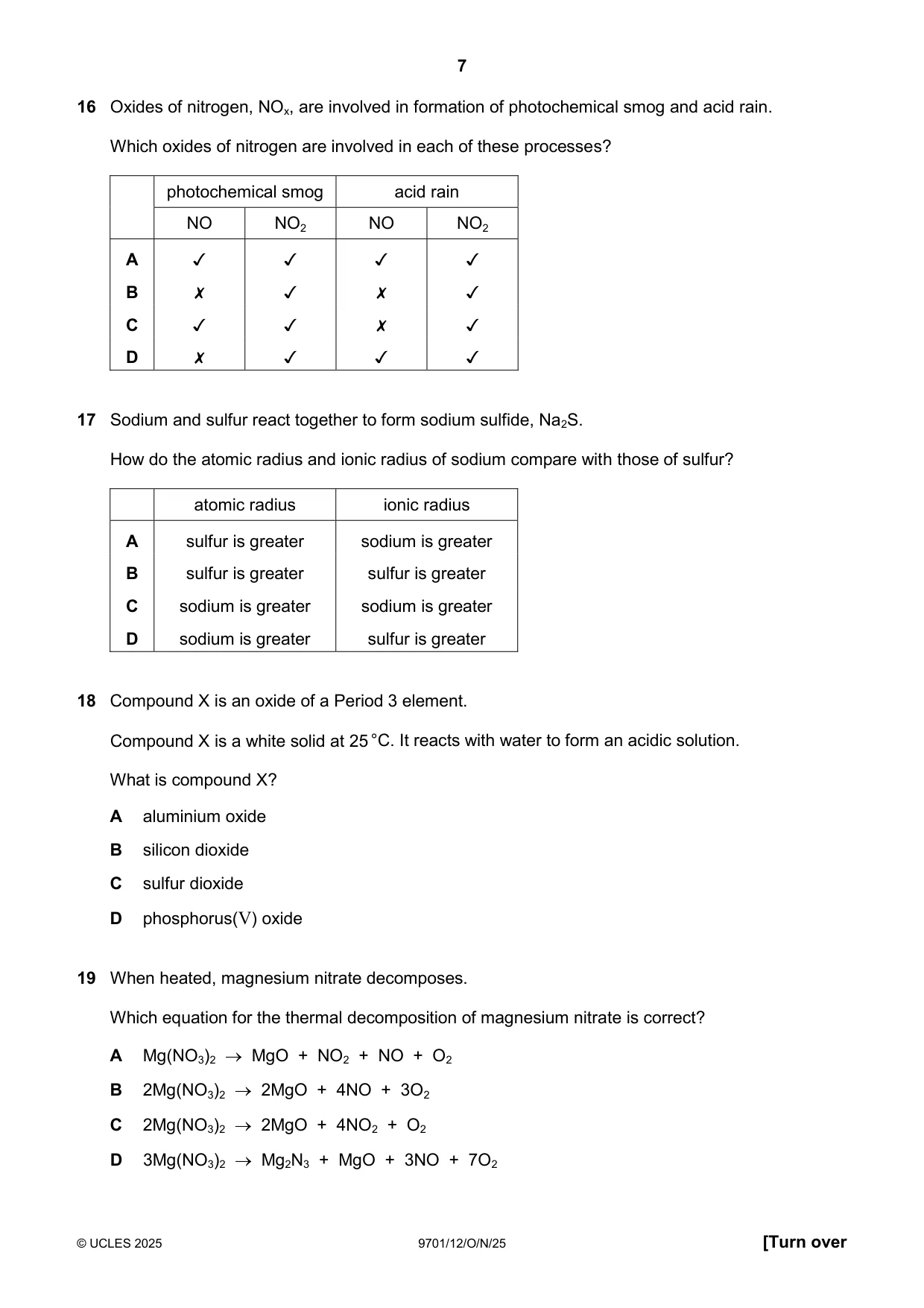
16 Oxides of nitrogen, NO,, are involved in formation of photochemical smog and acid rain. Which oxides of nitrogen are involved in each of these processes? photochemical smog acid rain
Mark scheme: A
Q17 · Sodium and sulfur react together to form sodium sulfide, Na2S
17 Sodium and sulfur react together to form sodium sulfide, Na2S. How do the atomic radius and ionic radius of sodium compare with those of sulfur? atomic radius ionic radius A sulfur is greater sodium is greater B sulfur is greater sulfur is greater C sodium is greater sodium is greater D sodium is greater sulfur is greater
Mark scheme: D
More questions on Periodicity of physical properties of the elements in Period 3
Q18 · Compound X is an oxide of a Period 3 element
18 Compound X is an oxide of a Period 3 element. Compound X is a white solid at 25 °C. It reacts with water to form an acidic solution. What is compound X? A aluminium oxide B silicon dioxide C sulfur dioxide D phosphorus(V) oxide
Mark scheme: D
More questions on Periodicity of chemical properties of the elements in Period 3
Q19 · When heated, magnesium nitrate decomposes
19 When heated, magnesium nitrate decomposes. Which equation for the thermal decomposition of magnesium nitrate is correct? A Mg(NO3)2 MgO + NO2 + NO + O2 B 2Mg(NO3)2 2MgO + 4NO + 3O2 C 2Mg(NO3)2 2MgO + 4NO2 + O2 D 3Mg(NO3)2 Mg2N3 + MgO + 3NO + 7O2
Mark scheme: C
Q20 · R is the aqueous solution of an ionic compound
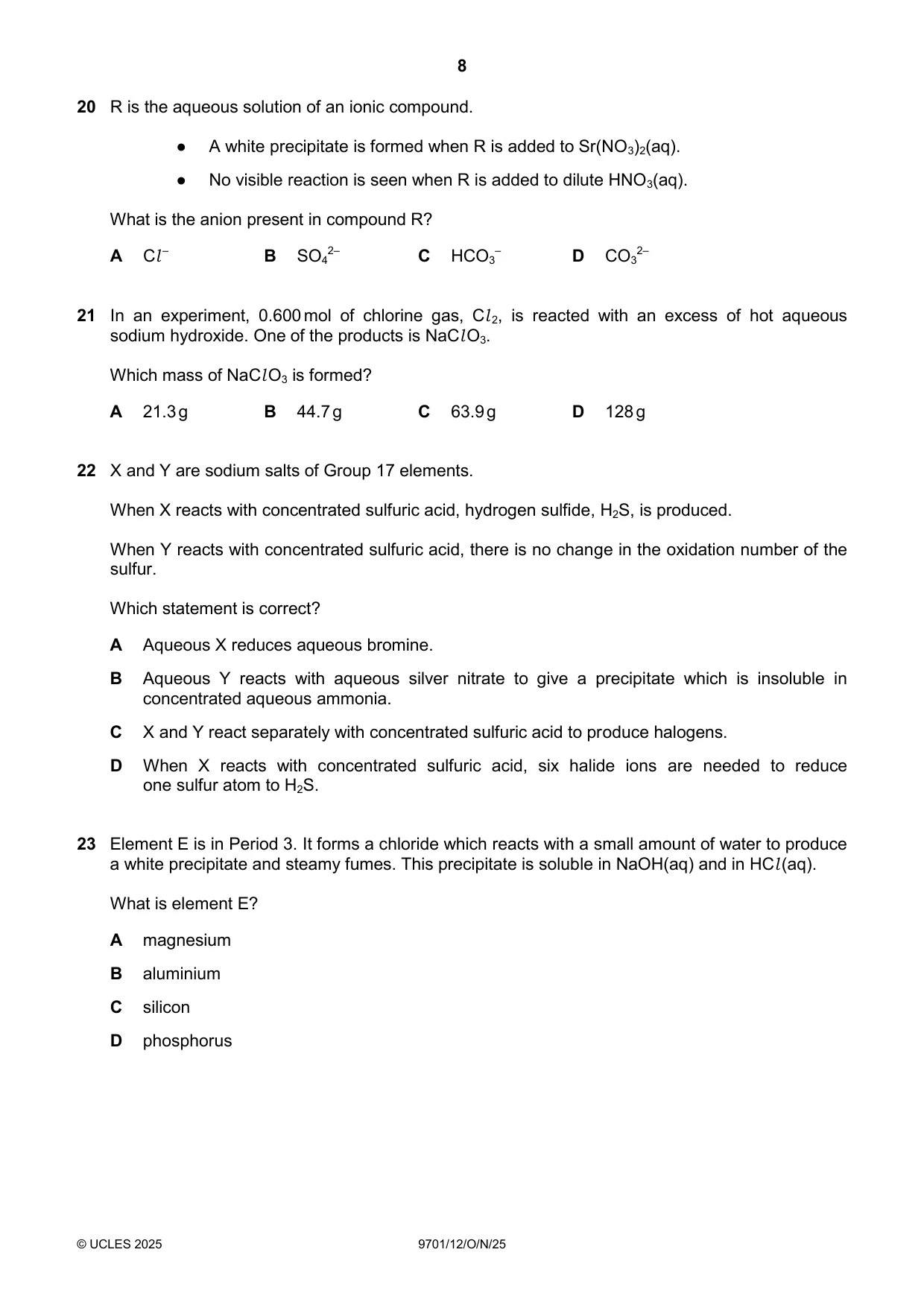
20 R is the aqueous solution of an ionic compound. ● A white precipitate is formed when R is added to Sr(NO3)2(aq). ● No visible reaction is seen when R is added to dilute HNO3(aq). What is the anion present in compound R? A Cl – B SO4 2– C HCO3 – D CO3 2–
Mark scheme: B
Q21 · In an experiment, 0.600 mol of chlorine gas, Cl 2, is reacted with an excess of hot…
21 In an experiment, 0.600 mol of chlorine gas, Cl 2, is reacted with an excess of hot aqueous sodium hydroxide. One of the products is NaCl O3. Which mass of NaCl O3 is formed? A 21.3 g B 44.7 g C 63.9 g D 128 g
Mark scheme: A
More questions on Reacting masses and volumes (of solutions and gases)
Q22 · X and Y are sodium salts of Group 17 elements
22 X and Y are sodium salts of Group 17 elements. When X reacts with concentrated sulfuric acid, hydrogen sulfide, H2S, is produced. When Y reacts with concentrated sulfuric acid, there is no change in the oxidation number of the sulfur. Which statement is correct? A Aqueous X reduces aqueous bromine. B Aqueous Y reacts with aqueous silver nitrate to give a precipitate which is insoluble in concentrated aqueous ammonia. C X and Y react separately with concentrated sulfuric acid to produce halogens. D When X reacts with concentrated sulfuric acid, six halide ions are needed to reduce one sulfur atom to H2S.
Mark scheme: A
More questions on The chemical properties of the halogen elements and the hydrogen halides
Q23 · Element E is in Period 3
23 Element E is in Period 3. It forms a chloride which reacts with a small amount of water to produce a white precipitate and steamy fumes. This precipitate is soluble in NaOH(aq) and in HCl (aq). What is element E? A magnesium B aluminium C silicon D phosphorus
Mark scheme: B
More questions on Periodicity of chemical properties of the elements in Period 3
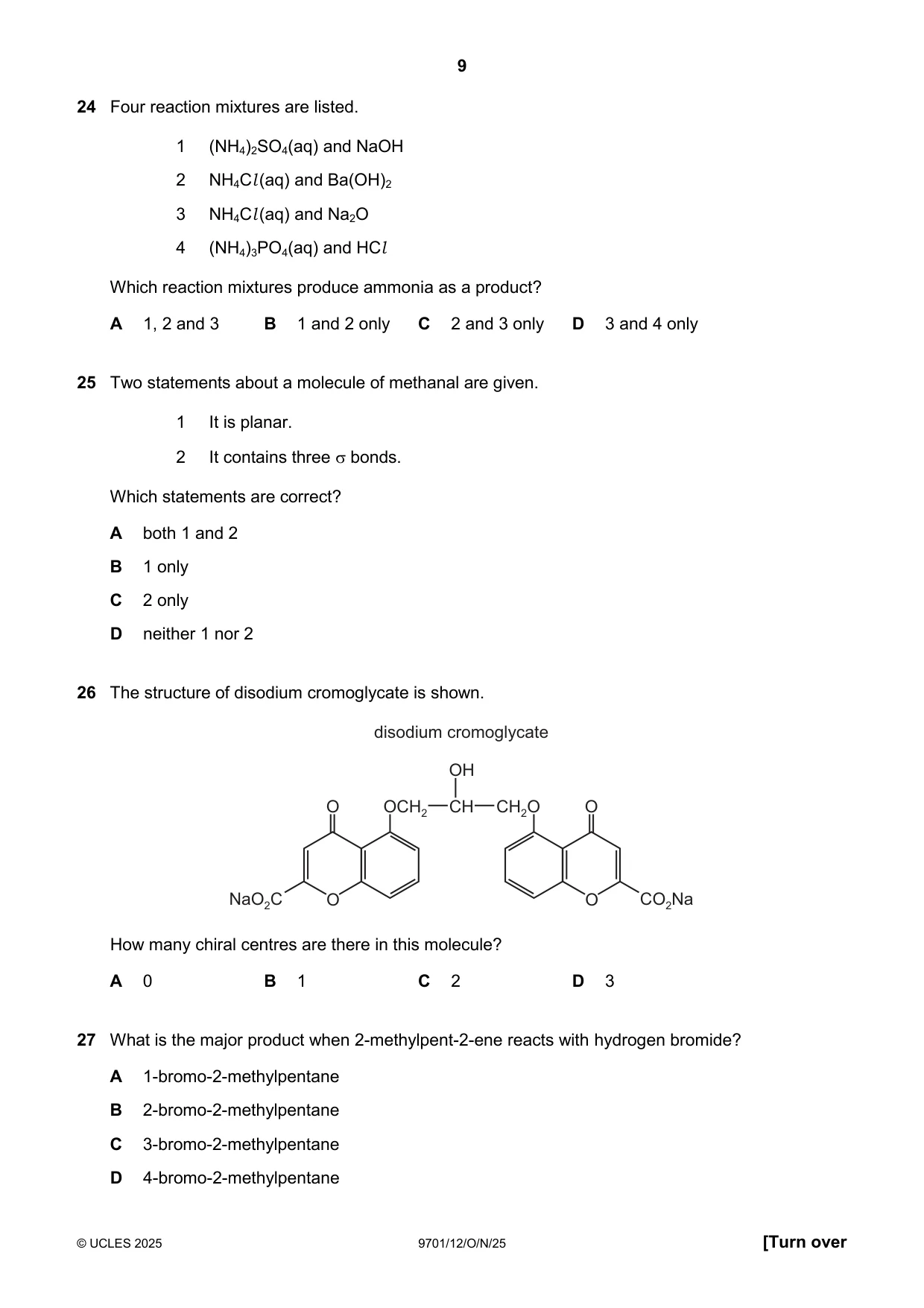
Q24 · Four reaction mixtures are listed
24 Four reaction mixtures are listed. 1 (NH4)2SO4(aq) and NaOH 2 NH4Cl (aq) and Ba(OH)2 3 NH4Cl (aq) and Na2O 4 (NH4)3PO4(aq) and HCl Which reaction mixtures produce ammonia as a product? A 1, 2 and 3 B 1 and 2 only C 2 and 3 only D 3 and 4 only
Mark scheme: A
Q25 · Two statements about a molecule of methanal are given
25 Two statements about a molecule of methanal are given. 1 It is planar. 2 It contains three bonds. Which statements are correct? A both 1 and 2 B 1 only C 2 only D neither 1 nor 2
Mark scheme: A
More questions on Shapes of organic molecules; σ and π bonds
Q26 · The structure of disodium cromoglycate is shown
26 The structure of disodium cromoglycate is shown. disodium cromoglycate OH O OCH2 CH CH2O O NaO2C O O CO2Na How many chiral centres are there in this molecule? A 0 B 1 C 2 D 3
Mark scheme: A
More questions on Isomerism: structural isomerism and stereoisomerism
Q27 · What is the major product when 2-methylpent-2-ene reacts with hydrogen bromide?
27 What is the major product when 2-methylpent-2-ene reacts with hydrogen bromide? A 1-bromo-2-methylpentane B 2-bromo-2-methylpentane C 3-bromo-2-methylpentane D 4-bromo-2-methylpentane
Mark scheme: B
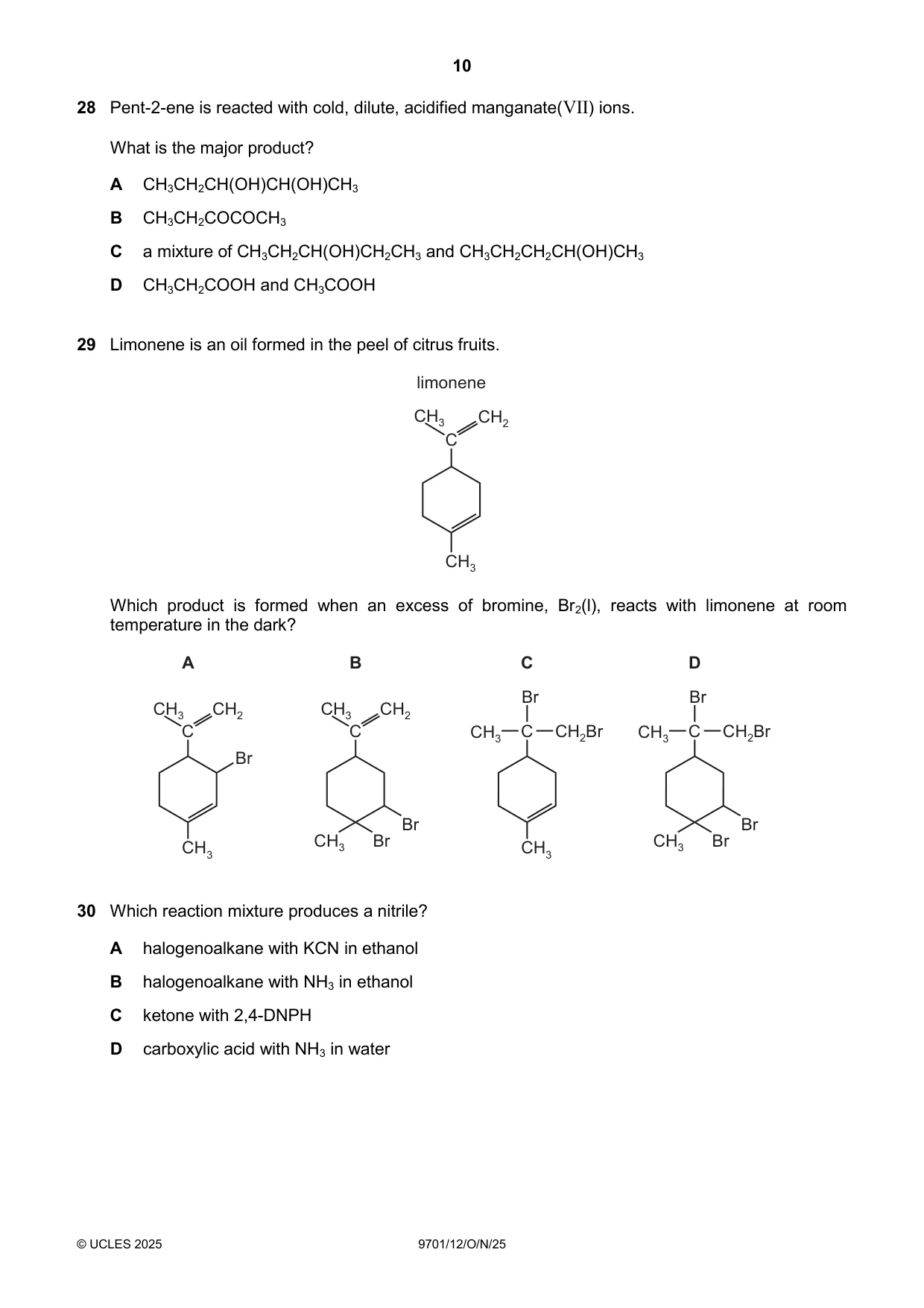
Q28 · Pent-2-ene is reacted with cold, dilute, acidified manganate(VII) ions
28 Pent-2-ene is reacted with cold, dilute, acidified manganate(VII) ions. What is the major product? A CH3CH2CH(OH)CH(OH)CH3 B CH3CH2COCOCH3 C a mixture of CH3CH2CH(OH)CH2CH3 and CH3CH2CH2CH(OH)CH3 D CH3CH2COOH and CH3COOH
Mark scheme: A
Q29 · Limonene is an oil formed in the peel of citrus fruits
29 Limonene is an oil formed in the peel of citrus fruits. limonene CH3 CH2 C CH3 Which product is formed when an excess of bromine, Br2(l), reacts with limonene at room temperature in the dark? A B C D Br Br CH3 CH2 CH3 CH2 C C CH3 C CH2Br CH3 C CH2Br Br Br Br CH3 CH3 Br CH3 CH3 Br
Mark scheme: D
Q30 · Which reaction mixture produces a nitrile?
30 Which reaction mixture produces a nitrile? A halogenoalkane with KCN in ethanol B halogenoalkane with NH3 in ethanol C ketone with 2,4-DNPH D carboxylic acid with NH3 in water
Mark scheme: A
Q31 · Which reaction is classified as SN1?
31 Which reaction is classified as SN1? A the reaction of 1-chloropropane with ammonia in ethanol B the reaction of 1-chloropropane with potassium hydroxide in ethanol C the reaction of 2-chloro-2-methylpropane with potassium cyanide in ethanol D the reaction of 2-chloro-2-methylpropane with potassium hydroxide in ethanol
Mark scheme: C
Q32 · Which reaction mixture produces a primary alcohol as the major product?
32 Which reaction mixture produces a primary alcohol as the major product? A propanone with NaBH4 B propene with steam in the presence of H3PO4 C butanoic acid with LiAl H4 D ethene with hot concentrated acidified KMnO4
Mark scheme: C
Q33 · HOCH2CHO is heated under reflux with an excess of acidified K2Cr2O7 until there is no…
33 HOCH2CHO is heated under reflux with an excess of acidified K2Cr2O7 until there is no further reaction. What is the final product of this reaction? A HOOCCHO B HOCH2COOH C HOOCCOOH D HOOCCH2COOH
Mark scheme: C
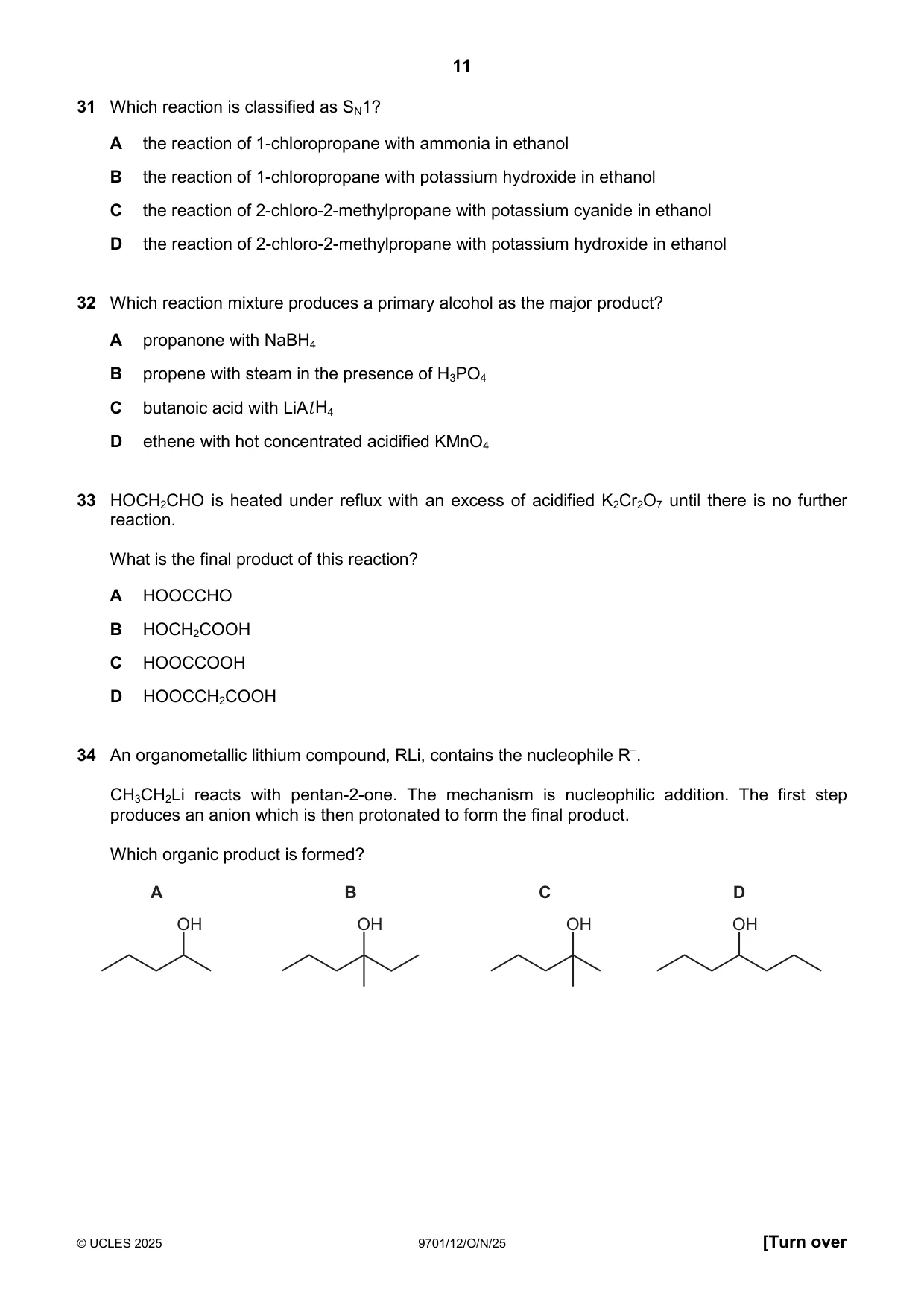
Q34 · An organometallic lithium compound, RLi, contains the nucleophile R–
34 An organometallic lithium compound, RLi, contains the nucleophile R–. CH3CH2Li reacts with pentan-2-one. The mechanism is nucleophilic addition. The first step produces an anion which is then protonated to form the final product. Which organic product is formed? A B C D OH OH OH OH
Mark scheme: B
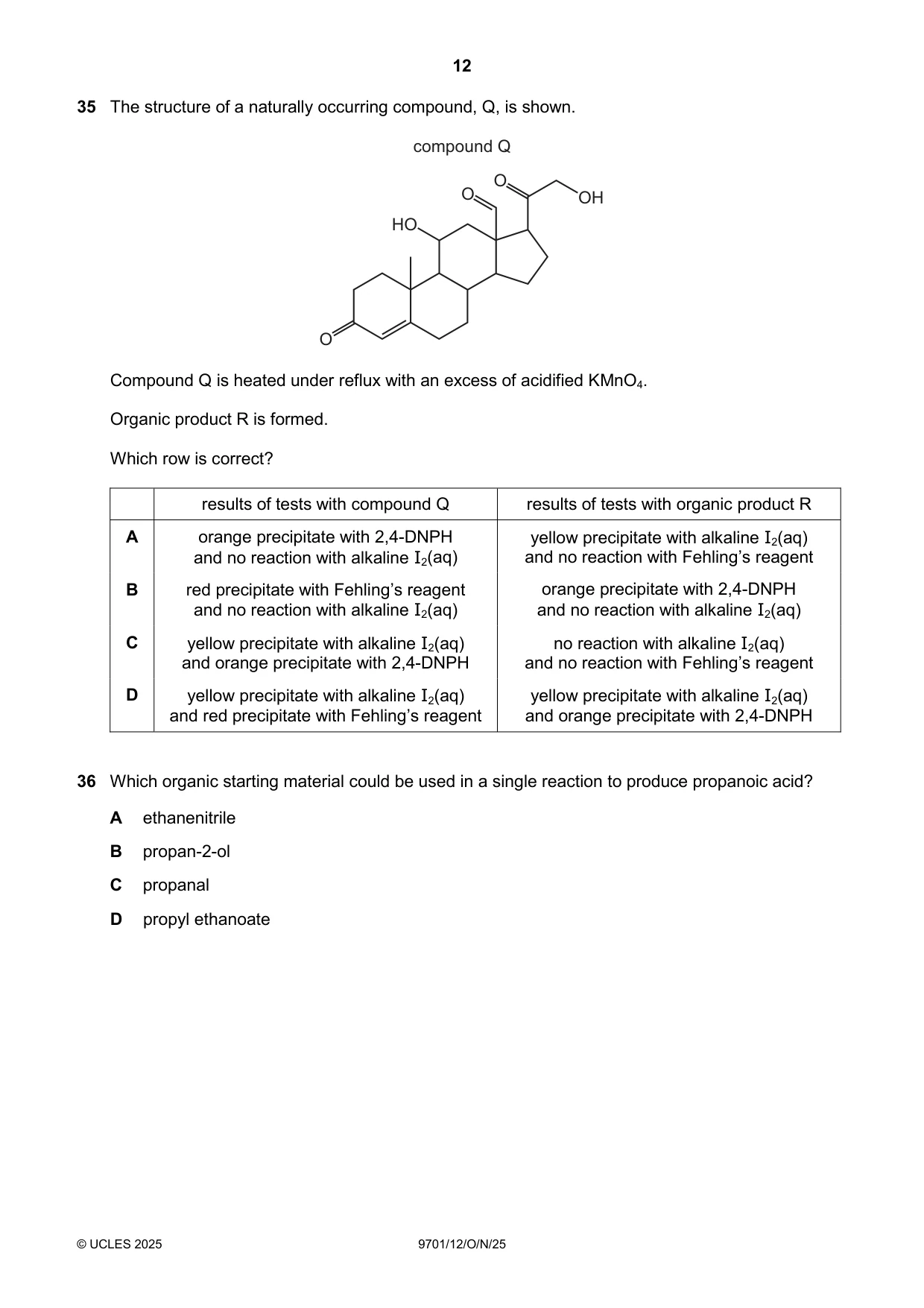
Q35 · The structure of a naturally occurring compound, Q, is shown
35 The structure of a naturally occurring compound, Q, is shown. compound Q O O OH HO O Compound Q is heated under reflux with an excess of acidified KMnO4. Organic product R is formed. Which row is correct? results of tests with compound Q results of tests with organic product R A orange precipitate with 2,4-DNPH yellow precipitate with alkaline I2(aq) and no reaction with alkaline I2(aq) and no reaction with Fehling’s reagent B red precipitate with Fehling’s reagent orange precipitate with 2,4-DNPH and no reaction with alkaline I2(aq) and no reaction with alkaline I2(aq) C yellow precipitate with alkaline I2(aq) no reaction with alkaline I2(aq) and orange precipitate with 2,4-DNPH and no reaction with Fehling’s reagent D yellow precipitate with alkaline I2(aq) yellow precipitate with alkaline I2(aq) and red precipitate with Fehling’s reagent and orange precipitate with 2,4-DNPH
Mark scheme: B
Q36 · Which organic starting material could be used in a single reaction to produce propanoic…
36 Which organic starting material could be used in a single reaction to produce propanoic acid? A ethanenitrile B propan-2-ol C propanal D propyl ethanoate
Mark scheme: C
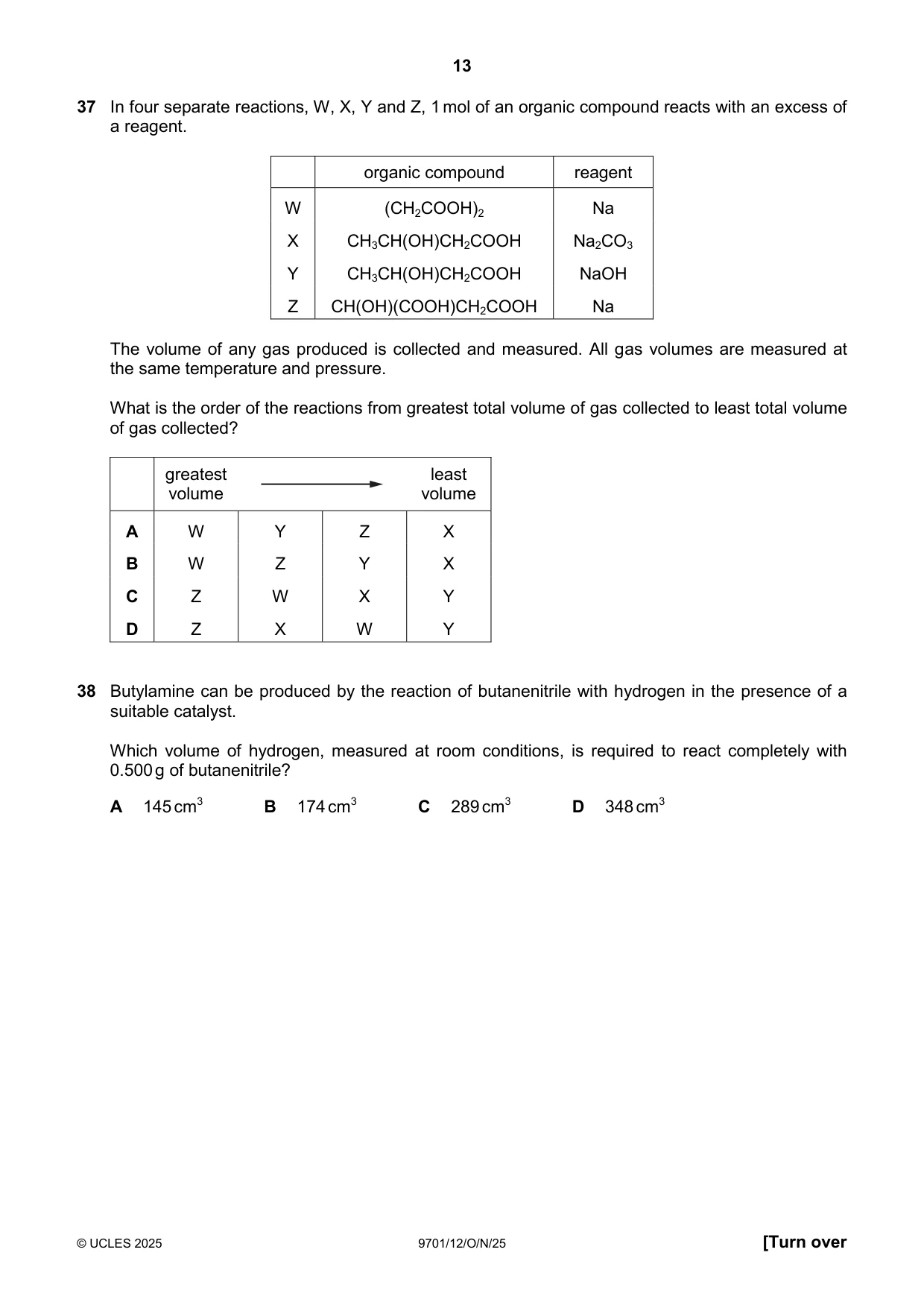
Q37 · In four separate reactions, W, X, Y and Z, 1 mol of an organic compound reacts with an…
37 In four separate reactions, W, X, Y and Z, 1 mol of an organic compound reacts with an excess of a reagent. organic compound reagent W (CH2COOH)2 Na X CH3CH(OH)CH2COOH Na2CO3 Y CH3CH(OH)CH2COOH NaOH Z CH(OH)(COOH)CH2COOH Na The volume of any gas produced is collected and measured. All gas volumes are measured at the same temperature and pressure. What is the order of the reactions from greatest total volume of gas collected to least total volume of gas collected? greatest least volume volume A W Y Z X B W Z Y X C Z W X Y D Z X W Y
Mark scheme: C
Q38 · Butylamine can be produced by the reaction of butanenitrile with hydrogen in the presence…
38 Butylamine can be produced by the reaction of butanenitrile with hydrogen in the presence of a suitable catalyst. Which volume of hydrogen, measured at room conditions, is required to react completely with 0.500 g of butanenitrile? A 145 cm3 B 174 cm3 C 289 cm3 D 348 cm3
Mark scheme: D
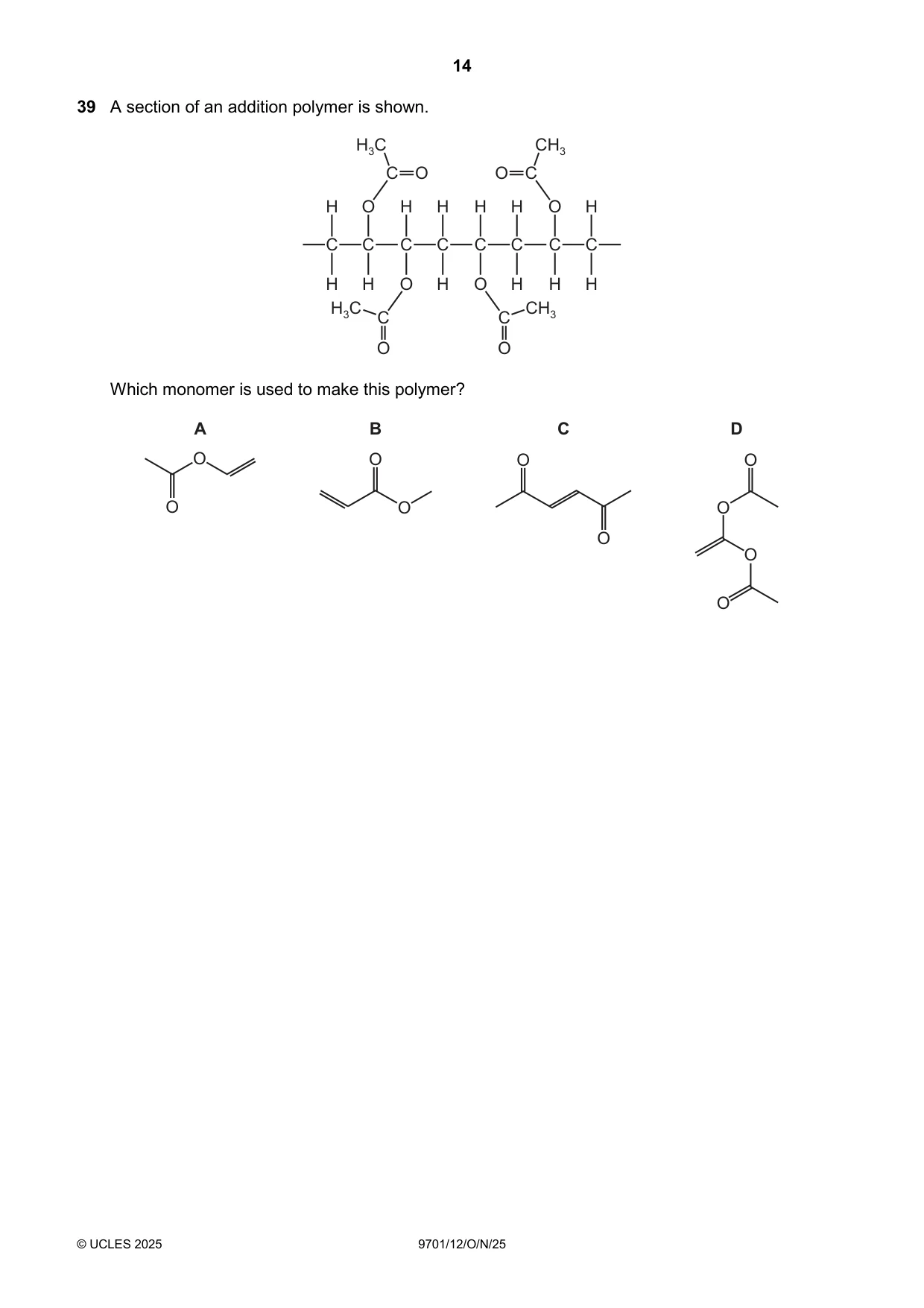
Q39 · A section of an addition polymer is shown
39 A section of an addition polymer is shown. H3C CH3 C O O C H O H H H H O H C C C C C C C C H H O H O H H H H3C CH3 C C O O Which monomer is used to make this polymer? A B C D O O O O O O O O O O
Mark scheme: A
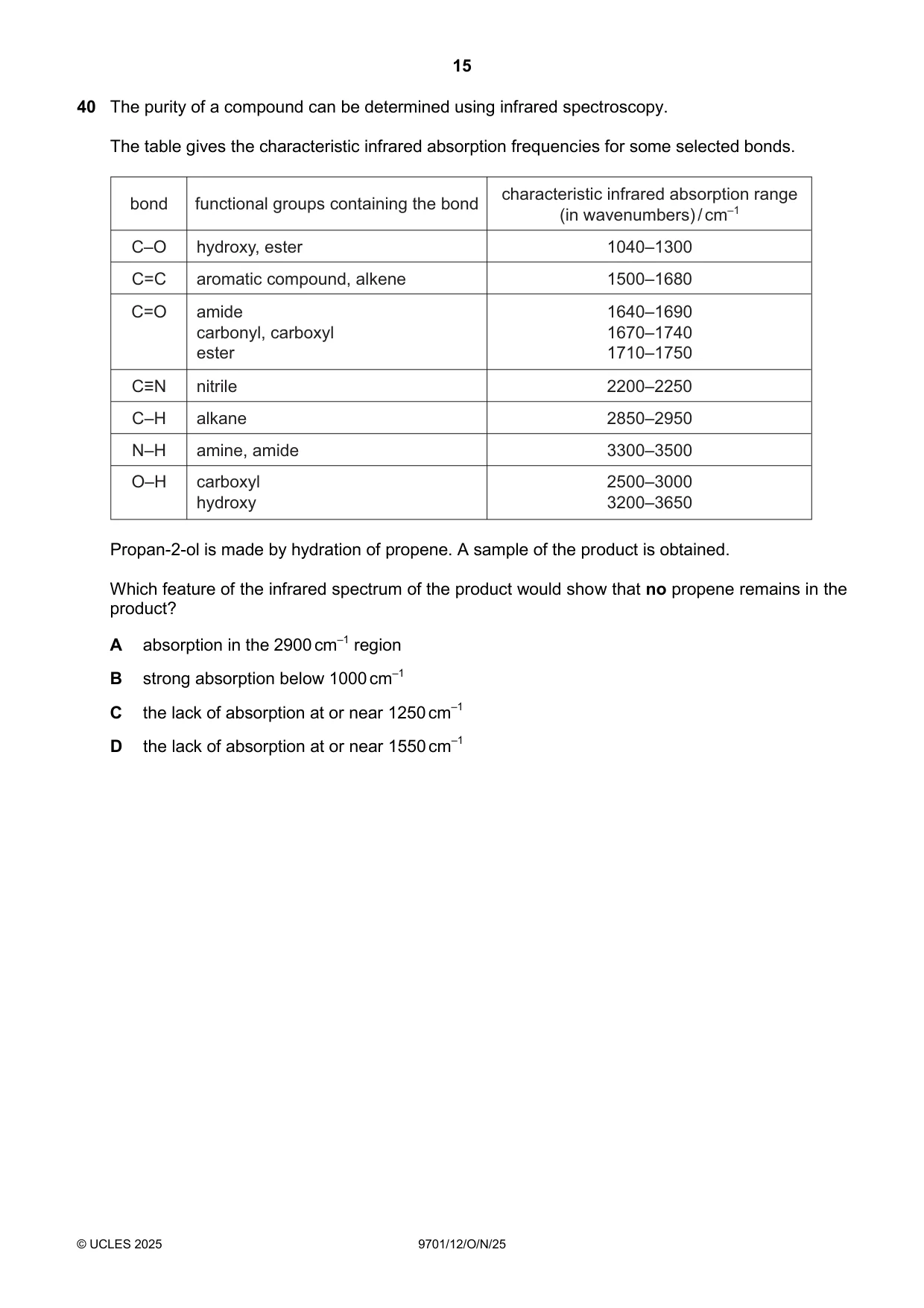
Q40 · The purity of a compound can be determined using infrared spectroscopy
40 The purity of a compound can be determined using infrared spectroscopy. The table gives the characteristic infrared absorption frequencies for some selected bonds. characteristic infrared absorption range bond functional groups containing the bond (in wavenumbers) / cm–1 C–O hydroxy, ester 1040–1300 C=C aromatic compound, alkene 1500–1680 C=O amide 1640–1690 carbonyl, carboxyl 1670–1740 ester 1710–1750 C≡N nitrile 2200–2250 C–H alkane 2850–2950 N–H amine, amide 3300–3500 O–H carboxyl 2500–3000 hydroxy 3200–3650 Propan-2-ol is made by hydration of propene. A sample of the product is obtained. Which feature of the infrared spectrum of the product would show that no propene remains in the product? A absorption in the 2900 cm–1 region B strong absorption below 1000 cm–1 C the lack of absorption at or near 1250 cm–1 D the lack of absorption at or near 1550 cm–1
Mark scheme: D
What was in this paper
The subtopics covered by these 39 questions, and how many questions each got. Open one in a new tab to see every Cambridge question on it.
4Alkenes3Carboxylic acids2Chemical equilibria: reversible reactions, dynamic equilibrium2Periodicity of chemical properties of the elements in Period 32Periodicity of physical properties of the elements in Period 32Reacting masses and volumes (of solutions and gases)2Redox processes: electron transfer and changes in oxidation number (oxidation state)2Shapes of organic molecules; σ and π bonds2Similarities and trends in the properties of the Group 2 metals, magnesium to barium, and their compounds2Alcohols1Aldehydes and ketones1Condensation polymerisation1Effect of temperature on reaction rates and the concept of activation energy1Electrons, energy levels and atomic orbitals1Enthalpy change, ΔH1Halogenoalkanes1Infrared spectroscopy1Isomerism: structural isomerism and stereoisomerism1Nitrogen and sulfur1Primary amines1Rate of reaction1Relative masses of atoms and molecules1Shapes of molecules1The chemical properties of the halogen elements and the hydrogen halides1The gaseous state: ideal and real gases and pV = nRT1What you needed in this session
Cambridge’s own grade thresholds for 2025 Oct/Nov, Paper 1 · Variant 2. A higher threshold means an easier paper — the bar moves with how the cohort did.