Cambridge A Level Chemistry 9701 — 2014 May/June Paper 1 · Variant 1
9701/11/M/J/14 · 40 questions · 40 marks · ≈45 min
The question paper and its mark scheme, free to read here and free to download. This is Cambridge’s own paper, exactly as it was sat.
Question paper16 pages

Mark scheme2 pages
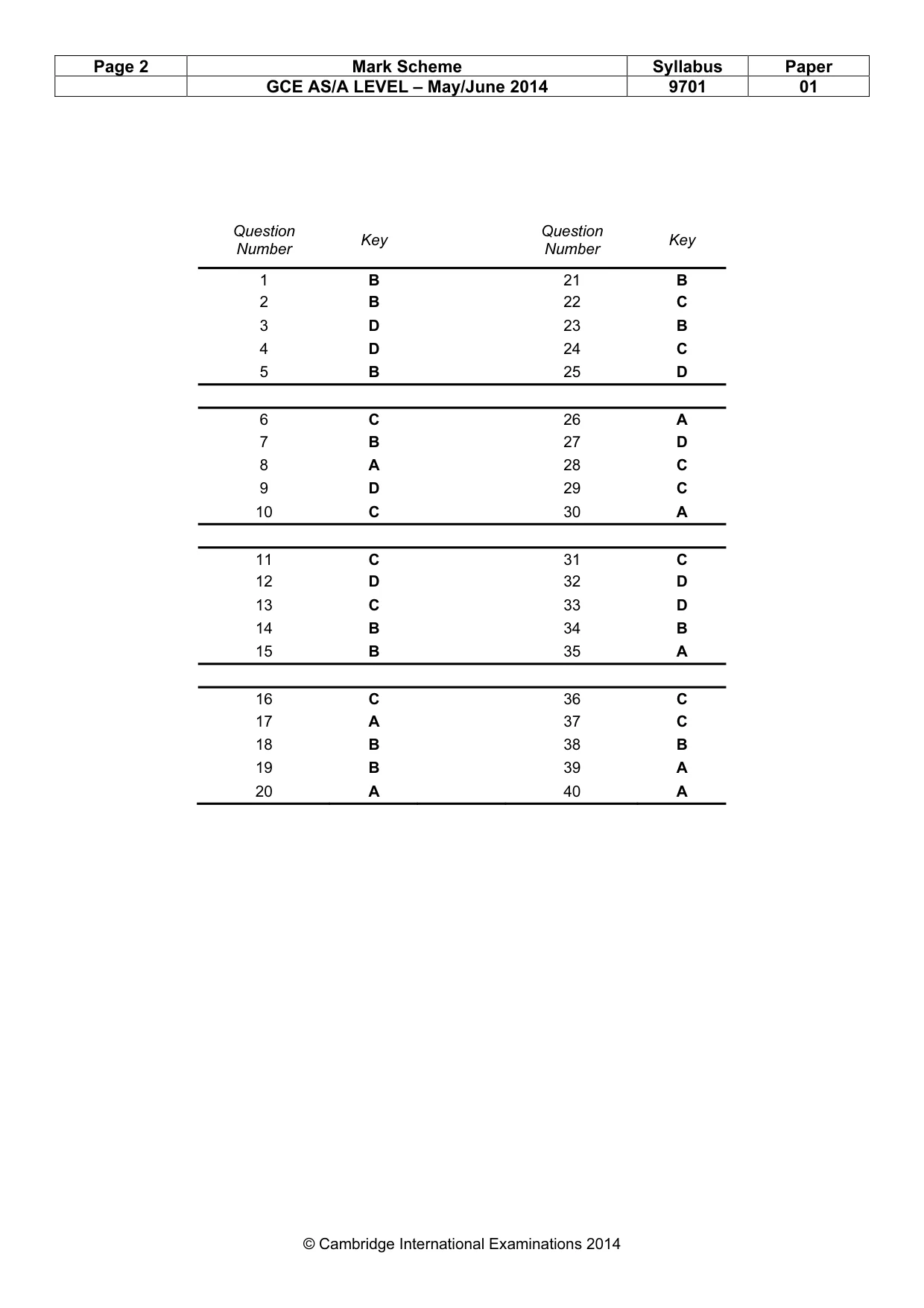
Answers below. Sit the paper first if you are practising.
Questions as text
Q1 · Use of the Data Booklet is relevant to this question
1 Use of the Data Booklet is relevant to this question. Atoms of element X have six unpaired electrons. What could be element X? A carbon B chromium C iron D selenium
Mark scheme: B
More questions on Electrons, energy levels and atomic orbitals
Q2 · Use of the Data Booklet is relevant to this question
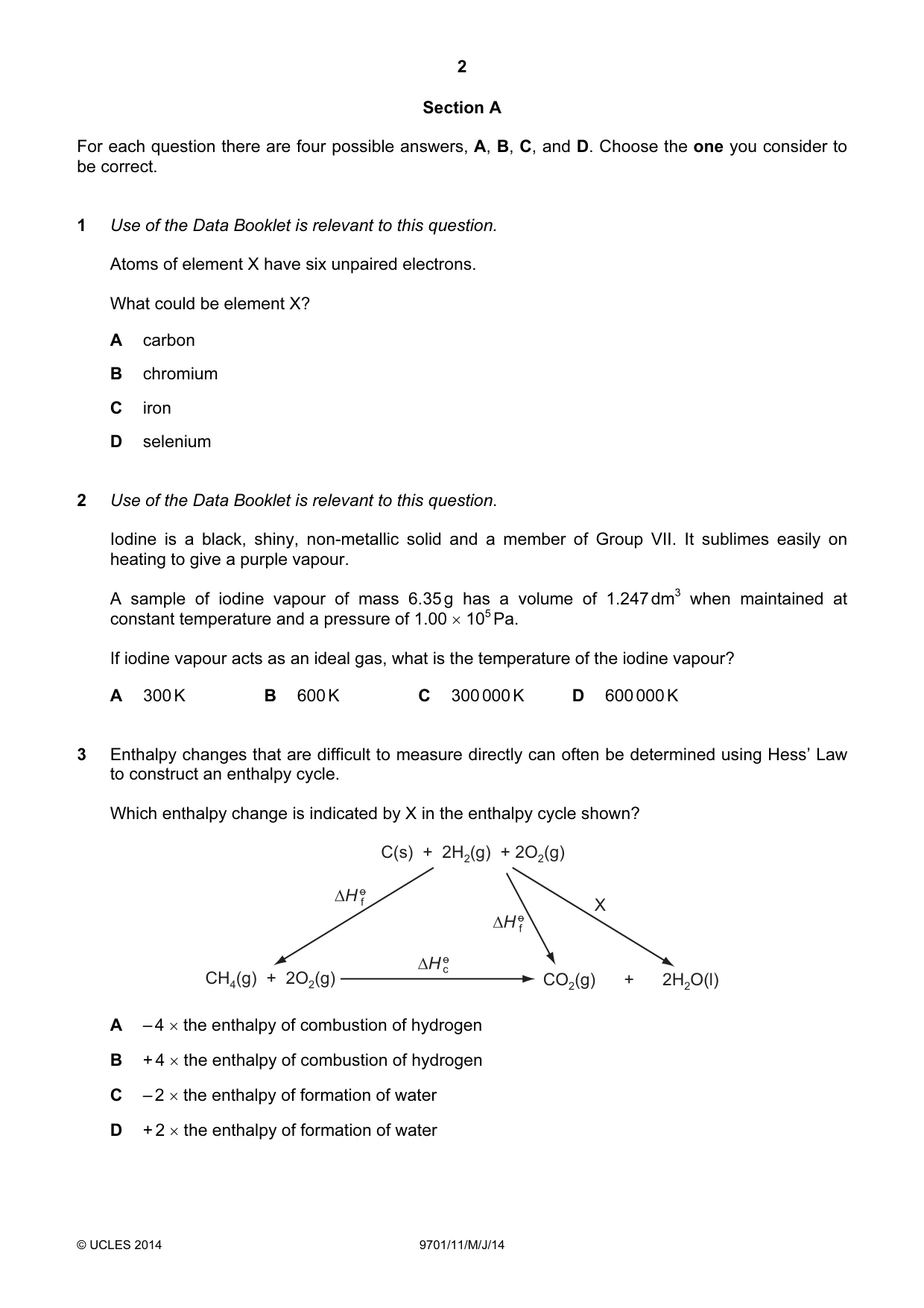
2 Use of the Data Booklet is relevant to this question. Iodine is a black, shiny, non-metallic solid and a member of Group VII. It sublimes easily on heating to give a purple vapour. A sample of iodine vapour of mass 6.35 g has a volume of 1.247 dm3 when maintained at constant temperature and a pressure of 1.00 × 10⁵ Pa. If iodine vapour acts as an ideal gas, what is the temperature of the iodine vapour? A 300 K B 600 K C 300 000 K D 600 000 K
Mark scheme: B
More questions on The gaseous state: ideal and real gases and pV = nRT
Q3 · Enthalpy changes that are difficult to measure directly can often be determined using…
3 Enthalpy changes that are difficult to measure directly can often be determined using Hess’ Law to construct an enthalpy cycle. Which enthalpy change is indicated by X in the enthalpy cycle shown? C(s) + 2H2(g) + 2O2(g) X CH4(g) + 2O2(g) CO2(g) + 2H2O(l) A – 4 × the enthalpy of combustion of hydrogen B + 4 × the enthalpy of combustion of hydrogen C – 2 × the enthalpy of formation of water D + 2 × the enthalpy of formation of water
Mark scheme: D
Q4 · The table shows the physical properties of four substances
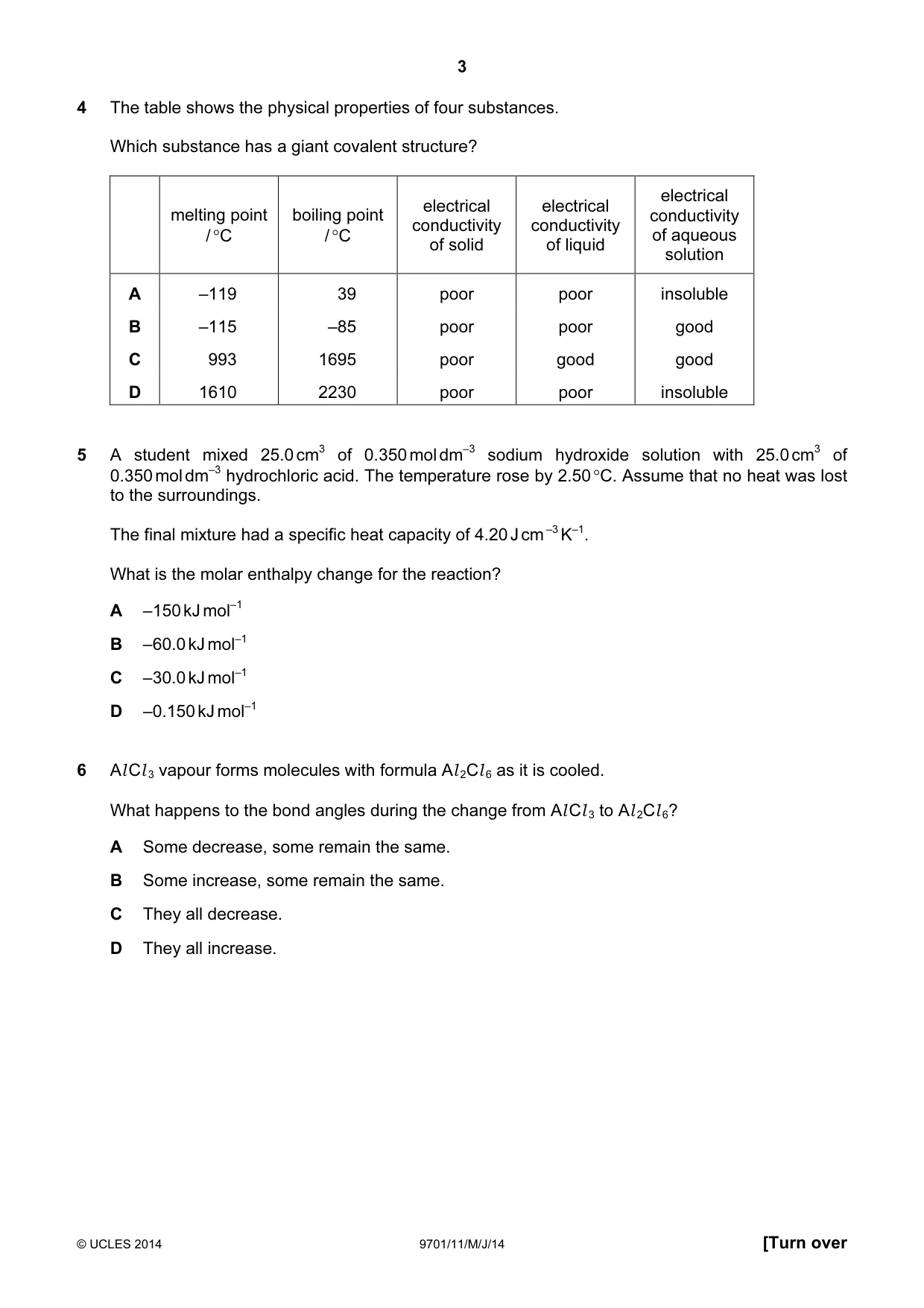
4 The table shows the physical properties of four substances. Which substance has a giant covalent structure? electrical electrical electrical melting point boiling point conductivity conductivity conductivity / °C / °C of aqueous of solid of liquid solution A –119 39 poor poor insoluble B –115 –85 poor poor good C 993 1695 poor good good D 1610 2230 poor poor insoluble
Mark scheme: D
Q5 · A student mixed 25.0 cm3 of 0.350 mol dm–3 sodium hydroxide solution with 25.0 cm3 of…
5 A student mixed 25.0 cm3 of 0.350 mol dm–3 sodium hydroxide solution with 25.0 cm3 of 0.350 mol dm–3 hydrochloric acid. The temperature rose by 2.50 °C. Assume that no heat was lost to the surroundings. The final mixture had a specific heat capacity of 4.20 J cm –3 K–1. What is the molar enthalpy change for the reaction? A –150 kJ mol–1 B –60.0 kJ mol–1 C –30.0 kJ mol–1 D –0.150 kJ mol–1
Mark scheme: B
Q6 · Al Cl 3 vapour forms molecules with formula Al 2Cl 6 as it is cooled
6 Al Cl 3 vapour forms molecules with formula Al 2Cl 6 as it is cooled. What happens to the bond angles during the change from Al Cl 3 to Al 2Cl 6? A Some decrease, some remain the same. B Some increase, some remain the same. C They all decrease. D They all increase.
Mark scheme: C
Q7 · The Contact process is used in the manufacture of sulfuric acid
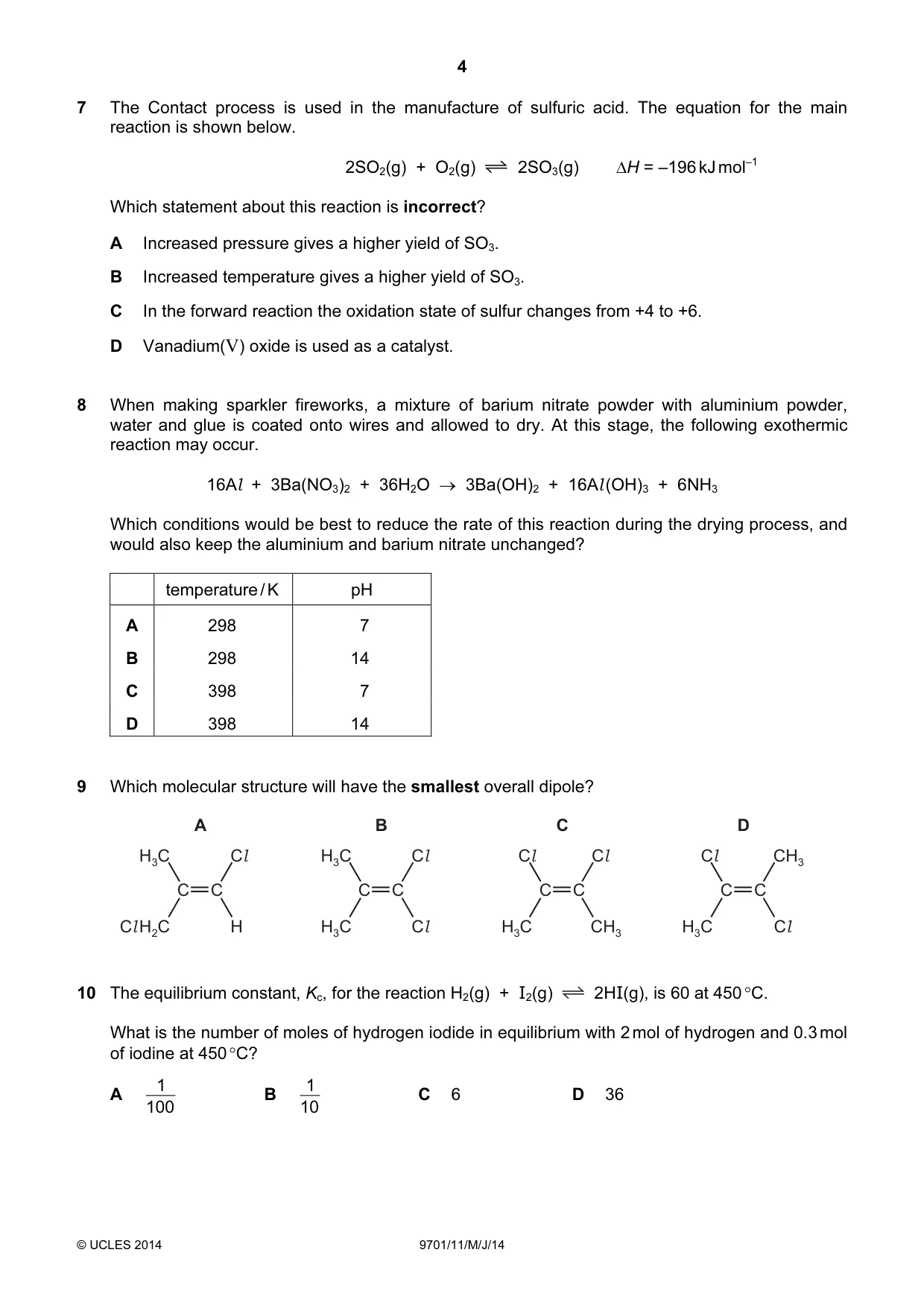
7 The Contact process is used in the manufacture of sulfuric acid. The equation for the main reaction is shown below. 2SO2(g) + O2(g) 2SO3(g) ∆H = –196 kJ mol–1 Which statement about this reaction is incorrect? A Increased pressure gives a higher yield of SO3. B Increased temperature gives a higher yield of SO3. C In the forward reaction the oxidation state of sulfur changes from +4 to +6. D Vanadium(V) oxide is used as a catalyst.
Mark scheme: B
More questions on Chemical equilibria: reversible reactions, dynamic equilibrium
Q8 · When making sparkler fireworks, a mixture of barium nitrate powder with aluminium powder…
8 When making sparkler fireworks, a mixture of barium nitrate powder with aluminium powder, water and glue is coated onto wires and allowed to dry. At this stage, the following exothermic reaction may occur. 16Al + 3Ba(NO3)2 + 36H2O → 3Ba(OH)2 + 16Al (OH)3 + 6NH3 Which conditions would be best to reduce the rate of this reaction during the drying process, and would also keep the aluminium and barium nitrate unchanged? temperature / K pH A 298 7 B 298 14 C 398 7 D 398 14
Mark scheme: A
Q9 · Which molecular structure will have the smallest overall dipole?
9 Which molecular structure will have the smallest overall dipole? A B C D H3C Cl H3C Cl Cl Cl Cl CH3 C C C C C C C C Cl H2C H H3C Cl H3C CH3 H3C Cl
Mark scheme: D
More questions on Intermolecular forces, electronegativity and bond properties
Q10 · The equilibrium constant, Kc, for the reaction H2(g) + I2(g) 2HI(g), is 60 at 450 °C
10 The equilibrium constant, Kc, for the reaction H2(g) + I2(g) 2HI(g), is 60 at 450 °C. What is the number of moles of hydrogen iodide in equilibrium with 2 mol of hydrogen and 0.3 mol of iodine at 450 °C? 1 1 A B C 6 D 36 100 10
Mark scheme: C
More questions on Chemical equilibria: reversible reactions, dynamic equilibrium
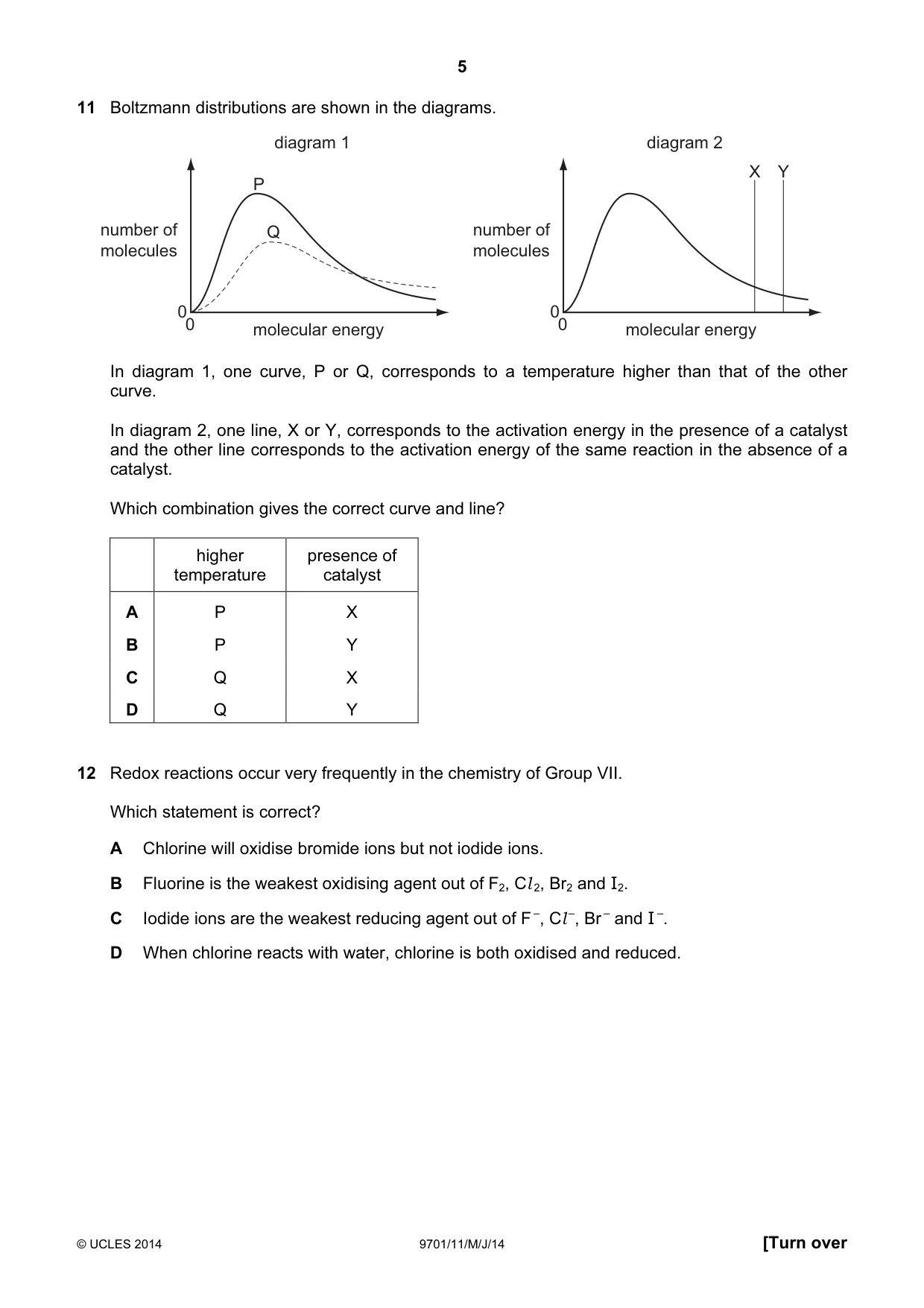
Q11 · Boltzmann distributions are shown in the diagrams
11 Boltzmann distributions are shown in the diagrams. diagram 1 diagram 2 X Y P number of Q number of molecules molecules 0 0 0 0 molecular energy molecular energy In diagram 1, one curve, P or Q, corresponds to a temperature higher than that of the other curve. In diagram 2, one line, X or Y, corresponds to the activation energy in the presence of a catalyst and the other line corresponds to the activation energy of the same reaction in the absence of a catalyst. Which combination gives the correct curve and line? higher presence of temperature catalyst A P X B P Y C Q X D Q Y
Mark scheme: C
More questions on Effect of temperature on reaction rates and the concept of activation energy
Q12 · Redox reactions occur very frequently in the chemistry of Group VII
12 Redox reactions occur very frequently in the chemistry of Group VII. Which statement is correct? A Chlorine will oxidise bromide ions but not iodide ions. B Fluorine is the weakest oxidising agent out of F2, Cl 2, Br2 and I2. C Iodide ions are the weakest reducing agent out of F –, Cl –, Br – and I –. D When chlorine reacts with water, chlorine is both oxidised and reduced.
Mark scheme: D
More questions on The chemical properties of the halogen elements and the hydrogen halides
Q13 · When equal volumes of saturated solutions of barium hydroxide and calcium hydroxide are…
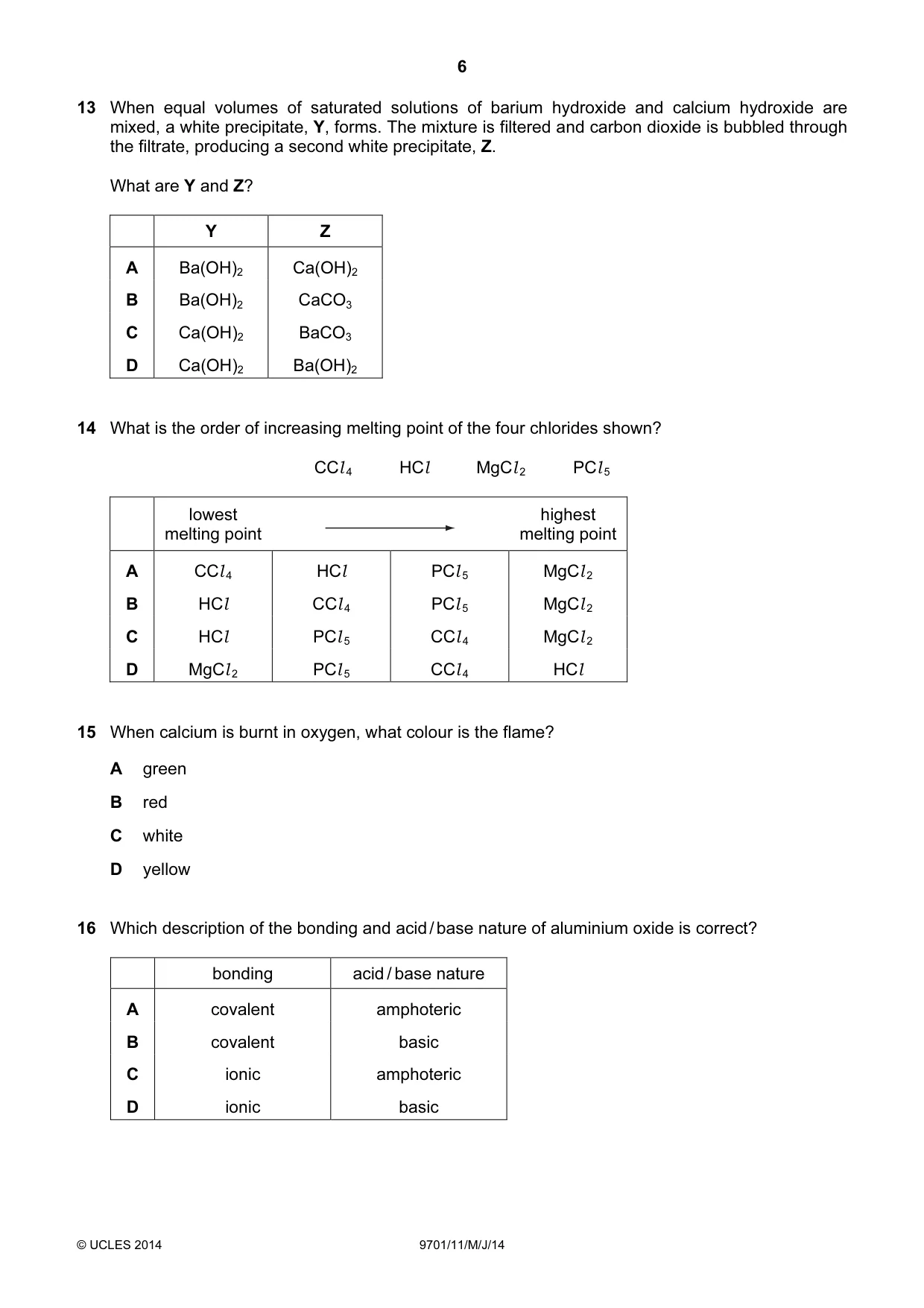
13 When equal volumes of saturated solutions of barium hydroxide and calcium hydroxide are mixed, a white precipitate, Y, forms. The mixture is filtered and carbon dioxide is bubbled through the filtrate, producing a second white precipitate, Z. What are Y and Z? Y Z A Ba(OH)2 Ca(OH)2 B Ba(OH)2 CaCO3 C Ca(OH)2 BaCO3 D Ca(OH)2 Ba(OH)2
Mark scheme: C
Q14 · What is the order of increasing melting point of the four chlorides shown?
14 What is the order of increasing melting point of the four chlorides shown? CCl 4 HCl MgCl 2 PCl 5 lowest highest melting point melting point A CCl 4 HCl PCl 5 MgCl 2 B HCl CCl 4 PCl 5 MgCl 2 C HCl PCl 5 CCl 4 MgCl 2 D MgCl 2 PCl 5 CCl 4 HCl
Mark scheme: B
More questions on Periodicity of physical properties of the elements in Period 3
Q15 · When calcium is burnt in oxygen, what colour is the flame?
15 When calcium is burnt in oxygen, what colour is the flame? A green B red C white D yellow
Mark scheme: B
Q16 · Which description of the bonding and acid / base nature of aluminium oxide is correct?
16 Which description of the bonding and acid / base nature of aluminium oxide is correct? bonding acid / base nature A covalent amphoteric B covalent basic C ionic amphoteric D ionic basic
Mark scheme: C
More questions on Periodicity of chemical properties of the elements in Period 3
Q17 · Group II nitrates undergo thermal decomposition according to the following equation
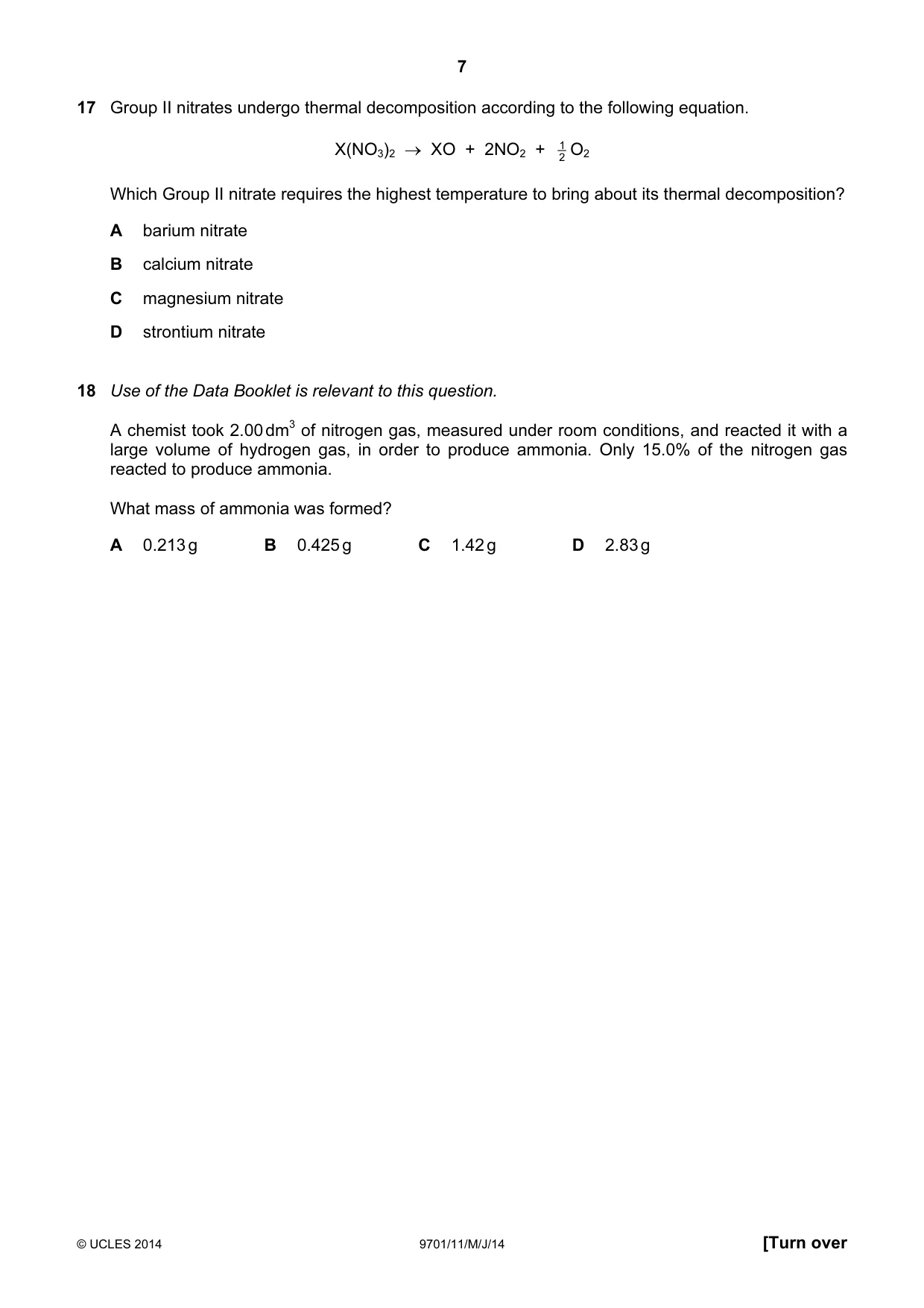
17 Group II nitrates undergo thermal decomposition according to the following equation. X(NO3)2 → XO + 2NO2 + 2 1 O2 Which Group II nitrate requires the highest temperature to bring about its thermal decomposition? A barium nitrate B calcium nitrate C magnesium nitrate D strontium nitrate
Mark scheme: A
Q18 · Use of the Data Booklet is relevant to this question
18 Use of the Data Booklet is relevant to this question. A chemist took 2.00 dm3 of nitrogen gas, measured under room conditions, and reacted it with a large volume of hydrogen gas, in order to produce ammonia. Only 15.0% of the nitrogen gas reacted to produce ammonia. What mass of ammonia was formed? A 0.213 g B 0.425 g C 1.42 g D 2.83 g
Mark scheme: B
More questions on Reacting masses and volumes (of solutions and gases)
Q19 · Use of the Data Booklet is relevant to this question
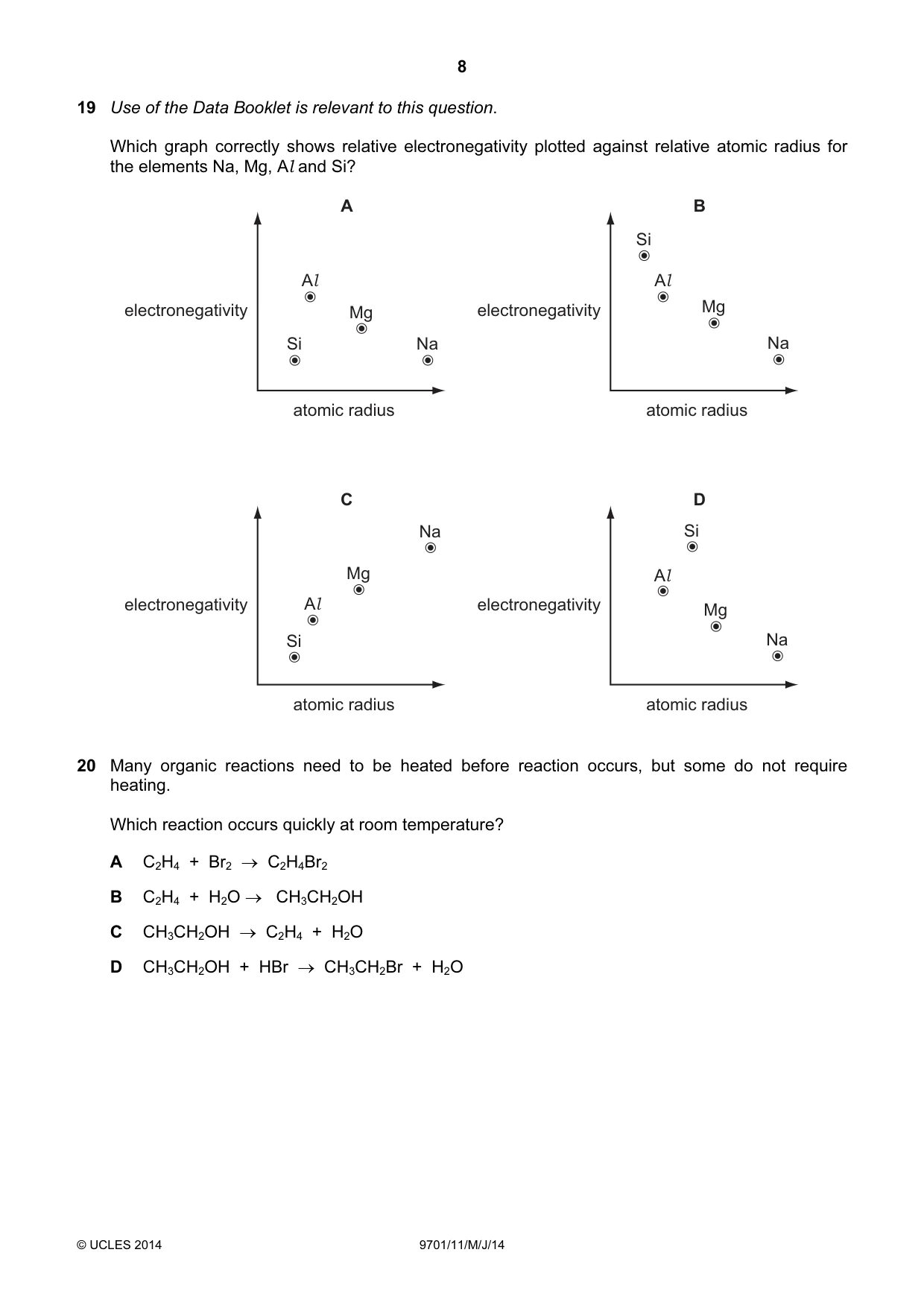
19 Use of the Data Booklet is relevant to this question. Which graph correctly shows relative electronegativity plotted against relative atomic radius for the elements Na, Mg, Al and Si? A B Si Al Al electronegativity Mg electronegativity Mg Si Na Na atomic radius atomic radius C D Na Si Mg Al electronegativity Al electronegativity Mg Si Na atomic radius atomic radius
Mark scheme: B
More questions on Periodicity of physical properties of the elements in Period 3
Q20 · Many organic reactions need to be heated before reaction occurs, but some do not require…
20 Many organic reactions need to be heated before reaction occurs, but some do not require heating. Which reaction occurs quickly at room temperature? A C2H4 + Br2 → C2H4Br2 B C2H4 + H2O → CH3CH2OH C CH3CH2OH → C2H4 + H2O D CH3CH2OH + HBr → CH3CH2Br + H2O
Mark scheme: A
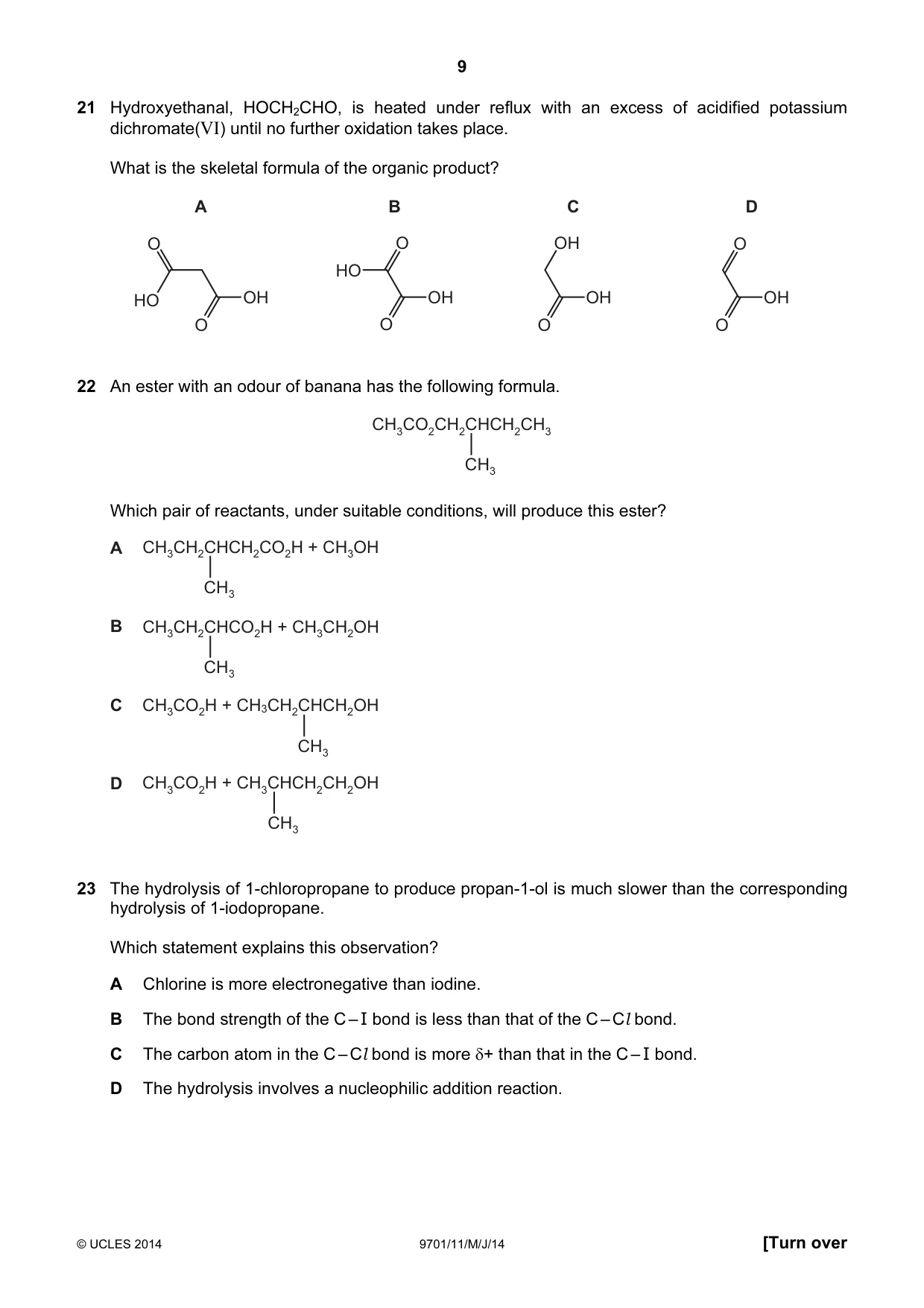
Q21 · Hydroxyethanal, HOCH2CHO, is heated under reflux with an excess of acidified potassium…
21 Hydroxyethanal, HOCH2CHO, is heated under reflux with an excess of acidified potassium dichromate(VI) until no further oxidation takes place. What is the skeletal formula of the organic product? A B C D O O OH O HO HO OH OH OH OH O O O O
Mark scheme: B
Q22 · An ester with an odour of banana has the following formula
22 An ester with an odour of banana has the following formula. CH3CO2CH2CHCH2CH3 CH3 Which pair of reactants, under suitable conditions, will produce this ester? A CH3CH2CHCH2CO2H + CH3OH CH3 B CH3CH2CHCO2H + CH3CH2OH CH3 C CH3CO2H + CH3CH2CHCH2OH CH3 D CH3CO2H + CH3CHCH2CH2OH CH3
Mark scheme: C
Q23 · The hydrolysis of 1-chloropropane to produce propan-1-ol is much slower than the…
23 The hydrolysis of 1-chloropropane to produce propan-1-ol is much slower than the corresponding hydrolysis of 1-iodopropane. Which statement explains this observation? A Chlorine is more electronegative than iodine. B The bond strength of the C – I bond is less than that of the C – Cl bond. C The carbon atom in the C – Cl bond is more δ+ than that in the C – I bond. D The hydrolysis involves a nucleophilic addition reaction.
Mark scheme: B
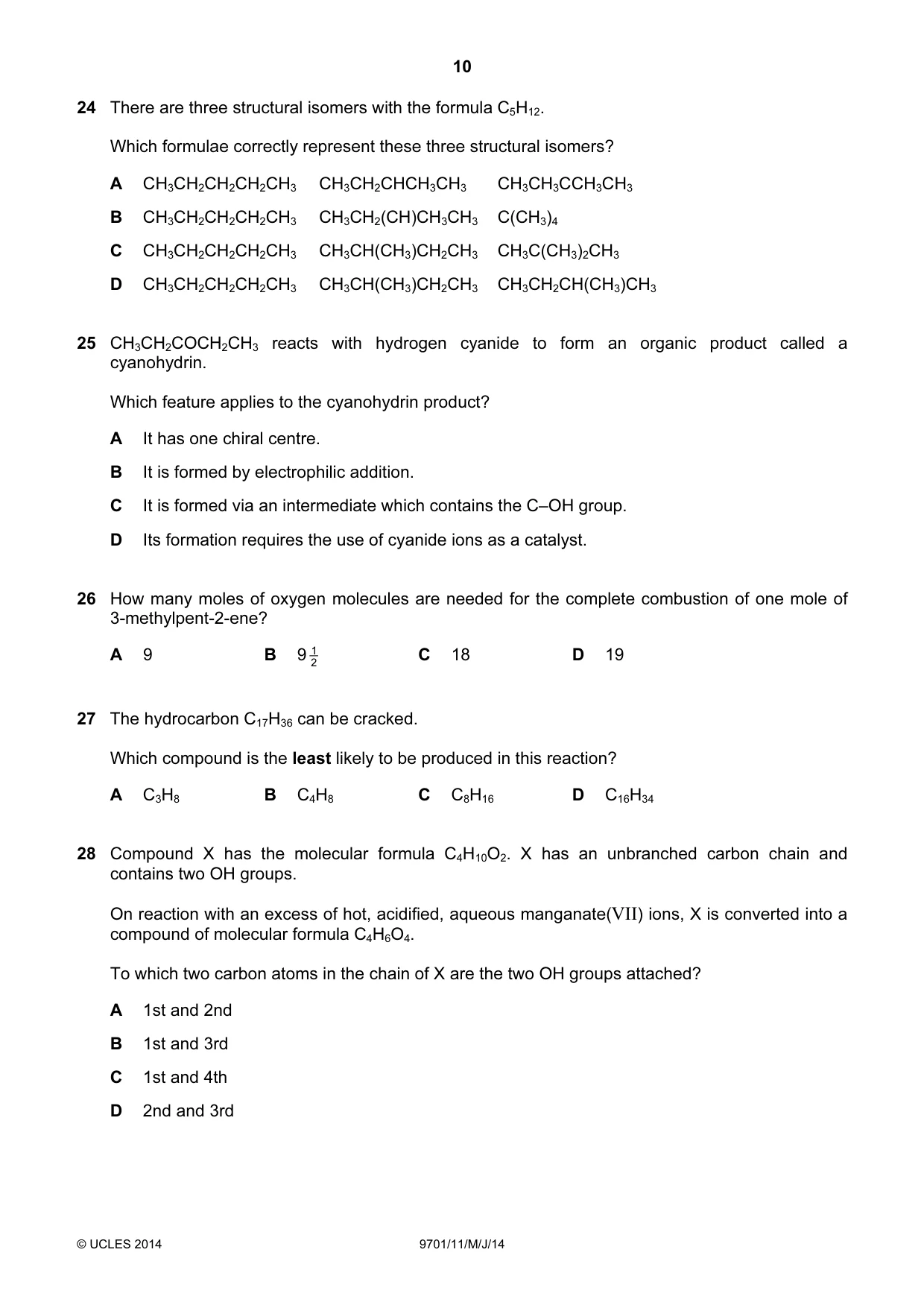
Q24 · There are three structural isomers with the formula C5H12
24 There are three structural isomers with the formula C5H12. Which formulae correctly represent these three structural isomers? A CH3CH2CH2CH2CH3 CH3CH2CHCH3CH3 CH3CH3CCH3CH3 B CH3CH2CH2CH2CH3 CH3CH2(CH)CH3CH3 C(CH3)4 C CH3CH2CH2CH2CH3 CH3CH(CH3)CH2CH3 CH3C(CH3)2CH3 D CH3CH2CH2CH2CH3 CH3CH(CH3)CH2CH3 CH3CH2CH(CH3)CH3
Mark scheme: C
More questions on Isomerism: structural isomerism and stereoisomerism
Q25 · CH3CH2COCH2CH3 reacts with hydrogen cyanide to form an organic product called a…
25 CH3CH2COCH2CH3 reacts with hydrogen cyanide to form an organic product called a cyanohydrin. Which feature applies to the cyanohydrin product? A It has one chiral centre. B It is formed by electrophilic addition. C It is formed via an intermediate which contains the C–OH group. D Its formation requires the use of cyanide ions as a catalyst.
Mark scheme: D
Q26 · How many moles of oxygen molecules are needed for the complete combustion of one mole of…
26 How many moles of oxygen molecules are needed for the complete combustion of one mole of 3-methylpent-2-ene? A 9 B 9 2 1 C 18 D 19
Mark scheme: A
Q27 · The hydrocarbon C17H36 can be cracked
27 The hydrocarbon C17H36 can be cracked. Which compound is the least likely to be produced in this reaction? A C3H8 B C4H8 C C8H16 D C16H34
Mark scheme: D
Q28 · Compound X has the molecular formula C4H10O2
28 Compound X has the molecular formula C4H10O2. X has an unbranched carbon chain and contains two OH groups. On reaction with an excess of hot, acidified, aqueous manganate(VII) ions, X is converted into a compound of molecular formula C4H6O4. To which two carbon atoms in the chain of X are the two OH groups attached? A 1st and 2nd B 1st and 3rd C 1st and 4th D 2nd and 3rd
Mark scheme: C
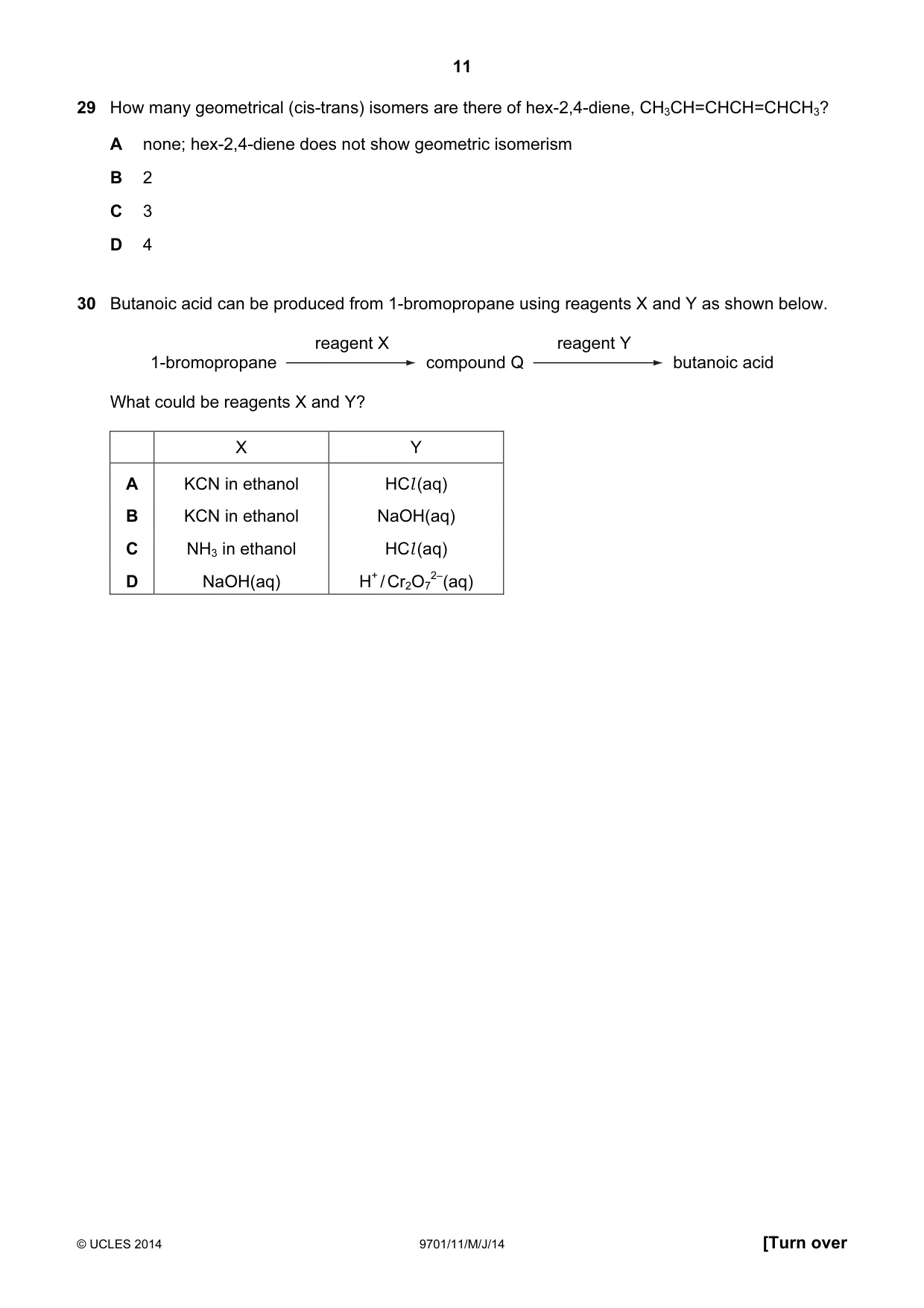
Q29 · How many geometrical (cis-trans) isomers are there of hex-2,4-diene, CH3CH=CHCH=CHCH3?
29 How many geometrical (cis-trans) isomers are there of hex-2,4-diene, CH3CH=CHCH=CHCH3? A none; hex-2,4-diene does not show geometric isomerism B 2 C 3 D 4
Mark scheme: C
More questions on Isomerism: structural isomerism and stereoisomerism
Q30 · Butanoic acid can be produced from 1-bromopropane using reagents X and Y as shown below
30 Butanoic acid can be produced from 1-bromopropane using reagents X and Y as shown below. reagent X reagent Y 1-bromopropane compound Q butanoic acid What could be reagents X and Y? X Y A KCN in ethanol HCl (aq) B KCN in ethanol NaOH(aq) C NH3 in ethanol HCl (aq) D NaOH(aq) H+ / Cr2O7 2–(aq)
Mark scheme: A
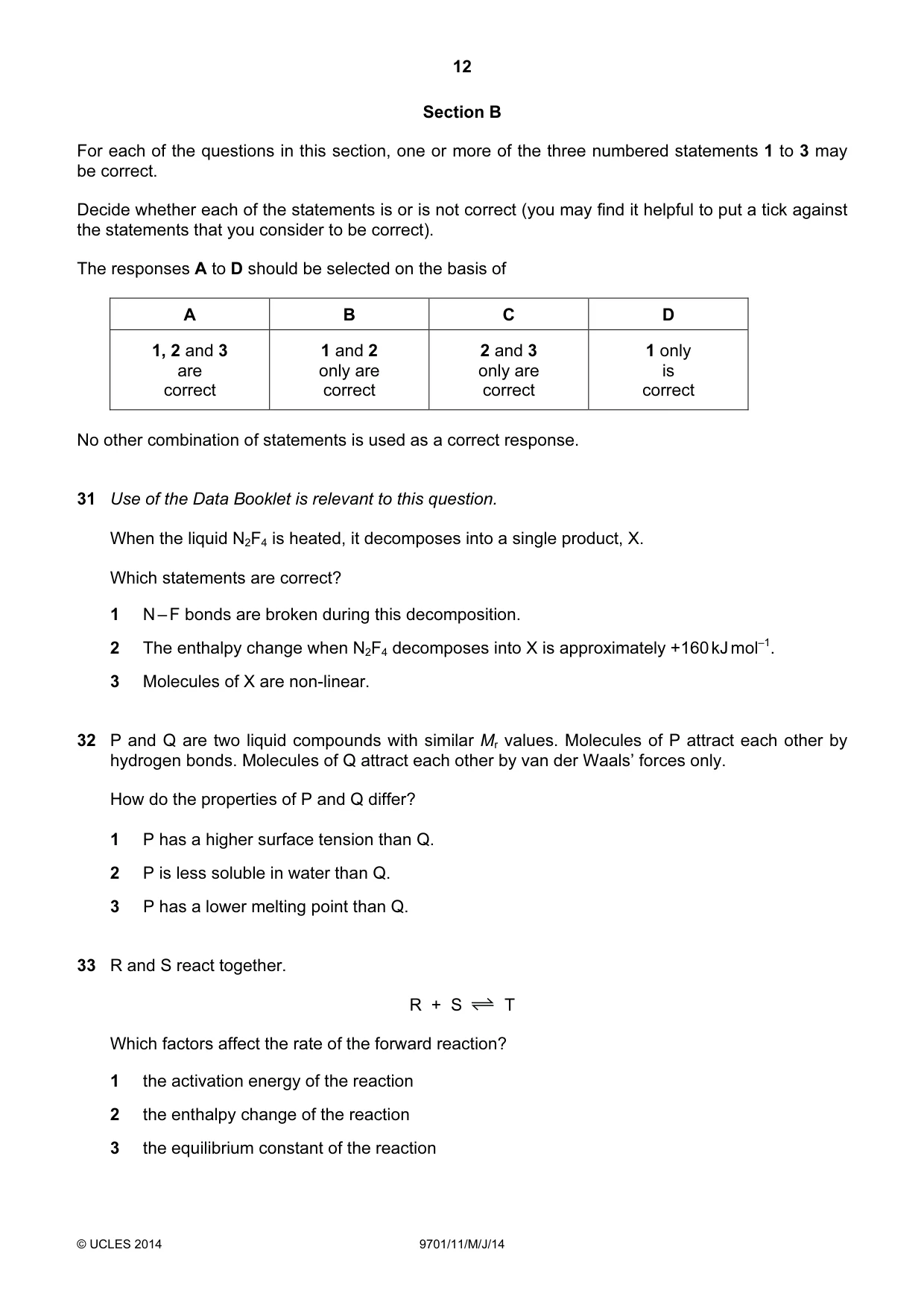
Q31 · Use of the Data Booklet is relevant to this question
31 Use of the Data Booklet is relevant to this question. When the liquid N2F4 is heated, it decomposes into a single product, X. Which statements are correct? 1 N – F bonds are broken during this decomposition. 2 The enthalpy change when N2F4 decomposes into X is approximately +160 kJ mol–1. 3 Molecules of X are non-linear.
Mark scheme: C
Q32 · P and Q are two liquid compounds with similar Mr values
32 P and Q are two liquid compounds with similar Mr values. Molecules of P attract each other by hydrogen bonds. Molecules of Q attract each other by van der Waals’ forces only. How do the properties of P and Q differ? 1 P has a higher surface tension than Q. 2 P is less soluble in water than Q. 3 P has a lower melting point than Q.
Mark scheme: D
More questions on Intermolecular forces, electronegativity and bond properties
Q33 · R and S react together
33 R and S react together. R + S T Which factors affect the rate of the forward reaction? 1 the activation energy of the reaction 2 the enthalpy change of the reaction 3 the equilibrium constant of the reaction
Mark scheme: D
Q34 · The Brønsted-Lowry theory describes acid and base character
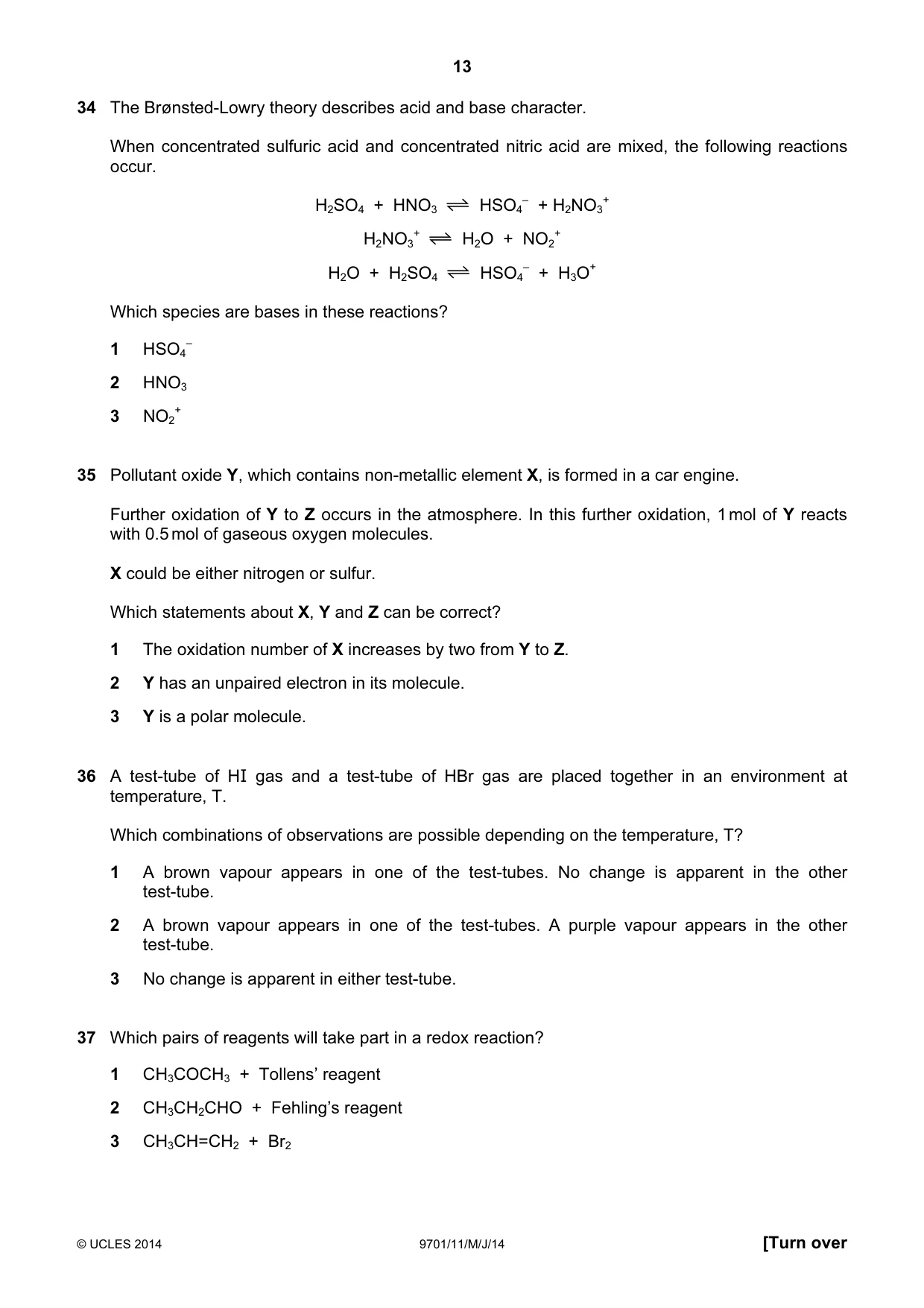
34 The Brønsted-Lowry theory describes acid and base character. When concentrated sulfuric acid and concentrated nitric acid are mixed, the following reactions occur. H2SO4 + HNO3 HSO4 – + H2NO3 + H2NO3 + H2O + NO2 + H2O + H2SO4 HSO4 – + H3O+ Which species are bases in these reactions? 1 HSO4 – 2 HNO3 3 NO2 +
Mark scheme: B
Q35 · Pollutant oxide Y, which contains non-metallic element X, is formed in a car engine
35 Pollutant oxide Y, which contains non-metallic element X, is formed in a car engine. Further oxidation of Y to Z occurs in the atmosphere. In this further oxidation, 1 mol of Y reacts with 0.5 mol of gaseous oxygen molecules. X could be either nitrogen or sulfur. Which statements about X, Y and Z can be correct? 1 The oxidation number of X increases by two from Y to Z. 2 Y has an unpaired electron in its molecule. 3 Y is a polar molecule.
Mark scheme: A
Q36 · A test-tube of HI gas and a test-tube of HBr gas are placed together in an environment at…
36 A test-tube of HI gas and a test-tube of HBr gas are placed together in an environment at temperature, T. Which combinations of observations are possible depending on the temperature, T? 1 A brown vapour appears in one of the test-tubes. No change is apparent in the other test-tube. 2 A brown vapour appears in one of the test-tubes. A purple vapour appears in the other test-tube. 3 No change is apparent in either test-tube.
Mark scheme: C
More questions on The chemical properties of the halogen elements and the hydrogen halides
Q37 · Which pairs of reagents will take part in a redox reaction?
37 Which pairs of reagents will take part in a redox reaction? 1 CH3COCH3 + Tollens’ reagent 2 CH3CH2CHO + Fehling’s reagent 3 CH3CH=CH2 + Br2
Mark scheme: C
Q38 · The molecule responsible for the pineapple flavour used in sweets is CH3CH2CH2CO2CH2CH3
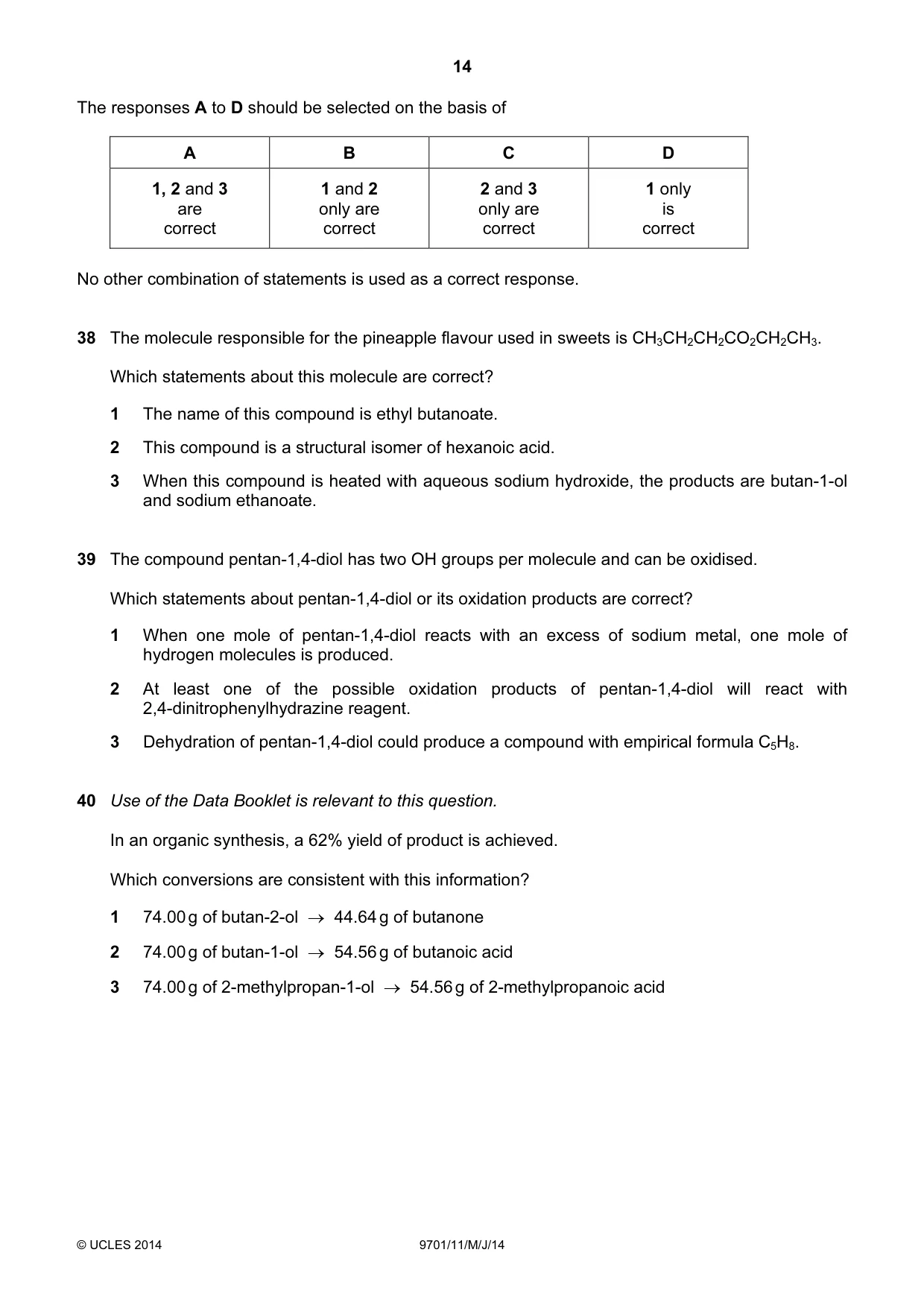
38 The molecule responsible for the pineapple flavour used in sweets is CH3CH2CH2CO2CH2CH3. Which statements about this molecule are correct? 1 The name of this compound is ethyl butanoate. 2 This compound is a structural isomer of hexanoic acid. 3 When this compound is heated with aqueous sodium hydroxide, the products are butan-1-ol and sodium ethanoate.
Mark scheme: B
Q39 · The compound pentan-1,4-diol has two OH groups per molecule and can be oxidised
39 The compound pentan-1,4-diol has two OH groups per molecule and can be oxidised. Which statements about pentan-1,4-diol or its oxidation products are correct? 1 When one mole of pentan-1,4-diol reacts with an excess of sodium metal, one mole of hydrogen molecules is produced. 2 At least one of the possible oxidation products of pentan-1,4-diol will react with 2,4-dinitrophenylhydrazine reagent. 3 Dehydration of pentan-1,4-diol could produce a compound with empirical formula C5H8.
Mark scheme: A
Q40 · Use of the Data Booklet is relevant to this question
40 Use of the Data Booklet is relevant to this question. In an organic synthesis, a 62% yield of product is achieved. Which conversions are consistent with this information? 1 74.00 g of butan-2-ol → 44.64 g of butanone 2 74.00 g of butan-1-ol → 54.56 g of butanoic acid 3 74.00 g of 2-methylpropan-1-ol → 54.56 g of 2-methylpropanoic acid
Mark scheme: A
What was in this paper
The subtopics covered by these 40 questions, and how many questions each got. Open one in a new tab to see every Cambridge question on it.
3Alcohols2Aldehydes and ketones2Alkenes2Chemical equilibria: reversible reactions, dynamic equilibrium2Esters2Intermolecular forces, electronegativity and bond properties2Isomerism: structural isomerism and stereoisomerism2Organic synthesis2Periodicity of physical properties of the elements in Period 32Rate of reaction2Shapes of molecules2The chemical properties of the halogen elements and the hydrogen halides2Alkanes1Bonding and structure1Brønsted–Lowry theory of acids and bases1Effect of temperature on reaction rates and the concept of activation energy1Electrons, energy levels and atomic orbitals1Enthalpy change, ΔH1Halogenoalkanes1Hess’s law1Nitriles and hydroxynitriles1Nitrogen and sulfur1Periodicity of chemical properties of the elements in Period 31Reacting masses and volumes (of solutions and gases)1The gaseous state: ideal and real gases and pV = nRT1What you needed in this session
Cambridge’s own grade thresholds for 2014 May/June, Paper 1 · Variant 1. A higher threshold means an easier paper — the bar moves with how the cohort did.