Cambridge A Level Chemistry 9701 — 2019 May/June Paper 1 · Variant 2
9701/12/M/J/19 · 40 questions · 40 marks · ≈45 min
The question paper and its mark scheme, free to read here and free to download. This is Cambridge’s own paper, exactly as it was sat.
Question paper16 pages

Mark scheme3 pages
Answers below. Sit the paper first if you are practising.
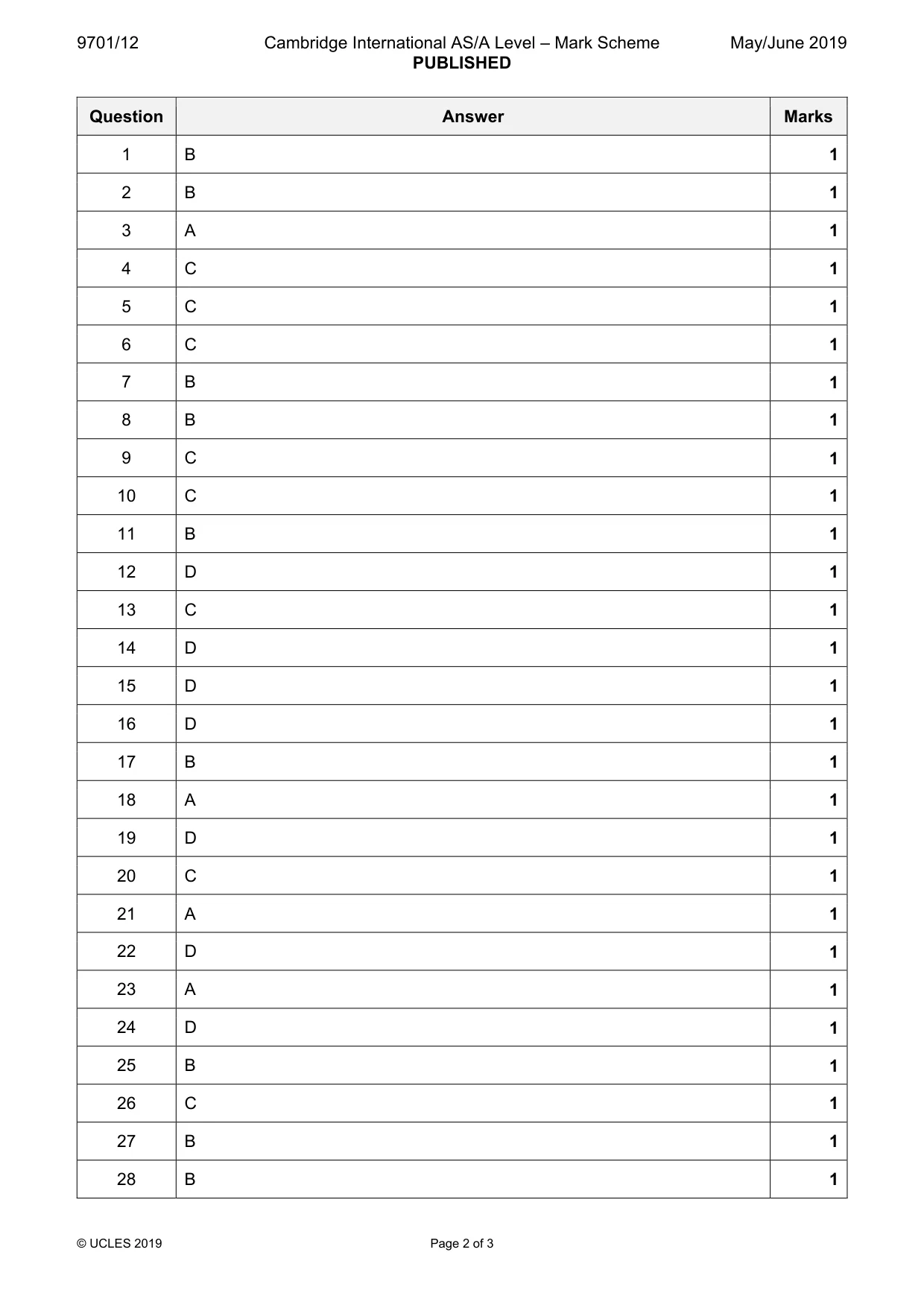
Questions as text
Q1 · The Boltzmann distribution of molecular energies in a sample of aqueous hydrogen peroxide…
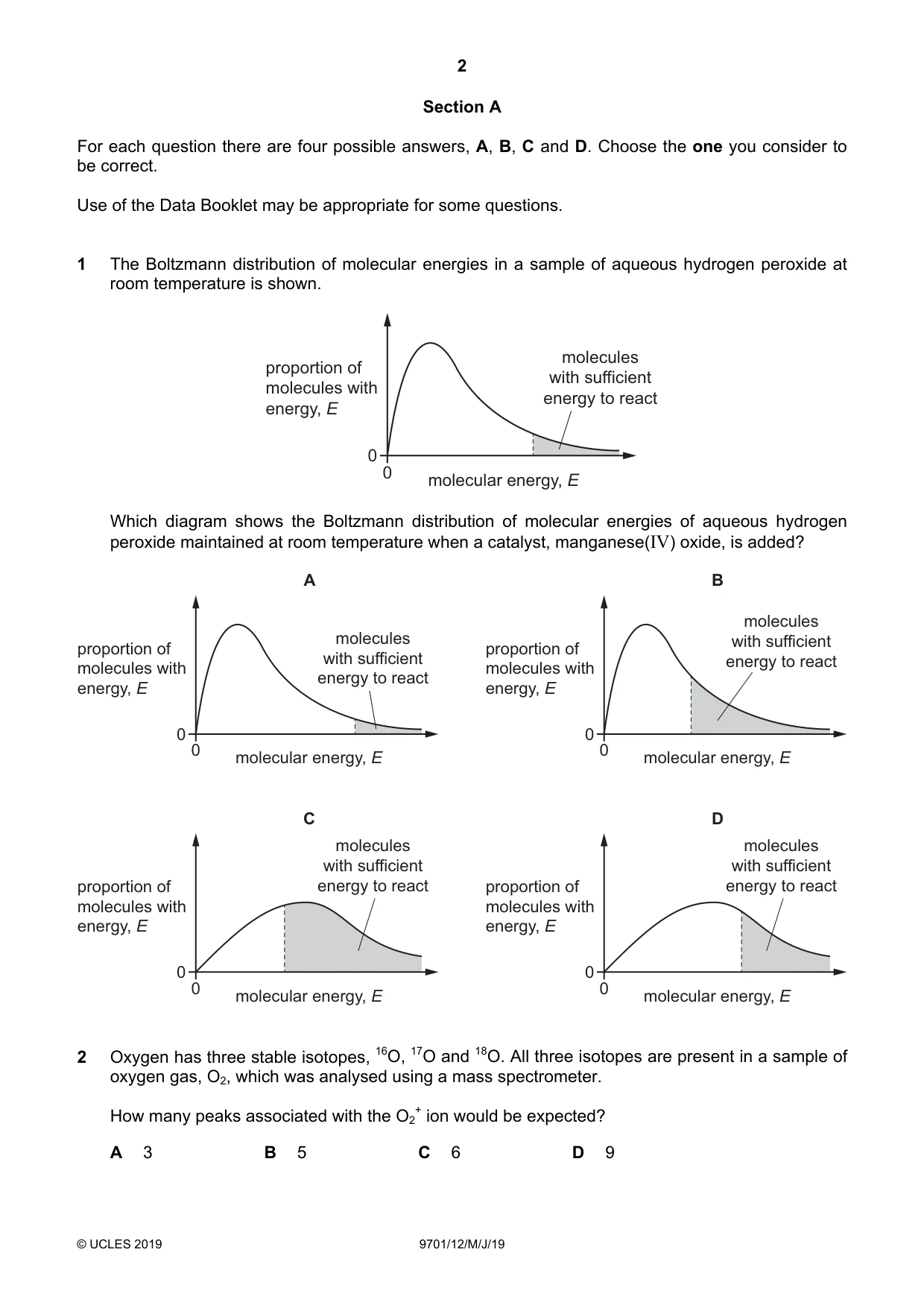
1 The Boltzmann distribution of molecular energies in a sample of aqueous hydrogen peroxide at room temperature is shown. molecules proportion of with sufficient molecules with energy to react energy, E 0 0 molecular energy, E Which diagram shows the Boltzmann distribution of molecular energies of aqueous hydrogen peroxide maintained at room temperature when a catalyst, manganese(IV) oxide, is added? A B molecules molecules with sufficient proportion of proportion of with sufficient energy to react molecules with molecules with energy to react energy, E energy, E 0 0 0 molecular energy, E 0 molecular energy, E C D molecules molecules with sufficient with sufficient proportion of energy to react proportion of energy to react molecules with molecules with energy, E energy, E 0 0 0 molecular energy, E 0 molecular energy, E
Mark scheme: B
More questions on Effect of temperature on reaction rates and the concept of activation energy
Q2 · Oxygen has three stable isotopes, 16O, 17O and 18O
2 Oxygen has three stable isotopes, 16O, 17O and 18O. All three isotopes are present in a sample of oxygen gas, O2, which was analysed using a mass spectrometer. How many peaks associated with the O2 + ion would be expected? A 3 B 5 C 6 D 9
Mark scheme: B
Q3 · The first eight successive ionisation energies for two elements of Period 3 of the…
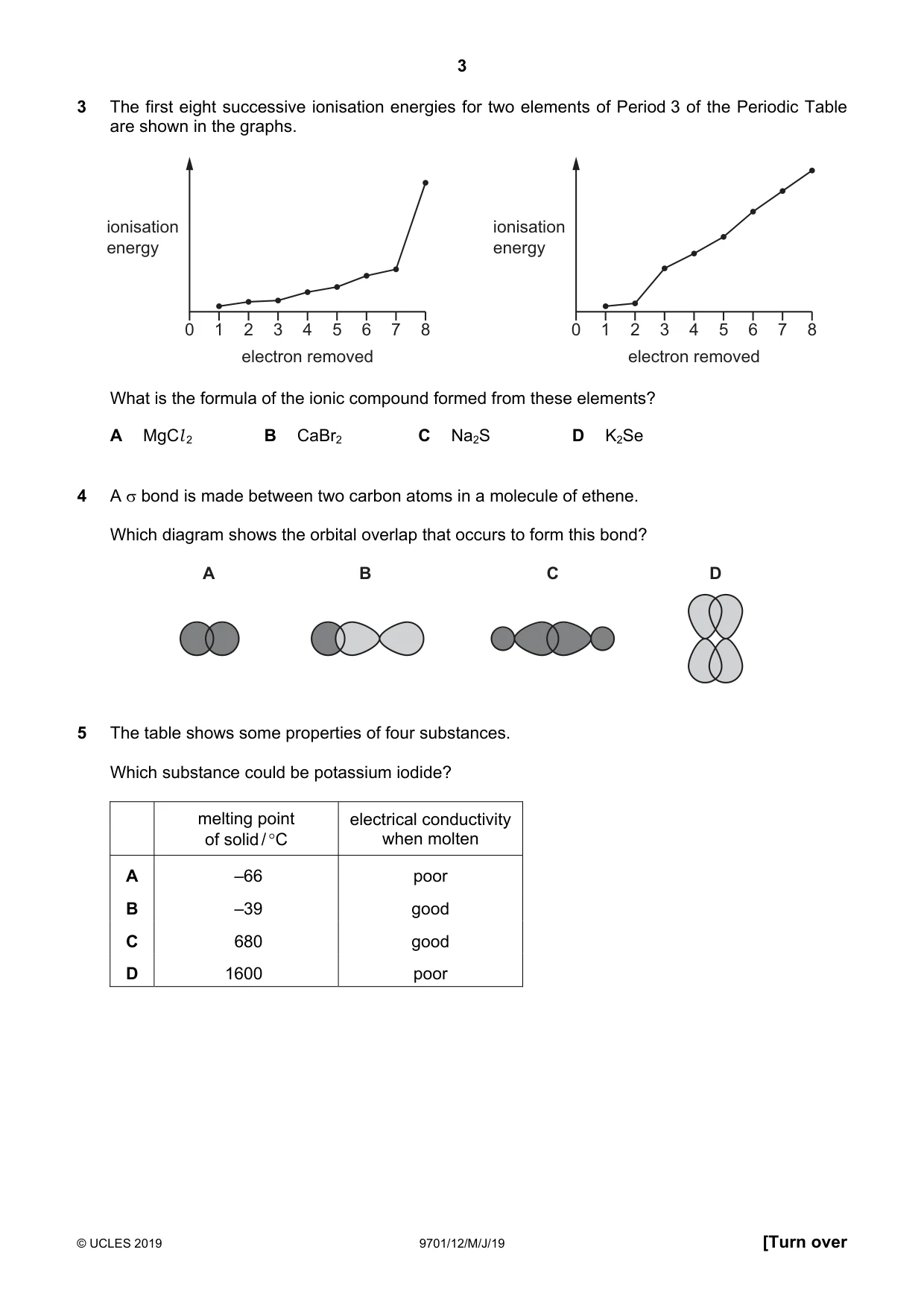
3 The first eight successive ionisation energies for two elements of Period 3 of the Periodic Table are shown in the graphs. ionisation ionisation energy energy 0 1 2 3 4 5 6 7 8 0 1 2 3 4 5 6 7 8 electron removed electron removed What is the formula of the ionic compound formed from these elements? A MgCl 2 B CaBr2 C Na2S D K2Se
Mark scheme: A
Q4 · A σ bond is made between two carbon atoms in a molecule of ethene
4 A σ bond is made between two carbon atoms in a molecule of ethene. Which diagram shows the orbital overlap that occurs to form this bond? A B C D
Mark scheme: C
More questions on Shapes of organic molecules; σ and π bonds
Q5 · The table shows some properties of four substances
5 The table shows some properties of four substances. Which substance could be potassium iodide? melting point electrical conductivity of solid / °C when molten A –66 poor B –39 good C 680 good D 1600 poor
Mark scheme: C
Q6 · X, Y and Z are all gases that behave ideally and react according to the equation shown
6 X, Y and Z are all gases that behave ideally and react according to the equation shown. X(g) + 2Y(g) → 2Z(g) When 3.0 mol of X and 3.0 mol of Y are placed inside a container with a volume of 1.0 dm3, they react to form the maximum amount of Z. The final temperature of the reaction vessel is 120 °C. What is the final pressure inside the reaction vessel? A 4.49 × 10⁶ Pa B 9.80 × 10⁶ Pa C 1.47 × 10⁷ Pa D 1.96 × 10⁷ Pa
Mark scheme: C
More questions on The gaseous state: ideal and real gases and pV = nRT
Q7 · Which pair of substances are both simple molecular?
7 Which pair of substances are both simple molecular? A C60 and graphene B C60 and iodine C graphene and graphite D graphite and iodine
Mark scheme: B
More questions on Intermolecular forces, electronegativity and bond properties
Q8 · A reaction pathway diagram is shown
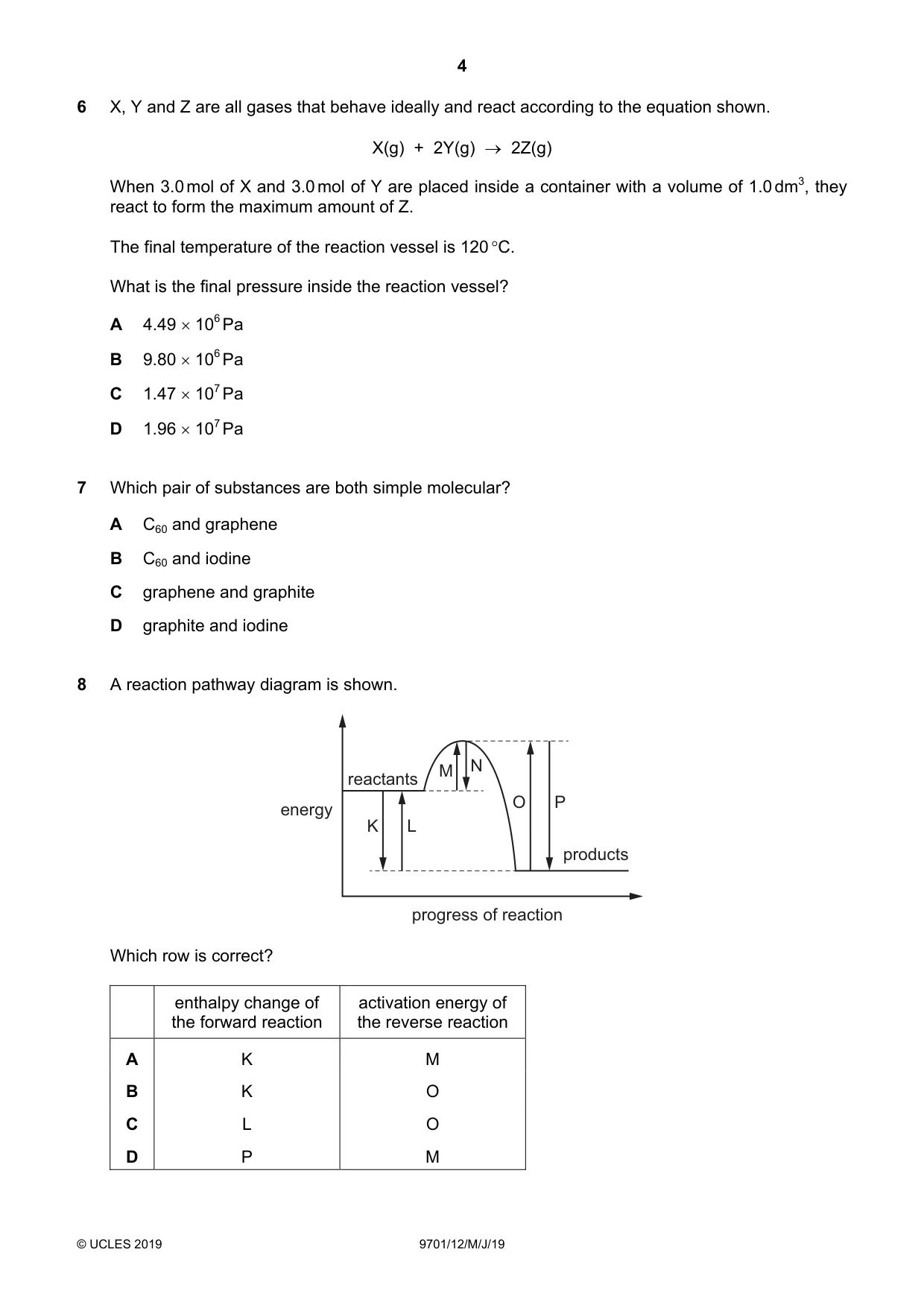
8 A reaction pathway diagram is shown. M N reactants energy O P K L products progress of reaction Which row is correct? enthalpy change of activation energy of the forward reaction the reverse reaction A K M B K O C L O D P M
Mark scheme: B
Q9 · X is either chlorine or an oxide of chlorine
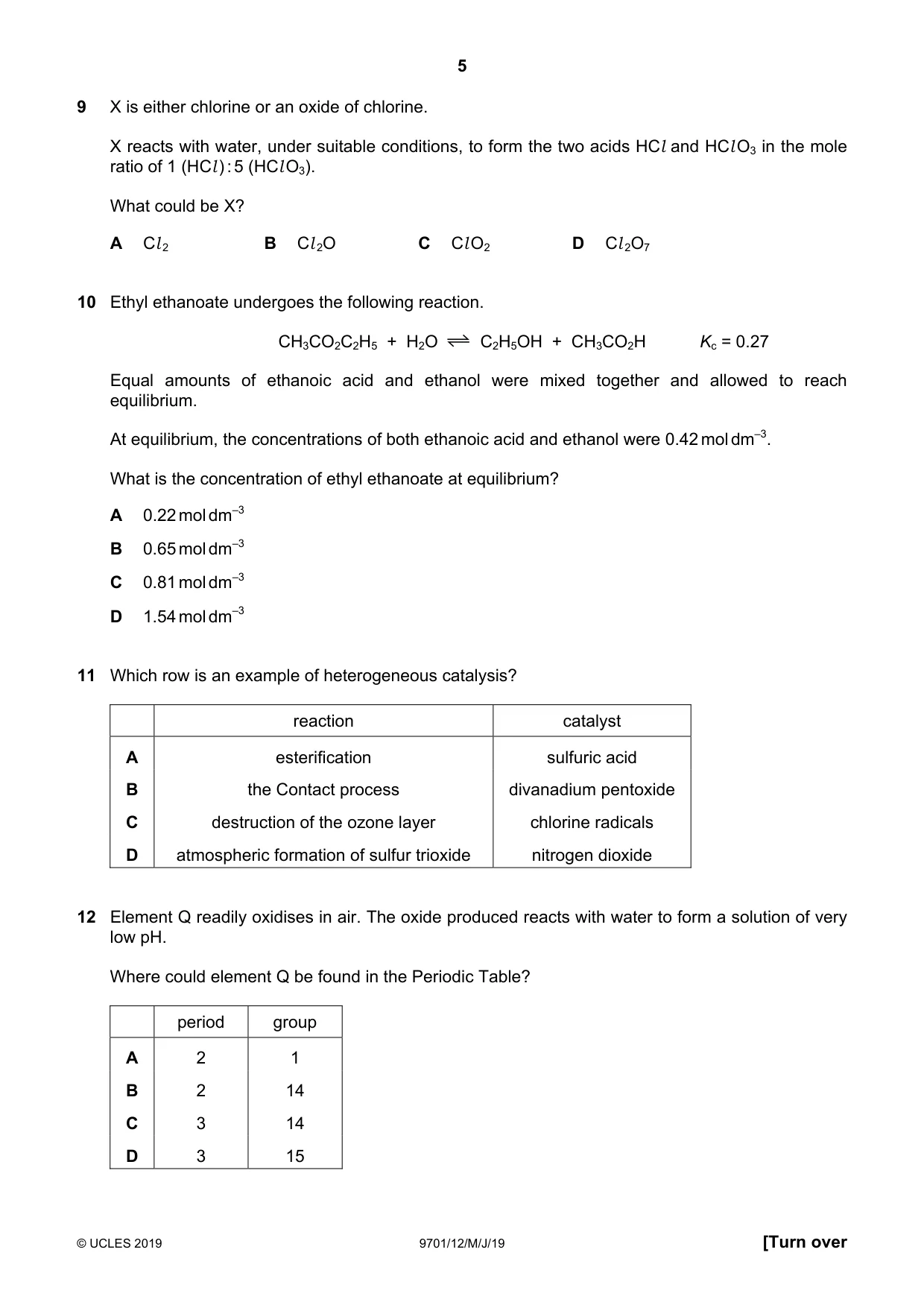
9 X is either chlorine or an oxide of chlorine. X reacts with water, under suitable conditions, to form the two acids HCl and HCl O3 in the mole ratio of 1 (HCl ) : 5 (HCl O3). What could be X? A Cl 2 B Cl 2O C Cl O2 D Cl 2O7
Mark scheme: C
More questions on Periodicity of chemical properties of the elements in Period 3
Q10 · Ethyl ethanoate undergoes the following reaction
10 Ethyl ethanoate undergoes the following reaction. CH3CO2C2H5 + H2O C2H5OH + CH3CO2H Kc = 0.27 Equal amounts of ethanoic acid and ethanol were mixed together and allowed to reach equilibrium. At equilibrium, the concentrations of both ethanoic acid and ethanol were 0.42 mol dm–3. What is the concentration of ethyl ethanoate at equilibrium? A 0.22 mol dm–3 B 0.65 mol dm–3 C 0.81 mol dm–3 D 1.54 mol dm–3
Mark scheme: C
More questions on Chemical equilibria: reversible reactions, dynamic equilibrium
Q11 · Which row is an example of heterogeneous catalysis?
11 Which row is an example of heterogeneous catalysis? reaction catalyst A esterification sulfuric acid B the Contact process divanadium pentoxide C destruction of the ozone layer chlorine radicals D atmospheric formation of sulfur trioxide nitrogen dioxide
Mark scheme: B
Q12 · Element Q readily oxidises in air
12 Element Q readily oxidises in air. The oxide produced reacts with water to form a solution of very low pH. Where could element Q be found in the Periodic Table? period group A 2 1 B 2 14 C 3 14 D 3 15
Mark scheme: D
More questions on Periodicity of chemical properties of the elements in Period 3
Q13 · The eight elements sodium to argon are in the same period of the Periodic Table
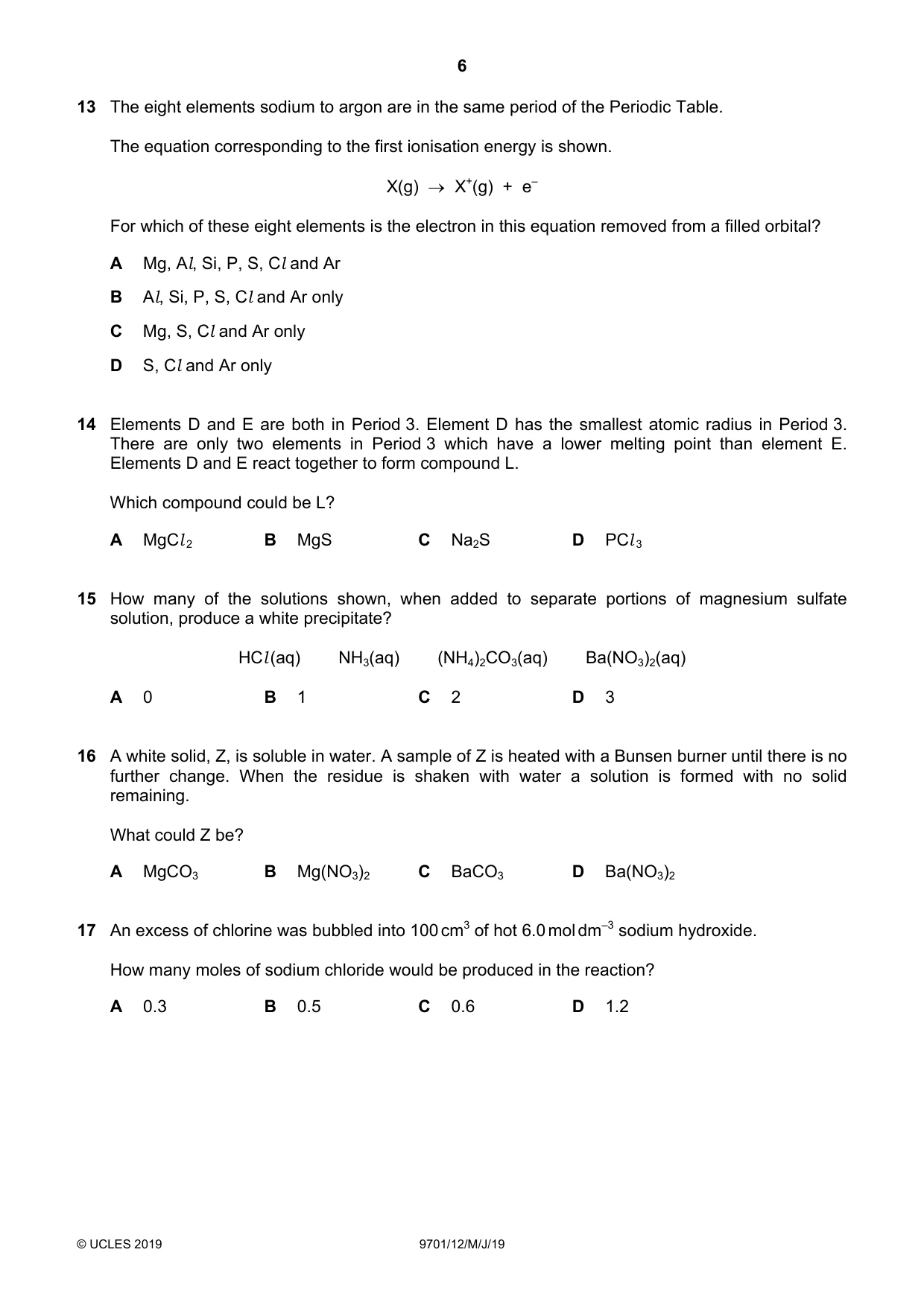
13 The eight elements sodium to argon are in the same period of the Periodic Table. The equation corresponding to the first ionisation energy is shown. X(g) → X+(g) + e– For which of these eight elements is the electron in this equation removed from a filled orbital? A Mg, Al, Si, P, S, Cl and Ar B Al, Si, P, S, Cl and Ar only C Mg, S, Cl and Ar only D S, Cl and Ar only
Mark scheme: C
More questions on Electrons, energy levels and atomic orbitals
Q14 · Elements D and E are both in Period 3
14 Elements D and E are both in Period 3. Element D has the smallest atomic radius in Period 3. There are only two elements in Period 3 which have a lower melting point than element E. Elements D and E react together to form compound L. Which compound could be L? A MgCl 2 B MgS C Na2S D PCl 3
Mark scheme: D
More questions on Periodicity of physical properties of the elements in Period 3
Q15 · How many of the solutions shown, when added to separate portions of magnesium sulfate…
15 How many of the solutions shown, when added to separate portions of magnesium sulfate solution, produce a white precipitate? HCl (aq) NH3(aq) (NH4)2CO3(aq) Ba(NO3)2(aq) A 0 B 1 C 2 D 3
Mark scheme: D
Q16 · A white solid, Z, is soluble in water
16 A white solid, Z, is soluble in water. A sample of Z is heated with a Bunsen burner until there is no further change. When the residue is shaken with water a solution is formed with no solid remaining. What could Z be? A MgCO3 B Mg(NO3)2 C BaCO3 D Ba(NO3)2
Mark scheme: D
Q17 · An excess of chlorine was bubbled into 100 cm3 of hot 6.0 mol dm–3 sodium hydroxide
17 An excess of chlorine was bubbled into 100 cm3 of hot 6.0 mol dm–3 sodium hydroxide. How many moles of sodium chloride would be produced in the reaction? A 0.3 B 0.5 C 0.6 D 1.2
Mark scheme: B
Q18 · Ammonium sulfate, (NH4)2SO4, and ammonium nitrate, NH4NO3, are used as fertilisers
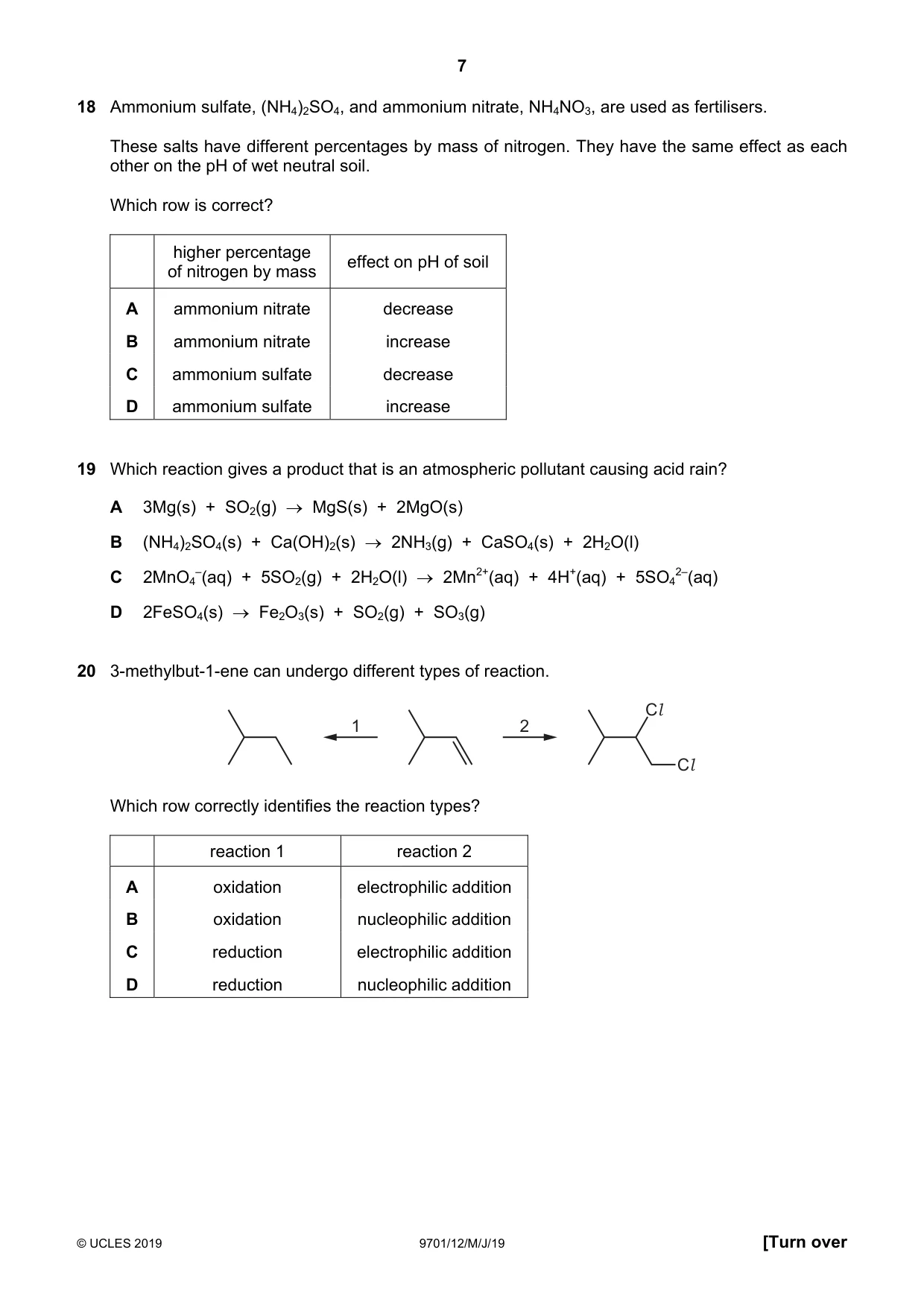
18 Ammonium sulfate, (NH4)2SO4, and ammonium nitrate, NH4NO3, are used as fertilisers. These salts have different percentages by mass of nitrogen. They have the same effect as each other on the pH of wet neutral soil. Which row is correct? higher percentage effect on pH of soil of nitrogen by mass A ammonium nitrate decrease B ammonium nitrate increase C ammonium sulfate decrease D ammonium sulfate increase
Mark scheme: A
Q19 · Which reaction gives a product that is an atmospheric pollutant causing acid rain?
19 Which reaction gives a product that is an atmospheric pollutant causing acid rain? A 3Mg(s) + SO2(g) → MgS(s) + 2MgO(s) B (NH4)2SO4(s) + Ca(OH)2(s) → 2NH3(g) + CaSO4(s) + 2H2O(l) C 2MnO4 –(aq) + 5SO2(g) + 2H2O(l) → 2Mn2+(aq) + 4H+(aq) + 5SO4 2–(aq) D 2FeSO4(s) → Fe2O3(s) + SO2(g) + SO3(g)
Mark scheme: D
Q20 · 3-methylbut-1-ene can undergo different types of reaction
20 3-methylbut-1-ene can undergo different types of reaction. Cl 1 2 Cl Which row correctly identifies the reaction types? reaction 1 reaction 2 A oxidation electrophilic addition B oxidation nucleophilic addition C reduction electrophilic addition D reduction nucleophilic addition
Mark scheme: C
Q21 · Compound X does not show cis-trans isomerism
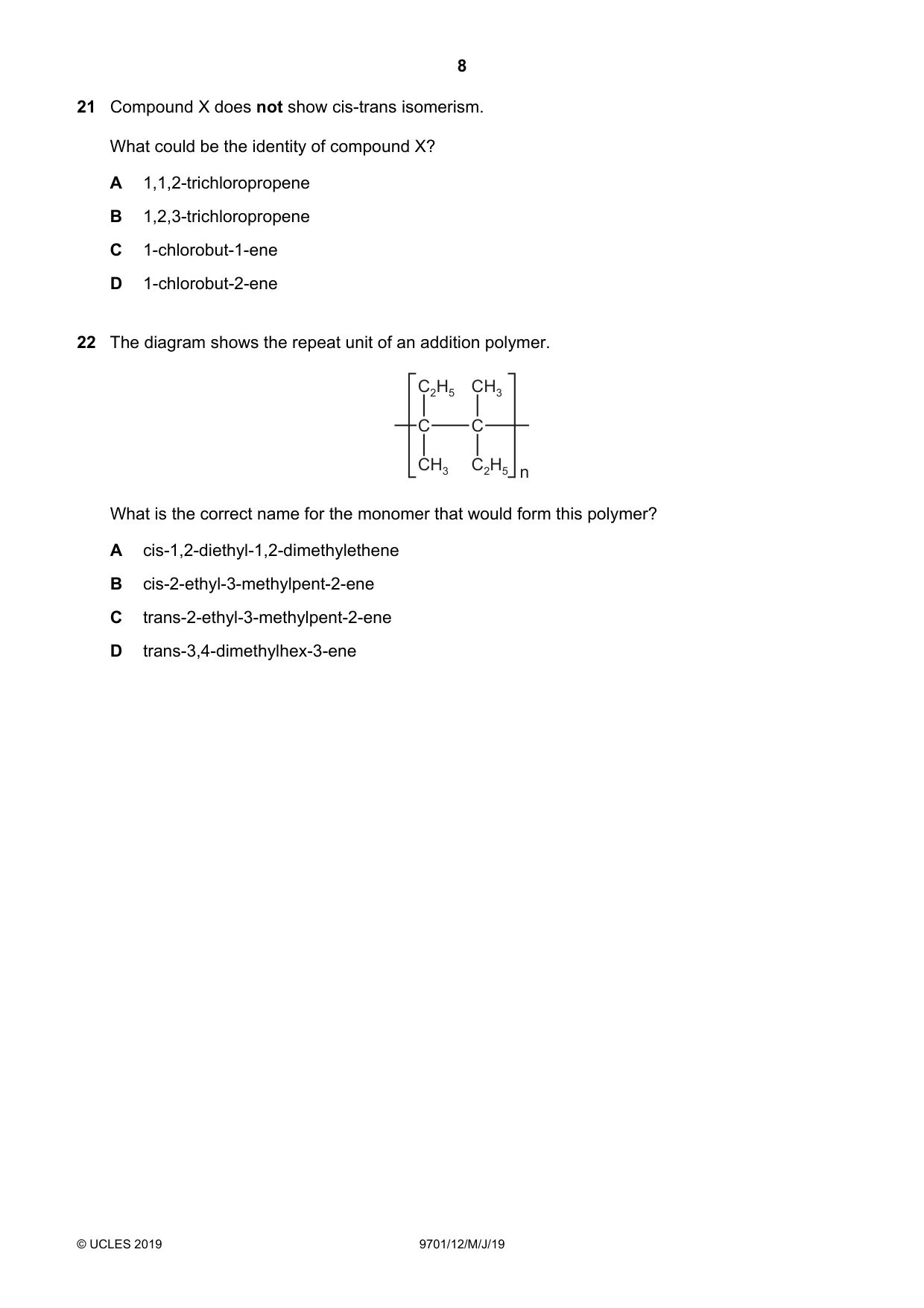
21 Compound X does not show cis-trans isomerism. What could be the identity of compound X? A 1,1,2-trichloropropene B 1,2,3-trichloropropene C 1-chlorobut-1-ene D 1-chlorobut-2-ene
Mark scheme: A
More questions on Isomerism: structural isomerism and stereoisomerism
Q22 · The diagram shows the repeat unit of an addition polymer
22 The diagram shows the repeat unit of an addition polymer. C2H5 CH3 C C CH3 C2H5 n What is the correct name for the monomer that would form this polymer? A cis-1,2-diethyl-1,2-dimethylethene B cis-2-ethyl-3-methylpent-2-ene C trans-2-ethyl-3-methylpent-2-ene D trans-3,4-dimethylhex-3-ene
Mark scheme: D
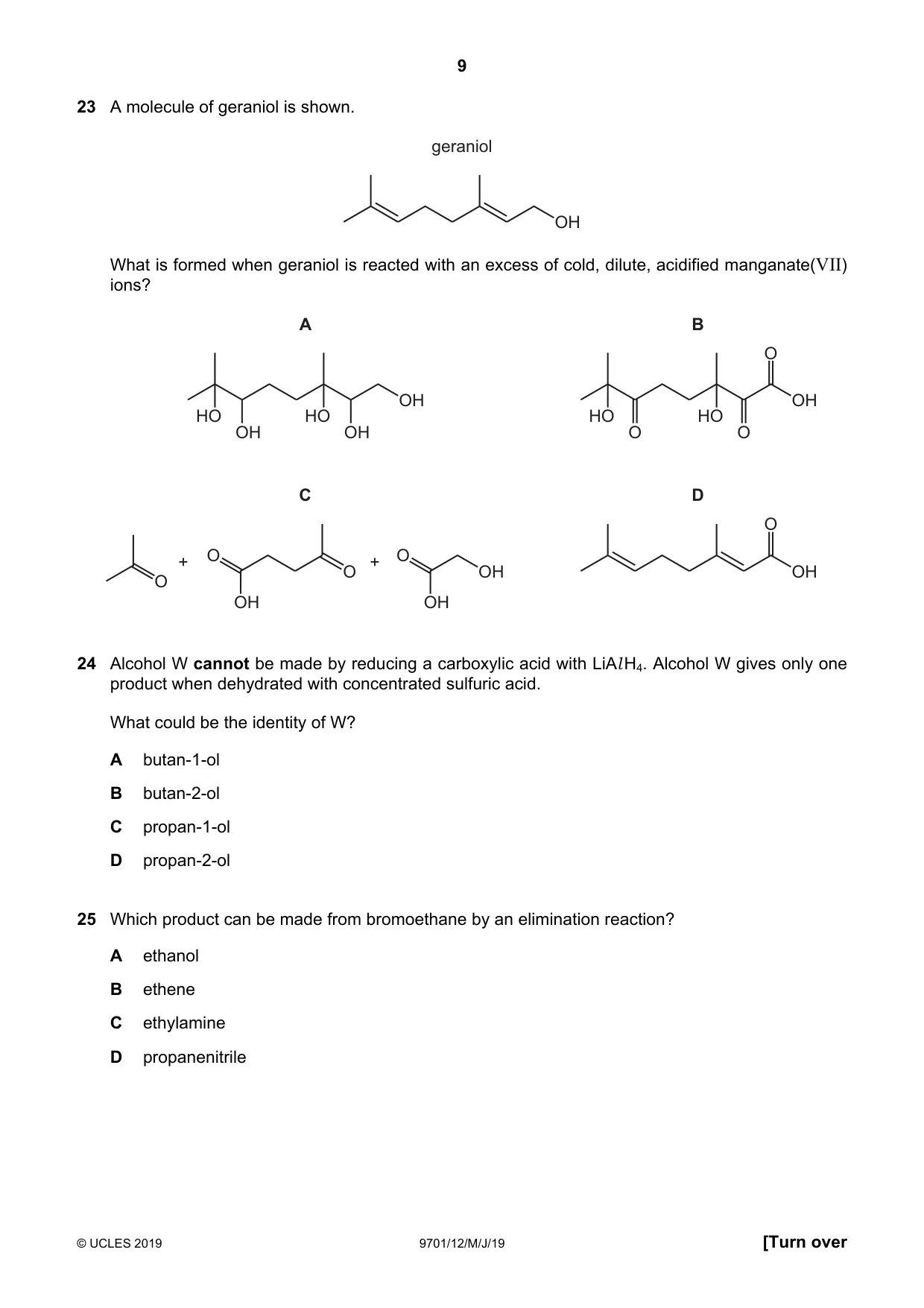
Q23 · A molecule of geraniol is shown
23 A molecule of geraniol is shown. geraniol OH What is formed when geraniol is reacted with an excess of cold, dilute, acidified manganate(VII) ions? A B O OH OH HO HO HO HO OH OH O O C D O + O + O O OH OH O OH OH
Mark scheme: A
Q24 · Alcohol W cannot be made by reducing a carboxylic acid with LiAl H4
24 Alcohol W cannot be made by reducing a carboxylic acid with LiAl H4. Alcohol W gives only one product when dehydrated with concentrated sulfuric acid. What could be the identity of W? A butan-1-ol B butan-2-ol C propan-1-ol D propan-2-ol
Mark scheme: D
Q25 · Which product can be made from bromoethane by an elimination reaction?
25 Which product can be made from bromoethane by an elimination reaction? A ethanol B ethene C ethylamine D propanenitrile
Mark scheme: B
Q26 · Propene, bromine and hydrogen bromide are mixed in the dark
26 Propene, bromine and hydrogen bromide are mixed in the dark. A number of products are formed, some in very small quantities. Which substance will not be present in the mixture of products? A 1-bromopropane B 2-bromopropane C 1,1-dibromopropane D 1,2-dibromopropane
Mark scheme: C
Q27 · Which reagent could be used to distinguish between ethanal and propanal?
27 Which reagent could be used to distinguish between ethanal and propanal? A 2,4-dinitrophenylhydrazine B I2 / NaOH(aq) C K2Cr2O7 / H2SO4(aq) D Tollens’ reagent
Mark scheme: B
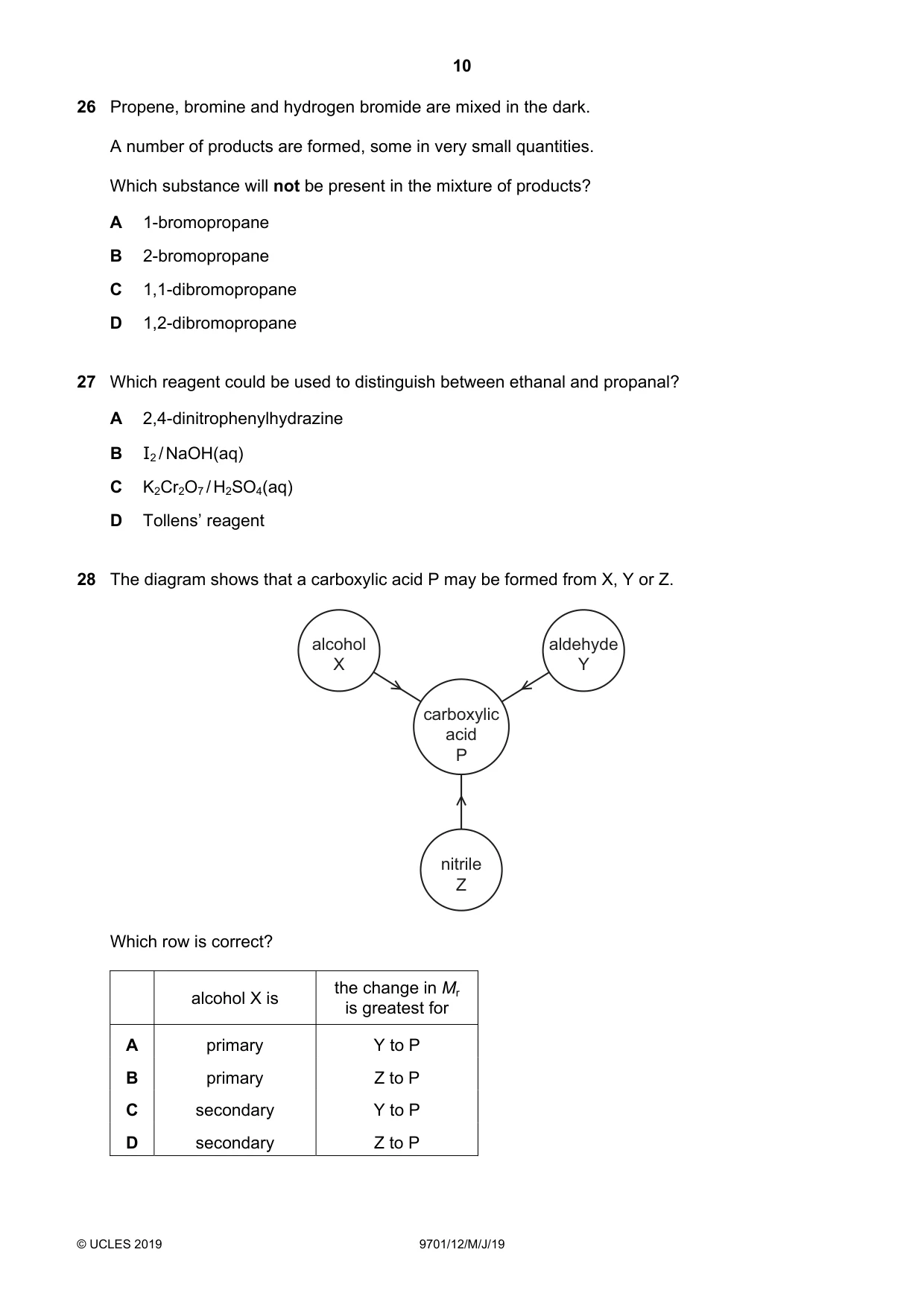
Q28 · The diagram shows that a carboxylic acid P may be formed from X, Y or Z
28 The diagram shows that a carboxylic acid P may be formed from X, Y or Z. alcohol aldehyde X Y carboxylic acid P nitrile Z Which row is correct? the change in Mr alcohol X is is greatest for A primary Y to P B primary Z to P C secondary Y to P D secondary Z to P
Mark scheme: B
Q29 · One molecule of compound R is shown
29 One molecule of compound R is shown. compound R H H H O H C C C O C H H H H What is the name of compound R and how does its boiling point compare with that of butanoic acid? name of R boiling point of R A methyl propanoate higher than butanoic acid B methyl propanoate lower than butanoic acid C propyl methanoate higher than butanoic acid D propyl methanoate lower than butanoic acid
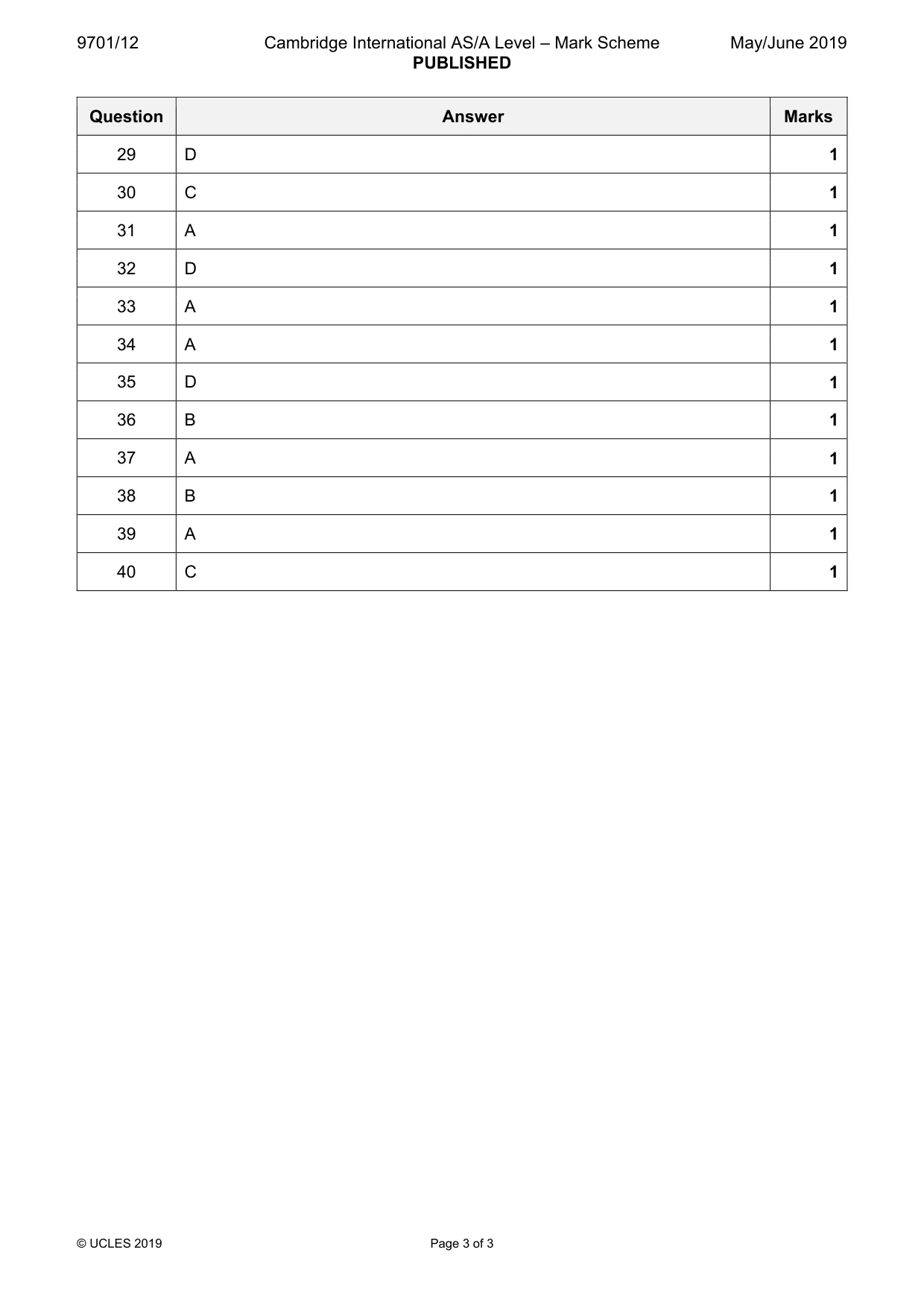
Mark scheme: D
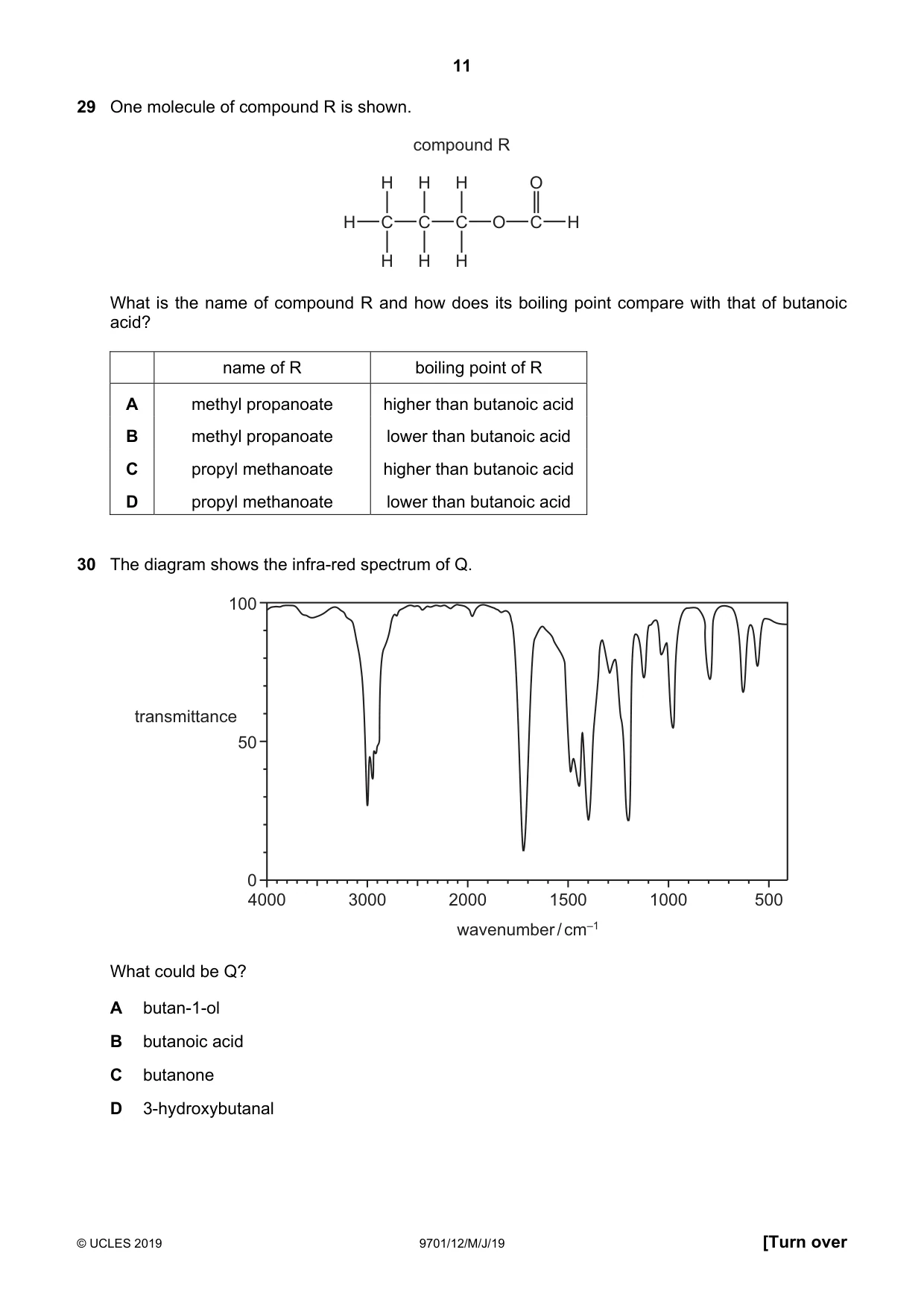
Q30 · The diagram shows the infra-red spectrum of Q
30 The diagram shows the infra-red spectrum of Q. 100 transmittance 50 0 4000 3000 2000 1500 1000 500 wavenumber / cm–1 What could be Q? A butan-1-ol B butanoic acid C butanone D 3-hydroxybutanal Section B
Mark scheme: C
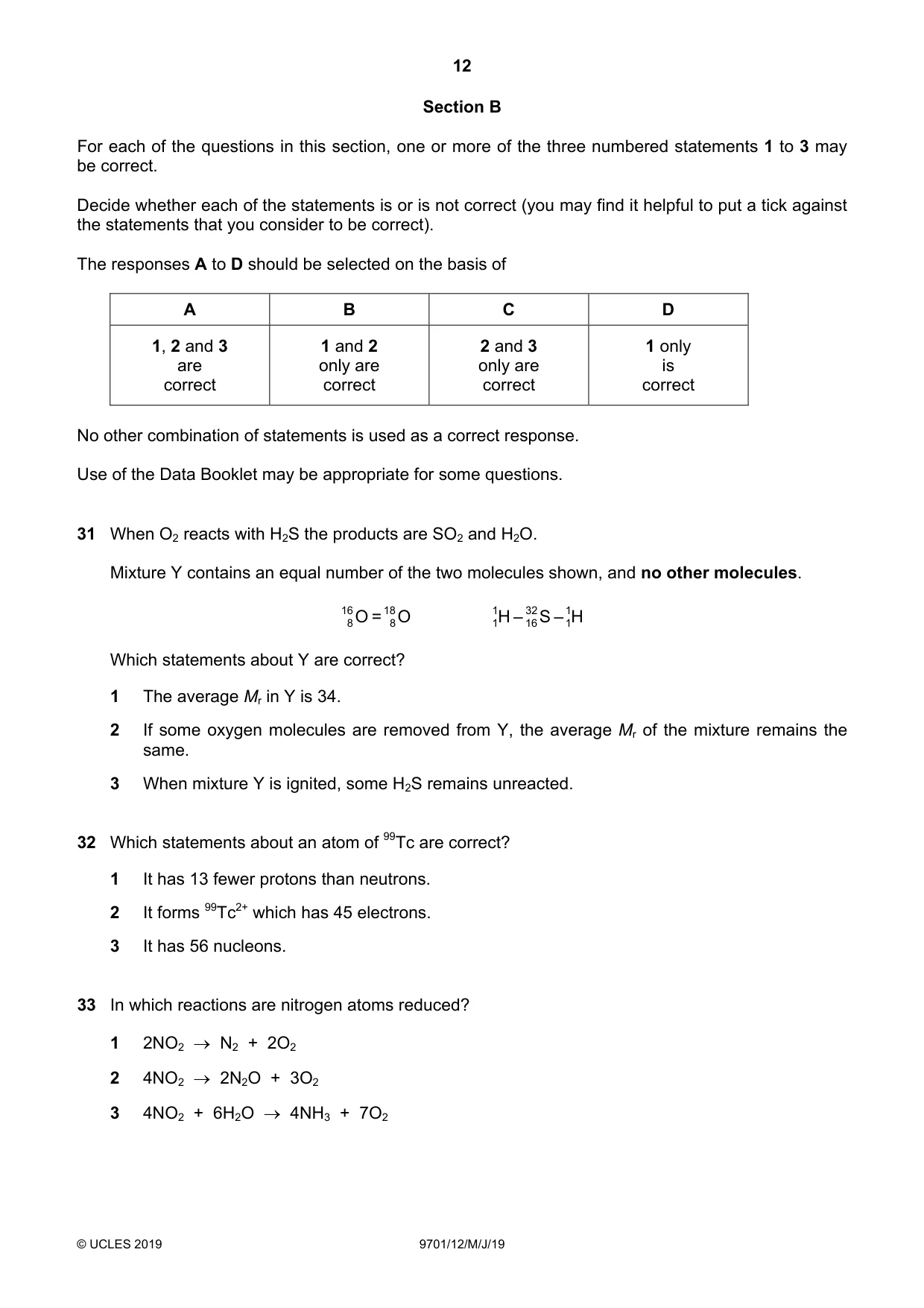
Q31 · When O2 reacts with H2S the products are SO2 and H2O
31 When O2 reacts with H2S the products are SO2 and H2O. Mixture Y contains an equal number of the two molecules shown, and no other molecules. 16 O = 18 O H 1 – 32 S – H 1 8 8 1 16 1 Which statements about Y are correct? 1 The average Mr in Y is 34. 2 If some oxygen molecules are removed from Y, the average Mr of the mixture remains the same. 3 When mixture Y is ignited, some H2S remains unreacted.
Mark scheme: A
Q32 · Which statements about an atom of 99Tc are correct?
32 Which statements about an atom of 99Tc are correct? 1 It has 13 fewer protons than neutrons. 2 It forms 99Tc2+ which has 45 electrons. 3 It has 56 nucleons.
Mark scheme: D
Q33 · In which reactions are nitrogen atoms reduced?
33 In which reactions are nitrogen atoms reduced? 1 2NO2 → N2 + 2O2 2 4NO2 → 2N2O + 3O2 3 4NO2 + 6H2O → 4NH3 + 7O2
Mark scheme: A
Q34 · The manufacture of ammonia from nitrogen and hydrogen is an important industrial process
34 The manufacture of ammonia from nitrogen and hydrogen is an important industrial process. Which of the following would leave the equilibrium constant, Kp, for the formation of ammonia unchanged? 1 addition of an iron catalyst 2 addition of ammonia 3 an increase in pressure
Mark scheme: A
More questions on Chemical equilibria: reversible reactions, dynamic equilibrium
Q35 · Which reactions involving calcium and its compounds produce two gaseous products?
35 Which reactions involving calcium and its compounds produce two gaseous products? 1 heating solid anhydrous calcium nitrate 2 heating solid anhydrous calcium carbonate 3 adding calcium metal to water
Mark scheme: D
Q36 · A small quantity of hot, concentrated sulfuric acid is added separately to solid samples…
36 A small quantity of hot, concentrated sulfuric acid is added separately to solid samples of potassium halides, KX. Which potassium halides react and produce a mixture of products that include a halogen, X2? 1 potassium iodide 2 potassium bromide 3 potassium chloride
Mark scheme: B
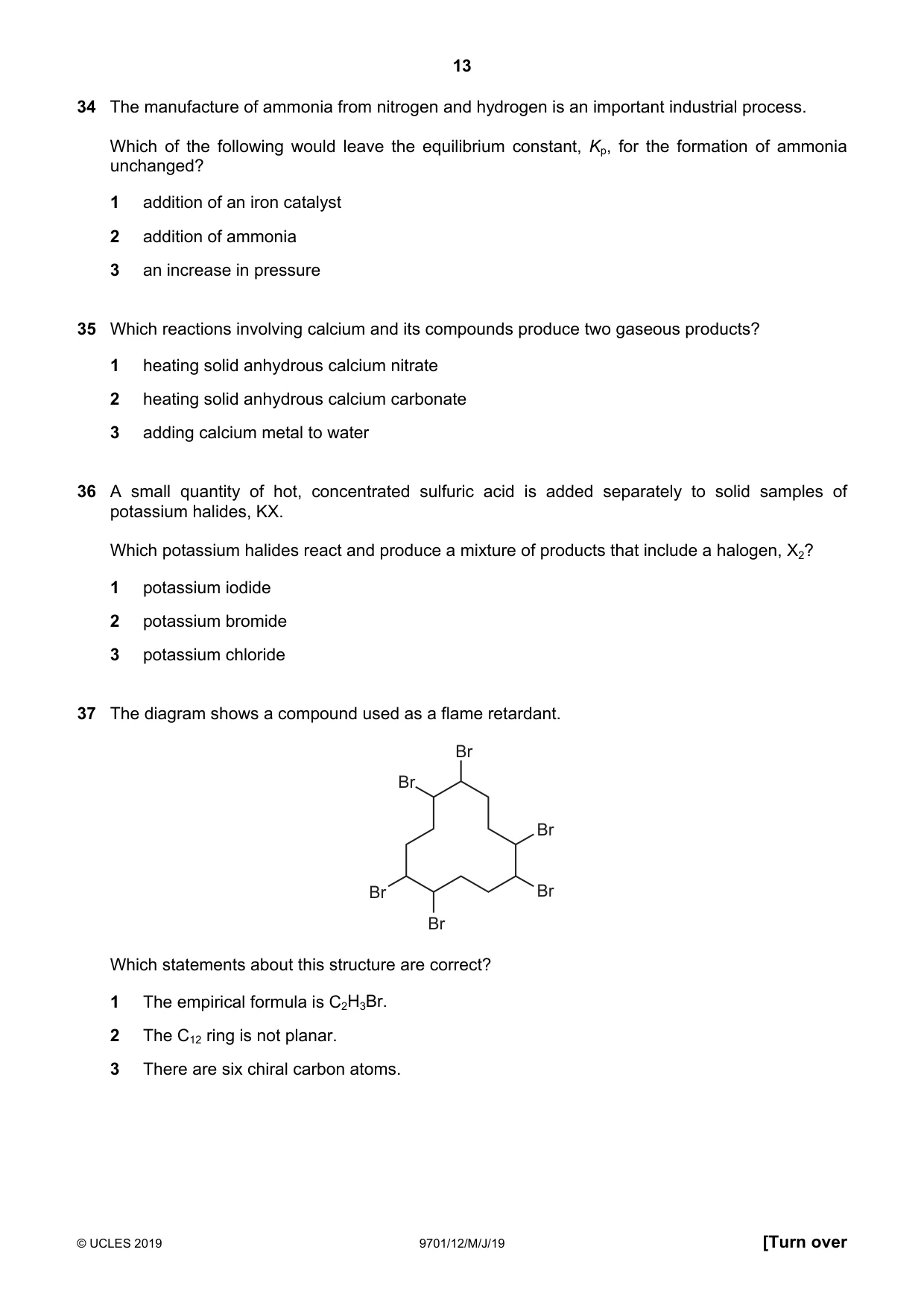
Q37 · The diagram shows a compound used as a flame retardant
37 The diagram shows a compound used as a flame retardant. Br Br Br Br Br Br Which statements about this structure are correct? 1 The empirical formula is C2H3Br. 2 The C12 ring is not planar. 3 There are six chiral carbon atoms.
Mark scheme: A
Q38 · Halogenoalkanes can be hydrolysed using aqueous sodium hydroxide
38 Halogenoalkanes can be hydrolysed using aqueous sodium hydroxide. Which compounds tend to be hydrolysed by an SN1 mechanism? 1 CH3CH2CCl (CH3)CH2CH3 2 CH3CH2CBr(CH3)CH2CH3 3 CH3CH2CH(CH3)CH2CH2Br
Mark scheme: B
Q39 · In an organic synthesis, a 62% yield of product is achieved
39 In an organic synthesis, a 62% yield of product is achieved. Which conversions are consistent with this information? 1 74.00 g of butan-2-ol → 44.64 g of butanone 2 74.00 g of butan-1-ol → 54.56 g of butanoic acid 3 74.00 g of 2-methylpropan-1-ol → 54.56 g of 2-methylpropanoic acid
Mark scheme: A
More questions on Reacting masses and volumes (of solutions and gases)
Q40 · An oxidising agent that can oxidise ethanal to ethanoic acid or ethanoate ions will also…
40 An oxidising agent that can oxidise ethanal to ethanoic acid or ethanoate ions will also oxidise methanoic acid, HCO2H, to carbon dioxide and water. Which reagents, on heating, will react differently with HCO2H and CH3CO2H? 1 Na2CO3(aq) 2 Fehling’s reagent 3 dilute acidified KMnO4
Mark scheme: C
What was in this paper
The subtopics covered by these 40 questions, and how many questions each got. Open one in a new tab to see every Cambridge question on it.
3Similarities and trends in the properties of the Group 2 metals, magnesium to barium, and their compounds3Aldehydes and ketones2Chemical equilibria: reversible reactions, dynamic equilibrium2Halogenoalkanes2Periodicity of chemical properties of the elements in Period 32Addition polymerisation1Alcohols1Bonding and structure1Effect of temperature on reaction rates and the concept of activation energy1Electrons, energy levels and atomic orbitals1Enthalpy change, ΔH1Esters1Formulas1Homogeneous and heterogeneous catalysts1Infrared spectroscopy1Intermolecular forces, electronegativity and bond properties1Ionisation energy1Isomerism: optical1Isomerism: structural isomerism and stereoisomerism1Mass spectrometry1Nitrogen and sulfur1Organic synthesis1Particles in the atom and atomic radius1Periodicity of physical properties of the elements in Period 31Reacting masses and volumes (of solutions and gases)1Redox processes: electron transfer and changes in oxidation number (oxidation state)1Relative masses of atoms and molecules1Shapes of organic molecules; σ and π bonds1Some reactions of the halide ions1The gaseous state: ideal and real gases and pV = nRT1The reactions of chlorine1What you needed in this session
Cambridge’s own grade thresholds for 2019 May/June, Paper 1 · Variant 2. A higher threshold means an easier paper — the bar moves with how the cohort did.